Inaugural “MyRCA” interdisciplinary faculty cohort empowers researchers to bring their work to life
UMBC’s new Make Your Research Come Alive (MyRCA) program is helping faculty translate their scholarship into compelling stories that resonate across disciplines, sectors, and audiences. Launched in November 2025, the program wrapped up its inaugural cohort with a May showcase.
“We created the MyRCA program to help faculty strengthen their research communication skills and effectively convey the significance and real-world impact of their work beyond traditional academic audiences and funding pathways,” says Christine Mallinson, assistant vice president for research and scholarly impact. “It also encourages faculty to think strategically and creatively about visibility, partnerships, collaboration, and long-term impact,” she adds.
Led by the Division of Research and Creative Achievement in partnership with the Office of Institutional Advancement, MyRCA brought together 14 faculty members for twice-monthly workshops and working group sessions, a January mini-retreat, and the culminating showcase. The program focused on identifying and articulating research impact, translating specialized scholarship for broad audiences, developing compelling narratives and pitches, understanding funding landscapes, exploring pathways for engagement with corporate, community, and philanthropic partners, and strengthening interdisciplinary collaboration.
“The value of this program is in connecting with each other,” cohort member Foad Hamidi, associate professor of information systems, shared at the showcase. “Strong research communication and collaboration can help our research come alive,” adds Dong Li, another cohort member and assistant professor of computer science and electrical engineering. Li added, “We are not just researchers, we are telling our story to our audience.”
The value of connection
The program intentionally grouped faculty into smaller interdisciplinary teams organized around broad themes such as health, youth, and the environment. These connections quickly sparked new ideas and collaborations.
For instance, Lauren Clay, professor and chair of emergency and disaster health systems, connected with Li, after learning about his work on wearable health-monitoring devices. Clay wondered how Li’s technology could support a colleague’s research on paramedic response during extreme heat events, including monitoring heat stroke risks for marathon runners.
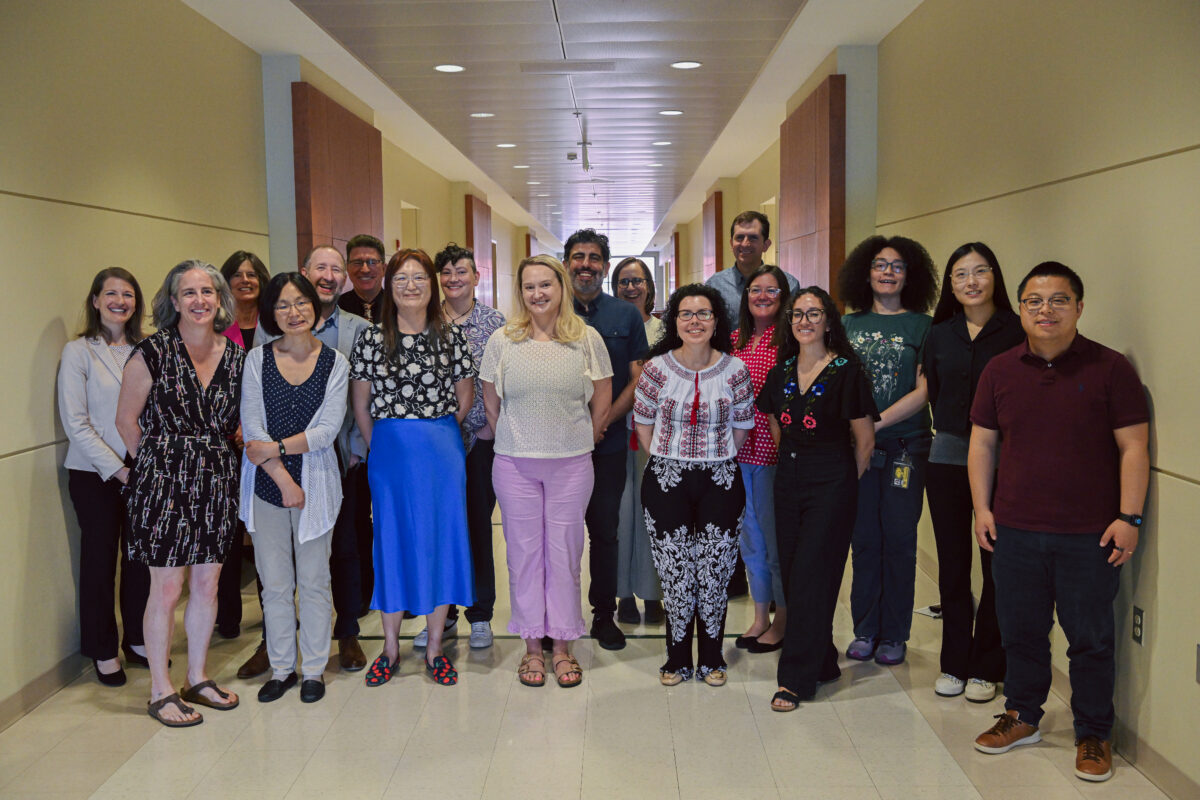 The inaugural MyRCA cohort and program organizers, left to right: Christine Mallinson, Ellen Kohl, Donna Ruginski, Karen Chen, Brian Kaufman, Karl Steiner, Shuling Yang, Sophie Comer-Warner, Amy Tondreau, Foad Hamidi, Linda Kidder Yarlott, Marie Christine-Daniel, Don Engel, Lauren Clay, Gabriella Weiss, Rebecca Williams, Yiwen Hu, Dong Li. Not pictured: Charissa Cheah.
A group including Gabriella Weiss, postdoctoral researcher with the Center for Spaces Sciences and Technology; Marie-Christine Daniel, associate professor of chemistry and biochemistry; and Sophie Comer-Warner, assistant professor of geography and environmental systems, examined remediation strategies for microplastics, heavy metals, and volatile organic compounds with a focus on wetlands. Their collaboration pointed to promising local funding opportunities with Maryland Sea Grant and Chesapeake Bay organizations.
Ellen Kohl, assistant professor of geography and environmental systems, strengthened a new science communication course with the skills she gained, and Shuling Yang, assistant professor of education, advanced her research using generative AI and Chinese pop music for biliteracy development. Brian Kaufman, professor of music, built on the UMBC Create Music Festival, which brings collaborative problem-solving into a typically performance-based discipline.
By the showcase, participants had developed polished pitches, public-facing materials, and broader impact narratives ready for funding proposals, donor outreach, and the media. Each received $500 in research support, along with new cross-campus and external connections.
MyRCA stretches faculty beyond their comfort zones
Mallinson has been excited to see the 14 faculty “stretch beyond their usual disciplinary comfort zones and immediately begin putting the skills and approaches they were learning into practice—developing cross-disciplinary proposals, crafting pitches, appearing in videos and podcasts, participating in panels, and bringing what they learned in the program back to their graduate students and colleagues.”
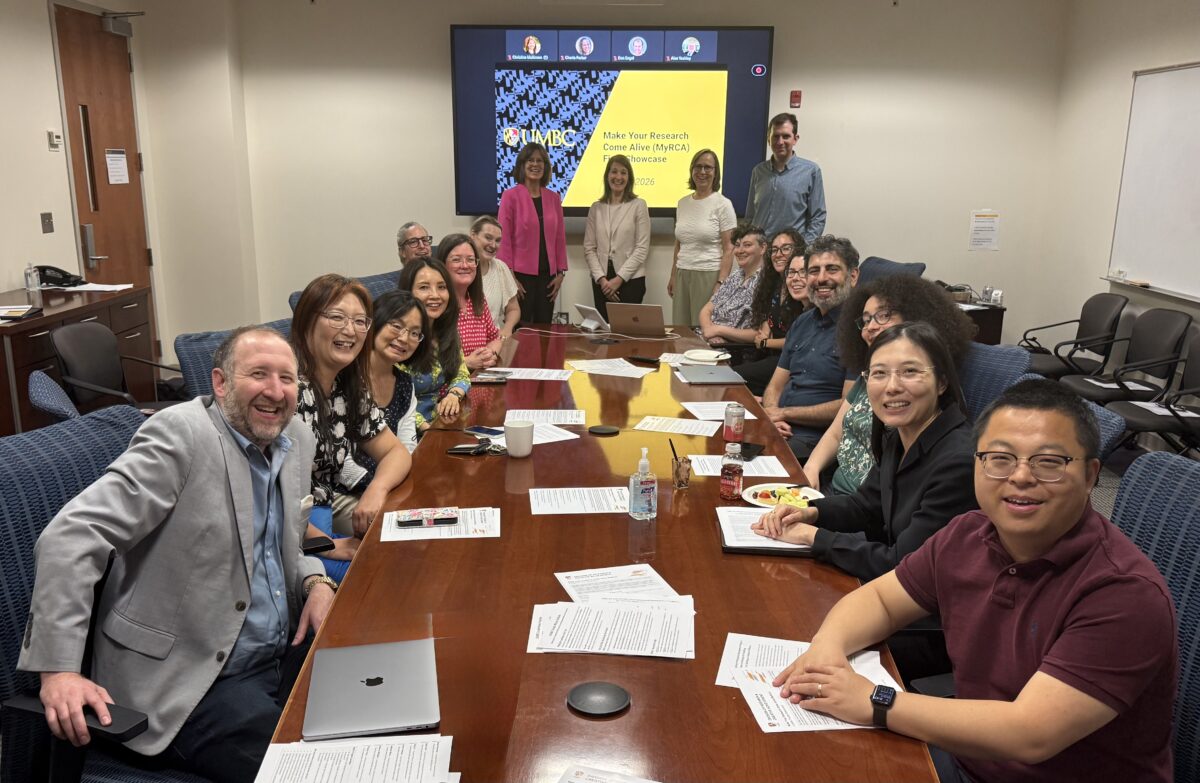 The inaugural MyRCA cohort shared progress and celebrated their accomplishments at a showcase event in May. (Photo by Karl Steiner)
Linda Kidder Yarlott, associate director for corporate research partnerships, highlighted the value of the partnership between the Division of Research and Creative Achievement and the Office of Institutional Advancement. “While federal funding agencies are looking for highly technical, methodology-driven proposals, it’s visionary, outcome-oriented narratives that clearly articulate the human impact and real-world return on investment that entice corporate and philanthropic partners,” Yarlott says.
Yarlott and Jocelyn Kehl, major gift officer for the College of Natural and Mathematical Sciences, worked with the cohort on practical skills—from strategic networking and optimizing LinkedIn profiles to crafting stories that resonate with donors and foundations. “Mentoring this cohort has been an incredibly rewarding experience, culminating in a spectacular program showcase where faculty teams powerfully demonstrated new communication skills that will help unlock new philanthropic pathways,” Yarlott shares.
For more information and to learn about the full 2025 – 2026 cohort, visit research.umbc.edu/myrca.
]]>
UMBC’s new Make Your Research Come Alive (MyRCA) program is helping faculty translate their scholarship into compelling stories that resonate across disciplines, sectors, and audiences. Launched...
https://umbc.edu/stories/myrca-empowers-interdisciplinary-researchers/
https://my3.my.umbc.edu/api/v0/pixel/news/160483/guest@my.umbc.edu/52d7d3b40ae47b848cd3806898a3a63d/api/pixel
cahss
chemistry-and-biochemistry
cnms
coeit
csee
edhs
education
ges
is
music
news
policy-and-society
rca
science-and-tech
story
UMBC News & Magazine
https://my3.my.umbc.edu/groups/umbc-news-magazine
https://assets1-my.umbc.edu/system/shared/avatars/groups/000/001/943/24435aa6207c452e7bc15cc74b42c7bb/xsmall.png?1748556657
https://assets1-my.umbc.edu/system/shared/avatars/groups/000/001/943/24435aa6207c452e7bc15cc74b42c7bb/original.png?1748556657
https://assets2-my.umbc.edu/system/shared/avatars/groups/000/001/943/24435aa6207c452e7bc15cc74b42c7bb/xxlarge.png?1748556657
https://assets2-my.umbc.edu/system/shared/avatars/groups/000/001/943/24435aa6207c452e7bc15cc74b42c7bb/xlarge.png?1748556657
https://assets3-my.umbc.edu/system/shared/avatars/groups/000/001/943/24435aa6207c452e7bc15cc74b42c7bb/large.png?1748556657
https://assets1-my.umbc.edu/system/shared/avatars/groups/000/001/943/24435aa6207c452e7bc15cc74b42c7bb/medium.png?1748556657
https://assets2-my.umbc.edu/system/shared/avatars/groups/000/001/943/24435aa6207c452e7bc15cc74b42c7bb/small.png?1748556657
https://assets1-my.umbc.edu/system/shared/avatars/groups/000/001/943/24435aa6207c452e7bc15cc74b42c7bb/xsmall.png?1748556657
https://assets2-my.umbc.edu/system/shared/avatars/groups/000/001/943/24435aa6207c452e7bc15cc74b42c7bb/xxsmall.png?1748556657
UMBC News & Magazine
1
0
false
Mon, 01 Jun 2026 15:17:46 -0400
Mon, 01 Jun 2026 15:17:46 -0400
UMBC’s Global Learning Lab receives Innovative Excellence in Internationalization Award
The Association of International Education Administrators (AIEA) has awarded UMBC’s Global Learning Lab one of two Innovative Excellence in Internationalization Awards. This award honors creative, replicable, and innovative initiatives that are critical to internationalization and require strong leadership to achieve. The AIEA commends the Global Learning Lab for reflecting UMBC’s commitment to justice, equity, diversity, and inclusion by fostering inclusive, cost-effective models that integrate global perspectives into the curriculum.
The lab’s primary mission is to support faculty development in increasing student access to global learning opportunities. Through a cohort-based model, the lab brings faculty together for a series of workshops to develop best practices for integrating applied global learning into the curriculum. The initiative was originally launched as a pilot program by the Center for Global Engagement (CGE) and the College of Arts, Humanities, and Social Sciences (CAHSS) Dean’s Office in support of CAHSS faculty. In fall 2025, the lab was opened to all faculty with support from the Office of the Provost. Faculty who participate in this initiative produce concrete deliverables, such as course maps, faculty-led study abroad programs, and Collaborative Online International Learning (COIL) projects.
“To date, 48 faculty members have participated across 27 unique departments ranging from biological sciences to visual arts to chemical, biochemical, and environmental engineering,” according to Provost Provost and Senior Vice President for Academic Affairs, Manfred van Dulmen‘s February campus newsletter. “Projects continue to positively impact the student experience and have included nine mapping initiatives, 12 COIL projects, and 27 study abroad programs.”
Developing an intercultural curriculum
To receive the Excellence in Internationalization Award, the Global Learning Lab had to be grounded in the principles of comprehensive internationalization—an inclusive process that impacts teaching, research, and service. It also had to align with at least two of UNESCO’s 17 Sustainable Development Goals, reflect the underlying principles of justice, equity, diversity, and inclusion in higher education, and serve as a replicable model for other institutions.
Cheryl North, clinical associate professor of education, and Takashi Yamashita, director and professor of sociology, anthropology, and public health (SAPH), are alumni of the inaugural cohort. They were both in the process of designing international university and community partnerships, in Germany and Japan, respectively, before the Global Learning Lab was launched. The lab provided technical and collegial support that bridged the gap between idea and implementation.
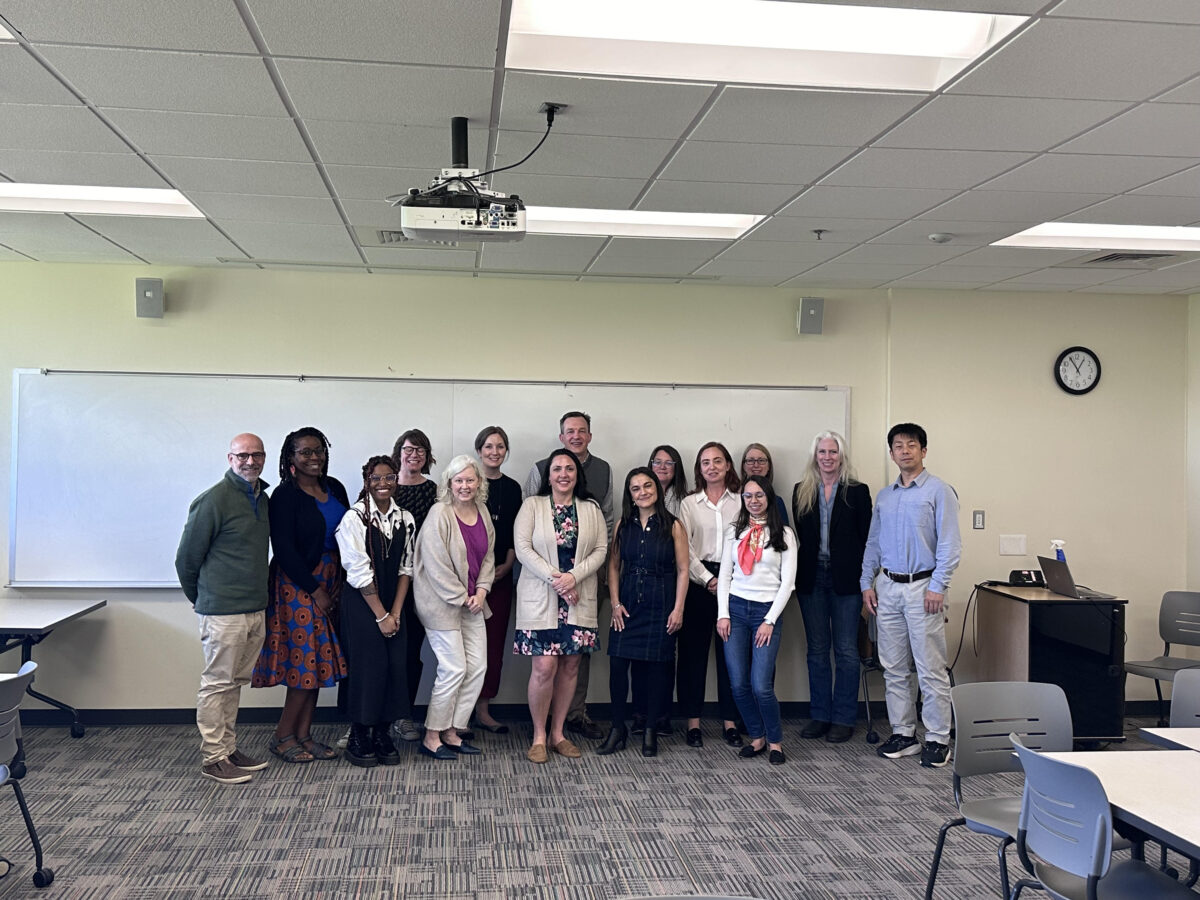 (l-r): Brian Souders (former CGE staff); Ogonna Owu Jones (former CGE staff); Alicyn Curtis (CGE staff); Rebecca Grenouilleau-Loescher (faculty fellow, modern languages, linguistics, and intercultrual communication); Katie Birger (faculty fellow, SAPH); Jessica Cook (faculty fellow, Sondheim Public Affairs Scholars Program); Katherine Heird (CGE staff); David Schultz (faculty fellow, pscyhology); Yolanda Valencia (faculty fellow, geography and environment sciences); Lauren Clay (faculty fellow, emergency and disaster health services); Racquel Matos (visiting dean of the faculty of education and psychology at Universidade Católica Portuguesa in Portugal); Jessica Pfeifer (faculty fellow, philosophy); Lina Mora (CGE intern/intercultural communication graduate student, North (second on the right); and Yamashita (first on the right). (Image courtesy of CGE)
North, along with faculty at the University of Kassel in Germany, had established the foundations for a virtual classroom exchange for their education students, but had experienced technical and scheduling conflicts. “After participating in the Global Learning Lab, we learned to structure the collaboration effectively,” said North. “When we implemented these insights, UMBC students were able to share completed lessons and reflections, while the German students shared their process in the early stages of planning and implementation. Despite the scheduling differences, the exchange was successful, meaningful, and professionally enriching for everyone involved.”
The lab’s funding, technical training, and networking opportunities provided essential support that helped Yamashita develop the Global Health and Aging in Japan faculty-led study abroad program, which will launch in summer 2026.
“Developing a study abroad program can often feel like an isolated effort for a single faculty member,” says Yamashita. “Having a dedicated technical support team from CGE, along with a community of UMBC colleagues to share unique ideas, made the process much more engaging. These interactions kept me inspired and motivated to bring this program to UMBC students.”
Campus-wide internationalization
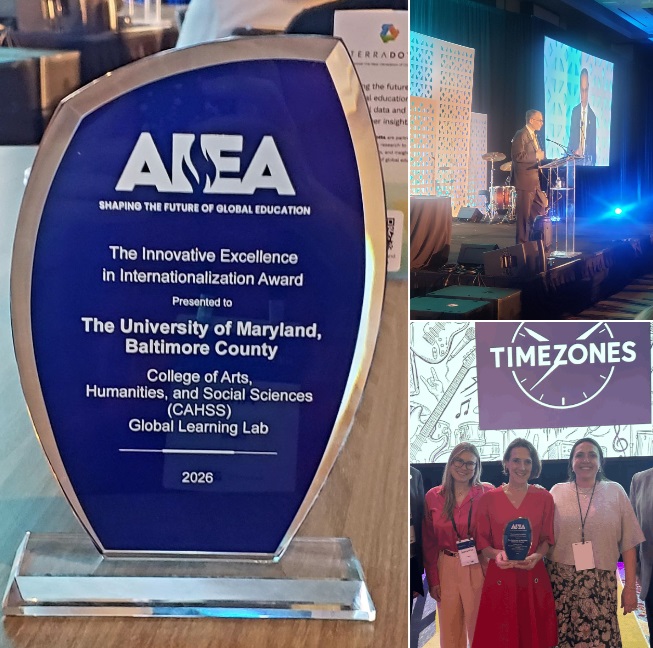
UMBC faculty and staff at the AIEA award. (Image courtesy of CGE)
“The impact of the Global Learning Lab has been profound,” wrote Ana Oskoz, vice provost for faculty affairs, in her recommendation letter. “It is a shining example of innovative internationalization that prioritizes inclusivity, equity, and academic excellence.”
Faculty interested in participating in the Global Learning Lab are encouraged to follow the Faculty Affairs page on MyUMBC for notifications regarding future offerings.
]]>
The Association of International Education Administrators (AIEA) has awarded UMBC’s Global Learning Lab one of two Innovative Excellence in Internationalization Awards. This award honors creative,...
https://umbc.edu/stories/umbcs-global-learning-lab-receives-internationalization-award/
https://my3.my.umbc.edu/api/v0/pixel/news/157429/guest@my.umbc.edu/139f4df23c515634323db492b84665cc/api/pixel
cahss
center-for-global-engagement
community
education
international
news
research
saph
story
UMBC News & Magazine
https://my3.my.umbc.edu/groups/umbc-news-magazine
https://assets1-my.umbc.edu/system/shared/avatars/groups/000/001/943/24435aa6207c452e7bc15cc74b42c7bb/xsmall.png?1748556657
https://assets1-my.umbc.edu/system/shared/avatars/groups/000/001/943/24435aa6207c452e7bc15cc74b42c7bb/original.png?1748556657
https://assets2-my.umbc.edu/system/shared/avatars/groups/000/001/943/24435aa6207c452e7bc15cc74b42c7bb/xxlarge.png?1748556657
https://assets2-my.umbc.edu/system/shared/avatars/groups/000/001/943/24435aa6207c452e7bc15cc74b42c7bb/xlarge.png?1748556657
https://assets3-my.umbc.edu/system/shared/avatars/groups/000/001/943/24435aa6207c452e7bc15cc74b42c7bb/large.png?1748556657
https://assets1-my.umbc.edu/system/shared/avatars/groups/000/001/943/24435aa6207c452e7bc15cc74b42c7bb/medium.png?1748556657
https://assets2-my.umbc.edu/system/shared/avatars/groups/000/001/943/24435aa6207c452e7bc15cc74b42c7bb/small.png?1748556657
https://assets1-my.umbc.edu/system/shared/avatars/groups/000/001/943/24435aa6207c452e7bc15cc74b42c7bb/xsmall.png?1748556657
https://assets2-my.umbc.edu/system/shared/avatars/groups/000/001/943/24435aa6207c452e7bc15cc74b42c7bb/xxsmall.png?1748556657
UMBC News & Magazine
8
0
false
Thu, 12 Mar 2026 10:10:48 -0400
Fri, 13 Mar 2026 15:49:18 -0400
UMBC’s Paws & Pivot free webinar series helps federal workers rebuild their careers
In early 2025, thousands of U.S. federal workers were unexpectedly laid off, many living in the Washington, D.C., Maryland, Virginia (DMV) area. Patrick Shirdon ’92, economics, a civil servant of 33 years, was among those left to grapple with the uncertainty and frustration of restarting a career. While searching for resources, he found UMBC’s Paws & Pivot free webinar series, where career development experts share concrete skills on resume writing, interview preparation, navigating a tech-centered job market, and more.
“After losing my job, I didn’t know what to do. I was just so happy to find something to do—and this series became so much more than that for me,” wrote Shirdon in an email to Rex Jarrett, the director of professional programs in UMBC’s Division of Professional Studies (DPS).
“Growing up in Montgomery County, being part of the DMV, I knew a lot of people whose parents were federal workers,” says Jarrett. “Many of my friends followed in those footsteps and were impacted by the layoffs.” The 2024 annual Maryland employment statistics report totaled the Maryland workforce at 2,764,497 people. Of these, some 530,257 workers, or 19.2 percent, were employed by federal, State, and local governments in the public sector.” Those impacted were asking for help to access new professional networks via Facebook and LinkedIn after decades of serving their country,” Jarrett noticed.
With skills in webinar development, Jarrett knew this format could quickly serve a wide audience. He reached out to Jill Barr, then associate vice provost and assistant dean of the Graduate School, and Julie Gilless, assistant vice provost for marketing in DPS, with an idea for a job skills development webinar series. What began as an idea grew into a conversation, and with the full support of Barr and Gilless, became a call to action.
Gathering the Paws & Pivot pack
Jarrett came to UMBC in fall 2024 after more than half a decade leading the Harvard Business Analytics Program. He was excited to return home to Maryland and put his expertise in career growth and community engagement to work for the greater good. Jarrett is passionate about his work because it helps him answer a question that is always on his mind—How can I make the world a better place? He did not anticipate that the answer would come so soon after joining UMBC, nor that it would involve hundreds of federal workers.
Quickly, the team created the Impacted Federal Workers Think Tank Committee and agreed that the series would be free for everyone—regardless of a UMBC affiliation—and remain accessible on the division’s YouTube channel. Thanks to DPS’s Rashad Cheeks, associate director of marketing, and Theresa Mabe, marketing data manager, the series received a memorable name and logo. The first episode of Paws & Pivot, “Building Your Digital Brand,” aired on Wednesday, April 16, 2025, and featured Rowena Winkler, assistant director for graduate student career development.
 Jarrett, with the DPS team (l-r): Allison Jones, assistant vice provost, Gilless, Winkler,
Elliot Talbert-Goldstein ’11, media and communication studies, director of digital marketing, Mabe, and Cheeks. (Brad Ziegler/UMBC)
Subsequent episodes were co-hosted by a cadre of UMBC supporters, including the Alex. Brown Center for Entrepreneurship and Innovation, the Career Center, and the Department of Education. Community partners also joined the effort. Batul Sadiq, owner of BHS Image Consulting based in Gaithersburg, Maryland, hosted the 11th episode, “First Impressions Matter: Dress The Part, Brand With Intention.” The Paws & Pivot team is heartened by the wonderful response, says Jarrett, as well as the steady stream of new volunteers eager to get involved. And the impact is real.
A few months after tuning into a Paws & Pivot webinar, Shirdon reached out to Jarrett: “Today, I attended my orientation day with the human resources team at my new organization. It has been 33 years since I was a ‘new’ employee!” wrote Shirdon.
Award-winning programming
Since launching in April, Paws & Pivot has hosted 15 sessions, amassed 150 registered participants, and engaged with over 900 impacted federal workers and government contractors. Over 90 percent of attendees say they would recommend the series to other impacted federal workers. The University Professional and Continuing Education Association (UPCEA) has nominated Paws & Pivot for their “2026 UPCEA Regional Program Award‘ as a Mid-Atlantic educational program that focuses on addressing a regional need. Jarrett notes that the initiative has become a model of regional engagement, scalable virtual learning, and social impact, grounded in the values of continuing education, career resiliency, and access.
“Paws & Pivot was/is amazing. In addition to the wonderful, technical information taught at the Wednesday sessions, an unintended benefit for me was the ability to have an event on my calendar. It gave me something to look forward to, and truthfully, I learned a lot,” writes Shirdon. “I certainly had my share of ups and downs, more downs than ups. But UMBC’s effort was an absolute blessing for me. Now, I just have to go and do great stuff! Ball in my court.”
Paws & Pivot’s 16th episode will air at noon on Wednesday, November 12, 2025.
]]>
In early 2025, thousands of U.S. federal workers were unexpectedly laid off, many living in the Washington, D.C., Maryland, Virginia (DMV) area. Patrick Shirdon ’92, economics, a civil servant of...
https://umbc.edu/stories/paws-pivot-webinars-help-federal-workers/
https://my3.my.umbc.edu/api/v0/pixel/news/154271/guest@my.umbc.edu/5103f4ca545fd2d238e127e650f0053e/api/pixel
alexbrowncenter
alumi
careercenter
dps
education
fall-2025
impact
magazine
story
UMBC News & Magazine
https://my3.my.umbc.edu/groups/umbc-news-magazine
https://assets1-my.umbc.edu/system/shared/avatars/groups/000/001/943/24435aa6207c452e7bc15cc74b42c7bb/xsmall.png?1748556657
https://assets1-my.umbc.edu/system/shared/avatars/groups/000/001/943/24435aa6207c452e7bc15cc74b42c7bb/original.png?1748556657
https://assets2-my.umbc.edu/system/shared/avatars/groups/000/001/943/24435aa6207c452e7bc15cc74b42c7bb/xxlarge.png?1748556657
https://assets2-my.umbc.edu/system/shared/avatars/groups/000/001/943/24435aa6207c452e7bc15cc74b42c7bb/xlarge.png?1748556657
https://assets3-my.umbc.edu/system/shared/avatars/groups/000/001/943/24435aa6207c452e7bc15cc74b42c7bb/large.png?1748556657
https://assets1-my.umbc.edu/system/shared/avatars/groups/000/001/943/24435aa6207c452e7bc15cc74b42c7bb/medium.png?1748556657
https://assets2-my.umbc.edu/system/shared/avatars/groups/000/001/943/24435aa6207c452e7bc15cc74b42c7bb/small.png?1748556657
https://assets1-my.umbc.edu/system/shared/avatars/groups/000/001/943/24435aa6207c452e7bc15cc74b42c7bb/xsmall.png?1748556657
https://assets2-my.umbc.edu/system/shared/avatars/groups/000/001/943/24435aa6207c452e7bc15cc74b42c7bb/xxsmall.png?1748556657
UMBC News & Magazine
0
0
false
Wed, 05 Nov 2025 15:43:46 -0500
Wed, 05 Nov 2025 15:43:46 -0500
UMBC and Building STEPs partner to help Baltimore City high school students reach their potential in STEM
Boing! Bouncy balls strike the hallway floor as small groups of students measure bounce heights with a meterstick and record data. They repeat the test in a carpeted classroom, then analyze results in Excel, discussing how surfaces affect energy conversion.
This might sound like a physics laboratory, but it’s actually a math course for high schoolers in Building Science Technology Education Partnerships (STEPs), a college-preparatory program for students from under-resourced high schools in Baltimore City. For two weeks this summer, 21 rising seniors and college-bound students, nine college-student tutors, and instructor Rebecca Kirvan, M.A. ’13, secondary education and teaching, filled the fourth floor of UMBC’s Interdisciplinary Life Sciences Building for intensive, hands-on math instruction each afternoon. In the mornings, the students participated in professional development programming, such as a financial literacy workshop and team-based problem-solving challenges.
This is the fifth year of collaboration between Building STEPS and UMBC, but thanks to a deepening relationship between the organization and the College of Natural and Mathematical Sciences (CNMS), this year the summer program came to UMBC’s campus for the first time. In addition, the math portion shifted from traditional tutoring to an adapted version of MATH 110: Math in Action, a unique laboratory-style math course heading into its third year being taught at UMBC.
 UMBC tutor Xavier Cohen (left), a rising senior majoring in math and computer science, has been tutoring math in various capacities since 2021. He says that he sees firsthand how the activity-based curriculum used by Building STEPs improves student learning. (Brad Ziegler/UMBC)
“UMBC and CNMS have been incredible collaborators, providing Building STEPs students with accessible and effective math enrichment in an immersive college experience,” says Debra Hettleman, CEO of Building STEPs.
William R. LaCourse, CNMS dean, believes strongly in making math education engaging and relevant for all students, in support of developing their critical thinking skills. “Teaching math in an interactive format shows the students how it relates to their everyday lives,” he says. “Creating opportunities for them to make those connections is so important.”
From tutoring to hands-on labs
In 2021, Cindy Greenwood, associate director of UMBC’s Center for Women in Technology, coordinated the original tutoring initiative for her capstone project in UMBC’s certificate program in community leadership, after learning from Building STEPs that that was what they needed most.
Alexis O’Malley ’18, mathematics and psychology, took the lead developing a robust curriculum for the tutors to implement on top of her role as a calculus instructor in CNMS. Until this year, the University of Baltimore hosted the tutoring sessions. For 2025, CNMS hired Kirvan to modify the activities in MATH 110, which O’Malley also originally led with support from math department faculty.
“As a former high school teacher, I’ve enjoyed the opportunity to adapt college labs for a high school audience,” Kirvan says. “It’s great to work with this group of students and help them beef up their math skills and get ready for college.”
 UMBC alumna Rebecca Kirvan, right, taught the lab-based math course this summer. (Brad Ziegler/UMBC)
The students see the benefits.
“It’s been good to review concepts and practice my math skills,” shared Benjamin Kima, a participant from Mergenthaler Vocational-Technical High School. Sam Boad, also at Mergenthaler, said, “I’m glad they’re giving us a chance to see the content ahead of the school year.” Zaiqah Pinkney, from City Neighbors High School, added, “I like hands-on activities. It helps me learn better.”
“Students consistently rate math as their favorite part of the day,” shares Sheyna Mikeal, chief program officer at Building STEPs. “It challenges them, but the small-group structure, guided by dedicated tutors, builds confidence and encourages real growth.”
Campus immersion and career prep
Beyond providing math instruction, CNMS funded lunches at UMBC’s True Grit’s dining hall, freeing up Building STEPs’ budget for student transportation and enabling greater participation.
“I’ve enjoyed the opportunity to be on a college campus,” shared Brandon Thomas, a student at Mergenthaler.
And beyond the summer program, a larger cohort of Building STEPs students visited UMBC during the semester. They heard presentations from CNMS departments and took a tour of campus. “We’ve witnessed the power of learning on a college campus shifting the students’ perspective,” Mikeal says. “It reinforces that college is not just a goal, it’s an environment where they belong.”
Other Building STEPs activities include visits to companies like Northrop Grumman and Beckton-Dickinson, workshops on searching for and applying to colleges, and one-on-one feedback with volunteer writing advisors.
 Benjamin Kima (standing) runs a trial in a lab activity about potential and kinetic energy. (Brad Ziegler/UMBC)
Strength beyond academics
Students in the program, founded in 2000, are recommended by college counselors and teachers, and must maintain a 3.0 GPA. This past academic year, there were 83 juniors and 83 seniors enrolled, and there are 175 Building STEPs alumni. Nearly 80 percent earn a college degree, and nearly two-thirds earn degrees in STEM. Coming from 15 of Baltimore’s most challenged high schools, 87 percent are first-generation college graduates. Alumni return from college to offer programming to current participants, fostering leadership development.
“Together with UMBC, we’re not only strengthening academic skills—we’re also expanding access to opportunity,” Mikeal says.
LaCourse sees providing space, funds, and effective and engaging math activities to benefit local high schoolers as a natural fit for the college.
“Building STEPs participants are bright, motivated students who just need a little support to reach their potential,” LaCourse says. “It’s a privilege to be able to offer the resources the program needs—from classrooms to curriculum—to enable an enriching summer math and professional development experience. We hope to see some of their faces on campus again soon—this time as UMBC students.”
 Building STEPs participant Brandon Thomas relaxes with his group members between experiments. (Brad Ziegler/UMBC)
]]>
Boing! Bouncy balls strike the hallway floor as small groups of students measure bounce heights with a meterstick and record data. They repeat the test in a carpeted classroom, then analyze...
https://umbc.edu/stories/umbc-building-steps-partnership/
https://my3.my.umbc.edu/api/v0/pixel/news/151257/guest@my.umbc.edu/78258b47f3068ff9dd7afde03f0bddb5/api/pixel
alumni
baltimore-city
cahss
cnms
coeit
community
community-leadership
cwit
education
news
science-and-tech
story
UMBC News & Magazine
https://my3.my.umbc.edu/groups/umbc-news-magazine
https://assets1-my.umbc.edu/system/shared/avatars/groups/000/001/943/24435aa6207c452e7bc15cc74b42c7bb/xsmall.png?1748556657
https://assets1-my.umbc.edu/system/shared/avatars/groups/000/001/943/24435aa6207c452e7bc15cc74b42c7bb/original.png?1748556657
https://assets2-my.umbc.edu/system/shared/avatars/groups/000/001/943/24435aa6207c452e7bc15cc74b42c7bb/xxlarge.png?1748556657
https://assets2-my.umbc.edu/system/shared/avatars/groups/000/001/943/24435aa6207c452e7bc15cc74b42c7bb/xlarge.png?1748556657
https://assets3-my.umbc.edu/system/shared/avatars/groups/000/001/943/24435aa6207c452e7bc15cc74b42c7bb/large.png?1748556657
https://assets1-my.umbc.edu/system/shared/avatars/groups/000/001/943/24435aa6207c452e7bc15cc74b42c7bb/medium.png?1748556657
https://assets2-my.umbc.edu/system/shared/avatars/groups/000/001/943/24435aa6207c452e7bc15cc74b42c7bb/small.png?1748556657
https://assets1-my.umbc.edu/system/shared/avatars/groups/000/001/943/24435aa6207c452e7bc15cc74b42c7bb/xsmall.png?1748556657
https://assets2-my.umbc.edu/system/shared/avatars/groups/000/001/943/24435aa6207c452e7bc15cc74b42c7bb/xxsmall.png?1748556657
UMBC News & Magazine
1
0
false
Fri, 01 Aug 2025 12:07:10 -0400
Fri, 01 Aug 2025 12:07:10 -0400
UMBC and MSDE launch admissions pathway for high school students aspiring to become teachers
Building STEPs participant Brandon Thomas relaxes with his group members between experiments. (Brad Ziegler/UMBC)
]]>
Boing! Bouncy balls strike the hallway floor as small groups of students measure bounce heights with a meterstick and record data. They repeat the test in a carpeted classroom, then analyze...
https://umbc.edu/stories/umbc-building-steps-partnership/
https://my3.my.umbc.edu/api/v0/pixel/news/151257/guest@my.umbc.edu/78258b47f3068ff9dd7afde03f0bddb5/api/pixel
alumni
baltimore-city
cahss
cnms
coeit
community
community-leadership
cwit
education
news
science-and-tech
story
UMBC News & Magazine
https://my3.my.umbc.edu/groups/umbc-news-magazine
https://assets1-my.umbc.edu/system/shared/avatars/groups/000/001/943/24435aa6207c452e7bc15cc74b42c7bb/xsmall.png?1748556657
https://assets1-my.umbc.edu/system/shared/avatars/groups/000/001/943/24435aa6207c452e7bc15cc74b42c7bb/original.png?1748556657
https://assets2-my.umbc.edu/system/shared/avatars/groups/000/001/943/24435aa6207c452e7bc15cc74b42c7bb/xxlarge.png?1748556657
https://assets2-my.umbc.edu/system/shared/avatars/groups/000/001/943/24435aa6207c452e7bc15cc74b42c7bb/xlarge.png?1748556657
https://assets3-my.umbc.edu/system/shared/avatars/groups/000/001/943/24435aa6207c452e7bc15cc74b42c7bb/large.png?1748556657
https://assets1-my.umbc.edu/system/shared/avatars/groups/000/001/943/24435aa6207c452e7bc15cc74b42c7bb/medium.png?1748556657
https://assets2-my.umbc.edu/system/shared/avatars/groups/000/001/943/24435aa6207c452e7bc15cc74b42c7bb/small.png?1748556657
https://assets1-my.umbc.edu/system/shared/avatars/groups/000/001/943/24435aa6207c452e7bc15cc74b42c7bb/xsmall.png?1748556657
https://assets2-my.umbc.edu/system/shared/avatars/groups/000/001/943/24435aa6207c452e7bc15cc74b42c7bb/xxsmall.png?1748556657
UMBC News & Magazine
1
0
false
Fri, 01 Aug 2025 12:07:10 -0400
Fri, 01 Aug 2025 12:07:10 -0400
UMBC and MSDE launch admissions pathway for high school students aspiring to become teachers

Thanks to award-winning education faculty and UMBC’s research-based teacher preparation programs, hundreds of Retriever alumni lead pre-k through 12-grade classrooms across the state, meeting the need for highly qualified teachers. Maryland’s high school students now have a unique opportunity to join their ranks by beginning their teacher training early in preparation for applying to UMBC’s teaching programs. This fall, UMBC joined an existing network of higher education institutions across Maryland that partner with the Maryland State Department of Education (MSDE) and the Teacher Academy of Maryland (TAM) to offer Maryland-high-school students interested in teaching a direct admissions pathway to UMBC’s undergraduate teacher education programs.
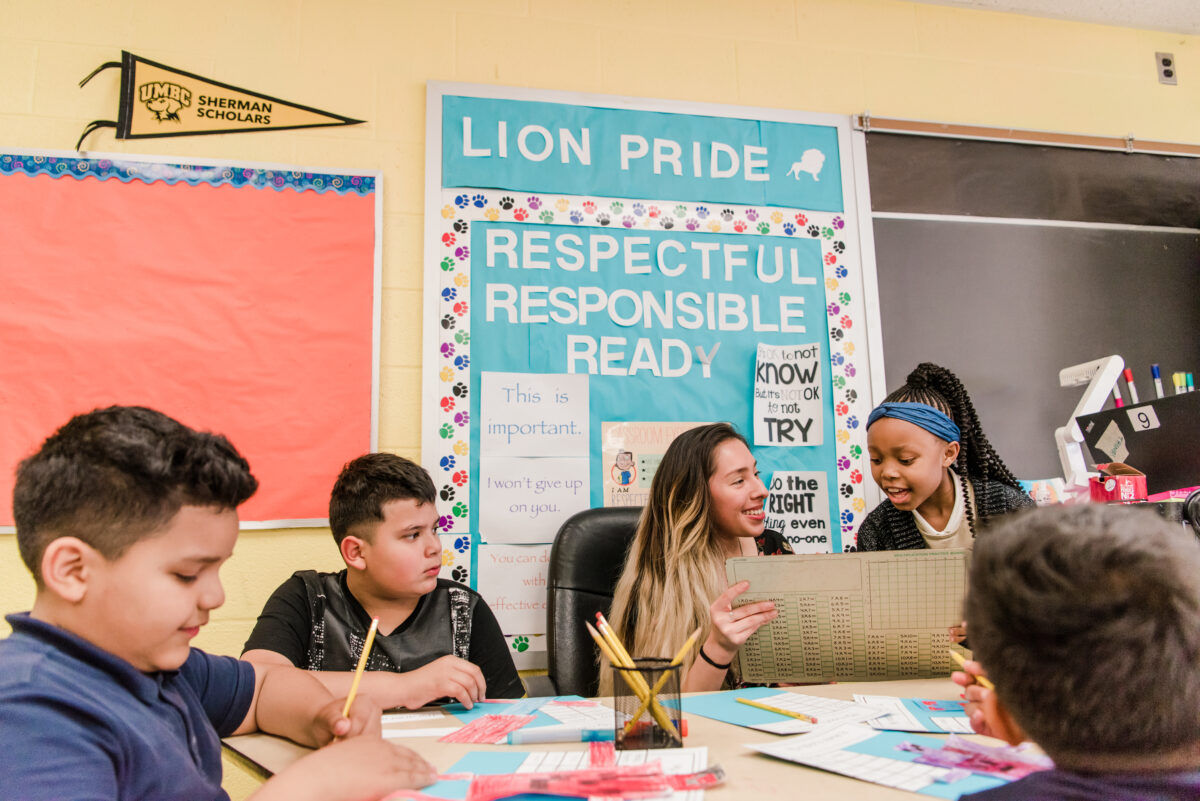 Sherman Teacher Scholars Program alumna, Vanessa Gonzalez ’19, American studies, during her first year teaching at Lakeland Elementary/Middle School in 2019. (Marlayna Demond ’11/UMBC)
UMBC awarded its first TAM scholarship and academic credit this fall to three first-year students, Layla Bugarini, Alna Thekkiniath, and Sofia Driver.“Once the word gets out that UMBC is a TAM-participating institution offering not only great benefits for TAM students but also a high quality and unique teacher education program, we anticipate many more aspiring educators will see UMBC as a destination institution for teacher education,” says Vickie Williams, director of student services and certification officer for UMBC’s Department of Education and a member of the organizing committee
TAM’s mission is to grow and diversify the teaching field by igniting high school students’ passion for teaching. The program provides them with foundational knowledge and skills essential for success as educators, learners, and leaders. Through a partnership with a higher education institution, participants gain valuable experience in a university setting which helps them prepare for their transition to education majors.
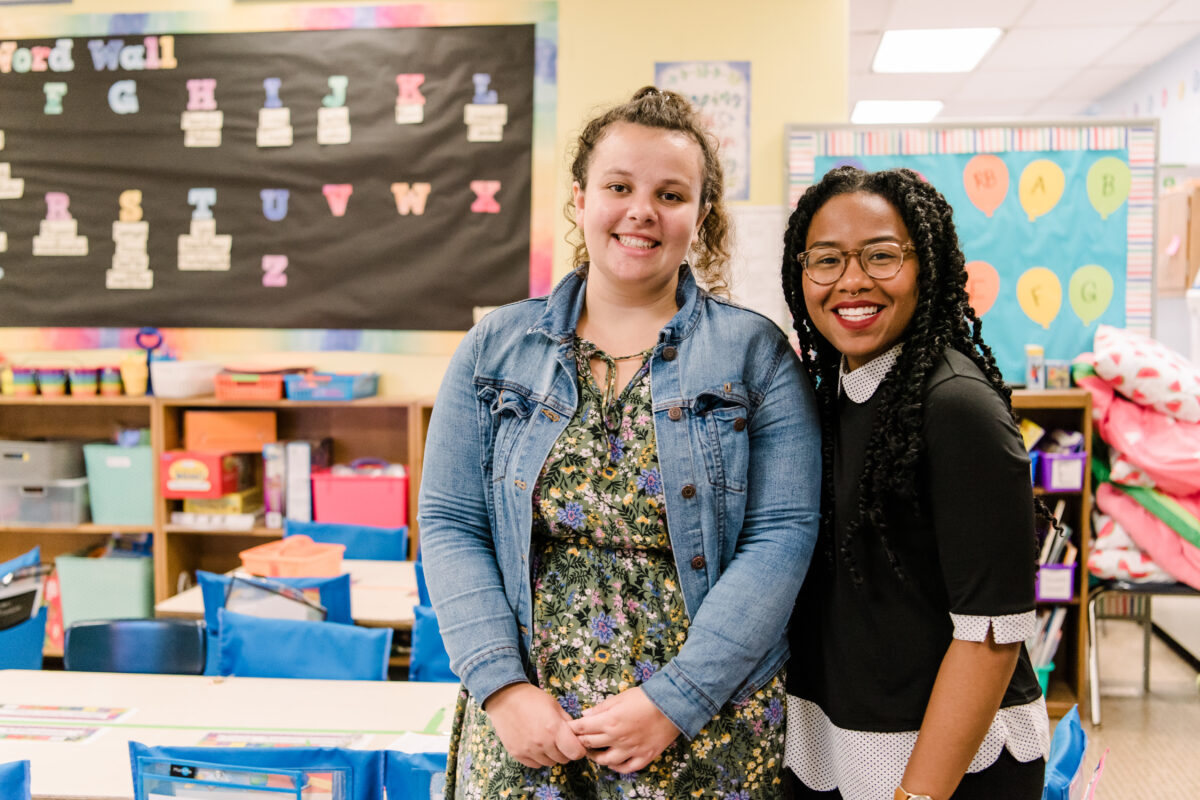 (l-r): Sherman Teacher Scholars Program alumni, Olivia Grimes ’19, individualized study, and Lydia Coley ’20, American studies, in 2020 during Grimes’s first year of teaching and Coley’s first semester as a student-teacher at Maree G. Farring Elementary/Middle School. (Marlayna Demond ’11/UMBC)
Participating high schoolers develop a portfolio that includes three high school courses: Human Growth and Development through Adolescence, Teaching as a Profession, and Foundations of Curriculum and Instruction. Students are also required to complete an internship in a classroom setting under the supervision of a TAM mentor. After fulfilling all the TAM requirements, students submit their portfolio for review and feedback to the university they plan to attend. Each university offers students different benefits.
UMBC is providing students who successfully complete the TAM program, with several incentives:
- a $75 application fee waiver
- three lower-level education elective credits that can be applied towards the 120-minimum credit graduation requirement
- for those who matriculate directly from high school, a $1,000 merit scholarship from the Homer and Martha Gudelsky and the Maggie Geeter Hrabowski Scholarship, to be applied directly to their UMBC account to assist with tuition, fees, and other educational expenses
- an opportunity to interview for UMBC’s Sherman Teacher Scholars Program.
“Our undergraduate students enter classrooms equipped with pedagogical knowledge, field experience, and expertise from their academic major. This prepares them for their teacher certification exams in their chosen grade level and subject area,” says Williams. “Collaborating with TAM provides high school students with exposure to rigorous education research and practice, along with guidance, financial support, and mentorship.”
“My journey with TAM began back in my freshman year at Eastern Technical High School [Baltimore County], where I had the opportunity to intern in a third-grade classroom at Rossville Elementary in Baltimore County Public Schools,” says Bugarini. She notes that the experience led her to enroll in UMBC’s education program and major in psychology. “TAM didn’t just introduce me to teaching in a classroom, it also gave me a glimpse of what education courses at college would be like. This head start has been invaluable as I pursue my education certification and the required classes to complete it.”
To learn more about UMBC’s teacher preparation programs, contact Vickie Williams, director of student services and certification officer.
]]>
Thanks to award-winning education faculty and UMBC’s research-based teacher preparation programs, hundreds of Retriever alumni lead pre-k through 12-grade classrooms across the state, meeting the...
https://umbc.edu/stories/umbc-msde-launched-pathway-for-aspiring-teachers/
https://my3.my.umbc.edu/api/v0/pixel/news/145533/guest@my.umbc.edu/5972d9f2def66dbf0d41a81aabf214bb/api/pixel
american-studies
cahss
community
education
inds
news
sherman-scholars
story
UMBC News & Magazine
https://my3.my.umbc.edu/groups/umbc-news-magazine
https://assets1-my.umbc.edu/system/shared/avatars/groups/000/001/943/24435aa6207c452e7bc15cc74b42c7bb/xsmall.png?1748556657
https://assets1-my.umbc.edu/system/shared/avatars/groups/000/001/943/24435aa6207c452e7bc15cc74b42c7bb/original.png?1748556657
https://assets2-my.umbc.edu/system/shared/avatars/groups/000/001/943/24435aa6207c452e7bc15cc74b42c7bb/xxlarge.png?1748556657
https://assets2-my.umbc.edu/system/shared/avatars/groups/000/001/943/24435aa6207c452e7bc15cc74b42c7bb/xlarge.png?1748556657
https://assets3-my.umbc.edu/system/shared/avatars/groups/000/001/943/24435aa6207c452e7bc15cc74b42c7bb/large.png?1748556657
https://assets1-my.umbc.edu/system/shared/avatars/groups/000/001/943/24435aa6207c452e7bc15cc74b42c7bb/medium.png?1748556657
https://assets2-my.umbc.edu/system/shared/avatars/groups/000/001/943/24435aa6207c452e7bc15cc74b42c7bb/small.png?1748556657
https://assets1-my.umbc.edu/system/shared/avatars/groups/000/001/943/24435aa6207c452e7bc15cc74b42c7bb/xsmall.png?1748556657
https://assets2-my.umbc.edu/system/shared/avatars/groups/000/001/943/24435aa6207c452e7bc15cc74b42c7bb/xxsmall.png?1748556657
UMBC News & Magazine
0
0
false
Mon, 11 Nov 2024 11:50:17 -0500
Mon, 11 Nov 2024 11:50:17 -0500
Josh Michael ’10, Ph.D. ’22, elected Maryland State Board of Education president
The Maryland State Board of Education has unanimously elected Josh Michael ’10, political science, Ph.D. ’22, public policy, as its new president following his completion of a one-year term as vice president last year. Michael, whose career in education advocacy has been greatly intertwined with UMBC for years, began his interaction with the Maryland State Department of Education (MSDE) as a student representative on the board in 2005.
Now, as president, Michael will continue to oversee the administration of MSDE with the 11-member board, which includes public school educators, parents, community leaders, and a student. UMBC alumna Chuen-Chin Bianca Chang ’91, nursing, is also a board member, representing Howard County since 2021.
Michael will work with the state superintendent to provide oversight of Maryland’s 24 school districts and lead the board’s work in guiding the implementation of MSDE’s Blueprint for Maryland’s Future, an initiative to increase state funding for education over the next 10 years with a focus on historically underserved students.
“Over the last 10 to 15 years, Maryland public schools have slowly declined in achievement, in literacy, and math. Our rankings have dropped in many ways. Taking this head-on has been a focus of our work,” Michael explains. “We seem to have lost sight of what is most important—ensuring our students are learning. Our schools must serve children from all backgrounds at all performance levels and provide opportunities to excel. The board is focused on restoring stability, vision, and direction for the state to support public schools.”
Direct service in the classroom and communities has humanized the policy process for me.
Josh Michael ’10, Ph.D. ’22
Education policy at work
Michael’s work with public education began as a UMBC Sondheim Public Affairs Scholar, where he learned about education policy. After graduating, he worked as a math teacher at Baltimore City’s Booker T. Washington Middle School and The Commodore John Rodgers School. After six years in the classroom, Michael returned to UMBC in 2016 to work on growing what was then called UMBC’s Sherman STEM Teachers Scholars Program with Rehana Shafi, the inaugural director, and with the support of The Sherman Family Foundation. The program prepared STEM majors to become high-quality K-12 teachers in urban settings through academic and professional coaching. The program has since broadened its scope and is now called the Sherman Teacher Scholars Program.
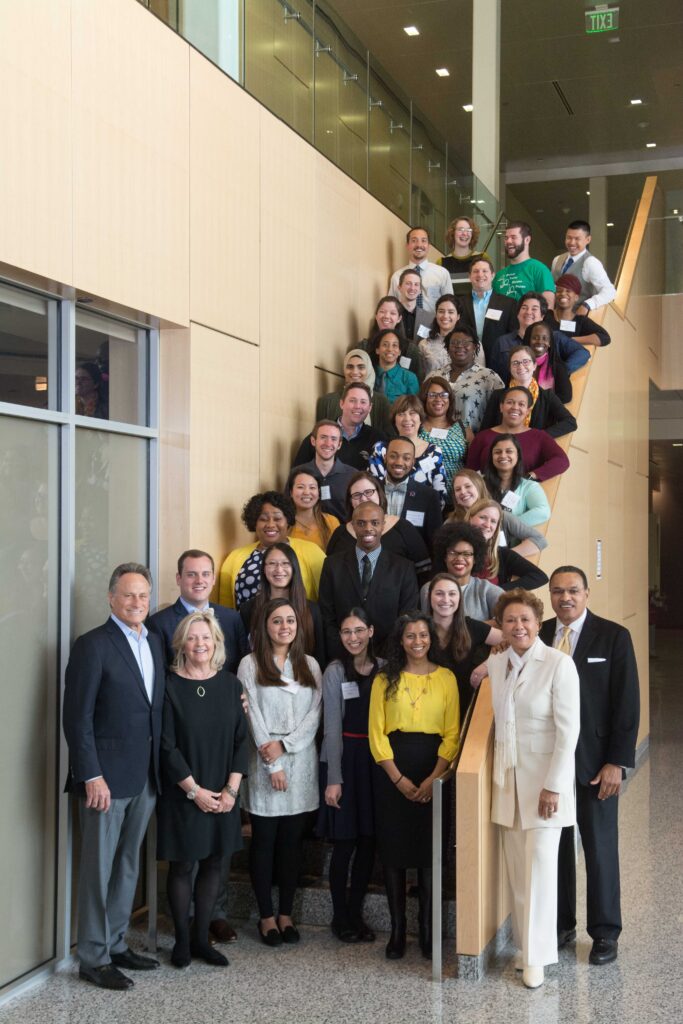 George and Betsy Sherman (first from left) in front of Josh Michael. Freeman Hrabowski, then-president of UMBC, and Jacqueline Hrabowski (first from right) next to Rehana Shafi (in yellow) at the Sherman STEM Teacher Scholars Program’s 10th anniversary.
Shafi and Michael fostered existing partnerships and helped establish the Lakeland Community and STEAM Center, where many Sherman Teacher Scholars continue to hold student-teacher placements and serve as math volunteers. During this six-year period, Michael also earned a doctorate degree at UMBC focused on mathematics achievement and improving outcomes for struggling students.
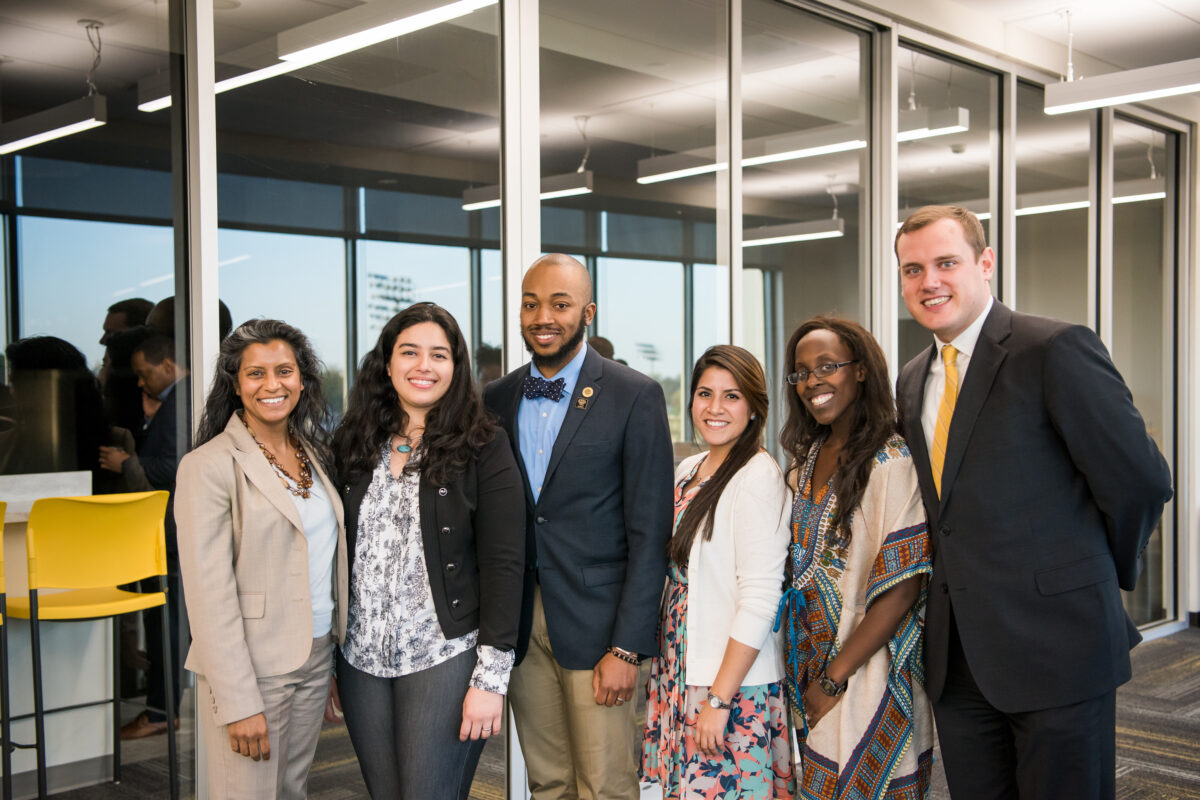 (l-r): Shafi, Monique Rivera-Velez, M.A.T ’17, education; Corey Carter ’08, biological sciences, M.A.T. ’10, education, current director of the Sherman scholars program; Emily Diaz ’16, biochemistry and molecular biology, and M.A.T ’17, education; Josephine Kalema-Kasozi ’13, dance, teaching certificate in secondary math education; and Michael at the 2018 Celebration of Teaching event. (Marlayna Demond ’11/UMBC)
Humanizing policy
“Josh’s work at the Sherman Teacher Scholars Program laid the groundwork for lasting partnerships between the university and City Schools. One example of this legacy is the Reach Together Tutoring Project (RTTP), which provides over 400 City Schools students each year with targeted math tutoring by UMBC students,” says Jane Lincove, professor of public policy and Michael’s dissertation chair. “The program is both reducing math achievement gaps and inspiring UMBC students to become math teachers. Josh’s work is a glowing example of how academic research by doctoral students in UMBC’s public policy program can be put to work to improve the lives of Marylanders.”
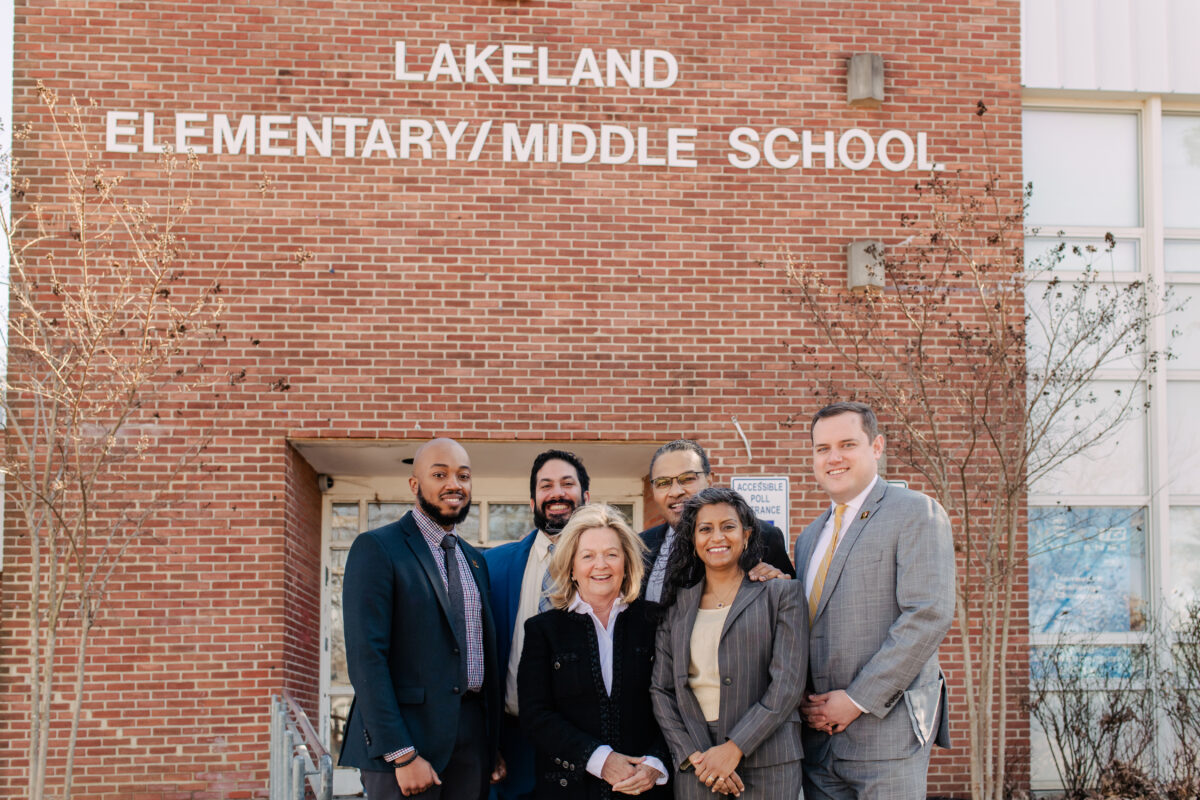 (l-r back row): Carter, Najib Jammal, then-principal of Lakeland Elementary/Middle School, Hrabowski, and Michael. (l-r front row): Betsy Sherman and Shafi. (Marlayna Demond ’11/UMBC)
“My advice to students interested in public policy is to serve in the communities you want to work with,” says Michael, currently the executive director at The Sherman Family Foundation and a board member of the Maryland Family Network, Cherry Hill Strong, and the Teach For America Baltimore Advisory Board. “Direct service in the classroom and communities have humanized the policy process for me.”
]]>
The Maryland State Board of Education has unanimously elected Josh Michael ’10, political science, Ph.D. ’22, public policy, as its new president following his completion of a one-year term as...
https://umbc.edu/stories/josh-michael-elected-msde-president/
https://my3.my.umbc.edu/api/v0/pixel/news/143029/guest@my.umbc.edu/fcaf3a9833b29e3c72c81413cedd1425/api/pixel
biochemistry
biological-sciences
cahss
dance
education
molecular-biology
news
policy-and-society
political-science
publicpolicy
sherman-stem-teacher-scholars-program
sondheim-public-affairs-scholars-program
story
UMBC News & Magazine
https://my3.my.umbc.edu/groups/umbc-news-magazine
https://assets1-my.umbc.edu/system/shared/avatars/groups/000/001/943/24435aa6207c452e7bc15cc74b42c7bb/xsmall.png?1748556657
https://assets1-my.umbc.edu/system/shared/avatars/groups/000/001/943/24435aa6207c452e7bc15cc74b42c7bb/original.png?1748556657
https://assets2-my.umbc.edu/system/shared/avatars/groups/000/001/943/24435aa6207c452e7bc15cc74b42c7bb/xxlarge.png?1748556657
https://assets2-my.umbc.edu/system/shared/avatars/groups/000/001/943/24435aa6207c452e7bc15cc74b42c7bb/xlarge.png?1748556657
https://assets3-my.umbc.edu/system/shared/avatars/groups/000/001/943/24435aa6207c452e7bc15cc74b42c7bb/large.png?1748556657
https://assets1-my.umbc.edu/system/shared/avatars/groups/000/001/943/24435aa6207c452e7bc15cc74b42c7bb/medium.png?1748556657
https://assets2-my.umbc.edu/system/shared/avatars/groups/000/001/943/24435aa6207c452e7bc15cc74b42c7bb/small.png?1748556657
https://assets1-my.umbc.edu/system/shared/avatars/groups/000/001/943/24435aa6207c452e7bc15cc74b42c7bb/xsmall.png?1748556657
https://assets2-my.umbc.edu/system/shared/avatars/groups/000/001/943/24435aa6207c452e7bc15cc74b42c7bb/xxsmall.png?1748556657
UMBC News & Magazine
1
0
false
Fri, 02 Aug 2024 12:18:57 -0400
Fri, 02 Aug 2024 12:18:57 -0400
UMBC’s first Fulbright Scholar-in-Residence shares unique research on neurodiversity in language teaching and learning
Neurodiversity inclusion and representation have been at the forefront of Michael Canale’s 20-year career in the disability services and education field. Canale, M.A. ’24, intercultural communication, is the assistant director of UMBC’s Office of Student Disability Services and teaches the first-year seminar Introduction to Disability Studies. “Sometimes parents of neurodivergent students worry that their child is incapable of learning another language,” says Canale. “I work with parents to ease their fears by showing them how their child can excel in college with the proper individualized accommodations.” These can include note-taking software, counseling services, tutoring, time management support, and more.
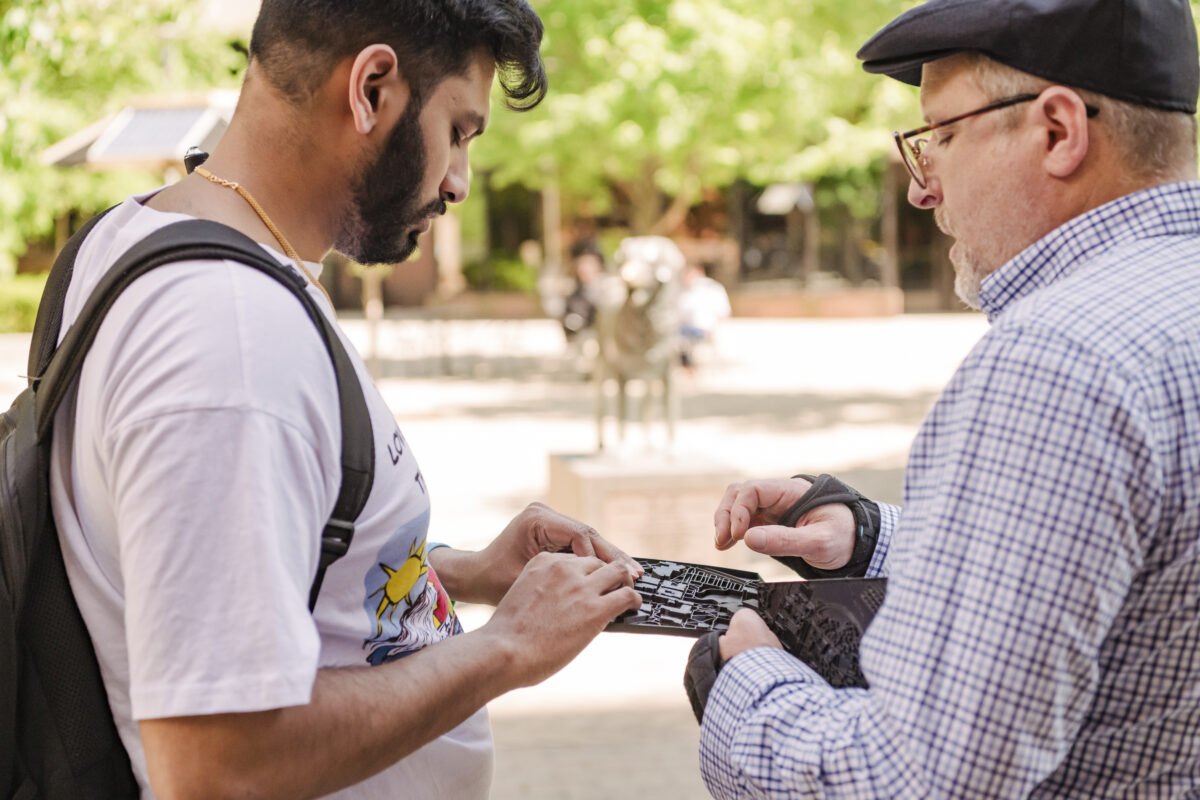 Michael Canale (r) has been working with Ph.D. students in human-centered computing to create personal tactile maps of campus for blind students at UMBC, like Shawn Abraham ’24, political science. (Marlayna Demond ’11/UMBC)
When Canele, who also received his post-master’s certificate in college teaching and learning science, heard that UMBC’s first Fulbright Scholar-in-Residence, Jules Buendgens-Kosten,would be teaching Language Learning and Special Education – Advanced Special Topics in Education, he was quick to enroll. The course, part of UMBC’s teaching English to speakers of other languages (TESOL) master’s program, was designed for anybody planning to work with heterogeneous groups of learners, including those of different neurotypes, both in special education and mainstream education settings.
Buendgens-Kosten, a research assistant at the Institute of English and American Studies at Goethe-Universität Frankfurt, Germany,began theirpartnership with UMBC as a research collaboration with Shannon Sauro, associate professor of education.Sauro recognized that Buendgens-Kosten’s expertise in English language teaching and teaching neurodivergent populations in Germany would add an international and non-U.S.-based perspective to UMBC’s TESOL program and education department.
My uni (@UMBC) just got so much geekier and cooler.
]]>
Neurodiversity inclusion and representation have been at the forefront of Michael Canale’s 20-year career in the disability services and education field. Canale, M.A. ’24, intercultural...
https://umbc.edu/stories/umbcs-first-fulbright-scholar-in-residence-research-on-neurodiversity/
https://my3.my.umbc.edu/api/v0/pixel/news/141776/guest@my.umbc.edu/9db27eba31ba49267d43df7a734d3ec0/api/pixel
cahss
cahss-research
coeit
community
education
fulbright
mlli
news
peaceworker
politicalscience
research
story
tesol
UMBC News & Magazine
https://my3.my.umbc.edu/groups/umbc-news-magazine
https://assets1-my.umbc.edu/system/shared/avatars/groups/000/001/943/24435aa6207c452e7bc15cc74b42c7bb/xsmall.png?1748556657
https://assets1-my.umbc.edu/system/shared/avatars/groups/000/001/943/24435aa6207c452e7bc15cc74b42c7bb/original.png?1748556657
https://assets2-my.umbc.edu/system/shared/avatars/groups/000/001/943/24435aa6207c452e7bc15cc74b42c7bb/xxlarge.png?1748556657
https://assets2-my.umbc.edu/system/shared/avatars/groups/000/001/943/24435aa6207c452e7bc15cc74b42c7bb/xlarge.png?1748556657
https://assets3-my.umbc.edu/system/shared/avatars/groups/000/001/943/24435aa6207c452e7bc15cc74b42c7bb/large.png?1748556657
https://assets1-my.umbc.edu/system/shared/avatars/groups/000/001/943/24435aa6207c452e7bc15cc74b42c7bb/medium.png?1748556657
https://assets2-my.umbc.edu/system/shared/avatars/groups/000/001/943/24435aa6207c452e7bc15cc74b42c7bb/small.png?1748556657
https://assets1-my.umbc.edu/system/shared/avatars/groups/000/001/943/24435aa6207c452e7bc15cc74b42c7bb/xsmall.png?1748556657
https://assets2-my.umbc.edu/system/shared/avatars/groups/000/001/943/24435aa6207c452e7bc15cc74b42c7bb/xxsmall.png?1748556657
UMBC News & Magazine
0
0
false
Tue, 07 May 2024 13:43:48 -0400
Tue, 07 May 2024 13:43:48 -0400
For the third time in five years, UMBC is named a Fulbright Top Producing Institution
Within just a few months of living in Piątek, a small town in central Poland, Leah Michaels, M.F.A ’19, intermedia and digital arts, has already traveled to Romania, where many recipients of the Fulbright U.S. Student award placed throughout Europe gathered at a media literacy conference. She has also had an opportunity to research Polish film at Poland’s Film Archive and connect with a local genealogist who helped her find details about her Polish roots for a short documentary she is producing about her ancestry.
Michaels and nine other UMBC Fulbright student recipients researching and teaching English abroad this year helped propel UMBC, once again, to the elite ranks of a Fulbright Top Producing Institution, as reported today in The Chronicle of Higher Education. The designation recognizes colleges and universities with the highest number of students selected for the Fulbright U.S. Student Program, the U.S. government’s flagship international academic exchange program. UMBC first received this designation from the U.S. Department of State’s Bureau of Educational and Cultural Affairs in 2019 – 2020 and again in 2020 – 2021.
UMBC is one of 57 doctoral universities nationwide and three in Maryland to receive a Fulbright Top Producing Institution designation for Fulbright U.S. Students in 2023 – 2024.
More than 2,200 U.S. students from hundreds of colleges and universities are awarded Fulbright grants annually. However, only a few of these institutions are designated top producers yearly. In the last decade, UMBC students and recent graduates have received over 60 Fulbright U.S. Student Program awards in Africa, Asia and the Pacific, the Middle East, South America, and Europe.
“This achievement is a testament to your institution’s deep commitment to international exchange,” wrote Secretary of State Antony Blinken in a letter to President Valerie Sheares Ashby, congratulating her on UMBC’s Fulbright Top Producer designation, “and to building lasting connections between the people of the United States and the people of other countries.”
Mutual understanding
In partnership with more than 140 countries worldwide, the Fulbright U.S. Student Program offers unparalleled opportunities in all academic disciplines to graduating college seniors, graduate students, and young professionals from all backgrounds. Fulbright recipients play a critical role in U.S. public diplomacy, establishing long-term relationships between people and nations through graduate study, research, or teaching as English Teaching Assistants (ETAs). ETAs develop their own language skills and knowledge of the host country while teaching English to elementary, middle school, or college students.
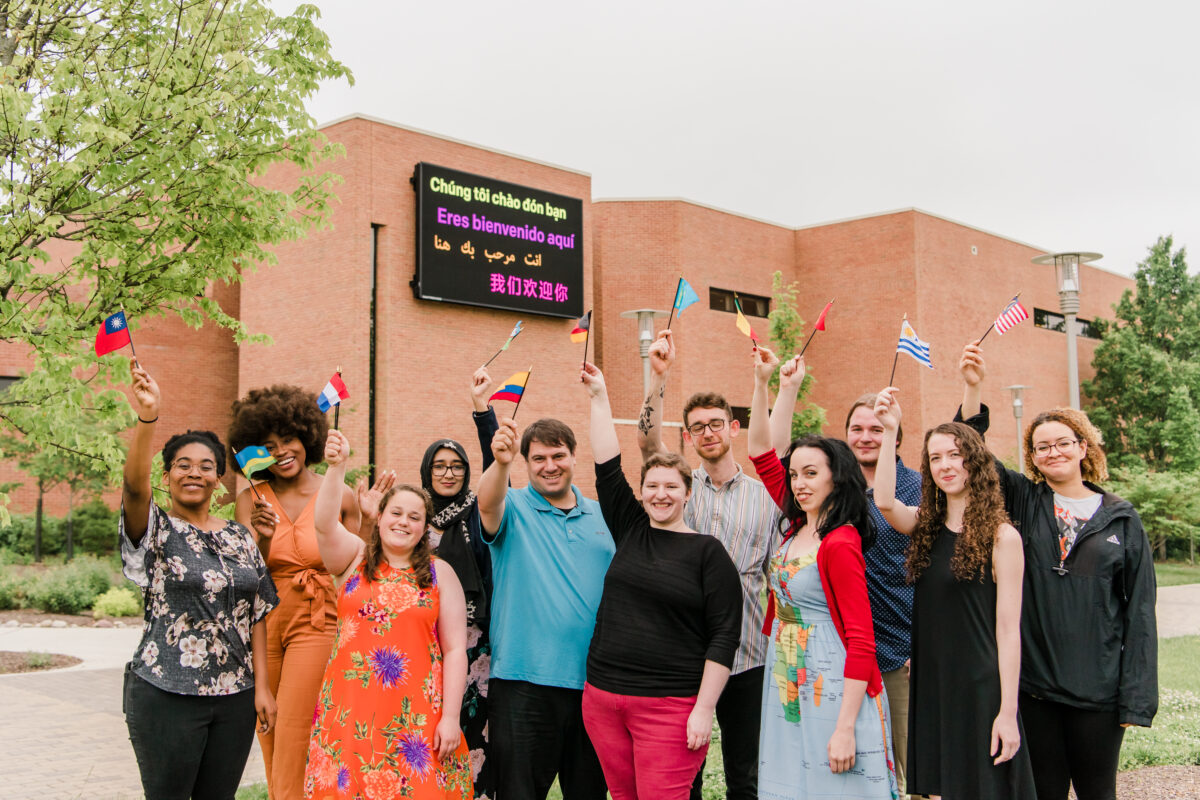 2019 – 2020 UMBC Fulbright U.S. Student recipients. (Marlayna Demond ’11/UMBC)
“As a public research university, it is imperative that we provide students with opportunities for global engagement,” says David Di Maria, associate vice provost for international education. “Fulbright is among the most prestigious of these opportunities.”
While Michaels has flourished in Poland, her 2023 – 2024 Fulbright class peers have also settled into their placements, which generally start in September with the new school year. Paul Ocone ’22, individualized study, is conducting research at the Meiji University School of Global Japanese Studies in Japan, and eight ETAs are teaching English across Europe and Asia:
- North Macedonia: David Bullman ’22, ancient studies
- Romania: Tiffany Powell, M.A.’23, teaching English to speakers of other languages (TESOL)
- Slovak Republic: Sianna Serio ’23, computer science
- South Korea: Tasneem Mansour ’20, modern languages, linguistics, and intercultural communication
- Taiwan: Nailah-Benā Chambers ’23, global studies; Kara Gavin ’20, English; and Milan Richardson ’23, bioinformatics
- Turkey: Grant Clifton, M.A. ’23, TESOL
“Being named a Top Producing Fulbright Institution is a tremendous honor—it not only shows the world what we already know about our amazing students, but it also lets our current students know that the Fulbright is a realistic opportunity for them,” says Brian Souders, Ph.D. ’09, language, literacy, and culture, M.A.’19, TESOL, and associate director of global learning at the Center for Global Engagement (CGE). Souders has led students through the Fulbright application process as UMBC’s Fulbright Program advisor for the last decade.
For Michaels, the experience has been life-changing. “My home city has been incredibly welcoming. I learned Polish folk dances, made Old Bay pierogi from scratch with some of my students, and joined a school trip to an art gallery,” says Michaels.
The Fulbright family
The Fulbright experience also includes college and university faculty and staff, as well as artists and professionals from a wide range of fields, who can join over 400,000 Fulbright alumni.
In October 2023,Renique Kersh, vice president of student affairs, and Souders traveled to Germany after receiving Fulbright International Education Administrator awards. Katherine Heird, director of education abroad and global learning, received the same award to travel to Taiwan in spring 2024. The award is geared to provide staff who support Fulbright applicants with a greater understanding of higher education worldwide.
Brian Souders is our assoc. director for global learning in the Center for Global Engagement and after years of helping faculty and students achieve their overseas learning and research goals, Brian recently took part in his own Fulbright exchange program. https://t.co/LvrOoabMou
— UMBC (@UMBC) November 15, 2023
Many UMBC faculty members and staff have received a Fulbright U.S. Scholar award over the years. This year, Lynn Cazabon, professor of visual arts and director of the Center for Innovation, Research, and Creativity in the Arts, received a Fulbright U.S. Scholar award to work at Queensland University, Australia, to create a public artwork based on local communities’ responses to climate change. Cazabon received her first Fulbright award in 2015 to the University of Liepāja, Latvia.
Fulbright Scholars globally are also drawn to UMBC’s welcoming community. Shannon Sauro, associate professor of education, hosted Jules Buendgens-Kosten, a research assistant at the Institute of English and American Studies at Goethe-Universität Frankfurt, Germany. Buendgens-Kosten joined UMBC as the institution’s first Fulbright Scholar-in-Residence to teach and share their research on inclusive education in teaching English as a foreign language to students in UMBC’s TESOL master’s program.
My uni (@UMBC) just got so much geekier and cooler.
]]>
Within just a few months of living in Piątek, a small town in central Poland, Leah Michaels, M.F.A ’19, intermedia and digital arts, has already traveled to Romania, where many recipients of the...
https://umbc.edu/stories/umbc-a-fulbright-top-producing-institution-2/
https://my3.my.umbc.edu/api/v0/pixel/news/138957/guest@my.umbc.edu/05838e8345b6084d69684b1796077d12/api/pixel
ancient-studies
biological-sciences
cahss
cnms
coeit
community
computer-science
education
english
fulbright-scholarship
global-studies
international
mlli
news
story
UMBC News & Magazine
https://my3.my.umbc.edu/groups/umbc-news-magazine
https://assets1-my.umbc.edu/system/shared/avatars/groups/000/001/943/24435aa6207c452e7bc15cc74b42c7bb/xsmall.png?1748556657
https://assets1-my.umbc.edu/system/shared/avatars/groups/000/001/943/24435aa6207c452e7bc15cc74b42c7bb/original.png?1748556657
https://assets2-my.umbc.edu/system/shared/avatars/groups/000/001/943/24435aa6207c452e7bc15cc74b42c7bb/xxlarge.png?1748556657
https://assets2-my.umbc.edu/system/shared/avatars/groups/000/001/943/24435aa6207c452e7bc15cc74b42c7bb/xlarge.png?1748556657
https://assets3-my.umbc.edu/system/shared/avatars/groups/000/001/943/24435aa6207c452e7bc15cc74b42c7bb/large.png?1748556657
https://assets1-my.umbc.edu/system/shared/avatars/groups/000/001/943/24435aa6207c452e7bc15cc74b42c7bb/medium.png?1748556657
https://assets2-my.umbc.edu/system/shared/avatars/groups/000/001/943/24435aa6207c452e7bc15cc74b42c7bb/small.png?1748556657
https://assets1-my.umbc.edu/system/shared/avatars/groups/000/001/943/24435aa6207c452e7bc15cc74b42c7bb/xsmall.png?1748556657
https://assets2-my.umbc.edu/system/shared/avatars/groups/000/001/943/24435aa6207c452e7bc15cc74b42c7bb/xxsmall.png?1748556657
UMBC News & Magazine
2
0
false
Tue, 13 Feb 2024 11:32:48 -0500
Tue, 13 Feb 2024 11:32:48 -0500
Should AI be permitted in college classrooms? 4 scholars weigh in

Written by Nicholas Tampio, Fordham University; Asim Ali, Auburn University; Patricia A. Young, professor of education UMBC, and Shital Thekdi, University of Richmond
One of the most intense discussions taking place among university faculty is whether to permit students to use artificial intelligence in the classroom. To gain perspective on the matter, The Conversation reached out to four scholars for their take on AI as a learning tool and the reasons why they will or won’t be making it a part of their classes.
Nicholas Tampio, professor of political science: Learn to think for yourself
 Nicholas Tampio, Fordham University.
As a professor, I believe the purpose of a college class is to teach students to think: to read scholarship, ask questions, formulate a thesis, collect and analyze data, draft an essay, take feedback from the instructor and other students, and write a final draft.
One problem with ChatGPT is that it allows students to produce a decent paper without thinking or writing for themselves.
In my American political thought class, I assign speeches by Martin Luther King Jr. and Malcolm X and ask students to compose an essay on what King and X might say about a current American political debate, such as the Supreme Court’s recent decision on affirmative action.
Students could get fine grades if they used ChatGPT to “write” their papers. But they will have missed a chance to enter a dialogue with two profound thinkers about a topic that could reshape American higher education and society.
The point of learning to write is not simply intellectual self-discovery. My students go on to careers in journalism, law, science, academia and business. Their employers often ask them to research and write about a topic.
Few employers will likely hire someone to use large language models that rely on an algorithm scraping databases filled with errors and biases. Already, a lawyer has gotten in trouble for using ChatGPT to craft a motion filled with fabricated cases. Employees succeed when they can research a topic and write intelligently about it.
Artificial intelligence is a tool that defeats a purpose of a college education – to learn how to think, and write, for oneself.
Patricia A. Young, professor of education: ChatGPT doesn’t promote advanced thinking
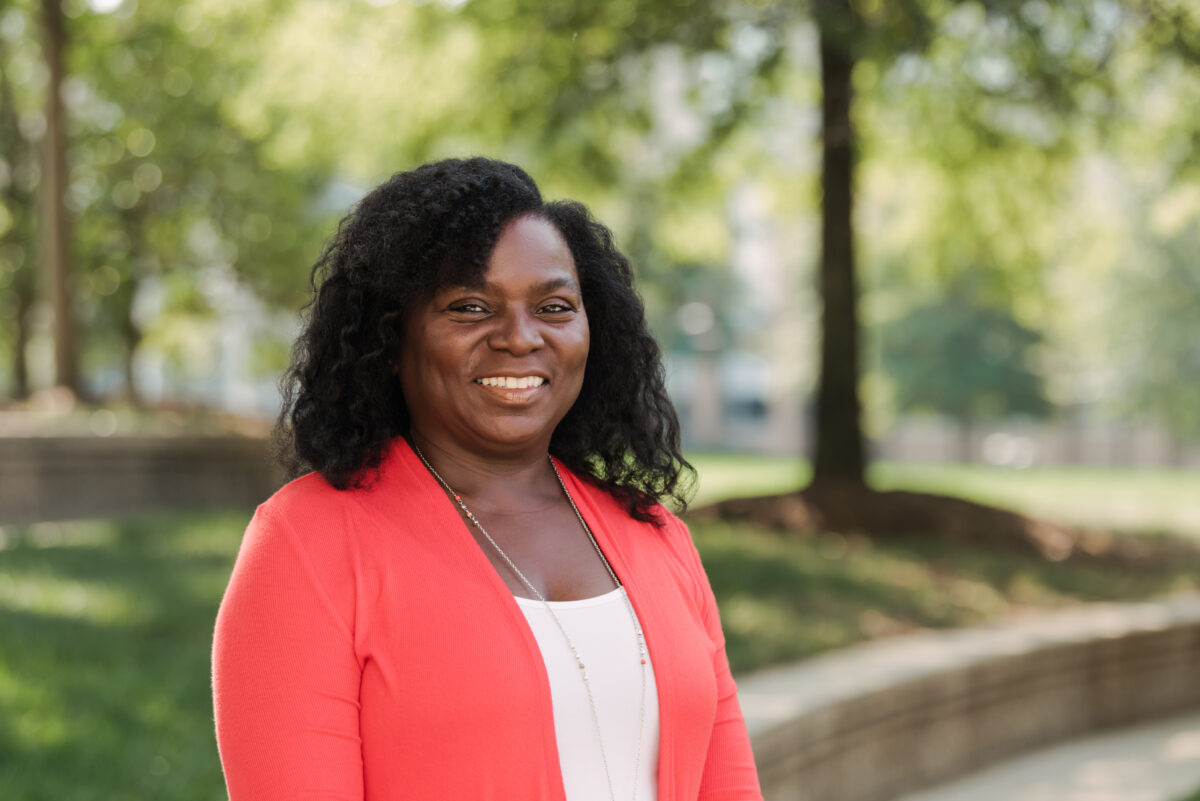 Patricia Young. (Marlayna Demond ’11/UMBC)
College students who are operating from a convenience or entitlement mentality – one in which they think, “I am entitled to use whatever technology is available to me” – will naturally gravitate toward using ChatGPT with or without their professor’s permission. Using ChatGPT and submitting a course assignment as your own creation is called AI-assisted plagiarism.
The proliferation of free AI means students won’t have to think much while writing – just engage in a high level of copy and paste. We used to call that plagiarism. With AI-assisted plagiarism, this brings in the potential for a new era of academic misconduct.
Some professors allow the use of ChatGPT as long as students cite ChatGPT as the source. As a researcher who specializes in the use of technology in education, I believe this practice needs to be thought through. Does this mean that ChatGPT would need to cite its sources, so that students could cite ChatGPT as a type of secondary source according to APA style, a standard academic style of citing papers? What Pandora’s box are we opening? Some users report that ChatGPT never reveals its sources anyway.
The concern will come when students take higher-level courses or land a job and lack the literacy skills to perform on an exceptional level. We will have created a generation of functionally illiterate adults who lack the capacity to engage in advanced thinking – like critiquing, comparing or contrasting information.
Yes, students can and should use smart tools, but we need to hypothesize and measure the costs to human ingenuity and the future of the human race.
Asim Ali, instructor of information systems management: AI is another teacher
I teach information systems management, and in the spring of 2023, I had students use ChatGPT for an essay assignment and then record a video podcast discussing how AI will impact their careers. This semester I am being more intentional by providing guidance on the possibilities and limitations of AI tools for each assignment. For example, students learn that using generative AI on a self-reflection assignment may not help, but using AI to analyze a case study is potentially a great way to find insights they may have overlooked. This emulates their future jobs in which they may use AI tools to enhance the quality of their work product.
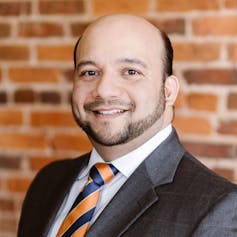 Asim Ali, Auburn University
My experience with adapting to AI for my own course inspired me to create a resource for all my colleagues. As executive director of the Biggio Center for the Enhancement of Teaching and Learning, I oversee the instructional design and educational development teams at Auburn University. We created a self-paced, online course called Teaching With AI.
Now there are over 600 faculty at Auburn and hundreds of faculty at almost 35 institutions engaging with the content and each other through discussion boards and practical exercises.
I receive messages from faculty sharing ways they are changing their assignments or discussing AI with their students. Some see AI as a threat to humans, but discussing AI with my students and with colleagues across the country has actually helped me develop human connections.
Shital Thekdi, associate professor of analytics & operations: What can you do that AI can’t?
This semester, I will ask students in my Statistics for Business and Economics course to discuss the question, “What is your value beyond the AI tools?” I want them to reframe the conversation beyond one of academic integrity and instead as a challenge. I believe students must recognize that the jobs they imagine will exist for them could be eliminated because of these new technologies. So the pressure is on students to understand not only how to use these tools but also how to be better than the tools.
 Shital Thekdi. University of Richmond.
I hope my students will consider ethical reasoning and the role of human connections. While AI can be trained to make value-based decisions, individuals and groups have their own values that can differ considerably from those used by AI. And AI tools do not have the capacity to form human connections and experiences.
Students will remain vital contributors to business and society as AI tools develop. I believe it’s our responsibility as educators to prepare our students for a rapidly evolving cultural and technological landscape.
This article is republished from The Conversation under a Creative Commons license. Read the original article and see more than 250 UMBC articles available in The Conversation.
]]>
Written by Nicholas Tampio, Fordham University; Asim Ali, Auburn University; Patricia A. Young, professor of education UMBC, and Shital Thekdi, University of Richmond One of the most intense...
https://umbc.edu/stories/should-ai-be-permitted-in-college-classrooms/
https://my3.my.umbc.edu/api/v0/pixel/news/135176/guest@my.umbc.edu/c693314229ef43bad5161dd2bea488a5/api/pixel
cahssresearch
discovery
education
magazine
research
the-conversation
UMBC News & Magazine
https://my3.my.umbc.edu/groups/umbc-news-magazine
https://assets1-my.umbc.edu/system/shared/avatars/groups/000/001/943/24435aa6207c452e7bc15cc74b42c7bb/xsmall.png?1748556657
https://assets1-my.umbc.edu/system/shared/avatars/groups/000/001/943/24435aa6207c452e7bc15cc74b42c7bb/original.png?1748556657
https://assets2-my.umbc.edu/system/shared/avatars/groups/000/001/943/24435aa6207c452e7bc15cc74b42c7bb/xxlarge.png?1748556657
https://assets2-my.umbc.edu/system/shared/avatars/groups/000/001/943/24435aa6207c452e7bc15cc74b42c7bb/xlarge.png?1748556657
https://assets3-my.umbc.edu/system/shared/avatars/groups/000/001/943/24435aa6207c452e7bc15cc74b42c7bb/large.png?1748556657
https://assets1-my.umbc.edu/system/shared/avatars/groups/000/001/943/24435aa6207c452e7bc15cc74b42c7bb/medium.png?1748556657
https://assets2-my.umbc.edu/system/shared/avatars/groups/000/001/943/24435aa6207c452e7bc15cc74b42c7bb/small.png?1748556657
https://assets1-my.umbc.edu/system/shared/avatars/groups/000/001/943/24435aa6207c452e7bc15cc74b42c7bb/xsmall.png?1748556657
https://assets2-my.umbc.edu/system/shared/avatars/groups/000/001/943/24435aa6207c452e7bc15cc74b42c7bb/xxsmall.png?1748556657
UMBC News & Magazine
0
0
false
Wed, 06 Sep 2023 10:16:33 -0400
Wed, 06 Sep 2023 10:16:33 -0400
Writing your way through your own history—and sharing the narrative

Family stories, told honestly, reach people in ways that reams of advice and pages in history books cannot. When personal narratives reach the classroom, students respond by opening up, say two professors who have published memoirs of their family tragedies as a way to process their grief and share their stories.
“I believe that writing personal narratives and sharing my own family’s stories helps build trust and rapport in the classroom,” said Aharona (Roni) Rosenthal, director of Judaic Studies at UMBC. “Writing personal narratives can serve as a model for students and encourage them to listen to their grandparents’ stories, embrace their own family’s traditions, and find their own voice in writing.”
Write about the darkness and the light
 Rosenthal’s Great-Aunt Friddie Stoleru in 1954 and the subject of her family memoir.
Rosenthal, who self-published her family’s history last spring as Where the Lilacs Bloom Once Again,remembers her great-aunt Friddie arriving for a visit to the family in Israel. With her huge laugh, her bright red nail polish, and her scarred hands and face, Friddie would wear thick makeup, pull white gloves over her hands, and paint the undersides of her nails to hide the permanently blackened nails.
Rosenthal recorded her father telling family stories about Friddie, kept for 13 years in secret prisons and labor camps in Romania during World War II and then under the Communist rule, where she was tortured and forced to dig the canal from the Danube River to the Black Sea. When her father, Yossi Rosenthal, died a few months after telling her that history, Rosenthal returned to Israel and found on her father’s desk a photo album, a partially finished family tree, and a note from her father, asking her to tell more widely the story of their family.
Rosenthal spent 12 years researching and writing her family memoir. Along the way, Rosenthal found long-lost family members, learned the fate of others, and gathered material that she now shares in her classes at UMBC, especially in her unit on the Holocaust in her Hebrew literature class.
One of the Rosenthal family stories tells of Friddie’s detainment in the labor camp, where she met a man through a chink in the stone wall dividing the men’s side from the women’s side of the camp. Friddie was looking for a cat who was slinking around the wall, and so was Mircea, the man she fell in love with, sight unseen.
 Rosenthal with her father in Romania in July 1998.
“It was a miracle in the darkest place in the world, the scariest place in the world,” Rosenthal said, and after Mircea was released, he helped free Friddie and the couple married.
Narratives that stick with you
Rosenthal’s family tales are intertwined with atrocities in World War II, when Romania allied with the Nazis. Thousands of Romania’s Jews were slaughtered and sent to concentration camps. Rosenthal remembers her grandparents who, on every anniversary of a 1941 pogrom in Iași, would light candles under pictures of lost loved ones, but never speak about the massacre.
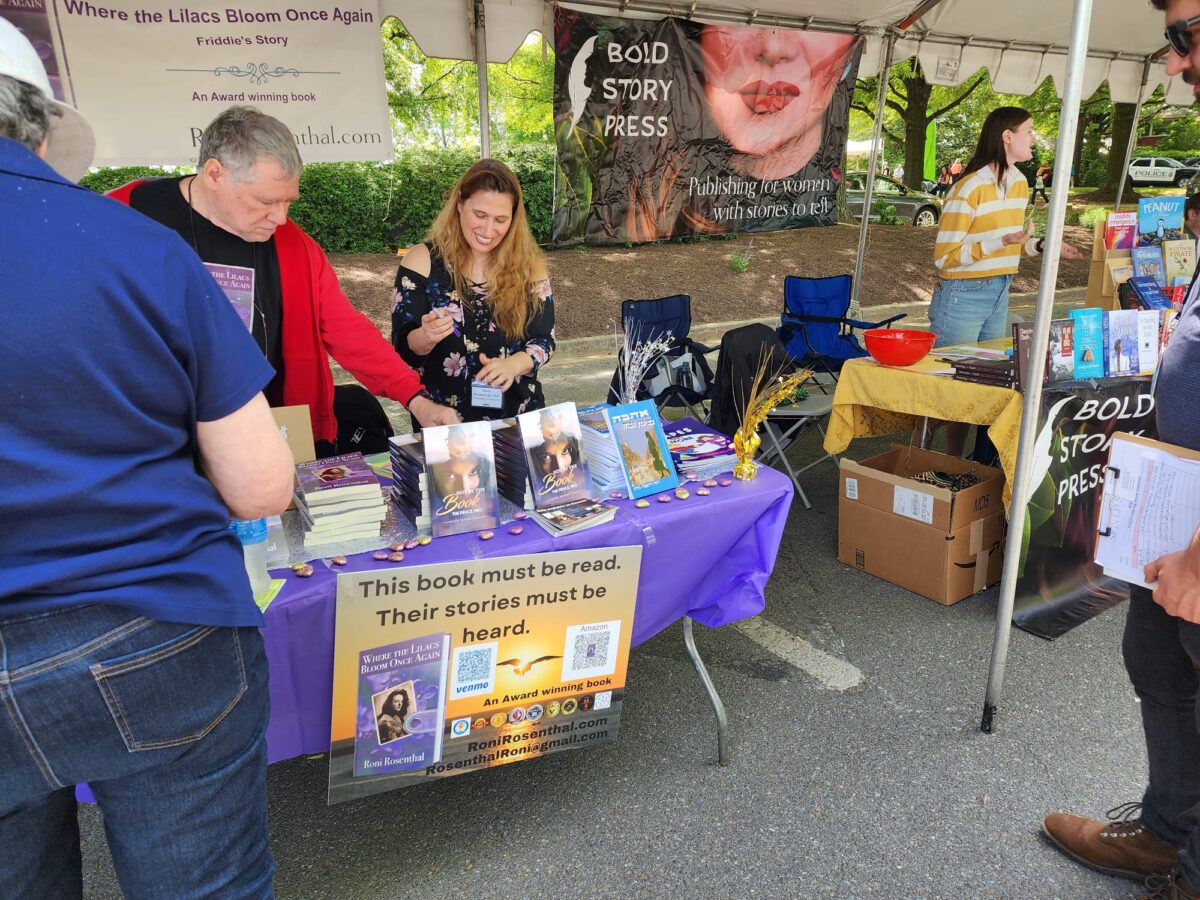 Rosenthal, center, presented a seminar at a 2023 Gaithersburg, Maryland, book festival titled, “Conduct your family research and write your memoir.”
One of Rosenthal’s students, Moriah Thompson ’24, biological sciences, said she had known the history of atrocities in World War II, but that Rosenthal’s stories and primary sources brought that history to life.
“Seeing her pictures and listening to the letter her ancestors wrote, it was actually so absolutely incredible to see the history as it related to her family,” Thompson said. “The narrative that stuck with me the most was the letter her great-grandfather wrote about the pogrom he and his family endured. Being Jewish, we know the history and we’ve heard the stories. But hearing from a man who experienced it was so much different. I can’t imagine the fear he felt trying to keep his family safe, or his wife worrying about the children.”
Writing your story so others can find it
Nancy Shelton,a recently retired education professor at UMBC, knows the power of writing a personal story.
“I don’t believe you can teach kids to write without writing with them,” said Shelton, who researched literacy and taught potential teachers how to teach writing. So as a classroom teacher, then as a professor in the education department, she always wrote with her students during classroom writing sessions.
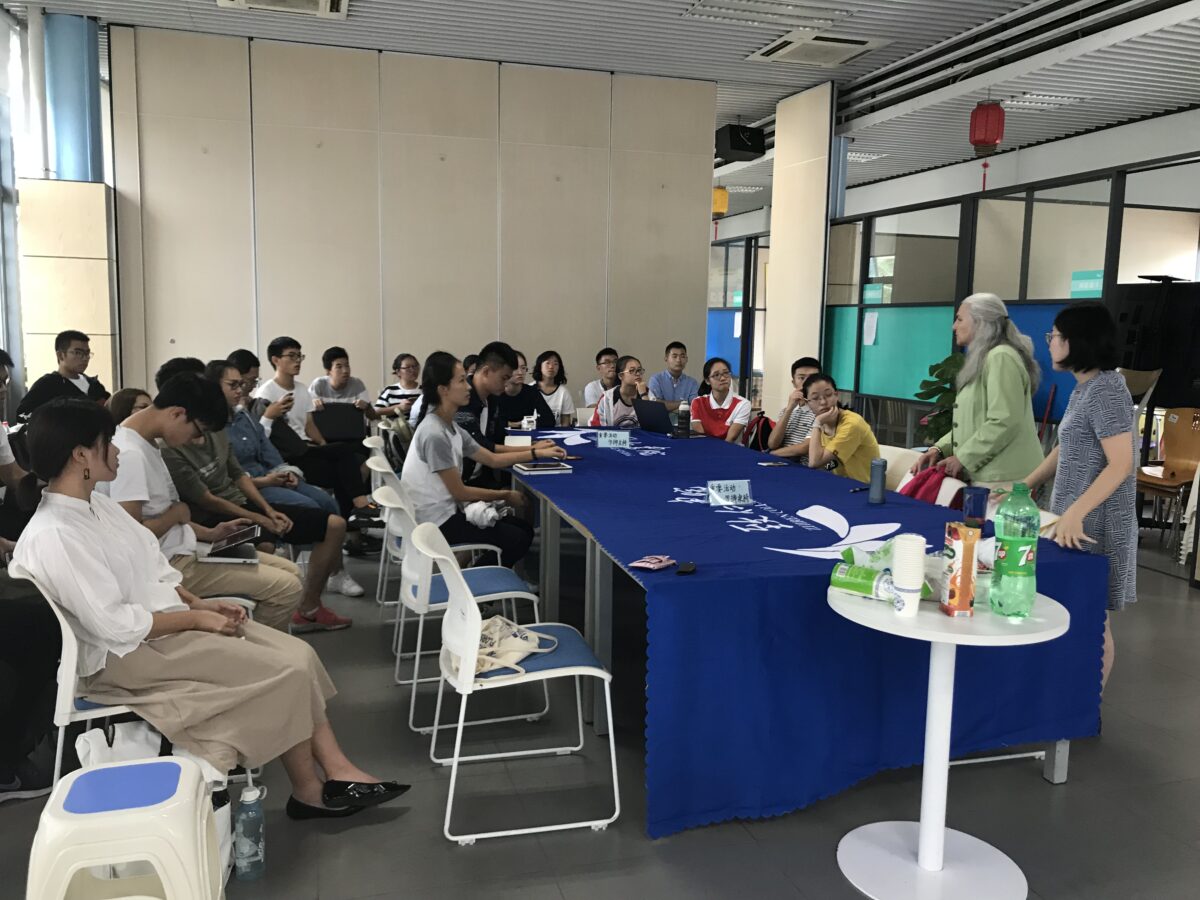 Jiyoon Lee, associate professor of education, and Nancy Shelton speak at the Southern University of Science and Technology in Shenzhen, China, on English Learning.
One winter day at their Florida vacation home, when she and her husband were both a few years from retirement, he was joking with her as he headed out to wash their new car. A while later, Shelton, who has hearing loss, heard her dogs barking frantically and found her husband prone on the kitchen floor, having a seizure.
“It literally came out of the blue,” Shelton remembered. At the hospital soon after his seizure, John was diagnosed with stage four cancer.
“A death sentence,” Shelton said. She called her sister who advised her to take notes during the medical consultations. As John slept in the evenings, Nancy sat by his hospital bedside and filled in her notes “as if they were data,” the kind she had collected for years researching schoolchildren’s literacy. Her notes, she said, were a way of handling her husband’s swift slide into illness, and finally death.
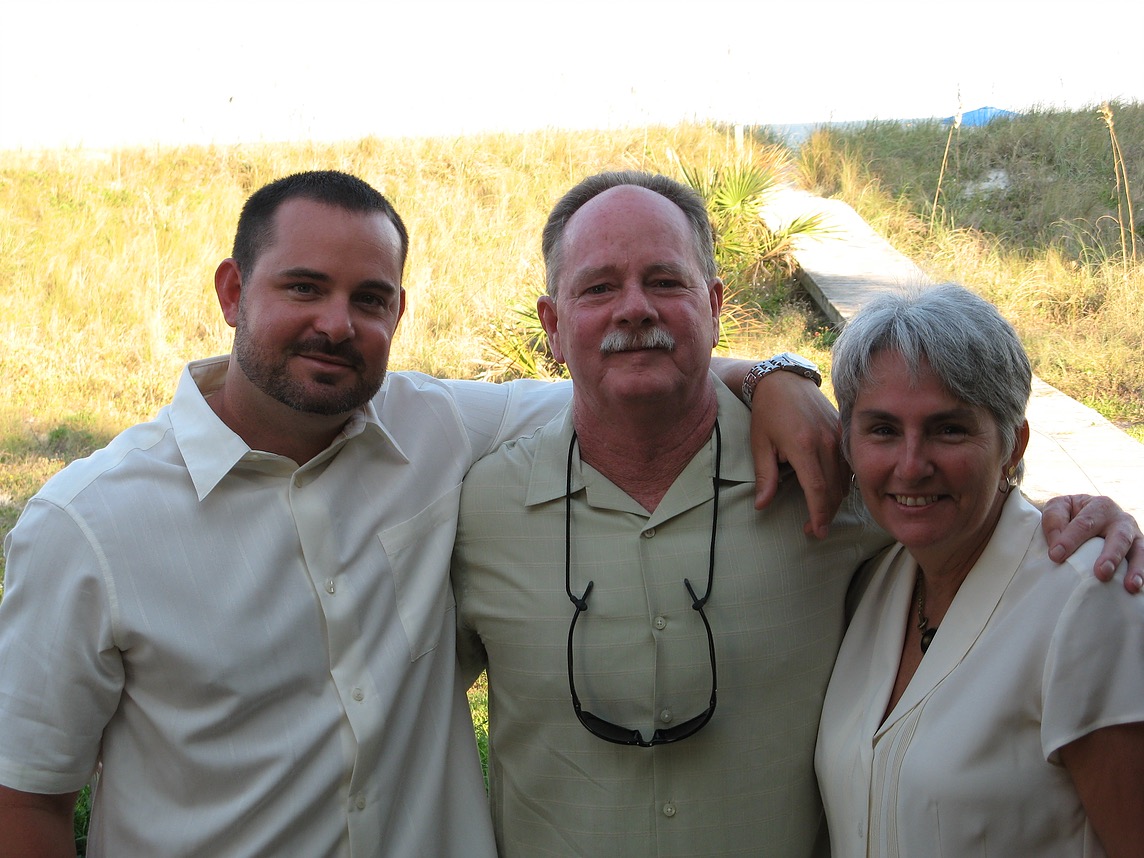 Nancy poses with her son, Conrad and her husband, Jack, circa 2006.
“I am a writer,” Shelton said. “I thought, well, I will write my way through this.”
As a reader, she looked for books with characters whose family members were dying of cancer, but she couldn’t find any she identified with. So she wrote one, 5-13: A Memoir of Love, Loss and Survival, published in 2016.
Writing can make you strong
“Being able to be a published author as a teacher of writing gives you credibility,” Shelton said.
In her education classes, Shelton read literature to her students, such as the first kiss scene from Rita Mae Brown’s autobiographical novel, Rubyfruit Jungle, or the definition of heaven by the narrator of Lovely Bones. Then she would ask the students to write in response. Often, the students’ writing was quite personal, exploring identity, family and memory.
The classroom, she said, turned into a safe space for writing, and for sharing. “I believe writing is something that exposes a part of us that would otherwise be hidden, and that exposing makes you very vulnerable, but also makes you very strong,” she said.
By Susan Thornton Hobby
]]>
Family stories, told honestly, reach people in ways that reams of advice and pages in history books cannot. When personal narratives reach the classroom, students respond by opening up, say two...
https://umbc.edu/stories/writing-your-way-through-your-narrative-history/
https://my3.my.umbc.edu/api/v0/pixel/news/133843/guest@my.umbc.edu/14d6d3be4f624db1fb06ffc7030eced5/api/pixel
cahss
cahssresearch
discovery
education
judaic-studies
magazine
research
UMBC News & Magazine
https://my3.my.umbc.edu/groups/umbc-news-magazine
https://assets1-my.umbc.edu/system/shared/avatars/groups/000/001/943/24435aa6207c452e7bc15cc74b42c7bb/xsmall.png?1748556657
https://assets1-my.umbc.edu/system/shared/avatars/groups/000/001/943/24435aa6207c452e7bc15cc74b42c7bb/original.png?1748556657
https://assets2-my.umbc.edu/system/shared/avatars/groups/000/001/943/24435aa6207c452e7bc15cc74b42c7bb/xxlarge.png?1748556657
https://assets2-my.umbc.edu/system/shared/avatars/groups/000/001/943/24435aa6207c452e7bc15cc74b42c7bb/xlarge.png?1748556657
https://assets3-my.umbc.edu/system/shared/avatars/groups/000/001/943/24435aa6207c452e7bc15cc74b42c7bb/large.png?1748556657
https://assets1-my.umbc.edu/system/shared/avatars/groups/000/001/943/24435aa6207c452e7bc15cc74b42c7bb/medium.png?1748556657
https://assets2-my.umbc.edu/system/shared/avatars/groups/000/001/943/24435aa6207c452e7bc15cc74b42c7bb/small.png?1748556657
https://assets1-my.umbc.edu/system/shared/avatars/groups/000/001/943/24435aa6207c452e7bc15cc74b42c7bb/xsmall.png?1748556657
https://assets2-my.umbc.edu/system/shared/avatars/groups/000/001/943/24435aa6207c452e7bc15cc74b42c7bb/xxsmall.png?1748556657
UMBC News & Magazine
0
0
false
Thu, 01 Jun 2023 13:07:34 -0400
Thu, 15 Jun 2023 13:07:34 -0400