Meet a Retriever—Annie Byrd ’04, M.P.S. ’23, birth worker advocate who creates employment connections for UMBC students
Annie Byrd ’04, emergency health services, M.P.S. ’23, community leadership, began her staff career at UMBC as an executive administrative assistant and she is now the Career Center’s assistant director for employer relations. She attributes her growth as a leader to UMBC’s supportive environment that encouraged members to make an impact in their communities. Annie says that the community leadership program helped her connect the dots between her undergraduate degree in emergency health services, her experience as a doula—a trained professional who provides emotional, physical, and informational support during pregnancy, birth, and the postpartum period—and her passion for maternal health equity and social justice. She then integrated these values into systems-level change, co-founding the Doula Alliance of Maryland.
Q: What’s one essential thing you’d want another Retriever to know about you?
A: I’ve been part of the UMBC community for over 20 years—as an undergraduate, graduate student, and a staff member. I love building connections, supporting students, and finding creative solutions that help people succeed.
Q: Tell us about someone in the UMBC community who has inspired you.
 Byrd, second from left, in May 2026 with the student staff she supervises. “This is why I do what I do—students!”
A: Yvette Mozie-Ross [’88, currently vice provost for enrollment management and planning] saw potential in me before I saw it in myself. As my first supervisor at UMBC, she encouraged me to continue my education and pursue new opportunities. Her mentorship helped shape my journey from executive administrative assistant to assistant director.
Q: Tell us about what you love about your academic program or an organization you’re involved in at UMBC.
A: What I loved most about the M.P.S. in Community Leadership was learning alongside people committed to creating change. The program challenged me to think strategically, and it directly inspired my work co-founding the Doula Alliance of Maryland to advance equitable maternal health.
Q: What’s the one thing you’d want someone who hasn’t joined the UMBC community to know about the support you find here?
A: What makes UMBC special is that everyone belongs here. It’s an inclusive community that values curiosity, encourages ambitious ideas, and provides the support to help you grow personally, academically, and professionally.
Q: What part of your job do you enjoy the most and why?
A: Student interactions are what I enjoy most. I love helping students discover opportunities, build confidence, and recognize the skills they already have. It’s rewarding to know that even one conversation can have a lasting impact on their career journey.
Q: What brought you to UMBC?
 Byrd at the May 2023 graduation ceremony for her M.P.S. in Community Leadership.
A: I came to UMBC as an undergraduate and a student-athlete, and I’ve come back as a staff member because I experienced firsthand how transformative this community can be. UMBC has shaped my life. I met my husband, built lifelong friendships, and found a career where I can help students create their own UMBC stories.
Q: At UMBC, how have you found support for birth work advocacy?
A: The community leadership program faculty and staff helped me turn my passion for birth work into systems-level change. Research shows that doula support is associated with better maternal health outcomes, yet many families—particularly those who have been historically marginalized—face significant barriers to accessing this care. Seeing both the impact of doulas and the inequities in access inspired me to co-found the Doula Alliance of Maryland to expand access and advance maternal health equity. Also, my Career Center colleagues have continued to support that mission, reminding me that UMBC values both professional growth and community impact.
Q: What would you tell someone who is considering a career at UMBC?
A: UMBC is a place where your ideas and potential are valued. It provides opportunities to grow your career while connecting your work to a larger purpose. My own journey from student to staff member shows how UMBC supports people who want to make a difference.
]]>
Annie Byrd ’04, emergency health services, M.P.S. ’23, community leadership, began her staff career at UMBC as an executive administrative assistant and she is now the Career Center’s assistant...
https://umbc.edu/stories/meet-a-retriever-annie-byrd-birth-worker-advocate/
https://my3.my.umbc.edu/api/v0/pixel/news/161335/guest@my.umbc.edu/411920c2945bc1cc733100111b1660e1/api/pixel
alumni
cahss
campus-life
career-center
community-leadership
dps
ehs
mps
stories
story
UMBC News & Magazine
https://my3.my.umbc.edu/groups/umbc-news-magazine
https://assets1-my.umbc.edu/system/shared/avatars/groups/000/001/943/24435aa6207c452e7bc15cc74b42c7bb/xsmall.png?1748556657
https://assets1-my.umbc.edu/system/shared/avatars/groups/000/001/943/24435aa6207c452e7bc15cc74b42c7bb/original.png?1748556657
https://assets2-my.umbc.edu/system/shared/avatars/groups/000/001/943/24435aa6207c452e7bc15cc74b42c7bb/xxlarge.png?1748556657
https://assets2-my.umbc.edu/system/shared/avatars/groups/000/001/943/24435aa6207c452e7bc15cc74b42c7bb/xlarge.png?1748556657
https://assets3-my.umbc.edu/system/shared/avatars/groups/000/001/943/24435aa6207c452e7bc15cc74b42c7bb/large.png?1748556657
https://assets1-my.umbc.edu/system/shared/avatars/groups/000/001/943/24435aa6207c452e7bc15cc74b42c7bb/medium.png?1748556657
https://assets2-my.umbc.edu/system/shared/avatars/groups/000/001/943/24435aa6207c452e7bc15cc74b42c7bb/small.png?1748556657
https://assets1-my.umbc.edu/system/shared/avatars/groups/000/001/943/24435aa6207c452e7bc15cc74b42c7bb/xsmall.png?1748556657
https://assets2-my.umbc.edu/system/shared/avatars/groups/000/001/943/24435aa6207c452e7bc15cc74b42c7bb/xxsmall.png?1748556657
UMBC News & Magazine
4
0
false
Tue, 28 Jul 2026 14:53:00 -0400
Tue, 28 Jul 2026 14:53:00 -0400
Meet a Retriever—David M. Williams, M.S. ’02, author and scholar-practitioner of the “Science of Improvement”
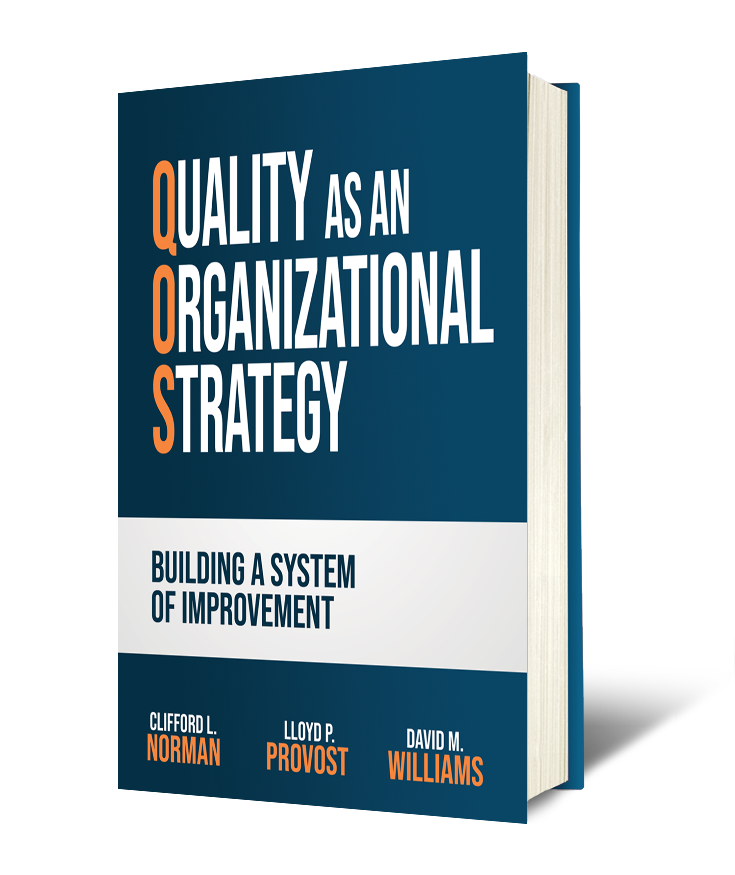
Meet David M. Williams, M.S. ’02, emergency health services (EHS) management, a scholar-practitioner of the “Science of Improvement,” and a co-author of Quality as an Organizational Strategy: Building a System of Improvement. With 25 years of experience in quality improvement, he has worked with leaders and teams worldwide to develop people’s abilities to make rigorous, results-driven improvements and adopt quality as an organizational strategy. Take it away, David!
Q: What’s one essential thing you’d want another Retriever to know about you?
A: I advise leaders worldwide to use the science of improvement to improve processes, products, and services. My experience in organizational systems began when I was a paramedic and got my master’s in EHS management at UMBC. My education led to me becoming an ambulance system expert and an internationally respected improvement advisor. I have a Ph.D. in organizational systems from Saybrook University.
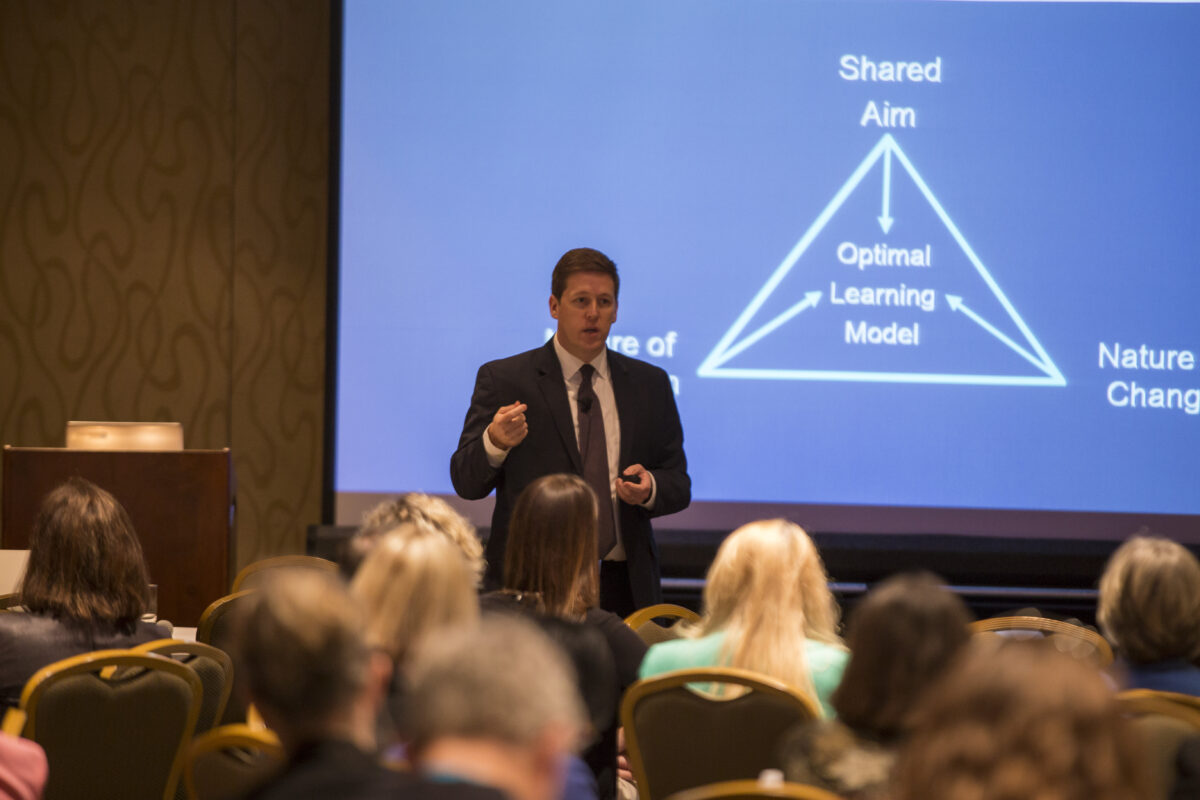 David M. Williams speaking at the Institute for Healthcare Improvement’s National Forum on Quality Improvement in Health Care.
Q: What brought you to UMBC?
A: After I earned a B.S. in emergency medical services management from Springfield College, I was looking for a graduate program that would allow me to study from my home in Austin, Texas, while I worked full-time as a paramedic. I decided on UMBC because it had a unique virtual graduate program in EHS management that met all my criteria.
Q: What do you love about your academic program?
A: As a student in the UMBC EHS program, I was introduced to literature and best practices that helped my professional development early in my career. The faculty comprised industry leaders, and their support and networks in the field helped me build my knowledge and skills. I credit my graduate work at UMBC as positioning me for career success.
I like seeing how UMBC has evolved. I first visited the campus in 1992, and it's amazing to see how it has grown.
David M. Williams, M.S. ’02, EHS management
Scholar-practitioner of the Science of Improvement
Q: What’s the one thing you’d want someone to know about the support you find at UMBC?
A: I was a remote student in the early days of online degree programs. UMBC worked hard to create a robust academic learning experience. The faculty have served as lifelong mentors, and my peers made a community of learners nationwide and internationally.
Q: Who in the UMBC community has inspired you or supported you?
A: EHS adjunct faculty Mike Taigman has been a mentor and supporter since we first met in his class in the late ’90s. He was an expert paramedic and consultant. He encouraged me to publish my first paper and introduced me to the editor of an industry publication. He sponsored me to speak at my first national conference. He wrote a recommendation in support of my first leadership role as the chief quality officer of Austin EMS. He introduced me to healthcare improvement, which has been my career for more than 15 years. His mentorship and support have been a constant contribution to my career success. We still talk each week.
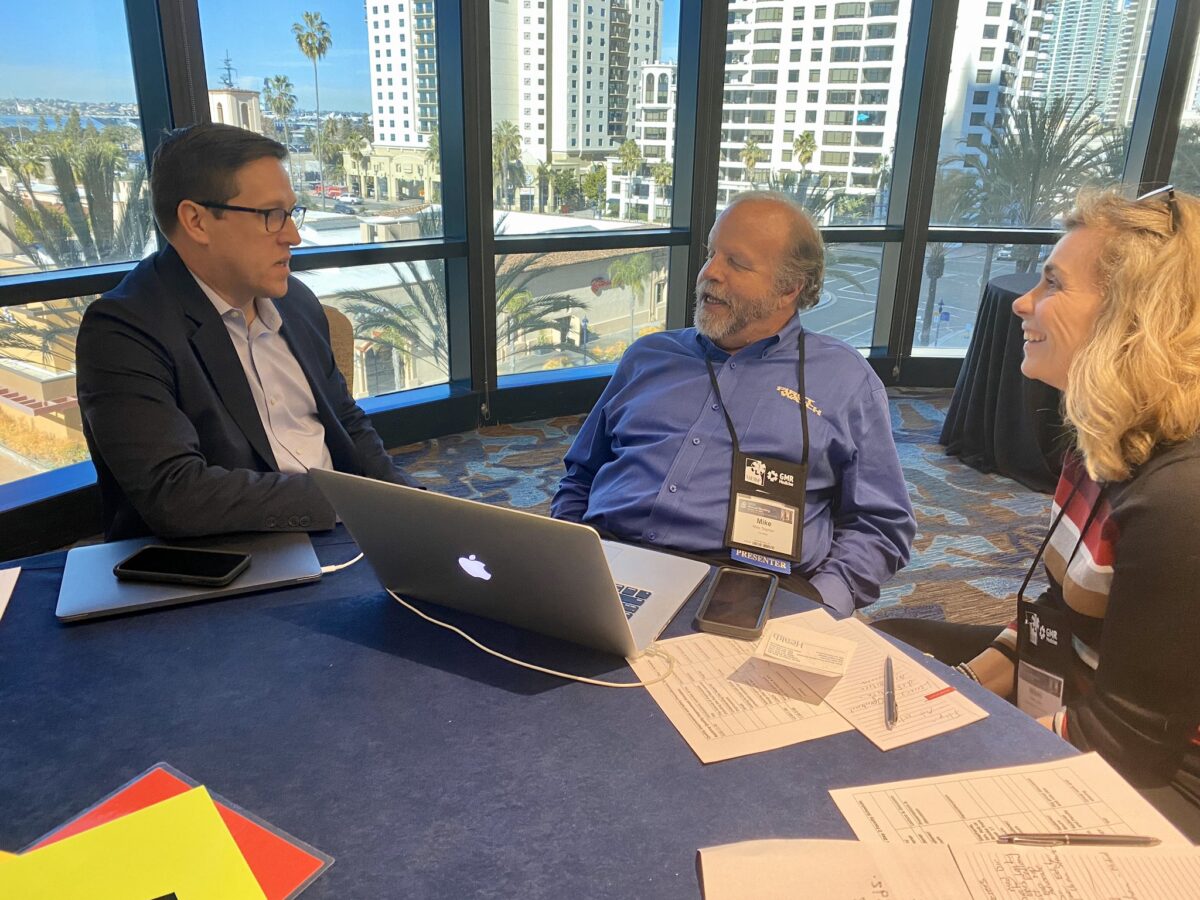
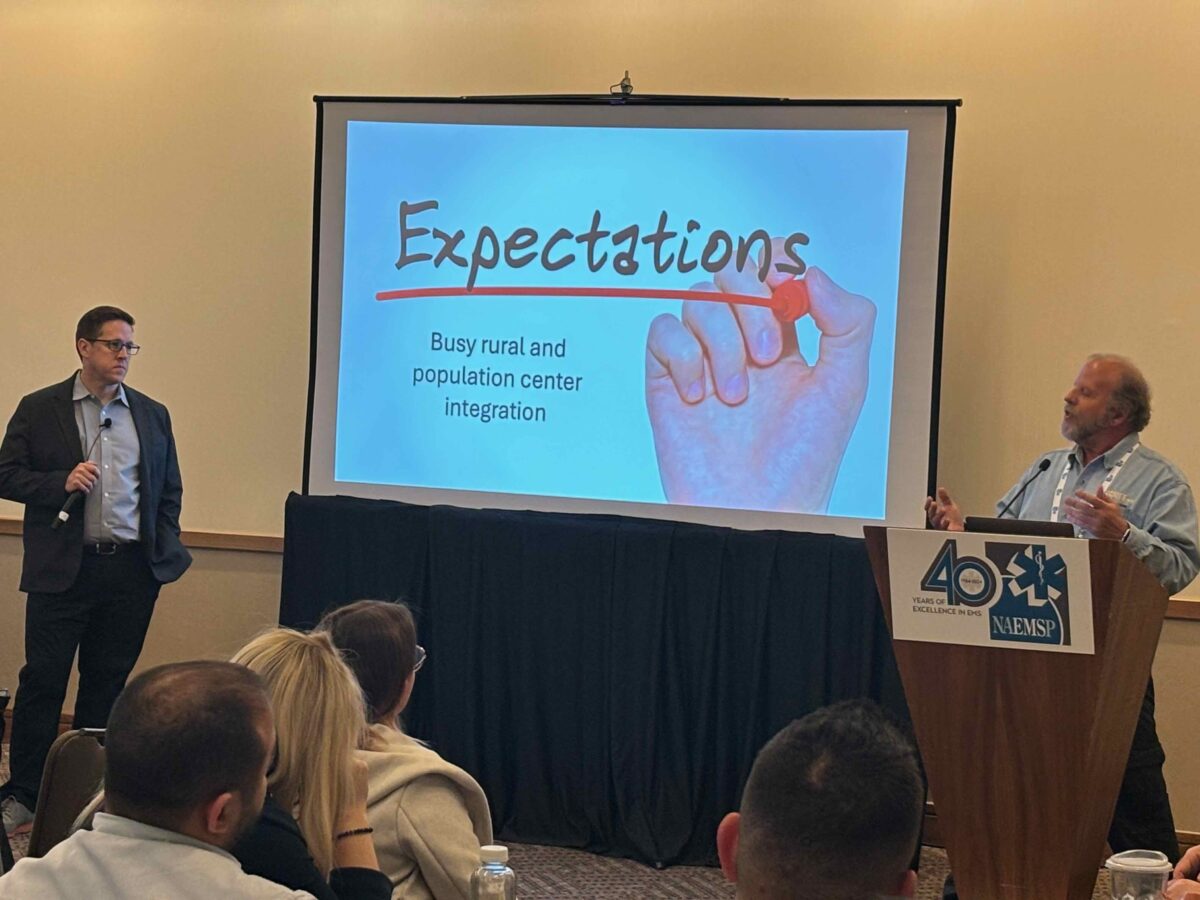
Images above: David Williams and Mike Taigman, UMBC EHS faculty, at the National Association of EMS Physicians (NAEMSP) Annual Meeting.
Q: Tell us about your current job. What do you like most about it?
A: I am a self-employed advisor, teacher, and author—an internationally respected scholar-practitioner of the Science of Improvement. With 25 years of experience in quality improvement, I have worked with leaders and teams worldwide to develop people’s abilities to make rigorous, results-driven improvements and adopt quality as an organizational strategy. I also recently co-authored Quality as an Organizational Strategy: Building a System of Improvement. The book describes an approach to leading organizations based on W. Edwards Deming’s charge that leaders need a new theory of leadership and a strategy built on quality. The book defines quality as a strategy and describes a framework of five activities for leaders that can lead to both immediate results and long-term performance.
Image right: Quality as an Organizational Strategy: Building a System of Improvement
* * * * *
UMBC’s greatest strength is its people. When people meet Retrievers and hear about the passion they bring, the relationships they create, the ways they support each other, and the commitment they have to inclusive excellence, they truly get a sense of our community. That’s what “Meet a Retriever” is all about.
Learn more about how UMBC can help you achieve your goals.
]]>
Meet David M. Williams, M.S. ’02, emergency health services (EHS) management, a scholar-practitioner of the “Science of Improvement,” and a co-author of Quality as an Organizational Strategy:...
https://umbc.edu/stories/meet-david-williams-science-of-improvement/
https://my3.my.umbc.edu/api/v0/pixel/news/145619/guest@my.umbc.edu/2583d2071a9f433b3d97acaeed040344/api/pixel
alumni
ehs
emergency-health-services
magazine
meet-a-retriever
story
umbc-author
UMBC News & Magazine
https://my3.my.umbc.edu/groups/umbc-news-magazine
https://assets1-my.umbc.edu/system/shared/avatars/groups/000/001/943/24435aa6207c452e7bc15cc74b42c7bb/xsmall.png?1748556657
https://assets1-my.umbc.edu/system/shared/avatars/groups/000/001/943/24435aa6207c452e7bc15cc74b42c7bb/original.png?1748556657
https://assets2-my.umbc.edu/system/shared/avatars/groups/000/001/943/24435aa6207c452e7bc15cc74b42c7bb/xxlarge.png?1748556657
https://assets2-my.umbc.edu/system/shared/avatars/groups/000/001/943/24435aa6207c452e7bc15cc74b42c7bb/xlarge.png?1748556657
https://assets3-my.umbc.edu/system/shared/avatars/groups/000/001/943/24435aa6207c452e7bc15cc74b42c7bb/large.png?1748556657
https://assets1-my.umbc.edu/system/shared/avatars/groups/000/001/943/24435aa6207c452e7bc15cc74b42c7bb/medium.png?1748556657
https://assets2-my.umbc.edu/system/shared/avatars/groups/000/001/943/24435aa6207c452e7bc15cc74b42c7bb/small.png?1748556657
https://assets1-my.umbc.edu/system/shared/avatars/groups/000/001/943/24435aa6207c452e7bc15cc74b42c7bb/xsmall.png?1748556657
https://assets2-my.umbc.edu/system/shared/avatars/groups/000/001/943/24435aa6207c452e7bc15cc74b42c7bb/xxsmall.png?1748556657
UMBC News & Magazine
0
0
false
Wed, 13 Nov 2024 16:43:50 -0500
Wed, 13 Nov 2024 16:43:50 -0500
NSF awards UMBC’s Lauren Clay $624K Convergence Accelerator grant to address food insecurity in disasters
Longstanding food insecurity problems in the U.S. and around the world, exacerbated by the pandemic, are projected to increase over the coming decades, as food, water, and energy demands increase and environmental crises worsen. With this in mind, the National Science Foundation (NSF) is investing $11 million toward solutions to address the nutritional needs of vulnerable and under-resourced communities through its Convergence Accelerator Program.
UMBC’s Lauren Clay, associate professor and chair of emergency health services, is one 16 Convergence Accelerator awardees selected for Phase I of the program. Clay was awarded $624,000 for her project to improve food system resilience and decrease disaster-induced food insecurity in communities impacted by hurricanes.
Supporting food system resilience
Clay’s proposal explains that 11-15 percent of the U.S. population experienced food insecurity annually between 2008 and 2018, and households that are struggling with food insecurity before a disaster are at greatest risk for serious food access issues when a disaster strikes, and long after.
“Food and nutrition insecurity rates can increase threefold following disasters,” Clay notes. “Increased food and nutrition insecurity rates persist for years while households and communities recover.”
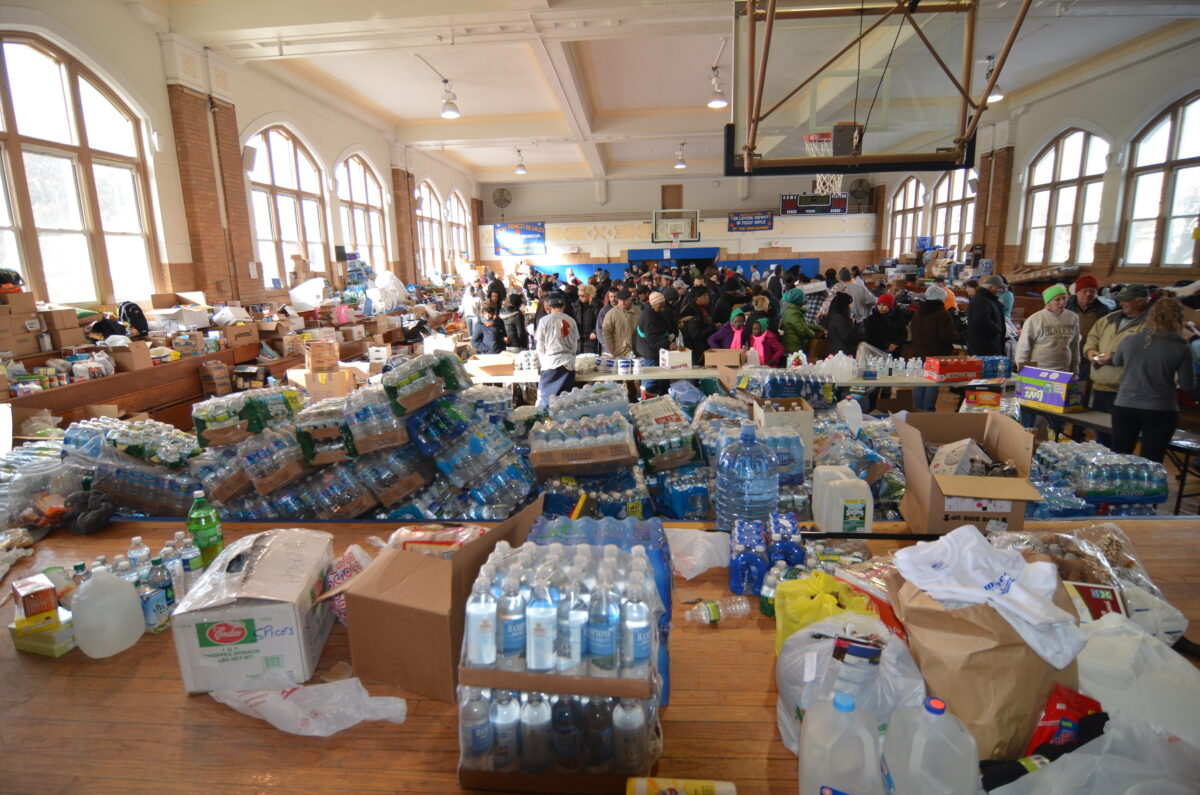 Food and clothing relief center for Hurricane Sandy survivors in New York City in 2012. (“Walter Jennings”/Wikimedia Commons)
“Communities across the U.S. are planning for growing threats related to climate disasters. Food security is a basic human need and is highly susceptible to disruption when families and communities experience disasters,” says Clay. “I’m excited to work with a multi-disciplinary and multi-sector team to develop a new tool for measuring community food security to support communities planning for, responding to, and recovering from hurricanes.”
Converging on solutions
The NSF Convergence Accelerator Program seeks to address national-scale challenges in science, engineering, and society through a collaborative research process that brings together expertise from multiple scientific disciplines, known as convergence research. The food and nutrition focus was recently added to the Convergence Accelerator, which also includes approaches towards combating challenges related to population health and climate change.
“We hope to create a group of synergistic efforts that advance regenerative agriculture practices, reduce water usage, provide equitable access to nutritious and affordable food for disadvantaged communities, and spur technology and job creation,” says Douglas Maughan, head of the Convergence Accelerator, in NSF’s announcement of award recipients.
Over the course of nine months, Clay and her team will work to develop the Food Index for Resilience, Security, & Tangible Solutions, called FIRST. This index will measure food system functioning in communities and is intended to be a resource that can be used to respond to and recover from disasters and environmental changes.
This effort builds on Clay’s prior and ongoing research to address disaster-specific food insecurity issues. She was also recently awarded an NSF Faculty Early Career Development (CAREER) award to develop a sociocultural model called Food Environment in Disasters (FED) and other tools to improve the understanding and monitoring of food availability, acceptability, and accessibility during disasters.
Following Phase I of this project, participating teams will take part in a formal pitch and Phase II proposal and could receive up to $5 million of additional support. Selected Phase II teams will further develop their solutions and sustainability development plans over the course of 24 months, to rapidly meet the needs of global communities.
]]>
Longstanding food insecurity problems in the U.S. and around the world, exacerbated by the pandemic, are projected to increase over the coming decades, as food, water, and energy demands increase...
https://umbc.edu/stories/convergence-accelerator-grant-food-insecurity-in-disasters/
https://my3.my.umbc.edu/api/v0/pixel/news/130098/guest@my.umbc.edu/3b254c269b2dc52563c49eefac025498/api/pixel
cahss
ehs
news
policy-and-society
rca-1
research
UMBC News & Magazine
https://my3.my.umbc.edu/groups/umbc-news-magazine
https://assets1-my.umbc.edu/system/shared/avatars/groups/000/001/943/24435aa6207c452e7bc15cc74b42c7bb/xsmall.png?1748556657
https://assets1-my.umbc.edu/system/shared/avatars/groups/000/001/943/24435aa6207c452e7bc15cc74b42c7bb/original.png?1748556657
https://assets2-my.umbc.edu/system/shared/avatars/groups/000/001/943/24435aa6207c452e7bc15cc74b42c7bb/xxlarge.png?1748556657
https://assets2-my.umbc.edu/system/shared/avatars/groups/000/001/943/24435aa6207c452e7bc15cc74b42c7bb/xlarge.png?1748556657
https://assets3-my.umbc.edu/system/shared/avatars/groups/000/001/943/24435aa6207c452e7bc15cc74b42c7bb/large.png?1748556657
https://assets1-my.umbc.edu/system/shared/avatars/groups/000/001/943/24435aa6207c452e7bc15cc74b42c7bb/medium.png?1748556657
https://assets2-my.umbc.edu/system/shared/avatars/groups/000/001/943/24435aa6207c452e7bc15cc74b42c7bb/small.png?1748556657
https://assets1-my.umbc.edu/system/shared/avatars/groups/000/001/943/24435aa6207c452e7bc15cc74b42c7bb/xsmall.png?1748556657
https://assets2-my.umbc.edu/system/shared/avatars/groups/000/001/943/24435aa6207c452e7bc15cc74b42c7bb/xxsmall.png?1748556657
UMBC News & Magazine
0
0
false
Fri, 06 Jan 2023 14:04:22 -0500
Fri, 06 Jan 2023 14:04:22 -0500
Tackling food insecurity in disasters: UMBC’s Lauren Clay develops a new model through $520K NSF CAREER award
When disasters happen, access to food can be interrupted, which can increase existing food insecurity issues and compound the impact of disasters. Currently, there isn’t a standard tool to measure disaster-specific food insecurity issues, making it harder to address them.
The National Science Foundation (NSF) has awarded UMBC’s Lauren Clay, associate professor and chair of emergency health services, a five-year, $520,000 Faculty Early Career Development (CAREER) award to develop a sociocultural model called Food Environment in Disasters (FED) and other tools to improve the understanding and monitoring of food availability, acceptability, and accessibility during disasters.
“Food is a basic need for human survival and the ability of social systems to meet this need in disaster situations is compromised when our homes, businesses, and other structures are damaged and lifelines disrupted,” says Clay. “While elements of the various social and built-in environmental systems that make up the broader food environment as well as food security issues have been studied by various disciplines, a comprehensive, systematic approach has yet to be applied and tested in disaster settings.”
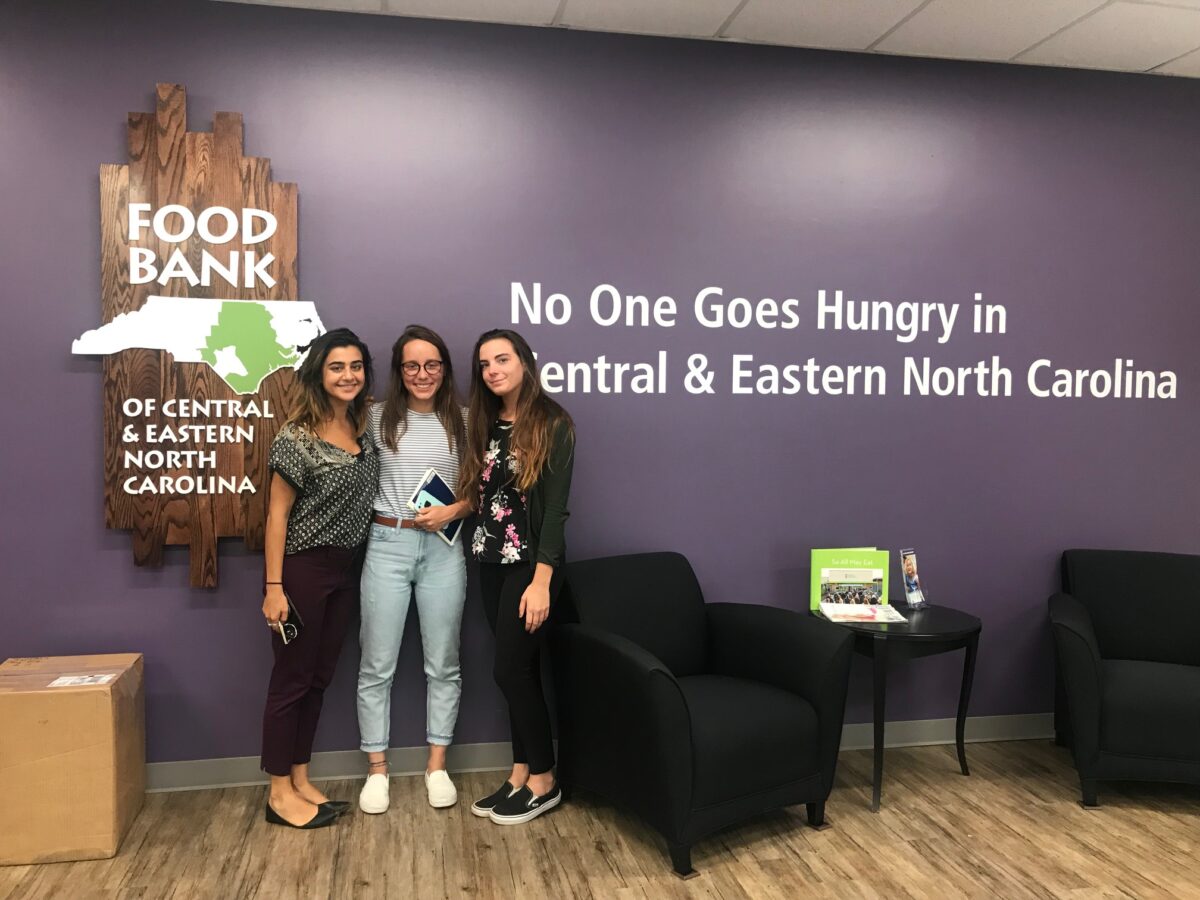 Lauren Clay’s graduate students volunteer at a food bank. (Image courtesy of Clay)
The CAREER award is one of NSF’s most prestigious awards for early career faculty. Recipients are chosen for their passion and dedication to the discovery process and commitment to teaching, learning, and sharing new knowledge.
This research builds on Clay’s prior body of work in disaster preparedness, recovery, and resilience. That work has focused on communities impacted by COVID-19; Hurricanes Harvey, Sandy, and Katrina; the Deepwater Horizon Oil Spill in the Gulf of Mexico; and the 2013 tornado in Moore, Oklahoma, among other disasters and public health emergencies.
The FED model
Over the next five years, Clay will use the current Nourish Food System Model as a guiding theory to develop her new FED model. “The Nourish Food System Model looks at the interconnectedness and interdependence of the biological, social, political, economic, health, and policy systems,” says Clay. “Some of these systems can be disrupted any day, but in a disaster, all of the systems are stressed.”
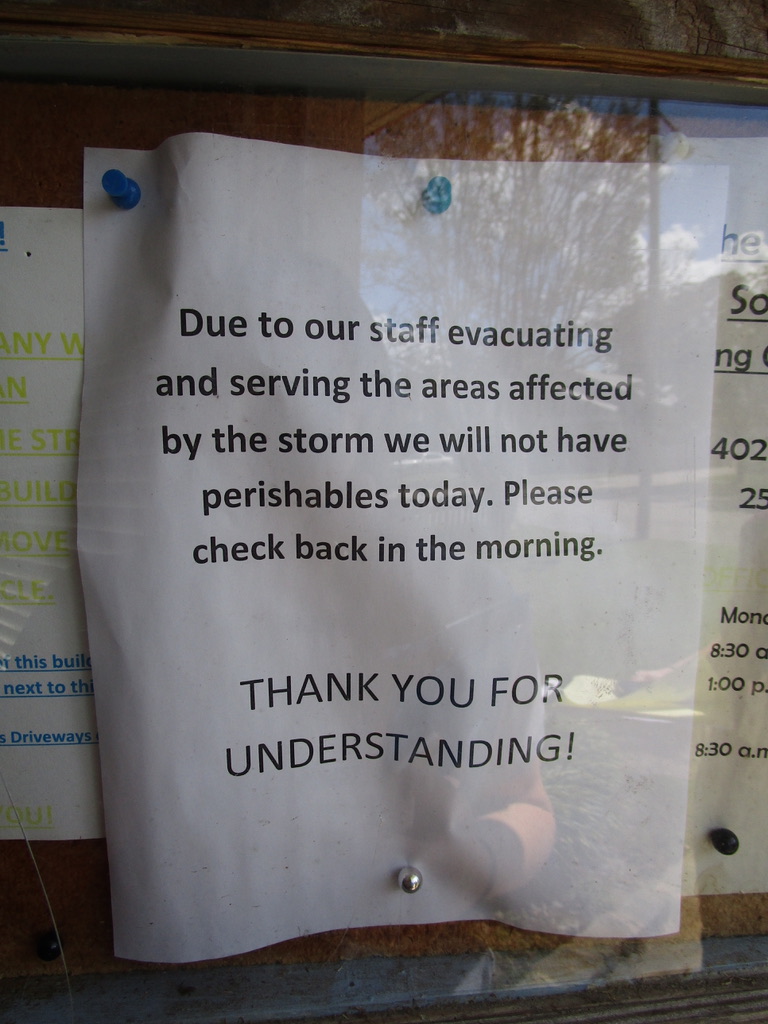 Community announcement for North Carolina residents after Hurricane Florence (2018).
(Image courtesy of Clay)
A key aspect of the FED model is that it is being developed with data from disasters. This is unlike current food system theory and metrics that base their emergency response on data from non-disaster times. The FED model will be tested against food insecurity data from COVID-19, Hurricane Florence, the 2018 Camp Fire in Paradise, California, and other case studies to determine how well the model fits with actual lived experiences in disasters.
“After I develop the FED model and validate it, the last part in the latter years of the grant will be to develop tools to support communities in building food system resilience for disasters,” says Clay. She will create the Environmental Audit Tool (EAT) to help local and state organizations better monitor and assess the processes and structures in place to address food insecurity in non-disaster times. This information will help improve both early response and long-term monitoring.
All of this work will help address the kinds of acute food insecurity issues that can double or triple chronic food security problems following disasters.
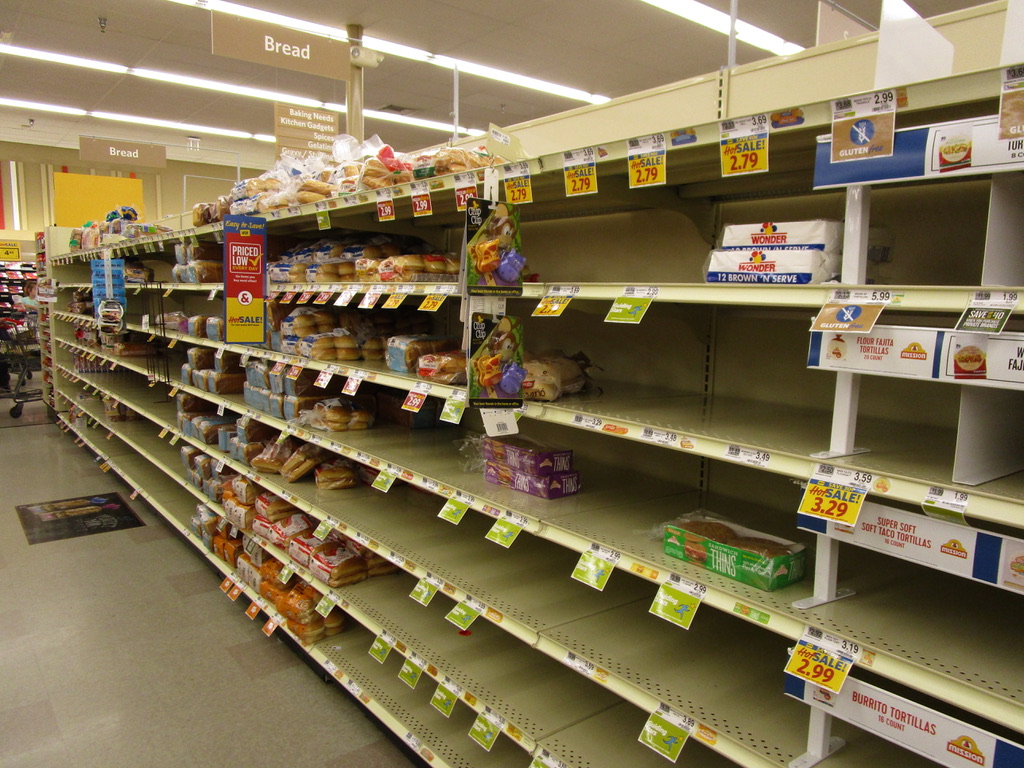 Grocery store shelves after Hurricane Florence (2018). (Image courtesy of Clay)
Best practices in teaching
The NSF award also recognizes and furthers Clay’s work as an innovative educator. Through the CAREER award, she will develop best practices in teaching methods related to food insecurity in disaster situations.
Clay will create one of the first teaching labs to train undergraduate students with the knowledge, skills, and attitudes to address disaster-focused food insecurity. She will also integrate field and lab research into her classes more broadly, where students can engage with the work as disaster response is unfolding, giving them the opportunity to learn about disasters both from emergency response practices and a theoretical framework.
Foundational work
Clay’s latest research builds on prior foundational work. In 2021, she received a $100,000 collaborative research award from the U.S. Department of Agriculture (USDA) and Tufts University. Clay was one of six researchers across the U.S. to participate in the USDA’s “25 Years of Food Security Measurement: Answered Questions and Further Research” program. The program aims to foster research related to the past 25 years of U.S. household food security research and to explore feasible evidence-based improvements.
“I proposed that the USDA was missing important information about people’s lives by focusing entirely on financial barriers to food security. Having cash does not guarantee food security if there are community-level disruptions,” says Clay. “Roads can flood and access to kitchens and food storage facilities can be damaged.”
Clay and a team of researchers collected data from six states to explore nonfinancial barriers to food accessibility, availability, and acceptability, including physical barriers to food sources (such as damaged roads), barriers to food availability (such as store closures), and access to foods that can be consumed without extensive kitchen facilities.
“We are in the final phase of developing a better measure of food insecurity following disasters when there is a community-level disruption,” says Clay. She plans to use this measurement tool in the development of the FED model.
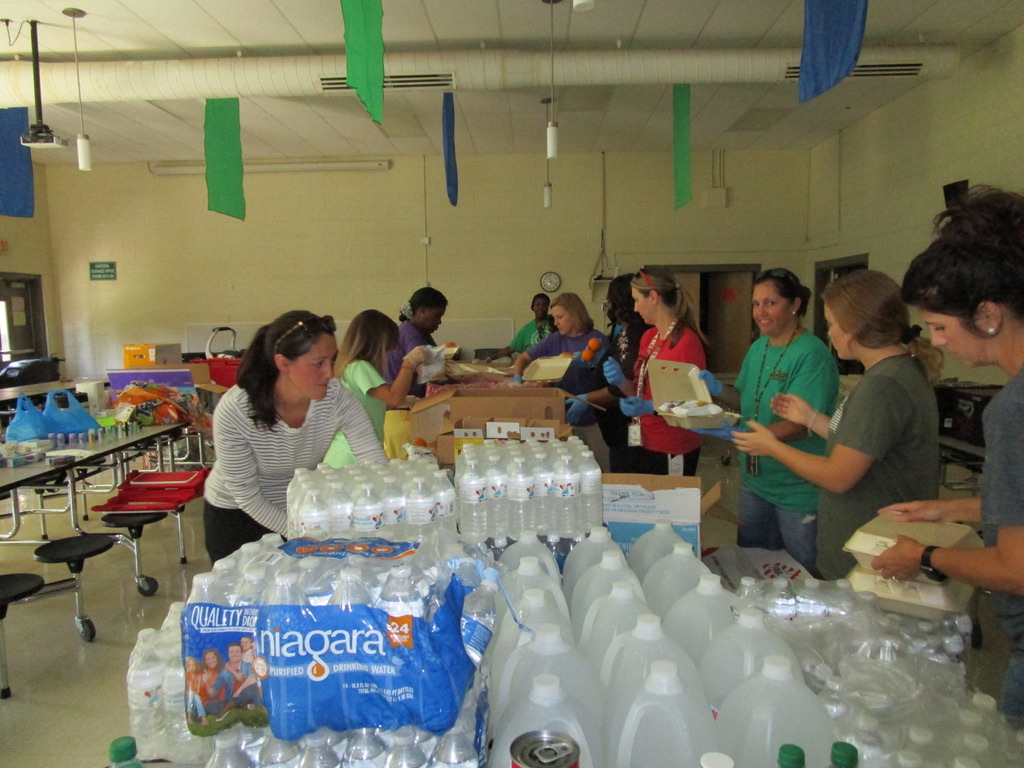 North Carolina teachers package food for victims of Hurricane Florence (2018). (Image courtesy of Clay)
National food access and COVID-19
Additionally, Clay has been working on two other food insecurity projects that have received Quick Response Research Awards, funded by the University of Colorado’s Natural Hazards Center with support from NSF.
In the first project, Clay leads the New York state team of the National Food Access and COVID research Team (NFACT). The team consists of researchers across 15 states exploring the impact of COVID-19 on food access, food security, and food systems across local, state, regional, and national levels. NFACT also integrates data to explore outcomes and impacts across scales.
NFACT has published several research briefs on COVID-19 and its primary and secondary health impacts, racial disparities in food insecurity, and racial disparities in healthcare insecurity among Native Americans and communities of color in New York City and New York State. NFACT has also published academic journal articles related to the health impacts of COVID-19, food access during the pandemic, and the need for enhanced outreach and support to those experiencing food insecurity for the first time during the pandemic.
The second project, in which Clay is the co-PI, is a study with the Food Distribution Program on American Reservations to pilot a culturally relevant metric of food insecurity. It will measure the impact of the COVID-19 pandemic on food insecurity among Native American and Alaskan Native communities in Western New York.
Clay was also awarded a research fellowship with the National Academies of Science, Engineering, and Medicine Gulf Research Program studying the Post-Disaster Food Environment project.
Helping communities to prepare and recover
In five years, Clay plans to have established the Disaster Health Research Lab, integrating the breadth of her research and teaching activities. This lab will offer a portfolio of tools to monitor food systems over the course of a disaster experience, from preparedness to assessing and responding to impact, to recovery. And she will offer tools to help communities improve the functioning of their food environments in disasters.
She particularly looks forward to developing a public engagement plan to share this work with researchers, disaster officials, and communities.
“Dr. Clay’s research demonstrates the importance of bringing a social science lens to the understanding of disaster science, management, and resilience,” says Christine Mallinson, director of UMBC’s Center for Social Science Scholarship. “Disasters exacerbate inequities, including food insecurity, which has a serious impact on the health of people and communities around the world. Dr. Clay’s research not only aims to understand these processes but also how to design interventions to mitigate the societal-level impacts and consequences of disasters.”
Clay is the first faculty member in UMBC’s College of Arts, Humanities, and Social Sciences to have received this award. UMBC faculty have received 42 NSF CAREER Awards since NSF launched the program in 1995, including eight faculty over the past five years. Their fields of research include computer science and electrical engineering (CSEE); information systems; chemistry and biochemistry; chemical, biochemical, and environmental engineering (CBEE); and biological sciences.
UMBC’s most recent recipients are Cynthia Matuszek, associate professor of CSEE; James Foulds, assistant professor of information systems; Naghmeh Karimi, assistant professor of CSEE, and Jianwu Wang, associate professor of information systems. UMBC President Valerie Sheares Ashby received an NSF CAREER award in 1998 while at Iowa State University.
]]>
When disasters happen, access to food can be interrupted, which can increase existing food insecurity issues and compound the impact of disasters. Currently, there isn’t a standard tool to measure...
https://umbc.edu/stories/tackling-food-insecurity-in-disasters-umbcs/
https://my3.my.umbc.edu/api/v0/pixel/news/128747/guest@my.umbc.edu/470bb3f3e0d5ff9ecfd2020b0f45ebe8/api/pixel
cahss
cahssresearch
career-award
cs3
diversityandinclusion
ehs
majoraward
news
policy-and-society
UMBC News & Magazine
https://my3.my.umbc.edu/groups/umbc-news-magazine
https://assets1-my.umbc.edu/system/shared/avatars/groups/000/001/943/24435aa6207c452e7bc15cc74b42c7bb/xsmall.png?1748556657
https://assets1-my.umbc.edu/system/shared/avatars/groups/000/001/943/24435aa6207c452e7bc15cc74b42c7bb/original.png?1748556657
https://assets2-my.umbc.edu/system/shared/avatars/groups/000/001/943/24435aa6207c452e7bc15cc74b42c7bb/xxlarge.png?1748556657
https://assets2-my.umbc.edu/system/shared/avatars/groups/000/001/943/24435aa6207c452e7bc15cc74b42c7bb/xlarge.png?1748556657
https://assets3-my.umbc.edu/system/shared/avatars/groups/000/001/943/24435aa6207c452e7bc15cc74b42c7bb/large.png?1748556657
https://assets1-my.umbc.edu/system/shared/avatars/groups/000/001/943/24435aa6207c452e7bc15cc74b42c7bb/medium.png?1748556657
https://assets2-my.umbc.edu/system/shared/avatars/groups/000/001/943/24435aa6207c452e7bc15cc74b42c7bb/small.png?1748556657
https://assets1-my.umbc.edu/system/shared/avatars/groups/000/001/943/24435aa6207c452e7bc15cc74b42c7bb/xsmall.png?1748556657
https://assets2-my.umbc.edu/system/shared/avatars/groups/000/001/943/24435aa6207c452e7bc15cc74b42c7bb/xxsmall.png?1748556657
UMBC News & Magazine
7
0
false
Wed, 26 Oct 2022 09:12:43 -0400
Wed, 26 Oct 2022 09:12:43 -0400
Scholar-athlete shines a light on mental health
Courtney Coppersmith
Degree: B.S., Biochemistry and Molecular Biology
Minors: Philosophy and Emergency Health Services
Hometown: York, PA
Plans: Graduate degree in chemistry
“I still talk to professors I had in my freshman year, which I think is really cool and speaks to the fact that this really is a community among faculty, staff, and students.”
Courtney Coppersmith, ‘22, biochemistry and molecular biology, experienced UMBC as a welcoming community on her first visit, and she has devoted her time on campus to paying that welcoming spirit forward.
She is one of the top softball pitchers in the nation. She has set several university records through the championship-winning UMBC softball team, including for strikeouts in a single game. But behind the stardom, her early success and involvement in nearly a dozen campus and community organizations created pressures that felt overwhelming at times.
Coppersmith responded by writing an essay about her experiences with depression, which won the Jackie Robinson Breaking Barriers national essay contest. Soon, teammates and competitors were reaching out to her to say how her story had resonated with them and helped them recognize that they were not alone.
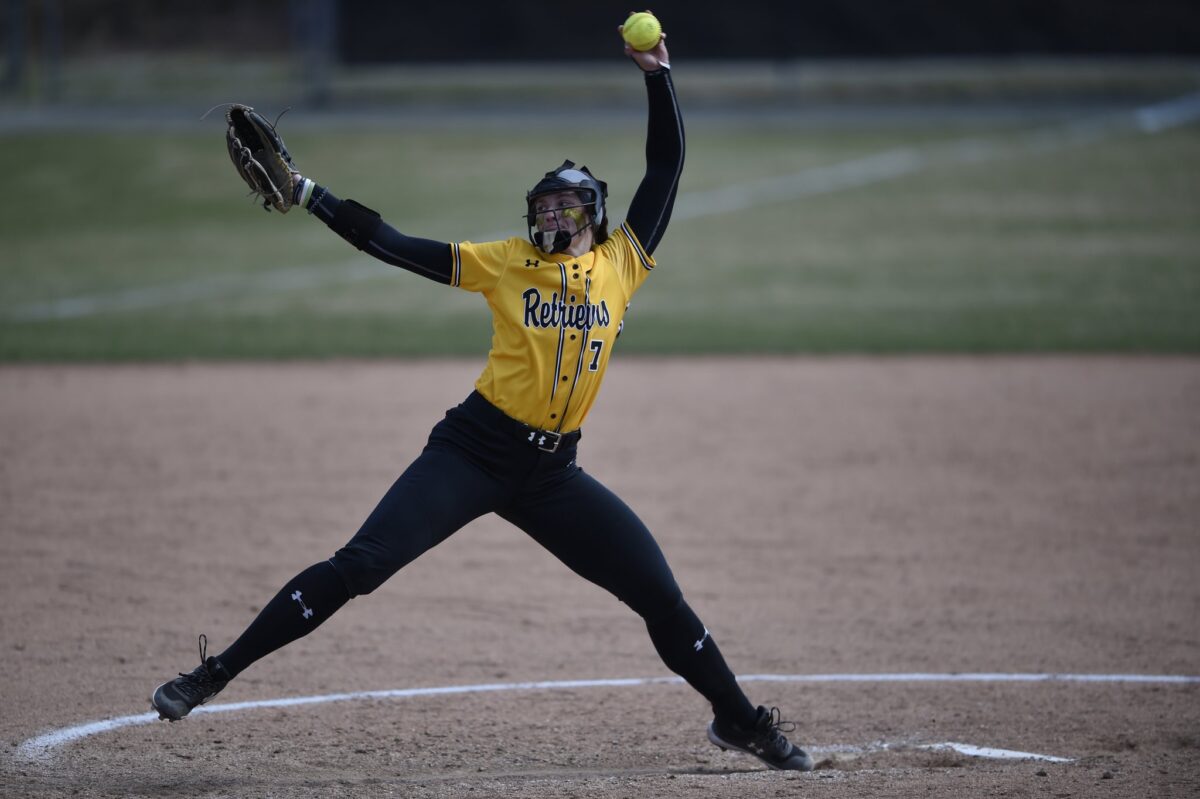 Courtney Coppersmith prepares to throw a strike. Photo courtesy of Coppersmith.
Coppersmith has continued to support fellow UMBC student-athletes and the broader UMBC community, particularly through mental health and food security initiatives. She has also served as a chemistry tutor and active volunteer in Baltimore.
Courtney Coppersmith in The College Tour video.
Coppersmith looks forward to pursuing a graduate degree in chemistry. She aspires to help develop medications to fight cancer.
Learn more about Coppersmith’s experience and advocacy in a new feature story in The Baltimore Sun.
Story written by David Hoffman, Ph.D. ’13, language, literacy, and culture (LLC), director of the Center for Democracy and Civic Life, and Romy Hübler ’09, modern languages and linguistics, M.A. ’11, intercultural communication, Ph.D. ’15, LLC, assistant director of the Center for Democracy and Civic Life.
]]>
Courtney Coppersmith Degree: B.S., Biochemistry and Molecular Biology Minors: Philosophy and Emergency Health Services Hometown: York, PA Plans: Graduate degree in chemistry “I still...
https://umbc.edu/stories/star-athlete-shines-a-light-on-mental-health/
https://my3.my.umbc.edu/api/v0/pixel/news/125385/guest@my.umbc.edu/5c0d37931ed97216df5544cc0c73b2a1/api/pixel
athletics
biochemistry
biology
cahss
class-of-2022
cnms
ehs
news
philosophy
together
UMBC News & Magazine
https://my3.my.umbc.edu/groups/umbc-news-magazine
https://assets1-my.umbc.edu/system/shared/avatars/groups/000/001/943/24435aa6207c452e7bc15cc74b42c7bb/xsmall.png?1748556657
https://assets1-my.umbc.edu/system/shared/avatars/groups/000/001/943/24435aa6207c452e7bc15cc74b42c7bb/original.png?1748556657
https://assets2-my.umbc.edu/system/shared/avatars/groups/000/001/943/24435aa6207c452e7bc15cc74b42c7bb/xxlarge.png?1748556657
https://assets2-my.umbc.edu/system/shared/avatars/groups/000/001/943/24435aa6207c452e7bc15cc74b42c7bb/xlarge.png?1748556657
https://assets3-my.umbc.edu/system/shared/avatars/groups/000/001/943/24435aa6207c452e7bc15cc74b42c7bb/large.png?1748556657
https://assets1-my.umbc.edu/system/shared/avatars/groups/000/001/943/24435aa6207c452e7bc15cc74b42c7bb/medium.png?1748556657
https://assets2-my.umbc.edu/system/shared/avatars/groups/000/001/943/24435aa6207c452e7bc15cc74b42c7bb/small.png?1748556657
https://assets1-my.umbc.edu/system/shared/avatars/groups/000/001/943/24435aa6207c452e7bc15cc74b42c7bb/xsmall.png?1748556657
https://assets2-my.umbc.edu/system/shared/avatars/groups/000/001/943/24435aa6207c452e7bc15cc74b42c7bb/xxsmall.png?1748556657
UMBC News & Magazine
0
0
false
Tue, 17 May 2022 12:56:24 -0400
Tue, 17 May 2022 12:56:24 -0400
As demand for telemedicine swells, UMBC researchers develop strategies to scale-up services

After years of gradual expansion, telemedicine has grown dramatically during the COVID-19 pandemic, allowing patients to consult with medical professionals from a distance, without traveling to an office or hospital. But the availability of telemedicine has not yet risen to meet demand, says UMBC’s Helena Mentis, associate professor of information systems (IS).

Helena Mentis. Photo by Marlayna Demond for UMBC.
New strategies are needed to scale-up telemedicine, and more entry-level medical professionals require training on how to provide care to patients virtually. Such training is particularly challenging when clinicians sharing their knowledge are in different locations than the people being trained. A UMBC team is taking on these challenges.
UMBC researchers have received a nearly $150,000 planning grant from the National Science Foundation (NSF) to study how telemedicine can be scaled more effectively, including meeting the complex training needs of medical professionals. Mentis, who is also an associate dean in the College of Engineering and Information Technology, is the principal investigator (PI) on the grant. She will work with Andrea Kleinsmith, assistant professor of IS; Anita Komlodi, associate professor of IS; Gary Williams, clinical coordinator in emergency health services; and Christine Yee, former assistant professor of economics, now an economist at Boston University and the Partnered Evidence-based Policy Resource Center, who are all co-PIs.

Anita Komlodi at an event in February 2020. Photo by Britney Clause ’11.
Mentis explains that this grant is an extension of her work on surgical telemedicine, which was the focus of her NSF CAREER award in 2016. “Whereas my prior work was on one physician communicating with one physician, this grant is looking at how we can scale the benefits of telemedicine with a hub and spoke model,” she says.
Addressing big ideas
The grant is part of NSF’s Big Ideas initiative, which focuses on “ten bold, long-term research and process ideas that identify areas for future investment at the frontiers of science and engineering.” Mentis explains that this research is specifically related to the Future of Work at the Human-Technology Frontier.
The research team will begin building a framework to better understand telemedicine through three approaches. First, they will develop and host a workshop for emergency healthcare leaders and educators, people who develop telemedicine systems, and health economists to discuss existing telemedicine challenges and identify possible innovative solutions.

Andrea Kleinsmith gives a tour of the Perception Lab in February 2020. Photo by Britney Clause ’11.
Second, they will complete an exploratory study to assess the cognitive, communicative, and affective loads experienced by telemedicine professionals in the field and by seasoned clinicians as they lead telemedicine training. Interviews with emergency medical services (EMS) professionals from the greater Baltimore region will provide data for this component.
The final element of this work will be for the research team to connect with community partners to understand the challenges of telemedicine-at-scale. They will also examine how expanding telemedicine could impact the EMS workforce and healthcare costs
Yee explains that through the grant, there will be interviews conducted with EMS managers to find out how they identified and hired their current workforce. “We hope to learn about the expenses related to the current practice of off-site emergency services and transportation to hospitals and other medical institutions,” she says. “We also will be interviewing current and potential EMTs and paramedics about their considerations regarding the EMS career path, including training, burnout, compensation, and risks.”
Developing scalable solutions
The researchers will interview EMS professionals in greater Baltimore to learn about the challenges they face when providing care through telemedicine. They will also examine how telemedicine might offer an entry-level pathway for high school graduates who are interested in pursuing a healthcare career.

Gary Williams. Photo courtesy of Williams.
Williams explains that in early 2019, EMS 2050 was released. This guide informs EMS leaders and educators about the future of the field, and one of the guiding principles is a focus on being adaptable and innovative. “The document speaks specifically about telemedicine and EMS and how we improve patient care by bringing this technology to the forefront,” he says. “The timing is perfect with receiving this grant and the release of EMS 2050. We need this type of research to start making changes and finding new ways to provide patient care to everyone, no matter where they live.”
The existing EMS infrastructure and educational pathways explored through this process will inform the team’s recommendations for scaling telemedicine. By finding new ways to meet high demand for telemedicine services, the team hopes to relieve some of the strain on emergency medical technicians and other healthcare providers who are stretched beyond capacity.
“We began this work with the intention to impact healthcare in the far off future, but as we have seen in the past 6 months, that future is here now,” says Mentis. “Equitable, scalable, and affordable healthcare are of paramount importance and this grant is a huge step in working with our healthcare partners to identify sustainable change.”
Banner image: Telemedicine consultation equipment. Photo by Sergio Santos, used under CC 2.0.
]]>
After years of gradual expansion, telemedicine has grown dramatically during the COVID-19 pandemic, allowing patients to consult with medical professionals from a distance, without traveling to an...
https://umbc.edu/stories/as-demand-for-telemedicine-swells-umbc-researchers-develop-strategies-to-scale-up-services/
https://my3.my.umbc.edu/api/v0/pixel/news/119779/guest@my.umbc.edu/0b7e825f7dc76a6990adbad227f0e1f1/api/pixel
cahss
coeit
economics
ehs
is
policy-and-society
science-and-technology
UMBC News & Magazine
https://my3.my.umbc.edu/groups/umbc-news-magazine
https://assets1-my.umbc.edu/system/shared/avatars/groups/000/001/943/24435aa6207c452e7bc15cc74b42c7bb/xsmall.png?1748556657
https://assets1-my.umbc.edu/system/shared/avatars/groups/000/001/943/24435aa6207c452e7bc15cc74b42c7bb/original.png?1748556657
https://assets2-my.umbc.edu/system/shared/avatars/groups/000/001/943/24435aa6207c452e7bc15cc74b42c7bb/xxlarge.png?1748556657
https://assets2-my.umbc.edu/system/shared/avatars/groups/000/001/943/24435aa6207c452e7bc15cc74b42c7bb/xlarge.png?1748556657
https://assets3-my.umbc.edu/system/shared/avatars/groups/000/001/943/24435aa6207c452e7bc15cc74b42c7bb/large.png?1748556657
https://assets1-my.umbc.edu/system/shared/avatars/groups/000/001/943/24435aa6207c452e7bc15cc74b42c7bb/medium.png?1748556657
https://assets2-my.umbc.edu/system/shared/avatars/groups/000/001/943/24435aa6207c452e7bc15cc74b42c7bb/small.png?1748556657
https://assets1-my.umbc.edu/system/shared/avatars/groups/000/001/943/24435aa6207c452e7bc15cc74b42c7bb/xsmall.png?1748556657
https://assets2-my.umbc.edu/system/shared/avatars/groups/000/001/943/24435aa6207c452e7bc15cc74b42c7bb/xxsmall.png?1748556657
UMBC News & Magazine
0
0
false
Thu, 08 Oct 2020 18:46:12 -0400
UMBC’s Lucy Wilson, an infectious disease transmission expert, helps governors and the public respond to COVID-19
Governors across the United States have been working to determine what safe reopening might look during the COVID-19 pandemic. When the National Governors Association (NGA) needed experts to outline considerations, they reached out to UMBC’s Lucy Wilson.
For more than a decade, Wilson has served as a public health expert on disease response and public health planning at the international, national, and state levels. When the NGA called, she joined an interdisciplinary team of experts in developing “The Roadmap to Recovery: A Public Health Guide for Governors,” published this April.
Keeping Maryland safe
Wilson is an infectious disease physician who is also a professor and graduate program director of emergency health services at UMBC. Prior to coming to UMBC, she served as a medical epidemiologist at the Maryland Department of Health, as chief for the Center for Surveillance, Infection Prevention and Outbreak Response for ten years. There she oversaw Maryland’s infectious disease outbreak responses and infection control guidance in all types of settings.

Spring 2019 graduate school graduation ceremony. (Wilson, first on the left in the second row.)
Photo courtesy of Wilson.
She has also served on the State’s Physician on Call Team, where she was one of a small group of doctors responsible for assessing potential biological, chemical, and nuclear threats. And she currently is the co-principal investigator of the Healthcare-Associated Infections (HAI) branch of Maryland’s Emerging Infections Program (EIP). Through EIP, she conducts surveillance epidemiology and antibiotic resistance research focusing on healthcare-associated infections (including COVID-19) in hospitals and nursing homes. At UMBC, her research focuses on visualizing health outcomes across the continuum of healthcare.
“I have experience working with stakeholders throughout the state to examine different areas of response…that cut across the spectrum of emergency management and response,” explains Wilson. She notes that this could range from education to agriculture to transportation. “This gave me the perspective to help make recommendations to governors about how to create a team and what type of considerations to have for COVID-19 response.”
Learning from previous outbreaks
The NGA provides governors, cabinet members, Congress, private business, and the international community with guidance related to public policy and governance. To develop a COVID-19 recovery roadmap, Wilson helped assess the various settings impacted by COVID-19. She then applied the science of infection control and disease transmission to help develop criteria to maintain the safety of settings like schools, hospitals, prisons, and nursing homes.
Wilson’s recommendations were informed by her prior work in infection control, disease surveillance, and government response to outbreaks, diseases, and pandemics at a national and international level. These include responding to the novel influenza A (H1N1) virus pandemic of 2009, Ebola, Zika, statewide food-related outbreaks, and medication recalls.
When it comes to COVID-19, Wilson says, “This level of pandemic is unprecedented in modern times.” She explains, “We can look back to 1918 to see how social distancing worked. We can look at other countries who have had different COVID-19 strategies in terms of their response and reopening. But what we need to be prepared for is that the coronavirus is difficult to control.”
Using available tools
“Governors must respond with tools we know will work, as appropriate to their region, to try to minimize illness,” states Wilson. These tools focus on minimizing physical contact between people, from using touchless purchasing and curbside pickup at businesses to adjusting work schedules to spread out employees.
The Roadmap to Recovery report divides states’ COVID-19 responses into two stages. The first stage focused on reducing the spread of infection through mandated physical distancing in the absence of comprehensive testing, treatment, or vaccines. Closing gathering spaces like schools, businesses, places of worship, and recreation areas helped to “flatten the curve.”
The second stage involves necessary measures and infrastructure needed to safely open up society. This includes continuous assessments to determine whether to keep moving forward or to return to previous restrictions.
“This is a multifactorial situation where we will likely see more cases and potentially more waves of disease,” shares Wilson. “It will be difficult to eradicate the coronavirus until we have a vaccine or valid treatment. Hopefully, as we implement and determine best practices, we can minimize the number of infections and deaths.”
Beyond the report, Wilson also provided support to policymakers as a panelist for a Johns Hopkins University Diagnostic Excellence Summit on COVID-19. The summit focused on “Diagnostic Strategy for the COVID-19 Pandemic — Bench to Bedside to Blueprint for Policymakers.” She is currently helping to develop and implement campus policy as part of UMBC’s Incident Management Team and Fall Planning Coordinating Committee.
Informing the public
Since the start of the pandemic, Wilson has also provided guidance to the general public on how to take precautions to reduce coronavirus transmission. “People are being asked to take very drastic measures, which have radically changed their lives,” she says. She takes the time to speak with the media because she knows it is essential for people to understand the reasoning behind public health guidelines.
In March, Wilson explained the need for sufficient protective equipment for healthcare workers in the New York Times. When the virus began to impact cruises she explained the quarantine process in the Washington Post.
When COVID-19 testing became a public concern and broader restrictions began to be implemented, Wilson helped Maryland and Washington D.C. residents understand these issues. She contributed to several additional articles in The Washington Post. This included coverage on increasing restrictions, testing issues, the rising rate of infection, contact tracing, and the closing of gathering spaces.
“It is important to know what is science and what is reasonable. People want to know what actions people can take to take care of themselves,” says Wilson. Wilson was a guest on the Public Health On Call podcast, produced by Johns Hopkins. She spoke about how nursing homes and first responders can address the threat of COVID-19.
Wilson has also offered guidance on what people can do on an individual level. She addressed issues with physical activities like golfing and running. In the Huffington Post she discussed how to properly remove disposable gloves and why they shouldn’t be reused, what to do about jewelry and beards to avoid disease transmission, and reusing face masks. And in The Conversation, Wilson wrote about the matters to consider after a loved one dies from coronavirus, to avoid further infection.
How to begin reopening
Wilson has now also begun speaking with news agencies, including CNN. She shares what the process of reopening the country might look like. Leaders are learning how to manage rapid changes on a daily basis in all aspects of life, beyond just healthcare.
Wilson expects that, moving forward, some interventions will work better than others, and communities will learn from each others’ experiences. “This is an evolving process. There will be changes in recommendations and information. Our understanding of this virus is that it affects everyone and every sector of our society,” says Wilson. “We need to have patience and be flexible because we are all learning as we go along.”
Banner image: Lucy Wilson. Photo courtesy of Wilson.
]]>
Governors across the United States have been working to determine what safe reopening might look during the COVID-19 pandemic. When the National Governors Association (NGA) needed experts to...
https://umbc.edu/stories/umbcs-lucy-wilson-an-infectious-disease-transmission-expert-helps-governors-and-the-public-respond-to-covid-19/
https://my3.my.umbc.edu/api/v0/pixel/news/119864/guest@my.umbc.edu/6a904e8bb66a0ddc4102716ed822be15/api/pixel
cahss
cahssresearch
covidresearch
ehs
page1
policy-and-society
science-and-technology
UMBC News & Magazine
https://my3.my.umbc.edu/groups/umbc-news-magazine
https://assets1-my.umbc.edu/system/shared/avatars/groups/000/001/943/24435aa6207c452e7bc15cc74b42c7bb/xsmall.png?1748556657
https://assets1-my.umbc.edu/system/shared/avatars/groups/000/001/943/24435aa6207c452e7bc15cc74b42c7bb/original.png?1748556657
https://assets2-my.umbc.edu/system/shared/avatars/groups/000/001/943/24435aa6207c452e7bc15cc74b42c7bb/xxlarge.png?1748556657
https://assets2-my.umbc.edu/system/shared/avatars/groups/000/001/943/24435aa6207c452e7bc15cc74b42c7bb/xlarge.png?1748556657
https://assets3-my.umbc.edu/system/shared/avatars/groups/000/001/943/24435aa6207c452e7bc15cc74b42c7bb/large.png?1748556657
https://assets1-my.umbc.edu/system/shared/avatars/groups/000/001/943/24435aa6207c452e7bc15cc74b42c7bb/medium.png?1748556657
https://assets2-my.umbc.edu/system/shared/avatars/groups/000/001/943/24435aa6207c452e7bc15cc74b42c7bb/small.png?1748556657
https://assets1-my.umbc.edu/system/shared/avatars/groups/000/001/943/24435aa6207c452e7bc15cc74b42c7bb/xsmall.png?1748556657
https://assets2-my.umbc.edu/system/shared/avatars/groups/000/001/943/24435aa6207c452e7bc15cc74b42c7bb/xxsmall.png?1748556657
UMBC News & Magazine
0
0
false
Wed, 10 Jun 2020 20:29:25 -0400
Retrievers on the Front Lines of the Pandemic
By Susan Thornton Hobby
Every time a coronavirus patient is released from St. Barnabas Hospital in the Bronx, a song plays over the loudspeaker: “St. Barnabas for All of Us.”
Trent Gabriel ’14, biochemistry and molecular biology, has heard the catchy tune several times, but not enough. Doctors call St. Barnabas a coronavirus “war zone,” with most of its clinics for specialties such as pediatrics and psychiatry now lined with bed after bed of patients with COVID-19. The hiss and click of ventilators fills the halls.
Gabriel is a dental resident who until mid-March handled routine and emergency dentistry at St. Barnabas. When the pandemic hit, Gabriel was pressed into service, filling in gaps when hospital staff were sick or overburdened. Among other jobs, he has tested doctors for coronavirus, taken vitals of COVID-19 patients, and filled prescriptions.
The pandemic necessitates fighting on all fronts. UMBC alumni and students are in the thick of that battle—testing hospital staff for the virus, screening patients at a Red Cross, riding in ambulances as an EMT, and many other roles.
Testing Medical Workers to Save Patients
When the pandemic closed St. Barnabas’ dental clinic, Gabriel was first assigned to test staff for coronavirus.
“It was really surprising how many had a good chance that they had COVID,” says Gabriel. “It hit the hospital really fast. These are doctors who know how to use PPE [personal protective equipment], and they’re getting sick.”
 Trent Gabriel, center, works as a dental resident at St. Barnabas Hospital in the Bronx. Since the pandemic, Gabriel has been testing staff for the virus, working in the pharmacy, and taking vital signs of patients. Photo courtesy of Gabriel.
Several staff, including a trauma surgeon and two nurses who both were supposed to have retired but stayed at St. Barnabas to help, have died from the disease. Gabriel’s worry that he’ll become infected is ever-present.
“A lot of us have a fatalistic attitude,” Gabriel says. “We’re getting exposed every day. It’s going to happen. You just hope that it’s later, and we’ve figured out how to treat it.”
How to Train a Hero
“Many of our faculty, students, and staff are participating in an active role in the COVID-19 response, treating patients on the ambulance, in the field, in the emergency department, and providing consultation to direct response,” explains J. Lee Jenkins, chair of the Department of Emergency Health Services at UMBC.
To prepare for just this kind of health crisis, leaders in medical and traumatic emergency services serve as faculty members and mentors to provide practical experiences for the 80 undergraduate and 35 graduate students in the program, Jenkins says.
 For the Graduate Experience Achievement Research Symposium in 2019, emergency health services graduate student Sanaz Taherzadeh and classmates demonstrate the proper use of personal protective equipment, concentrating on the Ebola crisis that was happening then. Photo courtesy of Taherzadeh.
“While serving as an emergency physician, I’ve personally seen the toll that this virus has taken on our first responders, our nation’s emergency public health system, our patients, our students and faculty,” says Jenkins, who is an emergency medicine physician at Johns Hopkins Hospital and a faculty member in emergency medicine at JHU’s School of Medicine.
“Our nation’s emergency departments and EMS systems have been stretched past our limits in both physical and supply capacity as the front-liners bravely handle the physical and emotional needs of both themselves and the patients,” Jenkins shares. “Those in EMS and in the hospital continue to go to work, to take care of patients, then we come home to our families, each time worrying that we may have brought home this disease.”
Why engage in this risky profession? “We are here to serve, to go where we are needed,” adds Jenkins. “This is why our department, EHS, exists, to educate the next generation of these heroes.”
The Right Skills for a Crisis
Current EHS student Sanaz Taherzadeh says her life has prepared her for a pandemic. As a teenager, she watched her grandfather battle cancer in her native Iran and decided to become a nurse. After years working as an operating room nurse in Tehran, when a 2017 earthquake devastated the mountainous region of Kermanshah, Taherzadeh traveled there to triage and treat victims.
“I had to be brave, calm, and honest so that people could trust me and rely on me,” Taherzadeh remembers.
In 2019, Taherzadeh started her master’s in emergency health services concentrating in epidemiology at UMBC. For her graduate research, she has given presentations on personal protection equipment and coronavirus. All the threads of her knowledge—disaster medicine, epidemiology, and protective equipment—culminated when this coronavirus became a pandemic.

 Top: Sanaz Taherzadeh volunteers at a Baltimore Red Cross donation center, assessing donors before their blood is drawn. Photos courtesy of Taherzadeh. Bottom: At the 2019 Graduate Experience Achievement Research Symposium, emergency health services graduate student Sanaz Taherzadeh and classmates presented on the proper use of personal protective equipment.
Taherzadeh, set to graduate in December, volunteers as a surgical support technician for the University of Maryland Shock Trauma Center, as well as for the Red Cross, where she assists victims at sites of disasters, and screens patients at blood donation centers to ensure they are healthy.
Even though Iran and the United States do not have a good diplomatic relationship, says Taherzadeh, and she worries about being deported, the nurse believes her place is here.
“Regardless of what our nationality is, what country we live in, or what religion we have, I believe we are human beings and now is the time that everyone in the world should work together to overcome this disease pandemic,” Taherzadeh says.
“Hard not to tear up”
Maggie Kemper ’14, biology, remembers her first patient with COVID-19. He arrived in mid-March, just after she and the rest of the nursing staff at Johns Hopkins Hospital had converted their Intensive Care Unit to an exclusively COVID-19 unit.
“He was pretty notable,” Kemper remembers, talking on an infrequent day off from her twelve-hour shifts at the hospital. “We had been hearing the patients would be older, immune-suppressed. But this guy was younger, a bodybuilder, no known health issues. It threw all of us for a loop. He was literally the opposite of what we’d been hearing. He was very sick, it was touch and go.”
 Maggie Kemper and her fellow nurses in a converted COVID-19 exclusive unit at Johns Hopkins Hospital. Photos courtesy of Kemper.
But finally, the last week in April, the patient had recovered enough for staff to discharge him after weeks on a ventilator. The disease had transformed him. Kemper says, “he came in jacked, and now he’s very skinny.” He will likely need rehabilitative care, his lungs were severely damaged, and he can’t live alone for a while, she says.
“We gave him a standing ovation,” Kemper says. “It was hard not to tear up.”
Like all of emergency medicine, Kemper and her unit have been learning on the fly about COVID-19—how they must put patients on their bellies to help the blood and oxygen flow to their lungs, how they should try to have patients breathe on their own as long as they can without putting them on ventilators, how it’s hard to guess, now, which patients are going to recover, and which aren’t.
The disease is taking its toll on the staff as well. Kemper is working her usual shifts, plus overtime because the unit is usually full to its capacity of 24 patients, “the sickest of the sick,” she says. And because she shouldn’t remove her protective gear, which gives her rashes around her ears and neck, she goes long stretches without eating or drinking. And she worries about getting infected herself.
“Initially I was very scared,” Kemper said. “Now I’m too tired to be scared.”
But Kemper is also thinking about her patients, who can’t have visitors, and who are debilitated with the disease. So she started an art campaign. Kemper spread the word in her Hampden neighborhood, and to friends and family, to have people send in drawings and letters. Kemper then laminated the pieces so the art could be sterilized, and hung them all over the unit and in patients’ rooms.
“It’s so overwhelming,” Kemper said. “Kids are sending in drawings and letters that say ‘I love you,’ and they don’t even know these people.”
Be Prepared
First-year emergency services and theatre dual major Jack Bez is just beginning his studies at UMBC, but is already using his skills. For 18 months, Bez has worked as an EMT with the Gamber & Community Fire Company. When campus closed, the Eagle Scout chose to live at the firehouse instead of moving home, to avoid exposing his parents to the coronavirus.
 Jack Bez at the Gamber & Community Fire Company, where he moved after campus closed. Photo courtesy of Bez.
Between responding to several ambulance calls a day, Bez is keeping up with his studies in theatre. He hung sleeping bags from a top bunk in the firehouse to fashion a sound booth in which he could record his sound production assignments.
Though Bez hasn’t yet treated a confirmed coronavirus patient, he has trained on prevention techniques and decontamination, and is activated with Maryland Medical Reserve Corps.
“All I know is that I’m content with being able to help people who need it, whether it’s COVID or not,” Bez says simply.
Looking Forward to “Normal”
When the pandemic crisis first began flooding hospitals with patients, but New York City hadn’t yet been put on lockdown, Gabriel remembers emerging from the subway after a long day of testing other doctors for coronavirus. Beside his subway stop was a public park, packed with kids and parents on a beautiful spring day. He remembers being afraid.
The pandemic, Gabriel says, “turns everything that makes us human on its head. Is it that bad to go to a park? We take for granted the things that keep us together.”
When Gabriel finishes his rotation at St. Barnabas this year, he’ll head to Boston University to complete specialty training and a program in crowns and dentures. He’ll be learning the aesthetics of making people’s smiles better, the layering of porcelains on implant teeth, full-mouth dentures on complex cases.
“Something calm and safe,” Gabriel says with a laugh. “Compared to now.”
Catherine Borg contributed to this story.
Header image courtesy of Jack Bez.
]]>
By Susan Thornton Hobby Every time a coronavirus patient is released from St. Barnabas Hospital in the Bronx, a song plays over the loudspeaker: “St. Barnabas for All of Us.” Trent...
https://umbc.edu/stories/retrievers-on-the-front-lines-of-the-pandemic/
https://my3.my.umbc.edu/api/v0/pixel/news/119902/guest@my.umbc.edu/34babb84b7bd0de2436a41c18e0e5813/api/pixel
alumni
covid-19
covidresearch
ehs
resilience
umbctogether
UMBC News & Magazine
https://my3.my.umbc.edu/groups/umbc-news-magazine
https://assets1-my.umbc.edu/system/shared/avatars/groups/000/001/943/24435aa6207c452e7bc15cc74b42c7bb/xsmall.png?1748556657
https://assets1-my.umbc.edu/system/shared/avatars/groups/000/001/943/24435aa6207c452e7bc15cc74b42c7bb/original.png?1748556657
https://assets2-my.umbc.edu/system/shared/avatars/groups/000/001/943/24435aa6207c452e7bc15cc74b42c7bb/xxlarge.png?1748556657
https://assets2-my.umbc.edu/system/shared/avatars/groups/000/001/943/24435aa6207c452e7bc15cc74b42c7bb/xlarge.png?1748556657
https://assets3-my.umbc.edu/system/shared/avatars/groups/000/001/943/24435aa6207c452e7bc15cc74b42c7bb/large.png?1748556657
https://assets1-my.umbc.edu/system/shared/avatars/groups/000/001/943/24435aa6207c452e7bc15cc74b42c7bb/medium.png?1748556657
https://assets2-my.umbc.edu/system/shared/avatars/groups/000/001/943/24435aa6207c452e7bc15cc74b42c7bb/small.png?1748556657
https://assets1-my.umbc.edu/system/shared/avatars/groups/000/001/943/24435aa6207c452e7bc15cc74b42c7bb/xsmall.png?1748556657
https://assets2-my.umbc.edu/system/shared/avatars/groups/000/001/943/24435aa6207c452e7bc15cc74b42c7bb/xxsmall.png?1748556657
UMBC News & Magazine
0
0
false
Sat, 02 May 2020 01:30:00 -0400
How to avoid infection after a COVID-19 death – an Ebola response veteran explains
by Lucy Wilson, Professor of Emergency Health Services, UMBC
As the grim reality of COVID-19 unfolds, families and health care workers in the United States are faced with dealing with the horrifying magnitude of deaths from this novel disease. This tragic situation brings forth the question of whether the bodies of patients who have died from COVID-19 provide a risk of infection in others.
I have worked for many years as an infectious disease doctor and public health official, during emerging disease outbreaks, such as Ebola virus disease in 2015. I have witnessed the extra challenges families experience when faced with the death of their loved ones from a highly transmissible infectious disease. For this current pandemic, here are the safety guidelines for dealing with deceased loved ones and the reasons why, from a scientific perspective.
Contagion risk decreases after death
Public health authorities have set out guidance for the management of the deceased based on current knowledge of both susceptibility to and transmissibility of the coronavirus.
The recommendations for handling those deceased from COVID-19 are based on knowledge that this novel coronavirus (SARS-CoV-2) is most commonly transmitted by respiratory droplets that are projected by a living person through coughing and sneezing. Therefore, after death, the risk from this respiratory mechanism is no longer present. However, the novel coronavirus (SARS-CoV-2) can also be transmitted from indirect contact: that is, touching a surface contaminated with the virus and then self-contaminating by touching one’s eyes, nose or mouth.
Preventing transmission when handling the deceased is achieved by “contact precautions,” which includes wearing a gown and gloves and hand-washing after removing these barriers. The deceased is placed in a body bag and the bag is then wiped down with EPA-approved disinfecting wipes prior to transportation.
This guidance holds in the funeral home setting as well, except there are additional instructions for preventing airborne transmission of coronavirus when certain body processing procedures, such as embalming, are performed.
This type of guidance in the health care setting is fairly standard for handling the deceased who is potentially infectious, given the risk of indirect contact of the patient with surrounding medical equipment, bedding and furniture.
During the Ebola pandemic, much stricter guidance was enforced, but this was also related to the tremendous amount of infectious fluids that were produced by a symptomatic patient, including profuse diarrhea. These precautions also took into consideration the extremely high mortality rate from Ebola.
At that time in 2015, I was working as a public health professional, and was involved in the determination of the best procedures to prevent cross-contamination when transferring a deceased patient with Ebola to the hospital morgue or elsewhere. A team of doctors, nurses and public health practitioners developed a protocol in a biocontainment unit with a patient mannequin and special chemical markers that could reveal contamination of surfaces via ultraviolet light.
This team was able to determine that multiple body bags were needed to prevent external contamination of the body bags being used. A careful manipulation of the patient, the bedding, proper personal protective equipment for staff and two stretchers was needed to achieve this level of caution.
Post-mortem safety for families
For families, there are many sad realities that need to be considered in the event of a death from COVID-19. While currently families are not allowed in the hospital to visit their loved ones, deaths in the home of those suspected of COVID-19 infection have been reported.
Again, given that breathing has stopped, the risk of transmission from coughing, sneezing and other mouth secretions is no longer a concern, but contact with surfaces that the patient could have previously contaminated remains. It is known that the virus can stay viable on surfaces for days, so all nearby surfaces should be considered infectious. Family members should thoroughly clean surfaces and bedding, wearing gloves and a washable or disposable cover up, if available.
Regarding funerals, when it is deemed safe to have a small gathering, or if exposed family members have completed their 14 day quarantine period, there is guidance on safety in those situations. There is no known risk of being in the same room at a funeral or visitation service with the body of someone who has died from COVID-19.
The CDC recommends not touching, kissing or hugging the deceased, though acknowledges that touching a hand or clothing after the body has been prepared for viewing is lower risk if hand-washing can then immediately occur.
Those at higher risk of complications of COVID-19 should use extra precaution in this setting. If there are important religious or cultural practices, such as shrouding or washing of the body, funeral home staff and local cultural and religious leaders can be involved to optimize reducing the risk of exposure.
Processing of the deceased can be achieved by cremation or embalming, and burial is allowed. For people who have died outside of the United States or need transportation for funeral services, federal and state guidelines need to be followed. For international transport, bodies can be transported if cremated, if embalmed and placed in a hermetically sealed casket or if the remains are accompanied by a CDC permit. This permit must be issued by the CDC director and allows for the importation of a person known or suspected of death from a quarantinable communicable disease.
How families can prepare
- Know your risk of complications from COVID-19.
- Know how to care for yourself and someone sick in your home.
- Know the warning signs of COVID-19 complications needing emergency medical care.
- Understand your hospital policy on visitation of someone sick with COVID-19.
- Learn the infection control and visitation policy in your family member’s nursing home or assisted living facility.
- Discuss end-of-life decisions with loved ones: living will, advanced directives, funeral and life ceremony wishes.
- Know the CDC recommendations for handling the deceased in the home and in funeral homes.
-
Prepare personal wills and child care plans in the event of death or prolonged hospitalization.
* * * * *
[You need to understand the coronavirus pandemic, and we can help. Read The Conversation’s newsletter.]
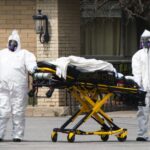
Header image: Workers wearing protective gear remove bodies of people who have died from COVID-19 from a New Jersey nursing home morgue. Eduardo Munoz Alvarez/Getty Image
Lucy Wilson, Professor of Emergency Health Services, University of Maryland, Baltimore County
This article is republished from The Conversation under a Creative Commons license. Read the original article.
]]>
by Lucy Wilson, Professor of Emergency Health Services, UMBC As the grim reality of COVID-19 unfolds, families and health care workers in the United States are faced with dealing with the...
https://umbc.edu/stories/how-to-avoid-infection-after-a-covid-19-death-an-ebola-response-veteran-explains/
https://my3.my.umbc.edu/api/v0/pixel/news/119915/guest@my.umbc.edu/d35d545f87aed4f35d63ccd15bc234a0/api/pixel
cahss
covidresearch
discovery
ehs
the-conversation
UMBC News & Magazine
https://my3.my.umbc.edu/groups/umbc-news-magazine
https://assets1-my.umbc.edu/system/shared/avatars/groups/000/001/943/24435aa6207c452e7bc15cc74b42c7bb/xsmall.png?1748556657
https://assets1-my.umbc.edu/system/shared/avatars/groups/000/001/943/24435aa6207c452e7bc15cc74b42c7bb/original.png?1748556657
https://assets2-my.umbc.edu/system/shared/avatars/groups/000/001/943/24435aa6207c452e7bc15cc74b42c7bb/xxlarge.png?1748556657
https://assets2-my.umbc.edu/system/shared/avatars/groups/000/001/943/24435aa6207c452e7bc15cc74b42c7bb/xlarge.png?1748556657
https://assets3-my.umbc.edu/system/shared/avatars/groups/000/001/943/24435aa6207c452e7bc15cc74b42c7bb/large.png?1748556657
https://assets1-my.umbc.edu/system/shared/avatars/groups/000/001/943/24435aa6207c452e7bc15cc74b42c7bb/medium.png?1748556657
https://assets2-my.umbc.edu/system/shared/avatars/groups/000/001/943/24435aa6207c452e7bc15cc74b42c7bb/small.png?1748556657
https://assets1-my.umbc.edu/system/shared/avatars/groups/000/001/943/24435aa6207c452e7bc15cc74b42c7bb/xsmall.png?1748556657
https://assets2-my.umbc.edu/system/shared/avatars/groups/000/001/943/24435aa6207c452e7bc15cc74b42c7bb/xxsmall.png?1748556657
UMBC News & Magazine
0
0
false
Mon, 20 Apr 2020 12:53:30 -0400
UMBC researchers offer knowledge, innovation during the time of COVID-19
At a time when information and misinformation are coming at us from all directions, and everyone is looking for answers, UMBC researchers are stepping up. They’re working hard to answer pressing questions about COVID-19 and sharing their expertise to help the public stay healthy and make informed decisions. By taking time to share their knowledge with local, national, and global communities, UMBC researchers are fulfilling our critical mission as a public university.
Lucy Wilson, professor of emergency health systems and an infectious disease expert, has been speaking regularly with leading national news outlets. She’s offered sobering analysis of what to expect in the days and weeks ahead, as well as practical advice to help people limit coronavirus exposure, like removing rings and switching to glasses from contacts.
As the number of cases in Washington, D.C., began to surge in mid-March, Wilson offered a reminder about the impact of social distancing. “Whatever numbers [of COVID-19 cases] we are seeing today reflect the transmission that was occurring one to two weeks ago,” Wilson told The Washington Post. “We shouldn’t be surprised by numbers continuing to increase, and we also shouldn’t discredit the effect of social distancing until we’ve given it time to take effect.”
Wilson has also talked about the importance of protecting the nation’s healthcare workers in The New York Times and the need to ramp up testing, also in the Post.
Dispelling rumors, sharing truths
Other faculty members are writing their own articles to help the public better understand issues in the news. Jeffrey Gardner, associate professor of biological sciences, explained “Why vodka won’t protect you from coronavirus, and four other things to know about hand sanitizer” in The Conversation. The article has been viewed more than 275,000 times across 44 different publishers. Almost overnight it has become the third most popular UMBC-authored article of all time in The Conversation.
Katherine Seley-Radtke, professor of chemistry and biochemistry, addressed whether the drug chloroquine is safe to use against COVID-19 in “5 questions answered about a promising, problematic and unproven use for an antimalarial drug.” The article, which calls on her seven years of research on coronaviruses and her career as a medicinal chemist, has been viewed more than 233,000 times across 49 publishers. It is UMBC’s all-time fifth-most-read Conversation article.

Katherine Seley-Radtke. Photo courtesy of Seley-Radtke.
Both Radtke’s and Gardner’s articles give readers useful and accessible information they can apply today.
Other UMBC experts are helping the public understand COVID-19’s effects on our communities, and how people can better support each other. John Fritz, associate vice president for instructional technology, has contributed to the conversation around the rapid transition from in-person to online learning. In the Baltimore Sun, he called the shift “a big step for a university like ours,” requiring flexibility and creativity. He also noted the importance of focusing on the needs of students who might not yet have access to the tools they need for distance learning.
Charissa Cheah, professor of psychology, is leading a new NSF-funded research project addressing how Chinese-American communities are experiencing discrimination related to COVID-19, and how they are coping. “The negative impact of infectious diseases on psychological health is understudied but highly significant,” Cheah says. Shimei Pan, assistant professor of information systems, will lead the study’s analysis of outbreak-related social media.
 Charissa Cheah. Photo by Marlayna Demond ’11 for UMBC.
Alumni focused on vaccine development, testing
UMBC alumni have taken lead roles in the record-paced development of a vaccine to prevent COVID-19. Kizzmekia Corbett ’08, M16, biological sciences, has led a team working on the vaccine at the National Institute of Allergy and Infectious Diseases. She and her teammates, including Olubukola Abiona ‘17, M25, biochemistry and molecular biology, received the genetic sequence of the virus early this year and developed a potential vaccine within two months.
They’ve since passed their findings to Darian Cash ’02, M10, chemistry, at the biotech company Moderna. Moderna is already administering phase I clinical trials with volunteers in Washington state.
On top of her research, Corbett has also been actively discussing her work with the media, including The New York Times, NPR, and Bloomberg News.
 Kizzmekia Corbett (center front) with her NIAID research team. Photo courtesy Kizzmekia Corbett.
Corbett, Abiona, and Cash thank the Meyerhoff Scholars program for helping them get to where they are as researchers, and to handle the intense pressures of the moment. “The Meyerhoff program not only showed me the Ph.D. pathway, but also provided mentorship and guidance to make it achievable,” Cash says. “Now, I use the skills the program taught me, such as public speaking and critical thinking, in my role as a scientist at Moderna.”
Corbett and Abiona draw on UMBC President Freeman Hrabowski’s consistent exhortation to “Focus, focus, focus,” Corbett says. “The UMBC connection and the training we received there, for both of us, has been instrumental in how we are operating right now,” she adds.
By bringing their expertise to bear in solving the COVID-19 crisis, these researchers are helping the United States and the world move through this uncharted territory.
Banner image: Chemical reactions sketched on a fume hood in Katherine Seley-Radtke’s laboratory. Photo by Marlayna Demond ’11 for UMBC.
]]>
At a time when information and misinformation are coming at us from all directions, and everyone is looking for answers, UMBC researchers are stepping up. They’re working hard to answer pressing...
https://umbc.edu/stories/umbc-researchers-offer-knowledge-innovation-during-the-time-of-covid-19/
https://my3.my.umbc.edu/api/v0/pixel/news/119932/guest@my.umbc.edu/8cd750278ba11940b5d5026517a78cdd/api/pixel
alumni
biology
cahss
chembiochem
cnms
coeit
community
covidresearch
cr
ehs
is
meyerhoffscholars
page1
policy-and-society
psychology
science-and-technology
UMBC News & Magazine
https://my3.my.umbc.edu/groups/umbc-news-magazine
https://assets1-my.umbc.edu/system/shared/avatars/groups/000/001/943/24435aa6207c452e7bc15cc74b42c7bb/xsmall.png?1748556657
https://assets1-my.umbc.edu/system/shared/avatars/groups/000/001/943/24435aa6207c452e7bc15cc74b42c7bb/original.png?1748556657
https://assets2-my.umbc.edu/system/shared/avatars/groups/000/001/943/24435aa6207c452e7bc15cc74b42c7bb/xxlarge.png?1748556657
https://assets2-my.umbc.edu/system/shared/avatars/groups/000/001/943/24435aa6207c452e7bc15cc74b42c7bb/xlarge.png?1748556657
https://assets3-my.umbc.edu/system/shared/avatars/groups/000/001/943/24435aa6207c452e7bc15cc74b42c7bb/large.png?1748556657
https://assets1-my.umbc.edu/system/shared/avatars/groups/000/001/943/24435aa6207c452e7bc15cc74b42c7bb/medium.png?1748556657
https://assets2-my.umbc.edu/system/shared/avatars/groups/000/001/943/24435aa6207c452e7bc15cc74b42c7bb/small.png?1748556657
https://assets1-my.umbc.edu/system/shared/avatars/groups/000/001/943/24435aa6207c452e7bc15cc74b42c7bb/xsmall.png?1748556657
https://assets2-my.umbc.edu/system/shared/avatars/groups/000/001/943/24435aa6207c452e7bc15cc74b42c7bb/xxsmall.png?1748556657
UMBC News & Magazine
0
0
false
Mon, 30 Mar 2020 16:23:42 -0400
 Photo by Carl Mikoy. Used under
  Photo by Kyler Kwock. Used under