Plot twist— Michelle Corpora ’03 took a nonlinear path to becoming NYT bestselling author
It was around five o’clock on a Wednesday in May, and Michelle Jabès Corpora ’03, English and theatre, was on her sofa watching her favorite British murder mystery on TV. It had been a long shot to think her newest book, His Face Is the Sun, would hit the New York Times (NYT) bestsellers list, and since she hadn’t heard anything and it was getting late, she figured it wasn’t meant to be.
Buzz! Buzz! Buzz! Suddenly, she looked down at her phone to see a FaceTime call from five different numbers—most of which she didn’t recognize. She quickly answered and saw her agent, editor, assistant editor, and publicists in the group of smiling faces before hearing the four words every author dreams of hearing: “You’re on the list!”
“I just started crying,” recalls Corpora. “I couldn’t believe it.”
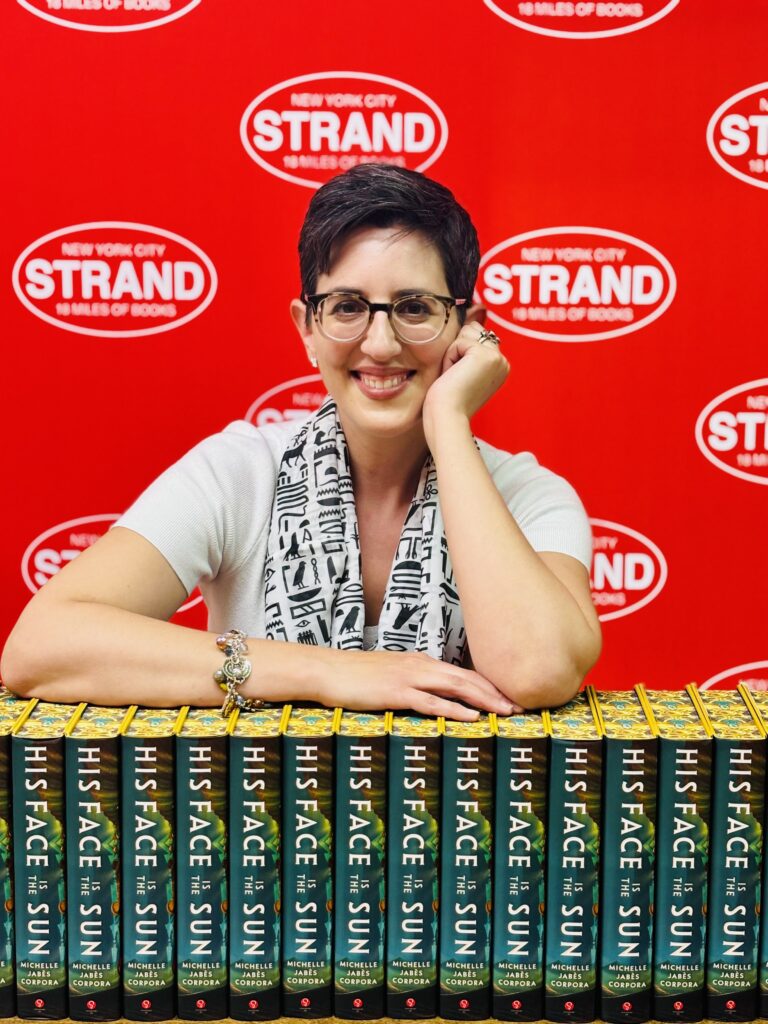
His Face Is the Sun stayed on the NYT Bestsellers Young Adult Hardcover list for five weeks, which the author says was “absolutely unbelievable.”
Where it all began
Corpora’s journey to becoming a NYTbestselling author was not a straight line—far from it. Corpora initially came to UMBC as a Linehan Artist Scholar to study theatre. Because she’d always been passionate about writing and literature, however, she added English as a second major to supplement her studies.

“Learning about drama helped significantly with my approach to character, plot, and pacing,” says Corpora. After UMBC, Corpora earned a master’s degree in Children’s Literature from Hollins University. Then, a few more twists and turns. Among other jobs, Corpora worked as a wedding singer, as a technician in a veterinarian’s office, and volunteered at a wildlife rehabilitation center before taking a big career leap and moving to New York City to try and get a job in children’s publishing.
Pictured left: Corpora as ‘Cleo’ AKA Fraulein Kost in a 2001 UMBC Theatre production of Cabaret.
New York state of mind
One catch: Corpora didn’t have a full-time job lined up. All she had were two unpaid summer internships at children’s publishing houses.
“It was a real gamble,” says Corpora, “but I feel like my entire career has been a series of gambles, and they always seem to work out well.”
Corpora landed an editorial assistant position at Greenwillow Books, an imprint of HarperCollins Children’s Books, where she had the opportunity to work on books by legendary authors like Kevin Henkes and Sid Fleischman, among many others. Then came her own children and another career pivot. With the birth of her daughter, Corpora moved into book packaging services.
“Book packaging is an interesting, mostly unknown side of the publishing industry where groups of writers work as a team to create concepts for series fiction,” says Corpora. “The transition was challenging because you really have to let go of ownership over your ideas, and you have to be creative in a collaborative way, which doesn’t come naturally to most people at first.”
Despite the learning curve, Corpora admits that her work as a concept creator really helped her grow as a writer, as she was coming up with ideas, developing them, and also editing manuscripts. “It made me into a jack of all trades,” she says.
From ghostwriting to ghosts
In 2015, Corpora got her first publishing opportunity after winning an audition to be a ghostwriter for a long-running middle-grade mystery series, eventually writing five books in the series. It wasn’t until 2021, however, that Corpora would see her name on one of her creations. Her next four books, all bearing the name Michelle Jabes Corpora on the cover, were what are known as work-for-hire projects.
“These are usually projects that you audition for,” explains Corpora. “It’s not ghostwriting because your name goes on the books, but usually the publisher has a concept for a book or series they want on their list, and they hire a writer to develop and write that project for them.”
This was the process for her two middle-grade historical fiction novels, The Fog of Warand The Dust Bowl, as well as her young adult horror duology, Holly Horror, which was created in partnership with the owners of the classic character, Holly Hobbie.
“Because of my job, I’d become a kind of chameleon,” says Corpora. “I was happy to write whatever book the client wanted. But it also taught me to identify the essence of every story. What makes it good? What makes it human? What’s the heart of this story?”
Michelle Jabès Corpora '03
English
Each step in Corpora’s journey built her foundation as a writer. But at that point, her agent knew she was ready for more.
“She’d seen me grow through all of this, was basically like, ‘It’s time for you to stop auditioning and ghostwriting and start writing your story—something that’s meaningful to you and that’s yours,’” recalls Corpora.
Finding her story
In 2023, Corpora took her next big gamble: creating not only her own original series, but writing something she’d never tried her hand at before. Epic fantasy.
“It felt like a big leap of faith at the time. I still had two young daughters, a part-time job, and a very busy life,” says Corpora, “and I was planning to put a lot of hours into a project that might never sell. But once the idea was born, I knew there was no going back.”
The Throne of Khetara series, born from that fateful conversation with her editor, is an Ancient Egyptian-inspired trilogy about a kingdom in turmoil, a forgotten oracle, and four unlikely heroes: a princess, a priestess, a rebel, and a thief.
“My parents and three of my grandparents were immigrants born in Egypt,” says Corpora. “So I grew up hearing stories about Egypt, and became fascinated by Ancient Egyptian history from a very young age.”
Corpora describes the series as “Ancient Egyptian Game of Thrones for young adults,” and is told from the perspectives of the four main characters.
“That seemed to really resonate strongly with people,” says Corpora, who wanted to showcase the different perspectives in ancient Egypt, including the non-royal population who were most affected by war and conquest.
The trilogy was picked up by Sourcebooks Fire and is currently being published in nine territories so far, including the UK, Italy, France, Germany, Spain, Brazil, Hungary, and Greece. It has also won numerous distinctions, including being on the list of YALSA Top Ten Best Fiction for Young Adults in 2026.
“It’s been a long and winding road to get here,” says Corpora. “But I’ll always remember UMBC as a place that allows people to find their way in the world, even if your journey might take you off the beaten path.”
Pictured right: Corpora, a New York Times bestseller, at a book signing event at The Strand Book Store in New York City.
]]>
It was around five o’clock on a Wednesday in May, and Michelle Jabès Corpora ’03, English and theatre, was on her sofa watching her favorite British murder mystery on TV. It had been a long shot...
https://umbc.edu/stories/michelle-corpora-nyt-bestselling-author/
https://my3.my.umbc.edu/api/v0/pixel/news/160456/guest@my.umbc.edu/e88128bedc3f4318bdb5ec9e163215e9/api/pixel
alumni
alumni-profile
cahss
english
magazine
retriever-authors
spring-2026
story
theatre
UMBC News & Magazine
https://my3.my.umbc.edu/groups/umbc-news-magazine
https://assets1-my.umbc.edu/system/shared/avatars/groups/000/001/943/24435aa6207c452e7bc15cc74b42c7bb/xsmall.png?1748556657
https://assets1-my.umbc.edu/system/shared/avatars/groups/000/001/943/24435aa6207c452e7bc15cc74b42c7bb/original.png?1748556657
https://assets2-my.umbc.edu/system/shared/avatars/groups/000/001/943/24435aa6207c452e7bc15cc74b42c7bb/xxlarge.png?1748556657
https://assets2-my.umbc.edu/system/shared/avatars/groups/000/001/943/24435aa6207c452e7bc15cc74b42c7bb/xlarge.png?1748556657
https://assets3-my.umbc.edu/system/shared/avatars/groups/000/001/943/24435aa6207c452e7bc15cc74b42c7bb/large.png?1748556657
https://assets1-my.umbc.edu/system/shared/avatars/groups/000/001/943/24435aa6207c452e7bc15cc74b42c7bb/medium.png?1748556657
https://assets2-my.umbc.edu/system/shared/avatars/groups/000/001/943/24435aa6207c452e7bc15cc74b42c7bb/small.png?1748556657
https://assets1-my.umbc.edu/system/shared/avatars/groups/000/001/943/24435aa6207c452e7bc15cc74b42c7bb/xsmall.png?1748556657
https://assets2-my.umbc.edu/system/shared/avatars/groups/000/001/943/24435aa6207c452e7bc15cc74b42c7bb/xxsmall.png?1748556657
UMBC News & Magazine
1
0
false
Mon, 01 Jun 2026 08:39:25 -0400
Mon, 01 Jun 2026 08:39:25 -0400
Bartleby is more than golden—50+ years with UMBC’s creative arts journal
 Quinn shows his poem published in the 1979 – 1980 Bartleby edition. (Catalina Dansberger Duque/UMBC)
“Bartleby NEEDS YOU!” This was the handwritten call to arms in 1979, for writers and poets to submit their work to Bartleby, UMBC’s creative arts journal. The sentiment of this flyer is not that different from its first publication in 1972 and from today’s social media posts alerting students to upcoming submission deadlines.
This unwavering spirit brought Howard Quinn ’80, English, back to campus in fall 2025 for the Bartleby 50+ celebration. He shared his memories as one of six editors of the 1979 – 1980 edition and reveled at the Bartleby covers and works, displayed in showcases at the Albin O. Kuhn Library and Gallery, some with typed-up poems printed on newsprint or cardstock and stapled together like the edition with 35 pieces that he helped edit—including his own poem, “Wind Down Wind” about loss.
In 2026, Bartleby—under the recently chartered Student Media Collective—editors read 200 art submissions, 120 poetry submissions, 60 fiction submissions, and 23 creative nonfiction submissions. The ensuing 160-page publication is book-bound and printed on glossy paper. Over five decades, Retrievers have continued to creatively express the personal and political events that have defined their lives, including war and national identity, rebellion, women’s rights, LGBTQ+ identity, social isolation, and joy and love.
Quinn came to Bartleby’s retrospective to celebrate the publication’s ongoing impact and to share a message from his friend Martha Campbell ’82, American studies, a Bartleby editor for three and a half years.
“I know that Bartleby has endured because people showed up to create art, give voice, share ideas, and they did that work year after year,” wrote Campbell, perhaps inadvertently echoing a line from her poem published during her tenure: “And the clock moves on, slow, but certain in its ways.”
 Left to right: Howard Quinn, Andrew Coulbourne, current editor (middle), and Sean McNutt ’24, anthropology, editor of volume 43, at the Bartleby 50+ exhibit. (Brad Ziegler/UMBC)
Read more Spring 2026 UMBC Magazine stories.
]]>
Quinn shows his poem published in the 1979 – 1980 Bartleby edition. (Catalina Dansberger Duque/UMBC) “Bartleby NEEDS YOU!” This was the handwritten call to arms in 1979, for writers and poets...
https://umbc.edu/stories/bartleby-is-more-than-golden-50-years-with-umbcs-creative-arts-journal/
https://my3.my.umbc.edu/api/v0/pixel/news/160278/guest@my.umbc.edu/fc04b276cb66c7fac1085ab5f5bf83f9/api/pixel
aok-library-gallery
cahss
community
english
magazine
story
UMBC News & Magazine
https://my3.my.umbc.edu/groups/umbc-news-magazine
https://assets1-my.umbc.edu/system/shared/avatars/groups/000/001/943/24435aa6207c452e7bc15cc74b42c7bb/xsmall.png?1748556657
https://assets1-my.umbc.edu/system/shared/avatars/groups/000/001/943/24435aa6207c452e7bc15cc74b42c7bb/original.png?1748556657
https://assets2-my.umbc.edu/system/shared/avatars/groups/000/001/943/24435aa6207c452e7bc15cc74b42c7bb/xxlarge.png?1748556657
https://assets2-my.umbc.edu/system/shared/avatars/groups/000/001/943/24435aa6207c452e7bc15cc74b42c7bb/xlarge.png?1748556657
https://assets3-my.umbc.edu/system/shared/avatars/groups/000/001/943/24435aa6207c452e7bc15cc74b42c7bb/large.png?1748556657
https://assets1-my.umbc.edu/system/shared/avatars/groups/000/001/943/24435aa6207c452e7bc15cc74b42c7bb/medium.png?1748556657
https://assets2-my.umbc.edu/system/shared/avatars/groups/000/001/943/24435aa6207c452e7bc15cc74b42c7bb/small.png?1748556657
https://assets1-my.umbc.edu/system/shared/avatars/groups/000/001/943/24435aa6207c452e7bc15cc74b42c7bb/xsmall.png?1748556657
https://assets2-my.umbc.edu/system/shared/avatars/groups/000/001/943/24435aa6207c452e7bc15cc74b42c7bb/xxsmall.png?1748556657
UMBC News & Magazine
1
0
false
Thu, 21 May 2026 17:07:56 -0400
Thu, 21 May 2026 17:07:56 -0400
Maia Turman Cooke ’26—English and political science double major, McNair Scholar, and Choice Program workforce and education advocate
With support from faculty, staff, and her peers, Maia Turman Cooke ’26, English and political science, not only thrived in her double major but also challenged herself by joining the McNair Scholars Program and working as a workforce and education advocate for the Shriver Center’s Choice Program. An Honors College student, she was awarded a 2025–2026 undergraduate research award to conduct a qualitative study on British Columbia’s 2023 drug decriminalization policy, and her paper “Resilient Hearts: Theoretical Portrayals: Lauryn Hill’s Self Love and Resistance Against Intimate Consequences,” was recently published in the UMBC Review. This fall, she begins work on a Ph.D. in English at the University of Maryland, College Park.
Q: What attracted you to UMBC?
A: During my senior year of high school, I moved from Brooklyn, New York, to southern Maryland, where my mom’s side of the family lives. At first, I thought I wanted to return to New York for school, but, after thinking things through, I realized I wanted to stay near my mom and her family. When I visited UMBC, I had never seen a school so diverse. And there was a section on the UMBC website that said, “15 minutes from Baltimore, one hour from D.C., and 3 hours from New York.” And as soon as I saw that, I was sold. I thought it was the best thing to do, and I’m glad I did it.
Q: What excites you about your two majors, and why did you choose them?
A: My mom wanted me to be a lawyer because of how much I argued with her! All my undergraduate applications were in political science. But literature was always such a huge part of me. I also realized how much I enjoyed writing the college application essays, and I realized I wanted to do English. Then, at orientation, I met a senior with an English and political science major. That was the first time I’d ever heard of double majoring. I thought, I’m going to do that. The intersecting qualities that English and political science have helped me understand my communities, learn how to better communicate, and how to represent and advocate for communities.
Q: What surprised you the most about your student experience at UMBC?
A: I guess what surprised me the most was what the McNair Scholars Program could do for my life. At the beginning of the application process, it seemed like a lot, and I wanted to quit—I didn’t want to join. The director of the McNair Scholars program, Dr. Michael Hunt, called me and said, “Just see it through, see it out. If you don’t like it when you get more involved, then you can leave.”
There were a lot of expectations, like pursuing graduate school. I knew I’d want to go to grad school, but I knew nothing about what it actually held. And I didn’t know a single thing about research when I started my first research project. I was so overwhelmed because I thought I had to solve every world problem. But my peers convinced me to stay. Soon, that work became a normal part of my schedule. I had no idea what research was, and now it’s something I’m super passionate about. Everyone has been so amazing.
 Maia Turman Cooke (far left on lower low) with student colleagues. (Image courtesy of Turman Cooke.)
Q: Can you share more about your enthusiasm for the McNair Scholars Program?
A: I never knew what a strong and supportive academic community could look like, and they go above and beyond for every single person. Being able to prove myself, as well as supporting other people, has been a really great experience. The McNair Scholars Program also helped me financially, so that I could attend events I never could have afforded on my own. The McNair Scholars Program is not just within UMBC—it’s a nationwide program. There was a time when I was in a program through Penn State, and I met a peer who was also a McNair Scholar. It excites me to know that there’s a huge network I can keep meeting as I go along the way with my career.
Q: How have your experiences with the Shriver Center impacted your time at UMBC?
A: As a freshman, I applied to the Shriver Living Learning Community and then became connected to The Choice Program, which completely transformed my life. I started as a student coordinator for the College Night events, which is when students from Baltimore City visit the campus for different activities. I then decided to join the Choice Program as a job coach—a workforce and education advocate. I’ve been working with around 5 to 10 Baltimore youth, helping them with their professional, academic, and even personal goals. I’ve always wanted to serve my community, and it was such a great introduction to Baltimore, learning systems, skills, and understanding how to best support my community. I’ve grown a lot from the lessons they’ve taught me as well.
Q: And were there any faculty who especially supported you during your time at UMBC?
A: Oh my gosh, yes. Yes, so many—I can’t even count. First, Dr. Hunt, the director of the McNair Scholars Program. If not for him, I probably would have dropped out so long ago. Ting Huang, the McNair program coordinator, as well—she’s like Dr. Hunt’s right arm. Dr. Earl Brooks, an associate professor of English, who is my research mentor, introduced me to the whole world of rhetorical studies. Crazy enough, I’ve never taken one of his classes, but he just took time out of his personal and academic life to mentor me and introduced me to so many programs and conferences. Dr. Keegan Finberg, an assistant professor of English, introduced me to English research papers, helping with the structure of my papers—I really like playing with words and articulating myself in creative ways that push the boundaries of academia.
 Maia Turman Cooke with Dr. Earl Brooks at URCAD 2025. (Image courtesy of Turman Cooke.)
Q: What do you feel most proud of from your time at UMBC?
A: My paper on Lauryn Hill, who is a singer, songwriter, and producer, is something I hold dear to my heart—it was just published in the UMBC Review. I was super happy. It was actually in Dr. Finberg’s English class that I learned that you can close read music, movies, anything outside of a formal paper, novel, or book structure. I chose a single Lauren Hill song for her class, but when it came to my McNair research, I decided to look at her whole album, The Miseducation of Lauren Hill. Having that opportunity to take something so personal to me and apply my close reading skills in a professional setting was something I never thought was possible.
Q: How did you manage to keep a work-life balance?
A: One day at a time, honestly. There were days when I knew I had to focus on one area of my life. And my planner—I wouldn’t be moving or running without my handwritten planner. There were some days when I knew I couldn’t work on a paper because I was so tired of reading my own work—my mind was about to explode. So, I think listening to myself every day, prioritizing myself, and my mental health.
Q: What are your post-graduation plans?
A: I’m starting an English Ph.D. program at the University of Maryland, College Park. I’m super excited about that. Long term, I don’t know, but the work I did with the Choice Program has changed my life entirely. I’d like to find a community service organization that advocates for a grassroots cause. Given that UMD is close to Washington, D.C., I hope to move in more political spaces.
 Maia Turman Cooke ’26 presents at URCAD in 2025. (Image courtesy of Turman Cooke.)
Q: What advice would you give to new students?
A: Push yourself to be extroverted, if you can, not limiting yourself to one space. Go to as many meetings as you can, and talk to people. Push yourself a little bit, and you’ll meet so many people, discover important resources, and learn more about yourself and your connections. You will be introduced to a whole other world if you just meet someone or go somewhere!
Read more Class of 2026 stories
]]>
With support from faculty, staff, and her peers, Maia Turman Cooke ’26, English and political science, not only thrived in her double major but also challenged herself by joining the McNair...
https://umbc.edu/stories/maia-turman-cooke-26-english-and-political-science-double-major-mcnair-scholar-and-choice-program-workforce-and-education-advocate/
https://my3.my.umbc.edu/api/v0/pixel/news/160150/guest@my.umbc.edu/39b72d4c8319636f00eb10eecb2c639e/api/pixel
cahss
choice-program
class-of-2026
english
honorscollege
mcnair
news
political-science
story
UMBC News & Magazine
https://my3.my.umbc.edu/groups/umbc-news-magazine
https://assets1-my.umbc.edu/system/shared/avatars/groups/000/001/943/24435aa6207c452e7bc15cc74b42c7bb/xsmall.png?1748556657
https://assets1-my.umbc.edu/system/shared/avatars/groups/000/001/943/24435aa6207c452e7bc15cc74b42c7bb/original.png?1748556657
https://assets2-my.umbc.edu/system/shared/avatars/groups/000/001/943/24435aa6207c452e7bc15cc74b42c7bb/xxlarge.png?1748556657
https://assets2-my.umbc.edu/system/shared/avatars/groups/000/001/943/24435aa6207c452e7bc15cc74b42c7bb/xlarge.png?1748556657
https://assets3-my.umbc.edu/system/shared/avatars/groups/000/001/943/24435aa6207c452e7bc15cc74b42c7bb/large.png?1748556657
https://assets1-my.umbc.edu/system/shared/avatars/groups/000/001/943/24435aa6207c452e7bc15cc74b42c7bb/medium.png?1748556657
https://assets2-my.umbc.edu/system/shared/avatars/groups/000/001/943/24435aa6207c452e7bc15cc74b42c7bb/small.png?1748556657
https://assets1-my.umbc.edu/system/shared/avatars/groups/000/001/943/24435aa6207c452e7bc15cc74b42c7bb/xsmall.png?1748556657
https://assets2-my.umbc.edu/system/shared/avatars/groups/000/001/943/24435aa6207c452e7bc15cc74b42c7bb/xxsmall.png?1748556657
UMBC News & Magazine
2
0
false
Sun, 17 May 2026 21:53:41 -0400
Sun, 17 May 2026 21:53:41 -0400
UMBC opens a new chapter with inaugural BookFest
Appropriately, chapter one of UMBC’s inaugural BookFest began at AOK Library Plaza. Hundreds of students gathered at the BookMarkIt to try letterpress printing, stitch pamphlets, create and swap zines, and browse a book arts display and used books.
Lindsay DiCuirci, associate professor of English, envisioned Bookfest ’26 after receiving professional development funds from the Breaking the M.O.L.D. leadership program in the College of Arts, Humanities, and Social Sciences in spring 2025. Her proposal for the funds included hosting a book festival that explored both the creative, maker-based aspects of book history and the importance of advocacy and access. BookFest came to fruition this April when UMBC celebrated writers, readers, makers, and advocates during National Library Week.


 A letterpress and zine swap were highlights for BookFest attendees.
“My own research is in early American book history, so I am drawn to all aspects of books across time and place,” DiCuirci says. “Given that we are also facing a major resurgence in book banning and censorship, I wanted to draw particular attention to attacks on libraries and the urgency around protecting our rights to read. Books by and about underrepresented people and experiences are being pulled from shelves across the country at the same time that funding for public schools and libraries is being slashed. I wanted BookFest to amplify this dynamic.”
A communal reading experience
One of the first conversations DiCuirci had about her idea was with Aditya Desai ’09, English, a program officer for Maryland Humanities who runs its Center for the Book and the One Maryland, One Book (OMOB) initiative. The pair decided that BookFest would celebrate OMOB—a communal reading experience for the state—by hosting Lawrence Burney, author of the 2026 OMOB selection, No Sense in Wishing. Burney attended BookFest and discussed his essay collection, growing up in Baltimore, and his deep relationship to music with Chris L. Terry, assistant professor of English.
Burney contended that everyone, no matter their age or life stage, can make valuable contributions to their community. “I think that’s one of the easiest ways any critic can kind of stunt their own growth, so I always make it a point to engage with people younger than me,” he said. As he leaned into writing and sharing his passions, he says he realized, “There is a way to amplify something while also having a challenging conversation about it.”
Desai also introduced DiCuirci to Maryland State Librarian Morgan Miller, who was instrumental in passing Maryland’s Freedom to Read Act. The pair collaborated on a BookFest panel called “Freedom to Read: Libraries and Our Democracy.”
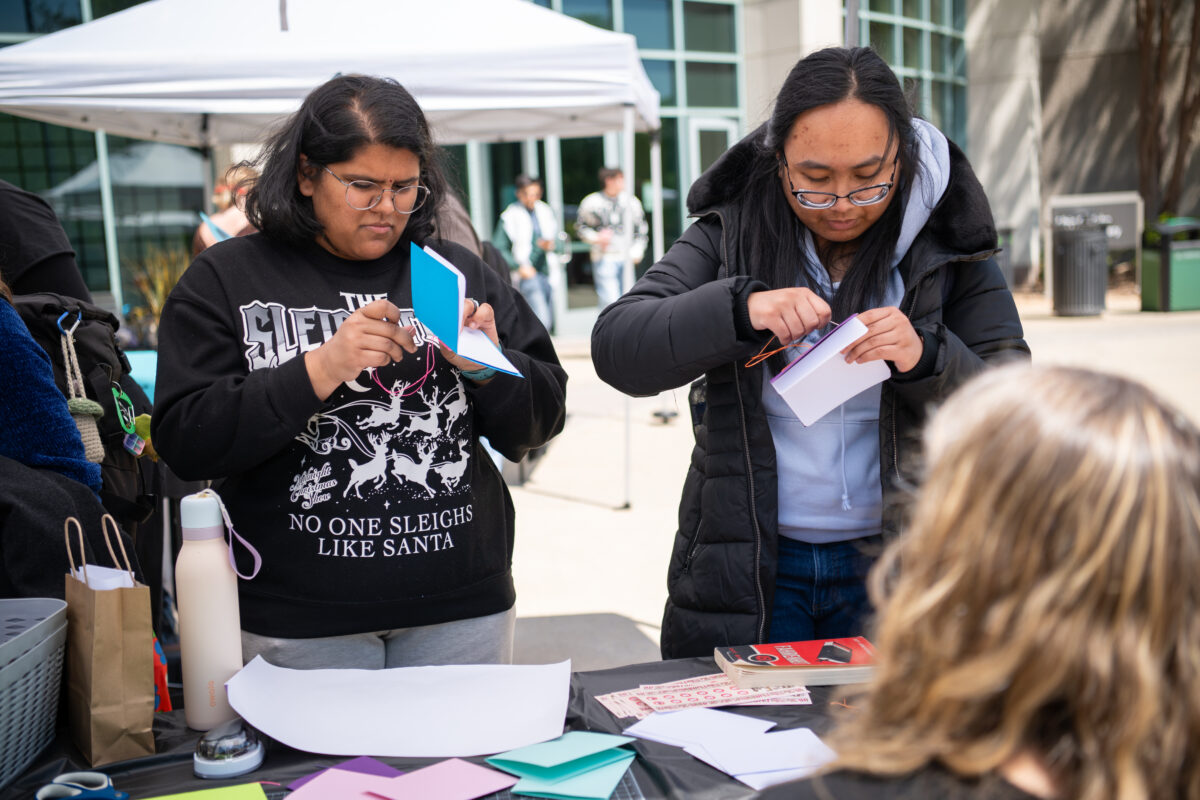
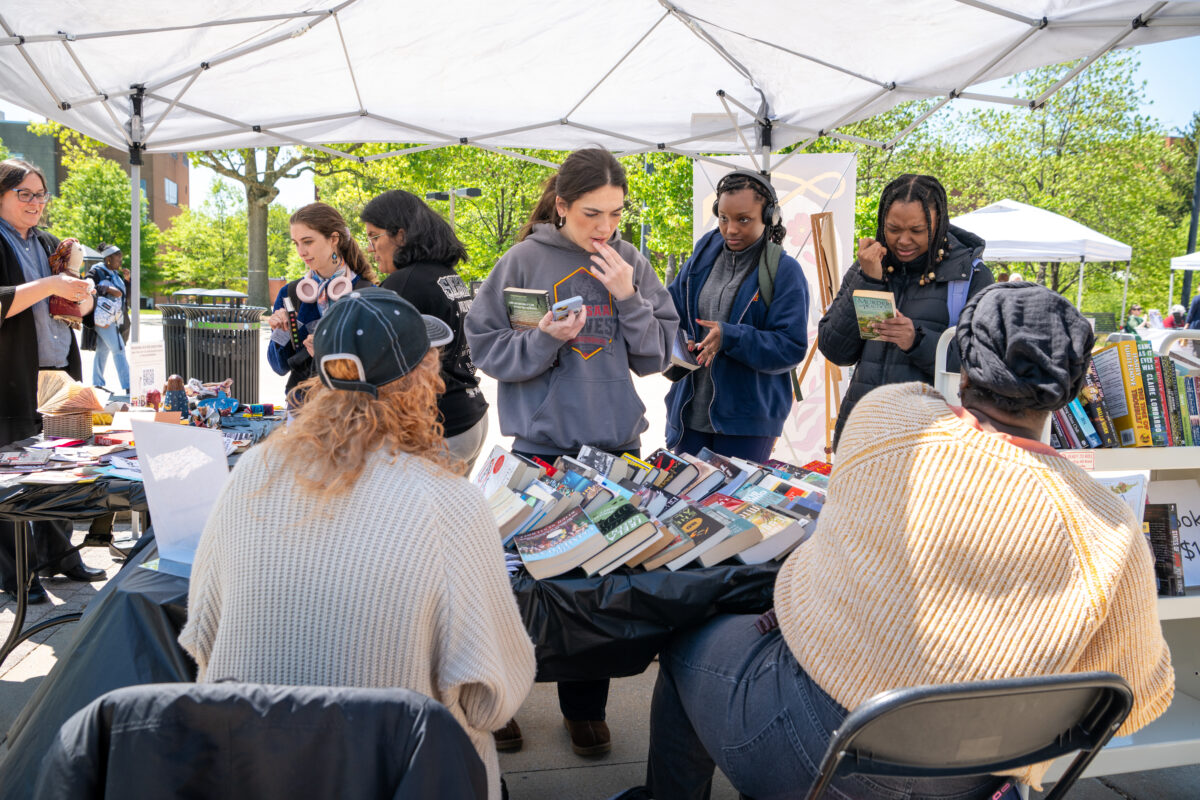 Left: Students got to stitch together their own books at BookFest. Right: So many books, so little time!
Miller then brought John Owen into the mix. Owen is the librarian for the Maryland State Library of the Blind and Print Disabled (LBPD), and throughout BookFest, UMBC raised funds for a nonprofit that supports the LBPD in its mission to make reading and all library services accessible to Marylanders. In partnership with Maryland Humanities, BookFest also served as a collection point for the Maryland Commission on African American History and Culture’s annual book drive.
Stay tuned for the sequel
Craft and care were front and center throughout the festival. Graphic design senior Sonia Pivovarov brought the first iteration of BookFest to life with eye-catching print and digital advertising materials. The BookMarkIt purveyed BookFest-themed original creations and items from the Hilltop Print Shop, an instructional letterpress printing shop and mobile cart. Special Collections librarian Lindsey Loeper and DiCuirci built the shop with support from a Hrabowski Innovation Grant.
Hoping for a sequel to BookFest? The next iteration is already in the works, DiCuirci says, along with ideas for smaller pop-up events throughout the year to amplify the creative work of UMBC students.
By Kayla Logue ’27
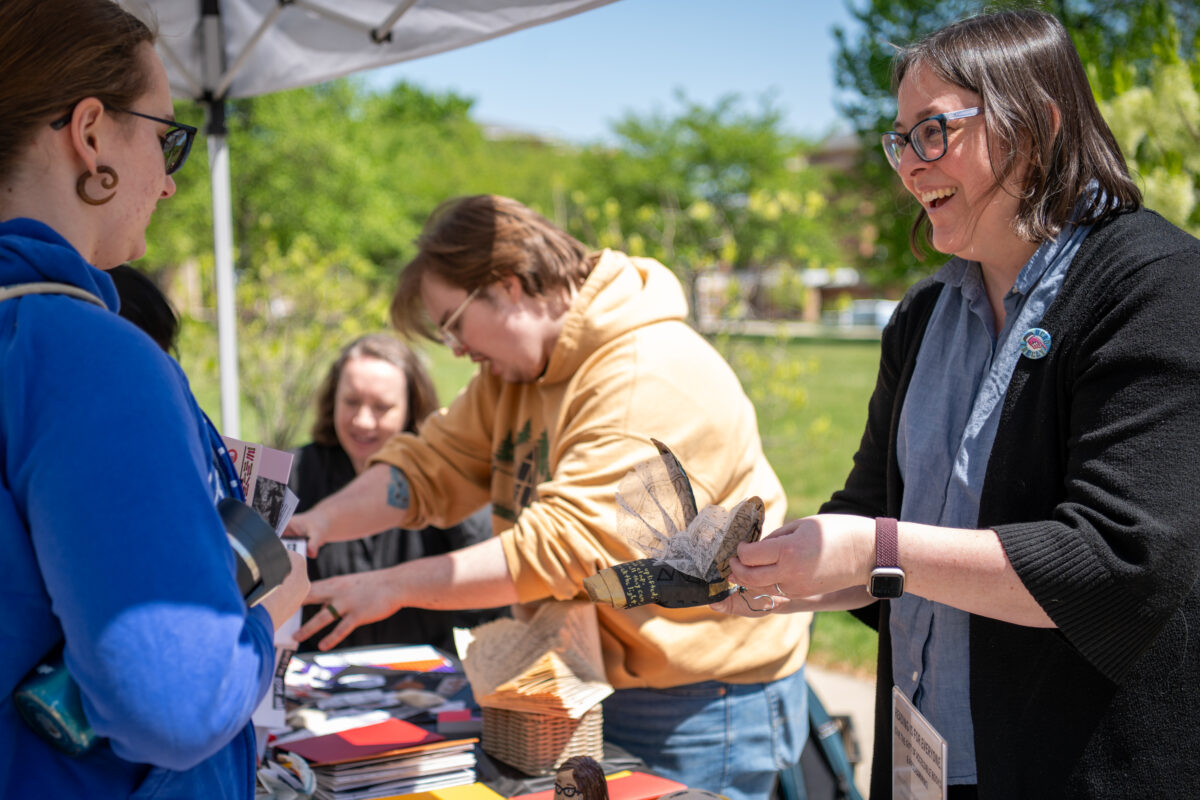 Jenny O’Grady, assistant vice president for communications, (right), shares her love of bookmaking with students at BookFest.
]]>
Appropriately, chapter one of UMBC’s inaugural BookFest began at AOK Library Plaza. Hundreds of students gathered at the BookMarkIt to try letterpress printing, stitch pamphlets, create and swap...
https://umbc.edu/stories/umbc-opens-a-new-chapter-with-inaugural-bookfest/
https://my3.my.umbc.edu/api/v0/pixel/news/160126/guest@my.umbc.edu/5241e563d54f59f869c22de29ea7284f/api/pixel
alumni
aok-library
cahss
campus-life
english
graphic-design
magazine
story
UMBC News & Magazine
https://my3.my.umbc.edu/groups/umbc-news-magazine
https://assets1-my.umbc.edu/system/shared/avatars/groups/000/001/943/24435aa6207c452e7bc15cc74b42c7bb/xsmall.png?1748556657
https://assets1-my.umbc.edu/system/shared/avatars/groups/000/001/943/24435aa6207c452e7bc15cc74b42c7bb/original.png?1748556657
https://assets2-my.umbc.edu/system/shared/avatars/groups/000/001/943/24435aa6207c452e7bc15cc74b42c7bb/xxlarge.png?1748556657
https://assets2-my.umbc.edu/system/shared/avatars/groups/000/001/943/24435aa6207c452e7bc15cc74b42c7bb/xlarge.png?1748556657
https://assets3-my.umbc.edu/system/shared/avatars/groups/000/001/943/24435aa6207c452e7bc15cc74b42c7bb/large.png?1748556657
https://assets1-my.umbc.edu/system/shared/avatars/groups/000/001/943/24435aa6207c452e7bc15cc74b42c7bb/medium.png?1748556657
https://assets2-my.umbc.edu/system/shared/avatars/groups/000/001/943/24435aa6207c452e7bc15cc74b42c7bb/small.png?1748556657
https://assets1-my.umbc.edu/system/shared/avatars/groups/000/001/943/24435aa6207c452e7bc15cc74b42c7bb/xsmall.png?1748556657
https://assets2-my.umbc.edu/system/shared/avatars/groups/000/001/943/24435aa6207c452e7bc15cc74b42c7bb/xxsmall.png?1748556657
UMBC News & Magazine
0
0
false
Fri, 15 May 2026 14:10:47 -0400
Fri, 15 May 2026 14:10:47 -0400
Can anything be read as poetry? Keegan Cook Finberg, English, is opening students’ eyes to the poetic world
Jenny O’Grady, assistant vice president for communications, (right), shares her love of bookmaking with students at BookFest.
]]>
Appropriately, chapter one of UMBC’s inaugural BookFest began at AOK Library Plaza. Hundreds of students gathered at the BookMarkIt to try letterpress printing, stitch pamphlets, create and swap...
https://umbc.edu/stories/umbc-opens-a-new-chapter-with-inaugural-bookfest/
https://my3.my.umbc.edu/api/v0/pixel/news/160126/guest@my.umbc.edu/5241e563d54f59f869c22de29ea7284f/api/pixel
alumni
aok-library
cahss
campus-life
english
graphic-design
magazine
story
UMBC News & Magazine
https://my3.my.umbc.edu/groups/umbc-news-magazine
https://assets1-my.umbc.edu/system/shared/avatars/groups/000/001/943/24435aa6207c452e7bc15cc74b42c7bb/xsmall.png?1748556657
https://assets1-my.umbc.edu/system/shared/avatars/groups/000/001/943/24435aa6207c452e7bc15cc74b42c7bb/original.png?1748556657
https://assets2-my.umbc.edu/system/shared/avatars/groups/000/001/943/24435aa6207c452e7bc15cc74b42c7bb/xxlarge.png?1748556657
https://assets2-my.umbc.edu/system/shared/avatars/groups/000/001/943/24435aa6207c452e7bc15cc74b42c7bb/xlarge.png?1748556657
https://assets3-my.umbc.edu/system/shared/avatars/groups/000/001/943/24435aa6207c452e7bc15cc74b42c7bb/large.png?1748556657
https://assets1-my.umbc.edu/system/shared/avatars/groups/000/001/943/24435aa6207c452e7bc15cc74b42c7bb/medium.png?1748556657
https://assets2-my.umbc.edu/system/shared/avatars/groups/000/001/943/24435aa6207c452e7bc15cc74b42c7bb/small.png?1748556657
https://assets1-my.umbc.edu/system/shared/avatars/groups/000/001/943/24435aa6207c452e7bc15cc74b42c7bb/xsmall.png?1748556657
https://assets2-my.umbc.edu/system/shared/avatars/groups/000/001/943/24435aa6207c452e7bc15cc74b42c7bb/xxsmall.png?1748556657
UMBC News & Magazine
0
0
false
Fri, 15 May 2026 14:10:47 -0400
Fri, 15 May 2026 14:10:47 -0400
Can anything be read as poetry? Keegan Cook Finberg, English, is opening students’ eyes to the poetic world
Keegan Cook Finberg, an assistant professor of English, started graduate school at UC Santa Cruz during the financial crisis of 2008, in a moment of extreme recession. “Privatization and austerity politics were everywhere. It was becoming increasingly clear that this wealth was stratifying upward, and notions of what constituted the public good were diminishing,” says Finberg. Finberg’s response to the times was to study avant-garde experimental poetry.
She notes that some might not see the connection between austerity politics and poetry. But she was excited about how poetry was engaging the public sphere. “Avant-garde poetry was obsessed with this notion of what made the public. And the category itself was becoming more interdisciplinary and more capacious,” said Finberg. “I started noticing and studying different forms of poems that didn’t look like what you might consider poetry. Poets were taking various aspects of state-controlled capitalist regimes and bureaucracy and using those forms as fodder for their poems.”
She remembers, around this time, books of poetry that were winning the major prizes were “avant-garde” in the sense that they chose words from material that wasn’t considered poetic. One poet chose words from the Department of Defense Dictionary of Military Terms to make poems about love. Others used these untraditional literary materials to document their experience of going through TSA at the airport, or repeating stories about racism on the street where people live. Finberg became interested in how all of these forms that we might think of as public forms were suddenly poetic forms.
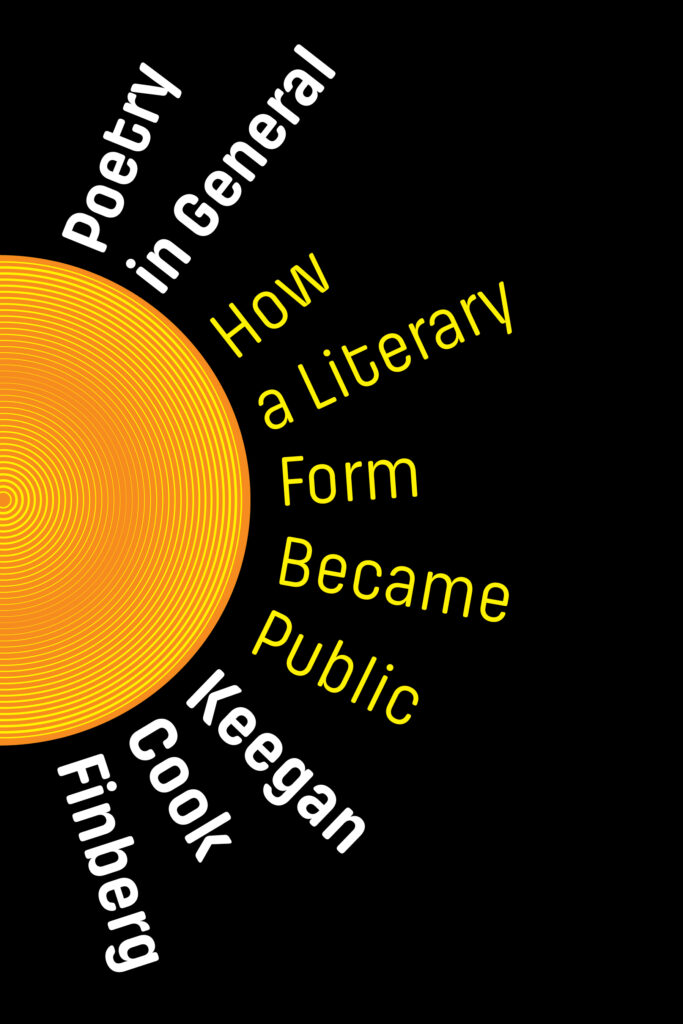
In her debut book, Poetry in General (Columbia University Press, 2025), Finberg explores the privatization of the welfare state and the way that poetry changed in relation to that notion of the public. “I located the beginning of this history around 1960, which many people consider the ballooning of the welfare state, the opposite of privatization,” says Finberg. “I started thinking about what poetic form looked like in that moment and how we might trace it to today.”
Q: What drew you to poetry?
A: I have loved poetry since I was an early reader. I was first drawn to it because it is a way of experiencing the world and understanding it. As I got deeper into my studies, I became really interested in the way that poetic form changes with history.
I’ve always been curious about how the category of poetry makes us think differently. What does it mean for us to read poetry versus the way we read other forms? Can anything be read as poetry? How do we think differently if we try to read things as poetry that aren’t poetry?
These questions excite me. It’s a way to slow down and model reading practices, a way of interacting with language that’s very intentional and precise. I think if you’re interested in play, the unknowable, or unmasterable, it can really change the way you see your everyday life. That’s how I got interested in poetry and what still excites me about poetry.
Q: Is there a piece of poetry that challenged you to accept being uncomfortable, not knowing exactly what it meant?
A: I remember when I was assigned Gertrude Stein‘s poetry as an undergraduate, it did not make any sense to me. Why would anyone assign this to me? I was irate about it at first, but once I started working with the text and playing with it, Stein’s poetry became richer and more interesting to me.
I began practicing different modes of orienting myself towards the text. Eventually, it helped govern the way that I think about the domestic sphere, feminism, and regular objects around the house. In her book Tender Buttons (1914), Stein makes objects and foods in her house come alive. Part of my attention to language and my love of language and detail comes from the practice of trying to do this type of work.
Q: Is there a particular poetic technique that you like best?
A: I love constraint-based processes where poets make a strict rule to limit the words they choose. Often, I find our brain is attuned to think in a certain way. These constraints help us outside of what we usually think of as creativity or imagination into this other world that we didn’t even know was possible.
 Keegan Cook Finberg. (Brad Ziegler/UMBC)
The book Zong! by M. NourbeSe Philip, a Canadian Caribbean poet, is a great example of a constraint-based process. The language for the book-length poem comes from the only historical record of an atrocious case that became important in the British abolitionist movement. Using only the text in the court case, Philip’s poem recounts the massacre of more than 130 enslaved Africans on the slave ship, Zong, headed to Jamaica from West Africa, who were thrown overboard to drown in 1781. The enslaved were dying of starvation and disease. Insurance would not cover this kind of loss. The captain decided that death by drowning could be claimed as a loss of property insurance claim. The insurance company approved the claim, but it was later overturned. No one was charged with murder.
Philip was trying to tell the story of the people on the ship and kept coming up against all of these gaps. The court case didn’t even contain the names of the people who were murdered. She decided to take the words of the court decision as a word bank for her book, to contort the case file to fill in these silences. The result is a testament to, and critique of, the horrors of the bureaucracy of slavery and its afterlife.
Most of the poems that I look at late in my book also use the language of archival documents about a major issue related to racial capitalism and the bureaucracy of the public sphere.
Q: What are other examples of constricted processes that you cover in the book?
A: I start the book with Yoko Ono. In the 1960s, she was doing wonderful experiments that were at the edge of what was performance and what was poetry. Ono was interested in speaking back to the category of racial capitalism through humor and expressions of everyday life as art. The poems in her book Grapefruit take this premise that instructions for everyday life can be fun, easy, or even impossible.
I’ve always been curious about how the category of poetry makes us think differently. What does it mean for us to read poetry versus the way we read other forms? Can anything be read as poetry? How do we think differently if we try to read things as poetry that aren’t poetry?
Keegan Cook Finberg
In my book, I also talk about three feminist artists from the 1970s, Eleanor Antin, Adrian Piper, and Bernadette Mayer. Their constraints are durational experiments where they go on some sort of diet, all of them for different reasons, for about the course of a month—the duration of a menstrual cycle—and document their journey. They’re writing about welfare and food assistance and their own reproductive rights on the precipice of Roe v. Wade. They’re interested in their own reproductive possibilities, and what it means to experiment with that as duration.
Q: This is your eighth year at UMBC. How do UMBC students respond to poetry in your classes?
A: For an upper-division class on feminist poetry, I recently taught Theresa Hak Kyung Cha’s Dictee, a famously complex avant-garde poem about Korean independence and about the experience of immigration and colonial violence. Cha writes in multiple languages to capture the disorientation of the acquisition of a new language, of a new culture, and the difficulty and violence of assimilation. It’s complex, and it can be off-putting to students.
In situations like these, I want students to be okay with not understanding everything that they’re reading while exploring the aspects that they do understand—to explore why this author might want it to be difficult in the beginning, why there might be something important in that feeling of discomfort that they’re experiencing with the text. Can they notice moments of beauty in the text, even if they don’t yet understand what they mean? A lot of our conversations start with that sort of work.
And once students realize that that is the goal—that they don’t need to be able to decode, they don’t have to be the person who knows it all in the room, there isn’t one right answer—it really unlocks a very different sort of space. I often watch that sort of journey with students. They realize that there’s something inherently important about this difficulty, important even to their understanding of themselves, their heritage, the way that language works in their households, even in their larger worlds.
And for my students who may take poetry to fulfill a lower division requirement, what I want more than anything is for them to see the ways that literature and poetry are alive in the world. Poetry is interesting, it’s happening, and they can read it. They don’t have to be afraid of it. Introductory level students are asked to attend literary events to see writers come and read and talk about their work. This is happening now. This is part of your world. If you’re a nurse, a scientist, or in whatever career path you follow, poetry and literature are alive and are going to continue to be part of the world that you live in. If you pay attention, this revelation may help you understand your experiences differently, connect to others in new ways, or even create new knowledge.
Learn more about Finberg’s work andUMBC’s English department.
]]>
Keegan Cook Finberg, an assistant professor of English, started graduate school at UC Santa Cruz during the financial crisis of 2008, in a moment of extreme recession. “Privatization and austerity...
https://umbc.edu/stories/poetry-keegan-cook-finberg-english/
https://my3.my.umbc.edu/api/v0/pixel/news/157459/guest@my.umbc.edu/d47745f8c35583522b397cede66227f0/api/pixel
arts-and-culture
cahss
english
humanitiesbooks
news
research
retriever-authors
story
UMBC News & Magazine
https://my3.my.umbc.edu/groups/umbc-news-magazine
https://assets1-my.umbc.edu/system/shared/avatars/groups/000/001/943/24435aa6207c452e7bc15cc74b42c7bb/xsmall.png?1748556657
https://assets1-my.umbc.edu/system/shared/avatars/groups/000/001/943/24435aa6207c452e7bc15cc74b42c7bb/original.png?1748556657
https://assets2-my.umbc.edu/system/shared/avatars/groups/000/001/943/24435aa6207c452e7bc15cc74b42c7bb/xxlarge.png?1748556657
https://assets2-my.umbc.edu/system/shared/avatars/groups/000/001/943/24435aa6207c452e7bc15cc74b42c7bb/xlarge.png?1748556657
https://assets3-my.umbc.edu/system/shared/avatars/groups/000/001/943/24435aa6207c452e7bc15cc74b42c7bb/large.png?1748556657
https://assets1-my.umbc.edu/system/shared/avatars/groups/000/001/943/24435aa6207c452e7bc15cc74b42c7bb/medium.png?1748556657
https://assets2-my.umbc.edu/system/shared/avatars/groups/000/001/943/24435aa6207c452e7bc15cc74b42c7bb/small.png?1748556657
https://assets1-my.umbc.edu/system/shared/avatars/groups/000/001/943/24435aa6207c452e7bc15cc74b42c7bb/xsmall.png?1748556657
https://assets2-my.umbc.edu/system/shared/avatars/groups/000/001/943/24435aa6207c452e7bc15cc74b42c7bb/xxsmall.png?1748556657
UMBC News & Magazine
1
0
false
Thu, 12 Mar 2026 16:26:41 -0400
Thu, 12 Mar 2026 16:26:41 -0400
The chase and thrill of researching erotic worlds
A couple of years ago, Jessica Floyd was enjoying delicious olive flatbreads in Opio, France, a village on the French Riviera, thanks to the hospitality of Judith Legman, who owned the olive grove and a manuscript Floyd had been trying to find for her doctoral work for three years. This bucolic heaven was not where Floyd, who studies erotic folklore, thought she would find the holy grail of erotic chanteys by Stan Hugill, a renowned British sailor and chantey singer. These sailors’ work songs, first collected in the 1900s, were passed down verbally by sailors, with some never recorded. These bawdy versions were never meant to be heard or read by women, much less shared between them.
“When you’re talking about erotic content, it automatically becomes something that is salacious and provocative and therefore seen as taboo,” said Floyd, Ph.D. ’17, language, literacy, and culture, an adjunct instructor of English. “Publications that are not conservative in their treatment of sex, gender, and sexuality are often deemed taboo. Scholars who are actively working in this field have to fight not only for their legitimacy, but also because we’re considered dirty workers. We also fight for the legitimacy of the materials that we’re researching. These are real human experiences. They just happen to be from the darker corners of the human experience.”
Like other scholars in the field seeking access to a variety of documents, Floyd reached out to the librarians at the Kinsey Institute, which holds the largest historical archive on sexuality. “They weren’t sure if the manuscript could be found in the extensive archive of Gershon Legman, which Judith, his wife, had donated,” said Floyd, of her research for her debut book Cabin Boys, Milkmaids, and Rough Seas: Identity in the Unexpurgated Repertoire of Stan Hugill (University Press of Mississippi, 2024).
She emailed Legman, following a tip from other chantey folklorists and researchers that Legman, a famous connoisseur and collector of erotic jokes, folklore, and songs, had the manuscript. “Lo and behold, she emailed me back. I still get chills talking about it,” said Floyd. “Judith said, ‘Not only do I have it, I actually just sent it to the Kinsey Institute. If you’d like, I’ll send you the copy.’” Dispersed throughout Legman’s chapter on erotic folk songs were Hugill’s erotic chanteys that had never been circulated.
 The envelope sent by Judith Legman to Jessica Floyd with Stan Hugill’s unpublished manuscript. (Image courtesy of Jessica Floyd)
Chasing erotic rare texts
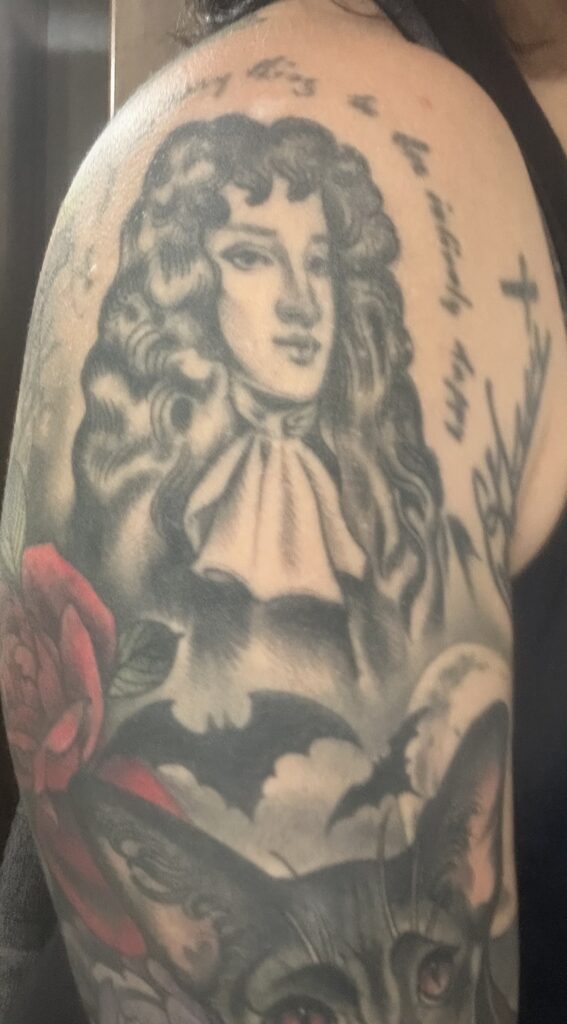 Floyd’s tattoo of John Wilmot, the Second Earl of Rochester, a late 17th-century English nobleman. (Image courtesy of Jessica Floyd)
Floyd is used to the chase and thrill of finding rare texts. She studies the gender and sexuality of sailors during the height of British and American sailing, from the mid-16th to the mid-19th centuries—when sailing ships dominated global trade and naval warfare—as well as 17th and 18th-century literature, erotic folklore, gender and women’s studies, and queer theory. This passion began in high school and continued through her undergraduate and graduate studies researching the life of John Wilmot, the Second Earl of Rochester, a late 17th-century English nobleman better known for questioning authority while also enjoying the excesses of court life and writing poetry that explored sex, desire, rebellion, and challenged social and gender norms.
“It made sense for me to research sexuality in chanteys because I want to understand why men sing dirty songs. What can chanteys tell us about how sailors negotiate sex and gender, especially in the constrained environment of the sailing ship?” said Floyd.
An epistolary discovery
Like Wilmot, Hugill also wrote and published his work. In the 1950s, Hugill began writing down the songs he remembered. In 1961, he published Shanties From The Seven Seas, a collection of over 400 chanteys now considered by chantey researchers and folklorists as the most comprehensive work on chanteys. Sailor Town was published in 1967, Shanties and Sailors’ Songs in 1969, followed by Songs of the Sea: The Tales and Tunes of Sailors and Sailing Shipsin 1977. Between 1962 and 1994, Hugill released 10 recordings—LPs, CDs, and cassette tapes—of chanteys and chantey history. Three were released posthumously. His Sea Songs CD, released in 1980, is now part of the Smithsonian Folkways Recordings catalogue.
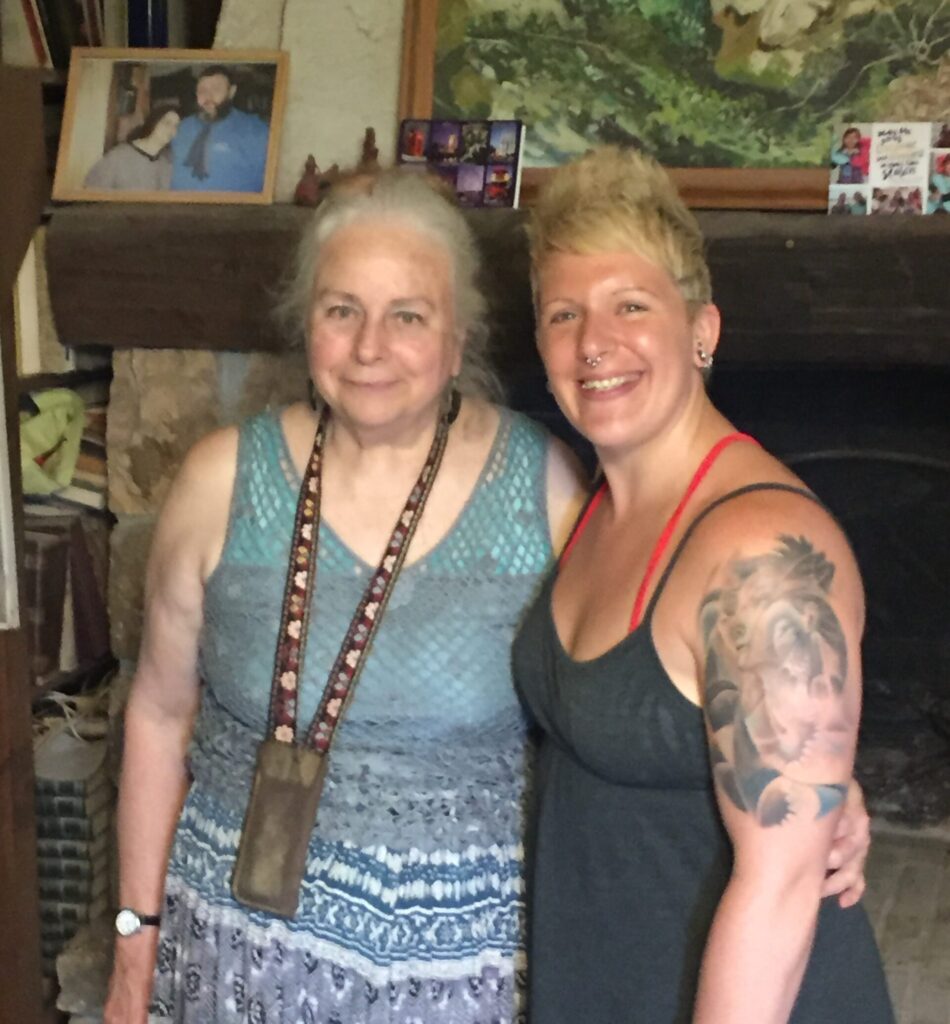 (l-r): Judith Legman and Jessica Floyd in Opio, France. (Image courtesy of Floyd)
However, unlike Wilmot, Hugill never penned the erotic versions and only sang them after a performance to an all-male audience. When Gershon Legman learned about Hugill’s repertoire, he wrote to Hugill, urging him to commit the erotic chanteys to paper for his vast collection. Hugill capitulated after years of correspondence with the condition that Legman not publish the manuscript before he could. Both men died in the 1990s without ever publishing it. With Hugill and Legman as the only witnesses of the manuscript’s existence, what was left for the chantey folklore community was rumors and the lore of its existence.
Thanks to funding from a 2016 UMBC Dresher Center for the Humanities summer fellowship, Floyd visited Judith Legman to study these letters alongside the manuscript. “Judith also had the letters shared between Hugill and Legman, which confirmed that this indeed was the sought-after manuscript,” said Floyd. She notes that by the time she left France, she had everything she needed to do a close analysis of the songs.
“Erotic worlds have fascinated me for a long time. It’s not your run-of-the-mill construction of gender. It’s actually focusing on the part of the human experience that we’re really reticent to talk about, especially in academic work,” said Floyd, who sports a palm-sized tattoo of Wilmot on her upper right arm. “This is the heart of my research—how do we write erotic worlds?”
Floyd is once again on the hunt for rare texts and has completed her second book, The Sons of Neptune. In this study, she is looking at cultural artifacts, from the 18th to the 20th century, that provide insight into why sailors are often thought of as sexy. This project is set to be published through the University of Mississippi Press in May 2026.
Read other books in our Humanities Books series.
]]>
A couple of years ago, Jessica Floyd was enjoying delicious olive flatbreads in Opio, France, a village on the French Riviera, thanks to the hospitality of Judith Legman, who owned the olive grove...
https://umbc.edu/stories/the-chase-and-thrill-of-researching-erotic-worlds/
https://my3.my.umbc.edu/api/v0/pixel/news/155331/guest@my.umbc.edu/6e42352b341487bf50a638ab81874d4f/api/pixel
arts-and-culture
cahss
dreshercenter
english
gwst
humanitiesbooks
llc
news
story
UMBC News & Magazine
https://my3.my.umbc.edu/groups/umbc-news-magazine
https://assets1-my.umbc.edu/system/shared/avatars/groups/000/001/943/24435aa6207c452e7bc15cc74b42c7bb/xsmall.png?1748556657
https://assets1-my.umbc.edu/system/shared/avatars/groups/000/001/943/24435aa6207c452e7bc15cc74b42c7bb/original.png?1748556657
https://assets2-my.umbc.edu/system/shared/avatars/groups/000/001/943/24435aa6207c452e7bc15cc74b42c7bb/xxlarge.png?1748556657
https://assets2-my.umbc.edu/system/shared/avatars/groups/000/001/943/24435aa6207c452e7bc15cc74b42c7bb/xlarge.png?1748556657
https://assets3-my.umbc.edu/system/shared/avatars/groups/000/001/943/24435aa6207c452e7bc15cc74b42c7bb/large.png?1748556657
https://assets1-my.umbc.edu/system/shared/avatars/groups/000/001/943/24435aa6207c452e7bc15cc74b42c7bb/medium.png?1748556657
https://assets2-my.umbc.edu/system/shared/avatars/groups/000/001/943/24435aa6207c452e7bc15cc74b42c7bb/small.png?1748556657
https://assets1-my.umbc.edu/system/shared/avatars/groups/000/001/943/24435aa6207c452e7bc15cc74b42c7bb/xsmall.png?1748556657
https://assets2-my.umbc.edu/system/shared/avatars/groups/000/001/943/24435aa6207c452e7bc15cc74b42c7bb/xxsmall.png?1748556657
UMBC News & Magazine
1
0
false
Mon, 15 Dec 2025 16:29:52 -0500
Mon, 15 Dec 2025 16:29:52 -0500
Who is AI for? Eric Stokan receives USM professorship to address barriers and promote AI equity for students and faculty
For tech-savvy individuals like Eric Stokan, artificial intelligence, programming languages, and open-source software are powerful tools that can turn once-impossible ideas into reality. Researchers can use human language processing to analyze historical documents or legal texts. Through collaborative platforms, global organizations can collaborate quickly without incurring travel costs. In the social sciences, open-source tools provide students with unique opportunities to work with experts developing projects that address community needs. However, to take full advantage of these revolutionary technologies, these tools often require advanced computing skills or access to expensive software, which can limit their impact and exclude those without the necessary resources or training.
Stokan, director of the Center for Social Science Scholarship (CS3), is committed to removing these barriers for faculty and students in computational social science, which uses computers, data, and algorithms to study human behavior and social systems. His research lies at the intersection of urban policy, economic development, and computational social science, with a focus on how local governments make policy decisions and how those decisions impact equity, economic growth, and environmental sustainability.
The University System of Maryland (USM) William E. Kirwan Center for Academic Innovation has awarded Stokan the Elkins Professorship for Academic Transformation to address this gap with his project “Computational Social Science and Generative AI: Scalable, Modular Training for Teaching, Research, and Public Impact.”

The Elkins Professorship is named after Wilson H. Elkins, a former Rhodes Scholar and president of the University of Maryland, College Park from 1954 to 1978. This prestigious award is for faculty within USM who are working on innovative projects focused on the use of generative AI to advance academic transformation, foster improvements in access, affordability, quality of outcomes, and/or stewardship of people’s time, money, and other scarce resources.
 Stokan’s examples of the R open-source programming language.
“The professorship will allow me, through the Center for Social Science Scholarship, to first assist faculty and students in understanding how to leverage advances in computing and AI to address new research questions and scale their research in ways that were unfathomable during Dr. Elkins tenure,” says Stokan, associate professor of political science, who earned one of three $10,000 awards. He will use the funding to complete Computational Public Administration—his first book written with R, a free programming language used for statistical computing and graphics—about computational social science methods focused on addressing public policy and administration topics, such as climate change and economic development.
The funding will also support the design and implementation of five hands-on training modules and workshops tailored for faculty, students, and community organizations. Participants will learn to use generative AI large language models (LLM) like ChatGPT and R. The goal is to help participants answer novel and important research questions, develop marketable technical skills, to work more effectively with data, and better communicate the results of their analyses with the broader community.

 Left: Codi Hrynko, Ph.D. ’29, chemistry, and Sarah Lanasa, Ph.D. ’25, environmental engineering work together. Right: Nagaraj Neerchal, professor of statistics, at the first workshop series on AI, LLMs, and computational methods.
“I am deeply honored to receive the Elkins Professorship, in honor of the late Wilson H. Elkins, who was a transformational leader, administrator, and educator,” says Stokan. “This award is important to me because it not only provides support but also affirms my commitment to accommodating learners at all levels of experience in computational social sciences, promoting accessibility, equity, and methodological transparency.”
Initial support for the project came from the UMBC’s Faculty Development Center, the AOK Library’s Digital Scholarship Services, iHARP/Data Science Scholars, and the Institute for Public Leadership at the University of Maryland, College Park.
The workshops will be offered through CS3 in collaboration with CGC-SCIPE, the UMBC Division of Information Technology, and ScaleS. A lecture series component, which will include external speakers, is being co-sponsored with the Department of English, the Department of Sociology, Anthropology, and Public Health, and the Department of Modern Languages, Linguistics, and Intercultural Communications.
Register for the fall semester’s workshop series on AI, LLMs, and computational methods.
]]>
For tech-savvy individuals like Eric Stokan, artificial intelligence, programming languages, and open-source software are powerful tools that can turn once-impossible ideas into reality....
https://umbc.edu/stories/eric-stokan-usm-professorship-ai-access/
https://my3.my.umbc.edu/api/v0/pixel/news/153456/guest@my.umbc.edu/c3599eb85a6c2ad8fd93f23e15267920/api/pixel
cahss
cahss-research
cbee
coeit
cs3
doit
english
graduate-school
mathstat
mlli
news
politicalscience
research
saph
science-and-tech
story
UMBC News & Magazine
https://my3.my.umbc.edu/groups/umbc-news-magazine
https://assets1-my.umbc.edu/system/shared/avatars/groups/000/001/943/24435aa6207c452e7bc15cc74b42c7bb/xsmall.png?1748556657
https://assets1-my.umbc.edu/system/shared/avatars/groups/000/001/943/24435aa6207c452e7bc15cc74b42c7bb/original.png?1748556657
https://assets2-my.umbc.edu/system/shared/avatars/groups/000/001/943/24435aa6207c452e7bc15cc74b42c7bb/xxlarge.png?1748556657
https://assets2-my.umbc.edu/system/shared/avatars/groups/000/001/943/24435aa6207c452e7bc15cc74b42c7bb/xlarge.png?1748556657
https://assets3-my.umbc.edu/system/shared/avatars/groups/000/001/943/24435aa6207c452e7bc15cc74b42c7bb/large.png?1748556657
https://assets1-my.umbc.edu/system/shared/avatars/groups/000/001/943/24435aa6207c452e7bc15cc74b42c7bb/medium.png?1748556657
https://assets2-my.umbc.edu/system/shared/avatars/groups/000/001/943/24435aa6207c452e7bc15cc74b42c7bb/small.png?1748556657
https://assets1-my.umbc.edu/system/shared/avatars/groups/000/001/943/24435aa6207c452e7bc15cc74b42c7bb/xsmall.png?1748556657
https://assets2-my.umbc.edu/system/shared/avatars/groups/000/001/943/24435aa6207c452e7bc15cc74b42c7bb/xxsmall.png?1748556657
UMBC News & Magazine
0
0
false
Thu, 09 Oct 2025 17:19:07 -0400
Thu, 09 Oct 2025 17:19:07 -0400
Who is AI for? Eric Stokan receives USM professorship to address barriers and promote AI equity for students and faculty
For tech-savvy individuals like Eric Stokan, artificial intelligence, programming languages, and open-source software are powerful tools that can turn once-impossible ideas into reality. Researchers can use human language processing to analyze historical documents or legal texts. Through collaborative platforms, global organizations can collaborate quickly without incurring travel costs. In the social sciences, open-source tools provide students with unique opportunities to work with experts developing projects that address community needs. However, to take full advantage of these revolutionary technologies, these tools often require advanced computing skills or access to expensive software, which can limit their impact and exclude those without the necessary resources or training.
Stokan, director of the Center for Social Science Scholarship (CS3), is committed to removing these barriers for faculty and students in computational social science, which uses computers, data, and algorithms to study human behavior and social systems. His research lies at the intersection of urban policy, economic development, and computational social science, with a focus on how local governments make policy decisions and how those decisions impact equity, economic growth, and environmental sustainability.
The University System of Maryland (USM) William E. Kirwan Center for Academic Innovation has awarded Stokan the Elkins Professorship for Academic Transformation to address this gap with his project “Computational Social Science and Generative AI: Scalable, Modular Training for Teaching, Research, and Public Impact.”
The Elkins Professorship is named after Wilson H. Elkins, a former Rhodes Scholar and president of the University of Maryland, College Park from 1954 to 1978. This prestigious award is for faculty within USM who are working on innovative projects focused on the use of generative AI to advance academic transformation, foster improvements in access, affordability, quality of outcomes, and/or stewardship of people’s time, money, and other scarce resources.
Stokan’s examples of the R open-source programming language.
“The professorship will allow me, through the Center for Social Science Scholarship, to first assist faculty and students in understanding how to leverage advances in computing and AI to address new research questions and scale their research in ways that were unfathomable during Dr. Elkins tenure,” says Stokan, associate professor of political science, who earned one of three $10,000 awards. He will use the funding to complete Computational Public Administration—his first book written with R, a free programming language used for statistical computing and graphics—about computational social science methods focused on addressing public policy and administration topics, such as climate change and economic development.
The funding will also support the design and implementation of five hands-on training modules and workshops tailored for faculty, students, and community organizations. Participants will learn to use generative AI large language models (LLM) like ChatGPT and R. The goal is to help participants answer novel and important research questions, develop marketable technical skills, to work more effectively with data, and better communicate the results of their analyses with the broader community.
Left: Codi Hrynko, Ph.D. ’29, chemistry, and Sarah Lanasa, Ph.D. ’25, environmental engineering work together. Right: Nagaraj Neerchal, professor of statistics, at the first workshop series on AI, LLMs, and computational methods.
“I am deeply honored to receive the Elkins Professorship, in honor of the late Wilson H. Elkins, who was a transformational leader, administrator, and educator,” says Stokan. “This award is important to me because it not only provides support but also affirms my commitment to accommodating learners at all levels of experience in computational social sciences, promoting accessibility, equity, and methodological transparency.”
Initial support for the project came from the UMBC’s Faculty Development Center, the AOK Library’s Digital Scholarship Services, iHARP/Data Science Scholars, and the Institute for Public Leadership at the University of Maryland, College Park.
The workshops will be offered through CS3 in collaboration with CGC-SCIPE, the UMBC Division of Information Technology, and ScaleS. A lecture series component, which will include external speakers, is being co-sponsored with the Department of English, the Department of Sociology, Anthropology, and Public Health, and the Department of Modern Languages, Linguistics, and Intercultural Communications.
Register for the fall semester’s workshop series on AI, LLMs, and computational methods.
]]>
For tech-savvy individuals like Eric Stokan, artificial intelligence, programming languages, and open-source software are powerful tools that can turn once-impossible ideas into reality....
https://umbc.edu/stories/eric-stokan-elkins-professorship/
https://my3.my.umbc.edu/api/v0/pixel/news/153447/guest@my.umbc.edu/bbab2ee0a08b4098a167cd53ca08b643/api/pixel
cahss
cahss-research
cbee
cs3
doit
english
mathstat
mlli
news
politicalscience
research
saph
science-and-tech
story
UMBC News & Magazine
https://my3.my.umbc.edu/groups/umbc-news-magazine
https://assets1-my.umbc.edu/system/shared/avatars/groups/000/001/943/24435aa6207c452e7bc15cc74b42c7bb/xsmall.png?1748556657
https://assets1-my.umbc.edu/system/shared/avatars/groups/000/001/943/24435aa6207c452e7bc15cc74b42c7bb/original.png?1748556657
https://assets2-my.umbc.edu/system/shared/avatars/groups/000/001/943/24435aa6207c452e7bc15cc74b42c7bb/xxlarge.png?1748556657
https://assets2-my.umbc.edu/system/shared/avatars/groups/000/001/943/24435aa6207c452e7bc15cc74b42c7bb/xlarge.png?1748556657
https://assets3-my.umbc.edu/system/shared/avatars/groups/000/001/943/24435aa6207c452e7bc15cc74b42c7bb/large.png?1748556657
https://assets1-my.umbc.edu/system/shared/avatars/groups/000/001/943/24435aa6207c452e7bc15cc74b42c7bb/medium.png?1748556657
https://assets2-my.umbc.edu/system/shared/avatars/groups/000/001/943/24435aa6207c452e7bc15cc74b42c7bb/small.png?1748556657
https://assets1-my.umbc.edu/system/shared/avatars/groups/000/001/943/24435aa6207c452e7bc15cc74b42c7bb/xsmall.png?1748556657
https://assets2-my.umbc.edu/system/shared/avatars/groups/000/001/943/24435aa6207c452e7bc15cc74b42c7bb/xxsmall.png?1748556657
UMBC News & Magazine
0
0
false
Thu, 09 Oct 2025 17:19:07 -0400
Thu, 09 Oct 2025 17:19:07 -0400
Hrabowski Fund for Innovation awardees continue to drive new approaches to teaching and learning
A cross-disciplinary incubator rooted in theatrical storytelling. Artificial intelligence and machine learning ethics education that blends ethical inquiry with hands-on technical exploration. Letterpress printing and bookmaking while students uncover “The Secret Lives of Books.” These are several of the 2024 – 2025 projects selected to receive grants in the Hrabowski Fund for Innovation competition. The fund supports initiatives to enhance teaching and learning at UMBC, with specific emphasis on innovative approaches to increase student success.
“The Hrabowski Innovation Fund has helped to drive innovation in pedagogy and student success at UMBC for the past 13 years. Recent projects have enhanced course and curriculum development, built generative AI literacy and introduced AI-powered tools, and engaged students in cross-disciplinary, international, and community-based projects that prepare them for their majors and careers.” says Kerrie Kephart, interim director of the Faculty Development Center.
Implementation and Research Awards
- IMPACT Lab: Interdisciplinary Music, Performance, Art, Collaboration, and Theatre Lab – Nigel Semaj (THTR) and Colleagues
- Developing Ethical Inquiry: A Participatory and Exploratory Lab Model for AI/ML Ethics Education – Rebecca Williams (CSEE)
- Computing for All: Cultivating a Culturally Responsive and Inclusive Computing Ecosystem – Patricia Ordóñez (IS) and colleague
Adaptation Award
- Hilltop Print Shop: Supporting Applied Learning in a Humanities Makerspace – Lindsay DiCuirci (ENGL) and colleague
Scholarship of Teaching and Learning Award
- Developing an Approach to Creating and Refining Innovative Learning Outcomes in a University Music Education Program – Brian Kaufman (MUSC) and colleague
SEED Awards
- Transforming Graduate Writing Support – Nicole Morse (LLC) and colleagues
- Centering Student Perspectives on Generative AI Integration in a Design Classroom – Yasmine Kotturi (IS)
The Hrabowski Fund for Innovation exemplifies UMBC’s commitment to investing in faculty initiatives that fuel creativity and enterprise and also create opportunities for student engagement. Proposals for the next round are due by October 31, 2025. For more information and to apply, visit UMBC’s Faculty Development Center website.
]]>
A cross-disciplinary incubator rooted in theatrical storytelling. Artificial intelligence and machine learning ethics education that blends ethical inquiry with hands-on technical exploration....
https://umbc.edu/quick-posts/hrabowski-fund-for-innovation-awardees-continue-to-drive-new-approaches-to-teaching-and-learning/
https://my3.my.umbc.edu/api/v0/pixel/news/153359/guest@my.umbc.edu/03473bb2ab97b0c705cfc6bf57f6f836/api/pixel
cahss
cnms
coeit
community
csee
english
is
language-literacy-and-culture
quick-post
theatre
UMBC News & Magazine
https://my3.my.umbc.edu/groups/umbc-news-magazine
https://assets1-my.umbc.edu/system/shared/avatars/groups/000/001/943/24435aa6207c452e7bc15cc74b42c7bb/xsmall.png?1748556657
https://assets1-my.umbc.edu/system/shared/avatars/groups/000/001/943/24435aa6207c452e7bc15cc74b42c7bb/original.png?1748556657
https://assets2-my.umbc.edu/system/shared/avatars/groups/000/001/943/24435aa6207c452e7bc15cc74b42c7bb/xxlarge.png?1748556657
https://assets2-my.umbc.edu/system/shared/avatars/groups/000/001/943/24435aa6207c452e7bc15cc74b42c7bb/xlarge.png?1748556657
https://assets3-my.umbc.edu/system/shared/avatars/groups/000/001/943/24435aa6207c452e7bc15cc74b42c7bb/large.png?1748556657
https://assets1-my.umbc.edu/system/shared/avatars/groups/000/001/943/24435aa6207c452e7bc15cc74b42c7bb/medium.png?1748556657
https://assets2-my.umbc.edu/system/shared/avatars/groups/000/001/943/24435aa6207c452e7bc15cc74b42c7bb/small.png?1748556657
https://assets1-my.umbc.edu/system/shared/avatars/groups/000/001/943/24435aa6207c452e7bc15cc74b42c7bb/xsmall.png?1748556657
https://assets2-my.umbc.edu/system/shared/avatars/groups/000/001/943/24435aa6207c452e7bc15cc74b42c7bb/xxsmall.png?1748556657
UMBC News & Magazine
0
0
false
Tue, 07 Oct 2025 15:51:37 -0400
Tue, 07 Oct 2025 15:51:37 -0400
Jane Austen as an abolitionist? Margie Burns unpacks the loaded history of the phrase “pride and prejudice”
Figuring out what to get someone for their birthday can be both fun and daunting, especially when it’s their 250th birthday. On December 16, 1775, Jane Austen was born in Steventon, Hampshire, England. Margie Burns, an assistant teaching professor of English literature, is a lifelong superfan of Jane Austen’s six novels: Sense and Sensibility, Pride and Prejudice, Mansfield Park, Emma, Northanger Abbey, and Persuasion.
With Hollywood movies and New York Times-bestselling spinoffs of Austen’s novels, it might seem that everything there is to say about the prolific author has already been said. Burns begs to differ as she ushers in a year of Austen celebrations worldwide with her latest contribution to the Austen canon withJane Austen, Abolitionist: The Loaded History of the Phrase “Pride and Prejudice”(McFarland, 2024). This new insight into Austen’s life allows Burns to open up a fresh discussion for Austen enthusiasts and to attract new readers interested in female authors who challenge societal norms by writing leading female characters with bold opinions. Burns discusses her Austen journey in a Q&A below.
Q: When did you become interested in Jane Austen and why?
A: I first read Pride and Prejudice as a college freshman. At that time, we had a full year of freshman English, focused on literature, alert reading, and writing. This was a great opportunity, even after I had taken a course on major works of literature in high school.
I was hooked. In time, I read the rest of Austen’s books. Naturally, when I like an author, I seek out everything else they’ve written and devour that as well. With Austen, as with Shakespeare, my interest deepened over time, reinforced (rather than undermined) by academic rigor. Given Austen’s current global standing, I have come to think of Jane Austen as England’s second Shakespeare.
 Margie Burns. (Brad Ziegler/UMBC)
Q: Why did you choose to write Jane Austen Abolitionist?
A: I was flabbergasted to discover how widespread, prevalent, and ethically fundamental the phrase “pride and prejudice” was in Britain and even in America before Austen chose it as her novel title. I was even more powerfully struck by finding out, over and over again across more than two centuries, that “pride and prejudice” as a phrase was being used as a critique of slavery and the slave trade. There was absolutely no one else writing about this aspect of Austen’s work.
I am not alone in seeing that part of Austen’s appeal lies in the successful transmission of ethics through her heroines: pro-health, pro-spirit, and pro-ethical stature, although not in a simplistic and preachy way.
Margie Burns
assistant teaching professor of English literature
Once I dug deeper, I found hundreds of examples. Most of the discussion about the Austens and slavery has focused on Austen’s more remote relatives. I do not believe that Jane Austen was unduly influenced by family finances involving her non-nuclear relatives. Her immediate family opposed the slave trade. More importantly, the evidence is overwhelming that she opposed it.
I would like to produce a second edition of the book. There is further relevant and closely related material, literary and historical evidence, through the end of the U.S. Civil War.
Q: What is your favorite Austen book?
A: That is a hard question. My “favorite” Austen book is probably whichever one I am working on/doing research on, or writing about at a given time.
Q: Which Austen character do you like to quote?
A: Elizabeth Bennett in Pride and Prejudice says one of my favorite quotes: “You shall not, for the sake of one individual, change the meaning of principle and integrity, nor endeavour to persuade yourself or me, that selfishness is prudence, and insensibility of danger, security for happiness.” (Elizabeth is talking about Charlotte Lucas’s decision to marry Mr. Collins. )
Q: Why would anyone be interested in Austen’s work centuries after it was published?
A: I dislike the word “themes” and try to avoid it, but there is no doubt that Austen’s heroines, their situation/s, and their ethics still speak to readers today, and in a language easily understood by contemporary readers. The readers are also being joined by millions of viewers, as the ever-evolving stream of film adaptations from Hollywood, Bollywood, and elsewhere demonstrates.
I am not alone in seeing that part of Austen’s appeal lies in the successful transmission of ethics through her heroines: pro-health, pro-spirit, and pro-ethical stature, although not in a simplistic and preachy way. Currently, of course, the appeal is broadcast farther through a range of media and genres, from podcast to parody.
Read more about Burns’s insights into Austen’s ideas on abolitionism in “The Loaded History of the Phrase ‘Pride and Prejudice” article she wrote for The Conversation.
Burns will present her research at the annual general meeting of the Jane Austen Society of North America in Baltimore this fall 2025.
Learn more about UMBC’s English department.
Header graphic: Design by Jill Blum/UMBC. Headshot by Brad Ziegler/UMBC. Book cover courtesy of Margie Burns.
]]>
Figuring out what to get someone for their birthday can be both fun and daunting, especially when it’s their 250th birthday. On December 16, 1775, Jane Austen was born in Steventon, Hampshire,...
https://umbc.edu/stories/jane-austen-abolitionist-margie-burns/
https://my3.my.umbc.edu/api/v0/pixel/news/151376/guest@my.umbc.edu/382d7c79b6d6d85f407b1f92195489a3/api/pixel
arts-and-culture
cahss
cahss-research
english
international
news
research
retriever-authors
story
UMBC News & Magazine
https://my3.my.umbc.edu/groups/umbc-news-magazine
https://assets1-my.umbc.edu/system/shared/avatars/groups/000/001/943/24435aa6207c452e7bc15cc74b42c7bb/xsmall.png?1748556657
https://assets1-my.umbc.edu/system/shared/avatars/groups/000/001/943/24435aa6207c452e7bc15cc74b42c7bb/original.png?1748556657
https://assets2-my.umbc.edu/system/shared/avatars/groups/000/001/943/24435aa6207c452e7bc15cc74b42c7bb/xxlarge.png?1748556657
https://assets2-my.umbc.edu/system/shared/avatars/groups/000/001/943/24435aa6207c452e7bc15cc74b42c7bb/xlarge.png?1748556657
https://assets3-my.umbc.edu/system/shared/avatars/groups/000/001/943/24435aa6207c452e7bc15cc74b42c7bb/large.png?1748556657
https://assets1-my.umbc.edu/system/shared/avatars/groups/000/001/943/24435aa6207c452e7bc15cc74b42c7bb/medium.png?1748556657
https://assets2-my.umbc.edu/system/shared/avatars/groups/000/001/943/24435aa6207c452e7bc15cc74b42c7bb/small.png?1748556657
https://assets1-my.umbc.edu/system/shared/avatars/groups/000/001/943/24435aa6207c452e7bc15cc74b42c7bb/xsmall.png?1748556657
https://assets2-my.umbc.edu/system/shared/avatars/groups/000/001/943/24435aa6207c452e7bc15cc74b42c7bb/xxsmall.png?1748556657
UMBC News & Magazine
0
0
false
Thu, 07 Aug 2025 12:57:46 -0400
Thu, 07 Aug 2025 12:57:46 -0400
