3 Global Conditions—and a Map—for Saving Nature and Using it Wisely
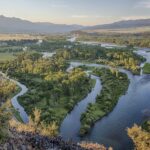
By Erle C. Ellis, professor of geography and environmental systems, UMBC, and James Watson, professor, The University of Queensland
Nature urgently needs our help. Wild creatures, from songbirds to butterflies and from primates to tortoises, are disappearing so rapidly that they could be lost forever together with the wild forests, grasslands and other habitats that long sustained them. We humans already use nearly half of all Earth’s land to sustain ourselves, and the most productive parts at that. Meanwhile, the habitats remaining for the rest of life are shrinking to levels too low to sustain themselves.
To ensure a future in which humanity thrives together with the rest of nature, people around the world will need to work together like never before.
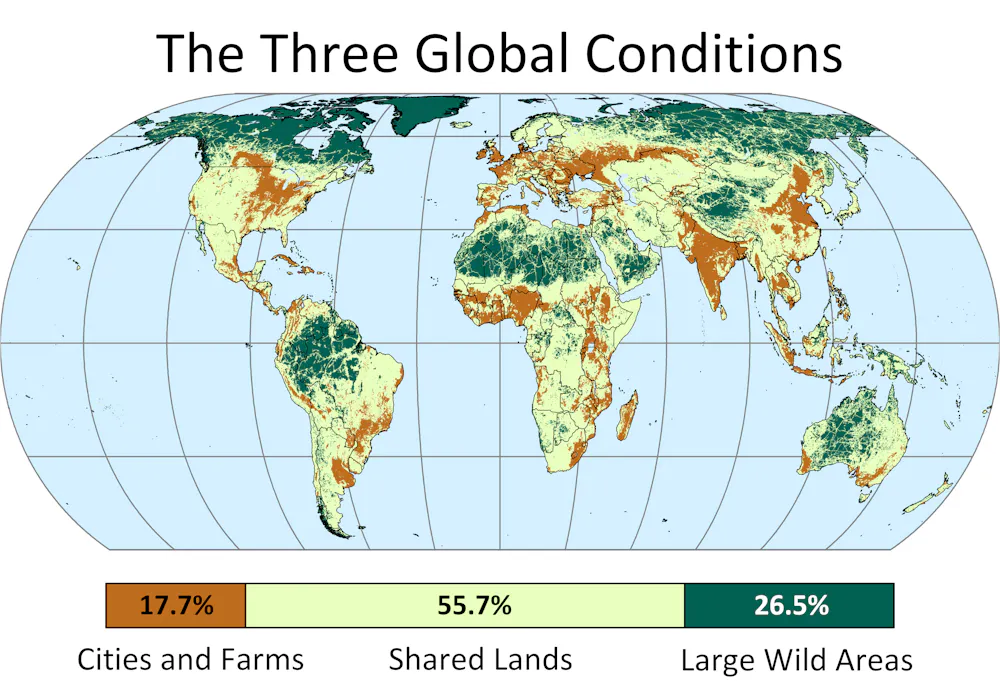
To help make this happen, our team of scientists and conservation experts have developed a new world map highlighting three conditions of landscapes across the planet that will need to be approached differently if we are to succeed in conserving biodiversity globally. These conditions are cities and farms, large wild areas and shared lands.
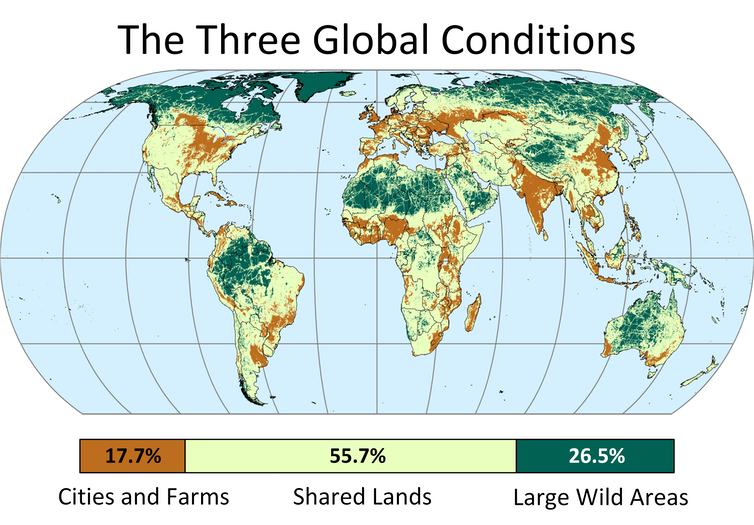 Cities and Farms are more than half covered by intensive agriculture and cities, Large Wild Areas are scarcely altered, and Shared Lands have a level of use somewhere in between. Each landscape condition requires a different conservation strategy. Harvey Locke et al. (2019), CC BY-ND
In a commentary accompanying our map, we argue that for too long, efforts to conserve nature globally have acted as if this entire planet is equally influenced by the human world. Yet different landscapes differ profoundly in how they are used and influenced by people, demanding different strategies to conserve biodiversity. Our map aims to clarify these conditions to enable people to work together to conserve biodiversity more fairly and equitably.
Biodiversity is our natural heritage
The extraordinary richness of life we’ve inherited is an irreplaceable treasure that makes the world an immeasurably better place for people. Biodiversity underpins many of the ecological functions that sustain us, from healthy soils to a stable climate, and provides a wide variety of benefits to human health – mental and physical.
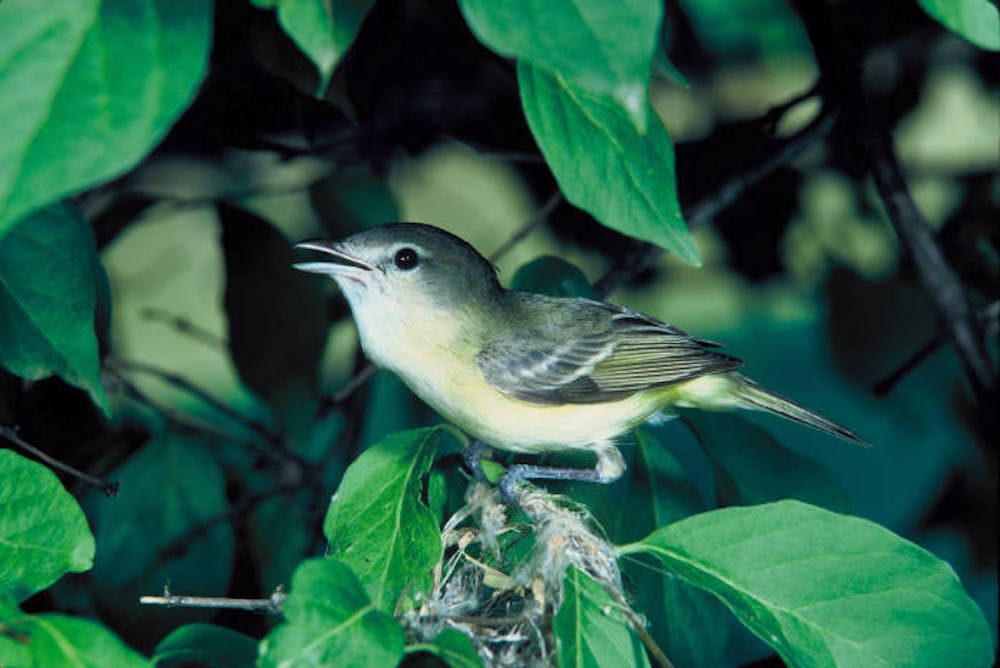
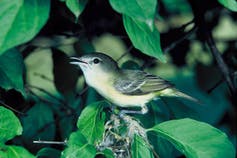 An endangered Bell’s vireo. Steve Maslowski/US Fish & Wildlife Service, CC BY
Yet the ultimate value of our biodiverse natural heritage is beyond any economic measure. Wild nature is our lifeblood and our heritage, connecting us with each other and the rest of life on this planet.
The good news is that people have already begun to rise to the challenge. For example, international commitments now aim to protect 17% of Earth’s land. But it is widely agreed that these and other existing conservation efforts are not nearly strong enough to halt nature’s decline.
In October 2020, nations working together through the global Convention on Biological Diversity will meet in Kunming, China to negotiate more ambitious international targets for conserving nature across the planet. One of the bolder proposals is to develop international commitments to officially protect 30% of Earth’s land area by 2030, and 50% by 2050.
But for any bold conservation agenda to succeed, an unprecedented level of international commitment will be needed. Perhaps the greatest obstacle is the many profound differences in social, economic and natural conditions that persist around the world. Some nations remain rich in unprotected biodiversity and wild habitats but are much less developed economically. Some are the opposite.
So how can such different nations and regions join together to make shared commitments and investments to save nature across this entire planet?
Three conditions for conserving nature
The first step is to build a basic consensus that conserving biodiversity can benefit all people, as long we share the efforts fairly at every level, from backyards to biosphere reserves, and across every social, economic and natural context, from the densest of cities to the most remote wild areas. To succeed, strategies need to be suited to the many different types of landscapes to conserve.
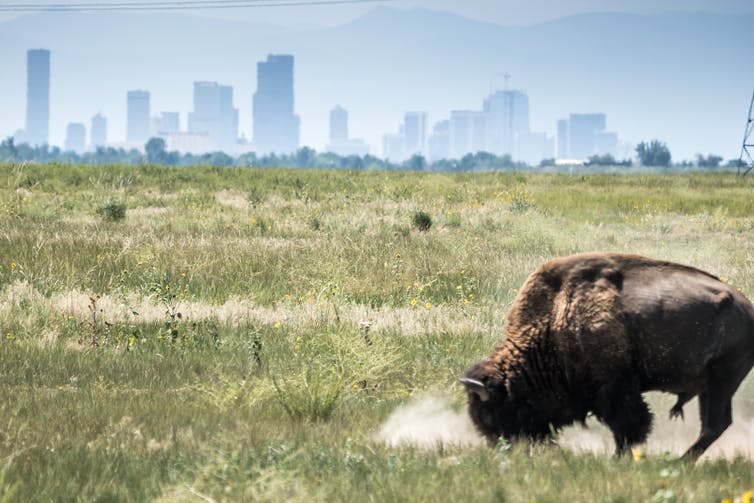 Buffalo grazing near Denver, Colorado, in Rocky Mountain Arsenal National Wildlife Refuge. Mark Byzewski, CC BY
Let’s start with the parts of the world where most of us live and most of our food comes from – the cities and farmlands that take up 18% of Earth’s land surface. These are not just full of people, crops and livestock, but also include some of the densest concentrations of vertebrate diversity on Earth, including many imperiled species of mammals and birds.
In these parts of the world, there needs to be widespread adoption of wildlife-friendly farming practices. Remnant and recovering habitats must be conserved within farmlands and agrichemical production reduced, even while increasing agricultural production. And even in the densest of cities, interconnecting small areas of protected habitat, such as parks and nature reserve networks, can successfully sustain some populations of highly endangered species. In the Indian city of Mumbai, for example, a national park conserves leopards.
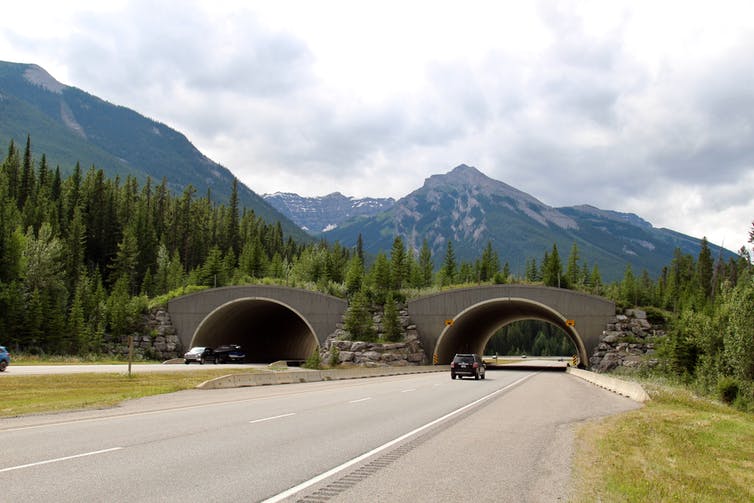 A bridge for wildlife in Banff National Park in Canada, one way to enhance biodiversity in protect lands. David Fulmer, CC BY
Large wild areas, where human influences are lowest, including large parts of Amazonia and Canadian boreal forests, still cover about a quarter of Earth’s land. Here, an emphasis on large-scale protection, such as the Five Great Forests Initiative in Central America, will be the most effective strategy. To avoid damaging the last of Earth’s unaltered ecosystems, new infrastructure and land uses, including mining, should be limited as much as possible. Recognizing indigenous people’s rights to land, so they can conserve their own lands, can also be highly effective; a large proportion of large wild areas are indigenous-owned and managed lands.
Perhaps the greatest conservation opportunities of all may reside within the most common condition of Earth’s land today – shared landscapes. Though parts of these working landscapes are still used intensively for agriculture and settlements, most of their area is composed of remnant and recovering habitats and areas lightly used for extensive grazing and forestry.
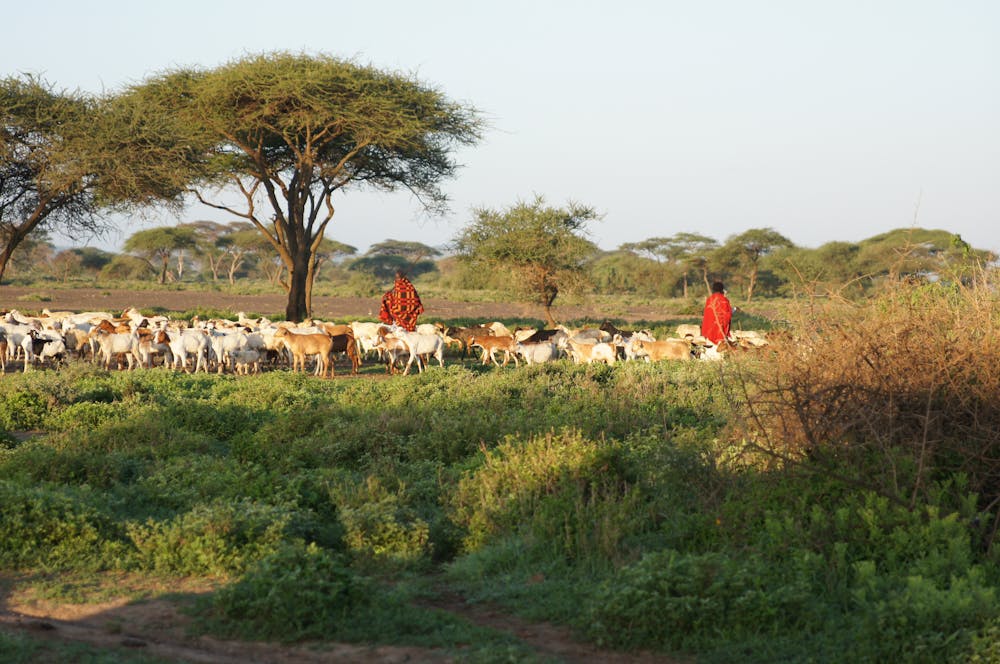
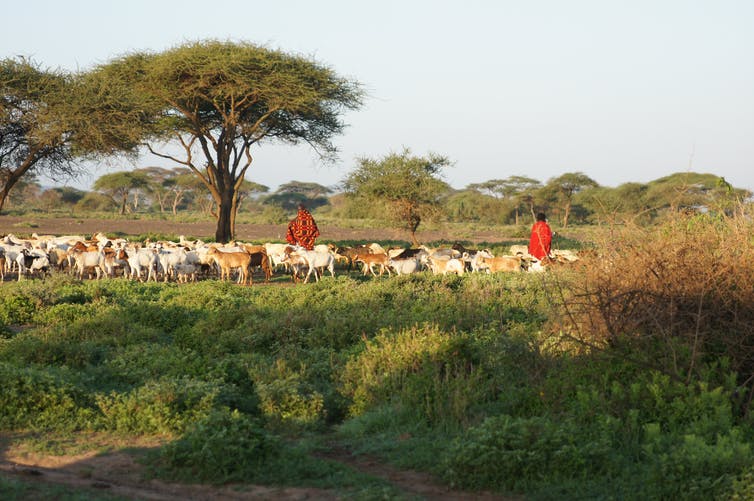 Maasai in Tanzania work on shared lands. jjmusgrove, CC BY
Conservation in shared lands can include regional protected area networks, such as the Yellowstone to Yukon Conservation Initiative, community conservation reserves, and conservation-friendly farms and cities that prioritize the needs of local people. For example, the Lewa community conservancy in Kenya, which protects habitat for endangered black rhinos, includes programs to assist local farmers to maximize their production while minimizing any negative impacts to protected habitats.
Shared lands are also home to almost half of Earth’s indigenous sovereign lands, another reason why expanding and empowering indigenous land sovereignty is considered essential to global efforts to expand conservation.
Doing your part to save nature
Distant wildlands are critical habitat for so many species, but effective conservation also depends on efforts in our own neighborhoods and the regions where our food comes from.
Think of nature when making new friends, caring for family, shopping, working, casting your vote, or donating your time or money to make the world a better place. The challenges ahead are not small, but working together across our farms and cities, shared landscapes, and large wild areas, we can make the nature of our planet whole and healthy again.
*****
Header image: The Snake River in Idaho is an area of ‘critical environmental concern.’ U.S. Bureau of Land Management, CC BY-SA
Contributors to the creation of the Three Conditions map include Harvey Locke of the International Union for Conservation of Nature World Commission on Protected Areas, Oscar Venter of University of Northern British Columbia, Richard Schuster of Carleton University, Keping Ma of the Chinese Academy of Sciences, Xiaoli Shen of the Chinese Academy of Sciences, Stephen Woodley, IUCN World Commission on Protected Areas, Naomi Kingston and Nina Bhola of the UN Environment Programme World Conservation Monitoring Centre, Bernardo B. N. Strassburg of the Pontifícia Universidade Católica and International Institute for Sustainability in Brazil, Axel Paulsch of the Institute for Biodiversity in Regensburg, Germany and Brooke Williams, University of Queensland.
 Erle Ellis is a member of the American Association of Geographers. The association is a funding partner of The Conversation US.
Erle C. Ellis, Professor of Geography and Environmental Systems, University of Maryland, Baltimore County and James Watson, Professor, The University of Queensland
This article is republished from The Conversation under a Creative Commons license. Read the original article.
]]>
By Erle C. Ellis, professor of geography and environmental systems, UMBC, and James Watson, professor, The University of Queensland Nature urgently needs our help. Wild creatures, from songbirds...
https://umbc.edu/stories/3-global-conditions%e2%81%a0-and-a-map%e2%81%a0-for-saving-nature-and-using-it-wisely/
https://my3.my.umbc.edu/api/v0/pixel/news/120025/guest@my.umbc.edu/bc72ab50576ff2c852f85400ea3fa764/api/pixel
cahss
erle-ellis
ges
perspectives
the-conversation
UMBC News & Magazine
https://my3.my.umbc.edu/groups/umbc-news-magazine
https://assets1-my.umbc.edu/system/shared/avatars/groups/000/001/943/24435aa6207c452e7bc15cc74b42c7bb/xsmall.png?1748556657
https://assets1-my.umbc.edu/system/shared/avatars/groups/000/001/943/24435aa6207c452e7bc15cc74b42c7bb/original.png?1748556657
https://assets2-my.umbc.edu/system/shared/avatars/groups/000/001/943/24435aa6207c452e7bc15cc74b42c7bb/xxlarge.png?1748556657
https://assets2-my.umbc.edu/system/shared/avatars/groups/000/001/943/24435aa6207c452e7bc15cc74b42c7bb/xlarge.png?1748556657
https://assets3-my.umbc.edu/system/shared/avatars/groups/000/001/943/24435aa6207c452e7bc15cc74b42c7bb/large.png?1748556657
https://assets1-my.umbc.edu/system/shared/avatars/groups/000/001/943/24435aa6207c452e7bc15cc74b42c7bb/medium.png?1748556657
https://assets2-my.umbc.edu/system/shared/avatars/groups/000/001/943/24435aa6207c452e7bc15cc74b42c7bb/small.png?1748556657
https://assets1-my.umbc.edu/system/shared/avatars/groups/000/001/943/24435aa6207c452e7bc15cc74b42c7bb/xsmall.png?1748556657
https://assets2-my.umbc.edu/system/shared/avatars/groups/000/001/943/24435aa6207c452e7bc15cc74b42c7bb/xxsmall.png?1748556657
UMBC News & Magazine
0
0
false
Fri, 25 Oct 2019 17:56:42 -0400
How to conserve half the planet without going hungry
Zia Mehrabi, University of British Columbia; Erle C. Ellis, University of Maryland, Baltimore County, and Navin Ramankutty, University of British Columbia
Every day there are roughly 386,000 new mouths to feed, and in that same 24 hours, scientists estimate between one and 100 species will go extinct. That’s it. Lost forever.
To deal with the biodiversity crisis we need to find a way to give nature more space — habitat loss is a key factor driving these extinctions. But how would this affect our food supplies?
New research, published in Nature Sustainability, found it could mean we lose a lot of food — but exactly how much really depends on how we choose to give nature that space. Doing it right could mean rethinking how we do agriculture and conservation altogether.
A fair deal
OK, but how much space are we talking about here?
There have been numbers flying around since the early 1990s. Some researchers say a quarter of all the space on earth, while others say three-quarters of all land and sea. Those in the middle ground, however, seem to suggest one half.
Leading scientists are increasingly endorsing the figure, including natural scientist E.O. Wilson, who wrote a book on it, and the former chief scientist at the World Wildlife Fund, Eric Dinerstein. These individuals are mobilizing funds, researchers, computing power and social capital to see what it takes to achieve this vision — through their organizations, The Half-Earth Project and Nature Needs Half.
The idea might seem crazy, but then again, maybe we need crazy ideas to get us to think about the better world we might be able to create.
And there is something about handing over half of the planet to nature that has an air of fairness to it — well, on the side of nature at least.
The global agricultural footprint
The reality is, most people would likely want to help save other species too (aside maybe from mosquitoes and some other pesky creatures). The upside seems massive and obvious — not in the least that our children will be able to enjoy these beautiful beings for generations to come.
But is it possible to conserve so much land and still feed everyone?
Agriculture and settlements already cover 37 per cent of the Earth’s ice-free land, so it’s difficult to see how we could set aside half the planet in a way that honours the needs of other species, without losing some of our agricultural lands.
Dinerstein and his colleagues found that some locations, such as the Midwest United States produce so much food that it would be “delusional” to even suggest returning them to nature.
But previous research didn’t quantify or map the scale of these trade-offs at a fine enough resolution to identify what’s really at stake.
Feeding people and conserving species
Our new research did just that.
It found that conserving habitats for other species could cost up to 29 per cent of the calories we currently produce from our food crops. But it also found that these food losses can be minimized to as little as three per cent depending on how that land is allocated to conservation.
If people manage landscapes so they are shared between agriculture and nature conservation — and make agricultural landscapes more kind to other species — it may bring effective results while avoiding large losses in food availability.
The trick here is making our agricultural landscapes less hostile to other life. This is no small ask.
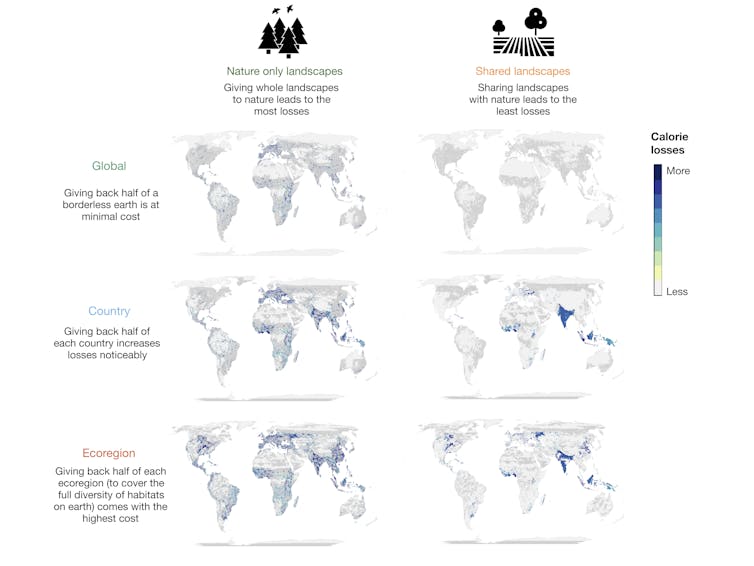 Calorie losses under different Half-Earth scenarios. Land allocations were made by minimizing calorie losses to show the lowest possible caloric costs to Half-Earth under current production.
Mehrabi, Ellis, and Ramankutty 2018
At the country scale, the study identified places where food losses would be large, including India (22 per cent) and China (12 per cent). These two countries have the greatest number of undernourished people on the planet, 195 million and 134 million respectively. It also identified other areas, such as in Indonesia, that may be less available for conservation than previously thought.
Clearly, conflicts between nature and agriculture need to be navigated carefully. Protecting the world’s most vulnerable, malnourished and food insecure populations must remain a priority. And synergies between conservation and poverty reduction need to be the primary focus.
Large potential co-benefits
But it isn’t all bad news.
The study also showed that giving half the planet to nature could increase temperate and tropical forest cover by 30 to 40 per cent, which would help tackle climate change and so likely reduce the agricultural losses from extreme weather.
What’s more, giving nature space might increase aspects of biodiversity important for crop yields like bees — boosting the amount of food we can produce in a given area — and help to offset some of the losses that might come from conservation.
Paula Ehrlich, the president and CEO of the E.O. Wilson Biodiversity Foundation and head of the Half-Earth Project, shared her thoughts on the scientific study:
“Identifying where conservation areas can protect the most species is key to reversing the species extinction crisis and ensuring a healthy planet for all of life, including people. Once identified, conservation protections must integrate into their planning and management systems the cultures and economies of Indigenous peoples, who are de facto the original conservationists.”
 A bee pollinates a flower. Photo by Kaj Schmidt.
There can be little doubt that the idea of giving half the planet back to nature is visionary and aspirational. We think these new findings have important implications for how humans see their needs against those of other species.
* * * * * *
Header image by LiCheng Shih.
The authors gratefully acknowledge the contributions of Carly Vynne Baker and Eric Dinerstein to the writing of this article, and Paula Ehrlich for her comments.
Zia Mehrabi, Research Associate, University of British Columbia; Erle C. Ellis, Professor of Geography and Environmental Systems, University of Maryland, Baltimore County, and Navin Ramankutty, Professor, University of British Columbia
This article was originally published on The Conversation. Read the original article.
]]>
Zia Mehrabi, University of British Columbia; Erle C. Ellis, University of Maryland, Baltimore County, and Navin Ramankutty, University of British Columbia Every day there are roughly 386,000 new...
https://umbc.edu/stories/how-to-conserve-half-the-planet-without-going-hungry/
https://my3.my.umbc.edu/api/v0/pixel/news/120349/guest@my.umbc.edu/6c0c665d27203c186725de173c9cad1e/api/pixel
discovery
erle-ellis
the-conversation
UMBC News & Magazine
https://my3.my.umbc.edu/groups/umbc-news-magazine
https://assets1-my.umbc.edu/system/shared/avatars/groups/000/001/943/24435aa6207c452e7bc15cc74b42c7bb/xsmall.png?1748556657
https://assets1-my.umbc.edu/system/shared/avatars/groups/000/001/943/24435aa6207c452e7bc15cc74b42c7bb/original.png?1748556657
https://assets2-my.umbc.edu/system/shared/avatars/groups/000/001/943/24435aa6207c452e7bc15cc74b42c7bb/xxlarge.png?1748556657
https://assets2-my.umbc.edu/system/shared/avatars/groups/000/001/943/24435aa6207c452e7bc15cc74b42c7bb/xlarge.png?1748556657
https://assets3-my.umbc.edu/system/shared/avatars/groups/000/001/943/24435aa6207c452e7bc15cc74b42c7bb/large.png?1748556657
https://assets1-my.umbc.edu/system/shared/avatars/groups/000/001/943/24435aa6207c452e7bc15cc74b42c7bb/medium.png?1748556657
https://assets2-my.umbc.edu/system/shared/avatars/groups/000/001/943/24435aa6207c452e7bc15cc74b42c7bb/small.png?1748556657
https://assets1-my.umbc.edu/system/shared/avatars/groups/000/001/943/24435aa6207c452e7bc15cc74b42c7bb/xsmall.png?1748556657
https://assets2-my.umbc.edu/system/shared/avatars/groups/000/001/943/24435aa6207c452e7bc15cc74b42c7bb/xxsmall.png?1748556657
UMBC News & Magazine
0
0
false
Wed, 22 Aug 2018 22:49:40 -0400
Roundup: UMBC in the News
One of the things that makes UMBC great is how wonderful our alumni, students, faculty, and staff are. Because of these amazing people, UMBC often finds itself “in the news,” so each week, we’ll be sharing with you a round-up of the most newsworthy achievements from our community.
- Dr. Hrabowski appeared on Comcast Newsmakers to stress the importance of inclusiveness in STEM fields.
- Erle Ellis, geography and environmental systems, told The Guardian that all human activity, even our conservation efforts, has an impact on how species evolve.
- Thomas Schaller, political science, discussed the Republican party’s shift towards the right in The Week.
- Marie DesJardins, computer science, tells us how we can integrate computer science education into the nationwide K-12 curriculum, providing more opportunities for female and minority students in the process.
- Patricia Joseph, former special assistant to the Provost, along with her husband Mark, have promised a $3 million gift to the Baltimore Museum of Art to help pay some of the costs of the museum’s new center for education and creativity.
- Light Point Security, a cybersecurity company founded by former NSA employees and based at bwtech@UMBC, is profiled in the Baltimore Sun.
-
Women’s volleyball beat Hartford 3-0 on Sunday, while women’s soccer scored a 2-0 victory over New Hampshire for their Senior Day game.
For more newsmaking moments and campus updates, check out UMBC Insights!
]]>
One of the things that makes UMBC great is how wonderful our alumni, students, faculty, and staff are. Because of these amazing people, UMBC often finds itself “in the news,” so each week, we’ll...
https://umbc.edu/stories/roundup-umbc-in-the-news-7/
https://my3.my.umbc.edu/api/v0/pixel/news/121511/guest@my.umbc.edu/7d311214122d851db129bbfea67bb79c/api/pixel
alumni
baltimore-museum-of-art
bwtech-at-umbc
computer-science
environmental-systems
erle-ellis
freeman-hrabowski
geography
light-point-security
marie-desjardins
patricia-joseph
political-science
thomas-schaller
volleyball
womens-soccer
UMBC News & Magazine
https://my3.my.umbc.edu/groups/umbc-news-magazine
https://assets1-my.umbc.edu/system/shared/avatars/groups/000/001/943/24435aa6207c452e7bc15cc74b42c7bb/xsmall.png?1748556657
https://assets1-my.umbc.edu/system/shared/avatars/groups/000/001/943/24435aa6207c452e7bc15cc74b42c7bb/original.png?1748556657
https://assets2-my.umbc.edu/system/shared/avatars/groups/000/001/943/24435aa6207c452e7bc15cc74b42c7bb/xxlarge.png?1748556657
https://assets2-my.umbc.edu/system/shared/avatars/groups/000/001/943/24435aa6207c452e7bc15cc74b42c7bb/xlarge.png?1748556657
https://assets3-my.umbc.edu/system/shared/avatars/groups/000/001/943/24435aa6207c452e7bc15cc74b42c7bb/large.png?1748556657
https://assets1-my.umbc.edu/system/shared/avatars/groups/000/001/943/24435aa6207c452e7bc15cc74b42c7bb/medium.png?1748556657
https://assets2-my.umbc.edu/system/shared/avatars/groups/000/001/943/24435aa6207c452e7bc15cc74b42c7bb/small.png?1748556657
https://assets1-my.umbc.edu/system/shared/avatars/groups/000/001/943/24435aa6207c452e7bc15cc74b42c7bb/xsmall.png?1748556657
https://assets2-my.umbc.edu/system/shared/avatars/groups/000/001/943/24435aa6207c452e7bc15cc74b42c7bb/xxsmall.png?1748556657
UMBC News & Magazine
0
0
false
Fri, 23 Oct 2015 14:16:21 -0400
Round-Up: UMBC In the News 8/8
One of the things that makes UMBC great is how wonderful our alumni, students, faculty, and staff are. Because of these amazing people, UMBC often finds itself “in the news,” so each week, we’ll be sharing with you a round-up of the most newsworthy achievements from our community.
View all the other great news on Insights Weekly.
]]>
One of the things that makes UMBC great is how wonderful our alumni, students, faculty, and staff are. Because of these amazing people, UMBC often finds itself “in the news,” so each week, we’ll...
https://umbc.edu/stories/round-up-umbc-in-the-news-88/
https://my3.my.umbc.edu/api/v0/pixel/news/122411/guest@my.umbc.edu/231b82950a18ef61fca66bdefc85e6a5/api/pixel
alumni
anne-spence
erle-ellis
katie-cano
mechanical-engineering
political-science
princeton-review
round-up
umbc
university-of-maryland-balitmore-county
UMBC News & Magazine
https://my3.my.umbc.edu/groups/umbc-news-magazine
https://assets1-my.umbc.edu/system/shared/avatars/groups/000/001/943/24435aa6207c452e7bc15cc74b42c7bb/xsmall.png?1748556657
https://assets1-my.umbc.edu/system/shared/avatars/groups/000/001/943/24435aa6207c452e7bc15cc74b42c7bb/original.png?1748556657
https://assets2-my.umbc.edu/system/shared/avatars/groups/000/001/943/24435aa6207c452e7bc15cc74b42c7bb/xxlarge.png?1748556657
https://assets2-my.umbc.edu/system/shared/avatars/groups/000/001/943/24435aa6207c452e7bc15cc74b42c7bb/xlarge.png?1748556657
https://assets3-my.umbc.edu/system/shared/avatars/groups/000/001/943/24435aa6207c452e7bc15cc74b42c7bb/large.png?1748556657
https://assets1-my.umbc.edu/system/shared/avatars/groups/000/001/943/24435aa6207c452e7bc15cc74b42c7bb/medium.png?1748556657
https://assets2-my.umbc.edu/system/shared/avatars/groups/000/001/943/24435aa6207c452e7bc15cc74b42c7bb/small.png?1748556657
https://assets1-my.umbc.edu/system/shared/avatars/groups/000/001/943/24435aa6207c452e7bc15cc74b42c7bb/xsmall.png?1748556657
https://assets2-my.umbc.edu/system/shared/avatars/groups/000/001/943/24435aa6207c452e7bc15cc74b42c7bb/xxsmall.png?1748556657
UMBC News & Magazine
0
0
false
Fri, 08 Aug 2014 14:30:26 -0400
Round-Up: UMBC in the News, 4/11
One of the things that makes UMBC great is how wonderful our alumni, students, faculty and staff are. Because of these amazing people, UMBC often finds itself “in the news,” so each week, we’ll be sharing with you a round-up of the most newsworthy achievements from our community.
Check out all the other great campus news on Insights Weekly.
]]>
One of the things that makes UMBC great is how wonderful our alumni, students, faculty and staff are. Because of these amazing people, UMBC often finds itself “in the news,” so each week, we’ll be...
https://umbc.edu/stories/round-up-umbc-in-the-news-411/
https://my3.my.umbc.edu/api/v0/pixel/news/122686/guest@my.umbc.edu/04c64f5de78ed7e660cf7b26af05ca9f/api/pixel
alumni
baltimore-jewish-times
city-paper
die-zeit
erle-ellis
lia-purpura
lynne-schaefer
project-mah-jongg
the-baltimore-sun
the-business-officer
tim-nohe
umbc
umbc-chess-team
university-of-maryland-baltimore-county
wpr
UMBC News & Magazine
https://my3.my.umbc.edu/groups/umbc-news-magazine
https://assets1-my.umbc.edu/system/shared/avatars/groups/000/001/943/24435aa6207c452e7bc15cc74b42c7bb/xsmall.png?1748556657
https://assets1-my.umbc.edu/system/shared/avatars/groups/000/001/943/24435aa6207c452e7bc15cc74b42c7bb/original.png?1748556657
https://assets2-my.umbc.edu/system/shared/avatars/groups/000/001/943/24435aa6207c452e7bc15cc74b42c7bb/xxlarge.png?1748556657
https://assets2-my.umbc.edu/system/shared/avatars/groups/000/001/943/24435aa6207c452e7bc15cc74b42c7bb/xlarge.png?1748556657
https://assets3-my.umbc.edu/system/shared/avatars/groups/000/001/943/24435aa6207c452e7bc15cc74b42c7bb/large.png?1748556657
https://assets1-my.umbc.edu/system/shared/avatars/groups/000/001/943/24435aa6207c452e7bc15cc74b42c7bb/medium.png?1748556657
https://assets2-my.umbc.edu/system/shared/avatars/groups/000/001/943/24435aa6207c452e7bc15cc74b42c7bb/small.png?1748556657
https://assets1-my.umbc.edu/system/shared/avatars/groups/000/001/943/24435aa6207c452e7bc15cc74b42c7bb/xsmall.png?1748556657
https://assets2-my.umbc.edu/system/shared/avatars/groups/000/001/943/24435aa6207c452e7bc15cc74b42c7bb/xxsmall.png?1748556657
UMBC News & Magazine
0
0
false
Fri, 11 Apr 2014 18:30:30 -0400
 Cities and Farms are more than half covered by intensive agriculture and cities, Large Wild Areas are scarcely altered, and Shared Lands have a level of use somewhere in between. Each landscape condition requires a different conservation strategy. Harvey Locke et al. (2019), CC BY-ND
 An endangered Bell’s vireo. Steve Maslowski/US Fish & Wildlife Service, CC BY
 A bridge for wildlife in Banff National Park in Canada, one way to enhance biodiversity in protect lands. David Fulmer, CC BY
 Maasai in Tanzania work on shared lands. jjmusgrove, CC BY
