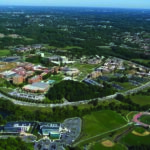
Measure of a Mission: The Exceptional by Example Campaign
UMBC’s Exceptional by Example Campaign transformed the campus. But you can’t calculate its true impact without assessing how it helped members of the UMBC community change and grow.
By Jenny O’Grady and Meredith Purvis
The tale of a successful capital campaign is often told by the numbers. And by that yardstick, UMBC’s Exceptional by Example Campaign was a success.
Over the course of nine years, UMBC’s Exceptional by Example Campaign raised money to invest in a community without boundaries, made up of teachers, students and researchers who come from every imaginable background and share a commitment to academic excellence and innovative thinking.
More than $115 million was raised to provide resources that advance the mission and vision of UMBC. More than $65 million has been earmarked for programs that support student scholarship and success, and more than $46 million has been allocated to support research and creativity at UMBC.
“Exceptional examples” of the tangible results of this campaign can be seen everywhere on campus, giving us reason to truly celebrate a fundraising effort — along with the more than 22,000 individual donors who contributed — that will continue to strengthen UMBC for years to come.
But look past the spreadsheets and statistics and you’ll find stories of individual people – those who gave to the campaign and those whose lives and education were advanced in the effort.
One can only measure the Exceptional by Example Campaign’s real impact by assessing its effect on people in the UMBC community. Greg Simmons ’04, M.P.P., vice president of institutional advancement, says that gifts to the campaign from a wide web of donors (more than 22,000) have allowed UMBC “to continue to be seen as a university that’s really leading the nation in terms of innovation, whether that’s innovation in the classroom, innovation in the lab or innovation in economic development.”
As the campaign officially closes, we at UMBC Magazine want to share some stories of the exceptional things that the campaign has helped achieve at the university – and allow you to hear from alumni about why they feel so strongly about the shared enterprise we’ve just concluded.
24-Hour Study
When we say UMBC students can change the world around them, we mean it. Case in point: the Retriever Learning Center, a 24-hour learning space opening in the Albin O. Kuhn Library & Gallery in September. Student government leaders came up with the idea, rallied their own troops to partially fund the renovations, and then worked with other groups – including parents – to raise funds to see the project to completion.
Pioneering Programs
Students in the now 23-year-old Meyerhoff Scholars Programknow this saying well: To whom much is given, much is expected. So much so that, inspired by namesake Robert Meyerhoff and his late wife, Jane, alumni of the program (and their parents) supported the campaign to ensure their landmark program – which has become a much-celebrated national model – continues for decades to come.
Strong Figures
Christine Sweigart ’10, mathematics, knew she wanted to be a math teacher when she was six years old. And in the Sherman Teacher Scholars Program, founded by George and Betsy Sherman, Sweigart has put her passion to use, helping children from low-income families to gain essential math skills. She is now pursuing her master’s degree in teaching at UMBC in order to work in high-needs schools in Baltimore.
Big Ideas Realized
Retriever pitcher Mike Pesci ’12 is helping mentally and physically handicapped kids participate in sports thanks in part to the Joseph and Frieda Faiman Eisenberg/VPC Endowed Scholarship, as entrepreneurship-based award generously funded by alumnus Eli Eisenberg ‘86 designed to help students see their big ideas to fruition.
Planting Hope
Alumni often understand the importance of access to a UMBC education better than anyone. That’s why the Chapter of Black & Latino Alumni has supported two scholarships – the Second Generation Scholarship and the Esperanza Endowment Fund – to provide financial assistance to outstanding UMBC students committed to the advancement of minorities.
Enriching Arts
Artists don’t take a summer vacation. Linehan Artist Scholars recently wrote thank you notes to their donors, Earl and Darielle Linehan, that breathlessly shared their summer plans: six weeks of studying theatre in London; sharing flute technique in Maccagno, Italy; dancing at the Trinity Laban Conservatoire of Music and Dance in England; and experiencing the rich visual arts culture of Milan, to name just a few.
Secure Environment
When it comes to finding better ways to scramble passwords or keep your data secure as it floats in “the cloud,” UMBC is helping keep your computing secrets safe. Through a university partnership with Northrop Grumman, the Cync Program helps emerging cybersecurity companies like Five Directions gain a toehold in a rapidly growing industry.
More Than Passing the Test
Teams of students with names like the “Nobel Gases” and “Team Nitrogen” are solving problems as groups – and upping the overall pass-rate for Chemistry 101 by double digit percentages – in “the isolation tank” also known as the Chemistry Discovery Center. Building off these successes, and thanks to support of alumni donors, as well as foundations and companies, especially SAIC, UMBC’s College of Natural and Mathematical Sciences launched a second process-oriented, guided-inquiry learning initiative, CASTLE – or CNMS Active Science Teaching and Learning Environment – in fall 2010.
Living and Learning
Everyone knows students like to study in their pajamas. With their friends. Preferably, with midnight pizza. Perhaps that’s why the nine Living Learning Communities– dorms that group future teachers, engineers, do-gooders, etc. – have been so successful, improving retention and grades by giving more than 1,000 students living there the chance to crack equations together and talk shop whenever the mood strikes. The LLCs were a priority of alumni giving during the campaign.
Steered to Service
At one point in her life, Sheila Williams ’11 was homeless and separated from her children. But scholarships for mature female students at UMBC – funded by the Charlotte W. Newcombe Foundation – helped Williams obtain a sociology degree and begin a career dedicated to service. “Honestly, without my experiences here, I wouldn’t know how to serve them,” she says. “I know I would not have made it through without that support system.”
Engineering A Future
As a mechanical engineering student,Mariano Mumpower ’11 received the Anthony Alvarez Engineering Scholarship, allowing him to intern at NASA and even enter – and win! – a campus-wide idea competition with his plan for a sustainable mobile food stand. Now that he has graduated, Mumpower is happily employed as an applications engineer at Conveyor Handling Corporation – the company founded by the Alvarez scholarship’s namesake.
Thinking Hard
UMBC’s Humanities Forum, sponsored by the James T. and Virginia M. Dresher Center for the Humanities, attracts some of the best thinkers of our time right to our students’ doorstep – and gets the university community thinking hard about broader intellectual issues, including the often-fractious relationship between the humanities and the sciences.
Picture This
UMBC’s nationally-renowned Imaging Research Center (IRC) has created amazing work ranging from a virtual tour of Washington DC’s Capitol Hill in 1800 to helping animate the ebullient work of local cartooning treasure Kevin “Kal” Kallaugher. But the pictures wouldn’t get made without support for the IRC by the Robert W. Deutsch Foundation and other donors.
Hands-On History
They say a picture is worth a thousand words. In the case of archaeological artifacts, there’s nothing quite like the real thing. Students at UMBC can work with mosaics, pottery and other pieces dating back as far as 15,000 years thanks to the gift of former College Park professor Marie Spiro’s personal collection, totaling more than 1,000 Greek, Roman and Byzantine pieces (dust not included).
Honoring Teachers
Established in 2006 by faculty, family and friends in memory of Dr. Carl Weber, Assistant Professor Emeritus in the UMBC Department of Biological Sciences, as a tribute to his passion for classroom teaching, the Carl S. Weber Excellence in Science and Mathematics Teaching Award honors exceptionally dedicated teachers, including current awardee UMBC alumnus James W. Sandoz ’76.
Contribution of Notes
Church has always been an important part of Charles Nicholas’ life. One of the few memories he has of his grandmother, Grace, is sitting on her lap as she played “Jesus Loves Me” on the organ at the Market Street Baptist Church in Zanesville, Ohio. So when the computer science and electrical engineering professor thought about ways to give back to UMBC, he made an utterly personal choice: purchase an electric organ (dedicated to his parents, Charles and Barbara) for UMBC’s department of music. Budding organists can now train on campus, when they previously had to visit local churches to practice.
Bright Ideas
Professor of chemical and biochemical engineering Govind Rao researches fluorescent spectroscopy: a process by which bands of light react with compounds to create other measurable levels of light. Rao’s work, in part supported by Sartorius Stedim North America, Inc., may aid doctors monitoring the progress of premature babies, creating a safer environment for them to gain their strength, and also help scientists track carbon dioxide levels in water, making it easier to predict climate changes.
Room of Their Own
UMBC’s staff also make gifts that change the university for the better. Vice president of student affairs Nancy Young comes from a family that loved recreational sports and community, and she recently decided to honor her father’s legacy through a gift that renamed the UMBC’s soccer team’s locker room in his honor. “Sport is a great way to build community,” says Young. “It supports and celebrates the connections we’re trying to make between students from so many different backgrounds.”
Female Capital
Associate professor of history Amy Froide, recipient of the Bearman Foundation Chair in Entrepreneurship, spent a year studying the ways women contributed to Britain’s financial revolution during the late 17th century. Since 2006, a grant from the Kauffman Foundation has allowed UMBC to infuse more than 60 of its courses with entrepreneurial content.
Paying it Forward
Though his parents wanted Jim Hong ’73 to go to college, they weren’t sure they could afford it. Hong still remembers the look on his father’s face when he announced he’d gotten a scholarship. “It was a huge burden off him,” Hong says. Hong went on to study biology and pursue a career in microbiology. And, when he was able, Hong took the chance to lift someone else’s burden by giving back to UMBC. Now, he’s been a loyal supporter for more than 20 years. “I’m grateful for the experience I had there [at UMBC] and I want to give back,” he explains. “I look at people with brains, who want to do it, and I want to help them.”
Aiding Aging
With one American turning 60 every eight seconds, thinkers at UMBC see an opportunity for the university to lead a revolution in aging education. Students in the Erickson School, founded with a gift by retirement businessman John Erickson, understand that by studying how to enhance the lives of a rapidly growing population of older adults, we will also advance our society as a whole.
Jetsetting Scholars
Over the past year, political science and French double major Laurentina Cizza ’12 has lived in Italy, Jordan and France – absorbing languages, cultures, and life experiences she hopes will translate into a policy analysis job with the U.S. State Department. A Jacob Blaustein Public Affairs Scholar in the Sondheim Scholars Program at UMBC who is fluent in Italian and French (and working hard to tackle Arabic), Cizza appreciates the freedom the scholarship has given her to explore the world.
Sense of Place
Over four decades of teaching, American studies professor Ed Orser inspired so many students to explore the history of their own community, a group of Orser devotees has banded together to name a piece of the community after him. Initiated during the Campaign, funds are still being raised to endow the Orser Center for the Study of Place, Community, and Culture.
Graduate Success
Thanks to donors like W.R. Grace & Company, graduate students like Andrea Gray – a Meyerhoff Graduate Fellow pursuing her doctorate in chemistry, who also interned at W.R. Grace – have the support they need to truly devote themselves to their course of study.
* * * * *
Q&A with Alumni Leaders: At the end of the campaign, UMBC Magazine sat down with four prominent alumni, including past (Anita Maddox Jackson ’80) and present (Bennett Moe ’88) presidents of the UMBC Alumni Board, a long-term donor (Emmerson Small ’74), and UMBC’s vice president of Institutional Advancement (Greg Simmons ’04), to talk about its success and the future. Read the full interview
By the Numbers: Learn more about who gave, how the money has been used and why community is so very important to the campaign effort. Read about Campaign stats
]]>
UMBC’s Exceptional by Example Campaign transformed the campus. But you can’t calculate its true impact without assessing how it helped members of the UMBC community change and grow. By Jenny...https://umbc.edu/stories/measure-of-a-mission-the-exceptional-by-example-campaign/https://my3.my.umbc.edu/api/v0/pixel/news/124426/guest@my.umbc.edu/7434f53d5f98068e1fe90e7442be51e2/api/pixelexceptional-by-example-campaignfall-2011impactUMBC News & Magazinehttps://my3.my.umbc.edu/groups/umbc-news-magazinehttps://assets1-my.umbc.edu/system/shared/avatars/groups/000/001/943/24435aa6207c452e7bc15cc74b42c7bb/xsmall.png?1748556657https://assets1-my.umbc.edu/system/shared/avatars/groups/000/001/943/24435aa6207c452e7bc15cc74b42c7bb/original.png?1748556657https://assets2-my.umbc.edu/system/shared/avatars/groups/000/001/943/24435aa6207c452e7bc15cc74b42c7bb/xxlarge.png?1748556657https://assets2-my.umbc.edu/system/shared/avatars/groups/000/001/943/24435aa6207c452e7bc15cc74b42c7bb/xlarge.png?1748556657https://assets3-my.umbc.edu/system/shared/avatars/groups/000/001/943/24435aa6207c452e7bc15cc74b42c7bb/large.png?1748556657https://assets1-my.umbc.edu/system/shared/avatars/groups/000/001/943/24435aa6207c452e7bc15cc74b42c7bb/medium.png?1748556657https://assets2-my.umbc.edu/system/shared/avatars/groups/000/001/943/24435aa6207c452e7bc15cc74b42c7bb/small.png?1748556657https://assets1-my.umbc.edu/system/shared/avatars/groups/000/001/943/24435aa6207c452e7bc15cc74b42c7bb/xsmall.png?1748556657https://assets2-my.umbc.edu/system/shared/avatars/groups/000/001/943/24435aa6207c452e7bc15cc74b42c7bb/xxsmall.png?1748556657UMBC News & Magazine00falseTue, 18 Oct 2011 19:55:11 -0400Striving to Make a Difference: Joseph T. Jones, Jr. '06
Once upon a time, Joseph T. Jones, Jr. thought he couldn’t escape the city’s mean streets. Now he’s leading efforts to help reclaim the families broken by urban ills. By Elizabeth Heubeck ’91 Photos by Bruce Weller
Searing waves of heat already ripple through West Baltimore at 9 a.m. on a Friday in July. The streets around 2201 N. Monroe Street – headquarters of the Baltimore-based nonprofit Center for Urban Families (CFUF) – are all but deserted.
Inside the center’s air-conditioned conference room, 40 or so adults – men and women, black and white, some as young as 18 and others old enough to be grandparents – sit in neat lines of metal folding chairs, sweating a
bout their future. Some look anxious, others bleary-eyed. Most of the men wear ties, pressed pants and dress shoes; the women are in heels, panty hose and skirts. Some are ex-convicts. Many have been involved with the drug trade. Others have held jobs but haven’t been able to keep them.
If the room has the solemn air of a funeral, there’s a good reason. Everyone here is preparing to say goodbye to their old lives and start anew through the CFUF’s signature program, STRIVE, which is modeled after a prototype launched in New York City’s East Harlem.
When the center’s founder and CEO, Joseph T. Jones, Jr. ’06, social work, walks to the front of the room, everyone seems to sit up a little straighter. Standing more than six feet tall in a dark blue pin stripe suit, Jones’ imposing stature and deep, authoritative voice command the room. But his story also grabs attention with this audience: He’s walked a remarkably similar path.
“All the things I did suggest I should be dead, incarcerated, or debilitated,” Jones tells the group.
Jones’ path was particularly rocky: He was the product of a broken family. He shot heroin at 13, and was arrested for the first time at 14. He spent more time in Maryland’s juvenile justice system than he did in a high school classroom. And Jones’ career as a drug dealer saw him only narrowly escape a lengthy federal prison sentence.
But Jones is living proof that hard knocks don’t always knock you out. His West Baltimore center promotes stable career paths and rebuilds strong family units among urban residents, and Jones is sharing his successes with national audiences – including meetings with former Vice President Albert Gore, Jr. and a place on President Barack Obama’s Taskforce on Responsible Fatherhood and Healthy Families.
Healthy families are the building block for any American renaissance, argues Jones. “Twenty-five million children live in households where their fathers are not present. As a society, we can’t have that number of children not having a relationship with their fathers.” Rough Beginnings
Jones remembers the breakup of his own family at age nine with chilling clarity.
“My father, he was ex-military,” Jones recalls. “I remember him packing his [military] duffel bag one day.” Jones watched from the living room window, which overlooked the entrance to East Baltimore’s Lafayette Courts projects, as his father put his duffel bag in the car and drove away. Life with a single mother left Jones “crossing boundaries,” as he puts it. He became friends with a crowd that plunged him into heroin use and selling drugs. And his first drug-related arrest and sentence to 30 days in a juvenile detention facility didn’t exactly scare him straight. “One of my best friends from the street was there. He created a seamless pathway
for me to have no trouble in that system,” Jones recalls. As Jones cycled in and out of the juvenile justice system and grew ever-deeper roots to drugs and crime, a part of him remained open to a different path. Ironically, it was Jones’ father, barely present in his life since leaving with his duffel bag, who planted the seed on a visit to his son in juvenile detention.
Jones’ father brought him Manchild in the Promised Land, a book by Claude Brown which tells the story of the author’s coming of age (and escaping) poverty-stricken and drug-filled 1960s Harlem. The book led Jones to other influential autobiographies, including those of Martin Luther King, Jr. and John F. Kennedy.
“I was preparing myself for now, but not intentionally,” Jones says. “I was always attracted to stories about people who were making change in society.” Almost Lost
Jones says he had a talent for masking problems under a façade of normality. He managed to earn his GED, attend community college, and was even admitted to a management training program with the Social Security Administration.
Under that surface, however, Jones remained unchanged. Indeed, he was brazen enough to sell drugs out of the Social Security Administration building.
He believed he was successfully evading police detection until one day he was asked to attend a meeting during work hours in the organization’s auditorium. When he arrived, he was greeted by members of the U.S. Drug Enforcement Agency.
Jones recalls the arrest was “a complete embarrassment.” His mother and grandmother also worked at Social Security Administration, and dealing in that building brought a federal drug charge. He was also suspended without pay and removed from the management training program.
Eventually Jones pled guilty to a misdemeanor and avoided jail time. But even that humiliating arrest did not create a final break with his addiction to heroin and cocaine and his drug crimes. For years, he observes, “faith and fate” allowed him to narrowly avoid lengthy jail sentences.
Jones started to weary of the game, however. On October 3, 1986, he knocked on the door of Spring Grove’s residential drug treatment program. “Part of me wanted to stop doing drugs,” Jones recalls. But the real motivation was to avoid a jail sentence for five new criminal charges. The choice was simple: drug treatment or jail.
A year in drug rehabilitation helped Jones finally make a break with his former life. For the first time since he could remember, he was sleeping and eating well and exercising regularly. At year’s end, Jones was ready to commit to the “phase out” stage of the treatment program, which required him to have a plan to continue his recovery. Jones decided on the community college degree he’d started but never finished.
Now in his thirties, his experience at Baltimore City Community College (BCCC) was decidedly different after rehab. Jones became the top student in the college’s accounting program. He also met his future wife, Debra Scovens, who was an assistant to BCCC’s dean of admissions.
They have now been married for 21 years and have three children. Armed with a new family and newfound confidence and stability, Jones was ready to pursue helping others change their lives as he had changed his own. Making Waves in Public Policy
Jones took several part-time jobs to make ends meet during community college. One job involved working with a community-based organization that provided health and HIV/AIDS education, where his primary role was negotiating contracts with drug treatment centers and providing health and HIV education to their clients.
Jones parlayed that job into a grant-funded position with the Baltimore City Health Department to ensure that pregnant women in the city received prenatal care. As he worked with these women, he had an epiphany about the connections between their challenges and his own upbringing. “I’m dragging these women from crack houses to prenatal care,” he recalls, “then they’re going home to these guys who were saying, ‘We need help, too…. Public policy wasn’t addressing the issue of fatherhood.”
Health officials urged Jones to take up the cause on his own. And he did. Using the federal government’s Healthy Start Initiative, Jones developed and implemented a “Men’s Services” program within the city health department’s Healthy Start program.
His success with that initiative provided Jones with invitations to high-level conferences on urban families, including one hosted by Vice President Gore and his former wife, Tipper Gore. At that conference, Jones chose to make a splash when he was asked to comment.
“I went off on a tirade about the surface level of the conversation, and how it didn’t meet the needs of the people in the communities where I come from,” Jones recalls. And though he received a round of applause for his outburst, he felt compelled to apologize to Gore for his strong words. That day allowed Jones not only to establish a personal relationship with Gore, but it also garnered him more invitations to discuss the obstacles facing urban families. Back to School
Jones’ persuasiveness about the importance of jobs and reconnecting families to create an urban renaissance also found an audience closer to home. UMBC president Freeman A. Hrabowski, III, attended one of Jones’ speeches and was impressed.
“It was clear he was a masterful communicator,” says Hrabowski. “He was analytical, used his own story and was able to talk about intervention strategies. Most importantly, he spoke with great authenticity.”
When Hrabowski queried Jones about his education and learned that he had an associate’s degree, he didn’t withhold his opinion. “My first reaction was that he had to go back,” Hrabowski recalls. “I knew it would open more doors for him.”
Jones demurred at first, telling UMBC’s president that he was too old, that he had a young family, and that he didn’t qualify for scholarships. But Hrabowski eventually won out, serving as Jones’ mentor as he took his degree at UMBC. In 2006, at the age of 50, Jones graduated cum laude from the university.
“His standard of excellence is so incredibly high,” Jones says of Hrabowski. “He uplifts you just being in his space.” Success and Standards
Jones’ dynamic presence provides a similar uplift for the men and women he’s working hard to help at the Center for Urban Families.
Take STRIVE. On its surface, the program is a boot camp for coping with the challenges of the contemporary workplace: being on time, dressing appropriately and managing office hierarchies. But it’s also a “reboot” camp to help clients gain self-assurance and self-reliance in all areas of their lives.
“When you see people who come in here, and you look in their eyes,” Jones observes, “there’s almost no hope. You have to convince them that if they follow the structure we have established, they can be successful, regardless of their background,” he says.
At the first day of the STRIVE training on this July morning, most participants come dressed in their best clothing. But one young man, dressed in baggy black pants and untucked shirt, didn’t get the message. Jones summons him to the front of the room.
“Did they explain to you what you had to do to prepare for today, including the dress code?” Jones barks. “Do you want to go through this program?”
The young man’s response is barely audible.
“You’ve got ten minutes to get dressed like this guy,” says Jones, pointing to a man in the front row wearing a dress shirt and slacks, wing tips, and tie. The young man saunters to the back of the room and out the door.
Jones tells those who remain: “We’re going to raise the standard real high, and some of people are going to fall off…. Twenty percent of you won’t be back on Monday.”
When Jones worked for the Baltimore City Health Department, he designed and oversaw innovative programs like STRIVE. But the bureaucracy of working within a government agency frustrated him. “If I wanted to grow beyond now, I knew I couldn’t do it at the health department,” he says. With a nod from his then-boss and former Baltimore City Health Commissioner Peter Beilenson – and financial support from the Abell Foundation and its longtime president, Robert C. Embry, Jr. – Jones was able to strike out on his own.
In 1999, Jones opened the doors to the Center for Urban Families. In the attractive new building in which the nonprofit is housed today, Jones has also started a program to help fathers: Men’s Services Responsible Fatherhood program. The center also launched its first national initiative, Baltimore Building Strong Families, in 2005. The program aims to support new low-income parents with financial know-how and relationship skill building. Tough Love
Jones attributes the success of the center’s initiatives to a tough-love approach that provides structure and demands discipline. It’s this approach that attracted longtime supporter David L. Warnock, CEO of a Baltimore-based investment firm. He’s been the chairman of the 12-year old nonprofit for more than eight years.
“I like the tough love approach to STRIVE,” says Warnock. “I also like how the model of STRIVE aims to create a sense of accomplishment among a group of people that doesn’t feel much in the way of accomplishment.”
The number of lives touched by STRIVE is also impressive. As of August 2011, more than 4,000 men and women in Baltimore have graduated from the program. And the center has been able to place more than 3,900 of its graduates in jobs with an average starting wage of $8.80 an hour.
Jones relishes telling personal success stories about STRIVE graduates, including La’Roy Charles Alston, Jr., a former gang member in Baltimore City. Two of Alston’s friends were shot within a week. Then Alston himself was shot twelve times and lost a leg. Though he thought about retaliating, Alston decided instead to give STRIVE a try.
“He was saying that he wanted to do something different. Now, he’s getting ready to graduate from Sojourner-Douglass College. He has one of the most infectious personalities, despite living with chronic pain,” says Jones.
Checking back in with Jones on a sunny Friday in August, he’s busily preparing new federal grants for the center and addressing a new class of STRIVE graduates, who enter to strains of “Pomp and Circumstance” decked out in blue caps and gowns.
Jones acknowledges that these graduates are facing some of the toughest economic times in recent memory, but he underscores that their commitment holds the key to success in surmounting it: “Remember when I told you on the first day that we were looking for a few good men and a few good women? You are the few good men and few good women.”
Jones also urges the new graduates not to get complacent. He wants to see them all back at the center bright and early on Monday morning, starting the job hunt.
“We’re going to have your back,” Jones says. “As long as you stay connected.”
]]>
Once upon a time, Joseph T. Jones, Jr. thought he couldn’t escape the city’s mean streets. Now he’s leading efforts to help reclaim the families broken by urban ills. By Elizabeth Heubeck ’91...https://umbc.edu/stories/striving-to-make-a-difference-joseph-t-jones-jr-06-2/https://my3.my.umbc.edu/api/v0/pixel/news/124471/guest@my.umbc.edu/c469f3439253841d6cc56fd408502ce6/api/pixelalumniartsbaltimoreeast-harlemfall-2011folding-chairjonesjoseph-t-jones-jrnew-york-cityshoppingumbcwest-baltimoreUMBC News & Magazinehttps://my3.my.umbc.edu/groups/umbc-news-magazinehttps://assets1-my.umbc.edu/system/shared/avatars/groups/000/001/943/24435aa6207c452e7bc15cc74b42c7bb/xsmall.png?1748556657https://assets1-my.umbc.edu/system/shared/avatars/groups/000/001/943/24435aa6207c452e7bc15cc74b42c7bb/original.png?1748556657https://assets2-my.umbc.edu/system/shared/avatars/groups/000/001/943/24435aa6207c452e7bc15cc74b42c7bb/xxlarge.png?1748556657https://assets2-my.umbc.edu/system/shared/avatars/groups/000/001/943/24435aa6207c452e7bc15cc74b42c7bb/xlarge.png?1748556657https://assets3-my.umbc.edu/system/shared/avatars/groups/000/001/943/24435aa6207c452e7bc15cc74b42c7bb/large.png?1748556657https://assets1-my.umbc.edu/system/shared/avatars/groups/000/001/943/24435aa6207c452e7bc15cc74b42c7bb/medium.png?1748556657https://assets2-my.umbc.edu/system/shared/avatars/groups/000/001/943/24435aa6207c452e7bc15cc74b42c7bb/small.png?1748556657https://assets1-my.umbc.edu/system/shared/avatars/groups/000/001/943/24435aa6207c452e7bc15cc74b42c7bb/xsmall.png?1748556657https://assets2-my.umbc.edu/system/shared/avatars/groups/000/001/943/24435aa6207c452e7bc15cc74b42c7bb/xxsmall.png?1748556657UMBC News & Magazine00falseFri, 30 Sep 2011 15:49:37 -0400Striving to Make a Difference: Joseph T. Jones, Jr. ’06
Once upon a time, Joseph T. Jones, Jr. thought he couldn’t escape the city’s mean streets. Now he’s leading efforts to help reclaim the families broken by urban ills.
By Elizabeth Heubeck ’91 Photos by Bruce Weller
Searing waves of heat already ripple through West Baltimore at 9 a.m. on a Friday in July. The streets around 2201 N. Monroe Street – headquarters of the Baltimore-based nonprofit Center for Urban Families (CFUF) – are all but deserted.
Inside the center’s air-conditioned conference room, 40 or so adults – men and women, black and white, some as young as 18 and others old enough to be grandparents – sit in neat lines of metal folding chairs, sweating a
bout their future. Some look anxious, others bleary-eyed. Most of the men wear ties, pressed pants and dress shoes; the women are in heels, panty hose and skirts. Some are ex-convicts. Many have been involved with the drug trade. Others have held jobs but haven’t been able to keep them.
If the room has the solemn air of a funeral, there’s a good reason. Everyone here is preparing to say goodbye to their old lives and start anew through the CFUF’s signature program, STRIVE, which is modeled after a prototype launched in New York City’s East Harlem.
When the center’s founder and CEO, Joseph T. Jones, Jr. ’06, social work, walks to the front of the room, everyone seems to sit up a little straighter. Standing more than six feet tall in a dark blue pin stripe suit, Jones’ imposing stature and deep, authoritative voice command the room. But his story also grabs attention with this audience: He’s walked a remarkably similar path.
“All the things I did suggest I should be dead, incarcerated, or debilitated,” Jones tells the group.
Jones’ path was particularly rocky: He was the product of a broken family. He shot heroin at 13, and was arrested for the first time at 14. He spent more time in Maryland’s juvenile justice system than he did in a high school classroom. And Jones’ career as a drug dealer saw him only narrowly escape a lengthy federal prison sentence.
But Jones is living proof that hard knocks don’t always knock you out. His West Baltimore center promotes stable career paths and rebuilds strong family units among urban residents, and Jones is sharing his successes with national audiences – including meetings with former Vice President Albert Gore, Jr. and a place on President Barack Obama’s Taskforce on Responsible Fatherhood and Healthy Families.
Healthy families are the building block for any American renaissance, argues Jones. “Twenty-five million children live in households where their fathers are not present. As a society, we can’t have that number of children not having a relationship with their fathers.”
Rough Beginnings
Jones remembers the breakup of his own family at age nine with chilling clarity.
“My father, he was ex-military,” Jones recalls. “I remember him packing his [military] duffel bag one day.” Jones watched from the living room window, which overlooked the entrance to East Baltimore’s Lafayette Courts projects, as his father put his duffel bag in the car and drove away. Life with a single mother left Jones “crossing boundaries,” as he puts it. He became friends with a crowd that plunged him into heroin use and selling drugs. And his first drug-related arrest and sentence to 30 days in a juvenile detention facility didn’t exactly scare him straight. “One of my best friends from the street was there. He created a seamless pathway
for me to have no trouble in that system,” Jones recalls. As Jones cycled in and out of the juvenile justice system and grew ever-deeper roots to drugs and crime, a part of him remained open to a different path. Ironically, it was Jones’ father, barely present in his life since leaving with his duffel bag, who planted the seed on a visit to his son in juvenile detention.
Jones’ father brought him Manchild in the Promised Land, a book by Claude Brown which tells the story of the author’s coming of age (and escaping) poverty-stricken and drug-filled 1960s Harlem. The book led Jones to other influential autobiographies, including those of Martin Luther King, Jr. and John F. Kennedy.
“I was preparing myself for now, but not intentionally,” Jones says. “I was always attracted to stories about people who were making change in society.”
Almost Lost
Jones says he had a talent for masking problems under a façade of normality. He managed to earn his GED, attend community college, and was even admitted to a management training program with the Social Security Administration.
Under that surface, however, Jones remained unchanged. Indeed, he was brazen enough to sell drugs out of the Social Security Administration building.
He believed he was successfully evading police detection until one day he was asked to attend a meeting during work hours in the organization’s auditorium. When he arrived, he was greeted by members of the U.S. Drug Enforcement Agency.
Jones recalls the arrest was “a complete embarrassment.” His mother and grandmother also worked at Social Security Administration, and dealing in that building brought a federal drug charge. He was also suspended without pay and removed from the management training program.
Eventually Jones pled guilty to a misdemeanor and avoided jail time. But even that humiliating arrest did not create a final break with his addiction to heroin and cocaine and his drug crimes. For years, he observes, “faith and fate” allowed him to narrowly avoid lengthy jail sentences.
Jones started to weary of the game, however. On October 3, 1986, he knocked on the door of Spring Grove’s residential drug treatment program. “Part of me wanted to stop doing drugs,” Jones recalls. But the real motivation was to avoid a jail sentence for five new criminal charges. The choice was simple: drug treatment or jail.
A year in drug rehabilitation helped Jones finally make a break with his former life. For the first time since he could remember, he was sleeping and eating well and exercising regularly. At year’s end, Jones was ready to commit to the “phase out” stage of the treatment program, which required him to have a plan to continue his recovery. Jones decided on the community college degree he’d started but never finished.
Now in his thirties, his experience at Baltimore City Community College (BCCC) was decidedly different after rehab. Jones became the top student in the college’s accounting program. He also met his future wife, Debra Scovens, who was an assistant to BCCC’s dean of admissions.
They have now been married for 21 years and have three children. Armed with a new family and newfound confidence and stability, Jones was ready to pursue helping others change their lives as he had changed his own.
Making Waves in Public Policy
Jones took several part-time jobs to make ends meet during community college. One job involved working with a community-based organization that provided health and HIV/AIDS education, where his primary role was negotiating contracts with drug treatment centers and providing health and HIV education to their clients.
Jones parlayed that job into a grant-funded position with the Baltimore City Health Department to ensure that pregnant women in the city received prenatal care. As he worked with these women, he had an epiphany about the connections between their challenges and his own upbringing. “I’m dragging these women from crack houses to prenatal care,” he recalls, “then they’re going home to these guys who were saying, ‘We need help, too…. Public policy wasn’t addressing the issue of fatherhood.”
Health officials urged Jones to take up the cause on his own. And he did. Using the federal government’s Healthy Start Initiative, Jones developed and implemented a “Men’s Services” program within the city health department’s Healthy Start program.
His success with that initiative provided Jones with invitations to high-level conferences on urban families, including one hosted by Vice President Gore and his former wife, Tipper Gore. At that conference, Jones chose to make a splash when he was asked to comment.
“I went off on a tirade about the surface level of the conversation, and how it didn’t meet the needs of the people in the communities where I come from,” Jones recalls. And though he received a round of applause for his outburst, he felt compelled to apologize to Gore for his strong words. That day allowed Jones not only to establish a personal relationship with Gore, but it also garnered him more invitations to discuss the obstacles facing urban families.
Back to School
Jones’ persuasiveness about the importance of jobs and reconnecting families to create an urban renaissance also found an audience closer to home. UMBC president Freeman A. Hrabowski, III, attended one of Jones’ speeches and was impressed.
“It was clear he was a masterful communicator,” says Hrabowski. “He was analytical, used his own story and was able to talk about intervention strategies. Most importantly, he spoke with great authenticity.”
When Hrabowski queried Jones about his education and learned that he had an associate’s degree, he didn’t withhold his opinion. “My first reaction was that he had to go back,” Hrabowski recalls. “I knew it would open more doors for him.”
Jones demurred at first, telling UMBC’s president that he was too old, that he had a young family, and that he didn’t qualify for scholarships. But Hrabowski eventually won out, serving as Jones’ mentor as he took his degree at UMBC. In 2006, at the age of 50, Jones graduated cum laude from the university.
“His standard of excellence is so incredibly high,” Jones says of Hrabowski. “He uplifts you just being in his space.”
Success and Standards
Jones’ dynamic presence provides a similar uplift for the men and women he’s working hard to help at the Center for Urban Families.
Take STRIVE. On its surface, the program is a boot camp for coping with the challenges of the contemporary workplace: being on time, dressing appropriately and managing office hierarchies. But it’s also a “reboot” camp to help clients gain self-assurance and self-reliance in all areas of their lives.
“When you see people who come in here, and you look in their eyes,” Jones observes, “there’s almost no hope. You have to convince them that if they follow the structure we have established, they can be successful, regardless of their background,” he says.
At the first day of the STRIVE training on this July morning, most participants come dressed in their best clothing. But one young man, dressed in baggy black pants and untucked shirt, didn’t get the message. Jones summons him to the front of the room.
“Did they explain to you what you had to do to prepare for today, including the dress code?” Jones barks. “Do you want to go through this program?”
The young man’s response is barely audible.
“You’ve got ten minutes to get dressed like this guy,” says Jones, pointing to a man in the front row wearing a dress shirt and slacks, wing tips, and tie. The young man saunters to the back of the room and out the door.
Jones tells those who remain: “We’re going to raise the standard real high, and some of people are going to fall off…. Twenty percent of you won’t be back on Monday.”
When Jones worked for the Baltimore City Health Department, he designed and oversaw innovative programs like STRIVE. But the bureaucracy of working within a government agency frustrated him. “If I wanted to grow beyond now, I knew I couldn’t do it at the health department,” he says. With a nod from his then-boss and former Baltimore City Health Commissioner Peter Beilenson – and financial support from the Abell Foundation and its longtime president, Robert C. Embry, Jr. – Jones was able to strike out on his own.
In 1999, Jones opened the doors to the Center for Urban Families. In the attractive new building in which the nonprofit is housed today, Jones has also started a program to help fathers: Men’s Services Responsible Fatherhood program. The center also launched its first national initiative, Baltimore Building Strong Families, in 2005. The program aims to support new low-income parents with financial know-how and relationship skill building.
Tough Love
Jones attributes the success of the center’s initiatives to a tough-love approach that provides structure and demands discipline. It’s this approach that attracted longtime supporter David L. Warnock, CEO of a Baltimore-based investment firm. He’s been the chairman of the 12-year old nonprofit for more than eight years.
“I like the tough love approach to STRIVE,” says Warnock. “I also like how the model of STRIVE aims to create a sense of accomplishment among a group of people that doesn’t feel much in the way of accomplishment.”
The number of lives touched by STRIVE is also impressive. As of August 2011, more than 4,000 men and women in Baltimore have graduated from the program. And the center has been able to place more than 3,900 of its graduates in jobs with an average starting wage of $8.80 an hour.
Jones relishes telling personal success stories about STRIVE graduates, including La’Roy Charles Alston, Jr., a former gang member in Baltimore City. Two of Alston’s friends were shot within a week. Then Alston himself was shot twelve times and lost a leg. Though he thought about retaliating, Alston decided instead to give STRIVE a try.
“He was saying that he wanted to do something different. Now, he’s getting ready to graduate from Sojourner-Douglass College. He has one of the most infectious personalities, despite living with chronic pain,” says Jones.
Checking back in with Jones on a sunny Friday in August, he’s busily preparing new federal grants for the center and addressing a new class of STRIVE graduates, who enter to strains of “Pomp and Circumstance” decked out in blue caps and gowns.
Jones acknowledges that these graduates are facing some of the toughest economic times in recent memory, but he underscores that their commitment holds the key to success in surmounting it: “Remember when I told you on the first day that we were looking for a few good men and a few good women? You are the few good men and few good women.”
Jones also urges the new graduates not to get complacent. He wants to see them all back at the center bright and early on Monday morning, starting the job hunt.
“We’re going to have your back,” Jones says. “As long as you stay connected.”
]]>
Once upon a time, Joseph T. Jones, Jr. thought he couldn’t escape the city’s mean streets. Now he’s leading efforts to help reclaim the families broken by urban ills. By Elizabeth Heubeck ’91...https://umbc.edu/stories/striving-to-make-a-difference-joseph-t-jones-jr-06/https://my3.my.umbc.edu/api/v0/pixel/news/124472/guest@my.umbc.edu/6b652152265b4bac7c28ee232a185621/api/pixelalumniartsbaltimoreeast-harlemfall-2011folding-chairjonesjoseph-t-jones-jrnew-york-cityshoppingumbcwest-baltimoreUMBC News & Magazinehttps://my3.my.umbc.edu/groups/umbc-news-magazinehttps://assets1-my.umbc.edu/system/shared/avatars/groups/000/001/943/24435aa6207c452e7bc15cc74b42c7bb/xsmall.png?1748556657https://assets1-my.umbc.edu/system/shared/avatars/groups/000/001/943/24435aa6207c452e7bc15cc74b42c7bb/original.png?1748556657https://assets2-my.umbc.edu/system/shared/avatars/groups/000/001/943/24435aa6207c452e7bc15cc74b42c7bb/xxlarge.png?1748556657https://assets2-my.umbc.edu/system/shared/avatars/groups/000/001/943/24435aa6207c452e7bc15cc74b42c7bb/xlarge.png?1748556657https://assets3-my.umbc.edu/system/shared/avatars/groups/000/001/943/24435aa6207c452e7bc15cc74b42c7bb/large.png?1748556657https://assets1-my.umbc.edu/system/shared/avatars/groups/000/001/943/24435aa6207c452e7bc15cc74b42c7bb/medium.png?1748556657https://assets2-my.umbc.edu/system/shared/avatars/groups/000/001/943/24435aa6207c452e7bc15cc74b42c7bb/small.png?1748556657https://assets1-my.umbc.edu/system/shared/avatars/groups/000/001/943/24435aa6207c452e7bc15cc74b42c7bb/xsmall.png?1748556657https://assets2-my.umbc.edu/system/shared/avatars/groups/000/001/943/24435aa6207c452e7bc15cc74b42c7bb/xxsmall.png?1748556657UMBC News & Magazine00falseFri, 30 Sep 2011 15:49:37 -0400Video: How to Grow Your Big Idea
From UMBC Magazine Fall 2011: How to Grow Your Big Idea. Featuring Dean Bill LaCourse, Vivian Armour, and Gib Mason. Video by Jenny O’Grady.
]]>
[Video]
From UMBC Magazine Fall 2011: How to Grow Your Big Idea. Featuring Dean Bill LaCourse, Vivian Armour, and Gib Mason. Video by Jenny O’Grady.https://umbc.edu/stories/video-how-to-grow-your-big-idea/https://my3.my.umbc.edu/api/v0/pixel/news/124499/guest@my.umbc.edu/e261b4c5397eb7adc5d7095cd07bd0ae/api/pixelbill-lacoursediscoveryentrepreneurshipfall-2011gib-masonhow-tovideosvivian-armourwebweb-extrasUMBC News & Magazinehttps://my3.my.umbc.edu/groups/umbc-news-magazinehttps://assets1-my.umbc.edu/system/shared/avatars/groups/000/001/943/24435aa6207c452e7bc15cc74b42c7bb/xsmall.png?1748556657https://assets1-my.umbc.edu/system/shared/avatars/groups/000/001/943/24435aa6207c452e7bc15cc74b42c7bb/original.png?1748556657https://assets2-my.umbc.edu/system/shared/avatars/groups/000/001/943/24435aa6207c452e7bc15cc74b42c7bb/xxlarge.png?1748556657https://assets2-my.umbc.edu/system/shared/avatars/groups/000/001/943/24435aa6207c452e7bc15cc74b42c7bb/xlarge.png?1748556657https://assets3-my.umbc.edu/system/shared/avatars/groups/000/001/943/24435aa6207c452e7bc15cc74b42c7bb/large.png?1748556657https://assets1-my.umbc.edu/system/shared/avatars/groups/000/001/943/24435aa6207c452e7bc15cc74b42c7bb/medium.png?1748556657https://assets2-my.umbc.edu/system/shared/avatars/groups/000/001/943/24435aa6207c452e7bc15cc74b42c7bb/small.png?1748556657https://assets1-my.umbc.edu/system/shared/avatars/groups/000/001/943/24435aa6207c452e7bc15cc74b42c7bb/xsmall.png?1748556657https://assets2-my.umbc.edu/system/shared/avatars/groups/000/001/943/24435aa6207c452e7bc15cc74b42c7bb/xxsmall.png?1748556657UMBC News & Magazine00falseTue, 13 Sep 2011 18:18:17 -0400Up on the Roof – Fall 2011
UMBC President Freeman A. Hrabowski, III takes your questions.
Q. UMBC ended its successful Exceptional by Example capital campaign by raising $15 million more than the $100 million target for the effort. What gave you the faith that this target of $100 million could be met? How gratified are you that the goal was surpassed in the end?
— Richard Byrne ’86
A. I am very encouraged by the success of the campaign. We appreciate the support that people have given us. This success also lays the foundation for future campaigns.
What we’ve been doing at UMBC is developing a culture of philanthropy. The reason that we thought we could reach the target was the encouragement that we got from our partners. There are certain names that you hear and recognize on campus: Meyerhoff, Erickson, Shriver, Linehan, Dresher and Shattuck. They are very important names, because they are leaders in our community who believe in UMBC.
The campaign also speaks to the growing support we get from our alumni – and the ways that we are increasing the engagement of our alumni with campus.
Here is the challenge: We’re still in our first 50 years. But we are competing against institutions that are hundreds of years old and which have had much more experience in developing support from various groups, including alumni. We have to be as good as, if not better, than the best.
The success of this campaign reflects the fact that people are willing to support this institution, because of the quality of the enterprise. You know, 20 years ago, we hadn’t even raised $5 million. So to command the respect to raise $100 million not only shows how far we have come, but how far we could go. Because success is never final.
Q. Why has UMBC invested so heavily in Homecoming in recent years? What makes Homecoming matter – to you and to the university?
— Amanda Winters ’11
A. Homecoming gives us a great opportunity to get people back to campus. It gives alumni a chance to remember and to reflect on their experience here. It also gives alumni a chance to see how the university is changing – and to understand that the change that’s happening at UMBC isn’t just physical. Homecoming is a chance for alumni to come and talk with people here. And when they do, they have the chance to see the rise in our prominence as an “up and coming” university. They are amazed, for instance, to find out that UMBC is being compared with places like Stanford University in terms of our opportunities for undergraduates.
Homecoming is also a time for alumni to be really proud of their alma mater. To feel that UMBC really is, indeed, home. And it also provides an opportunity, with our annual Outstanding Alumni of the Year awards, to celebrate the achievements of our alumni.
And UMBC Homecoming also points to something else. Our academic program gets stronger and stronger all the time, but the university also celebrates the fact that out athletic program is getting stronger and stronger as well. One of the highlights of the weekend is the men’s soccer game on Friday night, October 14. It’s a showcase for a team that has become a national powerhouse in soccer. A lot of people don’t know that our men’s soccer team won its conference championship last year and went to the NCAA tournament, where they beat Princeton University in the first round.
Homecoming at UMBC is a chance to celebrate our academic and our athletic successes. That’s Homecoming to me.
]]>
UMBC President Freeman A. Hrabowski, III takes your questions. Q. UMBC ended its successful Exceptional by Example capital campaign by raising $15 million more than the $100 million target for...https://umbc.edu/stories/up-on-the-roof-fall-2011/https://my3.my.umbc.edu/api/v0/pixel/news/124514/guest@my.umbc.edu/726fa5bebaefa5d83b3dd40d92cb0479/api/pixelfall-2011freeman-hrabowskiperspectivesup-on-the-roofUMBC News & Magazinehttps://my3.my.umbc.edu/groups/umbc-news-magazinehttps://assets1-my.umbc.edu/system/shared/avatars/groups/000/001/943/24435aa6207c452e7bc15cc74b42c7bb/xsmall.png?1748556657https://assets1-my.umbc.edu/system/shared/avatars/groups/000/001/943/24435aa6207c452e7bc15cc74b42c7bb/original.png?1748556657https://assets2-my.umbc.edu/system/shared/avatars/groups/000/001/943/24435aa6207c452e7bc15cc74b42c7bb/xxlarge.png?1748556657https://assets2-my.umbc.edu/system/shared/avatars/groups/000/001/943/24435aa6207c452e7bc15cc74b42c7bb/xlarge.png?1748556657https://assets3-my.umbc.edu/system/shared/avatars/groups/000/001/943/24435aa6207c452e7bc15cc74b42c7bb/large.png?1748556657https://assets1-my.umbc.edu/system/shared/avatars/groups/000/001/943/24435aa6207c452e7bc15cc74b42c7bb/medium.png?1748556657https://assets2-my.umbc.edu/system/shared/avatars/groups/000/001/943/24435aa6207c452e7bc15cc74b42c7bb/small.png?1748556657https://assets1-my.umbc.edu/system/shared/avatars/groups/000/001/943/24435aa6207c452e7bc15cc74b42c7bb/xsmall.png?1748556657https://assets2-my.umbc.edu/system/shared/avatars/groups/000/001/943/24435aa6207c452e7bc15cc74b42c7bb/xxsmall.png?1748556657UMBC News & Magazine00falseFri, 02 Sep 2011 20:11:35 -0400Today's Forecast: Stellar
Researchers at UMBC’s newly formed NASA research center wrestle with basic questions about our neighborhood star – and the effects that its weather can create on Earth. By Anthony Lane
On the morning of September 1, 1859, a British solar astronomer was using his telescope to look at a projected image of the sun when something strange happened: Two brilliant patches of white light pierced the thicket of sunspots he’d been tracking. Richard Carrington, the astronomer, was astounded by what he saw. He scrambled outside to find someone to join him as a witness to the amazing spectacle, but by the time he’d grabbed a bystander and returned a minute later, the solar eruption was nearly over.
Carrington’s account of the event might have been ignored or forgotten were it not for a much more widespread spectacle that commenced about 17 hours later. Auroras – which are normally seen only from the planet’s far north and south extremes – laced the night sky above Cuba, El Salvador and Hawaii. And according to a whimsical account in the Baltimore American and Commercial Advertiser, Marylanders saw an aurora that shined brighter than a full moon, appearing to “cover the whole firmament, apparently like a luminous cloud, through which the stars of the larger magnitude indistinctly shone.”
Charged particles from the sun sometimes penetrate Earth’s magnetosphere near the poles, resulting in dramatic auroras, such as this one over Alaska. Credit: Joshua Strang, USAF
But the beauties of that 1859 light display masked the minor destruction wrought worldwide by an event that scientists now say was a once-in-every-500-year solar flare. As strands of light pulsed overhead in the early morning of that September day, Earth’s changing magnetic field induced electric currents within telegraph wires. Some transmissions were blocked, and fires erupted at a few telegraph stations. Aleksandre “Sandro” Taktakishvili, a researcher and space weather forecaster at UMBC’s newly formed Goddard Planetary Heliophysics Institute (GPHI), observes that if such an event were to occur today, the results could be calamitous. He speaks in hushed tones about the likelihood of damaged and destroyed satellites, overloaded power grids, and useless GPS devices.
“It would be devastating,” Taktakishvili says. “The more dependent we are on satellites, the more vulnerable we are to these events.”
Fortunately, our knowledge of the sun and its capacity to hurl masses of plasma toward Earth has come a long way since 1859. Taktakishvili, who works with other GPHI researchers at NASA’s Goddard Space Flight Center, is part of a rotation of scientists at NASA charged with monitoring the sun’s activity and forecasting what impacts it could have on Earth or on the satellites that orbit around it. He has live access to streams of data
coming from a battery of instruments trained on the sun, and, based on that information, he is confident he can predict the impact that routine solar flares and coronal mass ejections (CMEs) will have on Earth.
Taktakishvili admits that he and other scientists at GPHI, NASA and in the broader research community still have much to learn about how the sun produces flares such as the one that Carrington observed in 1859 – as well as the ways in which such events can play havoc with Earth’s magnetic field.
“With the monitoring we have, we are pretty well prepared,” Taktakishvili says. “Still, you cannot exclude the possibility of something major happening.” TRACKING SOLAR WIND
Despite the possibility of damaging solar events, Jan Merka, director of GPHI, sounds a more soothing note when he talks about the lucky constellation of events that put Earth in just the right position in relation to the sun for life to thrive on this planet.
“Earth is a homey place,” Merka observes. “We need some radiation, but not too much. We need it to be warm, but not too warm.”
Earth’s magnetic field is an essential part of its suitability for life. Produced by the movement of molten iron in Earth’s outer core, the magnetic field effectively guards the planet against solar wind – a constant barrage of charged particles hurled from the sun. Without that protection, solar wind would have long since stripped away much of the planet’s atmosphere, making Earth a dreary and inhospitable place.
In the absence of solar wind, Earth’s magnetic field would send out an expanding and uniform series of field lines stretching from north to south. A drawing of this field would show lines organized in the sort of lobed race-track pattern that iron filings make when strewn around a bar magnet.
The solar wind, however, distorts the magnetic field, giving it a complex, changing form known as a magnetosphere. Artists’ renditions of the magnetosphere sometimes make it look like a ghostly octopus, with a small head facing the sun and spindly legs stretching out into the solar system.
The 16 scientists at GPHI investigate a range of topics related to solar activity and the magnetosphere. Taktakishvili and several others are concerned with making better forecasts and observations of solar events, providing information that can be used to protect satellites or inform decisions about how close airplanes should fly to Earth’s magnetic poles, where charged particles from the sun are most likely to work their way into the atmosphere.
The risk of illness or even death for those exposed to these particles is a particular challenge for space travel, making better predictions very important, especially in the event that a space crew ever ventures out from the relative safety of the magnetosphere for a months-long journey to Mars.
Other scientists at the institute work with teams that are analyzing data sent from the MESSENGER spacecraft orbiting Mercury or other NASA missions aimed at deepening human knowledge of solar activity and its impacts. Merka talks excitedly about seemingly basic questions that researchers still haven’t answered about solar phenomena. For instance, why and how are charged particles quickly accelerated to speeds of several hundred or even thousands of miles per second after they leave the sun?
“We need to understand all the pieces to reliably simulate space weather and make good predictions,” Merka says.
Merka’s own research delves into the complexities of solar wind and the interactions that occur when this torrent of charged particles collide with Earth’s magnetosphere. In the absence of major solar activity, solar wind can be relatively gentle, with particles cruising through space at about 250 miles per second before being slowed and redirected by Earth’s magnetic field. But things get more interesting when particles kicked out during solar events such as solar flares or coronal mass ejections speed through space at much greater speeds. Solar flares as seen in extreme ultraviolet range. Credit: NASA/SDO
These fast-moving particles plow past their leisurely cousins. The result, Merka explains, is much like what happens when a jet breaks the sound barrier in Earth’s atmosphere. The sonic “boom” you might hear living next to an Air Force base is actually a shock wave that results from air not being able to get out of a speeding plane’s way fast enough. This forms a sharp boundary between the undisturbed air and air that has piled up in front of the plane. In space, there’s no boom anyone could hear. Instead, charged particles pile up in front of the faster-moving sections of the solar wind. This produces an “interplanetary shockwave,” accelerating particles that can then slam into Earth’s magnetosphere and force it to reconfigure.
Predicting and modeling these shocks is one challenge. Another challenge is understanding what happens when solar wind comes in range of Earth’s magnetic field. Just as charged particles pile up when fast sections of solar wind encounter slower parts, the particles start to pile up when they encounter Earth’s magnetic field and need to find a way around it. This forms another shock wave that scientists refer to as the “bow shock.”
In artists’ renditions, the bow shock often looks like a massive deflector shield from a Star Trek episode. Things aren’t totally calm behind it, however. Solar wind slows, compresses, and then heats up at the bow shock, becoming turbulent in a region known as the magnetosheath. Moving closer to Earth, the pressure from the solar particles gradually decreases until it is balanced by the outward pressure exerted by Earth’s magnetic field. The magnetopause is the final boundary beyond which relatively few particles can penetrate.
Understanding how these layers react when the barrage of particles intensifies due to solar storms and interplanetary shocks is critical for predicting the impact these events will have on satellites, power grids and a host of other systems that people on Earth care about.
GPHI scientist Yongli Wang, who works with Merka and other scientists at NASA to accurately model these changes, explains that current modeling techniques face serious limitations. To understand changes in one layer, he frets, scientists have had to treat the others as unchanging or make simplifying assumptions about their shape.
Wang believes that an alternative he is developing with Merka and other colleagues will allow scientists to “forget about assuming structure.” They are working on a new technique which will allow scientists to deal with all the layers simultaneously, drawing on a database that catalogs a wealth of satellite observations collected over four decades. Just as meteorologists have developed ever better models to understand and predict the intensification of hurricanes as they cross Earth’s oceans, Wang and Merka are putting finishing touches on a model that makes sense of data from solar storms. Such a model should help scientists at NASA and elsewhere more accurately predict both the course and consequences of these events.
“This is the golden key to solving this problem,” Wang says. OBSERVING CYCLES
The prospect of new discoveries in the developing research field of space weather isn’t limited to tracking solar wind and eruptions on the sun. Keith Strong, a GPHI scientist affiliated with the University of Maryland at College Park, describes a different set of challenges associated with understanding and predicting solar activity. Scientists have known for more than 150 years that solar activity waxes and wanes in cycles of about 11 years, but the mechanism that controls the sun’s magnetic activity – and ultimately produces this cycle – remains a mystery.
“That’s the holy grail of solar physics,” Strong says.
Finding that grail is not just an interesting task for researchers. Sunspots regularly appear on the sun’s surface as small, dark patches. Scientists now know that these patches are associated with intense magnetic activity which reduces the amount of energy escaping. That’s why the spots appear dark: Sunspots are actually cooler than neighboring parts of the sun with weaker magnetic fields. A Coronal Mass Ejection, as seen using the LASCO instrument. The dark disk blocks the sun to allow researchers to observe structures in the corona. The inner circle shows the size and position of the sun. Credit: SOHO/ESA/NASA
Even with limited understanding of what causes these spots, astronomers have monitored and tracked them for more than 400 years. And for a 70-year period ending around 1715, there was relatively little such activity for these astronomers to see: The sun had entered an extended period of limited activity that is known as the Maunder Minimum.
Scientists debate the extent to which this period of minimal solar activity can be linked to an extended cold snap beginning around 1650 that brought decades of abnormally rainy summers and cold and snowy winters to Europe and North America. And how and why solar activity ebbed during this period is also a mystery.
More recently, the solar cycle that started in 1996 dragged on for 12.6 years, petering out only near the end of 2008. Predictions about the new cycle have repeatedly been wrong, Strong notes, highlighting the gaps in our knowledge: “It is fascinating to realize how little we do understand.”
Ascertaining the underlying mechanism of solar activity could be a huge asset in protecting our satellites and communications systems. It will also be critical if we ever embark on a new phase of space travel. A trip to Mars, for instance, would take about two years, and astronauts during that time could be exposed to potentially lethal streams of high-energy charged particles. Being able to predict when solar activity will be at a minimum will be critical.
Despite its tendency to belch vast quantities of high-energy particles during solar storms, the sun is a much less volatile neighbor than many other stars in the galaxy. As Merka notes, our sun’s relative consistency has been essential for life on Earth to develop. With astronomers discovering an increasing number of planets in orbit around distant stars, Strong says, the ability to recognize the signature of equally stable stars could serve as a “Rosetta Stone” for picking likely candidates to support life.
“By understanding variability,” Strong says, “we might be able to understand what planets could be habitable.”
Since March, Strong has been sharing his fascination with a potentially unlimited audience by posting daily videos on YouTube under the username “drkstrong.” Each episode of “The Sun Today” lasts about five minutes as Strong guides viewers through a series of observations about recent solar activity and explains the mechanics of such events as solar flares and coronal mass ejections (CMEs).
On Aug. 2, Strong began his program with exciting news: “We’ve had a proton flare!” He notes it was a significant, though not unusual flare, and he quickly segues to the day’s trivia question: “How many times brighter than this… flare was the largest flare ever observed by astronomers?” Strong goes on to show data and images from a variety of NASA instruments and satellites, with animations illustrating the blast of charged particles surging into space. At the end of the program, he answers the trivia question, recalling that the observation of the largest flare ever was made six years ago by astronomers looking at the star II Pegasi. That flare, Strong says, was 100 million times larger than the one just observed on the sun.
“That would have had some very serious consequences for the Earth,” he observes. “Like, our civilizations would probably be reduced to rubble, assuming any of us survived.”
But you needn’t worry about that happening here on planet earth. At least not yet.
“Just be thankful,” he says, “that we live around a star that is quiescent enough that we survived, but variable enough to be interesting.”
* * * * * Web Extras Complex Solar Eruption Having a Solar Blast Spacecraft Observes Coronal Mass Ejection
]]>
Researchers at UMBC’s newly formed NASA research center wrestle with basic questions about our neighborhood star – and the effects that its weather can create on Earth. By Anthony Lane On the...https://umbc.edu/stories/todays-forecast-stellar-2/https://my3.my.umbc.edu/api/v0/pixel/news/124515/guest@my.umbc.edu/687a3c1753319ef3bdb2254910195327/api/pixelaleksandre-taktakishvilidiscoveryfall-2011gphijan-merkakeith-strongnasayongli-wangUMBC News & Magazinehttps://my3.my.umbc.edu/groups/umbc-news-magazinehttps://assets1-my.umbc.edu/system/shared/avatars/groups/000/001/943/24435aa6207c452e7bc15cc74b42c7bb/xsmall.png?1748556657https://assets1-my.umbc.edu/system/shared/avatars/groups/000/001/943/24435aa6207c452e7bc15cc74b42c7bb/original.png?1748556657https://assets2-my.umbc.edu/system/shared/avatars/groups/000/001/943/24435aa6207c452e7bc15cc74b42c7bb/xxlarge.png?1748556657https://assets2-my.umbc.edu/system/shared/avatars/groups/000/001/943/24435aa6207c452e7bc15cc74b42c7bb/xlarge.png?1748556657https://assets3-my.umbc.edu/system/shared/avatars/groups/000/001/943/24435aa6207c452e7bc15cc74b42c7bb/large.png?1748556657https://assets1-my.umbc.edu/system/shared/avatars/groups/000/001/943/24435aa6207c452e7bc15cc74b42c7bb/medium.png?1748556657https://assets2-my.umbc.edu/system/shared/avatars/groups/000/001/943/24435aa6207c452e7bc15cc74b42c7bb/small.png?1748556657https://assets1-my.umbc.edu/system/shared/avatars/groups/000/001/943/24435aa6207c452e7bc15cc74b42c7bb/xsmall.png?1748556657https://assets2-my.umbc.edu/system/shared/avatars/groups/000/001/943/24435aa6207c452e7bc15cc74b42c7bb/xxsmall.png?1748556657UMBC News & Magazine00falseFri, 02 Sep 2011 20:00:09 -0400Today’s Forecast: Stellar
Researchers at UMBC’s newly formed NASA research center wrestle with basic questions about our neighborhood star – and the effects that its weather can create on Earth.
By Anthony Lane
On the morning of September 1, 1859, a British solar astronomer was using his telescope to look at a projected image of the sun when something strange happened: Two brilliant patches of white light pierced the thicket of sunspots he’d been tracking.
Richard Carrington, the astronomer, was astounded by what he saw. He scrambled outside to find someone to join him as a witness to the amazing spectacle, but by the time he’d grabbed a bystander and returned a minute later, the solar eruption was nearly over.
Carrington’s account of the event might have been ignored or forgotten were it not for a much more widespread spectacle that commenced about 17 hours later. Auroras – which are normally seen only from the planet’s far north and south extremes – laced the night sky above Cuba, El Salvador and Hawaii. And according to a whimsical account in the Baltimore American and Commercial Advertiser, Marylanders saw an aurora that shined brighter than a full moon, appearing to “cover the whole firmament, apparently like a luminous cloud, through which the stars of the larger magnitude indistinctly shone.”
Charged particles from the sun sometimes penetrate Earth’s magnetosphere near the poles, resulting in dramatic auroras, such as this one over Alaska. Credit: Joshua Strang, USAF
But the beauties of that 1859 light display masked the minor destruction wrought worldwide by an event that scientists now say was a once-in-every-500-year solar flare. As strands of light pulsed overhead in the early morning of that September day, Earth’s changing magnetic field induced electric currents within telegraph wires. Some transmissions were blocked, and fires erupted at a few telegraph stations. Aleksandre “Sandro” Taktakishvili, a researcher and space weather forecaster at UMBC’s newly formed Goddard Planetary Heliophysics Institute (GPHI), observes that if such an event were to occur today, the results could be calamitous. He speaks in hushed tones about the likelihood of damaged and destroyed satellites, overloaded power grids, and useless GPS devices.
“It would be devastating,” Taktakishvili says. “The more dependent we are on satellites, the more vulnerable we are to these events.”
Fortunately, our knowledge of the sun and its capacity to hurl masses of plasma toward Earth has come a long way since 1859. Taktakishvili, who works with other GPHI researchers at NASA’s Goddard Space Flight Center, is part of a rotation of scientists at NASA charged with monitoring the sun’s activity and forecasting what impacts it could have on Earth or on the satellites that orbit around it. He has live access to streams of data
coming from a battery of instruments trained on the sun, and, based on that information, he is confident he can predict the impact that routine solar flares and coronal mass ejections (CMEs) will have on Earth.
Taktakishvili admits that he and other scientists at GPHI, NASA and in the broader research community still have much to learn about how the sun produces flares such as the one that Carrington observed in 1859 – as well as the ways in which such events can play havoc with Earth’s magnetic field.
“With the monitoring we have, we are pretty well prepared,” Taktakishvili says. “Still, you cannot exclude the possibility of something major happening.”
TRACKING SOLAR WIND
Despite the possibility of damaging solar events, Jan Merka, director of GPHI, sounds a more soothing note when he talks about the lucky constellation of events that put Earth in just the right position in relation to the sun for life to thrive on this planet.
“Earth is a homey place,” Merka observes. “We need some radiation, but not too much. We need it to be warm, but not too warm.”
Earth’s magnetic field is an essential part of its suitability for life. Produced by the movement of molten iron in Earth’s outer core, the magnetic field effectively guards the planet against solar wind – a constant barrage of charged particles hurled from the sun. Without that protection, solar wind would have long since stripped away much of the planet’s atmosphere, making Earth a dreary and inhospitable place.
In the absence of solar wind, Earth’s magnetic field would send out an expanding and uniform series of field lines stretching from north to south. A drawing of this field would show lines organized in the sort of lobed race-track pattern that iron filings make when strewn around a bar magnet.
The solar wind, however, distorts the magnetic field, giving it a complex, changing form known as a magnetosphere. Artists’ renditions of the magnetosphere sometimes make it look like a ghostly octopus, with a small head facing the sun and spindly legs stretching out into the solar system.
The 16 scientists at GPHI investigate a range of topics related to solar activity and the magnetosphere. Taktakishvili and several others are concerned with making better forecasts and observations of solar events, providing information that can be used to protect satellites or inform decisions about how close airplanes should fly to Earth’s magnetic poles, where charged particles from the sun are most likely to work their way into the atmosphere.
The risk of illness or even death for those exposed to these particles is a particular challenge for space travel, making better predictions very important, especially in the event that a space crew ever ventures out from the relative safety of the magnetosphere for a months-long journey to Mars.
Other scientists at the institute work with teams that are analyzing data sent from the MESSENGER spacecraft orbiting Mercury or other NASA missions aimed at deepening human knowledge of solar activity and its impacts. Merka talks excitedly about seemingly basic questions that researchers still haven’t answered about solar phenomena. For instance, why and how are charged particles quickly accelerated to speeds of several hundred or even thousands of miles per second after they leave the sun?
“We need to understand all the pieces to reliably simulate space weather and make good predictions,” Merka says.
Merka’s own research delves into the complexities of solar wind and the interactions that occur when this torrent of charged particles collide with Earth’s magnetosphere. In the absence of major solar activity, solar wind can be relatively gentle, with particles cruising through space at about 250 miles per second before being slowed and redirected by Earth’s magnetic field. But things get more interesting when particles kicked out during solar events such as solar flares or coronal mass ejections speed through space at much greater speeds.
Solar flares as seen in extreme ultraviolet range. Credit: NASA/SDO
These fast-moving particles plow past their leisurely cousins. The result, Merka explains, is much like what happens when a jet breaks the sound barrier in Earth’s atmosphere. The sonic “boom” you might hear living next to an Air Force base is actually a shock wave that results from air not being able to get out of a speeding plane’s way fast enough. This forms a sharp boundary between the undisturbed air and air that has piled up in front of the plane. In space, there’s no boom anyone could hear. Instead, charged particles pile up in front of the faster-moving sections of the solar wind. This produces an “interplanetary shockwave,” accelerating particles that can then slam into Earth’s magnetosphere and force it to reconfigure.
Predicting and modeling these shocks is one challenge. Another challenge is understanding what happens when solar wind comes in range of Earth’s magnetic field. Just as charged particles pile up when fast sections of solar wind encounter slower parts, the particles start to pile up when they encounter Earth’s magnetic field and need to find a way around it. This forms another shock wave that scientists refer to as the “bow shock.”
In artists’ renditions, the bow shock often looks like a massive deflector shield from a Star Trek episode. Things aren’t totally calm behind it, however. Solar wind slows, compresses, and then heats up at the bow shock, becoming turbulent in a region known as the magnetosheath. Moving closer to Earth, the pressure from the solar particles gradually decreases until it is balanced by the outward pressure exerted by Earth’s magnetic field. The magnetopause is the final boundary beyond which relatively few particles can penetrate.
Understanding how these layers react when the barrage of particles intensifies due to solar storms and interplanetary shocks is critical for predicting the impact these events will have on satellites, power grids and a host of other systems that people on Earth care about.
GPHI scientist Yongli Wang, who works with Merka and other scientists at NASA to accurately model these changes, explains that current modeling techniques face serious limitations. To understand changes in one layer, he frets, scientists have had to treat the others as unchanging or make simplifying assumptions about their shape.
Wang believes that an alternative he is developing with Merka and other colleagues will allow scientists to “forget about assuming structure.” They are working on a new technique which will allow scientists to deal with all the layers simultaneously, drawing on a database that catalogs a wealth of satellite observations collected over four decades. Just as meteorologists have developed ever better models to understand and predict the intensification of hurricanes as they cross Earth’s oceans, Wang and Merka are putting finishing touches on a model that makes sense of data from solar storms. Such a model should help scientists at NASA and elsewhere more accurately predict both the course and consequences of these events.
“This is the golden key to solving this problem,” Wang says.
OBSERVING CYCLES
The prospect of new discoveries in the developing research field of space weather isn’t limited to tracking solar wind and eruptions on the sun.
Keith Strong, a GPHI scientist affiliated with the University of Maryland at College Park, describes a different set of challenges associated with understanding and predicting solar activity. Scientists have known for more than 150 years that solar activity waxes and wanes in cycles of about 11 years, but the mechanism that controls the sun’s magnetic activity – and ultimately produces this cycle – remains a mystery.
“That’s the holy grail of solar physics,” Strong says.
Finding that grail is not just an interesting task for researchers. Sunspots regularly appear on the sun’s surface as small, dark patches. Scientists now know that these patches are associated with intense magnetic activity which reduces the amount of energy escaping. That’s why the spots appear dark: Sunspots are actually cooler than neighboring parts of the sun with weaker magnetic fields.
A Coronal Mass Ejection, as seen using the LASCO instrument. The dark disk blocks the sun to allow researchers to observe structures in the corona. The inner circle shows the size and position of the sun. Credit: SOHO/ESA/NASA
Even with limited understanding of what causes these spots, astronomers have monitored and tracked them for more than 400 years. And for a 70-year period ending around 1715, there was relatively little such activity for these astronomers to see: The sun had entered an extended period of limited activity that is known as the Maunder Minimum.
Scientists debate the extent to which this period of minimal solar activity can be linked to an extended cold snap beginning around 1650 that brought decades of abnormally rainy summers and cold and snowy winters to Europe and North America. And how and why solar activity ebbed during this period is also a mystery.
More recently, the solar cycle that started in 1996 dragged on for 12.6 years, petering out only near the end of 2008. Predictions about the new cycle have repeatedly been wrong, Strong notes, highlighting the gaps in our knowledge: “It is fascinating to realize how little we do understand.”
Ascertaining the underlying mechanism of solar activity could be a huge asset in protecting our satellites and communications systems. It will also be critical if we ever embark on a new phase of space travel. A trip to Mars, for instance, would take about two years, and astronauts during that time could be exposed to potentially lethal streams of high-energy charged particles. Being able to predict when solar activity will be at a minimum will be critical.
Despite its tendency to belch vast quantities of high-energy particles during solar storms, the sun is a much less volatile neighbor than many other stars in the galaxy. As Merka notes, our sun’s relative consistency has been essential for life on Earth to develop. With astronomers discovering an increasing number of planets in orbit around distant stars, Strong says, the ability to recognize the signature of equally stable stars could serve as a “Rosetta Stone” for picking likely candidates to support life.
“By understanding variability,” Strong says, “we might be able to understand what planets could be habitable.”
Since March, Strong has been sharing his fascination with a potentially unlimited audience by posting daily videos on YouTube under the username “drkstrong.” Each episode of “The Sun Today” lasts about five minutes as Strong guides viewers through a series of observations about recent solar activity and explains the mechanics of such events as solar flares and coronal mass ejections (CMEs).
On Aug. 2, Strong began his program with exciting news: “We’ve had a proton flare!” He notes it was a significant, though not unusual flare, and he quickly segues to the day’s trivia question: “How many times brighter than this… flare was the largest flare ever observed by astronomers?” Strong goes on to show data and images from a variety of NASA instruments and satellites, with animations illustrating the blast of charged particles surging into space. At the end of the program, he answers the trivia question, recalling that the observation of the largest flare ever was made six years ago by astronomers looking at the star II Pegasi. That flare, Strong says, was 100 million times larger than the one just observed on the sun.
“That would have had some very serious consequences for the Earth,” he observes. “Like, our civilizations would probably be reduced to rubble, assuming any of us survived.”
But you needn’t worry about that happening here on planet earth. At least not yet.
“Just be thankful,” he says, “that we live around a star that is quiescent enough that we survived, but variable enough to be interesting.”
]]>
Researchers at UMBC’s newly formed NASA research center wrestle with basic questions about our neighborhood star – and the effects that its weather can create on Earth. By Anthony Lane On...https://umbc.edu/stories/todays-forecast-stellar/https://my3.my.umbc.edu/api/v0/pixel/news/124516/guest@my.umbc.edu/f8ff89fdec7107a81cc055cca0fe010c/api/pixelaleksandre-taktakishvilidiscoveryfall-2011gphijan-merkakeith-strongnasayongli-wangUMBC News & Magazinehttps://my3.my.umbc.edu/groups/umbc-news-magazinehttps://assets1-my.umbc.edu/system/shared/avatars/groups/000/001/943/24435aa6207c452e7bc15cc74b42c7bb/xsmall.png?1748556657https://assets1-my.umbc.edu/system/shared/avatars/groups/000/001/943/24435aa6207c452e7bc15cc74b42c7bb/original.png?1748556657https://assets2-my.umbc.edu/system/shared/avatars/groups/000/001/943/24435aa6207c452e7bc15cc74b42c7bb/xxlarge.png?1748556657https://assets2-my.umbc.edu/system/shared/avatars/groups/000/001/943/24435aa6207c452e7bc15cc74b42c7bb/xlarge.png?1748556657https://assets3-my.umbc.edu/system/shared/avatars/groups/000/001/943/24435aa6207c452e7bc15cc74b42c7bb/large.png?1748556657https://assets1-my.umbc.edu/system/shared/avatars/groups/000/001/943/24435aa6207c452e7bc15cc74b42c7bb/medium.png?1748556657https://assets2-my.umbc.edu/system/shared/avatars/groups/000/001/943/24435aa6207c452e7bc15cc74b42c7bb/small.png?1748556657https://assets1-my.umbc.edu/system/shared/avatars/groups/000/001/943/24435aa6207c452e7bc15cc74b42c7bb/xsmall.png?1748556657https://assets2-my.umbc.edu/system/shared/avatars/groups/000/001/943/24435aa6207c452e7bc15cc74b42c7bb/xxsmall.png?1748556657UMBC News & Magazine00falseFri, 02 Sep 2011 20:00:09 -0400To You – Fall 2011
Time flies when you’re having fun. And the three years that I have spent as editor of UMBC Magazine have flown by quickly. One reason is this time has flown is the terrific stories about the university and its alumni that I encounter almost every day in the course of editing the magazine.
Sometimes they arrive in an e-mail. Occasionally, it’s a phone call. And some of them come in a stamped envelope. Many stories also come from encounters that I have with students, faculty and staff on campus. I’ve even been accosted on the MARC train as I commute to UMBC, and in my neighborhood in Washington, DC, by people with a UMBC story to tell.
Each one of these stories is individual. They are unique in their struggles and in their triumphs, their joys and their sorrows. But as the editor of the magazine who gathers them, I see them accumulate a collective weight. They weave together into patterns and create broader narratives.
Part of that narrative is rooted in UMBC’s position as a public university.
Public universities are special because their openness and academic excellence serve as engines of transformation in people’s lives. Most of us who attended UMBC in any era of the university’s 45 years of existence do not come from a position of economic privilege. So many of the stories that I hear are tales of alumni who had to work at a job as they studied through UMBC, or who had to sacrifice – personally or as a family – to obtain their degrees.
Yet the work and sacrifice and smarts that UMBC alumni put into their degrees also left them savoring their university experience that much more. We worked hard at UMBC – and we played hard, too.
I hope that UMBC Magazine is way for you to rediscover that narrative.
In this issue, for instance, you can read about how one alumnus, Joseph T. Jones, Jr. ’06, surmounted a life that began with a broken home and selling drugs to become one of the leading voices in the nation for creating economic opportunity and repairing families. You can also read about how many individuals and institutions – alumni, corporations, friends of UMBC – banded together collectively to aid the university in its successful capital campaign (Exceptional by Example) to raise $115 million to support the aspirations of students, faculty and staff.
We’ve also devoted a few stories to another collective experience for alumni and the larger university community: UMBC Homecoming (October 12-15). I hope the stories will entice you to look at the schedule of events at the UMBC Homecoming website.
Whether you like UMBC soccer under the lights, or terrific food and fellowship, or want a chance to sample the work of alumni filmmakers, UMBC Homecoming is another chance to weave your story back into the university community. And also to have a great time as you do it. I hope I’ll see you there!
— Richard Byrne ’86
]]>
Time flies when you’re having fun. And the three years that I have spent as editor of UMBC Magazine have flown by quickly. One reason is this time has flown is the terrific stories about the...https://umbc.edu/stories/to-you-fall-2011/https://my3.my.umbc.edu/api/v0/pixel/news/124517/guest@my.umbc.edu/6a4706d2f6af2d8b6d55b3f07d79aea6/api/pixelfall-2011perspectivesUMBC News & Magazinehttps://my3.my.umbc.edu/groups/umbc-news-magazinehttps://assets1-my.umbc.edu/system/shared/avatars/groups/000/001/943/24435aa6207c452e7bc15cc74b42c7bb/xsmall.png?1748556657https://assets1-my.umbc.edu/system/shared/avatars/groups/000/001/943/24435aa6207c452e7bc15cc74b42c7bb/original.png?1748556657https://assets2-my.umbc.edu/system/shared/avatars/groups/000/001/943/24435aa6207c452e7bc15cc74b42c7bb/xxlarge.png?1748556657https://assets2-my.umbc.edu/system/shared/avatars/groups/000/001/943/24435aa6207c452e7bc15cc74b42c7bb/xlarge.png?1748556657https://assets3-my.umbc.edu/system/shared/avatars/groups/000/001/943/24435aa6207c452e7bc15cc74b42c7bb/large.png?1748556657https://assets1-my.umbc.edu/system/shared/avatars/groups/000/001/943/24435aa6207c452e7bc15cc74b42c7bb/medium.png?1748556657https://assets2-my.umbc.edu/system/shared/avatars/groups/000/001/943/24435aa6207c452e7bc15cc74b42c7bb/small.png?1748556657https://assets1-my.umbc.edu/system/shared/avatars/groups/000/001/943/24435aa6207c452e7bc15cc74b42c7bb/xsmall.png?1748556657https://assets2-my.umbc.edu/system/shared/avatars/groups/000/001/943/24435aa6207c452e7bc15cc74b42c7bb/xxsmall.png?1748556657UMBC News & Magazine00falseFri, 02 Sep 2011 19:57:12 -0400The News – Fall 2011
WONDERFUL WORKPLACE
UMBC’s reputation as an “honors university in Maryland” and as a place that revels in the diversity of its community have made it a destination for students. But what do the university’s faculty and staff members think about working at UMBC?
If the Chronicle of Higher Education’s annual survey of “Great Colleges to Work For” is any indication, professor and staffers alike are finding UMBC to be a destination as well. The university was one of only 42 colleges and universities in the nation – and the only four-year institution in Maryland – to make the newspaper’s Honor Roll of workplaces.
The Chronicle conducts an institutional audit of demographics and workplace policies, and then surveys more than 43,000 faculty and staff at 310 institutions across the United States, in order to compile its list. UMBC ranked highly in eight of the 12 categories surveyed, including “collaborative governance,” “professional/career development programs,” “work/life balance,” “confidence in senior leadership,” “respect and appreciation,” and “diversity.”
Employee responses were the key factor in the rankings, and faculty and staff members were selected at random. To make the Chronicle’s Honor Roll of “Great Colleges to Work For,” a university needed to place in the top ten in one of three respective categories of enrollment.
Stanyell Bruce, associate director of alumni relations and the president of UMBC’s Professional Staff Senate, says “It’s no surprise to me that the university won this distinction. UMBC is a place where people truly care about one another, and a place that encourages innovation and out of the box thinking.”
— Richard Byrne ’86
STEPPING UP
When UMBC provost Elliot Hirshman departed in June to become the new president of San Diego State University, the university quickly tapped two of its distinguished academic leaders to fill key positions for the upcoming academic year.
On June 17, UMBC President Freeman A. Hrabowski, III, named Philip J. Rous, dean of the College of Natural and Mathematical Sciences (CNMS) as the university’s interim provost and senior vice president for academic affairs. Rous came to UMBC in 1990 as an assistant professor of physics, rising to positions as professor of physics and as vice president and president of the university’s Faculty Senate from 2003 to 2007.
William R. LaCourse, chair of UMBC’s chemistry and biochemistry department, was tapped to replace Rous as interim dean of the College of Natural and Mathematical sciences. He arrived at UMBC in 1992 as an assistant professor of chemistry.
Both Rous and LaCourse have been in the forefront of UMBC’s nationally recognized efforts to reshape the institution’s curriculum and improve student outcomes. Interim provost Rous spearheaded the creation of CNMS’ Active Science Teaching and Learning Environment (CASTLE), which is reinventing teaching practice with an emphasis on student engagement. He is also principal investigator (PI) for the Howard Hughes Medical Institute’s National Experiment in Undergraduate Science and Co-PI for the National Science Foundation’s Innovation Through Institutional Integration.
Interim dean LaCourse founded the Chemistry Discovery Center, which has become a national model in teaching innovation in the sciences, and he has been at the forefront of efforts to weave entrepreneurship in disciplines across the university through the Kauffman Entrepreneurship Initiative.
— Richard Byrne ’86
ALUMNI ACCOLADES
Among the highlights of UMBC’s Homecoming 2011 is a ceremony that honors university alumni who have achieved distinction in a wide range of disciplines and careers.
The UMBC Alumni Association – which selects recipients and presents the awards – moved the annual Outstanding Alumni of the Year ceremony back to campus in 2009, and it has since become a key element of the university’s celebration of school spirit.
This year’s recipients of the awards – which will be presented on Thursday, October 13 at 7:30 p.m. in the Albin O. Kuhn Library Gallery – include alumni who’ve reached prominence in the fields of technology, medicine, journalism and business. This year’s recipients are:
Ralph Semmel ’92, Ph.D., computer science, is the UMBC Alumnus of the Year in Engineering and Information Technology. In 2010, Semmel was named as the eighth director of The Johns Hopkins University Applied Physics Laboratory – one of the most prominent hubs of advanced technological research in the world.
Ronita Marple, ’05, Ph.D., chemistry, is the UMBC Alumna of the Year in the Natural and Mathematical Sciences. She is an analytical chemist and senior scientist for consumer goods giant Procter & Gamble.
Jamie Smith Hopkins ’98, English, is the UMBC Alumna of the Year in the Humanities. She has been a reporter at The Baltimore Sun since 1999, and writes and blogs for the paper on the housing industry in the Baltimore metropolitan region. (UMBC Magazine profiled Hopkins in its Summer 2010 issue.)
Garrett Wright ’01, theatre, is the UMBC Alumnus of the Year in the Visual and Performing Arts. Wright is a staff attorney at the Urban Justice Center’s Community Development Project, where he provides legal support to low-income tenants and tenant organizations.
Dr. Jeffery Wilkinson ’89, interdisciplinary studies, is the UMBC Alumnus of the Year in the Social Sciences. He works at the University of North Carolina’s School of Medicine, and he has won renown as a global leader in combating obstetric fistula in some of the poorest regions of the world – including Asia and sub-Saharan Africa. (Wilkinson was profiled in the Summer 2009 issue of UMBC Magazine.)
Delali Dzirasa ’04, computer engineering, is UMBC’s Young Alumni Rising Star. He is the owner of Fearless Solutions, a cybersecurity company based in the bwtech@UMBC Research Park that focuses on secure software development, and already boasts several contracts with the federal government.
— Richard Byrne ’86
]]>
WONDERFUL WORKPLACE UMBC’s reputation as an “honors university in Maryland” and as a place that revels in the diversity of its community have made it a destination for students. But what do the...https://umbc.edu/stories/the-news-fall-2011/https://my3.my.umbc.edu/api/v0/pixel/news/124518/guest@my.umbc.edu/5ed9ed667cdec33ecc773c497c5b0d28/api/pixelcampus-lifefall-2011the-newsUMBC News & Magazinehttps://my3.my.umbc.edu/groups/umbc-news-magazinehttps://assets1-my.umbc.edu/system/shared/avatars/groups/000/001/943/24435aa6207c452e7bc15cc74b42c7bb/xsmall.png?1748556657https://assets1-my.umbc.edu/system/shared/avatars/groups/000/001/943/24435aa6207c452e7bc15cc74b42c7bb/original.png?1748556657https://assets2-my.umbc.edu/system/shared/avatars/groups/000/001/943/24435aa6207c452e7bc15cc74b42c7bb/xxlarge.png?1748556657https://assets2-my.umbc.edu/system/shared/avatars/groups/000/001/943/24435aa6207c452e7bc15cc74b42c7bb/xlarge.png?1748556657https://assets3-my.umbc.edu/system/shared/avatars/groups/000/001/943/24435aa6207c452e7bc15cc74b42c7bb/large.png?1748556657https://assets1-my.umbc.edu/system/shared/avatars/groups/000/001/943/24435aa6207c452e7bc15cc74b42c7bb/medium.png?1748556657https://assets2-my.umbc.edu/system/shared/avatars/groups/000/001/943/24435aa6207c452e7bc15cc74b42c7bb/small.png?1748556657https://assets1-my.umbc.edu/system/shared/avatars/groups/000/001/943/24435aa6207c452e7bc15cc74b42c7bb/xsmall.png?1748556657https://assets2-my.umbc.edu/system/shared/avatars/groups/000/001/943/24435aa6207c452e7bc15cc74b42c7bb/xxsmall.png?1748556657UMBC News & Magazine00falseFri, 02 Sep 2011 19:36:45 -0400Targeting Tastes – Maggie Lebherz '08, MLL
Some students studying abroad fall in love with a place. Maggie Lebherz ’08, modern languages and linguistics, fell in love with some new tastes during her semester at the University of Salamanca.
“Tasting fresh olive oil added an entirely new dimension to it, and I also learned about the health benefits of olive oil,” she says. “I had never had true balsamic vinegar, and even the best ones on the market here could not compare to what I had in Spain.”
The love affair that Lebherz developed with balsamic vinegar and fresh olive oil while studying in Spain has translated into a most unusual business venture: Lebherz Oil & Vinegar Emporium (LOVE) in her hometown of Frederick.
After graduating from UMBC, Lebherz returned to Frederick, working as a translator for the local school system. However, when a redistricting left her with a job as a secretary, she began to consider opening her own store focused on the two products she loved: olive oil and vinegar. Many people thought she was nuts to build a business on two products. But, as Lebherz says, “I told people that Baskin-Robbins ‘just’ sells ice cream.”
Working with the local Small Business Development Center (created by a collaboration of federal, state and local agencies), Lebherz put together a business plan. “My saving grace was Chris Olson, a retired businessman who helped me pull everything together and make projections,” she says. “But it was difficult because there were no other similar businesses to compare what I wanted to do.”
After extensive research and contributions from her own savings and financial help from family and friends, Lebherz threw open the doors of her store, Lebherz Oil & Vinegar Emporium, in June 2010.
Lebherz imports her olive oil from eight different countries and her vinegars from three countries. She buys in small quantities to keep the products fresh. The emporium boasts 25 different vinegars (including lavender and vanilla balsamic) and 30 different oils, including a blood orange and a Persian lime olive oil.
Most first-time visitors expect to see bottles waiting to be picked off the shelves. But Lebherz keep all her product on tap in “fustis,” which resemble ornate samovars. Cubes of fresh bread and small paper cups allow customers to sample oils and vinegars before making a purchase. “The stainless steel fustis ha
ve gaskets on top, which prevent oxidation and are key to keeping the oil from deteriorating,” says Lebherz, “and they also block the sunlight.”
Of course, Lebherz is on hand to offer suggestions to customers. “Believe it or not, wild blueberry balsamic vinegar is great on vanilla ice cream,” she says. “It really is a great complement to a number of desserts.” And her customers come up with their own twists – reducing wild blueberry balsamic and pouring it on pancakes, or using a dark chocolate balsamic to craft a terrific mole sauce. Indeed, a Frederick gelato store rustles up one of its flavors with that wild blueberry balsamic, which is so popular that Lebherz has a hard time keeping in stock.
Frederick is increasingly being seen as a food destination, and the emporium has forged a strong local following. But the shop does face challenges. A two-week period between ordering olive oil and actually receiving it requires some fine tuning in managing inventory. And when winter weather delayed a delivery of bottles from a California factory, she had to close the store for several days last year. “The trucks that were bringing the bottles got stuck in a snowstorm, and by law I can only sell the oil and vinegar in my store’s own bottles,” notes Lebherz.
Lebherz credits her family for providing practical assistance as well as investments. Her father helped make the store’s shelving. An aunt designed the shop’s website. And her mother and sister worked part-time in the store for no financial compensation for a few months. But the business has done well enough that her mother is now on the payroll on a part-time basis, and Lebherz has also hired another part-time staffer. And while the emporium isn’t showing a profit yet, Lebherz is very optimistic about the future.
“My main reason for doing this is for the health benefits of fresh olive oil and it is something that everyone can enjoy,” she says. “And this store feels like it is a little piece of Europe.” — Mary Medland
]]>
Some students studying abroad fall in love with a place. Maggie Lebherz ’08, modern languages and linguistics, fell in love with some new tastes during her semester at the University of Salamanca....https://umbc.edu/stories/targeting-tastes-maggie-lebherz-08-mll-2-2/https://my3.my.umbc.edu/api/v0/pixel/news/124519/guest@my.umbc.edu/5dd8a3df47149d028b8257c365208f79/api/pixelalumnifall-2011maggie-lebherzmllolive-oilUMBC News & Magazinehttps://my3.my.umbc.edu/groups/umbc-news-magazinehttps://assets1-my.umbc.edu/system/shared/avatars/groups/000/001/943/24435aa6207c452e7bc15cc74b42c7bb/xsmall.png?1748556657https://assets1-my.umbc.edu/system/shared/avatars/groups/000/001/943/24435aa6207c452e7bc15cc74b42c7bb/original.png?1748556657https://assets2-my.umbc.edu/system/shared/avatars/groups/000/001/943/24435aa6207c452e7bc15cc74b42c7bb/xxlarge.png?1748556657https://assets2-my.umbc.edu/system/shared/avatars/groups/000/001/943/24435aa6207c452e7bc15cc74b42c7bb/xlarge.png?1748556657https://assets3-my.umbc.edu/system/shared/avatars/groups/000/001/943/24435aa6207c452e7bc15cc74b42c7bb/large.png?1748556657https://assets1-my.umbc.edu/system/shared/avatars/groups/000/001/943/24435aa6207c452e7bc15cc74b42c7bb/medium.png?1748556657https://assets2-my.umbc.edu/system/shared/avatars/groups/000/001/943/24435aa6207c452e7bc15cc74b42c7bb/small.png?1748556657https://assets1-my.umbc.edu/system/shared/avatars/groups/000/001/943/24435aa6207c452e7bc15cc74b42c7bb/xsmall.png?1748556657https://assets2-my.umbc.edu/system/shared/avatars/groups/000/001/943/24435aa6207c452e7bc15cc74b42c7bb/xxsmall.png?1748556657UMBC News & Magazine00falseFri, 02 Sep 2011 19:34:52 -0400

 The tale of a successful capital campaign is often told by the numbers. And by that yardstick, UMBC’s Exceptional by Example Campaign was a success.
 Pioneering Programs
 Enriching Arts
 Steered to Service
 Picture This
 Contribution of Notes

 Paying it Forward
 Jetsetting Scholars