At Play – Fall 2015
Education In Motion
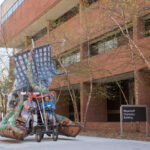
It’s a bright Saturday morning in mid-July, and the first floor of the Fine Arts Building is covered in plastic grocery bags, chicken wire, and paint buckets. A four-person surrey bike, girded with steel pipes and pontoons, looms in the front window like the skeleton of a prehistoric sea monster. In the shadow of a stairwell, a giant octopus waits to be attached to the bike, its one water-cooler-jug eye glinting in the dim light.
This colossal cephalopod, its wire frame furred with shreds of plastic water bottles, is the Kraken Upcycle. The machine is the result of three semesters’ labor by a group of students and alumni working with Steven McAlpine, assistant director of interdisciplinary studies. The Kraken was the winning entry in the 17th annual East Coast Kinetic Sculpture Race hosted by Baltimore’s American Visionary Art Museum.
Kinetic sculpture racing contestants build all-terrain bicycle-powered works of art to navigate 14 miles through Baltimore’s harbor. After seeing the race five years ago, and being captivated by the way each entry combined creative artistry with engineering expertise, McAlpine brought the idea to UMBC.
McAlpine and UMBC students from a variety of disciplines explored the idea in a pilot course in spring 2014, then designed and built the Kraken Upcycle over the next year. The project drew student artists and engineers, as well as students from the humanities and interdisciplinary studies.
“It’s such a great example of why you need community to do a project,” says McAlpine in front of the pontoon system, built from plastic barrels and steel pipes salvaged from the trash, and cut outdoors in 20-degree weather. “[This group has done] amazing and transformative things with things that would have ended up in a dumpster.”
The larger idea behind the Kraken, says McAlpine, is that single-use plastics – bottles, jugs, soda can rings – are the new monsters of the deep. He observes that 1,500 plastic bottles per second end up in the ocean, and that only 30 percent actually make it into the proper recycling stream.
As the June 14 race date drew closer, the team tested the Kraken, even throwing it into Pig Pen Pond. During the race, Gabriel Margarida, mechanical engineering; Rob Ford, environmental science; Vijay Raju, media and communication studies; and Kirby Kelbaugh ’15, interdisciplinary studies, powered and piloted the Kraken, eventually overcoming a mechanical breakdown to win the race and qualify for the Kinetic Grand Championship in California.
Today, the students are preparing the Kraken for a victory lap at Baltimore’s annual Artscape festival. This time, the concepts of “kinetic” and “race” will be left out of the equation, and the sculpture itself will be displayed with the interactive sound wall the students are building for the festival.
“[We needed to] somehow upcycle the upcycle,” says Heather Mortimer, interdisciplinary studies, one of the undergraduate students who worked on the project. “We’re trying to find a retirement plan.”
Perhaps this Kraken will be retired, but plans are afoot to field another kinetic UMBC entry next year.
— Achsah Callahan ’12 and Julia Celtnieks ’13
Next Steps
 Getting to the Final Four of men’s college soccer in 2014 was a crowning achievement for a Retrievers program that has made steady strides in recent years. It was the team’s fourth trip to the NCAA tournament in the last five years, and they shocked the soccer world with an amazing run of four road victories against national powers (Wake Forest, Maryland, Louisville and Creighton) to land in the national semifinals.
But UMBC Head Coach Pete Caringi won’t be resting on those laurels. He is already preparing his 2015 squad to understand the challenges last year’s success will bring.
“Teams will be zeroing in on UMBC,” says Caringi. “That’s the beauty of being where we’ve been, and accepting the fact that once you get there, you’re a marked team. That’s great, and we have to have players that have the mentality that they’ll accept that and understand it and not be afraid of it.”
The 2015 team will have a different look, with only three starters returning to Retriever Soccer Park this season.
Senior midfielder Malcolm Harris scored the game-winning goal for UMBC in the NCAA tournament victory against the University of Maryland, College Park on the Terrapins’ home pitch. He knows opponents will be eager for their chance to play a national semifinalist.
“Now there’s a target on your back,” he said. “Whether you like it or not, we’re now that top dog. Whether you like it or not, teams are going to be excited to play us. Whether we care or not, they’re going to be there. As a group, we’re going to have to understand that.”
Still, success isn’t all watching your back. It’s about looking confidently to the future. Caringi says that with the support of Tim Hall, director of athletics, UMBC is planning upgrades to the stands and the scoreboard at Retriever Soccer Park for fans who cheer for UMBC this season.
Caringi also hopes the momentum created by the team’s success will bring a new soccer stadium to campus, with a location just across the road from the Events Center that will open in 2018.
“Our ultimate goal is to try to put a nice soccer stadium here,” he says, “where we can all look back…and realize the success that we’ve had the last couple of years was the springboard [to it].”
Last season’s memories will be hard to forget, however. They have catapulted UMBC soccer to new levels. After a shaky start, the Retrievers peaked late in the season and put together a 10-game unbeaten streak that carried them to the Final Four and a fourth-place ranking in the final national men’s collegiate soccer polls.
Associate head coach Anthony Adams ’97 is excited by the rise of UMBC men’s soccer. But he says that there’s still a lot of work to do. “When I went here, nobody ever heard of UMBC,” says Adams. “And now we [have gone] to the Final Four. But last year’s over. Now we move on.”
— Jeff Seidel ’85
]]>
Education In Motion It’s a bright Saturday morning in mid-July, and the first floor of the Fine Arts Building is covered in plastic grocery bags, chicken wire, and paint buckets. A four-person...
https://umbc.edu/stories/at-play-fall-2015/
https://my3.my.umbc.edu/api/v0/pixel/news/121548/guest@my.umbc.edu/c03d08797b5d3fbc285b40fd966cf7b2/api/pixel
campus-life
fall-2015
UMBC News & Magazine
https://my3.my.umbc.edu/groups/umbc-news-magazine
https://assets1-my.umbc.edu/system/shared/avatars/groups/000/001/943/24435aa6207c452e7bc15cc74b42c7bb/xsmall.png?1748556657
https://assets1-my.umbc.edu/system/shared/avatars/groups/000/001/943/24435aa6207c452e7bc15cc74b42c7bb/original.png?1748556657
https://assets2-my.umbc.edu/system/shared/avatars/groups/000/001/943/24435aa6207c452e7bc15cc74b42c7bb/xxlarge.png?1748556657
https://assets2-my.umbc.edu/system/shared/avatars/groups/000/001/943/24435aa6207c452e7bc15cc74b42c7bb/xlarge.png?1748556657
https://assets3-my.umbc.edu/system/shared/avatars/groups/000/001/943/24435aa6207c452e7bc15cc74b42c7bb/large.png?1748556657
https://assets1-my.umbc.edu/system/shared/avatars/groups/000/001/943/24435aa6207c452e7bc15cc74b42c7bb/medium.png?1748556657
https://assets2-my.umbc.edu/system/shared/avatars/groups/000/001/943/24435aa6207c452e7bc15cc74b42c7bb/small.png?1748556657
https://assets1-my.umbc.edu/system/shared/avatars/groups/000/001/943/24435aa6207c452e7bc15cc74b42c7bb/xsmall.png?1748556657
https://assets2-my.umbc.edu/system/shared/avatars/groups/000/001/943/24435aa6207c452e7bc15cc74b42c7bb/xxsmall.png?1748556657
UMBC News & Magazine
0
0
false
Thu, 24 Sep 2015 16:05:32 -0400
Histories & Mysteries

UMBC Magazine answers alumni questions about True Grit, secret campus tunnels, football, Hillcrest and more…
Even though UMBC is a fairly young university, it still has mysteries and legends and stories of its founding. Why does UMBC look the way it looks? Why is a Chesapeake Bay Retriever our mascot? Why don’t we have a football team? What was Hillcrest? And what about those tunnels under
the university?
YOU ASKED. WE ANSWERED.
]]>
UMBC Magazine answers alumni questions about True Grit, secret campus tunnels, football, Hillcrest and more… Even though UMBC is a fairly young university, it still has mysteries and legends and...
https://umbc.edu/stories/histories-mysteries/
https://my3.my.umbc.edu/api/v0/pixel/news/121575/guest@my.umbc.edu/12486b6f68b147d222babed5934d19a2/api/pixel
fall-2015
histories-and-mysteries
umbc-history
UMBC News & Magazine
https://my3.my.umbc.edu/groups/umbc-news-magazine
https://assets1-my.umbc.edu/system/shared/avatars/groups/000/001/943/24435aa6207c452e7bc15cc74b42c7bb/xsmall.png?1748556657
https://assets1-my.umbc.edu/system/shared/avatars/groups/000/001/943/24435aa6207c452e7bc15cc74b42c7bb/original.png?1748556657
https://assets2-my.umbc.edu/system/shared/avatars/groups/000/001/943/24435aa6207c452e7bc15cc74b42c7bb/xxlarge.png?1748556657
https://assets2-my.umbc.edu/system/shared/avatars/groups/000/001/943/24435aa6207c452e7bc15cc74b42c7bb/xlarge.png?1748556657
https://assets3-my.umbc.edu/system/shared/avatars/groups/000/001/943/24435aa6207c452e7bc15cc74b42c7bb/large.png?1748556657
https://assets1-my.umbc.edu/system/shared/avatars/groups/000/001/943/24435aa6207c452e7bc15cc74b42c7bb/medium.png?1748556657
https://assets2-my.umbc.edu/system/shared/avatars/groups/000/001/943/24435aa6207c452e7bc15cc74b42c7bb/small.png?1748556657
https://assets1-my.umbc.edu/system/shared/avatars/groups/000/001/943/24435aa6207c452e7bc15cc74b42c7bb/xsmall.png?1748556657
https://assets2-my.umbc.edu/system/shared/avatars/groups/000/001/943/24435aa6207c452e7bc15cc74b42c7bb/xxsmall.png?1748556657
UMBC News & Magazine
0
0
false
Fri, 04 Sep 2015 18:11:10 -0400
Micro Economics – Mike Adelstein ’96
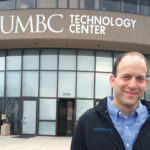
Mike Adelstein ’96, biochemistry and molecular biology, gets excited by the littlest things.
As president and CEO of Potomac Photonics Inc., he leads a company that uses advanced manufacturing technologies (high-tech lasers and 3-D printing) to create and manufacture essential and ultra-tiny parts used in products ranging from space satellites to espresso makers.
Nearly every prototype that Potomac Photonics produces can fit in Adelstein’s palm, or his shirt pocket, and he keeps plenty of examples on hand to share with visitors.
“Look at this!” he says, eyes shining, as he produces a thread-like sample for examination. It’s a surgical suture, which is impressive enough at that scale. But, wait. There’s more!
“Our client needed micro-wells laser-drilled into the suture, where they could insert radiation,” he explains. And Potomac Photonics engineers rose to the task, figuring out how to drill 25,000 holes, each just one micron thick, in each of the tiny sutures. Doctors at Walter Reed Army Hospital are now using this technology to deliver highly localized treatment for breast and prostate cancer.
Adelstein says that devising these micro products, and the potential they have to improve everyday lives in so many ways, make him eager to arrive at the company’s headquarters in the university’s bwtech@UMBC Research & Technology Park each day. “We’re involved in fabricating devices to diagnose concussions, develop new pharmaceutical drugs,” he says. “The things we are doing are actually making an impact on the world.”
Adelstein joined Potomac Photonics as a sales administrator in 1997, not long after graduating from UMBC with a major in biochemistry and molecular biology. “UMBC was really tough for me,” he recalls. “Learning never came easy to me, but I persevered and I got through.” The university’s supportive faculty and collaborative student environment, he says, helped reward his perseverance with a structure for success.
That resilience served him well over the next dozen years. As Adelstein focused on growing the contract-manufacturing unit at Potomac, he also earned an M.S. in technology management from University of Maryland, University College and became a CPA. In 2011, Adelstein was promoted to become Potomac’s president and CEO. A year later, he led a buyout of the company.
Among his first acts after the buyout was to move Potomac Photonics from Lanham to bwtech@UMBC. The company completed its move to the university’s research and technology park in March 2013.
Ellen Hemmerly, executive director of bwtech@UMBC, worked closely with Adelstein to make the move to the research park possible. “Mike wanted to move Potomac Photonics here for all of the right reasons,” she observes. “He wanted to grow his company. He wanted to be affiliated with UMBC. He wanted to collaborate with faculty. And he wanted to hire students.”
Indeed, since the move to bwtech@UMBC, Potomac has grown from 18 to 26 employees. Adelstein points with pride to the fact that six members of his staff have affiliations with UMBC – either as graduates or student interns. “And that’s only going to be growing,” he says.
The company’s director of research and development, Amir Harandi, Ph.D ’14, mechanical engineering, is one of those employees with UMBC connections. He began working at Potomac as a graduate student, and stepped into his current role after completing his degree.
“Mike is a great CEO,” says Harandi, “and this is a great environment for an engineer. Research and development really is the driver of the company.” That drive and growth is demonstrated by the company’s current build out of 2,000 square feet of additional R&D space at bwtech@UMBC.
Adelstein is committed to creating a work culture where employees feel respected and valued — and where opportunity abounds. High school graduates who start as technicians at the company can receive training to become engineers, for example. And Potomac Photonics does pro bono work for organizations including the Boy Scouts of America and the U.S. Marine Corps.
“Potomac’s culture very much parallels what [President Freeman A. Hrabowski, III] has brought to UMBC,” says Adelstein, who was named UMBC’s Alumnus of the Year in natural and mathematical sciences in 2014. “Our core values are based on lifelong education, opportunity, social responsibility, diversity, collaboration, and hard work.”
— Sue de Pasquale
]]>
Mike Adelstein ’96, biochemistry and molecular biology, gets excited by the littlest things. As president and CEO of Potomac Photonics Inc., he leads a company that uses advanced manufacturing...
https://umbc.edu/stories/micro-economics-mike-adelstein-96/
https://my3.my.umbc.edu/api/v0/pixel/news/121576/guest@my.umbc.edu/65322bce5a6bc377ee980d00b840ee42/api/pixel
alumni
fall-2015
UMBC News & Magazine
https://my3.my.umbc.edu/groups/umbc-news-magazine
https://assets1-my.umbc.edu/system/shared/avatars/groups/000/001/943/24435aa6207c452e7bc15cc74b42c7bb/xsmall.png?1748556657
https://assets1-my.umbc.edu/system/shared/avatars/groups/000/001/943/24435aa6207c452e7bc15cc74b42c7bb/original.png?1748556657
https://assets2-my.umbc.edu/system/shared/avatars/groups/000/001/943/24435aa6207c452e7bc15cc74b42c7bb/xxlarge.png?1748556657
https://assets2-my.umbc.edu/system/shared/avatars/groups/000/001/943/24435aa6207c452e7bc15cc74b42c7bb/xlarge.png?1748556657
https://assets3-my.umbc.edu/system/shared/avatars/groups/000/001/943/24435aa6207c452e7bc15cc74b42c7bb/large.png?1748556657
https://assets1-my.umbc.edu/system/shared/avatars/groups/000/001/943/24435aa6207c452e7bc15cc74b42c7bb/medium.png?1748556657
https://assets2-my.umbc.edu/system/shared/avatars/groups/000/001/943/24435aa6207c452e7bc15cc74b42c7bb/small.png?1748556657
https://assets1-my.umbc.edu/system/shared/avatars/groups/000/001/943/24435aa6207c452e7bc15cc74b42c7bb/xsmall.png?1748556657
https://assets2-my.umbc.edu/system/shared/avatars/groups/000/001/943/24435aa6207c452e7bc15cc74b42c7bb/xxsmall.png?1748556657
UMBC News & Magazine
0
0
false
Fri, 04 Sep 2015 17:54:10 -0400
Bold Horizons – Kavita Krishnaswamy ’07
Like many UMBC alumnae, Kavita Krishnaswamy ’07, mathematics and computer science, feels driven to create a better world for the next generation. More than most alumnae, however, she has a visceral, personal sense of what that better world might require.
Krishnaswamy lives with spinal muscular atrophy, a progressive neurological condition that has gradually robbed her of the ability to move below the neck. Today, she is a doctoral student in computer science at UMBC, and she has devoted the past six years of her life to designing prototypes for robotic assistive tools that could give more independence to people with severe neurological challenges.
“As a person with a disability, I have some control over my environment,” she says. “But I think we’re on the verge of a new wave of assistive technologies that could provide much more independence to people with disabilities and their caregivers.”
The digital prototypes that Krishnaswamy has painstakingly designed during the past few years are part of that new wave. Large slings and lifters that can safely move patients from a lying to a sitting position. A five-armed robot that can help reposition patients in bed. And finely-coordinated robots that can assist with eating and toothbrushing tasks.
“Kavita is just unbelievably focused and unbelievably driven,” says Tim Oates, a professor of computer science and electrical engineering. “She wants to create tools that will help herself, but more than that, she wants to create tools that will help people in the future.”
Krishnaswamy was born in India and raised in Columbia. She entered UMBC as an undergraduate through the Meyerhoff Scholars Program, and she says that she immediately felt welcomed in the campus community. She credits Sue Evans, a senior lecturer in computer science and electrical engineering, with helping her stay determined in programming, and Suddappa Seetharama Gowda, a professor of mathematics, with helping her find tools to continue to type complex mathematical formulas even as her handwriting deteriorated.
During her undergraduate years, Krishnaswamy was occasionally able to visit campus, but she has pursued her entire doctoral program from home, with the aid of Skype and other software. “She’s been able to do every single class,” Oates says. “She can hear the lectures, see the boards, and participate in the discussions. I’m very pleased with how we’ve been able to work with her as an institution.”
Krishnaswamy says it is vital for the designers of assistive technologies to spend more time listening to the people who might actually use their devices. “Many assistive devices so far have been designed with caregivers in mind,” she says. “And I understand that – they have great needs. But there’s also a need to assist the people with disabilities themselves.”
To fulfill the principle of participatory design in her own endeavors, Krishnaswamy has assembled a network of people with disabilities, and consults with them as she moves her prototypes from digital form to physical form.
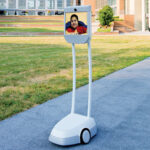
Krishnaswamy herself, meanwhile, is acting as an ambassador to Suitable Technologies, the makers of a technology known as Beam – a wheeled robot with a mounted camera that allows users to visit museums and conferences without being physically present.
“It’s a wonderful technology that has allowed me to travel across the world,” Krishnaswamy says.
For Krishnaswamy’s own robotic protoypes, the next step will be bringing them from idea and design to the marketplace. “I’ve been talking to a number of vendors,” she says, “and we hope to have a few things built by 2017.” A key element, she says, will be tools that allow users with severe disabilities to control the robots with simple voice commands, mouse movements, or even facial gestures.
Oates, for his part, has little doubt that Krishnaswamy will find partners for these projects. “One of Kavita’s many strong talents,” he says, “is her ability to rally people to help her build things.”
Krishnaswamy says assistive robotics shouldn’t be understood as concerning only people with rare severe conditions like her own. With an aging population and the explosion of conditions such as Alzheimer’s disease, many millions of people and their caregivers could benefit from smarter and nimbler robots. “We need to create more technology and better technology,” she says, “so that society as a whole can be more independent.”
— David Glenn
]]>
Like many UMBC alumnae, Kavita Krishnaswamy ’07, mathematics and computer science, feels driven to create a better world for the next generation. More than most alumnae, however, she has a...
https://umbc.edu/stories/bold-horizons-kavita-krishnaswamy-07/
https://my3.my.umbc.edu/api/v0/pixel/news/121577/guest@my.umbc.edu/b72eee72205762c18859222f49cb32ce/api/pixel
alumni
fall-2015
UMBC News & Magazine
https://my3.my.umbc.edu/groups/umbc-news-magazine
https://assets1-my.umbc.edu/system/shared/avatars/groups/000/001/943/24435aa6207c452e7bc15cc74b42c7bb/xsmall.png?1748556657
https://assets1-my.umbc.edu/system/shared/avatars/groups/000/001/943/24435aa6207c452e7bc15cc74b42c7bb/original.png?1748556657
https://assets2-my.umbc.edu/system/shared/avatars/groups/000/001/943/24435aa6207c452e7bc15cc74b42c7bb/xxlarge.png?1748556657
https://assets2-my.umbc.edu/system/shared/avatars/groups/000/001/943/24435aa6207c452e7bc15cc74b42c7bb/xlarge.png?1748556657
https://assets3-my.umbc.edu/system/shared/avatars/groups/000/001/943/24435aa6207c452e7bc15cc74b42c7bb/large.png?1748556657
https://assets1-my.umbc.edu/system/shared/avatars/groups/000/001/943/24435aa6207c452e7bc15cc74b42c7bb/medium.png?1748556657
https://assets2-my.umbc.edu/system/shared/avatars/groups/000/001/943/24435aa6207c452e7bc15cc74b42c7bb/small.png?1748556657
https://assets1-my.umbc.edu/system/shared/avatars/groups/000/001/943/24435aa6207c452e7bc15cc74b42c7bb/xsmall.png?1748556657
https://assets2-my.umbc.edu/system/shared/avatars/groups/000/001/943/24435aa6207c452e7bc15cc74b42c7bb/xxsmall.png?1748556657
UMBC News & Magazine
0
0
false
Fri, 04 Sep 2015 17:51:31 -0400
A Royal Road – Keri Burneston ’99

What does it take to be the Miss Exotic World, Reigning Queen of Burlesque? And, what’s more, to make a career from an art form that you love? Ask Trixie Little (aka Keri Burneston ’99, visual and performing arts). Little took her crown in June at the Burlesque Hall of Fame Weekend Tournament of Tease in Las Vegas, and she offered UMBC Magazine her reflections on a career onstage that’s been capped with this unique honor.
I’m Trixie Little. I am the Reigning Queen of Burlesque 2015. I have been performing my own style of “acrobatic burlesque” since 2002, primarily with my partner in life and art, The Evil Hate Monkey. I live in New York City now, and I have been performing full time since 2007.
I was among the last of the painting majors in UMBC’s Visual Arts Department. (I graduated just as digital media was taking over.) I never really wanted to be a painter, but I knew I was a visual person, and I figured having a traditional foundation in visual art – as well as a solid liberal arts education – would help me no matter what career I chose.
On a class trip to Italy to study Renaissance painting during my time at UMBC, I was inspired by how intertwined the work of these painters was with the politics of their time, the demands of their benefactors, and the expectations of both the church and the town. It occurred to me that art was meant to be an active part of the culture and the times, something I didn’t think I could achieve by hanging a painting in some obscure gallery.
I had another epiphany on that trip: It is up to the artist to figure out how to communicate effectively with the audience, and not the other way around. Many artists I knew back then were disgusted when people didn’t “get” their work. But those Renaissance painters taught me that artists must learn how to navigate the opinions and tastes of our audience. It is up to the artist to bring their ideas to the world in ways that audiences will swallow – even (and especially) when they are pushing the boundaries of their art.
 The trip also pushed me to look forward. In our modern, and often disconnected, age, how do artists best communicate? For me, performing in front of people felt like the most direct way. This revelation was the birth of me as a populist and a performer!
I worked on a number of projects after graduating. An interpretation of Bizet’s opera Carmen featuring elaborately-dressed hot dogs as puppets that clocked in at under 10 minutes. A water ballet inspired by my love of Busby Berkeley performed in public pools every summer in Baltimore at Patterson Park and elsewhere. (That troupe became a nonprofit organization called Fluid Movement.)
Eventually, I wanted to do something edgier. Something that played with sexuality and female power in an overt way. My own movie star fantasy. That’s when I found burlesque.
It was 2002. Burlesque was already enjoying a resurgence in New York, Los Angeles, and New Orleans. I jumped in with both feet, dragging my boyfriend along with me to play my sidekick, The Evil Hate Monkey. Together, we pioneered a form of burlesque that integrated acrobatics and strong characters into the striptease.
By 2006, we were successful enough to quit our day jobs to travel and perform full time.
Yet we had a vision, and knew that we needed more skill to achieve it. So Monkey and I moved to Vermont for a two-year professional circus training program. We studied partner acrobatics and duo trapeze.
All that work paid off – and not just with a crown. We have headlined countless burlesque festivals around the world, and toured Australia four times performing our own cabaret show. We have even had a feature length movie made by my fellow alumna Kirsten D’Andrea Hollander ’97 about our lives as performers: Us Naked: Trixie and Monkey.
But success makes you reflect on the tricky negotiation of making art and making a living. As an artist, you’re always thinking ahead to the next big act you want to create, the next costume you need to develop, or the next acrobatic skill you need to learn. You have to evolve and improve constantly. Stagnation is not an option. To stay at the top of your game, you have to put in endless hours of blood, sweat, and tears.
The business side requires just as much effort. You need to reinvest to build an empire that will sustain you. Often that involves taking bigger risks, including producing your own shows and international tours, creating all of your own merchandise, and finding side projects that don’t dilute your image.
In between my ongoing circus training, development of costumes, and maintenance of my repertoire, I am always looking for better and better festivals, shows, or venues to present my work. But I haven’t neglected the populist in me. The Trixie who also wants to present new work on television and in film in ways that doesn’t dilute the sexiness, authenticity, or the comedy of it.
With my newly acquired crown and title, I have a platform that just might help me do all of that and more.
]]>
What does it take to be the Miss Exotic World, Reigning Queen of Burlesque? And, what’s more, to make a career from an art form that you love? Ask Trixie Little (aka Keri Burneston ’99, visual and...
https://umbc.edu/stories/a-royal-road-keri-burneston-99/
https://my3.my.umbc.edu/api/v0/pixel/news/121578/guest@my.umbc.edu/3da21e54103cfd6d7b538cad12c9586c/api/pixel
alumni
fall-2015
UMBC News & Magazine
https://my3.my.umbc.edu/groups/umbc-news-magazine
https://assets1-my.umbc.edu/system/shared/avatars/groups/000/001/943/24435aa6207c452e7bc15cc74b42c7bb/xsmall.png?1748556657
https://assets1-my.umbc.edu/system/shared/avatars/groups/000/001/943/24435aa6207c452e7bc15cc74b42c7bb/original.png?1748556657
https://assets2-my.umbc.edu/system/shared/avatars/groups/000/001/943/24435aa6207c452e7bc15cc74b42c7bb/xxlarge.png?1748556657
https://assets2-my.umbc.edu/system/shared/avatars/groups/000/001/943/24435aa6207c452e7bc15cc74b42c7bb/xlarge.png?1748556657
https://assets3-my.umbc.edu/system/shared/avatars/groups/000/001/943/24435aa6207c452e7bc15cc74b42c7bb/large.png?1748556657
https://assets1-my.umbc.edu/system/shared/avatars/groups/000/001/943/24435aa6207c452e7bc15cc74b42c7bb/medium.png?1748556657
https://assets2-my.umbc.edu/system/shared/avatars/groups/000/001/943/24435aa6207c452e7bc15cc74b42c7bb/small.png?1748556657
https://assets1-my.umbc.edu/system/shared/avatars/groups/000/001/943/24435aa6207c452e7bc15cc74b42c7bb/xsmall.png?1748556657
https://assets2-my.umbc.edu/system/shared/avatars/groups/000/001/943/24435aa6207c452e7bc15cc74b42c7bb/xxsmall.png?1748556657
UMBC News & Magazine
0
0
false
Fri, 04 Sep 2015 17:49:32 -0400
Play Hard – Alex Pyles ’09
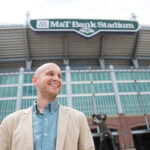

Alex Pyles ’09, English and media and communication studies, had loyal friends during his UMBC days.
One night, when he returned to his UMBC dorm room after covering a Baltimore Orioles player’s rehab assignment with the Frederick Keys (the Orioles’ single A minor league team), he found his roommates with their laptops open. They were clicking repeatedly on an article that he had just posted on the website of The Baltimore Sun. Thirty minutes later, Pyles’ story was atop the Sun’s “most read articles” list. And it was only his first byline.
Eight years later, Pyles manages the Sun’s coverage of the Baltimore Ravens and the entire National Football League. He can be found on Sundays during the fall at M&T Bank Stadium overseeing the staff of Sun reporters who give the team’s fans an inside look at each home game. He also manages the team’s coverage from Baltimore when the Ravens are on the road.
Pyles says his focus on vivid description in reporting stories was one of the many lessons he took away from his close association at UMBC with Christopher Corbett, a professor of the practice in the university’s Department of English and the faculty advisor to The Retriever Weekly.
“Professor Corbett always talked about detail and how important it was,” Pyles says. “What somebody was wearing, what they did with their hands during the interview, and what they were looking at. You look at something and you try to describe it, but he made me pay attention to the minutiae.”
Pyles’ interest in journalism was sparked when he received a copy of The Retriever Weekly in his welcome packet from UMBC during the summer before his freshman year. He decided to stop by a staff meeting when he arrived on campus. Three weeks later, he was hired to cover the UMBC men’s soccer team.
“I was riding high. I was thinking this was what I want to do,” recalls Pyles.
Pyles quickly impressed his colleagues with his polished writing skills. Eventually he worked his way up to become the editor in chief of the newspaper.
“Alex Pyles was the best all-around editor the newspaper has had in my time at UMBC,” observes Corbett. “There have been some excellent editors who have been successful in the real world. But Alex was the editor who combined all of the skills necessary to be good at what he did.”
Prior to being named the Sun’s professional football editor in April 2015, Pyles sharpened his journalism skills through a series of successful internships, freelance gigs, and jobs at a variety of outlets, including the Wilmington News Journal, Patch.com, and The Daily Record.
Although he has been an avid sports fan from a young age, he has found it takes more than a passion for sports to become a sports journalist. “I’m fortunate in that I realized this very early,” he says. “When you are covering sports, you aren’t really a fan anymore. You stop rooting for colors and jerseys, and you start rooting for good stories.”
That constant search for good stories has lead Pyles to create a coverage strategy to increase the ways that the Sun connects its readers to news about the Ravens. It’s more than just game recaps. He’s using more video and photos to engage his audience on a broader stage online and through social media. In today’s much-diluted media landscape, Pyles recognizes that the daily newspaper isn’t dominant by default anymore in covering professional sports. His team has to tell truthful stories in consistently interesting and innovative ways to stand out.
“Everyone can see the game,” he explains. “My job is to tell them what they can’t see.”
— Max Cole
]]>
Alex Pyles ’09, English and media and communication studies, had loyal friends during his UMBC days. One night, when he returned to his UMBC dorm room after covering a Baltimore Orioles player’s...
https://umbc.edu/stories/play-hard-alex-pyles-09/
https://my3.my.umbc.edu/api/v0/pixel/news/121595/guest@my.umbc.edu/b4fef7f6dd7e92e9bf430ef74cbb349e/api/pixel
alumni
fall-2015
UMBC News & Magazine
https://my3.my.umbc.edu/groups/umbc-news-magazine
https://assets1-my.umbc.edu/system/shared/avatars/groups/000/001/943/24435aa6207c452e7bc15cc74b42c7bb/xsmall.png?1748556657
https://assets1-my.umbc.edu/system/shared/avatars/groups/000/001/943/24435aa6207c452e7bc15cc74b42c7bb/original.png?1748556657
https://assets2-my.umbc.edu/system/shared/avatars/groups/000/001/943/24435aa6207c452e7bc15cc74b42c7bb/xxlarge.png?1748556657
https://assets2-my.umbc.edu/system/shared/avatars/groups/000/001/943/24435aa6207c452e7bc15cc74b42c7bb/xlarge.png?1748556657
https://assets3-my.umbc.edu/system/shared/avatars/groups/000/001/943/24435aa6207c452e7bc15cc74b42c7bb/large.png?1748556657
https://assets1-my.umbc.edu/system/shared/avatars/groups/000/001/943/24435aa6207c452e7bc15cc74b42c7bb/medium.png?1748556657
https://assets2-my.umbc.edu/system/shared/avatars/groups/000/001/943/24435aa6207c452e7bc15cc74b42c7bb/small.png?1748556657
https://assets1-my.umbc.edu/system/shared/avatars/groups/000/001/943/24435aa6207c452e7bc15cc74b42c7bb/xsmall.png?1748556657
https://assets2-my.umbc.edu/system/shared/avatars/groups/000/001/943/24435aa6207c452e7bc15cc74b42c7bb/xxsmall.png?1748556657
UMBC News & Magazine
0
0
false
Wed, 02 Sep 2015 17:56:47 -0400
Up on the Roof – Fall 2015

 UMBC President Freeman A. Hrabowski, III, takes your questions.
“Was there ever a time when asking a question had a tremendous impact on your life or changed its course?
— Monica Berron ’13, media and communications studies
Yes. When, as a child, I was in a math program on a college campus and a professor asked the class a question that no one
could answer.
The rest of the class became very upset, because the professor told them: “When you can answer the question, come and see me.” The students complained: “You’re the teacher. You’re supposed to tell us the answer.”
I watched how they spent their time focusing on how angry they were because that teacher wouldn’t give them the answer. And all of a sudden, I had this magical moment. I realized that the professor didn’t give us the answer because he had confidence that we had the answer within ourselves. He wasn’t worried about our getting the answer quickly. He was much more interested in us pushing ourselves to struggle, to figure it out on our own.
So I decided to try to convince my classmates to focus our attention on the power within ourselves. It was very hard, because I didn’t have a clue about how to solve the problem and neither did they. But several things became clear in that experience. First, you don’t do your best thinking when you’re angry. Sometimes anger can motivate you. But you have to get beyond the anger to clear your head in order to do your best thinking. Number two, you have to believe you really can achieve the goal. Number three, you have to be resourceful.
What the professor was teaching us was to be resourceful. To do research, as opposed to simply writing down what’s on the board, which is what we’d done all of our lives. And so we had to ask questions. Try different approaches. Slowly, we began to see, and after a couple of days, we saw the light. That was a magical moment for me. I’ve never forgotten the lessons I learned that summer.
I see the power of questions so often with our faculty. I remember going to Mike Summers, our distinguished university professor of chemistry, when I was concerned about one of my students who had earned a B in a course. I remember saying to him that the student wouldn’t be able to get into graduate school with that level of work. And Mike said to me: “Freeman, the grade is okay. What’s important is that she’s really curious. One of the reasons she’s earning the B is that she’s working so hard in the lab, because she’s passionate about her questions. So she may not be getting an A, but that really isn’t what’s most important. What’s important is she’s really excited about the questions, and she’s persistent in seeking answers.” I’ll never forget him saying that to me.
Wendy Salkind, one of our professors of theatre, is another person who comes to mind. Often after seeing a production, I will talk to Wendy about what I liked about the show, and I ask her about parts of it that I didn’t necessarily understand. Wendy is always a teacher in the best sense of that word. Wendy always listens. And often she smiles and says: “Freeman, I’m not concerned that you didn’t understand this fully. I’m simply delighted that you’re asking a question about it.”
What Wendy is saying is that the production exists to get people to think. That’s what we’re doing here in theatre, and in many other ways, all the time. We challenge people to think about life and the challenges that we all face – challenges that inevitably raise hard questions.
As people come to our campus to visit, especially as we approach our 50th anniversary in 2016, I hope that what they see will lead them to ask questions about the importance of higher education in the development of America, and also in the development of families and individuals. That really is the whole purpose of UMBC. We exist to help people dream about the possibilities and then reach those dreams.
Just visiting our campus and understanding how we have grown and developed gives people the chance to think about the transformation of their own lives. People come back and see that this campus has changed physically. They can’t help but think about how the changes on the campus – in some way or another – are connected to the changes in their own lives.
They say, “The place doesn’t look the same. I don’t know where I am.” Then they think: “Well, when I was here, what did I look like? Who was I? Who am I now?” Pondering the evolution of this campus gives each of us a chance to put the mirror up to ourselves.
To send a question to President Hrabowski, visit Ask the President.
]]>
UMBC President Freeman A. Hrabowski, III, takes your questions. “Was there ever a time when asking a question had a tremendous impact on your life or changed its course? — Monica Berron ’13,...
https://umbc.edu/stories/up-on-the-roof-fall-2015/
https://my3.my.umbc.edu/api/v0/pixel/news/121596/guest@my.umbc.edu/cddbd1e5d2175fa32571f106dfc2ec8c/api/pixel
fall-2015
perspectives
UMBC News & Magazine
https://my3.my.umbc.edu/groups/umbc-news-magazine
https://assets1-my.umbc.edu/system/shared/avatars/groups/000/001/943/24435aa6207c452e7bc15cc74b42c7bb/xsmall.png?1748556657
https://assets1-my.umbc.edu/system/shared/avatars/groups/000/001/943/24435aa6207c452e7bc15cc74b42c7bb/original.png?1748556657
https://assets2-my.umbc.edu/system/shared/avatars/groups/000/001/943/24435aa6207c452e7bc15cc74b42c7bb/xxlarge.png?1748556657
https://assets2-my.umbc.edu/system/shared/avatars/groups/000/001/943/24435aa6207c452e7bc15cc74b42c7bb/xlarge.png?1748556657
https://assets3-my.umbc.edu/system/shared/avatars/groups/000/001/943/24435aa6207c452e7bc15cc74b42c7bb/large.png?1748556657
https://assets1-my.umbc.edu/system/shared/avatars/groups/000/001/943/24435aa6207c452e7bc15cc74b42c7bb/medium.png?1748556657
https://assets2-my.umbc.edu/system/shared/avatars/groups/000/001/943/24435aa6207c452e7bc15cc74b42c7bb/small.png?1748556657
https://assets1-my.umbc.edu/system/shared/avatars/groups/000/001/943/24435aa6207c452e7bc15cc74b42c7bb/xsmall.png?1748556657
https://assets2-my.umbc.edu/system/shared/avatars/groups/000/001/943/24435aa6207c452e7bc15cc74b42c7bb/xxsmall.png?1748556657
UMBC News & Magazine
0
0
false
Wed, 02 Sep 2015 17:43:27 -0400
To You – Fall 2015
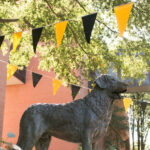
 Even though UMBC isn’t quite 50 years old, our university has already developed intriguing rumors and legends. One of the most persistent of these legends – submitted by Tal Levitas ’08, political science – is whether UMBC was designed to control student unrest.
This notion was part of campus folklore when I arrived at UMBC as an undergraduate in 1984.
The short and boring answer is “no.” When you plot the history of UMBC’s initial design and construction (1963-1966) against the trajectory of campus unrest that peaked after the killings at Kent State University in 1970, the timelines don’t match up.
UMBC’s original master plan focused on creating a walkable campus. UMBC was also designed to be modern. An antithesis, if you like, to the classical architectural designs usually favored by American universities. And by the time widespread student protest truly arrived at UMBC in 1970, the template for the campus and its physical design had been set.
So why has this notion persisted?
The newness of UMBC’s architectural design and the steady stream of construction occurring as student protests spread at UMBC are both undoubtedly factors. The mysterious campus tunnels may also have made an impression. (See page 20.)
The sudden intensity of the unrest at UMBC was also a factor. Particularly in the spring semester of 1970, clashes between students and administrators became more vitriolic. Students sat in at the Hillcrest administration building. Classes were disrupted. The largest campus protest on faculty hiring, firing, and tenure practices actually swamped UMBC’s celebration of the inaugural Earth Day.
Reading through the papers of UMBC’s founding Chancellor Albin O. Kuhn, I got a keen sense of how under siege administrators of that period felt. There are disciplinary committees, advisories on withdrawal of student loan eligibility for campus misconduct, and barbed correspondence.
It was a time that shaped the campus mood – and its effects lingered long after the first graduating class left. Yet there are some open questions. Little documentation exists on campus planning between 1969 and 1975. And speculation remains about the height of the Administration Building – which at its completion in 1973 literally towered over the UMBC campus.
Yet the vision of UMBC’s master plan remained largely unchanged through the 1980s with no radical shift or change in direction.
I hope you enjoy this special issue of UMBC Magazine. It has been a delight to answer questions from alumni about UMBC and its history. We also hope it stirs some wonderful memories of our campus as UMBC prepares to celebrate its 50th anniversary a year from now.
— Richard Byrne ’86
]]>
Even though UMBC isn’t quite 50 years old, our university has already developed intriguing rumors and legends. One of the most persistent of these legends – submitted by Tal Levitas ’08, political...
https://umbc.edu/stories/to-you-fall-2015/
https://my3.my.umbc.edu/api/v0/pixel/news/121597/guest@my.umbc.edu/3ab4bafa41bb7ff40f8ff729f1e5565d/api/pixel
fall-2015
perspectives
UMBC News & Magazine
https://my3.my.umbc.edu/groups/umbc-news-magazine
https://assets1-my.umbc.edu/system/shared/avatars/groups/000/001/943/24435aa6207c452e7bc15cc74b42c7bb/xsmall.png?1748556657
https://assets1-my.umbc.edu/system/shared/avatars/groups/000/001/943/24435aa6207c452e7bc15cc74b42c7bb/original.png?1748556657
https://assets2-my.umbc.edu/system/shared/avatars/groups/000/001/943/24435aa6207c452e7bc15cc74b42c7bb/xxlarge.png?1748556657
https://assets2-my.umbc.edu/system/shared/avatars/groups/000/001/943/24435aa6207c452e7bc15cc74b42c7bb/xlarge.png?1748556657
https://assets3-my.umbc.edu/system/shared/avatars/groups/000/001/943/24435aa6207c452e7bc15cc74b42c7bb/large.png?1748556657
https://assets1-my.umbc.edu/system/shared/avatars/groups/000/001/943/24435aa6207c452e7bc15cc74b42c7bb/medium.png?1748556657
https://assets2-my.umbc.edu/system/shared/avatars/groups/000/001/943/24435aa6207c452e7bc15cc74b42c7bb/small.png?1748556657
https://assets1-my.umbc.edu/system/shared/avatars/groups/000/001/943/24435aa6207c452e7bc15cc74b42c7bb/xsmall.png?1748556657
https://assets2-my.umbc.edu/system/shared/avatars/groups/000/001/943/24435aa6207c452e7bc15cc74b42c7bb/xxsmall.png?1748556657
UMBC News & Magazine
0
0
false
Wed, 02 Sep 2015 17:40:43 -0400
The News – Fall 2015

Anchors Aweigh

The U.S. Navy has a proud history in Maryland. And with two new agreements concluded in April, UMBC deepened its educational and research ties with the Navy in significant ways.
UMBC students are now eligible to steer a course to become commissioned officers in the Navy and Marine Corps with the establishment of a Naval ROTC (NROTC) program at the university.
The agreement with the Naval Service Training Command (NSTC) makes UMBC the first higher education institution in Maryland to be selected as an NROTC host. A professor of naval science, appointed by the NSTC in collaboration with UMBC, will lead the new program and coordinate instruction on campus.
“We are delighted to have been selected for this honor,” says UMBC President Freeman A. Hrabowski, III. “Many of our students are from military families, and many want to serve their country through the Navy. Already, hundreds of our graduates are working for the Navy. We envision many more doing so through this program.”
UMBC will join an exclusive club of 75 colleges and universities in the nation who host a NROTC program. The agreement is part of the new Maryland NROTC consortium that includes the University of Maryland, College Park. UMBC students can also participate in the Army University ROTC program through Johns Hopkins University, and also the Air Force ROTC program through the University of Maryland, College Park.
“By partnering with UMBC, we are continuing to work with elite colleges and universities committed to producing graduates with exemplary education, character, and leadership for service to our nation,” says Rear Adm. Richard A. Brown, who serves as commander of the NSTC.
“I am so pleased that the U.S. Navy is establishing an ROTC program at UMBC,” says U.S. Senator Barbara Mikulski (D-Maryland). “With the Naval Academy already in Annapolis, Maryland has a proud history of supporting those who sacrifice so much to keep us safe. Now, UMBC, a longtime leader in math and science education, will grow that historic relationship.”
UMBC also deepened its research relationship with the Navy when Hrabowski signed a Collaborative Research and Development Agreement (CRADA) with U.S. Naval Academy (USNA) Superintendent Vice Admiral Ted Carter on April 21, 2015. The CRADA formalizes opportunities for collaboration between faculty from UMBC and the Naval Academy, and five projects have already been awarded funding from the Office of Naval Research.
One team is working to create quantum computers that could be exponentially faster than traditional computing technologies. Physics researchers are taking advantage of nanoscale defects in the structure of diamonds, and an atomic property called “spin.”
Other projects already in the pipeline focus largely on security issues. One team hopes to generate self-aware computer systems that can detect when they’re being hacked. Another group is developing computer programs to detect cyberattacks via social media posts. Projects to make cloud computing and mobile devices more secure also obtained funding.
“People have been asking us for a long time to get more connected to the Navy,” says Hrabowski. These new agreements put UMBC and the Navy on the high seas of collaboration.
— Max Cole and Sarah Hansen
Safe on Arrival

After more than a year of construction, UMBC’s campus entrance project is finally open to welcome the campus community and the many visitors to the university.
The $13.5 million renewal and renovation of the main gateway to campus – which connects UMBC to the Baltimore-Washington technology corridor via major regional highways – boasts two roundabouts, a new traffic pattern, an entrance plaza that embraces the latest concepts in shared space for vehicles and pedestrians, and much-enhanced landscaping.
Those who enter campus via UMBC Boulevard will discover that it now features two travel lanes, with a new roundabout at the entrance to the bwtech@UMBC research park. The route has been landscaped to eventually provide a canopy of towering trees and flowering understory trees.
Other improvements accompany the project as it winds into the university’s main campus. A modern sign with champagne and charcoal stone and bronze lettering graces the entrance. UMBC Boulevard now flows into a large traffic rotary at Hilltop Circle that directs motorists as they enter campus. The rotary also connects to a new and more-pedestrian friendly entrance to the main campus itself.
The new entrance was designed both to heighten safety and boost UMBC’s aesthetic beauty, says Joe Rexing, UMBC’s campus architect and director of capital planning and construction. He says that the project reflects the energy of a young and forward-looking university.
“The impetus of the project was safety,” says Rexing. Yet the chance to remedy traffic headaches and difficult pedestrian access to UMBC’s former entrance was also a chance to beautify the first impression of campus for a new generation. The old entrance “looked like an exit ramp,” he quips. “We wanted you to feel like you had arrived at a place.”
 Consultations with the university community helped inform the planning. One of the chief desires was that UMBC’s new entrance should reflect a warm welcome to an inclusive campus. (The word “welcome” is even inscribed into the plaza in 80 languages, including sign language symbols and a “woof” from the campus mascot, True Grit.
Traditional iron gates and brick pillars wouldn’t do, says Rexing, who observes that “iron gates keep people out rather than welcome people in.”
Another welcoming element of the new entrance plaza is that it embraces the Dutch concept of the “living street,” or “woonerf” – a safe and shared place not only for pedestrians and bicycles to enter campus, but for cars and university shuttle buses to drop off pedestrians away from traffic and at low speeds.
Rusty Postlewate, assistant vice president for facilities management, says the new design will help direct visitors to campus. “Now it’ll be simple,” he says. “It’s going to be a lot easier for visitors, especially first time visitors.”
The campus entrance will also be greener, with landscaping that includes non-mow meadows, drought-tolerant and native plantings, and micro-bio-retention gardens that slow down runoff.
Eventually, the young trees along the entrance road will grow tall and provide a dramatic entrance to campus. “You’re going to feel like you’re driving through a forest,” says Rexing.
— Mary K. Tilghman ’79
Sound Thinking

The new 375-seat concert hall in UMBC’s Performing Arts and Humanities Building is already one of the premiere performing arts venues in the greater Baltimore region. Now, it has a name that acknowledges the leadership of Earl and Darielle Linehan in advancing UMBC as an institution – and especially its rising status as an artistic destination.
The Earl and Darielle Linehan Concert Hall provides an intimate experience that still allows ample room for large ensembles. The stage can accommodate a full symphony orchestra with chorus as easily as a soloist or string quartet. Materials employed to create the hall’s excellent acoustical properties – maple woodwork, birch floors and plaster walls – are supplemented by adjustable acoustic panels in the ceiling and acoustic curtains that can be lowered to adjust the sonic environment. To help ensure complete silence during performances, cool or warm air is delivered through vents under each seat from a large open chamber, or plenum, underneath the hall
“When I first walked into the hall, I was immediately struck by its visual beauty, but what was truly extraordinary was its weighty and sensual silence,” says Linda Dusman, chair of UMBC’s music department. “It’s absolutely magical, and I feel as though I am inside a beautifully tuned and crafted instrument – a Stradivarius.”
UMBC’s Department of Music will present more than 100 concerts in the hall each year, including internationally renowned soloists and chamber ensembles, the annual Livewire new music festival, emerging artists, faculty ensembles and soloists, and student ensembles and soloists.
“The Linehan Concert Hall takes us to a new level of teaching and performance opportunities, where students and faculty alike can teach, learn, and work collaboratively in a state-of-the-art environment,” says Scott E. Casper, dean of the College of Arts, Humanities and Social Sciences,
The Linehan Concert Hall (and the entire Performing Arts & Humanities Building) was created by design architects William Rawn Associates, architects of record Grimm + Parker, acousticians Kirkegaard Associates, and Theatre Project Consultants – the same team that developed the acclaimed Music Center at Strathmore in Bethesda and Seiji Ozawa Hall at Tanglewood.
Longtime residents of greater Baltimore, the Linehans have a distinguished history of involvement with UMBC. The Linehan Artist Scholars Program, launched with a generous gift in September 1997, was created through a vision that reflected the Linehans’ deeply held belief in the importance of the arts in society.
Earl Linehan chaired UMBC’s Board of Visitors from 1993 to 2005, and he was chair of the university’s first capital campaign. He also served on the committee for UMBC’s second campaign (Exceptional by Example), which surpassed its fundraising goal upon its completion in 2011. Linehan is president of Woodbrook Capital, Inc., and he serves on numerous corporate, civic, and non-profit boards.
Darielle Linehan has turned her life-long love of books and learning into a vocation, founding the highly acclaimed Ivy Bookshop in North Baltimore. She has worked with the university to create the Salons at UMBC, a series of intimate social evenings designed to explore issues in the arts and humanities.
— Thomas Moore

2016 will be a memorable year for UMBC.
The university celebrates its 50th anniversary on September 19, 1966 – a golden anniversary that will be commemorated with more than a full year of events and programs and conversations with alumni, the campus community, and the general public.
Those who have studied, taught or worked at UMBC can be proud of what they have accomplished in the university’s pioneering first five decades as a public research university – and there is a palpable excitement about where the institution is heading on the way to its 100th birthday and beyond.
But UMBC’s 50th anniversary will be much more than a party. The campus-wide team organizing the celebration wants to seize the opportunity presented by the occasion to spur greater engagement with UMBC’s ever-growing number of alumni. (Almost 70,000 in 2015.)
How will that happen? From the grassroots up. In collaboration with university leaders including President Freeman A. Hrabowski, III, the UMBC campus team to guide the 50th anniversary celebrations has created a grassroots organizing effort to mobilize proud and committed UMBC alumni to celebrate the anniversary.
The message is simple but powerful: “We Need Hundreds of You to Reach Thousands of Us.”
Starting in September, members of the UMBC community will reach out to alumni to swell the ranks of those we’ve dubbed “the Hundreds.” (Starting now, with the issue of UMBC Magazine you’re reading.) They will let alumni know about the role they play as the face of UMBC – and as stewards of the university and its growing reputation.
The organizing effort will also remind alumni that as UMBC’s founding generation of faculty and staff transition to retirement, a new generation of Retrievers must pick up the torch and carry it forward – especially by staying connected with the university through continuing relationships with current students.
There are a number of exciting things in the works to make the Hundreds campaign a success. Alumni can visit a new digital space created to share UMBC stories and reconnect with fellow alumni. They can help find and organize alumni in their workplace and neighborhood, create and host events connected with the 50th anniversary, or volunteer to show up for UMBC at major regional and national events.
This groundswell of alumni engagement and pride from the organizing effort will help UMBC send a powerful message about the university’s achievements, obtained through inclusive excellence in research, teaching, and service to the community.
The 50th team has also created a video in collaboration with the university’s acclaimed Imaging Research Center (IRC) to spread the word. We’ll also be talking about the effort at UMBC’s Homecoming (October 7–10, 2015).
Be on the lookout for news about these opportunities – and ways that alumni can make UMBC’s 50th anniversary a celebration that expresses the grit and the greatness of
our community!
— Richard Byrne ’86
(Read more about why alumni leaders are excited about UMBC’s 50th anniversary and the opportunities for alumni to become part of the celebration, see Back Story.)
]]>
Anchors Aweigh The U.S. Navy has a proud history in Maryland. And with two new agreements concluded in April, UMBC deepened its educational and research ties with the Navy in significant...
https://umbc.edu/stories/the-news-fall-2015/
https://my3.my.umbc.edu/api/v0/pixel/news/121598/guest@my.umbc.edu/182c09ecf4b3914ef48d8f112c47dfaa/api/pixel
campus-life
fall-2015
UMBC News & Magazine
https://my3.my.umbc.edu/groups/umbc-news-magazine
https://assets1-my.umbc.edu/system/shared/avatars/groups/000/001/943/24435aa6207c452e7bc15cc74b42c7bb/xsmall.png?1748556657
https://assets1-my.umbc.edu/system/shared/avatars/groups/000/001/943/24435aa6207c452e7bc15cc74b42c7bb/original.png?1748556657
https://assets2-my.umbc.edu/system/shared/avatars/groups/000/001/943/24435aa6207c452e7bc15cc74b42c7bb/xxlarge.png?1748556657
https://assets2-my.umbc.edu/system/shared/avatars/groups/000/001/943/24435aa6207c452e7bc15cc74b42c7bb/xlarge.png?1748556657
https://assets3-my.umbc.edu/system/shared/avatars/groups/000/001/943/24435aa6207c452e7bc15cc74b42c7bb/large.png?1748556657
https://assets1-my.umbc.edu/system/shared/avatars/groups/000/001/943/24435aa6207c452e7bc15cc74b42c7bb/medium.png?1748556657
https://assets2-my.umbc.edu/system/shared/avatars/groups/000/001/943/24435aa6207c452e7bc15cc74b42c7bb/small.png?1748556657
https://assets1-my.umbc.edu/system/shared/avatars/groups/000/001/943/24435aa6207c452e7bc15cc74b42c7bb/xsmall.png?1748556657
https://assets2-my.umbc.edu/system/shared/avatars/groups/000/001/943/24435aa6207c452e7bc15cc74b42c7bb/xxsmall.png?1748556657
UMBC News & Magazine
0
0
false
Wed, 02 Sep 2015 17:37:45 -0400
Discovery – Fall 2015
Nimble Fingers
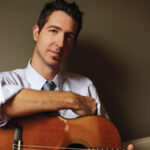
Classical guitarist and UMBC affiliate artist Zane Forshee has lived a number of musical lives. First it was choosing an instrument. A well-meaning elementary school band teacher pegged the gangly, long-limbed boy as a trombone player. But borrowing an album that featured the nimble fingerpicking of Andrés Segovia from his local library soon had him considering other musical options.
“It’s kind of cliché,” Forshee recalls. “But I heard Segovia, and I was completely smitten.” The young trombonist realized he wanted to play melody. A fledgling guitarist was born.
Rock music also competed for Forshee’s heart as a teenager. But after playing in an indie rock band that toured the U.S. in a van, Forshee found himself drawn to classical performance. He quips that the lifestyle is less sweaty, with better hours, and “you only have to carry the instrument, and not all the equipment.”
Forshee is celebrating his tenth year as a member of UMBC’s faculty, where he coaches chamber music and guitar ensembles and offers private lessons in classical guitar. He is also the chair of the guitar and harp department of the Peabody Institute-Preparatory Division, and a founder of that department’s Fret Festival, which is now in its sixth year. His first album, Initial, appeared in 2008 and he is currently at work on a second album – a series of works by Valencian composers Forshee studied in Spain in 2009 as a Fulbright fellow.
The new album – which Forshee will finish in November –will center on the work of composer Vicente Asencio (1908-1979), including Forshee’s interpretation of Asencio’s Collectici Intim, or “Intimate Collection” – a series of short pieces originally written for Spanish guitarist Narciso Yepes.
While studying in the Spanish city of Alicante, Forshee examined original manuscripts and scores of Asencio’s music, which led him to the work of other Valencian composers including Eduardo López-Chávarri, Óscar Esplá, and Joaquín Rodrigo.
“I started with just investigating Asencio and sort of ended up capturing all these four composers from the same province,” explains Forshee. “What’s interesting to me is as you hear them over the course of the recording, you start to hear how there are similarities and differences in how they use rhythms and also tonalities. In the beginning they become very tonal, and then toward the end of the 20th century, they become less tonal. It’s this really unique sort of sound.”
Lauded by Fingerstyle Guitar magazine as “one of his generation’s finest guitarists,” Forshee now leads a full life as a performer and teacher of classical guitar.
“I ended up wearing a lot of different hats [in my career], and I found I really enjoy that,” says Forshee. “I get to perform. I get to think creatively about what I want to program and where I want to play. I get to teach really interesting students who are smart, fun, inspiring individuals.”
Forshee says that those students also help to shape his repertoire and performance. “They have a big impact on when I’m playing and performing and approaching pieces,” he observes, “for which I’m really thankful for because it keeps it fresh.”
— Mary Zajac
Picture Perfect

Quick: Women make up what proportion of biologists in the United States? According to federal statistics, the answer is almost exactly half: 50.1 percent. If you search for “biologist” on Google Images, however, only 35 percent of the top results are images of women.
The Google algorithm serves up similar distortions for computer programmers (23 percent in real life, but only 17 percent of top Google images) and chief executive officers (27 percent in real life, but only 11 percent of top Google results, one of which is “CEO Barbie”).
Those were among the findings of a much-discussed study released this spring by Cynthia Matuszek, assistant professor of computer science and electrical engineering at UMBC, and two colleagues from the University of Washington, where Matuszek recently completed her doctorate. Matuszek and her colleagues wanted to explore the ways in which algorithm-generated image-search results both reflect and reinforce popular stereotypes about how men and women should spend their lives.
The germ of the project, Matuszek says, came when she attended a conference presentation by a scholar working on robot caregivers for children. “He was referring to all of the grad students in his lab with male pronouns, even when he had pictures of his female grad students on the screen,” Matuszek recalls. “And when he introduced the concept of ‘caregiver,’ he used a clip-art image of a stereotypically motherly looking, smiling woman in a pink skirt suit. And I just thought to myself, ‘Really?’”
As she sat there, Matuszek started to wonder if image databases act as vectors for lazy gender stereotypes. With two University of Washington colleagues – Matthew Kay, a doctoral candidate in computer science, and Sean A. Munson, an assistant professor of human-centered design and engineering – she decided to put Google Images to some empirical tests.
The three scholars examined 45 occupations for which reliable data exist from the U.S. Bureau of Labor Statistics. They found that, on average, men were overrepresented across Google image search results relative to their actual prevalence in the work force. In highly female-dominated professions, however, Google image results tend to be even more skewed than the reality. (Ninety-five percent of image results for “librarian” are women, for example, versus 87 percent of the actual librarian work force.)
Matuszek’s team also examined gender differences in the degree of competence and professionalism portrayed in the Google search results. To explore that question, the team recruited a few dozen participants from Amazon’s Mechanical Turk system and asked them to rate workers in the images along eight different scales: “attractive,” “trustworthy,” and so on. It turned out that the workers in the images were rated as appearing more professional, competent, and trustworthy if they matched the profession’s gender stereotype. Female nurses, for example, were rated as more competent-appearing than male nurses; the opposite was true for construction workers.
In a final study, Matuszek and her colleagues examined whether image-search results could actually alter people’s perceptions of an occupation’s real-world gender balance. To test that question, they asked participants to estimate a profession’s gender balance, rate the profession’s prestige, and say whether they believe the profession is growing – all without viewing Google’s image-search results. Then, two weeks later, the same participants were shown Google’s search results and asked the same questions.
They found a small but significant effect: The image results did indeed tend to sway the participants’ estimates by at least a small degree. Here’s one example: In the real world, 55 percent of technical writers are women. But in Google’s image-search results for “technical writer,” only 35 percent of the images are of women. One of Matuszek’s participants initially estimated that 40 percent of technical writers are women – but then, two weeks later, after viewing the image search results, estimated the proportion at 35 percent, in line with what Google was showing. In this case, Google had led the participant deeper into error.
Does any of this matter? And, if so, what should be done about it? “We don’t make any recommendations in the paper,” Matuszek says. “We don’t necessarily say anything should change. We just want people who are designing these algorithms to be aware of the choices they’re making, and to know what kinds of effects these things can have.”
— David Glenn
]]>
Nimble Fingers Classical guitarist and UMBC affiliate artist Zane Forshee has lived a number of musical lives. First it was choosing an instrument. A well-meaning elementary school band teacher...
https://umbc.edu/stories/discovery-fall-2015/
https://my3.my.umbc.edu/api/v0/pixel/news/121599/guest@my.umbc.edu/01e453b9a833bfcdc4e6a02e30dcf0b1/api/pixel
discovery
fall-2015
UMBC News & Magazine
https://my3.my.umbc.edu/groups/umbc-news-magazine
https://assets1-my.umbc.edu/system/shared/avatars/groups/000/001/943/24435aa6207c452e7bc15cc74b42c7bb/xsmall.png?1748556657
https://assets1-my.umbc.edu/system/shared/avatars/groups/000/001/943/24435aa6207c452e7bc15cc74b42c7bb/original.png?1748556657
https://assets2-my.umbc.edu/system/shared/avatars/groups/000/001/943/24435aa6207c452e7bc15cc74b42c7bb/xxlarge.png?1748556657
https://assets2-my.umbc.edu/system/shared/avatars/groups/000/001/943/24435aa6207c452e7bc15cc74b42c7bb/xlarge.png?1748556657
https://assets3-my.umbc.edu/system/shared/avatars/groups/000/001/943/24435aa6207c452e7bc15cc74b42c7bb/large.png?1748556657
https://assets1-my.umbc.edu/system/shared/avatars/groups/000/001/943/24435aa6207c452e7bc15cc74b42c7bb/medium.png?1748556657
https://assets2-my.umbc.edu/system/shared/avatars/groups/000/001/943/24435aa6207c452e7bc15cc74b42c7bb/small.png?1748556657
https://assets1-my.umbc.edu/system/shared/avatars/groups/000/001/943/24435aa6207c452e7bc15cc74b42c7bb/xsmall.png?1748556657
https://assets2-my.umbc.edu/system/shared/avatars/groups/000/001/943/24435aa6207c452e7bc15cc74b42c7bb/xxsmall.png?1748556657
UMBC News & Magazine
0
0
false
Wed, 02 Sep 2015 17:35:54 -0400

