Baltimore Bonds

If you had the chance to interview someone you look up to, what would you ask? Sydney Fryer ’22, psychology, had the opportunity this fall when she sat down for a chat with fellow Sondheim Scholar Alicia Wilson ’04, political science. (The Sondheim program is celebrating its 20th anniversary this year, by the way!) Fryer came ready to find out more about Wilson and her trajectory from growing up in Baltimore City to being a Retriever (and winning a prestigious Truman Scholarship), to becoming vice president for Economic Development at Johns Hopkins University.
Sydney Fryer:
I, like you, am a Baltimore girl. The city has changed a lot since I was a child. What is your view about all the development that happened over the years in Baltimore?
Alicia Wilson:
Growing up in Baltimore, I’d hear about development projects at Harbor East but I didn’t have any real concept of what it meant other than brick and mortar. Development is complicated; historically development has been about the building of buildings rather than the building of community.
But the reality is, there are local people living adjacent to those developments and they should be part of the calculation of how we design, create, and impact the existing landscape. As we think about development in the city, we always need to keep an eye on what is good for the people.
I think everyone agrees vacant homes need to be developed. Life needs to be developed. Things need to be developed. Even if they were great at their time, things evolve. Cities evolve. The needs of people evolve.
Fryer:
What are some things college students can do to help the state of things when we find they are not up to code in our city?
Wilson:
Students have the luxury of time, passion, and resources. You’re in a place that allows you to look at a problem, learn about it, and have a great amount of time to figure out how to solve it. Students have a huge role in changing things and shaking it up. Don’t diminish your youth and ability to bring forth a new, fresh perspective on things people have been looking at for years.
Pick the problem you are passionate about and apply what you are learning about. Make the uncomfortable statements. Learn through the process. Take a position and advocate; be open to having your position challenged and shifted to get the results you want.
Fryer:
Is being a public servant hard?
Wilson:
There are enormous challenges out there but I find joy in serving. You have to take the time to replenish yourself. Many times you will want to solve everything with a sense of urgency because you believe the work demands it. But the reality is, you need to be a soldier in that fight for a long time. You can’t burn yourself out at the expense of a cause. You have to pace yourself.
Fryer:
How did being a Truman Scholar shape your journey?
Wilson:
Being a Truman Scholar really opened me up to thinking about how I see issues in my community on a much more national/global scale. Food deserts aren’t just about being very neighborhood-centric. It’s about what happens on the national scale and what happens on the global stage which allows food deserts to happen in Baltimore. We have to see the interconnectedness between our plight here and the plight of people in rural America and across the world. The Truman Scholarship gave me a big platform to work on these issues and help create positive change for all people in our country.
Fryer:
What was the greatest takeaway from all of your education?
Wilson:
My time at UMBC was blessed because I was able to be friends with and be mentored by Walter Sondheim. He was vibrant with passion, vigor, and intellect. Walter was thoughtful about how he was going to contribute to the city and the world in a way, I think, which would ignite young people today. He didn’t have a self-serving agenda. He was pure about being effective in the world.
I think understanding to live with purity in service to others was something that gelled at UMBC, which I think has been helpful.
*****
Header photo by Marlayna Demond ’11.
]]>
If you had the chance to interview someone you look up to, what would you ask? Sydney Fryer ’22, psychology, had the opportunity this fall when she sat down for a chat with fellow Sondheim Scholar...
https://umbc.edu/stories/baltimore-bonds/
https://my3.my.umbc.edu/api/v0/pixel/news/119974/guest@my.umbc.edu/003bffb6d38a2bbc1ae4ee8fa2ab6276/api/pixel
cahss
fall-2019
impact
perspectives
sondheim-scholar
UMBC News & Magazine
https://my3.my.umbc.edu/groups/umbc-news-magazine
https://assets1-my.umbc.edu/system/shared/avatars/groups/000/001/943/24435aa6207c452e7bc15cc74b42c7bb/xsmall.png?1748556657
https://assets1-my.umbc.edu/system/shared/avatars/groups/000/001/943/24435aa6207c452e7bc15cc74b42c7bb/original.png?1748556657
https://assets2-my.umbc.edu/system/shared/avatars/groups/000/001/943/24435aa6207c452e7bc15cc74b42c7bb/xxlarge.png?1748556657
https://assets2-my.umbc.edu/system/shared/avatars/groups/000/001/943/24435aa6207c452e7bc15cc74b42c7bb/xlarge.png?1748556657
https://assets3-my.umbc.edu/system/shared/avatars/groups/000/001/943/24435aa6207c452e7bc15cc74b42c7bb/large.png?1748556657
https://assets1-my.umbc.edu/system/shared/avatars/groups/000/001/943/24435aa6207c452e7bc15cc74b42c7bb/medium.png?1748556657
https://assets2-my.umbc.edu/system/shared/avatars/groups/000/001/943/24435aa6207c452e7bc15cc74b42c7bb/small.png?1748556657
https://assets1-my.umbc.edu/system/shared/avatars/groups/000/001/943/24435aa6207c452e7bc15cc74b42c7bb/xsmall.png?1748556657
https://assets2-my.umbc.edu/system/shared/avatars/groups/000/001/943/24435aa6207c452e7bc15cc74b42c7bb/xxsmall.png?1748556657
UMBC News & Magazine
0
0
false
Wed, 08 Jan 2020 15:37:42 -0500
High-Tech Gift Harnesses Data for Athletes

When UMBC Men’s Soccer Coach Anthony Adams traveled to Canada for a former player’s wedding, he didn’t expect to come away from the trip with a significant donation to the team. But then again, he wasn’t all that surprised; his players usually found ways to give back.
The gift came from Liam Paddock ’12, psychology and sociology, who played soccer at UMBC from 2009 to 2012. After catching up with Adams at the wedding of teammate Milovan Kapor ’13, economics, Paddock asked if there was anything the team needed—after all, UMBC Men’s Soccer had made a huge impact on his life. “They backed me in hard times, connected me with the right people, and continued to give me opportunities throughout my years there,” he says. “So, now I’m in a position to, giving back to UMBC Men’s Soccer makes sense.”
Adams immediately thought of the VX system, a wearable piece of technology that helps players track their movements and their heart rates. Adams hoped to get his hands on the technology to better train his athletes.
“As much as we can, we want to be on the cutting edge. Science is a big part of sports, and this is information we didn’t have in the past,” Adams explains. “Monitoring systems [were] just the next logical step for us.”
 Ryan Becher, a midfielder, drives the ball down the field during a game against Incarnate Word.
The VX System, and others like it, has become invaluable to many soccer teams because it can be used to foresee possible injuries, says Adams. This technology, which players don under their jerseys during practice and games, lets coaches see important pieces of performance data, all of which are presented via simple, comprehensive metrics on the system’s custom software. An unusually high heart rate, for example, can indicate that a player may be fatigued and at greater risk for a muscular injury.
Ryan Becher, ’23, a midfielder, used the VX system as a part of another team, prior to coming to UMBC. “The training staff noticed my numbers were getting lower, so they started to talk to me,” he remembers. He ended up having some back problems and being unable to play for two months, but he believes the situation could have gotten much worse if his coaches hadn’t known to intervene so early.
On top of aiding with injury prevention, the VX system also helps players improve their gameplay. Though the UMBC team has only been using the technology since the start of this season, Ryan’s brother and fellow teammate, Jackson Becher, ’22, psychology, has already found these functions useful. “We get my max heart rate, how fast I’m sprinting, how often I’m sprinting, and how far I’m running,” he says. “So being able to look at that makes it easier for me to understand where I need to be and what I need to do to improve.”
Adams says that giving back is part of the soccer team’s DNA, and the coach doesn’t shy away from asking alumni to pitch in. This past season, the team needed a new couch for their locker room, but didn’t have the money to buy one. Adams sent out an email to soccer team alumni and, within 30 minutes, three alumni had replied, collectively donating enough to cover the cost of the couch.
But this relationship with alumni goes far beyond donations. For Paddock, the friendships he made while playing for UMBC became some of the most important in his life. “There is a genuine sense of family,” he explains. “And while I think that term gets thrown around, I feel it every time I go back to Baltimore.”
— Johanna Alonso ’20
*****
All photos courtesy of UMBC Athletics.
]]>
When UMBC Men’s Soccer Coach Anthony Adams traveled to Canada for a former player’s wedding, he didn’t expect to come away from the trip with a significant donation to the team. But then again, he...
https://umbc.edu/stories/high-tech-gift-harnesses-data-for-athletes/
https://my3.my.umbc.edu/api/v0/pixel/news/119975/guest@my.umbc.edu/9d7d47ea5e1e98d1f16c3a7334d07d08/api/pixel
alumni
athletics
fall-2019
impact
mens-soccer
UMBC News & Magazine
https://my3.my.umbc.edu/groups/umbc-news-magazine
https://assets1-my.umbc.edu/system/shared/avatars/groups/000/001/943/24435aa6207c452e7bc15cc74b42c7bb/xsmall.png?1748556657
https://assets1-my.umbc.edu/system/shared/avatars/groups/000/001/943/24435aa6207c452e7bc15cc74b42c7bb/original.png?1748556657
https://assets2-my.umbc.edu/system/shared/avatars/groups/000/001/943/24435aa6207c452e7bc15cc74b42c7bb/xxlarge.png?1748556657
https://assets2-my.umbc.edu/system/shared/avatars/groups/000/001/943/24435aa6207c452e7bc15cc74b42c7bb/xlarge.png?1748556657
https://assets3-my.umbc.edu/system/shared/avatars/groups/000/001/943/24435aa6207c452e7bc15cc74b42c7bb/large.png?1748556657
https://assets1-my.umbc.edu/system/shared/avatars/groups/000/001/943/24435aa6207c452e7bc15cc74b42c7bb/medium.png?1748556657
https://assets2-my.umbc.edu/system/shared/avatars/groups/000/001/943/24435aa6207c452e7bc15cc74b42c7bb/small.png?1748556657
https://assets1-my.umbc.edu/system/shared/avatars/groups/000/001/943/24435aa6207c452e7bc15cc74b42c7bb/xsmall.png?1748556657
https://assets2-my.umbc.edu/system/shared/avatars/groups/000/001/943/24435aa6207c452e7bc15cc74b42c7bb/xxsmall.png?1748556657
UMBC News & Magazine
0
0
false
Tue, 07 Jan 2020 19:37:07 -0500
A Day in the Life of a Student Teacher

“In the Sherman STEM Teacher Scholars Program, we drive home two points. One: we teach children. Two: children are people. It sounds simple, but we tend to forget that children are younger versions of us. Sometimes in a “STEM” program, we become fixated on the math or biology, when what belongs at the center of all we do is the students.” — Rehana Shafi, director, Sherman STEM Teacher Scholars Program
Lydia Coley ’20, American studies, has started a new adventure this semester. Twice a week she wakes up by 5:30 a.m., crosses Baltimore City from north to south, and arrives at Maree G. Farring Elementary/Middle School by 7 a.m. to do what she has been preparing for over the last three years—be a student-teacher. As a scholar in the Sherman STEM program, Coley is among a group of future mathematics and science teachers who will eventually work throughout the Baltimore region and across the state, focusing on high-need schools.
She listens, observes, supports, and learns from her mentor teacher. Sometimes, this means she’s in the front of the classroom or leading small groups as she begins to transition into next semester’s role as a full-time lead student teacher. But what we found when UMBC Magazine followed Coley for a day, was not a student but a natural leader.
Coley smiles at the beginning of the day and enthusiastically welcomes each of the 90 students she is there to support. “This is a collaborative effort. I am here to learn from my mentor and to support students, but really most of the learning comes from what students are willing to share with me. They are also my teachers.”

It is 7 a.m. and Lydia Coley, a first-semester student teacher at Maree G. Farring Elementary/Middle School smiles at her day ahead. Her duties include supporting students while her mentor teacher leads lessons and, when possible, Coley leads parts of the lesson in small groups.
Coley runs into her mentor teacher, Theresa Frey, who has been teaching for 19 years. They take a few minutes to review the day and head in to prepare.

Coley signs in at the office and makes her way to her classroom. Maree G. Farring is 23% English language learners. Many students’ first language is Spanish.
It’s preparation time! Coley finalizes the details as she changes the date and takes note of the objective for the day. The cactus theme of the classroom encourages students with signs like “Looking Sharp” and “We Are on Point.” Coley’s classroom has about 30 students in each of the three blocks throughout the day. She helps the first block by putting all the chairs down for them because soon the students will come in with breakfast baskets and books in hand.


The day starts quickly. Frey and Coley go over the materials for today’s lesson—telling time counting by fives and a number line. Every minute literally counts!
Students begin to arrive but there is no time to waste. Coley goes over last night’s homework with a student while she finishes her breakfast. One-on-one time is precious and Coley is happy to provide it. She is also passionate about students eating fresh food as she studies the correlation between nutrition and academic behavior. She wants them to have time to eat so they also have time to think.

Coley leads the students through some critical thinking about how a clock ties into multiplication and number lines. Students compare answers and discuss the possible options by using their own clocks.
It’s time to delve deeper. Coley engages students to identify parts of a clock and determine the correct time using a variety of strategies. When she asks what time is shown on the clock (2:30 p.m.) one student smartly calls out “dismissal time!” The rest of the students show their work on whiteboards and raise them for a quick check.


Coley becomes a student as she quietly observes her mentor teacher think out loud about the various ways to solve a word problem. “I became a teacher because I love learning. The classroom is full of ideas. It’s not only a place for academics but a place to build empathy,” she explains. “It is important for students to experience someone that respects, supports, and has a positive influence over them.” Coley looks forward to transitioning into a lead student teacher for third-grade mathematics and sixth-grade social science in the spring.

Each student requires a different type of support. Coley takes time to help a student think through the connection between her diagram and her multiplication process. “One of the greatest challenges in teaching math is that many students don’t feel they are good at math,” she explains. “It is my job to help them believe in themselves by showing them how these skills are connected to their lives.”
The first block of math is done. Students follow Coley to computer science for more applied math. Two more 90-minute blocks of math follow with two other classes of students to support before calling it a day.

The bell rings. It’s 2:30 p.m. and raining but students don’t mind. It is time to head home. Coley helps a student keep their hood on as they rush out the door. Teachers and students share smiles all around.

Quiet fills the classrooms and the hallways. It is the perfect time to catch up with a fellow alumna, Olivia Grimes ’19, individualized study and early childhood education, a first-year teacher at MGF. They exchange stories and Grimes gives advice on how to adjust to the full-time workload when Coley comes back in the spring.
It’s 3:15 p.m. and the day is done. Grimes and Coley head home with thoughts of equations, stories, and fun ways to educate their students tomorrow.

*****

Since its inception 12 years ago, the Sherman STEM Teaching Scholars Program has supported more than 150 students in becoming culturally responsive and compassionate STEM educators by collaborating with UMBC faculty and local, high-need schools. Currently, nine students and 13 alumni of the program are leading and learning in zip codes across Baltimore City.
All photos by Marlayna Demond ’11.
]]>
“In the Sherman STEM Teacher Scholars Program, we drive home two points. One: we teach children. Two: children are people. It sounds simple, but we tend to forget that children are younger...
https://umbc.edu/stories/a-day-in-the-life-of-a-student-teacher/
https://my3.my.umbc.edu/api/v0/pixel/news/119976/guest@my.umbc.edu/ad81663bbec19b26539af52c31c37913/api/pixel
cahss
discovery
fall-2019
feature
sherman-stem-teacher-scholars-program
shermanscholars
UMBC News & Magazine
https://my3.my.umbc.edu/groups/umbc-news-magazine
https://assets1-my.umbc.edu/system/shared/avatars/groups/000/001/943/24435aa6207c452e7bc15cc74b42c7bb/xsmall.png?1748556657
https://assets1-my.umbc.edu/system/shared/avatars/groups/000/001/943/24435aa6207c452e7bc15cc74b42c7bb/original.png?1748556657
https://assets2-my.umbc.edu/system/shared/avatars/groups/000/001/943/24435aa6207c452e7bc15cc74b42c7bb/xxlarge.png?1748556657
https://assets2-my.umbc.edu/system/shared/avatars/groups/000/001/943/24435aa6207c452e7bc15cc74b42c7bb/xlarge.png?1748556657
https://assets3-my.umbc.edu/system/shared/avatars/groups/000/001/943/24435aa6207c452e7bc15cc74b42c7bb/large.png?1748556657
https://assets1-my.umbc.edu/system/shared/avatars/groups/000/001/943/24435aa6207c452e7bc15cc74b42c7bb/medium.png?1748556657
https://assets2-my.umbc.edu/system/shared/avatars/groups/000/001/943/24435aa6207c452e7bc15cc74b42c7bb/small.png?1748556657
https://assets1-my.umbc.edu/system/shared/avatars/groups/000/001/943/24435aa6207c452e7bc15cc74b42c7bb/xsmall.png?1748556657
https://assets2-my.umbc.edu/system/shared/avatars/groups/000/001/943/24435aa6207c452e7bc15cc74b42c7bb/xxsmall.png?1748556657
UMBC News & Magazine
0
0
false
Tue, 07 Jan 2020 18:35:23 -0500
The Right Dog for the Job

Earlier this year, Chip interviewed for the coveted position of campus comfort dog with UMBC Police Sergeant Jamie Cheatem.

There’s no denying that any day we get to interact with Chip is the best work day, so we were thrilled when Sergeant Cheatem agreed to let UMBC Magazine follow Chip around for a day on the job as a campus comfort dog. UMBC is the fourth U.S. campus to welcome a comfort dog, and we wanted to see what Chip’s day-to-day duties looked like.
Chip lives with Sergeant Cheatem and his family and gets a ride to the office with her favorite UMBC police officer.


Her day continues as Sergeant Cheatem completes necessary tasks at the police station before heading down to campus.

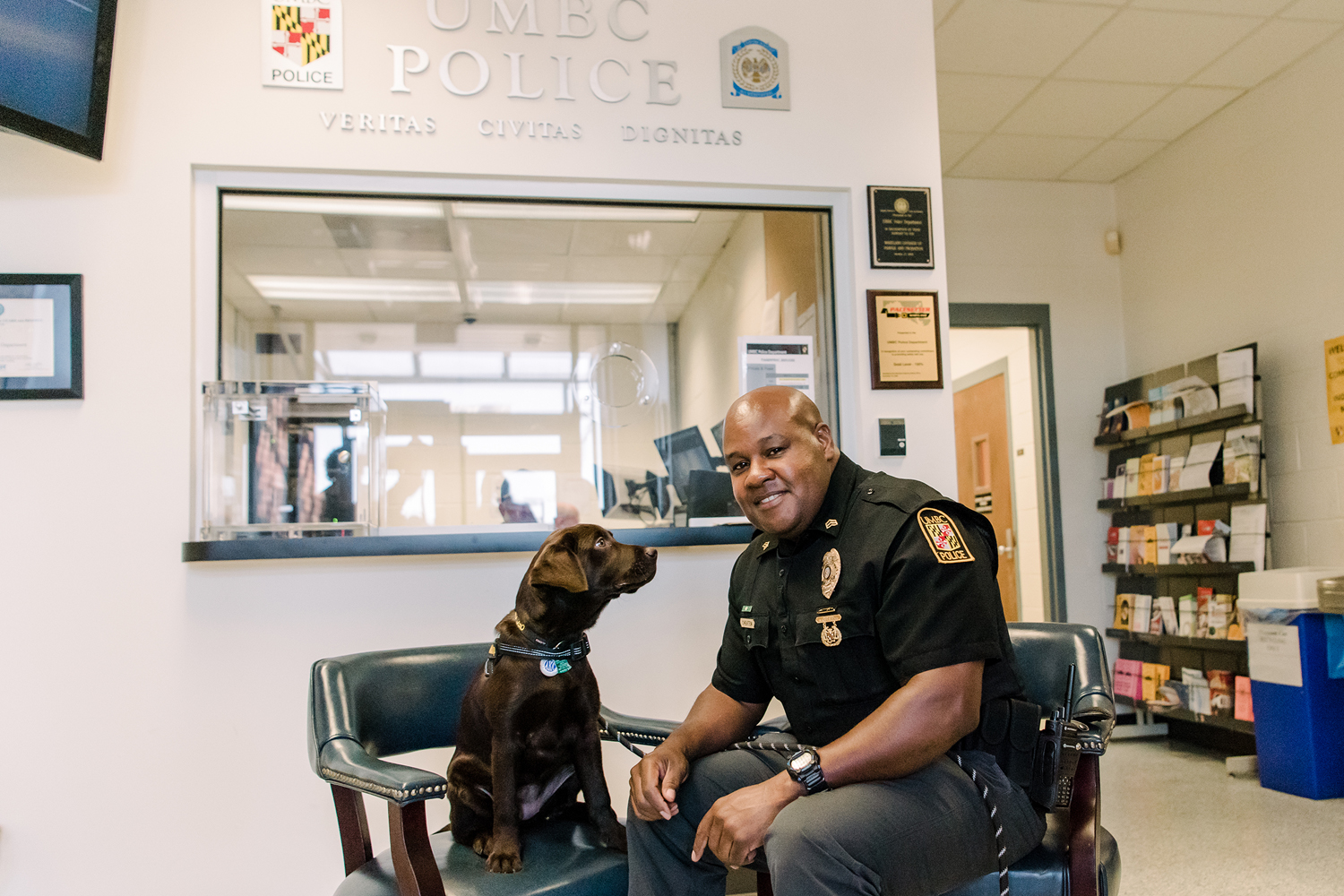
On the way to hang out with some students, Chip runs into someone who looks familiar and excitement ensues.

Chip loves her fellow Retrievers and they love her. They show their affection through Chip’s favorite activity—getting her belly pet.

Chip doesn’t make it very far down Academic Row before more admirers stop to say hi.

Although it may look like Chip’s on-campus duties involve getting the attention she deserves, she also attends events like the Retriever Courage Fall Gathering, which featured a variety of resource tables and a collection of updates about the steps the University is taking to improve its response to, and ultimately prevent, violence in our community.

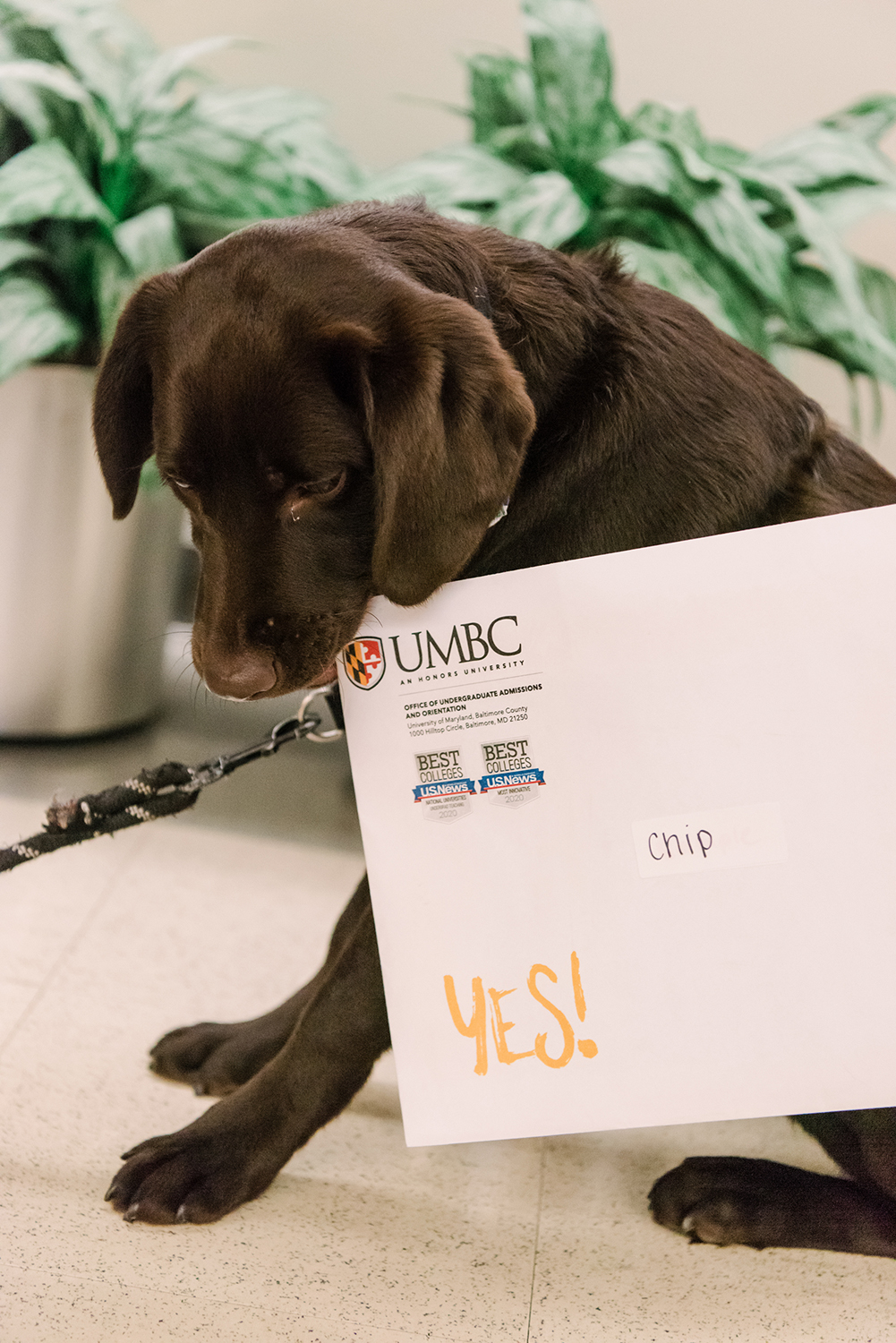
Chip also responds to requests from specific departments, like when Undergraduate Admissions wanted to let the incoming class of Retrievers know that their acceptance letters were on the way. Chip was the first in the class of 2024 to get her letter!

At the end of the day, Chip is still a young pupper and needs time to frolic and get her energy out.

****
All photos by Marlayna Demond ’11, featuring Sergeant Cheatem and Officer Chip.
]]>
Earlier this year, Chip interviewed for the coveted position of campus comfort dog with UMBC Police Sergeant Jamie Cheatem. There’s no denying that any day we get to interact with Chip is the...
https://umbc.edu/stories/the-right-dog-for-the-job/
https://my3.my.umbc.edu/api/v0/pixel/news/119977/guest@my.umbc.edu/17637802127e9396bcd35f3525fe7b4f/api/pixel
campus-life
chip
fall-2019
wild-card
UMBC News & Magazine
https://my3.my.umbc.edu/groups/umbc-news-magazine
https://assets1-my.umbc.edu/system/shared/avatars/groups/000/001/943/24435aa6207c452e7bc15cc74b42c7bb/xsmall.png?1748556657
https://assets1-my.umbc.edu/system/shared/avatars/groups/000/001/943/24435aa6207c452e7bc15cc74b42c7bb/original.png?1748556657
https://assets2-my.umbc.edu/system/shared/avatars/groups/000/001/943/24435aa6207c452e7bc15cc74b42c7bb/xxlarge.png?1748556657
https://assets2-my.umbc.edu/system/shared/avatars/groups/000/001/943/24435aa6207c452e7bc15cc74b42c7bb/xlarge.png?1748556657
https://assets3-my.umbc.edu/system/shared/avatars/groups/000/001/943/24435aa6207c452e7bc15cc74b42c7bb/large.png?1748556657
https://assets1-my.umbc.edu/system/shared/avatars/groups/000/001/943/24435aa6207c452e7bc15cc74b42c7bb/medium.png?1748556657
https://assets2-my.umbc.edu/system/shared/avatars/groups/000/001/943/24435aa6207c452e7bc15cc74b42c7bb/small.png?1748556657
https://assets1-my.umbc.edu/system/shared/avatars/groups/000/001/943/24435aa6207c452e7bc15cc74b42c7bb/xsmall.png?1748556657
https://assets2-my.umbc.edu/system/shared/avatars/groups/000/001/943/24435aa6207c452e7bc15cc74b42c7bb/xxsmall.png?1748556657
UMBC News & Magazine
0
0
false
Tue, 07 Jan 2020 15:37:16 -0500
Creating Community Through Food

If you’ve ever searched online for a place to eat in Baltimore, chances are Ekiben has popped up as a top destination again and again. Or, if you followed along with this year’s fried chicken sandwich feud between two fast food joints, you’ll have seen plenty of Baltimoreans resolving the issue by pointing to Ekiben’s classic Neighborhood Bird steamed bun. Yelp, Buzzfeed, and other national outlets reaffirm that this small storefront serving eclectic pan-Asian fare is worth the trip to Fells Point (with a second location in Hampden to open soon). Steve Chu ’12, economics, co-owner of the restaurant along with two other UMBC alumni, writes how the store owes its origins to UMBC and Baltimore City, and why these Retriever chefs care so much about the communities they serve.
Food has always been about community to me. My father worked endless hours running his Chinese restaurant, but on Mondays, he closed the restaurant and the whole family—aunts, uncles, grandparents—would go out to eat dim sum for breakfast. There’s be like 50 plates on the table. My relatives would urge me, eat, eat, try everything.
When Ephrem Abebe ’13, web development and information systems, Nikhil Yesurpriya ’13, M.S., ’16, biological science, and I started Ekiben in 2013 we wanted other people to enjoy food together, specifically this weird combination of Chinese/Taiwanese/Indian/Ethiopian cuisine. It was completely natural to us, coming from the food-focused cultures we came from, that food could unite disparate groups of people. The fact that Ekiben has been such a hit in Baltimore blows our minds, but is exactly what we hoped would happen.
 Abebe chats with a regular customer who brought some out-of-town friends.
When we met at UMBC—Nikhil and I through suitemates and Ephrem and I while volunteering for Habitat for Humanity in Baltimore City—I was studying financial economics, but it was so heavily focused on crunching numbers. I switched to a straight economics major early on after I realized that I wanted to learn more about how people thought and behaved with money. My background from UMBC has helped me tremendously in my career.
Gib Mason ’95, economics, taught a course on entrepreneurship that gave me the confidence that we could take this leap, buy a hot dog cart, and sell meatballs or spicy tofu at farmers markets, which is how we started out. He steered the class away from traditional homework assignments and asked us for our reasoning behind our answers instead. That still resonates with me as a business owner.
 Chu and Abebe in their Fells Point storefront.
Gathering community around us has come as naturally as combining our love of food into affordable and delicious dishes. Fells Point has been like home to us, and Baltimore has supported us every step of the way. Even in unusual ways—getting the original food license for the hot dog cart as a couple of 20-somethings was so much easier than we anticipated. The licensing board was so supportive after we explained our vision, but that came as a complete surprise to us.
What came next could be surprising to some in the restaurant business, but in Baltimore, this seems par for the course. After struggling with our hot dog cart-turned eclectic Asian fare cart for about a year, we got invaluable support from other local chefs. Ekiben wouldn’t exist without the guys behind Black Sauce, Damian Mosley and Michael Singleton, and Ben Lefenfeld from La Cuchara. Our friendships with other local chefs led naturally into collaboration and guest chef takeovers.
The best example of that communal approach to food in the city is the Charm City Night Market—think of an Asian open air market, tons of people and amazing food—organized by Stephanie Hsu and the rest of the local Chinatown Collective. We were really proud to be a part of the inaugural year and subsequent events. It does what we want for the city. It brings people of all demographics together, and it’s always so densely packed, and there’s so much great energy in it.
We’ve partnered with so many excellent chefs from Baltimore and beyond, and this is another way we get to cross-pollinate with talented craftspeople. There’s this push for food to be “traditional” or “authentic” but at it’s best, food is art. And ultimately, we just want to make food that tastes good and build up the community while doing so. We start that goal in the restaurant, investing a lot of energy into developing leaders in the company. We have staff that’s been with us since the beginning. I hope the supportive culture that we built really just kind of oozes out, and it spreads.
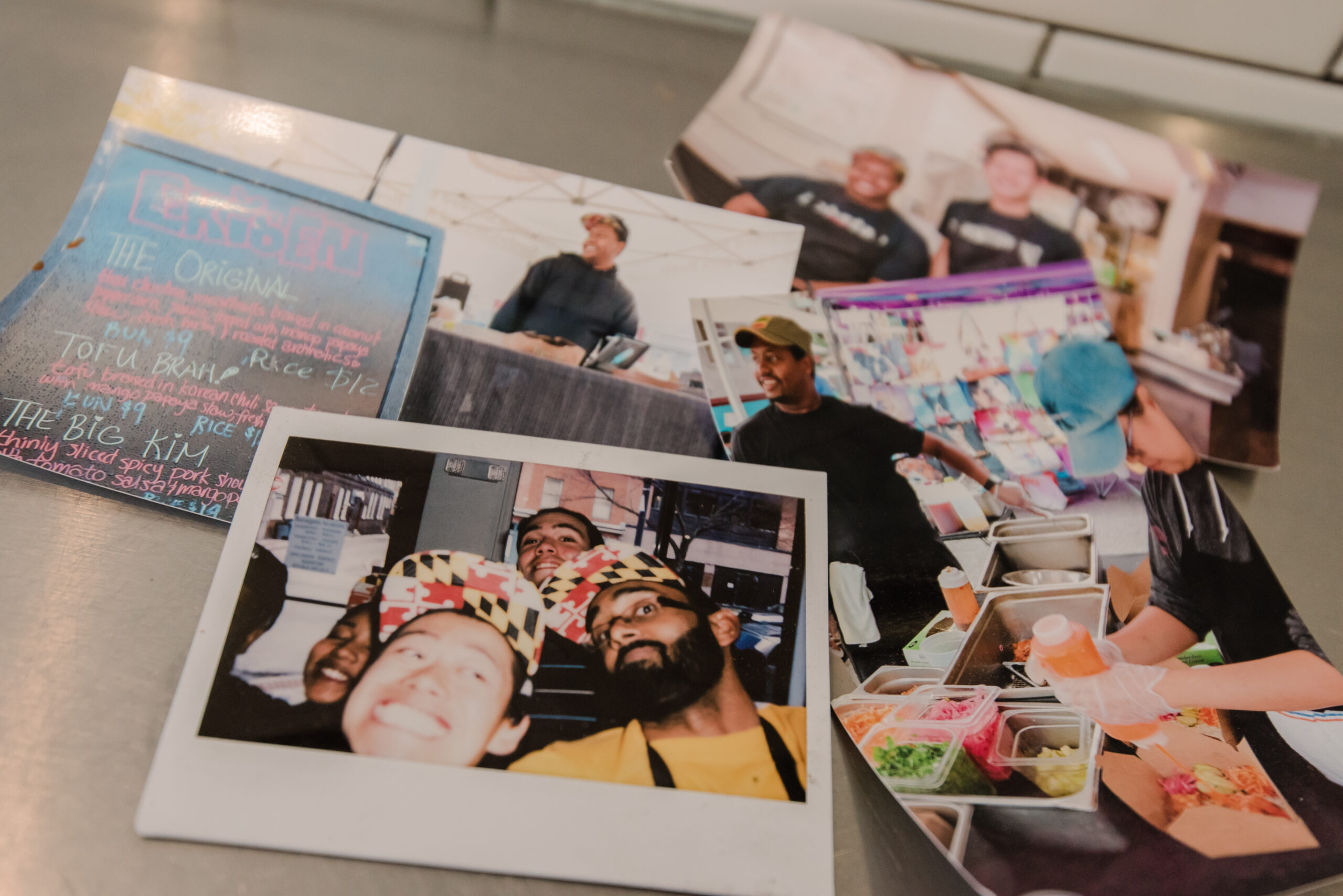

And Baltimore has supported us every step of the way. Baltimore has raised us. Literally, this restaurant was built on every $7 meal we served at any market that would let us sell there. We didn’t have a Kickstarter page, we just had Baltimore showing up to buy our food.
At those family dim sum breakfasts, as communal as they were, my relatives were not encouraging me to start my own restaurant. They actually loudly and emphatically (to put it politely) tried to steer me in the opposite direction. They, like so many other immigrants, had come here with very little and worked so hard to break away from that poverty. They didn’t want to see me take that same road, I guess. But in the end, their harsh words really spurred me to succeed. How could I fail when they had given so much to make a successful life here?
—Steve Chu ’12
*****
Header image: Abebe and Chu work together in the small prep space where customers can watch their orders being created. All photos by Marlayna Demond ’11.
]]>
If you’ve ever searched online for a place to eat in Baltimore, chances are Ekiben has popped up as a top destination again and again. Or, if you followed along with this year’s fried chicken...
https://umbc.edu/stories/creating-community-through-food/
https://my3.my.umbc.edu/api/v0/pixel/news/119980/guest@my.umbc.edu/8f902d5d1939ddc2c6f4e52373bbc4ee/api/pixel
alumni
alumni-essay
baltimore-city
economics
ekiben
fall-2019
UMBC News & Magazine
https://my3.my.umbc.edu/groups/umbc-news-magazine
https://assets1-my.umbc.edu/system/shared/avatars/groups/000/001/943/24435aa6207c452e7bc15cc74b42c7bb/xsmall.png?1748556657
https://assets1-my.umbc.edu/system/shared/avatars/groups/000/001/943/24435aa6207c452e7bc15cc74b42c7bb/original.png?1748556657
https://assets2-my.umbc.edu/system/shared/avatars/groups/000/001/943/24435aa6207c452e7bc15cc74b42c7bb/xxlarge.png?1748556657
https://assets2-my.umbc.edu/system/shared/avatars/groups/000/001/943/24435aa6207c452e7bc15cc74b42c7bb/xlarge.png?1748556657
https://assets3-my.umbc.edu/system/shared/avatars/groups/000/001/943/24435aa6207c452e7bc15cc74b42c7bb/large.png?1748556657
https://assets1-my.umbc.edu/system/shared/avatars/groups/000/001/943/24435aa6207c452e7bc15cc74b42c7bb/medium.png?1748556657
https://assets2-my.umbc.edu/system/shared/avatars/groups/000/001/943/24435aa6207c452e7bc15cc74b42c7bb/small.png?1748556657
https://assets1-my.umbc.edu/system/shared/avatars/groups/000/001/943/24435aa6207c452e7bc15cc74b42c7bb/xsmall.png?1748556657
https://assets2-my.umbc.edu/system/shared/avatars/groups/000/001/943/24435aa6207c452e7bc15cc74b42c7bb/xxsmall.png?1748556657
UMBC News & Magazine
0
0
false
Fri, 20 Dec 2019 20:53:29 -0500
50-Foot Woman Tells All

If art is life, then Rahne Alexander is living hers as a collage of towering technicolor.
On stage with her bands Santa Librada and 50’  ; she conjures her musical muses—think Stevie Nicks or the Wilson sisters from Heart—leaning into the lyrics while shredding her guitar. Her hair glows purple in the spotlight.
In quieter moments, in her studio at UMBC’s Lion Brothers Building downtown, she carefully de-archives her collection of hundreds of decades-old cassette tapes. (Among them is a copy of Billy Idol’s 1981 Don’t Stop she stole from a Woolworths, she says, smiling.)
She works on short films like the Marcel Duchamp/Brett Kavanaugh/Atomic Blonde–inspired “Dude Descending a Staircase” that earned her “best creative award” at an international conference of computer-human interaction in China last year. And she never seems to rest.
 Portrait of Rahne Alexander in her Baltimore studio by Marlayna Demond ’11.
“I maintain a pretty high performance and art schedule, and have for a long time,” says Alexander, who is pursuing an MFA in UMBC’s intermedia and digital arts program as much for the community and the push to produce as anything else. “But I love making work, I love being on stage. It’s exhausting, but this is what I’m here for.”
All along the way—as she has for the last 16 years, at least—Alexander also writes. And nowhere is she quite more herself than in Heretic to Housewife, a collection of essays now in its second run from publisher Neon Hemlock Press. Described as “the trans* Marcel Proust,” by one critic, the 10 collected essays delve into what drives Alexander as an artist.
In the first essay, “A Meditation,” which she originally performed as a sort of love letter to herself at the D.C. Women in Comedy show, and later as the opener when author/actress Amber Tamblyn spoke in Baltimore, Alexander dives deeply into her personal story. In others, she un-buries the echos of traumas experienced throughout her life up to age 50. The doors haven’t always been as open to her, and life has not always been as safe. But, “fear is never revolutionary,” she writes, so she does not give in.
 Still from “Dude Descending a Staircase” courtesy of Rahhe Alexander.
But even with the most serious topics, Alexander’s wit and warmth shine through. “It was easier for me to come out as a transsexual lesbian than it was for me to come out as a witch,” she jokes in a monologue about the artist Paulina Peavy.
“[She] brings a multi-faceted body of work that often touches on artists of the past in ways that mine their works for tips on how to move into the future in more critical and equitable ways,” says Kathy O’Dell, associate professor of visual arts, art history, and museum studies. “And she does so with motivational humor—meaning, humor with edges of seriousness that prod us as viewers/participants to make decisions about where we stand on a variety of topics, from humor itself to domesticity, self-care, politics, LGBTQ issues, and many more.”
 (L-R): Jack Pinder, Skizz Cyzyk, Rahne Alexander, Mickey Dehn, Sarah Michaels, and Joseph Mulhollen
If her social media following—and the fact that the first run of her book sold out in two weeks—is any indication, Alexander has amassed a dedicated fan base who can’t wait to see what she does next. So, instead of resting, she presses on.
“It’s a lot, but this is why I moved to Baltimore in the first place—to have an art career and to put it all out there,” she says. “So these are all great problems to have.”
*****
Header image by Marlayna Demond ’11.
]]>
If art is life, then Rahne Alexander is living hers as a collage of towering technicolor. On stage with her bands Santa Librada and 50’ ; she conjures her musical muses—think Stevie Nicks or the...
https://umbc.edu/stories/50-foot-woman-tells-all/
https://my3.my.umbc.edu/api/v0/pixel/news/119989/guest@my.umbc.edu/3fa1e228ea40d4d2fad695dd1cfe0fc1/api/pixel
cahss
digital-arts
discovery
fall-2019
graduateschool
imda-mfa
lion-building
UMBC News & Magazine
https://my3.my.umbc.edu/groups/umbc-news-magazine
https://assets1-my.umbc.edu/system/shared/avatars/groups/000/001/943/24435aa6207c452e7bc15cc74b42c7bb/xsmall.png?1748556657
https://assets1-my.umbc.edu/system/shared/avatars/groups/000/001/943/24435aa6207c452e7bc15cc74b42c7bb/original.png?1748556657
https://assets2-my.umbc.edu/system/shared/avatars/groups/000/001/943/24435aa6207c452e7bc15cc74b42c7bb/xxlarge.png?1748556657
https://assets2-my.umbc.edu/system/shared/avatars/groups/000/001/943/24435aa6207c452e7bc15cc74b42c7bb/xlarge.png?1748556657
https://assets3-my.umbc.edu/system/shared/avatars/groups/000/001/943/24435aa6207c452e7bc15cc74b42c7bb/large.png?1748556657
https://assets1-my.umbc.edu/system/shared/avatars/groups/000/001/943/24435aa6207c452e7bc15cc74b42c7bb/medium.png?1748556657
https://assets2-my.umbc.edu/system/shared/avatars/groups/000/001/943/24435aa6207c452e7bc15cc74b42c7bb/small.png?1748556657
https://assets1-my.umbc.edu/system/shared/avatars/groups/000/001/943/24435aa6207c452e7bc15cc74b42c7bb/xsmall.png?1748556657
https://assets2-my.umbc.edu/system/shared/avatars/groups/000/001/943/24435aa6207c452e7bc15cc74b42c7bb/xxsmall.png?1748556657
UMBC News & Magazine
0
0
false
Tue, 17 Dec 2019 16:44:14 -0500
Climate Shift
From Eritrea to UMBC, this physicist is cultivating a diverse generation of climate scientists.
It’s a nearly cloudless afternoon at UMBC in early October. A group of physics students and their two faculty advisors, Belay Demoz and Ruben Delgado, make their way to the roof of the physics building to continue their conversation about atmospheric research. Earlier, gathered in a small, dimmed lecture hall, the students engaged their advisors and each other in robust discussions about their research while practicing their presentation skills.
In that session, Amanze Ejiogu ’22, physics, had the chance to explain his findings on the Bay Breeze. Rather than an adult beverage, it refers to breezes coming in off the Chesapeake Bay that redirect back to land air masses (and the pollutants they contain) that would otherwise blow offshore.
The Bay Breeze effect is a complicated phenomenon. Many factors contribute to it, from precipitation to wind speed to the overall quality of the air. Understanding it is a multidisciplinary effort, requiring chemistry, fluid dynamics, statistics, and meteorology skills. That’s exactly the kind of challenge that Demoz, physics professor and director of UMBC’s Joint Center for Earth Systems Technology (JCET), likes to help his students tackle.
After Ejiogu’s presentation, Demoz asks questions. His elbow leaning casually against a railing, he breaks into a grin—he is in his element. Of a certain result, he asks, “Is that expected?” And a minute later, “That’s for you to figure out,” his Eritrean accent inflecting his speech.
 Demoz regularly engages his students in robust discussions about their research. Photo by Marlayna Demond ’11.
Climate change and other environmental issues like air and water quality disproportionately affect people of color. Today, Demoz sees his role at UMBC as empowering students, especially students from underrepresented backgrounds, to take ownership of their research and contribute to their communities. Eventually, he hopes his graduates will also become mentors and advocates for their own students and colleagues—behaviors he models for them every day.
This wasn’t always Demoz’s idea of what his life’s work would be. After a challenging childhood in what is now the East African country of Eritrea, Demoz came to the United States for graduate school in the 1980s. His original goal was to learn how to seed clouds—to bring rain to his drought-stricken homeland. He’s still doing climate research, but his focus has shifted. His experiences as a youth in Eritrea and his years as an African in the United States have shaped who he has become and what he seeks to achieve.
Graduates from all backgrounds have left Demoz’s lab and taken roles at places like NASA, the National Oceanic and Atmospheric Administration (NOAA), the Environmental Protection Agency (EPA), and other research institutions. These alumni create a ripple effect that will continue to enhance diversity in atmospheric research and answer questions that have the potential to change the lives of people around the globe, in part because of Belay Demoz.
Maurice Roots, a graduate student in atmospheric physics, has already felt the effects of Demoz’s efforts. Roots, who graduated from Hampton University, only applied to UMBC for graduate school because Demoz approached him at a conference. “Belay has a great set of stories to tell,” Roots says. “His journey shows that perseverance is possible.”
A changing homeland
“It’s where the desert and the green are always fighting.”
That’s how Demoz describes the location of Eritrea. It’s a small African country on the Red Sea, sandwiched between Sudan and Ethiopia, right where the Sahara Desert and the jungles of central Africa meet. Many people there are subsistence farmers, including generations of the physicist’s family.
It used to be that when drought or floods hit, Eritrean farmers moved to where the grass was literally greener. But that changed after their land was colonized by the Italians and later the British. Strict political borders limited movement. “Once you put a wall, that valve of mitigating drought disappears,” Demoz says.
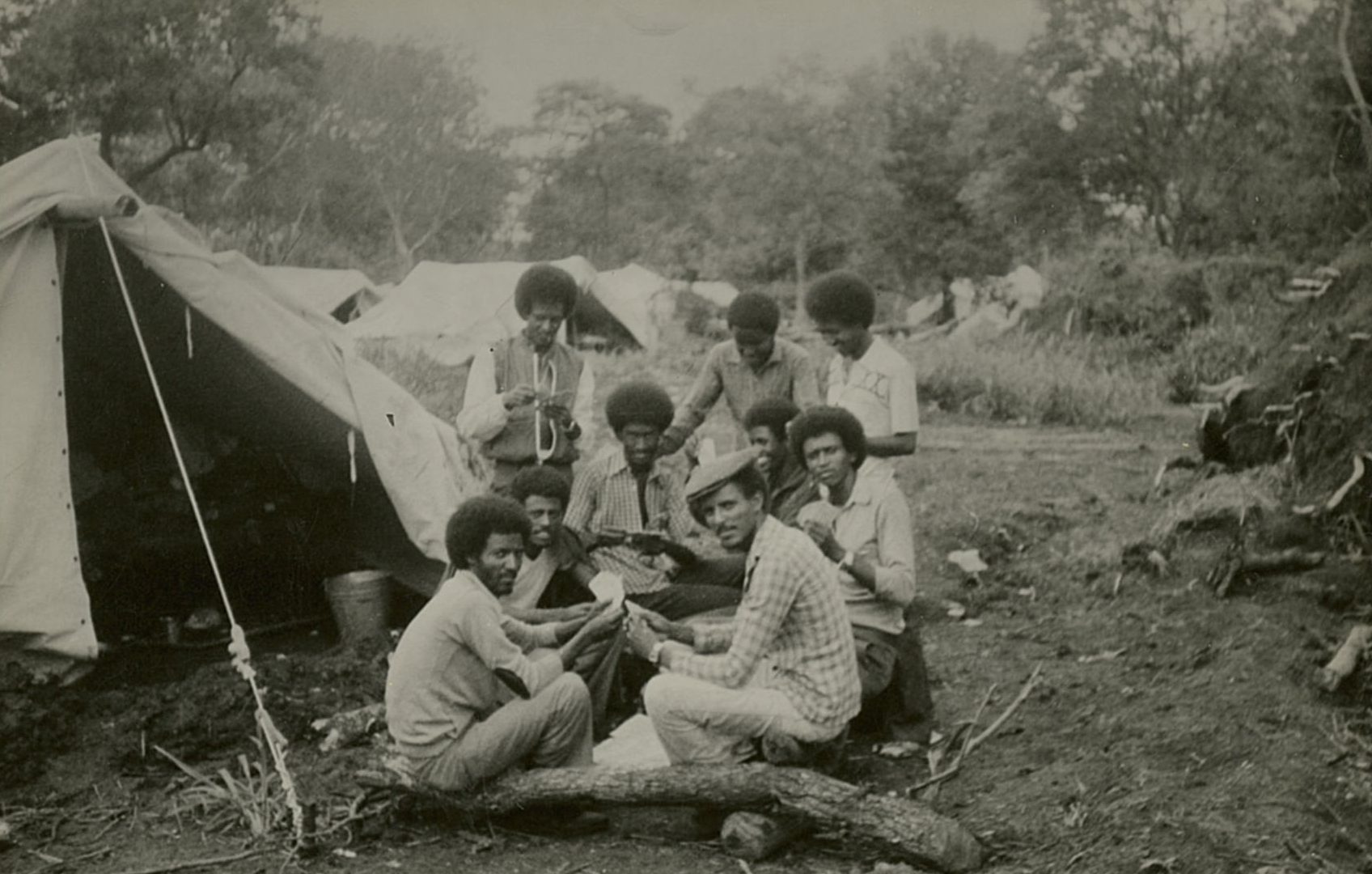
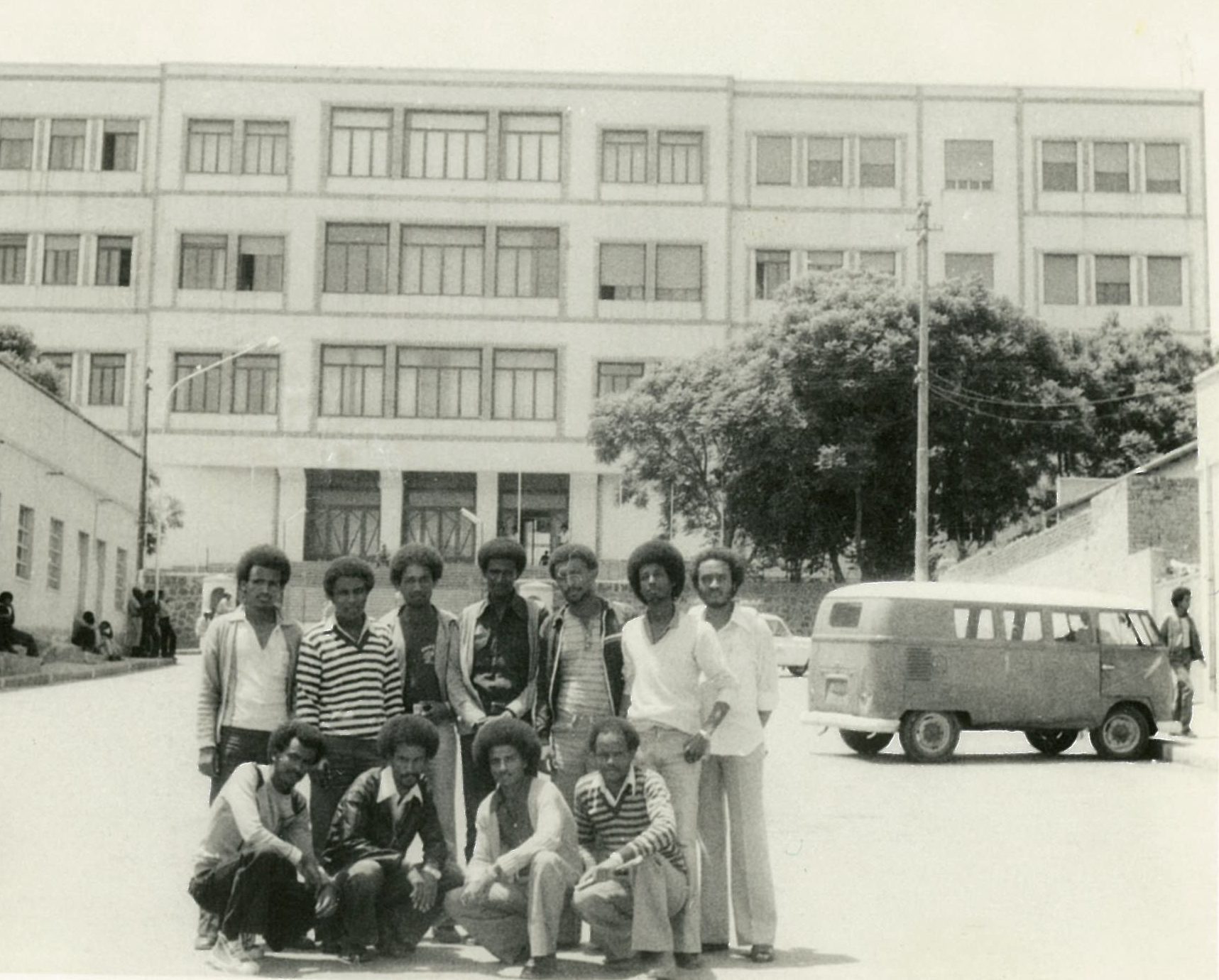
His childhood and youth in Eritrea, in the 1960s and ’70s, was one of the most volatile times for the region, when an internal resistance movement was fighting Ethiopia to gain independence. “My time was a time of coups, a time of drought, a time of war,” Demoz says. “Those are the times when a lot of heartache happened.”
Many people died because they weren’t allowed to migrate. Their crops failed in the drought, and some starved. Some died when they attempted to migrate and met violence along the way. Demoz’s older brother and many of his friends perished fighting in the resistance.
An unlikely advocate
Belay Demoz knew the challenges his people were facing. So in 1980, when he finished high school and was assigned to study physics as an undergraduate at the University of Asmara in what was to become Eritrea, he knew he wanted to find a way to use his education to make things better for his family.
At first, he struggled. He failed his first three exams. And then the first of several major turning points in his life happened, the first time help came from where he least expected it.
Demoz and his roommate frequently played soccer together. Both were highly talented but knew there was no career for them in the sport. So, after Demoz failed his third physics exam, his roommate decided it was time for an intervention.
“You can play soccer so well, but you’re going to let physics twist you?” he asked Demoz. “No, you study with me.” So he did. And by the next semester, Demoz was at the top of his class. “Part of me was afraid,” Demoz admits. Why? His roommate had recently been released from prison on a murder conviction. But “if I didn’t find him, I don’t think I would have made it.”
As his undergraduate career was coming to a close in 1984, another severe drought hit Eritrea. Demoz wanted to do something, but he didn’t know how his nuclear physics degree could help the situation. Then, he learned about cloud seeding in a Physics Today article.
In the 1980s, cloud seeding seemed like the next big revolution in weather modification. In order for clouds to produce rain, the water molecules they contain need to condense into liquid form. That happens around tiny solid particles inside the cloud. Cloud seeding adds these particles, creating more opportunities for raindrops to form.
“That’s when I switched from nuclear to atmospheric physics,” Demoz says. “I wanted to help make it rain.”
He applied and was accepted to the atmospheric physics program at the University of Nevada, Reno, but to leave Eritrea, he had to promise that he would come back. Without the required funds to guarantee that promise, his parents had to put their family home on the line so that he could study in the U.S.
“I was given $50 and a plane ticket,” Demoz remembers. “My dad didn’t blink. He just said, ‘Go. We will find a way.’”
Peaks and valleys
In Nevada, everything was new and different. “At 22, it was my first time to see snow,” Demoz says. And not just through his dorm room window—his courses and research involved spending ample time in the Sierra Nevada Mountains. After replacing his dress shoes with snow boots and skis, Demoz began to learn his way around the mountains.
In addition to the new climate, there were other steep learning curves for Demoz in graduate school. One of the core courses required computer programming skills. One day, Professor Jim Telford—Demoz refers to him as a “cloud giant”—called Demoz into his office.
Telford devised the stochastic rain theory when he was a master’s student in the 1960s, which describes why and predicts when clouds will produce rain. Today there is still no better theory. Demoz describes him as an arrogant, brilliant Australian scientist, who also went to great lengths to ensure his students’ success. Demoz remembers their first conversation going something like this:
“You must be pretty good in programming,” Telford says.
“No, I’m not.” Demoz replies.
“Well, have you used a computer?” Telford asks.
“No.”
“Have you touched a computer?”
“No.”
As Demoz recalls, Telford roared with laughter and rushed to another room to share with a colleague the ridiculousness of a Ph.D. student in physics who had never touched a computer.
“At this point, I’m thinking, I’m doomed!” Demoz remembers. “But there’s something inside me saying, I am an Eritrean, and others are fighting for independence. There’s something instilled in me. And so I stood there.” And instead of throwing him out, Telford agreed to give Demoz a crash course in computing.
 Demoz in grad school, after mastering the necessary computing skills. Photo courtesy of Demoz.
For two weeks, Demoz sat with a clunky 1985 desktop and a pile of Fortran books in Telford’s office, learning how to program. Today, Demoz tells his students, “If you cannot compute, you cannot compete. Everyone who has achieved something in our field is good in programming.” But his experience with Telford was about more than programming. It was about a mentor making a special effort to help a student succeed. Belay carries that memory with him today and strives to pay it forward to his own students.
In addition to learning all about clouds and weather modification, and completing a dissertation titled, “Sierra Nevada Winter Storms Using Microwave Radiometry, Ice Crystal, and Isotopic Techniques,” Demoz learned something else important in Reno—what it felt like to be black in the United States, especially in higher education and especially in physics.
 In front of the Desert Research Institute circa 1991 with a fellow graduate student. Photo courtesy of Demoz.
He noticed it right away in his courses (he was the only black person) and in the city. “It takes a toll,” he says. “Reno had a very tough police force.” He was stopped on many occasions as he drove home late from doing research in the mountains, seemingly for nothing. “I tend to be an outlier,” he reflects. “You don’t see a lot of black people doing cloud seeding and working with snow.”
Only later would he find out that the graduate program had accepted him as a “test case”—he was the first African accepted to the program and the first to graduate with a Ph.D. He remembers John Hallett (another “cloud giant” and another of Demoz’s important mentors) telling him, years later, “We wanted to see if those schools [in East Africa] were any good. That’s why we admitted you.” That, of course, didn’t sit well with Demoz and stayed with him as his future in physics unfolded.
Shifting the landscape
Once he finished his Ph.D., Demoz pursued postdoctoral studies at the University of Illinois in cloud chemistry. In 1997, UMBC finally entered his experience. He completed a second postdoc with UMBC at the NASA Goddard Space Flight Center in Greenbelt, Maryland.
Demoz continued his work at NASA after his postdoc ended. Then, another life-changing moment: He got a call from Howard University to help create a new atmospheric research center there in 2006. “The whole reason I studied this field was to go back and seed clouds,” Demoz reflects. “That wasn’t happening, but I realized, there is plenty to be done here.” So Demoz jumped at the chance to contribute to the historically black university while continuing his research program at NASA.
“It was around that time that I started to be conscious of my status as a minority in the field,” Demoz remembers. “It bothered me, being one of the only ones.”
At a conference around then, Demoz and a handful of other atmospheric researchers of color met in the lobby. “And we asked, OK, what is our part?” Their first step was to join efforts in developing the Howard research center together.
In 2005, Demoz was awarded a NASA Administrators Fellowship—a two-year sabbatical during which recipients are expected to build up a program at a minority-serving institution. The fellowship allowed Demoz to focus full time on building up the research center in Beltsville, which is administered by NOAA. When the two years were up, Demoz didn’t go back to his research program at NASA, choosing instead to commit himself permanently to the work of increasing the success of minorities in atmospheric science.
“Most people thought I was crazy because NASA is a stable job for life,” Demoz says. “But thinking about all the support that I had growing up, I decided my place was there.”
Building the pipeline
Over the next several years, Demoz and colleagues built up the NOAA Center for Atmospheric Science (NCAS) at Howard University’s campus in Beltsville, Maryland. The NCAS is a “super-site” among the Global Climate Observing System (GCOS) Reference Upper Air Network (GRUAN), a set of sites worldwide that looks at air and cloud chemistry. People around the world rely on the data it collects and the analyses the Beltsville researchers (including many students) conduct for their own work. The Beltsville GRUAN site contributes powerfully to science and also to increasing the diversity of scientists. It is the only GRUAN site in the world operated by a university, which is a source of pride for Demoz.
Students who’ve studied at the GRUAN site from Howard, UMBC, and elsewhere—many of them from underrepresented backgrounds—have gone on to careers at preeminent government and private research organizations. “You can involve students no matter how specialized and difficult your science is,” Demoz says. “The Beltsville site has made quite a number of important scientific advances and also brought diversity to the federal agencies.”
At the same time, the small group of African and African-American climate researchers who had met at the conference in the early 1990s started to formalize their lobby conversations into an official event at other meetings. “It paid off. We used to meet in a bar in the hotel lobby at the American Meteorological Society conferences. Right now, Colour of Weather is perhaps the biggest minority-focused group in atmospheric sciences, and it is what we started,” Demoz says with pride. “It’s held in a ballroom. I look at that and I think, I didn’t go back to Eritrea and seed clouds, but I’m making a difference here.”
Bringing a meaningful vision to life
With his experience at NASA and as a professor of physics at Howard, and his commitment to mentoring students from all backgrounds, Demoz was a perfect fit to serve as the next director of UMBC’s JCET, a partnership with NASA formed in 1995, when the position opened up in 2014.
As JCET director, Demoz has clear ideas about what he wants to accomplish. “If I can get a really strong, diverse graduate program here, that would be great. And I think that’s possible here.” In addition to recruiting and mentoring students from diverse backgrounds, Demoz says continuing to diversify the faculty is also a worthy goal. The UMBC physics department is already off to a strong start, with faculty members from Brazil, Eritrea, China, Hungary, Greece, and Puerto Rico.
Students are noticing the changes Demoz has modeled. “He really cares about his students and wants them to succeed,” adds Kylie Hoffman, a third-year graduate student. “He wants to help you do what you want to do.”
 Demoz and Ruben Delgado with a group of their students on top of the physics building. Photo by Marlayna Demond ’11.
He supports graduate and undergraduate students alike. After giving his presentation at the lab meeting, sophomore Amanze Ejiogu expected that “a seasoned atmospheric science veteran would pull it apart like cotton candy,” he says. But Demoz didn’t. “He was very respectful and asked genuine, thoughtful questions that will help me take my research forward.”
“Belay has been a great mentor for teaching lessons that are never covered in a classroom,” says Brian Carroll, a fifth-year Ph.D. candidate. “I’m proud to be part of such a diverse research group,” Carroll adds. “Thanks to my experiences with the group, I will pursue and highlight diversity in my own workplaces and the community at large as I progress in my own career.”
When asked about Demoz’s mentoring, Maurice Roots is more straightforward: “He’s good at it,” Roots replied. “So I’m taking notes.”
Demoz himself benefited from support and mentoring—sometimes from unlikely places. “Help will come from the place you least expect it, so be open,” Demoz says, maybe remembering the time a convicted murderer got him through his nuclear physics degree or an arrogant scientist made sure he was ready for programming class. Or maybe even the time he got the green light from Howard University to start the Beltsville Climate program or the call from UMBC to apply for the JCET directorship.
It’s all part of Demoz’s story. Now he’s taken it as his mission to help students create their own stories, with a strong start at UMBC.
“By seeing us,” he says, “I hope that students say, ‘I belong here.’”
*****
Header image: Demoz meets with students on top of the physics building. Photo by Marlayna Demond ’11.
]]>
From Eritrea to UMBC, this physicist is cultivating a diverse generation of climate scientists. It’s a nearly cloudless afternoon at UMBC in early October. A group of physics students and their...
https://umbc.edu/stories/climate-shift/
https://my3.my.umbc.edu/api/v0/pixel/news/119996/guest@my.umbc.edu/82f73445ca4996ccbf0f34cd279495b8/api/pixel
climate-change
cnms
discovery
fall-2019
feature
graduateschool
jcet
nasa
physics
UMBC News & Magazine
https://my3.my.umbc.edu/groups/umbc-news-magazine
https://assets1-my.umbc.edu/system/shared/avatars/groups/000/001/943/24435aa6207c452e7bc15cc74b42c7bb/xsmall.png?1748556657
https://assets1-my.umbc.edu/system/shared/avatars/groups/000/001/943/24435aa6207c452e7bc15cc74b42c7bb/original.png?1748556657
https://assets2-my.umbc.edu/system/shared/avatars/groups/000/001/943/24435aa6207c452e7bc15cc74b42c7bb/xxlarge.png?1748556657
https://assets2-my.umbc.edu/system/shared/avatars/groups/000/001/943/24435aa6207c452e7bc15cc74b42c7bb/xlarge.png?1748556657
https://assets3-my.umbc.edu/system/shared/avatars/groups/000/001/943/24435aa6207c452e7bc15cc74b42c7bb/large.png?1748556657
https://assets1-my.umbc.edu/system/shared/avatars/groups/000/001/943/24435aa6207c452e7bc15cc74b42c7bb/medium.png?1748556657
https://assets2-my.umbc.edu/system/shared/avatars/groups/000/001/943/24435aa6207c452e7bc15cc74b42c7bb/small.png?1748556657
https://assets1-my.umbc.edu/system/shared/avatars/groups/000/001/943/24435aa6207c452e7bc15cc74b42c7bb/xsmall.png?1748556657
https://assets2-my.umbc.edu/system/shared/avatars/groups/000/001/943/24435aa6207c452e7bc15cc74b42c7bb/xxsmall.png?1748556657
UMBC News & Magazine
0
0
false
Tue, 10 Dec 2019 16:47:44 -0500
Beautiful Dreamer
The film begins, a fast-moving montage of seemingly unrelated images: eyes, people dancing, an airplane landing, artillery, President Kennedy, wrestlers, a woman applying hairspray, all interspersed with wacky cartoon-like animated images.
It’s the start of Breathdeath, Stan VanDerBeek’s experimental 1963 masterpiece that would influence a generation of artists, including Monty Python’s Terry Gilliam. VanDerBeek’s genius and visionary thinking—not only as a filmmaker, but also as a video artist, computer animator, and futurist—would earn him worldwide fame and, in 1975, a full professorship at UMBC, where he taught until his untimely death in 1984.
VanDerBeek’s vision can still be seen in the programs he helped found and the alumni he inspired at UMBC.
Underground Artist
Born in 1927 in New York to immigrant parents, VanDerBeek’s early interest in painting, architecture, and design led him to Black Mountain College, where he befriended pioneering composer John Cage, choreographer Merce Cunningham, and inventor Buckminster Fuller, all of whom were to prove deeply influential on the artist. In the early 1950s, working as a designer on the CBS children’s program Winky Dink and You—which featured plastic screens children could apply to the television and draw on with special crayons—VanDerBeek learned basic animation skills and, by 1955, began to create his own animated films. In 1959, he organized a New York film festival entitled “Films from the Underground,” and the term “underground film” was born.
 A portrait of Stan VanDerBeek.
Throughout his 30-year career, VanDerBeek was more than an artist; he became a visionary who thought beyond limits and boundaries, often dreaming up fascinating ideas that couldn’t be executed—at least in his lifetime. In 1980, midway through his tenure at UMBC, he imagined, “You’ll sit in your backyard and look up at beautiful paintings I and other artists will do for you on a 10,000 square mile screen of clouds. The strokes and colors will be images projected by laser beams. I call it ‘painting with light’ or optical painting.”
At UMBC, recalls Ellsworth Hall ’82, visual arts, the cloud projections were realized on a smaller scale. “A good friend of mine, Ed Hopf, with whom I’ve made films with since we were 13, helped Stan on his multimedia presentations. He would have film projected on the ‘smoke’ created by melting dry ice. At one point there wasn’t enough ‘smoke’ and Stan was in a hurry trying to coordinate some other aspect of the production so he grabbed the dry ice with his bare hands and threw it in the container to melt!”

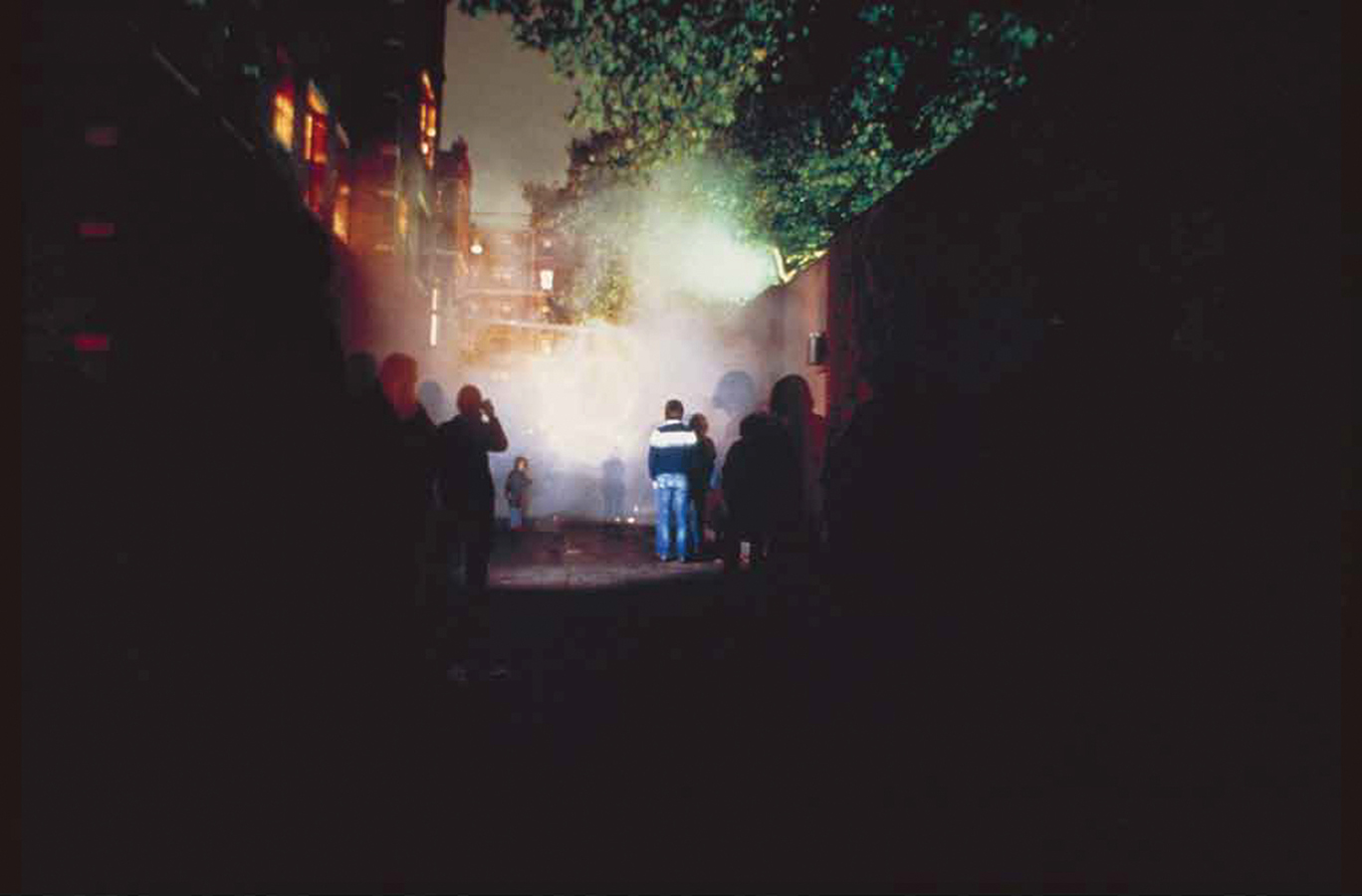
For VanDerBeek, moving images weren’t only material for his artwork—they had the power to facilitate global understanding and to help the world move toward peace. In a manifesto, “CULTURE: Intercom and Expanded Cinema,” he wrote, “I propose the following: that immediate research begin on the possibility of a picture-language based on motion pictures; that we combine audio-visual devices into an educational tool: an experience machine or ‘culture-intercom’; that audio-visual research centers be established on an international scale to explore the existing audio-visual devices and procedures, develop new image-making devices, and store and transfer image materials, motion pictures, television, computers, video-tape, etc.; that artists be trained on an international basis in the use of these image tools…” He set forth ideas with the certainty that they could be accomplished and even needed to be accomplished.
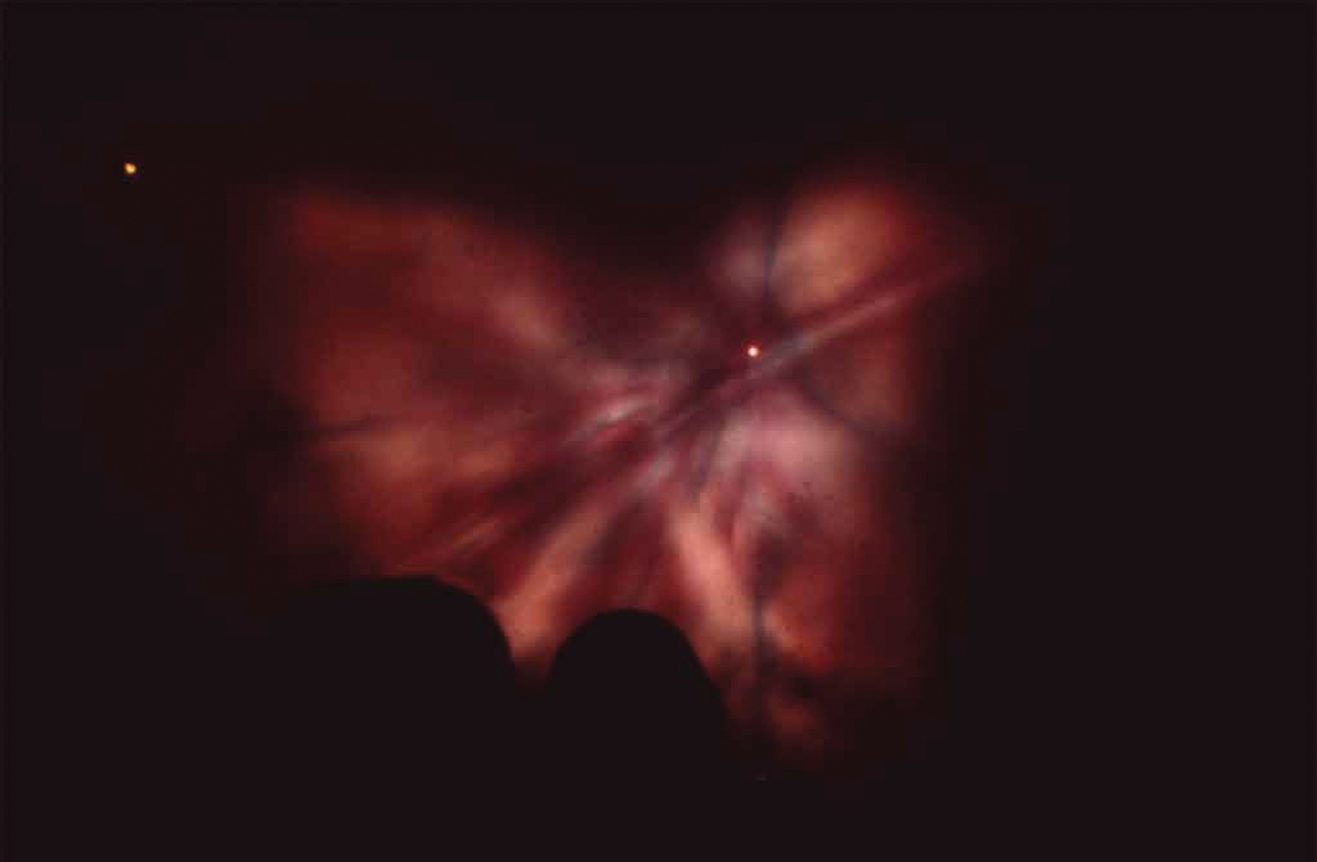
To facilitate that vision of global communication, VanDerBeek forged what was perhaps his best-known creation, the Movie-Drome. Located at Stony Point, New York, at the Gate Hill Cooperative (populated by the young VanDerBeek family in addition to others who had migrated from Black Mountain College, including John Cage, pianist David Tudor, and potter M.C. Richards), the Movie-Drome was the top of a grain silo dome. Guests were invited inside, asked to lie down, and, looking up, watched a mosaic of continually changing films and slides that were concurrently projected across the dome’s interior. VanDerBeek imagined a network of Movie-Dromes operating internationally, linked by satellite, presaging the internet.
Endless Possibilities
By the time VanDerBeek arrived at UMBC in 1975, he was already in the international limelight—a filmmaker whose works had won awards at festivals worldwide and who had received support from the Guggenheim Foundation, the Ford Foundation, the National Endowment for the Arts, and the Rockefeller Foundation. He had taught, lectured, or been in residence at Columbia University, MIT, the Walker Arts Center, the Smithsonian Institution, WGBH (Boston), NASA, and dozens of other institutions and had enjoyed a 1968 retrospective at the Museum of Modern Art. Ever fascinated by the possibilities of emerging technologies, VanDerBeek had branched out from film to embrace videography and computer animation, which seemed to offer endless possibilities. (His early computer-generated films were produced at MIT and at Bell Labs, where he was in residence and assisted by computer art pioneer Ken Knowlton.) An exhibition of VanDerBeek’s work Machine Art: An Exhibit of “Inter-Graphics” was presented in UMBC’s Library Gallery in spring 1976.
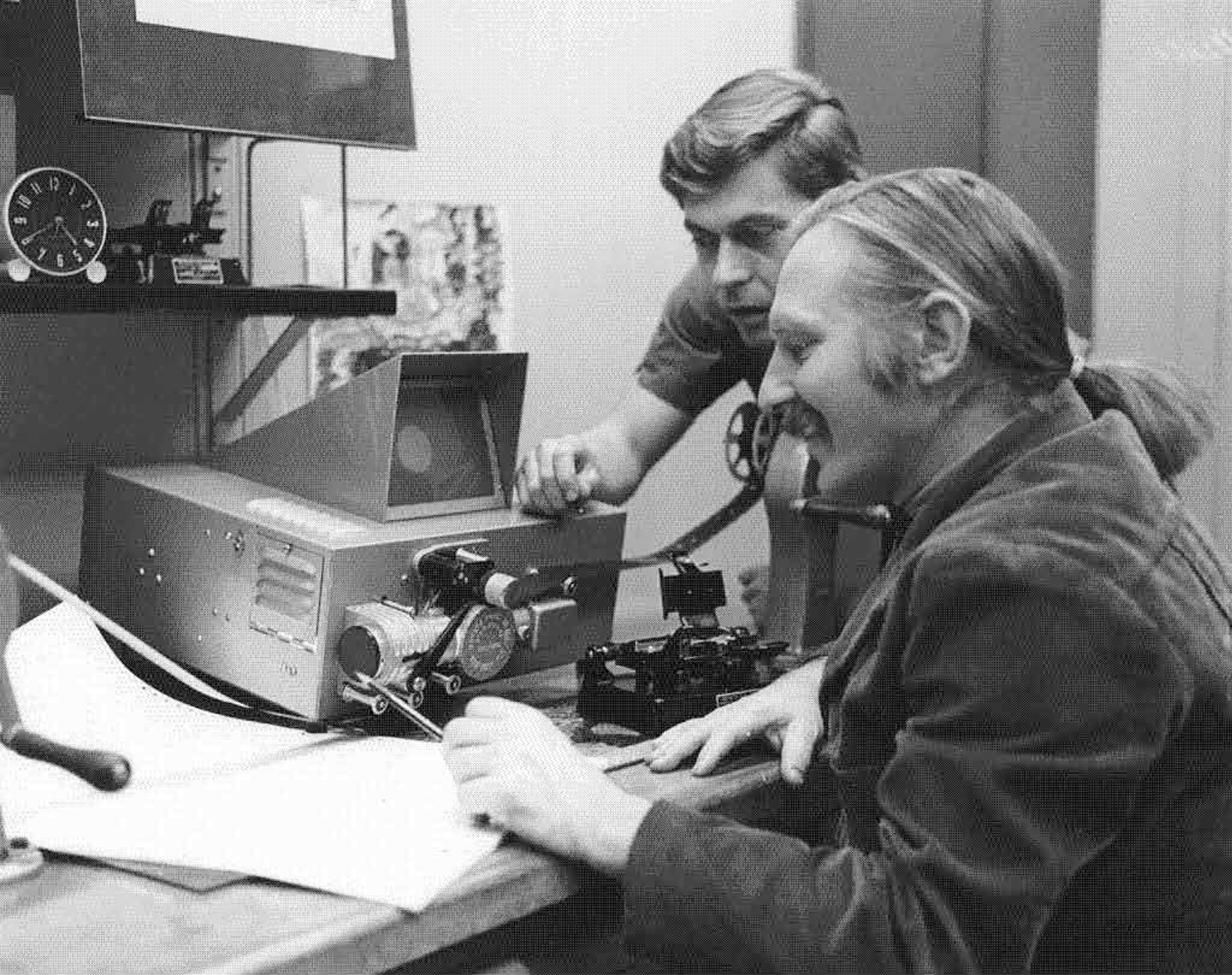
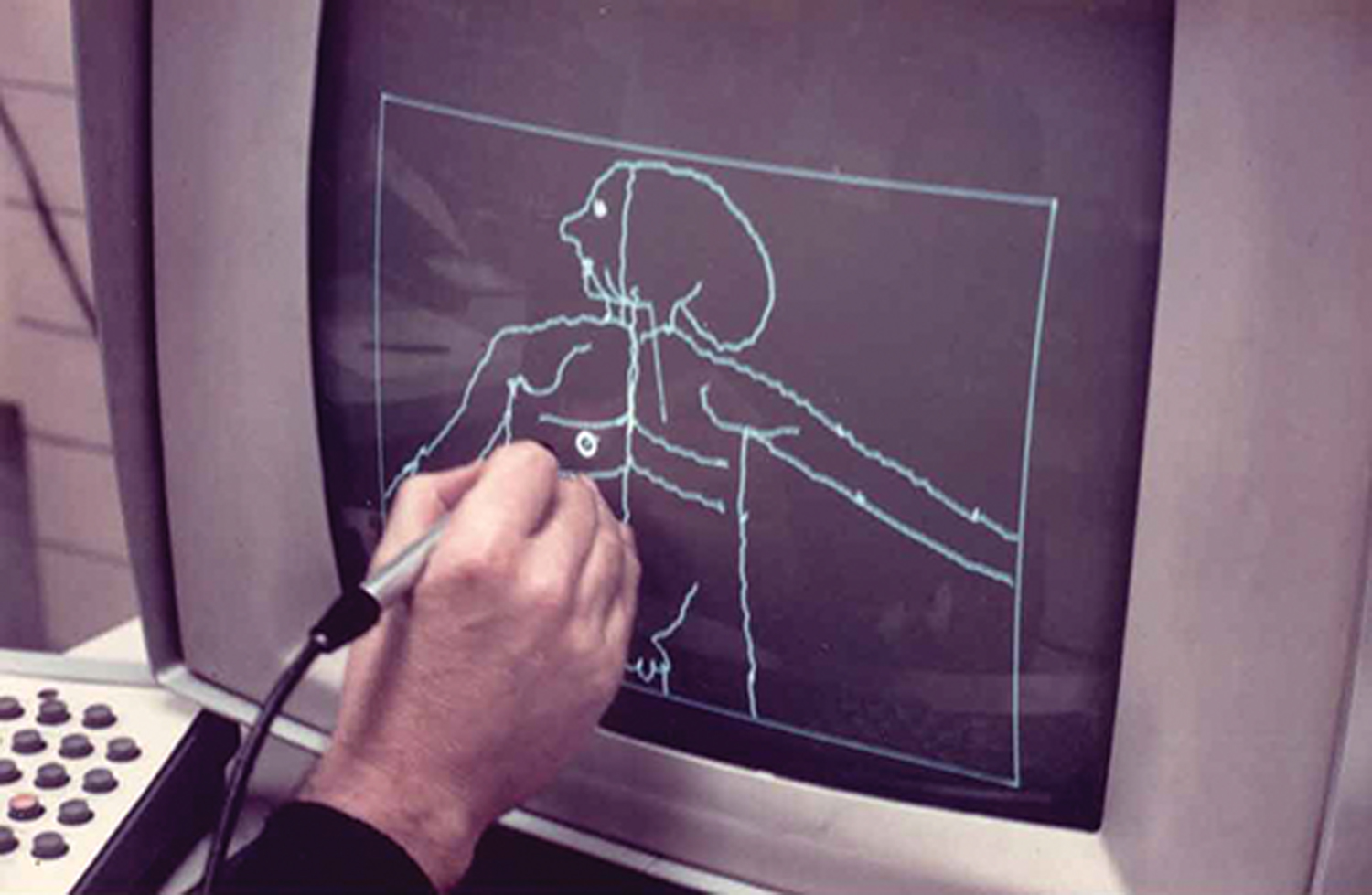
“It was a dynamic time,” remembers Ferdinand Maisel, who studied at UMBC and also worked in the dance department, “and Stan was maybe among the first interdisciplinary/collaborative artists of the 20th century. He was fascinated with how other people would think and solve problems. I met Stan via my work with Liz Walton—I worked for the dance department back then as a composer. Stan immediately had me push his shopping cart of films (which he was known to walk around campus) to a Steenbeck film machine, where I watched, with amazement, some of the films for which he wanted music.” VanDerBeek tapped Maisel to help run his Image Lab, a precursor to UMBC’s present-day Imaging Research Center.
While at UMBC, VanDerBeek recreated the Movie-Drome. Baltimore newscaster Denise Koch, who taught acting and theatre performance at UMBC, recalled, “Stan built a geodesic dome in the center of a large field and projected clouds and nighttime sky-lines, and had people come and lay on the floor for the experience.” (He had planned to erect on campus a 70-foot dome housing a 40-foot planetarium screen.)
 VanDerBeek’s award-winning 1963 film Breathdeath was described by the filmmaker as “a film experiment that deals with the photo reality and the surrealism of life…a black comedy, a fantasy that mocks at death.”
Koch also stars in a 1979 VanDerBeek film, Mirrored Reason. “He came to me and told me he’d been given a studio at the Voice of America for a day, and wanted to play with some of the equipment and asked if I’d participate as his actor—how could I refuse! We went to the studio, and he placed me in a room and just asked me to do an improvisation. I think I used a Kafka story to fall into a state of paranoia as Stan fooled around with my image. At one point my head splits in two and then I’m facing myself—thus, I believe, Mirrored Reason. Stan and our theatre company, Kraken, collaborated a number of times. Once, he took video of each actor’s head in the exact same position and then had us bleeding or melting into and out of each other as if we were a company made up of one face that held the persona of eight different people. It’s hard to explain, but I remember I was stunned!”
Ellsworth Hall remembers that VanDerBeek’s “office was rather messy with stacks of magazines, books, and film cans, but he knew where everything was!” Always encouraging his students to branch out with novel techniques, “In Experimental Film class Stan would have us put objects directly on unexposed film and then move them and expose each frame so as to create a direct animation on the emulsion. Very unusual technique, but it resulted in some interesting images.”
 A frequent collaborator across artistic disciplines, VanDerBeek worked in 1965 on the Merce Cunningham Dance Company’s Variations V with John Cage, Nam June Paik, and others. (Pictured: composers David Tudor and Gordon Mumma, dancer Carolyn Brown.)
Steve Estes, who studied film at UMBC as an undergraduate and then returned to earn an MFA in 1997, remembers VanDerBeek as an encouraging, supportive force. “He was very open, and very open to whatever you really wanted to do. Stan was the kind of guy who was helpful by basically just being there, and letting you do what you did, and providing whatever assistance he could. He had suggestions about this or that, but he was pretty much, ‘Go for it! Freedom, man, just go ahead and do it. Explore! Play!’”
Filmmaker Richard Chisolm ’82, interdisciplinary studies, recalls VanDerBeek as a character whose mind was sometimes racing so quickly that he wasn’t always focused on teaching, but says, “This dreamer personality, this charming dreamer, is kind of by definition boundary-less, and wild, and expressive. We need Stan VanDerBeeks to challenge our otherwise concrete, boring, structured way of looking at the arts. True art is extremely messy. It requires taking risks, and it requires trying things that are going to fail, and losing money, and losing time during those failures, and people like Stan are just fearless and have no regard for whether this dream is going to come true or be doable or not. It’s the old cliché about throwing things at the wall and seeing what sticks—that’s definitely how he looked at ideas. He got ideas every day, and every week, and he tried to contagiously get people to jump in with him, and sometimes they would. He was going super fast every day, always walking and talking fast and could never sit still.”
Dreaming at UMBC
VanDerBeek’s “dreamer” personality was, in fact, fascinated by dreams. He posted a note in a 1970s-era publication, Dreamworks, encouraging readers to send him brief written descriptions of their dreams, saying, “I am seeking this material for developing my ‘dream theater’ and for other futuristic dream-related media projects…. I am convinced that movies are the visual enactment of the dream state. I do not know how specific this function of pre-visualizing and making tangible the dream state is in our lives. But my own instincts move me further into experimenting with such illusory systems, such as freedom of metamorphosis to create ‘meta’ images that can approximate the geometry and forms of dreams.”
 The computer-generated Poemfield series, created between 1965 and 1969, were the artist’s exploration of “image-based poetry language.”
UMBC’s connections to the VanDerBeek family run deep. Two of his children—August and Max— studied briefly at UMBC, and his daughter Julie graduated in 2003 with a degree in theatre. Max returned in the 1990s to teach for the Department of Music; his son, Clay, was a Linehan Artist Scholar who graduated in 2017 with a degree in theatre. Another of Stan’s daughters, artist Sara VanDerBeek, has exhibited and spoken at UMBC’s Center for Art, Design, and Visual Culture. Stan VanDerBeek’s second wife, Louise, graduated in 1976 with a degree in interdisciplinary studies and an arts emphasis and then returned to earn a master’s in 1995 in instructional development systems.
“If I had to draw a cartoon for The New Yorker that was about Stan VanDerBeek?” Richard Chisolm asks rhetorically. “It would be Stan VanDerBeek buys furniture at IKEA, and then you see him in a room with the boxes, and then in the next frame you would see something that didn’t look at all like furniture, and the instructions would be curled up in the corner, and what he built would be this anarchistic mound of panels and windows that was not at all what the IKEA people were telling you to build.”
VanDerBeek served as chair of UMBC’s Department of Visual Arts for only a short time in 1983 and 1984 before becoming ill. Several days before his death in September 1984, he received a poignant good-bye letter from fellow experimental filmmaker Stan Brakhage, who wrote, “I grow more sure of what we’ve done, and that someday…our works and lives will be fully known to the ears and minds of human beings….”
— Tom Moore
*****
To learn more about Stan VanDerBeek’s work, visit stanvanderbeek.com. An exhibition, VanDerBeek + VanDerBeek, which presents artwork by Stan VanDerBeek alongside work by Sara VanDerBeek, is on display at the Black Mountain College Museum + Arts Center through January 4, 2020.
Thanks to Max VanDerBeek, August VanDerBeek, Chelsea Spengemann, the Stan VanDerBeek Archives, and Judy Taylor.
All images, including header, courtesy of the Estate of Stan VanDerBeek.
]]>
The film begins, a fast-moving montage of seemingly unrelated images: eyes, people dancing, an airplane landing, artillery, President Kennedy, wrestlers, a woman applying hairspray, all...
https://umbc.edu/stories/beautiful-dreamer/
https://my3.my.umbc.edu/api/v0/pixel/news/119999/guest@my.umbc.edu/46195ac1524849cc0a8a2f2d0b14052a/api/pixel
cahss
department-of-theatre
fall-2019
feature
graduateschool
mfa
theatre
umbc-history
visual-arts
UMBC News & Magazine
https://my3.my.umbc.edu/groups/umbc-news-magazine
https://assets1-my.umbc.edu/system/shared/avatars/groups/000/001/943/24435aa6207c452e7bc15cc74b42c7bb/xsmall.png?1748556657
https://assets1-my.umbc.edu/system/shared/avatars/groups/000/001/943/24435aa6207c452e7bc15cc74b42c7bb/original.png?1748556657
https://assets2-my.umbc.edu/system/shared/avatars/groups/000/001/943/24435aa6207c452e7bc15cc74b42c7bb/xxlarge.png?1748556657
https://assets2-my.umbc.edu/system/shared/avatars/groups/000/001/943/24435aa6207c452e7bc15cc74b42c7bb/xlarge.png?1748556657
https://assets3-my.umbc.edu/system/shared/avatars/groups/000/001/943/24435aa6207c452e7bc15cc74b42c7bb/large.png?1748556657
https://assets1-my.umbc.edu/system/shared/avatars/groups/000/001/943/24435aa6207c452e7bc15cc74b42c7bb/medium.png?1748556657
https://assets2-my.umbc.edu/system/shared/avatars/groups/000/001/943/24435aa6207c452e7bc15cc74b42c7bb/small.png?1748556657
https://assets1-my.umbc.edu/system/shared/avatars/groups/000/001/943/24435aa6207c452e7bc15cc74b42c7bb/xsmall.png?1748556657
https://assets2-my.umbc.edu/system/shared/avatars/groups/000/001/943/24435aa6207c452e7bc15cc74b42c7bb/xxsmall.png?1748556657
UMBC News & Magazine
0
0
false
Tue, 03 Dec 2019 21:36:22 -0500
Keeping Pace with Theatrical Intimacy

If you’ve ever watched a movie with anything higher than a PG rating, chances are you’ve seen two actors perform an on-screen kiss. Perhaps at the time, you didn’t think much about what went into staging that kiss. But in reality, staging intimacy—which includes everything from holding hands to simulated sex—can be one of the most challenging parts of producing a play.
“There seems to be a lot of opportunity for miscommunication, misunderstanding, and, in the very worst cases, abuses of power,” Chelsea Pace, assistant professor of theatre, explains. Pace is one of the founding members of Theatrical Intimacy Education, a consulting group that helps theatre and film companies develop their best practices for staging intimacy. TIE usually does this not by staging the intimacy themselves, but by conducting workshops and trainings to teach those who are already a part of the company how to direct intimacy.
 Chelsea Pace. Photo courtesy of Shealyn Jae.
“If we can make the people who are already in the room better at being in the room,” Pace says, “then we’re actually working towards a cultural change in our industry.”
Pace originally took an interest in how intimacy was directed when she noticed that directors shied away from staging intimate scenes, leaving it up to the actors to figure out for themselves. It seemed, to her, to be the only part of the creative process that didn’t have a designated designer or director.
That lack of direction impacts the performance, says Pace. “Directors would just ask two actors, ‘okay, do the kiss, do the make-out,’” Pace says. “And if the actors didn’t know how to do that, or they did something weird, you were stuck with it.”
Pace has studied theatrical intimacy for over 10 years and has been helping the UMBC Theatre Department develop their own best practices for staging intimacy since she began working here in 2017. Not only has she conducted trainings and workshops with theatre students and faculty, but she also worked with the department to develop their new Theatrical Intimacy and Instructional Touch Policy.
Formed from the input of students, faculty, and staff in the department, the policy aims to set standards for touch in the classroom, including obtaining consent and making it clear that there are alternative practices for students who don’t want to be touched. “That’s a really large part of a lot of pedagogical systems for teaching theatre. There’s a lot of contact,” Pace says, explaining the need for such standards. “We have a lot of needs in this department because of what we do that you may not necessarily discover in a physics department.”
One of the four UMBC shows Pace worked on last year, She Like Girls, featured a young woman discovering her sexuality. The show handled both moments of intimacy as well as instances of sexual violence; in one scene, a character named Andre, played by Lloyd Ekpe ’20, acting, attempts to coerce his friend into having sex.
 Majenta Thomas ’21 and Maria Marsalis ’20 in a scene from “She Like Girls.” Photo courtesy of Chelsea Pace.
According to Ekpe, Pace’s methods made staging such a dark moment infinitely easier. “The initial meeting with Chelsea at rehearsal is going through the best practices for touching and initiating contact, and with that comes the language of contact—the distance, the levels of touch, the lines and shapes,” he explains. When it came time to stage the assault, “one thing [Pace] kept hammering into my head was: It’s just choreography. It’s just choreography. You’re just closing the distance, you’re just lifting her up here, you’re just putting her down there.”
Divorcing the motions of the scene from the feelings of the actor are an important part of Pace’s practices for staging intimacy. “In stage combat, it’s very clear that I’m not punching my scene partner in the face. When you’re staging a kiss? Your faces actually go on each others faces,” Pace says. “And that creates a lot of muddiness between what is real and what’s just real in the scene.”
Purposefully, carefully choreographed intimacy helps to clear up that muddiness by creating what she calls a “container of technique” that separates the movements of the scene from real-life emotions.
 Pace observes a rehearsal for “The Diary of Anne Frank” at Chesapeake Shakespeare Company, featuring Hannah Kelly ’17, acting, and Clay Vanderbeek ’17, theatre. Photo by Molly Prunty.
All of the best practices Pace has developed with TIE and as part of her own research will soon be catalogued for other educators, students, and professionals in her upcoming book, Staging Sex, which is forthcoming from Routledge Publishing. Like TIE’s workshops or the theatre department’s new Theatrical Intimacy and Instructional Touch Policy, Staging Sex is yet just another step in changing the theatre industry to be a more ethical and consent-driven space.
“We can do a lot [of] good if every undergraduate coming out of a BFA program across the country comes out knowing how to establish their boundaries with a scene partner…and every student director coming out of these programs starts asking actors questions about their boundaries,” Pace says. “That’s going to create a cultural change a lot faster than just insisting every production needs an intimacy choreographer.”
*****
Header image: UMBC Alumnae Sanjana Taskar ’19, acting and sociology, and Hannah Kelly ’17, acting, pose for the cover of Staging Sex. Photo courtesy of Shealyn Jae.
]]>
If you’ve ever watched a movie with anything higher than a PG rating, chances are you’ve seen two actors perform an on-screen kiss. Perhaps at the time, you didn’t think much about what went into...
https://umbc.edu/stories/keeping-pace-with-theatrical-intimacy/
https://my3.my.umbc.edu/api/v0/pixel/news/120002/guest@my.umbc.edu/3edeb8175ab43df29245e18b9a11e2a2/api/pixel
cahss
discovery
fall-2019
professorsnottomiss
theatre
UMBC News & Magazine
https://my3.my.umbc.edu/groups/umbc-news-magazine
https://assets1-my.umbc.edu/system/shared/avatars/groups/000/001/943/24435aa6207c452e7bc15cc74b42c7bb/xsmall.png?1748556657
https://assets1-my.umbc.edu/system/shared/avatars/groups/000/001/943/24435aa6207c452e7bc15cc74b42c7bb/original.png?1748556657
https://assets2-my.umbc.edu/system/shared/avatars/groups/000/001/943/24435aa6207c452e7bc15cc74b42c7bb/xxlarge.png?1748556657
https://assets2-my.umbc.edu/system/shared/avatars/groups/000/001/943/24435aa6207c452e7bc15cc74b42c7bb/xlarge.png?1748556657
https://assets3-my.umbc.edu/system/shared/avatars/groups/000/001/943/24435aa6207c452e7bc15cc74b42c7bb/large.png?1748556657
https://assets1-my.umbc.edu/system/shared/avatars/groups/000/001/943/24435aa6207c452e7bc15cc74b42c7bb/medium.png?1748556657
https://assets2-my.umbc.edu/system/shared/avatars/groups/000/001/943/24435aa6207c452e7bc15cc74b42c7bb/small.png?1748556657
https://assets1-my.umbc.edu/system/shared/avatars/groups/000/001/943/24435aa6207c452e7bc15cc74b42c7bb/xsmall.png?1748556657
https://assets2-my.umbc.edu/system/shared/avatars/groups/000/001/943/24435aa6207c452e7bc15cc74b42c7bb/xxsmall.png?1748556657
UMBC News & Magazine
0
0
false
Tue, 26 Nov 2019 15:36:27 -0500
Setting the Bar — The Impact of a Judicial Internship

As a student in Towson High School’s Law and Public Policy program, Randall Ainsworth ’19, history and philosophy, created a peer mentoring program for other young African American men there. In a predominantly white school, Ainsworth envisioned a support system for students who were struggling to succeed as they dealt with violence and poverty at home and then were placed in an environment that expected them to conform. The group sought to overcome their circumstances through mentorship, brotherhood, and community service.Their motto, Ainsworth says, was, “Once you’ve been restored, go back and restore your brother.”
After a four-semester internship with Chief Judge Wanda Keyes Heard ’79, political science, of the Circuit Court for Baltimore City, 8th Judicial Circuit of Maryland, Ainsworth has wrestled with what restoration might look like for each person making their way through the criminal justice system. In his first semester, Heard handed him a thick file for someone in prison. His task was to review a request to have a sentence reduced.
“Just so you know, this is a real person. You have to look through here, see what his record is, and tell me what to do,” the judge told Ainsworth, he recalls.
These types of hands-on tasks with real-life application are par for the course for an internship with Heard. In her 20-year career as a judge, she’s mentored 26 interns from UMBC alone.
 Ainsworth and Heard at a recent Hilltop Society Dinner, honoring the generosity of alumni and friends.
Ainsworth says that Heard has been instrumental in holding open the door for the next generation of lawyers and judges. “She has, like, an army of little children, just all over the place, doing good work.”
Getting a foot in the door
The summer before Ainsworth began his studies at UMBC, he met Heard serendipitously at an award ceremony, where he was being honored for his high school mentoring program. Hearing about Ainsworth’s background and his acceptance to UMBC, Heard approached him with her business card and told him to get in touch, despite the fact that he hadn’t even started college yet.
“When I was coming along, the most frustrating thing was not being able to get experience,” says Heard, sitting in her wood paneled office downtown. Her mother was a nurse and her father was an educator. “But there were no lawyers in my family. There were no lawyers around that looked like me—African American and a woman—and I found it very, very difficult to get my foot in the door.”
While Heard was at UMBC in the ’70s, she went to Capitol Hill to search out internships. Discouraged but undeterred by warnings that she wouldn’t be able to secure a position, Heard approach Shirley Chisholm, the first African American in Congress and the first woman and the first African American to seek a presidential nomination from one of the two major political parties. Chisholm’s mentorship was invaluable, says Heard, who learned all the steps for how a bill gets from point A to point B, solicited co-sponsors for Chisholm’s bills, and eventually drafted her own bill—to establish a stipend for interns to receive compensation for their work.
Seeing representation mattered, and Heard has strived to set a similar example for the interns who work in her office but also for younger children, who come into the courthouse with their classmates and recreate mock trials for scenarios like Jack and the Beanstalk. In a recent rendition, Ainsworth participated in the role of Jack, who was on trial for breaking into the giant’s house and stealing his goose that lays the golden eggs, and ultimately attempted murder of the giant by cutting down the stalk that held up his house.
“We bring in kids from the area’s public schools and nonprofits…they are the attorneys, they serve as the judge, they’re the jurors,” says Heard. “And we show them the jobs like the clerk and the sheriff…to encourage them into careers in the law.”
“If I show young people,” continues Heard, “that there’s an alternative to what they see on the street by bringing them to the courthouse and showing them jobs or a female judge, I’m offering them an opportunity that I may not have had. That’s where my mentoring Randall comes in. He comes from a rough background, and a very rough neighborhood, but he’s brilliant. You only need to talk to him. Give him an assignment. And his brilliance shines through.”
Heard, says Ainsworth, has been instrumental in setting him on this path. And from Heard’s perspective, “I truly feel like a mentor, because he’s outgrown my office.”
Legal bootcamp
Working with the judge is like “legal bootcamp,” says Ainsworth. “Basically, she gives you an assignment and then she’s like, ‘Go do it.’ But it’s really a hands-on thing where you’re figuring out the law, you’re also figuring out the circumstances of the case, and then you’re figuring out how it applies.”
Ainsworth has been struck and shaped by the way Heard’s passion for the law translates as a passion for helping people in the system. “She does this whole thing with her probation that’s a little different, where she gives people stipulations, but the stipulations are things like, ‘Leave town. Get a job. Go to school,’ you know? And you’ll see people that you would think are hardcore criminals come in six months, a year later, and they’re completely different people.”
The judge has also taken time with Ainsworth to go through his law school applications, providing a much needed voice of experience. “I always wanted to be an attorney, but no one in my family and no one that’s connected to my family has ever done anything like this before,” says Ainsworth, unconsciously echoing Heard’s own words about her first foray into studying law.
 Ainsworth graduates from UMBC in December 2019, the same month Heard will retire after 20 years on the bench.
“My relationship with the judge has definitely opened doors to opportunities that I didn’t think were possible,” continues Ainsworth. “Having the opportunity to gain experience with the law and network with leaders in the legal field has made me confident that I can succeed as an attorney.”
Changing the narrative
Other formative experiences shaped Ainsworth’s pursuit of this career. On the way home from volunteering at a nursing home with members of his peer mentoring group, Ainsworth says, someone called the police on the group as they walked into a convenience store. “You know, we’re being orderly,” Ainsworth remembers explaining. “We’re not doing anything. Why are you calling the police?” Ainsworth managed to deescalate the situation, but for him, the experience underscored that “African Americans do not have the same experience with the law and the justice system as other groups of people in America.”
Ainsworth, who after graduating will work as a legislative aide in the Maryland General Assembly and apply for law school, sees his career goal clearly: “I want to help reverse a cycle of historical injustice, create opportunities for others like me, and make it easier for African Americans to have faith that the law will be just and treat them fairly.”
*****
All photos, including header, by Marlayna Demond ’11.
]]>
As a student in Towson High School’s Law and Public Policy program, Randall Ainsworth ’19, history and philosophy, created a peer mentoring program for other young African American men there. In a...
https://umbc.edu/stories/setting-the-bar/
https://my3.my.umbc.edu/api/v0/pixel/news/120004/guest@my.umbc.edu/48ac0c8c5217cba3030fc5e990f97a3d/api/pixel
cahss
fall-2019
hilltop-society
impact
internship
UMBC News & Magazine
https://my3.my.umbc.edu/groups/umbc-news-magazine
https://assets1-my.umbc.edu/system/shared/avatars/groups/000/001/943/24435aa6207c452e7bc15cc74b42c7bb/xsmall.png?1748556657
https://assets1-my.umbc.edu/system/shared/avatars/groups/000/001/943/24435aa6207c452e7bc15cc74b42c7bb/original.png?1748556657
https://assets2-my.umbc.edu/system/shared/avatars/groups/000/001/943/24435aa6207c452e7bc15cc74b42c7bb/xxlarge.png?1748556657
https://assets2-my.umbc.edu/system/shared/avatars/groups/000/001/943/24435aa6207c452e7bc15cc74b42c7bb/xlarge.png?1748556657
https://assets3-my.umbc.edu/system/shared/avatars/groups/000/001/943/24435aa6207c452e7bc15cc74b42c7bb/large.png?1748556657
https://assets1-my.umbc.edu/system/shared/avatars/groups/000/001/943/24435aa6207c452e7bc15cc74b42c7bb/medium.png?1748556657
https://assets2-my.umbc.edu/system/shared/avatars/groups/000/001/943/24435aa6207c452e7bc15cc74b42c7bb/small.png?1748556657
https://assets1-my.umbc.edu/system/shared/avatars/groups/000/001/943/24435aa6207c452e7bc15cc74b42c7bb/xsmall.png?1748556657
https://assets2-my.umbc.edu/system/shared/avatars/groups/000/001/943/24435aa6207c452e7bc15cc74b42c7bb/xxsmall.png?1748556657
UMBC News & Magazine
0
0
false
Mon, 25 Nov 2019 17:58:55 -0500

