Strange Dance Partners
UMBC researchers are discovering building blocks of hand motions, aiming to improve physical therapy for humans and find better ways to program robots. They’re turning to a novel source material for these gestures: classical Indian dance.
Fossil records suggest that between four and six million years ago, the hominin ancestors of modern humans first stood up and walked on two legs—thus freeing their hands. Those hands went on to craft humanity’s story arc: cradling babies, carrying food, fashioning and wielding weapons, carving the woodblocks used to print the first paper books, running over the keys of a piano in a Rachmaninoff concerto, and even planting a flag on the surface of the moon.
“Hands are incredibly important to humans,” says Ramana Vinjamuri, an associate professor of computer science and electrical engineering whose work has focused on understanding how the brain controls complex hand movements.
Vinjamuri personally witnessed the debilitating impact of loss of hand movement when his mother suffered a stroke in 2014. “The very hand that taught me how to draw, how to write—I saw that hand irrevocably paralyzed. It was really hard for the family.”
The experience motivated Vinjamuri to work on technologies that could help people regain lost motor functions or serve as robotic replacements for injured body parts. As part of the research, the team began searching for and cataloging the building blocks of hand motions. Further inspiration struck when Vinjamuri attended a scientific conference on the brain, hosted by the Indian Institute of Technology Mandi in the serene foothills of the Himalayas. While brainstorming ideas for a session of the conference focused on ways that ancient Indian traditions might be applied to modern problems, Vinjamuri conceived a novel approach to deriving these building blocks—from the structured hand gestures of Indian classical dance.

Ramana Vinjamuri in the Vinjamuri lab, stands with a Unitree bipedal robot.
A Complex and Versatile Instrument

Mitra, a humanoid robot produced by Invento Robotics, a company founded by UMBC alumnus Balaji Viswanathan, M.S ’06, Ph.D. ’23, computer science. The researchers programmed Mitra to make letters of the American Sign Language alphabet by combining the mudras-derived alphabets of movement, in this case making the letter E.
Take a moment to consider your hands. Including the wrist, each hand has 27 joints. Some of those joints, such as the carpometacarpal joint at the base of the thumb, can move in multiple ways, such as rotating, bending, and moving toward or away from the center of the palm. The full hand encompasses billions of possible unique combinations of movements.
“To study something as complex as the hand is fascinating,” says Parthan Olikkal, a longtime member of Vinjamuri’s lab who is currently working toward his Ph.D in computer science and is deeply involved in recent research efforts.
To get a grip on the complexities, the team has turned to a concept called kinematic synergies. First extensively explored in the mid-20th century by Russian physiologist Nikolai Bernstein, synergies are essentially building blocks of movement in which the brain simultaneously coordinates multiple joint movements to simplify complex motions.
The concept can be used to deconstruct a dazzling diversity of movements into a limited number of fundamental units, similar to how the hundreds of thousands of different words in the English language can be broken down into only 26 letters.
Vinjamuri and his students have been on a quest to discover the “alphabets” of human hand movements we’ve collectively learned through hundreds of dropped sippy cups, hours of handwriting practice, and the like. The hope is that the knowledge could then be used as a “hack”—to more effectively train ourselves and our robotic assistants in the future.
“The way we interact with our surroundings—the way we grasp objects or move through space—feels so natural and effortless. We often forget we stumbled and fell as children while our brains and bodies were learning to coordinate.”
— Ramana Vinjamuri, associate professor of computer science and electrical engineering
Natural Versus Structured Movements

Ashwathi Menon, co-caption of the Adaa Indian fusion dance team, stopped by the lab for a photo shoot in October. Here she appears on the computer screen as the team demonstrates how to use a simple camera and software system to recognize hand movements.

A small statue representing the Hindu god Shiva in the form of Nataraja, the cosmic dancer. Ramana Vinjamuri keeps the statue in his office. (Photo courtesy of Vinjamuri)
As part of their latest research on alphabets of hand movements, Vinjamuri and his students analyzed a dataset of 30 natural hand grasps. The movements are used for picking up objects ranging in size from large water bottles to tiny beads. The researchers found six synergies, akin to an alphabet of six letters, that when combined could account for nearly 99 percent of the variations in movements represented in the full dataset.
The first two synergies alone—specifically a movement in which all five fingers wrap around an object and a movement in which the index finger and thumb pinch together—could account for more than 90 percent of the variations. Learning (or relearning) those two movements would be essential to training a hand to pick up objects, the researchers say.
However, the team also says that studying natural grasps has limitations.
“Natural grasp is unique to the motor learning history of an individual,” says Olikkal. “So the way I do something might be completely different from another person.” The grasps also represented limited functionality, containing only a small subset of ways that a person might use their hands.
“Hand gestures are part of the storytelling. They are very precise. They can be used to point, to represent an animal, to represent praying—those are just some examples.”
— Ashwathi Menon, a junior and co-captain of UMBC’s Adaa Indian fusion dance team
In search of richer alphabets of movement, the researchers turned to dance, specifically an Indian classical dance form called Bharatanatyam, which originated in the southern Indian state of Tamil Nadu. The term Bharatanatyam is often explained as a mnemonic blend of words combining the concepts of emotion, melody, rhythm, and dance. The holistic art form employs a variety of hand gestures, called mudras, to drive the storytelling at its heart.
“Bharatanatyam is an intricate, linear, and structured dance form with a lot of precision,” says Ashwathi Menon, a UMBC junior majoring in bioinformatics and computational biology who is co-captain of the university’s Adaa Indian fusion dance team and who has been performing classical Indian dances since she was four years old. “Hand gestures are part of the storytelling. They are very precise. They can be used to point, to represent an animal, to represent praying—those are just some examples.”
“We noticed dancers tend to age super gracefully: They remain flexible and agile because they have been training,” says Vinjamuri. “That was a huge inspiration for us when we started looking for richer alphabets of movement. With dance, we are looking not just at healthy movement but super healthy. And so the question became, could we find a ‘superhuman’ alphabet from the dance gestures?”

Mitra’s hands use three types of motors for movement. The strongest motor, located at the shoulder, handles shoulder flexion and extension, while a medium-torque motor at the elbow controls elbow movements, and five servo motors, one for each digit, are used to control the fingers.
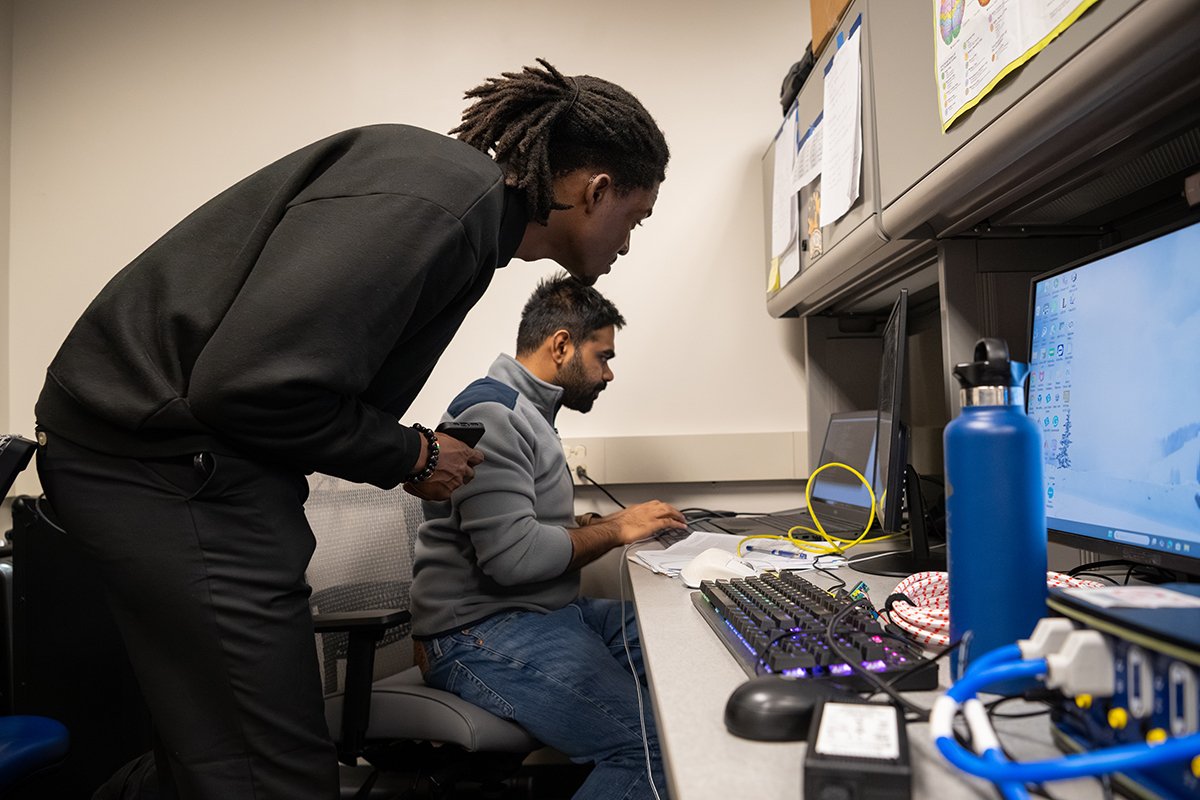
Chris Dollo (left), a senior computer science major and undergraduate researcher in the Vinjamuri lab, and Parthan Olikkal (right) work at the computer. Olikkal brought the concept of capturing hand movements using simple camera set-ups into the lab, a key step toward making cost-effective technologies.
Dance-Derived Alphabets of Movement

Ashwathi Menon demonstrates mudras, which are copied by an Inspire robotic hand. From top to bottom the mudras are: Ardhachandra, meaning “half moon;” Chandrakala, meaning “crescent moon;” and Tripataka, meaning “three parts of the flag.” The mudras can demonstrate various elements of a story, including weapons, trees, flowers, or concepts such as balance, unity, and beauty.
Using the same techniques they had deployed to deconstruct the 30 natural hand grasps, the research team also analyzed 30 single-hand mudras. They found six synergies that could account for around 94 percent of the mudras’ variations.
Crucially, the team then tested how well the six natural grasp-derived synergies could combine to construct unrelated hand motions—in this case 15 letters of the American Sign Language alphabet—compared to the mudras-derived synergies. The mudras synergies significantly outperformed the natural hand grasp synergies on that task.
“When we started this type of research more than 15 years ago, we wondered: Can we find a golden alphabet that can be used to reconstruct anything?” says Vinjamuri. “Now I highly doubt that there is such a thing. But the mudras-derived alphabet is definitely better than the natural grasp alphabet because there is more dexterity and more flexibility.”
Ultimately, Vinjamuri envisions coming up with libraries of task-specific alphabets that can be deployed depending on the needs, be it completing everyday household chores such as cooking or folding laundry, or something more complicated and precise, such as playing an instrument.
Robotic Helping Hands
Apart from advancing understanding of the fundamental roots of movement, the team has made great strides developing cost-effective and pragmatic methods of testing and implementing their ideas. When Vinjamuri first started the work, his team relied on motion-capture systems that required specialized gloves and other equipment. Now, the team uses a simple camera and software system to recognize, record, and analyze movements.
“Parthan brought the concept of capturing hand movements using cameras into the lab and really developed it,” Vinjamuri said. It’s an important contribution to ultimately making cost-effective technologies that people could use in their homes, he says, such as a virtual system to coach people through physical therapy sessions.
The team is also successfully developing techniques to “teach” robotic hands the alphabets of movements and how to combine them to make new hand gestures. The approach marks a departure from standard techniques of teaching robots to mimic hand gestures, and toward a method rooted in our understanding of how the human body and brain work.

Ashwathi Menon, left, demonstrates the Katakamukha mudra while a robotic hand mimics her gesture. The mudra is often used to represent actions like plucking flowers, holding a necklace, and pulling a bowstring.
“It’s called biomimetic learning,” says Vinjamuri. “We want to watch how a human body moves, how a hand moves and works, and we want to derive those principles and apply them to machines.”
The researchers are testing the techniques on a stand-alone robotic hand and a humanoid robot, each of which operates in a different way and requires a unique approach to translating the mathematical representations of synergies into physical movements.
“Once I learned about synergies, I became so curious to see if we could use them to make a robotic hand respond and perform the same way as a human hand,” says Olikkal. “Adding my own work to the research efforts and seeing the results has been gratifying.”
These moments of satisfaction in finding solutions to knotty problems will continue to propel the team’s voyage of discovery. They may even take a moment to celebrate their successes—perhaps with a fitting high-five.

Could A Dancing Robot Improve Humans’ Mental Health?
By Catherine Meyers • Photography by Kiirstn Pagan ’11
Searching for an alphabet of hand movements from the gestures in classical Indian dance is not the only way that art is inspiring and guiding new research in Ramana Vinjamuri’s lab. In a related project, Vinjamuri has teamed up with Andrea Kleinsmith, an associate professor in information systems who specializes in ways that computers can assess humans’ emotions, and Ann Sofie Clemmensen, an associate professor of dance, to explore whether and how dancing robots might offer humans new tools to improve their mental health. The research piggybacks off established practices of human-to-human dance/movement therapy, which can be used to treat some mental health challenges, such as schizophrenia, anxiety, and depression.
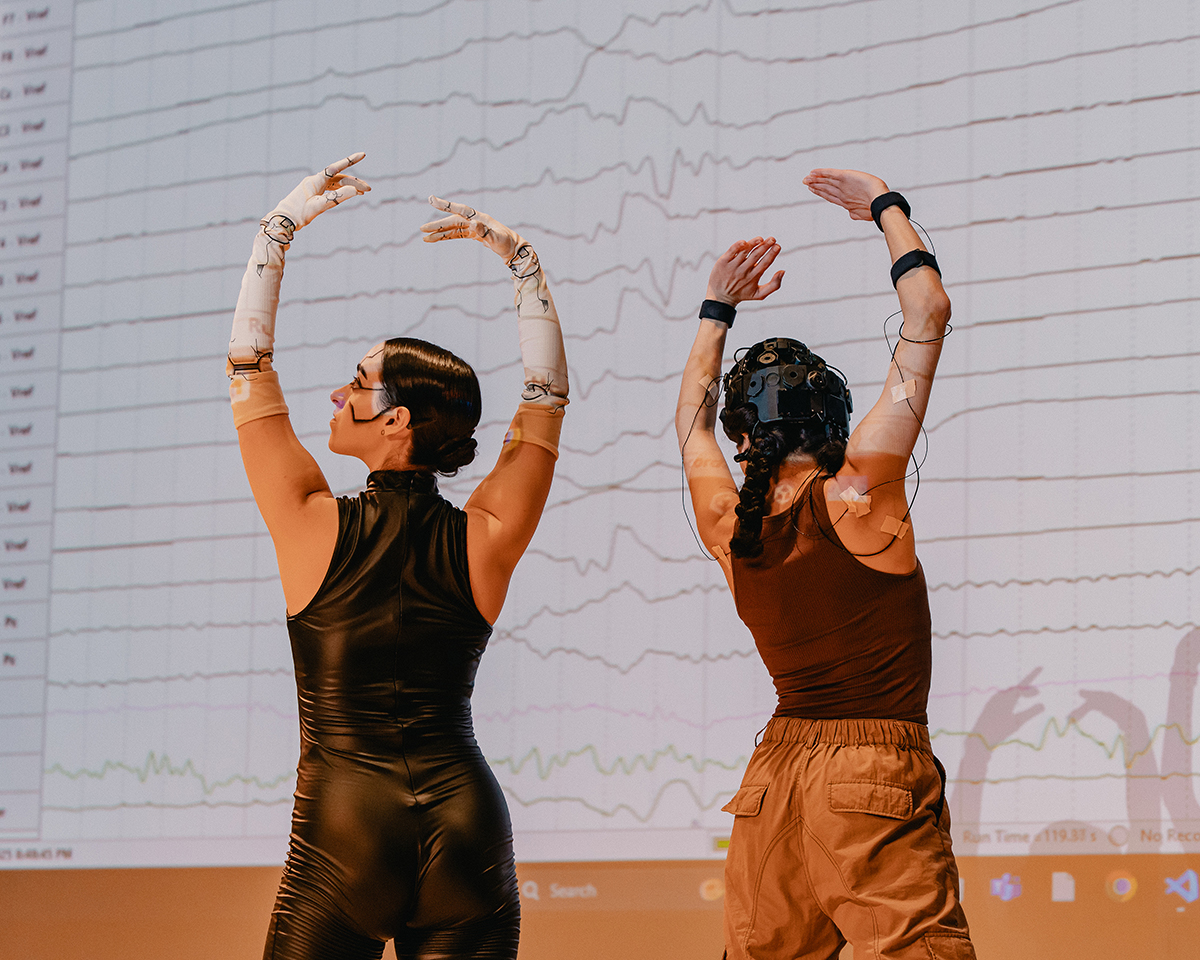
Dancers Sarah McHale ’24 and Juju Ayoub ’25 perform during the AccelNet meeting. The dance was a demonstration of a collaborative research project by UMBC faculty Ramana Vinjamuri, Andrea Kleinsmith, and Ann Sofie Clemmensen exploring stress reducing technology.
The spark for the interdisciplinary venture was struck when the College of Engineering and Information Technology launched a program to encourage faculty to explore collaborations across disciplines to tackle big challenges.
Together, Vinjamuri, Kleinsmith and Clemmensen developed a proposal to investigate questions such as whether the coordination in a person’s arms and legs could be a proxy measure of mental well-being, how existing dance therapy movements affect brain activity, and how a humanoid robot dance partner compares in effectiveness to a flesh-and-blood one.
“As a healthcare opportunity, dancing with a robot may sound weird at first,” notes Clemmensen. But, she says, people who are socially isolated or struggle with the stressors of human interactions might benefit from robot partners. “As humans, we project emotions on objects, but the objects do not judge back.”
In June, the team creatively demonstrated their progress to brain researchers and artists from around the world when they choreographed a technology-infused dance performance for the Movement, Music, and Brain Health National Science Foundation AccelNet meeting on the UMBC campus.
Two dancers—one representing a robot and the other a human—took turns moving around each other. Sensors monitored physiological signs of stress on the human dancer. As the dance progressed, the human was at first fearful, then curious, and finally happy—an ending the researchers hope their own project might one day also accomplish.
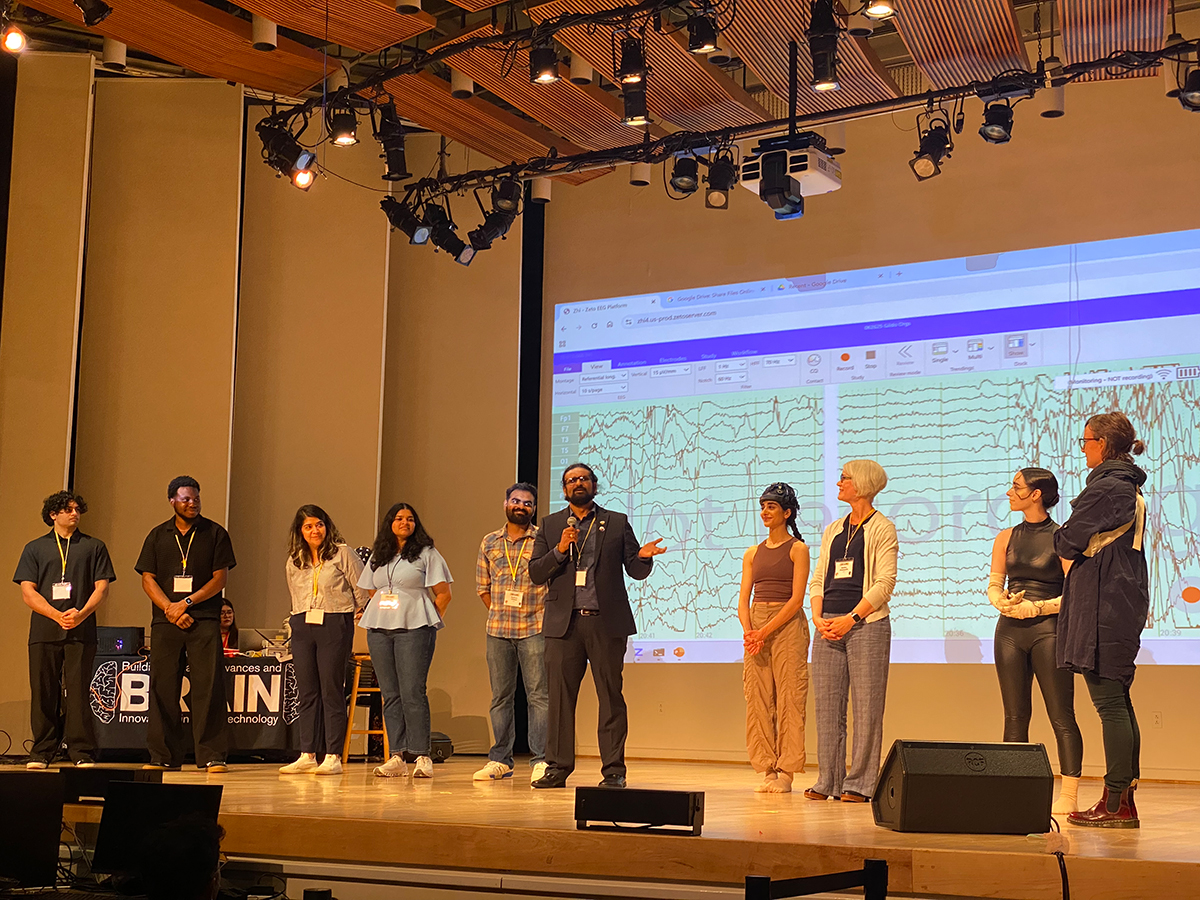
UMBC students and professors who worked on the project gather on the stage after the dance performance. From left to right are Viraj Janeja, Oritsejolomisan Mebaghanje, Golnaz Moharrer, Sruthi Sundharram, Parthan Olikkal, Ramana Vinjamuri, Juju Ayoub, Andrea Kleinsmith, Sarah McHale, and Ann Sofie Clemmensen.
Photo Credit: Niloufar Sarmast
 ]]>
UMBC researchers are discovering building blocks of hand motions, aiming to improve physical therapy for humans and find better ways to program robots. They’re turning to a novel source material...
https://umbc.edu/stories/strange-dance-partners/
https://my3.my.umbc.edu/api/v0/pixel/news/155312/guest@my.umbc.edu/f9ed6ebca522ae4dc141aea381fb8838/api/pixel
cahss
cnms
coeit
csee
dance
discovery
fall-2025
feature
magazine
research
story
UMBC News & Magazine
https://my3.my.umbc.edu/groups/umbc-news-magazine
https://assets1-my.umbc.edu/system/shared/avatars/groups/000/001/943/24435aa6207c452e7bc15cc74b42c7bb/xsmall.png?1748556657
https://assets1-my.umbc.edu/system/shared/avatars/groups/000/001/943/24435aa6207c452e7bc15cc74b42c7bb/original.png?1748556657
https://assets2-my.umbc.edu/system/shared/avatars/groups/000/001/943/24435aa6207c452e7bc15cc74b42c7bb/xxlarge.png?1748556657
https://assets2-my.umbc.edu/system/shared/avatars/groups/000/001/943/24435aa6207c452e7bc15cc74b42c7bb/xlarge.png?1748556657
https://assets3-my.umbc.edu/system/shared/avatars/groups/000/001/943/24435aa6207c452e7bc15cc74b42c7bb/large.png?1748556657
https://assets1-my.umbc.edu/system/shared/avatars/groups/000/001/943/24435aa6207c452e7bc15cc74b42c7bb/medium.png?1748556657
https://assets2-my.umbc.edu/system/shared/avatars/groups/000/001/943/24435aa6207c452e7bc15cc74b42c7bb/small.png?1748556657
https://assets1-my.umbc.edu/system/shared/avatars/groups/000/001/943/24435aa6207c452e7bc15cc74b42c7bb/xsmall.png?1748556657
https://assets2-my.umbc.edu/system/shared/avatars/groups/000/001/943/24435aa6207c452e7bc15cc74b42c7bb/xxsmall.png?1748556657
UMBC News & Magazine
0
0
false
Fri, 05 Dec 2025 16:55:00 -0500
Mon, 15 Dec 2025 12:55:36 -0500
Office Hours—President Sheares Ashby and Petra Janka ’25 discuss student-led inclusive excellence
]]>
UMBC researchers are discovering building blocks of hand motions, aiming to improve physical therapy for humans and find better ways to program robots. They’re turning to a novel source material...
https://umbc.edu/stories/strange-dance-partners/
https://my3.my.umbc.edu/api/v0/pixel/news/155312/guest@my.umbc.edu/f9ed6ebca522ae4dc141aea381fb8838/api/pixel
cahss
cnms
coeit
csee
dance
discovery
fall-2025
feature
magazine
research
story
UMBC News & Magazine
https://my3.my.umbc.edu/groups/umbc-news-magazine
https://assets1-my.umbc.edu/system/shared/avatars/groups/000/001/943/24435aa6207c452e7bc15cc74b42c7bb/xsmall.png?1748556657
https://assets1-my.umbc.edu/system/shared/avatars/groups/000/001/943/24435aa6207c452e7bc15cc74b42c7bb/original.png?1748556657
https://assets2-my.umbc.edu/system/shared/avatars/groups/000/001/943/24435aa6207c452e7bc15cc74b42c7bb/xxlarge.png?1748556657
https://assets2-my.umbc.edu/system/shared/avatars/groups/000/001/943/24435aa6207c452e7bc15cc74b42c7bb/xlarge.png?1748556657
https://assets3-my.umbc.edu/system/shared/avatars/groups/000/001/943/24435aa6207c452e7bc15cc74b42c7bb/large.png?1748556657
https://assets1-my.umbc.edu/system/shared/avatars/groups/000/001/943/24435aa6207c452e7bc15cc74b42c7bb/medium.png?1748556657
https://assets2-my.umbc.edu/system/shared/avatars/groups/000/001/943/24435aa6207c452e7bc15cc74b42c7bb/small.png?1748556657
https://assets1-my.umbc.edu/system/shared/avatars/groups/000/001/943/24435aa6207c452e7bc15cc74b42c7bb/xsmall.png?1748556657
https://assets2-my.umbc.edu/system/shared/avatars/groups/000/001/943/24435aa6207c452e7bc15cc74b42c7bb/xxsmall.png?1748556657
UMBC News & Magazine
0
0
false
Fri, 05 Dec 2025 16:55:00 -0500
Mon, 15 Dec 2025 12:55:36 -0500
Office Hours—President Sheares Ashby and Petra Janka ’25 discuss student-led inclusive excellence
“You are a valued and important voice.” “UMBC cares and listens.” “The diversity on UMBC’s campus helps to bring out the best in everyone.” Along with an eye-catching color gradient, these words adorn the walls of the Mezzanine Gallery in The Commons. And while the phrases may sound like something President Valerie Sheares Ashby would (and does) say quite often, they are actually part of an Arts+ initiative, student-sourced art installation that asked students: “Inclusive excellence: What does it mean to you?”
Created by students in the spring 2025 class Professional Practices in Graphic Design, the installation transforms the Mezzanine Gallery and nearby breezeway into spaces that reflect UMBC’s welcoming community. Funded by Student Affairs Communications and Marketing, the project included Petra Janka ’25, graphic design and modern languages and linguistics, and a current human-centered computing master’s student. In this Q&A, Janka and President Sheares Ashby talk about student-led inclusive excellence and the ways that UMBC welcomes people into its community.
President Valerie Sheares Ashby: How did your class approach this project?
Petra Janka: Our class was asked to help to reimagine and transform two spaces in The Commons: The Mezzanine Gallery and the entrance near the breezeway. We wanted students to interact with something enjoyable and inspirational. So our design approach focused on creating a multi-perspective experience.
There are three specific views you can take in this installation. From one side, you see this colorful gradient representing the diversity of residential life on campus. From the other angle, you can see the black and gold gradient symbolizing academic life at the university. If you look at it straight on, you can see the quotes included in the installation and the digital signage, which highlights additional answers. We sourced these quotes by surveying students about their connections, their advice, their challenges, their experiences on campus, and so on.

 Left: headshot of Petra Janka in front of the colorful gradient perspective; Right: Designed by the same class, “The Roots of Inclusive Excellence” mural takes over the entire wall of the breezeway entrance to The Commons. The flowers of all different colors, shapes, and sizes represent the many backgrounds and stories each UMBC student brings to campus.
Sheares Ashby: This is fantastic. It is a brilliant idea on multiple levels. I talk about inclusive excellence all the time because it is a core value of the institution, but hearing students’ experience lets me know we are doing something right. It also lets me know there is more for us to do, right? These quotes inspire me to keep going—to try to make the place even more inclusive for everyone.
It is one thing for me to say it, but to know that your student peer is saying—”Give everyone a chance”—well, that is far more powerful than if I were using my voice. When I read the quotes on the wall, I think, “Oh, that is different. That is more powerful. That is more meaningful.”
Janka: The motto of our group was: “From the students, for the students.” We wanted everyone who passes by to stop, read, and feel seen, heard, and valued, and I think we achieved that.
Sheares Ashby: This is a unique institution. It is a very different thing to be at an institution that has been around for more than 150 years, and one that has been around for 59. Older institutions are pretty hard to change. Students certainly have an impact everywhere they go, but you are not creating that institution anymore, not fundamentally changing the DNA.
But, here, we are still in a space where we are becoming clear about our values, but we are flexible and humble enough to recognize there is still more input to receive, still more growth to experience, still new ideas to include. We can be better and different, and it is our clarity about our core principle of inclusive excellence that enables us to do that.
Janka: Last spring, when we were scouting out the space, we saw how many people pass through because this is a place to eat, study, and meet friends. We wanted to add something that becomes part of that everyday experience at UMBC. And now the colors draw your eyes to it, and then you read the messages, and you feel connected, and you’re like, “Oh, this is nice. I feel inspired to do better, to give everyone a chance.” I hope it stays up for a long time.
Sheares Ashby: We are clearly better because you are here. This is what students do. Each time a new student joins us, UMBC gets better.
The project, part of UMBC’s Arts+ initiative, was completed and installed by commonvision, UMBC Student Design and Print Center students Shomapti Hussein ‘25 and Thomas Hammond ‘25, under the print and installation guidance of Tori Richner ‘22, general associate: print production, and the supervision of SACM staff. The Commons Facilities and Operations team installed the panels and screen in the Mezzanine Gallery, and were integral partners in this project.
]]>
“You are a valued and important voice.” “UMBC cares and listens.” “The diversity on UMBC’s campus helps to bring out the best in everyone.” Along with an eye-catching color gradient, these words...
https://umbc.edu/stories/office-hours-inclusive-excellence/
https://my3.my.umbc.edu/api/v0/pixel/news/155094/guest@my.umbc.edu/55f688a7135a5ae6d04417370cce03bc/api/pixel
cahss
campus-life
coeit
fall-2025
graphic-design
magazine
mll
office-hours
story
UMBC News & Magazine
https://my3.my.umbc.edu/groups/umbc-news-magazine
https://assets1-my.umbc.edu/system/shared/avatars/groups/000/001/943/24435aa6207c452e7bc15cc74b42c7bb/xsmall.png?1748556657
https://assets1-my.umbc.edu/system/shared/avatars/groups/000/001/943/24435aa6207c452e7bc15cc74b42c7bb/original.png?1748556657
https://assets2-my.umbc.edu/system/shared/avatars/groups/000/001/943/24435aa6207c452e7bc15cc74b42c7bb/xxlarge.png?1748556657
https://assets2-my.umbc.edu/system/shared/avatars/groups/000/001/943/24435aa6207c452e7bc15cc74b42c7bb/xlarge.png?1748556657
https://assets3-my.umbc.edu/system/shared/avatars/groups/000/001/943/24435aa6207c452e7bc15cc74b42c7bb/large.png?1748556657
https://assets1-my.umbc.edu/system/shared/avatars/groups/000/001/943/24435aa6207c452e7bc15cc74b42c7bb/medium.png?1748556657
https://assets2-my.umbc.edu/system/shared/avatars/groups/000/001/943/24435aa6207c452e7bc15cc74b42c7bb/small.png?1748556657
https://assets1-my.umbc.edu/system/shared/avatars/groups/000/001/943/24435aa6207c452e7bc15cc74b42c7bb/xsmall.png?1748556657
https://assets2-my.umbc.edu/system/shared/avatars/groups/000/001/943/24435aa6207c452e7bc15cc74b42c7bb/xxsmall.png?1748556657
UMBC News & Magazine
1
0
false
Fri, 05 Dec 2025 14:35:04 -0500
Fri, 05 Dec 2025 14:35:04 -0500
Submersive Subversive Art
While many know that Charm City is home to the wizard of weird himself, John Waters, along with the quirky American Visionary Art Museum, poodle skirts, and flamingos galore, most probably don’t associate UMBC with the same offbeat reputation. But take a splash in the wacky waters and you’ll find Retrievers all the way down.
By Janelle Erlichman Diamond
It’s a few minutes into her Fluid Movement water ballet scene, and while most of the swimmers have dropped the red cloaks that hid their bathing suits—a nod to The Handmaid’s Tale—and slipped into the pool as Madonna’s “Like a Prayer” plays on the speaker, Delana Gregg stands alone. As the song reaches its crescendo—“let the choir sing”—Gregg, still in her red cape, falls dramatically backward into the water as the audience gasps and cheers.
Gregg, M.S. ’04, Ph.D. ’19, has worked at UMBC for more than 20 years and is currently the assistant vice provost for Undergraduate Academic Affairs, working with the Academic Success Center and with data and analytics supporting student success. But her summers are filled with swimsuits, glitter, and choreography sheets.
Fluid Movement is a Baltimore-based nonprofit performance art organization that creates joyful, inclusive, quirky, and accessible performances in public spaces, most notably their annual synchronized swimming shows in city pools. “Our art is a love letter to the city of Baltimore and its residents,” says Ashley Ball, Fluid Movement artistic director. “We focus on inclusivity and the empowerment that comes from movement.”
Baltimore City’s commitment to the quirk is well documented, but you might be more surprised to learn that UMBC may be one of the best breeding grounds for pursuing and creating non-traditional art. (John Waters, the kinky, eccentric, famous Baltimore-based filmmaker, writer, and artist known as the “Pope of Trash,” borrowed UMBC film equipment to make some of his early films.) UMBC, a school with an R1 classification for its high level of research and known by a national audience perhaps for the immensely successful STEM-focused Meyerhoff Scholars Program or the 2018 NCAA men’s basketball upset, has a long history of stirring the artistic pot—and current Retrievers play an active role in the weird and inclusive art world of Charm City.
Water ballet get STEAM-y

Photos by Erik Whipple
Gregg swam in her very first water ballet in 2014—Star Spangled Swimmer—and has starred in, stage managed, or produced almost every ballet since including her role as a fatberg in Sinkholes, Sewers, & Streams: A Water Infrastructure Ballet. This past summer she added directing to her repertoire with The Handmaid’s Tale scene in the Dive Into Banned Books: A Water Ballet of Resistance and Joy performance.
That her love for theatrics and performance might be nurtured at a school that has earned a national reputation for excellence in STEM education is not a surprise to Gregg. “Art and design are in everything, and you can’t have theatre without science and technology,” she says. Anyone who has ever built a set or mixed music can attest to that. “Performance is the ultimate interdisciplinary project, and community performance allows for all the different talents to find expression. You know how to sculpt, sew, run cable, create a program, design a logo, write a script, plan a budget, figure out how to create a waterproof, lightweight, affordable set design that can fit in a storage pod—so much geometry and engineering—we need all of those talents, along with sparkle.”
Ball, the artistic director, comes from a STEM background and has her master’s degree in environmental engineering. “People in STEM need art just as much as anyone else, and a Fluid Movement show is nothing short of an engineering marvel,” she says.
And it’s clear that this is a draw for Retrievers. “I’ve met so many UMBC people via Fluid Movement: former board members like visual arts professor Timothy Nohe and Kelly Quinn—people who are committed to creating art in Baltimore with people in our communities. UMBC alumni who live in the area, like Amelia Meman ’15; Maria Blanca, M.A. ’15; and Charlotte Keniston, M.F.A. ’14, Ph.D. ’24—it was so great to work with them at UMBC and to create art with them in Baltimore City. Other amazing artists, like Ann Tabor ’03 of the Mercury Theater, I met through Fluid Movement and realized the UMBC connection later,” says Gregg.
“People are validated by seeing people of all shapes and sizes and ages and ethnicities performing. My performing at age 60-plus as a full-figured, African American woman is affirming to many people in our audiences.”
— Judith “Judi” Reynolds-Stokes ’87, M.A. ’02
“I think there is something about working at a university committed to excellence that makes space for people to be excellent in many aspects of their lives,” says Quinn, managing director of The Choice Program at UMBC and a longtime Fluid Movement participant. “I’m really grateful that I have a boss who’s challenged me as part of my performance plan for this year to incorporate more of my artistic work with Fluid Movement into my leadership of our organization,” says Quinn. This next year she’s going to add “whimsy and creativity” to her storytelling. “I think that’s a testament both to Fluid Movement and my boss’s understanding of the value of arts in everyday life. People at UMBC—including our leadership—really take seriously our artistic and civic lives beyond our position descriptions.”
There’s a place in the pool for everyone
These artistic endeavors may hit the UMBC sweet spot because of the recognition that STEM and art go hand in hand, but the accessibility and inclusiveness of the programming also aligns with the Retriever spirit. “I first became acquainted with Fluid Movement while lifeguarding for Baltimore City Aquatics,” says Judith “Judi” Reynolds-Stokes ’87, M.A. ’02, who works as an instructor, advisor, and career counselor at the Caroline Center, a workforce development program for adult women. “I guarded many of their water ballet shows and loved their creativity and inclusivity. I decided that I wanted to be a swimmer in one of their shows.” Her Fluid Movement debut was in the 2019 show Fluid Movement: The Water Ballet in honor of the nonprofit’s 20th anniversary.
“I think the pull of Fluid Movement for UMBC folks is that you can be a big kid having fun dancing, swimming, and acting. You get to wear pretty costumes and outrageous makeup, and the best part is you get to bring others joy and laughter,” says Reynolds-Stokes.
Like Gregg, she loves that the quirky—in the best way possible—group brings her so much joy and affirmation. “People are validated by seeing people of all shapes and sizes and ages and ethnicities performing. My performing at age 60-plus as a full-figured, African American woman is affirming to many people in our audiences. It lets others know that they too can be in a Fluid Movement show and will be accepted just as they are,” says Reynolds-Stokes, who swims with Stephanie Johnson ’86, her aunt and a fellow UMBC alum. “I love to swim and dance and put on pretty things, so Fluid Movement is a perfect fit for me.”
Release the Kraken
The American Visionary Art Museum, adjacent to the Inner Harbor, is another incubator of Baltimore quirk. The distinctive landmark and home to Fifi, a 15-foot pink poodle on wheels, is dedicated to the preservation and display of outside art and features the work of self-taught artists. (Retriever Jess Owens-Young ’08, political science, recently showed her sports-inspired work in the museum’s galleries.) That includes the Kinetic Sculpture Race, for which teams build and pedal works of art for eight hours on Baltimore City streets, including a foray into the Baltimore Harbor.
In 2011, Steven McAlpine, assistant teaching professor in the Individualized Study Program (INDS), was at the race, as a casual observer with his son. “Dad, can we build one of these?” he asked in awe. McAlpine had also been blown away by both the artistry of the floats and the physical effort of the 15-mile human-powered, all-terrain race for custom-built amphibious sculptures. McAlpine was trying to figure out how he could construct a 12-foot high and 30-foot-long creature at his house when he had a lightbulb moment—the answer was UMBC.
In 2014, McAlpine started the Kinetic Sculpture Project, an interdisciplinary applied learning experience funded by the Alex. Brown Center for Entrepreneurship and UMBC community engagement organization BreakingGround. Students from INDS, mechanical engineering, computer engineering, visual art, psychology, geography and environmental systems, and mathematics all came together to design, build, and race the Kraken Upcycle in the 2015 race. “You need all those perspectives and disciplines to be that innovative,” says McAlpine.
In the 400-level class, students studied sustainable design methods and use of recycled materials (including plastic bottles and barrels as well as reclaimed metal and wood) that would often involve McAlpine dumpster diving—especially after the theatre department broke down a set.
“I wanted to explore something less traditional, where I could express new, wacky ideas and merge creativity with engineering.”
—Michael Webb, computer engineering student

Top and bottom photos courtesy of Steve McAlpine; Middle photo by Poulomi Banerjee ’16, M.P.P. ’21
That very first year UMBC’s team was awarded the “Grand Mediocre East Coast Champion,” and in the 10 years since, more than 100 students have passed through the class. Last year UMBC teamed up with a disability advocacy organization and took home the “Best Art Award” for IMAGE Man—in which a larger-than-life teal superhero sits in a wheelchair with a football in hand, flying over some of Baltimore’s iconic buildings, such as the Bromo Seltzer Arts Tower and the Baltimore World Trade Center.
Of all the years UMBC has participated, McAlpine was especially proud of this one since it showed “the beauty of an infusion of a new partnership,” that, like the water ballet, also underscored UMBC’s commitment to accessibility for all.
“It’s a lot of work—but unconventional art that leans a little offbeat and weird is never all work because it’s playful too,” says McAlpine. “I think it’s absolutely essential for education to feel thrilling and full of discovery and adventure.”
An Out-of-the-Ordinary Spectacle
Dulcey Comeau, a sophomore computer engineering student, participated in the 2025 race with IMAGE Man. “The race day was super cool; we woke up early to get our capes and our helmets, and we spent some of the morning talking to people who wanted to know more about the float,” says Comeau. “It was a cool experience to have people cheering you along all throughout Baltimore,” she says. The race started a bit rocky—they were having some issues with the brakes—but once they were fixed, it was smooth sailing.
“Part of the race is to ride through the mud and I remember getting stuck, and it was so fun to be pushed up the hill through the rest of it,” she says. “Usually as engineers, we create something for a very specific reason with specific standards for the customer, so it was cool to create something for ourselves and really see the full engineering cycle. The opportunity to have creative freedom with such little specifications made the project that much more enjoyable, and I was able to find the fun in being an engineer again.”
Michael Webb had a similar experience. “As a computer engineering student, I was initially drawn to STEM-related clubs and activities like Baja SAE and UMBC’s chapter of American Institute of Aeronautics and Astronautics. Those organizations are incredible for hands-on experience, but they tend to be more formulaic, focused on refining and improving designs from past generations,” the sophomore says. He wanted something a little more left-field and subversive. “I wanted to explore something less traditional, where I could express new, wacky ideas and merge creativity with engineering.”
The Kinetic Sculpture Race, like Fluid Movement, is a perfect blend of the new iteration of STEM—one that includes art with an emphasis on off-the-wall—and it’s in that combination that UMBC excels. The UMBC team and faculty Webb ended up working alongside helped challenge some of his established systems and beliefs and consider alternative perspectives.
“The Kinetic Sculpture Race is unlike anything I had ever seen before,” says Webb. “It was fun, quirky, and completely different from the structured world of engineering I’m used to. The whole event is just for fun, and the sculptures people bring in are absolutely wild: a giant poodle, giant alligators, even a platypus with a differential axle. The rules are just as wacky—you can even bribe the judges.”
It was the wake-up he needed. “In engineering, the goal is usually performance and efficiency,” he says. But in the Kinetic Sculpture Race, the goal is simply to make something imaginative and have fun trying to race it. “It’s messy, unpredictable, and just laughs; a reminder that engineering and art can come together and be creative, ridiculous, and fun at once.”
]]>
While many know that Charm City is home to the wizard of weird himself, John Waters, along with the quirky American Visionary Art Museum, poodle skirts, and flamingos galore, most probably don’t...
https://umbc.edu/stories/submersive-subversive-art/
https://my3.my.umbc.edu/api/v0/pixel/news/155083/guest@my.umbc.edu/be5fc6058db751a75e902259d83cf09c/api/pixel
baltimore-city
cahss
coeit
computer-engineering
fall-2025
impact
inds
magazine
story
UMBC News & Magazine
https://my3.my.umbc.edu/groups/umbc-news-magazine
https://assets1-my.umbc.edu/system/shared/avatars/groups/000/001/943/24435aa6207c452e7bc15cc74b42c7bb/xsmall.png?1748556657
https://assets1-my.umbc.edu/system/shared/avatars/groups/000/001/943/24435aa6207c452e7bc15cc74b42c7bb/original.png?1748556657
https://assets2-my.umbc.edu/system/shared/avatars/groups/000/001/943/24435aa6207c452e7bc15cc74b42c7bb/xxlarge.png?1748556657
https://assets2-my.umbc.edu/system/shared/avatars/groups/000/001/943/24435aa6207c452e7bc15cc74b42c7bb/xlarge.png?1748556657
https://assets3-my.umbc.edu/system/shared/avatars/groups/000/001/943/24435aa6207c452e7bc15cc74b42c7bb/large.png?1748556657
https://assets1-my.umbc.edu/system/shared/avatars/groups/000/001/943/24435aa6207c452e7bc15cc74b42c7bb/medium.png?1748556657
https://assets2-my.umbc.edu/system/shared/avatars/groups/000/001/943/24435aa6207c452e7bc15cc74b42c7bb/small.png?1748556657
https://assets1-my.umbc.edu/system/shared/avatars/groups/000/001/943/24435aa6207c452e7bc15cc74b42c7bb/xsmall.png?1748556657
https://assets2-my.umbc.edu/system/shared/avatars/groups/000/001/943/24435aa6207c452e7bc15cc74b42c7bb/xxsmall.png?1748556657
UMBC News & Magazine
1
0
false
Thu, 04 Dec 2025 14:42:41 -0500
Thu, 04 Dec 2025 14:42:41 -0500
Renaissance Retrievers
It was polymath Leonardo da Vinci who declared, “Learning never exhausts the mind,” a credo that propelled a rebirth of education with people seeking to master art, science, and invention in pursuit of human potential. At UMBC today, this same spirit thrives among our many “Renaissance Retrievers”—students, faculty, and staff who blend disciplines into a symphony of diverse talents and whose stories reveal a community where interdisciplinary curiosity isn’t an exception, but rather the engine of innovation.

Jazz harmonies and rhythms emanating from a grand piano echo through The Commons, mingled with the smell of coffee and student conversations. At the bench sits Elia Mascolo, who has just completed his Ph.D. in biological sciences, with a focus on bioinformatics and information science. He’s a math, biology, and computer science whiz who once thought he’d rather be a professional musician—and had a real shot at it.
Across the Quad, on the fourth floor of the Math and Psychology Building, Manil Suri, professor of mathematics, scrawls partial differential equations on his office whiteboard. In the evening, he pores over the manuscript of his forthcoming memoir, A Room in Bombay. It’s the latest of his non-academic publications—a list that includes a trio of bestselling novels and regular New York Times columns.
Meanwhile, Bonnie Lander, production coordinator for the Performing Arts and Humanities Building (PAHB), is speaking with urgency into her headset, quickly resolving a catering glitch before guests arrive for a performance of Shakespeare in Harlem. The following night, she’s onstage, lending her soprano to an experimental music festival put on by High Zero Foundation, a Baltimore-based group Lander also supports as a board member and volunteer.
While Lander sings, Mareisha Banga, a senior double majoring in information systems and design, is coding on her laptop, and Mahrukh Eijaz, a senior studying information systems and media and communication studies, is analyzing how media consumption affects our worldviews.
Mascolo, Suri, Lander, Banga, and Eijaz merge scientific rigor and technical analysis with artistic and literary expression. In a world of specialization and targeted career goals, these community members might sound like rare exceptions. But at UMBC, they’re far from alone. The university’s interdisciplinary ethos invites students, faculty, and staff to forge paths that cultivate the full spectrum of their interests and potential.
Nearly half of UMBC students are pursuing either a second major, a minor, an undergraduate certificate, or a combination of these. Looking at the most popular majors across UMBC’s three colleges, 58 percent of psychology majors are taking on an additional area of study, including dance, chemistry, and creative writing; 55 percent of biological sciences majors are working toward additional credentials, such as in music, finance, and Arabic; and 30 percent of information systems majors are pursuing something else, from entrepreneurship to Japanese.

And for students whose interests don’t fit within an established major, there is the Individualized Study Program (INDS). Launched in 1969—only three years after the university’s founding—INDS is one of the longest-standing individualized degree programs in the country. It affords motivated, intellectually mature students the opportunity to construct their own academic sequence, limited only by their ingenuity.
Employers see the value in a diversified education. A 2013 survey commissioned by the Association of American Colleges and Universities revealed that 80 percent of employers believe all college students, regardless of major, should gain broad knowledge in the liberal arts and sciences to succeed in today’s workforce. Skills like critical thinking, communication, and adaptability don’t just fill résumés, though; they build lives resilient to shifting workforce winds and position UMBC alumni to impact the world for good.

Speaking from an apartment in Vienna, Austria, where he’s about to launch a postdoctoral fellowship in theoretical biology at the Institute of Science and Technology Austria, Mascolo describes how overhearing his older sister’s piano lessons as a child inspired him to sit down at the bench. “It felt just like a big toy. But a super interesting one,” he recalls.
Eventually, he took his own lessons. “When I was studying classical music, I didn’t see the point of jazz music at all. I was like, ‘I don’t know what that is,’” he admits with a laugh. But curiosity won: Hearing a modern jazz piece, “I had to admit I had no idea what I was hearing. I didn’t like it yet, but there was structure; it was something different from random.” He found the genre’s improvisational chaos a puzzle demanding a solution. What started as an academic mission evolved into joy and appreciation. “I wanted to defeat jazz, and the opposite happened,” he says.
Poised to pursue music full time after high school, Mascolo’s parents urged him to take a detour at university. “They said, ‘You have always had this super strong interest for science. Why don’t you do one year of something scientific? If you still say after that, “I just want to do music,” we’ll support you.’”

He chose biology, thinking it would leave more room for piano gigs. But “after one year, I was like, ‘Actually, I like science a lot. I want to keep doing both.’” He was drawn to UMBC to work with computational biologist Ivan Erill, but when classmates learned he played piano, they recruited him for the department band, Fever Dream. “They said, ‘Hey, we figured out that you were a piano player,’ and I could not say ‘no.’”
Mascolo’s two passions might seem completely different, but there are surprising and profound parallels. Both biology and jazz resist tidy reduction. “Music and biology share complex structures that invite analytical exploration, despite differing contexts,” he notes. In bioinformatics, he applies information theory to gene regulation, much like decoding harmonic progressions.
“You start with these simple rules, and then something is built on those in a way that is too complex to completely figure out,” he reflects. “Biology and music demand a leap of wonder. It’s like a color; can you describe a color with words to a blind person and have them know exactly what the color looks like? It’s not clear that you can actually reduce that to language.”
This duality guards against tunnel vision. Having once obsessed over jazz stardom, imagining that “that was the only important thing in the world,” and then coming to experience just as much passion for scientific research, has taught Mascolo, “It doesn’t do justice to a person to equate fulfillment with a specific career.”

Suri, too, has found ways to meld his disparate skills. His novels, like The Death of Vishnu, long-listed for the 2001 Booker Prize and short-listed for the 2002 PEN/Faulkner Award, have graced The New York Times-bestseller list, his math-related columns have helped demystify the discipline for lay audiences, and he has contributed to progress in the mathematical field of numerical analysis. Yet his dual life as novelist and mathematician started as a lark. “Everyone has hobbies,” Suri says. “I know people in the department who act in plays, for example. My hobby was writing.”
Not until he was tenured did Suri join writing groups and classes at The Writer’s Center in Bethesda. He broke onto the literary stage when an agent excerpted his debut novel in The New Yorker.
Suri’s writing and math worlds merged with his 2022 book The Big Bang of Numbers, which traces how to “build the universe with only math.” The book was inspired in part by a math-humanities mash-up UMBC honors seminar, which he co-taught with English faculty and Folger Theatre resident dramaturg Michele Osherow. That course also led to a play, ‘The Mathematics of Being Human,’ co-written by Suri and Osherow that premiered at UMBC and then ran at the National Museum of Mathematics in New York City and other sites in the U.S. and Canada.
This fusion sharpens his teaching, too. In a writing-intensive history of math course, Suri grades students’ writing like a novelist. “They got a shock. ‘Hey! This guy is really serious about essay writing,’” Suri laughs. “Writing is so essential when you’re trying to articulate technical things.” Employers echo this claim: Broad liberal arts skills like communication boost employability across fields. Suri’s students—many future STEM teachers—emerge equipped to bridge disciplines.

Lander’s voice soars through experimental operas at night, but by day, she orchestrates UMBC’s performing arts venues. As operations and production coordinator for the College of Arts, Humanities, and Social Sciences, she books events, manages staff, and troubleshoots the rare crisis—like the time fog from a theater rehearsal triggered fire alarms mid-concert. “Everybody had to evacuate. After we all returned to the hall, the pianist sat down, picked up where she left off, and finished the last 10 minutes of a 70-minute piece. It was incredible.”
In 2007, Lander co-founded Rhymes With Opera, which premiered more than 22 chamber operas over its 15-year run. In 2018, she began working with 2640 Space, a nonprofit event venue in Baltimore. During the pandemic, “I wrote out the entire handbook and operations manual for 2640 Space. It was a big labor of love,” she says. In that role, her love of events management grew.

Lander joined UMBC in January 2023, blending her worlds. Her role in the PAHB “pays the bills and comes with a wonderful community,” she says, and “I still have plenty of time outside of work to continue pursuing performance.” On top of her production role, she teaches voice lessons and led an improv workshop for UMBC’s Linehan Artist Scholars.
The contrast in the skills required for logistics management versus performance keep her on her toes. During a performance, “Your primary role is to exist solely in the present moment,” while coordinating events requires tracking many elements on a strict timeline. “When is the caterer showing up? When is furniture being delivered?” Lander says. “But, as with a musical performance, if you’ve prepared well, you can usually just press play, enjoy the event, and go home having made an impact.”
In Lander’s experience, UMBC’s venues aren’t just stages—they’re launchpads for lives lived in 360 stereo.

Mareisha Banga fuses aesthetics and algorithms as a senior double-majoring in design and information systems. Banga is drawn to user experience and user interface (UX/UI) projects, where the visual and functional worlds collide. “I didn’t want to just make something beautiful. I wanted to make it work,” she says.
“Having both perspectives made me a more well-rounded thinker and creative,” Banga says. “The more I learned about systems and how people interact with technology, the better I became at designing visually. Similarly, design helped me understand the human element behind the technical problems I was trying to solve. They push and inform each other in ways I didn’t expect when I first declared both majors.”
Those connections have created unique opportunities for Banga, including as a designer for the UMBC Student Events Board. “Not only do I get to design and plan events, which I love, but the fast-paced environment and tight turnaround times have helped me grow as a professional in ways I didn’t expect. It’s taught me how to work under pressure, communicate with people, and what it really means to be a student leader on campus.”
Her unique skillset is attractive to prospective employers, too. “My interviewers have consistently been fascinated by my background, wanting to dig deeper into how I think about problems from both perspectives,” Banga says. “I genuinely believe I wouldn’t have the same prospects if I’d only focused on one major.”
Senior Mahrukh Eijaz has similarly merged two fields that initially might seem unrelated. “I’ve always been interested in how people and technology interact. My information systems major gives me the tools to understand how systems and data work, while my media and communication studies major helps me think critically about how messages and meaning shape those systems,” Eijaz says. “I wanted to bridge the gap between tech and storytelling, because I believe the most impactful innovations come from people who can speak both languages.”
Like Banga, Eijaz has found that her unusual double major has opened doors. “Having both degrees has made me more confident in my ability to adapt and collaborate,” she shares. “I feel more prepared to work in interdisciplinary environments, whether it’s in UX design, digital marketing, or tech policy, because I can translate ideas between technical and creative teams as well as with consumers.”
Support she found at UMBC has enhanced her ability to blend her two majors. “Professors in both departments encouraged me to find connections between the fields, instead of treating them as separate paths,” Eijaz says.
That encouragement is no accident. The way Eijaz is making connections, like the way Mascolo dissects jazz chords with the same analytical eye he brings to gene regulation, is exactly the inclination UMBC seeks to cultivate. The role of a liberal arts institution is not to slot students into pre-grooved tracks, but to offer fertile terrain where seemingly disconnected gen-eds become scaffolding for unexpected connections. In this environment, every Retriever forges a personal mosaic of ideas, methods, and passions no single major could contain.
It is here, in this complex intermingling, that Renaissance Retrievers emerge—adaptable, inspired, and whole.
]]>
It was polymath Leonardo da Vinci who declared, “Learning never exhausts the mind,” a credo that propelled a rebirth of education with people seeking to master art, science, and invention in...
https://umbc.edu/stories/renaissance-retrievers/
https://my3.my.umbc.edu/api/v0/pixel/news/155313/guest@my.umbc.edu/5a3c051119a12bc08018a953074b36c7/api/pixel
cahss
campus-life
cnms
coeit
fall-2025
magazine
story
UMBC News & Magazine
https://my3.my.umbc.edu/groups/umbc-news-magazine
https://assets1-my.umbc.edu/system/shared/avatars/groups/000/001/943/24435aa6207c452e7bc15cc74b42c7bb/xsmall.png?1748556657
https://assets1-my.umbc.edu/system/shared/avatars/groups/000/001/943/24435aa6207c452e7bc15cc74b42c7bb/original.png?1748556657
https://assets2-my.umbc.edu/system/shared/avatars/groups/000/001/943/24435aa6207c452e7bc15cc74b42c7bb/xxlarge.png?1748556657
https://assets2-my.umbc.edu/system/shared/avatars/groups/000/001/943/24435aa6207c452e7bc15cc74b42c7bb/xlarge.png?1748556657
https://assets3-my.umbc.edu/system/shared/avatars/groups/000/001/943/24435aa6207c452e7bc15cc74b42c7bb/large.png?1748556657
https://assets1-my.umbc.edu/system/shared/avatars/groups/000/001/943/24435aa6207c452e7bc15cc74b42c7bb/medium.png?1748556657
https://assets2-my.umbc.edu/system/shared/avatars/groups/000/001/943/24435aa6207c452e7bc15cc74b42c7bb/small.png?1748556657
https://assets1-my.umbc.edu/system/shared/avatars/groups/000/001/943/24435aa6207c452e7bc15cc74b42c7bb/xsmall.png?1748556657
https://assets2-my.umbc.edu/system/shared/avatars/groups/000/001/943/24435aa6207c452e7bc15cc74b42c7bb/xxsmall.png?1748556657
UMBC News & Magazine
0
0
false
Thu, 04 Dec 2025 14:31:39 -0500
Then & Now—Going on Tour
Sarah Darby regularly gets in thousands of steps walking backwards around campus. “I have never felt more burn in my legs. It’s like you’re using muscle groups that you don’t use when you walk forward. I was sore,” says the sophomore political science and psychology major after she got her dream job as a Grit Guide last spring. Generally tours last a little under 90 minutes, and Darby said that her legs adjusted pretty quickly.
Surely in the 1960s, when UMBC only had four academic buildings and no residential life yet, the tours were quicker, or at least shorter, right? Frances Allen Nickolas ’70, American studies, says: “Not really.” According to Nickolas, one of the early tour guides on campus, the tours would usually take over an hour as the interested visitors wanted to see the new school that had sprouted up in Catonsville over the last few years.


 The 1969 copy of Skipjack, the university’s year book, featured photos of Fran Allen giving tours to prospective students.
“We would talk about the majors UMBC offered and share perspectives from our own majors,” says Nickolas. “We would tell them about our experiences with the courses of study and the professors. I truly loved it because I got to meet different people all the time, and I just really enjoyed it. Because UMBC was much smaller in those days, later I’d run into some of those visitors again, but as students this time.”
This is something the modern tours have in common, says Darby, a Sondheim Scholar who enjoys giving her tours an in-depth view of her majors and favorite areas on campus (The Commons and the Library). But the thing she values most is getting to know these potential Retrievers. “I have made so many genuine connections with people when I’m out on tour—I enjoy making jokes and making them laugh,” says Darby. “Some people might think it’s ‘just a campus job,’ but I love seeing the high schoolers’ reactions to campus. It’s rewarding in a way that none of my other jobs have been. I really love it.”
]]>
Sarah Darby regularly gets in thousands of steps walking backwards around campus. “I have never felt more burn in my legs. It’s like you’re using muscle groups that you don’t use when you walk...
https://umbc.edu/stories/then-now-going-on-campus-tour/
https://my3.my.umbc.edu/api/v0/pixel/news/154794/guest@my.umbc.edu/a55a6e4a429da0771fc98db8af4558f4/api/pixel
alumni
american-studies
cahss
campus-life
fall-2025
founding-four
magazine
polisci
psychology
sondheim-scholar
story
then-and-now
UMBC News & Magazine
https://my3.my.umbc.edu/groups/umbc-news-magazine
https://assets1-my.umbc.edu/system/shared/avatars/groups/000/001/943/24435aa6207c452e7bc15cc74b42c7bb/xsmall.png?1748556657
https://assets1-my.umbc.edu/system/shared/avatars/groups/000/001/943/24435aa6207c452e7bc15cc74b42c7bb/original.png?1748556657
https://assets2-my.umbc.edu/system/shared/avatars/groups/000/001/943/24435aa6207c452e7bc15cc74b42c7bb/xxlarge.png?1748556657
https://assets2-my.umbc.edu/system/shared/avatars/groups/000/001/943/24435aa6207c452e7bc15cc74b42c7bb/xlarge.png?1748556657
https://assets3-my.umbc.edu/system/shared/avatars/groups/000/001/943/24435aa6207c452e7bc15cc74b42c7bb/large.png?1748556657
https://assets1-my.umbc.edu/system/shared/avatars/groups/000/001/943/24435aa6207c452e7bc15cc74b42c7bb/medium.png?1748556657
https://assets2-my.umbc.edu/system/shared/avatars/groups/000/001/943/24435aa6207c452e7bc15cc74b42c7bb/small.png?1748556657
https://assets1-my.umbc.edu/system/shared/avatars/groups/000/001/943/24435aa6207c452e7bc15cc74b42c7bb/xsmall.png?1748556657
https://assets2-my.umbc.edu/system/shared/avatars/groups/000/001/943/24435aa6207c452e7bc15cc74b42c7bb/xxsmall.png?1748556657
UMBC News & Magazine
1
0
false
Fri, 21 Nov 2025 15:56:11 -0500
Fri, 21 Nov 2025 15:56:11 -0500
One brick at a time
Brick making is an inherently pay-it-forward process, says Marian April Glebes, M.F.A. ’09, a conceptual and mixed-media artist. In the past 10 years of her Mobile Community Brick Factory & Monument project, Glebes has made thousands of bricks and then invited community members to imprint their stories into the clay. Later, the bricks are used in mobile monuments around Baltimore City and beyond. Glebes, who won the 2025 Rubys Alumni Award through the Robert W. Deutsch Foundation for this work, asks: How can we support social and spatial change in order to build a new kind of community-driven monumental public space?
I come to historic preservation by way of my M.F.A. in imaging media and digital arts (IMDA) from UMBC—with an additional masters degree in city and regional planning and historic preservation from the University of Pennsylvania—my home in Baltimore City, and by making bricks as public art. As an artist, a preservation planner, a homeowner, an educator, a gardener, and a community and economic development practitioner, all of my research and methods investigate how we make a place and how a place makes us.
In 2015, I was the inaugural artist-in-residence at the Baltimore Museum of Art’s Patricia and Mark Joseph Education Center. The Robert E. Lee and Stonewall Jackson Confederate monument still stood across from the BMA’s Spring House in Wyman Park Dell in the Charles Village neighborhood of Baltimore. Aligning with and inspired by protest in support of social and civic justice movements, The Mobile Community Brick Factory & Monument operated within these complex intersections.
 Glebes’ brick factory set up outside of the Spring House at the Baltimore Museum of Art. (Photo by Marian April Glebes, M.F.A. ’09)
Almost a decade later, my camera was the only familiar thing at Baltimore City’s Department of Transportation facility on a frigid dawn in November 2023. I held it tightly as if it would prove to signify my role in providing archival documentation of a monumental move. The temperature had dropped to a mere 22 degrees, but the top-secret site was teeming with activity while the project was just beginning.
“I like to do an easy one first,” the director of field operations says. But with the removal of any Confederate monuments, these or other “monuments to hate,” there is no easy one.
In the back corner of a DOT storage yard, I watched as the historical record was made and unmade, as preservation theory and practice was suspended and turned on their side, as conservation techniques and concepts were followed to the letter and simultaneously reinvented, starting with the Roger B. Taney statue.
 Baltimore’s Confederate monuments in a Department of Transportation storage lot. (Photo by Marian April Glebes, M.F.A. ’09)
Baltimore’s contentious monuments shipped out to a storage facility near St. Louis on their way to Los Angeles for an exhibition at The Brick (formerly LAXart). In Baltimore, I stayed with the problem through a project I started a decade ago—creating a countermonument out of personalized, handmade bricks.
Memory is mutable. Social contexts shift. This is the wicked problem in living heritage and what to do when it dies. I’ve had a unique position with singular access to process and understand this ongoing debate in Baltimore City while unofficial researcher-in-residence at the Commission for Historic and Architectural Preservation (CHAP). Each community is unique in its response on what to do with their Confederate monuments, and Baltimore’s perspective is vital to the discourse. Eric Holcomb, the former director of CHAP, invited me to the conversation, positing that perhaps it could or should be for the arts and artists to influence this unfolding preservation conundrum.

 Left: A stack of imprinted bricks waits to be transformed. Right: Glebes holds a brick imprinted with: “I am a monument.”
At UMBC, as M.F.A. candidates, our artwork was considered research—and therefore had to be contextualized and placed within the canon. To work responsibly, we were encouraged to know our audiences and our references and understand our place in time. Inspired by the people and places of Baltimore and by conceptual art’s blurring-of-art-andlife thinking of the 1960s, The Mobile Community Brick Factory & Monument maintains the ethos of rigorous research, material gravitas, and community connection engendered by my IMDA studies. Existing in the contexts of the Baltimore Uprising, the 2017 monument removals, social practice art, and civic engagement, I interrogate our circumscribed understandings of monumentality.
Monuments exist in social contexts that have often changed dramatically since the time they were created. Because of this, their meaning does not come only from the objects themselves—or only from how people view them—but from the shifting relationship between the two. The counter-monument was birthed by artists in Germany after the fall of the Berlin Wall and has not been widely accepted or brought into practice. In 2017, as monuments were being removed from our public spaces, artists again began erecting counter-monuments in protest of white supremacy.
The Mobile Community Brick Factory & Monument is centered in process, people, and making. To date, we have engaged over 15,000 people in Baltimore, made over 2,500 unique bricks, and collected over 1,000 personal stories from Baltimore residents. The Mobile Community Brick Factory & Monument is a new kind of monument, a monument not to the past, but a monument as an act of collective power that anticipates what will come to be.
 To date, the project has engaged over 15,000 people in Baltimore, made over 2,500 unique bricks, and collected over 1,000 personal stories from Baltimore residents.
The Mobile Community Brick Factory produces handmade bricks using local hand-processed clay and historic water-struck methods. This means of brickmaking is an inherently pay-it-forward endeavor—the bricks made one day are destined for someone else’s future hands. Participants personalize and inscribe their stories onto these bricks—words and messages about place, power, home, and experience. These story bricks are woodfired and become The Mobile Community Brick Monument, an ongoing series of exhibitions that create shared spaces.
While the bricks become pathways, garden beds, benches—some are embedded in sidewalks in Baltimore—I collect oral histories from brick constituents through ethnographic methods. In Baltimore, over 150,000 people have visited The Mobile Community Brick Monuments, finding connections to stories that are like their own.
At The Mobile Community Brick Factory & Monument, we believe ordinary voices matter, especially those that aren’t usually heard, that public space should be built by the people who use it, that heritage is alive, memory is mutable, and history is ongoing—made by daily lives. Our bricks represent pasts, presents, and futures that would otherwise remain untold and unwitnessed, built, shared, and spoken by urban residents. All are welcome and included in the process—a different kind of monument—a living space that honors the past and is built collectively by the people who live in and use our cities.
—Marian April Glebes, M.F.A ’09
]]>
Brick making is an inherently pay-it-forward process, says Marian April Glebes, M.F.A. ’09, a conceptual and mixed-media artist. In the past 10 years of her Mobile Community Brick Factory &...
https://umbc.edu/stories/one-brick-at-a-time-marian-april-glebes/
https://my3.my.umbc.edu/api/v0/pixel/news/154790/guest@my.umbc.edu/a5b5b57409fdd065cdb303c4d962d827/api/pixel
alumni
alumni-essay
cahss
fall-2025
imda
magazine
mfa
story
UMBC News & Magazine
https://my3.my.umbc.edu/groups/umbc-news-magazine
https://assets1-my.umbc.edu/system/shared/avatars/groups/000/001/943/24435aa6207c452e7bc15cc74b42c7bb/xsmall.png?1748556657
https://assets1-my.umbc.edu/system/shared/avatars/groups/000/001/943/24435aa6207c452e7bc15cc74b42c7bb/original.png?1748556657
https://assets2-my.umbc.edu/system/shared/avatars/groups/000/001/943/24435aa6207c452e7bc15cc74b42c7bb/xxlarge.png?1748556657
https://assets2-my.umbc.edu/system/shared/avatars/groups/000/001/943/24435aa6207c452e7bc15cc74b42c7bb/xlarge.png?1748556657
https://assets3-my.umbc.edu/system/shared/avatars/groups/000/001/943/24435aa6207c452e7bc15cc74b42c7bb/large.png?1748556657
https://assets1-my.umbc.edu/system/shared/avatars/groups/000/001/943/24435aa6207c452e7bc15cc74b42c7bb/medium.png?1748556657
https://assets2-my.umbc.edu/system/shared/avatars/groups/000/001/943/24435aa6207c452e7bc15cc74b42c7bb/small.png?1748556657
https://assets1-my.umbc.edu/system/shared/avatars/groups/000/001/943/24435aa6207c452e7bc15cc74b42c7bb/xsmall.png?1748556657
https://assets2-my.umbc.edu/system/shared/avatars/groups/000/001/943/24435aa6207c452e7bc15cc74b42c7bb/xxsmall.png?1748556657
UMBC News & Magazine
2
0
false
Fri, 21 Nov 2025 14:32:47 -0500
Fri, 21 Nov 2025 14:32:47 -0500
How to land the sweetest internship
Securing any internship is a huge accomplishment for a college student, but it’s even sweeter when it combines hands-on leadership training with a few tasty perks. Senior Justin Medina and sophomore Gabriel Jenkins joined seven other Retrievers over the summer as part of the Hersheypark Leadership Development Internship Program, a 12-week paid internship that allows students earn an hourly wage while also providing them with intensive leadership training—oh, and full-access passes to the park during their time off.
Tools of the trade
- An open mind (you’ll be trying new experiences and meeting new people)
- Strong work ethic (be ready to be tested)
- Sunscreen and sunglasses (it IS an amusement park, afterall)
- A watch (time flies when you’re having fun)
Step 1: Figure out what you’re hungry for
 Gabriel Jenkins closes out the summer with a smile and a certificate of achievement. (Photo courtesy of Jenkins)
Through this unparalleled program, students get to enjoy the monetary benefits of holding down a Hersheypark job of their choice, in addition to undergoing leadership training. Medina leaned into his love of swimming and trained as a lifeguard, learning life-saving skills like CPR and how to handle a trauma kit. Jenkins chose to do ride operations and learned a few things about himself along the way.
“I learned I’m more reliable than I thought,” he said. Jenkins was trained on Lightning Racer, the first wooden racing/dueling rollercoaster in the United States. He interacted with guests while ensuring their safety by following the set procedures Hershey Entertainment & Resorts provided, confirmed height and/or weight standards were met, checked that seatbelts and restraints were fastened and locked, and controlled the right buttons to make the roller coasters go and return with a team of other hardworking ride operators. Throughout the summer, his work ethic was recognized and his supervisors gave him additional responsibilities that helped him see abilities he hadn’t tapped into yet.
“These students were great team members in our operations and fantastic contributors in our Professional Development Sessions, where they uncovered their strengths and how to apply them in their roles at Hersheypark and beyond,” said Jacklyn Mrakovich, college relations recruiter at Hershey Entertainment & Resorts.
Step 2: A taste of the real world
Both Medina and Jenkins packed up their things and spent the summer living in rental housing provided at a reduced rate through the company. The time away from home and campus gave them a glimpse of what post-graduate life could possibly look like.
“It was a good taste of being in the real world, especially because I moved out there. It really teaches you how to be on your own,” said Medina. He also underscores what a unique opportunity this was: “It basically gave you the 9-5 work experience, but also has a school aspect with seminars and events. While being at an amusement park.”
Once a week, interns attended various professional development trainings, with coursework and curriculum focused on teaching students to be better leaders and prepare them for the workforce. Although their work didn’t directly speak to either student’s majors (information systems for Medina and graphic design for Jenkins), they still learned invaluable lessons that they’ll carry with them in their professional careers. Which brings us to…
Step 3: Buckle up and enjoy the ride
“You have to go in with an open mind and not be scared, you have to just take the next step forward,” encourages Medina to those thinking about the program. The intangibles of this experience were the things both Retrievers will remember—the networking opportunities, meeting students from across the world, and learning how to be a good employee and a good colleague.
“It really helped me understand the process of actually doing a job and working for someone, learning how to communicate with co-workers and working with people from different backgrounds,” says Jenkins.
At a roundtable discussion held as part of the leadership portion, students were grouped by major/area of interest and given the opportunity to meet employees in their field. From this discussion, Medina was able to see how he could apply the skills he learned over the summer to his future career—directly or indirectly.
 Justin Medina takes a minute to dry off for a quick photo opp. (Brad Ziegler/UMBC)
“I thought more of how it could help benefit me in the future when it comes to IT. If I’m going to be working in groups or if I end up going towards a project management route, that’ll help me as a leader and help me adapt to certain scenarios or circumstances.”
Not realizing the program’s universal draw, both Jenkins and Medina found themselves energized by getting to know their international peers—a highlight of their experience.
“We got to work alongside international employees and learned a lot about working with people from different backgrounds,” says Jenkins. “My favorite part was meeting people from across the world.”
“It was so cool showing my experience and seeing their experience and how we were able to share cultures,” adds Medina.
Step 4: Reap the rewards
The summer wasn’t all work and no play for the Retrievers. Interns got to enjoy some of the perks of living in a town known equally for its chocolate and its theme park. On their days off, they could take a dip in the pool at their accommodations, check out the employee store, or take advantage of the free access to Hersheypark.
“It just felt different going to the park as an adult and knowing I could go whenever I want. Little me would have been so excited,” says Medina.
While the swag and all-access passes certainly are souvenirs the interns are grateful for, the lasting impact is what the experience could mean for their future careers.
Of recent alumni, 85 percent were engaged in applied learning like internships, research, service-learning, or leadership during their time at UMBC. Thanks to the work they’re putting into their futures as a student, 93 percent graduate with firm plans for employment or graduate school within six months of graduation.
“I’m continually inspired by the way our students engage in applied learning to launch their careers,” says Marykate Conroy, associate director of internships and employment. “UMBC students are entering the workforce prepared and in demand.”
“The memories and the networking are the two things I’m walking away with,” says Medina. “I have more people to reach out to and even if they’re not directly in my field, they’re so willing to help.”
]]>
Securing any internship is a huge accomplishment for a college student, but it’s even sweeter when it combines hands-on leadership training with a few tasty perks. Senior Justin Medina and...
https://umbc.edu/stories/how-to-land-the-sweetest-internship/
https://my3.my.umbc.edu/api/v0/pixel/news/154533/guest@my.umbc.edu/fb48d7462fc875b0ea6acea4eb47f0d8/api/pixel
cahss
campus-life
coeit
fall-2025
graphic-design
how-to
information-systems
magazine
story
UMBC News & Magazine
https://my3.my.umbc.edu/groups/umbc-news-magazine
https://assets1-my.umbc.edu/system/shared/avatars/groups/000/001/943/24435aa6207c452e7bc15cc74b42c7bb/xsmall.png?1748556657
https://assets1-my.umbc.edu/system/shared/avatars/groups/000/001/943/24435aa6207c452e7bc15cc74b42c7bb/original.png?1748556657
https://assets2-my.umbc.edu/system/shared/avatars/groups/000/001/943/24435aa6207c452e7bc15cc74b42c7bb/xxlarge.png?1748556657
https://assets2-my.umbc.edu/system/shared/avatars/groups/000/001/943/24435aa6207c452e7bc15cc74b42c7bb/xlarge.png?1748556657
https://assets3-my.umbc.edu/system/shared/avatars/groups/000/001/943/24435aa6207c452e7bc15cc74b42c7bb/large.png?1748556657
https://assets1-my.umbc.edu/system/shared/avatars/groups/000/001/943/24435aa6207c452e7bc15cc74b42c7bb/medium.png?1748556657
https://assets2-my.umbc.edu/system/shared/avatars/groups/000/001/943/24435aa6207c452e7bc15cc74b42c7bb/small.png?1748556657
https://assets1-my.umbc.edu/system/shared/avatars/groups/000/001/943/24435aa6207c452e7bc15cc74b42c7bb/xsmall.png?1748556657
https://assets2-my.umbc.edu/system/shared/avatars/groups/000/001/943/24435aa6207c452e7bc15cc74b42c7bb/xxsmall.png?1748556657
UMBC News & Magazine
2
0
false
Thu, 13 Nov 2025 15:35:32 -0500
Thu, 13 Nov 2025 15:35:32 -0500
Off-road thrills—faculty and staff try out the SAE Baja cars on Drive Day
In a sparsely wooded expanse just off Hilltop Circle, engines rev and dirt flies. Drivers whoop as they steer through trees, clear rocks, traverse ditches, and accelerate down steep hills. You might expect UMBC Police would be handing out tickets for such shenanigans—but this is officially sanctioned fun. It’s all part of the annual Faculty and Staff Drive Day, hosted by UMBC’s Society of Automotive Engineers (SAE) Baja racing team on Halloween this year.
On the grass, an array of single-seat, off-road vehicles sit parked, showcasing the skills of the UMBC team, whose 20 or so student members pull together to design, build, and race a new car each year. On Drive Day, adventurous UMBC community members and industry sponsors are invited to feel the thrill of hopping behind the wheel.
Drivers hit the track on Faculty and Staff Drive Day 2025. (Video by Elijah Davis, M.F.A. ’21)
The club takes safety seriously. Drivers don a neck restraint, helmet, goggles, and gloves. They are buckled in with a 5-point harness and slip their hands through wrist restraints that will keep their arms inside the vehicle at all times. If things get really hairy, there’s a kill switch that shuts off the engine.
Plenty of team volunteers are on hand to calm nerves, free stuck vehicles, and fill empty gas tanks. When a suspension arm on one of the cars gets bent in a run-in with a tree, the team grabs tools, lifts up the vehicle, and swaps in a new arm.
 UMBC Racing team members, including William Busch (left) and Shawn Pourifarsi (center) replace a suspension arm on one of the cars. (Brad Ziegler/UMBC)
“I want two things: for people to be safe and for them to have fun,” says Shawn Pourifarsi, a junior computer engineering major and co-vice president of the club.
For two Residential Life staffers who stopped by for the first time, the event was a great success on both counts. “It was terrifyingly fun,” says Marnea Shamblen, an administrative assistant. “What a rush,” agrees her colleague Grace Collins, the residential education and leadership coordinator, still savoring the adrenaline kick. “I give it a 10 out of 10.”
]]>
In a sparsely wooded expanse just off Hilltop Circle, engines rev and dirt flies. Drivers whoop as they steer through trees, clear rocks, traverse ditches, and accelerate down steep hills. You...
https://umbc.edu/stories/umbc-racing-off-road-drive-day-2025/
https://my3.my.umbc.edu/api/v0/pixel/news/154512/guest@my.umbc.edu/70554f481a6f6099fb3faad063efb937/api/pixel
campus-life
coeit
csee
fall-2025
is
magazine
meche
story
wild-card
UMBC News & Magazine
https://my3.my.umbc.edu/groups/umbc-news-magazine
https://assets1-my.umbc.edu/system/shared/avatars/groups/000/001/943/24435aa6207c452e7bc15cc74b42c7bb/xsmall.png?1748556657
https://assets1-my.umbc.edu/system/shared/avatars/groups/000/001/943/24435aa6207c452e7bc15cc74b42c7bb/original.png?1748556657
https://assets2-my.umbc.edu/system/shared/avatars/groups/000/001/943/24435aa6207c452e7bc15cc74b42c7bb/xxlarge.png?1748556657
https://assets2-my.umbc.edu/system/shared/avatars/groups/000/001/943/24435aa6207c452e7bc15cc74b42c7bb/xlarge.png?1748556657
https://assets3-my.umbc.edu/system/shared/avatars/groups/000/001/943/24435aa6207c452e7bc15cc74b42c7bb/large.png?1748556657
https://assets1-my.umbc.edu/system/shared/avatars/groups/000/001/943/24435aa6207c452e7bc15cc74b42c7bb/medium.png?1748556657
https://assets2-my.umbc.edu/system/shared/avatars/groups/000/001/943/24435aa6207c452e7bc15cc74b42c7bb/small.png?1748556657
https://assets1-my.umbc.edu/system/shared/avatars/groups/000/001/943/24435aa6207c452e7bc15cc74b42c7bb/xsmall.png?1748556657
https://assets2-my.umbc.edu/system/shared/avatars/groups/000/001/943/24435aa6207c452e7bc15cc74b42c7bb/xxsmall.png?1748556657
UMBC News & Magazine
0
0
false
Thu, 13 Nov 2025 10:46:33 -0500
Thu, 13 Nov 2025 10:46:33 -0500
UMBC’s Paws & Pivot free webinar series helps federal workers rebuild their careers
In early 2025, thousands of U.S. federal workers were unexpectedly laid off, many living in the Washington, D.C., Maryland, Virginia (DMV) area. Patrick Shirdon ’92, economics, a civil servant of 33 years, was among those left to grapple with the uncertainty and frustration of restarting a career. While searching for resources, he found UMBC’s Paws & Pivot free webinar series, where career development experts share concrete skills on resume writing, interview preparation, navigating a tech-centered job market, and more.
“After losing my job, I didn’t know what to do. I was just so happy to find something to do—and this series became so much more than that for me,” wrote Shirdon in an email to Rex Jarrett, the director of professional programs in UMBC’s Division of Professional Studies (DPS).
“Growing up in Montgomery County, being part of the DMV, I knew a lot of people whose parents were federal workers,” says Jarrett. “Many of my friends followed in those footsteps and were impacted by the layoffs.” The 2024 annual Maryland employment statistics report totaled the Maryland workforce at 2,764,497 people. Of these, some 530,257 workers, or 19.2 percent, were employed by federal, State, and local governments in the public sector.” Those impacted were asking for help to access new professional networks via Facebook and LinkedIn after decades of serving their country,” Jarrett noticed.
With skills in webinar development, Jarrett knew this format could quickly serve a wide audience. He reached out to Jill Barr, then associate vice provost and assistant dean of the Graduate School, and Julie Gilless, assistant vice provost for marketing in DPS, with an idea for a job skills development webinar series. What began as an idea grew into a conversation, and with the full support of Barr and Gilless, became a call to action.
Gathering the Paws & Pivot pack
Jarrett came to UMBC in fall 2024 after more than half a decade leading the Harvard Business Analytics Program. He was excited to return home to Maryland and put his expertise in career growth and community engagement to work for the greater good. Jarrett is passionate about his work because it helps him answer a question that is always on his mind—How can I make the world a better place? He did not anticipate that the answer would come so soon after joining UMBC, nor that it would involve hundreds of federal workers.
Quickly, the team created the Impacted Federal Workers Think Tank Committee and agreed that the series would be free for everyone—regardless of a UMBC affiliation—and remain accessible on the division’s YouTube channel. Thanks to DPS’s Rashad Cheeks, associate director of marketing, and Theresa Mabe, marketing data manager, the series received a memorable name and logo. The first episode of Paws & Pivot, “Building Your Digital Brand,” aired on Wednesday, April 16, 2025, and featured Rowena Winkler, assistant director for graduate student career development.
 Jarrett, with the DPS team (l-r): Allison Jones, assistant vice provost, Gilless, Winkler,
Elliot Talbert-Goldstein ’11, media and communication studies, director of digital marketing, Mabe, and Cheeks. (Brad Ziegler/UMBC)
Subsequent episodes were co-hosted by a cadre of UMBC supporters, including the Alex. Brown Center for Entrepreneurship and Innovation, the Career Center, and the Department of Education. Community partners also joined the effort. Batul Sadiq, owner of BHS Image Consulting based in Gaithersburg, Maryland, hosted the 11th episode, “First Impressions Matter: Dress The Part, Brand With Intention.” The Paws & Pivot team is heartened by the wonderful response, says Jarrett, as well as the steady stream of new volunteers eager to get involved. And the impact is real.
A few months after tuning into a Paws & Pivot webinar, Shirdon reached out to Jarrett: “Today, I attended my orientation day with the human resources team at my new organization. It has been 33 years since I was a ‘new’ employee!” wrote Shirdon.
Award-winning programming
Since launching in April, Paws & Pivot has hosted 15 sessions, amassed 150 registered participants, and engaged with over 900 impacted federal workers and government contractors. Over 90 percent of attendees say they would recommend the series to other impacted federal workers. The University Professional and Continuing Education Association (UPCEA) has nominated Paws & Pivot for their “2026 UPCEA Regional Program Award‘ as a Mid-Atlantic educational program that focuses on addressing a regional need. Jarrett notes that the initiative has become a model of regional engagement, scalable virtual learning, and social impact, grounded in the values of continuing education, career resiliency, and access.
“Paws & Pivot was/is amazing. In addition to the wonderful, technical information taught at the Wednesday sessions, an unintended benefit for me was the ability to have an event on my calendar. It gave me something to look forward to, and truthfully, I learned a lot,” writes Shirdon. “I certainly had my share of ups and downs, more downs than ups. But UMBC’s effort was an absolute blessing for me. Now, I just have to go and do great stuff! Ball in my court.”
Paws & Pivot’s 16th episode will air at noon on Wednesday, November 12, 2025.
]]>
In early 2025, thousands of U.S. federal workers were unexpectedly laid off, many living in the Washington, D.C., Maryland, Virginia (DMV) area. Patrick Shirdon ’92, economics, a civil servant of...
https://umbc.edu/stories/paws-pivot-webinars-help-federal-workers/
https://my3.my.umbc.edu/api/v0/pixel/news/154271/guest@my.umbc.edu/5103f4ca545fd2d238e127e650f0053e/api/pixel
alexbrowncenter
alumi
careercenter
dps
education
fall-2025
impact
magazine
story
UMBC News & Magazine
https://my3.my.umbc.edu/groups/umbc-news-magazine
https://assets1-my.umbc.edu/system/shared/avatars/groups/000/001/943/24435aa6207c452e7bc15cc74b42c7bb/xsmall.png?1748556657
https://assets1-my.umbc.edu/system/shared/avatars/groups/000/001/943/24435aa6207c452e7bc15cc74b42c7bb/original.png?1748556657
https://assets2-my.umbc.edu/system/shared/avatars/groups/000/001/943/24435aa6207c452e7bc15cc74b42c7bb/xxlarge.png?1748556657
https://assets2-my.umbc.edu/system/shared/avatars/groups/000/001/943/24435aa6207c452e7bc15cc74b42c7bb/xlarge.png?1748556657
https://assets3-my.umbc.edu/system/shared/avatars/groups/000/001/943/24435aa6207c452e7bc15cc74b42c7bb/large.png?1748556657
https://assets1-my.umbc.edu/system/shared/avatars/groups/000/001/943/24435aa6207c452e7bc15cc74b42c7bb/medium.png?1748556657
https://assets2-my.umbc.edu/system/shared/avatars/groups/000/001/943/24435aa6207c452e7bc15cc74b42c7bb/small.png?1748556657
https://assets1-my.umbc.edu/system/shared/avatars/groups/000/001/943/24435aa6207c452e7bc15cc74b42c7bb/xsmall.png?1748556657
https://assets2-my.umbc.edu/system/shared/avatars/groups/000/001/943/24435aa6207c452e7bc15cc74b42c7bb/xxsmall.png?1748556657
UMBC News & Magazine
0
0
false
Wed, 05 Nov 2025 15:43:46 -0500
Wed, 05 Nov 2025 15:43:46 -0500
Fine Arts gets a facelift
Strolling through campus, you might have noticed the blend of architectural styles, with a strong leaning toward brick brutalism (nicknamed “brickalism”), normalized in the 1960s; a typical look for a chemistry or engineering building. But you’ve probably wondered why the Fine Arts building doesn’t look so “artsy”?
From the outside, it may appear like a stereotypical late 60s/early 70s college building. But inside, you’ll find brilliant creative minds hard at work, taking photos, painting, or rendering animations. Now, thanks to UMBC’s new Arts+ initiative, a public art installation by the Cheeky Magpie Collective—made up of more than 20 alumni and current UMBC artists—is transforming the windows of the first four floors of the Fine Arts Building. The bold colors and patterns give visitors an idea of the artistic processes and world-expanding learning that’s going on behind the facade.

 Left to right: UMBC Fine Arts Building art installation progress (Photo by Petra Janka ’25, courtesy of Cheeky Magpie Collective); Final installation of new vinyl decals (Brad Ziegler/UMBC)
“The Fine Arts Building was really integral to our development, not only as designers but as growing students, and now alumni. All the effort we put into this design is a direct reflection of how amazing all the people in the building are,” says Thomas Hammond ’25, design, a member of the artist collective.
Funding for creative endeavors
This fall, UMBC launched Arts+ to celebrate and connect our vibrant and multifaceted arts scene throughout campus and with the region. Through this initiative, funding was allocated for a public art installation. The Cheeky Magpie Collective’s pitch to install a window treatment on the Fine Arts Building, where many of them spent most of their undergraduate career, was accepted. Collective members Gwen Knott ’25, design, and Jayden Rhodes ’25, design, were the lead designers of the project, with administrators Jalen Boyd ’25, design,Hammond, and Ni Truong ’25, design.


 Fine Arts Building window treatment team (left to right top: Ni Truong, Jalen Boyd, Thomas Hammond; bottom: Jayden Rhodes and Gwen Knott) (Photos provided courtesy of Cheeky Magpie Collective)
“I taught with the students who are now the Cheeky Magpie Collective in one of our capstone design classes,” says Kelley Bell, M.F.A. ’06, imaging and digital arts, the visual arts coordinator for Arts+. “It’s almost magical to see what we at UMBC have taught them in action. This was a fantastic opportunity for visual arts and UMBC to shine and give visitors to the campus and our UMBC community a new way to see our campus.”
 Fine Arts Building with new vinyl decals (Photo by Jordan Fisher, courtesy of Cheeky Magpie Collective)
Members of the collective say that by showcasing the Fine Arts Building in an attention-calling way puts a crack in the perception of UMBC as “just a STEM school,” bringing the groundbreaking art by UMBC students and faculty out into the light. The building and the faculty working inside were “great creative inspirations to the collective as student designers,” says Hammond. The art installation highlights this creativity, becoming a beacon of encouragement and inspiration for emerging artists.
A meaningful mark
 Cut vinyl decal on the Fine Arts building windows (Photo by Elijah Agurs, courtesy of Cheeky Magpie Collective)
“I knew this project would be perfect to support a group of alums who are doing something exceptional in forming this collective,” says Bell who was the coordinator and art director for the job, “but the design and thinking behind that design was all theirs,” she adds.
“It felt like we were able to really contribute to the university and leave a meaningful mark on what arts can do for a community and how we can use it to build up our already pretty great university,” says Boyd.
The visual style is a fusion of different inspirations, selected for their use of pattern, color, repeating motifs, and geometric and organic forms. The primary inspirations were the Arquitectonica style, and artist Sol LeWitt’s wall drawings which are characterized by their bold use of color and form and exacting geometric precision, and finally, in line with the modern influences of UMBC, the Memphis and post-modern style which was emblematic of the 1980s.
While the design was handled by the members of the Cheeky Magpie Collective, the print and installation was done by the UMBC Facilities Management Sign Shop on cut vinyl.
“UMBC is about the community,” says Truong. “It just makes you feel like it’s home because they’re always trying to give back and looking to support local companies and businesses like the Cheeky Magpie Collective. And this is our way of giving back.”
]]>
Strolling through campus, you might have noticed the blend of architectural styles, with a strong leaning toward brick brutalism (nicknamed “brickalism”), normalized in the 1960s; a typical look...
https://umbc.edu/stories/fine-arts-gets-a-facelift/
https://my3.my.umbc.edu/api/v0/pixel/news/154262/guest@my.umbc.edu/91174f9da22d6bd897c3fd7a7ae14bcc/api/pixel
arts
at-play
cahss
campus-life
design
fall-2025
magazine
story
visualarts
UMBC News & Magazine
https://my3.my.umbc.edu/groups/umbc-news-magazine
https://assets1-my.umbc.edu/system/shared/avatars/groups/000/001/943/24435aa6207c452e7bc15cc74b42c7bb/xsmall.png?1748556657
https://assets1-my.umbc.edu/system/shared/avatars/groups/000/001/943/24435aa6207c452e7bc15cc74b42c7bb/original.png?1748556657
https://assets2-my.umbc.edu/system/shared/avatars/groups/000/001/943/24435aa6207c452e7bc15cc74b42c7bb/xxlarge.png?1748556657
https://assets2-my.umbc.edu/system/shared/avatars/groups/000/001/943/24435aa6207c452e7bc15cc74b42c7bb/xlarge.png?1748556657
https://assets3-my.umbc.edu/system/shared/avatars/groups/000/001/943/24435aa6207c452e7bc15cc74b42c7bb/large.png?1748556657
https://assets1-my.umbc.edu/system/shared/avatars/groups/000/001/943/24435aa6207c452e7bc15cc74b42c7bb/medium.png?1748556657
https://assets2-my.umbc.edu/system/shared/avatars/groups/000/001/943/24435aa6207c452e7bc15cc74b42c7bb/small.png?1748556657
https://assets1-my.umbc.edu/system/shared/avatars/groups/000/001/943/24435aa6207c452e7bc15cc74b42c7bb/xsmall.png?1748556657
https://assets2-my.umbc.edu/system/shared/avatars/groups/000/001/943/24435aa6207c452e7bc15cc74b42c7bb/xxsmall.png?1748556657
UMBC News & Magazine
1
0
false
Wed, 05 Nov 2025 13:39:53 -0500
Wed, 05 Nov 2025 13:39:53 -0500