Then & Now—Going on Tour
Sarah Darby regularly gets in thousands of steps walking backwards around campus. “I have never felt more burn in my legs. It’s like you’re using muscle groups that you don’t use when you walk forward. I was sore,” says the sophomore political science and psychology major after she got her dream job as a Grit Guide last spring. Generally tours last a little under 90 minutes, and Darby said that her legs adjusted pretty quickly.
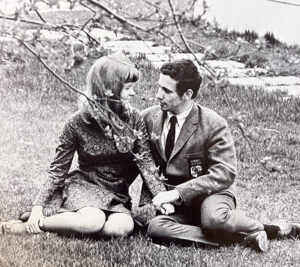
Surely in the 1960s, when UMBC only had four academic buildings and no residential life yet, the tours were quicker, or at least shorter, right? Frances Allen Nickolas ’70, American studies, says: “Not really.” According to Nickolas, one of the early tour guides on campus, the tours would usually take over an hour as the interested visitors wanted to see the new school that had sprouted up in Catonsville over the last few years.


 The 1969 copy of Skipjack, the university’s year book, featured photos of Fran Allen giving tours to prospective students.
“We would talk about the majors UMBC offered and share perspectives from our own majors,” says Nickolas. “We would tell them about our experiences with the courses of study and the professors. I truly loved it because I got to meet different people all the time, and I just really enjoyed it. Because UMBC was much smaller in those days, later I’d run into some of those visitors again, but as students this time.”
This is something the modern tours have in common, says Darby, a Sondheim Scholar who enjoys giving her tours an in-depth view of her majors and favorite areas on campus (The Commons and the Library). But the thing she values most is getting to know these potential Retrievers. “I have made so many genuine connections with people when I’m out on tour—I enjoy making jokes and making them laugh,” says Darby. “Some people might think it’s ‘just a campus job,’ but I love seeing the high schoolers’ reactions to campus. It’s rewarding in a way that none of my other jobs have been. I really love it.”
]]>
Sarah Darby regularly gets in thousands of steps walking backwards around campus. “I have never felt more burn in my legs. It’s like you’re using muscle groups that you don’t use when you walk...
https://umbc.edu/stories/then-now-going-on-campus-tour/
https://my3.my.umbc.edu/api/v0/pixel/news/154794/guest@my.umbc.edu/a55a6e4a429da0771fc98db8af4558f4/api/pixel
alumni
american-studies
cahss
campus-life
fall-2025
founding-four
magazine
polisci
psychology
sondheim-scholar
story
then-and-now
UMBC News & Magazine
https://my3.my.umbc.edu/groups/umbc-news-magazine
https://assets1-my.umbc.edu/system/shared/avatars/groups/000/001/943/24435aa6207c452e7bc15cc74b42c7bb/xsmall.png?1748556657
https://assets1-my.umbc.edu/system/shared/avatars/groups/000/001/943/24435aa6207c452e7bc15cc74b42c7bb/original.png?1748556657
https://assets2-my.umbc.edu/system/shared/avatars/groups/000/001/943/24435aa6207c452e7bc15cc74b42c7bb/xxlarge.png?1748556657
https://assets2-my.umbc.edu/system/shared/avatars/groups/000/001/943/24435aa6207c452e7bc15cc74b42c7bb/xlarge.png?1748556657
https://assets3-my.umbc.edu/system/shared/avatars/groups/000/001/943/24435aa6207c452e7bc15cc74b42c7bb/large.png?1748556657
https://assets1-my.umbc.edu/system/shared/avatars/groups/000/001/943/24435aa6207c452e7bc15cc74b42c7bb/medium.png?1748556657
https://assets2-my.umbc.edu/system/shared/avatars/groups/000/001/943/24435aa6207c452e7bc15cc74b42c7bb/small.png?1748556657
https://assets1-my.umbc.edu/system/shared/avatars/groups/000/001/943/24435aa6207c452e7bc15cc74b42c7bb/xsmall.png?1748556657
https://assets2-my.umbc.edu/system/shared/avatars/groups/000/001/943/24435aa6207c452e7bc15cc74b42c7bb/xxsmall.png?1748556657
UMBC News & Magazine
1
0
false
Fri, 21 Nov 2025 15:56:11 -0500
Fri, 21 Nov 2025 15:56:11 -0500
Stepping up to the plate to preserve UMBC history
When the Fort McHenry Tunnel opened, drivers could thank Richard “Rock” Soracoe ’71, economics, for helping them see as they drove under the harbor. Soracoe spent 50-plus years in the lighting industry and helped source the original 8,870 8-ft light fixtures that lined the road. In retirement, he’s helping shed a different type of light. Soracoe and other members of the founding four classes at UMBC are putting their collective memories to work to assist in identifying people and events in UMBC’s archival material to help complete our UMBC history. One event—UMBC’s first intercollegiate athletics win—is a story Soracoe loves to tell.
I have the game ball in my hand. The red stitches feel familiar, and the leather sits in my palm like it was made to fit. I’m not on the mound winding up to pitch, however; I’m standing in the basement of the Albin O. Kuhn Library. It’s been 57 years since I last touched this baseball when UMBC won its first intercollegiate victory.
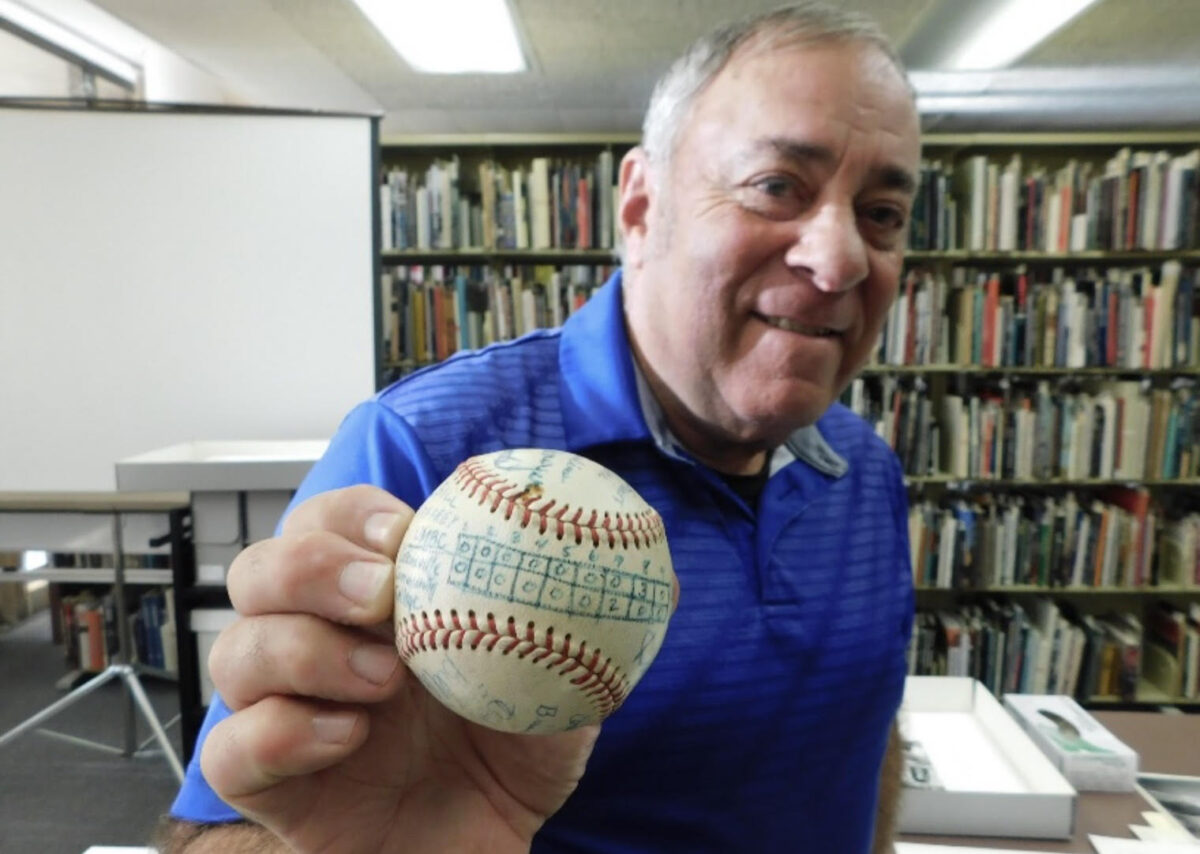 In UMBC’s Special Collections, Soracoe holds up the first game-winning baseball with the box score drawn on.
In 1967, UMBC’s inaugural fall sports season, the teams didn’t win a single game (as a member of the UMBC soccer team at the time, I was well aware of this), so it fell to baseball or lacrosse, the spring sports, to come through with the first win. While the details of that ballgame (a 3-2 win) are fuzzy now—all that remains officially is a 28-word write up in the Baltimore Sun archives—the game deserves its place of honor in the relatively short history of our institution. The budding campus newspaper, The Retriever Weekly, didn’t cover the game (although they did cover our loss to the same team the following week) and the box score is immortalized only as pen scratched onto the game ball’s leather.
Despite the lack of thorough archival material, in its own way, the game has certainly gone on to define aspects of my own life. Ken Diehl—the pitcher of the losing team, Catonsville Community College—would go on to transfer to UMBC the next year. We bonded over our shared Retriever spirit and also from our shared memories as roommates on UMBC’s first mini-mester trip to Europe in 1968. But it’s my Founding Four membership that drives me to keep memories like the first intercollegiate win alive.
As graduates of the first four classes at UMBC, we feel excited but also responsible for helping archive and catalog memories that might be unique to us. It’s one of the reasons we wrote This Belongs to Us, and it’s the reason we meet at the library to help the university archivists put appropriate names and metadata on early university yearbooks called Skipjack and other historical materials.
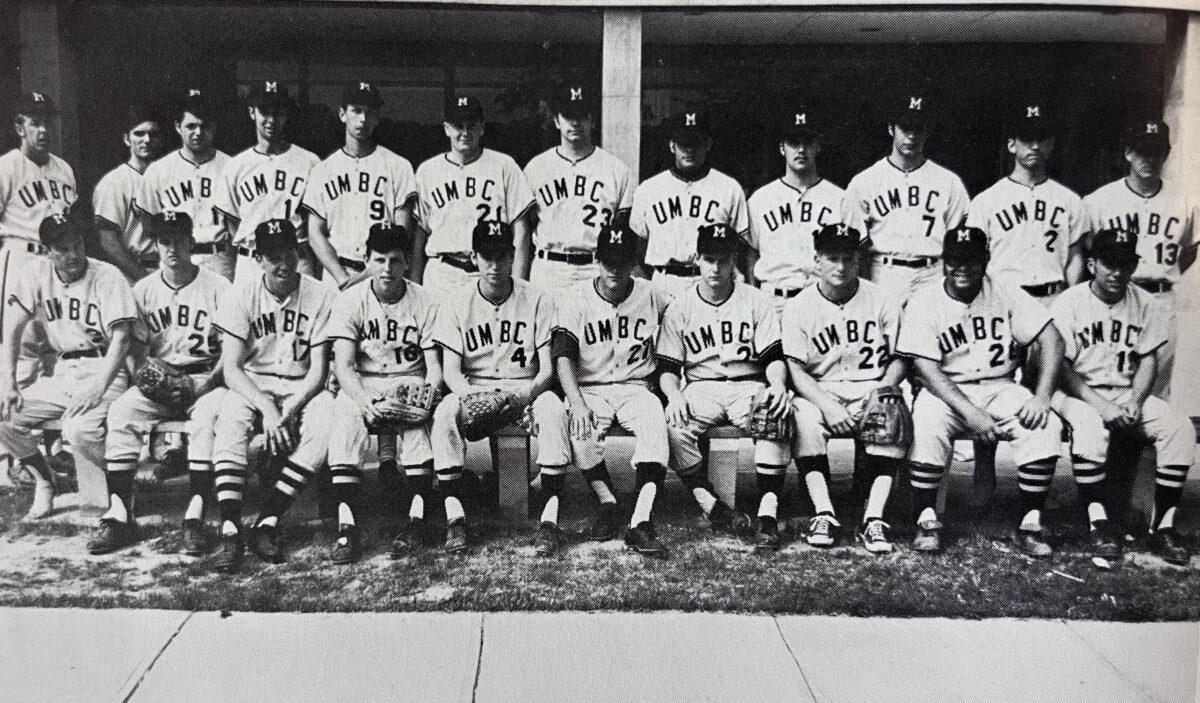
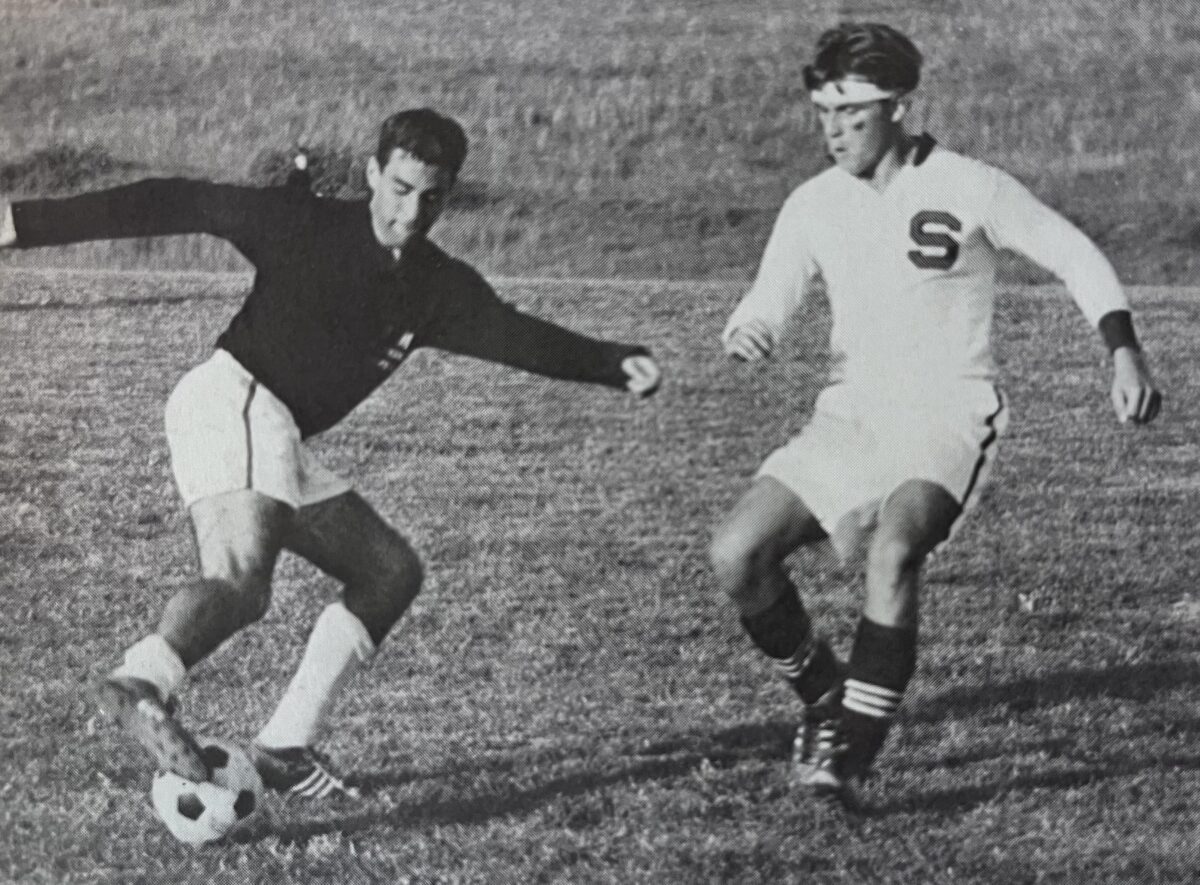
Left, the 1969 baseball team pictured in the 1969 university yearbook, Skipjack. Right, Soracoe in the black jersey also played on UMBC’s men’s soccer team.
When we were students here—walking around on plywood sidewalks on top of muddy construction sites—we weren’t thinking about creating the history of UMBC. We referred to the college as “high school plus one.” So our yearbooks rarely include captions or names and it’s up to us now to identify those people so that they’re not lost to history.
Some things have been lost to history. Louie Sowers [’70, American studies], a fellow classmate and student-athlete, stood up for Retriever women to have equal representation in university sports well before Title IX made it mandatory. She, along with Athletic Director Dick Watts, formed the women’s field hockey, basketball, and volleyball teams for the 1967 – 1968 academic year. Unfortunately, those records have been lost to time, so on paper, officially, women’s varsity sports only started in 1973.
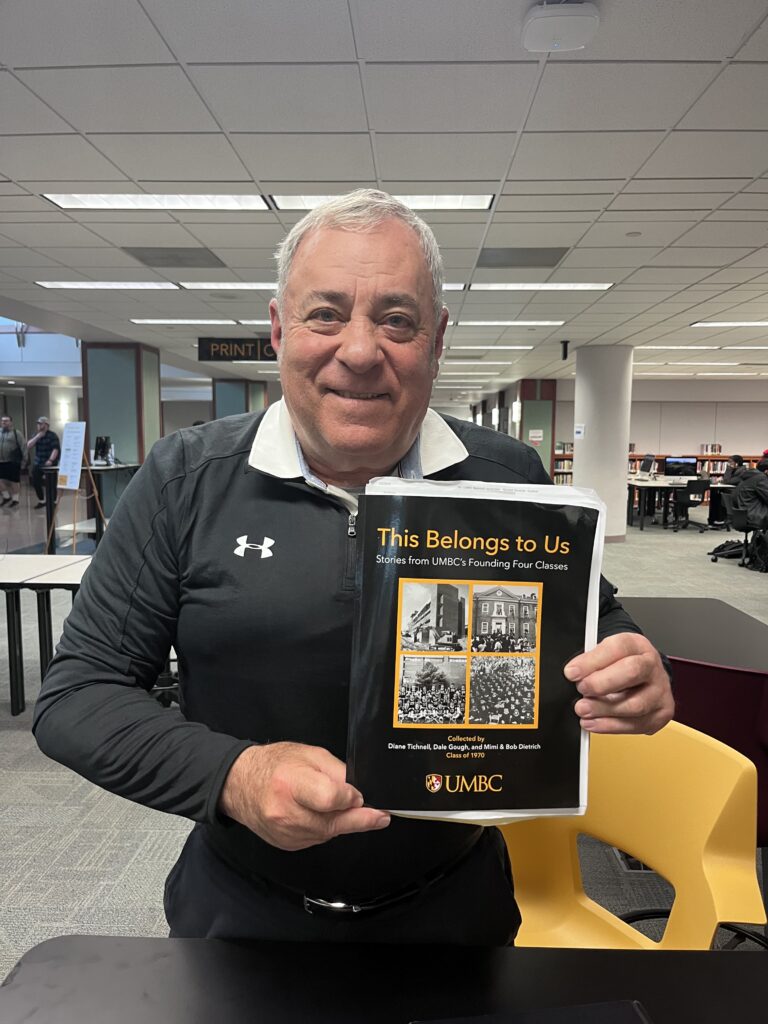 Soracoe holds a copy of This Belongs to Us—the Founding Four’s book about UMBC’s early days.
I reached out to some teammates to see if they could help me fill in the missing blanks of that game in April 1967. We played at Banneker Field in Catonsville (referred to as the “loser’s field” in the Sun write up) because UMBC did not have its own field yet. It was a low-scoring game; CCC got the first two runs in the game in the bottom of the 7th inning. The top of the 8th would be our key to victory. After one runner already came in, my teammate Bill Rust [’71, history] remembers players on second and third. He was at bat, and lined our then-opponent Ken’s pitch into left center field for what would become the game-winning RBIs.
What I remember is pitching the whole game (90 pitches according to Bill’s memory), and being so grateful when Ken [’70, psychology] joined our team the next year as an additional pitcher. And over the years, I’ve grown comfortable with the idea that the individual details don’t matter as much as the whole picture. Stepping back to see the shape of my career, my marriage, and my friends, I can see how they’ve all been defined by my UMBC experience.
UMBC was as welcoming as you wanted it to be, and still is today. My professors taught me the power of critical thinking and my coaches taught me the power of mental and physical discipline—which helped me in my job and my 36-year career as a high school and college soccer referee. I am very proud to say that I am a UMBC graduate and happy to see the tremendous achievement the university has attained from humble beginnings to worldwide status.
— Richard “Rock” Soracoe ’71, economics
]]>
When the Fort McHenry Tunnel opened, drivers could thank Richard “Rock” Soracoe ’71, economics, for helping them see as they drove under the harbor. Soracoe spent 50-plus years in the lighting...
https://umbc.edu/stories/stepping-up-to-the-plate-to-preserve-umbc-history/
https://my3.my.umbc.edu/api/v0/pixel/news/142515/guest@my.umbc.edu/1ba6502c67b2faff3c9f3194cc2c07a1/api/pixel
alumni
alumni-essay
american-studies
athletics
baseball
economics
founding-four
history
magazine
spring-2024
story
umbc-history
UMBC News & Magazine
https://my3.my.umbc.edu/groups/umbc-news-magazine
https://assets1-my.umbc.edu/system/shared/avatars/groups/000/001/943/24435aa6207c452e7bc15cc74b42c7bb/xsmall.png?1748556657
https://assets1-my.umbc.edu/system/shared/avatars/groups/000/001/943/24435aa6207c452e7bc15cc74b42c7bb/original.png?1748556657
https://assets2-my.umbc.edu/system/shared/avatars/groups/000/001/943/24435aa6207c452e7bc15cc74b42c7bb/xxlarge.png?1748556657
https://assets2-my.umbc.edu/system/shared/avatars/groups/000/001/943/24435aa6207c452e7bc15cc74b42c7bb/xlarge.png?1748556657
https://assets3-my.umbc.edu/system/shared/avatars/groups/000/001/943/24435aa6207c452e7bc15cc74b42c7bb/large.png?1748556657
https://assets1-my.umbc.edu/system/shared/avatars/groups/000/001/943/24435aa6207c452e7bc15cc74b42c7bb/medium.png?1748556657
https://assets2-my.umbc.edu/system/shared/avatars/groups/000/001/943/24435aa6207c452e7bc15cc74b42c7bb/small.png?1748556657
https://assets1-my.umbc.edu/system/shared/avatars/groups/000/001/943/24435aa6207c452e7bc15cc74b42c7bb/xsmall.png?1748556657
https://assets2-my.umbc.edu/system/shared/avatars/groups/000/001/943/24435aa6207c452e7bc15cc74b42c7bb/xxsmall.png?1748556657
UMBC News & Magazine
1
0
false
Thu, 20 Jun 2024 13:02:54 -0400
Thu, 20 Jun 2024 13:02:54 -0400
Retriever for Life

Very few Retrievers can say they’ve spent as many years on campus or enjoyed quite so many roles in doing so as Joan Costello ’73, social work. From her first days as a student and student worker; to 41 years as a staff member in the library, audiovisual (AV) services, and multimedia center; to her current role as basketball season ticket holder, committee member of the Founding Four, and board member of the Wisdom Institute—UMBC’s organization for retired staff and faculty—Costello shares why she’s chosen to make UMBC her second home for more than 50 years.
The first days
I grew up two miles away, and when this new school opened, I thought I would give UMBC a shot. In my memory, it rained at the beginning of most semesters—a nice complement to the on-going construction. But I really enjoyed the experience of being part of a young university. It was fun seeing everything grow up with me.
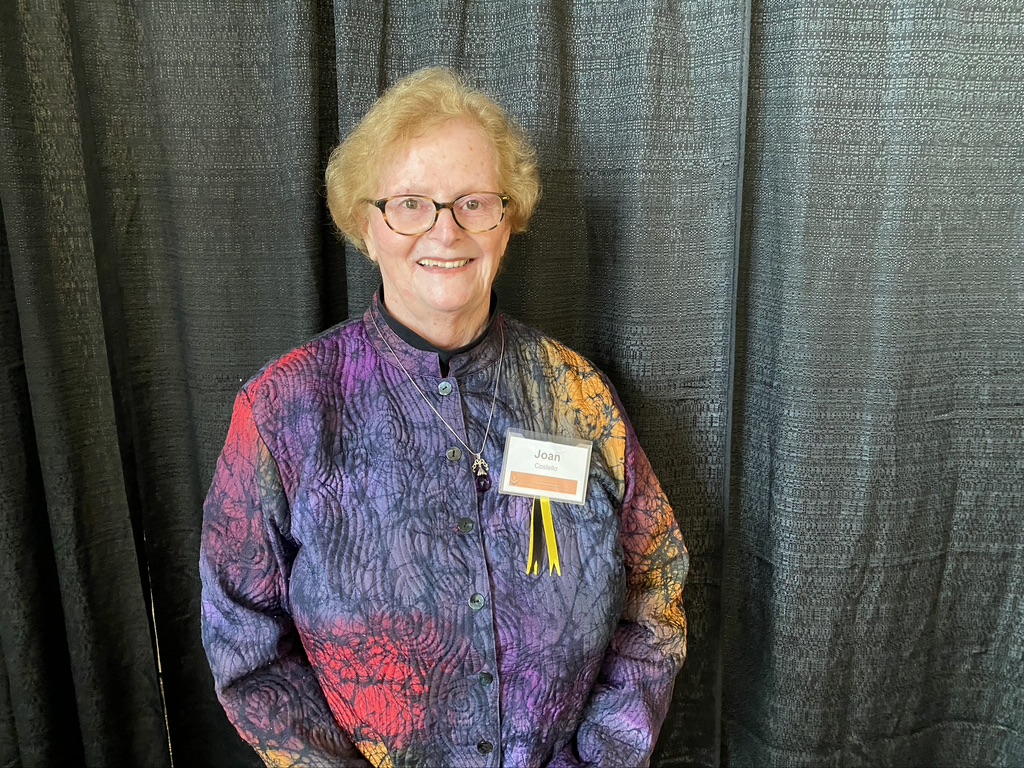 Costello at a 2023 Wisdom Institute event.
College was hard at first. It was a big change for me academically; even the language used was very different from what I was used to. Terms like mean and median and bell curve I had never heard of! I took a statistics course and I thought I was doing okay compared with everybody else. We were all on that same curve, right? But when it came to the final, I ended up getting a D in that class. I didn’t know yet about repeating classes, or dropping them at the last minute, so it took me a while to bring my GPA up, but I did.
In my second semester, I got a job at the library—not yet the Albin O. Kuhn Library that Retrievers have access to now—and it gave me an outlet to learn more about the campus, faculty, staff, student workers, and patrons. The library was a great place to work. We learned each other’s jobs so that we could help in a pinch, and we had the best parties—staff Olympics and talent contests like the Gong Show. We were all young, students and staff, and many of those bonds have lasted over 50 years.
Returning to work at UMBC
After I graduated, I worked at the Good Shepherd School for Girls for five months, but UMBC called me and offered me a job in the library, so I happily returned. I eventually became a supervisor of Record and Tape. Back then there was an AV department on campus that did the movies and equipment around campus, which eventually went under the wing of the library. It became two jobs: supervising Record and Tape and AV services. AV was located in the Chem/Physics building, which had to be the worst office ever because it was in the basement and you got the lovely fumes from the labs.
We later moved to a new building, Academic IV (now Sherman Hall). Victor Aulestia (director of instructional technology) made his case to put the media areas together—AV services, the International Media Center (the Language Lab), and the TV studio.
I always loved getting to know the students, staff, and faculty. And I liked to help. If somebody needed help in a pinch, I would try to arrange it. I later worked in the International Media Center in Academic IV. It was a great study area for students to hang out.
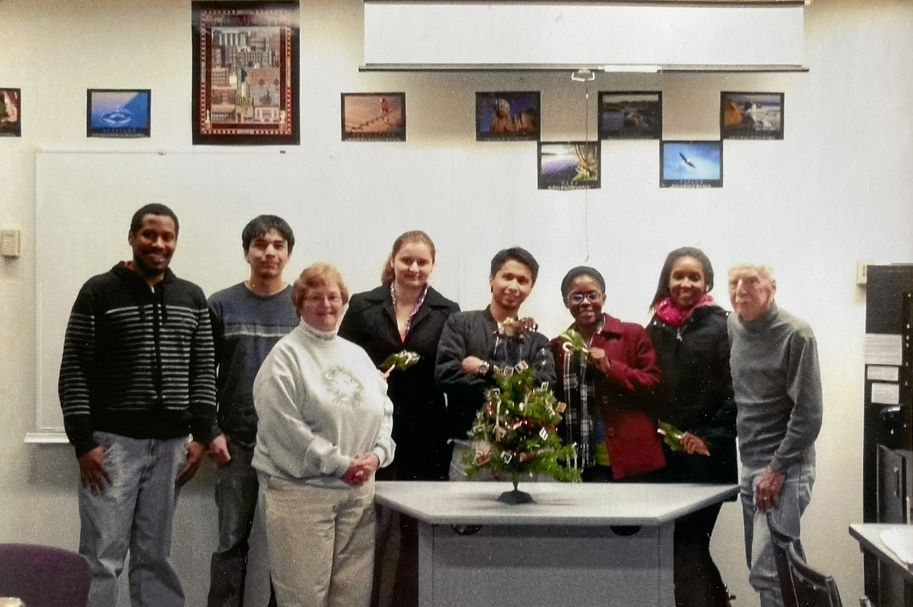 Costello (center front) with student workers in 2012.
At the beginning of the school year, kids often looked lost, and so I tried to help with directions and encourage them—I really enjoyed that. I had a crew of students who worked with me—students from all over the place—and it was fun getting to know all of them. I wanted to make them feel comfortable because some of them were away from home for the first time.
Long-term Retriever
I’ve found ways to stay involved. I am a part of the Founding Four group (our members include the first four graduating classes of UMBC). It’s been rewarding to be involved with that group and to hear other people’s stories. In fact, we have just put together a book of early recollections, This Belongs to Us. I go to the UMBC theatre to see the plays as often as I can, and I’m also a basketball season ticket holder. I always see friends there.
I’m also on the board of the Wisdom Institute, a group of UMBC retirees always working to bring folks together with activities and volunteering and camaraderie. We’ve done luncheons, we’ve gone to plays and concerts at Lurman Woodland Theatre, in Catonsville. We also get people involved in service, like helping tutor or mentor students in the nearby schools, and that’s a great way of giving back. Our biggest hit as an institute is our annual special talk and luncheon—we’ve had some great speakers, and you get to see so many people coming back to campus.
That’s the best part. You get to keep your connections to people you knew at UMBC, and maybe you wouldn’t think of getting together with them otherwise, but we have this venue that makes it easy and makes it so much fun.
I’ve stayed connected to UMBC for all this time because it’s familiar, convenient, and like another family. UMBC is its own community within the loop. I enjoyed the people…and I still do!
Learn more about the Wisdom Institute, now celebrating its fifth anniversary.
]]>
Very few Retrievers can say they’ve spent as many years on campus or enjoyed quite so many roles in doing so as Joan Costello ’73, social work. From her first days as a student and student worker;...
https://umbc.edu/stories/retriever-for-life/
https://my3.my.umbc.edu/api/v0/pixel/news/134002/guest@my.umbc.edu/4be79e06579bbc4114f2eca340a76207/api/pixel
alumni
cahss
founding-four
magazine
social-work
spring-2023
UMBC News & Magazine
https://my3.my.umbc.edu/groups/umbc-news-magazine
https://assets1-my.umbc.edu/system/shared/avatars/groups/000/001/943/24435aa6207c452e7bc15cc74b42c7bb/xsmall.png?1748556657
https://assets1-my.umbc.edu/system/shared/avatars/groups/000/001/943/24435aa6207c452e7bc15cc74b42c7bb/original.png?1748556657
https://assets2-my.umbc.edu/system/shared/avatars/groups/000/001/943/24435aa6207c452e7bc15cc74b42c7bb/xxlarge.png?1748556657
https://assets2-my.umbc.edu/system/shared/avatars/groups/000/001/943/24435aa6207c452e7bc15cc74b42c7bb/xlarge.png?1748556657
https://assets3-my.umbc.edu/system/shared/avatars/groups/000/001/943/24435aa6207c452e7bc15cc74b42c7bb/large.png?1748556657
https://assets1-my.umbc.edu/system/shared/avatars/groups/000/001/943/24435aa6207c452e7bc15cc74b42c7bb/medium.png?1748556657
https://assets2-my.umbc.edu/system/shared/avatars/groups/000/001/943/24435aa6207c452e7bc15cc74b42c7bb/small.png?1748556657
https://assets1-my.umbc.edu/system/shared/avatars/groups/000/001/943/24435aa6207c452e7bc15cc74b42c7bb/xsmall.png?1748556657
https://assets2-my.umbc.edu/system/shared/avatars/groups/000/001/943/24435aa6207c452e7bc15cc74b42c7bb/xxsmall.png?1748556657
UMBC News & Magazine
1
0
false
Wed, 14 Jun 2023 12:56:09 -0400
UMBC Belongs to All of Us
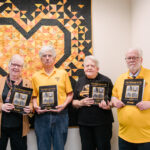
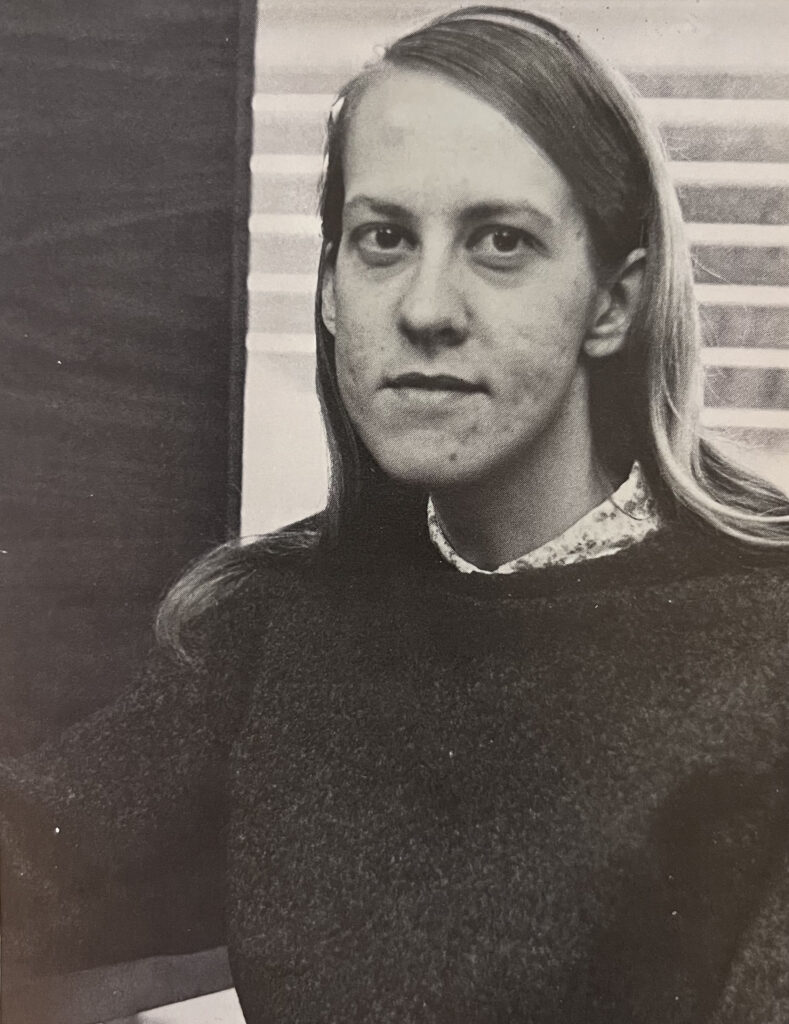 Diane Tichnell from the 1970 Skipjack, UMBC’s yearbook.
UMBC is a young institution—and not only do we have active alumni from the first four graduating classes still working to make an impact on campus and beyond, we are still discovering new stories about the establishment of the university and the ways the campus community was invited to co- create UMBC at its inception.
In fact, Diane Tichnell ’70, political science, describes the impetus for the Founding Four’s book, This Belongs to Us (2023), as its own sort of inception. Several years ago, she had a dream—literal dream while she was asleep. In it, she was attending a lecture given by then-President Freeman Hrabowski. He was talking about the books he had written, and afterward, Tichnell went up to speak to him. In her dream, she said, “We need to get the first four years of UMBC documented because soon we’re all going to be gone. Maybe in a hundred years, somebody will write it down, but why not do it now?” Dream Freeman replied, “Write that book.”
Mimi Dietrich ’70, American studies, remembers an event at the Wisdom Institute—UMBC’s association for retired faculty and staff—where a UMBC professor expressed surprise by Dietrich’s story about the plywood sidewalks that connected campus during the construction in the early years. “What do you mean you’ve never heard that story?” Dietrich responded—she figured everyone remembered what it was like in the beginning. “So Diane and I, and later Dale [Gough ’70, American studies] and Bob [Dietrich ’70, biological sciences, Mimi’s husband] came together on this; and we just started saying, ‘We have to do this. We have to do this right now.’”
Left: Co-authors Mimi and Bob Dietrich in UMBC’s 1970 yearbook Skipjack. Right: Dale Gough (pictured with Betty Huesman ’70) in the 1969 Skipjack.
Those four brainstormed the idea and knew that this labor of love would need to be as inclusive as possible. “We needed to engage the collective memory of everybody that we could possibly ask to write a story from the first four classes who were on campus,” says Tichnell. They sent newsletters, emails, mail, and even knocked on doors to capture the voices of as many graduates as possible.
In the end, 84 authors contributed more than 100 stories to This Belongs to Us, a kaleidoscopic retelling of the colorful and authentic story of UMBC. Proceeds from the book (at the clever price of $19.66) go to several scholarships supported by the founding four classes.
The Founding Four marvel at what their young institution has grown into. “All those flags in The Commons are so incredible to me,” says Joan Costello ’73, social work, a contributing author. “Because they’re from different countries. But when we came here, we were just from different neighborhoods.”
]]>
Diane Tichnell from the 1970 Skipjack, UMBC’s yearbook. UMBC is a young institution—and not only do we have active alumni from the first four graduating classes still working to make an impact...
https://umbc.edu/stories/umbc-belongs-to-all-of-us-founding-four/
https://my3.my.umbc.edu/api/v0/pixel/news/133982/guest@my.umbc.edu/49059143f75149be9cf1041938729431/api/pixel
alumni
american-studies
biological-sciences
erickson-school
founding-four
impact
magazine
spring-2023
UMBC News & Magazine
https://my3.my.umbc.edu/groups/umbc-news-magazine
https://assets1-my.umbc.edu/system/shared/avatars/groups/000/001/943/24435aa6207c452e7bc15cc74b42c7bb/xsmall.png?1748556657
https://assets1-my.umbc.edu/system/shared/avatars/groups/000/001/943/24435aa6207c452e7bc15cc74b42c7bb/original.png?1748556657
https://assets2-my.umbc.edu/system/shared/avatars/groups/000/001/943/24435aa6207c452e7bc15cc74b42c7bb/xxlarge.png?1748556657
https://assets2-my.umbc.edu/system/shared/avatars/groups/000/001/943/24435aa6207c452e7bc15cc74b42c7bb/xlarge.png?1748556657
https://assets3-my.umbc.edu/system/shared/avatars/groups/000/001/943/24435aa6207c452e7bc15cc74b42c7bb/large.png?1748556657
https://assets1-my.umbc.edu/system/shared/avatars/groups/000/001/943/24435aa6207c452e7bc15cc74b42c7bb/medium.png?1748556657
https://assets2-my.umbc.edu/system/shared/avatars/groups/000/001/943/24435aa6207c452e7bc15cc74b42c7bb/small.png?1748556657
https://assets1-my.umbc.edu/system/shared/avatars/groups/000/001/943/24435aa6207c452e7bc15cc74b42c7bb/xsmall.png?1748556657
https://assets2-my.umbc.edu/system/shared/avatars/groups/000/001/943/24435aa6207c452e7bc15cc74b42c7bb/xxsmall.png?1748556657
UMBC News & Magazine
4
0
false
Tue, 13 Jun 2023 13:31:26 -0400
Tue, 13 Jun 2023 13:31:26 -0400
Shop Talk

One of the undeniable benefits of UMBC’s relative youth is access to founding members of the institution and other individuals who’ve played a foundational role in shaping the University. What happens when you sit down three key players in Alumni Relations and Development who span the years of UMBC from the first day to this present moment? You learn that some things haven’t changed.
When Royce Bradshaw ’70, political science, was hired in 1969 by Chancellor Albin O. Kuhn to be the first director of the not-yet-formed alumni association, he worked as an office of one. Barbara Quinn’78, ancient studies, who took on the role of executive director of Alumni Relations in 1979, reiterates the need to wear multiple hats when working with a small staff that carries a large mandate—a mandate that grows larger with each graduating class.
Today, under the leadership of Stanyell Odom, the director of Alumni Engagement, UMBC boasts 83,000 Retriever alumni. These three sat down in October 2020 for a socially distanced discussion of how their work has shifted over the years.
Stanyell Odom: How would you both characterize UMBC alumni? What sets them apart from students at other schools?
Barbara Quinn: I would say that they’re extremely committed and they really believe in the institution. A lot of that has to do with Freeman because he has made UMBC into a family. Even though it’s continued to grow it still feels like the original institution it was back in the ’60s. And so people feel really committed to it and really want to see it continue to do well.
 Bradshaw featured in the 1969 Skipjack, the university yearbook at the time.
Royce Bradshaw: We’re getting to be a big family. How do you make it personal at this size? To go from representing the founding class to somehow connecting with this giant population of alumni, that’s very different.
For example—Dr. Kuhn, UMBC’s chancellor at the time I graduated—he still had his farm, and during graduation, we got to nibble on strawberries from his own garden. When you have 80,000 alumni, that relationship is much different.
Odom:Barb, during your 15 years at UMBC the alumni population jumped from 5,500 to 22,000. How did you manage to keep the alumni as a whole engaged but also develop personal relationships?
Quinn: You know what, we did a lot of stuff around Athletics, because we had a good lacrosse program, a good basketball program. We also engaged the sororities and fraternities to help us. We also did special projects, like installing the statue of the Chesapeake Bay Retriever in front of the RAC.
An early project that engaged alumni is the Second Generation Scholarship, created by a committee of African American alumni to support students trying to finish their degree. We also had an alumni board that was just really devoted, really committed to the University.
Odom: Royce, from 1970 to 1972, you went from 240 graduates to 1,200 graduates. That’s a pretty substantial increase. And I know when I started at UMBC in 2006 we had 40,000 alumni, which has more than doubled now.
So to get to your question, Royce, about how to make it personal, I think anyone working with alumni now, that’s the constant struggle. I get the opportunity to work with alumni leaders and so my personal relationships are developed through the Second Generation Scholarship committee, the alumni board, working with your group, Royce, the Founding Four.
It would be really helpful to get an understanding, Royce, of how you became the first, alumni director.
Bradshaw: I came to UMBC after getting out of the army with a wife and child. The Cold War GI bill passed and I decided to use it. My second child was born 10 days before UMBC opened.
 Part of the senior project included repainting local buildings.
I was very active in student government even though I was driving a taxi to support my family at the same time. I was the first student appointed to the faculty senate. I worked very closely with Dr. Kuhn. He was a guy you could call and get a meeting with the same day. I mean as a student, you know?
I was the second person to complete their degree requirements at UMBC, finishing in 1969. Chancellor Kuhn asked me to stay on at UMBC as his graduate assistant, and to begin planning for the alumni and development programs. In 1971, I became the first director of Alumni and Development, and served for one year. During my tenure I helped organize the class of 1970 gift.
Our senior class project was to write to corporations and ask them to donate to a student emergency loan fund, and in return we would do projects for them. We raised $13,000, which was no small amount of money at the time!
Odom: Barb, during your tenure as executive director of Alumni Relations what are some major ways that your office engaged alumni?
Quinn:There are actually two things. The first wasn’t a project that I particularly liked but it turned out to be a good thing—the first alumni directory. Creating something like this (and without a computer!) takes so much work. It was the first collective thing that we had with all the alumni listed in it.
The second thing, one of my favorite projects I mentioned earlier, was the Second Generation Scholarship.
Odom:Oh, wow. We still have that in place!
Quinn:The Second Generation Scholarship requires that scholarship candidates take a course in Africana studies and demonstrate a commitment to improving the lives of minorities through community service. It was started by James Wiggins ’75, political science, and other African American alumni. It was a lot of work but it was so much fun.
Odom: We actually think it’s one of the first, or possibly the first alumni-endowed scholarships at the University.
Quinn:It’s a huge source of pride for me. Because I know how much work went into it, and it was a really cool thing. I have to admit.
 Quinn looks through documents from UMBC’s early years.
Quinn: Stanyell, while you’ve been at UMBC, what are you most proud of?
Odom:I think for me the pinnacle of my experience at UMBC was the 50th anniversary celebration. I don’t think any of us fully knew what we were in store for, but to see thousands of alumni be engaged throughout those yearlong series of events was so satisfying.
I’ll just never forget the moment when the fireworks went off and it was done and the night was over and it was like, we did this. It was such a feeling of accomplishment because I mean we put our blood, sweat, and tears into that. And through that work I got a better relationship and a strategic partnership with the alumni board and the association.
I know that when I think about how we characterize our alumni, I see their immense pride of really being part of the school’s story. I’ve been here to see the prominence and the reputation of the University continue to evolve. It’s not that we’re without our problems—we certainly have our challenges—but I think that the way we approach problem-solving as a community, it feels really good, and I think alums have become accustomed to being a part of that.
The Second Generation committee continues to illustrate this, and our Alumni Association Board of Directors is also a perfect example. They award annual scholarships to students, and they wanted to double their endowment to $200,000 by 2020. Five years ago the endowment was at $100,000. Before the campaign ended they actually had $225,000. And so I think it’s a good example of alumni also taking the lead and saying, “No, we want to help with this fundraising. It doesn’t have to all be UMBC. Here’s what we want to do.” And that’s been really great.
Barb, doesn’t it feel good to know that things that were in place when you were here that they’re still moving forward?
Quinn: It feels like it’s coming full circle.
Odom: I think that we’re ready for the next big thing.
*****
Header image: Quinn, Bradshaw, and Odom sit outside OCA Mocha in Arbutus for a socially-distant discussion. All photos by Marlayna Demond ’11.
]]>
One of the undeniable benefits of UMBC’s relative youth is access to founding members of the institution and other individuals who’ve played a foundational role in shaping the University. What...
https://umbc.edu/stories/shop-talk/
https://my3.my.umbc.edu/api/v0/pixel/news/119717/guest@my.umbc.edu/b5ae65aaa1a04f79224fb5cc2aece8db/api/pixel
alumni
fall-2020
founding-four
impact
UMBC News & Magazine
https://my3.my.umbc.edu/groups/umbc-news-magazine
https://assets1-my.umbc.edu/system/shared/avatars/groups/000/001/943/24435aa6207c452e7bc15cc74b42c7bb/xsmall.png?1748556657
https://assets1-my.umbc.edu/system/shared/avatars/groups/000/001/943/24435aa6207c452e7bc15cc74b42c7bb/original.png?1748556657
https://assets2-my.umbc.edu/system/shared/avatars/groups/000/001/943/24435aa6207c452e7bc15cc74b42c7bb/xxlarge.png?1748556657
https://assets2-my.umbc.edu/system/shared/avatars/groups/000/001/943/24435aa6207c452e7bc15cc74b42c7bb/xlarge.png?1748556657
https://assets3-my.umbc.edu/system/shared/avatars/groups/000/001/943/24435aa6207c452e7bc15cc74b42c7bb/large.png?1748556657
https://assets1-my.umbc.edu/system/shared/avatars/groups/000/001/943/24435aa6207c452e7bc15cc74b42c7bb/medium.png?1748556657
https://assets2-my.umbc.edu/system/shared/avatars/groups/000/001/943/24435aa6207c452e7bc15cc74b42c7bb/small.png?1748556657
https://assets1-my.umbc.edu/system/shared/avatars/groups/000/001/943/24435aa6207c452e7bc15cc74b42c7bb/xsmall.png?1748556657
https://assets2-my.umbc.edu/system/shared/avatars/groups/000/001/943/24435aa6207c452e7bc15cc74b42c7bb/xxsmall.png?1748556657
UMBC News & Magazine
0
0
false
Wed, 16 Dec 2020 16:20:50 -0500