UMBC’s student Fulbright recipients pursue community-driven research on a global stage
UMBC’s 2026 – 2027 recipients of the prestigious Fulbright U.S. Student Program are joining the ranks of UMBC’s distinguished Fulbright alumni, who have made UMBC a three-time Fulbright Top Producing Institution, a recognition from the U.S. Department of State’s Bureau of Educational and Cultural Affairs.
More than 2,000 Fulbright U.S. Students—recent college graduates, graduate students, and early career professionals—pursue graduate study, conduct research, or teach English in schools abroad each year, earning placements in Africa, Asia and the Pacific, the Middle East, Latin America, and Europe. This year’s Fulbright Retrievers are launching the international phase of their research. From Baltimore to the Dominican Republic, India, and Mexico, these students are working with and for local communities to support local approaches to ongoing challenges.
The art of collaboration
During her senior year, Marelen Acevedo Soto ’26, visual arts, wowed Retrievers at UMBC’s 2025 Undergraduate Research and Creative Achievement Day with an experiential painting that combined projection, animation, and live performance. Now, she is packing up these skills and taking them to Santo Domingo, Dominican Republic, where she was born. Acevedo Soto earned her associate’s degree from Chavón School of Design. She is returning to work with the students to create a large-scale mural titled “Multidimensional Mural: Augmented Reality for Environmental Change” in Santo Domingo’s Zona Colonial (Colonial Zone), a UNESCO World Heritage site. Using QR codes, passersby will access animations and hear community voices describing how pollution affects daily life. The project will close with a Spanish and English multimedia performance combining projected animations, environmental data, and Dominican music.


Acevedo Soto (on the right) with artists from The Music and Me Foundation and at URCAD 2025. (Images courtesy of Acevedo)
“Many of my strongest ideas came from learning across different fields at UMBC,” says Acevedo Soto. “Music theory helped me think about rhythm and emotion. Storytelling taught me how to create meaningful experiences. Psychology helped me better understand how people think and engage with art. Environmental science deepened my understanding of water and the importance of its conservation, and data analysis gave me the tools to measure the impact of my project.”
Researchers’ responsibility
Vunnathi Ankem ’26, psychology, has had a passion for India for years, specifically how cultural exchange in India was shaped by hundreds of years of discourse, colonization, and history. While researching intimate partner violence (IPV) for her honors thesis, Vunnathi Ankem ’26, psychology, became interested in how South Asian students developed their understandings of IPV. Unexpectedly, most of the students she interviewed were from Telugu-speaking regions, such as Hyderabad in southern India. Intrigued, Ankem is now headed to the Psychology Center at the University of Hyderabad to continue her research. “Psychology, as we know it in the Western world, is only one approach to understanding the mind and the body,” says Ankem. “As psychology students, it is our responsibility to explore worlds and lenses beyond the Eurocentric ones.”
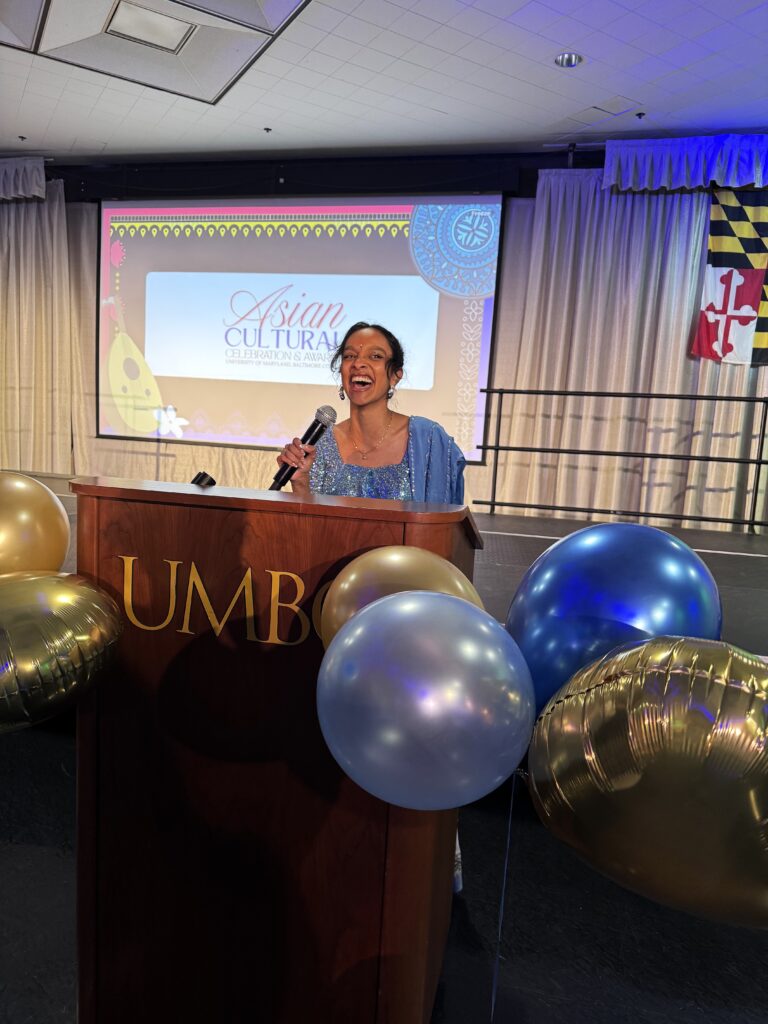
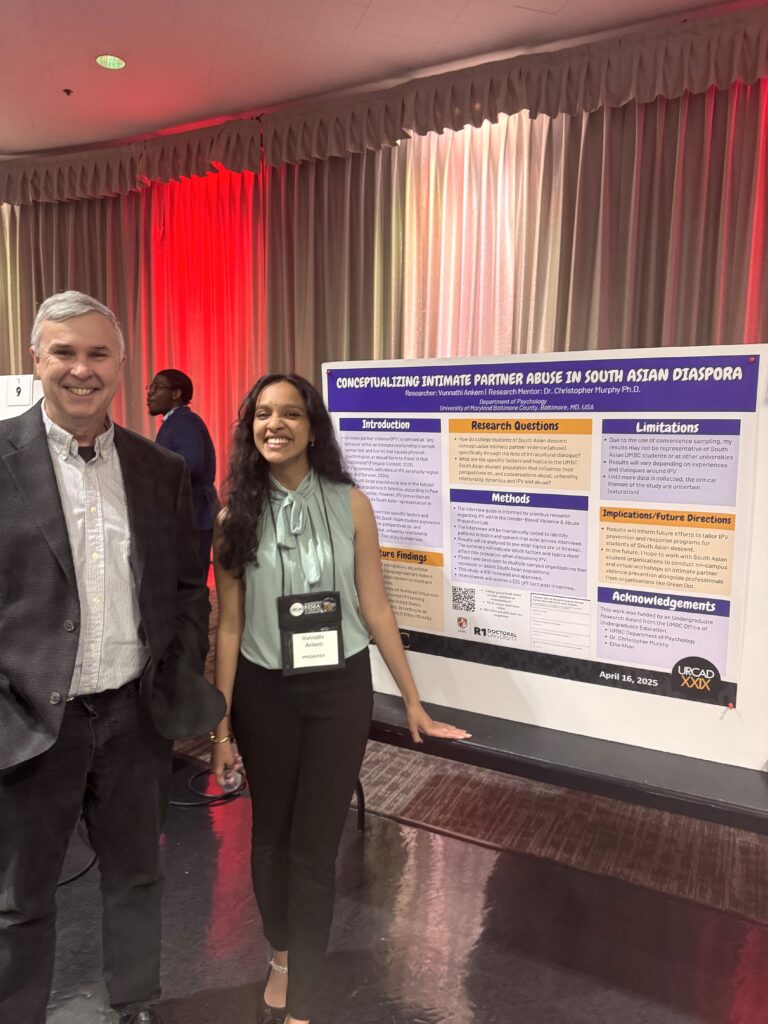
(l-r) Ankem at the 2026 Asian Cultural Celebration and Awards ceremony. Ankem with mentor Christopher Murphy, professor of psychology. (Images courtesy of Ankem)
She will study how systems, class, community, and culture shape experiences of IPV in India and inform more culturally responsive prevention strategies. Ankem will then develop community-based and community-led IPV prevention workshops. “The Fulbright program is giving me the opportunity I have always dreamed about,” says Ankem. “I can’t wait to learn from professionals and clinicians, alongside ancient culture practitioners and experts in India. It will be the experience of a lifetime!”
Humanistic climate futures
After studying climate change and migration on a study abroad trip to Oaxaca, Mexico, Bryan Castro-Velez ’26, geography and environmental studies, knew he was on the right research path—studying humanistic approaches to equitable agroecological systems and land in Indigenous Latin American communities. He says learning directly from indigenous leaders about their farming practices and response to climate change inspired him to apply for the Fulbright García-Robles award for graduate and doctoral research in Mexico. Castro-Velez’s graduate work will focus on agroecology, natural resource management, and rural development in Chiapas, Mexico.
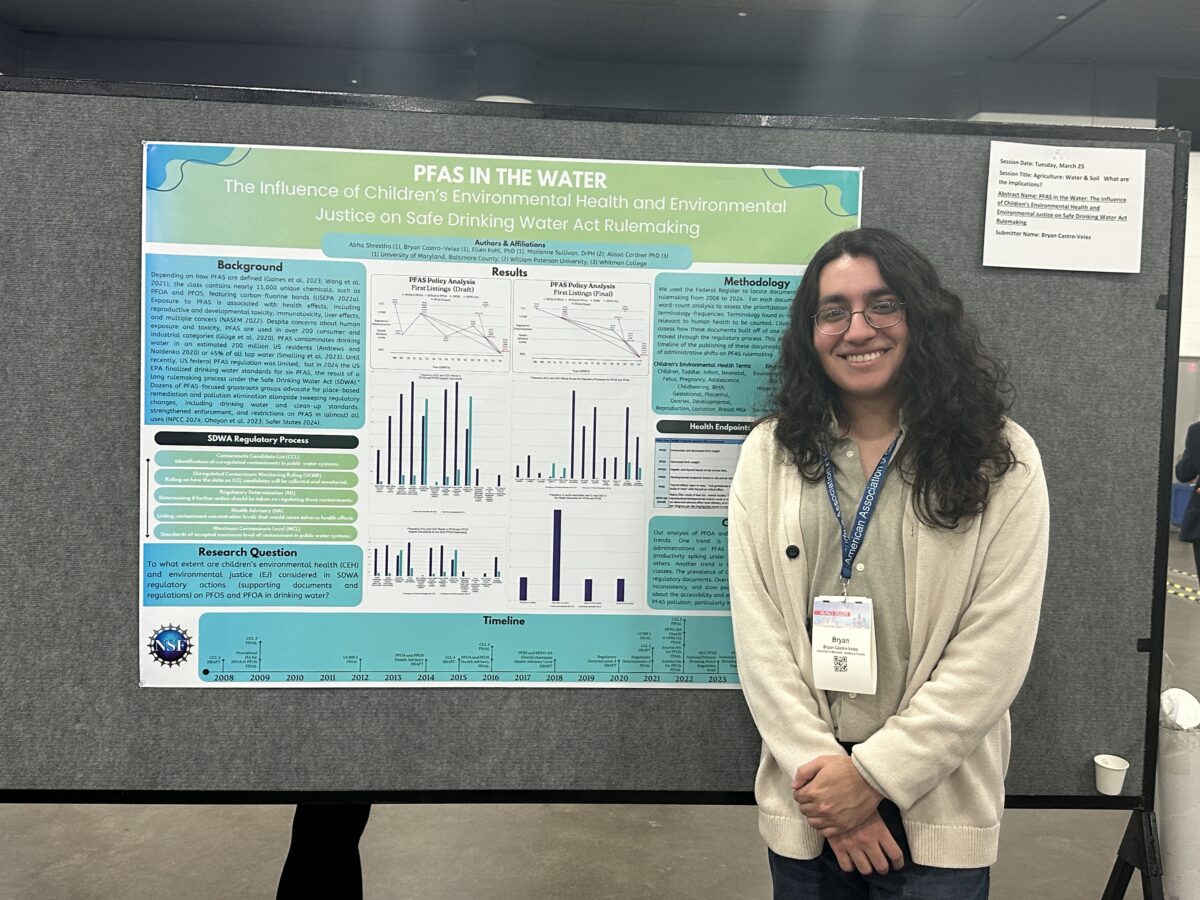 Bryan Castro-Velez at the 2025 Association of American Geographers annual conference in Detroit. (Image courtesy of Castro-Velez)
“I look forward to continuing down this path, encouraging others to do the same, and furthering my education outside the walls of academia,” says Castro-Velez. “My experiences during and outside of UMBC have proven to me that community-based learning systems are fundamental to just climate solutions and humanistic futures.”
As the U.S. Fulbright Program celebrates its 80th anniversary this year, UMBC’s Fulbright program is celebrating by expanding support through the Office of Prestigious Scholarships (OPS) under the leadership of April Householder ’95, director of OPS: “I am looking forward to building on UMBC’s strong legacy as a top producer of Fulbright students,” says Householder, “and expanding student support throughout the processes of exploring, applying, and transitioning abroad.”
Learn more about UMBC’s international opportunities.
]]>
UMBC’s 2026 – 2027 recipients of the prestigious Fulbright U.S. Student Program are joining the ranks of UMBC’s distinguished Fulbright alumni, who have made UMBC a three-time Fulbright Top...
https://umbc.edu/stories/umbcs-2026-student-fulbright-recipients/
https://my3.my.umbc.edu/api/v0/pixel/news/161318/guest@my.umbc.edu/3c2bd6a8225156f81db68222ed9fdd71/api/pixel
alumni
cahss
class-of-2026
community
fulbright
geographic-information-systems
international
policy-and-society
psychology
stories
story
urcad
visual-arts
UMBC News & Magazine
https://my3.my.umbc.edu/groups/umbc-news-magazine
https://assets1-my.umbc.edu/system/shared/avatars/groups/000/001/943/24435aa6207c452e7bc15cc74b42c7bb/xsmall.png?1748556657
https://assets1-my.umbc.edu/system/shared/avatars/groups/000/001/943/24435aa6207c452e7bc15cc74b42c7bb/original.png?1748556657
https://assets2-my.umbc.edu/system/shared/avatars/groups/000/001/943/24435aa6207c452e7bc15cc74b42c7bb/xxlarge.png?1748556657
https://assets2-my.umbc.edu/system/shared/avatars/groups/000/001/943/24435aa6207c452e7bc15cc74b42c7bb/xlarge.png?1748556657
https://assets3-my.umbc.edu/system/shared/avatars/groups/000/001/943/24435aa6207c452e7bc15cc74b42c7bb/large.png?1748556657
https://assets1-my.umbc.edu/system/shared/avatars/groups/000/001/943/24435aa6207c452e7bc15cc74b42c7bb/medium.png?1748556657
https://assets2-my.umbc.edu/system/shared/avatars/groups/000/001/943/24435aa6207c452e7bc15cc74b42c7bb/small.png?1748556657
https://assets1-my.umbc.edu/system/shared/avatars/groups/000/001/943/24435aa6207c452e7bc15cc74b42c7bb/xsmall.png?1748556657
https://assets2-my.umbc.edu/system/shared/avatars/groups/000/001/943/24435aa6207c452e7bc15cc74b42c7bb/xxsmall.png?1748556657
UMBC News & Magazine
0
0
false
Mon, 27 Jul 2026 17:10:21 -0400
Mon, 27 Jul 2026 17:10:21 -0400
From Baltimore City to Bergen, Norway: Fulbrighter Shanika Freeman ’24 researches the reentry process of women in one of the world’s most humane systems
After Shanika Freeman ’24 walked across the stage, she had something on her mind—basic human rights. For the past four years, Freeman’s research has focused on the reentry experiences of formerly incarcerated women in the United States and Maryland. Basic human rights—including access to healthy food, education, housing, healthcare, clothing, and job skills development—are difficult to access for people in the reentry process due to limited to no financial resources, support networks, services, and stigma.
“In Maryland, over 15,000 women are released from prison every year. Just imagine, you’ve been released, and unfortunately, you couldn’t get a transitional program or reentry program, so you are basically by yourself,” said Freeman during her individualized study major’s capstone presentation. “You go out, you kiss the ground because you know you are free, but you are only given about $50 to $100 of gate money to find transportation and all your basic needs.”
Reentry programs are not the root of these obstacles. During her research, Freeman learned that the U.S.incarceration system’s emphasis on punishments rather than rehabilitation means many women are released without workforce skills needed to meet the demands of a changing job, let alone recreate a new life. All of these factors increase recidivism rates.
“I wasn’t born to be caged up and chained up,” is a quote by Susan Burton that inspired Freeman to continue her research on successful reentry pathways. Burton is the founder of A New Way of Life Reentry Project, a non-profit organization in California that provides safe housing, pro bono legal services, advocacy, and family reunification for formerly incarcerated women. Leading with compassion inspired Freeman to seek similar approaches in her own work.
She didn’t know at the time that her search would lead her to Norway, whose incarceration system is widely recognized as one of the most humane rehabilitative institutions in the world. Their rehabilitation process emphasizes mentorship, skill-building, communal living, mirroring regular life based on the Norwegians’ belief that the only right a person loses through incarceration is liberty. As a result, Norway has one of the lowest rates of recidivism in the world. Thanks to a 2025 – 2026 Fulbright U.S. Student Program award, Freeman crossed the Atlantic to Bergen, Norway, to conduct research on the reentry experiences of Norwegian women into the community after incarceration.
Janteloven, a culture of humility
For the first time, Freeman boarded a plane, leaving the United States and Baltimore for Bergen, a city on Norway’s southwestern coast known as the city between the seven mountains. Freeman quickly found that life in Bergen is about enjoying nature. She remembers walking from her small studio apartment to the University of Bergen and seeing hikers everywhere. While cross-country skiing is the official national sport, hiking is an integral part of Bergen culture. Freeman joined the locals on both activities, and suited up with hiking boots and cross-country skis—also a first.

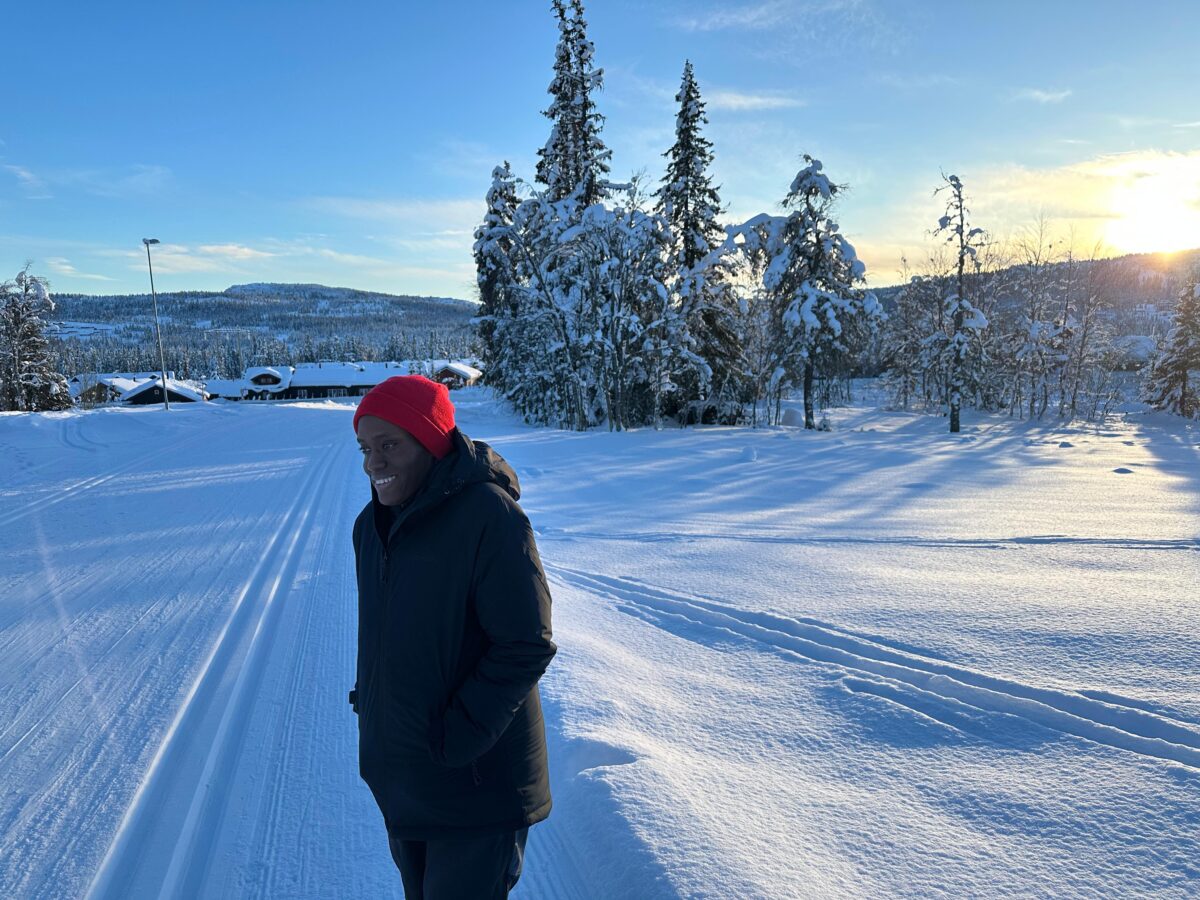 Left: Freeman cross-country skiing in Gausdal, Norway. Right: Freeman enjoys a walk in the mountains.
“I love this city. It’s not crowded. You can take a hike up a mountain any day of the week. Mount Fløyen is the closest and most popular mountain in Bergen,” said Freeman. “So many beautiful views and at the top, you can also get hot chocolate, coffee, and Norwegian waffles. It’s all really nice.” While she enjoyed the outdoors, Freeman did have some first-day jitters when it came time to join the research team.
“I was a bit hesitant when I arrived because I had just graduated with my bachelor’s, and most of my colleagues had a Ph.D. or were earning one. I was a bit worried about fitting in. But they welcomed me with open arms,” says Freeman. “Bergensere really value you and your voice, no matter what. It doesn’t matter if you have a degree or not, they really value you and make sure your voice is heard.”
This practice of equality and community above all is called Janteloven, a Scandinavian cultural, social, and literary concept that emphasizes equality, humility, and collective conformity over individual achievement. Freeman’s welcome was an example of Janteloven. This extends to architecture, clothing, and even standing in line.
I was a bit hesitant when I arrived because I had just graduated with my bachelor’s, and most of my colleagues had a Ph.D. or were earning one. I was a bit worried about fitting in. But they welcomed me with open arms,” says Freeman. “Bergensere really value you and your voice, no matter what. It doesn’t matter if you have a degree or not, they really value you and make sure your voice is heard.
Shanika Freeman ’24
Individualized Study
“From my perspective, a lot of Norwegians are sort of hard to crack because they don’t usually do small talk. Back in Baltimore, if you’re standing in line at the grocery store, you can strike up a conversation with anyone. Not here so much,” explains Freeman. “They’re not being rude. They value your time, and they value their time as well, and don’t want to inconvenience anybody. It’s a cultural norm.”
Janteloven in the prison system
Possibly because of this norm, it took time for Freeman to find participants who wanted to focus on their own story. “It’s such a sensitive subject that I researched. One of the challenges I faced was helping participants feel comfortable speaking,” said Freeman. “I talked about their feelings during incarceration and reentry. It’s a very vulnerable state to be in.” Her Fulbright research advisors stepped in and connected Freeman with a few participants and guided her to pivot from solely focusing on reentry to include the system side of the process by speaking with experts in the field of criminology and penology—the philosophy, management, and effectiveness of prison systems and rehabilitation methods.
“One of my main findings was that Norway’s successful reentry is shaped primarily by its welfare system. It is set up to help with social support, housing, education, and job support. They have something called the import model,” said Freeman, “which means that they rely on external public services like healthcare, education, and libraries that are delivered by community providers rather than the prison staff themselves.” Freeman notes that this is in stark contrast to what she found in her research on the U.S. reentry process, where these services are usually contracted out. In Norway, staff are almost always civilians from the same communities into which the residents—Norway doesn’t use the term inmate or prisoner—will be released.
Freeman found a successful example to observe at WayBack, a Norwegian nonprofit foundation that supports formerly incarcerated individuals’ return to society by coordinating services and building networks for successful reintegration. However, the process doesn’t end there. WayBack’s approach to intervention is also based on peer-to-peer mentorship, a form of rehabilitation support Freeman has rarely seen in Baltimore.
 Freeman presents her research at Bergen Global. (Image courtesy of Freeman)
“Norway’s welfare state and broader cultural belief systems, Janteloven included, reinforce the idea that the conviction and sentence to prison itself is the punishment,” Freeman explained. “So while you are inside, rehabilitation should be the main priority.”
But nothing is perfect. Another of Freeman’s findings includes the shortcomings of the Norwegian incarceration system. Freeman explained that there are prisons where women have limited gender-specific support and lack the services needed to overcome major barriers, including trauma, addiction, and mental health. “There was a recent report criticizing Trondheim Prison, a few hours from Bergen, due to human rights violations,” said Freeman, after submitting her research. “This was extremely surprising to me. They were in violation of mishandling medication, isolation, and unsanitary conditions, to name a few. So, despite all of the progress, there are still things that aren’t being addressed as quickly as others might want, but at least they are working to address it.”
Human rights in Bergen and Baltimore
After four seasons in Norway, Freeman is packing up and preparing to return home to Baltimore, leaving with a greater appreciation for Janteloven. She is hopeful that one day she will return to the city between the seven mountains either for travel or to pursue a master’s program to continue her research. In the meantime, Freeman is already working on adding a visual element to her research, as she plans to spend the summer filming a documentary on the impact of incarceration on Baltimore communities and families.
“Having both the reentering system and the criminal system perspectives made my research stronger. My main goal is to work with reentry programs or even programs inside the prison system,” says Freeman. “I want people to think about the human rights of people in the prison system. No matter what they did, just because they were inside, it doesn’t mean they don’t deserve basic human rights.”
Read more Fulbright stories and learn about UMBC’s Fulbright preparation.
]]>
After Shanika Freeman ’24 walked across the stage, she had something on her mind—basic human rights. For the past four years, Freeman’s research has focused on the reentry experiences of formerly...
https://umbc.edu/stories/from-baltimore-city-to-bergen-norway-fulbright-shanika-freeman-expands-her-research/
https://my3.my.umbc.edu/api/v0/pixel/news/160554/guest@my.umbc.edu/b95daa68b2e4f15f656d7bd54ea77e58/api/pixel
cahss
fulbright
inds
international
news
policy-and-society
story
UMBC News & Magazine
https://my3.my.umbc.edu/groups/umbc-news-magazine
https://assets1-my.umbc.edu/system/shared/avatars/groups/000/001/943/24435aa6207c452e7bc15cc74b42c7bb/xsmall.png?1748556657
https://assets1-my.umbc.edu/system/shared/avatars/groups/000/001/943/24435aa6207c452e7bc15cc74b42c7bb/original.png?1748556657
https://assets2-my.umbc.edu/system/shared/avatars/groups/000/001/943/24435aa6207c452e7bc15cc74b42c7bb/xxlarge.png?1748556657
https://assets2-my.umbc.edu/system/shared/avatars/groups/000/001/943/24435aa6207c452e7bc15cc74b42c7bb/xlarge.png?1748556657
https://assets3-my.umbc.edu/system/shared/avatars/groups/000/001/943/24435aa6207c452e7bc15cc74b42c7bb/large.png?1748556657
https://assets1-my.umbc.edu/system/shared/avatars/groups/000/001/943/24435aa6207c452e7bc15cc74b42c7bb/medium.png?1748556657
https://assets2-my.umbc.edu/system/shared/avatars/groups/000/001/943/24435aa6207c452e7bc15cc74b42c7bb/small.png?1748556657
https://assets1-my.umbc.edu/system/shared/avatars/groups/000/001/943/24435aa6207c452e7bc15cc74b42c7bb/xsmall.png?1748556657
https://assets2-my.umbc.edu/system/shared/avatars/groups/000/001/943/24435aa6207c452e7bc15cc74b42c7bb/xxsmall.png?1748556657
UMBC News & Magazine
3
0
false
Thu, 04 Jun 2026 15:16:08 -0400
Thu, 04 Jun 2026 15:16:08 -0400
Retrievers gone global: 5 ways UMBC fosters international engagement
As International Education Week 2025 comes to a close, we’ve rounded up a few of the many ways Retrievers engage globally through their work and studies. Even though it has been a particularly trying time for international students, “…more UMBC students studied abroad in Academic Year 2024 – 25 than ever before. Our students are discovering new perspectives, building global connections, and transforming their futures through these life-changing experiences,” says Katie Heird, director of education abroad and global learning at UMBC. Here are a few ways international students and Retrievers who have gone abroad play a role in the lifeblood of UMBC.
1. Who is Fulbright material?
UMBC’s six 2025 – 2026 Fulbright U.S. Student Program recipients share their not-so-secret recipe for success. Deciding to apply for a Fulbright is just the first step, and with the support of UMBC’s Center for Global Engagement, which hosts Fulbright information sessions in the spring for undergraduate, graduate, and recent alumni. Retrievers can apply to earn a master’s, conduct research, or be an English Teaching Assistant in more than 160 countries. With the UMBC 2025 – 2026 Fulbrights already settled in Taiwan, Norway, and Indonesia, Belgium, Israel, and Germany, these alumni are eager to share tips to inspire and prepare the next generations of Fulbright Retrievers.
 UMBC’s 2025 – 2026 U.S. Fulbright Program class. (Brad Ziegler/UMBC)
Additionally, this year, four UMBC faculty and staff members received highly competitive Fulbright U.S. Scholar awards to teach, conduct research, and foster cross-cultural connections globally. The recipients span all three UMBC colleges and comprise three faculty members and one staff member. The UMBC awardees are connecting with international partners in areas of shared interest. Augusto Casas, an associate teaching professor of information systems, is working in Colombia; Cynthia Wagner, a teaching professor of biological sciences, went to Kyrgyzstan; Irene Chan, a professor of visual arts, is in Romania; and Tom Penniston, M.A. ’09, TESOL, Ph.D. ’14, language, literacy, and culture, the coordinator of learning analytics in the Division of Information Technology, is working in Croatia.
2. Building intentional international connections
A six-person UMBC team built international connections at the “PIWOT – World of Technology” conference, held in early 2025 in Mumbai, India. The science and technology conference is organized by the alumni association for graduates of the prestigious Indian Institutes of Technology (IITs), and attracts many of the leaders in science and technology in India and around the world. The CEO of Alphabet, Inc. (Google’s parent company), the co-founder of Sun Microsystems, and the CEO of IBM are all graduates of IITs.
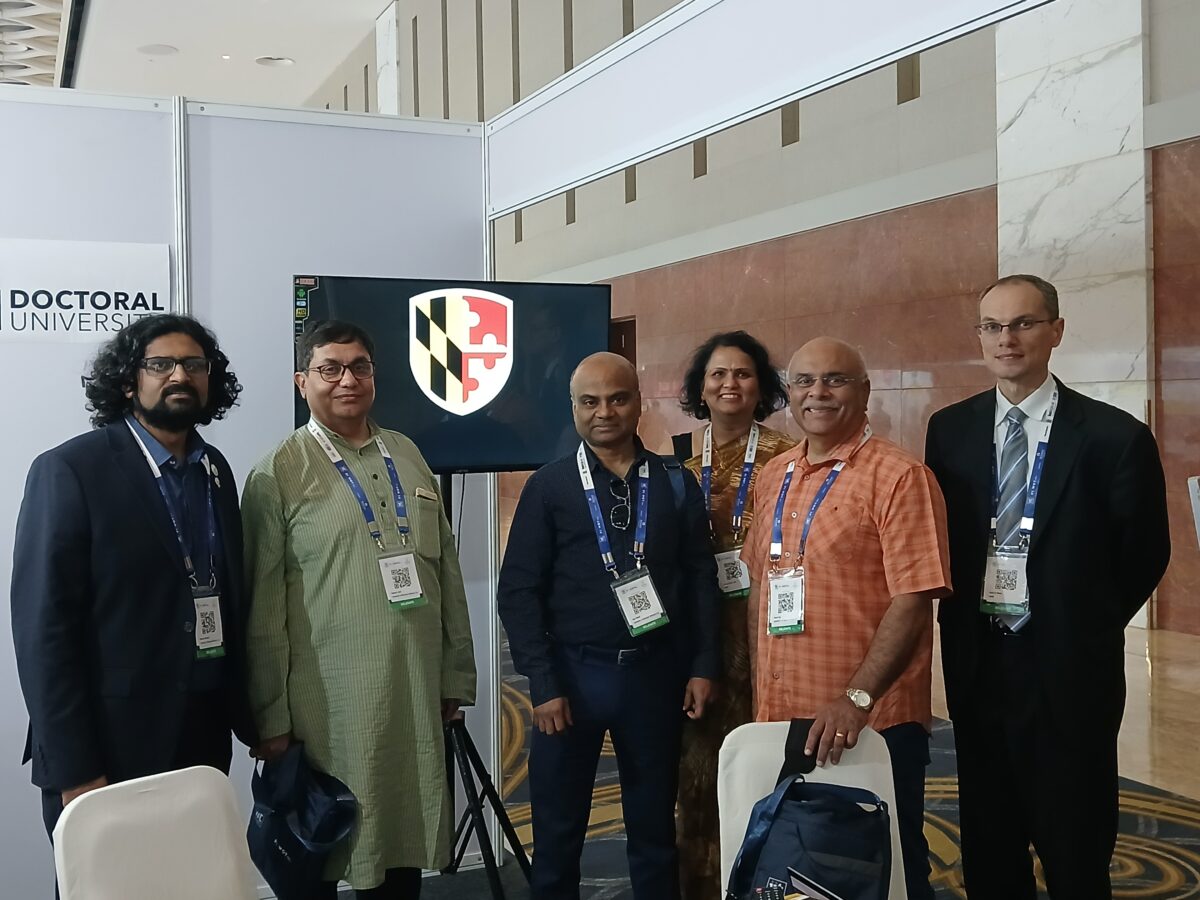 UMBC PIWOT attendees (l-r): Ramana Vinjamuri, associate professor of computer science and electrical engineering and director of the NSF IUCRC BRAIN Center; Joshi; Upal Ghosh, professor of chemical, biochemical, and environmental engineering; Karuna Pande Joshi, professor of information systems and director of the NSF IUCRC Center for Accelerated Real Time Analytics; Govind Rao, director of the Center for Advanced Sensor Technology and professor of chemical, biochemical and environmental engineering; and David Di Maria, associate vice provost for international education at UMBC. (Photo courtesy of Karuna Pande Joshi)
This year’s PIWOT conference focused on the impact of technology across multiple dimensions of life, from the professional to the personal. UMBC’s Anupam Joshi, acting dean of the College of Engineering and Information Technology, took part as a speaker on a panel about the impact of technology on education, and the UMBC booth also displayed the low-cost infant incubator developed by Professor Govind Rao.
3. International research collaboration challenges assumptions
Thanks to funding from the German Academic Exchange Service, Lorenz Kopp and Björn Michelmann, mechanical engineering students from Germany’s Regensburg University of Applied Sciences, came to UMBC to conduct research with UMBC’s mechanical engineering professor, Paris von Lockette. The project was part of a bigger assumption-questioning enterprise—in particular, probing the behavior of materials called soft magnets. Kopp’s and Michelmann’s advisor at Regensburg University of Applied Sciences knew von Lockette through the American Society of Mechanical Engineers, and together they arranged the details of the two-month visit with the help of the Office of International Students and Scholars at UMBC.
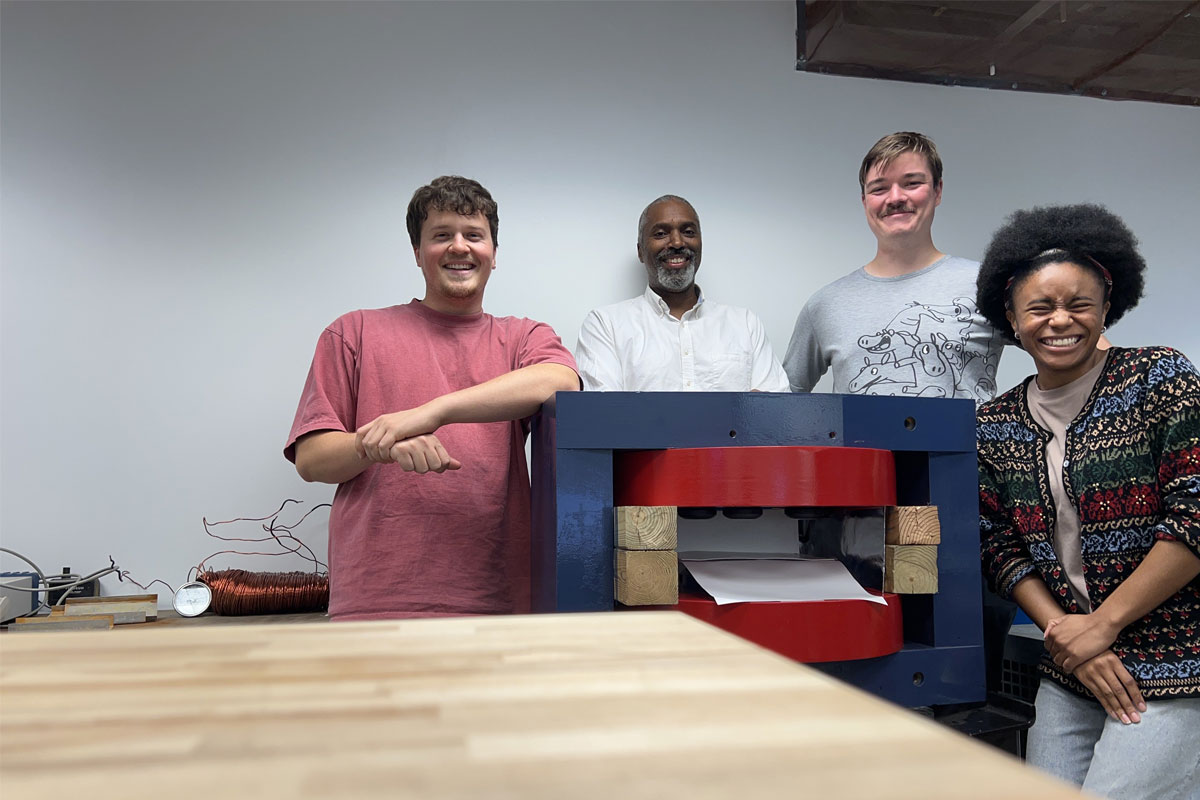 (l-r): Lorenz Kopp, Björn Michelmann, von Lockette, and Tamia Bowers ’23, mechanical engineering, with the electromagnet they set up in the lab. (Brad Ziegler/UMBC)
While Kopp and Michelmann spent plenty of time in the lab during their visit, they also had chances to explore the areas surrounding UMBC on weekends. They visited the National Aquarium in Baltimore, took in a Baltimore Ravens football game, and drove to Shenandoah National Park in Virginia. They also enjoyed campus life, attending Homecoming weekend, and regularly visiting the Retriever Activity Center to work out.
4. Exploring politics in a global context, virtually
Professor Filomeno’s 2024 Collaborative Online International Learning (COIL) Brazil project on climate change equips students with the technical and interpersonal skills to thrive in professional online international and intercultural environments. COIL makes international scholarship and intercultural learning accessible by removing barriers of cost and travel while preparing students with essential skills for future in-person exchanges. COIL Brazil was part of Filomeno’s Global Citizenship class in collaboration with former colleague Clarissa Dri, a professor of international relations at his alma mater, the Federal University of Santa Catarina, in southern Brazil.
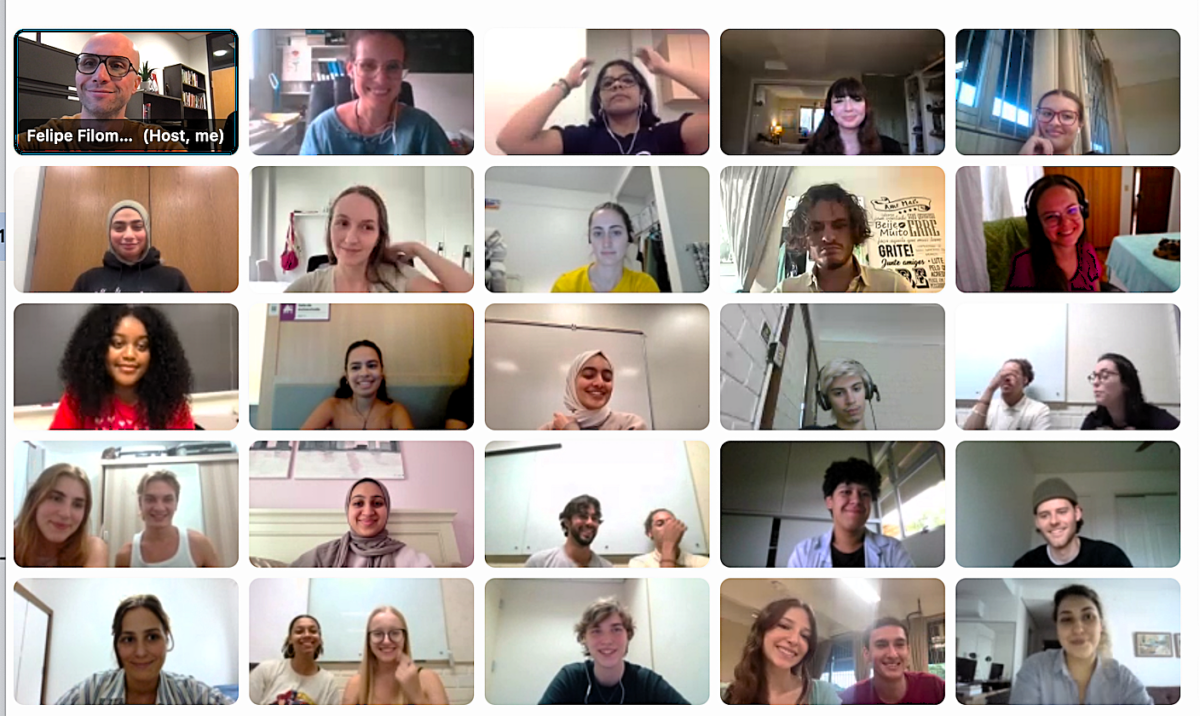 COIL Brazil met online so that students from UMBC and the Federal University of Santa Catarina in southern Brazil could participate. (Image courtesy of Felipe Filomeno.)
The ongoing Virtual Tandem Conversation project was created by Susanne Sutton, a teaching professor of German, and Talke Macfarland, a visiting lecturer of German in UMBC’s Department of Modern Languages, Linguistics, and Intercultural Communication. They established the program during COVID-19 to help UMBC students learning German and German students learning English socialize while continuing to improve their language skills.
The actual tandem meetings are entirely student-driven and take place outside of the classroom—each tandem pair arranges virtual meetings according to their schedule. Tandem participants have gone beyond the virtual classroom, such as UMBC Golden ID Program student Rebecca Smith, who, while on a recent trip to France, hopped over to Germany to visit Gertrud Krause-Traudes, her partner in UMBC’s Virtual Tandem Conversation project. After three semesters of virtual conversations in German and English, Smith was happy to meet Krause-Traudes in person.
5. Science that bridges two worlds
In 2020, as the COVID-19 pandemic disrupted lives worldwide, Greema Regmi began her Ph.D. in UMBC’s atmospheric physics program. Studying remotely from her home in Nepal, she navigated a grueling schedule due to the time difference. Now in her fifth year, Regmi’s perseverance has earned her NASA’s prestigious Future Investigators in NASA Earth and Space Science and Technology (FINESST) fellowship, which will provide up to $50,000 annually for up to three years to fuel her research on atmospheric dust.
 Greema Regmi discussed her research at a recent poster session at UMBC. (Brad Ziegler/UMBC)
Regmi has been able to accomplish so much in part because of the supportive community she found at UMBC, after finally arriving on campus in fall 2021. Regmi’s journey bridges her unique perspectives as a student in Nepal and the U.S. At UMBC, she’s embraced broader opportunities. “I think here you can push the limit. I don’t even know what the limit is in the U.S. Here you can dream more and be more experimental,” she observes.
Grounded in the UMBC physics department’s community of support, Regmi’s confidence has only grown since her arrival in Maryland. “There’s always a place for my opinion, which is very nice. Because of that, and all of the experiences I’ve had, now I have the confidence to start my own project,” she explains. “And that’s why I think now I’m confident to go back home, lead something there, and be helpful in some small way.”
Learn more about UMBC’s international opportunities.
]]>
As International Education Week 2025 comes to a close, we’ve rounded up a few of the many ways Retrievers engage globally through their work and studies. Even though it has been a particularly...
https://umbc.edu/stories/gone-global-umbc-international-engagement/
https://my3.my.umbc.edu/api/v0/pixel/news/154859/guest@my.umbc.edu/4a42a8215afbcd5c0ace5e35458352e2/api/pixel
cahss
cge
cnms
coeit
community
fulbright
international
is
llc
meche
mlli
news
physics
politicalscience
research
story
visualarts
UMBC News & Magazine
https://my3.my.umbc.edu/groups/umbc-news-magazine
https://assets1-my.umbc.edu/system/shared/avatars/groups/000/001/943/24435aa6207c452e7bc15cc74b42c7bb/xsmall.png?1748556657
https://assets1-my.umbc.edu/system/shared/avatars/groups/000/001/943/24435aa6207c452e7bc15cc74b42c7bb/original.png?1748556657
https://assets2-my.umbc.edu/system/shared/avatars/groups/000/001/943/24435aa6207c452e7bc15cc74b42c7bb/xxlarge.png?1748556657
https://assets2-my.umbc.edu/system/shared/avatars/groups/000/001/943/24435aa6207c452e7bc15cc74b42c7bb/xlarge.png?1748556657
https://assets3-my.umbc.edu/system/shared/avatars/groups/000/001/943/24435aa6207c452e7bc15cc74b42c7bb/large.png?1748556657
https://assets1-my.umbc.edu/system/shared/avatars/groups/000/001/943/24435aa6207c452e7bc15cc74b42c7bb/medium.png?1748556657
https://assets2-my.umbc.edu/system/shared/avatars/groups/000/001/943/24435aa6207c452e7bc15cc74b42c7bb/small.png?1748556657
https://assets1-my.umbc.edu/system/shared/avatars/groups/000/001/943/24435aa6207c452e7bc15cc74b42c7bb/xsmall.png?1748556657
https://assets2-my.umbc.edu/system/shared/avatars/groups/000/001/943/24435aa6207c452e7bc15cc74b42c7bb/xxsmall.png?1748556657
UMBC News & Magazine
7
0
false
Tue, 25 Nov 2025 13:03:08 -0500
Tue, 25 Nov 2025 13:03:08 -0500
After a lifetime of adapting her English to fit the occasion, Ivy Nguyen ’23 pursues further language education abroad with critical funding
When Ivy Nguyen moved to the United States from Vietnam in 2014, her high school peers struggled to understand the British English she had grown up speaking. As she found herself “lost in British translation,” Nguyen decided to expand her skills across multiple English accents—Mid-Atlantic English, British English, and the accent with a mix of Vietnamese and English. From high school through college, these linguistic bridges provided Nguyen with opportunities for community building and leadership. Now, equipped with these strengths, she is headed to Taiwan to add Chinese to her language repertoire.
 Nguyen wearing a hanbok, traditional Korean clothing, at Gyeongbokgung Palace in Seoul, Korea. (Image courtesy of Nguyen)
“Being able to listen without judgment is a critical skill,” says Nguyen, who double majored in Asian studies and global studies—adding Chinese, Korean, and a bit of Japanese—as well as some mileage in between with an education abroad experience at the Ewha Womans University in Seoul, Korea, during her junior year.
Since graduating in 2023, Nguyen has worked as a tutor at several public schools in Anne Arundel County, supporting students in first to ninth grade during the academic year, and served as a Generation Teach AmeriCorps Summer Teaching Fellow, a five-week K-8 STEAM academy, during the summer. “Two core values of Generation Teach are to foster belonging and to make sure everyone is included,” said Nguyen of her intensive training in identity, community building, content, and teaching. “We have students and teachers from all kinds of different backgrounds. I learned more about expressing myself without causing misunderstandings and how to convey my message while understanding the role that privilege plays in communication.”
Nguyen’s language chops and ability to teach, lead, and uplift multiple communities earned her two prestigious international opportunities: First, as an alternate for the Fulbright U.S. Student Program award to Taiwan to pursue a master’s in Chinese as a second language; and the second is admission to the National Normal University, a leading institution in education and education research in Taipei, Taiwan, with funding from Taiwan’s Ministry of Education.
After completing over 350 hours of AmeriCorps service, Nguyen decided to forgo the alternate Fulbright spot and apply her hard-earned wisdom to pursue a master’s degree in teaching Chinese as a foreign language in Taiwan.
“When I was a kid coming to the United States, I was excited to get on a plane and move to a different country, but once I got here, I realized how different it was from what I thought it would be or sound like,” said Nguyen, who is already applying for a part-time job in Taiwan’s Ministry of Education English Language Teaching Assistant Program. “You have to know how to be flexible and pick what is right for you. If there is a change in plans, that’s still okay. Everything will be okay in the end.”
Learn more about UMBC’s Asian studies and global studies programs.
]]>
When Ivy Nguyen moved to the United States from Vietnam in 2014, her high school peers struggled to understand the British English she had grown up speaking. As she found herself “lost in British...
https://umbc.edu/stories/ivy-nguyen-pursues-language-ed-abroad/
https://my3.my.umbc.edu/api/v0/pixel/news/152216/guest@my.umbc.edu/e4789333d8030eac82bc05d227b4514b/api/pixel
asianstudies
cahss
community
fulbright
globalstudies
international
news
policy-and-society
story
UMBC News & Magazine
https://my3.my.umbc.edu/groups/umbc-news-magazine
https://assets1-my.umbc.edu/system/shared/avatars/groups/000/001/943/24435aa6207c452e7bc15cc74b42c7bb/xsmall.png?1748556657
https://assets1-my.umbc.edu/system/shared/avatars/groups/000/001/943/24435aa6207c452e7bc15cc74b42c7bb/original.png?1748556657
https://assets2-my.umbc.edu/system/shared/avatars/groups/000/001/943/24435aa6207c452e7bc15cc74b42c7bb/xxlarge.png?1748556657
https://assets2-my.umbc.edu/system/shared/avatars/groups/000/001/943/24435aa6207c452e7bc15cc74b42c7bb/xlarge.png?1748556657
https://assets3-my.umbc.edu/system/shared/avatars/groups/000/001/943/24435aa6207c452e7bc15cc74b42c7bb/large.png?1748556657
https://assets1-my.umbc.edu/system/shared/avatars/groups/000/001/943/24435aa6207c452e7bc15cc74b42c7bb/medium.png?1748556657
https://assets2-my.umbc.edu/system/shared/avatars/groups/000/001/943/24435aa6207c452e7bc15cc74b42c7bb/small.png?1748556657
https://assets1-my.umbc.edu/system/shared/avatars/groups/000/001/943/24435aa6207c452e7bc15cc74b42c7bb/xsmall.png?1748556657
https://assets2-my.umbc.edu/system/shared/avatars/groups/000/001/943/24435aa6207c452e7bc15cc74b42c7bb/xxsmall.png?1748556657
UMBC News & Magazine
0
0
false
Tue, 09 Sep 2025 09:39:46 -0400
Tue, 09 Sep 2025 09:39:46 -0400
Internationally minded excellence: Faculty and staff across all three UMBC colleges receive Fulbright U.S. Scholar awards to teach and research abroad
Four UMBC faculty and staff members have received highly competitive Fulbright U.S. Scholar awards to teach, conduct research, and forge cross-cultural connections around the world in the coming year. The recipients span all three UMBC colleges and comprise three faculty members and one staff member. Augusto Casas, an associate teaching professor in information systems, will travel to Colombia; Cynthia Wagner, a teaching professor in biological sciences, will travel to Kyrgyzstan; Irene Chan, a professor in visual arts, will travel to Romania; and Tom Penniston, M.A. ’09, TESOL, Ph.D. ’14, language, literacy, and culture, the coordinator of learning analytics in the Division of Information Technology (DoIT), will travel to Croatia.
“Fulbright Scholar awards are not just a globally prestigious academic award; they are also a centerpiece of public diplomacy,” says Brian Souders, Ph.D. ’09, language, literacy, and culture, M.A. ’19, TESOL, the associate director for global learning in UMBC’s Center for Global Engagement.
The Fulbright Program was founded in 1946 with the goal of increasing mutual understanding and supporting friendly relations between people in the United States and other countries. It is the flagship international academic exchange program sponsored by the United States government. UMBC has had 18 Fulbright Scholars over the past 10 years, not including the upcoming year’s four recipients. Past awardees have taught or conducted research throughout the world, including in Ethiopia, Kosovo, Colombia, Germany, Australia, the United Kingdom, Denmark, and China.
Sharing a passion with international partners
The new UMBC awardees will connect with international partners in areas of shared interest.
 Augusto Casas (Photo courtesy of Casas)
“My primary responsibility at UMBC is to support data-informed pedagogy, and my Fulbright grant aligns directly with this work,” says Penniston, who will be working with colleagues at the University of Zagreb in Croatia on projects such as AI-assisted course redesigns and mapping how learning analytics tools are adopted within and between universities. “I am most excited to dive headfirst into work and be a data wonk,” he says.
Casas, who is an associate teaching professor in the online M.S. in information systems program at UMBC, will assist the Universidad del Atlántico in Barranquilla, Colombia, in creating an online software engineering degree program to reach beyond the university’s physical campus. He will support creating the curriculum, help select the most appropriate technology, and train their faculty.
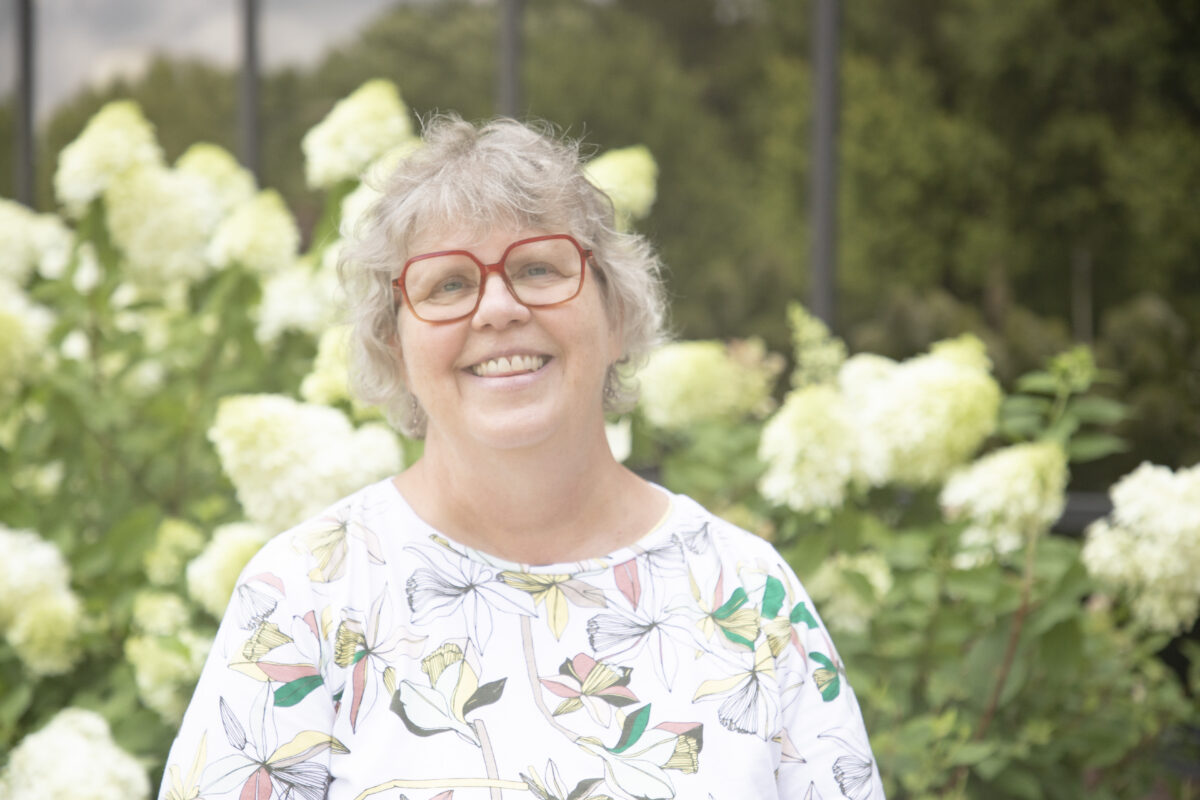 Cynthia Wagner (Photo courtesy of Wagner)
Wagner, who recently retired from UMBC after decades of inspiring students in her popular biology courses, will teach biology classes in English to students at Kyrgyz-Turkish Manas University in Bishkek, Kyrgyzstan. She’ll also conduct research searching for novel antimicrobial agents in the soil of Kyrgyzstan.
Lastly, Chan, a multidisciplinary artist engaged in conceptual work across print media, papermaking, installation art, and storytelling performance, will instruct both undergraduate and graduate students at the University of Art and Design in Cluj Napoca, Romania, utilizing concepts and methodologies she has developed during her tenure at UMBC. Additionally, she will produce a new collection of artist books, focusing on research into fiber art techniques and Romanian folk tales. These books, intended for display in both Romanian and international art collections, will also subtly reference corresponding motifs found within Chan’s own Chinese and American cultural heritage. This recognition of folk art traditions provides a foundation for cultural exchange, Chan says.
 Chan printing in August 2024 at ‘ace Proyecto, Buenos Aires, Argentina. (Photo courtesy of Chan)
Finding support at home and abroad
Souders, who serves as the Fulbright Scholar Liaison, says most UMBC faculty and staff work with him to hone their application. Casas shares that while he had been interested in the Fulbright awards since he started his academic career in the early 2000s, it wasn’t until he attended an informational webinar by Souders that he realized he was ready to apply. He met with Souders for advice, reached out to colleagues at the Universidad del Atlántico to assess where their needs and his interests overlapped, submitted his application, and “Here I am,” he says.
Penniston credits his supervisors and colleagues in DoIT with supporting his application and the opportunity for him to work remotely from Croatia following his six-month residency at the University of Zagreb. He hopes his time abroad will deepen his understanding of European Union education policy and seed partnerships that will ultimately benefit UMBC students and faculty.
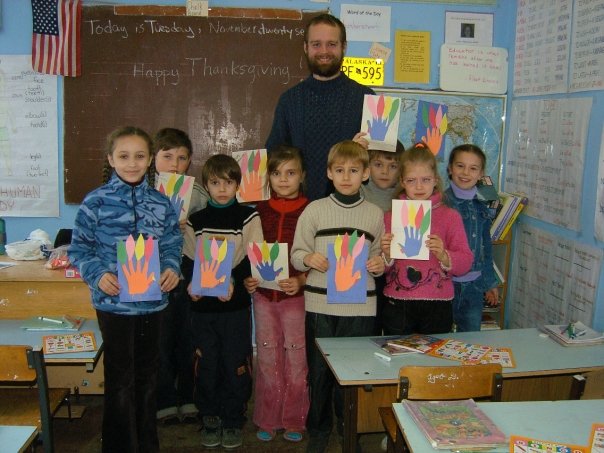 Tom Penniston with students at a school in Moldova, where he served as a U.S. Peace Corps volunteer. (Photo courtesy of Penniston)
Different scholars find different ways to bring bits of the world back with them when they return to the UMBC community, Souders says. For example, the College of Engineering and Information Technology’s award-winning Global Engineering course, co-taught with faculty at the University of Porto in Portugal, originated with the Fulbright project of Marc Zupan, an associate professor in the Department of Mechanical Engineering.
Wagner says it would be amazing to make a discovery that might one day help alleviate the antibiotic resistance crisis in the world. “A good majority of our current antibiotics come from soil microbes,” she says. “Kyrgyzstan has several different ecological niches in which the soil could vary and so could the microbes.”
Across the board, UMBC’s newest crop of Fulbright Scholars is excited to connect internationally and advance projects of shared interest.
“My Croatian hosts have already gone out of their way to make me feel welcome,” says Penniston. “I am thrilled to embark on this immersive intercultural experience, and to share it with my wife and our children.”
Wagner echoes the sense of excitement at a new, horizon-broadening opportunity: “It will be an adventure!” she says.
]]>
Four UMBC faculty and staff members have received highly competitive Fulbright U.S. Scholar awards to teach, conduct research, and forge cross-cultural connections around the world in the coming...
https://umbc.edu/stories/umbc-fulbright-scholar-awards-2025-2026/
https://my3.my.umbc.edu/api/v0/pixel/news/151242/guest@my.umbc.edu/40aedb34ecbc39cdccebef1442f801d5/api/pixel
biological-sciences
cahss
cnms
coeit
doit
fulbright
is
news
policy-and-society
research
story
visualarts
UMBC News & Magazine
https://my3.my.umbc.edu/groups/umbc-news-magazine
https://assets1-my.umbc.edu/system/shared/avatars/groups/000/001/943/24435aa6207c452e7bc15cc74b42c7bb/xsmall.png?1748556657
https://assets1-my.umbc.edu/system/shared/avatars/groups/000/001/943/24435aa6207c452e7bc15cc74b42c7bb/original.png?1748556657
https://assets2-my.umbc.edu/system/shared/avatars/groups/000/001/943/24435aa6207c452e7bc15cc74b42c7bb/xxlarge.png?1748556657
https://assets2-my.umbc.edu/system/shared/avatars/groups/000/001/943/24435aa6207c452e7bc15cc74b42c7bb/xlarge.png?1748556657
https://assets3-my.umbc.edu/system/shared/avatars/groups/000/001/943/24435aa6207c452e7bc15cc74b42c7bb/large.png?1748556657
https://assets1-my.umbc.edu/system/shared/avatars/groups/000/001/943/24435aa6207c452e7bc15cc74b42c7bb/medium.png?1748556657
https://assets2-my.umbc.edu/system/shared/avatars/groups/000/001/943/24435aa6207c452e7bc15cc74b42c7bb/small.png?1748556657
https://assets1-my.umbc.edu/system/shared/avatars/groups/000/001/943/24435aa6207c452e7bc15cc74b42c7bb/xsmall.png?1748556657
https://assets2-my.umbc.edu/system/shared/avatars/groups/000/001/943/24435aa6207c452e7bc15cc74b42c7bb/xxsmall.png?1748556657
UMBC News & Magazine
12
0
false
Thu, 31 Jul 2025 14:51:07 -0400
Thu, 31 Jul 2025 14:51:07 -0400
Retrievers Behind the Scenes—Dave Anguish ’12, political science, M.P.P ’19, advocate for international students and immigrant communities
One way to describe Dave Anguish’s journey with UMBC is as a trip around the world and back again. Anguish came to UMBC in 2008 to study political science as well as modern languages, linguistics, and intercultural communication. After graduating in 2012, he hopped on a plane to Mexico City to conduct political science research thanks to a research grant from the Fulbright U.S. Student Program. He later returned to UMBC to earn an M.P.P. in public management in 2019 while working in UMBC’s International Education Services (IES)—an opportunity that allowed him to travel the world and inspired his first career in international education leadership. Now, it is leading to his second career as he prepares to graduate from the University of Maryland Francis King Carey School of Law. Take it away, Dave!
Q: Tell us about your primary WHY, and how it led you to UMBC.
A: In 2008, I came to UMBC as an undergraduate student because it offered something different, something I didn’t see at other schools. I liked that it was “medium-sized” and that the buildings were arranged in a grid, almost like a small city. It was so easy to meet new people, whether they were classmates, staff, or faculty. Everyone was open to making connections. At the time, I was surprised that an undergraduate student had so much access to people of greater stature. I came to understand that reducing the power differential was a deliberate choice and part of the university’s culture. It’s something I’m so glad still lives on today.
Q: What’s one essential thing you’d want another Retriever to know about you?
A: After graduation, I moved abroad for a year and then came back to work at UMBC. When I returned, it took a few years to find my passion. An urgent need for an advisor in IES ended up being my big break. I discovered that it wasn’t simply getting to meet and work with people from all over the world that appealed to me; it was also learning and explaining to others the complexity of immigration law. That seed of an idea blossomed into the (eventual) decision to attend law school and become an immigration lawyer focused on deportation defense and justice for immigrant communities. I could never have foreseen how far a frontline advisor position in the “visa office” would take me, or how it would reveal my professional path.
A: I’ve been part of CGE since it was called International Education Services. Back then, we were a small but mighty team of five or so people. Today, CGE has nearly thirty staff, and while our teams focus on different areas, we all seek to forge connections between UMBC and the world.
 Anguish (last row, third from the left) with colleagues from UMBC’s Center for Global Engagement. (Image courtesy of Anguish)
I’m so inspired by the work CGE does. My team handles immigration services for the thousands of international students coming to UMBC to study, as well as those who have graduated and are working around the country in exciting fields, getting practical training.
My colleagues in Education Abroad enable students to break through the confines of campus and explore new lands, gaining crucial intercultural skills, learning languages, and learning more about themselves and their role in the world. Other CGE teams coordinate English language training and design special programs for groups to visit UMBC over the summer for intercultural experiences and training.
 Anguish (center) with UMBC alumni panelists at UMBC’s International Student Career Conference. (Image courtesy of Anguish)
Q: Tell us about someone in the community who has inspired you or supported you, and how they did it.
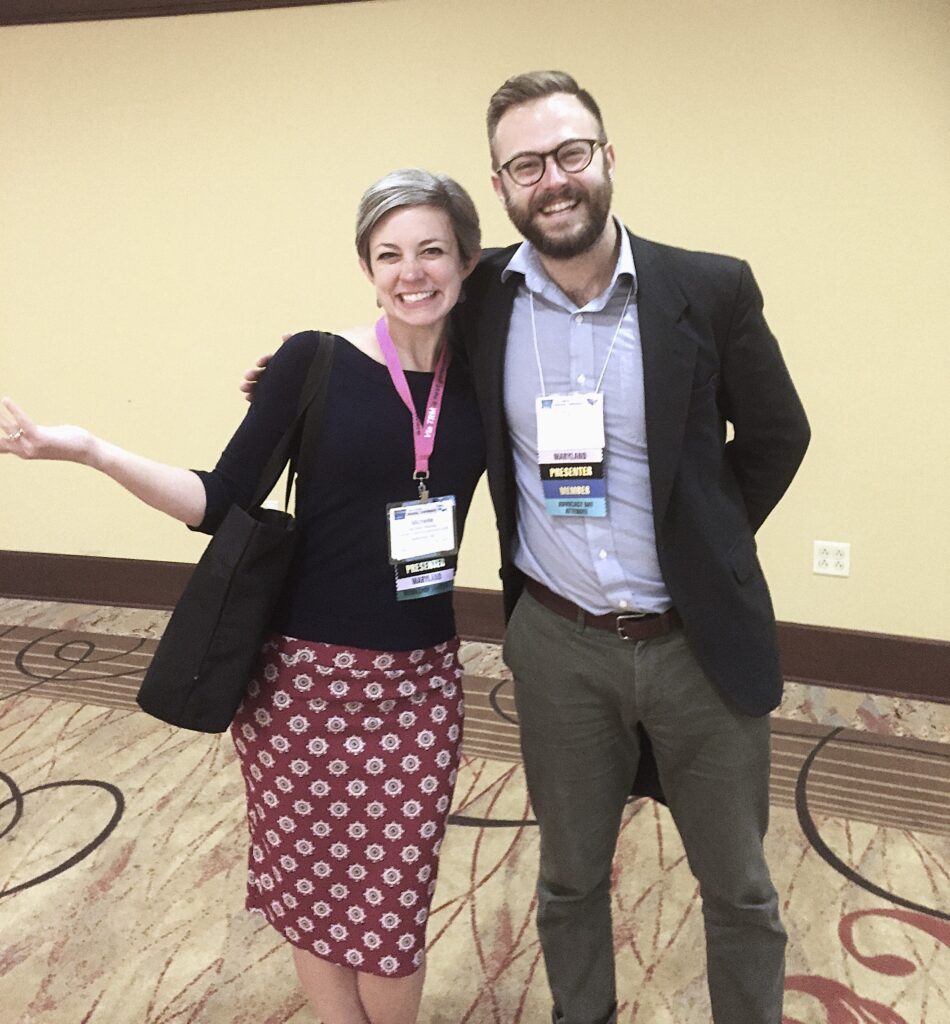 Massey (l) with Anguish. (Image courtesy of Anguish)
A: For several years, I was on a two-person team serving all of UMBC’s international students. My co-worker, supervisor, and friend, Michelle Massey ’10, intercultural communications, taught me so much about how to be the best version of myself for those I serve. She is the reason why my emails are littered with happy exclamation points, and why I try to communicate in the most positive and friendly way with people who may not be as familiar with U.S. culture, and why I keep in mind that the work we do matters, because it has such an impact on every student’s life, career, and dreams. Michelle left UMBC to join the foreign service several years ago, but her example of servant leadership has stuck with me and set a standard that I try to live up to in my work.
Q: What’s the one thing you’d want someone who hasn’t joined the UMBC community to know about the support you find here?
A: It’s clichéd to say “it’s the people” that make UMBC what it is, but it’s true. I’ve had the pleasure of working with so many people who work hard every day to make the place run. Maybe it’s our relative youth as an institution, but there is a sense that even a university of our size can be nimble and adjust to new realities. We’re writing the story of UMBC every day. It’s been fascinating to see how much UMBC has changed since I was an undergraduate, but how the ethos has remained constant. We’ve had many changes in leadership over the past few years, and this new era at UMBC is an exciting one to watch and even more exciting to participate in.
Although I returned to UMBC shortly after I graduated, really, I’ve been all over the place: through my work at UMBC I’ve been able to travel the world, meet so many wonderful people, and learn new skills. Two graduate degrees later, my time at UMBC is coming to a close as I transition into an attorney role in another organization. But UMBC has been such a significant part of my life for so long that I know this isn’t truly the end.
* * * * *
UMBC’s greatest strength is its people. When people meet Retrievers and hear about the passion they bring, the relationships they create, the ways they support each other, and the commitment they have to inclusive excellence, they truly get a sense of our community. That’s what “Meet a Retriever” is all about. Learn more about UMBC’s Center for Global Engagement.
]]>
One way to describe Dave Anguish’s journey with UMBC is as a trip around the world and back again. Anguish came to UMBC in 2008 to study political science as well as modern languages, linguistics,...
https://umbc.edu/stories/dave-anguish-retriever-behind-the-scenes/
https://my3.my.umbc.edu/api/v0/pixel/news/150478/guest@my.umbc.edu/d76d4d61e0feb3887338814d27029783/api/pixel
cahss
cge
class-of-2018
fulbright
impact
magazine
public-policy
retriever-behind-the-scenes
story
UMBC News & Magazine
https://my3.my.umbc.edu/groups/umbc-news-magazine
https://assets1-my.umbc.edu/system/shared/avatars/groups/000/001/943/24435aa6207c452e7bc15cc74b42c7bb/xsmall.png?1748556657
https://assets1-my.umbc.edu/system/shared/avatars/groups/000/001/943/24435aa6207c452e7bc15cc74b42c7bb/original.png?1748556657
https://assets2-my.umbc.edu/system/shared/avatars/groups/000/001/943/24435aa6207c452e7bc15cc74b42c7bb/xxlarge.png?1748556657
https://assets2-my.umbc.edu/system/shared/avatars/groups/000/001/943/24435aa6207c452e7bc15cc74b42c7bb/xlarge.png?1748556657
https://assets3-my.umbc.edu/system/shared/avatars/groups/000/001/943/24435aa6207c452e7bc15cc74b42c7bb/large.png?1748556657
https://assets1-my.umbc.edu/system/shared/avatars/groups/000/001/943/24435aa6207c452e7bc15cc74b42c7bb/medium.png?1748556657
https://assets2-my.umbc.edu/system/shared/avatars/groups/000/001/943/24435aa6207c452e7bc15cc74b42c7bb/small.png?1748556657
https://assets1-my.umbc.edu/system/shared/avatars/groups/000/001/943/24435aa6207c452e7bc15cc74b42c7bb/xsmall.png?1748556657
https://assets2-my.umbc.edu/system/shared/avatars/groups/000/001/943/24435aa6207c452e7bc15cc74b42c7bb/xxsmall.png?1748556657
UMBC News & Magazine
9
0
false
Fri, 30 May 2025 12:13:32 -0400
Fri, 30 May 2025 12:13:32 -0400
Retrievers are upping their research game in the 2024-25 Fulbright U.S. Student Program cohort

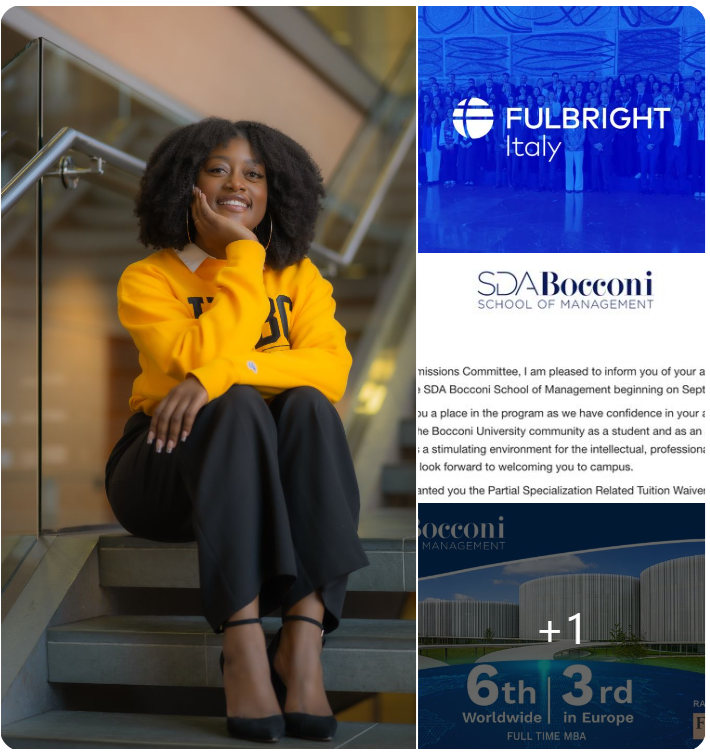
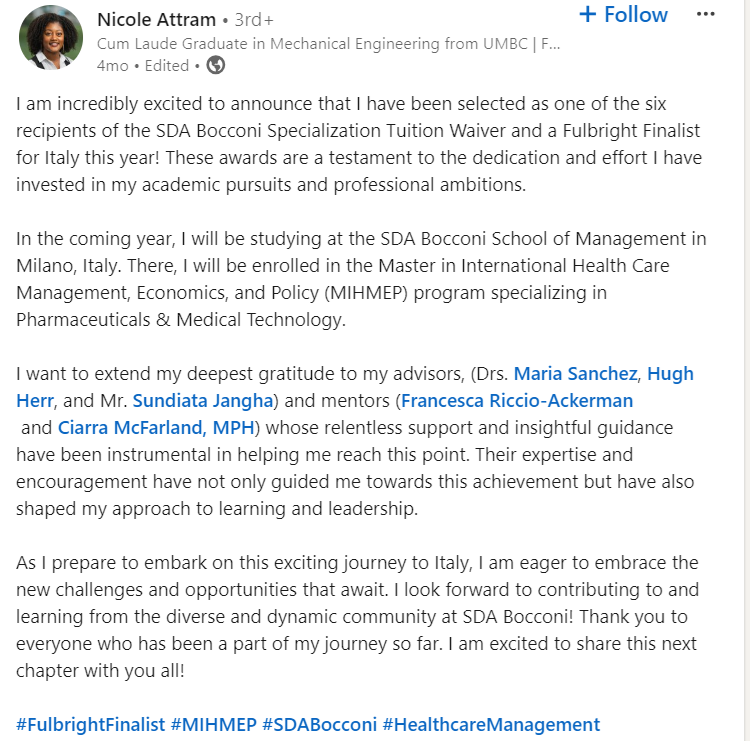
At the height of COVID-19, Nicole Attram developed severe lower back pain which impeded her mobility and flexibility. While physical therapy helped mitigate the symptoms, the cause is still unknown. That experience determined the course of her career. After graduating from UMBC in 2023, Attram, mechanical engineering, received a 2024 – 2025 Fulbright U.S. Student award to study in Milan, Italy, in a master’s program in international healthcare management, economics, and policy specializing in pharmaceuticals and medical technology at the SDA Bocconi School of Management.
“This experience has inspired my interest in orthopedic biomechanics, particularly prosthetics, and exoskeletons, to help restore autonomy to individuals with lifelong mobility challenges,” shares Attram on her website. “I aim to conduct research at the intersection of systemic racism, healthcare policy, and orthopedic biomechanics to offer holistic care and assistive technology to underserved communities.”
Each year, more than 10,000 students apply to the Fulbright U.S. Student Program with just over 2,000 selected from hundreds of colleges and universities across the U.S. In the last decade, UMBC students and alumni have received more than 85 Fulbright U.S. Student Program awards for research and teaching placements in Africa, Asia and the Pacific, the Middle East, South America, and Europe. UMBC was named a Fulbright Top Producing Institution for the third time in five years for the 2023 – 2024 cycle.
Attram’s mentor Maria C. Sanchez, director of the Grand Challenge Scholars Program, professor of the practice, and director of the Engineering and Computing Education Program, says, “Nicole always displayed the motivation, perseverance, and inquisitiveness of a successful researcher. She also demonstrated a high level of global awareness that was refreshing to see in a non-international undergraduate student.”
Advancing global research
Attram is among eight recent graduates and alumni in UMBC’s 2024 – 2025 Fulbright U.S. Student Program class who are sharing their knowledge and building community around the world by earning a master’s degree, conducting research, or teaching English. This year is especially significant, as six of eight awards are research-focused, marking the highest number of research awards in UMBC’s Fulbright history. Students seeking research awards must develop a proposal in coordination with potential advisers in the universities and laboratories where they want to study as part of their application. Graduate degree awards require submitting both Fulbright and graduate school applications.
-
Arpita Tuladhar ’23 public health, Research Award to Germany
-
Jennifer Sorrells ’22, political science, Research Award to North Macedonia
-
Jolie Greer ’24, psychology, Research Award to Bulgaria
-
Lauren Mister ’24, teaching English to speakers of other languages, English Teaching Award to Bahrain
-
Sarah-Fatime Yoda ’24, chemical engineering, Research Award to France
-
Stuart Holton ’24, political science, English Teaching Award to Slovakia
-
Timothy Mallard, M.A. ’21, teaching English to speakers of other languages, Research Award to Uganda
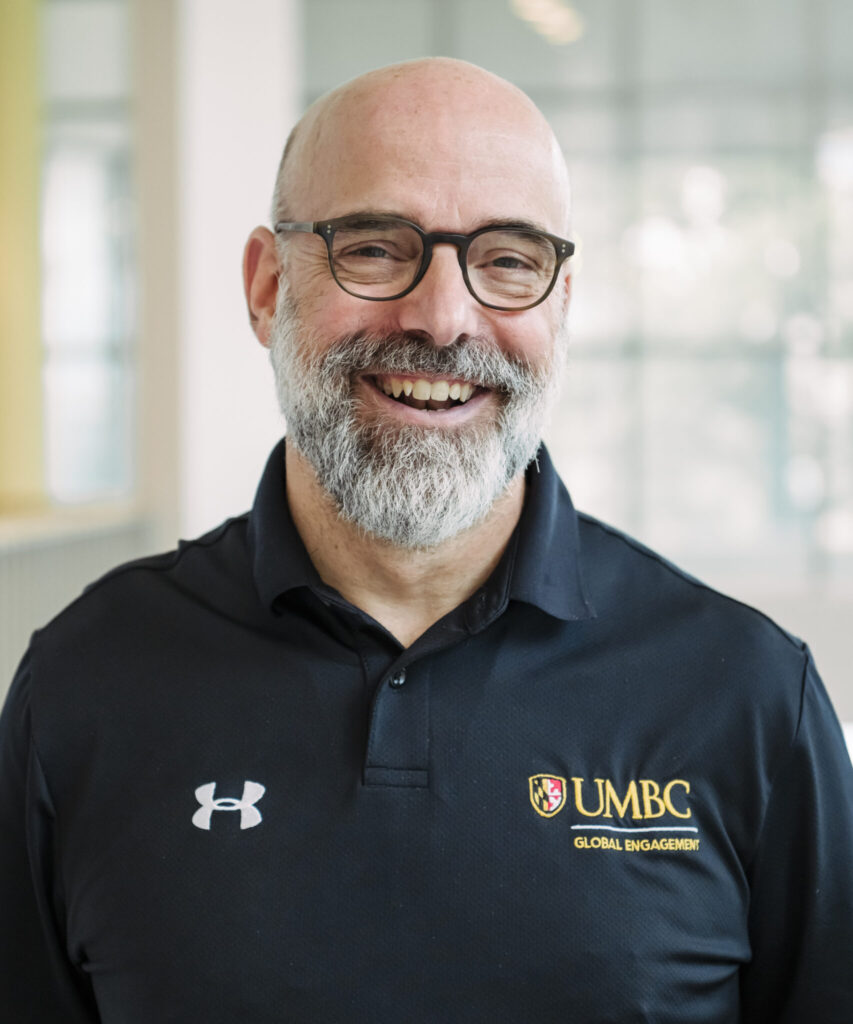
“This year’s cohort of Fulbright recipients and alternates shows the country and the globe what we at UMBC already know,” says Brian Souders, Ph.D. ’09, language, literacy, and culture, M.A.’19, TESOL, the associate director of global learning at UMBC’s Center for Global Engagement. In this role, Souders, who received a 2023 Fulbright International Education Administrator Award to Germany, has led hundreds of Retrievers through the Fulbright application process as UMBC’s Fulbright Program advisor. “We produce world-class graduates who will lead the future with their work in laboratories, in the field, and in the classrooms throughout the world.” (Image by Marlayna Demond ’11/UMBC)
Learn more about UMBC’s Fulbright Program.
]]>
At the height of COVID-19, Nicole Attram developed severe lower back pain which impeded her mobility and flexibility. While physical therapy helped mitigate the symptoms, the cause is still...
https://umbc.edu/stories/retrievers-are-upping-their-research-game-in-the-2024-2025-fulbright-u-s-student-program-cohort/
https://my3.my.umbc.edu/api/v0/pixel/news/144257/guest@my.umbc.edu/74dbeefa8c480d6930724fb40a369389/api/pixel
cahss
cbee
cge
chemical-engineering
coeit
community
feature
fulbright
international
mechanical
news
politicalscience
psychology
research
saph
story
tesol
UMBC News & Magazine
https://my3.my.umbc.edu/groups/umbc-news-magazine
https://assets1-my.umbc.edu/system/shared/avatars/groups/000/001/943/24435aa6207c452e7bc15cc74b42c7bb/xsmall.png?1748556657
https://assets1-my.umbc.edu/system/shared/avatars/groups/000/001/943/24435aa6207c452e7bc15cc74b42c7bb/original.png?1748556657
https://assets2-my.umbc.edu/system/shared/avatars/groups/000/001/943/24435aa6207c452e7bc15cc74b42c7bb/xxlarge.png?1748556657
https://assets2-my.umbc.edu/system/shared/avatars/groups/000/001/943/24435aa6207c452e7bc15cc74b42c7bb/xlarge.png?1748556657
https://assets3-my.umbc.edu/system/shared/avatars/groups/000/001/943/24435aa6207c452e7bc15cc74b42c7bb/large.png?1748556657
https://assets1-my.umbc.edu/system/shared/avatars/groups/000/001/943/24435aa6207c452e7bc15cc74b42c7bb/medium.png?1748556657
https://assets2-my.umbc.edu/system/shared/avatars/groups/000/001/943/24435aa6207c452e7bc15cc74b42c7bb/small.png?1748556657
https://assets1-my.umbc.edu/system/shared/avatars/groups/000/001/943/24435aa6207c452e7bc15cc74b42c7bb/xsmall.png?1748556657
https://assets2-my.umbc.edu/system/shared/avatars/groups/000/001/943/24435aa6207c452e7bc15cc74b42c7bb/xxsmall.png?1748556657
UMBC News & Magazine
0
0
false
Mon, 23 Sep 2024 14:32:36 -0400
Mon, 23 Sep 2024 14:32:36 -0400
A Journey of Growth
International travel offers ample opportunities to stretch yourself—one minute you may be the expert and the next, completely clueless about how something works. Retrievers currently in the Fulbright U.S. Student Program—teaching English or researching around the globe—find themselves oscillating between their teaching and student roles on a daily or hourly basis. By engaging their host communities through openness and cultural humility (and many shared cups of tea or coffee), these Fulbrighters are finding their balance along the way.
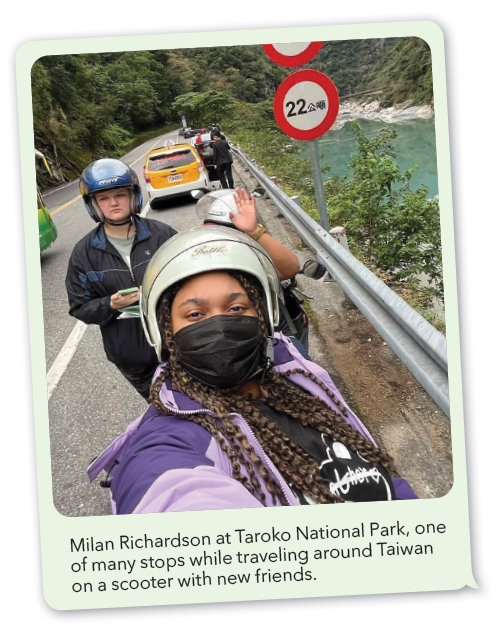
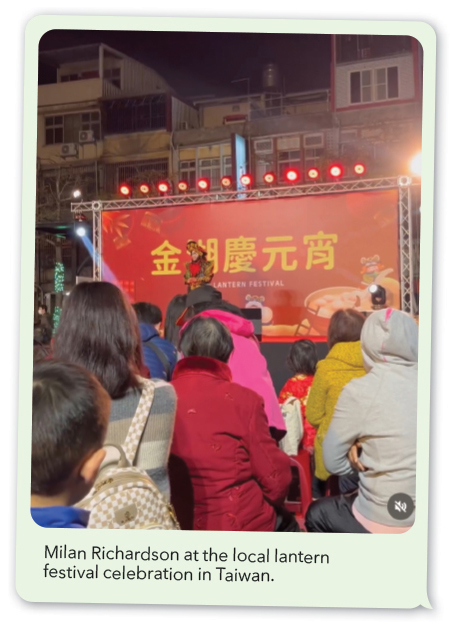
All eyes are on Milan Richardson ’23 as she helps her co-teacher keep score in a Jeopardy-like game her students are playing. Richardson teaches English to several classes of first through sixth-grade students at Jinsha Elementary School in Kinmen County, Taiwan. As she completes the Mandarin character for the numeral 5, a wave of giggles and chatter flows through the room.
Similar to a U.S. tally—four strokes and a strike though, the Mandarin character has 5 strokes total and needs to be written a certain way to represent 1, 2, 3, 4, or 5. “The students were so confused because I wrote the character strokes in the wrong order,” says Richardson, who is used to solving complex math as a Meyerhoff Scholar having earned a bachelor’s degree in bioinformatics and computational biology and minors in computer science and modern, languages, linguistics, and intercultural communication.
“I wanted to write the character correctly. I asked, and they showed me the proper order to write the strokes,” says Richardson, a Fulbright English Teaching Assistant (ETA). “They started clapping once I got it right. This was one of the many cool moments where my students were able to teach me.”
While she may be new to teaching in Taiwan, Richardson brings with her four years as an English and math tutor and a minor in Mandarin. “Taiwan was so different from any place I’ve ever been to. I was overwhelmed at first,” says Richardson. “I like it a lot, now. In my second month, I applied for a scooter license. Now I ride around the island and have taken my scooter other places on trips.”
Diplomas earned. Visas in hand. Vaccines completed. Luggage packed. Destination confirmed. Last summer, UMBC’s eight participants in the 2023 – 2024 Fulbright U.S. Student Program checked off all the important items on their to-do lists. The only thing left was to get to their placements on islands and in landlocked countries, cities, and countrysides across East Asia and Eastern Europe. It’s easier written than done. To adapt well to a new community, job, language, and culture, they must practice the art of humility and flexibility as their roles shift regularly from teacher to student.
Leading the Fulbright charge
All technicalities aside, the Fulbright experience is the beginning of building an international network of teachers and researchers who share the diversity and possibility of the U.S. with the world. In return, across the globe, communities welcome the next generation of leaders into their cities, neighborhoods, schools, and homes to share their country’s history, innovations, and culture. Since Fulbright’s inception in 1946, these reciprocal acts of kindness have created multiple paths forward to lifelong worldwide collaboration and understanding based on the simple act of giving someone different than yourself a chance.
“The Fulbright Program truly demonstrates public diplomacy in action,” says Brian Souders, M.A.’19, TESOL, and Ph.D. ’09, language, literacy, and culture, the associate director of global learning at UMBC’s Center for Global Engagement. In this role, Souders, who received a 2023 Fulbright International Education Administrator award to Germany, has led hundreds of Retrievers through the Fulbright application process as UMBC’s Fulbright Program advisor. “Whether in the classroom as teachers, students, or researchers, recipients learn about the world as much as they share what it means to be from the U.S. and UMBC alumni,” says Souders.
Thanks to Souders’ guidance, UMBC is one of 57 doctoral universities nationwide and three in Maryland to receive a Fulbright Top Producing Institution designation for 2023 – 2024, for the third time in the last five years. In the last decade, more than 80 UMBC alumni have received Fulbright awards. Out of the 10 Retrievers who received a 2023 – 2024 Fulbright, eight are currently placed internationally, seven are ETAs and one is on a research grant.
The hard work of play
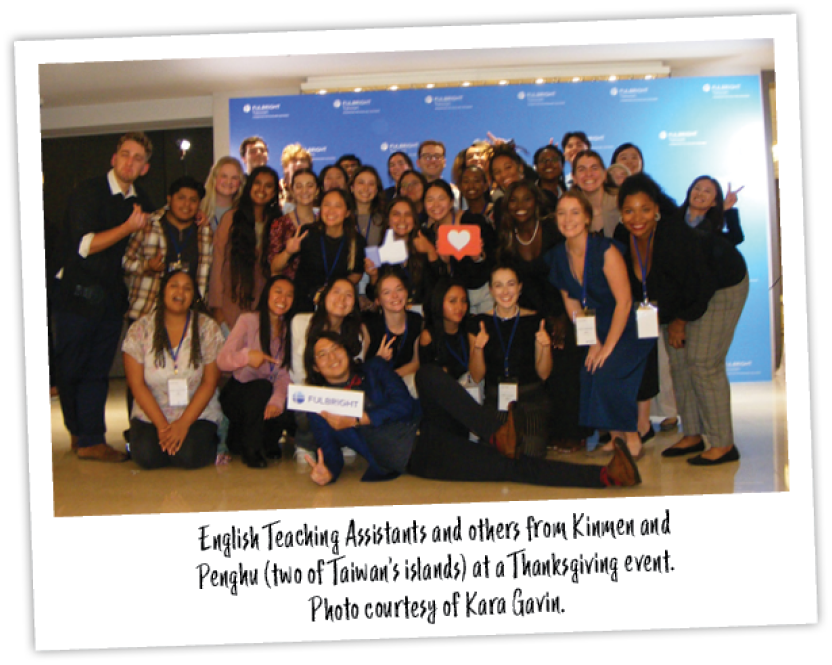
There are U.S. Fulbright student scholars in more than 100 countries worldwide. Three Retrievers were placed in Taiwan—they keep in touch regularly, see each other at ETA trainings, and are planning to travel together during their Fulbright year. But they all arrived in Taiwan separately and faced different challenges settling in.
“I arrived in Taiwan and immediately changed my plans because the airline lost my luggage,” says Humanities Scholar Kara Gavin ’20, English. She was grateful to have a carry-on. “It was chaotic. I was taking it all in,” says Gavin. A day and a 50-minute plane ride later, she arrived in Penghu County, Taiwan, an archipelago of about 90 islands between China and the main island of Taiwan. “The little beach town is in its own little world,” says Gavin. “The smell of the sand gave me comfort.”
Gavin teaches beginner English at two local junior high schools. New to Asia and Mandarin, Gavin’s thinking cap is on 24 – 7, including learning Mandarin in between teaching classes. “Living independently for the first time is hard on its own, but doing it in a foreign country is a whole other ball game,” says Gavin. “I’m acquiring many new life skills that will last me a lifetime.”
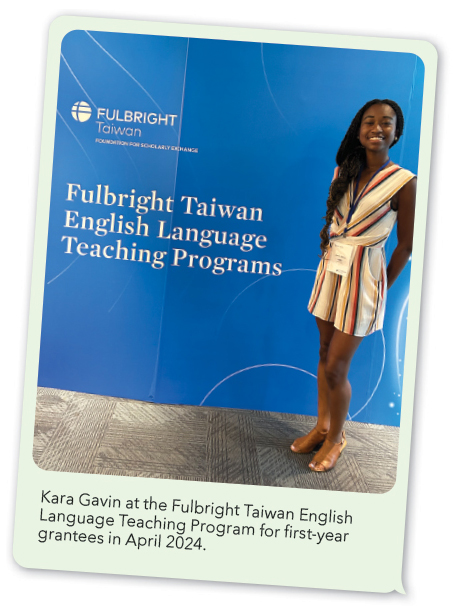
One of those is sympathizing with her students and anyone learning a new language and culture. “I teach the English pronunciation and spelling of a word,” says Gavin. “Then, they like to share the Mandarin equivalent with me. It’s all about patience, balance, and trust.” She also models intercultural teamwork by developing and teaching lessons with her bilingual (Mandarin/English) Taiwanese co-teacher to foster student engagement and enrichment.
For Fulbright Scholars, it is equally important to engage with communities beyond the classroom. When they apply for the grant, the Fulbright Program asks them to develop ideas to share their passions and skills in a community project. For Gavin, this meant adding a little drama to have a lot of fun. As a performing artist, Gavin knows the theatre can be a powerful community-building outlet. “I wanted to encourage students and other community members to express themselves and share their culture with me and others,” says Gavin.
She found a kindred spirit in a professor at a local university. They formed a drama club at the university for English language learners at all levels to explore American play formats with Taiwanese traditions and histories.“Writing original bilingual plays, in English and Mandarin, based on folktales about island traditions is creating an artistic and fun cultural exchange and understanding outside of my ETA duties,” says Gavin.
Finding the right pace
For fellow Humanities Scholar Nailah-Benā Chambers ’23, global studies, a Fulbright award to Taiwan was a natural next step. Chambers began learning Mandarin and all things Taiwanese in sixth grade at a Taiwanese Mandarin language immersion school in her hometown of Richmond, Virginia. As her Mandarin improved, she tutored other English speakers. This oscillating pattern of being a student and a teacher makes Chambers adaptable and persistent, she says.
But it hasn’t always been easy. When she first visited Taipei, Taiwan, in the spring of 2023 on a Mandarin language-intensive study abroad program, “I was so confident. I walked into a 7-Eleven to shop. No one could understand me,” says Chambers. “It was a bit embarrassing. Even with my language and cultural skills, I had a long way to go to mastering Mandarin.”
Now on her Fulbright ETA grant, Chambers arrived on solid ground, both culturally and linguistically. “I felt such a sense of calm and familiarity. Taiwan is so welcoming,” says Chambers. “It calms you down. Things are much slower here than in the U.S.” Soon enough, Chambers was balancing classrooms at Huludun Elementary and Fu Chun Elementary in Taichung City, on the main island of Taiwan, with students at both schools on the extreme spectrum of English proficiency.
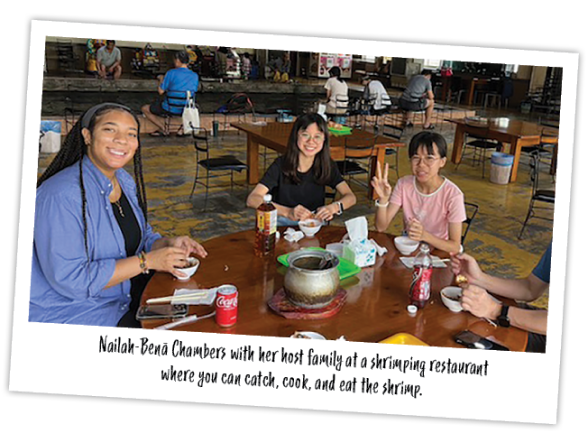
The upside of working with proficient English language learners is connecting on more advanced topics and sticking to Fulbright’s English-only immersion model. At one of her schools, the students are beginning English language learners, and the administrators only speak Mandarin. “My experience as a bilingual teacher and learner with a high level of understanding of the local language and culture has helped with classroom management and fostering powerful connections with students and administrators,” says Chambers. “It also helps to advance their grasp of the nuances of American English, especially when there are gray areas or misunderstandings.”
Keeping your ears open
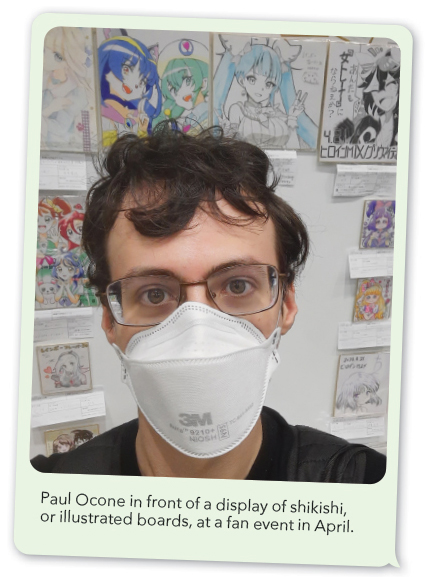
Watching anime, reading manga, (Japanese graphic novels), and participating in their fandom inspired Paul Ocone ’22, individualized study, a Linehan Artist Scholar, to research these subjects and learn Japanese. “I have deeply engaged in fan social life and communities—from leading an anime club to participating in and running conventions to moderating online communities—my affinity for and interest in anime fan spaces runs deep,” says Ocone. Part of Ocone’s observations include witnessing how some fan subcultures limit their membership in fear that a broader fanbase would weaken their subculture identity. In contrast, he says, other fan subcultures are more flexible while maintaining their identity.
Interested in adding to his initial research in U.S. fan spaces, Ocone is now at the epicenter of anime and manga culture as a Fulbright Student Researcher doing anthropological research with Morikawa Kaichirō, a leading scholar in this field at Meiji University’s School of Global Japanese Studies in Tokyo, also home to the Yoshihiro Yonezawa Memorial Library of Manga and Subcultures.
“I have had some amazing experiences participating in anime pilgrimage or anime tourism, including learning much from other fans and benefitting from their generosity,” says Ocone. “My Japanese is conversational—sometimes it’s challenging to understand specialized topics, but this has not deterred me from adding anime and manga tourism as a second research project.” In January, Ocone presented his work at the Popular Culture Tourism Stakeholders Summit in Japan.
Ocone is a sort of tourist himself, enjoying various aspects of Japanese pop culture. The daily musicality of Tokyo teaches him about enjoying the rhythm of the day. “Each train station plays a unique melody when the train departs,” says Ocone. These melodies or “hassha merodii,” are catchy and echo around in his brain like the convenience store jingles that also greet customers. “I was happily surprised when I heard a loudspeaker playing a symphony in my neighborhood,” says Ocone. “Another one played the following day and the next. I learned this was a daily sunset ritual.” He knows these sound experiences will play in his head long after returning to the U.S.
Learning new languages
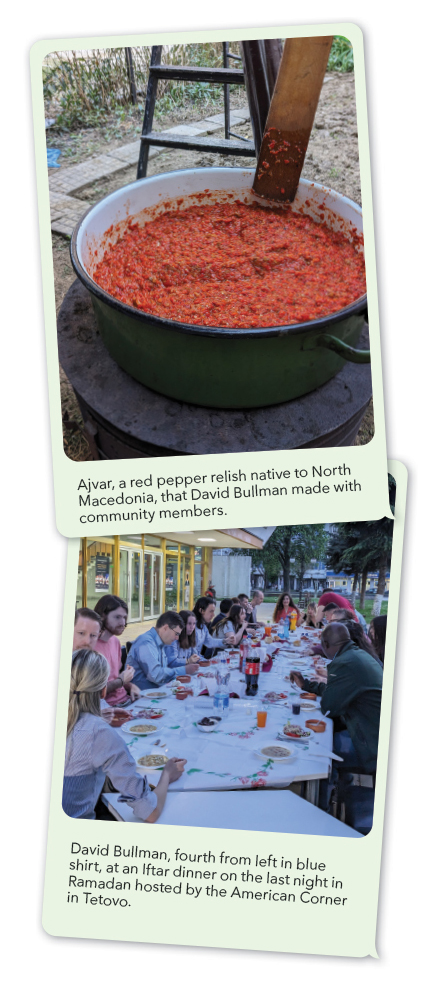
This is not the first time David Bullman ’22, ancient studies, visited North Macedonia. He first went in 1995 as a performing musician and public affairs representative for the U.S. Army.
“North Macedonia was very different coming out of the Cold War,” says Bullman. “The infrastructure and general state of repair of public spaces and businesses is much better than I recall from that time.”
Now, as an ETA, Bullman teaches British civilization and American civilization in addition to three different levels of English at the University of Totovo in the Republic of North Macedonia, a landlocked country north of Greece. In Totovo, students begin learning English in elementary school and are fluent by the time they reach college. “I thought I would be teaching English basics,” says Bullman, “but it’s been great to teach a complex subject in the context of where my students live.”
His students are equally glad to help him with the local language. Macedonian and Albanian are the country’s two official languages. Bullman began learning some key Macedonian phrases in preparation for his trip. However, Albanian is the preferred language in Tetovo. After traveling with the Army to more than 15 countries on three continents, Bullman is used to rapidly switching gears and accepting help.
He eagerly takes on the student role when it comes to learning about new foods. Bullman’s apartment faces the Hapësira Socio-Kulturore Tetovë, a community center where locals and the nearby Peace Corps Volunteers sometimes organize activities, like an ajvar-making gathering. Ajvar is a delicacy across the Balkans made every fall. It’s a tradition passed down through centuries with many recipe variations. “Ajvar is made by charring red bell peppers that are then peeled, minced, seasoned, and cooked for hours,” says Bullman. It boils down to a relish that can be preserved for months, but locals tell Bullman that’s rare because it’s too good to keep for even one week. After participating in the preparation and getting to take home a few jars, Bullman agrees with the locals. Ajvar is now his go-to condiment on eggs, pasta, toast—anything goes.
Albanian and cooking are not the only languages Bullman tapped into while in Tetovo. As a lifelong clarinet player, Bullman hoped to create a musical exchange with local musicians. The opportunity presented itself when the dean of the Faculty of Art wanted to celebrate Thanksgiving. Bullman collaborated with the music faculty, the orchestra director, and students to create a concert of six songs. “I’m glad I returned to North Macedonia. The people are as warm and friendly as I remembered them to be,” says Bullman. “I wanted to come back and experience it myself again.”
Tapping into curiosity
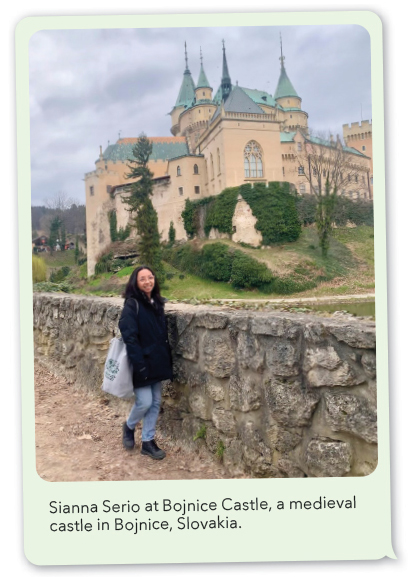
On her way to her Fulbright placement, Sianna Serio ’23, computer science, went city hopping. “I was headed to Žilina, Slovakia, east of Austria and south of Poland,” says Serio. “I flew into Vienna, Austria, then I took a one-hour bus ride crossing Austria’s eastern border into Slovakia to get to Bratislava, the capital.“ There she met other ETAs for orientation. “A week later, I hopped on a two-hour train ride to my teaching placement in Žilina and I met my wonderful mentor, Maria Veršova, who became my second mom.”
Serio teaches at the Hotel Academy, Žilina. The academy focuses on hotel management, gastronomy, and tourism. “My students are beginning English language learners,” says Serio. “I teach what the class is interested in, like American pop culture, because they rarely meet a native English speaker.” During outings with her students, they ask about a wide range of topics. “There are many topics that I would not have thought to cover if it were not for time spent outside of the classroom,” says Serio, “Some of those conversations became formal lessons, like the lesson on the three branches of the U. S. government.”
Serio appreciates her students’ curiosity. She tapped into her love of website development and design to improve her students’ confidence in writing and speaking English and prepare for their Maturita exam, a national high school exit exam. “Some of my students are helping me design a class webpage for them where I will showcase their class and post some of their practice writing in English,” says Serio. “These posts will include topics covered in the Maturita exam, information about their school, and answers to questions about Slovakia.”
Serio’s mentor Maria Veršova, head of the English department, is her motivation. She guides her through lesson planning, class schedules, and the challenges of relocating to a new country. “When my original housing plans fell through, Maria found housing for me five minutes from her house,” says Serio. “She helped me find health insurance and open a bank account. Her husband set up my internet.” They have welcomed Serio almost daily into their home for dinner, tea, coffee, or wine. Serio is a gracious guest and lent her graphic design expertise to help Veršova design invitation cards for her 50th birthday party. Veršova tells Serio she will always have a place to stay in Žilina.
Fulbright: The next generation
Teaching has defined the last decade for Tiffany Powell, a master’s student in UMBC’s TESOL program, a passion she invested in as an English language learner teacher in Seoul and in Miryang City, South Korea, for five years, and in Florida this past year. Now, she is in Iași, Romania, southwest of Ukraine, at the Alexandru Ioan Cuza University teaching American studies. Powell is committed to bridging culture, community, and belonging by bringing technology into the classroom.
Powell also decided to bring the research and cultural understanding closer to home by partnering with Romanian teachers to develop a five-part series on African American women’s history. “We talked about Black women in science in the context of the movie Hidden Figures and discussed Hollywood’s portrayal of Black life,” says Powell. The class is now creating a series on Romanian women. Helping students better understand the similarities and differences between U.S. and Romanian cultures has been an eye-opening experience for Powell.
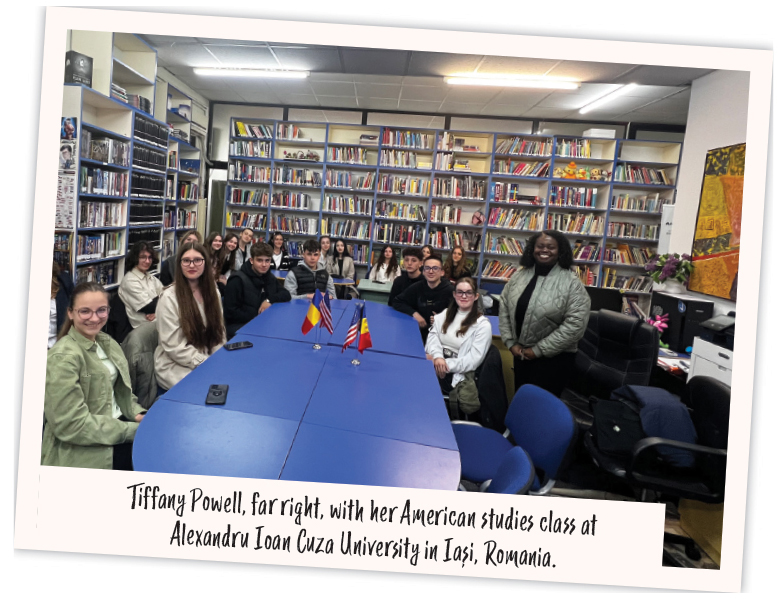
She sees the impact of a country formerly under communism. In Iași, sometimes the internet doesn’t work and, in her school, there are no clubs or student organizations to gain the skills needed to earn a Fulbright award. “My students have given me a new perspective. You may want to come in and make changes, but you must understand where they’re coming from. There is a saying in Iași, ‘It’s not impossible. It’s just difficult,’” says Powell. She is trying to help with the difficult part by leading Fulbright application and leadership workshops.
Powell, like the other Fulbrighters, will bring her experiences home with her and wherever she ends up teaching English next. When their Fulbright year ends, these Retriever ambassadors will find themselves as emissaries yet again, returning to their hometowns, sharing the good news of ajvar made in community, the freedom of a scooter ride along a Taiwanese beach, or the correct stroke order for writing the Mandarin number five. The lessons their students and host families passed along—including pausing to take a breath and appreciate their international successes small and large—will continue to form and shape the way they see the world.
“Having a flexible mindset and under-standing the historical context of your placement is key,” says Powell. “I carry myself as a U.S. representative. Living abroad teaches humility, adaptability, and open-mindedness to press on through challenging times.”
]]>
International travel offers ample opportunities to stretch yourself—one minute you may be the expert and the next, completely clueless about how something works. Retrievers currently in the...
https://umbc.edu/stories/a-journey-of-growth/
https://my3.my.umbc.edu/api/v0/pixel/news/142391/guest@my.umbc.edu/429a43e449ef9d4187b1ae1d4e63ca4e/api/pixel
alumni
ancient-studies
bioinformatics-and-computational-biology
cahss
cge
computer-science
education-abroad
english
feature
fulbright
global-studies
humanities
inds
linehan
llc
magazine
meyerhoff
spring-2024
story
UMBC News & Magazine
https://my3.my.umbc.edu/groups/umbc-news-magazine
https://assets1-my.umbc.edu/system/shared/avatars/groups/000/001/943/24435aa6207c452e7bc15cc74b42c7bb/xsmall.png?1748556657
https://assets1-my.umbc.edu/system/shared/avatars/groups/000/001/943/24435aa6207c452e7bc15cc74b42c7bb/original.png?1748556657
https://assets2-my.umbc.edu/system/shared/avatars/groups/000/001/943/24435aa6207c452e7bc15cc74b42c7bb/xxlarge.png?1748556657
https://assets2-my.umbc.edu/system/shared/avatars/groups/000/001/943/24435aa6207c452e7bc15cc74b42c7bb/xlarge.png?1748556657
https://assets3-my.umbc.edu/system/shared/avatars/groups/000/001/943/24435aa6207c452e7bc15cc74b42c7bb/large.png?1748556657
https://assets1-my.umbc.edu/system/shared/avatars/groups/000/001/943/24435aa6207c452e7bc15cc74b42c7bb/medium.png?1748556657
https://assets2-my.umbc.edu/system/shared/avatars/groups/000/001/943/24435aa6207c452e7bc15cc74b42c7bb/small.png?1748556657
https://assets1-my.umbc.edu/system/shared/avatars/groups/000/001/943/24435aa6207c452e7bc15cc74b42c7bb/xsmall.png?1748556657
https://assets2-my.umbc.edu/system/shared/avatars/groups/000/001/943/24435aa6207c452e7bc15cc74b42c7bb/xxsmall.png?1748556657
UMBC News & Magazine
5
0
false
Wed, 29 May 2024 14:32:52 -0400
A Journey of Growth
International travel offers ample opportunities to stretch yourself—one minute you may be the expert and the next, completely clueless about how something works. Retrievers currently in the Fulbright U.S. Student Program—teaching English or researching around the globe—find themselves oscillating between their teaching and student roles on a daily or hourly basis. By engaging their host communities through openness and cultural humility (and many shared cups of tea or coffee), these Fulbrighters are finding their balance along the way.
All eyes are on Milan Richardson ’23 as she helps her co-teacher keep score in a Jeopardy-like game her students are playing. Richardson teaches English to several classes of first through sixth-grade students at Jinsha Elementary School in Kinmen County, Taiwan. As she completes the Mandarin character for the numeral 5, a wave of giggles and chatter flows through the room.
Similar to a U.S. tally—four strokes and a strike though, the Mandarin character has 5 strokes total and needs to be written a certain way to represent 1, 2, 3, 4, or 5. “The students were so confused because I wrote the character strokes in the wrong order,” says Richardson, who is used to solving complex math as a Meyerhoff Scholar having earned a bachelor’s degree in bioinformatics and computational biology and minors in computer science and modern, languages, linguistics, and intercultural communication.
“I wanted to write the character correctly. I asked, and they showed me the proper order to write the strokes,” says Richardson, a Fulbright English Teaching Assistant (ETA). “They started clapping once I got it right. This was one of the many cool moments where my students were able to teach me.”
While she may be new to teaching in Taiwan, Richardson brings with her four years as an English and math tutor and a minor in Mandarin. “Taiwan was so different from any place I’ve ever been to. I was overwhelmed at first,” says Richardson. “I like it a lot, now. In my second month, I applied for a scooter license. Now I ride around the island and have taken my scooter other places on trips.”
Diplomas earned. Visas in hand. Vaccines completed. Luggage packed. Destination confirmed. Last summer, UMBC’s eight participants in the 2023 – 2024 Fulbright U.S. Student Program checked off all the important items on their to-do lists. The only thing left was to get to their placements on islands and in landlocked countries, cities, and countrysides across East Asia and Eastern Europe. It’s easier written than done. To adapt well to a new community, job, language, and culture, they must practice the art of humility and flexibility as their roles shift regularly from teacher to student.
Leading the Fulbright charge
All technicalities aside, the Fulbright experience is the beginning of building an international network of teachers and researchers who share the diversity and possibility of the U.S. with the world. In return, across the globe, communities welcome the next generation of leaders into their cities, neighborhoods, schools, and homes to share their country’s history, innovations, and culture. Since Fulbright’s inception in 1946, these reciprocal acts of kindness have created multiple paths forward to lifelong worldwide collaboration and understanding based on the simple act of giving someone different than yourself a chance.
“The Fulbright Program truly demonstrates public diplomacy in action,” says Brian Souders, M.A.’19, TESOL, and Ph.D. ’09, language, literacy, and culture, the associate director of global learning at UMBC’s Center for Global Engagement. In this role, Souders, who received a 2023 Fulbright International Education Administrator award to Germany, has led hundreds of Retrievers through the Fulbright application process as UMBC’s Fulbright Program advisor. “Whether in the classroom as teachers, students, or researchers, recipients learn about the world as much as they share what it means to be from the U.S. and UMBC alumni,” says Souders.
Thanks to Souders’ guidance, UMBC is one of 57 doctoral universities nationwide and three in Maryland to receive a Fulbright Top Producing Institution designation for 2023 – 2024, for the third time in the last five years. In the last decade, more than 80 UMBC alumni have received Fulbright awards. Out of the 10 Retrievers who received a 2023 – 2024 Fulbright, eight are currently placed internationally, seven are ETAs and one is on a research grant.
The hard work of play
There are U.S. Fulbright student scholars in more than 100 countries worldwide. Three Retrievers were placed in Taiwan—they keep in touch regularly, see each other at ETA trainings, and are planning to travel together during their Fulbright year. But they all arrived in Taiwan separately and faced different challenges settling in.
“I arrived in Taiwan and immediately changed my plans because the airline lost my luggage,” says Humanities Scholar Kara Gavin ’20, English. She was grateful to have a carry-on. “It was chaotic. I was taking it all in,” says Gavin. A day and a 50-minute plane ride later, she arrived in Penghu County, Taiwan, an archipelago of about 90 islands between China and the main island of Taiwan. “The little beach town is in its own little world,” says Gavin. “The smell of the sand gave me comfort.”
Gavin teaches beginner English at two local junior high schools. New to Asia and Mandarin, Gavin’s thinking cap is on 24 – 7, including learning Mandarin in between teaching classes. “Living independently for the first time is hard on its own, but doing it in a foreign country is a whole other ball game,” says Gavin. “I’m acquiring many new life skills that will last me a lifetime.”
One of those is sympathizing with her students and anyone learning a new language and culture. “I teach the English pronunciation and spelling of a word,” says Gavin. “Then, they like to share the Mandarin equivalent with me. It’s all about patience, balance, and trust.” She also models intercultural teamwork by developing and teaching lessons with her bilingual (Mandarin/English) Taiwanese co-teacher to foster student engagement and enrichment.
For Fulbright Scholars, it is equally important to engage with communities beyond the classroom. When they apply for the grant, the Fulbright Program asks them to develop ideas to share their passions and skills in a community project. For Gavin, this meant adding a little drama to have a lot of fun. As a performing artist, Gavin knows the theatre can be a powerful community-building outlet. “I wanted to encourage students and other community members to express themselves and share their culture with me and others,” says Gavin.
She found a kindred spirit in a professor at a local university. They formed a drama club at the university for English language learners at all levels to explore American play formats with Taiwanese traditions and histories.“Writing original bilingual plays, in English and Mandarin, based on folktales about island traditions is creating an artistic and fun cultural exchange and understanding outside of my ETA duties,” says Gavin.
Finding the right pace
For fellow Humanities Scholar Nailah-Benā Chambers ’23, global studies, a Fulbright award to Taiwan was a natural next step. Chambers began learning Mandarin and all things Taiwanese in sixth grade at a Taiwanese Mandarin language immersion school in her hometown of Richmond, Virginia. As her Mandarin improved, she tutored other English speakers. This oscillating pattern of being a student and a teacher makes Chambers adaptable and persistent, she says.
But it hasn’t always been easy. When she first visited Taipei, Taiwan, in the spring of 2023 on a Mandarin language-intensive study abroad program, “I was so confident. I walked into a 7-Eleven to shop. No one could understand me,” says Chambers. “It was a bit embarrassing. Even with my language and cultural skills, I had a long way to go to mastering Mandarin.”
Now on her Fulbright ETA grant, Chambers arrived on solid ground, both culturally and linguistically. “I felt such a sense of calm and familiarity. Taiwan is so welcoming,” says Chambers. “It calms you down. Things are much slower here than in the U.S.” Soon enough, Chambers was balancing classrooms at Huludun Elementary and Fu Chun Elementary in Taichung City, on the main island of Taiwan, with students at both schools on the extreme spectrum of English proficiency.
The upside of working with proficient English language learners is connecting on more advanced topics and sticking to Fulbright’s English-only immersion model. At one of her schools, the students are beginning English language learners, and the administrators only speak Mandarin. “My experience as a bilingual teacher and learner with a high level of understanding of the local language and culture has helped with classroom management and fostering powerful connections with students and administrators,” says Chambers. “It also helps to advance their grasp of the nuances of American English, especially when there are gray areas or misunderstandings.”
Keeping your ears open
Watching anime, reading manga, (Japanese graphic novels), and participating in their fandom inspired Paul Ocone ’22, individualized study, a Linehan Artist Scholar, to research these subjects and learn Japanese. “I have deeply engaged in fan social life and communities—from leading an anime club to participating in and running conventions to moderating online communities—my affinity for and interest in anime fan spaces runs deep,” says Ocone. Part of Ocone’s observations include witnessing how some fan subcultures limit their membership in fear that a broader fanbase would weaken their subculture identity. In contrast, he says, other fan subcultures are more flexible while maintaining their identity.
Interested in adding to his initial research in U.S. fan spaces, Ocone is now at the epicenter of anime and manga culture as a Fulbright Student Researcher doing anthropological research with Morikawa Kaichirō, a leading scholar in this field at Meiji University’s School of Global Japanese Studies in Tokyo, also home to the Yoshihiro Yonezawa Memorial Library of Manga and Subcultures.
“I have had some amazing experiences participating in anime pilgrimage or anime tourism, including learning much from other fans and benefitting from their generosity,” says Ocone. “My Japanese is conversational—sometimes it’s challenging to understand specialized topics, but this has not deterred me from adding anime and manga tourism as a second research project.” In January, Ocone presented his work at the Popular Culture Tourism Stakeholders Summit in Japan.
Ocone is a sort of tourist himself, enjoying various aspects of Japanese pop culture. The daily musicality of Tokyo teaches him about enjoying the rhythm of the day. “Each train station plays a unique melody when the train departs,” says Ocone. These melodies or “hassha merodii,” are catchy and echo around in his brain like the convenience store jingles that also greet customers. “I was happily surprised when I heard a loudspeaker playing a symphony in my neighborhood,” says Ocone. “Another one played the following day and the next. I learned this was a daily sunset ritual.” He knows these sound experiences will play in his head long after returning to the U.S.
Learning new languages
This is not the first time David Bullman ’22, ancient studies, visited North Macedonia. He first went in 1995 as a performing musician and public affairs representative for the U.S. Army.
“North Macedonia was very different coming out of the Cold War,” says Bullman. “The infrastructure and general state of repair of public spaces and businesses is much better than I recall from that time.”
Now, as an ETA, Bullman teaches British civilization and American civilization in addition to three different levels of English at the University of Totovo in the Republic of North Macedonia, a landlocked country north of Greece. In Totovo, students begin learning English in elementary school and are fluent by the time they reach college. “I thought I would be teaching English basics,” says Bullman, “but it’s been great to teach a complex subject in the context of where my students live.”
His students are equally glad to help him with the local language. Macedonian and Albanian are the country’s two official languages. Bullman began learning some key Macedonian phrases in preparation for his trip. However, Albanian is the preferred language in Tetovo. After traveling with the Army to more than 15 countries on three continents, Bullman is used to rapidly switching gears and accepting help.
He eagerly takes on the student role when it comes to learning about new foods. Bullman’s apartment faces the Hapësira Socio-Kulturore Tetovë, a community center where locals and the nearby Peace Corps Volunteers sometimes organize activities, like an ajvar-making gathering. Ajvar is a delicacy across the Balkans made every fall. It’s a tradition passed down through centuries with many recipe variations. “Ajvar is made by charring red bell peppers that are then peeled, minced, seasoned, and cooked for hours,” says Bullman. It boils down to a relish that can be preserved for months, but locals tell Bullman that’s rare because it’s too good to keep for even one week. After participating in the preparation and getting to take home a few jars, Bullman agrees with the locals. Ajvar is now his go-to condiment on eggs, pasta, toast—anything goes.
Albanian and cooking are not the only languages Bullman tapped into while in Tetovo. As a lifelong clarinet player, Bullman hoped to create a musical exchange with local musicians. The opportunity presented itself when the dean of the Faculty of Art wanted to celebrate Thanksgiving. Bullman collaborated with the music faculty, the orchestra director, and students to create a concert of six songs. “I’m glad I returned to North Macedonia. The people are as warm and friendly as I remembered them to be,” says Bullman. “I wanted to come back and experience it myself again.”
Tapping into curiosity
On her way to her Fulbright placement, Sianna Serio ’23, computer science, went city hopping. “I was headed to Žilina, Slovakia, east of Austria and south of Poland,” says Serio. “I flew into Vienna, Austria, then I took a one-hour bus ride crossing Austria’s eastern border into Slovakia to get to Bratislava, the capital.“ There she met other ETAs for orientation. “A week later, I hopped on a two-hour train ride to my teaching placement in Žilina and I met my wonderful mentor, Maria Veršova, who became my second mom.”
Serio teaches at the Hotel Academy, Žilina. The academy focuses on hotel management, gastronomy, and tourism. “My students are beginning English language learners,” says Serio. “I teach what the class is interested in, like American pop culture, because they rarely meet a native English speaker.” During outings with her students, they ask about a wide range of topics. “There are many topics that I would not have thought to cover if it were not for time spent outside of the classroom,” says Serio, “Some of those conversations became formal lessons, like the lesson on the three branches of the U. S. government.”
Serio appreciates her students’ curiosity. She tapped into her love of website development and design to improve her students’ confidence in writing and speaking English and prepare for their Maturita exam, a national high school exit exam. “Some of my students are helping me design a class webpage for them where I will showcase their class and post some of their practice writing in English,” says Serio. “These posts will include topics covered in the Maturita exam, information about their school, and answers to questions about Slovakia.”
Serio’s mentor Maria Veršova, head of the English department, is her motivation. She guides her through lesson planning, class schedules, and the challenges of relocating to a new country. “When my original housing plans fell through, Maria found housing for me five minutes from her house,” says Serio. “She helped me find health insurance and open a bank account. Her husband set up my internet.” They have welcomed Serio almost daily into their home for dinner, tea, coffee, or wine. Serio is a gracious guest and lent her graphic design expertise to help Veršova design invitation cards for her 50th birthday party. Veršova tells Serio she will always have a place to stay in Žilina.
Fulbright: The next generation
Teaching has defined the last decade for Tiffany Powell, a master’s student in UMBC’s TESOL program, a passion she invested in as an English language learner teacher in Seoul and in Miryang City, South Korea, for five years, and in Florida this past year. Now, she is in Iași, Romania, southwest of Ukraine, at the Alexandru Ioan Cuza University teaching American studies. Powell is committed to bridging culture, community, and belonging by bringing technology into the classroom.
Powell also decided to bring the research and cultural understanding closer to home by partnering with Romanian teachers to develop a five-part series on African American women’s history. “We talked about Black women in science in the context of the movie Hidden Figures and discussed Hollywood’s portrayal of Black life,” says Powell. The class is now creating a series on Romanian women. Helping students better understand the similarities and differences between U.S. and Romanian cultures has been an eye-opening experience for Powell.
She sees the impact of a country formerly under communism. In Iași, sometimes the internet doesn’t work and, in her school, there are no clubs or student organizations to gain the skills needed to earn a Fulbright award. “My students have given me a new perspective. You may want to come in and make changes, but you must understand where they’re coming from. There is a saying in Iași, ‘It’s not impossible. It’s just difficult,’” says Powell. She is trying to help with the difficult part by leading Fulbright application and leadership workshops.
Powell, like the other Fulbrighters, will bring her experiences home with her and wherever she ends up teaching English next. When their Fulbright year ends, these Retriever ambassadors will find themselves as emissaries yet again, returning to their hometowns, sharing the good news of ajvar made in community, the freedom of a scooter ride along a Taiwanese beach, or the correct stroke order for writing the Mandarin number five. The lessons their students and host families passed along—including pausing to take a breath and appreciate their international successes small and large—will continue to form and shape the way they see the world.
“Having a flexible mindset and under-standing the historical context of your placement is key,” says Powell. “I carry myself as a U.S. representative. Living abroad teaches humility, adaptability, and open-mindedness to press on through challenging times.”
]]>
International travel offers ample opportunities to stretch yourself—one minute you may be the expert and the next, completely clueless about how something works. Retrievers currently in the...
https://umbc.edu/stories/a-journey-of-growth-retriever-fulbright/
https://my3.my.umbc.edu/api/v0/pixel/news/142404/guest@my.umbc.edu/ed280c216f570c718be808f58bf7c55a/api/pixel
alumni
ancient-studies
bioinformatics-and-computational-biology
cahss
cge
computer-science
education-abroad
english
feature
fulbright
global-studies
humanities
inds
linehan
llc
magazine
meyerhoff
spring-2024
story
UMBC News & Magazine
https://my3.my.umbc.edu/groups/umbc-news-magazine
https://assets1-my.umbc.edu/system/shared/avatars/groups/000/001/943/24435aa6207c452e7bc15cc74b42c7bb/xsmall.png?1748556657
https://assets1-my.umbc.edu/system/shared/avatars/groups/000/001/943/24435aa6207c452e7bc15cc74b42c7bb/original.png?1748556657
https://assets2-my.umbc.edu/system/shared/avatars/groups/000/001/943/24435aa6207c452e7bc15cc74b42c7bb/xxlarge.png?1748556657
https://assets2-my.umbc.edu/system/shared/avatars/groups/000/001/943/24435aa6207c452e7bc15cc74b42c7bb/xlarge.png?1748556657
https://assets3-my.umbc.edu/system/shared/avatars/groups/000/001/943/24435aa6207c452e7bc15cc74b42c7bb/large.png?1748556657
https://assets1-my.umbc.edu/system/shared/avatars/groups/000/001/943/24435aa6207c452e7bc15cc74b42c7bb/medium.png?1748556657
https://assets2-my.umbc.edu/system/shared/avatars/groups/000/001/943/24435aa6207c452e7bc15cc74b42c7bb/small.png?1748556657
https://assets1-my.umbc.edu/system/shared/avatars/groups/000/001/943/24435aa6207c452e7bc15cc74b42c7bb/xsmall.png?1748556657
https://assets2-my.umbc.edu/system/shared/avatars/groups/000/001/943/24435aa6207c452e7bc15cc74b42c7bb/xxsmall.png?1748556657
UMBC News & Magazine
0
0
false
Wed, 29 May 2024 14:32:52 -0400
UMBC’s first Fulbright Scholar-in-Residence shares unique research on neurodiversity in language teaching and learning
Neurodiversity inclusion and representation have been at the forefront of Michael Canale’s 20-year career in the disability services and education field. Canale, M.A. ’24, intercultural communication, is the assistant director of UMBC’s Office of Student Disability Services and teaches the first-year seminar Introduction to Disability Studies. “Sometimes parents of neurodivergent students worry that their child is incapable of learning another language,” says Canale. “I work with parents to ease their fears by showing them how their child can excel in college with the proper individualized accommodations.” These can include note-taking software, counseling services, tutoring, time management support, and more.
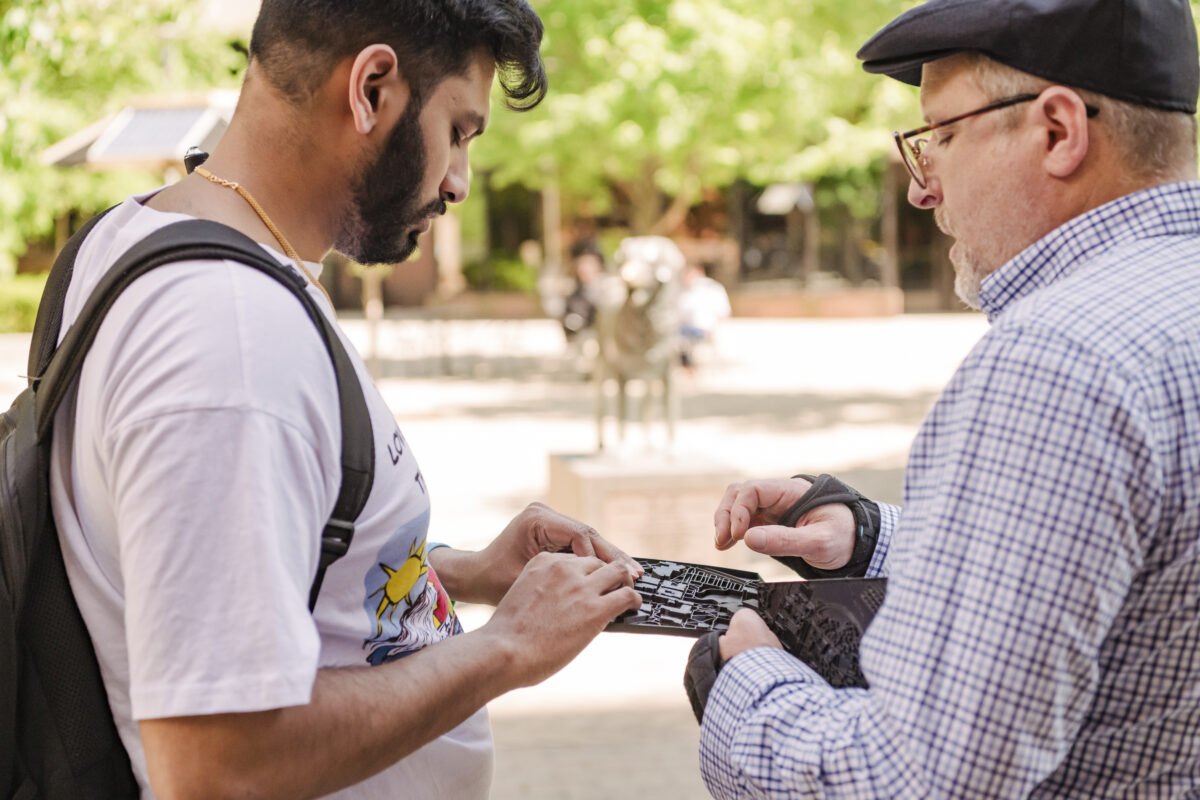 Michael Canale (r) has been working with Ph.D. students in human-centered computing to create personal tactile maps of campus for blind students at UMBC, like Shawn Abraham ’24, political science. (Marlayna Demond ’11/UMBC)
When Canele, who also received his post-master’s certificate in college teaching and learning science, heard that UMBC’s first Fulbright Scholar-in-Residence, Jules Buendgens-Kosten,would be teaching Language Learning and Special Education – Advanced Special Topics in Education, he was quick to enroll. The course, part of UMBC’s teaching English to speakers of other languages (TESOL) master’s program, was designed for anybody planning to work with heterogeneous groups of learners, including those of different neurotypes, both in special education and mainstream education settings.
Buendgens-Kosten, a research assistant at the Institute of English and American Studies at Goethe-Universität Frankfurt, Germany,began theirpartnership with UMBC as a research collaboration with Shannon Sauro, associate professor of education.Sauro recognized that Buendgens-Kosten’s expertise in English language teaching and teaching neurodivergent populations in Germany would add an international and non-U.S.-based perspective to UMBC’s TESOL program and education department.
My uni (@UMBC) just got so much geekier and cooler.
]]>
Neurodiversity inclusion and representation have been at the forefront of Michael Canale’s 20-year career in the disability services and education field. Canale, M.A. ’24, intercultural...
https://umbc.edu/stories/umbcs-first-fulbright-scholar-in-residence-research-on-neurodiversity/
https://my3.my.umbc.edu/api/v0/pixel/news/141776/guest@my.umbc.edu/9db27eba31ba49267d43df7a734d3ec0/api/pixel
cahss
cahss-research
coeit
community
education
fulbright
mlli
news
peaceworker
politicalscience
research
story
tesol
UMBC News & Magazine
https://my3.my.umbc.edu/groups/umbc-news-magazine
https://assets1-my.umbc.edu/system/shared/avatars/groups/000/001/943/24435aa6207c452e7bc15cc74b42c7bb/xsmall.png?1748556657
https://assets1-my.umbc.edu/system/shared/avatars/groups/000/001/943/24435aa6207c452e7bc15cc74b42c7bb/original.png?1748556657
https://assets2-my.umbc.edu/system/shared/avatars/groups/000/001/943/24435aa6207c452e7bc15cc74b42c7bb/xxlarge.png?1748556657
https://assets2-my.umbc.edu/system/shared/avatars/groups/000/001/943/24435aa6207c452e7bc15cc74b42c7bb/xlarge.png?1748556657
https://assets3-my.umbc.edu/system/shared/avatars/groups/000/001/943/24435aa6207c452e7bc15cc74b42c7bb/large.png?1748556657
https://assets1-my.umbc.edu/system/shared/avatars/groups/000/001/943/24435aa6207c452e7bc15cc74b42c7bb/medium.png?1748556657
https://assets2-my.umbc.edu/system/shared/avatars/groups/000/001/943/24435aa6207c452e7bc15cc74b42c7bb/small.png?1748556657
https://assets1-my.umbc.edu/system/shared/avatars/groups/000/001/943/24435aa6207c452e7bc15cc74b42c7bb/xsmall.png?1748556657
https://assets2-my.umbc.edu/system/shared/avatars/groups/000/001/943/24435aa6207c452e7bc15cc74b42c7bb/xxsmall.png?1748556657
UMBC News & Magazine
0
0
false
Tue, 07 May 2024 13:43:48 -0400
Tue, 07 May 2024 13:43:48 -0400