From Nepal to NASA: A journey of resilience and discovery
In 2020, as the COVID-19 pandemic disrupted lives worldwide,Greema Regmibegan her Ph.D. in UMBC’s atmospheric physics program. Studying remotely from her home in Nepal, she navigated a grueling schedule due to the time difference.
“One class started at 1 a.m. Nepal time, and one final went until 4:30 a.m.,” she recalls. Yet, she embraced the challenge. “I didn’t mind. I like working at night, so it worked for me. And because of COVID, I had nothing else to do. At least this way, I was making progress towards my studies.”
Now in her fifth year, Regmi’s perseverance has earned her NASA’s prestigious Future Investigators in NASA Earth and Space Science and Technology (FINESST) fellowship, which will provide up to $50,000 annually for up to three years to fuel her research on atmospheric dust.
Regmi’s passion for atmospheric physics took root in Nepal. For an undergraduate project, she analyzed meteorological factors surrounding a tragic local plane crash. “Nepal has a lot of hills and mountains, so it channels wind in certain directions,” she explains. “Based on my analysis, unexpected turbulence could have been a factor in the crash.”
As a senior at Tribhuvan University in Kathmandu, Nepal, Regmi traveled to the U.S. for the first time, to present at the American Geophysical Union Annual Meeting. The event was a turning point in her scientific trajectory.
“I really liked sharing my work in front of a huge crowd. Everybody was listening, and that boosted my confidence,” she says. In Nepal, it sometimes felt like research was a lower priority, but the U.S. offered a fresh stage for her work, Regmi says: “The AGU meeting was great—people appreciated my work. That was a huge motivation to continue and do grad school.”
 This still image from a simulation shows dust and other aerosols moving around the globe. Greema Regmi’s research has focused on dust traveling over the Atlantic Ocean between Africa and the Caribbean, visualized here in shades of red to tan. (NASA/Goddard Space Flight Center)
Decoding dust for climate science
Regmi’s FINESST-funded research aims to improve the accuracy of climate forecasting by refining how atmospheric dust is accounted for in climate models. How dust scatters light affects how much heat is reflected back to space versus absorbed. She combines data from LiDAR and multi-angle polarimeters, such as NASA’s Research Scanning Polarimeter, to analyze dust’s role.
“A polarimeter measures how much radiation you see from the top of the atmosphere,” integrating information from every atmospheric layer, “versus LiDAR, which gives you information on each layer of the atmosphere separately. So when you combine both of those, you have a very rich dataset,” she explains.
Regmi’s work challenges outdated assumptions. “Our existing models assume that dust has a simple shape, such as spherical, but for a long time we’ve known that it isn’t that simple,” she says. In her work, she models dust as hexahedral instead—a 3D shape with six faces. The most familiar hexahedron is a cube, but the angles can shift to make it more or less pointy.
Regmi was surprised by how much using a spheroid versus hexahedral model for dust affects the overall climate models she is investigating. “I did not expect the shape of dust particles that tiny to have such a huge impact. And that was very exciting for me,” she says.
Her research focuses on dust traveling across the Atlantic Ocean from the Sahara Desert. The solid, dark ocean background makes it much easier to pull out clean information about dust, avoiding uncertainty introduced by variegated background landscapes, like the shadows that form in mountain ranges or a wide range of vegetation colors. Improved climate models based on her work could inform decision-making related to climate resilience and mitigation.
 NASA’s ER-2 high-altitude plane carried the instruments that collected the data Regmi used in her research. (NASA)
A community that lifts you up
Regmi has been able to accomplish so much in part because of the supportive community she found at UMBC, after finally arriving on campus in fall 2021. Her Ph.D. advisor, Vanderlei Martins, professor of physics and director of UMBC’s Earth and Space Institute, fosters a collaborative lab.
“Vanderlei is a great professor, but what I really appreciate about him is the group that he has built over years. Everybody in the group is as supportive as he is,” Regmi says. “He has done so much in the field, yet he’s still so humble.”
The positive feelings are mutual. “From the very first classes it was obvious that Greema had great potential and tremendous enthusiasm to learn, to grow scientifically, and to work with others,” Martins says.
Regmi is co-advised by Reed Espinosa, Ph.D. ’17, atmospheric physics, a research physical scientist at NASA Goddard Space Flight Center. “He is an outstanding mentor—patient, thorough, and always encouraging,” Regmi says. “Most of what I know about conducting research I have learned from him.” And Espinosa learned much of that from Martins, who was his own Ph.D. advisor.
 Reed Espinosa (left) and Vanderlei Martins (right) have both mentored Greema Regmi (center) during her Ph.D. at UMBC. (Brad Ziegler/UMBC)
Pengwang Zhai, professor of physics, has been another mentor. “Regmi is a hardworking and intelligent student,” Zhai says. Despite starting her Ph.D. during the pandemic, “she embraced the difficulties, overcame steep learning curves, and has grown into a valuable member of the atmospheric physics program.”
Martins highlights her cohort’s strength. “Regmi has joined an enthusiastic group of Ph.D. students in the atmospheric physics program at UMBC, who have clearly shown that together we are better, and can go farther,” he says.
Regmi values the camaraderie. “In Vanderlei’s group, people help you in every way they can,” she says. Her office near the elevator sparks connections. “Every time someone comes up, they will stop to say ‘hi.’ I’ve made a lot of friends and learned so much from them,” she shares. “I like my department a lot.”
Bridging two worlds
Regmi’s journey bridges her unique perspectives as a student in Nepal and the U.S. “You learn different things when you work back home in a developing country. And when you come here to a developed country, it’s a very different perspective,” she reflects. “In Nepal, it’s more about, ‘These are the resources we have, so how can we make the most out of them?’” she says. At UMBC, she’s embraced broader opportunities. “I think here you can push the limit. I don’t even know what the limit is in the U.S. Here you can dream more and be more experimental,” she observes.
Regmi is inspired by her father, also an atmospheric physicist, but she has forged her own path. This spring, she returned to Nepal for only the second time since starting her Ph.D. to conduct research with him. “I finally got to work with him professionally, which was great,” she says.
Grounded in the UMBC physics department’s community of support, Regmi’s confidence has only grown since her arrival in Maryland. “There’s always a place for my opinion, which is very nice. Because of that, and all of the experiences I’ve had, now I have the confidence to start my own project,” she explains. “And that’s why I think now I’m confident to go back home, lead something there, and be helpful in some small way.”
Learn more about atmospheric physics research at UMBC.
]]>
In 2020, as the COVID-19 pandemic disrupted lives worldwide,Greema Regmibegan her Ph.D. in UMBC’s atmospheric physics program. Studying remotely from her home in Nepal, she navigated a grueling...
https://umbc.edu/stories/greema-regmi-nepal-to-nasa/
https://my3.my.umbc.edu/api/v0/pixel/news/151727/guest@my.umbc.edu/480d2e309d39f6cae265282072452f44/api/pixel
cnms
esi
gestar2
gradresearch
international
news
physics
research
science-and-tech
story
UMBC News & Magazine
https://my3.my.umbc.edu/groups/umbc-news-magazine
https://assets1-my.umbc.edu/system/shared/avatars/groups/000/001/943/24435aa6207c452e7bc15cc74b42c7bb/xsmall.png?1748556657
https://assets1-my.umbc.edu/system/shared/avatars/groups/000/001/943/24435aa6207c452e7bc15cc74b42c7bb/original.png?1748556657
https://assets2-my.umbc.edu/system/shared/avatars/groups/000/001/943/24435aa6207c452e7bc15cc74b42c7bb/xxlarge.png?1748556657
https://assets2-my.umbc.edu/system/shared/avatars/groups/000/001/943/24435aa6207c452e7bc15cc74b42c7bb/xlarge.png?1748556657
https://assets3-my.umbc.edu/system/shared/avatars/groups/000/001/943/24435aa6207c452e7bc15cc74b42c7bb/large.png?1748556657
https://assets1-my.umbc.edu/system/shared/avatars/groups/000/001/943/24435aa6207c452e7bc15cc74b42c7bb/medium.png?1748556657
https://assets2-my.umbc.edu/system/shared/avatars/groups/000/001/943/24435aa6207c452e7bc15cc74b42c7bb/small.png?1748556657
https://assets1-my.umbc.edu/system/shared/avatars/groups/000/001/943/24435aa6207c452e7bc15cc74b42c7bb/xsmall.png?1748556657
https://assets2-my.umbc.edu/system/shared/avatars/groups/000/001/943/24435aa6207c452e7bc15cc74b42c7bb/xxsmall.png?1748556657
UMBC News & Magazine
1
0
false
Mon, 25 Aug 2025 14:40:58 -0400
Mon, 25 Aug 2025 14:40:58 -0400
Leaf year: PACE satellite data reveals global plant health
A new study using data collected by NASA’s Plankton, Aerosol, Cloud, ocean Ecosystem (PACE) satellite established a novel method to determine how productive plants are worldwide. The new remote sensing technique could help us better understand plants’ role in capturing carbon on a global scale and reveal how plants are responding to factors like changing water availability and temperature, with relevance for conservation, agriculture, and more.
The research, led by Karl F. Huemmrich, a UMBC research scientist with the Goddard Earth Sciences Technology and Research (GESTAR) Center II, shows that PACE’s advanced camera can track plant health by analyzing the light leaves reflect. By comparing these satellite observations with measurements taken on the ground, the study confirmed that the new method works across diverse landscapes, opening the door to improved global ecosystem monitoring.
Launched in February 2024, PACE’s Ocean Color Instrument (OCI) captures daily images of Earth that show how plants are responding to their environment in real time. While OCI’s primary mission is to study oceans (hence its name), it also collects data over land.
“Although they do not appear to be very active to us, plants are constantly making physiological adjustments to their environment, responding to factors such as changing light, temperature, humidity, water, and nutrient availability,” Huemmrich explains. A plant can change its leaf area, leaf orientation, and the prevalence of different leaf pigments, he says. All of those changes alter the intensity and wavelengths of light the plants reflect, which OCI detects.
“PACE provides almost daily repeat observations,” except for areas blocked by clouds, Huemmrich says. “This time series can be used to describe changes in vegetation productivity related to seasonal change, for example the timing of spring green-up and autumn senescence, or more transient effects, like droughts or cold snaps.”
 This gif shows how PACE’s OCI “sees” plant productivity changing throughout the growing season across North America. (Skye Caplan)
One algorithm to track them all
Unlike older satellite methods, such as MODIS Gross Primary Productivity, which needed weather data like temperature and humidity to estimate plant growth, PACE relies solely on the light reflected by plants.
“By using the information from the spectral reflectance alone, we are letting the plants show us their responses to environmental conditions, rather than trying to predict their responses,” Huemmrich explains. This approach makes it easier to accurately capture short-term changes.
The study tested PACE’s data against ground measurements from National Ecological Observatory Network (NEON) sites across the U.S., covering everything from arctic tundra to tropical dry forests.
“The NEON sites were chosen to cover all of the major ecoclimate types within the U.S.,” Huemmrich notes, “and frankly, it was surprising that a single algorithm could do as well as it did across all of those very different vegetation types.” This success suggests the method can be used globally, and there are plans to include more sites worldwide in future studies to cover even more ecosystems.
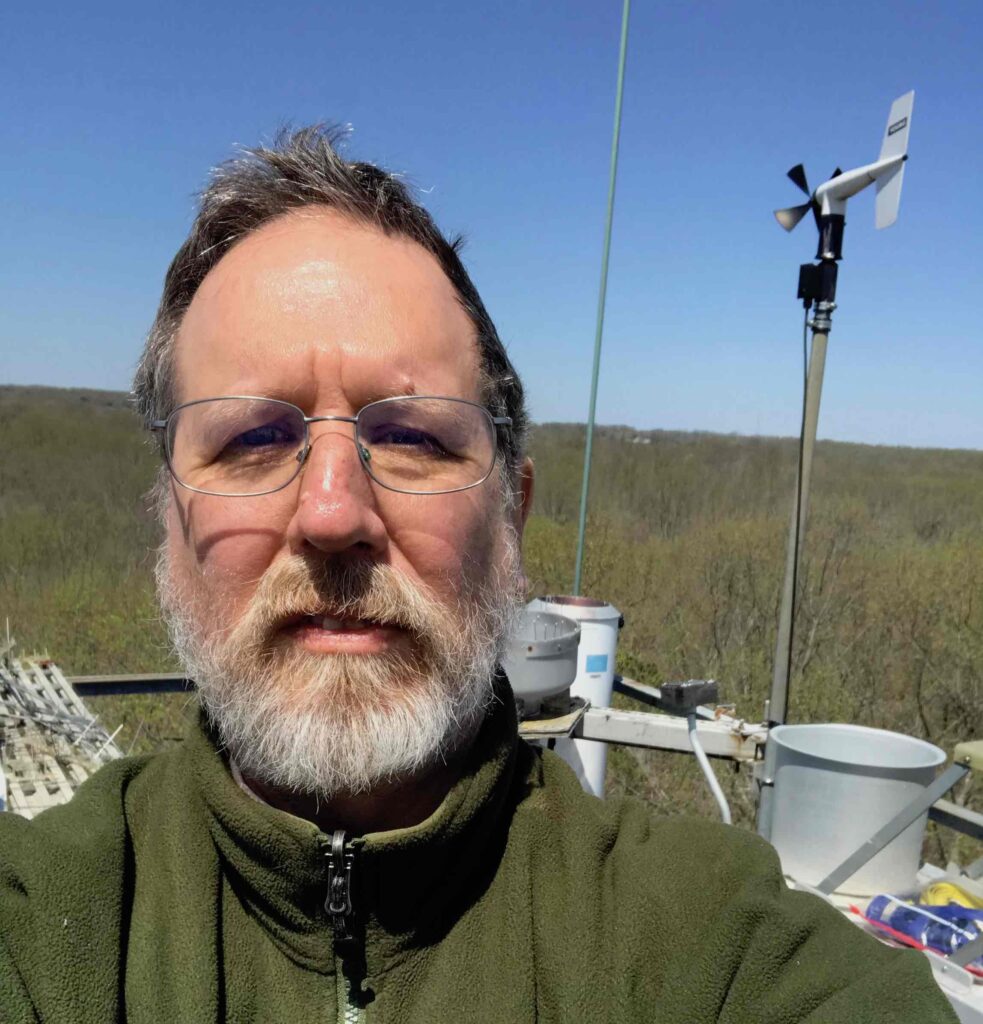 Huemmrich stands 100 feet above the ground on a meteorology tower at the Smithsonian Environmental Research Center in Edgewater, Maryland. (Courtesy of Huemmrich)
“An entirely new view”
This research could transform how scientists track carbon sequestration—how plants absorb and store carbon dioxide, a key greenhouse gas—improving understanding of how different ecosystems influence climate change. The ability to spot stress events early could also help farmers and environmental managers act quickly to improve outcomes for crops and wildlife.
PACE’s global reach is a huge step forward. “I believe this new ability to describe global ecosystem dynamics opens up an entirely new view of the Earth’s ecological functioning that we really have not been able to see before,” Huemmrich says. Unlike earlier methods that relied on labor-intensive ground measurements or expensive airplane flights, PACE offers a cost-effective way to monitor ecosystems worldwide.
Moving into PACE’s second year, Huemmrich is excited to explore how plant responses change over time. “I’m interested in looking at year-to-year differences,” he says. “I want to see how best to use the spectral information for early detection of stress events. Can we learn to diagnose types of stress responses? Do these responses vary among different types of plants?”
These questions will drive future research, aiming to improve how we detect and understand plant stress across diverse ecosystems. PACE’s frequent, detailed satellite data will help scientists, policymakers, and conservationists protect ecosystems and understand how plants are responding to a changing world.
The findings were published in IEEE Transactions on Geoscience and Remote Sensing and co-authored by Petya Campbell, a UMBC research scientist with GESTAR II and senior author; Skye Caplan, Goddard Space Flight Center; and John Gamon, University of Nebraska–Lincoln.
]]>
A new study using data collected by NASA’s Plankton, Aerosol, Cloud, ocean Ecosystem (PACE) satellite established a novel method to determine how productive plants are worldwide. The new remote...
https://umbc.edu/stories/pace-data-plant-health/
https://my3.my.umbc.edu/api/v0/pixel/news/151205/guest@my.umbc.edu/efc63e24949abe2900bbd83c39929fdd/api/pixel
gestar2
news
research
science-and-tech
story
UMBC News & Magazine
https://my3.my.umbc.edu/groups/umbc-news-magazine
https://assets1-my.umbc.edu/system/shared/avatars/groups/000/001/943/24435aa6207c452e7bc15cc74b42c7bb/xsmall.png?1748556657
https://assets1-my.umbc.edu/system/shared/avatars/groups/000/001/943/24435aa6207c452e7bc15cc74b42c7bb/original.png?1748556657
https://assets2-my.umbc.edu/system/shared/avatars/groups/000/001/943/24435aa6207c452e7bc15cc74b42c7bb/xxlarge.png?1748556657
https://assets2-my.umbc.edu/system/shared/avatars/groups/000/001/943/24435aa6207c452e7bc15cc74b42c7bb/xlarge.png?1748556657
https://assets3-my.umbc.edu/system/shared/avatars/groups/000/001/943/24435aa6207c452e7bc15cc74b42c7bb/large.png?1748556657
https://assets1-my.umbc.edu/system/shared/avatars/groups/000/001/943/24435aa6207c452e7bc15cc74b42c7bb/medium.png?1748556657
https://assets2-my.umbc.edu/system/shared/avatars/groups/000/001/943/24435aa6207c452e7bc15cc74b42c7bb/small.png?1748556657
https://assets1-my.umbc.edu/system/shared/avatars/groups/000/001/943/24435aa6207c452e7bc15cc74b42c7bb/xsmall.png?1748556657
https://assets2-my.umbc.edu/system/shared/avatars/groups/000/001/943/24435aa6207c452e7bc15cc74b42c7bb/xxsmall.png?1748556657
UMBC News & Magazine
2
0
false
Tue, 29 Jul 2025 14:52:47 -0400
Tue, 29 Jul 2025 14:52:47 -0400
Dust aerosol research earns Jianyu Zheng, Ph.D. ’23, outstanding early-career award
Jianyu “Kevin” Zheng, a postdoctoral fellow with the Goddard Earth Sciences Technology and Research (GESTAR) Center II, whose work focuses on remote sensing for dust aerosols, is the recipient of the 2025 Elsevier/JQSRT Richard M. Goody Award. This honor recognizes early-career researchers for outstanding contributions to the fields of atmospheric radiation and remote sensing. Zheng, Ph.D. ’23, atmospheric physics, will accept the award in June at the 21st Electromagnetic and Light Scattering Conference in Milazzo, Italy.
Zheng researches microscopic particles from deserts that drift across the globe, influencing Earth’s climate. These particles play a dual role in the planet’s radiation budget, which describes how much heat is trapped or reflected.
“Aerosols can scatter solar radiation, but they can also absorb thermal radiation from the Earth. If the scattering effect is stronger, that will cause cooling. If the absorption effect is stronger, then it causes warming,” Zheng says. “That causes uncertainties, because right now we still don’t know to what extent aerosols are warming or cooling in different circumstances, due to our limited understanding of how aerosols’ properties change during global transport.”
Zheng’s research digs into this complexity, offering insights that could sharpen the accuracy of climate predictions.

A dust aerosol size surprise
Using satellite data, Zheng studies dust as it travels from Africa across the Atlantic Ocean. His findings show that dust particles are on average larger than most scientists expected. Other emerging research using samples collected from ocean-mounted buoys has also shown that large particles can stay aloft for weeks or months—much longer than researchers had assumed.
“Particle size on average generally decreases over time during transport,” Zheng says, “but our study shows that it remains relatively constant as dust transports over the North Atlantic until it reaches Puerto Rico and the Caribbean.”
He also identified seasonal shifts in particle sizes. Current climate models assume a constant rate of particle shrinkage as dust travels across the Atlantic, and they completely overlook seasonal dynamics, so Zheng’s discoveries are pushing experts to rethink how aerosols are represented in climate models.
Today Zheng is expanding his work to investigate particle size variability over land, an even more complex dynamic than over the ocean.
Left: Zheng also recently received the NASA Goddard Outstanding Scientific Achievement Award. (Courtesy of Zheng)
Finding his niche
Zheng’s academic journey began in China, where he completed a bachelor’s degree in geography and a master’s focused on atmospheric science. Then a chance encounter with Zhibo Zhang, professor of physics, changed his trajectory.
“I hadn’t thought about coming to the U.S., but Zhibo invited me to consider UMBC when we met at a research conference,” Zheng recalls. “I thought the United States might be a good choice to try learning in a different environment.”
With Zhang’s guidance and access to collaborators at the NASA Goddard Space Flight Center, Zheng has honed his expertise in dust aerosol research over several years.
 Jianyu Zheng (right) graduated with his Ph.D. in December 2023, conducting research with Zhibo Zhang (left). (Courtesy of Zheng)
“Zhibo is the reason I ended up taking this postdoc position at NASA Goddard, because of the close collaborators that he has there who were engaged with my Ph.D. project,” Zheng says. At Goddard, Zheng is mentored by Hongbin Yu, a research physical scientist.
“I have to give thanks to both of them, Zhibo and Hongbin, for keeping me motivated to continue this work. It helped me build up a reputation in this specific field early in my career,” Zheng says. “I think it’s the most important reason that I got this award, because right now I am an early-career scientist who is considered as rising in this field among the scientific community—they recognize this work.”
In his current role, Zheng continues to explore the frontiers of atmospheric science. His work not only deepens our understanding of aerosols but also lays the groundwork for more reliable climate models—with implications that reach far beyond the lab.
]]>
Jianyu “Kevin” Zheng, a postdoctoral fellow with the Goddard Earth Sciences Technology and Research (GESTAR) Center II, whose work focuses on remote sensing for dust aerosols, is the recipient of...
https://umbc.edu/stories/dust-aerosol-research-early-career-award/
https://my3.my.umbc.edu/api/v0/pixel/news/150443/guest@my.umbc.edu/d51ab8822b4ce1e3fb63b6176adcbaf6/api/pixel
cnms
gestar2
news
physics
research
science-and-tech
story
UMBC News & Magazine
https://my3.my.umbc.edu/groups/umbc-news-magazine
https://assets1-my.umbc.edu/system/shared/avatars/groups/000/001/943/24435aa6207c452e7bc15cc74b42c7bb/xsmall.png?1748556657
https://assets1-my.umbc.edu/system/shared/avatars/groups/000/001/943/24435aa6207c452e7bc15cc74b42c7bb/original.png?1748556657
https://assets2-my.umbc.edu/system/shared/avatars/groups/000/001/943/24435aa6207c452e7bc15cc74b42c7bb/xxlarge.png?1748556657
https://assets2-my.umbc.edu/system/shared/avatars/groups/000/001/943/24435aa6207c452e7bc15cc74b42c7bb/xlarge.png?1748556657
https://assets3-my.umbc.edu/system/shared/avatars/groups/000/001/943/24435aa6207c452e7bc15cc74b42c7bb/large.png?1748556657
https://assets1-my.umbc.edu/system/shared/avatars/groups/000/001/943/24435aa6207c452e7bc15cc74b42c7bb/medium.png?1748556657
https://assets2-my.umbc.edu/system/shared/avatars/groups/000/001/943/24435aa6207c452e7bc15cc74b42c7bb/small.png?1748556657
https://assets1-my.umbc.edu/system/shared/avatars/groups/000/001/943/24435aa6207c452e7bc15cc74b42c7bb/xsmall.png?1748556657
https://assets2-my.umbc.edu/system/shared/avatars/groups/000/001/943/24435aa6207c452e7bc15cc74b42c7bb/xxsmall.png?1748556657
UMBC News & Magazine
2
0
false
Wed, 28 May 2025 14:35:05 -0400
Wed, 28 May 2025 14:35:05 -0400
5 ways UMBC partnered with NASA in 2024
UMBC is approaching 30 years of collaboration with the National Aeronautics and Space Administration (NASA), a partnership that largely culminates under the university’s three major cooperative agreements with the agency. According to the NSF’s latest Higher Education Research and Development (HERD) survey, UMBC is among the nation’s top 10 universities receiving federal funding from NASA. In 2024, UMBC scientists, researchers, interns, and engineers have reached new levels of achievement in connection to this partnership—some even going as far as to the surface of the Moon…in a few years.
Take a look back at five ways UMBC collaborated with NASA in 2024:
UMBC goes to the Moon
Planetary scientist Mehdi Benna of UMBC’s Center for Space Sciences Technology is leading the team designing one of the lunar instruments chosen for implementation and deployment in NASA’s forthcoming Artemis III mission, humanity’s first return to the lunar surface in more than 50 years. The Lunar Environment Monitoring Station (LEMS) was selected as one of the first three candidate payloads to be a part of Artemis III, NASA’s mission that will send astronauts to explore the region near the lunar South Pole. Artemis III, currently planned to launch in 2026, will be the first time humans will return to the Moon’s surface since the historic Apollo program in 1969 – 1972.
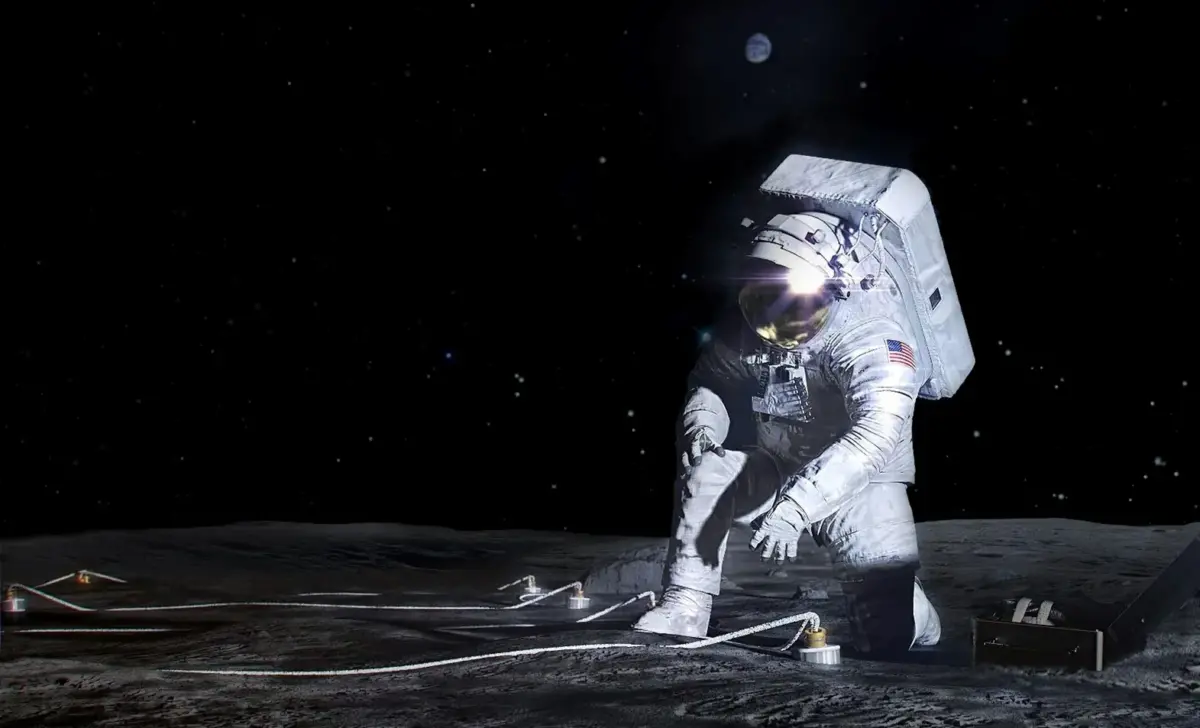 Artist’s concept of an Artemis astronaut deploying an instrument on the lunar surface.
(Photo courtesy of NASA)
HARP2 launches into space
The UMBC-designed Hyper-Angular Rainbow Polarimeter (HARP2) wide-angle imaging polarimeter instrument is part of NASA’s Plankton, Aerosol, Cloud, ocean Ecosystem (PACE) spacecraft mission, which launched into space in February. The PACE satellite provides insight into ocean health, air quality, and the effects of a changing climate. PACE’s mission data, which includes data captured by the HARP2 instrument, is now available for public access. The HARP2 team, which includes a host of students and alumni, is led by Vanderlei Martins, professor of physics, who is also the director of the NASA-affiliated Earth and Space Institute, based out of UMBC’s Physics Building.
AXIS X-ray telescope selected for final round
Nearly a year ago, a group of engineers and scientists including UMBC physicists became one of 10 teams to successfully submit a proposal to NASA to develop the Advanced X-ray Imaging Satellite (AXIS). In October 2024, the AXIS team was selected as one of the final two instrument designs selected for further development. The team will receive $5 million to flesh out their plans as part of what NASA calls a “Phase A study.” Adi Foord, assistant professor of physics, and Eileen Meyer, associate professor of physics, serve on the AXIS leadership team, and during the proposal development phase, Foord co-led the sub-team focused on supermassive black hole evolution.
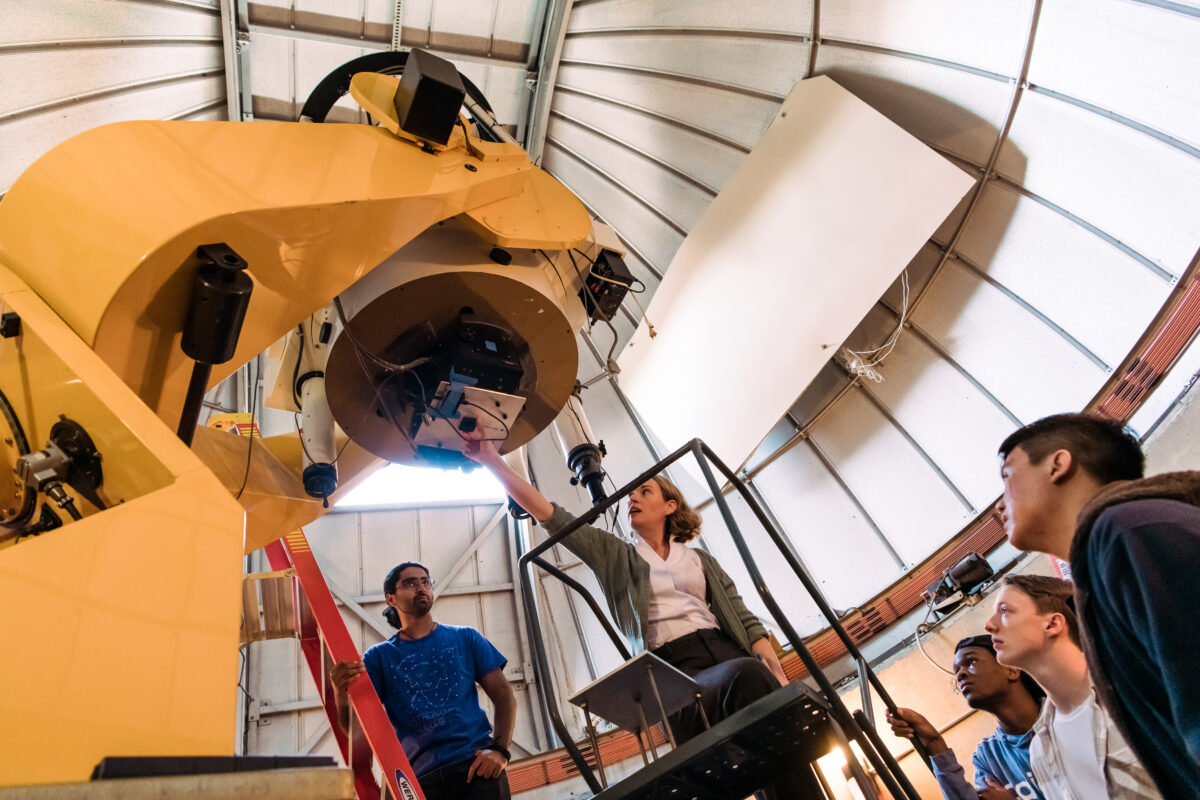 Eileen Meyer (center, reaching up) works on UMBC’s telescope with students. (Marlayna Demond ’11/UMBC)
NASA comes to campus
The university collaborated with the Goddard Space Flight Center to host the “NASA-UMBC Interaction Days,” an interactive, three-day series that took a closer look into the agency’s current research activity across a range of fields, with insight into how UMBC faculty, staff, and students can continue to work with Goddard scientists and engineers. The event series attracted more than 250 registrants.
UMBC-NASA earth science center awarded $47 million extension
The UMBC-led Goddard Earth Science Technology and Research (GESTAR) II center was awarded a two-year, $47 million extension this year to continue its cooperative agreement with the NASA Goddard Space Flight Center (GSFC). Since launching in 2021, GESTAR II has employed more than 150 scientists who are distributed across nearly all of GSFC’s earth science division laboratories. Over the years, GESTAR II researchers have been a part of teams that have developed an instrument that monitors water quality in the Chesapeake Bay, studied the environmental impacts of megafire smoke plumes, generated the first global map of cargo ship pollution, and much more.
More on UMBC’s partnership with NASA
]]>
UMBC is approaching 30 years of collaboration with the National Aeronautics and Space Administration (NASA), a partnership that largely culminates under the university’s three major cooperative...
https://umbc.edu/stories/umbc-nasa-partnership-2024/
https://my3.my.umbc.edu/api/v0/pixel/news/146266/guest@my.umbc.edu/c9b14e4a81a0cad626bb8a2df7cb33d8/api/pixel
csst
esi
gestar2
gphi
nasa
nasa-goddard-space-flight-center
news
research
science-and-tech
story
UMBC News & Magazine
https://my3.my.umbc.edu/groups/umbc-news-magazine
https://assets1-my.umbc.edu/system/shared/avatars/groups/000/001/943/24435aa6207c452e7bc15cc74b42c7bb/xsmall.png?1748556657
https://assets1-my.umbc.edu/system/shared/avatars/groups/000/001/943/24435aa6207c452e7bc15cc74b42c7bb/original.png?1748556657
https://assets2-my.umbc.edu/system/shared/avatars/groups/000/001/943/24435aa6207c452e7bc15cc74b42c7bb/xxlarge.png?1748556657
https://assets2-my.umbc.edu/system/shared/avatars/groups/000/001/943/24435aa6207c452e7bc15cc74b42c7bb/xlarge.png?1748556657
https://assets3-my.umbc.edu/system/shared/avatars/groups/000/001/943/24435aa6207c452e7bc15cc74b42c7bb/large.png?1748556657
https://assets1-my.umbc.edu/system/shared/avatars/groups/000/001/943/24435aa6207c452e7bc15cc74b42c7bb/medium.png?1748556657
https://assets2-my.umbc.edu/system/shared/avatars/groups/000/001/943/24435aa6207c452e7bc15cc74b42c7bb/small.png?1748556657
https://assets1-my.umbc.edu/system/shared/avatars/groups/000/001/943/24435aa6207c452e7bc15cc74b42c7bb/xsmall.png?1748556657
https://assets2-my.umbc.edu/system/shared/avatars/groups/000/001/943/24435aa6207c452e7bc15cc74b42c7bb/xxsmall.png?1748556657
UMBC News & Magazine
0
0
false
Fri, 13 Dec 2024 12:58:18 -0500
Fri, 13 Dec 2024 12:58:18 -0500
PANTHYR instrument installed in Chesapeake Bay to monitor water quality, validate satellite data

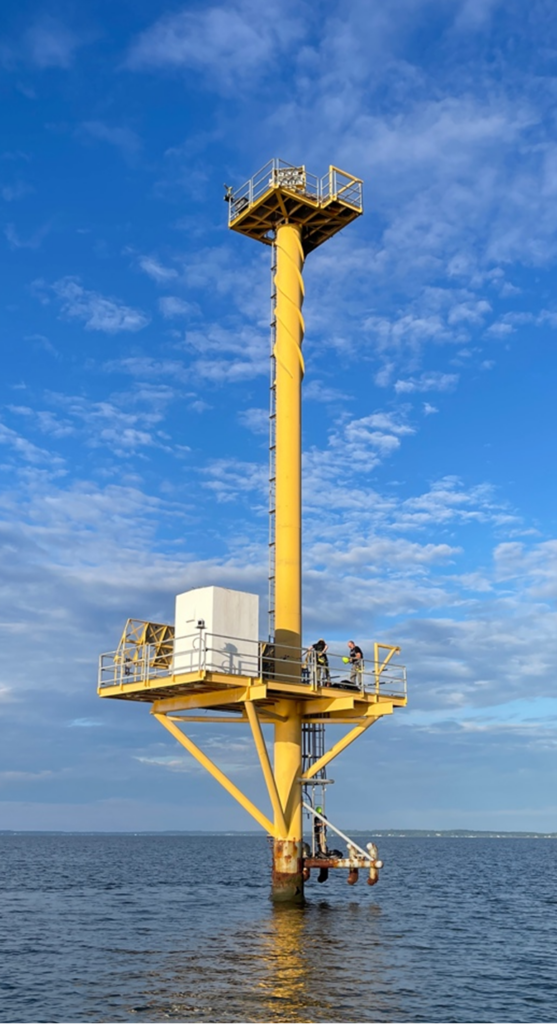 The PANTHYR instrument system is on the upper platform of the Chesapeake Bay Tower on the corner out of view. (Kevin Turpie, GSFC/UMBC)
Climbing 30-meter ladders and avoiding osprey nests might not sound like typical activities for scientists who usually work with equations and models—but it’s all in a day’s work for Kevin Turpie’s team, which includes an international group of scientists and engineers from UMBC, NASA, the Royal Belgian Institute of Natural Sciences (RBINS) and the Vlaams Instituut voor de Zee (VLIZ), also known as the Flanders Marine Institute, also in Belgium. Over the last 15 months, they have collaborated with Maryland Department of the Environment (MDE) staff, with the blessing of the U.S. Coast Guard, to install, monitor, and repair a new instrument on top of a Coast Guard navigation tower in Chesapeake Bay near Tolchester, Maryland.
The instrument, called the Pan-and-Tilt Hyperspectral Radiometer (PANTHYR) and developed by VLIZ, is one of multiple PANTHYRs deployed worldwide. Each is part of the WATERHYPERNET—a growing network of automated instruments that provide measurements to validate observations from space. The WATERHYPERNET concept was developed by RBINS and VLIZ and supported by the European Space Agency (ESA). Another instrument called the HYPSTAR is installed at some other WATERHYPERNET sites, and the Chesapeake Bay station may add one in the future.
The Chesapeake Bay PANTHYR station is the first WATERHYPERNET station installed in North America; others operate off the coasts of France, Italy, Belgium, and Argentina. The new station “will provide a wealth of information regarding water quality and the environmental and ecological conditions in the Upper Chesapeake Bay,” says Turpie, a research associate professor with the Goddard Earth Science Technology and Research Center (GESTAR II), a UMBC partnership with NASA.
A “rigorous test”
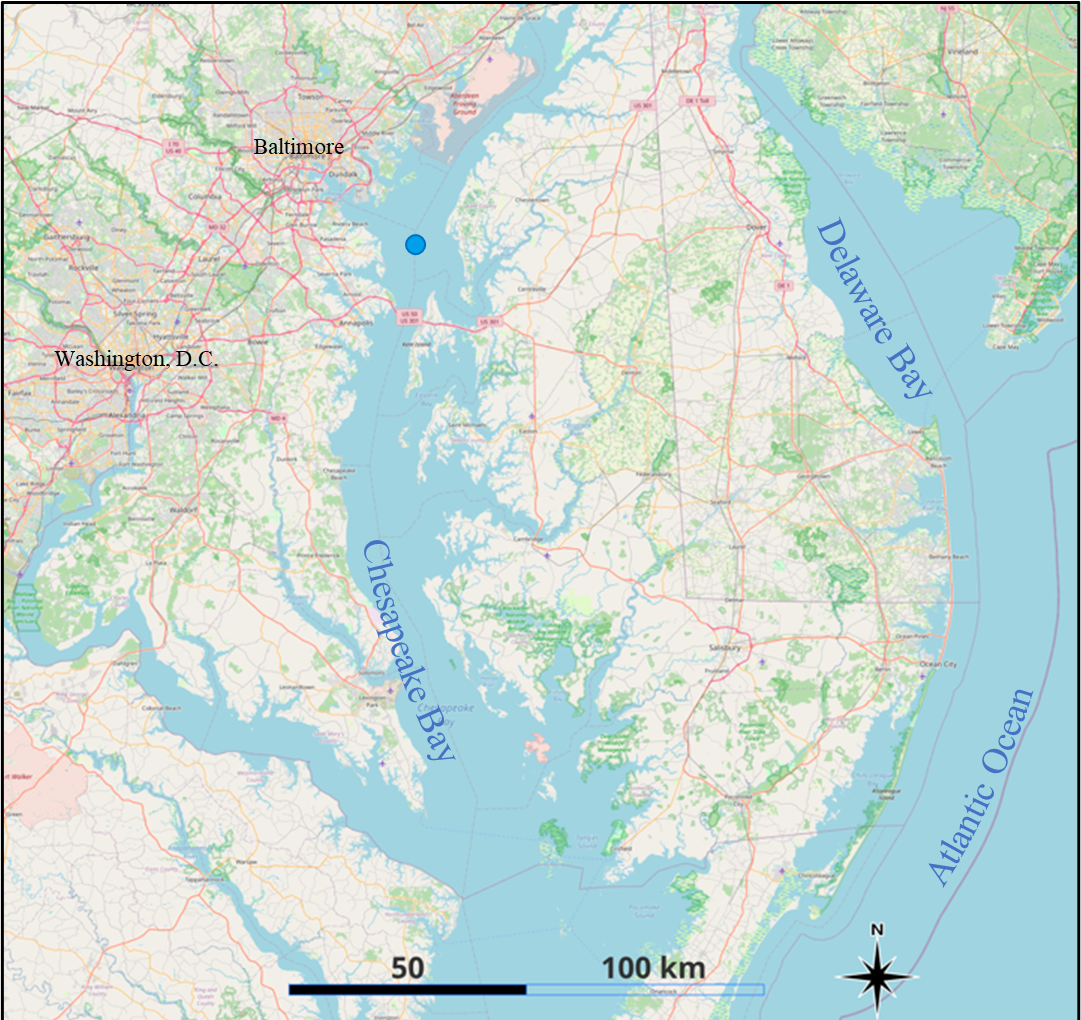 The blue dot marks the location of the new Chesapeake Bay WATERHYPERNET station. (Courtesy of Kevin Turpie)
The Chesapeake PANTHYR will also help validate data coming from the Ocean Color Instrument (OCI) aboard the recently-launched NASA PACE satellite, which also carries HARP2, an instrument designed and built by UMBC researchers. The station will also provide data to validate many other satellite missions, including NASA’s future Surface Biology and Geology (SBG) mission, part of the upcoming Integrated Earth System Observatory.
“Observations from space are critical to understanding how our planet functions as a system and how that system is changing. But such measurements are done in the harsh environment of space, looking through the entire atmosphere, and always from several hundred kilometers away,” Turpie explains. “So, we need to compare those data against the same kind of measurements taken at the surface. PANTHYR offers a rigorous test for PACE and its ability to glean vital information about our world’s most critical coastal resources.”
PANTHYR is the newest instrument in the WATERHYPERNET, a global network of instruments managed by the Royal Belgian Institute of Natural Sciences and supported by the European Space Agency.
A challenging work location
The Chesapeake Bay PANTHYR station was installed in July 2023, but encountered challenges due to winter weather, complex logistics, and the collapse of Baltimore’s Key Bridge and subsequent environmental threat assessments. However, after a repair mission in September 2024, PANTHYR is up and running again, and data are streaming in.
Arranging each trip to service PANTHYR is complicated. MDE staff pilot the boats that take the researchers to and from the site, and only tower climbers with special training can access the instrument. Calm weather is a necessity. Plus, in the spring, there’s always a risk that ospreys or eagles will choose the tower for nesting. That makes the instrument inaccessible if young birds are present.
But the team is committed, because the data PANTHYR produces are valuable. Every 20 minutes, PANTHYR measures the intensity of light encountering the surface of the water, the brightness of the sky, and how much light is reflected back from the water’s surface. PANTHYR detects visible and near-infrared light. These are some of the same data collected by satellites like PACE. WATERHYPERNET instruments also help scientists develop improved algorithms for processing the data and monitor phenomena like harmful algal blooms.
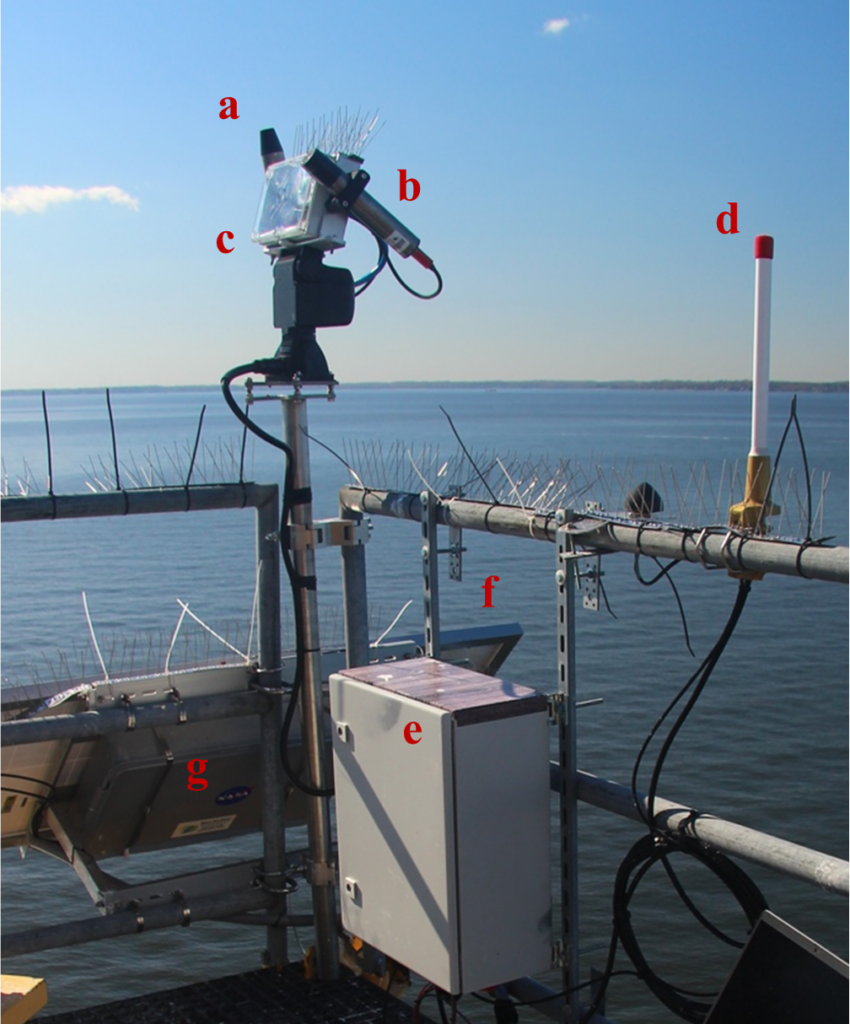 A closer view of the PANTHYR instrument on the tower’s upper platform. Components of the station instrument system include (a) solar spectral irradiance instrument, (b) sky and surface radiance instrument, (c) robotics package (with the “pan/tilt” device), (d) cellular antenna, (e) instrument control box, (f) photovoltaic panel, (g) power control box. (Photo by Dieter Vansteenwegen, VLIZ)
“Autonomous stations like this collect a wealth of validation information—more than we get from science cruises or other means, which can be very expensive,” Turpie says. “It’s exciting to get multiple observations a day of the changing water quality and ecosystem conditions of this important coastal estuary. For surface radiometry, this is very important in order to build up as many match ups with satellite observations as possible.”
Moving forward, UMBC is responsible for the maintenance and operation of the PANTHYR station. Turpie and his colleagues will be working hard to keep the station in tip-top shape so that it can continue to produce useful data and inform future satellite missions—with or without the “help” of neighborhood ospreys.
]]>
The PANTHYR instrument system is on the upper platform of the Chesapeake Bay Tower on the corner out of view. (Kevin Turpie, GSFC/UMBC) Climbing 30-meter ladders and avoiding osprey nests...
https://umbc.edu/stories/panthyr-in-chesapeake-bay/
https://my3.my.umbc.edu/api/v0/pixel/news/145273/guest@my.umbc.edu/9d518e886633877b7b70494fab57822b/api/pixel
gestar2
nasa
news
research
science-and-tech
story
UMBC News & Magazine
https://my3.my.umbc.edu/groups/umbc-news-magazine
https://assets1-my.umbc.edu/system/shared/avatars/groups/000/001/943/24435aa6207c452e7bc15cc74b42c7bb/xsmall.png?1748556657
https://assets1-my.umbc.edu/system/shared/avatars/groups/000/001/943/24435aa6207c452e7bc15cc74b42c7bb/original.png?1748556657
https://assets2-my.umbc.edu/system/shared/avatars/groups/000/001/943/24435aa6207c452e7bc15cc74b42c7bb/xxlarge.png?1748556657
https://assets2-my.umbc.edu/system/shared/avatars/groups/000/001/943/24435aa6207c452e7bc15cc74b42c7bb/xlarge.png?1748556657
https://assets3-my.umbc.edu/system/shared/avatars/groups/000/001/943/24435aa6207c452e7bc15cc74b42c7bb/large.png?1748556657
https://assets1-my.umbc.edu/system/shared/avatars/groups/000/001/943/24435aa6207c452e7bc15cc74b42c7bb/medium.png?1748556657
https://assets2-my.umbc.edu/system/shared/avatars/groups/000/001/943/24435aa6207c452e7bc15cc74b42c7bb/small.png?1748556657
https://assets1-my.umbc.edu/system/shared/avatars/groups/000/001/943/24435aa6207c452e7bc15cc74b42c7bb/xsmall.png?1748556657
https://assets2-my.umbc.edu/system/shared/avatars/groups/000/001/943/24435aa6207c452e7bc15cc74b42c7bb/xxsmall.png?1748556657
UMBC News & Magazine
0
0
false
Fri, 01 Nov 2024 15:34:10 -0400
Fri, 01 Nov 2024 15:34:10 -0400
GESTAR II center awarded $47 million extension on cooperative agreement with NASA Goddard Space Flight Center

The UMBC-led Goddard Earth Science Technology and Research (GESTAR) II center has been awarded a two-year, $47 million extension to continue its cooperative agreement with the NASA Goddard Space Flight Center (GSFC).
In fall 2021, NASA awarded $72 million for UMBC to establish GESTAR II in collaboration with primary partner Morgan State University and six other institutions. Since its launch, GESTAR II has employed more than 150 scientists who are distributed across nearly all of GSFC’s earth science division laboratories. GESTAR II scientists and engineers are currently working on active NASA earth science missions, such as the Plankton, Aerosol, Cloud, ocean Ecosystem (PACE) satellite mission, which launched into orbit earlier this year.
“Our scientists and engineers are continuing to contribute toward the advancement of earth science at NASA Goddard. We want to continue to do more of the same with this agreement extension,” said GESTAR II director Charles Ichoku. “With GSFC, we are making progress to keep our planet safe while continuing to make a lot of discoveries.”
GESTAR II is one of three cooperative agreements that UMBC has with GSFC, a partnership that began nearly 30 years ago. Earlier this month, the university collaborated with GSFC to host the “NASA-UMBC Interaction Days,” an interactive, three-day event series (concluding on September 30) that takes a closer look into the center’s current research activity, with insight into how faculty and students can engage with Goddard scientists and engineers.
In addition to contributions to NASA’s missions and earth science scholarship, GESTAR II also provides funding support for UMBC students with its undergraduate and graduate fellowships. The center also hosts a recurring seminar series for scientists.
Learn more about the research happening at the Goddard Earth Science Technology and Research (GESTAR) II center.
]]>
The UMBC-led Goddard Earth Science Technology and Research (GESTAR) II center has been awarded a two-year, $47 million extension to continue its cooperative agreement with the NASA Goddard Space...
https://umbc.edu/quick-posts/gestar-ii-center-extension/
https://my3.my.umbc.edu/api/v0/pixel/news/144266/guest@my.umbc.edu/67693ecb504c855e32d9d78a5289d181/api/pixel
gestar
gestar2
nasa
nasa-goddard-space-flight-center
quick-post
UMBC News & Magazine
https://my3.my.umbc.edu/groups/umbc-news-magazine
https://assets1-my.umbc.edu/system/shared/avatars/groups/000/001/943/24435aa6207c452e7bc15cc74b42c7bb/xsmall.png?1748556657
https://assets1-my.umbc.edu/system/shared/avatars/groups/000/001/943/24435aa6207c452e7bc15cc74b42c7bb/original.png?1748556657
https://assets2-my.umbc.edu/system/shared/avatars/groups/000/001/943/24435aa6207c452e7bc15cc74b42c7bb/xxlarge.png?1748556657
https://assets2-my.umbc.edu/system/shared/avatars/groups/000/001/943/24435aa6207c452e7bc15cc74b42c7bb/xlarge.png?1748556657
https://assets3-my.umbc.edu/system/shared/avatars/groups/000/001/943/24435aa6207c452e7bc15cc74b42c7bb/large.png?1748556657
https://assets1-my.umbc.edu/system/shared/avatars/groups/000/001/943/24435aa6207c452e7bc15cc74b42c7bb/medium.png?1748556657
https://assets2-my.umbc.edu/system/shared/avatars/groups/000/001/943/24435aa6207c452e7bc15cc74b42c7bb/small.png?1748556657
https://assets1-my.umbc.edu/system/shared/avatars/groups/000/001/943/24435aa6207c452e7bc15cc74b42c7bb/xsmall.png?1748556657
https://assets2-my.umbc.edu/system/shared/avatars/groups/000/001/943/24435aa6207c452e7bc15cc74b42c7bb/xxsmall.png?1748556657
UMBC News & Magazine
0
0
false
Thu, 26 Sep 2024 13:59:40 -0400
Thu, 26 Sep 2024 13:59:40 -0400
UMBC hosts “NASA Days” event series with Goddard Space Flight Center
UMBC is collaborating with the NASA Goddard Space Flight Center (GSFC) to host an interactive, three-day event series that takes a closer look into the center’s current research activity, with insight into how faculty and students can engage with Goddard scientists and engineers.
NASA-UMBC Interaction Days launched on September 9 and continues on September 16 and September 30, highlighting a range of topics on the diverse research and technological advancements in space exploration from leading scientists and engineers at GSFC. The series also provides an overview of the extensive research activity happening in collaboration between UMBC and NASA, a partnership that began nearly 30 years ago.
Astrophysicist Sibasish Laha, an associate research scientist with UMBC’s Center for Space Sciences and Technology who works out of GSFC, organized the series in response to an influx of students inquiring about the work that happens at NASA and ways to get involved.
“I started this interaction day series to help UMBC students better understand what NASA scientists and engineers do on a day-to-day basis,” says Laha. Students get a behind-the-scenes look into the research happening at GSFC, across an array of disciplinary fields such as earth science, data science and AI, astrobiology, and more.
Student opportunities at NASA
Day one of the event series included lectures focused on earth science, exoplanets, and laboratory astrophysics with featured speakers Maurice Leutenegger of GSFC’s x-ray astrophysics laboratory; Wayne Yu, an senior engineer in astrobiology; and planetary scientist Ravi Kopparap. A packed room of more than 90 attendees learned about the inquiring minds behind the GSFC’s research activity.
Day two of the event series (happening on September 16) will feature discussions on data science and AI, x-ray astrophysics, and astrobiology. The event will conclude on September 30 with lectures on the habitable worlds observatory, payload systems and engineering, and NASA’s long term goals with featured speaker Robert Petre, director of GSFC’s astrophysics science division.
Some Retrievers at the event were there out of general curiosity and some were looking for jobs and internship experiences. Brad Cenko, research scientist at GSFC, shared about the wide array of experiential learning opportunities happening at NASA’s research centers across the country.
“NASA has one of the largest internship programs in the state of Maryland, and students can apply to internships year-round,” said Cenko. This summer, UMBC students secured internship placements with NASA, which included senior Leah Narat, business technology administration, who worked at GSFC as a business intelligence intern.
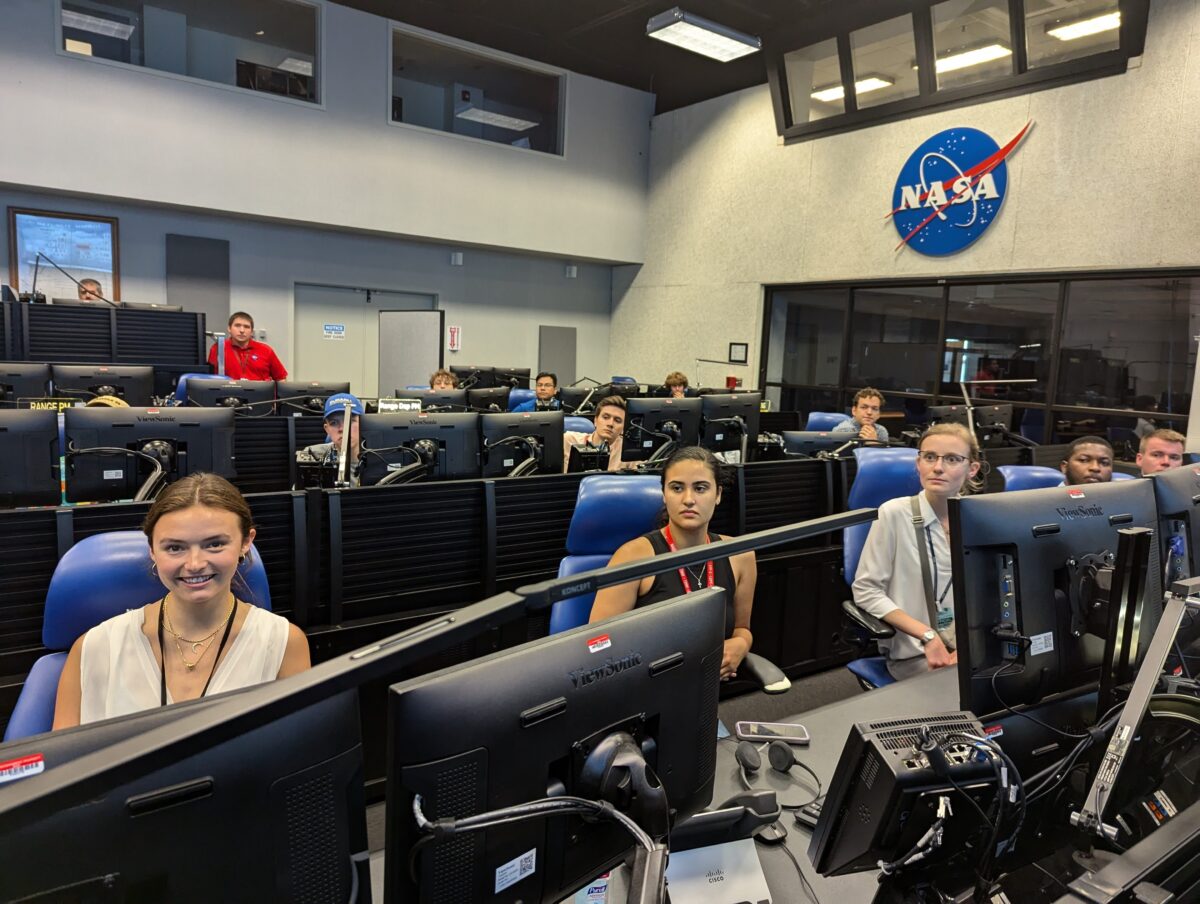 Interns from the Flight Projects Directorate at NASA Goddard, including Leah Narat, center, tour the Wallops Flight Facility in Virginia. (Image courtesy of Narat)
Narat created and updated databases to track awards given to NASA employees. The agency will use the information to maximize employees’ recognition and success and guide them toward career paths that best take advantage of their strengths.
“Honestly, being at NASA was something that I never thought I would achieve, but I put my application out there, and here I am,” says Narat, who worked as a business intelligence intern at the NASA Goddard Space Flight Center in Greenbelt, Maryland, this past summer. “It’s been wonderful.”
A 30-year partnership
While a large majority of students made up the attendee list for day one, the event also brought in many faculty and staff interested in collaborating with the agency. “Faculty are an integral part in these collaborative efforts and our goal is to connect them directly with NASA’s scientists and engineers,” said event organizer Laha.
 Makenzie Lystrup, director of NASA’s Goddard Space Flight Center, and UMBC President Valerie Sheares Ashby during Lystrup’s visit to UMBC in February 2024. (Marlayna Demond ’11/UMBC)
Currently, more than 250 UMBC scientists and research faculty members are partnering with NASA civil servants and are employed under three major cooperative agreements, of which includes the Goddard Earth Sciences Technology and Research II center (GESTAR II); the Center for Space Sciences and Technology (CSST); and the Goddard Planetary Heliophysics Institute (GPHI). The university also is home to the NASA-affiliated Earth and Space Institute based out of UMBC’s Physics Building.
Additionally, nearly 30 of the university’s scientists and research faculty are working on active NASA space missions. That includes the UMBC-developed Lunar Environment Monitoring Station, which was selected as one of the first three instruments to be a part of Artemis III, NASA’s mission that will send astronauts back to the lunar surface after more than 50 years, and UMBC’s Hyper-Angular Rainbow Polarimeter wide-angle imaging polarimeter instrument on board NASA’s Plankton, Aerosol, Cloud, ocean Ecosystem spacecraft mission.
“NASA is providing half of UMBC’s federal contract funding—on a national scale, this is really unusual,” says Don Engel, director of the CSST and assistant professor of computer science and electrical engineering. “Our NASA partnerships are so cross-disciplinary. All three of UMBC’s colleges are represented with these centers, and that’s extremely significant.”
Register for the remaining NASA-UMBC Interaction Days events here.
]]>
UMBC is collaborating with the NASA Goddard Space Flight Center (GSFC) to host an interactive, three-day event series that takes a closer look into the center’s current research activity, with...
https://umbc.edu/stories/nasa-days-event-series/
https://my3.my.umbc.edu/api/v0/pixel/news/143892/guest@my.umbc.edu/e03c952bb42087e2a28c0c06cd19474e/api/pixel
community
csst
esi
gestar
gestar2
gphi
nasa
nasa-goddard-space-flight-center
news
science-and-tech
story
UMBC News & Magazine
https://my3.my.umbc.edu/groups/umbc-news-magazine
https://assets1-my.umbc.edu/system/shared/avatars/groups/000/001/943/24435aa6207c452e7bc15cc74b42c7bb/xsmall.png?1748556657
https://assets1-my.umbc.edu/system/shared/avatars/groups/000/001/943/24435aa6207c452e7bc15cc74b42c7bb/original.png?1748556657
https://assets2-my.umbc.edu/system/shared/avatars/groups/000/001/943/24435aa6207c452e7bc15cc74b42c7bb/xxlarge.png?1748556657
https://assets2-my.umbc.edu/system/shared/avatars/groups/000/001/943/24435aa6207c452e7bc15cc74b42c7bb/xlarge.png?1748556657
https://assets3-my.umbc.edu/system/shared/avatars/groups/000/001/943/24435aa6207c452e7bc15cc74b42c7bb/large.png?1748556657
https://assets1-my.umbc.edu/system/shared/avatars/groups/000/001/943/24435aa6207c452e7bc15cc74b42c7bb/medium.png?1748556657
https://assets2-my.umbc.edu/system/shared/avatars/groups/000/001/943/24435aa6207c452e7bc15cc74b42c7bb/small.png?1748556657
https://assets1-my.umbc.edu/system/shared/avatars/groups/000/001/943/24435aa6207c452e7bc15cc74b42c7bb/xsmall.png?1748556657
https://assets2-my.umbc.edu/system/shared/avatars/groups/000/001/943/24435aa6207c452e7bc15cc74b42c7bb/xxsmall.png?1748556657
UMBC News & Magazine
0
0
false
Fri, 13 Sep 2024 16:04:17 -0400
Fri, 13 Sep 2024 16:04:17 -0400
Month of Earth Day events culminates with 8th Annual Earth Day Symposium
UMBC’s strength in environmental research spans all three colleges and the university’s NASA-partnered centers, and Earth Day is always a special time on campus. This year, UMBC partnered with the Environmental Protection Agency (EPA) to host more events than ever before. A committee led at UMBC by Rhonda Plofkin, a Ph.D. student in geography and environmental systems (GES), organized 18 events throughout the month of April.
Volunteers led by enthusiastic students and Office of Sustainability staff removed invasive plants on campus; a panel at the AOK Library & Gallery discussed how various disciplines, including the arts, can engage with environmental conservation; the UMBC community watched a partial solar eclipse on campus; and much more.
The month of festivities culminated with the 8th Annual Earth Day Symposium on April 29, organized by graduate students in atmospheric physics and geography and environmental systems (GES). Nearly 150 attendees from at least six universities and five federal agencies gave talks, participated in panel discussions, presented 26 research posters, and even went on a hike through UMBC’s Conservation and Environmental Research Area on an unseasonably warm day.
“A tradition we are really proud of is that this event is 100 percent planned and implemented by our graduate students,” shared Zhibo Zhang, professor of physics at UMBC. He noted the event not only benefits the attendees, but also the planning team. “I’ve seen their confidence grow every day as the event came together,” Zhang says.
“It has been a great experience for us to invite such a wide range of people with shared enthusiasm for Earth science to UMBC,” shares Kamal Aryal, Ph.D. student in atmospheric physics and the lead organizer for the Earth Day Symposium. “Having students, early career scientists, and university professors from many universities and from NASA’s PACE mission, including the lead project scientist for PACE, attend our symposium creates great opportunities for networking and professional development.”
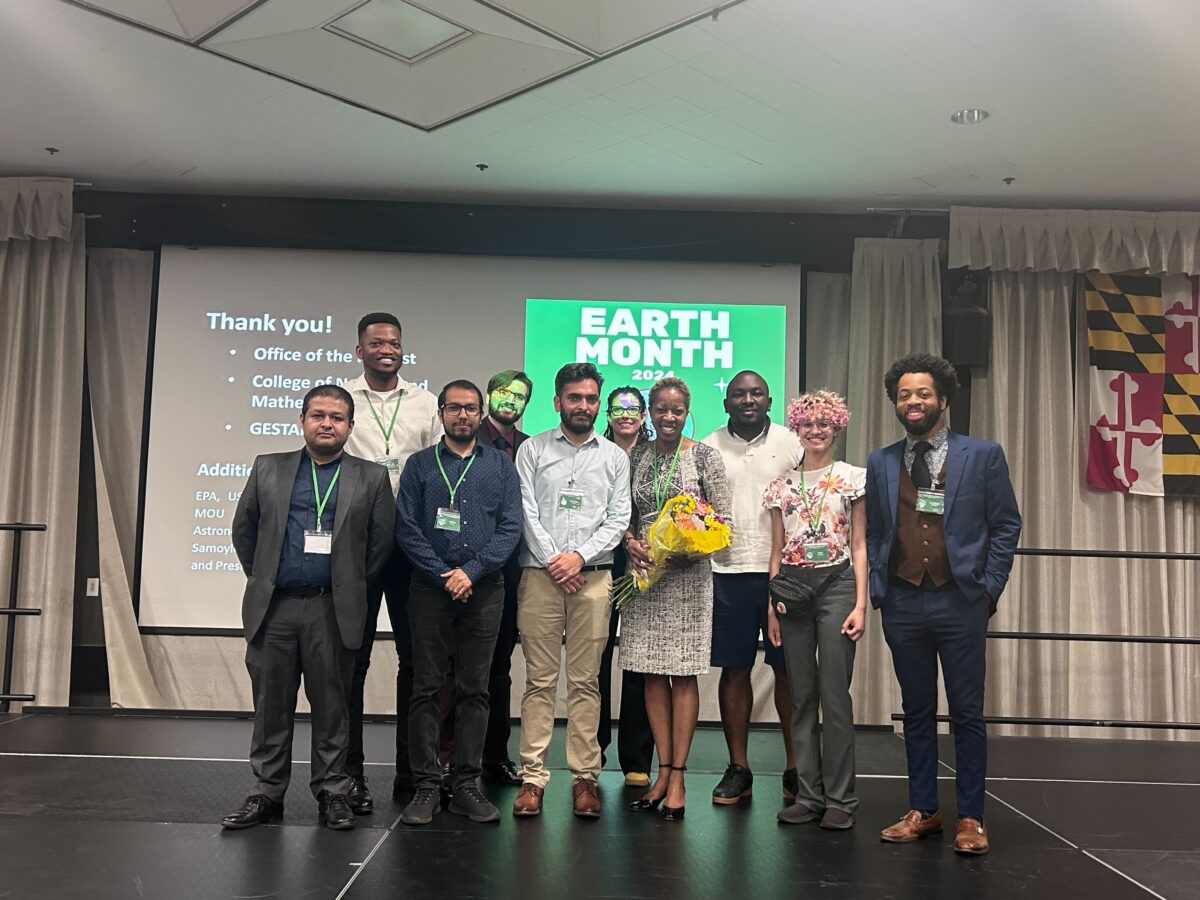 Planning committee members for the Earth Day Symposium and other Earth Day events with President Valerie Sheares Ashby. Left to right: Sharad Pandey, Adeleke Segun Ademakinwa, Kamal Aryal, Tony La Luna, Roshan Mishra, Rhonda Plofkin, Valerie Sheares Ashby, Tolulope Ale, Erin Hamner, and Maurice Roots. (Image by Zhibo Zhang)
Monitoring the environment—from above Earth’s atmosphere to underwater
First organized in 2017, the Earth Day Symposium has grown in stature, size, and scope every year. This year’s theme was “monitoring planetary health,” a nod to the recently-launched NASA PACE mission carrying HARP2, a polarimeter designed and built at UMBC. HARP2 will improve our understanding of the roles various particles in the atmosphere—like dust, water vapor, and pollutants—play in climate and health. Previous symposium themes have included the environmental impacts of COVID-19, the synergy of scientific disciplines, and equity and environmental justice.
Vanderlei Martins, professor of physics at UMBC and the HARP2 team lead, gave the first presentation, which was followed later in the morning by a panel discussion including PACE scientists from UMBC, NASA, and Morgan State University.
The three main instruments on PACE have complementary roles. Each sees Earth a little differently, and will provide important data on plankton populations in the ocean, the role of clouds in Earth’s energy balance, and much more. “Each of these instruments is unique, and together, they are amazing,” Martins says. HARP2 “has capabilities we’ve never had before,” he adds. “I cannot even imagine everything we are going to learn.”
Between Martins’ talk and the panel, Vanessa Vargas-Nguyen, a researcher with the University of Maryland Center for Environmental Science (UMCES), discussed her work on monitoring the health of the Chesapeake Bay watershed. UMCES produces one of several report cards for the Chesapeake Bay, collecting data on everything from populations of bottom-dwelling critters to concentrations of elements like phosphorus and nitrogen, which are commonly found in fertilizers. Now Vargas-Nguyen is expanding her group’s work to look at the entire watershed more holistically, including adding social factors like economic activity, governance structures, and population density.
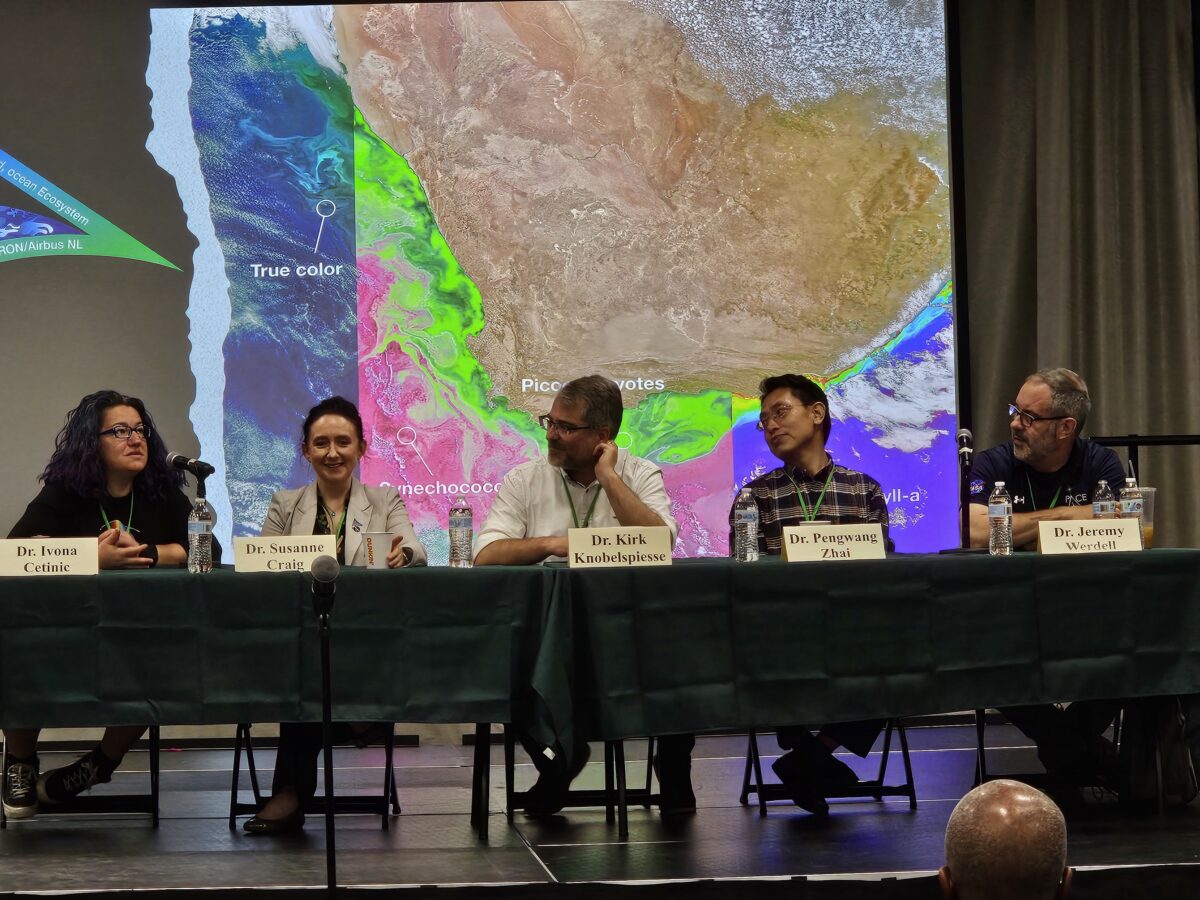 Panelists discussed the PACE mission. From left to right: Ivona Cetinic, senior research scientist with Morgan State University through the Goddard Earth Science and Technology Research Center (GESTAR) II; Susanne Craig, scientist with UMBC through GESTAR II; Kirk Knobelspiesse, researcher at NASA Goddard Space Flight Center; Pengwang Zhai, professor of physics at UMBC; and Jeremy Werdell, project scientist for the PACE mission at NASA. (Photo by Kamal Aryal)
A hub for environmental action
After the post-lunch hike, a poster session featured student and faculty research from UMBC, NASA, and the National Oceanic and Atmospheric Administration. Jing Wei, from the University of Maryland, College Park, discussed remote sensing methods for monitoring air pollution, and Robert Foster, from the U.S. Naval Research Laboratory, explained his work on monitoring microplastics in the ocean. Kandis Boyd, from the EPA, emphasized the importance of interdisciplinary and cross-sector partnerships.
Throughout the day, the ballroom buzzed with energy as students, UMBC faculty, and researchers from around the region shared their science and connected with each other. A shared sense of purpose guided the event, grounded in UMBC’s commitment to promoting a sustainable future.
As Charles Ichoku, director of the Goddard Earth Science and Technology Research Center II, one of UMBC’s NASA partnerships, and a professor of GES, put it, “UMBC is a young university that does great things.”
Whether taking immediate action to improve the campus landscape, conducting research on global climate, or training the next generation of Earth scientists, the month of Earth Day events demonstrates how UMBC has positioned itself as a hub for environmental action.
]]>
UMBC’s strength in environmental research spans all three colleges and the university’s NASA-partnered centers, and Earth Day is always a special time on campus. This year, UMBC partnered with the...
https://umbc.edu/stories/8th-annual-earth-day-symposium/
https://my3.my.umbc.edu/api/v0/pixel/news/141690/guest@my.umbc.edu/e8eaf936eeb0a780690163c7f947b912/api/pixel
cahss
cnms
coeit
ges
gestar2
information-systems
news
physics
science-and-tech
story
UMBC News & Magazine
https://my3.my.umbc.edu/groups/umbc-news-magazine
https://assets1-my.umbc.edu/system/shared/avatars/groups/000/001/943/24435aa6207c452e7bc15cc74b42c7bb/xsmall.png?1748556657
https://assets1-my.umbc.edu/system/shared/avatars/groups/000/001/943/24435aa6207c452e7bc15cc74b42c7bb/original.png?1748556657
https://assets2-my.umbc.edu/system/shared/avatars/groups/000/001/943/24435aa6207c452e7bc15cc74b42c7bb/xxlarge.png?1748556657
https://assets2-my.umbc.edu/system/shared/avatars/groups/000/001/943/24435aa6207c452e7bc15cc74b42c7bb/xlarge.png?1748556657
https://assets3-my.umbc.edu/system/shared/avatars/groups/000/001/943/24435aa6207c452e7bc15cc74b42c7bb/large.png?1748556657
https://assets1-my.umbc.edu/system/shared/avatars/groups/000/001/943/24435aa6207c452e7bc15cc74b42c7bb/medium.png?1748556657
https://assets2-my.umbc.edu/system/shared/avatars/groups/000/001/943/24435aa6207c452e7bc15cc74b42c7bb/small.png?1748556657
https://assets1-my.umbc.edu/system/shared/avatars/groups/000/001/943/24435aa6207c452e7bc15cc74b42c7bb/xsmall.png?1748556657
https://assets2-my.umbc.edu/system/shared/avatars/groups/000/001/943/24435aa6207c452e7bc15cc74b42c7bb/xxsmall.png?1748556657
UMBC News & Magazine
1
0
false
Fri, 03 May 2024 15:58:22 -0400
Fri, 03 May 2024 15:58:22 -0400
First data from UMBC’s HARP2 instrument on NASA PACE mission goes public
Data from NASA’s newest Earth-observing satellite, which will provide insight into ocean health, air quality, and the effects of a changing climate, are now available. The Plankton, Aerosol, Cloud, ocean Ecosystem (PACE) satellite launched on February 8, and after several subsequent weeks of testing of the spacecraft and instruments, the mission is gathering data that the public can access.
PACE includes three instruments: The Ocean Color Instrument (OCI), built at NASA Goddard Space Flight Center, observes the ocean, land, and atmosphere across more than 200 unique wavelengths spanning ultraviolet, visible, and near infrared light. It is particularly suited to identifying phytoplankton communities in the ocean.
HARP2, designed and built by UMBC scientists and engineers, and SPEXOne, built at the Netherlands Institute for Space Research (SRON) and Airbus Netherlands B.V., are both polarimeters, which measure light that has reflected off clouds and particles in the atmosphere. These particles, known as aerosols, can range from dust to smoke to sea spray and more.
“First light,” as the first data received from satellites in orbit is known, is a key milestone in the progression of any scientific instrument destined for space.
“When I look at the first light PACE images, I feel like I have put on magical eye glasses and am seeing the true characteristics of aerosol plumes from a satellite for the first time.”
Lorraine Remer
UMBC Climate Scientist
“To me, first light means the conclusion of all the engineering work to develop HARP2 and the beginning of our science quest exploring and understanding the data from PACE,” shares Vanderlei Martins, professor of physics at UMBC and lead of the HARP2 team. “First light means ‘It is working!’ and the question right after first light is, ‘What does it mean?’”
Answering big questions about Earth’s interrelated systems
With data from PACE’s polarimeters, scientists will be able to measure cloud properties and monitor, analyze, and identify atmospheric aerosols to better inform the public about air quality. Scientists will also be able to learn how aerosols interact with clouds and impact cloud formation, which is essential to creating accurate climate models.
The HARP2 team will focus on air pollution, the effect of aerosols produced by humans on cloud formation, and the energy balance of the planet, Martins says. “We will learn about the type of aerosols in Earth’s atmosphere: What they look like in terms of size and shape matters in terms of their health effects,” he says. “The way they absorb and scatter light affects how they interact with solar radiation and influence the energy balance of the planet: Do they produce heating or cooling of the planet, and in which circumstances?”
“I have plans to use PACE aerosol and ocean products to better understand how nutrient-rich aerosols are deposited into the global ocean and how ocean plankton communities respond to this nutrient source,” adds Lorraine Remer, a UMBC climate researcher affiliated with the Goddard Earth Science Technology and Research Center II, one of UMBC’s NASA-partnered research centers.
First, though, “We will spend the next weeks and months tuning our parameters to coax out the most and best possible information on aerosols and clouds,” Remer says. “Then, the next step is to compare PACE’s output with established sensors on the ground.” A validation experiment in September 2024 called PACE-PAX will enable and encourage those comparisons.
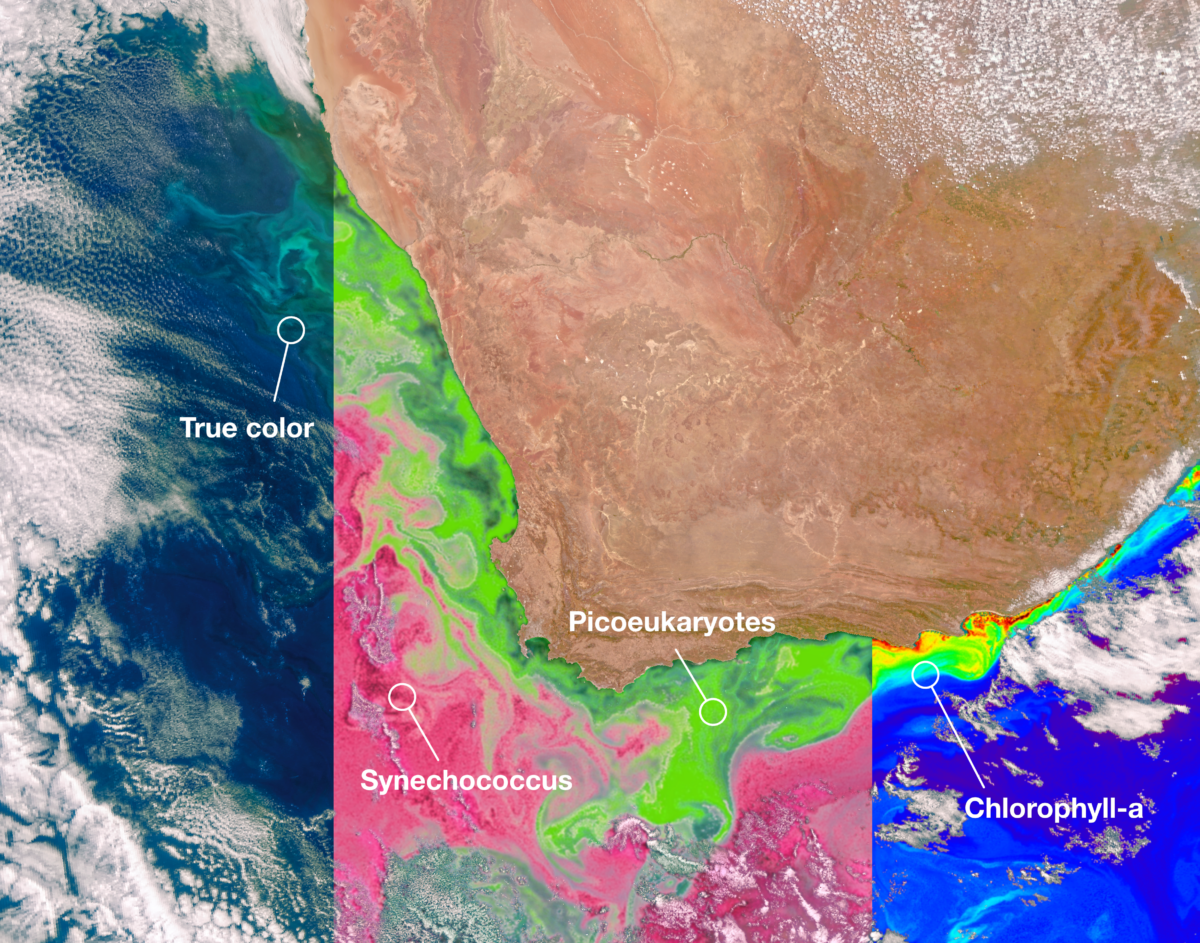 The Ocean Color Instrument (OCI) has the unique ability to detect light that allows scientists to differentiate among communities of phytoplankton. This first image released from OCI identifies two different communities of these microscopic marine organisms in the ocean off the coast of South Africa on February 28, 2024. The central panel shows Synechococcus in pink and picoeukaryotes in green. The left panel shows a natural color view of the ocean, and the right panel displays the concentration of chlorophyll-a, a photosynthetic pigment used to identify the presence of phytoplankton. (Image by NASA)
PACE lets scientists put on “magical eye glasses”
Because of the power and unique capabilities of the instruments on PACE, “We see confident atmospheric parameters that have never been seen from any previous NASA mission,” Remer says. And because the data will be completely public, the benefits will go far beyond work that current PACE scientists will do.
“PACE data will be free for everyone around the globe and will be useful for decades to come,” Martins says. “Events on Earth will come and go, and they will be recorded forever by the PACE sensors. Beyond our own science studying aerosols, clouds, and the energy balance of the planet, this data will be explored by students and scientists for all sorts of applications that I can’t even imagine.”
Martins expects UMBC scientists to write proposals to analyze PACE data for many years, and many of these projects will involve opportunities for students at all levels to gain experience with research. For now, PACE scientists are still relishing the successful launch and return of first light from the PACE instruments.
“When I look at the first light PACE images,” Remer says, “I feel like I have put on magical eye glasses and am seeing the true characteristics of aerosol plumes from a satellite for the first time.”
Jeremy Werdell, PACE project scientist, shepherded the project from start to finish, beginning when Martins pitched him the idea of including a HARP2-like instrument on board. “We’ve been dreaming of PACE-like imagery for over two decades. It’s surreal to finally see the real thing,” he says. “The data from all three instruments is of such high quality that we can start distributing it publicly less than two months from launch, and I’m proud of our team for making that happen.”
]]>
Data from NASA’s newest Earth-observing satellite, which will provide insight into ocean health, air quality, and the effects of a changing climate, are now available. The Plankton, Aerosol,...
https://umbc.edu/stories/first-light-from-harp2-on-pace/
https://my3.my.umbc.edu/api/v0/pixel/news/140823/guest@my.umbc.edu/f6e83a436b1feb9f205418cba2f162e3/api/pixel
cnms
esi
gestar2
news
physics
research
science-and-tech
story
UMBC News & Magazine
https://my3.my.umbc.edu/groups/umbc-news-magazine
https://assets1-my.umbc.edu/system/shared/avatars/groups/000/001/943/24435aa6207c452e7bc15cc74b42c7bb/xsmall.png?1748556657
https://assets1-my.umbc.edu/system/shared/avatars/groups/000/001/943/24435aa6207c452e7bc15cc74b42c7bb/original.png?1748556657
https://assets2-my.umbc.edu/system/shared/avatars/groups/000/001/943/24435aa6207c452e7bc15cc74b42c7bb/xxlarge.png?1748556657
https://assets2-my.umbc.edu/system/shared/avatars/groups/000/001/943/24435aa6207c452e7bc15cc74b42c7bb/xlarge.png?1748556657
https://assets3-my.umbc.edu/system/shared/avatars/groups/000/001/943/24435aa6207c452e7bc15cc74b42c7bb/large.png?1748556657
https://assets1-my.umbc.edu/system/shared/avatars/groups/000/001/943/24435aa6207c452e7bc15cc74b42c7bb/medium.png?1748556657
https://assets2-my.umbc.edu/system/shared/avatars/groups/000/001/943/24435aa6207c452e7bc15cc74b42c7bb/small.png?1748556657
https://assets1-my.umbc.edu/system/shared/avatars/groups/000/001/943/24435aa6207c452e7bc15cc74b42c7bb/xsmall.png?1748556657
https://assets2-my.umbc.edu/system/shared/avatars/groups/000/001/943/24435aa6207c452e7bc15cc74b42c7bb/xxsmall.png?1748556657
UMBC News & Magazine
2
0
false
Thu, 11 Apr 2024 15:05:00 -0400
Thu, 11 Apr 2024 15:05:00 -0400
UMBC scientists and engineers celebrate launch of HARP2 instrument on NASA’s PACE mission
By Anne Wainscott-Sargent
The third time’s the charm. Against a calm and crisp dark night sky on Florida’s Cape Canaveral last Thursday, February 8, just after 1:30 a.m., the Plankton, Aerosol, Cloud, Ocean Ecosystem (PACE) spacecraft rocketed to orbit carrying on board Hyper-Angular Rainbow Polarimeter (HARP2)―UMBC’s wide-angle imaging polarimeter. The launch marked the first time NASA deployed a university payload on a large operational Earth science space mission.
Following two scrubbed night launches on Tuesday and Wednesday due to strong winds, Thursday’s successful takeoff was well worth the wait for the core team of UMBC Earth and Space Institute researchers, graduate students, and their family and friends who journeyed from Baltimore to watch the historic launch.
Arriving by bus a little before midnight to the Banana Creek Launch Viewing Area at Kennedy Space Center, just over six miles from Space Launch Complex-40, the close-knit UMBC entourage huddled together waiting for the final countdown.
When it came, they—along with hundreds of other space launch watchers—held their breath and then yelled and clapped as SpaceX’s Falcon 9 rocket blasted off and propelled PACE 400 miles above Earth into sun-synchronous orbit. Minutes later the Falcon 9’s first stage—SpaceX’s reusable rocket booster—successfully landed at Landing Zone 1. The crowd gasped audibly at the sonic boom, caused when the spacecraft broke the sound barrier.
“It still doesn’t quite feel real,” said Noah Christian Sienkiewicz, a calibration scientist who earned his master’s degree in atmospheric physics from UMBC in 2019 and expects to complete his physics doctorate this summer. “I grew up watching Carl Sagan and dreamed of going into astrophysics. I never thought I’d be the person making the instruments that will go up and do the measurements.”
“It’s so exciting—I’m going to cry,” uttered Margo Young from the upper bleacher. “I don’t always see the pieces and parts put together, so this is really historic.”
Young serves as UMBC’s HARP program administrator, where she has overseen procurement and other back-end support for HARP since the program’s inception in 2013. “I get to see students come full circle—working in the lab and then graduating and becoming civil servants where they continue to be involved because it’s such an amazing project,” she explained.
On the path to PACE
The UMBC HARP team’s remarkable journey from idea to mission reality spanned over 15 years, and involved countless hours of design, modeling, testing, and validation. Earlier iterations of HARP flew first on private aircraft over the Maryland countryside and then an award-winning “cubesat” version launched into orbit from the International Space Station (ISS), all stepping stones on the path to PACE.
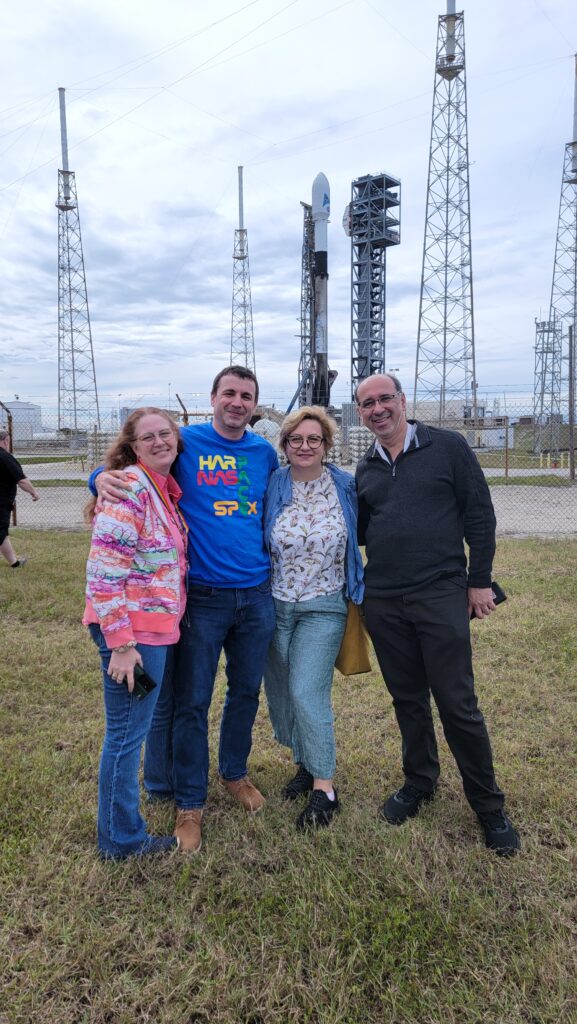 Left to right: Margo Young, Dominik Cieslak, Magdalena Kuzmicz-Cieslak, and Vanderlei Martins stand in front of the PACE spacecraft the day before its launch. (Image courtesy of Margo Young)
For the three multidisciplinary HARP2 physics, optics, and research engineering leads, Vanderlei Martins, Roberto Borda, and Dominik Cieslak, HARP2’s launch represents a career-defining moment that at times seemed against all odds for a mid-size public university. UMBC’s strong partnerships with NASA, such as the Goddard Earth Science Technology and Research (GESTAR) Center II that supports Borda’s and Cieslak’s roles, help enable milestones like this.
“I feel like I’m still dreaming,” said a visibly emotional Cieslak, research engineer, who captured the launch on his long-range camera.
Transfixed by the sight of live satellite footage of the PACE spacecraft heading to orbit, he added, “This is the last time we will physically see it [HARP2],” before hugging his long-time colleague, Borda.
“We’re very proud to have UMBC in space,” added Martins, professor of physics, who watched the big moment from a VIP viewing area three miles from the launch site. “We dreamed big from the beginning. The team persevered and just kept going.”
“I never despaired of having HARP2 on the PACE satellite,” admitted UMBC’s HARP2 manager, Lorraine Remer, research professor in the Joint Center for Earth Systems Technology. Her bigger worry wasn’t HARP2’s viability, but whether PACE would ever launch. “PACE was canceled four times and reinstated four times,” she recalled, noting that the program “survived a lengthy government shutdown and a global pandemic that destroyed our supply chains.”
Immediately after launch, Remer had to return to Maryland and the Goddard Space Flight Center to oversee HARP2 being turned on within 36 hours of launch. “It would be nice to bask in the successful launch, but I haven’t had much time to contemplate the success. There is just more work to do all the time,” she said.
An international effort
NASA’s PACE mission clears the path for revolutionary new measurements of Earth’s oceans and atmosphere. HARP2 measures aerosol particles and clouds, as well as properties of land and water surfaces. By analyzing particles like dust, wildfire smoke, or urban pollution, the science community gains deeper insights into air quality as well as global warming and its impacts. Scientists will be able see through things like sun glint to ascertain patterns never before possible.
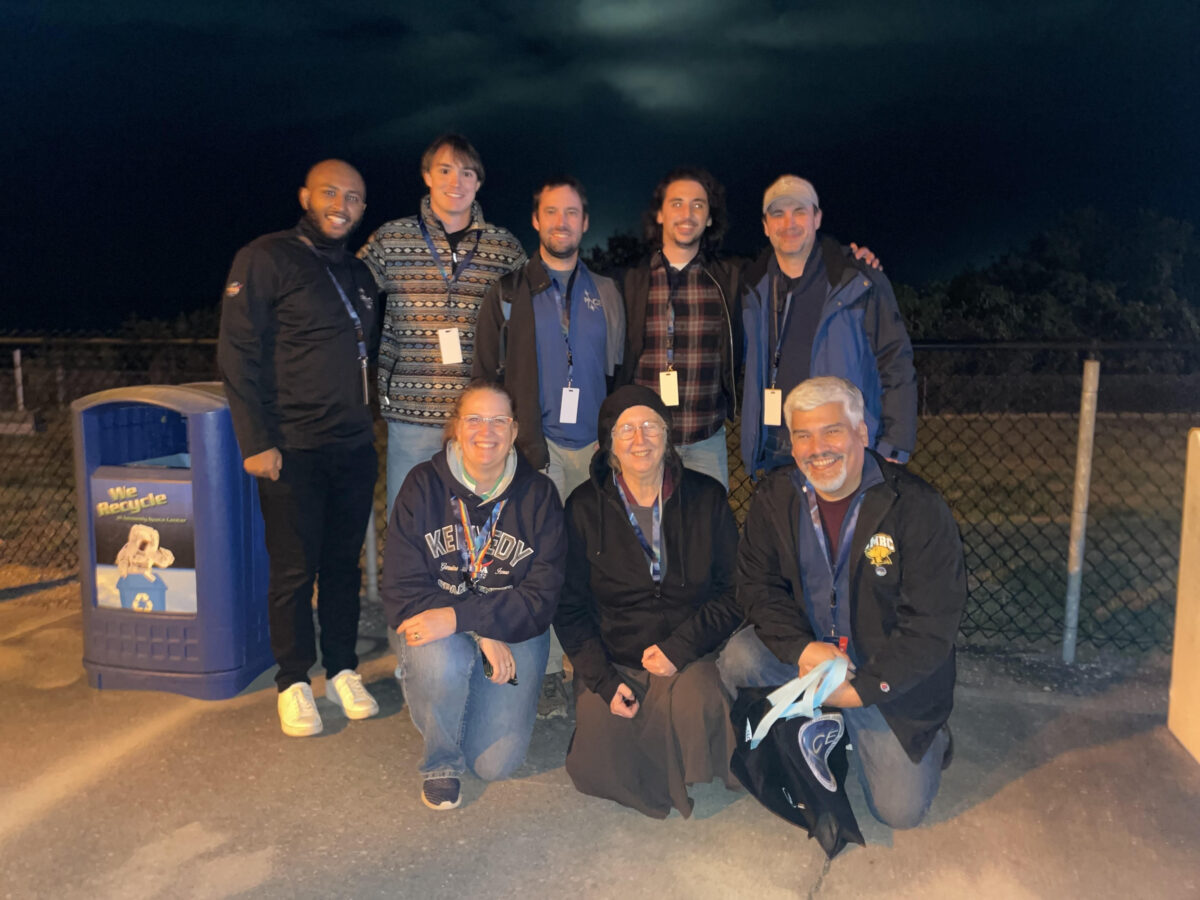 Members of the HARP team eagerly await the PACE launch at Kennedy Space Center’s Banana Creek Launch Viewing Area before the final countdown. Top, left to right: Yomiyu Fekadu, Ian Decker, Ben Cramer, Noah Sienkiewicz, Dominik Cieslak. Bottom, left to right: Margo Young, Lorraine Remer, Roberto Borda. (Image by Anne Wainscott-Sargent)
A second polarimeter on PACE, the Spectro-polarimeter for Planetary Exploration (SPEXone), developed through a Dutch consortium consisting of SRON Netherlands Institute for Space Research and Airbus Defence and Space Netherlands, will measure sunlight reflected from Earth’s atmosphere, land surface and ocean.
These two companion polarimeter instruments are important because the interaction between aerosols and clouds is the biggest unknown factor in atmospheric temperature change, according to reports from the U.N.’s Intergovernmental Panel on Climate Change.
“I have watched Dr. Martins and his team work toward this moment for about a decade, and have been aware of the trials and tribulations along the way. Seeing the smiles on their faces in the control station after the launch made it all worthwhile,” shared UMBC Vice President for Research Karl V. Steiner. “The HARP2 mission as an integral part of PACE is making all of us proud here on the UMBC campus. We cannot wait to see the science that will come from this engineering masterpiece conceptualized and created right here in Maryland.”
Waiting game
In the days leading up to the PACE launch, the HARP2 team knew there might be delays because of the weather so they rented a large Airbnb in neighboring Cocoa Beach for the full week. Earlier in the week, over grilled food at the shared house, the team reflected on their journey.
According to Martins, a key strategy was bringing together engineering and physics students, who typically don’t communicate well across disciplines.
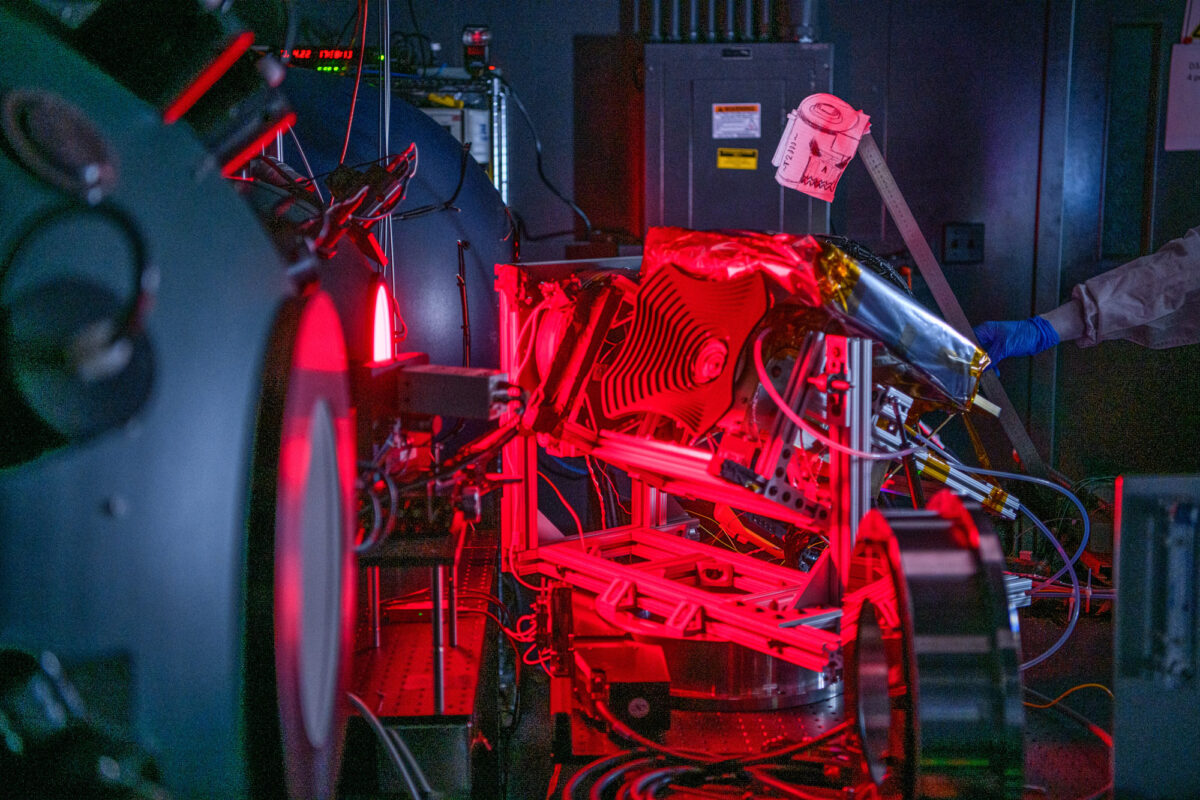 The HARP2 instrument undergoes calibration testing with red light. (Image by NASA)
“We introduced engineering students to the physics students and made them work together very quickly so they spoke the same language,” he said, crediting this multidisciplinary collaboration to the team’s ability to rapidly iterate and problem solve.
Borda, senior research engineer overseeing HARP2’s optical design, said a key technical challenge was determining how to best compensate for the effects of polarized light waves inside the instrument.
“It’s continuous work and you cannot do it alone. We needed a fantastic team with not only the staff but also students working at different levels,” Borda said. “There are undergraduate students and Ph.D.s integrated into the team who put in a lot of effort to make this real. We’re really thankful for the environment at this university—we’re able to work with students who find a career in this industry and field of research.”
Nurturing future career scientists
Martins echoed Borda’s pride in the broad level of participation in the HARP program, from high school students to senior scientists.
“We’ve had people from our team who now work in all levels of industry—at NASA, at NOAA, or in private industry. We’ve even had some students start their own company.”
Young, the program administrator, estimates that the cooperative agreements between UMBC and NASA have resulted in 20 UMBC graduates finding roles with NASA.
“It was everything I could have asked for. No other place would have let me be involved in the entire process, including making parts for HARP2 in the machine shop. Not only did I get to do hands-on stuff, but I also was part of the design and saw it all come together on a NASA mission.”
Yomiyu Fekadu ’20, mechanical engineering, M.S. ’23, engineering management
UMBC alumna Elissa Ogburn is one such graduate. She began working on HARP2 as a computer science major, tasked with creating a database that supported ground communications so researchers could communicate with the instrument when it was in space.
After graduating from UMBC in 2021, Ogburn joined NASA on the PACE project as a test conductor (TC)―responsible for integrating and testing the instruments onto the PACE spacecraft. During launch, she was one of five TCs in the PACE Control Room in Titusville, Florida, who powered up the spacecraft for the last time and configured it for launch.
“I never imagined having a job at NASA or working with people who were this smart, helpful, and kind. Every single person I’ve worked with was so fun. It’s also cool to have seen the whole process beginning as a student at UMBC. PACE is my first mission, so I’m learning everything as I go,” Ogburn said.
Close collaboration
The partnership between NASA and UMBC goes back over two decades. NASA Goddard Space Flight Center and UMBC are located just up the road from one another.
Jeremy Werdell, PACE project scientist at Goddard, recalled how initial calls to industry and academia for a polarimetry instrument for PACE were not promising due to cost and other factors.
However, Martins immediately suggested to Werdell that his lab develop a polarimeter, given his team’s experience with airborne instruments and the HARP cubesat, and the rest is history. In the end, NASA selected two polarimeters—HARP2 and SPEXone.
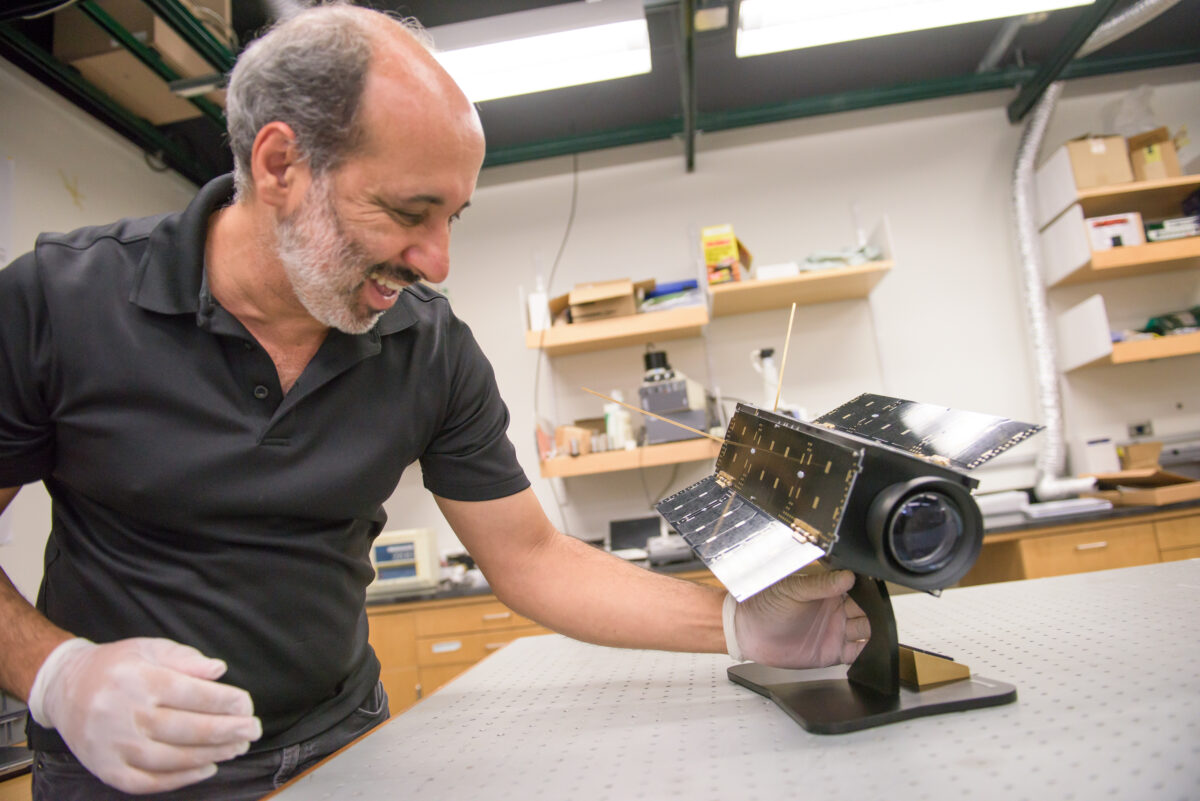 Vanderlei Martins inspects the HARP cubesat, which launched in 2019. (Image by Marlayna Demond ’11/UMBC)
Each instrument measures polarization differently: HARP2 is multispectral (measuring only four wavelengths of light) and hyperangular, so it looks at the same piece of real estate multiple times from dozens of different viewing directions. Its wide swath coverage means HARP2 will cover the globe every two days. SPEXone, on the other hand, is hyperspectral (measuring a continuous spectrum of light from the ultraviolet to near-infrared) but only views Earth at five angles. It has a narrower swath, meaning it will take almost a month to cover the globe.
“They’re small and mighty and miraculously complement each other very, very well,” said Werdell. “Having multi-band, multi-angle polarimetry is going to open up a lot of really interesting opportunities for discovery, because we can see clouds and aerosols in very different ways.”
HARP2 provides daily views that will help scientists understand how aerosols and clouds interact and their role in warming and cooling in the atmosphere.
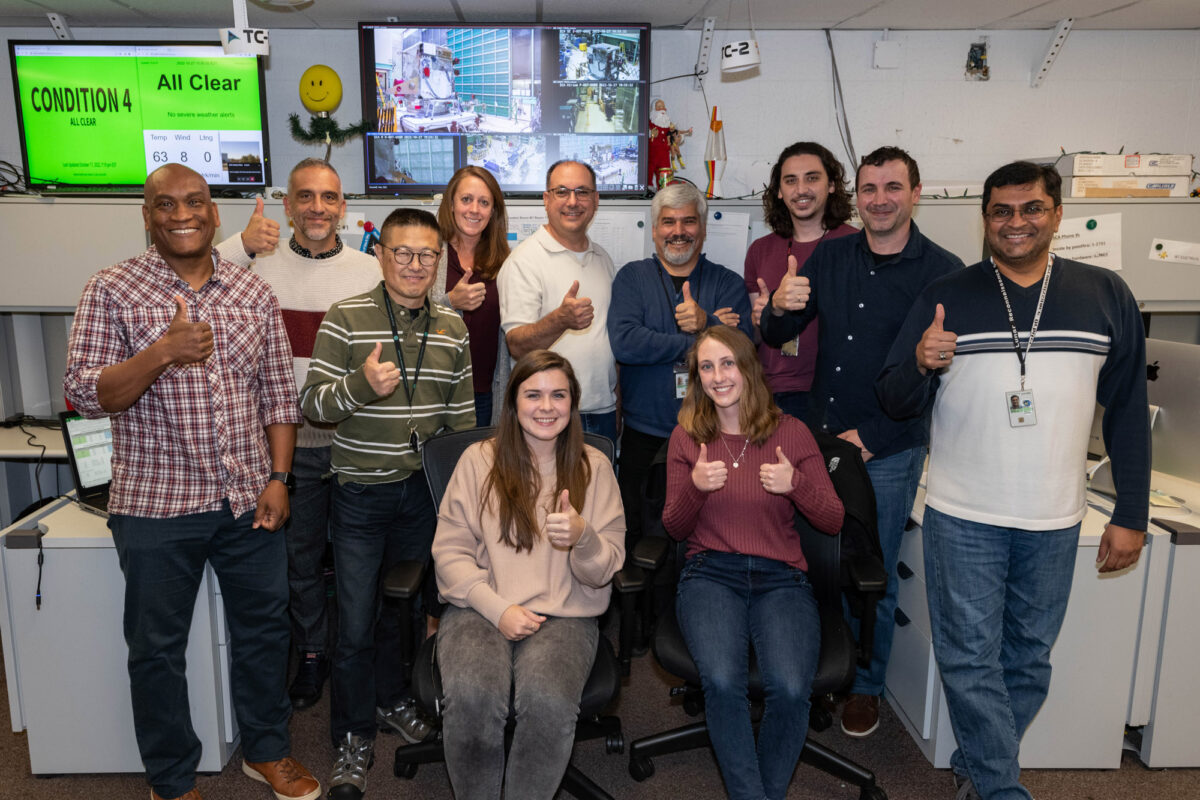 Some members of the HARP2 team successfully test HARP2’s electrical Integration to the Spacecraft. (Image by NASA)
“Understanding where aerosols are, how they’re transported, how they interact with clouds, and whether they absorb or reflect radiation is important to everybody because those characteristics are what drive warming of the atmosphere.” Werdell said.
Better air quality models
Onsite at the Cape for the first launch attempts, Nirandi Jayasinghe and Rachel Smith, both physics graduate research assistants at UMBC, shared their excitement for the PACE mission and HARP2’s potential to help modelers predict air quality, rain, or if the atmosphere is warming or cooling.
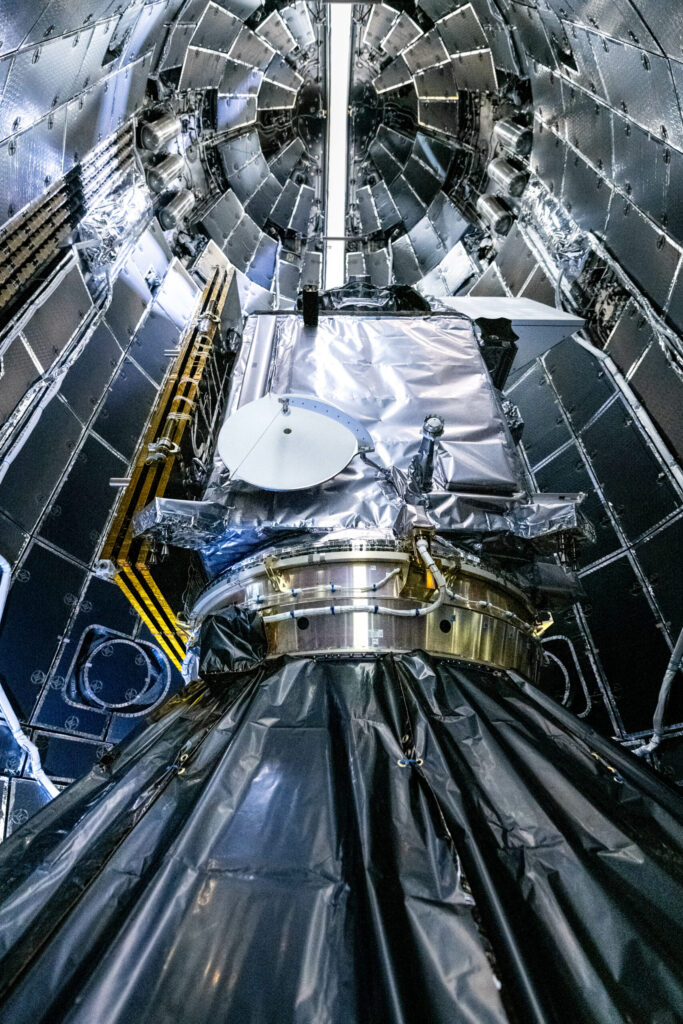 NASA and SpaceX technicians safely encapsulated NASA’s PACE spacecraft in SpaceX’s Falcon 9 payload fairings–a protective shell for the instruments on PACE during launch. (Image by NASA)
Jayasinghe is a data modeler who comes up with different methods to retrieve information from HARP2. Originally from Sri Lanka, Jayasinghe notes that her hometown used to be one of her country’s cleanest cities, and now due to development in Sri Lanka’s dominant neighbor, India, the air quality is extremely bad. She said HARP2 can help close the gap that exists in understanding the twilight zone—where a cloud starts and where it stops—by providing more accurate measurements.
Smith adds that this will go a long way in understanding cloud formation processes, weather patterns, forecasting, and climate modeling—information important for agriculture, transportation, disaster preparedness, and infrastructure planning.
“Even simple things like weather forecasting are impacted by how much dust is in the air,” said Smith, a 2026 doctoral candidate who earned her M.S. in atmospheric physics from UMBC in 2023. HARP2 will help address whether clouds have a net cooling effect or a net warming effect, which will allow for more accurate models of where Earth’s climate is headed. Smith notes that during events like the Canadian wildfires in 2023 no one could accurately predict rainfall, because the forecasting models were not accounting for the number of airborne aerosols.
“I’m really excited to see what new science questions come out of the instruments that we’re putting up in space,” she concluded.
Bouncing back from disaster
The HARP2 team has come a long way from initial concept to PACE. What impresses Werdell the most is the UMBC team’s resilience in the face of setbacks.
The most devastating moment came in February 2022, one month before the team was set to deliver HARP2 to NASA for integration on the spacecraft. As the instrument was in the last few seconds of vibration tests, the bonding on one of the prisms loosened and shattered.
“It tactically put us to point zero,” recalled Cieslak, who was shocked and humbled when so many NASA scientists volunteered their time and expertise to help the HARP2 team get back on track.
“We got an extension, and within two months we had built a new engineering model and were able to prove the new solution worked. By September, we were back to where we were before the incident,” he added.
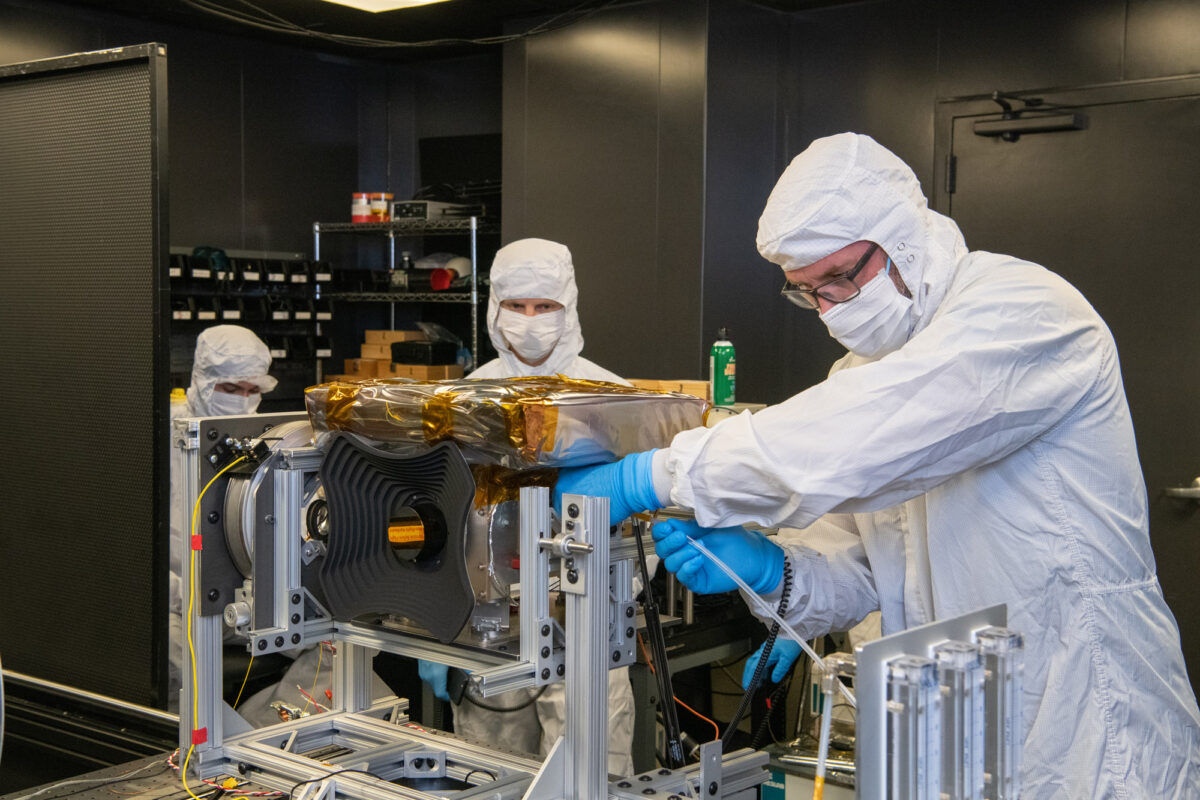 HARP2 calibration testing at Goddard Space Flight Center in Maryland, before the instrument was delivered to NASA. (Image by NASA)
First-time NASA launch attendee Yomiyu Fekadu ’20, mechanical engineering, M.S. ’23, engineering management, recalled that time well, as he helped assemble HARP2 as an intern under Benjamin Cramer ’17, M.S. ’20, mechanical engineer on the program.
“Especially after the failure, and the review board assessment, I helped put everything back together and do the test plans for construction and other documentation so NASA could give us the go-ahead to move on,” Fekadu said.
The experience was pivotal to his career. “It was everything I could have asked for,” said Fekado, now a systems engineer at Northrop Grumman. “No other place would have let me be involved in the entire process, including making parts for HARP2 in the machine shop. Not only did I get to do hands-on stuff, but I also was part of the design and saw it all come together on a NASA mission.”
As the HARP2 group left the viewing platform to line up for bus rides back to the Space Center, the smiles and easy camaraderie conveyed a collective sense of pride, relief, and excitement.
“I‘m now just anxious to see the first bytes of data,” said Cieslak, echoing the feeling of his colleagues.
In addition to the HARP team, several additional GESTAR II scientists and engineers were instrumental in their contributions to the overall PACE mission, including Ivona Cetinić, Andrew Sayer, Violeta Sanjuan Calzado, Bridget Seegers, Susanne Craig, Dirk Aurin, Meng Gao, Inia Soto Ramos, and Ian Carroll.
Update: On February 10, HARP2 successfully connected with instrumentation on the ground and all of its systems appear to be working as intended.
Follow along with what’s learned from the HARP2 project.
]]>
By Anne Wainscott-Sargent The third time’s the charm. Against a calm and crisp dark night sky on Florida’s Cape Canaveral last Thursday, February 8, just after 1:30 a.m., the Plankton,...
https://umbc.edu/stories/harp2-launches-on-nasa-pace-mission/
https://my3.my.umbc.edu/api/v0/pixel/news/139053/guest@my.umbc.edu/e0dbaea402ea1a164a7f168d63631a1e/api/pixel
cnms
coeit
compsci
engineering-management
esi
feature
gestar
gestar2
meche
news
physics
rca
research
science-and-tech
story
UMBC News & Magazine
https://my3.my.umbc.edu/groups/umbc-news-magazine
https://assets1-my.umbc.edu/system/shared/avatars/groups/000/001/943/24435aa6207c452e7bc15cc74b42c7bb/xsmall.png?1748556657
https://assets1-my.umbc.edu/system/shared/avatars/groups/000/001/943/24435aa6207c452e7bc15cc74b42c7bb/original.png?1748556657
https://assets2-my.umbc.edu/system/shared/avatars/groups/000/001/943/24435aa6207c452e7bc15cc74b42c7bb/xxlarge.png?1748556657
https://assets2-my.umbc.edu/system/shared/avatars/groups/000/001/943/24435aa6207c452e7bc15cc74b42c7bb/xlarge.png?1748556657
https://assets3-my.umbc.edu/system/shared/avatars/groups/000/001/943/24435aa6207c452e7bc15cc74b42c7bb/large.png?1748556657
https://assets1-my.umbc.edu/system/shared/avatars/groups/000/001/943/24435aa6207c452e7bc15cc74b42c7bb/medium.png?1748556657
https://assets2-my.umbc.edu/system/shared/avatars/groups/000/001/943/24435aa6207c452e7bc15cc74b42c7bb/small.png?1748556657
https://assets1-my.umbc.edu/system/shared/avatars/groups/000/001/943/24435aa6207c452e7bc15cc74b42c7bb/xsmall.png?1748556657
https://assets2-my.umbc.edu/system/shared/avatars/groups/000/001/943/24435aa6207c452e7bc15cc74b42c7bb/xxsmall.png?1748556657
UMBC News & Magazine
4
0
false
Fri, 16 Feb 2024 10:36:17 -0500
Fri, 16 Feb 2024 10:36:17 -0500