Record-setting group of UMBC students explores global careers through Albrecht Fellowship
Eight UMBC students are spending part of their summer meeting business leaders, visiting Maryland companies, and getting a closer look at careers that connect the state to the rest of the world.
They were selected for the World Trade Center Institute’s (WTCI) 2026 Albrecht Fellowship, a two-week professional development program hosted in Baltimore City and focused on international business and global affairs. This year, the UMBC group set a record.
Daniel Khoshkepazi, senior manager of fellowships at the World Trade Center Institute, called the eight students “a record for a single university from any given cohort in the past.” WTCI typically limits participation to five or six students from one institution, he says. But UMBC students ranked so highly during what he described as the program’s most competitive application cycle to date that “their exceptional performance earned them a place in the cohort.”
For the students participating, the two weeks are a chance to test assumptions about their careers, see what they have studied at UMBC in practice, and, in some cases, discover work they had never considered.
Trying something different
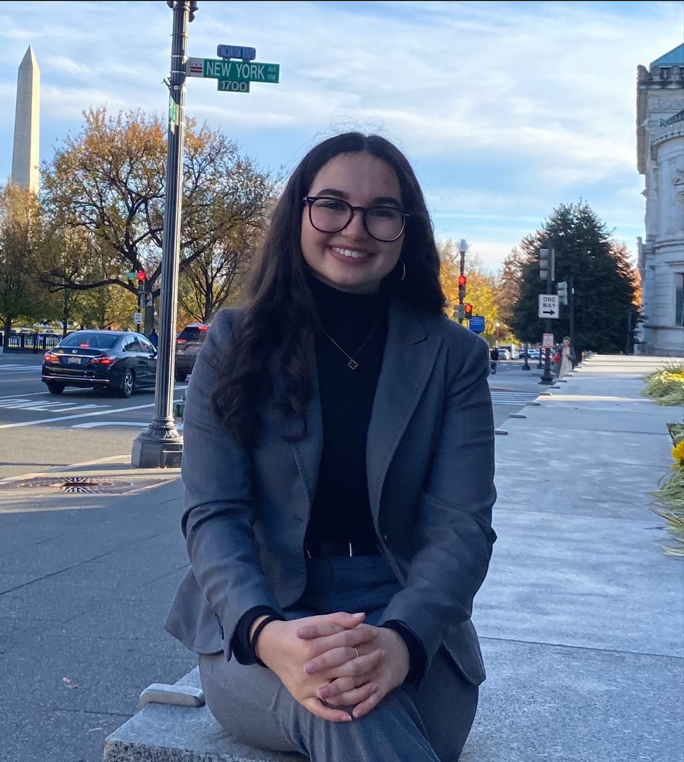
 Headshot courtesy of Matthew O’Donnell
Matthew O’Donnell applied for the fellowship the day after hearing WTCI CEO Eddie Resende speak at UMBC. O’Donnell, a senior global studies major and political science minor, had been thinking about how he spent his first few years of college and wanted to push himself to try something different. Resende’s description of the fellowship and its focus on global trade and business caught his attention.
“I began to realize I need to step out of my comfort zone more,” O’Donnell says. “I felt that I spent my first semesters too close to the norm, and I wanted to try a new experience to see how it would go.”
Gouri Gupta, a junior, initially had a different reaction when she heard about the opportunity. A global studies and political science double major on the pre-law track, Gupta initially brushed off the fellowship. Marketing, global supply chains, logistics, and other business-oriented topics did not seem particularly relevant to her plans to pursue human rights law or federal law enforcement.
Eventually, that became part of the appeal. Gupta decided there could be value in pursuing an experience that did not neatly match the future she had planned for herself. A few hours before the application closed, she started filling it out. She hit submit just seconds before midnight.
The experience introduced Gupta to industries she had rarely considered. Through site visits, she got a closer look at the systems behind everyday products, from olive oil and power saws to athletic wear. She also began connecting concepts from the classroom with areas such as supply chain management and logistics. For Gupta, the fellowship helped clear up some of the “fuzziness” surrounding careers and industries she had previously known primarily as a consumer.
Seeing coursework in action
That sense of discovery is showing up in the classroom connections students are making, too.
During a fellowship panel on global business and supply chains, O’Donnell found himself fascinated by a field he had known little about. He stayed after the session to talk with several panelists about their work. As he explores new fields through the fellowship, he is also seeing connections to topics he has discussed in his global studies courses at UMBC, including global trade, artificial intelligence, international boundaries, and negotiation.
Bibi Qudsia Tolwak, a senior global studies major and public humanities minor, has studied national and international organizations in her UMBC courses. Through the fellowship, she had the chance to visit organizations and businesses and talk directly with professionals about their work.
Originally from Afghanistan, Tolwak is interested in global affairs, humanitarian work, refugee issues, and advocacy. But one of the things that has stood out to her during the fellowship has less to do with any particular industry.
The professionals the students heard from have taken very different routes to their current roles. Some started as interns. Some applied multiple times before an opportunity came through. Others changed directions or faced challenges such as building careers while speaking English as a second language.
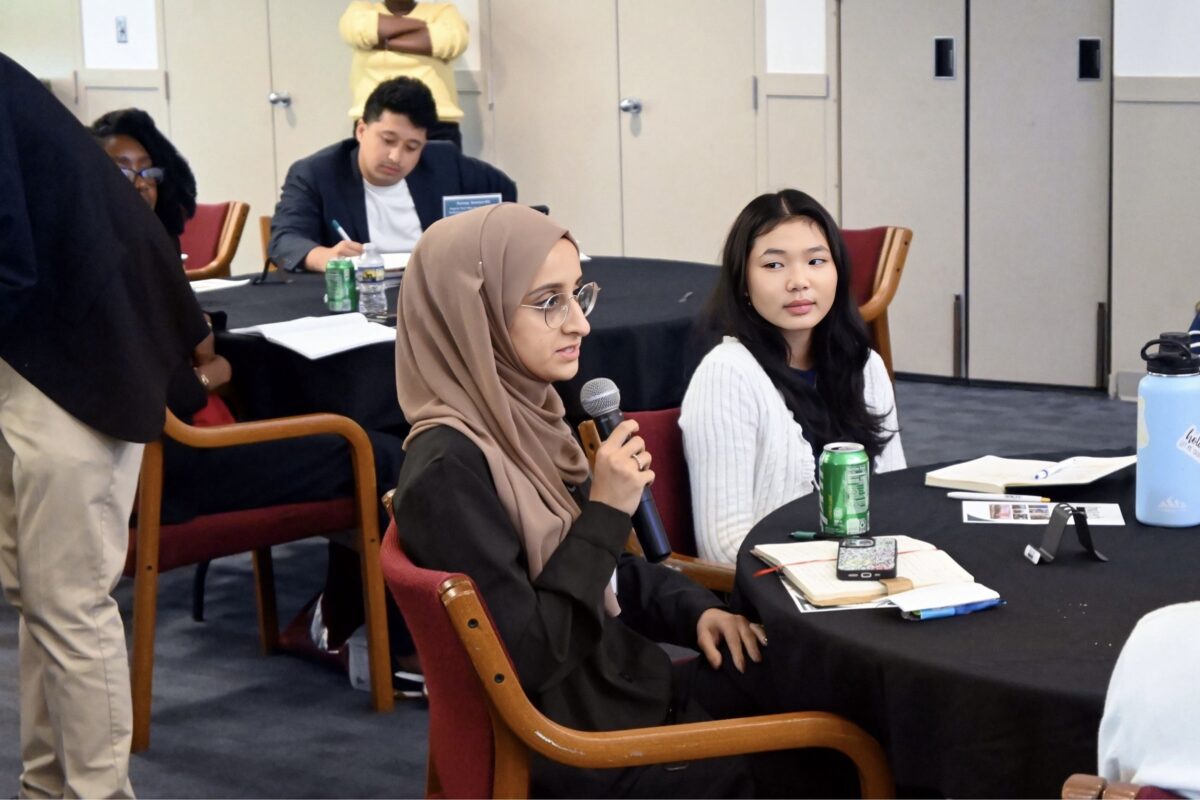 Bibi Qudsia Tolwak speaks at a WTCI group meeting. (Photo courtesy of Tolwak)
“It reminded me that careers do not always happen all at once,” Tolwak says. “Sometimes you just have to say yes to an opportunity and keep moving forward.”
The message resonated with Gupta, too. During a visit to McCormick’s plant and global headquarters in Hunt Valley, Maryland, a panelist shared a message about how the steps toward one career goal may not be the same ones that lead to the next. Gupta says it put into words one of the biggest lessons she is taking from the fellowship: Growth requires being willing to learn and adapt.
Eight Retrievers, one cohort
The size of UMBC’s group has added another dimension to the experience. “It has been great meeting other Retrievers from different majors and backgrounds and learning from their experiences,” Tolwak says. “It also makes me proud to see so many UMBC students represented in the fellowship.”
O’Donnell appreciates that the students bring different interests and strengths to the group. “One thing I love is that nobody feels like they’re overshadowing one another,” he says. “We each have our interests and strengths, and no matter if it’s a group setting or an individual one, we always contribute in a way that aids both ourselves and the group.”
Their paths to the fellowship began months earlier. In April, UMBC’s Global Studies Program hosted Global Career Conversations with Resende, an event focused on international careers. Felipe Filomeno, director of the Global Studies Program, and Christine Routzahn, director of the Career Center, worked together to promote the fellowship and encourage students to apply.
After the UMBC students were selected, the university worked to make sure cost would not prevent any of them from participating. The Division of Student Affairs provided support through a combination of the Career Center’s intern and service funds and divisional resources, allowing all eight students to participate.
Making room for what comes next
As the fellowship continues, the students are not necessarily finding one answer about what comes next. Instead, they are becoming more comfortable with the possibility that their careers may take unexpected turns.
O’Donnell is interested in international relations and more recently, community engagement and local government as well. The fellowship has given him more possibilities to consider rather than one definitive answer.
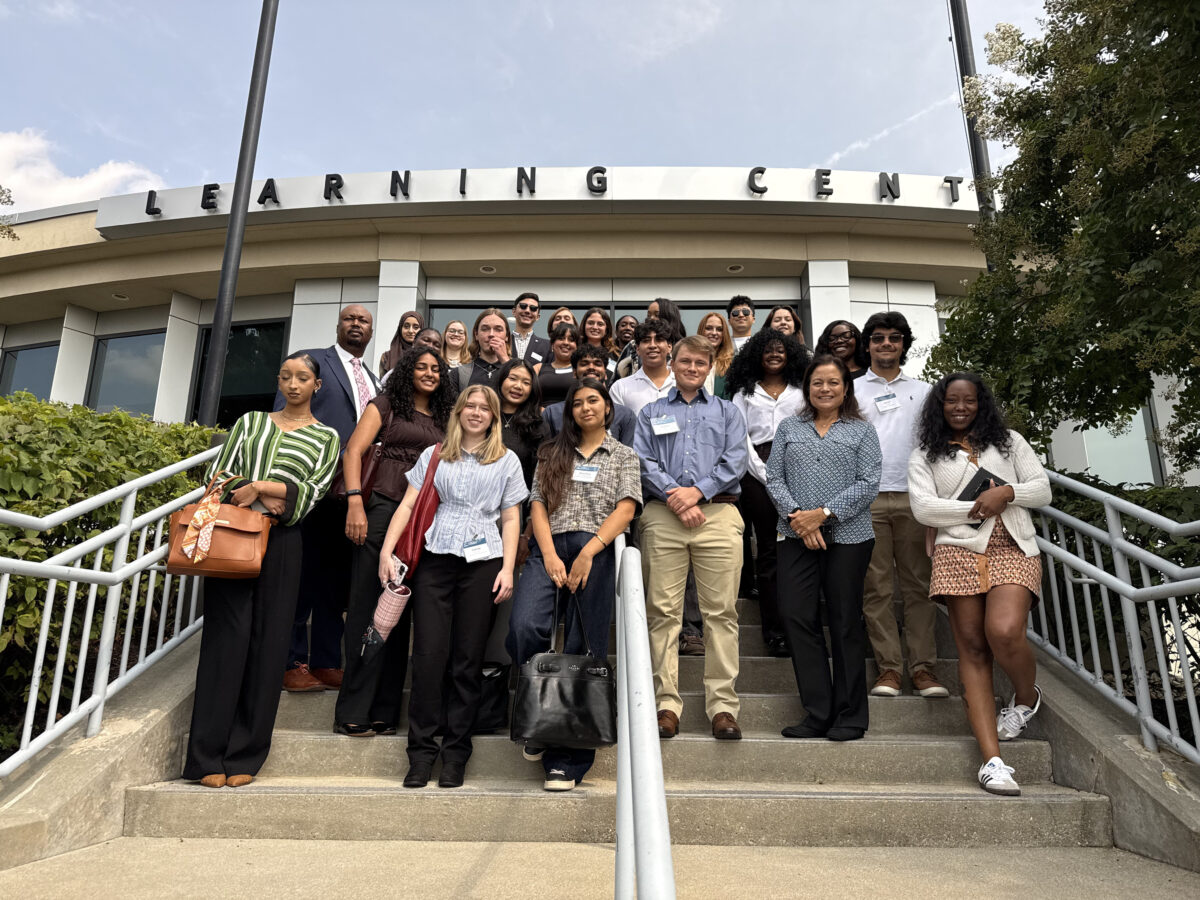 The WTCI interns gather at another site visit. (Photo courtesy of Tolwak).
“The Albrecht Fellowship has certainly given me more to think on, and that’s really what I wanted from this opportunity,” he says.
Tolwak is also still exploring where her interests will lead after UMBC. “I have learned that successful careers are not always straightforward,” Tolwak says. “You do not have to have everything figured out at the beginning; you just have to be willing to learn, keep trying, and say yes to opportunities that can help you grow.”
Gupta is considering law school and careers in human rights or federal law enforcement. The fellowship is also changing how she thinks about entering spaces where she may be younger or less experienced than the people around her.
“If there is one important lesson that the fellowship taught me, it’s that we—as students and professionals—can own our space,” Gupta says.
She hopes to carry that confidence into a field where she wants to make a difference: Gupta specifically wants to increase the representation of South Asian women in federal law enforcement. “I want to change that, and the Albrecht Fellowship has solidified the notion that I can change it.”
]]>
Eight UMBC students are spending part of their summer meeting business leaders, visiting Maryland companies, and getting a closer look at careers that connect the state to the rest of the world....
https://umbc.edu/stories/exploring-global-careers-albrecht-fellowship/
https://my3.my.umbc.edu/api/v0/pixel/news/162085/guest@my.umbc.edu/172c155646d287fefd0c96cd8334dee5/api/pixel
cahss
campus-life
career-center
community
global-studies
political-science
pre-law
public-humanities
stories
story
UMBC News & Magazine
https://my3.my.umbc.edu/groups/umbc-news-magazine
https://assets1-my.umbc.edu/system/shared/avatars/groups/000/001/943/24435aa6207c452e7bc15cc74b42c7bb/xsmall.png?1748556657
https://assets1-my.umbc.edu/system/shared/avatars/groups/000/001/943/24435aa6207c452e7bc15cc74b42c7bb/original.png?1748556657
https://assets2-my.umbc.edu/system/shared/avatars/groups/000/001/943/24435aa6207c452e7bc15cc74b42c7bb/xxlarge.png?1748556657
https://assets2-my.umbc.edu/system/shared/avatars/groups/000/001/943/24435aa6207c452e7bc15cc74b42c7bb/xlarge.png?1748556657
https://assets3-my.umbc.edu/system/shared/avatars/groups/000/001/943/24435aa6207c452e7bc15cc74b42c7bb/large.png?1748556657
https://assets1-my.umbc.edu/system/shared/avatars/groups/000/001/943/24435aa6207c452e7bc15cc74b42c7bb/medium.png?1748556657
https://assets2-my.umbc.edu/system/shared/avatars/groups/000/001/943/24435aa6207c452e7bc15cc74b42c7bb/small.png?1748556657
https://assets1-my.umbc.edu/system/shared/avatars/groups/000/001/943/24435aa6207c452e7bc15cc74b42c7bb/xsmall.png?1748556657
https://assets2-my.umbc.edu/system/shared/avatars/groups/000/001/943/24435aa6207c452e7bc15cc74b42c7bb/xxsmall.png?1748556657
UMBC News & Magazine
0
0
false
Thu, 27 Aug 2026 14:39:28 -0400
Thu, 27 Aug 2026 14:39:28 -0400
Zareen Taj earns her Ph.D., publishing the first autoethnography by a Hazara Afghan woman about the ongoing genocide of Hazara women under Taliban rule
This spring on Thursday evenings, students filled room 424 in the Fine Arts building for their Asian Diaspora in Motion: Media, Culture, Identity, and Activism class. At the head of the classroom was Zareen Taj, who designed the new 300-level class based on her experiences as a documentary filmmaker and activist defending the rights of her community—the Hazara women of Afghanistan, a community that has for over a century experienced extreme ethnic, religious, and gender oppression, including multiple massacres and starvation, under Taliban rule.
It’s a reality Taj grew up with as part of the Hazara people, a religious and ethnic minority. In the 1990s, when the Taliban increased their killings of the Hazara people, Taj and her family fled to a refugee settlement in Pakistan. There, Taj started speaking out against the systemic oppression of Hazara women. Her activism made her a Taliban target. With a scholarship from the Feminist Majority Foundation, Taj fled once more, this time to Towson University, where she earned a bachelor’s in political science and women’s studies and a master’s in women’s studies.
After graduation, Taj worked for Voice of America as an international broadcaster and producer. At UMBC, she worked for Chartwells in the HR department first and then as an accounting associate at The Shriver Center. A year later, Taj was accepted into the language, literacy, and culture (LLC) doctoral program. During her studies, she raised two children and created four short documentaries about Hazara women while teaching in the global studies, Asian studies, and American studies departments.
This semester, Taj successfully defended her dissertation, “Journey of a Scholar-Activist: An Autoethnographic and Multimodal Inquiry,” which includes written narratives and her fourth documentary short film titled “For My People.” The project marks the first time she took the time and space to reflect on her life.
“I learned from this journey that I am different. I look different. I work differently. I see things differently, but my difference is not a problem,” says Taj about her experience at UMBC, where she hopes to become a professor. “My experience is an asset. It’s my wealth. The UMBC community, particularly the LLC and my professors, were very supportive of what I’m doing. So they supported me at each stage of my life.”
Q: What was your journey to UMBC?
A: I studied in a refugee displacement settlement in Pakistan, so it was very hard. But I got the Feminist Majority Scholarship and moved to Maryland in 2000 to attend Towson University. I could not speak English well. I saw a computer for the first time in my life. It was very hard because I came from a very war-torn country. We don’t have that advanced education system, and it’s often interrupted by war. Every minute, I reminded myself about the other Afghan girls who didn’t have this opportunity, so I couldn’t give up.
I always wanted to get a Ph.D. That was my dream. I put all of my experiences into my academic world. In 2018, I applied to the LLC doctoral program. I talked with Carole McCann, professor of gender, sexuality, and women’s studies, about what I wanted to do. She said yes to being my advisor right away. Joby Taylor, Ph.D. ’05, assistant vice provost and co-leader of The Shriver Center for Public Service and Community Engagement, and Tania Lizarazo, associate professor of modern languages, linguistics, and intercultural communication, and global studies, also lent their support as co-chairs.
Q: How did you decide on the topic for your dissertation?
A: My master’s thesis, titled “Dual Identity, Dual Oppression of Hazara Women,” didn’t follow the same research path as a traditional thesis because there were no official documents that I could use for my research. I felt frustrated. My thesis was informed by my firsthand research trips to Afghanistan. This work represents the first contribution of its kind in the academic field. My personal experiences and frustrations motivated me to return to my country, which ultimately shaped and grounded the development of my thesis.
For my dissertation, my committee wanted me to talk about myself, to write a book. I appreciated them encouraging me, but I continued to focus on Hazara women until Dr. Tanya Saunders, associate professor of sociology, pointed out all the different types of ethnography I was doing and encouraged me to focus on myself to do an autoethnography. I was surprised that I could do that, and that’s how I started.
That gave me a kind of confidence in my writing. I’m always reflecting on all of these things I’m doing, but not reflecting on myself. I never had the chance, or I never thought of doing it. I never thought I would be allowed to talk about myself, so I didn’t. I come from a culture where we never talk about ourselves because this is taboo. Women would be told, “Why are you talking about yourself? We have bigger issues, bigger things to talk about.” That’s the culture, especially for Hazara women. We never talk about ourselves, our pain, our joy. Everything is internalized.
I am reaching a stage of very clear realizations about how this academic process is a very healing process for me. I’m making my people visible and bringing awareness to the cause. We’ll get to know people, my people, my ethnicity, their suffering, and also the resilience of these women.
Q: Why was this dissertation process a healing process?
A: My short documentary, “For My People,” which I produced for my dissertation, helped me process the anger and isolation I have carried after years of fighting for survival and against oppression. This process led to exploration and, for the first time, I explored healing and the shift to joy, community, and belonging I have found with the Hazara women who resettled in Washington, D.C., my global network of activists, and my UMBC community.
The more work I’m doing in the form of writing an article, creating films, or public speaking, the more visibility I have to those dimensions, those identities. It’s helping me feel that I do justice for them. That’s the process of healing. The more I work to bring community sustainability and collectiveness, the stronger my sense of belonging, satisfaction, and deep attachment to my community.
Q: What inspired the topics for your other films?
A: I was doing my master’s thesis about Hazara women, but there wasn’t much data. I decided to go back to Afghanistan for the first time since fleeing Pakistan to document the living conditions and experiences of Hazara women living under the fear of genocide. When I returned, I had 40 hours of videotapes, 700 photographs, and 20 hours of cassette recordings that helped me make my first film, “The Oppression of Hazara in Afghanistan.”
But I didn’t just want to show the oppression of Hazara women as victims. I wanted to show the resistance and leadership of Hazara women. After the fall of the last Afghan government in 2021, some Hazara refugees came to the Washington, D.C., Maryland, Virginia area. We have a lot of activists and advocates like Azra Jafari, the first woman in Afghanistan to hold the office of mayor. They were willing to be interviewed for “Our Face Tells: Seeing the Genocide of Hazaras in Afghanistan.”
Last year, I collaborated with several organizations and led efforts to train Hazara women to create and share their own stories. The Hazara Women of Afghanistan Share Digital Stories event trained and supported Hazara women to tell their own stories. That inspired “Voices of Resistance.”
Q: How have you passed on your documentary film skills to your students?
A: UMBC has given me so much and helped me to contribute to it. I taught three years in the global studies program as a visiting lecturer, and I designed, established, and taught Global Studies 409: Documentary Film as Global Activism. Students had to make a documentary about their families from any part of the world. They had to document where their identity and sense of belonging came from. Their films reflected their family backgrounds as well as their personal passions and engagement with social issues.
I still remember a student whose grandparents came from Ethiopia. His film was about them, and afterwards told me that when he was given the assignment, he said to himself, “If this lady, this lady from Afghanistan, can do these films, I can do that too.” It made me smile
Q: Looking back on everything that you have experienced and accomplished, has your purpose changed?
A: In 2021, when the Taliban returned, it was like the loss of a 20-year-old child. It was hard not to despair. But in all the chaos, some Hazara were able to get out and needed help arriving to live in the United States. That service rescued me from that vulnerable situation. Community work changed me again. It lifted me up.
 Zareen Taj (first row, second from the left), at the Hazara Women of Afghanistan Share Digital Stories event. (Image courtesy of Taj.)
After the Hazara Women of Afghanistan Share Digital Stories event, I realized I do not need to feel the responsibility to speak for Hazara women, as they are now able to articulate and share their own stories with the world. This is my message for Hazara around the world, especially Hazara women who feel like their stories do not matter. You need to tell your story because your story is our history. And your story is our future. Sharing our stories will hold us together and make us known to the world.
]]>
This spring on Thursday evenings, students filled room 424 in the Fine Arts building for their Asian Diaspora in Motion: Media, Culture, Identity, and Activism class. At the head of the classroom...
https://umbc.edu/stories/zareen-taj-publishes-first-autoethnography-by-a-hazara-afghan-woman/
Video Preview
https://assets4-my.umbc.edu/system/shared/attachments/56c276514fcee88e01cdc640f7bc3e4f/6a9d000e/news/000/159/731/e0c4ba8f6e02c02ed67cc30334e8c183/2498820.jpg?1778009707
https://my3.my.umbc.edu/api/v0/pixel/news/159731/guest@my.umbc.edu/f9e9ea2143bc436276841dd469489856/api/pixel
asianstudies
cahss
class-of-2026
global-studies
gwst
international
language-literacy-and-culture
mlli
news
policy-and-society
saph
shrivercenter
story
UMBC News & Magazine
https://my3.my.umbc.edu/groups/umbc-news-magazine
https://assets1-my.umbc.edu/system/shared/avatars/groups/000/001/943/24435aa6207c452e7bc15cc74b42c7bb/xsmall.png?1748556657
https://assets1-my.umbc.edu/system/shared/avatars/groups/000/001/943/24435aa6207c452e7bc15cc74b42c7bb/original.png?1748556657
https://assets2-my.umbc.edu/system/shared/avatars/groups/000/001/943/24435aa6207c452e7bc15cc74b42c7bb/xxlarge.png?1748556657
https://assets2-my.umbc.edu/system/shared/avatars/groups/000/001/943/24435aa6207c452e7bc15cc74b42c7bb/xlarge.png?1748556657
https://assets3-my.umbc.edu/system/shared/avatars/groups/000/001/943/24435aa6207c452e7bc15cc74b42c7bb/large.png?1748556657
https://assets1-my.umbc.edu/system/shared/avatars/groups/000/001/943/24435aa6207c452e7bc15cc74b42c7bb/medium.png?1748556657
https://assets2-my.umbc.edu/system/shared/avatars/groups/000/001/943/24435aa6207c452e7bc15cc74b42c7bb/small.png?1748556657
https://assets1-my.umbc.edu/system/shared/avatars/groups/000/001/943/24435aa6207c452e7bc15cc74b42c7bb/xsmall.png?1748556657
https://assets2-my.umbc.edu/system/shared/avatars/groups/000/001/943/24435aa6207c452e7bc15cc74b42c7bb/xxsmall.png?1748556657
UMBC News & Magazine
0
0
false
Tue, 05 May 2026 15:29:15 -0400
Tue, 05 May 2026 15:29:15 -0400
Peace has long been elusive in rural Colombia – Black women’s community groups try to bring it closer each day
Written by Tania Lizarazo, associate professor of Latin American studies and global studies, UMBC
It’s been almost nine years since Colombia celebrated a landmark peace agreement between one guerrilla group and the government, and three years since President Gustavo Petro vowed “total peace.” But in reality, the country’s decades-long internal conflict continues – making it one of the oldest in the world.
Violence surged in early 2025, the most intense uptick in years. Fighting between two armed guerrilla groups in the northeastern Catatumbo region killed dozens of people and displaced tens of thousands more. Since the largest armed group – the Revolutionary Armed Forces of Colombia, known as FARC – signed the 2016 peace accord, more than 400 signatories have been killed. Meanwhile, more than 1,200 social leaders and human rights defenders have been assassinated.
We often define peace as the absence of war. The problem with thinking about peace and war as an all-or-nothing binary, however, is that it obscures the violence that takes place in “peaceful times.” For Colombians, that paradox is nothing new. In many communities most affected by the violence, thinking about a “post-conflict era” feels utopian.
As a Colombian researcher who has collaborated with Afro-Colombian leaders for over a decade, I have noticed that emphasizing peace talks and accords erases the historical violence that is still present, especially for racial minorities. Colombia has the largest Black population in Spanish-speaking Latin America. In Chocó – a region on the Pacific coast where I conducted my research – Afro-Colombians form a majority.
Communities there are contending not only with the contemporary conflict, but also ongoing challenges from the legacies of slavery, colonialism and extractive industries. Many residents, particularly women, work together every day to try to bring peace and justice within reach.
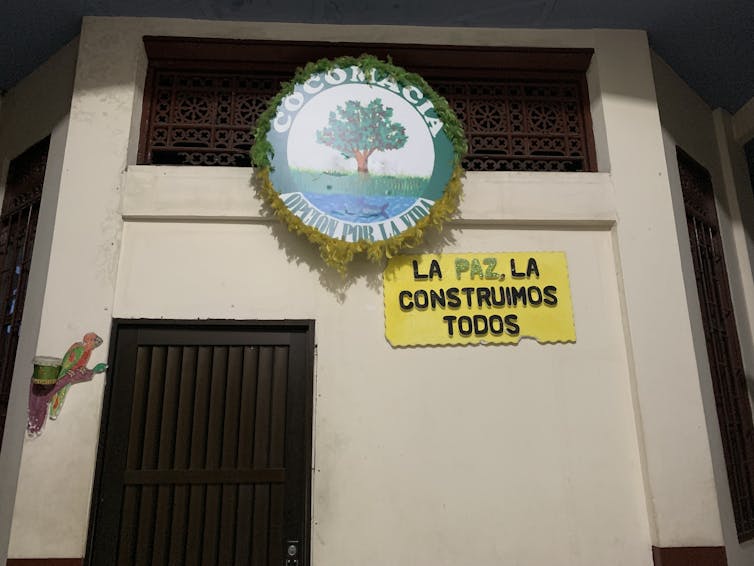 Signs in the office of COCOMACIA say ‘option for life’ and ‘peace, we all build it.’ Tania Lizarazo
Rights vs. reality
Colombia has been mired in war for over six decades, as legal and illegal armed groups across the political spectrum fight for territories and resources. The conflict is estimated to have killed around 450,000 people and displaced around 7 million.
Black and Indigenous communities have disproportionately suffered the brunt of the war – especially in rural areas, where their lives and territories have been threatened by armed groups and companies alike. In Chocó Department, the site of my research, the region’s remoteness and biodiversity have attracted illegal groups and practices like drug trafficking, as well as mining and other types of resource extraction that threaten traditional livelihoods. Mercury from industrial mining poses an additional danger to people’s health and the environment.
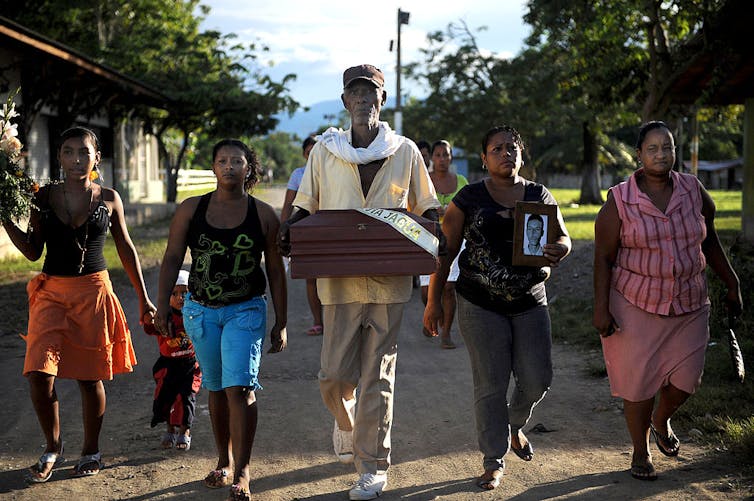 Andres Magallan carries an urn with the remains of Ivan Mejia, who was murdered by right-wing paramilitary guerrillas years before, in Santa Maria, Chocó, Colombia, in 2010. Raul Arboleda/AFP via Getty Images
Black rural communities in the Pacific lowlands, where most of Chocó is located, have a legal right to collective ownership of their territories and to be consulted about development plans. In reality, land grabs and targeted killings over illegal crops, mining and other extractive practices have become the norm here, as is true throughout rural Colombia.
The conflict has intensified racism and gender hierarchies, with Black women, particularly activists, especially vulnerable. Vice President Francia Márquez Mina, for example – who has won awards for her activism against illegal mining – survived an attack near her home in the nearby department of Cauca in 2019. She and her family have received other threats on their lives since then.
Building solidarity
Even in “postconflict” times, peace is a challenging task. It requires social change that does not happen overnight. Rather, it is the accumulation of tiny sparks in people’s daily commitments.
In my book “Postconflict Utopias: Everyday Survival in Chocó, Colombia,” I write about how Black women’s organizations care for their territories and communities. The “comisionadas,” for example, belong to one of the largest associations of community councils in rural Colombia, called COCOMACIA. These women travel the Atrato River and its tributaries to lead workshops about the organization, as well as territorial rights and women’s rights.
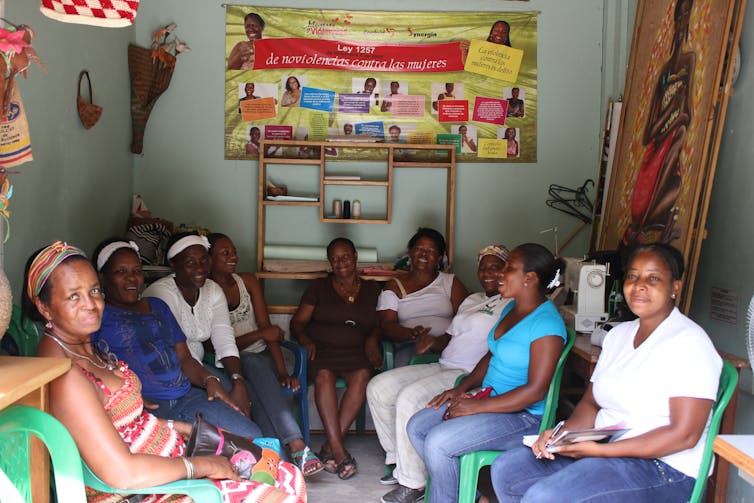 Comisionadas next to a poster with information about a landmark law against domestic violence, on July 7, 2012. María del Socorro Mosquera Pérez sits on the left. Tania Lizarazo
Everyone in the community is welcome to participate in dialogues about issues such as women’s political participation, land ownership and related legislation. Comisionada María del Socorro Mosquera Pérez, for example, wrote a song to share the importance of Law 1257, a landmark 2008 law against violence and discrimination against women.
In her story for the research project that I discuss in my book, “Mujeres Pacíficas,” comisionada Rubiela Cuesta Córdoba says it best: “The best legacy that one leaves to family and friends is resistance.”
One focus of these women’s groups’ work is the Atrato River itself. Since 2016, the same year of the peace accords, Colombian courts have recognized the river as a legal person, with rights to protection, conservation, maintenance and restoration.
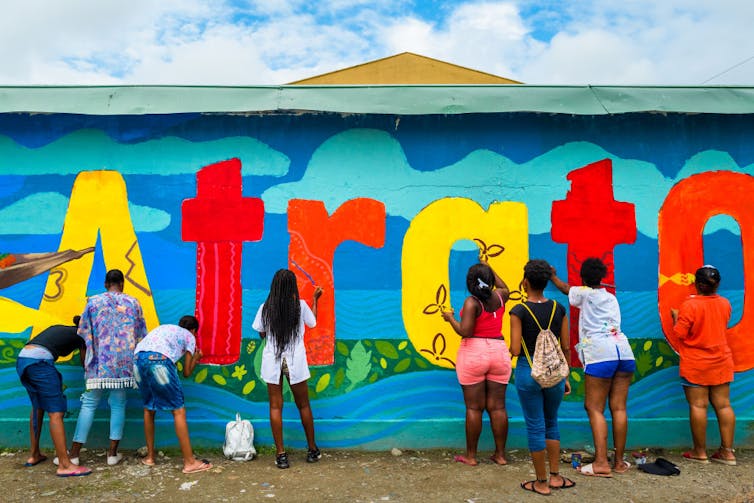 Students paint a mural in Quibdó, Chocó, Colombia, which says ‘Somos Atrato’: We are the Atrato River. Jan Sochor/Getty Images
The river is a source of food and transportation between many basin communities where potable water, electricity and other amenities are scarce. But it is also intertwined with politics and spirituality. Pilgrimages like “Atratiando,” a trip along the river and its tributaries that has taken place multiple times since 1999, highlight that there is no life without the river. Participants travel through areas where paramilitaries and guerrillas are active, showing solidarity with vulnerable communities.
COCOMACIA’s comisionadas are part of many other organizations – highlighting how survival is not only intertwined with lands and rivers, but other regions and countries. The struggle for women’s rights has led the comisionadas to collaborate with other organizations, creating wider networks of care. These include La Red Departamental de Mujeres Chocoanas, a feminist coalition of women’s organizations in Chocó; La Ruta Pacífica de las Mujeres, a feminist movement of 300 organizations from across Colombia; and Women in Black, an anti-militarism network with members in over 150 countries.
Their solidarity is a reminder that peace and justice are a collaborative, everyday effort. As Justa Germania Mena Córdoba, leader of the comisionadas at the time, told me in 2012: “One cannot change the world by herself.”
This article has been updated to correct the description of COCOMACIA.
This article is republished from The Conversation under a Creative Commons license. Read the original and see more than 250 UMBC articles available in The Conversation.
]]>
Written by Tania Lizarazo, associate professor of Latin American studies and global studies, UMBC It’s been almost nine years since Colombia celebrated a landmark peace agreement between one...
https://umbc.edu/stories/peace-has-long-been-elusive-in-rural-colombia-black-womens-community-groups-try-to-bring-it-closer-each-day/
https://my3.my.umbc.edu/api/v0/pixel/news/150570/guest@my.umbc.edu/8b74b892031103b9cca9adbc50966b27/api/pixel
cahss
cahss-research
discovery
global-studies
magazine
mlli
research
story
the-conversation
UMBC News & Magazine
https://my3.my.umbc.edu/groups/umbc-news-magazine
https://assets1-my.umbc.edu/system/shared/avatars/groups/000/001/943/24435aa6207c452e7bc15cc74b42c7bb/xsmall.png?1748556657
https://assets1-my.umbc.edu/system/shared/avatars/groups/000/001/943/24435aa6207c452e7bc15cc74b42c7bb/original.png?1748556657
https://assets2-my.umbc.edu/system/shared/avatars/groups/000/001/943/24435aa6207c452e7bc15cc74b42c7bb/xxlarge.png?1748556657
https://assets2-my.umbc.edu/system/shared/avatars/groups/000/001/943/24435aa6207c452e7bc15cc74b42c7bb/xlarge.png?1748556657
https://assets3-my.umbc.edu/system/shared/avatars/groups/000/001/943/24435aa6207c452e7bc15cc74b42c7bb/large.png?1748556657
https://assets1-my.umbc.edu/system/shared/avatars/groups/000/001/943/24435aa6207c452e7bc15cc74b42c7bb/medium.png?1748556657
https://assets2-my.umbc.edu/system/shared/avatars/groups/000/001/943/24435aa6207c452e7bc15cc74b42c7bb/small.png?1748556657
https://assets1-my.umbc.edu/system/shared/avatars/groups/000/001/943/24435aa6207c452e7bc15cc74b42c7bb/xsmall.png?1748556657
https://assets2-my.umbc.edu/system/shared/avatars/groups/000/001/943/24435aa6207c452e7bc15cc74b42c7bb/xxsmall.png?1748556657
UMBC News & Magazine
1
0
false
Fri, 06 Jun 2025 11:30:37 -0400
Fri, 06 Jun 2025 11:30:37 -0400
Public law for public good
On a fall Saturday morning, Mohammad Arshad, an information systems senior, greeted clients arriving at the Erickson School of Aging Studies looking for a fresh start with the help of UMBC’s first Expungement Clinic. After completing the intake forms, Arshad passed the files to pro-bono lawyers and staff from Maryland Legal Aid and pro-bono lawyers from the Baltimore County Bar Association. They carefully reviewed each client’s criminal records to determine eligibility for clearing or sealing certain charges or offenses that can create barriers to jobs, housing, and education
When Jessica Cook, associate director of the Sondheim Public Affairs Scholar Program, noticed that Loyola University has this program, she connected with Molly Timko, UMBC’s pre-law academic advisor, and discussed bringing the program to UMBC. They established the clinic with funding from UMBC’s Center for Democracy and Civic Life. As soon as a call was made for 20 student volunteers, the response was overwhelming.
 Expungement clinic volunteers (l-r): Damilola Khadijat Yusuf, a philosophy sophomore; Oyinlola Oluka, a political science and philosophy senior; Desta’nae Nicole Wilson ’24, psychology; Jessica Cook, associate director of the Sondheim Public Affairs Scholar Program. (center); Jean Kim, a global studies junior; Thara Pillai, a political science sophomore; Samantha Kennedy ’25, a social work senior; Cooper; Garret Miller, a financial economics sophomore; and Arshad. (Image courtesy of Timko)
Sometimes it’s hard to get internships as an undergraduate student, notes Timko. “The exposure to public interest law—doing law for the greater good—and to network with lawyers in various fields broadens students’ understanding of what being a lawyer can look like beyond arguing in a courtroom,” says Timko, a licensed attorney in Maryland, Washington, D.C., and New York. In her role at UMBC, Timko provides career pathway counseling and law school application support for UMBC students of all majors, as well as alumni.
“It was the first time I saw a law-related volunteer opportunity on campus,” said Arshad. He serves as the senate president of the Maryland Student Legislation (MSL), a model Maryland General Assembly. Currently, there are 15 college delegations, governed by the Council of States, a group of six college students elected by MSL members. Arshad serves as the lieutenant governor.
 Mohammad Arshad (l) with Maryland State Delegate, Christopher Michael Griffith. (Image courtesy of Arshad)
This experiential learning experience teaches students how to draft original legislation and debate bills, navigate parliamentary procedures, and understand the legislative process. At the end of the year, all of the legislation adopted by the students is shared with members of the Maryland General Assembly for their review. “As someone interested in the legal field, I saw the Expungement Clinic as a meaningful way to deepen my understanding of the legal process.”
 Oyinlola Oluka assists with a client intake at the Expungement Clinic. (Image courtesy of Timko)
The expungement clinic was streamlined to assist as many clients as possible. No appointment was needed. Lawyers arrived equipped with laptops and printers, prepared to complete and file paperwork. Angus Derbyshire, director for Pro Bono at Maryland Legal Aid, who spearheads expungement clinics across Maryland, reported that 14 clients were served at the UMBC Expungement Clinic, and 10 of them had cases that were deemed potentially eligible for expungement. “This resulted in the preparation of 24 expungement petitions, which is a meaningful outcome for both the clients and the community,” said Derbyshire.
As a first-generation college student, Arshad had never seen the legal process in action firsthand, let alone been part of it. What surprised him most was the collaboration and community focus. “I had always assumed legal work was mostly done behind the scenes, but this clinic showed me how much personal interaction and empathy are involved,” said Arshad, who plans to practice intellectual property law defending the rights of inventors, entrepreneurs, and developers. “It also gave me a better understanding of expungement and how access to legal resources can significantly improve someone’s future opportunities.”
All majors to the legal field
Despite the overwhelming response from volunteers for the expungement clinic, Timko has noticed that many students still assume a political science major is required to pursue a career in law. Like Arshad, Timko is a first-generation law student with a major outside of political science. She majored in anthropology and art history, with a minor in Italian, but wasn’t sure if she wanted to pursue a Ph.D. in either field. “During my master’s program in higher education and student affairs administration, I studied abroad in South Africa and took a course on social reform in post-apartheid South Africa. It sparked my interest in education and advocacy law,” says Timko.
One of Timko’s bigger goals is to help students discover their spark. “It’s important for students to know you can major in anything. There are so many ways to be a lawyer. There’s the stereotypical trial lawyer, but there are also lawyers focused on research and writing that never set foot in a courtroom,” says Timko who is also the advisor for UMBC’s Pre-Law Society that helps student prepare for the Law School Admissions Test (LSAT) and network with area schools. “You don’t have to be super extroverted or argumentative to be a really good lawyer.” There is also no expiration date on when you can decide to pursue a legal career.

 Timko (right with gold jacket) and UMBC’s Pre-Law Society students visit nearby law schools. (Images courtesy of Timko)
This is why she was excited when Shannon Ziegler ’14, fine arts, and Alexander Langsam ’22, biology, reached out to her for guidance on applying to law school. Both had initially worked in their respective fields, which unexpectedly led them in new directions—Ziegler in the financial technology industry and Langsam in civil service, which then spurred in them an interest in law.
After completing the pre-med track at UMBC, Langsam dove into studying for the Medical College Admission Test and worked as a medical assistant. When he saw firsthand the challenges faced by providers and patients, he pivoted and decided to pursue a master’s in public health policy instead, while continuing to work in civil service. There, he spent time learning about the work of the general counsel, which confirmed for him the impact lawyers can have at the federal level.
“I had never considered law school before, so when I began to think of it as a possible career, I looked up UMBC pre-law advising and emailed Molly out of the blue. She guided me through the law school application process,” said Langsam. “If you can, expand your career options beyond your degree because there are so many things you can do in this world that may not be obvious in undergrad.” He will complete his masters in May and continue to the University of Baltimore Law School in the fall.
Ziegler is about to finish her first year of law school at the University of Maryland Francis King Carey School of Law. In the decade before law school, she balanced being a business manager for Baltimore’s Center Stage by day and acting by night. She then checked off living in Chicago from her bucket list, where she worked at Venmo, launching a career at the crossroads of financial regulation and technology, the topic of her law school admissions essay.
Timko is on the Law School Admission Council directory as an undergraduate pre-law school advisor and receives an alert when an alum takes the LSAT. As soon as she was sent Ziegler’s results, she touched base with her. “It had been so long since I left UMBC that I didn’t think of reaching out. Molly gave me great advice on how to focus my application better and what to prioritize in my search,” said Ziegler. “She helped me slow down to think about what my goals are. I found that reframing really helpful.”
Making the LSAT accessible
 Megumi Fukuzawa. (Image courtesy of Fukuzawa)
At the core of the pre-law advising programming is a mission to create a supportive community where UMBC’s law school hopefuls can develop the skills, strategies, and confidence to navigate the various steps between studying for the LSAT and the first year of law school. This spring, Megumi Fukuzawa ’23, political science, who is currently studying for the LSAT, understands the need for support. Like many undergraduate students, Fukuzawa’s schedule was jam-packed. Whenever she carved out time to study for the LSAT, she felt lost and discouraged. “I needed help understanding the materials and advice about how to study effectively,” said Fukuzawa, a research assistant at the Howard County Historical Society’s Archives and Historical Center. “The only flyer I saw on campus was during my junior year, advertising a $1,000 introductory LSAT course. At that point, the LSAT felt like a massive wall I couldn’t break through.”
Thanks to a professional development grant from the American Studies Department, she was able to access study materials during her senior year. This spring, Fukuzawa asked Timko if she could lead an LSAT preparation information session.“By hosting this LSAT prep information session, providing free tutoring, and forming an online study community for UMBC LSAT students, I hope to make LSAT prep, and by extension, a legal education, more accessible to UMBC students and alumni,” said Fukuzawa. Arshad is also championing the need to help fund LSAT preparation materials, for Fukuwaza, himself, and other pre-law students who can’t afford expensive study aids. Arshad is collaborating with peers and community members on a long-term solution to establish a UMBC partnership with an LSAT coaching provider to offset LSAT preparation costs.
Advocacy and fairness are Arshad’s core values. They have defined his student work as well as his career plans to practice intellectual property law. “My background in systems and data gives me a unique perspective on how legal services, like the Expungement Clinic, can be streamlined and made more accessible through innovation,” said Arshad. “Volunteering at the expungement clinic made me think about how I can apply my tech skills to create more efficient and equitable legal solutions.”
Learn more about UMBC’s Expungement Clinic and pre-law advising.
]]>
On a fall Saturday morning, Mohammad Arshad, an information systems senior, greeted clients arriving at the Erickson School of Aging Studies looking for a fresh start with the help of UMBC’s first...
https://umbc.edu/stories/public-law-for-public-good/
https://my3.my.umbc.edu/api/v0/pixel/news/150161/guest@my.umbc.edu/62c19cce5439e59fc3b514d5ea6a7daf/api/pixel
baltimore-city
cahss
class-of-2025
cnms
coeit
economics
erickson-school
fine-arts
global-studies
impact
magazine
mcs
philosophy
political-science
psychology
social-work
sondheim-public-affairs-scholars-program
story
UMBC News & Magazine
https://my3.my.umbc.edu/groups/umbc-news-magazine
https://assets1-my.umbc.edu/system/shared/avatars/groups/000/001/943/24435aa6207c452e7bc15cc74b42c7bb/xsmall.png?1748556657
https://assets1-my.umbc.edu/system/shared/avatars/groups/000/001/943/24435aa6207c452e7bc15cc74b42c7bb/original.png?1748556657
https://assets2-my.umbc.edu/system/shared/avatars/groups/000/001/943/24435aa6207c452e7bc15cc74b42c7bb/xxlarge.png?1748556657
https://assets2-my.umbc.edu/system/shared/avatars/groups/000/001/943/24435aa6207c452e7bc15cc74b42c7bb/xlarge.png?1748556657
https://assets3-my.umbc.edu/system/shared/avatars/groups/000/001/943/24435aa6207c452e7bc15cc74b42c7bb/large.png?1748556657
https://assets1-my.umbc.edu/system/shared/avatars/groups/000/001/943/24435aa6207c452e7bc15cc74b42c7bb/medium.png?1748556657
https://assets2-my.umbc.edu/system/shared/avatars/groups/000/001/943/24435aa6207c452e7bc15cc74b42c7bb/small.png?1748556657
https://assets1-my.umbc.edu/system/shared/avatars/groups/000/001/943/24435aa6207c452e7bc15cc74b42c7bb/xsmall.png?1748556657
https://assets2-my.umbc.edu/system/shared/avatars/groups/000/001/943/24435aa6207c452e7bc15cc74b42c7bb/xxsmall.png?1748556657
UMBC News & Magazine
4
0
false
Wed, 14 May 2025 14:48:23 -0400
Wed, 14 May 2025 14:48:23 -0400
UMBC’s Ethics Bowl team earns spot in national championship two years in a row
UMBC’s Ethics Bowl team won third place at the 2024 Chesapeake Regional Ethics Bowl competition in December. The team competed at UMBC against 15 teams from the Mid-Atlantic region, all vying for one of three qualifying spots in the 2025 Association for Practical and Professional Ethics Intercollegiate Ethics Bowl National Competition. UMBC will join Virginia Tech, first-place winner, Salisbury University, second-place winner, and 33 qualifying teams across the country at the national competition in February 2025.
“Activities like the Ethics Bowl engage students to think more critically about their own values and decisions, and thereby be better able to engage with those whose views differ,” says Jessica Pfeifer, associate professor of philosophy and department chair. “This will make them better scientists, doctors, programmers, entrepreneurs, lawyers, parents, and citizens.”
Six weeks before the competition, teams receive detailed information about the topics they will discuss, allowing them to prepare and strategize their arguments. Students must be ready to answer judges’ questions and defend their responses to the opposing team in just a few minutes. Each team competes in four preliminary rounds to advance to the semifinals and finals.
Greg Ealick, a philosophy lecturer, has coached the undergraduate team 15 years. He meets with the team year-round to hone their critical thinking skills, debate challenging ethical issues across all disciplines, and develop strategies for conveying their research respectfully and succinctly. Ealick knows what it takes to make it to the top. In 1988, Ealick ’89, philosophy, helped lead UMBC’s debate team to number one in the United States and to the Parliamentary Debate Association world finals in Australia, where he was ranked as the number one American speaker. Over the 15 years Ealick has coached the Ethics Bowl team, UMBC has qualified for nationals seven times, most recently in 2023 and 2020.
 Tafat Boudif. (Image courtesy of Greg Ealick.)
“Qualifying means a lot since it is a testament to all our hard work throughout the semester. We spent several hours each week preparing for these cases, which were sometimes incredibly difficult to hash out,” says Tafat Boudif, a political science junior. Boudif helps Retrievers engage with government, politics, and policy-making as a political engagement intern at UMBC’s Center for Democracy and Civic Life. She also serves on the Student Government Association’s Appeals Board. “There are also so many additional things that we have to take into account, such as tone, confidence, etc. So I’m super proud of our team for being able to juggle all these things against some pretty tough teams!”
This year’s achievement comes shortly after UMBC’s new Center for Ethics and Values, home to the UMBC Ethics Bowl team, announced it would be a new host in the national line-up for the Association for Practical and Professional Ethics regional competitions. The event was co-hosted by UMBC’s Department of Philosophy and made possible with over 50 former Ethics Bowl team members and community members who helped to run, moderate, and judge the tournament, which took place on December 7, 2024, in the Performing Arts and Humanities Building.
This is what keeps former Ethics Bowl team member Stephanie Ferrone ’09, physics, returning to UMBC—her role as a coach. She notes that the skills she developed in Ethics Bowl continue to guide her thinking and communication as a physicist at the Underwater Electromagnetics Sensors branch of the Naval Surface Warfare Center.
“Coaching Ethics Bowl has been a joy; past the highs and lows of competition, there is a true delight in sitting in a room in the PAHB every week to help students talk through all aspects of Ethics Bowl, from Beauchamp’s principles of biomedical ethics to the importance of signposting in public speaking,” says Ferrone. “It’s even more meaningful of an experience to know how deeply this is likely to affect these students—this type of experience is one that shapes a college career and crafts friendships and connections that truly last.”
Learn more about UMBC’s philosophy department.
]]>
UMBC’s Ethics Bowl team won third place at the 2024 Chesapeake Regional Ethics Bowl competition in December. The team competed at UMBC against 15 teams from the Mid-Atlantic region, all vying for...
https://umbc.edu/quick-posts/ethics-bowl-team-headed-to-national-championship/
https://my3.my.umbc.edu/api/v0/pixel/news/146539/guest@my.umbc.edu/28fa588296e975af7251e97c644d707f/api/pixel
biology
cahss
cnms
coeit
computer-science
global-studies
news
physics
policy-and-society
political-science
psychology
quick-post
UMBC News & Magazine
https://my3.my.umbc.edu/groups/umbc-news-magazine
https://assets1-my.umbc.edu/system/shared/avatars/groups/000/001/943/24435aa6207c452e7bc15cc74b42c7bb/xsmall.png?1748556657
https://assets1-my.umbc.edu/system/shared/avatars/groups/000/001/943/24435aa6207c452e7bc15cc74b42c7bb/original.png?1748556657
https://assets2-my.umbc.edu/system/shared/avatars/groups/000/001/943/24435aa6207c452e7bc15cc74b42c7bb/xxlarge.png?1748556657
https://assets2-my.umbc.edu/system/shared/avatars/groups/000/001/943/24435aa6207c452e7bc15cc74b42c7bb/xlarge.png?1748556657
https://assets3-my.umbc.edu/system/shared/avatars/groups/000/001/943/24435aa6207c452e7bc15cc74b42c7bb/large.png?1748556657
https://assets1-my.umbc.edu/system/shared/avatars/groups/000/001/943/24435aa6207c452e7bc15cc74b42c7bb/medium.png?1748556657
https://assets2-my.umbc.edu/system/shared/avatars/groups/000/001/943/24435aa6207c452e7bc15cc74b42c7bb/small.png?1748556657
https://assets1-my.umbc.edu/system/shared/avatars/groups/000/001/943/24435aa6207c452e7bc15cc74b42c7bb/xsmall.png?1748556657
https://assets2-my.umbc.edu/system/shared/avatars/groups/000/001/943/24435aa6207c452e7bc15cc74b42c7bb/xxsmall.png?1748556657
UMBC News & Magazine
0
0
false
Mon, 13 Jan 2025 11:29:41 -0500
Mon, 13 Jan 2025 11:29:41 -0500
Intercultural conversations: Exploring politics in a global context, even at home
Middle school sweethearts, Ellyn Fennema and Joseph Patarini came to UMBC to pursue global studies (her) and geography and environmental studies (him). Despite their busy schedules, they were able to squeeze in a wedding between their sophomore and junior years, followed by a two-week van camping trip around Iceland. While it wasn’t their main goal for the trip, their majors seemed to align perfectly with learning about a new country and its geography. It wasn’t until Joseph found himself sitting outside Ellyn’s Research Methods in Global Studies and Approaches to Globalization classes with Felipe Filomeno, associate professor of political science and director of UMBC’s global studies program, that his interest was piqued by how to connect both their fields in a real-world setting.
“We used to carpool, so while I waited for her, I could hear Filomeno’s lecture,” says Joseph. “I was like, ‘Oh, he’s really cool and the discussions they have are really interesting.” Ellyn felt this was an excellent way to deepen his knowledge of the world. “Professor Filomeno makes learning these topics interactive and fun.”
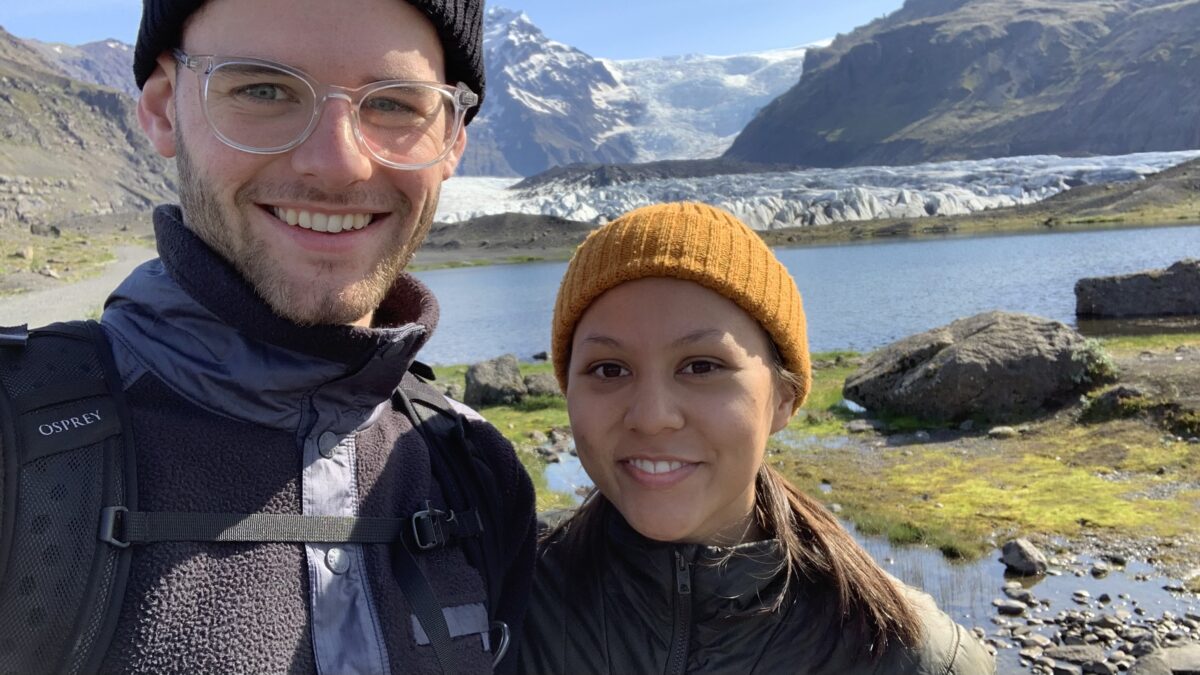 (l-r): Joseph Patarini and Ellyn Fennema. (Image courtesy of Joseph Patarini)
When Joseph learned about Filomeno’s 2024 Collaborative Online International Learning (COIL) Brazil project on climate change, he quickly enrolled. It equips students with the technical and interpersonal skills to thrive in professional online international and intercultural environments. COIL makes international scholarship and intercultural learning accessible by removing barriers of cost and travel while preparing students with essential skills for future in-person exchanges. COIL Brazil was part of Filomeno’s spring Global Citizenship class in collaboration with former colleague Clarissa Dri, a professor of international relations at his alma mater, Universidade Federal de Santa Catarina (UFSC, the Federal University of Santa Catarina), in southern Brazil.
Dri’s expertise includes Brazilian foreign policy, international cooperation, and human rights. “Clarissa and I teamed up because we value intercultural exchanges. We were both international students,” says Filomeno. “Clarissa earned a Ph.D. from the University of Bordeaux in France. I earned mine at Johns Hopkins Hopkins as a Fulbright Scholar.”
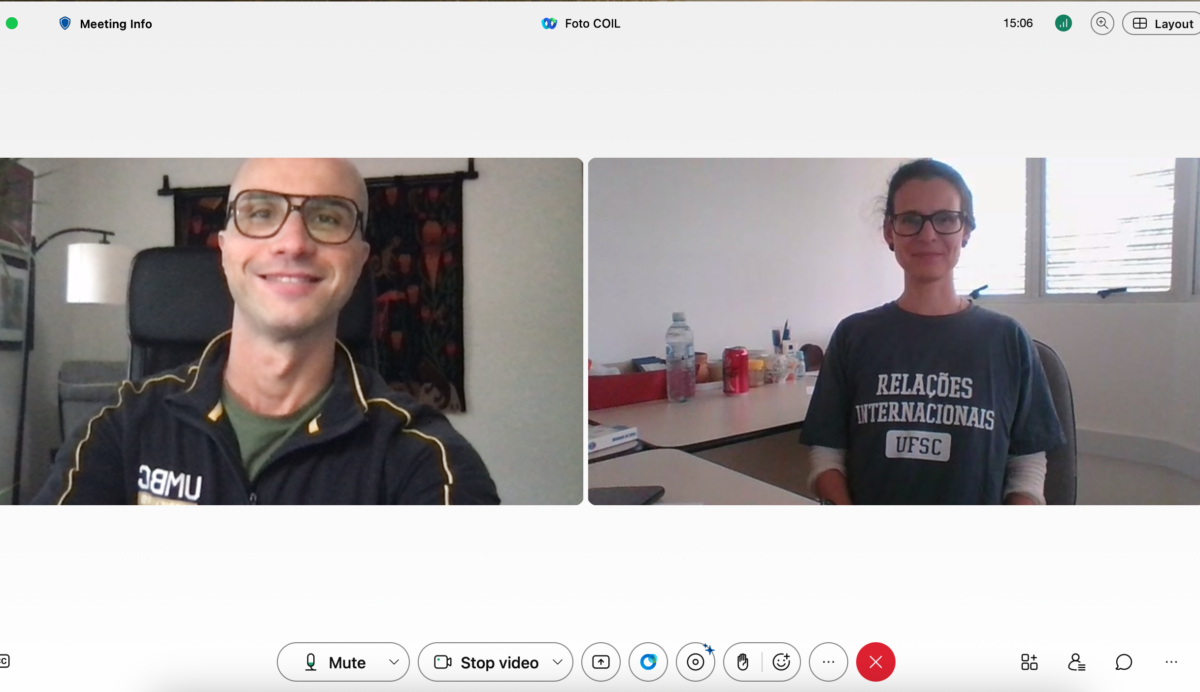 (l-r): Felipe Filomeno and Clarissa Dri. (Image courtesy of Filomeno)
The program enrolls Retrievers and Brazilian students to enhance their intercultural competence and knowledge of human rights, democracy, and climate change policy advocacy. Spring 2024 was its third iteration with plans of future offerings
“COIL has become another major pedagogical tool I use for active global learning,” says Filomeno, noting along with Dri the growing interest in COIL from one day in the first year to four weeks in spring 2025 “The students are very interested and happy with the intercultural interactions, exploring cultural differences, and the possibility to interact in English,” says Dri. “They are amazed by the concrete possibility of talking to someone who is in the U.S. right now and to listen to what they think of our country.”
Politics without borders
Ellyn saw COIL as a way for Joseph to combine his ongoing GES research with a global studies perspective. “Since Brazil holds the lungs of the earth—the Amazon rainforest—getting the ideas and perspectives of Brazilian students would be valuable for his future career.” Before participating in COIL, Joseph’s understanding of Brazil was at a more physical level. At the GES research lab, he tracked forest plantations, deforestation, and land use change using global satellite imagery. COIL was an extra opportunity to develop a personal, qualitative understanding of land-use change, deforestation, and Brazilian environmental policies.
Filomeno and Dri coordinated the classes on Webex to align with the one-hour time difference. Students implement online social science research methods to gather and analyze data in 10 to 30-minute increments before sharing their findings. Each group schedules time outside of class to further their research and final presentations.
In Joseph’s class, students took on roles from various U.S. and Brazilian constituents including political parties, worker’s unions, philanthropic organizations, and Brazilian indigenous rights groups. Teams researched their constituents’ climate stance and proposed two goals for the their country to pursue at the 2025 United Nations Climate Change Conference. Joseph’s group proposed that the Bill and Melinda Gates Foundation focus on developing and deploying green technologies in agriculture and biodiversity preservation in Brazil.
Courage in politics
Gustavo Peres, a first-year international relations student at UFSC, believes it takes courage to actively engage in international political discourse. Initially, Peres was hesitant to apply to COIL Brazil 2023 because of the English language requirement but he was intrigued by the subject material which focused on democracy in the context of the presidential elections in the U.S. in 2020 and in Brazil in 2022.
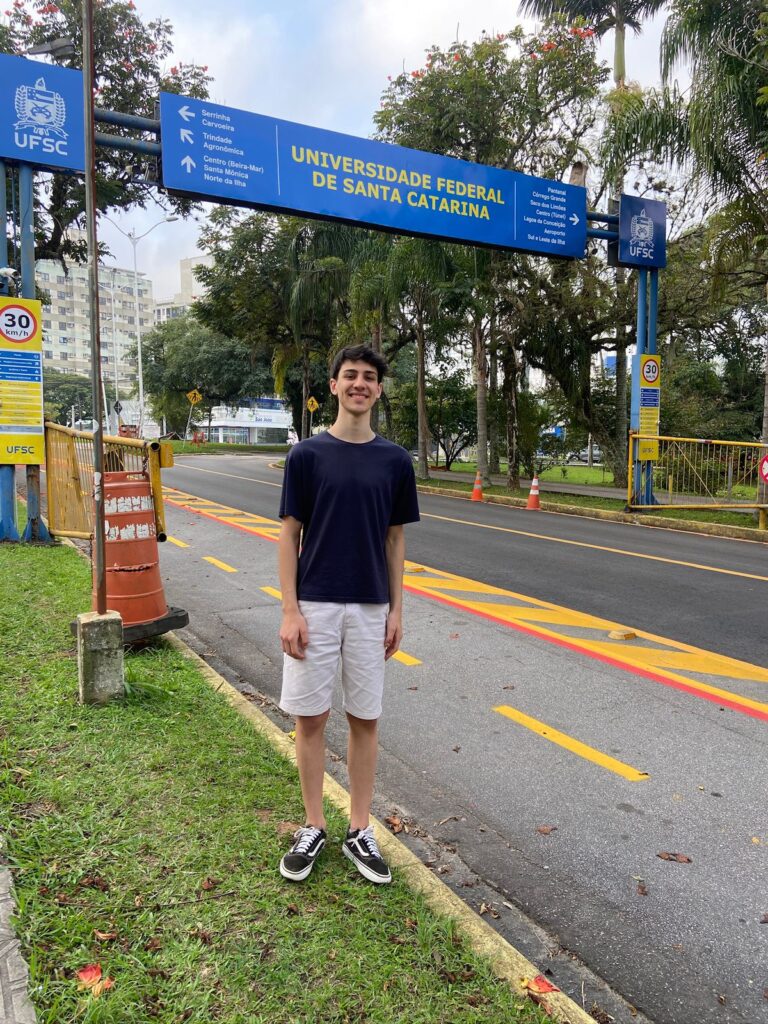 Gustavo Peres. (Image courtesy of Peres)
“I could have just seen the email and said, ‘No, it’s not for me because I felt a little bit intimidated to be judged about how I speak,” says Peres, a native Portuguese speaker and English language learner. He followed his COIL experience with an internship in international trade. “I can lose a big opportunity to practice English and also know more about other people, their culture, and other things that are very valuable to our life. The West can provide a lot of things to other countries, but I think the other countries can also give a lot to the West.”
UMBC students were surprised by Brazil’s universal public healthcare and free public education without student loans or copays to receive medical care. UFSC students were intrigued that the U.S. lacks compulsory voting. “In Brazil, if you are 18, you have to vote or pay a small tax,” says Peres. “But it’s good that in both Brazil and the U.S. you can vote. I think the voting process is something very important and valuable for democracies.”
Paths to global understanding
Filomeno says students in the U.S. often think about democracy in procedural terms—free and fair elections, the rule of law, etc. “Brazilian students tend to emphasize substantive aspects of democracy—people’s right to education and health care, equality of economic opportunity, etc.,” says Filomeno. “Through dialogue, they realize their understanding of democracy is culturally specific.”
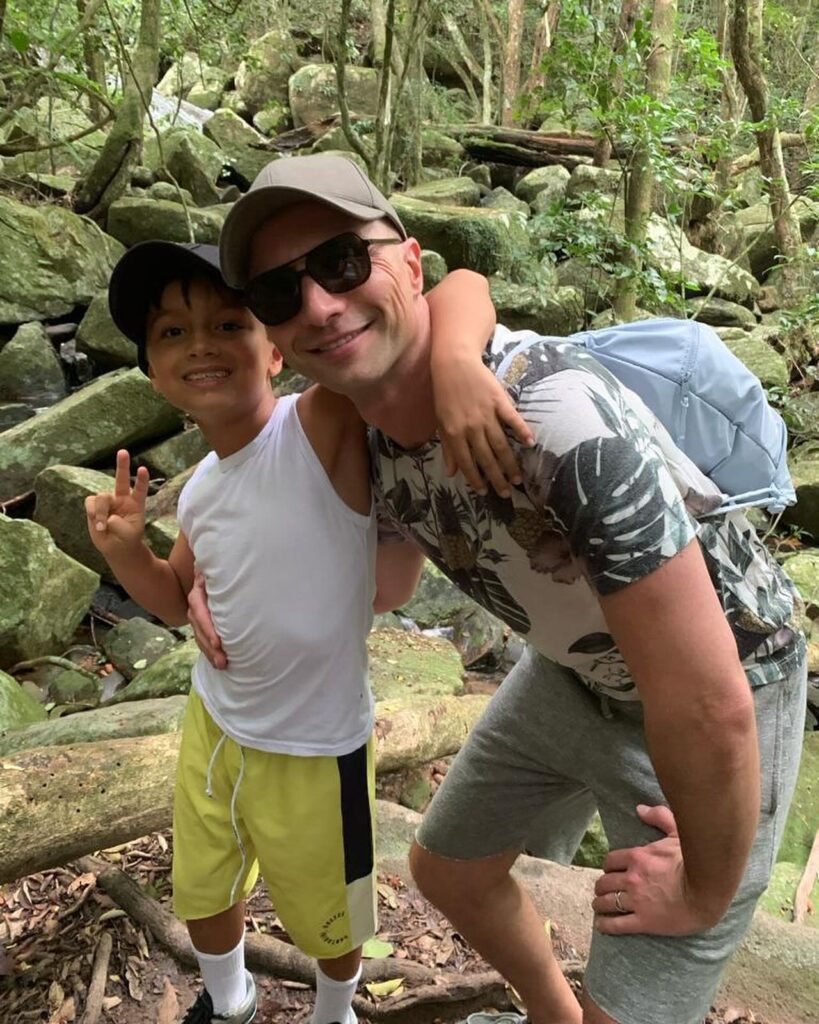
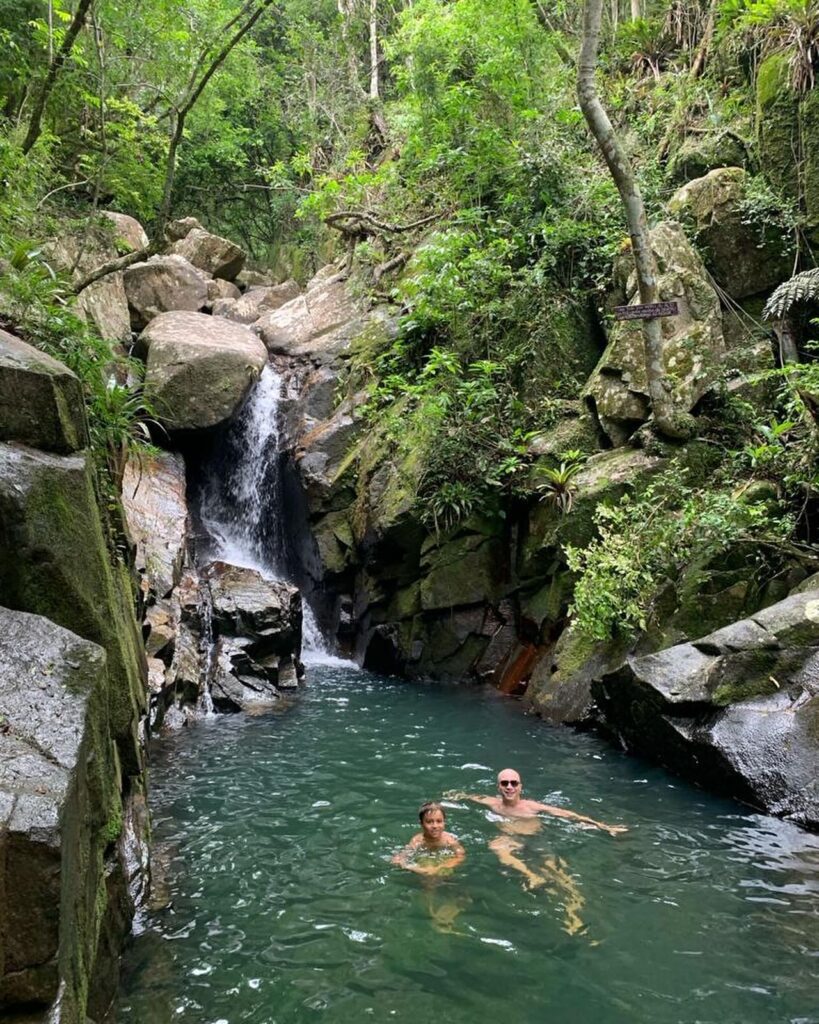 Filomeno with nephew in Brazil. (Images courtesy of Filomeno)
Filomeno is all too familiar with these cultural differences. When he left Brazil for graduate school in the U.S., he became aware of his way of being. “My ancestors came from Portugal, Lebanon, Italy, and other countries. These cultures appeared in my family’s cuisine, language, and traditions,” says Filomeno. “I realized that the food I was used to eating was not just food but Brazilian food, that the way I greeted people in hallways was not just how people greet each other but how Brazilians greet each other.”
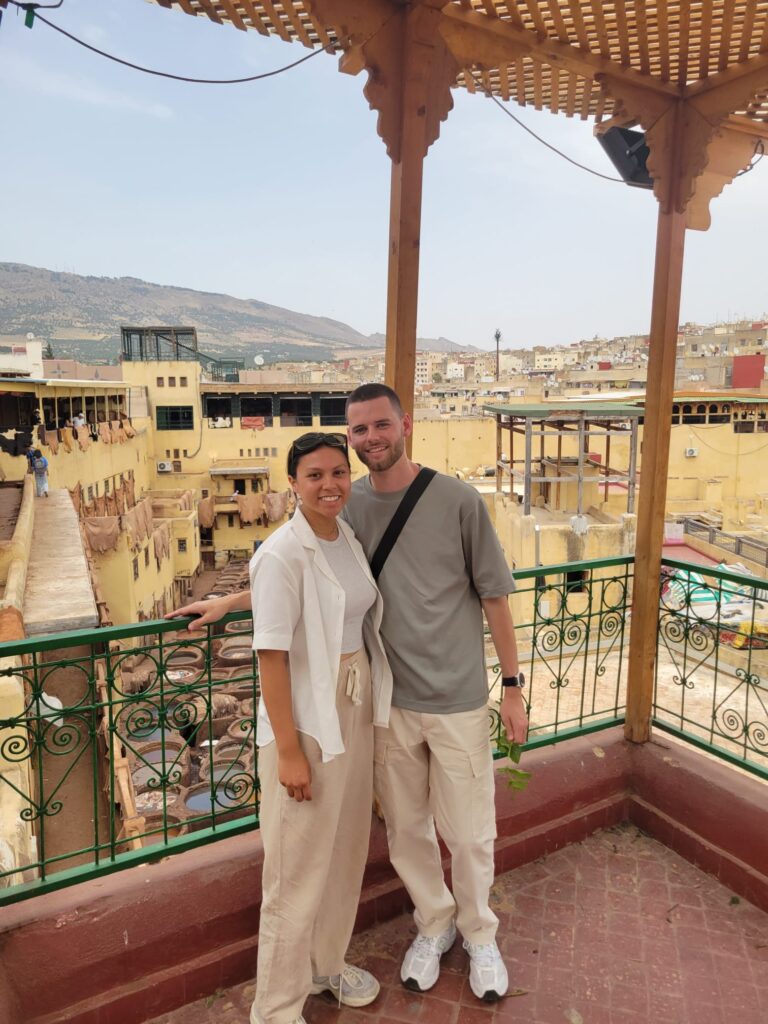 The Patarinis celebrating their wedding anniversary in Rabat, Morocco. (Image courtesy of Joseph Patarini)
The Patarinis were inspired to fulfill Ellyn’s global studies education abroad requirement together—spending their senior summer in Morocco and Spain. “I felt very excited and fortunate,” says Ellyn. “Many things had to line up to make it happen; however, we put a lot of effort into the application for the CAHSS Dean’s Education Abroad Scholarship process, which made it all possible.”
The Patarinis celebrated their first anniversary in traditional Moroccan style with their friends and host family in Rabat the capital of Morocco during their UMBC faculty-led Intercultural Communication in Morocco and Spain education abroad classes. COIL and education abroad lay the groundwork for students to continue learning and engaging with the world beyond the U.S. Even with busy careers, Ellyn and Joseph plan to continue making time for travel. “Reading and studying global issues is one thing, but experiencing them firsthand offers an entirely new perspective—it ignites a deeper understanding and fuels a powerful drive to create meaningful change,” says Ellyn.
Register for Global Studies Spring 2025 classes.
Learn more about UMBC’s political science department and global studies program on Instagram @global.umbc.
]]>
Middle school sweethearts, Ellyn Fennema and Joseph Patarini came to UMBC to pursue global studies (her) and geography and environmental studies (him). Despite their busy schedules, they were able...
https://umbc.edu/stories/intercultural-politics-in-a-global-contex/
https://my3.my.umbc.edu/api/v0/pixel/news/146098/guest@my.umbc.edu/c98a2e297a5e721a285305559454c190/api/pixel
cahss
discovery
ges
global-studies
international
magazine
political-science
story
UMBC News & Magazine
https://my3.my.umbc.edu/groups/umbc-news-magazine
https://assets1-my.umbc.edu/system/shared/avatars/groups/000/001/943/24435aa6207c452e7bc15cc74b42c7bb/xsmall.png?1748556657
https://assets1-my.umbc.edu/system/shared/avatars/groups/000/001/943/24435aa6207c452e7bc15cc74b42c7bb/original.png?1748556657
https://assets2-my.umbc.edu/system/shared/avatars/groups/000/001/943/24435aa6207c452e7bc15cc74b42c7bb/xxlarge.png?1748556657
https://assets2-my.umbc.edu/system/shared/avatars/groups/000/001/943/24435aa6207c452e7bc15cc74b42c7bb/xlarge.png?1748556657
https://assets3-my.umbc.edu/system/shared/avatars/groups/000/001/943/24435aa6207c452e7bc15cc74b42c7bb/large.png?1748556657
https://assets1-my.umbc.edu/system/shared/avatars/groups/000/001/943/24435aa6207c452e7bc15cc74b42c7bb/medium.png?1748556657
https://assets2-my.umbc.edu/system/shared/avatars/groups/000/001/943/24435aa6207c452e7bc15cc74b42c7bb/small.png?1748556657
https://assets1-my.umbc.edu/system/shared/avatars/groups/000/001/943/24435aa6207c452e7bc15cc74b42c7bb/xsmall.png?1748556657
https://assets2-my.umbc.edu/system/shared/avatars/groups/000/001/943/24435aa6207c452e7bc15cc74b42c7bb/xxsmall.png?1748556657
UMBC News & Magazine
7
0
false
Thu, 05 Dec 2024 15:51:07 -0500
Thu, 05 Dec 2024 15:51:07 -0500
Robert Barry ’25 returns to Greece as a summer research assistant at an archaeological field school
For the last seven weeks, Robert Barry ’25, ancient studies and visual arts, worked in a trench under the sweltering 90-degree sun. It may sound grueling, but this is Barry’s second year working in this archeological site in Greece with Michael F. Lane, associate professor of ancient studies and field director on the Kopaic Cultures, Economies, and Landscapes (KOCECOLA) research program. KOCECOLA is an archaeological investigation of a prehistoric settlement in its physical, human, and historical circumstances in the Kopaic Basin of central mainland Greece. Lane has conducted fieldwork in this area since 2010.
“What I really like about ancient studies is the faculty,” shares Barry. “They show a lot of interest in their students, and I feel like I belong.” Barry has taken archaeology and ancient Greek language classes with Lane, where he has excelled.
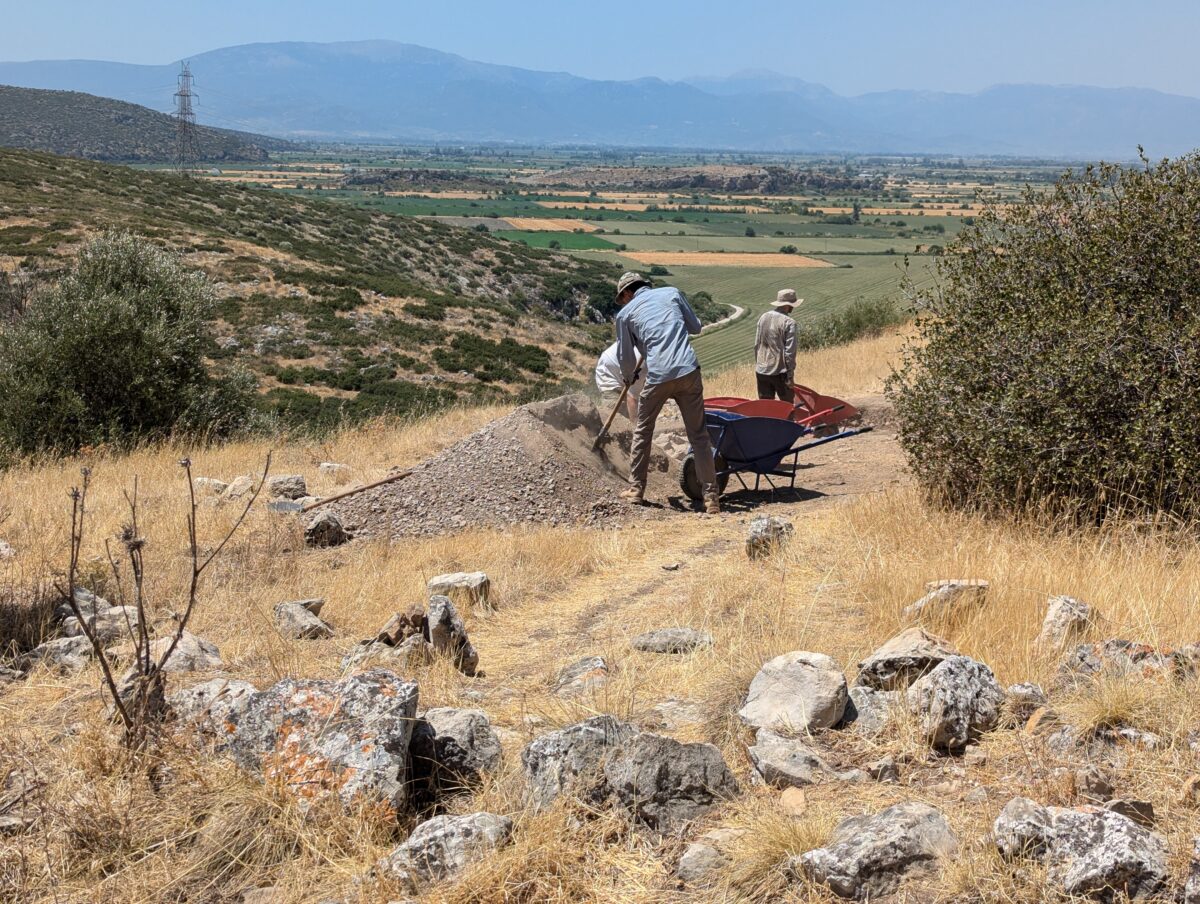 Students at UMBC’s 2024 archeological field school in Greece prepare the site for winter by backfilling trenches with soil. (Michael F. Lane/UMBC)
Barry learned about the project in Lane’s ancient Greek language class. Lane was seeking undergraduate research assistants to join the 2023 six-week summer archeological fieldwork opportunity, and Barry joined the team. This year, he returned as a trench supervisor with more responsibilities.
From excavating to supervising
Student research assistants use satellite-based differential Global Navigation Satellite Systems (DGNSS) and optical survey equipment. “We use the DGNSS and optical equipment both to plot the location of our trenches and to record the position of discoveries in three dimensions: latitude, longitude, and elevation above sea level,” explains Lane. Once an excavation site is identified, students use trigonometry to measure trenches and then large shovels to reveal distinct layers of soil. Excavation teams are made up of 2 – 3 students spread across six trenches.
“This year, I was a trench supervisor and learned a lot about myself. My priorities changed,” explains Barry. “Last year, I was digging and following directions from my supervisor. Now, I’m giving the orders and having to be responsible for the health and safety of everyone else while getting the job done.”
Lane says the senior staff at KOCECOLA regarded Barry as a peer. “He’s smart, meticulous, punctual, responsible, untiring, even-keeled, good-humored, and funny,” says Lane. “For this reason, I gave him a trench of his own to supervise for the last three weeks this summer, and he exceeded expectations.”
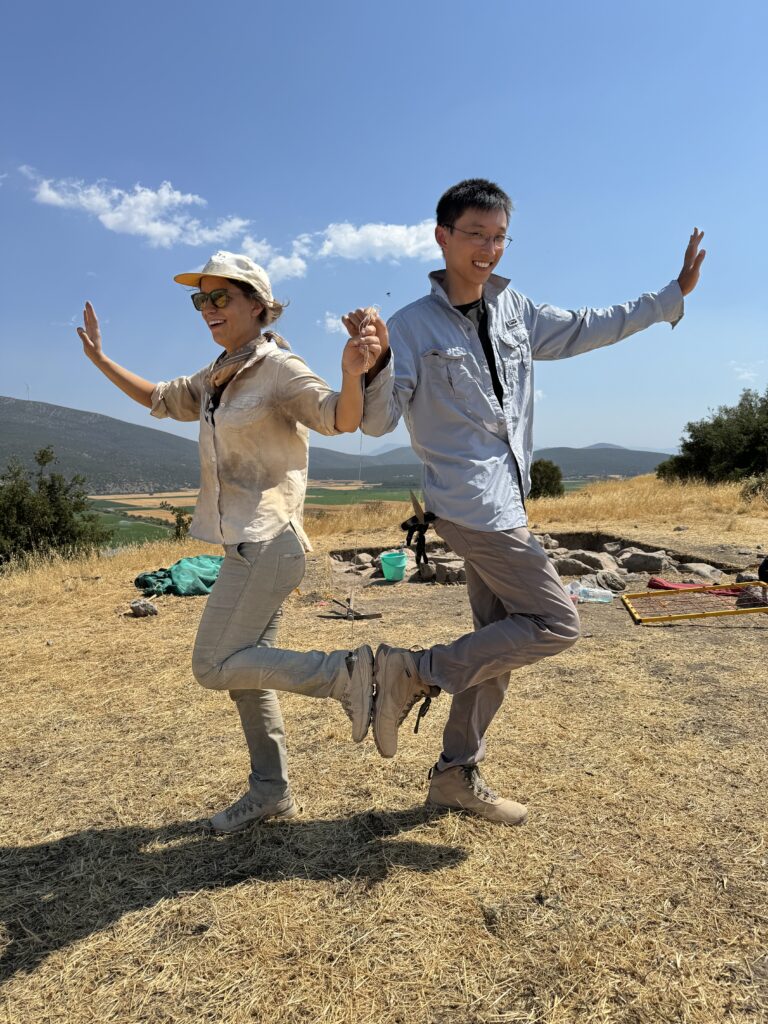 (l-r): Rachel Channell, a crew supervisor from Greece, teaches Barry a traditional Greek dance. (Brady E. Cavanagh/UMBC)
To get the job done, the team’s daily routine meant leaving the village at 5 a.m., taking a 20-minute drive to the dig site, hiking up a mountain, and beginning work around 5:30 a.m. Barry’s team of three students used small hand trowels and brushes to help reveal soil layers and artifacts, such as pottery. A fine mesh screen helped sift the soil removed during excavation, leaving behind finer artifacts. They would take soil samples for scientific dating and chemical analysis, as well as basic soil and sedimentary descriptions. Thanks to a 2024 UMBC Strategic Awards for Research Transitions grant that Lane received, students also had the opportunity to sample for radiocarbon dating and luminescence dating, which measures the energy of photons released from minerals to determine the age of exposed strata.
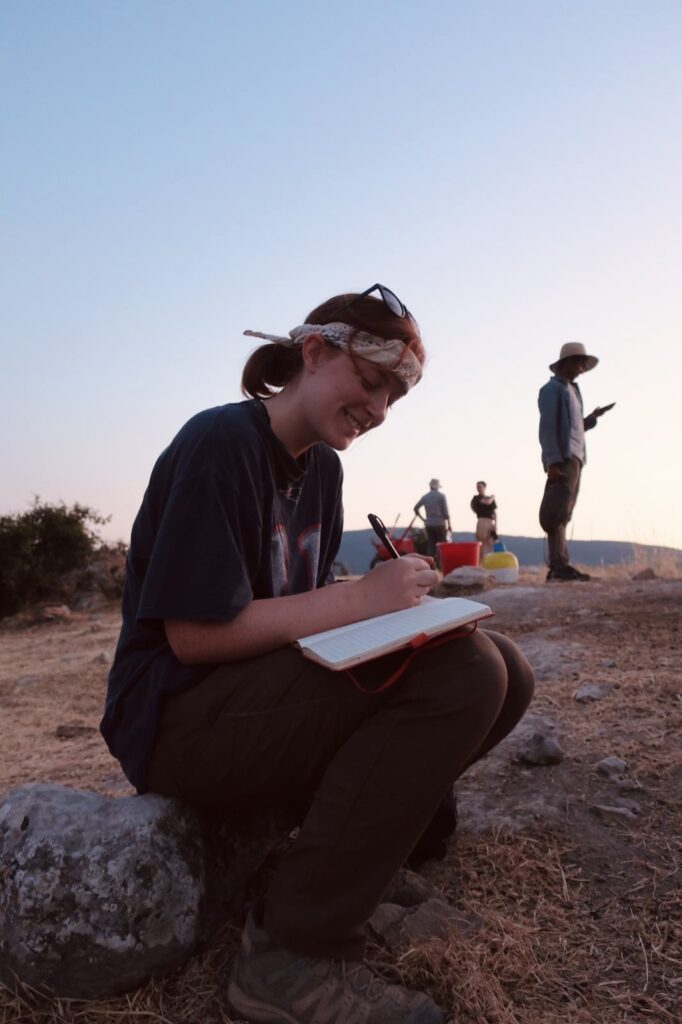 Brady E. Cavanagh ’26, visual arts, documents her work. (Elliott G. Alvey/University of Virginia)
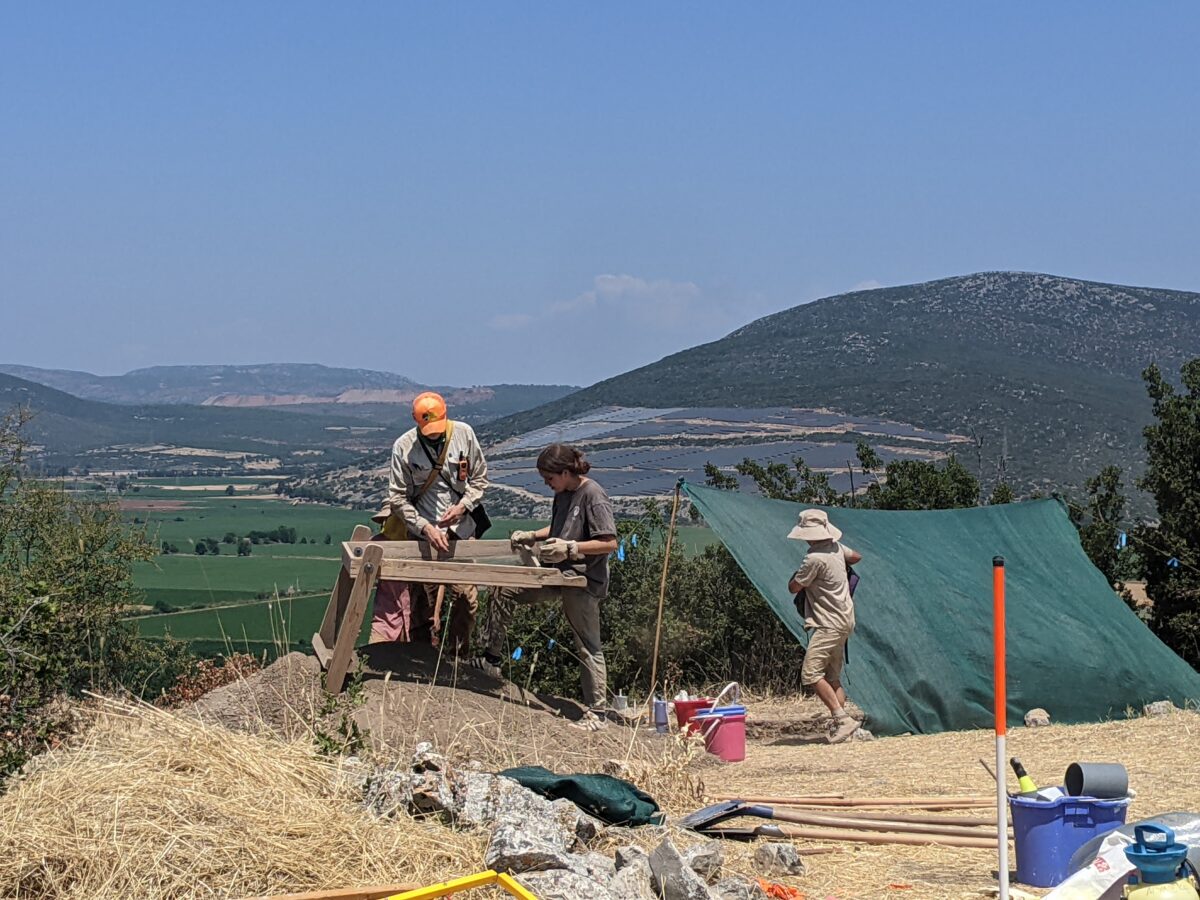 2023 crew screen soil for fine artifacts. (l-r): Damian V. Koropeckyj ’16, global studies, supervises India J. Kelly ’24, history, and Naomi Morales Glen, a master’s student at the University of the Peloponnese in Kalamata, Greece. (Michael F. Lane/UMBC)
“We record where each artifact is, define its features and its chronological, historical, cultural, and social contexts,” says Barry. “It can get complicated when there are numerous artifacts to identify, map, excavate, bag, and label.” At 1 p.m., the crew would head to the lab for three hours to wash the day’s finds, scrub them with toothbrushes, and catalog finds. The rest of the afternoon would be all theirs until 8 p.m. when they would gather for a communal dinner at the local taverna (Greek for restaurant).
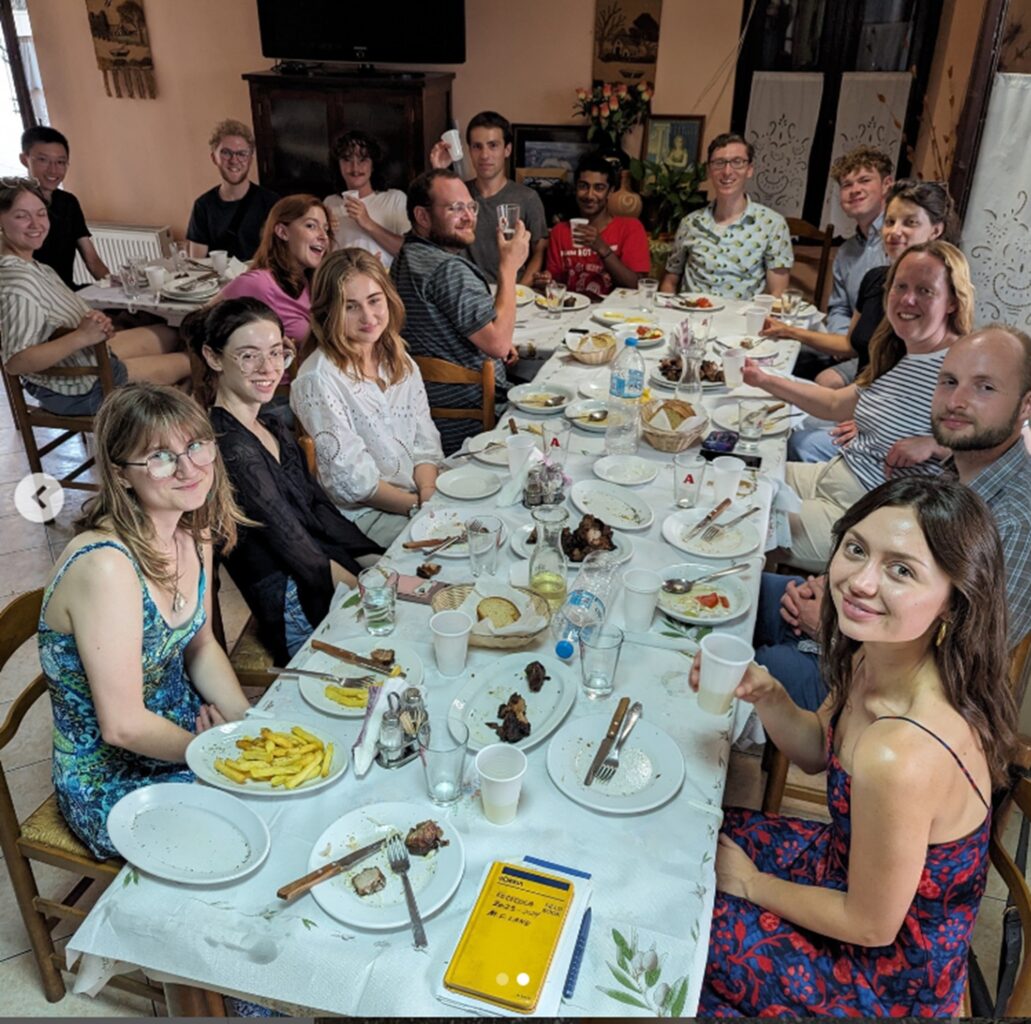 The 2024 crew enjoys dinner in the local village after a long day. (Michael F. Lane/UMBC)
To Greece and beyond
Now that the internship has ended, Barry is sightseeing in Austria before returning to the U.S. “My favorite part of this year’s experience was the international collaboration. I enjoyed getting to know students from the United Kingdom, the Netherlands, Germany, and Greece,” says Barry, who used these opportunities to practice his Greek and Latin skills, which are important in the ancient studies graduate programs he’ll apply to after returning to UMBC.
“Probably the moment that most touched me this summer was when Robert sat down at the kitchen table at the staff house with me and said, ‘Lane, can I tell you something…? I think I want to do this for the rest of my life’,” Lane shares. “I now consider it my duty to help him continue to excel, doing everything in my power to get him into the best academic programs and relevant jobs.”
Learn more about UMBC’s ancient studies program.
]]>
For the last seven weeks, Robert Barry ’25, ancient studies and visual arts, worked in a trench under the sweltering 90-degree sun. It may sound grueling, but this is Barry’s second year working...
https://umbc.edu/stories/robert-barry-in-greece-research-assistant-archaeological-field-school/
https://my3.my.umbc.edu/api/v0/pixel/news/143021/guest@my.umbc.edu/d761882da02d66065b8dad941c9ce281/api/pixel
ancient-studies
arts-and-culture
cahss
cahss-research
careercenter
global-studies
history
international
news
story
visual-arts
UMBC News & Magazine
https://my3.my.umbc.edu/groups/umbc-news-magazine
https://assets1-my.umbc.edu/system/shared/avatars/groups/000/001/943/24435aa6207c452e7bc15cc74b42c7bb/xsmall.png?1748556657
https://assets1-my.umbc.edu/system/shared/avatars/groups/000/001/943/24435aa6207c452e7bc15cc74b42c7bb/original.png?1748556657
https://assets2-my.umbc.edu/system/shared/avatars/groups/000/001/943/24435aa6207c452e7bc15cc74b42c7bb/xxlarge.png?1748556657
https://assets2-my.umbc.edu/system/shared/avatars/groups/000/001/943/24435aa6207c452e7bc15cc74b42c7bb/xlarge.png?1748556657
https://assets3-my.umbc.edu/system/shared/avatars/groups/000/001/943/24435aa6207c452e7bc15cc74b42c7bb/large.png?1748556657
https://assets1-my.umbc.edu/system/shared/avatars/groups/000/001/943/24435aa6207c452e7bc15cc74b42c7bb/medium.png?1748556657
https://assets2-my.umbc.edu/system/shared/avatars/groups/000/001/943/24435aa6207c452e7bc15cc74b42c7bb/small.png?1748556657
https://assets1-my.umbc.edu/system/shared/avatars/groups/000/001/943/24435aa6207c452e7bc15cc74b42c7bb/xsmall.png?1748556657
https://assets2-my.umbc.edu/system/shared/avatars/groups/000/001/943/24435aa6207c452e7bc15cc74b42c7bb/xxsmall.png?1748556657
UMBC News & Magazine
0
0
false
Wed, 31 Jul 2024 16:35:54 -0400
Wed, 31 Jul 2024 16:35:54 -0400
A Journey of Growth
International travel offers ample opportunities to stretch yourself—one minute you may be the expert and the next, completely clueless about how something works. Retrievers currently in the Fulbright U.S. Student Program—teaching English or researching around the globe—find themselves oscillating between their teaching and student roles on a daily or hourly basis. By engaging their host communities through openness and cultural humility (and many shared cups of tea or coffee), these Fulbrighters are finding their balance along the way.
All eyes are on Milan Richardson ’23 as she helps her co-teacher keep score in a Jeopardy-like game her students are playing. Richardson teaches English to several classes of first through sixth-grade students at Jinsha Elementary School in Kinmen County, Taiwan. As she completes the Mandarin character for the numeral 5, a wave of giggles and chatter flows through the room.
Similar to a U.S. tally—four strokes and a strike though, the Mandarin character has 5 strokes total and needs to be written a certain way to represent 1, 2, 3, 4, or 5. “The students were so confused because I wrote the character strokes in the wrong order,” says Richardson, who is used to solving complex math as a Meyerhoff Scholar having earned a bachelor’s degree in bioinformatics and computational biology and minors in computer science and modern, languages, linguistics, and intercultural communication.
“I wanted to write the character correctly. I asked, and they showed me the proper order to write the strokes,” says Richardson, a Fulbright English Teaching Assistant (ETA). “They started clapping once I got it right. This was one of the many cool moments where my students were able to teach me.”
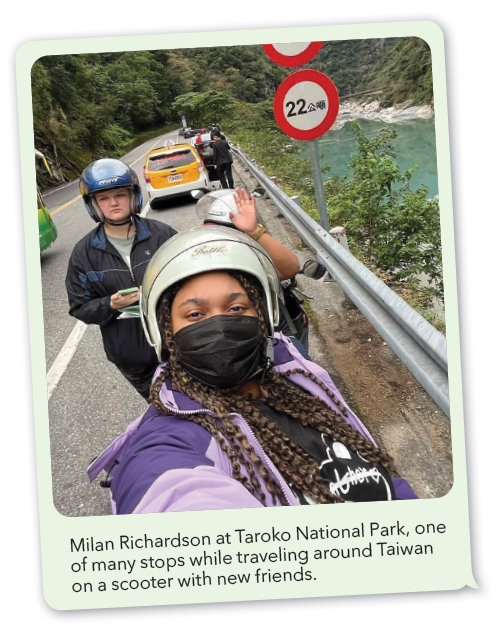
While she may be new to teaching in Taiwan, Richardson brings with her four years as an English and math tutor and a minor in Mandarin. “Taiwan was so different from any place I’ve ever been to. I was overwhelmed at first,” says Richardson. “I like it a lot, now. In my second month, I applied for a scooter license. Now I ride around the island and have taken my scooter other places on trips.”
Diplomas earned. Visas in hand. Vaccines completed. Luggage packed. Destination confirmed. Last summer, UMBC’s eight participants in the 2023 – 2024 Fulbright U.S. Student Program checked off all the important items on their to-do lists. The only thing left was to get to their placements on islands and in landlocked countries, cities, and countrysides across East Asia and Eastern Europe. It’s easier written than done. To adapt well to a new community, job, language, and culture, they must practice the art of humility and flexibility as their roles shift regularly from teacher to student.
Leading the Fulbright charge
All technicalities aside, the Fulbright experience is the beginning of building an international network of teachers and researchers who share the diversity and possibility of the U.S. with the world. In return, across the globe, communities welcome the next generation of leaders into their cities, neighborhoods, schools, and homes to share their country’s history, innovations, and culture. Since Fulbright’s inception in 1946, these reciprocal acts of kindness have created multiple paths forward to lifelong worldwide collaboration and understanding based on the simple act of giving someone different than yourself a chance.
“The Fulbright Program truly demonstrates public diplomacy in action,” says Brian Souders, M.A.’19, TESOL, and Ph.D. ’09, language, literacy, and culture, the associate director of global learning at UMBC’s Center for Global Engagement. In this role, Souders, who received a 2023 Fulbright International Education Administrator award to Germany, has led hundreds of Retrievers through the Fulbright application process as UMBC’s Fulbright Program advisor. “Whether in the classroom as teachers, students, or researchers, recipients learn about the world as much as they share what it means to be from the U.S. and UMBC alumni,” says Souders.
Thanks to Souders’ guidance, UMBC is one of 57 doctoral universities nationwide and three in Maryland to receive a Fulbright Top Producing Institution designation for 2023 – 2024, for the third time in the last five years. In the last decade, more than 80 UMBC alumni have received Fulbright awards. Out of the 10 Retrievers who received a 2023 – 2024 Fulbright, eight are currently placed internationally, seven are ETAs and one is on a research grant.
The hard work of play
There are U.S. Fulbright student scholars in more than 100 countries worldwide. Three Retrievers were placed in Taiwan—they keep in touch regularly, see each other at ETA trainings, and are planning to travel together during their Fulbright year. But they all arrived in Taiwan separately and faced different challenges settling in.
“I arrived in Taiwan and immediately changed my plans because the airline lost my luggage,” says Humanities Scholar Kara Gavin ’20, English. She was grateful to have a carry-on. “It was chaotic. I was taking it all in,” says Gavin. A day and a 50-minute plane ride later, she arrived in Penghu County, Taiwan, an archipelago of about 90 islands between China and the main island of Taiwan. “The little beach town is in its own little world,” says Gavin. “The smell of the sand gave me comfort.”
Gavin teaches beginner English at two local junior high schools. New to Asia and Mandarin, Gavin’s thinking cap is on 24 – 7, including learning Mandarin in between teaching classes. “Living independently for the first time is hard on its own, but doing it in a foreign country is a whole other ball game,” says Gavin. “I’m acquiring many new life skills that will last me a lifetime.”
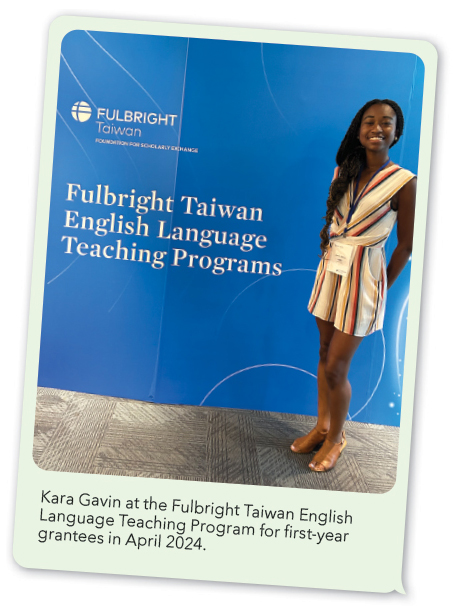
One of those is sympathizing with her students and anyone learning a new language and culture. “I teach the English pronunciation and spelling of a word,” says Gavin. “Then, they like to share the Mandarin equivalent with me. It’s all about patience, balance, and trust.” She also models intercultural teamwork by developing and teaching lessons with her bilingual (Mandarin/English) Taiwanese co-teacher to foster student engagement and enrichment.
For Fulbright Scholars, it is equally important to engage with communities beyond the classroom. When they apply for the grant, the Fulbright Program asks them to develop ideas to share their passions and skills in a community project. For Gavin, this meant adding a little drama to have a lot of fun. As a performing artist, Gavin knows the theatre can be a powerful community-building outlet. “I wanted to encourage students and other community members to express themselves and share their culture with me and others,” says Gavin.
She found a kindred spirit in a professor at a local university. They formed a drama club at the university for English language learners at all levels to explore American play formats with Taiwanese traditions and histories.“Writing original bilingual plays, in English and Mandarin, based on folktales about island traditions is creating an artistic and fun cultural exchange and understanding outside of my ETA duties,” says Gavin.
Finding the right pace
For fellow Humanities Scholar Nailah-Benā Chambers ’23, global studies, a Fulbright award to Taiwan was a natural next step. Chambers began learning Mandarin and all things Taiwanese in sixth grade at a Taiwanese Mandarin language immersion school in her hometown of Richmond, Virginia. As her Mandarin improved, she tutored other English speakers. This oscillating pattern of being a student and a teacher makes Chambers adaptable and persistent, she says.
But it hasn’t always been easy. When she first visited Taipei, Taiwan, in the spring of 2023 on a Mandarin language-intensive study abroad program, “I was so confident. I walked into a 7-Eleven to shop. No one could understand me,” says Chambers. “It was a bit embarrassing. Even with my language and cultural skills, I had a long way to go to mastering Mandarin.”
Now on her Fulbright ETA grant, Chambers arrived on solid ground, both culturally and linguistically. “I felt such a sense of calm and familiarity. Taiwan is so welcoming,” says Chambers. “It calms you down. Things are much slower here than in the U.S.” Soon enough, Chambers was balancing classrooms at Huludun Elementary and Fu Chun Elementary in Taichung City, on the main island of Taiwan, with students at both schools on the extreme spectrum of English proficiency.
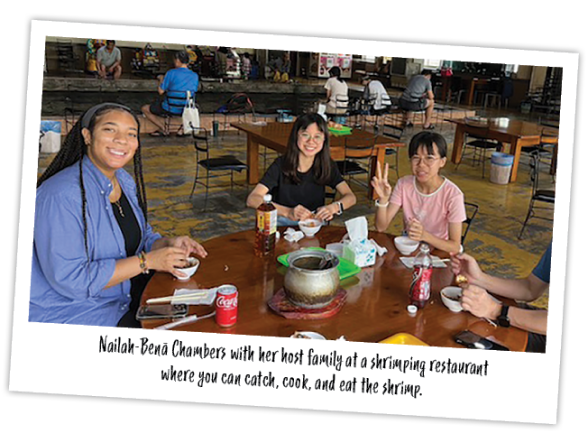
The upside of working with proficient English language learners is connecting on more advanced topics and sticking to Fulbright’s English-only immersion model. At one of her schools, the students are beginning English language learners, and the administrators only speak Mandarin. “My experience as a bilingual teacher and learner with a high level of understanding of the local language and culture has helped with classroom management and fostering powerful connections with students and administrators,” says Chambers. “It also helps to advance their grasp of the nuances of American English, especially when there are gray areas or misunderstandings.”
Keeping your ears open
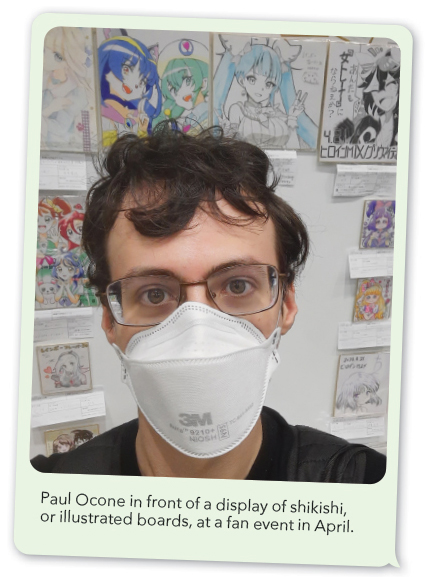
Watching anime, reading manga, (Japanese graphic novels), and participating in their fandom inspired Paul Ocone ’22, individualized study, a Linehan Artist Scholar, to research these subjects and learn Japanese. “I have deeply engaged in fan social life and communities—from leading an anime club to participating in and running conventions to moderating online communities—my affinity for and interest in anime fan spaces runs deep,” says Ocone. Part of Ocone’s observations include witnessing how some fan subcultures limit their membership in fear that a broader fanbase would weaken their subculture identity. In contrast, he says, other fan subcultures are more flexible while maintaining their identity.
Interested in adding to his initial research in U.S. fan spaces, Ocone is now at the epicenter of anime and manga culture as a Fulbright Student Researcher doing anthropological research with Morikawa Kaichirō, a leading scholar in this field at Meiji University’s School of Global Japanese Studies in Tokyo, also home to the Yoshihiro Yonezawa Memorial Library of Manga and Subcultures.
“I have had some amazing experiences participating in anime pilgrimage or anime tourism, including learning much from other fans and benefitting from their generosity,” says Ocone. “My Japanese is conversational—sometimes it’s challenging to understand specialized topics, but this has not deterred me from adding anime and manga tourism as a second research project.” In January, Ocone presented his work at the Popular Culture Tourism Stakeholders Summit in Japan.
Ocone is a sort of tourist himself, enjoying various aspects of Japanese pop culture. The daily musicality of Tokyo teaches him about enjoying the rhythm of the day. “Each train station plays a unique melody when the train departs,” says Ocone. These melodies or “hassha merodii,” are catchy and echo around in his brain like the convenience store jingles that also greet customers. “I was happily surprised when I heard a loudspeaker playing a symphony in my neighborhood,” says Ocone. “Another one played the following day and the next. I learned this was a daily sunset ritual.” He knows these sound experiences will play in his head long after returning to the U.S.
Learning new languages
This is not the first time David Bullman ’22, ancient studies, visited North Macedonia. He first went in 1995 as a performing musician and public affairs representative for the U.S. Army.
“North Macedonia was very different coming out of the Cold War,” says Bullman. “The infrastructure and general state of repair of public spaces and businesses is much better than I recall from that time.”
Now, as an ETA, Bullman teaches British civilization and American civilization in addition to three different levels of English at the University of Totovo in the Republic of North Macedonia, a landlocked country north of Greece. In Totovo, students begin learning English in elementary school and are fluent by the time they reach college. “I thought I would be teaching English basics,” says Bullman, “but it’s been great to teach a complex subject in the context of where my students live.”
His students are equally glad to help him with the local language. Macedonian and Albanian are the country’s two official languages. Bullman began learning some key Macedonian phrases in preparation for his trip. However, Albanian is the preferred language in Tetovo. After traveling with the Army to more than 15 countries on three continents, Bullman is used to rapidly switching gears and accepting help.
He eagerly takes on the student role when it comes to learning about new foods. Bullman’s apartment faces the Hapësira Socio-Kulturore Tetovë, a community center where locals and the nearby Peace Corps Volunteers sometimes organize activities, like an ajvar-making gathering. Ajvar is a delicacy across the Balkans made every fall. It’s a tradition passed down through centuries with many recipe variations. “Ajvar is made by charring red bell peppers that are then peeled, minced, seasoned, and cooked for hours,” says Bullman. It boils down to a relish that can be preserved for months, but locals tell Bullman that’s rare because it’s too good to keep for even one week. After participating in the preparation and getting to take home a few jars, Bullman agrees with the locals. Ajvar is now his go-to condiment on eggs, pasta, toast—anything goes.
Albanian and cooking are not the only languages Bullman tapped into while in Tetovo. As a lifelong clarinet player, Bullman hoped to create a musical exchange with local musicians. The opportunity presented itself when the dean of the Faculty of Art wanted to celebrate Thanksgiving. Bullman collaborated with the music faculty, the orchestra director, and students to create a concert of six songs. “I’m glad I returned to North Macedonia. The people are as warm and friendly as I remembered them to be,” says Bullman. “I wanted to come back and experience it myself again.”
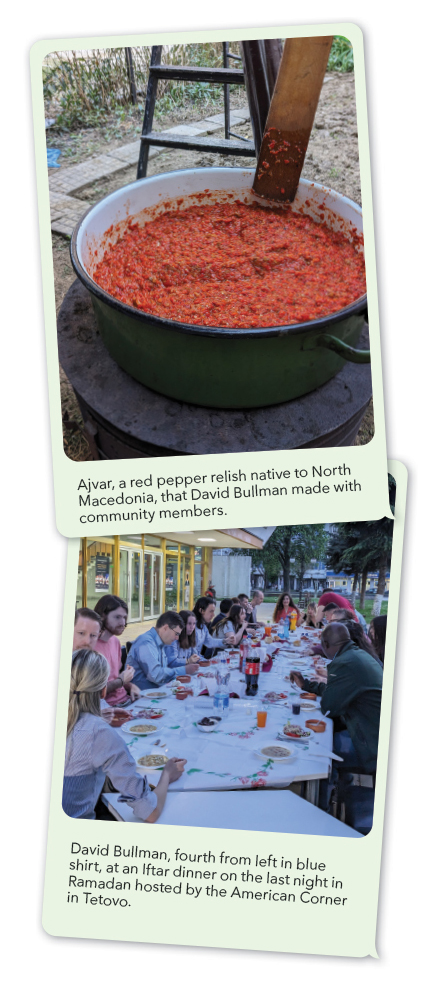
Tapping into curiosity
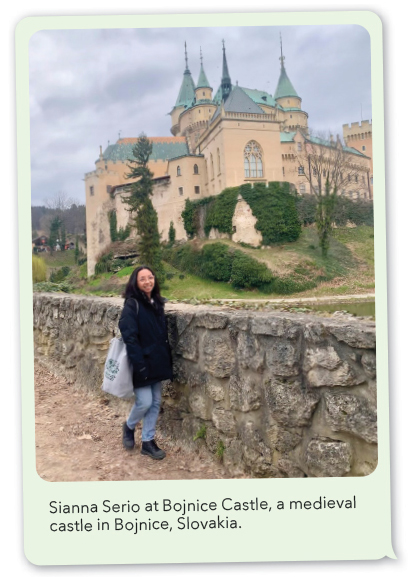
On her way to her Fulbright placement, Sianna Serio ’23, computer science, went city hopping. “I was headed to Žilina, Slovakia, east of Austria and south of Poland,” says Serio. “I flew into Vienna, Austria, then I took a one-hour bus ride crossing Austria’s eastern border into Slovakia to get to Bratislava, the capital.“ There she met other ETAs for orientation. “A week later, I hopped on a two-hour train ride to my teaching placement in Žilina and I met my wonderful mentor, Maria Veršova, who became my second mom.”
Serio teaches at the Hotel Academy, Žilina. The academy focuses on hotel management, gastronomy, and tourism. “My students are beginning English language learners,” says Serio. “I teach what the class is interested in, like American pop culture, because they rarely meet a native English speaker.” During outings with her students, they ask about a wide range of topics. “There are many topics that I would not have thought to cover if it were not for time spent outside of the classroom,” says Serio, “Some of those conversations became formal lessons, like the lesson on the three branches of the U. S. government.”
Serio appreciates her students’ curiosity. She tapped into her love of website development and design to improve her students’ confidence in writing and speaking English and prepare for their Maturita exam, a national high school exit exam. “Some of my students are helping me design a class webpage for them where I will showcase their class and post some of their practice writing in English,” says Serio. “These posts will include topics covered in the Maturita exam, information about their school, and answers to questions about Slovakia.”
Serio’s mentor Maria Veršova, head of the English department, is her motivation. She guides her through lesson planning, class schedules, and the challenges of relocating to a new country. “When my original housing plans fell through, Maria found housing for me five minutes from her house,” says Serio. “She helped me find health insurance and open a bank account. Her husband set up my internet.” They have welcomed Serio almost daily into their home for dinner, tea, coffee, or wine. Serio is a gracious guest and lent her graphic design expertise to help Veršova design invitation cards for her 50th birthday party. Veršova tells Serio she will always have a place to stay in Žilina.
Fulbright: The next generation
Teaching has defined the last decade for Tiffany Powell, a master’s student in UMBC’s TESOL program, a passion she invested in as an English language learner teacher in Seoul and in Miryang City, South Korea, for five years, and in Florida this past year. Now, she is in Iași, Romania, southwest of Ukraine, at the Alexandru Ioan Cuza University teaching American studies. Powell is committed to bridging culture, community, and belonging by bringing technology into the classroom.
Powell also decided to bring the research and cultural understanding closer to home by partnering with Romanian teachers to develop a five-part series on African American women’s history. “We talked about Black women in science in the context of the movie Hidden Figures and discussed Hollywood’s portrayal of Black life,” says Powell. The class is now creating a series on Romanian women. Helping students better understand the similarities and differences between U.S. and Romanian cultures has been an eye-opening experience for Powell.
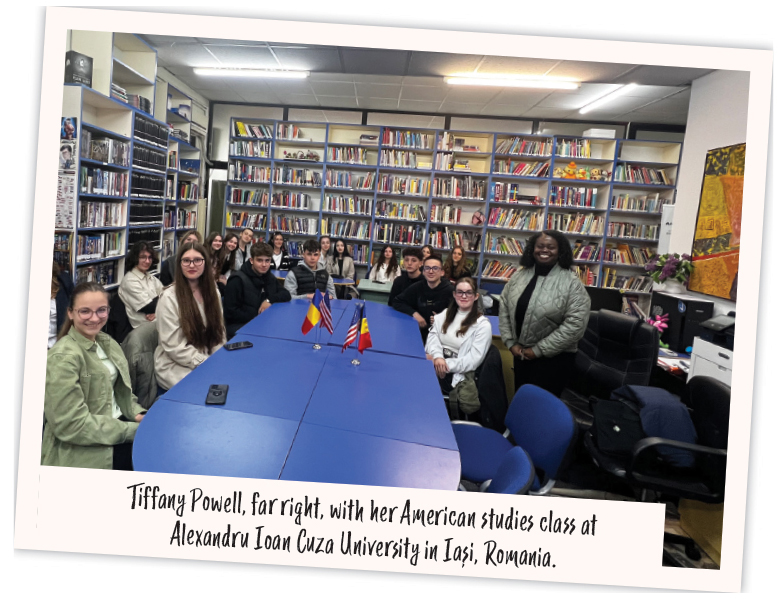
She sees the impact of a country formerly under communism. In Iași, sometimes the internet doesn’t work and, in her school, there are no clubs or student organizations to gain the skills needed to earn a Fulbright award. “My students have given me a new perspective. You may want to come in and make changes, but you must understand where they’re coming from. There is a saying in Iași, ‘It’s not impossible. It’s just difficult,’” says Powell. She is trying to help with the difficult part by leading Fulbright application and leadership workshops.
Powell, like the other Fulbrighters, will bring her experiences home with her and wherever she ends up teaching English next. When their Fulbright year ends, these Retriever ambassadors will find themselves as emissaries yet again, returning to their hometowns, sharing the good news of ajvar made in community, the freedom of a scooter ride along a Taiwanese beach, or the correct stroke order for writing the Mandarin number five. The lessons their students and host families passed along—including pausing to take a breath and appreciate their international successes small and large—will continue to form and shape the way they see the world.
“Having a flexible mindset and under-standing the historical context of your placement is key,” says Powell. “I carry myself as a U.S. representative. Living abroad teaches humility, adaptability, and open-mindedness to press on through challenging times.”
]]>
International travel offers ample opportunities to stretch yourself—one minute you may be the expert and the next, completely clueless about how something works. Retrievers currently in the...
https://umbc.edu/stories/a-journey-of-growth/
https://my3.my.umbc.edu/api/v0/pixel/news/142391/guest@my.umbc.edu/429a43e449ef9d4187b1ae1d4e63ca4e/api/pixel
alumni
ancient-studies
bioinformatics-and-computational-biology
cahss
cge
computer-science
education-abroad
english
feature
fulbright
global-studies
humanities
inds
linehan
llc
magazine
meyerhoff
spring-2024
story
UMBC News & Magazine
https://my3.my.umbc.edu/groups/umbc-news-magazine
https://assets1-my.umbc.edu/system/shared/avatars/groups/000/001/943/24435aa6207c452e7bc15cc74b42c7bb/xsmall.png?1748556657
https://assets1-my.umbc.edu/system/shared/avatars/groups/000/001/943/24435aa6207c452e7bc15cc74b42c7bb/original.png?1748556657
https://assets2-my.umbc.edu/system/shared/avatars/groups/000/001/943/24435aa6207c452e7bc15cc74b42c7bb/xxlarge.png?1748556657
https://assets2-my.umbc.edu/system/shared/avatars/groups/000/001/943/24435aa6207c452e7bc15cc74b42c7bb/xlarge.png?1748556657
https://assets3-my.umbc.edu/system/shared/avatars/groups/000/001/943/24435aa6207c452e7bc15cc74b42c7bb/large.png?1748556657
https://assets1-my.umbc.edu/system/shared/avatars/groups/000/001/943/24435aa6207c452e7bc15cc74b42c7bb/medium.png?1748556657
https://assets2-my.umbc.edu/system/shared/avatars/groups/000/001/943/24435aa6207c452e7bc15cc74b42c7bb/small.png?1748556657
https://assets1-my.umbc.edu/system/shared/avatars/groups/000/001/943/24435aa6207c452e7bc15cc74b42c7bb/xsmall.png?1748556657
https://assets2-my.umbc.edu/system/shared/avatars/groups/000/001/943/24435aa6207c452e7bc15cc74b42c7bb/xxsmall.png?1748556657
UMBC News & Magazine
5
0
false
Wed, 29 May 2024 14:32:52 -0400
A Journey of Growth
International travel offers ample opportunities to stretch yourself—one minute you may be the expert and the next, completely clueless about how something works. Retrievers currently in the Fulbright U.S. Student Program—teaching English or researching around the globe—find themselves oscillating between their teaching and student roles on a daily or hourly basis. By engaging their host communities through openness and cultural humility (and many shared cups of tea or coffee), these Fulbrighters are finding their balance along the way.
All eyes are on Milan Richardson ’23 as she helps her co-teacher keep score in a Jeopardy-like game her students are playing. Richardson teaches English to several classes of first through sixth-grade students at Jinsha Elementary School in Kinmen County, Taiwan. As she completes the Mandarin character for the numeral 5, a wave of giggles and chatter flows through the room.
Similar to a U.S. tally—four strokes and a strike though, the Mandarin character has 5 strokes total and needs to be written a certain way to represent 1, 2, 3, 4, or 5. “The students were so confused because I wrote the character strokes in the wrong order,” says Richardson, who is used to solving complex math as a Meyerhoff Scholar having earned a bachelor’s degree in bioinformatics and computational biology and minors in computer science and modern, languages, linguistics, and intercultural communication.
“I wanted to write the character correctly. I asked, and they showed me the proper order to write the strokes,” says Richardson, a Fulbright English Teaching Assistant (ETA). “They started clapping once I got it right. This was one of the many cool moments where my students were able to teach me.”
While she may be new to teaching in Taiwan, Richardson brings with her four years as an English and math tutor and a minor in Mandarin. “Taiwan was so different from any place I’ve ever been to. I was overwhelmed at first,” says Richardson. “I like it a lot, now. In my second month, I applied for a scooter license. Now I ride around the island and have taken my scooter other places on trips.”
Diplomas earned. Visas in hand. Vaccines completed. Luggage packed. Destination confirmed. Last summer, UMBC’s eight participants in the 2023 – 2024 Fulbright U.S. Student Program checked off all the important items on their to-do lists. The only thing left was to get to their placements on islands and in landlocked countries, cities, and countrysides across East Asia and Eastern Europe. It’s easier written than done. To adapt well to a new community, job, language, and culture, they must practice the art of humility and flexibility as their roles shift regularly from teacher to student.
Leading the Fulbright charge
All technicalities aside, the Fulbright experience is the beginning of building an international network of teachers and researchers who share the diversity and possibility of the U.S. with the world. In return, across the globe, communities welcome the next generation of leaders into their cities, neighborhoods, schools, and homes to share their country’s history, innovations, and culture. Since Fulbright’s inception in 1946, these reciprocal acts of kindness have created multiple paths forward to lifelong worldwide collaboration and understanding based on the simple act of giving someone different than yourself a chance.
“The Fulbright Program truly demonstrates public diplomacy in action,” says Brian Souders, M.A.’19, TESOL, and Ph.D. ’09, language, literacy, and culture, the associate director of global learning at UMBC’s Center for Global Engagement. In this role, Souders, who received a 2023 Fulbright International Education Administrator award to Germany, has led hundreds of Retrievers through the Fulbright application process as UMBC’s Fulbright Program advisor. “Whether in the classroom as teachers, students, or researchers, recipients learn about the world as much as they share what it means to be from the U.S. and UMBC alumni,” says Souders.
Thanks to Souders’ guidance, UMBC is one of 57 doctoral universities nationwide and three in Maryland to receive a Fulbright Top Producing Institution designation for 2023 – 2024, for the third time in the last five years. In the last decade, more than 80 UMBC alumni have received Fulbright awards. Out of the 10 Retrievers who received a 2023 – 2024 Fulbright, eight are currently placed internationally, seven are ETAs and one is on a research grant.
The hard work of play
There are U.S. Fulbright student scholars in more than 100 countries worldwide. Three Retrievers were placed in Taiwan—they keep in touch regularly, see each other at ETA trainings, and are planning to travel together during their Fulbright year. But they all arrived in Taiwan separately and faced different challenges settling in.
“I arrived in Taiwan and immediately changed my plans because the airline lost my luggage,” says Humanities Scholar Kara Gavin ’20, English. She was grateful to have a carry-on. “It was chaotic. I was taking it all in,” says Gavin. A day and a 50-minute plane ride later, she arrived in Penghu County, Taiwan, an archipelago of about 90 islands between China and the main island of Taiwan. “The little beach town is in its own little world,” says Gavin. “The smell of the sand gave me comfort.”
Gavin teaches beginner English at two local junior high schools. New to Asia and Mandarin, Gavin’s thinking cap is on 24 – 7, including learning Mandarin in between teaching classes. “Living independently for the first time is hard on its own, but doing it in a foreign country is a whole other ball game,” says Gavin. “I’m acquiring many new life skills that will last me a lifetime.”
One of those is sympathizing with her students and anyone learning a new language and culture. “I teach the English pronunciation and spelling of a word,” says Gavin. “Then, they like to share the Mandarin equivalent with me. It’s all about patience, balance, and trust.” She also models intercultural teamwork by developing and teaching lessons with her bilingual (Mandarin/English) Taiwanese co-teacher to foster student engagement and enrichment.
For Fulbright Scholars, it is equally important to engage with communities beyond the classroom. When they apply for the grant, the Fulbright Program asks them to develop ideas to share their passions and skills in a community project. For Gavin, this meant adding a little drama to have a lot of fun. As a performing artist, Gavin knows the theatre can be a powerful community-building outlet. “I wanted to encourage students and other community members to express themselves and share their culture with me and others,” says Gavin.
She found a kindred spirit in a professor at a local university. They formed a drama club at the university for English language learners at all levels to explore American play formats with Taiwanese traditions and histories.“Writing original bilingual plays, in English and Mandarin, based on folktales about island traditions is creating an artistic and fun cultural exchange and understanding outside of my ETA duties,” says Gavin.
Finding the right pace
For fellow Humanities Scholar Nailah-Benā Chambers ’23, global studies, a Fulbright award to Taiwan was a natural next step. Chambers began learning Mandarin and all things Taiwanese in sixth grade at a Taiwanese Mandarin language immersion school in her hometown of Richmond, Virginia. As her Mandarin improved, she tutored other English speakers. This oscillating pattern of being a student and a teacher makes Chambers adaptable and persistent, she says.
But it hasn’t always been easy. When she first visited Taipei, Taiwan, in the spring of 2023 on a Mandarin language-intensive study abroad program, “I was so confident. I walked into a 7-Eleven to shop. No one could understand me,” says Chambers. “It was a bit embarrassing. Even with my language and cultural skills, I had a long way to go to mastering Mandarin.”
Now on her Fulbright ETA grant, Chambers arrived on solid ground, both culturally and linguistically. “I felt such a sense of calm and familiarity. Taiwan is so welcoming,” says Chambers. “It calms you down. Things are much slower here than in the U.S.” Soon enough, Chambers was balancing classrooms at Huludun Elementary and Fu Chun Elementary in Taichung City, on the main island of Taiwan, with students at both schools on the extreme spectrum of English proficiency.
The upside of working with proficient English language learners is connecting on more advanced topics and sticking to Fulbright’s English-only immersion model. At one of her schools, the students are beginning English language learners, and the administrators only speak Mandarin. “My experience as a bilingual teacher and learner with a high level of understanding of the local language and culture has helped with classroom management and fostering powerful connections with students and administrators,” says Chambers. “It also helps to advance their grasp of the nuances of American English, especially when there are gray areas or misunderstandings.”
Keeping your ears open
Watching anime, reading manga, (Japanese graphic novels), and participating in their fandom inspired Paul Ocone ’22, individualized study, a Linehan Artist Scholar, to research these subjects and learn Japanese. “I have deeply engaged in fan social life and communities—from leading an anime club to participating in and running conventions to moderating online communities—my affinity for and interest in anime fan spaces runs deep,” says Ocone. Part of Ocone’s observations include witnessing how some fan subcultures limit their membership in fear that a broader fanbase would weaken their subculture identity. In contrast, he says, other fan subcultures are more flexible while maintaining their identity.
Interested in adding to his initial research in U.S. fan spaces, Ocone is now at the epicenter of anime and manga culture as a Fulbright Student Researcher doing anthropological research with Morikawa Kaichirō, a leading scholar in this field at Meiji University’s School of Global Japanese Studies in Tokyo, also home to the Yoshihiro Yonezawa Memorial Library of Manga and Subcultures.
“I have had some amazing experiences participating in anime pilgrimage or anime tourism, including learning much from other fans and benefitting from their generosity,” says Ocone. “My Japanese is conversational—sometimes it’s challenging to understand specialized topics, but this has not deterred me from adding anime and manga tourism as a second research project.” In January, Ocone presented his work at the Popular Culture Tourism Stakeholders Summit in Japan.
Ocone is a sort of tourist himself, enjoying various aspects of Japanese pop culture. The daily musicality of Tokyo teaches him about enjoying the rhythm of the day. “Each train station plays a unique melody when the train departs,” says Ocone. These melodies or “hassha merodii,” are catchy and echo around in his brain like the convenience store jingles that also greet customers. “I was happily surprised when I heard a loudspeaker playing a symphony in my neighborhood,” says Ocone. “Another one played the following day and the next. I learned this was a daily sunset ritual.” He knows these sound experiences will play in his head long after returning to the U.S.
Learning new languages
This is not the first time David Bullman ’22, ancient studies, visited North Macedonia. He first went in 1995 as a performing musician and public affairs representative for the U.S. Army.
“North Macedonia was very different coming out of the Cold War,” says Bullman. “The infrastructure and general state of repair of public spaces and businesses is much better than I recall from that time.”
Now, as an ETA, Bullman teaches British civilization and American civilization in addition to three different levels of English at the University of Totovo in the Republic of North Macedonia, a landlocked country north of Greece. In Totovo, students begin learning English in elementary school and are fluent by the time they reach college. “I thought I would be teaching English basics,” says Bullman, “but it’s been great to teach a complex subject in the context of where my students live.”
His students are equally glad to help him with the local language. Macedonian and Albanian are the country’s two official languages. Bullman began learning some key Macedonian phrases in preparation for his trip. However, Albanian is the preferred language in Tetovo. After traveling with the Army to more than 15 countries on three continents, Bullman is used to rapidly switching gears and accepting help.
He eagerly takes on the student role when it comes to learning about new foods. Bullman’s apartment faces the Hapësira Socio-Kulturore Tetovë, a community center where locals and the nearby Peace Corps Volunteers sometimes organize activities, like an ajvar-making gathering. Ajvar is a delicacy across the Balkans made every fall. It’s a tradition passed down through centuries with many recipe variations. “Ajvar is made by charring red bell peppers that are then peeled, minced, seasoned, and cooked for hours,” says Bullman. It boils down to a relish that can be preserved for months, but locals tell Bullman that’s rare because it’s too good to keep for even one week. After participating in the preparation and getting to take home a few jars, Bullman agrees with the locals. Ajvar is now his go-to condiment on eggs, pasta, toast—anything goes.
Albanian and cooking are not the only languages Bullman tapped into while in Tetovo. As a lifelong clarinet player, Bullman hoped to create a musical exchange with local musicians. The opportunity presented itself when the dean of the Faculty of Art wanted to celebrate Thanksgiving. Bullman collaborated with the music faculty, the orchestra director, and students to create a concert of six songs. “I’m glad I returned to North Macedonia. The people are as warm and friendly as I remembered them to be,” says Bullman. “I wanted to come back and experience it myself again.”
Tapping into curiosity
On her way to her Fulbright placement, Sianna Serio ’23, computer science, went city hopping. “I was headed to Žilina, Slovakia, east of Austria and south of Poland,” says Serio. “I flew into Vienna, Austria, then I took a one-hour bus ride crossing Austria’s eastern border into Slovakia to get to Bratislava, the capital.“ There she met other ETAs for orientation. “A week later, I hopped on a two-hour train ride to my teaching placement in Žilina and I met my wonderful mentor, Maria Veršova, who became my second mom.”
Serio teaches at the Hotel Academy, Žilina. The academy focuses on hotel management, gastronomy, and tourism. “My students are beginning English language learners,” says Serio. “I teach what the class is interested in, like American pop culture, because they rarely meet a native English speaker.” During outings with her students, they ask about a wide range of topics. “There are many topics that I would not have thought to cover if it were not for time spent outside of the classroom,” says Serio, “Some of those conversations became formal lessons, like the lesson on the three branches of the U. S. government.”
Serio appreciates her students’ curiosity. She tapped into her love of website development and design to improve her students’ confidence in writing and speaking English and prepare for their Maturita exam, a national high school exit exam. “Some of my students are helping me design a class webpage for them where I will showcase their class and post some of their practice writing in English,” says Serio. “These posts will include topics covered in the Maturita exam, information about their school, and answers to questions about Slovakia.”
Serio’s mentor Maria Veršova, head of the English department, is her motivation. She guides her through lesson planning, class schedules, and the challenges of relocating to a new country. “When my original housing plans fell through, Maria found housing for me five minutes from her house,” says Serio. “She helped me find health insurance and open a bank account. Her husband set up my internet.” They have welcomed Serio almost daily into their home for dinner, tea, coffee, or wine. Serio is a gracious guest and lent her graphic design expertise to help Veršova design invitation cards for her 50th birthday party. Veršova tells Serio she will always have a place to stay in Žilina.
Fulbright: The next generation
Teaching has defined the last decade for Tiffany Powell, a master’s student in UMBC’s TESOL program, a passion she invested in as an English language learner teacher in Seoul and in Miryang City, South Korea, for five years, and in Florida this past year. Now, she is in Iași, Romania, southwest of Ukraine, at the Alexandru Ioan Cuza University teaching American studies. Powell is committed to bridging culture, community, and belonging by bringing technology into the classroom.
Powell also decided to bring the research and cultural understanding closer to home by partnering with Romanian teachers to develop a five-part series on African American women’s history. “We talked about Black women in science in the context of the movie Hidden Figures and discussed Hollywood’s portrayal of Black life,” says Powell. The class is now creating a series on Romanian women. Helping students better understand the similarities and differences between U.S. and Romanian cultures has been an eye-opening experience for Powell.
She sees the impact of a country formerly under communism. In Iași, sometimes the internet doesn’t work and, in her school, there are no clubs or student organizations to gain the skills needed to earn a Fulbright award. “My students have given me a new perspective. You may want to come in and make changes, but you must understand where they’re coming from. There is a saying in Iași, ‘It’s not impossible. It’s just difficult,’” says Powell. She is trying to help with the difficult part by leading Fulbright application and leadership workshops.
Powell, like the other Fulbrighters, will bring her experiences home with her and wherever she ends up teaching English next. When their Fulbright year ends, these Retriever ambassadors will find themselves as emissaries yet again, returning to their hometowns, sharing the good news of ajvar made in community, the freedom of a scooter ride along a Taiwanese beach, or the correct stroke order for writing the Mandarin number five. The lessons their students and host families passed along—including pausing to take a breath and appreciate their international successes small and large—will continue to form and shape the way they see the world.
“Having a flexible mindset and under-standing the historical context of your placement is key,” says Powell. “I carry myself as a U.S. representative. Living abroad teaches humility, adaptability, and open-mindedness to press on through challenging times.”
]]>
International travel offers ample opportunities to stretch yourself—one minute you may be the expert and the next, completely clueless about how something works. Retrievers currently in the...
https://umbc.edu/stories/a-journey-of-growth-retriever-fulbright/
https://my3.my.umbc.edu/api/v0/pixel/news/142404/guest@my.umbc.edu/ed280c216f570c718be808f58bf7c55a/api/pixel
alumni
ancient-studies
bioinformatics-and-computational-biology
cahss
cge
computer-science
education-abroad
english
feature
fulbright
global-studies
humanities
inds
linehan
llc
magazine
meyerhoff
spring-2024
story
UMBC News & Magazine
https://my3.my.umbc.edu/groups/umbc-news-magazine
https://assets1-my.umbc.edu/system/shared/avatars/groups/000/001/943/24435aa6207c452e7bc15cc74b42c7bb/xsmall.png?1748556657
https://assets1-my.umbc.edu/system/shared/avatars/groups/000/001/943/24435aa6207c452e7bc15cc74b42c7bb/original.png?1748556657
https://assets2-my.umbc.edu/system/shared/avatars/groups/000/001/943/24435aa6207c452e7bc15cc74b42c7bb/xxlarge.png?1748556657
https://assets2-my.umbc.edu/system/shared/avatars/groups/000/001/943/24435aa6207c452e7bc15cc74b42c7bb/xlarge.png?1748556657
https://assets3-my.umbc.edu/system/shared/avatars/groups/000/001/943/24435aa6207c452e7bc15cc74b42c7bb/large.png?1748556657
https://assets1-my.umbc.edu/system/shared/avatars/groups/000/001/943/24435aa6207c452e7bc15cc74b42c7bb/medium.png?1748556657
https://assets2-my.umbc.edu/system/shared/avatars/groups/000/001/943/24435aa6207c452e7bc15cc74b42c7bb/small.png?1748556657
https://assets1-my.umbc.edu/system/shared/avatars/groups/000/001/943/24435aa6207c452e7bc15cc74b42c7bb/xsmall.png?1748556657
https://assets2-my.umbc.edu/system/shared/avatars/groups/000/001/943/24435aa6207c452e7bc15cc74b42c7bb/xxsmall.png?1748556657
UMBC News & Magazine
0
0
false
Wed, 29 May 2024 14:32:52 -0400
Meet a Retriever—Christian Jassani ’27, a first-year ambassador and active student leader
Meet Christian Jassani, a first-year political science and global studies major. Christian is a member of the Honors College, Susquehanna Community Council, Honors Council, and SGA. He has taken advantage of the many opportunities UMBC offers, which has helped him to grow, both socially, and academically. From these opportunities, he has been able to gain confidence in himself, find a family at UMBC, and make connections with staff who are there to support his academic journey every step of the way. Take it away, Christian.
Q: What’s one essential thing you’d want another Retriever to know about you?
A: I love learning! It sounds very cliché, but I truly love learning about all different kinds of topics. Whether it be history, politics, or any other areas, I really do find learning to be very fun.
Q: Tell us about someone in the community who has inspired you or supported you, and how they did it.
A: Dr. Brigid Starkey, the director of global studies. I had her my first semester and continue to stay in contact. She is always there to help guide me academically, but also reminds me to step back and enjoy college.
Q: Tell us what you love about your academic program or an organization you’re involved in.
A: I love everyone and everything about the Honors College. The staff truly care for all their students. You are also surrounded by a group of other students who love learning. The best thing about the Honors College is everyone supports each other because we are one big family.
Christian, second from left, with his roommate and suitemate posing with True Grit at UMBC’s 2023 Homecoming carnival.
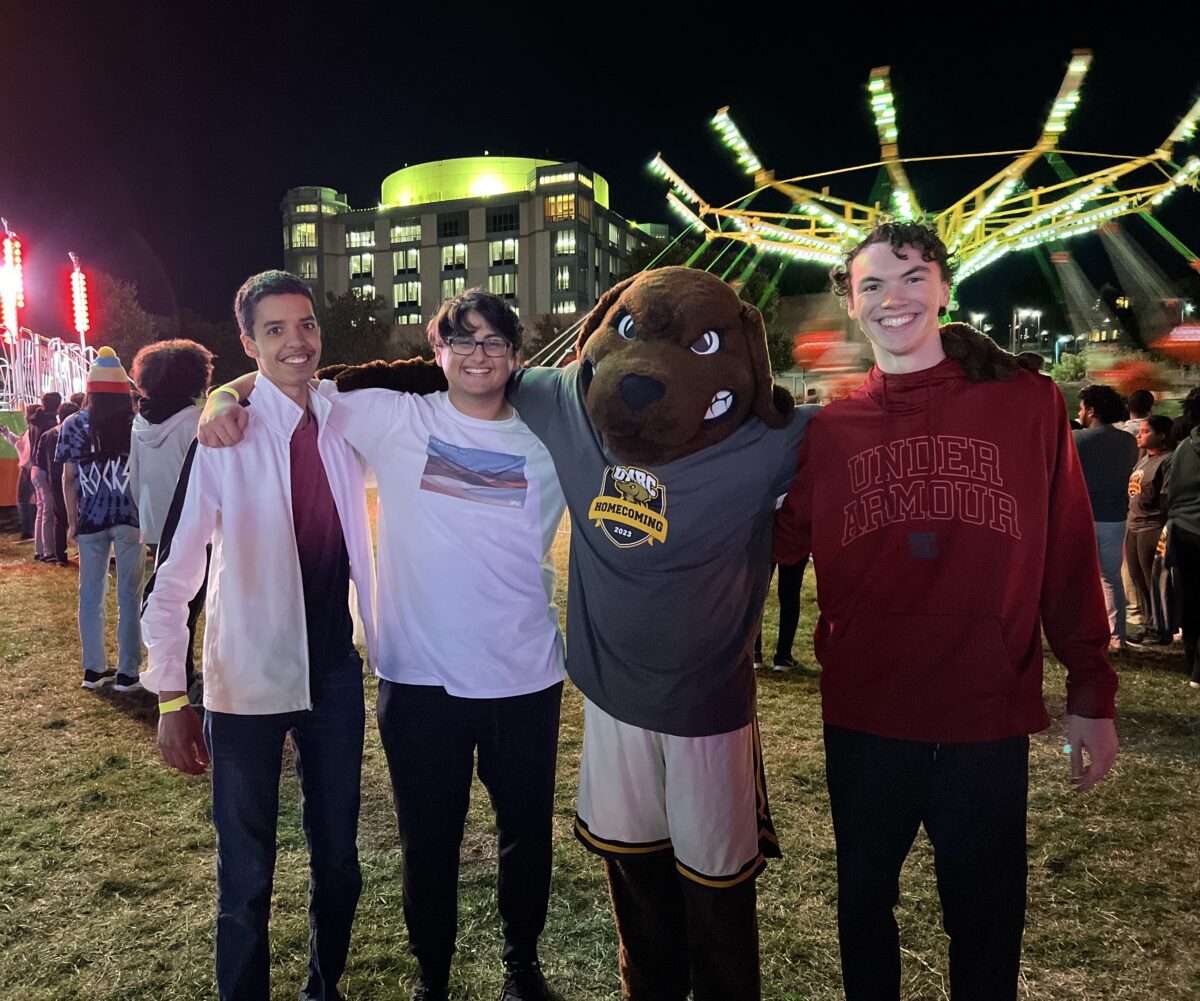
Q: What’s the one thing you’d want someone to know about the support you find here?
A: Connect! There are so many great opportunities as UMBC available to students. To get these opportunities you have to be willing to put your name out there. So even though I know it seems scary, send out those emails!
Q: Tell us what brought you to UMBC in the first place.
A: I chose UMBC because when I stepped on campus for my tour I truly felt like this was the place for me. I was looking for colleges where I would be challenged academically, but also be surrounded by a supportive environment. I automatically knew this was the place for me when on my tour my Grit Guide said something along the lines of, “Here at UMBC, students are not pitted against each other, but rather the students help each other grow.”
As soon as I heard that, in my head, I was committed to UMBC. I knew UMBC was a place that could give not only a great education, but also be in a supportive community that cares about me and help me flourish both academically and socially.
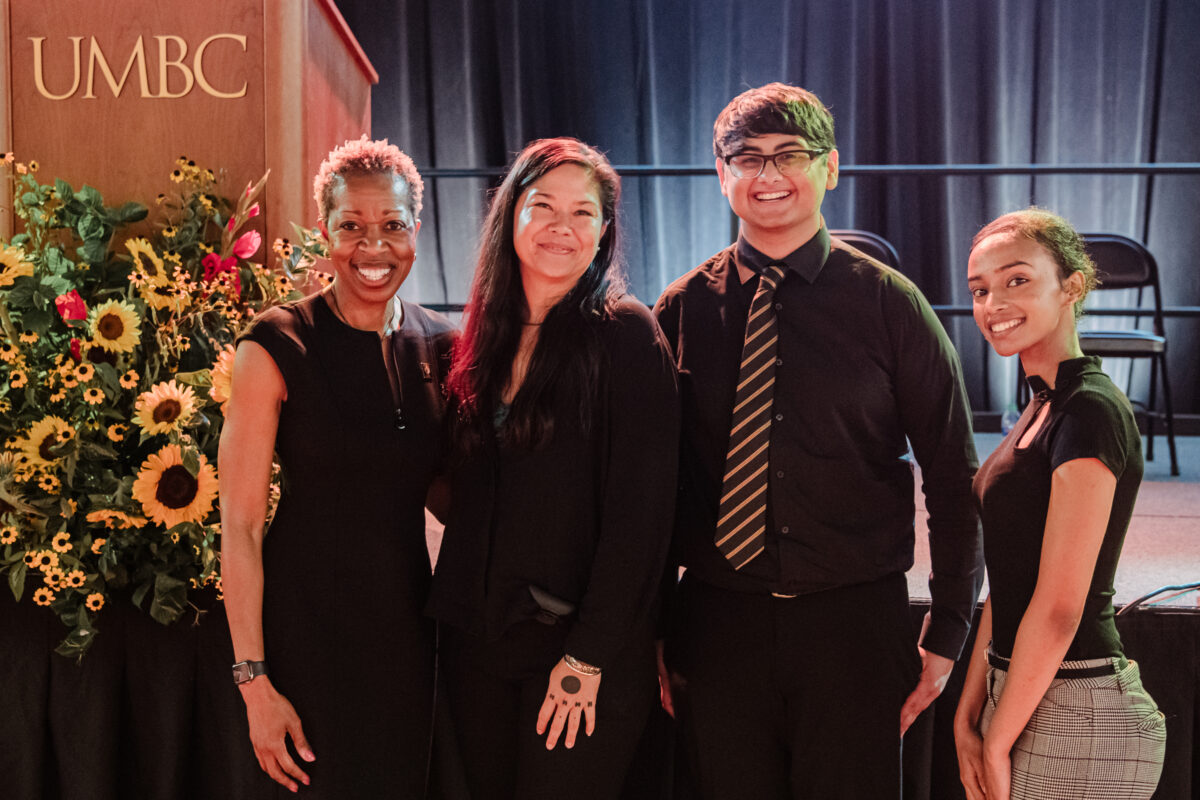 Christian with President Valerie Sheares Ashby and other student speakers at UMBC’s 2023 Fall Opening.
Q: Your HOW. Since you’ve been a part of the UMBC community, how have you found support?
A: Since I have been at UMBC I have grown so much both socially and in my academics. I am a rather shy person, but my being here has allowed me to gain more confidence in myself. I have a huge fear of presenting, so when I was chosen to be the first-year speaker for the 2023 Fall Opening, I was terrified. But through that speech, I made connections with many faculty members on campus. That kid who was terrified to speak, is now a Grit Guide and is involved in multiple clubs.
I automatically knew this was the place for me when on my tour my Grit Guide said something along the lines of, “Here at UMBC, students are not pitted against each other, but rather the students help each other grow.”
Besides helping me grow socially, UMBC has also been extremely supportive in my academic journey. I frequently meet with my professor who gives me guidance and advice on how to navigate the different academic departments. The staff at UMBC have also helped me find different internships and scholarships. Here at UMBC, it is evident you are more than just a number, the staff really do have your best interest at heart and want to see you grow as an individual.
Q: What clubs, teams, or organizations are you a part of? What do you love about them?
A: I am currently the Residential Student Life representative for Susquehanna Community Council, first-year rep for the Honors College Council, a First-Year Ambassador for SGA, and a Grit Guide. What I love about all of these groups are the people I get to work with. We all share a common purpose of wanting to create a better space for everyone at UMBC.
Q: Are you currently part of a scholars program or Living Learning Community at UMBC? Tell us about what you enjoy about it!
A: I am a member of the Honors College and live in the Honors LLC. My favorite thing about this is that I have a big family here at UMBC. The Honors College is an extremely supportive environment. What I especially love about the LLC in particular, is that I am surrounded by people who have similar experiences to me, and can directly relate to problems I may encounter.
Christian and his friends from the Honors LLC in the Harbor Courtyard making s’mores on Valentine’s Day 2024.
Q: What do you enjoy most about being a student leader?
A: The best part about my leadership roles are that I have the platform to actively execute the ideas of the students I represent. I love hearing from my fellow peers about concerns they have, and being able to bring those issues to the table. But the absolute best thing about these roles is getting to plan fun events and see students take a break from academics to just enjoy college.
* * * * *
UMBC’s greatest strength is its people. When people meet Retrievers and hear about the passion they bring, the relationships they create, the ways they support each other, and the commitment they have to inclusive excellence, they truly get a sense of our community. That’s what “Meet a Retriever” is all about.
Learn more about how UMBC can help you achieve your goals.
]]>
Meet Christian Jassani, a first-year political science and global studies major. Christian is a member of the Honors College, Susquehanna Community Council, Honors Council, and SGA. He has taken...
https://umbc.edu/stories/meet-a-retriever-christian-jassani-first-year/
https://my3.my.umbc.edu/api/v0/pixel/news/141685/guest@my.umbc.edu/dee511130d2155e5edd46a0f22191d28/api/pixel
campus-life
global-studies
honors-college
magazine
meet-a-retriever
perspectives
politicalscience
sga
story
UMBC News & Magazine
https://my3.my.umbc.edu/groups/umbc-news-magazine
https://assets1-my.umbc.edu/system/shared/avatars/groups/000/001/943/24435aa6207c452e7bc15cc74b42c7bb/xsmall.png?1748556657
https://assets1-my.umbc.edu/system/shared/avatars/groups/000/001/943/24435aa6207c452e7bc15cc74b42c7bb/original.png?1748556657
https://assets2-my.umbc.edu/system/shared/avatars/groups/000/001/943/24435aa6207c452e7bc15cc74b42c7bb/xxlarge.png?1748556657
https://assets2-my.umbc.edu/system/shared/avatars/groups/000/001/943/24435aa6207c452e7bc15cc74b42c7bb/xlarge.png?1748556657
https://assets3-my.umbc.edu/system/shared/avatars/groups/000/001/943/24435aa6207c452e7bc15cc74b42c7bb/large.png?1748556657
https://assets1-my.umbc.edu/system/shared/avatars/groups/000/001/943/24435aa6207c452e7bc15cc74b42c7bb/medium.png?1748556657
https://assets2-my.umbc.edu/system/shared/avatars/groups/000/001/943/24435aa6207c452e7bc15cc74b42c7bb/small.png?1748556657
https://assets1-my.umbc.edu/system/shared/avatars/groups/000/001/943/24435aa6207c452e7bc15cc74b42c7bb/xsmall.png?1748556657
https://assets2-my.umbc.edu/system/shared/avatars/groups/000/001/943/24435aa6207c452e7bc15cc74b42c7bb/xxsmall.png?1748556657
UMBC News & Magazine
2
0
false
Fri, 03 May 2024 11:42:43 -0400
Fri, 03 May 2024 11:42:43 -0400