CNMS GradFest fosters research connections and builds community
On November 7, graduate students and postdoctoral researchers from the College of Natural and Mathematical Sciences (CNMS) gathered for the college’s second annual CNMS GradFest.
Prableen Chowdhary, Ph.D. ’24, biological sciences, currently a postdoc with Rachel Brewster, professor of biological sciences, and a member of the student-led planning committee, expressed hope that GradFest would “spark conversations and collaborations across disciplines.”
CNMS dean William LaCourse offered advice to attendees as the program kicked off. “Whatever you do in life, do it with all your heart. If you’re doing research, do it like you own it,” he said. “Live in the present and seize opportunities. Enjoy every moment, like this moment today. You can’t change yesterday; when I make mistakes, I’m grateful for grace and forgiveness. And you can plan for tomorrow, but you can’t control it.”
 Prableen Chowdhary (left) and Hasan Al Banna, CNMS GradFest’s two emcees, welcome attendees to the event. (Brad Ziegler/UMBC)
Following the introductions, seven students presented “lightning talks,” five-minute presentations describing their research in engaging, accessible terms for those outside their field. The talks featured students in biological sciences, physics, chemistry and biochemistry, marine biotechnology, and mathematics and statistics. They discussed topics like novel therapeutic targets for ovarian cancer, innovative two-dimensional materials for improved sensors, and previously unobserved plasma jets from black holes.
GradFest as a stepping stone
“Part of our goal was to intentionally include graduate students with less presentation experience or early-stage projects,” shared Maria Cambraia, director for research and international affairs in CNMS, and lead staff member on the planning committee. “GradFest gives them a chance to practice in a friendly environment.”
 Lightning talk presenters and CNMS GradFest planning committee members worked hard to make the event a success. Rear, left to right: Maria Cambraia, Lara Scott, Andrew Wolff, Sean Ravel, Peng Yan, Codi Hrynko, Jalil Ahmad. Front, left to right: Prableen Chowdhary, Lizbeth Joy Tan, Megha Pandya, Ronita Sequeira, Hasan Al Banna. Planning committee members not pictured: Ayo Ogunsanya, Elana Frazier, Jeanne Ngo. (Brad Ziegler/UMBC)
Following the talks, the ballroom buzzed during two poster sessions, where dozens more students discussed their projects with peers, mentors, and guests. GradFest encouraged presentations of research at all stages of development.
Muhammad Jalil Ahmad, president of the Mathematics and Statistics Graduate Student Association and a planning committee member, presented a lightning talk and poster on mathematical modeling for complex phenomena like weather or disease spread.
Ahmad, a fourth-year applied mathematics Ph.D. candidate mentored by Animikh Biswas and Kathleen Hoffman, professors of mathematics, agreed. “Presenting at GradFest is useful before heading to a bigger stage, like a national meeting,” he said. “Even at a math conference, people are studying different topics, so it’s good to practice communicating with people outside your field.” He added that GradFest offers the opportunity to network with researchers using similar methods for different applications.

 Muhammad Jalil Ahmad (left) and Lara Scott (right), Ph.D. students in mathematics, presented lightning talks at GradFest. (Brad Ziegler/UMBC)
Ian Kirn ’23, physics, a second-year physics Ph.D. student, presented a poster on astroseismology, which investigates earthquake-like phenomena on stars. Kirn chose to pursue his Ph.D. with Eileen Meyer, professor of physics, after doing undergraduate research with her. “It’s important for different disciplines to talk to each other, because they’re actually all related,” Kirn says. “This event encourages collaboration.”
Fidelia Asomani, a third-year biological sciences Ph.D. candidate working with Erin Green, associate professor of biological sciences, called GradFest “a good first opportunity to get my feet wet presenting.” Asomani studies yeast, which shares basic functions with complex organisms. “It’s important to invest in studying processes conserved across species,” she says, which can inform human disease treatment.

 Ian Kirn (left) discussed his astroseismology research, and Fidelia Asomani (right) explains her research on protein regulation in yeast, with GradFest attendees. (Brad Ziegler/UMBC)
The humble heart of a scientist
LaCourse also encouraged embracing humility. “By remembering you won’t always be the best, humility helps you celebrate others’ successes and accept failure—and research involves a lot of failure,” he said. “Humility is a path you walk, not a trait you innately possess, and it leads to learning, growth, and respect.”
By late afternoon, GradFest had turned strangers into collaborators, boosted first-time presenters’ confidence, and made the ballroom a launchpad for breakthroughs. Attendees left with new contacts and the dean’s words in their hearts—proof that bold discoveries can begin with a humble “hello.”
Learn more about graduate programs in CNMS.
]]>
On November 7, graduate students and postdoctoral researchers from the College of Natural and Mathematical Sciences (CNMS) gathered for the college’s second annual CNMS GradFest. Prableen...
https://umbc.edu/stories/cnms-gradfest-2025/
https://my3.my.umbc.edu/api/v0/pixel/news/154570/guest@my.umbc.edu/e98c847e7012a2b534bab5add27d1f0c/api/pixel
biology
chembiochem
cnms
community
gradresearch
graduateschool
marinebiotech
mathstat
news
physics
science-and-tech
story
UMBC News & Magazine
https://my3.my.umbc.edu/groups/umbc-news-magazine
https://assets1-my.umbc.edu/system/shared/avatars/groups/000/001/943/24435aa6207c452e7bc15cc74b42c7bb/xsmall.png?1748556657
https://assets1-my.umbc.edu/system/shared/avatars/groups/000/001/943/24435aa6207c452e7bc15cc74b42c7bb/original.png?1748556657
https://assets2-my.umbc.edu/system/shared/avatars/groups/000/001/943/24435aa6207c452e7bc15cc74b42c7bb/xxlarge.png?1748556657
https://assets2-my.umbc.edu/system/shared/avatars/groups/000/001/943/24435aa6207c452e7bc15cc74b42c7bb/xlarge.png?1748556657
https://assets3-my.umbc.edu/system/shared/avatars/groups/000/001/943/24435aa6207c452e7bc15cc74b42c7bb/large.png?1748556657
https://assets1-my.umbc.edu/system/shared/avatars/groups/000/001/943/24435aa6207c452e7bc15cc74b42c7bb/medium.png?1748556657
https://assets2-my.umbc.edu/system/shared/avatars/groups/000/001/943/24435aa6207c452e7bc15cc74b42c7bb/small.png?1748556657
https://assets1-my.umbc.edu/system/shared/avatars/groups/000/001/943/24435aa6207c452e7bc15cc74b42c7bb/xsmall.png?1748556657
https://assets2-my.umbc.edu/system/shared/avatars/groups/000/001/943/24435aa6207c452e7bc15cc74b42c7bb/xxsmall.png?1748556657
UMBC News & Magazine
2
0
false
Fri, 14 Nov 2025 15:37:10 -0500
Fri, 14 Nov 2025 15:37:10 -0500
Meet a Retriever—Maggie Williams ’24, physics, Quantum Science Institute Graduate Fellow
Maggie Williams ’24, physics, is a second-year physics Ph.D. student, a Quantum Science Institute (QSI) Graduate Fellow, and an officer in the Physics Graduate Student Association (PGSA). In her research with Sebastian Deffner, associate professor of physics, she studies biological processes at a microscopic scale, where the physics of atomic interactions—including quantum effects—come into play. Outside the lab, Maggie enjoys playing guitar, listening to music, hiking, and reading.
On November 6, Maggie is giving an interactive live demo of quantum key distribution, where participants can experience firsthand how quantum physics makes eavesdropping detectable and secure communication possible. All are welcome. Take it away, Maggie!
Q: What brought you to UMBC for graduate school, and how did your path at UMBC begin?
A: I applied to graduate school because I wasn’t done learning. As a UMBC undergraduate, my first upper-level physics course was Thermal and Statistical Physics, taught by Dr. Deffner. It was very challenging, but it sparked my interest in statistical physics, and soon I began sitting in on Dr. Deffner’s research group meetings to learn more about the field and what research involves. Not long after, I completed a research project under his guidance and presented a poster at UMBC’s 2023 Undergraduate Research and Creative Achievement Day.
Working with Dr. Deffner led me to begin reading current papers and graduate texts to better understand my work, which only made me want to learn more. Since I already knew about the strong, close-knit community at UMBC from my undergraduate experience, choosing UMBC for graduate school felt like the best option for my success.
Earning my bachelor’s degree was not without challenges, though. After struggling through classes during the COVID-19 pandemic, I felt burned out and unsure about continuing my education, so I took a gap semester in spring 2022 to complete an internship at the tourism organization Visit Baltimore. After some time in the corporate world, I decided to finish my bachelor’s degree and returned to UMBC that fall. During my time away, UMBC advisors and faculty checked in and helped map out a clear path to graduating, which made my transition feel more manageable.
Q: Tell us about your current research and what fascinates you about it.
A: I study nonequilibrium statistical physics, which uses mathematics to model systems heavily affected by randomness. Right now, I’m finishing a project on small, active processes inside cells that are not in balance, with a particular focus on how cells copy information from DNA to RNA, and how tiny errors can build up as an organism ages. Because cells are so small, their behavior is naturally random, and events in the cell that are far apart in time barely affect each other.
That makes Markovian dynamics, which assumes the next step of a system depends only on its current state, a good framework for modeling these systems. This project also provides a simple testbed for future studies that aim to model microscopic biological processes.
Graduate school is challenging, and I’ve had my own moments of discouragement and impostor syndrome. When that happens, I try to turn it into a chance to deepen my understanding, which has only fueled my curiosity about a subject.
Maggie Williams ’24, physics, and a second-year physics Ph.D. student
In my graduate work, the idea that mathematics, combined with physical intuition, can effectively model complex quantum systems continues to fascinate me. I plan to focus my Ph.D. research on quantum many-body systems, which are large groups of tiny particles (like electrons or atoms) that follow quantum rules (such as being able to act like waves or exist in multiple states at once) and whose behaviors are tightly interconnected, so you have to consider how they all influence each other at the quantum level.
Q: What do you love about UMBC’s physics program and the community that supports you?
A: One thing I love about my program is its small-but-mighty community, which makes it easy to reach professors or senior grad students for support, advice, or just a chat. My cohort has inspired me to push toward my goals and has been a steady support network when classes or work get overwhelming, so I’m genuinely grateful for my peers at UMBC.
 Edgar Rueda, Sandra Cheng, Cassie Daniele, and Maggie Williams (left to right) enjoy an intense game of spikeball at a Physics Graduate Student Association event. (Courtesy of Williams)
Q: How is being part of QSI benefiting your Ph.D.?
A: QSI fosters a welcoming community across disciplines that has helped me learn about fields I might not otherwise have the chance to explore. It also provides practical support, from funding for research materials and supplementary textbooks to travel support for conferences and meetings, and it offers chances to lead academic seminars!
Q: How are you involved on campus, and what do you enjoy about it?
A: I serve on the PGSA council. It’s a great way to boost morale among first- and second-year students, encourage socializing outside of class and work, and help us get to know each other. I also enjoy the event-planning side—it’s an opportunity to get creative and come up with fun group activities. The other council members are supportive and kind, and it’s been a great experience so far.
Q: What advice would you give to a high schooler or undergraduate interested in physics and/or quantum science?
A: Don’t hesitate to reach out to teachers and mentors: Ask questions, introduce yourself, and start conversations. Networking matters in every field, and it’s especially important in academia. I’d also encourage them not to dwell on setbacks. Graduate school is challenging, and I’ve had my own moments of discouragement and impostor syndrome. When that happens, I try to turn it into a chance to deepen my understanding, which has only fueled my curiosity about a subject.
In the end, a genuine interest in learning and the drive to keep pursuing knowledge are the most important ingredients. I believe these things have brought me to where I am today, and I’m excited to see where my journey through graduate school takes me. This is only the beginning!
UMBC’s greatest strength is its people. When people meet Retrievers and hear about the passion they bring, the relationships they create, the ways they support each other, and the commitment they have to inclusive excellence, they truly get a sense of our community. That’s what “Meet a Retriever” is all about.
Learn more about how UMBC can help you achieve your goals.
]]>
Maggie Williams ’24, physics, is a second-year physics Ph.D. student, a Quantum Science Institute (QSI) Graduate Fellow, and an officer in the Physics Graduate Student Association (PGSA). In her...
https://umbc.edu/stories/meet-a-retriever-maggie-williams/
https://my3.my.umbc.edu/api/v0/pixel/news/154250/guest@my.umbc.edu/54e42b6cdf38117f5d88903b448ca07b/api/pixel
cnms
gradresearch
graduate-school
magazine
meetaretriever
physics
qsi
story
UMBC News & Magazine
https://my3.my.umbc.edu/groups/umbc-news-magazine
https://assets1-my.umbc.edu/system/shared/avatars/groups/000/001/943/24435aa6207c452e7bc15cc74b42c7bb/xsmall.png?1748556657
https://assets1-my.umbc.edu/system/shared/avatars/groups/000/001/943/24435aa6207c452e7bc15cc74b42c7bb/original.png?1748556657
https://assets2-my.umbc.edu/system/shared/avatars/groups/000/001/943/24435aa6207c452e7bc15cc74b42c7bb/xxlarge.png?1748556657
https://assets2-my.umbc.edu/system/shared/avatars/groups/000/001/943/24435aa6207c452e7bc15cc74b42c7bb/xlarge.png?1748556657
https://assets3-my.umbc.edu/system/shared/avatars/groups/000/001/943/24435aa6207c452e7bc15cc74b42c7bb/large.png?1748556657
https://assets1-my.umbc.edu/system/shared/avatars/groups/000/001/943/24435aa6207c452e7bc15cc74b42c7bb/medium.png?1748556657
https://assets2-my.umbc.edu/system/shared/avatars/groups/000/001/943/24435aa6207c452e7bc15cc74b42c7bb/small.png?1748556657
https://assets1-my.umbc.edu/system/shared/avatars/groups/000/001/943/24435aa6207c452e7bc15cc74b42c7bb/xsmall.png?1748556657
https://assets2-my.umbc.edu/system/shared/avatars/groups/000/001/943/24435aa6207c452e7bc15cc74b42c7bb/xxsmall.png?1748556657
UMBC News & Magazine
0
0
false
Wed, 05 Nov 2025 11:55:11 -0500
Wed, 05 Nov 2025 11:55:11 -0500
Quantum on track: UMBC researchers demonstrate feasibility of using quantum devices to manage urban train scheduling, using a Baltimore transit line as a model
Train delays can cascade into stalled commutes, economic losses, and vacation snags. Scheduling trains is computationally complex, though: It can take hours or days to solve large transportation networks on traditional computers, when disruptions like train breakdowns or traffic accidents demand much quicker solutions. A new study led by UMBC researchers—and focused on Baltimore’s Light RailLink, a hybrid tram-rail network sharing roads with cars inside Baltimore City—harnesses quantum computing to address this challenge, using an approach that blends physics, computer science, and mathematics.
In their new paper, Sebastian Deffner, associate professor of physics; postdoctoral fellow Emery Doucet; doctoral candidate Reece Robertson; and collaborators Krzysztof Domino and Bartłomiej Gardas at the Institute of Theoretical and Applied Informatics in the Polish Academy of Sciences tested whether quantum devices could manage train schedules under real-world conditions. The team leveraged the “noise” inherent in quantum computers—random, unwanted disturbances that cause an effect similar to radio static—to model unpredictable train travel times.
Their results suggest that quantum computers can solve transportation scheduling problems, but more advanced hardware is needed to make using quantum devices practical, especially for larger networks.
Randomness on the rails
Doucet and Robertson discussed the work at Baltimore’s Camden Yards LightRail Link Station, while Orioles baseball fans unloaded from trains at regular intervals and delivery trucks rumbled by. Their enthusiasm cut through the urban din, their voices rising over the clatter and clank of passing Baltimore Light RailLink cars.
 Baltimore’s LightRail Link is a good example of a complex system that would benefit from a way to address disruptions quickly and efficiently. As hardware improves, new research suggests quantum computers could help. (Elijah Davis, M.F.A. ’21/UMBC)
“How long it takes you to get between two stations where you have a lot of shared infrastructure in between—you can’t really predict that precisely,” Doucet says, gesturing toward the tracks and their intersection with a nearby stoplight. This randomness complicates scheduling, but the team’s diverse expertise—spanning theoretical physics, algorithm design, and quantum hardware—facilitated creative solutions.
Noisy doesn’t have to be bad
Current quantum computers are classified as “NISQ,” or “noisy intermediate-scale quantum,” pronounced “nisk.” That means they’re error-prone with only moderate power. Rather than fighting the noise, though, the researchers used it to mimic everyday randomness, like traffic delays.
“The ‘N’ in NISQ stands for ‘noisy,’ but that doesn’t mean that the noise has to always be deleterious,” Doucet explains. “We wondered if maybe we could use the noise that the device is subject to as a tool to model the chaos and randomness.”
 Sebastian Deffner leads the research group that published the new paper. (Marlayna Demond ’11/UMBC)
The team tested their approach on two different quantum computers, one made by IonQ, which is headquartered in Maryland, and the other by D-Wave. Each company’s quantum devices use quantum bits, or qubits, slightly differently to process information. The research team was able to solve scheduling problems with up to 12 trains on D-Wave’s system, which contains thousands of qubits, and only two trains on IonQ’s 25-qubit system.
This proof-of-principle work demonstrates that quantum computers can tackle concrete problems, though they’re not yet faster or cheaper than classical supercomputers for large networks—the experiments cost about $65,000.
“What we’ve shown is that with the currently available hardware, you can already solve practical problems,” Deffner, senior author on the new paper, says. The study highlights the need for larger, less noisy quantum systems to handle bigger networks.
Merging expertise, expanding possibilities
The potential impact is significant; rapid rescheduling could prevent network-wide disruptions.
“If you have an issue on a train network, everything has to stop until you reschedule, at least in that region—and the longer it takes you to come up with a new schedule, the more disruptive the original problem becomes,” Doucet noted, as a train coasted noisily into the platform.
 The bustling Baltimore LightRail Link operates as a train outside Baltimore City, and as a tram subject to traffic within the city limits, making it an interesting challenge for scheduling. (Elijah Davis, M.F.A. ’21/UMBC)
Robertson, a Ph.D. candidate in computer science, added, “Within the next few generations of quantum technology, the problems we could address will get larger, approaching problems that are intractable on current hardware.”
Robertson’s computer science background complements the team’s physics expertise.
“Someone else might be able to help me with physics intuition, and then I can help them by suggesting an algorithm we could use to test their idea, or by applying some computational intuition that we could use in designing our quantum solution.”
“Quantum information science is truly interdisciplinary,” adds Deffner, who is also affiliated with the UMBC computer science and electrical engineering department and has master’s level math training.
Beyond trains
This interdisciplinary, quantum-based approach could eventually optimize logistics, financial portfolios, or drug discovery—fields with complex, random variables. The study, funded through Deffner’s fellowship at the National Quantum Laboratory, involved coding, theoretical modeling, and experiments on real quantum devices—a departure for Deffner’s typically theory-focused research group.
Working on the Baltimore system was a fun challenge, Deffner says, because the LightRail Link transitions from operating as a train unaffected by traffic outside the city to a tram navigating city streets and stopping at traffic lights inside Baltimore. “Because of its unusual characteristics, it was just a unique problem. And of course, it’s cool to work on a local system,” Deffner says.
By uniting diverse expertise, UMBC’s team is turning quantum noise into a strength, paving the way for efficient solutions to real-world problems.
]]>
Train delays can cascade into stalled commutes, economic losses, and vacation snags. Scheduling trains is computationally complex, though: It can take hours or days to solve large transportation...
https://umbc.edu/stories/quantum-on-track-for-train-scheduling/
https://my3.my.umbc.edu/api/v0/pixel/news/152581/guest@my.umbc.edu/3eefabfe8602b421ddbf76c093c02380/api/pixel
cnms
coeit
csee
gradresearch
news
physics
qsi
research
science-and-tech
story
UMBC News & Magazine
https://my3.my.umbc.edu/groups/umbc-news-magazine
https://assets1-my.umbc.edu/system/shared/avatars/groups/000/001/943/24435aa6207c452e7bc15cc74b42c7bb/xsmall.png?1748556657
https://assets1-my.umbc.edu/system/shared/avatars/groups/000/001/943/24435aa6207c452e7bc15cc74b42c7bb/original.png?1748556657
https://assets2-my.umbc.edu/system/shared/avatars/groups/000/001/943/24435aa6207c452e7bc15cc74b42c7bb/xxlarge.png?1748556657
https://assets2-my.umbc.edu/system/shared/avatars/groups/000/001/943/24435aa6207c452e7bc15cc74b42c7bb/xlarge.png?1748556657
https://assets3-my.umbc.edu/system/shared/avatars/groups/000/001/943/24435aa6207c452e7bc15cc74b42c7bb/large.png?1748556657
https://assets1-my.umbc.edu/system/shared/avatars/groups/000/001/943/24435aa6207c452e7bc15cc74b42c7bb/medium.png?1748556657
https://assets2-my.umbc.edu/system/shared/avatars/groups/000/001/943/24435aa6207c452e7bc15cc74b42c7bb/small.png?1748556657
https://assets1-my.umbc.edu/system/shared/avatars/groups/000/001/943/24435aa6207c452e7bc15cc74b42c7bb/xsmall.png?1748556657
https://assets2-my.umbc.edu/system/shared/avatars/groups/000/001/943/24435aa6207c452e7bc15cc74b42c7bb/xxsmall.png?1748556657
UMBC News & Magazine
0
0
false
Wed, 17 Sep 2025 10:41:36 -0400
Wed, 17 Sep 2025 10:41:36 -0400
From Nepal to NASA: A journey of resilience and discovery
In 2020, as the COVID-19 pandemic disrupted lives worldwide,Greema Regmibegan her Ph.D. in UMBC’s atmospheric physics program. Studying remotely from her home in Nepal, she navigated a grueling schedule due to the time difference.
“One class started at 1 a.m. Nepal time, and one final went until 4:30 a.m.,” she recalls. Yet, she embraced the challenge. “I didn’t mind. I like working at night, so it worked for me. And because of COVID, I had nothing else to do. At least this way, I was making progress towards my studies.”
Now in her fifth year, Regmi’s perseverance has earned her NASA’s prestigious Future Investigators in NASA Earth and Space Science and Technology (FINESST) fellowship, which will provide up to $50,000 annually for up to three years to fuel her research on atmospheric dust.
Regmi’s passion for atmospheric physics took root in Nepal. For an undergraduate project, she analyzed meteorological factors surrounding a tragic local plane crash. “Nepal has a lot of hills and mountains, so it channels wind in certain directions,” she explains. “Based on my analysis, unexpected turbulence could have been a factor in the crash.”
As a senior at Tribhuvan University in Kathmandu, Nepal, Regmi traveled to the U.S. for the first time, to present at the American Geophysical Union Annual Meeting. The event was a turning point in her scientific trajectory.
“I really liked sharing my work in front of a huge crowd. Everybody was listening, and that boosted my confidence,” she says. In Nepal, it sometimes felt like research was a lower priority, but the U.S. offered a fresh stage for her work, Regmi says: “The AGU meeting was great—people appreciated my work. That was a huge motivation to continue and do grad school.”
 This still image from a simulation shows dust and other aerosols moving around the globe. Greema Regmi’s research has focused on dust traveling over the Atlantic Ocean between Africa and the Caribbean, visualized here in shades of red to tan. (NASA/Goddard Space Flight Center)
Decoding dust for climate science
Regmi’s FINESST-funded research aims to improve the accuracy of climate forecasting by refining how atmospheric dust is accounted for in climate models. How dust scatters light affects how much heat is reflected back to space versus absorbed. She combines data from LiDAR and multi-angle polarimeters, such as NASA’s Research Scanning Polarimeter, to analyze dust’s role.
“A polarimeter measures how much radiation you see from the top of the atmosphere,” integrating information from every atmospheric layer, “versus LiDAR, which gives you information on each layer of the atmosphere separately. So when you combine both of those, you have a very rich dataset,” she explains.
Regmi’s work challenges outdated assumptions. “Our existing models assume that dust has a simple shape, such as spherical, but for a long time we’ve known that it isn’t that simple,” she says. In her work, she models dust as hexahedral instead—a 3D shape with six faces. The most familiar hexahedron is a cube, but the angles can shift to make it more or less pointy.
Regmi was surprised by how much using a spheroid versus hexahedral model for dust affects the overall climate models she is investigating. “I did not expect the shape of dust particles that tiny to have such a huge impact. And that was very exciting for me,” she says.
Her research focuses on dust traveling across the Atlantic Ocean from the Sahara Desert. The solid, dark ocean background makes it much easier to pull out clean information about dust, avoiding uncertainty introduced by variegated background landscapes, like the shadows that form in mountain ranges or a wide range of vegetation colors. Improved climate models based on her work could inform decision-making related to climate resilience and mitigation.
 NASA’s ER-2 high-altitude plane carried the instruments that collected the data Regmi used in her research. (NASA)
A community that lifts you up
Regmi has been able to accomplish so much in part because of the supportive community she found at UMBC, after finally arriving on campus in fall 2021. Her Ph.D. advisor, Vanderlei Martins, professor of physics and director of UMBC’s Earth and Space Institute, fosters a collaborative lab.
“Vanderlei is a great professor, but what I really appreciate about him is the group that he has built over years. Everybody in the group is as supportive as he is,” Regmi says. “He has done so much in the field, yet he’s still so humble.”
The positive feelings are mutual. “From the very first classes it was obvious that Greema had great potential and tremendous enthusiasm to learn, to grow scientifically, and to work with others,” Martins says.
Regmi is co-advised by Reed Espinosa, Ph.D. ’17, atmospheric physics, a research physical scientist at NASA Goddard Space Flight Center. “He is an outstanding mentor—patient, thorough, and always encouraging,” Regmi says. “Most of what I know about conducting research I have learned from him.” And Espinosa learned much of that from Martins, who was his own Ph.D. advisor.
 Reed Espinosa (left) and Vanderlei Martins (right) have both mentored Greema Regmi (center) during her Ph.D. at UMBC. (Brad Ziegler/UMBC)
Pengwang Zhai, professor of physics, has been another mentor. “Regmi is a hardworking and intelligent student,” Zhai says. Despite starting her Ph.D. during the pandemic, “she embraced the difficulties, overcame steep learning curves, and has grown into a valuable member of the atmospheric physics program.”
Martins highlights her cohort’s strength. “Regmi has joined an enthusiastic group of Ph.D. students in the atmospheric physics program at UMBC, who have clearly shown that together we are better, and can go farther,” he says.
Regmi values the camaraderie. “In Vanderlei’s group, people help you in every way they can,” she says. Her office near the elevator sparks connections. “Every time someone comes up, they will stop to say ‘hi.’ I’ve made a lot of friends and learned so much from them,” she shares. “I like my department a lot.”
Bridging two worlds
Regmi’s journey bridges her unique perspectives as a student in Nepal and the U.S. “You learn different things when you work back home in a developing country. And when you come here to a developed country, it’s a very different perspective,” she reflects. “In Nepal, it’s more about, ‘These are the resources we have, so how can we make the most out of them?’” she says. At UMBC, she’s embraced broader opportunities. “I think here you can push the limit. I don’t even know what the limit is in the U.S. Here you can dream more and be more experimental,” she observes.
Regmi is inspired by her father, also an atmospheric physicist, but she has forged her own path. This spring, she returned to Nepal for only the second time since starting her Ph.D. to conduct research with him. “I finally got to work with him professionally, which was great,” she says.
Grounded in the UMBC physics department’s community of support, Regmi’s confidence has only grown since her arrival in Maryland. “There’s always a place for my opinion, which is very nice. Because of that, and all of the experiences I’ve had, now I have the confidence to start my own project,” she explains. “And that’s why I think now I’m confident to go back home, lead something there, and be helpful in some small way.”
Learn more about atmospheric physics research at UMBC.
]]>
In 2020, as the COVID-19 pandemic disrupted lives worldwide,Greema Regmibegan her Ph.D. in UMBC’s atmospheric physics program. Studying remotely from her home in Nepal, she navigated a grueling...
https://umbc.edu/stories/greema-regmi-nepal-to-nasa/
https://my3.my.umbc.edu/api/v0/pixel/news/151727/guest@my.umbc.edu/480d2e309d39f6cae265282072452f44/api/pixel
cnms
esi
gestar2
gradresearch
international
news
physics
research
science-and-tech
story
UMBC News & Magazine
https://my3.my.umbc.edu/groups/umbc-news-magazine
https://assets1-my.umbc.edu/system/shared/avatars/groups/000/001/943/24435aa6207c452e7bc15cc74b42c7bb/xsmall.png?1748556657
https://assets1-my.umbc.edu/system/shared/avatars/groups/000/001/943/24435aa6207c452e7bc15cc74b42c7bb/original.png?1748556657
https://assets2-my.umbc.edu/system/shared/avatars/groups/000/001/943/24435aa6207c452e7bc15cc74b42c7bb/xxlarge.png?1748556657
https://assets2-my.umbc.edu/system/shared/avatars/groups/000/001/943/24435aa6207c452e7bc15cc74b42c7bb/xlarge.png?1748556657
https://assets3-my.umbc.edu/system/shared/avatars/groups/000/001/943/24435aa6207c452e7bc15cc74b42c7bb/large.png?1748556657
https://assets1-my.umbc.edu/system/shared/avatars/groups/000/001/943/24435aa6207c452e7bc15cc74b42c7bb/medium.png?1748556657
https://assets2-my.umbc.edu/system/shared/avatars/groups/000/001/943/24435aa6207c452e7bc15cc74b42c7bb/small.png?1748556657
https://assets1-my.umbc.edu/system/shared/avatars/groups/000/001/943/24435aa6207c452e7bc15cc74b42c7bb/xsmall.png?1748556657
https://assets2-my.umbc.edu/system/shared/avatars/groups/000/001/943/24435aa6207c452e7bc15cc74b42c7bb/xxsmall.png?1748556657
UMBC News & Magazine
1
0
false
Mon, 25 Aug 2025 14:40:58 -0400
Mon, 25 Aug 2025 14:40:58 -0400
A web of mentorship: Weaving support and arachnid research at UMBC
A web of mentorship, as intricate as the arachnids Mercedes Burns studies, stretches from her UMBC lab to University of North Carolina at Charlotte and University of Nevada, Las Vegas.
At the web’s center is Burns, a passionate arachnologist whose guidance heavily influenced Sarah Stellwagen, a former postdoctoral fellow in Burns’ lab and now a faculty member at UNC Charlotte. Burns and Stellwagen both mentored Tyler Brown, Ph.D. ’24, biological sciences, at UMBC, and today Brown is a National Science Foundation postdoctoral fellow with Stellwagen in North Carolina. The web extends to Emily Marinko ’23, biological sciences, who coauthored research with Brown and Burns and today is pursuing graduate work in Nevada.
Like spider silk, this network is strong, flexible, and enduring—fostering a love for science and a supportive environment that extends beyond the lab and into the community. All four of these researchers share a commitment to spreading their love for the often-maligned arachnids they study with broad audiences as a means of dispelling myths, reducing fear, and promoting the value of diversity.
 Tyler Brown (left) earned his Ph.D. in 2024, mentored by Mercedes Burns (right). (Marlayna Demond ’11/UMBC)
Guiding the next generation
Burns’ mentorship style is “a very one-on-one approach,” Stellwagen says. “She has an open door and wants to talk about details and help you think through your experiments and your projects. That was a very successful way to mentor me, and I’m trying to mentor students in that way, too.”
Burns meets students where they are, helping them pursue their interests within her research program’s framework. Burns focuses on the evolutionary ecology of Opiliones, commonly known as daddy longlegs, while Stellwagen explores the material properties of arachnid silks and glues.
“I appreciated Mercedes’ willingness to open up her lab to my interests, so we could push our expertise together, which has made me a lot more successful down the line,” Stellwagen says. “I took that openness to heart. Today, I’m a silk lab, a biomaterials lab—but for people who have different interests, as long as you can incorporate some bit of silks and glues into your research, I’m very open.”
That attitude extends to Brown, who is more interested in behavioral research. In Burns’ lab, he led a study of Opiliones mating behaviors using a novel video-tracking method driven by machine learning. Marinko conducted many of the trials, and both are co-authors with Burns on the resulting paper. Now in Stellwagen’s lab, Brown is continuing to pursue behavioral work with a silk-and-glue twist.
 Emily Marinko (above) conducted research with Mercedes Burns as an undergraduate. Here they present her findings at UMBC’s Undergraduate Research and Creative Achievement Day in 2022. (Sarah Hansen, M.S. ’15/UMBC)
“Connecting with them personally is something I’ve really appreciated with both Mercedes and Sarah. It makes the lab a more comfortable place to be in,” Brown says. In turn, “Being accessible on a personal and professional level to Emily was something that was important for me. I made sure that they had the level of independence they were hoping for.”
The personal, high-touch mentoring style in the Burns lab worked well for Marinko. “Dr. Burns and Tyler were very supportive, and I felt very welcomed. It helped me feel like I was able to ask questions, which I think is a really important part of learning in science,” Marinko says. “I wasn’t just a pair of hands that did busy work. I felt like I was really learning and contributing to the research, and that experience helped me get my position as a grad student.”
Sharing science, breaking down barriers
While much of their work happens in the lab, Burns’ team understands that thoughtful outreach can help the public care for—and perhaps even learn to like—arachnids.
“We’re talking about organisms that most people dislike,” Burns acknowledges, “so if we understand them and are curious about them, that’s going to take some of the fear away.”
For Brown, it started with “getting to know them on a more personal level”—the arachnids, that is. “Working with arachnids every day and learning so much more about them, it just becomes so much more interesting, and any fear you have sort of goes away, the more you understand them,” he says. He wants to help others overcome their fears, too.
 Burns and her lab members use this tarantula as part of their educational outreach to shift how people think about arachnids. (Marlayna Demond ’11/UMBC)
To that end, Brown recently participated in a children’s outreach event at a local library. “A lot of people were very nervous when they saw a bucketful of tarantula molts, but even in the short time frame of the event, getting to explain things and seeing people overcome that initial fear because they’re learning a bit—that has really helped guide me toward what I want to do with outreach.”
The entire Stellwagen lab participated in an outreach event at a major youth museum in Charlotte. “I think the commitment to outreach is born from having such a strong love for these organisms,” she says. “We do this because we love them so much, and we want people to learn about them so they don’t have this stigma. In the end, it’s about, ‘How do you get this information effectively to the public so they can care about and preserve these precious things?’”
Events at libraries, schools, and museums can foster scientific literacy and humanize scientists and the scientific process, leading to a better informed and more open-minded community.
Marinko started out with some of their own hangups around arachnids, but over time, that changed. “When Dr. Burns talked about her research, she was so passionate about it that I wanted to be more like her, I guess. I wanted to overcome my fear; I wanted to be braver,” they say. Today Marinko works with a potentially even scarier organism: ticks. “And obviously since I ended up working with ticks, I’m not as afraid of them as I used to be, either,” Marinko says.
 This summer, Mercedes Burns (left) and Harper Montgomery ’20 (right) traveled to Japan and South Korea to collect arachnid specimens and work in a collaborator’s laboratory. Montgomery is currently pursuing a Ph.D. with Burns, adding to the mentorship web. (Courtesy of Burns)
Embracing difference
Reducing fears of organisms we don’t understand can even affect how we think about and interact with people who are different from us, Burns says. “I don’t think it’s an accident that I’m interested in biodiversity, and I also care a lot about human diversity—about celebrating that experience and how people bring different ideas, passions, and interests to the table,” she says.
Burns strives to promote curiosity, a genuine desire to learn, and a willingness to change one’s mind in all of her students. “If you’re curious about something, there’s less fear and more of a motivation to understand,” she says. “By getting a broad range of students involved in research, they’ll go out and have those casual conversations with friends and family that lead overall to a more open perspective on biodiversity and, more broadly, an appreciation of diversity.”
“When you go into Mercedes’ lab, there’s an excitement about these organisms that you feel,” Stellwagen says. That passion helps attract outstanding students and keep them motivated, she adds. “Mercedes has created arachnology ‘lifers’ with her enthusiasm, and now that’s trickled down into me being able to pull in some lifers, too.”
 Sarah Stellwagen (left) and Mercedes Burns (right) developed a close personal relationship when Stellwagen was a postdoc with Burns; Burns even fills the role of adoptive “auntie” to Stellwagen’s children. Today they are continuing their highly productive research collaboration, with Stellwagen now a faculty member at UNC Charlotte. (Marlayna Demond ’11/UMBC)
Teamwork fuels discovery
The culture of supportive mentorship in Burns’ lab extends beyond work in the lab to the group members’ collaborative approach to applying for grants to fund their ongoing research. Together, Burns, Stellwagen, and Brown refined a strategy—ranking reviewer concerns and proposing solutions—that won funding after initial rejections.
“We collaboratively came up with techniques to go through the grant application process, and that has helped us all a lot,” Burns notes. Having each other for support also kept the group’s morale up, even when they received harsh feedback from reviewers.
Brown was involved in some of those applications, which he says “definitely helped me make mine into a successful application in my second year in Sarah’s lab.”
Burns collaborated with Stellwagen on a major grant when Stellwagen was still a postdoc in her lab, which is not necessarily typical. “I feel like a collaborative approach to grant-writing has been more my style,” Burns reflects. “If we want rich collaborative experiences, we need to enable our colleagues to be co-PIs and apply with us.”
The mentorship web spun by Burns, Stellwagen, Brown, and Marinko at UMBC illustrates a dynamic cycle of learning, collaboration, and outreach. Their shared passion for arachnids not only drives innovative research but also fosters a supportive environment where students can grow into confident scientists.
This network, built on personal connections and open inquiry, extends its impact through public engagement, encouraging broader appreciation for biodiversity. By fostering curiosity and embracing diverse perspectives, the lab’s legacy weaves an ever-expanding web, inspiring new generations to advance science and understanding—and maybe even grow an appreciation for arachnids along the way.
]]>
A web of mentorship, as intricate as the arachnids Mercedes Burns studies, stretches from her UMBC lab to University of North Carolina at Charlotte and University of Nevada, Las Vegas. At the...
https://umbc.edu/stories/arachnids-web-of-mentorship/
https://my3.my.umbc.edu/api/v0/pixel/news/151458/guest@my.umbc.edu/c6c041c5f3c058325d693c5846da6701/api/pixel
biology
cnms
gradresearch
news
research
science-and-tech
story
undergradresearch
UMBC News & Magazine
https://my3.my.umbc.edu/groups/umbc-news-magazine
https://assets1-my.umbc.edu/system/shared/avatars/groups/000/001/943/24435aa6207c452e7bc15cc74b42c7bb/xsmall.png?1748556657
https://assets1-my.umbc.edu/system/shared/avatars/groups/000/001/943/24435aa6207c452e7bc15cc74b42c7bb/original.png?1748556657
https://assets2-my.umbc.edu/system/shared/avatars/groups/000/001/943/24435aa6207c452e7bc15cc74b42c7bb/xxlarge.png?1748556657
https://assets2-my.umbc.edu/system/shared/avatars/groups/000/001/943/24435aa6207c452e7bc15cc74b42c7bb/xlarge.png?1748556657
https://assets3-my.umbc.edu/system/shared/avatars/groups/000/001/943/24435aa6207c452e7bc15cc74b42c7bb/large.png?1748556657
https://assets1-my.umbc.edu/system/shared/avatars/groups/000/001/943/24435aa6207c452e7bc15cc74b42c7bb/medium.png?1748556657
https://assets2-my.umbc.edu/system/shared/avatars/groups/000/001/943/24435aa6207c452e7bc15cc74b42c7bb/small.png?1748556657
https://assets1-my.umbc.edu/system/shared/avatars/groups/000/001/943/24435aa6207c452e7bc15cc74b42c7bb/xsmall.png?1748556657
https://assets2-my.umbc.edu/system/shared/avatars/groups/000/001/943/24435aa6207c452e7bc15cc74b42c7bb/xxsmall.png?1748556657
UMBC News & Magazine
1
0
false
Tue, 12 Aug 2025 12:53:33 -0400
Tue, 12 Aug 2025 12:53:33 -0400
UMBC’s human services psychology doctoral program is inspiring careers to serve people with opioid use disorders and post-traumatic stress
If you could develop a treatment to improve the care of millions of people with opioid use disorder (OUD) and post-traumatic stress disorder (PTSD), where would you start? For doctoral students like Laurel Meyer, with a passion for serving this community, the answer begins with funded clinical research opportunities and faculty mentorship.
In 2020, Rebecca Schacht, clinical psychologist and associate professor of psychology, and Kevin R. Wenzel, a clinical psychologist and director of research at Baltimore-based Maryland Treatment Centers, welcomed Meyer into the human services psychology doctoral program as a research coordinator in their study. Schacht and Wenzel were conducting a randomized trial of written exposure therapy (WET) for people with PTSD in residential OUD and substance use disorder (SUD) treatment settings. WET is an evidence-based treatment for PTSD in which patients process their trauma by writing an in-depth narrative about a specific traumatic event in five sessions.

 (l-r): Rebecca Schacht and Kevin R. Wenzel. (Image courtesy of Schacht)
“At the start of the project, I contributed to research design and protocol development. I then collaborated with clinical staff at the treatment facility to identify and recruit eligible patients,” says Meyer, who, along with fellow research assistant Samantha Berg, a fifth-year human services psychology doctoral student, had the opportunity to share the findings as co-authors on the article “A pilot test of Written Exposure Therapy for PTSD in residential substance use treatment” in the American Journal on Addictions.
“Throughout the trial, I worked directly with participants in several capacities, including assessing eligibility for the study, providing Written Exposure Therapy as a study therapist, and conducting follow-up interviews to understand participants’ experiences,” says Meyer.
Thanks to the team’s rigorous research, Schacht and Wenzel, the co-principal investigator, are scaling up their research with a grant of over $3 million from the National Institute on Drug Abuse to develop and test Written Exposure in Substance Treatment (WEST), an adapted version of WET for use with people with OUD in residential SUD treatment.
“One of the most exciting aspects of grants like this one is that they include funding for Ph.D. students. This project will support at least two doctoral students throughout the six years of the project, including summer funding,” says Schacht, the director of the UMBC Psychology Training Clinic. “Most doctoral students serve as either research assistants or teaching assistants. These positions provide students with mentored professional development and include tuition, health insurance, and stipends to support living expenses.”
The research cycle
Now a sixth-year doctoral student, Meyer is passing the baton to the next generation of researchers in the human services psychology doctoral program, one of whom is second-year doctoral student Alexis Alfano. This summer, Alfano has been preparing assessments by programming measures in Qualtrics, an online survey tool to build and distribute surveys, collect responses, and analyze response data. Because the research involves human participants, Alfano is assisting in developing a detailed plan for participant involvement to submit to the Institutional Review Board for review and approval. She also contributed to the development of the procedure manual and materials used during interviews and focus groups, and assisted with programming forms, transcribing qualitative data, and data entry.
“I had the opportunity to become involved in Project WEST by being a student in Dr. Schacht’s lab and receiving her mentorship,” says Alfano. “For the last two years, I have participated in a variety of tasks, including recruiting and interviewing both patients and staff at the Maryland Treatment Centers to gather feedback on Written Exposure Therapy.”
 (l-r): Julia Thomas and Morgan Dease, research coordinators at Maryland Treatment Centers, demonstrate what a WEST session looks like. (Image courtesy of Schacht)
Maryland Treatment Centers have a longstanding history of conducting clinical research trials to improve patient care and treatment delivery, with the support of patients and staff, as well as researchers and universities. The seven-year partnership between Schacht and Wenzel offers students a real-world clinical setting to develop hands-on clinical skills essential for treating patients, collaborating with center staff and fellow researchers, and gaining the experience needed to become clinical psychologists and conduct clinical research.
“Patients are at the center of the research. Their experiences, insights, and feedback help us identify which aspects of the treatment are most effective and which need to be adjusted for maximum impact,” says Schacht. “We consider people to be the experts of their own experience, and their perspectives are essential to designing an intervention that’s aligned with their needs.” Schacht hopes that, by the end of the project, the team will have an effective intervention that can be widely implemented, making WEST the gold-standard treatment for PTSD available in residential and other SUD treatment contexts.
The long game
Doctoral training is a years-long process. In the coming year, Meyer is completing her predoctoral internship in an integrated healthcare setting where she is receiving further clinical training in evidence-based treatment for PTSD. She is excited to move closer to her career goal to combine both clinical practice and clinically focused research.
“My role as research coordinator in Dr. Schacht’s research on Written Exposure Therapy has deepened my passion for clinical research and has been instrumental in shaping my long-term career goals,” says Meyer. “Being part of research that has such a direct impact on clinical care has inspired me to pursue a career in which I can use science and clinical practice to enhance treatment outcomes and quality of life for individuals who have experienced trauma and substance use.”
Learn more about UMBC’s psychology graduate programs.
]]>
If you could develop a treatment to improve the care of millions of people with opioid use disorder (OUD) and post-traumatic stress disorder (PTSD), where would you start? For doctoral students...
https://umbc.edu/stories/psych-program-careers-in-opioid-use-disorders-and-ptsd/
https://my3.my.umbc.edu/api/v0/pixel/news/151261/guest@my.umbc.edu/bb9c2cdfeb33459f8b9b6306cd4e1480/api/pixel
cahss
cahss-research
gradresearch
news
policy-and-society
psychology
research
story
UMBC News & Magazine
https://my3.my.umbc.edu/groups/umbc-news-magazine
https://assets1-my.umbc.edu/system/shared/avatars/groups/000/001/943/24435aa6207c452e7bc15cc74b42c7bb/xsmall.png?1748556657
https://assets1-my.umbc.edu/system/shared/avatars/groups/000/001/943/24435aa6207c452e7bc15cc74b42c7bb/original.png?1748556657
https://assets2-my.umbc.edu/system/shared/avatars/groups/000/001/943/24435aa6207c452e7bc15cc74b42c7bb/xxlarge.png?1748556657
https://assets2-my.umbc.edu/system/shared/avatars/groups/000/001/943/24435aa6207c452e7bc15cc74b42c7bb/xlarge.png?1748556657
https://assets3-my.umbc.edu/system/shared/avatars/groups/000/001/943/24435aa6207c452e7bc15cc74b42c7bb/large.png?1748556657
https://assets1-my.umbc.edu/system/shared/avatars/groups/000/001/943/24435aa6207c452e7bc15cc74b42c7bb/medium.png?1748556657
https://assets2-my.umbc.edu/system/shared/avatars/groups/000/001/943/24435aa6207c452e7bc15cc74b42c7bb/small.png?1748556657
https://assets1-my.umbc.edu/system/shared/avatars/groups/000/001/943/24435aa6207c452e7bc15cc74b42c7bb/xsmall.png?1748556657
https://assets2-my.umbc.edu/system/shared/avatars/groups/000/001/943/24435aa6207c452e7bc15cc74b42c7bb/xxsmall.png?1748556657
UMBC News & Magazine
2
0
false
Fri, 01 Aug 2025 12:16:20 -0400
Fri, 01 Aug 2025 12:16:20 -0400
UMBC researchers pioneer method to discover new 2D materials for advanced electronics
Finding new materials with useful properties is a primary goal for materials scientists, and it’s central to improving technology. One exciting area of current research is 2D materials—super-thin substances made of just a few layers of atoms, which could power the next generation of electronic devices. UMBC researchers have developed a new way to predict 2D materials that might transform electronics, and the results were published in Chemistry of Materials earlier in July.
Picture a sheet of paper so thin that it’s only a few atoms thick, and that’s what 2D materials are like. One might think they would be fragile—but these materials can actually be incredibly strong or conduct electricity in unique ways. They’re held together by weak forces called van der Waals bonds, which allow materials to slightly deform without breaking under stress. Stacked layers of these 2D materials can slide past each other, further reducing brittleness.
The research team, led by Peng Yan, Ph.D. candidate in chemistry, and Joseph Bennett, assistant professor of chemistry and biochemistry, focused on a type of 2D material called van der Waals layered phosphochalcogenides. Some of these materials are ferroelectric, meaning they can hold an electric charge in a particular direction, and then the direction can be reversed on command—sort of like tiny, reversible batteries. Some ferroelectric materials are also magnetic, behaving similarly when a magnetic field is applied. That combination makes them ideal for advanced electronics like memory devices and sensors.
“There’s only two known 2D van der Waals ferroelectric materials with this type of structure,” Bennett said, “so we were asking ourselves, where might others be hiding?” The new publication is their answer to that question.
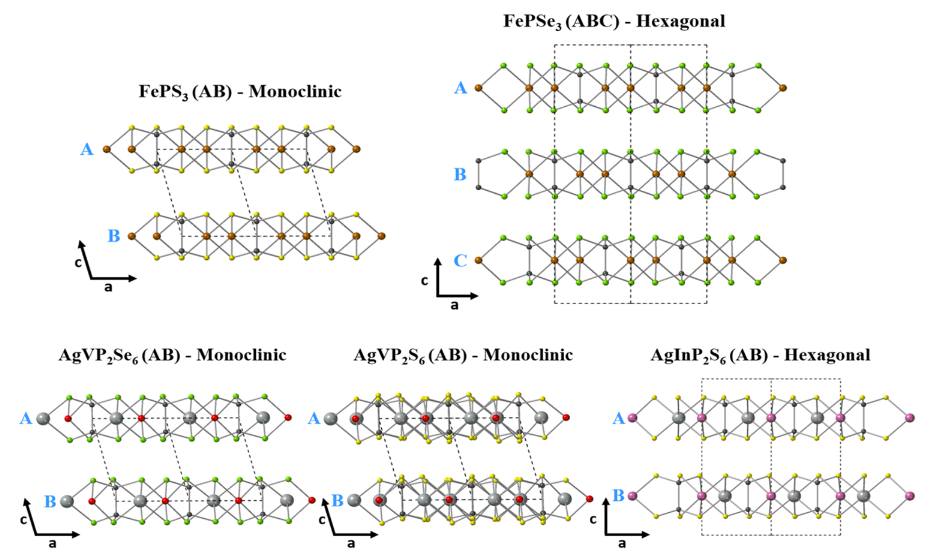 Figure 1 from the new study shows examples of atomic structures that the research team’s algorithm identified as having features conducive for potential use as 2D materials.
A treasure map to new 2D materials
The researchers used a mix of data mining, computer modeling, and structural analysis (because only materials with certain shapes are conducive to use in electronics) to ferret out new material candidates.
“We developed a set of chemical design rules to predict these materials, which could significantly accelerate the discovery of new functional materials,” Yan, the study’s first author, said.
Joshua Birenzvige ’23, chemistry, played a key role by developing a Python script that helped sort the potential materials based on their properties, speeding up the team’s progress. Mona Layegh, a Ph.D. candidate in Bennett’s group, is also a co-author on the new paper.
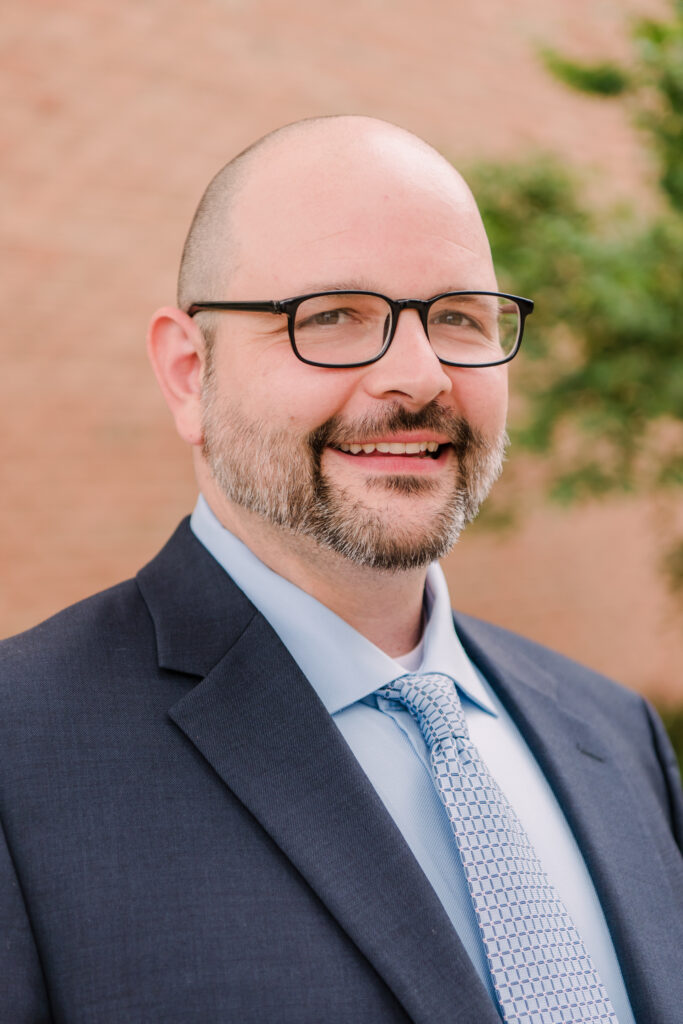 Joseph Bennett’s research lab focuses on the discovery and design of new functional materials. (Marlayna Demond ’11/UMBC)
The researchers began by digging into the Inorganic Crystal Structure Database, a huge collection of known crystal structures. Then they used quantum structural diagrams—which map materials on a chart according to how they relate to each other, determined by their atomic traits—to find areas within the diagrams where promising new materials might be hiding.
“By analyzing basic parameters like differences in electronegativity and radius, we were able to separate materials that have the properties we want from those that don’t,” Bennett explained. Electronegativity measures how strongly an atom attracts electrons, and an atom’s radius is the distance from its center to the outer edge of its electron cloud.
“These quantum structural diagrams act like a treasure map,” Bennett said, “guiding us to regions of chemical space where new, stable 2D materials are likely to exist.”
Their results indicated 83 potential new materials that could be made and used in the tech industry, potentially increasing the number of known ferroelectric materials by an incredible margin.
From the computer to the lab bench
After the computer-based analysis, the team took their work a step further. The UMBC researchers collaborated with Ryan Stadel, Peter Zavalij, and Efrain Rodriguez at the University of Maryland, College Park (UMD), who made and tested some of the predicted materials in the lab. Their work proved the UMBC predictions could be used to guide experiments with the predicted materials.
“Being able to predict which compositions are likely to form stable, functional materials gives us a huge head start in the lab,” Bennett said. “It’s like having a recipe book for materials that haven’t been made yet, which saves time and resources.”
These new materials could shine in real-world uses, substantially advancing the electronics industry. For example, they could help build memory devices that can store data after power is shut off, tiny sensors that detect minute amounts of particular substances, or low-power components that make your phone battery last longer. These properties are in high demand across the tech industry and the U.S. government—this work was funded by a substantial grant from the Defense Threat Reduction Agency.
 Joseph Bennett’s students Peng Yan (top left), Joshua Berinzvige (top right), and Mona Layegh (bottom) are all authors on the new study. (Courtesy of Bennett)
An exciting future of discovery
“I’m excited because the work demonstrates a successful data-guided approach to discovering novel 2D materials with promising functional properties, potentially accelerating the design of next-generation electronic materials,” Yan said.
Next up, the team will use a complex computer simulation, called high-throughput density functional theory modeling, to explore these 83 materials in more depth. They’ll check their ferroic traits and how easily they can be made. Plus, they’ll continue their collaboration with the UMD to synthesize and study the materials in the lab, aiming to confirm their special properties and tweak them for specific applications.
The research is a major step forward, paving the way for materials that could change how engineers build electronics—from sensors for the military to longer-lasting laptops and tablets for students on the go.
]]>
Finding new materials with useful properties is a primary goal for materials scientists, and it’s central to improving technology. One exciting area of current research is 2D materials—super-thin...
https://umbc.edu/stories/new-2d-materials-for-advanced-electronics/
https://my3.my.umbc.edu/api/v0/pixel/news/151101/guest@my.umbc.edu/0bb5442dfdd83f7ff2784483866a9272/api/pixel
chembiochem
cnms
gradresearch
news
research
science-and-tech
story
UMBC News & Magazine
https://my3.my.umbc.edu/groups/umbc-news-magazine
https://assets1-my.umbc.edu/system/shared/avatars/groups/000/001/943/24435aa6207c452e7bc15cc74b42c7bb/xsmall.png?1748556657
https://assets1-my.umbc.edu/system/shared/avatars/groups/000/001/943/24435aa6207c452e7bc15cc74b42c7bb/original.png?1748556657
https://assets2-my.umbc.edu/system/shared/avatars/groups/000/001/943/24435aa6207c452e7bc15cc74b42c7bb/xxlarge.png?1748556657
https://assets2-my.umbc.edu/system/shared/avatars/groups/000/001/943/24435aa6207c452e7bc15cc74b42c7bb/xlarge.png?1748556657
https://assets3-my.umbc.edu/system/shared/avatars/groups/000/001/943/24435aa6207c452e7bc15cc74b42c7bb/large.png?1748556657
https://assets1-my.umbc.edu/system/shared/avatars/groups/000/001/943/24435aa6207c452e7bc15cc74b42c7bb/medium.png?1748556657
https://assets2-my.umbc.edu/system/shared/avatars/groups/000/001/943/24435aa6207c452e7bc15cc74b42c7bb/small.png?1748556657
https://assets1-my.umbc.edu/system/shared/avatars/groups/000/001/943/24435aa6207c452e7bc15cc74b42c7bb/xsmall.png?1748556657
https://assets2-my.umbc.edu/system/shared/avatars/groups/000/001/943/24435aa6207c452e7bc15cc74b42c7bb/xxsmall.png?1748556657
UMBC News & Magazine
0
0
false
Mon, 21 Jul 2025 13:54:33 -0400
Mon, 21 Jul 2025 13:54:33 -0400
More life science grad students to be prepared for interdisciplinary success following renewed NIH funding for Chemistry Biology Interface program
For over 20 years, the Chemistry Biology Interface (CBI) program at UMBC has been shaping Ph.D. students into leaders who bridge chemistry and biology. Programs like CBI are critical to help meet the rising demand for researchers with wide-ranging skill sets who can communicate clearly with those outside their specialty. In the joint UMBC-University of Maryland, Baltimore (UMB) CBI program, participants complete their degrees faster than students in similar labs outside the program, and 97 percent graduate—well above the national average of 63 percent for graduate study in the life sciences.
“Everything now is interdisciplinary research,” says Aaron Smith, associate professor of chemistry and biochemistry at UMBC and CBI director.
CBI supports Ph.D. students at UMBC in chemistry, biochemistry, and biological sciences, and pharmacy students at UMB. Now it has secured five more years of funding to continue building community, creating networking opportunities, and training students in interdisciplinary research and science communication.
Communication for career success
CBI alumni credit the program with positioning them to thrive in a range of careers, from the classroom to corporate laboratories.
“I became more confident with public speaking and attribute the success of my job interview talks to the training I received in CBI,” shares Kathryn Wardrup, Ph.D. ’24, biological sciences. Today, she is a postdoctoral fellow at the Fred Hutchinson Cancer Center, an independent research institute in Seattle.
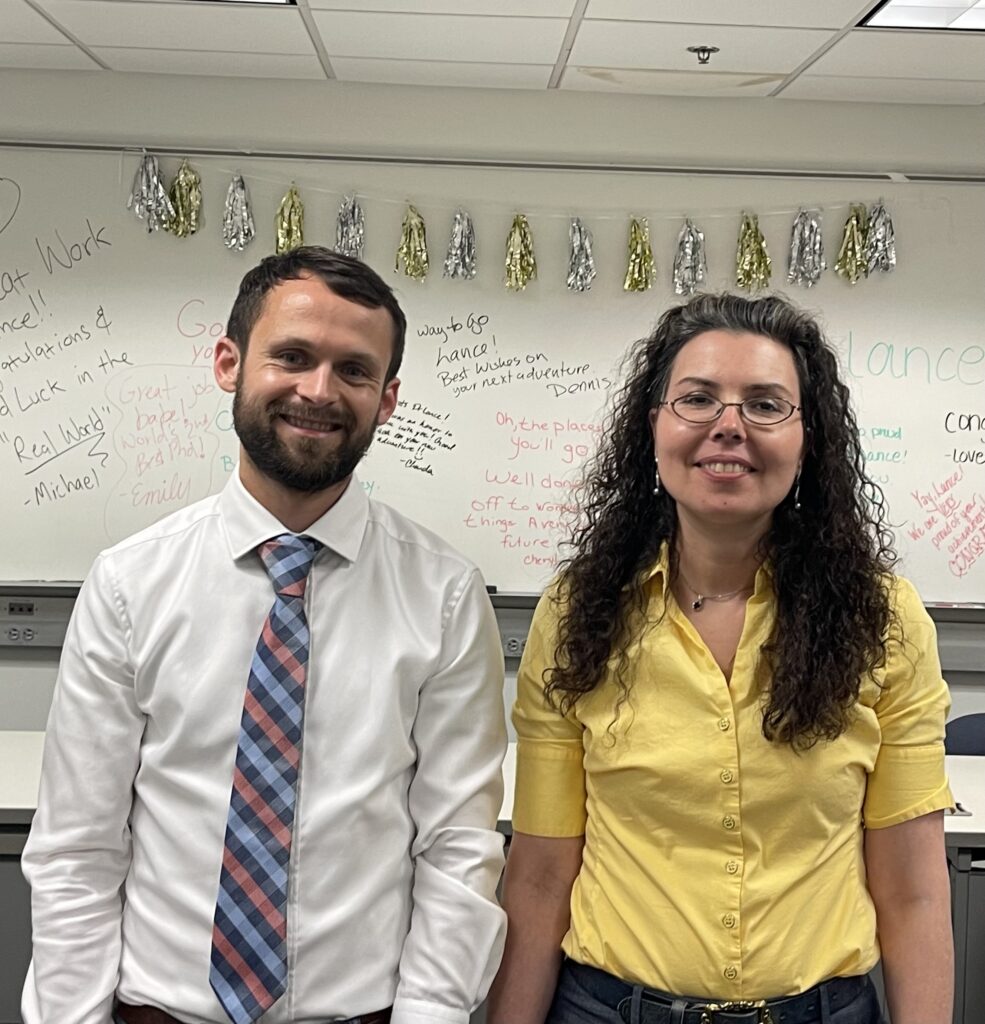 Lance Dockery (left) completed his Ph.D. with Marie-Christine Daniel, associate professor of chemistry and biochemistry. Here they celebrate his thesis defense in 2022. (Courtesy of Dockery)
“Hearing about other research on campus and learning what techniques are being used was a valuable experience,” Wardrup adds. “I felt confident in my ability to be able to have discussions outside of my scientific expertise.”
Scott Riley, Ph.D. ’20, chemistry, also benefited. “I’ve carried many of the lessons I learned into presentations, whether classroom lectures or at meetings and conferences,” he says. “I know many of my interviews were successful because of things I learned in CBI.”
Currently, Riley coordinates internship placements and teaches courses in the master’s program in pharmaceutical sciences at UMB.
Lance Dockery, Ph.D. ’22, chemistry, parlayed skills gained in CBI into a senior scientist role at biotech company AstraZeneca, and recently transitioned to a leadership role at pharmaceutical company Eli Lilly.
“In industry, projects often require coordination between chemists, biochemists, immunologists, and other specialists, similar to the collaborative environment within the CBI program,” Dockery says. “The experience of presenting research to a diverse audience within CBI strengthened my communication skills—something that has given me a clear advantage when interacting with project teams.”
Building a supportive community
CBI participants attend weekly meetings where they take turns teaching their peers about a range of scientific topics selected by the students. Following the more formal instruction period, students partake in group discussions on graduate student life and professional development topics—like mental health, time management, and creating and updating a CV—over pizza.
All this interaction promotes a strong sense of community. “This program builds a really strong rapport among the students, some of whom are in their first semester of graduate school and some of whom are preparing to defend their theses,” Smith says. “They build connections with one another; they learn how to talk with one another. I really think of it as building a community of support among the students.”
Danielle Schmitt, Ph.D. ’17, biochemistry, concurs. “I really benefited from having a cohort of fellow graduate students to support me during my Ph.D.,” she says. Today, Schmitt is an assistant professor of chemistry and biochemistry at UCLA.
CBI’s community feel also fosters shared investment in each participant’s success. “It’s a fun experience to see other students’ data and scientific talks develop as they experience growth during their time in CBI,” Wardrup says.
 Danielle Schmitt (front row, yellow shirt) took a group of her UCLA lab members to the 2nd Annual SoCal Metabolism Symposium in 2022, where several of them presented research posters. She completed her Ph.D. with Songon An, associate professor of chemistry and biochemistry. (Courtesy of Schmitt)
Hands-on cross-training
CBI includes about 40 students per year. Most of them are considered “trainees,” who receive a funding allowance to support conference travel and research expenses for cross-training in a lab outside their work with their primary Ph.D. advisor. Students have received training at the NIH, St. Jude’s Research Hospital, biotech giant Genentech, labs at universities such as UNC-Chapel Hill and UT-Austin, and UMBC and UMB labs.
Riley’s cross-training experience “allowed me to discover a new technique (electron microscopy) which played a critical role in my thesis,” he says. Schmitt adds, as a CBI fellow, “I was able to spend time at the NIH working on a collaborative project related to glucose metabolism. Because CBI supported my time at the NIH, I could move the project forward and learn new skills I might not have gained otherwise.”
 Scott Riley (front row, third from left) with his first class of graduates from the UMB master’s program in pharmaceutical sciences in 2022. (Courtesy of Riley)
Janae Baptiste Brown, Ph.D. ’18, chemistry, adds that “the cross-disciplinary training gave me the unique opportunity to conduct research at the bench with collaborators both at UMBC and the NIH.”
In addition to the benefits trainees receive, six CBI fellows per year further receive full tuition support, health care benefits, and a living stipend. The fellows serve as peer leaders, planning CBI programming in collaboration with Smith and leading group discussions.
“Beyond the bench, I have referred back to some of the leadership skills that I gained as a fellow to encourage an active learning environment in my classes,” says Baptiste Brown, who is now an assistant professor of chemistry and biochemistry at Spelman College.
 Janae Baptiste Brown (right) with members of her lab group at Spelman College. Baptiste Brown completed her Ph.D. with Michael Summers, professor of chemistry and biochemistry. (Courtesy of Baptiste Brown)
Expanding horizons through conferences
Support for conference travel is another major benefit of CBI. Conferences offered “an excellent opportunity to engage with scientists outside my realm of expertise and network with scientists in my field, ultimately landing me a job interview through a connection made at a CBI-sponsored conference,” Wardrup says.
Conferences also offer more opportunities to practice communicating one’s work with a range of audiences. “Having experience in interdisciplinary communication is invaluable,” Dockery says. “It facilitates smoother collaborations and ensures that diverse expertise contributes effectively to project success.”
“I can’t overstate the way this program dramatically enhances the graduate training outcomes for individuals,” Smith says, “so I wish we had more of these training grants for cross-disciplinary training in other fields, like chemistry-engineering or chemistry-physics.”
Embracing growth beyond comfort zones
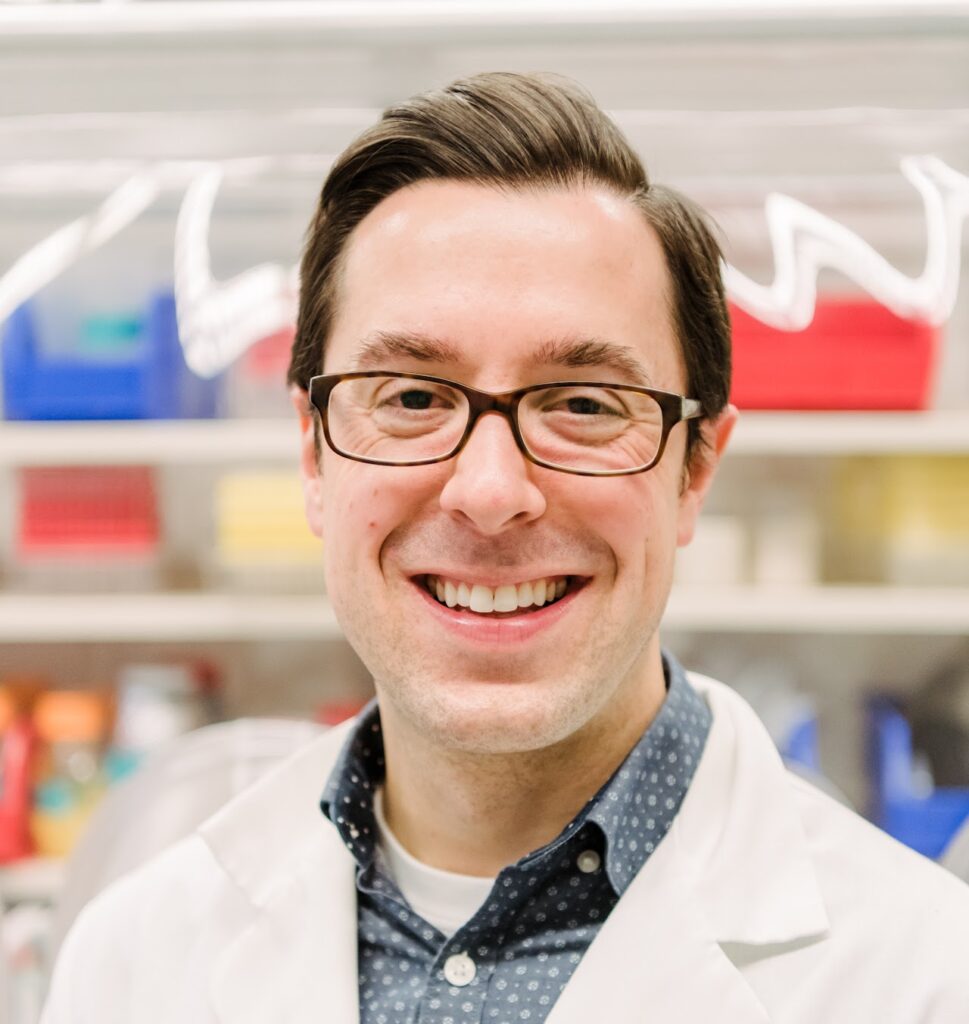 Aaron Smith has led the CBI program since 2022. (Marlayna Demond ’11/UMBC)
Smith took on leading CBI in 2022, after serving as assistant director under previous director Katherine Seley Radtke, professor of chemistry and biochemistry. “It’s a ton of work, but the benefits far outweigh the amount of time and effort that it takes to keep this program running,” he says. “It’s just a fantastic program.”
As Wardrup notes, “It can feel uncomfortable to step outside of your comfort zone to explore something new, but CBI is an extremely supportive environment to take that first step.” Riley echoes this sentiment. “Graduate school is one of the best times in your life to really dig deep and learn as many things as you can,” he says. “You will be surprised how some skills or knowledge will be relevant in your early career.”
The CBI program, with its focus on interdisciplinary training and community building, provides the perfect platform for students to do just that—equipping them with the confidence, skills, and networks to excel.
]]>
For over 20 years, the Chemistry Biology Interface (CBI) program at UMBC has been shaping Ph.D. students into leaders who bridge chemistry and biology. Programs like CBI are critical to help meet...
https://umbc.edu/stories/chemistry-biology-interface-program-impact/
https://my3.my.umbc.edu/api/v0/pixel/news/151067/guest@my.umbc.edu/4b8db02c66ed351fd8a0624d49dd504a/api/pixel
alumni
biology
chembiochem
cnms
gradresearch
news
research
science-and-tech
story
UMBC News & Magazine
https://my3.my.umbc.edu/groups/umbc-news-magazine
https://assets1-my.umbc.edu/system/shared/avatars/groups/000/001/943/24435aa6207c452e7bc15cc74b42c7bb/xsmall.png?1748556657
https://assets1-my.umbc.edu/system/shared/avatars/groups/000/001/943/24435aa6207c452e7bc15cc74b42c7bb/original.png?1748556657
https://assets2-my.umbc.edu/system/shared/avatars/groups/000/001/943/24435aa6207c452e7bc15cc74b42c7bb/xxlarge.png?1748556657
https://assets2-my.umbc.edu/system/shared/avatars/groups/000/001/943/24435aa6207c452e7bc15cc74b42c7bb/xlarge.png?1748556657
https://assets3-my.umbc.edu/system/shared/avatars/groups/000/001/943/24435aa6207c452e7bc15cc74b42c7bb/large.png?1748556657
https://assets1-my.umbc.edu/system/shared/avatars/groups/000/001/943/24435aa6207c452e7bc15cc74b42c7bb/medium.png?1748556657
https://assets2-my.umbc.edu/system/shared/avatars/groups/000/001/943/24435aa6207c452e7bc15cc74b42c7bb/small.png?1748556657
https://assets1-my.umbc.edu/system/shared/avatars/groups/000/001/943/24435aa6207c452e7bc15cc74b42c7bb/xsmall.png?1748556657
https://assets2-my.umbc.edu/system/shared/avatars/groups/000/001/943/24435aa6207c452e7bc15cc74b42c7bb/xxsmall.png?1748556657
UMBC News & Magazine
0
0
false
Thu, 17 Jul 2025 12:02:54 -0400
Thu, 17 Jul 2025 12:02:54 -0400
Black hole mergers open doors for students
There are black holes, and then there are supermassive black holes (SMBH), with masses millions to billions of times as great as the Sun. A small percentage of SMBH are furiously gobbling up matter; these are called active galactic nuclei (AGN). Adi Foord, assistant professor of physics, is co-leading a research project designed to further understanding of how this rare type of black hole forms and changes over time.
The project, recently funded by a National Science Foundation (NSF) Astronomy and Astrophysics Research Grant, also creates prime opportunities for undergraduate and graduate students to contribute to the research and connect with leaders in the field for networking and mentorship—experiences with the potential to shape these students’ futures.
In addition to Foord, the three other co-leads are giants in the field of black hole research at institutions with powerhouse astronomy programs: Meg Urry at Yale University, David Sanders at the University of Hawaii, and Nico Cappelluti at the University of Miami. All four co-leads have collaborated for years as members of a research consortium known as the Accretion History of AGN (AHA) group.
“The goal of the NSF project is to try to map out the growth of AGN across cosmic time using as much data as humanly possible,” Foord says. “We’ll be looking at data collected by observatories in space and on the ground over a really wide range of wavelengths.”
By analyzing data from various sources, the team has a better chance of shedding light on how these black holes grow and evolve, “and how their growth mechanisms connect to things like their environments,” Foord adds, “so getting information about the host galaxies that they’re in will be key.”
Foord is particularly interested in what happens when two galaxies, each with a supermassive black hole at its center, merge, and her part of the new grant zeroes in on exploring these merging AGN. For example, the percentage of galaxies that begin to interact and then go on to complete a merger is an open question.
 Adi Foord (left) and Ph.D. students Cassie Daniele (center) and Zack Reeves discuss research data in Foord’s office. (Brad Ziegler/UMBC)
Addressing the bottleneck
Zack Reeves, a UMBC Ph.D. student mentored by Foord, is contributing to the project through his research on dual AGN—pairs of black holes in the early stages of a potential merger. Reeves started with a dataset including 2,684 confirmed AGN, based on data from the X-ray Multi-mirror Mission (XMM) Newton observatory and Sloan Digital Sky Survey. Then he pared down the data further, eventually settling on 38 AGN that met particular data standards.
“This summer, I’m going through each of the XMM X-ray sources, and looking to see if the AGN have any other significant X-ray sources nearby that could indicate a dual AGN,” Reeves says.
XMM Newton includes tools that allow scientists to filter and analyze the data to answer their specific questions, “but the process can be manual and tedious to do observation by observation,” Reeves says. To address that bottleneck, he’s coding a Python script to streamline data analysis, which he’ll run on UMBC’s High-Performance Computing Facility (HPCF), which can analyze all of the samples in parallel, producing results many times faster than completing the task sequentially by hand.
The results will provide important insights into how galaxies and AGN form. Multiple theoretical simulations describe those processes, and “these simulations disagree on certain predictions, like how the dual AGN population will evolve over the course of cosmic time,” Reeves says. “So the interesting part of this project is that we can actually look in space and observationally constrain how this population evolves, and through that we can identify what strengths and weaknesses these simulations have.”
 Weekly lab meetings with Adi Foord, left, allow students to share their progress and ask and answer questions. (Brad Ziegler/UMBC)
Empowering the next generation of astrophysicists
The NSF grant not only creates opportunities for Foord’s students to dive into cutting-edge research—it will also connect them with top scientists and grow their professional networks. For example, Reeves will begin attending regular AHA group meetings this summer and attend the AHA workshop in Miami in December.
Foord considers creating these career-building opportunities for her students a core part of her mission as a faculty member at UMBC.
“It’s really important that we give UMBC students not only great research projects and opportunities, but also visibility to the field and the ability to make connections and network with people,” Foord says.
The grant also funds UMBC undergraduate students to conduct research with the co-leads at their institutions. This summer, funded through the same NSF grant, Katherine Carver, a rising senior physics major, is interning at Yale with Meg Urry.
At Yale, “Networking with so many talented astronomers and physicists and attending unique professional development and astronomy events”—like a workshop on dark matter and a watch party for the reveal of the first Vera Rubin Observatory images—“have been the most beneficial opportunities,” Carver says.
“It’s really important that we give UMBC students not only great research projects and opportunities, but also visibility to the field and the ability to make connections and network with people.”
Adi Foord, assistant professor of physics
“The students are getting an opportunity to learn about what’s going on at these other institutions, how research teams work at these different places, and also to network with scientists there,” Foord says, “and that’s only going to help their careers if they decide to continue in astrophysics.”
“Dr. Foord has been instrumental in my success as an aspiring scientist,” Carver says, “from teaching me how to write scientific proposals to aiding the progression of my research at UMBC.”
Reeves is grateful for Foord’s guidance, too. “She’s teaching me a lot about moves that I should be making right now, and how to network and build connections, and also making those connections for me, which means a lot,” he says.
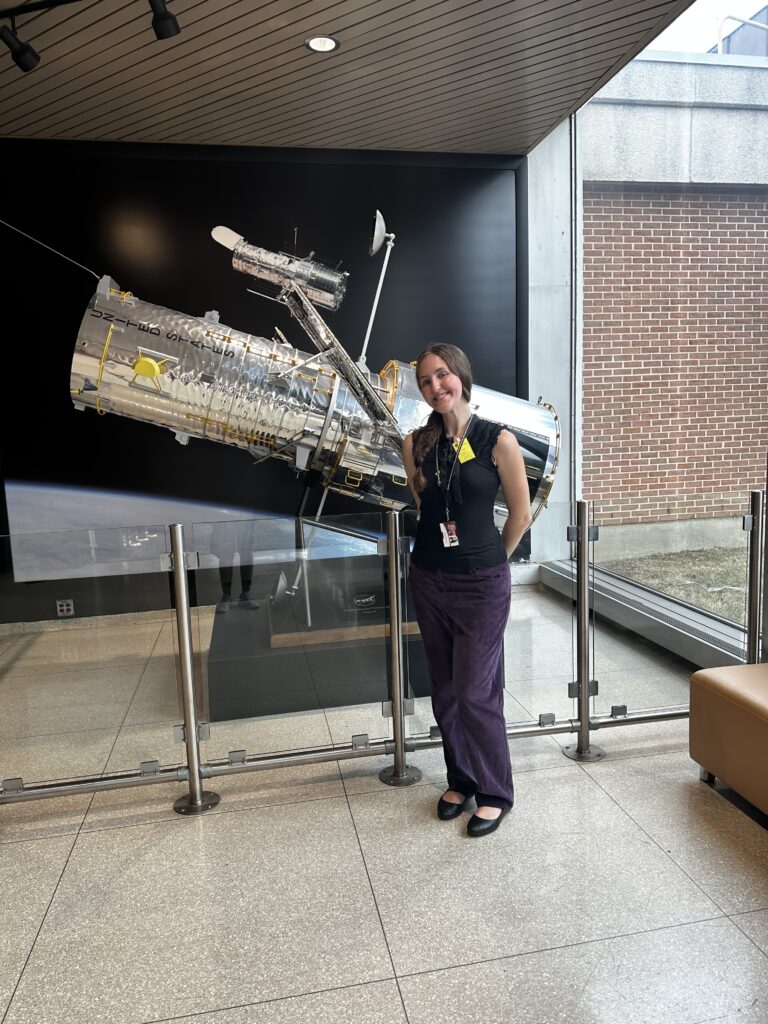 Katherine Carver stands in front of a model of the Hubble Space Telescope at NASA Goddard Space Flight Center in Greenbelt, Maryland. She took a field trip to Goddard in summer 2024 while an intern at the Johns Hopkins Space Telescope Science Institute. (Courtesy of Carver)
Big-picture questions require practical skills
Reeves says that in high school, he romanticized physics; “the lure of figuring out how the universe works” drew him in. Since then, he’s learned that to be successful in the field, big-picture wonder must be backed up with practical skills.
“I consider myself at heart to be an astrophysicist. That’s the dream. That’s what sparks joy in my heart,” he says. Luckily for him, “In practice, I also really enjoy statistics and statistical physics.”
Reeves’ work relies heavily on computer programming, data analysis, and statistics, skills he says are “absolutely critical” for astrophysicists. “I learned quickly in college you have to be really good at problem-solving to succeed in physics,” he notes. Reeves encourages anyone interested in physics to take enough computer science courses to “understand what the code is doing under the hood.” Without that foundation and a solid dose of perseverance, he says, at some point you’ll get stuck.
Thankfully, “Zack is super self-motivated, which is one of the most important aspects to being successful,” Foord says. “I’ve seen so many points in time where he’s hit some sort of wall, and then he comes back the next week and he’s figured out some way to get above that wall.”
 At a lab meeting, Zack Reeves shows how his python script generated the same figure that he created manually previously, demonstrating the code’s efficacy. (Brad Ziegler/UMBC)
Staying close to go far
Carver, too, has picked up additional skills that support her physics research. From her work in Foord’s lab and previous internships at the Johns Hopkins Applied Physics Laboratory and Space Telescope Science Institute, she gained key coding and problem-solving skills. Without that, “I would not have been able to contribute to the level I can now to my project at Yale,” she says. “Those experiences also prepared me to secure the internship.”
Foord’s students benefit from a close relationship with her and other research group members. “The energy in the group meetings and our one-to-ones is always just really positive and encouraging, and there’s no stress,” Reeves says. Foord’s guidance has turbocharged his growth, from tackling advanced projects to presenting his work clearly.
“He already has a really good idea of how to tell a story in a way that will help people who aren’t intimately familiar with his research to understand it,” Foord says.
Through Adi Foord’s mentorship, doors to cutting-edge black hole research have swung wide open for Reeves and Carver, equipping them with skills and networks to explore the cosmos as their careers progress. Already, Reeves is paying it forward, using his communication skills to share his fascination with black holes and spark curiosity about one of the universe’s most mysterious phenomena.
]]>
There are black holes, and then there are supermassive black holes (SMBH), with masses millions to billions of times as great as the Sun. A small percentage of SMBH are furiously gobbling up...
https://umbc.edu/stories/black-hole-mergers-open-doors-for-students/
https://my3.my.umbc.edu/api/v0/pixel/news/150986/guest@my.umbc.edu/f6577e89be8854a0d16bac43da6ba910/api/pixel
cnms
gradresearch
news
physics
research
science-and-tech
story
undergradresearch
UMBC News & Magazine
https://my3.my.umbc.edu/groups/umbc-news-magazine
https://assets1-my.umbc.edu/system/shared/avatars/groups/000/001/943/24435aa6207c452e7bc15cc74b42c7bb/xsmall.png?1748556657
https://assets1-my.umbc.edu/system/shared/avatars/groups/000/001/943/24435aa6207c452e7bc15cc74b42c7bb/original.png?1748556657
https://assets2-my.umbc.edu/system/shared/avatars/groups/000/001/943/24435aa6207c452e7bc15cc74b42c7bb/xxlarge.png?1748556657
https://assets2-my.umbc.edu/system/shared/avatars/groups/000/001/943/24435aa6207c452e7bc15cc74b42c7bb/xlarge.png?1748556657
https://assets3-my.umbc.edu/system/shared/avatars/groups/000/001/943/24435aa6207c452e7bc15cc74b42c7bb/large.png?1748556657
https://assets1-my.umbc.edu/system/shared/avatars/groups/000/001/943/24435aa6207c452e7bc15cc74b42c7bb/medium.png?1748556657
https://assets2-my.umbc.edu/system/shared/avatars/groups/000/001/943/24435aa6207c452e7bc15cc74b42c7bb/small.png?1748556657
https://assets1-my.umbc.edu/system/shared/avatars/groups/000/001/943/24435aa6207c452e7bc15cc74b42c7bb/xsmall.png?1748556657
https://assets2-my.umbc.edu/system/shared/avatars/groups/000/001/943/24435aa6207c452e7bc15cc74b42c7bb/xxsmall.png?1748556657
UMBC News & Magazine
1
0
false
Thu, 10 Jul 2025 17:06:49 -0400
Thu, 10 Jul 2025 17:06:49 -0400
Interdisciplinary UMBC team deepens understanding of cell migration, important for potential medical advances
Imagine cells navigating through a complex maze, guided by chemical signals and the physical landscape of their environment. At UMBC, a team of researchers has contributed an important discovery about how cells move, or migrate, through this maze of bodily tissues. Potential implications include better understanding of diseases like cancer and advancing medical treatments.
Published in iScience, the team’s study combines biological experiments and mathematics to reveal new insights into cell migration. Alex George, Ph.D. ’24, biological sciences, and Naghmeh Akhavan, Ph.D. ’25, mathematics, led the study, which explores how cells in fruit fly egg chambers navigate their environment. Their mentors, Michelle Starz-Gaiano, professor of biological sciences, and Brad Peercy, professor of mathematics, are co-authors.
By integrating mathematical modeling with advanced imaging, the team discovered that the physical shape of the egg chamber, combined with chemical signals called chemoattractants, significantly influences how cells move.
 Alex George (left) and Naghmeh Akhavan present their research at a conference at the University of Maryland, College Park. (Courtesy of Starz-Gaiano)
“This paper takes an interdisciplinary focus with tight collaboration between a mathematical framework and experimental design,” Peercy says. “The results promote the idea that complex distribution of chemical attractants can explain specific variations in migratory movement.” His enthusiasm highlights the study’s innovative approach, which merges precise mathematical models with real-world biological experiments to uncover patterns that were previously invisible.
Following the breadcrumbs
The team’s work focuses on border cells, a type of cell in fruit fly egg chambers, which are a model system for studying cell migration because of their similarities to processes in human development and disease. The team found that the border cells’ movement wasn’t just driven by continuously increasing chemical concentrations from one end of the egg chamber to the other, as earlier models suggested. Instead, the physical structure of the tissue—narrow tubes alternating with wider gaps—played a critical role.
“This was the first time that we characterized that there were these patterns of migration behavior that ended up correlating to aspects of the tissue geometry,” explains George, who specializes in capturing live images of these cells. He likens the process to Hansel and Gretel following breadcrumbs through a forest: On a flat plain, the trail is clear, but in a landscape with ravines and valleys, the breadcrumbs pool in unexpected ways, complicating the path.
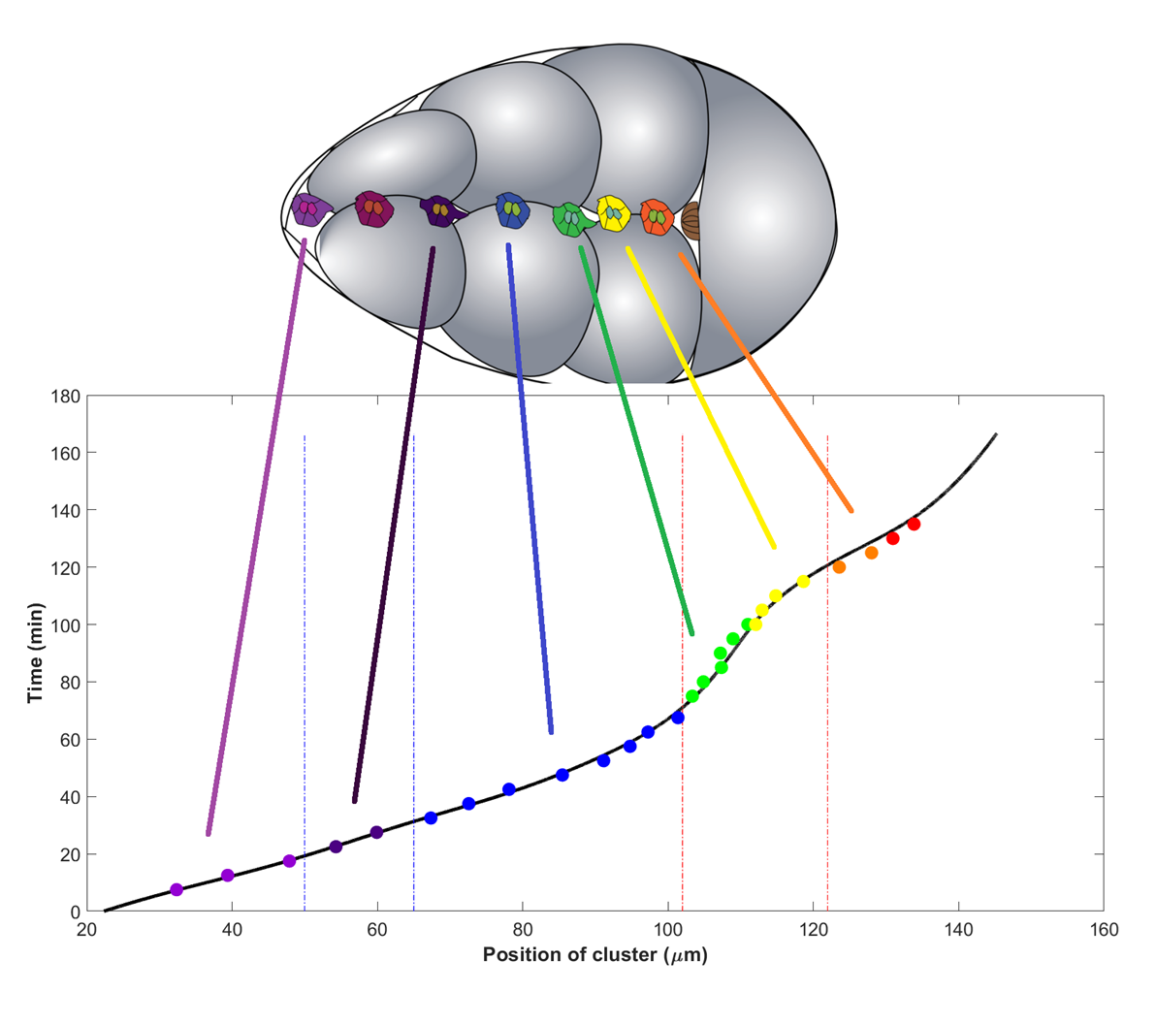 This visualization of Akhavan’s mathematical model shows how migration speed shifts in each zone of the egg chamber, pictured above the graph. A steeper slope indicates a slower speed. (Courtesy of Akhavan)
To understand this, Akhavan developed mathematical models that simulate how cells respond to both chemical signals and tissue geometry together. “Alex’s experiments showed that the speed is not exactly the way previous models showed it,” she says. Her models revealed that cells speed up in narrow tubes and slow down in larger gaps, a pattern confirmed by George’s imaging.
Both approaches—wet-lab experiments and modeling—bring unique strengths to the work. Putting them together “is like unveiling the invisible from two different perspectives,” George says. “My experiments would refine her model, and her model would refine my experiments.”
And then, “When our model shows exactly what Alex found in his experiments, we love that,” Akhavan adds.
Learning new languages
This synergy didn’t always come easily. Working across disciplines meant learning to speak each other’s scientific “languages.” Akhavan, with a background in pure mathematics, recalls that when she joined the project in spring 2022, “Everything was in a different language for me.” Similarly, “A couple of times I opened my MATLAB code and Alex’s eyes got huge,” Akhavan laughs.
Yet, their collaboration flourished, fostering not only scientific breakthroughs but also friendship. “It’s a challenge to communicate across disciplines since it’s almost like speaking in different languages,” Starz-Gaiano says. “Both Alex and Naghmeh got more adept at explaining their work and honing their research questions as a result of working together over a couple of years, which was great to watch.”
Putting together wet lab experiments and mathematical modeling “is like unveiling the invisible from two different perspectives. My experiments would refine her model, and her model would refine my experiments.”
Alex George, Ph.D. ’24, biological sciences
“It is a risky and vulnerable situation to be open with colleagues in areas in which you are not a burgeoning expert,” Peercy adds. “Naghmeh and Alex have grown so much through this project to genuinely rely on each other’s opinion.”
The study’s broader impact lies in its potential to inform fields beyond developmental biology. Cell migration is critical in processes like wound healing, immune responses, and cancer metastasis. “Most research on how cells navigate the world has focused only on chemical signals or only on structural ones, so this is one of the first studies to consider how those two things impact each other, which is likely to be relevant in many cases,” Starz-Gaiano explains. By showing how tissue geometry and chemical signals interact, the research could guide new strategies for controlling cell movement via medical treatments.


 Left: The team traveled to the Janelia Research Campus in Virginia to do advanced imaging for the cell migration project, which will open new avenues for research. (Courtesy of Starz-Gaiano) Center: A moment of levity in the Starz-Gaiano lab. (Courtesy of Akhavan) Right: Brad Peercy and Michelle Starz-Gaiano shared their collaborative work at the “RetriEVER Empowered: Student Success + Research + Community”event in April 2022.
New strategies lead to new discoveries
George refined his expertise in microscopy through working with Tagide deCarvalho in UMBC’s Keith R. Porter Imaging Facility. “It helped me learn a lot, getting my hands on other people’s work and visualizing all the cool things,” he says. “A picture is worth a thousand words, but a movie? Ten thousand words.” Now he’s taking his skills to the Dartmouth Cancer Center’s microscopy core facility at the Geisel School of Medicine, where he’ll start as a research scientist in June.
For Akhavan and George, leading this project has been a defining experience. Akhavan’s models, including a new approach that uses energy calculations to better capture the egg chamber’s complex geometry, have become a cornerstone of her dissertation, and she plans to continue this work post-graduation.
George and Akhavan’s mentors played a pivotal role in their success. “Michelle is a role model for me,” Akhavan says, praising the collaborative spirit of Starz-Gaiano and Peercy. “Dr. Peercy and Dr. Starz-Gaiano make the best combination for doing interdisciplinary research. This collaboration is amazing.”

 Left: Naghmeh Akhavan (center) accepts the Outstanding Graduate Research in Mathematics Award at CNMS Awards and Recognition Day. (Courtesy of Akhavan) Right: Michelle Starz-Gaiano and Alex George take some time for fun while attending the Society for Developmental Biology Annual Meeting in Chicago in 2023. (Courtesy of Starz-Gaiano)
The team’s work continues to evolve, including recent experiments at the Advanced Imaging Center at the Janelia Research Campus in Virginia, where George used advanced microscopes to capture previously unseen dynamics of the relevant chemoattractants. These findings will further refine their models, opening new avenues for research.
“We are developing new experimental strategies both on the biology and the math side of things,” Starz-Gaiano says, “so it will be exciting to see where this will take us next.”
]]>
Imagine cells navigating through a complex maze, guided by chemical signals and the physical landscape of their environment. At UMBC, a team of researchers has contributed an important discovery...
https://umbc.edu/stories/cell-migration-research-medical-advances/
https://my3.my.umbc.edu/api/v0/pixel/news/150422/guest@my.umbc.edu/5bddad5f85a6271f260efba4d150dbfc/api/pixel
biological-sciences
biology
cnms
gradresearch
mathematics-and-statistics
mathstat
news
research
science-and-tech
story
UMBC News & Magazine
https://my3.my.umbc.edu/groups/umbc-news-magazine
https://assets1-my.umbc.edu/system/shared/avatars/groups/000/001/943/24435aa6207c452e7bc15cc74b42c7bb/xsmall.png?1748556657
https://assets1-my.umbc.edu/system/shared/avatars/groups/000/001/943/24435aa6207c452e7bc15cc74b42c7bb/original.png?1748556657
https://assets2-my.umbc.edu/system/shared/avatars/groups/000/001/943/24435aa6207c452e7bc15cc74b42c7bb/xxlarge.png?1748556657
https://assets2-my.umbc.edu/system/shared/avatars/groups/000/001/943/24435aa6207c452e7bc15cc74b42c7bb/xlarge.png?1748556657
https://assets3-my.umbc.edu/system/shared/avatars/groups/000/001/943/24435aa6207c452e7bc15cc74b42c7bb/large.png?1748556657
https://assets1-my.umbc.edu/system/shared/avatars/groups/000/001/943/24435aa6207c452e7bc15cc74b42c7bb/medium.png?1748556657
https://assets2-my.umbc.edu/system/shared/avatars/groups/000/001/943/24435aa6207c452e7bc15cc74b42c7bb/small.png?1748556657
https://assets1-my.umbc.edu/system/shared/avatars/groups/000/001/943/24435aa6207c452e7bc15cc74b42c7bb/xsmall.png?1748556657
https://assets2-my.umbc.edu/system/shared/avatars/groups/000/001/943/24435aa6207c452e7bc15cc74b42c7bb/xxsmall.png?1748556657
UMBC News & Magazine
0
0
false
Tue, 27 May 2025 14:10:11 -0400
Tue, 27 May 2025 14:10:11 -0400