Meet a Retriever—Triple alum Corris Davis is building a stronger network for students
Corris Davis’98, M.P.P. ’19, Ph.D. ’25, didn’t originally envision such a long career at UMBC or the number of students she would directly impact. As a Meyerhoff Program Scholar, Corris experienced how intentional mentoring and support could lift up students on their UMBC journeys. Now the senior director of the Office of Academic Opportunity Programs—which she founded as a home to UMBC’s five TRIO Programs as well as first-generation student programming—Corris has been at the front lines for first-gen and low-income students for 26 years. By forging cross-departmental connections, Corris has built a network of support and encouragement for UMBC’s growing population of first-gen students. Tell us all about it!
Q: What’s one essential thing you’d want another Retriever to know about you?
A: I’m a three time UMBC alum—undergrad in biological sciences in 1998, M.P.P. ’19, and Ph.D. ’25, public policy—who has recently rekindled a love for Galaga and LEGOs (because everything old is new again).

 Left: Fellow staff of the Upward Bound Program outside of the Apollo Theatre in New York City during an end of summer field trip. Left to right: Terri Chambers, Christine Harris ’98, Allen Bolden ’99, Karriem Farrakhan ’97, Kerrian McLean ’00, and Corris. Right: At UMBC Commencement 2022, Dr. Michael Hunt, Damarius Johnson ’22 (McNair alum), and Corris.
Q: What’s the one thing you’d want someone to know about the support you find here?
A: “Support” and “community” aren’t just words. People show up for each other because that’s who we are, be it faculty, staff, students, or alumni.
Q: What part of your job do you enjoy the most and why?
A: I support programs that allow students from middle school all the way to undergrad to see what they can be. I have seen students that I met in 8th or 9th grade earn Ph.D.s. I love knowing that while I don’t always work directly with students, the work I do supports them in reaching their goals.
Q: What brought you to UMBC in the first place?
A: I started my professional staff journey as the office coordinator of the TRIO Upward Bound program at UMBC, one of what is now five TRIO programs hosted at UMBC (Upward Bound, Upward Bound Math/Science, Talent Search, McNair Scholars, and now Student Support Services). Since then, I’ve been the assistant director of Upward Bound, and then director. In 2016, I was able to form the Office of Academic Opportunity Programs that houses all of the TRIO Programs as well as first-generation student programming.
After completing my bachelor’s degree, I left UMBC to go to a Ph.D. program in molecular and cellular biology, but about seven months in, I realized that it was not a good fit. I had previously worked with Upward Bound as an undergrad so I essentially came home until I could figure out what my next moves were. I didn’t think that I would still be at UMBC 26 years later.
The reason I stay at UMBC is that I am given the space to help students who are from similar backgrounds to grow and thrive and have great experiences.
Photo: Over the years, many participants have become like family, says Corris. Left side front to back: Prentiss Haney, Gerrod Williamson (Upward Bound alum and current staff member), Corris’s wife, Consuela Lowery; on the right from front to back: Tobias Davis (Upward Bound alum), Dr. Durell Callier ’14, McNair Scholar alum), and Corris.

Q: Tell us about the people who have helped you at UMBC, and why it has made such a difference to you.
A: I must start with the late LaMont Toliver, director of the Meyerhoff Scholars Program. While my initial relationship with him was as a Meyerhoff Scholar, once I became a staff member, he provided even more guidance and support. I use much of what I learned from him in my work in supporting students now, both directly and behind the scenes. I recall him sharing a quote from Harry Truman: “It is amazing what you can accomplish if you do not care who gets the credit.” This has shaped a lot of my work at UMBC. It’s all about advancing our students.
I’ve found support at UMBC in two ways: sometimes by making the ask, and sometimes because people see the vision and step forward on their own. A great example is the creation of the First Generation Network. While it’s not as active as we’d like currently, it’s very existence comes from a group of campus partners, many of whom were first-generation students themselves who understand the importance of the work and volunteering.
The quote… “It is amazing what you can accomplish if you do not care who gets the credit.” This has shaped a lot of my work at UMBC. It’s all about advancing our students.
Corris Davis
Senior director of the Office of Academic Opportunity Programs
We’ve been able to honor first-generation graduates with cords for about six years now. Offices like the Academic Success Center, the Career Center, and several Student Affairs departments have regularly stepped up, not just as cord pick-up sites, but as co-creators of programming that supports UMBC’s first-gen students. Support may be handing out graduation cords, or staffing First Gen Week tables, or even redesigning programming and workshops so they tackle the hidden curriculum and the barriers created by higher-ed jargon.
 Staff of the various TRIO programs in the Office of Academic Opportunity Programs at the annual regional TRIO conference in Hershey, PA, in Feb 2023. Front, left to right: Tanaj Mogase, Talent Search, Corris, Ting Huang (UMBC and McNair alum), Ahdrianna Boyce (UMBC and Upward Bound alum); back left to right: Jennifer Appleby (former TS coordinator), Dr. Michael Hunt, and Dr. Sunji Jangha ’25
Although my office sits in Academic Affairs, this cross-division collaboration is exactly how things get done at UMBC: People come together to support students. It’s impossible to name everyone who has supported me and this work over the years, but I must acknowledge the incredibly talented staff in AOP. Their commitment, partnership, and care make everything we do not only possible, but even more meaningful.
Q: What would you tell someone who is considering a career at UMBC?
A: UMBC is a place where you can take a dream and run with it. We have a culture of supporting students and supporting each other in that work.
UMBC’s greatest strength is its people. When people meet Retrievers and hear about the passion they bring, the relationships they create, the ways they support each other, and the commitment they have to inclusive excellence, they truly get a sense of our community. That’s what “Meet a Retriever” is all about.
Learn more about how UMBC can help you achieve your goals.
]]>
Corris Davis’98, M.P.P. ’19, Ph.D. ’25, didn’t originally envision such a long career at UMBC or the number of students she would directly impact. As a Meyerhoff Program Scholar, Corris...
https://umbc.edu/stories/meet-a-retriever-triple-alum-corris-davis-is-building-a-stronger-network-for-students/
https://my3.my.umbc.edu/api/v0/pixel/news/155467/guest@my.umbc.edu/c1b04b96258202ea2847b3e626f8104b/api/pixel
biological-sciences
cnms
graduateschool
meet-a-retriever
meyerhoff-alumni
story
trio
uncategorized
UMBC News & Magazine
https://my3.my.umbc.edu/groups/umbc-news-magazine
https://assets1-my.umbc.edu/system/shared/avatars/groups/000/001/943/24435aa6207c452e7bc15cc74b42c7bb/xsmall.png?1748556657
https://assets1-my.umbc.edu/system/shared/avatars/groups/000/001/943/24435aa6207c452e7bc15cc74b42c7bb/original.png?1748556657
https://assets2-my.umbc.edu/system/shared/avatars/groups/000/001/943/24435aa6207c452e7bc15cc74b42c7bb/xxlarge.png?1748556657
https://assets2-my.umbc.edu/system/shared/avatars/groups/000/001/943/24435aa6207c452e7bc15cc74b42c7bb/xlarge.png?1748556657
https://assets3-my.umbc.edu/system/shared/avatars/groups/000/001/943/24435aa6207c452e7bc15cc74b42c7bb/large.png?1748556657
https://assets1-my.umbc.edu/system/shared/avatars/groups/000/001/943/24435aa6207c452e7bc15cc74b42c7bb/medium.png?1748556657
https://assets2-my.umbc.edu/system/shared/avatars/groups/000/001/943/24435aa6207c452e7bc15cc74b42c7bb/small.png?1748556657
https://assets1-my.umbc.edu/system/shared/avatars/groups/000/001/943/24435aa6207c452e7bc15cc74b42c7bb/xsmall.png?1748556657
https://assets2-my.umbc.edu/system/shared/avatars/groups/000/001/943/24435aa6207c452e7bc15cc74b42c7bb/xxsmall.png?1748556657
UMBC News & Magazine
0
0
false
Mon, 22 Dec 2025 20:33:40 -0500
Mon, 22 Dec 2025 20:33:40 -0500
CNMS GradFest fosters research connections and builds community
On November 7, graduate students and postdoctoral researchers from the College of Natural and Mathematical Sciences (CNMS) gathered for the college’s second annual CNMS GradFest.
Prableen Chowdhary, Ph.D. ’24, biological sciences, currently a postdoc with Rachel Brewster, professor of biological sciences, and a member of the student-led planning committee, expressed hope that GradFest would “spark conversations and collaborations across disciplines.”
CNMS dean William LaCourse offered advice to attendees as the program kicked off. “Whatever you do in life, do it with all your heart. If you’re doing research, do it like you own it,” he said. “Live in the present and seize opportunities. Enjoy every moment, like this moment today. You can’t change yesterday; when I make mistakes, I’m grateful for grace and forgiveness. And you can plan for tomorrow, but you can’t control it.”
 Prableen Chowdhary (left) and Hasan Al Banna, CNMS GradFest’s two emcees, welcome attendees to the event. (Brad Ziegler/UMBC)
Following the introductions, seven students presented “lightning talks,” five-minute presentations describing their research in engaging, accessible terms for those outside their field. The talks featured students in biological sciences, physics, chemistry and biochemistry, marine biotechnology, and mathematics and statistics. They discussed topics like novel therapeutic targets for ovarian cancer, innovative two-dimensional materials for improved sensors, and previously unobserved plasma jets from black holes.
GradFest as a stepping stone
“Part of our goal was to intentionally include graduate students with less presentation experience or early-stage projects,” shared Maria Cambraia, director for research and international affairs in CNMS, and lead staff member on the planning committee. “GradFest gives them a chance to practice in a friendly environment.”
 Lightning talk presenters and CNMS GradFest planning committee members worked hard to make the event a success. Rear, left to right: Maria Cambraia, Lara Scott, Andrew Wolff, Sean Ravel, Peng Yan, Codi Hrynko, Jalil Ahmad. Front, left to right: Prableen Chowdhary, Lizbeth Joy Tan, Megha Pandya, Ronita Sequeira, Hasan Al Banna. Planning committee members not pictured: Ayo Ogunsanya, Elana Frazier, Jeanne Ngo. (Brad Ziegler/UMBC)
Following the talks, the ballroom buzzed during two poster sessions, where dozens more students discussed their projects with peers, mentors, and guests. GradFest encouraged presentations of research at all stages of development.
Muhammad Jalil Ahmad, president of the Mathematics and Statistics Graduate Student Association and a planning committee member, presented a lightning talk and poster on mathematical modeling for complex phenomena like weather or disease spread.
Ahmad, a fourth-year applied mathematics Ph.D. candidate mentored by Animikh Biswas and Kathleen Hoffman, professors of mathematics, agreed. “Presenting at GradFest is useful before heading to a bigger stage, like a national meeting,” he said. “Even at a math conference, people are studying different topics, so it’s good to practice communicating with people outside your field.” He added that GradFest offers the opportunity to network with researchers using similar methods for different applications.

 Muhammad Jalil Ahmad (left) and Lara Scott (right), Ph.D. students in mathematics, presented lightning talks at GradFest. (Brad Ziegler/UMBC)
Ian Kirn ’23, physics, a second-year physics Ph.D. student, presented a poster on astroseismology, which investigates earthquake-like phenomena on stars. Kirn chose to pursue his Ph.D. with Eileen Meyer, professor of physics, after doing undergraduate research with her. “It’s important for different disciplines to talk to each other, because they’re actually all related,” Kirn says. “This event encourages collaboration.”
Fidelia Asomani, a third-year biological sciences Ph.D. candidate working with Erin Green, associate professor of biological sciences, called GradFest “a good first opportunity to get my feet wet presenting.” Asomani studies yeast, which shares basic functions with complex organisms. “It’s important to invest in studying processes conserved across species,” she says, which can inform human disease treatment.

 Ian Kirn (left) discussed his astroseismology research, and Fidelia Asomani (right) explains her research on protein regulation in yeast, with GradFest attendees. (Brad Ziegler/UMBC)
The humble heart of a scientist
LaCourse also encouraged embracing humility. “By remembering you won’t always be the best, humility helps you celebrate others’ successes and accept failure—and research involves a lot of failure,” he said. “Humility is a path you walk, not a trait you innately possess, and it leads to learning, growth, and respect.”
By late afternoon, GradFest had turned strangers into collaborators, boosted first-time presenters’ confidence, and made the ballroom a launchpad for breakthroughs. Attendees left with new contacts and the dean’s words in their hearts—proof that bold discoveries can begin with a humble “hello.”
Learn more about graduate programs in CNMS.
]]>
On November 7, graduate students and postdoctoral researchers from the College of Natural and Mathematical Sciences (CNMS) gathered for the college’s second annual CNMS GradFest. Prableen...
https://umbc.edu/stories/cnms-gradfest-2025/
https://my3.my.umbc.edu/api/v0/pixel/news/154570/guest@my.umbc.edu/e98c847e7012a2b534bab5add27d1f0c/api/pixel
biology
chembiochem
cnms
community
gradresearch
graduateschool
marinebiotech
mathstat
news
physics
science-and-tech
story
UMBC News & Magazine
https://my3.my.umbc.edu/groups/umbc-news-magazine
https://assets1-my.umbc.edu/system/shared/avatars/groups/000/001/943/24435aa6207c452e7bc15cc74b42c7bb/xsmall.png?1748556657
https://assets1-my.umbc.edu/system/shared/avatars/groups/000/001/943/24435aa6207c452e7bc15cc74b42c7bb/original.png?1748556657
https://assets2-my.umbc.edu/system/shared/avatars/groups/000/001/943/24435aa6207c452e7bc15cc74b42c7bb/xxlarge.png?1748556657
https://assets2-my.umbc.edu/system/shared/avatars/groups/000/001/943/24435aa6207c452e7bc15cc74b42c7bb/xlarge.png?1748556657
https://assets3-my.umbc.edu/system/shared/avatars/groups/000/001/943/24435aa6207c452e7bc15cc74b42c7bb/large.png?1748556657
https://assets1-my.umbc.edu/system/shared/avatars/groups/000/001/943/24435aa6207c452e7bc15cc74b42c7bb/medium.png?1748556657
https://assets2-my.umbc.edu/system/shared/avatars/groups/000/001/943/24435aa6207c452e7bc15cc74b42c7bb/small.png?1748556657
https://assets1-my.umbc.edu/system/shared/avatars/groups/000/001/943/24435aa6207c452e7bc15cc74b42c7bb/xsmall.png?1748556657
https://assets2-my.umbc.edu/system/shared/avatars/groups/000/001/943/24435aa6207c452e7bc15cc74b42c7bb/xxsmall.png?1748556657
UMBC News & Magazine
2
0
false
Fri, 14 Nov 2025 15:37:10 -0500
Fri, 14 Nov 2025 15:37:10 -0500
Emily Brown ’14, M.S. ’14, shares the importance of community for women in technology
As a high schooler, Emily Brown ’14, M.S. ’14, computer science, dreamed of a future in STEM. Searching for a community to support her aspirations, she found the Center for Women and Technology at UMBC. Brown became a CWIT Scholar and ended up earning her bachelor’s and her master’s degrees one semester apart. After graduation, she was hired at Johns Hopkins Applied Physics Laboratory. This October, Brown will receive the 2025 UMBC Outstanding Alumna Award. In this Q&A, she shares how her time at UMBC—and the support she found there—helped get her to where she is today.
Q: What brought you to UMBC?
A: Initially, I was looking into other schools, but UMBC kept making its way back to the top of my list because I was looking for schools that explicitly had programs and communities for women in engineering.
Eventually, I applied for the CWIT (Center for Women and Technology) Scholars Program. As I kept coming back to UMBC for tours and meetings, I figured out this was a community that I really wanted to be a part of. At the time, Dr. Penny Rheingans was the director of the CWIT program, and hearing her talk about the program and what it would offer made UMBC one of my top two school choices. The in-state nature of UMBC meant that I would come out of school debt-free, with the kind of support that I wanted as a woman in STEM.
Q: What did you enjoy about the computer science program?
A: I graduated from my master’s degree in the winter. I have a picture of myself and the four other people who graduated with a computer science master’s that December, and I had taken classes with all of them. At my undergraduate graduation in May, there were nine women who graduated from the computer science program. I knew all nine, which is exactly what I had attended UMBC for—to be part of a community of other women in STEM, it meant a lot to me.
Right: Emily Brown along with fellow CWIT Scholars pose to spell out CWIT.

Q: You graduated with both a bachelor’s and master’s degree in the same year. How did you decide to pursue that and is there any advice you would give another student who may consider doing the same?
A: I wasn’t sure at first that I wanted to do computer science after graduation, but by my junior year I decided to stick to a computer science career. I realized then I could either graduate early or I could start taking graduate classes with the combined B.S./M.S. program. After finishing my undergraduate degree that May, I took summer and fall classes and finished my master’s in December, and that’s how I was able to graduate twice in one year.
There are both upsides and downsides to having done that. On the upside, I started my professional career with a graduate degree, which does come with more pay and professional respect. On the downside, my computer science master’s was a general master’s degree as opposed to specialized. But this has actually proven to be useful: I started my career thinking I wanted to focus on cybersecurity and now I do more AI work and I have some graduate coursework in both of those things.
Q: Is there a faculty or staff member who helped you on your UMBC path?
A: There are three faculty members who stand out when I think of my time at UMBC. Dr. Marie desJardins, who has since retired, was an AI and machine learning professor and the professor that I completed undergraduate research with. Her passion for teaching aligned with my desire for a community that encourages women in engineering. The undergraduate research I did with her was working on the new AP computer science curriculum for the College Board.
Dr. desJardin’s argument was that with computer science you should submit a portfolio rather than take a test. She worked with the College Board to develop what that curriculum for submitting a portfolio would look like and I worked alongside her. My former high school computer science teacher from Howard High School was also on that team, so that was really great. My younger sister has since taken the course and I said, “Did you know I wrote that course that you’re taking in high school now?” Her response was, “I’m not telling anyone that—that’s the most embarrassing thing ever.” I thought it was very exciting.
The second professor who had a huge impact on me is Dr. Tim Oates. I found his teaching style to be one that I deeply resonated with. I always tell people, when you take a class with Dr. Oates, you need to take paper without lines because he draws a lot of pictures to explain things.
He had an example where he would walk around the classroom floor and each tile was a different square and he would say, “All right, I’m an AI, and I’m using reinforcement learning and I physically step here.” He wasn’t just lecturing, he taught by physically moving his body around the classroom.
 Emily Brown and Sam Manas meet with then President Freeman Hrabowski for an interview with “The Retriever Weekly” in 2013.
One example he used was if a $10 bill drops from the ceiling here, I’m incentivized as the AI to keep going back to that corner of the room, where if a $1 bill drops over there, then I know that’s not as useful of a place to go. Even if you don’t have a computer science background, you intuitively go, that makes sense. I followed him to whichever class he would teach because I knew his teaching style broke it down in a way I would deeply understand. In my final class with him, I rigged a $10 bill to drop from the ceiling because he had done this example over and over.
The third is Dr. Anupam Joshi. He was my master’s advisor and he’s now the vice provost and chief AI officer, but at the time he was a professor teaching cybersecurity classes. He is largely the reason that I work the way I do here at the Applied Physics Laboratory. He introduced me to the type of work that got me my first job at the lab. I wrote my final research paper for my master’s degree about my APL internship experience, which was combining all of my passions.
Q: Can you share your involvement in CWIT (Center for Women in Technology), both as an alum and mentor, and what your experience was as a student?
A: I lived in the CWIT Living Learning Community my freshman and sophomore years and then lived in an on-campus apartment with other CWIT students. I met my best friends in the CWIT program. We had a CWIT alum virtual happy hour during the pandemic, and I think there were a number of us who said, “I walked into that CWIT office and just cried and then walked out and passed my classes because there was that kind of support for me.”
I have been involved as an alum since day one. After undergrad, I participated in the career fairs and networking dinners with the talent services recruiting department from APL.
I’ve done industry mentoring nearly every year for the past six years. When I was a CWIT student, my industry mentor was from Lockheed Martin. She did a mock interview with me where she asked me the same questions she would ask a candidate interviewing for their summer internship. She then brought me on a Friday afternoon to the Lockheed Martin office facilities for a lab tour. Those two things were both extremely memorable to me, and I carried that forward with my mentees, some of whom then got internships at APL. That was the experience I sought to replicate and produce for my CWIT mentees.
Q: Can you tell me a little bit more about your current job at APL? What do you enjoy most about it?
A: I’m currently the assistant group supervisor for the analytic capabilities group. The group is really known for a space at APL called the Live Lab, which was started as a response to a 2009 cyber attack that APL was victim of. The lab watches cyber data coming into the lab and processes it in real time to try to be more proactive about the next attack. I actually toured the Live Lab as part of a CWIT Scholars and Cyber Scholars visit day my senior year and thought to myself, ”This place is really cool. I would really like to work there someday.” The staff member running the tour that I attended was Dr. Elisha Peterson, who is my direct boss now. It took a while, but I made it to where I wanted to work my senior year of undergrad.
I’m so proud of UMBC. Being recognized as someone who UMBC is proud of also is incredible.
Emily Brown ’14, M.S. ’14, computer science
Q: How did your UMBC degree help prepare you for your professional career?
A: It wasn’t just what I learned at UMBC that was valuable, but how I learned how to learn. I came into my career already knowing that I valued community and diversity of thought because I had valued it and been taught to value it from my time at UMBC.
UMBC also prepared me to anticipate that there are things that will be interdisciplinary in nature [in my career]. I was able to quickly understand at APL that the value of interdisciplinary teams is really important.

For example, I’ve worked with a psychologist colleague on the concept of a moral foundation. There is, of course, a computing component to parsing out the information, but there’s also a psychological component: Why does this message resonate with you, but not with me? Everybody has their own semi-unique moral foundations profile and a message that aligns to your moral foundations is more likely to resonate with you. That’s something I didn’t study in my computer science coursework at UMBC and I do need to make sure that I’m taking my psychologist colleagues’ opinions and thoughts about this into account as we’re building a project.
Q: What does winning a UMBC Alumni Award mean to you?
A: My sister, who I already mentioned finds me embarrassing, has told me in the past, “You know, there’s such a thing as too much school spirit.” And I refuse to believe that. Having been given so much by UMBC and being so passionate about what I experienced in that circle on that campus, I’m so proud of UMBC. Being recognized as someone who UMBC is proud of also is incredible.
Left: Emily Brown with her younger sister at Homecoming.
Q: If you could give one piece of advice to a current UMBC student, what would it be?
A: Try to do something different. I got a computer science degree, but I was also on The Retriever Weekly editorial staff, which for a CS major was super unusual. But that was my something different. I can’t tell you how many times I have been told in my professional career, “Wow, finding an engineer who is a decent writer is rare.” But that’s because I was on a student newspaper in undergrad. That ability to communicate has taken me pretty far in my career.
Mark your calendars for the 2025 Alumni Awards on Wednesday, October 29,at 6 p.m., and consider joining the UMBC community at the Chesapeake Employers Insurance Arena to celebrate Emily Brown and the many remarkable individuals receiving awards. The event will be livestreamed for those unable to join in person. You can learn more at alumni.umbc.edu/alumniawards.
]]>
As a high schooler, Emily Brown ’14, M.S. ’14, computer science, dreamed of a future in STEM. Searching for a community to support her aspirations, she found the Center for Women and Technology at...
https://umbc.edu/stories/meet-emily-brown-outstanding-alumna/
https://my3.my.umbc.edu/api/v0/pixel/news/153407/guest@my.umbc.edu/9e780e840b563a561e8f3eb3305e5e14/api/pixel
alumni
alumni-awards
coeit
community
csee
cwit
graduateschool
news
story
UMBC News & Magazine
https://my3.my.umbc.edu/groups/umbc-news-magazine
https://assets1-my.umbc.edu/system/shared/avatars/groups/000/001/943/24435aa6207c452e7bc15cc74b42c7bb/xsmall.png?1748556657
https://assets1-my.umbc.edu/system/shared/avatars/groups/000/001/943/24435aa6207c452e7bc15cc74b42c7bb/original.png?1748556657
https://assets2-my.umbc.edu/system/shared/avatars/groups/000/001/943/24435aa6207c452e7bc15cc74b42c7bb/xxlarge.png?1748556657
https://assets2-my.umbc.edu/system/shared/avatars/groups/000/001/943/24435aa6207c452e7bc15cc74b42c7bb/xlarge.png?1748556657
https://assets3-my.umbc.edu/system/shared/avatars/groups/000/001/943/24435aa6207c452e7bc15cc74b42c7bb/large.png?1748556657
https://assets1-my.umbc.edu/system/shared/avatars/groups/000/001/943/24435aa6207c452e7bc15cc74b42c7bb/medium.png?1748556657
https://assets2-my.umbc.edu/system/shared/avatars/groups/000/001/943/24435aa6207c452e7bc15cc74b42c7bb/small.png?1748556657
https://assets1-my.umbc.edu/system/shared/avatars/groups/000/001/943/24435aa6207c452e7bc15cc74b42c7bb/xsmall.png?1748556657
https://assets2-my.umbc.edu/system/shared/avatars/groups/000/001/943/24435aa6207c452e7bc15cc74b42c7bb/xxsmall.png?1748556657
UMBC News & Magazine
1
0
false
Wed, 08 Oct 2025 11:25:00 -0400
Wed, 08 Oct 2025 11:25:00 -0400
Who is “Fulbright material”? UMBC’s six 2025 – 2026 Fulbright U.S. Student Program recipients share their not-so-secret recipe for success
Alyssa Thomas is more of an “and” person than an “or” person. Growing up in a military family stationed in Florida, Thomas learned flexibility, a sense of curiosity, and a “Why not?” approach to life. So when Shin Yon Kim, assistant teaching professor of Asian studies, encouraged her to apply to the U.S. Fulbright Student Program during her junior year, Thomas was skeptical. “I decided to give it a try, but I didn’t think I’d get very far because I had never studied abroad,” said Thomas. “And then Dr. Kim said, ‘I need you to start believing in yourself and actually push yourself to apply for it.'” Those words of encouragement stuck with her. Thomas took her own advice and said, “Why not?”
Thomas ’25, Asian studies, ended her summer by moving to Taipei, Taiwan, where she is already working as a Fulbright English Teaching Assistant. She hopes her rudimentary Mandarin will help her learn Taiwanese Mandarin and the various dialects while she’s there. “There’s a big difference between learning in the classroom and in person. Accents, tempo, and slang are elements of Mandarin I’ve yet to adjust to,” says Thomas.

Retriever advice from Alyssa Thomas ’25
U.S. Fulbright Student Program
English Teaching Assistant, Taipei, Taiwan
“It’s important to learn how to manage your stress, especially if you have never traveled abroad or applied for a Fulbright. For me, it’s morning walks. Find what works for you—whether it’s journaling or therapy—to help manage the unexpected.”
Deciding to apply for a Fulbright is only the beginning. The process usually starts with a mentor pointing the way toward Brian Souders, M.A. ’19, TESOL, and Ph.D. ’09, language, literacy, and culture, the associate director for global learning at UMBC’s Center for Global Engagement. CGE hosts Fulbright information sessions in the spring for undergraduate, graduate, and recent alumni. Retrievers can apply to earn a master’s, conduct research, or be an English Teaching Assistant in East Asia-Pacific, Europe and Eurasia, Middle East and North Africa, South and Central Asia, Sub-Saharan Africa, and the Western Hemisphere.
With three UMBC 2025 – 2026 Fulbrights already settled in Taiwan, Norway, and Indonesia, and three preparing to cross the Atlantic Ocean to Belgium, Israel, and Germany, these alumni are eager to share tips to inspire and prepare the next generations of Fulbright Retrievers.
Transforming the lives of incarcerated women
Right now, it is the beginning of fall in Bergen, Norway, where Shanika Freeman ’24 is settling in at the University of Bergen, working with faculty studying the reentry experiences of native Norwegian and non-native Norwegian women into the community after incarceration. Freeman’s individualized studies major at UMBC focused on recidivism and policy in urban communities, making Norway a perfect research location. The country’s progressive and humane approach to rehabilitation, from the point of entry into the carceral system to successful reentry, has made Norway have the world’s lowest recidivism rates. Though Baltimore and Norway are worlds apart geographically and culturally, Freeman hopes to use what she learns abroad to help transform the lives of incarcerated women in the U.S. by exploring practices that shift the focus from punishment to rehabilitation and community building.

Retriever advice from Shanika Freeman ’24
U.S. Fulbright Student Program
Research in Bergen, Norway
“Build a team. I found out about Fulbright through Dr. Brian Souders. I didn’t know anything about it before and felt like Fulbright was out of reach for me. The furthest I had traveled was to California, and that was only for a weekend. I never thought a person like me—low-income, two-time college dropout from Baltimore City—would get the opportunity to go abroad.”
Her team included the INDS faculty and her academic mentors: Tammy Henderson, associate teaching professor of Africana studies; Loren Henderson, director of the school of public policy; László Kőrössy, assistant director for academic advising, outreach, and assessment; and Eric Stokan, director of the Center for Social Science Scholarship. “I applied because the faculty encouraged me and supported my research. I knew that my research was important, and Fulbright allowed me to take it further. Applying was a bit overwhelming at times, but Dr. Souders was extremely thorough, patient, kind, and knowledgeable. My team of faculty and staff was instrumental in my development as a scholar and fostered my academic goals.”
Researching your roots
Since Eilah Goldberg ’25, history, with a Judaic studies minor, first learned about the Fulbright Program during her sophomore year, her academic goals became very clear—build a strong academic and social foundation to earn this prestigious award. Goldberg knew she wanted to study Jewish history, religion, and culture abroad. The first step was studying abroad in England at the University College London (UCL) Hebrew and Jewish studies department, with the intent of returning to earn a master’s. “When I told Dr. Souders my plan to return to London after graduation, he asked me what I really wanted to do,” says Goldberg. “I shared my deep interest in Jewish studies, and he helped me realize that I could go directly to Israel to study—that it was a real option.”

Retriever advice from Eilah Goldberg ’25
U.S. Fulbright Student Program
Master’s at Hebrew University of Jerusalem
“Stay true to yourself, your interests, passions, and intellectual curiosities. Don’t let fear stop you from traveling to places or studying topics that are personally and culturally meaningful to you. Take the opportunity to conduct firsthand research into your roots, identity, and beliefs. Lean on the support of student clubs and cultural communities, just as I did with UMBC’s Chabad and Hillel Jewish student organizations and UCL’s Jewish Student Union. It’s important to have people to encourage you and believe in you.”
Goldberg will earn a master’s in Israel Studies at the Hebrew University of Jerusalem, surrounded by her extended family in Israel, an hour away from Jerusalem. She will study the impact of American Aliyah—ascent in Hebrew—the immigration of American Jews to Israel, and how it shaped Israeli society historically, culturally, and politically.
Pre-med neurologocial research abroad
The summer before his first year at UMBC, Andrew Opincar ’25, biological sciences, mapped out a four-year plan to ensure he would complete his major requirements, gain clinical experience, and take the MCAT all before graduating. As a participant in STEM Build—a National Institutes of Health initiative focused on enhancing diversity in the biomedical and behavioral sciences workforce, Opincar was excited to explore diverse perspectives in healthcare and research. While planning for his final two years at UMBC, he took the opportunity to study abroad in Amsterdam, Netherlands, to learn about the Dutch public universal health system.

Retriever advice from Andrew Opincar ’25
U.S. Fulbright Student Program
Research at the University of Heidelberg, Germany
“For pre-med students to critically analyze the health systems around us, we need to understand systems and people different from ourselves. It’s difficult to be well-rounded physicians, scientists, or researchers when you’ve only lived in one place and had one kind of experience,” says Opincar, who, even though his mentors encouraged him to apply, was unsure if he was “Fulbright material.” “I like the sports quote, ‘You lose 100 percent of the shots you don’t take,’ so you really must take a chance on what you care about and put yourself out there.”
Now, Opincar has mapped the time between graduation and medical school to learn a new healthcare system and expand his research experience from cell migration in fruit flies to spinal cord regeneration in mouse models at Heidelberg University, Germany, a global center for molecular biology and neuroscience. He’s excited to plan for many unknowns, like exploring a new research field, becoming bilingual, and stepping outside of his comfort zone to gain more confidence personally and professionally.
Connecting with your community across borders
Law and politics have been on Navara Syed‘s mind as long as she can remember. Her political science professors, Carolyn Forestiere, Brian Grodsky, and Jeffrey Davis, fueled her passion for comparative politics, civil and human rights, and community advocacy, leading her to choose a major in political science. During her visits to Pakistan to visit family and to Thailand to study abroad, Syed began to understand the complexity and broadness of what community can mean, and is ready to embrace the community she will be part of during her Fulbright in Indonesia as an English Teaching Assistant.

Retriever advice from Navara Syed ’25
U.S. Fulbright Student Program
English Teaching Assistant
Padang, West Sumatra, Indonesia
“Dip your toes into different ponds. You never know what you will find. I’m Muslim and have never lived in a Muslim country. In the U.S., I always have to think about where to get Halal food. In Thailand, a kind person approached me and offered to show me where I could find Halal food. Our tour guide even made sure to include Halal restaurant options.
Indonesia is a Muslim country, so spending Ramadan and other major Muslim holidays without needing to explain them or figure out how to participate in them is a dream come true. No experience is a waste—it’s just as important to realize what you don’t like as it is to discover what you do.”
Since graduating in May, these connections, along with her time in Mock Trial, the Muslim Student Association, and the student events board, continue to plant seeds of possibilities for her future in the field of law, whether as a judge, legislator, professor, or advocate.
Intersectional approach to flood mitigation
Daniel Douglas ’21, global studies, M.P.P. ’24, public policy, a current Ph.D. student, has been clear about his career path since his undergraduate years, when he began researching environmental policy focused on disaster mitigation and natural hazards. As a Fulbright recipient, he is now taking his expertise to the international level in Antwerp, Belgium.

Retriever advice from Daniel Douglas, Ph.D. student
U.S. Fulbright Student Program
Research at University of Antwerp, Belgium
“In every single field of study at UMBC, you can identify a way to apply your work for the common good. Find and seek your purpose above all else. This is especially important today when research and academia are being challenged. Now, we all have to uplift goodness, justice, and each other. And most of all, we can’t give up hope. I try my best to uplift those around me, knowing and trusting that they are pushing me forward to new heights.”
At the University of Antwerp, Douglas will conduct research on Belgium’s Sigma Plan—the primary flood mitigation plan along the Scheldt River Valley in Flanders, Belgium. Originally launched in 1977 as a single-purpose safety plan, it has since evolved to manage flood protection with nature conservation, recreation, and the needs of shipping and agriculture. This intersectional approach to flood mitigation is Douglas’s passion. He plans to build on his skill set in Belgium, then bring this newfound knowledge back to UMBC to complete his doctorate, and help communities worldwide—including Ellicott City—reduce the disastrous impacts of environmental hazards through disaster prevention, mitigation, and governance.
Learn more about UMBC’s Center for Global Education.
All photos by Brad Ziegler/UMBC, with the exception of Shanika Friedman’s, courtesy of INDS, and Daniel Douglas, courtesy of Douglas.
]]>
Alyssa Thomas is more of an “and” person than an “or” person. Growing up in a military family stationed in Florida, Thomas learned flexibility, a sense of curiosity, and a “Why not?” approach to...
https://umbc.edu/stories/2025-2026-fulbright-u-s-student-program-recipients-share-advice/
https://my3.my.umbc.edu/api/v0/pixel/news/153327/guest@my.umbc.edu/41b99848b6530be49b6743052c7a2469/api/pixel
africanastudies
asianstudies
baltimorecity
biologicalsciences
cahss
cnms
coeit
community
cs3
globalstudies
graduateschool
inds
international
judaicstudies
news
publicpolicy
story
UMBC News & Magazine
https://my3.my.umbc.edu/groups/umbc-news-magazine
https://assets1-my.umbc.edu/system/shared/avatars/groups/000/001/943/24435aa6207c452e7bc15cc74b42c7bb/xsmall.png?1748556657
https://assets1-my.umbc.edu/system/shared/avatars/groups/000/001/943/24435aa6207c452e7bc15cc74b42c7bb/original.png?1748556657
https://assets2-my.umbc.edu/system/shared/avatars/groups/000/001/943/24435aa6207c452e7bc15cc74b42c7bb/xxlarge.png?1748556657
https://assets2-my.umbc.edu/system/shared/avatars/groups/000/001/943/24435aa6207c452e7bc15cc74b42c7bb/xlarge.png?1748556657
https://assets3-my.umbc.edu/system/shared/avatars/groups/000/001/943/24435aa6207c452e7bc15cc74b42c7bb/large.png?1748556657
https://assets1-my.umbc.edu/system/shared/avatars/groups/000/001/943/24435aa6207c452e7bc15cc74b42c7bb/medium.png?1748556657
https://assets2-my.umbc.edu/system/shared/avatars/groups/000/001/943/24435aa6207c452e7bc15cc74b42c7bb/small.png?1748556657
https://assets1-my.umbc.edu/system/shared/avatars/groups/000/001/943/24435aa6207c452e7bc15cc74b42c7bb/xsmall.png?1748556657
https://assets2-my.umbc.edu/system/shared/avatars/groups/000/001/943/24435aa6207c452e7bc15cc74b42c7bb/xxsmall.png?1748556657
UMBC News & Magazine
0
0
false
Tue, 07 Oct 2025 09:08:23 -0400
Tue, 07 Oct 2025 09:08:23 -0400
Following where curiosity leads them—COEIT celebrates student summer research
Students from across the College of Engineering and Information Technology (COEIT) spent the summer diving into research—embarking on new projects or deepening their focus. The college celebrated their work in August with a poster session and networking lunch. Students showcased their research on diverse topics including how artificial intelligence can help K-12 teachers monitor student engagement; how best to model environmental phenomena like wildfires and cloud patterns; and how the sex hormone estradiol affects the behavior of blood platelets, which play an essential role in healthy blood clotting.
Julia Chapman, a rising senior in mechanical engineering who conducted research on a mathematical model that replicates aircraft wing flutter, says she was inspired by the curiosity on display at the poster session. “I’m so thankful for the opportunity to share my summer research and engage in thoughtful conversations,” she says.
“I really enjoyed sharing my work with faculty and fellow students. Since everyone comes from different backgrounds, the variety of questions helped me see my research from multiple perspectives,” says Zahid Hassan Tushar, a Ph.D. candidate in information systems who presented his research studying how machine learning techniques can help predict properties of clouds and aerosols from data gathered by one of NASA’s recently launched Earth-observing satellites.
Many of the participating students were supported through the inaugural COEIT Student Summer Projects (CSSP) awards, which provided stipends to 10 students—both graduate and undergraduate—across all academic departments of the college.
The CSSP-funded students were joined by faculty-nominated members of various labs across COEIT and students from REU (Research Experiences for Undergraduates) programs—National Science Foundation-funded opportunities that bring undergraduates from around the country to UMBC for summer research. The students’ summer research experience also included attending professional development seminars, in which campus leaders shared their own research journeys and COEIT faculty ran skill-development workshops on topics such as making effective presentations, writing papers, and more.
 COEIT student summer researchers pose with UMBC President Valerie Sheares Ashby (center in yellow dress). Sheares Ashby spoke with the students as part of a professional development program. (Photo courtesy of Vandana Janeja)
“The poster session was the culmination of a summer of research exploration for our students, and it was an honor to meet them and learn about their work,” says COEIT Dean Jeanne van Briesen. “Their excitement at the challenges they’d faced and the new ideas they’d generated reminded me of why I love research!”
“It was an honor to celebrate the hard work of these students,” says Vandana Janeja, associate dean for research and faculty development in COEIT. “We look forward to seeing where our students’ curiosity leads us next.”
]]>
Students from across the College of Engineering and Information Technology (COEIT) spent the summer diving into research—embarking on new projects or deepening their focus. The college celebrated...
https://umbc.edu/quick-posts/coeit-student-summer-research/
https://my3.my.umbc.edu/api/v0/pixel/news/152544/guest@my.umbc.edu/5dca7d6183be390862d1ba18a8ff6037/api/pixel
coeit
graduateschool
quick-post
research
science-and-tech
UMBC News & Magazine
https://my3.my.umbc.edu/groups/umbc-news-magazine
https://assets1-my.umbc.edu/system/shared/avatars/groups/000/001/943/24435aa6207c452e7bc15cc74b42c7bb/xsmall.png?1748556657
https://assets1-my.umbc.edu/system/shared/avatars/groups/000/001/943/24435aa6207c452e7bc15cc74b42c7bb/original.png?1748556657
https://assets2-my.umbc.edu/system/shared/avatars/groups/000/001/943/24435aa6207c452e7bc15cc74b42c7bb/xxlarge.png?1748556657
https://assets2-my.umbc.edu/system/shared/avatars/groups/000/001/943/24435aa6207c452e7bc15cc74b42c7bb/xlarge.png?1748556657
https://assets3-my.umbc.edu/system/shared/avatars/groups/000/001/943/24435aa6207c452e7bc15cc74b42c7bb/large.png?1748556657
https://assets1-my.umbc.edu/system/shared/avatars/groups/000/001/943/24435aa6207c452e7bc15cc74b42c7bb/medium.png?1748556657
https://assets2-my.umbc.edu/system/shared/avatars/groups/000/001/943/24435aa6207c452e7bc15cc74b42c7bb/small.png?1748556657
https://assets1-my.umbc.edu/system/shared/avatars/groups/000/001/943/24435aa6207c452e7bc15cc74b42c7bb/xsmall.png?1748556657
https://assets2-my.umbc.edu/system/shared/avatars/groups/000/001/943/24435aa6207c452e7bc15cc74b42c7bb/xxsmall.png?1748556657
UMBC News & Magazine
1
0
false
Tue, 16 Sep 2025 14:42:41 -0400
Tue, 16 Sep 2025 14:42:41 -0400
Sweat equity—UMBC’s arts, humanities, and social science interns use campus connections and resources to find ideal summer placements
Used to working in beautiful sunny weather, Giovanna Orfali, a visual arts senior from São Paulo, Brazil, spent this summer behind the camera as a digital content intern at the Maryland Center for History and Culture (MCHC). A seasoned filmmaker and photographer, this internship was an opportunity to expand her professional network and bring a fresh perspective to Maryland history by creating short-form social media content to share the center’s unique exhibits and events with audiences across the state.
Orfali is a recipient of the #YouAreWelcomeHere scholarship that offers tuition support for international students. She came to UMBC with experience as a television video editor and videographer and has used her skillset working on a wide range of projects. She produced and edited “Arthropod Biodiversity and Applications,” a full-length instructional video course for the Department of Biological Sciences, and works part-time as a photographer for UMBC athletics events. When Orfali is not at the MCHC, she produces digital media for UMBC’s event and conference services, her second summer internship site.


 Giovanna Orfali editing videos and photos of MCHC’s research library and documenting a Tom Miller exhibit. (Brad Ziegler/UMBC)
“When I began taking classes back home, no one was interested in editing audio, so I volunteered. I learned to say yes to all opportunities. At the TV station, I filmed interviews, exercise classes, and tourism commercials,” says Orfali. “I did the same when I came to UMBC. Being open to learning all aspects of audiovisual production has made me more confident and helped me make a lot of connections in and outside of the classroom.” Orfali’s short film “A Shared Story of Distance” was chosen to represent UMBC at the 2023 Maryland Film Festival Day: Student Shorts Showcase.
Hundreds of Retrievers like Orfali maximize their summer by putting their hard-earned skills to work in collaboration with campus and community partners. The 2025 arts, humanities, and social sciences summer interns are getting it done, one sunny day at a time.
Designing a career
No matter where a Retriever is in the world, they can search the online student job platform Handshake for thousands of summer internships, including on-campus opportunities. This was crucial for Humanities Scholar Kendal Howell, who stepped off the plane after studying business management abroad in France this past spring and into the office as an intern at UMBC’s Division of Student Affairs for their new academic partnerships and high-impact experiences (APHIE) unit. James DeVita, assistant vice president for APHIE, says his group needed materials and resources to help stakeholders understand the value of developing and engaging in high-impact experiences. So he turned to the experts in student experiences—the students themselves.
 Kendal Howell working at the academic partnerships and high-impact experiences (APHIE) unit. (Brad Ziegler/UMBC)
“We wanted to add to the number of on-campus internships. It was wonderful to have created a new professional experience for over 25 students, whose research will directly benefit their peers in a multitude of ways,” says DeVita. “By the end of the internship, the interns had collectively reviewed over 30 publications and drafted six resources in addition to completing the mapping research and related presentation.”
“The student-led research team studied high-impact practices for scholars programs, including UMBC’s, and synthesized academic research of these practices on student success in higher education,” says Howell, an Africana studies and sociology senior, with a minor in entrepreneurship. She focused on entrepreneurship, education abroad, work-based learning, and student leadership opportunities. “The information we gathered will help inform campus leaders in improving UMBC’s scholar programs. This was my first internship, and I loved it!”
 (l-r): Kendal Howell updates internship supervisor, James DeVita, on her latest project. (Brad Ziegler/UMBC)
Second-year gerontology doctoral student Claire McDonald also had the opportunity to conduct new research. Trained in quantitative research in psychology, McDonald gained qualitative methodology skills in her spring sociology class as part of her training to conduct research about aging in the LGBTQ+ community, a growing area of research. She is utilizing the mixed-methods LGBTQ+ Social Networks, Aging, and Policy Study, one of the few datasets on this topic, and hopes to add to her dissertation qualitative data from interviews with older LGBTQ+ adults in Baltimore for a mixed-methods project. Impressed with McDonald’s rigor, her professor recommended her to Rowena Winkler, the new assistant director for graduate student career development at the UMBC Career Center, who was seeking graduate students to conduct a 10-week qualitative research project.

 (l-r): Claire McDonald discusses her research with her internship supervisor, Rowena Winkler. McDonald practices interviewing a graduate student about their experience. (Brad Ziegler/UMBC)
“I recruited over 100 students, conducted 11 individual interviews, and three focus groups to learn how and why graduate students use the Career Center and why they don’t,” says McDonald. Winkler appreciated the partnership. They co-facilitated two of the focus groups together. “I watched Claire build rapport with the students. She was very open-ended and asked great prompts and follow-ups,” says Winkler. “I’m happy she had the opportunity to hone in on some of these skills that she learned in her class.”
From intern to staff
Professional growth and community building throughout the summer help students maintain ongoing growth at every stage of their learning process, leading to new jobs in other organizations, extending their internship to another semester, or a promotion from an intern to a staff member.
Like Howell, Handshake helped Orfali find both her summer internship at the MCHC as well as a spring internship in media production and audiovisual at the CATO Institute, a think tank in Washington, D.C. She impressed the MCHC team so much that they have extended her internship through the fall. “I learned a lot about working at a nonprofit that values the importance of history and culture, as well as collaborating with the external affairs team to create content for marketing purposes,” shared Orfali on LinkedIn. “This experience made me very interested in producing informative and educational videos and documentaries.”
As students advance in their academic careers, they can access paid, hands-on learning opportunities by serving as graduate assistants. Over the last eight years, Caleb Ruck, a language, literacy, and culture doctoral student and two-time alum, has climbed UMBC’s student worker ladder, including as a graphic designer and social media manager for UMBC’s Initiatives for Identity, Inclusion, and Belonging. He served as a special projects intern for the Center for Democracy and Civic Life and moved to the front of the classroom as a graduate teaching assistant for the modern languages, linguistics, and intercultural communication department.
Ruck is now the first year-long graduate assistant for the Center for Social Justice Dialogue where he is helping develop and establish programming and procedures, such as co-facilitating a first-year seminar on the intricacies of dialogue around social identity, race, power, privilege, and oppression, and co-facilitating Building Bridges Across Difference: A Dialogue for Every Day for staff and faculty.
 Caleb Ruck (center) speaks with Jasmine Lee and Ciara Christian, M.A. ’18, sociology, Ph.D. ’22, language literacy, and culture, who both co-direct the Center for Social Justice Dialogue. (Brad Ziegler/UMBC)
This summer, Ruck focused on professional development by attending the National Intergroup Dialogue Institute, hosted by the University of Michigan’s program on intergroup relations, and preparing to welcome the first group of interns he helped interview.
 Caleb Ruck shares his doctoral research with members of the Center for Social Justice Dialogue. (Brad Ziegler/UMBC)
“The skills I’ve acquired in this job make me feel more competent and prepared to co-facilitate dialogue, especially in student, staff, and faculty-facing contexts,” says Ruck ’22, modern languages, linguistics, and intercultural communication, and M.A. ’24, intercultural communication. “I want to be a faculty member, teach, and conduct research on social identity topics. Being able to navigate dialogue across differences is key.”
The UMBC Career Guide has templates and resources for students to help with internet and job search at every stage of their internship and job search. Listen to more tips on UMBC’s Careers Unleashed podcast.
]]>
Used to working in beautiful sunny weather, Giovanna Orfali, a visual arts senior from São Paulo, Brazil, spent this summer behind the camera as a digital content intern at the Maryland Center for...
https://umbc.edu/stories/arts-humanities-social-science-interns/
https://my3.my.umbc.edu/api/v0/pixel/news/151641/guest@my.umbc.edu/2948f8cc3d15624a344110be1c818563/api/pixel
africanastudies
arts-and-culture
cahss
careercenter
centerfordemocracyandciviclife
community
graduateschool
humanitiesscholars
international
internships
llc
mlli
news
psychology
research
sociology
story
studentaffairs
visualarts
UMBC News & Magazine
https://my3.my.umbc.edu/groups/umbc-news-magazine
https://assets1-my.umbc.edu/system/shared/avatars/groups/000/001/943/24435aa6207c452e7bc15cc74b42c7bb/xsmall.png?1748556657
https://assets1-my.umbc.edu/system/shared/avatars/groups/000/001/943/24435aa6207c452e7bc15cc74b42c7bb/original.png?1748556657
https://assets2-my.umbc.edu/system/shared/avatars/groups/000/001/943/24435aa6207c452e7bc15cc74b42c7bb/xxlarge.png?1748556657
https://assets2-my.umbc.edu/system/shared/avatars/groups/000/001/943/24435aa6207c452e7bc15cc74b42c7bb/xlarge.png?1748556657
https://assets3-my.umbc.edu/system/shared/avatars/groups/000/001/943/24435aa6207c452e7bc15cc74b42c7bb/large.png?1748556657
https://assets1-my.umbc.edu/system/shared/avatars/groups/000/001/943/24435aa6207c452e7bc15cc74b42c7bb/medium.png?1748556657
https://assets2-my.umbc.edu/system/shared/avatars/groups/000/001/943/24435aa6207c452e7bc15cc74b42c7bb/small.png?1748556657
https://assets1-my.umbc.edu/system/shared/avatars/groups/000/001/943/24435aa6207c452e7bc15cc74b42c7bb/xsmall.png?1748556657
https://assets2-my.umbc.edu/system/shared/avatars/groups/000/001/943/24435aa6207c452e7bc15cc74b42c7bb/xxsmall.png?1748556657
UMBC News & Magazine
0
0
false
Thu, 21 Aug 2025 11:00:43 -0400
Thu, 21 Aug 2025 11:00:43 -0400
UMBC publishes first-of-its-kind tutorial for teaching complex computational chemistry technique
Joseph Bennett, assistant professor of chemistry and biochemistry, and Mona Layegh, Ph.D. ’25, chemistry, know how hard it can be to teach density functional theory (DFT) to undergraduates. DFT is a computational method for predicting a substances’ properties at the quantum level, such as how they conduct electricity or react with other compounds. Despite its complexity, DFT is a foundational technique that underpins research in fields like renewable energy, pharmaceuticals, and nanotechnology, so it’s critical that students understand it and know how to apply it.
To address the challenge of teaching DFT well, Bennett and Layegh coauthored a tutorial on teaching the technique, which was published in the Journal of Chemical Education. Their paper was the first ever published in the journal’s brand new Tutorial section, which was inspired by their submission and a need to develop more training tools.
The tutorial, refined over five years of training UMBC students in DFT, is paired with open-source resources on GitHub, including ready-to-use files and visualizations. These allow instructors at community colleges or in areas with limited internet to teach the concepts even without advanced computers.
“If you can erase some of the hurdles to make DFT a little bit more accessible, more students can get into it,” Bennett says.
In sharing these teaching tools, UMBC is leveling the playing field, making it possible for students in all kinds of learning environments to master this core technique. As a result, they’ll be better prepared for careers in growing industries like technology and healthcare, where they may go on to design better batteries, solar panels, life-saving drugs, and more.
]]>
Joseph Bennett, assistant professor of chemistry and biochemistry, and Mona Layegh, Ph.D. ’25, chemistry, know how hard it can be to teach density functional theory (DFT) to undergraduates. DFT is...
https://umbc.edu/quick-posts/chemistry-tutorial-published/
https://my3.my.umbc.edu/api/v0/pixel/news/151117/guest@my.umbc.edu/9396ad05149080141d08e90e009638ea/api/pixel
chembiochem
cnms
graduateschool
news
quick-post
research
science-and-tech
UMBC News & Magazine
https://my3.my.umbc.edu/groups/umbc-news-magazine
https://assets1-my.umbc.edu/system/shared/avatars/groups/000/001/943/24435aa6207c452e7bc15cc74b42c7bb/xsmall.png?1748556657
https://assets1-my.umbc.edu/system/shared/avatars/groups/000/001/943/24435aa6207c452e7bc15cc74b42c7bb/original.png?1748556657
https://assets2-my.umbc.edu/system/shared/avatars/groups/000/001/943/24435aa6207c452e7bc15cc74b42c7bb/xxlarge.png?1748556657
https://assets2-my.umbc.edu/system/shared/avatars/groups/000/001/943/24435aa6207c452e7bc15cc74b42c7bb/xlarge.png?1748556657
https://assets3-my.umbc.edu/system/shared/avatars/groups/000/001/943/24435aa6207c452e7bc15cc74b42c7bb/large.png?1748556657
https://assets1-my.umbc.edu/system/shared/avatars/groups/000/001/943/24435aa6207c452e7bc15cc74b42c7bb/medium.png?1748556657
https://assets2-my.umbc.edu/system/shared/avatars/groups/000/001/943/24435aa6207c452e7bc15cc74b42c7bb/small.png?1748556657
https://assets1-my.umbc.edu/system/shared/avatars/groups/000/001/943/24435aa6207c452e7bc15cc74b42c7bb/xsmall.png?1748556657
https://assets2-my.umbc.edu/system/shared/avatars/groups/000/001/943/24435aa6207c452e7bc15cc74b42c7bb/xxsmall.png?1748556657
UMBC News & Magazine
0
0
false
Tue, 22 Jul 2025 15:32:42 -0400
Meet a Retriever—Army veteran Tim Besse, M.A. ’17, management of aging services

Meet Tim Besse, M.A. ’17, management of aging services, a veteran of the United States Army who now works as an advocate for veterans with neurological injuries or diseases. As a student in the Erickson School, Tim made connections with a fellow student that sticks with him to this day. Thanks for sharing your story, Tim!
Q: What’s one essential thing you’d want another Retriever to know about you?
A: As far back as I can remember, I aspired to go to college and pursue a career that was dependent upon my college education. I enlisted in the U.S. Army (USA) at age 18 to take advantage of the GI Bill for education. During my 1973 – 1980 USA years, I completed the first three years of a University of Maryland Global Campus baccalaureate degree. In 1981, I completed my degree that was focused on social sciences, and I started a Department of Defense civilian career that ended in my 2016 retirement.
I was active in my community during my career, working with older adults, people with disabilities, and refugee families. In September 2016, two weeks into retirement, I entered the Erickson School at UMBC to earn my M.A. in the management of aging services. Today I am an affiliate of the U.S. Department of Veterans Affairs, wherein I advocate for veterans who are neurologically injured or who suffer from neurologic diseases.
Q: What’s the one thing you’d want someone who hasn’t joined the UMBC community to know about the support you found here?
A: That support will be a gift to themselves for a lifetime.
Q: Tell us about someone in the community who has inspired you or supported you, and how they did it.
A: I have many who supported me on my journey through the Erickson School. The person who stands out is my classmate Cynthia Garner [’16, M.A. ’17, management of aging studies]. The classmate closest to my age was 10 years younger than me. The classmate furthest from my age, Cynthia, was 40 years younger than I am. We were kindred souls, out to prove something to ourselves as well as to others! We were committed to each other not to let the other one fail. Cynthia once said to me: “Because I am young, people don’t think I know anything!” I responded to her, “Because I am old, people don’t think I know anything either!”
Regardless of the difficulty of the assignment, and regardless of the tight timeline, working with Cynthia, I knew we would pull through it! Cynthia was not only very bright, but she was ethical, unafraid to work hard to be successful, always gracious, and shared her talents to help others succeed too! On the day we graduated, I said to myself, “If there are just a few more like Cynthia, the world will be okay!”
My insight into myself allows me to understand the constraints age has placed on these veterans. My insight enables me to recognize their right and their need for self-determination and explain to well-meaning family members why it is vital for their veterans to guide their lives.
Tim Besse, M.A. ’17
Q: What did you love most about your program of study at UMBC?
A: The Erickson curriculum strives to enable its students to understand the needs of older adults and to be able to bring resources to meet those needs. For many of my classmates, the course content was abstract; it pertained to others and not yet to themselves. The course content was personal to me because I am an older adult. Many scenarios are used as examples, such as aging parents, changes in physical stamina, and cognitive changes. Also, traits that may improve with age include resilience and crystallized intelligence (wisdom) are current life events.
The curriculum enabled students to grasp the difficulties encountered by older adults and potential solutions for those difficulties. For those students who are older adults, the course content was as much about them as it was about an entire aging cohort. Every day, I work with older adult veterans and their families. My insight into myself allows me to understand the constraints age has placed on these veterans. My insight enables me to recognize their right and their need for self-determination and explain to well-meaning family members why it is vital for their veterans to guide their lives.
Q: What brought you to UMBC?
A: I came to UMBC because it offered the education I needed to work with older adults at my desired level of expertise. I stay engaged with UMBC and the Erickson School for the aid it provides me to improve my job skills.
Q: Where are you working now, and what do you like about it most?
A: I am a national service officer in the U.S. Department of Veterans Affairs. Our veteran population is aging. The average age for a veteran is 68. The average age for a Vietnam-era veteran is 72. Besides being older adults, these men and women have an extra layer on top of being an older adult. Veterans are more likely to contract Amyotrophic Lateral Sclerosis (ALS) and Multiple Sclerosis.
PTSD is more prevalent amongst veterans, especially combatant veterans. Veterans are more likely to fall than non-veterans. And then there is loneliness. It is gratifying to work with these older adults with their special needs. At my age my credo is if it’s not fun, I’m doing it! I anticipate I am not going anywhere.
* * * * *
UMBC’s greatest strength is its people. When people meet Retrievers and hear about the passion they bring, the relationships they create, the ways they support each other, and the commitment they have to inclusive excellence, they truly get a sense of our community. That’s what “Meet a Retriever” is all about.
Learn more about how UMBC can help you achieve your goals.
]]>
Meet Tim Besse, M.A. ’17, management of aging services, a veteran of the United States Army who now works as an advocate for veterans with neurological injuries or diseases. As a student in the...
https://umbc.edu/stories/army-veteran-tim-besse-aging-services/
https://my3.my.umbc.edu/api/v0/pixel/news/137044/guest@my.umbc.edu/960a9b3d7e7a2498c3b46f2dd4bdc0ee/api/pixel
alumni
erickson-school
graduateschool
impact
magazine
meet-a-retriever
perspectives
UMBC News & Magazine
https://my3.my.umbc.edu/groups/umbc-news-magazine
https://assets1-my.umbc.edu/system/shared/avatars/groups/000/001/943/24435aa6207c452e7bc15cc74b42c7bb/xsmall.png?1748556657
https://assets1-my.umbc.edu/system/shared/avatars/groups/000/001/943/24435aa6207c452e7bc15cc74b42c7bb/original.png?1748556657
https://assets2-my.umbc.edu/system/shared/avatars/groups/000/001/943/24435aa6207c452e7bc15cc74b42c7bb/xxlarge.png?1748556657
https://assets2-my.umbc.edu/system/shared/avatars/groups/000/001/943/24435aa6207c452e7bc15cc74b42c7bb/xlarge.png?1748556657
https://assets3-my.umbc.edu/system/shared/avatars/groups/000/001/943/24435aa6207c452e7bc15cc74b42c7bb/large.png?1748556657
https://assets1-my.umbc.edu/system/shared/avatars/groups/000/001/943/24435aa6207c452e7bc15cc74b42c7bb/medium.png?1748556657
https://assets2-my.umbc.edu/system/shared/avatars/groups/000/001/943/24435aa6207c452e7bc15cc74b42c7bb/small.png?1748556657
https://assets1-my.umbc.edu/system/shared/avatars/groups/000/001/943/24435aa6207c452e7bc15cc74b42c7bb/xsmall.png?1748556657
https://assets2-my.umbc.edu/system/shared/avatars/groups/000/001/943/24435aa6207c452e7bc15cc74b42c7bb/xxsmall.png?1748556657
UMBC News & Magazine
1
0
false
Thu, 09 Nov 2023 16:23:07 -0500
Thu, 09 Nov 2023 16:23:07 -0500
From nurture to apocalypse (and back again) —The Mundane Afrofuturism of multimedia artist Safiyah Cheatam

Safiyah Cheatam, M.F.A. ’21, intermedia and digital arts, always has her hands in something.
In just the past few years, the multidisciplinary conceptual artist has exhibited work at The Peale and VisArts. She co-produced OBSIDIAN, a Rubys Grant-funded Afrofuturist podcast, with alum Adetola Abdulkadir ’17, and served as curatorial research assistant at the Smithsonian’s National Museum of African American History and Culture for the special exhibition Afrofuturism: A History of Black Futures. This summer, Cheatam is also serving as a juror for the Hamiltonian Artists Fellowship.
Cheatam devotes her days to providing programming for teen artists as the assistant manager of teen programs at the Walters Art Museum. Over the last decade, she’s led arts programming for young artists at a variety of institutions, including the Baltimore Museum of Art, Wide Angle Youth Media, the University of Maryland, College Park, and UMBC.
“My grandmother, almost everybody in my family, is an educator, so I’m in a long line of educators,” says Cheatam. “One of the things that I decided after undergrad was I wanted to do museum programming; I wanted to lead in a good alternative learning space like the museum.”
Cheatam notes that an attractive aspect of working as a museum educator is the level of engagement.
“I’ve been lucky to get kids who actually want to be there,” she says. “Nobody goes to a museum unless they want to, and so the students come and want to learn what I have planned for them. It’s a good feeling.”
 Artist Safiyah Cheatam runs a workshop with students through the Baltimore Museum of Art. Photo courtesy of Cheatam.
What Happens When We Nurture
Last year, Cheatam co-founded Islam & Print with her husband, Dan Flounders. A community print fellowship that champions diverse Muslim experiences housed at Maryland Art Place, Islam & Print celebrated its inaugural year with an exhibition at Black Artist Research Space.
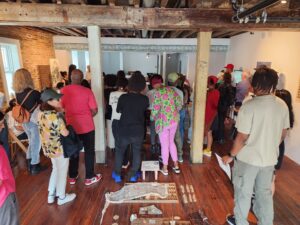
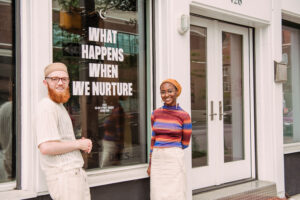
This exhibition, What Happens When We Nurture, features the work of 2022 artist fellows Suldano Abdiruhman, Tayyab Maqsood, Anysa Saleh, and Leili Arai Tavallaei, and will be on view through July 30. Cheatam and Flounders designed the exhibit to center on the work each artist developed as part of the Islam & Print cohort as they learned the techniques and processes of printmaking.
“We want people who come to the show to know that Islamic art is not monolithic. You’re not going to see much geometric patterning or Arabic calligraphy; it’s not that kind of show,” says Cheatam. “We don’t even really like to say Islamic art—it’s just Muslims making work. The goal is that they have a community where they can critique with artists who come from a similar understanding.”
 Cheatam and Flounders put the finishing touches on their show. (Marlayna Demond ’11/UMBC)
When Islam & Print initially launched, Cheatam and Flounders received applications from across the country, but ultimately decided to focus on artists in the DMV region for the first year. The size of the show and existing exhibition calendars initially presented a hurdle for finding a venue for What Happens When We Nurture, Cheatam says. But when they began talking with Black Artist Research Space founder Rhea Beckett—faculty with MICA’s Curatorial MFA program—things clicked into place.
“I’m very grateful and excited that we’ve gotten to this place,” says Cheatam. “At first I wasn’t going to pitch it to them because only one person in our cohort is Black and I didn’t want to disrupt the integrity of the space, but Rhea was open to it. She clarified that her space is open to making cultural connections between different races and ethnicities, and she was very interested to talk about the long and important history of Muslims in Baltimore.”
Left: Visitors enjoy the opening reception of What Happens When We Nurture. Photo by Timothy Nohe. Right: Cheatam and her husband and co-curator Dan Flounders outside their exhibit. (Marlayna Demond ’11/UMBC)
The Rhetoric of Apocalypse
After the exhibition closes, Cheatam and Flounders will begin planning the next cohort for Islam & Print. And while they plan, Cheatam will spend August and September as a fellow at Baltimore’s Waller Gallery, where she will produce a new, large body of work—larger than her current studio space can hold—based in the history of American apocalyptic religious messaging.
“We’ve been going to my husband’s family’s house in Allentown, Pennsylvania, and driving a lot of country roads. You see these Christian propaganda billboards, like ‘Jesus now before you die.’ And you know, I found that the Nation of Islam has a similar kind of rhetoric,” Cheatam says.
It’s a body of work that is still in development, so Cheatam is coy about what the end product will look like.
“No spoilers, but for this series I’m going to explore the imagery and texts from the Nation of Islam,” Cheatam says. “I’m interested in the history of literacy within Black Muslims in America, how design and literature is to Muslims. Because almost a third of the enslaved Africans brought here were Muslim, so there’s a rich history of literacy with Black Muslims in America that I want to investigate.”
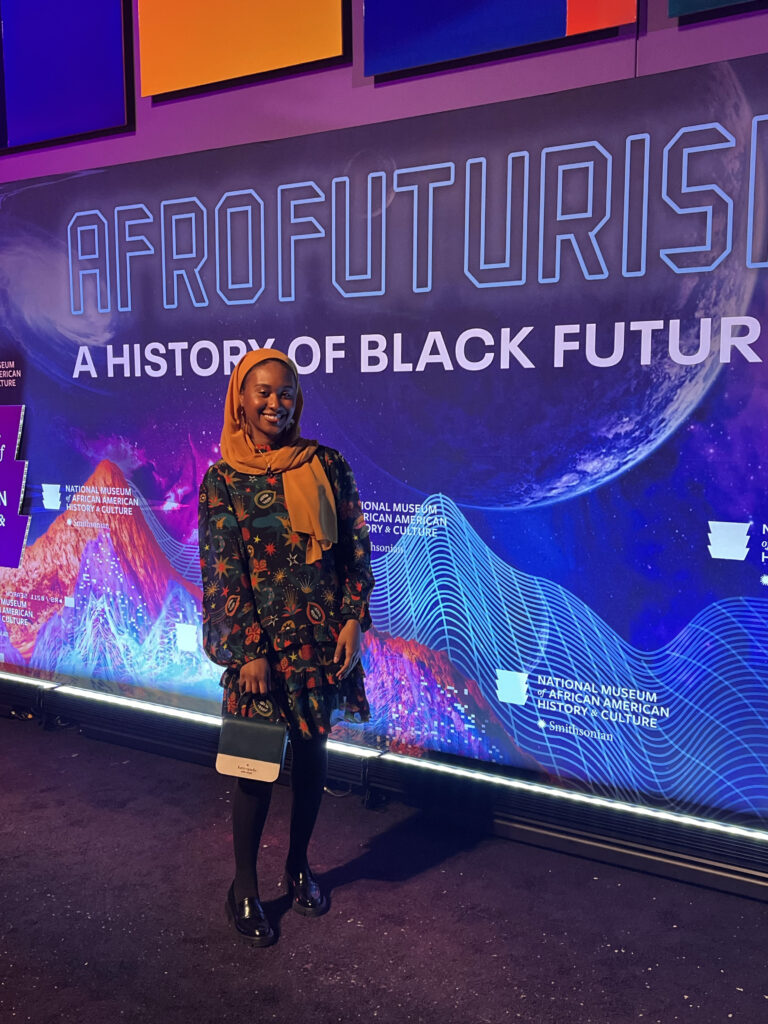 Cheatam at the opening reception of the Smithsonian’s National Museum of African American History and Culture exhibit Afrofuturism: A History of Black Futures, with which she assisted. Photo courtesy of Cheatam.
Cheatam began research for this new body of work delving into the archives of Muhammad Speaks, which was published between 1960 and 1975 as the official newspaper of the Nation of Islam.
“They’re very alarming in their speech sometimes, and I know they have a bad rap with a lot of people, but I really wanted to lean in and learn more about their messaging,” Cheatam says. “And one of the things I noticed about their newspapers is that their headlines are saying things that people, even non-Muslims, feel today.”
During her Waller Gallery fellowship, Cheatam will be making work investigating the underpinning of this messaging, filtering through the Mundane Afrofuturist lens that unites her work.
“I am a big sci-fi enthusiast, and I love disaster movies. I’m obsessed with apocalypses,” says Cheatam. “I like to see how people portray human nature in disaster times and look at how they answer questions like, do we help each other? Do we hurt each other? What does sustainability look like after the apocalypse? How are we taking care of each other?”
* * * * * * *
Learn more about Cheatam’s ongoing work.
Apply to UMBC’s Imaging and Digital Arts M.F.A. program.
]]>
Safiyah Cheatam, M.F.A. ’21, intermedia and digital arts, always has her hands in something. In just the past few years, the multidisciplinary conceptual artist has exhibited work at The...
https://umbc.edu/stories/afrofuturism-multimedia-artist-safiyah-cheatam/
https://my3.my.umbc.edu/api/v0/pixel/news/134430/guest@my.umbc.edu/367ffedd503fba70d337532823b86adf/api/pixel
alumni
cahss
graduateschool
imda
magazine
UMBC News & Magazine
https://my3.my.umbc.edu/groups/umbc-news-magazine
https://assets1-my.umbc.edu/system/shared/avatars/groups/000/001/943/24435aa6207c452e7bc15cc74b42c7bb/xsmall.png?1748556657
https://assets1-my.umbc.edu/system/shared/avatars/groups/000/001/943/24435aa6207c452e7bc15cc74b42c7bb/original.png?1748556657
https://assets2-my.umbc.edu/system/shared/avatars/groups/000/001/943/24435aa6207c452e7bc15cc74b42c7bb/xxlarge.png?1748556657
https://assets2-my.umbc.edu/system/shared/avatars/groups/000/001/943/24435aa6207c452e7bc15cc74b42c7bb/xlarge.png?1748556657
https://assets3-my.umbc.edu/system/shared/avatars/groups/000/001/943/24435aa6207c452e7bc15cc74b42c7bb/large.png?1748556657
https://assets1-my.umbc.edu/system/shared/avatars/groups/000/001/943/24435aa6207c452e7bc15cc74b42c7bb/medium.png?1748556657
https://assets2-my.umbc.edu/system/shared/avatars/groups/000/001/943/24435aa6207c452e7bc15cc74b42c7bb/small.png?1748556657
https://assets1-my.umbc.edu/system/shared/avatars/groups/000/001/943/24435aa6207c452e7bc15cc74b42c7bb/xsmall.png?1748556657
https://assets2-my.umbc.edu/system/shared/avatars/groups/000/001/943/24435aa6207c452e7bc15cc74b42c7bb/xxsmall.png?1748556657
UMBC News & Magazine
0
0
false
Thu, 27 Jul 2023 10:09:44 -0400
Thu, 27 Jul 2023 10:09:44 -0400
UMBC’s Achuth Padmanabhan to pursue promising ovarian cancer research with $1.5 million in grants
No one wants to receive a cancer diagnosis. Ovarian cancer can be particularly scary, because its vague symptoms make it difficult to detect early—and when caught late, after the cancer has already metastasized into nearby organs, the five-year survival rate of ovarian cancer is less than 30 percent.
However, if caught early, that number rises sharply to 90 percent, explains Achuth Padmanabhan, assistant professor of biological sciences. Padmanabhan, who received his Ph.D. from UMBC in 2011 and returned as a faculty member in 2019, has made it the mission of his long-term research program to improve these daunting statistics.
Padmanabhan’s research group, which includes graduate, undergraduate, and high school students, is revealing new potential treatment options by expanding understanding of the basic biology of ovarian cancer. Overall, “our goal is to eliminate ovarian cancer mortality,” he says.
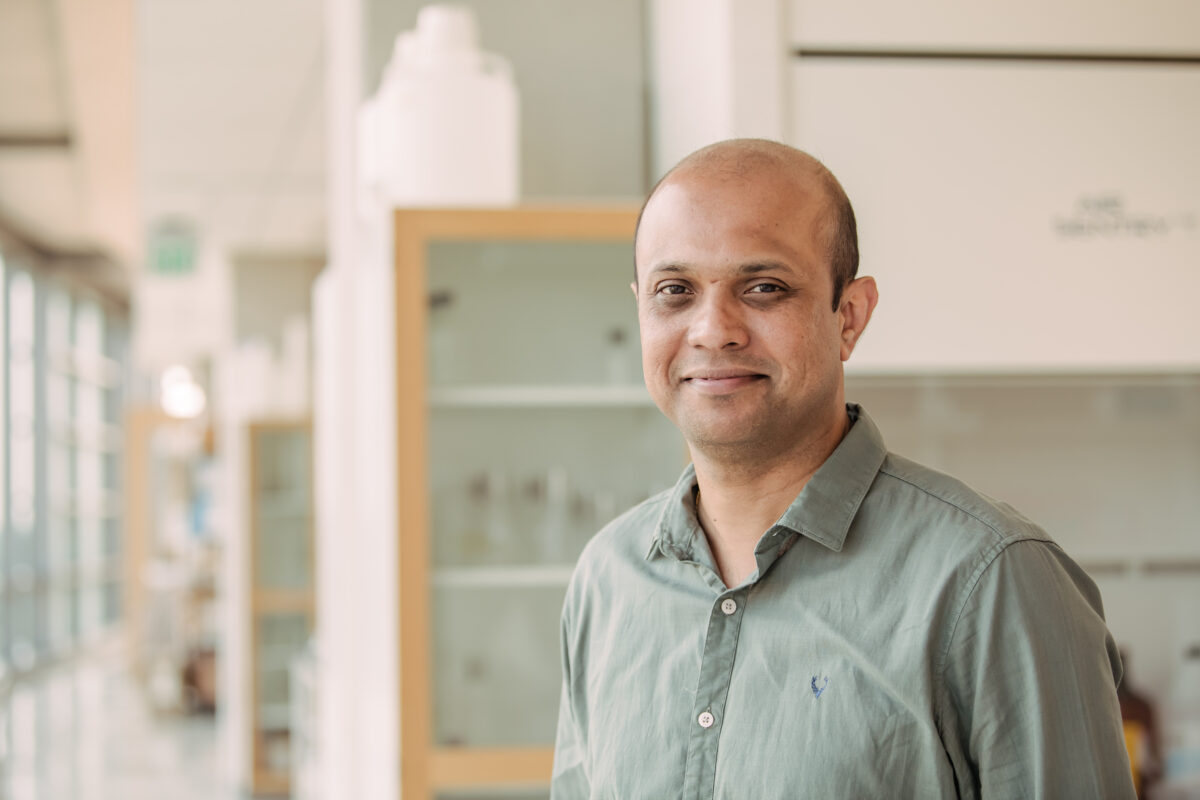 Achuth Padmanabhan in his laboratory. (Image by Marlayna Demond ’11/UMBC)
Starting this summer, Padmanabhan will be in an even stronger position to pursue that ambitious goal: He has received a two-year, $387,000 Ovarian Cancer Pilot Award and a four-year, $1.2 million Ovarian Cancer Academy Early-Career Award, both from the U.S. Department of Defense (DoD). In addition to funding, the Academy offers valuable opportunities for mentorship from leading ovarian cancer researchers, including Padmanabhan’s mentor le-Ming Shih, professor of gynecology and obstetrics at Johns Hopkins University. Workshops and training sessions with all Academy members also offer networking opportunities and exposure to the latest knowledge and techniques for fighting this life-threatening disease.
Opening doors to new treatment and diagnostic tools
Padmanabhan has already contributed to the understanding of how ovarian cancer progression is regulated, opening new avenues to developing treatments. His lab discovered that a protein called zinc finger protein 217, or ZNF217, is frequently present in unusually high amounts in ovarian cancer tumors and is associated with tumor growth, metastasis, and resistance to chemotherapy. “We believe it is central to driving metastasis,” Padmanabhan says.
Early data also suggest high levels of ZNF217 might cause changes in the chemical environment inside a tumor, which impacts how a patient responds to different therapeutics. “If we can reduce ZNF217 in tumor cells, there is the potential to extend the life of the patient and give other therapies a chance to work more effectively,” Padmanabhan explains.
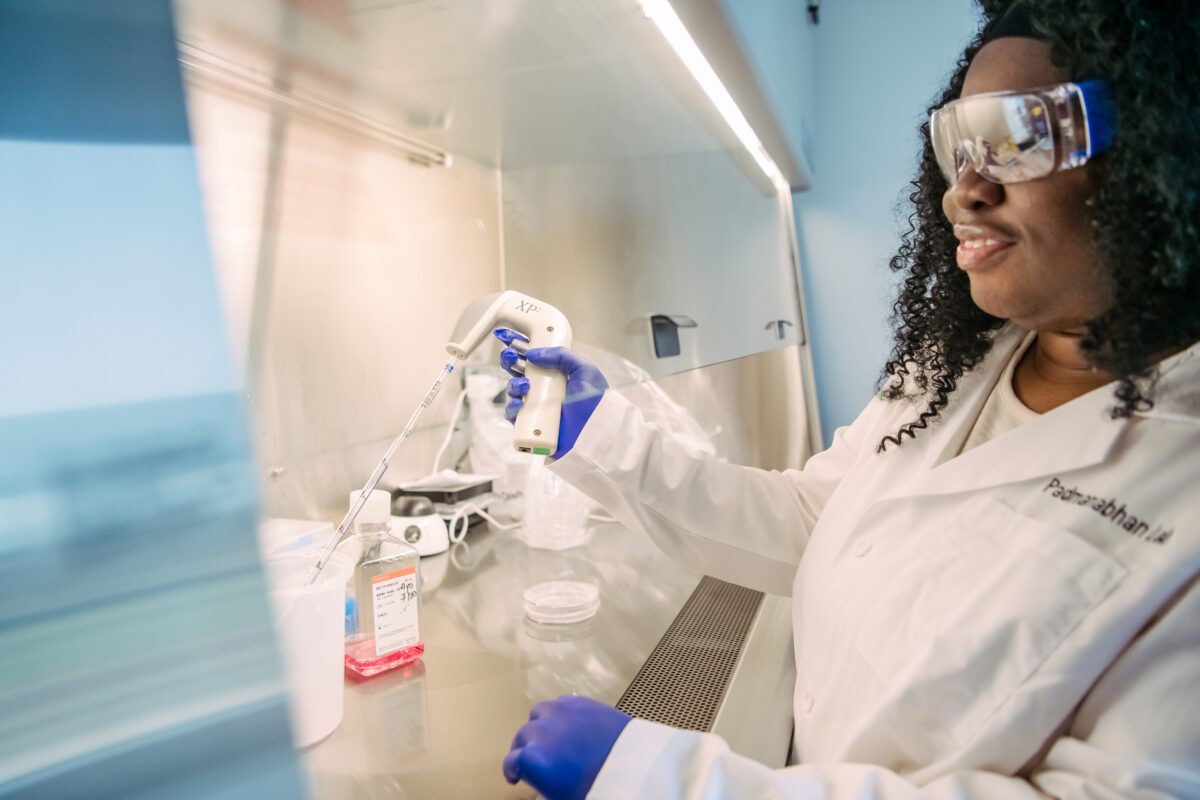 Ayo Ogunsanya, a Ph.D. student in Padmanabhan’s lab, works at a cell culture hood. (Image by Marlayna Demond ’11/UMBC)
With the new grant, Padmanabhan and his students will further explore the effects of ZNF217 on ovarian cancer progression, treatment resistance, and the environment inside tumors. If the lab can confirm its preliminary data about ZNF217’s significant role in ovarian cancer, they will then explore their hypotheses for how to reduce the amount of ZNF217 in cancer cells, thereby reducing its detrimental effects.
Overall, the work has the potential to significantly increase treatment options and improve outcomes for patients.
Exploring every angle
At the same time, the $387,000 Pilot Award will allow Padmanabhan’s team to test different combinations of existing cancer drugs in cell lines and in mice. Some of these drugs target a tumor suppressor protein called p53. In cancer cells, p53 is frequently mutated in such a way that it helps the tumor grow rather than suppressing it. In the most lethal version of ovarian cancer, p53 is mutated more than 96 percent of the time, Padmanabhan explains.
“We think the new drug combinations will more effectively target mutated p53, and because the drugs are already approved for use in cancer patients, effective new combinations could be translated to the clinic more quickly,” Padmanabhan says.
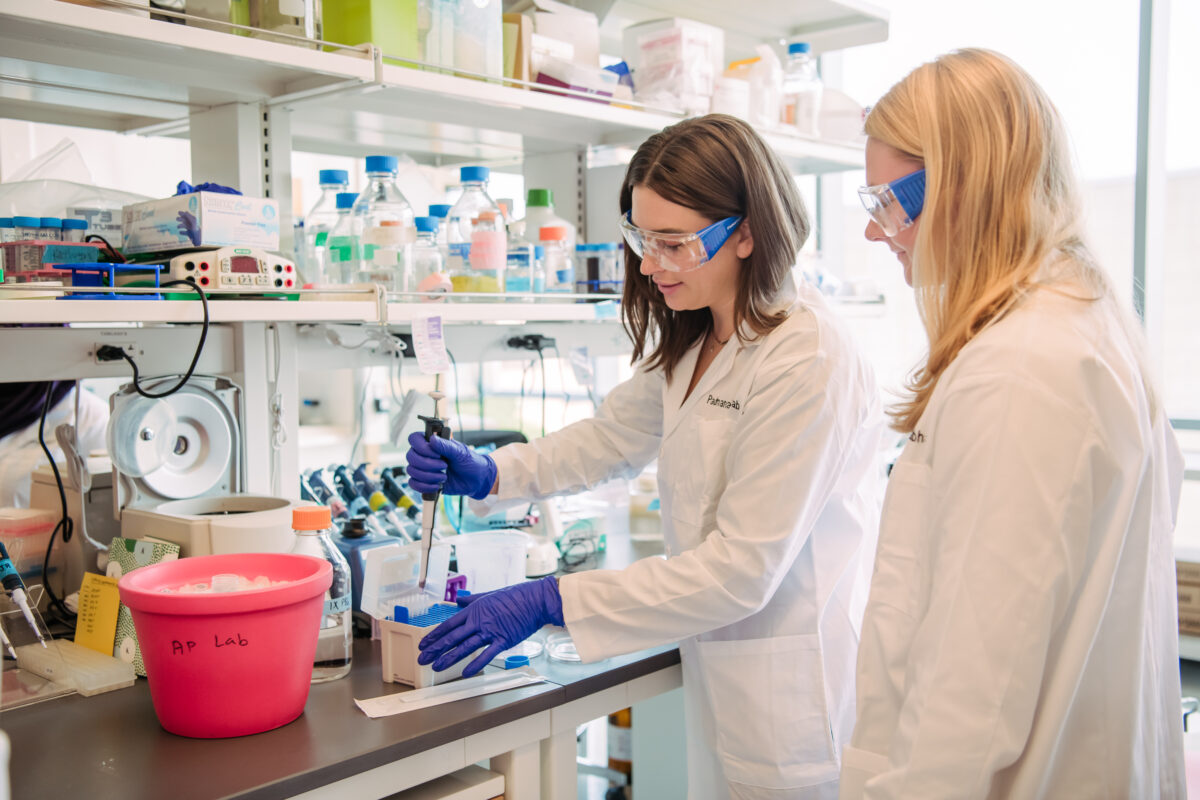 Kathryn Wardrup (left), a fourth-year Ph.D. student with Padmanabhan, was instrumental in collecting data that led to the group’s new Academy grant. Here she works with Jessica Hoffman ’26, biological sciences in the laboratory. (Image by Marlayna Demond ’11/UMBC)
The work for both new grants builds on support Padmanabhan previously received, which includes internal sources at UMBC. UMBC’s Alex Brown Center for Entrepreneurship CENTRE Funding Initiative, the UMBC Technology Catalyst Fund, and the Accelerated Translational Incubator Pilot (a joint grant program between University of Maryland, Baltimore and UMBC), as well as external funders like the Rivkin Foundation and Elsa U. Pardee Foundation, have supported Padmanabhan’s work. “All of this support got us to the DoD grant,” he says.
It takes a team
Padmanabhan is a strong believer in involving students in research, and his lab’s new projects will be no exception. The grant will allow him to hire another postdoctoral fellow, and there are currently several graduate and undergraduate students in the lab who will contribute their energy to this work. Dedicated high school students are also welcome. He gives every lab member an independent project, and several have made key contributions that got the lab to the place it is now.
Kathryn Wardrup, a fourth-year Ph.D. student in Padmanabhan’s lab, generated the bulk of the data that led to the Academy grant. Noel Amadu, M.S. ’20, applied molecular biology, and Megha Pandya, M.S. ’21, applied molecular biology, generated data that led to the DoD Pilot Award. Amadu is in the third-year of his Ph.D., and Pandya is in her first year—although she previously worked with Padmanabhan in the applied molecular biology program and then as a laboratory technician.
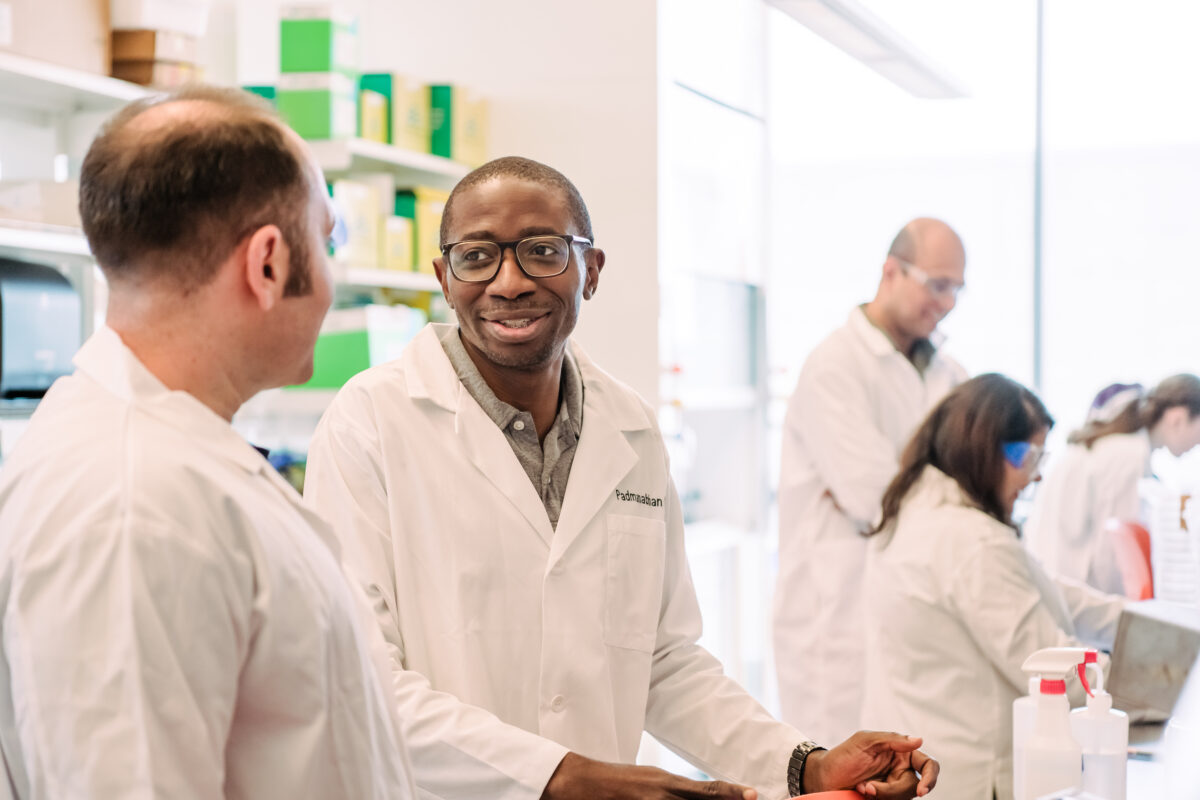 Work by Noel Amadu, center left, and Megha Pandya (right, blue goggles) conducted experiments that led to the Pilot Award. Here Amadu talks with research assistant Joseph Lobianco, and Pandya works at the bench with Padmanabhan. (Image by Marlayna Demond ’11/UMBC)
“It’s important for students to realize how challenging and rewarding research can be,” Padmanabhan says, “and it’s most rewarding when you have something you can call yours.”
Having a large team will help the group make progress on several scientific questions at once. “All of our previous work is coming together in these new grants,” Padmanabhan says. While it is still early days in their line of research, there is high potential for it to translate to clinical trials later on and have a major impact on the future of ovarian cancer treatment—which is Padmanabhan’s overarching goal.
“There’s a lot that needs to be understood at the basic science level that will hopefully allow us to translate it someday,” Padmanabhan says. “I guess that’s every person’s dream—you just want to help people.”
]]>
No one wants to receive a cancer diagnosis. Ovarian cancer can be particularly scary, because its vague symptoms make it difficult to detect early—and when caught late, after the cancer has...
https://umbc.edu/stories/promising-ovarian-cancer-research-grants/
https://my3.my.umbc.edu/api/v0/pixel/news/134422/guest@my.umbc.edu/a58d8a245b009c1e475481bc2ce5532e/api/pixel
biology
cnms
gradresearch
graduateschool
news
rca-1
research
science-and-tech
UMBC News & Magazine
https://my3.my.umbc.edu/groups/umbc-news-magazine
https://assets1-my.umbc.edu/system/shared/avatars/groups/000/001/943/24435aa6207c452e7bc15cc74b42c7bb/xsmall.png?1748556657
https://assets1-my.umbc.edu/system/shared/avatars/groups/000/001/943/24435aa6207c452e7bc15cc74b42c7bb/original.png?1748556657
https://assets2-my.umbc.edu/system/shared/avatars/groups/000/001/943/24435aa6207c452e7bc15cc74b42c7bb/xxlarge.png?1748556657
https://assets2-my.umbc.edu/system/shared/avatars/groups/000/001/943/24435aa6207c452e7bc15cc74b42c7bb/xlarge.png?1748556657
https://assets3-my.umbc.edu/system/shared/avatars/groups/000/001/943/24435aa6207c452e7bc15cc74b42c7bb/large.png?1748556657
https://assets1-my.umbc.edu/system/shared/avatars/groups/000/001/943/24435aa6207c452e7bc15cc74b42c7bb/medium.png?1748556657
https://assets2-my.umbc.edu/system/shared/avatars/groups/000/001/943/24435aa6207c452e7bc15cc74b42c7bb/small.png?1748556657
https://assets1-my.umbc.edu/system/shared/avatars/groups/000/001/943/24435aa6207c452e7bc15cc74b42c7bb/xsmall.png?1748556657
https://assets2-my.umbc.edu/system/shared/avatars/groups/000/001/943/24435aa6207c452e7bc15cc74b42c7bb/xxsmall.png?1748556657
UMBC News & Magazine
3
0
false
Wed, 26 Jul 2023 17:54:17 -0400
Wed, 26 Jul 2023 17:54:17 -0400