To You – Fall 2013

 I ride UMBC Transit to work every day.
Yes, I’m likely helping reduce UMBC’s carbon footprint by doing so. But what I have found over the five years that I’ve been a rider is that the feeling of virtuousness is outweighed by the camaraderie I’ve found with my fellow riders.
For a little over four years, I battled the commute by DC Metro and MARC train with the hardy group of souls who ride the Halethorpe Line and the BWI/MARC Line. Students, faculty and staff together – braving the blustery winds at the Halethorpe MARC station, or the crowded trains and inevitable commuting delays.
When I moved closer to UMBC late in 2012, I switched over to the Catonsville Line and the Arbutus Line. These lines primarily serve the off-campus housing near the university – and the eager chatter of students in multiple languages reminds me not only how diverse our campus is, but just how far many people travel to get a UMBC education.
This issue of UMBC Magazine takes sustainability as its theme. One thing that has surprised me as we have assembled this issue is how hard the university is working to overcome the history and geography that made UMBC a primarily commuter campus through much of its existence. The campus is becoming more of a community as its residential student population grows. There are more ways than ever to get to campus without being one person in one car. And the university is also coordinating efforts to become more ecologically friendly in how we dispose of our waste, heat our classrooms and offices, and construct new buildings to more exacting environmental standards.
Another surprise has been the scope of research on campus devoted to sustainability. We’ve tackled some of this research in previous issues of UMBC Magazine, but had no problem filling more than half of the space we normally allot to features with stories about the ways that UMBC faculty are pondering just how to make our city and our planet a greener place.
The magazine that you hold in your hand is also playing its part in UMBC’s sustainability efforts. Before the first issue of UMBC Magazine was published, the university decided that it would be printed on paper that was at least 50 percent postconsumer recycled (Roland Cascades Opaque). According to our suppliers, the use of this paper preserves trees (139), cuts down on the creation of solid waste (6,542 pounds worth) and prevents the release of 12, 882 pounds of net greenhouse gases.
We hope you enjoy this issue of UMBC Magazine! And perhaps enjoy it more knowing the efforts we are making to harmonize its production with UMBC’s goals to be a greener university.
— Richard Byrne ’86
]]>
I ride UMBC Transit to work every day. Yes, I’m likely helping reduce UMBC’s carbon footprint by doing so. But what I have found over the five years that I’ve been a rider is that the feeling of...
https://umbc.edu/stories/to-you-fall-2013/
https://my3.my.umbc.edu/api/v0/pixel/news/123058/guest@my.umbc.edu/49e699d07ac1b341beff861feb975899/api/pixel
fall-2013
green-issue
perspectives
UMBC News & Magazine
https://my3.my.umbc.edu/groups/umbc-news-magazine
https://assets1-my.umbc.edu/system/shared/avatars/groups/000/001/943/24435aa6207c452e7bc15cc74b42c7bb/xsmall.png?1748556657
https://assets1-my.umbc.edu/system/shared/avatars/groups/000/001/943/24435aa6207c452e7bc15cc74b42c7bb/original.png?1748556657
https://assets2-my.umbc.edu/system/shared/avatars/groups/000/001/943/24435aa6207c452e7bc15cc74b42c7bb/xxlarge.png?1748556657
https://assets2-my.umbc.edu/system/shared/avatars/groups/000/001/943/24435aa6207c452e7bc15cc74b42c7bb/xlarge.png?1748556657
https://assets3-my.umbc.edu/system/shared/avatars/groups/000/001/943/24435aa6207c452e7bc15cc74b42c7bb/large.png?1748556657
https://assets1-my.umbc.edu/system/shared/avatars/groups/000/001/943/24435aa6207c452e7bc15cc74b42c7bb/medium.png?1748556657
https://assets2-my.umbc.edu/system/shared/avatars/groups/000/001/943/24435aa6207c452e7bc15cc74b42c7bb/small.png?1748556657
https://assets1-my.umbc.edu/system/shared/avatars/groups/000/001/943/24435aa6207c452e7bc15cc74b42c7bb/xsmall.png?1748556657
https://assets2-my.umbc.edu/system/shared/avatars/groups/000/001/943/24435aa6207c452e7bc15cc74b42c7bb/xxsmall.png?1748556657
UMBC News & Magazine
0
0
false
Thu, 26 Sep 2013 19:37:29 -0400
Zip and Volt
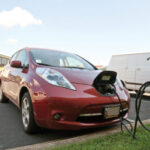
Transportation counts for more than one third of UMBC’s carbon footprint, so getting more students, faculty and staff to campus with fewer vehicles is high on the university’s sustainability agenda.
The university has a dedicated system of commuter buses serving surrounding communities (UMBC Transit), but a campus initiative called Transportation Alternatives for a Greener UMBC (TAG UMBC) now offers alternatives to single passenger commuting that make driving to the university a greener experience as well.
TAG UMBC works alongside the Climate Change Taskforce, specifically the Transportation Workgroup chaired by Julianne Simpson, the university’s assistant director for planning .
“The taskforce has different initiatives to reduce pollution and emissions,” says Simpson. “Transportation has been the most active because it’s something that’s tangible.”
One TAG UMBC initiative was to place two electric car-charging stations in the Stadium Parking Lot. The stations, installed in October 2011, were funded by the Baltimore Electric Vehicle Initiative (BEVI) and are free and open to use by the entire UMBC community.
TAG UMBC also sponsors a carpooling program with Parking Services and Off-Campus Student Services. Participants are matched with other individuals who live nearby – and carpool drivers receive a special parking permit that allows them to park closer to campus as an incentive.
The most popular of TAG UMBC’s green alternatives is Zipcar, which has been in place since May 2011. The service allows students—and even faculty and staff—to rent one of two campus Zipcars for personal use. According to Lena Salins ’13, theatre and anthropology, Zipcar is a great resource for residential students without cars on campus.
“I had opted not to get a meal plan senior year since my apartment on campus had a full kitchen, but I had no way to get to the grocery store,” says Salins. “Zipcar was really useful for those short trips I couldn’t have made otherwise.”
Simpson hopes that bringing greater visibility to TAG UMBC initiatives will make the campus community reflect on the impact their vehicles have on the environment – and create support for future green transportation alternatives, such as the bike share program that is currently in the works.
“It’s all about implementing a system of awareness,” says Simpson. “That’s the key to greener transportation at UMBC.”
– Laura Lefavor ’13
]]>
Transportation counts for more than one third of UMBC’s carbon footprint, so getting more students, faculty and staff to campus with fewer vehicles is high on the university’s sustainability...
https://umbc.edu/stories/zip-and-volt/
https://my3.my.umbc.edu/api/v0/pixel/news/123064/guest@my.umbc.edu/bf934566ad080324bebf519bc476672e/api/pixel
discovery
fall-2013
green-issue
UMBC News & Magazine
https://my3.my.umbc.edu/groups/umbc-news-magazine
https://assets1-my.umbc.edu/system/shared/avatars/groups/000/001/943/24435aa6207c452e7bc15cc74b42c7bb/xsmall.png?1748556657
https://assets1-my.umbc.edu/system/shared/avatars/groups/000/001/943/24435aa6207c452e7bc15cc74b42c7bb/original.png?1748556657
https://assets2-my.umbc.edu/system/shared/avatars/groups/000/001/943/24435aa6207c452e7bc15cc74b42c7bb/xxlarge.png?1748556657
https://assets2-my.umbc.edu/system/shared/avatars/groups/000/001/943/24435aa6207c452e7bc15cc74b42c7bb/xlarge.png?1748556657
https://assets3-my.umbc.edu/system/shared/avatars/groups/000/001/943/24435aa6207c452e7bc15cc74b42c7bb/large.png?1748556657
https://assets1-my.umbc.edu/system/shared/avatars/groups/000/001/943/24435aa6207c452e7bc15cc74b42c7bb/medium.png?1748556657
https://assets2-my.umbc.edu/system/shared/avatars/groups/000/001/943/24435aa6207c452e7bc15cc74b42c7bb/small.png?1748556657
https://assets1-my.umbc.edu/system/shared/avatars/groups/000/001/943/24435aa6207c452e7bc15cc74b42c7bb/xsmall.png?1748556657
https://assets2-my.umbc.edu/system/shared/avatars/groups/000/001/943/24435aa6207c452e7bc15cc74b42c7bb/xxsmall.png?1748556657
UMBC News & Magazine
0
0
false
Thu, 26 Sep 2013 19:26:33 -0400
Raising the Roof
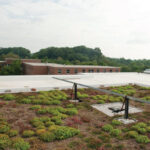
Want to see UMBC’s sustainable future? Just make your way to the roof of Patapsco Hall – where efforts make UMBC greener are intersecting with pedagogy and academic research.
A recent $16.5 million renovation and addition to the residence hall – designed by Newman Architects and built by KBE Building Corporation – recently received a Leadership in Energy and Environmental Design (LEED) Gold certification. It is the first building on campus to receive this designation.
One of the key features in obtaining this certification is Patapsco Hall’s “green roof.” These green roofs are important elements of sustainable design since they help reduce storm water runoff that is key cause of pollution in the Chesapeake Bay and in other local streams and rivers. Rooftop vegetation helps to insulate the building, reducing energy consumption. Vegetated surfaces also improve air quality and capture the greenhouse gas carbon dioxide.
Patapsco Hall’s green roof is also the platform for a research project focusing on sustainable design and construction. The green roof is paired with an identically-sized control area. Each area features dedicated drainage systems and rainwater quantity and quality measurement devices.
Andrew J. Miller, a professor in UMBC’s geography and environmental systems department, says that the data generated by the system will document storm water retention and monitor runoff from both portions of the roof, allowing comparisons in terms of quantity and quality. Storm water retention totals and storm hydrographs are displayed in real-time in the building’s lobby – and Miller plans incorporate the data into his classes.
When I teach hydrology, I always have the students access real data from local USGS stream gages as well as rainfall data from nearby sources,” he observes. “One of the best ways to assess [green roofs’] effectiveness is to have monitoring sites side by side on the same roof, comparing how much water runs off the traditional roof compared with the green roof. Having such a monitoring site right here on campus collecting information in real time presents a great educational opportunity.”
The LEED rating system was developed by the U.S. Green Building Council (USGBC) in 2000 and provides verification that a building was designed and built using aspects of efficient environmental health conservation strategies. Certifications of Silver, Gold, and Platinum recognizes varying levels of design and performance in areas including sustainable site development, water savings, energy efficiency, materials selection, and indoor environmental quality.
The push for new LEED designated sites at UMBC is not limited to Patapsco. The university’s Performing Arts and Humanities Building has been awarded a LEED Silver designation. Its sustainable features include a rainwater harvesting system (for on-site irrigation), use of pervious concrete sidewalks and a white roof which will reduce the building’s urban heat island effect.
– Chelsea Haddaway
]]>
Want to see UMBC’s sustainable future? Just make your way to the roof of Patapsco Hall – where efforts make UMBC greener are intersecting with pedagogy and academic research. A recent $16.5...
https://umbc.edu/stories/raising-the-roof/
https://my3.my.umbc.edu/api/v0/pixel/news/123065/guest@my.umbc.edu/76639baff49d9dcfdf906a5f620a5f1f/api/pixel
discovery
fall-2013
green-issue
UMBC News & Magazine
https://my3.my.umbc.edu/groups/umbc-news-magazine
https://assets1-my.umbc.edu/system/shared/avatars/groups/000/001/943/24435aa6207c452e7bc15cc74b42c7bb/xsmall.png?1748556657
https://assets1-my.umbc.edu/system/shared/avatars/groups/000/001/943/24435aa6207c452e7bc15cc74b42c7bb/original.png?1748556657
https://assets2-my.umbc.edu/system/shared/avatars/groups/000/001/943/24435aa6207c452e7bc15cc74b42c7bb/xxlarge.png?1748556657
https://assets2-my.umbc.edu/system/shared/avatars/groups/000/001/943/24435aa6207c452e7bc15cc74b42c7bb/xlarge.png?1748556657
https://assets3-my.umbc.edu/system/shared/avatars/groups/000/001/943/24435aa6207c452e7bc15cc74b42c7bb/large.png?1748556657
https://assets1-my.umbc.edu/system/shared/avatars/groups/000/001/943/24435aa6207c452e7bc15cc74b42c7bb/medium.png?1748556657
https://assets2-my.umbc.edu/system/shared/avatars/groups/000/001/943/24435aa6207c452e7bc15cc74b42c7bb/small.png?1748556657
https://assets1-my.umbc.edu/system/shared/avatars/groups/000/001/943/24435aa6207c452e7bc15cc74b42c7bb/xsmall.png?1748556657
https://assets2-my.umbc.edu/system/shared/avatars/groups/000/001/943/24435aa6207c452e7bc15cc74b42c7bb/xxsmall.png?1748556657
UMBC News & Magazine
0
0
false
Thu, 26 Sep 2013 19:25:16 -0400
Passing the Sniff Test
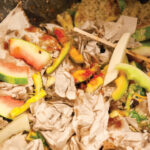
Most people stop thinking about their trash once they toss it in a bin. But with composting, the bin is only the beginning.
“Composting is a way to make food waste into new food growth,” explains Madeline Hall ’12, geography and environmental systems, who was a key player in establishing a composting program at UMBC. “It’s a way to bring the process full circle.”
Even before she became a Student Government Association sustainability intern in 2011, Hall was working to show that composting was something students really wanted. But before composting could become a part of UMBC’s sustainability efforts, Hall needed to forge a new relationship between the university (which oversees campus waste disposal) and Chartwells (which holds the university’s catering contract). And because UMBC’s Campus Card Office oversees the Chartwells contract, it also became involved with compost planning.
Angie Hammerbacher, manager of the Campus Card Office, worked with Hall to sort out the logistics of composting on a large scale. “It’s just the natural direction UMBC was going in,” says Hammerbacher. “The community understood that something needed to be done to promote sustainability on campus, and composting was one of the ways we could do that.”
Because of UMBC’s size, the accumulated waste needs to be taken off campus to be composted. So the university signed a contract with Waste Neutral to do so, and composting was introduced into the True Grits dining hall in July 2011.
True Grits employees are trained to recognize compostable material, which includes not only food waste but also paper products without a plastic coating. This waste is taken to a special dumpster outside the dining hall, which is emptied by the contractors twice per week.
UMBC’s composting is carried out almost completely behind the scenes, so student advocacy is a key element in building a constituency for the effort. Brent Mattox ’13, computer science, continued Hall’s efforts when he took on the sustainability intern post last year.
“At the end of the day, our success is all about outreach,” says Mattox. “It starts with the students—if people see that we really want it, they’ll start to make the changes too.”
Mattox organized composting at large campus events such as Quadmania and EcoFest to help advertise the program. He also helped implement an extension of UMBC’s composting program to The Commons in February.
To date, 107.77 tons of waste has been composted at UMBC between the dining hall, The Commons and campus events.
“Composting at UMBC is unique because so many people have to come together to make it happen,” says Hall. “And to do that at a time when resources could easily be allocated elsewhere—that really shows our campus’ commitment to sustainable actions.”
– Laura Lefavor’13
]]>
Most people stop thinking about their trash once they toss it in a bin. But with composting, the bin is only the beginning. “Composting is a way to make food waste into new food growth,”...
https://umbc.edu/stories/passing-the-sniff-test/
https://my3.my.umbc.edu/api/v0/pixel/news/123066/guest@my.umbc.edu/a55e5ba83c48ceb0227eb9e7ce8ec7ba/api/pixel
discovery
fall-2013
green-issue
UMBC News & Magazine
https://my3.my.umbc.edu/groups/umbc-news-magazine
https://assets1-my.umbc.edu/system/shared/avatars/groups/000/001/943/24435aa6207c452e7bc15cc74b42c7bb/xsmall.png?1748556657
https://assets1-my.umbc.edu/system/shared/avatars/groups/000/001/943/24435aa6207c452e7bc15cc74b42c7bb/original.png?1748556657
https://assets2-my.umbc.edu/system/shared/avatars/groups/000/001/943/24435aa6207c452e7bc15cc74b42c7bb/xxlarge.png?1748556657
https://assets2-my.umbc.edu/system/shared/avatars/groups/000/001/943/24435aa6207c452e7bc15cc74b42c7bb/xlarge.png?1748556657
https://assets3-my.umbc.edu/system/shared/avatars/groups/000/001/943/24435aa6207c452e7bc15cc74b42c7bb/large.png?1748556657
https://assets1-my.umbc.edu/system/shared/avatars/groups/000/001/943/24435aa6207c452e7bc15cc74b42c7bb/medium.png?1748556657
https://assets2-my.umbc.edu/system/shared/avatars/groups/000/001/943/24435aa6207c452e7bc15cc74b42c7bb/small.png?1748556657
https://assets1-my.umbc.edu/system/shared/avatars/groups/000/001/943/24435aa6207c452e7bc15cc74b42c7bb/xsmall.png?1748556657
https://assets2-my.umbc.edu/system/shared/avatars/groups/000/001/943/24435aa6207c452e7bc15cc74b42c7bb/xxsmall.png?1748556657
UMBC News & Magazine
0
0
false
Thu, 26 Sep 2013 19:23:52 -0400
A Greener UMBC?
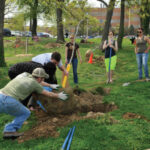
When UMBC President Freeman A. Hrabowski, III, signed the American College & University Presidents’ Climate Commitment in 2007, he took the first step to put UMBC on the path to a more sustainable future.
Tanvi Gadhia ’09, geography and environmental systems, has the job of assessing UMBC’s progress in making its goal of becoming climate neutral and helping push the university to get there even more quickly.
Gadhia was hired last year as UMBC’s first environmental sustainability coordinator. As a student, she led groups including UMBC Students for Environmental Awareness and the Maryland Student Climate Coalition – raising awareness about the issue of climate change and advocating for change.
In her new job, Gadhia coordinates the sustainability efforts across the entire campus, tracking the university’s movement toward its climate targets and increasing community awareness of those goals.
Coordination is necessary because of the diverse groups working under the umbrella of UMBC’s Climate Change Task Force. Larger initiatives such as reducing energy consumption on campus, providing greener alternatives to single-person commuting and managing the university’s parking resources are being led by various administrative departments at the university.
Yet the push for a greener UMBC isn’t just coming from the top down. “A lot of the progress that we’re seeing is from grassroots initiatives,” Gadhia says. A composting proposal was created and led by UMBC students. And UMBC faculty members are pursuing new research to create a sustainable future as they organize workshops to weave climate issues into the curriculum.
Gadhia was especially inspired by a June workshop specifically designed to brainstorm ways to integrate sustainability into courses across the university. “There was representation across so many different disciplines,” she says. “Having faculty from environmental engineering and political science in the same room, and seeing all these different lenses through which we can view the issue. There was interest in even more collaboration across those boundaries – and a desire to link up research efforts and classroom efforts.”
These combined efforts have already had a tangible effect on UMBC’s push for climate neutrality. “As of the most recent reporting, we have reduced our carbon footprint by 13.3 percent since 2007,” Gadhia says. The university’s goal is to reduce such emissions by 15 percent by 2015 and by 25 percent by 2020.
Other numbers also show progress. The rate at which UMBC recycles has more than doubled since 2008, from 20.1 percent to 40.4 percent. And a $5 million chilled water optimization project across the campus’s heating and cooling systems will reduce UMBC’s climate footprint by another 3.5 percent.
“The percentage of the energy that we purchase from renewable energy sources like solar and wind is now 20 percent,” Gadhia observes.
Ask Gadhia where UMBC struggles most to make positive changes, and she says “transportation definitely moves to the forefront of my mind. Being situated in the suburbs, we exist in a very automobile-dependent culture.”
Gadhia points to carpooling as one area where grassroots momentum toward more sustainable practices is being accelerated with university support – including providing carpoolers with preferential parking spots on campus.
“In recent surveys we started asking how many people are casually carpooling,” Gadhia says. “We found that many, many people have set up their own carpooling systems independently so what we’re doing is we’re strategizing ways to help facilitate and foster that.”
UMBC is making other efforts to reduce single-passenger commuting. “We have new bus stop shelters that are solar powered,” she says, “and the [Maryland Transit Authority] buses are stopping here now. We have improved UMBC Transit in so many ways. We’ve upgraded the shuttle vehicles so that they’re more efficient and more appealing. And we’ve done research to determine where everyone lives and optimal routes that our buses can serve.”
Gadhia is intent on making every member of the UMBC community aware of their ability to help address the climate crisis.
“We have a huge untapped opportunity to raise awareness on simple things each and every one of us can do,” she says. “Creating a culture where we don’t walk around campus and see classrooms, conference rooms and common rooms where lights are left on all night every night. We can make a huge dent doing simple things.”
UMBC’s successes so far – and the collaborative spirit in which they have been achieved – also inspire the woman in charge of guiding the university’s efforts.
“I have been really kind of pleasantly surprised at how rapidly things happen,” Gadhia says. “If an idea comes up, how quickly that idea actually takes root and actually is implemented. A lot of the things that have been really successful have been things that build community and bring people together. We are laying the groundwork for substantial infrastructure changes by creating a strong, vibrant, active, and very engaged community of people who will support making major changes happen.”
– Richard Byrne ’86
]]>
When UMBC President Freeman A. Hrabowski, III, signed the American College & University Presidents’ Climate Commitment in 2007, he took the first step to put UMBC on the path to a more...
https://umbc.edu/stories/a-greener-umbc/
https://my3.my.umbc.edu/api/v0/pixel/news/123067/guest@my.umbc.edu/10e7c9b40436950c626f40d8467cddb0/api/pixel
discovery
fall-2013
green-issue
UMBC News & Magazine
https://my3.my.umbc.edu/groups/umbc-news-magazine
https://assets1-my.umbc.edu/system/shared/avatars/groups/000/001/943/24435aa6207c452e7bc15cc74b42c7bb/xsmall.png?1748556657
https://assets1-my.umbc.edu/system/shared/avatars/groups/000/001/943/24435aa6207c452e7bc15cc74b42c7bb/original.png?1748556657
https://assets2-my.umbc.edu/system/shared/avatars/groups/000/001/943/24435aa6207c452e7bc15cc74b42c7bb/xxlarge.png?1748556657
https://assets2-my.umbc.edu/system/shared/avatars/groups/000/001/943/24435aa6207c452e7bc15cc74b42c7bb/xlarge.png?1748556657
https://assets3-my.umbc.edu/system/shared/avatars/groups/000/001/943/24435aa6207c452e7bc15cc74b42c7bb/large.png?1748556657
https://assets1-my.umbc.edu/system/shared/avatars/groups/000/001/943/24435aa6207c452e7bc15cc74b42c7bb/medium.png?1748556657
https://assets2-my.umbc.edu/system/shared/avatars/groups/000/001/943/24435aa6207c452e7bc15cc74b42c7bb/small.png?1748556657
https://assets1-my.umbc.edu/system/shared/avatars/groups/000/001/943/24435aa6207c452e7bc15cc74b42c7bb/xsmall.png?1748556657
https://assets2-my.umbc.edu/system/shared/avatars/groups/000/001/943/24435aa6207c452e7bc15cc74b42c7bb/xxsmall.png?1748556657
UMBC News & Magazine
0
0
false
Thu, 26 Sep 2013 19:22:47 -0400
Green Future: The Long View
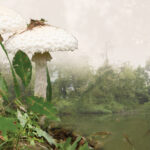
Climate change created by human activity is seen as a relatively recent phenomenon. But is it?
There is general agreement that we now live in an epoch called the Anthropocene (or “the Age of Man”), in which there has been a new and accelerating human impact on Earth’s ecology due to industrial civilization.
Many scientists peg the era’s starting point as 50, or perhaps 250, years ago. But Erle Ellis, a professor of geography and environmental systems at UMBC, is among those who argue that the Anthropocene wasn’t born yesterday.
“Human engineering of ecosystems, which changed the biosphere at globally significant levels in order to sustain human populations, likely began 3,000 years ago or earlier,” he says.
Long before the emergence of agriculture, Ellis explains, human populations had adapted to denser populations by increasing the productivity of their land use systems, burning forests to attract game, consuming broader diets, and propagating favored species. The emergence of agriculture only continued the trend.
“We have been pushing past natural limits as long as we have been a species,” he observes.
Ellis and other colleagues have been publishing about the extended Anthropocene era and its possible implications in journals including Proceedings of the National Academy of Sciences and Trends in Ecology and Evolution.
Some of the ripple effects from taking a longer view of the Anthropocene may be surprising. Ellis observes that rises in agricultural productivity mean that humans are using far less land per person than even a century ago. As populations level off and concentrate within cities, land is increasingly being returned to other species- a process that might ultimately allow biodiversity to recover worldwide.
Widening the time frame through which we examine human effects on the biosphere and climate offers a very different view of the planetary changes we humans are responsible for.
Some observers, for instance, frame the question of global environmental change as a recent crisis: are humans now causing changes in Earth’s ecosystems that might soon trigger a global tipping point? Is the Anthropocene biosphere accelerating towards a point of no return?
While global tipping points can be difficult to recognize, Ellis points out, ecological tipping points at the local level are well studied.
“If you add nutrients to a lake,” he explains, “it will continue on as before until you surpass a certain level of nutrients. Then the lake’s ecosystem will suddenly shift to a new state – it will have reached its tipping point. The lake will go from having very clear water to very turbid water, the kinds of fish will change and the chemistry and the ecology of the lake will change almost completely. It is then very hard to get that lake back into its previous state.”
Such a planetary tipping point in Earth’s ecosystems might occur if systems across the planet responded to the same human pressures in similar ways, or if there were strong connections across continents and ecosystems that enabled ecological responses to be transmitted rapidly across the planet. Yet Ellis and other researchers have shown that there is virtually no precedent or current evidence for such processes in the Earth system.
Our planet’s animals, plants, microbes and ecosystems are greatly limited in their ability to interact at global scales by distance and barriers such as oceans and mountain ranges, and their responses to human pressures, including rapid climate change, depend largely on local conditions. As a result, even rapid changes in global climate are unlikely to produce a coherent global shift in ecology because local ecosystems respond so differently to changes in climate and other human pressures.
“Essentially, local changes aren’t acting to push each other over the edge, as is the case with tipping points,” Ellis says. “They are simply adding up to cause long-term global changes in ecology.” His work on long-term human changes in the terrestrial biosphere shows clearly that while these changes are massive, they have been sustained for millennia. While recent changes are more rapid and dramatic than ever, the longer view shows that these represent less of a crisis than a continuation of human transformation of the Earth.
Ellis argues that the big picture of human effects on the terrestrial biosphere calls for a renewed emphasis on managing ecosystems at the local and regional levels. “The overwhelming disadvantage of thinking in terms of global tipping points,” says Ellis, “is that if you think you are far from the brink, no need to act, and if you think you’ve passed the tipping point you might as well give up.” “The real question is – how can we all work together to create the planet that future generations will be proud of.”
– Nicole Ruediger
]]>
Climate change created by human activity is seen as a relatively recent phenomenon. But is it? There is general agreement that we now live in an epoch called the Anthropocene (or “the Age of...
https://umbc.edu/stories/green-future-the-long-view/
https://my3.my.umbc.edu/api/v0/pixel/news/123068/guest@my.umbc.edu/00925424f7b941f518c0e6b9e3e3a721/api/pixel
discovery
fall-2013
green-issue
UMBC News & Magazine
https://my3.my.umbc.edu/groups/umbc-news-magazine
https://assets1-my.umbc.edu/system/shared/avatars/groups/000/001/943/24435aa6207c452e7bc15cc74b42c7bb/xsmall.png?1748556657
https://assets1-my.umbc.edu/system/shared/avatars/groups/000/001/943/24435aa6207c452e7bc15cc74b42c7bb/original.png?1748556657
https://assets2-my.umbc.edu/system/shared/avatars/groups/000/001/943/24435aa6207c452e7bc15cc74b42c7bb/xxlarge.png?1748556657
https://assets2-my.umbc.edu/system/shared/avatars/groups/000/001/943/24435aa6207c452e7bc15cc74b42c7bb/xlarge.png?1748556657
https://assets3-my.umbc.edu/system/shared/avatars/groups/000/001/943/24435aa6207c452e7bc15cc74b42c7bb/large.png?1748556657
https://assets1-my.umbc.edu/system/shared/avatars/groups/000/001/943/24435aa6207c452e7bc15cc74b42c7bb/medium.png?1748556657
https://assets2-my.umbc.edu/system/shared/avatars/groups/000/001/943/24435aa6207c452e7bc15cc74b42c7bb/small.png?1748556657
https://assets1-my.umbc.edu/system/shared/avatars/groups/000/001/943/24435aa6207c452e7bc15cc74b42c7bb/xsmall.png?1748556657
https://assets2-my.umbc.edu/system/shared/avatars/groups/000/001/943/24435aa6207c452e7bc15cc74b42c7bb/xxsmall.png?1748556657
UMBC News & Magazine
0
0
false
Thu, 26 Sep 2013 19:21:22 -0400
Green Future: Seeds and Synergies
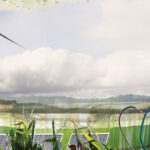
Imagine driving a car fueled by reprocessed household trash. Or visiting a farm where a herd of beef cattle is fed with algae that might be vastly better for the environment than the corn and grains in common use today.
Those are just two of the visions being that have been pursued over the past four years by small companies in the Maryland Clean Energy Technology Incubator (CETI) at bwtech@UMBC Research & Technology Park.
As the youngest of three business incubators housed within the research park, CETI has had its share of growing pains. When the incubator was founded in 2009, the clean-energy sector was awash in federal stimulus money. Today, companies must scrap for every bit of private investment and public research support they can muster.
Fledgling clean-energy companies in the CETI get inexpensive office space, ample laboratory facilities, and a host of less-tangible benefits – including proximity to UMBC faculty members and students and membership in a statewide network of energy companies – to help grow their businesses.
“You can meet people here who you’d never meet if you rented offices in a random building in Columbia,” says Bjorn Frogner, who serves as the incubator’s “entrepreneur-in-residence.” With more than three decades of experience in energy and software companies, Frogner gives CETI companies informal advice and troubleshoots problems related to grant proposals, patenting, and human resources.
“Having an entrepreneur-in-residence is a real value,” says George Oyler, the founder of Clean Green Chesapeake, a start-up company piloting systems for converting algae to cattle feed and liquid transportation fuels. “My background was as an M.D./Ph.D. Many academics dream about transitioning into some sort of start-up, but there’s not a lot of appreciation for what it means to be in business as opposed to research. It is really helpful to have people like Bjorn who have a history in this kind of work.”
Perhaps the best-known clean-energy company at BWTECH is Fiberight, which will soon break ground on a large-scale plant in Iowa that will convert municipal waste into ethanol fuels. (The company has begun the planning-and-permitting process for constructing similar plants in Maryland.) Fiberight was already two years old when the CETI was founded, company CEO Craig Stuart-Paul leapt at the chance to move the company’s headquarters there when he learned about its creation.
“There’s no question that you get better access to academic expertise if you’re located in a center like this,” Stuart-Paul says. His company has hired three UMBC graduates as full-time staff members and regularly brings UMBC students aboard as summer interns.
Bryan Kim ’13, chemical engineering, worked as an intern at Fiberight in 2012 and accepted a full-time job this past May after graduation. “I’ve mostly been creating process-and-instrumentation diagrams for our small pilot plant in Virginia,” Kim says. “But I’ve met everyone, and I’ve gotten to do a little bit of everything. That’s the great thing about working for a start-up. This is the best introduction I can imagine to the post-college work world.”
Frogner also hopes that some of the collective expertise of companies at CETI can pay off for the UMBC campus itself, including the possibility of applying “smart grid” technology developed at the incubator to future campus construction projects.
Other companies in the clean-energy incubator include Plant Sensory Systems, which has large federal grants to support the development of genetically-engineered plants with high oil yields and low requirements for nitrate fertilizers; Innovative Bios, which converts animal wastes into cell culture broths for the biotechnology industry; and Agira Energy, a solar-cell manufacturer.
David J. Fink, director of entrepreneurial services at bwtech@UMBC, says that he believes that even more companies at CETI will be helping create a greener future in the marketplace – and maybe sooner than anyone thinks.
“We have today a very strong and diverse set of companies,” Fink says, “and they’re all geared toward bringing products and services to market very rapidly.”
– David Glenn
]]>
Imagine driving a car fueled by reprocessed household trash. Or visiting a farm where a herd of beef cattle is fed with algae that might be vastly better for the environment than the corn and...
https://umbc.edu/stories/green-future-seeds-and-synergies/
https://my3.my.umbc.edu/api/v0/pixel/news/123069/guest@my.umbc.edu/69d0b1af0b69c3c0a83ef92f72d16065/api/pixel
discovery
fall-2013
green-issue
UMBC News & Magazine
https://my3.my.umbc.edu/groups/umbc-news-magazine
https://assets1-my.umbc.edu/system/shared/avatars/groups/000/001/943/24435aa6207c452e7bc15cc74b42c7bb/xsmall.png?1748556657
https://assets1-my.umbc.edu/system/shared/avatars/groups/000/001/943/24435aa6207c452e7bc15cc74b42c7bb/original.png?1748556657
https://assets2-my.umbc.edu/system/shared/avatars/groups/000/001/943/24435aa6207c452e7bc15cc74b42c7bb/xxlarge.png?1748556657
https://assets2-my.umbc.edu/system/shared/avatars/groups/000/001/943/24435aa6207c452e7bc15cc74b42c7bb/xlarge.png?1748556657
https://assets3-my.umbc.edu/system/shared/avatars/groups/000/001/943/24435aa6207c452e7bc15cc74b42c7bb/large.png?1748556657
https://assets1-my.umbc.edu/system/shared/avatars/groups/000/001/943/24435aa6207c452e7bc15cc74b42c7bb/medium.png?1748556657
https://assets2-my.umbc.edu/system/shared/avatars/groups/000/001/943/24435aa6207c452e7bc15cc74b42c7bb/small.png?1748556657
https://assets1-my.umbc.edu/system/shared/avatars/groups/000/001/943/24435aa6207c452e7bc15cc74b42c7bb/xsmall.png?1748556657
https://assets2-my.umbc.edu/system/shared/avatars/groups/000/001/943/24435aa6207c452e7bc15cc74b42c7bb/xxsmall.png?1748556657
UMBC News & Magazine
0
0
false
Thu, 26 Sep 2013 19:19:45 -0400
Green Future: Plotting a New Course
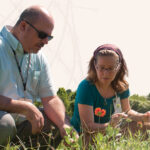
In the shadow of a guard tower and an electrified fence at the Maryland Correctional Institute for Women in Jessup, a simple patch of wildflowers blooms.
But look more closely at the yellow partridge peas, red Indian blankets, and dozens of other species most of which are native to Maryland and you’ll see a carefully designed set of 25 distinct plots.
Two or three times a week, a few inmates come here to cultivate these plots -– and to take careful notes about the plants’ progress. “This has been a joy,” says L.J., an inmate in her late twenties. “My family has a camp up in Cecil County, and this is the closest thing I can experience to being up there.”
Prison gardens aren’t unusual. But the wildflower plots at Jessup aren’t like most prison gardens The inmates who tend them are being trained to harvest scientific data as part of an experiment being directed by Anna L. Johnson, a doctoral student in geography and environmental systems at UMBC, under the auspices of the Maryland Green Prisons Initiative.
The initiative is a collaboration between UMBC and the Maryland Department of Public Safety and Correctional Services, and its leaders have huge ambitions for the project. They would like to allow dozens of inmates to earn certifications in gardening and horticulture that might help them find jobs post-release. They envision fruit and nut orchards in greenhouses and fields at prison facilities throughout Maryland – and reduce by 90 percent the amount of solid waste generated at those same facilities.
The project leaders would also like to re-landscape hundreds of vacant lots in Baltimore City by planting native Maryland wildflowers. Anna Johnson’s garden plots at the women’s prison are a crucial step toward that last goal.
Johnson and her inmate partners have planted 16 plots here, with various combinations of native species. Each week, L.J. and other inmates gather data about each plot’s soil quality, species diversity, total biomass, and the number of bees and other pollinators they attract. They want to discover the optimal species mix recipe for seeding vacant lots in Baltimore. Once that recipe has been established, the inmates will transform a few dozen vacant lots in Baltimore’s Harlem Park neighborhood.
“All of our projects have to do with integrating primary research about sustainability and preserving biodiversity in an urban habitat, and at the same time providing education and training for pre-release inmates,” says Christopher Swan, an associate professor of geography and environmental systems at UMBC.
The initiative was born last fall, when Swan got a call from an old graduate-school friend on the west coast. His friend is part of the Sustainability in Prisons Project, a national network of scholars, activists, and correctional officers, and she had heard that Maryland prison officials were looking for academic collaborators for environmental projects.
“I was an inch away from saying, ‘You’ve got to be kidding – there’s no way I want to touch this,’” says Swan. He already had a huge amount on his plate, teaching courses at UMBC and serving as a co-principal investigator of the Baltimore Ecosystem Study, a multimillion-dollar analysis of human influences on soil, water, plants, and animal life in central Maryland. Bringing prisoners into the mix sounded like a massive logistical burden that did not promise much payoff.
Swan did agree to have a phone conversation with William Merritt, the Maryland prison system’s executive director for environmental compliance, safety, and emergency operations. Merritt turned out to be energetic, sharp, and unpretentious. By the end of the call, Swan somehow found himself agreeing to collaborate. He’d been persuaded that training prisoners might deepen the Baltimore Ecosystem Study’s ties with the community – and also that prisoners could regularly collect data about plants at their sites, allowing certain research projects to be conducted at much larger scales than would otherwise be possible.
“When you think of prisons, there’s usually a cloud of negativity, and obviously our state system has some severe problems,” Swan says. “But the people we’ve worked with in the agency – I just can’t emphasize enough how great they’ve been. When there’s a problem, everyone hops right up to help.”
For his part, Merritt is equally grateful to have found partners at UMBC. “Working with Chris has been a godsend in terms of finding likeminded people,” he says.
Swan has helped forge a connection, for example, between the prison system and the Baltimore Orchard Project, a nonprofit organization that helps plant trees at schools and churches. If all goes well, later this year inmates at the Maryland Metropolitan Transition Center, a prison in Baltimore City, will be trained to grow American chestnut and pecan seedlings in a greenhouse. Once the trees reach a certain size, they will be transplanted to a new orchard on the site of a decommissioned boot camp in Jessup, down the road from the women’s prison. And when they grow yet larger, many of those trees will be transplanted to the grounds of schools and churches in Baltimore.
“This kind of work fits in perfectly with our mission,” says Betty Johnson, the chief warden of the department’s pre-release program. “We’re constantly trying to provide services that allow our inmates to give back to the community. A lot of these guys will go back to the city after they’re released, and they’ll be able to point to these projects and know that they helped.”
The hope is that for at least a few inmates, the orchard projects will lead not only to a sense of personal accomplishment but also to skills that can be brought to the labor market. “Fruit and nut trees are very complicated,” Swan says. “Propagating the stock, doing the grafting – if you learn how to do that well, that should be a marketable skill post-release. We’re working on finding certifications that the inmates will be able to take to employers.”
Back at the women’s prison in Jessup, the inmates who work with Anna Johnson on the wildflower plots say they value the experience because it gives them a respite from the routines of incarceration.
“I come here once or twice a week,” says C.B., an inmate in her thirties. “It gives you time to meditate. It’s something totally out of the box.”
In addition to the wildflower plots, Johnson has also helped the inmates construct a vegetable garden on three raised beds at the center of the prison campus. “I wanted to give the women another way to get involved, because the experimental plots involve a lot of sitting and waiting,” Johnson says. “And the vegetable gardens really took off. They’ve got a lot of visibility, and they’ve become a center of activity.”
“I live for this,” says R.S., an inmate who volunteers in the vegetable garden twice a week after she finishes her night job in the prison’s mental-health clinic. “This is the closest thing to being at home.”
Thirteen inmates were chosen through an interview process last spring to work in the gardens. Johnson says she wanted to find at least a few inmates who already had gardening skills (one participant, for example, once worked as a volunteer docent at the U.S. National Arboretum in Washington). But she has also been happy to provide training to those without experience.
“It’s not really our study,” says S.D., an inmate in her thirties who is leading a trainee seeing-eye dog around the edge of the experimental plots. “But it’s good for us to get out here. I just gave Anna an update on my plots.”
“This is the only project I’ve experienced that’s been anything like this,” says Tanieka Scott-Black, the prison’s environmental compliance and safety officer, who is the primary on-site supervisor of the gardens. “In the past, we’ve just been working on site maintenance. But a lot of the officers here have really committed to this. When it came time to harvest from the vegetable gardens, people brought in equipment from home.”
Scott-Black and Johnson have an excellent rapport, but they’ve had to negotiate a few issues along the way. Metal stakes in the gardens? That would be a no. (They’re using small wooden stakes instead.) The prison also requires that no growth be taller than two feet – “I’d really be more comfortable with eighteen inches,” Scott-Black says – so that sight lines can be preserved. And because the experimental plots are in a relatively remote corner of the prison, only a few inmates have been approved to go there independently. (Those are the inmates who, like S.D., are also participating in training seeing-eye dogs. The dogs’ shed is near the wildflower plots, and a single guard can watch the inmates as they work on both projects.)
“Officers can be skeptical at first,” Swan says. “But what the Sustainable Prisons Project has learned nationally is that this kind of work is generally a win-win. Some good things get done, and the prison environment becomes safer. When they’re working on these projects, inmates aren’t doing other things that might cause problems. Something positive is going on.”
In addition to building trust with inmates and prison officials, Swan has also been working to build trust with neighborhood leaders in Baltimore. No work has been done yet outside the prison walls, but Swan and Merritt hope that next year will see prisoners participating in dozens of vacant-lot rehabilitation and tree-planting efforts in the city.
“We want to get buy-in from as many community groups as possible,” Swan says. “And that’s a lot of hard work. People are positive—I’ve actually never run into anything negative—but it’s been a lot of legwork.”
Merritt says that he and his colleagues will listen carefully to neighborhood groups’ opinions about what the vacant lots should look like. When people express anxiety about prisoners coming into their neighborhoods to do this work, he tells them: “These are pre-screened inmates who are close to release. They have to be infraction-free. They’ll have a guard with them at all times. We have a lot of experience bringing inmates onto road crews, and this really isn’t so different.”
But Merritt adds that this project could be a much deeper experience for the inmates than typical road work. They will, after all, be planting a mix of wildflowers based on the data now being painstakingly collected at the women’s prison. “When we go to national conferences of the Sustainability in Prisons project, that is what has impressed people the most — the idea that we’re training inmates to do technical data gathering,” Merritt says.
Swan now has more on his plate than ever. This spring, he oversaw the construction of a new greenhouse on the UMBC campus, where undergraduate researchers will do plant studies that parallel the ones being conducted at the women’s prison. This fall, he will help with building a greenhouse at the Maryland Metropolitan Transitional Center in Baltimore. (“But first I need to figure out a way to anchor a greenhouse on a concrete prison yard, so that it doesn’t blow away like a kite.”)
Meanwhile, Johnson has helped plant a second set of experimental wildflower plots at a prison on the Eastern Shore. Lynn Cazabon, an associate professor of photography at UMBC, is planning to do a series of portraits of inmates in the gardens. And Merritt is about to launch a composting program that he hopes will radically reduce the amount of solid waste that comes from Maryland prisons.
“I have never encountered this much enthusiasm for anything that I’ve done,” Swan says. “We’re getting to do a ton of real science, and with any luck we’ll help to inform sustainability policies for Baltimore City for a long time to come.”
– David Glenn
]]>
In the shadow of a guard tower and an electrified fence at the Maryland Correctional Institute for Women in Jessup, a simple patch of wildflowers blooms. But look more closely at the yellow...
https://umbc.edu/stories/green-future-plotting-a-new-course/
https://my3.my.umbc.edu/api/v0/pixel/news/123070/guest@my.umbc.edu/20d1d5d95c413f37362dbdd924faca22/api/pixel
discovery
fall-2013
green-issue
UMBC News & Magazine
https://my3.my.umbc.edu/groups/umbc-news-magazine
https://assets1-my.umbc.edu/system/shared/avatars/groups/000/001/943/24435aa6207c452e7bc15cc74b42c7bb/xsmall.png?1748556657
https://assets1-my.umbc.edu/system/shared/avatars/groups/000/001/943/24435aa6207c452e7bc15cc74b42c7bb/original.png?1748556657
https://assets2-my.umbc.edu/system/shared/avatars/groups/000/001/943/24435aa6207c452e7bc15cc74b42c7bb/xxlarge.png?1748556657
https://assets2-my.umbc.edu/system/shared/avatars/groups/000/001/943/24435aa6207c452e7bc15cc74b42c7bb/xlarge.png?1748556657
https://assets3-my.umbc.edu/system/shared/avatars/groups/000/001/943/24435aa6207c452e7bc15cc74b42c7bb/large.png?1748556657
https://assets1-my.umbc.edu/system/shared/avatars/groups/000/001/943/24435aa6207c452e7bc15cc74b42c7bb/medium.png?1748556657
https://assets2-my.umbc.edu/system/shared/avatars/groups/000/001/943/24435aa6207c452e7bc15cc74b42c7bb/small.png?1748556657
https://assets1-my.umbc.edu/system/shared/avatars/groups/000/001/943/24435aa6207c452e7bc15cc74b42c7bb/xsmall.png?1748556657
https://assets2-my.umbc.edu/system/shared/avatars/groups/000/001/943/24435aa6207c452e7bc15cc74b42c7bb/xxsmall.png?1748556657
UMBC News & Magazine
0
0
false
Thu, 26 Sep 2013 19:16:37 -0400
Finding a Green Future


UMBC is making big steps toward making the university’s campus more sustainable. But as a state research university that’s growing every year, the faculty of UMBC and researchers affiliated with the university are also investigating how to make our cities and our planet greener. They are creating new products that will cut down on pollution and waste. And they are creating works of art that help us feel more tangibly the effects of climate change.
One of the most important centers for such research on campus is UMBC’s Center for Urban Environmental Research and Education (CUERE). The projects pursued at CUERE include research on public health, energy management, ecological sociology, meteorology, and soil study. The center also is host to the Baltimore Ecosystem Study, a project funded by the National Science Foundation (NSF) as part of the foundation’s Long Term Ecological Research Program.
Stuart S. Schwartz, a senior researcher at CUERE, has worked on multiple fronts to address the problem of storm runoff (which is one of the main conduits of pollution to the Cheaspeake Bay) – including spearheading use of “pervious concrete” which allows water to infiltrate the surface instead of running off. The concrete has been used on UMBC’s campus, and the center has successfully prodded other state agencies in Maryland to give it a try – including Park-n-Ride lots for the Maryland Transit Administration and State Highway Administration and a pervious concrete lot for the Maryland Science Center.
Another prominent UMBC researcher who’s tackled climate issues is Ray Hoff, a recently-retired professor of physics and senior science advisor to the Joint Center for Earth Systems Technology (JCET). In collaboration with Jill Engel-Cox, ’04, Ph.D., marine estuarine environmental science, Hoff created the “Smog Blog” – a website that merges real-time satellite imagery and air quality data with analysis of air pollution across the United States for people interested in air quality. The “Smog Blog” has logged more than 50 million hits during its first eight years.
In the following pages, we’d like to introduce you to other UMBC faculty who are pursuing research or creative projects – some of them in unusual places – that give us deeper insight into the causes (and possible solutions) of our climate crisis.
– Richard Byrne’ 86 and Joel N. Shurkin
]]>
UMBC is making big steps toward making the university’s campus more sustainable. But as a state research university that’s growing every year, the faculty of UMBC and researchers affiliated with...
https://umbc.edu/stories/finding-a-green-future-2/
https://my3.my.umbc.edu/api/v0/pixel/news/123071/guest@my.umbc.edu/f017e76448f7c04cdea7d99045dc6a82/api/pixel
discovery
fall-2013
green-issue
UMBC News & Magazine
https://my3.my.umbc.edu/groups/umbc-news-magazine
https://assets1-my.umbc.edu/system/shared/avatars/groups/000/001/943/24435aa6207c452e7bc15cc74b42c7bb/xsmall.png?1748556657
https://assets1-my.umbc.edu/system/shared/avatars/groups/000/001/943/24435aa6207c452e7bc15cc74b42c7bb/original.png?1748556657
https://assets2-my.umbc.edu/system/shared/avatars/groups/000/001/943/24435aa6207c452e7bc15cc74b42c7bb/xxlarge.png?1748556657
https://assets2-my.umbc.edu/system/shared/avatars/groups/000/001/943/24435aa6207c452e7bc15cc74b42c7bb/xlarge.png?1748556657
https://assets3-my.umbc.edu/system/shared/avatars/groups/000/001/943/24435aa6207c452e7bc15cc74b42c7bb/large.png?1748556657
https://assets1-my.umbc.edu/system/shared/avatars/groups/000/001/943/24435aa6207c452e7bc15cc74b42c7bb/medium.png?1748556657
https://assets2-my.umbc.edu/system/shared/avatars/groups/000/001/943/24435aa6207c452e7bc15cc74b42c7bb/small.png?1748556657
https://assets1-my.umbc.edu/system/shared/avatars/groups/000/001/943/24435aa6207c452e7bc15cc74b42c7bb/xsmall.png?1748556657
https://assets2-my.umbc.edu/system/shared/avatars/groups/000/001/943/24435aa6207c452e7bc15cc74b42c7bb/xxsmall.png?1748556657
UMBC News & Magazine
0
0
false
Thu, 26 Sep 2013 19:15:03 -0400
Green Future: Earth Tones
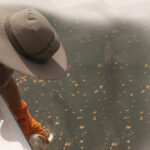
On a heavy studio table in UMBC’s Fine Arts building, artist Lisa Moren spreads out a sheet of beautiful marbleized paper, all fine waves and feathering.
But the delicate patterns and the classical images they evoke belie the artist’s main ingredient: pigments derived from oils she collected from the 2010 British Petroleum spill in Louisiana’s Bastian Bay.
“This type of marbleizing is traditionally known from Venetian books, the Renaissance books, and for all those beautiful colors. And mine are very monochromatic and brown,” laughed Moren, whose recent work revolves around the ever-evolving nature of nature, as it relates to sites and their communities.
“All my artwork is brown!”
Moren has spent her career teaching, creating and curating around aspects of technology and the sublime. In recent years, however, as her interest in community interactions and the environment has intensified, her work has taken on the sometimes-murky brownish tones of that research.
This particular itch began in an unlikely place: her kids’ school. Volunteering on the Baltimore Montessori School’s greening committee, Moren unexpectedly found herself thinking anew about ecological relationships as simple – yet vital – as bees and fruit trees. Later, when the opportunity to contribute a water-themed project to Baltimore’s Transmodern Festival presented itself, she followed the impulse straight into Maryland’s waterways.
“I said to myself, almost as an aside, maybe I could make watercolor out of the water,” said Moren, “and so I sort of came up with this laborious way of making watercolor pigments from the water.” She collected samples from the Jones and Gwynn falls, as well as the Chesapeake Bay, boiled them down into pigments, and at the festival, she invited passersby to help stir a Crock Pot full of the tarry substance, which she also used to create a community-driven watercolor postcard project.
Moren used some of the same collected pigments to concoct a greenish-gray “Chesapeake Bay Water Lipstick,” which was displayed (along with her marbleized Gulf papers) last spring in Hydroflow, an exhibit at Goucher College, along with fellow UMBC professors Calla Thompson and Eric Dyer.
“Nobody would want to wear this lipstick,” she joked.
As she explored the Bay’s depths artistically, however, the BP oil spill drew Moren’s attention away from Baltimore. It wasn’t long before she had chartered a small fishing boat and enlisted the help of a friendly Captain Patrick to collect globs of fuel in small bottles from the spoiled waters of Bastian Bay. From those pigments, she produced more than 70 marbleized papers and postcards, each evoking patterns of oils on water.
Most recently, Moren’s research has taken her to south Australia, to ochre-rippled hills once tread by the Dieri tribe, which was wiped out by colonialists during the gold rush of the 1860s. Fascinated by the Dieri’s early economic system driven by the “red gold” they mined from the mountains, Moren based her own “Currentse” project on the very same pigments. Working with residents of the historic town of Bendigo, they printed a sort of faux currency that not only ties each piece of paper to the exact GPS location of its pigment’s origin, but tracks online the fluctuations of the very land’s value over time.
With the care of a researcher, Moren brings to her art a detailed context that allows viewers to better understand the community’s relationship to the environment. And with that same understanding, she follows a strict code of artistic conduct – one of which the Earth would certainly approve.
“It’s very important to me that it’s all natural,” Moren says. “It’s made from nature, or I derived it from what is considered nature…and that whole idea of nature is evolving.”
– Jenny O’Grady
]]>
On a heavy studio table in UMBC’s Fine Arts building, artist Lisa Moren spreads out a sheet of beautiful marbleized paper, all fine waves and feathering. But the delicate patterns and the...
https://umbc.edu/stories/green-future-earth-tones/
https://my3.my.umbc.edu/api/v0/pixel/news/123072/guest@my.umbc.edu/3ee5dd25b0f999d7f9cdca4f6df550cd/api/pixel
discovery
fall-2013
green-issue
UMBC News & Magazine
https://my3.my.umbc.edu/groups/umbc-news-magazine
https://assets1-my.umbc.edu/system/shared/avatars/groups/000/001/943/24435aa6207c452e7bc15cc74b42c7bb/xsmall.png?1748556657
https://assets1-my.umbc.edu/system/shared/avatars/groups/000/001/943/24435aa6207c452e7bc15cc74b42c7bb/original.png?1748556657
https://assets2-my.umbc.edu/system/shared/avatars/groups/000/001/943/24435aa6207c452e7bc15cc74b42c7bb/xxlarge.png?1748556657
https://assets2-my.umbc.edu/system/shared/avatars/groups/000/001/943/24435aa6207c452e7bc15cc74b42c7bb/xlarge.png?1748556657
https://assets3-my.umbc.edu/system/shared/avatars/groups/000/001/943/24435aa6207c452e7bc15cc74b42c7bb/large.png?1748556657
https://assets1-my.umbc.edu/system/shared/avatars/groups/000/001/943/24435aa6207c452e7bc15cc74b42c7bb/medium.png?1748556657
https://assets2-my.umbc.edu/system/shared/avatars/groups/000/001/943/24435aa6207c452e7bc15cc74b42c7bb/small.png?1748556657
https://assets1-my.umbc.edu/system/shared/avatars/groups/000/001/943/24435aa6207c452e7bc15cc74b42c7bb/xsmall.png?1748556657
https://assets2-my.umbc.edu/system/shared/avatars/groups/000/001/943/24435aa6207c452e7bc15cc74b42c7bb/xxsmall.png?1748556657
UMBC News & Magazine
0
0
false
Thu, 26 Sep 2013 19:13:45 -0400