Zareen Taj earns her Ph.D., publishing the first autoethnography by a Hazara Afghan woman about the ongoing genocide of Hazara women under Taliban rule
This spring on Thursday evenings, students filled room 424 in the Fine Arts building for their Asian Diaspora in Motion: Media, Culture, Identity, and Activism class. At the head of the classroom was Zareen Taj, who designed the new 300-level class based on her experiences as a documentary filmmaker and activist defending the rights of her community—the Hazara women of Afghanistan, a community that has for over a century experienced extreme ethnic, religious, and gender oppression, including multiple massacres and starvation, under Taliban rule.
It’s a reality Taj grew up with as part of the Hazara people, a religious and ethnic minority. In the 1990s, when the Taliban increased their killings of the Hazara people, Taj and her family fled to a refugee settlement in Pakistan. There, Taj started speaking out against the systemic oppression of Hazara women. Her activism made her a Taliban target. With a scholarship from the Feminist Majority Foundation, Taj fled once more, this time to Towson University, where she earned a bachelor’s in political science and women’s studies and a master’s in women’s studies.
After graduation, Taj worked for Voice of America as an international broadcaster and producer. At UMBC, she worked for Chartwells in the HR department first and then as an accounting associate at The Shriver Center. A year later, Taj was accepted into the language, literacy, and culture (LLC) doctoral program. During her studies, she raised two children and created four short documentaries about Hazara women while teaching in the global studies, Asian studies, and American studies departments.
This semester, Taj successfully defended her dissertation, “Journey of a Scholar-Activist: An Autoethnographic and Multimodal Inquiry,” which includes written narratives and her fourth documentary short film titled “For My People.” The project marks the first time she took the time and space to reflect on her life.
“I learned from this journey that I am different. I look different. I work differently. I see things differently, but my difference is not a problem,” says Taj about her experience at UMBC, where she hopes to become a professor. “My experience is an asset. It’s my wealth. The UMBC community, particularly the LLC and my professors, were very supportive of what I’m doing. So they supported me at each stage of my life.”
Q: What was your journey to UMBC?
A: I studied in a refugee displacement settlement in Pakistan, so it was very hard. But I got the Feminist Majority Scholarship and moved to Maryland in 2000 to attend Towson University. I could not speak English well. I saw a computer for the first time in my life. It was very hard because I came from a very war-torn country. We don’t have that advanced education system, and it’s often interrupted by war. Every minute, I reminded myself about the other Afghan girls who didn’t have this opportunity, so I couldn’t give up.
I always wanted to get a Ph.D. That was my dream. I put all of my experiences into my academic world. In 2018, I applied to the LLC doctoral program. I talked with Carole McCann, professor of gender, sexuality, and women’s studies, about what I wanted to do. She said yes to being my advisor right away. Joby Taylor, Ph.D. ’05, assistant vice provost and co-leader of The Shriver Center for Public Service and Community Engagement, and Tania Lizarazo, associate professor of modern languages, linguistics, and intercultural communication, and global studies, also lent their support as co-chairs.
Q: How did you decide on the topic for your dissertation?
A: My master’s thesis, titled “Dual Identity, Dual Oppression of Hazara Women,” didn’t follow the same research path as a traditional thesis because there were no official documents that I could use for my research. I felt frustrated. My thesis was informed by my firsthand research trips to Afghanistan. This work represents the first contribution of its kind in the academic field. My personal experiences and frustrations motivated me to return to my country, which ultimately shaped and grounded the development of my thesis.
For my dissertation, my committee wanted me to talk about myself, to write a book. I appreciated them encouraging me, but I continued to focus on Hazara women until Dr. Tanya Saunders, associate professor of sociology, pointed out all the different types of ethnography I was doing and encouraged me to focus on myself to do an autoethnography. I was surprised that I could do that, and that’s how I started.
That gave me a kind of confidence in my writing. I’m always reflecting on all of these things I’m doing, but not reflecting on myself. I never had the chance, or I never thought of doing it. I never thought I would be allowed to talk about myself, so I didn’t. I come from a culture where we never talk about ourselves because this is taboo. Women would be told, “Why are you talking about yourself? We have bigger issues, bigger things to talk about.” That’s the culture, especially for Hazara women. We never talk about ourselves, our pain, our joy. Everything is internalized.
I am reaching a stage of very clear realizations about how this academic process is a very healing process for me. I’m making my people visible and bringing awareness to the cause. We’ll get to know people, my people, my ethnicity, their suffering, and also the resilience of these women.
Q: Why was this dissertation process a healing process?
A: My short documentary, “For My People,” which I produced for my dissertation, helped me process the anger and isolation I have carried after years of fighting for survival and against oppression. This process led to exploration and, for the first time, I explored healing and the shift to joy, community, and belonging I have found with the Hazara women who resettled in Washington, D.C., my global network of activists, and my UMBC community.
The more work I’m doing in the form of writing an article, creating films, or public speaking, the more visibility I have to those dimensions, those identities. It’s helping me feel that I do justice for them. That’s the process of healing. The more I work to bring community sustainability and collectiveness, the stronger my sense of belonging, satisfaction, and deep attachment to my community.
Q: What inspired the topics for your other films?
A: I was doing my master’s thesis about Hazara women, but there wasn’t much data. I decided to go back to Afghanistan for the first time since fleeing Pakistan to document the living conditions and experiences of Hazara women living under the fear of genocide. When I returned, I had 40 hours of videotapes, 700 photographs, and 20 hours of cassette recordings that helped me make my first film, “The Oppression of Hazara in Afghanistan.”
But I didn’t just want to show the oppression of Hazara women as victims. I wanted to show the resistance and leadership of Hazara women. After the fall of the last Afghan government in 2021, some Hazara refugees came to the Washington, D.C., Maryland, Virginia area. We have a lot of activists and advocates like Azra Jafari, the first woman in Afghanistan to hold the office of mayor. They were willing to be interviewed for “Our Face Tells: Seeing the Genocide of Hazaras in Afghanistan.”
Last year, I collaborated with several organizations and led efforts to train Hazara women to create and share their own stories. The Hazara Women of Afghanistan Share Digital Stories event trained and supported Hazara women to tell their own stories. That inspired “Voices of Resistance.”
Q: How have you passed on your documentary film skills to your students?
A: UMBC has given me so much and helped me to contribute to it. I taught three years in the global studies program as a visiting lecturer, and I designed, established, and taught Global Studies 409: Documentary Film as Global Activism. Students had to make a documentary about their families from any part of the world. They had to document where their identity and sense of belonging came from. Their films reflected their family backgrounds as well as their personal passions and engagement with social issues.
I still remember a student whose grandparents came from Ethiopia. His film was about them, and afterwards told me that when he was given the assignment, he said to himself, “If this lady, this lady from Afghanistan, can do these films, I can do that too.” It made me smile
Q: Looking back on everything that you have experienced and accomplished, has your purpose changed?
A: In 2021, when the Taliban returned, it was like the loss of a 20-year-old child. It was hard not to despair. But in all the chaos, some Hazara were able to get out and needed help arriving to live in the United States. That service rescued me from that vulnerable situation. Community work changed me again. It lifted me up.
 Zareen Taj (first row, second from the left), at the Hazara Women of Afghanistan Share Digital Stories event. (Image courtesy of Taj.)
After the Hazara Women of Afghanistan Share Digital Stories event, I realized I do not need to feel the responsibility to speak for Hazara women, as they are now able to articulate and share their own stories with the world. This is my message for Hazara around the world, especially Hazara women who feel like their stories do not matter. You need to tell your story because your story is our history. And your story is our future. Sharing our stories will hold us together and make us known to the world.
]]>
This spring on Thursday evenings, students filled room 424 in the Fine Arts building for their Asian Diaspora in Motion: Media, Culture, Identity, and Activism class. At the head of the classroom...
https://umbc.edu/stories/zareen-taj-publishes-first-autoethnography-by-a-hazara-afghan-woman/
Video Preview
https://assets3-my.umbc.edu/system/shared/attachments/32b975bcfed793a9f4fb5268ccfcc05d/6a9d4ec0/news/000/159/731/e0c4ba8f6e02c02ed67cc30334e8c183/2498820.jpg?1778009707
https://my3.my.umbc.edu/api/v0/pixel/news/159731/guest@my.umbc.edu/f9e9ea2143bc436276841dd469489856/api/pixel
asianstudies
cahss
class-of-2026
global-studies
gwst
international
language-literacy-and-culture
mlli
news
policy-and-society
saph
shrivercenter
story
UMBC News & Magazine
https://my3.my.umbc.edu/groups/umbc-news-magazine
https://assets1-my.umbc.edu/system/shared/avatars/groups/000/001/943/24435aa6207c452e7bc15cc74b42c7bb/xsmall.png?1748556657
https://assets1-my.umbc.edu/system/shared/avatars/groups/000/001/943/24435aa6207c452e7bc15cc74b42c7bb/original.png?1748556657
https://assets2-my.umbc.edu/system/shared/avatars/groups/000/001/943/24435aa6207c452e7bc15cc74b42c7bb/xxlarge.png?1748556657
https://assets2-my.umbc.edu/system/shared/avatars/groups/000/001/943/24435aa6207c452e7bc15cc74b42c7bb/xlarge.png?1748556657
https://assets3-my.umbc.edu/system/shared/avatars/groups/000/001/943/24435aa6207c452e7bc15cc74b42c7bb/large.png?1748556657
https://assets1-my.umbc.edu/system/shared/avatars/groups/000/001/943/24435aa6207c452e7bc15cc74b42c7bb/medium.png?1748556657
https://assets2-my.umbc.edu/system/shared/avatars/groups/000/001/943/24435aa6207c452e7bc15cc74b42c7bb/small.png?1748556657
https://assets1-my.umbc.edu/system/shared/avatars/groups/000/001/943/24435aa6207c452e7bc15cc74b42c7bb/xsmall.png?1748556657
https://assets2-my.umbc.edu/system/shared/avatars/groups/000/001/943/24435aa6207c452e7bc15cc74b42c7bb/xxsmall.png?1748556657
UMBC News & Magazine
0
0
false
Tue, 05 May 2026 15:29:15 -0400
Tue, 05 May 2026 15:29:15 -0400
The chase and thrill of researching erotic worlds
A couple of years ago, Jessica Floyd was enjoying delicious olive flatbreads in Opio, France, a village on the French Riviera, thanks to the hospitality of Judith Legman, who owned the olive grove and a manuscript Floyd had been trying to find for her doctoral work for three years. This bucolic heaven was not where Floyd, who studies erotic folklore, thought she would find the holy grail of erotic chanteys by Stan Hugill, a renowned British sailor and chantey singer. These sailors’ work songs, first collected in the 1900s, were passed down verbally by sailors, with some never recorded. These bawdy versions were never meant to be heard or read by women, much less shared between them.
“When you’re talking about erotic content, it automatically becomes something that is salacious and provocative and therefore seen as taboo,” said Floyd, Ph.D. ’17, language, literacy, and culture, an adjunct instructor of English. “Publications that are not conservative in their treatment of sex, gender, and sexuality are often deemed taboo. Scholars who are actively working in this field have to fight not only for their legitimacy, but also because we’re considered dirty workers. We also fight for the legitimacy of the materials that we’re researching. These are real human experiences. They just happen to be from the darker corners of the human experience.”
Like other scholars in the field seeking access to a variety of documents, Floyd reached out to the librarians at the Kinsey Institute, which holds the largest historical archive on sexuality. “They weren’t sure if the manuscript could be found in the extensive archive of Gershon Legman, which Judith, his wife, had donated,” said Floyd, of her research for her debut book Cabin Boys, Milkmaids, and Rough Seas: Identity in the Unexpurgated Repertoire of Stan Hugill (University Press of Mississippi, 2024).
She emailed Legman, following a tip from other chantey folklorists and researchers that Legman, a famous connoisseur and collector of erotic jokes, folklore, and songs, had the manuscript. “Lo and behold, she emailed me back. I still get chills talking about it,” said Floyd. “Judith said, ‘Not only do I have it, I actually just sent it to the Kinsey Institute. If you’d like, I’ll send you the copy.’” Dispersed throughout Legman’s chapter on erotic folk songs were Hugill’s erotic chanteys that had never been circulated.
 The envelope sent by Judith Legman to Jessica Floyd with Stan Hugill’s unpublished manuscript. (Image courtesy of Jessica Floyd)
Chasing erotic rare texts
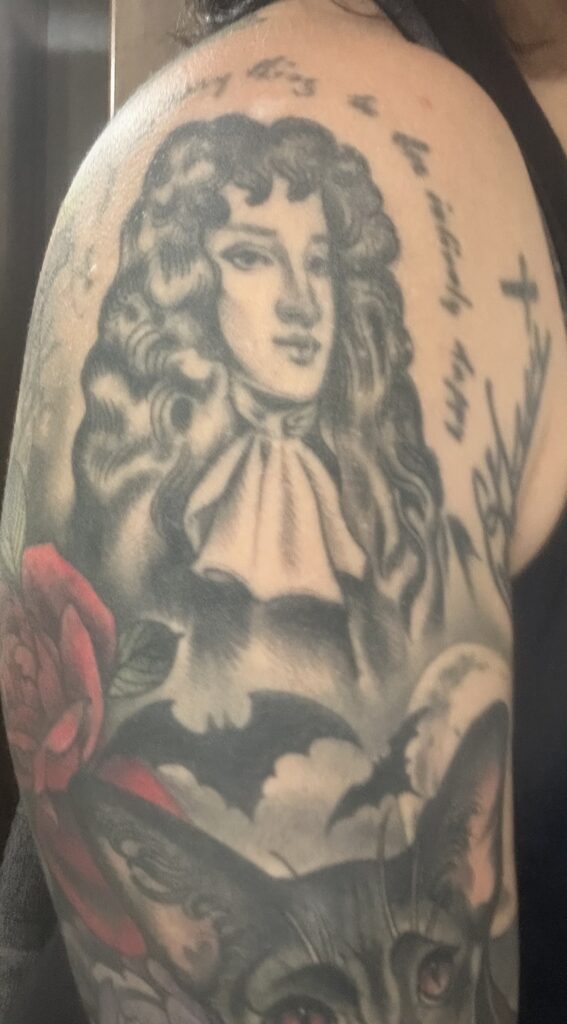 Floyd’s tattoo of John Wilmot, the Second Earl of Rochester, a late 17th-century English nobleman. (Image courtesy of Jessica Floyd)
Floyd is used to the chase and thrill of finding rare texts. She studies the gender and sexuality of sailors during the height of British and American sailing, from the mid-16th to the mid-19th centuries—when sailing ships dominated global trade and naval warfare—as well as 17th and 18th-century literature, erotic folklore, gender and women’s studies, and queer theory. This passion began in high school and continued through her undergraduate and graduate studies researching the life of John Wilmot, the Second Earl of Rochester, a late 17th-century English nobleman better known for questioning authority while also enjoying the excesses of court life and writing poetry that explored sex, desire, rebellion, and challenged social and gender norms.
“It made sense for me to research sexuality in chanteys because I want to understand why men sing dirty songs. What can chanteys tell us about how sailors negotiate sex and gender, especially in the constrained environment of the sailing ship?” said Floyd.
An epistolary discovery
Like Wilmot, Hugill also wrote and published his work. In the 1950s, Hugill began writing down the songs he remembered. In 1961, he published Shanties From The Seven Seas, a collection of over 400 chanteys now considered by chantey researchers and folklorists as the most comprehensive work on chanteys. Sailor Town was published in 1967, Shanties and Sailors’ Songs in 1969, followed by Songs of the Sea: The Tales and Tunes of Sailors and Sailing Shipsin 1977. Between 1962 and 1994, Hugill released 10 recordings—LPs, CDs, and cassette tapes—of chanteys and chantey history. Three were released posthumously. His Sea Songs CD, released in 1980, is now part of the Smithsonian Folkways Recordings catalogue.
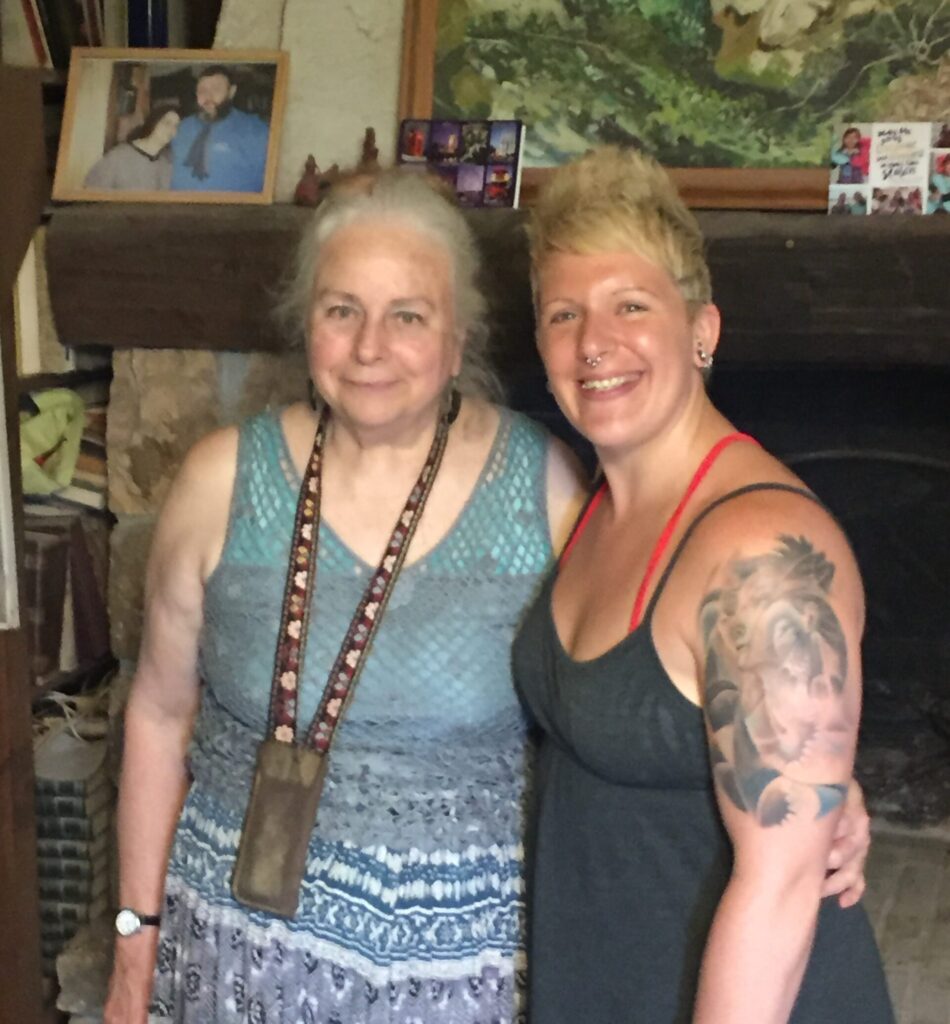 (l-r): Judith Legman and Jessica Floyd in Opio, France. (Image courtesy of Floyd)
However, unlike Wilmot, Hugill never penned the erotic versions and only sang them after a performance to an all-male audience. When Gershon Legman learned about Hugill’s repertoire, he wrote to Hugill, urging him to commit the erotic chanteys to paper for his vast collection. Hugill capitulated after years of correspondence with the condition that Legman not publish the manuscript before he could. Both men died in the 1990s without ever publishing it. With Hugill and Legman as the only witnesses of the manuscript’s existence, what was left for the chantey folklore community was rumors and the lore of its existence.
Thanks to funding from a 2016 UMBC Dresher Center for the Humanities summer fellowship, Floyd visited Judith Legman to study these letters alongside the manuscript. “Judith also had the letters shared between Hugill and Legman, which confirmed that this indeed was the sought-after manuscript,” said Floyd. She notes that by the time she left France, she had everything she needed to do a close analysis of the songs.
“Erotic worlds have fascinated me for a long time. It’s not your run-of-the-mill construction of gender. It’s actually focusing on the part of the human experience that we’re really reticent to talk about, especially in academic work,” said Floyd, who sports a palm-sized tattoo of Wilmot on her upper right arm. “This is the heart of my research—how do we write erotic worlds?”
Floyd is once again on the hunt for rare texts and has completed her second book, The Sons of Neptune. In this study, she is looking at cultural artifacts, from the 18th to the 20th century, that provide insight into why sailors are often thought of as sexy. This project is set to be published through the University of Mississippi Press in May 2026.
Read other books in our Humanities Books series.
]]>
A couple of years ago, Jessica Floyd was enjoying delicious olive flatbreads in Opio, France, a village on the French Riviera, thanks to the hospitality of Judith Legman, who owned the olive grove...
https://umbc.edu/stories/the-chase-and-thrill-of-researching-erotic-worlds/
https://my3.my.umbc.edu/api/v0/pixel/news/155331/guest@my.umbc.edu/6e42352b341487bf50a638ab81874d4f/api/pixel
arts-and-culture
cahss
dreshercenter
english
gwst
humanitiesbooks
llc
news
story
UMBC News & Magazine
https://my3.my.umbc.edu/groups/umbc-news-magazine
https://assets1-my.umbc.edu/system/shared/avatars/groups/000/001/943/24435aa6207c452e7bc15cc74b42c7bb/xsmall.png?1748556657
https://assets1-my.umbc.edu/system/shared/avatars/groups/000/001/943/24435aa6207c452e7bc15cc74b42c7bb/original.png?1748556657
https://assets2-my.umbc.edu/system/shared/avatars/groups/000/001/943/24435aa6207c452e7bc15cc74b42c7bb/xxlarge.png?1748556657
https://assets2-my.umbc.edu/system/shared/avatars/groups/000/001/943/24435aa6207c452e7bc15cc74b42c7bb/xlarge.png?1748556657
https://assets3-my.umbc.edu/system/shared/avatars/groups/000/001/943/24435aa6207c452e7bc15cc74b42c7bb/large.png?1748556657
https://assets1-my.umbc.edu/system/shared/avatars/groups/000/001/943/24435aa6207c452e7bc15cc74b42c7bb/medium.png?1748556657
https://assets2-my.umbc.edu/system/shared/avatars/groups/000/001/943/24435aa6207c452e7bc15cc74b42c7bb/small.png?1748556657
https://assets1-my.umbc.edu/system/shared/avatars/groups/000/001/943/24435aa6207c452e7bc15cc74b42c7bb/xsmall.png?1748556657
https://assets2-my.umbc.edu/system/shared/avatars/groups/000/001/943/24435aa6207c452e7bc15cc74b42c7bb/xxsmall.png?1748556657
UMBC News & Magazine
1
0
false
Mon, 15 Dec 2025 16:29:52 -0500
Mon, 15 Dec 2025 16:29:52 -0500
Meet a Retriever—Rishi Nixon, Honors College senior, Parkinson’s researcher, and performing storyteller
Rishi Nixon, a senior biological sciences major and member of the Honors College, brings a kaleidoscope of interests and skills to his time at UMBC after transferring from Montgomery College. He’s been a performing storyteller for more than 10 years, originally with his 4-H youth club and now independently. Nixon conducts research on Parkinson’s disease at the University of Maryland School of Medicine and plans to pursue a medical degree after UMBC.
Q: Tell us about someone in the UMBC community who has inspired or supported you.
A: Meeting Kendyl Walker, my honors college advisor, on my first day of classes made UMBC feel like home. Especially coming into this new environment after leaving my community college—she met me where I was on day one and continues to make me feel supported every time we meet.
Q: Tell us about what you love about your academic program or an organization you’re involved in.
A: My honors college seminar on race, poverty, and gender in Baltimore, taught by Dr. Jodi Kelber-Kaye (“Dr. K.”) opened my eyes to issues facing the city and was one of my most impactful UMBC courses. It helped cut through the ways the city is sometimes talked about in Maryland politics, emphasizing the importance of funding programs that help lift up Baltimore.
This past summer, I had the opportunity to complete a second seminar with Dr. K: an applied community service experience at a nonprofit organization in the city called Moveable Feast, which helps deliver medically-tailored meals to Baltimore residents experiencing food insecurity.
In August 2025, I engaged with the city for the first time in my capacity as a performing storyteller. I performed at the Irvington Peace Park for an annual summer camp organized by Cynthia Wagner, teaching professor in biological sciences, for youth who live in her West Baltimore community. The peace park—a beautiful space built by community members from clearing a vacant lot—was a magical site for the camp, and the kids were a wonderful audience.
Photo right: Rishi Nixon at the National Storytelling Conference in Georgia with the vice chair and vice chair-elect of the board of the National Storytelling Network.

Q: What’s the one thing you’d want someone who hasn’t joined the UMBC community to know about it?
A: Something Dr. K. said once sums it up: “UMBC is a small town.” I see UMBC as a really welcoming place for students who are comfortable leaning on their advisors, mentors, and supporters. It’s very comforting to see faces you recognize each day all over “town.”
Q: What brought you to UMBC?
 Rishi Nixon sits at his lab bench at the University of Maryland School of Medicine, where he conducts Parkinson’s research.
A: I came to UMBC because of its excellent reputation for undergraduate teaching and scientific research opportunities, but also to maintain the small-town feeling and one-on-one learning I received at Montgomery College.
Now that I’m here, UMBC’s research reputation has proven true. I’ve conducted research at the University of Maryland School of Medicine (UMSOM) and also in my coursework. At UMSOM, I study a neuron protein called proSAAS that helps unclump misfolded proteins in the brain that are responsible for neuron death in Parkinson’s disease.
And in my Experimental Biology Lab course, taught by Dr. Tracy Smith, associate teaching professor in biological sciences, I got to participate in ecological research. We visited on-campus sections of the West Branch of Herbert Run to measure the diversity of macroinvertebrates (e.g. fly larvae, water beetles, etc.). We collected them from the stream bed, logged their abundance and the number of types of organisms, and drew a conclusion about the stream’s overall health and pollution levels based on an index of biodiversity levels associated with different degrees of stream health.
Our calculations determined that the stream is very healthy, which is probably a result of UMBC and the Chesapeake and Atlantic Coastal Bays Trust Fund investing in restoring the streams. In fact, the most abundant species of macroinvertebrate we found (damselfly larvae), are actually sensitive to pollutants, yet they were thriving in campus streams when we surveyed in September 2025.
Q: How has UMBC supported your “why”?
A: UMBC’s Honors College has been core to supporting my “why.” They have been huge supporters in connecting me with opportunities for research, and their seminars are excellent for deep one-on-one learning in very niche areas (e.g., Dr. K. and Baltimore). It’s hard for me to imagine my UMBC experience without the Honors College. Its staff and programming helped deepen my existing interests, including pursuing service in Baltimore after my coursework on the city and taking a seminar in neuroscience after conducting research in neurobiology.
Q: What would you tell other transfer students about UMBC?
A: I would encourage other transfer students to apply to the Honors College—I think the small class sizes and the one-on-one advising preserve a similar experience at community colleges. I am also very grateful that UMBC is able to provide generous merit scholarships to support transfer students coming from honors programs at Maryland community colleges.
]]>
Rishi Nixon, a senior biological sciences major and member of the Honors College, brings a kaleidoscope of interests and skills to his time at UMBC after transferring from Montgomery College. He’s...
https://umbc.edu/stories/meet-a-retriever-rishi-nixon-honors-college/
https://my3.my.umbc.edu/api/v0/pixel/news/153825/guest@my.umbc.edu/984747be35e4a4a8a35b1a7c85606166/api/pixel
biology
cahss
campus-life
cnms
community
gwst
honors-college
magazine
perspectives
story
transfer-students
undergradresearch
UMBC News & Magazine
https://my3.my.umbc.edu/groups/umbc-news-magazine
https://assets1-my.umbc.edu/system/shared/avatars/groups/000/001/943/24435aa6207c452e7bc15cc74b42c7bb/xsmall.png?1748556657
https://assets1-my.umbc.edu/system/shared/avatars/groups/000/001/943/24435aa6207c452e7bc15cc74b42c7bb/original.png?1748556657
https://assets2-my.umbc.edu/system/shared/avatars/groups/000/001/943/24435aa6207c452e7bc15cc74b42c7bb/xxlarge.png?1748556657
https://assets2-my.umbc.edu/system/shared/avatars/groups/000/001/943/24435aa6207c452e7bc15cc74b42c7bb/xlarge.png?1748556657
https://assets3-my.umbc.edu/system/shared/avatars/groups/000/001/943/24435aa6207c452e7bc15cc74b42c7bb/large.png?1748556657
https://assets1-my.umbc.edu/system/shared/avatars/groups/000/001/943/24435aa6207c452e7bc15cc74b42c7bb/medium.png?1748556657
https://assets2-my.umbc.edu/system/shared/avatars/groups/000/001/943/24435aa6207c452e7bc15cc74b42c7bb/small.png?1748556657
https://assets1-my.umbc.edu/system/shared/avatars/groups/000/001/943/24435aa6207c452e7bc15cc74b42c7bb/xsmall.png?1748556657
https://assets2-my.umbc.edu/system/shared/avatars/groups/000/001/943/24435aa6207c452e7bc15cc74b42c7bb/xxsmall.png?1748556657
UMBC News & Magazine
0
0
false
Wed, 22 Oct 2025 16:21:36 -0400
Wed, 22 Oct 2025 16:21:36 -0400
Meet a Retriever—Tanzila Malik, gender and women’s studies major, and multi-semester on-campus intern
Meet Tanzila Malik, a senior majoring in gender and women’s studies and minoring in political science and anthropology. Tanzila is an intern with UMBC’s University Communications and Marketing team and a former intern of the Women’s, Gender, and Equity Center.
Q: Tell us about someone in the UMBC community who has inspired you or supported you, and how they did it.
A: It’s hard to pick just one. I’ve had the honor of meeting many people in the UMBC community who have made a lifelong impact on my journey here. In particular, Lauren Allen, director, and Zoe Brown, program coordinator, of UMBC’s Women’s, Gender, and Equity Center (WGEC) consistently supported me in my academic and career goals. They challenged me to move out of my comfort zone and gave me the confidence to pursue incredible opportunities that I’d never thought possible.
 WGEC staff members and panelists of the Women of Color Reception hosted by the WGEC (Lauren Allen/UMBC)
Q: What’s the one thing you’d want someone who hasn’t joined the UMBC community to know about the support you find here?
A: You are never alone at UMBC. There is something/someone for everyone here. From the students to the faculty and staff, UMBC is truly a supportive place to grow and explore new possibilities.
Q: What part of your job do you enjoy the most and why?
A: As an intern at the WGEC, I loved meeting new people and building community. It was fulfilling to be involved in initiatives where I saw firsthand the impact we were making. From hosting panels and discussion circles centered on the experiences of women of color to organizing a campus-wide student activism blog, among many other initiatives, the WGEC takes on. I learned how, even as students, we hold so much power to enact change and make a difference in our communities.
Q: What brought you to UMBC in the first place?
A: After applying to and touring several schools in the DMV area, I ultimately committed to UMBC because it felt like a true “community,” something I hadn’t seen anywhere else. As I spent more time on campus, engaging with my professors, taking part in student organizations, and working on campus, it became clear that UMBC was so much more than “just a school.” I’ve met students and staff with an eagerness to learn and a genuine passion for their work, which goes beyond the classroom.
As I spent more time on campus, it became clear that UMBC was so much more than “just a school.”
Tanzila Malik
gender, women's and sexuality studies senior
Q: Since you’ve been a part of the UMBC community, how have you found support of your WHY? Tell us about the people who have helped you at UMBC, and why it has made such a difference to you.
A: As a student, I tend to get trapped in the merry-go-round of school. Not stopping to think about my “why.” As a participant and later a leader for the Alternative Spring Break (ASB) trip through the Center for Democracy and Civic Life, I got to build a deeper connection with Baltimore through learning about various social issues impacting it.

 (l-r): ASB 2024 Improving Life After Prison cohort, ASB 2025 Environmental Justice and Sustainability cohort, cleaning oyster cages in Baltimore’s Inner Harbor. (Farrell Kimble/UMBC, Bianca Canales/UMBC)
I was part of the 2024 ASB cohort focusing on improving life after prison, and later was a co-leader for the environmental justice and sustainability group. Through meeting with city officials, local nonprofits, and community members, ASB gave me a chance to apply what I was learning in the classroom to the “real world.” This was a really impactful experience for me, as it reminded me of why it is I’m doing what I’m doing.
UMBC’s greatest strength is its people. When people meet Retrievers and hear about the passion they bring, the relationships they create, the ways they support each other, and the commitment they have to inclusive excellence, they truly get a sense of our community. That’s what “Meet a Retriever” is all about.
]]>
Meet Tanzila Malik, a senior majoring in gender and women’s studies and minoring in political science and anthropology. Tanzila is an intern with UMBC’s University Communications and Marketing...
https://umbc.edu/stories/meet-a-retriever-tanzila-malik-gwst/
https://my3.my.umbc.edu/api/v0/pixel/news/152573/guest@my.umbc.edu/841e378548e3e1920022f552d0ae77db/api/pixel
anthropology
cahss
gwst
magazine
meetaretriever
perspectives
politicalscience
story
UMBC News & Magazine
https://my3.my.umbc.edu/groups/umbc-news-magazine
https://assets1-my.umbc.edu/system/shared/avatars/groups/000/001/943/24435aa6207c452e7bc15cc74b42c7bb/xsmall.png?1748556657
https://assets1-my.umbc.edu/system/shared/avatars/groups/000/001/943/24435aa6207c452e7bc15cc74b42c7bb/original.png?1748556657
https://assets2-my.umbc.edu/system/shared/avatars/groups/000/001/943/24435aa6207c452e7bc15cc74b42c7bb/xxlarge.png?1748556657
https://assets2-my.umbc.edu/system/shared/avatars/groups/000/001/943/24435aa6207c452e7bc15cc74b42c7bb/xlarge.png?1748556657
https://assets3-my.umbc.edu/system/shared/avatars/groups/000/001/943/24435aa6207c452e7bc15cc74b42c7bb/large.png?1748556657
https://assets1-my.umbc.edu/system/shared/avatars/groups/000/001/943/24435aa6207c452e7bc15cc74b42c7bb/medium.png?1748556657
https://assets2-my.umbc.edu/system/shared/avatars/groups/000/001/943/24435aa6207c452e7bc15cc74b42c7bb/small.png?1748556657
https://assets1-my.umbc.edu/system/shared/avatars/groups/000/001/943/24435aa6207c452e7bc15cc74b42c7bb/xsmall.png?1748556657
https://assets2-my.umbc.edu/system/shared/avatars/groups/000/001/943/24435aa6207c452e7bc15cc74b42c7bb/xxsmall.png?1748556657
UMBC News & Magazine
1
0
false
Wed, 17 Sep 2025 09:22:26 -0400
Wed, 17 Sep 2025 09:22:26 -0400
This is what it looks like when you’re welcomed into UMBC’s community of change-makers
Menstrual health can be a financial burden that many people quietly carry. On average, menstruating people spend $20 a month on period products, a total of around $18,000 in their lifetime. When I first started attending UMBC, on campus, like most places, I noticed that products aren’t freely accessible in bathrooms, leaving many students struggling to meet basic needs. But I would quickly learn, from my classes and my student work position, that at UMBC, you’re never “just a student,” but also a person who can create change.
That realization first took shape in the spring of 2023, during my freshman year. I was taking Dr. Kate Drabinski’s gender and women’s studies class on feminist activism, in which I worked with a group to advocate for free menstrual health products on campus. Looking for guidance, I reached out to the Women’s, Gender, and Equity Center (WGEC). But what started as a class project turned into a deeper connection with the WGEC, ultimately leading me to apply for a student intern position that would last for four semesters.
Pushing past imposter syndrome
When I began working at the WGEC, my initial assumption was that my role would primarily involve routine administrative tasks, such as managing the front desk, greeting visitors, and answering phone calls. Instead, as I became more immersed in the role, I was given the space to take on responsibilities that extended beyond administrative duties and required deeper involvement, such as facilitating a discussion group for women of color. After taking on these important tasks, I began to feel a sense of imposter syndrome—I felt unqualified to meet the expectations. Still, I pushed myself to take on the responsibilities of the job.
For the two years I worked there, my supervisors, Lauren Allen, director, and Zoe Brown, program coordinator, consistently encouraged me to go out of my comfort zone and grow both personally and professionally. I picked up skills on public speaking from the various activities the WGEC is involved in—from presenting my research on intersectional feminism at URCAD, to hosting panels, workshops, and discussion circles.
Working at the WGEC also allowed me to put my passion for social justice to use. Such as planning and engaging in the Take Back the Night (TBTN) rally to support survivors of sexual violence and raise awareness on campus. Despite the difficulties of navigating imposter syndrome, UMBC gave me many opportunities to make real change as “just a student worker.”


 Left to right: WGEC’s Women’s History Month Panel, TBTN 2024 rally, TBTN 2025 clothesline display (Michael Mower/UMBC, Tanzila Malik/UMBC)
The skills I developed through working at the WGEC gave me the confidence and abilities to pursue other avenues—another step in learning to elevate my student voice. In March of 2024, I was a participant in the Alternative Spring Break (ASB) trip through the Center for Democracy and Civic Life. Again, I had the opportunity to advocate for causes I was passionate about, in this case, specifically focusing on the incarceration system and improving life after incarceration. The lessons I learned during that five-day trip were invaluable.
I was so impassioned by this experience that I applied to become a leader for next year’s cohort of ASB participants. This time, the group focused on environmental justice and sustainability efforts in Baltimore City. We met with community leaders, organizations, city officials, and local communities directly impacted by the issues.

 Left to right: ASB Environmental Justice and Sustainability cohort cleaning oyster cages at the Baltimore Inner Harbor; ASB participants planting trees in Howard Park (Bianca Canales/UMBC).
Discovering my self-reliance
Participating in these opportunities through the WGEC and the Center for Democracy and Civic Life instilled the belief that I could pursue significant endeavors. As a first-year student, I thought of UMBC as just another educational institution. Through participating in campus initiatives, I came to discover that UMBC is a community of change-makers, from our administration, to our faculty and staff, to the students. We’re always pushed to think outside the box and question everything we think we already know.
Taking on leadership roles while being supported by the WGEC has allowed me to transform self-doubt into self-reliance, something I didn’t pick up on until college. I drew confidence from trusting that my supervisors and peers recognized strengths in me that I hadn’t fully seen, which reinforced my belief in my own potential.
Although my project advocating for free menstrual products has yet to come to fruition, the work continues. Through other student groups, SGA committees, and proposals, I have hope that this vision will be realized. In the meantime, the WGEC has many free resources available.
My advice to fellow Retrievers is, get involved. It’s never too late to explore all the opportunities available at UMBC. Always remember that the connections you make and the lessons you learn here will stay with you long after your academic journey is over. Get engaged, ask the big questions, push yourself to achieve your goals, and influence the world. The UMBC community will be right there with you along your journey.
Learn more about UMBC’s Center for Democracy and Civic Life, and the Women’s, Gender, & Equity Center.
Tanzila Malik is a senior majoring in women’s studies and a 2025 UCM intern.
]]>
Menstrual health can be a financial burden that many people quietly carry. On average, menstruating people spend $20 a month on period products, a total of around $18,000 in their lifetime. When I...
https://umbc.edu/stories/umbcs-community-of-change-makers/
https://my3.my.umbc.edu/api/v0/pixel/news/152054/guest@my.umbc.edu/28c2fcdbb66c1c290ce54d28635e84c7/api/pixel
baltimorecity
cahss
career-center
centerfordemocracyandciviclife
gwst
internships
magazine
perspectives
story
womenscenter
UMBC News & Magazine
https://my3.my.umbc.edu/groups/umbc-news-magazine
https://assets1-my.umbc.edu/system/shared/avatars/groups/000/001/943/24435aa6207c452e7bc15cc74b42c7bb/xsmall.png?1748556657
https://assets1-my.umbc.edu/system/shared/avatars/groups/000/001/943/24435aa6207c452e7bc15cc74b42c7bb/original.png?1748556657
https://assets2-my.umbc.edu/system/shared/avatars/groups/000/001/943/24435aa6207c452e7bc15cc74b42c7bb/xxlarge.png?1748556657
https://assets2-my.umbc.edu/system/shared/avatars/groups/000/001/943/24435aa6207c452e7bc15cc74b42c7bb/xlarge.png?1748556657
https://assets3-my.umbc.edu/system/shared/avatars/groups/000/001/943/24435aa6207c452e7bc15cc74b42c7bb/large.png?1748556657
https://assets1-my.umbc.edu/system/shared/avatars/groups/000/001/943/24435aa6207c452e7bc15cc74b42c7bb/medium.png?1748556657
https://assets2-my.umbc.edu/system/shared/avatars/groups/000/001/943/24435aa6207c452e7bc15cc74b42c7bb/small.png?1748556657
https://assets1-my.umbc.edu/system/shared/avatars/groups/000/001/943/24435aa6207c452e7bc15cc74b42c7bb/xsmall.png?1748556657
https://assets2-my.umbc.edu/system/shared/avatars/groups/000/001/943/24435aa6207c452e7bc15cc74b42c7bb/xxsmall.png?1748556657
UMBC News & Magazine
3
0
false
Thu, 04 Sep 2025 12:51:21 -0400
Thu, 04 Sep 2025 12:51:21 -0400
The Mellon Foundation awards UMBC’s Gender, Women’s, and Sexuality Studies department $100,000 as part of its ‘Affirming Multivocal Humanities’ initiative
UMBC’s Gender, Women’s, and Sexuality Studies (GWST) department has received a $100,000 grant from the Mellon Foundation to implement its Advancing Gender and Sexuality Studies in Community project. UMBC is one of 95 public colleges and university programs leading research on race, ethnicity, gender, or sexuality to receive funding from the Mellon Foundation’s $18 million “Affirming Multivocal Humanities” initiative.
“[The] initiative champions the scholarship and teaching taking place in these disciplines—those that are too often undervalued and even undermined in American society today,” says Elizabeth Alexander, president of the Mellon Foundation. “We are proud to support colleges and universities in the United States advancing deep research and curricular engagement with the stories and histories of our country’s vastly diverse racial, ethnic, and gender identities.”
Advancing GWST
The Advancing Gender and Sexuality Studies in Community project broadens three programs. The UMBC LGBTQ+ Oral History Project, the Korenman Lecture series, and social change-skills development workshops. “This Mellon funding enables our students, faculty, and staff, to further expand our pedagogical and community-building work around critical sexuality studies,” says Vrushali Patil, chair and professor of GWST. “It also enhances how GWST helps realize UMBC’s goal of inclusive excellence.”
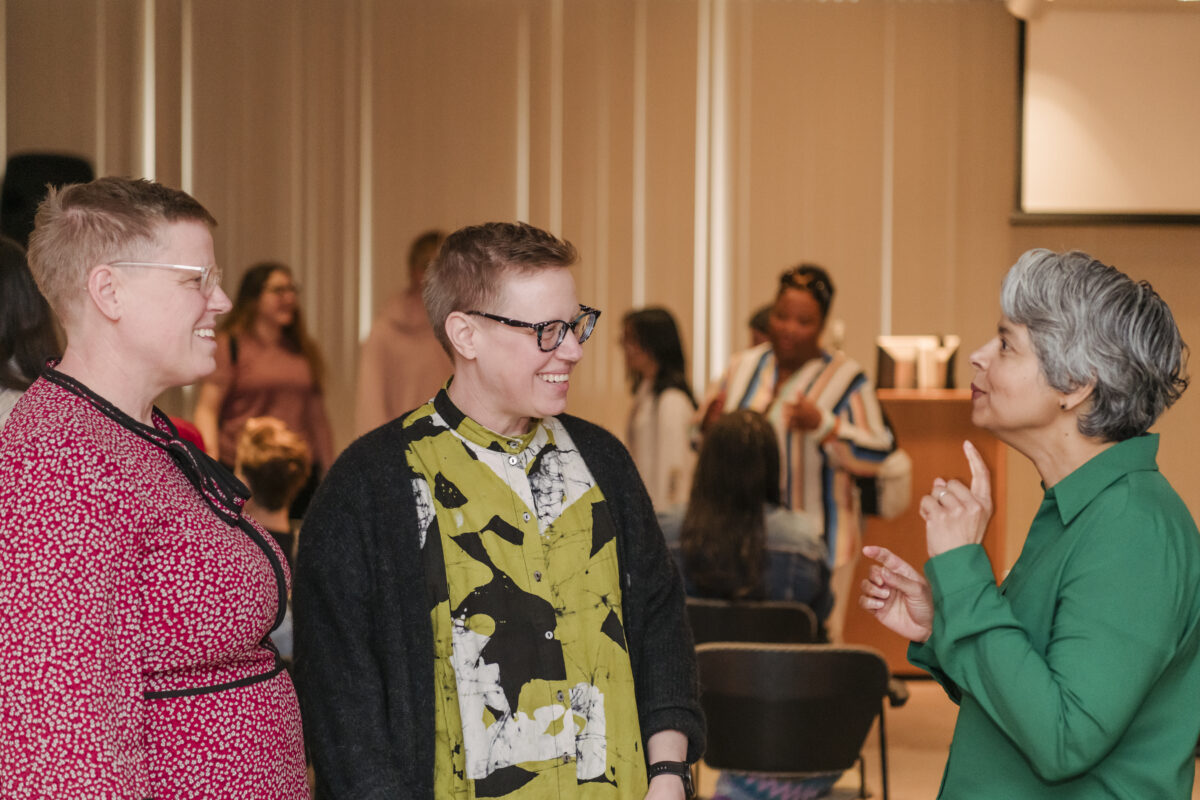 (l-r) Kate Drabinski, Kate Drabinski, Emily Drabinskis, president of the American Library Association, and Vrushali Patil.
The oral history project trains undergraduate students on oral history interview skills with community members such as the Charm City Kitty Club, a queer femme cabaret; Prettyboi Drag, a queer of color drag king troupe in the Baltimore and Washington, D.C. region; as well as queer UMBC community members. It is archived in the UMBC Albin O. Kuhn Library Special Collection.
“Students are building the oral history archive I wish I had as a researcher in Baltimore queer history,” says co-principal investigator Kate Drabinski, principal lecturer in GWST. “The grant will pay for more basic equipment and training.”
The annual Korenman Lecture series brings scholars, activists, and artists to campus for talks on cutting-edge topics in GWST and includes student workshops on related topics. Over the next three years, GWST will host three additional Korenman Lectures focused on transgender sexual politics, reproductive justice, decolonizing health, and sexuality and the carceral state.
The third program includes six social justice workshops for faculty and students. They will explore approaches to organizing such as running for political office, identifying social justice issues, zine making, and social media for social justice.
 GWST workshop: “How to Queer Any Text Using Black Out Poetry”
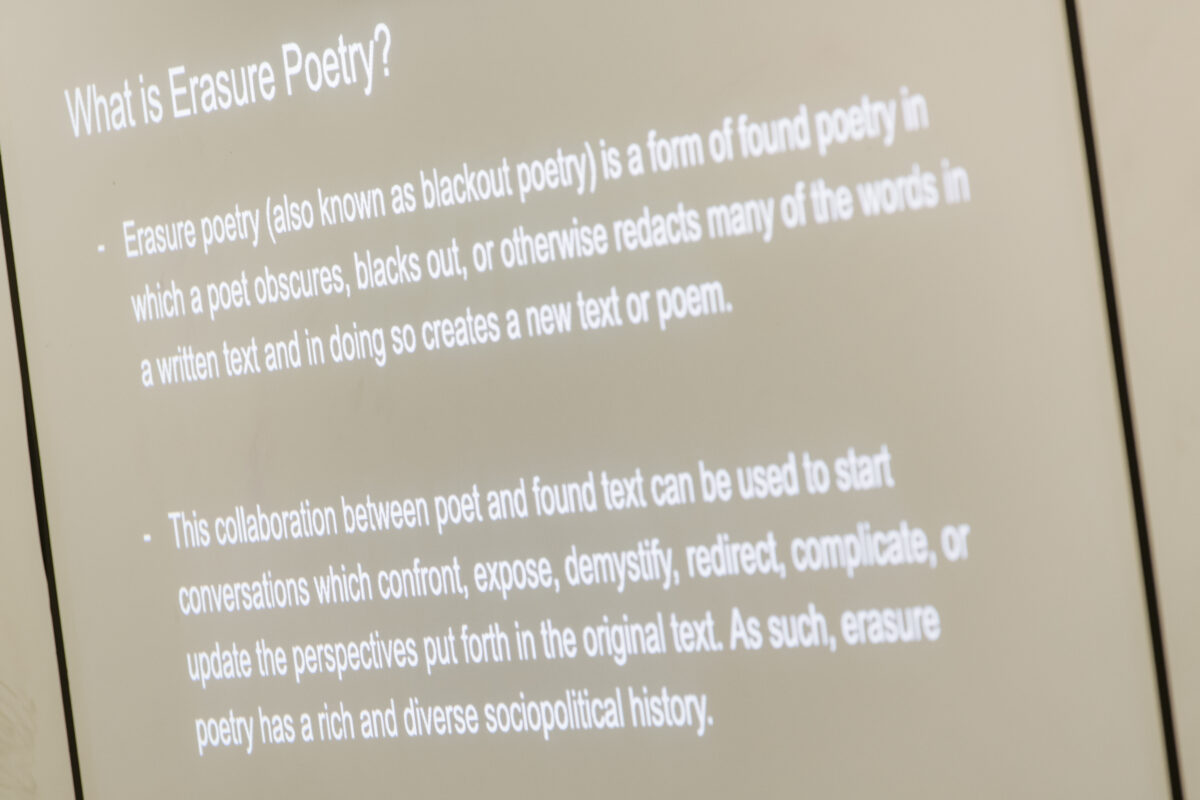
“The Affirming Multivocal Humanities grant provides an incredible opportunity to expand our ongoing work of challenging gender, sexuality, and race-based systems of oppression,” says Carole McCann, principal investigator and professor of GWST.
Additional GWST faculty participating in the grant: María Célleri, assistant professor; and Kathryn Kein, lecturer; and Courtney Cook, visiting lecturer.
Learn more about UMBC’s Gender, Women’s, and Sexuality Studies.
]]>
UMBC’s Gender, Women’s, and Sexuality Studies (GWST) department has received a $100,000 grant from the Mellon Foundation to implement its Advancing Gender and Sexuality Studies in Community...
https://umbc.edu/stories/mellon-foundation-awards-umbcs-gender-wst-100k/
https://my3.my.umbc.edu/api/v0/pixel/news/141253/guest@my.umbc.edu/d767536d505ae0c6a065cf246fdaa894/api/pixel
cahss
cahss-research
gwst
news
policy-and-society
rca-2
research
story
UMBC News & Magazine
https://my3.my.umbc.edu/groups/umbc-news-magazine
https://assets1-my.umbc.edu/system/shared/avatars/groups/000/001/943/24435aa6207c452e7bc15cc74b42c7bb/xsmall.png?1748556657
https://assets1-my.umbc.edu/system/shared/avatars/groups/000/001/943/24435aa6207c452e7bc15cc74b42c7bb/original.png?1748556657
https://assets2-my.umbc.edu/system/shared/avatars/groups/000/001/943/24435aa6207c452e7bc15cc74b42c7bb/xxlarge.png?1748556657
https://assets2-my.umbc.edu/system/shared/avatars/groups/000/001/943/24435aa6207c452e7bc15cc74b42c7bb/xlarge.png?1748556657
https://assets3-my.umbc.edu/system/shared/avatars/groups/000/001/943/24435aa6207c452e7bc15cc74b42c7bb/large.png?1748556657
https://assets1-my.umbc.edu/system/shared/avatars/groups/000/001/943/24435aa6207c452e7bc15cc74b42c7bb/medium.png?1748556657
https://assets2-my.umbc.edu/system/shared/avatars/groups/000/001/943/24435aa6207c452e7bc15cc74b42c7bb/small.png?1748556657
https://assets1-my.umbc.edu/system/shared/avatars/groups/000/001/943/24435aa6207c452e7bc15cc74b42c7bb/xsmall.png?1748556657
https://assets2-my.umbc.edu/system/shared/avatars/groups/000/001/943/24435aa6207c452e7bc15cc74b42c7bb/xxsmall.png?1748556657
UMBC News & Magazine
2
0
false
Tue, 23 Apr 2024 10:49:09 -0400
Tue, 23 Apr 2024 10:49:09 -0400
American Council of Learned Societies spotlights UMBC’s CoLab as an interdisciplinary leader

The American Council of Learned Societies (ACLS) has chosen UMBC’s Interdisciplinary CoLab for its “Undergraduate Spotlight” series. ACLS is a nonprofit federation of 80 scholarly organizations that has supported and amplified American scholarship in the humanities and interpretive social sciences since 1919. Over the last six summers, UMBC’s CoLab has provided students with an innovative team-based applied learning opportunity through a three-credit paid internship in narrative-based research.
ACLS writes, “Unlike traditional group work in a college classroom, wherein majors from the same discipline are all trying to master the same material, CoLab projects require students to use their own skills and appreciate the skills of others.”
Professional research experience
CoLab gives interdisciplinary student teams a professional research experience while learning how to tell effective stories and create valuable public-facing results for community partners. “I wasn’t aware of the [Baltimore Immigration] museum prior to my internship,” shared CoLab alum Johanna Alonso ’20, English, about her team’s project “Baltimore: The Second Ellis Island. “I think the real benefit of the CoLab is that it exposes students to people, places, programs, and projects we may never have encountered otherwise.”
Co-directed by Carole McCann, professor and chair of gender, women’s, + sexuality studies, and Donald Snyder, a principal lecturer in media and communications studies, UMBC Interdisciplinary CoLab is a partnership between the Provost’s Office, the Dresher Center for the Humanities, and the Office of Summer, Winter, and Special Programs.
“ACLS is a very prestigious national academic organization,” says McCann, “so for it to highlight CoLab as an innovative program is a big deal.”
After participating in the 2021 CoLab focused on BLM and Civil Rights Oral Histories, Deysi Chitic-Amaya ’23, media and communication studies, said, “I want to be able to approach future projects with a more open-minded perspective that may help to produce something new and innovative.”
Read more about students’ CoLab experiences and the application process.
]]>
The American Council of Learned Societies (ACLS) has chosen UMBC’s Interdisciplinary CoLab for its “Undergraduate Spotlight” series. ACLS is a nonprofit federation of 80 scholarly organizations...
https://umbc.edu/quick-posts/acls-spotlights-umbcs-colab/
https://my3.my.umbc.edu/api/v0/pixel/news/138616/guest@my.umbc.edu/8adca042e9b8aa6e12394de60be2da52/api/pixel
cahss
cahss-research
colab
english
gwst
mcs
news
policy-and-society
quick-post
research
UMBC News & Magazine
https://my3.my.umbc.edu/groups/umbc-news-magazine
https://assets1-my.umbc.edu/system/shared/avatars/groups/000/001/943/24435aa6207c452e7bc15cc74b42c7bb/xsmall.png?1748556657
https://assets1-my.umbc.edu/system/shared/avatars/groups/000/001/943/24435aa6207c452e7bc15cc74b42c7bb/original.png?1748556657
https://assets2-my.umbc.edu/system/shared/avatars/groups/000/001/943/24435aa6207c452e7bc15cc74b42c7bb/xxlarge.png?1748556657
https://assets2-my.umbc.edu/system/shared/avatars/groups/000/001/943/24435aa6207c452e7bc15cc74b42c7bb/xlarge.png?1748556657
https://assets3-my.umbc.edu/system/shared/avatars/groups/000/001/943/24435aa6207c452e7bc15cc74b42c7bb/large.png?1748556657
https://assets1-my.umbc.edu/system/shared/avatars/groups/000/001/943/24435aa6207c452e7bc15cc74b42c7bb/medium.png?1748556657
https://assets2-my.umbc.edu/system/shared/avatars/groups/000/001/943/24435aa6207c452e7bc15cc74b42c7bb/small.png?1748556657
https://assets1-my.umbc.edu/system/shared/avatars/groups/000/001/943/24435aa6207c452e7bc15cc74b42c7bb/xsmall.png?1748556657
https://assets2-my.umbc.edu/system/shared/avatars/groups/000/001/943/24435aa6207c452e7bc15cc74b42c7bb/xxsmall.png?1748556657
UMBC News & Magazine
0
0
false
Fri, 02 Feb 2024 11:54:56 -0500
Creating Queer Arab Joy
Seven years ago, Mejdulene Bernard Shomali began a search for her queer Arab women “banat” ancestors. Shomali, a queer Palestinian poet, was looking for mirrors and searching for hope in other queer Arab women, queer Arab banat. Their lives and names were unknown to her, blurred as they were by Western, Orientalism, and Arab hetero-patriarchal representations of Arab femininity.
Shomali came to UMBC in 2015 as a member of the third cohort of UMBC’s Postdoctoral Fellows which recognizes and supports talented scholars who are emerging as cutting-edge researchers and educators in their fields. In 2016, Shomali joined the faculty as an assistant professor of gender, women’s, and sexuality studies.
Shomali wondered if one could be queer and Arab and okay all at the same time especially if representation of queer banat desire was missing from popular cultural texts and films. In the darkest of times, during a global pandemic shutdown, she found her answer— it was a resounding, YES. Not only can one be queer and Arab and okay, you can also create queer Arab joy.
In 2019, Shomali received The Woodrow Wilson National Fellowship Foundation Career Enhancement Fellowship to continue research for her manuscript. After seven years of research throughout the Arab diaspora, Shomali published her first book, Between Banat: Queer Arab Critique and Transnational Arab Archives. It is the first study of desire that addresses the contemporary cultures and lives of queer Arab women.
“This book is my love letter to my unnamed queer Palestinian ancestors. It is the knowing glance, playful wink, and double entendre between us,” Shomali writes in her book. “It is the ways we call one another, not only for recognition and community but to action and movement toward a joyful and pleasurable queer Arab future.”
Shomali, who has developed university-wide programming around Arab and Muslim identity, discussed her book at the Dresher Center for the Humanities 2023 Spring Humanities Forum. “It is not easy to work at the intersection of several disciplines and build both sophisticated and intelligible arguments for all audiences,” said Carole McCann, professor and chair of gender, women’s, and sexuality studies, who introduced Shomali. “However, Dr. Shomali deploys the conceptual tools of critical cultural studies, literary theory, transnational feminist theory, and queer of color critique with great dexterity demonstrating both a sharp intellect and immense writerly talent.”
UMBC Dresher Center for the Humanities 2023 Spring Humanities Forum.
Queer Arab Critique
Moving between Arabic, English, and Arabish (Arab+English), Shomali takes us as far back as the 10th century to analyze the famed Persian, Arab, Indian, and Asian tale of The Thousand and One Nights where Scheherazade saves herself, other women, and the nation by telling the king—who killed his virgin wives each morning—stories over 1001 nights. “As a storyteller and state queen, she evades the three typical representations of Arab femininity: silent veiled Muslima, hypersexual dancer or harem girl, and female terrorist,” notes Shomali. “She is hailed as an ancestor, muse, and icon for many Arab and Arab American writers.”
Shomali analyzes an 1855 and 1995 translation and three modern versions. “Scheherazade has also been used as a key figure in the portrayal of Arab women’s femininity, elitism, heteronormative sexuality, and anti-Blackness and has served to perpetuate colonial and Orientalist beliefs of the Arab world,” explains Shomali. Orientalism defines the West as civilized colonizers with progressive ideas and the East as foreign, uncivilized, primitive, and “other” that must be tamed through colonization. “Studying Scheherazade can reveal how representations of Arab women and femininity change given the cultural and political context in which they emerge,” says Shomali.
Where would one find queer Arab representation in a text that defines heterosexuality as the norm of Arab femininity? Like many queer people and people of color who do not see themselves represented in literature, art, business, or academia Shomali had to design her own solution—what she calls a Queer Arab Critique.
Queer Arab Critique is about finding the unseen, “the what ifs,” reading critically and between the lines. Using this lens, Shomali reexamines Scheherazade’s story and two films from the Golden Era of Egyptian Cinema (1940s – 70s). It is as much a mirror for queer Arab women of queer Arab women’s desires, sexuality, space, and time. It is also evidence that Western colonization and Western queer thought do not define nor erase mainstream queer Arab culture.
“Queer Arab Critique allows us to see the traces of queer desire in mainstream Arab cultures and undermines the erasure of queer people from Arab histories,” Shomali explains, “and reveals how queerness and Arabness are constructed relationally, between many locations, texts, and times.”
For and by queer Arab women
Between Banat is equally about undoing the archives of the past as it is about creating a new queer Arab archive. One that centers on literature, arts, film, and activism by and for trans and cis Arab women, femmes, and those Arabs who identify with femininity.
Searching for these vibrant communities pre-pandemic would have taken multiple trips to several countries, scouring state and local archives, and finding the hidden and active network of queer Arab communities. A global pandemic meant shifting gears. Shomali took to digital sleuthing in English and Arabic. Posting questions, following helpers, and clicking through online bootleg archives in Lebanon, Syria, Saudi Arabia, and Palestine.
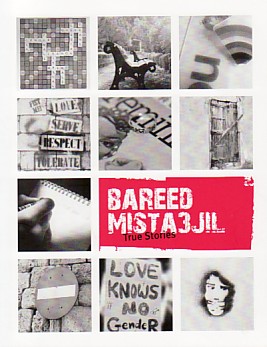
“Bareed Mista3ji” by Meem.
One find includes three biographical essay collections: “Haqi: An A’ish, An Akhtar, An Akoon” (My Right: To Live, To Choose, To Be) and “Waqfet Banat” (Women’s Stand) by Astwa in Palestine, and “Bareed Mista3ji” (Priority Mail) by Meem in Lebanon. Through anonymous and first-name authorship, banat write about their experiences, identities, and communities and publish their work via queer feminist organizations that advocate for LGBTI+ communities like Astwa and Meem.
In her search, Shomali also found three novels: Elham Mansour’s Ana Hiya Inti (I Am You), Seba al-Herz’s Al Akharuun (The Others), and Samar Yazbek’s Ra’ihat il Kirfathree (The Scent of Cinnamon). Once more written by, for, and about queer Arab women. These rich narratives take place in Lebanon, Saudi Arabia, and Syria respectively, giving readers a complex, close, and varied experience of same-sex desires and practices within Arab communities, families, spaces, and politics.
“It often comes as a surprise to Western and some Arab audiences that the majority of works about same-sex desires and practices between Arab women are not, as Orientalism would have us believe, originating in the West or in English,” says Shomali, who was named the 2017 Outstanding Faculty Ally at the Lavender Celebration, UMBC’s yearly event honoring LGBTQIA+ students, faculty, and staff. “They are works by Arab authors and artists, produced in Arabic, in Arab nations.”
A free and joyful queer future
In addition to texts, Shomali connected with filmakers, artists, and designers currently advancing perceptions and practices of gender, sexuality, and liberation from oppressive systems within Arab culture creating a joyful and thriving present and future in film, fashion, and illustration.
Maysaloun Hamoud’s 2016 narrative film Bar Bahar (In Between) tells the friendship of three Palestinian roommates living in occupied Palestine working through issues of cultural expectations, identity, desire, and freedom. Nöl Collective is a clothing production company and intersectional feminist and political fashion collective based in Ramallah, Palestine. It works with Palestinian women artisans to create clothes based on traditional methods as a platform to bring awareness to political, environmental, and intersectionality issues as shared on their website.
The political reality for Palestinians is shaped by the military occupation which touches and shapes every element of our lives, including creativity. Isolated from one another geographically most of the artisans we are working with have never met and even need to work together digitally to bring garments to life, representing a creative endeavor which has triumphed over imposed borders.
Detroit’s own Maamoul Press is a small multidisciplinary art collective that supports the production and circulation of creative works in the genres of comics, printmaking, and book arts in the Arab diaspora.
“Ultimately, Bar Bahar, Nöl Collective, and Maamoul Press are geared toward a queer Arab future whose ethnic, sexual, and gender politics point toward collective liberation rather than community gatekeeping and social erasure,” says Shomali. “They do so by centering diverse voices, substantiating a future in which queer Arabs not only exist and experience pleasure, but whose existence, pleasures, and activists are essential to a sexually free future.”
Shomali chose the word banat because it is void of the western, Orientalist, and hetero-patriarchal gaze that has defined queer Arab women into three stereotypes of Arab women’s religion, sexuality, and political beliefs. Between Banat is about all the spaces in between queer Arab women’s loving and living. Their past and future, visibility and invisibility, heterosexuality and queerness, empires and colonies, western and Arab.
“When I felt like it was impossible to write this book, I thought about my Palestinian ancestors and how I was bringing to bear a future we couldn’t have imagined,” says Shomali. “I believe in our joy and I believe our freedom is coming. I am grateful to them for teaching me that I am not alone.”
]]>
Seven years ago, Mejdulene Bernard Shomali began a search for her queer Arab women “banat” ancestors. Shomali, a queer Palestinian poet, was looking for mirrors and searching for hope in other...
https://umbc.edu/stories/creating-queer-arab-joy/
https://my3.my.umbc.edu/api/v0/pixel/news/134473/guest@my.umbc.edu/16f7fdf860bd129bbc54caf5d1aef2ac/api/pixel
cahss
cahssresearch
discovery
gwst
international-stories
magazine
research
UMBC News & Magazine
https://my3.my.umbc.edu/groups/umbc-news-magazine
https://assets1-my.umbc.edu/system/shared/avatars/groups/000/001/943/24435aa6207c452e7bc15cc74b42c7bb/xsmall.png?1748556657
https://assets1-my.umbc.edu/system/shared/avatars/groups/000/001/943/24435aa6207c452e7bc15cc74b42c7bb/original.png?1748556657
https://assets2-my.umbc.edu/system/shared/avatars/groups/000/001/943/24435aa6207c452e7bc15cc74b42c7bb/xxlarge.png?1748556657
https://assets2-my.umbc.edu/system/shared/avatars/groups/000/001/943/24435aa6207c452e7bc15cc74b42c7bb/xlarge.png?1748556657
https://assets3-my.umbc.edu/system/shared/avatars/groups/000/001/943/24435aa6207c452e7bc15cc74b42c7bb/large.png?1748556657
https://assets1-my.umbc.edu/system/shared/avatars/groups/000/001/943/24435aa6207c452e7bc15cc74b42c7bb/medium.png?1748556657
https://assets2-my.umbc.edu/system/shared/avatars/groups/000/001/943/24435aa6207c452e7bc15cc74b42c7bb/small.png?1748556657
https://assets1-my.umbc.edu/system/shared/avatars/groups/000/001/943/24435aa6207c452e7bc15cc74b42c7bb/xsmall.png?1748556657
https://assets2-my.umbc.edu/system/shared/avatars/groups/000/001/943/24435aa6207c452e7bc15cc74b42c7bb/xxsmall.png?1748556657
UMBC News & Magazine
2
0
false
Mon, 31 Jul 2023 13:54:48 -0400
Mon, 31 Jul 2023 13:54:48 -0400
Rooted in Advocacy—Giese ’99 ensures federal programs meet community needs
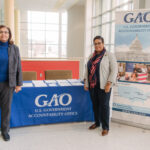
Danielle Giese ’99, political science and Africana studies, remembers her first paychecks were hot and cheesy pizza lunches. They were the reward for volunteering at the Southern Maryland Tri-County Community Action Committee where her father, Dana M. Jones, served as chief executive officer for 30 years. At 12 years old, Giese and her two brothers, Rondell and Gregory, were tasked with answering phones, doing data entry, and directing people to the corresponding service.
Giese watched as her father advocated for and administered federal and state-funded local programs for vulnerable communities for decades. Giese quickly learned that her participation was vital to helping connect people to necessary resources, and Jones had no qualms about his children’s ability to do their job well. Slacking off was not an option, Giese reminisces with a smile.
“I began working on my political science and Africana studies degrees years before coming to UMBC,” says Giese who is the assistant director at the U.S. Government Accountability Office where she has dedicated over two decades. She leads performance audits of government programs at the request of congressional committees, a policy-making process to help ensure federal programs are meeting community needs.
Day-to-day work of social change
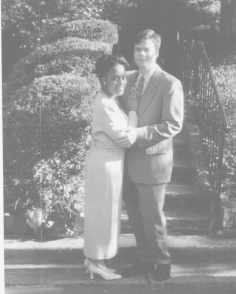 Danielle and Michael Giese early in their relationship. Photo courtesy of Giese.
What she remembers most about volunteering for her father is getting a glimpse into the myriad needs of her community. Doing data entry for the food bank increased her awareness of the number of families whose paychecks were not enough to feed their families. “I saw people who had jobs and sometimes were also receiving other types of support,” says Giese, “show up month after month after month. I learned just how difficult it was for people to make ends meet and put food on the table.”
As the hub of entry for new and existing clients, Giese quickly learned community members’ needs went beyond being connected with other agencies and resources. Direct services like a Head Start program and an elder care program provided the spectrum of direct support caretakers needed to seek and maintain employment. And for those who needed housing, the organization also raised funds to supplement federal and state allocations to build affordable housing. Her father would even do home visits to inform families on energy efficiency.
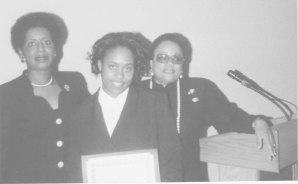 Giese, center, while as a student at UMBC. Photo courtesy of Giese.
What Giese didn’t know at the time was that she was an active participant in the War on Poverty, a social welfare legislation introduced in the 1960s by President Lyndon Bates Johnson intended to help end poverty in the United States. The people she welcomed were part of the about 13 percent of Americans who were living in poverty at the time. When she volunteered, it freed more employees to serve more families. In those informative years, Giese watched her father be a liaison between the federal and state government and local communities carrying out the day-to-day work of social change, and she saw a place for herself in that world.
From local to federal change
Once at UMBC, Giese, a Humanities Scholar and a McNair Scholar, chose a path that broadened the foundation her father had given her. Giese passionately describes the long-term impact her gender and women’s studies courses—taught by Patrice McDermott, now vice provost for faculty affairs—have had on her work with childcare policies at the federal level.
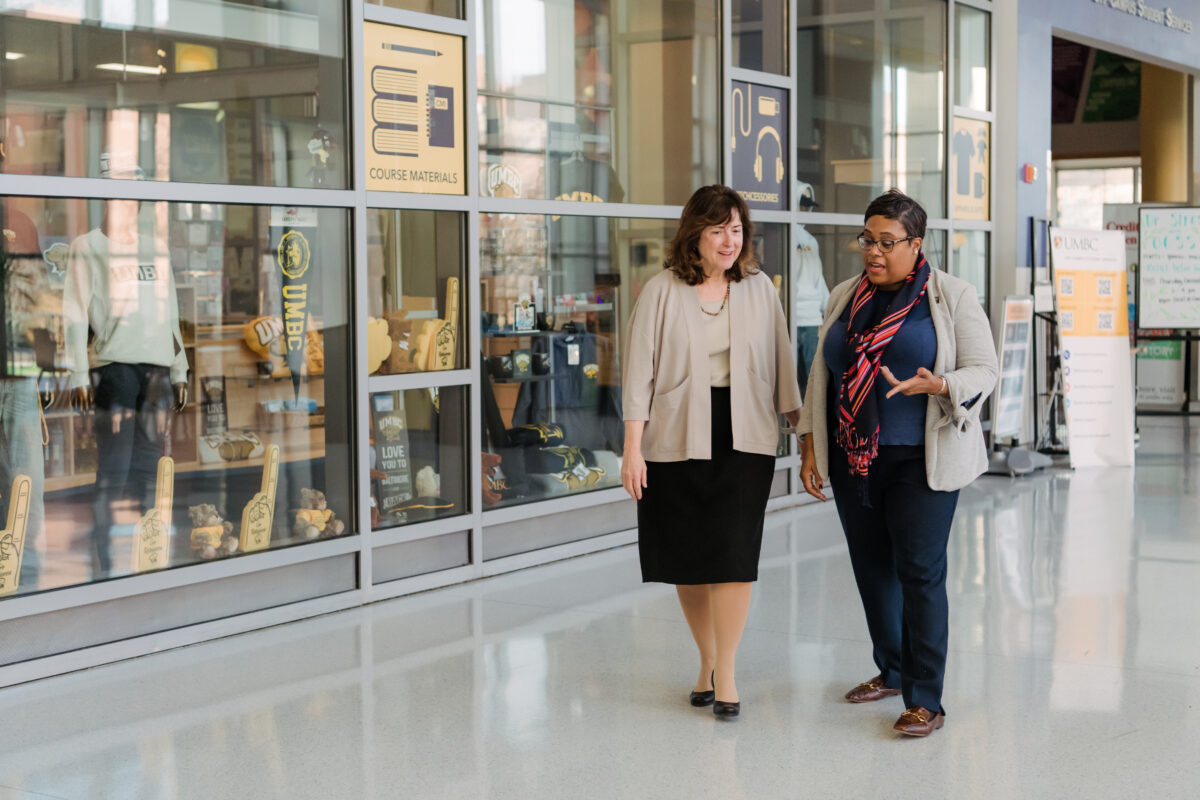 Patrice McDermott and Danielle Giese. (Marlayna Demond ’11/UMBC)
“Learning about how the social construct of gender controls access to work and its distribution, income, and wealth inspired me to engage in conversations about how we define and value ‘male’ work versus ‘female’ work, especially in the childcare industry,” says Giese. “Finally, after 20 years, policymakers are willing to discuss viable wages for childcare workers that will allow them to sustain a family.”
UMBC laid the foundation for so many aspects of Giese’s professional career, but also would determine the personal side of her life too. Danielle Jones met Michael Giese ’97, history, at Humanities Scholars gatherings where they found they shared an agricultural background dating back to the 1860s—with her family’s liberation and landownership and his family’s immigration from a farm in Germany to one in Maryland. He also took McDermott’s gender and women’s studies class. These shared bonds deepened their understanding of the world and each other leading to their marriage and their two children: Kent, 12, and Luke, 10.
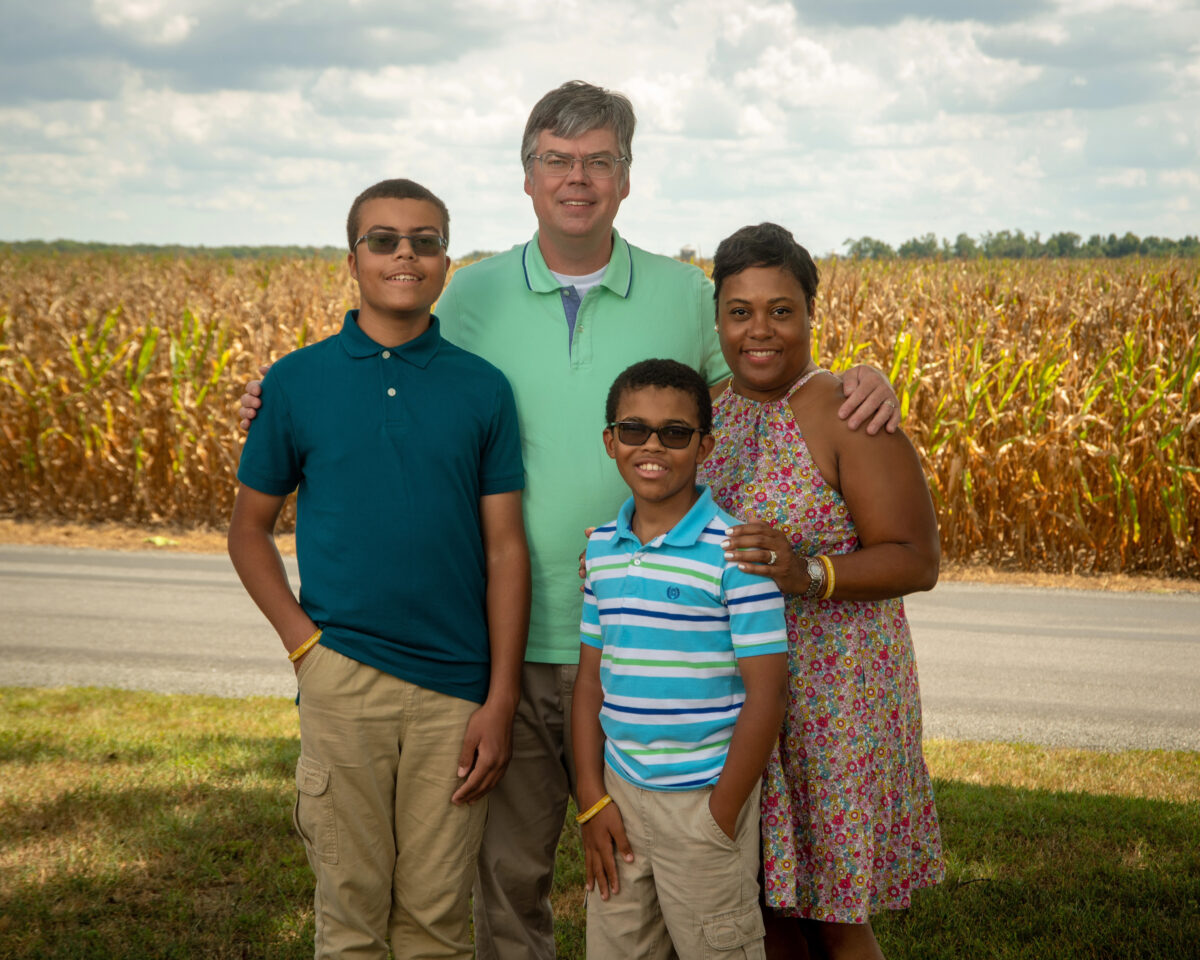 The Giese family. Photo courtesy of Giese.
“Danielle’s courses in gender, women’s, and sexuality studies shaped not only her understanding of herself but also the ways she pursues her work in the world,” shares McDermott. “Her story is a testament to the powerful ways our graduates draw on these lessons within their workplaces and society at large.”
From theory to action
Giese recently spoke about the joy she experienced as an Africana studies major in a video celebrating the department’s 50th anniversary. She shared the pivotal role Willie Lamousé-Smith, professor emeritus and former chair, had in her understanding of race and power in society and the global systems that have supported and perpetuated racism. Giese also shared about the transformative power of her class with Thomas Robinson, professor of Africana studies, on the psychology of racism and how it affects home, work, and personal relationships.
Reflecting on the on-going legacy of the department, Gloria Chuku, current chair and professor of Africana studies said, “The goal of the Africana studies department is to educate about the Africana heritage which includes the experiences, successes, challenges, and progress of people of African descent in the U.S. and across the globe.”
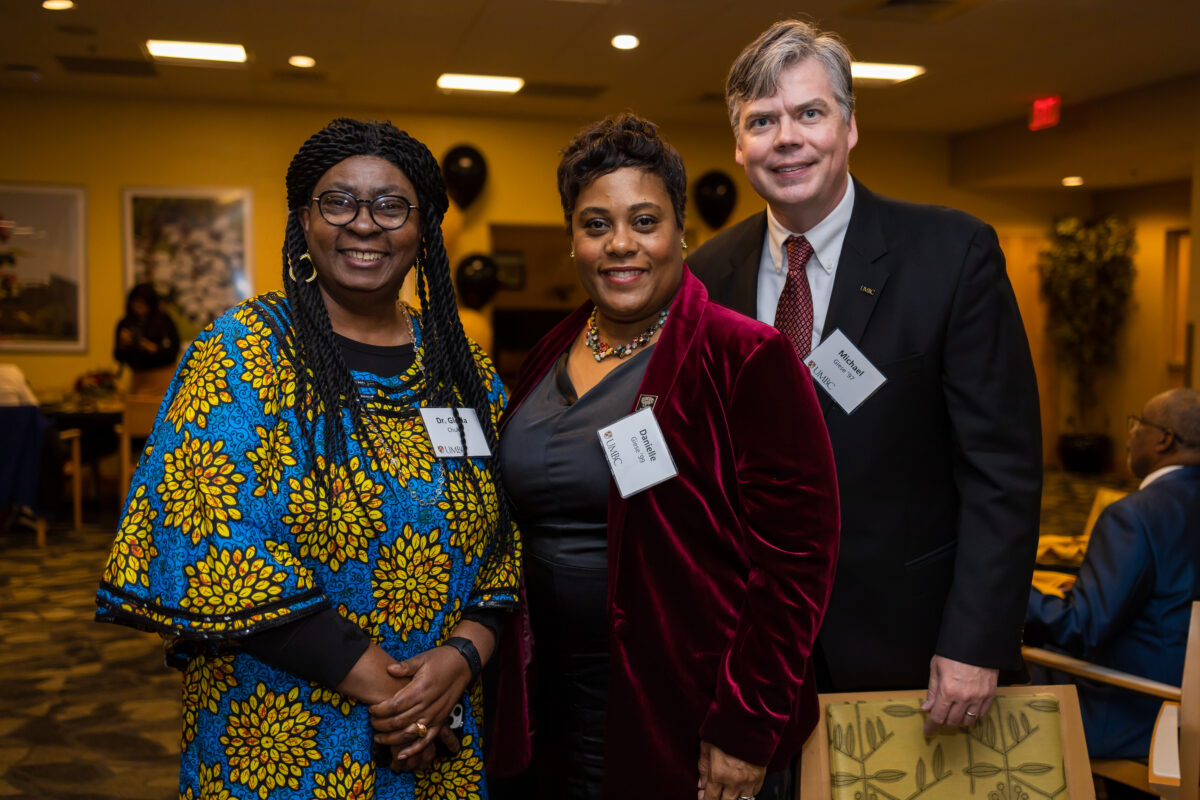 (l-r): Gloria Chuku, Danielle and Michael Giese. (Marlayna Demond ’11/UMBC)
Before graduating, Giese applied her experience from volunteering with her father that she continued to build on at UMBC to serve as an intern within an organization tackling housing issues in the Maryland Housing and Community Development Agency. Once again, she experienced the intricacies of collaborative work between state and local and state and federal programs. Even as a student, Giese could envision the impact she could have if she continued down this path at a federal level.
“The humanities, the cultural studies, provide important insights that we all need to basically influence the nation that we live in. It makes you think creatively about how you want to live your life,” says Giese. “Combining Africana studies with political science has given me incredible insights into how our government systems affect people of color. Change requires daily committed engagement through tough conversations that push the dialogue incrementally. Both majors have given me a leg up in a lot of ways.”
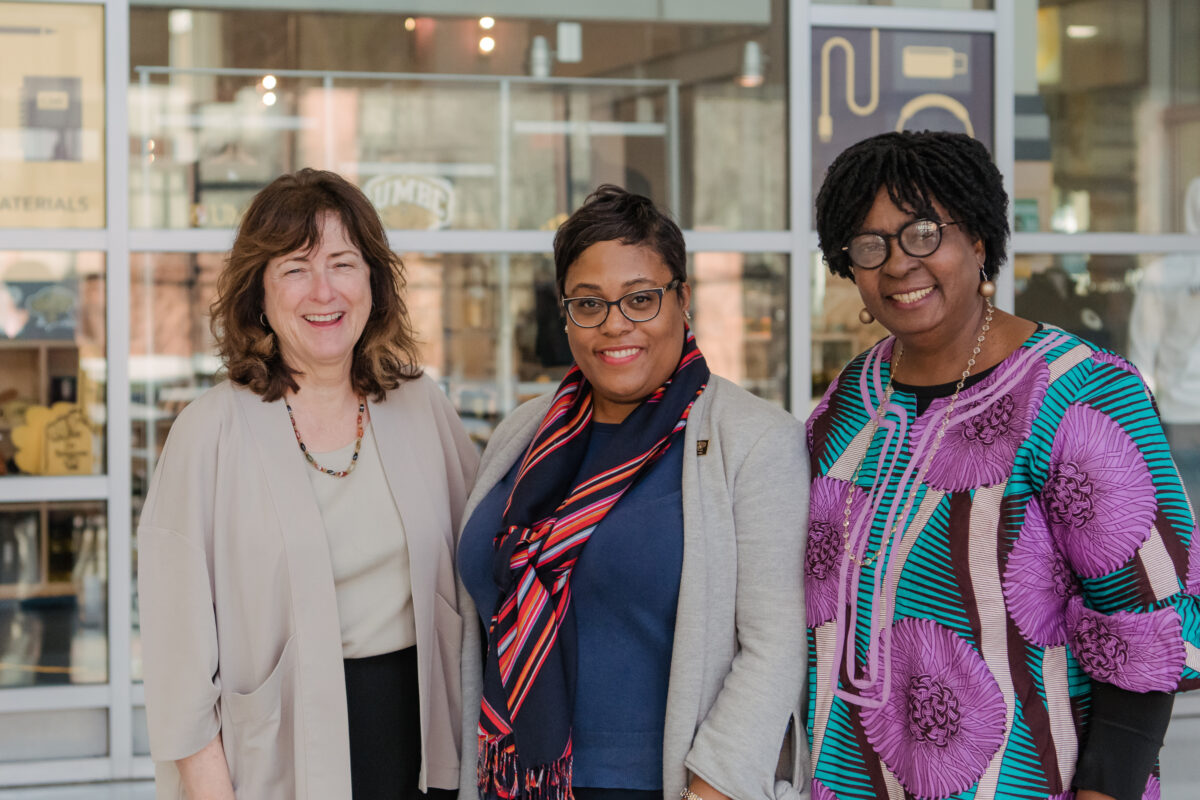 (l-r): McDermott, Giese, and Chuku. (Marlayna Demond ’11/UMBC)
Improving the country
“My work, like my dad’s, is ever-changing because it is always about improving the lives of communities across the country,” says Giese. She specializes in issues related to education, income and workforce security, equitable wages, worker protections, and subsidized childcare programs.
“It’s about engaging in dialogue on whether the federal programs meet the goal, the vision we have for serving people and for improving their lives.” She has no qualms about her ability to do the job well. Slacking off is not an option.
]]>
Danielle Giese ’99, political science and Africana studies, remembers her first paychecks were hot and cheesy pizza lunches. They were the reward for volunteering at the Southern Maryland...
https://umbc.edu/stories/rooted-in-advocacy-federal-programs-meet-needs/
https://my3.my.umbc.edu/api/v0/pixel/news/131287/guest@my.umbc.edu/554028ddcd3fb1887b5cf4f404092bdf/api/pixel
africana-studies
alumni
cahss
gwst
history
impact
magazine
politicalscience
UMBC News & Magazine
https://my3.my.umbc.edu/groups/umbc-news-magazine
https://assets1-my.umbc.edu/system/shared/avatars/groups/000/001/943/24435aa6207c452e7bc15cc74b42c7bb/xsmall.png?1748556657
https://assets1-my.umbc.edu/system/shared/avatars/groups/000/001/943/24435aa6207c452e7bc15cc74b42c7bb/original.png?1748556657
https://assets2-my.umbc.edu/system/shared/avatars/groups/000/001/943/24435aa6207c452e7bc15cc74b42c7bb/xxlarge.png?1748556657
https://assets2-my.umbc.edu/system/shared/avatars/groups/000/001/943/24435aa6207c452e7bc15cc74b42c7bb/xlarge.png?1748556657
https://assets3-my.umbc.edu/system/shared/avatars/groups/000/001/943/24435aa6207c452e7bc15cc74b42c7bb/large.png?1748556657
https://assets1-my.umbc.edu/system/shared/avatars/groups/000/001/943/24435aa6207c452e7bc15cc74b42c7bb/medium.png?1748556657
https://assets2-my.umbc.edu/system/shared/avatars/groups/000/001/943/24435aa6207c452e7bc15cc74b42c7bb/small.png?1748556657
https://assets1-my.umbc.edu/system/shared/avatars/groups/000/001/943/24435aa6207c452e7bc15cc74b42c7bb/xsmall.png?1748556657
https://assets2-my.umbc.edu/system/shared/avatars/groups/000/001/943/24435aa6207c452e7bc15cc74b42c7bb/xxsmall.png?1748556657
UMBC News & Magazine
0
0
false
Mon, 27 Feb 2023 15:52:33 -0500
Mon, 27 Feb 2023 15:52:33 -0500
Community-building in Baltimore through public humanities
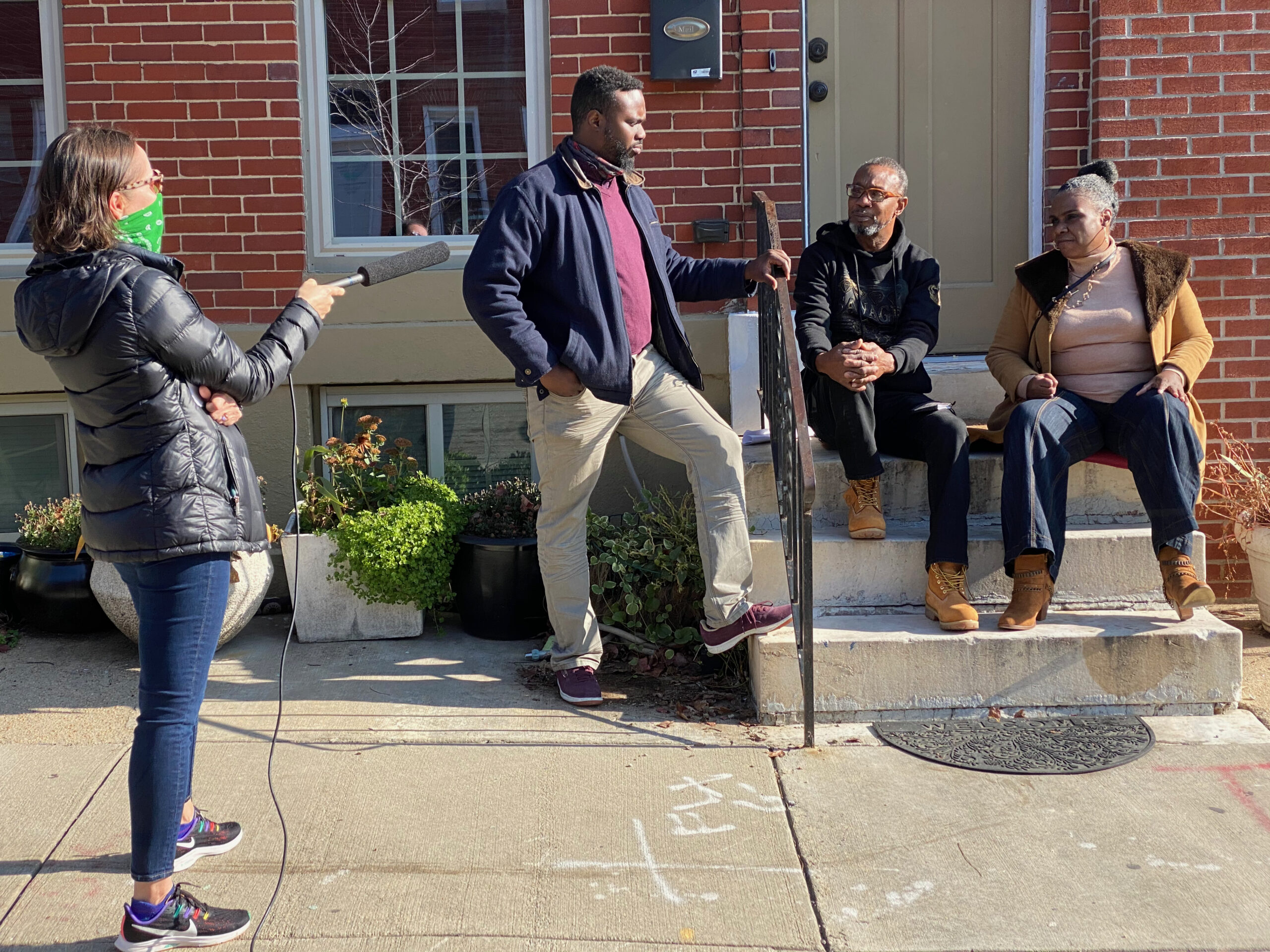
Over the last decade Nicole King, professor of American studies and director of the Orser Center for the Study of Place, Community, and Culture, has worked with colleagues to develop public humanities research methods that address disconnections, misrepresentation, and inequalities in Baltimore City and in the classroom. King helps students actively listen to and partner with Baltimore communities in research to create multimedia narratives as a vehicle of community-building and advocacy.
“Place-based public history projects demonstrate that students and scholars can engage and collaborate with communities to identify, analyze, and respond to pressing social problems,” says King. “Public history methods can create dynamic social spaces in which scholars and residents work together to frame questions, conduct research, and preserve urban places.”
King’s work has reached a broad range of academic and public audiences, from the recent co-authored article “Building Together” in Baltimore? Corporate Megadevelopment and Coalitions for Community Power in Urban Affairs Review to media coverage of A Place Called Poppleton, documenting a fight for community-led development as part of the Baltimore Traces project.
A Place Called Poppleton
In July 2022, Sonia and Curtis Eaddy celebrated as Baltimore’s mayor announced their home in the historic Poppleton neighborhood of West Baltimore, dating back to the late 1800s, would not be demolished for redevelopment as previously planned. Among those whom Sonia thanked for support were King and her students.
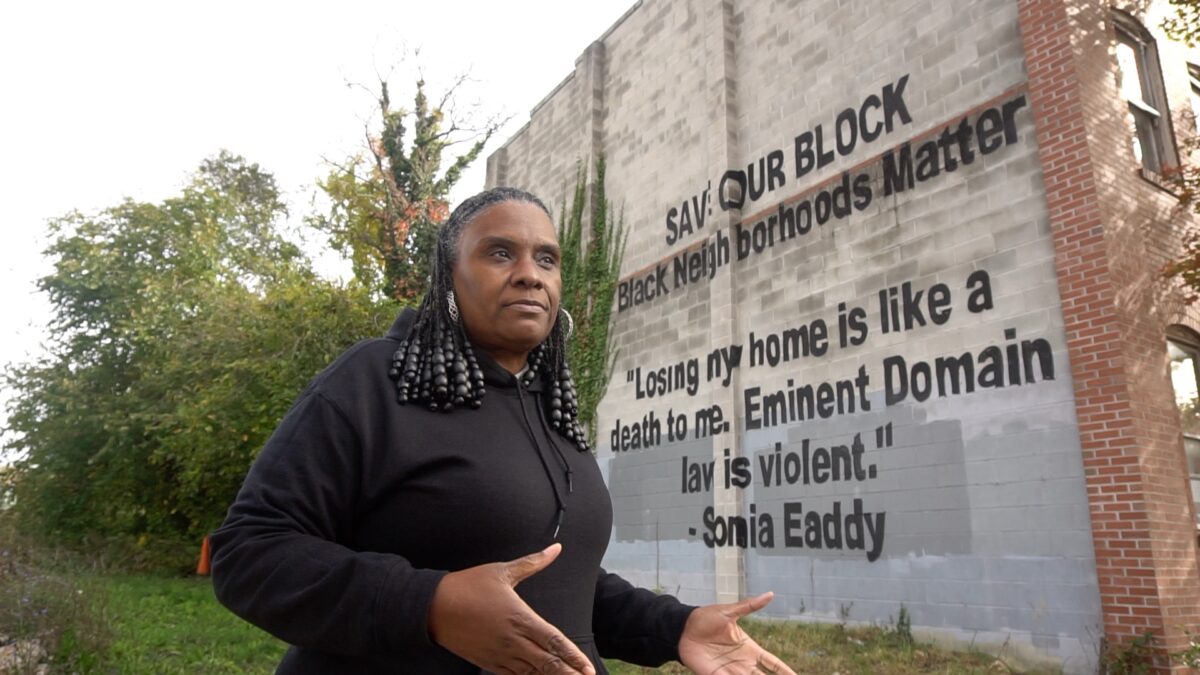 Sonia Eaddy. (Image courtesy of King)
King originally connected with the Eaddy family through their son, Curtis Eaddy II, who shared his story as a third-generation Poppleton resident in 2019 for the storytelling series Baltimore Traces: West Baltimore. He became a strong partner in leading walking tours of West Baltimore through UMBC’s Baltimore Field School before interviewing his parents for A Place Called Poppleton, which King co-created in 2020 with students, residents, and Bill Shewbridge, media and communication studies professor of the practice.
Curtis Eaddy II shares his story for Baltimore Traces: West Baltimore, produced by Shewbridge.
Through A Place Called Poppleton, UMBC students listened to residents who live, work, and are connected to Poppleton. They shared their voices through media like films, a digital walking tour and historical timeline, a zine, and a brochure. These materials have documented, analyzed, and raised awareness about Poppleton’s history and present community advocacy.
We Are You and You Are Us produced by María Morte, M.A. ’23, intercultural communication, Fulbright U.S. Student Scholar from Spain.
The project Baltimore Traces: Communities in Transition, which began in 2015, is a collaborative teaching initiative that brings together students from a variety of disciplines in the arts and humanities to create media focused on Baltimore neighborhoods. The project has produced the Telly Award-winning documentary Mill Stories: Remembering Sparrows Point Steel Mill as well as short films, digital maps, and podcasts such as the Baltimore Green Space and A Walk Down West Baltimore Street. This included the radio series Stories of Deindustrialization, produced in partnership with the Center for Emerging Media—a Baltimore non-profit, and aired on the Marc Steiner Show.
“Getting out, showing up, listening to people, and meeting people where they are is so important to building the Baltimore Traces project,” King explains. “It’s something that organically grows to educate students…to do work that matters on the ground.”
Baltimore Field School
It’s no accident that King first connected with Curtis Eaddy II through Baltimore Traces, and then the Baltimore Field School, a project specifically designed to support innovation in the public humanities through collaboration with Baltimore residents.
The Andrew W. Mellon Foundation awarded King and Dean Kimberly Moffitt $125,000 to establish the Baltimore Field School in 2020, to enhance the understanding and visibility of communities in South and Southwest Baltimore. The project accomplishes these objectives through methods centered in community partnership. In this way, it works to build a national model of effective, ethical humanities research, teaching, and learning about Baltimore and cities like it.
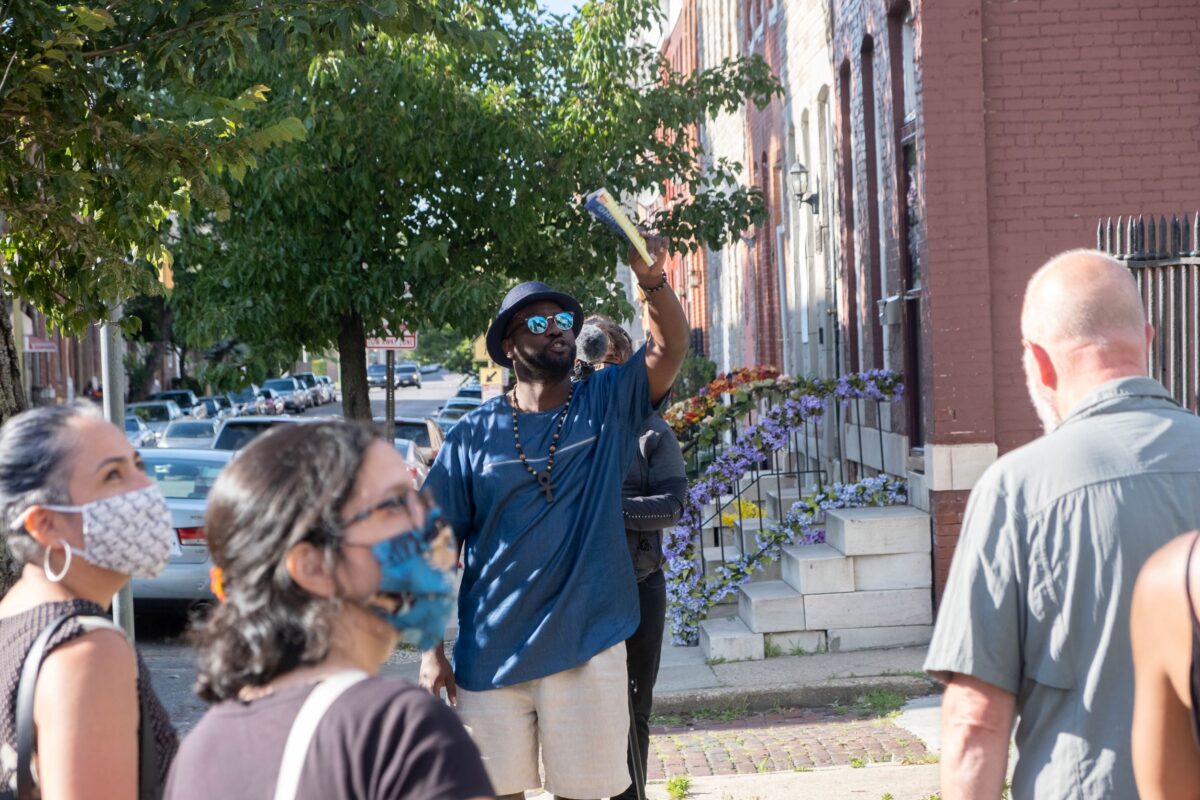 Curtis Eaddy II (center) leading a walking tour of West Baltimore for the Baltimore Field School.
The work continues to evolve. In 2022, the American Council of Learned Societies awarded King; Sarah Fouts, assistant professor of American studies; and Tahira Mahdi, adjunct professor of psychology, an NEH-supported public engagement grant totaling more than $150,000 for “Baltimore Field School 2.0: Undoing & Doing Anew in Public Humanities.”
Fouts, King, and Mahdi will work with community members, UMBC graduate students, and faculty to continue to develop frameworks for ethical and sustainable community-engaged research between local communities and academia, around topics such as public information, racial equity, and food and land justice.
The “public” in public humanities
These are some of the same core themes explored inBaltimore Revisited(Rutgers University Press, 2019), the leading contemporary anthology on the city’s complex history and efforts to address longstanding inequalities, written by experts both within and outside of academia. King co-edited the book with long-time collaborators Kate Drabinski, principal lecturer of gender, women’s, and sexuality studies, and the University of Baltimore’s Joshua Clark Davis.
“We hope the book raises questions about how history can inform the present to understand the roots of the city’s many inequalities,” said Drabinski, when it was published. “We wish readers to imagine new ways of being in and organizing for Baltimore now and in the future.”
Thinking of the anthology and all that has followed it, King reflects, “We can not forget the ‘public’ in public humanities.”
]]>
Over the last decade Nicole King, professor of American studies and director of the Orser Center for the Study of Place, Community, and Culture, has worked with colleagues to develop public...
https://umbc.edu/stories/community-building-in-baltimore-through-public-humanities/
https://my3.my.umbc.edu/api/v0/pixel/news/128592/guest@my.umbc.edu/75d853f2693ffa86fb3610b7278880c5/api/pixel
americanstudies
cahss
cahssresearch
gwst
intercultural-communications
mcs
news
policy-and-society
psychology
UMBC News & Magazine
https://my3.my.umbc.edu/groups/umbc-news-magazine
https://assets1-my.umbc.edu/system/shared/avatars/groups/000/001/943/24435aa6207c452e7bc15cc74b42c7bb/xsmall.png?1748556657
https://assets1-my.umbc.edu/system/shared/avatars/groups/000/001/943/24435aa6207c452e7bc15cc74b42c7bb/original.png?1748556657
https://assets2-my.umbc.edu/system/shared/avatars/groups/000/001/943/24435aa6207c452e7bc15cc74b42c7bb/xxlarge.png?1748556657
https://assets2-my.umbc.edu/system/shared/avatars/groups/000/001/943/24435aa6207c452e7bc15cc74b42c7bb/xlarge.png?1748556657
https://assets3-my.umbc.edu/system/shared/avatars/groups/000/001/943/24435aa6207c452e7bc15cc74b42c7bb/large.png?1748556657
https://assets1-my.umbc.edu/system/shared/avatars/groups/000/001/943/24435aa6207c452e7bc15cc74b42c7bb/medium.png?1748556657
https://assets2-my.umbc.edu/system/shared/avatars/groups/000/001/943/24435aa6207c452e7bc15cc74b42c7bb/small.png?1748556657
https://assets1-my.umbc.edu/system/shared/avatars/groups/000/001/943/24435aa6207c452e7bc15cc74b42c7bb/xsmall.png?1748556657
https://assets2-my.umbc.edu/system/shared/avatars/groups/000/001/943/24435aa6207c452e7bc15cc74b42c7bb/xxsmall.png?1748556657
UMBC News & Magazine
0
0
false
Wed, 19 Oct 2022 10:52:25 -0400
Wed, 19 Oct 2022 10:52:25 -0400

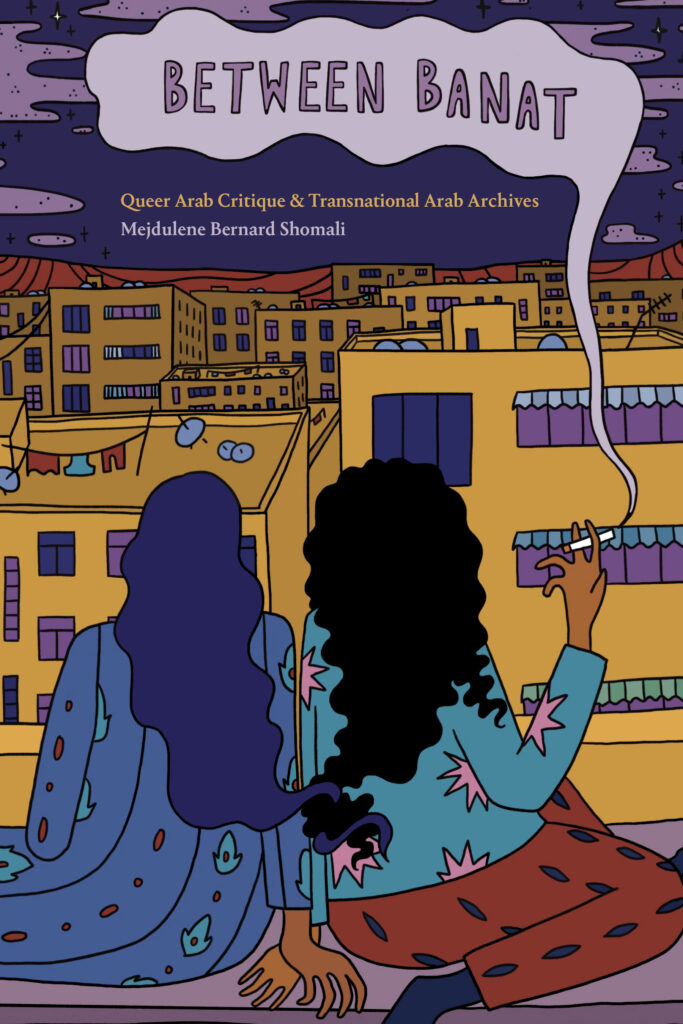 Book cover illustration by