How to enjoy being underground

Anyone trying to soothe a fussy toddler has their work cut out for them under normal circumstances. Add 379 feet of earth above your head and about 30 other tourists to the equation and you’ve got a potential disaster on your hands. But for Jeff Garcia, an interpretive park ranger at Jewel Cave National Monument in South Dakota, it’s just another day on the job. At any point into his hour and thirty minute below ground scenic tour of one of the world’s longest caves, Garcia might need to interrupt his historical and geological discourse (and steady stream of jokes) to address questions, the restroom needs of his party, or someone faced with a sudden bout of claustrophobia. The wonders of the cave make all the accompanying human foibles an afterthought for Garcia, who prior to his two summers at Jewel Cave had never been below the surface before.
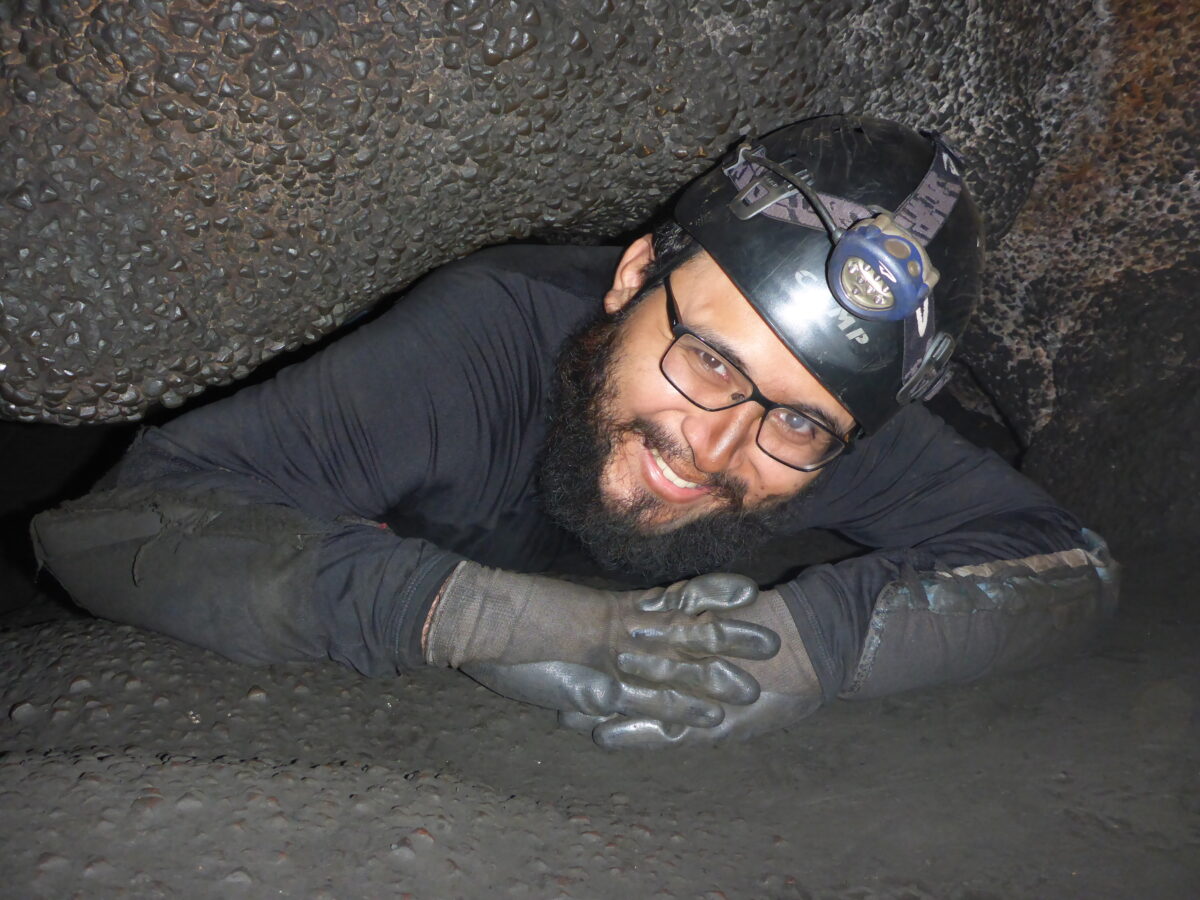
Tools of the Trade:
Flashlight
Minimal fears when it comes to the dark or enclosed spaces
A love of history and geology
Convenience baggies (you don’t want to know)
Backup flashlight
Step 1: Know your audience
Garcia didn’t anticipate spending multiple summers guiding people underground in the most complete darkness he’d ever seen, but he took to it quickly. Born and raised in Montgomery County, Maryland, Garcia anticipated he’d do an internship for his historical studies master’s program at UMBC somewhere close by—the nation’s capital, for example. But when he applied to the Latino Heritage Internship Program and they asked if he’d be open to going to South Dakota, he took the plunge. “I just wanted the opportunity to work with the public and teach history,” says Garcia, who knows from experience that learning history in the classroom is not nearly as effective as learning it on-site. “When people go to museums, when they go to archives, when they go to parks, they really absorb the knowledge,” he says.
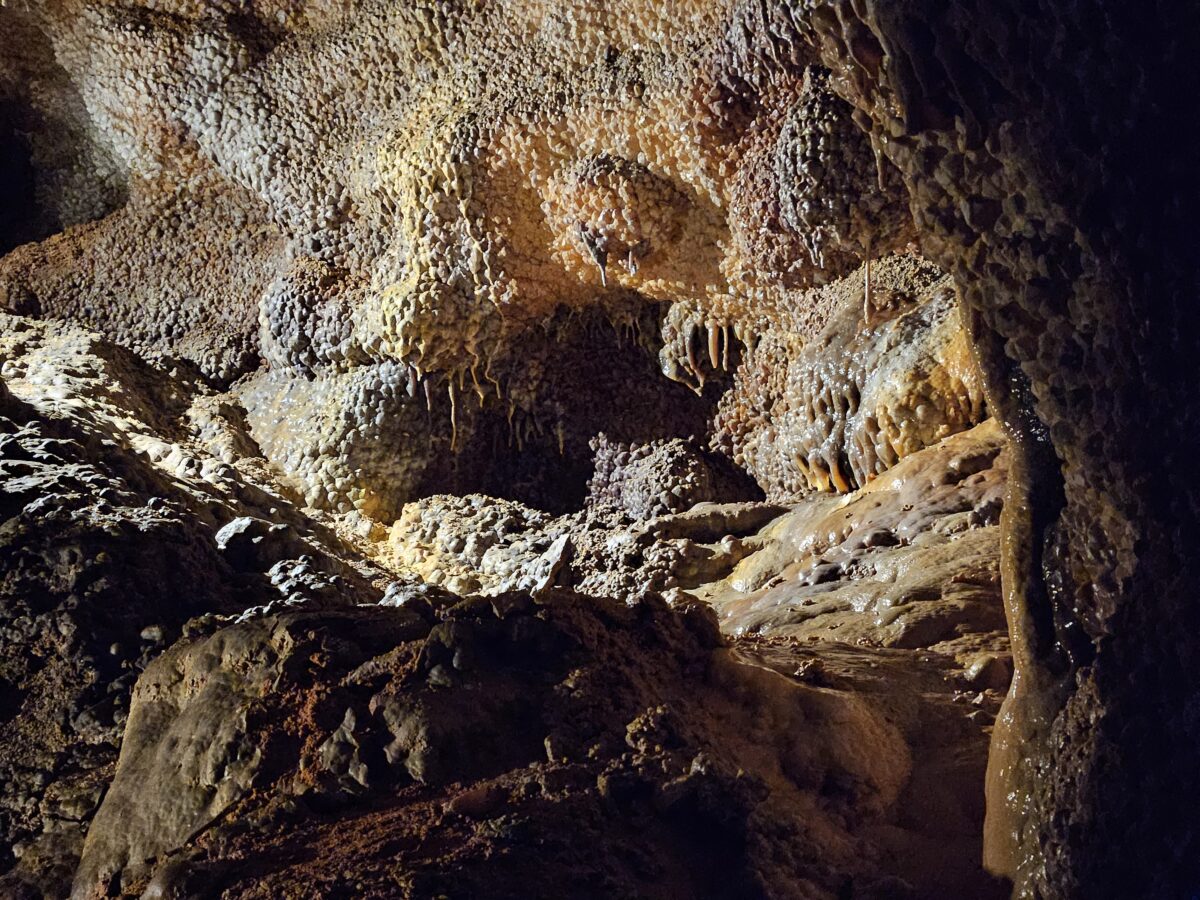 Draperies and flowstone in the Formation Room of Jewel Cave.
All sorts of people come to ooh and aah over the nailhead spar and dogtooth spar calcite crystals, the so-called jewels of Jewel Cave. At the beginning of his tour, Garcia assesses his group of tourists by warming them up with a history lesson and throwing in some jokes to see how they respond—that gives him a bellwether to know how the next 90 minutes will go. “You have to be mindful of the audience,” says Garcia. “I realized early on that seniors really like the dad jokes. So you kind of lean into those a bit more. When you have a lot of kids, they’re really just going to absorb it. So I’d get out the black light or a UV light onto some of the formations and it looks really cool—purple or greenish. So the kids are just going, ‘Whoa.’”
Step 2: Leave no trace
As Garcia often reminds his tour groups: In the caves, there are no cell service, food, or bathrooms, so take care of what you need before heading underground. But the persistent drip-drop sound of water—indeed the very substance that influences the formations of stalactites, stalagmites, boxwork, cave popcorn, flowstone, draperies, and a long ribbon drapery called the cave bacon—occasionally reminds visitors to heed the call of nature themselves. What then?
Garcia removes from his ever-present Ranger-issued fanny pack an innocuously named “convenience baggie.” Visitors then thank their unseeable lucky stars for the blackout conditions to ease their human needs. It then becomes their responsibility to tote their convenient baggie along until the lone trash can appears in the middle of the tour.
Step: 3 Avoid the low points
Originally when Frank and Albert Michaud filed a mining claim for “Jewel Tunnel” in 1900, they were hoping their cave was filled with minable treasure—gold or diamonds. Instead, they found calcite crystals, which Garcia quips to his groups, “Are about as strong as your fingernails and worth the same amount.” Not quite sure how to monetize their claim, the Michaud brothers invited the U.S. Forest Service to the caves, and due to the “objects of scientific interest,” in 1908 President Theodore Roosevelt declared Jewel Cave a National Monument.
At the Dugout, the lowest geographical point of the tour, Garcia reminds the visitors that, “There should be no low points emotionally.” Likewise at the Torture Room stop, the congenial guide walks the group through the naming process, which had nothing to do with torture. “It’s more of a funny story,” says Garcia, who explains that Jan and Herb Conn—the couple who mapped out more than 65 miles of the cave including the entire route of the Scenic Tour—were following the echoey sound of dripping water looking for a drink, but when they discovered the source, it was too high for them to reach.
Step 4: See yourself in history
“It wasn’t part of my family’s lifestyle to go to national parks,” says Garcia. “It wasn’t until Professor Melissa Blair’s History of Baltimore class when I went to Hampton National Historic Site in north Baltimore County that I can remember visiting something like that.”
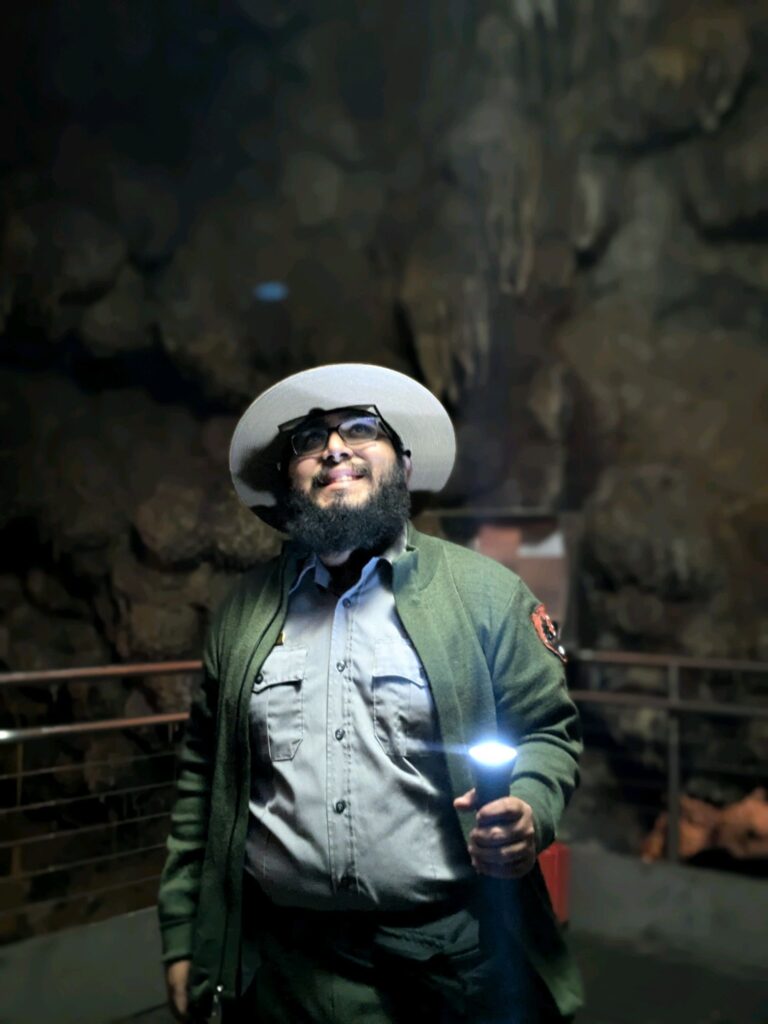
In 2023, Garcia went to Jewel Cave through the Latino Heritage Internship Program, which not only introduces young folks to professional roles in the National Park Service, says Garcia, “but also allows visitors to see someone who is of your background and be like, ‘Hey, I can picture myself being in that position!’ Representation matters, and so I thought, ‘I could be that person for someone in the future.’”
In 2024, he was invited back to South Dakota as summer park ranger, complete with the hat and uniform. Garcia plans to graduate in May 2025, but this January he starts his new position with the National Parks Service a little closer to home—the National Mall in Washington, D.C. “I’ll still get to work with the public and hopefully have them leave me more informed than they were before or have them think a bit differently. That’s all that matters,” says Garcia.
]]>
Anyone trying to soothe a fussy toddler has their work cut out for them under normal circumstances. Add 379 feet of earth above your head and about 30 other tourists to the equation and you’ve got...
https://umbc.edu/stories/how-to-enjoy-being-underground-with-jeff-garcia/
https://my3.my.umbc.edu/api/v0/pixel/news/146165/guest@my.umbc.edu/007da6468a0ffd5e4862d535c1dbe05c/api/pixel
cahss
campus-life
fall-2024
historical-studies
history
how-to
internship
magazine
story
UMBC News & Magazine
https://my3.my.umbc.edu/groups/umbc-news-magazine
https://assets1-my.umbc.edu/system/shared/avatars/groups/000/001/943/24435aa6207c452e7bc15cc74b42c7bb/xsmall.png?1748556657
https://assets1-my.umbc.edu/system/shared/avatars/groups/000/001/943/24435aa6207c452e7bc15cc74b42c7bb/original.png?1748556657
https://assets2-my.umbc.edu/system/shared/avatars/groups/000/001/943/24435aa6207c452e7bc15cc74b42c7bb/xxlarge.png?1748556657
https://assets2-my.umbc.edu/system/shared/avatars/groups/000/001/943/24435aa6207c452e7bc15cc74b42c7bb/xlarge.png?1748556657
https://assets3-my.umbc.edu/system/shared/avatars/groups/000/001/943/24435aa6207c452e7bc15cc74b42c7bb/large.png?1748556657
https://assets1-my.umbc.edu/system/shared/avatars/groups/000/001/943/24435aa6207c452e7bc15cc74b42c7bb/medium.png?1748556657
https://assets2-my.umbc.edu/system/shared/avatars/groups/000/001/943/24435aa6207c452e7bc15cc74b42c7bb/small.png?1748556657
https://assets1-my.umbc.edu/system/shared/avatars/groups/000/001/943/24435aa6207c452e7bc15cc74b42c7bb/xsmall.png?1748556657
https://assets2-my.umbc.edu/system/shared/avatars/groups/000/001/943/24435aa6207c452e7bc15cc74b42c7bb/xxsmall.png?1748556657
UMBC News & Magazine
0
0
false
Mon, 09 Dec 2024 12:54:54 -0500
Mon, 09 Dec 2024 12:54:54 -0500
Meet a Retriever—Rachel Brubaker, M.A. ’00, faculty funding connector
Meet Rachel Brubaker, M.A. ’00, historical studies, assistant director for grants and program development at the Dresher Center for the Humanities. Brubaker, a self-proclaimed humanities nerd, has worked in different positions at UMBC for 22 years, but her current seat in the Dresher Center allows her to combine her UMBC degree with her passion for public humanities and education to collaborate with faculty members on research proposals and help connect them to prestigious funding opportunities. Take it away, Rachel!
Q: What’s one essential thing you’d want another Retriever to know about you?
 Rachel Brubaker, M.A. ’00 (Marlayna Demond ’11/UMBC)
A: I have been assistant director for grants and program development in the Dresher Center for the Humanities for nearly 10 years. In that capacity, I assist faculty in the arts and humanities get prestigious grants and fellowships. It’s a joy to learn about their research projects and help bring them to fruition.
Before that I worked for 12 years in the history department on “Teaching American History” professional development grants with eight area school districts. I received my master’s degree in historical studies from UMBC in 2000 and prior to that directed the National History Day Program for middle- and high-school students.
In a different life, I was a graphic designer and education communications professional, but that’s old news. I am a proud history/public history/humanities nerd, and I love working with our faculty!
Q: Tell us what you love about your place of work.
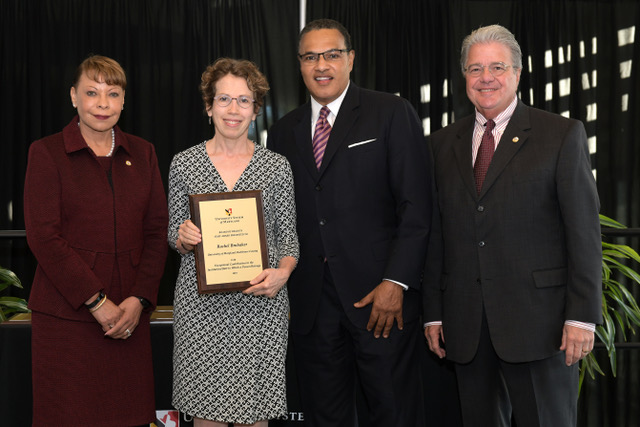 In 2019, Brubaker received the University System of Maryland Board of Regents’ Staff Award for exceptional contribution to the institution. Photo courtesy of Brubaker.
A: The Dresher Center is an interdisciplinary intellectual community in the truest sense. Our programs and grants support and promote faculty and graduate student research in the humanities at UMBC. We run a number of fellowship programs for faculty at all stages of their careers, and provide a temporary home for visiting and internal fellows to research, write, and think about the humanities in conversation with each other.
Our multi-year Inclusion Imperative program, funded by the Mellon Foundation, challenged us to put the tools of the humanities to use to further equity, inclusion, and social justice. With that charge, we have expanded our support for the public humanities at UMBC and formed a regional diversity teaching network of humanities scholars at area institutions who are doing similar work.
Q: What part of your job do you enjoy the most and why?
A: Collaborating with faculty on their research proposals. This often begins in learning about them and their works in progress. Finding the right support for them to write books, create digital projects, and collaborate with community scholars and partners is supremely gratifying!
Think about UMBC not as an office, but as a community of like-minded people who value and produce knowledge and look to make a difference.
Rachel Brubaker, M.A. ’00
Q: Tell us about your primary WHY, and how it led you to UMBC.
A: I came to UMBC because I was transitioning from one career to another, and UMBC became the place to do it. I began as a freelance designer in OIA, then entered the M.A. program in historical studies. After finishing the program, I came back to help run grant programs in the Center for History Education in the history department. That led to my present position in the Dresher Center.
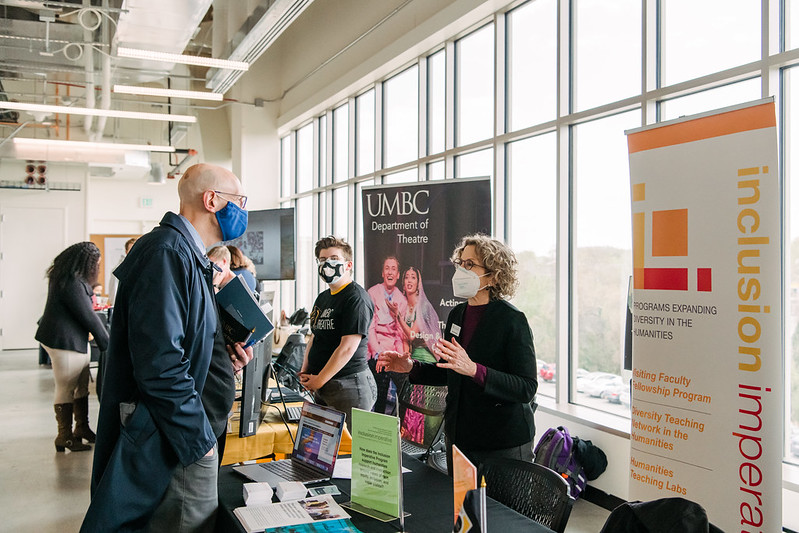 Brubaker presented at the RetriEVER Empowered event in May 2022. (Marlayna Demond ’11/UMBC)
Q: Tell us about the people who have helped you at UMBC, and why their HOW made such a difference to you.
A: There are many people who have made a difference…too many to list, but I have truly appreciated the caliber of support and kindness from colleagues, who have challenged me and helped me grow in my career. I have become a better writer and thinker with their help.
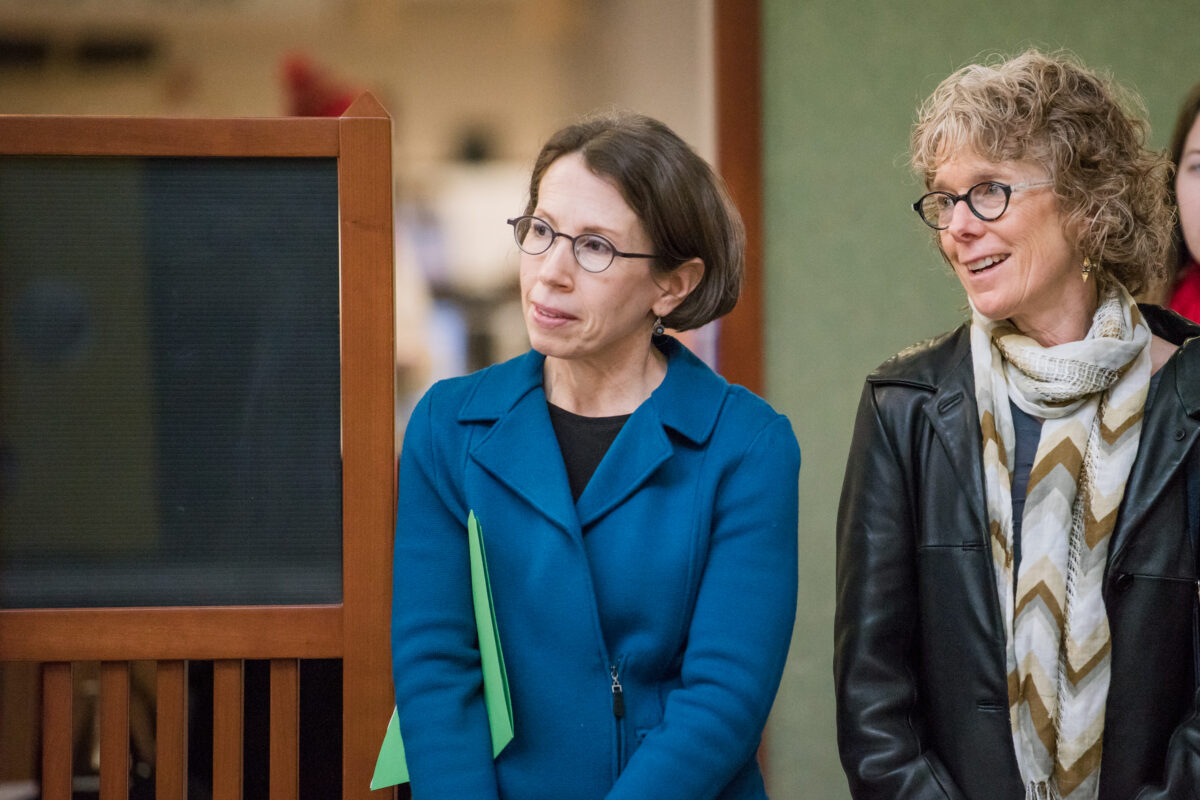 An activity that came out of the Inclusion Imperative are Humanities Teaching Labs (HTLabs). In 2018, a popular HTLab for faculty and students was the “Transcribe-a-thon,” commemorating the 200th anniversary of Frederick Douglass’s birth. Participants transcribed a portion of the Freedmen’s Bureau Papers for the Smithsonian Transcription Center and the National Museum of African American History and Culture. The national event was organized by the Colored Conventions program. Photo courtesy of Brubaker.
Q: Tell us about someone in the community who has inspired you or supported you, and how they did it.
A: Kriste Lindenmeyer was professor of history and chair of the department at UMBC for a number of years (now retired). Kris was a true force of nature. She inspired me with her dedication to the department, students, faculty and to her scholarship.
Q: What would you tell someone who is considering a career at UMBC?
A: Think about UMBC not as an office, but as a community of like-minded people who value and produce knowledge and look to make a difference. As a long-time staff member and former student, I have had the pleasure of seeing the campus evolve to become a place that is inclusive, creative, and original!
* * * * *
UMBC’s greatest strength is its people. When people meet Retrievers and hear about the passion they bring, the relationships they create, the ways they support each other, and the commitment they have to inclusive excellence, they truly get a sense of our community. That’s what “Meet a Retriever” is all about.
Learn more about how UMBC can help you achieve your goals.
]]>
Meet Rachel Brubaker, M.A. ’00, historical studies, assistant director for grants and program development at the Dresher Center for the Humanities. Brubaker, a self-proclaimed humanities nerd, has...
https://umbc.edu/stories/meet-retriever-rachel-brubaker-historical-studies/
https://my3.my.umbc.edu/api/v0/pixel/news/132653/guest@my.umbc.edu/623a683ca89c2b9d41f4d1cd37a85837/api/pixel
alumni
cahss
dreshercenter
graduateschool
historical-studies
impact
magazine
meet-a-retriever
perspectives
staff
UMBC News & Magazine
https://my3.my.umbc.edu/groups/umbc-news-magazine
https://assets1-my.umbc.edu/system/shared/avatars/groups/000/001/943/24435aa6207c452e7bc15cc74b42c7bb/xsmall.png?1748556657
https://assets1-my.umbc.edu/system/shared/avatars/groups/000/001/943/24435aa6207c452e7bc15cc74b42c7bb/original.png?1748556657
https://assets2-my.umbc.edu/system/shared/avatars/groups/000/001/943/24435aa6207c452e7bc15cc74b42c7bb/xxlarge.png?1748556657
https://assets2-my.umbc.edu/system/shared/avatars/groups/000/001/943/24435aa6207c452e7bc15cc74b42c7bb/xlarge.png?1748556657
https://assets3-my.umbc.edu/system/shared/avatars/groups/000/001/943/24435aa6207c452e7bc15cc74b42c7bb/large.png?1748556657
https://assets1-my.umbc.edu/system/shared/avatars/groups/000/001/943/24435aa6207c452e7bc15cc74b42c7bb/medium.png?1748556657
https://assets2-my.umbc.edu/system/shared/avatars/groups/000/001/943/24435aa6207c452e7bc15cc74b42c7bb/small.png?1748556657
https://assets1-my.umbc.edu/system/shared/avatars/groups/000/001/943/24435aa6207c452e7bc15cc74b42c7bb/xsmall.png?1748556657
https://assets2-my.umbc.edu/system/shared/avatars/groups/000/001/943/24435aa6207c452e7bc15cc74b42c7bb/xxsmall.png?1748556657
UMBC News & Magazine
0
0
false
Fri, 14 Apr 2023 13:18:27 -0400
Historical Lens: Preserving the photography of social documentarian Lewis Hine

The photographer Lewis Hine secured a place in history as a documentarian of early 20th century life, including a transformational investigation into the conditions for child laborers.
From 1908 through 1930, Hine worked closely with the National Child Labor Committee (NCLC), an organization devoted to preventing the exploitation of children in the workplace. Hine criss-crossed the U.S., creating portraits of a diverse array of children working in fields and factories.
Hine’s body of work was revelatory and immensely impactful in the efforts to implement child labor laws in U.S., and continues to be a relevant resource for researchers working in the intersections of art, history, politics, and more.
For nearly 50 years, UMBC Special Collections has been the caretaker of the Lewis Hine Collection, comprising some 5,400 photographs taken by Hine during his career. This year, the Special Collections team at UMBC’s Albin O. Kuhn Library received a Preservation Assistance Grant from the National Endowment for the Humanities to support conservation of this groundbreaking collection.
“Our set is particularly important because it’s an almost complete collection of the photographs Hine made for the NCLC. It is very rare to have this incredible collection as a whole body,” says Beth Saunders, head of special collections. “It’s one of our most important and most used collections, and it was in immediate danger.”
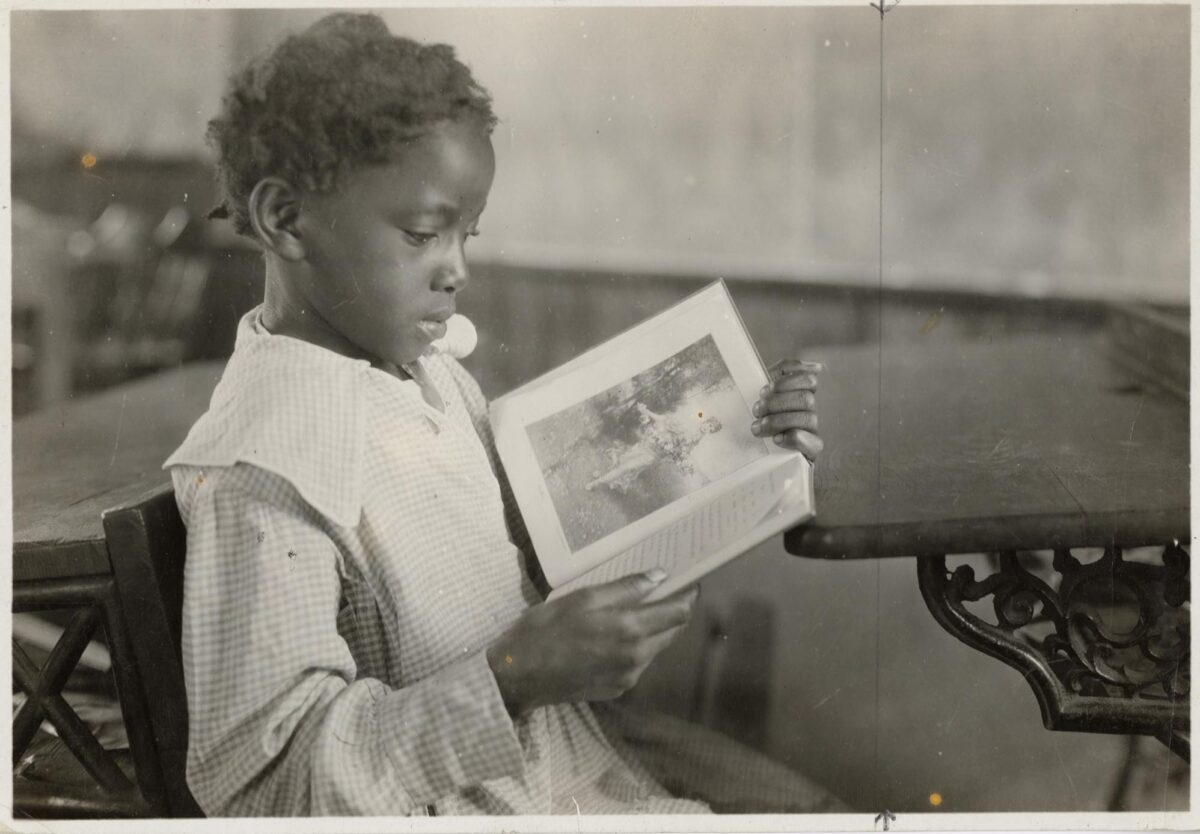
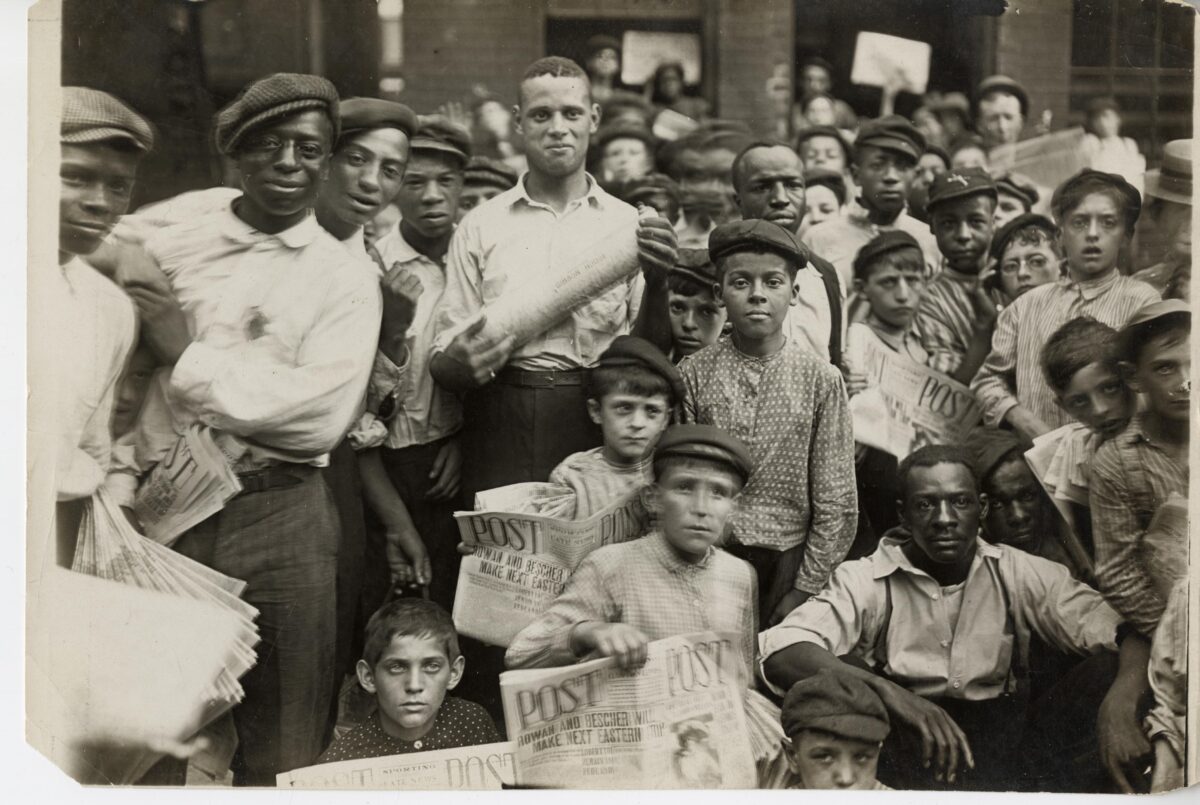 At left: Lewis Hine, Pupil in Pleasant Green School, Pocahontas Co., Pocahontas County, Marlinton, West Virginia, 1921. 5 x 7 in. The Photography Collections, University of Maryland, Baltimore County (P1050) At right: Lewis Hine, Newsboys and Supply Men Waiting At Newspaper Office For Base-Ball Edition, Cincinnati, Ohio, 1908. 5 x 7 in. The Photography Collections, University of Maryland, Baltimore County (P3)
Preserving the work of Lewis Hine
For many decades, the photographs in the collection were protected in envelopes, held in place with adhesive strips. With age, the adhesive has begun to deteriorate, putting the collection at risk.
“If the glue migrates and the photographs are stuck, you have the risk of tearing, discoloration, all the terrible things,” Saunders says. “They’re not mounted, so the versos—the backs—are visible. All of the original inscriptions, notations by Hine or other folks at NCLC, extended captions, those are all intact.”
Part of the current preservation effort will include photographing the detail written on the backs of the photographs, which have until now never been officially digitized.
“It was an opportunity to record the versos of the photographs. We needed to build a new overhead camera setup, and we’re very grateful that Melissa Cormier [M.F.A. ’17] with UMBC’s office of Research Graphics helped us to get that going,” says Saunders, who notes that while the behind-the-scenes work of preservation is unglamorous, the work requires a dedicated multidisciplinary team across the university community.
“My colleagues, Lindsey Loeper [’04] and Susan Graham [’98] have just written an essay about the teaching exercises that they’ve developed out of the Hine collections,” Saunders says. “Lindsey runs our instruction program, and Susan is the mastermind of this project. She’s been the one troubleshooting, setting the standards, and training everybody to do the work.”
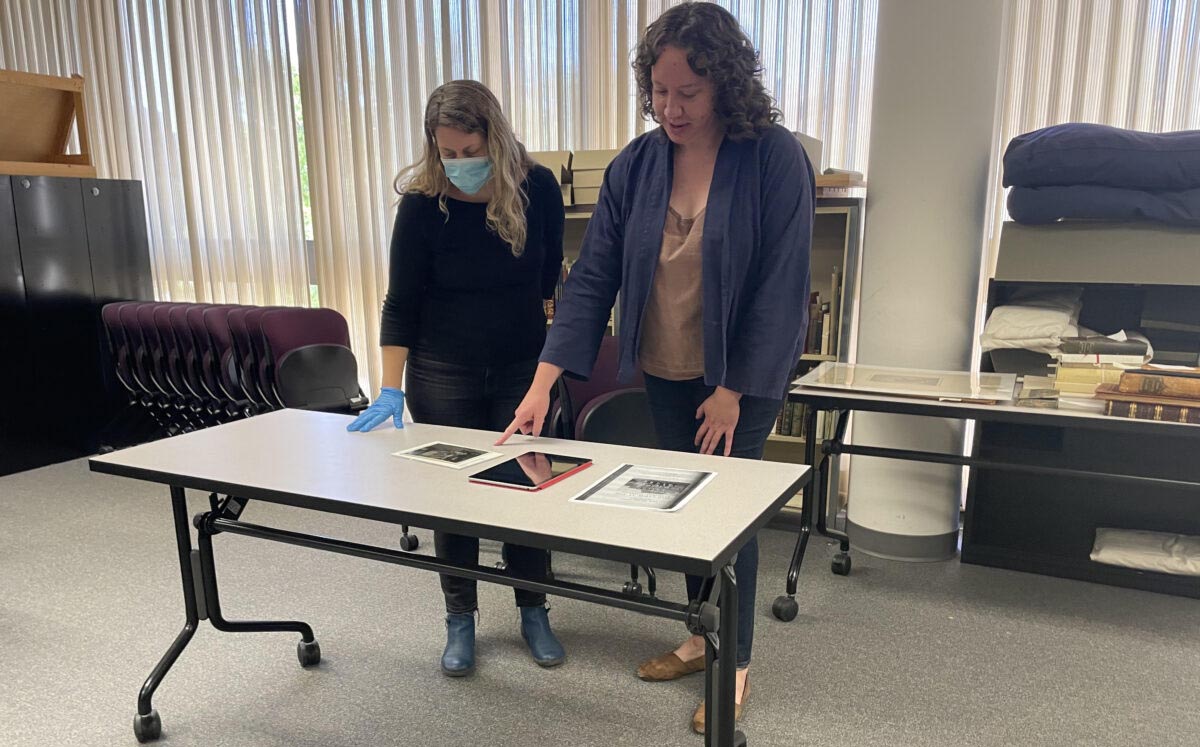 Special Collections staff Susan Graham ’98 and Lindsey Loeper ’04 share pieces of the Lewis Hine collection with students.
Learning from our past
Meredith Power, a graduate student in UMBC’s historical studies program who has been interning with the preservation project, notes the power Hine’s images still possess.
“Some are heartbreaking, some are thought-provoking, while others made me stop short and smile as I pulled them from their storage folder to photograph them,” Power says. “From the bright, sad eyes of the young boys who spent their days underground opening and closing gates inside coal mines, to the cheerful joy on the face of a girl who sold eggs as she hugs her beloved hen, the collection still manages to evoke an emotional response. It’s that emotional connection, the shared sense of experiencing something.”
Next year, the Special Collections department will celebrate its 50th anniversary. The Hine collection was among the inaugural collections for UMBC’s Special Collections, leading in turn to a specific focus on photography in the collection.
In 1974, the Hine collection was acquired by the then new Special Collections program from the NCLC, facilitated by former Library Director Antonio Raimo and Jerry Stephany, a photographer in the visual arts department who had once worked at the George Eastman Museum in Rochester.
“Jerry really saw the importance of a teaching collection of photography,” says Saunders. “The idea behind collecting this particular body of work was to show photography’s relationship to a variety of social issues and the way that photography can be used as a tool of visual communication across disciplines.”
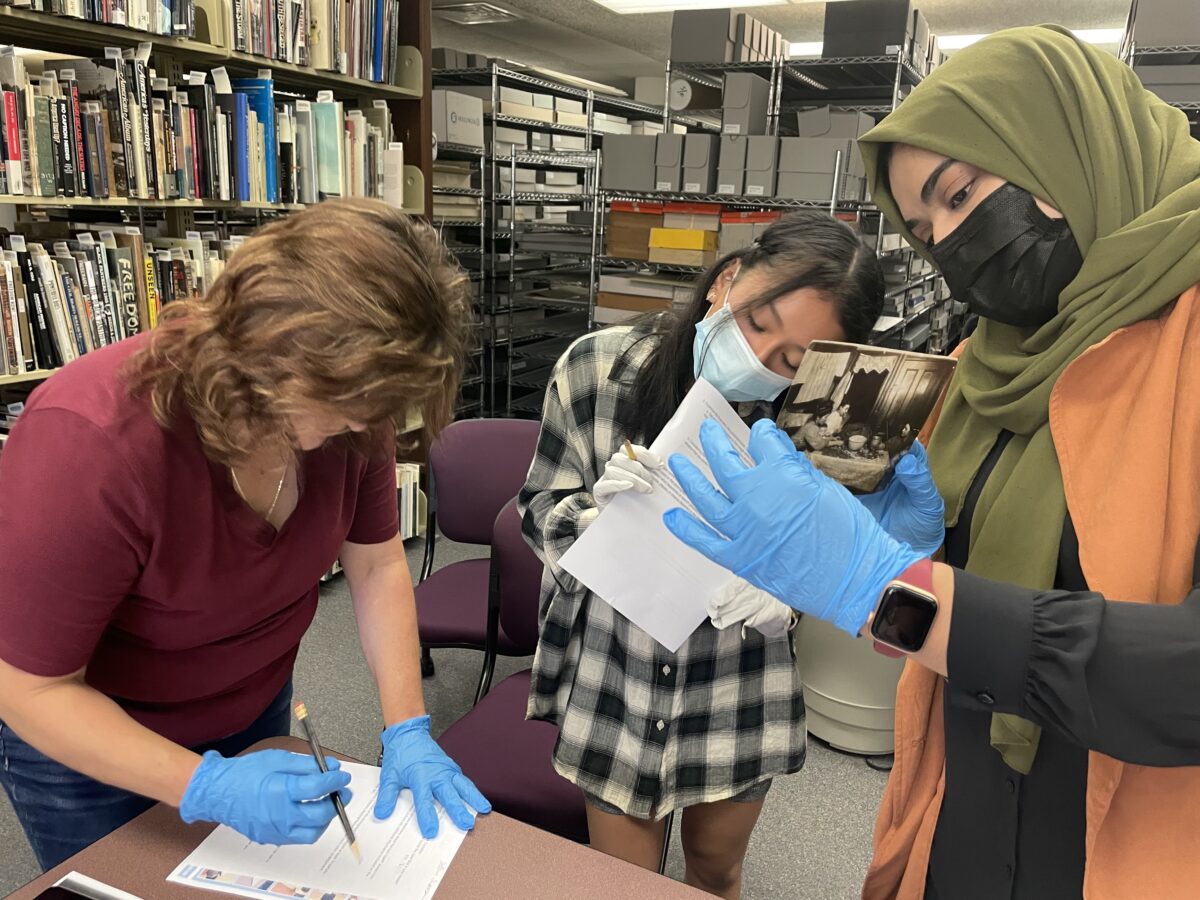
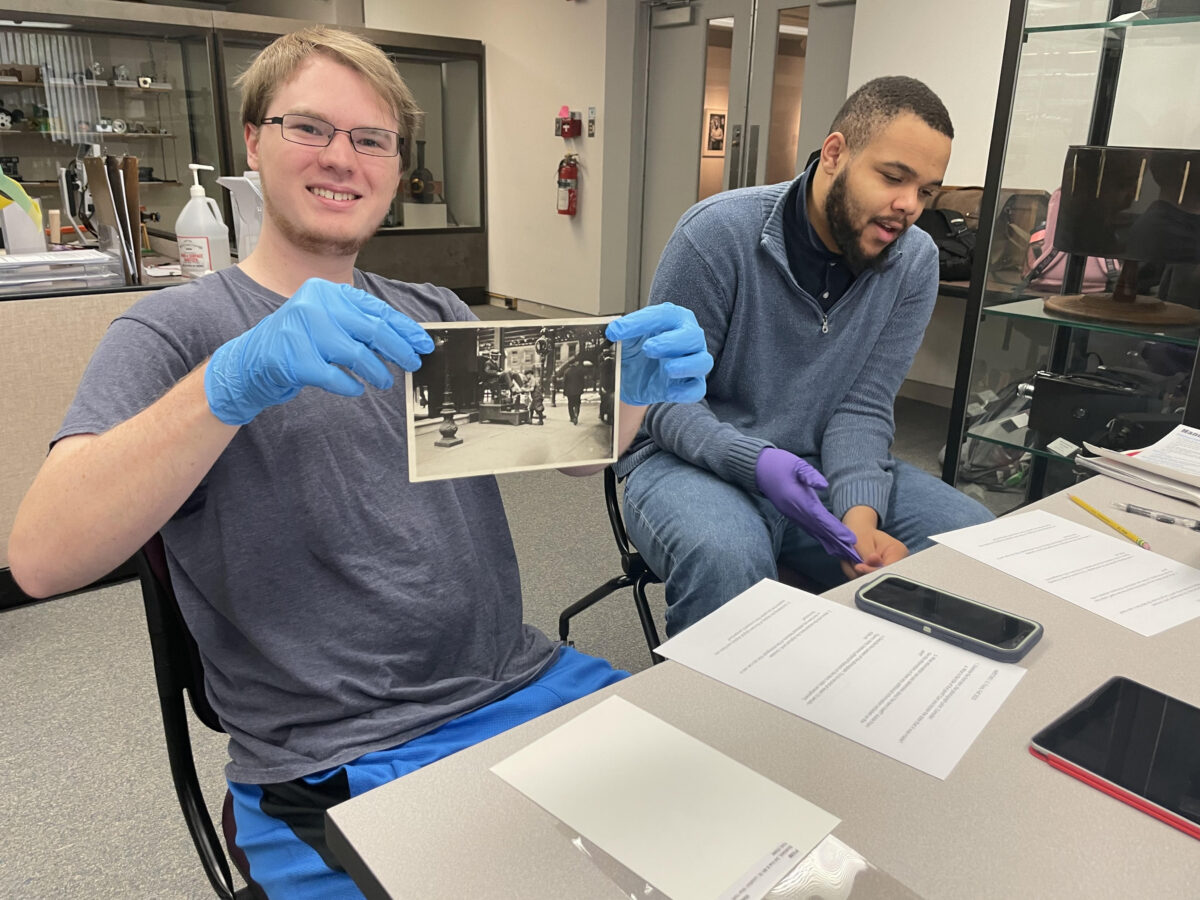 Students in Sarah Fouts’ Approaches to American Studies AMST300 class take part in an activity where student look at the same/similar photographs in a book, in the digital collections, and then the original photo print, and the features and contextual information available with each format. At left (L-R): Hellen Swanson, Sissi Castro, and Fairuaz Mukarama. At right (L-R): Kyle Warfield and Edward Robinson. Photos courtesy of Sarah Fouts.
Power, who is currently working towards an M.A. in UMBC’s historical studies program, researching solitary fourteenth-century religious Englishwomen, notes the interdisciplinary power of the Hine collection and the need to preserve it.
“On the surface, photographs of early twentieth century American child laborers have very little in common with my own academic research,” Power says. “However, as we’ve all learned since COVID-19’s arrival, physical access to research or archival material is sometimes impossible. In those cases, digitized resources and online information about them are invaluable. This is just as true for materials related to medieval religious history as it is for those who are looking into U.S. child labor reform.”
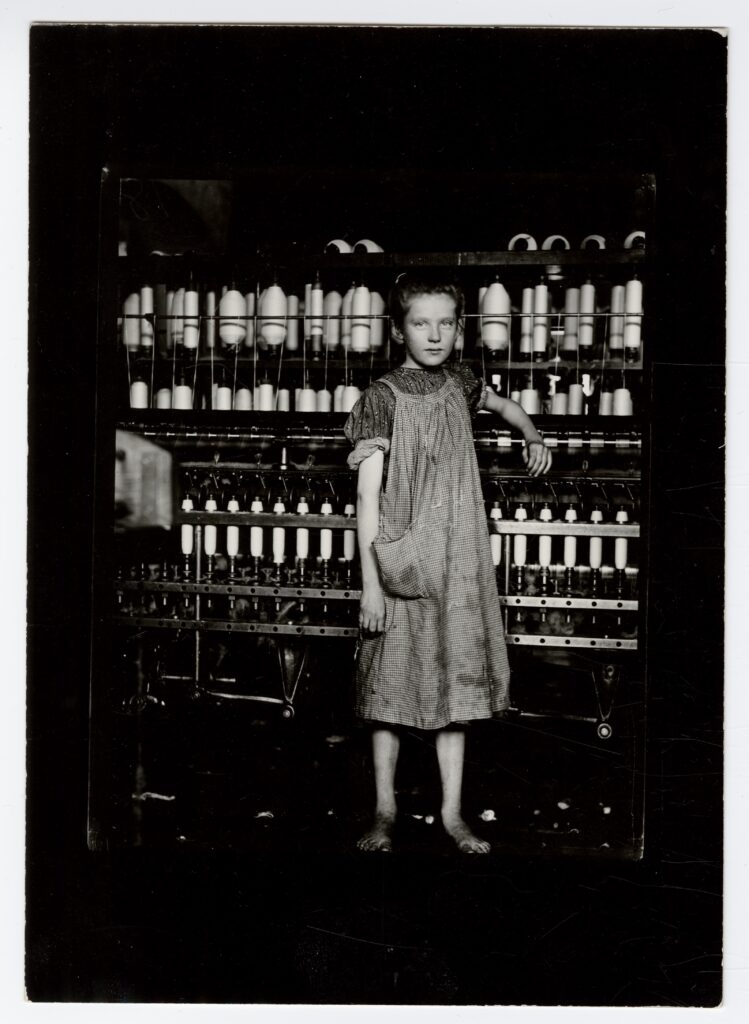 Lewis Hine, Anaemic Little Spinner in North Pownal Cotton Mill, Vermont, 1910. Gelatin silver print, 5 x 7 in. The Photography Collections, University of Maryland, Baltimore County (P1050)
A shared history
Today, UMBC Special Collections holds an estimated three million photographs stretching back to 1840, including the Baltimore Sun archive.
“There is a strong emphasis on documentary photography, which kind of came out of the Hine collection,” says Saunders. “We’re also particularly strong in Maryland history, including the Maryland Traditions archive, the state folklore archive.”
Additionally, Special Collections holds the collection of radical literature from the Alternative Press Center, an extensive collection of historic science fiction, the UMBC archive, and the new Eileen J. Garret Parapsychology Foundation Collection.
]]>
The photographer Lewis Hine secured a place in history as a documentarian of early 20th century life, including a transformational investigation into the conditions for child laborers. From...
https://umbc.edu/stories/preserving-the-photography-of-lewis-hine/
https://my3.my.umbc.edu/api/v0/pixel/news/129185/guest@my.umbc.edu/a1f21e61816717034b9fcac1000f4415/api/pixel
albin-o-kuhn-library-and-gallery
arts-and-culture
cahss
discovery
graduateschool
historical-studies
lewis-hine
magazine
news
special-collections
UMBC News & Magazine
https://my3.my.umbc.edu/groups/umbc-news-magazine
https://assets1-my.umbc.edu/system/shared/avatars/groups/000/001/943/24435aa6207c452e7bc15cc74b42c7bb/xsmall.png?1748556657
https://assets1-my.umbc.edu/system/shared/avatars/groups/000/001/943/24435aa6207c452e7bc15cc74b42c7bb/original.png?1748556657
https://assets2-my.umbc.edu/system/shared/avatars/groups/000/001/943/24435aa6207c452e7bc15cc74b42c7bb/xxlarge.png?1748556657
https://assets2-my.umbc.edu/system/shared/avatars/groups/000/001/943/24435aa6207c452e7bc15cc74b42c7bb/xlarge.png?1748556657
https://assets3-my.umbc.edu/system/shared/avatars/groups/000/001/943/24435aa6207c452e7bc15cc74b42c7bb/large.png?1748556657
https://assets1-my.umbc.edu/system/shared/avatars/groups/000/001/943/24435aa6207c452e7bc15cc74b42c7bb/medium.png?1748556657
https://assets2-my.umbc.edu/system/shared/avatars/groups/000/001/943/24435aa6207c452e7bc15cc74b42c7bb/small.png?1748556657
https://assets1-my.umbc.edu/system/shared/avatars/groups/000/001/943/24435aa6207c452e7bc15cc74b42c7bb/xsmall.png?1748556657
https://assets2-my.umbc.edu/system/shared/avatars/groups/000/001/943/24435aa6207c452e7bc15cc74b42c7bb/xxsmall.png?1748556657
UMBC News & Magazine
2
0
false
Mon, 14 Nov 2022 15:22:11 -0500
Mon, 14 Nov 2022 15:22:11 -0500
Retrievers Behind the Scenes—Courtney C. Hobson, M.A. ’14

During the pandemic it has become even more important to find ways of engaging students in learning activities beyond the classroom. Fortunately, we have Courtney C. Hobson, M.A. ’14, historical studies, program coordinator for the Dresher Center for the Humanities, to help make these special moments happen.
What is your favorite thing about the work you do at UMBC and why?
As program coordinator, I do exactly what the title says—COORDINATE. This covers a multitude of things such as maintaining budgets, crafting social media posts, and other various administrative tasks. My favorite part of my job is helping to plan and coordinate the Humanities Forum, our free public lecture series. I essentially have a wish list of different artists, professors, writers, etc. who I would love to hear from and/or meet; through the Humanities Forum, sometimes that gets to happen! But mostly, I get to constantly learn new ideas and hear from different perspectives, which has been an enriching experience.
Tell us something people don’t really know or understand about your job.
Coordinating events or programs requires so much multitasking, juggling—any euphemism that you want to apply. It requires the ability to think about both the smaller and bigger picture and prepare for contingencies. You also have to be aware of the various people or groups that you interact with and anticipate their potential needs. Doing all of this and making the experience appear to be seamless is also a skill.
Is there someone in the campus community who has been particularly supportive?
I can’t really pick out one person in particular because I have so many wonderful friends and colleagues at the university. As an alumna of the university, it’s a unique experience to transition from student-professor relationship to colleague or even friend with some of the professors in the History Department; they were my cheerleader when I was a student and continue to be so now.
Learn more about the Humanities Forum at https://dreshercenter.umbc.edu/humanities-forum/current/.
Header image: Hobson works with faculty members during an Humanities Teaching Lab. Both photos courtesy of Hobson.
]]>
During the pandemic it has become even more important to find ways of engaging students in learning activities beyond the classroom. Fortunately, we have Courtney C. Hobson, M.A. ’14, historical...
https://umbc.edu/stories/retrievers-behind-the-scenes-courtney-c-hobson-m-a-14/
https://my3.my.umbc.edu/api/v0/pixel/news/119606/guest@my.umbc.edu/b627151d7d0c43e2bcf476e42a115c33/api/pixel
campus-life
historical-studies
humanities
retrievers-behind-the-scenes
spring-2021
UMBC News & Magazine
https://my3.my.umbc.edu/groups/umbc-news-magazine
https://assets1-my.umbc.edu/system/shared/avatars/groups/000/001/943/24435aa6207c452e7bc15cc74b42c7bb/xsmall.png?1748556657
https://assets1-my.umbc.edu/system/shared/avatars/groups/000/001/943/24435aa6207c452e7bc15cc74b42c7bb/original.png?1748556657
https://assets2-my.umbc.edu/system/shared/avatars/groups/000/001/943/24435aa6207c452e7bc15cc74b42c7bb/xxlarge.png?1748556657
https://assets2-my.umbc.edu/system/shared/avatars/groups/000/001/943/24435aa6207c452e7bc15cc74b42c7bb/xlarge.png?1748556657
https://assets3-my.umbc.edu/system/shared/avatars/groups/000/001/943/24435aa6207c452e7bc15cc74b42c7bb/large.png?1748556657
https://assets1-my.umbc.edu/system/shared/avatars/groups/000/001/943/24435aa6207c452e7bc15cc74b42c7bb/medium.png?1748556657
https://assets2-my.umbc.edu/system/shared/avatars/groups/000/001/943/24435aa6207c452e7bc15cc74b42c7bb/small.png?1748556657
https://assets1-my.umbc.edu/system/shared/avatars/groups/000/001/943/24435aa6207c452e7bc15cc74b42c7bb/xsmall.png?1748556657
https://assets2-my.umbc.edu/system/shared/avatars/groups/000/001/943/24435aa6207c452e7bc15cc74b42c7bb/xxsmall.png?1748556657
UMBC News & Magazine
0
0
false
Tue, 08 Jun 2021 19:37:00 -0400
