Details and detective skills matter at Reese Finnigan’s internship at the U.S. Holocaust Memorial Museum’s archives in Bowie
Deep in UMBC’s climate-controlled Special Collections are 750,000 prints, negatives, and transparencies from The Baltimore Sun dating from the 1930s through the 1980s.
Before faculty and students can use the collection, archivists must create finding aids. These inventory documents describe a collection—its origins, number of pieces, types of materials, their quality, dates, number of archival boxes, box measurements, and more. It’s a road map guiding users through each piece of a collection.
Reese Finnigan, studying the history of the Soviet Union and learning Russian, developed these archival skills working on The Baltimore Sun collection during her first year in the Master of Arts in Public History program. This year, when looking for summer internship opportunities, Finnigan was excited to find that the United States Holocaust Memorial Museum Shapell Family Collections, Conservation and Research Center in Bowie, Maryland—a museum she had tried to secure a curatorial or research internship with for years—was seeking an intern with her exact skill set.
“In retrospect, this is the first year that I’ve had the skills and resume needed for this level of archival work,” says Finnigan, grateful that Maryland is home to such a prestigious research center with the largest concentration of Holocaust-related records in the United States, and to learn from archival experts with decades of experience. “The opportunities UMBC has given me to learn Russian, historical research, and archival skills dovetailed very nicely with the center’s Archival Affairs Division internship, which required knowledge of Eastern European history and languages.”
Needle in the digital stack
The finding aids for the Eastern European collection that Finnigan is working on do not always directly correspond to what is in the archive. Some materials are in the wrong order or are missing finding aids. Other times, some things aren’t listed in the original file but are actually in it. Finnigan also has to translate the words on the document, which could be a translation of the original language, depending on where the document was recovered from. It could be Russian, a Slavic language, or any language using the Cyrillic alphabet, which is used for various languages across Eastern Europe, the former Soviet Union, and the Soviet Republics of Central Asia.
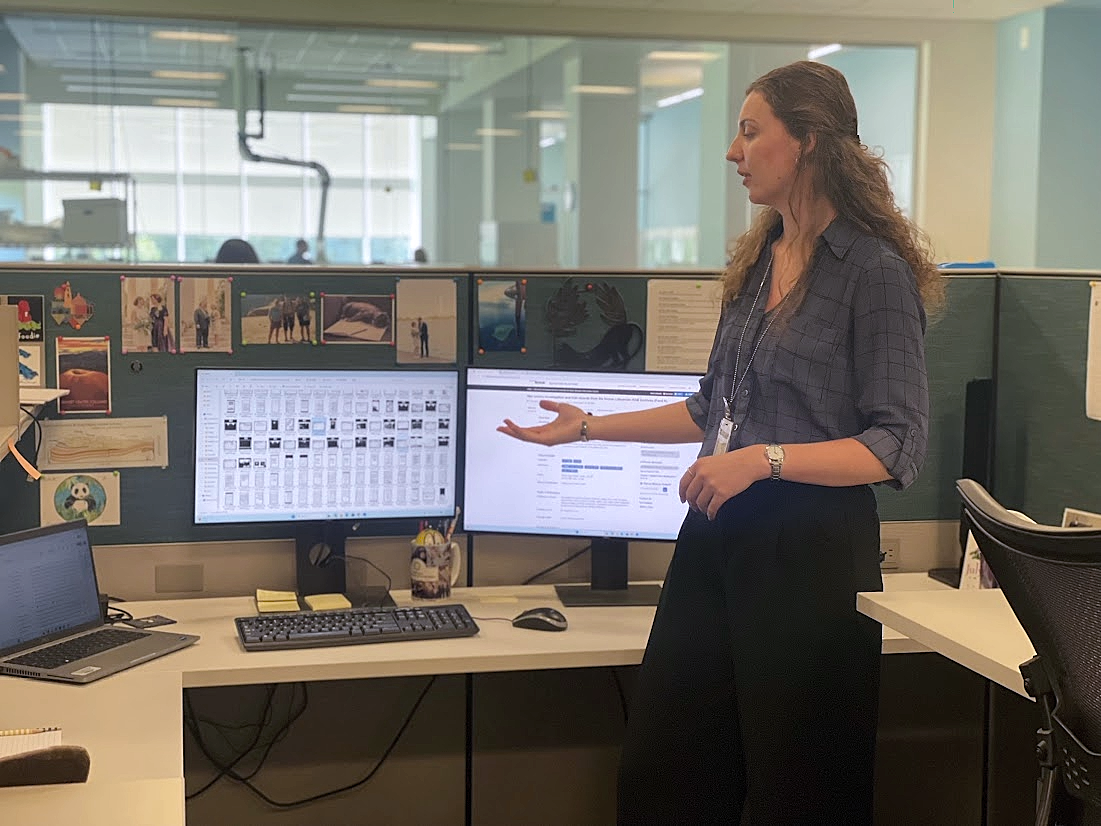 Finnigan showing the documents and photographs she is creating finding aids for.
She spends hours cross-checking inventories, documents, photos, descriptions, and creating new spreadsheets that reflect the latest information. She then hands it off to another archivist to double-check her work. It’s a cycle of verification and refinement to align the finding aids with the accurate collections. The maze of finding aids is the result of different archival processes carried out across borders, countries, and decades. “The researcher should be able to come in and find something quickly without ever having to think too much about it. The easier they can find things, the better,” says Finnigan.
A note from the past
Some mysteries are beyond languages and locations, stumping even a team of experts and bringing them together to do serious detective work. That’s exactly what happened when Finnigan noticed a small symbol on some original photos in a Lithuanian KGB (national security and intelligence agency) collection placed by the original archives. She asked archivists Julie Schweitzer, her boss, and Alla Dvorkin, her direct supervisor, but they hadn’t seen it before either. The mystery quickly spread throughout the building, ensuing a string of emails with experts weighing in, hoping to reveal the meaning of what looked like a small bean. They found that the symbol was a mark used in some European archival systems to note the poor quality of the writing or the photography.
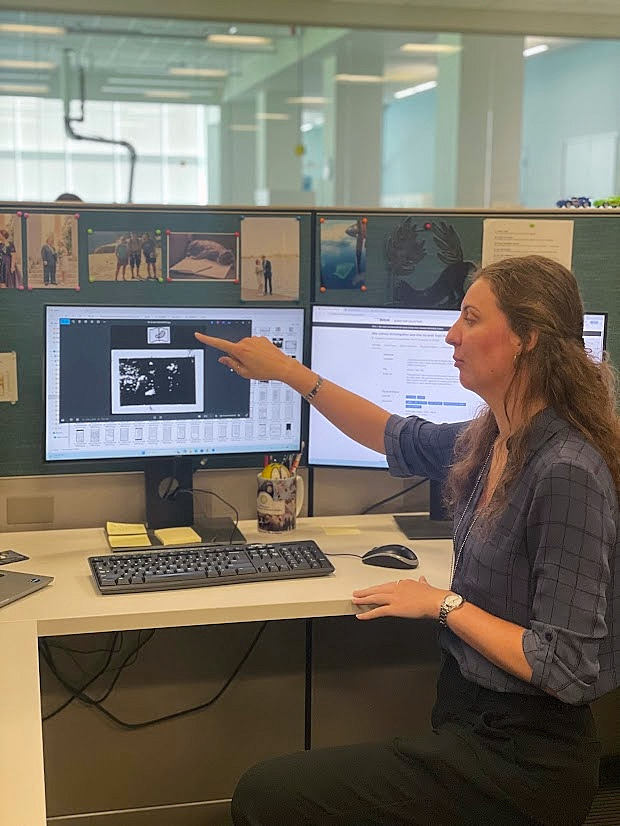
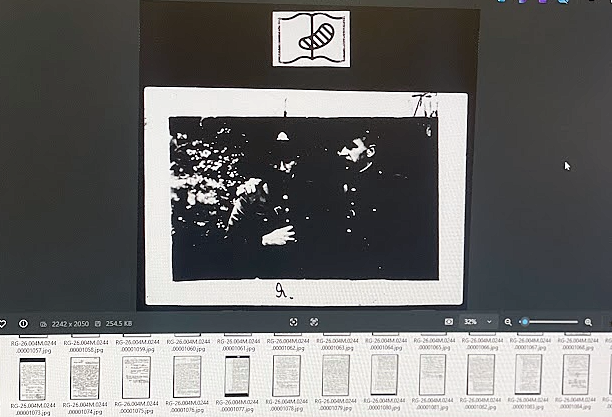
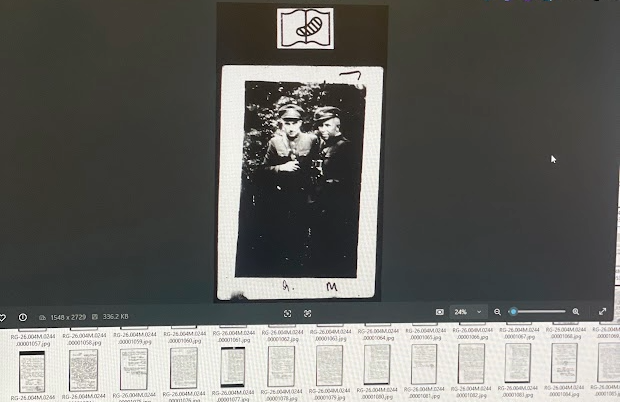
Finnigan showing the mysterious mark she came across in a set of photographs.
“People often imagine archival work as simply preserving historical materials. In reality, a surprising amount of the job involves acting as part historian, part detective, part translator, and occasionally part conspiracy theorist—until someone finds the answer,” Finnigan posted on LinkedIn. “It’s a reminder that expertise is often collective. No single person knew the answer. The solution emerged through conversations, institutional knowledge, and a network of colleagues willing to chase down an obscure question simply because it mattered.”
To preserve and share
In the last few weeks of her internship, Finnigan received additional training from Adam Fielding, a processing archivist who works primarily with personal papers. Fielding, who has been at the center for 11 years, began by showing Finnigan the Rudolph Daniel Sichel papers, an example of what a finished collection can look like once the personal papers have been digitized and preserved in archival boxes.
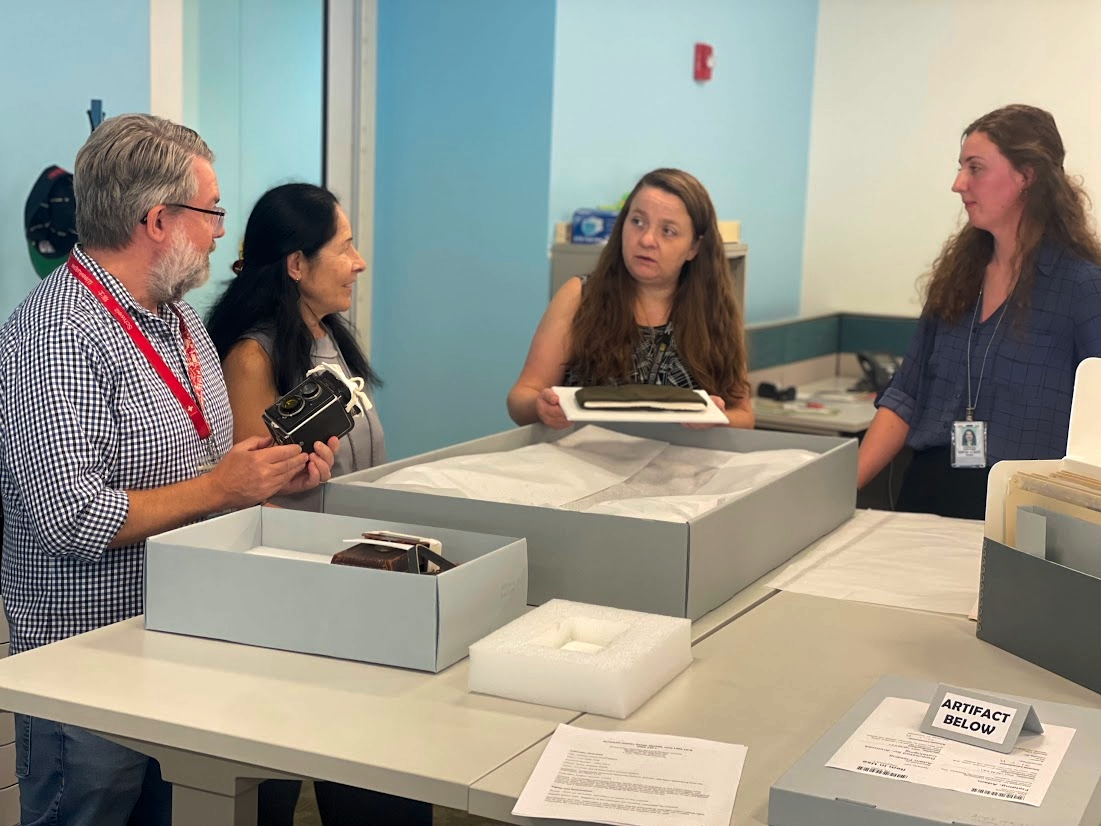
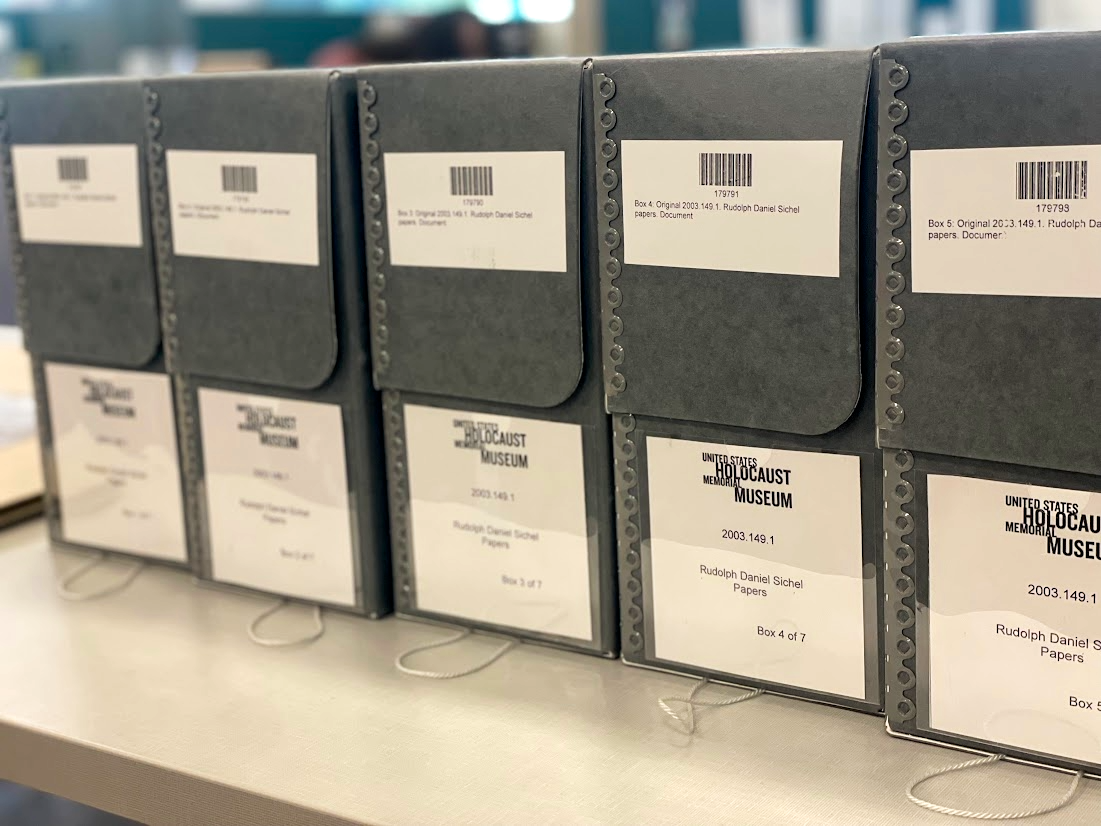
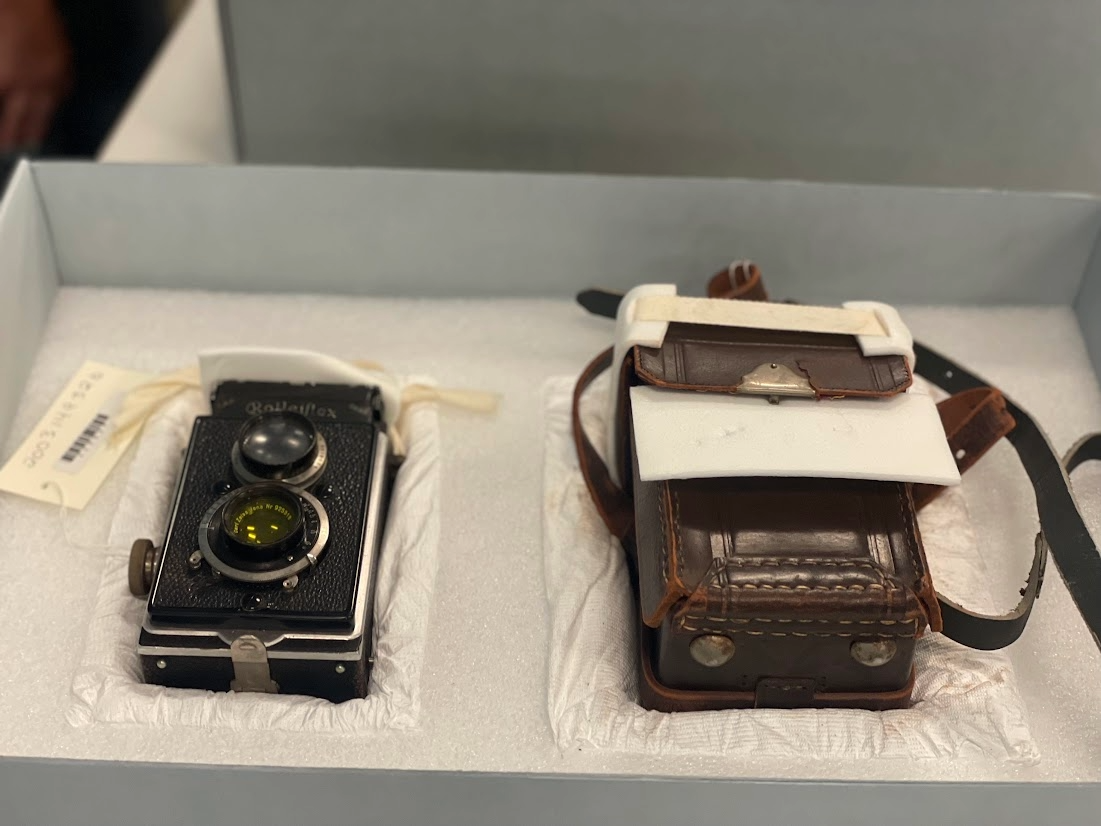
(Top) Finnigan with Fielding, Dvorkin, and Schweitzer (center), reviewing Rudolph Daniel Sichel‘s military uniform and personal camera. (Bottom) The Sichel collection archival boxes and Sichel’s camera and camera case.
The Sichel papers, donated by Rudolph’s children, consist of seven boxes with documents dating from 1903 to 1978, many of which connect Sichel to Maryland. Sichel was a “Ritchie Boy,” one of thousands of Jewish refugees who immigrated to the U.S., enlisted in the army, and trained at the Military Intelligence Training Center at Camp Ritchie near Cascade, Maryland, a little over an hour north of UMBC.
The additonal training gave Finnigan the techniques to work with non-digital items that require special care, like the folder Fielding tasked her with, full of primarily prewar family photographs related to the Kugelman family from Bedzin, Poland, dating between 1930 – 1942.
While putting these skills to use was exciting, the greater reward was seeing the impact of the team’s work. Finnigan’s interest in archival work is not only about preserving history but also making archives accessible to the public, which are two of the center’s priorities.
“There is no point in preserving all of this history if the public can’t access it. We want to preserve the history and make it easily accessible, whether through exhibitions, digital archives, or physical collections. Good archival work should essentially be invisible,” says Finnigan. This includes special handling and storage methods, like cold storage (35°F to 50°F) and cool storage (55°F to 65°F) to dramatically slow chemical decay, stop pest activity, and extend the lifespan of sensitive artifact and media collections.
“The collections at the Shapell Center are evidence of atrocities, of war crimes, of survival,” says Finnigan. “If the items are damaged, they can’t be replaced, and then that piece of history is lost.”
Learn more about internship opportunities at the United States Holocaust Memorial Museum’s archives.
]]>
Deep in UMBC’s climate-controlled Special Collections are 750,000 prints, negatives, and transparencies from The Baltimore Sun dating from the 1930s through the 1980s. Before faculty and...
https://umbc.edu/stories/details-and-detective-skills-matter-at-reese-finnigans-internship-at-the-u-s-holocaust-memorial-museums-archives-in-bowie/
https://my3.my.umbc.edu/api/v0/pixel/news/161639/guest@my.umbc.edu/38aca15bbbceb371a51a6da4ca4cef43/api/pixel
cahss
career-center
history
international
internships
policy-and-society
stories
story
UMBC News & Magazine
https://my3.my.umbc.edu/groups/umbc-news-magazine
https://assets1-my.umbc.edu/system/shared/avatars/groups/000/001/943/24435aa6207c452e7bc15cc74b42c7bb/xsmall.png?1748556657
https://assets1-my.umbc.edu/system/shared/avatars/groups/000/001/943/24435aa6207c452e7bc15cc74b42c7bb/original.png?1748556657
https://assets2-my.umbc.edu/system/shared/avatars/groups/000/001/943/24435aa6207c452e7bc15cc74b42c7bb/xxlarge.png?1748556657
https://assets2-my.umbc.edu/system/shared/avatars/groups/000/001/943/24435aa6207c452e7bc15cc74b42c7bb/xlarge.png?1748556657
https://assets3-my.umbc.edu/system/shared/avatars/groups/000/001/943/24435aa6207c452e7bc15cc74b42c7bb/large.png?1748556657
https://assets1-my.umbc.edu/system/shared/avatars/groups/000/001/943/24435aa6207c452e7bc15cc74b42c7bb/medium.png?1748556657
https://assets2-my.umbc.edu/system/shared/avatars/groups/000/001/943/24435aa6207c452e7bc15cc74b42c7bb/small.png?1748556657
https://assets1-my.umbc.edu/system/shared/avatars/groups/000/001/943/24435aa6207c452e7bc15cc74b42c7bb/xsmall.png?1748556657
https://assets2-my.umbc.edu/system/shared/avatars/groups/000/001/943/24435aa6207c452e7bc15cc74b42c7bb/xxsmall.png?1748556657
UMBC News & Magazine
0
0
false
Fri, 14 Aug 2026 11:51:40 -0400
Fri, 14 Aug 2026 11:51:40 -0400
Nothing but beauty: Noor Zaidi leads an international interfaith team digitizing the history of one of the few shrines to a woman in Islam
The Sayyida Zainab shrine, near Damascus, Syria, is capped by a gold leaf dome atop a building wrapped in interlocking glazed tiles. The aquamarine, gold, amethyst, and brown tiles create geographic tapestries of swirls and intricate flower patterns. It’s a beautiful place of splendor inside and out, where thousands of Shi‘i Muslim pilgrims and visitors worldwide gather, pray, and honor the resting place of Zainab bint ‘Ali, Prophet Muhammad’s granddaughter. The shrine’s roofline is decorated with cobalt blue tiles that repeat the phrase, “Peace be upon you, oh mother of sorrows and hardships” in white Arabic calligraphy—a testament to the trials Zainab endured throughout her life.
When Noor Zaidi, assistant professor of history, visited the shrine on pilgrimage with her family more than 20 years ago, she was mesmerized. The shrine then inspired her graduate research, and now Zaidi is a scholar of the Middle East and South Asia specializing in the history of gender and sectarianism.
Her new book, Traces of Zainab: Ritual, Memory, and Place in Shi’a Islam, is a study of the woman who became a symbol of resistance for Shi‘i Muslims worldwide. Now Zaidi is leading an international interfaith team to preserve, restore, and digitize the shrine’s archives. With the support of Father Columba Stewart of the Hill Museum & Manuscript Library (HMML) in Minnesota, the Holy Spirit University of Kaslik in Lebanon, and the Mourtada family from Damascus, who have been the custodians of the shrine for over 800 years, the world will learn about one of the very few shrines to a woman in Islam and the community that has preserved it with love.
“We are delighted to return to Syria in support of this historic project,” says Stewart, executive director and CEO of HMML, at Saint John’s University—one of the world’s leading organizations funding the preservation and digitization of endangered archives to create open access collections. “Partnering with this historic shrine lies at the very heart of HMML’s mission to preserve and share the world’s handwritten past to inspire a deeper understanding of our present and future.”
Zaidi notes that this is not just about preserving. It’s about teaching students what it takes to be historians, stewards of a past with many missing parts, and to be aware that their work cannot happen in isolation. “There is a story to tell in the construction of this work that also tells us about the discipline of history, at this moment in time,” says Zaidi. “It’s a story of how to teach students to be conscientious scholars: to not just look at newspapers and documents but take into account what’s not being told, what history is being erased, and ask whose voices are not being heard.”
Q: Who is Zainab bint ‘Ali?
A: Zainab bint ‘Ali has meant many things to many people: woman, emblem, whisper in the past, shout in the street. Her presence, body, and words have been central to the construction of a distinct Shi‘i Islamic identity, yet large parts of her life were absent from view.
At six, she witnessed her grandfather Muhammad’s death, the singular political and religious leader of the Muslim community. Her father, ‘Ali, became the fourth successor to the Prophet Muhammad in 656 AD. His followers considered him the first Imam, God’s spiritual representative on earth. Before he was killed five years later, he passed on the leadership to his sons.
In Karbala, present-day Iraq, in 680 AD, Husayn ibn ‘Ali, Zainab’s brother, refused allegiance to Caliph Yazīd ibn Mu‘awiyah, viewing his rule as illegitimate. A battle ensued, and Husayn’s 72 male companions were killed along with his eight sons, nephews, and cousins. Husayn was beheaded. Zainab and the other women witnessed the massacre. After she was taken into captivity and paraded unveiled to Damascus, it is said that she delivered sermons recounting the events at Karbala. Zainab became a symbol of resistance—the few against the many.
For Shi‘i Muslims, the battle at Karbala became central to constructing their distinct identity, collective memory, theological frameworks, devotional practice, and traditions of mourning.
Q: In what ways have local and international communities contributed to keeping the shrine alive?
A: The shrine is a transnational space with people, materials, and ideas moving in and out of it. In the 19th and 20th centuries, many Shi‘i shrines in Iran and Iraq began to take on a similar appearance, usually attributed to Iranian patronage. A lot of money was invested in maintaining these shrines. The mausoleum is surrounded by silver and gold grilles with Zainab’s grave beneath. They were replaced over the centuries through donations. One came from Pakistan in the 1950s, while others came from Iraq and Iran. The gold leaf, some of the tile colors, and the carpets have all come from different countries. However, the Mourtada family was very deliberate in the renovations, using local craftsmen and an Arab Damascene style of tilework to keep the local cultural heritage embedded in the shrine.


Top row: Inside Sayyida Zainab shrine. (Images courtesy of Zaidi) Bottom row: Local craftsmen renovating the shrine. Constructing the golden dome. (Images courtesy of Makam Sayyida Zainab)
Long before the politics of the present, the shrine was part of the shared sacred geography of Damascus. Its history is entwined with the devotion of countless people who have passed through it over centuries. Syrians of many different backgrounds—including Muslims, Christians, and Jews—have visited the shrine over the centuries. Queen Soraya Esfandiary-Bakhtiary of Iran gave funding to build an electrical system, and Sunni Muslim Muhammad Ali, the American professional boxer and activist, also visited the shrine and paid tribute. Their visits helped raise awareness and respect and brought support from outside the Shi’i community.


(l) Former Prime Minister of Pakistan, Benazir Bhutto, at the Sayyida Zainab shrine. (r) Boxer Muhammad Ali at the Shrine of Sayyida Zainab (Images courtesy Makam Sayyida Zainab)
While the shrine’s story can be told through violence, conflict, and upheaval, we chose to tell the story that often gets buried. When Zainab was asked what she thought of her dead brother, she said, “I see nothing but beauty.” We see nothing but beauty. This is the story the project chooses to tell.
Q: How did you gain access to the shrine’s archives?
A: When I first visited for research in 2012, there was almost nobody there. The shrine was under constant threat, and the atmosphere was one of uncertainty. During that visit, I met Hani Mohsen Mourtada, the head custodian, former Syrian Minister of Higher Education, and former president of the University of Damascus. I think he was genuinely surprised that someone was willing to come under those conditions. He gave me access to photographs, legal documents, and virtually everything the shrine held in its archives. We built a close relationship. I interviewed him several times as the project developed. I returned to Syria in 2019 and again in 2021, but he was in Beirut. Sadly, he passed away during the COVID-19 pandemic, and I never had the chance to see him again.
As I neared completion of my manuscript, I needed to revisit the archival materials and get legal permission to use them. After Hani Mohsen’s death, custodianship passed to his son, Sayed Mazen Al-Mourtada. I connected with him, and Mazen agreed to give me access. He explained that he had moved the oldest records to Beirut because he feared they might not survive the war. Although there was widespread looting and destruction when he moved the records, Mazen recovered much of what I needed. There are many major Shi‘i shrines around the world, but not all of them make their archives available in this way or welcome the same level of transparency. That made this project especially meaningful because Mozen was willing to do exactly that.


Manuscripts from the Sayyida Zainab shrine. (Images courtesy of Makam Sayyida Zainab)
For historians, the history we write is so often incomplete and shaped by these absences and losses. Rather than presenting itself as complete, the digital archive will clearly identify documents destroyed through conflict and explain how historical archives are often incomplete collections of surviving materials. Understanding this is crucial for students as they embark on research.
Q: How does your personal journey help students understand the academic and personal skills required to be a historian?
A: History as a discipline is changing. We’re reading documents, translating them, and making meaning from them. Our research process is part of that history. While I was writing the book, my colleagues at UMBC told me that I should be in the story. I wasn’t used to that. The book is divided into three parts: Zainab’s shrine, the Bibi Pak Daman shrine in Lahore, Pakistan; and the al-Rashād prison for women in Iraq. In each section, I invite the reader to take a journey with me. I was so much a part of the process that while I was writing the book, I became part of the story. I learned that if I’m interviewing these women, they are not speaking to a wall—they were speaking to me.
Being a historian is a labor of love. You don’t do things this long unless you care and find them interesting. I have been studying the Shrine of Sayyida Zainab for about 15 years. For much of that time, Syria was caught in civil war and proxy war. The shrine was regularly targeted by jihadist groups such as ISIS and al-Qaeda, and for more than a decade it was extraordinarily difficult to travel in and out of the country, and then the pandemic happened. Many times, I was told to reframe the book or to change the topic. I didn’t give up.
This archive is my way of contributing something meaningful to the people and place that shaped my research. Although I continue to worry about the shrine’s future, preserving these materials offers hope that, should anything happen to it, its history will not disappear. In that sense, preserving the shrine and its documents is about preserving a piece of our common humanity.
Learn more about UMBC’s history department.
]]>
The Sayyida Zainab shrine, near Damascus, Syria, is capped by a gold leaf dome atop a building wrapped in interlocking glazed tiles. The aquamarine, gold, amethyst, and brown tiles create...
https://umbc.edu/stories/noor-zaidi-leads-team-digitizing-history-of-sayyida-zainab-shrine/
https://my3.my.umbc.edu/api/v0/pixel/news/161375/guest@my.umbc.edu/b26c99277cb65970c0caa20dd3e07b2e/api/pixel
cahss
history
international
policy-and-society
research
stories
story
UMBC News & Magazine
https://my3.my.umbc.edu/groups/umbc-news-magazine
https://assets1-my.umbc.edu/system/shared/avatars/groups/000/001/943/24435aa6207c452e7bc15cc74b42c7bb/xsmall.png?1748556657
https://assets1-my.umbc.edu/system/shared/avatars/groups/000/001/943/24435aa6207c452e7bc15cc74b42c7bb/original.png?1748556657
https://assets2-my.umbc.edu/system/shared/avatars/groups/000/001/943/24435aa6207c452e7bc15cc74b42c7bb/xxlarge.png?1748556657
https://assets2-my.umbc.edu/system/shared/avatars/groups/000/001/943/24435aa6207c452e7bc15cc74b42c7bb/xlarge.png?1748556657
https://assets3-my.umbc.edu/system/shared/avatars/groups/000/001/943/24435aa6207c452e7bc15cc74b42c7bb/large.png?1748556657
https://assets1-my.umbc.edu/system/shared/avatars/groups/000/001/943/24435aa6207c452e7bc15cc74b42c7bb/medium.png?1748556657
https://assets2-my.umbc.edu/system/shared/avatars/groups/000/001/943/24435aa6207c452e7bc15cc74b42c7bb/small.png?1748556657
https://assets1-my.umbc.edu/system/shared/avatars/groups/000/001/943/24435aa6207c452e7bc15cc74b42c7bb/xsmall.png?1748556657
https://assets2-my.umbc.edu/system/shared/avatars/groups/000/001/943/24435aa6207c452e7bc15cc74b42c7bb/xxsmall.png?1748556657
UMBC News & Magazine
1
0
false
Wed, 29 Jul 2026 09:43:09 -0400
Wed, 29 Jul 2026 09:43:09 -0400
Meet a Retriever—Balmory Moran ’24 drew on his history major to coach his youth soccer team to league championships
Balmory Moran II ’24, history, used to describe himself as a soccer player above all else. The soccer field and his team were where he felt most at home. In high school, an injury ended his hopes of playing at the collegiate level, and doubts about his future settled in until he met Joe Thompson, a professor of history and political science at Montgomery College (MC), and Andrew Nolan, teaching professor of history at UMBC. They instilled in him a passion for history, and their support helped him transfer to UMBC as a history major, where he learned not only about the past but also interpersonal and mentorship skills that he now puts to practice every day as a coach for the Latino Youth Development Program in Rockville, Maryland.
As a coach, Balmory imparts performance strategies and techniques to middle school and high school students in the program while also emphasizing essential team skills such as collaboration, active listening, empathy, and accountability, both on and off the field. This strategy led the team to win the league championship in fall 2025.
After years of coaching and time away from the classroom, Balmory is ready to balance soccer and the classroom once again as he begins applying to a master’s in social work. He credits his sister, Alexandra Moran ’15, social work, a current social worker, for the inspiration to join the field. Take it away, Balmory!
Q: What was your journey to UMBC?
A: I began my undergraduate experience at MC. I was a bit lost, and I didn’t know what I wanted to do, but Professor Thompson changed all that. I had a 200-level U.S. history class with him. He made our class so entertaining, enticing, and interesting at both a personal and an academic level. It really showed me that history didn’t have to be boring or slow.
After seeing how attentive I was in his classes, he encouraged me to pursue a degree in history. Professor Thompson showed me multiple examples of students in different fields of work with a history degree. It prompted me to take more history classes at MC, which laid the foundation for studying history at UMBC.
I made my way to UMBC after Professor Nolan visited MC multiple times to talk to students about life as a history major at UMBC and the careers it could lead to after graduation. He also explained the many ways UMBC would further nurture my academic aspirations. I was so involved with the history program at MC that it felt like a natural next step to continue my undergrad degree in history at UMBC.
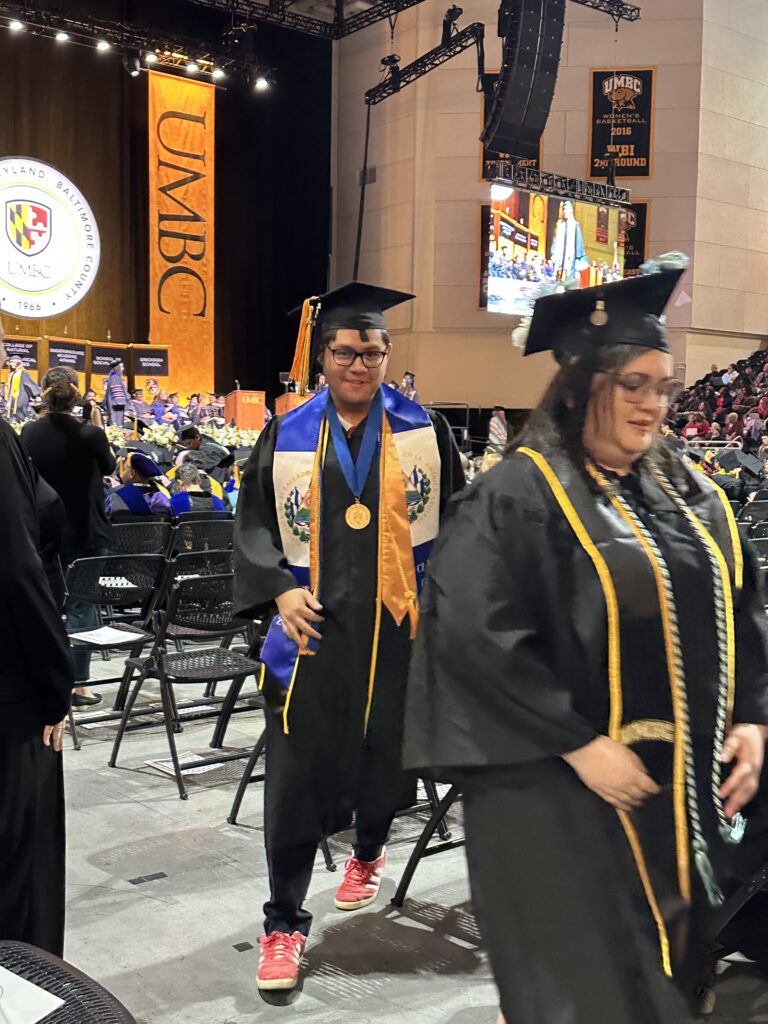
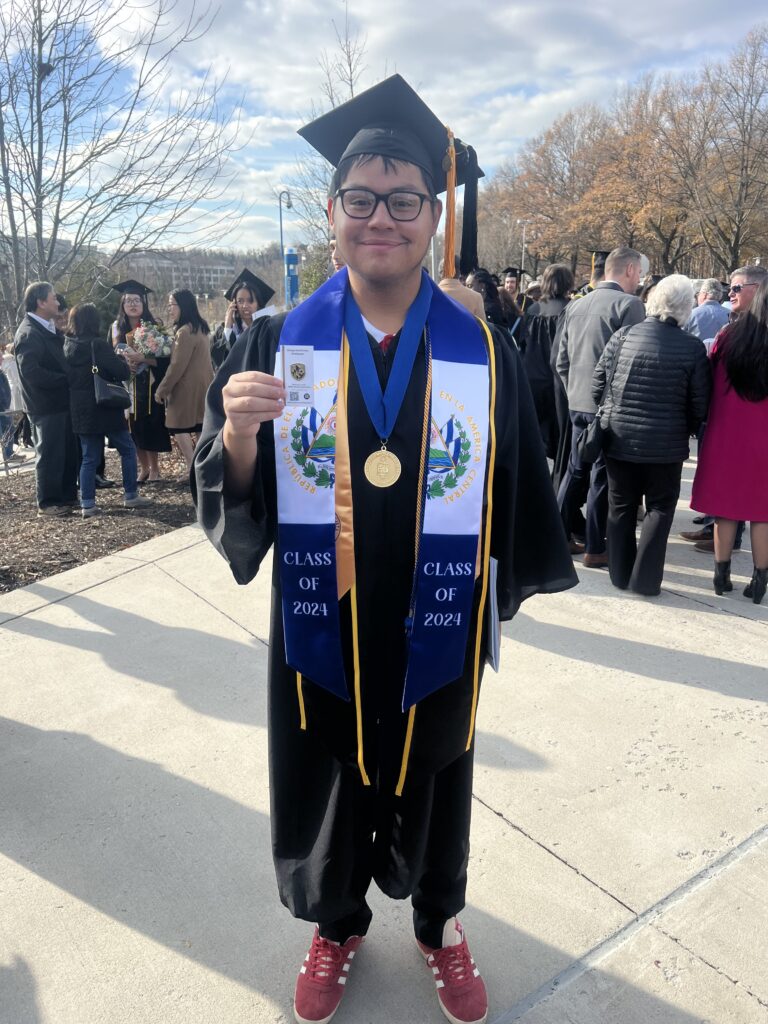 Moran at his 2024 graduation from UMBC.
Q: What was your experience studying history at UMBC?
A: Once at UMBC, I dove into the multitude of classes on aging, women’s studies, sociology, and, of course, history, which all helped me gain a better understanding and appreciation for the communities I grew up alongside. I learned that there was a history of pretty much everything, as long as there was some interest. So many people think history is just old people in wigs, but it’s everywhere, from political history to sports history. There is always a story to be told as long as someone is willing to listen and learn.
Q: Who in the UMBC community has inspired you or supported you?
A: The last two years have really pushed me to be the best version of myself in my work as well as my mentorship. I’ve learned from Melissa Blair, associate teaching professor of history, as well as other professors throughout the history department, how to approach different types of students. These lessons have helped me teach these young men right from wrong in ways that they can understand.
UMBC gave me the tools to be creative in how I tackle challenges and debates with my players. I guide players by equipping them with the tools to grow and improve, as Blair and other professors supported me in the classroom, rather than stepping in.
So many people think history is just old people in wigs, but it’s everywhere, from political history to sports history. There is always a story to be told as long as someone is willing to listen and learn. —Balmory Moran ’24
Q: Is there a concept you learned in your classes at UMBC that is applicable outside of the classroom?
A: The professors I had at UMBC showed me that there are many ways to get important information across that don’t feel like a lecture. They taught me how to be an effective problem-solver. These lessons were within a history class setup, but felt applicable to how I wanted to coach and mentor my players. So many people get the wrong idea when they hear the term “history degree.” It’s not just about curating museums and lecturing. It is also about what makes us who we are, helps us understand where we come from, and what values we hold onto.
* * * * *
UMBC’s greatest strength is its people. When people meet Retrievers and hear about the passion they bring, the relationships they create, the ways they support each other, and the commitment they have to inclusive excellence, they truly get a sense of our community. That’s what Meet a Retriever is all about.
Learn more about how UMBC can help you achieve your goals and the UMBC History Department’s programs and faculty.
]]>
Balmory Moran II ’24, history, used to describe himself as a soccer player above all else. The soccer field and his team were where he felt most at home. In high school, an injury ended his hopes...
https://umbc.edu/stories/balmory-moran-uses-history-major-to-coach-youth/
Video Preview
https://assets1-my.umbc.edu/system/shared/attachments/9d275eae2e4ca27826933a86d60638fe/6a9fa4d5/news/000/160/698/77fd1d4f4e2edb4384e207a1ab551f9f/ENkc1G1ZZCw.jpg?1781549406
https://my3.my.umbc.edu/api/v0/pixel/news/160698/guest@my.umbc.edu/15a3d9b0ded499cefe0c1446285fb89c/api/pixel
alumni
cahss
history
impact
meet-a-retriever
perspectives
story
transfer-students
UMBC News & Magazine
https://my3.my.umbc.edu/groups/umbc-news-magazine
https://assets1-my.umbc.edu/system/shared/avatars/groups/000/001/943/24435aa6207c452e7bc15cc74b42c7bb/xsmall.png?1748556657
https://assets1-my.umbc.edu/system/shared/avatars/groups/000/001/943/24435aa6207c452e7bc15cc74b42c7bb/original.png?1748556657
https://assets2-my.umbc.edu/system/shared/avatars/groups/000/001/943/24435aa6207c452e7bc15cc74b42c7bb/xxlarge.png?1748556657
https://assets2-my.umbc.edu/system/shared/avatars/groups/000/001/943/24435aa6207c452e7bc15cc74b42c7bb/xlarge.png?1748556657
https://assets3-my.umbc.edu/system/shared/avatars/groups/000/001/943/24435aa6207c452e7bc15cc74b42c7bb/large.png?1748556657
https://assets1-my.umbc.edu/system/shared/avatars/groups/000/001/943/24435aa6207c452e7bc15cc74b42c7bb/medium.png?1748556657
https://assets2-my.umbc.edu/system/shared/avatars/groups/000/001/943/24435aa6207c452e7bc15cc74b42c7bb/small.png?1748556657
https://assets1-my.umbc.edu/system/shared/avatars/groups/000/001/943/24435aa6207c452e7bc15cc74b42c7bb/xsmall.png?1748556657
https://assets2-my.umbc.edu/system/shared/avatars/groups/000/001/943/24435aa6207c452e7bc15cc74b42c7bb/xxsmall.png?1748556657
UMBC News & Magazine
1
0
false
Mon, 15 Jun 2026 14:40:35 -0400
Mon, 15 Jun 2026 14:40:35 -0400
Finley Bandy ’26 finds a future in history
Finley Bandy spent last summer in the cool temperatures and dim light of UMBC’s Albin O. Kuhn Library and Gallery Special Collections—the perfect environment to preserve rare books, photographs, manuscripts, archives, and artifacts. As part of UMBC’s 2025 Co-Lab interdisciplinary undergraduate summer research program, Bandy learned techniques to produce “Special Collections 101”, an informative video about how to use the resources in the collections. Bandy also loves being surrounded by thousands of historical narratives and working with Special Collections staff Beth Saunders, associate director and curator, and Lindsey Loeper, reference and instruction archivist. The infinite possibilities housed in Special Collections and the people who ensure historical narratives aren’t forgotten have inspired Bandy to join the cadre of museum and archive professionals.
“I was accepted into UMBC’s master’s program in historical studies,” says Bandy. “I love the process of using my historical and archival research to write about what I’m finding so that other people are aware that this piece of history exists. That’s why I want my master’s research to be an online exhibit that is accessible to the world.”
Museums and archives are only two of Bandy’s passions. When Bandy transferred to UMBC from Lamar Community College in Colorado, they brought their love of Russian language, history, and culture, and their deep love of Baltimore City.
Q: Did you come to UMBC already knowing what you wanted to study?
A: When I started at UMBC, I was all set to learn Russian and study Soviet history, but then I decided to go broader and major in history. I did finish all the Russian language courses, so I can speak Russian. I’m still interested in Russian history, and I love Russian music. I really love the language and like Eastern European culture.
Q: Where does your passion for Russian language and culture come from?
A: In my community college, I took a 20th-century world history class, and learned about the Cold War, which lasted from 1947 to 1991. A lot of the history really broke my heart. It made me want to learn more about it. I took a lot of Russian history classes and started reading Russian and Soviet literature. I really love how unique it is.
Q: Is there a modern piece of Russian culture that you enjoy, or are you focused on the history?
A: I think it’s really interesting to see how Soviet culture is beginning to meld with Western culture.
Soviet rock bands are really, really cool. There’s this great rock band that has been around since the ’70s called Akvarium or Aquarium. They were underground for a long time due to the war. I listen to them a lot. There’s also a current pop musician named Monetochka. She’s really cool.
I’ve never travelled abroad or have a passport, but one day I would like to visit Moscow and St. Petersburg, and travel all over Eastern Europe and the Balkans.
 UMBC’s proximity to Camden Yards makes for a great trip to cheer on the Orioles! (Image courtesy of Bandy)
Q: Do you have a community to speak Russian with and immerse yourself in Russian culture?
A: Yes! UMBC’s Russian Club is a really tight-knit group. In the past, we hosted many holiday celebrations. In post-Soviet Russia and Eastern Europe, they still celebrate Christmas, but New Year’s is celebrated more because during the Soviet era, atheism was promoted and New Year’s didn’t have religious ties. Towards the end of the fall semester, we organized a giant Novy God [New Year’s] celebration. And then in the spring, we celebrated Maslenitsa. In the Russian Orthodox Church, this is the last week to feast before a period of fasting that ends at Easter. We also hung out a lot and talked about different Eastern European cultures. It’s called the Russian Club, but we have students from all over Eastern Europe—Ukraine, Armenia, and Belarus.
Q: Why do you love Baltimore City?
A:. Even though I was in Colorado for community college, I spent a lot of my childhood in Baltimore City because my grandmother worked in the city and my mom lived there. I have a connection to Baltimore, but I never really knew its history. I took “The History of Baltimore” at the Lion Brothers Building downtown. Every week, we took field trips to historic sites in Baltimore City to connect what we were learning with real-world experiences.
Q: Why did you change your major from Russian to history, and who has inspired you in this path?
A: I decided to switch majors from Russian to history while doing research in Professor Melissa Blair‘s “The History of Baltimore” class. It inspired me to pivot and focus my work on Maryland’s transportation history. The experiential learning and field work inspired me to better understand Baltimore and its history. I think Baltimore is a very unique city with a rich history that is often ignored by the historical record. I enjoyed interacting with other public historians and museum professionals within the city through that class.
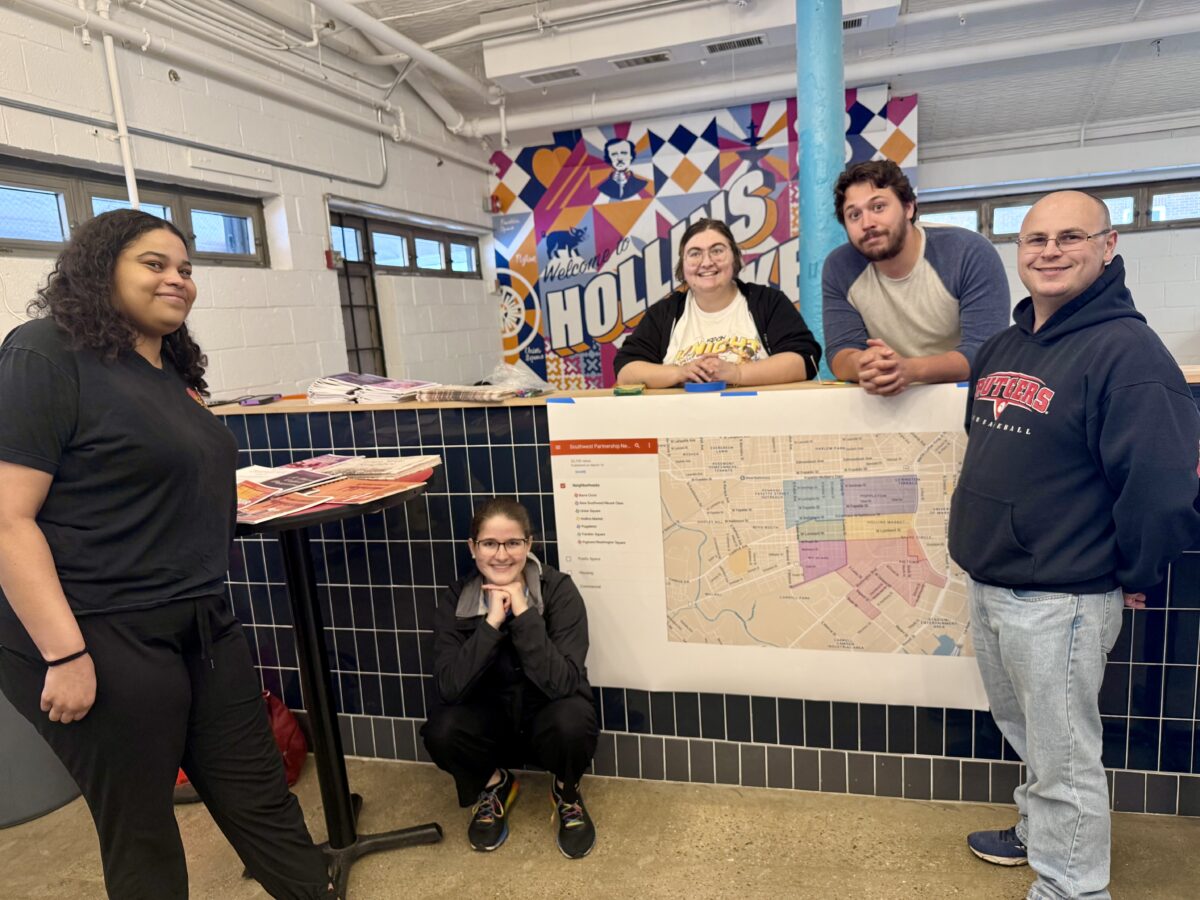 Students from King’s class, “Preserving Spaces, Making Spaces in Baltimore,” participated in a Community Archiving Day event. The class planned this event to engage with residents and community members from neighborhoods in Southwest Baltimore and to gauge interest in developing a Community Archive to preserve their histories. (l-r) Amina Thiam ’24, history, Em Schumacher, a geography and environmental systems senior, Bandy, Tristan Diaz ’25, cultural anthropology and sociology, and Bandy’s fiancé, Max Taylor (who is not a UMBC student). (Image courtesy of King)
I’ve also worked a lot with Professor Nicole King in American studies—I took her “Preserving Places, Making Spaces in Baltimore” class twice. In 2025, we worked with the Poppleton Now Community Association and the Southwest Partnership Historic Preservation Committee on a Public History and Preservation Study. It included my research on the “Highway to Nowhere,” a 1.4-mile stretch of U.S. Route 40 in West Baltimore, built in the 1970s, that ends abruptly. The highway cuts off a section of Poppleton, one of the city’s oldest historically Black neighborhoods. We also created an online story map.
Q: Why are you passionate about transportation equity?
A: I don’t have a car, so I rely on Baltimore’s terrible public transportation. I love public transit, and I need it to be better. In the Baltimore history class, I realized the bus schedules, the bus routes, and the history of highway construction in the city have limited transportation, not expanded it. I conducted research with American studies Professor Michael Cassiano, my public humanities advisor. I presented my research, “Our City Is a City Without an Expressway: A Historical Review of Transportation Injustice in Baltimore City,” at URCAD. I’m interested in exploring these topics in my master’s program.
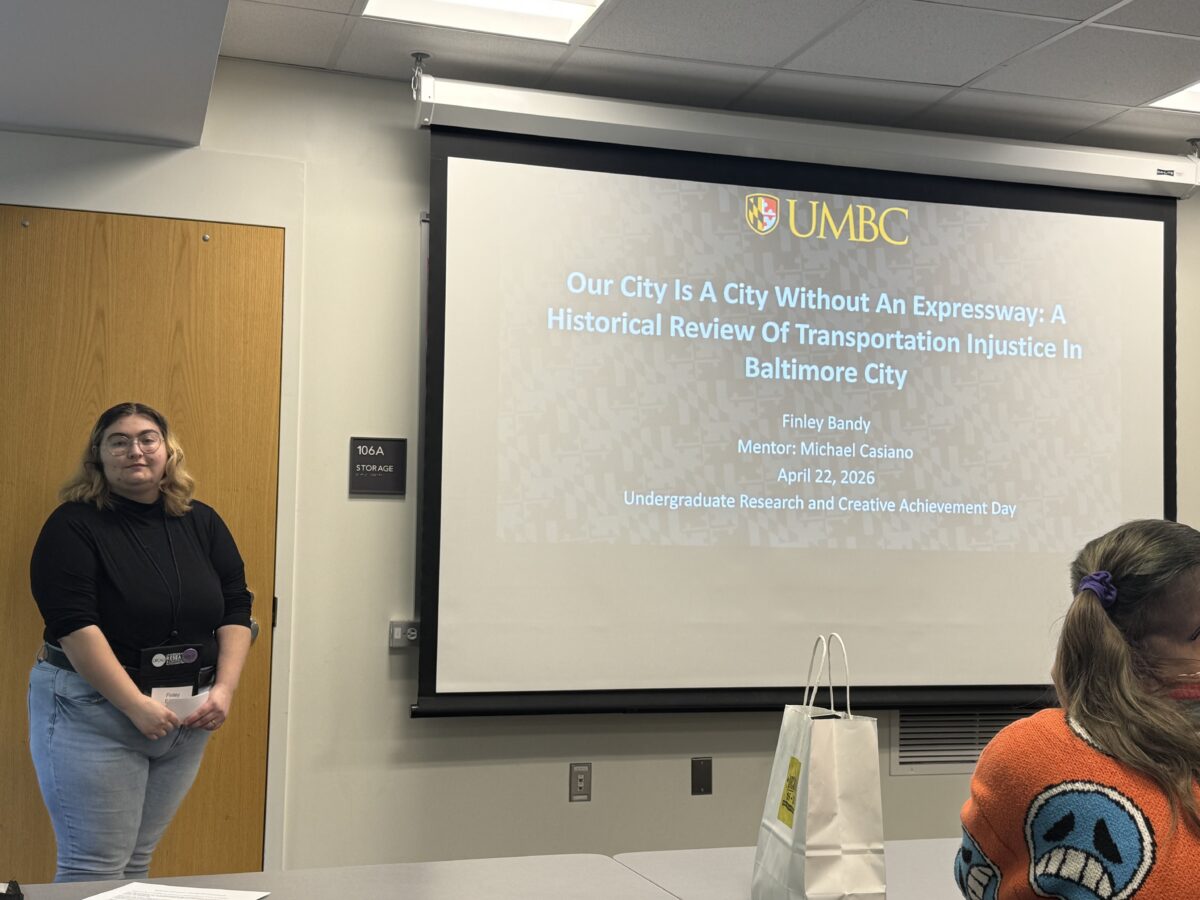 Bandy presents her research at the 2026 Undergraduate Research and Creative Achievement Day. (Image courtesy of King.)
Q: What is a challenge that you love?
A: I love creative writing. I’ve been writing since I was a kid. I think it’s a natural segue into history, because history is narrative-based. It’s very humanistic. I won’t say it comes naturally to me. It takes me probably an hour to write a sentence because I overthink my word choices a lot. But I love using language to evoke certain feelings and really press home on an idea. I try to choose the right word to fit what I’m talking about and its context. I also try to support students in the writing process as the History Student Council president. Last semester, we organized a bi-weekly writing group to encourage community and motivation within the major.
Q: What advice do you have for undergraduate and transfer students?
A: For undergraduate students, I would say to be realistic. Don’t put too much on your plate. That’s been the biggest challenge for me. I’ve been suffering a lot of burnout, because, in addition to my classes, I am a teaching assistant for “Introduction to the University for Transfer Students.” I started getting better at saying no to things. I encourage students to get out there, explore new things, but also recognize their limits. Prioritize making space for something that brings you joy.
For transfer students, I would say time management. Most of us work full-time or part-time, are raising families, and have other commitments. We’re not fresh out of high school and can sometimes internalize a feeling of being behind or not doing college “right.” It’s important to get over that because it doesn’t really matter. When I was 18 years old, my coworker was 40 years old. They had been working for decades. Once you leave high school, age doesn’t matter the same way—people are people, and everyone is busy. I wouldn’t focus on trying to get things done in a way that’s expected of you. Instead, focus on what you need to do to succeed.
Read more Class of 2026 stories.
]]>
Finley Bandy spent last summer in the cool temperatures and dim light of UMBC’s Albin O. Kuhn Library and Gallery Special Collections—the perfect environment to preserve rare books, photographs,...
https://umbc.edu/stories/finley-bandy-finds-a-future-in-history/
Video Preview
https://assets3-my.umbc.edu/system/shared/attachments/c77996eef6746178e2395bc2b0e325e8/6a9fa4d5/news/000/160/021/753b160cd612d83ee6b7c8c05e556046/2VV5_EeP8xs.jpg?1778616307
https://my3.my.umbc.edu/api/v0/pixel/news/160021/guest@my.umbc.edu/74ebb52b16afdf97b14dc160572a104f/api/pixel
american-studies
aok-library
baltimore-city
cahss
class-of-2026
ges
history
news
policy-and-society
saph
story
UMBC News & Magazine
https://my3.my.umbc.edu/groups/umbc-news-magazine
https://assets1-my.umbc.edu/system/shared/avatars/groups/000/001/943/24435aa6207c452e7bc15cc74b42c7bb/xsmall.png?1748556657
https://assets1-my.umbc.edu/system/shared/avatars/groups/000/001/943/24435aa6207c452e7bc15cc74b42c7bb/original.png?1748556657
https://assets2-my.umbc.edu/system/shared/avatars/groups/000/001/943/24435aa6207c452e7bc15cc74b42c7bb/xxlarge.png?1748556657
https://assets2-my.umbc.edu/system/shared/avatars/groups/000/001/943/24435aa6207c452e7bc15cc74b42c7bb/xlarge.png?1748556657
https://assets3-my.umbc.edu/system/shared/avatars/groups/000/001/943/24435aa6207c452e7bc15cc74b42c7bb/large.png?1748556657
https://assets1-my.umbc.edu/system/shared/avatars/groups/000/001/943/24435aa6207c452e7bc15cc74b42c7bb/medium.png?1748556657
https://assets2-my.umbc.edu/system/shared/avatars/groups/000/001/943/24435aa6207c452e7bc15cc74b42c7bb/small.png?1748556657
https://assets1-my.umbc.edu/system/shared/avatars/groups/000/001/943/24435aa6207c452e7bc15cc74b42c7bb/xsmall.png?1748556657
https://assets2-my.umbc.edu/system/shared/avatars/groups/000/001/943/24435aa6207c452e7bc15cc74b42c7bb/xxsmall.png?1748556657
UMBC News & Magazine
0
0
false
Tue, 12 May 2026 15:44:27 -0400
Tue, 12 May 2026 15:44:27 -0400
Author Kristina Gaddy ’09, collaborates with Rhiannon Giddens, Grammy Award-winning musician, on the history of Black American music
Kristina Gaddy ’09, saves and gathers manuscripts, sheet music, pictures, maps, drawings, and anecdotes, sharing them on her blog to make public what she finds hidden in archives, private collections, and museums. For her fourth book, Go Back and Fetch It: Recovering Early Black Music in the Americas for Fiddle and Banjo (University of North Carolina Press, 2025), Gaddy teamed up with Rhiannon Giddens, a Grammy Award-winning musician who is equally passionate about digitizing and broadening access to the historical material culture of the banjo.
Gaddy came to UMBC as a Sondheim Public Affairs Scholar. Her passion for history and languages—Swedish, German, and Spanish—led her to graduate with a dual degree in history and modern languages and linguistics. Looking back on her time at UMBC, Gaddy is grateful for the opportunities the program provided, especially the chance to study abroad in Germany. There, she combined her proficiency in German with her historical training to research the foundations of her first book.
“The Sondheim Public Affairs Scholars Program was wonderful because of the funding I received to support my research and the cohort of students,” says Gaddy. “We were all really interested and excited about social issues, public policy, and how these ideas could be used to improve the world.”
These interests inspired a career in historical nonfiction writing and led to her to write meticulously researched books: Flowers in the Gutter: True Story of the Edelweiss Pirates, Teenagers Who Resisted the Nazis (Dutton Books, 2020), Well of Souls: Uncovering the Banjo’s Hidden History (W. W. Norton & Company, 2022), and A Most Perilous World: The True Story of the Young Abolitionists and their Crusade Against Slavery (Dutton Books, 2025).
Digitizing public history
Her collaboration with Giddens isn’t the first time Gaddy has written a book about banjos. “My start in music research and writing started 15 years ago when I was an AmeriCorps working with multi-instrumentalist Gerry Milnes at Augusta [Heritage Center in Elkins, West Virginia], and the friends I made while living in Elkins helped put me on the path to writing Well of Souls and Go Back and Fetch It.”
It’s not just documents that Gaddy used in her first banjo book—which are accessible on her blog—but also sound clips, performances, and interviews. While many historical records can be found online, many more have yet to be digitized. Gaddy, who also digitized and archived the West Virginia Upshur County Historical Society‘s local history collection, has made digitization an integral part of her process.
 Kristina Gaddy performing at the Augusta Heritage Center in Elkins, West Virginia. (Image courtesy of Gaddy)
“Having come from the public history side of UMBC’s history department, I strongly believe in people having access to information as it pertains to their own history. It was one of the reasons I wanted to write Well of Souls,” says Gaddy, about her second book. “I had gathered all this information, and I could have shared it with just a few people, but I wanted anybody who wants access to banjo history not to have to go to some expensive conference to hear about it.”
A revolutionary collaboration
Giddens, a MacArthur recipient and Pulitzer Prize winner, is grateful for Gaddy’s dedication to digitizing and broadening access to historical material culture. While working on pieces of music highlighting 18th-century North American, Scottish, and Irish traditions for Ken Burns’s 2025 PBS documentary The American Revolution, Giddens was looking for samples of Black music from the Revolutionary War. She wasn’t having much luck until she explored Gaddy’s website, where she not only found what she was looking for but also the inspiration for their co-authored book, Go Back and Fetch It.
“I just kept going back to Kristina’s website, where she had put up these JPEGs. I would download them, lose the JPEG, and I’d go back and, like, download it again. And then I was just like, ‘Kristina, why don’t we put all of these in a book?’” explained Giddens at the 2025 Michigan University Arts Initiative interview on Go Back and Fetch It with Gaddy.
The book is their third collaboration. In 2018, Giddens invited Gaddy and her husband, Pete Ross—banjo maker, researcher, and musician—to present at a banjo symposium during the inaugural North Carolina Folk Festival, which Giddens curated. Gaddy presented her research on the African American roots of the banjo, an experience she credits as the inspiration for Wells of Souls, for which Giddens wrote the foreword. They also collaborated in 2022 on one episode of the 10-part series The Banjo: Music, History, and Heritage for The Great Courses.
“The idea behind the book was that there were all these little pieces of music in archives, in published books, in manuscripts that were sprinkled throughout the historic record of Black music in the Americas,” explains Gaddy in the same interview. “They weren’t compiled in one place. Rhiannon, as an artist, was frustrated that she couldn’t access them.”
For their book collaboration, they selected 19 pieces of music from 1687 through the 1860s. Gaddy wrote a historical research essay for each song explaining the types of banjos used, how and when they were played, and their socio-cultural significance across communities in the Americas and the Caribbean. Giddens transcribed the songs into modern treble clef and banjo tablature, which shows finger placement, rather than the Western classical notation tradition, making early Black Atlantic banjo music accessible to banjo players today, in the future, globally, and across all genres.
Following the banjo around the world
Gaddy’s last five years have been busy. But dig a little deeper, ask more questions, and do a lot of listening—just as she does for all of her interviews—it turns out that Gaddy really started her musical performance research in high school while playing traditional Swedish music with her mom and traditional American music with her uncle and aunt. After college, she fell in love with the banjo while living with other artists in West Virginia, developing a connection with a vast, diverse community passionate about banjo culture and history—including in Baltimore City, where Gaddy and her husband performed some of the songs from Go Back and Fetch It at the Enoch Pratt Free Library in September, right before she moved to Nottingham, England.
Gaddy and Ross perform at the Baltimore City Enoch Pratt Free Library.
Gaddy has also expanded her digital research presence to Substack, where she posted the news of her fully funded doctoral program at the University of Nottingham, where she will research Black fiddling in the 19th-century British Caribbean.
And even though she is a whole ocean away, Gaddy still feels the support of her UMBC history department.
“One of the most exciting things for me is to see other students and scholars diving deeper into these subjects,” says Gaddy. “My former history professor, Dr. Michelle Scott, recently put me in touch with Amina Thiam, a UMBC graduate student who is writing her thesis on Black banjoists and string instrumentalists in Maryland during the colonial period. I can’t wait to see what she uncovers.”
Learn more about Kristina Gaddy’s work and UMBC’s History department.
]]>
Kristina Gaddy ’09, saves and gathers manuscripts, sheet music, pictures, maps, drawings, and anecdotes, sharing them on her blog to make public what she finds hidden in archives, private...
https://umbc.edu/stories/kristina-gaddy-and-rhiannon-giddens-banjos/
https://my3.my.umbc.edu/api/v0/pixel/news/157498/guest@my.umbc.edu/249209c87f638d5f94605cb83fd26c64/api/pixel
alumni
arts-and-culture
cahss
history
humanitiesbooks
news
research
retriever-authors
story
UMBC News & Magazine
https://my3.my.umbc.edu/groups/umbc-news-magazine
https://assets1-my.umbc.edu/system/shared/avatars/groups/000/001/943/24435aa6207c452e7bc15cc74b42c7bb/xsmall.png?1748556657
https://assets1-my.umbc.edu/system/shared/avatars/groups/000/001/943/24435aa6207c452e7bc15cc74b42c7bb/original.png?1748556657
https://assets2-my.umbc.edu/system/shared/avatars/groups/000/001/943/24435aa6207c452e7bc15cc74b42c7bb/xxlarge.png?1748556657
https://assets2-my.umbc.edu/system/shared/avatars/groups/000/001/943/24435aa6207c452e7bc15cc74b42c7bb/xlarge.png?1748556657
https://assets3-my.umbc.edu/system/shared/avatars/groups/000/001/943/24435aa6207c452e7bc15cc74b42c7bb/large.png?1748556657
https://assets1-my.umbc.edu/system/shared/avatars/groups/000/001/943/24435aa6207c452e7bc15cc74b42c7bb/medium.png?1748556657
https://assets2-my.umbc.edu/system/shared/avatars/groups/000/001/943/24435aa6207c452e7bc15cc74b42c7bb/small.png?1748556657
https://assets1-my.umbc.edu/system/shared/avatars/groups/000/001/943/24435aa6207c452e7bc15cc74b42c7bb/xsmall.png?1748556657
https://assets2-my.umbc.edu/system/shared/avatars/groups/000/001/943/24435aa6207c452e7bc15cc74b42c7bb/xxsmall.png?1748556657
UMBC News & Magazine
0
0
false
Thu, 12 Mar 2026 16:30:42 -0400
Thu, 12 Mar 2026 16:30:42 -0400
Author Kristina Gaddy ’09, collaborates with Rhiannon Giddens, Grammy Award-winning musician, on the history of Black American music
Kristina Gaddy came to UMBC as a Sondheim Public Affairs Scholar. Her passion for history and languages—Swedish, German, and Spanish—led her to graduate with a dual degree in history and modern languages and linguistics. Looking back on her time at UMBC, Gaddy is grateful for the opportunities the program provided, especially the chance to study abroad in Germany. There, she combined her proficiency in German with her historical training to research the foundations of her first book.
“The Sondheim Public Affairs Scholars Program was wonderful because of the funding I received to support my research and the cohort of students,” says Gaddy. “We were all really interested and excited about social issues, public policy, and how these ideas could be used to improve the world.”
These interests inspired a career in historical nonfiction writing and led to her to write meticulously researched books: Flowers in the Gutter: True Story of the Edelweiss Pirates, Teenagers Who Resisted the Nazis (Dutton Books, 2020), Well of Souls: Uncovering the Banjo’s Hidden History (W. W. Norton & Company, 2022), and A Most Perilous World: The True Story of the Young Abolitionists and their Crusade Against Slavery (Dutton Books, 2025).
Digitizing public history
Her collaboration with Giddens isn’t the first time Gaddy has written a book about banjos. “My start in music research and writing started 15 years ago when I was an AmeriCorps working with multi-instrumentalist Gerry Milnes at Augusta [Heritage Center in Elkins, West Virginia], and the friends I made while living in Elkins helped put me on the path to writing Well of Souls and Go Back and Fetch It.”
Kristina Gaddy performing at the Augusta Heritage Center in Elkins, West Virginia. (Image courtesy of Gaddy)
It’s not just documents that Gaddy used in her first banjo book—which are accessible on her blog—but also sound clips, performances, and interviews. While many historical records can be found online, many more have yet to be digitized. Gaddy, who also digitized and archived the West Virginia Upshur County Historical Society‘s local history collection, has made digitization an integral part of her process.
“Having come from the public history side of UMBC’s history department, I strongly believe in people having access to information as it pertains to their own history. It was one of the reasons I wanted to write Well of Souls,” says Gaddy, about her second book. “I had gathered all this information, and I could have shared it with just a few people, but I wanted anybody who wants access to banjo history not to have to go to some expensive conference to hear about it.”
A revolutionary collaboration
Giddens, a MacArthur recipient and Pulitzer Prize winner, is grateful for Gaddy’s dedication to digitizing and broadening access to historical material culture. While working on pieces of music highlighting 18th-century North American, Scottish, and Irish traditions for Ken Burns’s 2025 PBS documentary The American Revolution, Giddens was looking for samples of Black music from the Revolutionary War. She wasn’t having much luck until she explored Gaddy’s website, where she not only found what she was looking for but also the inspiration for their co-authored book, Go Back and Fetch It.
“I just kept going back to Kristina’s website, where she had put up these JPEGs. I would download them, lose the JPEG, and I’d go back and, like, download it again. And then I was just like, ‘Kristina, why don’t we put all of these in a book?’ explained Giddens at the 2025 Michigan University Arts Initiative interview on Go Back and Fetch It with Gaddy.
The book is their third collaboration. In 2018, Giddens invited Gaddy and her husband, Pete Ross—banjo maker, researcher, and musician—to present at a banjo symposium during the inaugural North Carolina Folk Festival, which Giddens curated. Gaddy presented her research on the African American roots of the banjo, an experience she credits as the inspiration for Wells of Souls, for which Giddens wrote the foreword. They also collaborated in 2022 on one episode of the 10-part series The Banjo: Music, History, and Heritage for The Great Courses project.
Gaddy, Pete Ross, presenting at the 2022 American Musical Instrument Society Conference.
“The idea behind the book was that there were all these little pieces of music in archives, in published books, in manuscripts that were sprinkled throughout the historic record of Black music in the Americas,” explains Gaddy in the same interview. “They weren’t compiled in one place. Rhiannon, as an artist, was frustrated that she couldn’t access them.”
For their book collaboration, they selected 19 pieces of music from 1687 through the 1860s. Gaddy wrote a historical research essay for each song explaining the types of banjos used, how and when they were played, and their socio-cultural significance across communities in the Americas and the Caribbean. Giddens transcribed the songs into modern treble clef and banjo tablature, which shows finger placement, rather than the Western classical notation tradition, making early Black Atlantic banjo music accessible to banjo players today, in the future, globally, and across all genres.
Following the banjo around the world
Gaddy’s last five years have been busy. But once you dig a little deeper, ask more questions, and do a lot of listening—just as she does for all of her interviews—you learn that Gaddy really started her musical performance research in high school while playing traditional Swedish music with her mom and traditional American music with her uncle and aunt. After college, she fell in love with the banjo while living with other artists in West Virginia, developing a connection with a vast, diverse community passionate about banjo culture and history—including in Baltimore City, where Gaddy and her husband performed some of the songs from Go Back and Fetch It at the Enoch Pratt Free Library in September, right before she moved to Nottingham, England.
Gaddy and Ross perform at the Baltimore City Enoch Pratt Free Library.
Gaddy has also expanded her digital research presence to Substack, where she posted the news of her fully funded doctoral program at the University of Nottingham, where she will research Black fiddling in the 19th-century British Caribbean.
And even though she is a whole ocean away, Gaddy still feels the support of her UMBC history department.
“One of the most exciting things for me is to see other students and scholars diving deeper into these subjects. My former history professor, Dr. Michelle Scott, recently put me in touch with Amina Thiam, a UMBC graduate student who is writing her thesis on Black banjoists and string instrumentalists in Maryland during the colonial period. I can’t wait to see what she uncovers.”
Learn more about Kristina Gaddy’s work and UMBC’s History department.
]]>
Kristina Gaddy came to UMBC as a Sondheim Public Affairs Scholar. Her passion for history and languages—Swedish, German, and Spanish—led her to graduate with a dual degree in history and modern...
https://umbc.edu/stories/kristina-gaddy-and-rhiannon-giddens-banjo-go-back-and-fetch-it/
https://my3.my.umbc.edu/api/v0/pixel/news/157461/guest@my.umbc.edu/9020f8e9aa55d55c556ad5cc4ac0f114/api/pixel
alumni
arts-and-culture
cahss
history
humanitiesbooks
news
research
story
UMBC News & Magazine
https://my3.my.umbc.edu/groups/umbc-news-magazine
https://assets1-my.umbc.edu/system/shared/avatars/groups/000/001/943/24435aa6207c452e7bc15cc74b42c7bb/xsmall.png?1748556657
https://assets1-my.umbc.edu/system/shared/avatars/groups/000/001/943/24435aa6207c452e7bc15cc74b42c7bb/original.png?1748556657
https://assets2-my.umbc.edu/system/shared/avatars/groups/000/001/943/24435aa6207c452e7bc15cc74b42c7bb/xxlarge.png?1748556657
https://assets2-my.umbc.edu/system/shared/avatars/groups/000/001/943/24435aa6207c452e7bc15cc74b42c7bb/xlarge.png?1748556657
https://assets3-my.umbc.edu/system/shared/avatars/groups/000/001/943/24435aa6207c452e7bc15cc74b42c7bb/large.png?1748556657
https://assets1-my.umbc.edu/system/shared/avatars/groups/000/001/943/24435aa6207c452e7bc15cc74b42c7bb/medium.png?1748556657
https://assets2-my.umbc.edu/system/shared/avatars/groups/000/001/943/24435aa6207c452e7bc15cc74b42c7bb/small.png?1748556657
https://assets1-my.umbc.edu/system/shared/avatars/groups/000/001/943/24435aa6207c452e7bc15cc74b42c7bb/xsmall.png?1748556657
https://assets2-my.umbc.edu/system/shared/avatars/groups/000/001/943/24435aa6207c452e7bc15cc74b42c7bb/xxsmall.png?1748556657
UMBC News & Magazine
2
0
false
Thu, 12 Mar 2026 16:30:42 -0400
Thu, 12 Mar 2026 16:30:42 -0400
How China uses second world war history in its bid to reshape the global order – podcast
The Conversation Weekly Podcast Interview with Meredith Oyen, Associate Professor of History and Asian Studies, UMBC.
With Russia’s Vladimir Putin and North Korea’s Kim Jong-Un among 26 world leaders watching, China’s president Xi Jinping made a muscular address to 50,000 people in Tiananmen Square marking 80 years since the end of the second world war. China is “never intimidated by bullies” and would “stand by the right side of history”, Xi said, adding that “the great rejuvenation of the Chinese nation was unstoppable”.
Absent from the ceremony was Taiwan’s leader, Lai Ching-te, who instead took to Facebook, writing that Taiwan does not “commemorate peace with the barrel of a gun”. Taiwan had barred public officials from attending the event.
China and Taiwan both claim their forces bore the true burden of Chinese resistance against Japan during the second world war, and use this contested history to lay claim to power and territory. Now China is weaponising this history, pushing for a “correct” perspective of the war as it seeks to reshape the world order and assert its ambitions over Taiwan.
In this episode of The Conversation Weekly podcast, Meredith Oyen, a historian and expert in China-Taiwan relations, explains how disagreements between China and Taiwan over who fought the Japanese more than 80 years ago are still raging and why China’s military parade raised tensions with Taiwan up another notch.
“The second world war has this very long shadow in all of east Asia because there’s a lot of unfinished business,” says Oyen, an associate professor of history and Asian studies at the University of Maryland, Baltimore County.
When Japan officially surrendered on September 9 at a ceremony in Nanjing, it was to the Republic of China, then ruled by Chiang Kai-shek. With the war against Japan over, Chiang’s nationalist Kuomintang resumed their civil war against the Chinese Communist Party. In 1949, Chiang and the Kuomintang were pushed to Taiwan as Mao Zedong declared the People’s Republic of China.
As a result, persistent questions about whether China and Taiwan are two separate entities or a divided nation with Taiwan a part of China are a “really significant geopolitical flashpoint” says Oyen, “something that stems directly out of the second world war”.
Listen to the conversation with Meredith Oyen about how disagreements between China and Taiwan over the second world war on The Conversation Weekly podcast. You can also read an text version of this interview.
This episode of The Conversation Weekly was written and produced by Mend Mariwany and Gemma Ware with assistance from Katie Flood. Mixing and sound design by Eloise Stevens and theme music by Neeta Sarl.
Newclips in this episode from Straits Times , BBC News and NBC News and KinoLibrary .
Listen to The Conversation Weekly via any of the apps listed above, download it directly via our RSS feed or find out how else to listen here. A transcript of this episode is available on Apple Podcasts or Spotify.
Gemma Ware, Host, The Conversation Weekly Podcast, The Conversation
This article is republished from The Conversation under a Creative Commons license. Read the original article and see more than 300 UMBC articles available in The Conversation.
]]>
The Conversation Weekly Podcast Interview with Meredith Oyen, Associate Professor of History and Asian Studies, UMBC. With Russia’s Vladimir Putin and North Korea’s Kim Jong-Un among 26 world...
https://umbc.edu/stories/china-uses-history-to-reshape-global-order/
https://my3.my.umbc.edu/api/v0/pixel/news/152245/guest@my.umbc.edu/b7d2feb9e9f5c8b9041a925c9b447542/api/pixel
asianstudies
cahss
conversation
discovery
history
magazine
story
UMBC News & Magazine
https://my3.my.umbc.edu/groups/umbc-news-magazine
https://assets1-my.umbc.edu/system/shared/avatars/groups/000/001/943/24435aa6207c452e7bc15cc74b42c7bb/xsmall.png?1748556657
https://assets1-my.umbc.edu/system/shared/avatars/groups/000/001/943/24435aa6207c452e7bc15cc74b42c7bb/original.png?1748556657
https://assets2-my.umbc.edu/system/shared/avatars/groups/000/001/943/24435aa6207c452e7bc15cc74b42c7bb/xxlarge.png?1748556657
https://assets2-my.umbc.edu/system/shared/avatars/groups/000/001/943/24435aa6207c452e7bc15cc74b42c7bb/xlarge.png?1748556657
https://assets3-my.umbc.edu/system/shared/avatars/groups/000/001/943/24435aa6207c452e7bc15cc74b42c7bb/large.png?1748556657
https://assets1-my.umbc.edu/system/shared/avatars/groups/000/001/943/24435aa6207c452e7bc15cc74b42c7bb/medium.png?1748556657
https://assets2-my.umbc.edu/system/shared/avatars/groups/000/001/943/24435aa6207c452e7bc15cc74b42c7bb/small.png?1748556657
https://assets1-my.umbc.edu/system/shared/avatars/groups/000/001/943/24435aa6207c452e7bc15cc74b42c7bb/xsmall.png?1748556657
https://assets2-my.umbc.edu/system/shared/avatars/groups/000/001/943/24435aa6207c452e7bc15cc74b42c7bb/xxsmall.png?1748556657
UMBC News & Magazine
0
0
false
Tue, 09 Sep 2025 14:08:14 -0400
Meet a Retriever—Mariam Yaldram ’20, Alumni Board Member & Special Educator
Meet Mariam Yaldram ’20, history, a graduate from UMBC at the Universities at Shady Grove with a passion for education, disability justice, and global citizenship. She is a special education 8th-grade English Language Arts (ELA) teacher, and a Teach for America corps member. She also serves on the UMBC Alumni Association Board of Directors and Fulbrighters with Disabilities. Outside of work, she loves writing, collecting antiques, and exploring different cultures. Take it away, Mariam!
Q: What is your WHY? What brought you to UMBC?
A: I chose UMBC Shady Grove because I had transferred from Montgomery College, where I concentrated in history. Being located in Montgomery County, it felt like a natural transition for me. As a caregiver with many responsibilities, the Shady Grove campus offered the flexibility I needed to balance my academic journey with my personal commitments.
It provided an environment where I could continue to pursue my passion for history while being close to home, allowing me to stay involved in my family’s needs. The campus also offered leadership opportunities, such as serving as the president of the History Student Association and co-founding the UMBC History Journal at Shady Grove. These opportunities gave me the chance to grow both academically and professionally.
Ultimately, choosing UMBC at Shady Grove allowed me to pursue my education and career goals without compromising my family responsibilities—making it a perfect fit for where I was in my life.
Q: What’s one thing you’d want someone to know about the UMBC community?
A: One thing I’d want someone who hasn’t yet joined the UMBC community to know is that you will always find support here—whether academically, professionally, or personally. The faculty, staff, and student organizations truly care about your growth and success. My professors challenged and mentored me, helping me develop critical thinking and leadership skills, while my advisors provided guidance in student engagement, networking, and advocacy.
Whether you’re a student or an alum, UMBC is a place where you’ll find a welcoming, diverse, and empowering community that encourages you to grow and make an impact.
Mariam Yaldram ’20
history
Q: Who has inspired you or supported you?
A: Andrew Nolan, UMBC history program director at UMBC-Shady Grove, Melissa Blair, lecturer and public history minor coordinator, and Chelsea Moyer, assistant vice provost at UMBC-Shady Grove, have all played crucial roles in inspiring and supporting me throughout my educational journey. Their collective support has shaped my academic and professional path, reinforcing my passion for education, advocacy, and leadership.

My history professors, Dr. Nolan and Dr. Blair, helped me develop strong critical thinking skills in historical analysis, research, and writing. Their mentorship also encouraged me to take on leadership opportunities, such as serving as the president of the History Student Association and co-founding the first-ever student-led UMBC History Journal at Shady Grove.
Moyer, my leadership advisor, was instrumental in my growth as a student leader. Through UMBC Peer Advisory, I gained valuable leadership development experience by assisting with orientations, preview nights, outreach, and student engagement. Her guidance helped me build confidence in networking and creating meaningful connections within the UMBC community.
Q: How has the UMBC community helped you grow beyond the classroom?
A: Beyond the classroom, UMBC provided me with invaluable opportunities and resources, including being a Returning Women Scholar, serving on the Shady Grove Campus Student Council, and working as a UMBC Shady Grove Blogger. These roles allowed me to amplify student voices, advocate for my peers, and share my educational journey, all while balancing my responsibilities as a caregiver.
With UMBC’s supportive network and mentorship, I was also able to secure a Fulbright English Teaching Assistantship (ETA)—a transformative experience that reinforced my passion for education and global citizenship. Now, as a special education 8th-grade ELA teacher and Teach for America corps member, I see how these experiences shaped my ability to lead, teach, and advocate for equity in education.
Photo Left: Mariam during UMBC Spirit Week 2020, showing her UMBC pride from home.
Q: How have you stayed connected with the UMBC community?
A: Even after graduation, the UMBC Chapter of Young Alumni (CYA) and the UMBC Alumni Association Board of Directors have continued to offer a strong support system, allowing me to stay connected, share my journey through panels and networking events, and support UMBC alumni—especially those from Shady Grove, whose voices I am passionate about uplifting. My involvement with these groups has been an incredible opportunity for leadership, advocacy, and community engagement. These organizations have allowed me to stay connected with UMBC while supporting fellow alumni
The people and opportunities at UMBC didn’t just support me—they empowered me to grow, push boundaries, and create meaningful change. That’s what makes UMBC so special!
Mariam Yaldram ’20
history
Through CYA, I have had the chance to participate in networking events, mentorship opportunities, and outreach initiatives that foster connections among recent graduates. Being on the Alumni Association Board of Directors has further strengthened my advocacy skills, as I’ve worked to highlight the achievements and needs of Shady Grove alumni. One of the most meaningful aspects has been sharing my educational journey on panels, where I can inspire current and future Retrievers by discussing my path from student leadership to becoming a special education teacher and Teach for America corps member.
UMBC has been instrumental in my personal and professional growth, from providing leadership roles in student organizations to helping me secure a Fulbright ETA. These experiences have shaped my ability to lead, advocate, and build meaningful connections—all while giving back to the UMBC community that has given me so much.
 Mariam Yaldram in Taiwan with her students during her Fulbright English Teaching Assistantship.
For anyone considering a partnership with UMBC, I’d say it’s a great investment in a dynamic, diverse, and innovative community. UMBC fosters meaningful connections, leadership opportunities, and global impact, making it an incredible place to collaborate, support, and grow together.
 Mariam and her UMBC-Shady Grove history class visiting the Montgomery County Historical Society.
Q: Tell us more about your current job. What do you like most about it?
A: I’m a special education 8th-grade ELA teacher at Ingenuity Prep and a Teach for America corps member. What I enjoy most about my work is helping students find their voice through reading, writing, and critical thinking. Seeing my students grow academically and gain confidence in their abilities is incredibly rewarding. I also love creating an inclusive and supportive classroom environment, where students with diverse learning needs feel empowered to succeed. My role allows me to advocate for educational equity and disability justice, ensuring that all students have access to meaningful learning experiences. Every day, I get to make a difference in their lives, and that’s what makes my job so fulfilling!
* * * * *
UMBC’s greatest strength is its people. When people meet Retrievers and hear about the passion they bring, the relationships they create, the ways they support each other, and the commitment they have to inclusive excellence, they truly get a sense of our community. That’s what “Meet a Retriever” is all about.
Learn more about how UMBC can help you achieve your goals.
]]>
Meet Mariam Yaldram ’20, history, a graduate from UMBC at the Universities at Shady Grove with a passion for education, disability justice, and global citizenship. She is a special education...
https://umbc.edu/stories/meet-mariam-yaldram-alumni-board/
https://my3.my.umbc.edu/api/v0/pixel/news/150073/guest@my.umbc.edu/eebb2c8bb83701ed102d3ab444f3549d/api/pixel
alumni
alumni-board
history
magazine
meet-a-retriever
shady-grove
story
UMBC News & Magazine
https://my3.my.umbc.edu/groups/umbc-news-magazine
https://assets1-my.umbc.edu/system/shared/avatars/groups/000/001/943/24435aa6207c452e7bc15cc74b42c7bb/xsmall.png?1748556657
https://assets1-my.umbc.edu/system/shared/avatars/groups/000/001/943/24435aa6207c452e7bc15cc74b42c7bb/original.png?1748556657
https://assets2-my.umbc.edu/system/shared/avatars/groups/000/001/943/24435aa6207c452e7bc15cc74b42c7bb/xxlarge.png?1748556657
https://assets2-my.umbc.edu/system/shared/avatars/groups/000/001/943/24435aa6207c452e7bc15cc74b42c7bb/xlarge.png?1748556657
https://assets3-my.umbc.edu/system/shared/avatars/groups/000/001/943/24435aa6207c452e7bc15cc74b42c7bb/large.png?1748556657
https://assets1-my.umbc.edu/system/shared/avatars/groups/000/001/943/24435aa6207c452e7bc15cc74b42c7bb/medium.png?1748556657
https://assets2-my.umbc.edu/system/shared/avatars/groups/000/001/943/24435aa6207c452e7bc15cc74b42c7bb/small.png?1748556657
https://assets1-my.umbc.edu/system/shared/avatars/groups/000/001/943/24435aa6207c452e7bc15cc74b42c7bb/xsmall.png?1748556657
https://assets2-my.umbc.edu/system/shared/avatars/groups/000/001/943/24435aa6207c452e7bc15cc74b42c7bb/xxsmall.png?1748556657
UMBC News & Magazine
11
0
false
Tue, 13 May 2025 08:54:00 -0400
Tue, 13 May 2025 08:54:00 -0400
Finding a lifetime of purpose in giving back
A bright yellow bead slides over a red pipe cleaner, then a blue bead followed by green. Soon, the rainbow of beads and wire is twisted this way and that until it resembles the Big Dipper. This same activity is happening throughout PHYS 401, a seminar room in the UMBC Physics building, as 20 Baltimore City middle and high school students and their parents recreate the constellations.
These students are part of their local Sigma Beta Club, a youth auxiliary of Phi Beta Sigma Fraternity, Inc., founded nationally in 1950 to help mentor young men and develop their leadership skills. “When we go out to UMBC, it’s always something special,” says Gary Brooks ’79, history, who played a large part in bringing these young people to Hilltop Circle. “UMBC does things second to none.”
The students came to campus in February with members of the Nu Sigma Sigma Alumni Chapter, which includes Phi Beta Sigma alumni—including Brooks—to tour the UMBC Observatory and attend a men’s basketball game.
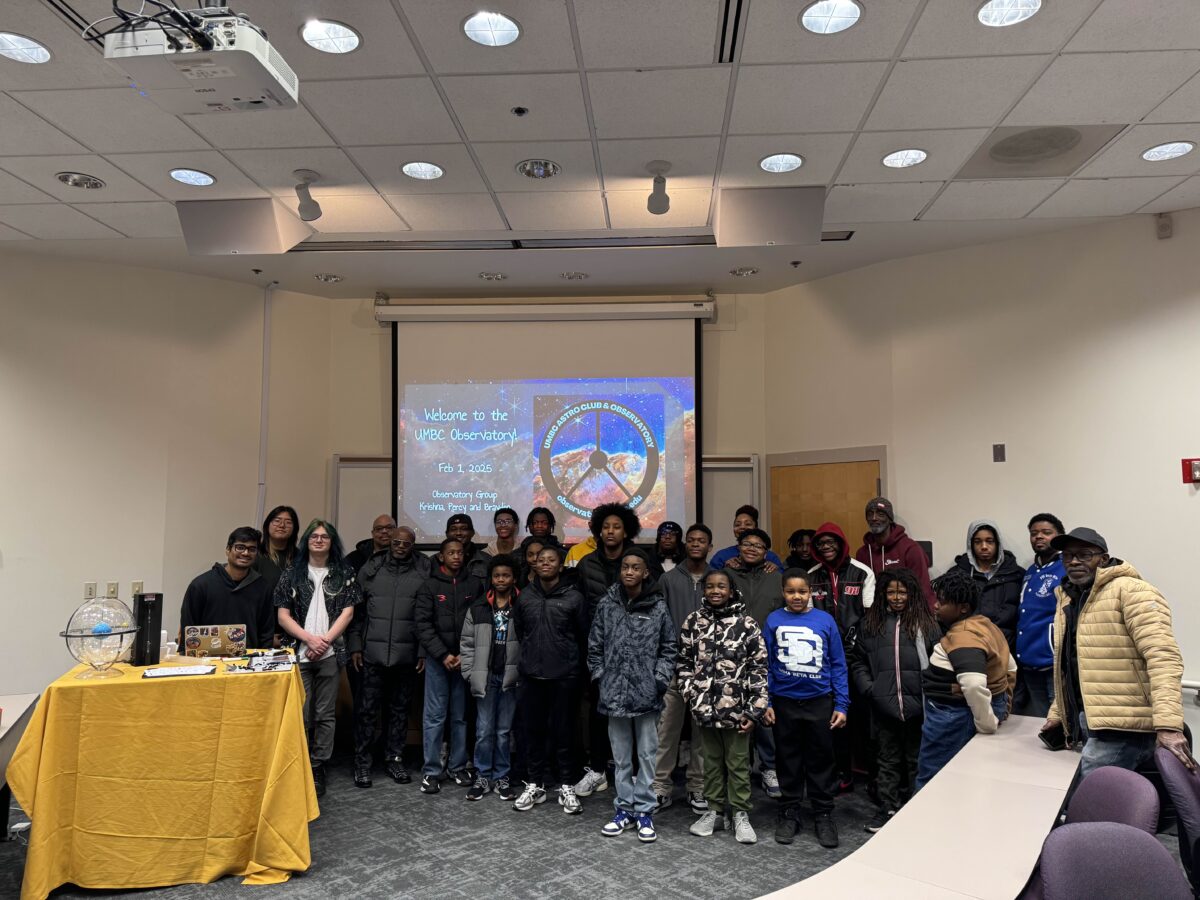 Gary Brooks ’79 and members of the Sigma Beta Club touring the UMBC Observatory with middle and high school students.
Nu Sigma Sigma partners with local universities like UMBC to offer Baltimore City youth interested in STEM the chance to experience college life. Most of these visits involve some sort of athletics event, and that’s about it—but not at UMBC.
Another Sigma Beta Club visit to UMBC involved a FIRST LEGO League competition, and another saw the students observe a robotics event. Brooks also makes sure that each visit includes a member of UMBC senior leadership. Recently, the students had the chance to speak with UMBC President Valerie Sheares Ashby and Athletics Director Tiffany Tucker.
Brooks wants each visit to UMBC to be as meaningful as possible for these young men because he knows how UMBC can change lives.
Staying connected
Even though Brooks graduated 45 years ago, he never really left UMBC. He remains closely involved with Phi Beta Sigma at UMBC, helping mentor students, and he is an active member of Nu Sigma Sigma, working closely with the university to bring Sigma Beta Club members to campus.
“The fraternity got me involved in community service,” says Brooks—a personal mission he carries on to this day.
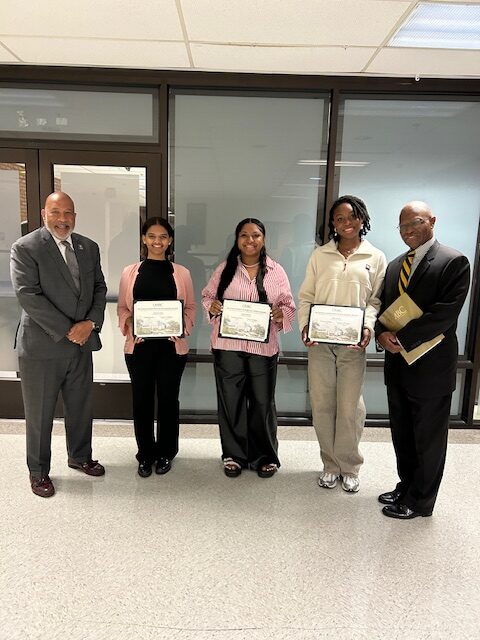
“Since I met Gary almost 20 years ago, he has been a dedicated champion of UMBC,” says Stanyell Bruce, director of alumni engagement at UMBC.
Brooks also serves on the UMBC Second Generation Scholarship Fund committee. The Second Generation Scholarship is awarded annually to outstanding undergraduate students who intend to pursue study at UMBC, are enrolled in or have completed a course in Africana studies, and demonstrate a commitment to improving the lives of racial/ethnic minorities through community service, extracurricular activities, or other community involvement. Brooks has served on the committee since 1986, when the scholarship was established.
Brooks is also the chairperson for the Historic St. James Episcopal Church Scholarship Fund—a position he has held since 2010—and helped establish the Dr. Lamont Smith, M.D. Scholarship through Sigma R.E.A.C.H., Inc. Brooks has served on that committee since its inception as well.
“Education is dear to my heart,” says Brooks, who went on to earn his M.P.A. from the University of Baltimore and his J.D. from the University of Maryland School of Law—an impressive resume for someone who initially struggled in college.
“My first semester at UMBC wasn’t the best,” admits Brooks. “I didn’t do well at all.”
Photo left: Gary Brooks ‘79 and Larry Wiggins ‘75 with the 2024 Second Generation Scholarship recipients.
Finding place and purpose
Instead of giving up, Brooks decided to lean into his weaknesses—reading and writing—by taking courses in Africana studies, a subject that interested him a great deal. These courses involved a lot of reading and writing, but Brooks found himself more immersed in the work. It was still difficult, but he enjoyed the subject matter, and the faculty was incredibly supportive. As a result, his grades began to improve.
“I saw that success, and I got more and more serious about school,” says Brooks.
After graduation, Brooks remained close to the Africana studies department. He spearheaded a committee tasked with hosting the annual “Party with a Purpose,” whose proceeds supported Africana studies and the Second Generation Scholarship. Brooks also continued to correspond with several Africana studies faculty members who mentored Brooks throughout graduate school, law school, and his career.
 Gary Brooks ‘79 and the Party with a Purpose planning committee during UMBC’s 50th anniversary.
After Brooks graduated from law school, one of those professors, Willie Lamousé-Smith, former chair of Africana studies, asked Brooks to step out of his comfort zone and step into the classroom to teach a course on the impact of the criminal justice system on the Black community. Despite some hesitancy—“I do estate planning and bankruptcy,” says Brooks. “I am not a criminal justice attorney.”—the young lawyer decided to take the leap into teaching after more than a little encouragement from Lamousé-Smith.
“Dr. Lamousé-Smith said, ‘Mr. Brooks, you are smart enough,’ and that was enough,” says Brooks. “He believed in me.”
Brooks taught this class for six years, connecting UMBC students with impactful, African American leaders, including the Baltimore City police commissioner and the Baltimore City state’s attorney. Brooks eventually handed the class over to his good friend and former law partner, Larry Wiggins ’75, political science, who played a large role in helping Brooks study for and pass the bar exam.
When the giving goes both ways
Brooks was honored at the 2001 UMBC Alumni Awards with an Alumni Community Leadership Award. He also received a special Visionary Leadership Award in 2006, recognizing members of the Reginald F. Lewis Museum of Maryland African American History and Culture Event Planning Committee for their outstanding contributions to advancing the mission of the UMBC Alumni Association. He’d like to thank his wife, Karen B. Brooks, their four children, Aja, Ashlea, Morgan, and Geron, and their three grandkids, Ryder, Ari, and Amari.
Over the years, Brooks has continued to give back to the UMBC community because of how much the UMBC community has given him.
“Gary’s commitment to UMBC never wavers,” says Bruce. “He’s someone I seek out for advice and guidance, and he embodies what it means to be Retriever Proud.”
]]>
A bright yellow bead slides over a red pipe cleaner, then a blue bead followed by green. Soon, the rainbow of beads and wire is twisted this way and that until it resembles the Big Dipper. This...
https://umbc.edu/stories/finding-a-lifetime-of-purpose-in-giving-back/
https://my3.my.umbc.edu/api/v0/pixel/news/149879/guest@my.umbc.edu/88822ec4ac81192ec039f21af5edb8c6/api/pixel
alumni
alumni-profile
baltimore-city
cahss
gary-brooks
history
impact
magazine
phi-beta-sigma
second-generation-scholarship
sigma-beta-club
spring-2025
story
UMBC News & Magazine
https://my3.my.umbc.edu/groups/umbc-news-magazine
https://assets1-my.umbc.edu/system/shared/avatars/groups/000/001/943/24435aa6207c452e7bc15cc74b42c7bb/xsmall.png?1748556657
https://assets1-my.umbc.edu/system/shared/avatars/groups/000/001/943/24435aa6207c452e7bc15cc74b42c7bb/original.png?1748556657
https://assets2-my.umbc.edu/system/shared/avatars/groups/000/001/943/24435aa6207c452e7bc15cc74b42c7bb/xxlarge.png?1748556657
https://assets2-my.umbc.edu/system/shared/avatars/groups/000/001/943/24435aa6207c452e7bc15cc74b42c7bb/xlarge.png?1748556657
https://assets3-my.umbc.edu/system/shared/avatars/groups/000/001/943/24435aa6207c452e7bc15cc74b42c7bb/large.png?1748556657
https://assets1-my.umbc.edu/system/shared/avatars/groups/000/001/943/24435aa6207c452e7bc15cc74b42c7bb/medium.png?1748556657
https://assets2-my.umbc.edu/system/shared/avatars/groups/000/001/943/24435aa6207c452e7bc15cc74b42c7bb/small.png?1748556657
https://assets1-my.umbc.edu/system/shared/avatars/groups/000/001/943/24435aa6207c452e7bc15cc74b42c7bb/xsmall.png?1748556657
https://assets2-my.umbc.edu/system/shared/avatars/groups/000/001/943/24435aa6207c452e7bc15cc74b42c7bb/xxsmall.png?1748556657
UMBC News & Magazine
1
0
false
Tue, 06 May 2025 17:06:34 -0400
Tue, 06 May 2025 17:06:34 -0400
Gathering a humanities research tool kit to understand a fascinating world
Sean Silverman began his UMBC journey as a computer science major. After taking several programming classes in high school, he was ready to pursue a career in data science while also enrolling in history courses to foster his love of history. However, by his second semester, Silverman’s passion for history inspired him to switch majors during his sophomore year. It is a common misperception among incoming students that they must commit to one path, but UMBC is a place where students can explore careers across disciplines and have the support needed to shift gears and equip themselves with the tools to succeed academically.
Silverman’s initial interest in history was sparked by his older sister’s trips to Kazakhstan and other Central Asian countries and then by the deep dive into that region’s intricate past. At UMBC, he found a mentor in Brian Van Wyck, assistant professor of history, who shared a similar academic trajectory. During the fall semester of his senior year, Silverman completed his 30-page history capstone research paper on the Tokyo War Crimes Trials of 1946 – 1948. As he looks forward to graduation, Silverman reflects on how he rose to meet the challenge of his successful capstone project with the support ofVan Wyck.
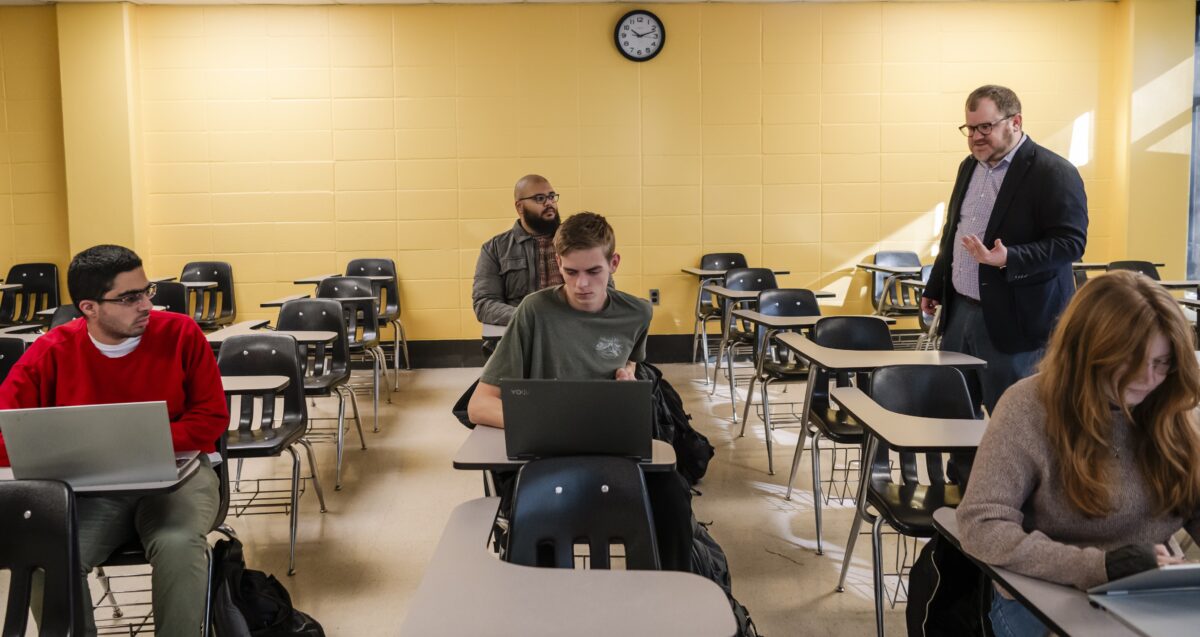 Brian Van Wyck’s fall 2024 senior capstone class on Nazi Germany. (Marlayna Demond ’11/UMBC)
Learning the skills as you go

Van Wyck, who has been at UMBC for nearly five years, shares Silverman’s enthusiasm for learning about places, events, and languages vastly different from his own experiences and history. Like Silverman, he did not travel abroad or become fluent in a second language during his undergraduate years. It wasn’t until after college, when Van Wyck worked and lived in Turkey, that he began learning Turkish and German. These skills flourished through the Fulbright U.S. Student Program in the Turkish immigrant community of Detmold, in northwestern Germany, and the support of the Turkish Critical Language Scholarship. Van Wyck’s willingness and curiosity to immerse himself in Detmold’s linguistic, cultural, and political crossroads shaped the trajectory of his research and influenced his teaching, including Silverman’s capstone course.
“I like the complexity and challenge of research, putting different kinds of sources in different languages in conversation with one another to find surprising answers to important questions relevant to understanding problems and injustices in our contemporary world,” says Van Wyck, who promoted opportunities for UMBC, faculty, and students to study and research in Germany as a 2023 – 2024 DAAD Research Ambassador.
(right)While conducting research at the Atatürk Library in Istanbul, Van Wyck consulted a 1966 news article from the Cumhuriyet, the oldest Turkish daily newspaper, about Turkish migrant workers’ attempt to organize religious services in West Germany. (Image courtesy of Van Wyck)
A diverse tool kit for humanities and social science research
Silverman’s capstone class first learned about the post-WWII Nuremberg Trial of 1945 – 1946 and the Tokyo War Crimes Trials of 1946 – 1948, then students chose an aspect of one of the trials for further research. With Silverman’s keen interest in Asian history, the Tokyo War Crimes Trials intrigued him. His passion and dedication helped him find elusive dates, names, references, and footnotes, which led to a domino effect of ideas about the 11 presiding judges representing 11 countries from North America, Europe, and Asia that shaped his thesis, “Presupposed Justice: How Orientalism Affected the Tokyo Trial.” An Orientalism framework analyzes how the West negatively perceives, stereotypes, and exerts power over the East, often through colonialism, racism, and the sexualization of Asian people.
For students with little experience researching international topics, Van Wyck’s expertise in international and multilingual research helped bridge that gap. He has spent over a decade studying migration from Turkey to West Germany, starting in the 1960s. His current research was spurred by a long-forgotten banned Turkish public school textbook, created by Germany, to teach Turkish students their language and culture without input from Turkey.
“There was little information, but I found some copies. I spent a great deal of time reading and coding the information and conducting a quantitative analysis of the topics according to geography, the authors in each section, and those cited,” says Van Wyck who also took advantage of UMBC’s interlibrary loan service to access law books in Dutch from the 1980s, original pamphlets in German from the 1970s, and Turkish-language memoirs written by imams and theology professors. “I used government documents and archives. Then, I tracked down the project’s administrators and authors and conducted in-depth interviews. By using humanities and social science research methods, I was able to tell the story of this unique and broad textbook project that was, in the end, canceled.”
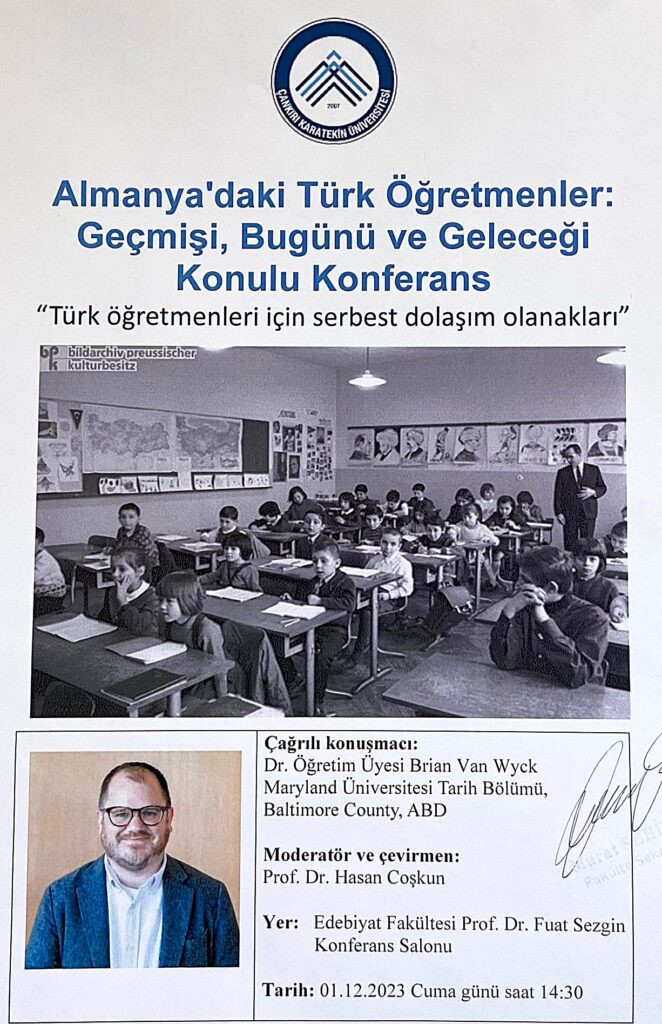 Van Wyck(l) with faculty from Çankırı Karatekin University in Turkey where he was invited to present his latest research in 2023 as a National Academy of Education/Spencer Postdoctoral Fellow. (Image courtesy of Van Wyck)
Silverman faced similar obstacles in his research throughout the semester. “The Tokyo Trials are not covered as well as the Nuremberg Trial and less so through an Orientalism framework,” says Silverman. To help students move beyond the general knowledge of the trials, Van Wyck noted databases and archives that were less familiar to students. He first pointed Silverman to the University of Virginia Law School International Military Tribunal for the Far East Digital Collection. Then, Silverman navigated the databases of the Library of Congress and the University of Hawaiʻi at Mānoa’s War Crimes Documentation Initiative
“Professor Van Wyck suggested a document written in French that related heavily to the Tokyo Trials and Orientalism. He knows some French and helped me translate it.” Silverman also made the most of his budding Japanese skills to further his project. He was in search of the dissent by the only judge who wanted to acquit all the Japanese leaders charged with war crimes. “I couldn’t find much in English. My one semester of Japanese came to the rescue,” says Silverman. “I found the dissent by looking up his last name in Japanese, which ended up being in the title of a book.”
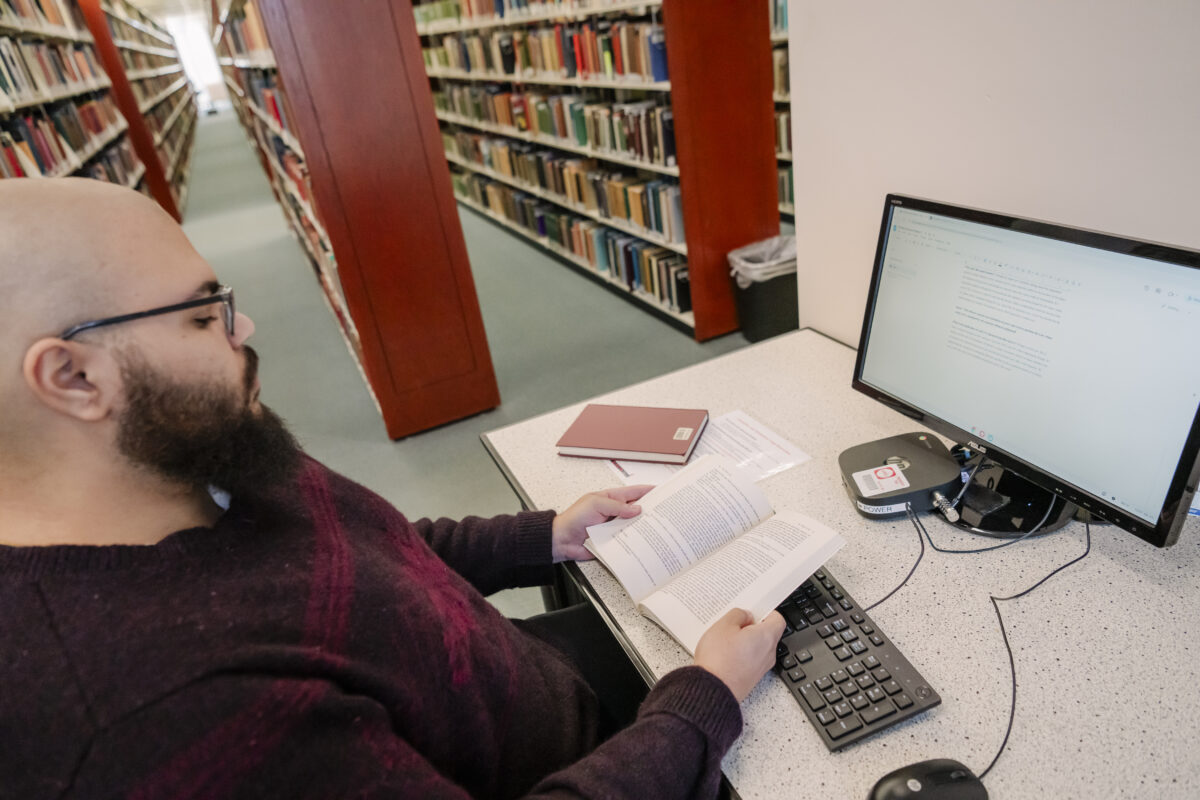 Sean Silverman at UMBC’s Albin O. Kuhn Library and Gallery. (Marlayna Demond ’11/UMBC)
The trail didn’t end there. Silverman struck gold among the 690,000 physical books in the Albin O. Kuhn Library, where he found two books in the political science and international law sections that profoundly shaped his paper. The Tokyo Trial and Beyond: Reflections of a Peacemonger is a collection of interviews with one of the sitting judges and the Sugamo Prison, Tokyo: An Account of the Trial and Sentencing of Japanese War Criminals in 1948, by a U.S. Participant, describes life inside the American-guarded prison. With a wide array of resources, Silverman began to write.
Writing history
After the research is complete, students begin analyzing the facts. However, this part of the process shifts from a solitary task to a communal experience. Students read each other’s papers, ask questions, and suggest changes several times before Van Wyck gives feedback. Four to five drafts later, students turn in a final product—Silverman received an A. It’s a moment Silverman didn’t foresee when he started at UMBC.
“Switching to a history major two years into my college career, I felt a little behind for a while, especially with my research skills. Wanting to go to graduate school, I knew I needed to work on that and build the skills over the years,” says Silverman. “The extensive research and synthesizing writing skills have been the most valuable skills I’ve gained, not just in this class but from all my history classes at UMBC. They will serve me well as I continue further into my academic career in graduate school and make plans to travel to Asia.”
“I became a historian because the questions that interested me take place predominantly in the past,” says Van Wyck. He will return to Germany this summer as a visiting research fellow at the Leibniz Center for Contemporary History Potsdam and at the International Youth Library. “I think it’s important for historians and undergraduate history majors to gain access to a broad and diverse toolkit.”
In fall 2025, Van Wyck will teach HIST 372: Nazi Germany, HIST 210: Migration in World History, a new course he developed.
Learn more about the UMBC History Department‘s degree programs, faculty research, and events.
]]>
Sean Silverman began his UMBC journey as a computer science major. After taking several programming classes in high school, he was ready to pursue a career in data science while also enrolling in...
https://umbc.edu/stories/humanities-research-tool-kit-to-understand-world/
https://my3.my.umbc.edu/api/v0/pixel/news/149120/guest@my.umbc.edu/0b5a3095162588892b7377c7ee448c55/api/pixel
cahss
cahss-research
class-of-2025
history
international
news
policy-and-society
research
story
UMBC News & Magazine
https://my3.my.umbc.edu/groups/umbc-news-magazine
https://assets1-my.umbc.edu/system/shared/avatars/groups/000/001/943/24435aa6207c452e7bc15cc74b42c7bb/xsmall.png?1748556657
https://assets1-my.umbc.edu/system/shared/avatars/groups/000/001/943/24435aa6207c452e7bc15cc74b42c7bb/original.png?1748556657
https://assets2-my.umbc.edu/system/shared/avatars/groups/000/001/943/24435aa6207c452e7bc15cc74b42c7bb/xxlarge.png?1748556657
https://assets2-my.umbc.edu/system/shared/avatars/groups/000/001/943/24435aa6207c452e7bc15cc74b42c7bb/xlarge.png?1748556657
https://assets3-my.umbc.edu/system/shared/avatars/groups/000/001/943/24435aa6207c452e7bc15cc74b42c7bb/large.png?1748556657
https://assets1-my.umbc.edu/system/shared/avatars/groups/000/001/943/24435aa6207c452e7bc15cc74b42c7bb/medium.png?1748556657
https://assets2-my.umbc.edu/system/shared/avatars/groups/000/001/943/24435aa6207c452e7bc15cc74b42c7bb/small.png?1748556657
https://assets1-my.umbc.edu/system/shared/avatars/groups/000/001/943/24435aa6207c452e7bc15cc74b42c7bb/xsmall.png?1748556657
https://assets2-my.umbc.edu/system/shared/avatars/groups/000/001/943/24435aa6207c452e7bc15cc74b42c7bb/xxsmall.png?1748556657
UMBC News & Magazine
0
0
false
Tue, 15 Apr 2025 16:34:25 -0400
Tue, 15 Apr 2025 16:34:25 -0400