How to make a (really) strong magnet
Magnets often attract curious minds. Einstein told of his profound sense of hidden order after witnessing the invisible forces of the Earth’s magnetic field guide the needle of a compass. For Ethan Bowers, it was the wonder of learning Maxwell’s laws—equations developed by 19th-century Scottish physicist James Clerk Maxwell that unite magnetism, electricity, and light—that really pulled him in.
Now a Ph.D. student in mechanical engineering, Bowers is building a massive, one-of-a-kind research magnet. It weighs more than 2,300 pounds and will be capable of generating a magnetic field of 7 tesla (roughly 140,000 times stronger than the Earth’s magnetic field and more than twice as strong as the field in most MRI machines).
Making the magnet has been the labor of multiple researchers over more than a decade, led by mechanical engineering associate professor Carlos Romero Talamás, who plans to use the magnet to conduct experiments on plasma, the superheated soup of particles found in stars, lighting, and the Aurora Borealis, and which makes up more than 99 percent of the visible universe.
An initial magnet design and analysis was completed by Evan Bates, M.S. ’15, Ph.D. ’18, mechanical engineering. In 2023, Bowers, who had returned as a student to UMBC following a stint in industry, joined the project. He redesigned key aspects of the magnet and began the meticulous work of assembling and testing it. In the coming months, Bowers plans to run the magnet up to full strength. Then the real fun begins: Unleashing the new tool to help answer the questions curious minds dream up.
Tools of the trade
- Mechanical and electrical know-how
- Perseverance
- Heavy-lifting equipment (custom designed)
- A serious power source and some chilled water (things are going to get hot)
Step 1: Brush up on your magnet basics
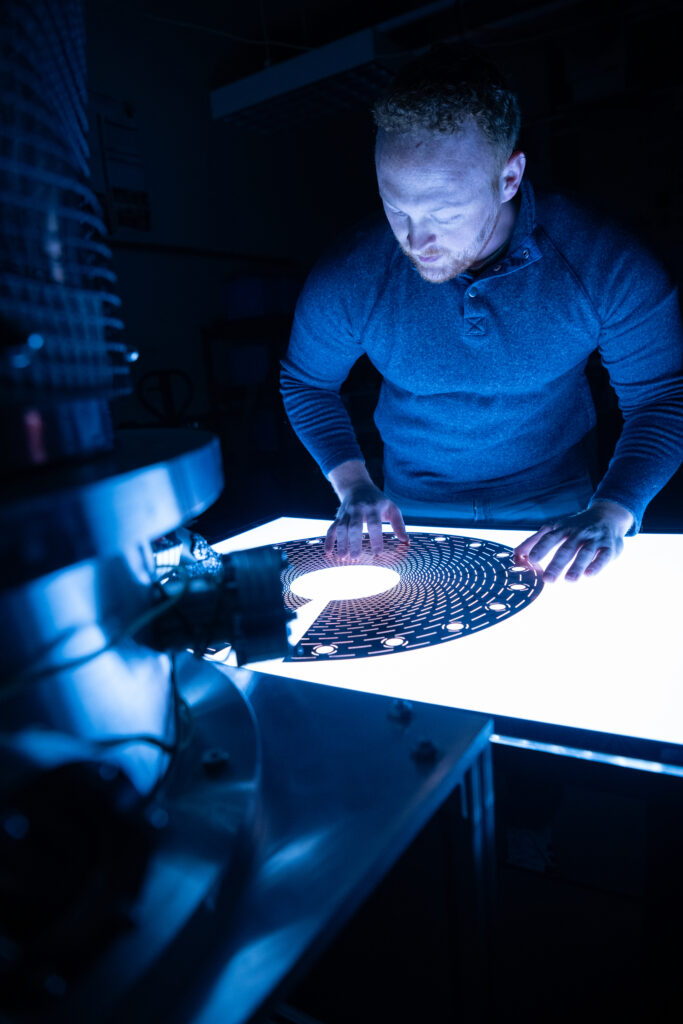 Bowers illuminates a Bitter disk with a backlight. (Brad Ziegler/UMBC)
Say “magnet,” and many people think first of the objects affixing their kids’ artwork to the fridge. Refrigerator magnets are an example of permanent magnets: materials in which the electrons permanently align in a way that generates a magnetic field. Permanent magnets can get quite strong—such as the rare earth neodymium magnets used in some maglev trains—but they top out at about 2 tesla.
To get an even stronger magnet, engineers can turn to a phenomenon that’s captured in the Maxwell equations that captivated Bowers: Electricity and magnetism are intrinsically linked.
Electrons flowing through a wire generate a magnetic field. Coil the wire and you can create a field similar in shape to a permanent bar magnet, with distinct north and south poles. This is the electromagnet. Higher current and more coils make a stronger magnet. However, high current also risks melting your magnet into a puddle and mangling it with the enormous pressure from the magnetic field pushing on the moving electrons (called Lorentz forces).
Superconducting electromagnets, which use material with the almost magical property of showing virtually zero electrical resistance when cooled with liquid helium, can eliminate the melting risk, but are expensive and finicky to operate, and have other limitations.
Another (more old-school) solution is called the Bitter electromagnet, invented in the 1930s by American physicist Francis Bitter. In place of coiled wires, circular metal disks separated with insulating spacers create a helical path that concentrates the current. The disks are shot through with holes for circulating water to whisk away heat and the structural design counteracts the mechanical stresses. “We chose a Bitter magnet because it offered the right combination of features for the tasks we wanted to perform,” Bowers says.
Step 2: Design, test, refine, repeat
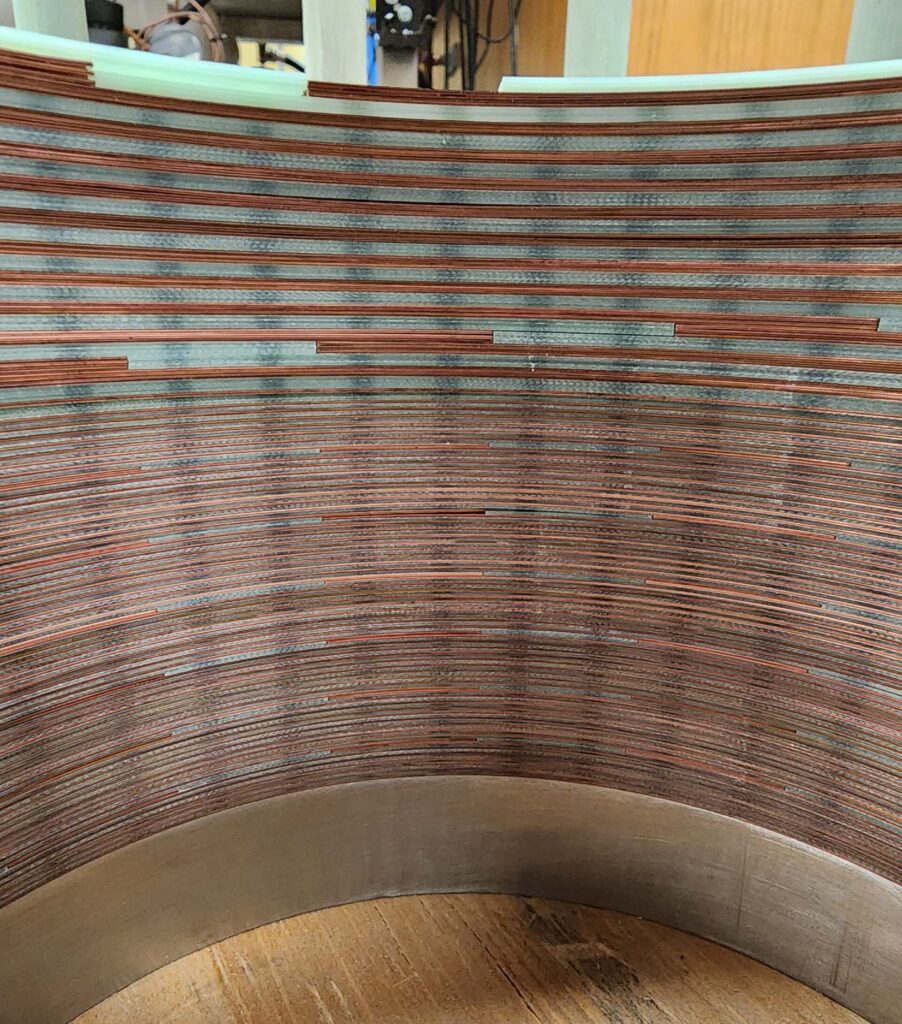 The turn density for the magnet is higher at the ends than at the middle. (Photo courtesy of Bowers)
The UMBC team’s initial vision was to create a 10-tesla Bitter magnet, with space in the center for a relatively large vacuum chamber to hold plasma. The magnet could generate either a steady or pulsed magnetic field, depending on the needs of the experiment. Bates analyzed the disk shape, stacking methods, cooling hole geometry, heat transfer, mechanical stress, and electrical properties of the magnet to optimize the design. He validated it by constructing and testing a 1-tesla prototype.
In 2023, the team decided to change the desired magnetic field profile, making it slightly higher on the ends of the magnet than in the middle, so that charged particles would be pushed toward the center. They didn’t want to redesign the Bitter disks, so they had to lower the maximum field strength to 7 tesla. They also had to vary the coil density, making tighter turns at the ends to get the stronger field.
Bowers analyzed the new field profile and worked out a clever trick of adding a tapered insulating disk to seamlessly transition between the areas of tighter and looser turns. He also performed a structural analysis of the whole assembly.
Step 3: Pallets, cranes, and painstaking planning
The final design called for 439 copper Bitter disks, four insulating transition disks, and 434 regular insulating disks housed inside a pressure vessel. Outside companies manufactured the disks, but Bowers personally inspected every single one, removing any with defects, and cleaning the copper ones with isopropyl alcohol. He built a custom pallet to hold the cylindrical assembly in place in the lab, and started stacking.
The process took about a month, and near the end “I was so sick of the monotony,” Bowers says. To push it across the finish line, he worked straight through the weekend, stacking the last disk on a Sunday afternoon in February. “It happened to be my friend’s birthday so I celebrated that completion and their birthday together,” he says.
Next up was moving the approximately 2-foot-high stack of disks to a movable swing set, created by a UMBC mechanical engineering capstone team to serve as a mobile and rotatable platform for the magnet. Bowers built a custom crane fixture to lift the assembly onto the platform and spent weeks planning every step of the move. “It was the last major place the structure could fail before we power the magnet,” he says. After one stressful day, Bowers says he was elated when it all went according to plan. “I felt genuinely grateful for all I had been given the chance to work on, and grateful that God had given me the ability to succeed.”
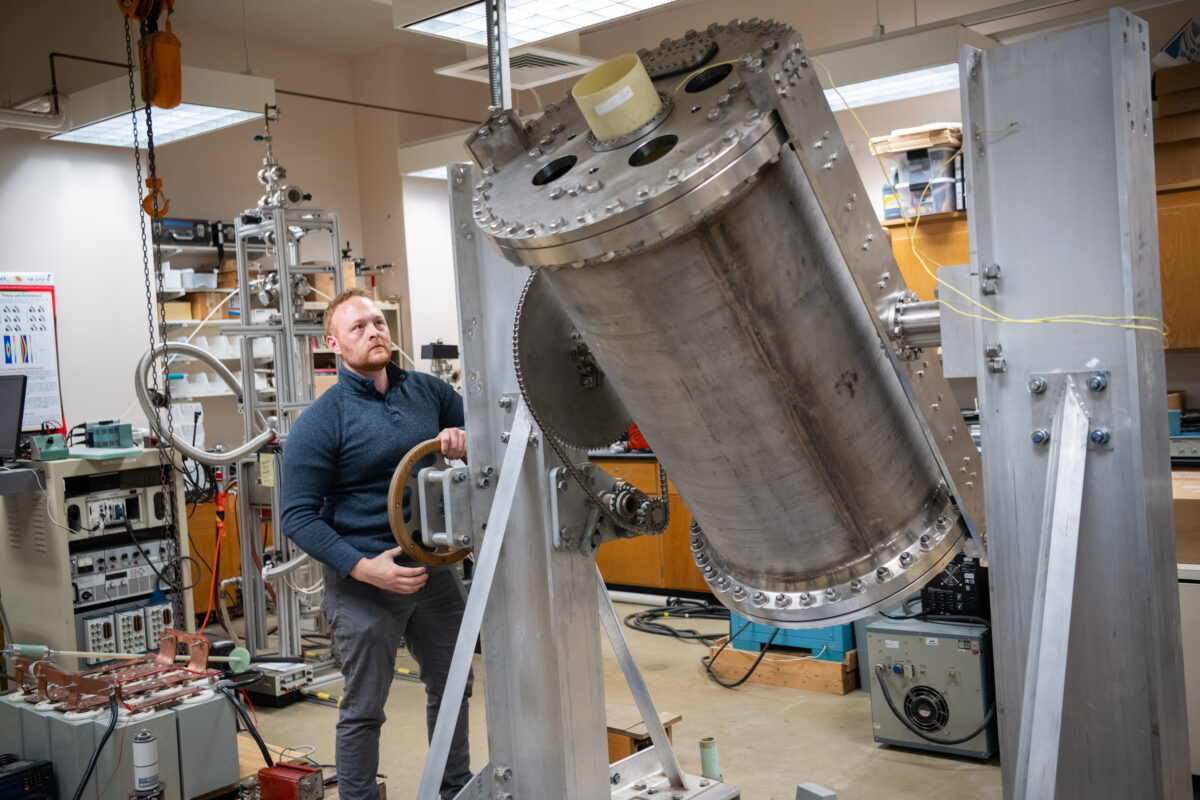 Bowers shows how the magnet core can be rotated. (Brad Ziegler/UMBC)
Step 4: Test some more
With the core of the magnet assembled, Bowers has also begun the detailed process of testing its electrical properties, using a host of measurement equipment.
At first, he is powering the magnet with lower currents, but eventually he will send 15,000 amps through the disks, about half the current that flows in an average lightning bolt. The voltage will be about five times the voltage in a wall socket.
Safety is of paramount concern to the team when working with such high power. When the magnet is operating at full strength, the energy in two cubic feet of the magnetic field alone will be more than the energy of a small SUV zooming by at 60 miles per hour.
Bowers is working on a set of detailed instructions to address all conceivable operating, maintenance, and failure scenarios. “We’re safe. We do all our due diligence,” he says.
Step 5: Serve up some science
Once the magnet is fully up and running, the science experiments can start. Bowers and Romero Talamás have a few ideas for initial experiments, including investigating how a high magnetic field affects when a gas will suddenly switch from being an insulator to a conductor, allowing current to arc through it. They are also interested in how the magnet might be used to separate different forms of hydrogen—particularly two forms that may form the fuel for future fusion reactors to supply clean and near limitless energy.
 Stars—nature’s original fusion reactors—show how plasma and magnetic fields can interact in spectacular fashion. In this image of our sun, taken in July 2012, million-degree plasma in the sun’s atmosphere began to cool and fall to the surface. Because the plasma is charged, it condensed along twisted magnetic field lines close to the surface and formed giant streaming arcs, some as tall as five Earths stacked high. (NASA Solar Dynamics Observatory)
Bowers grew up in rural Hagarstown, Maryland, a kid who enjoyed exploring everything from the rocks on the side of a path to the electrical motors his grandfather would wind. Research has offered him the chance to constantly challenge himself. After graduation, he’ll move on to new questions at the scientific frontiers, perhaps working at a fusion energy start-up or a national lab. But the 7T Bitter magnet will remain at UMBC, a gift to curious students who come after him.
]]>
Magnets often attract curious minds. Einstein told of his profound sense of hidden order after witnessing the invisible forces of the Earth’s magnetic field guide the needle of a compass. For...
https://umbc.edu/stories/how-to-make-a-really-strong-magnet/
https://my3.my.umbc.edu/api/v0/pixel/news/160699/guest@my.umbc.edu/daf60158f49bee7547aece6f2687d891/api/pixel
coeit
discovery
graduate-research
how-to
meche
research
science-and-tech
spring-2026
story
UMBC News & Magazine
https://my3.my.umbc.edu/groups/umbc-news-magazine
https://assets1-my.umbc.edu/system/shared/avatars/groups/000/001/943/24435aa6207c452e7bc15cc74b42c7bb/xsmall.png?1748556657
https://assets1-my.umbc.edu/system/shared/avatars/groups/000/001/943/24435aa6207c452e7bc15cc74b42c7bb/original.png?1748556657
https://assets2-my.umbc.edu/system/shared/avatars/groups/000/001/943/24435aa6207c452e7bc15cc74b42c7bb/xxlarge.png?1748556657
https://assets2-my.umbc.edu/system/shared/avatars/groups/000/001/943/24435aa6207c452e7bc15cc74b42c7bb/xlarge.png?1748556657
https://assets3-my.umbc.edu/system/shared/avatars/groups/000/001/943/24435aa6207c452e7bc15cc74b42c7bb/large.png?1748556657
https://assets1-my.umbc.edu/system/shared/avatars/groups/000/001/943/24435aa6207c452e7bc15cc74b42c7bb/medium.png?1748556657
https://assets2-my.umbc.edu/system/shared/avatars/groups/000/001/943/24435aa6207c452e7bc15cc74b42c7bb/small.png?1748556657
https://assets1-my.umbc.edu/system/shared/avatars/groups/000/001/943/24435aa6207c452e7bc15cc74b42c7bb/xsmall.png?1748556657
https://assets2-my.umbc.edu/system/shared/avatars/groups/000/001/943/24435aa6207c452e7bc15cc74b42c7bb/xxsmall.png?1748556657
UMBC News & Magazine
0
0
false
Mon, 15 Jun 2026 14:54:55 -0400
Mon, 15 Jun 2026 14:54:55 -0400
How to land the sweetest internship
Securing any internship is a huge accomplishment for a college student, but it’s even sweeter when it combines hands-on leadership training with a few tasty perks. Senior Justin Medina and sophomore Gabriel Jenkins joined seven other Retrievers over the summer as part of the Hersheypark Leadership Development Internship Program, a 12-week paid internship that allows students earn an hourly wage while also providing them with intensive leadership training—oh, and full-access passes to the park during their time off.
Tools of the trade
- An open mind (you’ll be trying new experiences and meeting new people)
- Strong work ethic (be ready to be tested)
- Sunscreen and sunglasses (it IS an amusement park, afterall)
- A watch (time flies when you’re having fun)
Step 1: Figure out what you’re hungry for
 Gabriel Jenkins closes out the summer with a smile and a certificate of achievement. (Photo courtesy of Jenkins)
Through this unparalleled program, students get to enjoy the monetary benefits of holding down a Hersheypark job of their choice, in addition to undergoing leadership training. Medina leaned into his love of swimming and trained as a lifeguard, learning life-saving skills like CPR and how to handle a trauma kit. Jenkins chose to do ride operations and learned a few things about himself along the way.
“I learned I’m more reliable than I thought,” he said. Jenkins was trained on Lightning Racer, the first wooden racing/dueling rollercoaster in the United States. He interacted with guests while ensuring their safety by following the set procedures Hershey Entertainment & Resorts provided, confirmed height and/or weight standards were met, checked that seatbelts and restraints were fastened and locked, and controlled the right buttons to make the roller coasters go and return with a team of other hardworking ride operators. Throughout the summer, his work ethic was recognized and his supervisors gave him additional responsibilities that helped him see abilities he hadn’t tapped into yet.
“These students were great team members in our operations and fantastic contributors in our Professional Development Sessions, where they uncovered their strengths and how to apply them in their roles at Hersheypark and beyond,” said Jacklyn Mrakovich, college relations recruiter at Hershey Entertainment & Resorts.
Step 2: A taste of the real world
Both Medina and Jenkins packed up their things and spent the summer living in rental housing provided at a reduced rate through the company. The time away from home and campus gave them a glimpse of what post-graduate life could possibly look like.
“It was a good taste of being in the real world, especially because I moved out there. It really teaches you how to be on your own,” said Medina. He also underscores what a unique opportunity this was: “It basically gave you the 9-5 work experience, but also has a school aspect with seminars and events. While being at an amusement park.”
Once a week, interns attended various professional development trainings, with coursework and curriculum focused on teaching students to be better leaders and prepare them for the workforce. Although their work didn’t directly speak to either student’s majors (information systems for Medina and graphic design for Jenkins), they still learned invaluable lessons that they’ll carry with them in their professional careers. Which brings us to…
Step 3: Buckle up and enjoy the ride
“You have to go in with an open mind and not be scared, you have to just take the next step forward,” encourages Medina to those thinking about the program. The intangibles of this experience were the things both Retrievers will remember—the networking opportunities, meeting students from across the world, and learning how to be a good employee and a good colleague.
“It really helped me understand the process of actually doing a job and working for someone, learning how to communicate with co-workers and working with people from different backgrounds,” says Jenkins.
At a roundtable discussion held as part of the leadership portion, students were grouped by major/area of interest and given the opportunity to meet employees in their field. From this discussion, Medina was able to see how he could apply the skills he learned over the summer to his future career—directly or indirectly.
 Justin Medina takes a minute to dry off for a quick photo opp. (Brad Ziegler/UMBC)
“I thought more of how it could help benefit me in the future when it comes to IT. If I’m going to be working in groups or if I end up going towards a project management route, that’ll help me as a leader and help me adapt to certain scenarios or circumstances.”
Not realizing the program’s universal draw, both Jenkins and Medina found themselves energized by getting to know their international peers—a highlight of their experience.
“We got to work alongside international employees and learned a lot about working with people from different backgrounds,” says Jenkins. “My favorite part was meeting people from across the world.”
“It was so cool showing my experience and seeing their experience and how we were able to share cultures,” adds Medina.
Step 4: Reap the rewards
The summer wasn’t all work and no play for the Retrievers. Interns got to enjoy some of the perks of living in a town known equally for its chocolate and its theme park. On their days off, they could take a dip in the pool at their accommodations, check out the employee store, or take advantage of the free access to Hersheypark.
“It just felt different going to the park as an adult and knowing I could go whenever I want. Little me would have been so excited,” says Medina.
While the swag and all-access passes certainly are souvenirs the interns are grateful for, the lasting impact is what the experience could mean for their future careers.
Of recent alumni, 85 percent were engaged in applied learning like internships, research, service-learning, or leadership during their time at UMBC. Thanks to the work they’re putting into their futures as a student, 93 percent graduate with firm plans for employment or graduate school within six months of graduation.
“I’m continually inspired by the way our students engage in applied learning to launch their careers,” says Marykate Conroy, associate director of internships and employment. “UMBC students are entering the workforce prepared and in demand.”
“The memories and the networking are the two things I’m walking away with,” says Medina. “I have more people to reach out to and even if they’re not directly in my field, they’re so willing to help.”
]]>
Securing any internship is a huge accomplishment for a college student, but it’s even sweeter when it combines hands-on leadership training with a few tasty perks. Senior Justin Medina and...
https://umbc.edu/stories/how-to-land-the-sweetest-internship/
https://my3.my.umbc.edu/api/v0/pixel/news/154533/guest@my.umbc.edu/fb48d7462fc875b0ea6acea4eb47f0d8/api/pixel
cahss
campus-life
coeit
fall-2025
graphic-design
how-to
information-systems
magazine
story
UMBC News & Magazine
https://my3.my.umbc.edu/groups/umbc-news-magazine
https://assets1-my.umbc.edu/system/shared/avatars/groups/000/001/943/24435aa6207c452e7bc15cc74b42c7bb/xsmall.png?1748556657
https://assets1-my.umbc.edu/system/shared/avatars/groups/000/001/943/24435aa6207c452e7bc15cc74b42c7bb/original.png?1748556657
https://assets2-my.umbc.edu/system/shared/avatars/groups/000/001/943/24435aa6207c452e7bc15cc74b42c7bb/xxlarge.png?1748556657
https://assets2-my.umbc.edu/system/shared/avatars/groups/000/001/943/24435aa6207c452e7bc15cc74b42c7bb/xlarge.png?1748556657
https://assets3-my.umbc.edu/system/shared/avatars/groups/000/001/943/24435aa6207c452e7bc15cc74b42c7bb/large.png?1748556657
https://assets1-my.umbc.edu/system/shared/avatars/groups/000/001/943/24435aa6207c452e7bc15cc74b42c7bb/medium.png?1748556657
https://assets2-my.umbc.edu/system/shared/avatars/groups/000/001/943/24435aa6207c452e7bc15cc74b42c7bb/small.png?1748556657
https://assets1-my.umbc.edu/system/shared/avatars/groups/000/001/943/24435aa6207c452e7bc15cc74b42c7bb/xsmall.png?1748556657
https://assets2-my.umbc.edu/system/shared/avatars/groups/000/001/943/24435aa6207c452e7bc15cc74b42c7bb/xxsmall.png?1748556657
UMBC News & Magazine
2
0
false
Thu, 13 Nov 2025 15:35:32 -0500
Thu, 13 Nov 2025 15:35:32 -0500
How to create a new world
In her day job as a vice president at the advanced technology company Booz Allen Hamilton, Catherine Ordun, Ph.D. ’23, information systems, leads teams of engineers working on far-out AI tech. In the evenings, she crafts a different type of futuristic world, putting the finishing touches on a sci-fi trilogy featuring two alien brothers at odds with each other over a plan to invade Earth, which she hopes to publish in early 2026.
Ordun started writing the books in 2022, as a break from her intense computer science Ph.D. research work, which she completed in 2023 under the direction of UMBC assistant professor Sanjay Purushotham. Although fiction writing and coding seem to call for different skill sets, the two pursuits share some defining features, from the mental challenge of connecting ideas to the satisfaction that comes from completing a herculean task. In both, Ordun embraces the thrill of creating—whether an imaginary world where characters grapple with technologically infused questions of identity and purpose, to the seemingly sci-fi, yet very real, AI tools that will shape our own tomorrows.
Tools of the trade
- A thirst for knowledge
- A pen and paper (when you need old fashioned tools)
- Computer (when you need digital assistance)
- Vision and discipline
- Lots of coffee
Step 1: Hit the books
Ordun voraciously consumes knowledge and ideas. Although she earned her bachelor’s degree in biology, not computer science, she became deeply interested in machine learning around 2015, while working as a data scientist for Booz Allen Hamilton. “I became fascinated by the idea, just like really, really obsessed,” she says. “And for five years, I taught myself.”
Ordun’s favorite book from this time was Deep Learning, by Google AI researcher François Chollet. “It is like dogeared to the max. I went through every page and I typed out every line. I learned so much, from natural language processing to computer vision.”
When Ordun decided she needed a brief break from technical research, she kept right on reading—though she turned to sci-fi books, from the cyberpunk novels of William Gibson to the technically elaborate works of Neal Stephenson. “At the time, I was also very interested in simulation theory, this kind of Matrix-like idea that we could be living in a computer simulation.
And I thought, ‘You know what, I’m going to write my own sci-fi book, so I can explore this idea.’”
Step 2: Get your hands dirty
 Ordun works in her home office. (Image courtesy of Ordun)
Once you have some background knowledge, it’s time to dive in. Ordun wrote the first draft of her novel (which she eventually split into three parts and named the Morfyk Trilogy) in under three months. “It was a horrible, horrible first draft. And it was huge, like 600 pages long,” she says. She revised it multiple times herself, and then hired a professional editor.
Ordun says working on the books has become a nightly ritual. “Every night, even if I’m dead tired, I tell myself to just put five words down, it’s better than zero.”
In her AI-work, Ordun tackles problems on a similarly compressed timeline. “One team I lead is called AI rapid prototyping, and we basically crank out prototypes for exquisitely hard AI problems in about four weeks.”
Ordun isn’t committed to any one way of transforming ideas from her brain into a tangible object. Sometimes she reaches for pen and paper, other times she is coding and typing on a digital screen. What unites the efforts is the desire to build, be it novel AI-tools for a client or a different universe she can escape to when the work day is over.
Step 3: Tackle the hard problems
Book authors and scientific researchers share the challenge of birthing something entirely new. When searching for the fertile ground that could yield unique knowledge, tools, or stories, it helps to lean into profound, hard problems.
Ordun says the most rewarding part of her Ph.D. work was tackling a long-standing challenge in computer science—how to match up differently sized images of the same object, and finding a new way for computers to train themselves to do it.
She says her book writing also took a more fulfilling turn when she started to reflect on her own traumas and anxieties and the big themes of purpose and identity. She explored morality, the nature of reality, and her characters’ fluctuating sense of themselves. “I found I was pouring a lot of my own self into this book, so it became much more than “What if we live in a simulation?”
 Ordun discusses machine learning with her Ph.D. advisor Sanjay Purushotham (seated center) and other members of his research group at UMBC. (Marlayna Demond ’11/UMBC)
Step 4: Assemble your team
The work of creating new worlds is monumental, so it helps to have a solid cast of characters supporting you. Ordun praises the engineers she leads at Booz Allen, who she says are tackling some of the toughest technology challenges out there and pioneering innovative solutions.
In the writing sphere, she credits editors and volunteer readers for helping her hone her “horrible first draft” into polished prose.
More recently, Ordun has turned to teaching, in a sense educating future collaborators. She joined UMBC as an adjunct assistant professor in summer of 2024, and she regularly engages with aspiring young computer scientists on TikTok, answering questions and commiserating about coding problems.
“I learn by imagining having to teach a concept to someone else,” says Ordun. “So now I’m actually teaching and it’s something I really enjoy doing.”
Step 5: Celebrate your successes
 Ordun with the family dog. (Image courtesy of Ordun)
Ordun isn’t shy about admitting setbacks. She talks about her strings of rejected papers, the coffee-fueled problem solving sessions that turned into pure error finding missions, and the red ink-filled drafts that her book editors send her. Sometimes to release stress, she needed to lace up her shoes, grab the dog, and just go for a run.
Obstacles are a natural part of any pursuit where you push into the unknown. And so, when you do have success, it’s important to take a moment and take it in. “The moment I finished my book, I was out on my deck, it was 10 p.m. at night. I don’t want to sound melodramatic, but I almost cried,” Ordun says. “I felt I had created something totally new, a new universe. It was a similar feeling of pride to passing my Ph.D. dissertation defense.”
]]>
In her day job as a vice president at the advanced technology company Booz Allen Hamilton, Catherine Ordun, Ph.D. ’23, information systems, leads teams of engineers working on far-out AI tech. In...
https://umbc.edu/stories/how-to-create-a-new-world/
https://my3.my.umbc.edu/api/v0/pixel/news/150482/guest@my.umbc.edu/0734b91fdb7b16da5b6034ebf12926df/api/pixel
alumni
coeit
how-to
is
magazine
spring-2025
story
UMBC News & Magazine
https://my3.my.umbc.edu/groups/umbc-news-magazine
https://assets1-my.umbc.edu/system/shared/avatars/groups/000/001/943/24435aa6207c452e7bc15cc74b42c7bb/xsmall.png?1748556657
https://assets1-my.umbc.edu/system/shared/avatars/groups/000/001/943/24435aa6207c452e7bc15cc74b42c7bb/original.png?1748556657
https://assets2-my.umbc.edu/system/shared/avatars/groups/000/001/943/24435aa6207c452e7bc15cc74b42c7bb/xxlarge.png?1748556657
https://assets2-my.umbc.edu/system/shared/avatars/groups/000/001/943/24435aa6207c452e7bc15cc74b42c7bb/xlarge.png?1748556657
https://assets3-my.umbc.edu/system/shared/avatars/groups/000/001/943/24435aa6207c452e7bc15cc74b42c7bb/large.png?1748556657
https://assets1-my.umbc.edu/system/shared/avatars/groups/000/001/943/24435aa6207c452e7bc15cc74b42c7bb/medium.png?1748556657
https://assets2-my.umbc.edu/system/shared/avatars/groups/000/001/943/24435aa6207c452e7bc15cc74b42c7bb/small.png?1748556657
https://assets1-my.umbc.edu/system/shared/avatars/groups/000/001/943/24435aa6207c452e7bc15cc74b42c7bb/xsmall.png?1748556657
https://assets2-my.umbc.edu/system/shared/avatars/groups/000/001/943/24435aa6207c452e7bc15cc74b42c7bb/xxsmall.png?1748556657
UMBC News & Magazine
2
0
false
Fri, 30 May 2025 15:01:36 -0400
Fri, 30 May 2025 15:01:36 -0400
How to enjoy being underground

Anyone trying to soothe a fussy toddler has their work cut out for them under normal circumstances. Add 379 feet of earth above your head and about 30 other tourists to the equation and you’ve got a potential disaster on your hands. But for Jeff Garcia, an interpretive park ranger at Jewel Cave National Monument in South Dakota, it’s just another day on the job. At any point into his hour and thirty minute below ground scenic tour of one of the world’s longest caves, Garcia might need to interrupt his historical and geological discourse (and steady stream of jokes) to address questions, the restroom needs of his party, or someone faced with a sudden bout of claustrophobia. The wonders of the cave make all the accompanying human foibles an afterthought for Garcia, who prior to his two summers at Jewel Cave had never been below the surface before.
Tools of the Trade:
Flashlight
Minimal fears when it comes to the dark or enclosed spaces
A love of history and geology
Convenience baggies (you don’t want to know)
Backup flashlight
Step 1: Know your audience
Garcia didn’t anticipate spending multiple summers guiding people underground in the most complete darkness he’d ever seen, but he took to it quickly. Born and raised in Montgomery County, Maryland, Garcia anticipated he’d do an internship for his historical studies master’s program at UMBC somewhere close by—the nation’s capital, for example. But when he applied to the Latino Heritage Internship Program and they asked if he’d be open to going to South Dakota, he took the plunge. “I just wanted the opportunity to work with the public and teach history,” says Garcia, who knows from experience that learning history in the classroom is not nearly as effective as learning it on-site. “When people go to museums, when they go to archives, when they go to parks, they really absorb the knowledge,” he says.
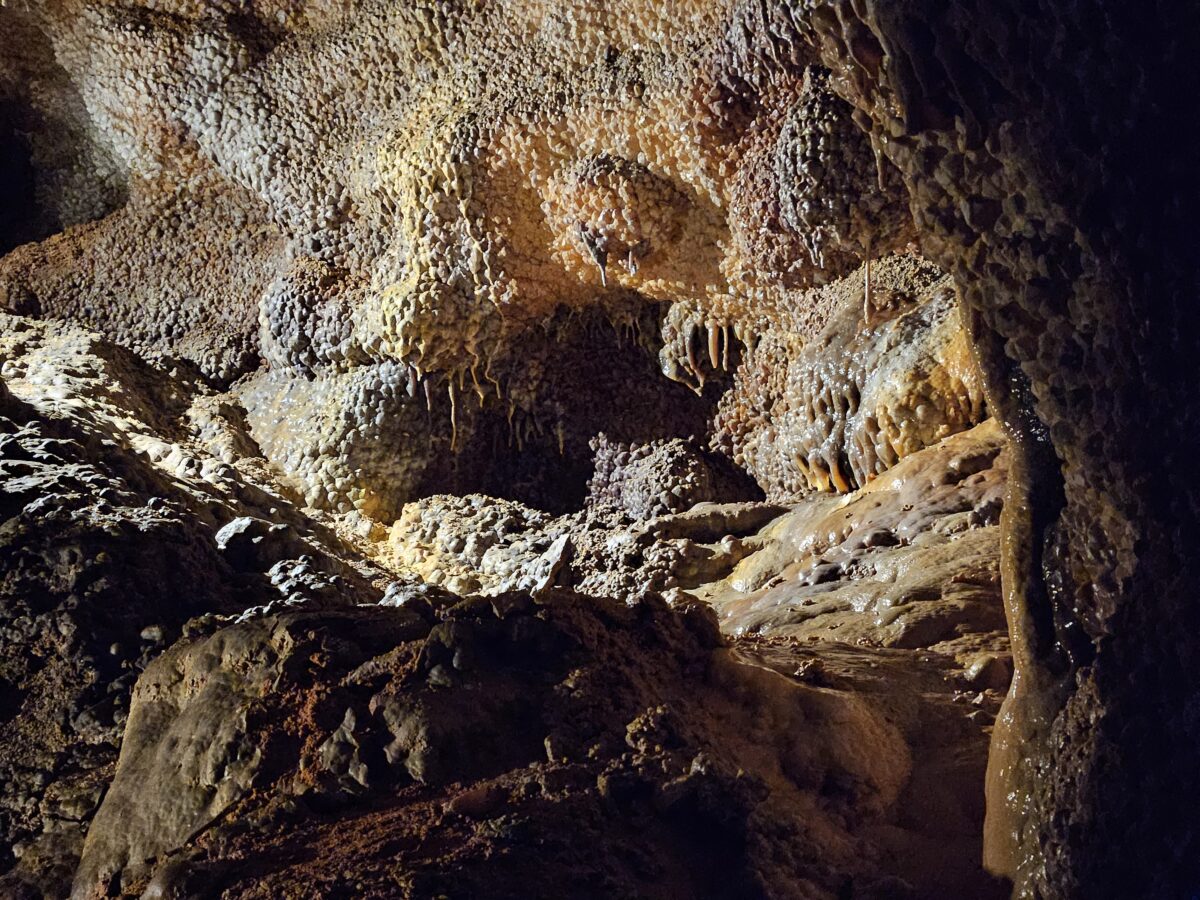 Draperies and flowstone in the Formation Room of Jewel Cave.
All sorts of people come to ooh and aah over the nailhead spar and dogtooth spar calcite crystals, the so-called jewels of Jewel Cave. At the beginning of his tour, Garcia assesses his group of tourists by warming them up with a history lesson and throwing in some jokes to see how they respond—that gives him a bellwether to know how the next 90 minutes will go. “You have to be mindful of the audience,” says Garcia. “I realized early on that seniors really like the dad jokes. So you kind of lean into those a bit more. When you have a lot of kids, they’re really just going to absorb it. So I’d get out the black light or a UV light onto some of the formations and it looks really cool—purple or greenish. So the kids are just going, ‘Whoa.’”
Step 2: Leave no trace
As Garcia often reminds his tour groups: In the caves, there are no cell service, food, or bathrooms, so take care of what you need before heading underground. But the persistent drip-drop sound of water—indeed the very substance that influences the formations of stalactites, stalagmites, boxwork, cave popcorn, flowstone, draperies, and a long ribbon drapery called the cave bacon—occasionally reminds visitors to heed the call of nature themselves. What then?
Garcia removes from his ever-present Ranger-issued fanny pack an innocuously named “convenience baggie.” Visitors then thank their unseeable lucky stars for the blackout conditions to ease their human needs. It then becomes their responsibility to tote their convenient baggie along until the lone trash can appears in the middle of the tour.
Step: 3 Avoid the low points
Originally when Frank and Albert Michaud filed a mining claim for “Jewel Tunnel” in 1900, they were hoping their cave was filled with minable treasure—gold or diamonds. Instead, they found calcite crystals, which Garcia quips to his groups, “Are about as strong as your fingernails and worth the same amount.” Not quite sure how to monetize their claim, the Michaud brothers invited the U.S. Forest Service to the caves, and due to the “objects of scientific interest,” in 1908 President Theodore Roosevelt declared Jewel Cave a National Monument.
At the Dugout, the lowest geographical point of the tour, Garcia reminds the visitors that, “There should be no low points emotionally.” Likewise at the Torture Room stop, the congenial guide walks the group through the naming process, which had nothing to do with torture. “It’s more of a funny story,” says Garcia, who explains that Jan and Herb Conn—the couple who mapped out more than 65 miles of the cave including the entire route of the Scenic Tour—were following the echoey sound of dripping water looking for a drink, but when they discovered the source, it was too high for them to reach.

Step 4: See yourself in history
“It wasn’t part of my family’s lifestyle to go to national parks,” says Garcia. “It wasn’t until Professor Melissa Blair’s History of Baltimore class when I went to Hampton National Historic Site in north Baltimore County that I can remember visiting something like that.”
In 2023, Garcia went to Jewel Cave through the Latino Heritage Internship Program, which not only introduces young folks to professional roles in the National Park Service, says Garcia, “but also allows visitors to see someone who is of your background and be like, ‘Hey, I can picture myself being in that position!’ Representation matters, and so I thought, ‘I could be that person for someone in the future.’”
In 2024, he was invited back to South Dakota as summer park ranger, complete with the hat and uniform. Garcia plans to graduate in May 2025, but this January he starts his new position with the National Parks Service a little closer to home—the National Mall in Washington, D.C. “I’ll still get to work with the public and hopefully have them leave me more informed than they were before or have them think a bit differently. That’s all that matters,” says Garcia.
]]>
Anyone trying to soothe a fussy toddler has their work cut out for them under normal circumstances. Add 379 feet of earth above your head and about 30 other tourists to the equation and you’ve got...
https://umbc.edu/stories/how-to-enjoy-being-underground-with-jeff-garcia/
https://my3.my.umbc.edu/api/v0/pixel/news/146165/guest@my.umbc.edu/007da6468a0ffd5e4862d535c1dbe05c/api/pixel
cahss
campus-life
fall-2024
historical-studies
history
how-to
internship
magazine
story
UMBC News & Magazine
https://my3.my.umbc.edu/groups/umbc-news-magazine
https://assets1-my.umbc.edu/system/shared/avatars/groups/000/001/943/24435aa6207c452e7bc15cc74b42c7bb/xsmall.png?1748556657
https://assets1-my.umbc.edu/system/shared/avatars/groups/000/001/943/24435aa6207c452e7bc15cc74b42c7bb/original.png?1748556657
https://assets2-my.umbc.edu/system/shared/avatars/groups/000/001/943/24435aa6207c452e7bc15cc74b42c7bb/xxlarge.png?1748556657
https://assets2-my.umbc.edu/system/shared/avatars/groups/000/001/943/24435aa6207c452e7bc15cc74b42c7bb/xlarge.png?1748556657
https://assets3-my.umbc.edu/system/shared/avatars/groups/000/001/943/24435aa6207c452e7bc15cc74b42c7bb/large.png?1748556657
https://assets1-my.umbc.edu/system/shared/avatars/groups/000/001/943/24435aa6207c452e7bc15cc74b42c7bb/medium.png?1748556657
https://assets2-my.umbc.edu/system/shared/avatars/groups/000/001/943/24435aa6207c452e7bc15cc74b42c7bb/small.png?1748556657
https://assets1-my.umbc.edu/system/shared/avatars/groups/000/001/943/24435aa6207c452e7bc15cc74b42c7bb/xsmall.png?1748556657
https://assets2-my.umbc.edu/system/shared/avatars/groups/000/001/943/24435aa6207c452e7bc15cc74b42c7bb/xxsmall.png?1748556657
UMBC News & Magazine
0
0
false
Mon, 09 Dec 2024 12:54:54 -0500
Mon, 09 Dec 2024 12:54:54 -0500
How to plan a successful stage battle

Van Helsing straddles the vampire, brandishing her cross and wooden stake. The undead—mouth and shirt stained with blood—had just confessed to a brutal kill when the vampire slayer brings down her stake. A half second delayed, a comically small amount of blood spurts from the wooden prop. Van Helsing, played by Franchesca Parker ’25, acting, and the rest of the group in the theatre rehearsal space titter at the anticlimactic moment. Tessara Morgan Farley, production stage manager, and Sierra Young ’23, the fighting and intimacy director, immediately jump in to triage a better death for the vampire, Lucy (played by Liza Mupende ’25, action and information systems technology).
It’s stage blood rehearsal day for UMBC’s fall production of Dracula: a Feminist Revenge Fantasy, Really by Kate Hamill, directed by Kathryn Chase Bryer (running November 2 – 12). Snags like this are the reason the crew is spending four hours on a Monday evening trying out blood capsules, strawberries (aka, mini bags of stage blood), sponges loaded with blood dye, and grits mixed with edible stage blood for various effects on stage.
What does it take to pull off a veritable bloodbath on stage for six performances? That’s what this crew of staff and students aim to find out.
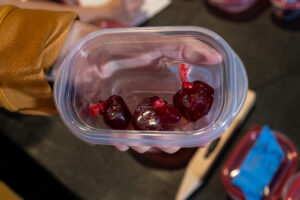
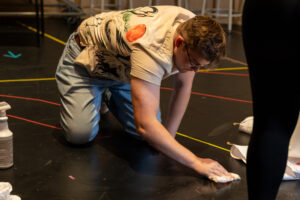
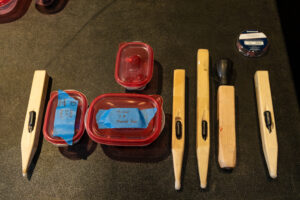
Left to right: Baggies of edible stage blood called strawberries; a crew member cleans the rehearsal floor during practice; various types of blood and props waiting for trial and error. (Kiirstn Pagan ’11/UMBC)
Tools of the Trade
1. 2,000 ounces of stage blood, some homemade, some bought
2. LOTS of baby wipes
3. Several mops and buckets
4. A taste for corn syrup
Step 1—Finding the right vein
For Morgan Farley and Emerson Balthis ’24, theatre design and production, assistant scenic designer and newly-christened stage blood mixologist, finding the perfect combination of purchased and homemade stage blood was a multi-month project. Several of the pressing questions at hand: Some of the blood needed to be edible—could they make it taste at least OK? Was anyone allergic to the substance? Most importantly, could it be washed out of the costumes every night? Oh yeah, and how to stay on budget?
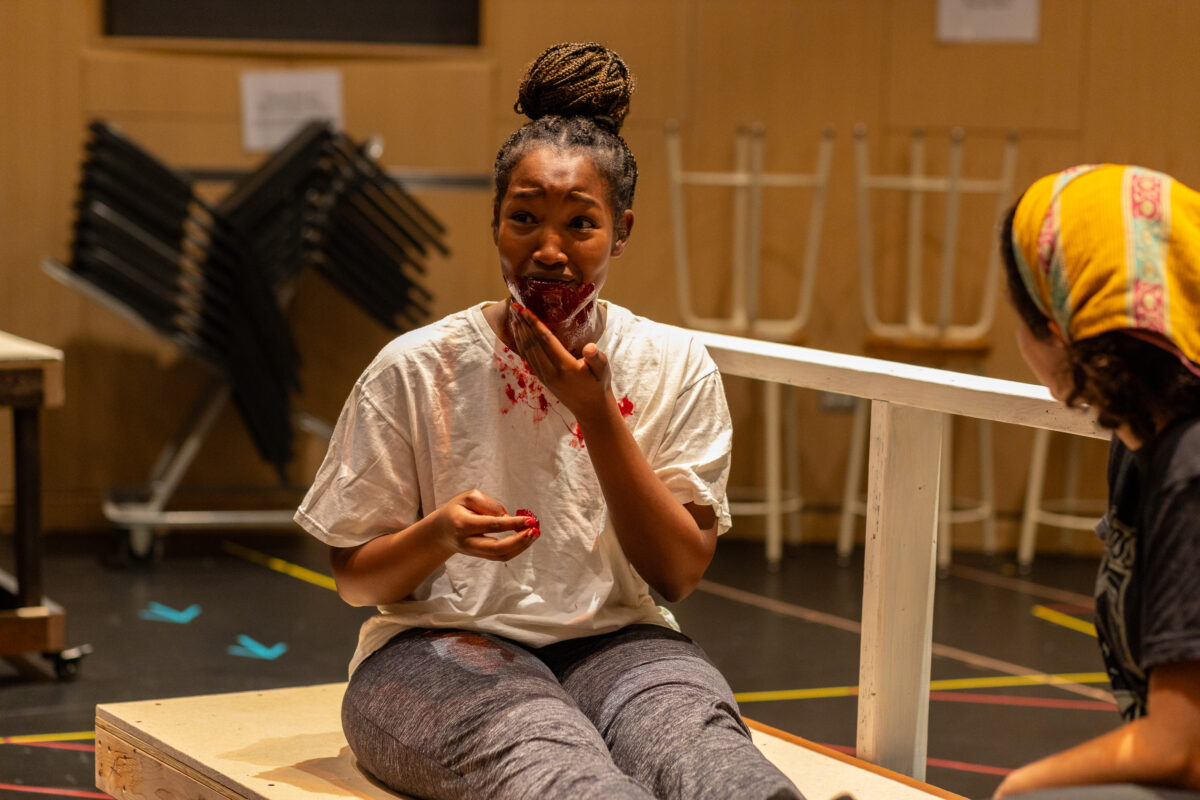 Liza Mupende as the vampire Lucy smears stage blood on her face and neck to get used to the texture in rehearsal. (Kiirstn Pagan ’11/UMBC)
“It’s going to be a bloodbath on stage,” says Morgan Farley, “but also not being too excessive to the point where it becomes funny. We’re trying to go more in the vein of reality versus comical, which also influenced our choice of color for blood. Of course, we were looking for washability, but we were also looking at the color and the viscosity.”
In order to stretch the budget, Morgan Farley and Balthis found ways to water down what they bought and manufacture the rest— simmering vats of chocolate syrup, corn syrup, food coloring, and various thickening agents dissolving into a viscous, sugary brew.
Step 2—Out damned spot
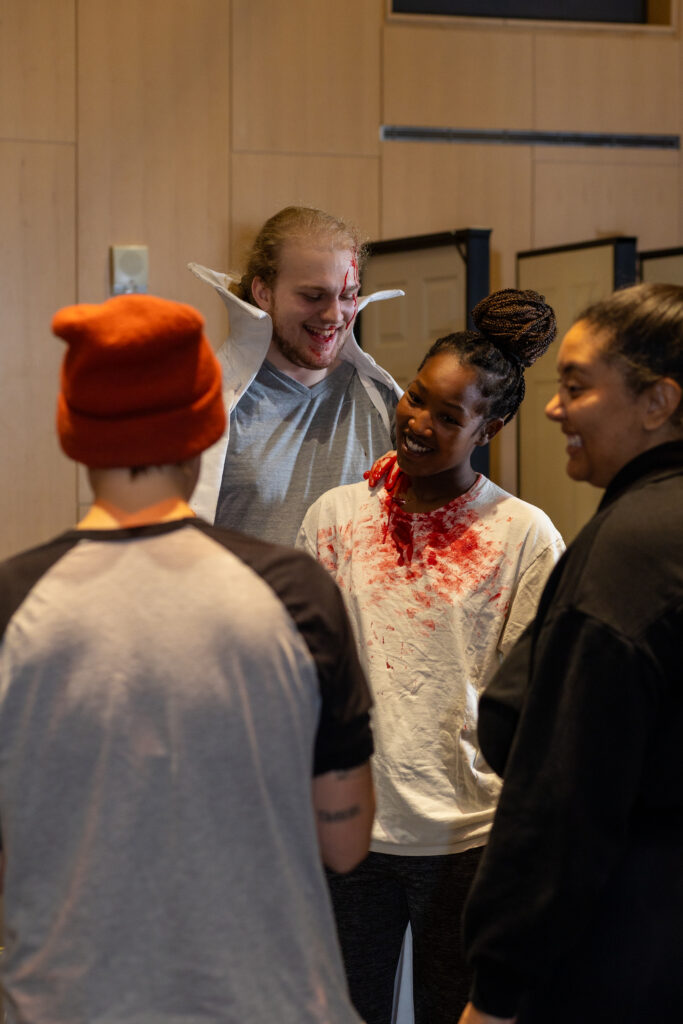 Dracula and Lucy are coached through a violent moment by Sierra Young, right, and Tessara Morgan Farley, left. (Kiirstn Pagan ’11/UMBC)
Moods are high, hands are stained red, and it’s obvious the student actors are having a blast (and most likely, a sugar high, based on the recipe). Standing in a six-foot-long pristine white cape—except for a few new blood smears—with a curved collar another foot high, Cece Smith ’24, acting, who plays Dracula, is nearly giggling with glee.
“I’m having so much fun,” says Smith. “I honestly don’t see a downside to the blood, even when it gets all sticky and nasty—it makes me feel pretty badass.”
Enter the people responsible for wardrobe and laundry: Margaret Caster, assistant costume shop manager and wardrobe supervisor, and Jennie Hardman ’23, theatre studies and environmental studies, wardrobe head for the show. While they could potentially see downsides galore, the duo is taking their tasks in stride.
“It was a little bit of ‘oh no,’ if I’m going to be honest,” says Hardman, who has worked on many UMBC shows in her time as a student, but this is her first as wardrobe head. “When you read the script, there is so much blood. So you think, ‘We’re going to do this with real red liquid. On white colored clothing. Oh boy, that’s going to be my problem, isn’t it!’”
“I’ve done blood shows before, so it’s not my first blood rodeo,” says Caster, “but I like to think of it like ‘How do you wrangle the blood?’ Because as you can see, it spreads everywhere. So my side is to think, ‘How can we contain it?’”
Their answer? Overnight soaks in Oxiclean and Shout spritzes for the tougher stains.
Step 3—Making the magic happen
In her role as an intimacy and fight director, Sierra Young has done vomit, has done other bodily fluids, has done blood—but never this much blood. Her job, as she puts it, “is to choreograph all of those big heightened moments so that they’re specific, repeatable, and narratively dynamic. And then give the actors tools to create a culture that is consent forward and trauma informed so they can feel secure in that space to create.”
In a feminist revenge fantasy based on Bram Stoker’s Dracula, unsurprisingly, there are a lot of opportunities for staging violence and intimacy, often at the same time. The added layer of Young’s already substantial task is designing the choreography so that the blood effects can be effectively masked.
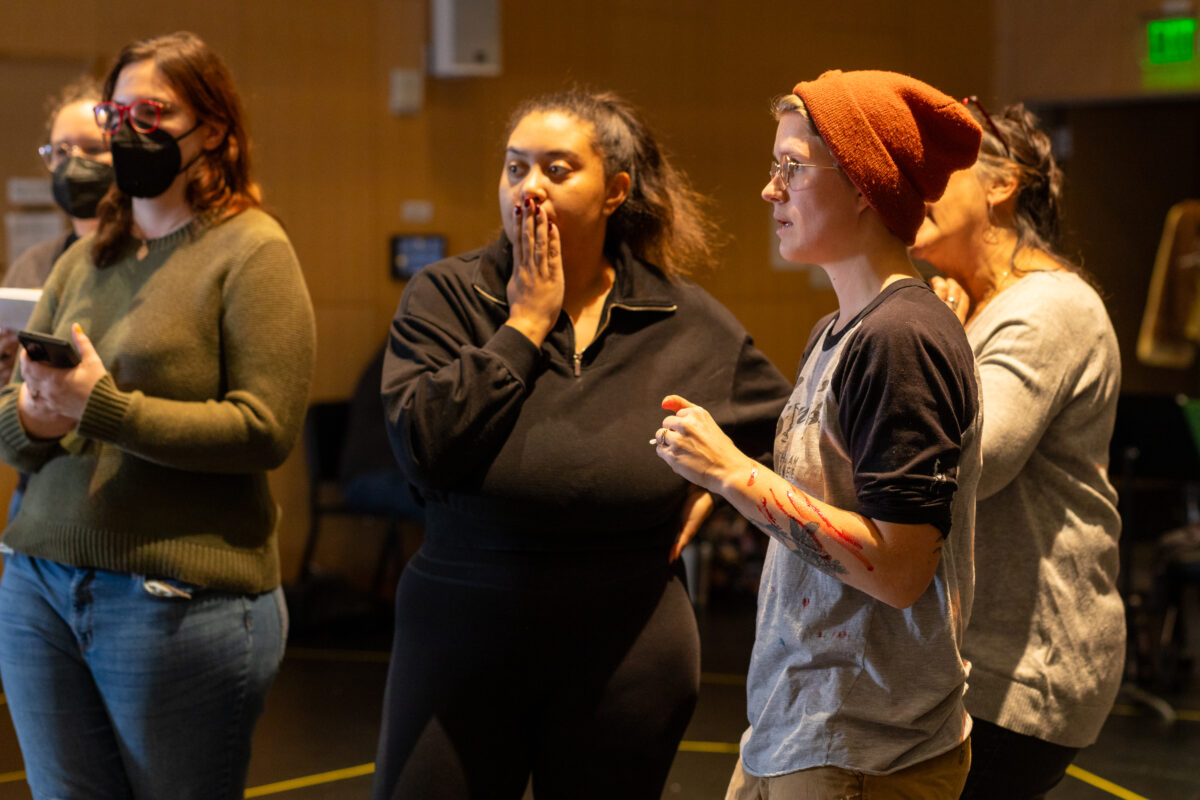 Sierra Young, center, and Tessara Morgan Farley, right, at rehearsal. (Kiirstn Pagan ’11/UMBC)
This means actors are subtly handing off blood capsules to each other, picking them up from behind stage props, or accessing them from hidden pockets. “In terms of choreography, how do I hide these things, because stage combat is the illusion of danger. It’s a lot of magic tricks and misdirection.”
“We’re doing this show on purpose,” adds Eve Muson, associate professor of theatre and chair of the Theatre Department at UMBC. “These extravagant elements are for teaching purposes.”
Step 4—In pursuit of a good death
Back to rehearsal and the problem of Van Helsing’s stake and the paltry amount of blood it produced. The actors, Parker and Mupende, are game to try any workarounds suggested by Morgan Farley and Young. They finally land on a blood strawberry that Parker-as-Van Helsing will place upstage of Mupende-as-the-vampire-Lucy.
While writhing after Van Helsing’s stab, Lucy puts the baggy of blood in her mouth and chomps down. She bends over to gasp her last undead breath, spewing the leftover plastic at the same time, looking as much like viscera as imaginable. The entire rehearsal space erupts in applause at the successful, bloody death.
]]>
Van Helsing straddles the vampire, brandishing her cross and wooden stake. The undead—mouth and shirt stained with blood—had just confessed to a brutal kill when the vampire slayer brings down her...
https://umbc.edu/stories/how-to-plan-a-successful-stage-battle/
https://my3.my.umbc.edu/api/v0/pixel/news/136787/guest@my.umbc.edu/3caf0334b520367b2d42ba587b782748/api/pixel
acting
cahss
campus-life
fall-2023
how-to
magazine
theatre
UMBC News & Magazine
https://my3.my.umbc.edu/groups/umbc-news-magazine
https://assets1-my.umbc.edu/system/shared/avatars/groups/000/001/943/24435aa6207c452e7bc15cc74b42c7bb/xsmall.png?1748556657
https://assets1-my.umbc.edu/system/shared/avatars/groups/000/001/943/24435aa6207c452e7bc15cc74b42c7bb/original.png?1748556657
https://assets2-my.umbc.edu/system/shared/avatars/groups/000/001/943/24435aa6207c452e7bc15cc74b42c7bb/xxlarge.png?1748556657
https://assets2-my.umbc.edu/system/shared/avatars/groups/000/001/943/24435aa6207c452e7bc15cc74b42c7bb/xlarge.png?1748556657
https://assets3-my.umbc.edu/system/shared/avatars/groups/000/001/943/24435aa6207c452e7bc15cc74b42c7bb/large.png?1748556657
https://assets1-my.umbc.edu/system/shared/avatars/groups/000/001/943/24435aa6207c452e7bc15cc74b42c7bb/medium.png?1748556657
https://assets2-my.umbc.edu/system/shared/avatars/groups/000/001/943/24435aa6207c452e7bc15cc74b42c7bb/small.png?1748556657
https://assets1-my.umbc.edu/system/shared/avatars/groups/000/001/943/24435aa6207c452e7bc15cc74b42c7bb/xsmall.png?1748556657
https://assets2-my.umbc.edu/system/shared/avatars/groups/000/001/943/24435aa6207c452e7bc15cc74b42c7bb/xxsmall.png?1748556657
UMBC News & Magazine
0
0
false
Fri, 03 Nov 2023 11:00:53 -0400
Fri, 03 Nov 2023 11:00:53 -0400
How to Make a Pinhole Camera

When Chris Peregoy ’81, visual and performing arts, M.F.A. ’99, intermedia and digital arts, received a tin full of Christmas cookies from his sister around the year 2000, he immediately dumped the contents out on the table to eat later. He had a moment of inspiration staring at the empty container—“This tin would make a great camera.”
If you’ve ever looked at an oatmeal container, a hollowed-out book, a mailbox, or an entire room, and thought, “This object would make a great camera,” chances are you are familiar with the concept of a pinhole camera. It’s photography distilled to its most basic elements: a light-proof box, a lens—which is often just a literal hole made from a pin—and some film or photographic paper.
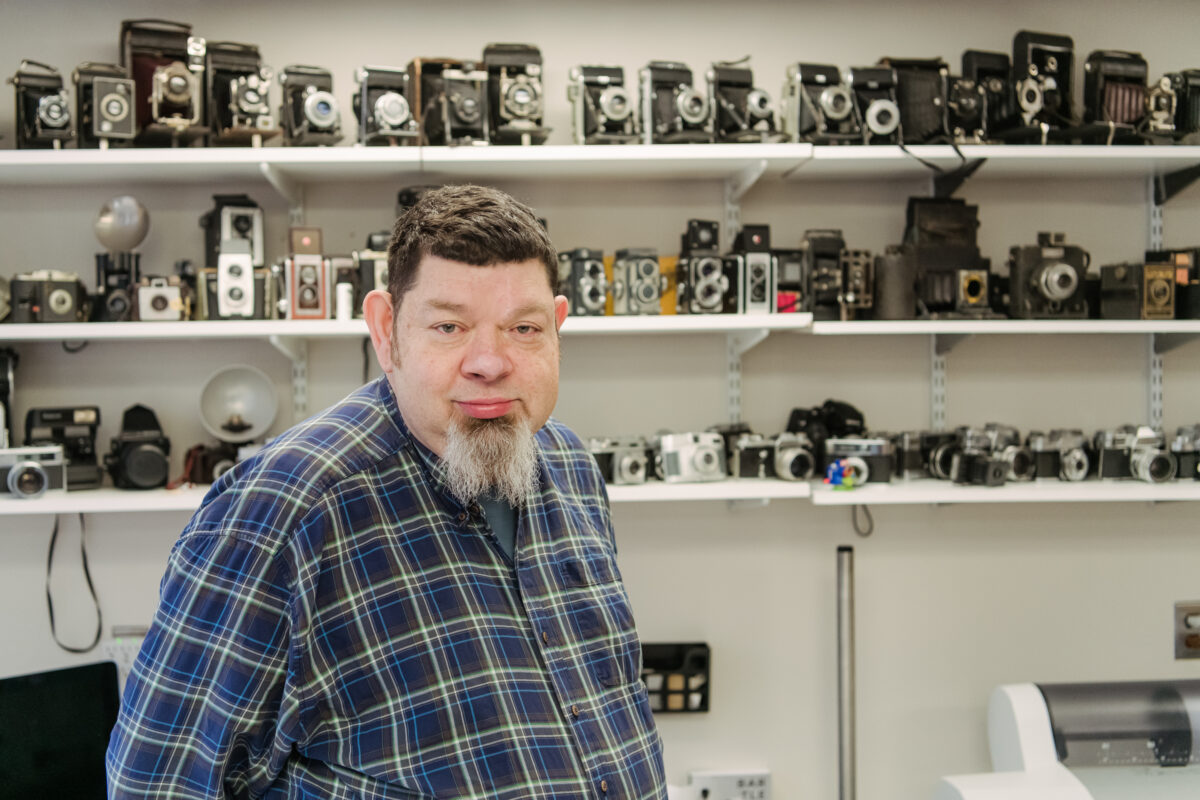
Peregoy, the lab manager for the Department of Visual Arts, has worked at UMBC since graduating from the photography program in 1981 and will retire this summer, but he leaves behind a substantial legacy in his 6-foot 8-inch wake. He’s also leaving behind a few dozen handcrafted pinhole cameras from his company Pinhole Blender for students to keep using in their photo classes.
In addition to the helpful labels on each camera describing exposure time in different types of light, Peregoy has some useful hints for the rest of us who might want to dabble in the non-digital world of making photos.
Tools of the Trade:
- A light-proof container—a great second life for the shipping tube your diploma arrives in
- A pin to make the eponymous pinhole
- Small square of black tape to act as a shutter
- Film or photo paper
- Access to a darkroom (but if not, you can still make it work)
Step 1: MAKE YOUR CAMERA (OR BUY ONE FROM PEREGOY’S COMPANY).
Cookie tins aside, Peregoy says he isn’t someone who makes cameras out of odd objects for the most part, although those people are out there. Shipping tubes and oatmeal containers (especially before Quaker changed their lids to transparent plastic) are his go-tos (although he’s making a camera for his retirement party out of an old whiskey barrel the brewery near his house is giving him).
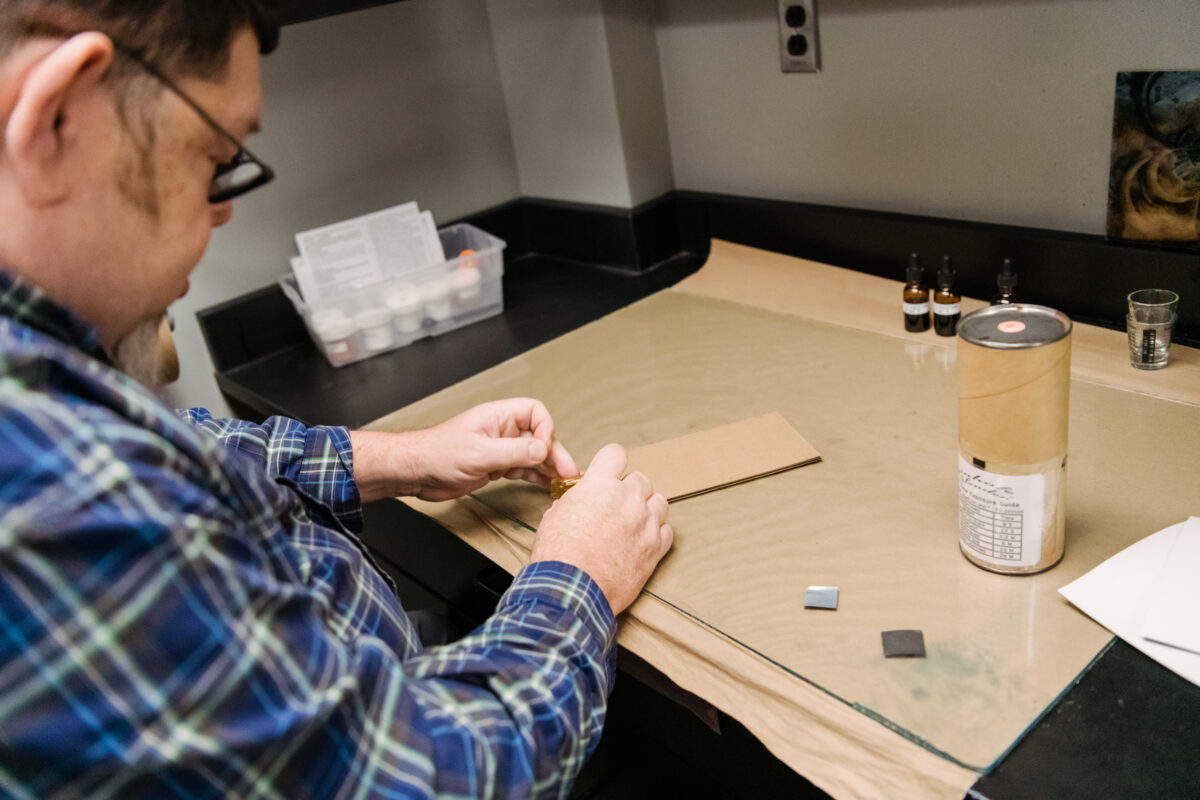
You need an opening large enough to arrange the film in the containers and a way to reseal the box/tube/pumpkin/ etc. When you make the pinhole, Peregoy recommends pushing a pin through a small square of soda-can material and smoothing out any burrs with fine sandpaper. Affix this metal piece to the camera body with black tape. Then you need to attach a shutter— something that ends the light exposure—like a piece of black electrical tape.
Step 2: LOAD YOUR CAMERA.
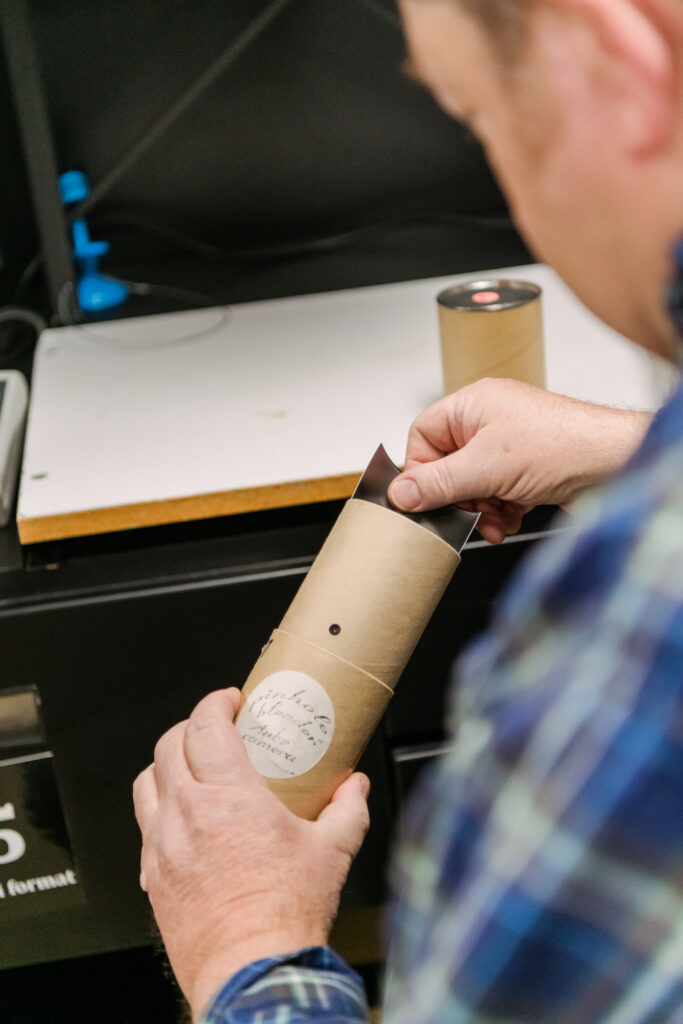
Load the camera with the film or photo paper in a darkroom (you can improvise with cardboard taped over your bathroom window, in a pinch). Now you need to choose your subject. “One of the aspects of the pinhole camera is that although it might not create a sharp picture like a real lens, it has an incredible range of focus,” says Peregoy. “So things a quarter inch away from the pinhole will be as focused as things that are 30 feet away.” In his own pinhole work, Peregoy often uses miniature dolls or statues as subjects in the photos, using the strength of the camera to play with perspectives.
Most often, when students are released from the classroom to go take photos, for time reasons, they don’t stray far. “I’ve seen a lot of pictures of the Fine Arts building,” laughs Peregoy. But even so, he’s still surprised sometimes. In one image of a rocky scene with a building in the background, Peregoy did a double take; despite his many decades on this campus and specifically in this building, he didn’t recognize the shot. The student revealed they had laid down in a drainage ditch, and yes, indeed, it was still Fine Arts in the background.
Step 3: DEVELOP YOUR FILM.
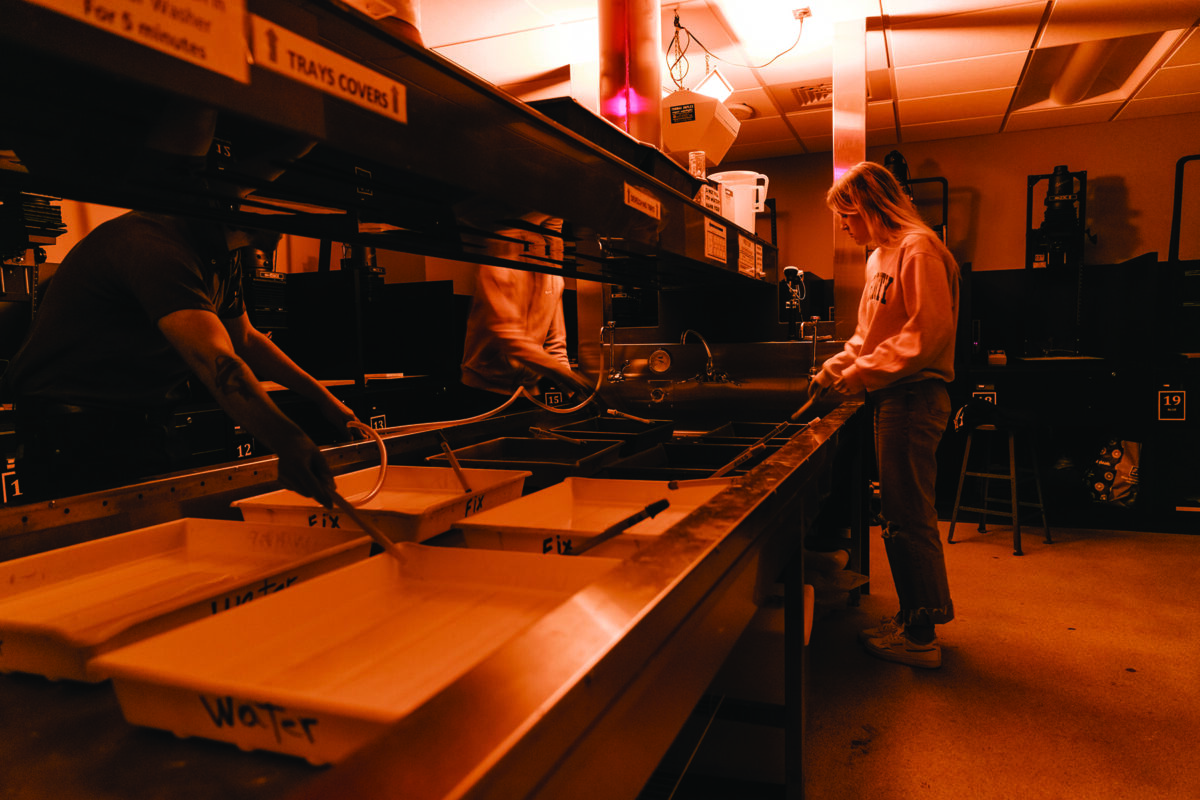
Next comes film development. For students, that means learning the rules of the darkroom. “I didn’t know what a pinhole camera was,” says Erin Cusick, a sophomore who is taking the class for elective credit. “It’s been so fun to see how exposing the paper to light and then using time to play with the way the image develops,” says Cusick as she leans over a tray of chemicals in the darkroom watching her image appear.
But Peregoy offers two alternatives for a darkroom-free pinhole experience—solargraphy and lumen photography. Solargraphy uses a pinhole camera and exposes the image outside for several months, burning the path of the sun and the stars into the paper. Lumen prints use photo paper overlaid with flowers or other objects, which after exposure to sunlight will create an ethereal image on the paper. It’s a fragile process, says Peregoy, and the paper should be scanned digitally because eventually the image will fade from the paper.
Step 4: KEEP PLAYING AROUND WITH ANALOG.
“Digital has taken most of the cameras away from us,” says Peregoy. “But there are lots of old options and ways to turn old things into film or pinhole.” Cusick, in the photo class, is struck by how simple-seeming the whole process is, “but the simplicity makes it all the more confusing how it works,” she marvels.
Outside Fine Arts, the sun shines brightly on the building and Jamal Jackson, a visual arts major who transferred from Montgomery College, aligns his pinhole camera just so. “The versatility of the camera makes it so fun to play with,” he says. “It’s letting me capture my own voice in photos.”
The more you know: Discover more pinhole resources.
]]>
When Chris Peregoy ’81, visual and performing arts, M.F.A. ’99, intermedia and digital arts, received a tin full of Christmas cookies from his sister around the year 2000, he immediately dumped...
https://umbc.edu/stories/how-to-make-a-pinhole-camera/
https://my3.my.umbc.edu/api/v0/pixel/news/133961/guest@my.umbc.edu/e283b139552c0360790057d949553f8f/api/pixel
alumni
cahss
campus-life
how-to
intermedia-and-digital-arts
magazine
spring-2023
visual-and-performing-arts
UMBC News & Magazine
https://my3.my.umbc.edu/groups/umbc-news-magazine
https://assets1-my.umbc.edu/system/shared/avatars/groups/000/001/943/24435aa6207c452e7bc15cc74b42c7bb/xsmall.png?1748556657
https://assets1-my.umbc.edu/system/shared/avatars/groups/000/001/943/24435aa6207c452e7bc15cc74b42c7bb/original.png?1748556657
https://assets2-my.umbc.edu/system/shared/avatars/groups/000/001/943/24435aa6207c452e7bc15cc74b42c7bb/xxlarge.png?1748556657
https://assets2-my.umbc.edu/system/shared/avatars/groups/000/001/943/24435aa6207c452e7bc15cc74b42c7bb/xlarge.png?1748556657
https://assets3-my.umbc.edu/system/shared/avatars/groups/000/001/943/24435aa6207c452e7bc15cc74b42c7bb/large.png?1748556657
https://assets1-my.umbc.edu/system/shared/avatars/groups/000/001/943/24435aa6207c452e7bc15cc74b42c7bb/medium.png?1748556657
https://assets2-my.umbc.edu/system/shared/avatars/groups/000/001/943/24435aa6207c452e7bc15cc74b42c7bb/small.png?1748556657
https://assets1-my.umbc.edu/system/shared/avatars/groups/000/001/943/24435aa6207c452e7bc15cc74b42c7bb/xsmall.png?1748556657
https://assets2-my.umbc.edu/system/shared/avatars/groups/000/001/943/24435aa6207c452e7bc15cc74b42c7bb/xxsmall.png?1748556657
UMBC News & Magazine
1
0
false
Mon, 12 Jun 2023 11:57:11 -0400
Mon, 12 Jun 2023 11:57:11 -0400
How to Bridge Your Two Homes

With Jess Presuel ’23, biological sciences, an international student from Mexico
Jess Presuel’s route to UMBC was not a direct flight from Mérida, Yucatán—her home state in Mexico—to UMBC. She originally arrived in Maryland in 2015 as an au pair to a family with five children. There, she immediately felt accepted and as she cared for the children, they helped her learn English. Over time, Presuel realized she was ready to pursue her dream of becoming a surgeon, starting in fall 2021 working toward a degree in biological science. At UMBC, Presuel knew that she wasn’t just on campus to take classes; she wanted to bring her Mexican and Mayan heritage to her time as a Retriever. Now, as a global ambassador through the Center for Global Engagement and through other connections on campus, Presuel has found platforms to bridge her two homes and she wants to share how she’s going about it.
Tools of the Trade
1. A sense of adventure
2. Backpack of study skills
3. Openness to joining clubs and volunteering
4. Grandma’s recipe book
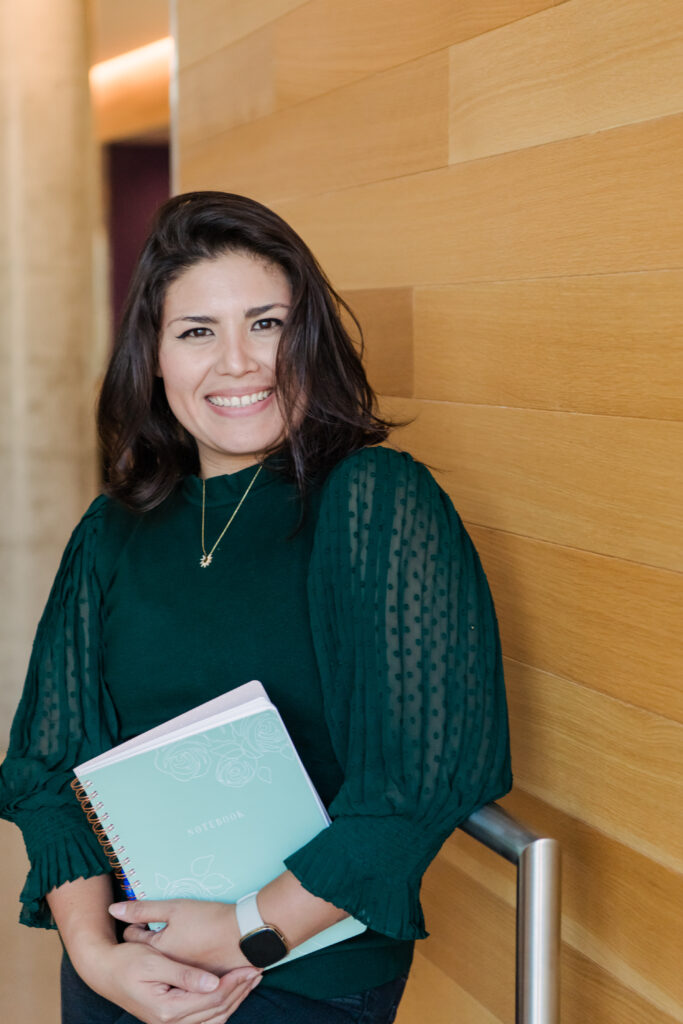
Jess Presuel (Marlayna Demond ’11/UMBC)
Step 1: Find your family
For Presuel, this was both easy and hard. When she arrived in the U.S., still using Google Translate to communicate with her au pair family, she found the parents and kids eager to help her learn English and navigate life in Maryland. Most importantly, she says, they supported her personally when she shared that she was gay. “Part of the rough patch of my life in Mexico,” Presuel shares, “was that at the time, my mom didn’t accept me as being gay. So when I first got here, the family was welcoming to me. Just for me, I began to experience how American culture, especially in Maryland, can be welcoming to the LGBTQ community. It made me feel safe.”
Presuel would later meet her fiancée, Lyana Cortes, in D.C. and over time, she says, her mother has grown to accept her daughter and love her future daughter-in-law. “My mom was a single mom, so she was always working. At the time, she sustained three jobs and I raised my siblings. So when I left, she felt my absence. Now, we’ve patched things up and she’s finally accepted me. She adores Lyana,” says Presuel. In fact, the couple got engaged on their most recent trip to Mexico, building stronger family ties internationally.
 Presuel, seated, second from right, with her fiancée, Lyana Cortes, in front, with other members of Presuel’s family in Mexico. Photo courtesy of Presuel.
Step 2: Share your favorite things from home
“For me, being a Latina means always taking the time to cook something from my hometown,” says Presuel. “In addition to being Mexican, I’m Mayan too. Not many people know that the Mayan community is still alive. So I’m spreading the word, we’re here.”
Presuel uses any opportunity to make food for her communities on campus, including her medical fraternity Phi Delta Epsilon. For her Mayan dishes, she incorporates pumpkin seeds into many different recipes, and on Mexican Independence Day, September 16, she made pozole, a rich stew.
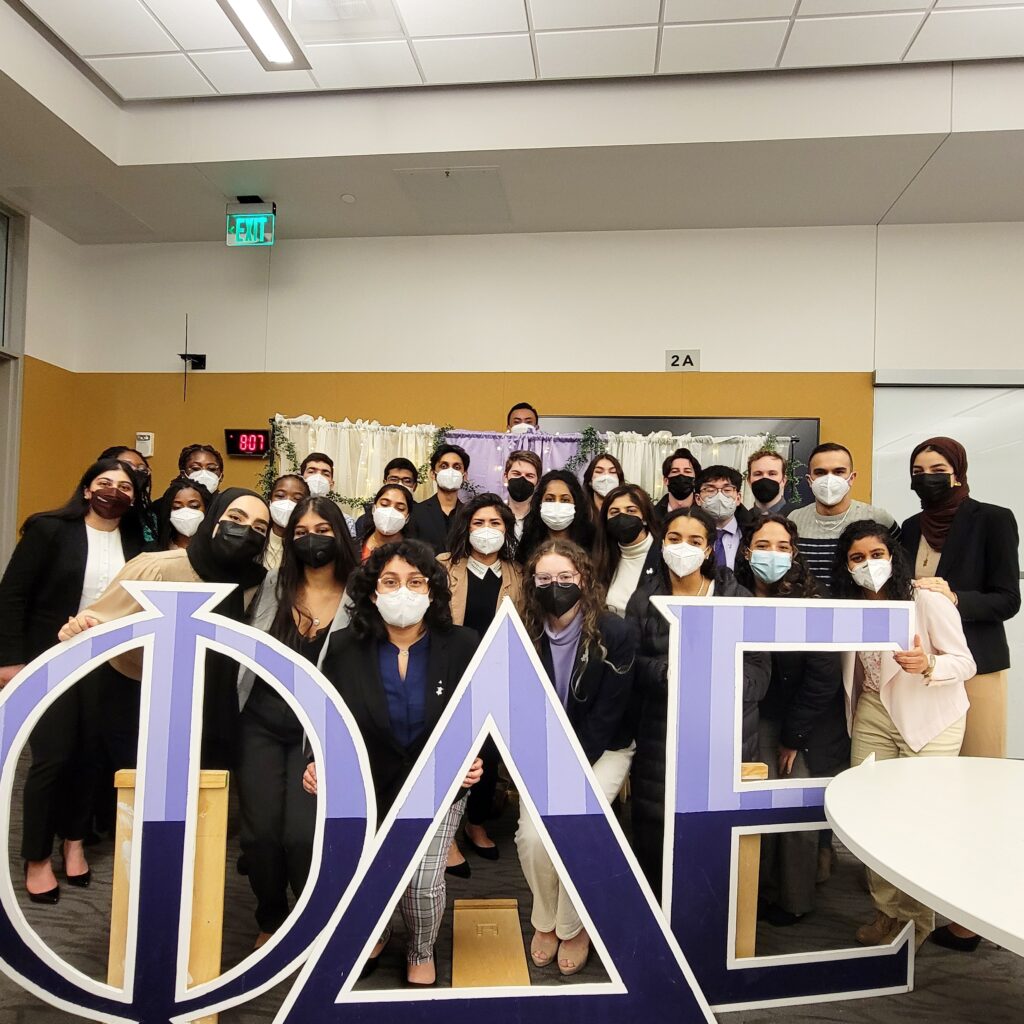 Presuel, center, in a black sweater with a white collar, with other members of her fraternity, Phi Delta Epsilon.
In addition to food, Presuel wants to share a sense of Latina empowerment. She’s currently in the process of replicating Harvard’s Latina Empowerment & Development (LEAD) conference at UMBC. “I am trying to get more Latinas involved in any type of workshops and educational settings,” says Presuel. “I want to showcase Latina leadership.”
Step 3: Get the lay of the land
Higher education in the States is a convoluted process for someone coming from outside of the system. For international students in particular, specific and important paperwork must be submitted to the right authorities. At UMBC, staff in International Student and Scholar Services (ISSS) help handle this bureaucratic burden. “I knew that when I finally picked UMBC as my university, ISSS was the first office I needed to connect with.”
 Presuel, second from left in the back, poses with other members of CGE’s global ambassador team. (Marlayna Demond ’11/UMBC)
In addition to ISSS, Presuel says, she doesn’t hesitate to ask her advisor Philip Farabaugh, professor in biological sciences, endless questions, even things she might be able to find online, because inevitably the conversation ends up being so useful to her. “He always gives me good advice. And he’s so funny, that makes me feel like, ‘Okay, I got this. I definitely can do this.’”
Step 4: Tell your story
After a year taking classes at UMBC, Presuel felt like she was ready to start offering advice to other international students. She’s now a global ambassador through the Center for Global Engagement.
“It’s such a rewarding role,” says Presuel, “because I finally get to share my experience. When you first get here from another country, you likely feel lost, so having someone who can help or speak your own language, it’s so relieving.”

Presuel, center, has fun with other global ambassadors at a Welcome Week event. Photo courtesy of CGE.
Step 5: Find ways to give back to your community
“As an international student, it’s important to have a community even outside of campus,” says Presuel. She wanted to find a way to give back to other Mexicans and Spanish speakers in the area and found a home at the Esperanza Center in Baltimore City. This nonprofit is a comprehensive resource center for immigrant communities. “I do absolutely anything that’s possible for me to do,” says Presuel, who has been volunteering there for the past year.
“I help from the front desk. I’ve been assisting dentists. I translate for doctors. So being part of the immigrant community in Baltimore, it has filled my heart,” says Presuel. “I wouldn’t call it a hole, but something was missing from Mexico. I needed to have that link between my American culture, my Mexican culture here.”
]]>
With Jess Presuel ’23, biological sciences, an international student from Mexico Jess Presuel’s route to UMBC was not a direct flight from Mérida, Yucatán—her home state in Mexico—to UMBC....
https://umbc.edu/stories/how-to-bridge-your-two-homes/
https://my3.my.umbc.edu/api/v0/pixel/news/129381/guest@my.umbc.edu/99b66d5573cafaa0e5674257e47c5cc5/api/pixel
biological-sciences
campus-life
cge
cnms
fall-2022
how-to
international
magazine
UMBC News & Magazine
https://my3.my.umbc.edu/groups/umbc-news-magazine
https://assets1-my.umbc.edu/system/shared/avatars/groups/000/001/943/24435aa6207c452e7bc15cc74b42c7bb/xsmall.png?1748556657
https://assets1-my.umbc.edu/system/shared/avatars/groups/000/001/943/24435aa6207c452e7bc15cc74b42c7bb/original.png?1748556657
https://assets2-my.umbc.edu/system/shared/avatars/groups/000/001/943/24435aa6207c452e7bc15cc74b42c7bb/xxlarge.png?1748556657
https://assets2-my.umbc.edu/system/shared/avatars/groups/000/001/943/24435aa6207c452e7bc15cc74b42c7bb/xlarge.png?1748556657
https://assets3-my.umbc.edu/system/shared/avatars/groups/000/001/943/24435aa6207c452e7bc15cc74b42c7bb/large.png?1748556657
https://assets1-my.umbc.edu/system/shared/avatars/groups/000/001/943/24435aa6207c452e7bc15cc74b42c7bb/medium.png?1748556657
https://assets2-my.umbc.edu/system/shared/avatars/groups/000/001/943/24435aa6207c452e7bc15cc74b42c7bb/small.png?1748556657
https://assets1-my.umbc.edu/system/shared/avatars/groups/000/001/943/24435aa6207c452e7bc15cc74b42c7bb/xsmall.png?1748556657
https://assets2-my.umbc.edu/system/shared/avatars/groups/000/001/943/24435aa6207c452e7bc15cc74b42c7bb/xxsmall.png?1748556657
UMBC News & Magazine
3
0
false
Wed, 23 Nov 2022 13:23:36 -0500
Wed, 23 Nov 2022 13:23:36 -0500
How to Chill Out
With Joella Lubaszewski ’10, theatre, UMBC’s coordinator in fitness and wellness
In the hustle and bustle of exams, family dinners, and everyday life, it can be easy to forget to take time for yourself—time that isn’t spent thinking about the errands you need to run or the emails cluttering your inbox. One could argue that Ferris Bueller said it best when he reminded us, “Life moves pretty fast. If you don’t stop and look around once in a while, you could miss it.”
A great way to reconnect, relax, and recenter is through yoga. UMBC’s coordinator in fitness and wellness, Joella Lubaszewski ’10, theatre, has spent hundreds of hours getting certified so she can teach you the art of finding your calm.
Tools of the Trade:
- A willingness to try (seriously, that’s it): “There are a lot of different types of yoga and ways to practice, you don’t necessarily need anything special,” says Lubaszewski.
- Optional: Yoga mat and yoga blocks.
Step 1: Get Started!
So frequently people seem to think they need to have a certain level of flexibility or balance to get started (or the right wardrobe), but Lubaszewski wants to assure newbies this is not the case.
“I think anybody can do yoga in some capacity,” says Lubaszewski. “There are a lot of different kinds of yoga. Maybe you’re never going to put your foot behind your head, that doesn’t mean you’re not doing yoga. Maybe for you it’s more of the meditation or the act of practicing.”
She encourages those who are new to try a few studios and a few classes before throwing in the towel—the RAC offers quite a few options, too. Having trouble getting started? Try journaling or reading beforehand to ease yourself into the class and center your focus.
Step 2: Find Your Space
Wouldn’t it be cool to have a full yoga studio in your home? Yes. Is that feasible? Maybe not, but it’s okay to dream big. The good news is you don’t need a fancy space or equipment to get started. The rise of online classes has made it easier than ever to take a virtual class from virtually anywhere.
“Some days your practice will be just from your bed in your pajamas and some days it will be on the floor, it just depends on what you need that day,” says Lubaszewski.
The important thing is finding a space that’s yours. One of the biggest challenges that comes with starting is focusing on your practice. You may find that you concentrate better when you’re in an in-person class with others, a live video with an instructor, a pre-recorded class you can do at your own speed, or even just working through your own flow.
Step 3: Find What Works for You
If you’re trying yoga for the first time and can’t seem to get the hang of it, you’re not the only one. Lubaszewski recalls that when she first started practicing she admits she thought it was, “a little boring,” but as she integrated it into her regular routine, she fell in love with it.
You don’t need to have a reason to start or set an intention to start your practice that day. “It’s such a personal thing; if you have a clear reason and intention, sure, you can think about that. If you don’t, maybe you’ll figure it out along the way, but it’s not a problem if you don’t,” she assures new students.
Step 4: Turn Your Brain Off
“I say this during savasana [the final resting pose of almost every class]—try not to think that as soon as class is over you’re going to get changed and go to the grocery store and run your errands,” Lubaszewski encourages. “Just stop, don’t think for a minute.”
We know this one is easier said than done, but if you’re really going to let yourself relax, you’re going to have to channel your inner Elsa and “let it go.” There are so few occasions when we’re actually encouraged not to think, but this helps to reflect on the work you just did and capture the last vestiges of peace before returning to real life.
 Through recurring events like Mindfulness Mondays, UMBC students and staff are encouraged to find ways to breathe and relax. Here, RAC fitness instructor Erica Sligh ’20, biological sciences, leads a yoga class next to the Library Pond in 2019.
Brain still stuck on a hamster wheel of thoughts? Lubaszewski suggests making an inventory of all the things you can feel—your legs on the mat, your arms at your sides, the fabric of your clothes, etc.
Step 5: Practice Makes Perfect
Even after over a decade of practice, Lubaszewski still doesn’t consider herself an expert (hence why it’s called a practice). For her, the appeal is that you can do it every day but still find new and different ways to suit your needs.
“One of the reasons I really love yoga is that it can be whatever you need, when you need it. Sometimes it’s sitting down for an intense 90-minute workout, sometimes it’s 30 seconds of just breathing because you’re feeling overwhelmed.”
Step 6: Recapture Your Peace Throughout the Day
As you start to condition yourself to take time throughout the day, it can get easier to recapture some of those feelings of peace, even without rolling out your mat.
“It can be easy to wake up and jump into all the things you have to do,” says Lubaszewski, “but giving yourself permission to stop and focus for a second can calm you down and change the trajectory of your day.”
*****
All photos by Marlayna Demond ’11.
]]>
With Joella Lubaszewski ’10, theatre, UMBC’s coordinator in fitness and wellness In the hustle and bustle of exams, family dinners, and everyday life, it can be easy to forget to take time...
https://umbc.edu/stories/how-to-chill-out/
https://my3.my.umbc.edu/api/v0/pixel/news/119523/guest@my.umbc.edu/30b616998c15522f27391813a75e6433/api/pixel
campus-life
fall-2021
how-to
rac
theatre
yoga
UMBC News & Magazine
https://my3.my.umbc.edu/groups/umbc-news-magazine
https://assets1-my.umbc.edu/system/shared/avatars/groups/000/001/943/24435aa6207c452e7bc15cc74b42c7bb/xsmall.png?1748556657
https://assets1-my.umbc.edu/system/shared/avatars/groups/000/001/943/24435aa6207c452e7bc15cc74b42c7bb/original.png?1748556657
https://assets2-my.umbc.edu/system/shared/avatars/groups/000/001/943/24435aa6207c452e7bc15cc74b42c7bb/xxlarge.png?1748556657
https://assets2-my.umbc.edu/system/shared/avatars/groups/000/001/943/24435aa6207c452e7bc15cc74b42c7bb/xlarge.png?1748556657
https://assets3-my.umbc.edu/system/shared/avatars/groups/000/001/943/24435aa6207c452e7bc15cc74b42c7bb/large.png?1748556657
https://assets1-my.umbc.edu/system/shared/avatars/groups/000/001/943/24435aa6207c452e7bc15cc74b42c7bb/medium.png?1748556657
https://assets2-my.umbc.edu/system/shared/avatars/groups/000/001/943/24435aa6207c452e7bc15cc74b42c7bb/small.png?1748556657
https://assets1-my.umbc.edu/system/shared/avatars/groups/000/001/943/24435aa6207c452e7bc15cc74b42c7bb/xsmall.png?1748556657
https://assets2-my.umbc.edu/system/shared/avatars/groups/000/001/943/24435aa6207c452e7bc15cc74b42c7bb/xxsmall.png?1748556657
UMBC News & Magazine
0
0
false
Mon, 22 Nov 2021 20:45:32 -0500
How To Paint a Mural

With Zaynub Siddiqui ’21, psychology
Last November, Zaynub Siddiqui ’21, psychology, set out to paint the town red—and yellow, green, pink, and black. Jumping at the chance to contribute creatively to OCA Mocha—the community-centered UMBC-affiliated coffee shop in neighboring Arbutus—the UMBC senior took a drab wall and transformed it over the course of her 20th birthday weekend. So, how exactly does one tackle a 150-square-foot blank space? For Siddiqui, it took vision, daring, and multiple iced matchas. But in the end she left local coffee lovers a floral feast for the eyes.
Tools of the Trade:
 Headshot courtesy of Siddiqui.
-
A projector, a scaffold, and no fear of heights—To translate a design from the page to the side of a building, it helps to use an Epson 4K projector.
-
Shoe coverings—“Paint gets everywhere,” says Siddiqui.
-
A passion for the subject matter—“I love plants, I have a whole bunch. I love gardening,” she says.
-
A favorite coffee shop drink—“I really love an iced matcha,” says Siddiqui.
- Advil—because that’s a LOT of standing.
Step 1: Find a Wall
In Siddiqui’s case, the wall found her. The people behind OCA Mocha put out a call for artists to decorate the wall adjacent to their outdoor patio and parking lot. Even though she is a psychology major (with a sociology minor), the notice caught her eye. “I’ve always wanted to be a part of UMBC’s art scene,” she says. “I would see their art building and their exhibit areas and think, I want to do that.”
As such, armed with a love of arts and crafts and her experience helping out with collective murals at the college she attended briefly before transferring to UMBC, Siddiqui submitted her ideas for consideration, and was excited to be chosen.
Step 2: Create a Design and a Plan
Siddiqui’s vision started with the idea of a steaming cup of coffee and adding her own spin with lots of florals. “Nature really inspires my artwork,” she says. She also wanted to create a space where people could easily snap fun photos of themselves. After a series of meetings and emails with OCA Mocha staff, they settled on a design.
 Photo of her favorite drink in front of her mural, courtesy of Siddiqui.
Siddiqui was excited that the timing of the mural aligned with her senior year. “Since this is my last year at UMBC, I’d sort of leave off with a bang,” she says. Siddiqui also appreciated being able to paint it on her birthday, showing growth artistically and personally. “Entering my 20s by doing this was something really exciting for me,” she says.
Step 3: Scale Up Your Art Supplies
Got paint brushes? Get bigger ones. Siddiqui also ditched regular art trays for mixing in favor of big foil trays usually used for food. For paint, you’ll need something a lot more durable than the stuff in your everyday art kit. Buy exterior primer for the base and exterior flat finish for the design.
And, don’t forget about clean-up. With a mural, paint splashes up, down, and all around, so Siddiqui suggests being prepared to cover up and wash up. “You think you’re not going to touch something…and then you’ll find it,” she says. “I had paint on myself a week and a half after. I’d say, ‘I thought I scrubbed my arms!’”
Step 4: Be Prepared to Grow Your Art
When the time came to start painting, the huge wall size came as something of a surprise to Siddiqui once it was right in front of her. Undeterred, she painted flowers and more flowers, and then added more until the space was full. The end result? A burst of color (and coffee) that explodes into an otherwise humdrum parking lot.
Florals often find their way into Siddiqui’s work. As such, she packed it with some of her favorites, including a peony and roses. She also made sure to include flora and fauna that are special to the area. There is a monarch butterfly, native to the region, as well as plenty of Maryland’s state flower, the Black-Eyed Susan. Siddiqui even included a White Oak leaf in an homage to the famous Arbutus White Oak that fell in 2019.
Step 5: Go and Dream Bigger Dreams
The mural may be done, but Siddiqui’s work is far from over. She plans to pursue a master’s degree in psychology and possibly mix her love of art with her love of how the mind works.
“They both provide different insights to people and how they think and their emotions,” she says. Eventually she’d like to possibly get into art therapy—but the scaffold sitting in her house now proves murals are still in her life. “I would love to have a mural in New York City or Los Angeles or Amsterdam…something that people would be able to take pictures of and remind them of nature.” Ultimately, she thinks that “just to put a smile on someone’s face would be really fun.”
— Karen Stysley
*****
All photos by Marlayna Demond ’11, unless otherwise noted.
]]>
With Zaynub Siddiqui ’21, psychology Last November, Zaynub Siddiqui ’21, psychology, set out to paint the town red—and yellow, green, pink, and black. Jumping at the chance to contribute...
https://umbc.edu/stories/how-to-paint-a-mural/
https://my3.my.umbc.edu/api/v0/pixel/news/119612/guest@my.umbc.edu/9ba13ef5975954985a2db86e91a73593/api/pixel
campus-life
how-to
oca-mocha
psychology
spring-2021
UMBC News & Magazine
https://my3.my.umbc.edu/groups/umbc-news-magazine
https://assets1-my.umbc.edu/system/shared/avatars/groups/000/001/943/24435aa6207c452e7bc15cc74b42c7bb/xsmall.png?1748556657
https://assets1-my.umbc.edu/system/shared/avatars/groups/000/001/943/24435aa6207c452e7bc15cc74b42c7bb/original.png?1748556657
https://assets2-my.umbc.edu/system/shared/avatars/groups/000/001/943/24435aa6207c452e7bc15cc74b42c7bb/xxlarge.png?1748556657
https://assets2-my.umbc.edu/system/shared/avatars/groups/000/001/943/24435aa6207c452e7bc15cc74b42c7bb/xlarge.png?1748556657
https://assets3-my.umbc.edu/system/shared/avatars/groups/000/001/943/24435aa6207c452e7bc15cc74b42c7bb/large.png?1748556657
https://assets1-my.umbc.edu/system/shared/avatars/groups/000/001/943/24435aa6207c452e7bc15cc74b42c7bb/medium.png?1748556657
https://assets2-my.umbc.edu/system/shared/avatars/groups/000/001/943/24435aa6207c452e7bc15cc74b42c7bb/small.png?1748556657
https://assets1-my.umbc.edu/system/shared/avatars/groups/000/001/943/24435aa6207c452e7bc15cc74b42c7bb/xsmall.png?1748556657
https://assets2-my.umbc.edu/system/shared/avatars/groups/000/001/943/24435aa6207c452e7bc15cc74b42c7bb/xxsmall.png?1748556657
UMBC News & Magazine
0
0
false
Fri, 28 May 2021 20:23:21 -0400
How to Throw a Hammer

with Andrew Haberman ’21, computer science, and Davina Orieukwu, assistant Track & Field coach
It’s widely accepted that you need to practice a skill for 10,000 hours before becoming an expert. Andrew Haberman ’21, computer science, has a different number in mind—20,000 throws. Twenty-five throws a practice, five days of practice a week, 10 months out of the year for four years. And even after that, he knows that success is never final. So he makes another throw.
Along with shot put, weight, and discus throws, Haberman specializes in the hammer throw. This is not a tool from your dad’s shed. For men’s regulation competition, it’s a 16lb metal ball attached by a steel wire to a grip. While the object of this competition is—like all throwing competitions—to launch your object the farthest, with hammer throw speed is also a big factor.
-
 Andrew Haberman
-
 Davina Orieukwu
As part of track and field, throwing is more obscure than some events, but UMBC has a storied history in this discipline. Cleopatra Borel ’02, interdisciplinary studies, is a four-time Olympian shot putter representing Trinidad and Tobago, placing 7th in Brazil in 2016.
On the practice field, again and again, the rhythmic sound of Haberman’s shoes scuffing the throwing circle are followed by a thunk as the hammer lands in the grass, a rooster tail of dirt following each toss. Haberman and his throwing coach, Davina Orieukwu, talk through foot placement, chest height, release angle, and many other minute readjustments to his technique. Over and over, Orieukwu reminds him, “push the hammer all the way around,” to get the most efficient throw. So how does anyone get to 20,000 throws? Start with the first one.
Tools of the Trade
-
A hammer—This implement is a 8.8lb (for women) or 16lb (for men) metal ball on a wire with a handhold. But in a pinch, other heavy implements attached to a chain and grip will work.
-
Wide open space—this is not a sport to practice near a lot of windows.
-
Upper body strength—this would be helpful to start, but you can always build it up while you practice.
-
A coach or mentor—no YouTube video can substitute for hands-on guidance.
Haberman’s career record toss is 55.06m (180.6 ft). That is approximately as long as the Leaning Tower of Pisa is tall. Illustration by Jim Lord ’99.
Step 1 — Hammer time
First acquire a hammer or throwing implement. These aren’t the most accessible pieces of equipment like a pair of running shoes or a soccer ball. Hammer throw isn’t a part of most high school track and field teams, but Haberman’s coach at Century in Carroll County had access to some of the heavy equipment and allowed the throwing athlete to practice on his own. Haberman saw the hammer throw as a way to extend his athletic career, gaining experience in a more uncommon discipline to make him a more attractive athlete to colleges.
But you don’t need a regulation hammer to start off. During practice, Orieukwu has Haberman and another throwing athlete, sophomore Thomas Hamby, use a variety of weighted objects. First, Haberman warms up with a literal ball and chain. This implement weighs twice as much as the hammer he’ll use in competition, so he’s gaining strength and developing better technique by handing the heavier object. Hamby throws a hefty chain looped around a handle to start.
Step 2 — When, not if, you fall, get back up again
Hone your technique. Maybe at first this is watching YoutTube tutorials by world class athletes or binging compilations of “fails,” to see all the ways that things could go wrong. As Orieukwu repeats during practice, “losing connection with the ground is losing connection with the ball.” For the uninitiated, stumbling or falling down is to be expected in the beginning. Imagine this: you are trying to balance your body while swinging a weighted ball over your head twice and then spinning anywhere from three to five times (called “the wind”), building up momentum to the moment of release. The faster the speed of your spins, the more velocity your hammer has.
 Orieukwu gives Haberman pointers for his foot placement and when to release the hammer.
Everyone, says Haberman—even with four years of experience—loses control of the ball. The key, he notes: “Be as relaxed as possible, but strong and intentional at the same time.”
Step 3 — Arm & hammer
Learn better form. Haberman says his STEM background certainly helps, as he thinks through the physics of the pull of the hammer as his body rotates to gain speed. Orieukwu tells him to watch his “flat 2.” Haberman knows that means during his second rotation, “my hammer rises really high in my orbit, so that keeps me from throwing farther,” he says.
As the ball increases velocity with each turn, it’s important to retain a triangular shape with your arms—your chest forming the base, your arms the two legs of the isosceles triangle, and the hammer at the vertex. If the hammer gets ahead or behind your triangle, you’re in trouble, says Haberman.
Step 4 — Pass it forward
Start mentoring others. So much of hammer throwing is a mind game, shares Haberman, who credits older team members with helping him learn good habits early on: relax, make jokes during practice, and stay neutral to avoid emotional highs and lows which can derail an athlete. Hamby, who just picked up the hammer throw in fall 2020, says that Haberman, now a senior, is his go-to source for advice.
 Haberman, a senior, and Hamby, a sophomore, discuss throwing techniques.
The older athlete sees his responsibility and tries not to pass long throwing neuroses. “I consistently think I can do better, but sometimes that works against me,” says Haberman. “Thomas picks up on my attitude and I don’t want it to negatively affect him.”
With that, he lifts the hammer, executes the wind, and completes another throw—number 20,001 and counting.
*****
Header image: Haberman practices with Orieukwu looking on. All photos by Marlayna Demond ’11.
]]>
with Andrew Haberman ’21, computer science, and Davina Orieukwu, assistant Track & Field coach It’s widely accepted that you need to practice a skill for 10,000 hours before becoming an...
https://umbc.edu/stories/how-to-throw-a-hammer/
https://my3.my.umbc.edu/api/v0/pixel/news/119733/guest@my.umbc.edu/28caea069fd0fddc26f7664d1653224a/api/pixel
athletics
campus-life
fall-2020
how-to
UMBC News & Magazine
https://my3.my.umbc.edu/groups/umbc-news-magazine
https://assets1-my.umbc.edu/system/shared/avatars/groups/000/001/943/24435aa6207c452e7bc15cc74b42c7bb/xsmall.png?1748556657
https://assets1-my.umbc.edu/system/shared/avatars/groups/000/001/943/24435aa6207c452e7bc15cc74b42c7bb/original.png?1748556657
https://assets2-my.umbc.edu/system/shared/avatars/groups/000/001/943/24435aa6207c452e7bc15cc74b42c7bb/xxlarge.png?1748556657
https://assets2-my.umbc.edu/system/shared/avatars/groups/000/001/943/24435aa6207c452e7bc15cc74b42c7bb/xlarge.png?1748556657
https://assets3-my.umbc.edu/system/shared/avatars/groups/000/001/943/24435aa6207c452e7bc15cc74b42c7bb/large.png?1748556657
https://assets1-my.umbc.edu/system/shared/avatars/groups/000/001/943/24435aa6207c452e7bc15cc74b42c7bb/medium.png?1748556657
https://assets2-my.umbc.edu/system/shared/avatars/groups/000/001/943/24435aa6207c452e7bc15cc74b42c7bb/small.png?1748556657
https://assets1-my.umbc.edu/system/shared/avatars/groups/000/001/943/24435aa6207c452e7bc15cc74b42c7bb/xsmall.png?1748556657
https://assets2-my.umbc.edu/system/shared/avatars/groups/000/001/943/24435aa6207c452e7bc15cc74b42c7bb/xxsmall.png?1748556657
UMBC News & Magazine
0
0
false
Wed, 02 Dec 2020 21:48:13 -0500