A Journey of Growth
International travel offers ample opportunities to stretch yourself—one minute you may be the expert and the next, completely clueless about how something works. Retrievers currently in the Fulbright U.S. Student Program—teaching English or researching around the globe—find themselves oscillating between their teaching and student roles on a daily or hourly basis. By engaging their host communities through openness and cultural humility (and many shared cups of tea or coffee), these Fulbrighters are finding their balance along the way.
All eyes are on Milan Richardson ’23 as she helps her co-teacher keep score in a Jeopardy-like game her students are playing. Richardson teaches English to several classes of first through sixth-grade students at Jinsha Elementary School in Kinmen County, Taiwan. As she completes the Mandarin character for the numeral 5, a wave of giggles and chatter flows through the room.
Similar to a U.S. tally—four strokes and a strike though, the Mandarin character has 5 strokes total and needs to be written a certain way to represent 1, 2, 3, 4, or 5. “The students were so confused because I wrote the character strokes in the wrong order,” says Richardson, who is used to solving complex math as a Meyerhoff Scholar having earned a bachelor’s degree in bioinformatics and computational biology and minors in computer science and modern, languages, linguistics, and intercultural communication.
“I wanted to write the character correctly. I asked, and they showed me the proper order to write the strokes,” says Richardson, a Fulbright English Teaching Assistant (ETA). “They started clapping once I got it right. This was one of the many cool moments where my students were able to teach me.”
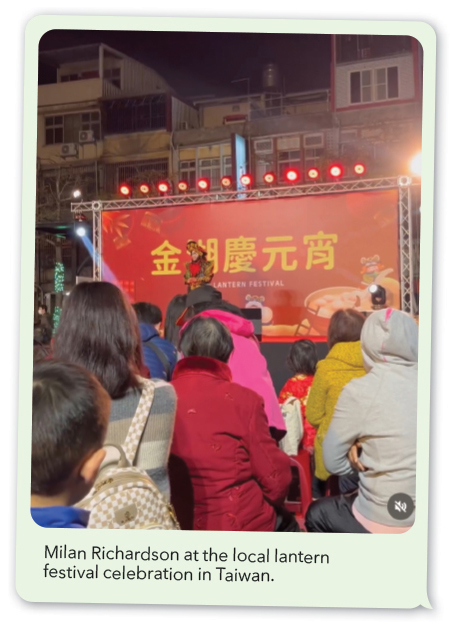
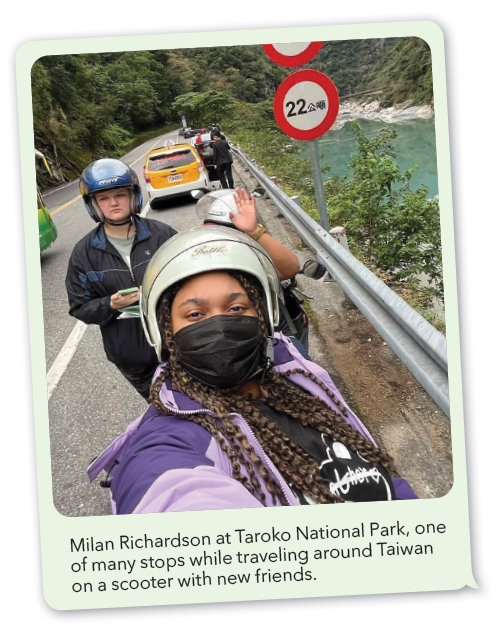
While she may be new to teaching in Taiwan, Richardson brings with her four years as an English and math tutor and a minor in Mandarin. “Taiwan was so different from any place I’ve ever been to. I was overwhelmed at first,” says Richardson. “I like it a lot, now. In my second month, I applied for a scooter license. Now I ride around the island and have taken my scooter other places on trips.”
Diplomas earned. Visas in hand. Vaccines completed. Luggage packed. Destination confirmed. Last summer, UMBC’s eight participants in the 2023 – 2024 Fulbright U.S. Student Program checked off all the important items on their to-do lists. The only thing left was to get to their placements on islands and in landlocked countries, cities, and countrysides across East Asia and Eastern Europe. It’s easier written than done. To adapt well to a new community, job, language, and culture, they must practice the art of humility and flexibility as their roles shift regularly from teacher to student.
Leading the Fulbright charge
All technicalities aside, the Fulbright experience is the beginning of building an international network of teachers and researchers who share the diversity and possibility of the U.S. with the world. In return, across the globe, communities welcome the next generation of leaders into their cities, neighborhoods, schools, and homes to share their country’s history, innovations, and culture. Since Fulbright’s inception in 1946, these reciprocal acts of kindness have created multiple paths forward to lifelong worldwide collaboration and understanding based on the simple act of giving someone different than yourself a chance.
“The Fulbright Program truly demonstrates public diplomacy in action,” says Brian Souders, M.A.’19, TESOL, and Ph.D. ’09, language, literacy, and culture, the associate director of global learning at UMBC’s Center for Global Engagement. In this role, Souders, who received a 2023 Fulbright International Education Administrator award to Germany, has led hundreds of Retrievers through the Fulbright application process as UMBC’s Fulbright Program advisor. “Whether in the classroom as teachers, students, or researchers, recipients learn about the world as much as they share what it means to be from the U.S. and UMBC alumni,” says Souders.
Thanks to Souders’ guidance, UMBC is one of 57 doctoral universities nationwide and three in Maryland to receive a Fulbright Top Producing Institution designation for 2023 – 2024, for the third time in the last five years. In the last decade, more than 80 UMBC alumni have received Fulbright awards. Out of the 10 Retrievers who received a 2023 – 2024 Fulbright, eight are currently placed internationally, seven are ETAs and one is on a research grant.
The hard work of play
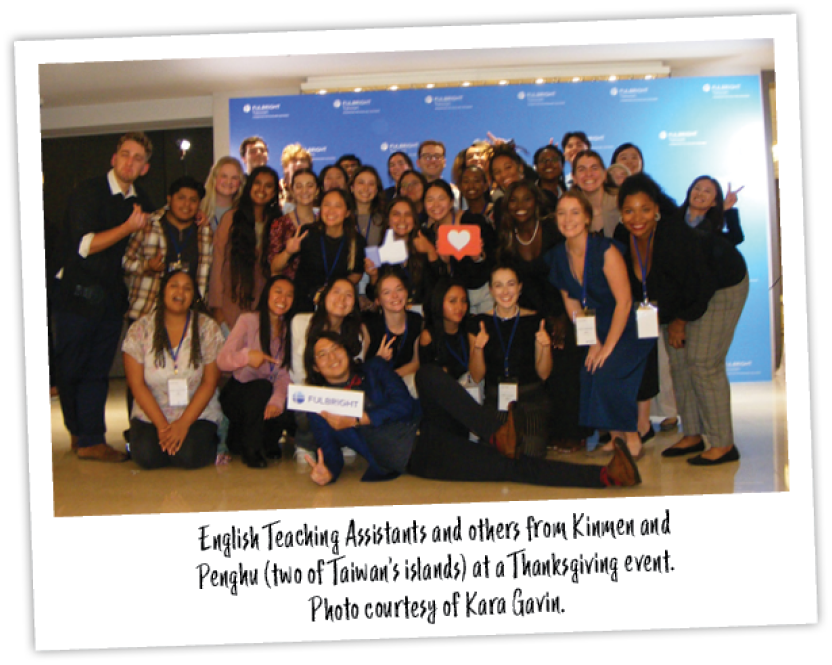
There are U.S. Fulbright student scholars in more than 100 countries worldwide. Three Retrievers were placed in Taiwan—they keep in touch regularly, see each other at ETA trainings, and are planning to travel together during their Fulbright year. But they all arrived in Taiwan separately and faced different challenges settling in.
“I arrived in Taiwan and immediately changed my plans because the airline lost my luggage,” says Humanities Scholar Kara Gavin ’20, English. She was grateful to have a carry-on. “It was chaotic. I was taking it all in,” says Gavin. A day and a 50-minute plane ride later, she arrived in Penghu County, Taiwan, an archipelago of about 90 islands between China and the main island of Taiwan. “The little beach town is in its own little world,” says Gavin. “The smell of the sand gave me comfort.”
Gavin teaches beginner English at two local junior high schools. New to Asia and Mandarin, Gavin’s thinking cap is on 24 – 7, including learning Mandarin in between teaching classes. “Living independently for the first time is hard on its own, but doing it in a foreign country is a whole other ball game,” says Gavin. “I’m acquiring many new life skills that will last me a lifetime.”
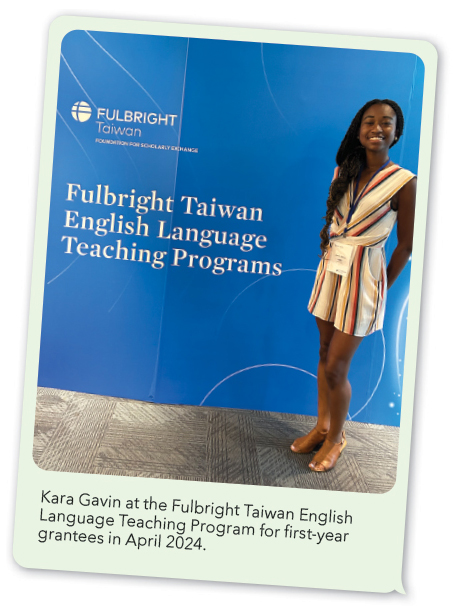
One of those is sympathizing with her students and anyone learning a new language and culture. “I teach the English pronunciation and spelling of a word,” says Gavin. “Then, they like to share the Mandarin equivalent with me. It’s all about patience, balance, and trust.” She also models intercultural teamwork by developing and teaching lessons with her bilingual (Mandarin/English) Taiwanese co-teacher to foster student engagement and enrichment.
For Fulbright Scholars, it is equally important to engage with communities beyond the classroom. When they apply for the grant, the Fulbright Program asks them to develop ideas to share their passions and skills in a community project. For Gavin, this meant adding a little drama to have a lot of fun. As a performing artist, Gavin knows the theatre can be a powerful community-building outlet. “I wanted to encourage students and other community members to express themselves and share their culture with me and others,” says Gavin.
She found a kindred spirit in a professor at a local university. They formed a drama club at the university for English language learners at all levels to explore American play formats with Taiwanese traditions and histories.“Writing original bilingual plays, in English and Mandarin, based on folktales about island traditions is creating an artistic and fun cultural exchange and understanding outside of my ETA duties,” says Gavin.
Finding the right pace
For fellow Humanities Scholar Nailah-Benā Chambers ’23, global studies, a Fulbright award to Taiwan was a natural next step. Chambers began learning Mandarin and all things Taiwanese in sixth grade at a Taiwanese Mandarin language immersion school in her hometown of Richmond, Virginia. As her Mandarin improved, she tutored other English speakers. This oscillating pattern of being a student and a teacher makes Chambers adaptable and persistent, she says.
But it hasn’t always been easy. When she first visited Taipei, Taiwan, in the spring of 2023 on a Mandarin language-intensive study abroad program, “I was so confident. I walked into a 7-Eleven to shop. No one could understand me,” says Chambers. “It was a bit embarrassing. Even with my language and cultural skills, I had a long way to go to mastering Mandarin.”
Now on her Fulbright ETA grant, Chambers arrived on solid ground, both culturally and linguistically. “I felt such a sense of calm and familiarity. Taiwan is so welcoming,” says Chambers. “It calms you down. Things are much slower here than in the U.S.” Soon enough, Chambers was balancing classrooms at Huludun Elementary and Fu Chun Elementary in Taichung City, on the main island of Taiwan, with students at both schools on the extreme spectrum of English proficiency.
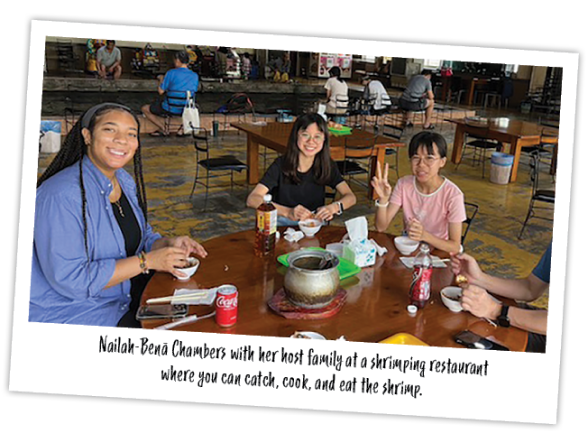
The upside of working with proficient English language learners is connecting on more advanced topics and sticking to Fulbright’s English-only immersion model. At one of her schools, the students are beginning English language learners, and the administrators only speak Mandarin. “My experience as a bilingual teacher and learner with a high level of understanding of the local language and culture has helped with classroom management and fostering powerful connections with students and administrators,” says Chambers. “It also helps to advance their grasp of the nuances of American English, especially when there are gray areas or misunderstandings.”
Keeping your ears open
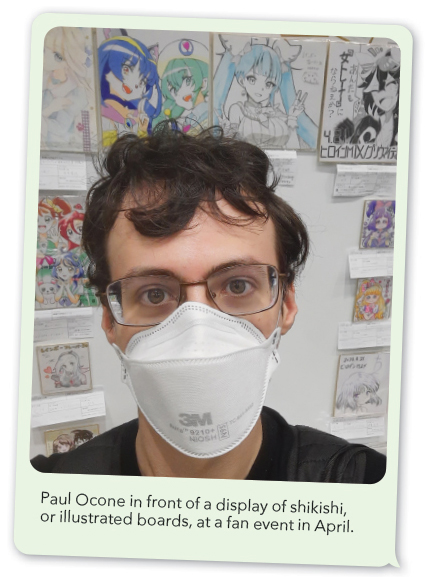
Watching anime, reading manga, (Japanese graphic novels), and participating in their fandom inspired Paul Ocone ’22, individualized study, a Linehan Artist Scholar, to research these subjects and learn Japanese. “I have deeply engaged in fan social life and communities—from leading an anime club to participating in and running conventions to moderating online communities—my affinity for and interest in anime fan spaces runs deep,” says Ocone. Part of Ocone’s observations include witnessing how some fan subcultures limit their membership in fear that a broader fanbase would weaken their subculture identity. In contrast, he says, other fan subcultures are more flexible while maintaining their identity.
Interested in adding to his initial research in U.S. fan spaces, Ocone is now at the epicenter of anime and manga culture as a Fulbright Student Researcher doing anthropological research with Morikawa Kaichirō, a leading scholar in this field at Meiji University’s School of Global Japanese Studies in Tokyo, also home to the Yoshihiro Yonezawa Memorial Library of Manga and Subcultures.
“I have had some amazing experiences participating in anime pilgrimage or anime tourism, including learning much from other fans and benefitting from their generosity,” says Ocone. “My Japanese is conversational—sometimes it’s challenging to understand specialized topics, but this has not deterred me from adding anime and manga tourism as a second research project.” In January, Ocone presented his work at the Popular Culture Tourism Stakeholders Summit in Japan.
Ocone is a sort of tourist himself, enjoying various aspects of Japanese pop culture. The daily musicality of Tokyo teaches him about enjoying the rhythm of the day. “Each train station plays a unique melody when the train departs,” says Ocone. These melodies or “hassha merodii,” are catchy and echo around in his brain like the convenience store jingles that also greet customers. “I was happily surprised when I heard a loudspeaker playing a symphony in my neighborhood,” says Ocone. “Another one played the following day and the next. I learned this was a daily sunset ritual.” He knows these sound experiences will play in his head long after returning to the U.S.
Learning new languages
This is not the first time David Bullman ’22, ancient studies, visited North Macedonia. He first went in 1995 as a performing musician and public affairs representative for the U.S. Army.
“North Macedonia was very different coming out of the Cold War,” says Bullman. “The infrastructure and general state of repair of public spaces and businesses is much better than I recall from that time.”
Now, as an ETA, Bullman teaches British civilization and American civilization in addition to three different levels of English at the University of Totovo in the Republic of North Macedonia, a landlocked country north of Greece. In Totovo, students begin learning English in elementary school and are fluent by the time they reach college. “I thought I would be teaching English basics,” says Bullman, “but it’s been great to teach a complex subject in the context of where my students live.”
His students are equally glad to help him with the local language. Macedonian and Albanian are the country’s two official languages. Bullman began learning some key Macedonian phrases in preparation for his trip. However, Albanian is the preferred language in Tetovo. After traveling with the Army to more than 15 countries on three continents, Bullman is used to rapidly switching gears and accepting help.
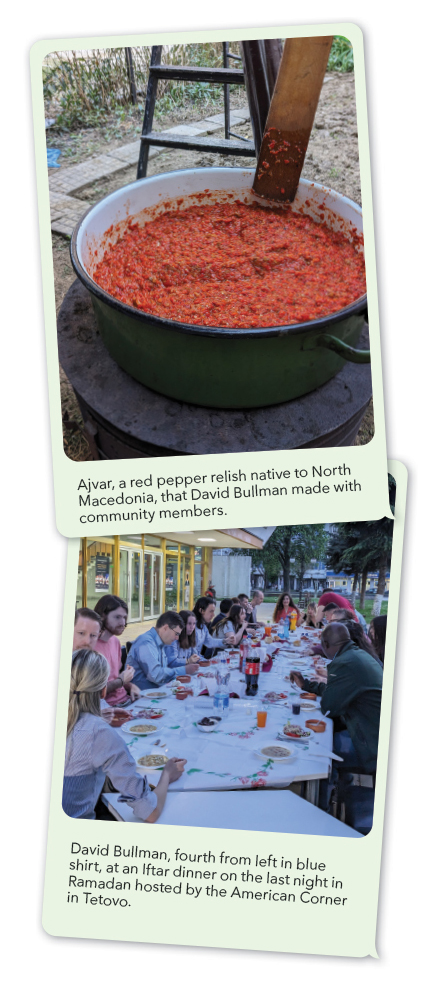
He eagerly takes on the student role when it comes to learning about new foods. Bullman’s apartment faces the Hapësira Socio-Kulturore Tetovë, a community center where locals and the nearby Peace Corps Volunteers sometimes organize activities, like an ajvar-making gathering. Ajvar is a delicacy across the Balkans made every fall. It’s a tradition passed down through centuries with many recipe variations. “Ajvar is made by charring red bell peppers that are then peeled, minced, seasoned, and cooked for hours,” says Bullman. It boils down to a relish that can be preserved for months, but locals tell Bullman that’s rare because it’s too good to keep for even one week. After participating in the preparation and getting to take home a few jars, Bullman agrees with the locals. Ajvar is now his go-to condiment on eggs, pasta, toast—anything goes.
Albanian and cooking are not the only languages Bullman tapped into while in Tetovo. As a lifelong clarinet player, Bullman hoped to create a musical exchange with local musicians. The opportunity presented itself when the dean of the Faculty of Art wanted to celebrate Thanksgiving. Bullman collaborated with the music faculty, the orchestra director, and students to create a concert of six songs. “I’m glad I returned to North Macedonia. The people are as warm and friendly as I remembered them to be,” says Bullman. “I wanted to come back and experience it myself again.”
Tapping into curiosity
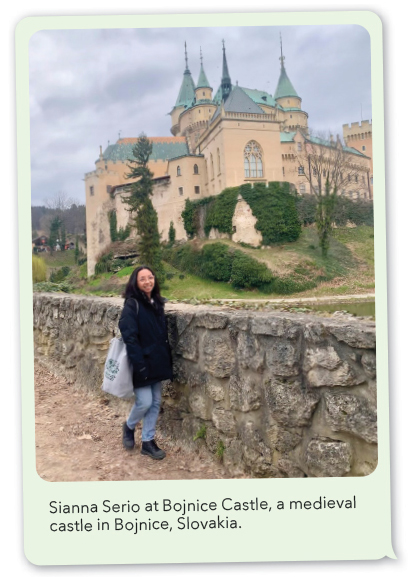
On her way to her Fulbright placement, Sianna Serio ’23, computer science, went city hopping. “I was headed to Žilina, Slovakia, east of Austria and south of Poland,” says Serio. “I flew into Vienna, Austria, then I took a one-hour bus ride crossing Austria’s eastern border into Slovakia to get to Bratislava, the capital.“ There she met other ETAs for orientation. “A week later, I hopped on a two-hour train ride to my teaching placement in Žilina and I met my wonderful mentor, Maria Veršova, who became my second mom.”
Serio teaches at the Hotel Academy, Žilina. The academy focuses on hotel management, gastronomy, and tourism. “My students are beginning English language learners,” says Serio. “I teach what the class is interested in, like American pop culture, because they rarely meet a native English speaker.” During outings with her students, they ask about a wide range of topics. “There are many topics that I would not have thought to cover if it were not for time spent outside of the classroom,” says Serio, “Some of those conversations became formal lessons, like the lesson on the three branches of the U. S. government.”
Serio appreciates her students’ curiosity. She tapped into her love of website development and design to improve her students’ confidence in writing and speaking English and prepare for their Maturita exam, a national high school exit exam. “Some of my students are helping me design a class webpage for them where I will showcase their class and post some of their practice writing in English,” says Serio. “These posts will include topics covered in the Maturita exam, information about their school, and answers to questions about Slovakia.”
Serio’s mentor Maria Veršova, head of the English department, is her motivation. She guides her through lesson planning, class schedules, and the challenges of relocating to a new country. “When my original housing plans fell through, Maria found housing for me five minutes from her house,” says Serio. “She helped me find health insurance and open a bank account. Her husband set up my internet.” They have welcomed Serio almost daily into their home for dinner, tea, coffee, or wine. Serio is a gracious guest and lent her graphic design expertise to help Veršova design invitation cards for her 50th birthday party. Veršova tells Serio she will always have a place to stay in Žilina.
Fulbright: The next generation
Teaching has defined the last decade for Tiffany Powell, a master’s student in UMBC’s TESOL program, a passion she invested in as an English language learner teacher in Seoul and in Miryang City, South Korea, for five years, and in Florida this past year. Now, she is in Iași, Romania, southwest of Ukraine, at the Alexandru Ioan Cuza University teaching American studies. Powell is committed to bridging culture, community, and belonging by bringing technology into the classroom.
Powell also decided to bring the research and cultural understanding closer to home by partnering with Romanian teachers to develop a five-part series on African American women’s history. “We talked about Black women in science in the context of the movie Hidden Figures and discussed Hollywood’s portrayal of Black life,” says Powell. The class is now creating a series on Romanian women. Helping students better understand the similarities and differences between U.S. and Romanian cultures has been an eye-opening experience for Powell.
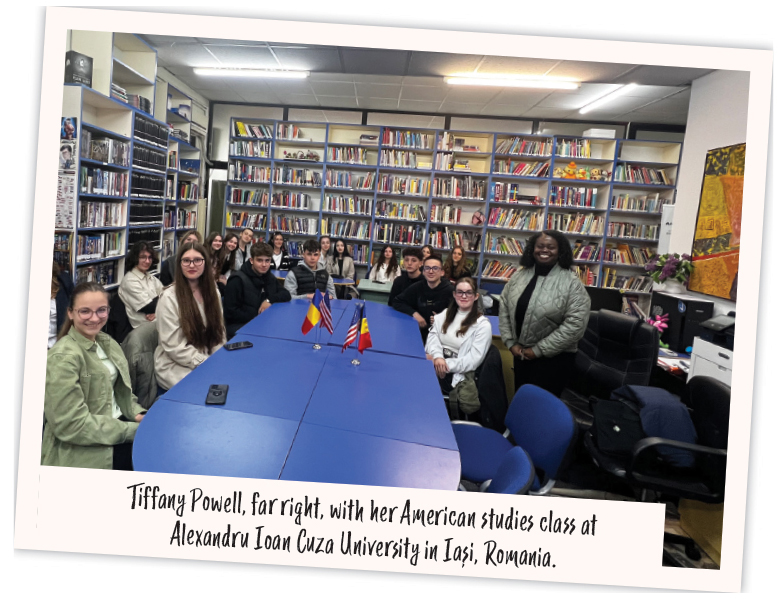
She sees the impact of a country formerly under communism. In Iași, sometimes the internet doesn’t work and, in her school, there are no clubs or student organizations to gain the skills needed to earn a Fulbright award. “My students have given me a new perspective. You may want to come in and make changes, but you must understand where they’re coming from. There is a saying in Iași, ‘It’s not impossible. It’s just difficult,’” says Powell. She is trying to help with the difficult part by leading Fulbright application and leadership workshops.
Powell, like the other Fulbrighters, will bring her experiences home with her and wherever she ends up teaching English next. When their Fulbright year ends, these Retriever ambassadors will find themselves as emissaries yet again, returning to their hometowns, sharing the good news of ajvar made in community, the freedom of a scooter ride along a Taiwanese beach, or the correct stroke order for writing the Mandarin number five. The lessons their students and host families passed along—including pausing to take a breath and appreciate their international successes small and large—will continue to form and shape the way they see the world.
“Having a flexible mindset and under-standing the historical context of your placement is key,” says Powell. “I carry myself as a U.S. representative. Living abroad teaches humility, adaptability, and open-mindedness to press on through challenging times.”
]]>
International travel offers ample opportunities to stretch yourself—one minute you may be the expert and the next, completely clueless about how something works. Retrievers currently in the...
https://umbc.edu/stories/a-journey-of-growth/
https://my3.my.umbc.edu/api/v0/pixel/news/142391/guest@my.umbc.edu/429a43e449ef9d4187b1ae1d4e63ca4e/api/pixel
alumni
ancient-studies
bioinformatics-and-computational-biology
cahss
cge
computer-science
education-abroad
english
feature
fulbright
global-studies
humanities
inds
linehan
llc
magazine
meyerhoff
spring-2024
story
UMBC News & Magazine
https://my3.my.umbc.edu/groups/umbc-news-magazine
https://assets1-my.umbc.edu/system/shared/avatars/groups/000/001/943/24435aa6207c452e7bc15cc74b42c7bb/xsmall.png?1748556657
https://assets1-my.umbc.edu/system/shared/avatars/groups/000/001/943/24435aa6207c452e7bc15cc74b42c7bb/original.png?1748556657
https://assets2-my.umbc.edu/system/shared/avatars/groups/000/001/943/24435aa6207c452e7bc15cc74b42c7bb/xxlarge.png?1748556657
https://assets2-my.umbc.edu/system/shared/avatars/groups/000/001/943/24435aa6207c452e7bc15cc74b42c7bb/xlarge.png?1748556657
https://assets3-my.umbc.edu/system/shared/avatars/groups/000/001/943/24435aa6207c452e7bc15cc74b42c7bb/large.png?1748556657
https://assets1-my.umbc.edu/system/shared/avatars/groups/000/001/943/24435aa6207c452e7bc15cc74b42c7bb/medium.png?1748556657
https://assets2-my.umbc.edu/system/shared/avatars/groups/000/001/943/24435aa6207c452e7bc15cc74b42c7bb/small.png?1748556657
https://assets1-my.umbc.edu/system/shared/avatars/groups/000/001/943/24435aa6207c452e7bc15cc74b42c7bb/xsmall.png?1748556657
https://assets2-my.umbc.edu/system/shared/avatars/groups/000/001/943/24435aa6207c452e7bc15cc74b42c7bb/xxsmall.png?1748556657
UMBC News & Magazine
5
0
false
Wed, 29 May 2024 14:32:52 -0400
A Journey of Growth
International travel offers ample opportunities to stretch yourself—one minute you may be the expert and the next, completely clueless about how something works. Retrievers currently in the Fulbright U.S. Student Program—teaching English or researching around the globe—find themselves oscillating between their teaching and student roles on a daily or hourly basis. By engaging their host communities through openness and cultural humility (and many shared cups of tea or coffee), these Fulbrighters are finding their balance along the way.
All eyes are on Milan Richardson ’23 as she helps her co-teacher keep score in a Jeopardy-like game her students are playing. Richardson teaches English to several classes of first through sixth-grade students at Jinsha Elementary School in Kinmen County, Taiwan. As she completes the Mandarin character for the numeral 5, a wave of giggles and chatter flows through the room.
Similar to a U.S. tally—four strokes and a strike though, the Mandarin character has 5 strokes total and needs to be written a certain way to represent 1, 2, 3, 4, or 5. “The students were so confused because I wrote the character strokes in the wrong order,” says Richardson, who is used to solving complex math as a Meyerhoff Scholar having earned a bachelor’s degree in bioinformatics and computational biology and minors in computer science and modern, languages, linguistics, and intercultural communication.
“I wanted to write the character correctly. I asked, and they showed me the proper order to write the strokes,” says Richardson, a Fulbright English Teaching Assistant (ETA). “They started clapping once I got it right. This was one of the many cool moments where my students were able to teach me.”
While she may be new to teaching in Taiwan, Richardson brings with her four years as an English and math tutor and a minor in Mandarin. “Taiwan was so different from any place I’ve ever been to. I was overwhelmed at first,” says Richardson. “I like it a lot, now. In my second month, I applied for a scooter license. Now I ride around the island and have taken my scooter other places on trips.”
Diplomas earned. Visas in hand. Vaccines completed. Luggage packed. Destination confirmed. Last summer, UMBC’s eight participants in the 2023 – 2024 Fulbright U.S. Student Program checked off all the important items on their to-do lists. The only thing left was to get to their placements on islands and in landlocked countries, cities, and countrysides across East Asia and Eastern Europe. It’s easier written than done. To adapt well to a new community, job, language, and culture, they must practice the art of humility and flexibility as their roles shift regularly from teacher to student.
Leading the Fulbright charge
All technicalities aside, the Fulbright experience is the beginning of building an international network of teachers and researchers who share the diversity and possibility of the U.S. with the world. In return, across the globe, communities welcome the next generation of leaders into their cities, neighborhoods, schools, and homes to share their country’s history, innovations, and culture. Since Fulbright’s inception in 1946, these reciprocal acts of kindness have created multiple paths forward to lifelong worldwide collaboration and understanding based on the simple act of giving someone different than yourself a chance.
“The Fulbright Program truly demonstrates public diplomacy in action,” says Brian Souders, M.A.’19, TESOL, and Ph.D. ’09, language, literacy, and culture, the associate director of global learning at UMBC’s Center for Global Engagement. In this role, Souders, who received a 2023 Fulbright International Education Administrator award to Germany, has led hundreds of Retrievers through the Fulbright application process as UMBC’s Fulbright Program advisor. “Whether in the classroom as teachers, students, or researchers, recipients learn about the world as much as they share what it means to be from the U.S. and UMBC alumni,” says Souders.
Thanks to Souders’ guidance, UMBC is one of 57 doctoral universities nationwide and three in Maryland to receive a Fulbright Top Producing Institution designation for 2023 – 2024, for the third time in the last five years. In the last decade, more than 80 UMBC alumni have received Fulbright awards. Out of the 10 Retrievers who received a 2023 – 2024 Fulbright, eight are currently placed internationally, seven are ETAs and one is on a research grant.
The hard work of play
There are U.S. Fulbright student scholars in more than 100 countries worldwide. Three Retrievers were placed in Taiwan—they keep in touch regularly, see each other at ETA trainings, and are planning to travel together during their Fulbright year. But they all arrived in Taiwan separately and faced different challenges settling in.
“I arrived in Taiwan and immediately changed my plans because the airline lost my luggage,” says Humanities Scholar Kara Gavin ’20, English. She was grateful to have a carry-on. “It was chaotic. I was taking it all in,” says Gavin. A day and a 50-minute plane ride later, she arrived in Penghu County, Taiwan, an archipelago of about 90 islands between China and the main island of Taiwan. “The little beach town is in its own little world,” says Gavin. “The smell of the sand gave me comfort.”
Gavin teaches beginner English at two local junior high schools. New to Asia and Mandarin, Gavin’s thinking cap is on 24 – 7, including learning Mandarin in between teaching classes. “Living independently for the first time is hard on its own, but doing it in a foreign country is a whole other ball game,” says Gavin. “I’m acquiring many new life skills that will last me a lifetime.”
One of those is sympathizing with her students and anyone learning a new language and culture. “I teach the English pronunciation and spelling of a word,” says Gavin. “Then, they like to share the Mandarin equivalent with me. It’s all about patience, balance, and trust.” She also models intercultural teamwork by developing and teaching lessons with her bilingual (Mandarin/English) Taiwanese co-teacher to foster student engagement and enrichment.
For Fulbright Scholars, it is equally important to engage with communities beyond the classroom. When they apply for the grant, the Fulbright Program asks them to develop ideas to share their passions and skills in a community project. For Gavin, this meant adding a little drama to have a lot of fun. As a performing artist, Gavin knows the theatre can be a powerful community-building outlet. “I wanted to encourage students and other community members to express themselves and share their culture with me and others,” says Gavin.
She found a kindred spirit in a professor at a local university. They formed a drama club at the university for English language learners at all levels to explore American play formats with Taiwanese traditions and histories.“Writing original bilingual plays, in English and Mandarin, based on folktales about island traditions is creating an artistic and fun cultural exchange and understanding outside of my ETA duties,” says Gavin.
Finding the right pace
For fellow Humanities Scholar Nailah-Benā Chambers ’23, global studies, a Fulbright award to Taiwan was a natural next step. Chambers began learning Mandarin and all things Taiwanese in sixth grade at a Taiwanese Mandarin language immersion school in her hometown of Richmond, Virginia. As her Mandarin improved, she tutored other English speakers. This oscillating pattern of being a student and a teacher makes Chambers adaptable and persistent, she says.
But it hasn’t always been easy. When she first visited Taipei, Taiwan, in the spring of 2023 on a Mandarin language-intensive study abroad program, “I was so confident. I walked into a 7-Eleven to shop. No one could understand me,” says Chambers. “It was a bit embarrassing. Even with my language and cultural skills, I had a long way to go to mastering Mandarin.”
Now on her Fulbright ETA grant, Chambers arrived on solid ground, both culturally and linguistically. “I felt such a sense of calm and familiarity. Taiwan is so welcoming,” says Chambers. “It calms you down. Things are much slower here than in the U.S.” Soon enough, Chambers was balancing classrooms at Huludun Elementary and Fu Chun Elementary in Taichung City, on the main island of Taiwan, with students at both schools on the extreme spectrum of English proficiency.
The upside of working with proficient English language learners is connecting on more advanced topics and sticking to Fulbright’s English-only immersion model. At one of her schools, the students are beginning English language learners, and the administrators only speak Mandarin. “My experience as a bilingual teacher and learner with a high level of understanding of the local language and culture has helped with classroom management and fostering powerful connections with students and administrators,” says Chambers. “It also helps to advance their grasp of the nuances of American English, especially when there are gray areas or misunderstandings.”
Keeping your ears open
Watching anime, reading manga, (Japanese graphic novels), and participating in their fandom inspired Paul Ocone ’22, individualized study, a Linehan Artist Scholar, to research these subjects and learn Japanese. “I have deeply engaged in fan social life and communities—from leading an anime club to participating in and running conventions to moderating online communities—my affinity for and interest in anime fan spaces runs deep,” says Ocone. Part of Ocone’s observations include witnessing how some fan subcultures limit their membership in fear that a broader fanbase would weaken their subculture identity. In contrast, he says, other fan subcultures are more flexible while maintaining their identity.
Interested in adding to his initial research in U.S. fan spaces, Ocone is now at the epicenter of anime and manga culture as a Fulbright Student Researcher doing anthropological research with Morikawa Kaichirō, a leading scholar in this field at Meiji University’s School of Global Japanese Studies in Tokyo, also home to the Yoshihiro Yonezawa Memorial Library of Manga and Subcultures.
“I have had some amazing experiences participating in anime pilgrimage or anime tourism, including learning much from other fans and benefitting from their generosity,” says Ocone. “My Japanese is conversational—sometimes it’s challenging to understand specialized topics, but this has not deterred me from adding anime and manga tourism as a second research project.” In January, Ocone presented his work at the Popular Culture Tourism Stakeholders Summit in Japan.
Ocone is a sort of tourist himself, enjoying various aspects of Japanese pop culture. The daily musicality of Tokyo teaches him about enjoying the rhythm of the day. “Each train station plays a unique melody when the train departs,” says Ocone. These melodies or “hassha merodii,” are catchy and echo around in his brain like the convenience store jingles that also greet customers. “I was happily surprised when I heard a loudspeaker playing a symphony in my neighborhood,” says Ocone. “Another one played the following day and the next. I learned this was a daily sunset ritual.” He knows these sound experiences will play in his head long after returning to the U.S.
Learning new languages
This is not the first time David Bullman ’22, ancient studies, visited North Macedonia. He first went in 1995 as a performing musician and public affairs representative for the U.S. Army.
“North Macedonia was very different coming out of the Cold War,” says Bullman. “The infrastructure and general state of repair of public spaces and businesses is much better than I recall from that time.”
Now, as an ETA, Bullman teaches British civilization and American civilization in addition to three different levels of English at the University of Totovo in the Republic of North Macedonia, a landlocked country north of Greece. In Totovo, students begin learning English in elementary school and are fluent by the time they reach college. “I thought I would be teaching English basics,” says Bullman, “but it’s been great to teach a complex subject in the context of where my students live.”
His students are equally glad to help him with the local language. Macedonian and Albanian are the country’s two official languages. Bullman began learning some key Macedonian phrases in preparation for his trip. However, Albanian is the preferred language in Tetovo. After traveling with the Army to more than 15 countries on three continents, Bullman is used to rapidly switching gears and accepting help.
He eagerly takes on the student role when it comes to learning about new foods. Bullman’s apartment faces the Hapësira Socio-Kulturore Tetovë, a community center where locals and the nearby Peace Corps Volunteers sometimes organize activities, like an ajvar-making gathering. Ajvar is a delicacy across the Balkans made every fall. It’s a tradition passed down through centuries with many recipe variations. “Ajvar is made by charring red bell peppers that are then peeled, minced, seasoned, and cooked for hours,” says Bullman. It boils down to a relish that can be preserved for months, but locals tell Bullman that’s rare because it’s too good to keep for even one week. After participating in the preparation and getting to take home a few jars, Bullman agrees with the locals. Ajvar is now his go-to condiment on eggs, pasta, toast—anything goes.
Albanian and cooking are not the only languages Bullman tapped into while in Tetovo. As a lifelong clarinet player, Bullman hoped to create a musical exchange with local musicians. The opportunity presented itself when the dean of the Faculty of Art wanted to celebrate Thanksgiving. Bullman collaborated with the music faculty, the orchestra director, and students to create a concert of six songs. “I’m glad I returned to North Macedonia. The people are as warm and friendly as I remembered them to be,” says Bullman. “I wanted to come back and experience it myself again.”
Tapping into curiosity
On her way to her Fulbright placement, Sianna Serio ’23, computer science, went city hopping. “I was headed to Žilina, Slovakia, east of Austria and south of Poland,” says Serio. “I flew into Vienna, Austria, then I took a one-hour bus ride crossing Austria’s eastern border into Slovakia to get to Bratislava, the capital.“ There she met other ETAs for orientation. “A week later, I hopped on a two-hour train ride to my teaching placement in Žilina and I met my wonderful mentor, Maria Veršova, who became my second mom.”
Serio teaches at the Hotel Academy, Žilina. The academy focuses on hotel management, gastronomy, and tourism. “My students are beginning English language learners,” says Serio. “I teach what the class is interested in, like American pop culture, because they rarely meet a native English speaker.” During outings with her students, they ask about a wide range of topics. “There are many topics that I would not have thought to cover if it were not for time spent outside of the classroom,” says Serio, “Some of those conversations became formal lessons, like the lesson on the three branches of the U. S. government.”
Serio appreciates her students’ curiosity. She tapped into her love of website development and design to improve her students’ confidence in writing and speaking English and prepare for their Maturita exam, a national high school exit exam. “Some of my students are helping me design a class webpage for them where I will showcase their class and post some of their practice writing in English,” says Serio. “These posts will include topics covered in the Maturita exam, information about their school, and answers to questions about Slovakia.”
Serio’s mentor Maria Veršova, head of the English department, is her motivation. She guides her through lesson planning, class schedules, and the challenges of relocating to a new country. “When my original housing plans fell through, Maria found housing for me five minutes from her house,” says Serio. “She helped me find health insurance and open a bank account. Her husband set up my internet.” They have welcomed Serio almost daily into their home for dinner, tea, coffee, or wine. Serio is a gracious guest and lent her graphic design expertise to help Veršova design invitation cards for her 50th birthday party. Veršova tells Serio she will always have a place to stay in Žilina.
Fulbright: The next generation
Teaching has defined the last decade for Tiffany Powell, a master’s student in UMBC’s TESOL program, a passion she invested in as an English language learner teacher in Seoul and in Miryang City, South Korea, for five years, and in Florida this past year. Now, she is in Iași, Romania, southwest of Ukraine, at the Alexandru Ioan Cuza University teaching American studies. Powell is committed to bridging culture, community, and belonging by bringing technology into the classroom.
Powell also decided to bring the research and cultural understanding closer to home by partnering with Romanian teachers to develop a five-part series on African American women’s history. “We talked about Black women in science in the context of the movie Hidden Figures and discussed Hollywood’s portrayal of Black life,” says Powell. The class is now creating a series on Romanian women. Helping students better understand the similarities and differences between U.S. and Romanian cultures has been an eye-opening experience for Powell.
She sees the impact of a country formerly under communism. In Iași, sometimes the internet doesn’t work and, in her school, there are no clubs or student organizations to gain the skills needed to earn a Fulbright award. “My students have given me a new perspective. You may want to come in and make changes, but you must understand where they’re coming from. There is a saying in Iași, ‘It’s not impossible. It’s just difficult,’” says Powell. She is trying to help with the difficult part by leading Fulbright application and leadership workshops.
Powell, like the other Fulbrighters, will bring her experiences home with her and wherever she ends up teaching English next. When their Fulbright year ends, these Retriever ambassadors will find themselves as emissaries yet again, returning to their hometowns, sharing the good news of ajvar made in community, the freedom of a scooter ride along a Taiwanese beach, or the correct stroke order for writing the Mandarin number five. The lessons their students and host families passed along—including pausing to take a breath and appreciate their international successes small and large—will continue to form and shape the way they see the world.
“Having a flexible mindset and under-standing the historical context of your placement is key,” says Powell. “I carry myself as a U.S. representative. Living abroad teaches humility, adaptability, and open-mindedness to press on through challenging times.”
]]>
International travel offers ample opportunities to stretch yourself—one minute you may be the expert and the next, completely clueless about how something works. Retrievers currently in the...
https://umbc.edu/stories/a-journey-of-growth-retriever-fulbright/
https://my3.my.umbc.edu/api/v0/pixel/news/142404/guest@my.umbc.edu/ed280c216f570c718be808f58bf7c55a/api/pixel
alumni
ancient-studies
bioinformatics-and-computational-biology
cahss
cge
computer-science
education-abroad
english
feature
fulbright
global-studies
humanities
inds
linehan
llc
magazine
meyerhoff
spring-2024
story
UMBC News & Magazine
https://my3.my.umbc.edu/groups/umbc-news-magazine
https://assets1-my.umbc.edu/system/shared/avatars/groups/000/001/943/24435aa6207c452e7bc15cc74b42c7bb/xsmall.png?1748556657
https://assets1-my.umbc.edu/system/shared/avatars/groups/000/001/943/24435aa6207c452e7bc15cc74b42c7bb/original.png?1748556657
https://assets2-my.umbc.edu/system/shared/avatars/groups/000/001/943/24435aa6207c452e7bc15cc74b42c7bb/xxlarge.png?1748556657
https://assets2-my.umbc.edu/system/shared/avatars/groups/000/001/943/24435aa6207c452e7bc15cc74b42c7bb/xlarge.png?1748556657
https://assets3-my.umbc.edu/system/shared/avatars/groups/000/001/943/24435aa6207c452e7bc15cc74b42c7bb/large.png?1748556657
https://assets1-my.umbc.edu/system/shared/avatars/groups/000/001/943/24435aa6207c452e7bc15cc74b42c7bb/medium.png?1748556657
https://assets2-my.umbc.edu/system/shared/avatars/groups/000/001/943/24435aa6207c452e7bc15cc74b42c7bb/small.png?1748556657
https://assets1-my.umbc.edu/system/shared/avatars/groups/000/001/943/24435aa6207c452e7bc15cc74b42c7bb/xsmall.png?1748556657
https://assets2-my.umbc.edu/system/shared/avatars/groups/000/001/943/24435aa6207c452e7bc15cc74b42c7bb/xxsmall.png?1748556657
UMBC News & Magazine
0
0
false
Wed, 29 May 2024 14:32:52 -0400
7 ways to spring into the arts at UMBC
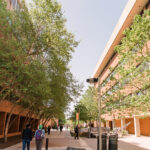
As flowers start popping up on campus and we get some warmer (if rainy) days, it’s the perfect time to go out and catch some of the arts events happening at UMBC. Whether you need a break from studying, work, or are just looking for some fun, you can be sure to find many entertaining and thought provoking arts and culture events happening on campus!
1. Enjoy an Artful Conversation All About Dance
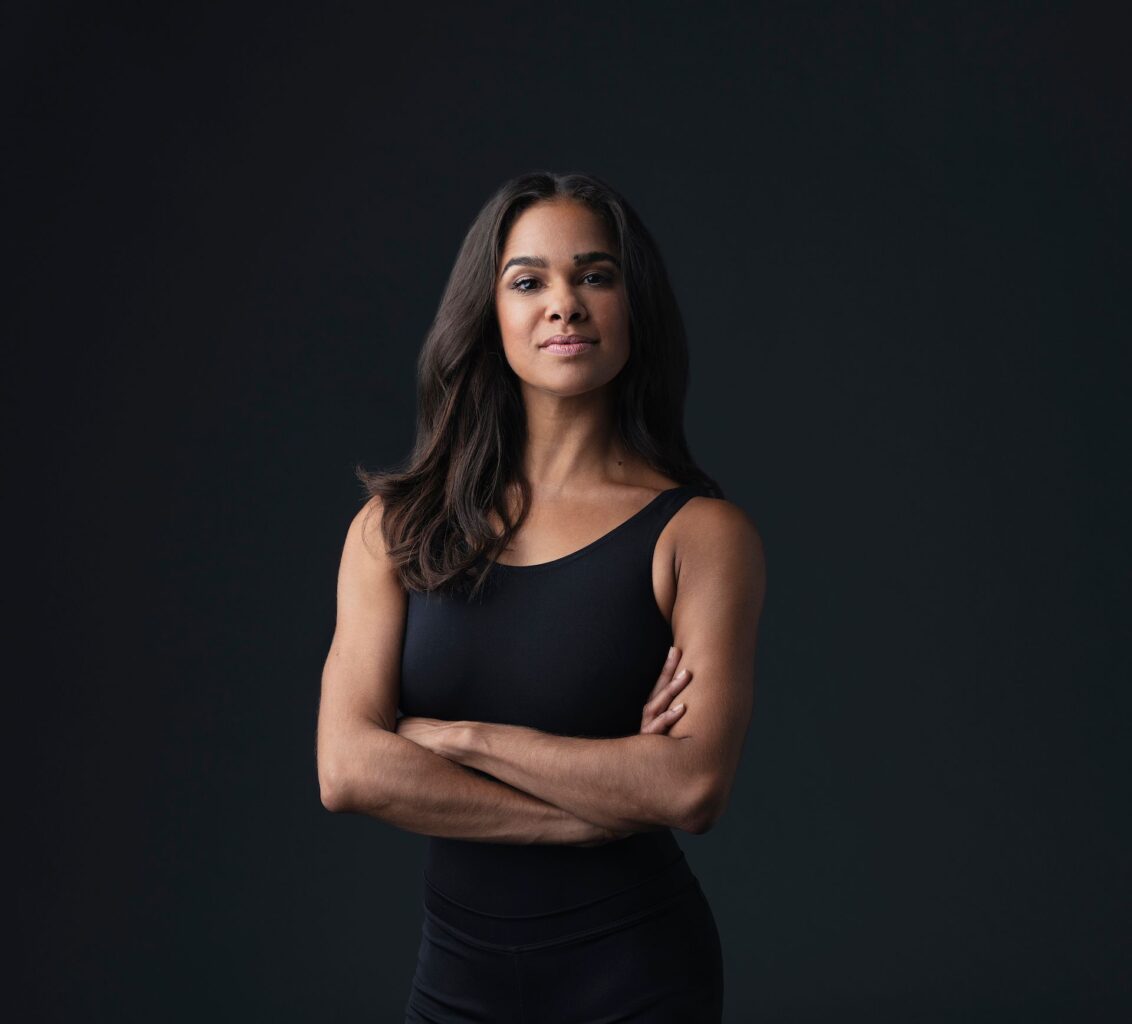
No dance skills are required to enjoy an evening all about dance with Artful Conversations: An Evening with Misty Copeland. On the night of March 6, from 6 to 7:30 p.m., Misty Copeland, the first African American female principal dancer with the American Ballet Theatre, and a New York Times best selling author, will be discussing topics all about dance and her historical performances. The night will begin with dance works performed by UMBC students and faculty. Later, in conversation with College of Art, Humanities, and Social Sciences Dean Kimberly Moffitt, Copeland will talk about her ground-breaking career.
In case the event is sold out or if you just want to watch on a later date, a livestream and recording will be available via the UMBC Youtube Channel. (Photo by Drew Gurian/MasterClass)

2. Bask in the Glow at a Poetry Reading
If you’re unable to make the Misty Copeland event, the English Department’s spring reading series event on March 6 features Taylor Johnson, poet laureate of Takoma Park, Maryland. Johnson is the author of Inheritance, and winner of the 2021 Norma Farber First Book Award from the Poetry Society of America. Inheritance was influenced by living in Washington, D.C., and it explores the complexities of language. The event, which includes a reading, Q&A, and book signing, is free, and runs from 4 to 5 p.m. in the Albin O. Kuhn Library. (Photo by Sean D. Henry-Smith)
3. Listen to an Enchanting Evening of Music from the Baltimore Symphony Orchestra
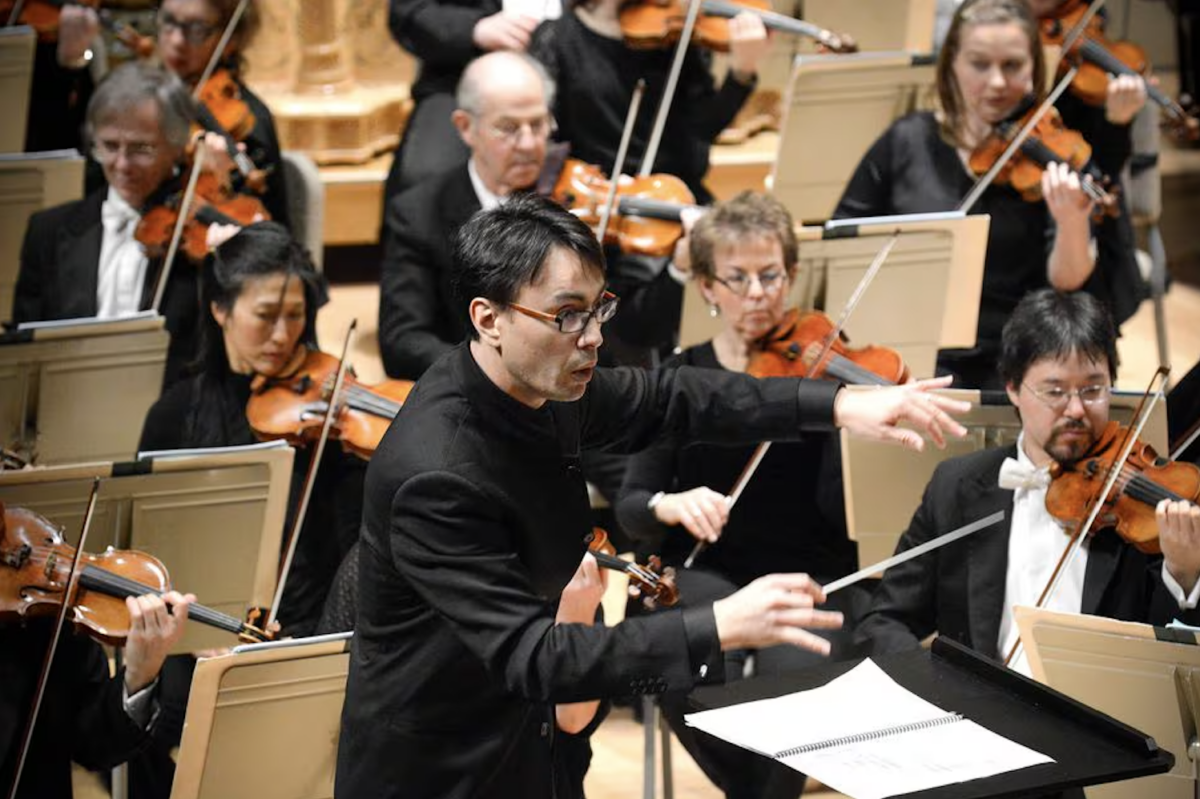
On March 8, the Baltimore Symphony Orchestra will perform at UMBC. The ensemble will be led by conductor Ken-David Masur. The program includes Tchaikovsky’s Fourth Symphony, Toshio Hosokawa’s Meditation to the victims of Tsunami 3.11, and the orchestra will be joined by cellist, Zlatomir Fung, for a performance of Camille Saint-Saëns’s Cello Concerto. The performance is being held at the Linehan Concert Hall from 8 to 10 p.m., and tickets are only $5 for students. (Ken-David Masur conducting. Photo taken by Stu Rosner.)
4. Join WMBC for its Entertaining Spring Music Festival
WMBC Radio, UMBC’s independent, student-run radio station, will be hosting their second annual music festival on March 29 in the UC Ballroom, from 6 to 11 p.m. The festival will be featuring some student artists, bands, and other creatives! The bill includes Fly by The Seat, Regan Lewis, Eat the Cake, and more. Don’t forget to check out the art vendors who will be there as well!
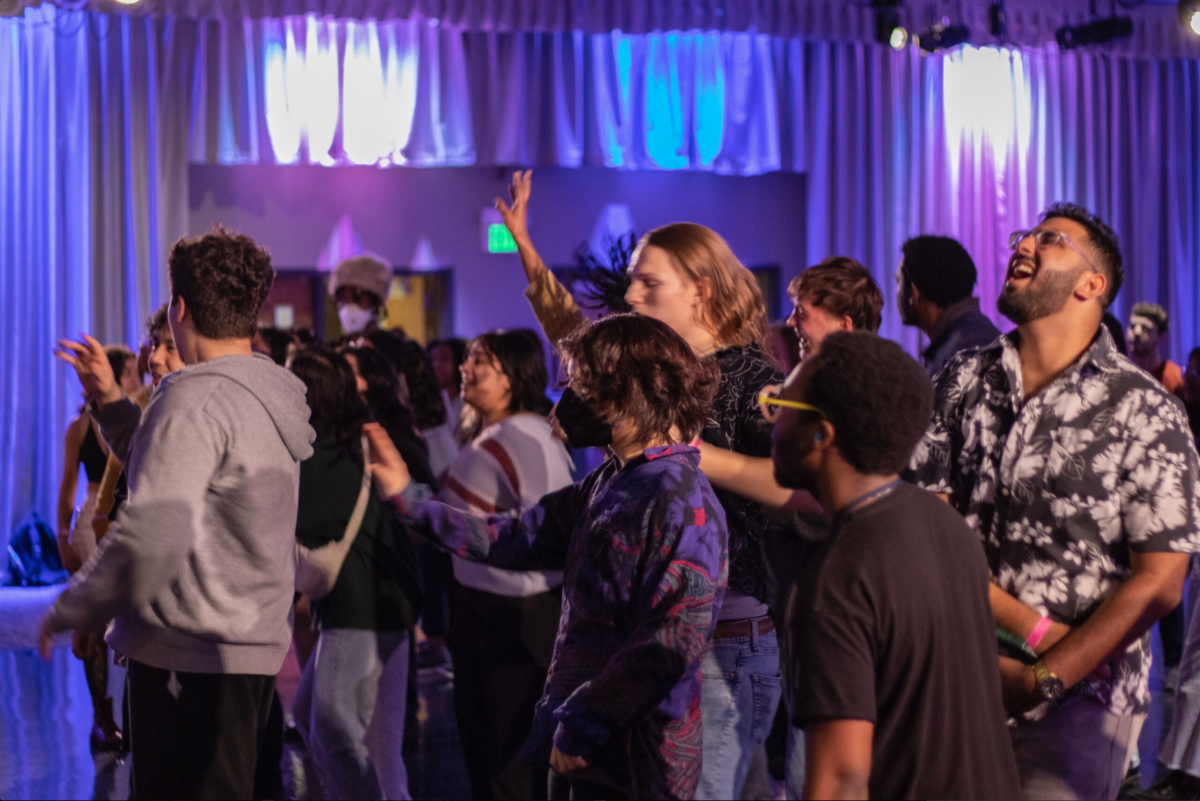 Students enjoying live music at WMBC’s Lonely Heart’s Club Music Festival on February 9, 2023. Event photos by Emily Bryant, Maya Classon, and Mason Doan.
5. Chuckle with Dog Collar at “Saturday Bite Live”
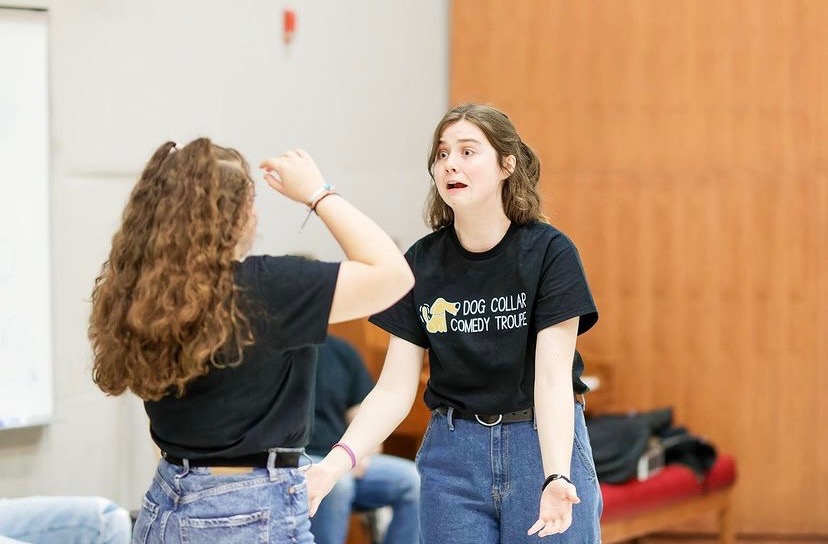
Either before or after WMBC’s music festival, stop by Saturday Bite Live, a free improv show put on by UMBC’s comedy troupe, Dog Collar. Contrary to its name, the show will be on a Friday, March 29, and will take place in the ITE building in room 104. Doors open at 7:30, and the show begins at 8 p.m. Come out and support these students while having a laugh! (Members of the Dog Collar troupe performing at the UMBC Gritty Kitties charity show. Photo by Anthony Rivera.)
6. Check out Plays for Our Planet
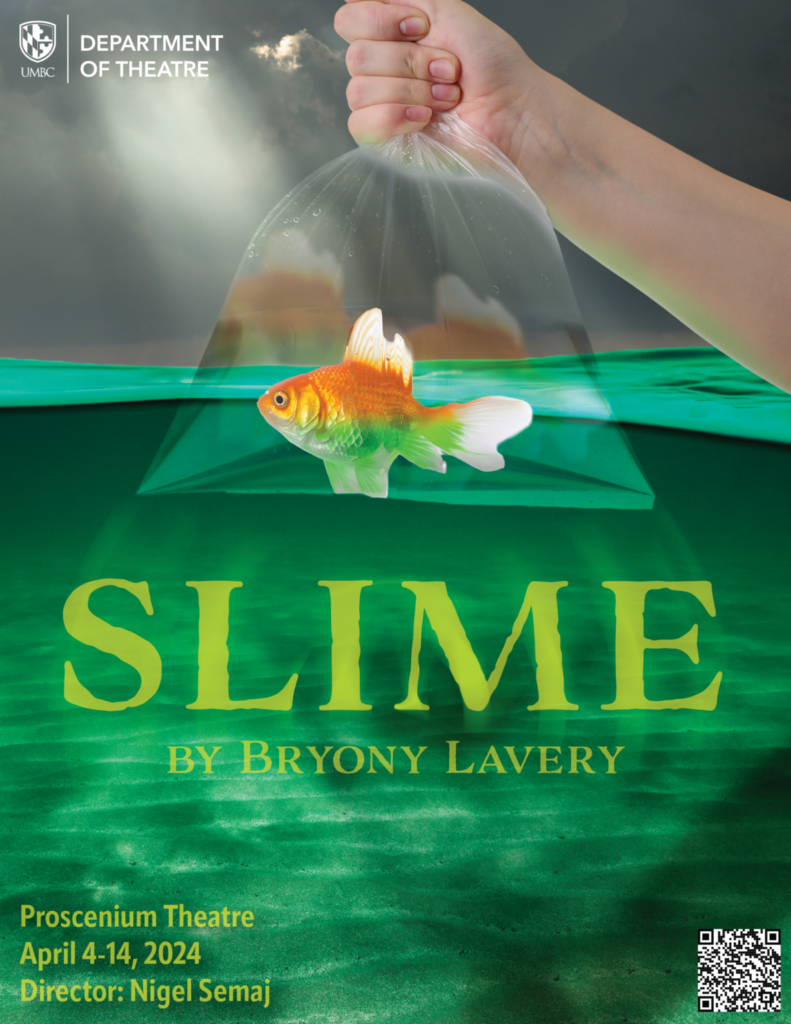
Get an early start on Earth Day this year at one of the UMBC Department of Theatre’s multiple plays centered around the theme of climate science and activism. The play Slime, by Bryony Lavery, directed by Nigel Semaj, will run from April 4 to the 14 in the Performing Arts and Humanities Building’s Proscenium Theatre. Slime is a dystopian comedy about seven grad students who are translators of different animal species, who must work to save all life on earth from a toxic slime. On April 14, there will be a free matinee for UMBC students and post-show actor talk-back.
For more theatre events, you can check out the entire production season here!
The eerie and alluring photographs of Anastasia Samoylova’s FloodZone, depict the painstaking reality of what it’s like to live in the southern U.S. at a time when the climate crisis has greatly affected the environment. The exhibition was first featured at the George Eastman Museum in 2022, and has been on display in a few other locations throughout the U.S. as well as internationally, but the alligators and flamingos and other coastal life forms have now arrived at UMBC for a limited time. The exhibition will be on display at the AOK Library Gallery until May 29.
 Image: Anastasia Samoylova, Gator, 2017. From FloodZone. Photo mural, printed by UMBC © Anastasia Samoylova
On Monday, April 22, in the Library Gallery, the artist will participate in an Earth Day panel on Climate Change, Science Communication, and the Arts. How do climate scientists share their research and data with the wider public in a way that non-specialists can understand? How might art contribute to this urgent work? Samoylova will discuss her photography while in conversation with scientists and media historians specializing in science communication.
]]>
As flowers start popping up on campus and we get some warmer (if rainy) days, it’s the perfect time to go out and catch some of the arts events happening at UMBC. Whether you need a break from...
https://umbc.edu/stories/spring-into-the-arts-at-umbc-spring-2024-events/
https://my3.my.umbc.edu/api/v0/pixel/news/139611/guest@my.umbc.edu/589299d1a6cbc63bdbfbe3aeeb5ff25d/api/pixel
albin-o-kuhn-library-gallery
arts
cahss
campus-life
dance
english
humanities
magazine
music
proscenium-theatre
story
theatre-department
visualarts
wmbc
UMBC News & Magazine
https://my3.my.umbc.edu/groups/umbc-news-magazine
https://assets1-my.umbc.edu/system/shared/avatars/groups/000/001/943/24435aa6207c452e7bc15cc74b42c7bb/xsmall.png?1748556657
https://assets1-my.umbc.edu/system/shared/avatars/groups/000/001/943/24435aa6207c452e7bc15cc74b42c7bb/original.png?1748556657
https://assets2-my.umbc.edu/system/shared/avatars/groups/000/001/943/24435aa6207c452e7bc15cc74b42c7bb/xxlarge.png?1748556657
https://assets2-my.umbc.edu/system/shared/avatars/groups/000/001/943/24435aa6207c452e7bc15cc74b42c7bb/xlarge.png?1748556657
https://assets3-my.umbc.edu/system/shared/avatars/groups/000/001/943/24435aa6207c452e7bc15cc74b42c7bb/large.png?1748556657
https://assets1-my.umbc.edu/system/shared/avatars/groups/000/001/943/24435aa6207c452e7bc15cc74b42c7bb/medium.png?1748556657
https://assets2-my.umbc.edu/system/shared/avatars/groups/000/001/943/24435aa6207c452e7bc15cc74b42c7bb/small.png?1748556657
https://assets1-my.umbc.edu/system/shared/avatars/groups/000/001/943/24435aa6207c452e7bc15cc74b42c7bb/xsmall.png?1748556657
https://assets2-my.umbc.edu/system/shared/avatars/groups/000/001/943/24435aa6207c452e7bc15cc74b42c7bb/xxsmall.png?1748556657
UMBC News & Magazine
0
0
false
Tue, 05 Mar 2024 11:59:34 -0500
Tue, 05 Mar 2024 11:59:34 -0500
UMBC hosts 11th International Digital Storytelling Conference
For nearly two decades, UMBC faculty and students have been deeply engaged in story-driven research. The UMBC community’s contributions to this humanities-centered scholarship has included documenting the stories of former workers of the historic and now-defunct Sparrows Point steel mill in Baltimore County, and projects such as “A Place Called Poppleton,” which chronicles the history and culture of Baltimore City’s Poppleton neighborhood.
UMBC’s commitment to highlighting storytelling research continued this summer as the university co-hosted the first state-side edition of the 11th International Digital Storytelling Conference—a four-day event showcasing an expansive range of storytelling-focused projects and initiatives. The conference was a collaborative effort in partnership with the Smithsonian Institution, StoryCenter, and Montgomery College, who previously partnered with UMBC on digital storytelling projects.
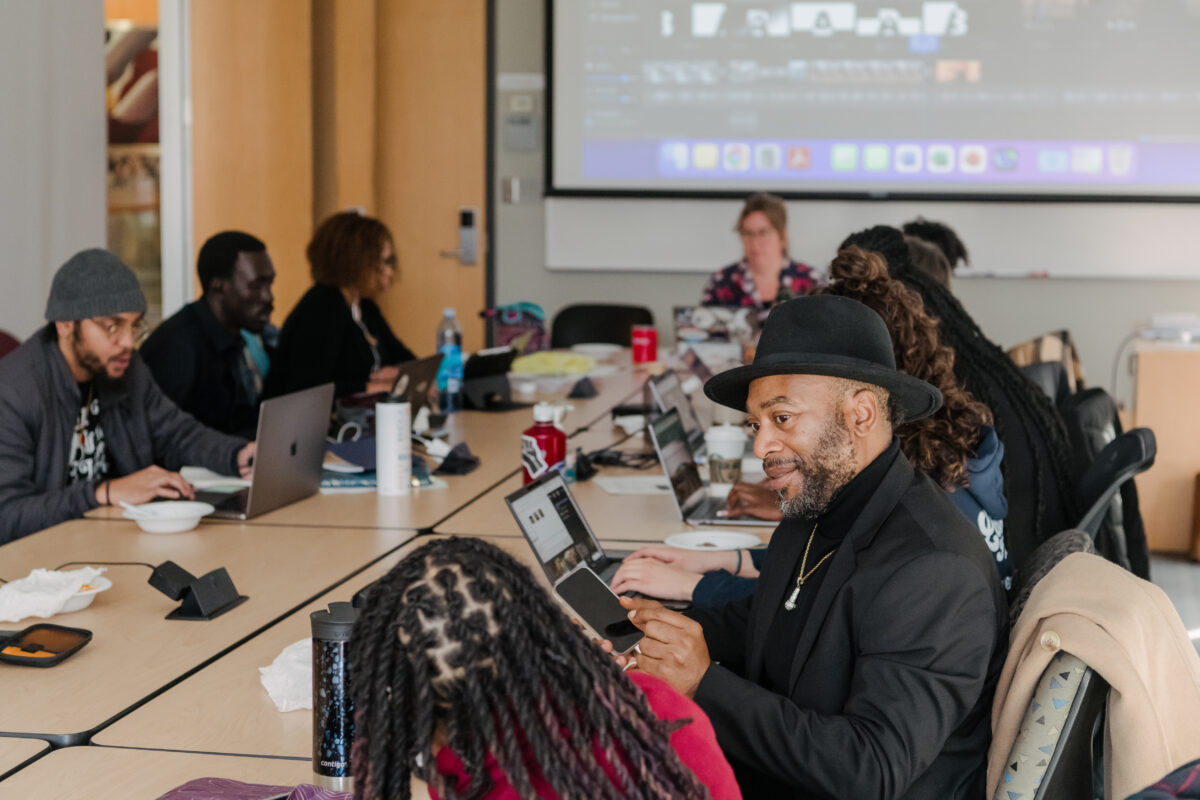 UMBC students learning about digital storytelling. (Marlayna Demond ’11/UMBC)
A commitment to community storytelling
The multi-day conference included workshops, presentations, storytelling tours, and site visits to partner institutions illuminating the impact of digital storytelling. Julissa Gómez Ruvalcaba, M.A. ’23, applied sociology, was one of the featured presenters at this year’s conference, her work adding to UMBC’s ongoing research of Latinx immigrant communities in Baltimore. During a site visit on the first day of the conference to the Creative Alliance, a non-profit art space in Baltimore City, Ruvalcaba discussed her capstone research project that included an ethnographic study of the city’s Latinx community.
Ruvalcaba shared that she felt a sense of “culture shock” when originally moving to Baltimore to study at UMBC. She is from a predominantly Mexican community in Northern California and took note of the drastically smaller Latinx population in Baltimore City, which, according to the 2020 Census, makes up about eight percent of the city’s population.
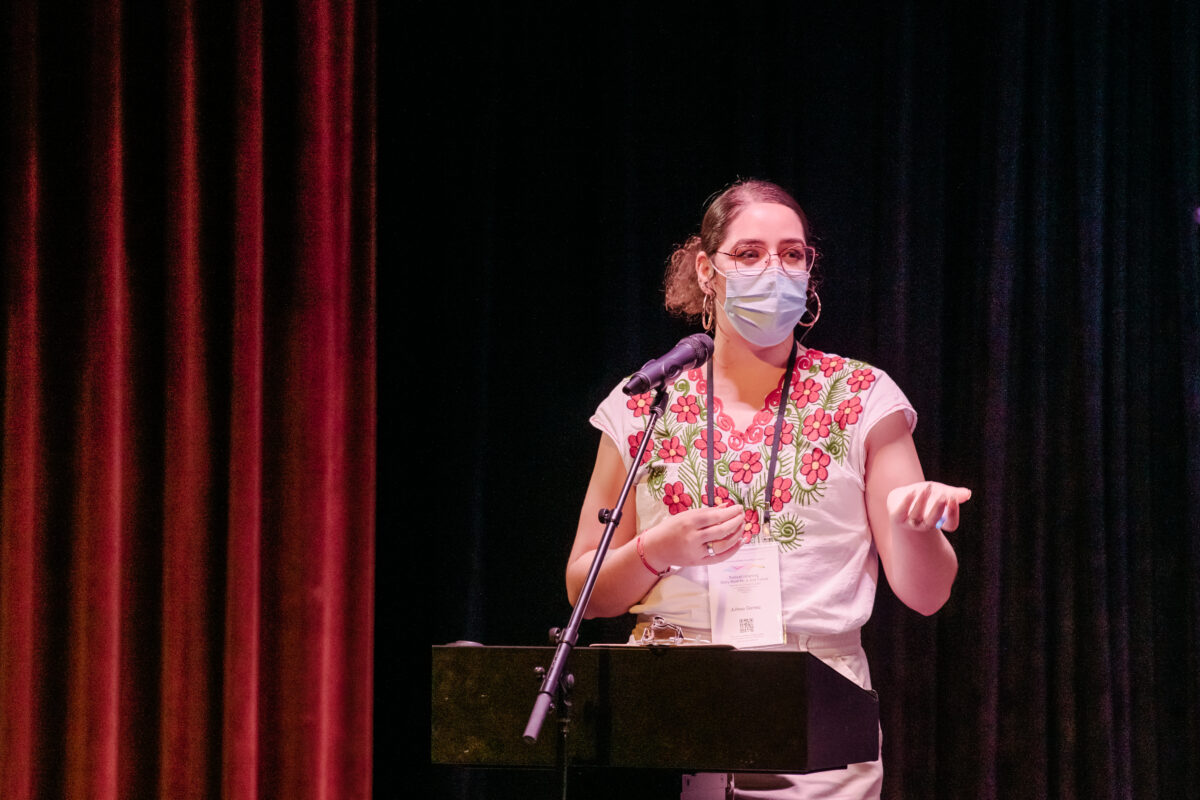 Julissa Gómez Ruvalcaba discussing her short film “Nest Making” at the Creative Alliance during the 11th International Digital Storytelling Conference. (Marlayna Demond ’11/UMBC)
“I became curious about how Latinx people understood their cultural identity and how they expressed themselves while living in a city that is predominately Black and white. That was the starting point to my thesis.”
That curiosity culminated in “Nest Making,” a short film that Ruvalcaba created documenting the Latinx community living in Highlandtown, a neighborhood in Southeast Baltimore that Ruvalcaba says is often referred to as “Latino Baltimore.” During the conference, Ruvalcaba held a screening of the film, which captures Ruvalcaba’s year-long research journey of examining how Latinx people are building their homes and communities in Highlandtown as they express parts of their culture and heritage.
“Digital storytelling is a medium that I’m really excited about. I thought about how to make my research accessible to all, including my family who may not understand all of the research jargon,” says Ruvalcaba. “Showing your story in a way that’s visually engaging, along with audio, captures [many] of the senses, which is something that I want to show people that can’t really be shown on paper.”
Digital storytelling history at UMBC
Bill Shewbridge ’80, history, a professor of practice in media and communication studies, attended a StoryCenter workshop in 2004 and was excited to bring the practice back to UMBC. The university’s cultivation of storytelling research grew following a series of several StoryCenter workshops organized in 2006 by UMBC’s New Media Studio, the university’s multimedia production hub. Faculty and staff learned about digital storytelling as a pedagogical tool and have since brought the practice into the classroom.
“Over the years, UMBC has become an active participant in a growing international community of the digital storytelling practice through conferences and collaborative projects,” explains Shewbridge. “[Bringing] the international conference to our region grew out of discussions had at the 2018 conference in Zakinthos, Greece, so it was in the works for a long time.”
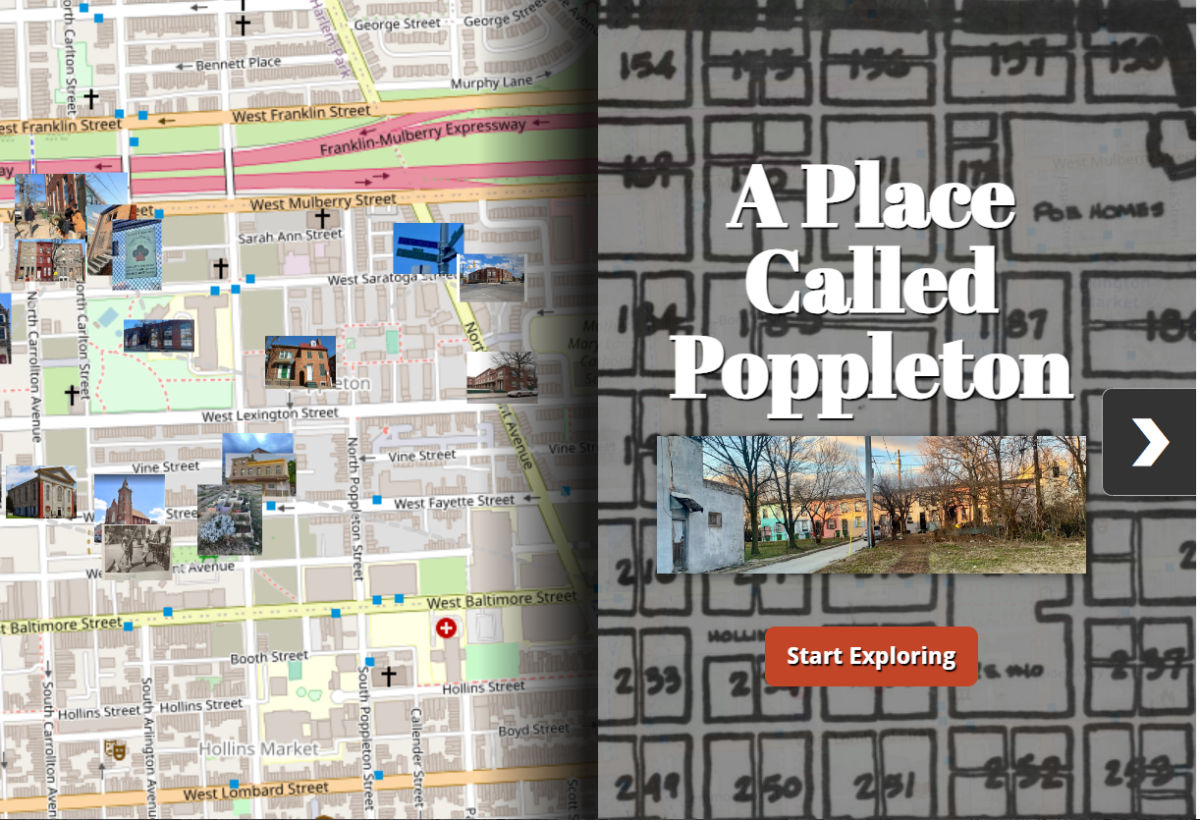 In spring 2021 “A Place Called Poppleton” debuted to document the history and culture of the Poppleton neighborhood of Southwest Baltimore. UMBC students produced a Story Map digital walking tour of the neighborhood with a focus on the area’s Black history and places lost or endangered due to redevelopment.
UMBC’s Digital Storytelling and Civic Agency in Higher Education working group, which Shewbridge leads, collaborated with Loughborough University in England, Montgomery College, the Smithsonian Office of Educational Technology, and StoryCenter to bring the international conference stateside for the first time.
“It was a great experience to be able to share our work in the Baltimore region with this very special group of colleagues,” says Shewbridge.
That sentiment was echoed by Charlotte Keniston, MFA ’14, intermedia and digital art, associate director of UMBC’s Shriver Peaceworker Fellows program. “What’s significant about UMBC hosting the conference is that it represents nearly 20 years of digital storytelling work that’s been happening here on campus,” she noted.
 Charlotte Keniston teaching a digital storytelling class. (Marlayna Demond ’11/UMBC)
Keniston, who co-chaired this year’s conference, has championed digital storytelling research since she was a student at UMBC: “I have been using digital storytelling, teaching it, and facilitating others in using it since my start at the university. There are hundreds of students who have used it in the classroom, and dozens of faculty who teach it in their curricula as a way to engage students in reflection.”
For more information on storytelling research happening at UMBC, review a collection of UMBC’s digital storytelling projects here.
]]>
For nearly two decades, UMBC faculty and students have been deeply engaged in story-driven research. The UMBC community’s contributions to this humanities-centered scholarship has included...
https://umbc.edu/stories/international-digital-storytelling-conference/
https://my3.my.umbc.edu/api/v0/pixel/news/135612/guest@my.umbc.edu/7fd0645d98f1d5d211f614d4ba223237/api/pixel
cahss
community
humanities
media-and-communication-studies
news
research
shriver-center
UMBC News & Magazine
https://my3.my.umbc.edu/groups/umbc-news-magazine
https://assets1-my.umbc.edu/system/shared/avatars/groups/000/001/943/24435aa6207c452e7bc15cc74b42c7bb/xsmall.png?1748556657
https://assets1-my.umbc.edu/system/shared/avatars/groups/000/001/943/24435aa6207c452e7bc15cc74b42c7bb/original.png?1748556657
https://assets2-my.umbc.edu/system/shared/avatars/groups/000/001/943/24435aa6207c452e7bc15cc74b42c7bb/xxlarge.png?1748556657
https://assets2-my.umbc.edu/system/shared/avatars/groups/000/001/943/24435aa6207c452e7bc15cc74b42c7bb/xlarge.png?1748556657
https://assets3-my.umbc.edu/system/shared/avatars/groups/000/001/943/24435aa6207c452e7bc15cc74b42c7bb/large.png?1748556657
https://assets1-my.umbc.edu/system/shared/avatars/groups/000/001/943/24435aa6207c452e7bc15cc74b42c7bb/medium.png?1748556657
https://assets2-my.umbc.edu/system/shared/avatars/groups/000/001/943/24435aa6207c452e7bc15cc74b42c7bb/small.png?1748556657
https://assets1-my.umbc.edu/system/shared/avatars/groups/000/001/943/24435aa6207c452e7bc15cc74b42c7bb/xsmall.png?1748556657
https://assets2-my.umbc.edu/system/shared/avatars/groups/000/001/943/24435aa6207c452e7bc15cc74b42c7bb/xxsmall.png?1748556657
UMBC News & Magazine
1
0
false
Wed, 20 Sep 2023 13:36:40 -0400
Wed, 20 Sep 2023 13:36:40 -0400
English major learns to facilitate social change through writing and conversation
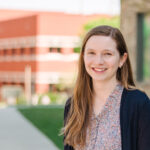
Clair Volkening
Degree: B.A., English
Hometown: Boonsboro, MD
Post-grad plans: Technical editor, Defense Intelligence Agency
Humanities Scholar Clair Volkening has used her voice as a writer, editor, and facilitator to help UMBC community members build connections with one another and to inspire social change.
Volkening, who is also a member of the Honors College, was a participant and a coach in UMBC’s Center for Democracy and Civic Life’s (CDCL) STRiVE program, where she developed her leadership and civic engagement skills. Because of her contributions to STRiVE, Volkening was recruited to participate in CDCL’s first cohort of the ConnectionCorps program, a year-long facilitator training program for students. As a ConnectionCorps facilitator, Volkening facilitated community conversations involving students, faculty, staff, alumni, and local and state leaders on various issues. She also facilitated workshops for students involving reflection, storytelling, and discussion.
Volkening extended her coaching and leadership work further by helping students along their academic journeys. She was a tutor in UMBC’s Writing Center, assisting fellow Retrievers with strengthening their writing skills. This experience inspired her to join the editorial team for UMBC Review, the university’s student-organized, peer-reviewed undergraduate research journal. That work, she says, was an “incredible learning experience” that informed her burgeoning career pursuits as an editor.
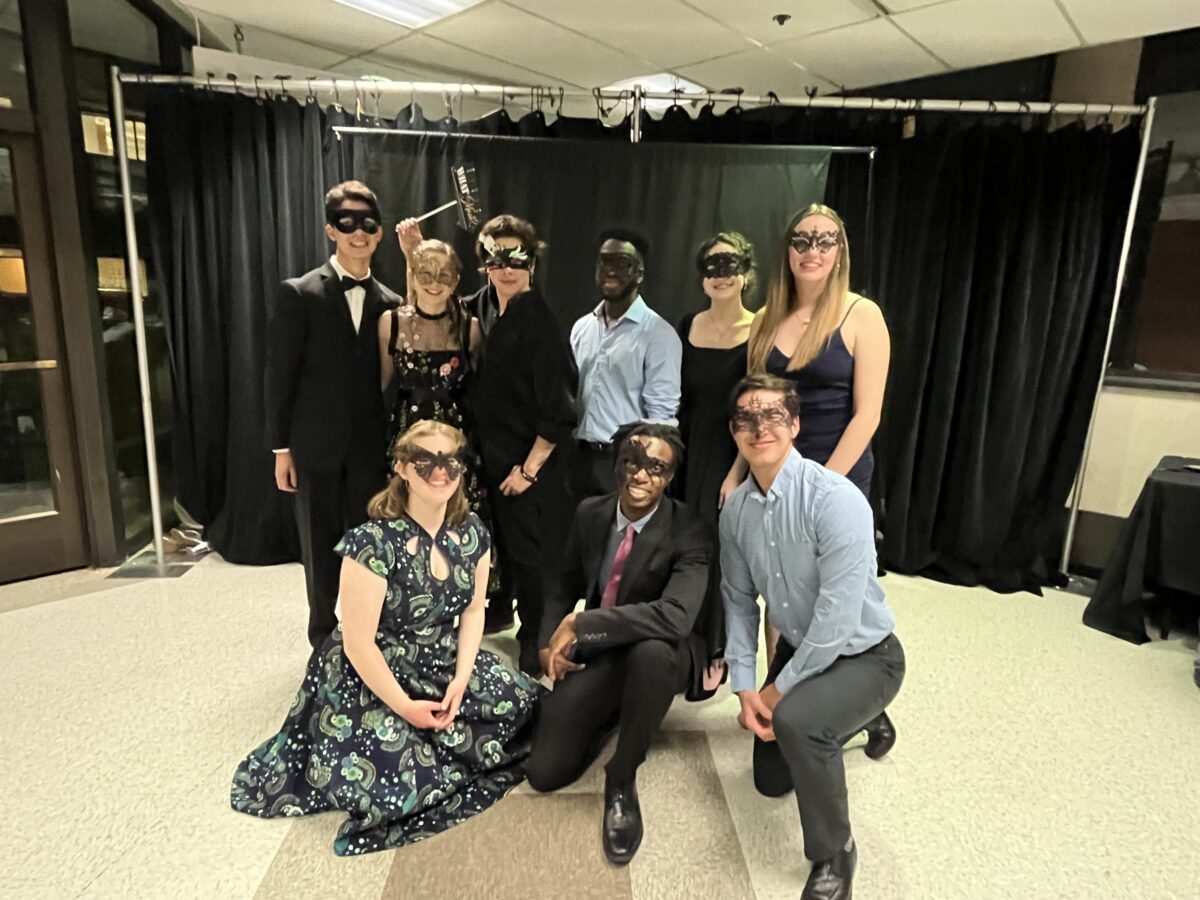 Clair Volkening (back row, second from the left) and fellow UMBC students at the Meyerhoff and Honors College’s Masquerade Charity Gala in February 2023. (Photo courtesy of Clair Volkening)
Has there been a mentor or fellow student who influenced your time at UMBC?
“David Hoffman, who earned his Ph.D. at UMBC and is director of the CDCL, and Elaine MacDougall, lecturer in English and the director of the Writing Center, influenced me the most during my time at UMBC. Working with Hoffman at CDCL events and learning from him has changed my outlook on life in all areas, not just school. MacDougall is a role model and someone who has taught me so much. She helped me find myself as a tutor and leader.
“There have been so many mentors and students who have made a huge impact on my time here, including many of my fellow Humanities Scholars who have made UMBC feel like home. Sally Shivnan, principal lecturer in English, and Lia Purpura, UMBC’s writer in residence, have helped me grow in my creative writing and have shown me what it is to live like a writer.”
What has been the best part of your UMBC experience?
“The people, by far, have been the best part of my time at UMBC. From my professors to my friends to the teachers in classes at the Retriever Activities Center, the people at UMBC make the university what it is. So many of the conversations that I’ve had with people on campus—whether they were serious and introspective, or silly and fun—have taught me about how community is formed and how we can all exist as people in our world.”
]]>
Clair Volkening Degree: B.A., English Hometown: Boonsboro, MD Post-grad plans: Technical editor, Defense Intelligence Agency Humanities Scholar Clair Volkening has used her voice as a...
https://umbc.edu/stories/social-change-through-writing-and-conversation/
https://my3.my.umbc.edu/api/v0/pixel/news/133321/guest@my.umbc.edu/43470f27e88f0709fd8c0102487441de/api/pixel
cahss
center-for-democracy-and-civic-life
class-of-2023
english
humanities
humanitiesscholars
news
UMBC News & Magazine
https://my3.my.umbc.edu/groups/umbc-news-magazine
https://assets1-my.umbc.edu/system/shared/avatars/groups/000/001/943/24435aa6207c452e7bc15cc74b42c7bb/xsmall.png?1748556657
https://assets1-my.umbc.edu/system/shared/avatars/groups/000/001/943/24435aa6207c452e7bc15cc74b42c7bb/original.png?1748556657
https://assets2-my.umbc.edu/system/shared/avatars/groups/000/001/943/24435aa6207c452e7bc15cc74b42c7bb/xxlarge.png?1748556657
https://assets2-my.umbc.edu/system/shared/avatars/groups/000/001/943/24435aa6207c452e7bc15cc74b42c7bb/xlarge.png?1748556657
https://assets3-my.umbc.edu/system/shared/avatars/groups/000/001/943/24435aa6207c452e7bc15cc74b42c7bb/large.png?1748556657
https://assets1-my.umbc.edu/system/shared/avatars/groups/000/001/943/24435aa6207c452e7bc15cc74b42c7bb/medium.png?1748556657
https://assets2-my.umbc.edu/system/shared/avatars/groups/000/001/943/24435aa6207c452e7bc15cc74b42c7bb/small.png?1748556657
https://assets1-my.umbc.edu/system/shared/avatars/groups/000/001/943/24435aa6207c452e7bc15cc74b42c7bb/xsmall.png?1748556657
https://assets2-my.umbc.edu/system/shared/avatars/groups/000/001/943/24435aa6207c452e7bc15cc74b42c7bb/xxsmall.png?1748556657
UMBC News & Magazine
4
0
false
Mon, 08 May 2023 12:52:24 -0400
Michelle R. Scott illuminates the lives of Black Vaudeville performers and their broader social impact in Jazz Age America
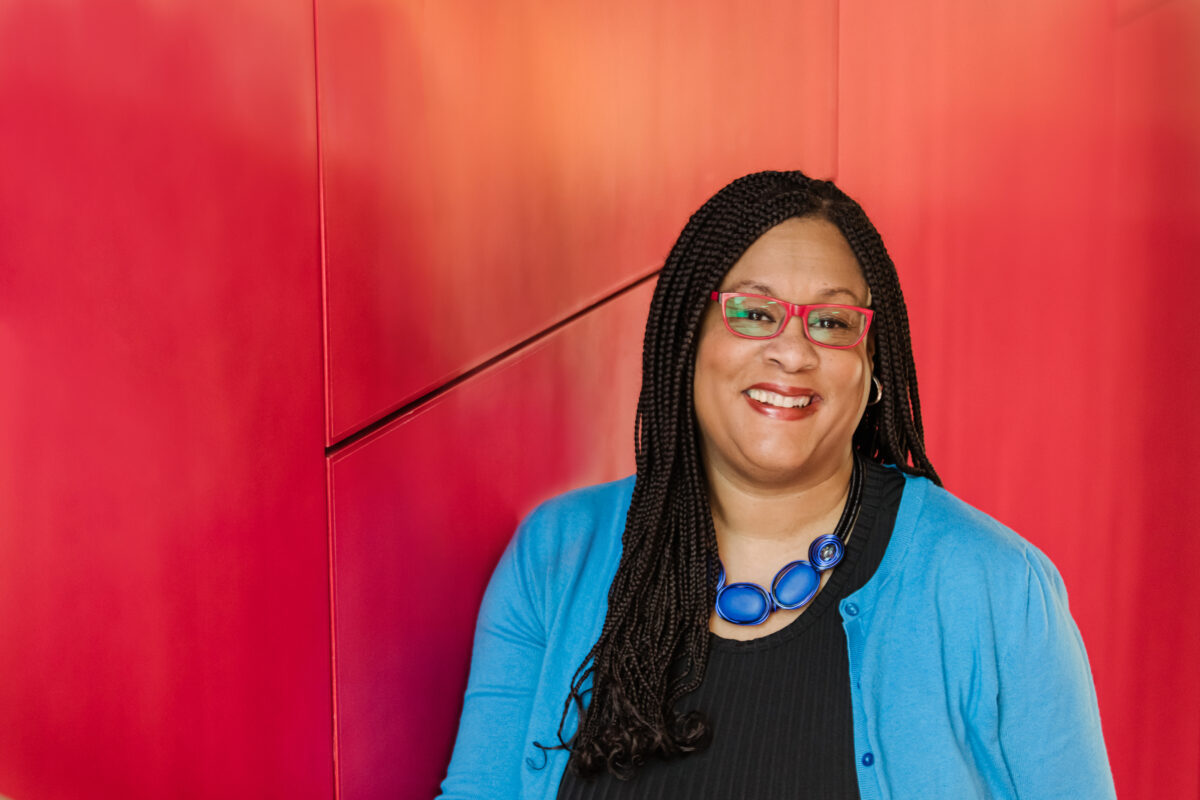
Michelle Scott, associate professor of history, will discuss her new book T.O.B.A. Time: Black Vaudeville and the Theater Owners Booking Association in Jazz Age America(University of Illinois Press, 2023) on April 11, presenting the history department’s annual Lowe Lecture. In a conversation with UMBC News, Scott shares the artistic, social, and historic context of an association that brought Black artists to both Black and white audiences across the United States during the 1920s.
 Michelle Scott. (Marlayna Demond ’11/UMBC)
UMBC News: What are some of the central themes the book explores?
Scott: The book explores the lives of the performers, theater owners, producers, managers, and audiences that were part of Black Vaudeville and the Theater Owners Booking Association (T.O.B.A.). It’s a story about how these Black- and white-owned theaters fostered Black artistic exploration and development and the growth of Black-owned businesses. T.O.B.A. is the foundation of Black live entertainment in the 20th century. This is the first in-depth study of this circuit during a time of transition in the entertainment industry between WWI and the Great Depression in segregated America.
UMBC News: Who were some of the artists who began with T.O.B.A. and grew famous, leading to profitable and stable careers?
Scott: T.O.B.A. is a cornerstone in the history of the African American entertainment industry where artists like Cab Calloway, the famed singer, songwriter, bandleader, conductor, and dancer, honed their talents. Other artists include “The Empress of the Blues,” Bessie Smith, and Ethel Waters, who became the first Black woman to receive equal billing with white stars on Broadway. These headliners, including Sammy Davis Jr., the tap-dancing Nicholas Brothers, Count Basie, and the comedic duo Butterbeans and Susie, found fame lasting decades beyond the Jazz Age.
But there was also a place for novelty acts, like the person doing the hula hoop or playing the harmonica with their nostrils. There were also tabloid plays. These abbreviated musical comedies bootlegged off-Broadway plays in a few songs. It’s a much shorter version of today’s Broadway tours. Think of a cabaret version of Hamilton represented in three songs.
It might be a few minutes, but T.O.B.A gave an opportunity to a wide variety of talents to create shows that appealed to a wide audience.
It was a family, where many had multiple jobs to make the show happen. Singers would do makeup. An actor would help with costuming. It wasn’t “the show must go on.” It was “the show will go on.”
UMBC News: T.O.B.A. enabled artists to channel their talents and broaden their networks. What was the association’s impact beyond performances?
Scott: This was the entertainment business. In 1929, T.O.B.A. was among the 12th most profitable black-owned industries in the United States, alongside black-owned insurance agencies, beauty businesses, dressmakers, etc. It had headquarters in Chicago, Washington, D.C., and Chattanooga, Tennessee, running 100 theaters over a decade. For Black and white theater owners, T.O.B.A. provided a steady stream of entertainers, helping to contribute to the local and national economy.
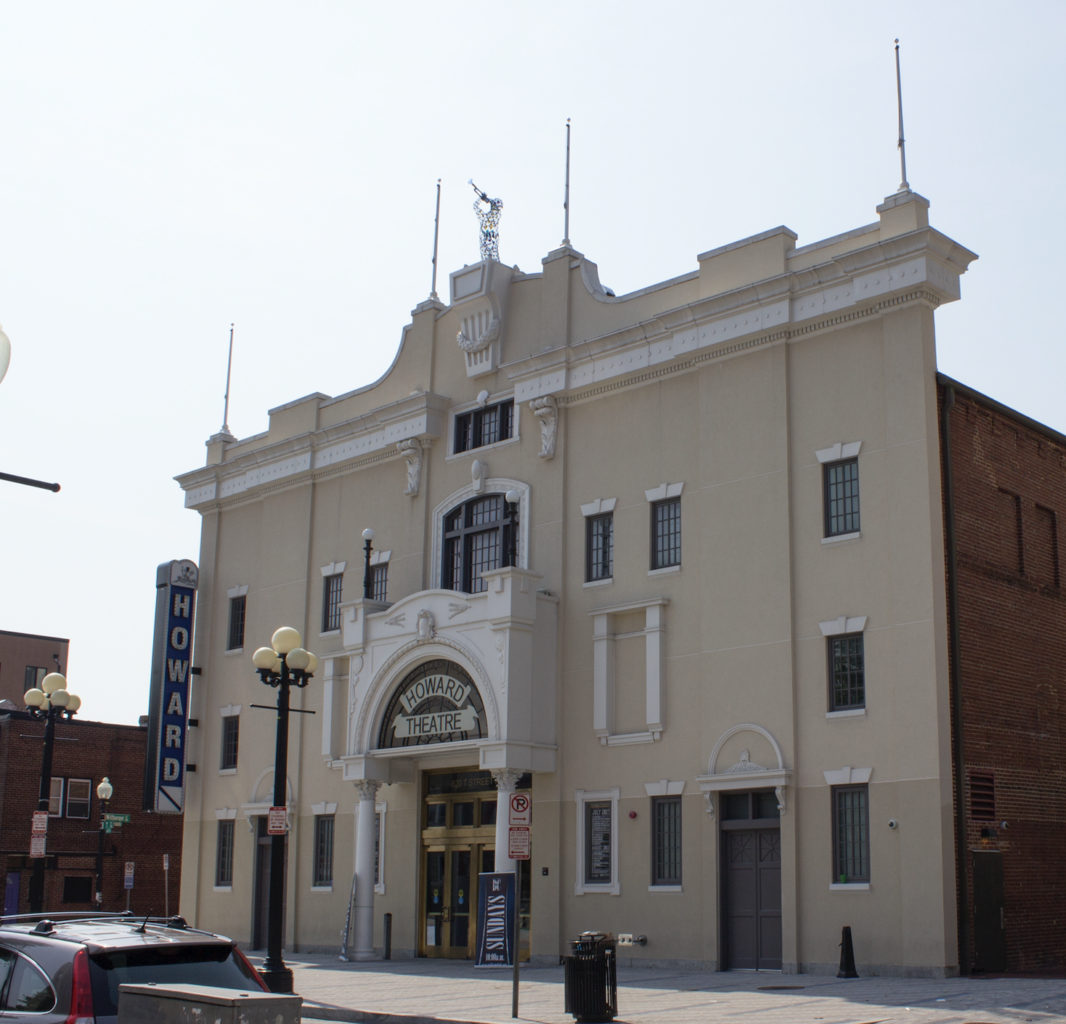 The Howard Theater in Washington DC, on T Street, Northwest. Photo by Dhousch, Wikemedia Commons.
The hospitality industry grew to meet the demands. This was a particularly important business venture for leading Black artists who were paid well like Cab Calloway and the “Mother of the Blues” Ma Rainey, who was paid $800 for four performances and could spend money on fine room, board, and clothing while traveling for performances. In segregated towns, the Black hospitality industry played an essential role in meeting the needs of entertainers. Black women found opportunities to operate boarding room homes and cook meals, and workers created a key union to fight for fair wages.
As traveling performers, women were also allowed more financial, sexual, and artistic freedom away from families that could be strict and religious. Yet, they also faced gender discrimination and sexual violence on the road.
UMBC News: Jazz Age America was a time of expansive Black artistic exploration and innovation within a heightened period of racial violence and segregation. How did this affect T.O.B.A.?
Scott: The world was trying to recover from WWI, the devastation of the Spanish Flu, and a slowly declining economy that would lead to the Great Depression. Returning white veterans and communities felt threatened by the prospect of losing jobs and housing to Black veterans and to families moving from the South. All of these tensions led to the “Red Summer” of 1919. Mass shootings, lynchings, and race riots spread throughout the country including in Chicago, Washington, D.C., and Baltimore.
Most of the T.O.B.A. theaters were in the South. Artists traveling the country and performing in theaters often risked their safety to make a living from their art. The Black working-class audiences were taking a risk going to see live shows and spending their hard-earned money while surrounded by racial violence and segregation.
One of the most haunting accounts that I found was of the Dreamland Theatre in Tulsa, Oklahoma owned by a Black couple. It was one of the earliest theaters to join the circuit. In 1921, it was leveled during the Tulsa Race Massacre. I was shocked that their records survived, allowing the shared history of the theater, owners, artists, and local community to be witness to the importance of Black theater to Tulsa’s Black community. The owners eventually opened up other Dreamland Theatres in Oklahoma.
T.O.B.A. is monumental because it helped Black artists and Black communities continue to thrive while fighting white supremacy. Many times, if churches were not able to provide a space to organize marches, communities organized in theaters. Sometimes, theater entrance fees were donated to help activists or communities hit by natural disasters, or to help with legal fees.
History definitely talks about the violence inflicted on Black communities, the death toll, and poverty, but it doesn’t always tell about Black innovation, economic prosperity, creativity, and thriving Black communities that existed before, during, and after the Jazz Age. It doesn’t always talk about art as an alternative resistance. T.O.B.A. is that story.
Learn more about this new book in Michelle Scott’s Low Lecture on April 11, 4-5 p.m., in the Albin O. Kuhn Library 7th floor. Research for the book was partially supported by UMBC’s Dresher Center for the Humanities and the CAHSS research grant.
]]>
Michelle Scott, associate professor of history, will discuss her new book T.O.B.A. Time: Black Vaudeville and the Theater Owners Booking Association in Jazz Age America(University of Illinois...
https://umbc.edu/stories/strongmichelle-r-scott-illuminates-the-lives-of-black-vaudeville-performers-in-jazz-age-america-strong/
https://my3.my.umbc.edu/api/v0/pixel/news/132431/guest@my.umbc.edu/6929e550dfebce03421d7732f37337f9/api/pixel
arts-and-culture
cahss
cahssresearch
dreshercenter
history
humanities
news
policy-and-society
rca-2
research
UMBC News & Magazine
https://my3.my.umbc.edu/groups/umbc-news-magazine
https://assets1-my.umbc.edu/system/shared/avatars/groups/000/001/943/24435aa6207c452e7bc15cc74b42c7bb/xsmall.png?1748556657
https://assets1-my.umbc.edu/system/shared/avatars/groups/000/001/943/24435aa6207c452e7bc15cc74b42c7bb/original.png?1748556657
https://assets2-my.umbc.edu/system/shared/avatars/groups/000/001/943/24435aa6207c452e7bc15cc74b42c7bb/xxlarge.png?1748556657
https://assets2-my.umbc.edu/system/shared/avatars/groups/000/001/943/24435aa6207c452e7bc15cc74b42c7bb/xlarge.png?1748556657
https://assets3-my.umbc.edu/system/shared/avatars/groups/000/001/943/24435aa6207c452e7bc15cc74b42c7bb/large.png?1748556657
https://assets1-my.umbc.edu/system/shared/avatars/groups/000/001/943/24435aa6207c452e7bc15cc74b42c7bb/medium.png?1748556657
https://assets2-my.umbc.edu/system/shared/avatars/groups/000/001/943/24435aa6207c452e7bc15cc74b42c7bb/small.png?1748556657
https://assets1-my.umbc.edu/system/shared/avatars/groups/000/001/943/24435aa6207c452e7bc15cc74b42c7bb/xsmall.png?1748556657
https://assets2-my.umbc.edu/system/shared/avatars/groups/000/001/943/24435aa6207c452e7bc15cc74b42c7bb/xxsmall.png?1748556657
UMBC News & Magazine
0
0
false
Fri, 07 Apr 2023 11:15:07 -0400
Fri, 07 Apr 2023 11:15:07 -0400
Retrievers Behind the Scenes—Courtney C. Hobson, M.A. ’14

During the pandemic it has become even more important to find ways of engaging students in learning activities beyond the classroom. Fortunately, we have Courtney C. Hobson, M.A. ’14, historical studies, program coordinator for the Dresher Center for the Humanities, to help make these special moments happen.
What is your favorite thing about the work you do at UMBC and why?
As program coordinator, I do exactly what the title says—COORDINATE. This covers a multitude of things such as maintaining budgets, crafting social media posts, and other various administrative tasks. My favorite part of my job is helping to plan and coordinate the Humanities Forum, our free public lecture series. I essentially have a wish list of different artists, professors, writers, etc. who I would love to hear from and/or meet; through the Humanities Forum, sometimes that gets to happen! But mostly, I get to constantly learn new ideas and hear from different perspectives, which has been an enriching experience.
Tell us something people don’t really know or understand about your job.
Coordinating events or programs requires so much multitasking, juggling—any euphemism that you want to apply. It requires the ability to think about both the smaller and bigger picture and prepare for contingencies. You also have to be aware of the various people or groups that you interact with and anticipate their potential needs. Doing all of this and making the experience appear to be seamless is also a skill.
Is there someone in the campus community who has been particularly supportive?
I can’t really pick out one person in particular because I have so many wonderful friends and colleagues at the university. As an alumna of the university, it’s a unique experience to transition from student-professor relationship to colleague or even friend with some of the professors in the History Department; they were my cheerleader when I was a student and continue to be so now.
Learn more about the Humanities Forum at https://dreshercenter.umbc.edu/humanities-forum/current/.
Header image: Hobson works with faculty members during an Humanities Teaching Lab. Both photos courtesy of Hobson.
]]>
During the pandemic it has become even more important to find ways of engaging students in learning activities beyond the classroom. Fortunately, we have Courtney C. Hobson, M.A. ’14, historical...
https://umbc.edu/stories/retrievers-behind-the-scenes-courtney-c-hobson-m-a-14/
https://my3.my.umbc.edu/api/v0/pixel/news/119606/guest@my.umbc.edu/b627151d7d0c43e2bcf476e42a115c33/api/pixel
campus-life
historical-studies
humanities
retrievers-behind-the-scenes
spring-2021
UMBC News & Magazine
https://my3.my.umbc.edu/groups/umbc-news-magazine
https://assets1-my.umbc.edu/system/shared/avatars/groups/000/001/943/24435aa6207c452e7bc15cc74b42c7bb/xsmall.png?1748556657
https://assets1-my.umbc.edu/system/shared/avatars/groups/000/001/943/24435aa6207c452e7bc15cc74b42c7bb/original.png?1748556657
https://assets2-my.umbc.edu/system/shared/avatars/groups/000/001/943/24435aa6207c452e7bc15cc74b42c7bb/xxlarge.png?1748556657
https://assets2-my.umbc.edu/system/shared/avatars/groups/000/001/943/24435aa6207c452e7bc15cc74b42c7bb/xlarge.png?1748556657
https://assets3-my.umbc.edu/system/shared/avatars/groups/000/001/943/24435aa6207c452e7bc15cc74b42c7bb/large.png?1748556657
https://assets1-my.umbc.edu/system/shared/avatars/groups/000/001/943/24435aa6207c452e7bc15cc74b42c7bb/medium.png?1748556657
https://assets2-my.umbc.edu/system/shared/avatars/groups/000/001/943/24435aa6207c452e7bc15cc74b42c7bb/small.png?1748556657
https://assets1-my.umbc.edu/system/shared/avatars/groups/000/001/943/24435aa6207c452e7bc15cc74b42c7bb/xsmall.png?1748556657
https://assets2-my.umbc.edu/system/shared/avatars/groups/000/001/943/24435aa6207c452e7bc15cc74b42c7bb/xxsmall.png?1748556657
UMBC News & Magazine
0
0
false
Tue, 08 Jun 2021 19:37:00 -0400
UMBC celebrates Dean Scott Casper, next president of the American Antiquarian Society

This fall, UMBC will bid farewell to one of its senior leaders as Scott Casper, dean of the College of Arts, Humanities and Social Sciences (CAHSS), departs the university to assume the presidency of the American Antiquarian Society (AAS). His new position speaks not only to his administrative skills, but also to his national eminence as a scholar of 19th-century U.S. history.
“We are very proud of our colleague Scott Casper, and know he will do a superb job as president of the American Antiquarian Society,” says President Freeman A. Hrabowski, III. “He is one of UMBC’s most admired leaders—as a scholar, academic administrator, and human being, and he has done a masterful job as dean of our College of Arts, Humanities, and Social Sciences.”
“Most important, Dean Casper lives the values we consider most significant in the humanities, including intellectual curiosity, compassion for others, and an abiding commitment to social justice,” Hrabowski says. “He will always be part of the UMBC community.”
“I want to express my gratitude to everyone at UMBC,” Casper shares. “This extraordinary community has changed me in deep, powerful ways, and UMBC’s values will go with me on this next step in my journey.”
 Scott Casper and Darielle Linehan welcome Christopher Dew ’13, theatre, to the 2018 Linehan Artist Scholars reception.
Transformative leadership
Under Dean Casper’s leadership, UMBC received the distinguished Community Engagement Classification from The Carnegie Foundation for the Advancement of Teaching in January 2020. This achievement required a rigorous campus-wide self-study of UMBC’s work with communities in Greater Baltimore and beyond, a process that involved more than 120 members of the UMBC community as well as dozens of community partners.
During Casper’s tenure as dean, CAHSS scaled up research in significant ways, including the creation of the Center for Social Science Scholarship. The college’s commitment to community engagement and civic agency has been notable, reflected in UMBC’s most recent Mellon Foundation grant, in hosting the Imagining America conference in 2015, in establishing studios and a classroom at the Lion Brothers building in downtown Baltimore, and in the new Community Leadership MPS and Public Humanities minor.
 Scott Casper joins students at the exhibition A Designed Life, curated by associate professor Peggy Re, at the Center for Art, Design and Visual Culture.
And, in the time since Dean Casper’s arrival, CAHSS has hired one third of its current faculty, enriching the campus with the addition of an extraordinary, diverse cohort of brilliant scholars and artists, and outstanding teachers.
“Everything we’ve accomplished these past seven years has come from collective effort by so many people—faculty and staff and students across the college and the university,” says Casper. “We have an exceptional college—broad and diverse and also truly collegial and supportive. It’s been a privilege and a joy to serve it and UMBC.”
 Scott Casper with Derek Musgrove ’97, associate professor of history, at a “bar talk” event to discuss Musgrove’s book Chocolate City.
Building community relationships
Dean Casper has also worked to develop robust relationships with external organizations. Under his guidance, UMBC signed an MOU with The Walters Art Museum. And Casper served on the advisory committee for the reinstallation of The Walters’s 1 West Mount Vernon Place. He also serves on the boards of Maryland Humanities and the Greater Baltimore Cultural Alliance.
“In my former role as executive director of Maryland Humanities, I saw the impact of Scott’s many community contributions,” says Phoebe Stein, president of the Federation of State Humanities Councils. “He was consistently generous, level-headed, and a real cheerleader for the work.”
“His commitment also extends to other nonprofits,” says Stein. “On the board of the Greater Baltimore Cultural Alliance, there too he is a generous contributor and colleague who brings intellectual rigor, a passion for the humanities, and common sense.”
 Scott Casper speaks to the audience at the 2018 Frederick Douglass Day Transcribe-a-thon.
Eminence as a scholar
Casper, who received his Ph.D. in American Studies from Yale University, joined the UMBC community in 2013, after many years on the faculty of the University of Nevada, Reno.
A historian of the nineteenth-century United States, he is the author of Sarah Johnson’s Mount Vernon: The Forgotten History of an American Shrine (Hill & Wang, 2008) and Constructing American Lives: Biography and Culture in Nineteenth-Century America (University of North Carolina Press, 1999). He is the co-author, editor, or co-editor of seven other books, most recently The Oxford Encyclopedia of American Cultural and Intellectual History (Oxford University Press, 2013).
 The late Maurice Berger, research professor at the Center for Art, Design and Visual Culture, with Scott Casper, celebrating the opening of the exhibition Revolution of the Eye: Modern Art and the Birth of American Television.
Casper’s commitment to teaching is also evident through his publications. He edited the annual “Textbooks and Teaching” section of the Journal of American History from 2008 to 2018, and was acting editor of the William and Mary Quarterly in 2008–09. He has worked extensively with K–12 history and social studies educators through the Mount Vernon Ladies’ Association, the Center for Civic Education, and the Northern Nevada Teaching American History Project.
The American Antiquarian Society
Dean Casper will become the 8th president in the 208-year history of the American Antiquarian Society. “At a time when deepened understanding of our past has never been more important, I look forward to leading an institution that fosters the essential work of telling America’s complex, contested stories,” says Casper, reflecting on his upcoming role.
 Scott Casper at the 2013 Theatre Salon.
The American Antiquarian Society was founded in 1812 by Revolutionary War patriot and printer Isaiah Thomas, and is both a learned society and a major independent research library. The AAS library, with some four million items, today houses the largest and most accessible collection of books, pamphlets, broadsides, newspapers, periodicals, music, and graphic arts material printed through 1876 in what is now the United States. It also houses manuscripts and a substantial collection of secondary texts, bibliographies, and digital resources and reference works related to all aspects of American history and culture before the twentieth century. AAS was presented with the 2013 National Humanities Medal by President Obama in a ceremony at the White House.
“We are thrilled that Scott Casper has agreed to become the next President of the American Antiquarian Society,” says John Herron, Jr., chair of the AAS Council. “Our nation’s past is as present as ever in this important time in our civic life. As a scholar, administrator, mentor and more, Scott is unusually well prepared to further leverage the Society’s long-standing commitment to evidence-based history and to preserving and sharing the stories of all Americans.”
Images by Marlayna Demond ’11 for UMBC.
]]>
This fall, UMBC will bid farewell to one of its senior leaders as Scott Casper, dean of the College of Arts, Humanities and Social Sciences (CAHSS), departs the university to assume the presidency...
https://umbc.edu/stories/umbc-celebrates-dean-scott-casper-next-president-of-the-american-antiquarian-society/
https://my3.my.umbc.edu/api/v0/pixel/news/119863/guest@my.umbc.edu/1b8035d1933f1ba5357bb7bc261a09b6/api/pixel
arts
arts-and-culture
cahss
community
humanities
socialsciences
UMBC News & Magazine
https://my3.my.umbc.edu/groups/umbc-news-magazine
https://assets1-my.umbc.edu/system/shared/avatars/groups/000/001/943/24435aa6207c452e7bc15cc74b42c7bb/xsmall.png?1748556657
https://assets1-my.umbc.edu/system/shared/avatars/groups/000/001/943/24435aa6207c452e7bc15cc74b42c7bb/original.png?1748556657
https://assets2-my.umbc.edu/system/shared/avatars/groups/000/001/943/24435aa6207c452e7bc15cc74b42c7bb/xxlarge.png?1748556657
https://assets2-my.umbc.edu/system/shared/avatars/groups/000/001/943/24435aa6207c452e7bc15cc74b42c7bb/xlarge.png?1748556657
https://assets3-my.umbc.edu/system/shared/avatars/groups/000/001/943/24435aa6207c452e7bc15cc74b42c7bb/large.png?1748556657
https://assets1-my.umbc.edu/system/shared/avatars/groups/000/001/943/24435aa6207c452e7bc15cc74b42c7bb/medium.png?1748556657
https://assets2-my.umbc.edu/system/shared/avatars/groups/000/001/943/24435aa6207c452e7bc15cc74b42c7bb/small.png?1748556657
https://assets1-my.umbc.edu/system/shared/avatars/groups/000/001/943/24435aa6207c452e7bc15cc74b42c7bb/xsmall.png?1748556657
https://assets2-my.umbc.edu/system/shared/avatars/groups/000/001/943/24435aa6207c452e7bc15cc74b42c7bb/xxsmall.png?1748556657
UMBC News & Magazine
0
0
false
Thu, 11 Jun 2020 13:06:25 -0400
Outstanding Alumna: Donna Lewis ’86

Over the next few weeks we’ll be introducing you to this year’s Alumni Award winners. The UMBC Alumni Association proudly honors distinguished alumni and faculty for their accomplishments and dedication to UMBC. Today we’re talking with Donna Lewis ‘86, English, about her career working as the Unit Chief for the Transportation Security Administration and her work as a cartoonist for the Washington Post News Service and Syndicate.
Name: Donna Lewis ’86, English
Job Title: Cartoonist, Washington Post News Service and Syndicate // Unit Chief, Office of Professional Responsibility, Transportation Security Administration, Department of Homeland Security
Award Category: Humanities
Q: Please tell us a little about why you chose to attend UMBC and what, if any, involvement you have with the university currently.
I chose to attend UMBC after leaving a larger university. I wanted to be a shining star, a high achiever, and, most importantly, I wanted to develop meaningful relationships with my professors, peers, and mentors. At the larger university, I just couldn’t find that level of intimacy. At UMBC, I immediately felt like a champion. I knew my peers on a first-name basis and I developed dynamic relationships with my professors, all of whom knew my name and probably much more about me. For me, UMBC felt like home and the people I met through the English Department and my classes felt like family. I sponsored my first UMBC intern in 2014 and she is now working with me again since graduating last spring! I hope to sponsor two more interns in 2015. My first intern obviously worked out great – for both of us.
Q: Is there a particular class or professor at UMBC who really inspired you?
Linda Benson inspired me to reach much farther than I was used to in my processes of thinking, writing, and analysis. I was always an outgoing and competitive student but I was at risk of being lazy in my thinking, focusing on the A grade and not the greater challenges of expanding my perspective or testing my own beliefs. Linda Benson challenged me to do more than earn an A on a paper. She forced me to keep peeling the onion and to question my thinking. After that, I knew that earning the A wasn’t the end goal.
Q: Please tell us a little about the trajectory of your career and what you are working on now.
I began my legal career in litigation, focusing primarily on issues related to disability. After 10 years of litigation, I transitioned to the management side of business in the hopes of helping supervisors deal more successfully with employees’ differences and diversity. In 2006, I accepted a position with the Transportation Security Administration. I am currently a Unit Chief in the Office of Professional Responsibility where I adjudicate matters involving misconduct. My focus these days is to be an excellent leader in the organization and in the training of future leaders.
Q: What has been the greatest success in your career? The greatest challenge?
The greatest success in my career has been becoming a syndicated cartoonist. I am a writer, first and foremost, and I have always worked hard to develop my writing skills. I have written articles and essays for every organization I’ve ever worked with and I’ve always had a personal writing project in progress. Around the time that I transitioned from the private sector to the Federal Government, I also decided to mix it up a bit with my writing and try some different forms. After a very enjoyable stint in stand-up comedy, I realized that I loved writing punchlines. One day I added a favorite punchline to a drawing and a cartoon was born. Today I have a daily cartoon and a daily comic strip, both of which are syndicated internationally through the Washington Post Writers Group. Getting syndicated is difficult proposition. There are few opportunities for syndication. I am confident that my getting syndicated is proof that hard work and dedication to taking creative risks pays off. I never dreamed or even thought of being a cartoonist and now I cannot imagine not being one. The greatest challenge? Life. Life is challenging and inconvenient. I assume most people don’t need for that to be explained.
Q: What are your proudest personal achievements?
I am proud of my ability to keep working hard no matter what the challenges are. Life is filled with ups and downs and many forces that are not conducive to following one’s dream. But hard work keeps you focused during the hard times and, hopefully, challenged during the easier times. I am proud that I listened to my mentors and just kept moving forward. The harder you work, the better prepared you are to seize good opportunities when they come along.
]]>
Over the next few weeks we’ll be introducing you to this year’s Alumni Award winners. The UMBC Alumni Association proudly honors distinguished alumni and faculty for their accomplishments and...
https://umbc.edu/stories/outstanding-alumna-donna-lewis-86/
https://my3.my.umbc.edu/api/v0/pixel/news/122284/guest@my.umbc.edu/9471115bec27e5290b4fdb92b38cfb78/api/pixel
alumni
cartoonist
department-of-homeland-security
donna-lewis
english
humanities
linda-benson
litigation
office-of-professional-responsibility
transportation-security-administration
umbc
unit-chief
university-of-maryland-baltimore-county
washington-news-post
UMBC News & Magazine
https://my3.my.umbc.edu/groups/umbc-news-magazine
https://assets1-my.umbc.edu/system/shared/avatars/groups/000/001/943/24435aa6207c452e7bc15cc74b42c7bb/xsmall.png?1748556657
https://assets1-my.umbc.edu/system/shared/avatars/groups/000/001/943/24435aa6207c452e7bc15cc74b42c7bb/original.png?1748556657
https://assets2-my.umbc.edu/system/shared/avatars/groups/000/001/943/24435aa6207c452e7bc15cc74b42c7bb/xxlarge.png?1748556657
https://assets2-my.umbc.edu/system/shared/avatars/groups/000/001/943/24435aa6207c452e7bc15cc74b42c7bb/xlarge.png?1748556657
https://assets3-my.umbc.edu/system/shared/avatars/groups/000/001/943/24435aa6207c452e7bc15cc74b42c7bb/large.png?1748556657
https://assets1-my.umbc.edu/system/shared/avatars/groups/000/001/943/24435aa6207c452e7bc15cc74b42c7bb/medium.png?1748556657
https://assets2-my.umbc.edu/system/shared/avatars/groups/000/001/943/24435aa6207c452e7bc15cc74b42c7bb/small.png?1748556657
https://assets1-my.umbc.edu/system/shared/avatars/groups/000/001/943/24435aa6207c452e7bc15cc74b42c7bb/xsmall.png?1748556657
https://assets2-my.umbc.edu/system/shared/avatars/groups/000/001/943/24435aa6207c452e7bc15cc74b42c7bb/xxsmall.png?1748556657
UMBC News & Magazine
0
0
false
Wed, 08 Oct 2014 12:00:14 -0400