Meet a Retriever—Madelyn “Maddy” Pollack ’24, Humanities Scholar and Honors College member
Madelyn (“Maddy”) Pollack ’24, history, is a Humanities Scholar and a member of the Honors College. She is pursuing minors in public history and Judaic studies, and she is active in Hillel and Chabad on campus. Maddy works in Undergraduate Admissions as a Grit Guide and in the UMBC Office of the President as a student archivist. When she isn’t studying or spending time with friends, she enjoys reading. Here Maddy shares the many ways she is involved on campus and why she values all of her sources of support at UMBC.
Q: Tell us what you love about your academic program or another organization you are involved in.
A: I love being part of the Honors College because it’s my home on campus. They give us all the resources we might need, like a study lounge in the library and free printing, and support us beyond that with learning opportunities, free food, and amazing interdisciplinary excursions (did someone say Hamilton at the Hippodrome?). I’m currently taking an Honors Seminar on Star Wars and puppetry, and I think it’s fantastic that we have such an amazing variety of courses. I know that I will stay connected even after I graduate, because Honors College staff have helped me grow so much academically, professionally, and personally. Plus, it’s fun to say that I’m in the Honors College at an honors university!
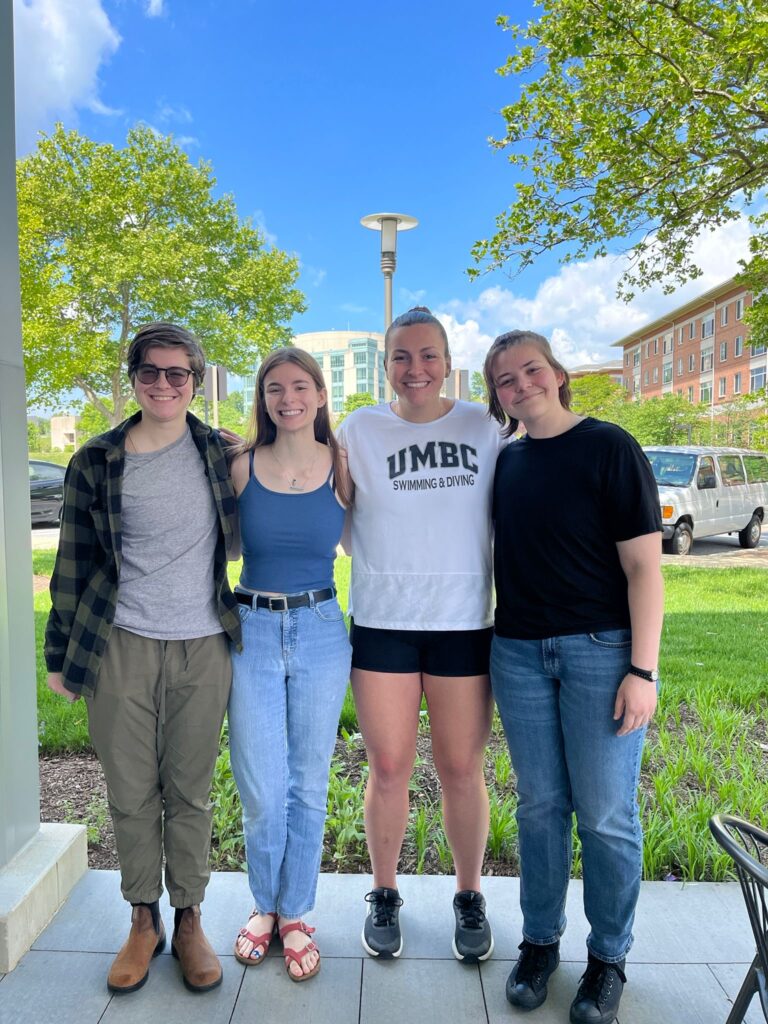 Maddy Pollack, second from left, with fellow members of the UMBC Hillel executive board for the 2022 – 2023 academic year. (Image courtesy of Pollack)
Q: Why did you choose UMBC??
A: I came to UMBC because I wanted to have the resources of a large university and the feel of a small university. We have the best of both worlds—not too big, but not too small. I love that I can see people I know everywhere I go on campus, but I also feel so lucky to have connections with professors and mentors who can help me do anything I want after graduation.
Q: Since you’ve been a part of the UMBC community, what sources of support have you found to help you reach your goals?
A: My professors in the history department have been the biggest help in jump-starting my future. They’ve not only provided important skills training in the classroom, but also career planning and networking advice. I even got to intern at NASA—not something you’d expect of someone so far removed from STEM disciplines!
I know that I will stay connected even after I graduate, because Honors College staff have helped me grow so much academically, professionally, and personally.
Q: Are you currently part of a scholars program at UMBC? Tell us what you enjoy about it!
A: Being part of the Humanities Scholars Program means I get extra enrichment as a UMBC student. First, we are lucky to have multiple excursions each semester that bring us to local arts events and theatrical performances. Each spring, we get to go on a trip to New York City to visit a museum and see a show on Broadway. (I’m especially excited about this year’s tickets to Six!)
Finally, each Humanities Scholar is encouraged to study abroad, and our scholarships are transferable to our institutions abroad. We can also apply for additional study abroad scholarships to fund our experiences as we become global citizens. I just got back from a semester in London this past fall, and you can see my blogs as an ambassador for our Education Abroad office.
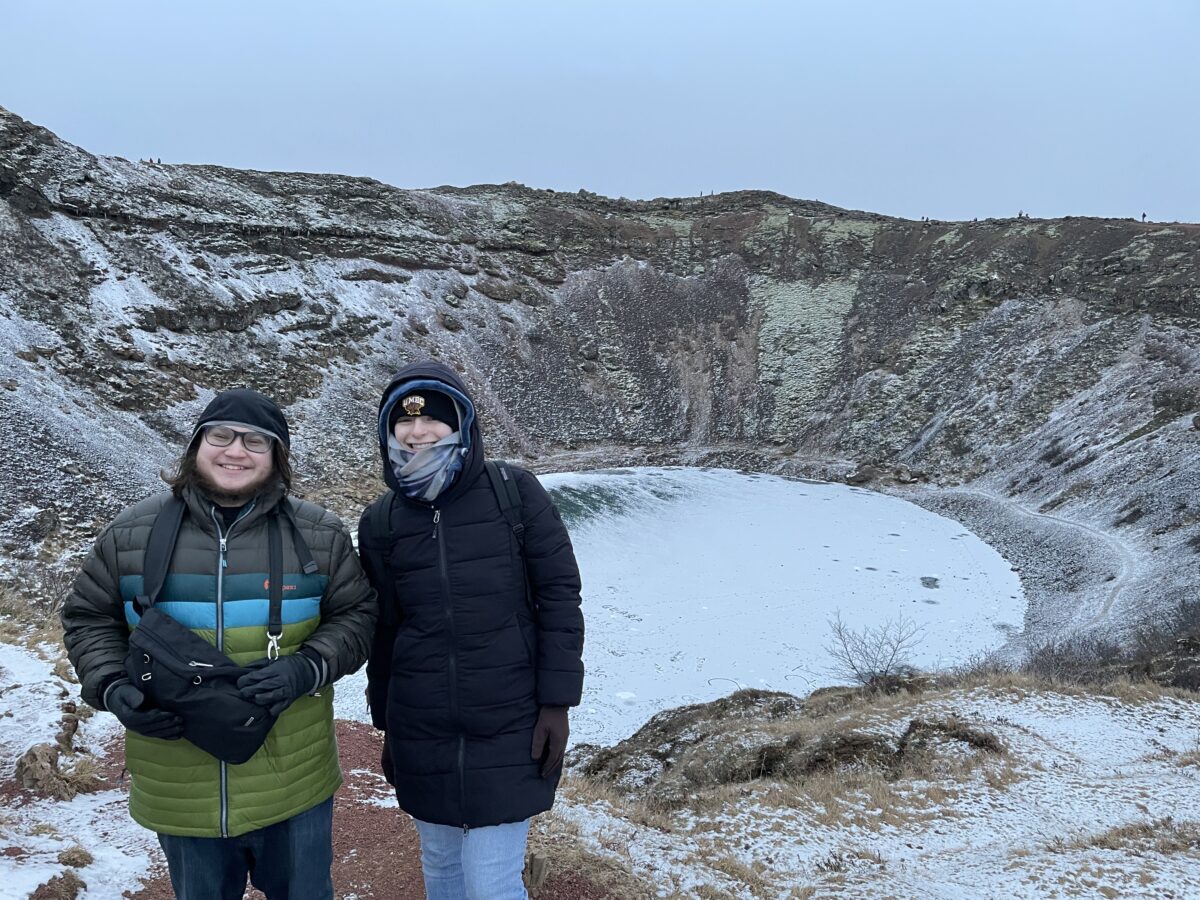 Maddy Pollack, right, and Humanities Scholar Evan Royston ’25, history, visited Iceland while both of them were studying abroad in Europe. Here they stand in front of the Kerid Volcanic Crater. (Image courtesy of Pollack)
Q: What’s the one thing you’d want someone who is new to the UMBC community to know?
A: Don’t be afraid to ask for help! Everyone remembers what it was like to be new to UMBC, and although the first few times you ask for help might be scary, our community is dedicated to being a family, and you’ll find your place soon!
UMBC’s greatest strength is its people. When people meet Retrievers and hear about the passion they bring, the relationships they create, the ways they support each other, and the commitment they have to inclusive excellence, they truly get a sense of our community. That’s what “Meet a Retriever” is all about.
Learn more about how UMBC can help you achieve your goals.
]]>
Madelyn (“Maddy”) Pollack ’24, history, is a Humanities Scholar and a member of the Honors College. She is pursuing minors in public history and Judaic studies, and she is active in Hillel and...
https://umbc.edu/stories/maddy-pollack-humanities-scholar-honors-college/
https://my3.my.umbc.edu/api/v0/pixel/news/139956/guest@my.umbc.edu/65cbf98ec53da3bceea6026964251f0a/api/pixel
cahss
hillel
history
honors-college
humanities-scholars
impact
judaic-studies
magazine
meet-a-retriever
perspectives
story
UMBC News & Magazine
https://my3.my.umbc.edu/groups/umbc-news-magazine
https://assets1-my.umbc.edu/system/shared/avatars/groups/000/001/943/24435aa6207c452e7bc15cc74b42c7bb/xsmall.png?1748556657
https://assets1-my.umbc.edu/system/shared/avatars/groups/000/001/943/24435aa6207c452e7bc15cc74b42c7bb/original.png?1748556657
https://assets2-my.umbc.edu/system/shared/avatars/groups/000/001/943/24435aa6207c452e7bc15cc74b42c7bb/xxlarge.png?1748556657
https://assets2-my.umbc.edu/system/shared/avatars/groups/000/001/943/24435aa6207c452e7bc15cc74b42c7bb/xlarge.png?1748556657
https://assets3-my.umbc.edu/system/shared/avatars/groups/000/001/943/24435aa6207c452e7bc15cc74b42c7bb/large.png?1748556657
https://assets1-my.umbc.edu/system/shared/avatars/groups/000/001/943/24435aa6207c452e7bc15cc74b42c7bb/medium.png?1748556657
https://assets2-my.umbc.edu/system/shared/avatars/groups/000/001/943/24435aa6207c452e7bc15cc74b42c7bb/small.png?1748556657
https://assets1-my.umbc.edu/system/shared/avatars/groups/000/001/943/24435aa6207c452e7bc15cc74b42c7bb/xsmall.png?1748556657
https://assets2-my.umbc.edu/system/shared/avatars/groups/000/001/943/24435aa6207c452e7bc15cc74b42c7bb/xxsmall.png?1748556657
UMBC News & Magazine
2
0
false
Tue, 12 Mar 2024 12:36:31 -0400
Tue, 12 Mar 2024 12:36:31 -0400
Preserving history’s mark—one tree, one brick, one story at a time
Artillery booms in the distance as men hurriedly button up their scratchy wool uniforms and grab their muskets. The smell of campfires and horses intertwine with shouts, neighs, and gunfire.
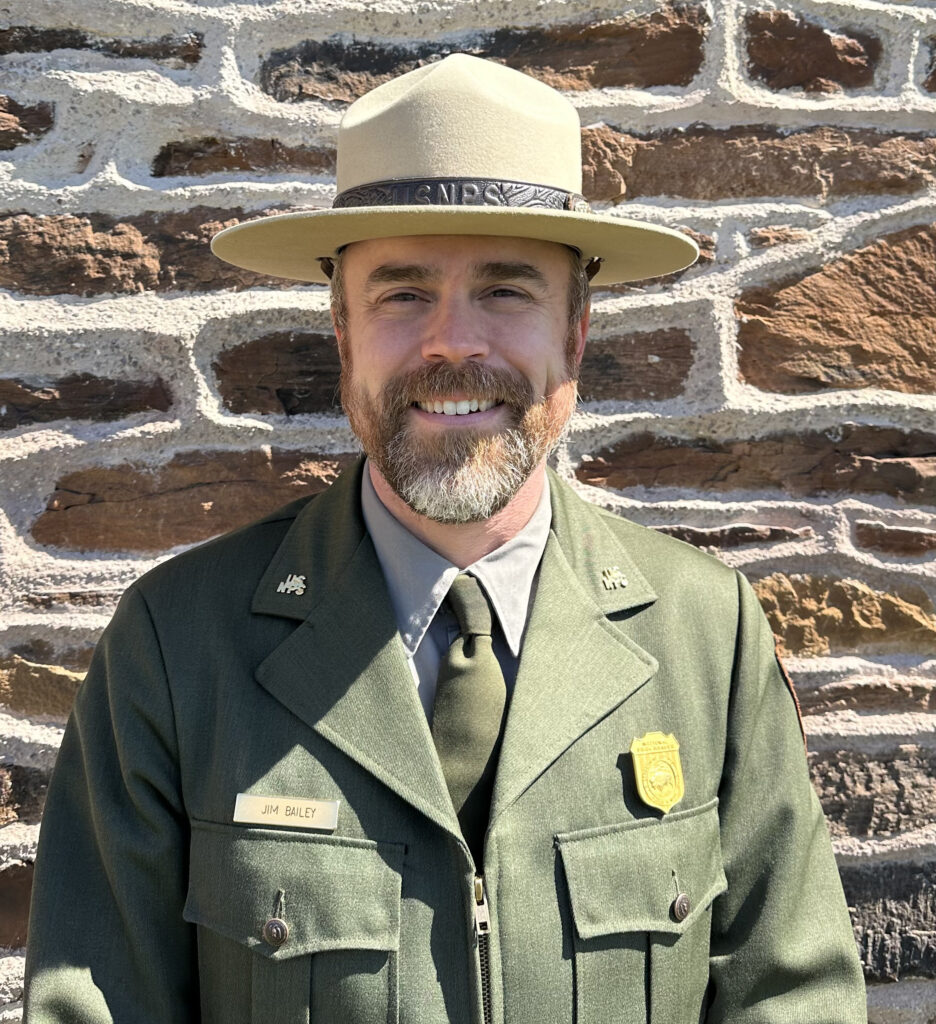
“It was a sensory overload,” remembers Jim Bailey ’03, M.A. ’07, history, of the recreated battles and camps he saw during 125th anniversary Civil War events. “At the age of eight, it wasn’t that I was reading books and studying history. It was something I could see. Smell. Hear. Feel.”
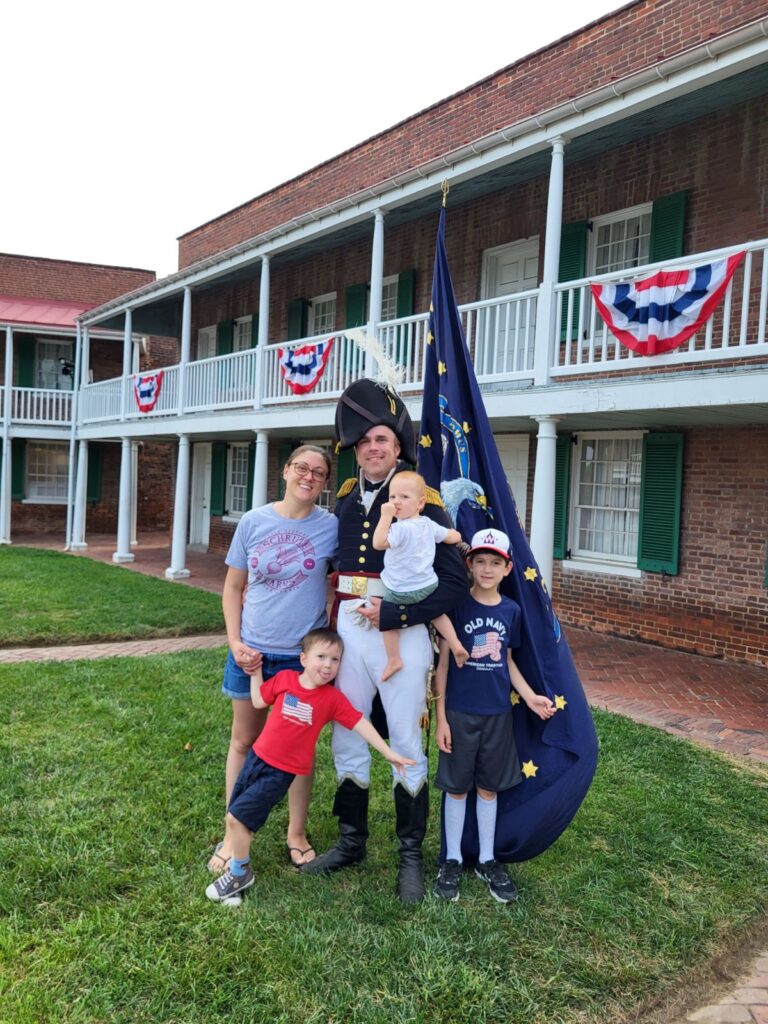
Exactly what Bailey would do with his early love for immersive history, however, wasn’t clear until a class during his first year at UMBC, when a park ranger from nearby Fort McHenry National Monument & Historic Shrine in Baltimore City gave a guest talk on volunteering for the National Park Service. By December of 1998, 18-year-old Bailey—a Humanities Scholar—was signed up as a Volunteer-in-Parks, the first step in a long career that has led him to his current position as superintendent of both Appomattox Court House National Historical Park and Booker T. Washington National Monument.
Balancing natural and cultural resources
The United States National Park System (NPS) is 424 units strong, and always expanding. If this number seems large—aren’t there 63 national parks?—it’s because NPS includes everything from national battlefields and lakeshores to historical parks and monuments, as well as marquee parks like Yellowstone.
Bailey explains that the two parks now under his jurisdiction—although 65 miles apart—tell similar narratives about the end of one story and the beginning of another. Appomattox Courthouse was the site of the April 9, 1865, surrender of the Army of Northern Virginia, marking the beginning of the end of the Civil War and the start of a new era of freedom fraught with uncertainty for newly freed people.
The Booker T. Washington monument tells the story of a nine-year-old boy who had to carry school books for the children of his enslavers, but was not himself allowed to learn to read and write. Washington eventually made the 500-mile trek to Hampton University, becoming an influential early African American leader. (Another influential Black leader would follow in his footsteps to Hampton, President Emeritus Freeman Hrabowski, who received his undergraduate degree there.)
The national parks are hugely important because they show us that as a people, we continue to define freedom, civil rights, and civil liberty. We can’t take that for granted.
Jim Bailey ’03, M.A. ’07, history
“As a nation, we for years have been having an open discussion on Civil War memory and monumentation in public places. Who gets remembered? And that is something that as an agency, we’ve always done,” says Bailey.
“We’ve always been expanding the cultural sites that we maintain and the stories that we tell. We recognize that all of these stories make up the tapestry that is our nation. It’s not just for George Washington or Francis Scott Key. It’s also people like Booker T. Washington and Hannah Reynolds.” (Reynolds, an enslaved woman, was mortally wounded during the Battle of Appomattox Court House—and is the only known civilian casualty of the battle—but was free for the three days between the Confederate surrender and her tragic death.)
As superintendent, Bailey leads a team that works on preserving historic structures, keeping up with the latest research on the stories told in those structures, and maintaining natural resources, including water quality, wildlife surveys, wildlife management, and controlled burns.
Conflicts can arise, however, when working to balance both natural and cultural resources.
“How do you do that when you also have to provide access to the public today and you have to do that in a way that doesn’t impact the ability of their children or grandchildren or great grandchildren to come to this park and see all the same things?” asks Bailey. “But that’s the mission of the National Park Service: To preserve and protect these parks for both this generation and future generations.”
Cultural landscapes as classrooms
Unsurprisingly, perhaps, Bailey makes a point of getting out of the office to walk through the parks, greeting staff and talking to visitors. He says that his leadership style is heavily influenced by an early mentor: Hrabowski.
“As an undergraduate, I was shocked to see Dr. Hrabowski out there, talking with students. And you saw it all the time,” explains Bailey. “He said that he can wander through campus and easily be looking down and be thinking about the next meeting or issue, but had to remind himself not to do that. As a young man, hearing that from someone like Dr. Hrabowski was very powerful. And I’ve always tried to emulate that.”
Sometimes, Bailey will seek solitude and hike a trail, maintaining a regular connection to the park—walking where Booker T. Washington spent his childhood, or experiencing the Appomattox River where the Monacan people settled— separate from his administrative role. He describes this as “the power of place.” You can experience history outside of books and classrooms because, “You’re there and you can see it.”
“We call it the cultural landscape,” adds Bailey. “The national parks are hugely important because they show us that as a people, we continue to define freedom, civil rights, and civil liberty. We can’t take that for granted. It’s something that each generation has to define and defend and decide—What do these things mean?”
For current Retrievers, Bailey recommends being willing to step outside of your comfort zone.
“Listen and open a dialogue with people who think differently. Engage with other disciplines than your own. Consider different perspectives. UMBC provides that space, both literally and figuratively.”
Bailey says his favorite national park is “the next one” he visits. But just in case you need another reason to visit one of the 424 National Parks Service sites: “The value of these national parks is that they are open classrooms where all Americans are welcome to think and to contemplate.”
Want to see where a degree in history might take you? Explore UMBC’s history program today.
]]>
Artillery booms in the distance as men hurriedly button up their scratchy wool uniforms and grab their muskets. The smell of campfires and horses intertwine with shouts, neighs, and gunfire. ...
https://umbc.edu/stories/preserving-history-mark-on-a-place/
https://my3.my.umbc.edu/api/v0/pixel/news/134565/guest@my.umbc.edu/0881b135f71034dfa1465084b84980a1/api/pixel
alumni
cahss
history
humanities-scholars
magazine
UMBC News & Magazine
https://my3.my.umbc.edu/groups/umbc-news-magazine
https://assets1-my.umbc.edu/system/shared/avatars/groups/000/001/943/24435aa6207c452e7bc15cc74b42c7bb/xsmall.png?1748556657
https://assets1-my.umbc.edu/system/shared/avatars/groups/000/001/943/24435aa6207c452e7bc15cc74b42c7bb/original.png?1748556657
https://assets2-my.umbc.edu/system/shared/avatars/groups/000/001/943/24435aa6207c452e7bc15cc74b42c7bb/xxlarge.png?1748556657
https://assets2-my.umbc.edu/system/shared/avatars/groups/000/001/943/24435aa6207c452e7bc15cc74b42c7bb/xlarge.png?1748556657
https://assets3-my.umbc.edu/system/shared/avatars/groups/000/001/943/24435aa6207c452e7bc15cc74b42c7bb/large.png?1748556657
https://assets1-my.umbc.edu/system/shared/avatars/groups/000/001/943/24435aa6207c452e7bc15cc74b42c7bb/medium.png?1748556657
https://assets2-my.umbc.edu/system/shared/avatars/groups/000/001/943/24435aa6207c452e7bc15cc74b42c7bb/small.png?1748556657
https://assets1-my.umbc.edu/system/shared/avatars/groups/000/001/943/24435aa6207c452e7bc15cc74b42c7bb/xsmall.png?1748556657
https://assets2-my.umbc.edu/system/shared/avatars/groups/000/001/943/24435aa6207c452e7bc15cc74b42c7bb/xxsmall.png?1748556657
UMBC News & Magazine
0
0
false
Tue, 08 Aug 2023 14:55:29 -0400
Career Q&A: Alexander Bush ’09, Political Science
Every once in a while, we’ll chat with an alum about what they do and how they got there. Recently, we caught up with Alexander Bush ’09, political science, a former Humanities Scholar who went on to law school at Pepperdine University in California. In addition to his full-time job as a personal injury attorney in Baltimore, Bush co-hosts Baltimore Barristers, a radio call-in show about legal issues.
 NAME: Alexander A. Bush
JOB TITLE/EMPLOYER: Co-host of the Baltimore Barristers radio show on CBS 1300 AM and Associate Attorney at Ingerman & Horwitz LLP
MAJOR/MINOR: major in History, minors in Political Science and French
GRAD YEAR: 2009
How did you decide to go to law school? What has the trajectory of your law career been, leading up to “Baltimore Barristers”?
I’ve learned the importance of career flexibility. My plan at Pepperdine Law was to do death-penalty defense. While I was very pleased that Maryland ended the death penalty soon after my graduation, it did keep me from getting a permanent position with the Public Defender’s Aggravated Homicide Division.
Fortunately, a diploma from UMBC, with its ever increasing reputation and rankings, helped me in the job market. Since then I [have] accepted a position at Ingerman & Horwitz, the state’s largest workers’ compensation firm, located in Baltimore City. I still get to handle criminal defense cases, but now I specialize in personal injury.
My co-host, Stephen Caramenico, and I came up with the idea for a radio show only about two months ago. We were fortunate to find an opening on 1300AM Tuesdays at 7pm. It has been a challenge balancing a heavy caseload and all the work that goes into the show, but I’m really enjoying it.
As a lawyer, what made you decide to do a radio show? Did you have any experience with the medium prior to breaking into that realm?
My current position as a litigation attorney gets me lots of trial experience, but I also wanted to find a way to incorporate politics and public policy into what I do. Since [my] co-host and I started the Baltimore Barristers in September, we’ve had two state delegates on to discuss proposed changes in the law, and a county council chairman to discuss the future of marijuana dispensaries.
It’s also a good career move given how competitive my field is. You can be the most skilled lawyer in the city, but if no one knows your name, you won’t get any clients.
I had no background in radio before this. It has been quite the learning experience. I’ve been lucky to have a great producer at CBS 1300 AM. I’ve yet to have any major technical slip-up or (my greatest fear) use any fine-inducing salty language on air, so I am feeling confident.
Since CBS 1300AM is mostly a sports talk station, my co-host and I have embraced our sports fan audience with stories on whether fantasy sports sites like FanDuel and DraftKings are gambling (the answer: maybe), Deflategate, and more.
What is it like to answer people’s legal questions?
The first step in doing it empathetically is understanding the vast difference between the public’s perception of the law and what the law actually says. Most of us have our own sense of basic fairness and just assume that’s how the law works. I think having a Master’s in Alternative Dispute Resolution [from Pepperdine’s nationally-recognized Straus Institute] helps me to build rapport and trust with someone even while I’m telling them something they really don’t want to hear about the law.
On the radio, I make it clear that there is no attorney-client relationship (and obviously no confidentiality) in on-air advice. I’ve had to tell callers not to give me any identifying information on the air, and then have spoken to them privately after the show.
What about your experience at UMBC stands out the most to you?
The Humanities Scholars program has had a great positive impact on my life. It provided me with a small, supportive community and was the impetus for a lot of great experiences like study abroad, funded research, and a living-learning community dorm. But it was more than just the program[.] [The] whole culture of UMBC worked for me. Being a nerd (in my case, a history and law nerd) is cool here.
I also had a number of great professors with whom I’ve been lucky to have lasting relationships, but especially Dr. George LaNoue, who taught my constitutional law courses and gave me a lot of great advice while applying to law schools. While I was at Pepperdine, Dr. LaNoue and I co-authored a paper on 1st Amendment issues with internal review boards, which we presented at a conference at Cambridge in the UK.
Knowing what you know now, what would you tell a brand new UMBC student?
There are a lot of opportunities to take advantage of, so start planning early. Give yourself time in the beginning to try new experiences, but once you’ve found what you like, go for it!
For me, it was a study abroad in Cameroon and France that I was able to tie into research in the UK, which then led to presenting my research at URCAD. That was a great experience, especially for an undergrad who wouldn’t usually have an opportunity like that.
You can listen to past Baltimore Barristers podcasts here.
]]>
Every once in a while, we’ll chat with an alum about what they do and how they got there. Recently, we caught up with Alexander Bush ’09, political science, a former Humanities Scholar who went on...
https://umbc.edu/stories/career-qa-alexander-bush-09-political-science/
https://my3.my.umbc.edu/api/v0/pixel/news/121502/guest@my.umbc.edu/53ced4ad02a10a3e44525dcac786f8b2/api/pixel
alexander-bush
alumni
humanities-scholars
law
political-science
UMBC News & Magazine
https://my3.my.umbc.edu/groups/umbc-news-magazine
https://assets1-my.umbc.edu/system/shared/avatars/groups/000/001/943/24435aa6207c452e7bc15cc74b42c7bb/xsmall.png?1748556657
https://assets1-my.umbc.edu/system/shared/avatars/groups/000/001/943/24435aa6207c452e7bc15cc74b42c7bb/original.png?1748556657
https://assets2-my.umbc.edu/system/shared/avatars/groups/000/001/943/24435aa6207c452e7bc15cc74b42c7bb/xxlarge.png?1748556657
https://assets2-my.umbc.edu/system/shared/avatars/groups/000/001/943/24435aa6207c452e7bc15cc74b42c7bb/xlarge.png?1748556657
https://assets3-my.umbc.edu/system/shared/avatars/groups/000/001/943/24435aa6207c452e7bc15cc74b42c7bb/large.png?1748556657
https://assets1-my.umbc.edu/system/shared/avatars/groups/000/001/943/24435aa6207c452e7bc15cc74b42c7bb/medium.png?1748556657
https://assets2-my.umbc.edu/system/shared/avatars/groups/000/001/943/24435aa6207c452e7bc15cc74b42c7bb/small.png?1748556657
https://assets1-my.umbc.edu/system/shared/avatars/groups/000/001/943/24435aa6207c452e7bc15cc74b42c7bb/xsmall.png?1748556657
https://assets2-my.umbc.edu/system/shared/avatars/groups/000/001/943/24435aa6207c452e7bc15cc74b42c7bb/xxsmall.png?1748556657
UMBC News & Magazine
0
0
false
Thu, 29 Oct 2015 13:30:00 -0400