Who gets to tell the story? The tricky back story of how radio shows can promote empathy but also build up cultural divides
In his new book, Empathy Machines: This American Life, Podcasting, and the Public Radio Structure of Feeling, Jason Loviglio, professor of media and communications, critiques and analyzes the making of and the impact of one of his favorite shows on National Public Radio (NPR), “This American Life”—a radio show turned podcast that received the 2021 Pulitzer Prize in Audio Reporting. “This American Life,” created and hosted by Baltimore-native Ira Glass, became a listener favorite for its magical way of weaving stories about everyday people into larger human issues, sounding more like a sympathetic, curious neighbor instead of a serious professor. The irony is not lost on Loviglio, who thanked his students in the book for reminding him that accessibility ensures that the public, his students, and their families, not only academic editors, understand the research. He wants this young audience to learn about radio and be inspired to research their own media and communications passions.
“The people I have had the honor of calling my students over the years have done more than anyone else to help me learn how to communicate ideas about communication and media clearly and simply,” writes Loviglio in his acknowledgements. “The MCS undergraduates are among the least pretentious and least entitled people I’ve ever had the pleasure of working with. Too numerous to name here, I give a collective thanks to you for the lessons of clarity you’ve taught me and for the laughs.”
Long before Loviglio became an author and the co-editor of Radio Journal: International Studies in Broadcast and Audio Media and of The Routledge Companion to Radio and Podcasting Studies, he was a young kid in love with “weird radio shows,” notes Loviglio. “I remember listening at night to my red transistor radio when I was little, maybe 9 or so. I put it under my pillow so my parents wouldn’t hear it,” says Loviglio. “I mostly listened to weird nationally-syndicated late night public radio shows, like Dr. Demento and local sports talk shows.”
While he doesn’t expect students to fall in love with radio as he did, in his History of Media class, he wants students to understand the power and importance of radio long before stories were mobilized in the palms of our hands 24/7 worldwide. Loviglio encourages students to look beyond Google and instead find people whose lives were shaped by radio.
He wants students to explore what radio meant in everyday life and how it conveyed and reflected emotions such as fear, danger, excitement, and joy—functioning as empathy machines that inspired deeper forms of storytelling and laid the groundwork for public radio and podcasts.
Q: What are empathy machines?
A: I think it’s safe to say that public radio has been explicitly understood as an empathy machine at least since the radio show “This American Life’s” debut in 1996. If we allow for synonyms of empathy, then radio has been understood this way for a lot longer. There’s a longer history regarding various media of communication as uniquely efficient machines for producing empathy. Most famously, of course, is the novel. And before that, oral storytelling. The idea of radio as an empathy machine stems from a specific history referred to as the technological sublime.
The notion that we can invent and communicate our way into equality is central to the way we understand Western history since at least the printing press. The book, particularly the novel, has been hailed for its powers to impart democracy and empathy. This history is opposed by an equally compelling one in which the machine represents the antithesis of democratic values of participation and empathy. A dominant theme in media history is the role of technology as an extension of human values, such that we no longer hear the metaphors in our arguments.
Q: Did you always know you were going to write about “This American Life” instead of general radio?
A: It wasn’t until a couple of years ago that I realized the best way to tell the story of public radio and podcasting was through NPR’s “This American Life.” It was first produced in 1996 by WBEZ, Chicago Public Radio, and then picked up nationally by Public Radio International. It became a massive show.
“This American Life” is also one of the first shows to start offering a podcast version, in case you missed an episode. Around 2014, “This American Life” started to shift, where more people were listening to it as a podcast. I wrote to Ira Glass last year, and he still calls it a radio show. That’s still his default understanding of it, even now.
Q: Did you have fun writing this?
A: Yes and no. I had fun thinking about it and fun listening to the shows. This is such a great way to tell stories. But it was hard to write because the shows kept changing. My thoughts kept changing. I began writing the book during President Obama’s administration, when I was thinking positively about American history. Then, Trump won.
I didn’t think that because President Obama was elected, it meant that everything was great and we had cured racism. I thought a particular version of liberalism had won. Definitely very capitalistic, definitely very interested in style, maybe more than substance, but there was a story everyone was telling about the country that was designed to make people feel very comfortable. Not only liberals, but also very privileged people, and not particularly political.
Trump winning the 2016 presidential election was a reminder that there is another story. I knew the other far-right story, but I thought that more people were happy for the positive symbolic victory that President Obama represented in terms of being biracial and being born to an immigrant father. This educated, cosmopolitan elite could also speak across different cultural registers. I thought that’s what I was writing about. Then the Trump administration began, and I felt I had to write about this darker story. That meant I had to think differently about the long, slow death of liberalism. There was something rotten in the creeping neoliberalism of the era that put some of us to sleep, left others out in the cold, and mobilized a politics of racial grievance on the right.
Q: What was the critique?
A: I’m not speaking for everyone, but people like me: privileged, educated, and progressive but kind of complacent. What did we do for the eight years of the Obama administration and the previous two or three decades of creeping neoliberalism? What were we listening to? Public radio. That’s what we were listening to. That’s the soundtrack of the frog and the pot. The pot slowly heats up, the frog is comfortable, and doesn’t realize it’s slowly boiling. I love public radio. I love “This American Life.” I love podcasting, but I also wanted to look critically at the story we were telling about empathy, who is telling the story, and who is the story about?
Important exceptions long persisted at the margins of the public radio industry. “Latino USA” is the longest-running public radio Latino news and cultural program in the United States. It is unique in that it has people of color behind the microphone. It is designed by the people that it speaks to, but most of public radio is not that way. In contrast, “This American Life,” in a way, is the epitome of white liberalism. It’s really beautiful storytelling, but in the service of this kind of sound effect of liberalism and empathy, instead of something a little bit more gritty and radically engaged that maybe we should have been trying to tune into.
I use “This American Life,” as a bridge, because of the way that it really epitomizes…radio, as a place for sonic innovation, experimentation, the primacy of the local, the intimacy of the familiar, weakly voice…
Then what happens is it becomes a national phenomenon…turning into inside the beltway, political relevance, and increasing market share…driven by an increasingly robust audience research, which discovers…that the folks who listen to public radio are disproportionately…highly educated, higher earners, and that in order to sustain a system that relies on donations…the programming has to not only appeal to them, but the variation between programs has to be minimal…which is borrowed from commercial radio.
Q: Did the mindset about who gets to tell the radio story shift during or after the social justice protests of the summer of 2020?
A: Yes. That is when it all falls apart. The whole public radio storytelling format starts to collapse in the late 2010s because most of these shows are run by white producers and white on-air talent who are telling stories about others. All the contradictions just start to crash into each other, and a lot of the shows go off the air. There are all these awkward moments of reckoning. Shows changed. One week, the radio show “Invisibilia,” an NPR podcast about the unseen forces that shape human behavior, like ideas and beliefs, was being produced by all-white women from NPR, The New Yorker, and Slate magazine. Then, in part due to the collapse of the specific logic of empathy that animated the show, there is a switchover to new hosts—two women of color, who cheerfully embraced a more politically engaged set of feelings, like confrontation and discomfort. The show was canceled in 2023, suggesting that the format could not bear certain kinds of changes to its structure of feeling.
The same thing happened with “Reply All,” a popular podcast about the internet and digital culture, created and hosted by Alex Goldman and PJ Vogt, two white men from New York City. They had a massive implosion. Goldman and Vogt were called out for perpetuating plantation culture in the workplace, where leadership and decision-making are dominated by white executives or managers, right in the middle of doing an exposé on Bon Appétit, a high-end food culture magazine, for doing precisely the same thing. “Reply All” was calling out a white-run magazine, and the people who were doing a lot of the grunt work but not getting paid were people of color and young people, who spoke up about the hypocrisy. That show collapsed in a couple of weeks.
It’s really a radical moment because radio shows and podcasts don’t get to tell the same stories without ever changing who gets to tell the stories. You don’t get to pretend you care, but not change. And so things really start to feel the strain by 2020.
Q: Are shows today more liberal or conservative as a result of the shift in 2020?
A: There are many shows today that center on conflict and unhappiness with the status quo—that Trumpism has gone too far. I try to write about how we are in a whiplash between this rhetoric of empathy and the rhetoric of Trumpism, this hostility to the idea of caring for others. I don’t know how many people took the political implications of empathy seriously, but rhetorically, it shaped a good deal of the public radio structure of feeling.
Q: Why did you thank your students in the book?
A: Students are reading less and less, and academics like me want to write clearly, and we usually don’t because we’re not thinking about 17-year-olds. We’re not thinking about the parents of 17-year-olds who might encounter our research in a faculty magazine or a newspaper. We’re thinking about the people who review academic journals or books.
One reason I thanked the students is that in the MCS methods class, students read articles written by MCS faculty. If they’re learning about history, they’re reading something I wrote or something Liz Patton, chair and associate professor of MCS, who writes about media history, identity, and space, wrote. If they’re reading about globalization and representation, they’ll read research byTracy Tinga, associate professor of MCS, who focuses on critical conversations about media, power, development, and digital cultures in African contexts, or research by Fan Yang, professor of MCS, who writes about the intersection of cultural studies, transnational media studies, globalization, postcolonialism/postsocialism, urban communication, and contemporary China. And now, they are reading work on social media and mental health, thanks to our newest colleague, Holly Avella. They’re also reading or viewing the work of Chung-Wei Huang, teaching assistant professor, Kristen Anchor, teaching associate professor, and Donald Snyder, teaching professor of MCS.
Students love reading faculty research, so I want to make sure what I’m writing is accessible to students. It’s a conversation starter when students connect personally with the research.
Q: Do students in your classes listen to the radio?
A: Some do. I think they do so a bit more after they’ve had a class with me. I want to make sure all my classes have opportunities for different kinds of creativity and engagement. In my History of Media class, I have students think about radio and pay attention to what is on the radio by having them interview a grandparent or someone older in their lives about their experiences with the radio. Students create small stories by conducting interviews and editing them into short radio diaries in a style similar to “This American Life.”
A lot of our students are immigrants or international students, and even more are children or grandchildren of immigrants. Radio remains especially important in much of the world, particularly in the Global South and in regions shaped by uneven development. This assignment helps students learn about their grandparents, and for some, it becomes the most meaningful conversation they have ever had with them. I’ve had students come back and tell me, “My grandfather died, and I have this recording of us talking for your assignment. It’s the only thing I have of him.” That’s why I really value this assignment.
Q: Is listening to the radio really a thing of the past?
A: Video games and gaming culture are increasingly central to sound studies because so much of these experiences are built around audio design. Many major games are intentionally structured to sound like radio, as in Grand Theft Auto, which features more than a dozen in-game radio stations with full playlists. In this sense, radio continues to shape not only podcasting but also video games, providing a template for how soundscapes are constructed for audiences. Even though radio may seem obsolete or old-fashioned, it remains one of the dominant frameworks through which people understand and design contemporary sound culture.
Register to attend an interview with Loviglio on July 21, 2026, at the Ivy Bookshop in Baltimore City, hosted by Aaron Henkin, award-winning public radio producer and podcaster. Read more UMBC Humanities Books stories.
]]>
In his new book, Empathy Machines: This American Life, Podcasting, and the Public Radio Structure of Feeling, Jason Loviglio, professor of media and communications, critiques and analyzes the...
https://umbc.edu/stories/public-radio-empathy-machines-loviglio/
Video Preview
https://assets3-my.umbc.edu/system/shared/attachments/f0f5b38d387e750783ee41e4045aa653/6a9ffc89/news/000/160/880/1421f658b20874eb200e6eeaca8d6d88/2ofgfOORQ1E.jpg?1782827406
https://my3.my.umbc.edu/api/v0/pixel/news/160880/guest@my.umbc.edu/04fc9b50e74032c6482b5f555a9ed286/api/pixel
arts-and-culture
cahss
humanitiesbooks
perspectives
research
retriever-authors
stories
story
UMBC News & Magazine
https://my3.my.umbc.edu/groups/umbc-news-magazine
https://assets1-my.umbc.edu/system/shared/avatars/groups/000/001/943/24435aa6207c452e7bc15cc74b42c7bb/xsmall.png?1748556657
https://assets1-my.umbc.edu/system/shared/avatars/groups/000/001/943/24435aa6207c452e7bc15cc74b42c7bb/original.png?1748556657
https://assets2-my.umbc.edu/system/shared/avatars/groups/000/001/943/24435aa6207c452e7bc15cc74b42c7bb/xxlarge.png?1748556657
https://assets2-my.umbc.edu/system/shared/avatars/groups/000/001/943/24435aa6207c452e7bc15cc74b42c7bb/xlarge.png?1748556657
https://assets3-my.umbc.edu/system/shared/avatars/groups/000/001/943/24435aa6207c452e7bc15cc74b42c7bb/large.png?1748556657
https://assets1-my.umbc.edu/system/shared/avatars/groups/000/001/943/24435aa6207c452e7bc15cc74b42c7bb/medium.png?1748556657
https://assets2-my.umbc.edu/system/shared/avatars/groups/000/001/943/24435aa6207c452e7bc15cc74b42c7bb/small.png?1748556657
https://assets1-my.umbc.edu/system/shared/avatars/groups/000/001/943/24435aa6207c452e7bc15cc74b42c7bb/xsmall.png?1748556657
https://assets2-my.umbc.edu/system/shared/avatars/groups/000/001/943/24435aa6207c452e7bc15cc74b42c7bb/xxsmall.png?1748556657
UMBC News & Magazine
4
0
false
Tue, 30 Jun 2026 09:33:36 -0400
Tue, 30 Jun 2026 09:33:36 -0400
Humanities Books: A Room in Bombay
Manil Suri moved to the United States after spending the first 20 years of his life living in a 400-square-foot room in Bombay, India, with his father, Ram, and mother, Prem, to whom he dedicated his latest book, A Room in Bombay. The rest of the apartment was shared between three other families. “In the apartment lived my family, which was Hindu, and three Muslim families. We had a lot of fights, but those fights were really not about religion. They were about the shared bathroom, or the shared kitchen, or resources, or money, or space,” explains Suri, a professor of mathematics at UMBC.
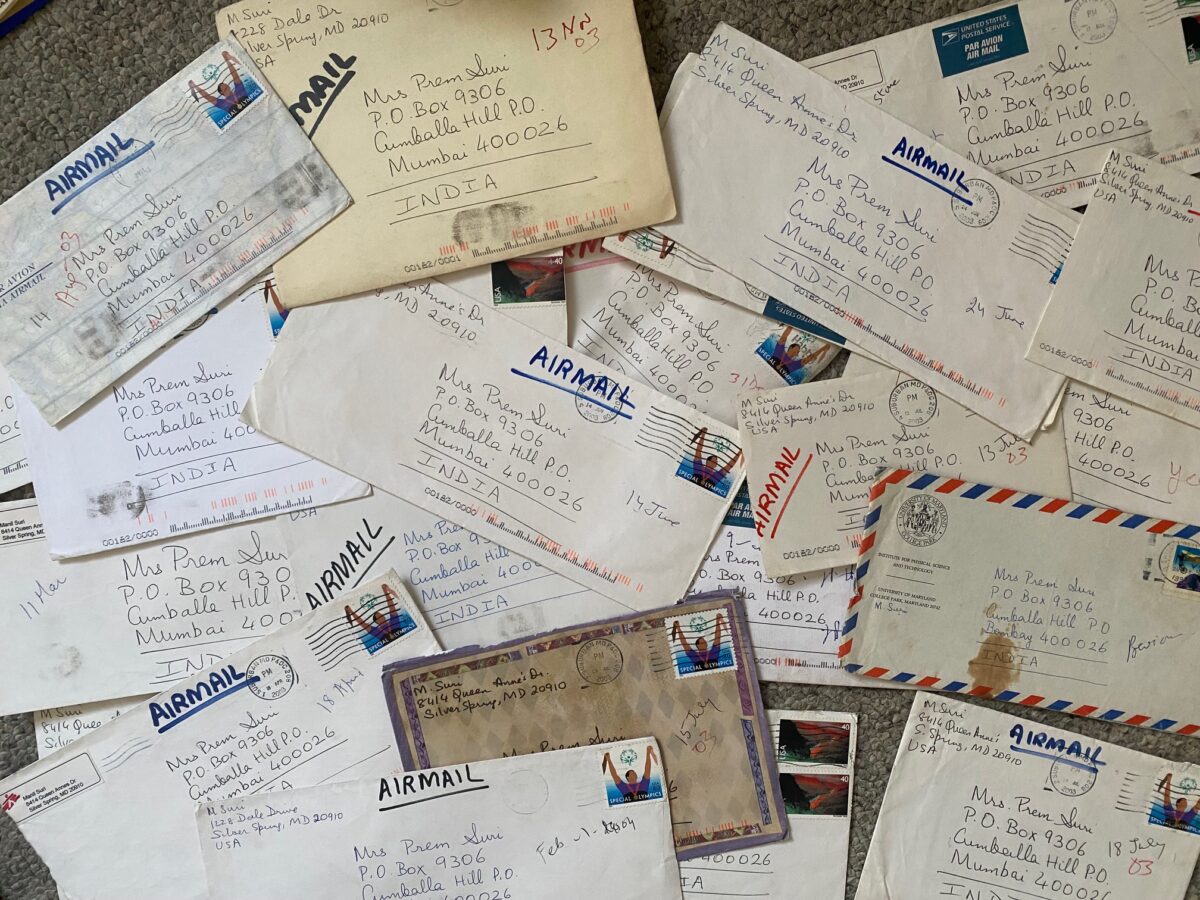 Some of the envelopes from letters Suri sent to his mom, Prem, in India once he moved to the U.S. (Image courtesy of Manil Suri)
Suri is also an award-winning author of three novels named after Hindu gods: The Death of Vishnu, The Age of Shiva, and The City of Devi. His fourth book, The Big Bang of Numbers: How to Build the Universe Using Only Math, is a humanities-based approach to mathematical concepts. They all paved the way for Suri’s most personal and most recent book. In three parts, Suri shares his life growing up in this room in Bombay and his life in the United States, drawing on more than 2,700 letters he wrote to his mother, which she saved in bundles organized by year, beginning with his time as a graduate student at Carnegie Mellon University. The letters chronicle his life in the U.S., including his relationship with his partner Larry, whom he took twice to meet his parents in the room in Bombay.
Q: Who is your book for?
A: I think it’s a book that, first of all, I want to work as a story. People who like a good narrative will enjoy it. It also ties into a different idea of immigration. You hear drastic tales of how immigrants are being shunned and put into prisons. But there’s another side of immigration, too, a little more subtle, perhaps. People immigrate for all sorts of reasons—including “finding themselves,” as I did.
 Aditya Desai ’09, English, a fellow writer, editor, teacher, and activist in Baltimore, and a great fan of Suri’s work, interviewed Suri during an Asian Studies Program book event in spring 2026. (Brad Ziegler/UMBC)
Also, I’ve already received a few pieces of feedback from people who are taking care of their aging parents. There are a huge number of people in various generations who are doing that. So I think it’ll appeal to them and help them negotiate the very difficult road ahead that many will face.
Q: How did the timing for publishing this memoir come about?
A: I have published three novels and a book on math. I felt I had to write the math book as a public service, since I had one foot in the humanities and one in the sciences—and needed to make something out of it. Once this math book was done, there was this other lingering project [the memoir] that I actually started around 2010.

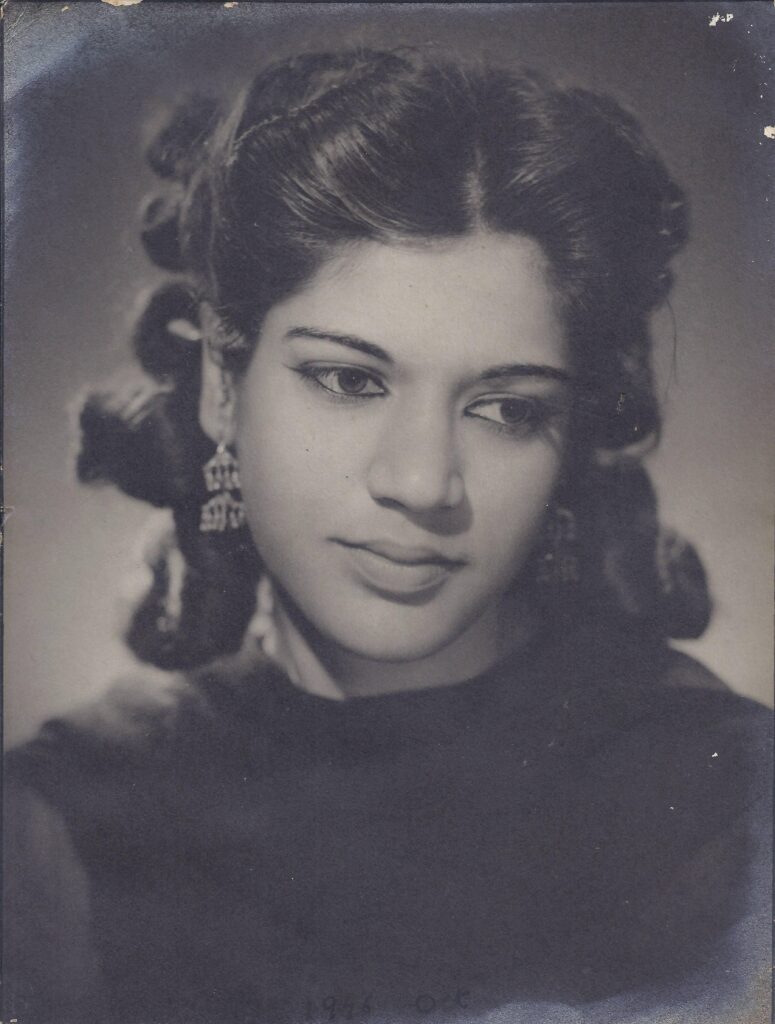
 (l-r): Suri’s mom, Prem Suri, in Bombay (date unknown), Prem in 1946, and Suri with Prem and his father, Ram, at Juhu Chowpatty Beach, Mumbai in 1961.
My mother passed away in 2013, and there was a big gap before I really got into writing the memoir. I needed that distance, since it would have been too much to have written it too close to her passing.
Q: Your mom had this intense love for you, which you wrote was sometimes overwhelming. How did that carry on through the room and through the rest of your life?
A: I think what happened with my mother was that my identity almost melded with hers when I was growing up. It’s only once I came to the U.S. that I was able to separate the two a little and move on. She would always say, “The U.S. has made you unemotional.” It was something I learned after coming here, to keep some distance, and move away from that merging of personalities.
Keeping boundaries is always hard, but it also tunes you to being more conscious of them. I don’t have any kids, so I don’t have to worry about that boundary.
Q: How did you feel coming to the United States?
A: When I first came to the U.S., I spent one week with a typical American family, and suddenly I had my own bedroom. That was exhilarating, but also a little weird. After that, I was in a dorm room with a roommate, so that was again a shared room for one year.
But after that year, I moved into an apartment where I had my own room. Since then, I’ve always had my own bedroom. Even though I’m married now, I need my own bedroom.
Q: A Room in Bombay centers around four families with very different backgrounds that often argue and have major disagreements. How does that tie into today’s world?
A: I think the book actually offers a lesson pertinent to our times. Although it was my Hindu family and three Muslim families sharing this apartment, the fights we had—and there were a lot of them—were really not about religion. They were about the shared bathroom, or the shared kitchen, or resources, or money, or space.
The same applies to most of the clashes going on in the world. Even though people try to put a religious spin on them, there are so many other reasons underlying all this strife. It’s property and boundaries, space, and resources.
Very rarely is it really religion. It’s not the cultural differences that are the cause of friction, it’s other things. Look deeper, and you’ll probably find an economic reason.
Q: Why did you choose to write the book as a memoir as opposed to an epistolary novel?
A: First of all, in terms of the letters, what I wrote are not letters to be treasured like Letters Between a Father and Son, a collection of intimate letters between Nobel laureate V.S. Naipaul and his son. Most of my letters are very ordinary and come with no claim of literary value. I was desperately trying to find things to say, and wrote three or four times a week just to keep my parents happy and engaged.
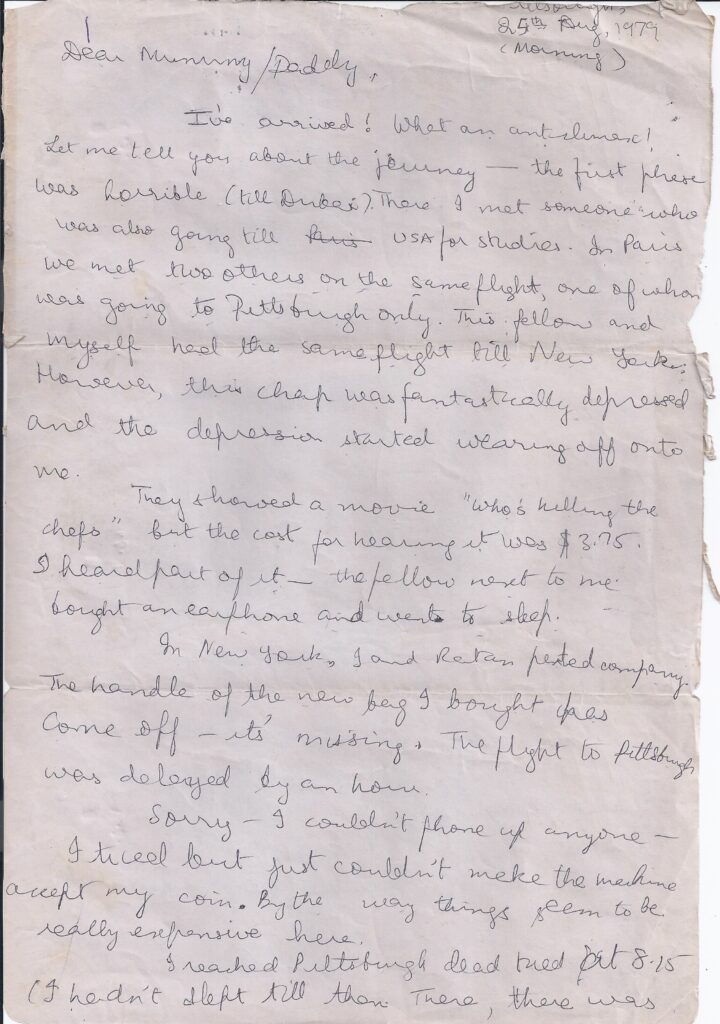 A letter Suri wrote to his father, Ram, in 1979.
There’s also so much more that happened that is not covered by the letters. I did keep some journals, especially once my mother came to the U.S. In fact, I had too much material. The first draft of this novel was about 50 percent longer, excess that I had to edit out.
Q: How do you choose what parts of the book to keep and what to cut?
A: That can be a painful decision, but fortunately, my editor helped by telling me what could be trimmed or shortened. Eventually, I had to get ruthless enough and ask myself: Is the story coming across? How much do I really need to put in for that? What examples have already been included to illustrate something—if there are two of them, let’s get rid of one.
A lot of nice, entertaining experiences had to be jettisoned in the interest of a story that keeps moving. You know, that’s what they say to writers: Kill your darlings. It’s a hard, murderous task to be a writer.
Q: There is a lot of stigma still in South Asian cultures around coming out. Did you intentionally want to address that?
A: Yes, the South Asian LGBTQ+ community is definitely one of the audiences I aimed for in this book, and in particular, their parents. Because even with my mother, who was so enlightened in many ways, there was this up and down that she went through after I came out to her. I think it really eats away at you if you cannot come out to your parents.
At the end of part two in the book, I talk about coming out to my dad. It happened after he took me to his friend’s house to introduce me to his 19-year-old daughter. Afterwards, my father said, “Well, what did you think of the daughter?” And I said, “You can’t be serious. First of all, she’s like half my age.” I ended up telling him about my relationship with my partner, to which he said, “I didn’t know, I didn’t know.” But then I noticed he was still looking expectantly at me. I realized then that he was still waiting for an answer to his question about whether I wanted to marry his friend’s daughter!
I always wanted to have a long conversation with him, which I thought I would have the next time I went back. But he passed away two months later, so that opportunity never came. I found out from my uncle that he had told all his brothers I was gay, even in that short period. So even though my mother always said, “He won’t be able to handle it. Don’t tell him,” as it turned out, he was fine with it.
As far as creating a supportive atmosphere for coming out in the South Asian LGBTQ+ community goes, I’d love to help in any way I could. It would be a good thing for members to give the book to their parents, “Here is someone else’s experience. It may help you.”
Q: Out of the twelve letters that you kept from the hundreds your mom wrote to you, is there one that really stands out to you?
A: The one that’s at the end of the book. It’s a full letter that really crystallizes a lot of things about how she viewed my coming out and how she was aware of losing some of her faculties in terms of memory and concentration. All those things are in that letter, which is why it’s probably the most poignant.
Read more about books from the humanities at UMBC.
]]>
Manil Suri moved to the United States after spending the first 20 years of his life living in a 400-square-foot room in Bombay, India, with his father, Ram, and mother, Prem, to whom he dedicated...
https://umbc.edu/stories/humanities-books-a-room-in-bombay/
https://my3.my.umbc.edu/api/v0/pixel/news/160556/guest@my.umbc.edu/9b67a293e9b6faf4fff6d4a7338ae592/api/pixel
arts-and-culture
cnms
humanitiesbooks
mathematics
news
retriever-authors
story
UMBC News & Magazine
https://my3.my.umbc.edu/groups/umbc-news-magazine
https://assets1-my.umbc.edu/system/shared/avatars/groups/000/001/943/24435aa6207c452e7bc15cc74b42c7bb/xsmall.png?1748556657
https://assets1-my.umbc.edu/system/shared/avatars/groups/000/001/943/24435aa6207c452e7bc15cc74b42c7bb/original.png?1748556657
https://assets2-my.umbc.edu/system/shared/avatars/groups/000/001/943/24435aa6207c452e7bc15cc74b42c7bb/xxlarge.png?1748556657
https://assets2-my.umbc.edu/system/shared/avatars/groups/000/001/943/24435aa6207c452e7bc15cc74b42c7bb/xlarge.png?1748556657
https://assets3-my.umbc.edu/system/shared/avatars/groups/000/001/943/24435aa6207c452e7bc15cc74b42c7bb/large.png?1748556657
https://assets1-my.umbc.edu/system/shared/avatars/groups/000/001/943/24435aa6207c452e7bc15cc74b42c7bb/medium.png?1748556657
https://assets2-my.umbc.edu/system/shared/avatars/groups/000/001/943/24435aa6207c452e7bc15cc74b42c7bb/small.png?1748556657
https://assets1-my.umbc.edu/system/shared/avatars/groups/000/001/943/24435aa6207c452e7bc15cc74b42c7bb/xsmall.png?1748556657
https://assets2-my.umbc.edu/system/shared/avatars/groups/000/001/943/24435aa6207c452e7bc15cc74b42c7bb/xxsmall.png?1748556657
UMBC News & Magazine
1
0
false
Thu, 04 Jun 2026 16:35:39 -0400
Thu, 04 Jun 2026 16:35:39 -0400
Author Kristina Gaddy ’09, collaborates with Rhiannon Giddens, Grammy Award-winning musician, on the history of Black American music
Kristina Gaddy came to UMBC as a Sondheim Public Affairs Scholar. Her passion for history and languages—Swedish, German, and Spanish—led her to graduate with a dual degree in history and modern languages and linguistics. Looking back on her time at UMBC, Gaddy is grateful for the opportunities the program provided, especially the chance to study abroad in Germany. There, she combined her proficiency in German with her historical training to research the foundations of her first book.
“The Sondheim Public Affairs Scholars Program was wonderful because of the funding I received to support my research and the cohort of students,” says Gaddy. “We were all really interested and excited about social issues, public policy, and how these ideas could be used to improve the world.”
These interests inspired a career in historical nonfiction writing and led to her to write meticulously researched books: Flowers in the Gutter: True Story of the Edelweiss Pirates, Teenagers Who Resisted the Nazis (Dutton Books, 2020), Well of Souls: Uncovering the Banjo’s Hidden History (W. W. Norton & Company, 2022), and A Most Perilous World: The True Story of the Young Abolitionists and their Crusade Against Slavery (Dutton Books, 2025).
Digitizing public history
Her collaboration with Giddens isn’t the first time Gaddy has written a book about banjos. “My start in music research and writing started 15 years ago when I was an AmeriCorps working with multi-instrumentalist Gerry Milnes at Augusta [Heritage Center in Elkins, West Virginia], and the friends I made while living in Elkins helped put me on the path to writing Well of Souls and Go Back and Fetch It.”
 Kristina Gaddy performing at the Augusta Heritage Center in Elkins, West Virginia. (Image courtesy of Gaddy)
It’s not just documents that Gaddy used in her first banjo book—which are accessible on her blog—but also sound clips, performances, and interviews. While many historical records can be found online, many more have yet to be digitized. Gaddy, who also digitized and archived the West Virginia Upshur County Historical Society‘s local history collection, has made digitization an integral part of her process.
“Having come from the public history side of UMBC’s history department, I strongly believe in people having access to information as it pertains to their own history. It was one of the reasons I wanted to write Well of Souls,” says Gaddy, about her second book. “I had gathered all this information, and I could have shared it with just a few people, but I wanted anybody who wants access to banjo history not to have to go to some expensive conference to hear about it.”
A revolutionary collaboration
Giddens, a MacArthur recipient and Pulitzer Prize winner, is grateful for Gaddy’s dedication to digitizing and broadening access to historical material culture. While working on pieces of music highlighting 18th-century North American, Scottish, and Irish traditions for Ken Burns’s 2025 PBS documentary The American Revolution, Giddens was looking for samples of Black music from the Revolutionary War. She wasn’t having much luck until she explored Gaddy’s website, where she not only found what she was looking for but also the inspiration for their co-authored book, Go Back and Fetch It.
“I just kept going back to Kristina’s website, where she had put up these JPEGs. I would download them, lose the JPEG, and I’d go back and, like, download it again. And then I was just like, ‘Kristina, why don’t we put all of these in a book?’ explained Giddens at the 2025 Michigan University Arts Initiative interview on Go Back and Fetch It with Gaddy.
The book is their third collaboration. In 2018, Giddens invited Gaddy and her husband, Pete Ross—banjo maker, researcher, and musician—to present at a banjo symposium during the inaugural North Carolina Folk Festival, which Giddens curated. Gaddy presented her research on the African American roots of the banjo, an experience she credits as the inspiration for Wells of Souls, for which Giddens wrote the foreword. They also collaborated in 2022 on one episode of the 10-part series The Banjo: Music, History, and Heritage for The Great Courses project.
Gaddy, Pete Ross, presenting at the 2022 American Musical Instrument Society Conference.
“The idea behind the book was that there were all these little pieces of music in archives, in published books, in manuscripts that were sprinkled throughout the historic record of Black music in the Americas,” explains Gaddy in the same interview. “They weren’t compiled in one place. Rhiannon, as an artist, was frustrated that she couldn’t access them.”
For their book collaboration, they selected 19 pieces of music from 1687 through the 1860s. Gaddy wrote a historical research essay for each song explaining the types of banjos used, how and when they were played, and their socio-cultural significance across communities in the Americas and the Caribbean. Giddens transcribed the songs into modern treble clef and banjo tablature, which shows finger placement, rather than the Western classical notation tradition, making early Black Atlantic banjo music accessible to banjo players today, in the future, globally, and across all genres.
Following the banjo around the world
Gaddy’s last five years have been busy. But once you dig a little deeper, ask more questions, and do a lot of listening—just as she does for all of her interviews—you learn that Gaddy really started her musical performance research in high school while playing traditional Swedish music with her mom and traditional American music with her uncle and aunt. After college, she fell in love with the banjo while living with other artists in West Virginia, developing a connection with a vast, diverse community passionate about banjo culture and history—including in Baltimore City, where Gaddy and her husband performed some of the songs from Go Back and Fetch It at the Enoch Pratt Free Library in September, right before she moved to Nottingham, England.
Gaddy and Ross perform at the Baltimore City Enoch Pratt Free Library.
Gaddy has also expanded her digital research presence to Substack, where she posted the news of her fully funded doctoral program at the University of Nottingham, where she will research Black fiddling in the 19th-century British Caribbean.
And even though she is a whole ocean away, Gaddy still feels the support of her UMBC history department.
“One of the most exciting things for me is to see other students and scholars diving deeper into these subjects. My former history professor, Dr. Michelle Scott, recently put me in touch with Amina Thiam, a UMBC graduate student who is writing her thesis on Black banjoists and string instrumentalists in Maryland during the colonial period. I can’t wait to see what she uncovers.”
Learn more about Kristina Gaddy’s work and UMBC’s History department.
]]>
Kristina Gaddy came to UMBC as a Sondheim Public Affairs Scholar. Her passion for history and languages—Swedish, German, and Spanish—led her to graduate with a dual degree in history and modern...
https://umbc.edu/stories/kristina-gaddy-and-rhiannon-giddens-banjo-go-back-and-fetch-it/
https://my3.my.umbc.edu/api/v0/pixel/news/157461/guest@my.umbc.edu/9020f8e9aa55d55c556ad5cc4ac0f114/api/pixel
alumni
arts-and-culture
cahss
history
humanitiesbooks
news
research
story
UMBC News & Magazine
https://my3.my.umbc.edu/groups/umbc-news-magazine
https://assets1-my.umbc.edu/system/shared/avatars/groups/000/001/943/24435aa6207c452e7bc15cc74b42c7bb/xsmall.png?1748556657
https://assets1-my.umbc.edu/system/shared/avatars/groups/000/001/943/24435aa6207c452e7bc15cc74b42c7bb/original.png?1748556657
https://assets2-my.umbc.edu/system/shared/avatars/groups/000/001/943/24435aa6207c452e7bc15cc74b42c7bb/xxlarge.png?1748556657
https://assets2-my.umbc.edu/system/shared/avatars/groups/000/001/943/24435aa6207c452e7bc15cc74b42c7bb/xlarge.png?1748556657
https://assets3-my.umbc.edu/system/shared/avatars/groups/000/001/943/24435aa6207c452e7bc15cc74b42c7bb/large.png?1748556657
https://assets1-my.umbc.edu/system/shared/avatars/groups/000/001/943/24435aa6207c452e7bc15cc74b42c7bb/medium.png?1748556657
https://assets2-my.umbc.edu/system/shared/avatars/groups/000/001/943/24435aa6207c452e7bc15cc74b42c7bb/small.png?1748556657
https://assets1-my.umbc.edu/system/shared/avatars/groups/000/001/943/24435aa6207c452e7bc15cc74b42c7bb/xsmall.png?1748556657
https://assets2-my.umbc.edu/system/shared/avatars/groups/000/001/943/24435aa6207c452e7bc15cc74b42c7bb/xxsmall.png?1748556657
UMBC News & Magazine
2
0
false
Thu, 12 Mar 2026 16:30:42 -0400
Thu, 12 Mar 2026 16:30:42 -0400
Author Kristina Gaddy ’09, collaborates with Rhiannon Giddens, Grammy Award-winning musician, on the history of Black American music
Kristina Gaddy ’09, saves and gathers manuscripts, sheet music, pictures, maps, drawings, and anecdotes, sharing them on her blog to make public what she finds hidden in archives, private collections, and museums. For her fourth book, Go Back and Fetch It: Recovering Early Black Music in the Americas for Fiddle and Banjo (University of North Carolina Press, 2025), Gaddy teamed up with Rhiannon Giddens, a Grammy Award-winning musician who is equally passionate about digitizing and broadening access to the historical material culture of the banjo.
Gaddy came to UMBC as a Sondheim Public Affairs Scholar. Her passion for history and languages—Swedish, German, and Spanish—led her to graduate with a dual degree in history and modern languages and linguistics. Looking back on her time at UMBC, Gaddy is grateful for the opportunities the program provided, especially the chance to study abroad in Germany. There, she combined her proficiency in German with her historical training to research the foundations of her first book.
“The Sondheim Public Affairs Scholars Program was wonderful because of the funding I received to support my research and the cohort of students,” says Gaddy. “We were all really interested and excited about social issues, public policy, and how these ideas could be used to improve the world.”
These interests inspired a career in historical nonfiction writing and led to her to write meticulously researched books: Flowers in the Gutter: True Story of the Edelweiss Pirates, Teenagers Who Resisted the Nazis (Dutton Books, 2020), Well of Souls: Uncovering the Banjo’s Hidden History (W. W. Norton & Company, 2022), and A Most Perilous World: The True Story of the Young Abolitionists and their Crusade Against Slavery (Dutton Books, 2025).
Digitizing public history
Her collaboration with Giddens isn’t the first time Gaddy has written a book about banjos. “My start in music research and writing started 15 years ago when I was an AmeriCorps working with multi-instrumentalist Gerry Milnes at Augusta [Heritage Center in Elkins, West Virginia], and the friends I made while living in Elkins helped put me on the path to writing Well of Souls and Go Back and Fetch It.”
It’s not just documents that Gaddy used in her first banjo book—which are accessible on her blog—but also sound clips, performances, and interviews. While many historical records can be found online, many more have yet to be digitized. Gaddy, who also digitized and archived the West Virginia Upshur County Historical Society‘s local history collection, has made digitization an integral part of her process.
Kristina Gaddy performing at the Augusta Heritage Center in Elkins, West Virginia. (Image courtesy of Gaddy)
“Having come from the public history side of UMBC’s history department, I strongly believe in people having access to information as it pertains to their own history. It was one of the reasons I wanted to write Well of Souls,” says Gaddy, about her second book. “I had gathered all this information, and I could have shared it with just a few people, but I wanted anybody who wants access to banjo history not to have to go to some expensive conference to hear about it.”
A revolutionary collaboration
Giddens, a MacArthur recipient and Pulitzer Prize winner, is grateful for Gaddy’s dedication to digitizing and broadening access to historical material culture. While working on pieces of music highlighting 18th-century North American, Scottish, and Irish traditions for Ken Burns’s 2025 PBS documentary The American Revolution, Giddens was looking for samples of Black music from the Revolutionary War. She wasn’t having much luck until she explored Gaddy’s website, where she not only found what she was looking for but also the inspiration for their co-authored book, Go Back and Fetch It.
“I just kept going back to Kristina’s website, where she had put up these JPEGs. I would download them, lose the JPEG, and I’d go back and, like, download it again. And then I was just like, ‘Kristina, why don’t we put all of these in a book?’” explained Giddens at the 2025 Michigan University Arts Initiative interview on Go Back and Fetch It with Gaddy.
The book is their third collaboration. In 2018, Giddens invited Gaddy and her husband, Pete Ross—banjo maker, researcher, and musician—to present at a banjo symposium during the inaugural North Carolina Folk Festival, which Giddens curated. Gaddy presented her research on the African American roots of the banjo, an experience she credits as the inspiration for Wells of Souls, for which Giddens wrote the foreword. They also collaborated in 2022 on one episode of the 10-part series The Banjo: Music, History, and Heritage for The Great Courses.
“The idea behind the book was that there were all these little pieces of music in archives, in published books, in manuscripts that were sprinkled throughout the historic record of Black music in the Americas,” explains Gaddy in the same interview. “They weren’t compiled in one place. Rhiannon, as an artist, was frustrated that she couldn’t access them.”
For their book collaboration, they selected 19 pieces of music from 1687 through the 1860s. Gaddy wrote a historical research essay for each song explaining the types of banjos used, how and when they were played, and their socio-cultural significance across communities in the Americas and the Caribbean. Giddens transcribed the songs into modern treble clef and banjo tablature, which shows finger placement, rather than the Western classical notation tradition, making early Black Atlantic banjo music accessible to banjo players today, in the future, globally, and across all genres.
Following the banjo around the world
Gaddy’s last five years have been busy. But dig a little deeper, ask more questions, and do a lot of listening—just as she does for all of her interviews—it turns out that Gaddy really started her musical performance research in high school while playing traditional Swedish music with her mom and traditional American music with her uncle and aunt. After college, she fell in love with the banjo while living with other artists in West Virginia, developing a connection with a vast, diverse community passionate about banjo culture and history—including in Baltimore City, where Gaddy and her husband performed some of the songs from Go Back and Fetch It at the Enoch Pratt Free Library in September, right before she moved to Nottingham, England.
Gaddy and Ross perform at the Baltimore City Enoch Pratt Free Library.
Gaddy has also expanded her digital research presence to Substack, where she posted the news of her fully funded doctoral program at the University of Nottingham, where she will research Black fiddling in the 19th-century British Caribbean.
And even though she is a whole ocean away, Gaddy still feels the support of her UMBC history department.
“One of the most exciting things for me is to see other students and scholars diving deeper into these subjects,” says Gaddy. “My former history professor, Dr. Michelle Scott, recently put me in touch with Amina Thiam, a UMBC graduate student who is writing her thesis on Black banjoists and string instrumentalists in Maryland during the colonial period. I can’t wait to see what she uncovers.”
Learn more about Kristina Gaddy’s work and UMBC’s History department.
]]>
Kristina Gaddy ’09, saves and gathers manuscripts, sheet music, pictures, maps, drawings, and anecdotes, sharing them on her blog to make public what she finds hidden in archives, private...
https://umbc.edu/stories/kristina-gaddy-and-rhiannon-giddens-banjos/
https://my3.my.umbc.edu/api/v0/pixel/news/157498/guest@my.umbc.edu/249209c87f638d5f94605cb83fd26c64/api/pixel
alumni
arts-and-culture
cahss
history
humanitiesbooks
news
research
retriever-authors
story
UMBC News & Magazine
https://my3.my.umbc.edu/groups/umbc-news-magazine
https://assets1-my.umbc.edu/system/shared/avatars/groups/000/001/943/24435aa6207c452e7bc15cc74b42c7bb/xsmall.png?1748556657
https://assets1-my.umbc.edu/system/shared/avatars/groups/000/001/943/24435aa6207c452e7bc15cc74b42c7bb/original.png?1748556657
https://assets2-my.umbc.edu/system/shared/avatars/groups/000/001/943/24435aa6207c452e7bc15cc74b42c7bb/xxlarge.png?1748556657
https://assets2-my.umbc.edu/system/shared/avatars/groups/000/001/943/24435aa6207c452e7bc15cc74b42c7bb/xlarge.png?1748556657
https://assets3-my.umbc.edu/system/shared/avatars/groups/000/001/943/24435aa6207c452e7bc15cc74b42c7bb/large.png?1748556657
https://assets1-my.umbc.edu/system/shared/avatars/groups/000/001/943/24435aa6207c452e7bc15cc74b42c7bb/medium.png?1748556657
https://assets2-my.umbc.edu/system/shared/avatars/groups/000/001/943/24435aa6207c452e7bc15cc74b42c7bb/small.png?1748556657
https://assets1-my.umbc.edu/system/shared/avatars/groups/000/001/943/24435aa6207c452e7bc15cc74b42c7bb/xsmall.png?1748556657
https://assets2-my.umbc.edu/system/shared/avatars/groups/000/001/943/24435aa6207c452e7bc15cc74b42c7bb/xxsmall.png?1748556657
UMBC News & Magazine
0
0
false
Thu, 12 Mar 2026 16:30:42 -0400
Thu, 12 Mar 2026 16:30:42 -0400
Can anything be read as poetry? Keegan Cook Finberg, English, is opening students’ eyes to the poetic world
Keegan Cook Finberg, an assistant professor of English, started graduate school at UC Santa Cruz during the financial crisis of 2008, in a moment of extreme recession. “Privatization and austerity politics were everywhere. It was becoming increasingly clear that this wealth was stratifying upward, and notions of what constituted the public good were diminishing,” says Finberg. Finberg’s response to the times was to study avant-garde experimental poetry.
She notes that some might not see the connection between austerity politics and poetry. But she was excited about how poetry was engaging the public sphere. “Avant-garde poetry was obsessed with this notion of what made the public. And the category itself was becoming more interdisciplinary and more capacious,” said Finberg. “I started noticing and studying different forms of poems that didn’t look like what you might consider poetry. Poets were taking various aspects of state-controlled capitalist regimes and bureaucracy and using those forms as fodder for their poems.”
She remembers, around this time, books of poetry that were winning the major prizes were “avant-garde” in the sense that they chose words from material that wasn’t considered poetic. One poet chose words from the Department of Defense Dictionary of Military Terms to make poems about love. Others used these untraditional literary materials to document their experience of going through TSA at the airport, or repeating stories about racism on the street where people live. Finberg became interested in how all of these forms that we might think of as public forms were suddenly poetic forms.
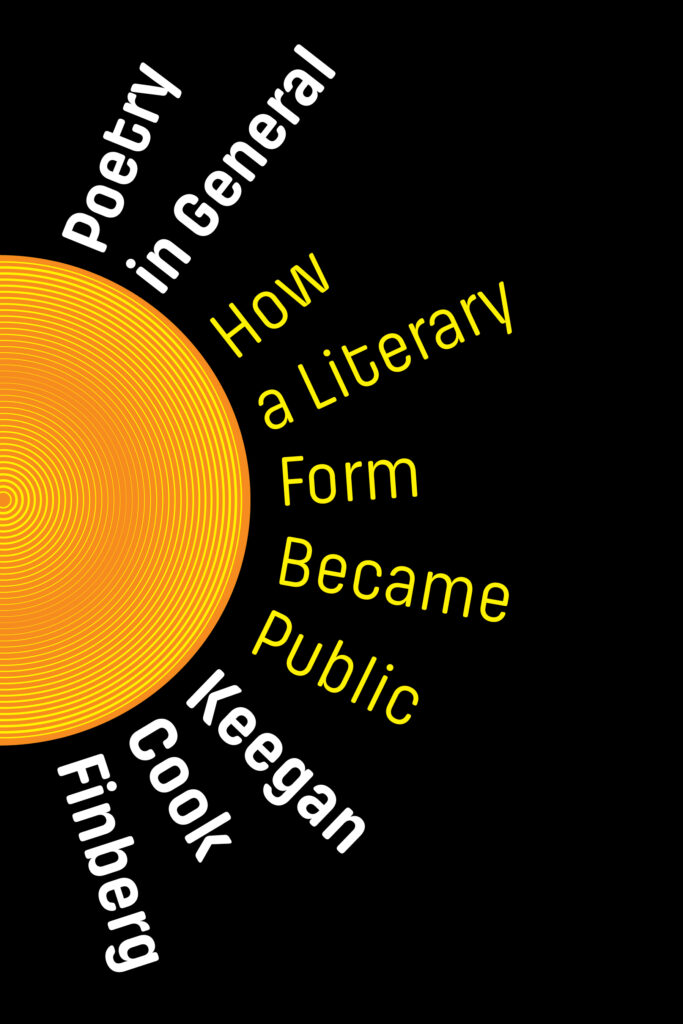
In her debut book, Poetry in General (Columbia University Press, 2025), Finberg explores the privatization of the welfare state and the way that poetry changed in relation to that notion of the public. “I located the beginning of this history around 1960, which many people consider the ballooning of the welfare state, the opposite of privatization,” says Finberg. “I started thinking about what poetic form looked like in that moment and how we might trace it to today.”
Q: What drew you to poetry?
A: I have loved poetry since I was an early reader. I was first drawn to it because it is a way of experiencing the world and understanding it. As I got deeper into my studies, I became really interested in the way that poetic form changes with history.
I’ve always been curious about how the category of poetry makes us think differently. What does it mean for us to read poetry versus the way we read other forms? Can anything be read as poetry? How do we think differently if we try to read things as poetry that aren’t poetry?
These questions excite me. It’s a way to slow down and model reading practices, a way of interacting with language that’s very intentional and precise. I think if you’re interested in play, the unknowable, or unmasterable, it can really change the way you see your everyday life. That’s how I got interested in poetry and what still excites me about poetry.
Q: Is there a piece of poetry that challenged you to accept being uncomfortable, not knowing exactly what it meant?
A: I remember when I was assigned Gertrude Stein‘s poetry as an undergraduate, it did not make any sense to me. Why would anyone assign this to me? I was irate about it at first, but once I started working with the text and playing with it, Stein’s poetry became richer and more interesting to me.
I began practicing different modes of orienting myself towards the text. Eventually, it helped govern the way that I think about the domestic sphere, feminism, and regular objects around the house. In her book Tender Buttons (1914), Stein makes objects and foods in her house come alive. Part of my attention to language and my love of language and detail comes from the practice of trying to do this type of work.
Q: Is there a particular poetic technique that you like best?
A: I love constraint-based processes where poets make a strict rule to limit the words they choose. Often, I find our brain is attuned to think in a certain way. These constraints help us outside of what we usually think of as creativity or imagination into this other world that we didn’t even know was possible.
 Keegan Cook Finberg. (Brad Ziegler/UMBC)
The book Zong! by M. NourbeSe Philip, a Canadian Caribbean poet, is a great example of a constraint-based process. The language for the book-length poem comes from the only historical record of an atrocious case that became important in the British abolitionist movement. Using only the text in the court case, Philip’s poem recounts the massacre of more than 130 enslaved Africans on the slave ship, Zong, headed to Jamaica from West Africa, who were thrown overboard to drown in 1781. The enslaved were dying of starvation and disease. Insurance would not cover this kind of loss. The captain decided that death by drowning could be claimed as a loss of property insurance claim. The insurance company approved the claim, but it was later overturned. No one was charged with murder.
Philip was trying to tell the story of the people on the ship and kept coming up against all of these gaps. The court case didn’t even contain the names of the people who were murdered. She decided to take the words of the court decision as a word bank for her book, to contort the case file to fill in these silences. The result is a testament to, and critique of, the horrors of the bureaucracy of slavery and its afterlife.
Most of the poems that I look at late in my book also use the language of archival documents about a major issue related to racial capitalism and the bureaucracy of the public sphere.
Q: What are other examples of constricted processes that you cover in the book?
A: I start the book with Yoko Ono. In the 1960s, she was doing wonderful experiments that were at the edge of what was performance and what was poetry. Ono was interested in speaking back to the category of racial capitalism through humor and expressions of everyday life as art. The poems in her book Grapefruit take this premise that instructions for everyday life can be fun, easy, or even impossible.
I’ve always been curious about how the category of poetry makes us think differently. What does it mean for us to read poetry versus the way we read other forms? Can anything be read as poetry? How do we think differently if we try to read things as poetry that aren’t poetry?
Keegan Cook Finberg
In my book, I also talk about three feminist artists from the 1970s, Eleanor Antin, Adrian Piper, and Bernadette Mayer. Their constraints are durational experiments where they go on some sort of diet, all of them for different reasons, for about the course of a month—the duration of a menstrual cycle—and document their journey. They’re writing about welfare and food assistance and their own reproductive rights on the precipice of Roe v. Wade. They’re interested in their own reproductive possibilities, and what it means to experiment with that as duration.
Q: This is your eighth year at UMBC. How do UMBC students respond to poetry in your classes?
A: For an upper-division class on feminist poetry, I recently taught Theresa Hak Kyung Cha’s Dictee, a famously complex avant-garde poem about Korean independence and about the experience of immigration and colonial violence. Cha writes in multiple languages to capture the disorientation of the acquisition of a new language, of a new culture, and the difficulty and violence of assimilation. It’s complex, and it can be off-putting to students.
In situations like these, I want students to be okay with not understanding everything that they’re reading while exploring the aspects that they do understand—to explore why this author might want it to be difficult in the beginning, why there might be something important in that feeling of discomfort that they’re experiencing with the text. Can they notice moments of beauty in the text, even if they don’t yet understand what they mean? A lot of our conversations start with that sort of work.
And once students realize that that is the goal—that they don’t need to be able to decode, they don’t have to be the person who knows it all in the room, there isn’t one right answer—it really unlocks a very different sort of space. I often watch that sort of journey with students. They realize that there’s something inherently important about this difficulty, important even to their understanding of themselves, their heritage, the way that language works in their households, even in their larger worlds.
And for my students who may take poetry to fulfill a lower division requirement, what I want more than anything is for them to see the ways that literature and poetry are alive in the world. Poetry is interesting, it’s happening, and they can read it. They don’t have to be afraid of it. Introductory level students are asked to attend literary events to see writers come and read and talk about their work. This is happening now. This is part of your world. If you’re a nurse, a scientist, or in whatever career path you follow, poetry and literature are alive and are going to continue to be part of the world that you live in. If you pay attention, this revelation may help you understand your experiences differently, connect to others in new ways, or even create new knowledge.
Learn more about Finberg’s work andUMBC’s English department.
]]>
Keegan Cook Finberg, an assistant professor of English, started graduate school at UC Santa Cruz during the financial crisis of 2008, in a moment of extreme recession. “Privatization and austerity...
https://umbc.edu/stories/poetry-keegan-cook-finberg-english/
https://my3.my.umbc.edu/api/v0/pixel/news/157459/guest@my.umbc.edu/d47745f8c35583522b397cede66227f0/api/pixel
arts-and-culture
cahss
english
humanitiesbooks
news
research
retriever-authors
story
UMBC News & Magazine
https://my3.my.umbc.edu/groups/umbc-news-magazine
https://assets1-my.umbc.edu/system/shared/avatars/groups/000/001/943/24435aa6207c452e7bc15cc74b42c7bb/xsmall.png?1748556657
https://assets1-my.umbc.edu/system/shared/avatars/groups/000/001/943/24435aa6207c452e7bc15cc74b42c7bb/original.png?1748556657
https://assets2-my.umbc.edu/system/shared/avatars/groups/000/001/943/24435aa6207c452e7bc15cc74b42c7bb/xxlarge.png?1748556657
https://assets2-my.umbc.edu/system/shared/avatars/groups/000/001/943/24435aa6207c452e7bc15cc74b42c7bb/xlarge.png?1748556657
https://assets3-my.umbc.edu/system/shared/avatars/groups/000/001/943/24435aa6207c452e7bc15cc74b42c7bb/large.png?1748556657
https://assets1-my.umbc.edu/system/shared/avatars/groups/000/001/943/24435aa6207c452e7bc15cc74b42c7bb/medium.png?1748556657
https://assets2-my.umbc.edu/system/shared/avatars/groups/000/001/943/24435aa6207c452e7bc15cc74b42c7bb/small.png?1748556657
https://assets1-my.umbc.edu/system/shared/avatars/groups/000/001/943/24435aa6207c452e7bc15cc74b42c7bb/xsmall.png?1748556657
https://assets2-my.umbc.edu/system/shared/avatars/groups/000/001/943/24435aa6207c452e7bc15cc74b42c7bb/xxsmall.png?1748556657
UMBC News & Magazine
1
0
false
Thu, 12 Mar 2026 16:26:41 -0400
Thu, 12 Mar 2026 16:26:41 -0400
Laughing in the dark—UMBC’s Erin Hogan writes about Spain’s cinema after Franco
Asking Erin Hogan to choose her favorite film is like asking her whether she prefers to study Iberian or Latin American films—both of which she researches and fell in love with as an undergrad. The real answer is that Hogan’s favorite film is whatever film she is studying at the time. For her new book, Patriarchy’s Remains: An Autopsy of Iberian Cinematic Dark Humour (2024), she capped the list at 14 films between 1958 and 2018, whose characters must deal with the death of the male head of household. Hogan uses the visions of 14 diverse directors to study cinematic dark humor through a feminist, biopolitical, and socio-economic inequality lens.
“My work is pretty transversal, not exclusive to writing books about one director, one creator, one film, or one novel. I enjoy analyzing multiple sources and finding the patterns across texts. In this case, I focus on films with dark humor,” said Hogan, a professor of Spanish. Dark humor blends humor with grim topics like death, violence, crime, and social dysfunction through wit, irony, or satire.
“I’ve always been interested in dark humor. When I explain to my students why I study a wide range of texts, films, and languages—Spanish, Italian, Catalan, Portuguese, and most recently, Galego, the language of Galicia in Northwestern Spain—it always comes back to the joy of learning. I encourage students to ask themselves what they want to explore, learn, or know more about, and then to pursue it.”
Spain’s cinema 50 years later
The question Hogan pursues in Patriarchy’s Remains is how and why the legacy of Francisco Franco, Spain’s fascist, repressive, and violent dictator who ruled Spain from 1939 until his death in 1975, continues to impact Spain’s work toward democracy—even 50 years after his death on November 20, 1975.
“I’ve always been interested in dark humor. When I explain to my students why I study a wide range of texts, films, and languages—Spanish, Italian, Catalan, Portuguese, and most recently, Galego, the language of Galicia in Northwestern Spain—it always comes back to the joy of learning. I encourage students to ask themselves what they want to explore, learn, or know more about, and then to pursue it.”
Erin Hogan
associate professor of Spanish
“Patriarchy’s Remains has two meanings. One refers to the on-screen corpse of the patriarch and the other to the persistence of patriarchy in Spain today,” writes Hogan in her book. She draws parallels between the families in the films—who must figure out how to live after the patriarch they depended on dies or is killed—and Spain’s citizens, who are still working to understand what a functioning democracy looks like.
“In critiquing Spanish politics, I aim to highlight how Spanish democracy could better serve its people by heeding the protests of its own citizens, on and off screen,” writes Hogan. “Patriarchy’s Remains reveals persisting inequities in post-Franco Spain to shine a light on the disenfranchised children of democracy who grieve for the unfulfilled promises of greater civil liberties and improved quality of life.”
Interested in learning more about Iberian or Latin American film? Hogan is the co-founder and co-curator of CineMaestro an open-access collaborative digital project designed to promote audiovisual literacy and intercultural competencies through the study and teaching of the cinemas by Spanish, Latin American, and Latinx directors.
]]>
Asking Erin Hogan to choose her favorite film is like asking her whether she prefers to study Iberian or Latin American films—both of which she researches and fell in love with as an undergrad....
https://umbc.edu/stories/erin-hogan-spains-cinema-after-franco/
https://my3.my.umbc.edu/api/v0/pixel/news/155348/guest@my.umbc.edu/4e3b5c8704ab6ce322b0e85698fbd755/api/pixel
arts-and-culture
cahss
cahss-research
humanitiesbooks
mlli
news
spanish
story
UMBC News & Magazine
https://my3.my.umbc.edu/groups/umbc-news-magazine
https://assets1-my.umbc.edu/system/shared/avatars/groups/000/001/943/24435aa6207c452e7bc15cc74b42c7bb/xsmall.png?1748556657
https://assets1-my.umbc.edu/system/shared/avatars/groups/000/001/943/24435aa6207c452e7bc15cc74b42c7bb/original.png?1748556657
https://assets2-my.umbc.edu/system/shared/avatars/groups/000/001/943/24435aa6207c452e7bc15cc74b42c7bb/xxlarge.png?1748556657
https://assets2-my.umbc.edu/system/shared/avatars/groups/000/001/943/24435aa6207c452e7bc15cc74b42c7bb/xlarge.png?1748556657
https://assets3-my.umbc.edu/system/shared/avatars/groups/000/001/943/24435aa6207c452e7bc15cc74b42c7bb/large.png?1748556657
https://assets1-my.umbc.edu/system/shared/avatars/groups/000/001/943/24435aa6207c452e7bc15cc74b42c7bb/medium.png?1748556657
https://assets2-my.umbc.edu/system/shared/avatars/groups/000/001/943/24435aa6207c452e7bc15cc74b42c7bb/small.png?1748556657
https://assets1-my.umbc.edu/system/shared/avatars/groups/000/001/943/24435aa6207c452e7bc15cc74b42c7bb/xsmall.png?1748556657
https://assets2-my.umbc.edu/system/shared/avatars/groups/000/001/943/24435aa6207c452e7bc15cc74b42c7bb/xxsmall.png?1748556657
UMBC News & Magazine
0
0
false
Tue, 16 Dec 2025 12:59:17 -0500
Tue, 16 Dec 2025 12:59:17 -0500
The chase and thrill of researching erotic worlds
A couple of years ago, Jessica Floyd was enjoying delicious olive flatbreads in Opio, France, a village on the French Riviera, thanks to the hospitality of Judith Legman, who owned the olive grove and a manuscript Floyd had been trying to find for her doctoral work for three years. This bucolic heaven was not where Floyd, who studies erotic folklore, thought she would find the holy grail of erotic chanteys by Stan Hugill, a renowned British sailor and chantey singer. These sailors’ work songs, first collected in the 1900s, were passed down verbally by sailors, with some never recorded. These bawdy versions were never meant to be heard or read by women, much less shared between them.
“When you’re talking about erotic content, it automatically becomes something that is salacious and provocative and therefore seen as taboo,” said Floyd, Ph.D. ’17, language, literacy, and culture, an adjunct instructor of English. “Publications that are not conservative in their treatment of sex, gender, and sexuality are often deemed taboo. Scholars who are actively working in this field have to fight not only for their legitimacy, but also because we’re considered dirty workers. We also fight for the legitimacy of the materials that we’re researching. These are real human experiences. They just happen to be from the darker corners of the human experience.”
Like other scholars in the field seeking access to a variety of documents, Floyd reached out to the librarians at the Kinsey Institute, which holds the largest historical archive on sexuality. “They weren’t sure if the manuscript could be found in the extensive archive of Gershon Legman, which Judith, his wife, had donated,” said Floyd, of her research for her debut book Cabin Boys, Milkmaids, and Rough Seas: Identity in the Unexpurgated Repertoire of Stan Hugill (University Press of Mississippi, 2024).
She emailed Legman, following a tip from other chantey folklorists and researchers that Legman, a famous connoisseur and collector of erotic jokes, folklore, and songs, had the manuscript. “Lo and behold, she emailed me back. I still get chills talking about it,” said Floyd. “Judith said, ‘Not only do I have it, I actually just sent it to the Kinsey Institute. If you’d like, I’ll send you the copy.’” Dispersed throughout Legman’s chapter on erotic folk songs were Hugill’s erotic chanteys that had never been circulated.
 The envelope sent by Judith Legman to Jessica Floyd with Stan Hugill’s unpublished manuscript. (Image courtesy of Jessica Floyd)
Chasing erotic rare texts
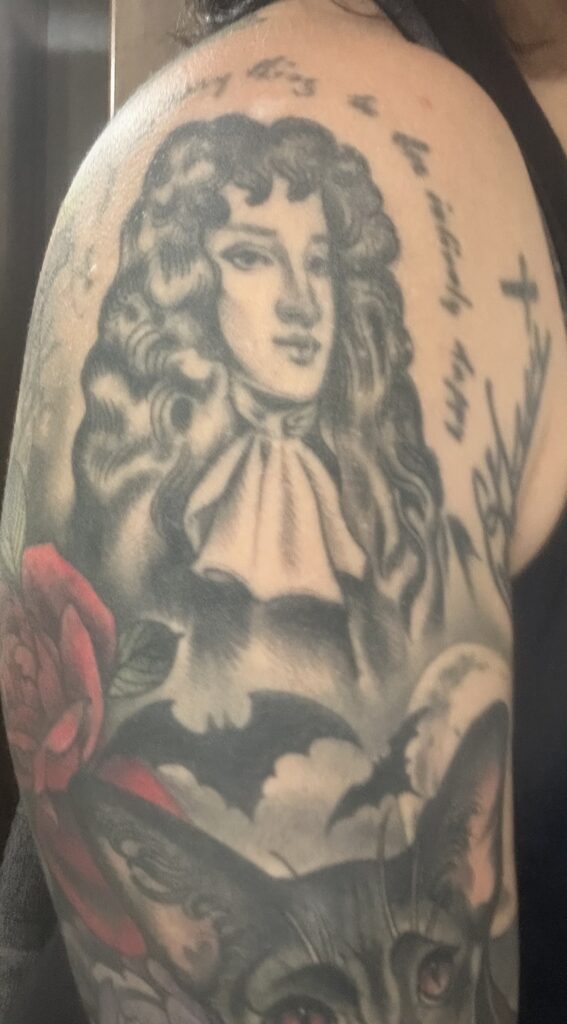 Floyd’s tattoo of John Wilmot, the Second Earl of Rochester, a late 17th-century English nobleman. (Image courtesy of Jessica Floyd)
Floyd is used to the chase and thrill of finding rare texts. She studies the gender and sexuality of sailors during the height of British and American sailing, from the mid-16th to the mid-19th centuries—when sailing ships dominated global trade and naval warfare—as well as 17th and 18th-century literature, erotic folklore, gender and women’s studies, and queer theory. This passion began in high school and continued through her undergraduate and graduate studies researching the life of John Wilmot, the Second Earl of Rochester, a late 17th-century English nobleman better known for questioning authority while also enjoying the excesses of court life and writing poetry that explored sex, desire, rebellion, and challenged social and gender norms.
“It made sense for me to research sexuality in chanteys because I want to understand why men sing dirty songs. What can chanteys tell us about how sailors negotiate sex and gender, especially in the constrained environment of the sailing ship?” said Floyd.
An epistolary discovery
Like Wilmot, Hugill also wrote and published his work. In the 1950s, Hugill began writing down the songs he remembered. In 1961, he published Shanties From The Seven Seas, a collection of over 400 chanteys now considered by chantey researchers and folklorists as the most comprehensive work on chanteys. Sailor Town was published in 1967, Shanties and Sailors’ Songs in 1969, followed by Songs of the Sea: The Tales and Tunes of Sailors and Sailing Shipsin 1977. Between 1962 and 1994, Hugill released 10 recordings—LPs, CDs, and cassette tapes—of chanteys and chantey history. Three were released posthumously. His Sea Songs CD, released in 1980, is now part of the Smithsonian Folkways Recordings catalogue.
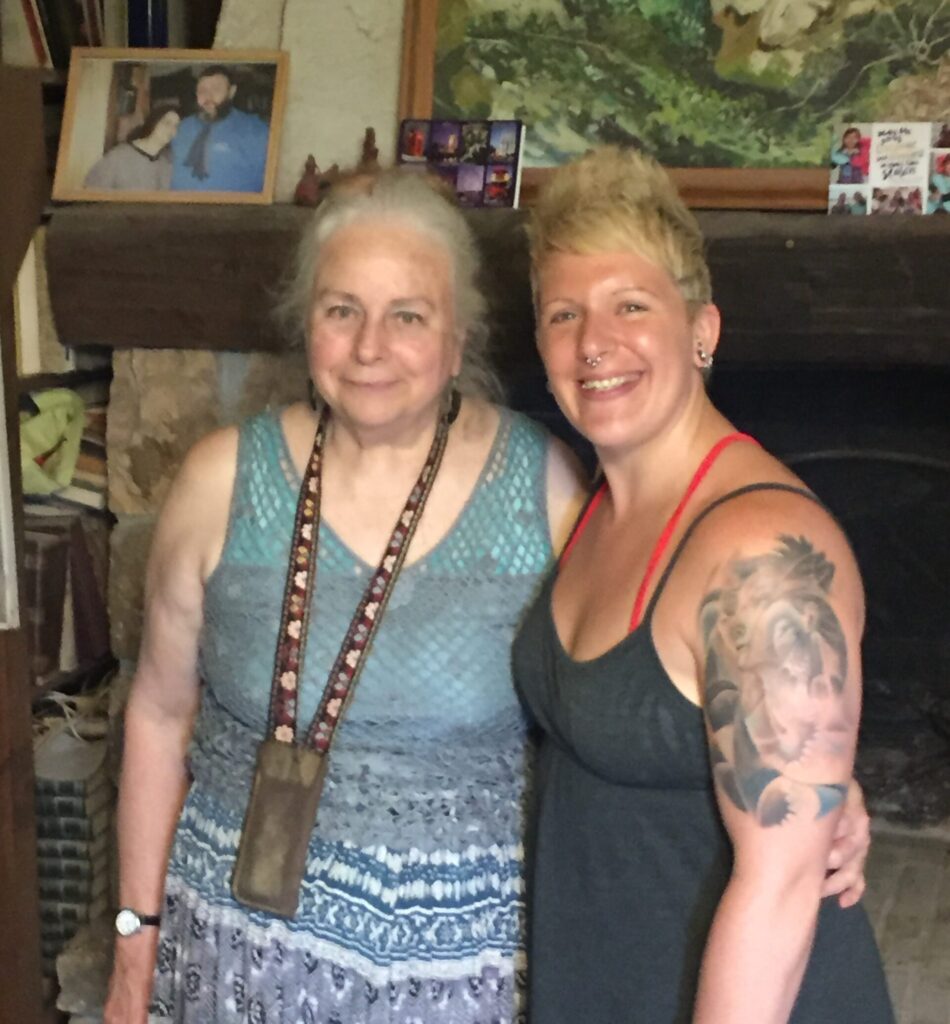 (l-r): Judith Legman and Jessica Floyd in Opio, France. (Image courtesy of Floyd)
However, unlike Wilmot, Hugill never penned the erotic versions and only sang them after a performance to an all-male audience. When Gershon Legman learned about Hugill’s repertoire, he wrote to Hugill, urging him to commit the erotic chanteys to paper for his vast collection. Hugill capitulated after years of correspondence with the condition that Legman not publish the manuscript before he could. Both men died in the 1990s without ever publishing it. With Hugill and Legman as the only witnesses of the manuscript’s existence, what was left for the chantey folklore community was rumors and the lore of its existence.
Thanks to funding from a 2016 UMBC Dresher Center for the Humanities summer fellowship, Floyd visited Judith Legman to study these letters alongside the manuscript. “Judith also had the letters shared between Hugill and Legman, which confirmed that this indeed was the sought-after manuscript,” said Floyd. She notes that by the time she left France, she had everything she needed to do a close analysis of the songs.
“Erotic worlds have fascinated me for a long time. It’s not your run-of-the-mill construction of gender. It’s actually focusing on the part of the human experience that we’re really reticent to talk about, especially in academic work,” said Floyd, who sports a palm-sized tattoo of Wilmot on her upper right arm. “This is the heart of my research—how do we write erotic worlds?”
Floyd is once again on the hunt for rare texts and has completed her second book, The Sons of Neptune. In this study, she is looking at cultural artifacts, from the 18th to the 20th century, that provide insight into why sailors are often thought of as sexy. This project is set to be published through the University of Mississippi Press in May 2026.
Read other books in our Humanities Books series.
]]>
A couple of years ago, Jessica Floyd was enjoying delicious olive flatbreads in Opio, France, a village on the French Riviera, thanks to the hospitality of Judith Legman, who owned the olive grove...
https://umbc.edu/stories/the-chase-and-thrill-of-researching-erotic-worlds/
https://my3.my.umbc.edu/api/v0/pixel/news/155331/guest@my.umbc.edu/6e42352b341487bf50a638ab81874d4f/api/pixel
arts-and-culture
cahss
dreshercenter
english
gwst
humanitiesbooks
llc
news
story
UMBC News & Magazine
https://my3.my.umbc.edu/groups/umbc-news-magazine
https://assets1-my.umbc.edu/system/shared/avatars/groups/000/001/943/24435aa6207c452e7bc15cc74b42c7bb/xsmall.png?1748556657
https://assets1-my.umbc.edu/system/shared/avatars/groups/000/001/943/24435aa6207c452e7bc15cc74b42c7bb/original.png?1748556657
https://assets2-my.umbc.edu/system/shared/avatars/groups/000/001/943/24435aa6207c452e7bc15cc74b42c7bb/xxlarge.png?1748556657
https://assets2-my.umbc.edu/system/shared/avatars/groups/000/001/943/24435aa6207c452e7bc15cc74b42c7bb/xlarge.png?1748556657
https://assets3-my.umbc.edu/system/shared/avatars/groups/000/001/943/24435aa6207c452e7bc15cc74b42c7bb/large.png?1748556657
https://assets1-my.umbc.edu/system/shared/avatars/groups/000/001/943/24435aa6207c452e7bc15cc74b42c7bb/medium.png?1748556657
https://assets2-my.umbc.edu/system/shared/avatars/groups/000/001/943/24435aa6207c452e7bc15cc74b42c7bb/small.png?1748556657
https://assets1-my.umbc.edu/system/shared/avatars/groups/000/001/943/24435aa6207c452e7bc15cc74b42c7bb/xsmall.png?1748556657
https://assets2-my.umbc.edu/system/shared/avatars/groups/000/001/943/24435aa6207c452e7bc15cc74b42c7bb/xxsmall.png?1748556657
UMBC News & Magazine
1
0
false
Mon, 15 Dec 2025 16:29:52 -0500
Mon, 15 Dec 2025 16:29:52 -0500