One brick at a time
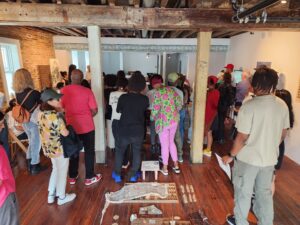
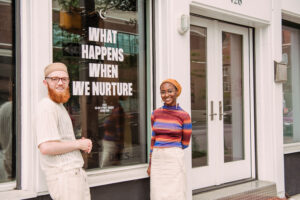
Brick making is an inherently pay-it-forward process, says Marian April Glebes, M.F.A. ’09, a conceptual and mixed-media artist. In the past 10 years of her Mobile Community Brick Factory & Monument project, Glebes has made thousands of bricks and then invited community members to imprint their stories into the clay. Later, the bricks are used in mobile monuments around Baltimore City and beyond. Glebes, who won the 2025 Rubys Alumni Award through the Robert W. Deutsch Foundation for this work, asks: How can we support social and spatial change in order to build a new kind of community-driven monumental public space?
I come to historic preservation by way of my M.F.A. in imaging media and digital arts (IMDA) from UMBC—with an additional masters degree in city and regional planning and historic preservation from the University of Pennsylvania—my home in Baltimore City, and by making bricks as public art. As an artist, a preservation planner, a homeowner, an educator, a gardener, and a community and economic development practitioner, all of my research and methods investigate how we make a place and how a place makes us.
In 2015, I was the inaugural artist-in-residence at the Baltimore Museum of Art’s Patricia and Mark Joseph Education Center. The Robert E. Lee and Stonewall Jackson Confederate monument still stood across from the BMA’s Spring House in Wyman Park Dell in the Charles Village neighborhood of Baltimore. Aligning with and inspired by protest in support of social and civic justice movements, The Mobile Community Brick Factory & Monument operated within these complex intersections.
 Glebes’ brick factory set up outside of the Spring House at the Baltimore Museum of Art. (Photo by Marian April Glebes, M.F.A. ’09)
Almost a decade later, my camera was the only familiar thing at Baltimore City’s Department of Transportation facility on a frigid dawn in November 2023. I held it tightly as if it would prove to signify my role in providing archival documentation of a monumental move. The temperature had dropped to a mere 22 degrees, but the top-secret site was teeming with activity while the project was just beginning.
“I like to do an easy one first,” the director of field operations says. But with the removal of any Confederate monuments, these or other “monuments to hate,” there is no easy one.
In the back corner of a DOT storage yard, I watched as the historical record was made and unmade, as preservation theory and practice was suspended and turned on their side, as conservation techniques and concepts were followed to the letter and simultaneously reinvented, starting with the Roger B. Taney statue.
 Baltimore’s Confederate monuments in a Department of Transportation storage lot. (Photo by Marian April Glebes, M.F.A. ’09)
Baltimore’s contentious monuments shipped out to a storage facility near St. Louis on their way to Los Angeles for an exhibition at The Brick (formerly LAXart). In Baltimore, I stayed with the problem through a project I started a decade ago—creating a countermonument out of personalized, handmade bricks.
Memory is mutable. Social contexts shift. This is the wicked problem in living heritage and what to do when it dies. I’ve had a unique position with singular access to process and understand this ongoing debate in Baltimore City while unofficial researcher-in-residence at the Commission for Historic and Architectural Preservation (CHAP). Each community is unique in its response on what to do with their Confederate monuments, and Baltimore’s perspective is vital to the discourse. Eric Holcomb, the former director of CHAP, invited me to the conversation, positing that perhaps it could or should be for the arts and artists to influence this unfolding preservation conundrum.

 Left: A stack of imprinted bricks waits to be transformed. Right: Glebes holds a brick imprinted with: “I am a monument.”
At UMBC, as M.F.A. candidates, our artwork was considered research—and therefore had to be contextualized and placed within the canon. To work responsibly, we were encouraged to know our audiences and our references and understand our place in time. Inspired by the people and places of Baltimore and by conceptual art’s blurring-of-art-andlife thinking of the 1960s, The Mobile Community Brick Factory & Monument maintains the ethos of rigorous research, material gravitas, and community connection engendered by my IMDA studies. Existing in the contexts of the Baltimore Uprising, the 2017 monument removals, social practice art, and civic engagement, I interrogate our circumscribed understandings of monumentality.
Monuments exist in social contexts that have often changed dramatically since the time they were created. Because of this, their meaning does not come only from the objects themselves—or only from how people view them—but from the shifting relationship between the two. The counter-monument was birthed by artists in Germany after the fall of the Berlin Wall and has not been widely accepted or brought into practice. In 2017, as monuments were being removed from our public spaces, artists again began erecting counter-monuments in protest of white supremacy.
The Mobile Community Brick Factory & Monument is centered in process, people, and making. To date, we have engaged over 15,000 people in Baltimore, made over 2,500 unique bricks, and collected over 1,000 personal stories from Baltimore residents. The Mobile Community Brick Factory & Monument is a new kind of monument, a monument not to the past, but a monument as an act of collective power that anticipates what will come to be.
 To date, the project has engaged over 15,000 people in Baltimore, made over 2,500 unique bricks, and collected over 1,000 personal stories from Baltimore residents.
The Mobile Community Brick Factory produces handmade bricks using local hand-processed clay and historic water-struck methods. This means of brickmaking is an inherently pay-it-forward endeavor—the bricks made one day are destined for someone else’s future hands. Participants personalize and inscribe their stories onto these bricks—words and messages about place, power, home, and experience. These story bricks are woodfired and become The Mobile Community Brick Monument, an ongoing series of exhibitions that create shared spaces.
While the bricks become pathways, garden beds, benches—some are embedded in sidewalks in Baltimore—I collect oral histories from brick constituents through ethnographic methods. In Baltimore, over 150,000 people have visited The Mobile Community Brick Monuments, finding connections to stories that are like their own.
At The Mobile Community Brick Factory & Monument, we believe ordinary voices matter, especially those that aren’t usually heard, that public space should be built by the people who use it, that heritage is alive, memory is mutable, and history is ongoing—made by daily lives. Our bricks represent pasts, presents, and futures that would otherwise remain untold and unwitnessed, built, shared, and spoken by urban residents. All are welcome and included in the process—a different kind of monument—a living space that honors the past and is built collectively by the people who live in and use our cities.
—Marian April Glebes, M.F.A ’09
]]>
Brick making is an inherently pay-it-forward process, says Marian April Glebes, M.F.A. ’09, a conceptual and mixed-media artist. In the past 10 years of her Mobile Community Brick Factory &...
https://umbc.edu/stories/one-brick-at-a-time-marian-april-glebes/
https://my3.my.umbc.edu/api/v0/pixel/news/154790/guest@my.umbc.edu/a5b5b57409fdd065cdb303c4d962d827/api/pixel
alumni
alumni-essay
cahss
fall-2025
imda
magazine
mfa
story
UMBC News & Magazine
https://my3.my.umbc.edu/groups/umbc-news-magazine
https://assets1-my.umbc.edu/system/shared/avatars/groups/000/001/943/24435aa6207c452e7bc15cc74b42c7bb/xsmall.png?1748556657
https://assets1-my.umbc.edu/system/shared/avatars/groups/000/001/943/24435aa6207c452e7bc15cc74b42c7bb/original.png?1748556657
https://assets2-my.umbc.edu/system/shared/avatars/groups/000/001/943/24435aa6207c452e7bc15cc74b42c7bb/xxlarge.png?1748556657
https://assets2-my.umbc.edu/system/shared/avatars/groups/000/001/943/24435aa6207c452e7bc15cc74b42c7bb/xlarge.png?1748556657
https://assets3-my.umbc.edu/system/shared/avatars/groups/000/001/943/24435aa6207c452e7bc15cc74b42c7bb/large.png?1748556657
https://assets1-my.umbc.edu/system/shared/avatars/groups/000/001/943/24435aa6207c452e7bc15cc74b42c7bb/medium.png?1748556657
https://assets2-my.umbc.edu/system/shared/avatars/groups/000/001/943/24435aa6207c452e7bc15cc74b42c7bb/small.png?1748556657
https://assets1-my.umbc.edu/system/shared/avatars/groups/000/001/943/24435aa6207c452e7bc15cc74b42c7bb/xsmall.png?1748556657
https://assets2-my.umbc.edu/system/shared/avatars/groups/000/001/943/24435aa6207c452e7bc15cc74b42c7bb/xxsmall.png?1748556657
UMBC News & Magazine
2
0
false
Fri, 21 Nov 2025 14:32:47 -0500
Fri, 21 Nov 2025 14:32:47 -0500
UMBC’s exploratory artist in residence Levester Williams examines history of Cockeysville marble in film project

Since 2014, multimedia artist Levester Williams has developed a personal connection and exploration with a natural material that is a historic staple of Baltimore life—Cockeysville, Maryland, marble.
Go down specific streets in neighborhoods like Highlandtown, Charles Village, Cherry Hill, or Mount Vernon and you’ll see the ubiquitous, three-to-four tiered steps made of marble outfitting the exterior of many rowhomes throughout Baltimore, much of it from Cockeysville. Beyond the steps, you’ll also find the stone in landmarks such as Baltimore’s City Hall, the Washington monuments in Baltimore and D.C., and the 108 columns of the U.S. Capitol Building.
“The stone is a literal and figurative bedrock of our nation. It’s used in many prominent monuments and institutions,” explains Williams, who is a 2023 – 2024 artist in residence in UMBC’s Exploratory Research Residency Program, a component of the university’s Center for Art, Design, and Visual Culture (CADVC).
In this pilot artist residency program, Williams is collaborating with the CADVC to complete a new video art project called “dreaming of a beyond: Baltimore,” in which the artist is researching the history of Cockeysville marble, underscoring the “intertwined history of African Americans’ plight to self-determined agency and full citizenship, and a rather benign stone.”
More than just marble
In his work, Williams examines the relationship between objects, humans, and the physical world with art that includes sculptures, installations, sound, animations, drawings, and videos. Williams is continuing that exploration in “dreaming of a beyond: Baltimore,” part of his ongoing series focused on the dolomitic stone that is quarried in Cockeysville, 25 miles from Catonsville. The series explores Williams’ desire to examine his idea of “the beyond—where race is no longer tethered to value; where my body matters just as much as other bodies matter,” he says.
 A drone image of the Texas Quarry in Cockeysville, Maryland, one of the locations where Cockeysville marble is mined. (Photo courtesy of Levester Williams)
The artist began his exploration into the stone after reading a passage in Lindon Barrett’s book Blackness and Value: Seeing Double about jazz singer Billie Holiday’s time growing up in Baltimore. The book references Holiday’s autobiography, Lady Sings the Blues, which documents her stint cleaning the marble steps in Baltimore as a teenager.
“White homeowners were obsessed with keeping the white marble stoops clean, and didn’t care how the inside of their homes looked, as long as the steps were clean,” says Williams in reference to the passage about Holiday in Blackness and Value. The steps were seen as a marker of class and economic status, he adds, explaining how “Holiday knew that and was able to bargain to get more money for cleaning the stoops.”
Through archival research, Williams learned more about the stone’s connection to Black people in Baltimore and their bodies as they handled, cleaned, and labored over the marble. As part of his CADVC residency, Williams conducted research at the Maryland Center for History and Culture, using the center’s digital archives of Baltimore’s historic Afro-American newspaper and photographer Paul Henderson’s collection of images he captured for the paper from 1930 through 1960. The archives showcase the long history of Baltimore’s Black residents who cleaned and maintained the marble steps as part of their daily routines.
“Bodies in space”
The “dreaming of a beyond” series consists of short vignettes capturing performers touching and physically engaging with structures, objects, and buildings made with Cockeysville marble at different sites throughout the northeast region. Beyond Maryland, the marble can be found in places such as the Buffalo AKG Art Museum in upstate New York; the Fisher Building in Detroit; Girard College in Philadelphia; and St. Patrick’s Cathedral in New York City.
In Baltimore, Williams filmed performers interacting with the (original) Washington Monument in Mount Vernon Place. Nia Hampton, an intermedia and digital arts (IMDA) graduate student at UMBC, and her mother, Sheila Gaskins, were featured in “dreaming of a beyond: Baltimore,” filmed with the assistance of IMDA student Bao Nguyen. A sneak peek of Williams’ in-development projection demo was on display at the CADVC in February.
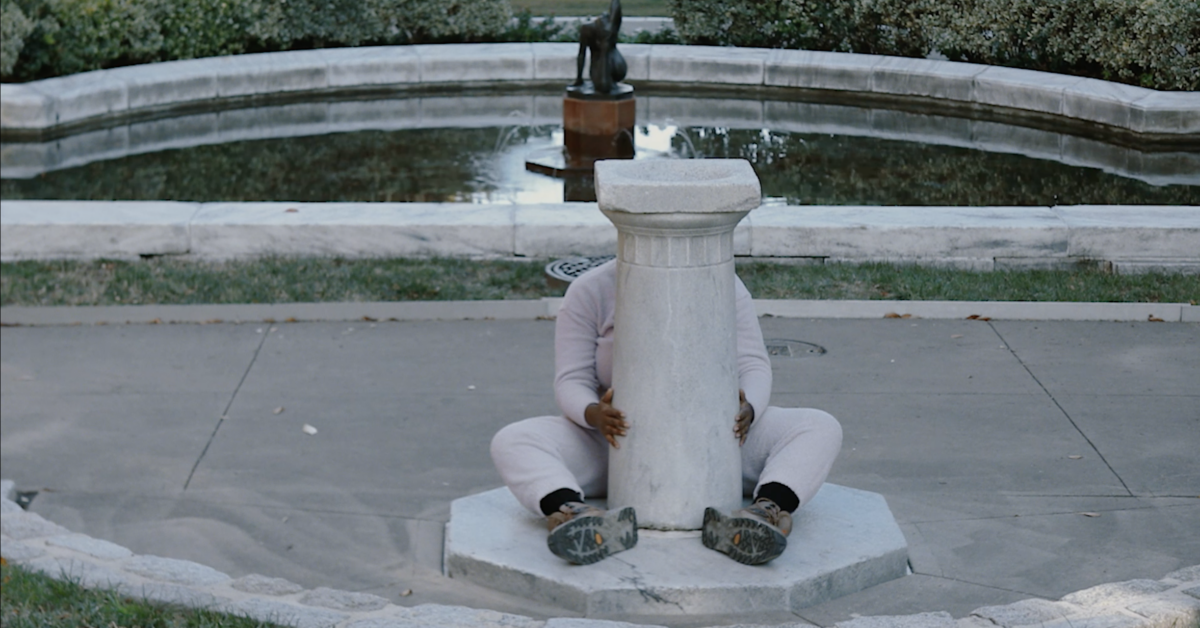 Video still of Nia Hampton in the vignette “Nia’s Embrace” from “dreaming of a beyond: Baltimore,” filmed at Mount Vernon Park Place in November 2023. (Photo by Levester Williams)
The film—which was projected onto the side of a building across from the CADVC’s outdoor amphitheater space—captures the mother-daughter duo physically engaging with the monument with movements that included hugging, caressing, scaling, and sprawling various body parts across the marble-encased statue. Williams worked with artist and intimacy coordinator Savannah Knoop to “reconfigure and think about bodies in space, non-human bodies, and what it is to give consent to these things,” he says.
“What I appreciate about Levester’s work is its level of obscurity,” says Hampton. “When I saw his work, I thought it was different—I never saw anything like it before.”
When she learned that the artist wanted the film’s subjects to be local residents with a deep connection to Baltimore’s history, Hampton referred Williams to her mother. Gaskins, a multi-disciplined artist who has been a local arts advocate and educator for more than four decades, wrote and directed “Last House Standing: A Play About the Highway to Nowhere”in 2016. The play included performers playing the role of the marbled stoop steps.
“When I was interacting with the marble [in the work with Williams], it wasn’t a pretty thing. I was thinking about my ancestors. Nia and I were having conversations about the slaves that probably built the monument. All of that was in our minds when we were interacting with the marble,” says Gaskins.
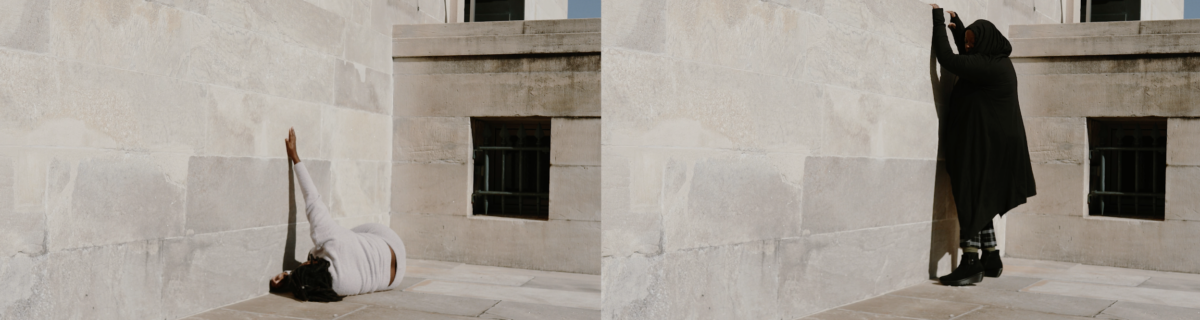 Nia Hampton (left) and Sheila Gaskins in “standing ground (On Washington)” from “dreaming of a beyond: Baltimore,” filmed at the base of the Washington Monument in Baltimore. (Photo by Levester Williams)
“Black folks touching the stone have been an anchor in this master-slave dynamic. I reimagined this relationship between the Black body and the stone, which is not in service of this power dynamic,” says Williams. “I’m using this stone as a way to reimagine Black folks in public spaces.”
Artistic practice as research
This fall, the CADVC gallery is set to premiere a selection of Williams’ artwork that emerges from his “dreaming of a beyond: Baltimore” research as part of the introduction to the center’s public video projection gallery series, which will be on display in the Fine Arts Building Amphitheater. The series is anticipated to rotate new video artwork presentations and will run for the next several years, says Rebecca Uchill, director of the CADVC.
The fall projection presentation will also coincide with the “all matters aside” exhibition at the CADVC that will feature a retrospective of Williams’ work from the last 10 years, organized by curator Lisa Freiman. Williams’ work was previously featured in “Declaration,” the inaugural exhibition at the Institute for Contemporary Art at Virginia Commonwealth University that Freiman curated as the institute’s inaugural director.
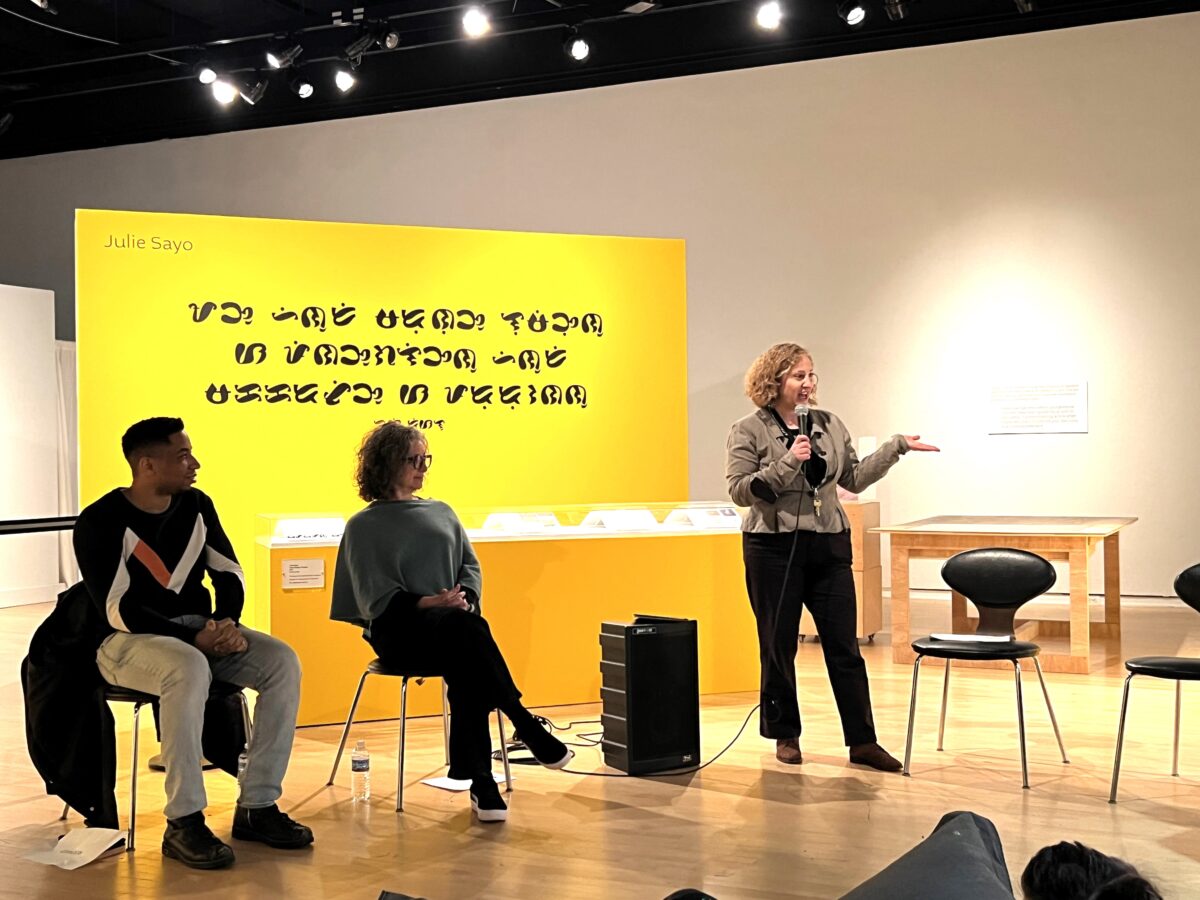 Levester Williams, Lisa Freiman, and Rebecca Uchill at the sneak peak projection demo of “dreaming of a beyond: Baltimore” in February 2024 at the CADVC. (Photo by Tedd Henn, courtesy of the CADVC)
Wiliams’ projection work will also feature an accompanying booklet that includes an essay by Michelle Wright, professor of history and Africana studies at the Community College of Baltimore County. Wright’s essay, “Scrubbed Clean,” examines the complex history of Beaver Dam marble, its use in Baltimore’s Washington Monument, and its connections to the city’s history of racial division.
Along with Williams, the CADVC Exploratory Research Residency Program also hosted artists Tomashi Jackson and Paul Rucker. Portions of the program have been funded by the Maryland State Arts Council, the Baltimore County Commission on Arts and Culture, and UMBC’s College of Arts, Humanities, and Social Sciences’ Big Ideas initiative. The pilot program, which launched in 2022, “recognizes the inherent research that is artistic practice,” Uchill explains.
“Artists are researchers, technicians, and producers. I think some of that occasionally may be underemphasized in certain contexts, but fortunately not at UMBC. CADVC’s residency program aligns with the rigor, creativity, and civic engagement of the university at large, and feeds into other areas of our center’s programs in exhibition, publication, and creative production,” says Uchill. “This has been an especially enriching opportunity because of UMBC’s laudable, sincere belief in the importance of the arts as research.”
For Williams, the exploratory residency program is helping him to expand his interpretation of being Black and existing in public spaces: “There’s no hierarchy of us existing in space and doing that through touch is what my project is focused on. Having these performers touch the stone in any way that they want is [my idea of] pushing back and getting to that ‘beyond’.”
]]>
Since 2014, multimedia artist Levester Williams has developed a personal connection and exploration with a natural material that is a historic staple of Baltimore life—Cockeysville, Maryland,...
https://umbc.edu/stories/exploratory-artist-levester-williams-marble/
https://my3.my.umbc.edu/api/v0/pixel/news/142784/guest@my.umbc.edu/6451d2c213b5ef5e11ff25ba1ef6b2c4/api/pixel
arts-and-culture
cadvc
cahss
community
feature
imda
news
rca-2
research
story
visualarts
UMBC News & Magazine
https://my3.my.umbc.edu/groups/umbc-news-magazine
https://assets1-my.umbc.edu/system/shared/avatars/groups/000/001/943/24435aa6207c452e7bc15cc74b42c7bb/xsmall.png?1748556657
https://assets1-my.umbc.edu/system/shared/avatars/groups/000/001/943/24435aa6207c452e7bc15cc74b42c7bb/original.png?1748556657
https://assets2-my.umbc.edu/system/shared/avatars/groups/000/001/943/24435aa6207c452e7bc15cc74b42c7bb/xxlarge.png?1748556657
https://assets2-my.umbc.edu/system/shared/avatars/groups/000/001/943/24435aa6207c452e7bc15cc74b42c7bb/xlarge.png?1748556657
https://assets3-my.umbc.edu/system/shared/avatars/groups/000/001/943/24435aa6207c452e7bc15cc74b42c7bb/large.png?1748556657
https://assets1-my.umbc.edu/system/shared/avatars/groups/000/001/943/24435aa6207c452e7bc15cc74b42c7bb/medium.png?1748556657
https://assets2-my.umbc.edu/system/shared/avatars/groups/000/001/943/24435aa6207c452e7bc15cc74b42c7bb/small.png?1748556657
https://assets1-my.umbc.edu/system/shared/avatars/groups/000/001/943/24435aa6207c452e7bc15cc74b42c7bb/xsmall.png?1748556657
https://assets2-my.umbc.edu/system/shared/avatars/groups/000/001/943/24435aa6207c452e7bc15cc74b42c7bb/xxsmall.png?1748556657
UMBC News & Magazine
0
0
false
Mon, 15 Jul 2024 14:48:42 -0400
Mon, 15 Jul 2024 14:48:42 -0400
Putting UMBC Research on the Map
Spring on UMBC’s main campus brings a host of familiar sights and sounds: blooms on the magnolia trees, the chatter of red-winged blackbirds calling from the reeds around Library Pond, greening grass on the campus Quad, and black-and-gold-bedecked Grit Guides leading groups of prospective Retrievers around what may soon become a home away from home.
The guides cover the usual highlights—Academic Row, the Retriever Activity Center, the AOK Library, eating establishments, and residential halls. UMBC is a place to live, to learn, and to find community. And while some of the functions of campus spaces are obvious, others are often hidden.
Look more closely, and you’ll see faculty and students turning the everyday infrastructure and green oases of UMBC into out-of-the-ordinary laboratories. Beeswax sculptures, tactile maps, robots helping other robots—read on to discover some of the amazing ways Retrievers are using the campus itself for experiential learning and diverse research.
Written by: Catherine Meyers & Sarah L. Hansen, M.S. ’15

Two students wearing knee-high waders stand several meters apart in the middle of a rapidly flowing stream at the north end of UMBC’s campus. One releases a Ping-Pong ball, which bobs along with the current, as the second starts a timer, stopping it when the ball reaches his feet to determine the stream’s flow rate.
Nearby, another student measures the size of rocks in the streambed using a device called a gravelometer—a rectangular piece of metal with square holes of various sizes. The smallest hole a given rock will fit through becomes its measurement.
Farther along, other students capture photos that include reference posts on the stream bank. Each small group of students also takes measurements of the water depth at one-foot intervals along strings hung from one bank to the other. The students (with the help of specialized software) will use these measurements and photos to generate 3D models of the streambed.
“It’s a little DIY, but we get some amazing pictures,” says Charles Kaylor, the instructor and director of GIS and cartography labs in the Department of Geography and Environmental Systems (GES).
This is the “stream lab” in Exploring the Environment: A Geospatial Perspective, a course best known in the UMBC community for its semesterly launch of a dozen or so brightly-colored balloons that dot the campus skyline. Throughout the semester, students train their brains in the ways geographic data can help answer a wide range of research questions.
For the students, there are a range of perks to the course. “It’s cool to see different applications of computer science, which can sometimes feel pretty theoretical,” says George Rush ’24, computer science. Luke Thomas ’27, GES, who was partnered with Rush, is grateful for the senior’s support with the programming aspects of the coursework.
Rhonda Plofkin, Ph.D. student in GES and the graduate assistant for the class, concurs that having students with different strengths facilitates peer learning. “This is real-life stuff that geomorphologists do in the field,” she adds.
For some, the benefits are just as real, but simpler: “The cold water wakes me up,” Anthony Roytenberg ’24, computer science, says with a smile.
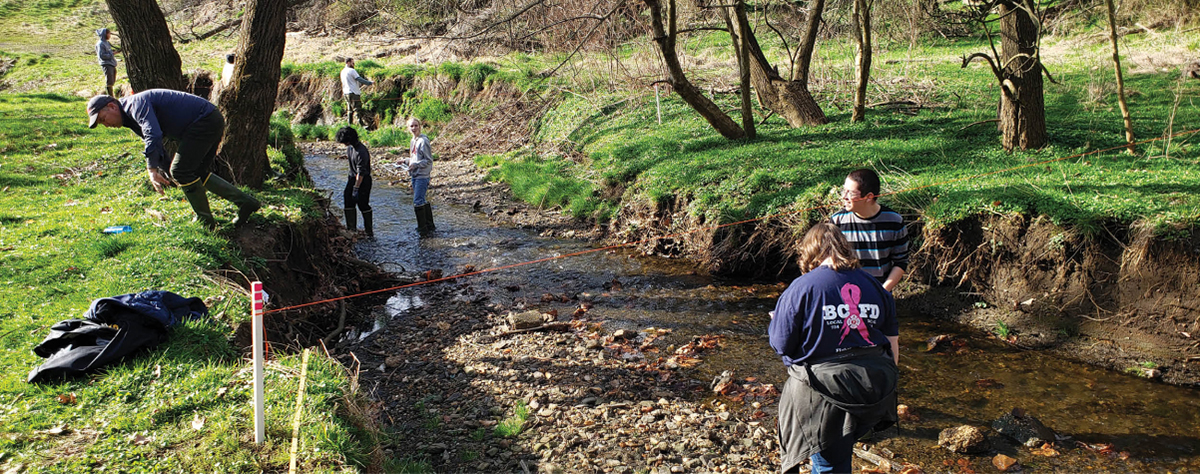 Students collect data that measure flow rate, depth, pebble size, and more as part of the “stream lab” in a popular, interdisciplinary GES course. Photo by Sarah Hansen, M.S. ’15.

When Alieh Rezaei arrived at UMBC from Iran, she couldn’t take her eyes off the ground. Almost immediately she was mesmerized by the flora and fauna of her new residence, and as an master of fine
arts student in the intermedia and digital arts (IMDA) program, she decided to incorporate pieces of UMBC into her artwork. She walked around campus, picking up windfalls of seeds and exploring hidden nooks of nature. A place that would come to be her sanctuary,
Rezaei, M.F.A. ’22, says, was Joseph Beuys Sculpture Park.
“The solidity of the stones alongside the growth of the oaksand the evolving shape of the garden reflect concepts of erosion and growth,” says Rezaei. “As an immigrant, I found solace in my attachment to the settled and solid stones, representing a sense of
grounding to me.”
Rezaei was drawn to UMBC’s M.F.A. program because of its multidisciplinary approach and the freedom she felt to choose an unconventional path. She praised Kathy O’Dell, IMDA professor emerita, who was her advisor. “Kathy was someone who—it was like I was floating in the air and Kathy held my hand and grounded me. She was very supportive for the whole journey.”
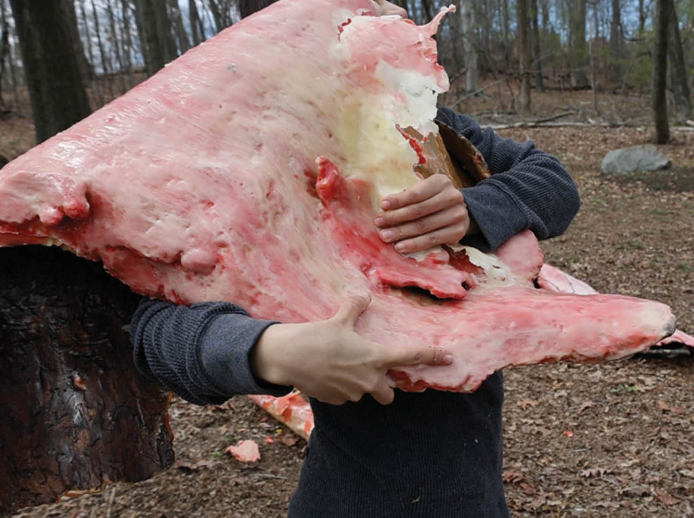
A photograph from Rezaei’s three-hour performance “The Tongue in the Landscape” at the Joseph Beuys Sculpture Park featuring the artist laboriously peeling the wax layer off the pieces of bark. Photo courtesy of Rezaei.
To create the art for her thesis project, Rezaei used almost exclusively materials collected on or near campus, including fallen tree bark, shattered wood, and seeds. She bought her main material—beeswax— from Baltimore beekeepers. One piece, “The Collective Womb,” featured hundreds of native seeds, called Devil’s Darning Needles, held together by beeswax around orange peels.
When the pieces were finished, Rezaei immediately knew the stage she wanted to showcase them on—Joseph Beuys Sculpture Park. “I installed my pieces there and had a performance as a way to extend the concept of public sculpture, aiming to reactivate the space and revive the concept of ecological engagement central to Beuys’ 7000 Oaks project.”

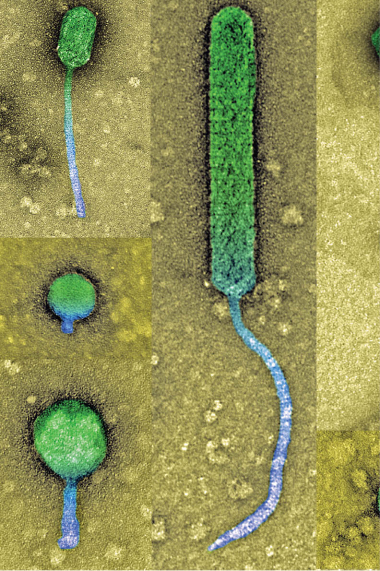
A composite of several microscope images of phages discovered by UMBC students in the Phage Hunters program demonstrates the variety of shapes phages can take. Photo by Tagide deCarvalho.
IchabodCrane. MindFlayer. Annihilus. TonyStarch. These are viruses previously completely unknown to science discovered by UMBC students in the Phage Hunters program, a two-course undergraduate genetics and bioinformatics sequence.
Since its launch in 2008, UMBC students have discovered 661 viruses that infect bacteria, called phages. Ninety-seven of them originated in samples collected on campus, with the most popular location being the Library Pond. Seventy-seven phages have been sequenced and 60 have been fully characterized and submitted to GenBank, an international digital repository of genetic and protein sequences.
Steven Caruso ’94, Ph.D. ’02, biological sciences, principal lecturer of biological sciences, runs the genetics course where the students collect samples, isolate their phages, image them with help from Tagide deCarvalho, “and growth,” says Rezaei. “As an immigrant, I found present their findings. They learn foundational laboratory techniques and get a taste for research.
Phage Hunters gives students “a first glimpse of what research is, with all that goes with it: determination, grit, inspiration, frustration, and more,” says Ivan Erill, professor of biological sciences and co-instructor for the bioinformatics course with Caruso. “Students get to see all the possible outcomes of a research project, from total success culminating in a DNA extraction for sequencing to failure to isolate a phage in the first place.”

In the basement of the Meyerhoff Chemistry Building, in a tiled expanse called the Molecular Characterization and Analysis Complex, sits a sleek, roughly human-sized instrument with the power to measure extremely tiny amounts of chemicals. Amanda Belunis, a chemistry Ph.D. student now in her final year, knows the instrument like an old friend, having turned to it to analyze a smorgasbord of UMBC water samples.
Belunis studies a group of chemicals called per- and polyfluoroalkyl substances, or PFAS. The chemicals are used in products as varied as makeup, clothing, and fire-fighting foam and are found in trace amounts in many water sources as well as in human blood. Dubbed “forever chemicals” because of the way they persist in the environment, they present a growing concern to human health.
Belunis’s research is part of a growing effort by scientists to understand how PFAS enter and travel through the environment and, ultimately, figure out ways to remove them.
To validate her procedures for measuring PFAS concentrations, Belunis tested water from drinking fountains, the sink in her chemistry lab, the pool, and the pond and streams around UMBC, all of which contained trace amounts of PFAS, as would be expected. Confident her methods worked on real-life samples, she then turned her attention to analyzing water in aquaculture fish tanks.
“My lab mates and I sometimes discuss how all of us have these chemicals in our bodies,” says Belunis. “It’s concerning, which is why we need to do more studies.”
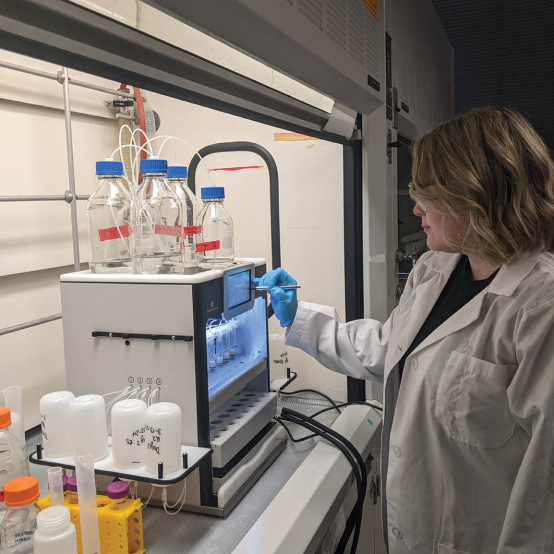
Amanda Belunis prepares samples for later analysis in the Molecular Characterization and Analysis Complex. Photo by Catherine Meyers.

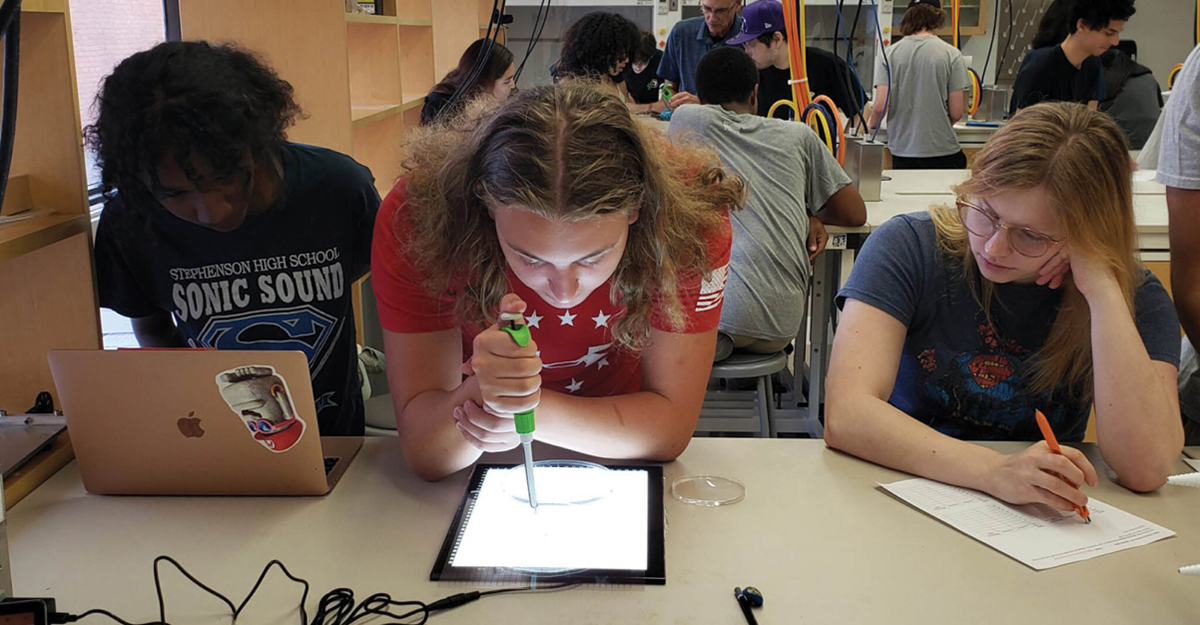 In addition to measuring buildings, students in Math in Action discovered other ways that math naturally interacts with their lives and studies. Here they are recording the movements of brine shrimp. Photo by Sarah Hansen, M.S. ’15.
When asked how to measure the height of a building, most students in Math in Action, a new laboratory course for non-STEM majors, “came up with various ways to measure the height directly—for example, by dropping down a string and then measuring the string or stacking up various objects,” says Alexis O’Malley ’18, mathematics and psychology, who teaches the lab.
But today, students are peering along the edges of homemade clinometers—plastic protractors with drinking straws attached—taking measurements from safely on the ground with a meter stick, and running simple calculations based on the properties of triangles to measure the height of UMBC’s Administration Building (123 feet, 2 inches).
Throughout the course, “I want students to see how math can be used to solve problems creatively,” O’Malley says.
Math in Action covers different math concepts each week through hands-on activities. The purpose of the clinometer activity is to remind students that “science is based on measurement, and you can build a tool to measure almost anything,” shares William R. LaCourse, dean of the College of Natural and Mathematical Sciences, who originally generated the idea for the course to help a wider range of students develop math skills relevant to their everyday lives. The course, he adds, “is a doorway to a lot of different math concepts.”

Shawn Abraham ’24, political science, has gotten lost on the UMBC campus more times than he can remember. As a blind student, he finds his way using a white cane, auditory cues, mental maps, and by asking people for directions. “People are surprised when I tell them, but big cities are much easier to navigate,” Abraham says. “College campuses are hard to get around.”
Tactile maps are one tool that could help. Erin Higgins and Kirk Crawford, Ph.D. students in human-centered computing, have recently been working with blind students at UMBC to create and test 3D-printed maps of campus.
The researchers launched the project after being approached by Michael Canale, assistant director of the Office of Student Disability Services. He says UMBC currently has four completely blind students enrolled and his office wants to provide personalized maps that each student can carry with them as they navigate campus. He’d also like to see a large 3D-printed map mounted somewhere on campus.
“A beautiful tactile map could be used by visitors of all kinds,” Canale said. “It’s the principle of universal design.”
Meanwhile, Md Osman Gani, an assistant professor of information systems, is spearheading a new project, named MyPath, to develop a Google Maps–style app to help wheelchair users navigate campus.
“Uneven surfaces, discontinuous sidewalks, and steep slopes can make wheelchair travel challenging, and even impossible” Gani says. The MyPath app would help by providing users with personalized turn-by-turn navigation with real-time updates. The app will rely on a machine learning model that recognizes path accessibility conditions based on crowd-sourced data, and Gani is currently recruiting wheelchair users to contribute data using their smartphones.
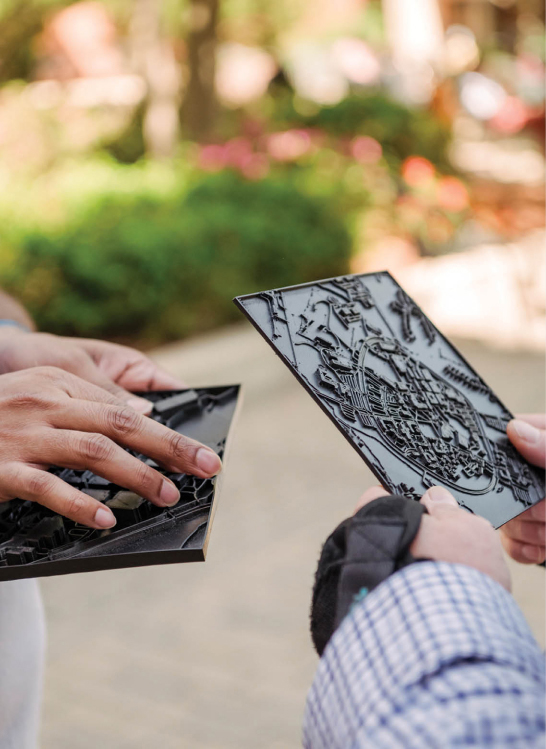
Shawn Abraham (left) tests prototype tactile maps made with 3-D printers with Michael Canale (right).

It’s 7 a.m. in July, and Megan Curtiss ’23, GES, is standing next to a tree just outside The Loop on UMBC’s southeast corner. It’s wrapped in a thin metal band at about chest height. Curtiss carefully measures the small gap between the two ends of the band with digital calipers three times, takes the average, and then moves on to the next tree. Only 98 to go.
This scene played out weekly from March to October 2023 as Curtiss collected data for a study led by Matthew Baker, GES professor, and Nancy Sonti, a research ecologist with the U.S. Forest Service. “It became like a morning meditation,” Curtiss shares.
The metal bands, call dendrobands, “are a cheap and easy way to get pretty detailed information,” Curtiss says. By measuring the trees’ growth over time, the goal is to look at how trees of different species and in different immediate environments (such as a parking lot versus a forest) handle conditions like fluctuating temperatures and water availability.
After attending Anne Arundel Community College in her 30s, Curtiss then found a home at UMBC. She began working with Baker in fall 2022 and will enter the GES master’s program at UMBC this fall. A graduate degree was not something Curtiss originally planned on, but now she’s excited about the further experiences it will bring. “I’m looking forward to the unexpected,” Curtiss says.

Take a left off Hilltop Circle, just past the greenhouse on the right and toward the Walker Avenue apartments, and you’ll find yourself outside a traditional brick building that used to house trial rooms and detention cells. In 2021, UMBC turned this former courthouse into the main hub for the Center for Real-time Distributed Sensing and Autonomy (CARDS). Researchers here develop artificial intelligence-enabled smart robots for military and search-and-rescue operations.
On a sunny day in spring, you will likely see students gathered in the courthouse’s “backyard,” huddled around dog-like Spot robots and wheeled vehicles called Jackals and Huskies.
The researchers outfit the robots with a host of custom devices, such as cameras and radar to sense their surroundings and microprocessors to run on-board algorithms. While the robots can be commanded via voice and gesture, the ultimate goal is for them to operate mostly autonomously.
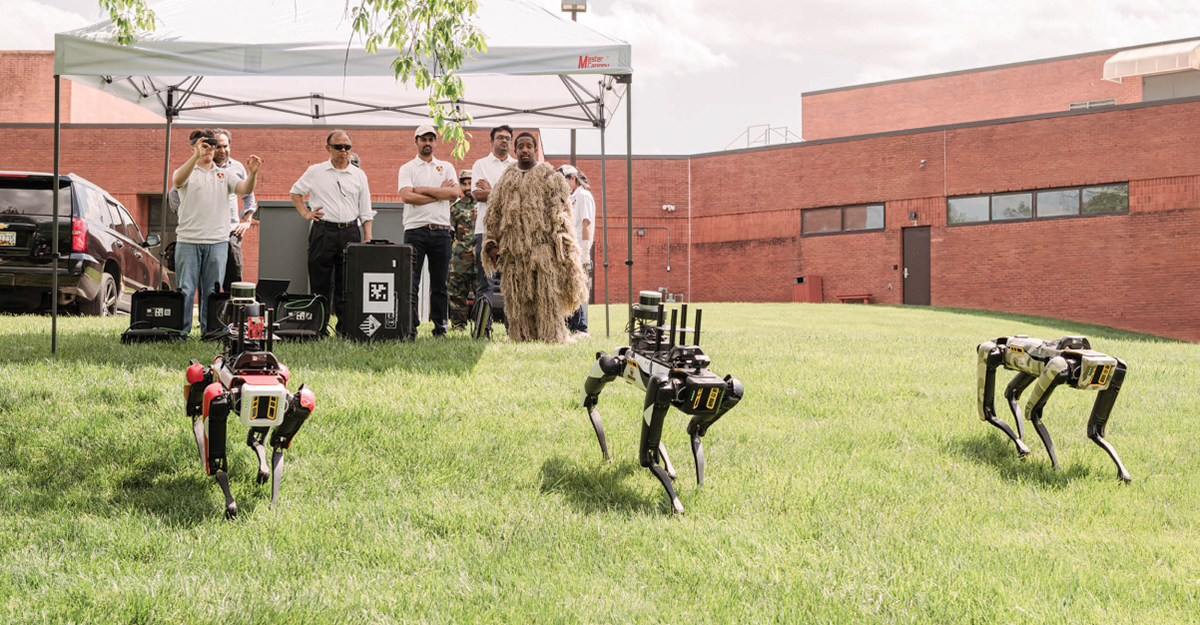 On the back lawn of the courthouse building, student researcher Kevin Rippy, left, controls three Spot robots with gestures. Another student stands by in a ghillie suit, a type of camouflage clothing.
Recently, the team has demonstrated this capability by verbally assigning the robots the task of jointly surveying a given area. The robots must translate the instructions from plain English into machine-level commands, divide up duties, detect and avoid obstacles, come to a fellow robot’s aid in the case of unexpected problems, and identify and keep track of the objects and people within their assigned perimeter.
“People from around campus will see us testing and will stop to watch,” says Aryya Gangopadhyay, a professor in information systems who directs CARDS. “The robots are an attention getter.”

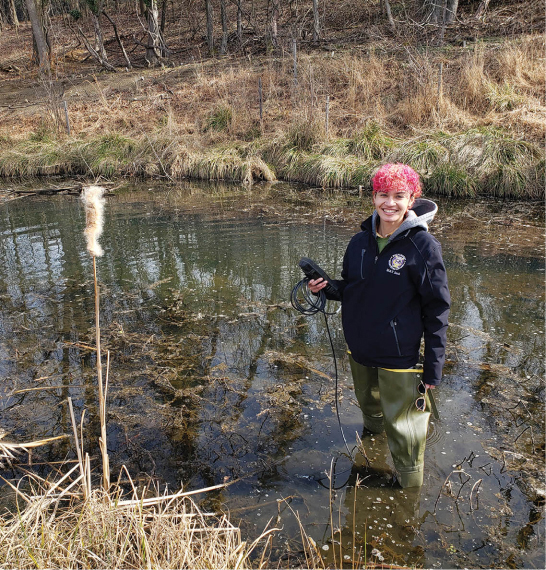
Erin Hamner collected weekly water quality data from this stream for six months, using the battery-powered digital probe she’s holding. (Image by Sarah L. Hansen, M.S. ’15)
After traipsing across a swampy field between research sites, Erin Hamner ’22, GES, and a current master’s student in the Interdisciplinary Consortium for Applied Research in the Environment program, scampers down a streambank in thigh-high waders and plunges a battery-powered probe into the water. It reports concentrations of ammonia and nitrates—key water quality measures. The probe also measures the water’s conductivity, which indicates the level of ions, such as salts used to melt snow.
It’s beautiful out today, but Hamner completed the trek to a dozen campus sites weekly from September 2023 to February 2024, sometimes dealing with mud, snow, or rain. The goal of her master’s thesis is to confirm that stormwater management features UMBC has installed to reduce flooding, filter storm runoff, and otherwise improve water quality are working as intended—or if they aren’t, to suggest improvements.
Hamner and her collaborators in Facilities Management and the Office of Sustainability want to see the data collection effort continue after she graduates. So she is working with faculty in GES to incorporate crowd-sourced stormwater monitoring into the undergraduate curriculum, including generating a public dashboard.
“Erin has done incredible groundwork collecting water quality data across our campus, generating useful data that can tell us about the health of UMBC’s waterways,” says Taylor Smith, assistant director of sustainability.
Long-term data will help the university “see how our development affects our watershed so we can continue to be good stewards,” Smith adds, noting that, “data like Erin’s can help us advocate for more greenspace and stream buffers around campus.”
]]>
Spring on UMBC’s main campus brings a host of familiar sights and sounds: blooms on the magnolia trees, the chatter of red-winged blackbirds calling from the reeds around Library Pond, greening...
https://umbc.edu/stories/putting-umbc-research-on-the-map/
https://my3.my.umbc.edu/api/v0/pixel/news/142303/guest@my.umbc.edu/93196282138c9d99f3c2930689edf3cd/api/pixel
biological-sciences
cahss
campus-life
cards
chemistry
cnms
coeit
computer-science
feature
ges
humancentered-computing
icare
imda
information-systems
joseph-beuys
magazine
mathematics
political-science
psychology
science-and-tech
sds
spring-2024
story
UMBC News & Magazine
https://my3.my.umbc.edu/groups/umbc-news-magazine
https://assets1-my.umbc.edu/system/shared/avatars/groups/000/001/943/24435aa6207c452e7bc15cc74b42c7bb/xsmall.png?1748556657
https://assets1-my.umbc.edu/system/shared/avatars/groups/000/001/943/24435aa6207c452e7bc15cc74b42c7bb/original.png?1748556657
https://assets2-my.umbc.edu/system/shared/avatars/groups/000/001/943/24435aa6207c452e7bc15cc74b42c7bb/xxlarge.png?1748556657
https://assets2-my.umbc.edu/system/shared/avatars/groups/000/001/943/24435aa6207c452e7bc15cc74b42c7bb/xlarge.png?1748556657
https://assets3-my.umbc.edu/system/shared/avatars/groups/000/001/943/24435aa6207c452e7bc15cc74b42c7bb/large.png?1748556657
https://assets1-my.umbc.edu/system/shared/avatars/groups/000/001/943/24435aa6207c452e7bc15cc74b42c7bb/medium.png?1748556657
https://assets2-my.umbc.edu/system/shared/avatars/groups/000/001/943/24435aa6207c452e7bc15cc74b42c7bb/small.png?1748556657
https://assets1-my.umbc.edu/system/shared/avatars/groups/000/001/943/24435aa6207c452e7bc15cc74b42c7bb/xsmall.png?1748556657
https://assets2-my.umbc.edu/system/shared/avatars/groups/000/001/943/24435aa6207c452e7bc15cc74b42c7bb/xxsmall.png?1748556657
UMBC News & Magazine
1
0
false
Thu, 30 May 2024 10:42:29 -0400
Thu, 30 May 2024 10:42:29 -0400
Kelley Bell named Baker Artist Awardee, Corrie Francis Parks and Katie Hileman are finalists
On May 30, Kelley Bell, M.F.A. ’06, associate professor of visual arts, was named one of the six 2024 Baker Artist Awardees, receiving the $10,000 Mary Sawyers Baker Prize. The awardees were selected by an anonymous jury from a field of almost 700 artists from across the greater Baltimore region. Corrie Francis Parks, associate professor of visual arts, and Katie Hileman ’12, theatre, and general associate in the department of theatre, were among the finalists for the prestigious 2024 Baker Artist Award.
Established in 2009, the Baker Artist program was created to support artists and promote greater Baltimore as a strong creative community. Since then, more than 150 artists have been awarded $1.3 million in grant money. The program was established by the William G. Baker, Jr. Memorial Fund and is managed by the Greater Baltimore Cultural Alliance.
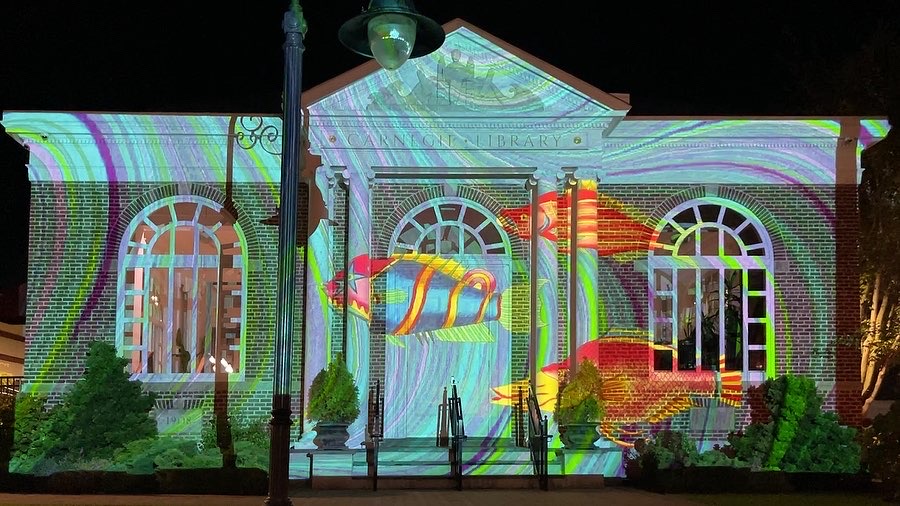 Still from Paper Palazzo by Kelley Bell. Image courtesy of the artist.
As part of the Baker program, artists across six disciplines—visual arts, film/video, interdisciplinary, literary arts, performance, and music—are invited to establish online portfolios of their work, which are housed on the Baker Artist Awards website. The 2024 portfolios, numbering more than 700, were reviewed by an anonymous jury which selected the 36 finalists. One artist in each of the disciplines was awarded the $10,000 Mary Sawyers Baker prize, and one of those six awardees was selected to receive the additional $30,000 Mary Sawyers Imboden prize.
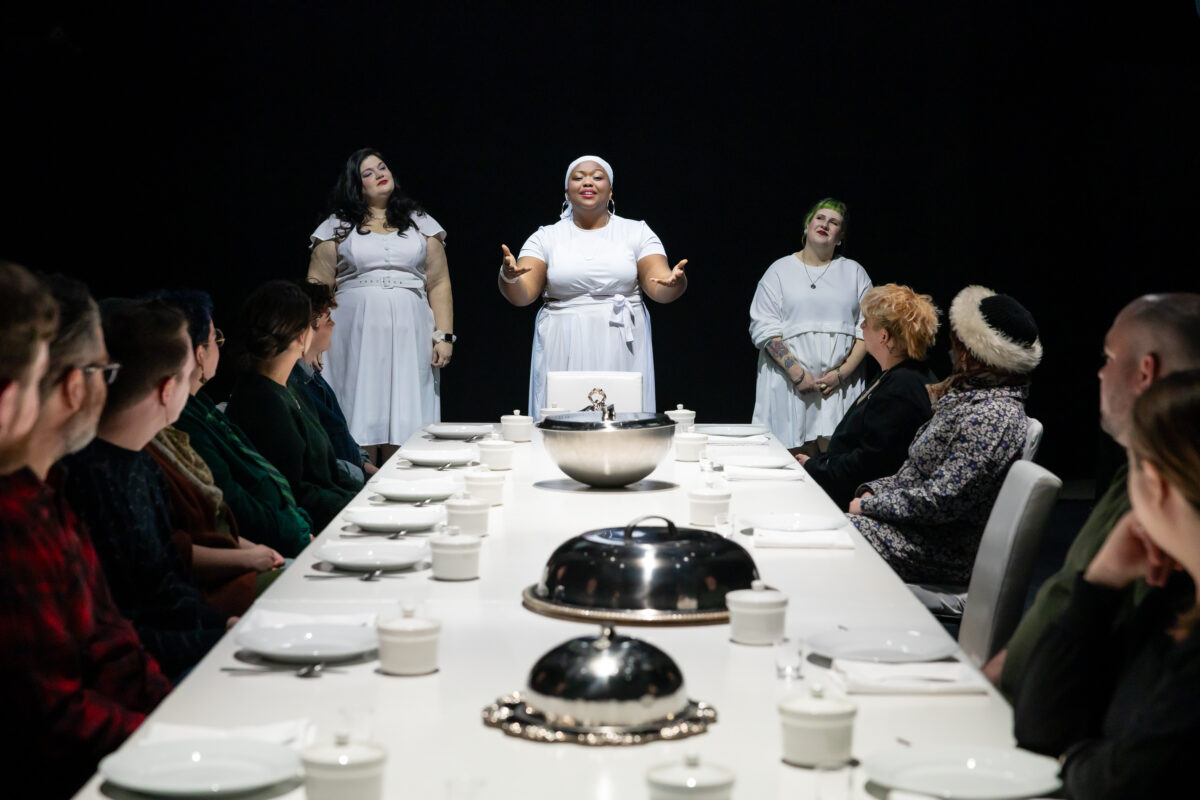 I Will Eat You Alive, written and directed by Katie Hileman ’12. Pictured from left, actors Betse Lyons, Vicky Graham ’20, and Meghan Taylor. Photo by Kiirstn Pagan ’11.
The work of Bell, Parks, Hileman, and other finalists will be featured in a series of finalist showcases. Kelley Bell’s work (in the interdisciplinary category) will be on display at Current Space from April 20 to June 2; Katie Hileman’s work (in the performance category) will be featured at Theatre Project on April 27 at 7:30 p.m. and on April 28 at 4 p.m. The showcase that will feature the work of Corrie Parks (and others in the film/video category) has yet to be scheduled.
UMBC is no stranger to the Baker Artist Awards. Previous recipients have included:
- 2011—Andrew Liang, M.F.A. ’24 ($1,000 b-grant)
- 2013—Jenny O’Grady, assistant vice president, strategic content ($1,000 b-grant)
- 2015—Eric Dyer ’95, visual arts, and professor, visual arts ($25,000 Mary Sawyers Baker prize); and Dominique Zeltzman, M.F.A. ’14, ($5,000 Nancy Haragan award)
- 2018—Lafayette Gilchrist ’92 ($10,000 Mary Sawyers Baker prize)
- 2021—Rahne Alexander, M.F.A. ’21, ($2,500 Baker Artist award); and Mina Cheon, M.F.A. ’02 ($2,500 Baker Artist award)
“Being counted among the 2024 Mary Sawyers Baker Prize awardees is amazing,” said Bell. “I am fiercely proud to call Baltimore my home and inspirational wellspring—it‘s a city like no other, and there is no other creative community I‘d rather be a part of. My colleagues from CAHSS, Katie Hileman and Corrie Francis Parks, were also included in the finalist‘s circle for this prestigious acknowledgment, and that’s a testament to the wonderful things that can happen when UMBC supports and invests in the arts and culture—our colleagues, our institution, and our city all reap the benefits of an active and vibrant creative community.”
Bell’s work will be featured in an exhibition of works by Baker Award recipients at the Baltimore Museum of Art in spring 2025.
]]>
On May 30, Kelley Bell, M.F.A. ’06, associate professor of visual arts, was named one of the six 2024 Baker Artist Awardees, receiving the $10,000 Mary Sawyers Baker Prize. The awardees were...
https://umbc.edu/stories/umbc-artists-named-baker-artist-award-finalists/
https://my3.my.umbc.edu/api/v0/pixel/news/140718/guest@my.umbc.edu/814e0714b03b3e788a512d5b30275cf0/api/pixel
arts-and-culture
cahss
imda
news
story
theatre
visual-arts
UMBC News & Magazine
https://my3.my.umbc.edu/groups/umbc-news-magazine
https://assets1-my.umbc.edu/system/shared/avatars/groups/000/001/943/24435aa6207c452e7bc15cc74b42c7bb/xsmall.png?1748556657
https://assets1-my.umbc.edu/system/shared/avatars/groups/000/001/943/24435aa6207c452e7bc15cc74b42c7bb/original.png?1748556657
https://assets2-my.umbc.edu/system/shared/avatars/groups/000/001/943/24435aa6207c452e7bc15cc74b42c7bb/xxlarge.png?1748556657
https://assets2-my.umbc.edu/system/shared/avatars/groups/000/001/943/24435aa6207c452e7bc15cc74b42c7bb/xlarge.png?1748556657
https://assets3-my.umbc.edu/system/shared/avatars/groups/000/001/943/24435aa6207c452e7bc15cc74b42c7bb/large.png?1748556657
https://assets1-my.umbc.edu/system/shared/avatars/groups/000/001/943/24435aa6207c452e7bc15cc74b42c7bb/medium.png?1748556657
https://assets2-my.umbc.edu/system/shared/avatars/groups/000/001/943/24435aa6207c452e7bc15cc74b42c7bb/small.png?1748556657
https://assets1-my.umbc.edu/system/shared/avatars/groups/000/001/943/24435aa6207c452e7bc15cc74b42c7bb/xsmall.png?1748556657
https://assets2-my.umbc.edu/system/shared/avatars/groups/000/001/943/24435aa6207c452e7bc15cc74b42c7bb/xxsmall.png?1748556657
UMBC News & Magazine
1
0
false
Tue, 09 Apr 2024 10:45:44 -0400
Thu, 13 Jun 2024 10:45:44 -0400
Why We Love it Here
What gets you up and out the door each morning? And what makes a job more than a job—or even more than a career? For so many who make UMBC their professional home, the value goes way beyond a paycheck.
Case in point: Employees for the 14th consecutive year rated UMBC as one of ModernThink’s Great Colleges to Work For in all 10 categories, including shared governance, mission and pride, job satisfaction and support, and diversity, equity, and inclusion. Additionally, the Baltimore Sun has once again named UMBC a 2023 Top Workplace winner based on a confidential employee survey conducted earlier this year. This is the 9th time UMBC has earned this designation since 2013.
What does this excellence look like in the day-to-day? We talked to some Retrievers about what they love about their work at UMBC.
Want weekly Top Stories sent to your inbox?
Valuing Our Whole Selves
UMBC is a place that considers the whole person, opening up space for both professional growth and work-life balance. From mentoring programs to embracing our individual stories, when we support each other in our work and lives, we all come out stronger.
Sharing Our Time
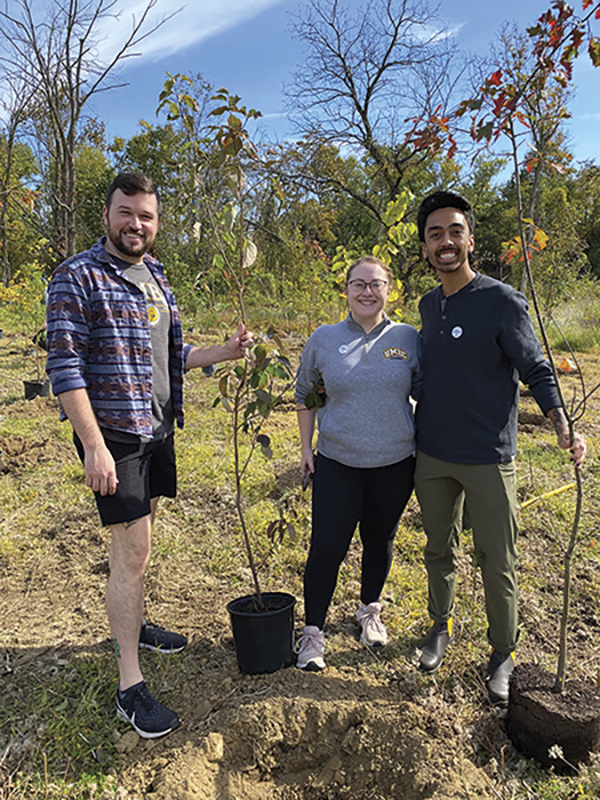
Dozens of Retrievers spent time this fall planting 900 new trees around campus, including those pictured here (L-R): Gavin Gilliland, Abby Hart ’18, and Tim Olivella.
Building bridges across campus
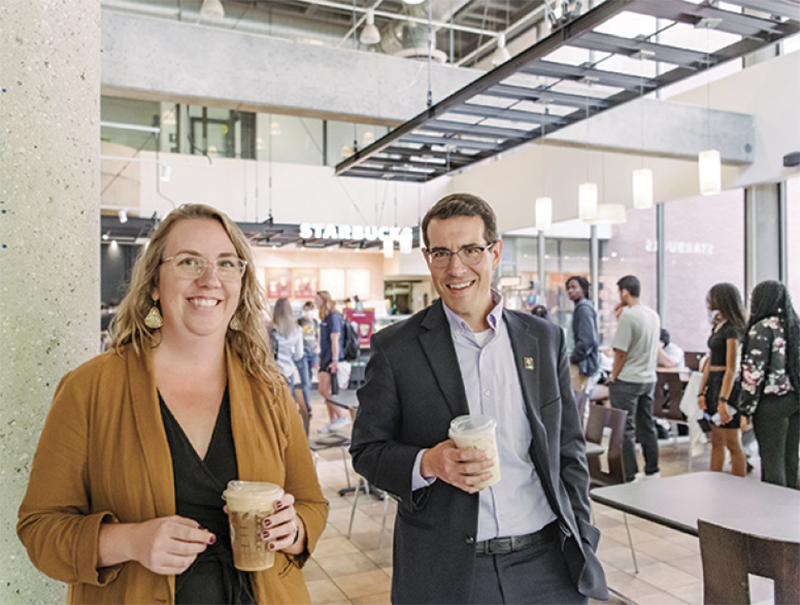
They met so many times at Starbucks, they knew each other’s orders.
Damian Doyle (’99, computer science, M.S. ’16, information systems): tea, Earl Grey, hot. Charlotte Keniston (M.F.A. ’14, intermedia and digital arts): coffee, iced.
Over their caffeine of choice, the two UMBC staff, who work in wildly divergent disciplines, forged connections through the Professional Staff Senate mentorship program—a staple of campus connectedness for the last decade.
Doyle, who works in information technology and has been a staff member at the university for almost 24 years, has served as a mentor for more than five years. Keniston, who started at the Shriver Center five years ago, anticipated a year of opportunity and transition and wanted a mentor to guide her toward balance between a demanding career, family, and finishing her Ph.D. in language, literacy, and culture.
“It was a perfect fit because Damian saw the big picture of the university and explained the campus overarching structures that I had never understood and was really great at advising me on critical points I was at in my career,” Keniston said.
As a mentor to a number of staff over the years, Doyle finds the program rewarding.
“One of the things I loved was getting to know different parts of the university. I get exposed to these different areas of the campus at a deeper level. It confirms for me the kind of driven work that people are doing.”
The mentorship program matches staff through a mentee-first pairing system that includes a speed-dating session and goal analysis for a year-long commitment. Keniston said the mentorship was crucial to her path at UMBC.
“I was at the point where I felt like I couldn’t ask questions, like, ‘Who is this person?’” Keniston said with a laugh. “But being in this mentor/mentee relationship gave me an opportunity to say, ‘Help me understand this.’”
Doyle said that hearing Keniston’s questions and seeing the campus organization through new eyes helped him know what is working and what needs improvement at UMBC. “It’s very educational for me, having to think through what is the right answer, what is the honest answer.”
After a year of meeting about once a month, Doyle has a new mentee, and Keniston has now become a mentor. But they’ll be keeping in touch. Maybe over tea and coffee.
Inner Peace
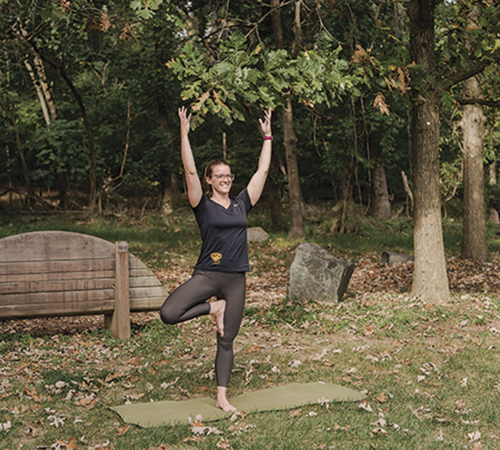
Many of our staff and faculty take advantage of free exercise and wellness classes in the RAC, some of which are taught by Joella Lubaszewski ’10.
Telling her authentic story
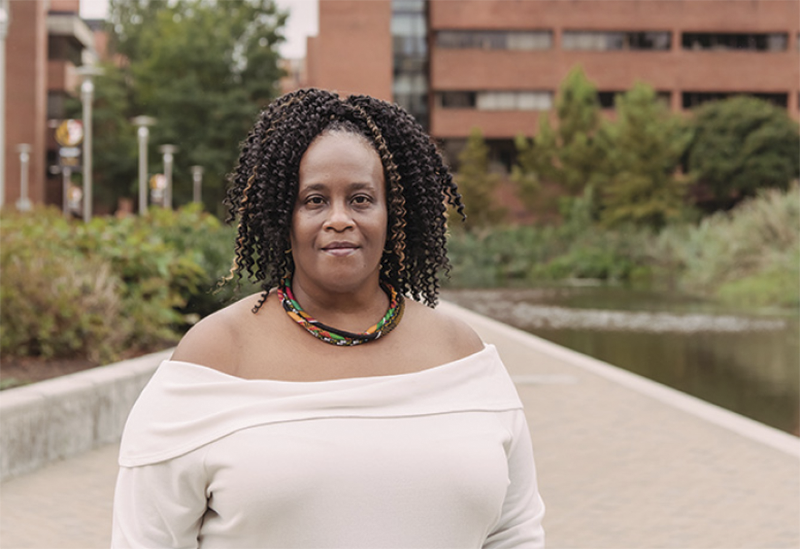
Melessia Jasper’s journey to UMBC was not straight. But something kept pointing her toward UMBC. And toward herself.
“My path to UMBC started before I knew about UMBC,” Jasper said, explaining that after high school in Alabama, she arrived in Maryland only to find that the job she had been promised was locked in a hiring freeze. She started at American University, where she worked with two former UMBC staffers. Then she heard UMBC President Emeritus Freeman Hrabowski at a faculty retreat. “I didn’t realize it at the time, but God was laying the groundwork for where I am today.”
When she moved to Baltimore with her new husband, she applied to UMBC and worked in several different divisions, including Student Affairs and Administration and Finance. In each office, Jasper said, she found acceptance and growth. She now works in the Division of Institutional Equity.
“It was the first university I worked for where you’re applauded for your quirkiness,” Jasper said. “I was so empowered by the resources UMBC offered to me that I then could empower others.”
Last year, she stood on stage to tell her story in a Retriever Talk. For weeks, she and a cohort of other UMBC staff labored with Jill Wardell ’99, interdisciplinary studies, and other strategic talent management and storytelling staff to shape their life tales, a commitment of time and effort on the part of both the storytellers and for UMBC. Jasper said she felt like she was stripping naked. She was reluctant but told herself, “Sometimes, you have to be uncomfortable in order to follow your purpose in life.”
In addition to revealing lifelong intrusive thoughts of inadequacies and imposter syndrome, Jasper also shared—in front of hundreds of people she didn’t know—that in 2000, doctors discovered she had a rare condition called a Chiari malformation, in which part of her brain had grown down into her spine. Her doctor was amazed at what she had achieved, but Jasper knew she was only getting started.
After her Retriever Talk, many students, colleagues, and even strangers have since contacted her to affirm how her story helped them.
“This is something that I have gone through,” Jasper said. “If I can go through it and possibly help you by telling you my story, I want you to have that same freedom…freedom in understanding who I am and accepting who I am.”
A Community That Builds Together
Through our unique commitment to shared governance and a deep appreciation of community, we collectively build UMBC into what we know it should be.
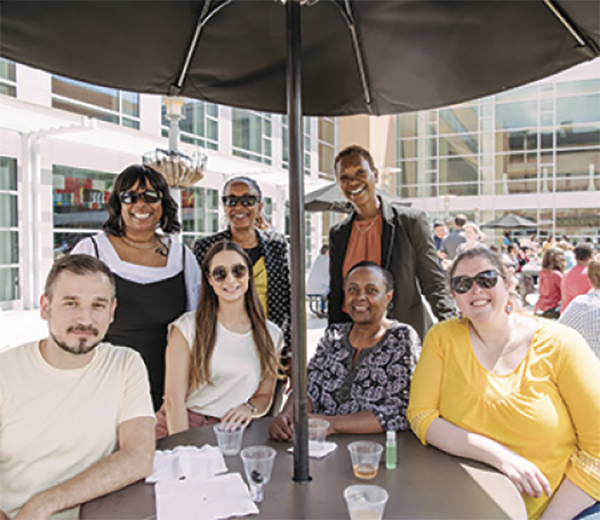
Sharing the Moment
The annual cookout put on by the Professional Staff Senate and Nonexempt Staff Senate brings folks together from all over campus.
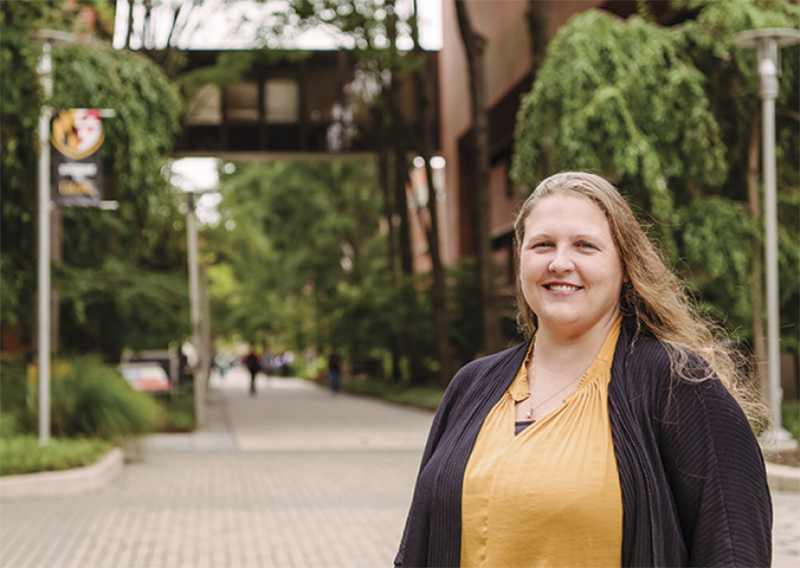
Finding a voice in leadership
There’s a reason the Nonexempt Staff Senate (NESS) carries the name of a democratic body. Alongside other staff and faculty shared governance groups and student government bodies serving their respective constituents, NESS exists to ensure all UMBC nonexempt employees have a voice, the way democracy is supposed to work.
Desiree Stonesifer, serving the second year of her term as president of NESS, and a business services specialist in the financial services department, believes that the shared governance organization builds trust at the university. UMBC offers both staff and faculty shared governance groups, in which all parties work together on the university’s leadership.
“I think it gives people the security of knowing that they’re welcome to speak their mind without it being held against them,” Stonesifer said. “They’re allowed to have thoughts outside the status quo. And a lot of times, those are the kind of thoughts that maybe the administration or other people in the university haven’t thought of. It gives everyone different perspectives and it allows staff the ability to grow more comfortable in their community so that they can be who they are and say what they think.”
NESS helps its members handle issues that are vital to employees: Are job descriptions adequate? Are positions equitably valued? Is professional development available?
Many of the nonexempt senate members aren’t interacting with students as much as other UMBC employees, Stonesifer said, and many of them want to reach out. The NESS, she said, can help members “find ways to get involved in the community.”
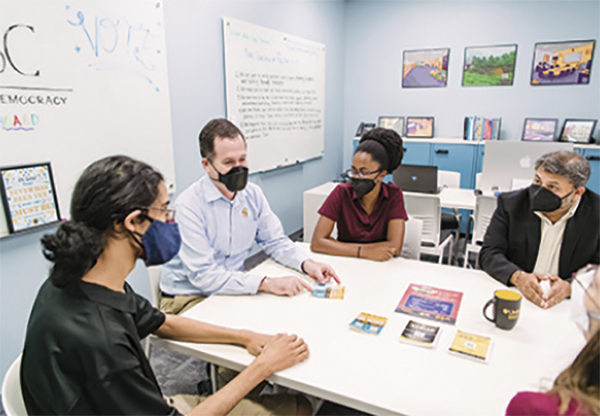
Creating Change
Campus offices like the Center for Democracy and Civic Life work alongside students to engage the community and make a difference.
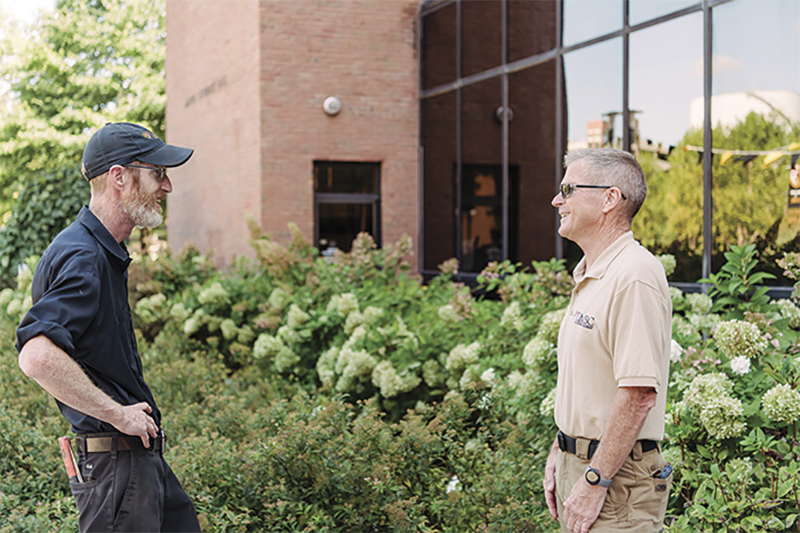
Creating a green space of solace
Charles Hogan, UMBC’s landscape and grounds manager, is comfortable with trees. He grew up climbing them, building forts in them, and “falling out of them,” he said, laughing. For decades, he has run and biked through forests for mile upon mile every week.
As he walks UMBC’s Academic Row in his sturdy boots and cargo pants, Hogan (above, right) admires the trees that have survived years of building renovations, root system compromise by tunnels carrying utilities and water underground, and the hundreds of students who tramp over their soil and tie hammocks to their trunks.
Hogan, who has worked on UMBC’s landscaping for 26 years, likes to construct park-like pockets dotted throughout the campus. Each of those miniature parks is based around trees, whether that’s the pair of oaks in front of the Administration Building that tower over the hydrangeas below or the diminutive weeping redbud that Hogan wanted to top with a tiny hat and sunglasses because it looked so much like Cousin Itt from the Addams Family.
“I’m a tree person,” said Hogan, who is a certified arborist. “Trees should be the focal points. We’re creating a lot of little park environments.”
A campus’ green spaces, Hogan said, make a difference when students and their families are trying to decide where to attend as well as provide succor to everyone making their way through a busy semester. That’s why the grounds staff plants 30,000 summer annuals and 10,000 fall pansies every year. Each area on campus is assigned to a particular gardener, Hogan said, who takes pride in the beauty of the plants under their charge.
Those gardens and the shade of the trees surrounding the buildings offer comfort to the staff, faculty, and students who make the campus their living rooms.
“I never went to college, but I know students are under a lot of stress. They should be able to sit outside, read, study, write a paper,” Hogan said. “Any landscape, whether it’s at your house or on campus, should make you feel good, feel relaxed.”
Living the Mission
At the end of the day, UMBC’s values and mission are what bring us all together. When we work in service of our students and our academic mission of inclusive excellence, it’s hard not to feel connected to the work on another level.
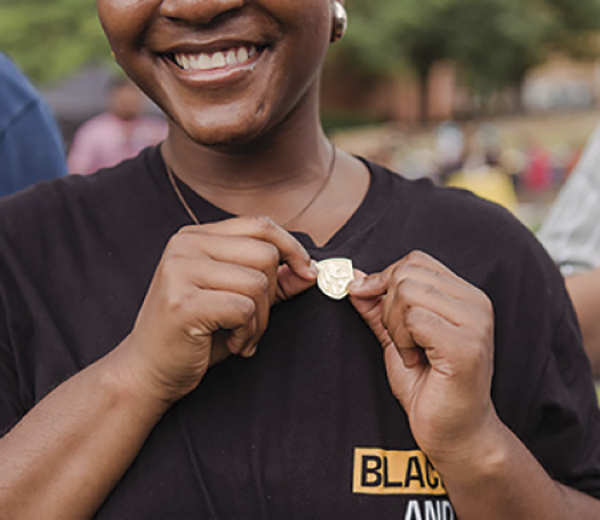
A Student-Centered Community
At the beginning of each school year, our new students are officially welcomed with the Convocation ceremony, where they each receive a special UMBC shield pin.
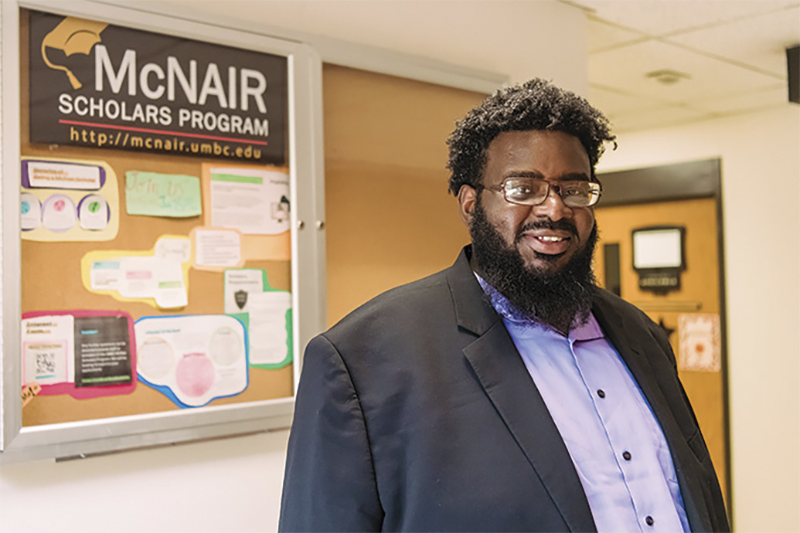
Lifting students to the next level
When he’s deep into extolling the mission and benefits of the McNair Scholars Program he directs, Michael Hunt ’06, computer engineering, needs only a pulpit to become the preacher he trained to be.
When Hunt sees a student achieve, he feels “that parent feeling, that joy that comes to you. Sometimes I’m more excited than they are when they’re telling me. Sometimes it’s a sense of awe in knowing their story, in knowing all that had to happen to get to that space,” said Hunt, who has a masters in theology. “I feel like we’re the mama bird, teaching them all they need before they fly away.”
The federally funded McNair program, with a goal of boosting students from underrepresented segments of society into earning research-based doctoral degrees, has expanded over the six years of Hunt’s directorship.
Every year, the McNair Scholars Program funds 30 slots for students, who meet with mentors, fulfill service obligations, attend cross-cultural events, and receive the help they need to prepare for, apply to, and excel in graduate school.
Hunt, who was a Meyerhoff and McNair scholar, is earning his own interdisciplinary Ph.D. from UMBC. After he became director of the McNair program in 2019, he found himself frustrated when he had to shut some students out of opportunities. So he spearheaded, with the backing of the then-current scholars, staff, and McNair Advisory Council, the creation of the Friends of McNair network, a group of students who reap some of the mentoring, community, and support benefits that McNair Scholars enjoy.
Hunt is exploring ways for the university to expand the support it gives to students not in formal scholar programs. He enthusiastically advocates for the need for holistic critical mentoring (HCM), a network of power-dynamic-flipped, student-centered, reciprocal relationships. HCM is the mentoring framework that uplifts both mentor and mentee while dismantling systems of oppression.
“Because of my heart and because of the work that I do, I don’t want to turn anyone away when I know there are resources to support them. The institution has to rise and say, ‘This is a part of the work of inclusive excellence, and we’re going to fund this to make it happen.’ What I love about my institution is that the more I talk and have these conversations, the more I do see people beginning to question and challenge what we are doing. And so I don’t feel quieted. In other spaces, I know that folks would have been quieted.”
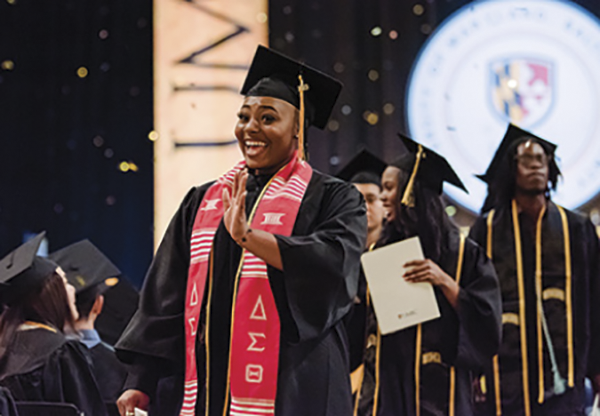
Moments of Joy
There’s simply nothing like the feeling of watching our students cross the stage to get their diplomas.
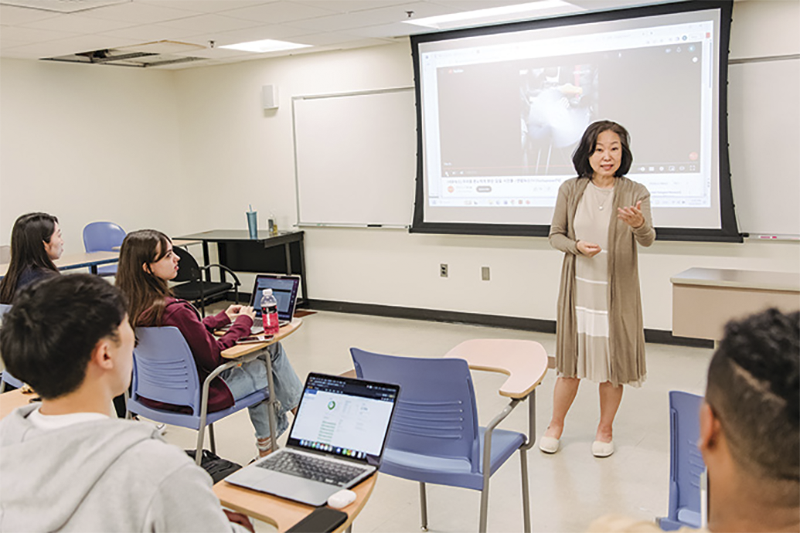
Shaping success in all sizes
At Commencement, Kyung-Eun Yoon likes to sneak out of her academic division’s seating section to hug students in other majors, she confesses. Of course, she gets to hug all the Korean majors when they rise to receive their diplomas, but other students have taken maybe five or six courses or minored in Korean, and she wants to embrace them, too, to recognize that achievement.
Student success, Yoon says, doesn’t come in one shape or size.
“For some students, yes, excelling in every class and getting double degrees and finishing an honors program with a wonderful thesis, going to Korea’s top university as a graduate student, getting a job—that’s a wonderful, wonderful success story,” Yoon said. “But for some students, completing the semester without withdrawing from too many classes, or without failing one or two courses, completing their degree, finally, in five or six years, that’s a wonderful success story for them too.”
Yoon started at UMBC in 2009 as the coordinator of the new Korean program and has grown the program so that students can now major or minor in Korean within the modern languages, linguistics, and intercultural communication department. Over her 14 years, Yoon’s Korean program graduates have gone on to work at the National Security Agency, to pursue graduate schools in various fields including Korean studies and international relations, to teach English in Korea, and more.
But sometimes, she said, success looks like one student whose achievement she particularly treasures. The student had dropped out, withdrawn from many classes, but after six years and many advising sessions with Yoon, last May, she graduated.
“It was not just a mere graduation for her, it was a really, really huge success for her,” Yoon said, and that student’s achievement made Yoon feel proud. “I did this much,” she says, holding up her finger and thumb an inch apart.
Yoon and her colleagues can help students along the path of hard work, but eventually, she says, “you have to have your ownership. We’ll help you, but without your ownership of this time, success cannot be happening.”
And when success happens, Yoon is sure to find that student to give them a hug.
By Susan Thornton Hobby
]]>
What gets you up and out the door each morning? And what makes a job more than a job—or even more than a career? For so many who make UMBC their professional home, the value goes way beyond a...
https://umbc.edu/stories/why-we-love-it-here-at-umbc/
https://my3.my.umbc.edu/api/v0/pixel/news/137627/guest@my.umbc.edu/7e783d773436c1823fe0629cac29e423/api/pixel
campus-life
center-for-democracy-and-civic-life
doit
fall-2023
imda
llc
magazine
mcnairscholars
meyerhoff-scholar
mll
ness
pss
UMBC News & Magazine
https://my3.my.umbc.edu/groups/umbc-news-magazine
https://assets1-my.umbc.edu/system/shared/avatars/groups/000/001/943/24435aa6207c452e7bc15cc74b42c7bb/xsmall.png?1748556657
https://assets1-my.umbc.edu/system/shared/avatars/groups/000/001/943/24435aa6207c452e7bc15cc74b42c7bb/original.png?1748556657
https://assets2-my.umbc.edu/system/shared/avatars/groups/000/001/943/24435aa6207c452e7bc15cc74b42c7bb/xxlarge.png?1748556657
https://assets2-my.umbc.edu/system/shared/avatars/groups/000/001/943/24435aa6207c452e7bc15cc74b42c7bb/xlarge.png?1748556657
https://assets3-my.umbc.edu/system/shared/avatars/groups/000/001/943/24435aa6207c452e7bc15cc74b42c7bb/large.png?1748556657
https://assets1-my.umbc.edu/system/shared/avatars/groups/000/001/943/24435aa6207c452e7bc15cc74b42c7bb/medium.png?1748556657
https://assets2-my.umbc.edu/system/shared/avatars/groups/000/001/943/24435aa6207c452e7bc15cc74b42c7bb/small.png?1748556657
https://assets1-my.umbc.edu/system/shared/avatars/groups/000/001/943/24435aa6207c452e7bc15cc74b42c7bb/xsmall.png?1748556657
https://assets2-my.umbc.edu/system/shared/avatars/groups/000/001/943/24435aa6207c452e7bc15cc74b42c7bb/xxsmall.png?1748556657
UMBC News & Magazine
6
0
false
Fri, 08 Dec 2023 09:06:37 -0500
Fri, 08 Dec 2023 09:06:37 -0500
Grab a Seat at the Table
These days, it’s tempting to grow numb to the polarization of society and the breakdown in public discourse and to retreat into our silos of solidarity. But a liberal arts education has the potential to offer an antidote to these seemingly inevitable fates—through modeling and practicing empathy. At UMBC, students are invited to the table to share their stories and listen to their peers. These acts of educational hospitality help Retrievers find their why and pursue the public good.
Want weekly Top Stories sent to your inbox?
It’s the first day of class. You’re looking around, bright-eyed and a little nervous, and then your instructor smiles at the class and says, “One day you are all going to die.” Are you offended? Shocked? Titillated? Horrified? Collectively, the class titters. Already social bonds are forming as Christine Armstrong Mair, associate professor of sociology who specializes in gerontology, continues her spiel. “And if we’re all lucky, that won’t be for a long time.”
As sociologists, says Mair, or more broadly as leaders in an educational setting, “it’s not our task to make somebody think a certain way. Our task is to show them what exists in society and help them feel empathy for the human experience.”
At its most pedestrian roots, empathy is putting yourself in someone else’s shoes. How can someone else’s emotional experience inform your own personal perspective?
In the best-case scenario, a college campus is a microcosm of its society: a crosshatch of races, ages, and socio-economic backgrounds. And UMBC holds true to those measures. But something different happens when you step into the Loop—you sit next to someone who didn’t go to your high school. You eat at the same table with someone outside of your cultural background. You take a test side by side with someone who voted differently than you. And even more than sharing space, you start sharing notes and books and stories—even your own story—with these strangers and then suddenly they’re no longer strangers.
When empathy is on the table, students and colleagues expand their capacity for hard work. You might change your thesis to address human trafficking or leave your home island to work toward healthy aging for all populations. So pull up a chair, step into someone else’s shoes, and partake in this grand educational potluck.
“With my background—what I’ve seen with human trafficking and migrant smuggling—what can I do as a person with my knowledge and responsibility?”
– Saydeh Karabatis, Ph.D. candidate
Building bridges across campus
You’re sitting at a beach-side cafe in Greece with your husband. It’s 2015 and Greece’s financial troubles are in the news, but the waves of migrants washing ashore are not yet as publicized. As you enjoy your coffee, you see a group of 40 to 50 people sitting seemingly aimless and distraught nearby. Based on their clothing, you make a guess that they are Muslims and Arabic speakers. What do you do?
If you’re Saydeh Karabatis, originally from Lebanon—and a survivor of the 17-year Lebanon civil war—and fluent in Arabic, you let that immediate moment of empathy guide you and approach the group.
Karabatis and her husband George, a professor of information systems at UMBC and from Greece, changed the plans for their summer in the Mediterranean to volunteer as translators, food finders, and listeners for the refugees, primarily fleeing the war in Syria and arriving in Greece in dire straits. They did so again in 2017.
As Karabatis interacted with these desperate groups and read more about their plight, she realized familiar patterns were emerging in their stories. They were not just migrants fleeing a war, they were trafficked people, paying dearly for not-safe passage, and many others headed toward labor and a life they did not sign up for. Struck by the limits of her actions—and even her emotional capacity for empathy—when Karabatis returned home to Maryland, she found her next step.
Karabatis, who has a master’s in computer science from UMBC and works for the university’s Division of Information Technology, knew she would need to fill her time when her two sons left for college. Karabatis asked herself, “With my background—what I’ve seen with human trafficking and migrant smuggling—what can I do as a person with my knowledge and responsibility?”
She contacted Vandana Janeja, then chair of information systems, and explained the project she wanted to complete for her Ph.D. During her master’s, Karabatis had tried to conduct a research project on human trafficking for a class with Janeja but couldn’t find a robust data set to use for her project and ended up having to leave the work incomplete. This time, she pitched using the stories of trafficked people. “Instead of dealing with numbers, numbers as data, I am now dealing with stories as data—the stories of people being trafficked,” says Karabatis.
It’s not been easy going. Many trafficked people are not open about their stories, for fear of retribution or simply because of how horrific the experience was. Additionally, it’s hard for Karabatis to take in their trauma. “I’m reading about all these abuses,” says Karabatis. “I’m reading about sex trafficking, labor trafficking, organ trafficking, human smuggling. I can’t imagine—how can a human being do something like that to another human?”
Eventually though, with the end goal of combating the network of smuggling routes, Karabatis says, you need to reach a level where you can try to put your emotions aside: “You need to detach yourself from these emotions if you want to do something to help these people. If your emotions are the only thing driving you, you wouldn’t be able to produce the research. Use these emotions as a spark and then put them on the side.”
Caring starts with listening
You’re a teenager riding the bus for fun in Puerto Rico, killing time by people watching. You’re struck by the number of older adults on the bus, noticing their many bags stuffed with x-rays and other apparent medical paperwork. Unthinkingly, you just assume they’re enjoying the ride like yourself, but this older generation seems eager to talk.
If you’re Jaminette Nazario, a curious if bored high schooler, you strike up a conversation.
What she heard from her fellow travelers shook her: “‘We don’t have people to help….’ ‘My wife just died of cancer….’ ‘I need to use this bus to get to my medical appointments.’” It wasn’t until she was pursuing her bachelor’s degree in social sciences that Nazario was hit by the realization that those conversations might have been the only time those older bus riders had talked to someone that day. “So I started thinking about the many barriers older adults have in order to achieve healthy aging,” she says. “When older adults don’t have resources or people, they miss out on social networks that are vital to healthy aging.”
This aha moment would propel Nazario to a master’s degree in public health with a focus on gerontology, but in order to study further, she’d have to leave her island for the next academic step.
Now in her second year of UMBC’s Ph.D. program in gerontology—a joint program with the University of Maryland, Baltimore—Nazario is beginning to research aging Hispanic immigrants and their increasing challenges accessing medical care.
And unlike her fellow bus riders, she’s not doing this alone. “Even though it’s really hard to be far from family, I feel like I’m home here. And I love how Dr. Mair teaches.” Like most classes, says Nazario, there are readings and discussion, but Mair brings a “specific dynamic” to the setting. Each class starts with questions prepared by the students, which is really empowering, says Nazario. It might end up that the class all resonates with one question and they stay on that topic, guiding the trajectory of the discussion.
In summer 2022, Nazario joined Mair and others from the gerontology program at a conference in Japan. She presented a poster on her research and walked away from her talk with a new level of confidence. “There were professionals from Japan and China and they’re asking me about something in the United States…it was kind of cool. People came up and treated me with so much respect.”
Students in Mair’s gerontology classes are finding their drive to solve crises in aging care not only because they might have loved ones suffering, but because aging (if we’re lucky) and death are unifying elements. “It’s something that really applies to all of us,” says Mair, “to make sure that we’re taking care and setting up a good system so that when we all arrive there, that us and all of our people that we care about are okay.”
Inclusive classrooms by design
You walk to the front of the media and communications class you’re teaching. Students are sitting in traditional desks in rows, facing the whiteboard where you’ll teach. They’re silent, spaced out or on their phones. They seem to breathe a sigh of relief when you walk in, grateful to know where to put their attention. Later, in a different section of that class, you meet in a newly designed lecture hall filled with round tables and no clear lectern space. In this format, the students are already grouped together and chatting.
If you’re Donald Snyder, principal lecturer in media and communication studies, you know there is science behind what forms good class cohesion and participation. He learned it from the experts in UMBC’s Faculty Development Center (FDC).
In addition to learning about and playing around with classroom set-up to facilitate more natural conversations (and to rid the learning experience from a “perceived hierarchy” as FDC Director Linda Hodges calls it), Snyder and others who use the FDC are supported in using inclusive and culturally responsive teaching.
While culturally responsive pedagogy isn’t a new concept—it centers and nurtures students’ unique cultural strengths—Hodges says that recent world events have brought the teaching style more into focus. Citing the death of George Floyd and the nation’s response—especially young people—and the COVID-19 pandemic as two significant flashpoints, Hodges says inclusive pedagogy and empathetic practices have become more imperative than ever. Room design is just one tool in the FDC toolbelt that can work to democratize students’ experience. It can erase the divide between the front row handraiser and the back row hider, giving equal footing to all types of students and their stories.
“Instructors are recognizing that they need to try to connect with and hear their students’ voices,” says Hodges. “This will create a sense of belonging. It’s become quite clear in the research that one of the key factors in whether students succeed and persist in education is the feeling of belonging.”
Snyder has made the most of the FDC’s offerings, including inviting Hodges’ team to observe his teaching and offer feedback. He starts many of his classes with some tools for students to learn about self-regulation, basically how to use available resources to make the most of education. He introduces them to Bloom’s Taxonomy, which places rote memorization at the bottom of the pyramid and evaluating and creating a unique argument at top. “I want the students to know, I’m not asking to memorize anything,” says Snyder, “but we need to learn to be critical when we’re thinking about media and communication texts and how these things operate.”
Giving students tools to succeed in college—go to office hours, block out time for studying, get enough sleep—may seem basic and far afield from teaching and practicing empathy, but in the taxonomy of educational success, says Snyder, this foundation leads to the heavy-lifting tools at the top of the pyramid.
Snyder helps them harness existing interests, in tech or media, and then run with it, academically. He wants them to ask, “‘How can I turn that switch? What is the thing that I can grab onto? What do I really want to know about?’”
He also listens to them, and attempts to model vulnerability in the classroom. “Yes, these are students and they need to understand content, but they’re also humans who are struggling and we’re all struggling and there’s a human condition aspect we can’t ignore as instructors.”

Swapping stories strengthens neighborly bonds
You’re driving your car on tour in Texas when you’re hit by a criminally intoxicated drunk driver. You survive, but a host of physical and psychological repercussions are still taking their toll 10 years later. As a musician, you fuel your art with your resiliency and work through the healing process by creating music. But when the pandemic hits, and live, in-person music disappears, you look for a pivot point—and the community you’re missing.
If you’re Kristin Putchinski, a student in UMBC’s M.F.A. program for intermedia and digital arts, you lean into the concept of “platonic intimacy.”
Putchinski coined the term to sum up her goal of “trying to strengthen neighborly bonds. What I’m looking for is an intimate experience between two people. And when people hear intimacy, they tend to think that it’s about a romantic or sexual component. But how do I frame that intimacy—and how important intimacy is—in terms of friendship and neighborliness?”
Through a graduate assistantship jointly funded by jointly funded by UMBC and the University of Maryland, Baltimore’s Community Engagement Center (CEC), Putchinski was given the opportunity to shadow CEC’s then-director Tyrone Roper and learn about the center’s mission, which includes strengthening neighborly bonds. Roper told Putchinski they were looking for ways to engage the 18- to 24-year-old demographic. When Putchinski was tasked with creating an art project for CEC the following semester, she kept this age goal in mind.
As a student in UMBC’s intermedia program, Putchinski “explores the textures between mediums,” she says. As a musical artist who performed under the stage name ellen cherry, “I have 25 years of experience as a performing songwriter and storyteller, creating my own and interpreting other people’s stories.” So she began to imagine a strange game of telephone that would give participants the opportunity to swap stories, with the end result of creating instances of platonic intimacy.
This multifaceted project connected post-high-school-aged individuals with older generations through curated, facilitated sessions. The participant-pairs met four different times and talked about a song, a photograph, and a memory—and at the last session, the neighbors “swapped” their stories. A recording of the swap was sent to local artists who interpreted the stories into their own mediums—painting, poetry, and a video soundscape. Then, at an event open to the public in the CEC, the storytellers took the stage, retelling their neighbor’s story. For example, a Latinx college graduate took to the stage to reshare her stranger-turned-partner’s tale of being raised in foster care in 1970s Baltimore.
Putchinski was eager to find out “when you talk to somebody that’s 40 years different from you…did your perceptions change about yourself, about them, and what were those changes and the answers?”
It makes sense she’s asking these questions based on her ongoing empathy toward the man who altered her life in an accident 10 years ago. “It was very conflicting for me to be the victim of a crime that I really feel like was committed not by a criminal but by a person who abuses alcohol. At the base level, he’s a human being. How can we think about his human potential after this experience and mine?”
“Imagine intensely” a better way forward
One of the greatest assertions of the liberal arts comes from Percy Bysshe Shelley’s essay “A Defence of Poetry.” The short-lived husband of Frankenstein’s creator writes, “A man, to be greatly good, must imagine intensely and comprehensively; he must put himself in the place of another and of many others; the pains and pleasures of his species must become his own.”
On college campuses, and at UMBC in particular, through thoughtful classroom instruction and intentional commitment to community, students trade their stories—pains and pleasures alike. Less of a transaction and more of a gift, these stories are invitations to grow in understanding, change your opinion, or shape your research.
But walking in someone else’s shoes doesn’t mean you misplace your own shoes along the way—in fact professors hope it helps you find your footing at UMBC. “That open-mindedness and appreciation and empathy does not necessarily mean that you lose other parts of yourself,” says Anne Brodsky, professor and chair of the psychology department. “It shouldn’t be a zero-sum game.”
You’re walking down Academic Row. You’re a first-generation college student with a lot of questions. You’re a returning student giving college a second (or third) chance. You’re a first-year who misses the familiar halls of high school. You see other Retrievers walking in groups, heading into classrooms, rubbing True Grit’s bronze nose, making conversation with their peers. What do you do?
]]>
These days, it’s tempting to grow numb to the polarization of society and the breakdown in public discourse and to retreat into our silos of solidarity. But a liberal arts education has the...
https://umbc.edu/stories/grab-a-seat-at-the-table-empathy/
https://my3.my.umbc.edu/api/v0/pixel/news/137271/guest@my.umbc.edu/777eb34ff02b7fc72d1664adf771099a/api/pixel
campus-life
coeit
computer-science
fall-2023
feature
imda
information-systems
magazine
mcs
UMBC News & Magazine
https://my3.my.umbc.edu/groups/umbc-news-magazine
https://assets1-my.umbc.edu/system/shared/avatars/groups/000/001/943/24435aa6207c452e7bc15cc74b42c7bb/xsmall.png?1748556657
https://assets1-my.umbc.edu/system/shared/avatars/groups/000/001/943/24435aa6207c452e7bc15cc74b42c7bb/original.png?1748556657
https://assets2-my.umbc.edu/system/shared/avatars/groups/000/001/943/24435aa6207c452e7bc15cc74b42c7bb/xxlarge.png?1748556657
https://assets2-my.umbc.edu/system/shared/avatars/groups/000/001/943/24435aa6207c452e7bc15cc74b42c7bb/xlarge.png?1748556657
https://assets3-my.umbc.edu/system/shared/avatars/groups/000/001/943/24435aa6207c452e7bc15cc74b42c7bb/large.png?1748556657
https://assets1-my.umbc.edu/system/shared/avatars/groups/000/001/943/24435aa6207c452e7bc15cc74b42c7bb/medium.png?1748556657
https://assets2-my.umbc.edu/system/shared/avatars/groups/000/001/943/24435aa6207c452e7bc15cc74b42c7bb/small.png?1748556657
https://assets1-my.umbc.edu/system/shared/avatars/groups/000/001/943/24435aa6207c452e7bc15cc74b42c7bb/xsmall.png?1748556657
https://assets2-my.umbc.edu/system/shared/avatars/groups/000/001/943/24435aa6207c452e7bc15cc74b42c7bb/xxsmall.png?1748556657
UMBC News & Magazine
1
0
false
Wed, 15 Nov 2023 14:07:28 -0500
From nurture to apocalypse (and back again) —The Mundane Afrofuturism of multimedia artist Safiyah Cheatam

Safiyah Cheatam, M.F.A. ’21, intermedia and digital arts, always has her hands in something.
In just the past few years, the multidisciplinary conceptual artist has exhibited work at The Peale and VisArts. She co-produced OBSIDIAN, a Rubys Grant-funded Afrofuturist podcast, with alum Adetola Abdulkadir ’17, and served as curatorial research assistant at the Smithsonian’s National Museum of African American History and Culture for the special exhibition Afrofuturism: A History of Black Futures. This summer, Cheatam is also serving as a juror for the Hamiltonian Artists Fellowship.
Cheatam devotes her days to providing programming for teen artists as the assistant manager of teen programs at the Walters Art Museum. Over the last decade, she’s led arts programming for young artists at a variety of institutions, including the Baltimore Museum of Art, Wide Angle Youth Media, the University of Maryland, College Park, and UMBC.
“My grandmother, almost everybody in my family, is an educator, so I’m in a long line of educators,” says Cheatam. “One of the things that I decided after undergrad was I wanted to do museum programming; I wanted to lead in a good alternative learning space like the museum.”
Cheatam notes that an attractive aspect of working as a museum educator is the level of engagement.
“I’ve been lucky to get kids who actually want to be there,” she says. “Nobody goes to a museum unless they want to, and so the students come and want to learn what I have planned for them. It’s a good feeling.”
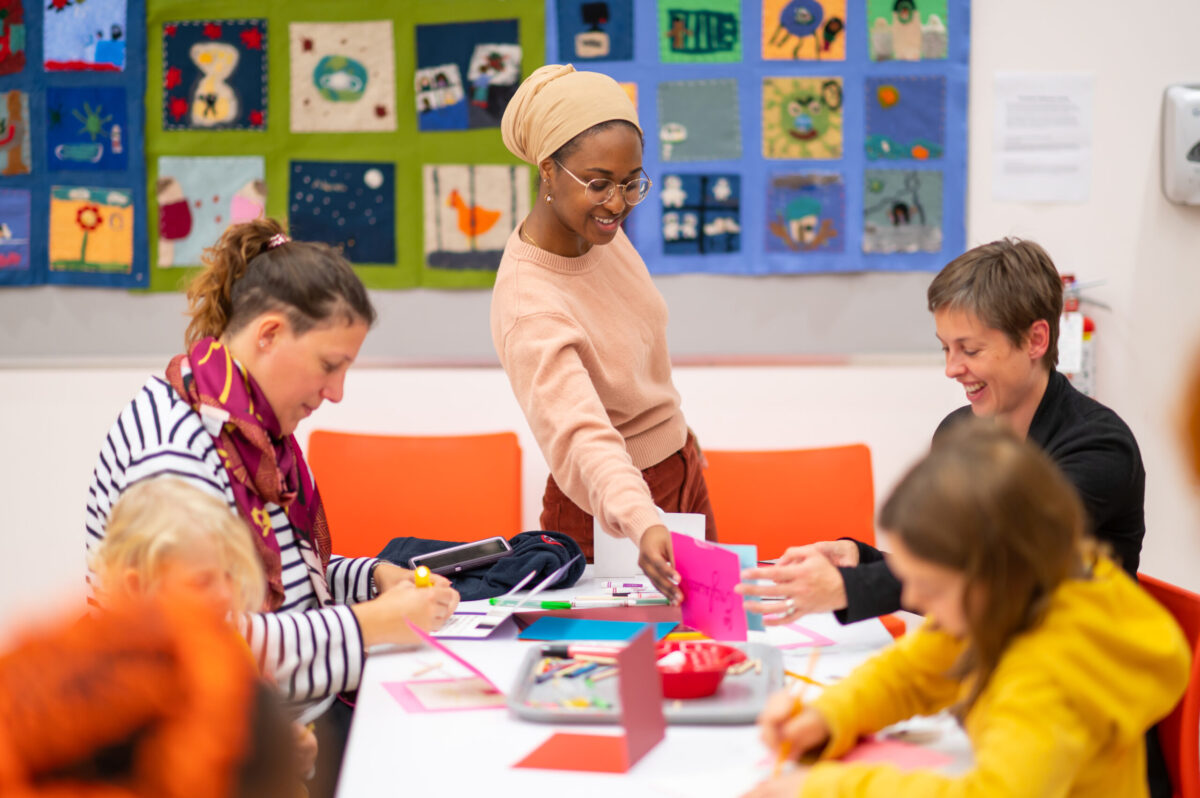 Artist Safiyah Cheatam runs a workshop with students through the Baltimore Museum of Art. Photo courtesy of Cheatam.
What Happens When We Nurture
Last year, Cheatam co-founded Islam & Print with her husband, Dan Flounders. A community print fellowship that champions diverse Muslim experiences housed at Maryland Art Place, Islam & Print celebrated its inaugural year with an exhibition at Black Artist Research Space.
This exhibition, What Happens When We Nurture, features the work of 2022 artist fellows Suldano Abdiruhman, Tayyab Maqsood, Anysa Saleh, and Leili Arai Tavallaei, and will be on view through July 30. Cheatam and Flounders designed the exhibit to center on the work each artist developed as part of the Islam & Print cohort as they learned the techniques and processes of printmaking.
“We want people who come to the show to know that Islamic art is not monolithic. You’re not going to see much geometric patterning or Arabic calligraphy; it’s not that kind of show,” says Cheatam. “We don’t even really like to say Islamic art—it’s just Muslims making work. The goal is that they have a community where they can critique with artists who come from a similar understanding.”
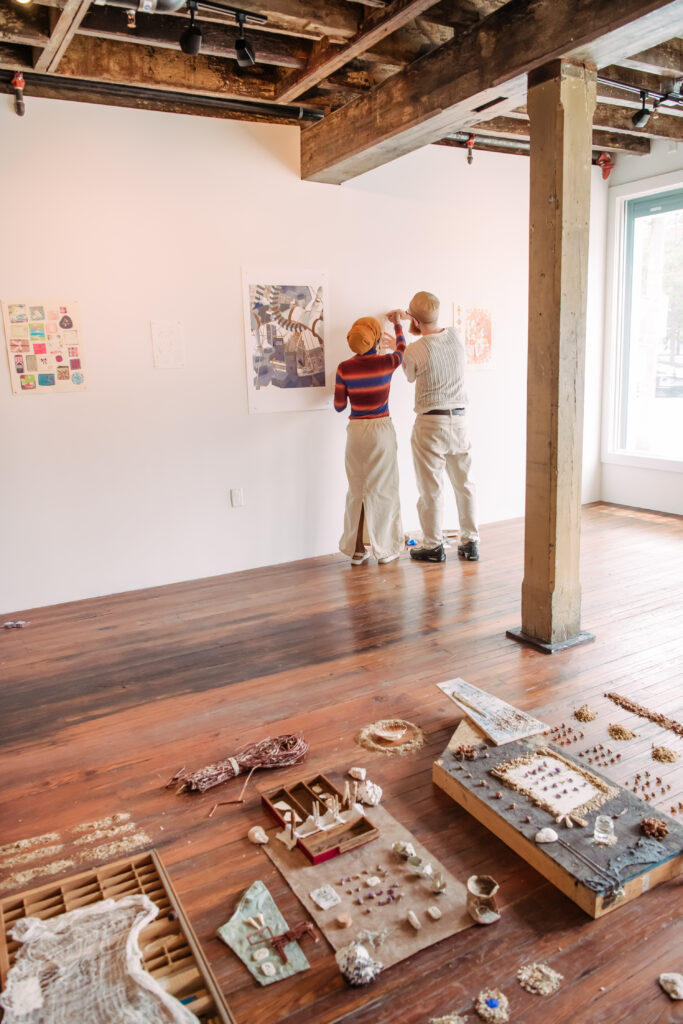 Cheatam and Flounders put the finishing touches on their show. (Marlayna Demond ’11/UMBC)
When Islam & Print initially launched, Cheatam and Flounders received applications from across the country, but ultimately decided to focus on artists in the DMV region for the first year. The size of the show and existing exhibition calendars initially presented a hurdle for finding a venue for What Happens When We Nurture, Cheatam says. But when they began talking with Black Artist Research Space founder Rhea Beckett—faculty with MICA’s Curatorial MFA program—things clicked into place.
“I’m very grateful and excited that we’ve gotten to this place,” says Cheatam. “At first I wasn’t going to pitch it to them because only one person in our cohort is Black and I didn’t want to disrupt the integrity of the space, but Rhea was open to it. She clarified that her space is open to making cultural connections between different races and ethnicities, and she was very interested to talk about the long and important history of Muslims in Baltimore.”
Left: Visitors enjoy the opening reception of What Happens When We Nurture. Photo by Timothy Nohe. Right: Cheatam and her husband and co-curator Dan Flounders outside their exhibit. (Marlayna Demond ’11/UMBC)
The Rhetoric of Apocalypse
After the exhibition closes, Cheatam and Flounders will begin planning the next cohort for Islam & Print. And while they plan, Cheatam will spend August and September as a fellow at Baltimore’s Waller Gallery, where she will produce a new, large body of work—larger than her current studio space can hold—based in the history of American apocalyptic religious messaging.
“We’ve been going to my husband’s family’s house in Allentown, Pennsylvania, and driving a lot of country roads. You see these Christian propaganda billboards, like ‘Jesus now before you die.’ And you know, I found that the Nation of Islam has a similar kind of rhetoric,” Cheatam says.
It’s a body of work that is still in development, so Cheatam is coy about what the end product will look like.
“No spoilers, but for this series I’m going to explore the imagery and texts from the Nation of Islam,” Cheatam says. “I’m interested in the history of literacy within Black Muslims in America, how design and literature is to Muslims. Because almost a third of the enslaved Africans brought here were Muslim, so there’s a rich history of literacy with Black Muslims in America that I want to investigate.”
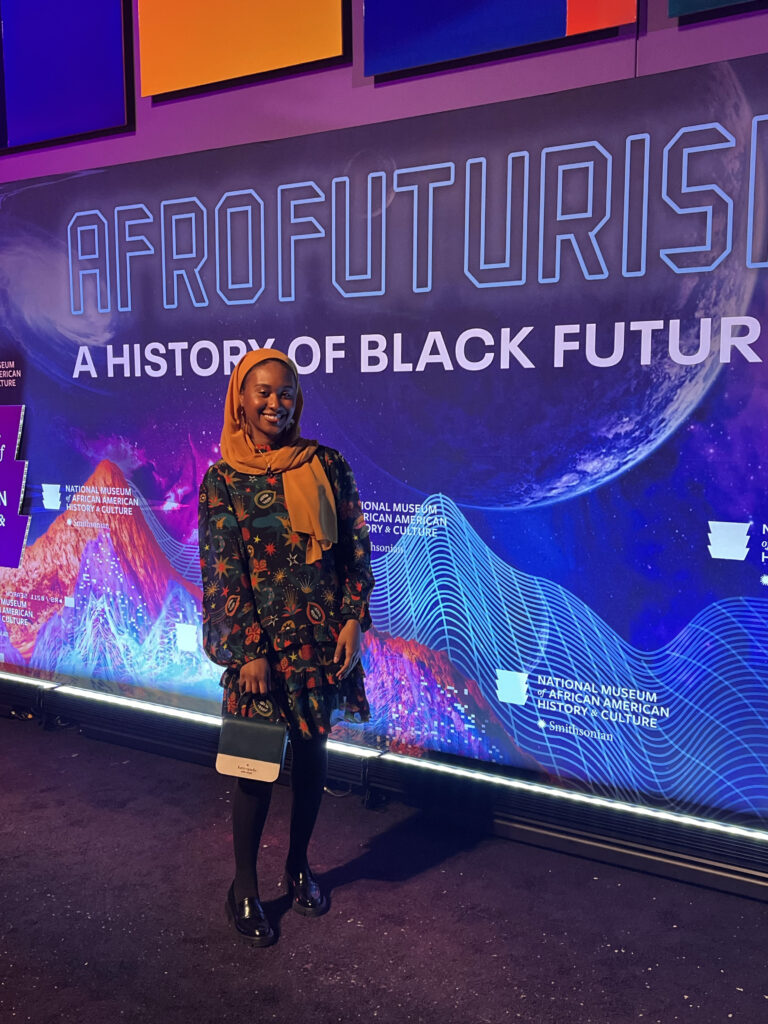 Cheatam at the opening reception of the Smithsonian’s National Museum of African American History and Culture exhibit Afrofuturism: A History of Black Futures, with which she assisted. Photo courtesy of Cheatam.
Cheatam began research for this new body of work delving into the archives of Muhammad Speaks, which was published between 1960 and 1975 as the official newspaper of the Nation of Islam.
“They’re very alarming in their speech sometimes, and I know they have a bad rap with a lot of people, but I really wanted to lean in and learn more about their messaging,” Cheatam says. “And one of the things I noticed about their newspapers is that their headlines are saying things that people, even non-Muslims, feel today.”
During her Waller Gallery fellowship, Cheatam will be making work investigating the underpinning of this messaging, filtering through the Mundane Afrofuturist lens that unites her work.
“I am a big sci-fi enthusiast, and I love disaster movies. I’m obsessed with apocalypses,” says Cheatam. “I like to see how people portray human nature in disaster times and look at how they answer questions like, do we help each other? Do we hurt each other? What does sustainability look like after the apocalypse? How are we taking care of each other?”
* * * * * * *
Learn more about Cheatam’s ongoing work.
Apply to UMBC’s Imaging and Digital Arts M.F.A. program.
]]>
Safiyah Cheatam, M.F.A. ’21, intermedia and digital arts, always has her hands in something. In just the past few years, the multidisciplinary conceptual artist has exhibited work at The...
https://umbc.edu/stories/afrofuturism-multimedia-artist-safiyah-cheatam/
https://my3.my.umbc.edu/api/v0/pixel/news/134430/guest@my.umbc.edu/367ffedd503fba70d337532823b86adf/api/pixel
alumni
cahss
graduateschool
imda
magazine
UMBC News & Magazine
https://my3.my.umbc.edu/groups/umbc-news-magazine
https://assets1-my.umbc.edu/system/shared/avatars/groups/000/001/943/24435aa6207c452e7bc15cc74b42c7bb/xsmall.png?1748556657
https://assets1-my.umbc.edu/system/shared/avatars/groups/000/001/943/24435aa6207c452e7bc15cc74b42c7bb/original.png?1748556657
https://assets2-my.umbc.edu/system/shared/avatars/groups/000/001/943/24435aa6207c452e7bc15cc74b42c7bb/xxlarge.png?1748556657
https://assets2-my.umbc.edu/system/shared/avatars/groups/000/001/943/24435aa6207c452e7bc15cc74b42c7bb/xlarge.png?1748556657
https://assets3-my.umbc.edu/system/shared/avatars/groups/000/001/943/24435aa6207c452e7bc15cc74b42c7bb/large.png?1748556657
https://assets1-my.umbc.edu/system/shared/avatars/groups/000/001/943/24435aa6207c452e7bc15cc74b42c7bb/medium.png?1748556657
https://assets2-my.umbc.edu/system/shared/avatars/groups/000/001/943/24435aa6207c452e7bc15cc74b42c7bb/small.png?1748556657
https://assets1-my.umbc.edu/system/shared/avatars/groups/000/001/943/24435aa6207c452e7bc15cc74b42c7bb/xsmall.png?1748556657
https://assets2-my.umbc.edu/system/shared/avatars/groups/000/001/943/24435aa6207c452e7bc15cc74b42c7bb/xxsmall.png?1748556657
UMBC News & Magazine
0
0
false
Thu, 27 Jul 2023 10:09:44 -0400
Thu, 27 Jul 2023 10:09:44 -0400
Squaring the Circle: The Powerful Art of Hadieh Shafie
The most recent artworks by Hadieh Shafie, M.F.A. ’04, intermedia and digital arts, appear like optical illusions, tricks. Tightly stacked lines of colored pencil suddenly twist and warp into circles. The two-dimensional surface swirls and vibrates, like eddy lines in a river or sound waves blasting from a speaker. Tucked into these dancing lines, Shafie has written the Persian word for passionate love: eshgh.
The drawings pull together many themes from Shafie’s work and life experience, of leaving her home country of Iran in 1983 at the age of 12 and never going back. From her childhood there, she recalls how women were banned from reading certain texts.
“The importance of books and the power of language, the seed of that idea was implanted in my heart and mind then,” says Shafie, a 2014 Alumni Award recipient. “I saw things as a child there that were really traumatic. So, I felt that while my culture is imbued with all this poetry and love for beauty—things that are beautiful, and homes are decorated, and there’s this idea of paradise in the Persian carpet—there was a lack of really practicing any of it.”
Work documentation of Shafie’s Draw, Cut, Rotate series by Robert J. Fagan.
Love and the circle have shown up in her art since the beginning, since her days studying painting at the Pratt Institute in the nineties and intermedia and digital arts at UMBC in the early aughts. Her work now resides in collections of the British Museum, the Metropolitan Museum of Art, the Brooklyn Museum, and the Los Angeles County Museum of Art and in exhibits from Virginia to Dubai to Australia.
She considers herself a Brooklynite, but when she found the M.F.A. program at UMBC, she was ready for a break from the city. She was drawn to the program because it was small, intimate, and she was excited about the writings on performance art by Kathy O’Dell, a faculty member in the Department of Visual Arts.
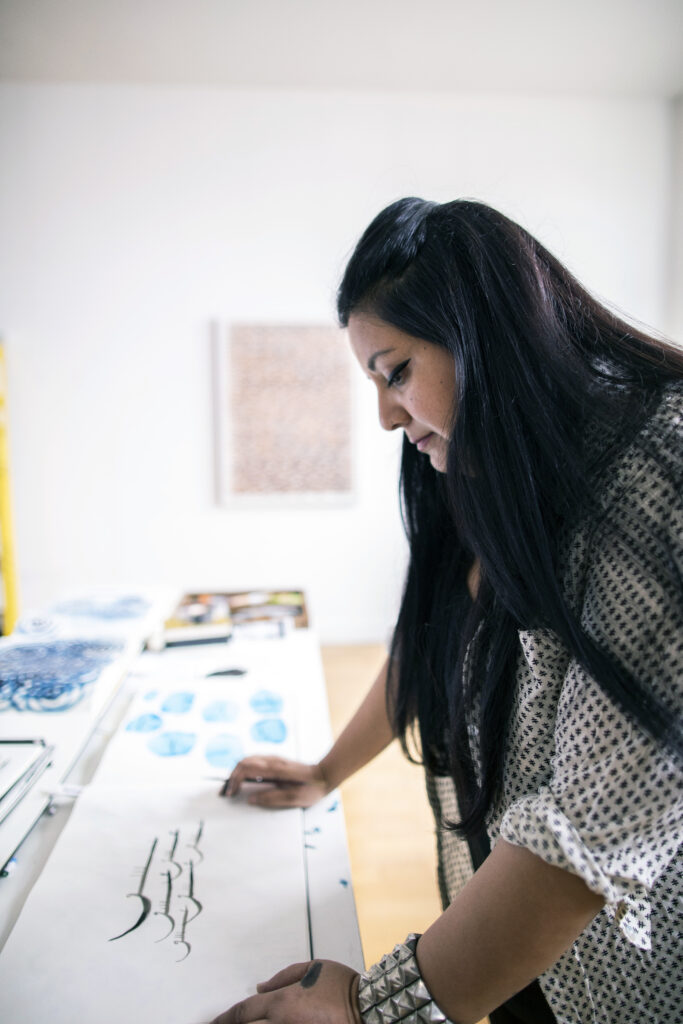 Photo by Erin Collette.
At UMBC, Shafie began a deeper exploration of the Whirling Dervishes, the religious art form of spinning meditative circle dance, and the poems of Rumi, the 13th-century Persian mystic who expounded on the idea of passionate love. Shafie started whirling at UMBC.
“I was getting better at it, only to come to realize that as an Iranian woman, the very first session when I was whirling and I got sick, and I fell on the ground and slammed into the wall—that was my work,” says Shafie, explaining that was symbolic of the role of women in Iranian society. “As a woman I’m never allowed to forget I’m a woman, my place in society, and the things that are barriers to me, so that was very significant.”
Shafie carried these themes into the “Paper Works” series, where she packs a frame with tightly rolled and stacked sheaves of colored paper that have been filled with texts. The effect is a dizzying mosaic of thousands of circles.
“I started with fragments of poems and then kept reducing it to one word, and the word and the common denominator for all of our problems was love and hate,” Shafie says. “I didn’t want to use the word hate. So I use the word for passionate love.”
In her new body of work, the optical “Cut & Rotate Series,” love continues to prevail, the word eshgh appearing like notches, like dragonflies that have landed on rivers of color and line.
“This word that’s so ordinary holds so much power,” Shafie says.
By Alex V. Cipolle
Other members of the UMBC community are also asking big questions and using their intuition to follow the question for as long as it takes. Read about these creative thinkers willing to get lost on a tangent, to joyfully put themselves in positions of not knowing, and looking for new ways of translating the world around them in Open to Interpretation.
]]>
The most recent artworks by Hadieh Shafie, M.F.A. ’04, intermedia and digital arts, appear like optical illusions, tricks. Tightly stacked lines of colored pencil suddenly twist and warp into...
https://umbc.edu/stories/squaring-the-circle-the-art-of-hadieh-shafie/
https://my3.my.umbc.edu/api/v0/pixel/news/134021/guest@my.umbc.edu/d1011cd575f62583e4711fffb0556af2/api/pixel
alumni
alumni-award
imda
magazine
spring-2023
UMBC News & Magazine
https://my3.my.umbc.edu/groups/umbc-news-magazine
https://assets1-my.umbc.edu/system/shared/avatars/groups/000/001/943/24435aa6207c452e7bc15cc74b42c7bb/xsmall.png?1748556657
https://assets1-my.umbc.edu/system/shared/avatars/groups/000/001/943/24435aa6207c452e7bc15cc74b42c7bb/original.png?1748556657
https://assets2-my.umbc.edu/system/shared/avatars/groups/000/001/943/24435aa6207c452e7bc15cc74b42c7bb/xxlarge.png?1748556657
https://assets2-my.umbc.edu/system/shared/avatars/groups/000/001/943/24435aa6207c452e7bc15cc74b42c7bb/xlarge.png?1748556657
https://assets3-my.umbc.edu/system/shared/avatars/groups/000/001/943/24435aa6207c452e7bc15cc74b42c7bb/large.png?1748556657
https://assets1-my.umbc.edu/system/shared/avatars/groups/000/001/943/24435aa6207c452e7bc15cc74b42c7bb/medium.png?1748556657
https://assets2-my.umbc.edu/system/shared/avatars/groups/000/001/943/24435aa6207c452e7bc15cc74b42c7bb/small.png?1748556657
https://assets1-my.umbc.edu/system/shared/avatars/groups/000/001/943/24435aa6207c452e7bc15cc74b42c7bb/xsmall.png?1748556657
https://assets2-my.umbc.edu/system/shared/avatars/groups/000/001/943/24435aa6207c452e7bc15cc74b42c7bb/xxsmall.png?1748556657
UMBC News & Magazine
0
0
false
Wed, 14 Jun 2023 14:01:43 -0400
Wed, 14 Jun 2023 14:01:43 -0400
Sparking History at The Peale
The commonly-told histories of the American Civil War don’t usually include any Asian stories, although Asian Americans were certainly engaged with the war to end slavery.
“Thomas Sylvanus (aka Ching Lee, Ye Way Lee, Ah Yee Way), was born in Hong Kong, brought as an orphaned child to America for schooling in 1852, but was enslaved in Baltimore,” says Irene Chan, an associate professor of visual arts at UMBC. “He ran away at age 16 to join the Union Army and served all the war years. His story, along with many 19th-century Chinese in America, has been forgotten.”
Chan’s new six-part intermedia work, “The Thomas Project,” is devoted to telling Sylvanus’ story in many mediums: fabric silkscreens, paper lithography, drawing, hand lettering, embroidery, and book arts, and debuts in August as part of SPARK: New Light at The Peale in downtown Baltimore.
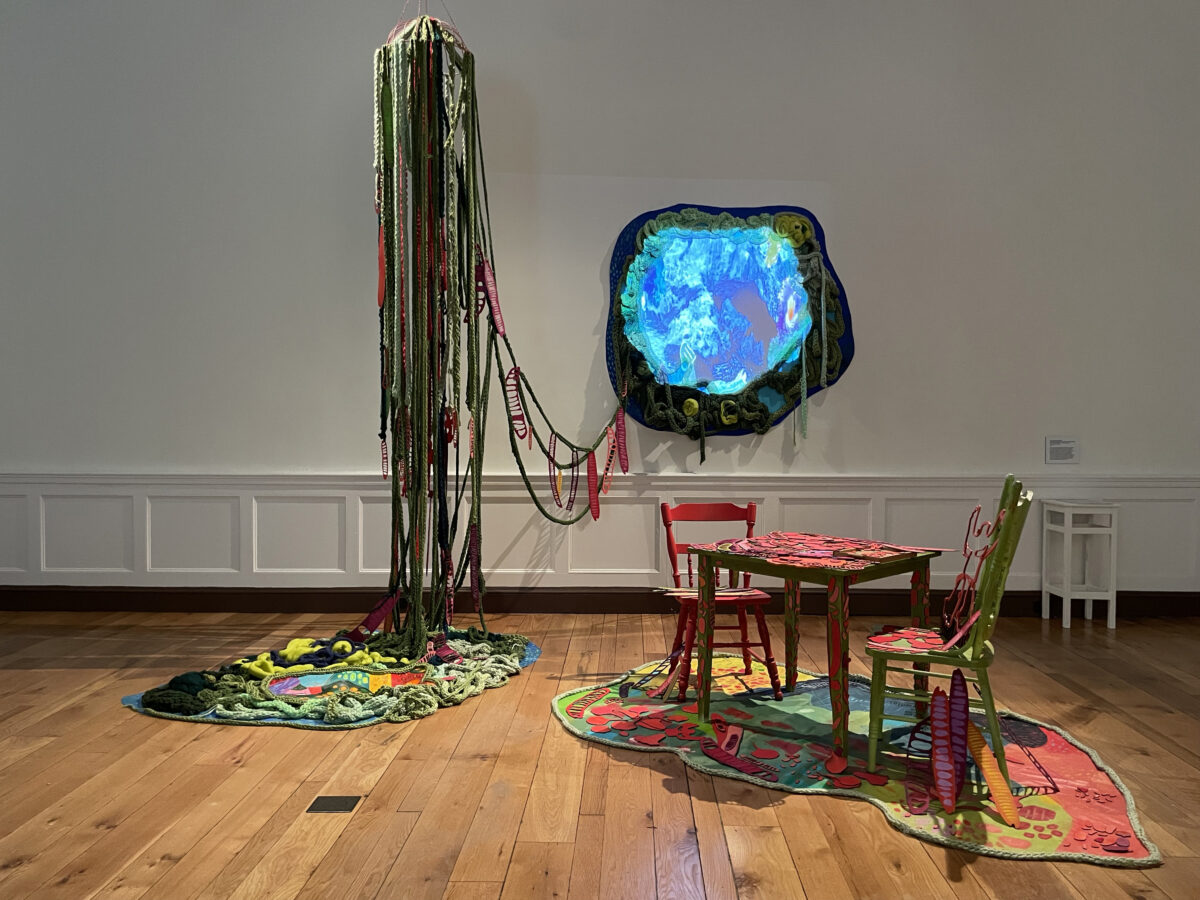
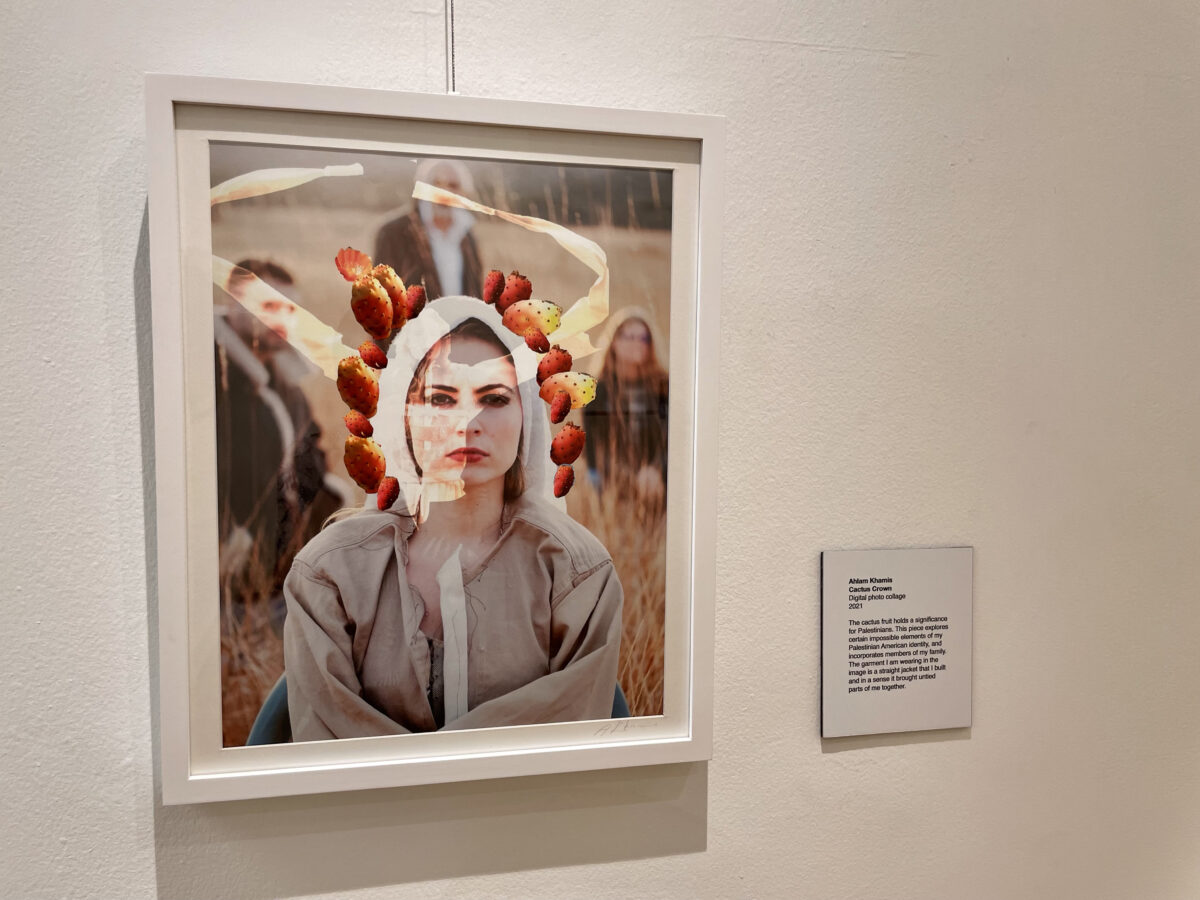 At left: Foster Reynolds-Santiago, Transgender Euphoria: Puerto Rico’s Queer Exaltation, 2022. Mixed media installation, with video projection, 33 minutes, 35 seconds. At right: Ahlam Khamis, Cactus Crown, 2021. Digital photo collage, 24” x 17”. Photos by Catherine Borg.
SPARK, an annual group exhibition of works by faculty, staff, alumni, and students at UMBC and Towson University curated by Catherine Borg, returns for its fifth edition August 13-September 25. SPARK: New Light features work from 24 artists, and opens concurrently with the Founder’s Day Grand Reopening of The Peale, a celebration of the completion of extensive renovations to the historic facility. Each of the annual SPARK exhibits has been made possible through a partnership with PNC Bank, which also helped secure the venue.
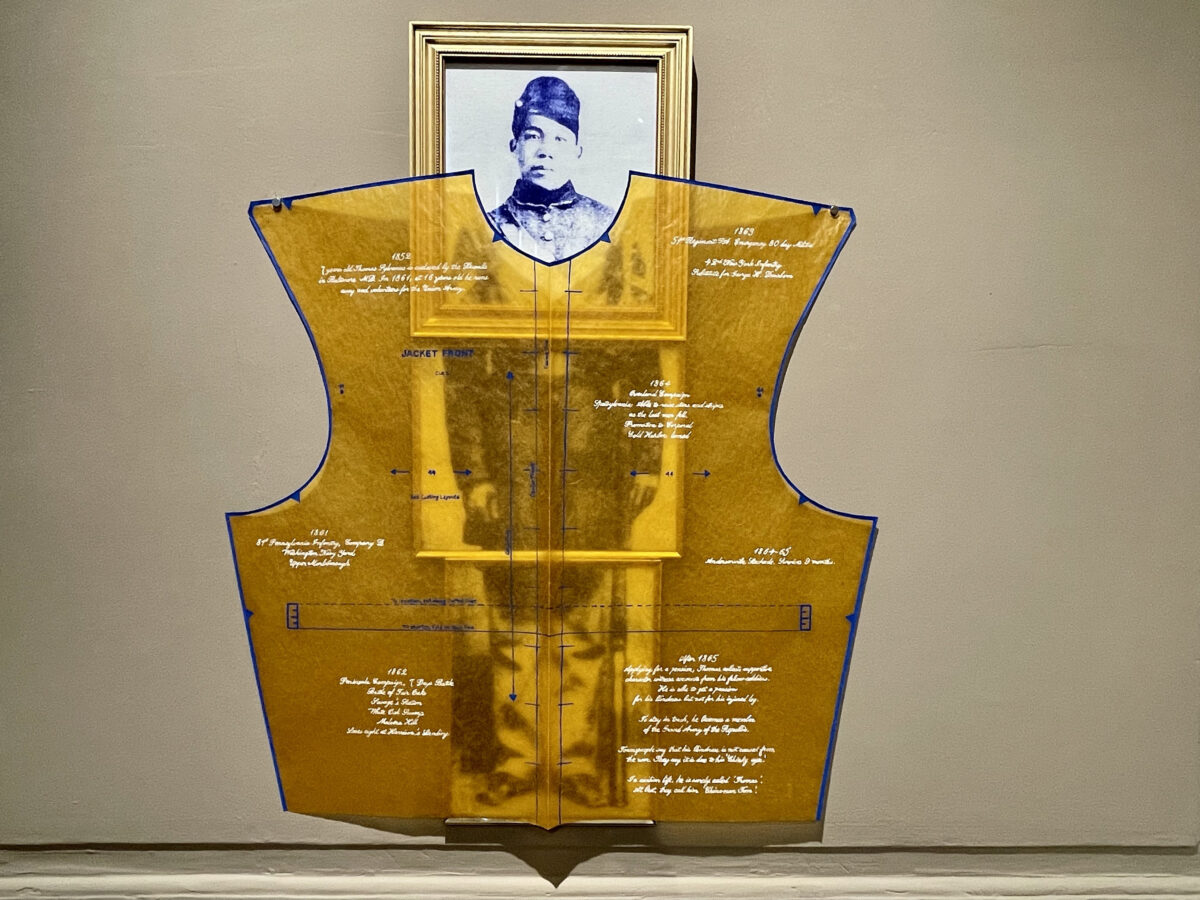 Irene Chan, Thomas in the War, 2022. Paper lithography, in three frames, with hand-drawn overlay with calligraphy on golden yellow glassine. Photo by Catherine Borg.
Community spark
The Peale, the first museum building in the United States, was established in Baltimore in 1814 by the artist Rembrandt Peale. Over the course of its nearly 200 years, The Peale has seen many incarnations before landing on its current role as a center devoted to celebrating the unique history of Baltimore, and telling the stories of the city’s people and buildings.
“The Peale is Baltimore’s community museum,” says Chan. “I have had the Peale space in mind throughout the development of ‘The Thomas Project,’ and this exhibit uses the unique architectural features of the room to tell part of Thomas’ story, starting with living his early American life in Baltimore.”
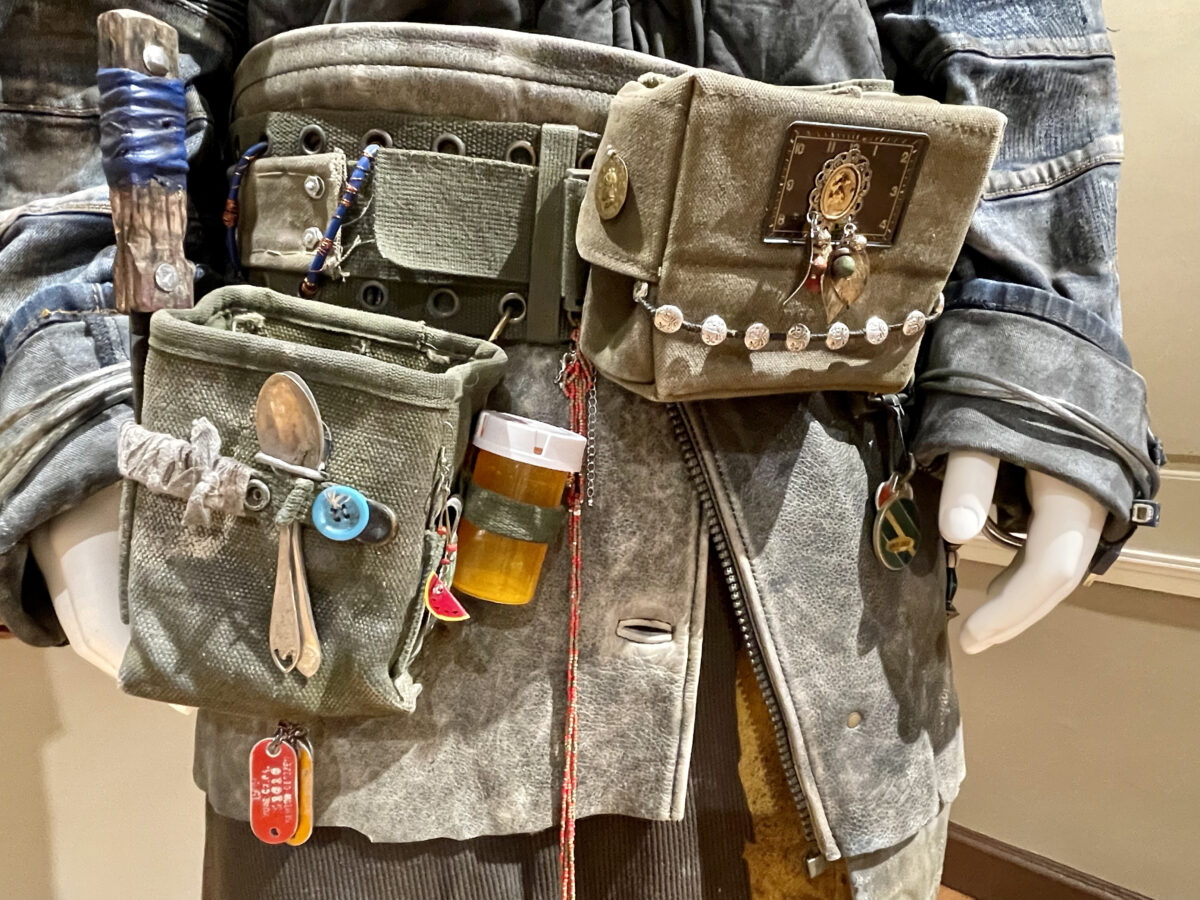
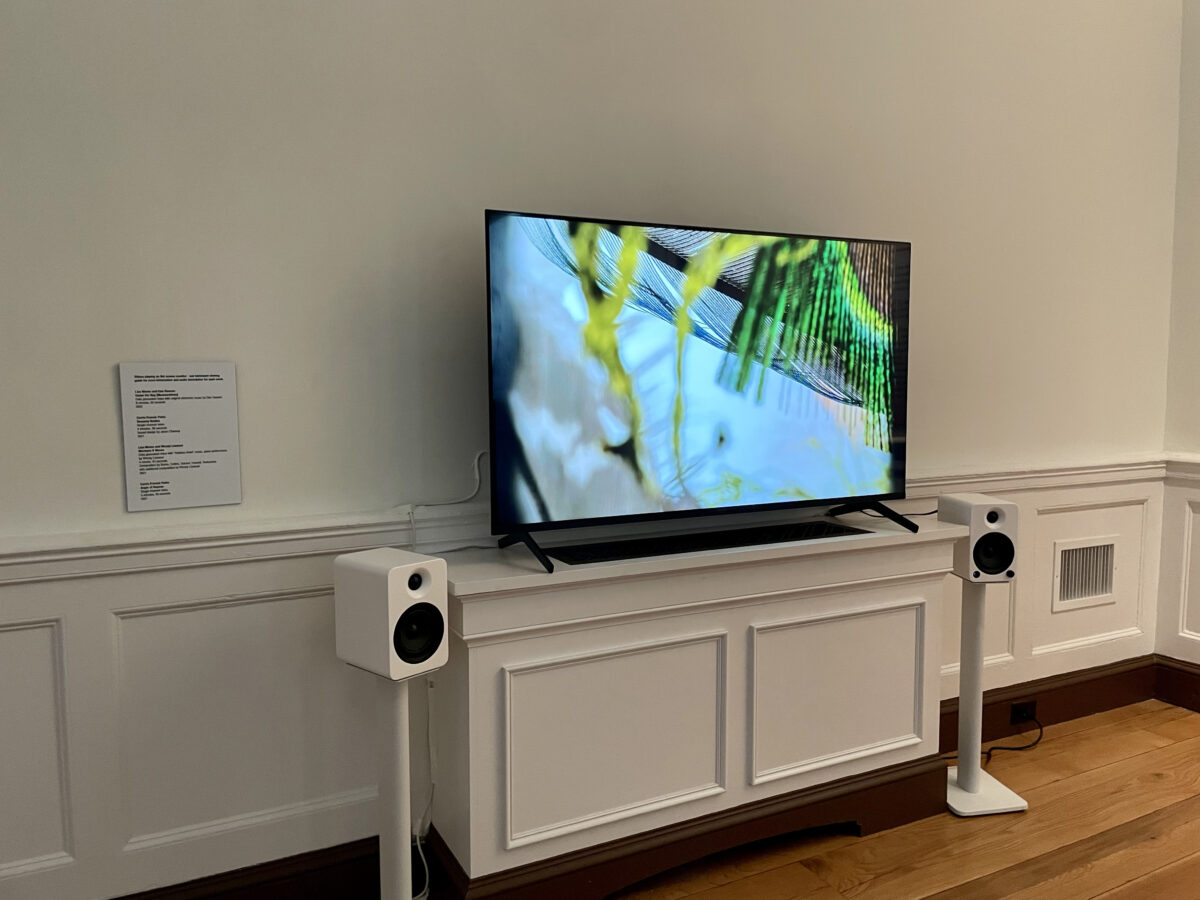 At left: Adam Droneburg, detail from Top 5 Outfits Trending Right Now (from Post Us series), 2022. Mixed media costumes. At right: Corrie Francis Parks, Uncanny Bodies, 2021. Single channel video, 4 minutes, 38 seconds. Sound design by Jason Charney M.F.A. ‘20. Photos by Catherine Borg.
Chris Peregoy ’81, M.F.A. ’99, a photographer who manages the photo and print facilities for the Visual Arts department, also incorporated The Peale’s architecture into “Time Capsules,” his new work for SPARK: New Light.
“Working with The Peale, I placed pinhole cameras on windowsills in east, south and west facing windows for six weeks in May and June,” Peregoy says. “The results capture the streak of the sun and the accumulated light that had fallen on the scene during the long exposure.”
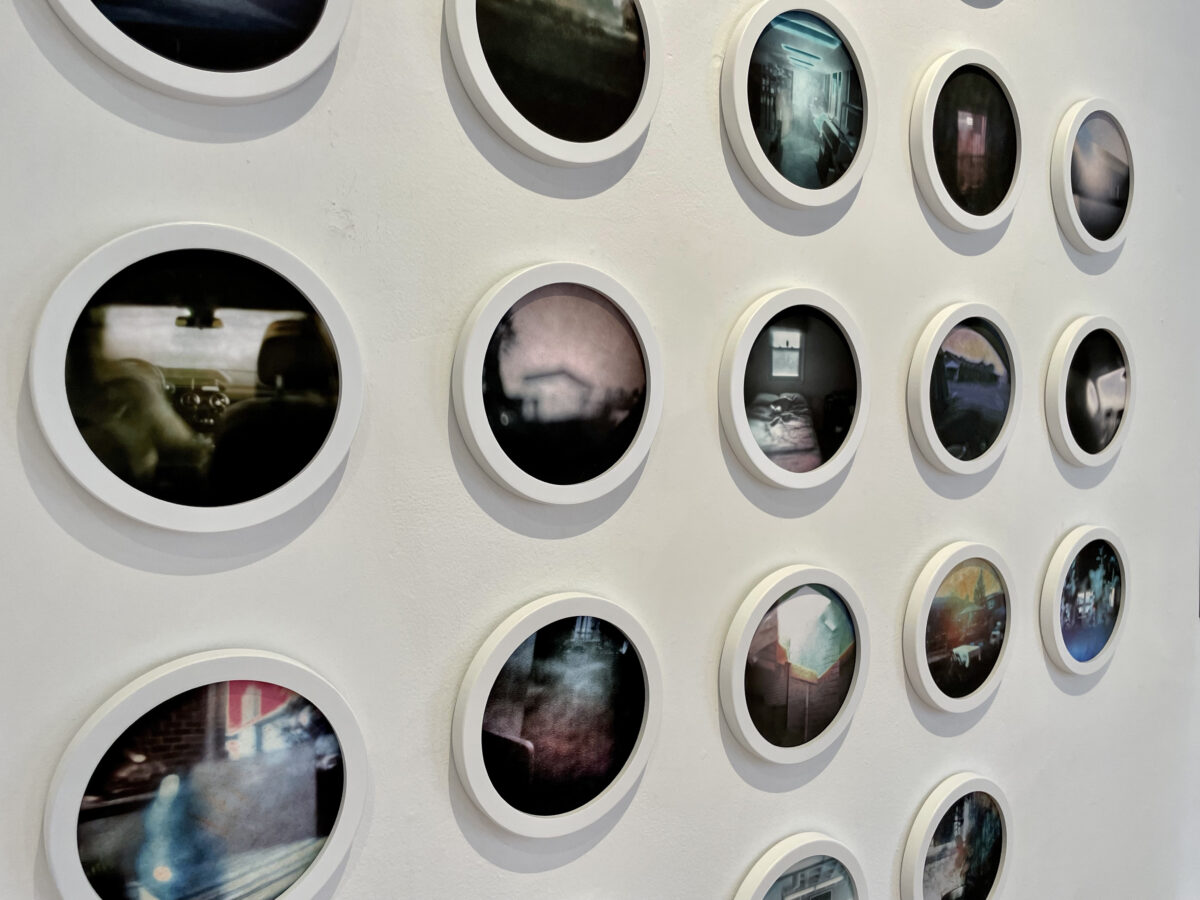 Chris Peregoy, detail of Time Capsules, 2021-2022. Archival pigment prints, 8” diameter each. Photo by Catherine Borg.
In all, 24 artists are exhibiting new work in SPARK: New Light. UMBC contributors include Chan and Peregoy as well as Lynn Cazabon, Adam Droneberg, M.F.A. ’22, Kathy Marmor (with Penny Rheingans), Lisa Moren (with Tsvetan Bachvaroff, Dan Deacon, and Woody Lissauer), Timothy Nohe, Corrie Francis Parks, Foster Reynolds-Santiago, M.F.A. ’22, and current IMDA graduate students Ahlam Khamis and Fahmida Hossain.
Hossain’s video work, “Touch,” focuses on the artist touching different objects in the context of urban life in her hometown, Dhaka, expressing the yearning for physical contact with loved ones and her friends.
“I am always curious about touching objects around me and feeling their textures, but the recent pandemic made us fearful of handling things,” says Hossain. “This work represents my visualization of the human brain, which is a subconscious world where we can have different personalities and experiences, like the changing abstract shapes in my video.”
Participating artists from Towson University include Mark Burchick, Grace Doyle, Carrie Fucile, Alexandra Garove, Danielle Hawk, Jinyoung Koh, Diane Kuthy, Jenee Mateer, Kat Navarro, Sookkyung Park, Lynn Tomlinson, and J. Yablonsky.
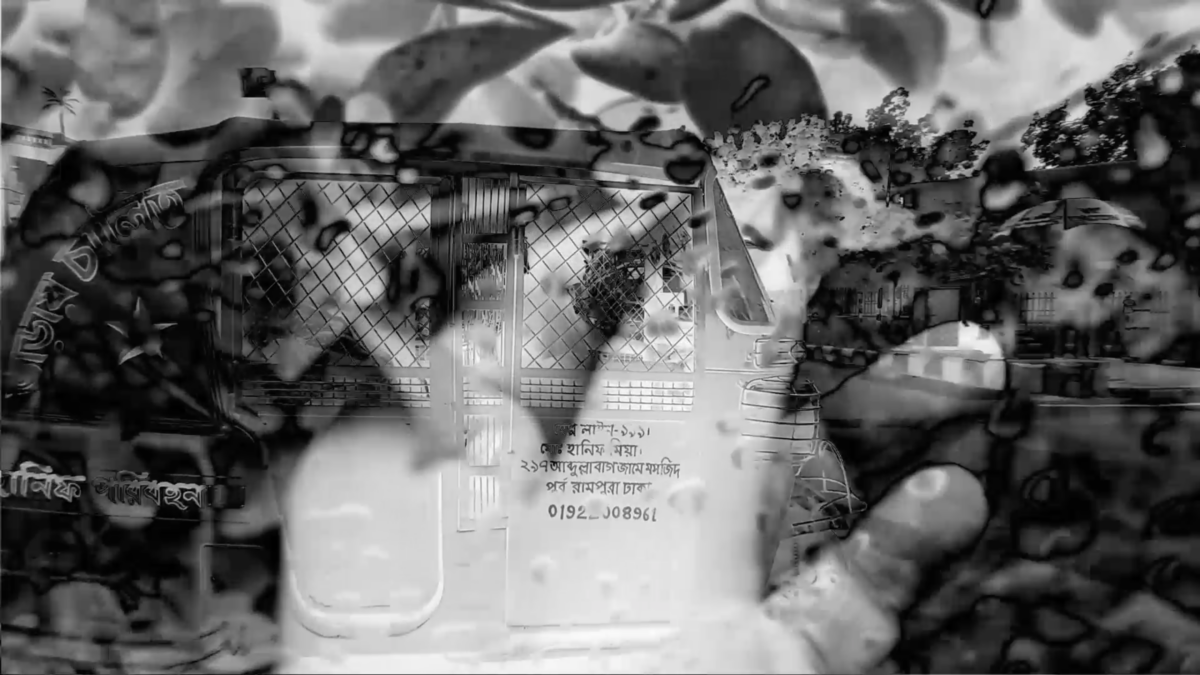 Fahmida Hossain, still from Touch, 2020. Digital video collage, 1 minute, 9 seconds.
Sparking creativity
Additional events will include an artist reception on the evening of September 7, and a cameraless photography workshop by Peregoy on the afternoon of September 11.
The exhibition will draw to a close with a series of projected artworks by visual arts associate professor Kelley Bell, M.F.A. ’06, and performances by the Towson Percussion Ensemble, the UMBC Percussion Ensemble (a group featuring UMBC faculty and alumni), and the Umbilicus percussion ensemble over the weekend of September 23–25.
* * * * *
SPARK: New Light opens August 13 and will run through September 25, 2022. Opening festivities run from 10 a.m.–4 p.m. on August 13. Tickets are free of charge, and masks will be required to attend. Learn more at the UMBC Arts & Culture Calendar or by following The Peale.
]]>
The commonly-told histories of the American Civil War don’t usually include any Asian stories, although Asian Americans were certainly engaged with the war to end slavery. “Thomas Sylvanus...
https://umbc.edu/stories/sparking-history-at-the-peale-in-downtown-baltimore/
https://my3.my.umbc.edu/api/v0/pixel/news/126809/guest@my.umbc.edu/ab44174510f532c0a6012fae8660cdbd/api/pixel
discovery
imda
magazine
spark
visualarts
UMBC News & Magazine
https://my3.my.umbc.edu/groups/umbc-news-magazine
https://assets1-my.umbc.edu/system/shared/avatars/groups/000/001/943/24435aa6207c452e7bc15cc74b42c7bb/xsmall.png?1748556657
https://assets1-my.umbc.edu/system/shared/avatars/groups/000/001/943/24435aa6207c452e7bc15cc74b42c7bb/original.png?1748556657
https://assets2-my.umbc.edu/system/shared/avatars/groups/000/001/943/24435aa6207c452e7bc15cc74b42c7bb/xxlarge.png?1748556657
https://assets2-my.umbc.edu/system/shared/avatars/groups/000/001/943/24435aa6207c452e7bc15cc74b42c7bb/xlarge.png?1748556657
https://assets3-my.umbc.edu/system/shared/avatars/groups/000/001/943/24435aa6207c452e7bc15cc74b42c7bb/large.png?1748556657
https://assets1-my.umbc.edu/system/shared/avatars/groups/000/001/943/24435aa6207c452e7bc15cc74b42c7bb/medium.png?1748556657
https://assets2-my.umbc.edu/system/shared/avatars/groups/000/001/943/24435aa6207c452e7bc15cc74b42c7bb/small.png?1748556657
https://assets1-my.umbc.edu/system/shared/avatars/groups/000/001/943/24435aa6207c452e7bc15cc74b42c7bb/xsmall.png?1748556657
https://assets2-my.umbc.edu/system/shared/avatars/groups/000/001/943/24435aa6207c452e7bc15cc74b42c7bb/xxsmall.png?1748556657
UMBC News & Magazine
0
0
false
Thu, 11 Aug 2022 14:16:36 -0400
Thu, 11 Aug 2022 14:16:36 -0400
Corrie Francis Parks: Artist, Community Builder, and Advocate for Students
Compared to the tropical midsummer heat outside the Montpelier Arts Center in Laurel, Maryland, UMBC visual arts professor Corrie Francis Parks’ latest show “Uncanny Bodies” provides cool respite.
The exhibit’s home is in a dark room, where multiple projectors coat the walls in Parks’ unique animation style through which tiny sand particles are enlarged, diminishing your own size as they dance across your vision. The exhibit is multidimensionally entrancing, meanwhile, the sound design created by visual arts instructor Jason Charney, M.F.A. ’20, imaging and digital arts, is body-encompassing.
 View from inside artist Corrie Francis Parks’ exhibit “Uncanny Bodies” displayed at the Montpelier Arts Center. Photo courtesy of Thom Parks.
Even before her career began as an animator, and now as a professor, Parks has always made a point of creating her artwork through uncharted channels. Parks attributes her animation origins to her mentor and professor David Ehrlich at Dartmouth College. “He became very influential in challenging me to try things differently, like painting on glass which was really interesting to me because it looked different from anything else that was being made,” says Parks, “and I liked having my work stand out.”
Eventually, this path of striving for the unique led to Parks’ remarkable sand animation technique which has been displayed on walls from Disney to Serbia, and currently, at Montpelier Arts Center. And now Parks hopes to play a similar role promoting her own students’ work as her mentor did for her.
Giving students space to develop ideas
“People are interesting, and I see my students as people with really unique ideas that sometimes just need a little push,” says Parks. “As a professor, you’re supposed to do that. You have that authority and experience.” Throughout her past seven years as a professor at UMBC, Parks’ posture has allowed her to develop a reputation as an “above and beyond” professor. Her pride in promoting and developing her students’ talents is evident, her Instagram account @corrieeeee features a collection of her students’ animations, but goes beyond social media, too. “Some of the most influential professors I’ve had,” says Parks, “are the kind of professors who don’t necessarily develop that student-teacher relationship but rather a colleague relationship with their students.”
Camille Ollivierre, a senior visual arts student with a concentration in animation, describes Parks as someone who talks “to us with the same level of respect she would other professors, while still acknowledging we are young adults with much room for growth.”
Where that growth can come from is something that Parks helps her students find.
“She encouraged me to apply for an Undergraduate Research Award grant (URA),” says Ollivierre, “to explore my idea to create paint on glass animation by creating my own multiplane animation camera.” Receiving the URA allowed Ollivierre to work closely with Parks as her mentor. “She encouraged me to push myself further than I thought I was capable of,” says Ollivierre. “Also, since I’m interested in professionally pursuing stop motion animation, I’ve really enjoyed working with someone who has extensive experience using unconventional materials like sand and paint.”
Visual arts major senior Chase Nickoles expands upon Parks’ ability to connect students with new professional experiences. Nickoles found an opportunity to submit the class’s rotoscoping project to be displayed at the Carroll Arts Center in Westminster, Maryland. “Corrie was quick to help as much as possible with the logistics and providing necessary information,” says Nickoles. “Thanks to her help, our project was successfully displayed, pushing me into the Westminster art world as a representative of the piece, and pushing all the students to be seen by a wider circle.”
Constructive classroom communities
Meanwhile, within the classroom, Parks has found ways to connect with students on a level that is accessible and relatable to them—including creating a Discord server for her students to continue building community.
Visual arts senior Aaron Wescott says that “the space Corrie created online for the whole class was amazing, and it really let us bounce ideas off of each other and her. Being able to talk to someone who had genuine experience and talent in the field made me feel comfortable enough to start branching out and grow as an artist, and I even looked forward to talking with her. She is an amazing teacher and colleague.”
For Parks, creating a community that cultivates her students’ abilities is something that comes naturally.
 Angle of Repose. Photo courtesy of Thom Parks.
“The thing that I love about teaching college is we’re all adults, my students are just a few steps behind me in their development as an artist… I’m really happy to share my experience as to what it means to be an artist, I love sharing information,” she says.
Her exhibit, “Uncanny Bodies” is available from now until August 1, 2021. In Parks’ own words “It’s a really enveloping and calming space that is good to go to on a hot day, it’s cool in there. It takes you into a different perspective and it allows you to take a little break from whatever you’re dealing with right now”.
Visit it now and see what it means to be a grain of sand.
]]>
Compared to the tropical midsummer heat outside the Montpelier Arts Center in Laurel, Maryland, UMBC visual arts professor Corrie Francis Parks’ latest show “Uncanny Bodies” provides cool respite....
https://umbc.edu/stories/corrie-parks-artist-community-builder-and-advocate-for-students/
https://my3.my.umbc.edu/api/v0/pixel/news/119581/guest@my.umbc.edu/67f3e4901b2cdb67ad79427879e2f39f/api/pixel
cahss
campus-life
imda
professorsnottomiss
visual-arts
UMBC News & Magazine
https://my3.my.umbc.edu/groups/umbc-news-magazine
https://assets1-my.umbc.edu/system/shared/avatars/groups/000/001/943/24435aa6207c452e7bc15cc74b42c7bb/xsmall.png?1748556657
https://assets1-my.umbc.edu/system/shared/avatars/groups/000/001/943/24435aa6207c452e7bc15cc74b42c7bb/original.png?1748556657
https://assets2-my.umbc.edu/system/shared/avatars/groups/000/001/943/24435aa6207c452e7bc15cc74b42c7bb/xxlarge.png?1748556657
https://assets2-my.umbc.edu/system/shared/avatars/groups/000/001/943/24435aa6207c452e7bc15cc74b42c7bb/xlarge.png?1748556657
https://assets3-my.umbc.edu/system/shared/avatars/groups/000/001/943/24435aa6207c452e7bc15cc74b42c7bb/large.png?1748556657
https://assets1-my.umbc.edu/system/shared/avatars/groups/000/001/943/24435aa6207c452e7bc15cc74b42c7bb/medium.png?1748556657
https://assets2-my.umbc.edu/system/shared/avatars/groups/000/001/943/24435aa6207c452e7bc15cc74b42c7bb/small.png?1748556657
https://assets1-my.umbc.edu/system/shared/avatars/groups/000/001/943/24435aa6207c452e7bc15cc74b42c7bb/xsmall.png?1748556657
https://assets2-my.umbc.edu/system/shared/avatars/groups/000/001/943/24435aa6207c452e7bc15cc74b42c7bb/xxsmall.png?1748556657
UMBC News & Magazine
0
0
false
Fri, 16 Jul 2021 19:43:05 -0400