Alumna introduces horseshoe crabs to K-12 classrooms to raise these scientifically useful arthropods
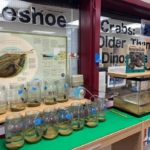
Most people wouldn’t guess horseshoe crabs—ancient arthropods with hard, round carapaces and long, spiky tails—when asked what animals you might find in a K-12 classroom. But Jessica Baniak ’23, biological sciences, is collaborating with the Maryland Department of Natural Resources (DNR) to shift kids’ perspectives of the alien-looking critters and create opportunities for inquiry-based learning.
Today, Baniak is a student in the ICARE program, an environmental science master’s program led by UMBC biology professor Tamra Mendelson. ICARE students study local environmental issues and include community partners on their master’s thesis committees.
Horseshoe crabs congregate on Maryland and Delaware beaches to mate each spring, and the last two years Baniak has collected some of their eggs with a research permit from the Maryland DNR. Each female can produce upwards of 20,000 eggs. Baniak takes the eggs back to a lab at the Institute of Marine and Environmental Technology (IMET), a multi-institution research facility on Baltimore’s Inner Harbor, and raises them until they’re about a centimeter across.
Then Baniak delivers the baby crabs to elementary, middle, and high school classrooms in Howard, Carroll, and Baltimore counties. This year, 10 schools received crabs. Some teachers use the crabs in their curriculum, and some crabs are tended by student environmental clubs. Students run basic experiments that develop their science reasoning skills, like comparing growth rates in different hatchery setups.
Finding the sweet spot
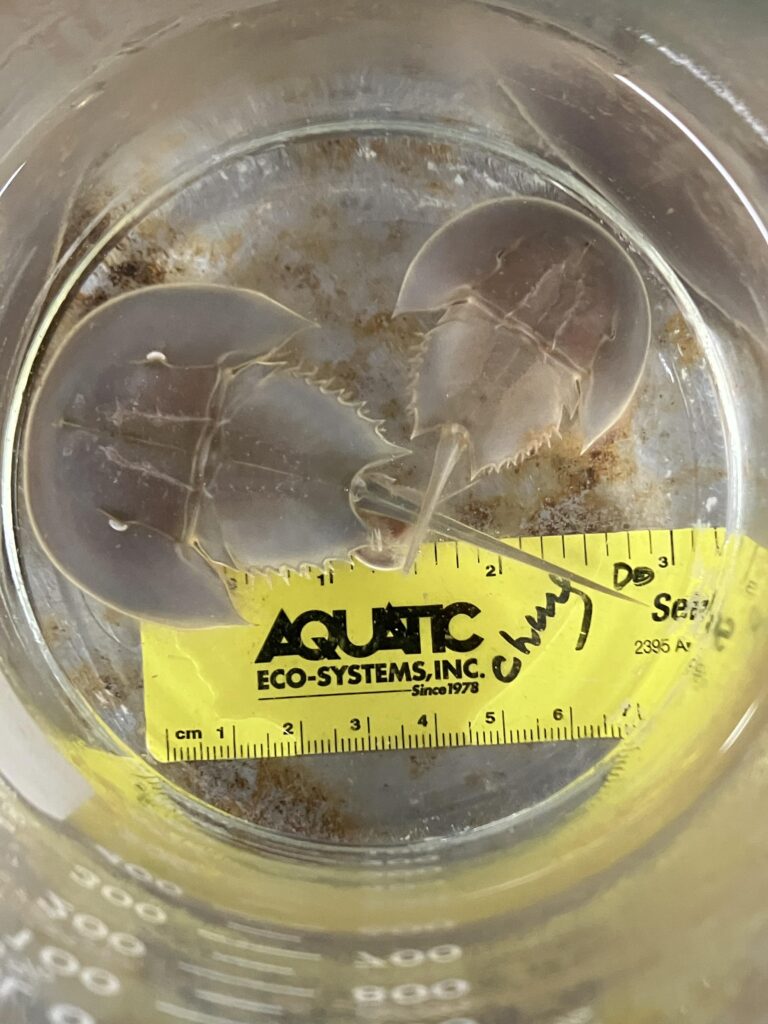 These baby crabs are about six months old, and Baniak grew them at the highest temperature in her study—so they are a little larger than average. (Courtesy of Baniak)
It’s tricky to successfully raise the crabs to adulthood. Baniak visits each classroom a couple of times a year and makes suggestions to improve the crab habitats. Factors like feed, temperature, salinity, and more play a role in their survival. For her master’s research, Baniak is working out the ideal setup for successful crab-rearing with a focus on temperature. Higher temperatures produce faster growth, but some baby crabs perish in the heat. Cooler temps cut the mortality rate, but slow growth.
Baniak’s goal is to find the sweet spot that produces the most healthy crabs in a short amount of time. Why does efficiency matter? Because eager students aren’t the only ones interested in raising crabs.
Companies extract a compound from horseshoe crab blood that is used to detect bacterial contamination in pharmaceuticals. The blood can’t be harvested until the crabs are about 10 years old, Baniak explains, so raising them in captivity isn’t economical (it’s also challenging). Instead, reintroducing young crabs to their natural habitat is “a way that companies can help mitigate how much they’ve taken out of the wild,” Baniak says. Baniak’s work will help optimize these reintroduction programs for the industry—and at the same time, give kids a unique learning opportunity.
‘Everything all at once’
As a child, the National Aquarium in Baltimore—directly across the pier from IMET—inspired Baniak to pursue marine biology. Today her experiences range well beyond horseshoe crabs. As an undergraduate, she had a summer internship at an oyster hatchery. “During the breeding season—that’s when you work really long hours,” she says. “You have to do everything all at once.”
Counting surviving oysters, mating specific oyster pairs, and cleaning tanks—all while squeezing in work on experiments running at the hatchery—filled her days. One project involved developing a protocol to anesthetize oysters, which made it possible to collect tissue samples without killing the oyster. Baniak also assisted with the hatchery’s softshell clam initiative.
For another internship, she worked at the Maryland Pesticide Education Network, which promotes safer alternatives to harmful pesticides. During the academic year, she found time to participate in UMBC’s tae-kwon do club and play club volleyball.
Sharing the joy in science
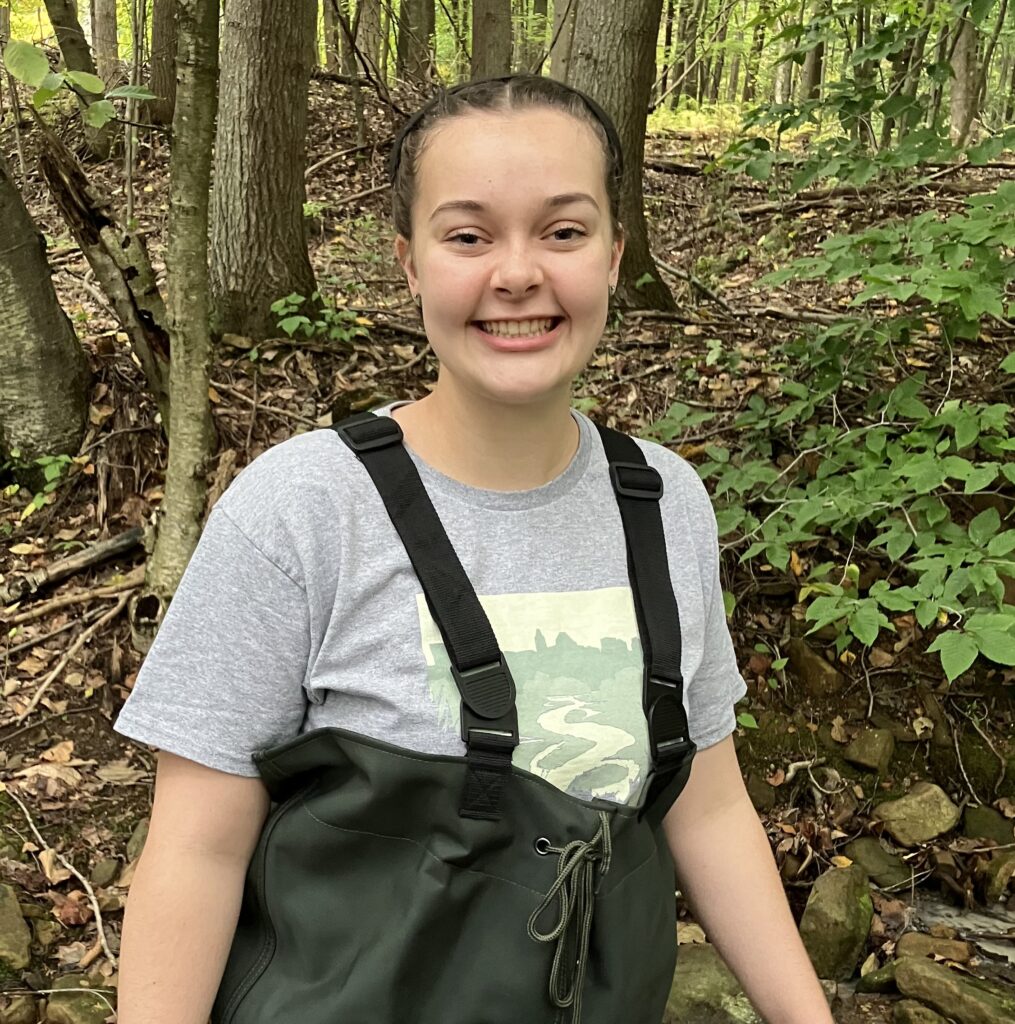 Jessica Baniak ’23 (Courtesy of Baniak)
After she graduates with her master’s next spring, Baniak hopes to move on to a role in a federal agency like the U.S. Fish and Wildlife Service. She wants to continue to contribute to outreach programs like the horseshoe crab project.
“That’s my motivation for continuing in science, because I want to make more programs like that,” Baniak says. “I like ICARE because you’re working with other people in the community and not just researching a really niche subject.”
After she transferred to UMBC during the pandemic to be closer to home, UMBC faculty members helped her stay committed to her biological sciences degree. Maggie Holland, professor of geography and environmental systems, “brought back the joy into science after returning from online learning,” Baniak says. “She seemed to genuinely care about me as a student and about the subject she was teaching.”
Mendelson, too, made an impact. “She’s put a lot of effort into the ICARE program and wants to see all of us succeed,” Baniak says.
At the end of the school year, Baniak will travel with the students to release their horseshoe crabs at Sandy Point State Park and watch them wriggle across the sand and swim into the Chesapeake Bay, heading for life’s next phase.
]]>
Most people wouldn’t guess horseshoe crabs—ancient arthropods with hard, round carapaces and long, spiky tails—when asked what animals you might find in a K-12 classroom. But Jessica Baniak ’23,...
https://umbc.edu/stories/alumna-introduces-horseshoe-crabs-to-k-12-classrooms-to-raise-these-scientifically-useful-arthropods/
https://my3.my.umbc.edu/api/v0/pixel/news/145114/guest@my.umbc.edu/740ef73058e1b1c2c43f965fda03acb2/api/pixel
alumni
alumni-profile
biology
cahss
cnms
fall-2024
ges
icare
imet
magazine
story
UMBC News & Magazine
https://my3.my.umbc.edu/groups/umbc-news-magazine
https://assets1-my.umbc.edu/system/shared/avatars/groups/000/001/943/24435aa6207c452e7bc15cc74b42c7bb/xsmall.png?1748556657
https://assets1-my.umbc.edu/system/shared/avatars/groups/000/001/943/24435aa6207c452e7bc15cc74b42c7bb/original.png?1748556657
https://assets2-my.umbc.edu/system/shared/avatars/groups/000/001/943/24435aa6207c452e7bc15cc74b42c7bb/xxlarge.png?1748556657
https://assets2-my.umbc.edu/system/shared/avatars/groups/000/001/943/24435aa6207c452e7bc15cc74b42c7bb/xlarge.png?1748556657
https://assets3-my.umbc.edu/system/shared/avatars/groups/000/001/943/24435aa6207c452e7bc15cc74b42c7bb/large.png?1748556657
https://assets1-my.umbc.edu/system/shared/avatars/groups/000/001/943/24435aa6207c452e7bc15cc74b42c7bb/medium.png?1748556657
https://assets2-my.umbc.edu/system/shared/avatars/groups/000/001/943/24435aa6207c452e7bc15cc74b42c7bb/small.png?1748556657
https://assets1-my.umbc.edu/system/shared/avatars/groups/000/001/943/24435aa6207c452e7bc15cc74b42c7bb/xsmall.png?1748556657
https://assets2-my.umbc.edu/system/shared/avatars/groups/000/001/943/24435aa6207c452e7bc15cc74b42c7bb/xxsmall.png?1748556657
UMBC News & Magazine
0
0
false
Mon, 28 Oct 2024 10:14:45 -0400
Alumna introduces horseshoe crabs to K-12 classrooms to raise these scientifically useful arthropods
Most people wouldn’t guess horseshoe crabs—ancient arthropods with hard, round carapaces and long, spiky tails—when asked what animals you might find in a K-12 classroom. But Jessica Baniak ’23, biological sciences, is collaborating with the Maryland Department of Natural Resources (DNR) to shift kids’ perspectives of the alien-looking critters and create opportunities for inquiry-based learning.
Today, Baniak is a student in the ICARE program, an environmental science master’s program led by UMBC biology professor Tamra Mendelson. ICARE students study local environmental issues and include community partners on their master’s thesis committees.
Horseshoe crabs congregate on Maryland and Delaware beaches to mate each spring, and the last two years Baniak has collected some of their eggs with a research permit from the Maryland DNR. Each female can produce upwards of 20,000 eggs. Baniak takes the eggs back to a lab at the Institute of Marine and Environmental Technology (IMET), a multi-institution research facility on Baltimore’s Inner Harbor, and raises them until they’re about a centimeter across.
Then Baniak delivers the baby crabs to elementary, middle, and high school classrooms in Howard, Carroll, and Baltimore counties. This year, 10 schools received crabs. Some teachers use the crabs in their curriculum, and some crabs are tended by student environmental clubs. Students run basic experiments that develop their science reasoning skills, like comparing growth rates in different hatchery setups.
Finding the sweet spot
These baby crabs are about six months old, and Baniak grew them at the highest temperature in her study—so they are a little larger than average. (Courtesy of Baniak)
It’s tricky to successfully raise the crabs to adulthood. Baniak visits each classroom a couple of times a year and makes suggestions to improve the crab habitats. Factors like feed, temperature, salinity, and more play a role in their survival. For her master’s research, Baniak is working out the ideal setup for successful crab-rearing with a focus on temperature. Higher temperatures produce faster growth, but some baby crabs perish in the heat. Cooler temps cut the mortality rate, but slow growth.
Baniak’s goal is to find the sweet spot that produces the most healthy crabs in a short amount of time. Why does efficiency matter? Because eager students aren’t the only ones interested in raising crabs.
Companies extract a compound from horseshoe crab blood that is used to detect bacterial contamination in pharmaceuticals. The blood can’t be harvested until the crabs are about 10 years old, Baniak explains, so raising them in captivity isn’t economical (it’s also challenging). Instead, reintroducing young crabs to their natural habitat is “a way that companies can help mitigate how much they’ve taken out of the wild,” Baniak says. Baniak’s work will help optimize these reintroduction programs for the industry—and at the same time, give kids a unique learning opportunity.
‘Everything all at once’
As a child, the National Aquarium in Baltimore—directly across the pier from IMET—inspired Baniak to pursue marine biology. Today her experiences range well beyond horseshoe crabs. As an undergraduate, she had a summer internship at an oyster hatchery. “During the breeding season—that’s when you work really long hours,” she says. “You have to do everything all at once.”
Counting surviving oysters, mating specific oyster pairs, and cleaning tanks—all while squeezing in work on experiments running at the hatchery—filled her days. One project involved developing a protocol to anesthetize oysters, which made it possible to collect tissue samples without killing the oyster. Baniak also assisted with the hatchery’s softshell clam initiative.
For another internship, she worked at the Maryland Pesticide Education Network, which promotes safer alternatives to harmful pesticides. During the academic year, she found time to participate in UMBC’s tae-kwon do club and play club volleyball.
Sharing the joy in science
Jessica Baniak ’23 (Courtesy of Baniak)
After she graduates with her master’s next spring, Baniak hopes to move on to a role in a federal agency like the U.S. Fish and Wildlife Service. She wants to continue to contribute to outreach programs like the horseshoe crab project.
“That’s my motivation for continuing in science, because I want to make more programs like that,” Baniak says. “I like ICARE because you’re working with other people in the community and not just researching a really niche subject.”
After she transferred to UMBC during the pandemic to be closer to home, UMBC faculty members helped her stay committed to her biological sciences degree. Maggie Holland, professor of geography and environmental systems, “brought back the joy into science after returning from online learning,” Baniak says. “She seemed to genuinely care about me as a student and about the subject she was teaching.”
Mendelson, too, made an impact. “She’s put a lot of effort into the ICARE program and wants to see all of us succeed,” Baniak says.
At the end of the school year, Baniak will travel with the students to release their horseshoe crabs at Sandy Point State Park and watch them wriggle across the sand and swim into the Chesapeake Bay, heading for life’s next phase.
]]>
Most people wouldn’t guess horseshoe crabs—ancient arthropods with hard, round carapaces and long, spiky tails—when asked what animals you might find in a K-12 classroom. But Jessica Baniak ’23,...
https://umbc.edu/stories/horseshoe-crabs-in-the-classroom/
https://my3.my.umbc.edu/api/v0/pixel/news/145121/guest@my.umbc.edu/bed35689905753f7e8e4a73a2ba71d5f/api/pixel
alumni
alumni-profile
biology
cahss
cnms
fall-2024
ges
icare
imet
magazine
story
UMBC News & Magazine
https://my3.my.umbc.edu/groups/umbc-news-magazine
https://assets1-my.umbc.edu/system/shared/avatars/groups/000/001/943/24435aa6207c452e7bc15cc74b42c7bb/xsmall.png?1748556657
https://assets1-my.umbc.edu/system/shared/avatars/groups/000/001/943/24435aa6207c452e7bc15cc74b42c7bb/original.png?1748556657
https://assets2-my.umbc.edu/system/shared/avatars/groups/000/001/943/24435aa6207c452e7bc15cc74b42c7bb/xxlarge.png?1748556657
https://assets2-my.umbc.edu/system/shared/avatars/groups/000/001/943/24435aa6207c452e7bc15cc74b42c7bb/xlarge.png?1748556657
https://assets3-my.umbc.edu/system/shared/avatars/groups/000/001/943/24435aa6207c452e7bc15cc74b42c7bb/large.png?1748556657
https://assets1-my.umbc.edu/system/shared/avatars/groups/000/001/943/24435aa6207c452e7bc15cc74b42c7bb/medium.png?1748556657
https://assets2-my.umbc.edu/system/shared/avatars/groups/000/001/943/24435aa6207c452e7bc15cc74b42c7bb/small.png?1748556657
https://assets1-my.umbc.edu/system/shared/avatars/groups/000/001/943/24435aa6207c452e7bc15cc74b42c7bb/xsmall.png?1748556657
https://assets2-my.umbc.edu/system/shared/avatars/groups/000/001/943/24435aa6207c452e7bc15cc74b42c7bb/xxsmall.png?1748556657
UMBC News & Magazine
0
0
false
Mon, 28 Oct 2024 10:14:45 -0400
Mon, 28 Oct 2024 10:14:45 -0400
National Institutes of Environmental Health Sciences highlight Professor Upal Ghosh’s work cleaning contaminated waterways
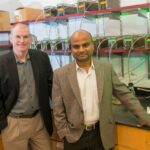
The positive environmental and health impacts of work led by Upal Ghosh, professor of chemical, biochemical, and environmental engineering at UMBC, was recently highlighted by the National Institutes of Environmental Health Sciences (NIEHS). The agency showcased a low-cost technology that Ghosh and his colleagues developed to clean waterways contaminated with polychlorinated biphenyls (PCBs), a group of likely carcinogenic chemicals that were used in insulation, coolants, and electrical equipment for decades before being banned in the U.S. in 1979.
The chemicals are stable and persist in the environment, often accumulating in fish that live in contaminated waterways and posing a risk to humans who consume those fish. NIEHS funded Ghosh’s research into using activated carbon pellets to bind the chemicals in place at the bottom of the waterways. This prevents the PCBs from circulating through the aquatic food chain. In projects carried out in contaminated lakes, rivers, and harbors in Delaware, Maryland, and elsewhere, Ghosh’s team demonstrated that the technique could significantly reduce the concentration of PCBs in the water and in aquatic lifeforms. Importantly, the technique is also significantly cheaper than standard clean-up approaches, such as dredging and disposing of contaminated sediment.
In related work performed with Kevin Sowers, from the Institute of Marine and Environmental Technology, Ghosh’s team also developed a way to combine the activated carbon with microbes that break down PCBs, reducing their toxicity.
With NIEHS support, Ghosh has co-founded two companies—Sediment Solutions and RemBac—to commercialize the technology and deploy it at full-scale to clean up contaminated sites across the country, such as at Mirror Lake in Delaware.
“The technology brings together innovations in material science and biology,” says Ghosh. It’s an honor, he says, that the NIEHS, the leading agency in the country that funds research on public health and the environment, recognized “the real impact our research is having on improving public health.”
]]>
The positive environmental and health impacts of work led by Upal Ghosh, professor of chemical, biochemical, and environmental engineering at UMBC, was recently highlighted by the National...
https://umbc.edu/quick-posts/niehs-highlights-upal-ghoshs-work-cleaning-contaminated-waterways/
https://my3.my.umbc.edu/api/v0/pixel/news/139274/guest@my.umbc.edu/cd3baad4df895ca15888f8fccb6f77c3/api/pixel
cbee
cnms
coeit
imet
news
quick-post
quick-posts
research
science-and-tech
UMBC News & Magazine
https://my3.my.umbc.edu/groups/umbc-news-magazine
https://assets1-my.umbc.edu/system/shared/avatars/groups/000/001/943/24435aa6207c452e7bc15cc74b42c7bb/xsmall.png?1748556657
https://assets1-my.umbc.edu/system/shared/avatars/groups/000/001/943/24435aa6207c452e7bc15cc74b42c7bb/original.png?1748556657
https://assets2-my.umbc.edu/system/shared/avatars/groups/000/001/943/24435aa6207c452e7bc15cc74b42c7bb/xxlarge.png?1748556657
https://assets2-my.umbc.edu/system/shared/avatars/groups/000/001/943/24435aa6207c452e7bc15cc74b42c7bb/xlarge.png?1748556657
https://assets3-my.umbc.edu/system/shared/avatars/groups/000/001/943/24435aa6207c452e7bc15cc74b42c7bb/large.png?1748556657
https://assets1-my.umbc.edu/system/shared/avatars/groups/000/001/943/24435aa6207c452e7bc15cc74b42c7bb/medium.png?1748556657
https://assets2-my.umbc.edu/system/shared/avatars/groups/000/001/943/24435aa6207c452e7bc15cc74b42c7bb/small.png?1748556657
https://assets1-my.umbc.edu/system/shared/avatars/groups/000/001/943/24435aa6207c452e7bc15cc74b42c7bb/xsmall.png?1748556657
https://assets2-my.umbc.edu/system/shared/avatars/groups/000/001/943/24435aa6207c452e7bc15cc74b42c7bb/xxsmall.png?1748556657
UMBC News & Magazine
1
0
false
Fri, 23 Feb 2024 15:53:29 -0500
Bridging environmental research and activism

Aiman Raza
Degree: B.S., Biological Sciences (Environmental Science minor)
Hometown: Baltimore, MD
Plans: M.S. in Biological Sciences at UMBC through ICARE
“I’m really passionate about activism and making change on campus. It’s meaningful, and it has allowed me to make some amazing connections on and off campus.”
During her freshman year, Aiman Raza ‘22, biological sciences, was walking through the tables at UMBC’s annual Involvement Fest when she came across the Greenpeace student organization, which focuses on environmental activism. The group captured her interest and, over the past four years, she has worked to help the organization grow its presence on campus.
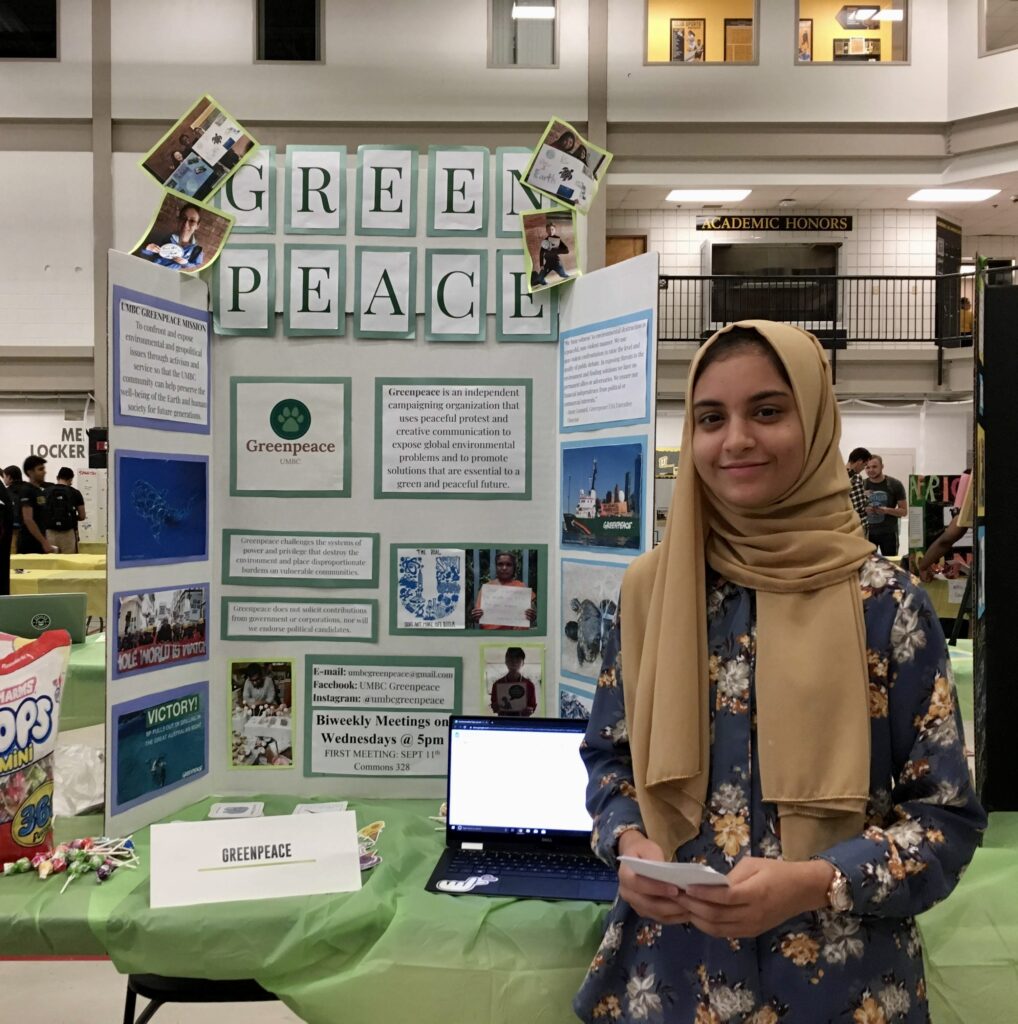 Aiman Raza at the Greenpeace table at Involvement Fest. (Image courtesy of Raza)
Raza was the group’s president during her sophomore and junior years. She says that this experience helped her develop her leadership skills, including during the challenging COVID-19 pandemic virtual events.
She also is involved in UMBC’s Muslim Student Association, and the Pakistani Student Association. These student organizations host events and bring people together for social, cultural, and religious events, as well as lectures and discussions. Being involved allowed Raza to build strong connections and get to know people outside of her major and across campus.
Raza serves as a mentor within the Biology Council of Majors as well. She meets with students who are earlier in their academic journeys, offering them guidance and support.
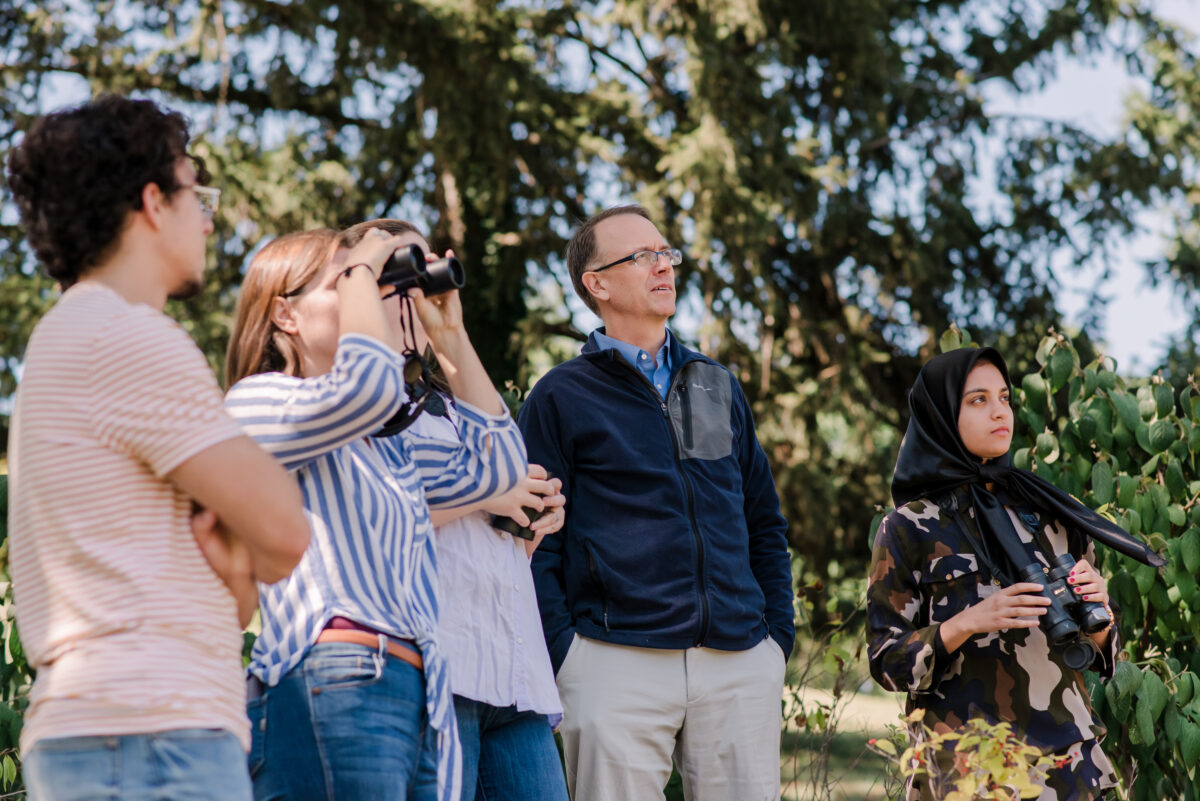 Aiman Raza, right, with Kevin Omland and several peers. (Marlayna Demond ’11/UMBC.)
At UMBC, Raza has conducted research with Kevin Omland, professor of biological sciences, and at the Institute of Marine and Environmental Technology, located in Baltimore’s Inner Harbor. She also completed a virtual summer internship with the Smithsonian, where she studied fish and crustacean communities on oyster reefs in the Chesapeake Bay.
]]>
Aiman Raza Degree: B.S., Biological Sciences (Environmental Science minor) Hometown: Baltimore, MD Plans: M.S. in Biological Sciences at UMBC through ICARE “I’m really passionate about...
https://umbc.edu/stories/bridging-environmental-research-and-activism/
https://my3.my.umbc.edu/api/v0/pixel/news/119425/guest@my.umbc.edu/649d3ea686f5f1d7780477002471cc6c/api/pixel
biology
careerpath
class-of-2022
cnms
imet
news
UMBC News & Magazine
https://my3.my.umbc.edu/groups/umbc-news-magazine
https://assets1-my.umbc.edu/system/shared/avatars/groups/000/001/943/24435aa6207c452e7bc15cc74b42c7bb/xsmall.png?1748556657
https://assets1-my.umbc.edu/system/shared/avatars/groups/000/001/943/24435aa6207c452e7bc15cc74b42c7bb/original.png?1748556657
https://assets2-my.umbc.edu/system/shared/avatars/groups/000/001/943/24435aa6207c452e7bc15cc74b42c7bb/xxlarge.png?1748556657
https://assets2-my.umbc.edu/system/shared/avatars/groups/000/001/943/24435aa6207c452e7bc15cc74b42c7bb/xlarge.png?1748556657
https://assets3-my.umbc.edu/system/shared/avatars/groups/000/001/943/24435aa6207c452e7bc15cc74b42c7bb/large.png?1748556657
https://assets1-my.umbc.edu/system/shared/avatars/groups/000/001/943/24435aa6207c452e7bc15cc74b42c7bb/medium.png?1748556657
https://assets2-my.umbc.edu/system/shared/avatars/groups/000/001/943/24435aa6207c452e7bc15cc74b42c7bb/small.png?1748556657
https://assets1-my.umbc.edu/system/shared/avatars/groups/000/001/943/24435aa6207c452e7bc15cc74b42c7bb/xsmall.png?1748556657
https://assets2-my.umbc.edu/system/shared/avatars/groups/000/001/943/24435aa6207c452e7bc15cc74b42c7bb/xxsmall.png?1748556657
UMBC News & Magazine
0
0
false
Wed, 11 May 2022 14:39:04 -0400
Wed, 11 May 2022 14:39:04 -0400
UMBC and Israeli Ministry of Agriculture establish aquaculture research partnership
UMBC will grow its aquaculture collaboration with Israeli colleagues thanks to a new statement of intent signed last week at the Institute of Marine and Environmental Technology (IMET), a collaborative research facility in Baltimore’s Inner Harbor that supports faculty affiliated with UMBC; University of Maryland, Baltimore; and University of Maryland Center for Environmental Science. The new agreement builds on decades of collaboration between Israeli researchersand Yonathan Zohar, professor and chair of marine biotechnology at UMBC. It will enable them to grow their ongoing efforts to improve and expand the aquaculture industry around the world.
Coming together to sign the document were Oded Forer, Israeli Minister of Agriculture and Rural Development; Russell Hill, executive director of IMET; and Karl V. Steiner, UMBC’s vice president for research. The minister visited IMET on December 1 with a delegation from the agriculture ministry. Leaders from the United States Department of Agriculture (USDA) Animal Production and Protection program also attended the signing event, which was followed by a tour of the Aquaculture Research Center at IMET.
The partnership will center on addressing challenges to the industry that, once overcome, will make aquaculture more efficient and sustainable, and expand it to more seafood species. Developing zero-waste systems, improving fish health and performance in captivity, and scaling up land-based aquaculture systems are all among the partners’ priorities.
“This is a very important day for IMET and aquaculture,” Hill said at the event. “There is an urgent need to promote agriculture in a sustainable way in the U.S., and we hope to contribute as much as possible to that effort.”
 Representatives from IMET, UMBC, and the Israeli Ministry of Agriculture and Rural Development signed a statement of intent to increase collaboration on aquaculture. From left to right: Russell Hill, Yonathan Zohar, Oded Forer, Karl Steiner (front), and Yakov Poleg (rear). Photo by Marlayna Demond ’11 for UMBC.
Focused on the future
Zoharhas been working in the aquaculture space for over 35 years and is an international leader in aquaculture research. In fact, in November 2020, the Binational Agricultural Research Development Fund (BARD), a partnership program between the U.S. and Israel, honored him for the economic impact of his research.
In addition to the BARD recognition, Zohar has received several other awards and accolades in recent months. He was awarded a $10 million grant from the USDA to lead a consortium of aquaculture researchers. He also led the creation of a partnership with Aquacon, a Norwegian company investing $1 billion in aquaculture in the U.S., including a large land-based facility on Maryland’s Eastern Shore. And Zohar’s startup, Silfra Biosystems, LLC, founded in partnership with UMBC microbiologist Kevin Sowers, was recognized as a “Maryland Future 20” company for 2021.
Zohar continues to forge full speed ahead in his work to increase food production in a sustainable way for the increasing human population. “The world’s population is growing by 200,000 each day, placing an increasing demand on our food supply,” Zohar says. “Aquaculture is the fastest growing sector in all of agriculture, and now produces more fish than traditional fishing. Still, we must double production by 2030 to meet the growing demand for sustainable protein sources.”
The land-based systems Zohar pioneered and continues to champion will be a big part of the solution, he believes, especially for salmon. “Atlantic salmon’s U.S. future is land-based,” Zohar says.
 Yonathan Zohar shows the Israeli delegation one of the fish tanks at the Aquaculture Research Center. Photo by Marlayna Demond ’11 for UMBC.
Public research, public good
University System of Maryland (USM) Chancellor Jay Perman called the environmental research being conducted at IMET one of the “crown jewels” of the system, in remarks during the signing event. “I can’t think of anything in higher ed that’s more current than the environment,” Perman said.
Israeli institutions bring their own strengths to this field. For example, they’ve worked to develop agricultural systems that can succeed in drought conditions, which are common in Israel. In particular, the National Center for Mariculture (food production from the sea) in Eilat, Israel is a world leader.
“Bringing together the complementary expertise of UMBC, IMET, and Israeli institutions is exactly the kind of collaboration that is needed to produce innovations that advance aquaculture and the broader mariculture field,” Steiner says, and the public impact this work will have is directly in line with UMBC’s values.
“As a public research university, our motto is ‘public research for public good,’” Steiner continues. “I can think of no better way to embody this motto than by focusing on one of the most pressing questions of our time—how do we ensure that we can feed the world within rapidly changing ecosystems? We are absolutely delighted that this new agreement will allow us to further strengthen the impact of our faculty’s important work.”
 Yonathan Zohar (center) talks about operations at the Aquaculture Research Center with a delegation from Israel, including the Minister of Agriculture and Rural Development, Oded Forer (far right). Photo by Marlayna Demond ’11 for UMBC.
Header image: Yonathan Zohar (left) explains operations of the Aquaculture Research Center to Israeli officials Yakov Poleg, Senior Deputy Director General of the Foreign Trade and International Cooperation; Yoram Kapulnik, Executive Director of BARD; and Oded Forer, Minister of Agriculture and Rural Development, during the delegation’s visit. Photo by Marlayna Demond ’11 for UMBC.
]]>
UMBC will grow its aquaculture collaboration with Israeli colleagues thanks to a new statement of intent signed last week at the Institute of Marine and Environmental Technology (IMET), a...
https://umbc.edu/stories/umbc-and-israeli-ministry-of-agriculture-establish-aquaculture-research-partnership/
https://my3.my.umbc.edu/api/v0/pixel/news/119507/guest@my.umbc.edu/f33f88cf10c35ce6d7b9e8574bb8e619/api/pixel
cnms
imet
marinebiotech
research
science-and-technology
UMBC News & Magazine
https://my3.my.umbc.edu/groups/umbc-news-magazine
https://assets1-my.umbc.edu/system/shared/avatars/groups/000/001/943/24435aa6207c452e7bc15cc74b42c7bb/xsmall.png?1748556657
https://assets1-my.umbc.edu/system/shared/avatars/groups/000/001/943/24435aa6207c452e7bc15cc74b42c7bb/original.png?1748556657
https://assets2-my.umbc.edu/system/shared/avatars/groups/000/001/943/24435aa6207c452e7bc15cc74b42c7bb/xxlarge.png?1748556657
https://assets2-my.umbc.edu/system/shared/avatars/groups/000/001/943/24435aa6207c452e7bc15cc74b42c7bb/xlarge.png?1748556657
https://assets3-my.umbc.edu/system/shared/avatars/groups/000/001/943/24435aa6207c452e7bc15cc74b42c7bb/large.png?1748556657
https://assets1-my.umbc.edu/system/shared/avatars/groups/000/001/943/24435aa6207c452e7bc15cc74b42c7bb/medium.png?1748556657
https://assets2-my.umbc.edu/system/shared/avatars/groups/000/001/943/24435aa6207c452e7bc15cc74b42c7bb/small.png?1748556657
https://assets1-my.umbc.edu/system/shared/avatars/groups/000/001/943/24435aa6207c452e7bc15cc74b42c7bb/xsmall.png?1748556657
https://assets2-my.umbc.edu/system/shared/avatars/groups/000/001/943/24435aa6207c452e7bc15cc74b42c7bb/xxsmall.png?1748556657
UMBC News & Magazine
0
0
false
Fri, 10 Dec 2021 15:58:39 -0500
UMBC and IMET faculty reveal a hidden world in the Chesapeake Bay
The waters of the Chesapeake Bay teem with microscopic organisms—swimming single-celled plankton known as dinoflagellates. But how can we peer into the depths to see them?
That’s the question driving a new creative project led by Lisa Moren, professor of visual arts at UMBC and artist-in-residence at the University of Maryland Center for Environmental Science’s Institute of Marine and Environmental Technology (IMET), and IMET associate research professor Tsvetan Bachvaroff.

Dinoflagellate image from Under the Bay courtesy of Lisa Moren.
Moren and Bachvaroff have developed “Under the Bay,” an augmented reality app that allows users a glimpse into the lives of the dinoflagellates. Bringing the project to life are close collaborators Marc Olano, associate professor of computer science and director UMBC’s game development track, and Baltimore-based composer Dan Deacon.

Screen shot from Under the Bay courtesy of Lisa Moren.
This project brings together experts from divergent fields, whose work generally takes very different forms, to create something fully unique. Moren, a multi-disciplinary artist, works with emerging media, public space and works-on-paper. Bachvaroff’s research focuses on the evolution and biology of dinoflagellates, which are often associated with “red tides” or harmful algal blooms. Olano is known for innovations in game design, while Deacon is known globally for electronic music involving large-scale audience interaction.
Public demonstration
In a first public demonstration of Under the Bay on October 9, from 1 to 4 p.m., participants will download the project app and hold their phones over water in the Inner Harbor near IMET (701 East Pratt Street). Dozens of animated microorganisms, typically too small for the human eye to see, will appear on their screens—beautiful, large, and vibrantly changing in color.

Dinoflagellate image from Under the Bay courtesy of Lisa Moren.
Moren has produced a teaser trailer for the event, viewable here on Vimeo.
A unique experience for each user
Under the Bay’s screen animations will change color when conditions in the Bay change, while stories and music will connect memory, science, and anecdotal observation. When the Bay water is healthy, the organisms appear swimming and billowing over their field of view like happy jellyfish. When the water is unhealthy, the organisms become shriveled like discarded plastic bags in the water.

Under the Bay co-creator Lisa Moren. Image courtesy of Lisa Moren.
“Under the Bay will tell a unique story for every user, changing over time, over seasons, but always from the viewpoint of the water itself,” says Moren. “The microscopic dinoflagellate species represented in augmented reality are hundreds of millions of years old, and because they are at the very bottom of the food chain, they are important to all marine life.”
Live sensors in the Chesapeake Bay direct how the organisms appear and how their stories are told. In addition to undulating forms and color, originally composed music by Deacon will change in pitch and tempo based on the water conditions. Stories will describe the amazing survival strategies of these unicellular creatures that make their own light, food and energy when water conditions are favorable. When severe oxygen deprivation occurs in the water, voiceover stories of survival become choppy, fragmented, even choking.
The app will also provide users with basic information about Chesapeake Bay health, including oxygen levels, salinity, and temperatures. Users will be able to select past dates to compare the health of the Bay at various times.
 Dinoflagellate image from Under the Bay courtesy of Lisa Moren.
The eight audio stories created for Under the Bay, including music by Dan Deacon, are also available as separate podcasts. The podcasts present the original stories, which will be heard in the app in modified versions based on the changing conditions of the Bay.
The narrators of the stories describe the Chesapeake Bay from multiple perspectives, sharing personal observation intertwined with scientific knowledge, unpacking recent political events, and advocating for diversity. Some episodes invoke evocative imagery of microbes as faeries and the planet as a living organism that inhales and exhales. Other occasional topics include cryonics, meditation, the origins of the Internet, monuments, protests, U.S. elections, and algae blooms, all conveying a world out of balance.
Worldwide launch
Following the public demonstration and alpha test on October 9, Moren anticipates exhibiting a beta version of Under the Bay at UMBC’s Center for Art, Design and Visual Culture in January and February 2022, and then the final version at an additional art exhibition in downtown Baltimore in March and April 2022. With the launch of Under the Bay for iOS and Android devices in March 2022, the app will be freely available worldwide.
Development of Under the Bay has been supported by the Saul Zaentz Innovation Fund at The Johns Hopkins University and by the Robert W. Deutsch Foundation.
Header image: Institute of Marine and Environmental Technology. Image courtesy of IMET.
]]>
The waters of the Chesapeake Bay teem with microscopic organisms—swimming single-celled plankton known as dinoflagellates. But how can we peer into the depths to see them? That’s the question...
https://umbc.edu/stories/umbc-and-imet-faculty-reveal-a-hidden-world-in-the-chesapeake-bay/
https://my3.my.umbc.edu/api/v0/pixel/news/119550/guest@my.umbc.edu/e622991cb4a62ff4325212ddec9c4980/api/pixel
arts-and-culture
cahss
coeit
csee
imet
visualarts
UMBC News & Magazine
https://my3.my.umbc.edu/groups/umbc-news-magazine
https://assets1-my.umbc.edu/system/shared/avatars/groups/000/001/943/24435aa6207c452e7bc15cc74b42c7bb/xsmall.png?1748556657
https://assets1-my.umbc.edu/system/shared/avatars/groups/000/001/943/24435aa6207c452e7bc15cc74b42c7bb/original.png?1748556657
https://assets2-my.umbc.edu/system/shared/avatars/groups/000/001/943/24435aa6207c452e7bc15cc74b42c7bb/xxlarge.png?1748556657
https://assets2-my.umbc.edu/system/shared/avatars/groups/000/001/943/24435aa6207c452e7bc15cc74b42c7bb/xlarge.png?1748556657
https://assets3-my.umbc.edu/system/shared/avatars/groups/000/001/943/24435aa6207c452e7bc15cc74b42c7bb/large.png?1748556657
https://assets1-my.umbc.edu/system/shared/avatars/groups/000/001/943/24435aa6207c452e7bc15cc74b42c7bb/medium.png?1748556657
https://assets2-my.umbc.edu/system/shared/avatars/groups/000/001/943/24435aa6207c452e7bc15cc74b42c7bb/small.png?1748556657
https://assets1-my.umbc.edu/system/shared/avatars/groups/000/001/943/24435aa6207c452e7bc15cc74b42c7bb/xsmall.png?1748556657
https://assets2-my.umbc.edu/system/shared/avatars/groups/000/001/943/24435aa6207c452e7bc15cc74b42c7bb/xxsmall.png?1748556657
UMBC News & Magazine
0
0
false
Tue, 28 Sep 2021 18:25:23 -0400
UMBC faculty, alumni entrepreneurs receive record number of MIPS awards for tech collaborations
Six UMBC faculty members have just received grants from the Maryland Industrial Partnerships (MIPS) program to develop new technologies with potential to grow the state’s economy. This is UMBC’s largest number of winning proposals within a single proposal round since MIPS began in 1987.
The program connects University System of Maryland (USM) faculty and students with Maryland businesses. UMBC’s latest MIPS grantees include computer science and electrical engineering faculty Tim Oates, Chein-I Chang, and Anupam Joshi; Soobum Lee, mechanical engineering; Dipanjan Pan, chemical, biochemical, and environmental engineering; and Vikram Vakharia, marine biotechnology. Among their industry partners are UMBC alumni entrepreneurs who are building businesses in Maryland.
Advances in aquaculture technology
Vakharia partnered with Mary Larkin, founder and CEO of Gaskiya Diagnostics, on a high-impact aquaculture project. The pair worked to develop a proposal for rapid, low-cost, easy-to-use diagnostic tests to protect and support aqua-farm production.
Larkin received her Ph.D. in marine biotechnology from UMBC in 2018. She was supported by research funding through MIPS as a graduate student at the Institute of Marine and Environmental Technology. She now serves as an industry partner through the program.
 Institute of Marine and Environmental Technology
According to Larkin, “Low-cost, on-site tests enable aqua-farms to rapidly identify pathogens, allowing them to monitor disease and take actions to protect their crop.” Gaskiya’s initial focus for this testing is Whiteleg shrimp production facilities, which have an average of more than $4.5 billion in losses annually from disease.
“Farmers need to test their ponds and get instant information so that they can quickly take action and mitigate disease,” says Larkin.
What faster, simpler tests look like
Larkin describes Vakharia as a “perfect match” for her collaborator on this research. Vakharia’s background is in viruses that impact organisms important to aquaculture, including shrimp.
For this project, Vakharia notes, “I first had to identify the target. With the target, I can make a protein that Larkin can use to detect those pathogens in shrimp.” He explains, “This protein is a critical first step in making a non-animal-based binder that detects the pathogen.”
The team plans to incorporate the proteins and binders into a paper-based test. The test will provide results in minutes, similar to a pregnancy test.
Aqua-farms’ current tests for similar pathogens must be done through a lab. This results in an elongated turn-around time and average cost of $50 per sample. Gaskiya Diagnostics hopes to price the new diagnostic test at $5 to $10. The test results will be available in as quickly as 10 minutes. No expertise or additional equipment are required to perform or interpret the results.
Next generation cybersecurity
Joshi, professor and chair of computer science and electrical engineering, received a MIPS grant for a cybersecurity collaboration with the startup CyDeploy. They are developing a platform that automates the quality assurance process for cybersecurity updates made to IT and “internet of things” (IoT) devices like Amazon Alexa, Google Home, and health and medical devices.
CyDeploy CEO Tina Williams-Koroma ‘02, computer science, presented Joshi with the idea to develop a “cybersecurity-driven change management system.” The technology is based in and leverages the use of artificial intelligence and machine learning to create a cloud-based replica of a company’s systems.
 Tina Williams-Koroma. Photo courtesy of Williams-Koroma
From prototype to launch
Williams-Koroma and Joshi’s group at UMBC developed a conceptual prototype. It shows the infrastructure and technology that would make the system feasible, combining off-the-shelf tools with novel research.
“Increasingly, the government is now beginning to mandate security requirements around IoT devices. The longer-term vision that CyDeploy has is capturing the state of these systems, virtually recreating them and then running the security changes against virtual versions to see how the changes would affect those systems,” Joshi adds.

Anupam Joshi
Williams-Koroma, who is also an adjunct instructor at UMBC, projects that the initial development of the platform will be complete in late spring 2021. They anticipate launching a free pilot version for businesses to test their IT systems. IoT pilots will come in a later phase.
Funding that matters
Joseph Naft, director of the MIPS program, is excited about the tremendous potential of these projects. The long-term vision is creating additional high-quality jobs in Maryland. “We do this,” he says, “by bringing the expertise of faculty and students to bear on technology issues in product development for companies within the state.”
Since its inception, the MIPS grant program has had a $42 billion economic impact on the state of Maryland and has created nearly 22,000 jobs. UMBC’s incredibly strong results “speak well to the engagement of UMBC’s faculty with commercially viable products and technologies,” says Naft.
Dean Drake, associate vice president for research at UMBC, credits these results to the “expansive pool of talent” at UMBC and across all of the University System of Maryland.
“Helping our industry partners solve their challenges is a great strength of both UMBC and USM institutions more broadly,” says Drake. “Our talented faculty, students, staff, and alumni have expertise in every discipline that’s out there.”
These results also demonstrate UMBC’s “interest in working with companies in the state” for the benefit of all Marylanders, Naft notes, and UMBC’s robust potential for future growth.
Banner image: IMET entrance. All photos by Marlayna Demond’ 11 unless otherwise noted.
Article by Adriana Fraser for UMBC News.
]]>
Six UMBC faculty members have just received grants from the Maryland Industrial Partnerships (MIPS) program to develop new technologies with potential to grow the state’s economy. This is UMBC’s...
https://umbc.edu/stories/umbc-faculty-alumni-entrepreneurs-receive-record-number-of-mips-awards-for-tech-collaborations/
https://my3.my.umbc.edu/api/v0/pixel/news/119686/guest@my.umbc.edu/d04d87810bfbfd8566d3937a837118b7/api/pixel
alumni
cbee
cnms
coeit
csee
cybersecurity
imet
majoraward
marinebiotech
meche
page1
research
science-and-technology
UMBC News & Magazine
https://my3.my.umbc.edu/groups/umbc-news-magazine
https://assets1-my.umbc.edu/system/shared/avatars/groups/000/001/943/24435aa6207c452e7bc15cc74b42c7bb/xsmall.png?1748556657
https://assets1-my.umbc.edu/system/shared/avatars/groups/000/001/943/24435aa6207c452e7bc15cc74b42c7bb/original.png?1748556657
https://assets2-my.umbc.edu/system/shared/avatars/groups/000/001/943/24435aa6207c452e7bc15cc74b42c7bb/xxlarge.png?1748556657
https://assets2-my.umbc.edu/system/shared/avatars/groups/000/001/943/24435aa6207c452e7bc15cc74b42c7bb/xlarge.png?1748556657
https://assets3-my.umbc.edu/system/shared/avatars/groups/000/001/943/24435aa6207c452e7bc15cc74b42c7bb/large.png?1748556657
https://assets1-my.umbc.edu/system/shared/avatars/groups/000/001/943/24435aa6207c452e7bc15cc74b42c7bb/medium.png?1748556657
https://assets2-my.umbc.edu/system/shared/avatars/groups/000/001/943/24435aa6207c452e7bc15cc74b42c7bb/small.png?1748556657
https://assets1-my.umbc.edu/system/shared/avatars/groups/000/001/943/24435aa6207c452e7bc15cc74b42c7bb/xsmall.png?1748556657
https://assets2-my.umbc.edu/system/shared/avatars/groups/000/001/943/24435aa6207c452e7bc15cc74b42c7bb/xxsmall.png?1748556657
UMBC News & Magazine
0
0
false
Thu, 11 Feb 2021 20:41:47 -0500
Groundbreaking fish research by UMBC’s Yonathan Zohar spawns partnership with AquaCon on $1 billion Maryland aquaculture project
More and more U.S. states, from Texas to Maine, are increasing their capacity to produce fish for human consumption in land-based facilities. These operations are less susceptible to disease and result in fresher fish for locals. They also remove the risk of releasing waste or farmed fish to the environment, and reduce costs and the carbon footprint associated with shipping. Plus, they create jobs and help decrease American reliance on seafood imports.
Decades of research led by Yonathan Zohar, UMBC professor of marine biotechnology, have led the way for these paradigm-shifting developments. For example, he is the lead on a large grant from the National Oceanic and Atmospheric Association (NOAA) National Sea Grant program designed to build capacity for land-based Atlantic salmon aquaculture in the U.S. The effort, known as the Recirculating Aquaculture Salmon Network (RAS-N), is a public-private partnership that includes academic research institutions, federal labs, and industry partners from across the country.
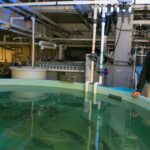
Zohar conducts his work in the Aquaculture Research Center (ARC) at the Institute of Marine and Environmental Technology (IMET) on Baltimore’s Inner Harbor. Work at the ARC pioneered many of the land-based aquaculture techniques now used around the country and the world.
Now, that work is coming back home.
A new take on “buy local”
AquaCon, a company led by Norwegian aquaculture leaders, is currently marshaling funds for a massive land-based Atlantic salmon aquaculture project based on Maryland’s Eastern Shore. In phase one, the company will invest $300 million, and the facility will produce 15,000 metric tons of fish. By phase three, the investment and output will triple. And that’s just for the aquaculture operation itself. The facility will also support job creation and economic development through affiliated industries, like seafood processing and distribution.
 Yoni Zohar (left) and Jorge Gomezjurado (right), faculty research assistant at IMET, at the Aquaculture Research Center. Photo by Marlayna Demond ’11 for UMBC.
AquaCon executives visited IMET and the ARC in November 2019 and again in February 2020, and were struck by the many ways that UMBC, IMET, and AquaCon could work together to make the venture a success for everyone. When they toured the ARC, “They were very excited about our innovative aquaculture platforms,” Zohar says, enthusiastic to see every feature. “Now I regularly communicate with the group to help them develop the design and biological planning for the Eastern Shore operation.”
UMBC and IMET executed an memorandum of understanding with AquaCon, stating their intentions to collaborate and how they will work together. In a recent announcement about the company’s aquaculture vision, AquaCon specifically stated that UMBC and IMET were one major reason for their decision to select Maryland for their aquaculture operations.
Staying on the forefront
“For a company like AquaCon, there is a huge amount of competition,” Zohar says, “and the companies who are going to succeed are those who are at the forefront of the technology.” That’s another reason for AquaCon to choose UMBC as a strategic partner. “IMET will be in the new operation’s backyard, so we can do sponsored research for them to keep them on the forefront of the field,” Zohar says.
 Salmon swimming in a tank at the Aquaculture Research Center. Photo courtesy Yonathan Zohar.
Workforce training is another critical element of the relationship. Tom Sadowski ‘89, political science, vice chancellor for economic development for the University System of Maryland, discussed opportunities with the AquaCon executives when they visited IMET. For example, students will likely get the chance to gain hands-on training at the Eastern Shore facility, and AquaCon could fund employees to pursue training and degrees through UMBC at IMET.
“Workforce development for this booming industry is a very important component to the NOAA-funded RAS-N consortium,” Zohar says.
Filling in the missing link
One thing is inevitable in a land-based aquaculture facility, besides lots of fish: lots of fish poop. Kevin Sowers, professor of marine biotechnology, and Zohar have that handled, too. They invented a system to convert organic waste (affectionately known as “sludge”) in the fish tanks to fuel-grade methane. This technology, abundantly tested and optimized at ARC and already scaled up in the Norwegian salmon industry, can generate enough energy to offset about 10 percent of the operation’s energy costs.
The duo formed a company, Silfra BioSytems LLC, that will focus on improving and scaling up the waste conversion technology. They named the company after a pristine Icelandic lake to emphasize the result of the process—clean water. Their invention completes “this missing link for how you responsibly and biologically remove the huge amounts of solid waste,” Zohar says, “And in the process, you generate biofuel.”
 Kevin Sowers (right) with Upal Ghosh, professor of chemical, biochemical, and environmental engineering, in Sowers’s IMET lab. Photo by Marlayna Demond ’11 for UMBC.
The right model
On top of these developments in tech transfer, Zohar recently received a substantial National Science Foundation grant for his basic research on fish reproduction. The NSF fully funded the grant, which is for four years and a little over a million dollars.
Zohar’s basic research will influence the aquaculture industry, because if you can precisely control when fish do and do not reproduce, you can create a system where fish are constantly reaching market size. On top of that, fish that are not preparing to reproduce grow muscle faster and have immune systems that are more robust.
The research could also have implications for human health. For various reasons, “Fish are one of the best reproductive models for humans,” Zohar says. “You cannot even use rats or mice for this type of research. So it has a lot of interest from that standpoint as well.” A better understanding of the causes of infertility, for example, could be on the horizon.
A perfect storm
For IMET and the ARC facility, “It’s a perfect storm in a good sense, because everything is falling in place now,” says Zohar. “I’ve been working in Maryland for almost 30 years, and we’ve been developing a lot of these technologies. Our mission is research, education, and economic development, and we have been working to create connections between academia and industry to fulfill that mission.” And projects long underway are now bearing fruit.
Land-based aquaculture, in particular, has seen a huge rise in interest of late. “We’ve been working on this for 15 or 20 years. People said we were ahead of our time, but now things are happening,” Zohar says. “Land-based aquaculture has matured. People believe in it, and it’s going to develop at a large scale.”
Banner photo: Yonathan Zohar at the Aquaculture Research Center in the Institute of Marine and Environmental Technology. Photo by Marlayna Demond ’11 for UMBC.
]]>
More and more U.S. states, from Texas to Maine, are increasing their capacity to produce fish for human consumption in land-based facilities. These operations are less susceptible to disease and...
https://umbc.edu/stories/groundbreaking-fish-research-led-by-umbcs-yonathan-zohar-draws-aquaculture-giant-aquacon-to-maryland-for-nearly-1-billion-project/
https://my3.my.umbc.edu/api/v0/pixel/news/119849/guest@my.umbc.edu/b59fd107df8c74bb4ddcbd9f8b53a568/api/pixel
cnms
imet
marinebiotech
research
science-and-technology
UMBC News & Magazine
https://my3.my.umbc.edu/groups/umbc-news-magazine
https://assets1-my.umbc.edu/system/shared/avatars/groups/000/001/943/24435aa6207c452e7bc15cc74b42c7bb/xsmall.png?1748556657
https://assets1-my.umbc.edu/system/shared/avatars/groups/000/001/943/24435aa6207c452e7bc15cc74b42c7bb/original.png?1748556657
https://assets2-my.umbc.edu/system/shared/avatars/groups/000/001/943/24435aa6207c452e7bc15cc74b42c7bb/xxlarge.png?1748556657
https://assets2-my.umbc.edu/system/shared/avatars/groups/000/001/943/24435aa6207c452e7bc15cc74b42c7bb/xlarge.png?1748556657
https://assets3-my.umbc.edu/system/shared/avatars/groups/000/001/943/24435aa6207c452e7bc15cc74b42c7bb/large.png?1748556657
https://assets1-my.umbc.edu/system/shared/avatars/groups/000/001/943/24435aa6207c452e7bc15cc74b42c7bb/medium.png?1748556657
https://assets2-my.umbc.edu/system/shared/avatars/groups/000/001/943/24435aa6207c452e7bc15cc74b42c7bb/small.png?1748556657
https://assets1-my.umbc.edu/system/shared/avatars/groups/000/001/943/24435aa6207c452e7bc15cc74b42c7bb/xsmall.png?1748556657
https://assets2-my.umbc.edu/system/shared/avatars/groups/000/001/943/24435aa6207c452e7bc15cc74b42c7bb/xxsmall.png?1748556657
UMBC News & Magazine
0
0
false
Fri, 03 Jul 2020 02:33:06 -0400
Third annual UMBC-UMB Partnership Symposium reveals impact of collaborative research

Researchers and campus leaders from UMBC and the University of Maryland, Baltimore (UMB) convened at bwtech@UMBC South on April 12 to celebrate ongoing research partnerships and announce a new round of Research and Innovation Seed Grants. The awards provide one or two years of funding for interdisciplinary projects with collaborators from both institutions, and are available to faculty in every college at UMBC and every school at UMB.
UMB President Jay Perman, who is also a physician, thanked the researchers for tackling challenging issues that transcend the boundaries between fields. “Your collaborative work empowers people like me to help improve the human condition,” he shared. “You need to know that your work is critically important.”
Wendy Perrow, CEO of AsclepiX Therapeutics, also emphasized the connection between research and clinical work in her keynote address. She encouraged attendees to “bring your technology to the market to help patients,” while acknowledging the many challenges along the way. Perrow’s wealth of experience includes launching a now-mainstream high-blood pressure drug and the first-ever chicken pox vaccine. Most recently, she played a key role in a breakthrough celiac disease drug entering stage three clinical trials.
Following Perrow, five teams who received funding last year presented updates on their progress. Xudong Ge, assistant director of the UMBC Center for Advanced Sensor Technology, and Richard Pierson, professor of surgery at UMB, presented the improvements they’ve made to a non-invasive respiration sensor for adults, children, and even babies. The device would be a boon for intensive care units. Its accuracy parallels that of traditional methods, without the potential to cause burns, a pitfall of current respiration monitoring technologies.
 Xudong Ge, assistant director of UMBC’s CAST, explains his work on a non-invasive respiration sensor.
Tonya Santaus, Ph.D. student in Chris Geddes’ lab at UMBC, shared the development of a rapid, low-cost test for cholera. The lab is applying the same technology to tests for sexually-transmitted infections. “The goal is to get this to rural Africa and rural Haiti,” shared UMB collaborator Colin Stine, professor of epidemiology and public health. Geddes, professor of chemistry, added that while he and Stine have known each other for 15 years, it is “because of this grant [that] we’ve actually been able to work together.”
Elsa Garcin, UMBC associate professor of chemistry and biochemistry, presented her work with Patrick Wintrode, UMB associate professor of pharmaceutical sciences. Their research seeks to better understand how a molecule naturally found in cells, called GAPDH, is able to either activate or shut down another molecule known to contribute to autoimmune conditions and cancer. Eventually, that knowledge could be used to harness GAPDH to treat those conditions.
Soobum Lee, UMBC assistant professor of mechanical engineering, and Mary Melo, UMB clinical assistant professor of dentistry, explained how they intend to use the movement of people’s own jaws to provide the energy for deep brain stimulation, a proven treatment for some neurodegenerative diseases. The proposed new method would avoid the need for repeated surgeries to replace the battery.
Christine Mair, UMBC assistant professor of sociology, and Amanda Lehning, UMB assistant professor of social work, examine the relationship between neighborhood environments and cardiovascular health in Baltimore City to identify social determinants of health inequality such as violent crime and low social cohesion.
 Keynote speaker Wendy Perrow discusses her successful career.
Don Engel, UMBC assistant vice president for research, and Terry Rogers, assistant dean of research affairs at the UMB School of Medicine, announced this year’s cohort of awardees. “We’re delighted to see this program reaching across many areas of both universities,” shared Engel. The new projects include research on oyster herpes, opioid addiction, and non-invasive neonatal glucose monitoring.
Closing the program, UMBC President Freeman Hrabowski reiterated the value and strength of the UMBC-UMB relationship. The $1.5 million invested so far in UMBC-UMB partnership grants has led to $15 million of external grant funding, a return on investment that indicates the effectiveness of the program. In a challenging federal funding climate, it is more important than ever to creatively collaborate to demonstrate the importance of scientific research and generate new funding sources, Hrabowski explained.
“We want to be strong in our commitment to investing in and supporting” collaborative work, said Hrabowski, of uniting inquisitive minds across the institutions. “Our very future, not just in Maryland, not just in America, but of humankind, in large part depends on [this] kind of work.”
Banner image: 2017 UMBC-UMB Partnership Grant recipients with the university presidents. From left to right: Jay Perman, President of UMB; Rose Viscardi, UMB School of Medicine; Leah Tolosa, UMBC Center for Advanced Sensor Technologies; Shaya Fadia, UMB School of Pharmacy; Michael Abrams, UMBC Hilltop Institute; Colleen Burge, UMBC Department of Marine Biotechnology; Matthew Frieman, UMB School of Medicine; Freeman Hrabowski, President of UMBC. All photos by Marlayna Demond ’11 for UMBC.
]]>
Researchers and campus leaders from UMBC and the University of Maryland, Baltimore (UMB) convened at bwtech@UMBC South on April 12 to celebrate ongoing research partnerships and announce a new...
https://umbc.edu/stories/third-annual-umbc-umb-partnership-symposium-reveals-impact-of-collaborative-research/
https://my3.my.umbc.edu/api/v0/pixel/news/120816/guest@my.umbc.edu/e08f908e93e9d2a7c3cd9d50e3ed3c5b/api/pixel
cahss
cast
chembiochem
cnms
coeit
community
imet
iof
marinebiotech
meche
research
saph
science-and-technology
UMBC News & Magazine
https://my3.my.umbc.edu/groups/umbc-news-magazine
https://assets1-my.umbc.edu/system/shared/avatars/groups/000/001/943/24435aa6207c452e7bc15cc74b42c7bb/xsmall.png?1748556657
https://assets1-my.umbc.edu/system/shared/avatars/groups/000/001/943/24435aa6207c452e7bc15cc74b42c7bb/original.png?1748556657
https://assets2-my.umbc.edu/system/shared/avatars/groups/000/001/943/24435aa6207c452e7bc15cc74b42c7bb/xxlarge.png?1748556657
https://assets2-my.umbc.edu/system/shared/avatars/groups/000/001/943/24435aa6207c452e7bc15cc74b42c7bb/xlarge.png?1748556657
https://assets3-my.umbc.edu/system/shared/avatars/groups/000/001/943/24435aa6207c452e7bc15cc74b42c7bb/large.png?1748556657
https://assets1-my.umbc.edu/system/shared/avatars/groups/000/001/943/24435aa6207c452e7bc15cc74b42c7bb/medium.png?1748556657
https://assets2-my.umbc.edu/system/shared/avatars/groups/000/001/943/24435aa6207c452e7bc15cc74b42c7bb/small.png?1748556657
https://assets1-my.umbc.edu/system/shared/avatars/groups/000/001/943/24435aa6207c452e7bc15cc74b42c7bb/xsmall.png?1748556657
https://assets2-my.umbc.edu/system/shared/avatars/groups/000/001/943/24435aa6207c452e7bc15cc74b42c7bb/xxsmall.png?1748556657
UMBC News & Magazine
0
0
false
Mon, 01 May 2017 21:11:04 -0400
The Economist features UMBC’s revolutionary land-based aquaculture
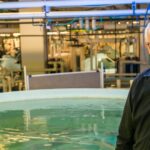
UMBC Professor Yonathan Zohar, chair of marine biotechnology, is featured in a new issue of The Economist focused on the future or agricultural technologies. Zohar’s research seeks to revolutionize the fish farming industry, removing many of the pitfalls of conventional methods and increasing environmental sustainability.
Zohar’s marine aquaculture system is land-based and completely self-contained, and it could dramatically change how millions of people access fish as a local food source.
“Fresh fish…would…become accessible to millions of landlubbers who must now have their fish shipped in from afar, deep-frozen,” writes Geoff Carr. “Old world species like sea bream and sea bass…could be delivered fresh to the table anywhere” without the threats of nonnative species escaping into local waters or wild fish being exposed to pathogens found in open water.
Localized systems reduce transportation costs and energy usage, and Zohar’s system includes several core features to maximize sustainability. The system puts bacteria to work to convert waste from the growing fish into either reusable or harmless compounds. Two sets of bacteria work in tandem to convert ammonia excreted by fish into inert nitrogen gas. A third set converts solid waste into methane that is put back to use powering the aquaculture operation.
“The upshot is a closed system that can be set up anywhere, generates no pollution and can be kept disease-free,” writes Carr.
Yoni Zohar (l) and Jorge Gomezjurado (r) watching bluefin tuna larvae at IMET aquaculture research facility.
Zohar has learned the hard way that it is difficult to grow in captivity some species that consumers most value, like bluefin tuna, yellowtail, and other marine fish. The system he and his colleagues have built at the Institute of Marine and Environmental Technology (IMET) enables fish to thrive, particularly in the early stages of life, by carefully mimicking factors like temperature, salinity, and oxygen conditions found in the species’ natural habitats. However, the optimal conditions initiating reproduction and nurturing juvenile fish to adulthood have proven more challenging to replicate.
“[Zohar] has spent decades studying the hormone system that triggers spawning and can now stimulate it on demand,” writes Carr. He has also carefully researched the needs of freshly-hatched larvae, and he is now focused on developing methods to effectively and reliably raise Bluefin tuna into adulthood.
Baltimore area restaurants have already enjoyed IMET’s locally grown fish, and Zohar is currently preparing for his system to undergo commercial-scale trials. “If he succeeds,” Carr writes, “…sushi lovers around the world will be forever in his debt.”
Read the full story in The Economist.
Photos by Marlayna Demond ’11.
]]>
UMBC Professor Yonathan Zohar, chair of marine biotechnology, is featured in a new issue of The Economist focused on the future or agricultural technologies. Zohar’s research seeks to...
https://umbc.edu/stories/the-economist-features-umbcs-revolutionary-land-based-aquaculture/
https://my3.my.umbc.edu/api/v0/pixel/news/121121/guest@my.umbc.edu/0937593180c0cc18130420d666e83424/api/pixel
cnms
imet
marinebiotech
research
science-and-technology
UMBC News & Magazine
https://my3.my.umbc.edu/groups/umbc-news-magazine
https://assets1-my.umbc.edu/system/shared/avatars/groups/000/001/943/24435aa6207c452e7bc15cc74b42c7bb/xsmall.png?1748556657
https://assets1-my.umbc.edu/system/shared/avatars/groups/000/001/943/24435aa6207c452e7bc15cc74b42c7bb/original.png?1748556657
https://assets2-my.umbc.edu/system/shared/avatars/groups/000/001/943/24435aa6207c452e7bc15cc74b42c7bb/xxlarge.png?1748556657
https://assets2-my.umbc.edu/system/shared/avatars/groups/000/001/943/24435aa6207c452e7bc15cc74b42c7bb/xlarge.png?1748556657
https://assets3-my.umbc.edu/system/shared/avatars/groups/000/001/943/24435aa6207c452e7bc15cc74b42c7bb/large.png?1748556657
https://assets1-my.umbc.edu/system/shared/avatars/groups/000/001/943/24435aa6207c452e7bc15cc74b42c7bb/medium.png?1748556657
https://assets2-my.umbc.edu/system/shared/avatars/groups/000/001/943/24435aa6207c452e7bc15cc74b42c7bb/small.png?1748556657
https://assets1-my.umbc.edu/system/shared/avatars/groups/000/001/943/24435aa6207c452e7bc15cc74b42c7bb/xsmall.png?1748556657
https://assets2-my.umbc.edu/system/shared/avatars/groups/000/001/943/24435aa6207c452e7bc15cc74b42c7bb/xxsmall.png?1748556657
UMBC News & Magazine
0
0
false
Mon, 13 Jun 2016 20:08:43 -0400


