Calling our better angels: Computing for Social Good Award launched by alumnus Akshay Java at Google honors work prioritizing people’s well-being
 Akshay Java (Photo courtesy of Java)
Akshay Java, M.S. ’03, Ph.D. ’08, computer science, is a seasoned technology leader whose career spans key roles across the tech industry, including research at Microsoft, co-founding a successful start-up, and leading critical user protection efforts at Google. In his roles at Google across Egregious Harms Protections and Responsibility AI Engineering, he works daily on the front lines of digital safety, addressing both the serious risks and the transformative potential of modern computing technology.
“Technology by itself is not necessarily good or bad, what matters is how we choose to use it,” Java says. “But AI is moving so quickly now—community and technical leaders need to be engaged, making sure the good use cases can be advanced rapidly while preventing the bad from happening.”
It was in this spirit that Java made a generous donation to UMBC to launch the Computing for Social Good Award, to be given annually to one or more students in the College of Engineering and Information Technology (COEIT) who have conducted substantial research with the goal of harnessing technology to make positive social change. The awards are funded by an endowment, which is open to contributions from the community. In May of this year, two students—Rishav Gupta, a Ph.D. student in computer science, and ASM Mobarak Hossain, M.S. ’26, information systems—received the inaugural awards for their work in affordable health monitoring and wheelchair accessibility, respectively.
“We are tremendously grateful to Akshay Java for establishing the Computing for Social Good Award in COEIT,” says Dean Jeanne van Briesen. “His commitment to supporting research that combines technical excellence with meaningful societal impact reflects values that are central to our college. This award celebrates the creativity and dedication of our student researchers and reinforces our belief that engineering and computing can be powerful forces for positive change.”
Monitoring cardiovascular health and improving wheelchair accessibility
Both recipients of the 2026 awards talked about how meaningful it was to them to apply their technical expertise to work that aims to improve people’s lives.
Gupta is working in the lab of his advisor Dong Li on tools to make blood pressure monitoring affordable and accessible using only a commodity smartphone. Hossain worked on a project with advisor Md Osman Gani to develop MyPath, a Google Maps–style app that uses AI, remote sensing measurements, and crowd-sourced data to guide wheelchair users to accessible routes.
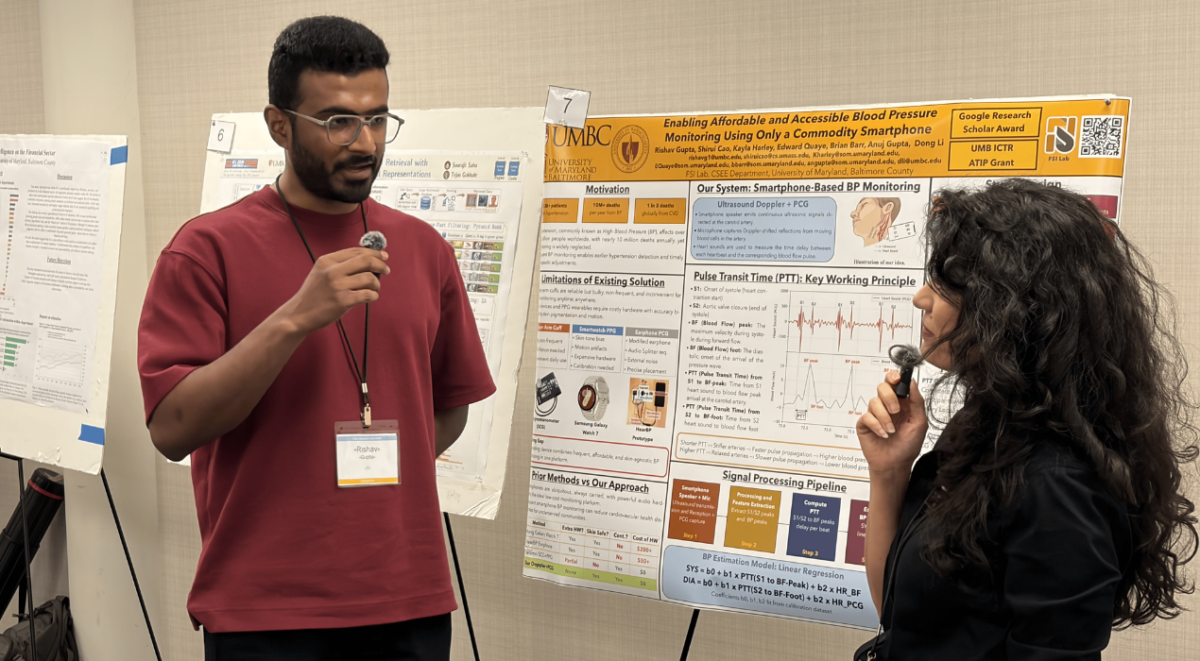 Ph.D. student Rishav Gupta presents at UMBC COEIT Research Day 2026 in front of his poster, “Enabling Affordable and Accessible Blood Pressure Monitoring Using Only a Commodity Smartphone.” (Photo courtesy of Gupta)
“Receiving the COEIT Computing for Social Good Award felt meaningful in a way I didn’t expect,” Gupta says. “I came to UMBC from a career in industry because I wanted my work to matter beyond a product. Being recognized for the research’s social impact felt like confirmation that I’d chosen the right path.”
“Developing MyPath required countless hours of hard work, continuous refinement, and a deep commitment to addressing a meaningful community need,” Hossain says. “Seeing that work recognized by COEIT was incredibly exciting and humbling—it gave me a strong sense of pride in what we’ve built and renewed enthusiasm for creating tools that deliver genuine social value.”
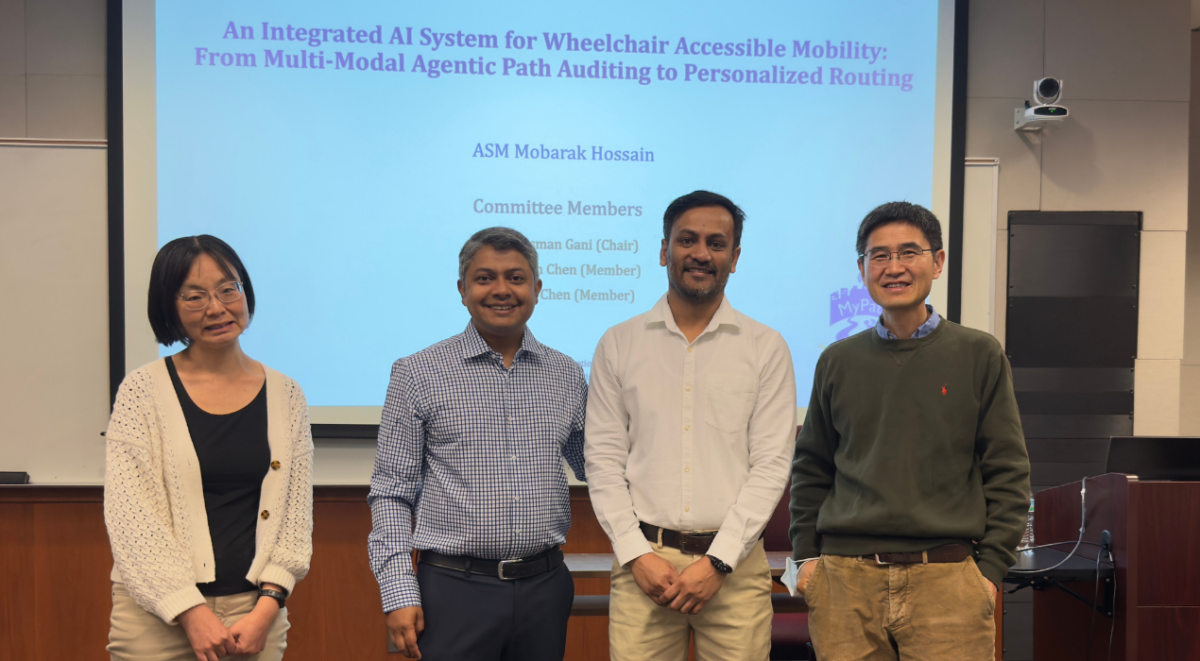 Hossain after his master’s thesis defense at UMBC. From left to right: Karen Chen, Md Osman Gani, Hossain, and Zhiuyan Chen. (Photo courtesy of Hossain)
Seeing the students and the work they are doing has been the most meaningful part of the award process, Java says. “I’m so proud of the students for what they’ve achieved. And I hope this award inspires more students to apply their skills in this space of social good.”
]]>
Akshay Java (Photo courtesy of Java) Akshay Java, M.S. ’03, Ph.D. ’08, computer science, is a seasoned technology leader whose career spans key roles across the tech industry, including...
https://umbc.edu/stories/computing-for-social-good-award/
https://my3.my.umbc.edu/api/v0/pixel/news/162247/guest@my.umbc.edu/b8c62600208724700159c05fd6f43321/api/pixel
alumni
coeit
csee
graduate-research
impact
is
research
science-and-tech
stories
story
UMBC News & Magazine
https://my3.my.umbc.edu/groups/umbc-news-magazine
https://assets1-my.umbc.edu/system/shared/avatars/groups/000/001/943/24435aa6207c452e7bc15cc74b42c7bb/xsmall.png?1748556657
https://assets1-my.umbc.edu/system/shared/avatars/groups/000/001/943/24435aa6207c452e7bc15cc74b42c7bb/original.png?1748556657
https://assets2-my.umbc.edu/system/shared/avatars/groups/000/001/943/24435aa6207c452e7bc15cc74b42c7bb/xxlarge.png?1748556657
https://assets2-my.umbc.edu/system/shared/avatars/groups/000/001/943/24435aa6207c452e7bc15cc74b42c7bb/xlarge.png?1748556657
https://assets3-my.umbc.edu/system/shared/avatars/groups/000/001/943/24435aa6207c452e7bc15cc74b42c7bb/large.png?1748556657
https://assets1-my.umbc.edu/system/shared/avatars/groups/000/001/943/24435aa6207c452e7bc15cc74b42c7bb/medium.png?1748556657
https://assets2-my.umbc.edu/system/shared/avatars/groups/000/001/943/24435aa6207c452e7bc15cc74b42c7bb/small.png?1748556657
https://assets1-my.umbc.edu/system/shared/avatars/groups/000/001/943/24435aa6207c452e7bc15cc74b42c7bb/xsmall.png?1748556657
https://assets2-my.umbc.edu/system/shared/avatars/groups/000/001/943/24435aa6207c452e7bc15cc74b42c7bb/xxsmall.png?1748556657
UMBC News & Magazine
0
0
false
Tue, 01 Sep 2026 11:32:45 -0400
Could a smart phone take the place of expensive medical equipment? Dong Li investigates how to make affordable health monitoring accessible
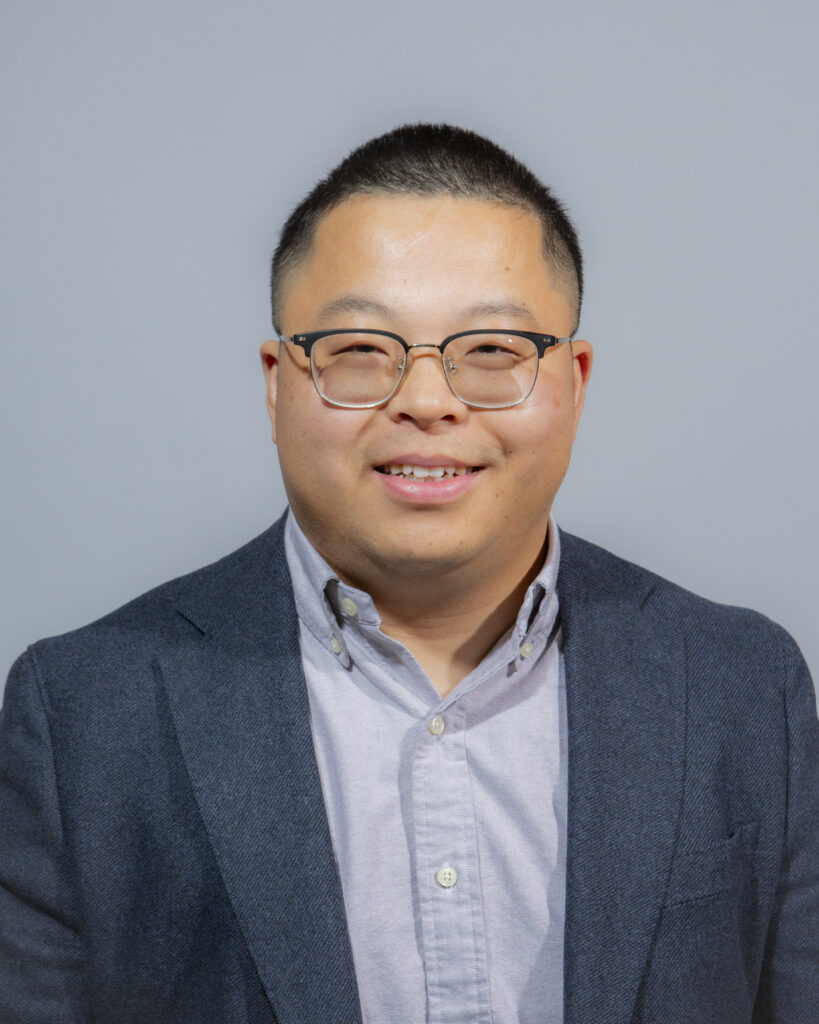 Dong Li (Photo courtesy of Li)
A common saying is “Health is wealth.” Its meaning—that good health gives people the vitality to succeed in life—is found in stories and phrases across cultures and times. Dong Li, an assistant professor in the Department of Computer Science and Electrical Engineering, has long nurtured an interest in helping people stay in good health, from his early childhood interest in becoming a doctor to his current research focusing on developing cost-effective and widely accessible health monitoring technologies.
As the founder and director of the Future Sensing and Interaction Lab, Li studies how affordable devices, such as smartphones and watches, can monitor general health indicators, vital signs, and physical activities. Li also explores how to build innovative computer-human interfaces to deliver an intuitive user experience. His goal is to use the advanced sensing technologies on many smart devices to help people improve their well-being.
“I am a tech believer,” Li says. “Technology has enormous potential to make change, and that’s why I have devoted my efforts and my time to try to develop applications of technology that benefit society.”
Li shares here about his work, its challenges, and his hopes for a world where healthcare is both affordable and accessible.
Q: What are your main areas of research?
A: My main area of research is what we usually call mobile health, or mHealth. The goal is to make health intelligence more accessible by using everyday devices that people already have, such as smartphones, earphones, smartwatches, and even smart rings.
For example, in several projects in my lab, we’re exploring ways to measure things like blood pressure and skin stiffness using a smartphone. One way to think about it is this: as human beings, we have eyes, ears, and a nose that help us sense the world around us. So what if we could use our smartphones as an additional sensing tool—not just to understand our environment, but to sense what’s happening inside our own bodies, such as blood pressure, heart rate, respiration rate, and other physiological signals?
The second part of my research focuses on AI. We’re interested in building AI models that can use data collected from these everyday devices to detect signs of disease at an early stage. Large language models like ChatGPT, for example, are trained on huge amounts of language data. In a similar way, we can train health-related AI models on large amounts of physiological data collected from devices people use in their daily lives. The question is whether the model can learn subtle patterns in that data that may indicate the early stages of disease.
The third part of my research is about security and privacy. If we’re collecting sensitive health information, we need to make sure both the AI model and the overall system are secure, and that people’s private information is protected.
Ph.D. student Rishav Gupta is working with Li. Here he presents the research at UMBC COEIT Research Day 2026. (Photo courtesy of Gupta)
Q: What motivated you to get involved in these areas of research?
To be honest, when I was in primary school, my dream was to become a doctor. But somehow, I ended up choosing computer science as my major.
After I completed my Ph.D. at the University of Massachusetts Amherst and joined UMBC as a faculty member, I learned about opportunities for internal research funding and collaboration between UMBC and the University of Maryland, Baltimore, which has long-established professional schools in areas such as medicine, dentistry, pharmacy, and nursing.
When I heard about those opportunities, I immediately thought, “Okay, this is my chance to reconnect with that childhood dream.” I realized I could combine my background in computer science with healthcare and work on interdisciplinary research that could have a real impact on people’s health.
So in a way, I didn’t become a doctor, but I found another path that allows me to contribute to medicine through technology. That’s really what motivated me to move into this area of research.
Q: How do you hope the research will impact ordinary people’s lives down the road?
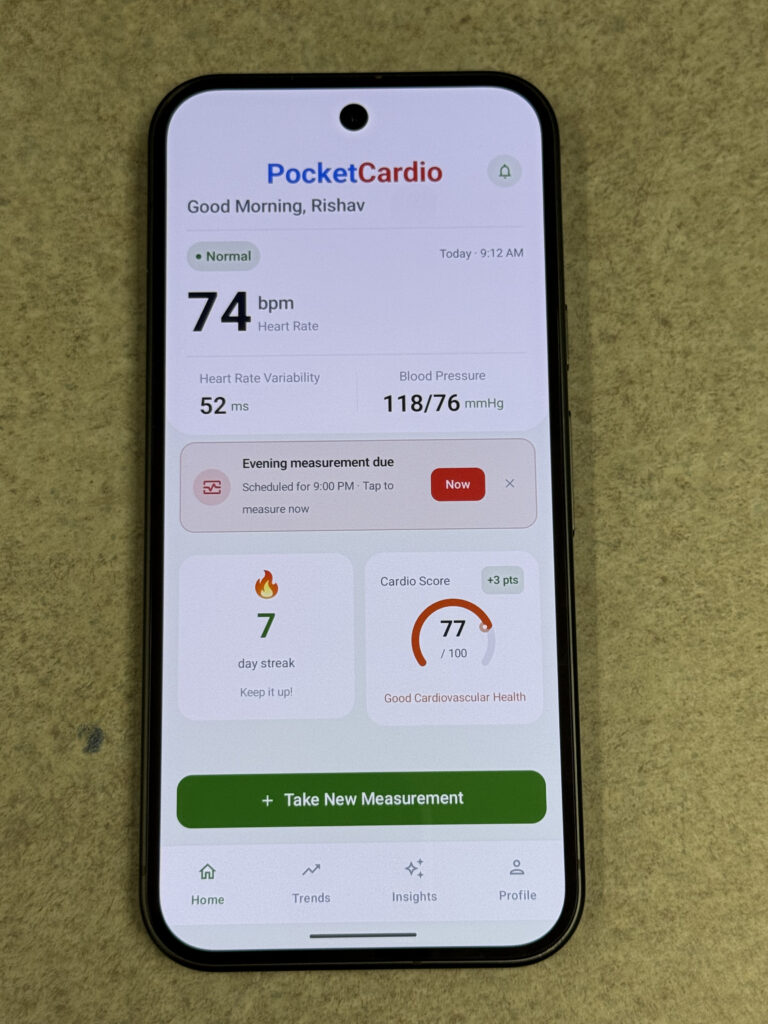 Li and Gupta have created an intuitive interface for the blood pressure monitoring PocketCardio app. (Photo by Ramya Bommakanti)
Our long-term vision is to make health monitoring more accessible and affordable for everyone. Right now, if we want to monitor certain aspects of our health, we often have to go to a doctor for regular examinations or use specialized medical equipment, which can be expensive and may not be easily available to everyone.
What we hope to do is bring some of that monitoring capability into the everyday devices people already use, such as smartphones, earphones, smartwatches, or even smart glasses. Instead of relying only on specialized equipment, people could potentially use these familiar devices to better understand and monitor their health in their daily lives.
If our research is successful, we hope it can give people a simple and convenient way to keep track of their health, identify potential problems earlier, and make more informed decisions about when to seek medical care. Ultimately, the goal is to use technology to help people live healthier lives.
Q: What are the biggest challenges that the research will need to overcome to reach these goals?
The most challenging part is not technical. What I realized when I talked to the clinical doctors from UMB School of Medicine is that the challenge is how to make people aware of this development. The challenge is assuring people of data security. People ask questions like, “What about privacy? How can you make sure you don’t leak our private information?” I think that’s the biggest challenge we will have if we want to make this a product that everybody can benefit from: How can we communicate about the technology so that people can understand it and are willing to use our product in the future?
Q: Do you have any recent results that you are especially excited about?
Yes. We are doing the clinical trials for our blood pressure monitoring project. We have collected data, I believe, from 30 healthy subjects right now, and we are in the process of collecting data from hypertensive patients at the hospital. The data we have right now shows very promising results, and I’m very excited to see if our prototype can work for those hypertensive patients. If it does, I think our next step is that we could do a wider deployment to verify our system. I attended the Maryland NEW VENTURE program [an intensive 12-week accelerator run by bwtech@UMBC that helps early-stage technology founders]. I shared this story with a lot of our investors, and they are super excited about this product. Maybe sometime next year, we will establish a startup company to make it a real product to benefit ordinary people.
 Li (center), Gupta (left) and other members of the PocketCardio team won first place at the Maryland NEW VENTURE pitch competition. (Photo courtesy of Li)
Written by: Ramya Bommakanti, a senior information systems major and communications intern in the COEIT Dean’s office.
]]>
Dong Li (Photo courtesy of Li) A common saying is “Health is wealth.” Its meaning—that good health gives people the vitality to succeed in life—is found in stories and phrases across cultures...
https://umbc.edu/stories/dong-li-affordable-health-monitoring-tech/
https://my3.my.umbc.edu/api/v0/pixel/news/161725/guest@my.umbc.edu/44dfd24726bc854308ec14cb9e1e8f70/api/pixel
bwtech
coeit
csee
graduate-research
impact
research
science-and-tech
stories
story
UMBC News & Magazine
https://my3.my.umbc.edu/groups/umbc-news-magazine
https://assets1-my.umbc.edu/system/shared/avatars/groups/000/001/943/24435aa6207c452e7bc15cc74b42c7bb/xsmall.png?1748556657
https://assets1-my.umbc.edu/system/shared/avatars/groups/000/001/943/24435aa6207c452e7bc15cc74b42c7bb/original.png?1748556657
https://assets2-my.umbc.edu/system/shared/avatars/groups/000/001/943/24435aa6207c452e7bc15cc74b42c7bb/xxlarge.png?1748556657
https://assets2-my.umbc.edu/system/shared/avatars/groups/000/001/943/24435aa6207c452e7bc15cc74b42c7bb/xlarge.png?1748556657
https://assets3-my.umbc.edu/system/shared/avatars/groups/000/001/943/24435aa6207c452e7bc15cc74b42c7bb/large.png?1748556657
https://assets1-my.umbc.edu/system/shared/avatars/groups/000/001/943/24435aa6207c452e7bc15cc74b42c7bb/medium.png?1748556657
https://assets2-my.umbc.edu/system/shared/avatars/groups/000/001/943/24435aa6207c452e7bc15cc74b42c7bb/small.png?1748556657
https://assets1-my.umbc.edu/system/shared/avatars/groups/000/001/943/24435aa6207c452e7bc15cc74b42c7bb/xsmall.png?1748556657
https://assets2-my.umbc.edu/system/shared/avatars/groups/000/001/943/24435aa6207c452e7bc15cc74b42c7bb/xxsmall.png?1748556657
UMBC News & Magazine
4
0
false
Tue, 18 Aug 2026 16:25:10 -0400
Tue, 18 Aug 2026 16:25:10 -0400
Meet a Retriever—ASM Mobarak Hossain, M.S. ’26, COEIT Computing for Social Good Award recipient
Meet ASM Mobarak Hossain (Sajib). He recently graduated from UMBC with an M.S. in information systems and joined IBM as a Senior Developer and AI Specialist. Sajib has spent more than a decade working in technology. What excites him most is using what he knows to build solutions that make a difference in people’s lives. At UMBC, he put that passion to work helping to develop MyPath, a Google Maps–style app that uses AI, remote sensing measurements, and crowd-sourced data to guide wheelchair users to accessible routes.
This May, the work was recognized when Sajib was selected as one of two recipients for the inaugural COEIT Computing for Social Good Award, made possible by a generous donation from alumnus Akshay Java, M.S. ’03, Ph.D. ’08, computer science. Awardees were selected in a competitive review process by COEIT faculty reviewers and departmental leadership. Sajib was selected for his project “A Multi-Modal Agentic Framework for Auditing Wheelchair Accessibility.” Take it away, Sajib!
Q: What brought you to UMBC?
A: After spending many years working in software engineering and technology leadership, I wanted to keep growing and challenge myself in a new way. I came to UMBC to deepen my knowledge, explore AI and research, and connect my industry experience with problems that could have a meaningful impact on people’s lives.
Q: What did you enjoy most about UMBC?
A: What I enjoyed most about UMBC was being able to connect what I learned in class with real problems. My research gave me the chance to use AI and software engineering to work on wheelchair accessibility, which made the experience much more meaningful to me than simply learning technology.
Q: Who in the UMBC community inspired you or supported you?
A: I found support at UMBC through the people who were willing to listen to my ideas and help me develop them. My advisor, Md Osman Gani, has been one of the most supportive people during my time at UMBC. He encouraged me to think beyond the technical side of a problem and focus on how our research could actually help people. That support helped turn my interest in accessibility into research that became a very meaningful part of my UMBC experience.
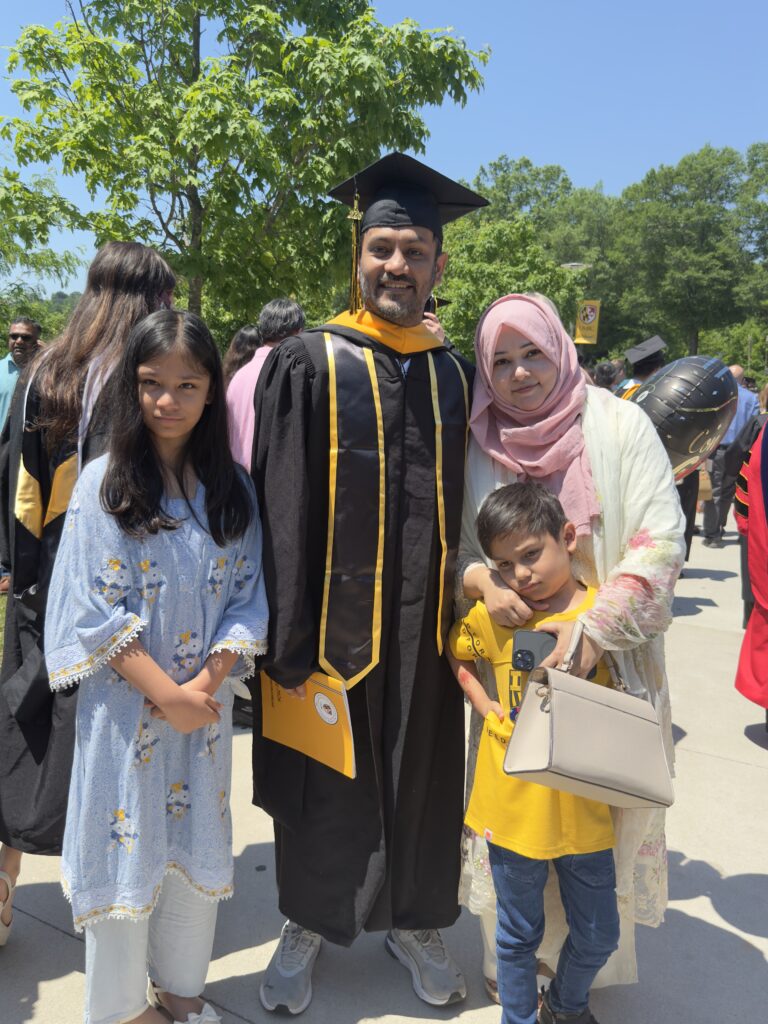 Following commencement, Hossain (middle) posed for a picture outside the Chesapeake Employers Insurance Arena with his daughter, Ayra (left), wife, Humayira (right), and son, Ayaz (bottom right). (Photo courtesy of Hossain)
Q: What’s the one thing you’d want someone who hasn’t joined the UMBC community to know about the support you find here?
A: I would tell them that at UMBC you don’t have to figure everything out by yourself. I found professors and researchers who were willing to listen to my ideas, guide me, and give me room to explore. That support helped me turn an idea into research with a real purpose.
Even after graduation, I feel connected to the people, mentors, and experiences that were part of my journey at UMBC. I’m proud to be part of a community that encourages learning, collaboration, and meaningful work.
ASM Mobarak Hossain, M.S. '26
information systems
Q: Can you tell us about your current job and how UMBC helped prepare you for your career?
A: I’m currently working at IBM as a Senior Developer and AI Specialist. What I enjoy most is the opportunity to work on challenging technology problems and continue learning. I especially enjoy using my software engineering background together with AI to build solutions that can solve real-world problems.
UMBC helped me look at technology from a different perspective. I already had many years of industry experience, but my time at UMBC gave me the opportunity to become more involved in research, explore AI more deeply, and think about how technology can be used to address real human needs. That experience has been valuable as I move into the next stage of my career.
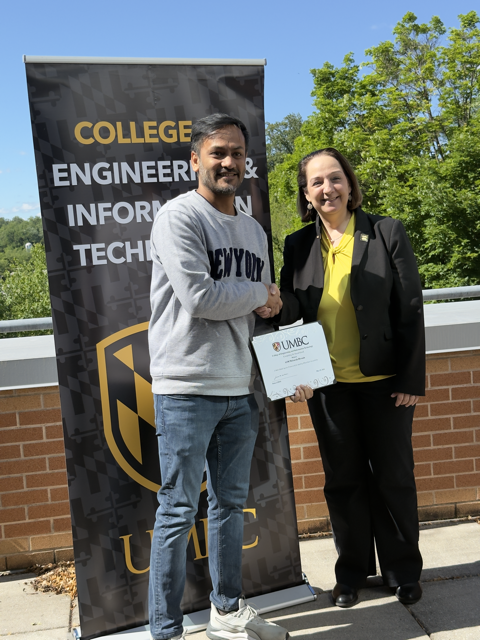 Hossain (left) pictured with Jeanne van Briesen, dean of the College of Engineering and Information Technology, after receiving the COEIT Computing for Social Good Award. (Photo courtesy of Vandana Janeja)
Q: How does the COEIT Computing for Social Good Award make an impact on your education?
A: Receiving the COEIT Computing for Social Good Award directly bridges the gap between academic theory and real-world impact. It provides vital encouragement and support to continue leveraging computer science for positive social change, specifically through the MyPath project. Beyond the immediate recognition, it inspires me to stay focused on human-centered software design, seek out complex social challenges in my future coursework, and pursue career opportunities centered on technology for good.
Q: How did it feel to win the award?
A: Winning the COEIT Computing for Social Good Award was an immense honor and deeply validating. Developing MyPath required countless hours of hard work, continuous refinement, and a deep commitment to addressing a meaningful community need. Seeing that work recognized by COEIT was incredibly exciting and humbling—it gave me a strong sense of pride in what we’ve built and renewed enthusiasm for creating tools that deliver genuine social value.
* * * * *
UMBC’s greatest strength is its people. When people meet Retrievers and hear about the passion they bring, the relationships they create, the ways they support each other, and the commitment they have to inclusive excellence, they truly get a sense of our community. That’s what “Meet a Retriever” is all about.
Learn more about how UMBC can help you achieve your goals.
]]>
Meet ASM Mobarak Hossain (Sajib). He recently graduated from UMBC with an M.S. in information systems and joined IBM as a Senior Developer and AI Specialist. Sajib has spent more than a decade...
https://umbc.edu/stories/hossain-coeit-computing-for-social-good/
https://my3.my.umbc.edu/api/v0/pixel/news/161833/guest@my.umbc.edu/e98d34c33e8561e78fab88181404606c/api/pixel
coeit
impact
is
meet-a-retriever
perspectives
science-and-tech
stories
story
UMBC News & Magazine
https://my3.my.umbc.edu/groups/umbc-news-magazine
https://assets1-my.umbc.edu/system/shared/avatars/groups/000/001/943/24435aa6207c452e7bc15cc74b42c7bb/xsmall.png?1748556657
https://assets1-my.umbc.edu/system/shared/avatars/groups/000/001/943/24435aa6207c452e7bc15cc74b42c7bb/original.png?1748556657
https://assets2-my.umbc.edu/system/shared/avatars/groups/000/001/943/24435aa6207c452e7bc15cc74b42c7bb/xxlarge.png?1748556657
https://assets2-my.umbc.edu/system/shared/avatars/groups/000/001/943/24435aa6207c452e7bc15cc74b42c7bb/xlarge.png?1748556657
https://assets3-my.umbc.edu/system/shared/avatars/groups/000/001/943/24435aa6207c452e7bc15cc74b42c7bb/large.png?1748556657
https://assets1-my.umbc.edu/system/shared/avatars/groups/000/001/943/24435aa6207c452e7bc15cc74b42c7bb/medium.png?1748556657
https://assets2-my.umbc.edu/system/shared/avatars/groups/000/001/943/24435aa6207c452e7bc15cc74b42c7bb/small.png?1748556657
https://assets1-my.umbc.edu/system/shared/avatars/groups/000/001/943/24435aa6207c452e7bc15cc74b42c7bb/xsmall.png?1748556657
https://assets2-my.umbc.edu/system/shared/avatars/groups/000/001/943/24435aa6207c452e7bc15cc74b42c7bb/xxsmall.png?1748556657
UMBC News & Magazine
1
0
false
Fri, 14 Aug 2026 16:18:43 -0400
Meet a Retriever—Rishav Gupta, COEIT Computing for Social Good Award recipient
Meet Rishav Gupta. After spending five years as a mobile engineer, he decided to pursue his Ph.D. in computer science at UMBC to deepen his expertise and choose projects with the clear objective of improving people’s lives. Rishav is working in the Future Sensing and Interaction Lab of professor Dong Li on a project to use everyday smartphones as affordable and accessible blood pressure monitors.
This May, the work was recognized when Rishav was selected as one of two recipients for the inaugural COEIT Computing for Social Good Award, made possible by a generous donation from alumnus Akshay Java, M.S. ’03, Ph.D. ’08, computer science. Awardees were selected in a competitive review process by COEIT faculty reviewers and departmental leadership. Rishav was choosen for his project “Enabling Affordable and Accessible Blood Pressure Monitoring Using Only a Commodity Smartphone.” Take it away, Rishav!
Q: What brought you to UMBC?
A: As an international student from India, I left a comfortable career to come here. After five years as a mobile engineer in industry, I was a generalist who could build things, but I wanted to understand them, to master a domain and create research that genuinely gives back to the community and helps people. UMBC’s work in health sensing was exactly that chance.
UMBC’s welcoming and inclusive environment made the transition less daunting. From peers who’d walked the same path to a community that genuinely wants your feedback to others considering it: you won’t be figuring things out alone here.
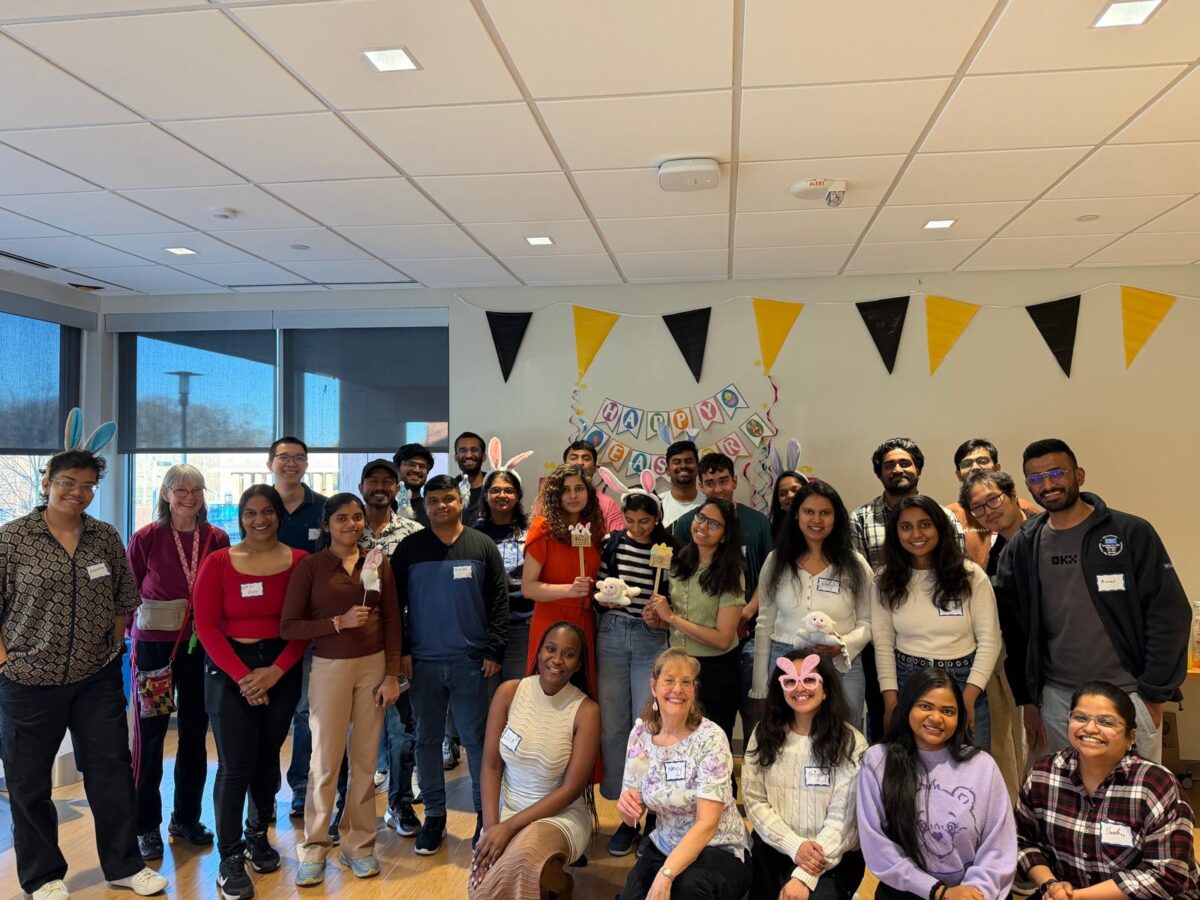 Gupta attending an Easter festival organized by Nancy Parlette and the International Students Connect club. (Photo courtesy of Gupta)
Q: What do you love about UMBC?
A: Beyond my research, I serve on the Graduate Assistant Advisory Committee, helping improve the experience for graduate assistants across campus. From clarifying appointment expectations to shaping GA orientation, it’s shown me a side of UMBC that genuinely listens to students and works to actually affect people’s day-to-day lives. What I enjoy most is being a bridge: carrying real student concerns to people who can actually act on them.
Q: Who in the community inspired you or supported you?
A: My advisor, Dong Li, pushes me to aim high and take ownership of my research, trusting me to drive my own ideas. That independence has stretched me. I’ve also leaned on senior students in the department, whose willingness to share what they’ve learned has made navigating the early Ph.D. years far less daunting.
Q: What’s the one thing you’d want someone who hasn’t joined the UMBC community to know about the support you find here?
A: What surprised me most is how many people quietly have your back. A student who walked me through a rough patch, a staff member who actually wanted my feedback and acted on it, and peers who share hard lessons so I don’t struggle alone are just a few examples. The support is every day and practical.
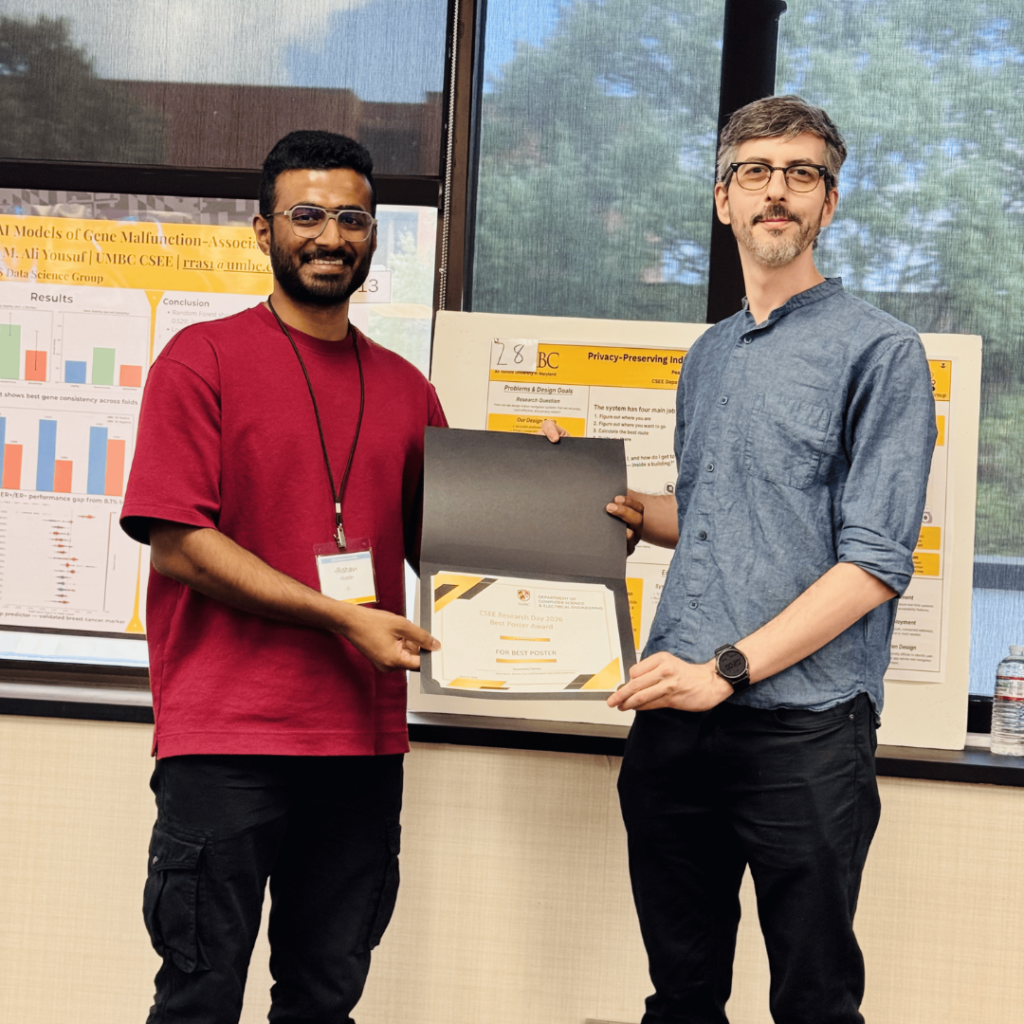
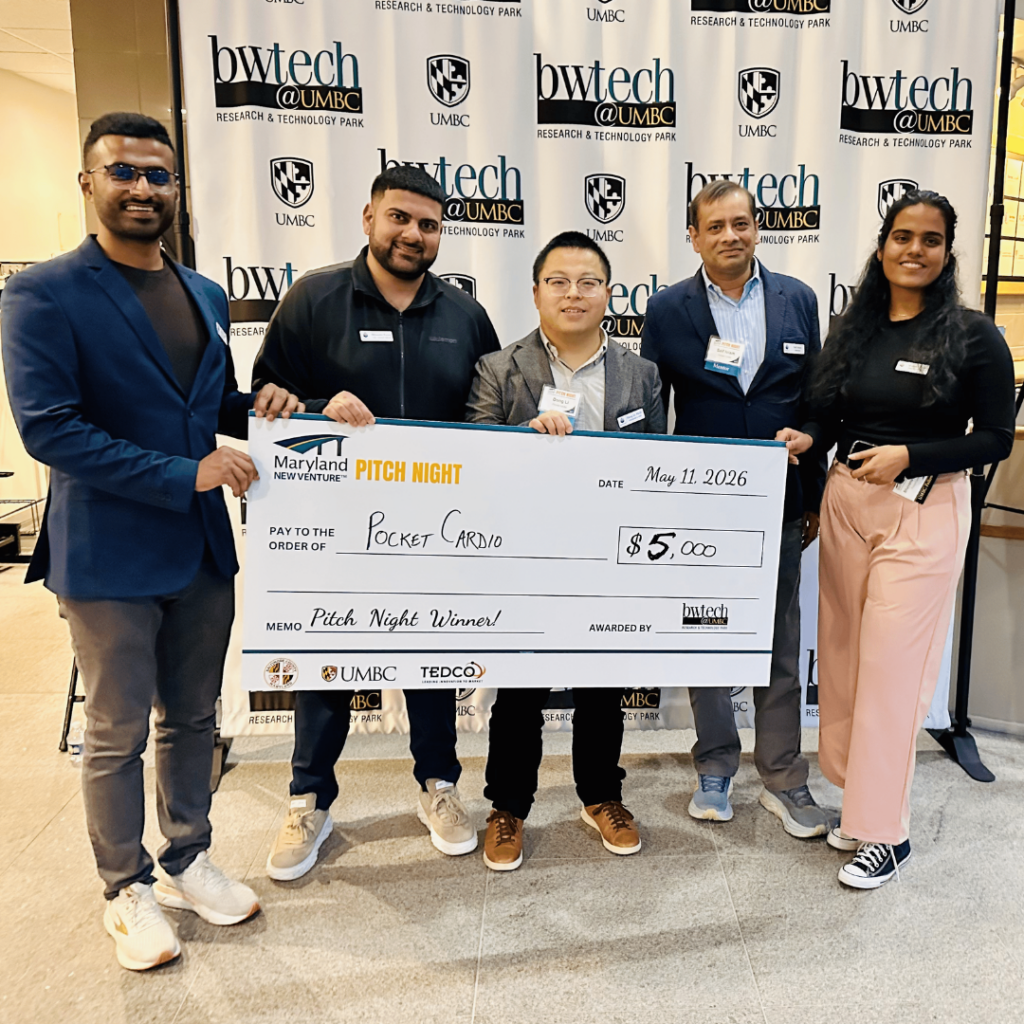
On left, Gupta receives an award for best poster from computer science and electrical engineering assistant professor Roberto Yus on CSEE Research Day in April 2026. On right, Gupta and his team receive a first place award from The Maryland NEW VENTURE program in May 2026. (Photos courtesy of Gupta)
Q: What are your goals after graduation and how is UMBC helping you?
A: My goal is a research career with significant meaningful work, ideally a faculty position at a strong university, where I can keep pushing on affordable health-sensing technology and train the next generation of researchers. I’m early in the journey, but that’s the direction I’m building toward.
UMBC has pushed me toward independence by owning my research direction, presenting my work at top venues, and building the depth I came here for. Serving on a graduate committee has also grown skills I didn’t expect to develop: representing others, navigating institutions, and turning feedback into real change.
Q: How has the Computing for Social Good Award impacted your education?
A: The COEIT Computing for Social Good Award directly supports my research to make blood pressure monitoring affordable and accessible using only a commodity smartphone, with no specialized hardware and no clinic visit required. Beyond the tangible support, being recognized specifically for the social good of the work, rather than only its technical side, has shaped how I choose research problems: it pushes me to keep asking who my work actually helps, and to keep people who can’t easily access conventional care at the center of what I build.
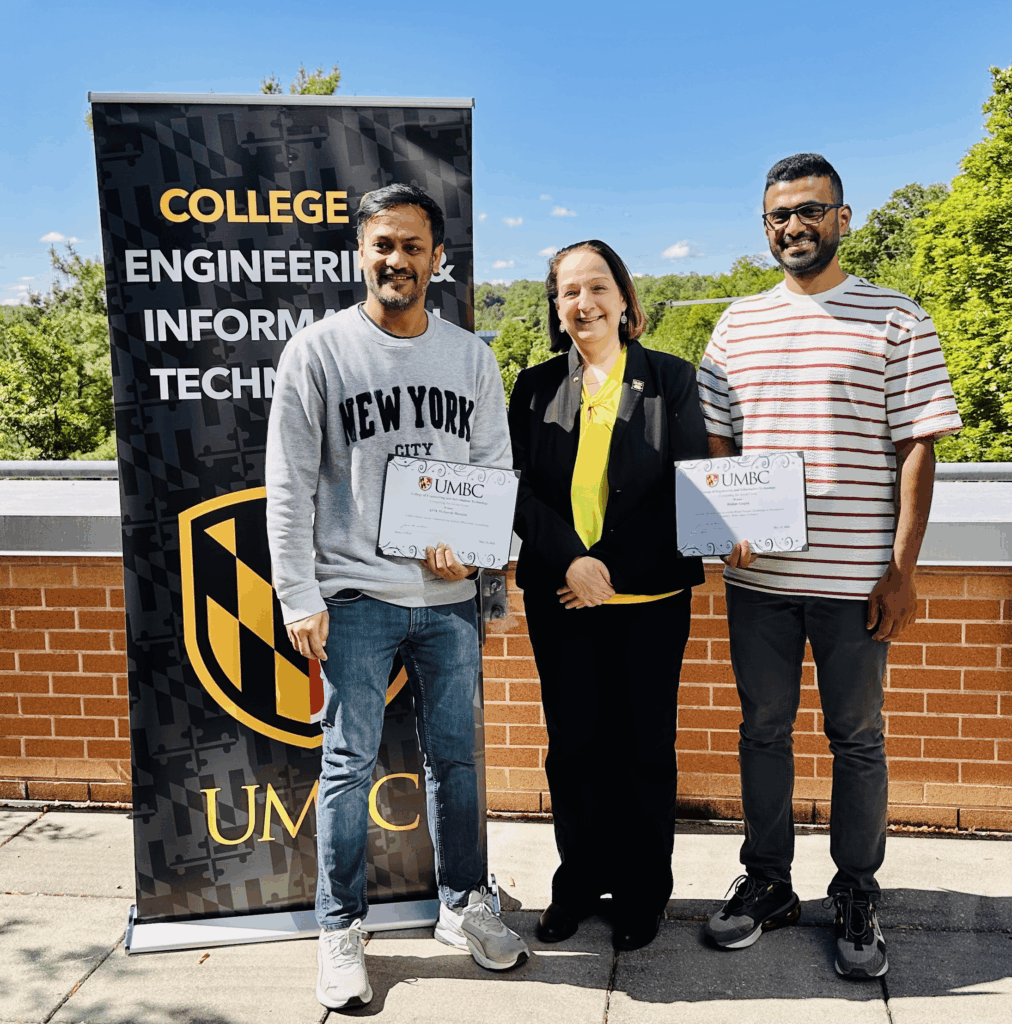 Rishav Gupta and ASM Mobarak Hossain receiving the COEIT Computing Social for Good Award from Jeanne van Briesen, dean of the College of Engineering and Information Technology. (Photo courtesy of Vandana Janeja)
Q: How did it feel to win this award?
A: Receiving the COEIT Computing for Social Good Award felt meaningful in a way I didn’t expect. I came to UMBC from a career in industry because I wanted my work to matter beyond a product. Being recognized for the research’s social impact felt like confirmation that I’d chosen the right path. It was also humbling as a reminder that affordable health technology isn’t an abstract goal but something real people are rooting for, and it left me more motivated to deliver on the promise the award recognizes.
* * * * *
UMBC’s greatest strength is its people. When people meet Retrievers and hear about the passion they bring, the relationships they create, the ways they support each other, and the commitment they have to inclusive excellence, they truly get a sense of our community. That’s what “Meet a Retriever” is all about.
Learn more about how UMBC can help you achieve your goals.
]]>
Meet Rishav Gupta. After spending five years as a mobile engineer, he decided to pursue his Ph.D. in computer science at UMBC to deepen his expertise and choose projects with the clear objective...
https://umbc.edu/stories/rishav-gupta-coeit-computing-for-social-good/
https://my3.my.umbc.edu/api/v0/pixel/news/161834/guest@my.umbc.edu/561a4ae78bb45a1aa63e92cf0f0faf27/api/pixel
coeit
csee
impact
meet-a-retriever
perspectives
science-and-tech
stories
story
UMBC News & Magazine
https://my3.my.umbc.edu/groups/umbc-news-magazine
https://assets1-my.umbc.edu/system/shared/avatars/groups/000/001/943/24435aa6207c452e7bc15cc74b42c7bb/xsmall.png?1748556657
https://assets1-my.umbc.edu/system/shared/avatars/groups/000/001/943/24435aa6207c452e7bc15cc74b42c7bb/original.png?1748556657
https://assets2-my.umbc.edu/system/shared/avatars/groups/000/001/943/24435aa6207c452e7bc15cc74b42c7bb/xxlarge.png?1748556657
https://assets2-my.umbc.edu/system/shared/avatars/groups/000/001/943/24435aa6207c452e7bc15cc74b42c7bb/xlarge.png?1748556657
https://assets3-my.umbc.edu/system/shared/avatars/groups/000/001/943/24435aa6207c452e7bc15cc74b42c7bb/large.png?1748556657
https://assets1-my.umbc.edu/system/shared/avatars/groups/000/001/943/24435aa6207c452e7bc15cc74b42c7bb/medium.png?1748556657
https://assets2-my.umbc.edu/system/shared/avatars/groups/000/001/943/24435aa6207c452e7bc15cc74b42c7bb/small.png?1748556657
https://assets1-my.umbc.edu/system/shared/avatars/groups/000/001/943/24435aa6207c452e7bc15cc74b42c7bb/xsmall.png?1748556657
https://assets2-my.umbc.edu/system/shared/avatars/groups/000/001/943/24435aa6207c452e7bc15cc74b42c7bb/xxsmall.png?1748556657
UMBC News & Magazine
1
0
false
Tue, 11 Aug 2026 15:01:08 -0400
Tue, 11 Aug 2026 15:01:08 -0400
Meet a Retriever—Rishav Gupta, COEIT Computing for Social Good Award recipient
Meet Rishav Gupta. After spending five years as a mobile engineer, he decided to pursue his Ph.D. in computer science at UMBC to deepen his expertise and choose projects with the clear objective of improving people’s lives. Rishav is working in the Future Sensing and Interaction Lab of professor Dong Li on a project to use everyday smartphones as affordable and accessible blood pressure monitors.
This May, the work was recognized when Rishav was selected as one of two recipients for the inaugural COEIT Computing for Social Good Award, made possible by a generous donation from alumnus Akshay Java, M.S. ’03, computer science, Ph.D. ’08, computer science. Awardees were selected in a competitive review process by COEIT faculty reviewers and departmental leadership. Rishav was choosen for his project “Enabling Affordable and Accessible Blood Pressure Monitoring Using Only a Commodity Smartphone.” Take it away, Rishav!
Q: What brought you to UMBC?
A: As an international student from India, I left a comfortable career to come here. After five years as a mobile engineer in industry, I was a generalist who could build things, but I wanted to understand them, to master a domain and create research that genuinely gives back to the community and helps people. UMBC’s work in health sensing was exactly that chance.
UMBC’s welcoming and inclusive environment made the transition less daunting. From peers who’d walked the same path to a community that genuinely wants your feedback to others considering it: you won’t be figuring things out alone here.
Gupta attending an Easter festival organized by Nancy Parlette and the International Students Connect club. (Photo courtesy of Gupta)
Q: What do you love about UMBC?
A: Beyond my research, I serve on the Graduate Assistant Advisory Committee, helping improve the experience for graduate assistants across campus. From clarifying appointment expectations to shaping GA orientation, it’s shown me a side of UMBC that genuinely listens to students and works to actually affect people’s day-to-day lives. What I enjoy most is being a bridge: carrying real student concerns to people who can actually act on them.
Q: Who in the community inspired you or supported you?
A: My advisor, Dong Li, pushes me to aim high and take ownership of my research, trusting me to drive my own ideas. That independence has stretched me. I’ve also leaned on senior students in the department, whose willingness to share what they’ve learned has made navigating the early Ph.D. years far less daunting.
Q: What’s the one thing you’d want someone who hasn’t joined the UMBC community to know about the support you find here?
A: What surprised me most is how many people quietly have your back. A student who walked me through a rough patch, a staff member who actually wanted my feedback and acted on it, and peers who share hard lessons so I don’t struggle alone are just a few examples. The support is every day and practical.
On left, Gupta receives an award for best poster from computer science and electrical engineering assistant professor Roberto Yus on CSEE Research Day in April 2026. On right, Gupta and his team receive a first place award from The Maryland NEW VENTURE program in May 2026. (Photos courtesy of Gupta)
Q: What are your goals after graduation and how is UMBC helping you?
A: My goal is a research career with significant meaningful work, ideally a faculty position at a strong university, where I can keep pushing on affordable health-sensing technology and train the next generation of researchers. I’m early in the journey, but that’s the direction I’m building toward.
UMBC has pushed me toward independence by owning my research direction, presenting my work at top venues, and building the depth I came here for. Serving on a graduate committee has also grown skills I didn’t expect to develop: representing others, navigating institutions, and turning feedback into real change.
Q: How has the Computing for Social Good Award impacted your education?
A: The COEIT Computing for Social Good Award directly supports my research to make blood pressure monitoring affordable and accessible using only a commodity smartphone, with no specialized hardware and no clinic visit required. Beyond the tangible support, being recognized specifically for the social good of the work, rather than only its technical side, has shaped how I choose research problems: it pushes me to keep asking who my work actually helps, and to keep people who can’t easily access conventional care at the center of what I build.
Rishav Gupta and ASM Mobarak Hossain receiving the COEIT Computing Social for Good Award from Jeanne van Briesen, dean of the College of Engineering and Information Technology. (Photo courtesy of Vandana Janeja)
Q: How did it feel to win this award?
A: Receiving the COEIT Computing for Social Good Award felt meaningful in a way I didn’t expect. I came to UMBC from a career in industry because I wanted my work to matter beyond a product. Being recognized for the research’s social impact felt like confirmation that I’d chosen the right path. It was also humbling as a reminder that affordable health technology isn’t an abstract goal but something real people are rooting for, and it left me more motivated to deliver on the promise the award recognizes.
* * * * *
UMBC’s greatest strength is its people. When people meet Retrievers and hear about the passion they bring, the relationships they create, the ways they support each other, and the commitment they have to inclusive excellence, they truly get a sense of our community. That’s what “Meet a Retriever” is all about.
Learn more about how UMBC can help you achieve your goals.
]]>
Meet Rishav Gupta. After spending five years as a mobile engineer, he decided to pursue his Ph.D. in computer science at UMBC to deepen his expertise and choose projects with the clear objective...
https://umbc.edu/stories/riishav-guptaa-coeit-computing-for-social-good/
https://my3.my.umbc.edu/api/v0/pixel/news/161829/guest@my.umbc.edu/0647a74cddf8f7fd7e12be7e2a8a1948/api/pixel
coeit
csee
impact
meet-a-retriever
perspectives
science-and-tech
stories
story
UMBC News & Magazine
https://my3.my.umbc.edu/groups/umbc-news-magazine
https://assets1-my.umbc.edu/system/shared/avatars/groups/000/001/943/24435aa6207c452e7bc15cc74b42c7bb/xsmall.png?1748556657
https://assets1-my.umbc.edu/system/shared/avatars/groups/000/001/943/24435aa6207c452e7bc15cc74b42c7bb/original.png?1748556657
https://assets2-my.umbc.edu/system/shared/avatars/groups/000/001/943/24435aa6207c452e7bc15cc74b42c7bb/xxlarge.png?1748556657
https://assets2-my.umbc.edu/system/shared/avatars/groups/000/001/943/24435aa6207c452e7bc15cc74b42c7bb/xlarge.png?1748556657
https://assets3-my.umbc.edu/system/shared/avatars/groups/000/001/943/24435aa6207c452e7bc15cc74b42c7bb/large.png?1748556657
https://assets1-my.umbc.edu/system/shared/avatars/groups/000/001/943/24435aa6207c452e7bc15cc74b42c7bb/medium.png?1748556657
https://assets2-my.umbc.edu/system/shared/avatars/groups/000/001/943/24435aa6207c452e7bc15cc74b42c7bb/small.png?1748556657
https://assets1-my.umbc.edu/system/shared/avatars/groups/000/001/943/24435aa6207c452e7bc15cc74b42c7bb/xsmall.png?1748556657
https://assets2-my.umbc.edu/system/shared/avatars/groups/000/001/943/24435aa6207c452e7bc15cc74b42c7bb/xxsmall.png?1748556657
UMBC News & Magazine
0
0
false
Tue, 11 Aug 2026 15:01:08 -0400
Meet a Retriever—Kyle Clelan ’08, M.A. ’09, private investments manager and Retriever Loyal donor
Meet Kyle Clelan, a double alumnus who earned his B.S. in financial economics in 2008 and his M.A. in economic policy analysis in 2009. Today, he serves as a private investments manager with The Johnson Group, building on a successful career with stints at the U.S. Commodity Futures Trading Commission and T. Rowe Price. Kyle is also a Retriever Loyal donor, having given back to UMBC for the past eight years. Take it away, Kyle!
Q: What brought you to UMBC?
A: I was primarily drawn to UMBC because of its academically-centered reputation coming out of high school. I wanted to go to school, study, and work hard so that I could get to my career as soon as possible. Then I found myself surrounded by similarly-minded people and started making some lifelong friendships—many of whom were in my wedding. Meeting so many great people with a vast array of life experiences and backgrounds enhanced my time at UMBC immensely and helped me to slow down and enjoy the journey.

 Left: Clelan when he first started at UMBC and lived in Chesapeake Hall. Right: Clelan and his first-year roommate, Matt Basch ’08, M.S. ’09, who became a lifelong friend.
Q: What did you love about the economics programs at UMBC?
A: The economic policy analysis program in particular introduced me to econometric and data science concepts and how they can apply to investment management and policy decision-making. I have used foundational knowledge I learned in that coursework over and over throughout my career. From how to build a model using Stata or SAS, for example, to learning how to organize data and look for anomalies that can help inform better risk management, the courses taught me how to think better analytically and holistically.
Q: Who in the community inspired you or supported you?
A: Doug Lamdin in the Department of Economics was my M.A. advisor, and I also did work with him during my time as an undergraduate. He helped me connect the dots between academia and practice by pushing me to do research with real-world market data. He also introduced me to several professional mentors and helped me find my initial internship at T. Rowe Price, where I spent the first 12 years of my professional career. That experience has been instrumental to where I am today.
Without Dr. Lamdin’s guidance and support, I likely would have never found that pivotal opportunity. And the knowledge I acquired and various investment and technical courses continue to come in handy in roles I have had and have now.
Q: What’s one thing you’d want someone to know about the support you find at UMBC?
A: I came to UMBC expecting a healthy balance of academic rigor and the opportunity to develop lasting relationships and connections. I was not disappointed. UMBC offers a myriad of opportunities to perform meaningful research. Undergraduate Research and Creative Achievement Day, also known as URCAD, is one example that was very rewarding for me to publish my first paper. There are real pipelines that I personally benefitted from to get my career going, which showed me opportunities that wouldn’t have been possible without UMBC. It’s all about being proactive and seeking them out because the resources are there.
The UMBC community really engages with alumni and cares how they are doing after graduation.
Kyle Clelan ’08, M.A. ’09
financial economics
Q: Tell us about your current job. What do you like most about it?
A: For the past five years, I was a risk analyst within the Risk Surveillance Branch at the U.S. Commodity Futures Trading Commission (CFTC). I enjoyed performing broad derivatives market oversight work where we published reports on a regular basis to help better inform the public and help markets better manage systemic risks.
For the last year, I have relocated to being nearer to family in South Carolina and am working as a private investments manager for a family office and set of operating companies. In this role, I am applying the investment and risk management knowledge acquired from UMBC and my career, and I am enjoying being part of investment and capital allocation decisions that directly affect investment outcomes that benefit the company and also the local community.
Q: What drives you to support UMBC?
A: Without financial support from aid and scholarships, I likely would not have been able to attend college at all. So, giving back in whatever way I can now is important to me and my family because it could be just the little bit extra that makes all of the difference for someone to make something really special happen.
* * * * *
UMBC’s greatest strength is its people. When people meet Retrievers and hear about the passion they bring, the relationships they create, the ways they support each other, and the commitment they have to inclusive excellence, they truly get a sense of our community. That’s what “Meet a Retriever” is all about.
Learn more about how UMBC can help you achieve your goals.
]]>
Meet Kyle Clelan, a double alumnus who earned his B.S. in financial economics in 2008 and his M.A. in economic policy analysis in 2009. Today, he serves as a private investments manager with The...
https://umbc.edu/stories/meet-kyle-clelan-financial-economics/
https://my3.my.umbc.edu/api/v0/pixel/news/161541/guest@my.umbc.edu/f3bf184af8cd0e930c021c9d0b7bff32/api/pixel
alumni
cahss
financial-economics
impact
stories
story
UMBC News & Magazine
https://my3.my.umbc.edu/groups/umbc-news-magazine
https://assets1-my.umbc.edu/system/shared/avatars/groups/000/001/943/24435aa6207c452e7bc15cc74b42c7bb/xsmall.png?1748556657
https://assets1-my.umbc.edu/system/shared/avatars/groups/000/001/943/24435aa6207c452e7bc15cc74b42c7bb/original.png?1748556657
https://assets2-my.umbc.edu/system/shared/avatars/groups/000/001/943/24435aa6207c452e7bc15cc74b42c7bb/xxlarge.png?1748556657
https://assets2-my.umbc.edu/system/shared/avatars/groups/000/001/943/24435aa6207c452e7bc15cc74b42c7bb/xlarge.png?1748556657
https://assets3-my.umbc.edu/system/shared/avatars/groups/000/001/943/24435aa6207c452e7bc15cc74b42c7bb/large.png?1748556657
https://assets1-my.umbc.edu/system/shared/avatars/groups/000/001/943/24435aa6207c452e7bc15cc74b42c7bb/medium.png?1748556657
https://assets2-my.umbc.edu/system/shared/avatars/groups/000/001/943/24435aa6207c452e7bc15cc74b42c7bb/small.png?1748556657
https://assets1-my.umbc.edu/system/shared/avatars/groups/000/001/943/24435aa6207c452e7bc15cc74b42c7bb/xsmall.png?1748556657
https://assets2-my.umbc.edu/system/shared/avatars/groups/000/001/943/24435aa6207c452e7bc15cc74b42c7bb/xxsmall.png?1748556657
UMBC News & Magazine
0
0
false
Tue, 11 Aug 2026 08:44:06 -0400
Tue, 11 Aug 2026 08:44:06 -0400
Four Retrievers selected for this summer’s Key Bridge rebuilding internship
This summer, four UMBC students are getting hands-on experience contributing to efforts to rebuild the Francis Scott Key Bridge over the Patapsco River, which collapsed in March 2024 after a cargo ship collided with one of its supports. This is the second year in a row that the Maryland Transportation Authority has partnered with the Maryland Higher Education Commission to run the program.
Last year, three out of nine students in the program hailed from UMBC. This year, four out of the 10 interns are Retrievers. Mechanical engineering students Bilal Faizullah and Katelyn Prasad and geography and environmental systems students James Keller and Megan (Em) Schumacher ’26 will get the opportunity to learn about topics such as project management, environmental analysis, construction oversight, and community outreach. They will also get the chance to be a part of an iconic infrastructure project for Maryland, an experience that last year’s student interns found particularly meaningful.
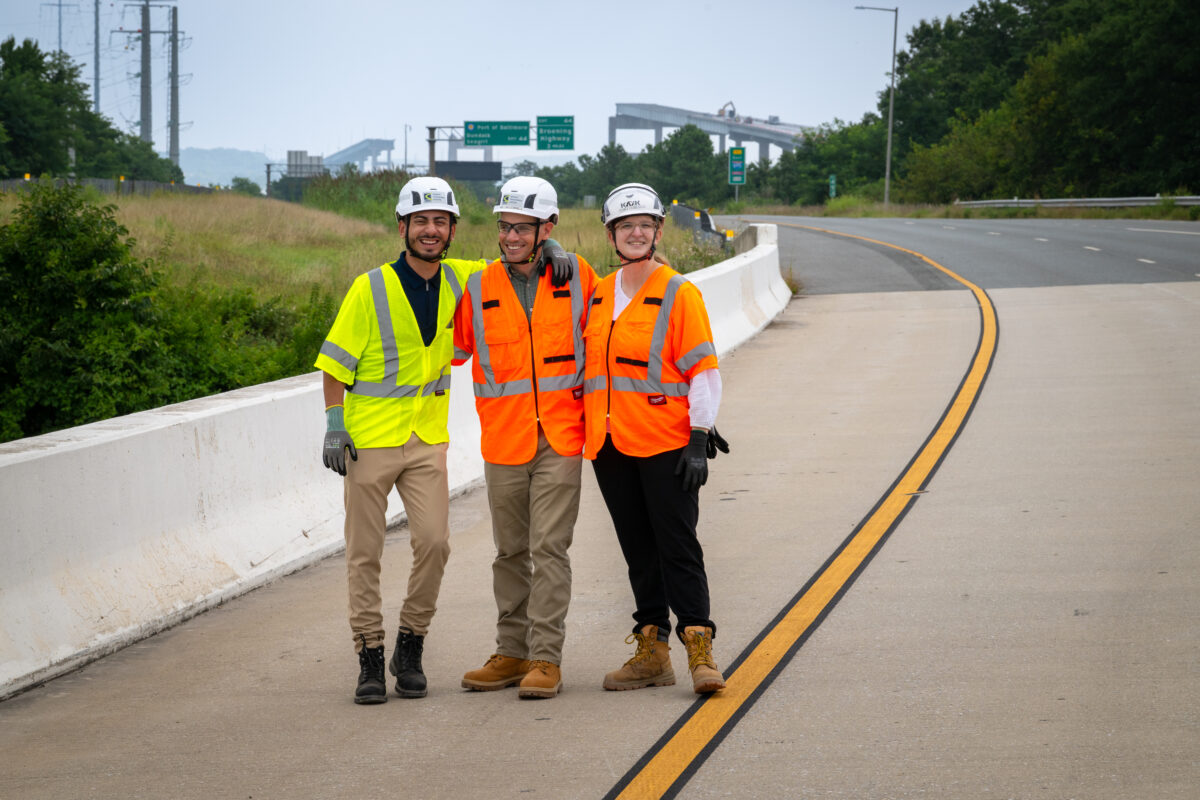 From left to right, Cristian Mena, William McConnell, and Emily DiMarzio pose for a photo near the site of the collapsed Key Bridge. The three worked on the bridge rebuilding project as interns with the Maryland Transportation Authority in summer 2025. (Brad Ziegler/UMBC)
“The Key Bridge Internship Program represents the very best of career-connected learning by giving students the opportunity to contribute to a project that will have a lasting impact on Maryland,” says Christine Routzahn, director of UMBC’s Career Center. “We’re incredibly proud that four UMBC students were selected for this prestigious program. Their selection reflects not only their talent and dedication, but also the strength of the partnerships that make opportunities like this possible. We are grateful to the Maryland Transportation Authority, Maryland Higher Education Commission, and its partners for investing in our students and in the state’s future workforce.”
]]>
This summer, four UMBC students are getting hands-on experience contributing to efforts to rebuild the Francis Scott Key Bridge over the Patapsco River, which collapsed in March 2024 after a cargo...
https://umbc.edu/stories/key-bridge-rebuilding-internship-summer-2026/
https://my3.my.umbc.edu/api/v0/pixel/news/161314/guest@my.umbc.edu/56fca8c62f428a6e6cff12abb2ccee1e/api/pixel
cahss
coeit
ges
impact
internship
meche
science-and-tech
stories
story
UMBC News & Magazine
https://my3.my.umbc.edu/groups/umbc-news-magazine
https://assets1-my.umbc.edu/system/shared/avatars/groups/000/001/943/24435aa6207c452e7bc15cc74b42c7bb/xsmall.png?1748556657
https://assets1-my.umbc.edu/system/shared/avatars/groups/000/001/943/24435aa6207c452e7bc15cc74b42c7bb/original.png?1748556657
https://assets2-my.umbc.edu/system/shared/avatars/groups/000/001/943/24435aa6207c452e7bc15cc74b42c7bb/xxlarge.png?1748556657
https://assets2-my.umbc.edu/system/shared/avatars/groups/000/001/943/24435aa6207c452e7bc15cc74b42c7bb/xlarge.png?1748556657
https://assets3-my.umbc.edu/system/shared/avatars/groups/000/001/943/24435aa6207c452e7bc15cc74b42c7bb/large.png?1748556657
https://assets1-my.umbc.edu/system/shared/avatars/groups/000/001/943/24435aa6207c452e7bc15cc74b42c7bb/medium.png?1748556657
https://assets2-my.umbc.edu/system/shared/avatars/groups/000/001/943/24435aa6207c452e7bc15cc74b42c7bb/small.png?1748556657
https://assets1-my.umbc.edu/system/shared/avatars/groups/000/001/943/24435aa6207c452e7bc15cc74b42c7bb/xsmall.png?1748556657
https://assets2-my.umbc.edu/system/shared/avatars/groups/000/001/943/24435aa6207c452e7bc15cc74b42c7bb/xxsmall.png?1748556657
UMBC News & Magazine
6
0
false
Mon, 27 Jul 2026 13:01:27 -0400
Mon, 27 Jul 2026 13:01:27 -0400
A $1M alumni gift expands graduate student success and inclusive excellence in tech
In 2022, when Pam Offutt ’82, computer science, visited campus 40 years after graduating, she was taken aback by two things: how much the university had changed and how much it had stayed the same.
“While I can still see the bones of what we knew, it is almost unrecognizable,” says Pam, who loved seeing the new buildings and how much the campus had physically grown since she and her husband, Jay Offutt ’82, computer science, graduated. However, Pam was shocked to see that the percentage of women majoring in computer science had not changed much since 1982.
“We were part of the first graduating class in computer science at UMBC. It was brand new,” says Pam. “Back then, 18 percent of the computer science population was women. When I came back to campus and looked it up, the percentage was around 20 percent. And that just doesn’t sit right after 40 years.”
Determined to be part of the solution, Pam and Jay established the Pam and Jay Offutt Graduate Student Endowment in May 2026 with a transformational $1,040,000 gift. This significant investment will expand the Center for Women in Technology (CWIT) model at the graduate level, helping CWIT Scholars pursue advanced degrees at UMBC—a primary driver for moving into senior management and executive leadership roles after graduation.
While Pam’s personal experience has centered on gender equity, the Offutt endowment is designed to support any CWIT Scholar as they pursue graduate education in computing or technology, reflecting CWIT’s broader mission of inclusive excellence.
“We are tremendously grateful for Pam and Jay’s vision, which supports our commitment to inclusive excellence,” says Jeanne van Briesen, dean of the College of Engineering and Information Technology. “The endowment will help strengthen the pipeline of talent prepared for leadership in computing and technology careers.”
UMBC’s CWIT program is committed to developing community members who are prepared and empowered to be change agents in creating technology workplaces that are diverse, equitable, and inclusive. The program encourages the participation and success of all students, especially those from underrepresented groups, with a nurturing and challenging community, transformative leadership experiences, and professional development opportunities.
 CWIT Scholars, Cyber Scholars, and affiliates before UMBC’s spring 2026 Commencement ceremony. (Cindy Greenwood, M.P.S. ’21/UMBC)
“The CWIT office is buzzing with happy plans for recruiting and supporting the first cohort of Offutt Scholars this fall,” says Carolyn Seaman, director of CWIT. “We are grateful for this opportunity to support so many more of our students in taking the next step toward being the tech leaders we know they can be.”
Going beyond the gift
Pam and Jay knew the problem they wanted to solve, but they took time to discuss the issue with Seaman, van Briesen, and Kim Robinson, director of major gifts in the Office of Institutional Advancement, to come up with a plan that felt like it could make a difference.
“Maybe some people find value in giving money for the sake of giving money, but if it’s not going to solve a problem, what’s the point?”
Pam Offutt ’82
computer science
Simply funding scholarships wasn’t enough. Pam and Jay realized that in order to truly make a difference, they needed to find a way to support students throughout their academic journey. To the Offutts, the solution was simple—mentoring and leadership development.
Offutt Scholars will receive a financial award for two years to defray school expenses, participate in leadership development, mentor undergraduate CWIT Scholars, and be mentored by more senior alumni with similar professional interests. The endowment will also support staff and programming for Offutt Scholars through the CWIT Program. This investment extends beyond financial support to build a connected community across undergraduate students, graduate students, and professional mentors.
“What stands out to me about Pam and Jay’s vision is that they are not just investing in financial support for students—they are investing in a model that builds community, mentorship, and leadership that will shape how our students persist, succeed, and lead,” says van Briesen. “They asked us to think beyond access and to focus on what it takes for students to grow into leaders in the computing field.”
 CWIT Scholars alumni, UMBC alumni, and industry partners come together for Fall Career Networking, a signature CWIT event. Many featured alumni also mentor in CWIT’s industry mentor program. (Jess Myers/UMBC)
Pam believes deeply in mentorship. She served on the UMBC Alumni Association Board of Directors from 1998 to 2004, and, most recently, served as a CWIT industry mentor.
“What makes this gift so meaningful is the journey behind it,” says Robinson, who assisted in cultivating the relationship with the Offutts throughout their engagement with UMBC. “Pam has been engaged with UMBC in so many ways—through the Alumni Association Board, as a CWIT industry mentor, at career fairs—and that connection is exactly what led her and Jay to see this gap and want to help close it.”
For Pam and Jay, it comes back to the experiences they had as undergraduate students at UMBC and how their careers unfolded after graduation.
Computer science pioneers
Pam and Jay both started UMBC as math majors—computer science was not yet an option—and met in Calculus 101. Boy meets girl. Boy and girl both become teaching assistants. Boy and girl form a close bond by terrorizing professors.
“As TAs, Jay and I both had keys to the same office and we used to torture the same professors that were right across the hall from us, flipping bottle caps and stuff into their room while they were teaching,” says Pam. “So, that got the door slammed on us at least a couple of times.”
It’s the classic UMBC love story.
One semester before Pam and Jay were set to graduate, UMBC launched the B.S. in computer science. Knowing what it could mean for their job prospects and earning potential, both switched majors.
“I took a couple of extra classes and finished the B.S.,” says Pam.
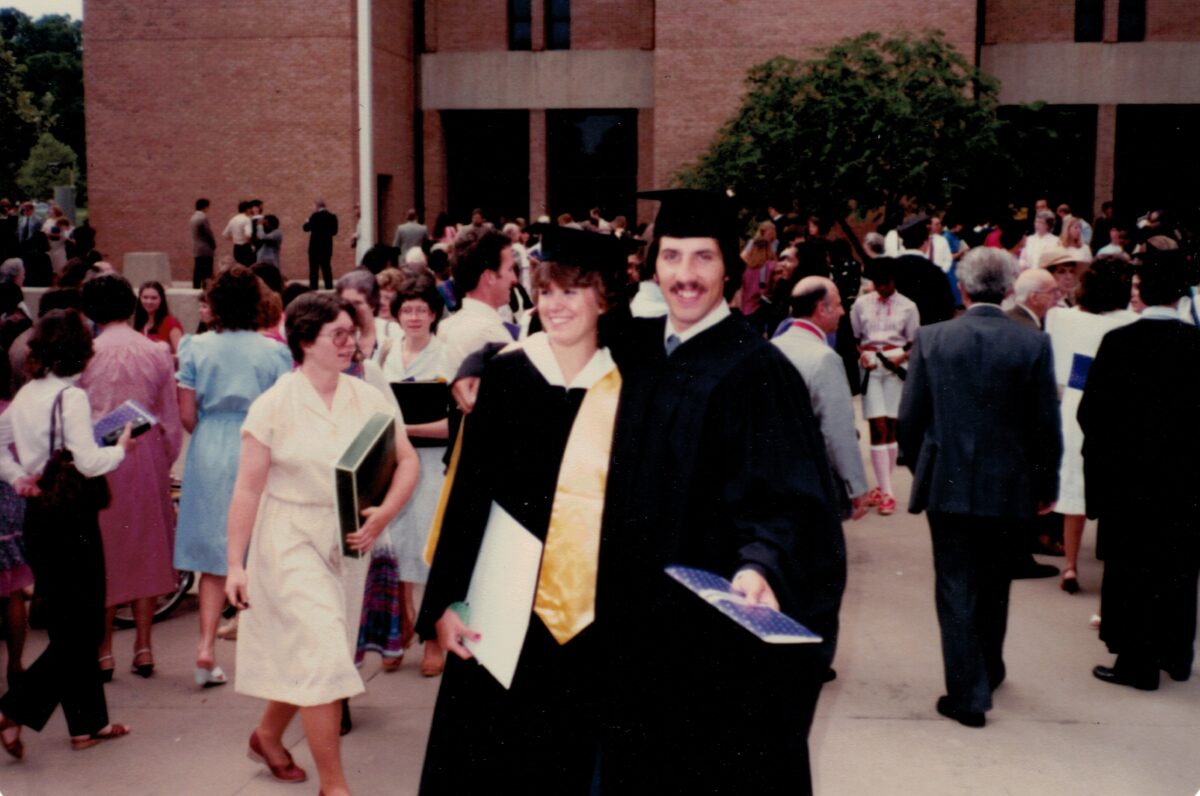
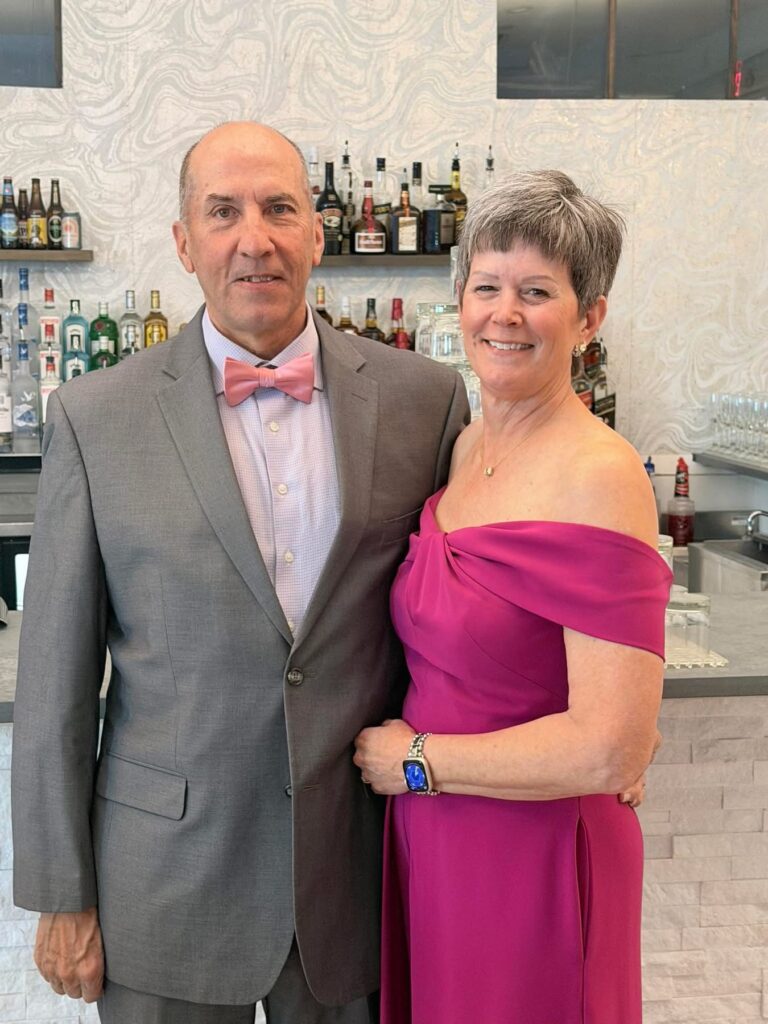 Left: Pam and Jay after their 1982 UMBC graduation. Right: The Offutts today. (Photos courtesy Pam and Jay Offutt)
After UMBC, Pam and Jay went on to Loyola University and earned master’s degrees.
In 1988, Jay founded Offutt Associates, which later folded into Interface and Control Systems, Inc. (ICS). Serving public and private sectors, ICS provided end-to-end autonomous command and control software for satellites, operational centers, testing setups, and digital business systems. Notably, ICS technology was integrated into major aerospace and defense initiatives, including NASA’s Constellation project and the Department of Defense’s TAC-SAT tactical satellite program. Jay and his partners sold ICS to SRA International in 2008, and Jay retired a few years later.
Meanwhile, Pam took on management and leadership roles in various companies, including COO at Edaptive Systems, LLC (acquired by ManTech) and CEO at MDMeta. In 2009, Pam and fellow UMBC alumnus John duClos ’90, information systems, founded Bellese Technologies, which engineers large-scale, human-centered digital products and data solutions that improve the quality, equity, and efficiency of public health systems. As CEO, Pam made a concerted effort to hire and promote women—successfully building a workforce that was 25 to 30 percent female. It was a stark contrast to the male-dominated workspaces she had experienced throughout her career, though still not the parity she envisioned. The problem, however, was not in the motivation, but in the small pool of potential female hires.
“You can’t find women to hire because women aren’t going into tech,” says Pam. “So it’s a difficult thing.”
Pam sold the company in 2022, and now serves on its Board of Directors. Around the same time, she had that inspirational visit to UMBC where she realized that she and Jay could be part of the solution, leading to the establishment of the Pam and Jay Offutt Graduate Student Endowment.
“I want to see that needle move,” says Pam.
]]>
In 2022, when Pam Offutt ’82, computer science, visited campus 40 years after graduating, she was taken aback by two things: how much the university had changed and how much it had stayed the...
https://umbc.edu/stories/inclusive-excellence-in-tech/
https://my3.my.umbc.edu/api/v0/pixel/news/161186/guest@my.umbc.edu/df6e441b7cb09e030249aa065efa7ab6/api/pixel
alumni
coeit
cwit
impact
stories
story
UMBC News & Magazine
https://my3.my.umbc.edu/groups/umbc-news-magazine
https://assets1-my.umbc.edu/system/shared/avatars/groups/000/001/943/24435aa6207c452e7bc15cc74b42c7bb/xsmall.png?1748556657
https://assets1-my.umbc.edu/system/shared/avatars/groups/000/001/943/24435aa6207c452e7bc15cc74b42c7bb/original.png?1748556657
https://assets2-my.umbc.edu/system/shared/avatars/groups/000/001/943/24435aa6207c452e7bc15cc74b42c7bb/xxlarge.png?1748556657
https://assets2-my.umbc.edu/system/shared/avatars/groups/000/001/943/24435aa6207c452e7bc15cc74b42c7bb/xlarge.png?1748556657
https://assets3-my.umbc.edu/system/shared/avatars/groups/000/001/943/24435aa6207c452e7bc15cc74b42c7bb/large.png?1748556657
https://assets1-my.umbc.edu/system/shared/avatars/groups/000/001/943/24435aa6207c452e7bc15cc74b42c7bb/medium.png?1748556657
https://assets2-my.umbc.edu/system/shared/avatars/groups/000/001/943/24435aa6207c452e7bc15cc74b42c7bb/small.png?1748556657
https://assets1-my.umbc.edu/system/shared/avatars/groups/000/001/943/24435aa6207c452e7bc15cc74b42c7bb/xsmall.png?1748556657
https://assets2-my.umbc.edu/system/shared/avatars/groups/000/001/943/24435aa6207c452e7bc15cc74b42c7bb/xxsmall.png?1748556657
UMBC News & Magazine
18
0
false
Mon, 20 Jul 2026 08:09:08 -0400
Mon, 20 Jul 2026 08:09:08 -0400
Baltimore City hometown recruits shine bright
The Best of Baltimore Grant, a UMBC initiative started in fall 2025, is changing how students from Baltimore City imagine college: not as a distant possibility overshadowed by debt, but as a tangible, financially supported path forward, and right in their backyard.
For first-year student Essence Jones, who went to Baltimore City College, a high school in east Baltimore, “that financial freedom really pushed me towards UMBC,” she says, describing the moment she learned the grant would cover what other aid could not—including room and board. A double major in biological sciences and psychology, Jones is already thinking ahead to a future in forensics, drawn by what she calls “the puzzle problem-solving aspect” of analyzing crime scenes. But her present focus is simpler: adjusting, learning, and finding her place and people.
Embracing the ‘B’ in UMBC
The Best of Baltimore grant grew out of President Valerie Sheares Ashby’s desire to see a greater number of Baltimore City high school students become Retrievers. And the grant is just one part of a bigger initiative, says Yvette Mozie-Ross ’88, vice provost for enrollment management and planning: “This year, we have been more intentional with our outreach efforts—partnering with community based organizations such as CollegeBound and College Track to continue to help us get the word out about the many benefits of a UMBC education and specifically how the Best of Baltimore grant can make a UMBC education attainable for all Baltimore City residents.”
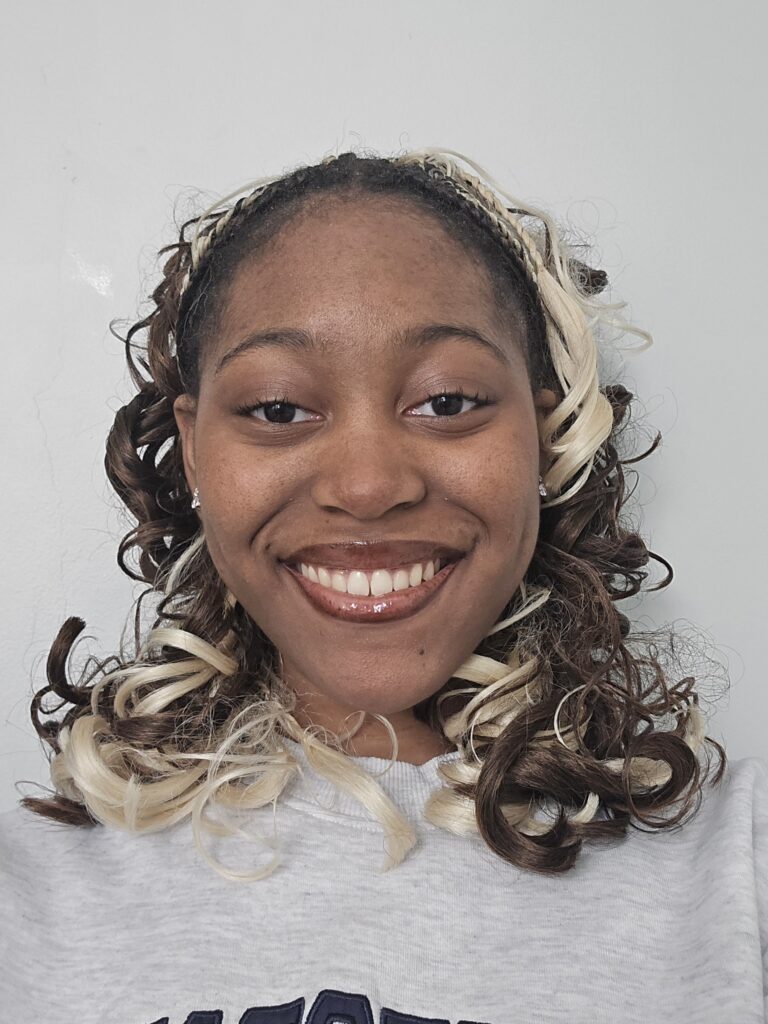 Essence Jones
The grant is designed to cover remaining billed costs after federal grants, subsidized loans, and other scholarships are applied—closing gaps that often prevent students with demonstrated financial need from enrolling.
Early results suggest momentum. In its first year, the program offered awards to nearly 140 students, with dozens ultimately enrolling and receiving grants ranging from $1,100 to $22,000. Just as importantly, Mozie-Ross notes, the early promise of financial support helped families make confident decisions about college. And the increased outreach methods are paying off—applications from city residents grew by 20 percent for fall 2026.
UMBC, Jones says, meets her at her pace and provides lots of student support. She points to spaces like the Learning Collaboratory, where students gather to work through complex chemistry problems together. “You’re both teaching and learning,” she explains. “That helps solidify the information.”
That sense of shared effort—of not struggling alone—has defined her early college experience. Whether studying with friends from her STEM courses or working quietly on the sixth floor of the library, Jones has found community. Her path to science was shaped before UMBC. At Baltimore City College, she was inspired by teachers who looked like her—women of color leading classrooms in biology and chemistry. “Being able to see them in that space… really helped me enjoy science,” she says. Now, she hopes to carry that sense of belonging forward.
Support fosters success
Deylon Moy Joseph, a mechanical engineering first-year student and another Best of Baltimore awardee, echoes Jones’ observations about support and community at UMBC. Originally from Trinidad and Tobago, he arrived in the United States in 2022 and enrolled at Mergenthaler Vocational-Technical High School—a mile north of Jones’ school. From the start, financial reality shaped his college search. “It was necessary for me to get some type of college funding,” he says. “I didn’t want to be stuck with really heavy student loans.”
At UMBC, he found a layered support system: the prestigious Meyerhoff Scholars Program, and unexpectedly, the Best of Baltimore grant. “We didn’t have to apply, but when we were accepted to UMBC, we received letters saying, ‘Congratulations,’” he recalls. “It was amazing.”
For Moy Joseph, that confidence extends into the classroom. He describes his technical coursework as demanding but manageable—especially with the right support. He credits faculty like Joseph Washington ’97, mechanical engineering, an assistant teaching professor whose open-door approach allows students to work through complex problems in real time. “Having the professor right there to give pointers… it really made retention much easier,” he says.
Outside class, in spaces like the Retriever Learning Center, students gather around whiteboards filled with equations, working through concepts together. “It’s so easy to study with someone,” Moy Joseph says. “And it’s satisfying to help people, too.”
That reciprocity—learning, then teaching—is central to many Retrievers’ experiences. It reflects a broader culture at UMBC, one that merges academic rigor with connection, starting in our very own neighborhood.
]]>
The Best of Baltimore Grant, a UMBC initiative started in fall 2025, is changing how students from Baltimore City imagine college: not as a distant possibility overshadowed by debt, but as a...
https://umbc.edu/stories/baltimore-city-recruits-shine-bright/
https://my3.my.umbc.edu/api/v0/pixel/news/160819/guest@my.umbc.edu/f96cc653dbc18a3b7081fca1134b9df1/api/pixel
baltimore-city
cahss
cnms
coeit
impact
spring-2026
stories
story
UMBC News & Magazine
https://my3.my.umbc.edu/groups/umbc-news-magazine
https://assets1-my.umbc.edu/system/shared/avatars/groups/000/001/943/24435aa6207c452e7bc15cc74b42c7bb/xsmall.png?1748556657
https://assets1-my.umbc.edu/system/shared/avatars/groups/000/001/943/24435aa6207c452e7bc15cc74b42c7bb/original.png?1748556657
https://assets2-my.umbc.edu/system/shared/avatars/groups/000/001/943/24435aa6207c452e7bc15cc74b42c7bb/xxlarge.png?1748556657
https://assets2-my.umbc.edu/system/shared/avatars/groups/000/001/943/24435aa6207c452e7bc15cc74b42c7bb/xlarge.png?1748556657
https://assets3-my.umbc.edu/system/shared/avatars/groups/000/001/943/24435aa6207c452e7bc15cc74b42c7bb/large.png?1748556657
https://assets1-my.umbc.edu/system/shared/avatars/groups/000/001/943/24435aa6207c452e7bc15cc74b42c7bb/medium.png?1748556657
https://assets2-my.umbc.edu/system/shared/avatars/groups/000/001/943/24435aa6207c452e7bc15cc74b42c7bb/small.png?1748556657
https://assets1-my.umbc.edu/system/shared/avatars/groups/000/001/943/24435aa6207c452e7bc15cc74b42c7bb/xsmall.png?1748556657
https://assets2-my.umbc.edu/system/shared/avatars/groups/000/001/943/24435aa6207c452e7bc15cc74b42c7bb/xxsmall.png?1748556657
UMBC News & Magazine
0
0
false
Tue, 23 Jun 2026 16:18:32 -0400
Tue, 23 Jun 2026 16:18:32 -0400
Meet a Retriever—Balmory Moran ’24 drew on his history major to coach his youth soccer team to league championships
Balmory Moran II ’24, history, used to describe himself as a soccer player above all else. The soccer field and his team were where he felt most at home. In high school, an injury ended his hopes of playing at the collegiate level, and doubts about his future settled in until he met Joe Thompson, a professor of history and political science at Montgomery College (MC), and Andrew Nolan, teaching professor of history at UMBC. They instilled in him a passion for history, and their support helped him transfer to UMBC as a history major, where he learned not only about the past but also interpersonal and mentorship skills that he now puts to practice every day as a coach for the Latino Youth Development Program in Rockville, Maryland.
As a coach, Balmory imparts performance strategies and techniques to middle school and high school students in the program while also emphasizing essential team skills such as collaboration, active listening, empathy, and accountability, both on and off the field. This strategy led the team to win the league championship in fall 2025.
After years of coaching and time away from the classroom, Balmory is ready to balance soccer and the classroom once again as he begins applying to a master’s in social work. He credits his sister, Alexandra Moran ’15, social work, a current social worker, for the inspiration to join the field. Take it away, Balmory!
Q: What was your journey to UMBC?
A: I began my undergraduate experience at MC. I was a bit lost, and I didn’t know what I wanted to do, but Professor Thompson changed all that. I had a 200-level U.S. history class with him. He made our class so entertaining, enticing, and interesting at both a personal and an academic level. It really showed me that history didn’t have to be boring or slow.
After seeing how attentive I was in his classes, he encouraged me to pursue a degree in history. Professor Thompson showed me multiple examples of students in different fields of work with a history degree. It prompted me to take more history classes at MC, which laid the foundation for studying history at UMBC.
I made my way to UMBC after Professor Nolan visited MC multiple times to talk to students about life as a history major at UMBC and the careers it could lead to after graduation. He also explained the many ways UMBC would further nurture my academic aspirations. I was so involved with the history program at MC that it felt like a natural next step to continue my undergrad degree in history at UMBC.
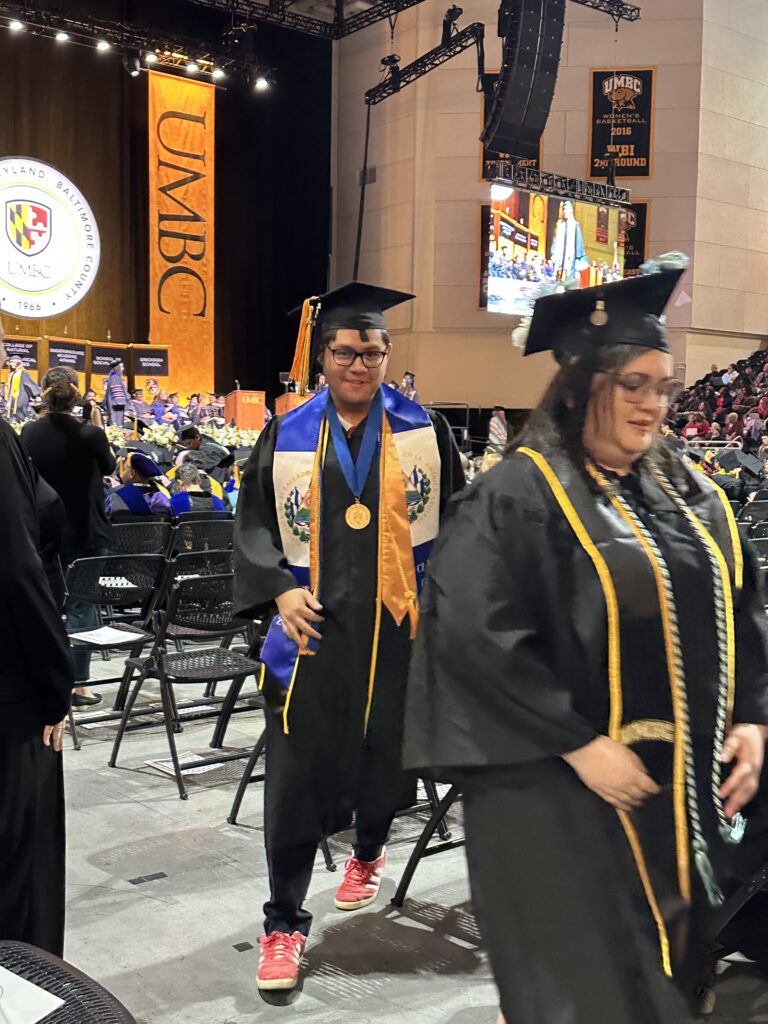
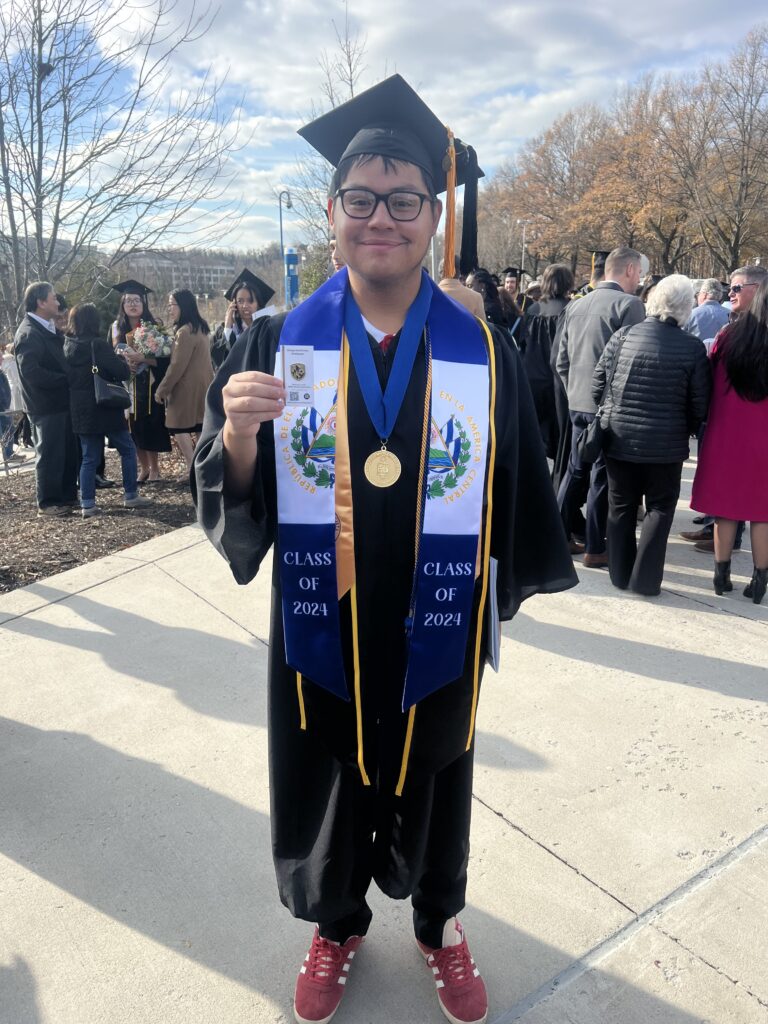 Moran at his 2024 graduation from UMBC.
Q: What was your experience studying history at UMBC?
A: Once at UMBC, I dove into the multitude of classes on aging, women’s studies, sociology, and, of course, history, which all helped me gain a better understanding and appreciation for the communities I grew up alongside. I learned that there was a history of pretty much everything, as long as there was some interest. So many people think history is just old people in wigs, but it’s everywhere, from political history to sports history. There is always a story to be told as long as someone is willing to listen and learn.
Q: Who in the UMBC community has inspired you or supported you?
A: The last two years have really pushed me to be the best version of myself in my work as well as my mentorship. I’ve learned from Melissa Blair, associate teaching professor of history, as well as other professors throughout the history department, how to approach different types of students. These lessons have helped me teach these young men right from wrong in ways that they can understand.
UMBC gave me the tools to be creative in how I tackle challenges and debates with my players. I guide players by equipping them with the tools to grow and improve, as Blair and other professors supported me in the classroom, rather than stepping in.
So many people think history is just old people in wigs, but it’s everywhere, from political history to sports history. There is always a story to be told as long as someone is willing to listen and learn. —Balmory Moran ’24
Q: Is there a concept you learned in your classes at UMBC that is applicable outside of the classroom?
A: The professors I had at UMBC showed me that there are many ways to get important information across that don’t feel like a lecture. They taught me how to be an effective problem-solver. These lessons were within a history class setup, but felt applicable to how I wanted to coach and mentor my players. So many people get the wrong idea when they hear the term “history degree.” It’s not just about curating museums and lecturing. It is also about what makes us who we are, helps us understand where we come from, and what values we hold onto.
* * * * *
UMBC’s greatest strength is its people. When people meet Retrievers and hear about the passion they bring, the relationships they create, the ways they support each other, and the commitment they have to inclusive excellence, they truly get a sense of our community. That’s what Meet a Retriever is all about.
Learn more about how UMBC can help you achieve your goals and the UMBC History Department’s programs and faculty.
]]>
Balmory Moran II ’24, history, used to describe himself as a soccer player above all else. The soccer field and his team were where he felt most at home. In high school, an injury ended his hopes...
https://umbc.edu/stories/balmory-moran-uses-history-major-to-coach-youth/
Video Preview
https://assets2-my.umbc.edu/system/shared/attachments/631072e3446b79e697d4697cbc6ca88c/6a9753ef/news/000/160/698/77fd1d4f4e2edb4384e207a1ab551f9f/ENkc1G1ZZCw.jpg?1781549406
https://my3.my.umbc.edu/api/v0/pixel/news/160698/guest@my.umbc.edu/15a3d9b0ded499cefe0c1446285fb89c/api/pixel
alumni
cahss
history
impact
meet-a-retriever
perspectives
story
transfer-students
UMBC News & Magazine
https://my3.my.umbc.edu/groups/umbc-news-magazine
https://assets1-my.umbc.edu/system/shared/avatars/groups/000/001/943/24435aa6207c452e7bc15cc74b42c7bb/xsmall.png?1748556657
https://assets1-my.umbc.edu/system/shared/avatars/groups/000/001/943/24435aa6207c452e7bc15cc74b42c7bb/original.png?1748556657
https://assets2-my.umbc.edu/system/shared/avatars/groups/000/001/943/24435aa6207c452e7bc15cc74b42c7bb/xxlarge.png?1748556657
https://assets2-my.umbc.edu/system/shared/avatars/groups/000/001/943/24435aa6207c452e7bc15cc74b42c7bb/xlarge.png?1748556657
https://assets3-my.umbc.edu/system/shared/avatars/groups/000/001/943/24435aa6207c452e7bc15cc74b42c7bb/large.png?1748556657
https://assets1-my.umbc.edu/system/shared/avatars/groups/000/001/943/24435aa6207c452e7bc15cc74b42c7bb/medium.png?1748556657
https://assets2-my.umbc.edu/system/shared/avatars/groups/000/001/943/24435aa6207c452e7bc15cc74b42c7bb/small.png?1748556657
https://assets1-my.umbc.edu/system/shared/avatars/groups/000/001/943/24435aa6207c452e7bc15cc74b42c7bb/xsmall.png?1748556657
https://assets2-my.umbc.edu/system/shared/avatars/groups/000/001/943/24435aa6207c452e7bc15cc74b42c7bb/xxsmall.png?1748556657
UMBC News & Magazine
1
0
false
Mon, 15 Jun 2026 14:40:35 -0400
Mon, 15 Jun 2026 14:40:35 -0400