From Baltimore City to Bergen, Norway: Fulbrighter Shanika Freeman ’24 researches the reentry process of women in one of the world’s most humane systems
After Shanika Freeman ’24 walked across the stage, she had something on her mind—basic human rights. For the past four years, Freeman’s research has focused on the reentry experiences of formerly incarcerated women in the United States and Maryland. Basic human rights—including access to healthy food, education, housing, healthcare, clothing, and job skills development—are difficult to access for people in the reentry process due to limited to no financial resources, support networks, services, and stigma.
“In Maryland, over 15,000 women are released from prison every year. Just imagine, you’ve been released, and unfortunately, you couldn’t get a transitional program or reentry program, so you are basically by yourself,” said Freeman during her individualized study major’s capstone presentation. “You go out, you kiss the ground because you know you are free, but you are only given about $50 to $100 of gate money to find transportation and all your basic needs.”
Reentry programs are not the root of these obstacles. During her research, Freeman learned that the U.S.incarceration system’s emphasis on punishments rather than rehabilitation means many women are released without workforce skills needed to meet the demands of a changing job, let alone recreate a new life. All of these factors increase recidivism rates.
“I wasn’t born to be caged up and chained up,” is a quote by Susan Burton that inspired Freeman to continue her research on successful reentry pathways. Burton is the founder of A New Way of Life Reentry Project, a non-profit organization in California that provides safe housing, pro bono legal services, advocacy, and family reunification for formerly incarcerated women. Leading with compassion inspired Freeman to seek similar approaches in her own work.
She didn’t know at the time that her search would lead her to Norway, whose incarceration system is widely recognized as one of the most humane rehabilitative institutions in the world. Their rehabilitation process emphasizes mentorship, skill-building, communal living, mirroring regular life based on the Norwegians’ belief that the only right a person loses through incarceration is liberty. As a result, Norway has one of the lowest rates of recidivism in the world. Thanks to a 2025 – 2026 Fulbright U.S. Student Program award, Freeman crossed the Atlantic to Bergen, Norway, to conduct research on the reentry experiences of Norwegian women into the community after incarceration.
Janteloven, a culture of humility
For the first time, Freeman boarded a plane, leaving the United States and Baltimore for Bergen, a city on Norway’s southwestern coast known as the city between the seven mountains. Freeman quickly found that life in Bergen is about enjoying nature. She remembers walking from her small studio apartment to the University of Bergen and seeing hikers everywhere. While cross-country skiing is the official national sport, hiking is an integral part of Bergen culture. Freeman joined the locals on both activities, and suited up with hiking boots and cross-country skis—also a first.

 Left: Freeman cross-country skiing in Gausdal, Norway. Right: Freeman enjoys a walk in the mountains.
“I love this city. It’s not crowded. You can take a hike up a mountain any day of the week. Mount Fløyen is the closest and most popular mountain in Bergen,” said Freeman. “So many beautiful views and at the top, you can also get hot chocolate, coffee, and Norwegian waffles. It’s all really nice.” While she enjoyed the outdoors, Freeman did have some first-day jitters when it came time to join the research team.
“I was a bit hesitant when I arrived because I had just graduated with my bachelor’s, and most of my colleagues had a Ph.D. or were earning one. I was a bit worried about fitting in. But they welcomed me with open arms,” says Freeman. “Bergensere really value you and your voice, no matter what. It doesn’t matter if you have a degree or not, they really value you and make sure your voice is heard.”
This practice of equality and community above all is called Janteloven, a Scandinavian cultural, social, and literary concept that emphasizes equality, humility, and collective conformity over individual achievement. Freeman’s welcome was an example of Janteloven. This extends to architecture, clothing, and even standing in line.
I was a bit hesitant when I arrived because I had just graduated with my bachelor’s, and most of my colleagues had a Ph.D. or were earning one. I was a bit worried about fitting in. But they welcomed me with open arms,” says Freeman. “Bergensere really value you and your voice, no matter what. It doesn’t matter if you have a degree or not, they really value you and make sure your voice is heard.
Shanika Freeman ’24
Individualized Study
“From my perspective, a lot of Norwegians are sort of hard to crack because they don’t usually do small talk. Back in Baltimore, if you’re standing in line at the grocery store, you can strike up a conversation with anyone. Not here so much,” explains Freeman. “They’re not being rude. They value your time, and they value their time as well, and don’t want to inconvenience anybody. It’s a cultural norm.”
Janteloven in the prison system
Possibly because of this norm, it took time for Freeman to find participants who wanted to focus on their own story. “It’s such a sensitive subject that I researched. One of the challenges I faced was helping participants feel comfortable speaking,” said Freeman. “I talked about their feelings during incarceration and reentry. It’s a very vulnerable state to be in.” Her Fulbright research advisors stepped in and connected Freeman with a few participants and guided her to pivot from solely focusing on reentry to include the system side of the process by speaking with experts in the field of criminology and penology—the philosophy, management, and effectiveness of prison systems and rehabilitation methods.
“One of my main findings was that Norway’s successful reentry is shaped primarily by its welfare system. It is set up to help with social support, housing, education, and job support. They have something called the import model,” said Freeman, “which means that they rely on external public services like healthcare, education, and libraries that are delivered by community providers rather than the prison staff themselves.” Freeman notes that this is in stark contrast to what she found in her research on the U.S. reentry process, where these services are usually contracted out. In Norway, staff are almost always civilians from the same communities into which the residents—Norway doesn’t use the term inmate or prisoner—will be released.
Freeman found a successful example to observe at WayBack, a Norwegian nonprofit foundation that supports formerly incarcerated individuals’ return to society by coordinating services and building networks for successful reintegration. However, the process doesn’t end there. WayBack’s approach to intervention is also based on peer-to-peer mentorship, a form of rehabilitation support Freeman has rarely seen in Baltimore.
 Freeman presents her research at Bergen Global. (Image courtesy of Freeman)
“Norway’s welfare state and broader cultural belief systems, Janteloven included, reinforce the idea that the conviction and sentence to prison itself is the punishment,” Freeman explained. “So while you are inside, rehabilitation should be the main priority.”
But nothing is perfect. Another of Freeman’s findings includes the shortcomings of the Norwegian incarceration system. Freeman explained that there are prisons where women have limited gender-specific support and lack the services needed to overcome major barriers, including trauma, addiction, and mental health. “There was a recent report criticizing Trondheim Prison, a few hours from Bergen, due to human rights violations,” said Freeman, after submitting her research. “This was extremely surprising to me. They were in violation of mishandling medication, isolation, and unsanitary conditions, to name a few. So, despite all of the progress, there are still things that aren’t being addressed as quickly as others might want, but at least they are working to address it.”
Human rights in Bergen and Baltimore
After four seasons in Norway, Freeman is packing up and preparing to return home to Baltimore, leaving with a greater appreciation for Janteloven. She is hopeful that one day she will return to the city between the seven mountains either for travel or to pursue a master’s program to continue her research. In the meantime, Freeman is already working on adding a visual element to her research, as she plans to spend the summer filming a documentary on the impact of incarceration on Baltimore communities and families.
“Having both the reentering system and the criminal system perspectives made my research stronger. My main goal is to work with reentry programs or even programs inside the prison system,” says Freeman. “I want people to think about the human rights of people in the prison system. No matter what they did, just because they were inside, it doesn’t mean they don’t deserve basic human rights.”
Read more Fulbright stories and learn about UMBC’s Fulbright preparation.
]]>
After Shanika Freeman ’24 walked across the stage, she had something on her mind—basic human rights. For the past four years, Freeman’s research has focused on the reentry experiences of formerly...
https://umbc.edu/stories/from-baltimore-city-to-bergen-norway-fulbright-shanika-freeman-expands-her-research/
https://my3.my.umbc.edu/api/v0/pixel/news/160554/guest@my.umbc.edu/b95daa68b2e4f15f656d7bd54ea77e58/api/pixel
cahss
fulbright
inds
international
news
policy-and-society
story
UMBC News & Magazine
https://my3.my.umbc.edu/groups/umbc-news-magazine
https://assets1-my.umbc.edu/system/shared/avatars/groups/000/001/943/24435aa6207c452e7bc15cc74b42c7bb/xsmall.png?1748556657
https://assets1-my.umbc.edu/system/shared/avatars/groups/000/001/943/24435aa6207c452e7bc15cc74b42c7bb/original.png?1748556657
https://assets2-my.umbc.edu/system/shared/avatars/groups/000/001/943/24435aa6207c452e7bc15cc74b42c7bb/xxlarge.png?1748556657
https://assets2-my.umbc.edu/system/shared/avatars/groups/000/001/943/24435aa6207c452e7bc15cc74b42c7bb/xlarge.png?1748556657
https://assets3-my.umbc.edu/system/shared/avatars/groups/000/001/943/24435aa6207c452e7bc15cc74b42c7bb/large.png?1748556657
https://assets1-my.umbc.edu/system/shared/avatars/groups/000/001/943/24435aa6207c452e7bc15cc74b42c7bb/medium.png?1748556657
https://assets2-my.umbc.edu/system/shared/avatars/groups/000/001/943/24435aa6207c452e7bc15cc74b42c7bb/small.png?1748556657
https://assets1-my.umbc.edu/system/shared/avatars/groups/000/001/943/24435aa6207c452e7bc15cc74b42c7bb/xsmall.png?1748556657
https://assets2-my.umbc.edu/system/shared/avatars/groups/000/001/943/24435aa6207c452e7bc15cc74b42c7bb/xxsmall.png?1748556657
UMBC News & Magazine
3
0
false
Thu, 04 Jun 2026 15:16:08 -0400
Thu, 04 Jun 2026 15:16:08 -0400
Retriever-led video game design teams showcase their creations to thousands at MAGFest
Two Retriever-led video game design teams were selected to present their games at Super MAGFest (short for “Music And Gaming Festival”), one of the largest and most prominent fan-driven festivals in the U.S. dedicated to celebrating the gaming community. The event, which runs 24 hours a day, was held January 8 – 11 at the Gaylord National Resort in National Harbor, Maryland, and attracted tens of thousands of game enthusiasts.
Evan McRae ’25, computer science and individualized studies, was a member of both teams. The first team presented a game called King Scribble, in which the player must help the main character—a doodle from a notebook—find his way back to his kingdom by drawing (or erasing) platforms and objects to traverse sketched landscapes and solve physics puzzles. The second team presented the game Phantom Feline, in which the titular ghost cat character navigates through 32 haunting levels by controlling lights and turning into a shadow to scale illuminated walls.
Both teams found support for their creative and technical endeavors in UMBC’s vibrant game development classes and clubs. Computer science majors can choose to follow the game development track, and any interested student can join the Game Developers Club. In 2025, UMBC was ranked #1 in Maryland and #20 on the East Coast in game design education by Animation Career Review.
The Game Developers Club is advised by computer science associate professor Marc Olano, who pioneered the procedural shading algorithms that are used to generate color, texture, and lighting in real-time on graphics hardware and are now a standard feature on every PC and game platform.
It was in Olano’s Capstone Games Group Project class that King Scribble first took shape. The class includes both student artists in the animation track and programmers in the game development track. McRae pitched the King Scribble idea—which he had first thought up in first grade—to his classmates, who selected it as one of four games to develop. Since the end of the class, the King Scribble team has continued improving the game. They started a limited liability company and have plans to ultimately commercialize the game. People can currently wishlist the game on Steam, a large digital distribution platform for PC gaming.
Phantom Feline was first developed during the Game Developers Club 2025 Spring Game Jam, and is free to play on Windows and Linux.
Creating the games “has been a dream come true,” says McRae. “I owe so much to the teams for coming together to make them a playable reality.” In addition to McRae, the King Scribble team members are Jay Cina ’25, computer science; Brian Lawser ’25, computer science; Colby Frashure ’25, computer science; Sormeh Jaribion ’25, computer science; Justin Gaylord ’25, visual arts; and Ginger Sealy, Halle Onyeador, and Anthony Bonilla Duron, all current visual arts students. The Phantom Feline team includes McRae and Scott Serafin ’25, computer science; Aidan Brown ’25, computer science; Jet Thompson ’25, computer science; and Joshua Epstein, a current student in music technology and music composition.
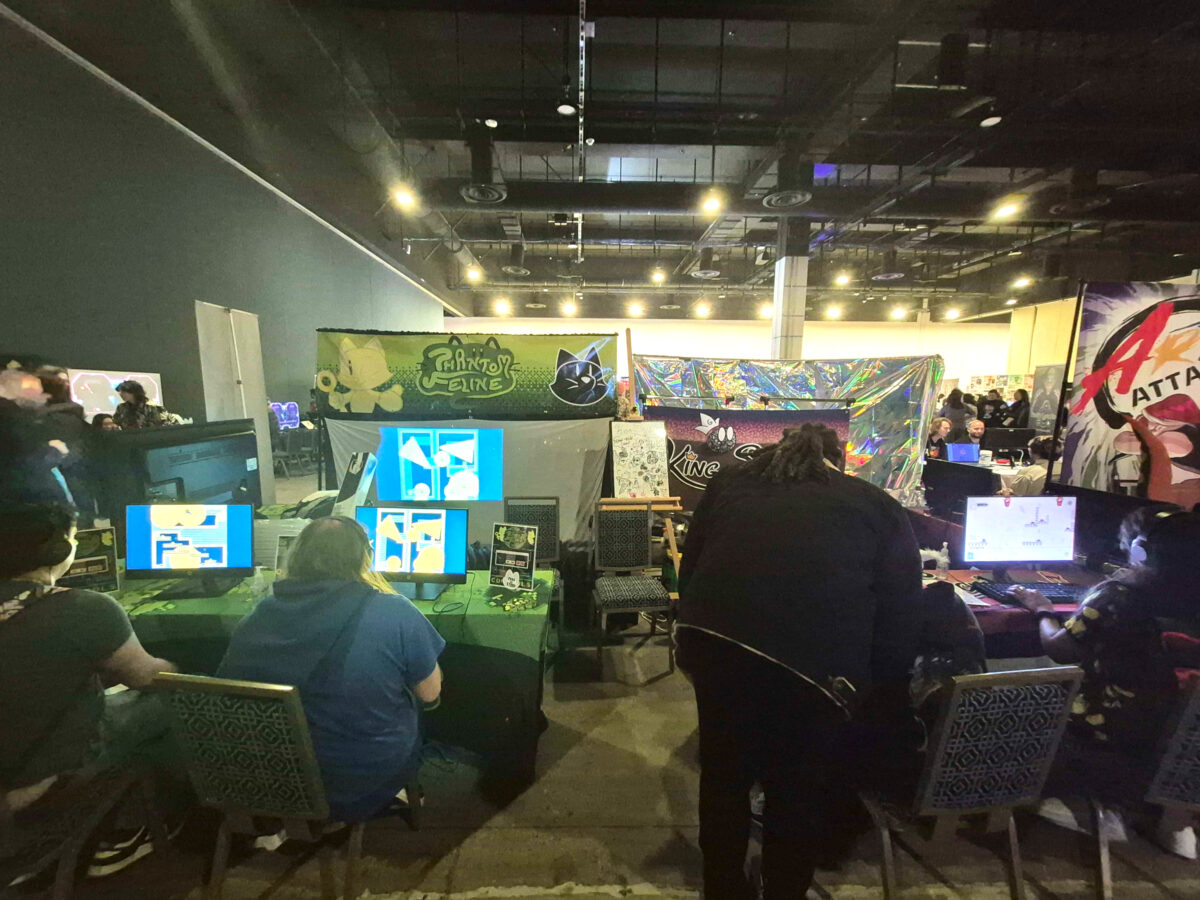 MAGFest attendees playing the games at the King Scribble and Phantom Feline booths. Seeing people play the games is “what meant the most to us as presenters at MAGFest,” McRae says. (Photo courtesy of McRae)
]]>
Two Retriever-led video game design teams were selected to present their games at Super MAGFest (short for “Music And Gaming Festival”), one of the largest and most prominent fan-driven festivals...
https://umbc.edu/stories/video-game-design-teams-at-magfest/
https://my3.my.umbc.edu/api/v0/pixel/news/156651/guest@my.umbc.edu/048db872ca6c370a5021fe36d99cdf44/api/pixel
cahss
coeit
community
csee
inds
music
news
science-and-tech
story
visual-arts
UMBC News & Magazine
https://my3.my.umbc.edu/groups/umbc-news-magazine
https://assets1-my.umbc.edu/system/shared/avatars/groups/000/001/943/24435aa6207c452e7bc15cc74b42c7bb/xsmall.png?1748556657
https://assets1-my.umbc.edu/system/shared/avatars/groups/000/001/943/24435aa6207c452e7bc15cc74b42c7bb/original.png?1748556657
https://assets2-my.umbc.edu/system/shared/avatars/groups/000/001/943/24435aa6207c452e7bc15cc74b42c7bb/xxlarge.png?1748556657
https://assets2-my.umbc.edu/system/shared/avatars/groups/000/001/943/24435aa6207c452e7bc15cc74b42c7bb/xlarge.png?1748556657
https://assets3-my.umbc.edu/system/shared/avatars/groups/000/001/943/24435aa6207c452e7bc15cc74b42c7bb/large.png?1748556657
https://assets1-my.umbc.edu/system/shared/avatars/groups/000/001/943/24435aa6207c452e7bc15cc74b42c7bb/medium.png?1748556657
https://assets2-my.umbc.edu/system/shared/avatars/groups/000/001/943/24435aa6207c452e7bc15cc74b42c7bb/small.png?1748556657
https://assets1-my.umbc.edu/system/shared/avatars/groups/000/001/943/24435aa6207c452e7bc15cc74b42c7bb/xsmall.png?1748556657
https://assets2-my.umbc.edu/system/shared/avatars/groups/000/001/943/24435aa6207c452e7bc15cc74b42c7bb/xxsmall.png?1748556657
UMBC News & Magazine
7
0
false
Tue, 17 Feb 2026 08:19:21 -0500
Tue, 17 Feb 2026 08:19:21 -0500
Submersive Subversive Art
MAGFest attendees playing the games at the King Scribble and Phantom Feline booths. Seeing people play the games is “what meant the most to us as presenters at MAGFest,” McRae says. (Photo courtesy of McRae)
]]>
Two Retriever-led video game design teams were selected to present their games at Super MAGFest (short for “Music And Gaming Festival”), one of the largest and most prominent fan-driven festivals...
https://umbc.edu/stories/video-game-design-teams-at-magfest/
https://my3.my.umbc.edu/api/v0/pixel/news/156651/guest@my.umbc.edu/048db872ca6c370a5021fe36d99cdf44/api/pixel
cahss
coeit
community
csee
inds
music
news
science-and-tech
story
visual-arts
UMBC News & Magazine
https://my3.my.umbc.edu/groups/umbc-news-magazine
https://assets1-my.umbc.edu/system/shared/avatars/groups/000/001/943/24435aa6207c452e7bc15cc74b42c7bb/xsmall.png?1748556657
https://assets1-my.umbc.edu/system/shared/avatars/groups/000/001/943/24435aa6207c452e7bc15cc74b42c7bb/original.png?1748556657
https://assets2-my.umbc.edu/system/shared/avatars/groups/000/001/943/24435aa6207c452e7bc15cc74b42c7bb/xxlarge.png?1748556657
https://assets2-my.umbc.edu/system/shared/avatars/groups/000/001/943/24435aa6207c452e7bc15cc74b42c7bb/xlarge.png?1748556657
https://assets3-my.umbc.edu/system/shared/avatars/groups/000/001/943/24435aa6207c452e7bc15cc74b42c7bb/large.png?1748556657
https://assets1-my.umbc.edu/system/shared/avatars/groups/000/001/943/24435aa6207c452e7bc15cc74b42c7bb/medium.png?1748556657
https://assets2-my.umbc.edu/system/shared/avatars/groups/000/001/943/24435aa6207c452e7bc15cc74b42c7bb/small.png?1748556657
https://assets1-my.umbc.edu/system/shared/avatars/groups/000/001/943/24435aa6207c452e7bc15cc74b42c7bb/xsmall.png?1748556657
https://assets2-my.umbc.edu/system/shared/avatars/groups/000/001/943/24435aa6207c452e7bc15cc74b42c7bb/xxsmall.png?1748556657
UMBC News & Magazine
7
0
false
Tue, 17 Feb 2026 08:19:21 -0500
Tue, 17 Feb 2026 08:19:21 -0500
Submersive Subversive Art
While many know that Charm City is home to the wizard of weird himself, John Waters, along with the quirky American Visionary Art Museum, poodle skirts, and flamingos galore, most probably don’t associate UMBC with the same offbeat reputation. But take a splash in the wacky waters and you’ll find Retrievers all the way down.
By Janelle Erlichman Diamond
It’s a few minutes into her Fluid Movement water ballet scene, and while most of the swimmers have dropped the red cloaks that hid their bathing suits—a nod to The Handmaid’s Tale—and slipped into the pool as Madonna’s “Like a Prayer” plays on the speaker, Delana Gregg stands alone. As the song reaches its crescendo—“let the choir sing”—Gregg, still in her red cape, falls dramatically backward into the water as the audience gasps and cheers.
Gregg, M.S. ’04, Ph.D. ’19, has worked at UMBC for more than 20 years and is currently the assistant vice provost for Undergraduate Academic Affairs, working with the Academic Success Center and with data and analytics supporting student success. But her summers are filled with swimsuits, glitter, and choreography sheets.
Fluid Movement is a Baltimore-based nonprofit performance art organization that creates joyful, inclusive, quirky, and accessible performances in public spaces, most notably their annual synchronized swimming shows in city pools. “Our art is a love letter to the city of Baltimore and its residents,” says Ashley Ball, Fluid Movement artistic director. “We focus on inclusivity and the empowerment that comes from movement.”
Baltimore City’s commitment to the quirk is well documented, but you might be more surprised to learn that UMBC may be one of the best breeding grounds for pursuing and creating non-traditional art. (John Waters, the kinky, eccentric, famous Baltimore-based filmmaker, writer, and artist known as the “Pope of Trash,” borrowed UMBC film equipment to make some of his early films.) UMBC, a school with an R1 classification for its high level of research and known by a national audience perhaps for the immensely successful STEM-focused Meyerhoff Scholars Program or the 2018 NCAA men’s basketball upset, has a long history of stirring the artistic pot—and current Retrievers play an active role in the weird and inclusive art world of Charm City.
Water ballet get STEAM-y

Photos by Erik Whipple
Gregg swam in her very first water ballet in 2014—Star Spangled Swimmer—and has starred in, stage managed, or produced almost every ballet since including her role as a fatberg in Sinkholes, Sewers, & Streams: A Water Infrastructure Ballet. This past summer she added directing to her repertoire with The Handmaid’s Tale scene in the Dive Into Banned Books: A Water Ballet of Resistance and Joy performance.
That her love for theatrics and performance might be nurtured at a school that has earned a national reputation for excellence in STEM education is not a surprise to Gregg. “Art and design are in everything, and you can’t have theatre without science and technology,” she says. Anyone who has ever built a set or mixed music can attest to that. “Performance is the ultimate interdisciplinary project, and community performance allows for all the different talents to find expression. You know how to sculpt, sew, run cable, create a program, design a logo, write a script, plan a budget, figure out how to create a waterproof, lightweight, affordable set design that can fit in a storage pod—so much geometry and engineering—we need all of those talents, along with sparkle.”
Ball, the artistic director, comes from a STEM background and has her master’s degree in environmental engineering. “People in STEM need art just as much as anyone else, and a Fluid Movement show is nothing short of an engineering marvel,” she says.
And it’s clear that this is a draw for Retrievers. “I’ve met so many UMBC people via Fluid Movement: former board members like visual arts professor Timothy Nohe and Kelly Quinn—people who are committed to creating art in Baltimore with people in our communities. UMBC alumni who live in the area, like Amelia Meman ’15; Maria Blanca, M.A. ’15; and Charlotte Keniston, M.F.A. ’14, Ph.D. ’24—it was so great to work with them at UMBC and to create art with them in Baltimore City. Other amazing artists, like Ann Tabor ’03 of the Mercury Theater, I met through Fluid Movement and realized the UMBC connection later,” says Gregg.
“People are validated by seeing people of all shapes and sizes and ages and ethnicities performing. My performing at age 60-plus as a full-figured, African American woman is affirming to many people in our audiences.”
— Judith “Judi” Reynolds-Stokes ’87, M.A. ’02
“I think there is something about working at a university committed to excellence that makes space for people to be excellent in many aspects of their lives,” says Quinn, managing director of The Choice Program at UMBC and a longtime Fluid Movement participant. “I’m really grateful that I have a boss who’s challenged me as part of my performance plan for this year to incorporate more of my artistic work with Fluid Movement into my leadership of our organization,” says Quinn. This next year she’s going to add “whimsy and creativity” to her storytelling. “I think that’s a testament both to Fluid Movement and my boss’s understanding of the value of arts in everyday life. People at UMBC—including our leadership—really take seriously our artistic and civic lives beyond our position descriptions.”
There’s a place in the pool for everyone
These artistic endeavors may hit the UMBC sweet spot because of the recognition that STEM and art go hand in hand, but the accessibility and inclusiveness of the programming also aligns with the Retriever spirit. “I first became acquainted with Fluid Movement while lifeguarding for Baltimore City Aquatics,” says Judith “Judi” Reynolds-Stokes ’87, M.A. ’02, who works as an instructor, advisor, and career counselor at the Caroline Center, a workforce development program for adult women. “I guarded many of their water ballet shows and loved their creativity and inclusivity. I decided that I wanted to be a swimmer in one of their shows.” Her Fluid Movement debut was in the 2019 show Fluid Movement: The Water Ballet in honor of the nonprofit’s 20th anniversary.
“I think the pull of Fluid Movement for UMBC folks is that you can be a big kid having fun dancing, swimming, and acting. You get to wear pretty costumes and outrageous makeup, and the best part is you get to bring others joy and laughter,” says Reynolds-Stokes.
Like Gregg, she loves that the quirky—in the best way possible—group brings her so much joy and affirmation. “People are validated by seeing people of all shapes and sizes and ages and ethnicities performing. My performing at age 60-plus as a full-figured, African American woman is affirming to many people in our audiences. It lets others know that they too can be in a Fluid Movement show and will be accepted just as they are,” says Reynolds-Stokes, who swims with Stephanie Johnson ’86, her aunt and a fellow UMBC alum. “I love to swim and dance and put on pretty things, so Fluid Movement is a perfect fit for me.”
Release the Kraken
The American Visionary Art Museum, adjacent to the Inner Harbor, is another incubator of Baltimore quirk. The distinctive landmark and home to Fifi, a 15-foot pink poodle on wheels, is dedicated to the preservation and display of outside art and features the work of self-taught artists. (Retriever Jess Owens-Young ’08, political science, recently showed her sports-inspired work in the museum’s galleries.) That includes the Kinetic Sculpture Race, for which teams build and pedal works of art for eight hours on Baltimore City streets, including a foray into the Baltimore Harbor.
In 2011, Steven McAlpine, assistant teaching professor in the Individualized Study Program (INDS), was at the race, as a casual observer with his son. “Dad, can we build one of these?” he asked in awe. McAlpine had also been blown away by both the artistry of the floats and the physical effort of the 15-mile human-powered, all-terrain race for custom-built amphibious sculptures. McAlpine was trying to figure out how he could construct a 12-foot high and 30-foot-long creature at his house when he had a lightbulb moment—the answer was UMBC.
In 2014, McAlpine started the Kinetic Sculpture Project, an interdisciplinary applied learning experience funded by the Alex. Brown Center for Entrepreneurship and UMBC community engagement organization BreakingGround. Students from INDS, mechanical engineering, computer engineering, visual art, psychology, geography and environmental systems, and mathematics all came together to design, build, and race the Kraken Upcycle in the 2015 race. “You need all those perspectives and disciplines to be that innovative,” says McAlpine.
In the 400-level class, students studied sustainable design methods and use of recycled materials (including plastic bottles and barrels as well as reclaimed metal and wood) that would often involve McAlpine dumpster diving—especially after the theatre department broke down a set.
“I wanted to explore something less traditional, where I could express new, wacky ideas and merge creativity with engineering.”
—Michael Webb, computer engineering student

Top and bottom photos courtesy of Steve McAlpine; Middle photo by Poulomi Banerjee ’16, M.P.P. ’21
That very first year UMBC’s team was awarded the “Grand Mediocre East Coast Champion,” and in the 10 years since, more than 100 students have passed through the class. Last year UMBC teamed up with a disability advocacy organization and took home the “Best Art Award” for IMAGE Man—in which a larger-than-life teal superhero sits in a wheelchair with a football in hand, flying over some of Baltimore’s iconic buildings, such as the Bromo Seltzer Arts Tower and the Baltimore World Trade Center.
Of all the years UMBC has participated, McAlpine was especially proud of this one since it showed “the beauty of an infusion of a new partnership,” that, like the water ballet, also underscored UMBC’s commitment to accessibility for all.
“It’s a lot of work—but unconventional art that leans a little offbeat and weird is never all work because it’s playful too,” says McAlpine. “I think it’s absolutely essential for education to feel thrilling and full of discovery and adventure.”
An Out-of-the-Ordinary Spectacle
Dulcey Comeau, a sophomore computer engineering student, participated in the 2025 race with IMAGE Man. “The race day was super cool; we woke up early to get our capes and our helmets, and we spent some of the morning talking to people who wanted to know more about the float,” says Comeau. “It was a cool experience to have people cheering you along all throughout Baltimore,” she says. The race started a bit rocky—they were having some issues with the brakes—but once they were fixed, it was smooth sailing.
“Part of the race is to ride through the mud and I remember getting stuck, and it was so fun to be pushed up the hill through the rest of it,” she says. “Usually as engineers, we create something for a very specific reason with specific standards for the customer, so it was cool to create something for ourselves and really see the full engineering cycle. The opportunity to have creative freedom with such little specifications made the project that much more enjoyable, and I was able to find the fun in being an engineer again.”
Michael Webb had a similar experience. “As a computer engineering student, I was initially drawn to STEM-related clubs and activities like Baja SAE and UMBC’s chapter of American Institute of Aeronautics and Astronautics. Those organizations are incredible for hands-on experience, but they tend to be more formulaic, focused on refining and improving designs from past generations,” the sophomore says. He wanted something a little more left-field and subversive. “I wanted to explore something less traditional, where I could express new, wacky ideas and merge creativity with engineering.”
The Kinetic Sculpture Race, like Fluid Movement, is a perfect blend of the new iteration of STEM—one that includes art with an emphasis on off-the-wall—and it’s in that combination that UMBC excels. The UMBC team and faculty Webb ended up working alongside helped challenge some of his established systems and beliefs and consider alternative perspectives.
“The Kinetic Sculpture Race is unlike anything I had ever seen before,” says Webb. “It was fun, quirky, and completely different from the structured world of engineering I’m used to. The whole event is just for fun, and the sculptures people bring in are absolutely wild: a giant poodle, giant alligators, even a platypus with a differential axle. The rules are just as wacky—you can even bribe the judges.”
It was the wake-up he needed. “In engineering, the goal is usually performance and efficiency,” he says. But in the Kinetic Sculpture Race, the goal is simply to make something imaginative and have fun trying to race it. “It’s messy, unpredictable, and just laughs; a reminder that engineering and art can come together and be creative, ridiculous, and fun at once.”
]]>
While many know that Charm City is home to the wizard of weird himself, John Waters, along with the quirky American Visionary Art Museum, poodle skirts, and flamingos galore, most probably don’t...
https://umbc.edu/stories/submersive-subversive-art/
https://my3.my.umbc.edu/api/v0/pixel/news/155083/guest@my.umbc.edu/be5fc6058db751a75e902259d83cf09c/api/pixel
baltimore-city
cahss
coeit
computer-engineering
fall-2025
impact
inds
magazine
story
UMBC News & Magazine
https://my3.my.umbc.edu/groups/umbc-news-magazine
https://assets1-my.umbc.edu/system/shared/avatars/groups/000/001/943/24435aa6207c452e7bc15cc74b42c7bb/xsmall.png?1748556657
https://assets1-my.umbc.edu/system/shared/avatars/groups/000/001/943/24435aa6207c452e7bc15cc74b42c7bb/original.png?1748556657
https://assets2-my.umbc.edu/system/shared/avatars/groups/000/001/943/24435aa6207c452e7bc15cc74b42c7bb/xxlarge.png?1748556657
https://assets2-my.umbc.edu/system/shared/avatars/groups/000/001/943/24435aa6207c452e7bc15cc74b42c7bb/xlarge.png?1748556657
https://assets3-my.umbc.edu/system/shared/avatars/groups/000/001/943/24435aa6207c452e7bc15cc74b42c7bb/large.png?1748556657
https://assets1-my.umbc.edu/system/shared/avatars/groups/000/001/943/24435aa6207c452e7bc15cc74b42c7bb/medium.png?1748556657
https://assets2-my.umbc.edu/system/shared/avatars/groups/000/001/943/24435aa6207c452e7bc15cc74b42c7bb/small.png?1748556657
https://assets1-my.umbc.edu/system/shared/avatars/groups/000/001/943/24435aa6207c452e7bc15cc74b42c7bb/xsmall.png?1748556657
https://assets2-my.umbc.edu/system/shared/avatars/groups/000/001/943/24435aa6207c452e7bc15cc74b42c7bb/xxsmall.png?1748556657
UMBC News & Magazine
1
0
false
Thu, 04 Dec 2025 14:42:41 -0500
Thu, 04 Dec 2025 14:42:41 -0500
The molecular storyteller: How Cameron Slayden ’99 advances science through animation
Inside the dark, swirling chaos of a cell, drama unfolds. A viral molecule, rendered in electric blue and menacing curves, attempts its invasion. A therapeutic compound swoops in to intercept it like a fighter jet defending its home from alien forces. This is not science fiction; it is the meticulously crafted vision brought to life by Cameron Slayden ’99, interdisciplinary studies, founder, CEO, and creative director at Microverse Studios.
Slayden’s team of animators specializes in creating detailed, stunning visuals for biotech, pharmaceutical, and medical device companies, illustrating how their technologies operate at the most granular level—on a cellular and molecular scale. “We never copy other people,” says Slayden. Instead, his team embraces metaphor—visualizing neurons as jellyfish tentacles or lightning bolts—and superimpose that artistic aesthetic onto the scientific imagery.
It’s not enough for Slayden to just be a 3D animator. He also needs to fully understand the science—satisfying practicing scientists with his two-minute animation while compelling venture capitalists to invest millions. “I have to balance clarity of message to reach multiple levels of audience with enough accuracy so that the underlying message is unimpeachable,” says Slayden.
This is a video animation Microverse Studios recently completed for Excellergy, a biotechnology company developing a first-in-class portfolio of trifunctional effector cell response inhibitors (ECRIs) to combat severe allergic diseases and help improve patient quality of life.
This unique balance of artistic flair and scientific rigor is the direct result of a path galvanized over three decades ago. For his pioneering work in scientific visualization, combining the rigorous inquiry of science with the persuasive power of art, Slayden is being recognized with an Outstanding Alumni award at the 2025 UMBC Alumni Awards on Wednesday, October 29. His career exemplifies the interdisciplinary spirit UMBC fosters, proving that to truly understand the world, one must be able to both analyze it like a scientist and appreciate it like an artist.
Illustrations have more value than just beauty
 Slayden holding a microscope.
Even as a 16-year-old student at Suitland High School in Prince George’s County, Maryland, Slayden was already balancing his passion for art with his love of science—but he had yet to discover how the two intertwined. At this time, Slayden had won multiple Gold Key awards, the highest regional prize in the Scholastic Art and Writing Awards, a competition for students in grades 7-12, which, he admits, had given him a “hugely inflated ego.” Then, during one biology class, inspiration struck while studying chloroplasts, the organelles in plant cells that are responsible for photosynthesis.
“The illustration in the textbook was awful, really ridiculous, extremely simplified,” says Slayden.
Next to the illustration, however, was a cross-section of the cell created from a tunneling electron microscope, which creates images at an extremely small scale, down to resolving individual molecules. Immediately, Slayden began to notice differences between the illustration and the tunneling electron micrograph. That’s when his pencil got to work. He began to sketch a more detailed illustration of the chloroplast that better represented the intricate details of the organelle.
“When I was done with that drawing, I remember realizing that that illustration had more value than just being pretty,” says Slayden. “It carried real information about the world, and it was valuable to humanity in that way. And at that moment, I realized that was the kind of art that I wanted to do.”
The rest of Slayden’s life would be guided by that moment. From then on, he used every opportunity to hone his craft—to envision how each tiny detail would translate to paper.
“When you’re drawing something, you’re bringing it through your visual cortex and through all of the processing,” explains Slayden. “Your brain is creating a three-dimensional model of the object in your head, and then you’re bringing it out through your motor cortex onto the paper. You come away with a much deeper understanding of the thing that you were just drawing.”
Fruitful friction
Around the same time Slayden was looking into colleges, something big was happening at UMBC. Earl and Darielle Linehan, with a deeply held belief in the importance of the arts in society, had recently made a generous gift to the university to establish the Linehan Artist Scholars Program. Slayden applied in the program’s inaugural year and was then offered a full ride to UMBC as one of the first cohort of Linehan Artist Scholars.
Slayden seized the opportunity, working with his advisor, Stephen Bradley, to craft an interdisciplinary course load that seamlessly merged UMBC’s stellar biology program with the visual arts curriculum. While the science courses provided the foundational accuracy, it was the friction in the art program that proved transformative.
“There was an artistic journey that I had to go through,” says Slayden. “UMBC’s art program forced me to dig deep and crack open my inner reservoirs of creativity and start to actually explore producing an emotional response in my audience.”
Today, that emotional engagement is the key to the success of Microverse Studios, transforming dry scientific information into a memorable, persuasive story. However, the greatest impact UMBC had on Slayden and his career was not a class or a professor, but a fellow student—Olivia Rogers ’99, psychology—now Olivia Slayden, his wife.


Photos above: Slayden and Adam Mueller ’02, M.S. ’03, at the UMBC Jiu-Jitsu club, which he helped found in 1999. Slayden is a black belt in Brazilian Jiu-Jitsu and a second-degree black belt in Japanese Jiu-Jitsu (left). Slayden and Olivia Rogers, now Olivia Slayden, at Cameron’s graduation (right).
Following graduation, Slayden got a job doing medical illustrations for legal cases, but found the work to be “too dark and draining.” He eventually landed the role of scientific illustrator at Science Magazine, creating medical illustrations for the publication and designing a dozen magazine covers. However, after three years, he realized, “I wasn’t at the top of my game.” At the same time, Olivia was also unhappy with her job. It was time for a change.
After Slayden received his master’s degree in medical illustration from Augusta University in Georgia, he and Olivia founded Microverse Studios in 2005. Cameron serves as CEO and creative director, while Olivia serves as chief commercial officer.
When you’re drawing something, you’re bringing it through your visual cortex and through all of the processing. Your brain is creating a three-dimensional model of the object in your head.
Cameron Slayden '99
“I had no idea what I was doing running a business,” says Slayden. “And in the intervening 20 years, I think I’ve kind of finally figured it out, at least for the most part.”
Leaning into new tech
Today, Microverse Studios is a full-service scientific and medical animation studio serving high-profile clients like Pfizer, National Geographic, Bausch + Lomb, and the Howard Hughes Medical Institute (HHMI) as well as notable startups like Elon Musk’s Neuralink. Slayden and his team specialize in taking an idea and turning it into a deployment-ready video for a wide range of audiences, from research scientists to investors and venture capitalists, as well as healthcare providers.
Slayden attributes the studio’s success to their commitment to staying on top of science and new animation technology. The shift to cloud rendering means complex, high-quality animation that once took a week to output can now be rendered in “literally an hour.” Slayden also believes artificial intelligence will continue to play a larger role in the studio’s work. Rather than viewing it as a threat, he sees AI as another tool at his disposal—the next evolution in how artists create their work.
Mark your calendars for the 2025 Alumni Awards on Wednesday, October 29, at 6 p.m., and consider joining the UMBC community at the Chesapeake Employers Insurance Arena to celebrate Cameron Slayden and the many remarkable individuals receiving awards. The event will be livestreamed for those unable to join in person. You can learn more at alumni.umbc.edu/alumniawards.
]]>
Inside the dark, swirling chaos of a cell, drama unfolds. A viral molecule, rendered in electric blue and menacing curves, attempts its invasion. A therapeutic compound swoops in to intercept it...
https://umbc.edu/stories/meet-cameron-slayden-science-animation/
https://my3.my.umbc.edu/api/v0/pixel/news/153784/guest@my.umbc.edu/7ca09a8eb995ebeac144267240a4f2a0/api/pixel
alumni
alumni-awards
animation
cahss
cameron-slayden
inds
linehan-artist-scholar
magazine
psychology
story
visual-arts
UMBC News & Magazine
https://my3.my.umbc.edu/groups/umbc-news-magazine
https://assets1-my.umbc.edu/system/shared/avatars/groups/000/001/943/24435aa6207c452e7bc15cc74b42c7bb/xsmall.png?1748556657
https://assets1-my.umbc.edu/system/shared/avatars/groups/000/001/943/24435aa6207c452e7bc15cc74b42c7bb/original.png?1748556657
https://assets2-my.umbc.edu/system/shared/avatars/groups/000/001/943/24435aa6207c452e7bc15cc74b42c7bb/xxlarge.png?1748556657
https://assets2-my.umbc.edu/system/shared/avatars/groups/000/001/943/24435aa6207c452e7bc15cc74b42c7bb/xlarge.png?1748556657
https://assets3-my.umbc.edu/system/shared/avatars/groups/000/001/943/24435aa6207c452e7bc15cc74b42c7bb/large.png?1748556657
https://assets1-my.umbc.edu/system/shared/avatars/groups/000/001/943/24435aa6207c452e7bc15cc74b42c7bb/medium.png?1748556657
https://assets2-my.umbc.edu/system/shared/avatars/groups/000/001/943/24435aa6207c452e7bc15cc74b42c7bb/small.png?1748556657
https://assets1-my.umbc.edu/system/shared/avatars/groups/000/001/943/24435aa6207c452e7bc15cc74b42c7bb/xsmall.png?1748556657
https://assets2-my.umbc.edu/system/shared/avatars/groups/000/001/943/24435aa6207c452e7bc15cc74b42c7bb/xxsmall.png?1748556657
UMBC News & Magazine
1
0
false
Tue, 21 Oct 2025 15:53:01 -0400
Tue, 21 Oct 2025 15:53:01 -0400
Sherman Hall’s Phase 1 renovation is complete, creating space for creative collaboration
The west wing of George and Betsy Sherman Hall is open to students and staff again after 18 months undergoing extensive renovations and modernizations. While the renovation on the building’s east wing (adjacent to Academic Row) begins in earnest this semester, west wing residents are settling into their colorful and versatile office set ups and classroom spaces.
Walking into the Sherman Hall atrium, a floating staircase dominates the entryway, but if you take a right and a left and walk past a few brightly colored sitting areas, you’ll find the new offices of Division of Undergraduate Academic Affairs (UAA) and Academic Transition Programs. It’s no longer just the offices of ATP, it’s now also home to the Individualized Study Program (INDS) and the University Innovation Alliance (UIA) as well.
Relocation inspires collaboration
With this exciting new phase for campus, comes disruptions to some normal operations. Laila Shishineh, a new resident in Sherman Hall’s office suites, and the assistant vice provost and assistant dean for UAA, understands the disruption better than most. Shishineh and her team were relocated two years ago because of the renovations to temporary offices that were shared with them by the Academic Success Center. Now as they settle into their new office space—shared with two offices who await their new space in the east wing—Shishineh celebrates the infrastructural improvements and also the new opportunities for collaboration that weren’t possible before.


 Laila Shishineh’s new office in Sherman Hall, overlooking the east wing and the under-construction courtyard. (Tanzila Malik/UMBC)
Under a plan developed by Shishineh alongside Facilities Management, ATP, UIA, and INDS, the new suite space in Sherman Hall’s west wing will be shared by these offices, with hoteling space available for days when employees overlap. This collaboration of 17 people allows flexibility for people to work in the office some days and work from home on other days.
This physical proximity to other departments allows for unique opportunities of collaboration between them. “It’s so nice to have a suite space,” says Shishineh. ”People get to build new relationships and support each other in different ways as opposed to just being ‘doors in a hallway’ somewhere on campus.”

 (Left to right): INDS uses the new conference space for a team meeting; Shishineh speaks with members of Facilities Management about shared space use. (Tanzila Malik, Kayla Logue/UMBC)
As a former resident assistant in college, Shishineh thought of creating an office-mate agreement, based on the concept of a roommate agreement. Across the three departments, people were paired up based on schedule, personalities, and types of roles. A meet and greet was held so everyone could get to know their officemate, and outline an agreement. The agreements include everything from what days each person is working in the office or from home, to how much shelf space they each get.
Student-centered design
 Shared office of Tim Olivella (ATP) and Jose Arenas Gómez (INDS). (Kayla Logue/UMBC)
The new physical structure of Sherman Hall not only allows for more collaboration among the faculty and staff working there, but also for students. A noticeable difference in the layout is the student-centered design: with plenty of collaborative spaces including lounges, conference/study rooms, vending machines, and TVs broadcasting events happening on campus.
“I hope it becomes a place where students come not just for classes, but to hangout, study, and congregate,” says Shishineh. Improvements have also been made to make wayfinding easier in Sherman Hall, since the two wings make some things difficult to find. New signage, room numbering, general space layouts and color-coding help everyone more easily find their way to the other occupied offices in the west wing, including the George and Betsy Sherman Center, which is home to the umbrella of programs that help train up teachers in urban schools that will transform lives in the communities they serve.
A feature to look forward to is the courtyard between the east and west wings of Sherman Hall. This multi-tiered green space with new ramps and stairs will provide gathering places and outdoor classroom opportunities at each level when the entire renovation is complete.
Construction and cost, with a mind for sustainability
At the beginning of the project, UMBC evaluated tearing down Sherman Hall and rebuilding it, versus a significant renovation. It was determined that the structure was still very solid and the cost of a new structure could be as much as 40 percent of the cost of a building, says Stacy Brian, the Facilities Management project manager for the renovation. By renovating instead of starting new, money was saved on excavation, underground utilities to serve the building, new foundations, new steel structure, new stair and elevator shafts and new floor slabs, and more.
But to complete the job, Sherman Hall needed to be gutted down to the bones of the building, with only concrete floor slabs and steel structure remaining. Just about everything else is brand new, says Brian: New elevators, HVAC systems, plumbing, electrical, walls, ceilings, roof, fire alarm and protection systems, finishes, IT/AV, etc.


 Renderings courtesy of Facilities Management show the linked lobby addition with student lounge and study spaces, Sherman Hall’s updated lecture hall, student lounge and study/waiting area between classes; and the outdoor terrace courtyard.
Besides the bottom-line cost, there were more considerations for taking on the renovation. Believe it or not, but “tearing this building down completely in the heart of campus would also have been much more disruptive than what we are experiencing now,” says Brian.
The campus utility tunnel wraps all around Sherman Hall, so a significant amount of money would have been spent on protecting the tunnel so that heating, cooling, and power across all of campus wouldn’t be disrupted.
 Faculty and staff gather together in advance of Homecoming at the new entryway of Sherman Hall. (Brad Ziegler/UMBC)
There were also considerations regarding the environmental sustainability of the project. “It was definitely ‘greener’ (more sustainable) to use as much existing structure as possible to save those items from the landfill, the generation of more embedded carbon, etc.,” says Brian.
Additionally, Sherman Hall is now much more energy efficient, greatly reducing not only UMBC’s carbon footprint but also saving money on utilities. These savings can provide UMBC the opportunity to spend that money on other important upgrades across the campus. Some of the new features include much larger windows, which bring more daylight into the rooms. Students, staff, and faculty can all benefit from more daylight for their mental health and general well-being.

 Renderings from Facilities Management show Sherman Hall’s new front entrance opposite the University Center, rendering of Sherman Hall as viewed from Math/Psych.
“This project has been a shining example of how all of the different departments from many different UMBC divisions can come together and accomplish a very difficult task,” says John Zahor, assistant vice president for Facilities Management.
From sharing offices, providing earbuds to get through the noise of construction, and putting up with all the other disruptions necessary for a project like this, Zahor says that the building’s returning occupants have remained open and flexible, and that’s made all the difference. Zahor says without the cooperation of many folks across campus, an already difficult task would have been impossible. Thanks to Craig Goodwin, the director of design and construction, Molly Power, UMBC’s campus planner in charge of the temporary space planning and Elyse Clegg, manager of facilities support services, and Joe Washington, moving/logistics coordinator and the student workforce supervisor, “This was a job well done,” says Zahor.
“We hope to be done by the beginning of the 2027 spring semester to give this wonderful building back to the campus community without fences and temporary signs, ready for full use,” says Zahor.
]]>
The west wing of George and Betsy Sherman Hall is open to students and staff again after 18 months undergoing extensive renovations and modernizations. While the renovation on the building’s east...
https://umbc.edu/stories/sherman-halls-phase-1-renovation-complete/
https://my3.my.umbc.edu/api/v0/pixel/news/153433/guest@my.umbc.edu/b1ffa191e6fb30e03fadfc32cdfe3b55/api/pixel
community
inds
news
sherman-hall
staff
story
sustainability
UMBC News & Magazine
https://my3.my.umbc.edu/groups/umbc-news-magazine
https://assets1-my.umbc.edu/system/shared/avatars/groups/000/001/943/24435aa6207c452e7bc15cc74b42c7bb/xsmall.png?1748556657
https://assets1-my.umbc.edu/system/shared/avatars/groups/000/001/943/24435aa6207c452e7bc15cc74b42c7bb/original.png?1748556657
https://assets2-my.umbc.edu/system/shared/avatars/groups/000/001/943/24435aa6207c452e7bc15cc74b42c7bb/xxlarge.png?1748556657
https://assets2-my.umbc.edu/system/shared/avatars/groups/000/001/943/24435aa6207c452e7bc15cc74b42c7bb/xlarge.png?1748556657
https://assets3-my.umbc.edu/system/shared/avatars/groups/000/001/943/24435aa6207c452e7bc15cc74b42c7bb/large.png?1748556657
https://assets1-my.umbc.edu/system/shared/avatars/groups/000/001/943/24435aa6207c452e7bc15cc74b42c7bb/medium.png?1748556657
https://assets2-my.umbc.edu/system/shared/avatars/groups/000/001/943/24435aa6207c452e7bc15cc74b42c7bb/small.png?1748556657
https://assets1-my.umbc.edu/system/shared/avatars/groups/000/001/943/24435aa6207c452e7bc15cc74b42c7bb/xsmall.png?1748556657
https://assets2-my.umbc.edu/system/shared/avatars/groups/000/001/943/24435aa6207c452e7bc15cc74b42c7bb/xxsmall.png?1748556657
UMBC News & Magazine
2
0
false
Thu, 09 Oct 2025 13:27:56 -0400
Thu, 09 Oct 2025 13:27:56 -0400
Who is “Fulbright material”? UMBC’s six 2025 – 2026 Fulbright U.S. Student Program recipients share their not-so-secret recipe for success
Alyssa Thomas is more of an “and” person than an “or” person. Growing up in a military family stationed in Florida, Thomas learned flexibility, a sense of curiosity, and a “Why not?” approach to life. So when Shin Yon Kim, assistant teaching professor of Asian studies, encouraged her to apply to the U.S. Fulbright Student Program during her junior year, Thomas was skeptical. “I decided to give it a try, but I didn’t think I’d get very far because I had never studied abroad,” said Thomas. “And then Dr. Kim said, ‘I need you to start believing in yourself and actually push yourself to apply for it.'” Those words of encouragement stuck with her. Thomas took her own advice and said, “Why not?”
Thomas ’25, Asian studies, ended her summer by moving to Taipei, Taiwan, where she is already working as a Fulbright English Teaching Assistant. She hopes her rudimentary Mandarin will help her learn Taiwanese Mandarin and the various dialects while she’s there. “There’s a big difference between learning in the classroom and in person. Accents, tempo, and slang are elements of Mandarin I’ve yet to adjust to,” says Thomas.

Retriever advice from Alyssa Thomas ’25
U.S. Fulbright Student Program
English Teaching Assistant, Taipei, Taiwan
“It’s important to learn how to manage your stress, especially if you have never traveled abroad or applied for a Fulbright. For me, it’s morning walks. Find what works for you—whether it’s journaling or therapy—to help manage the unexpected.”
Deciding to apply for a Fulbright is only the beginning. The process usually starts with a mentor pointing the way toward Brian Souders, M.A. ’19, TESOL, and Ph.D. ’09, language, literacy, and culture, the associate director for global learning at UMBC’s Center for Global Engagement. CGE hosts Fulbright information sessions in the spring for undergraduate, graduate, and recent alumni. Retrievers can apply to earn a master’s, conduct research, or be an English Teaching Assistant in East Asia-Pacific, Europe and Eurasia, Middle East and North Africa, South and Central Asia, Sub-Saharan Africa, and the Western Hemisphere.
With three UMBC 2025 – 2026 Fulbrights already settled in Taiwan, Norway, and Indonesia, and three preparing to cross the Atlantic Ocean to Belgium, Israel, and Germany, these alumni are eager to share tips to inspire and prepare the next generations of Fulbright Retrievers.
Transforming the lives of incarcerated women
Right now, it is the beginning of fall in Bergen, Norway, where Shanika Freeman ’24 is settling in at the University of Bergen, working with faculty studying the reentry experiences of native Norwegian and non-native Norwegian women into the community after incarceration. Freeman’s individualized studies major at UMBC focused on recidivism and policy in urban communities, making Norway a perfect research location. The country’s progressive and humane approach to rehabilitation, from the point of entry into the carceral system to successful reentry, has made Norway have the world’s lowest recidivism rates. Though Baltimore and Norway are worlds apart geographically and culturally, Freeman hopes to use what she learns abroad to help transform the lives of incarcerated women in the U.S. by exploring practices that shift the focus from punishment to rehabilitation and community building.

Retriever advice from Shanika Freeman ’24
U.S. Fulbright Student Program
Research in Bergen, Norway
“Build a team. I found out about Fulbright through Dr. Brian Souders. I didn’t know anything about it before and felt like Fulbright was out of reach for me. The furthest I had traveled was to California, and that was only for a weekend. I never thought a person like me—low-income, two-time college dropout from Baltimore City—would get the opportunity to go abroad.”
Her team included the INDS faculty and her academic mentors: Tammy Henderson, associate teaching professor of Africana studies; Loren Henderson, director of the school of public policy; László Kőrössy, assistant director for academic advising, outreach, and assessment; and Eric Stokan, director of the Center for Social Science Scholarship. “I applied because the faculty encouraged me and supported my research. I knew that my research was important, and Fulbright allowed me to take it further. Applying was a bit overwhelming at times, but Dr. Souders was extremely thorough, patient, kind, and knowledgeable. My team of faculty and staff was instrumental in my development as a scholar and fostered my academic goals.”
Researching your roots
Since Eilah Goldberg ’25, history, with a Judaic studies minor, first learned about the Fulbright Program during her sophomore year, her academic goals became very clear—build a strong academic and social foundation to earn this prestigious award. Goldberg knew she wanted to study Jewish history, religion, and culture abroad. The first step was studying abroad in England at the University College London (UCL) Hebrew and Jewish studies department, with the intent of returning to earn a master’s. “When I told Dr. Souders my plan to return to London after graduation, he asked me what I really wanted to do,” says Goldberg. “I shared my deep interest in Jewish studies, and he helped me realize that I could go directly to Israel to study—that it was a real option.”

Retriever advice from Eilah Goldberg ’25
U.S. Fulbright Student Program
Master’s at Hebrew University of Jerusalem
“Stay true to yourself, your interests, passions, and intellectual curiosities. Don’t let fear stop you from traveling to places or studying topics that are personally and culturally meaningful to you. Take the opportunity to conduct firsthand research into your roots, identity, and beliefs. Lean on the support of student clubs and cultural communities, just as I did with UMBC’s Chabad and Hillel Jewish student organizations and UCL’s Jewish Student Union. It’s important to have people to encourage you and believe in you.”
Goldberg will earn a master’s in Israel Studies at the Hebrew University of Jerusalem, surrounded by her extended family in Israel, an hour away from Jerusalem. She will study the impact of American Aliyah—ascent in Hebrew—the immigration of American Jews to Israel, and how it shaped Israeli society historically, culturally, and politically.
Pre-med neurologocial research abroad
The summer before his first year at UMBC, Andrew Opincar ’25, biological sciences, mapped out a four-year plan to ensure he would complete his major requirements, gain clinical experience, and take the MCAT all before graduating. As a participant in STEM Build—a National Institutes of Health initiative focused on enhancing diversity in the biomedical and behavioral sciences workforce, Opincar was excited to explore diverse perspectives in healthcare and research. While planning for his final two years at UMBC, he took the opportunity to study abroad in Amsterdam, Netherlands, to learn about the Dutch public universal health system.

Retriever advice from Andrew Opincar ’25
U.S. Fulbright Student Program
Research at the University of Heidelberg, Germany
“For pre-med students to critically analyze the health systems around us, we need to understand systems and people different from ourselves. It’s difficult to be well-rounded physicians, scientists, or researchers when you’ve only lived in one place and had one kind of experience,” says Opincar, who, even though his mentors encouraged him to apply, was unsure if he was “Fulbright material.” “I like the sports quote, ‘You lose 100 percent of the shots you don’t take,’ so you really must take a chance on what you care about and put yourself out there.”
Now, Opincar has mapped the time between graduation and medical school to learn a new healthcare system and expand his research experience from cell migration in fruit flies to spinal cord regeneration in mouse models at Heidelberg University, Germany, a global center for molecular biology and neuroscience. He’s excited to plan for many unknowns, like exploring a new research field, becoming bilingual, and stepping outside of his comfort zone to gain more confidence personally and professionally.
Connecting with your community across borders
Law and politics have been on Navara Syed‘s mind as long as she can remember. Her political science professors, Carolyn Forestiere, Brian Grodsky, and Jeffrey Davis, fueled her passion for comparative politics, civil and human rights, and community advocacy, leading her to choose a major in political science. During her visits to Pakistan to visit family and to Thailand to study abroad, Syed began to understand the complexity and broadness of what community can mean, and is ready to embrace the community she will be part of during her Fulbright in Indonesia as an English Teaching Assistant.

Retriever advice from Navara Syed ’25
U.S. Fulbright Student Program
English Teaching Assistant
Padang, West Sumatra, Indonesia
“Dip your toes into different ponds. You never know what you will find. I’m Muslim and have never lived in a Muslim country. In the U.S., I always have to think about where to get Halal food. In Thailand, a kind person approached me and offered to show me where I could find Halal food. Our tour guide even made sure to include Halal restaurant options.
Indonesia is a Muslim country, so spending Ramadan and other major Muslim holidays without needing to explain them or figure out how to participate in them is a dream come true. No experience is a waste—it’s just as important to realize what you don’t like as it is to discover what you do.”
Since graduating in May, these connections, along with her time in Mock Trial, the Muslim Student Association, and the student events board, continue to plant seeds of possibilities for her future in the field of law, whether as a judge, legislator, professor, or advocate.
Intersectional approach to flood mitigation
Daniel Douglas ’21, global studies, M.P.P. ’24, public policy, a current Ph.D. student, has been clear about his career path since his undergraduate years, when he began researching environmental policy focused on disaster mitigation and natural hazards. As a Fulbright recipient, he is now taking his expertise to the international level in Antwerp, Belgium.

Retriever advice from Daniel Douglas, Ph.D. student
U.S. Fulbright Student Program
Research at University of Antwerp, Belgium
“In every single field of study at UMBC, you can identify a way to apply your work for the common good. Find and seek your purpose above all else. This is especially important today when research and academia are being challenged. Now, we all have to uplift goodness, justice, and each other. And most of all, we can’t give up hope. I try my best to uplift those around me, knowing and trusting that they are pushing me forward to new heights.”
At the University of Antwerp, Douglas will conduct research on Belgium’s Sigma Plan—the primary flood mitigation plan along the Scheldt River Valley in Flanders, Belgium. Originally launched in 1977 as a single-purpose safety plan, it has since evolved to manage flood protection with nature conservation, recreation, and the needs of shipping and agriculture. This intersectional approach to flood mitigation is Douglas’s passion. He plans to build on his skill set in Belgium, then bring this newfound knowledge back to UMBC to complete his doctorate, and help communities worldwide—including Ellicott City—reduce the disastrous impacts of environmental hazards through disaster prevention, mitigation, and governance.
Learn more about UMBC’s Center for Global Education.
All photos by Brad Ziegler/UMBC, with the exception of Shanika Friedman’s, courtesy of INDS, and Daniel Douglas, courtesy of Douglas.
]]>
Alyssa Thomas is more of an “and” person than an “or” person. Growing up in a military family stationed in Florida, Thomas learned flexibility, a sense of curiosity, and a “Why not?” approach to...
https://umbc.edu/stories/2025-2026-fulbright-u-s-student-program-recipients-share-advice/
https://my3.my.umbc.edu/api/v0/pixel/news/153327/guest@my.umbc.edu/41b99848b6530be49b6743052c7a2469/api/pixel
africanastudies
asianstudies
baltimorecity
biologicalsciences
cahss
cnms
coeit
community
cs3
globalstudies
graduateschool
inds
international
judaicstudies
news
publicpolicy
story
UMBC News & Magazine
https://my3.my.umbc.edu/groups/umbc-news-magazine
https://assets1-my.umbc.edu/system/shared/avatars/groups/000/001/943/24435aa6207c452e7bc15cc74b42c7bb/xsmall.png?1748556657
https://assets1-my.umbc.edu/system/shared/avatars/groups/000/001/943/24435aa6207c452e7bc15cc74b42c7bb/original.png?1748556657
https://assets2-my.umbc.edu/system/shared/avatars/groups/000/001/943/24435aa6207c452e7bc15cc74b42c7bb/xxlarge.png?1748556657
https://assets2-my.umbc.edu/system/shared/avatars/groups/000/001/943/24435aa6207c452e7bc15cc74b42c7bb/xlarge.png?1748556657
https://assets3-my.umbc.edu/system/shared/avatars/groups/000/001/943/24435aa6207c452e7bc15cc74b42c7bb/large.png?1748556657
https://assets1-my.umbc.edu/system/shared/avatars/groups/000/001/943/24435aa6207c452e7bc15cc74b42c7bb/medium.png?1748556657
https://assets2-my.umbc.edu/system/shared/avatars/groups/000/001/943/24435aa6207c452e7bc15cc74b42c7bb/small.png?1748556657
https://assets1-my.umbc.edu/system/shared/avatars/groups/000/001/943/24435aa6207c452e7bc15cc74b42c7bb/xsmall.png?1748556657
https://assets2-my.umbc.edu/system/shared/avatars/groups/000/001/943/24435aa6207c452e7bc15cc74b42c7bb/xxsmall.png?1748556657
UMBC News & Magazine
0
0
false
Tue, 07 Oct 2025 09:08:23 -0400
Tue, 07 Oct 2025 09:08:23 -0400
Then & Now—Home Sweet Home
 The Retriever Weekly announces the new dorms opening in 1970. (UMBC Special Collections)
“Hey UMBC, and welcome to my crib!” That’s probably not verbatim what students said when UMBC’s first dormitories opened for students to call home, but there’s always a possibility. Starting from humble beginnings, UMBC opened its residential doors to the first cohort of 118 on-campus Retrievers on March 15, 1970. More dorms would follow, and apartments, and living learning communities, and here we are in 2025 with an on-campus population of approximately 4,000 Retrievers.
While some may take today’s dorm amenities for granted, a November 1969 edition of The Retrieverreports about the forthcoming dorms promising, “The new dormitories boast of many features not currently found in other residence halls. On-campus residents will enjoy wall-to-wall carpeting, numerous lounges and study facilities, and kitchenette facilities for snacks. Each room will have a telephone and individual climate control (air conditioning included).”
The phone and air conditioning were probably great perks, but what really made a lasting impression on the first residents were the intangibles. Tom Stewart ’74, psychology, remembers how much it bonded him and his friends to the campus.
“It was a bit of a ‘suitcase school’ back then, so when the commuters went home on weekends, we had the whole place to ourselves,” he said. “I was living on the other side of Baltimore and I knew I wasn’t going to get any kind of college experience if I continued commuting.”
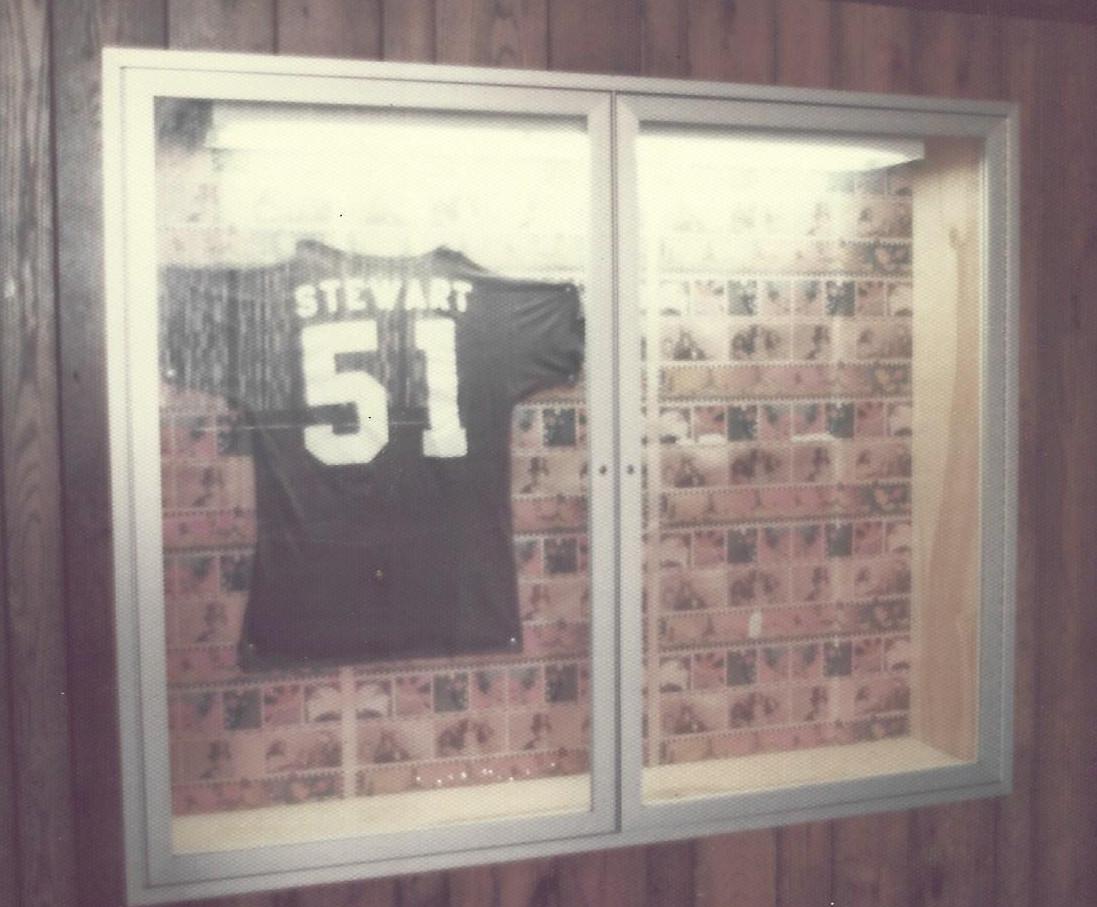 Residing in a place of distinction, Stewart’s intramural football jersey hung proudly in the Dorm One lobby. Stewart, a close friend of photographer Nicaise, was the founding member of the Dorm Chargers team.
Making a home of their own
Much like the UMBC we know today, there was always an emphasis on making sure that students who lived on campus and those who commuted still had plenty of opportunities to interact through mixers, concerts, and movie nights, many of these being entertainment options still offered through Campus Life in 2025.
In addition to improving his social life, having a dedicated spot on campus to buckle down and do his work inspired Stewart to grow academically.
“When I started, I was just a slightly above average student, but things really kicked in for me at UMBC,” he said. “For some reason, this really seemed like the environment to take this whole academic thing seriously.”
 Cathy Amaya ’26, business technology administration and media and communication studies, (seated on beanbag) loves living in the dorm with her built-in friends. “It always guarantees that you have someone to explore with and go on a few side quests.” (Marlayna Demond ’11/UMBC)
During Homecoming 2024, a group of alumni from the 1970s, including Stewart, got together for a reunion tour of campus and had the opportunity to revisit some of their old haunts, including the dorms and the memories all came flooding back. Stewart and his wife Wendy ’77, sociology, agree that the friends they made at UMBC “are our lifelong friends.” And that’s something we can all agree on, no matter your graduation year.
All photos courtesy of Leo J. “Nick” Nicaise ’75, INDS, unless otherwise noted.
]]>
The Retriever Weekly announces the new dorms opening in 1970. (UMBC Special Collections) “Hey UMBC, and welcome to my crib!” That’s probably not verbatim what students said when UMBC’s first...
https://umbc.edu/stories/then-now-home-sweet-home/
https://my3.my.umbc.edu/api/v0/pixel/news/150472/guest@my.umbc.edu/03620c8815097fb98aa37fdd397f9737/api/pixel
alumni
campus-history
campus-life
inds
magazine
spring-2025
story
then-and-now
UMBC News & Magazine
https://my3.my.umbc.edu/groups/umbc-news-magazine
https://assets1-my.umbc.edu/system/shared/avatars/groups/000/001/943/24435aa6207c452e7bc15cc74b42c7bb/xsmall.png?1748556657
https://assets1-my.umbc.edu/system/shared/avatars/groups/000/001/943/24435aa6207c452e7bc15cc74b42c7bb/original.png?1748556657
https://assets2-my.umbc.edu/system/shared/avatars/groups/000/001/943/24435aa6207c452e7bc15cc74b42c7bb/xxlarge.png?1748556657
https://assets2-my.umbc.edu/system/shared/avatars/groups/000/001/943/24435aa6207c452e7bc15cc74b42c7bb/xlarge.png?1748556657
https://assets3-my.umbc.edu/system/shared/avatars/groups/000/001/943/24435aa6207c452e7bc15cc74b42c7bb/large.png?1748556657
https://assets1-my.umbc.edu/system/shared/avatars/groups/000/001/943/24435aa6207c452e7bc15cc74b42c7bb/medium.png?1748556657
https://assets2-my.umbc.edu/system/shared/avatars/groups/000/001/943/24435aa6207c452e7bc15cc74b42c7bb/small.png?1748556657
https://assets1-my.umbc.edu/system/shared/avatars/groups/000/001/943/24435aa6207c452e7bc15cc74b42c7bb/xsmall.png?1748556657
https://assets2-my.umbc.edu/system/shared/avatars/groups/000/001/943/24435aa6207c452e7bc15cc74b42c7bb/xxsmall.png?1748556657
UMBC News & Magazine
2
0
false
Fri, 30 May 2025 09:57:52 -0400
Fri, 30 May 2025 09:57:52 -0400
UMBC teams up with disability advocacy organization on Kinetic Sculpture Race—and wins best art award
On a pleasant Saturday in early May, nearly 30 teams gathered in Baltimore to pedal elaborate all-terrain sculptures 15 miles through a course featuring pavement, water, sand, and mud. The 25th year of the Kinetic Sculpture Race, organized by the American Visionary Art Museum, brought out Baltimore residents to cheer on the wacky sculptures, such as a kilt-wearing platypus and a BLT sandwich, and their human pedalers. This year UMBC, which has regularly gathered a team to compete in the race, partnered with The IMAGE Center of Maryland, a non-profit organization dedicated to “new thinking about disability,” to build and race a sculpture named IMAGE Man. The larger-than-life teal superhero sits in a wheelchair and wears an orange cape—The IMAGE Center’s branded colors. With football in hand, he flies over some of Baltimore’s iconic buildings, such as the Bromo Seltzer Arts Tower and the Baltimore World Trade Center.
IMAGE Man successfully navigated the hazardous terrain of the race—including a floating lap around a dock in the Baltimore Harbor—and was also recognized with a best art award, a category that, according to the race organizers “includes consideration of color, costumes, two and three dimensional ‘artistic designs,’ kinetic motion, humor, theatrical appeal, and mass crowd- and media glory-seeking.” The team also won second place in the overall standings.
 Mechanical engineer Jasmine Pearcy, a volunteer with a program from The IMAGE Center called Volunteers for Medical Engineering, paints part of the sculpture. (Image courtesy of the VME Collection)
It took many months, and hundreds of volunteer hours, to bring the kinetic sculpture to life from foam, wood and paint and mount it on a recycled quadricycle in a workspace at the 900 Walker Ave building on the UMBC campus. Volunteers from UMBC pitched in alongside partners from Volunteers for Medical Engineering (VME) Program Services, a part of The IMAGE Center that provides innovative custom devices to empower people with disabilities to live life more fully.
 UMBC student Dulcey Comeau breaks out the power tools. (Image courtesy of the VME collection)
The partnership between The IMAGE Center and UMBC on the Kinetic Sculpture Race was a spinoff of a long-term collaboration, says Angela Tyler, the director of VME. In that partnership, UMBC engineering students collaborate with VME to design and build the custom devices. Many graduating students return to volunteer on other VME projects. This year, four UMBC mechanical engineering students participated in a project to design and build a fishing rod holder and casting device for a disabled client. All four also volunteered their time on the kinetic sculpture project.
Alex Brunkhorst was one of those students. He participated in the race as a member of the pit crew, pedaling alongside the sculpture and offering technical (and emotional) support as needed. “The race was a lot of fun and challenged all of us physically, mentally, and mechanically,” he says. “We did run into some difficulty with our kinetic sculpture’s braking system, but with some quick thinking and a little luck, the pit crew was able to rig something together and keep IMAGE Man in the race.”
Tyler says the collaboration for this year’s race was a win-win. “We’d like to thank UMBC for providing the space, thanks to UMBC faculty Steve McAlpine and Dr. Jamie Gurganus for help leading the volunteer team, and many thanks to all the volunteers! It was a natural fit, and a great partnership.”
Gurganus, who has nurtured the partnership with VME for many years, says the expansion of the collaboration to the Kinetic Sculpture Race this year made the race-day experience much more than just a fun and wacky day. “The race became a moving stage to amplify VME’s mission, and their presence was unforgettable,” she says. “It became a celebration of purpose, empathy, and community.”
]]>
On a pleasant Saturday in early May, nearly 30 teams gathered in Baltimore to pedal elaborate all-terrain sculptures 15 miles through a course featuring pavement, water, sand, and mud. The 25th...
https://umbc.edu/stories/kinetic-sculpture-race-25/
https://my3.my.umbc.edu/api/v0/pixel/news/150461/guest@my.umbc.edu/072bbda338846cd50661d82c646f15b1/api/pixel
coeit
community
inds
meche
news
story
UMBC News & Magazine
https://my3.my.umbc.edu/groups/umbc-news-magazine
https://assets1-my.umbc.edu/system/shared/avatars/groups/000/001/943/24435aa6207c452e7bc15cc74b42c7bb/xsmall.png?1748556657
https://assets1-my.umbc.edu/system/shared/avatars/groups/000/001/943/24435aa6207c452e7bc15cc74b42c7bb/original.png?1748556657
https://assets2-my.umbc.edu/system/shared/avatars/groups/000/001/943/24435aa6207c452e7bc15cc74b42c7bb/xxlarge.png?1748556657
https://assets2-my.umbc.edu/system/shared/avatars/groups/000/001/943/24435aa6207c452e7bc15cc74b42c7bb/xlarge.png?1748556657
https://assets3-my.umbc.edu/system/shared/avatars/groups/000/001/943/24435aa6207c452e7bc15cc74b42c7bb/large.png?1748556657
https://assets1-my.umbc.edu/system/shared/avatars/groups/000/001/943/24435aa6207c452e7bc15cc74b42c7bb/medium.png?1748556657
https://assets2-my.umbc.edu/system/shared/avatars/groups/000/001/943/24435aa6207c452e7bc15cc74b42c7bb/small.png?1748556657
https://assets1-my.umbc.edu/system/shared/avatars/groups/000/001/943/24435aa6207c452e7bc15cc74b42c7bb/xsmall.png?1748556657
https://assets2-my.umbc.edu/system/shared/avatars/groups/000/001/943/24435aa6207c452e7bc15cc74b42c7bb/xxsmall.png?1748556657
UMBC News & Magazine
4
0
false
Thu, 29 May 2025 10:58:02 -0400
Thu, 29 May 2025 10:58:02 -0400
Awarding 100,000 dreams and counting—UMBC’s Class of 2025
Before Joy Gabrielle Ware walked off the Commencement stage, she stopped mid-stage to face her peers and shouted, “UM!” prompting a booming “BC!” response from the undergraduates and their families who packed the arena last week at UMBC’s 84th Undergraduate Commencement Ceremony. Ware, an individualized study major, was awarded the historic 100,000th degree since UMBC’s first Commencement class in 1970, which had 241 students—a stark contrast to the 1,528 undergraduate and over 700 graduate degrees awarded to the Class of 2025.
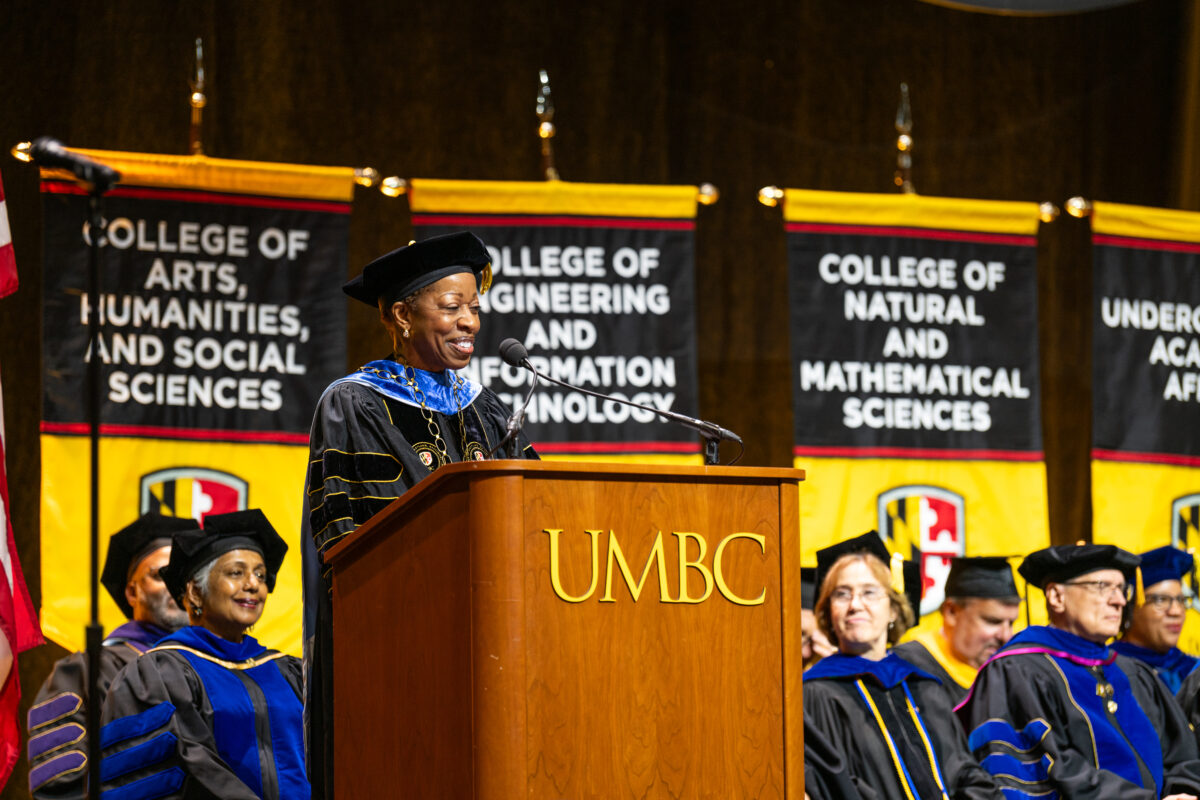
 (l) President Valerie Sheares Ashby addressing UMBC’s Class of 2025. (Brad Ziegler/UMBC) (r) Diane Tichnell ’70 (third from left) celebrates the publication of This Belongs To Us with fellow book editors Mimi Dietrich, Bob Dietrich, and Dale Gough. (Marlayna Demond ’11/UMBC).
To celebrate this historic moment, President Valerie Sheares Ashby paid tribute to the alumni known as the Founding Four, who represented graduates of the first four undergraduate classes from 1970 to 1973.
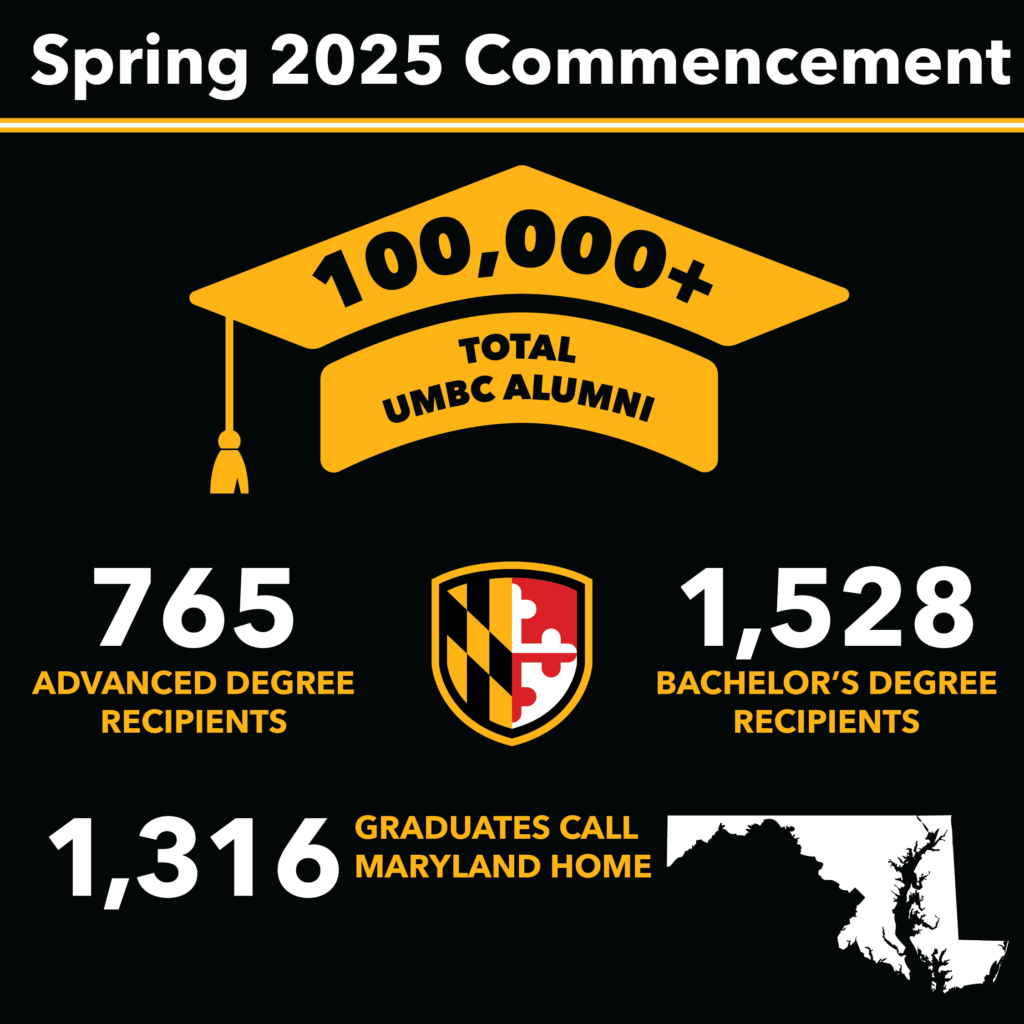
“What a profound impact UMBC has had on the state of Maryland and the world,” said Sheares Ashby. “Each one of our alumni has made a difference in some way, many of them as leaders and pathbreakers—in the public and private sectors, in the arts, in education, in research, in public service, and in their communities.”
Gratitude
The Class of 2025 celebrated and cheered for each other. However, thunderous applause rippled across UMBC’s Chesapeake Employers Insurance Arena every time a speaker asked the students to thank those who made their dreams come true. The stands were filled with roommates, classmates, mentors, and families who kept pointing the way when graduation seemed out of reach.
“You took risks when you chose to pursue this graduate degree. You stumbled and struggled and faced down your fears and insecurities,” said Graduate Student Association President Jessica Burstrem, Ph.D. ’25, language, literacy, and culture, in her address to her peers at the Graduate School Commencement ceremony.

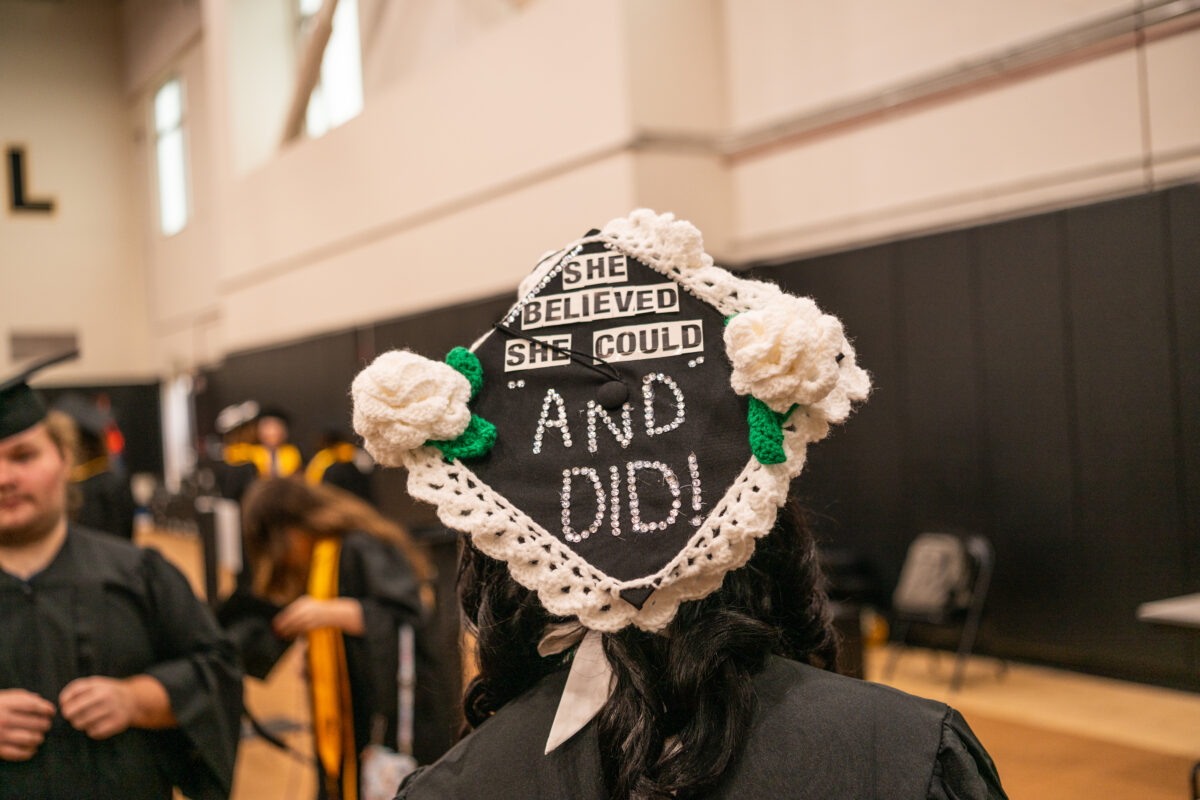 (l) Jessica Burstrem addressing the Graduate School Class of 2025. (Brad Ziegler/UMBC)
“That bravery is why you celebrate today. Those are the kinds of people the world always needs—people who do the right thing even if they are afraid. People of integrity and bravery. People who stand together,” said Burstrem.

 (l) Sonja Brookins Santelises, chief executive officer of Baltimore City Public Schools, Thursday morning’s undergraduate commencement speaker and honorary degree recipient. (r) Anwesha Day, Ph.D. ’04, biochemistry and molecular biology, executive director in the Discovery Oncology Department of Genentech, spoke to Thursday afternoon’s graduates. (Brad Ziegler/UMBC)
The path of service
College wasn’t Tina Garcia’s first path, even after becoming the first in her family to graduate from high school. She served nearly a decade in the United States Air Force, rising to the rank of staff sergeant, before continuing her service within the government. After serving her country, Garcia chose to honor her family once again—this time by becoming the first to earn a college degree. She drew on her experience as a veteran and her majors in social work and psychology to co-found and serve as vice president of UMBC’s Student Service Members, Veterans, and Families organization.

 (l) Valedictorian Tina Garcia shares her journey to UMBC. (r) UMBC’s Color Guard opening the 2025 commencement ceremonies. (Brad Ziegler/UMBC)
“UMBC is where I found my community, and with it, a renewed sense of purpose to continue serving Veterans. I’m so grateful to everyone who continues this work, who shows up for veterans every day, and who refuses to let that momentum fade,” said Garcia, as one of two undergraduate valedictorians. “When we find belonging, we thrive. When we thrive, we create space for others to do the same. May you always find places where you belong and never let anyone convince you that you don’t.”
UMBC welcomes all
For international students, the meaning of community transcended physical boundaries, cultures, and languages, with graduate students representing 27 nations across five continents and Central America, and undergraduates representing 35 countries across six continents and the Caribbean, including Jamaican native, Akellia Bernard, a music performance major with a concentration in voice. Bernard, a member of UMBC’s Choir and Camerata, performed the national anthem for the three commencement ceremonies. This summer, Bernard plans to join the Choir and Camerata in Paris and Prague, where they have been invited to perform with the Czech National Symphony Orchestra.
 Akellia Bernardsings the Star-Spangled Banner at her undergraduate commencement ceremony. (Brad Ziegler/UMBC)
Praise Lasekan, a biological science major, whose family watched his valedictorian speech virtually back home in Ondo, Nigeria, was adamant about how the Retriever community became the vessel for his growth, acceptance, and joy.
 UMBC faculty and alumni give Praise Lasekan a standing ovation for his inspiring words. (Brad Ziegler/UMBC)
“The person you see standing in front of you today was once called a failure. People made fun of me. There were times I almost quit. But mentors, community, and the grace of God reminded me: Dreams don’t die, they just need to be stirred again,” said Lasekan. This fall, he will begin his Ph.D. at Brown University in the Department of Molecular Biology, Cell Biology, and Biochemistry. “UMBC showed me that community isn’t just who you’re around, it’s who holds you up when life feels heavy.” His journey resonated with the celebratory crowd and earned a standing ovation from the full house.
 And with the turn of the tassel, these students are officially UMBC Alumni. (Brad Ziegler/UMBC)
As Retrievers crossed their tassels from right to left, President Sheares Ashby reminded them that while the pursuit of their dreams might have had similar zig zags, they, “will be the ones who will listen to all the voices, fight for the needs of others, not just yourself, unite, not divide, bring calm to chaos, open doors, and see new ways forward.”
Listen to Akellia Bernard sing the Star-Spangled Banner, Governor Wes Moore’s message to the Class of 2025, and watch all three ceremonies at commencement.umbc.edu.
]]>
Before Joy Gabrielle Ware walked off the Commencement stage, she stopped mid-stage to face her peers and shouted, “UM!” prompting a booming “BC!” response from the undergraduates and their...
https://umbc.edu/stories/umbcs-class-of-2025/
https://my3.my.umbc.edu/api/v0/pixel/news/150428/guest@my.umbc.edu/976827328c289a34967296b2f158b9ce/api/pixel
biological-sciences
cahss
class-of-2025
cnms
coeit
community
feature
inds
music
news
psych
social-work
story
UMBC News & Magazine
https://my3.my.umbc.edu/groups/umbc-news-magazine
https://assets1-my.umbc.edu/system/shared/avatars/groups/000/001/943/24435aa6207c452e7bc15cc74b42c7bb/xsmall.png?1748556657
https://assets1-my.umbc.edu/system/shared/avatars/groups/000/001/943/24435aa6207c452e7bc15cc74b42c7bb/original.png?1748556657
https://assets2-my.umbc.edu/system/shared/avatars/groups/000/001/943/24435aa6207c452e7bc15cc74b42c7bb/xxlarge.png?1748556657
https://assets2-my.umbc.edu/system/shared/avatars/groups/000/001/943/24435aa6207c452e7bc15cc74b42c7bb/xlarge.png?1748556657
https://assets3-my.umbc.edu/system/shared/avatars/groups/000/001/943/24435aa6207c452e7bc15cc74b42c7bb/large.png?1748556657
https://assets1-my.umbc.edu/system/shared/avatars/groups/000/001/943/24435aa6207c452e7bc15cc74b42c7bb/medium.png?1748556657
https://assets2-my.umbc.edu/system/shared/avatars/groups/000/001/943/24435aa6207c452e7bc15cc74b42c7bb/small.png?1748556657
https://assets1-my.umbc.edu/system/shared/avatars/groups/000/001/943/24435aa6207c452e7bc15cc74b42c7bb/xsmall.png?1748556657
https://assets2-my.umbc.edu/system/shared/avatars/groups/000/001/943/24435aa6207c452e7bc15cc74b42c7bb/xxsmall.png?1748556657
UMBC News & Magazine
0
0
false
Tue, 27 May 2025 20:14:29 -0400
Tue, 27 May 2025 20:14:29 -0400
Evan McRae ’25 paired his computer science degree with a music focused-individualized studies major and followed his family’s Retriever legacy
Before Evan McRae came to UMBC, Tess McRae—his sister—was a student here. So was Evan and Tess’s mother—Sharon McRae.You might say being a legacy Retriever was a family tradition. With Evan graduating this spring with majors in both computer science and individualized studies, we thought to ask Tess, now the assistant director for connective learning with the Center for Democracy and Civic Life, to take on this Q&A with her younger brother. Evan shares how an early exposure to UMBC’s Game Developers Club before attending UMBC eventually led to an executive board position and the creation of numerous games and great memories with other programmers and musicians.
Q: How did you decide to come to UMBC?
A: UMBC is where our mom went and also where you went, and I wanted to continue that family legacy. I also knew that it was a really great institution especially for computer science. I remember our family going to campus for Homecoming when I was in high school, and I saw a banner in The Commons for the UMBC Game Developers Club. I have always wanted to be a game developer; seeing that banner, I knew that there was a pretty good foundation for my passion at UMBC, and I wanted to join the club.
 McRae (second from left) and his fellow members of the Game Developers Club pose for a photo. Photo courtesy of McRae.
Q: In high school you discovered a passion for composing and producing music. How have you been able to expand on that passion at UMBC both technically and artistically?
A: While I was in high school I thought, “Music is something fun I do on the side, but not what I’m going to go to college for.” I was a computer science and math double major going into UMBC. When I decided to drop my math major by my second year, I told my Honors College advisor, Julie Oakes, that I was interested in music but didn’t have time to finish a music major within the next two years. She suggested I try individualized study (INDS) and see if there was a way to integrate my music passion with game development.
I ended up talking to professor Steven McAlpine from the INDS department and found a great bond with him; he shares a lot of my interests in game design and music. He has helped open a lot of doors for me, and I’m really grateful to the INDS program for that. I’ve been able to take music theory and composition courses, use UMBC’s studio facilities, and learn how to produce with industry standard software like Logic Pro. My music professors Greg Kalember, Linda Dusman, and Joseph Siu have mentored and fiercely advocated for me as an INDS major. It’s been incredible to not be a music major but still feel like I belong in those rooms.
Q: What are some of the most meaningful experiences you’ve had during your time at UMBC?
A: I’m taking a class this semester called Capstone Games Group Project taught by Marc Olano, the director of UMBC’s game development track and advisor for the Game Developers Club. The class combines artists and programmers who pitch game ideas at the start and work together on only a handful of those games for the rest of the semester. I pitched a puzzle platformer game called King Scribble that I’ve been wanting to make since first grade. My classmates and professor liked the idea, and to my surprise, it got picked as one of four games the class will develop in full. I still don’t think I’ve fully internalized how cool it is to actually be making this game.
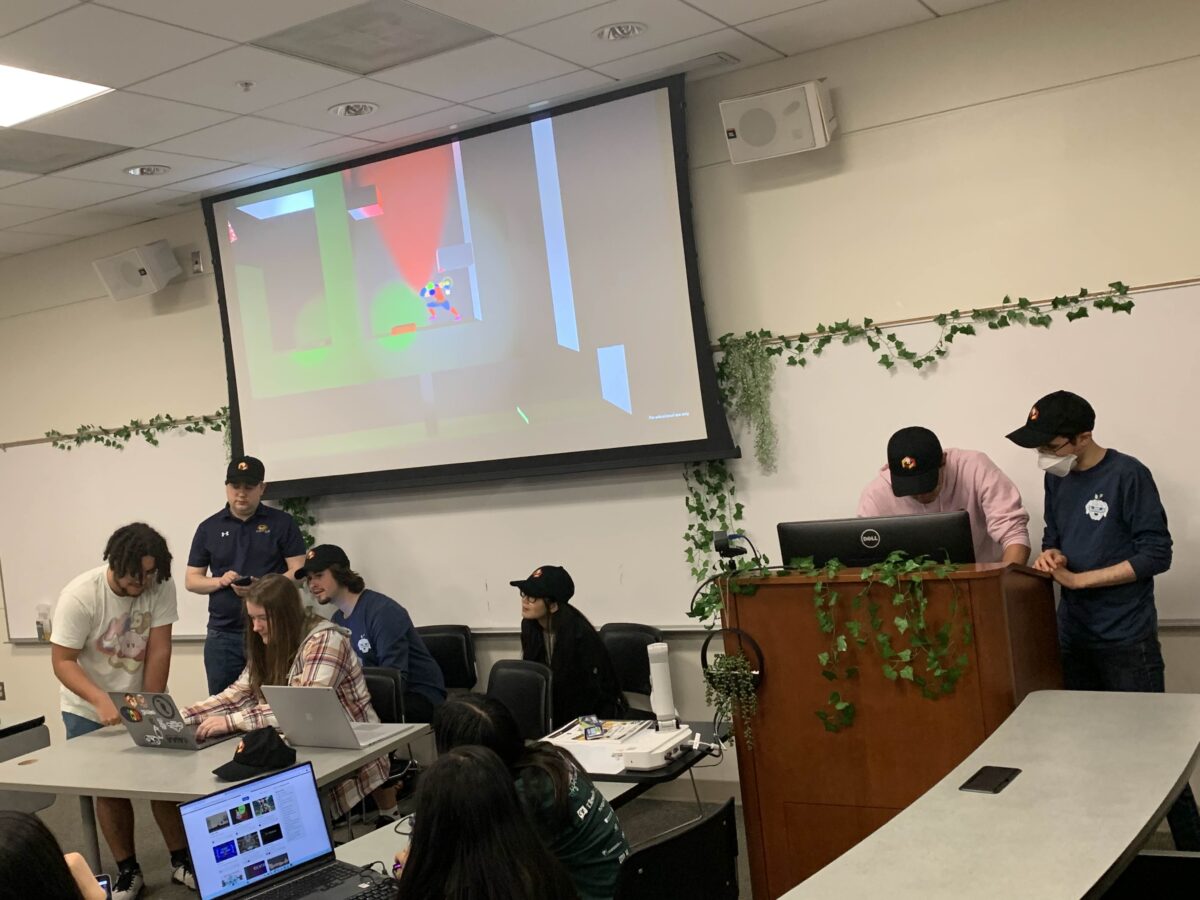 McRae (standing at podium) plays a submission to the Game Jamathon, hosted by hackUMBC and UMBC Game Developers Club. Photo courtesy of McRae.
I’ve also been working on a game called Daylight(available to play on Windows only, the password is: dog)since 2022 through the Game Developers Club. I feel like I’ve really grown as a developer and musician from it, and I’ve met some really cool and talented people through it. For my INDS capstone I’m improving and expanding upon Daylight’s soundtrack, which I’ve been working on for years now. It likely won’t be finished this semester or even next year, but I’m so privileged and grateful to have played such a big part in it.
I also have found a lot of meaning in my internship at UMBC’s Imaging Research Center (IRC). I got a position there thanks to Professor McAlpine, who had previously mentored Tristan King ’21,a former IRC technical specialist, when he was an INDS student. Tristan ended up being my supervisor for my first year there. I’m making virtual reality data visualization concept mapping software using Unreal Engine and solving complex, cutting-edge interface design problems. It’s really challenging my professional coding skills and helping me to grow exponentially as a game developer. I appreciate that I’ve had the opportunity on campus to enrich my learning like that. It’s been so cool to work with this transdisciplinary team and develop something that I think will have a good impact on the world.
Q: How have the ideas of inter/transdisciplinarity enhanced your UMBC experience?
A: What drew me to game development was working among disciplines. I love the idea of being a programmer and musician working with artists, writers, and playtesters to make a very human, cohesive experience: a love letter to players. Finding myself in INDS and at the IRC legitimized this way of thinking for me. I’ve really found myself at home in environments where I can collaborate with people from different backgrounds who are bringing all their skills and influences to the table. I value that process in everything I make and do at UMBC.
Being part of the Honors College also helped broaden my personal horizons as a student. I’ve been able to take a lot of cool courses outside of my disciplines like Mathematics of the Universe with Manil Suri and Sounds Like Social Justice with Earl Brooks, who have also been pretty big inspirations for me when it comes to the interdisciplinarity of technical fields and the ways I can actually make an impact toward issues I care about.
Q: What has being a student leader in the UMBC Game Developers Club been like for you?

A: It actually wasn’t something I knew I wanted to do in the first place until my friend encouraged me to run for vice president during a special election. I think it’s been the happiest accident in my life. I’ve been able to help make UMBC a proper home for students of all disciplines interested in game development, whether it’s for a hobby or a future career. Playing a pivotal role in creating and maintaining that space has been absolutely awesome. (Check out another Game Developers Club creation, Phantom Feline—I was a programmer and musician on this game that can be played in-browser as well as on Windows, Mac, and Linux.) The Game Developers Club has established alumni and mentors in the industry who give talks and network with our students. To be able to stand on that 20-year legacy and be lifted by it is a really special thing.
Written by Tess McRae ’22, Assistant Director for Connective Learning, Center for Democracy and Civic Life
Read more Commencement 2025 stories.
]]>
Before Evan McRae came to UMBC, Tess McRae—his sister—was a student here. So was Evan and Tess’s mother—Sharon McRae.You might say being a legacy Retriever was a family tradition. With Evan...
https://umbc.edu/stories/evan-mcrae-25-followed-familys-retriever-legacy/
https://my3.my.umbc.edu/api/v0/pixel/news/149903/guest@my.umbc.edu/5e648a26fda274bc5c1302e370d47cd1/api/pixel
center-for-democracy-and-civic-life
class-of-2025
coeit
computer-science
inds
news
story
UMBC News & Magazine
https://my3.my.umbc.edu/groups/umbc-news-magazine
https://assets1-my.umbc.edu/system/shared/avatars/groups/000/001/943/24435aa6207c452e7bc15cc74b42c7bb/xsmall.png?1748556657
https://assets1-my.umbc.edu/system/shared/avatars/groups/000/001/943/24435aa6207c452e7bc15cc74b42c7bb/original.png?1748556657
https://assets2-my.umbc.edu/system/shared/avatars/groups/000/001/943/24435aa6207c452e7bc15cc74b42c7bb/xxlarge.png?1748556657
https://assets2-my.umbc.edu/system/shared/avatars/groups/000/001/943/24435aa6207c452e7bc15cc74b42c7bb/xlarge.png?1748556657
https://assets3-my.umbc.edu/system/shared/avatars/groups/000/001/943/24435aa6207c452e7bc15cc74b42c7bb/large.png?1748556657
https://assets1-my.umbc.edu/system/shared/avatars/groups/000/001/943/24435aa6207c452e7bc15cc74b42c7bb/medium.png?1748556657
https://assets2-my.umbc.edu/system/shared/avatars/groups/000/001/943/24435aa6207c452e7bc15cc74b42c7bb/small.png?1748556657
https://assets1-my.umbc.edu/system/shared/avatars/groups/000/001/943/24435aa6207c452e7bc15cc74b42c7bb/xsmall.png?1748556657
https://assets2-my.umbc.edu/system/shared/avatars/groups/000/001/943/24435aa6207c452e7bc15cc74b42c7bb/xxsmall.png?1748556657
UMBC News & Magazine
4
0
false
Wed, 07 May 2025 15:37:48 -0400
Wed, 07 May 2025 15:37:48 -0400

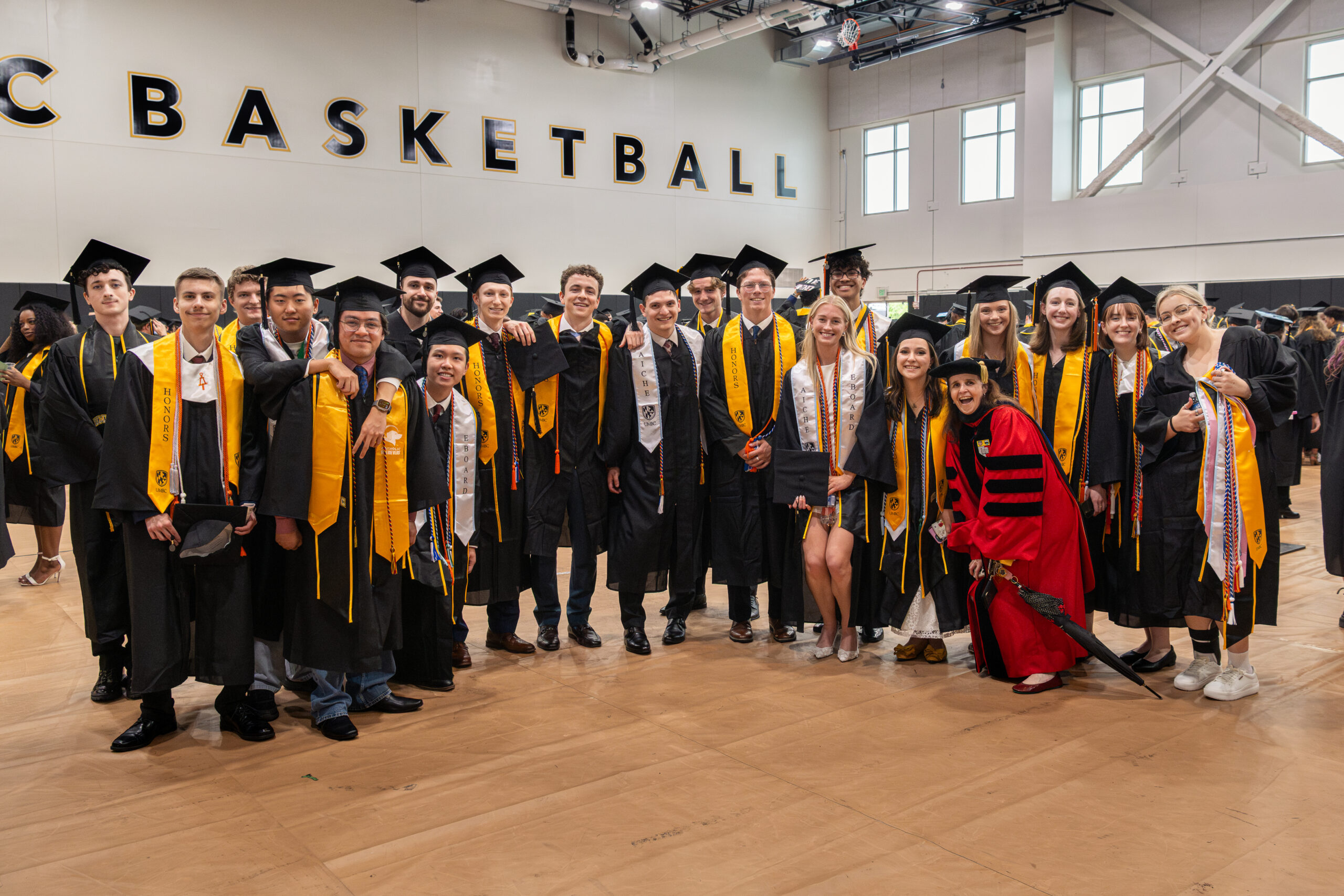


 Celebrating graduation day! (Brad Ziegler/UMBC)