How to land the sweetest internship
Securing any internship is a huge accomplishment for a college student, but it’s even sweeter when it combines hands-on leadership training with a few tasty perks. Senior Justin Medina and sophomore Gabriel Jenkins joined seven other Retrievers over the summer as part of the Hersheypark Leadership Development Internship Program, a 12-week paid internship that allows students earn an hourly wage while also providing them with intensive leadership training—oh, and full-access passes to the park during their time off.
Tools of the trade
- An open mind (you’ll be trying new experiences and meeting new people)
- Strong work ethic (be ready to be tested)
- Sunscreen and sunglasses (it IS an amusement park, afterall)
- A watch (time flies when you’re having fun)
Step 1: Figure out what you’re hungry for
 Gabriel Jenkins closes out the summer with a smile and a certificate of achievement. (Photo courtesy of Jenkins)
Through this unparalleled program, students get to enjoy the monetary benefits of holding down a Hersheypark job of their choice, in addition to undergoing leadership training. Medina leaned into his love of swimming and trained as a lifeguard, learning life-saving skills like CPR and how to handle a trauma kit. Jenkins chose to do ride operations and learned a few things about himself along the way.
“I learned I’m more reliable than I thought,” he said. Jenkins was trained on Lightning Racer, the first wooden racing/dueling rollercoaster in the United States. He interacted with guests while ensuring their safety by following the set procedures Hershey Entertainment & Resorts provided, confirmed height and/or weight standards were met, checked that seatbelts and restraints were fastened and locked, and controlled the right buttons to make the roller coasters go and return with a team of other hardworking ride operators. Throughout the summer, his work ethic was recognized and his supervisors gave him additional responsibilities that helped him see abilities he hadn’t tapped into yet.
“These students were great team members in our operations and fantastic contributors in our Professional Development Sessions, where they uncovered their strengths and how to apply them in their roles at Hersheypark and beyond,” said Jacklyn Mrakovich, college relations recruiter at Hershey Entertainment & Resorts.
Step 2: A taste of the real world
Both Medina and Jenkins packed up their things and spent the summer living in rental housing provided at a reduced rate through the company. The time away from home and campus gave them a glimpse of what post-graduate life could possibly look like.
“It was a good taste of being in the real world, especially because I moved out there. It really teaches you how to be on your own,” said Medina. He also underscores what a unique opportunity this was: “It basically gave you the 9-5 work experience, but also has a school aspect with seminars and events. While being at an amusement park.”
Once a week, interns attended various professional development trainings, with coursework and curriculum focused on teaching students to be better leaders and prepare them for the workforce. Although their work didn’t directly speak to either student’s majors (information systems for Medina and graphic design for Jenkins), they still learned invaluable lessons that they’ll carry with them in their professional careers. Which brings us to…
Step 3: Buckle up and enjoy the ride
“You have to go in with an open mind and not be scared, you have to just take the next step forward,” encourages Medina to those thinking about the program. The intangibles of this experience were the things both Retrievers will remember—the networking opportunities, meeting students from across the world, and learning how to be a good employee and a good colleague.
“It really helped me understand the process of actually doing a job and working for someone, learning how to communicate with co-workers and working with people from different backgrounds,” says Jenkins.
At a roundtable discussion held as part of the leadership portion, students were grouped by major/area of interest and given the opportunity to meet employees in their field. From this discussion, Medina was able to see how he could apply the skills he learned over the summer to his future career—directly or indirectly.
 Justin Medina takes a minute to dry off for a quick photo opp. (Brad Ziegler/UMBC)
“I thought more of how it could help benefit me in the future when it comes to IT. If I’m going to be working in groups or if I end up going towards a project management route, that’ll help me as a leader and help me adapt to certain scenarios or circumstances.”
Not realizing the program’s universal draw, both Jenkins and Medina found themselves energized by getting to know their international peers—a highlight of their experience.
“We got to work alongside international employees and learned a lot about working with people from different backgrounds,” says Jenkins. “My favorite part was meeting people from across the world.”
“It was so cool showing my experience and seeing their experience and how we were able to share cultures,” adds Medina.
Step 4: Reap the rewards
The summer wasn’t all work and no play for the Retrievers. Interns got to enjoy some of the perks of living in a town known equally for its chocolate and its theme park. On their days off, they could take a dip in the pool at their accommodations, check out the employee store, or take advantage of the free access to Hersheypark.
“It just felt different going to the park as an adult and knowing I could go whenever I want. Little me would have been so excited,” says Medina.
While the swag and all-access passes certainly are souvenirs the interns are grateful for, the lasting impact is what the experience could mean for their future careers.
Of recent alumni, 85 percent were engaged in applied learning like internships, research, service-learning, or leadership during their time at UMBC. Thanks to the work they’re putting into their futures as a student, 93 percent graduate with firm plans for employment or graduate school within six months of graduation.
“I’m continually inspired by the way our students engage in applied learning to launch their careers,” says Marykate Conroy, associate director of internships and employment. “UMBC students are entering the workforce prepared and in demand.”
“The memories and the networking are the two things I’m walking away with,” says Medina. “I have more people to reach out to and even if they’re not directly in my field, they’re so willing to help.”
]]>
Securing any internship is a huge accomplishment for a college student, but it’s even sweeter when it combines hands-on leadership training with a few tasty perks. Senior Justin Medina and...
https://umbc.edu/stories/how-to-land-the-sweetest-internship/
https://my3.my.umbc.edu/api/v0/pixel/news/154533/guest@my.umbc.edu/fb48d7462fc875b0ea6acea4eb47f0d8/api/pixel
cahss
campus-life
coeit
fall-2025
graphic-design
how-to
information-systems
magazine
story
UMBC News & Magazine
https://my3.my.umbc.edu/groups/umbc-news-magazine
https://assets1-my.umbc.edu/system/shared/avatars/groups/000/001/943/24435aa6207c452e7bc15cc74b42c7bb/xsmall.png?1748556657
https://assets1-my.umbc.edu/system/shared/avatars/groups/000/001/943/24435aa6207c452e7bc15cc74b42c7bb/original.png?1748556657
https://assets2-my.umbc.edu/system/shared/avatars/groups/000/001/943/24435aa6207c452e7bc15cc74b42c7bb/xxlarge.png?1748556657
https://assets2-my.umbc.edu/system/shared/avatars/groups/000/001/943/24435aa6207c452e7bc15cc74b42c7bb/xlarge.png?1748556657
https://assets3-my.umbc.edu/system/shared/avatars/groups/000/001/943/24435aa6207c452e7bc15cc74b42c7bb/large.png?1748556657
https://assets1-my.umbc.edu/system/shared/avatars/groups/000/001/943/24435aa6207c452e7bc15cc74b42c7bb/medium.png?1748556657
https://assets2-my.umbc.edu/system/shared/avatars/groups/000/001/943/24435aa6207c452e7bc15cc74b42c7bb/small.png?1748556657
https://assets1-my.umbc.edu/system/shared/avatars/groups/000/001/943/24435aa6207c452e7bc15cc74b42c7bb/xsmall.png?1748556657
https://assets2-my.umbc.edu/system/shared/avatars/groups/000/001/943/24435aa6207c452e7bc15cc74b42c7bb/xxsmall.png?1748556657
UMBC News & Magazine
2
0
false
Thu, 13 Nov 2025 15:35:32 -0500
Thu, 13 Nov 2025 15:35:32 -0500
UMBC leverages interdisciplinary expertise to launch Quantum Science Institute

UMBC has received $1.5 million from the National Institute of Standards and Technology to organize a new UMBC Quantum Science Institute. The funding will support graduate fellowships for students pursuing quantum technology research, the development of new courses and academic programs focused on quantum, and equipment to enhance existing quantum labs and start new ones.
“This institute is the crowning jewel of several decades of pioneering quantum research here at UMBC,” says QSI director and professor of physics Todd Pittman, Ph.D. ’96, physics. “We have some heavy hitters here who are founders in the field, and the QSI is building on that foundation with a new generation of outstanding quantum-focused faculty.”
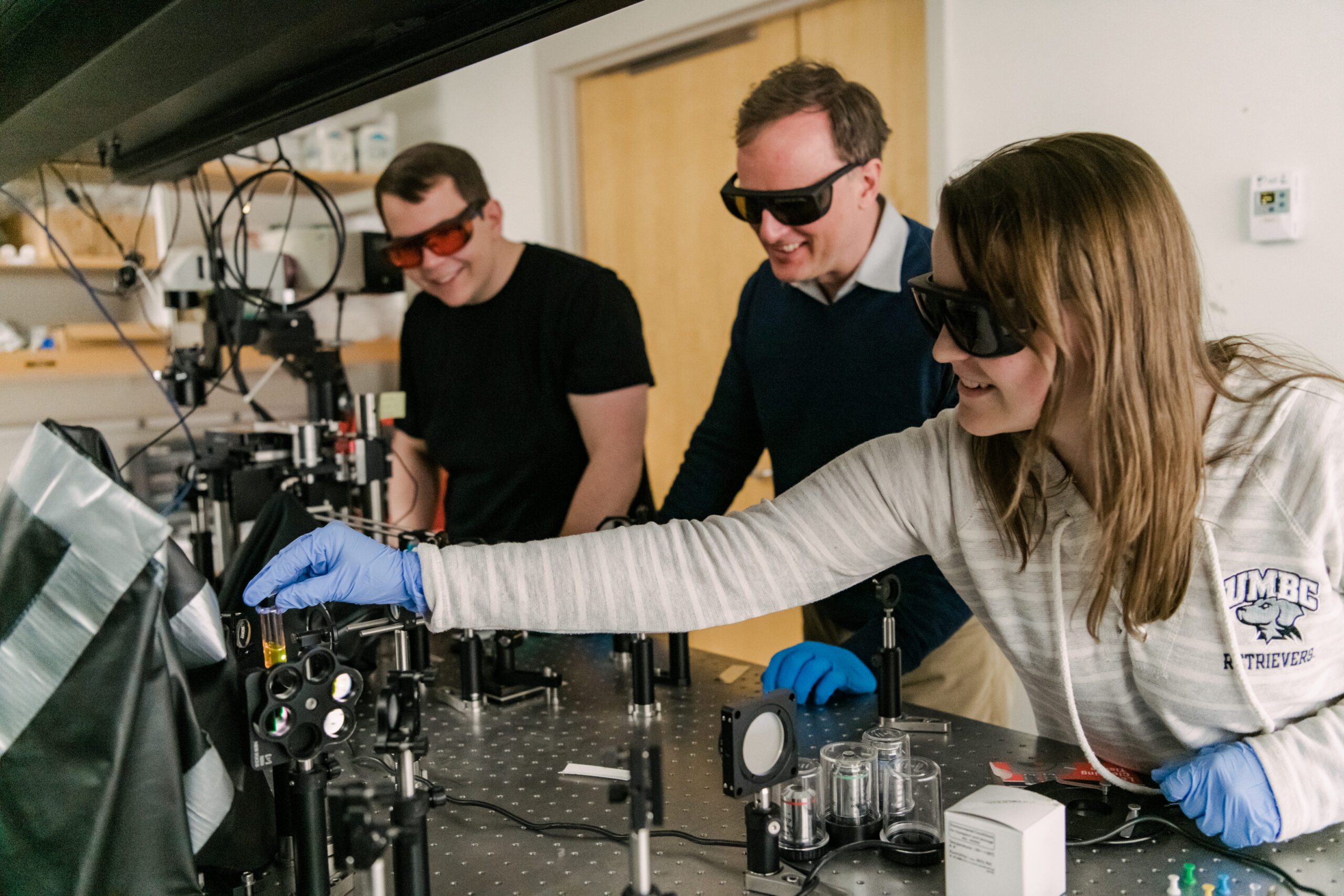 Matthew Pelton, center, leads a quantum optics laboratory at UMBC. (Marlayna Demond ’11/UMBC)
Quantum technologies harness the odd behaviors of particles at the atomic level to generate new functions, and are typically much more powerful than their conventional technology counterparts. To approach quantum research from every angle, the institute includes faculty across the College of Natural and Mathematical Sciences and the College of Engineering and IT in physics, mathematics and statistics, computer science, and information systems. They are pursuing quantum research in areas including computing, communications, sensing, information theory, algorithms, and more. “You just can’t do comprehensive quantum research without bringing together engineers, data analysts, computer scientists, mathematicians, and physicists,” Pittman says.
“I am thankful for the support provided by NIST to develop the UMBC Quantum Science Institute under the leadership of Dr. Pittman,” shares Karl V. Steiner, vice president for research and creative achievement. “QSI will catalyze a new quantum research effort, in support of Governor Moore’s ‘Capital of Quantum’ Initiative to position Maryland as a global leader in this rapidly growing field.”
Training quantum-ready workers
In addition to contributing to research innovation and discovery, the institute will train students from a range of backgrounds to take on skilled roles in the booming quantum industry.
“The quantum industry has exploded,” Pittman says. The quantum technology market was valued at $10 billion in 2021 and is projected to rise to $44 billion by 2028, with potential for much more growth beyond that. In addition to tech giants like Google and IBM, hundreds of start-ups are working in the quantum space. “The market is hungry for quantum-ready workers,” Pittman says, and UMBC is ready to train them.
UMBC marked World Quantum Day in 2022 with a short video highlighting the quantum technology research happening in the physics department.
Sandra Cheng, a fourth-year Ph.D. candidate in physics, is a member of the first cohort of quantum graduate fellows. “Quantum science research, particularly in computing and networking, is quite interdisciplinary by nature,” she says, “and I’m hopeful the QSI will bring together like minds from all the departments involved, so that we’ll be able to contribute towards a greater understanding of quantum science together.”
The QSI leadership team plans to offer social and professional development programming for the fellows. In addition to preparing them for the workforce, the connections they make will help generate a personal network of support, encouraging persistence in a demanding field. Organizing interdisciplinary offerings for the student cohort will also promote collaboration among faculty, Pittman says, adding, “Students are the glue that holds the center together.”
“This new institute is a celebration of our strength and history in quantum research,” Pittman says. “I’m looking forward to seeing QSI unify the quantum researchers on campus in a way that promotes and facilitates interdisciplinary collaboration.”
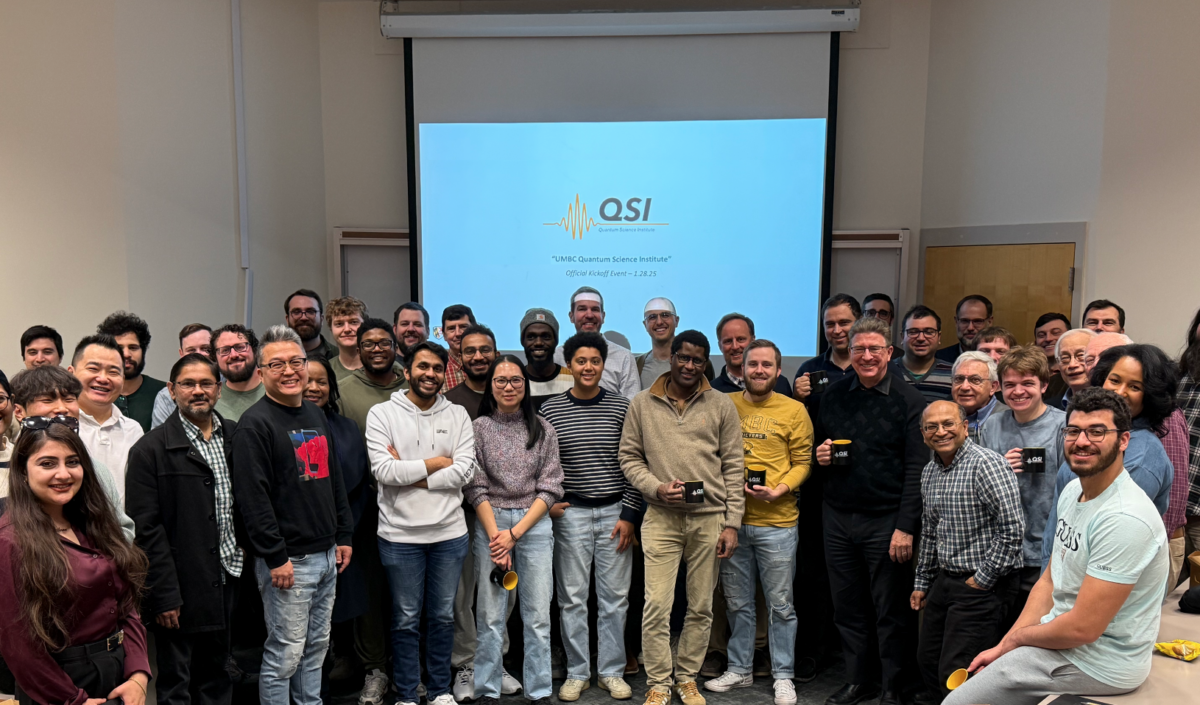 Representatives from all of the departments involved in the new QSI recently attended a launch event.
]]>
UMBC has received $1.5 million from the National Institute of Standards and Technology to organize a new UMBC Quantum Science Institute. The funding will support graduate fellowships for students...
https://umbc.edu/stories/quantum-science-institute-launch/
https://my3.my.umbc.edu/api/v0/pixel/news/147296/guest@my.umbc.edu/cb09589c98c92dd469d956539b185529/api/pixel
cnms
coeit
csee
information-systems
is
mathstat
news
physics
research
science-and-tech
story
UMBC News & Magazine
https://my3.my.umbc.edu/groups/umbc-news-magazine
https://assets1-my.umbc.edu/system/shared/avatars/groups/000/001/943/24435aa6207c452e7bc15cc74b42c7bb/xsmall.png?1748556657
https://assets1-my.umbc.edu/system/shared/avatars/groups/000/001/943/24435aa6207c452e7bc15cc74b42c7bb/original.png?1748556657
https://assets2-my.umbc.edu/system/shared/avatars/groups/000/001/943/24435aa6207c452e7bc15cc74b42c7bb/xxlarge.png?1748556657
https://assets2-my.umbc.edu/system/shared/avatars/groups/000/001/943/24435aa6207c452e7bc15cc74b42c7bb/xlarge.png?1748556657
https://assets3-my.umbc.edu/system/shared/avatars/groups/000/001/943/24435aa6207c452e7bc15cc74b42c7bb/large.png?1748556657
https://assets1-my.umbc.edu/system/shared/avatars/groups/000/001/943/24435aa6207c452e7bc15cc74b42c7bb/medium.png?1748556657
https://assets2-my.umbc.edu/system/shared/avatars/groups/000/001/943/24435aa6207c452e7bc15cc74b42c7bb/small.png?1748556657
https://assets1-my.umbc.edu/system/shared/avatars/groups/000/001/943/24435aa6207c452e7bc15cc74b42c7bb/xsmall.png?1748556657
https://assets2-my.umbc.edu/system/shared/avatars/groups/000/001/943/24435aa6207c452e7bc15cc74b42c7bb/xxsmall.png?1748556657
UMBC News & Magazine
0
0
false
Wed, 12 Feb 2025 15:54:40 -0500
Wed, 12 Feb 2025 15:54:40 -0500
Meet a Retriever—Collin Sullivan ’19, M.P.P. ’21, digital credential innovator
Representatives from all of the departments involved in the new QSI recently attended a launch event.
]]>
UMBC has received $1.5 million from the National Institute of Standards and Technology to organize a new UMBC Quantum Science Institute. The funding will support graduate fellowships for students...
https://umbc.edu/stories/quantum-science-institute-launch/
https://my3.my.umbc.edu/api/v0/pixel/news/147296/guest@my.umbc.edu/cb09589c98c92dd469d956539b185529/api/pixel
cnms
coeit
csee
information-systems
is
mathstat
news
physics
research
science-and-tech
story
UMBC News & Magazine
https://my3.my.umbc.edu/groups/umbc-news-magazine
https://assets1-my.umbc.edu/system/shared/avatars/groups/000/001/943/24435aa6207c452e7bc15cc74b42c7bb/xsmall.png?1748556657
https://assets1-my.umbc.edu/system/shared/avatars/groups/000/001/943/24435aa6207c452e7bc15cc74b42c7bb/original.png?1748556657
https://assets2-my.umbc.edu/system/shared/avatars/groups/000/001/943/24435aa6207c452e7bc15cc74b42c7bb/xxlarge.png?1748556657
https://assets2-my.umbc.edu/system/shared/avatars/groups/000/001/943/24435aa6207c452e7bc15cc74b42c7bb/xlarge.png?1748556657
https://assets3-my.umbc.edu/system/shared/avatars/groups/000/001/943/24435aa6207c452e7bc15cc74b42c7bb/large.png?1748556657
https://assets1-my.umbc.edu/system/shared/avatars/groups/000/001/943/24435aa6207c452e7bc15cc74b42c7bb/medium.png?1748556657
https://assets2-my.umbc.edu/system/shared/avatars/groups/000/001/943/24435aa6207c452e7bc15cc74b42c7bb/small.png?1748556657
https://assets1-my.umbc.edu/system/shared/avatars/groups/000/001/943/24435aa6207c452e7bc15cc74b42c7bb/xsmall.png?1748556657
https://assets2-my.umbc.edu/system/shared/avatars/groups/000/001/943/24435aa6207c452e7bc15cc74b42c7bb/xxsmall.png?1748556657
UMBC News & Magazine
0
0
false
Wed, 12 Feb 2025 15:54:40 -0500
Wed, 12 Feb 2025 15:54:40 -0500
Meet a Retriever—Collin Sullivan ’19, M.P.P. ’21, digital credential innovator
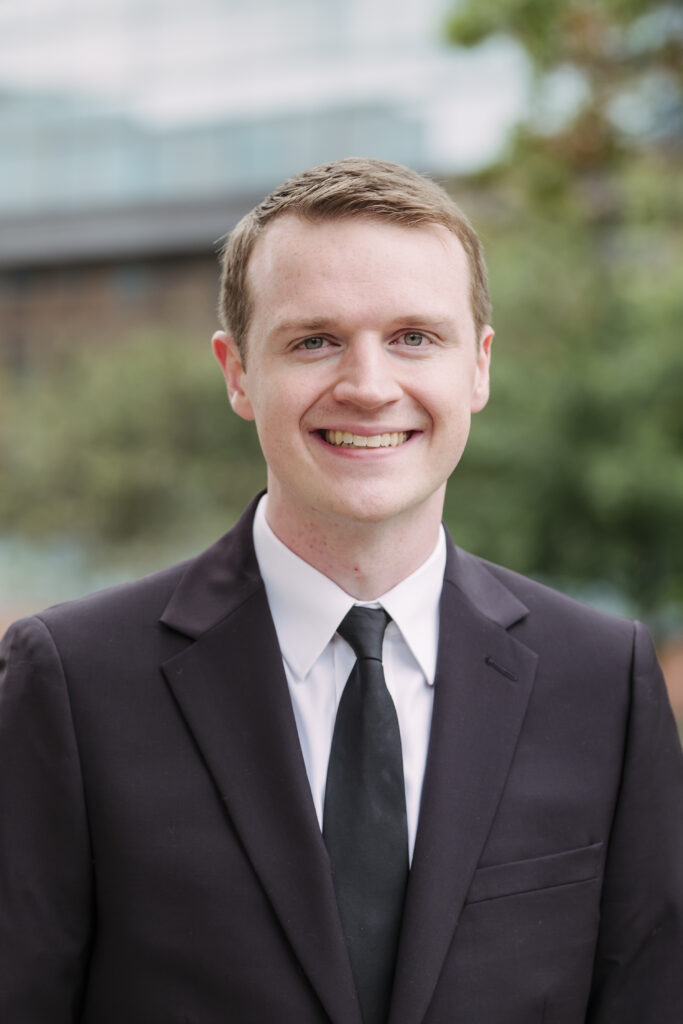
Collin Sullivan ’19, information systems and economics, M.P.P. ’21, is the program director for digital credential innovation in the Division of Professional Studies. While he started as a student worker in 2015 for the Division of Information Technology (DoIT), working with faculty to leverage the use of clickers in the classroom, he now leads university efforts to offer in-demand microcredentials, such as the Greater Washington Partnership Digital Tech credential. Two things have been constant in Collin’s career: his interest in technology and his love of the UMBC community.
Q: What led you to your current role?
A: In many ways, my professional time at UMBC found me. I began as an undergraduate student worker in Instructional Technology with DoIT. I started by supporting classroom clickers in classes all across campus. I’ve always been interested in educational technology, so I was incredibly fortunate and lucky to have had that opportunity during my undergrad.
When I was about to graduate, like many rising seniors, I was really unsure of where I was going to go. I was feeling uneasy about looking for jobs because I knew the values of UMBC and the community that exists here, and I had a hard time thinking about other places to work that would have the same feeling. My passion for educational technology never waned, and in the end I found an opportunity at UMBC.
Q: How many hats do you wear at UMBC?
A: I have had many roles here at UMBC: undergraduate student, graduate student, alumnus, staff, and adjunct faculty member. I’ve studied information systems, economics, and public policy. I began my career in the Division of Information Technology, and now I am in Extended Studies with the Division of Professional Studies. It is without question that I am who I am, and where I am, because of UMBC.
Q: Tell us about someone in the community who has inspired you.
A: There are way too many people to name! The first person who comes to mind is Craig Berger, my Student Government Association advisor when I was an undergrad. There is no other way to put it other than Craig is the best. During my first few days at UMBC, I made my way to the Campus Life office, and Craig always made me feel welcomed and, later, truly empowered me to feel like I could make a difference on campus and beyond the loop. He taught me that even during times that feel particularly challenging, the world is still malleable. A different perspective and level-headed, strategic approach often is a meaningful path forward.
Q: What’s the one thing you’d want someone who hasn’t joined the UMBC community to know about the support you find here?
A: In many ways, UMBC is a small town. It feels like a close-knit community where it’s easy to make meaningful connections with people from diverse backgrounds who genuinely care about each other. While we strive for excellence, there’s no sense of competition—everyone supports one another in achieving personal and collective success, whether in academics, work, or relationships.
Q: Tell us about an organization you’re involved in as part of your work.
A: I’ve had the privilege of being involved with 1EdTech, a national education technology organization, where I serve as co-chair of the Digital Credential Innovation Leadership Network. Our goal is to ensure that everyone who earns digital credentials can confidently showcase their verified competencies and achievements, using them in ways that best support whatever is next in life.
Q: What’s your favorite place on campus to relax or meet friends?
A: My favorite spot has changed over the years—from the tables by the Library pond to the area outside the RAC and the Forum sculpture at the PAHB. But honestly, my go-to answer has to be the coveted comfy chairs at Starbucks! I’ve had so many amazing conversations with friends, mentors, and colleagues there. Plus, you never know who you’ll bump into. There’s just something about the possibilities of chatting over a cup of coffee.
In many ways, UMBC is a small town. It feels like a close-knit community where it's easy to make meaningful connections with people from diverse backgrounds who genuinely care about each other.
Collin Sullivan '19, M.P.P. '21
program director for digital credential innovation
Q: What part of your job do you enjoy the most and why?
A: Working with faculty and staff to create new pathways for learners to reach their goals. It’s easy to get caught up in our own worlds and forget to pause and reflect on the progress we’re all making. I love that I get to collaborate with others to create space for those reflections, where we can really think about what we want learners to achieve. The best part? Seeing the end result—acknowledging all the hard work, both seen and unseen, that helps learners improve their lives and take the next step in their journey.
UMBC’s greatest strength is its people. When people meet Retrievers and hear about the passion they bring, the relationships they create, the ways they support each other, and the commitment they have to inclusive excellence, they truly get a sense of our community. That’s what “Meet a Retriever” is all about.
Learn more about how UMBC can help you achieve your goals.
]]>
Collin Sullivan ’19, information systems and economics, M.P.P. ’21, is the program director for digital credential innovation in the Division of Professional Studies. While he started as a student...
https://umbc.edu/stories/collin-sullivan-digital-credentials-innovation/
https://my3.my.umbc.edu/api/v0/pixel/news/146169/guest@my.umbc.edu/e8cc4a2302334d51835dd340b7a826e9/api/pixel
alumni
alumni-profile
doit
economics
fall-2024
information-systems
magazine
meet-a-retriever
mpp
story
UMBC News & Magazine
https://my3.my.umbc.edu/groups/umbc-news-magazine
https://assets1-my.umbc.edu/system/shared/avatars/groups/000/001/943/24435aa6207c452e7bc15cc74b42c7bb/xsmall.png?1748556657
https://assets1-my.umbc.edu/system/shared/avatars/groups/000/001/943/24435aa6207c452e7bc15cc74b42c7bb/original.png?1748556657
https://assets2-my.umbc.edu/system/shared/avatars/groups/000/001/943/24435aa6207c452e7bc15cc74b42c7bb/xxlarge.png?1748556657
https://assets2-my.umbc.edu/system/shared/avatars/groups/000/001/943/24435aa6207c452e7bc15cc74b42c7bb/xlarge.png?1748556657
https://assets3-my.umbc.edu/system/shared/avatars/groups/000/001/943/24435aa6207c452e7bc15cc74b42c7bb/large.png?1748556657
https://assets1-my.umbc.edu/system/shared/avatars/groups/000/001/943/24435aa6207c452e7bc15cc74b42c7bb/medium.png?1748556657
https://assets2-my.umbc.edu/system/shared/avatars/groups/000/001/943/24435aa6207c452e7bc15cc74b42c7bb/small.png?1748556657
https://assets1-my.umbc.edu/system/shared/avatars/groups/000/001/943/24435aa6207c452e7bc15cc74b42c7bb/xsmall.png?1748556657
https://assets2-my.umbc.edu/system/shared/avatars/groups/000/001/943/24435aa6207c452e7bc15cc74b42c7bb/xxsmall.png?1748556657
UMBC News & Magazine
0
0
false
Mon, 09 Dec 2024 13:15:01 -0500
Mon, 09 Dec 2024 13:15:01 -0500
Faisal Quader, Ph.D. ’20: Expanding access to the cyber ecosystem
There’s already a student waiting outside the office of Faisal Quader, Ph.D. ’20, when the adjunct professor arrives at the Information Technology and Engineering building on a Thursday afternoon.
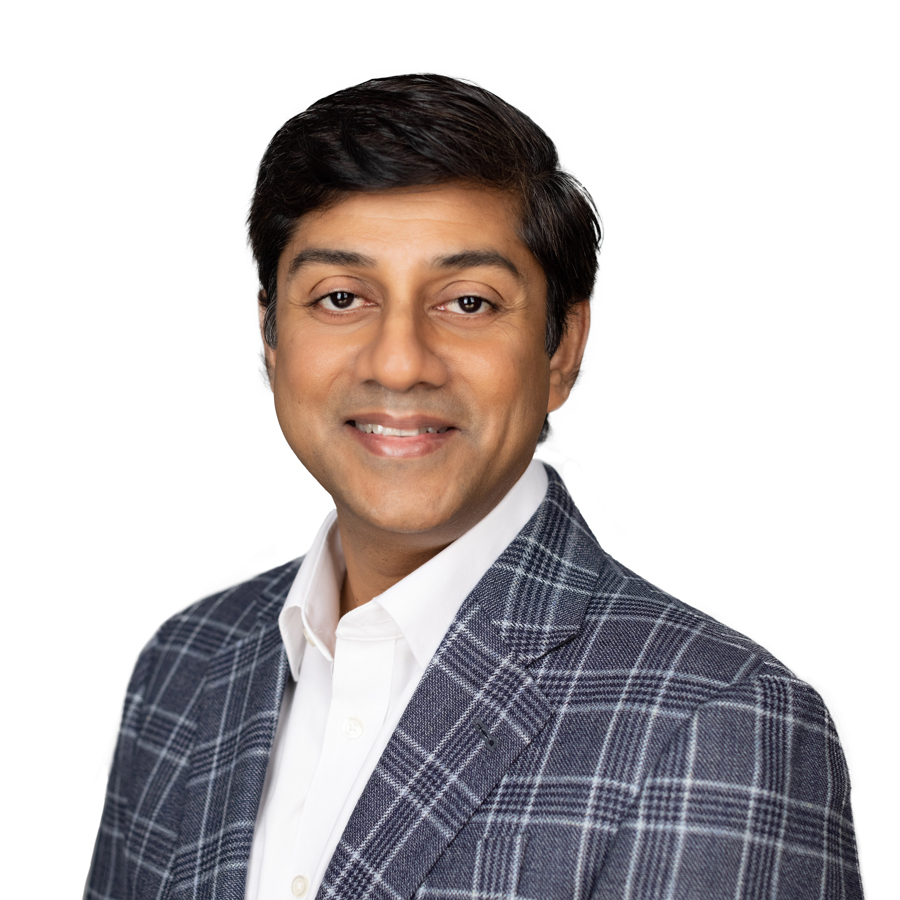 Headshot courtesy of Quader.
The recent graduate, Smriti Khilnani, M.S. ’24, information systems, patiently waits for the information systems instructor—a full-time president of Technuf LLC, philanthropist, and board member of several organizations—to open his office for his limited hours on campus. Quader breezes in, greeting his guest with a smile while asking her how she’s doing.
“I don’t know,” the graduate says, before the pair steps inside the office. After several minutes, the duo exit and Khilnani’s face looks more relaxed and at ease than moments before.
“She’s looking for a job, and she’s a little frustrated,” says Quader of the graduate, who is an international student. “She’s trying to get a cybersecurity job, but it needs security clearance, which she cannot get due to her non-U.S. citizen status. However, we talked about alternative solutions to her problem.”
Moments like these aren’t uncommon for Quader, a former international student himself. He spends a large portion of his time in service to those around him, whether it’s in the classroom, in a meeting room at the high-tech company he runs, or on stage when he’s singing classic Bengali songs.
“The fact that people are so open to come to me for help—that makes my day knowing that I’m able to make a difference,” says Quader.
Bringing industry perspectives into the classroom
Since graduating in 2020, Quader has spent the last four years as a part-time instructor teaching two graduate-level cybersecurity courses at UMBC and an additional course at the University of Maryland, College Park. On top of teaching, Quader works full-time as the president of the company he co-founded, Technuf, which specializes in cybersecurity, artificial intelligence (AI), machine learning (ML), robotic process automation, mobile application development, and software engineering. The Rockville-based company supports agencies, such as the Internal Revenue Service, the National Institutes of Health, and the Department of Homeland Security, and some state governments on high-profile cybersecurity initiatives.
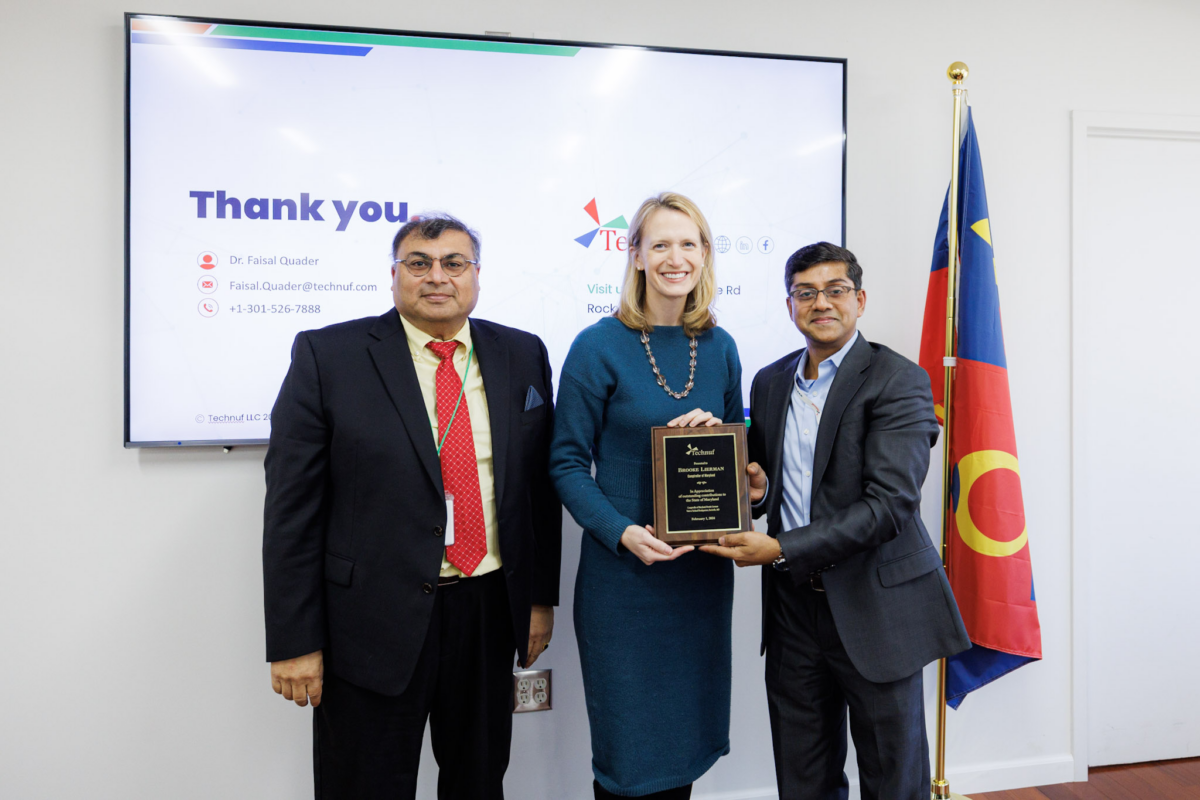 Faisal Quader (right) and Technuf co-founder and CEO Shah Ahmed (left) presenting an award to Maryland Comptroller Brooke E. Lierman in February 2024. (Photo courtesy of Technuf LLC’s X account)
Quader has a B.S. in computer science from the University of Wisconsin and an M.S. in computer science and engineering from Johns Hopkins University. Before going down the path to becoming a faculty member, Quader was initially a non-degree student at UMBC, but after enjoying his class so much, he decided to pursue a doctoral degree in information systems, specializing in cybersecurity.
“It was a difficult path working full-time and being a student, but I got so much from UMBC,” says Quader. “My mentors and professors supported me tremendously. I love this school, and now I feel like it’s time for me to give something back. Nothing is better than being able to share what I’ve learned with students.”
Quader brings his data science industry know-how to the classroom in more practical ways, educating students on how he and his team at Technuf work to address timely cybersecurity challenges, such as securing network infrastructures from cyber attacks and analyzing data to protect from cyber threats. His courses are capped to capacity every semester and has an ever-evolving waitlist of students hoping to learn from his tutelage.
“Cybersecurity is an extremely hot topic, and I like that I can bring in the industry perspective to my theoretical teachings,” explains Quader. “I love teaching—it’s my passion. Even though I work full time, I do this because I love to be able to share what I do everyday.”
A passion for performance
While Quader has spent the last three decades in engineering, computer science, and information science as an industry leader, he’s dedicated much of his life to something he got from his mother: a love of singing.
As a child growing up in Bangladesh, Quader frequently performed on tv shows as a vocalist and continues to feed his passion for performance today. He shares that music is his “weekend work” where he occasionally puts on family performances with his wife and two children. Every few weeks, Quader travels across the DMV singing with various groups. He’s a big fan of Lionel Richie and Bengali polymath Rabindranath Tagore. With his performances, Quader says that he is trying to create a bridge between Eastern and Western music.
 Faisal Quader singing traditional South Asian music during a performance at the Purbachal Resort in Bangladesh. (Photo courtesy of Quader)
The tech-heavy data scientist says that finding time to mesh his creative passions with his analytical and technical skills gives balance to his life—music and technology are more related than one may think, he adds.
“Technology has a lot of mathematical inductions, different kinds of modeling theories and patterns. Music is also something that is kind of like a pattern,” says Quader. “Music refreshes my brain. When the weekend comes, I focus on music and that gives me more energy to do my work. That keeps me sane.”
Supporting the next generation of data scientists and engineers
In 2023, Quader established the Technuf Endowed Fellowship at UMBC, a $100,000 fund that supports master’s or Ph.D. candidates in information systems with entrepreneurial aspirations who are conducting research and/or pursuing a career in AI/ML or cybersecurity. The fellowship, Quader shares, is particularly for students who are unable to receive financial support for their education.
“When I was a student here in the U.S. after emigrating from Bangladesh at age 18, I didn’t have a scholarship or funding because of the fact that I was an international student. I struggled so badly and had to work three jobs to make my tuition,” he says. “I don’t want my students to go through the same process of struggling. I’m not able to help every student, but this is a good start.”
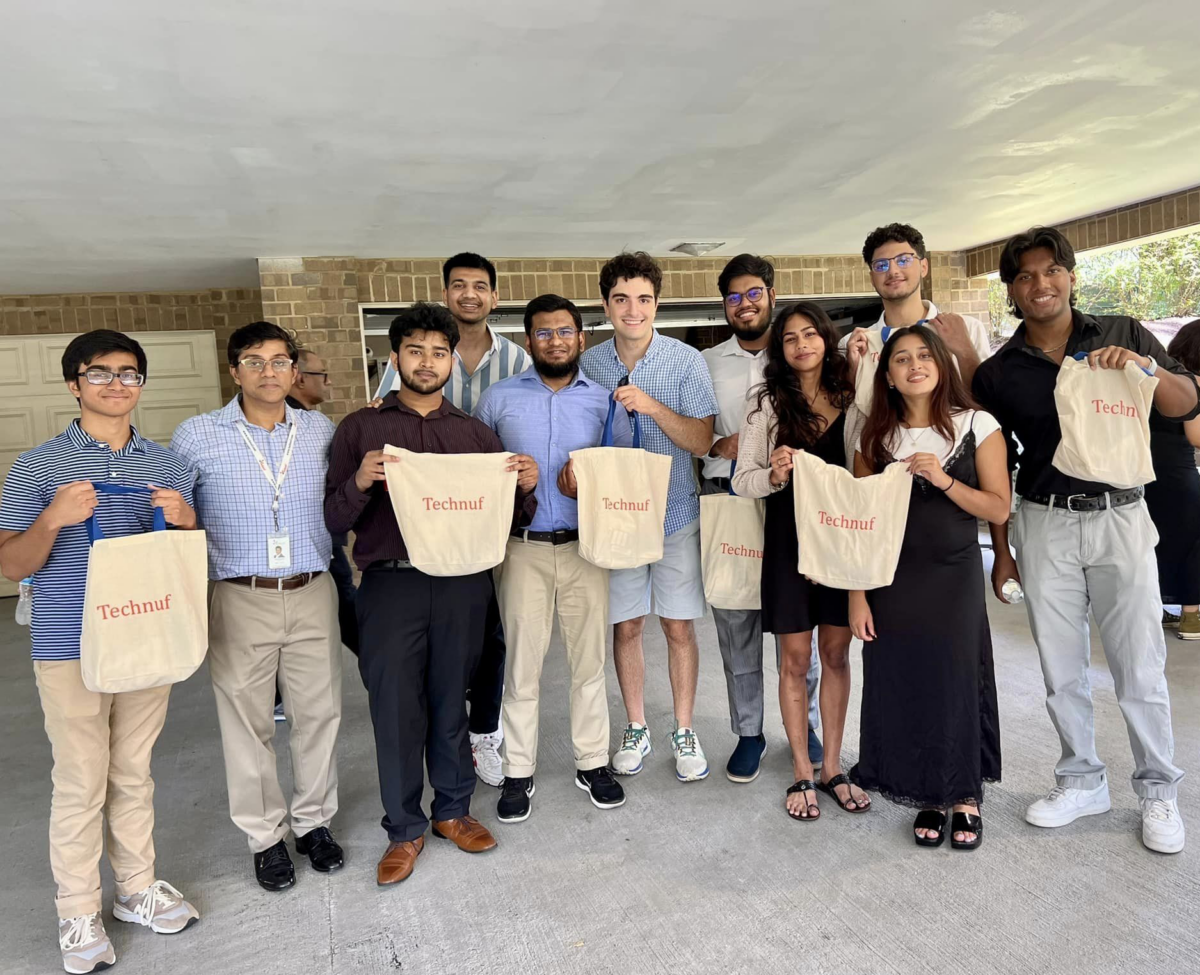 Faisal Quader (second from left) with former Technuf interns. (Photo courtesy of Technuf’s X account)
Quader also created a summer internship program at Technuf where students work hand-in-hand with data scientists and engineers on solving technical problems. Several UMBC students have gone on to work full time at Technuf following their internships, including Isha Shah, M.S. ’23, information systems. In summer 2022, Shah worked at Technuf as a software engineer and data science intern.
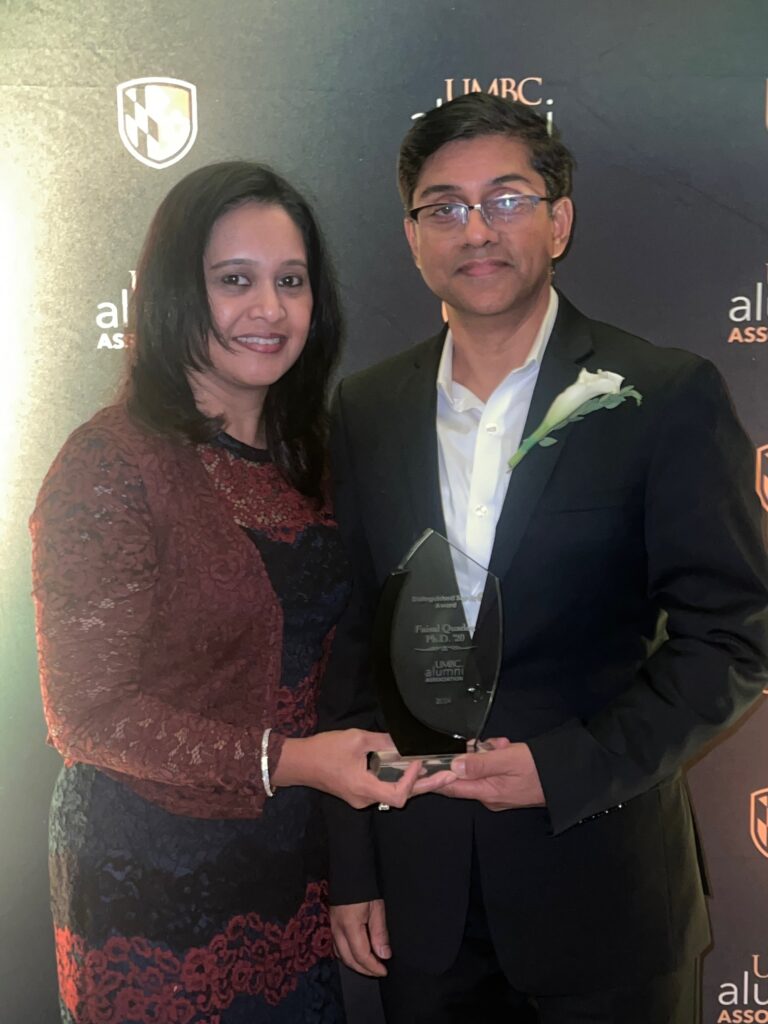 Quader, alongside his wife Fahmida, holding his Distinguished Service Alumni Award. (Photo courtesy of Quader)
“I often found it challenging to secure job or internship opportunities. During one of our initial classes, Dr. Quader mentioned his company, which immediately caught my interest,” says Shah. “I reached out to him to inquire about internship opportunities and to my surprise, he responded with enthusiasm and asked me to send over my resume. That moment felt like a turning point in my career journey.”
After graduating from UMBC, Shah was offered a full-time position at Technuf and currently works at the company as a product development engineer.
“Dr. Quader has had a tremendous impact on both my studies and career. His approach to teaching went far beyond textbooks. He always emphasized the importance of real-world applications and critical thinking, which made a significant difference in my understanding of cybersecurity concepts,” Shah explains. “Dr. Quader believed in my potential and opened doors for me at Technuf, where I’ve been able to gain invaluable hands-on experience in the field.”
In October, Quader was honored for his service as a 2024 recipient of UMBC’s Distinguished Service Alumni Award.
“That was a big encouragement for me,” Quader beamed. “I can see the difference I’m able to make with my students by giving them job opportunities, internships, training, and industry focused-teaching. That’s what keeps me going.”
]]>
There’s already a student waiting outside the office of Faisal Quader, Ph.D. ’20, when the adjunct professor arrives at the Information Technology and Engineering building on a Thursday...
https://umbc.edu/stories/faisal-quader/
https://my3.my.umbc.edu/api/v0/pixel/news/145437/guest@my.umbc.edu/f67ae41ea549926f17a588967aebfbf7/api/pixel
alumni
alumni-awards
coeit
cybersecurity
datascience
fall-2024
impact
information-systems
magazine
story
UMBC News & Magazine
https://my3.my.umbc.edu/groups/umbc-news-magazine
https://assets1-my.umbc.edu/system/shared/avatars/groups/000/001/943/24435aa6207c452e7bc15cc74b42c7bb/xsmall.png?1748556657
https://assets1-my.umbc.edu/system/shared/avatars/groups/000/001/943/24435aa6207c452e7bc15cc74b42c7bb/original.png?1748556657
https://assets2-my.umbc.edu/system/shared/avatars/groups/000/001/943/24435aa6207c452e7bc15cc74b42c7bb/xxlarge.png?1748556657
https://assets2-my.umbc.edu/system/shared/avatars/groups/000/001/943/24435aa6207c452e7bc15cc74b42c7bb/xlarge.png?1748556657
https://assets3-my.umbc.edu/system/shared/avatars/groups/000/001/943/24435aa6207c452e7bc15cc74b42c7bb/large.png?1748556657
https://assets1-my.umbc.edu/system/shared/avatars/groups/000/001/943/24435aa6207c452e7bc15cc74b42c7bb/medium.png?1748556657
https://assets2-my.umbc.edu/system/shared/avatars/groups/000/001/943/24435aa6207c452e7bc15cc74b42c7bb/small.png?1748556657
https://assets1-my.umbc.edu/system/shared/avatars/groups/000/001/943/24435aa6207c452e7bc15cc74b42c7bb/xsmall.png?1748556657
https://assets2-my.umbc.edu/system/shared/avatars/groups/000/001/943/24435aa6207c452e7bc15cc74b42c7bb/xxsmall.png?1748556657
UMBC News & Magazine
0
0
false
Thu, 07 Nov 2024 10:05:35 -0500
Thu, 07 Nov 2024 10:05:35 -0500
UMBC researchers to study digital twinning technology, AI use in neurodegenerative diseases with NSF grant

A multidisciplinary team of UMBC researchers was recently awarded a National Science Foundation (NSF) grant to expand the use of digital twinning technology to diagnose, treat, and increase the understanding of neurodegenerative diseases.
The use of digital twinning—a virtual model of a physical object—was developed by scientists and engineers at NASA as early as the 1960s. Within the last decade, the technology has grown in popularity across a range of industries and has more recently been implemented to advance healthcare diagnostics and treatments, explains Snigdhansu (Ansu) Chatterjee, professor of mathematics and statistics.
Chatterjee, the principal investigator of the UMBC-led study, is taking a closer look into the use of digital twinning to examine neurodegenerative diseases, supported by a nearly $900,000 grant from the NSF’s Foundations for Digital Twins as Catalyzers of Biomedical Technological Innovation (FDT-BioTech) program. The program, in collaboration with the National Institutes of Health and the FDA, was created to foster advances in mathematics, statistics, computational sciences, and engineering required to develop responsive digital twin models that incorporate the abilities of artificial intelligence. UMBC was one of seven institutions awarded research funding to explore the development and use of digital twins in health care and biomedical research. The Washington Post mentioned the FDT-BioTech program in a recent article on the evolution of digital twin technology and its potential to transform healthcare.
The UMBC team will work to develop a prototype of their digital twin model for possible use for neuroscience researchers. The study will also address the ethical, legal, and social implications of using digital twin models in the context of healthcare and in studying neurodegenerative diseases using magnetic resonance-technology driven images (MRI) in particular.
“There are various issues relating to the ethics of AI models and how you use the data, which is especially important when it comes to biological sciences and healthcare,” says Chatterjee. “All good scientists stay within ethical guardrails, and we’re defining what those guardrails are when it comes to using this technology to study neurodegenerative diseases like Alzheimer’s, Parkinson’s disease, and multiple sclerosis.”
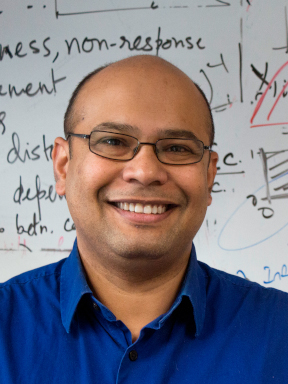
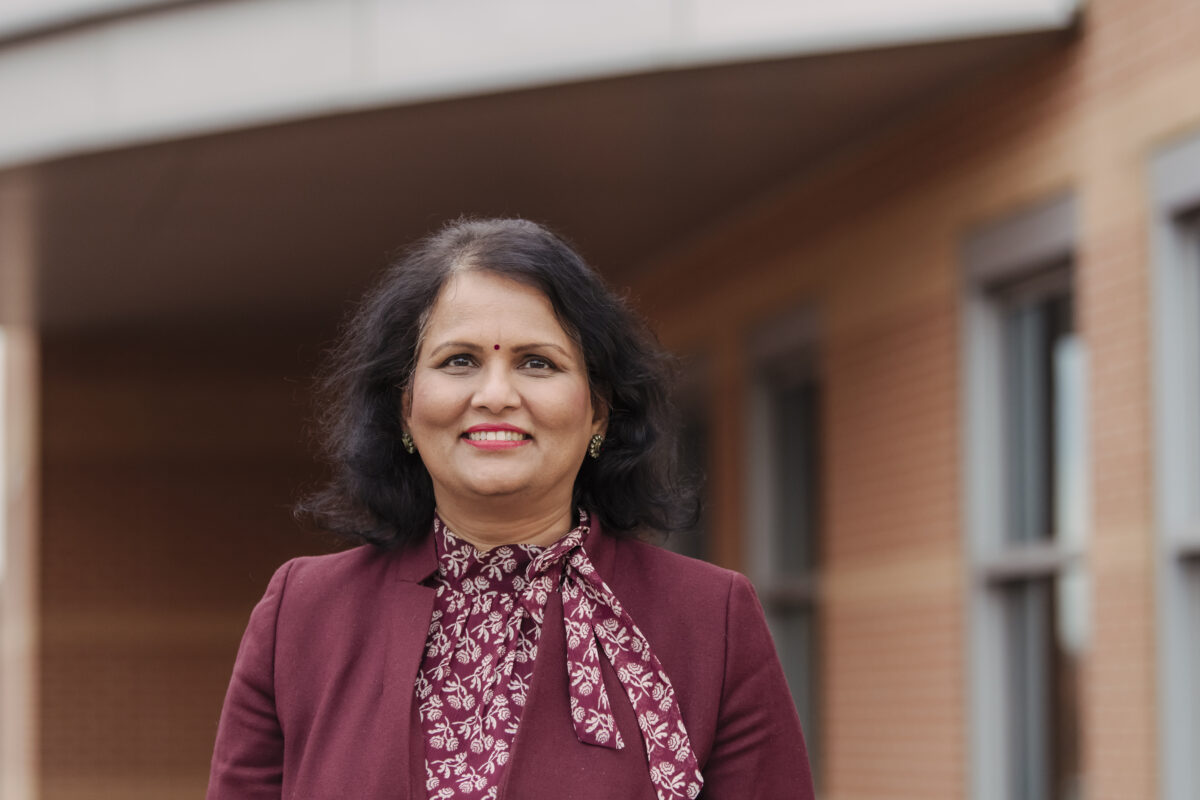
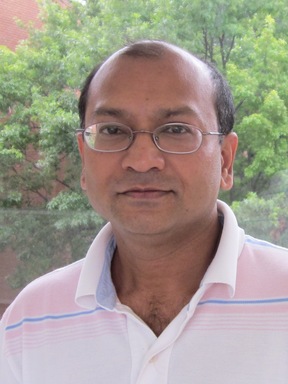 Principal investigator Snigdhansu (Ansu) Chatterjee (left) and co-investigators Karuna Joshi and Animikh Biswas are the leads of the“FDT-BioTech: Aspects of Digital Twin Studies for Neuroimages” study, funded by the National Science Foundation.
The study, which will run until 2027, includes co-investigators Karuna Joshi, professor of information systems, and Animikh Biswas, professor and chair of mathematics and statistics. Additional partners include researchers from the University of Minnesota and the University of Texas at El Paso. The project will also provide funding to support two graduate students and a postdoctoral researcher at UMBC who specialize in engineering, math, or statistics.
Joshi, who is the director of UMBC’s Center for Accelerated Real Time Analytics, explains that there has been an increase in the use of AI models in health prediction, diagnostics, and determining treatment options.
“The explainability and the replicability elements of digital twinning are very critical to why the technology is becoming popular,” says Joshi. “We are looking to develop a ‘meta model’ of all of the various models that’s going to run the neuroimages we’ll study so that it can be explained, archived, and audited.”
Joshi adds that the study will allow for “a cross-pollination of ideas,” where engineering meets science, math, statistics, and healthcare in a very unique way.
More on artificial intelligence research at UMBC.
]]>
A multidisciplinary team of UMBC researchers was recently awarded a National Science Foundation (NSF) grant to expand the use of digital twinning technology to diagnose, treat, and increase the...
https://umbc.edu/stories/digital-twinning-nsf-study/
https://my3.my.umbc.edu/api/v0/pixel/news/144906/guest@my.umbc.edu/70a855afdefe0651942e3e7739cf041e/api/pixel
artificial-intelligence
cnms
coeit
information-systems
mathematics-and-statistics
news
research
science-and-tech
story
UMBC News & Magazine
https://my3.my.umbc.edu/groups/umbc-news-magazine
https://assets1-my.umbc.edu/system/shared/avatars/groups/000/001/943/24435aa6207c452e7bc15cc74b42c7bb/xsmall.png?1748556657
https://assets1-my.umbc.edu/system/shared/avatars/groups/000/001/943/24435aa6207c452e7bc15cc74b42c7bb/original.png?1748556657
https://assets2-my.umbc.edu/system/shared/avatars/groups/000/001/943/24435aa6207c452e7bc15cc74b42c7bb/xxlarge.png?1748556657
https://assets2-my.umbc.edu/system/shared/avatars/groups/000/001/943/24435aa6207c452e7bc15cc74b42c7bb/xlarge.png?1748556657
https://assets3-my.umbc.edu/system/shared/avatars/groups/000/001/943/24435aa6207c452e7bc15cc74b42c7bb/large.png?1748556657
https://assets1-my.umbc.edu/system/shared/avatars/groups/000/001/943/24435aa6207c452e7bc15cc74b42c7bb/medium.png?1748556657
https://assets2-my.umbc.edu/system/shared/avatars/groups/000/001/943/24435aa6207c452e7bc15cc74b42c7bb/small.png?1748556657
https://assets1-my.umbc.edu/system/shared/avatars/groups/000/001/943/24435aa6207c452e7bc15cc74b42c7bb/xsmall.png?1748556657
https://assets2-my.umbc.edu/system/shared/avatars/groups/000/001/943/24435aa6207c452e7bc15cc74b42c7bb/xxsmall.png?1748556657
UMBC News & Magazine
0
0
false
Fri, 18 Oct 2024 15:25:12 -0400
Fri, 18 Oct 2024 15:25:12 -0400
UMBC’s 2024 Cybersecurity Leadership Exploratory Grant Program recipients announced
The UMBC Cybersecurity Institute and the Division of Research and Creative Achievement, in partnership with the College of Engineering and Information Technology, recently announced the recipients of the 2024 Cybersecurity Leadership Exploratory grant program.
The internal funding opportunity is designed to promote innovative, interdisciplinary research and education focused on enhancing UMBC’s leadership in cybersecurity research. Awardees received up to $45,000 in funding to develop their exploratory projects—an increase compared to its inaugural recipient cohort in 2023.
The 2024 recipients are:
-
Alan Sherman and Enis Golaszewski for “Modeling and Formal-Methods Analysis of the Secure DNA Protocol”
-
Manas Gaur for “Cybersecurity Research: MetamorphicLLM: Robust Understanding of Metamorphic Malware Through Attacks and Defenses Using Neurosymbolic Large Language Models”
-
Meilin Yu and Zhiyuan Chen for “Detecting Stealthy Long-Term Cyber Attacks on Wind Energy Assets with Physics-Informed Neural Network Technologies”
-
Naghmeh Karim for “Artificial Intelligence and Hardware Security: From Research to Classroom (Educational Proposal)”
-
Nilanjan Banerjee and Mohamed Younis for “Implementing Endpoint Security for Cyber-Physical Systems”
-
Tera Reynolds for “Swiss Cheese Please: Analyzing Cybersecurity Risks in the Digital Health Ecosystem with Patients with Complex Care Needs”
Learn more about UMBC’s internal funding opportunities.
]]>
The UMBC Cybersecurity Institute and the Division of Research and Creative Achievement, in partnership with the College of Engineering and Information Technology, recently announced the recipients...
https://umbc.edu/quick-posts/2024-exploratory-grant-recipients/
https://my3.my.umbc.edu/api/v0/pixel/news/144674/guest@my.umbc.edu/f49123192875a7393ea88ca4f921794b/api/pixel
coeit
csee
cybersecurity
information-systems
quick-post
research
UMBC News & Magazine
https://my3.my.umbc.edu/groups/umbc-news-magazine
https://assets1-my.umbc.edu/system/shared/avatars/groups/000/001/943/24435aa6207c452e7bc15cc74b42c7bb/xsmall.png?1748556657
https://assets1-my.umbc.edu/system/shared/avatars/groups/000/001/943/24435aa6207c452e7bc15cc74b42c7bb/original.png?1748556657
https://assets2-my.umbc.edu/system/shared/avatars/groups/000/001/943/24435aa6207c452e7bc15cc74b42c7bb/xxlarge.png?1748556657
https://assets2-my.umbc.edu/system/shared/avatars/groups/000/001/943/24435aa6207c452e7bc15cc74b42c7bb/xlarge.png?1748556657
https://assets3-my.umbc.edu/system/shared/avatars/groups/000/001/943/24435aa6207c452e7bc15cc74b42c7bb/large.png?1748556657
https://assets1-my.umbc.edu/system/shared/avatars/groups/000/001/943/24435aa6207c452e7bc15cc74b42c7bb/medium.png?1748556657
https://assets2-my.umbc.edu/system/shared/avatars/groups/000/001/943/24435aa6207c452e7bc15cc74b42c7bb/small.png?1748556657
https://assets1-my.umbc.edu/system/shared/avatars/groups/000/001/943/24435aa6207c452e7bc15cc74b42c7bb/xsmall.png?1748556657
https://assets2-my.umbc.edu/system/shared/avatars/groups/000/001/943/24435aa6207c452e7bc15cc74b42c7bb/xxsmall.png?1748556657
UMBC News & Magazine
1
0
false
Thu, 10 Oct 2024 13:07:29 -0400
Thu, 10 Oct 2024 13:07:29 -0400
Growing from the unexpected—nonlinear internships surprise Retrievers with success

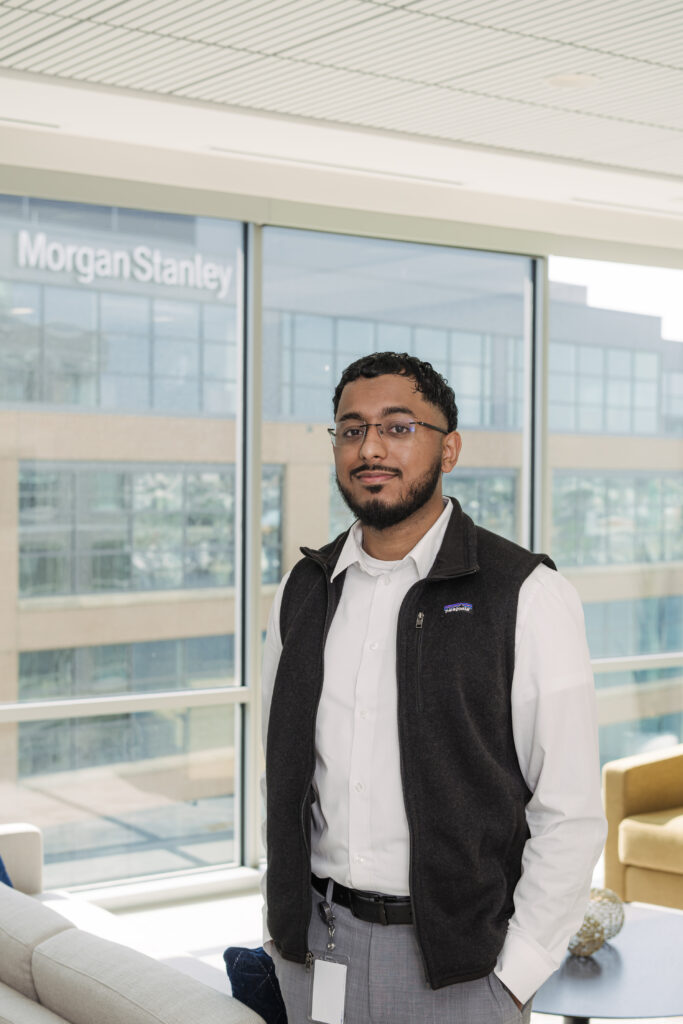
Anil Shaji was pretty content going to UMBC for classes and returning to his home in Elkridge, Maryland, as soon as his academic obligations were over. Until one day, a notice on myUMBC caught his eye—the Career Center was organizing an exploratory trip to Morgan Stanley for potential interns that week. As a senior studying political science, Shaji had originally imagined a role for himself at a security agency or somewhere in politics, not a financial institution. But expanding his perspective, he stepped out of his comfort zone and thought, “Why not take the trip?”
Shaji took a UMBC bus with about 20 other interested students and spent the day chatting with Morgan Stanley recruiters about what the three-month, full-time paid internship would look like. Shaji went home and quickly updated his resume, completed a virtual interview, and submitted his application. Later, Shaji was invited to SuperDay, where top candidates undergo multiple rounds of interviews with the firm. Eight months later, he’s wrapping up his placement as an operations summer analyst in Morgan Stanley’s institutional securities group and he sees a viable future using his major in a financial services career.
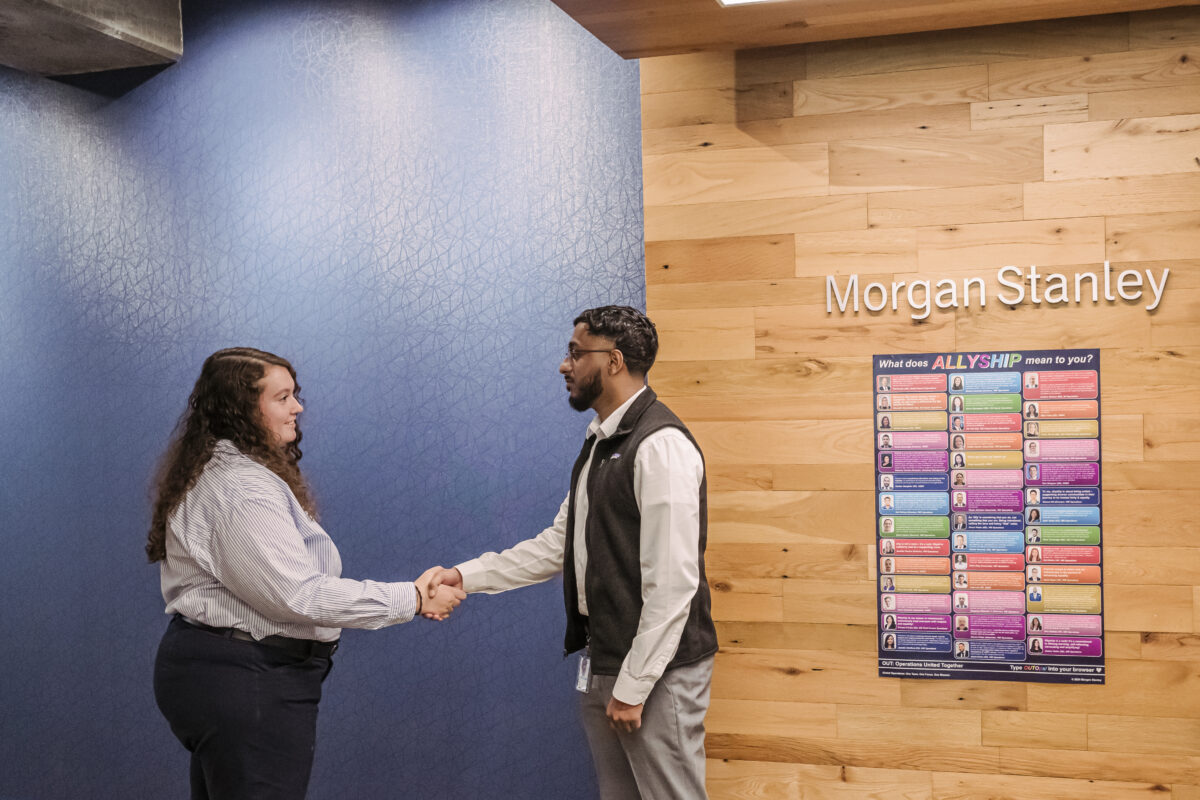 Shaji shakes hand with his internship supervisor, Rachel Hanrahan. (Marlayna Demond ’11/UMBC)
“There are multiple paths—many that are not linear—to get to your longer-term goal,” says Marykate Conroy, associate director of internships and employment in UMBC’s Career Center who often coaches students through the internship application process. “Diverse experiences also may open doors for students that they didn’t even see as possible.”
Hundreds of Retrievers are completing internships this summer, putting their skills to use in real life settings and trying out roles in industries they might want to pursue after graduation. Many of these students are discovering how their goals could be supported and strengthened by an internship not originally on their radar.
Looking for creative freedom
When Kayla Moore saw a LinkedIn post advertising a graphic design internship for the communications department at Johns Hopkins Applied Physics Laboratory (APL), she was initially hesitant to apply for several reasons. Moore, a senior studying visual arts, was aware of Johns Hopkins, but didn’t know anything about APL, and she was nervous about the communications-side of things—would she be required to write? She didn’t see what she did yet as a designer as a way of communicating content to an audience.
She went into her internship search “wanting to find something in the middle of having creative freedom and being structured. And this role has been ideal,” Moore says. So far, she’s designed graphics for papers, posters, and her favorite project—a sticker for a company family fun day. She pitched the design as a “draw your own picture” sticker that includes an APL logo or phrase, and to her surprise, that’s what the team went with.
 Moore in an APL conference room. Photo courtesy of Edward G. Whitman/APL.
The biggest skill she’s learned so far? Communication, she laughs. In past roles, she says, she’s finished her design and passed it along to her supervisor or professor and that was it. At APL, “I have to talk to at least four or five people before anything goes to print,” says Moore. “Someone reviews my design and offers feedback; someone checks for spelling. And then I need to talk to the print shop and ask if things look good. So communication was definitely the biggest thing that I’ve learned in order to make sure I’m not slowing down the process to get a project out.”
Let your motivation lead you
Misan Ayomike is spending the summer at the University of Chicago in an economics internship with Pietro Veronesi, a preeminent economist and a dean at the University of Chicago Booth School of Business. The catch? “I’m not really that cognizant in the econ field,” Ayomike freely admits. “I’m an information systems major senior.” But Veronesi was open to any major “with strong quantitative and analytical backgrounds” and good references to work on his project researching the R&D costs for oncology, and Ayomike knew she’d get what she wanted out of the internship—feedback on her own ongoing research project.
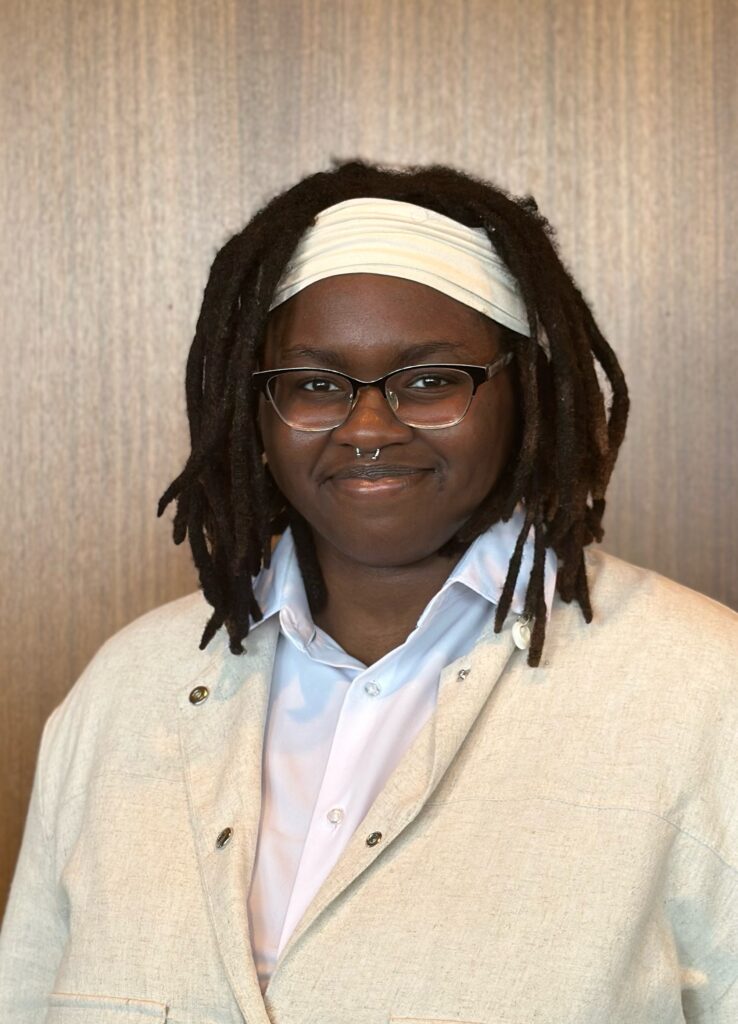
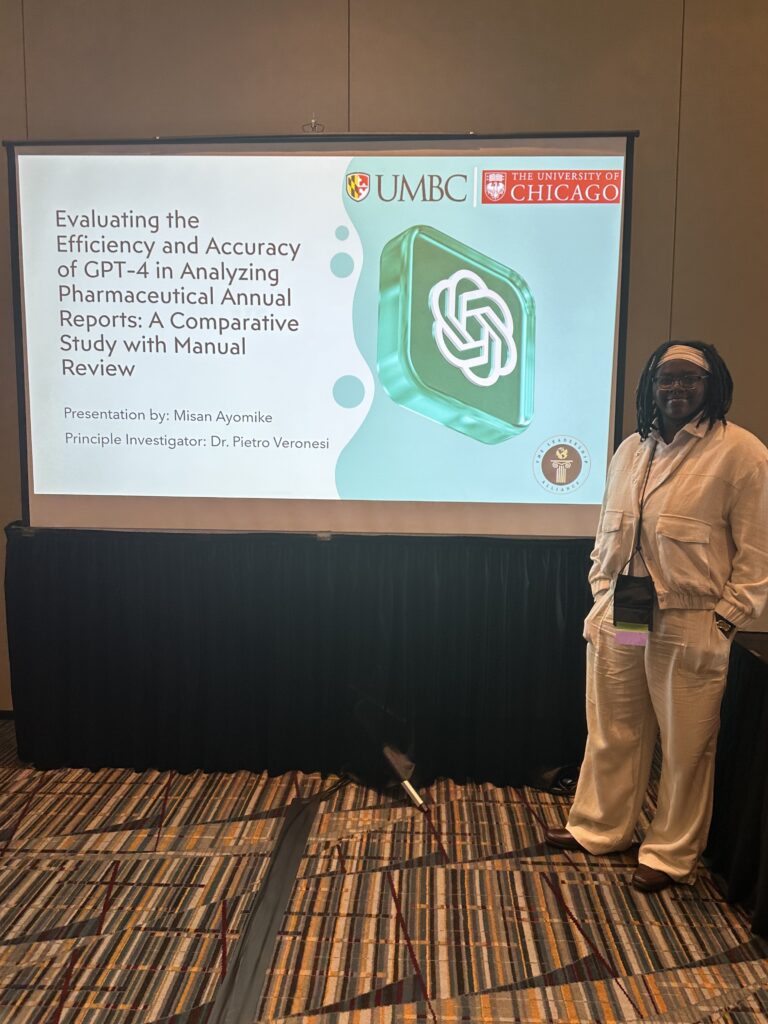
Left: Headshot of Misan Ayomike. Right: Ayomike at the Leadership Alliance Conference after presenting her own research project conducted during her internship at the University of Chicago. Photos courtesy of Ayomike.
When Christine Routzahn, director of UMBC’s Career Center, brought this opportunity to Ayomike, she jumped at the chance to earn a sizeable stipend, experience life in a different city, and have dedicated time and feedback while conducting her own manual and statistical review on how accurate and efficient Chat GPT’s 4o AI model is at reviewing and replicating data from annual reports of pharmaceutical companies. The internship, coordinated through the Leadership Alliance, culminated in a conference where Ayomike presented her work.
Ayomike’s advisor Bill Ryan, a lecturer in information systems, was one of her references when she applied. Looking back, he knew she’d be a good fit because “she liked and enjoyed research, as well as understood and sought out articles of interest in her topic areas,” he says. “This opportunity would provide her with that research opportunity and to also demonstrate some of the learning she’s done in information systems. It was an opportunity to pull everything together that motivated her.”
Relying on different strengths
Within his major, Shaji says, his favorite classes have been intelligence-based or about international relations, so originally he thought that meant pursuing an internship at a place like Northrop Grumman or the CIA. But after visiting Morgan Stanley, he saw the social sciences connection. “The banking industry is heavily regulated and there are laws in place that banks need to follow, so what Congress passes affects the firm as well as the clients.”
For Shaji’s role at Morgan Stanley, he’s looking at new types of data every day. “When we lend securities out to hedge funds, we need to observe whether they’re in compliance—whether Morgan Stanley is properly making those transactions or actions—and we’re ensuring that we’re following all protocols internally as well as with government regulations,” says Shaji. “We are working to ensure that the numbers are all adding up correctly as they should.”
Shaji’s biggest takeaway from Morgan Stanley was how necessary voices are from all perspectives. “When you bring in a group of people who are quantitative majors or political science majors and art majors and you put them into a group,” he says, “they can truly build out some awesome solutions to existing problems. But it requires all those different perspectives—all those different strengths—put together.”
Right: Anil Shaji in the offices at Morgan Stanley in downtown Baltimore. (Marlayna Demond ’11/UMBC).
No such thing as a “perfect internship”
While some students may have difficulty thinking about options other than their ideal placement, says Conroy in the Career Center, eventually students become excited about the increased options and opportunities that won’t throw them off track with their future goals. “The pressure to get the ‘perfect internship’ is released,” she says.
Moore, at APL, was excited to dive into the world of digital design but says she knows now she wants to explore positions that also let her work with her hands. When thinking about advice for other Retrievers looking for internships, she says, “Think about it as an extended job interview—there’s always a chance you can get hired on afterward, but also it’s an experience for you to see if you actually really like this industry.”
Ayomike concluded her internship by presenting her own research at a Leadership Alliance conference in Harford, Connecticut. Thinking back over her summer at the University of Chicago, she says, “I hadn’t ever really thought of going into econ or research, so this experience broadened my field of thinking. I learned about a lot of things I did not know that I did not know.”
]]>
Anil Shaji was pretty content going to UMBC for classes and returning to his home in Elkridge, Maryland, as soon as his academic obligations were over. Until one day, a notice on myUMBC caught his...
https://umbc.edu/stories/non-linear-internships-surprise-retrievers/
https://my3.my.umbc.edu/api/v0/pixel/news/143223/guest@my.umbc.edu/6d7e20a00ab2eb9e2de8c4133c776c77/api/pixel
cahss
campus-life
career-center
coeit
information-systems
magazine
political-science
story
visual-arts
UMBC News & Magazine
https://my3.my.umbc.edu/groups/umbc-news-magazine
https://assets1-my.umbc.edu/system/shared/avatars/groups/000/001/943/24435aa6207c452e7bc15cc74b42c7bb/xsmall.png?1748556657
https://assets1-my.umbc.edu/system/shared/avatars/groups/000/001/943/24435aa6207c452e7bc15cc74b42c7bb/original.png?1748556657
https://assets2-my.umbc.edu/system/shared/avatars/groups/000/001/943/24435aa6207c452e7bc15cc74b42c7bb/xxlarge.png?1748556657
https://assets2-my.umbc.edu/system/shared/avatars/groups/000/001/943/24435aa6207c452e7bc15cc74b42c7bb/xlarge.png?1748556657
https://assets3-my.umbc.edu/system/shared/avatars/groups/000/001/943/24435aa6207c452e7bc15cc74b42c7bb/large.png?1748556657
https://assets1-my.umbc.edu/system/shared/avatars/groups/000/001/943/24435aa6207c452e7bc15cc74b42c7bb/medium.png?1748556657
https://assets2-my.umbc.edu/system/shared/avatars/groups/000/001/943/24435aa6207c452e7bc15cc74b42c7bb/small.png?1748556657
https://assets1-my.umbc.edu/system/shared/avatars/groups/000/001/943/24435aa6207c452e7bc15cc74b42c7bb/xsmall.png?1748556657
https://assets2-my.umbc.edu/system/shared/avatars/groups/000/001/943/24435aa6207c452e7bc15cc74b42c7bb/xxsmall.png?1748556657
UMBC News & Magazine
1
0
false
Fri, 16 Aug 2024 16:22:38 -0400
Fri, 16 Aug 2024 16:22:38 -0400
Meet a Retriever—Patty Hathaway ’97, M.S. ’03, lifetime Retriever and advocate for veterans
Meet Patty Hathaway ’97, M.S. ’03, who earned her B.A. in economics and M.S. in information systems while working at UMBC. After 23 years of service to UMBC, Patty went on to work at three other universities, including the University of Maryland, College Park, where she retired. Patty now works with U.S. Navy veterans as the secretary/treasurer of the USS Hamner DD-718 Association and is the owner of Hathaway Photography of Bowie. Patty recently authored a book for the Hamner association, An American Destroyer: USS Hamner History in Photographs. Take it away, Patty!
Q: What’s one essential thing you’d want another Retriever to know about you?
A: I am a Retriever in many ways: a double alum, a former employee, a UMBC parent (twice), and a past Hilltop Society Member. I was a staff member for 23 years and earned my B.A. and M.S. while working on campus. I worked for three other universities after UMBC, and I now am loving my work with our Navy veterans. I am certain that I would not be where I am today without UMBC.
Q: What’s the one thing you’d want someone who hasn’t joined the UMBC community to know about the support you find here?
A: I would emphasize the feeling of being a “part of the campus family.” It’s not too big and not too small. You just feel like you “fit.” I felt that way as an employee and as a student, and when I visit, I still feel like I am coming home. UMBC was and continues to be a huge part of my life and the person I am today.
Q: Tell us about someone in the community who has inspired you or supported you, and how they did it.
A: UMBC had an atmosphere that made it feel like you were with family. A lot of that was encouraged by Freeman Hrabowski. Although he was the president of UMBC, he found time for employees and students, and was able to be a mentor, supporter, and leader for many. Although I have been away from the UMBC campus since 2005, I have been able to keep in touch with Freeman.
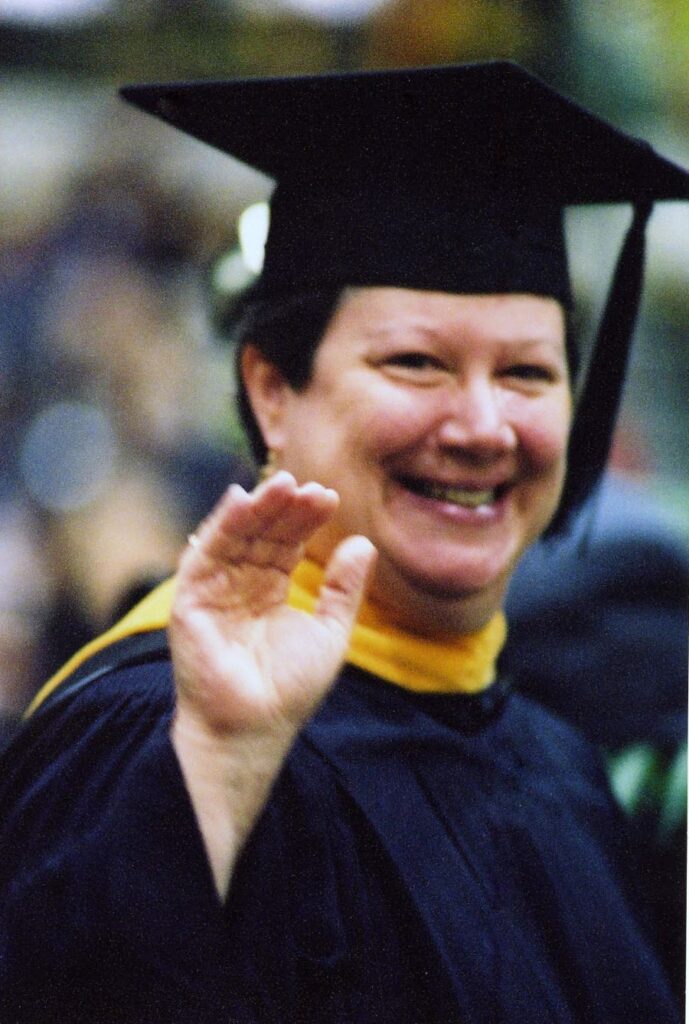
Left: Hathaway waving to the photographer at her 2003 UMBC graduation.
Q: Tell us what you love about your academic program or an organization you’re involved in.
A: During my time at UMBC, I also made time to help with non-profit veterans’ organizations. I was able to use the skills I learned on campus to help these groups. After retiring from paid employment, I have concentrated on my photography business and the USS Hamner DD-718 Association. The Hamner association is dedicated to preserving the memories of the ship and the crew who served on her.
When I visit, I still feel like I am coming home. UMBC was and continues to be a huge part of my life and the person I am today.
Patty Hathaway ’97, M.S. ’03
My most recent accomplishment for the Hamner association is the book I authored for them: An American Destroyer: USS Hamner History in Photographs. This book is the sequel to a book I edited for the association in 2022. The history of our veterans needs to be told and I am very happy to be a part of that. Without the skills I acquired and the confidence I developed at UMBC, I would never have been able to edit or author a book.
Q: If you’re currently working, what’s your title and where do you work? What do you enjoy most about it?
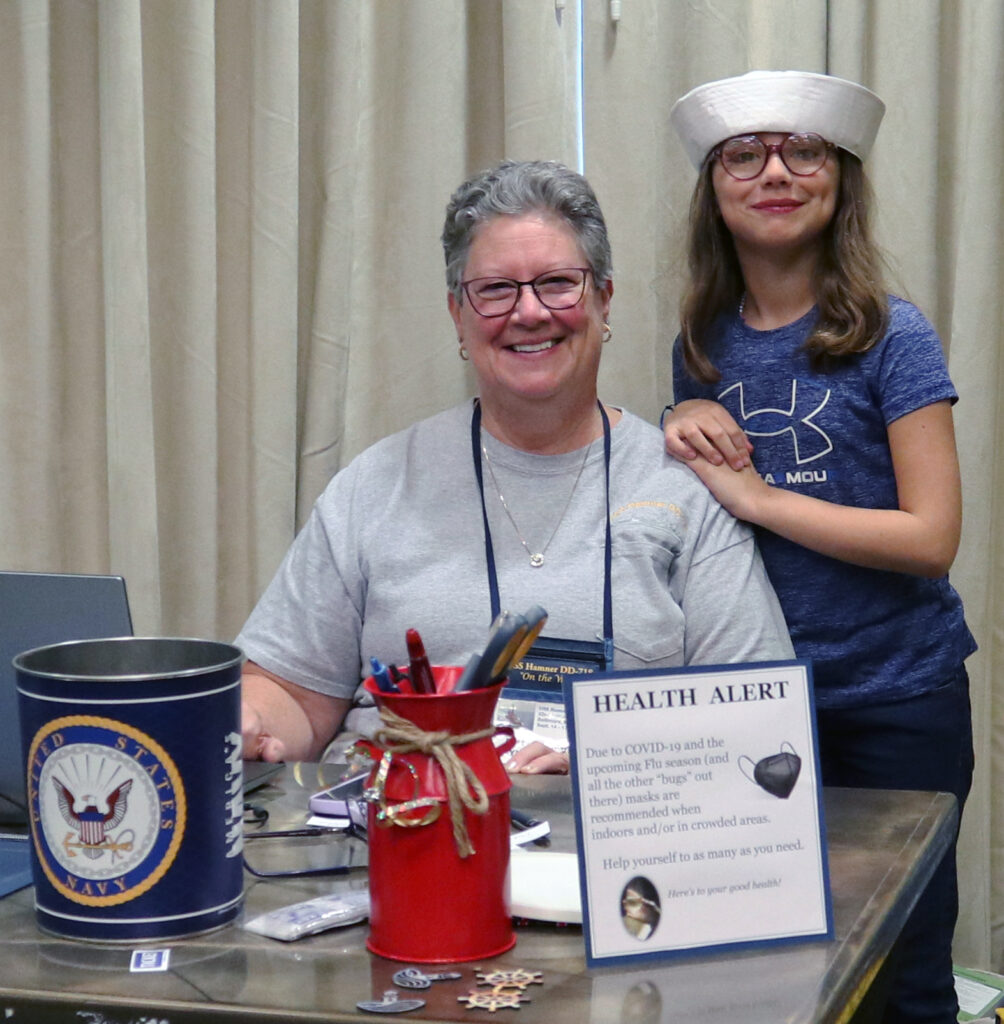
A: I am the secretary/treasurer of the USS Hamner DD-718 Association (non-paid office). The relationships I have developed with these Navy veterans is like those at UMBC—we are family!
Q: Tell us about your primary WHY, and how it led you to UMBC.
A: I first came to UMBC in the fall of 1976 as a freshman. I have to admit, I was not ready to be a full-time university student so I pursued my associate degree on a part-time schedule instead at Catonsville Community College. There was something about UMBC that drew me back, and in 1981, I was hired to work in the accounting department. Within four years I had completed my A.A. degree and began the pursuit of my B.A. degree in 1989. I loved working on campus and I enjoyed being a student again. I worked with great people and many friendships developed at UMBC that would last for decades.
Right: Hathaway and her granddaughter at a USS Hamner Reunion.
Q: Where have you found support in the UMBC community?
A: I had several people who helped me along the way, sometimes just with encouragement as I tried new positions or pursued a new path in life. Friends who are now gone, Diane Taylor ’76, Jim Milani ’73, and Gary Rupert always had an encouraging word or good advice as I selected courses or applied for the next job opening on campus. Their confidence in me meant more than I can put into words.
In both my work life as well as academic and personal life, David Gleason, M.S. ’04, would always be there to help me find the confidence I needed to move forward. He would always know how to convince me that I could take that next step. His friendship is one I still treasure.
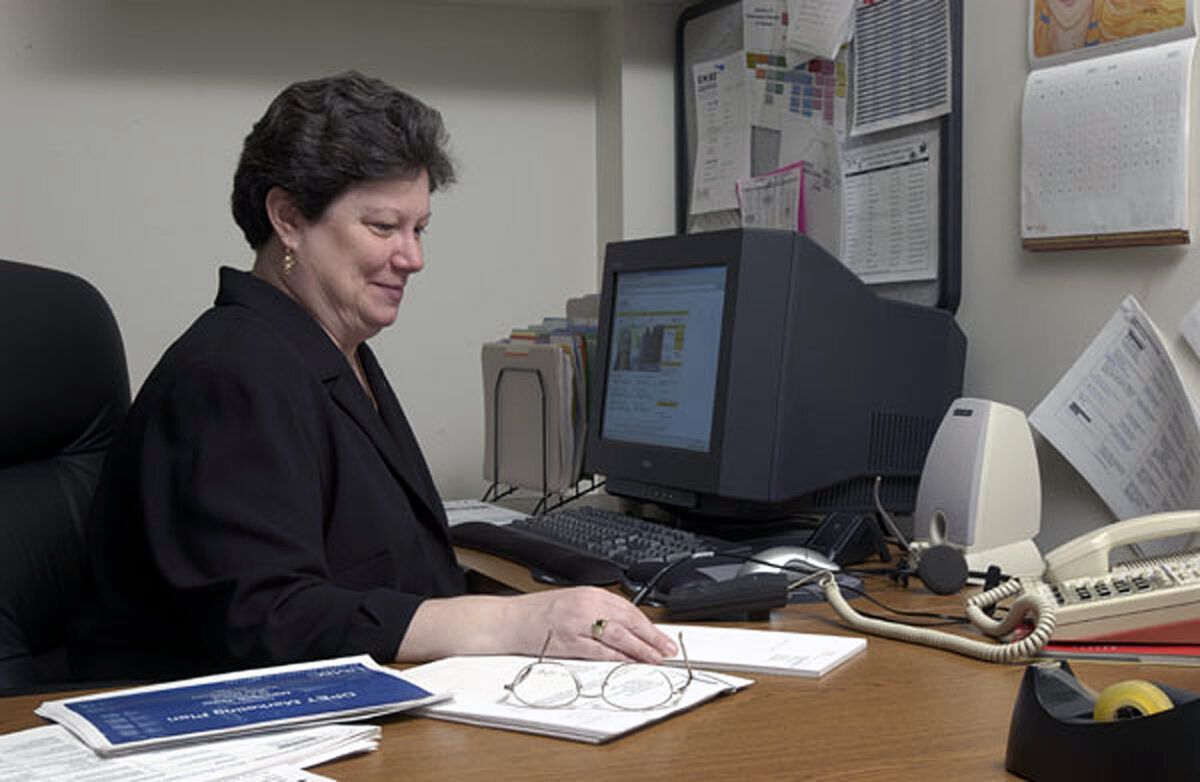 Hathaway was part of a photoshoot to advertise the UMBC’s online Master of Science in Information Systems program. Photo courtesy of Hathaway.
Q: What’s your favorite part of being a part of Retriever Nation?
A: I am proud to be a part of Retriever Nation both as a alum and a former employee/retiree. I enjoy seeing UMBC grow and being able to feel like I was part of that growth.
Q: What drives you to support UMBC?
A: I have tried to support UMBC whenever I can. I hope to be able to continue and do more in the future.
* * * * *
UMBC’s greatest strength is its people. When people meet Retrievers and hear about the passion they bring, the relationships they create, the ways they support each other, and the commitment they have to inclusive excellence, they truly get a sense of our community. That’s what “Meet a Retriever” is all about.
Learn more about how UMBC can help you achieve your goals.
]]>
Meet Patty Hathaway ’97, M.S. ’03, who earned her B.A. in economics and M.S. in information systems while working at UMBC. After 23 years of service to UMBC, Patty went on to work at three other...
https://umbc.edu/stories/meet-a-retriever-patty-hathaway-advocate-veterans/
https://my3.my.umbc.edu/api/v0/pixel/news/143154/guest@my.umbc.edu/1747a812d1f358748ffc8c4fe82ea448/api/pixel
alumni
author
economics
impact
information-systems
magazine
meet-a-retriever
story
umbc-author
veterans
UMBC News & Magazine
https://my3.my.umbc.edu/groups/umbc-news-magazine
https://assets1-my.umbc.edu/system/shared/avatars/groups/000/001/943/24435aa6207c452e7bc15cc74b42c7bb/xsmall.png?1748556657
https://assets1-my.umbc.edu/system/shared/avatars/groups/000/001/943/24435aa6207c452e7bc15cc74b42c7bb/original.png?1748556657
https://assets2-my.umbc.edu/system/shared/avatars/groups/000/001/943/24435aa6207c452e7bc15cc74b42c7bb/xxlarge.png?1748556657
https://assets2-my.umbc.edu/system/shared/avatars/groups/000/001/943/24435aa6207c452e7bc15cc74b42c7bb/xlarge.png?1748556657
https://assets3-my.umbc.edu/system/shared/avatars/groups/000/001/943/24435aa6207c452e7bc15cc74b42c7bb/large.png?1748556657
https://assets1-my.umbc.edu/system/shared/avatars/groups/000/001/943/24435aa6207c452e7bc15cc74b42c7bb/medium.png?1748556657
https://assets2-my.umbc.edu/system/shared/avatars/groups/000/001/943/24435aa6207c452e7bc15cc74b42c7bb/small.png?1748556657
https://assets1-my.umbc.edu/system/shared/avatars/groups/000/001/943/24435aa6207c452e7bc15cc74b42c7bb/xsmall.png?1748556657
https://assets2-my.umbc.edu/system/shared/avatars/groups/000/001/943/24435aa6207c452e7bc15cc74b42c7bb/xxsmall.png?1748556657
UMBC News & Magazine
1
0
false
Fri, 09 Aug 2024 16:18:52 -0400
Fri, 09 Aug 2024 16:18:52 -0400
Putting UMBC Research on the Map
Spring on UMBC’s main campus brings a host of familiar sights and sounds: blooms on the magnolia trees, the chatter of red-winged blackbirds calling from the reeds around Library Pond, greening grass on the campus Quad, and black-and-gold-bedecked Grit Guides leading groups of prospective Retrievers around what may soon become a home away from home.
The guides cover the usual highlights—Academic Row, the Retriever Activity Center, the AOK Library, eating establishments, and residential halls. UMBC is a place to live, to learn, and to find community. And while some of the functions of campus spaces are obvious, others are often hidden.
Look more closely, and you’ll see faculty and students turning the everyday infrastructure and green oases of UMBC into out-of-the-ordinary laboratories. Beeswax sculptures, tactile maps, robots helping other robots—read on to discover some of the amazing ways Retrievers are using the campus itself for experiential learning and diverse research.
Written by: Catherine Meyers & Sarah L. Hansen, M.S. ’15

Two students wearing knee-high waders stand several meters apart in the middle of a rapidly flowing stream at the north end of UMBC’s campus. One releases a Ping-Pong ball, which bobs along with the current, as the second starts a timer, stopping it when the ball reaches his feet to determine the stream’s flow rate.
Nearby, another student measures the size of rocks in the streambed using a device called a gravelometer—a rectangular piece of metal with square holes of various sizes. The smallest hole a given rock will fit through becomes its measurement.
Farther along, other students capture photos that include reference posts on the stream bank. Each small group of students also takes measurements of the water depth at one-foot intervals along strings hung from one bank to the other. The students (with the help of specialized software) will use these measurements and photos to generate 3D models of the streambed.
“It’s a little DIY, but we get some amazing pictures,” says Charles Kaylor, the instructor and director of GIS and cartography labs in the Department of Geography and Environmental Systems (GES).
This is the “stream lab” in Exploring the Environment: A Geospatial Perspective, a course best known in the UMBC community for its semesterly launch of a dozen or so brightly-colored balloons that dot the campus skyline. Throughout the semester, students train their brains in the ways geographic data can help answer a wide range of research questions.
For the students, there are a range of perks to the course. “It’s cool to see different applications of computer science, which can sometimes feel pretty theoretical,” says George Rush ’24, computer science. Luke Thomas ’27, GES, who was partnered with Rush, is grateful for the senior’s support with the programming aspects of the coursework.
Rhonda Plofkin, Ph.D. student in GES and the graduate assistant for the class, concurs that having students with different strengths facilitates peer learning. “This is real-life stuff that geomorphologists do in the field,” she adds.
For some, the benefits are just as real, but simpler: “The cold water wakes me up,” Anthony Roytenberg ’24, computer science, says with a smile.
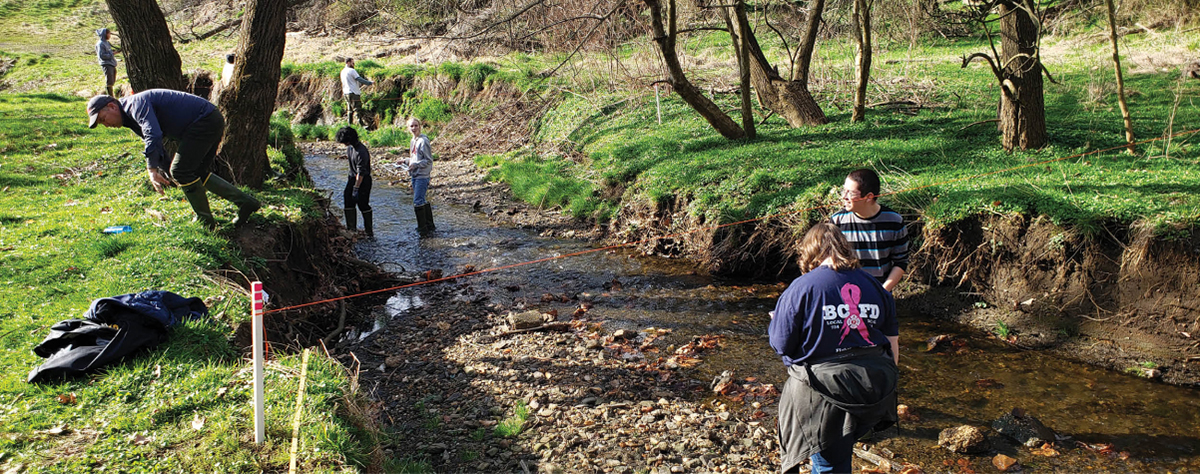 Students collect data that measure flow rate, depth, pebble size, and more as part of the “stream lab” in a popular, interdisciplinary GES course. Photo by Sarah Hansen, M.S. ’15.

When Alieh Rezaei arrived at UMBC from Iran, she couldn’t take her eyes off the ground. Almost immediately she was mesmerized by the flora and fauna of her new residence, and as an master of fine
arts student in the intermedia and digital arts (IMDA) program, she decided to incorporate pieces of UMBC into her artwork. She walked around campus, picking up windfalls of seeds and exploring hidden nooks of nature. A place that would come to be her sanctuary,
Rezaei, M.F.A. ’22, says, was Joseph Beuys Sculpture Park.
“The solidity of the stones alongside the growth of the oaksand the evolving shape of the garden reflect concepts of erosion and growth,” says Rezaei. “As an immigrant, I found solace in my attachment to the settled and solid stones, representing a sense of
grounding to me.”
Rezaei was drawn to UMBC’s M.F.A. program because of its multidisciplinary approach and the freedom she felt to choose an unconventional path. She praised Kathy O’Dell, IMDA professor emerita, who was her advisor. “Kathy was someone who—it was like I was floating in the air and Kathy held my hand and grounded me. She was very supportive for the whole journey.”
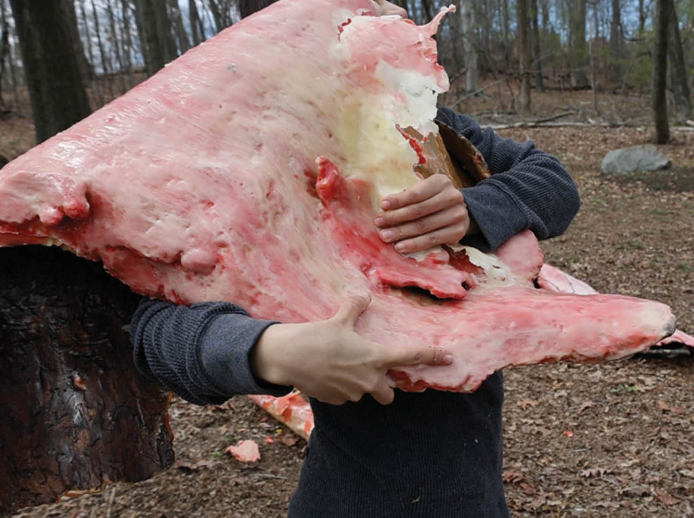
A photograph from Rezaei’s three-hour performance “The Tongue in the Landscape” at the Joseph Beuys Sculpture Park featuring the artist laboriously peeling the wax layer off the pieces of bark. Photo courtesy of Rezaei.
To create the art for her thesis project, Rezaei used almost exclusively materials collected on or near campus, including fallen tree bark, shattered wood, and seeds. She bought her main material—beeswax— from Baltimore beekeepers. One piece, “The Collective Womb,” featured hundreds of native seeds, called Devil’s Darning Needles, held together by beeswax around orange peels.
When the pieces were finished, Rezaei immediately knew the stage she wanted to showcase them on—Joseph Beuys Sculpture Park. “I installed my pieces there and had a performance as a way to extend the concept of public sculpture, aiming to reactivate the space and revive the concept of ecological engagement central to Beuys’ 7000 Oaks project.”


A composite of several microscope images of phages discovered by UMBC students in the Phage Hunters program demonstrates the variety of shapes phages can take. Photo by Tagide deCarvalho.
IchabodCrane. MindFlayer. Annihilus. TonyStarch. These are viruses previously completely unknown to science discovered by UMBC students in the Phage Hunters program, a two-course undergraduate genetics and bioinformatics sequence.
Since its launch in 2008, UMBC students have discovered 661 viruses that infect bacteria, called phages. Ninety-seven of them originated in samples collected on campus, with the most popular location being the Library Pond. Seventy-seven phages have been sequenced and 60 have been fully characterized and submitted to GenBank, an international digital repository of genetic and protein sequences.
Steven Caruso ’94, Ph.D. ’02, biological sciences, principal lecturer of biological sciences, runs the genetics course where the students collect samples, isolate their phages, image them with help from Tagide deCarvalho, “and growth,” says Rezaei. “As an immigrant, I found present their findings. They learn foundational laboratory techniques and get a taste for research.
Phage Hunters gives students “a first glimpse of what research is, with all that goes with it: determination, grit, inspiration, frustration, and more,” says Ivan Erill, professor of biological sciences and co-instructor for the bioinformatics course with Caruso. “Students get to see all the possible outcomes of a research project, from total success culminating in a DNA extraction for sequencing to failure to isolate a phage in the first place.”

In the basement of the Meyerhoff Chemistry Building, in a tiled expanse called the Molecular Characterization and Analysis Complex, sits a sleek, roughly human-sized instrument with the power to measure extremely tiny amounts of chemicals. Amanda Belunis, a chemistry Ph.D. student now in her final year, knows the instrument like an old friend, having turned to it to analyze a smorgasbord of UMBC water samples.
Belunis studies a group of chemicals called per- and polyfluoroalkyl substances, or PFAS. The chemicals are used in products as varied as makeup, clothing, and fire-fighting foam and are found in trace amounts in many water sources as well as in human blood. Dubbed “forever chemicals” because of the way they persist in the environment, they present a growing concern to human health.
Belunis’s research is part of a growing effort by scientists to understand how PFAS enter and travel through the environment and, ultimately, figure out ways to remove them.
To validate her procedures for measuring PFAS concentrations, Belunis tested water from drinking fountains, the sink in her chemistry lab, the pool, and the pond and streams around UMBC, all of which contained trace amounts of PFAS, as would be expected. Confident her methods worked on real-life samples, she then turned her attention to analyzing water in aquaculture fish tanks.
“My lab mates and I sometimes discuss how all of us have these chemicals in our bodies,” says Belunis. “It’s concerning, which is why we need to do more studies.”
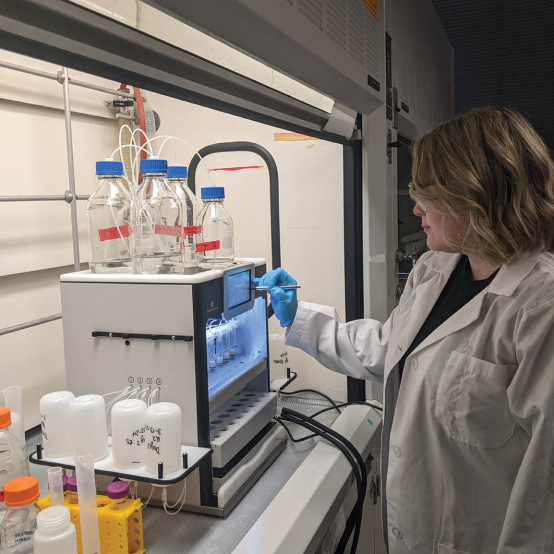
Amanda Belunis prepares samples for later analysis in the Molecular Characterization and Analysis Complex. Photo by Catherine Meyers.

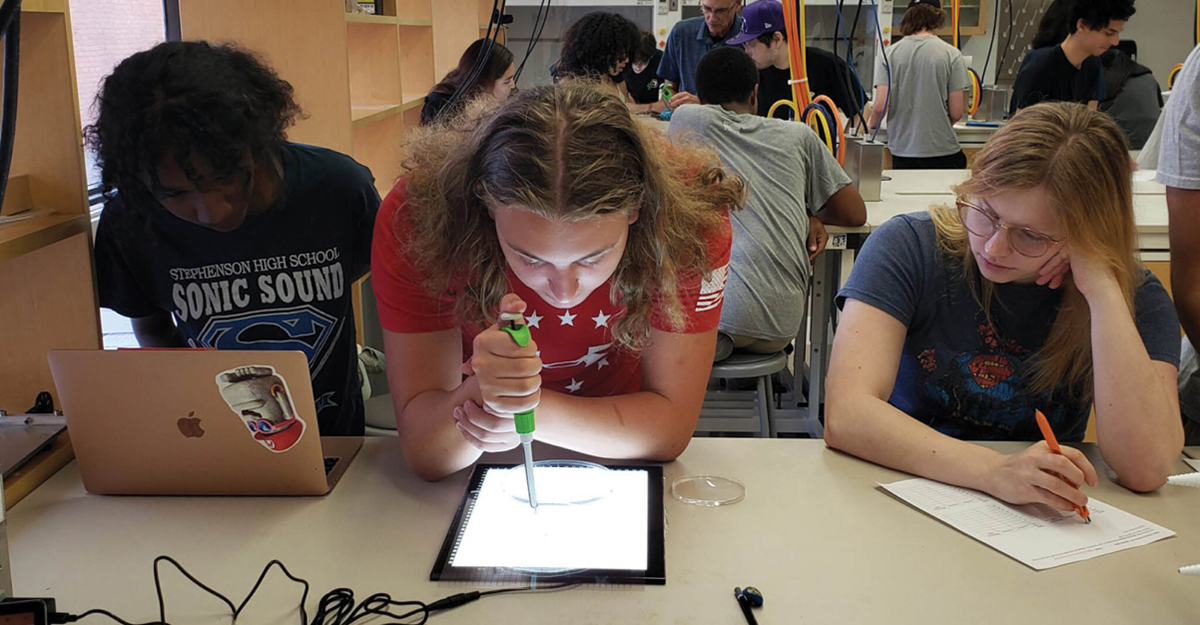 In addition to measuring buildings, students in Math in Action discovered other ways that math naturally interacts with their lives and studies. Here they are recording the movements of brine shrimp. Photo by Sarah Hansen, M.S. ’15.
When asked how to measure the height of a building, most students in Math in Action, a new laboratory course for non-STEM majors, “came up with various ways to measure the height directly—for example, by dropping down a string and then measuring the string or stacking up various objects,” says Alexis O’Malley ’18, mathematics and psychology, who teaches the lab.
But today, students are peering along the edges of homemade clinometers—plastic protractors with drinking straws attached—taking measurements from safely on the ground with a meter stick, and running simple calculations based on the properties of triangles to measure the height of UMBC’s Administration Building (123 feet, 2 inches).
Throughout the course, “I want students to see how math can be used to solve problems creatively,” O’Malley says.
Math in Action covers different math concepts each week through hands-on activities. The purpose of the clinometer activity is to remind students that “science is based on measurement, and you can build a tool to measure almost anything,” shares William R. LaCourse, dean of the College of Natural and Mathematical Sciences, who originally generated the idea for the course to help a wider range of students develop math skills relevant to their everyday lives. The course, he adds, “is a doorway to a lot of different math concepts.”

Shawn Abraham ’24, political science, has gotten lost on the UMBC campus more times than he can remember. As a blind student, he finds his way using a white cane, auditory cues, mental maps, and by asking people for directions. “People are surprised when I tell them, but big cities are much easier to navigate,” Abraham says. “College campuses are hard to get around.”
Tactile maps are one tool that could help. Erin Higgins and Kirk Crawford, Ph.D. students in human-centered computing, have recently been working with blind students at UMBC to create and test 3D-printed maps of campus.
The researchers launched the project after being approached by Michael Canale, assistant director of the Office of Student Disability Services. He says UMBC currently has four completely blind students enrolled and his office wants to provide personalized maps that each student can carry with them as they navigate campus. He’d also like to see a large 3D-printed map mounted somewhere on campus.
“A beautiful tactile map could be used by visitors of all kinds,” Canale said. “It’s the principle of universal design.”
Meanwhile, Md Osman Gani, an assistant professor of information systems, is spearheading a new project, named MyPath, to develop a Google Maps–style app to help wheelchair users navigate campus.
“Uneven surfaces, discontinuous sidewalks, and steep slopes can make wheelchair travel challenging, and even impossible” Gani says. The MyPath app would help by providing users with personalized turn-by-turn navigation with real-time updates. The app will rely on a machine learning model that recognizes path accessibility conditions based on crowd-sourced data, and Gani is currently recruiting wheelchair users to contribute data using their smartphones.
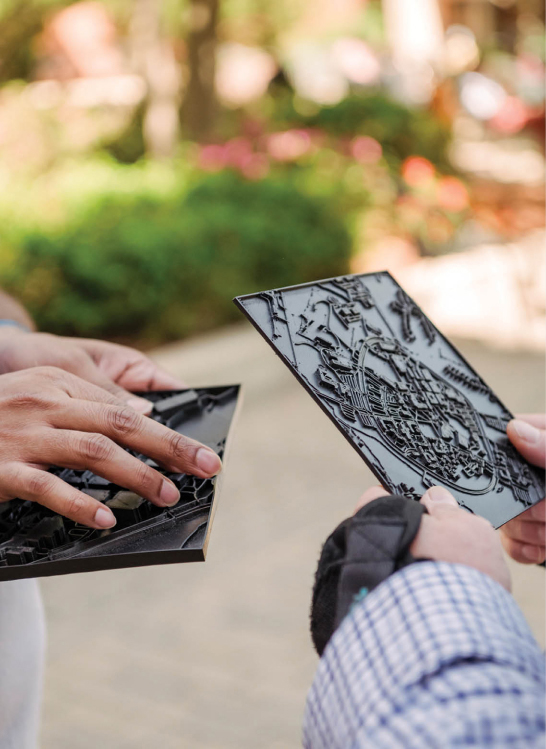
Shawn Abraham (left) tests prototype tactile maps made with 3-D printers with Michael Canale (right).

It’s 7 a.m. in July, and Megan Curtiss ’23, GES, is standing next to a tree just outside The Loop on UMBC’s southeast corner. It’s wrapped in a thin metal band at about chest height. Curtiss carefully measures the small gap between the two ends of the band with digital calipers three times, takes the average, and then moves on to the next tree. Only 98 to go.
This scene played out weekly from March to October 2023 as Curtiss collected data for a study led by Matthew Baker, GES professor, and Nancy Sonti, a research ecologist with the U.S. Forest Service. “It became like a morning meditation,” Curtiss shares.
The metal bands, call dendrobands, “are a cheap and easy way to get pretty detailed information,” Curtiss says. By measuring the trees’ growth over time, the goal is to look at how trees of different species and in different immediate environments (such as a parking lot versus a forest) handle conditions like fluctuating temperatures and water availability.
After attending Anne Arundel Community College in her 30s, Curtiss then found a home at UMBC. She began working with Baker in fall 2022 and will enter the GES master’s program at UMBC this fall. A graduate degree was not something Curtiss originally planned on, but now she’s excited about the further experiences it will bring. “I’m looking forward to the unexpected,” Curtiss says.

Take a left off Hilltop Circle, just past the greenhouse on the right and toward the Walker Avenue apartments, and you’ll find yourself outside a traditional brick building that used to house trial rooms and detention cells. In 2021, UMBC turned this former courthouse into the main hub for the Center for Real-time Distributed Sensing and Autonomy (CARDS). Researchers here develop artificial intelligence-enabled smart robots for military and search-and-rescue operations.
On a sunny day in spring, you will likely see students gathered in the courthouse’s “backyard,” huddled around dog-like Spot robots and wheeled vehicles called Jackals and Huskies.
The researchers outfit the robots with a host of custom devices, such as cameras and radar to sense their surroundings and microprocessors to run on-board algorithms. While the robots can be commanded via voice and gesture, the ultimate goal is for them to operate mostly autonomously.
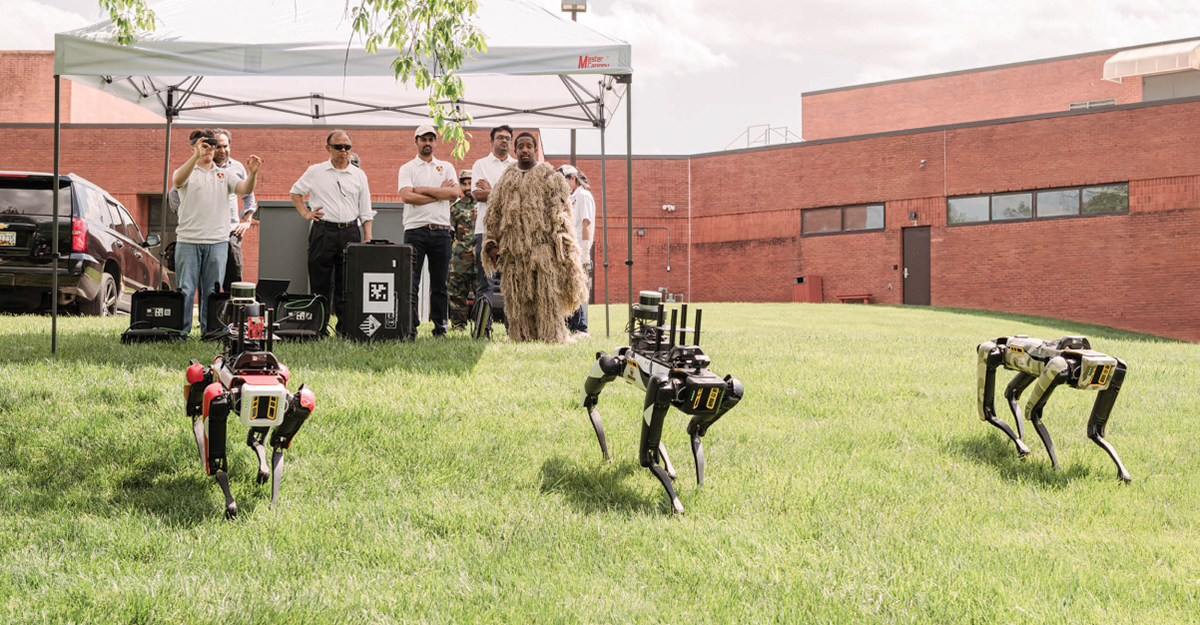 On the back lawn of the courthouse building, student researcher Kevin Rippy, left, controls three Spot robots with gestures. Another student stands by in a ghillie suit, a type of camouflage clothing.
Recently, the team has demonstrated this capability by verbally assigning the robots the task of jointly surveying a given area. The robots must translate the instructions from plain English into machine-level commands, divide up duties, detect and avoid obstacles, come to a fellow robot’s aid in the case of unexpected problems, and identify and keep track of the objects and people within their assigned perimeter.
“People from around campus will see us testing and will stop to watch,” says Aryya Gangopadhyay, a professor in information systems who directs CARDS. “The robots are an attention getter.”

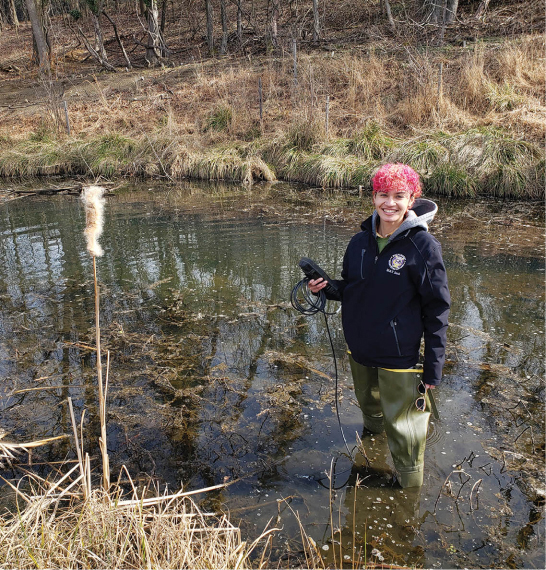
Erin Hamner collected weekly water quality data from this stream for six months, using the battery-powered digital probe she’s holding. (Image by Sarah L. Hansen, M.S. ’15)
After traipsing across a swampy field between research sites, Erin Hamner ’22, GES, and a current master’s student in the Interdisciplinary Consortium for Applied Research in the Environment program, scampers down a streambank in thigh-high waders and plunges a battery-powered probe into the water. It reports concentrations of ammonia and nitrates—key water quality measures. The probe also measures the water’s conductivity, which indicates the level of ions, such as salts used to melt snow.
It’s beautiful out today, but Hamner completed the trek to a dozen campus sites weekly from September 2023 to February 2024, sometimes dealing with mud, snow, or rain. The goal of her master’s thesis is to confirm that stormwater management features UMBC has installed to reduce flooding, filter storm runoff, and otherwise improve water quality are working as intended—or if they aren’t, to suggest improvements.
Hamner and her collaborators in Facilities Management and the Office of Sustainability want to see the data collection effort continue after she graduates. So she is working with faculty in GES to incorporate crowd-sourced stormwater monitoring into the undergraduate curriculum, including generating a public dashboard.
“Erin has done incredible groundwork collecting water quality data across our campus, generating useful data that can tell us about the health of UMBC’s waterways,” says Taylor Smith, assistant director of sustainability.
Long-term data will help the university “see how our development affects our watershed so we can continue to be good stewards,” Smith adds, noting that, “data like Erin’s can help us advocate for more greenspace and stream buffers around campus.”
]]>
Spring on UMBC’s main campus brings a host of familiar sights and sounds: blooms on the magnolia trees, the chatter of red-winged blackbirds calling from the reeds around Library Pond, greening...
https://umbc.edu/stories/putting-umbc-research-on-the-map/
https://my3.my.umbc.edu/api/v0/pixel/news/142303/guest@my.umbc.edu/93196282138c9d99f3c2930689edf3cd/api/pixel
biological-sciences
cahss
campus-life
cards
chemistry
cnms
coeit
computer-science
feature
ges
humancentered-computing
icare
imda
information-systems
joseph-beuys
magazine
mathematics
political-science
psychology
science-and-tech
sds
spring-2024
story
UMBC News & Magazine
https://my3.my.umbc.edu/groups/umbc-news-magazine
https://assets1-my.umbc.edu/system/shared/avatars/groups/000/001/943/24435aa6207c452e7bc15cc74b42c7bb/xsmall.png?1748556657
https://assets1-my.umbc.edu/system/shared/avatars/groups/000/001/943/24435aa6207c452e7bc15cc74b42c7bb/original.png?1748556657
https://assets2-my.umbc.edu/system/shared/avatars/groups/000/001/943/24435aa6207c452e7bc15cc74b42c7bb/xxlarge.png?1748556657
https://assets2-my.umbc.edu/system/shared/avatars/groups/000/001/943/24435aa6207c452e7bc15cc74b42c7bb/xlarge.png?1748556657
https://assets3-my.umbc.edu/system/shared/avatars/groups/000/001/943/24435aa6207c452e7bc15cc74b42c7bb/large.png?1748556657
https://assets1-my.umbc.edu/system/shared/avatars/groups/000/001/943/24435aa6207c452e7bc15cc74b42c7bb/medium.png?1748556657
https://assets2-my.umbc.edu/system/shared/avatars/groups/000/001/943/24435aa6207c452e7bc15cc74b42c7bb/small.png?1748556657
https://assets1-my.umbc.edu/system/shared/avatars/groups/000/001/943/24435aa6207c452e7bc15cc74b42c7bb/xsmall.png?1748556657
https://assets2-my.umbc.edu/system/shared/avatars/groups/000/001/943/24435aa6207c452e7bc15cc74b42c7bb/xxsmall.png?1748556657
UMBC News & Magazine
1
0
false
Thu, 30 May 2024 10:42:29 -0400
Thu, 30 May 2024 10:42:29 -0400
Month of Earth Day events culminates with 8th Annual Earth Day Symposium
UMBC’s strength in environmental research spans all three colleges and the university’s NASA-partnered centers, and Earth Day is always a special time on campus. This year, UMBC partnered with the Environmental Protection Agency (EPA) to host more events than ever before. A committee led at UMBC by Rhonda Plofkin, a Ph.D. student in geography and environmental systems (GES), organized 18 events throughout the month of April.
Volunteers led by enthusiastic students and Office of Sustainability staff removed invasive plants on campus; a panel at the AOK Library & Gallery discussed how various disciplines, including the arts, can engage with environmental conservation; the UMBC community watched a partial solar eclipse on campus; and much more.
The month of festivities culminated with the 8th Annual Earth Day Symposium on April 29, organized by graduate students in atmospheric physics and geography and environmental systems (GES). Nearly 150 attendees from at least six universities and five federal agencies gave talks, participated in panel discussions, presented 26 research posters, and even went on a hike through UMBC’s Conservation and Environmental Research Area on an unseasonably warm day.
“A tradition we are really proud of is that this event is 100 percent planned and implemented by our graduate students,” shared Zhibo Zhang, professor of physics at UMBC. He noted the event not only benefits the attendees, but also the planning team. “I’ve seen their confidence grow every day as the event came together,” Zhang says.
“It has been a great experience for us to invite such a wide range of people with shared enthusiasm for Earth science to UMBC,” shares Kamal Aryal, Ph.D. student in atmospheric physics and the lead organizer for the Earth Day Symposium. “Having students, early career scientists, and university professors from many universities and from NASA’s PACE mission, including the lead project scientist for PACE, attend our symposium creates great opportunities for networking and professional development.”
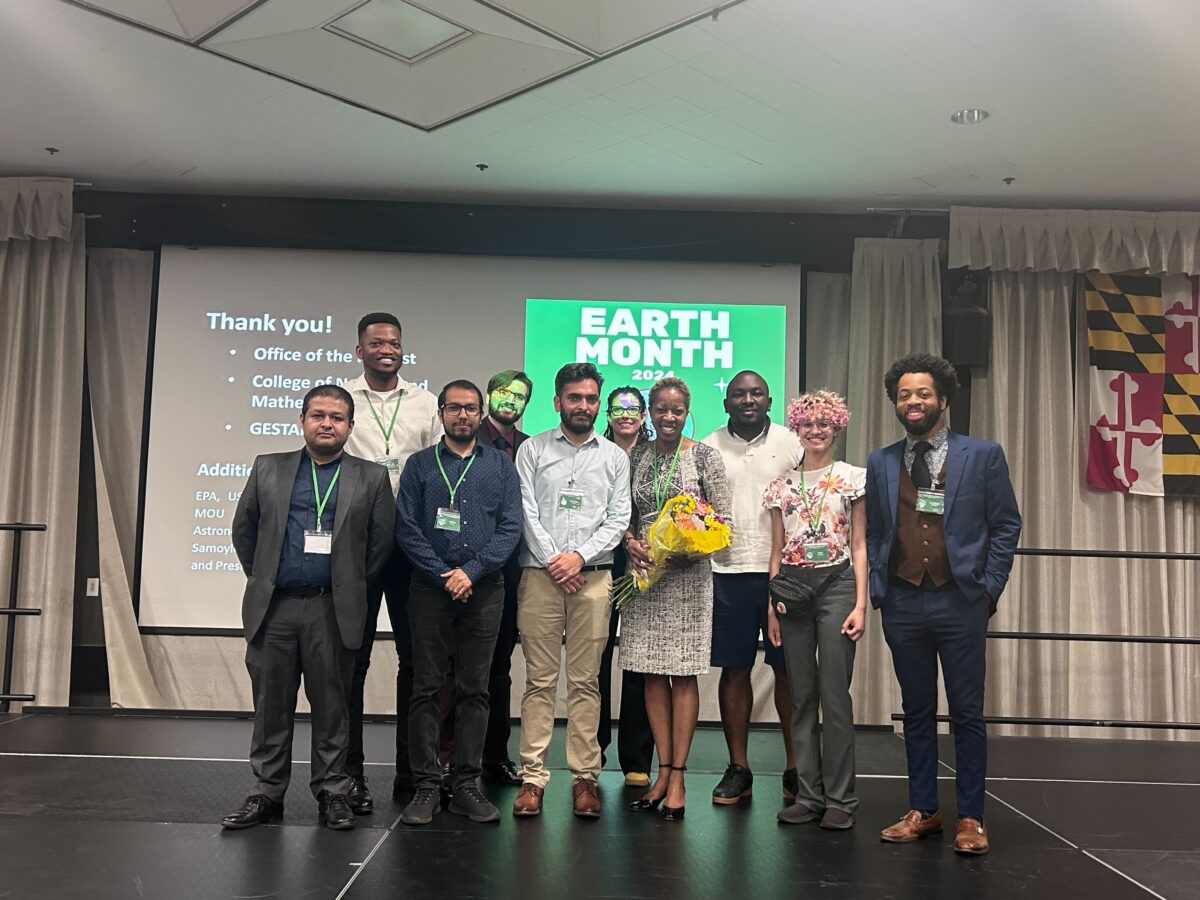 Planning committee members for the Earth Day Symposium and other Earth Day events with President Valerie Sheares Ashby. Left to right: Sharad Pandey, Adeleke Segun Ademakinwa, Kamal Aryal, Tony La Luna, Roshan Mishra, Rhonda Plofkin, Valerie Sheares Ashby, Tolulope Ale, Erin Hamner, and Maurice Roots. (Image by Zhibo Zhang)
Monitoring the environment—from above Earth’s atmosphere to underwater
First organized in 2017, the Earth Day Symposium has grown in stature, size, and scope every year. This year’s theme was “monitoring planetary health,” a nod to the recently-launched NASA PACE mission carrying HARP2, a polarimeter designed and built at UMBC. HARP2 will improve our understanding of the roles various particles in the atmosphere—like dust, water vapor, and pollutants—play in climate and health. Previous symposium themes have included the environmental impacts of COVID-19, the synergy of scientific disciplines, and equity and environmental justice.
Vanderlei Martins, professor of physics at UMBC and the HARP2 team lead, gave the first presentation, which was followed later in the morning by a panel discussion including PACE scientists from UMBC, NASA, and Morgan State University.
The three main instruments on PACE have complementary roles. Each sees Earth a little differently, and will provide important data on plankton populations in the ocean, the role of clouds in Earth’s energy balance, and much more. “Each of these instruments is unique, and together, they are amazing,” Martins says. HARP2 “has capabilities we’ve never had before,” he adds. “I cannot even imagine everything we are going to learn.”
Between Martins’ talk and the panel, Vanessa Vargas-Nguyen, a researcher with the University of Maryland Center for Environmental Science (UMCES), discussed her work on monitoring the health of the Chesapeake Bay watershed. UMCES produces one of several report cards for the Chesapeake Bay, collecting data on everything from populations of bottom-dwelling critters to concentrations of elements like phosphorus and nitrogen, which are commonly found in fertilizers. Now Vargas-Nguyen is expanding her group’s work to look at the entire watershed more holistically, including adding social factors like economic activity, governance structures, and population density.
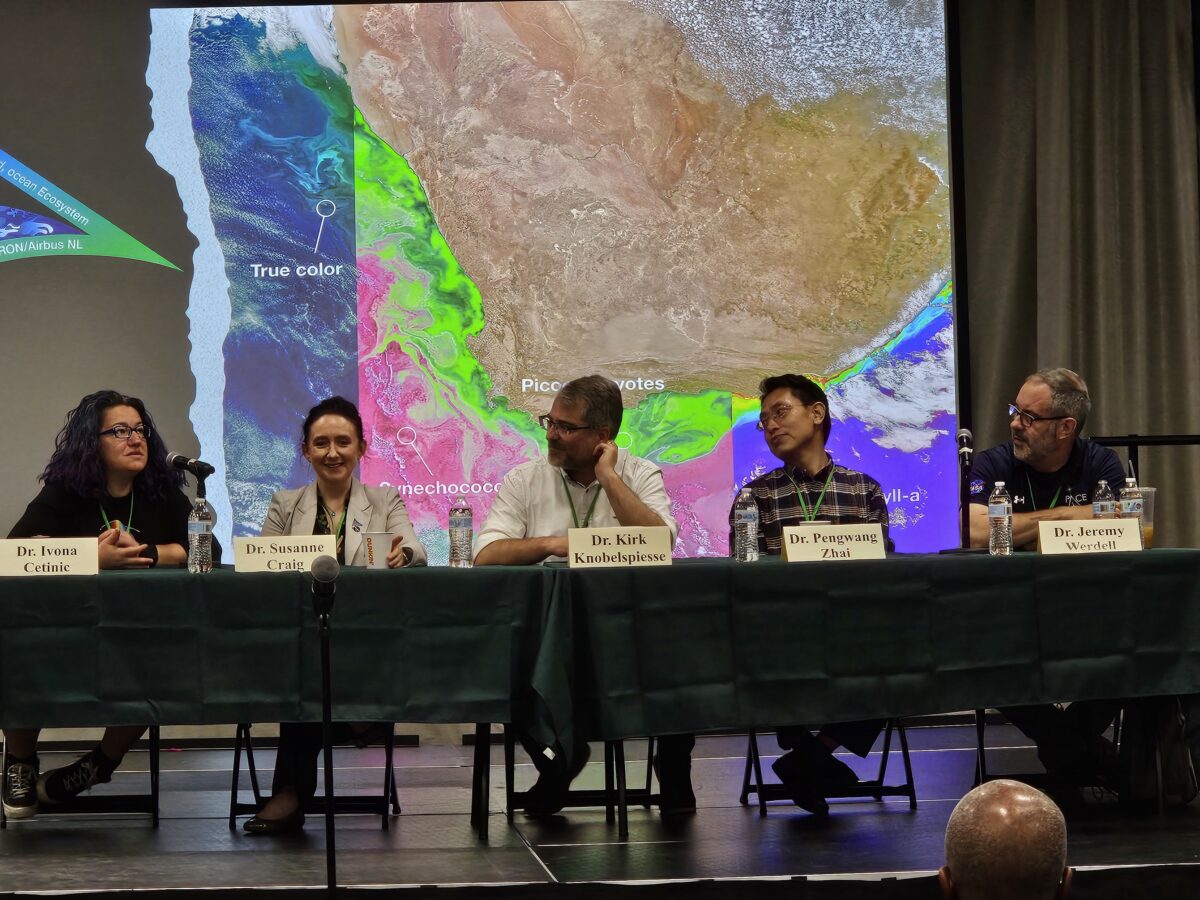 Panelists discussed the PACE mission. From left to right: Ivona Cetinic, senior research scientist with Morgan State University through the Goddard Earth Science and Technology Research Center (GESTAR) II; Susanne Craig, scientist with UMBC through GESTAR II; Kirk Knobelspiesse, researcher at NASA Goddard Space Flight Center; Pengwang Zhai, professor of physics at UMBC; and Jeremy Werdell, project scientist for the PACE mission at NASA. (Photo by Kamal Aryal)
A hub for environmental action
After the post-lunch hike, a poster session featured student and faculty research from UMBC, NASA, and the National Oceanic and Atmospheric Administration. Jing Wei, from the University of Maryland, College Park, discussed remote sensing methods for monitoring air pollution, and Robert Foster, from the U.S. Naval Research Laboratory, explained his work on monitoring microplastics in the ocean. Kandis Boyd, from the EPA, emphasized the importance of interdisciplinary and cross-sector partnerships.
Throughout the day, the ballroom buzzed with energy as students, UMBC faculty, and researchers from around the region shared their science and connected with each other. A shared sense of purpose guided the event, grounded in UMBC’s commitment to promoting a sustainable future.
As Charles Ichoku, director of the Goddard Earth Science and Technology Research Center II, one of UMBC’s NASA partnerships, and a professor of GES, put it, “UMBC is a young university that does great things.”
Whether taking immediate action to improve the campus landscape, conducting research on global climate, or training the next generation of Earth scientists, the month of Earth Day events demonstrates how UMBC has positioned itself as a hub for environmental action.
]]>
UMBC’s strength in environmental research spans all three colleges and the university’s NASA-partnered centers, and Earth Day is always a special time on campus. This year, UMBC partnered with the...
https://umbc.edu/stories/8th-annual-earth-day-symposium/
https://my3.my.umbc.edu/api/v0/pixel/news/141690/guest@my.umbc.edu/e8eaf936eeb0a780690163c7f947b912/api/pixel
cahss
cnms
coeit
ges
gestar2
information-systems
news
physics
science-and-tech
story
UMBC News & Magazine
https://my3.my.umbc.edu/groups/umbc-news-magazine
https://assets1-my.umbc.edu/system/shared/avatars/groups/000/001/943/24435aa6207c452e7bc15cc74b42c7bb/xsmall.png?1748556657
https://assets1-my.umbc.edu/system/shared/avatars/groups/000/001/943/24435aa6207c452e7bc15cc74b42c7bb/original.png?1748556657
https://assets2-my.umbc.edu/system/shared/avatars/groups/000/001/943/24435aa6207c452e7bc15cc74b42c7bb/xxlarge.png?1748556657
https://assets2-my.umbc.edu/system/shared/avatars/groups/000/001/943/24435aa6207c452e7bc15cc74b42c7bb/xlarge.png?1748556657
https://assets3-my.umbc.edu/system/shared/avatars/groups/000/001/943/24435aa6207c452e7bc15cc74b42c7bb/large.png?1748556657
https://assets1-my.umbc.edu/system/shared/avatars/groups/000/001/943/24435aa6207c452e7bc15cc74b42c7bb/medium.png?1748556657
https://assets2-my.umbc.edu/system/shared/avatars/groups/000/001/943/24435aa6207c452e7bc15cc74b42c7bb/small.png?1748556657
https://assets1-my.umbc.edu/system/shared/avatars/groups/000/001/943/24435aa6207c452e7bc15cc74b42c7bb/xsmall.png?1748556657
https://assets2-my.umbc.edu/system/shared/avatars/groups/000/001/943/24435aa6207c452e7bc15cc74b42c7bb/xxsmall.png?1748556657
UMBC News & Magazine
1
0
false
Fri, 03 May 2024 15:58:22 -0400
Fri, 03 May 2024 15:58:22 -0400