UMBC receives $6 million gift from the George and Betsy Sherman Family Foundation for two urban education initiatives

UMBC has received a $6 million gift from the George and Betsy Sherman Family Foundation to establish a new Center for Early Learning in Urban Communities and expand the work of the Sherman STEM Teacher Scholars Program.
Mavis Sanders, professor of education and affiliate professor for the language, literacy, and culture doctoral program, has been appointed the inaugural director for the new center. Its goal is to improve STEM, literacy, and mathematics practices and outcomes in early childhood education, with an initial focus in the South Baltimore/Greater Baybrook Alliance area. Sanders, who joined the UMBC community in 2011, has partnered with schools in Baltimore City since 1995.
 Mavis Sanders.
“This targeted approach is going to have implications for systemic change. We are looking at what works for the diverse populations that live in Baltimore City. We believe that the schools, families, and communities are the ‘experts’ on their needs and collaborative planning is key,” says Sanders. “We have an opportunity to contribute to the information and the understanding of what different populations face in the city, what is distinctive about them, and also what is common, and through that understanding address critical needs.”
The center will use this targeted approach beginning in two Baltimore schools – Maree G. Farring Elementary/Middle and Lakeland Elementary/Middle, – both of which have diverse populations including African American, Latinx, and white students. These schools also have dynamic principals with a deep understanding of how change occurs, as well as how to understand data, lead collaboratively, and enact community and family engagement. The center will promote research-based interventions needed to make the most impact for each of these populations.
The multidisciplinary center will also support UMBC’s established and new school partnerships by identifying and working with academic leaders in Baltimore City. Sanders will collaborate closely with the Provost’s Office and university-wide faculty-led research partnerships.
Sanders’ strong ties to Baltimore City schools come from years of sharing research and identifying best practices, as well as teaching undergraduate and graduate students, some of whom are now teachers, principals, and education leaders in the city. It is a bond that has been fostered through engagement with schools and listening to the experiences of students, parents, principals, and teachers.
“I am committed to K-12 education. If we don’t serve children and we can’t get education right then we get more of the same. I think things can change for individuals, and if we can change things for individuals then that is where the hope lies,” reflects Sanders.
These systemic changes are also being addressed through the Sherman Family Foundation gift with the expansion of The Sherman STEM Teacher Scholars program. The scholars program has produced almost 100 graduates prepared to teach in high need and urban schools. Early childhood, elementary and secondary candidates participate in cohorts that provide academic, social, and financial resources to help students be ready to become highly qualified STEM teachers and serve all children.
 George and Betsy Sherman (first from left) in front of Josh Michael. President Freeman Hrabowski and Jacqueline Hrabowski (first from right) next to Rehana Shafi (yellow) at the Sherman STEM Scholars Program 10 year anniversary held on April 1, 2017.
“We know there are two main things that help determine where a teacher becomes a teacher. One is where they are from and the other is where they complete their student teaching internship,” explains Josh Michael ’10, political science and education, assistant director of the program. “We are working with the education department to increase internship placements and also have more applied learning experiences before teaching in Baltimore.”
This current gift provides, over the course of five years, more financial support for students and an additional staff member to help with recruitment of candidates from groups that are underrepresented in teaching. The program is building a pipeline for educators, both natives of Baltimore and others, who have developed the mindset and skill to be highly effective teachers. The goal is to graduate 25 teachers annually, many of whom will teach in Baltimore.
 Caitlyn Fleming ’12, animal science, and M.A. ’15, education. Sherman Scholar and intern in the 2015 Lakeland Freedom Schools during the morning community meeting.
“All the work that we do is to help our scholars see themselves as agents of change. We don’t want students to just go teach somewhere. We want them to go somewhere and make a real impact not just in the classroom, but in the school and in the community” emphasizes Rehana Shafi, director of the program.
Being an agent of change also means having scholars from city schools working with scholars who aren’t from city schools to understand from each other what change could look like so they can return to the schools to work in partnership to make those changes. “It isn’t only about having more money to go to school,” says Shafi, “we are talking about significant social justice and systemic changes.”
Banner image: UMBC intern at the 2015 Lakeland Freedom Schools. All photos by Marlayna Demond ’11 for UMBC.
]]>
UMBC has received a $6 million gift from the George and Betsy Sherman Family Foundation to establish a new Center for Early Learning in Urban Communities and expand the work of the Sherman STEM...
https://umbc.edu/stories/umbc-receives-major-gift-from-the-george-and-betsy-sherman-family-foundation-for-two-urban-education-initiatives/
https://my3.my.umbc.edu/api/v0/pixel/news/120609/guest@my.umbc.edu/e5f78241fc58f30531222df9fec0c167/api/pixel
alumni
cahss
cfr
community
diversityandinclusion
education
innovation
majoraward
policy-and-society
roi
shermanscholars
UMBC News & Magazine
https://my3.my.umbc.edu/groups/umbc-news-magazine
https://assets1-my.umbc.edu/system/shared/avatars/groups/000/001/943/24435aa6207c452e7bc15cc74b42c7bb/xsmall.png?1748556657
https://assets1-my.umbc.edu/system/shared/avatars/groups/000/001/943/24435aa6207c452e7bc15cc74b42c7bb/original.png?1748556657
https://assets2-my.umbc.edu/system/shared/avatars/groups/000/001/943/24435aa6207c452e7bc15cc74b42c7bb/xxlarge.png?1748556657
https://assets2-my.umbc.edu/system/shared/avatars/groups/000/001/943/24435aa6207c452e7bc15cc74b42c7bb/xlarge.png?1748556657
https://assets3-my.umbc.edu/system/shared/avatars/groups/000/001/943/24435aa6207c452e7bc15cc74b42c7bb/large.png?1748556657
https://assets1-my.umbc.edu/system/shared/avatars/groups/000/001/943/24435aa6207c452e7bc15cc74b42c7bb/medium.png?1748556657
https://assets2-my.umbc.edu/system/shared/avatars/groups/000/001/943/24435aa6207c452e7bc15cc74b42c7bb/small.png?1748556657
https://assets1-my.umbc.edu/system/shared/avatars/groups/000/001/943/24435aa6207c452e7bc15cc74b42c7bb/xsmall.png?1748556657
https://assets2-my.umbc.edu/system/shared/avatars/groups/000/001/943/24435aa6207c452e7bc15cc74b42c7bb/xxsmall.png?1748556657
UMBC News & Magazine
0
0
false
Thu, 02 Nov 2017 09:54:41 -0400
George Derek Musgrove launches book at the National Museum of African American History and Culture

George Derek Musgrove ’97, associate professor of history, launched his new book Chocolate City: A History of Race and Democracy in the Nation’s Capital, University of North Carolina Press, with co-author Chris Myers Asch at the National Museum of African American History and Culture on November 2.
 Top of page: George Derek Musgrove, Chris Myers Asch with moderator at the Oprah Winfrey Theatre in the National African American History and Culture Museum.
While teaching the history of the District of Columbia at the University of the District Columbia (UDC), Musgrove and Asch discovered the need for an accessible and comprehensive text that tells the full history of our nation’s capital.
After six years of research and writing they have produced a sweeping history of race and democracy in D.C. They argue that because of the consistent presence of a large black population, race, above and beyond other factors, has proven to be the most significant explanation for social, economic, and political divisions in the District — and as a bellwether for the country, D.C. shows how race has been the central fault line in American democracy.
“D.C. is a beacon for black America. In the 1830s it was a magnet for free blacks,” explains Musgrove, who has taught at UMBC since 2012. “During the Civil War it was a place to which slaves could escape from Maryland and Virginia and tens of thousands poured into the city. In the late 19th century it had the largest black population of any city in the country, and in 1957 it became the first majority black city in the United States.”
Like its namesake, the 1975 Parliament Funkadelic album Chocolate City, the book centers on the everyday people who make up the D.C. beyond Capitol Hill. It is a narrative focused on a city that is also a national stage.
 Cover image courtesy of George Derek Musgrove.
For Musgrove, D.C. history includes the successful strivers but also the working people. It is the story of its more famous citizens like Mary Church Terrell and Walter Fauntroy, but also of welfare moms who create housing cooperatives, the struggles and triumphs of Irish immigrants in the mid-19th century, and the black elites of the Jazz Age.
In the process of weaving a national and local story, Musgrove and Asch realized two things: first, that D.C. history tells a unique story about American democracy by having the distinction of being the only city that is run by Congress and, second, how race influences this mode of governance.
The city provides us “a window into our democracy and how it is perverted by issues of race. These issues play out in the streets of the city,” explains Musgrove. “Keep it in mind that we are defining race not as black and white, but as Latinos, Ethiopians, as whites, and Native Americans. The latter group was central to understanding race and government for the first hundred years after contact.”
Musgrove and Asch draw on this vast documented history of the city and present the stories for a mass audience in one place with the hope that it will allow professors to engage new students of D.C. history, provide context for activists fighting gentrification, and help members of the neighborhoods continue to actively discuss their city’s history.
“Our hope is that people of goodwill will look at the lessons of D.C. history and use them to guide some of their activism,” says Musgrove.“We think it is a good guide for future action for making a better city, for making something really democratic of the alleged capital of the free world.”
Q&A: Read UMBC Magazine’s interview with Derek Musgrove ’97
For more information…
Chocolate City Facebook page:
Facebook.com/chocolatecitybook
Places to Purchase:
UNC Press
Amazon
Banner image: George Derek Musgrove, Chris Myers Asch with moderator at the Oprah Winfrey Theatre in the National African American History and Culture Museum. Photo by Marlayna Demond ’11 for UMBC.
]]>
George Derek Musgrove ’97, associate professor of history, launched his new book Chocolate City: A History of Race and Democracy in the Nation’s Capital, University of North Carolina Press, with...
https://umbc.edu/stories/george-derek-musgrove-launches-book-at-the-national-museum-of-african-american-history-and-culture/
https://my3.my.umbc.edu/api/v0/pixel/news/120611/guest@my.umbc.edu/605ca43af11082a98f23341d7a94fc6c/api/pixel
alumni
cahss
community
diversityandinclusion
history
innovation
policy-and-society
roi
UMBC News & Magazine
https://my3.my.umbc.edu/groups/umbc-news-magazine
https://assets1-my.umbc.edu/system/shared/avatars/groups/000/001/943/24435aa6207c452e7bc15cc74b42c7bb/xsmall.png?1748556657
https://assets1-my.umbc.edu/system/shared/avatars/groups/000/001/943/24435aa6207c452e7bc15cc74b42c7bb/original.png?1748556657
https://assets2-my.umbc.edu/system/shared/avatars/groups/000/001/943/24435aa6207c452e7bc15cc74b42c7bb/xxlarge.png?1748556657
https://assets2-my.umbc.edu/system/shared/avatars/groups/000/001/943/24435aa6207c452e7bc15cc74b42c7bb/xlarge.png?1748556657
https://assets3-my.umbc.edu/system/shared/avatars/groups/000/001/943/24435aa6207c452e7bc15cc74b42c7bb/large.png?1748556657
https://assets1-my.umbc.edu/system/shared/avatars/groups/000/001/943/24435aa6207c452e7bc15cc74b42c7bb/medium.png?1748556657
https://assets2-my.umbc.edu/system/shared/avatars/groups/000/001/943/24435aa6207c452e7bc15cc74b42c7bb/small.png?1748556657
https://assets1-my.umbc.edu/system/shared/avatars/groups/000/001/943/24435aa6207c452e7bc15cc74b42c7bb/xsmall.png?1748556657
https://assets2-my.umbc.edu/system/shared/avatars/groups/000/001/943/24435aa6207c452e7bc15cc74b42c7bb/xxsmall.png?1748556657
UMBC News & Magazine
0
0
false
Wed, 01 Nov 2017 20:33:02 -0400
UMBC’s Chris Curran receives major NIJ grant for research on law enforcement in K–12 schools

UMBC’s F. Chris Curran, assistant professor of public policy, has received a two-year $620,000 National Institute of Justice (NIJ) Comprehensive School Safety Initiative (CSSI) grant to lead a new research study on the role of law enforcement officers in public schools.
“Law enforcement have become an increasingly common presence in school settings, particularly after high profile events like the tragedy at Sandy Hook,” notes Curran. “Our work seeks to understand the role of these officers in promoting safety, managing student behavior, and facilitating relationships with students.”
The CSSI grant program specifically funds innovative research to help understand the root causes of school violence, develop strategies for increasing school safety, and implement research based pilot programs, policies, and practices. Curran, primary investigator for this new study, shares, “The support of the National Institute of Justice allows for an unprecedented look at the role and impact of SROs in previously understudied settings”—in this case, in two Southern U.S. suburban school districts.
This work began about two years ago when Curran co-founded the Collaborative on Adolescent Violence and Victimization (CAVV) with researchers from UMBC, University of Pittsburgh, University of Louisville, and Vanderbilt University who were interested in looking further at this issue. “We collectively started a conversation with a couple of school districts to examine issues around school safety, discipline, and how SROs intersect with that.” Curran’s primary collaborators for the current study include co-principal investigator Benjamin W. Fisher of the University of Louisville and project coordinator Samantha Viano of Vanderbilt University.
In addition to the NIJ grant, Curran has also received a one-year $20,000 grant through the American Educational Research Association (AERA) with support from the National Science Foundation (NSF) to fund research in another area of education policy: science achievement in kindergarten through second grade. This new grant will enable Curran to expand his previous research on inequalities in science education that appear at a very early age utilizing nationally representative data. Curran’s previous groundbreaking work in that area appeared in publications from The Atlantic to Education Week.
“Part of what informs my work is a moral imperative,” says Curran. His sense of urgency to better understand the impacts of educational environment, resources, and pedagogy is informed by his past encounters with inequalities in the U.S. education system as a former middle school science teacher. After experiencing the challenges of teaching with outdated textbooks and providing students hands-on laboratory experiences when access to materials and equipment were limited, he decided to begin working at a policy level to more effectively meet students’ needs.
“Right now there are students being short-changed by the education system. They are not sitting in a classroom with a high enough quality teacher. They are not being provided the resources they deserve,” Curran reflects. “Too often these disparities run along racial lines, socioeconomic lines, or gender lines, and that is a problem.”
As a researcher, educator, and someone training the next generation of education policy analysts, Curran says, “I would like to think my work does something to address those problems. Policy won’t change overnight, but these issues we’re addressing are truly urgent.”
]]>
UMBC’s F. Chris Curran, assistant professor of public policy, has received a two-year $620,000 National Institute of Justice (NIJ) Comprehensive School Safety Initiative (CSSI) grant to lead a new...
https://umbc.edu/stories/umbcs-chris-curran-receives-major-nij-grant-for-research-on-law-enforcement-in-k-12-schools/
https://my3.my.umbc.edu/api/v0/pixel/news/120661/guest@my.umbc.edu/58f54800172b1e2e8f342e9557637064/api/pixel
cahss
diversityandinclusion
innovation
policy-and-society
publicpolicy
roi
UMBC News & Magazine
https://my3.my.umbc.edu/groups/umbc-news-magazine
https://assets1-my.umbc.edu/system/shared/avatars/groups/000/001/943/24435aa6207c452e7bc15cc74b42c7bb/xsmall.png?1748556657
https://assets1-my.umbc.edu/system/shared/avatars/groups/000/001/943/24435aa6207c452e7bc15cc74b42c7bb/original.png?1748556657
https://assets2-my.umbc.edu/system/shared/avatars/groups/000/001/943/24435aa6207c452e7bc15cc74b42c7bb/xxlarge.png?1748556657
https://assets2-my.umbc.edu/system/shared/avatars/groups/000/001/943/24435aa6207c452e7bc15cc74b42c7bb/xlarge.png?1748556657
https://assets3-my.umbc.edu/system/shared/avatars/groups/000/001/943/24435aa6207c452e7bc15cc74b42c7bb/large.png?1748556657
https://assets1-my.umbc.edu/system/shared/avatars/groups/000/001/943/24435aa6207c452e7bc15cc74b42c7bb/medium.png?1748556657
https://assets2-my.umbc.edu/system/shared/avatars/groups/000/001/943/24435aa6207c452e7bc15cc74b42c7bb/small.png?1748556657
https://assets1-my.umbc.edu/system/shared/avatars/groups/000/001/943/24435aa6207c452e7bc15cc74b42c7bb/xsmall.png?1748556657
https://assets2-my.umbc.edu/system/shared/avatars/groups/000/001/943/24435aa6207c452e7bc15cc74b42c7bb/xxsmall.png?1748556657
UMBC News & Magazine
0
0
false
Wed, 27 Sep 2017 14:29:09 -0400
Christy Ford Chapin begins Library of Congress fellowship, continuing history faculty’s trend of research achievement

When Christy Ford Chapin, associate professor of history, began teaching at UMBC in 2012, she started by connecting curious students with the history of the American health care system. Her first book, Ensuring America’s Health, was an in-depth history of the country’s health care and health insurance system. This fall, as the recipient of a prestigious Kluge Fellowship, Chapin is immersed in the banking and finance collections at the U.S. Library of Congress, rather than in conversation with her students. While the archives are not quite as action-packed as the classroom, her enthusiasm for digging into the nitty gritty of U.S. history remains contagious.
Chapin loves how historians seek answers buried in documents, archives, museums, libraries, basements, attics and forgotten filing cabinets. “We have to be like private investigators. I have to beg, borrow, and plead to get documents,” says Chapin. “I was really intimidated by the research aspect early on in my graduate career, but then I fell in love with the hunt for primary sources and the process of putting together pieces of the evidence puzzle.”
Through her current Kluge Fellowship, as well as an inaugural fellowship last spring at the Ed Snider Center for the History of Capitalism at the University of Maryland, Chapin examines how the United States shifted from an industrial manufacturing economy to a financial economy for a new book on post-WWII finance. She’s energized by seeing several of her history colleagues pursue other high impact research areas through fellowships around the globe in what has been a particularly exciting year of achievement for the department’s faculty.
While in Beijing researching her first book in 2011, Meredith Oyen, associate professor, came across documents that discussed cooperation between the People’s Republic of China and the UN-affiliated International Refugee Organization well into the 1950s, when the PRC was not recognized by the UN. They dealt in part with the resettlement of Jewish and European refugees in China after WWII.
The documents reflected a great mystery. I asked myself, ‘Why did this organization stay in China all these years?’ I had to search other archives to start to figure it out.” Oyen was determined to learn more and followed the paperwork trail to Shanghai, Taipei, London, and Washington D.C. where she held a U.S. Holocaust Memorial Museum Fellowship in 2016-17 that helped her find even more clues.
 Meredith Oyen. Photo by Marlayna Demond ’11 for UMBC.
At the same time, Marjoleine Kars, associate professor and chair, and Kate Brown, professor, pursued Braudel Senior Fellowships at the European University Institute in Florence, Italy. There, Kars worked on her book about one of the largest rebellions of enslaved people in Atlantic history, which occurred in 1763 in the South American Dutch colony of Berbice. Brown continued to expand her research on the lasting health and environmental impacts of the Chernobyl nuclear disaster in new directions.
 Kate Brown. Photo courtesy of Annette Hornischer.
Brown also received a highly prestigious Andrew Carnegie Fellowship to study the health effect of Chernobyl and a Berlin Prize from the American Academy in Berlin.
 Rebecca Boehling. Photo courtesy of Annette Hornischer.
Prior to Brown receiving the Berlin Prize, Professor Rebecca Boehling received the prestigious award in fall 2016 for her work on denazification in post-WWII Germany, comparing the approaches of the United States, Great Britain, and France.
Kars shares how these types of intensive research and international exchange opportunities have far-reaching benefits for the individual faculty members who experience them. “Faculty come back from research leave with new ideas about teaching, research projects, new directions for their own work, and they bring that energy into the classroom,” she says. “Our students benefit from reenergized faculty who are on the cutting edge of their profession and are able to connect them with research monies, fellowships, and graduate school mentors.”
 Marjoleine Kars. Photo by Marlayna Demond ’11 for UMBC.
In order to reach this level of success, Kars notes, history faculty have also depended on support from each other—in terms of sharing feedback, resources, and responsibilities—and from the broader university. She particularly credits a multi-tiered support system of seed funding—in the form of summer fellowships and research money from the College of Arts, Humanities, and Social Sciences, The Maryland Institute for Policy Analysis and Research, and The Dresher Center for the Humanities—as well as the help of Rachel Brubaker, associate director of The Dresher Center, with writing and submitting grant applications.
“This kind of support has been invaluable to our faculty as they work to hone their research and explore new opportunities for growth,” says Kars. “When I think about what has made the difference in our successfully competing for such major national and international fellowships, one core aspect of UMBC comes to mind: our collaborative community of scholars. This is what makes it possible for us to explore unique research opportunities around the world, and what draws us back to UMBC each time, to share what we’ve learned.”
Banner image: Christy Ford Chapin presents at Hilltop First Talk. Photo Marlayna Demond ’11 for UMBC.
]]>
When Christy Ford Chapin, associate professor of history, began teaching at UMBC in 2012, she started by connecting curious students with the history of the American health care system. Her first...
https://umbc.edu/stories/christy-ford-chapin-begins-library-of-congress-fellowship-continuing-history-facultys-trend-of-research-achievement/
https://my3.my.umbc.edu/api/v0/pixel/news/120663/guest@my.umbc.edu/b41bd03413c231f42c0108b7c0e57355/api/pixel
cahss
dreshercenter
history
innovation
majoraward
mipar
policy-and-society
roi
UMBC News & Magazine
https://my3.my.umbc.edu/groups/umbc-news-magazine
https://assets1-my.umbc.edu/system/shared/avatars/groups/000/001/943/24435aa6207c452e7bc15cc74b42c7bb/xsmall.png?1748556657
https://assets1-my.umbc.edu/system/shared/avatars/groups/000/001/943/24435aa6207c452e7bc15cc74b42c7bb/original.png?1748556657
https://assets2-my.umbc.edu/system/shared/avatars/groups/000/001/943/24435aa6207c452e7bc15cc74b42c7bb/xxlarge.png?1748556657
https://assets2-my.umbc.edu/system/shared/avatars/groups/000/001/943/24435aa6207c452e7bc15cc74b42c7bb/xlarge.png?1748556657
https://assets3-my.umbc.edu/system/shared/avatars/groups/000/001/943/24435aa6207c452e7bc15cc74b42c7bb/large.png?1748556657
https://assets1-my.umbc.edu/system/shared/avatars/groups/000/001/943/24435aa6207c452e7bc15cc74b42c7bb/medium.png?1748556657
https://assets2-my.umbc.edu/system/shared/avatars/groups/000/001/943/24435aa6207c452e7bc15cc74b42c7bb/small.png?1748556657
https://assets1-my.umbc.edu/system/shared/avatars/groups/000/001/943/24435aa6207c452e7bc15cc74b42c7bb/xsmall.png?1748556657
https://assets2-my.umbc.edu/system/shared/avatars/groups/000/001/943/24435aa6207c452e7bc15cc74b42c7bb/xxsmall.png?1748556657
UMBC News & Magazine
0
0
false
Mon, 25 Sep 2017 14:23:02 -0400
UMBC receives major award to support inclusive excellence in the humanities

UMBC’s Dresher Center for the Humanities and College of the Arts, Humanities, and Social Sciences (CAHSS) are launching a major new five-year initiative to promote diversity and inclusion in the humanities through a $750,000 grant from The Andrew W. Mellon Foundation. The Inclusion Imperative will cultivate a supportive regional community of scholars committed to diversity in the humanities and to expanding community-engaged humanities research, teaching, and learning focused on issues of race, equity, inclusion, and justice.
“The Mellon award recognizes and allows us to expand and deepen our work toward inclusive excellence in the humanities—not just at UMBC, but throughout our region,” says Scott Casper, dean of the CAHSS. “Thanks to this award, we will bring together a community of scholars and students who are developing a diverse vision of the humanities.”
The initiative’s three interconnected parts include the Visiting Faculty Fellows Program, Diversity Teaching Network in the Humanities, and Humanities Teaching Labs, coordinated by project directors Jessica Berman, director of the Dresher Center, and Dean Casper. In addition to supporting students and faculty in the humanities, these programs will produce new tools and partnerships to support Baltimore-Washington communities as they move toward meaningful change.
The Visiting Faculty Fellows Program will invite full-time faculty from the region’s colleges and universities to join UMBC for a semester or year as residential research fellows, with a focus on faculty who are committed to diversity and inclusion. These exchanges will promote the sharing of diverse ideas and perspectives, and development of new research and teaching collaborations.
Through the Diversity Teaching Network in the Humanities, current and former visiting fellows, and other interested faculty, scholars, and graduate students, will meet regularly to work on course curricula and research projects that focus on diversity, inclusion, and community engagement. This program will deepen UMBC’s partnerships with Historically Black Colleges and Universities (HBCUs), including Coppin State University, Bowie State University, and Howard University, creating a regional community of faculty committed to diversity and inclusion in the humanities.
“Coppin State University is pleased to be part of this timely and innovative project, which recognizes correctly the excellence that resides on our diverse campuses and encourages top scholars from these communities to engage each other as colleagues and not as competitors,” says Ron L. Collins Sr., dean of the Coppin State University Honors College. He reflects, “The Dresher Center’s bold and brilliant effort will spawn lifelong professional relationships among faculty and create research agendas that respect the important voices of scholars from diverse communities of practice.”
Berman shares this vision. She notes that nurturing strong relationships among faculty at different institutions will be essential to the success of the initiative, commenting, “I’m perhaps most excited about the chance to work in partnership with area HBCUs to diversify curriculum, build new approaches, and share insight and experiences.”
Humanities Teaching Labs (HTLabs), the third component of the Inclusion Imperative, will support faculty at UMBC and partner institutions in undertaking community-engaged work on issues of race, equity, inclusion, and justice. Faculty and graduate teaching assistants will be invited to attend workshops to learn about tools and methods of community-engaged teaching and will have access to state-of-the-art media tools for classroom use. HTLabs will support approaches that bridge the divides between fields and between universities and partners beyond the academy.
“I firmly believe that the humanities offer us crucial tools for addressing pressing issues of civic life,” says Berman. “Now more than ever, we need the tools of the humanities to advance local and national conversations about our history, our identities, and our common future.”
Image: UMBC Humanities Scholars seminar “Political Childhood and Children’s Citizenship in Western Culture” in the Dresher Center, November 2016. Students include, r-l, Julia Byrne, De`Jia Long-Hillie, Dever Cunningham, Jonathan Harness, Garrett Beeg, and Kara Gavin. Photo by Marlayna Demond ’11.
]]>
UMBC’s Dresher Center for the Humanities and College of the Arts, Humanities, and Social Sciences (CAHSS) are launching a major new five-year initiative to promote diversity and inclusion in the...
https://umbc.edu/stories/umbc-receives-major-award-to-support-inclusive-excellence-in-the-humanities/
https://my3.my.umbc.edu/api/v0/pixel/news/120853/guest@my.umbc.edu/dfe888ae5442ed28eedfbf9f3da8945f/api/pixel
arts-and-culture
cahss
cfr
diversityandinclusion
dreshercenter
humanitiesscholars
innovation
majoraward
policy-and-society
UMBC News & Magazine
https://my3.my.umbc.edu/groups/umbc-news-magazine
https://assets1-my.umbc.edu/system/shared/avatars/groups/000/001/943/24435aa6207c452e7bc15cc74b42c7bb/xsmall.png?1748556657
https://assets1-my.umbc.edu/system/shared/avatars/groups/000/001/943/24435aa6207c452e7bc15cc74b42c7bb/original.png?1748556657
https://assets2-my.umbc.edu/system/shared/avatars/groups/000/001/943/24435aa6207c452e7bc15cc74b42c7bb/xxlarge.png?1748556657
https://assets2-my.umbc.edu/system/shared/avatars/groups/000/001/943/24435aa6207c452e7bc15cc74b42c7bb/xlarge.png?1748556657
https://assets3-my.umbc.edu/system/shared/avatars/groups/000/001/943/24435aa6207c452e7bc15cc74b42c7bb/large.png?1748556657
https://assets1-my.umbc.edu/system/shared/avatars/groups/000/001/943/24435aa6207c452e7bc15cc74b42c7bb/medium.png?1748556657
https://assets2-my.umbc.edu/system/shared/avatars/groups/000/001/943/24435aa6207c452e7bc15cc74b42c7bb/small.png?1748556657
https://assets1-my.umbc.edu/system/shared/avatars/groups/000/001/943/24435aa6207c452e7bc15cc74b42c7bb/xsmall.png?1748556657
https://assets2-my.umbc.edu/system/shared/avatars/groups/000/001/943/24435aa6207c452e7bc15cc74b42c7bb/xxsmall.png?1748556657
UMBC News & Magazine
0
0
false
Thu, 30 Mar 2017 14:33:39 -0400
Baltimore Sun highlights how UMBC is enhancing the student experience in and out of the classroom

Student success has long been a pillar of UMBC’s mission as a public research university, and the Baltimore Sun‘s latest special section on education highlights multiple UMBC programs focused on enhancing student achievement and experiences in and out of the classroom.
APA refresher course helps graduate students advance in their careers
UMBC’s master’s program in industrial/organizational (I/O) psychology offers its students an opportunity to take a refresher course in the American Psychological Association (APA) technical-style writing. Elliot Lasson, professor of the practice and I/O program director, worked with the Center for Academic Success to establish a summer workshop in APA writing after he learned from faculty that a number of students would benefit from extra training in that important skillset.
 Elliot Lasson teaches students about the APA style. Photo by Marlayna Demond.
“The APA-style technical writing is less prose, more succinct, more formulaic, and typically written in third person. There’s a very specific way to report the result of a study,” said Lasson. “We hope they know it, but the reality is that students do not all have a strong background in research coming into our program.”
Lasson explained that its essential for psychology students to develop this skill to have continued success as they advance in their careers.
Providing students with technology skills to address workforce needs
The U.S. government and industry have spoken out about a growing, critical demand for skilled cybersecurity professionals. “Between 200,000 to 300,000 cybersecurity jobs need to be filled,” Gib Mason, chief operating officer of UMBC Training Centers told the Baltimore Sun. “The jobs are there waiting.”
The RX5 program, developed by the UMBC Training Centers and Bowie State University, simultaneously addresses the shortage of talented professionals in the cybersecurity industry and the need to improve career opportunities for military veterans and diverse populations. Participants in the RX5 program complete 18 weeks of cybersecurity training, plus a 12-week fellowship, to prepare for a new cybersecurity career.
The program provides students with “a pathway to getting hired,” Mason explained.
UMBC students work with refugee youth in Baltimore to boost college access
UMBC’s College JUMP program provides near-peer college access mentoring for refugee youth in Baltimore City and Baltimore County. Current UMBC students are paired with refugee high school students through The Shriver Center to provide resources, support, and guidance throughout the college application process.
Christina Smith ’15, global studies, serves as the coordinator for the program as UMBC’s Maryland-DC Campus Compact (MDCCC) AmeriCorps VISTA. She said mentors meet with students on a weekly basis to navigate the college application process.
 A group of mentors, students, and a Chesapeake Hall resident pose at the College JUMP kickoff event. Photo by Brittany DeNovellis.
“They discuss goal setting, career planning, how to adjust to college life, professional email writing skills, how to talk to a professor, interpersonal skills, time management and self advocacy,” said Smith. “The mentor is there to listen and respond, not tell the high school students what to do. The high schooler is the driver of the process.”
Nuam Lun, a high school senior in Baltimore who grew up in Myanmar, is participating in the College JUMP program after learning about it from a friend. At first, she found the college application process to be daunting, but she said the program has helped by providing her with useful resources.
“It was tough at first as a refugee. My English skills have improved. I know how to write better, speak better and how to listen better. I’ve applied to six colleges and for scholarships,” she said.
Read the full education section in The Baltimore Sun.
Header image: UMBC I/O Psychology Professor Elliot Lasson reviews the basics of APA writing style with students Wilson Merida, Faith Kamei, and Wendy Lopez. From L-R: Wilson Merida, Elliot D. Lasson, Ph.D., Faith Kamei, and Wendy Lopez. Photo by Marlayna Demond ’11 for UMBC.
]]>
Student success has long been a pillar of UMBC’s mission as a public research university, and the Baltimore Sun‘s latest special section on education highlights multiple UMBC programs focused on...
https://umbc.edu/stories/umbc-is-featured-in-the-baltimore-sun-for-enhancing-the-student-experience-in-and-out-of-the-classroom/
https://my3.my.umbc.edu/api/v0/pixel/news/120886/guest@my.umbc.edu/5031031c8229f1510dcf505bff399d38/api/pixel
cahss
community
cybersecurity
innovation
policy-and-society
psychology
shadygrove
shrivercenter
trainingcenters
UMBC News & Magazine
https://my3.my.umbc.edu/groups/umbc-news-magazine
https://assets1-my.umbc.edu/system/shared/avatars/groups/000/001/943/24435aa6207c452e7bc15cc74b42c7bb/xsmall.png?1748556657
https://assets1-my.umbc.edu/system/shared/avatars/groups/000/001/943/24435aa6207c452e7bc15cc74b42c7bb/original.png?1748556657
https://assets2-my.umbc.edu/system/shared/avatars/groups/000/001/943/24435aa6207c452e7bc15cc74b42c7bb/xxlarge.png?1748556657
https://assets2-my.umbc.edu/system/shared/avatars/groups/000/001/943/24435aa6207c452e7bc15cc74b42c7bb/xlarge.png?1748556657
https://assets3-my.umbc.edu/system/shared/avatars/groups/000/001/943/24435aa6207c452e7bc15cc74b42c7bb/large.png?1748556657
https://assets1-my.umbc.edu/system/shared/avatars/groups/000/001/943/24435aa6207c452e7bc15cc74b42c7bb/medium.png?1748556657
https://assets2-my.umbc.edu/system/shared/avatars/groups/000/001/943/24435aa6207c452e7bc15cc74b42c7bb/small.png?1748556657
https://assets1-my.umbc.edu/system/shared/avatars/groups/000/001/943/24435aa6207c452e7bc15cc74b42c7bb/xsmall.png?1748556657
https://assets2-my.umbc.edu/system/shared/avatars/groups/000/001/943/24435aa6207c452e7bc15cc74b42c7bb/xxsmall.png?1748556657
UMBC News & Magazine
0
0
false
Thu, 09 Feb 2017 20:30:48 -0500
UMBC’s Cyber Scholars program stands out as a national model in “Diverse”
At a time when just 12 percent of information security analysts are black, Hispanic or Asian, and only 20 percent of information security analysts are women, successful student support programs like UMBC’s Cyber Scholars are poised to make a major impact on the field, suggests a new article in Diverse: Issues in Higher Education. The article focuses on this UMBC program as a model for increasing diversity in cyber-related fields through supporting the success of women and underrepresented minority students in cybersecurity, including providing them with opportunities to expand their professional networks.
The UMBC Cyber Scholars program currently includes 40 scholars and 10 associates, and over 97 percent of the scholars and associates in the program have graduated in their intended major, or are pursuing degrees in computer science, computer engineering or information systems, said Cindy Greenwood, assistant director of the program. Of those participating students, 53 percent are women and 40 percent are underrepresented minorities, in stark contrast to national averages for information security professions.
The Cyber Scholars program stands out in higher education because of the variety of elements offered to students, explained Anupam Joshi, professor and chair of computer science and electrical engineering, and director of the Center for Cybersecurity at UMBC. “Many other programs only focus on imparting technology training in cybersecurity,” he said. “Our program is part of formal degree requirements in computer science, computer engineering and information systems” and students can take a broad range of elective courses, which, Joshi noted, “mix instruction in the theory with hands-on projects.”
Each week, Joshi explained, the students in the Cyber Scholars program hear from industry leaders and government officials on topics such as professional development and technical aspects of the field. “They also conduct peer-led workshops in cybersecurity and work with faculty in research labs,” he added. “They are encouraged to do internships in the industry multiple times and get security clearances in the process.”
Alejandra Diaz ‘17, computer science, has been involved with the Cyber Scholars program since she was a freshman at UMBC, and described how the program has helped her grow and access new opportunities. After she met with UMBC President Freeman Hrabowski and Wes Bush, CEO of Northrop Grumman, Diaz interviewed for an internship with Northrop Grumman. Diaz has now interned twice with Northrop Grumman and plans to return to the company before pursuing her master’s degree.

Read “Programs Aim to Open Doors to Diversity in Cybersecurity” in Diverse: Issues in Higher Education.
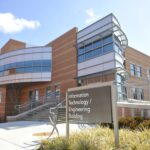
Images: The ITE building at UMBC (top), and Alejandra Diaz, left, with fellow Cyber Scholars (bottom). Header photo by Marlayna Demond ’11 for UMBC, and photo within story by Cindy Greenwood.
]]>
At a time when just 12 percent of information security analysts are black, Hispanic or Asian, and only 20 percent of information security analysts are women, successful student support programs...
https://umbc.edu/stories/umbcs-cyber-scholars-program-stands-out-as-a-national-model-in-diverse/
https://my3.my.umbc.edu/api/v0/pixel/news/120889/guest@my.umbc.edu/193469867bf98f6e526d8e8930ee7665/api/pixel
coeit
csee
cwit
cyberscholars
cybersecurity
diversityandinclusion
innovation
science-and-technology
UMBC News & Magazine
https://my3.my.umbc.edu/groups/umbc-news-magazine
https://assets1-my.umbc.edu/system/shared/avatars/groups/000/001/943/24435aa6207c452e7bc15cc74b42c7bb/xsmall.png?1748556657
https://assets1-my.umbc.edu/system/shared/avatars/groups/000/001/943/24435aa6207c452e7bc15cc74b42c7bb/original.png?1748556657
https://assets2-my.umbc.edu/system/shared/avatars/groups/000/001/943/24435aa6207c452e7bc15cc74b42c7bb/xxlarge.png?1748556657
https://assets2-my.umbc.edu/system/shared/avatars/groups/000/001/943/24435aa6207c452e7bc15cc74b42c7bb/xlarge.png?1748556657
https://assets3-my.umbc.edu/system/shared/avatars/groups/000/001/943/24435aa6207c452e7bc15cc74b42c7bb/large.png?1748556657
https://assets1-my.umbc.edu/system/shared/avatars/groups/000/001/943/24435aa6207c452e7bc15cc74b42c7bb/medium.png?1748556657
https://assets2-my.umbc.edu/system/shared/avatars/groups/000/001/943/24435aa6207c452e7bc15cc74b42c7bb/small.png?1748556657
https://assets1-my.umbc.edu/system/shared/avatars/groups/000/001/943/24435aa6207c452e7bc15cc74b42c7bb/xsmall.png?1748556657
https://assets2-my.umbc.edu/system/shared/avatars/groups/000/001/943/24435aa6207c452e7bc15cc74b42c7bb/xxsmall.png?1748556657
UMBC News & Magazine
0
0
false
Fri, 03 Feb 2017 18:54:43 -0500
New app Valuable Voices builds awareness of linguistic and cultural diversity in the classroom

A new iPhone app developed at UMBC is poised to change how students and teachers think about language in the classroom. Valuable Voices provides 12 ready-to-implement exercises for students and teachers to build linguistic awareness and English language skills.
Christine Mallinson, an associate professor of language, literacy, and culture (LLC), created the app with her longtime collaborator Anne Charity Hudley, an associate professor of linguistics at William & Mary. Aureanna Hakenson ’15, modern languages, linguistics, and intercultural communication, provided development assistance.

The app provides monthly exercises that can be adapted for elementary, middle, and high school classrooms, as well as higher ed, in a range of content areas and disciplines. Examples of exercises include analyzing the language of poetry, Shakespearean innovations, and linguistic heritage. Teachers can follow instructions for how to incorporate each exercise into their lesson plans.
Valuable Voices also highlights the importance of linguistic diversity, showing teachers and students alike the rich variation within even a single language, such as English. From word choice to sentence structure, different populations may use the same language in different ways, reflecting different social networks, regions, age groups, life experiences, and the ongoing evolution of language.
“Students don’t leave their language patterns at the door when they get to their classroom—any classroom, from English to biology,” says Mallinson. “This project really exemplifies applied research. With this app, teachers have tools at their disposal and can incorporate their own language background and those of their students. As a result, students are more engaged, and this is really applicable across all fields.”
Hakenson, who minored in computer science and now works as a cyber threat and intelligence analyst, built the app to share the positive impact linguistic awarness can have on students and educators.
“The goal was to make something that would be both interesting and easy to use,” explains Hakenson. “I also know that linguistics isn’t a very widely understood discipline, so being able to share that with students and teachers and possibly help to inspire a student to take in interest in linguistics is really exciting.”
Mallinson has showcased Valuable Voices on the national stage and its visibility continues to grow. She presented the app at the “Language and Educational Justice” symposium sponsored by the Linguistic Society for America and the Society for Linguistic Anthropology, held in January in Austin, Texas. On February 19, Valuable Voices will be featured at the American Association for the Advancement of Science (AAAS) annual meeting in Boston as part of the symposium “Leveraging Linguistics to Broaden Participation in STEM,” invited by the Linguistics and Language Science Section. Mallinson also presented Valuable Voices through a panel focused on linguistic diversity in education at the Maryland Language Science Center.
Since it launched, the free app has been well-received by educators, and downloaded nearly 200 times.
“Teachers and students thrive when they all have a deeper understanding of linguistic and cultural diversity, and this app is a natural extension of our efforts to bring that message into the classroom,” shares Mallinson.
“The value of using an app for this kind of project is that you’re presenting the new concepts to educators in a format that is not only familiar and convenient, but also fun,” adds Hakenson. “This means that the app format could be used across areas of study and with students of all ages, in addition to educators.”
Later this spring, Mallinson’s team will conduct a study with K-12 teachers who have used exercises from the app in their classrooms. Teachers who are interested in participating can contact Mallinson at mallinson@umbc.edu.
Update (2/10): Mallinson was featured in a Baltimore Sun article and video about language variations in Baltimore. “Language changes and develops for a lot of different reasons, and some of those are your social networks, your family networks, your mobility, residential patterns and migration,” Mallinson told the Sun. She is working to publish her research on Baltimore speech in the Journal of English Linguistics later this year.
Header image: Christine Mallinson uses the Valuable Voices app in her office. Photos by Marlayna Demond ’11 for UMBC.
]]>
A new iPhone app developed at UMBC is poised to change how students and teachers think about language in the classroom. Valuable Voices provides 12 ready-to-implement exercises for students and...
https://umbc.edu/stories/new-app-valuable-voices-builds-awareness-of-linguistic-and-cultural-diversity-in-the-classroom/
https://my3.my.umbc.edu/api/v0/pixel/news/120892/guest@my.umbc.edu/787af19f9c38018fc6c18ba8dc4fdc4f/api/pixel
arts-and-culture
cahss
diversityandinclusion
engage
innovation
llc
mlli
policy-and-society
UMBC News & Magazine
https://my3.my.umbc.edu/groups/umbc-news-magazine
https://assets1-my.umbc.edu/system/shared/avatars/groups/000/001/943/24435aa6207c452e7bc15cc74b42c7bb/xsmall.png?1748556657
https://assets1-my.umbc.edu/system/shared/avatars/groups/000/001/943/24435aa6207c452e7bc15cc74b42c7bb/original.png?1748556657
https://assets2-my.umbc.edu/system/shared/avatars/groups/000/001/943/24435aa6207c452e7bc15cc74b42c7bb/xxlarge.png?1748556657
https://assets2-my.umbc.edu/system/shared/avatars/groups/000/001/943/24435aa6207c452e7bc15cc74b42c7bb/xlarge.png?1748556657
https://assets3-my.umbc.edu/system/shared/avatars/groups/000/001/943/24435aa6207c452e7bc15cc74b42c7bb/large.png?1748556657
https://assets1-my.umbc.edu/system/shared/avatars/groups/000/001/943/24435aa6207c452e7bc15cc74b42c7bb/medium.png?1748556657
https://assets2-my.umbc.edu/system/shared/avatars/groups/000/001/943/24435aa6207c452e7bc15cc74b42c7bb/small.png?1748556657
https://assets1-my.umbc.edu/system/shared/avatars/groups/000/001/943/24435aa6207c452e7bc15cc74b42c7bb/xsmall.png?1748556657
https://assets2-my.umbc.edu/system/shared/avatars/groups/000/001/943/24435aa6207c452e7bc15cc74b42c7bb/xxsmall.png?1748556657
UMBC News & Magazine
0
0
false
Thu, 02 Feb 2017 20:52:16 -0500
UMBC grad students talk STEM teaching, mentorship, and collaboration in South Korea

A UMBC delegation of Ph.D. students and their mentors traveled to Seoul, South Korea in early November to discuss with international colleagues how engineering and engineering education can improve lives at the 2016 Global Student Forum (GSF) and World Engineering Education Forum (WEEF).
The GSF theme of “global partnership for development” included four tracks that aligned with United Nations’ Millennium Development Goals and the National Academy of Engineering’s Grand Challenges. Students from around the world collaborated to tackle assigned tasks on those tracks. Gloria Opoku-Boateng, Ph.D. student in information systems, worked with her team to create a community empowerment program to reduce extreme poverty and hunger. The project, dubbed “iHelp,” won its category at the GSF.
For Saadi Habib, Ph.D. student in mechanical engineering, speaking with students from more than 15 countries through the project-based GSF program was eye-opening. “I realized what I see as a problem and a solution in the U.S. is not necessarily true in other countries or even in the entire U.S,” he shared, noting that challenges that appear purely technical can have multiple, context-dependent solutions.
The GSF program is connected to the international Student Platform for Engineering Education Development (SPEED) and was designed to complement the larger WEEF gathering, which took place just afterward and focused on “Engineering Education for Smart Society.” There, UMBC participants gave research presentations and joined in panels focused on pedagogy and mentoring.
Habib and Hector Medina, Ph.D. student in mechanical engineering and Meyerhoff Graduate Fellow, presented on how to develop a successful engineering laboratory course. Renetta Tull, associate vice provost for graduate student development and postdoctoral affairs, spoke on inclusive engineering.
Opoku-Boateng delivered a research talk on her research in engineering artificial intelligence in consumer apps for personalized pain prediction and management. She reflected, “Presenting here helped me understand that clearly presenting solutions to engineering problems is as important as finding those solutions.” She also seized the opportunity to receive and offer mentoring, sharing her experience with navigating the transition from undergraduate to graduate education.
Unable to attend the event, but present in the minds of his colleagues, was Adegboyega Akinsiku, Ph.D. student in human-centered computing, who was scheduled to speak about project-based learning. Shortly before the conference, Akinsiku discussed the importance of mentoring at the White House Conference on Inclusive STEM Education for Youth of Color. His mother, who proudly attended the White House talk, passed away shortly before the Korea trip.
Akinsiku’s experience at the White House, and Opoku-Boateng, Habib, and Medina’s time in Korea, left them with a strong sense of mission. Getting a clearer sense of the range of challenges and possible solutions out in the world, “I start to think with a broader perspective of designing, building, engineering, and developing technology for social good,” says Opoku-Boateng. “That is what truly makes a mark.”
The South Korea trip was the fourth in a series of experiences organized through the International Engagement and Broadening Participation in STEM project, spearheaded by Renetta Tull and sponsored by the UMBC Graduate School and some of its initiatives that are funded by the National Science Foundation. The participating UMBC students are also all part of the LSAMP Bridge to the Doctorate program and PROMISE, Maryland’s Alliance for Graduate Education and the Professoriate (AGEP). Other UMBC mentors and participants included Julia Ross, dean of the college of engineering and IT; Tim Topoleski, professor of mechanical engineering; Autumn Reed, program coordinator for faculty diversity initiatives; and Yarazeth Medina, PROMISE coordinator.
Image: From left to right, UMBC graduate students Hector Medina, Saadi Habib, and Gloria Opoku-Boateng; David Delaine, assistant professor of engineering education at the Ohio State University; a student attendee from Colombia. Photo by Hector Medina.
]]>
A UMBC delegation of Ph.D. students and their mentors traveled to Seoul, South Korea in early November to discuss with international colleagues how engineering and engineering education can...
https://umbc.edu/stories/umbc-grad-students-talk-stem-teaching-mentorship-and-collaboration-in-south-korea/
https://my3.my.umbc.edu/api/v0/pixel/news/120917/guest@my.umbc.edu/7cfdbece46dd328c96f863114df5663f/api/pixel
coeit
graduateschool
innovation
is
meche
science-and-technology
UMBC News & Magazine
https://my3.my.umbc.edu/groups/umbc-news-magazine
https://assets1-my.umbc.edu/system/shared/avatars/groups/000/001/943/24435aa6207c452e7bc15cc74b42c7bb/xsmall.png?1748556657
https://assets1-my.umbc.edu/system/shared/avatars/groups/000/001/943/24435aa6207c452e7bc15cc74b42c7bb/original.png?1748556657
https://assets2-my.umbc.edu/system/shared/avatars/groups/000/001/943/24435aa6207c452e7bc15cc74b42c7bb/xxlarge.png?1748556657
https://assets2-my.umbc.edu/system/shared/avatars/groups/000/001/943/24435aa6207c452e7bc15cc74b42c7bb/xlarge.png?1748556657
https://assets3-my.umbc.edu/system/shared/avatars/groups/000/001/943/24435aa6207c452e7bc15cc74b42c7bb/large.png?1748556657
https://assets1-my.umbc.edu/system/shared/avatars/groups/000/001/943/24435aa6207c452e7bc15cc74b42c7bb/medium.png?1748556657
https://assets2-my.umbc.edu/system/shared/avatars/groups/000/001/943/24435aa6207c452e7bc15cc74b42c7bb/small.png?1748556657
https://assets1-my.umbc.edu/system/shared/avatars/groups/000/001/943/24435aa6207c452e7bc15cc74b42c7bb/xsmall.png?1748556657
https://assets2-my.umbc.edu/system/shared/avatars/groups/000/001/943/24435aa6207c452e7bc15cc74b42c7bb/xxsmall.png?1748556657
UMBC News & Magazine
0
0
false
Tue, 13 Dec 2016 20:39:42 -0500
UMBC support for STEM grad students from underrepresented groups featured as a national model

The Christian Science Monitor recently examined challenges that many graduate students from underrepresented groups experience, such as isolation, mentors who may not understand their perspectives and backgrounds, and a feeling of being unwelcome. Writer Schuyler Velasco focused on programs that address these challenges at leading U.S. research universities, including Vanderbilt and UMBC.
These programs “tackle the issue of treating those experiences of ‘otherness’ as a challenge as important as getting enough study time,” writes Velasco. They do so by providing emotional support resources, creating opportunities to connect with mentors of similar backgrounds, and monitoring racial and gender dynamics to ensure research and learning environments live up to their inclusive ideals, to ensure that these students succeed.
Renetta Tull, associate vice provost for graduate student development and postdoctoral affairs, addressed UMBC’s efforts to promote retention of minority students. “Having a community that says, ‘You are us,’ and having affinity groups that remind people how they are part of that broader community can be helpful, and lead to more opportunities to connect,” she said.
Only 2.5 percent of professors in engineering nationwide are black, and 40 percent of women who earn engineering degrees leave the field early or never enter it at all. These sobering statistics are the backdrop for Tull’s work.
The Summer Success Institute, hosted annually since 2003 at UMBC and other USM institutions, is “a retreat that invites faculty from other universities in the U.S. and overseas to serve as ‘mentors-in-residence’ for graduate students across the Maryland university system,” writes Velasco. And it’s working.
“In many cases, students have never had a faculty member who looked like them and engaged them outside the classroom,” shares Tull. “It’s a way for the students to discuss issues they may be having and not feel alone.” In addition, participating in the institute can lead to job offers. In previous years, visiting mentors have hired UMBC graduates, and students from other universities, often accompanying visiting faculty, have ended up working for UMBC.
The CSM article also features UMBC’s PROF-it, an initiative that partners with community colleges to, as Velasco describes, “give doctoral and postdoc candidates hands-on teaching experience, and [offer] workshops on how to be an effective professor.” Both the Summer Success Institute and PROF-it are part of PROMISE – Maryland’s Alliance for Graduate Education and the Professoriate.
A new article by Tull in Computing Research News addresses findings from a crowdsourcing exercise at the Summer Success Institute. Participants articulated several specific challenges graduate students face, such as time management, isolation, and expectations from family.
The group also generated several recommendations for first year graduate students to address these challenges: inviting internal and external mentors to assist outside the classroom; allowing a free flow of ideas that includes personal sharing and aspirations; reinforcing the importance of engagemet, development, and long-term goals; and giving students a chance to consider the challenges and solutions together.
Programs like the Summer Success Institute bring these recommendations to bear. Graduate programs need to treat students objectively, based on their merits as teachers and researchers, “while making sure that [they] have the emotional and community support they need to thrive,” writes Velasco.
Tull understands the positive effects that support can bring about. She reflects, “There’s a reward in that shared social connection, acknowledging that you are…valued.”
Image: Students at the Summer Success Institute converse with mentor-in-residence Gregory Triplett, professor of electrical engineering at Virginia Commonwealth University; photo by Cheriss May.
Read the full Christian Science Monitor article “How can universities keep minorities in STEM graduate programs?”
Read the Computing Research New article “Expanding the pipeline: PROMISE brings a new phase of #ThinkBigDiversity to Maryland graduate students.”
]]>
The Christian Science Monitor recently examined challenges that many graduate students from underrepresented groups experience, such as isolation, mentors who may not understand their perspectives...
https://umbc.edu/stories/umbc-support-for-stem-grad-students-from-underrepresented-groups-featured-as-a-national-model/
https://my3.my.umbc.edu/api/v0/pixel/news/120964/guest@my.umbc.edu/9ee13fc33c2506c445210b6b80c51b3a/api/pixel
cahss
cnms
coeit
community
graduateschool
innovation
UMBC News & Magazine
https://my3.my.umbc.edu/groups/umbc-news-magazine
https://assets1-my.umbc.edu/system/shared/avatars/groups/000/001/943/24435aa6207c452e7bc15cc74b42c7bb/xsmall.png?1748556657
https://assets1-my.umbc.edu/system/shared/avatars/groups/000/001/943/24435aa6207c452e7bc15cc74b42c7bb/original.png?1748556657
https://assets2-my.umbc.edu/system/shared/avatars/groups/000/001/943/24435aa6207c452e7bc15cc74b42c7bb/xxlarge.png?1748556657
https://assets2-my.umbc.edu/system/shared/avatars/groups/000/001/943/24435aa6207c452e7bc15cc74b42c7bb/xlarge.png?1748556657
https://assets3-my.umbc.edu/system/shared/avatars/groups/000/001/943/24435aa6207c452e7bc15cc74b42c7bb/large.png?1748556657
https://assets1-my.umbc.edu/system/shared/avatars/groups/000/001/943/24435aa6207c452e7bc15cc74b42c7bb/medium.png?1748556657
https://assets2-my.umbc.edu/system/shared/avatars/groups/000/001/943/24435aa6207c452e7bc15cc74b42c7bb/small.png?1748556657
https://assets1-my.umbc.edu/system/shared/avatars/groups/000/001/943/24435aa6207c452e7bc15cc74b42c7bb/xsmall.png?1748556657
https://assets2-my.umbc.edu/system/shared/avatars/groups/000/001/943/24435aa6207c452e7bc15cc74b42c7bb/xxsmall.png?1748556657
UMBC News & Magazine
0
0
false
Thu, 10 Nov 2016 18:55:36 -0500
 Mavis Sanders.


