Turning the Tides

For Christopher Tong, discovering clues hidden in texts documenting history’s most devastating floods isn’t just about the promise of making social, cultural, and political change. It’s also a personal journey inspired by generations of his own family.
In July of 2021, the city of Zhengzhou, China, had more than seven inches of rain in one hour, flooding subway train cars filled with commuters and forcing hundreds of thousands to evacuate.
Around this time Christopher K. Tong, an assistant professor of modern languages, linguistics, and intercultural communication, was surrounded by materials he had collected during his trip to the People’s Republic of China at the Hubei Provincial Archive in Wuhan and from the No. 2 Historical Archive in Nanjing, the national repository for Republican-era government documents. He was translating and analyzing historical, government, and personal documents regarding two major environmental disasters in China during the 1930s: the Yangzi River and Yellow River floods.
Nearly a century ago, the communities surrounding the third- and sixth-longest river systems in the world experienced the most severe flooding in modern China’s history, inundating thousands of miles of land, killing millions of people, and leading to extensive disease and famine.
Witnessing the coverage of the Zhengzhou flood, and watching the past and present intersect, was an extraordinary moment for Tong. Live, minute-by-minute social media posts gave insight into the catastrophic experience. By contrast, the floods from the 1930s did not have such personal coverage. First-person accounts tended to be handwritten letters and only some reached audiences beyond their villages, allowing for a select few, in cities far away from the areas most impacted, to understand what was happening on the ground.
“The Zhengzhou floods confirmed for me how important environmental humanities research is and how this scholarship sheds light on society and politics,” says Tong, who compares the impact of the floods to the impact the Dust Bowl of America’s Great Depression had on American society and politics. This deep research into the political—and personal—nature of environmental disasters like these has won Tong recognition among humanities scholars, social scientists, and policy analysts alike.
The Henry Luce Foundation and the American Council of Learned Societies recently awarded Tong one of 11 prestigious Early Career Fellowships in China Studies, providing funding for an academic year of research, writing, and curriculum development to help meet the needs of China studies in the 21st century. Tong will use this time and rich material to write his book on ecological consciousness and political representation in modern China.
“One of the goals of my book is to offer readers resources to ‘think with China’ on shared concerns such as ecological crises, human rights, and animal advocacy,” says Tong. “I see my work as contributing to cultural diplomacy and what people in the policy world call ‘China literacy.’”
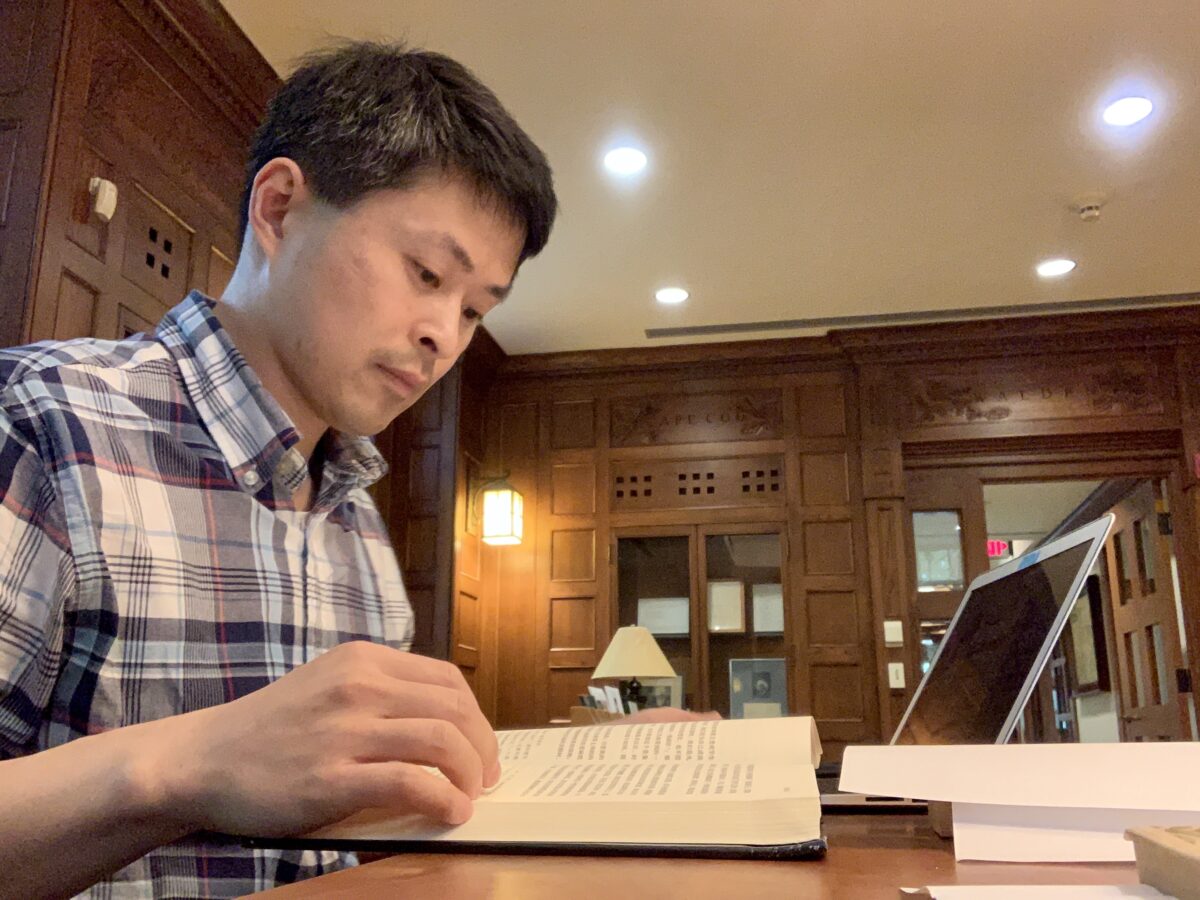
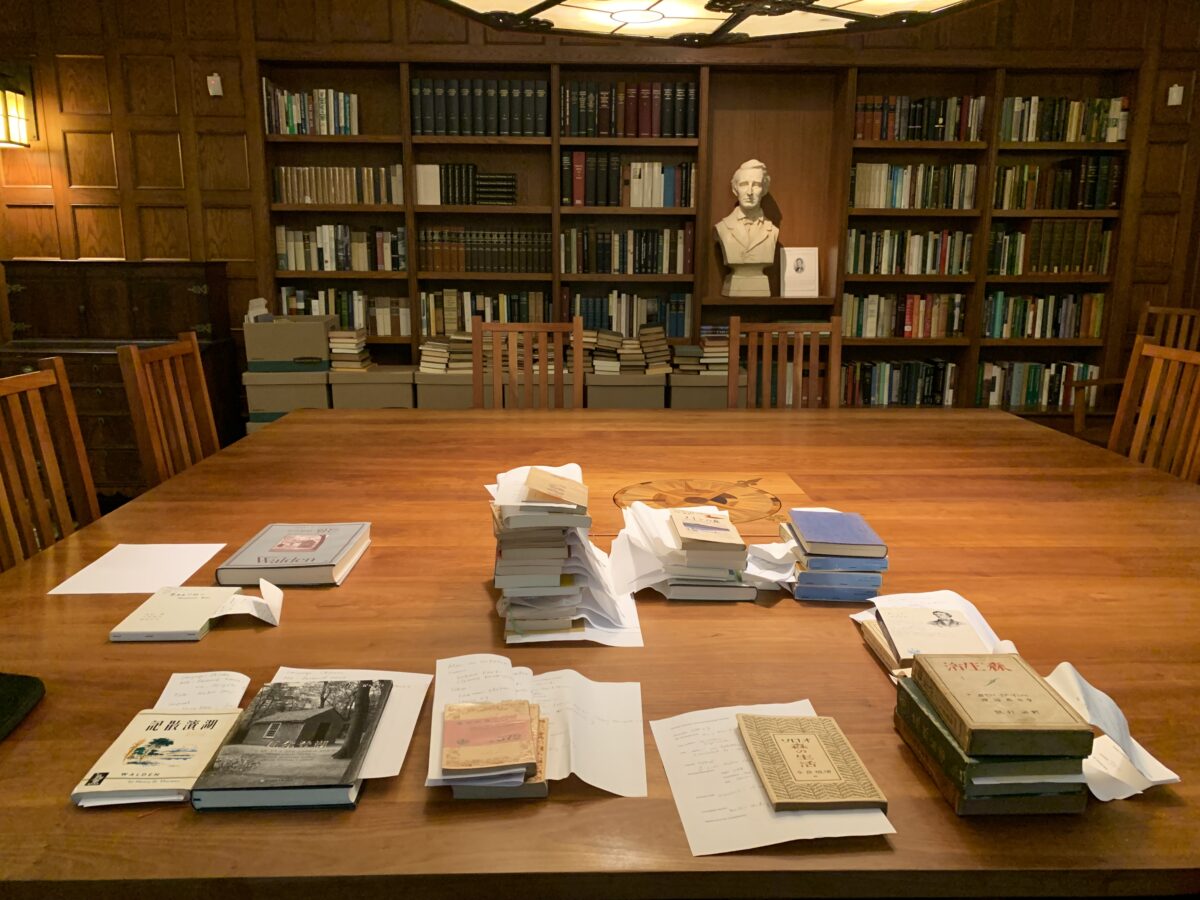 In September 2021, Tong spent two days examining, scanning, and taking notes on a number of Asian translations at the Thoreau Institute. Images courtesy of Tong.
Silent all these years
Historical and literary narratives of the Yangzi River and Yellow River floods tend to shift between focusing on facts and offering a political party’s explanation. The events are inevitably understood within the larger framework of building a national identity, especially the revolutionary history of the People’s Republic of China.
“Official narratives generally serve to build national unity, but there are always gaps and discrepancies in these narratives. It’s about whose voices are missing in the official narratives and why,” says Tong. “Unfortunately, people forget these voices over time, and my project is to recover them.
Wanting to delve into the archives on the floods to see what histories emerged, Tong first had to secure access to the archives. With access granted and the assistance of a Fulbright grant and Nanjing University, between 2018 and 2019 Tong spent 10 months in China analyzing thousands of documents written in classical and modern Chinese. In the archives, amongst letters written by survivors, correspondence between county officials and provincial and central governments lists of survivors at refugee camps, maps, logistical documents, and photos never before studied, was one of many untold stories:
“There are those who try to rescue their parents, but die in the water…There are those who hold their wives and children by the hand, but end up drowning together…[and] families that manage to escape on a single raft, but sink in the middle of the current.”
This excerpt of a rare petition letter written by a village representative was in the archives and mirrored accounts throughout the archives that spoke of death and survival. These voices, silent for decades, were not a story of revolutionary action as many histories of modern China would imply. What Tong unearthed bears witness to the lived experience of rural communities focused on repairing and managing loss. They sought help from government officials, relief workers, each other, and were more civically engaged than previously thought.
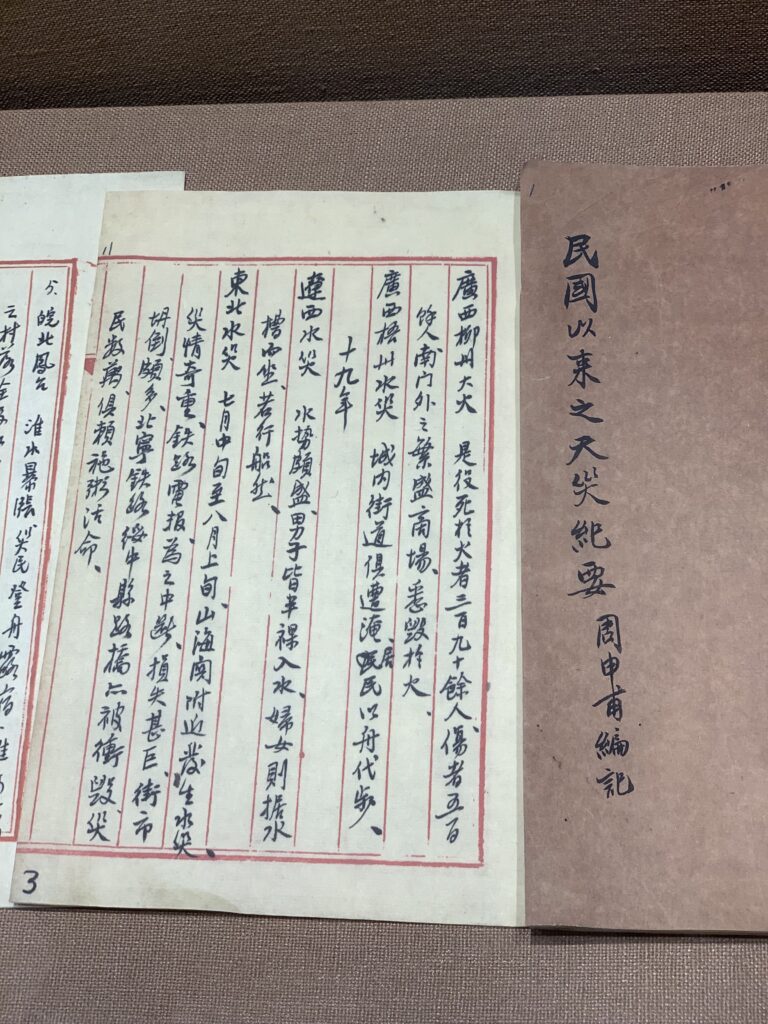 An archival document listing major environmental disasters in Republican China. Image courtesy of Tong.
“Sometimes these efforts are not given enough consideration in disaster narratives and national histories,” says Tong. “But I believe them to be important as building blocks of proto-democratic practices.” He hopes it will inspire the reconceptualization of Chinese literature and history in the early 20th century.
Kirk Denton, professor emeritus of Chinese literature at the Ohio State University and a mentor to Tong through UMBC’s Eminent Scholar Mentoring Program, gave Tong important feedback based on his own research on the representation of historical memory in Chinese and Taiwanese museums. Over the years, Denton has witnessed the evolution of Tong’s work.
“I was heartened to see a young man mature into such an accomplished scholar,” says Denton, who notes that Tong’s work “is at the forefront of the environmental humanities.”
Jessica Berman, professor of English and director of UMBC’s Dresher Center for the Humanities, says that as a scholar of comparative literature, “Christopher uses the core methods of textual analysis, critical theory, and intellectual history to bring out the ramifications of cross-cultural environmental thinking between China and the U.S. in the early 20th century.”
“The climate crisis is often portrayed as something serious that happens over time, like global warming,” says Tong. “However, with the Dust Bowl in the U. S. and floods in China, these disasters were fast and extreme and often contributed to immediate shifts in public sentiment and the government’s capacity to govern.”
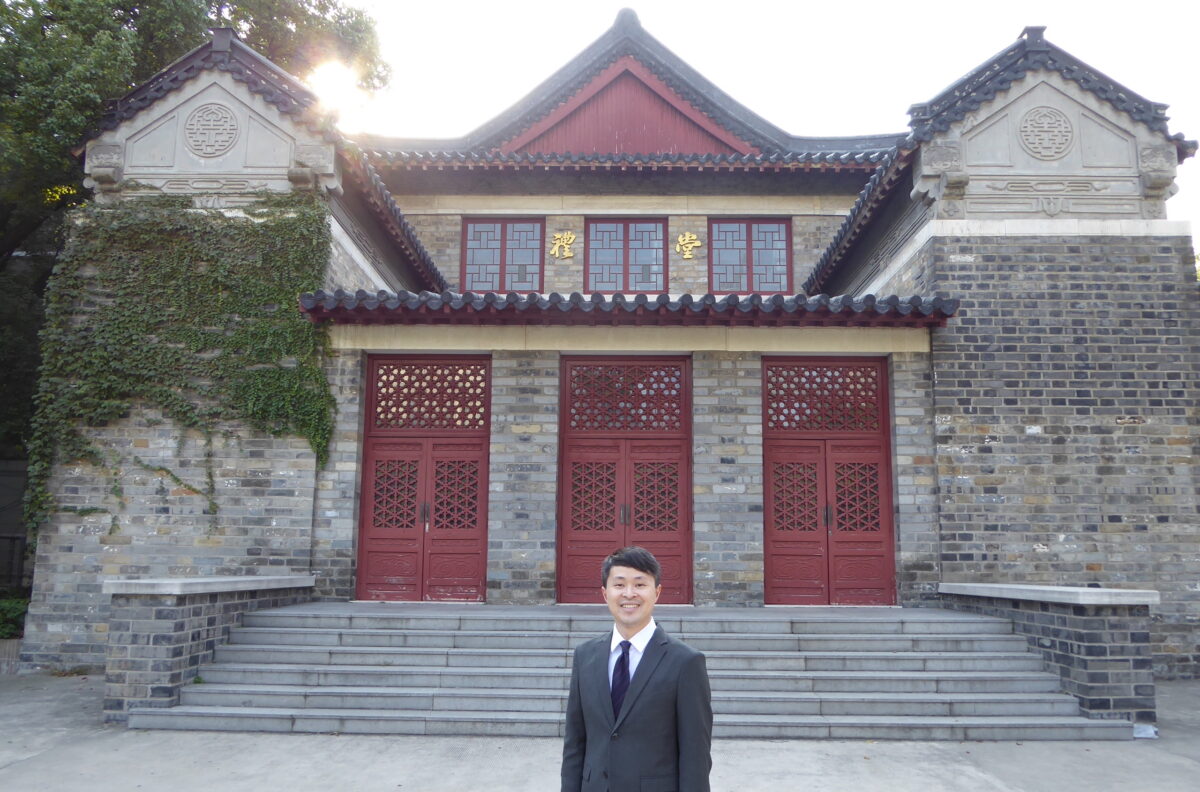 Tong stands in front of Nanjing University’s auditorium at the downtown campus, which features the fusion of traditional Chinese architectural elements and modern Western construction methods. Image courtesy of Tong.
Windows to the past
For Tong, the interconnectedness of his work is both personal and professional. His interest in 20th‑century China and Hong Kong stems from his maternal grandmother’s stories about her life in mainland China in the early 20th century.
“My maternal grandmother and her sibling were artists. She went to an art academy in China briefly during W WII and was the director of a clothing company in Hong Kong after the war. One of her sisters was a film star in Hong Kong who acted opposite a young Bruce Lee in the film Thunderstorm in 1957,” he says.
He remembers learning about his great‑great‑grandfather, Jiang Kong yin, a government official and well‑respected member of the gentry during the Qing dynasty, the last imperial dynasty in China. Jiang helped with the transition from the Qing dynasty to the Republic of China (ROC). Tong’s maternal grandfather learned English early because he was from one of the founding families whose fortune was tied to British Hong Kong. This was especially useful during WWII when he worked for Allied forces in southwestern China with Chinese aviators and the Flying Tigers, U. S. volunteer aviators who fought against Japan.
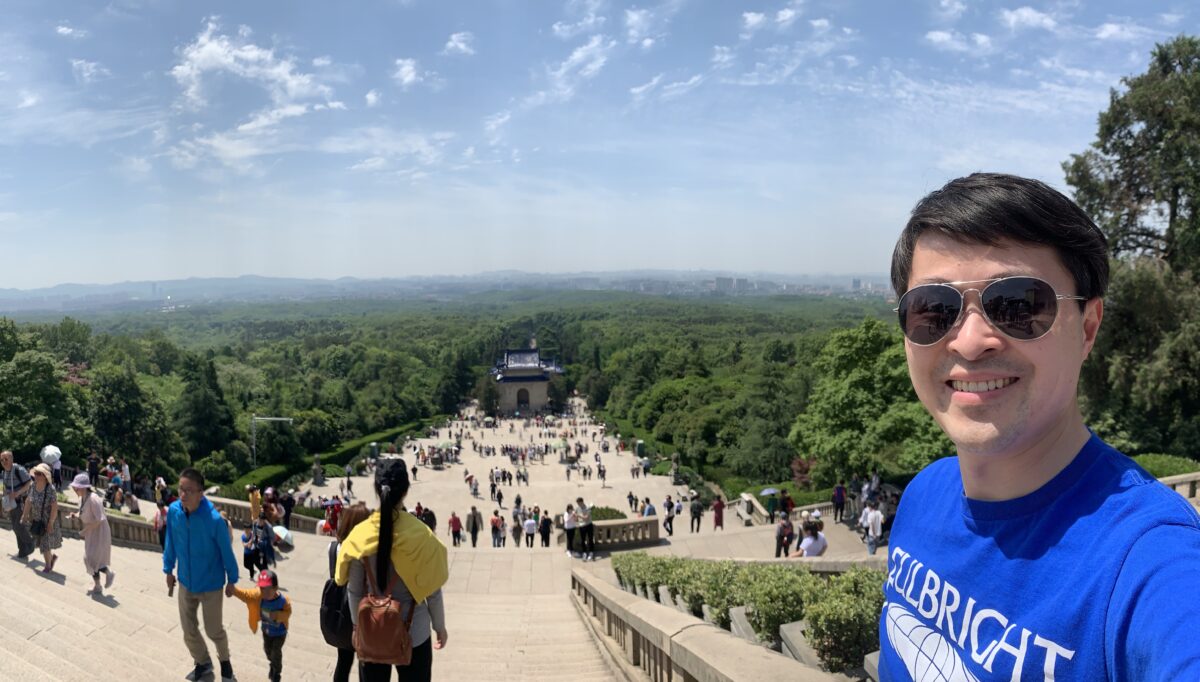
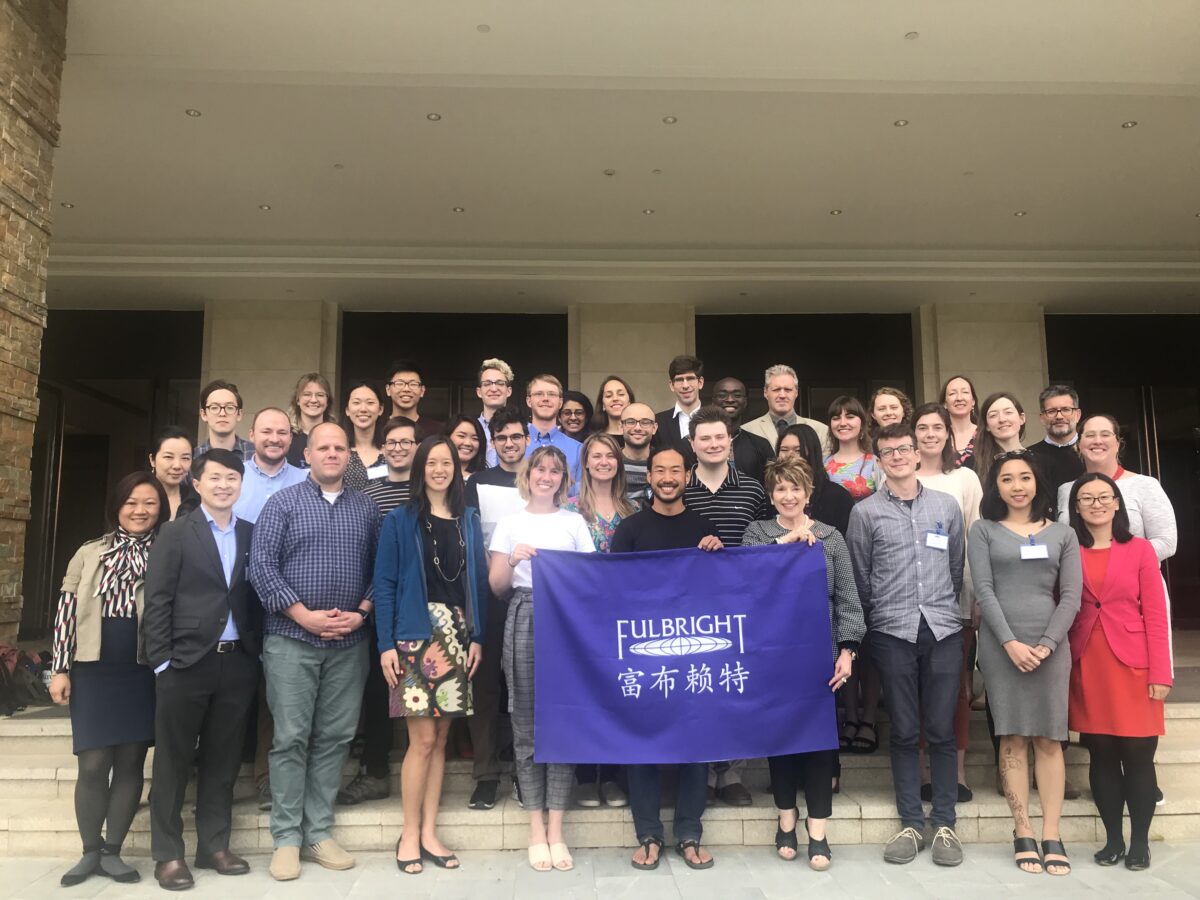 Left: Tong visited Dr. Sun Yat-sen’s Mausoleum on Nanjing’s Purple Mountain and wore his Fulbright shirt as a way to commemorate the US-China connection and his Fulbright experience in China. Right: The Fulbright program in China was cut short in 2020 by the pandemic and subsequently canceled, making Tong’s visit the last full year of Fulbright exchange in the People’s Republic of China. Images courtesy of Tong.
Tong also listened to the stories of his paternal grandfather who worked for an American company in Hong Kong after WWII. His paternal grandmother came from a peasant family and joined her siblings in the U.S. Her siblings ran a Chinese restaurant in Bakersfield, California. This side of Tong’s family eventually moved to the San Francisco Bay Area where his uncles would later work for the U. S. military. California has been home to most of Tong’s family since the late 1960s.
“I’m proud that my research not only broadens scholarship in the humanities,” shares Tong, “but it is also a way to maintain my connection to my family history and imagine what it was like for them to live through those periods.”
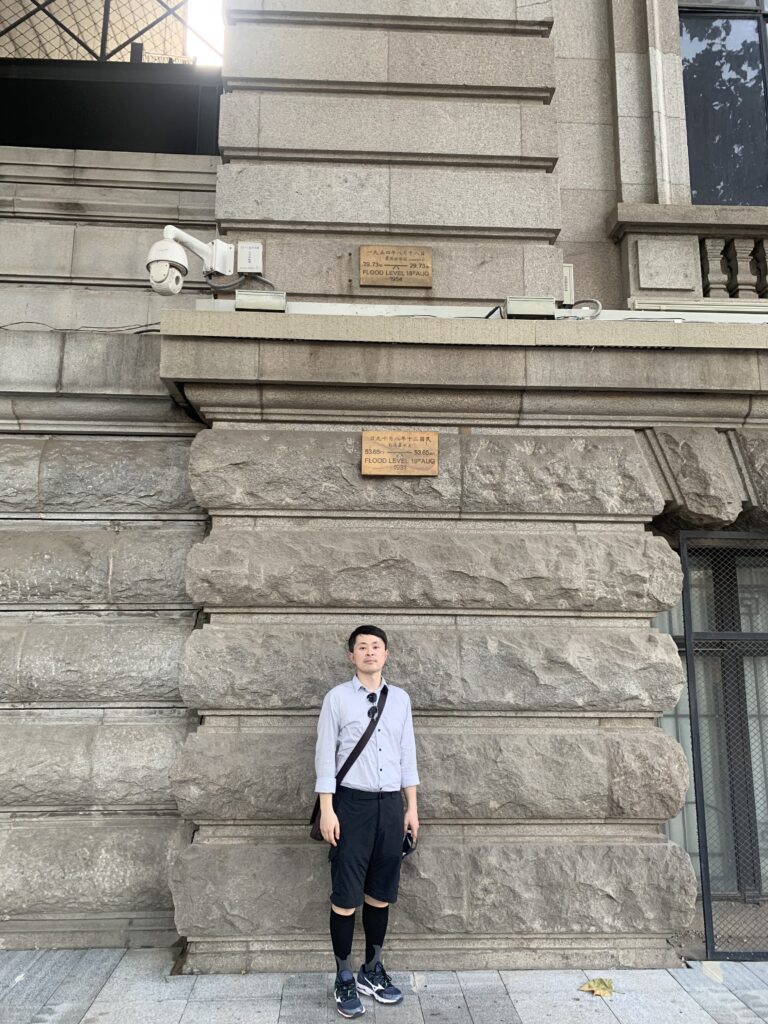 Tong stands below two plaques on the side of the former Hankow Customs House in Wuhan, China. The plaques are placed at the high-water marks of the 1931 floods (lower) and 1954 floods (higher). Image courtesy of Tong.
Mirrors
Tong’s work also holds space for voices missing in the humanities and the environmental movement. “Ecological thought draws heavily on European and North American traditions. Non-Western cultures are often viewed as derivative or marginal,” explains Tong. “Women, people of color, and disabled people are also underrepresented as contributors to environmentalism and animal advocacy.”
He remembers how his family often didn’t feel comfortable using green space, and when they did, people often assumed they were tourists. “Before COVID, I was visiting my grandmother and went for a hike in Muir Woods,” north of San Francisco, says Tong. “People asked me where I was from and were surprised to hear I grew up in the Bay Area.” The times when they did feel comfortable, when they enjoyed spending time outdoors, those experiences were memorable and inspired his career path.
Tong hopes to spur more inclusion and representation in the humanities. The STEM fields (science, technology, engineering, and math) have benefited from the talents and scholarship of Asian Americans and Pacific Islanders, he says, but the humanities have not had equal representation. As an Asian American with Hong Kong roots, Tong has often been the sole person of color or Asian American in classes and conferences. Often, he is mistaken as the “tech-person” or assumed to be in a STEM field, he explains.
Tamara Bhalla, an associate professor of American studies and affiliate faculty in the Asian Studies program, works with Tong on the board of the UMBC Asian and Asian American Faculty and Staff Council (AAAFSC). She says, “Chris has been a tremendous leader…He has brought his expansive intellect and global knowledge to bear in his approach to leadership in AAAFSC.”
Part of this work means going beyond the classroom. Tong participated in a series of talks at the Asian Art Museum of San Francisco on the theme of “After Hope.” His project helped raise awareness of Chinese-language literature in the context of Asian American history and addressed the pandemic, immigration policies, and what wellbeing means. He includes poetry found on Angel Island in the San Francisco Bay where Chinese immigrants were detained in the early 20th century because of the Chinese Exclusion Act.
“We’re an important part of the conversation on culture, politics, and history in American society,” he says. He wants to be one of the people that students can look to and think, “I can also pursue this path and have a career in academia in a humanistic field.”
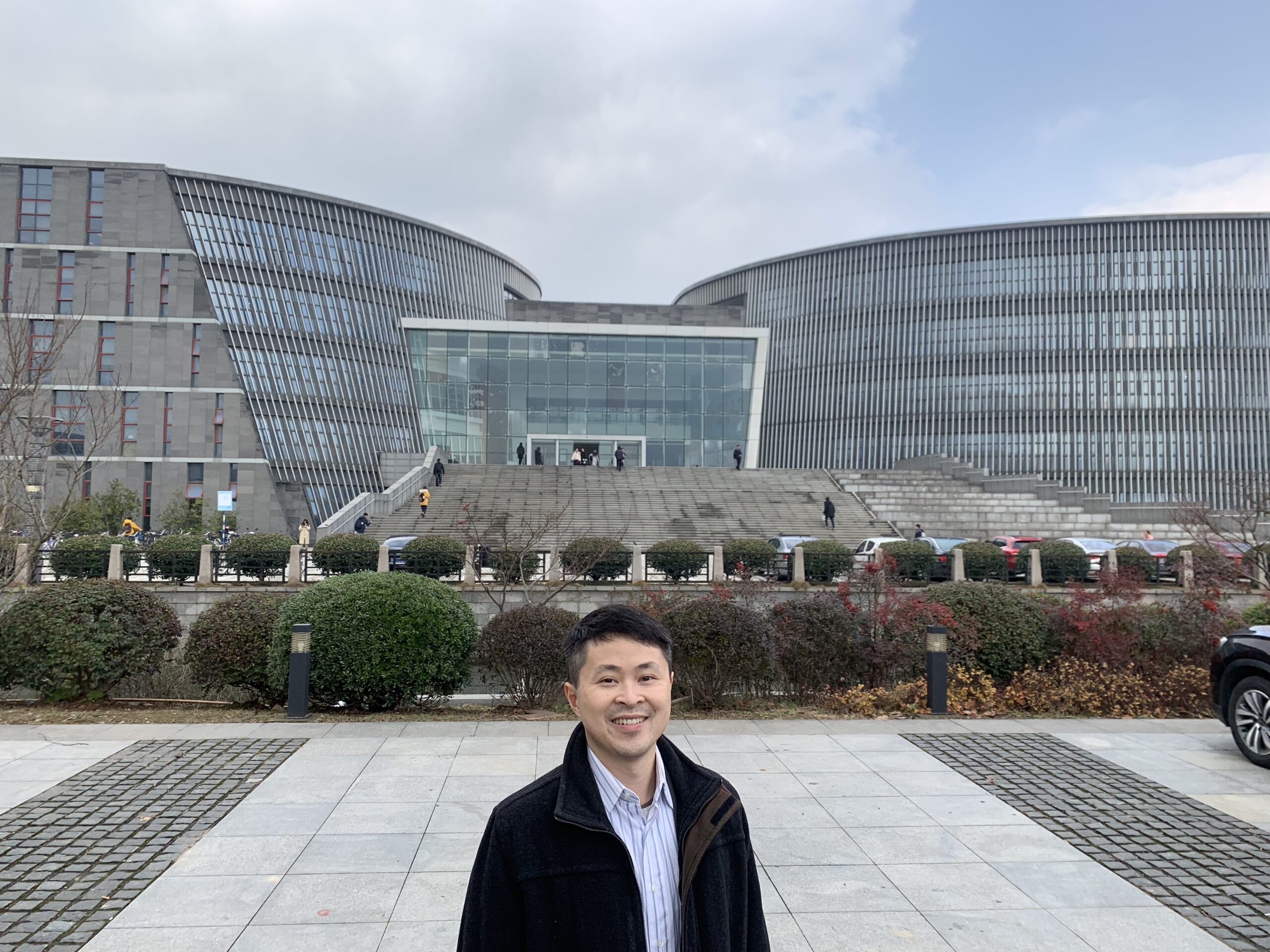
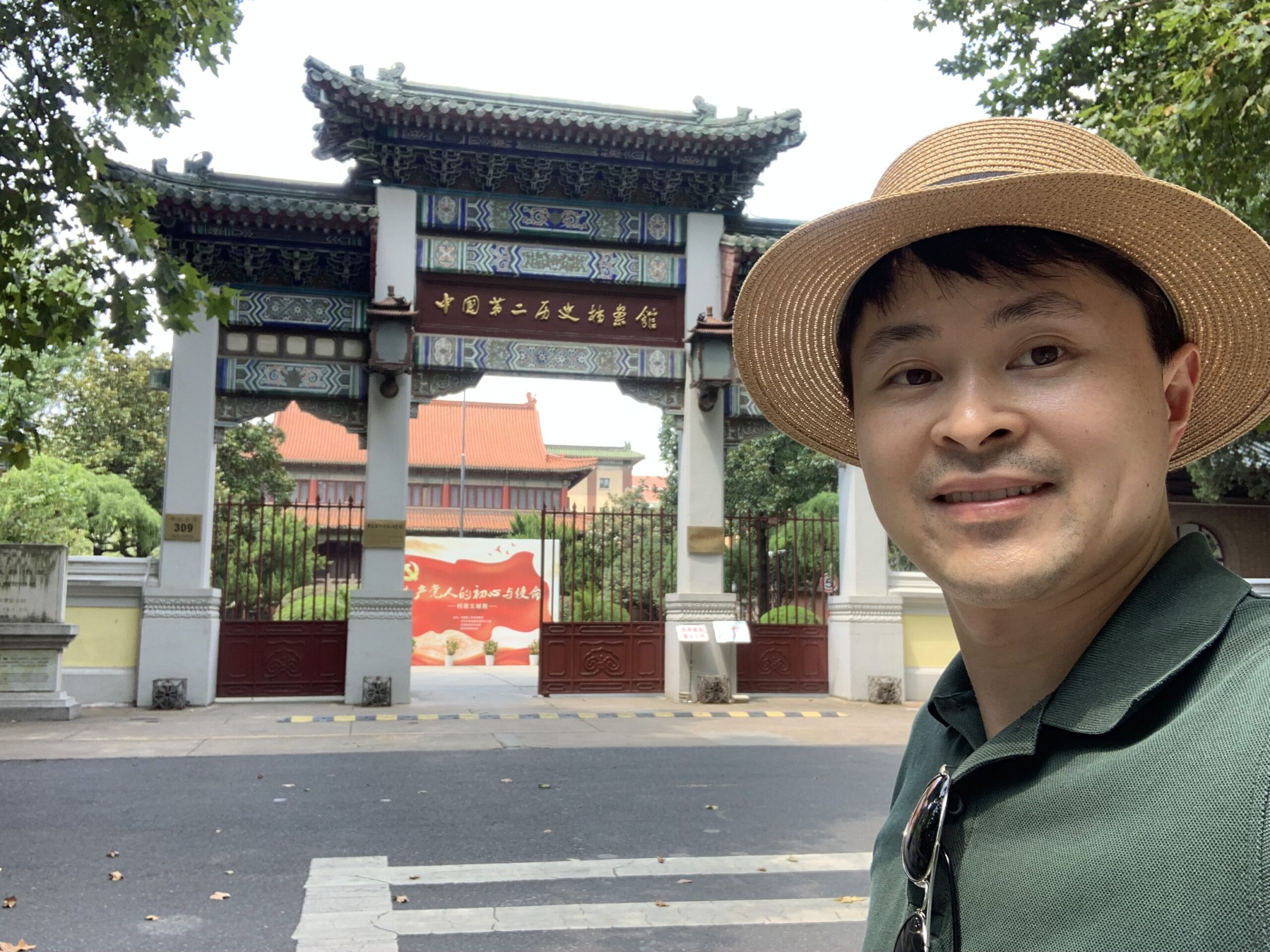 Left: At Nanjing University’s main library at the new campus in the Xianlin district. Right: At The No. 2 Historical Archive, the national repository for Republican-era government documents, in Nanjing. Images courtesy of Tong.
Last year’s flood in Zhengzhou was one of many extreme weather events in China that summer. Many cities and villages in various provinces were bombarded by the floods, killing hundreds and displacing millions.
The New York Times reported on the different accounts given by government officials, meteorologists, and on social media, including those trapped in the flooded subway, wading in the water, leaving their homes, and taking care of the dead while also dealing with COVID-19.
In the meantime, Tong has documents that remain to be analyzed in hopes they will unveil more voices and bring further clarity to China’s environmental history and its future.
“The climate crisis affects everyone every where in some way. It’s the most important issue of our generation,” says Tong. “It affects every domain of knowledge production.”
* * * * *
Header Image: A scene from the Yangzi River in China. Photo by Dong Zhang on Unsplash (2017). All other photos shared by Tong.
]]>
For Christopher Tong, discovering clues hidden in texts documenting history’s most devastating floods isn’t just about the promise of making social, cultural, and political change. It’s also a...
https://umbc.edu/stories/turning-the-tides-historic-flood-research/
https://my3.my.umbc.edu/api/v0/pixel/news/126254/guest@my.umbc.edu/e9ebe414caba9c1c343094233c3e1206/api/pixel
cahss
cahssresearch
discovery
interdisciplinary
international-stories
magazine
mlli
summer-2022
UMBC News & Magazine
https://my3.my.umbc.edu/groups/umbc-news-magazine
https://assets1-my.umbc.edu/system/shared/avatars/groups/000/001/943/24435aa6207c452e7bc15cc74b42c7bb/xsmall.png?1748556657
https://assets1-my.umbc.edu/system/shared/avatars/groups/000/001/943/24435aa6207c452e7bc15cc74b42c7bb/original.png?1748556657
https://assets2-my.umbc.edu/system/shared/avatars/groups/000/001/943/24435aa6207c452e7bc15cc74b42c7bb/xxlarge.png?1748556657
https://assets2-my.umbc.edu/system/shared/avatars/groups/000/001/943/24435aa6207c452e7bc15cc74b42c7bb/xlarge.png?1748556657
https://assets3-my.umbc.edu/system/shared/avatars/groups/000/001/943/24435aa6207c452e7bc15cc74b42c7bb/large.png?1748556657
https://assets1-my.umbc.edu/system/shared/avatars/groups/000/001/943/24435aa6207c452e7bc15cc74b42c7bb/medium.png?1748556657
https://assets2-my.umbc.edu/system/shared/avatars/groups/000/001/943/24435aa6207c452e7bc15cc74b42c7bb/small.png?1748556657
https://assets1-my.umbc.edu/system/shared/avatars/groups/000/001/943/24435aa6207c452e7bc15cc74b42c7bb/xsmall.png?1748556657
https://assets2-my.umbc.edu/system/shared/avatars/groups/000/001/943/24435aa6207c452e7bc15cc74b42c7bb/xxsmall.png?1748556657
UMBC News & Magazine
0
0
false
Thu, 14 Jul 2022 10:53:19 -0400
Thu, 14 Jul 2022 10:53:19 -0400
UMBC launches Faculty Expert Search tool to connect scholars with the public and each other
Every day UMBC faculty are hard at work testing antivirals in the lab, untangling the impacts of healthcare policy, and processing satellite data on Earth’s atmosphere. They are developing best practices for K-12 teaching, remediating water contaminants, and exploring how actors express intimacy on stage. But how can journalists, students, or the general public learn who these faculty are and what they study? And how can faculty connect with each other for innovative research collaborations?
Anyone seeking UMBC experts can now find them through a new online tool that makes searches fast and easy.
“UMBC has some of the nation’s leading experts in fields ranging from artificial intelligence and quantum computing to health equity and public history. But it can be challenging for potential research partners to identify exactly the right contact for a given project,” says Karl V. Steiner, vice president for research. “We are excited that this online tool will give current and future partners new ways to learn about and collaborate with talented researchers and scholars across our UMBC community.”
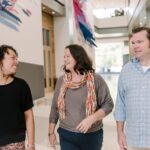
 Karl Steiner (left) and Aryya Gangopadhyay at the Pi Squared opening in 2018.
How it works
On the Faculty Expert Search site, users can enter a name or a research topic to identify UMBC experts, and then connect with those who most closely match their needs. Possible uses include fellow faculty seeking research collaborators, prospective graduate students looking for faculty in their areas of interest, journalists looking for experts on topics in the news, and community groups interested in project partners.
In response to search terms, the tool displays micro-profiles. These include faculty names, titles, departments, and brief bios, plus photos if available. Clicking on “view profile” will reveal contact information. It will also display additional information the faculty member chooses to add to their profile, such as research interests, teaching expertise, classes taught, and publications.
 Weihong Lin (right), professor of biological sciences, with Rishit Patel ’19 (left) and Kayla Lemons-Valdez, Ph.D. ’20, biological sciences (center), in 2018.
Faculty can update their profiles at any time, so the site is continuously growing. Currently, the database features tenured and tenure-track faculty and lecturers, and some research faculty, and there is interest in making it more inclusive over time.
Visibility and connections
“A comprehensive, searchable database of faculty experts highlights the diversity and vibrancy of scholarly activities in our institution,” says Preminda Jacob, associate dean of the College of Arts, Humanities, and Social Sciences. Jacob, who is also an associate professor of visual arts, was a leading force behind the development of the Faculty Expert Search tool.
 Preminda Jacob (left) and Andrea Lorick (right) at the Center for Art, Design, and Visual Culture, 2016.
“Within our campus, this site will further interdisciplinary research by connecting scholars with common interests,” Jacob says. “External to UMBC, it has the potential to strengthen our research community’s international networks and community partnerships. It encourages the public to connect with faculty experts who could serve as speakers, collaborators, contributors to publications, and mentors.”
Users can access the Faculty Expert Search tool through UMBC’s homepage, under Research.
Faculty seeking to update a profile can use this step-by-step guide. Community members looking for contacts not included in this tool can continue to use the main UMBC.edu search function. Journalists interested in interviewing UMBC experts can also contact news@umbc.edu.
Featured image: Mercedes Burns, Maggie Holland, and Chris Swan (l-r) are part of the NSF-funded Interdisciplinary Consortium for Applied Research in Ecology and Evolution (ICARE). Photos by Marlayna Demond ’11 for UMBC.
]]>
Every day UMBC faculty are hard at work testing antivirals in the lab, untangling the impacts of healthcare policy, and processing satellite data on Earth’s atmosphere. They are developing best...
https://umbc.edu/stories/umbc-launches-faculty-expert-search-tool-to-connect-scholars-with-the-public-and-each-other/
https://my3.my.umbc.edu/api/v0/pixel/news/119585/guest@my.umbc.edu/6cd7d30accaeb781aa0698210358bff8/api/pixel
arts-and-culture
interdisciplinary
page1
policy-and-society
research
science-and-technology
UMBC News & Magazine
https://my3.my.umbc.edu/groups/umbc-news-magazine
https://assets1-my.umbc.edu/system/shared/avatars/groups/000/001/943/24435aa6207c452e7bc15cc74b42c7bb/xsmall.png?1748556657
https://assets1-my.umbc.edu/system/shared/avatars/groups/000/001/943/24435aa6207c452e7bc15cc74b42c7bb/original.png?1748556657
https://assets2-my.umbc.edu/system/shared/avatars/groups/000/001/943/24435aa6207c452e7bc15cc74b42c7bb/xxlarge.png?1748556657
https://assets2-my.umbc.edu/system/shared/avatars/groups/000/001/943/24435aa6207c452e7bc15cc74b42c7bb/xlarge.png?1748556657
https://assets3-my.umbc.edu/system/shared/avatars/groups/000/001/943/24435aa6207c452e7bc15cc74b42c7bb/large.png?1748556657
https://assets1-my.umbc.edu/system/shared/avatars/groups/000/001/943/24435aa6207c452e7bc15cc74b42c7bb/medium.png?1748556657
https://assets2-my.umbc.edu/system/shared/avatars/groups/000/001/943/24435aa6207c452e7bc15cc74b42c7bb/small.png?1748556657
https://assets1-my.umbc.edu/system/shared/avatars/groups/000/001/943/24435aa6207c452e7bc15cc74b42c7bb/xsmall.png?1748556657
https://assets2-my.umbc.edu/system/shared/avatars/groups/000/001/943/24435aa6207c452e7bc15cc74b42c7bb/xxsmall.png?1748556657
UMBC News & Magazine
0
0
false
Wed, 07 Jul 2021 16:57:45 -0400
UMBC celebrates 25th Undergraduate Research and Creative Achievement Day with an expanded global audience

UMBC’s 25th Undergraduate Research and Creative Achievement Day (URCAD) reached more viewers than ever before, with visitors connecting online from as far away as Spain, Indonesia, Nigeria, Brazil, Bhutan, Germany, and the U.K.. Audiences logged more than 11,000 visits (compared with 8,000 in 2020) and posted more than 3,500 comments over the course of the week-long event.

Winner of URCADs “Best Selfie With The Number “25”
Angelika Albertorio ’21, English and dance.
“While we are eager to get back to the live event, there are definitely aspects of the online event that have widened the scope of URCAD,” says April Householder, director of undergraduate research and prestigious scholarships. “Presenters were able to invite friends and family members from other countries to view their presentations, and invite international scholars as potential future collaborators.”
Over 350 students presented projects, from novel artistic work to lab research to analysis of historical archives. The questions they asked reflected engagement with significant challenges and opportunities of today.
Anti-Asian racism
Zoe Hwang, English, was inspired to study the history of Koreans in Baltimore after reading a chapter about Korean immigrant communities in the city written by Aletheia Hyun-Jin Shin in the book Baltimore Revisited. Then COVID-19 happened and with it came a rise in hate crimes toward members of Asian communities in the United States. “I’m scared to go outside,” shares Hwang, who is Korean and lives in Maryland. “I was surprised that so many people thought this was new and were unaware of the history of racism toward the Asian community.”
She decided to widen the scope of her research for URCAD. In “We Were Never Welcome Here: How American History Predicted the Rise of Racism and Xenophobia During COVID-19,” Hwang uses archival posters and newspapers to contextualize racism toward Chinese and Japanese communities in the U.S. from 1850 to the present, while demonstrating how negative sentiments about one Asian community have often translated into violence for other Asian communities. “I want to continue to educate others about the diversity of the Asian community and the dangers of lumping the people and cultures under a single term,” says Hwang.
Connecting Baltimore
When COVID struck, many Baltimore families without internet access were completely disconnected from much-needed services that had moved online, and were disconnected from their communities. In fall 2020, Foad Hamidi, assistant professor of information systems, received NSF funding to research this problem in collaboration with the Digital Harbor Foundation and Project Waves, providing affordable internet service in Baltimore. Hamidi and Nora McDonald, research assistant professor of information systems, led a study to understand the experiences of low-income Baltimore families without broadband access, and student researchers played a major role in the work.

The Project Waves team installing a sector antenna in downtown Baltimore City.
Photo courtesy of Project Waves.
Hamidi says a lot has changed from when they started the project. “The preliminary findings have found that participants and partners value connectivity that is affordable, that can be used with social distancing, is offered by grassroots community organizations, and is private,” he shares.
Working on project Waves has been a humbling and a very rewarding experience for Karina Lopez-Brown ‘21, information systems. “Our research in Project Waves demonstrated to me that it doesn’t matter the level of knowledge or expertise that we have,” says Lopez-Brown, “we just need to be willing to share our knowledge to help our community.”
In addition to Lopez-Brown, the student team included seniors Rushaad Wright, business technology administration, and Daniel Laguna, information systems, as well as Lydia Stamato, a doctoral student in human-centered computing.
For Laguna, the project has been an opportunity to strengthen relationships with his peers and mentors and to collaborate with the Baltimore City community. “In these times where we have had to remain physically distant from one another it’s been easy to feel isolated from the world,” says Laguna. “But all of these connections have really helped me feel closer to the rest of the world.”
Conversation with squeegee kids
Growing up in Baltimore City, Sydney Fryer ’22, psychology, was accustomed to seeing young Black boys and men standing on downtown street corners ready with squeegees, trying to earn money by cleaning car windshields. Fryer saw the “Squeegee Kids” as a positive part of Baltimore City’s culture and economy but knew some residents and visitors didn’t share this sentiment.

Sydney Fryer.
Photo by Marlayna Demond ’11 for UMBC.
In “Decriminalizing (and Re-Humanizing) the ‘Squeegee Kid,” Fryer used Baltimore Sun archives, social media data, and interviews with the youth to examine the criminalization of these young men over forty years of city history. “Sydney’s methodology was designed to recognize the crucial role that discourse and policy play in shaping young people’s daily experiences,” says Dena Aufseeser, assistant professor of geography and environmental systems.
Fryer found that White boys and men doing similar work were seen as entrepreneurial while “Squeegee Kids” were often described through unsubstantiated narratives about crime and violence. She says her interviews revealed that, “many of them are working to buy clothes, food, books, and to help their families,” so what they earn often goes right back into the city’s economy.
Understanding the structure of HIV
As COVID-19 vaccine research moved forward at light speed this past year, research on other pandemics continued to make steady progress. Three groups of students presented their research on HIV-1, the retrovirus that causes AIDS.
Michael Summers, Distinguished University Professor of chemistry and biochemistry and Howard Hughes Medical Institute investigator, mentored over a dozen students that contributed to two of the major collaborative projects presented at URCAD, focused on the structures of HIV-1 MAL junction conformers and the HIV-1 5′ leader. Faith Davis ‘22, sociology and biological sciences, is part of the second project and a 2021 Newman Civic Fellow.

Davis (left) with her co-researchers tied for URCAD’s 2021 “Best Overall Selfie” award.
Photo courtesy of April Householder, director of undergraduate research and prestigious scholarships.
“The work is focused on determining an unsolved piece of the structure of the 5` leader of HIV-1’s genome, which is what makes HIV so infectious,” she explains. “If the structure of this area can be determined, it could possibly inform cures or better treatments for HIV.”
Collaborative process
For UMBC’s video game designers, going virtual was not new. Marc Olano, associate professor of computer science and electrical engineering, mentored four projects presented at URCAD, each led by a group of about four students. They include Sword Shibe; Recurring Moment – A Time Travel Puzzle Platformer; Jump Starters, and the two-player Android and PC strategy game Hamster Toaster Checker. Students in UMBC’s computer science game development track collaborated with students in animation and interactive media to envision and begin developing the new games.
“The beauty of the CMSC 493 class is that it brings artists and programmers together and the management of the project is completely led by us,” says Kristian Mischke ‘21, computer science, the game designer for the Recurring Moment project.

A scene from Recurring Moment.
Image courtesy of Mischke.
In Sword Shibe, players take a dog with a sword through different paths. The student team that created it drew inspiration for its concept designs from Japanese culture, folklore, and legends. The dog in the game is also inspired by a Shiba Inu, which is a breed of hunting dog from Japan.
Olano worked to model the students’ project experience on the structure of the game design and development industry. “Students began working through ideas in small teams and worked their way through prototypes and onto a bigger team,” he explains. “In the game industry, you have to work collaboratively or you fail.”
Mischke explains how he would bounce ideas off the artists for visual appeal or about the game’s narrative arc. With the other programmers, he talked through implementation feasibility. “We all would give feedback and discuss adaptations together,” says Mischke. “Everyone on the team was able to be part of the process and apply their unique skill set.”
Thought-provoking animation
UMBC artists also shared short animated films through URCAD. These include projects like “Finding the Sun” and “Familiarity in Change,” which resonated with audiences.

Young’s avatar.
Courtesy of Young.
“Finding the Sun” was created by Michelle Young ‘21, visual arts, who directed, animated, and composed the music for the film. She took an interdisciplinary approach by combining her illustration, design, 2D animation, and sound design skills to explore the themes of self-worth and self-acceptance.
The girl in the movie wakes up to a dark world and goes in search of the sun, says Young, only to find out she is the light in the world—that she is enough. “I was hoping that the simplicity of the character would allow the viewer to put themselves in their shoes,” she explains. “I wanted to create something that was meaningful and encouraging to people wherever they are in this difficult time in our lives.”
“Familiarity in Change” shows viewers imagery of various locations, such as an empty beach and snowy park, that express a desolate feeling. However, by pairing those images with peaceful music, creator Angela Endres ‘22, visual arts, transforms the mood to serenity and comfort.
Endresfinds meaning in showing the emptiness of these places, which prior to COVID would have been enjoyed by family and friends coming together. “Isolation has made me see the beauty in everyday life,” she shared in her URCAD talk. “The world has changed and that’s OK.”
Banner image: A scene from Michelle Young’s short film “Finding the Sun.” Image courtesy of Young.
]]>
UMBC’s 25th Undergraduate Research and Creative Achievement Day (URCAD) reached more viewers than ever before, with visitors connecting online from as far away as Spain, Indonesia, Nigeria,...
https://umbc.edu/stories/umbc-celebrates-the-25th-undergraduate-research-and-creative-achievement-day-with-an-expanded-global-audience/
https://my3.my.umbc.edu/api/v0/pixel/news/119637/guest@my.umbc.edu/65dfaf8d60c48038f5cd90721ba37421/api/pixel
arts-and-culture
biology
cahss
cnms
coeit
csee
diversityandinclusion
english
ges
interdisciplinary
international
policy-and-society
psychology
saph
science-and-technology
undergradresearch
urcad
visualarts
UMBC News & Magazine
https://my3.my.umbc.edu/groups/umbc-news-magazine
https://assets1-my.umbc.edu/system/shared/avatars/groups/000/001/943/24435aa6207c452e7bc15cc74b42c7bb/xsmall.png?1748556657
https://assets1-my.umbc.edu/system/shared/avatars/groups/000/001/943/24435aa6207c452e7bc15cc74b42c7bb/original.png?1748556657
https://assets2-my.umbc.edu/system/shared/avatars/groups/000/001/943/24435aa6207c452e7bc15cc74b42c7bb/xxlarge.png?1748556657
https://assets2-my.umbc.edu/system/shared/avatars/groups/000/001/943/24435aa6207c452e7bc15cc74b42c7bb/xlarge.png?1748556657
https://assets3-my.umbc.edu/system/shared/avatars/groups/000/001/943/24435aa6207c452e7bc15cc74b42c7bb/large.png?1748556657
https://assets1-my.umbc.edu/system/shared/avatars/groups/000/001/943/24435aa6207c452e7bc15cc74b42c7bb/medium.png?1748556657
https://assets2-my.umbc.edu/system/shared/avatars/groups/000/001/943/24435aa6207c452e7bc15cc74b42c7bb/small.png?1748556657
https://assets1-my.umbc.edu/system/shared/avatars/groups/000/001/943/24435aa6207c452e7bc15cc74b42c7bb/xsmall.png?1748556657
https://assets2-my.umbc.edu/system/shared/avatars/groups/000/001/943/24435aa6207c452e7bc15cc74b42c7bb/xxsmall.png?1748556657
UMBC News & Magazine
0
0
false
Wed, 12 May 2021 19:04:27 -0400
UMBC’s Erle Ellis and international team show people have shaped Earth’s ecology for 12,000 years
New research published today in the Proceedings of the National Academy of Sciences (PNAS) shows that land use by human societies has reshaped ecology across most of Earth’s land for at least 12,000 years. The research team, from more than a dozen institutions around the world, compared the history of global land use with current patterns of biodiversity and conservation. Their work revealed that the main cause of the current biodiversity crisis is not human destruction of uninhabited wildlands, but rather the appropriation, colonization, and intensified use of lands previously managed sustainably.
The new data overturn earlier reconstructions of global land use history, some of which indicated that most of Earth’s land was uninhabited even as recently as 1500 CE. Further, this new PNAS study supports the argument that an essential way to end Earth’s current biodiversity crisis is to empower the environmental stewardship of Indigenous peoples and local communities across the planet.
 Erle Ellis. Photo by Marlayna Demond for UMBC.
“Our work shows that most areas depicted as ‘untouched,’ ‘wild,’ and ‘natural’ are actually areas with long histories of human inhabitation and use,” says UMBC’s Erle Ellis, professor of geography and environmental systems and lead author. He notes that they might be interpreted like this because in these areas, “societies used their landscapes in ways that sustained most of their native biodiversity and even increased their biodiversity, productivity, and resilience.”
Mapping 12,000 years of land use
The interdisciplinary research team includes geographers, archaeologists, anthropologists, ecologists, and conservation scientists. They represent the U.S., the Netherlands, China, Germany, Australia, and Argentina, pooling their knowledge and expertise into a large-scale study that required a highly collaborative approach. They tested the degree to which global patterns of land use and population over 12,000 years were associated statistically with contemporary global patterns of high biodiversity value within areas prioritized for conservation.
“Our global maps show that even 12,000 years ago, nearly three-quarters of terrestrial nature was inhabited, used, and shaped by people,” says Ellis. “Areas untouched by people were almost as rare 12,000 years ago as they are today.”
 Global changes in anthromes and populations 10,000 BCE to 2017 CE.
Map courtesy of Erle Ellis.
The cultural practices of early land users did have some impact on extinctions. However, by and large, land use by Indigenous and traditional communities sustained the vast majority of Earth’s biodiversity for millennia. This finding comes at a critical time of heightened need to develop long-term, sustainable answers to our biggest environmental problems.
“The problem is not human use per se,” explains professor and co-author Nicole Boivin, of the Max Planck Institute for the Science of Human History in Jena, Germany. “The problem is the kind of land use we see in industrialized societies—characterized by unsustainable agricultural practices and unmitigated extraction and appropriation.”
To truly understand terrestrial nature today, it is necessary to understand the deep human history of that nature. Outside of a few remote areas, “nature as we know it was shaped by human societies over thousands of years,” says Ellis. He believes that efforts to conserve and restore “won’t be successful without empowering the Indigenous, traditional, and local people who know their natures in ways that scientists are only beginning to understand.”
Supporting Indigenous land use practices

Ancient gateway in Angkor, Cambodia.
Photo by Erle Ellis.
The authors argue that their findings confirm that biodiversity conservation and restoration will benefit by shifting focus from preserving land in a form imagined as “untouched” to supporting traditional and Indigenous peoples whose land use practices have helped sustain biodiversity over the long term.
“This study confirms on a scale not previously understood that Indigenous peoples have managed and impacted ecosystems for thousands of years, primarily in positive ways,” says Darren J. Ranco, associate professor of anthropology and coordinator of Native American research at the University of Maine. “These findings have particular salience for contemporary indigenous rights and self-determination.”
Ranco, a citizen of the Penobscot Indian Nation, notes that indigenous people currently exercise some level of management of about 5% of the world’s lands, upon which 80% of the world’s biodiversity exists. Even so, indigenous people have been excluded from management, access, and habitation of protected lands in places such as the U.S. National Parks.
 Darren J. Ranco. Photo courtesy of Ranco.
“We must also assure that new attempts to protect lands and biodiversity are not just a green-grab of indigenous lands,” says Ranco. “We cannot re-create the worst of colonial policies meant to exclude indigenous people, which would undoubtedly make the situation much worse for the environment and humanity.”
A sustainable future
“Our research demonstrates the connections between people and nature that span thousands of years,” says Torben Rick, study co-author and curator of North American Archaeology at the Smithsonian National Museum of Natural History. “These connections are essential for understanding how we arrived at the present and how to achieve a more sustainable future.”

Rick excavating a roughly 11,000 year old archaeological site on Santa Rosa Island, California.
Photo courtesy of Rick.
This research represents a new form of collaboration across archaeology, global change science, conservation, and scholars of Indigenous knowledge. The co-authors hope this work will open the door to increasing the use of global land use history data by natural scientists, policymakers, activists, and others. Leaders in a range of fields can use these data, they note, to better understand and collaborate with Indigenous, traditional, and local peoples to conserve biodiversity and ecosystems over the long term.
“It is clear that the perspectives of Indigenous and local peoples should be at the forefront of global negotiations to reduce biodiversity loss,” says Rebecca Shaw, chief scientist at World Wildlife Fund and another study co-author. “There is a global crisis in the way traditionally-used land has been transformed by the scale and magnitude of intensive human development. We have to change course if we are to sustain humanity over the next 12,000 years.”
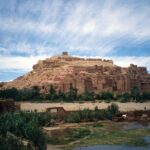
Banner image: Hilltop settlement in drylands, Morocco. Photo by Erle Ellis.
]]>
New research published today in the Proceedings of the National Academy of Sciences (PNAS) shows that land use by human societies has reshaped ecology across most of Earth’s land for at least...
https://umbc.edu/stories/umbcs-erle-ellis-and-international-team-show-people-have-shaped-earths-ecology-for-1200-years/
https://my3.my.umbc.edu/api/v0/pixel/news/119654/guest@my.umbc.edu/cd9af035cbed8256591c8218ff4eb8dc/api/pixel
cahss
cahssresearch
ges
interdisciplinary
international
policy-and-society
UMBC News & Magazine
https://my3.my.umbc.edu/groups/umbc-news-magazine
https://assets1-my.umbc.edu/system/shared/avatars/groups/000/001/943/24435aa6207c452e7bc15cc74b42c7bb/xsmall.png?1748556657
https://assets1-my.umbc.edu/system/shared/avatars/groups/000/001/943/24435aa6207c452e7bc15cc74b42c7bb/original.png?1748556657
https://assets2-my.umbc.edu/system/shared/avatars/groups/000/001/943/24435aa6207c452e7bc15cc74b42c7bb/xxlarge.png?1748556657
https://assets2-my.umbc.edu/system/shared/avatars/groups/000/001/943/24435aa6207c452e7bc15cc74b42c7bb/xlarge.png?1748556657
https://assets3-my.umbc.edu/system/shared/avatars/groups/000/001/943/24435aa6207c452e7bc15cc74b42c7bb/large.png?1748556657
https://assets1-my.umbc.edu/system/shared/avatars/groups/000/001/943/24435aa6207c452e7bc15cc74b42c7bb/medium.png?1748556657
https://assets2-my.umbc.edu/system/shared/avatars/groups/000/001/943/24435aa6207c452e7bc15cc74b42c7bb/small.png?1748556657
https://assets1-my.umbc.edu/system/shared/avatars/groups/000/001/943/24435aa6207c452e7bc15cc74b42c7bb/xsmall.png?1748556657
https://assets2-my.umbc.edu/system/shared/avatars/groups/000/001/943/24435aa6207c452e7bc15cc74b42c7bb/xxsmall.png?1748556657
UMBC News & Magazine
0
0
false
Thu, 15 Apr 2021 17:39:17 -0400
New UMBC grads honor parents’ immigrant journeys by forging their own paths

Graduating seniors Anthony Cano, Renato Zanelli, and Maya Scheirer came to UMBC with pride and hunger instilled by their immigrant parents’ work ethic. They brought rich cultures, languages, and hearts full of dreams and aspirations with the goal of forging futures of their own.
At UMBC they found faculty and staff who nurtured their curiosity, and a campus committed to learning from and working with local and international communities. Most importantly, they were embraced by a community who welcomed and celebrated them wholeheartedly for who they are and who they wanted to be.
Cano, Zanelli, and Scheirer lean on their friendships and faculty mentors as they end their time at UMBC, under an unprecedented global pandemic, via a virtual commencement ceremony. Together they face a changing world, knowing that their transformative years at UMBC have given them a solid foundation to hope, dream, and achieve.
Global citizen
Anthony Cano fondly recalls walking with his mom to school in the mornings. “We would part ways at the bus stop as she headed to work as a janitor,” a job she had to take after the market crash of 2008. “I would continue walking to my school,” shares Cano.
He watched his family lose everything and then rebuild their lives by working seven days a week. “They learned everything and anything to make ends meet,” explains Cano. “That work ethic—that unbreakable faith—is my moral structure. I connect it to everything I do.”
Cano wants to make sure everyone knows the real story behind his success. “My story does not begin with what I have achieved or my research,” he shares. “When I tell my story I want it to start and end by honoring my struggle as a student and as an immigrant. It is what made and continues to make my success happen.”
Mapping an interdisciplinary future
As a first-generation college student, Cano did not take his opportunities for granted. Instead, he invested time in and out of class to explore his wide interests in journalism, photography, and business. He also found ways to help his community, which he defines as global. “I think everything is connected,” shares Cano. “I identify as a global citizen more than any other identity.”

Cano eating a typical Cartagenian dish.
Photo courtesy of Cano.
Eager to learn, Cano transferred to UMBC immediately after earning an associate’s degree in broadcast and media production from Montgomery Community College. He planned to add a bachelor’s in computer science to facilitate his pathway to entrepreneurship. Cano began his general computer science courses while also enrolling in political science and human geography classes.
After learning about global political systems and internally displaced people (IDP), Cano immediately felt a sense of responsibility. He wanted to bring awareness to the political and social forces that displace people from their homes into dangerous and precarious living conditions.
“In some ways, my life was like a bubble,” explains Cano. These classes introduced him to the complexities of migration. “I have people in my social network that have experienced similar situations, but not to the extent that I learned about,” he shares. He decided to follow his interests and declared a double major in media and communications studies and political science.

Cano in Cartagena.
Photo courtesy of Cano.
Afro-Colombian stories
Felipe Filomeno, associate professor of political science, became his mentor and advisor. With his support, Cano developed strong skills in mixed research methods. He used social science, humanities, and visual research methods to continue to understand IDP.
“Tony is a unique and truly interdisciplinary student,” says Filomeno. “I advised his research on internally displaced people and urban development in Cartagena, Colombia. It combined oral history and visual research methods.”
Cano received a 2019-2020 Undergraduate Research Award to conduct field research in South America. His project focused on the relationship between internally displaced people as a result of violence and urban development in Cartagena.
Cano drew on his background in journalism and his fluent Spanish language skills to better understand the experiences of Afro-Colombians in a neighborhood named after Nelson Mandela. It’s located only a few minutes from a walled-in, tourism-focused urban center.
 Nelson Mandela neighborhood. Photo courtesy of Cano.
“Tony wanted his project to result not only in an academic paper. He also wanted to create a short virtual reality film to document the living conditions in Nelson Mandela,” shares Filomeno. Cano was careful and curious while analyzing data. Filomeno advised him on how to verify different sources of data and how to ensure his work reflected the community respectfully.
 Afro-Colombian women selling fruit in Cartagena. Photo courtesy of Cano.
In March, Cano presented his project, Informal Resettlement of Internally Displaced People (IDPs) in Cartagena, Colombia: A Visual Exploration and Oral History, at UMBC’s 24th annual Undergraduate Research and Creative Achievement Day (URCAD).
Theory to practice
Cano also served as a fellow in the Partnerships for Listening and Action by Communities (PLACE) program, an affiliate of UMBC’s Center for Democracy and Civic Life. There he received additional training in humanities methods and community organizing to support residents of Baltimore City’s Brooklyn neighborhood in building greater community cohesion and providing enriching opportunities for young people.

Cano walking in downtown Baltimore.
Photo courtesy of Cano.
In January, Cano will begin working at Morgan Stanley as an operations analyst. The multinational investment bank and financial services company found his humanities background invaluable to creating a strong finance team.
“I am a learner. My family always said there is nothing wrong with constantly wanting to learn,” shares Cano. “They taught me to set goals, and that through a lot of hard work, sacrifice, deep faith, and positivity, you can achieve your goals and break barriers.”
A home away from home
Renato Zanelli remembers how hard his mother worked and how much she sacrificed when she moved to the United States from Peru. “There are times I feel like giving up because some people assume that if you are Hispanic, you cannot do something,” shares Zanelli. “I want to prove that Hispanics can do anything. I want to make sure everything my mom sacrificed was not in vain.”
Like Cano, family and culture are also the founding blocks of Zanelli’s undergraduate life. He came to the United States from Peru when he was ten. He was raised in Anne Arundel County by his mom and grandparents. While he did well in school, it was at times isolating because of the lack of diversity. After a year in Anne Arundel Community College, he realized that what he was seeking the most was a community that embraced his language, culture, and interests.
Life-long friendships
Zanelli transferred to UMBC and was delighted to find a welcoming community. “One day, I saw a flyer for the Hispanic Latino Student Union. I went,” he remembers. Even though most of the people were not from Peru, he felt at home. “I was finally meeting people with similar immigration journeys and who spoke Spanish. It was amazing,” explains Zanelli. The HLSU members became his best friends.
Although most of the students he met in HSLU were years ahead of him, they guided him in understanding college life and included him in campus events. He had been worried about missing out on these experiences as a commuter, but their generous spirit made him feel like he belonged. “Instead of going straight home, I participated more in student activities,” shares Zanelli.
The HLSU also provided comfort and support when his cousin, who is like a brother, passed away and he could not travel to Peru. Later, Renato became part of the HLSU executive board, supporting the next generation of HLSU members.
Building confianza (trust)

Ana Maria Schwartz Caballerro.
Photo by Marlayna Demond.
Zanelli also found joy and support from UMBC’s faculty. His schedule included STEM and humanities classes, including a Spanish class for heritage Spanish speakers. The class helped him be more comfortable in a predominantly English environment and learn more about his first language. He met Ana Maria Schwartz Caballero, associate professor in modern languages, linguistics, and intercultural communication (MLLI), who teaches the course. Similar to his experience with HSLU, meeting professor Schwartz Caballero became one of the most important moments at UMBC.
“She advocated for me and encouraged me,” says Zanelli. Schwartz Caballero inspired him to take higher-level Spanish courses. They opened up an entirely new way to engage with his language, literature, and culture. He also began working as a Spanish language translator in the local hospitals, revealing a professional opportunity made possible with an MLLI major.
Professor Schwartz Caballero became his advisor and mentor. Regularly meeting with her created the structure and focus he needed. She also provided support on a personal level, checking how he was doing and asking about his mom and grandparents. “I have a huge amount of respect and love for her. We have a lot of confianza (trust),” explains Zanelli. “She understands who I am.”
Soccer love
Grounded in who he was and what he wanted out of his undergraduate experience, Zanelli had confidence to pursue an outside interest. He is a soccer aficionado both on the field and in the world of soccer gaming where he is better known as Renatogz05. In 2019, Zanelli became D.C. United’s first-ever official professional eEports athlete to play Electronic Arts SPORTS FIFA and compete in the 2019 Electronic MLS League Series. He came in second place in the last chance qualifier bracket at the Eastern Conference finals.
Zanelli’s experience at UMBC has been life-changing. “This isn’t just about me,” he explains. “As a first-generation college student, I can now be a role model for my younger cousins. I can help and inspire them. They will not have to do it alone.”
“100% me”
“I grew up in Kensington, Maryland, surrounded by people from all over the world,” says Maya Isabella Peiris Scheirer. “As a first-generation Sri Lankan American and a second-generation German American, I am proud of my immigrant roots.”
Her parents encouraged her to be curious about everything, she says. “They taught me to ask questions and find creative solutions when challenges arose.”
Scheirer first saw UMBC when her cousin Hashani Hettiarachchi ’14, biological sciences, invited her to campus events. When it came time to pick a college, she found UMBC an obvious fit thanks to its diversity, proximity to home, and biology program. She immediately moved onto campus and jumped into her science classes. Like Cano and Zanelli, Scheirer also chose to explore courses outside of her major.
A global state of mind
Scheirer found her global studies classes to be particularly fascinating, but fitting them into her biology-heavy course schedule proved challenging. She decided to explore new possibilities, including majors where she could use her French, Sinhala, and German language skills.
“I researched interdisciplinary majors. I attended the Career Center workshops and filled out career interest questionnaires,” remembers Scheirer. While searching for a different academic path, she gained insight into the skills and interests she had been developing most of her life. She was an avid reader, making her a strong writer, and she loved multilingual and multicultural communities.
“When I found global studies, it seemed 100% me,” shares Scheirer. “The study abroad requirement as well as the writing component and interdisciplinary research were what I had been looking for.”
Opening doors
In the spring of 2020, Scheirer traveled to Germany to study German at Leuphana University of Lüneburg. The language study program also gave her a deeper understanding of her father’s German culture. Unfortunately, like many students studying abroad this spring, Scheirer had to fly back home early due to COVID-19. She hopes to return soon.
 Scheirer in Germany during her study abroad. Photo courtesy of Scheirer.
Scheirer also chose to minor in gender, women’s, and sexuality studies after taking courses that expanded her perspective. “I was a feminist, but I had not viewed feminism through these theories,” she explains. “It opened a door for me.” Scheirer analyzed different feminists’ points of view through her writing while learning about how people occupy spaces differently.
Beyond her coursework, Scheirer put her writing skills to work covering arts and culture for The Retriever. She also found a community of close friends from different backgrounds through UMBC’s Equestrian Club, serving two terms as president. “Being president of the Equestrian Club taught me a lot about responsibility, collaboration, and motivating people,” she says, and it “gave me a sense of community.”
 Scheirer (kneeling from the right) with UMBC’s equestrian club.
Photo courtesy of Scheirer.
Be Your Best Self
Scheirer is waiting to find out what her next global adventure will be. She hopes to be an English teaching assistant in Andorra through the Fulbright U.S. Student Program. If accepted, Scheirer will move to Andorra, where her French skills will come in handy, in the fall of 2021.
As she looks back on her last four years, she is grateful for making UMBC the place where she has not just earned her degree, but also learned more about herself. Scheirer remembers receiving a UMBC t-shirt with the phrase, “Be Your Best Self.” “I know it’s on a t-shirt, but it’s true,” she laughs. She says her peers were all working hard to become their best selves regardless of the field they were studying.
“UMBC allowed me to stop worrying about what I ‘should’ be doing,” says Scheirer. “Being a Retriever gave me the confidence to know that what I ‘should’ be doing is being myself.”
Banner image: Maya Scheirer visiting Barcelona, Spain while studying abroad in Lüneburg, Germany.
]]>
Graduating seniors Anthony Cano, Renato Zanelli, and Maya Scheirer came to UMBC with pride and hunger instilled by their immigrant parents’ work ethic. They brought rich cultures, languages, and...
https://umbc.edu/stories/new-umbc-grads-honor-parents-immigrant-journeys-by-forging-their-own-paths/
https://my3.my.umbc.edu/api/v0/pixel/news/119723/guest@my.umbc.edu/1ff2c6df89886b196e62888f4a4252ec/api/pixel
alumni
cahss
careercenter
civic
classof2020
diversityandinclusion
globalstudies
gwst
interdisciplinary
international
mcs
mlli
policy-and-society
UMBC News & Magazine
https://my3.my.umbc.edu/groups/umbc-news-magazine
https://assets1-my.umbc.edu/system/shared/avatars/groups/000/001/943/24435aa6207c452e7bc15cc74b42c7bb/xsmall.png?1748556657
https://assets1-my.umbc.edu/system/shared/avatars/groups/000/001/943/24435aa6207c452e7bc15cc74b42c7bb/original.png?1748556657
https://assets2-my.umbc.edu/system/shared/avatars/groups/000/001/943/24435aa6207c452e7bc15cc74b42c7bb/xxlarge.png?1748556657
https://assets2-my.umbc.edu/system/shared/avatars/groups/000/001/943/24435aa6207c452e7bc15cc74b42c7bb/xlarge.png?1748556657
https://assets3-my.umbc.edu/system/shared/avatars/groups/000/001/943/24435aa6207c452e7bc15cc74b42c7bb/large.png?1748556657
https://assets1-my.umbc.edu/system/shared/avatars/groups/000/001/943/24435aa6207c452e7bc15cc74b42c7bb/medium.png?1748556657
https://assets2-my.umbc.edu/system/shared/avatars/groups/000/001/943/24435aa6207c452e7bc15cc74b42c7bb/small.png?1748556657
https://assets1-my.umbc.edu/system/shared/avatars/groups/000/001/943/24435aa6207c452e7bc15cc74b42c7bb/xsmall.png?1748556657
https://assets2-my.umbc.edu/system/shared/avatars/groups/000/001/943/24435aa6207c452e7bc15cc74b42c7bb/xxsmall.png?1748556657
UMBC News & Magazine
0
0
false
Mon, 14 Dec 2020 21:29:36 -0500
UMBC’s Pelton and Daniel are developing light-driven chips to enable super-fast computing
By combining their expertise in physics and chemistry, Matt Pelton and Marie-Christine Daniel are working toward the next big leap in computing. Both are engaged in photonics research, which is “the idea of using light—photons—to do information processing instead of using electrons like you do in electronics,” explains Pelton, associate professor of physics at UMBC.
Using light rather than electrons, as in fiber-optic telecommunication cables, is “faster, and you can send a lot more information,” Pelton says. However, no computer today runs exclusively on photons. “The huge pipeline of data coming down optical fibers all has to be converted to an electrical signal and then distributed to all the different processors in the computer. That’s the big power and time bottleneck,” Pelton says.
“If you could do as much of the function of the computer chip as possible using photons instead of electrons, then you would be able to use less power and do things more efficiently,” he says. “So there’s a big push to try to bring photonics down to the single chip scale.”
That’s where this interdisciplinary duo comes in. They’re working to develop a unique combination of existing chemical structures to enable photon-driven computer functionality even in the computer’s most fundamental building blocks. A new three-year grant from the National Science Foundation will enable Pelton and Daniel to make faster progress on their project and involve more students.
 Marie-Christine Daniel (right) and UMBC chemistry Ph.D. student Chanda Lowrance in Daniel’s lab. Photo by Diane Zeenny.
A new kind of switch
Daniel and Pelton’s novel technique depends on being able to reliably create very specific chemical structures. By binding two types of known structures in a particular arrangement, they can create a kind of on-off switch.
At its most basic level, a computer is just a lot of these switches. Whether they use ones and zeros, light and dark, or something else, the pattern of the switches encodes information. The new kind of switch that Daniel and Pelton are devising is different from what computers use now, because it relies on photons rather than electrons.
The light-driven structures Daniel and Pelton are working to build are made of quantum dots and metal nanoparticles. Quantum dots are tiny crystals only about 20 atoms in diameter. They’re made of semiconductor elements, similar to the silicon that powers electronics, and they can be designed to emit certain wavelengths (colors) of light. They’re even used in some televisions. The metal nanoparticles are larger, usually a few thousand atoms in diameter. They also appear as different colors based on the light they reflect and absorb, but they don’t emit their own light.
Through computer simulations, Pelton and Ph.D. student Vijin Veetil have demonstrated that by binding two rod-shaped nanoparticles (“nanorods”) and a quantum dot together in a specific way, their interaction can produce a structure that allows light to pass straight through both the dot and particle, when it would normally be scattered. Transmitting the light creates a transparent state rather than an opaque one. That switch from transparent to opaque, which can be controlled by an external beam of light, is exactly the kind of switch that could encode information in a computer.
 Matt Pelton in the lab. Photo by Marlayna Demond ’11 for UMBC.
Getting it just right
For this to work, Pelton and Daniel need to successfully construct molecular structures consisting of a single quantum dot stuck between two nanorods.
“It needs to be that configuration,” says Daniel, associate professor of chemistry and biochemistry, who is bringing on chemistry Ph.D. student Chanda Lowrance to help her tackle this project. “The quantum dot alone, or the nanoparticles alone, will not induce the transparency effect.”
And just any quantum dot bound to any nanoparticle is not sufficient. They need to have specific sizes and shapes, so that the wavelength of light that the quantum dot absorbs, and the wavelength that the nanoparticle scatters, are very similar, Daniel explains. Then, “they can interact very efficiently and create that transparency.”
“That’s essentially the goal of this project—to take these structures from a cartoon to something we can actually make,” Daniel says. “And making this is not easy.” If Daniel, Pelton, and their students can do it, though, they’ll be setting the stage for a revolution in computing.
From random to reliable
Previous research has shown that it’s fairly straightforward to get the nanoparticles and dots to clump together in groups. “But we need to get just one of them. And we don’t want it to bind just anywhere. It has to be right there,” Pelton says. “That’s the big challenge.”
A procedure that allows metal particles and dots to bind together randomly does result in a very small number of structures in the desired configuration. When scientists tested those lucky few for the transparency effect, they matched results predicted by Pelton’s simulations, proving this technique can work.
Now, the challenge is producing a larger number of these structures. “When we’re synthesizing these things, we don’t want just a few of them to be the right structure; we want the majority of them to be the right structure,” Pelton says. “We need the ability to make them in much larger numbers, in order to be able to optimize them.”
This is what the team is working on now. Their goal is that “by the end of the project we’ll have shown that we can make these things reliably, in larger numbers, and that we can use them as an on-off switch,” Pelton says.
 Marie-Christine Daniel (left) and Renee Suzich, an undergraduate from St. Mary’s College of Maryland at UMBC for a summer research experience, at work in Daniel’s lab. Photo by Diane Zeenny.
The power of teamwork
“I didn’t know if this was going to work when we started,” Pelton says. But considering their progress so far, and the impact this new funding will have on accelerating their work, today Daniel and Pelton are optimistic about the future of light-based computing and other applications for their joint research.
While the work poses significant challenges, “of course it’s a big opportunity, too,” Pelton says. In addition to the duo’s goal to create light-driven computer chips, there could be other scenarios where it would be beneficial to combine nanoparticles. Different configurations could generate new and useful physical and chemical properties for all kinds of applications.
Daniel and Pelton recognize the importance of their collaboration for the success of this work. Pelton’s theoretical and simulation expertise as well as his ability to do single-particle measurements, and Daniel’s in-depth knowledge of the chemistry and ability to find a way to make specific structures, have all been critical.
“This is not something that any physicist or chemist could do alone,” Daniel reflects. “It takes both.”
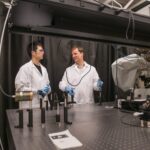
Banner image: Matt Pelton (right) and Haixu Leng, Ph.D. ’19, physics. Photo by Marlayna Demond ’11 for UMBC.
]]>
By combining their expertise in physics and chemistry, Matt Pelton and Marie-Christine Daniel are working toward the next big leap in computing. Both are engaged in photonics research, which is...
https://umbc.edu/stories/umbcs-pelton-and-daniel-are-developing-light-driven-chips-to-enable-super-fast-computing/
https://my3.my.umbc.edu/api/v0/pixel/news/119970/guest@my.umbc.edu/817f335d9b6241eacaf06cb6e39720d0/api/pixel
chembiochem
cnms
interdisciplinary
physics
research
science-and-technology
UMBC News & Magazine
https://my3.my.umbc.edu/groups/umbc-news-magazine
https://assets1-my.umbc.edu/system/shared/avatars/groups/000/001/943/24435aa6207c452e7bc15cc74b42c7bb/xsmall.png?1748556657
https://assets1-my.umbc.edu/system/shared/avatars/groups/000/001/943/24435aa6207c452e7bc15cc74b42c7bb/original.png?1748556657
https://assets2-my.umbc.edu/system/shared/avatars/groups/000/001/943/24435aa6207c452e7bc15cc74b42c7bb/xxlarge.png?1748556657
https://assets2-my.umbc.edu/system/shared/avatars/groups/000/001/943/24435aa6207c452e7bc15cc74b42c7bb/xlarge.png?1748556657
https://assets3-my.umbc.edu/system/shared/avatars/groups/000/001/943/24435aa6207c452e7bc15cc74b42c7bb/large.png?1748556657
https://assets1-my.umbc.edu/system/shared/avatars/groups/000/001/943/24435aa6207c452e7bc15cc74b42c7bb/medium.png?1748556657
https://assets2-my.umbc.edu/system/shared/avatars/groups/000/001/943/24435aa6207c452e7bc15cc74b42c7bb/small.png?1748556657
https://assets1-my.umbc.edu/system/shared/avatars/groups/000/001/943/24435aa6207c452e7bc15cc74b42c7bb/xsmall.png?1748556657
https://assets2-my.umbc.edu/system/shared/avatars/groups/000/001/943/24435aa6207c452e7bc15cc74b42c7bb/xxsmall.png?1748556657
UMBC News & Magazine
0
0
false
Thu, 16 Jan 2020 21:17:11 -0500
Open spaces nurture open minds in UMBC’s new Interdisciplinary Life Sciences Building
This fall, hundreds of Retrievers will set foot in UMBC’s new Interdisciplinary Life Sciences Building for the first time. They may be inspired by the vibrant art installation, find a quiet nook to study, or work together in research labs with floor-to-ceiling windows overlooking pocket gardens and curving pathways. The new facility offers features that set it apart as a space for learning, and set up students and faculty for transformative moments of discovery.
“New things will brew”
Each research floor in the ILSB is connected along its entire length and bounded by glass on all sides. Inside the labs, benches are configurable so that instrumentation can go in and out as needed. Neon-colored glass surfaces double as marker boards for quick sketches of lab protocols, equations, or encouraging doodles. Just outside the lab are spaces, overlooking an airy atrium, where graduate students can write and undergraduates can meet with mentors.
It’s a research environment that looks toward the future. These shared, open spaces are designed to help anyone who enters sense that they have a role to play in addressing big challenges, discovering more about the world, and developing the next generation of scientists.
 Greg Szeto, right, and Shirin Parsa ’20, biological sciences, conduct research in one of the ILSB’s open-concept labs.
“The ILSB provides an unprecedented opportunity to have researchers who are intellectually next to each other also be physically next to each other,” shares Greg Szeto, assistant professor of chemical, biochemical, and environmental engineering (CBEE). “When you share a kitchenette with a biologist, a chemist, an engineer and somebody from public policy, it’s inevitable that new things will brew.”
Szeto is part of the new Translational Center for Age-Related Disease and Disparities (TCARD2), an initiative made possible by the ILSB. The initiative is led by Chuck Bieberich, professor of biological sciences, and also includes faculty from CBEE and psychology. Bieberich’s lab focuses on cancer biology, especially prostate cancer, while Szeto works on cancer therapies that leverage the immune system. “When we bring our two approaches together, hopefully it will lead to new research, new papers, new grants,” and new cancer treatments, Szeto says.
 Faculty and students relax in one of the ILSB’s break areas. A spiral staircase reminiscent of DNA swirls up to the next floor in the background.
On top of the collaborative advantage, the ILSB offers all the equipment labs need in one place. Szeto’s students were already collaborating with biologists, but that used to mean carrying samples to instruments in other buildings. Not anymore. “Now everything is going to be in the ILSB,” Szeto says. “Being able to centralize the operation both intellectually and logistically is so critical.”
Bringing the outside in
Faculty in the new Interdisciplinary Consortium for Applied Research in Ecology and Evolution (ICARE2) are also taking up residence in the ILSB. Tamra Mendelson, professor of biological sciences, and Chris Swan, professor of geography and environmental systems (GES) co-lead the initiative. It also includes faculty in CBEE and marine biotechnology.
“The collaboration is designed to bring together evolutionary biologists, ecologists, conservationists, social scientists, and engineers,” says Swan. “We want to build a powerful network of people to collaborate on training graduate students, solving environmental problems relevant to Baltimore, and building out UMBC’s focus on ecology.” The ILSB will offer ICARE2 researchers the opportunity to work in a shared space for the first time.
 The ISLB atrium offers spaces to study or just relax. The art installation and a floating staircase add a whimsical, creative feel.
A new, state-of-the-art environmental science lab in the ILSB will also open up the possibilities for these researchers. It’s a space “devoted to environmental work,” which often means, “It’s dirty!” Swan says. The lab will enable larger-scale controlled experiments that can be hard to manage in the field and that would be incompatible with a lab focused on molecular work, where the slightest bit of stray DNA could ruin an experiment.
“A total game-changer”
Chris Hawn, assistant professor of GES, is excited to move to the ILSB because of the doors it will open for their environmental research. Hawn runs chemical analyses on spiderwebs to measure local air quality. They are collaborating with an advocacy group for houseless people that will train them to collect webs in spaces where they are living to send to Hawn for analysis. The goal is that they can use the findings to advocate locally for their health and make the best possible choices about where to stay.
Hawn also studies how pollutants in waterways are passed through the food chain from small aquatic insects, to spiders, to birds.
The ILSB “is a total game-changer for me,” Hawn says. With the instrumentation available at the ILSB, “There are protocols where I can get ‘level unlocked.’ It just opens things up for me and my students.”
 Chris Hawn (center) and their students in the ILSB, backed by the INFLIGHT art installation.
Hawn is the first researcher assigned to their floor of the new building. They note, “I’m excited to make the space my own, but also excited that it will be a shared space very soon. It will be interesting to see how we can work together.”
Even if they aren’t working together directly, having other researchers nearby is a good thing, Hawn adds. “Working simultaneously and having people around you is important, especially for graduate students who are spending a lot of their time in the lab.”
Coming to life
Sarah Leupen, senior lecturer in biological sciences, has been looking forward to teaching in the ILSB—and not just because it’s a new space, but because it’s a new kind of space. Even the building’s largest learning spaces are designed to help students connect with each other and the material in an engaged, intimate, collaborative way.
 Undergraduate researchers gather outside one of the labs in the ILSB. These spaces are designated as writing and meeting space for student researchers.
One of Leupen’s favorite rooms is filled with small round tables that seat six students. Screens and whiteboards appear all around the room and there is plenty of open space. “It’s this kind of flipped classroom that makes possible truly active learning, the kind of teaching that is most well-supported by research.”
Bill LaCourse, dean of the College of Natural and Mathematical Sciences, which administers the building, is thrilled to see it come to life. “For me, it’s been a decade of planning, design and construction to create this building that can serve the needs of our community in essential ways.”
“The process really epitomized the ethos of UMBC, involving the input and collaboration of so many people across the university,” he shares. “To see it evolve from a germ of an idea to the magnificent building we see today is a tribute to UMBC’s strength in the life sciences and commitment to student and faculty success.”
Banner image: Undergraduate researchers outside the TCARD2 lab. All photos by Marlayna Demond ’11 for UMBC.
]]>
This fall, hundreds of Retrievers will set foot in UMBC’s new Interdisciplinary Life Sciences Building for the first time. They may be inspired by the vibrant art installation, find a quiet nook...
https://umbc.edu/stories/open-spaces-nurture-open-minds-in-umbcs-new-interdisciplinary-life-sciences-building/
https://my3.my.umbc.edu/api/v0/pixel/news/120064/guest@my.umbc.edu/25ade5f53340901a658cd6a78e1112ce/api/pixel
biology
cahss
cbee
cnms
coeit
community
ges
interdisciplinary
page1
psychology
publicpolicy
research
science-and-technology
UMBC News & Magazine
https://my3.my.umbc.edu/groups/umbc-news-magazine
https://assets1-my.umbc.edu/system/shared/avatars/groups/000/001/943/24435aa6207c452e7bc15cc74b42c7bb/xsmall.png?1748556657
https://assets1-my.umbc.edu/system/shared/avatars/groups/000/001/943/24435aa6207c452e7bc15cc74b42c7bb/original.png?1748556657
https://assets2-my.umbc.edu/system/shared/avatars/groups/000/001/943/24435aa6207c452e7bc15cc74b42c7bb/xxlarge.png?1748556657
https://assets2-my.umbc.edu/system/shared/avatars/groups/000/001/943/24435aa6207c452e7bc15cc74b42c7bb/xlarge.png?1748556657
https://assets3-my.umbc.edu/system/shared/avatars/groups/000/001/943/24435aa6207c452e7bc15cc74b42c7bb/large.png?1748556657
https://assets1-my.umbc.edu/system/shared/avatars/groups/000/001/943/24435aa6207c452e7bc15cc74b42c7bb/medium.png?1748556657
https://assets2-my.umbc.edu/system/shared/avatars/groups/000/001/943/24435aa6207c452e7bc15cc74b42c7bb/small.png?1748556657
https://assets1-my.umbc.edu/system/shared/avatars/groups/000/001/943/24435aa6207c452e7bc15cc74b42c7bb/xsmall.png?1748556657
https://assets2-my.umbc.edu/system/shared/avatars/groups/000/001/943/24435aa6207c452e7bc15cc74b42c7bb/xxsmall.png?1748556657
UMBC News & Magazine
0
0
false
Mon, 26 Aug 2019 18:49:05 -0400
Team of UMBC grad students takes first place at 2019 BMEidea competition
A team of three UMBC graduate students earned first place in an innovation competition for their pioneering work in the rapid detection of bacteria in blood. The students joined teams from the University of Pennsylvania and the University of Michigan, which earned second and third place, respectively, at the BMEidea competition hosted by VentureWell, a national alliance of collegiate inventors and innovators.
UMBC’s team competed in the biomedical and bioengineering innovation student category of the competition, and presented a device called ASTEK, which allows physicians to more effectively treat bacterial infections. The interdisciplinary team included Mustafa Al-Adhami M.S. ‘15, mechanical engineering, Ph.D. ‘19, mechanical engineering; David Burgenson ‘17, chemical engineering, PhD ‘21, chemical engineering, and Benjamin Punshon-Smith M.S. ‘17, electrical engineering, and Ph.D. ‘22, electrical engineering.
 Benjamin Punshon-Smith (left), Mustafa Al-Adhami, and David Burgenson with their award at the BMEidea competition. Photo courtesy of Mustafa Al-Adhami.
“It can be difficult to translate science into relatable terms and a feasible business plan,” says Al-Adhami. “Participating in the BMEidea competition proved not only that they are interested in our research, but there is the potential to create a business around it. The BMEidea competition gave us the opportunity to get validation that we are onto something.”
Al-Adhami, Burgenson, and Punshon-Smith share office and lab space in UMBC’s Center for Advanced Sensor Technology, which is directed by Govind Rao, professor of chemical, biochemical, and environmental engineering. The group is also advised by Yordan Kostov, research professor in chemical, biochemical, and environmental engineering at UMBC, and Alan Cross, professor of medicine at the University of Maryland School of Medicine.
The team will use their $10,000 prize from VentureWell to continue to develop the technology and advance the ASTEK.
In 2016, Al-Adhami earned third place in UMBC’s Cangialosi Business Innovation Competition, and he explains that the feedback from the judges was valuable and helped him refine the design of the device. “I have used feedback and networking connections gained from these competitions to develop my business plan and expand my outreach on a national scale,” he says.
The technology was initially developed to detect bacteria in water, but after Al-Adhami learned about sepsis and the serious complications that it can cause, he changed focus to meet a known need in healthcare. The ASTEK displays results of the blood test in a user-friendly interface, he says.
“The project is at the intersection of mechanical engineering, electrical engineering, chemical engineering, and biology,” Al-Adhami explains. “The best thing about working on a multidisciplinary team is there are always four solutions to every problem we face.”
Banner image: Mustafa Al-Adhami gives his three-minute thesis talk at the 2018 Graduate Research Conference. Photo by Marlayna Demond ’11 for UMBC.
]]>
A team of three UMBC graduate students earned first place in an innovation competition for their pioneering work in the rapid detection of bacteria in blood. The students joined teams from the...
https://umbc.edu/stories/team-of-umbc-grad-students-takes-first-place-at-2019-bmeidea-competition/
https://my3.my.umbc.edu/api/v0/pixel/news/120067/guest@my.umbc.edu/6882de03fdcda614ecaae47e6d9f271d/api/pixel
cbee
coeit
csee
gradresearch
interdisciplinary
meche
science-and-technology
UMBC News & Magazine
https://my3.my.umbc.edu/groups/umbc-news-magazine
https://assets1-my.umbc.edu/system/shared/avatars/groups/000/001/943/24435aa6207c452e7bc15cc74b42c7bb/xsmall.png?1748556657
https://assets1-my.umbc.edu/system/shared/avatars/groups/000/001/943/24435aa6207c452e7bc15cc74b42c7bb/original.png?1748556657
https://assets2-my.umbc.edu/system/shared/avatars/groups/000/001/943/24435aa6207c452e7bc15cc74b42c7bb/xxlarge.png?1748556657
https://assets2-my.umbc.edu/system/shared/avatars/groups/000/001/943/24435aa6207c452e7bc15cc74b42c7bb/xlarge.png?1748556657
https://assets3-my.umbc.edu/system/shared/avatars/groups/000/001/943/24435aa6207c452e7bc15cc74b42c7bb/large.png?1748556657
https://assets1-my.umbc.edu/system/shared/avatars/groups/000/001/943/24435aa6207c452e7bc15cc74b42c7bb/medium.png?1748556657
https://assets2-my.umbc.edu/system/shared/avatars/groups/000/001/943/24435aa6207c452e7bc15cc74b42c7bb/small.png?1748556657
https://assets1-my.umbc.edu/system/shared/avatars/groups/000/001/943/24435aa6207c452e7bc15cc74b42c7bb/xsmall.png?1748556657
https://assets2-my.umbc.edu/system/shared/avatars/groups/000/001/943/24435aa6207c452e7bc15cc74b42c7bb/xxsmall.png?1748556657
UMBC News & Magazine
0
0
false
Mon, 12 Aug 2019 16:09:38 -0400
UMBC convenes research forum on immigration and mobility in higher education
In the late spring, the UMBC Center for Social Science Scholarship (CS3) convened researchers for the 2019 Research Forum: Immigration and Mobility in Higher Education. The event was the fifth in a UMBC research forum series that highlights original research and interdisciplinary discussions about pressing national and international issues. Christine Mallinson, director of CS3, co-hosted the event with Karl Steiner, vice president for research, to spotlight UMBC’s immigration research and to enable new collaborations.
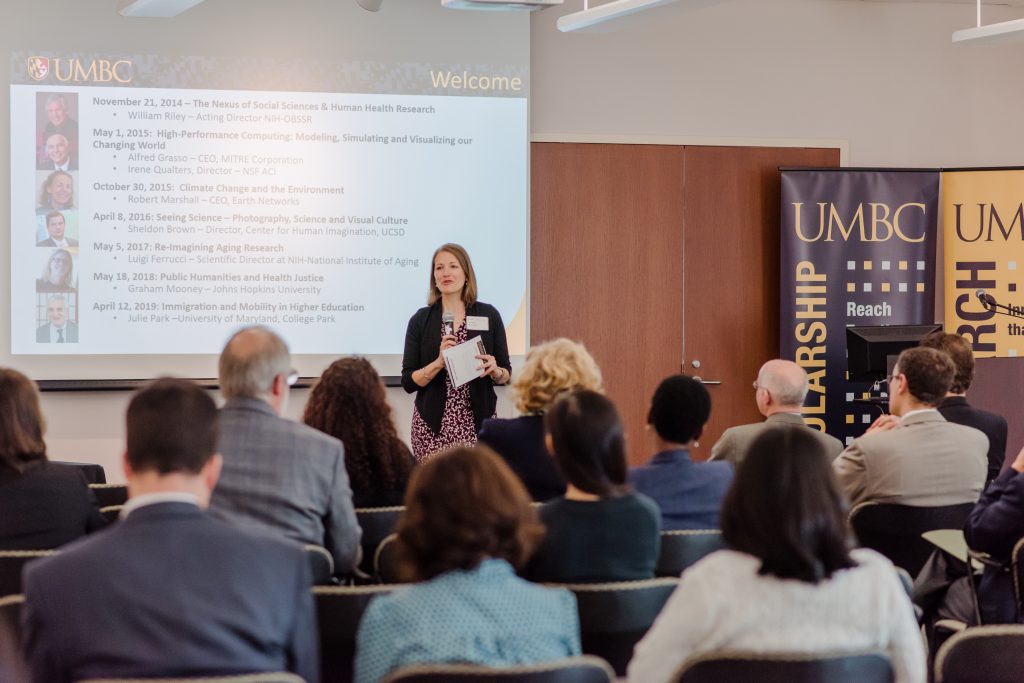 Mallinson welcoming forum attendees.
Through the forum, Mallinson aimed to create a space for discussion and brainstorming for both students and faculty. “This critically relevant forum creates new collaborations and research that can change conversations about the effect immigration has on education, economics, workforce, and policy,” she explained.
Panelists and attendees included UMBC faculty, staff, and students from the College of Arts, Humanities, and Social Sciences (CAHSS), College of Engineering and Information Technology (COEIT), and College of Natural and Mathematical Sciences (CNMS), as well as the Office of International Education Services.
Julie Park, associate professor of sociology and director of Asian American studies at the University of Maryland, College Park, delivered the event’s keynote address. Park spoke to the changing demographics and intergenerational mobility of new immigrants who are working to attain secondary and postsecondary degrees.
Trauma-informed services
The first panel, “Borders of Opportunity: Migration, Education, and Mobility and Immigration Policies,” focused on global education, the social welfare of immigrants in the U.S., and the information-seeking behavior of highly educated immigrants.
In this panel, Jayshree Jani, associate professor of social work, shared research on the burdens that undocumented students carry. Daunting situations such as being separated from their parents, having a parent incarcerated, and being unable to access social services cause long-term trauma for children, even years after reunification or receiving support services. “When someone is undocumented and living in fear, it is really hard for them to have a stable life,” explained Jani.
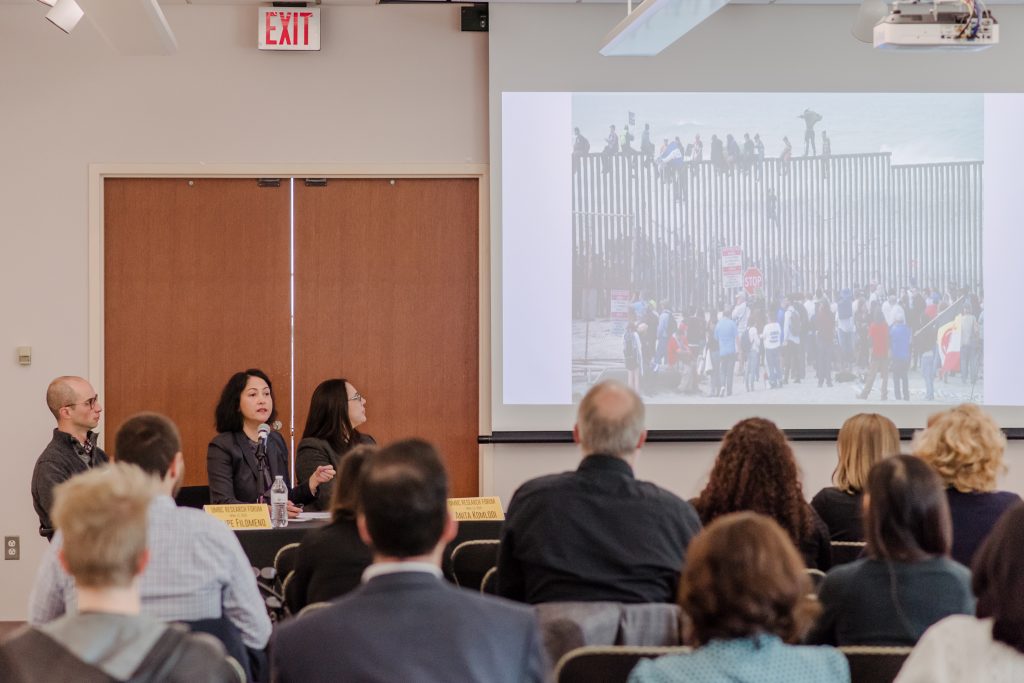 Jani, center, discussing immigrant family separations.
Her research showed how visible and invisible consequences of trauma currently overwhelm local schools, communities, and law enforcement. She described a significant need for training in how to provide trauma-informed services, and noted that this gap has had major negative impacts.
Jani’s call to action was to inspire her colleagues and future providers to conduct more research. “In order to support trauma-informed services in schools,” she argued, “universities need to encourage research on this population and prepare future professionals to create, expand, and provide services.”
International student perspective
Awareness of and access to services is a hurdle that undocumented and documented immigrants, as well as international students and faculty, must navigate. Doctoral student Wajanat Rayes, information systems, attended the forum, bringing to the event her perspective as both an international student and a researcher.
Rayes investigates the role that information networks play in the lives of international students. She specifically focuses on the transition to the U.S. of highly skilled Saudi Arabian international students who are also mothers. “I like how information can empower people and mitigate the challenges we have day today,” she says.
“I am a faculty member at a university in Saudi Arabia and a mother,” Rayes shares. “I have had a lot of challenges in my transition to studying in the U.S. I hope my research will help other mothers navigate the system in the future.”
Immigration and higher education
The second panel examined “Immigration Policies and Politics: Local, National, and International Impact.” Four UMBC faculty presented the latest research about higher education policies and their effects on immigrant and international students. They also discussed the current landscape of international research exchange in higher education and the role of higher education associations in immigration policy debates.
 Mortarboard from commencement 2018.
In this session, UMBC researchers Tim Gindling, professor of economics, and Lisa Dickson, associate professor of economics, focused on access to higher education for undocumented youth. Their ongoing research covers the cost-benefit analysis of policies that determine the price of higher education for undocumented students—access to-state resident tuition and additional financial aid. They also examine the impact of the national Deferred Action for Childhood Arrivals (DACA) policy on students’ enrollment, graduation, and persistence in higher education.
 Gindling in his office.
“The takeaway, however we looked at the data, was that the benefits were greater than the costs,” explained Gindling. The research results showed that for each undocumented student who graduates from a four-year college, who would not have gone otherwise, the net benefits to the state were $350,000.
“Providing access to higher education and financial aid to undocumented youth is a good investment for the individual, for the state, and for the government as a whole,” said Gindling.
The power of listening
After participants and audience members listened to the panelists they were given an opportunity to share different perspectives on these issues through microtalk roundtables. Groups joined sessions on law and policy, transnational migration, and higher education.
One discussion centered around what a stronger, more positive relationship between immigrants and the United States would look like. Immigrants who are able to access higher education and financial aid are more likely to move into the white-collar workforce. Entering the professional workforce means immigrants also earn more and pay higher taxes. Greater earning power opens opportunities to buy property, start businesses, and contribute to a thriving state and national economy.
“It is important to listen to the array of immigrant experiences,” explained Ruth Temesgen ‘19, sociology, who attended the event as part of her Immigration and Refugee Law class. Her parents were highly skilled government employees in Ethiopia who left during the country’s civil war. Their credentials did not transfer in the United States. They could only access service-level jobs.
Seeing how much her parents and other immigrants have struggled inspired Temesgen to pursue a path to law school. “Reaching beyond our comfort zones to understand how global events impact people at a personal, economic, educational, and mental health level can change what is now an isolating experience to a welcoming and prosperous partnership.”
To learn about future CS3 events, join the conversation on Twitter at @UMBCSocSci.
Banner image: (L to R): Steiner, Mallinson, Don Engel, assistant vice president for research, and Casper. All images by Marlayna Demond ’11 for UMBC.
]]>
In the late spring, the UMBC Center for Social Science Scholarship (CS3) convened researchers for the 2019 Research Forum: Immigration and Mobility in Higher Education. The event was the fifth in...
https://umbc.edu/stories/umbc-convenes-research-forum-on-immigration-and-mobility-in-higher-education/
https://my3.my.umbc.edu/api/v0/pixel/news/120094/guest@my.umbc.edu/787f550c2fff505b69a78035bec4f012/api/pixel
cahss
cnms
coeit
cs3
economics
interdisciplinary
international
policy-and-society
politicalscience
research
sociology
UMBC News & Magazine
https://my3.my.umbc.edu/groups/umbc-news-magazine
https://assets1-my.umbc.edu/system/shared/avatars/groups/000/001/943/24435aa6207c452e7bc15cc74b42c7bb/xsmall.png?1748556657
https://assets1-my.umbc.edu/system/shared/avatars/groups/000/001/943/24435aa6207c452e7bc15cc74b42c7bb/original.png?1748556657
https://assets2-my.umbc.edu/system/shared/avatars/groups/000/001/943/24435aa6207c452e7bc15cc74b42c7bb/xxlarge.png?1748556657
https://assets2-my.umbc.edu/system/shared/avatars/groups/000/001/943/24435aa6207c452e7bc15cc74b42c7bb/xlarge.png?1748556657
https://assets3-my.umbc.edu/system/shared/avatars/groups/000/001/943/24435aa6207c452e7bc15cc74b42c7bb/large.png?1748556657
https://assets1-my.umbc.edu/system/shared/avatars/groups/000/001/943/24435aa6207c452e7bc15cc74b42c7bb/medium.png?1748556657
https://assets2-my.umbc.edu/system/shared/avatars/groups/000/001/943/24435aa6207c452e7bc15cc74b42c7bb/small.png?1748556657
https://assets1-my.umbc.edu/system/shared/avatars/groups/000/001/943/24435aa6207c452e7bc15cc74b42c7bb/xsmall.png?1748556657
https://assets2-my.umbc.edu/system/shared/avatars/groups/000/001/943/24435aa6207c452e7bc15cc74b42c7bb/xxsmall.png?1748556657
UMBC News & Magazine
0
0
false
Tue, 25 Jun 2019 15:07:42 -0400
UMBC celebrates student achievement in the arts, humanities, and social sciences

Faculty and staff in UMBC’s College of Arts, Humanities, and Social Sciences (CAHSS) celebrated students in the annual CAHSS awards ceremony this spring. Scholars programs and departments recognized undergraduates for academic achievements, public service, and innovation within their major and beyond.
“CAHSS’s amazing students do it all: think and learn across boundaries and borders, develop their identities as scholars and citizens, and contribute their imagination and expertise to local and global communities,” says Scott Casper, dean of CAHSS. “Given all they’ve already accomplished, it’s exciting to envision what they’ll do next.”
 (L to R): Dean Casper; Carol Hess, dance department chair; Doug Hamby, director of the Linehan Artist Scholars program; Samantha Siegel; Giavanni Powell; Kasey Mannion ’19, dance; Emily Godfrey. Photo courtesy of CAHSS.
Combining dual passions
Among the many accolades were twelve awards to graduating students in the college’s hallmark scholar programs: the Humanities Scholars, Sondheim Public Affairs Scholars, and Linehan Artist Scholars. These include several students with dual majors.
For example, four honored dance majors were also earning a degree in another field: Linehan Artist Scholars Emily S. Godfrey ’20, dance and a psychology minor; Melissa Hudson ‘18, dance and economics; and Giavanni Powell ‘19, dance with an entrepreneurship and innovation minor; and Honors College member Samantha L. Siegel ‘19, dance and psychology.
Linehan Artist Scholar Giavanni Powell
Baltimore on my mind
The ceremony also honored students who committed to giving back to Baltimore communities during their time at UMBC. Vanessa Gonzalez ‘19, American studies, worked as a student teacher in Baltimore City as a Sherman STEM Teacher Scholar and received the award for outstanding achievement in American studies.
Gonzalez working with students.
Belgian international student Tanguy Ringoir ‘18, financial economics and M.S. ‘20, economic policy analysis, was named the outstanding graduating senior in financial economics. Ringoir, a chess grandmaster, learned to play chess from his father at age seven. As he strengthened his skills he began to enjoy teaching the game.
During his time at UMBC, Ringor was part of a volunteer chess coach team for a program by TouchPoint in collaboration with UMBC and the Johns Hopkins Center for Talented Youth (CTY). TouchPoint is a community organization in Baltimore that provides free chess lessons to Baltimore youth. The coaching team included volunteers from both the UMBC chess team and chess club.
Ringoir, chess grandmaster, working with CTY students. Photo courtesy of Ringoir.
Ringoir also received a Community Service Outreach and Leadership award from the UMBC Division of Professional Studies for his dedication to creating accessible chess teams. He will continue his work with Baltimore K-12 students through the CTY program.
“I personally stay in Baltimore because I can combine my passion for finance with chess,” shares Ringoir. “UMBC gives me an education at the same time that it supports my chess development through the chess team and community volunteer opportunities.”
Like Ringoir, Ciara Jones ‘19, social work, is also an award recipient who has chosen to begin her professional career in Baltimore. She received the excellence award from Africana studies, her minor. Upon graduation, Jones will work with Sarah’s House in Druid Park, as a forensic social worker. She will also serve the Canton community through Renaissance Baltimore Church.
Global skills
In addition to maximizing their academic experience on campus and participating in an exchange of skills within Baltimore communities, CAHSS students seek to sharpen their personal and professional skills by studying abroad.
Miriam Newman-Marshall ‘19, Asian studies with a Japanese minor, received the Constantine Vaporis Academic Excellence in Asian Studies Award. Newman-Marshall has traveled to Thailand and Cambodia, and has completed three study abroad trips to Japan. These trips strengthened her research skills and historical knowledge, which were critical for her work as a research assistant. She assisted Constantine Vaporis, Asian studies director, on his book, Samurai: An Encyclopedia of Japan’s Cultured Warriors.
Newman-Marshall next to a volcano in Hakone, Japan. Photo courtesy of Newman-Marshall.
Vaporis encourages all students to study a foreign language overseas to accelerate and deepen their understanding of that language and culture. “Learning a language in its country of origin equips students with skills to conduct more complex research, using multi-lingual sources,” explains Vaporis. “Miriam’s knowledge of Japanese history and her ability to read Japanese greatly facilitated her work in support of my research on the samurai.”
For more CAHSS news follow @UMBC_CAHSS on Twitter.
Banner image: Linehan Artist Scholar Emily Godfrey. All photos by Marlayna Demond ’11 for UMBC unless otherwise noted.
]]>
Faculty and staff in UMBC’s College of Arts, Humanities, and Social Sciences (CAHSS) celebrated students in the annual CAHSS awards ceremony this spring. Scholars programs and departments...
https://umbc.edu/stories/umbc-celebrates-student-achievement-in-the-arts-humanities-and-social-sciences/
https://my3.my.umbc.edu/api/v0/pixel/news/120105/guest@my.umbc.edu/9c3006dfab5fdde38adffccccd67c62c/api/pixel
americanstudies
arts-and-culture
asianstudies
cahss
dance
economics
interdisciplinary
international
linehanscholars
page1
policy-and-society
shermanscholars
socialwork
UMBC News & Magazine
https://my3.my.umbc.edu/groups/umbc-news-magazine
https://assets1-my.umbc.edu/system/shared/avatars/groups/000/001/943/24435aa6207c452e7bc15cc74b42c7bb/xsmall.png?1748556657
https://assets1-my.umbc.edu/system/shared/avatars/groups/000/001/943/24435aa6207c452e7bc15cc74b42c7bb/original.png?1748556657
https://assets2-my.umbc.edu/system/shared/avatars/groups/000/001/943/24435aa6207c452e7bc15cc74b42c7bb/xxlarge.png?1748556657
https://assets2-my.umbc.edu/system/shared/avatars/groups/000/001/943/24435aa6207c452e7bc15cc74b42c7bb/xlarge.png?1748556657
https://assets3-my.umbc.edu/system/shared/avatars/groups/000/001/943/24435aa6207c452e7bc15cc74b42c7bb/large.png?1748556657
https://assets1-my.umbc.edu/system/shared/avatars/groups/000/001/943/24435aa6207c452e7bc15cc74b42c7bb/medium.png?1748556657
https://assets2-my.umbc.edu/system/shared/avatars/groups/000/001/943/24435aa6207c452e7bc15cc74b42c7bb/small.png?1748556657
https://assets1-my.umbc.edu/system/shared/avatars/groups/000/001/943/24435aa6207c452e7bc15cc74b42c7bb/xsmall.png?1748556657
https://assets2-my.umbc.edu/system/shared/avatars/groups/000/001/943/24435aa6207c452e7bc15cc74b42c7bb/xxsmall.png?1748556657
UMBC News & Magazine
0
0
false
Mon, 17 Jun 2019 20:35:09 -0400


