Beyond the visa: UMBC supports its global community through trainings and human connections
The world researches, teaches, and learns at UMBC thanks to international student and scholar visas. With hundreds of international faculty and staff, our international Retriever family thrives because of the community and the infrastructure that supports their journey. Diane Zeenny Ghorayeb ’20, modern languages, linguistics, and intercultural communication, M.A. ’22, intercultural communication, UMBC’s international scholar senior coordinator, ensures this important and complex process is handled with care, accuracy, and a people-first mindset.
Zeenny Ghorayeb developed that people-first mindset long before she became a Retriever. She was born in Beirut, Lebanon, and lived in Paris, France, for more than 20 years before moving to the United States in 2006. This sparked a curiosity for world cultures and how people adapt when they move to a new country. It also instilled an understanding of what it takes to create a welcoming and compassionate community, inspiring her to combine her experience as a global citizen with her classroom knowledge to design two trainings: a cross-cultural communication training in 2021 and immigration training in 2024.
“My role and trainings are the first of their kind at UMBC. They align with the university’s investment in a globally engaged campus community by providing resources to support the international Retriever experience, be that as employers, teachers, or classmates,” says Zeenny Ghorayeb. She translates complicated requirements for UMBC-sponsored visa categories into practical guidance to help UMBC remain compliant. “It is rewarding seeing people develop new skills and a deeper understanding while also connecting with me and each other,” says Zeenny Ghorayeb, who has been at UMBC for 10 years. “Some of my friends have gone through the trainings, which has made us even closer.”
Immigration process made clear
With constant regulation changes, Zeenny Ghorayeb has adapted her immigration training and taken it on the road to faculty and leadership meetings. More than 350 people have received the training, creating a more informed university on the complexities of working and studying in the U.S.
The trainings teach faculty and staff responsible for managing international employees and students how to initiate visa applications and maintain compliance with J-1 researcher visas, H-1B employee visas, and, in liaison with UMBC’s outside immigration counsel, the United States permanent residency process. As regulations shifted, Zeenny Ghorayeb added sessions for specialized audiences, including human resources staff, leadership, and 30-minute crash courses for new leaders to help them navigate the latest immigration-related requirements and policy changes.
“In this year’s immigration training day,” said Zeenny Ghorayeb, “the audience expanded to include shared services and financial services because they were interested in all the sessions, especially the human resources/payroll session.”
Once a visa petition has been approved by United States Citizenship and Immigration Services (USCIS), the Office of International Students and Scholars (OISS)—the team Zeenny Ghorayeb is a part of—advises UMBC’s international students and scholars on navigating the visa process and maintaining valid immigration status. Immigration advising involves status maintenance, compliance, employment authorization, sponsorship, changing regulations, and individualized case analysis.
However, navigating visa regulations is only one part of welcoming global scholars and students. Faculty, staff, and students must also invest in their interpersonal skills to foster engaging and supportive cross-cultural relationships.
Communicating effectively
Before Zeenny Ghorayeb launched her immigration trainings, she was already a familiar face across campus and the University System of Maryland (USM) as an intercultural communication trainer. The workshops—designed to prepare teams to communicate more effectively across cultural differences—started as a project for one of her master’s classes. It was so well received that she refined it and became a freelance intercultural communications trainer. Since 2021, Zeenny Ghorayeb has partnered with departments across UMBC and throughout USM, equipping them with practical tools and strategies needed to sustain and develop an international workforce and learning environment.
“Cultural differences can create misunderstandings and affect how people interpret each other. When people understand these differences, they become more accepting and better able to work together,” says Zeenny Ghorayeb. “It has been rewarding to see UMBC embrace the processes and interpersonal skills that define a welcoming international R1 institution. What is most important is building collaboration across campus.”
Learn more about UMBC’s Office of International Students and Scholars.
]]>
The world researches, teaches, and learns at UMBC thanks to international student and scholar visas. With hundreds of international faculty and staff, our international Retriever family thrives...
https://umbc.edu/stories/visas-supporting-umbcs-international-community/
Video Preview
https://assets2-my.umbc.edu/system/shared/attachments/9e5065312f5e958218a1be88c821964c/6a9fe67c/news/000/162/409/8d806bbec8ab9ba5235e121c05e3154a/rjc_DrlqDFM.jpg?1788475807
https://my3.my.umbc.edu/api/v0/pixel/news/162409/guest@my.umbc.edu/894dfa3381f6b3ca0fcb1a4937baca04/api/pixel
cahss
center-for-global-engagement
cnms
coeit
community
international
stories
story
UMBC News & Magazine
https://my3.my.umbc.edu/groups/umbc-news-magazine
https://assets1-my.umbc.edu/system/shared/avatars/groups/000/001/943/24435aa6207c452e7bc15cc74b42c7bb/xsmall.png?1748556657
https://assets1-my.umbc.edu/system/shared/avatars/groups/000/001/943/24435aa6207c452e7bc15cc74b42c7bb/original.png?1748556657
https://assets2-my.umbc.edu/system/shared/avatars/groups/000/001/943/24435aa6207c452e7bc15cc74b42c7bb/xxlarge.png?1748556657
https://assets2-my.umbc.edu/system/shared/avatars/groups/000/001/943/24435aa6207c452e7bc15cc74b42c7bb/xlarge.png?1748556657
https://assets3-my.umbc.edu/system/shared/avatars/groups/000/001/943/24435aa6207c452e7bc15cc74b42c7bb/large.png?1748556657
https://assets1-my.umbc.edu/system/shared/avatars/groups/000/001/943/24435aa6207c452e7bc15cc74b42c7bb/medium.png?1748556657
https://assets2-my.umbc.edu/system/shared/avatars/groups/000/001/943/24435aa6207c452e7bc15cc74b42c7bb/small.png?1748556657
https://assets1-my.umbc.edu/system/shared/avatars/groups/000/001/943/24435aa6207c452e7bc15cc74b42c7bb/xsmall.png?1748556657
https://assets2-my.umbc.edu/system/shared/avatars/groups/000/001/943/24435aa6207c452e7bc15cc74b42c7bb/xxsmall.png?1748556657
UMBC News & Magazine
0
0
false
Thu, 03 Sep 2026 18:35:46 -0400
Thu, 03 Sep 2026 18:35:46 -0400
Details and detective skills matter at Reese Finnigan’s internship at the U.S. Holocaust Memorial Museum’s archives in Bowie
Deep in UMBC’s climate-controlled Special Collections are 750,000 prints, negatives, and transparencies from The Baltimore Sun dating from the 1930s through the 1980s.
Before faculty and students can use the collection, archivists must create finding aids. These inventory documents describe a collection—its origins, number of pieces, types of materials, their quality, dates, number of archival boxes, box measurements, and more. It’s a road map guiding users through each piece of a collection.
Reese Finnigan, studying the history of the Soviet Union and learning Russian, developed these archival skills working on The Baltimore Sun collection during her first year in the Master of Arts in Public History program. This year, when looking for summer internship opportunities, Finnigan was excited to find that the United States Holocaust Memorial Museum Shapell Family Collections, Conservation and Research Center in Bowie, Maryland—a museum she had tried to secure a curatorial or research internship with for years—was seeking an intern with her exact skill set.
“In retrospect, this is the first year that I’ve had the skills and resume needed for this level of archival work,” says Finnigan, grateful that Maryland is home to such a prestigious research center with the largest concentration of Holocaust-related records in the United States, and to learn from archival experts with decades of experience. “The opportunities UMBC has given me to learn Russian, historical research, and archival skills dovetailed very nicely with the center’s Archival Affairs Division internship, which required knowledge of Eastern European history and languages.”
Needle in the digital stack
The finding aids for the Eastern European collection that Finnigan is working on do not always directly correspond to what is in the archive. Some materials are in the wrong order or are missing finding aids. Other times, some things aren’t listed in the original file but are actually in it. Finnigan also has to translate the words on the document, which could be a translation of the original language, depending on where the document was recovered from. It could be Russian, a Slavic language, or any language using the Cyrillic alphabet, which is used for various languages across Eastern Europe, the former Soviet Union, and the Soviet Republics of Central Asia.
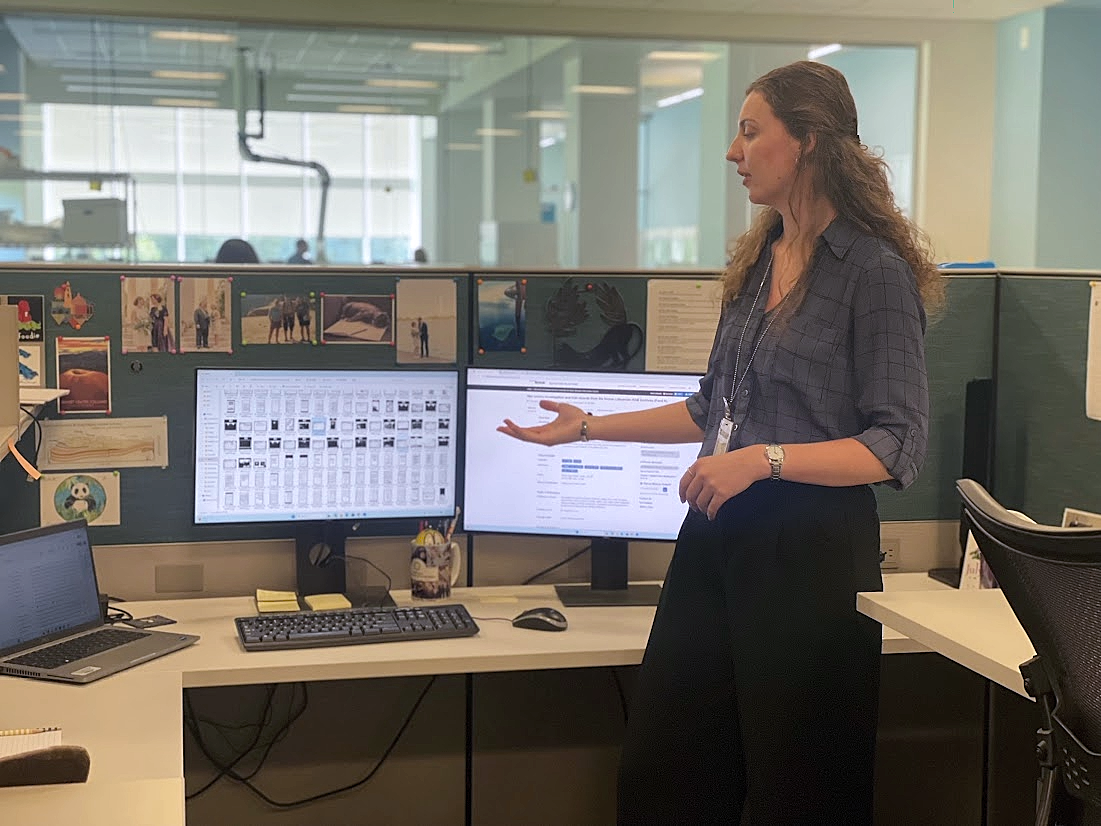 Finnigan showing the documents and photographs she is creating finding aids for.
She spends hours cross-checking inventories, documents, photos, descriptions, and creating new spreadsheets that reflect the latest information. She then hands it off to another archivist to double-check her work. It’s a cycle of verification and refinement to align the finding aids with the accurate collections. The maze of finding aids is the result of different archival processes carried out across borders, countries, and decades. “The researcher should be able to come in and find something quickly without ever having to think too much about it. The easier they can find things, the better,” says Finnigan.
A note from the past
Some mysteries are beyond languages and locations, stumping even a team of experts and bringing them together to do serious detective work. That’s exactly what happened when Finnigan noticed a small symbol on some original photos in a Lithuanian KGB (national security and intelligence agency) collection placed by the original archives. She asked archivists Julie Schweitzer, her boss, and Alla Dvorkin, her direct supervisor, but they hadn’t seen it before either. The mystery quickly spread throughout the building, ensuing a string of emails with experts weighing in, hoping to reveal the meaning of what looked like a small bean. They found that the symbol was a mark used in some European archival systems to note the poor quality of the writing or the photography.
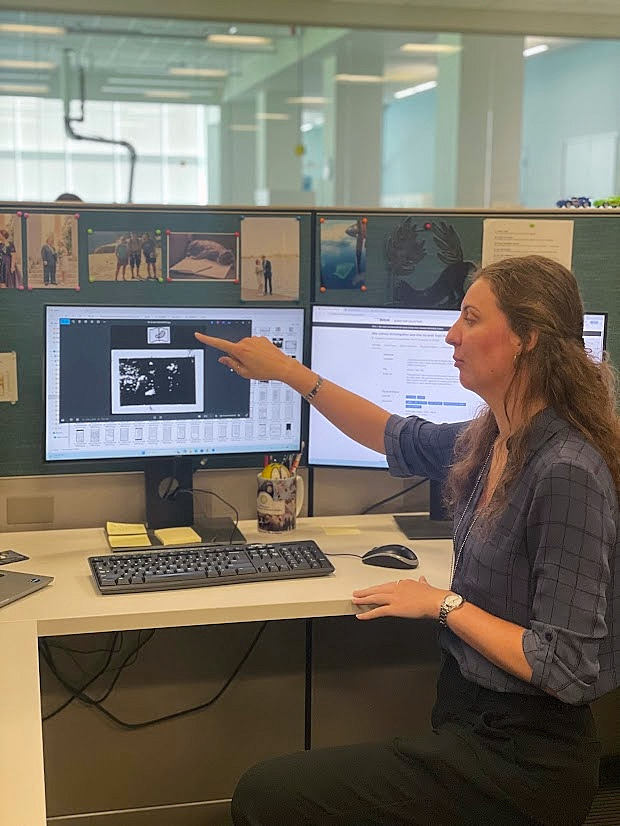
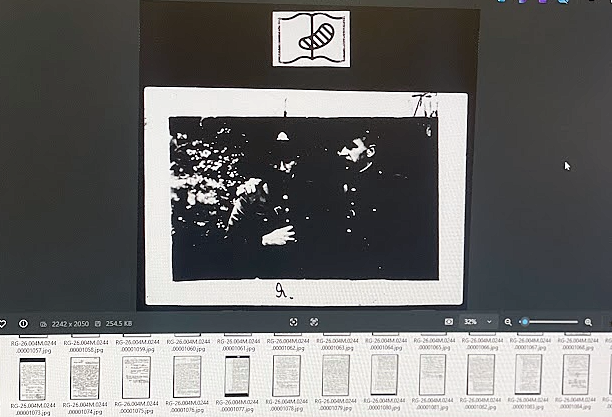
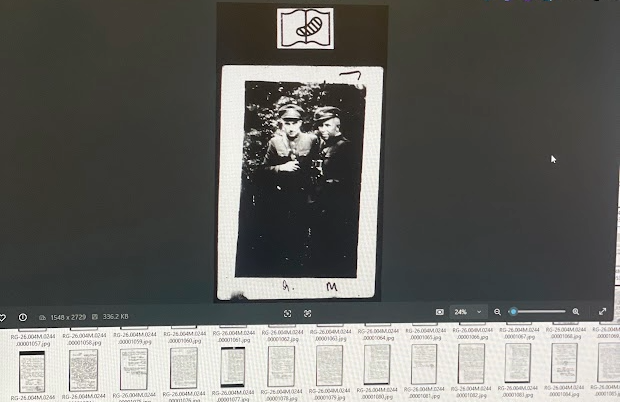
Finnigan showing the mysterious mark she came across in a set of photographs.
“People often imagine archival work as simply preserving historical materials. In reality, a surprising amount of the job involves acting as part historian, part detective, part translator, and occasionally part conspiracy theorist—until someone finds the answer,” Finnigan posted on LinkedIn. “It’s a reminder that expertise is often collective. No single person knew the answer. The solution emerged through conversations, institutional knowledge, and a network of colleagues willing to chase down an obscure question simply because it mattered.”
To preserve and share
In the last few weeks of her internship, Finnigan received additional training from Adam Fielding, a processing archivist who works primarily with personal papers. Fielding, who has been at the center for 11 years, began by showing Finnigan the Rudolph Daniel Sichel papers, an example of what a finished collection can look like once the personal papers have been digitized and preserved in archival boxes.
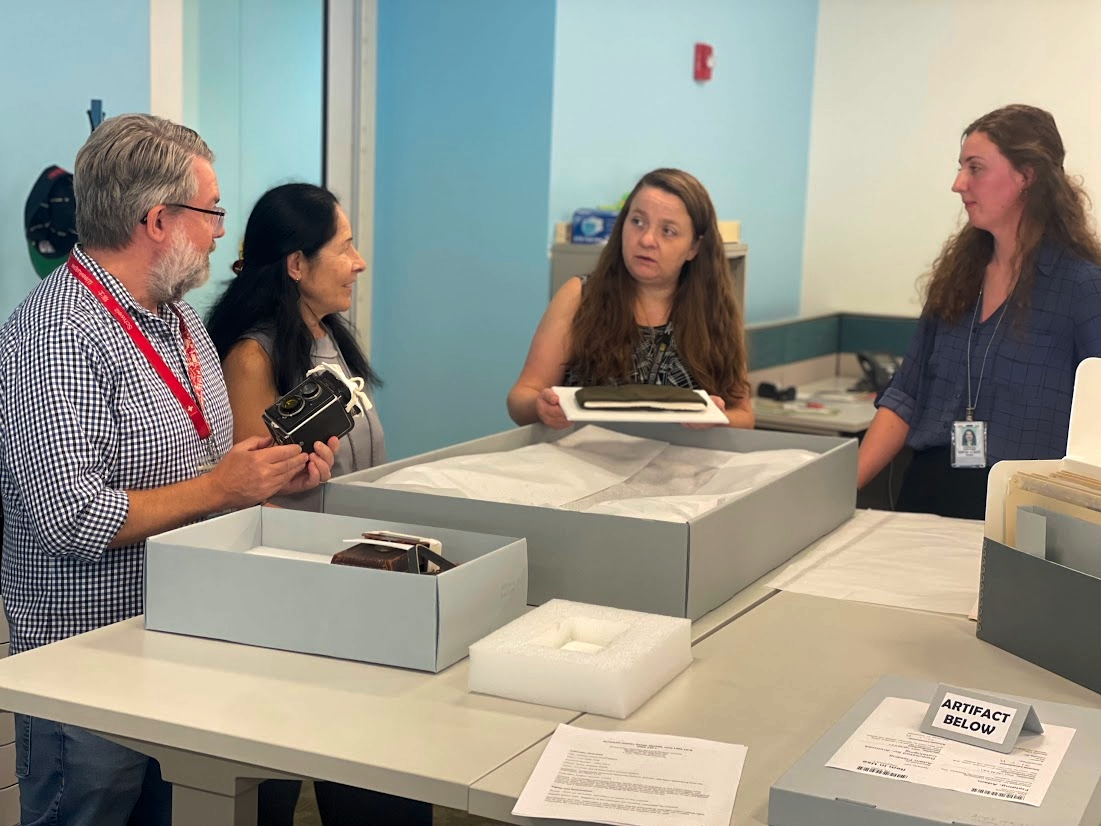
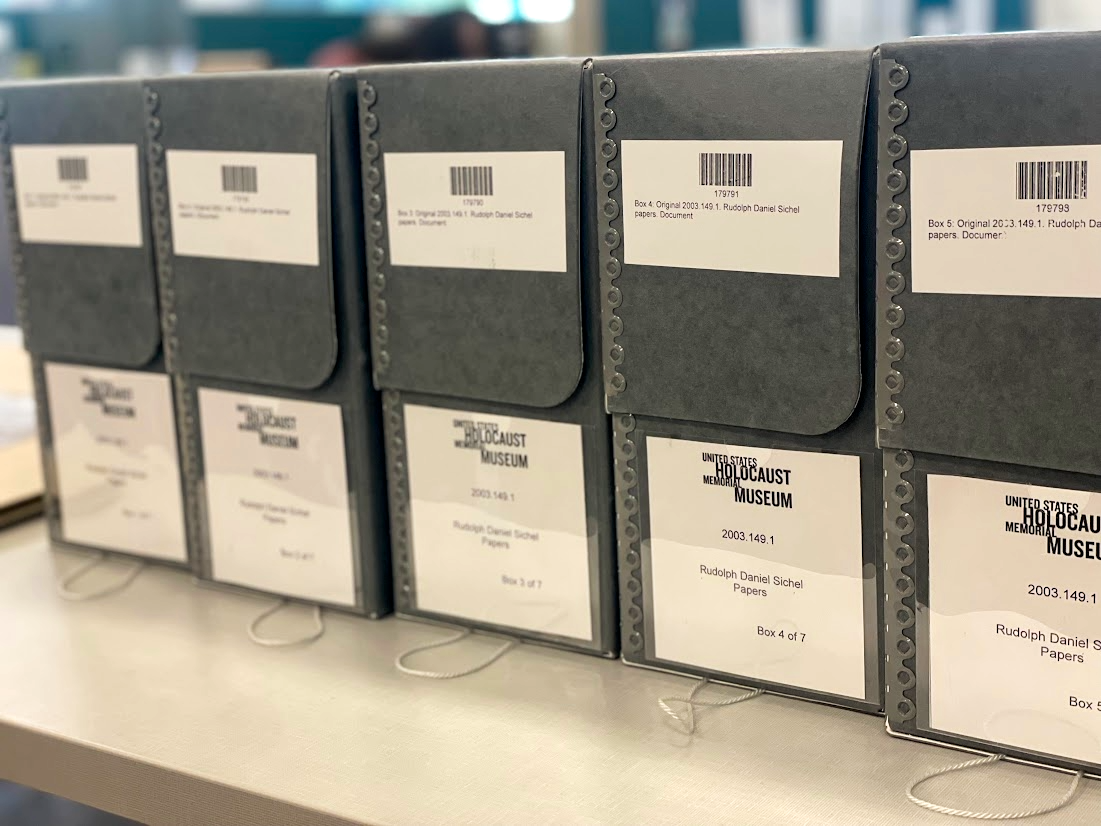
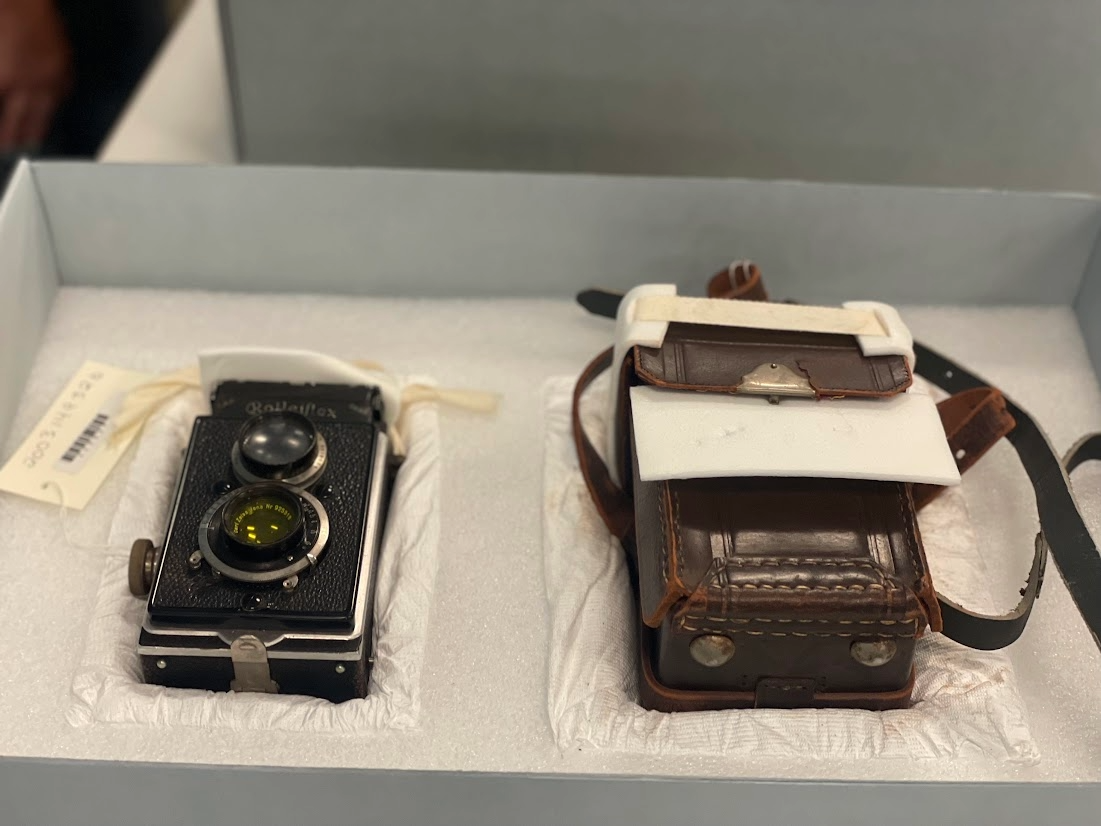
(Top) Finnigan with Fielding, Dvorkin, and Schweitzer (center), reviewing Rudolph Daniel Sichel‘s military uniform and personal camera. (Bottom) The Sichel collection archival boxes and Sichel’s camera and camera case.
The Sichel papers, donated by Rudolph’s children, consist of seven boxes with documents dating from 1903 to 1978, many of which connect Sichel to Maryland. Sichel was a “Ritchie Boy,” one of thousands of Jewish refugees who immigrated to the U.S., enlisted in the army, and trained at the Military Intelligence Training Center at Camp Ritchie near Cascade, Maryland, a little over an hour north of UMBC.
The additonal training gave Finnigan the techniques to work with non-digital items that require special care, like the folder Fielding tasked her with, full of primarily prewar family photographs related to the Kugelman family from Bedzin, Poland, dating between 1930 – 1942.
While putting these skills to use was exciting, the greater reward was seeing the impact of the team’s work. Finnigan’s interest in archival work is not only about preserving history but also making archives accessible to the public, which are two of the center’s priorities.
“There is no point in preserving all of this history if the public can’t access it. We want to preserve the history and make it easily accessible, whether through exhibitions, digital archives, or physical collections. Good archival work should essentially be invisible,” says Finnigan. This includes special handling and storage methods, like cold storage (35°F to 50°F) and cool storage (55°F to 65°F) to dramatically slow chemical decay, stop pest activity, and extend the lifespan of sensitive artifact and media collections.
“The collections at the Shapell Center are evidence of atrocities, of war crimes, of survival,” says Finnigan. “If the items are damaged, they can’t be replaced, and then that piece of history is lost.”
Learn more about internship opportunities at the United States Holocaust Memorial Museum’s archives.
]]>
Deep in UMBC’s climate-controlled Special Collections are 750,000 prints, negatives, and transparencies from The Baltimore Sun dating from the 1930s through the 1980s. Before faculty and...
https://umbc.edu/stories/details-and-detective-skills-matter-at-reese-finnigans-internship-at-the-u-s-holocaust-memorial-museums-archives-in-bowie/
https://my3.my.umbc.edu/api/v0/pixel/news/161639/guest@my.umbc.edu/38aca15bbbceb371a51a6da4ca4cef43/api/pixel
cahss
career-center
history
international
internships
policy-and-society
stories
story
UMBC News & Magazine
https://my3.my.umbc.edu/groups/umbc-news-magazine
https://assets1-my.umbc.edu/system/shared/avatars/groups/000/001/943/24435aa6207c452e7bc15cc74b42c7bb/xsmall.png?1748556657
https://assets1-my.umbc.edu/system/shared/avatars/groups/000/001/943/24435aa6207c452e7bc15cc74b42c7bb/original.png?1748556657
https://assets2-my.umbc.edu/system/shared/avatars/groups/000/001/943/24435aa6207c452e7bc15cc74b42c7bb/xxlarge.png?1748556657
https://assets2-my.umbc.edu/system/shared/avatars/groups/000/001/943/24435aa6207c452e7bc15cc74b42c7bb/xlarge.png?1748556657
https://assets3-my.umbc.edu/system/shared/avatars/groups/000/001/943/24435aa6207c452e7bc15cc74b42c7bb/large.png?1748556657
https://assets1-my.umbc.edu/system/shared/avatars/groups/000/001/943/24435aa6207c452e7bc15cc74b42c7bb/medium.png?1748556657
https://assets2-my.umbc.edu/system/shared/avatars/groups/000/001/943/24435aa6207c452e7bc15cc74b42c7bb/small.png?1748556657
https://assets1-my.umbc.edu/system/shared/avatars/groups/000/001/943/24435aa6207c452e7bc15cc74b42c7bb/xsmall.png?1748556657
https://assets2-my.umbc.edu/system/shared/avatars/groups/000/001/943/24435aa6207c452e7bc15cc74b42c7bb/xxsmall.png?1748556657
UMBC News & Magazine
0
0
false
Fri, 14 Aug 2026 11:51:40 -0400
Fri, 14 Aug 2026 11:51:40 -0400
Nothing but beauty: Noor Zaidi leads an international interfaith team digitizing the history of one of the few shrines to a woman in Islam
The Sayyida Zainab shrine, near Damascus, Syria, is capped by a gold leaf dome atop a building wrapped in interlocking glazed tiles. The aquamarine, gold, amethyst, and brown tiles create geographic tapestries of swirls and intricate flower patterns. It’s a beautiful place of splendor inside and out, where thousands of Shi‘i Muslim pilgrims and visitors worldwide gather, pray, and honor the resting place of Zainab bint ‘Ali, Prophet Muhammad’s granddaughter. The shrine’s roofline is decorated with cobalt blue tiles that repeat the phrase, “Peace be upon you, oh mother of sorrows and hardships” in white Arabic calligraphy—a testament to the trials Zainab endured throughout her life.
When Noor Zaidi, assistant professor of history, visited the shrine on pilgrimage with her family more than 20 years ago, she was mesmerized. The shrine then inspired her graduate research, and now Zaidi is a scholar of the Middle East and South Asia specializing in the history of gender and sectarianism.
Her new book, Traces of Zainab: Ritual, Memory, and Place in Shi’a Islam, is a study of the woman who became a symbol of resistance for Shi‘i Muslims worldwide. Now Zaidi is leading an international interfaith team to preserve, restore, and digitize the shrine’s archives. With the support of Father Columba Stewart of the Hill Museum & Manuscript Library (HMML) in Minnesota, the Holy Spirit University of Kaslik in Lebanon, and the Mourtada family from Damascus, who have been the custodians of the shrine for over 800 years, the world will learn about one of the very few shrines to a woman in Islam and the community that has preserved it with love.
“We are delighted to return to Syria in support of this historic project,” says Stewart, executive director and CEO of HMML, at Saint John’s University—one of the world’s leading organizations funding the preservation and digitization of endangered archives to create open access collections. “Partnering with this historic shrine lies at the very heart of HMML’s mission to preserve and share the world’s handwritten past to inspire a deeper understanding of our present and future.”
Zaidi notes that this is not just about preserving. It’s about teaching students what it takes to be historians, stewards of a past with many missing parts, and to be aware that their work cannot happen in isolation. “There is a story to tell in the construction of this work that also tells us about the discipline of history, at this moment in time,” says Zaidi. “It’s a story of how to teach students to be conscientious scholars: to not just look at newspapers and documents but take into account what’s not being told, what history is being erased, and ask whose voices are not being heard.”
Q: Who is Zainab bint ‘Ali?
A: Zainab bint ‘Ali has meant many things to many people: woman, emblem, whisper in the past, shout in the street. Her presence, body, and words have been central to the construction of a distinct Shi‘i Islamic identity, yet large parts of her life were absent from view.
At six, she witnessed her grandfather Muhammad’s death, the singular political and religious leader of the Muslim community. Her father, ‘Ali, became the fourth successor to the Prophet Muhammad in 656 AD. His followers considered him the first Imam, God’s spiritual representative on earth. Before he was killed five years later, he passed on the leadership to his sons.
In Karbala, present-day Iraq, in 680 AD, Husayn ibn ‘Ali, Zainab’s brother, refused allegiance to Caliph Yazīd ibn Mu‘awiyah, viewing his rule as illegitimate. A battle ensued, and Husayn’s 72 male companions were killed along with his eight sons, nephews, and cousins. Husayn was beheaded. Zainab and the other women witnessed the massacre. After she was taken into captivity and paraded unveiled to Damascus, it is said that she delivered sermons recounting the events at Karbala. Zainab became a symbol of resistance—the few against the many.
For Shi‘i Muslims, the battle at Karbala became central to constructing their distinct identity, collective memory, theological frameworks, devotional practice, and traditions of mourning.
Q: In what ways have local and international communities contributed to keeping the shrine alive?
A: The shrine is a transnational space with people, materials, and ideas moving in and out of it. In the 19th and 20th centuries, many Shi‘i shrines in Iran and Iraq began to take on a similar appearance, usually attributed to Iranian patronage. A lot of money was invested in maintaining these shrines. The mausoleum is surrounded by silver and gold grilles with Zainab’s grave beneath. They were replaced over the centuries through donations. One came from Pakistan in the 1950s, while others came from Iraq and Iran. The gold leaf, some of the tile colors, and the carpets have all come from different countries. However, the Mourtada family was very deliberate in the renovations, using local craftsmen and an Arab Damascene style of tilework to keep the local cultural heritage embedded in the shrine.


Top row: Inside Sayyida Zainab shrine. (Images courtesy of Zaidi) Bottom row: Local craftsmen renovating the shrine. Constructing the golden dome. (Images courtesy of Makam Sayyida Zainab)
Long before the politics of the present, the shrine was part of the shared sacred geography of Damascus. Its history is entwined with the devotion of countless people who have passed through it over centuries. Syrians of many different backgrounds—including Muslims, Christians, and Jews—have visited the shrine over the centuries. Queen Soraya Esfandiary-Bakhtiary of Iran gave funding to build an electrical system, and Sunni Muslim Muhammad Ali, the American professional boxer and activist, also visited the shrine and paid tribute. Their visits helped raise awareness and respect and brought support from outside the Shi’i community.


(l) Former Prime Minister of Pakistan, Benazir Bhutto, at the Sayyida Zainab shrine. (r) Boxer Muhammad Ali at the Shrine of Sayyida Zainab (Images courtesy Makam Sayyida Zainab)
While the shrine’s story can be told through violence, conflict, and upheaval, we chose to tell the story that often gets buried. When Zainab was asked what she thought of her dead brother, she said, “I see nothing but beauty.” We see nothing but beauty. This is the story the project chooses to tell.
Q: How did you gain access to the shrine’s archives?
A: When I first visited for research in 2012, there was almost nobody there. The shrine was under constant threat, and the atmosphere was one of uncertainty. During that visit, I met Hani Mohsen Mourtada, the head custodian, former Syrian Minister of Higher Education, and former president of the University of Damascus. I think he was genuinely surprised that someone was willing to come under those conditions. He gave me access to photographs, legal documents, and virtually everything the shrine held in its archives. We built a close relationship. I interviewed him several times as the project developed. I returned to Syria in 2019 and again in 2021, but he was in Beirut. Sadly, he passed away during the COVID-19 pandemic, and I never had the chance to see him again.
As I neared completion of my manuscript, I needed to revisit the archival materials and get legal permission to use them. After Hani Mohsen’s death, custodianship passed to his son, Sayed Mazen Al-Mourtada. I connected with him, and Mazen agreed to give me access. He explained that he had moved the oldest records to Beirut because he feared they might not survive the war. Although there was widespread looting and destruction when he moved the records, Mazen recovered much of what I needed. There are many major Shi‘i shrines around the world, but not all of them make their archives available in this way or welcome the same level of transparency. That made this project especially meaningful because Mozen was willing to do exactly that.


Manuscripts from the Sayyida Zainab shrine. (Images courtesy of Makam Sayyida Zainab)
For historians, the history we write is so often incomplete and shaped by these absences and losses. Rather than presenting itself as complete, the digital archive will clearly identify documents destroyed through conflict and explain how historical archives are often incomplete collections of surviving materials. Understanding this is crucial for students as they embark on research.
Q: How does your personal journey help students understand the academic and personal skills required to be a historian?
A: History as a discipline is changing. We’re reading documents, translating them, and making meaning from them. Our research process is part of that history. While I was writing the book, my colleagues at UMBC told me that I should be in the story. I wasn’t used to that. The book is divided into three parts: Zainab’s shrine, the Bibi Pak Daman shrine in Lahore, Pakistan; and the al-Rashād prison for women in Iraq. In each section, I invite the reader to take a journey with me. I was so much a part of the process that while I was writing the book, I became part of the story. I learned that if I’m interviewing these women, they are not speaking to a wall—they were speaking to me.
Being a historian is a labor of love. You don’t do things this long unless you care and find them interesting. I have been studying the Shrine of Sayyida Zainab for about 15 years. For much of that time, Syria was caught in civil war and proxy war. The shrine was regularly targeted by jihadist groups such as ISIS and al-Qaeda, and for more than a decade it was extraordinarily difficult to travel in and out of the country, and then the pandemic happened. Many times, I was told to reframe the book or to change the topic. I didn’t give up.
This archive is my way of contributing something meaningful to the people and place that shaped my research. Although I continue to worry about the shrine’s future, preserving these materials offers hope that, should anything happen to it, its history will not disappear. In that sense, preserving the shrine and its documents is about preserving a piece of our common humanity.
Learn more about UMBC’s history department.
]]>
The Sayyida Zainab shrine, near Damascus, Syria, is capped by a gold leaf dome atop a building wrapped in interlocking glazed tiles. The aquamarine, gold, amethyst, and brown tiles create...
https://umbc.edu/stories/noor-zaidi-leads-team-digitizing-history-of-sayyida-zainab-shrine/
https://my3.my.umbc.edu/api/v0/pixel/news/161375/guest@my.umbc.edu/b26c99277cb65970c0caa20dd3e07b2e/api/pixel
cahss
history
international
policy-and-society
research
stories
story
UMBC News & Magazine
https://my3.my.umbc.edu/groups/umbc-news-magazine
https://assets1-my.umbc.edu/system/shared/avatars/groups/000/001/943/24435aa6207c452e7bc15cc74b42c7bb/xsmall.png?1748556657
https://assets1-my.umbc.edu/system/shared/avatars/groups/000/001/943/24435aa6207c452e7bc15cc74b42c7bb/original.png?1748556657
https://assets2-my.umbc.edu/system/shared/avatars/groups/000/001/943/24435aa6207c452e7bc15cc74b42c7bb/xxlarge.png?1748556657
https://assets2-my.umbc.edu/system/shared/avatars/groups/000/001/943/24435aa6207c452e7bc15cc74b42c7bb/xlarge.png?1748556657
https://assets3-my.umbc.edu/system/shared/avatars/groups/000/001/943/24435aa6207c452e7bc15cc74b42c7bb/large.png?1748556657
https://assets1-my.umbc.edu/system/shared/avatars/groups/000/001/943/24435aa6207c452e7bc15cc74b42c7bb/medium.png?1748556657
https://assets2-my.umbc.edu/system/shared/avatars/groups/000/001/943/24435aa6207c452e7bc15cc74b42c7bb/small.png?1748556657
https://assets1-my.umbc.edu/system/shared/avatars/groups/000/001/943/24435aa6207c452e7bc15cc74b42c7bb/xsmall.png?1748556657
https://assets2-my.umbc.edu/system/shared/avatars/groups/000/001/943/24435aa6207c452e7bc15cc74b42c7bb/xxsmall.png?1748556657
UMBC News & Magazine
1
0
false
Wed, 29 Jul 2026 09:43:09 -0400
Wed, 29 Jul 2026 09:43:09 -0400
UMBC’s student Fulbright recipients pursue community-driven research on a global stage
UMBC’s 2026 – 2027 recipients of the prestigious Fulbright U.S. Student Program are joining the ranks of UMBC’s distinguished Fulbright alumni, who have made UMBC a three-time Fulbright Top Producing Institution, a recognition from the U.S. Department of State’s Bureau of Educational and Cultural Affairs.
More than 2,000 Fulbright U.S. Students—recent college graduates, graduate students, and early career professionals—pursue graduate study, conduct research, or teach English in schools abroad each year, earning placements in Africa, Asia and the Pacific, the Middle East, Latin America, and Europe. This year’s Fulbright Retrievers are launching the international phase of their research. From Baltimore to the Dominican Republic, India, and Mexico, these students are working with and for local communities to support local approaches to ongoing challenges.
The art of collaboration
During her senior year, Marelen Acevedo Soto ’26, visual arts, wowed Retrievers at UMBC’s 2025 Undergraduate Research and Creative Achievement Day with an experiential painting that combined projection, animation, and live performance. Now, she is packing up these skills and taking them to Santo Domingo, Dominican Republic, where she was born. Acevedo Soto earned her associate’s degree from Chavón School of Design. She is returning to work with the students to create a large-scale mural titled “Multidimensional Mural: Augmented Reality for Environmental Change” in Santo Domingo’s Zona Colonial (Colonial Zone), a UNESCO World Heritage site. Using QR codes, passersby will access animations and hear community voices describing how pollution affects daily life. The project will close with a Spanish and English multimedia performance combining projected animations, environmental data, and Dominican music.


Acevedo Soto (on the right) with artists from The Music and Me Foundation and at URCAD 2025. (Images courtesy of Acevedo)
“Many of my strongest ideas came from learning across different fields at UMBC,” says Acevedo Soto. “Music theory helped me think about rhythm and emotion. Storytelling taught me how to create meaningful experiences. Psychology helped me better understand how people think and engage with art. Environmental science deepened my understanding of water and the importance of its conservation, and data analysis gave me the tools to measure the impact of my project.”
Researchers’ responsibility
Vunnathi Ankem ’26, psychology, has had a passion for India for years, specifically how cultural exchange in India was shaped by hundreds of years of discourse, colonization, and history. While researching intimate partner violence (IPV) for her honors thesis, Vunnathi Ankem ’26, psychology, became interested in how South Asian students developed their understandings of IPV. Unexpectedly, most of the students she interviewed were from Telugu-speaking regions, such as Hyderabad in southern India. Intrigued, Ankem is now headed to the Psychology Center at the University of Hyderabad to continue her research. “Psychology, as we know it in the Western world, is only one approach to understanding the mind and the body,” says Ankem. “As psychology students, it is our responsibility to explore worlds and lenses beyond the Eurocentric ones.”
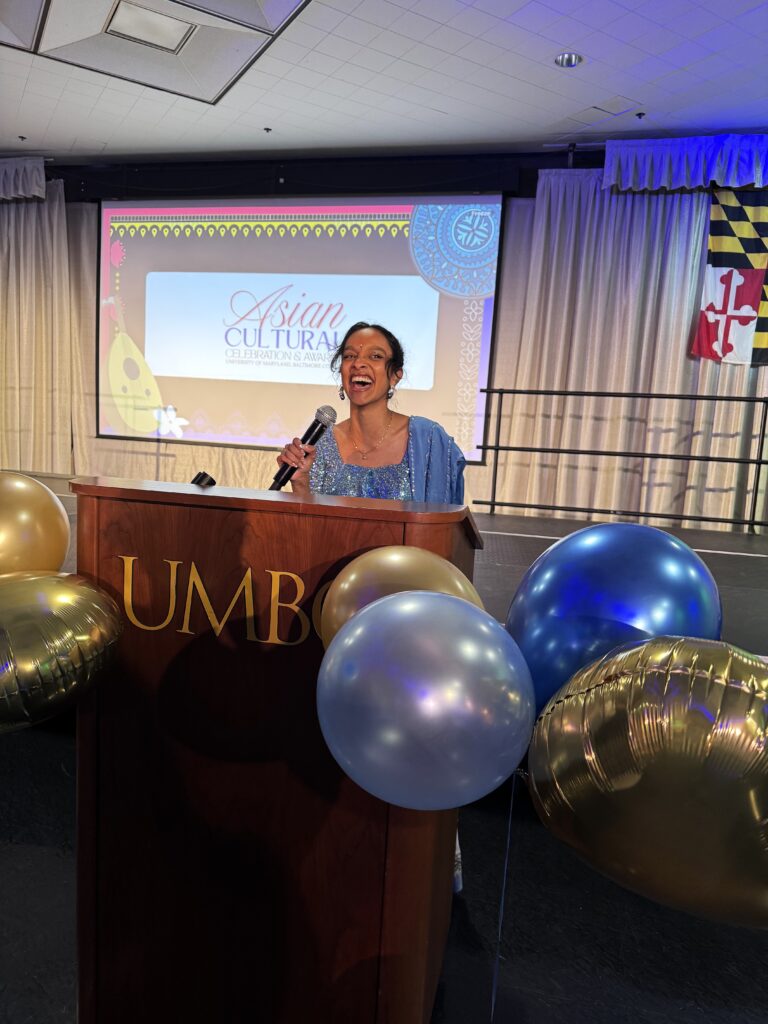
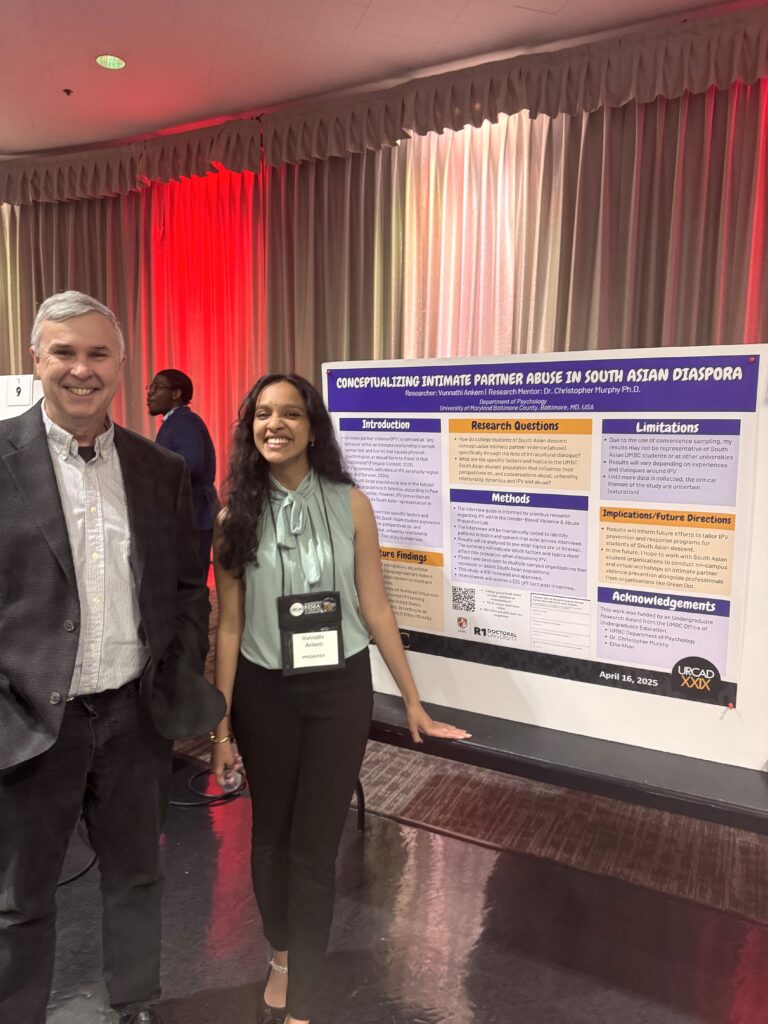
(l-r) Ankem at the 2026 Asian Cultural Celebration and Awards ceremony. Ankem with mentor Christopher Murphy, professor of psychology. (Images courtesy of Ankem)
She will study how systems, class, community, and culture shape experiences of IPV in India and inform more culturally responsive prevention strategies. Ankem will then develop community-based and community-led IPV prevention workshops. “The Fulbright program is giving me the opportunity I have always dreamed about,” says Ankem. “I can’t wait to learn from professionals and clinicians, alongside ancient culture practitioners and experts in India. It will be the experience of a lifetime!”
Humanistic climate futures
After studying climate change and migration on a study abroad trip to Oaxaca, Mexico, Bryan Castro-Velez ’26, geography and environmental studies, knew he was on the right research path—studying humanistic approaches to equitable agroecological systems and land in Indigenous Latin American communities. He says learning directly from indigenous leaders about their farming practices and response to climate change inspired him to apply for the Fulbright García-Robles award for graduate and doctoral research in Mexico. Castro-Velez’s graduate work will focus on agroecology, natural resource management, and rural development in Chiapas, Mexico.
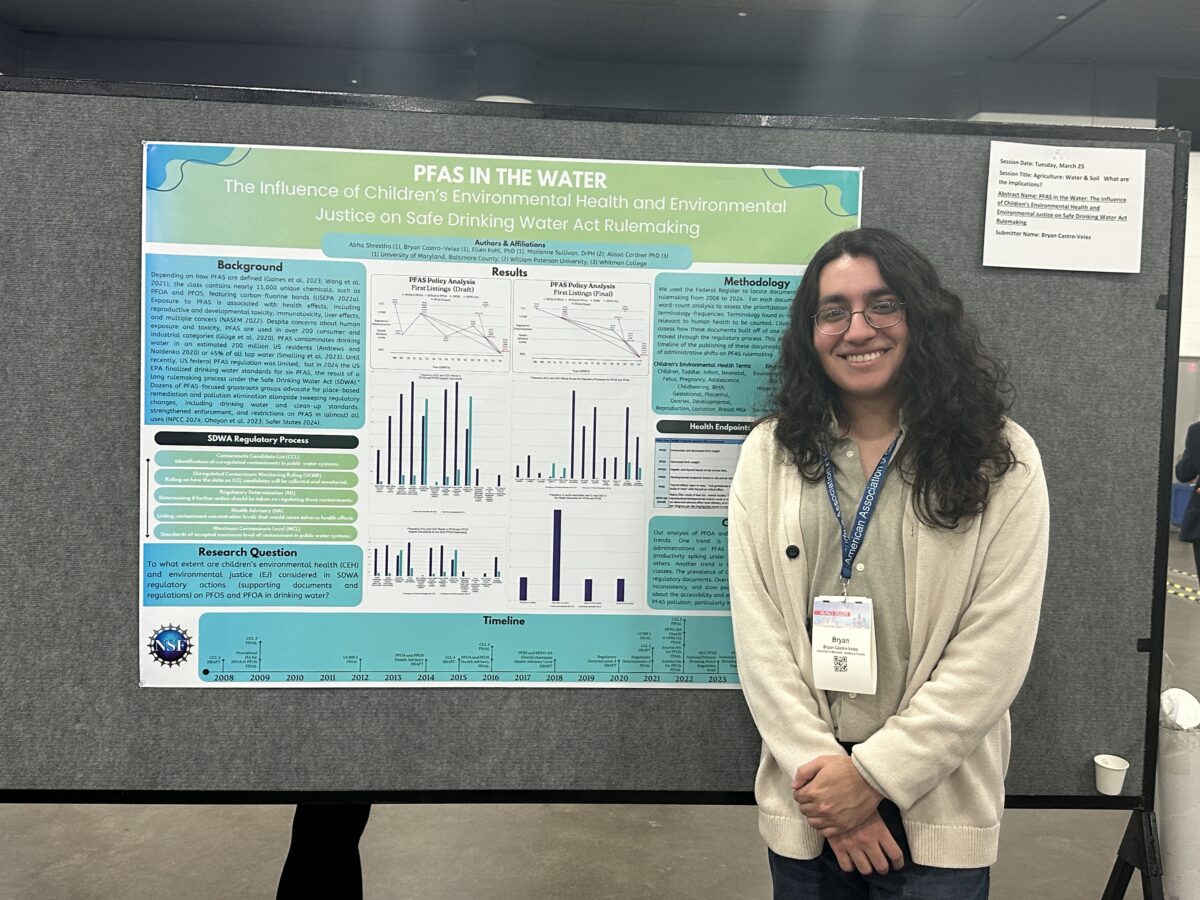 Bryan Castro-Velez at the 2025 Association of American Geographers annual conference in Detroit. (Image courtesy of Castro-Velez)
“I look forward to continuing down this path, encouraging others to do the same, and furthering my education outside the walls of academia,” says Castro-Velez. “My experiences during and outside of UMBC have proven to me that community-based learning systems are fundamental to just climate solutions and humanistic futures.”
As the U.S. Fulbright Program celebrates its 80th anniversary this year, UMBC’s Fulbright program is celebrating by expanding support through the Office of Prestigious Scholarships (OPS) under the leadership of April Householder ’95, director of OPS: “I am looking forward to building on UMBC’s strong legacy as a top producer of Fulbright students,” says Householder, “and expanding student support throughout the processes of exploring, applying, and transitioning abroad.”
Learn more about UMBC’s international opportunities.
]]>
UMBC’s 2026 – 2027 recipients of the prestigious Fulbright U.S. Student Program are joining the ranks of UMBC’s distinguished Fulbright alumni, who have made UMBC a three-time Fulbright Top...
https://umbc.edu/stories/umbcs-2026-student-fulbright-recipients/
https://my3.my.umbc.edu/api/v0/pixel/news/161318/guest@my.umbc.edu/3c2bd6a8225156f81db68222ed9fdd71/api/pixel
alumni
cahss
class-of-2026
community
fulbright
geographic-information-systems
international
policy-and-society
psychology
stories
story
urcad
visual-arts
UMBC News & Magazine
https://my3.my.umbc.edu/groups/umbc-news-magazine
https://assets1-my.umbc.edu/system/shared/avatars/groups/000/001/943/24435aa6207c452e7bc15cc74b42c7bb/xsmall.png?1748556657
https://assets1-my.umbc.edu/system/shared/avatars/groups/000/001/943/24435aa6207c452e7bc15cc74b42c7bb/original.png?1748556657
https://assets2-my.umbc.edu/system/shared/avatars/groups/000/001/943/24435aa6207c452e7bc15cc74b42c7bb/xxlarge.png?1748556657
https://assets2-my.umbc.edu/system/shared/avatars/groups/000/001/943/24435aa6207c452e7bc15cc74b42c7bb/xlarge.png?1748556657
https://assets3-my.umbc.edu/system/shared/avatars/groups/000/001/943/24435aa6207c452e7bc15cc74b42c7bb/large.png?1748556657
https://assets1-my.umbc.edu/system/shared/avatars/groups/000/001/943/24435aa6207c452e7bc15cc74b42c7bb/medium.png?1748556657
https://assets2-my.umbc.edu/system/shared/avatars/groups/000/001/943/24435aa6207c452e7bc15cc74b42c7bb/small.png?1748556657
https://assets1-my.umbc.edu/system/shared/avatars/groups/000/001/943/24435aa6207c452e7bc15cc74b42c7bb/xsmall.png?1748556657
https://assets2-my.umbc.edu/system/shared/avatars/groups/000/001/943/24435aa6207c452e7bc15cc74b42c7bb/xxsmall.png?1748556657
UMBC News & Magazine
0
0
false
Mon, 27 Jul 2026 17:10:21 -0400
Mon, 27 Jul 2026 17:10:21 -0400
A global perspective on aging: Alfred Boakye’s gerontology journey from Ghana to Japan and the U.S.
Alfred Boakye first began thinking deeply about the care and well-being of elders and their families while caring for his centenarian grandmother, Margaret Nyarko, in his home city of Tema, on the Atlantic coast of South East Ghana. She was in charge of her essential self-care routine—bathing, dressing, eating, toileting, transferring from sitting to standing, and continence—and more complex daily tasks necessary for independent living: medication management, meal preparation, transportation, and shopping. But even with her mobility, his grandmother lacked a social network.
Acting as both a devoted grandchild and a caretaker, Boakye experienced firsthand the complexities of aging. He learned to respect his grandmother’s independence while finding ways to support her where she needed help. Boakye, now a UMBC gerontology Ph.D. student in the social, cultural, and behavioral track, notes that his grandmother’s children didn’t live with her, and her grandchildren didn’t understand her aging process. As her friends and siblings passed away, her social circle shrank. “I asked her what motivated her to stay at church for hours, and she says the church supports her, brings her communion, visits her, and brings her Christmas gifts.”
After earning a bachelor’s degree in English and a master’s degree in human resources at the University of Ghana, Boakye wanted to broaden his understanding of aging and caregiving. In 2021, he moved to the United States to pursue a master’s degree in gerontology at Georgia State University (GSU), where he met his mentor and master’s thesis chair, Jennifer Craft Morgan, professor and director of the GSU Gerontology Institute.
 Boakye at his GSU master’s graduation. (l-r): Antonius Skipper, assistant professor of gerontology at GSU and Boakye’s master’s thesis committee member; Reverend Kwaku Owusu-Boachie, Boakye’s uncle; Boakye; and Craft Morgan. (Image courtesy of Boakye)
In 2023, the year his grandmother passed away and the year he completed his master’s at GSU, Boakye published his first aging-related article, “Does the Church Care? Assessment of Social Support Strategies on the Health and Wellbeing of Older Adults within the Tema Metropolitan Assembly-Ghana” in the African Journal of Ageing Studies.
Craft Morgan fostered Boakye’s interest in gerontology and encouraged him to continue his work at the doctoral level, leading him to UMBC’s gerontology doctoral program, which is an interdisciplinary program in collaboration with the University of Baltimore. “Professor Craft Morgan has held my hand from the day I started my master’s program and continues to do so today,” says Boakye. “I always feel privileged that I have her in my corner.”
Stigma of male caregivers
Boakye’s studies are also informed by his experience being the primary caregiver to his father. Before moving to the U.S., Boakye did the grocery shopping, cooking, and laundry for Stephen, his 76‑year‑old father. He became aware of the multiple obligations children have when caretaking for themselves, their families, and their parents, as well as the isolation that can happen, especially if you are a male caregiver.
At the time, Boakye saw himself as being a “helpful child,” a term associated with a Ghanaian proverb that states, “If they take care of you to grow your teeth, you take care of them to lose theirs.” The proverb is more than words—it is a way of life in Ghana, which reinforced Boakye’s caregiving role and emphasized what it takes to be a helpful child—one built on responsibility and reciprocity. But it’s easier said than done. “I had to juggle my ‘identity’ as a male caregiver in a historically patriarchal society with my caring masculinity,” says Boakye. “Caregiving is predominantly perceived as ‘women’s work’ in Ghana, and men who take on these roles are often stigmatized and labeled ‘Kojo besia,’ which translates to ‘man woman’. To avoid such labeling, I was hesitant to ask for help, despite the toll caregiving took on my physical and psychological well‑being.”
 Boakye presents his research on male caregiving to GSA leadership during their visit to UMBC in spring 2026. (Bradley Ziegler/UMBC)
Boakye presented his research and personal experience to the leadership of the Gerontological Society of America (GSA) during their visit to UMBC this spring. Thanks to the UMB Provost’s Global Scholar Program, Boakye will be traveling to Ghana this summer to engage with male caregivers—to listen to their caregiving experiences, explore what these experiences mean to them, and co‑create resources to support them. He will use this research to finish his master’s thesis in applied sociology—Boakye’s third master’s degree.
Meeting Japan’s centenarians
In 2024, Boakye joined the Global Healthy Aging in Japan study abroad program, organized by Taka Yamashita, professor of sociology, anthropology, and public health and co-director of the gerontology doctoral program. The two-week program leads students through research, community centers, and historic sites in Kanagawa Prefecture, near Tokyo. Japan is known for its cutting-edge research and policy that supports the active lives of the world’s largest aging population and the highest number of centenarians. The students visited multigenerational living communities and centers that merge theoretical research with real-world practice and outcomes.
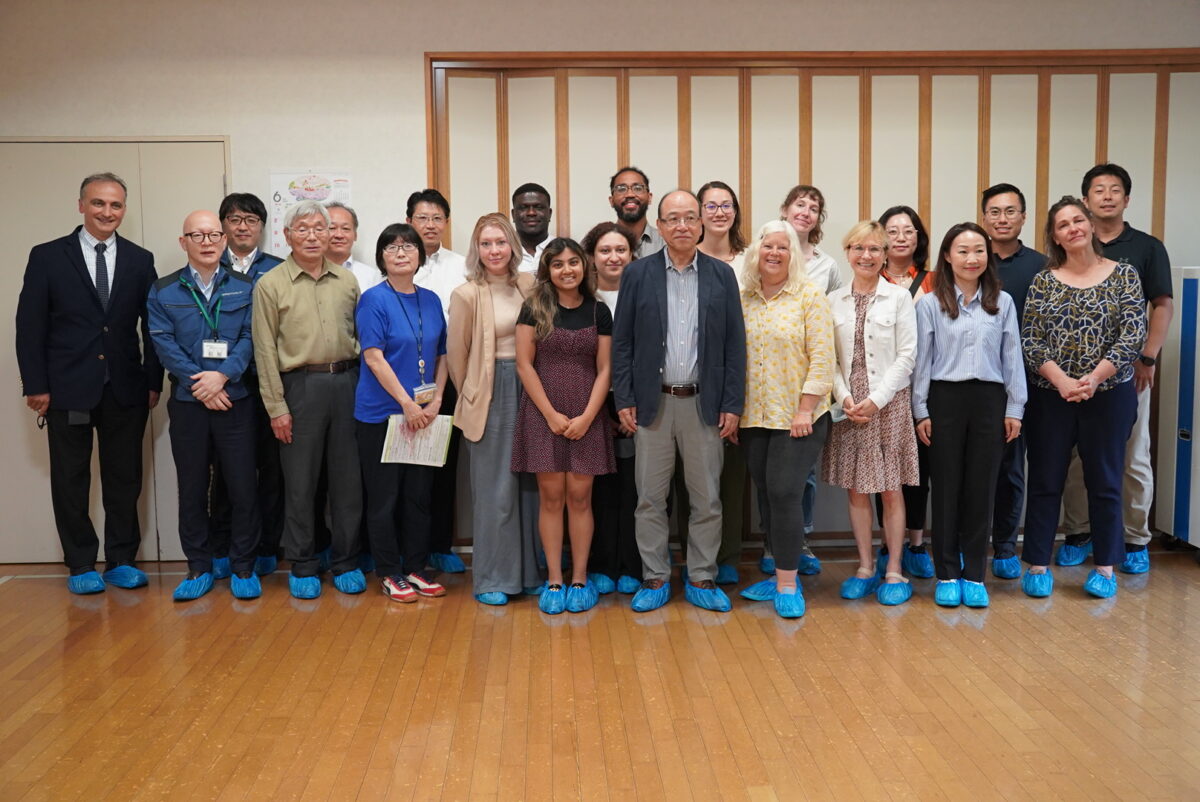 Boakye (second row, fifth from the left) at a senior center in Kanagawa Prefecture, Japan. (Image courtesy of TakaYamishita, professor of gerontology and sociology, second row, first on the right)
Boakye was not expecting that at a time when he was missing his grandmother the most, Kanagawa would make him feel like he was home in Tema. It wasn’t only that both Japan and Ghana operate on a similar collective familial care system focused on intergenerational living and inclusion, notes Boakye. It’s also the physical environment. “The buildings are close together, and people put chairs in front of their homes to talk,” says Boakye. “Older adults greet passersby, and people stop to have a conversation with them. They will tell you they are out for a little sun.”
A highlight of the trip for all the students was meeting a supercentenarian. The 110-year-old woman welcomed them and kissed each of them on the cheek. “All the students say that they were blessed to have this welcome and that she could still talk to us,” says Boakye. “It was really emotional for me. I just kept thinking of my grandmother.”
Boakye was also impressed by the Kanagawa ME-BYO approach to aging, which encourages monitoring vital signs using biomedical technologies. ME-BYO focuses on preventing and minimizing illness progression through programs that promote healthy behaviors such as a balanced diet, exercise, and social activities. “My experience in Japan has been one of the best things that has happened in my personal and academic life and in my career,” says Boakye, who wants to find a way to incorporate ME-BYO into his current and future caregiving research and practice. “This trip has equipped me with the cultural competence, literacy, sensitivity, communication, problem-solving, and critical thinking skills needed to have a real-world impact in the field of gerontology.”
Looking Ahead
With five years of longevity research, Boakye now understands that his grandmother’s experience is common for many older adults in Ghana. He discovered in the 2021 Population and Housing Census of Ghana that adults 65 years of age and older make up 4.3 percent of Ghana’s population. However, he explains, the need for person-centred and geriatric care services has not kept up with the demand.
“I feel like I am now clearly connecting the dots between my experiences in Ghana, what I saw in Japan, and what I have learned in class. I am passionate about encouraging more men to engage and support the people they love, but also seek help when they need it,” says Boakye. He plans to finish his doctoral program in fall 2027.
“It has been a pleasure to watch Alfred’s research grow during his time at UMBC,” says Nancy Kusmaul, professor at UMBC’s School of Social Work, his dissertation chair, who Boakye works with as a research assistant. “He is committed to raising the voices of paid and unpaid caregivers who provide vital services to older adults and people with disabilities in the US and abroad. I am confident that he will continue to make significant contributions to the field.”
He knows there is a long road ahead, but he is confident that he is on the right path. “I want to build culturally relevant and gender‑sensitive resources that support male caregivers, not only to improve their health and well‑being but also to amplify their voices when it matters most.” His grandmother, Margaret, continues to inspire Boakye’s work on how caregiving shapes the experiences of both the carer and the care recipient.
Learn more about UMBC’s gerontology doctoral program.
]]>
Alfred Boakye first began thinking deeply about the care and well-being of elders and their families while caring for his centenarian grandmother, Margaret Nyarko, in his home city of Tema, on the...
https://umbc.edu/stories/alfred-boakyes-gerontology-journey/
https://my3.my.umbc.edu/api/v0/pixel/news/160831/guest@my.umbc.edu/a44c085d6a24b6aba543a04a55557c3d/api/pixel
cahss
gerontology
international
policy-and-society
research
saph
socialwork
stories
story
UMBC News & Magazine
https://my3.my.umbc.edu/groups/umbc-news-magazine
https://assets1-my.umbc.edu/system/shared/avatars/groups/000/001/943/24435aa6207c452e7bc15cc74b42c7bb/xsmall.png?1748556657
https://assets1-my.umbc.edu/system/shared/avatars/groups/000/001/943/24435aa6207c452e7bc15cc74b42c7bb/original.png?1748556657
https://assets2-my.umbc.edu/system/shared/avatars/groups/000/001/943/24435aa6207c452e7bc15cc74b42c7bb/xxlarge.png?1748556657
https://assets2-my.umbc.edu/system/shared/avatars/groups/000/001/943/24435aa6207c452e7bc15cc74b42c7bb/xlarge.png?1748556657
https://assets3-my.umbc.edu/system/shared/avatars/groups/000/001/943/24435aa6207c452e7bc15cc74b42c7bb/large.png?1748556657
https://assets1-my.umbc.edu/system/shared/avatars/groups/000/001/943/24435aa6207c452e7bc15cc74b42c7bb/medium.png?1748556657
https://assets2-my.umbc.edu/system/shared/avatars/groups/000/001/943/24435aa6207c452e7bc15cc74b42c7bb/small.png?1748556657
https://assets1-my.umbc.edu/system/shared/avatars/groups/000/001/943/24435aa6207c452e7bc15cc74b42c7bb/xsmall.png?1748556657
https://assets2-my.umbc.edu/system/shared/avatars/groups/000/001/943/24435aa6207c452e7bc15cc74b42c7bb/xxsmall.png?1748556657
UMBC News & Magazine
0
0
false
Wed, 24 Jun 2026 12:31:18 -0400
Wed, 24 Jun 2026 12:31:18 -0400
A global perspective on aging: Alfred Boakye’s gerontology journey from Ghana to Japan and the U.S.
Alfred Boakye first began thinking deeply about the care and well-being of elders and their families while caring for his centenarian grandmother, Margaret Nyarko, in his home city of Tema, on the Atlantic coast of South East Ghana. She was in charge of her essential self-care routine—bathing, dressing, eating, toileting, transferring from sitting to standing, and continence—and more complex daily tasks necessary for independent living: medication management, meal preparation, transportation, and shopping. But even with her mobility, his grandmother lacked a social network.
Acting as both a devoted grandchild and a caretaker, Boakye experienced firsthand the complexities of aging. He learned to respect his grandmother’s independence while finding ways to support her where she needed help. Boakye, now a UMBC gerontology Ph.D. student in the social, cultural, and behavioral track, notes that his grandmother’s children didn’t live with her, and her grandchildren didn’t understand her aging process. As her friends and siblings passed away, her social circle shrank. “I asked her what motivated her to stay at church for hours, and she says the church supports her, brings her communion, visits her, and brings her Christmas gifts.”
After earning a bachelor’s degree in English and a master’s degree in human resources at the University of Ghana, Boakye wanted to broaden his understanding of aging and caregiving. In 2021, he moved to the United States to pursue a master’s degree in gerontology at Georgia State University (GSU), where he met his mentor and master’s thesis chair, Jennifer Craft Morgan, professor and director of the GSU Gerontology Institute.
Boakye at his GSU master’s graduation. (l-r): Antonius Skipper, assistant professor of gerontology at GSU and Boakye’s master’s thesis committee member; Reverend Kwaku Owusu-Boachie, Boakye’s uncle; Boakye; and Craft Morgan. (Image courtesy of Boakye)
In 2023, the year his grandmother passed away and the year he completed his master’s at GSU, Boakye published his first aging-related article, “Does the Church Care? Assessment of Social Support Strategies on the Health and Wellbeing of Older Adults within the Tema Metropolitan Assembly-Ghana” in the African Journal of Ageing Studies.
Craft Morgan fostered Boakye’s interest in gerontology and encouraged him to continue his work at the doctoral level, leading him to UMBC’s gerontology doctoral program, which is an interdisciplinary program in collaboration with the University of Baltimore. “Professor Craft Morgan has held my hand from the day I started my master’s program and continues to do so today,” says Boakye. “I always feel privileged that I have her in my corner.”
Stigma of male caregivers
Boakye’s studies are also informed by his experience being the primary caregiver to his father. Before moving to the U.S., Boakye did the grocery shopping, cooking, and laundry for Stephen, his 76‑year‑old father. He became aware of the multiple obligations children have when caretaking for themselves, their families, and their parents, as well as the isolation that can happen, especially if you are a male caregiver.
At the time, Boakye saw himself as being a “helpful child,” a term associated with a Ghanaian proverb that states, “If they take care of you to grow your teeth, you take care of them to lose theirs.” The proverb is more than words—it is a way of life in Ghana, which reinforced Boakye’s caregiving role and emphasized what it takes to be a helpful child—one built on responsibility and reciprocity. But it’s easier said than done. “I had to juggle my ‘identity’ as a male caregiver in a historically patriarchal society with my caring masculinity,” says Boakye. “Caregiving is predominantly perceived as ‘women’s work’ in Ghana, and men who take on these roles are often stigmatized and labeled ‘Kojo besia,’ which translates to ‘man woman’. To avoid such labeling, I was hesitant to ask for help, despite the toll caregiving took on my physical and psychological well‑being.”
Boakye presents his research on male caregiving to GSA leadership during their visit to UMBC in spring 2026. (Bradley Ziegler/UMBC)
Boakye presented his research and personal experience to the leadership of the Gerontological Society of America (GSA) during their visit to UMBC this spring. Thanks to the UMB Provost’s Global Scholar Program, Boakye will be traveling to Ghana this summer to engage with male caregivers—to listen to their caregiving experiences, explore what these experiences mean to them, and co‑create resources to support them. He will use this research to finish his master’s thesis in applied sociology—Boakye’s third master’s degree.
Meeting Japan’s centenarians
In 2024, Boakye joined the Global Healthy Aging in Japan study abroad program, organized by Taka Yamashita, professor of sociology, anthropology, and public health and co-director of the gerontology doctoral program. The two-week program leads students through research, community centers, and historic sites in Kanagawa Prefecture, near Tokyo. Japan is known for its cutting-edge research and policy that supports the active lives of the world’s largest aging population and the highest number of centenarians. The students visited multigenerational living communities and centers that merge theoretical research with real-world practice and outcomes.
Boakye (second row, fifth from the left) at a senior center in Kanagawa Prefecture, Japan. (Image courtesy of TakaYamishita, professor of gerontology and sociology, second row, first on the right)
Boakye was not expecting that at a time when he was missing his grandmother the most, Kanagawa would make him feel like he was home in Tema. It wasn’t only that both Japan and Ghana operate on a similar collective familial care system focused on intergenerational living and inclusion, notes Boakye. It’s also the physical environment. “The buildings are close together, and people put chairs in front of their homes to talk,” says Boakye. “Older adults greet passersby, and people stop to have a conversation with them. They will tell you they are out for a little sun.”
A highlight of the trip for all the students was meeting a supercentenarian. The 110-year-old woman welcomed them and kissed each of them on the cheek. “All the students say that they were blessed to have this welcome and that she could still talk to us,” says Boakye. “It was really emotional for me. I just kept thinking of my grandmother.”
Boakye was also impressed by the Kanagawa ME-BYO approach to aging, which encourages monitoring vital signs using biomedical technologies. ME-BYO focuses on preventing and minimizing illness progression through programs that promote healthy behaviors such as a balanced diet, exercise, and social activities. “My experience in Japan has been one of the best things that has happened in my personal and academic life and in my career,” says Boakye, who wants to find a way to incorporate ME-BYO into his current and future caregiving research and practice. “This trip has equipped me with the cultural competence, literacy, sensitivity, communication, problem-solving, and critical thinking skills needed to have a real-world impact in the field of gerontology.”
Looking Ahead
With five years of longevity research, Boakye now understands that his grandmother’s experience is common for many older adults in Ghana. He discovered in the 2021 Population and Housing Census of Ghana that adults 65 years of age and older make up 4.3 percent of Ghana’s population. However, he explains, the need for person-centred and geriatric care services has not kept up with the demand.
“I feel like I am now clearly connecting the dots between my experiences in Ghana, what I saw in Japan, and what I have learned in class. I am passionate about encouraging more men to engage and support the people they love, but also seek help when they need it,” says Boakye. He plans to finish his doctoral program in fall 2027.
“It has been a pleasure to watch Alfred’s research grow during his time at UMBC,” says Nancy Kusmaul, professor at UMBC’s School of Social Work, his dissertation chair, who Boakye works with as a research assistant. “He is committed to raising the voices of paid and unpaid caregivers who provide vital services to older adults and people with disabilities in the US and abroad. I am confident that he will continue to make significant contributions to the field.”
He knows there is a long road ahead, but he is confident that he is on the right path. “I want to build culturally relevant and gender‑sensitive resources that support male caregivers, not only to improve their health and well‑being but also to amplify their voices when it matters most.” His grandmother, Margaret, continues to inspire Boakye’s work on how caregiving shapes the experiences of both the carer and the care recipient.
Learn more about UMBC’s gerontology doctoral program.
]]>
Alfred Boakye first began thinking deeply about the care and well-being of elders and their families while caring for his centenarian grandmother, Margaret Nyarko, in his home city of Tema, on the...
https://umbc.edu/stories/a-global-perspective-on-aging-alfred-boakyes-gerontology-journey/
https://my3.my.umbc.edu/api/v0/pixel/news/160830/guest@my.umbc.edu/92ff94cfedaf1cafa34c3bbd1e692406/api/pixel
cahss
gerontology
international
policy-and-society
research
saph
socialwork
stories
story
UMBC News & Magazine
https://my3.my.umbc.edu/groups/umbc-news-magazine
https://assets1-my.umbc.edu/system/shared/avatars/groups/000/001/943/24435aa6207c452e7bc15cc74b42c7bb/xsmall.png?1748556657
https://assets1-my.umbc.edu/system/shared/avatars/groups/000/001/943/24435aa6207c452e7bc15cc74b42c7bb/original.png?1748556657
https://assets2-my.umbc.edu/system/shared/avatars/groups/000/001/943/24435aa6207c452e7bc15cc74b42c7bb/xxlarge.png?1748556657
https://assets2-my.umbc.edu/system/shared/avatars/groups/000/001/943/24435aa6207c452e7bc15cc74b42c7bb/xlarge.png?1748556657
https://assets3-my.umbc.edu/system/shared/avatars/groups/000/001/943/24435aa6207c452e7bc15cc74b42c7bb/large.png?1748556657
https://assets1-my.umbc.edu/system/shared/avatars/groups/000/001/943/24435aa6207c452e7bc15cc74b42c7bb/medium.png?1748556657
https://assets2-my.umbc.edu/system/shared/avatars/groups/000/001/943/24435aa6207c452e7bc15cc74b42c7bb/small.png?1748556657
https://assets1-my.umbc.edu/system/shared/avatars/groups/000/001/943/24435aa6207c452e7bc15cc74b42c7bb/xsmall.png?1748556657
https://assets2-my.umbc.edu/system/shared/avatars/groups/000/001/943/24435aa6207c452e7bc15cc74b42c7bb/xxsmall.png?1748556657
UMBC News & Magazine
1
0
false
Wed, 24 Jun 2026 12:31:18 -0400
From Baltimore City to Bergen, Norway: Fulbrighter Shanika Freeman ’24 researches the reentry process of women in one of the world’s most humane systems
After Shanika Freeman ’24 walked across the stage, she had something on her mind—basic human rights. For the past four years, Freeman’s research has focused on the reentry experiences of formerly incarcerated women in the United States and Maryland. Basic human rights—including access to healthy food, education, housing, healthcare, clothing, and job skills development—are difficult to access for people in the reentry process due to limited to no financial resources, support networks, services, and stigma.
“In Maryland, over 15,000 women are released from prison every year. Just imagine, you’ve been released, and unfortunately, you couldn’t get a transitional program or reentry program, so you are basically by yourself,” said Freeman during her individualized study major’s capstone presentation. “You go out, you kiss the ground because you know you are free, but you are only given about $50 to $100 of gate money to find transportation and all your basic needs.”
Reentry programs are not the root of these obstacles. During her research, Freeman learned that the U.S.incarceration system’s emphasis on punishments rather than rehabilitation means many women are released without workforce skills needed to meet the demands of a changing job, let alone recreate a new life. All of these factors increase recidivism rates.
“I wasn’t born to be caged up and chained up,” is a quote by Susan Burton that inspired Freeman to continue her research on successful reentry pathways. Burton is the founder of A New Way of Life Reentry Project, a non-profit organization in California that provides safe housing, pro bono legal services, advocacy, and family reunification for formerly incarcerated women. Leading with compassion inspired Freeman to seek similar approaches in her own work.
She didn’t know at the time that her search would lead her to Norway, whose incarceration system is widely recognized as one of the most humane rehabilitative institutions in the world. Their rehabilitation process emphasizes mentorship, skill-building, communal living, mirroring regular life based on the Norwegians’ belief that the only right a person loses through incarceration is liberty. As a result, Norway has one of the lowest rates of recidivism in the world. Thanks to a 2025 – 2026 Fulbright U.S. Student Program award, Freeman crossed the Atlantic to Bergen, Norway, to conduct research on the reentry experiences of Norwegian women into the community after incarceration.
Janteloven, a culture of humility
For the first time, Freeman boarded a plane, leaving the United States and Baltimore for Bergen, a city on Norway’s southwestern coast known as the city between the seven mountains. Freeman quickly found that life in Bergen is about enjoying nature. She remembers walking from her small studio apartment to the University of Bergen and seeing hikers everywhere. While cross-country skiing is the official national sport, hiking is an integral part of Bergen culture. Freeman joined the locals on both activities, and suited up with hiking boots and cross-country skis—also a first.

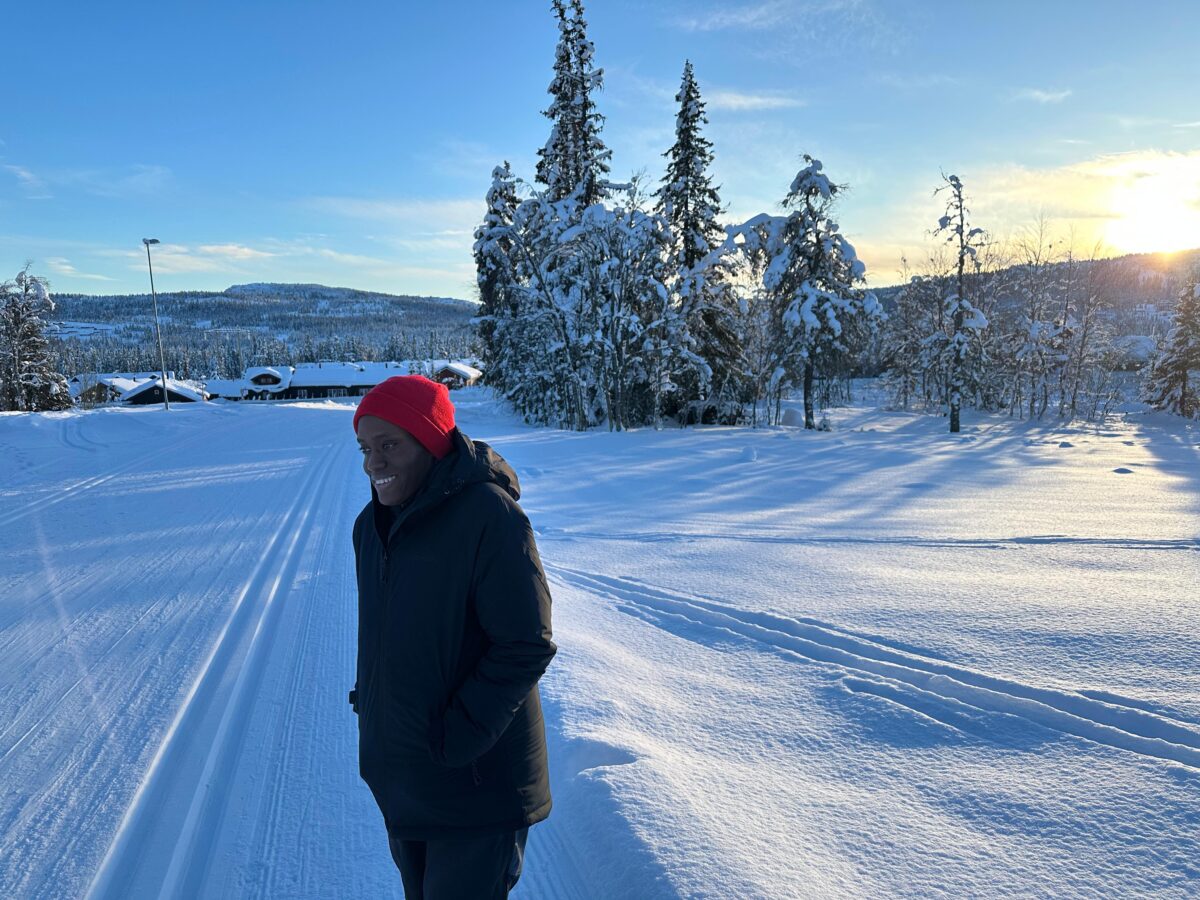 Left: Freeman cross-country skiing in Gausdal, Norway. Right: Freeman enjoys a walk in the mountains.
“I love this city. It’s not crowded. You can take a hike up a mountain any day of the week. Mount Fløyen is the closest and most popular mountain in Bergen,” said Freeman. “So many beautiful views and at the top, you can also get hot chocolate, coffee, and Norwegian waffles. It’s all really nice.” While she enjoyed the outdoors, Freeman did have some first-day jitters when it came time to join the research team.
“I was a bit hesitant when I arrived because I had just graduated with my bachelor’s, and most of my colleagues had a Ph.D. or were earning one. I was a bit worried about fitting in. But they welcomed me with open arms,” says Freeman. “Bergensere really value you and your voice, no matter what. It doesn’t matter if you have a degree or not, they really value you and make sure your voice is heard.”
This practice of equality and community above all is called Janteloven, a Scandinavian cultural, social, and literary concept that emphasizes equality, humility, and collective conformity over individual achievement. Freeman’s welcome was an example of Janteloven. This extends to architecture, clothing, and even standing in line.
I was a bit hesitant when I arrived because I had just graduated with my bachelor’s, and most of my colleagues had a Ph.D. or were earning one. I was a bit worried about fitting in. But they welcomed me with open arms,” says Freeman. “Bergensere really value you and your voice, no matter what. It doesn’t matter if you have a degree or not, they really value you and make sure your voice is heard.
Shanika Freeman ’24
Individualized Study
“From my perspective, a lot of Norwegians are sort of hard to crack because they don’t usually do small talk. Back in Baltimore, if you’re standing in line at the grocery store, you can strike up a conversation with anyone. Not here so much,” explains Freeman. “They’re not being rude. They value your time, and they value their time as well, and don’t want to inconvenience anybody. It’s a cultural norm.”
Janteloven in the prison system
Possibly because of this norm, it took time for Freeman to find participants who wanted to focus on their own story. “It’s such a sensitive subject that I researched. One of the challenges I faced was helping participants feel comfortable speaking,” said Freeman. “I talked about their feelings during incarceration and reentry. It’s a very vulnerable state to be in.” Her Fulbright research advisors stepped in and connected Freeman with a few participants and guided her to pivot from solely focusing on reentry to include the system side of the process by speaking with experts in the field of criminology and penology—the philosophy, management, and effectiveness of prison systems and rehabilitation methods.
“One of my main findings was that Norway’s successful reentry is shaped primarily by its welfare system. It is set up to help with social support, housing, education, and job support. They have something called the import model,” said Freeman, “which means that they rely on external public services like healthcare, education, and libraries that are delivered by community providers rather than the prison staff themselves.” Freeman notes that this is in stark contrast to what she found in her research on the U.S. reentry process, where these services are usually contracted out. In Norway, staff are almost always civilians from the same communities into which the residents—Norway doesn’t use the term inmate or prisoner—will be released.
Freeman found a successful example to observe at WayBack, a Norwegian nonprofit foundation that supports formerly incarcerated individuals’ return to society by coordinating services and building networks for successful reintegration. However, the process doesn’t end there. WayBack’s approach to intervention is also based on peer-to-peer mentorship, a form of rehabilitation support Freeman has rarely seen in Baltimore.
 Freeman presents her research at Bergen Global. (Image courtesy of Freeman)
“Norway’s welfare state and broader cultural belief systems, Janteloven included, reinforce the idea that the conviction and sentence to prison itself is the punishment,” Freeman explained. “So while you are inside, rehabilitation should be the main priority.”
But nothing is perfect. Another of Freeman’s findings includes the shortcomings of the Norwegian incarceration system. Freeman explained that there are prisons where women have limited gender-specific support and lack the services needed to overcome major barriers, including trauma, addiction, and mental health. “There was a recent report criticizing Trondheim Prison, a few hours from Bergen, due to human rights violations,” said Freeman, after submitting her research. “This was extremely surprising to me. They were in violation of mishandling medication, isolation, and unsanitary conditions, to name a few. So, despite all of the progress, there are still things that aren’t being addressed as quickly as others might want, but at least they are working to address it.”
Human rights in Bergen and Baltimore
After four seasons in Norway, Freeman is packing up and preparing to return home to Baltimore, leaving with a greater appreciation for Janteloven. She is hopeful that one day she will return to the city between the seven mountains either for travel or to pursue a master’s program to continue her research. In the meantime, Freeman is already working on adding a visual element to her research, as she plans to spend the summer filming a documentary on the impact of incarceration on Baltimore communities and families.
“Having both the reentering system and the criminal system perspectives made my research stronger. My main goal is to work with reentry programs or even programs inside the prison system,” says Freeman. “I want people to think about the human rights of people in the prison system. No matter what they did, just because they were inside, it doesn’t mean they don’t deserve basic human rights.”
Read more Fulbright stories and learn about UMBC’s Fulbright preparation.
]]>
After Shanika Freeman ’24 walked across the stage, she had something on her mind—basic human rights. For the past four years, Freeman’s research has focused on the reentry experiences of formerly...
https://umbc.edu/stories/from-baltimore-city-to-bergen-norway-fulbright-shanika-freeman-expands-her-research/
https://my3.my.umbc.edu/api/v0/pixel/news/160554/guest@my.umbc.edu/b95daa68b2e4f15f656d7bd54ea77e58/api/pixel
cahss
fulbright
inds
international
news
policy-and-society
story
UMBC News & Magazine
https://my3.my.umbc.edu/groups/umbc-news-magazine
https://assets1-my.umbc.edu/system/shared/avatars/groups/000/001/943/24435aa6207c452e7bc15cc74b42c7bb/xsmall.png?1748556657
https://assets1-my.umbc.edu/system/shared/avatars/groups/000/001/943/24435aa6207c452e7bc15cc74b42c7bb/original.png?1748556657
https://assets2-my.umbc.edu/system/shared/avatars/groups/000/001/943/24435aa6207c452e7bc15cc74b42c7bb/xxlarge.png?1748556657
https://assets2-my.umbc.edu/system/shared/avatars/groups/000/001/943/24435aa6207c452e7bc15cc74b42c7bb/xlarge.png?1748556657
https://assets3-my.umbc.edu/system/shared/avatars/groups/000/001/943/24435aa6207c452e7bc15cc74b42c7bb/large.png?1748556657
https://assets1-my.umbc.edu/system/shared/avatars/groups/000/001/943/24435aa6207c452e7bc15cc74b42c7bb/medium.png?1748556657
https://assets2-my.umbc.edu/system/shared/avatars/groups/000/001/943/24435aa6207c452e7bc15cc74b42c7bb/small.png?1748556657
https://assets1-my.umbc.edu/system/shared/avatars/groups/000/001/943/24435aa6207c452e7bc15cc74b42c7bb/xsmall.png?1748556657
https://assets2-my.umbc.edu/system/shared/avatars/groups/000/001/943/24435aa6207c452e7bc15cc74b42c7bb/xxsmall.png?1748556657
UMBC News & Magazine
3
0
false
Thu, 04 Jun 2026 15:16:08 -0400
Thu, 04 Jun 2026 15:16:08 -0400
Zareen Taj earns her Ph.D., publishing the first autoethnography by a Hazara Afghan woman about the ongoing genocide of Hazara women under Taliban rule
This spring on Thursday evenings, students filled room 424 in the Fine Arts building for their Asian Diaspora in Motion: Media, Culture, Identity, and Activism class. At the head of the classroom was Zareen Taj, who designed the new 300-level class based on her experiences as a documentary filmmaker and activist defending the rights of her community—the Hazara women of Afghanistan, a community that has for over a century experienced extreme ethnic, religious, and gender oppression, including multiple massacres and starvation, under Taliban rule.
It’s a reality Taj grew up with as part of the Hazara people, a religious and ethnic minority. In the 1990s, when the Taliban increased their killings of the Hazara people, Taj and her family fled to a refugee settlement in Pakistan. There, Taj started speaking out against the systemic oppression of Hazara women. Her activism made her a Taliban target. With a scholarship from the Feminist Majority Foundation, Taj fled once more, this time to Towson University, where she earned a bachelor’s in political science and women’s studies and a master’s in women’s studies.
After graduation, Taj worked for Voice of America as an international broadcaster and producer. At UMBC, she worked for Chartwells in the HR department first and then as an accounting associate at The Shriver Center. A year later, Taj was accepted into the language, literacy, and culture (LLC) doctoral program. During her studies, she raised two children and created four short documentaries about Hazara women while teaching in the global studies, Asian studies, and American studies departments.
This semester, Taj successfully defended her dissertation, “Journey of a Scholar-Activist: An Autoethnographic and Multimodal Inquiry,” which includes written narratives and her fourth documentary short film titled “For My People.” The project marks the first time she took the time and space to reflect on her life.
“I learned from this journey that I am different. I look different. I work differently. I see things differently, but my difference is not a problem,” says Taj about her experience at UMBC, where she hopes to become a professor. “My experience is an asset. It’s my wealth. The UMBC community, particularly the LLC and my professors, were very supportive of what I’m doing. So they supported me at each stage of my life.”
Q: What was your journey to UMBC?
A: I studied in a refugee displacement settlement in Pakistan, so it was very hard. But I got the Feminist Majority Scholarship and moved to Maryland in 2000 to attend Towson University. I could not speak English well. I saw a computer for the first time in my life. It was very hard because I came from a very war-torn country. We don’t have that advanced education system, and it’s often interrupted by war. Every minute, I reminded myself about the other Afghan girls who didn’t have this opportunity, so I couldn’t give up.
I always wanted to get a Ph.D. That was my dream. I put all of my experiences into my academic world. In 2018, I applied to the LLC doctoral program. I talked with Carole McCann, professor of gender, sexuality, and women’s studies, about what I wanted to do. She said yes to being my advisor right away. Joby Taylor, Ph.D. ’05, assistant vice provost and co-leader of The Shriver Center for Public Service and Community Engagement, and Tania Lizarazo, associate professor of modern languages, linguistics, and intercultural communication, and global studies, also lent their support as co-chairs.
Q: How did you decide on the topic for your dissertation?
A: My master’s thesis, titled “Dual Identity, Dual Oppression of Hazara Women,” didn’t follow the same research path as a traditional thesis because there were no official documents that I could use for my research. I felt frustrated. My thesis was informed by my firsthand research trips to Afghanistan. This work represents the first contribution of its kind in the academic field. My personal experiences and frustrations motivated me to return to my country, which ultimately shaped and grounded the development of my thesis.
For my dissertation, my committee wanted me to talk about myself, to write a book. I appreciated them encouraging me, but I continued to focus on Hazara women until Dr. Tanya Saunders, associate professor of sociology, pointed out all the different types of ethnography I was doing and encouraged me to focus on myself to do an autoethnography. I was surprised that I could do that, and that’s how I started.
That gave me a kind of confidence in my writing. I’m always reflecting on all of these things I’m doing, but not reflecting on myself. I never had the chance, or I never thought of doing it. I never thought I would be allowed to talk about myself, so I didn’t. I come from a culture where we never talk about ourselves because this is taboo. Women would be told, “Why are you talking about yourself? We have bigger issues, bigger things to talk about.” That’s the culture, especially for Hazara women. We never talk about ourselves, our pain, our joy. Everything is internalized.
I am reaching a stage of very clear realizations about how this academic process is a very healing process for me. I’m making my people visible and bringing awareness to the cause. We’ll get to know people, my people, my ethnicity, their suffering, and also the resilience of these women.
Q: Why was this dissertation process a healing process?
A: My short documentary, “For My People,” which I produced for my dissertation, helped me process the anger and isolation I have carried after years of fighting for survival and against oppression. This process led to exploration and, for the first time, I explored healing and the shift to joy, community, and belonging I have found with the Hazara women who resettled in Washington, D.C., my global network of activists, and my UMBC community.
The more work I’m doing in the form of writing an article, creating films, or public speaking, the more visibility I have to those dimensions, those identities. It’s helping me feel that I do justice for them. That’s the process of healing. The more I work to bring community sustainability and collectiveness, the stronger my sense of belonging, satisfaction, and deep attachment to my community.
Q: What inspired the topics for your other films?
A: I was doing my master’s thesis about Hazara women, but there wasn’t much data. I decided to go back to Afghanistan for the first time since fleeing Pakistan to document the living conditions and experiences of Hazara women living under the fear of genocide. When I returned, I had 40 hours of videotapes, 700 photographs, and 20 hours of cassette recordings that helped me make my first film, “The Oppression of Hazara in Afghanistan.”
But I didn’t just want to show the oppression of Hazara women as victims. I wanted to show the resistance and leadership of Hazara women. After the fall of the last Afghan government in 2021, some Hazara refugees came to the Washington, D.C., Maryland, Virginia area. We have a lot of activists and advocates like Azra Jafari, the first woman in Afghanistan to hold the office of mayor. They were willing to be interviewed for “Our Face Tells: Seeing the Genocide of Hazaras in Afghanistan.”
Last year, I collaborated with several organizations and led efforts to train Hazara women to create and share their own stories. The Hazara Women of Afghanistan Share Digital Stories event trained and supported Hazara women to tell their own stories. That inspired “Voices of Resistance.”
Q: How have you passed on your documentary film skills to your students?
A: UMBC has given me so much and helped me to contribute to it. I taught three years in the global studies program as a visiting lecturer, and I designed, established, and taught Global Studies 409: Documentary Film as Global Activism. Students had to make a documentary about their families from any part of the world. They had to document where their identity and sense of belonging came from. Their films reflected their family backgrounds as well as their personal passions and engagement with social issues.
I still remember a student whose grandparents came from Ethiopia. His film was about them, and afterwards told me that when he was given the assignment, he said to himself, “If this lady, this lady from Afghanistan, can do these films, I can do that too.” It made me smile
Q: Looking back on everything that you have experienced and accomplished, has your purpose changed?
A: In 2021, when the Taliban returned, it was like the loss of a 20-year-old child. It was hard not to despair. But in all the chaos, some Hazara were able to get out and needed help arriving to live in the United States. That service rescued me from that vulnerable situation. Community work changed me again. It lifted me up.
 Zareen Taj (first row, second from the left), at the Hazara Women of Afghanistan Share Digital Stories event. (Image courtesy of Taj.)
After the Hazara Women of Afghanistan Share Digital Stories event, I realized I do not need to feel the responsibility to speak for Hazara women, as they are now able to articulate and share their own stories with the world. This is my message for Hazara around the world, especially Hazara women who feel like their stories do not matter. You need to tell your story because your story is our history. And your story is our future. Sharing our stories will hold us together and make us known to the world.
]]>
This spring on Thursday evenings, students filled room 424 in the Fine Arts building for their Asian Diaspora in Motion: Media, Culture, Identity, and Activism class. At the head of the classroom...
https://umbc.edu/stories/zareen-taj-publishes-first-autoethnography-by-a-hazara-afghan-woman/
Video Preview
https://assets3-my.umbc.edu/system/shared/attachments/20bf119d8a261843c018236f19c8a261/6a9fe67c/news/000/159/731/e0c4ba8f6e02c02ed67cc30334e8c183/2498820.jpg?1778009707
https://my3.my.umbc.edu/api/v0/pixel/news/159731/guest@my.umbc.edu/f9e9ea2143bc436276841dd469489856/api/pixel
asianstudies
cahss
class-of-2026
global-studies
gwst
international
language-literacy-and-culture
mlli
news
policy-and-society
saph
shrivercenter
story
UMBC News & Magazine
https://my3.my.umbc.edu/groups/umbc-news-magazine
https://assets1-my.umbc.edu/system/shared/avatars/groups/000/001/943/24435aa6207c452e7bc15cc74b42c7bb/xsmall.png?1748556657
https://assets1-my.umbc.edu/system/shared/avatars/groups/000/001/943/24435aa6207c452e7bc15cc74b42c7bb/original.png?1748556657
https://assets2-my.umbc.edu/system/shared/avatars/groups/000/001/943/24435aa6207c452e7bc15cc74b42c7bb/xxlarge.png?1748556657
https://assets2-my.umbc.edu/system/shared/avatars/groups/000/001/943/24435aa6207c452e7bc15cc74b42c7bb/xlarge.png?1748556657
https://assets3-my.umbc.edu/system/shared/avatars/groups/000/001/943/24435aa6207c452e7bc15cc74b42c7bb/large.png?1748556657
https://assets1-my.umbc.edu/system/shared/avatars/groups/000/001/943/24435aa6207c452e7bc15cc74b42c7bb/medium.png?1748556657
https://assets2-my.umbc.edu/system/shared/avatars/groups/000/001/943/24435aa6207c452e7bc15cc74b42c7bb/small.png?1748556657
https://assets1-my.umbc.edu/system/shared/avatars/groups/000/001/943/24435aa6207c452e7bc15cc74b42c7bb/xsmall.png?1748556657
https://assets2-my.umbc.edu/system/shared/avatars/groups/000/001/943/24435aa6207c452e7bc15cc74b42c7bb/xxsmall.png?1748556657
UMBC News & Magazine
0
0
false
Tue, 05 May 2026 15:29:15 -0400
Tue, 05 May 2026 15:29:15 -0400
UMBC’s Global Learning Lab receives Innovative Excellence in Internationalization Award
The Association of International Education Administrators (AIEA) has awarded UMBC’s Global Learning Lab one of two Innovative Excellence in Internationalization Awards. This award honors creative, replicable, and innovative initiatives that are critical to internationalization and require strong leadership to achieve. The AIEA commends the Global Learning Lab for reflecting UMBC’s commitment to justice, equity, diversity, and inclusion by fostering inclusive, cost-effective models that integrate global perspectives into the curriculum.
The lab’s primary mission is to support faculty development in increasing student access to global learning opportunities. Through a cohort-based model, the lab brings faculty together for a series of workshops to develop best practices for integrating applied global learning into the curriculum. The initiative was originally launched as a pilot program by the Center for Global Engagement (CGE) and the College of Arts, Humanities, and Social Sciences (CAHSS) Dean’s Office in support of CAHSS faculty. In fall 2025, the lab was opened to all faculty with support from the Office of the Provost. Faculty who participate in this initiative produce concrete deliverables, such as course maps, faculty-led study abroad programs, and Collaborative Online International Learning (COIL) projects.
“To date, 48 faculty members have participated across 27 unique departments ranging from biological sciences to visual arts to chemical, biochemical, and environmental engineering,” according to Provost Provost and Senior Vice President for Academic Affairs, Manfred van Dulmen‘s February campus newsletter. “Projects continue to positively impact the student experience and have included nine mapping initiatives, 12 COIL projects, and 27 study abroad programs.”
Developing an intercultural curriculum
To receive the Excellence in Internationalization Award, the Global Learning Lab had to be grounded in the principles of comprehensive internationalization—an inclusive process that impacts teaching, research, and service. It also had to align with at least two of UNESCO’s 17 Sustainable Development Goals, reflect the underlying principles of justice, equity, diversity, and inclusion in higher education, and serve as a replicable model for other institutions.
Cheryl North, clinical associate professor of education, and Takashi Yamashita, director and professor of sociology, anthropology, and public health (SAPH), are alumni of the inaugural cohort. They were both in the process of designing international university and community partnerships, in Germany and Japan, respectively, before the Global Learning Lab was launched. The lab provided technical and collegial support that bridged the gap between idea and implementation.
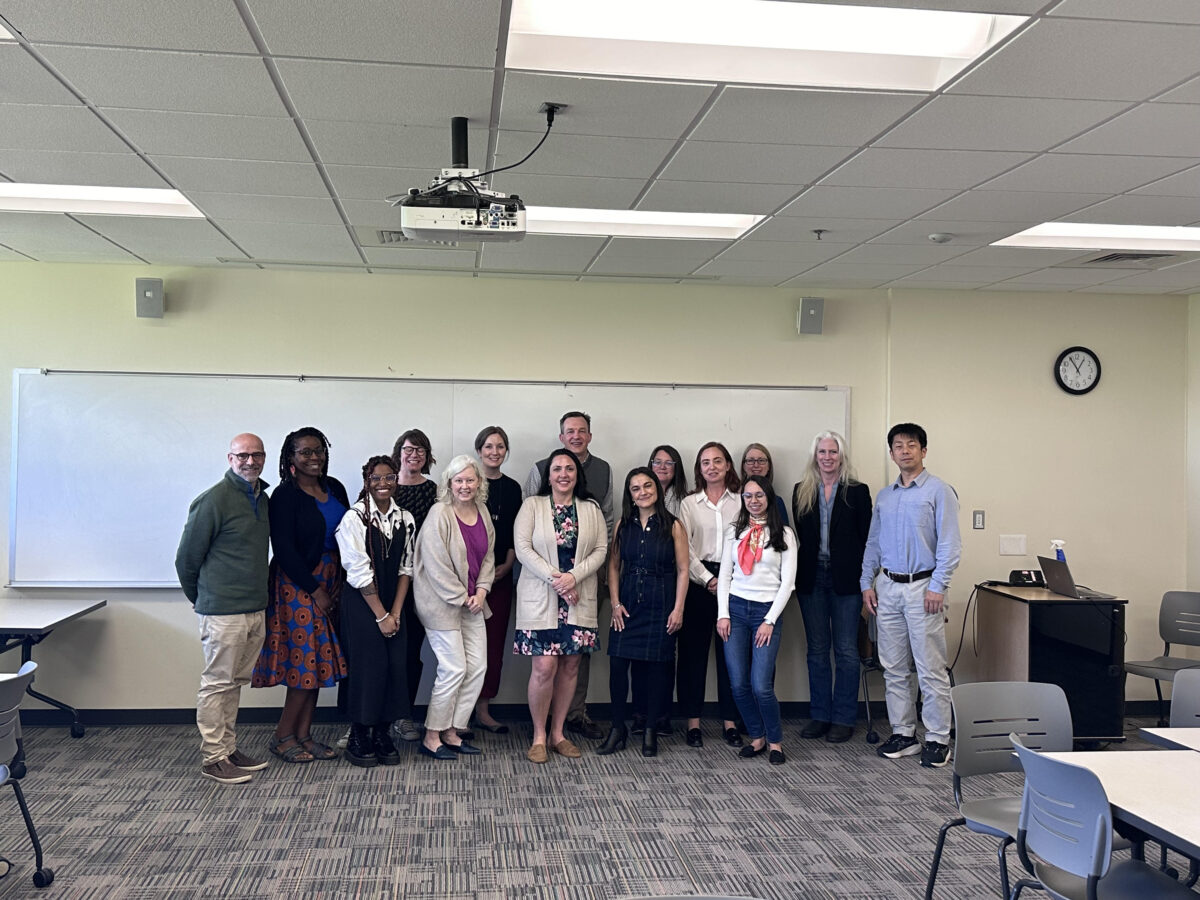 (l-r): Brian Souders (former CGE staff); Ogonna Owu Jones (former CGE staff); Alicyn Curtis (CGE staff); Rebecca Grenouilleau-Loescher (faculty fellow, modern languages, linguistics, and intercultrual communication); Katie Birger (faculty fellow, SAPH); Jessica Cook (faculty fellow, Sondheim Public Affairs Scholars Program); Katherine Heird (CGE staff); David Schultz (faculty fellow, pscyhology); Yolanda Valencia (faculty fellow, geography and environment sciences); Lauren Clay (faculty fellow, emergency and disaster health services); Racquel Matos (visiting dean of the faculty of education and psychology at Universidade Católica Portuguesa in Portugal); Jessica Pfeifer (faculty fellow, philosophy); Lina Mora (CGE intern/intercultural communication graduate student, North (second on the right); and Yamashita (first on the right). (Image courtesy of CGE)
North, along with faculty at the University of Kassel in Germany, had established the foundations for a virtual classroom exchange for their education students, but had experienced technical and scheduling conflicts. “After participating in the Global Learning Lab, we learned to structure the collaboration effectively,” said North. “When we implemented these insights, UMBC students were able to share completed lessons and reflections, while the German students shared their process in the early stages of planning and implementation. Despite the scheduling differences, the exchange was successful, meaningful, and professionally enriching for everyone involved.”
The lab’s funding, technical training, and networking opportunities provided essential support that helped Yamashita develop the Global Health and Aging in Japan faculty-led study abroad program, which will launch in summer 2026.
“Developing a study abroad program can often feel like an isolated effort for a single faculty member,” says Yamashita. “Having a dedicated technical support team from CGE, along with a community of UMBC colleagues to share unique ideas, made the process much more engaging. These interactions kept me inspired and motivated to bring this program to UMBC students.”
Campus-wide internationalization
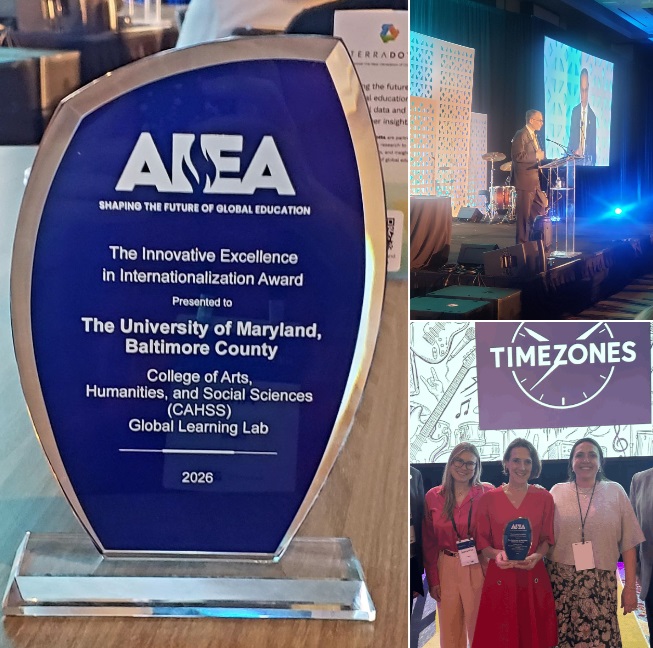
UMBC faculty and staff at the AIEA award. (Image courtesy of CGE)
“The impact of the Global Learning Lab has been profound,” wrote Ana Oskoz, vice provost for faculty affairs, in her recommendation letter. “It is a shining example of innovative internationalization that prioritizes inclusivity, equity, and academic excellence.”
Faculty interested in participating in the Global Learning Lab are encouraged to follow the Faculty Affairs page on MyUMBC for notifications regarding future offerings.
]]>
The Association of International Education Administrators (AIEA) has awarded UMBC’s Global Learning Lab one of two Innovative Excellence in Internationalization Awards. This award honors creative,...
https://umbc.edu/stories/umbcs-global-learning-lab-receives-internationalization-award/
https://my3.my.umbc.edu/api/v0/pixel/news/157429/guest@my.umbc.edu/139f4df23c515634323db492b84665cc/api/pixel
cahss
center-for-global-engagement
community
education
international
news
research
saph
story
UMBC News & Magazine
https://my3.my.umbc.edu/groups/umbc-news-magazine
https://assets1-my.umbc.edu/system/shared/avatars/groups/000/001/943/24435aa6207c452e7bc15cc74b42c7bb/xsmall.png?1748556657
https://assets1-my.umbc.edu/system/shared/avatars/groups/000/001/943/24435aa6207c452e7bc15cc74b42c7bb/original.png?1748556657
https://assets2-my.umbc.edu/system/shared/avatars/groups/000/001/943/24435aa6207c452e7bc15cc74b42c7bb/xxlarge.png?1748556657
https://assets2-my.umbc.edu/system/shared/avatars/groups/000/001/943/24435aa6207c452e7bc15cc74b42c7bb/xlarge.png?1748556657
https://assets3-my.umbc.edu/system/shared/avatars/groups/000/001/943/24435aa6207c452e7bc15cc74b42c7bb/large.png?1748556657
https://assets1-my.umbc.edu/system/shared/avatars/groups/000/001/943/24435aa6207c452e7bc15cc74b42c7bb/medium.png?1748556657
https://assets2-my.umbc.edu/system/shared/avatars/groups/000/001/943/24435aa6207c452e7bc15cc74b42c7bb/small.png?1748556657
https://assets1-my.umbc.edu/system/shared/avatars/groups/000/001/943/24435aa6207c452e7bc15cc74b42c7bb/xsmall.png?1748556657
https://assets2-my.umbc.edu/system/shared/avatars/groups/000/001/943/24435aa6207c452e7bc15cc74b42c7bb/xxsmall.png?1748556657
UMBC News & Magazine
8
0
false
Thu, 12 Mar 2026 10:10:48 -0400
Fri, 13 Mar 2026 15:49:18 -0400
Retrievers gone global: 5 ways UMBC fosters international engagement
As International Education Week 2025 comes to a close, we’ve rounded up a few of the many ways Retrievers engage globally through their work and studies. Even though it has been a particularly trying time for international students, “…more UMBC students studied abroad in Academic Year 2024 – 25 than ever before. Our students are discovering new perspectives, building global connections, and transforming their futures through these life-changing experiences,” says Katie Heird, director of education abroad and global learning at UMBC. Here are a few ways international students and Retrievers who have gone abroad play a role in the lifeblood of UMBC.
1. Who is Fulbright material?
UMBC’s six 2025 – 2026 Fulbright U.S. Student Program recipients share their not-so-secret recipe for success. Deciding to apply for a Fulbright is just the first step, and with the support of UMBC’s Center for Global Engagement, which hosts Fulbright information sessions in the spring for undergraduate, graduate, and recent alumni. Retrievers can apply to earn a master’s, conduct research, or be an English Teaching Assistant in more than 160 countries. With the UMBC 2025 – 2026 Fulbrights already settled in Taiwan, Norway, and Indonesia, Belgium, Israel, and Germany, these alumni are eager to share tips to inspire and prepare the next generations of Fulbright Retrievers.
 UMBC’s 2025 – 2026 U.S. Fulbright Program class. (Brad Ziegler/UMBC)
Additionally, this year, four UMBC faculty and staff members received highly competitive Fulbright U.S. Scholar awards to teach, conduct research, and foster cross-cultural connections globally. The recipients span all three UMBC colleges and comprise three faculty members and one staff member. The UMBC awardees are connecting with international partners in areas of shared interest. Augusto Casas, an associate teaching professor of information systems, is working in Colombia; Cynthia Wagner, a teaching professor of biological sciences, went to Kyrgyzstan; Irene Chan, a professor of visual arts, is in Romania; and Tom Penniston, M.A. ’09, TESOL, Ph.D. ’14, language, literacy, and culture, the coordinator of learning analytics in the Division of Information Technology, is working in Croatia.
2. Building intentional international connections
A six-person UMBC team built international connections at the “PIWOT – World of Technology” conference, held in early 2025 in Mumbai, India. The science and technology conference is organized by the alumni association for graduates of the prestigious Indian Institutes of Technology (IITs), and attracts many of the leaders in science and technology in India and around the world. The CEO of Alphabet, Inc. (Google’s parent company), the co-founder of Sun Microsystems, and the CEO of IBM are all graduates of IITs.
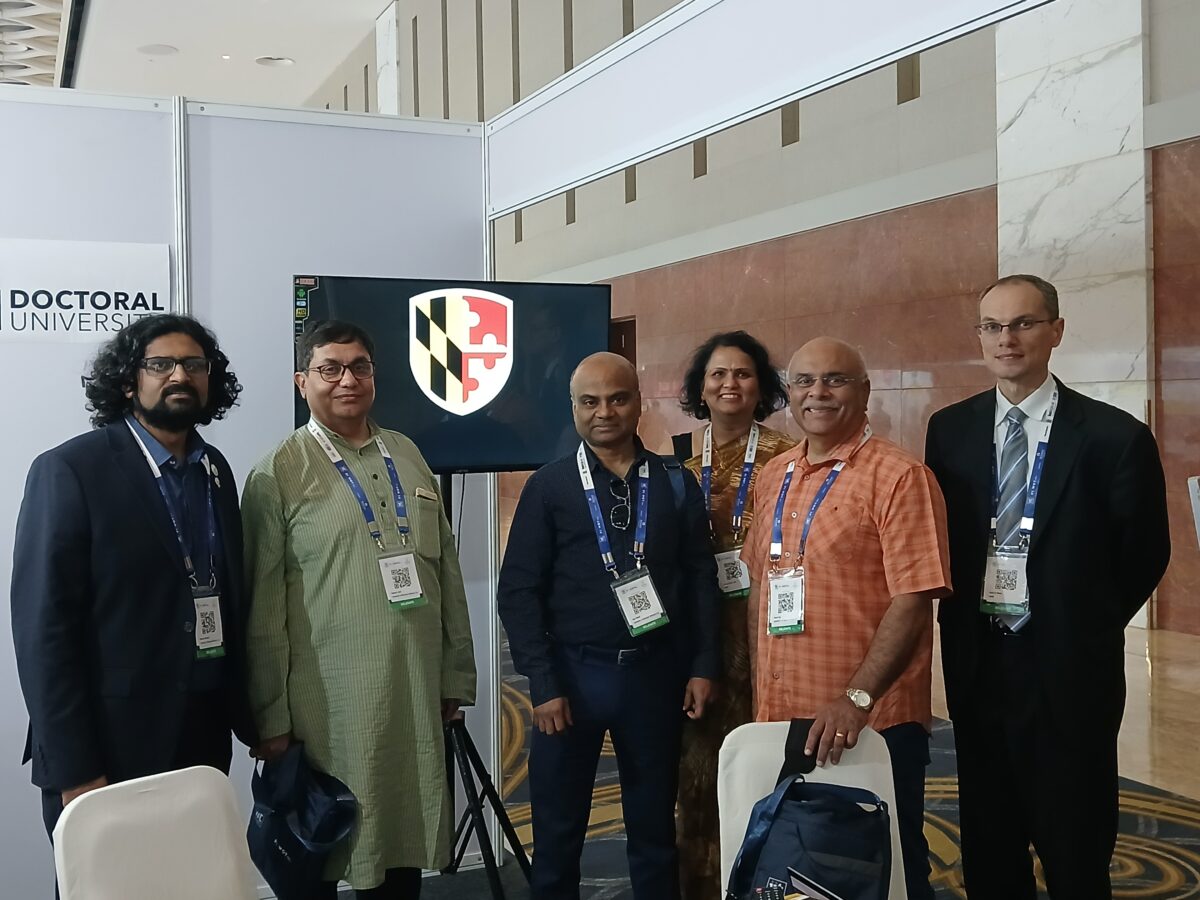 UMBC PIWOT attendees (l-r): Ramana Vinjamuri, associate professor of computer science and electrical engineering and director of the NSF IUCRC BRAIN Center; Joshi; Upal Ghosh, professor of chemical, biochemical, and environmental engineering; Karuna Pande Joshi, professor of information systems and director of the NSF IUCRC Center for Accelerated Real Time Analytics; Govind Rao, director of the Center for Advanced Sensor Technology and professor of chemical, biochemical and environmental engineering; and David Di Maria, associate vice provost for international education at UMBC. (Photo courtesy of Karuna Pande Joshi)
This year’s PIWOT conference focused on the impact of technology across multiple dimensions of life, from the professional to the personal. UMBC’s Anupam Joshi, acting dean of the College of Engineering and Information Technology, took part as a speaker on a panel about the impact of technology on education, and the UMBC booth also displayed the low-cost infant incubator developed by Professor Govind Rao.
3. International research collaboration challenges assumptions
Thanks to funding from the German Academic Exchange Service, Lorenz Kopp and Björn Michelmann, mechanical engineering students from Germany’s Regensburg University of Applied Sciences, came to UMBC to conduct research with UMBC’s mechanical engineering professor, Paris von Lockette. The project was part of a bigger assumption-questioning enterprise—in particular, probing the behavior of materials called soft magnets. Kopp’s and Michelmann’s advisor at Regensburg University of Applied Sciences knew von Lockette through the American Society of Mechanical Engineers, and together they arranged the details of the two-month visit with the help of the Office of International Students and Scholars at UMBC.
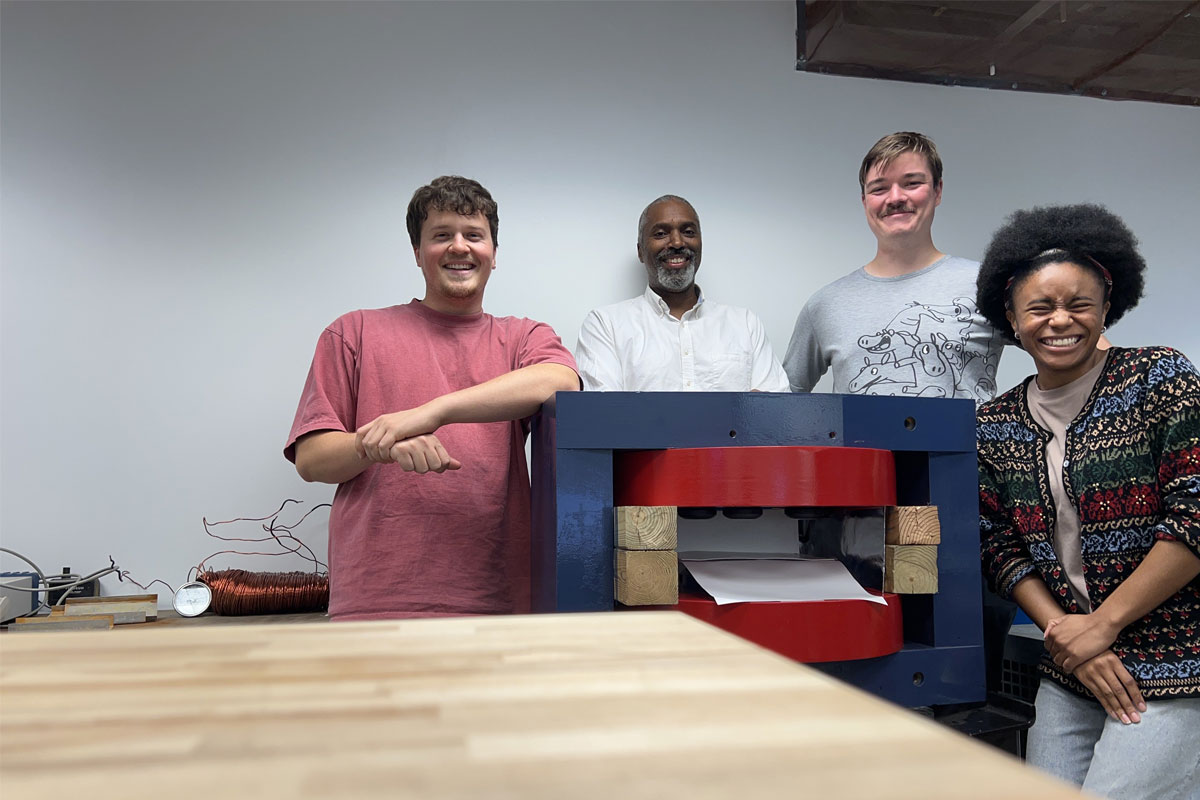 (l-r): Lorenz Kopp, Björn Michelmann, von Lockette, and Tamia Bowers ’23, mechanical engineering, with the electromagnet they set up in the lab. (Brad Ziegler/UMBC)
While Kopp and Michelmann spent plenty of time in the lab during their visit, they also had chances to explore the areas surrounding UMBC on weekends. They visited the National Aquarium in Baltimore, took in a Baltimore Ravens football game, and drove to Shenandoah National Park in Virginia. They also enjoyed campus life, attending Homecoming weekend, and regularly visiting the Retriever Activity Center to work out.
4. Exploring politics in a global context, virtually
Professor Filomeno’s 2024 Collaborative Online International Learning (COIL) Brazil project on climate change equips students with the technical and interpersonal skills to thrive in professional online international and intercultural environments. COIL makes international scholarship and intercultural learning accessible by removing barriers of cost and travel while preparing students with essential skills for future in-person exchanges. COIL Brazil was part of Filomeno’s Global Citizenship class in collaboration with former colleague Clarissa Dri, a professor of international relations at his alma mater, the Federal University of Santa Catarina, in southern Brazil.
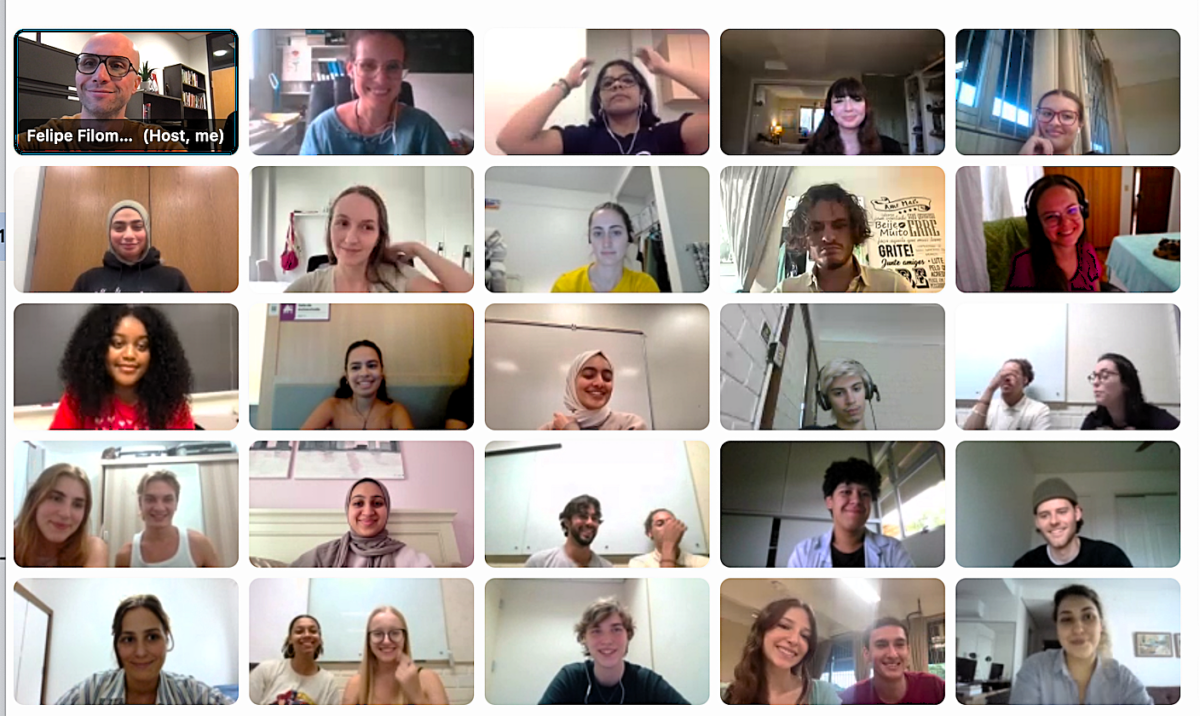 COIL Brazil met online so that students from UMBC and the Federal University of Santa Catarina in southern Brazil could participate. (Image courtesy of Felipe Filomeno.)
The ongoing Virtual Tandem Conversation project was created by Susanne Sutton, a teaching professor of German, and Talke Macfarland, a visiting lecturer of German in UMBC’s Department of Modern Languages, Linguistics, and Intercultural Communication. They established the program during COVID-19 to help UMBC students learning German and German students learning English socialize while continuing to improve their language skills.
The actual tandem meetings are entirely student-driven and take place outside of the classroom—each tandem pair arranges virtual meetings according to their schedule. Tandem participants have gone beyond the virtual classroom, such as UMBC Golden ID Program student Rebecca Smith, who, while on a recent trip to France, hopped over to Germany to visit Gertrud Krause-Traudes, her partner in UMBC’s Virtual Tandem Conversation project. After three semesters of virtual conversations in German and English, Smith was happy to meet Krause-Traudes in person.
5. Science that bridges two worlds
In 2020, as the COVID-19 pandemic disrupted lives worldwide, Greema Regmi began her Ph.D. in UMBC’s atmospheric physics program. Studying remotely from her home in Nepal, she navigated a grueling schedule due to the time difference. Now in her fifth year, Regmi’s perseverance has earned her NASA’s prestigious Future Investigators in NASA Earth and Space Science and Technology (FINESST) fellowship, which will provide up to $50,000 annually for up to three years to fuel her research on atmospheric dust.
 Greema Regmi discussed her research at a recent poster session at UMBC. (Brad Ziegler/UMBC)
Regmi has been able to accomplish so much in part because of the supportive community she found at UMBC, after finally arriving on campus in fall 2021. Regmi’s journey bridges her unique perspectives as a student in Nepal and the U.S. At UMBC, she’s embraced broader opportunities. “I think here you can push the limit. I don’t even know what the limit is in the U.S. Here you can dream more and be more experimental,” she observes.
Grounded in the UMBC physics department’s community of support, Regmi’s confidence has only grown since her arrival in Maryland. “There’s always a place for my opinion, which is very nice. Because of that, and all of the experiences I’ve had, now I have the confidence to start my own project,” she explains. “And that’s why I think now I’m confident to go back home, lead something there, and be helpful in some small way.”
Learn more about UMBC’s international opportunities.
]]>
As International Education Week 2025 comes to a close, we’ve rounded up a few of the many ways Retrievers engage globally through their work and studies. Even though it has been a particularly...
https://umbc.edu/stories/gone-global-umbc-international-engagement/
https://my3.my.umbc.edu/api/v0/pixel/news/154859/guest@my.umbc.edu/4a42a8215afbcd5c0ace5e35458352e2/api/pixel
cahss
cge
cnms
coeit
community
fulbright
international
is
llc
meche
mlli
news
physics
politicalscience
research
story
visualarts
UMBC News & Magazine
https://my3.my.umbc.edu/groups/umbc-news-magazine
https://assets1-my.umbc.edu/system/shared/avatars/groups/000/001/943/24435aa6207c452e7bc15cc74b42c7bb/xsmall.png?1748556657
https://assets1-my.umbc.edu/system/shared/avatars/groups/000/001/943/24435aa6207c452e7bc15cc74b42c7bb/original.png?1748556657
https://assets2-my.umbc.edu/system/shared/avatars/groups/000/001/943/24435aa6207c452e7bc15cc74b42c7bb/xxlarge.png?1748556657
https://assets2-my.umbc.edu/system/shared/avatars/groups/000/001/943/24435aa6207c452e7bc15cc74b42c7bb/xlarge.png?1748556657
https://assets3-my.umbc.edu/system/shared/avatars/groups/000/001/943/24435aa6207c452e7bc15cc74b42c7bb/large.png?1748556657
https://assets1-my.umbc.edu/system/shared/avatars/groups/000/001/943/24435aa6207c452e7bc15cc74b42c7bb/medium.png?1748556657
https://assets2-my.umbc.edu/system/shared/avatars/groups/000/001/943/24435aa6207c452e7bc15cc74b42c7bb/small.png?1748556657
https://assets1-my.umbc.edu/system/shared/avatars/groups/000/001/943/24435aa6207c452e7bc15cc74b42c7bb/xsmall.png?1748556657
https://assets2-my.umbc.edu/system/shared/avatars/groups/000/001/943/24435aa6207c452e7bc15cc74b42c7bb/xxsmall.png?1748556657
UMBC News & Magazine
7
0
false
Tue, 25 Nov 2025 13:03:08 -0500
Tue, 25 Nov 2025 13:03:08 -0500