Open to Interpretation
What if you could ask yourself a big question and then use your intuition to follow it wherever it led for as long as it took? It would take a certain kind of guts, right? But, with a willingness to get lost on a tangent, to joyfully put themselves in positions of not knowing, truly creative thinkers can find new ways of translating the world around them.
Enter the following: A dancer who makes beautiful movement from fish research. An information systems professor who turns poetry into wine. A data visualizer who draws connections while splattering paint. A mapper and sculptor of hip hop facts. A harnesser of color and language and culture.
This is the sort of magic that can happen when you’re open to interpretation.

On a molecular level, the push and pull of an ecosystem may feel too infinitesimal for humans to experience visually. A researcher can track the data in a spreadsheet as a series of characters and marks or explain it with the structure of a scientific article. Microscopes may capture stills or video of tiny worlds, but what about the emotional landscape of life in motion?
“I really am fascinated with the small things we cannot see that are so important,” says Ann Sofie Clemmensen, assistant professor of dance, who spent a year in residence at the Institute of Marine & Environmental Technology (IMET) next to Baltimore’s Inner Harbor working with scientists who study a variety of topics adjacent to aquaculture, environment, and sustainability.
Clemmensen began her residency by diving deeply into the research of the IMET scientists around her—learning about everything from rainbow trout viruses to the ecological wear and tear of red tides. As she built relationships with researchers, she found herself drawn into the details of their studies—and wondering how she might translate what she learned into something that might encourage viewers to learn more about their world.
“There’s a sort of unpacking of the language of that field. Because movement, while it’s not a spoken language, it is language,” she explains, ever the eager translator. “We have to understand the concept we are trying to embody in order for the physical embodiment to carry the meaning.”
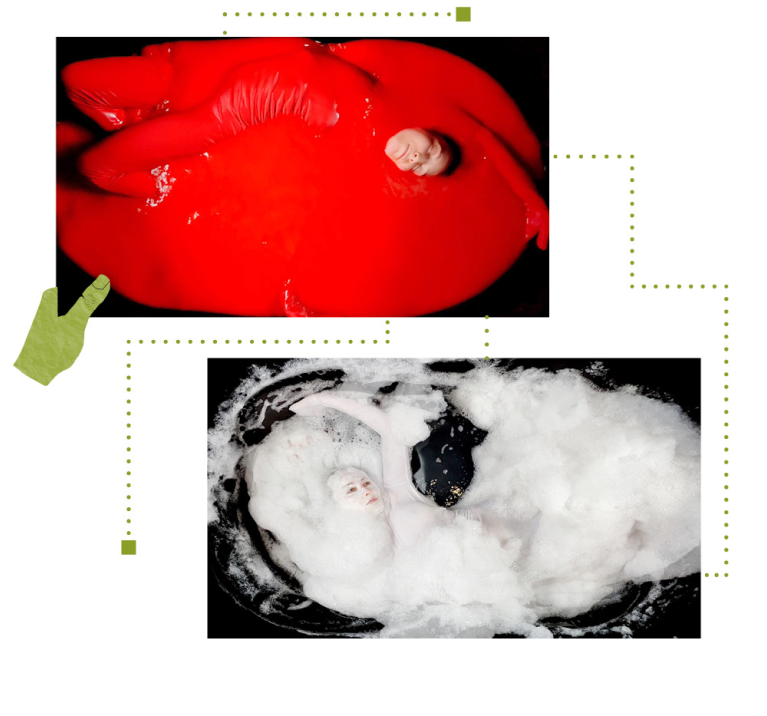
Working with student dancers, Clemmensen choreographed and filmed a series of movements and scenes meant to depict biological processes she learned about from her IMET counterparts. In one, students in masks represent the generic differences of virulent and avirulent strains of the VHSV rainbow trout virus. In another, dancer Michaela Emmerich ’24 (covered in clay powder) rolls in the dirt to show the effect of argonite in reducing levels of phosphorus in farming run-off.
While Clemmensen’s scenes of red tides, green biomass, and white, milky foams are objectively beautiful, don’t be fooled. Nature isn’t pretty, Clemmensen says. But taking a good close look can help us all understand our environment a bit better.
“For many doing art, dance, and data-driven research, it’s like looking at an abstract painting. If you don’t have a little key that can unveil or reveal some of those secrets, then it’s just chaos.”
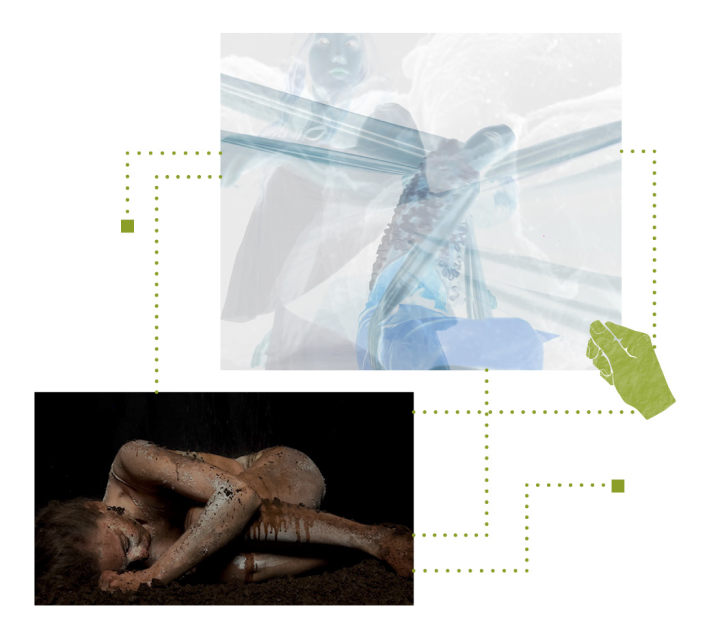
Assistant professor Ann Sofie Clemmensen worked with
researchers at IMET to create a series of videos depicting
microscopic processes like red tides and battling
dinoflaggelates. Photos courtesy of Clemmensen.

A poem crosses time and space, building in meaning as it travels from person to person, from generation to generation. With each new reader, it becomes something new and specific—but also potentially loses something of itself along the way.
As a trained computer scientist, Foad Hamidi, assistant professor of information systems, is fascinated by the practical challenge of being able to retrieve information lost when data is duplicated—an inevitable fact of digital life. As a lifelong lover of Sufi poetry from his home country of Iran, he also can’t help but wonder how to preserve the heart of these precious words, even as circumstances—generations, distance, cultural leanings—might dilute or change them.
“There’s always some information loss” in data duplication, he explains. “However, a very interesting theorem in information theory also says that if you have a lot of replicas of the same code…you can recover the original message in the presence of errors that was in all these codes.”
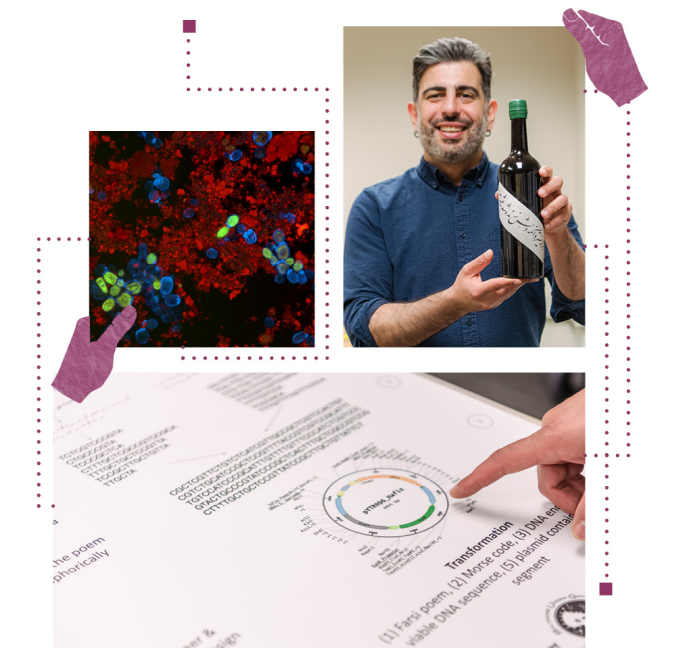
Information systems Professor Foad Hamidi has
translated a favorite childhood poem into DNA code,
wine, and more. Top image (magnified photo of yeast
cells with the modified DNA Hamidi made)
courtesy of Tagide deCarvalho.
Years ago, Hamidi learned about a song that was encoded by Japanese musician Etsuko Yakushimaru using living bacteria as a sort of language, “and it really made me think of the possibilities of information and culture and data and encoding.” And so, at the start of the pandemic, he began exploring ways of translating the poetry of Hafiz, a 14th-century Persian poet, into new, living forms and of sharing the experience with others.
Hamidi’s bio-art-inspired creative inquiry led him first to interpret the poetry as code—DNA, to be precise—culled from the words themselves. He then created a “poetry-infused transgenic wine” using yeast modified with the DNA encoding of the poem. Craving community, he took the idea to other researchers in music, biology, imaging, and beyond to joyfully build further iterations of the chain. These efforts led to an Imaging Research Center (IRC) Faculty Research Fellowship (with Linda Dusman, professor of music), and today, he continues to explore new translations of the coded poem through music, cellular imagery, and even a cluster of mushrooms growing in Hamidi’s office.
With each new link in Hamidi’s poetic chain, the information is replicated and the “data” is one step closer to being saved through this fascinating theorem. In doing so, Hamidi also is able to bring together curious new friends who might not have had reason to collaborate otherwise.
Although Hamidi’s “translations” may seem outside the box, the practice of making a poem one’s own “has a long history,” he explains. “These poems are the DNA of my culture…so our architecture, our music, our visual arts, our cultural traditions, are very much impacted by poetry.”

In a far corner hangs an enormous painting of a brain, with bright blue lines, red arrows, and clips of phrases suggesting ideas in motion. In every direction above it, threads of red and blue crisscross the room anchoring one artwork to the next—a system of knit synapses representing not only 25 years of research but the artistic process that fuels it.
“What I try to do, above and beyond anything else, is show as transparently as possible what that process looks like,” says Lee Boot, director of UMBC’s Imaging Research Center (IRC), whose retrospective exhibit “Abstracts & Artifacts” showed at Baltimore’s Peale Museum earlier this spring.
For Boot, that means a room filled with numbers, images—some animated, many bursting with color—and the connective tissue of the personal paintings he created to process information and experiences related to the various subjects of his research.
“The work is immersive. I paint my brain out as a meditative, reflective process. And then that gets honed, and reshaped, and…out of that automatically comes new perspectives and new ways of framing problems.”
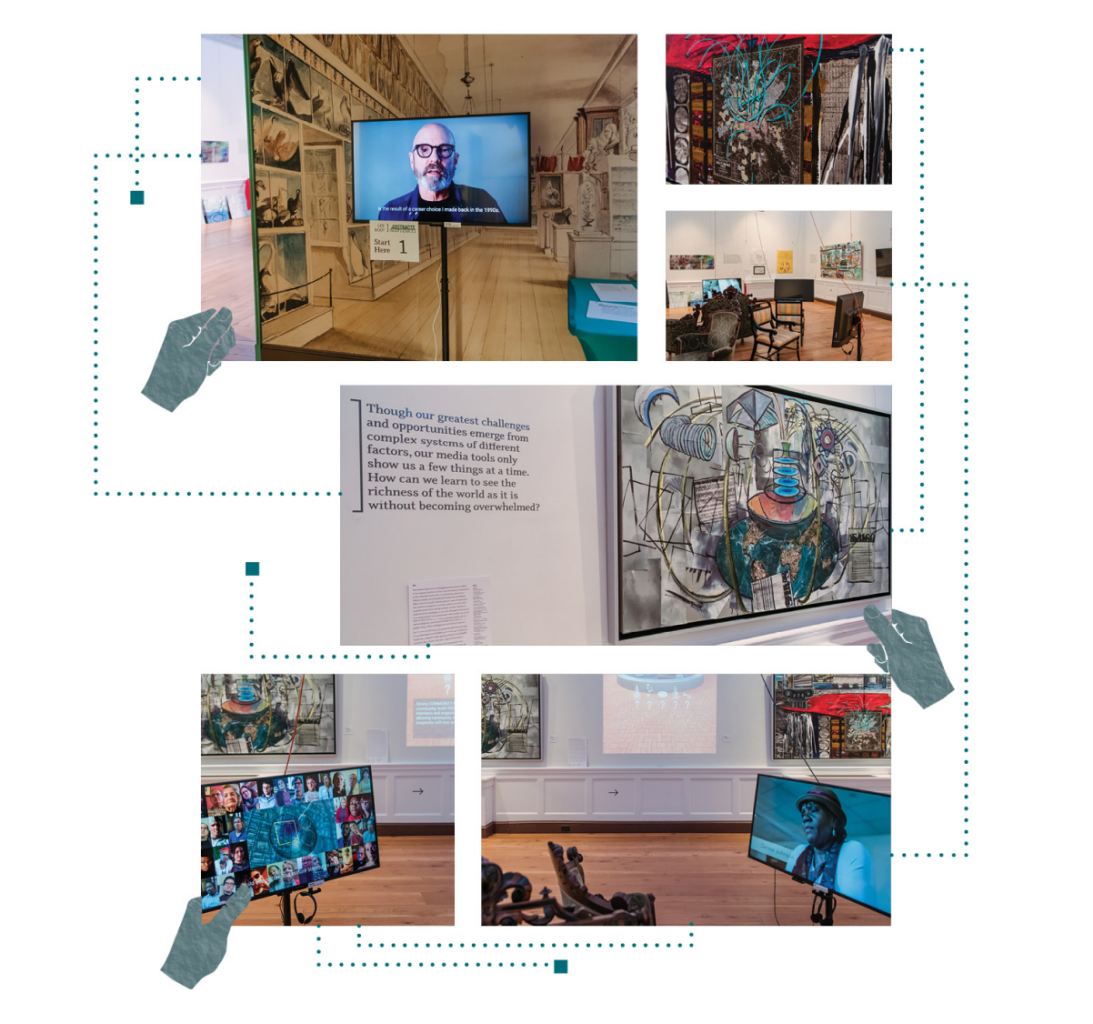 In his exhibit “Abstracts & Artifacts,” Lee Boot asks
viewers to consider new ways of solving problems.
“Almost like dreaming, making art with a question
in mind reveals meaning through metaphor. How
is it that metaphors seem to be both specific and
ambiguous—both personal and universal—at once?”
In his exhibit “Abstracts & Artifacts,” Lee Boot asks
viewers to consider new ways of solving problems.
“Almost like dreaming, making art with a question
in mind reveals meaning through metaphor. How
is it that metaphors seem to be both specific and
ambiguous—both personal and universal—at once?”
Boot lives to solve problems, and believes deeply in the power of combining artists’ ways of thinking with other disciplines to ask questions and find solutions in new ways. Over the years, the IRC has brought together multidisciplinary teams of artists, scientists, and social scientists from state and local agencies, foundations, and other organizations who are open to tackling everything from substance misuse to educational achievement gaps to the epidemiology of pandemics.
And while technology runs much of what the IRC builds, nothing is quite so essential to the heart of the work as one’s own intuition, says Boot. As a classically-trained painter, that means returning to the canvas and allowing his brush to take him in new directions—not to create something beautiful, per se, but to open himself to ideas accessible only through such a personal process.
With each stroke of the brush, and each new color, he pulls from the deepest reaches of experience, community, and understanding, creating a road map for what’s next.
“I’m not trying to make something pretty,” he says. “I am trying to understand how a set of issues sits in being, in my psyche, on the landscape of the world as I understand it. I’m trying to see what I cannot see.”

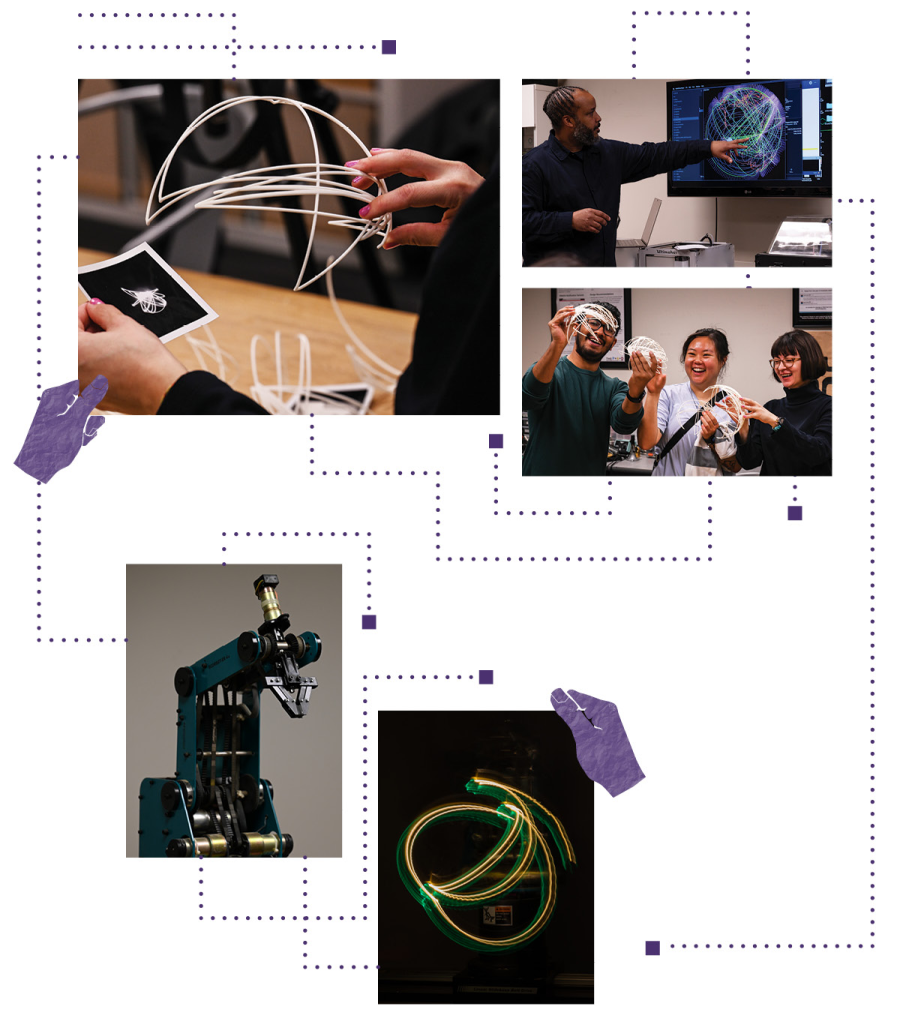
On the table sit three football-sized forms of light plastic. Each has been sculpted in a 3D printer using zigzag motions specifically programmed to mimic the map lit up behind them showing an orange globe splashed with green arcs. Dots on the screen represent locations mentioned in thousands of hip-hop and rap lyrics, as big as the oft-mentioned city of Atlanta and as hyperlocal as the intersection in front of a neighborhood convenience store.
A student gingerly picks up a gold-colored sculpture, and asks, “Is this Kendrick Lamar?” Tahir Hemphill, a faculty fellow, music aficionado, and self-described “creative technologist who works with art,” nods as a collective “oooh” makes its way around the room.
“It’s data sculpture, literally. It’s making things as real as possible,” says Hemphill, whose ever-evolving body of work, The Rap Research Lab, made its home at UMBC’s Center for Art, Design, and Visual Culture this spring. “This is what it feels like to touch a rapper’s rhymes.”
Located at the intersection of hip-hop and data visualization, and built as an interactive teaching space, the lab features the “Mapper’s Delight” tool that, using augmented and virtual reality, cross-references locations from thousands of rap song lyrics along with a variety of other art pieces that speak to Hemphill’s goal of finding “relationships and shapes in the data.”
Over the course of the semester, UMBC students helped Hemphill delve further into the data while middle schoolers from around the state visited the teaching lab with their classes to try their own hands at research using Hemphill’s lyrics database.
On this particular day, Hemphill demonstrates yet another incorporation of the geographic lyric data. In collaboration, Foad Hamidi helped Hemphill program a robotic arm, and by inserting a LED pen into the robot hand and filming movements at a long exposure, he’s able to make “light pen drawings” of the data, à la Pablo Picasso.
With the lights dimmed and the robot arm making ethereal data shapes before their eyes, Hemphill tinkers with his projected spreadsheet in real time. There are just so many threads to follow and infinite stories hidden within.
“My job is to draw them out—pun intended,” he laughs.
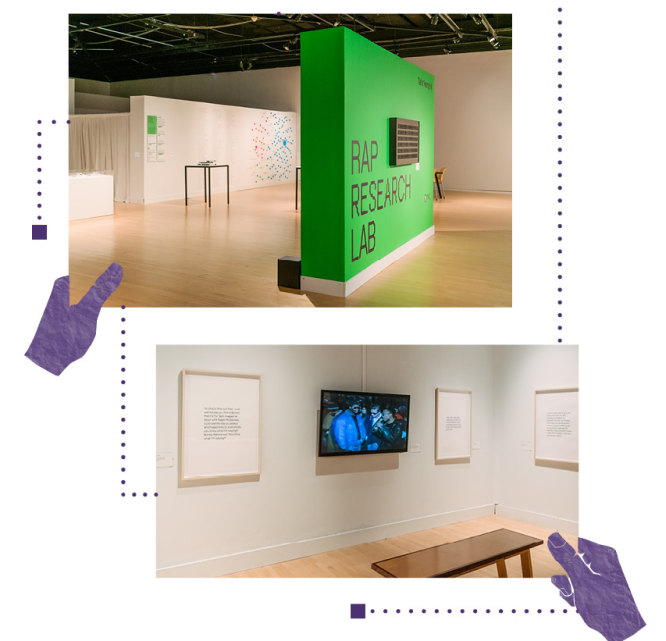
Tahir Hemphill, a faculty fellow, music aficionado, and
self-described “creative technologist who works with
art,” uses data visualization tools to reveal new levels
within hip-hop.
Read how artist Hadieh Shafie, M.F.A. ’04, channels the power of language and her childhood experiences in Iran into intricate and colorful pieces of art.
]]>
What if you could ask yourself a big question and then use your intuition to follow it wherever it led for as long as it took? It would take a certain kind of guts, right? But, with a willingness...
https://umbc.edu/stories/researchers-artists-open-to-interpretation/
https://my3.my.umbc.edu/api/v0/pixel/news/133965/guest@my.umbc.edu/7d78d7c39a954622fea6ad99411873aa/api/pixel
cadvc
dance
discovery
information-systems
irc
magazine
research
spring-2023
UMBC News & Magazine
https://my3.my.umbc.edu/groups/umbc-news-magazine
https://assets1-my.umbc.edu/system/shared/avatars/groups/000/001/943/24435aa6207c452e7bc15cc74b42c7bb/xsmall.png?1748556657
https://assets1-my.umbc.edu/system/shared/avatars/groups/000/001/943/24435aa6207c452e7bc15cc74b42c7bb/original.png?1748556657
https://assets2-my.umbc.edu/system/shared/avatars/groups/000/001/943/24435aa6207c452e7bc15cc74b42c7bb/xxlarge.png?1748556657
https://assets2-my.umbc.edu/system/shared/avatars/groups/000/001/943/24435aa6207c452e7bc15cc74b42c7bb/xlarge.png?1748556657
https://assets3-my.umbc.edu/system/shared/avatars/groups/000/001/943/24435aa6207c452e7bc15cc74b42c7bb/large.png?1748556657
https://assets1-my.umbc.edu/system/shared/avatars/groups/000/001/943/24435aa6207c452e7bc15cc74b42c7bb/medium.png?1748556657
https://assets2-my.umbc.edu/system/shared/avatars/groups/000/001/943/24435aa6207c452e7bc15cc74b42c7bb/small.png?1748556657
https://assets1-my.umbc.edu/system/shared/avatars/groups/000/001/943/24435aa6207c452e7bc15cc74b42c7bb/xsmall.png?1748556657
https://assets2-my.umbc.edu/system/shared/avatars/groups/000/001/943/24435aa6207c452e7bc15cc74b42c7bb/xxsmall.png?1748556657
UMBC News & Magazine
1
0
false
Thu, 08 Jun 2023 19:21:59 -0400
Thu, 08 Jun 2023 19:21:59 -0400
New UMBC grads find entrepreneurial ways to positively impact communities

Kiaron Bailey will soon become the very first graduate of UMBC’s new master’s degree program in community leadership, a path she hadn’t envisioned for herself while working in finance just a few years ago. “From a very young age, my parents instilled in me the importance of giving back. I just didn’t realize that I could pursue that passion and actually sustain myself,” Bailey says. In deciding to make the career shift, “I kind of had a heart-to-heart with myself,” and she realized that entrepreneurship and community impact can go hand in hand.
Bailey learned about the program when she connected with Sonya Crosby at her place of worship. Today, Crosby is assistant vice provost for applied and off-campus programs, but at the time she was director of the Office of Professional Programs, which offered the new master’s degree. Crosby told Bailey about the practical emphasis of the program—how it combined coursework community-based service-learning—and Bailey knew it was what she was looking for.
 Bailey, second from left in second row, and her classmates in a virtual class. Photo courtesy of Bailey.
Appreciating the nuances
As someone who studied finance as an undergraduate—where one plus one equals two—Bailey found the nuanced world of community leadership a bit shocking, she says, laughing. She particularly enjoyed connecting with nonprofits in Baltimore City, using her skills to support their missions while learning more about running community-based organizations.
Next One Up helps Black male youth in their academics, including preparing for the SATs and other college prep. The nonprofit did not yet have a physical space, and Bailey researched possible locations, preparing them to strengthen their services and community connections post-pandemic.
 Bailey, second from right, with her classmates in Baltimore. Photo courtesy of Bailey.
She also worked with The Lazarus Rite, which helps formerly incarcerated people prepare for jobs, obtain gainful employment, learn about budgeting, and develop soft skills to support their success. Bailey developed a survey to help the organization prepare to apply for a grant, and analyzed the survey data.
UMBC’s community leadership program, “definitely helped me get a holistic perspective of what it actually takes to run an organization and the type of tenacity and creativity you need,” she says. Bailey currently works for the Interagency Commission on School Construction for the State of Maryland, and also serves as an administrator of programs and finance, and the liaison for the Maryland Board of Education. She plans to continue that while starting to build a nonprofit supporting physical, mental, and financial wellness.
Creative problem solver
When Princess Sara Njemanze ‘21, chemical engineering, came to UMBC as a freshman, she knew that she wanted to find opportunities to build and to support communities. She started by joining the Shriver Center’s Living Learning Community, a residential floor bringing together students focused on meaningful social change. The experience proved so significant that she remained connected to the group for four years, transitioning through roles as a peer mentor and then as a resident assistant. “It’s my life,” she says, smiling.
 Njemanze, second from right in second row, with her fellow Orientation Peer Advisors in 2018. Photo by Marlayna Demond ’11 for UMBC.
As she explored possibilities for her degree and career paths, Njemanze knew she enjoyed fixing problems through science and engineering and that she loved connecting with people. After meeting Vivian Armor ‘73, American studies, director of the Alex. Brown Center for Entrepreneurship, Njemanze decided to register for an entrepreneurship class. There, she got a chance to partner with students from all different majors and to come up with a product to pitch for a Shark Tank-style presentation. Before long, she added minors in both computer science and entrepreneurship to her degree.
As a France-Merrick Fellow, Njemanze worked with a group of her peers to create initiatives that work to address challenges in Baltimore City and Baltimore County. “Something that I’m really proud of that we worked on and saw the fruits was hosting a leadership program for high school students at Lansdowne High School,” she explains, adding that they asked the students to envision their ideal communities.
 Njemanze, fifth from right, and the France-Merrick 2018-2019 cohort. Photo by Raquel Hamner ’20.
The high school students came to UMBC for a day-long leadership training and created art that was displayed at OCA Mocha, a coffee shop and community gathering space in downtown Arbutus. Njemanze says the opportunity to connect with younger students was meaningful to her and impacted her UMBC experience.
 Njemanze, second from right in front row, with her classmates in Introduction to Intercultural Communication class. Photo courtesy of Njemanze.
During her time at UMBC, Njemanze interned at the Naval Surface Warfare Center, where she was offered a job that will begin after graduation, combining her passion for engineering and creative problem solving. Her long-term vision is creating a nonprofit to support underserved communities gain access to knowledge and skills such as financial literacy, college readiness, and leadership development.
Supporting mental health through tech
Tristan King ‘21, individualized studies, created his own path at UMBC after transferring from Howard Community College (HCC), where he earned an associates degree in computer science. While King was at HCC, he met Joshua Massey ‘14, individualized studies, who was teaching an entrepreneurship course. By talking with Massey during his office hours King learned that at UMBC he could design his own major, and he began to explore the possibilities.
King shares that his personal mental health struggles led him to create a major at UMBC that focused on how technology could support mental health and wellbeing. Through an emerging field called digital therapeutics, he explains, some health care providers are prescribing apps and websites to provide support and resources to people with depression and other mental health challenges.
 King testing the UMBC-UCI-Toyota research prototype. Photo by Sarah King.
At UMBC, King began learning more about tech and accessibility. He worked with Ravi Kuber, associate professor of information systems, on creating obstacle-detection tools so that blind runners could complete their runs independently and safely (research supported by Toyota). King also worked with Lee Boot, director of UMBC’s Imaging Research Center, on data visualization research.
In 2020, he participated in UMBC’s annual Idea Competition through the Alex. Brown Center for Entrepreneurship. His team earned second place for the Sproutful System, which includes a plant container outfitted with sensors that transmit to a phone app, helping the user know what their plant needs to thrive. The app also features daily guided meditations. The idea is that a person will care for themselves and their plant in a daily meditative practice that is both relaxing and rewarding.
 King, top, and his collaborator Andrew Park ’21, individualized studies, presenting at the Idea Competition in 2020.
King’s senior capstone project uses virtual reality to translate metaphor therapy to an immersive environment. “It looks at how people describe depression and anxiety, and sort of visualizes it,” he says. The project combined what he learned through health psychology coursework with his computer science skills, interest in supporting mental health, creativity, and ingenuity to yield a thought-provoking tool.
Energy and commitment
When Amina Mahmood ‘21, computer science, was younger, she would routinely get viruses on her family’s desktop computer while playing online games. Her computing skill set has certainly grown and changed over the years, but her passion for the field remains the same.
As she was applying to colleges, Mahmood focused on institutions with strong resources for students pursuing computer science. She felt elated when offered a spot in UMBC’s Cyber Scholars program, housed within the Center for Women in Technology. She wanted to make the most of each and every opportunity that came her way.
 Mahmood, right, at a CWIT event. Photo courtesy of Mahmood.
That is how Mahmood, as a new freshman at UMBC, found herself at the UMBC Career Center’s campus career fair, 10 copies of her resume in hand. She didn’t yet have work experience in computing, and wasn’t quite sure of the protocol, but she committed to handing out each one of those resumes before she left.
Before the end of the day, Mahmood connected with Huntress Labs, a start-up company based in bwtech@UMBC. Huntress Labs offered her an internship, and she worked there part-time through her sophomore year.
She also went on to complete internships at Parsons, a company that develops digital solutions in the security, defense, and infrastructure industries; Systems and Tech Research; and the Johns Hopkins University Applied Physics Lab. There, she will soon begin a full-time job as a cyber engineer, where she will focus on reverse engineering, one of her computing-related passions.
A world of opportunities
While completing her courses and interning, Mahmood took advantage of unique learning opportunities. She received a scholarship to attend the Grace Hopper Celebration, the world’s largest gathering of women in technology. She also studied abroad in the United Kingdom in spring 2020, traveling to Paris and London before the program ended early due to the emergence of COVID-19.
 Mahmood in Paris. Photo courtesy of Mahmood.
Mahmood’s approach of taking on new challenges with energy and commitment extended to other aspects of her life at UMBC. When she found that UMBC offered limited on-campus halal dining options, she worked with the Student Dining Advisory Committee to expand those options. In her junior year her tenacity paid off. UMBC opened Halal Shack as a permanent halal dining option in The Commons, also popular with vegetarian and vegan diners.
 Mahmood, third from right, at the ribbon cutting event opening Halal Shack in The Commons. Photo by UMBC Dining.
Knowing the potential of her organizing to positively impact other people motivated Mahmood to push forward the work until it became a reality. “I’m the youngest in my family, but what if I have a daughter or a nephew and they come to UMBC, what would I want them to experience?” she asked herself. “I just want to use my skill set and whatever I can do to be beneficial to other people.”
Gaining confidence as entrepreneur
Jason Jozwiak, M.S. ‘21, information systems, came to UMBC with a bachelor’s degree in fine arts, a decade working as a software developer, and two years teaching English in Ukraine through the Peace Corps. As a Peaceworker Fellow with UMBC’s Shriver Center, he had an opportunity to pursue his master’s degree in information systems while working part-time with Baltimore City’s Department of General Services, and completing a social change leadership program.
 Jozwiak (in blue hat) and fellow Peaceworkers in Baltimore, 2020. Photo by Charlotte Keniston.
Jozwiak began working with the City of Baltimore before the COVID-19 pandemic began, developing software to help his department digitize records. During the pandemic, the City began using that same software to record COVID-19 data to support contact tracing efforts.
That experience broadened his sense of the kinds of community impacts he could have through a career in computing. After graduation, he plans to expand his software development work in partnership with another emerging entrepreneur.
 Jozwiak giving a presentation related to his work with Baltimore City. Photo by James Trimarco of the Department of General Services.
“UMBC helped open my eyes to the possibilities and opportunities that are available,” says Jozwiak. “Entrepreneurship is something that I’ve been interested in for a long time. There are inherent risks involved and it’s kind of scary trying to piece it together. But I learned that I know what I’m doing. It helped give me the confidence.”
Finding community
Jameka Wiggins ‘21, chemical engineering, remembers when representatives from UMBC’s Center for Women in Technology (CWIT) visited her high school in Prince George’s County, Maryland. They offered a glimpse into the kind of experience she might have as a CWIT Scholar, including a tight-knit community of mutual support. She was accepted into the scholars program and says, simply, “CWIT was my community coming into UMBC. They always made sure we had a community of supporters, that we were engaged in the program, and that we felt welcome at the university.”
That community proved particularly important when Wiggins struggled with the transition to college life, worrying that she didn’t belong. Working through that challenging time motivated her to shift from focusing on lab research to engineering education itself as a career path.
 Wiggins, second from left, with Elfreda Atoe ’19, political science; Krystal Ogun, ’19, information systems; Alayla Stone-Abernathy ’20, health administration and policy; and Cheyenne Oliver ’20, biological sciences, at an event for The Lambda Phi Chapter of Alpha Kappa Alpha Sorority, Incorporated. Photo courtesy of Wiggins.
During her sophomore year, Wiggins, who is also a member of the UMBC chapter of the National Society of Black Engineers, decided that she wanted to gain research experience. She applied to the NSF’s Louis Stokes Alliance for Minority Participation (LSAMP) program, which supported her summer research on optimizing oleaginous yeast cell factories in UMBC’s chemical, biochemical, and environmental engineering department.
The next year she accessed a very different kind of experience as a Shattuck Fellow through the UMBC Career Center and as a participant in the Maryland Technology Internship Program for Entrepreneurship. These initiatives allowed her to intern multiple semesters for the start-up Athena Environmental Sciences, with Sheldon Broedel, associate director of UMBC’s master’s in professional studies in biotechnology program.
As she was exploring these opportunities, Wiggins realized that she was not the only student who would benefit from academic support outside of the classroom. She and a group of her peers worked with the UMBC Academic Success Center to provide tutors for upper-level engineering courses. And she also began looking at career pathways in engineering that were focused on community and belonging.
Change agent
In fall 2020, Wiggins, also a McNair Scholar, began working with Jamie Gurganus, associate director of engineering education, on a project that would shape her trajectory. They conducted research on the engineering mindset and experiences of Black first-year students, including those who are and are not in scholars programs.
Wiggins and Gurganus explored how to foster a sense of community among these students, which has been demonstrated to support resilience and degree attainment. Their study found that participants experienced particular challenges during the COVID-19 pandemic, such as isolation and difficulty finding their footing in classes.
 Wiggins, second from right, with Delegate Samuel Rosenberg, second from left, in Annapolis as a bill hearing. Photo courtesy of Wiggins.
In addition to her interest in supporting college students, Wiggins committed time to supporting younger students as well. She volunteered for the Refugee Youth Project’s College Journey Upward Mentoring Program (College JUMP), where she mentored a high school student in Baltimore City and helped her with the college admissions process. This experience led Wiggins to become a leader in the program, creating curricula for students and supporting mentors.
She also worked with some of her peers to create the LIFT Mentoring Program, which connects upper-level students with underclassmen in the same or similar majors to support informal mentorship and guidance outside of the classroom.
And along the way, she took on other leadership roles through UMBC’s Truth, Racial Healing, and Transformation Center and UMBC’s Inclusion Council.
These research, mentoring, and leadership experiences have inspired Wiggins to pursue a Ph.D. in engineering education. Her emphasis will be on developing undergraduate student support services to increase the retention and representation of underrepresented populations in engineering. “I will serve as a change agent,” she says.
Banner image: Kiaron Bailey, second from right, with her classmates in Baltimore. Photo courtesy of Bailey.
]]>
Kiaron Bailey will soon become the very first graduate of UMBC’s new master’s degree program in community leadership, a path she hadn’t envisioned for herself while working in finance just a few...
https://umbc.edu/stories/new-umbc-grads-find-entrepreneurial-ways-to-positively-impact-communities/
https://my3.my.umbc.edu/api/v0/pixel/news/119629/guest@my.umbc.edu/b5d4e100348ac4461677fa8df30efc6b/api/pixel
alexbrowncenter
bwtech-at-umbc
careercenter
cbee
classof2021
coeit
community
csee
entrepreneurship
inds
irc
is
shrivercenter
UMBC News & Magazine
https://my3.my.umbc.edu/groups/umbc-news-magazine
https://assets1-my.umbc.edu/system/shared/avatars/groups/000/001/943/24435aa6207c452e7bc15cc74b42c7bb/xsmall.png?1748556657
https://assets1-my.umbc.edu/system/shared/avatars/groups/000/001/943/24435aa6207c452e7bc15cc74b42c7bb/original.png?1748556657
https://assets2-my.umbc.edu/system/shared/avatars/groups/000/001/943/24435aa6207c452e7bc15cc74b42c7bb/xxlarge.png?1748556657
https://assets2-my.umbc.edu/system/shared/avatars/groups/000/001/943/24435aa6207c452e7bc15cc74b42c7bb/xlarge.png?1748556657
https://assets3-my.umbc.edu/system/shared/avatars/groups/000/001/943/24435aa6207c452e7bc15cc74b42c7bb/large.png?1748556657
https://assets1-my.umbc.edu/system/shared/avatars/groups/000/001/943/24435aa6207c452e7bc15cc74b42c7bb/medium.png?1748556657
https://assets2-my.umbc.edu/system/shared/avatars/groups/000/001/943/24435aa6207c452e7bc15cc74b42c7bb/small.png?1748556657
https://assets1-my.umbc.edu/system/shared/avatars/groups/000/001/943/24435aa6207c452e7bc15cc74b42c7bb/xsmall.png?1748556657
https://assets2-my.umbc.edu/system/shared/avatars/groups/000/001/943/24435aa6207c452e7bc15cc74b42c7bb/xxsmall.png?1748556657
UMBC News & Magazine
0
0
false
Tue, 18 May 2021 14:36:51 -0400
Lisa Moren brings Baltimore’s McKeldin Fountain back to life with NONUMENT 01

Baltimore’s McKeldin Fountain, an icon of Brutalist architecture, may have been demolished in 2016, but Lisa Moren, professor of visual arts, wants to ensure visitors can still experience its presence and history. On Saturday, May 19, from 1 to 4 p.m. at the former site of the fountain at the intersection of Pratt and Light Streets, she will officially launch her augmented reality app NONUMENT 01::McKeldin Fountain, a project created in partnership with James Mayhew, MFA ’10, IMDA, and Slovenian artists Martin Bricelj Baraga and Neja Tomšič. The launch event is free and open to the public.
The app, which is available for both iOS and Android devices, projects a full-scale 3D image of McKeldin Fountain onto tablet or smartphone screens, creating the illusion that the fountain is present in the surrounding environment. The fountain’s history is told through various interactive “memory artifacts,” such as koi fish and protest signs, which when clicked will show interviews with Baltimore residents sharing their memories of events at McKeldin Square. The app can be downloaded for free and used anywhere in the world, but its effects are best realized when used on McKeldin Square where the fountain once stood.

“McKeldin Fountain was a place where ordinary citizens could express themselves creatively, relax, or stand up for their values,” says Moren. “The story of its destruction, which included little public input, points to the diminishment of public spaces worldwide. In terms of public art, quality of life, and free speech, we feel a loss for the residents of Baltimore.”
Audio engineering for the app was provided by Timothy Nohe, professor of visual arts, and Lexie Mountain, MFA ’14, IMDA, with additional contributions of 3D models by Ben Shaffer ’16, visual arts, and the Imaging Research Center’s Ryan Zuber ’04, visual arts.

Following the event at McKeldin Square on May 19, participants are invited to move to Maryland Art Place on Saratoga Street for an exhibit featuring video installations of content used in the app and mixed reality media.
See here for a March 2017 UMBC News story on the development of NONUMENT 01.
For more information about NONUMENT 01, visit its website here.
Images courtesy of Lisa Moren.
]]>
Baltimore’s McKeldin Fountain, an icon of Brutalist architecture, may have been demolished in 2016, but Lisa Moren, professor of visual arts, wants to ensure visitors can still experience its...
https://umbc.edu/stories/lisa-moren-brings-baltimores-mckeldin-fountain-back-to-life-with-nonument-01/
https://my3.my.umbc.edu/api/v0/pixel/news/120433/guest@my.umbc.edu/edaadd37185c32a6c27966a466612f0f/api/pixel
arts-and-culture
cahss
irc
visualarts
UMBC News & Magazine
https://my3.my.umbc.edu/groups/umbc-news-magazine
https://assets1-my.umbc.edu/system/shared/avatars/groups/000/001/943/24435aa6207c452e7bc15cc74b42c7bb/xsmall.png?1748556657
https://assets1-my.umbc.edu/system/shared/avatars/groups/000/001/943/24435aa6207c452e7bc15cc74b42c7bb/original.png?1748556657
https://assets2-my.umbc.edu/system/shared/avatars/groups/000/001/943/24435aa6207c452e7bc15cc74b42c7bb/xxlarge.png?1748556657
https://assets2-my.umbc.edu/system/shared/avatars/groups/000/001/943/24435aa6207c452e7bc15cc74b42c7bb/xlarge.png?1748556657
https://assets3-my.umbc.edu/system/shared/avatars/groups/000/001/943/24435aa6207c452e7bc15cc74b42c7bb/large.png?1748556657
https://assets1-my.umbc.edu/system/shared/avatars/groups/000/001/943/24435aa6207c452e7bc15cc74b42c7bb/medium.png?1748556657
https://assets2-my.umbc.edu/system/shared/avatars/groups/000/001/943/24435aa6207c452e7bc15cc74b42c7bb/small.png?1748556657
https://assets1-my.umbc.edu/system/shared/avatars/groups/000/001/943/24435aa6207c452e7bc15cc74b42c7bb/xsmall.png?1748556657
https://assets2-my.umbc.edu/system/shared/avatars/groups/000/001/943/24435aa6207c452e7bc15cc74b42c7bb/xxsmall.png?1748556657
UMBC News & Magazine
0
0
false
Wed, 16 May 2018 16:41:34 -0400
UMBC’s Denise Meringolo continues Baltimore Uprising public history project through Whiting Fellowship

Denise Meringolo was teaching her graduate-level Introduction to Public History course in the spring of 2015 when Freddie Gray died in police custody and city residents responded with protest, marching in the streets of Baltimore. The events of that time didn’t just make national headlines, they also sparked difficult conversations in homes, offices, community centers, and classrooms across the city about equality, representation, and safety.
Knowing that history is often told through official documents and representatives, Meringolo, an associate professor of history at UMBC, felt an urgency to help the local community control and document the story of their experience, and she initiated the crowdsourced story and image collection platform BaltimoreUprising2015.org.
 Protester holds sign during the Baltimore Uprising, 2015. Photo by Sean Scheidt (with permission).
“Museums are often not very democratic places,” Meringolo notes, explaining that their collections processes and guidelines often reinforce the voices and experiences of wealthy, white people rather than broader communities in all their diversity. In contrast, the Baltimore Uprising digital collection puts decisions into the hands of the public.
The project offers individuals the opportunity to upload their own materials and decide what they want to become part of the accessible public record. The collection, built and managed in partnership with Joe Tropea, Maryland Historical Society digital projects specialist, now includes 3,000 images, oral histories, and written accounts, and that number continues to grow.
 Protest signs in front of Baltimore City Hall, 2015. Photo by Jessica Baroody (with permission).
Recognizing the significant potential of this work to have a lasting impact, The Whiting Foundation has awarded Meringolo a $50,000 Public Engagement Fellowship to teach historical understanding through the “Preserve the Baltimore Uprising” project. Meringolo is one of just seven scholars to receive Whiting fellowships in 2018. The recipients represent the diversity of thought and research in the humanities, from history, literature, philosophy, and anthropology to gender studies, and they engage numerous different communities across the United States, particularly groups underrepresented in the humanities.
“The Whiting Fellowship Program is among the nation’s foremost awards for civically engaged research and scholarship,” says Scott Casper, dean of UMBC’s College of Arts, Humanities, and Social Sciences. “Dr. Meringolo’s recognition highlights the importance of her work preserving the archive of the Baltimore Uprising, a signal example of UMBC’s collaboration with communities in greater Baltimore.”
In this next phase of the project, Meringolo seeks to ensure the collection grows and is accessible as a resource for Baltimore City teachers and students. “This is an opportunity to share methods and best practices in conducting oral histories and relevant historical research with the next generation of public historians and their teachers,” she says. Through this work, she hopes to highlight community-based understandings of “the historical roots of racial injustice, economic equality, and social and political unrest in Baltimore.”
Over the next year, Meringolo will collaborate with campus and community partners in this work. As part of the Truth, Racial Healing, and Transformation Centers initiative, Frank Anderson, assistant director of the Choice Program, will lead the UMBC Shriver Center Choice education team in connecting the project with community partners and developing related youth-centered enrichment programs.
Community organizer Denise Griffin Johnson and Lee Boot, director of UMBC’s the Imaging Research Center, will support the initiative in creating story circles programs to guide student scholars in formulating and answering critical questions as they develop their stories. This arts-based component of the project will use materials assembled in the digital collection with and interviews Lee Boot and visual arts graduate students filmed with student protesters after the Baltimore Uprising.
“The work, I believe, will reflect, in particular, the young voices of tomorrow,” says Griffin Johnson. “I believe this action and work is instrumental in capturing the hearts, minds, and voices of people who embrace a community identity of self and others.”
Meringolo’s original collaboration with the Maryland Historical Society will expand to include oral history and interview techniques support by Joe Tropea. Thinking about conservation of the project for future community members, Lindsey Loeper, UMBC special collections archivist, will help the team develop a long-term plan to manage the digital collection.
Meringolo expects to conclude her Whiting Fellowship in a way that carries through her project’s initial vision: doing collaborative public history that honors and amplifies community voices. Participating Baltimore City students will present their research at a neighborhood branch of the Enoch Pratt Free Library.
Ultimately, the project all comes down to the “public” in “public history.” “I want to remind Freddie Gray’s community that the collection exists,” says Meringolo. “That it is theirs.”
Header image: Denise Meringolo. Photo by Marlayna Demond ’11 for UMBC.
]]>
Denise Meringolo was teaching her graduate-level Introduction to Public History course in the spring of 2015 when Freddie Gray died in police custody and city residents responded with protest,...
https://umbc.edu/stories/umbcs-denise-meringolo-continues-baltimore-uprising-public-history-project-through-whiting-fellowship/
https://my3.my.umbc.edu/api/v0/pixel/news/120524/guest@my.umbc.edu/87e147aece90f14a50bbd64b5b6c729e/api/pixel
arts-and-culture
cahss
choiceprogram
diversityandinclusion
history
irc
policy-and-society
UMBC News & Magazine
https://my3.my.umbc.edu/groups/umbc-news-magazine
https://assets1-my.umbc.edu/system/shared/avatars/groups/000/001/943/24435aa6207c452e7bc15cc74b42c7bb/xsmall.png?1748556657
https://assets1-my.umbc.edu/system/shared/avatars/groups/000/001/943/24435aa6207c452e7bc15cc74b42c7bb/original.png?1748556657
https://assets2-my.umbc.edu/system/shared/avatars/groups/000/001/943/24435aa6207c452e7bc15cc74b42c7bb/xxlarge.png?1748556657
https://assets2-my.umbc.edu/system/shared/avatars/groups/000/001/943/24435aa6207c452e7bc15cc74b42c7bb/xlarge.png?1748556657
https://assets3-my.umbc.edu/system/shared/avatars/groups/000/001/943/24435aa6207c452e7bc15cc74b42c7bb/large.png?1748556657
https://assets1-my.umbc.edu/system/shared/avatars/groups/000/001/943/24435aa6207c452e7bc15cc74b42c7bb/medium.png?1748556657
https://assets2-my.umbc.edu/system/shared/avatars/groups/000/001/943/24435aa6207c452e7bc15cc74b42c7bb/small.png?1748556657
https://assets1-my.umbc.edu/system/shared/avatars/groups/000/001/943/24435aa6207c452e7bc15cc74b42c7bb/xsmall.png?1748556657
https://assets2-my.umbc.edu/system/shared/avatars/groups/000/001/943/24435aa6207c452e7bc15cc74b42c7bb/xxsmall.png?1748556657
UMBC News & Magazine
0
0
false
Fri, 09 Mar 2018 22:28:17 -0500
UMBC honors Frederick Douglass’s legacy with event to transcribe Freedmen’s Bureau papers

The UMBC Dresher Center for the Humanities will host its first Humanities Teaching Lab (HT Lab) on February 14, as part of UMBC’s new Inclusion Imperative program, funded by the Andrew W. Mellon Foundation. The Humanities Teaching Lab: Frederick Douglass Day will commemorate Frederick Douglass’s 200th birthday and Black History Month through a public reading of excerpts from four of his speeches, birthday party, and transcribe-a-thon at the UMBC Albin O. Kuhn Library and Gallery from noon until 2:00 p.m.
 “The Dresher Center is thrilled to join forces with the Colored Conventions project at the University of Delaware and the Smithsonian Transcription Center at the National Museum of African American History and Culture to celebrate Frederick Douglass Day at UMBC through the first Inclusion Imperative Humanities Teaching Lab,” says Jessica Berman, director of the Dresher Center for the Humanities. “The transcribe-a-thon shows how innovative digital work in the humanities can help us explore and extend the legacies of Fredrick Douglass and other unsung social justice heroes.”
HT Labs aim to give humanities educators and researchers hands-on exposure to new media tools and methods to teach and learn about the humanities. During the Douglass Day event, participants will join Howard University, Princeton University, and 35 additional universities and colleges nationwide to transcribe two million digitized document from the Freedmen’s Bureau papers. The Bureau of Refugees, Freedmen, and Abandoned Lands was created in 1865 by President Lincoln to administer food, clothing, healthcare, and access to legal services; to assist African American soldiers and sailors in securing back pay, enlistment bounties, and pensions; to promote a system of labor contracts to replace slavery; to promote education; and to protect freedmen and women from intimidation and assault, among other purposes.
Courtney C. Hobson, Dresher Center coordinator and lead organizer of the HT Lab: Frederick Douglass Day notes that crowdsourcing the digital transcription of the Freedmen’s Bureau papers is a way to rapidly expand access to the papers for students, scholars, and African American family historians across the nation and the world. “The transcribe-a-thon adds to the existing digital database of typewritten copies of original records from the post-Civil War era that might otherwise have gone unused due to the quantity and length of time it takes to read handwritten material,” she explains.
Frederick Douglass Day events date back to the time of Frederick Douglass’s death in 1895. The Colored Conventions digital history initiative was founded to share, with a new generation of students and scholars, the history of the Colored Conventions which began in 1830 in Philadelphia as a meeting by the founder of the African Methodist Episcopal Church, Bishop Richard Allen. For sixty years Black women and men came together in state, regional, and national conventions to organize around education, labor, and legal justice through the Civil War and post-war period. In 2017, the project formally reestablished Fredrick Douglass Day by organizing a national, crowdsourced effort to transcribe Convention Minutes.
“Crowdsourced transcription projects like the Frederick Douglass Day Transcribe-a-thon are great ways to bring digital humanities to different audiences,” says Anne Sarah Rubin, associate director of the Imaging Resource Center (IRC) and history professor, who will be teaching faculty how to use crowdsourcing techniques in the classroom. “When students and members of the general public contribute to a project like this, they feel a sense of scholarly connection and ownership that results in deeper engagement with the materials.”
In addition to the transcribe-a-thon, the HT Lab will include a public reading of excerpts from three of Frederick Douglass’s speeches: “On Women’s Suffrage,” “Oration in Memory of Abraham Lincoln,” and “The meaning of July Fourth for the Negro,” as well as “The Color Line,” an article he wrote. Faculty and staff readers will include Courtney Hobson; Scott Casper, dean of the College of Arts, Humanities, and Social Sciences; Derek Musgrove ’97, history; and Joby Taylor ’05, Ph.D., LLC, director of the Peaceworker program. A discussion will follow between faculty, staff, and students about the importance of reading and understanding Fredrick Douglass’s work in the civil rights movement to actively engage in inclusive scholarship that furthers equity, education, and social justice today.
“As a pioneer in the struggle for freedom and equality and an extraordinary writer, Frederick Douglass remains among the most inspiring, powerful leaders in American history,” reflects Scott Casper. “All of us can learn from his actions, words, and example in striving for social justice and inclusive excellence.”
UMBC community members interested in the Humanities Teaching Lab: Frederick Douglass Day can register through the Dresher Center for the Humanities.
Banner image by Marlayna Demond ’11 for UMBC.
]]>
The UMBC Dresher Center for the Humanities will host its first Humanities Teaching Lab (HT Lab) on February 14, as part of UMBC’s new Inclusion Imperative program, funded by the Andrew W. Mellon...
https://umbc.edu/stories/umbc-honors-frederick-douglasss-legacy-with-event-to-transcribe-freedmens-bureau-papers/
https://my3.my.umbc.edu/api/v0/pixel/news/120555/guest@my.umbc.edu/880e03285a8116db2859ed9bd2636f04/api/pixel
cahss
community
diversityandinclusion
dreshercenter
irc
library
policy-and-society
UMBC News & Magazine
https://my3.my.umbc.edu/groups/umbc-news-magazine
https://assets1-my.umbc.edu/system/shared/avatars/groups/000/001/943/24435aa6207c452e7bc15cc74b42c7bb/xsmall.png?1748556657
https://assets1-my.umbc.edu/system/shared/avatars/groups/000/001/943/24435aa6207c452e7bc15cc74b42c7bb/original.png?1748556657
https://assets2-my.umbc.edu/system/shared/avatars/groups/000/001/943/24435aa6207c452e7bc15cc74b42c7bb/xxlarge.png?1748556657
https://assets2-my.umbc.edu/system/shared/avatars/groups/000/001/943/24435aa6207c452e7bc15cc74b42c7bb/xlarge.png?1748556657
https://assets3-my.umbc.edu/system/shared/avatars/groups/000/001/943/24435aa6207c452e7bc15cc74b42c7bb/large.png?1748556657
https://assets1-my.umbc.edu/system/shared/avatars/groups/000/001/943/24435aa6207c452e7bc15cc74b42c7bb/medium.png?1748556657
https://assets2-my.umbc.edu/system/shared/avatars/groups/000/001/943/24435aa6207c452e7bc15cc74b42c7bb/small.png?1748556657
https://assets1-my.umbc.edu/system/shared/avatars/groups/000/001/943/24435aa6207c452e7bc15cc74b42c7bb/xsmall.png?1748556657
https://assets2-my.umbc.edu/system/shared/avatars/groups/000/001/943/24435aa6207c452e7bc15cc74b42c7bb/xxsmall.png?1748556657
UMBC News & Magazine
0
0
false
Wed, 07 Feb 2018 16:58:28 -0500
Eric Dyer describes reinventing the zoetrope and other animation innovations at TEDxCharlottesville

Many years ago Eric Dyer, associate professor of visual arts, worked professionally as an animator by day, and at night created his own experimental films. He explained in his recent TEDxCharlottesville talk that spending very long days in front of a screen left him wanting and needing to find a way to limit his screen time and once again use his hands in the creation of his work.
He considered the possibilities of the zoetrope, a device widely popular in the late 19th century for creating the illusion of motion before the arrival of filmed animations. Various configurations of the zoetrope all made static sequences of drawings around a spinning inner cylinder appear to be in motion when viewed through slits. He took this idea with him to Copenhagen, Denmark for a year on a Fulbright Fellowship and upon his return began a course of work that has underpinned his research of the last decade.
Dyer printed sequences of stills from his Copenhagen videos on long strips of inkjet paper and for his own take on the zoetrope he replaced the slits with a video camera. He went on to make cylindrical paper sculptures the size of bicycle wheels from these strips, he estimates 25 in all, recording the animated sequence each created for his 2006 film Copenhagen Cycles. This new approach to animation “helped me get my life back,” Dyer said. “Instead of 12-15 hours a day with my face plastered to a screen I was having little adventures.”
 Knippel Louises Bro, from the Copenhagen Cycles project, cut inkjet prints, 2006/2014. An 8′ x 10′ mural of this image will be installed in the new D-E concourse connector at the BWI Airport. Image courtesy of Eric Dyer.
“But video flattens sculpture so I tried to imagine a way that animated sculpture could be experienced as such, and as a completely immersive animated sculpture,” said Dyer.
He came up with the concept of a zoetrope tunnel—the zoetrope turned inside out with the viewer inside the cylinder with a handheld strobe walking through the sculpture. Dyer estimates the full-scale realization of the elaborate structure he envisions creating will take years, but in the meantime he has built a half-scale prototype that he uses for animation tests.
Dyer lies inside the prototype, attaching 3D printed “sequences” with Velcro to the inside of the tunnel. The construction of the device has lead people to comment that it reminds them of an MRI machine. The medical connection spoke to Dyer because “at the age of 14 I was diagnosed with a degenerative retinal condition that is slowly taking my vision away and I’d never responded to that in my work.”
 Implant, 2015. Image courtesy of Eric Dyer.
This recognition inspired the creation of his next sculpture, Implant. Dyer describes it as his “science fiction fantasy cure” for his incurable disorder: “a super-magnified medical device that fits around the optic nerve.” With a handheld strobe, viewers explore the animating sculpture and discover thousands of cell-size robots hard at work “weaving in and out of the optic nerve.” Indeed what they are looking at are the tiny static 3D printed and painted elements Dyer has arranged precisely to create the illusion he describes.
Dyer shared that “now vision loss has helped to take me away from things that disconnect me from the world. Instead of being sealed off in an automobile, I ride my bike, take buses and trains, and walk a lot. And instead of visually intensive processes in the studio I am also getting outdoors a lot more and using more of my senses.” At the same time, he has been steadfast in exploring experimental processes to create innovative work and the support necessary to do so, receiving a Creative Capital Grant and Guggenheim Foundation Fellowship along the way.
Two recent examples of his innovative work are Mud Caves and Octopi. Mud Caves is a multi-layered print piece with an animation hidden within the artwork-a zoetrope laid out flat, revealed only by video. Octopi, commissioned by the Aurora Picture Show and recently installed in Houston, is a 17-foot diameter static installation that pops to animated life on the screen when visitors turn a tiny crank. It’s a new kind of zoetrope (dubbed the “real-time zoetrope”) that Dyer developed through work at UMBC’s Imaging Research Center.
A survey of Dyer’s work, ”The Material Instant” is currently exhibited at the Spagnuolo Gallery at Georgetown University and runs through December 11. Included in the exhibition are working zoetropes, maquettes, and videos. An artist talk (5 – 6 p.m.) and reception (6 – 8 p.m.) are scheduled for Thursday, November 17.
Watch Dyer’s TEDxCharlottesville talk below, beginning at 2:48:00.
Header image: Artist and filmmaker Eric Dyer introduces the zoetrope to the TEDxCharlottesville audience. Photo by Edmond Joe, courtesy of TEDx Charlottesville. CC BY-NC-ND 2.0.
]]>
Many years ago Eric Dyer, associate professor of visual arts, worked professionally as an animator by day, and at night created his own experimental films. He explained in his recent...
https://umbc.edu/stories/eric-dyer-talks-about-reinventing-the-zoetrope-at-tedxcharlottesville/
https://my3.my.umbc.edu/api/v0/pixel/news/120959/guest@my.umbc.edu/fa0afbc9a0fe27ad8f4014acc9cf7a51/api/pixel
alumni
arts-and-culture
cahss
irc
research
visualarts
UMBC News & Magazine
https://my3.my.umbc.edu/groups/umbc-news-magazine
https://assets1-my.umbc.edu/system/shared/avatars/groups/000/001/943/24435aa6207c452e7bc15cc74b42c7bb/xsmall.png?1748556657
https://assets1-my.umbc.edu/system/shared/avatars/groups/000/001/943/24435aa6207c452e7bc15cc74b42c7bb/original.png?1748556657
https://assets2-my.umbc.edu/system/shared/avatars/groups/000/001/943/24435aa6207c452e7bc15cc74b42c7bb/xxlarge.png?1748556657
https://assets2-my.umbc.edu/system/shared/avatars/groups/000/001/943/24435aa6207c452e7bc15cc74b42c7bb/xlarge.png?1748556657
https://assets3-my.umbc.edu/system/shared/avatars/groups/000/001/943/24435aa6207c452e7bc15cc74b42c7bb/large.png?1748556657
https://assets1-my.umbc.edu/system/shared/avatars/groups/000/001/943/24435aa6207c452e7bc15cc74b42c7bb/medium.png?1748556657
https://assets2-my.umbc.edu/system/shared/avatars/groups/000/001/943/24435aa6207c452e7bc15cc74b42c7bb/small.png?1748556657
https://assets1-my.umbc.edu/system/shared/avatars/groups/000/001/943/24435aa6207c452e7bc15cc74b42c7bb/xsmall.png?1748556657
https://assets2-my.umbc.edu/system/shared/avatars/groups/000/001/943/24435aa6207c452e7bc15cc74b42c7bb/xxsmall.png?1748556657
UMBC News & Magazine
0
0
false
Tue, 15 Nov 2016 18:24:26 -0500
Congressman Elijah Cummings discusses UMBC’s research leadership and commitment to Baltimore during campus visit

Congressman Elijah Cummings visited UMBC this month to speak with faculty, staff, and students from across the university about UMBC’s national leadership as a research university and commitment to growing Baltimore through long-term partnerships in local communities.
The morning focused on several major UMBC research centers and labs. Joining Congressman Cummings were Belay Demoz, director of the Joint Center for Earth Systems Technology (JCET); Jan Merka, director of the Goddard Planetary Heliophysics Institute (GPHI); Jane Turner, associate director of the Center for Research and Exploration in Space Science and Technology (CRESST); Gymama Slaughter, assistant professor of computer science and electrical engineering and director of the Bioelectronics Laboratory; and Lee Boot, associate director of the Imaging Research Center (IRC).
Tyson King-Meadows, incoming associate dean of the College of Arts, Humanities and Social Sciences and Karl V. Steiner, vice president for research, also offered their perspectives on UMBC’s well-rounded research portfolio, beyond the conversation’s focus on research strengths in physics, geosciences, space science, and bioengineering.
After a brief campus tour, Congressman Cummings met with several leaders among UMBC staff whose work focuses on students’ academic success, including Renetta Tull, associate vice provost for graduate student development; Keith Harmon, director of the Meyerhoff Scholars Program, and others.
The congressman also spoke at length with scholars from UMBC’s three colleges: Sheniqua Brown ’15, M.S. chemical engineering; Marina Congedo ’17, physics and ancient studies; Ciara Davis ’17, mechanical engineering; Joseph Hunter ’16, biological sciences; Da’Kuawn Johnson ’17, biochemistry; Naomi Mburu ’17, chemical engineering; Larry Morton ’16, biological sciences; Alexis O’Malley ’16, psychology and mathematical sciences; Andreas Seas ’16, mechanical engineering; and Manisha Vepa ’18, economics and global studies.
These students represented the Sherman STEM Teacher Scholars Program, Meyerhoff Scholars Program, and UMBC Honors College. They are pursuing a range of PhD and MD/PhD programs and the most prestigious national and internships and fellowships available. They also spoke of their experiences with and deep personal commitments to community engagement in Baltimore, supporting local groups from refugee communities to elementary school students.

Images: Congressman Elijah Cummings visits UMBC on March 10, 2016. Photo by Marlayna Demond ’11 for UMBC.
]]>
Congressman Elijah Cummings visited UMBC this month to speak with faculty, staff, and students from across the university about UMBC’s national leadership as a research university and commitment...
https://umbc.edu/stories/congressman-elijah-cummings-visits-umbc/
https://my3.my.umbc.edu/api/v0/pixel/news/121274/guest@my.umbc.edu/529128dca6a4c53f13b6eba249225780/api/pixel
biology
cahss
cbee
chembiochem
cnms
coeit
community
csee
csst
economics
globalstudies
gphi
graduateschool
irc
jcet
mathstat
meche
meyerhoffscholars
physics
psychology
research
shermanscholars
UMBC News & Magazine
https://my3.my.umbc.edu/groups/umbc-news-magazine
https://assets1-my.umbc.edu/system/shared/avatars/groups/000/001/943/24435aa6207c452e7bc15cc74b42c7bb/xsmall.png?1748556657
https://assets1-my.umbc.edu/system/shared/avatars/groups/000/001/943/24435aa6207c452e7bc15cc74b42c7bb/original.png?1748556657
https://assets2-my.umbc.edu/system/shared/avatars/groups/000/001/943/24435aa6207c452e7bc15cc74b42c7bb/xxlarge.png?1748556657
https://assets2-my.umbc.edu/system/shared/avatars/groups/000/001/943/24435aa6207c452e7bc15cc74b42c7bb/xlarge.png?1748556657
https://assets3-my.umbc.edu/system/shared/avatars/groups/000/001/943/24435aa6207c452e7bc15cc74b42c7bb/large.png?1748556657
https://assets1-my.umbc.edu/system/shared/avatars/groups/000/001/943/24435aa6207c452e7bc15cc74b42c7bb/medium.png?1748556657
https://assets2-my.umbc.edu/system/shared/avatars/groups/000/001/943/24435aa6207c452e7bc15cc74b42c7bb/small.png?1748556657
https://assets1-my.umbc.edu/system/shared/avatars/groups/000/001/943/24435aa6207c452e7bc15cc74b42c7bb/xsmall.png?1748556657
https://assets2-my.umbc.edu/system/shared/avatars/groups/000/001/943/24435aa6207c452e7bc15cc74b42c7bb/xxsmall.png?1748556657
UMBC News & Magazine
0
0
false
Mon, 21 Mar 2016 16:19:17 -0400
Jack Suess, CIO, predicts 2016 tech trends higher education
In a recent article in Campus Technology, Jack Suess, vice president of information technology and chief information officer, shares his perspective on the biggest technology trends in higher education coming in 2016.
The discussion kicks off with a conversation on makerspaces, which allow students, faculty, and staff from disciplines across colleges and majors to come together to learn and create. “There is a great day of variation in makerspace needs,” says Suess. “What mechanical engineering needs for instruction is different from art and information systems.”
Suess highlights UMBC’s recent research infrastructure additions, including the 3D scanning room and 3D visualization facility. He anticipates that in 2016 universities will branch out from mainstream technologies to more effectively use new tools designed to meet specific research, teaching, and creative production needs.
Suess shares his personal 2016 goal to focus on applying machine learning and data analytics to existing university systems and records to better predict student success in various programs, and more effectively support students early on if they are struggling. “We are looking to integrate this information into our system for Interactive Planning & Advising Student Services (IPASS). We want to use this predictive information to allow students and advisers to make better decisions,” explains Suess.
Additionally, Suess reflects on draft Access for All standards currently under discussion, with the potential to revolutionize web and broader tech accessibility, particularly for students with disabilities. Suess emphasizes the need to think about accessible technology holistically and not implement tools one at a time.
Read the full article, “9 Ed Tech Trends to Watch in 2016” on Campus Technology.
Image: UMBC’s Albin O. Kuhn Library and Gallery. Photo by Marlayna Demond ’11 for UMBC.
]]>
In a recent article in Campus Technology, Jack Suess, vice president of information technology and chief information officer, shares his perspective on the biggest technology trends in higher...
https://umbc.edu/stories/jack-suess-cio-predicts-2016-tech-trends-higher-education/
https://my3.my.umbc.edu/api/v0/pixel/news/121384/guest@my.umbc.edu/e77cbc4191d54d0bb49e5b734d806b2e/api/pixel
coeit
irc
science-and-technology
UMBC News & Magazine
https://my3.my.umbc.edu/groups/umbc-news-magazine
https://assets1-my.umbc.edu/system/shared/avatars/groups/000/001/943/24435aa6207c452e7bc15cc74b42c7bb/xsmall.png?1748556657
https://assets1-my.umbc.edu/system/shared/avatars/groups/000/001/943/24435aa6207c452e7bc15cc74b42c7bb/original.png?1748556657
https://assets2-my.umbc.edu/system/shared/avatars/groups/000/001/943/24435aa6207c452e7bc15cc74b42c7bb/xxlarge.png?1748556657
https://assets2-my.umbc.edu/system/shared/avatars/groups/000/001/943/24435aa6207c452e7bc15cc74b42c7bb/xlarge.png?1748556657
https://assets3-my.umbc.edu/system/shared/avatars/groups/000/001/943/24435aa6207c452e7bc15cc74b42c7bb/large.png?1748556657
https://assets1-my.umbc.edu/system/shared/avatars/groups/000/001/943/24435aa6207c452e7bc15cc74b42c7bb/medium.png?1748556657
https://assets2-my.umbc.edu/system/shared/avatars/groups/000/001/943/24435aa6207c452e7bc15cc74b42c7bb/small.png?1748556657
https://assets1-my.umbc.edu/system/shared/avatars/groups/000/001/943/24435aa6207c452e7bc15cc74b42c7bb/xsmall.png?1748556657
https://assets2-my.umbc.edu/system/shared/avatars/groups/000/001/943/24435aa6207c452e7bc15cc74b42c7bb/xxsmall.png?1748556657
UMBC News & Magazine
0
0
false
Tue, 19 Jan 2016 14:49:08 -0500
UMBC hosts Imagining America 2015 with local partners

Educators, cultural leaders, and activists from across the country will convene in Baltimore this week for the Imagining America National Conference, hosted by UMBC. This groundbreaking four-day gathering asks how, in the wake of the Baltimore Uprising, the arts, humanities, and design can help our city heal and grow.
At its core, Imagining America emphasizes the power of many voices coming together to envision our nation’s future, engaging with topics like race, inequality, and community-based approaches to spur collective action. UMBC was selected as host thanks to a track record of powerful civic work and commitment to fostering innovative, engaged scholarship, where excellence and inclusion go hand-in-hand.
The Maryland Institute College of Art (MICA) and Morgan State University are co-sponsoring the conference. Dozens of arts, culture, and community organizations have also been immersed in the planning process from the beginning. Unlike traditional academic conferences, many events will engage local residents, and partnerships formed through the event are expected to continue far into the future.
“The process of planning the conference has been deeply collaborative, reflecting a UMBC culture that embraces diversity and authentic connections,” shares David Hoffman, assistant director of student life for civic agency.
Much of the conference will take place in the heart of downtown Baltimore with sessions hosted by community organizations involved in creative social justice work.
“At their core, the arts, humanities, and design allow for ambiguity, and deal with human culture and the way human beings interact with their world and one another,” reflects Lee Boot, associate research professor and associate director of the Imaging Research Center. “Because at this time in our history, the challenges we face can also be traced to those interactions, those disciplines have elevated promise, if their practitioners rise to the occasion.”
Imagining America is designed to be deeply interactive, with a strong emphasis on workshops, collaboration, and relationship-building.
“Public universities have a responsibility to foster honest, open conversations about the tough issues,” explains Scott Casper, dean of UMBC’s College of Arts, Humanities, and Social Sciences. “We have an ability and opportunity to convene people broadly, perhaps more than many smaller organizations can. So we contribute by convening and participating in the conversations, and by lending our expertise and experience, while also listening to and learning from the expertise and experiences of others at the table.”
Conference highlights include an opening plenary session with UMBC President Freeman Hrabowski; Scott Casper; Joe Jones ’06, social work, founder and CEO of the Center for Urban Families; and Rebecca Alban Hoffberger, founder and director of American Visionary Art Museum (AVAM), to address innovative approaches to significant challenges facing the country. UMBC student Manisha Vepa ’18, financial economics, will lead a closing plenary session discussing final reflections and thoughts on sustaining meaningful partnerships.
Site-specific workshops on October 1 and 2 are the result of almost a year of organizing meetings around the city that engaged more than 150 community members, many representing local groups. With Imagining America recognizing the essential contributions of these community members and the importance of having these conversations in a public forum, the workshops are free and open to the public.
“I think we’re going to be dazzled by the collaborative civic work that will emerge in the months to come,” says Hoffman.
A complete conference schedule with details on each session is available on the Imagining America website.
Image: Baltimore skyline. Photo by Marlayna Demond ’11.
]]>
Educators, cultural leaders, and activists from across the country will convene in Baltimore this week for the Imagining America National Conference, hosted by UMBC. This groundbreaking four-day...
https://umbc.edu/stories/umbc-hosts-2015-imagining-america-national-conference-in-partnership-with-local-communities-universities-civic-leaders/
https://my3.my.umbc.edu/api/v0/pixel/news/121537/guest@my.umbc.edu/bfcde3c3b99ddd31e8c1e06a2fc14de1/api/pixel
alumni
arts-and-culture
breakingground
cahss
economics
hrabowski
irc
policy-and-society
socialwork
UMBC News & Magazine
https://my3.my.umbc.edu/groups/umbc-news-magazine
https://assets1-my.umbc.edu/system/shared/avatars/groups/000/001/943/24435aa6207c452e7bc15cc74b42c7bb/xsmall.png?1748556657
https://assets1-my.umbc.edu/system/shared/avatars/groups/000/001/943/24435aa6207c452e7bc15cc74b42c7bb/original.png?1748556657
https://assets2-my.umbc.edu/system/shared/avatars/groups/000/001/943/24435aa6207c452e7bc15cc74b42c7bb/xxlarge.png?1748556657
https://assets2-my.umbc.edu/system/shared/avatars/groups/000/001/943/24435aa6207c452e7bc15cc74b42c7bb/xlarge.png?1748556657
https://assets3-my.umbc.edu/system/shared/avatars/groups/000/001/943/24435aa6207c452e7bc15cc74b42c7bb/large.png?1748556657
https://assets1-my.umbc.edu/system/shared/avatars/groups/000/001/943/24435aa6207c452e7bc15cc74b42c7bb/medium.png?1748556657
https://assets2-my.umbc.edu/system/shared/avatars/groups/000/001/943/24435aa6207c452e7bc15cc74b42c7bb/small.png?1748556657
https://assets1-my.umbc.edu/system/shared/avatars/groups/000/001/943/24435aa6207c452e7bc15cc74b42c7bb/xsmall.png?1748556657
https://assets2-my.umbc.edu/system/shared/avatars/groups/000/001/943/24435aa6207c452e7bc15cc74b42c7bb/xxsmall.png?1748556657
UMBC News & Magazine
0
0
false
Thu, 01 Oct 2015 14:37:00 -0400
UMBC visit offers Chancellor Caret glimpse of “innovation that matters”

UMBC welcomed new University System of Maryland (USM) Chancellor Bob Caret for a busy, full-day campus visit on September 24, 2015. Chancellor Caret has a long relationship with UMBC, but this visit offered a special opportunity for him.
“We are delighted the chancellor is taking this time to connect directly with our students, faculty, and staff, and to develop a deeper understanding of UMBC’s culture, vision, and priorities,” said UMBC President Freeman Hrabowski.
Chancellor Caret shared his view of the special role Maryland’s public universities play in a region that boasts so many high caliber, internationally known centers of higher education. “In the USM,” he said, “we wake up every day and think about what we can do for Maryland.”
This theme carried through the day as UMBC community members shared their experiences, goals, and innovative work with the chancellor.
One highlight of Caret’s morning was a meeting with undergraduate and graduate student leaders, which included a discussion on college affordability. Caret remarked that this meeting with students, in particular, gave him “a sense of excitement about the future.”
A subsequent meeting with faculty and staff senate leaders demonstrated the important role of shared governance at UMBC, where faculty, staff, and student groups actively collaborate to make decisions that impact the university.
Following a lunch with college deans, Chancellor Caret toured spaces known across campus as hubs for collaboration and hands-on learning—places that foster interdisciplinary work and harness creative potential. These spaces included, among others, the Retriever Learning Center, Linehan Concert Hall, Imaging Research Center, English Writing Labs, and Science Learning Collaboratory, a model for the future Interdisciplinary Life Sciences Building.
Vice President for Research Karl Steiner explained that while the university is tremendously excited about these new facilities, in a certain sense “a building is just a building.” When it comes to how the university advances education and research, he said, “It is what happens inside that matters.”
A tour of the bwtech@UMBC Research and Technology Park offered a clear picture of what makes UMBC a distinctive community: promoting collaboration among creative faculty researchers, undergraduate and graduate students, alumni entrepreneurs and key partners.
UMBC provides essential support to bring innovations and best practices to the public, for the benefit of the state’s economy and the health and well-being of Marylanders. Faculty from psychology to cybersecurity, as well as young companies led by talented USM alumni, explained what this can look like across academic disciplines and industries.
Each conversation offered a different glimpse of what Karl Steiner has called the “unique research culture here at UMBC”—a culture focused on bringing together inquisitive minds with diverse perspectives, but the shared goal of social and economic impact. The recent expansion of collaborative research between UMBC and the University of Maryland-Baltimore demonstrates the exciting potential of this work. Steiner explained, “We call it innovation that matters.”
Caret began his service as USM chancellor in July 2015, after four years serving as president of the University of Massachusetts System. His time in Massachusetts followed more than 25 years at Towson University, where he began as a faculty member and served as president 2003-2011. The chancellor will visit additional USM institutions during a statewide listening tour, October 12-15, 2015.
Learn more about Chancellor Caret through his video greeting to USM communities:
Image: Chancellor Bob Caret and Ganna Vikhlyayeva ’15, animation and interactive media, in UMBC’s Imaging Research Center. Photo by Marlayna Demond ’11.
]]>
UMBC welcomed new University System of Maryland (USM) Chancellor Bob Caret for a busy, full-day campus visit on September 24, 2015. Chancellor Caret has a long relationship with UMBC, but this...
https://umbc.edu/stories/umbc-visit-offers-chancellor-caret-glimpse-of-innovation-that-matters/
https://my3.my.umbc.edu/api/v0/pixel/news/121541/guest@my.umbc.edu/f0e9d433e23932e48cdf81ac5238df9e/api/pixel
bwtech
community
irc
science-and-technology
UMBC News & Magazine
https://my3.my.umbc.edu/groups/umbc-news-magazine
https://assets1-my.umbc.edu/system/shared/avatars/groups/000/001/943/24435aa6207c452e7bc15cc74b42c7bb/xsmall.png?1748556657
https://assets1-my.umbc.edu/system/shared/avatars/groups/000/001/943/24435aa6207c452e7bc15cc74b42c7bb/original.png?1748556657
https://assets2-my.umbc.edu/system/shared/avatars/groups/000/001/943/24435aa6207c452e7bc15cc74b42c7bb/xxlarge.png?1748556657
https://assets2-my.umbc.edu/system/shared/avatars/groups/000/001/943/24435aa6207c452e7bc15cc74b42c7bb/xlarge.png?1748556657
https://assets3-my.umbc.edu/system/shared/avatars/groups/000/001/943/24435aa6207c452e7bc15cc74b42c7bb/large.png?1748556657
https://assets1-my.umbc.edu/system/shared/avatars/groups/000/001/943/24435aa6207c452e7bc15cc74b42c7bb/medium.png?1748556657
https://assets2-my.umbc.edu/system/shared/avatars/groups/000/001/943/24435aa6207c452e7bc15cc74b42c7bb/small.png?1748556657
https://assets1-my.umbc.edu/system/shared/avatars/groups/000/001/943/24435aa6207c452e7bc15cc74b42c7bb/xsmall.png?1748556657
https://assets2-my.umbc.edu/system/shared/avatars/groups/000/001/943/24435aa6207c452e7bc15cc74b42c7bb/xxsmall.png?1748556657
UMBC News & Magazine
0
0
false
Tue, 29 Sep 2015 17:43:00 -0400


