New UMBC/Los Alamos research on megafire smoke plumes clarifies what they contain, how they move, and their potential impacts
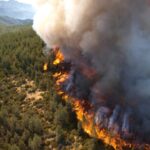
In recent years, large, intense wildfires, known as megafires, have increasingly caused severe damage to forests, homes, and crops. In addition to megafires fatally impacting humans and wildlife alike, they may also be impacting climate change. New research led by UMBC’s Stephen Guimond provides insight into how the large smoke plumes produced by megafires can be more accurately modeled and characterized to improve our understanding of how they might impact the earth.
Guimond, an associate research professor of physics, collaborated with scientists at the Los Alamos National Laboratory to determine the long-term effects of smoke plumes from megafires. Their findings, recently published in the Journal of Advances in Modeling Earth Systems, demonstrates how previous research utilized a model grid spacing that does not sample smoke plumes accurately. These inaccuracies in defining the dynamics of the problem lead to errors in interpretation of the smoke’s properties, vertical and horizontal movement of the plume, and potential climatic effects.
Tracking how smoke rises
The smoke plumes from megafires are voluminous and can rise very high into the upper atmosphere. Initially, the plumes get transported upwards by convective cells and travel into the stratosphere, explains Guimond, who is also a scientist at UMBC’s Goddard Earth Sciences Technology and Research (GESTAR) II (previously known as the Joint Center for Earth Systems Technology).
 Stephen Guimond. (Photo courtesy of Stephen Guimond)
“Once it gets up into the stratosphere, the smoke can stay around for many months, even up to a year or more. The fact that it can stay up there so long means that you can get effects on the solar radiation reaching the surface,” says Guimond. “If you have a big, dark-colored blanket of smoke up there, it’s going to absorb most of the sunlight, which will lead to less sunlight reaching the surface of the earth. Because of this, you could get, over a long period of time, a cooling that happens on the surface of the earth,” among other impacts.
For three years, scientists at Los Alamos studied the chemical properties of smoke plumes by burning objects like trees in a controlled setting to determine the percentages of carbon that the smoke emitted. The scientists evaluated atmospheric particulates, or aerosols, which have a major effect on climate. Guimond used a NASA climate model to determine the carbon characteristics of the smoke plumes, how they rise into the atmosphere, and the underlying causes of rotation within the plumes.
“The measurements we looked at included particle types, the spectrum of the particles, and their sizes,” says Guimond. “We also looked at the contributions of different chemical species such as black carbon, organic carbon, and other chemical compounds that come off of burning materials.”
Assessing previous smoke plume research
The color of the smoke is an important factor, Guimond notes, as different types of smoke have different radiative properties. White smoke is composed mostly of organic carbon: brightly-colored aerosol particles that in large part reflect radiation back into the atmosphere. Black smoke is composed mostly of black carbon: dark-colored aerosol particles that absorb radiation.
The researchers determined that previous models didn’t accurately sample the types of carbon within smoke plumes, leading to miscalculations or incorrect assumptions about the percentage of black carbon the plumes contained.
As the black smoke absorbs solar radiation, the smoke heats up, which can create a lofting effect that pushes the smoke higher into the atmosphere. The higher the smoke rises, the longer it stays in the stratosphere. The longer it stays, the more time it has to impact the surface of the earth. This means that inaccurate characterization of the percentage of black carbon in wildfire smoke can lead to inaccurate calculations of the lofting effect, height of the plume and stratospheric lifetime, as well as climatic effects.
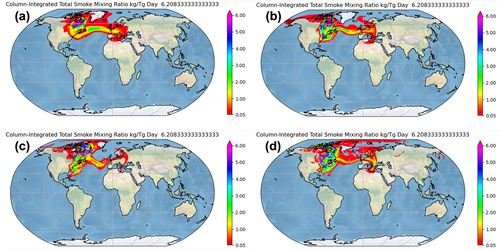 Figure 1
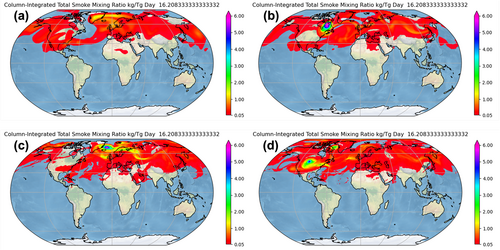 Figure 2
Figure 1 (left): The horizontal structure of the smoke plume at 6.2 days by vertically integrating the total smoke mixing ratio over the entire model atmosphere into the simulations for varying resolutions: (a) 2.0° (b) 1.0° (c) 0.25° and (d) 7 km.

    Figure 2 (right): The same as figure 1, except at 16.2 days. The horizontal structure of the smoke plume is significantly different between the various resolution simulations. (Images courtesy of Stephen Guimond and the Journal of Advances in Modeling Earth Systems)
Limits in how previous research represented the atmosphere also made for less accurate smoke plume simulations, Guimond said. He notes that prior smoke plume research used “coarse representation of the smoke plume in the model calculations, which has significant downstream effects on all other components of this problem, including the conclusions drawn from the research.”
Guimond hopes that his research can improve understanding of the dynamics of this problem: tracking of atmospheric motion and forces in three-dimensions, and how phenomena like rotating smoke plumes form and decay.
“Scientists need to accurately simulate the dynamics in order to get more accurate answers about aerosol properties inside the smoke plumes,” Guimond says, “such as how much of the smoke is black carbon, how long it is going to last in the stratosphere, how high it rises, and its effects on the radiation of the earth.”
With more accurate models and simulations, future research will be able to better inform climate policy and megafire response.
]]>
In recent years, large, intense wildfires, known as megafires, have increasingly caused severe damage to forests, homes, and crops. In addition to megafires fatally impacting humans and wildlife...
https://umbc.edu/stories/research-megafire-smoke-plumes/
https://my3.my.umbc.edu/api/v0/pixel/news/132851/guest@my.umbc.edu/1e34f79fff48056e08945b2093816fad/api/pixel
cnms
gestar
jcet
news
physics
rca-2
research
science-and-tech
UMBC News & Magazine
https://my3.my.umbc.edu/groups/umbc-news-magazine
https://assets1-my.umbc.edu/system/shared/avatars/groups/000/001/943/24435aa6207c452e7bc15cc74b42c7bb/xsmall.png?1748556657
https://assets1-my.umbc.edu/system/shared/avatars/groups/000/001/943/24435aa6207c452e7bc15cc74b42c7bb/original.png?1748556657
https://assets2-my.umbc.edu/system/shared/avatars/groups/000/001/943/24435aa6207c452e7bc15cc74b42c7bb/xxlarge.png?1748556657
https://assets2-my.umbc.edu/system/shared/avatars/groups/000/001/943/24435aa6207c452e7bc15cc74b42c7bb/xlarge.png?1748556657
https://assets3-my.umbc.edu/system/shared/avatars/groups/000/001/943/24435aa6207c452e7bc15cc74b42c7bb/large.png?1748556657
https://assets1-my.umbc.edu/system/shared/avatars/groups/000/001/943/24435aa6207c452e7bc15cc74b42c7bb/medium.png?1748556657
https://assets2-my.umbc.edu/system/shared/avatars/groups/000/001/943/24435aa6207c452e7bc15cc74b42c7bb/small.png?1748556657
https://assets1-my.umbc.edu/system/shared/avatars/groups/000/001/943/24435aa6207c452e7bc15cc74b42c7bb/xsmall.png?1748556657
https://assets2-my.umbc.edu/system/shared/avatars/groups/000/001/943/24435aa6207c452e7bc15cc74b42c7bb/xxsmall.png?1748556657
UMBC News & Magazine
0
0
false
Fri, 21 Apr 2023 08:02:38 -0400
Fri, 21 Apr 2023 08:02:38 -0400
UMBC researchers listed among the world’s top 2% of most-cited scientists and engineers
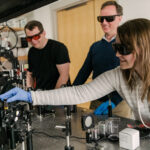
More than 40 active UMBC researchers are listed among the top 2% of the world’s most-cited scientists and engineers in an analysis recently published by Elsevier.
These researchers include faculty across all three of UMBC’s academic colleges as well as UMBC’s NASA-funded centers, such as the Goddard Earth Sciences Technology and Research (GESTAR II) Center. Their work covers an incredibly diverse array of topics. Represented academic departments include:
- biological sciences
- chemical, biochemical, and environmental engineering
- chemistry and biochemistry
- computer science and electrical engineering
- geography and environmental systems
- information systems
- mathematics and statistics
- mechanical engineering
- physics
- psychology
“We perform research to further our understanding of how the various aspects of our world function,” says Karl V. Steiner, vice president for research and creative achievement. “One of the highest recognitions in the scientific community is when other members of this community cite our work.”
He notes, “The Elsevier analysis shows that our researchers are truly impacting the scientific community in a significant way.”
History of citation honors
The list includes faculty researchers who have also received other “highly cited” researcher accolades. In 2022, Erle Ellis, professor of geography and environmental systems (GES), was featured on Clarivate’s Highly Cited Researchers list, which includes papers ranked in the top 1% of citations within Clarivate’s Web of Science database. About 0.1% of the world’s researchers have received this distinction. Ellis is known for his transformational work on human-managed ecosystems, with his research described as top discovery of 2021 by the Smithsonian National Museum of Natural History.
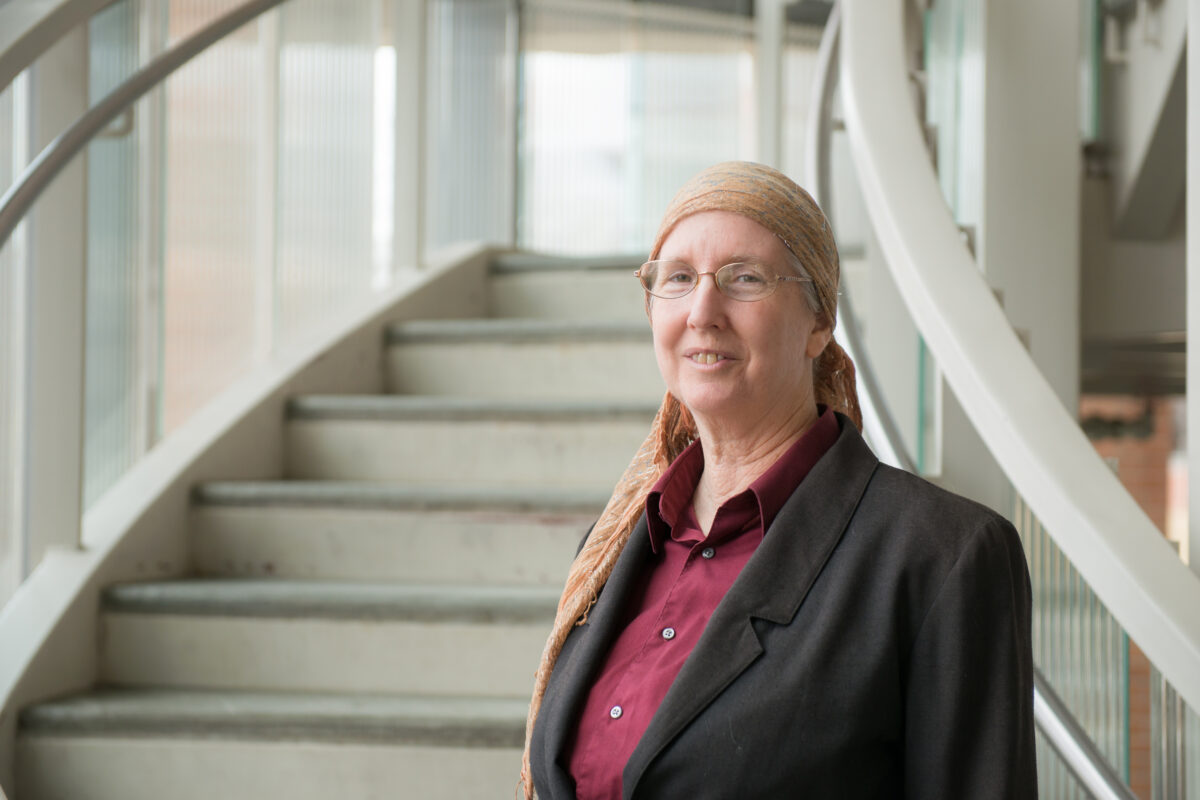 Lorraine Remer (Marlayna Demond ’11/UMBC)
Lorraine Remer, research professor for the Joint Center for Earth Systems Technology, who is affiliated with both GES and physics, is frequently honored for her geophysics publications. She received the 2019 UMBC Research Faculty Excellence Award following her recognition as one of “The Most Influential Scientific Minds” on the Thomson Reuters highly cited researchers list.
Anupam Joshi, director of UMBC’s Center for Cybersecurity and professor and chair of computer science and electrical engineering, was also included on Elsevier’s highly-cited list. His career trajectory demonstrates how UMBC faculty balance high-impact research with other forms of leadership. He has published more than 275 papers, has been granted nine patents, and has obtained research support from a variety of federal and industrial sources. At the same time, he is now serving as a 2022–23 American Council on Education (ACE) Fellow, an intensive program focused on agility and innovative problem solving among higher education leaders.
Measuring impact
This latest most-cited researchers list is based on data annually compiled from author profiles in Elsevier’s abstract and citation database, Scopus.
Elsevier’s 2022 database of standardized citation indicators classifies researchers into 22 fields and 174 subfields. Those with a composite indicator (c-score) within the top 2% of each subfield are included in the most-cited list. The list’s authors indicate that c-score is used because it “focuses on impact (citations) rather than productivity (number of publications)” and because it includes granular information on authorship, including co-authorship and author position (e.g., single, first, or last author).
]]>
More than 40 active UMBC researchers are listed among the top 2% of the world’s most-cited scientists and engineers in an analysis recently published by Elsevier. These researchers include...
https://umbc.edu/stories/most-cited-scientists-2022/
https://my3.my.umbc.edu/api/v0/pixel/news/130830/guest@my.umbc.edu/0a8209cd9947fb4136c6c8893cdbfae1/api/pixel
cahss
cbee
cnms
coeit
csee
cybersecurity
ges
gestar
is
jcet
meche
news
physics
rca-1
research
science-and-tech
UMBC News & Magazine
https://my3.my.umbc.edu/groups/umbc-news-magazine
https://assets1-my.umbc.edu/system/shared/avatars/groups/000/001/943/24435aa6207c452e7bc15cc74b42c7bb/xsmall.png?1748556657
https://assets1-my.umbc.edu/system/shared/avatars/groups/000/001/943/24435aa6207c452e7bc15cc74b42c7bb/original.png?1748556657
https://assets2-my.umbc.edu/system/shared/avatars/groups/000/001/943/24435aa6207c452e7bc15cc74b42c7bb/xxlarge.png?1748556657
https://assets2-my.umbc.edu/system/shared/avatars/groups/000/001/943/24435aa6207c452e7bc15cc74b42c7bb/xlarge.png?1748556657
https://assets3-my.umbc.edu/system/shared/avatars/groups/000/001/943/24435aa6207c452e7bc15cc74b42c7bb/large.png?1748556657
https://assets1-my.umbc.edu/system/shared/avatars/groups/000/001/943/24435aa6207c452e7bc15cc74b42c7bb/medium.png?1748556657
https://assets2-my.umbc.edu/system/shared/avatars/groups/000/001/943/24435aa6207c452e7bc15cc74b42c7bb/small.png?1748556657
https://assets1-my.umbc.edu/system/shared/avatars/groups/000/001/943/24435aa6207c452e7bc15cc74b42c7bb/xsmall.png?1748556657
https://assets2-my.umbc.edu/system/shared/avatars/groups/000/001/943/24435aa6207c452e7bc15cc74b42c7bb/xxsmall.png?1748556657
UMBC News & Magazine
0
0
false
Wed, 25 Jan 2023 11:47:33 -0500
Fri, 10 Feb 2023 17:01:24 -0500
Scientists may be underestimating Arctic ecosystem changes, new UMBC research shows
The Arctic climate is changing, and it’s important to understand how. But scientists may be consistently misinterpreting a common metric used to determine how Arctic ecosystems are shifting in response to climate change. A new paper in Ecological Applications by Fred Huemmrich, research scientist at UMBC’s Joint Center for Earth Systems Technology, shows that researchers may not appreciate the limitations of the Normalized Difference Vegetation Index (NDVI), leading to inaccurate interpretations, and likely an overall underestimate, of Arctic change.
NDVI is “one of the clearest indicators we have of ecological change related to climate change in tundra and boreal forest regions,” Huemmrich says. And yet, “there are limitations to what NDVI can tell us about ecological change.”
Dead or alive?
One of NDVI’s main advantages is that it can be determined using data collected by satellites. That’s particularly beneficial for Arctic research, because collecting data on the ground is difficult in remote areas and harsh conditions.
By looking at light reflected from the surface, NDVI can tell you how much of the surface is covered with plants versus non-living substances like rocks and ice. Plants absorb a lot of visible light (for photosynthesis), but still reflect infrared light. Non-living substances reflect about the same amount of infrared and visible light.
So, “NDVI highlights the difference between reflectance in visible light and the infrared,” Huemmrich explains. “And if it’s small, you’re looking at things that aren’t green. And if it’s big, you’re looking at things that are green. That’s it. And it works.”

Fred Huemmrich conducts research in the Arctic tundra on a cold, blustery day. Photo courtesy Fred Huemmrich.
The wrong question
But there’s a catch. Based on Huemmirch’s research, NDVI “saturates” at higher levels of plant cover. So, while NDVI is excellent at reporting a change from 20 percent to 40 percent plant cover, it may not show a change from 70 percent to 90 percent plant cover. It also may not show changes from one type of plant cover to another, such as from a scrub landscape to a woodland, if the total plant cover remains the same.
Many studies have not accounted for these limitations, Huemmrich says, leading researchers to ask questions about why ecosystems in certain regions of the Arctic are responding differently to similar levels of climate change. To Huemmrich, that’s the wrong question.
“To me, it suggests that there very well may be more ecological change going on at high latitudes than we are perceiving, if we’re leaning on NDVI as the metric we’re using to detect these changes,” Huemmrich says.
Time to reevaluate
As a graduate student in the 1990s, Huemmrich studied NDVI. However, “I never dreamed that 25 years later, people would still be using NDVI.” Yet, seeing how today’s climate scientists still rely heavily on NDVI, and may not consider its limitations, concerned him and drove him to publish his latest paper.
Huemmrich believes many analyses may need to be reconsidered based on his publication. For example, at the transition between tundra and forest, NDVI has shown little change. However, “It’s not that things aren’t changing at the tree line,” Huemmrich says, “it’s just that NDVI isn’t very sensitive to those changes. So what’s happening at the tree line probably needs to be reevaluated.”
Because NDVI works well in some situations and poorly in others, “What you really need to do is know what your starting point is for this change,” he says. If the ecosystem under study begins below 50 percent plant cover, NDVI could be very helpful. But if total plant cover is already above 50 percent, NDVI may not be the most useful metric.

One of the remote locations in the Arctic where Fred Huemmrich’s research takes place. Photo courtesy Fred Huemmrich.
Crucial changes
Huemmrich is an investigator on NASA’s Arctic-Boreal Vulnerability Experiment (ABoVE), which looks at ecosystem change at high latitudes. His project specifically is investigating Arctic “greening” (an increase in plant cover over time), which is heavily reliant on metrics like NDVI. With about 300 leading investigators, and over 1,000 people involved in ABoVE overall, it’s critical that these researchers understand when it’s useful to apply metrics like NDVI, and when to use other metrics.
The Arctic is changing. Those changes affect local wildlife populations and the Indigenous communities that often rely on them. Arctic climate change also affects major environmental shifts around the world, from rising seas to global wind patterns. Using the right metrics in the right way to study these ecosystems is crucial to understanding Arctic climate, Huemmerich notes, because that understanding can affect policy to protect the planet.
Header image: Boreal forest meets the alpine tundra ecosystem in Rocky Mountain National Park. Photo by Tim Lumley, used under CC BY-NC-ND 2.0.
]]>
The Arctic climate is changing, and it’s important to understand how. But scientists may be consistently misinterpreting a common metric used to determine how Arctic ecosystems are shifting in...
https://umbc.edu/stories/scientists-may-be-underestimating-arctic-ecosystem-changes-new-umbc-research-shows/
https://my3.my.umbc.edu/api/v0/pixel/news/119533/guest@my.umbc.edu/308108718e01df1a5a7b5a0be9b5e4f6/api/pixel
jcet
research
science-and-technology
UMBC News & Magazine
https://my3.my.umbc.edu/groups/umbc-news-magazine
https://assets1-my.umbc.edu/system/shared/avatars/groups/000/001/943/24435aa6207c452e7bc15cc74b42c7bb/xsmall.png?1748556657
https://assets1-my.umbc.edu/system/shared/avatars/groups/000/001/943/24435aa6207c452e7bc15cc74b42c7bb/original.png?1748556657
https://assets2-my.umbc.edu/system/shared/avatars/groups/000/001/943/24435aa6207c452e7bc15cc74b42c7bb/xxlarge.png?1748556657
https://assets2-my.umbc.edu/system/shared/avatars/groups/000/001/943/24435aa6207c452e7bc15cc74b42c7bb/xlarge.png?1748556657
https://assets3-my.umbc.edu/system/shared/avatars/groups/000/001/943/24435aa6207c452e7bc15cc74b42c7bb/large.png?1748556657
https://assets1-my.umbc.edu/system/shared/avatars/groups/000/001/943/24435aa6207c452e7bc15cc74b42c7bb/medium.png?1748556657
https://assets2-my.umbc.edu/system/shared/avatars/groups/000/001/943/24435aa6207c452e7bc15cc74b42c7bb/small.png?1748556657
https://assets1-my.umbc.edu/system/shared/avatars/groups/000/001/943/24435aa6207c452e7bc15cc74b42c7bb/xsmall.png?1748556657
https://assets2-my.umbc.edu/system/shared/avatars/groups/000/001/943/24435aa6207c452e7bc15cc74b42c7bb/xxsmall.png?1748556657
UMBC News & Magazine
0
0
false
Fri, 05 Nov 2021 18:04:01 -0400
NASA awards $72 million for new UMBC-led Earth science research partnership
NASA has announced a major award of $72 million over three years for the new Goddard Earth Sciences Technology and Research (GESTAR) II center. UMBC serves as the lead for a national consortium and will receive over $38 million. Morgan State University serves as the primary partner. Colorado State University, Arizona State University, and Pennsylvania State University are also close partners in the program, as are Northrop Grumman Corporation, Earth Resources Technology, Inc., and the non-profit Southeastern Universities Research Association.
“This award is a massive win for UMBC, for the University System, and—with Morgan State as a key partner—for Maryland as a whole,” says Jay Perman, chancellor of the University System of Maryland. “The sheer size of the award, supporting the work of over a hundred researchers and students, demonstrates NASA’s faith in UMBC as consortium leader.”
“And,” Perman adds, “I know the entire UMBC community welcomes an even tighter connection to Goddard and an even more prominent role in answering some of the biggest questions in earth and atmospheric science.”

David K. Wilson (left) and Freeman A. Hrabowski.
Connecting colleagues and students
The GESTAR II consortium will support over 120 researchers, creating extensive opportunities for breakthroughs in earth and atmospheric science research. Participants will carry out observational, experimental, and theoretical research in support of NASA strategic earth science mission objectives.The large scale of this work will also enable students at all levels to contribute to the research.
“I am absolutely delighted that this new cooperative GESTAR II award will further strengthen and expand the mutually beneficial partnership between NASA Goddard and UMBC, which was first launched a quarter-century ago,” says Karl Steiner, UMBC’s vice president for research. “Together with our partner institutions, especially Morgan State University, we are looking forward to the exciting scientific and educational opportunities that lie ahead.”
“Morgan brings more than a decade of experience working with NASA, and we look forward to partnering with UMBC and other collaborators in GESTAR II to produce cutting-edge, world-class Earth science in support of our national space program,” adds Willie E. May, vice president for research and economic development at Morgan State. “We are also very excited about what this partnership will mean for our students—more exposure, new educational pursuits, and access to longer-term employment opportunities.”
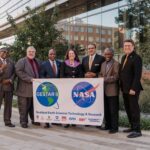
 Left to right: Willie E. May, David K. Wilson, Margo Young, Freeman A. Hrabowski, Belay Demoz, Karl Steiner. May and Wilson are from Morgan State U.
Reaching beyond
Like UMBC’s Joint Center for Earth Systems Technology (JCET), GESTAR II will create opportunities for undergraduate and graduate students to conduct research with and be mentored by NASA scientists and engineers. Some of these researchers might also teach courses or offer workshops to students from participating institutions.
This builds on the work of scientists like Belay Demoz, director of JCET and the incoming director of GESTAR II. Demoz has been recognized for his ongoing commitment to mentoring students from all backgrounds in climate science. His scientific and mentoring work is driven by his early life in Eritrea, which was struggling with drought and other climate-induced challenges that continue today.
“So much of what we are able to do at UMBC is tied to the dreams of our current and future students to reach beyond ourselves,” says Keith J Bowman, dean of UMBC’s College of Engineering and Information Technology. “UMBC’s NASA centers help drive our aspirations as a university to have an impact that reaches beyond our campus, beyond our state, and even beyond our planet.”
 Belay Demoz, director of JCET and incoming director of GESTAR II. Photo by Marlayna Demond ’11 for UMBC.
Advancing high-impact research
This fall, funding for JCET will sunset after two-and-a-half highly productive decades. The new GESTAR II award will enable ongoing projects to continue, while also creating opportunities for expansion under a new structure.
JCET-supported researchers have examined ice shelf collapse, air quality, humans’ role in climate change, how boreal forests are responding to rising temperatures, and more. JCET also supported scientists and engineers who launched UMBC’s first CubeSat, the Hyper-Angular Rainbow Polarimeter (HARP), named AIAA Small Satellite Mission of the Year in 2020.
Many of these investigators’ work will continue through GESTAR II. Demoz describes the consortium partners as “powerhouses in earth science research and administration.”
“The collaboration between Morgan and UMBC serves as a model for how two research universities, operating in a highly competitive space, can join in common purpose, pooling intellectual capital, resources, and expertise for the greater advancement of earth science and technology,” says David K. Wilson, president of Morgan State.
 President David K. Wilson and Vice President Willie E. May of Morgan State. Photo by Marlayna Demond ’11 for UMBC.
NASA’s next generation
Bringing together students and researchers from UMBC, Morgan State, NASA, and other institutions creates the opportunity for innovation and major advances in earth science. It also creates a pipeline of students from a wide range of backgrounds who are prepared to pursue careers at NASA and elsewhere, using the skills they’ve gained through learning from and with NASA team members.
“GESTAR II embodies UMBC’s collaborative, multidisciplinary approach to research and highlights the importance of research partnerships,” says Bill LaCourse, dean of UMBC’s College of Natural and Mathematical Sciences. “Only through inclusive excellence, which GESTAR II exemplifies, can we hope to unravel the mysteries of the universe and understand the world around us.”
“I am deeply grateful to everyone, especially our colleagues at Morgan State, who helped make this new partnership a reality,” says Freeman Hrabowski, president of UMBC. “I am looking forward to seeing what breakthroughs in earth science will come from the collaborative work of the scientists, engineers, and students who participate in GESTAR II.”
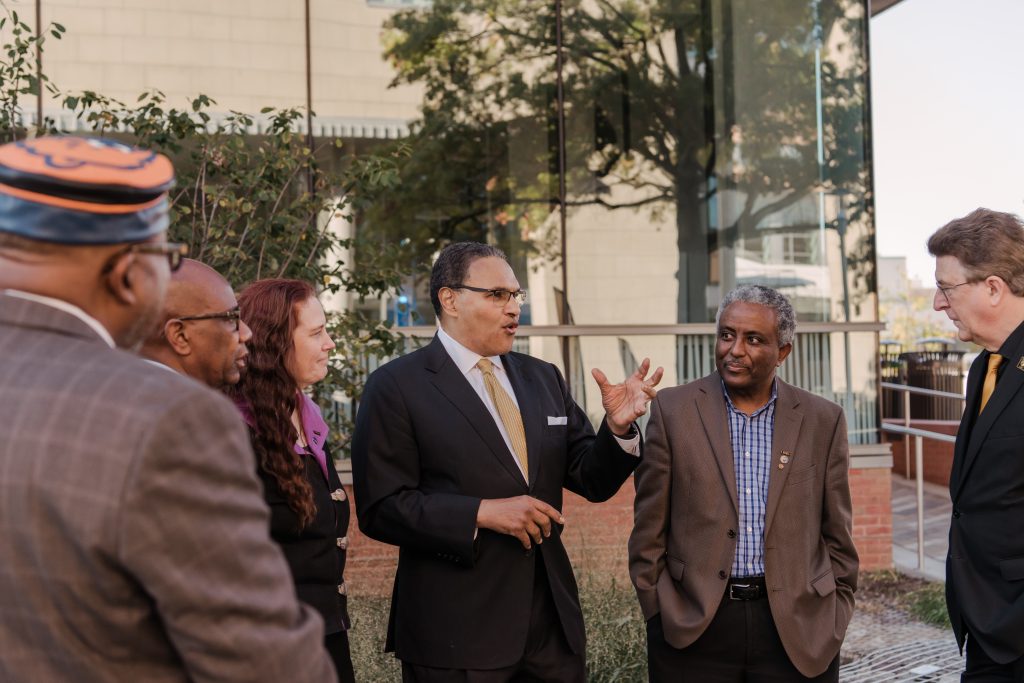
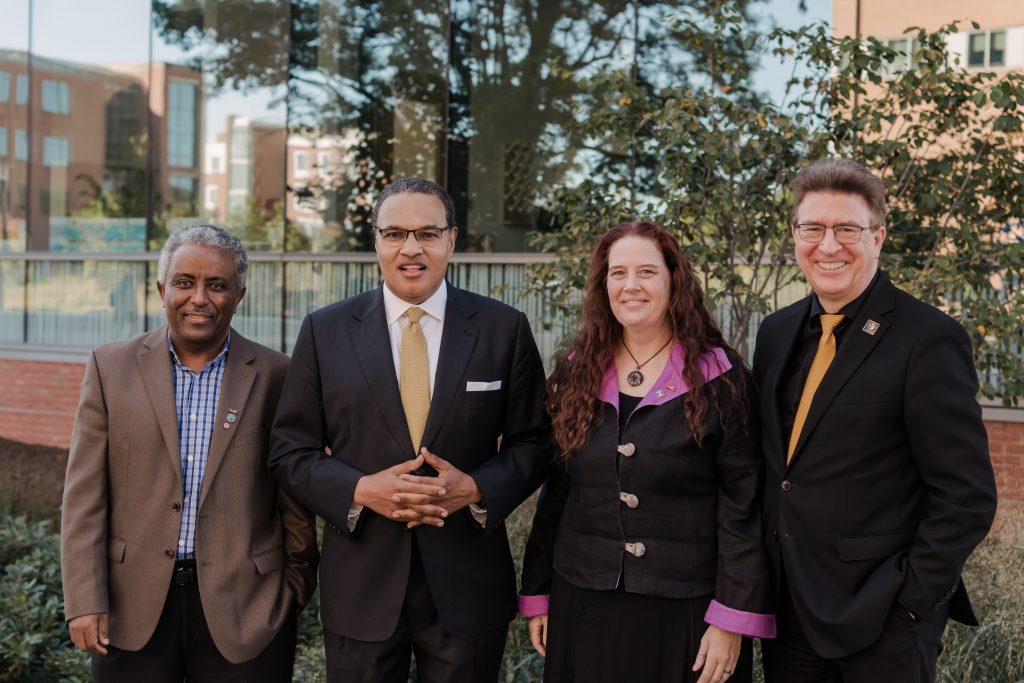 Left to right: Belay Demoz, Freeman A. Hrabowski, Margo Young, and Karl Steiner. Photo by Marlayna Demond ’11 for UMBC.
Banner image: UMBC and Morgan State colleagues gather to celebrate the new GESTAR II award outside UMBC’s Interdisciplinary Life Sciences Building. From left to right: Willie E. May, Daniel Laughlin, David K. Wilson, Margo Young, Freeman A. Hrabowski, Belay Demoz, Karl V. Steiner. Photo by Marlayna Demond ’11 for UMBC.
]]>
NASA has announced a major award of $72 million over three years for the new Goddard Earth Sciences Technology and Research (GESTAR) II center. UMBC serves as the lead for a national consortium...
https://umbc.edu/stories/nasa-awards-72-million-for-new-umbc-led-earth-science-research-partnership/
https://my3.my.umbc.edu/api/v0/pixel/news/119535/guest@my.umbc.edu/285b654a3ffa370e6294db86f58a222a/api/pixel
cnms
coeit
jcet
majoraward
page1
research
science-and-technology
UMBC News & Magazine
https://my3.my.umbc.edu/groups/umbc-news-magazine
https://assets1-my.umbc.edu/system/shared/avatars/groups/000/001/943/24435aa6207c452e7bc15cc74b42c7bb/xsmall.png?1748556657
https://assets1-my.umbc.edu/system/shared/avatars/groups/000/001/943/24435aa6207c452e7bc15cc74b42c7bb/original.png?1748556657
https://assets2-my.umbc.edu/system/shared/avatars/groups/000/001/943/24435aa6207c452e7bc15cc74b42c7bb/xxlarge.png?1748556657
https://assets2-my.umbc.edu/system/shared/avatars/groups/000/001/943/24435aa6207c452e7bc15cc74b42c7bb/xlarge.png?1748556657
https://assets3-my.umbc.edu/system/shared/avatars/groups/000/001/943/24435aa6207c452e7bc15cc74b42c7bb/large.png?1748556657
https://assets1-my.umbc.edu/system/shared/avatars/groups/000/001/943/24435aa6207c452e7bc15cc74b42c7bb/medium.png?1748556657
https://assets2-my.umbc.edu/system/shared/avatars/groups/000/001/943/24435aa6207c452e7bc15cc74b42c7bb/small.png?1748556657
https://assets1-my.umbc.edu/system/shared/avatars/groups/000/001/943/24435aa6207c452e7bc15cc74b42c7bb/xsmall.png?1748556657
https://assets2-my.umbc.edu/system/shared/avatars/groups/000/001/943/24435aa6207c452e7bc15cc74b42c7bb/xxsmall.png?1748556657
UMBC News & Magazine
0
0
false
Thu, 28 Oct 2021 18:45:11 -0400
UMBC’s Reem Hannun to co-lead urban air quality study with NOAA Climate Award

Over time, U.S. environmental regulations have successfully reduced emissions from combustion, such as car engines. That has decreased these emissions’ negative impact on air quality, particularly in urban areas. However, emissions from consumer products such as cleaning supplies, fragrances, inks, adhesives, and more are on the rise, and their effects on air quality are poorly understood.
Not only are there many more different compounds to investigate, but the compounds’ sources are dispersed. Rather than coming from tailpipes or power plants, these emissions can seep out of homes, building ventilation systems, and anywhere else the products are used.
“There’s a lot of uncertainty around this new class of molecules, and they’ve been shown to contribute more and more to poor air quality than traditional emissions. So, if we want to have a better understanding of air quality, now and as climate continues to change, we really need to be able to understand how the chemistry changes with this new class of emissions,” says Reem Hannun, assistant research scientist with UMBC’s Joint Center for Earth Systems Technology (JCET). “It’s a new, interesting dynamic.”

Reem Hannun on a NASA research plane. Photo courtesy Reem Hannun.
An “airborne” campaign
To improve understanding of these emerging air pollutants, the National Oceanic and Atmospheric Administration has funded a proposal co-led by Hannun and Jen Kaiser, an atmospheric scientist at Georgia Tech, for $550,000. The project is part of NOAA’s Atmospheric Emissions and Reactions Observed from Megacities to Marine Areas (AEROMMA) campaign.
The team will capture measurements of many of the polluting molecules, called volatile chemical products, or VCPs, using specialized instruments flown on research aircraft over several of the country’s largest cities. Hannun and UMBC colleague Jason St. Clair will bring their expertise with the instruments to the project. Kaiser’s team offers expertise in modeling and data analysis.
While previous studies have looked at some of the same specific compounds in isolated areas, “This will be the most spatially comprehensive look at these compounds in cities around the United States,” Hannun says.
Getting the whole picture
In addition to detecting many different emerging VCPs, the campaign, delayed due to the pandemic and now set to launch in 2023, will measure the presence of formaldehyde. Formaldehyde is a particularly pertinent compound to examine, because VCPs and the better-understood class of volatile organic compounds (VOCs) produce formaldehyde as a byproduct when they break down through a series of chemical reactions in the air.
“So it’s really useful, because formaldehyde provides an integrated perspective; it can tell us something about the sum of a diverse array of emitted VCPs and VOCs,” Hannun says. “We can use formaldehyde to kind of simplify this really complex series of chemical reactions.”

The NOAA WP-3D aircraft. The AEROMMA instruments will fly on this plane above several of the largest U.S. cities to collect data about the presence of pollutants in air. Photo by NOAA.
“AEROMMA is an exciting opportunity to better understand the urban air quality impacts of a new class of volatile organic compounds, and I believe our formaldehyde measurements will be a great contribution to the overall project,” adds St. Clair. “I’m looking forward to working with Jen and Reem on this project.”
Overall, the team is interested in the long-term effects of VCPs on the formation of ozone and particulates—two key indicators of air quality. “The main goal is to get a better understanding of the chemistry,” Hannun says. To do that, it’s important to know what molecules are in the air at a given moment, and also how they break down over time. “Being able to measure things like formaldehyde will ensure our understanding of that chemical processing,” Hannun explains.
Measuring pollution from space
After the researchers collect the data, they will compare the formaldehyde measurements to the measurements of other VCPs and VOCs during the campaign. If it turns out that formaldehyde is, as expected, a useful proxy for the presence of a range of air pollutants, then it can be applied as a scientific indicator in other situations.
As it turns out, satellites in space can measure formaldehyde. “You can’t make these measurements from aircraft all the time, but if we have satellite measurements of formaldehyde, then we can apply our understanding to broader regions across space and time,” Hannun says.
Measuring formaldehyde from space sounds good to Hannun for another reason. “I get a little air sick,” she says, “so I’m always happy to work with the instrument on the ground and then let somebody else fly with it,” she shares.
Women leading the way
In addition to contributing important science to the field of air quality studies, the AEROMMA project is important for another reason. “This project is co-led by me and Jen Kaiser at Georgia Tech,” Hannun says. “I feel like the field sciences, especially these measurement campaigns, can be really male-dominated, so it’s exciting to be in a woman-led group doing this. I hope that it will encourage more women to do this kind of field work.”
There are other long-term implications. Over time, if the researchers determine that a specific class of VCPs plays a significant role in ozone production, for example, “it could be that in several years this type of work would help put regulations or restrictions on the use of some of these more noxious or deleterious compounds,” Hannun says. And that would allow everyone to breathe a little easier.
Header image: Smog hovers over Los Angeles, one of the U.S. cities with the worst air pollution. Los Angeles is one of the cities the AEROMMA campaign will visit as it collects data about pollutants across the country. Photo by Maciek Lulko, used under CC-BY-NC-2.0.
]]>
Over time, U.S. environmental regulations have successfully reduced emissions from combustion, such as car engines. That has decreased these emissions’ negative impact on air quality, particularly...
https://umbc.edu/stories/umbcs-reem-hannun-to-co-lead-urban-air-quality-study-with-5-5-million-noaa-climate-award/
https://my3.my.umbc.edu/api/v0/pixel/news/119546/guest@my.umbc.edu/11ebb66e377870d3d6e0c7eec7da458e/api/pixel
jcet
research
science-and-technology
UMBC News & Magazine
https://my3.my.umbc.edu/groups/umbc-news-magazine
https://assets1-my.umbc.edu/system/shared/avatars/groups/000/001/943/24435aa6207c452e7bc15cc74b42c7bb/xsmall.png?1748556657
https://assets1-my.umbc.edu/system/shared/avatars/groups/000/001/943/24435aa6207c452e7bc15cc74b42c7bb/original.png?1748556657
https://assets2-my.umbc.edu/system/shared/avatars/groups/000/001/943/24435aa6207c452e7bc15cc74b42c7bb/xxlarge.png?1748556657
https://assets2-my.umbc.edu/system/shared/avatars/groups/000/001/943/24435aa6207c452e7bc15cc74b42c7bb/xlarge.png?1748556657
https://assets3-my.umbc.edu/system/shared/avatars/groups/000/001/943/24435aa6207c452e7bc15cc74b42c7bb/large.png?1748556657
https://assets1-my.umbc.edu/system/shared/avatars/groups/000/001/943/24435aa6207c452e7bc15cc74b42c7bb/medium.png?1748556657
https://assets2-my.umbc.edu/system/shared/avatars/groups/000/001/943/24435aa6207c452e7bc15cc74b42c7bb/small.png?1748556657
https://assets1-my.umbc.edu/system/shared/avatars/groups/000/001/943/24435aa6207c452e7bc15cc74b42c7bb/xsmall.png?1748556657
https://assets2-my.umbc.edu/system/shared/avatars/groups/000/001/943/24435aa6207c452e7bc15cc74b42c7bb/xxsmall.png?1748556657
UMBC News & Magazine
0
0
false
Tue, 12 Oct 2021 21:01:42 -0400
Hurricanes, well-being, and AI: START Awards set up UMBC researchers for success
Soon, Steve Guimond and his students will begin exploring a new angle of his hurricane research. They want to better understand the fundamental physics that drives hurricanes. Specifically, they want to know how small disturbances in a hurricane’s wind flow, similar to a strong gust on a windy day, may affect its overall structure and intensity. The findings could have implications for hurricane forecasting.
A new, $682,000 National Science Foundation (NSF) grant in collaboration with the New Jersey Institute of Technology will fund the team’s work, which primarily involves developing, running, and analyzing complex numerical models on supercomputers. However, Guimond might never have received the grant if he hadn’t received a UMBC Strategic Award for Research Transitions (START) first.
In 2018, the NSF rejected a related proposal from Guimond, who is an associate research professor with UMBC’s physics department and the Joint Center for Earth Systems Technology, a partnership with NASA. The proposal outlined a broad research program using two different methods to learn more about hurricanes: remote sensing and numerical modeling. “The START funding helped us evaluate those two sides of the project,” he says.
The START program funded initial research that was carried out by Guimond, Devin Protzko ’20, physics and mathematics, and Badrul Hasan, a Ph.D. student in mechanical engineering. They gathered preliminary data showing that the modeling path had significant potential, so they wrote a fresh NSF proposal with a narrower focus. It won approval. The small START grant, Guimond says, “was key to helping us identify the most fruitful path for follow-on funding from NSF.”

A simulation of a “large eddy,” an instance of turbulence, in a rapidly intensifying hurricane. Running this kind of simulation is part of Steve Guimond’s research. Animation courtesy Steve Guimond.
Turbulence in focus
The NSF proposal will support work to understand the role of turbulence in how or whether hurricanes intensify. Guimond’s team will also look at the value of using numerical hurricane models with very high resolution. High resolution is important because a hurricane’s “gusts” appear and disappear very quickly. They also generally take up very little physical space. Because they’re so ephemeral, you can’t simulate them precisely or accurately with current models. And if you can’t simulate them, you can’t figure out their role in overall hurricane development. High resolution models would make those simulations possible, which can feed back into improved forecasts in the future.
The fact that Guimond has the chance to do this work exemplifies START’s goal. The program, funded by UMBC’s Office of the Vice President for Research, offers a maximum of $25,000 to UMBC faculty who wish to pursue new avenues of research. The hope is that the funds will put them in a stronger position for much larger external grants from places like NSF—exactly what happened for Guimond.

Steve Guimond. Courtesy Steve Guimond.
A first step
A new cohort of UMBC faculty will receive START funding this summer. Lira Yoon, associate professor of psychology, hopes to follow a similar path to Guimond. Yoon will collect initial data on how Asian Americans regulate their emotions in response to overt racism, and how or whether the strategies they practice affect their well-being. This work is particularly relevant given the sharp rise in anti-Asian discrimination during the pandemic. Yoon is also working on a project to help long-term care workers better manage their stress, another group impacted heavily by the pandemic.
“I’m eager to start a new line of research examining the effects of racial discrimination on psychological well-being, particularly in Asian Americans,” Yoon shares. “Although the ultimate solution to the problems resulting from racial discrimination lies at the policy and systems levels, understanding mechanisms operating at an individual level could help mitigate the adverse effects of discrimination.”
“This project will be the first step in that direction,” she says, “and it will provide preliminary data to secure external funding for future larger-scale research.”

Lira Yoon. Photo courtesy Lira Yoon.
Real-world impact
Maryam Rahnemoonfar, information systems, is another member of the new START cohort. Her team is developing algorithms for use on drones flying over affected areas after natural disasters. The goal is for the drones to relay important information about conditions on the ground in real time. Her team has created a unique dataset, called FloodNet, that can train the algorithms to recognize disaster impacts—for example, roads that are flooded or blocked by debris.
With a previous AI for Earth grant from Microsoft, more than 20 students at all levels in Rahnemoonfar’s research group spent more than a thousand hours creating the FloodNet dataset. Input from first responders and the Federal Emergency Management Administration (FEMA) guided their work, plus mentoring from faculty and more advanced students. Team members labeled each pixel in images to teach the artificial intelligence (AI) system what a flooded road or damaged building looks like.
“It was a very difficult and challenging task, but we are the first in the world to prepare this sophisticated dataset,” Rahnemoonfar says.
Already, German authorities have requested (and been granted) access to the FloodNet set of labeled images to help them respond to recent catastrophic flooding in the country. The FloodNet dataset is the first and only dataset of its kind that can be used for training AI systems in the wake of natural disasters.

Maryam Rahnemoonfar. Courtesy Maryam Rahnemoonfar.
Saving time, saving lives
With the new START funding, Rahnemoonfar’s team hopes to improve the algorithm that evaluates how much damage buildings have sustained, on a scale from none to total destruction. Rahnemoonfar also hopes to build an interface where a person can ask the AI system a verbal question and get a useful answer. Her team is developing this ability for data already collected, “but when a new hurricane happens, we hope that while a drone is flying you can ask and get answers to these questions in real time,” she says.
To save time—of the essence during disaster response—Rahnemoonfar’s graduate students are working on adding a layer to the algorithms that would allow the AI to learn on its own, with a minimal training dataset.
“Now that we have developed this AI system, for any new hurricane that happens, we don’t need to label data again,” she says. “With the algorithm that we are developing, with very few labeled images we can get insights for any new hurricane.”
A ripple effect
The START program has a ripple effect beyond UMBC faculty. Many of the awardees involve students in their work, enhancing the students’ UMBC experience and helping set them up for success later on. Students in Guimond’s group, for example, get first-hand experience with NASA scientists and facilities.
Also, by helping researchers hone their projects and, as a result, future proposals, START increases their chance of success with applying for larger grants. Like Guimond, Rahnemoonfar is already looking to use the START support to lead to bigger research awards.
“The START program enables UMBC faculty members (and with them, UMBC students) to move in new directions with their scholarly work,” shares Don Engel, associate vice president for research. “We are proud of the success past recipients have found in turning their proposed ideas into longer-term initiatives.”
Banner image: Hurricane Matthew bears down on Haiti in 2016. Image by NASA Goddard Space Flight Center.
]]>
Soon, Steve Guimond and his students will begin exploring a new angle of his hurricane research. They want to better understand the fundamental physics that drives hurricanes. Specifically, they...
https://umbc.edu/stories/hurricanes-well-being-and-ai-start-awards-set-up-umbc-researchers-for-success/
https://my3.my.umbc.edu/api/v0/pixel/news/119577/guest@my.umbc.edu/ebb9d64242a961e91d0ab1a2c8ab62ed/api/pixel
cahss
cnms
coeit
is
jcet
physics
psychology
research
science-and-technology
UMBC News & Magazine
https://my3.my.umbc.edu/groups/umbc-news-magazine
https://assets1-my.umbc.edu/system/shared/avatars/groups/000/001/943/24435aa6207c452e7bc15cc74b42c7bb/xsmall.png?1748556657
https://assets1-my.umbc.edu/system/shared/avatars/groups/000/001/943/24435aa6207c452e7bc15cc74b42c7bb/original.png?1748556657
https://assets2-my.umbc.edu/system/shared/avatars/groups/000/001/943/24435aa6207c452e7bc15cc74b42c7bb/xxlarge.png?1748556657
https://assets2-my.umbc.edu/system/shared/avatars/groups/000/001/943/24435aa6207c452e7bc15cc74b42c7bb/xlarge.png?1748556657
https://assets3-my.umbc.edu/system/shared/avatars/groups/000/001/943/24435aa6207c452e7bc15cc74b42c7bb/large.png?1748556657
https://assets1-my.umbc.edu/system/shared/avatars/groups/000/001/943/24435aa6207c452e7bc15cc74b42c7bb/medium.png?1748556657
https://assets2-my.umbc.edu/system/shared/avatars/groups/000/001/943/24435aa6207c452e7bc15cc74b42c7bb/small.png?1748556657
https://assets1-my.umbc.edu/system/shared/avatars/groups/000/001/943/24435aa6207c452e7bc15cc74b42c7bb/xsmall.png?1748556657
https://assets2-my.umbc.edu/system/shared/avatars/groups/000/001/943/24435aa6207c452e7bc15cc74b42c7bb/xxsmall.png?1748556657
UMBC News & Magazine
0
0
false
Fri, 06 Aug 2021 17:56:40 -0400
UMBC’s Ryan Kramer confirms human-caused climate change with direct evidence for first time
A new analysis based on 16 years of observational data confirms that humans are heating the planet—a fact that had previously been inferred from climate models but not yet shown through direct evidence. Ryan Kramer, assistant research scientist at UMBC’s Joint Center for Earth Systems Technology, led the research, which was published in Geophysical Research Letters.
Kramer and colleagues analyzed atmospheric data collected continuously by NASA’s CERES mission from 2003 to 2018. They were able to show that a portion of the energy being trapped inside Earth’s atmosphere and causing warming is directly attributable to human activities.
The new analysis, and the novel technique Kramer employed to complete it, will create opportunities to compare and improve climate models and to track climate change mitigation efforts in nearly real time.
This animation visualizes Earth’s energy balance. Incoming radiation (energy) is presented in yellow, and outgoing radiation is in red. The human-contributed parts of the cycle, which Ryan Kramer’s study isolated from the rest, are featured from 15 seconds to the end. Animation by Adriana Manrique Gutierrez at the NASA Conceptual Image Lab, and a more thorough explanation of the animation is here.
Many factors, one main culprit: Humans
CERES tracks changes in radiation (energy) entering and exiting Earth’s atmosphere, but doesn’t parse out exactly what’s causing the changes. Kramer did that with a technique called “radiative kernels.” Atmospheric scientists often apply these “kernels” to climate models, he says, but they’ve used them with observational data very rarely, and never before in this context.
A kernel can tell you how much of the total radiation change is due to a particular factor, such as the temperature, clouds, brightness of the Earth’s surface (ice versus forest, for example), or the amount of water vapor in the atmosphere. Kramer subtracted out all the radiation changes even possibly attributable to natural changes.
“What’s left over is the radiative forcing,” he says. “And that radiative forcing is specifically caused by changes in greenhouse gases or changes in aerosols—so it’s the changes that we can specifically tie to human activity.”
“We knew the radiative forcing had to be in the CERES observations somewhere, but this was the first time we’ve really been able to pull it out, globally, and over time,” Kramer says. Many other factors have measurable effects on the overall radiation budget. Significantly, though, over the 16-year study period, Kramer says, “As far as we can see, the long-term trend in the CERES record seems to be almost entirely accounted for by the radiative forcing.”

Ryan Kramer (JCET). Courtesy Ryan Kramer.
Improving climate models
All climate models incorporate radiative forcing, as well as “radiative feedbacks,” or secondary effects caused by radiative forcing. And all climate models also have uncertainties.
“We tend to focus on the uncertainty in the feedbacks,” but there’s also uncertainty in how the different models simulate radiative forcing, Kramer says, “which is underappreciated.”
“We can use the observations to evaluate the models,” Kramer adds. The models that most closely matched the CERES observations may be more likely to accurately forecast future climate change.
Beyond determining which models were most accurate during the study period, “We can start digging into the models and see why some of the models don’t agree with the observations,” he adds. Understanding precisely what in the models causes them to disagree with real-life observations could enable improvements.
“It’s never that easy, because observations also have their uncertainties,” Kramer says, “but I think it’s a good first step toward really checking the radiative forcing in these models and understanding why they differ.”
A supercomputer model of how carbon dioxide, the gas currently having the greatest effect on climate change, swirled through the atmosphere in 2006. Visualization by William Putman at the NASA’s Scientific Visualization Studio.
What’s helping and what’s not
Kramer describes the overall result—that humans are affecting the climate—as “the least surprising result in climate science.” But the fact that scientists could even detect the human-caused radiative forcing is something to be proud of, he explains.
The trend in radiative forcing over time “is an important change, but it’s often hidden behind the large fluctuations that we see on a year-over-year basis caused by El Niño or other natural processes,” he says. “The fact that our instruments can even measure it is an accomplishment.”
Perhaps even more impressive, new atmospheric data from CERES becomes available in nearly real time. Combine that with the radiative kernel technique, and you have a recipe for tracking Earth’s energy budget in a way that could immediately inform global emission reduction goals.
“I think radiative forcing could be used to track how things are going—how our actions are making climate change worse, or, eventually, how our mitigation efforts are counteracting the energy imbalances we’re causing,” Kramer says. “Radiative forcing will be another tool in the toolbox for monitoring our climate and having a productive discussion about what’s helping and what’s not.”
Banner image: A rendering of the NOAA-20 satellite, which is currently carrying instruments for the CERES mission. Image courtesy of NASA.
]]>
A new analysis based on 16 years of observational data confirms that humans are heating the planet—a fact that had previously been inferred from climate models but not yet shown through direct...
https://umbc.edu/stories/umbcs-ryan-kramer-confirms-human-caused-climate-change-with-direct-evidence-for-first-time/
https://my3.my.umbc.edu/api/v0/pixel/news/119657/guest@my.umbc.edu/01810bcd34f1b38fd5b742c5179bde8b/api/pixel
jcet
research
science-and-technology
uncategorized
UMBC News & Magazine
https://my3.my.umbc.edu/groups/umbc-news-magazine
https://assets1-my.umbc.edu/system/shared/avatars/groups/000/001/943/24435aa6207c452e7bc15cc74b42c7bb/xsmall.png?1748556657
https://assets1-my.umbc.edu/system/shared/avatars/groups/000/001/943/24435aa6207c452e7bc15cc74b42c7bb/original.png?1748556657
https://assets2-my.umbc.edu/system/shared/avatars/groups/000/001/943/24435aa6207c452e7bc15cc74b42c7bb/xxlarge.png?1748556657
https://assets2-my.umbc.edu/system/shared/avatars/groups/000/001/943/24435aa6207c452e7bc15cc74b42c7bb/xlarge.png?1748556657
https://assets3-my.umbc.edu/system/shared/avatars/groups/000/001/943/24435aa6207c452e7bc15cc74b42c7bb/large.png?1748556657
https://assets1-my.umbc.edu/system/shared/avatars/groups/000/001/943/24435aa6207c452e7bc15cc74b42c7bb/medium.png?1748556657
https://assets2-my.umbc.edu/system/shared/avatars/groups/000/001/943/24435aa6207c452e7bc15cc74b42c7bb/small.png?1748556657
https://assets1-my.umbc.edu/system/shared/avatars/groups/000/001/943/24435aa6207c452e7bc15cc74b42c7bb/xsmall.png?1748556657
https://assets2-my.umbc.edu/system/shared/avatars/groups/000/001/943/24435aa6207c452e7bc15cc74b42c7bb/xxsmall.png?1748556657
UMBC News & Magazine
0
0
false
Mon, 12 Apr 2021 17:03:42 -0400
On Thin Ice
For UMBC alum Nathan Kurtz, the only thing scarier than a surprise visit from a polar bear is a melting ice cap.
When the Polarstern set sail from northern Norway in September 2019, it was looking to get stuck in the ice. But this goal—a death knell for so many historic exploration ships—would be much harder for this modern research vessel to accomplish due to a shrinking ice pack.
The Polarstern was embarking on history’s largest scientific expedition to the Arctic to date. But before the first wave of scientists could start their research, they had to find a suitably robust ice pack, known as a floe, to make their home. This is harder than it sounds in the rapidly warming Arctic. An increasing amount of ice doesn’t survive the summer, which means boats have to travel further north in search of suitably thick ice. But after a nearly two-week journey from Norway, the Polarstern had found its mark.
And this is how Nathan Kurtz, M.S. ’07, Ph.D. ’09, atmospheric physics, ended up standing guard on some floating ice 300 miles from the North Pole armed with a rifle and a mandate to keep an eye out for polar bears.
 Kurtz, pictured on the ice next to research apparatus, courtesy of Kurtz.
Kurtz was part of the first wave of more than 600 scientists from 20 different countries who over the course of the year cycled through the ship as it drifted more than 1500 miles locked in a massive sheet of ice. The goal of the Multidisciplinary drifting Observatory for the Study of Arctic Climate (MOSAiC) expedition was to better understand the link between the Arctic environment and climate change.
Polar bear lookout was “not something I saw myself doing when I was in grad school,” says Kurtz, who didn’t see any bears that day, but by the time he returned to civilization a month later he’d had his fill. “However, UMBC really did prepare me to face challenges,” says Kurtz. “For me, grad school was hard, but it helped me with self-confidence—that this can be done and I can do this.”
Neither Kurtz nor his shipmates had traveled all the way to the Arctic to be polar bear sentinels. It was just a necessary part of the journey that allowed them to do their real job: collecting massive amounts of data on the woefully understudied polar environment. Over the course of its Arctic sojourn, the Polarstern hosted scientists studying everything from zooplankton beneath the ice to the clouds floating above it.
But for Kurtz, the ice itself was the main attraction.
From Icy Moons to Polar Ice Caps
Kurtz’s arrival in the Arctic was the culmination of over a decade of research studying Arctic floes from afar. But his original focus was ice even farther away—the icy moons of Jupiter. A shift in funding from NASA had Kurtz pivot his focus from astrophysics to earth sciences. “But physics applies to the moons of Jupiter and to the Earth,” Kurtz puts it dryly, “so it wasn’t so difficult to switch my focus.”
One of Kurtz’s advisors at UMBC, Raymond Hoff, professor emeritus, says UMBC students are uniquely positioned to lead in atmospheric physics, considered a unique subset in a field that often prioritizes astronomy or astrophysics. UMBC’s relationship with the Earth Science Division of NASA Goddard Space Flight Center to form the Joint Center for Earth Systems Technology allows students to play an active role in ongoing research.
 Scientific teams conduct research at a coring site on MOSAiC ice floe. Alfred-Wegener-Institute / Esther Horvath (CC-BY 4.0)
Hoff himself brought valuable Arctic experience to his classroom, and Kurtz remembers being struck by his advisor’s journeys to the Arctic in the early 1980s. “What amazed me about the Arctic was the stark and pristine beauty of the landscape,” says Hoff. “Even at -45ºF, you would find yourself outside marvelling at the ice crystals which fell out of clear blue skies as any water vapor there would freeze and fall out on your parka.” For about 20 years, Hoff measured pollution at Alert, Northwest Territories, Canada, about as far north as he could get on land. There, researchers discovered that sulfur pollution from Europe and Russia was getting into the high Arctic.
“As a result of our work,” shares Hoff, “the Arctic nations brought in scientific agreements to reduce the inputs of mid-latitudinal pollution going to the Arctic. Some of those pollutants were really surprising since they were pesticides which were used in the tropics. It brought home how small our planet is.”
Kurtz’s work four decades later would continue to rely on the cooperation of numerous stakeholders, as scientists collaborated to study—and perhaps stymie—global warming.
Bridging the Ice Knowledge Gap
As a graduate student, Kurtz worked on methods for determining sea ice thickness based on data from NASA’s ICESat, a polar observation satellite launched in 2003. After earning his Ph.D., Kurtz has continued his work on the properties of polar ice as a scientist at NASA Goddard’s Cryospheric Sciences Branch.
To understand how ice around the poles is changing and what this can tell us about the climate, Kurtz and his colleagues relied heavily on laser data from ICESat, a satellite that passed over the poles bouncing laser light off the ice 40 times per second to get a high resolution map of the sea ice thickness. But when ICESat’s last laser failed in 2009, NASA was left without a dedicated satellite to study the ice caps.
 Three scientists and a bear guard land on a new floe in a transportation device called a “mummy chair” to scout its potential for setting up research stations. Alfred-Wegener Institute / Lianna Nixon (CC-BY 4.0)
NASA’s solution was slightly more hands-on than a satellite—following the laser failure, NASA launched Operation IceBridge. Like ICESat, IceBridge used laser altimeters and radar to observe the Arctic ice sheet, except now they’d use a manned turboprop plane to accomplish the same thing.
Kurtz took over Operation IceBridge in 2015 and helmed the mission until 2018. Hoff shares a story of tuning in to NASA TV to see a story labeled incorrectly on the TV Guide channel as “Ice Bride.” It was really about IceBridge. “You have to laugh,” says Hoff. “I was happy to watch that story and see Nate standing on the ice in the Arctic talking about how important ice thickness is to our understanding of the progression of global warming.”
Each season, Kurtz would travel to the poles for weeks at a time to survey the ice from the air. In the Arctic, Kurtz and his team would depart from an airbase in Greenland and spend upward of eight hours per day in the fuselage of a plane as it zig-zagged back and forth across the Arctic Circle. They would pass the time monitoring the instruments, watching movies, or simply taking in the alien landscape below.
“The scenery outside was really amazing,” Kurtz says. “I never got tired of looking out the window.”
Even if Kurtz wanted to spend more time in the IceBridge plane, the extreme polar weather limited operations to about three months out of the year, which made it difficult to comprehensively survey the polar regions. The upshot was the plane could carry far more instruments than ICESat, including ice penetrating radars that could only work at low altitudes. In this sense IceBridge drastically improved NASA’s understanding of the dynamics of polar ice—but Kurtz wanted to get closer still.
Since 2018, Kurtz has been studying polar ice data sent back by NASA’s shiny new orbiter, ICESat-2, at Goddard Space Flight Center in Maryland. But when he heard about the MOSAiC mission, Kurtz saw a once-in-a-lifetime opportunity. “I had done the airborne work, but on the ground field work is so different,” he says. “Being there would give me a totally different view of how the ice forms and help inspire me to use airborne and satellite data in a different way.”
A New Era of Polar Exploration
One does not simply book a ticket on a month-long trip to the Arctic, of course. After securing the funding to participate in MOSAiC’s research program, Kurtz was required to participate in extensive training in New Hampshire and northern Alaska before departure. Over the course of several weeks in summer 2019, Kurtz along with fellow scientists learned how to shoot a rifle and a flare gun, escape from a sinking helicopter, orchestrate a sea rescue, and protect themselves from polar bears. They were also trained in the art of doing science in the Arctic, learning how to use a giant drill to extract an ice core and drive a snowmobile.
The extensive training was necessary to prepare the scientists for the brutal environment. During the Arctic winter, temperatures can dip dozens of degrees below zero and starting in mid-October the Polarstern would witness five months of total darkness.
 Arctic sea ice in September 2019. Alfred-Wegener-Institute / Sebastian Grote (CC-BY 4.0)
Kurtz recalls reading novels like Endurance, which chronicles explorer Ernest Shackleton’s harrowing efforts to reach the South Pole in 1914. “This book kept sticking in my head even though I felt safe on the ship. There were all kinds of modern communication in case we needed help or ran out of something or if there was some kind of emergency—we could at least talk to someone,” says Kurtz. “Shackleton and his group had none of that. I can’t even imagine.”
In this modern journey, participants would face some of the same challenges as past expeditions—unstable ice sheets, the threat of frostbite, the prospect of hungry bears, diminishing stores of fresh produce—along with new ones: they were limited to just 50 kilobytes of email data per day—barely enough to send a photo. But aside from a brief bout of seasickness during the passage from Norway, Kurtz quickly adapted to the life of a polar seafarer.
A Fresh Perspective on the Ice
To be sure, the days were both literally and figuratively long. When Kurtz and his crewmates arrived in the Arctic at the tail end of summer, the sun was hanging just below the horizon, casting the already alien landscape in a perpetual twilight glow. But given how much work there was to do, the extended daylight was a blessing. As the first of six expedition teams that cycled through the Polarstern that year, Kurtz and his colleagues were responsible for setting up dozens of experiments and research infrastructure that would be used by other scientists over the course of the year.
The nature of the field experiments that surrounded the ship speaks to the diverse expertise of the crew. Some of MOSAiC’s more far flung field sites were up to 30 miles away, accessible only by helicopter. Others took place thousands of feet above and below the ship, where dirigibles or underwater robots collected data and relayed it back to the surface.
 Polar bear mother and cub on starboard side of
 Polarstern
curiously looks at the ship. Alfred-Wegener-Institute / Lianna Nixon (CC-BY 4.0)
Kurtz’s experiments were just a few minutes’ walk from the Polarstern. They were designed to measure changes in the ice’s thickness, density, thermal conductivity, and other properties, which will serve as a ground truth for polar measurements taken from space. The dynamics of the Arctic floe have a lot to tell us about our planet; Kurtz’s experiments are helping us decipher its language.
Being on the ice gave Kurtz a refreshed perspective of an area he could previously only appreciate from satellite data or the window of a plane, both in terms of the immense scale and barren beauty of the Arctic landscape, and what it means to study the ice.
“Science by its nature is very dry and technical, so you’re not necessarily thinking about why something is important when you’re solving an equation, you just do it,” Kurtz says. “But going to take these measurements to make sure we understand what’s happening and what it means for the future put a very different context on the work I do.”
Kurtz says he was struck by the realization that his two elementary school-aged children—who loved to hear stories about his polar bear interactions again and again—will likely never see what he saw during his trip. The Arctic is warming much faster than the rest of the world and its ice sheet is receding at an alarming rate. Over the past few decades it has lost enough winter ice to cover Alaska, Texas, and Montana combined, and many of the regions that used to stay frozen during the summer are now ice-free. Scientists are only just beginning to understand how the Arctic affects and is affected by climate change, but the work of Kurtz and other MOSAiC scientists will fill in a crucial gap in that knowledge.
Kurtz’s retired advisor Hoff adds, “One thing UMBC can be very proud of is the number of its graduates and alumni who are contributing to decision making and making important decisions about the most critical issues which will affect the planet.”
—By Daniel Oberhaus
*****
Learn more about other ways UMBC staff and students are using their research to study and combat the effects of climate change.
Header Image: RV Polarstern in the Arctic. During the MOSAiC expedition the German research icebreaker Polarstern, which is operated by the Alfred Weggener Institute, drifts with the sea ice for a whole year, experiencing several months of polar night. Alfred-Wegener-Institute / Markus Rex (CC-BY 4.0)
]]>
For UMBC alum Nathan Kurtz, the only thing scarier than a surprise visit from a polar bear is a melting ice cap. When the Polarstern set sail from northern Norway in September 2019, it was...
https://umbc.edu/stories/on-thin-ice/
https://my3.my.umbc.edu/api/v0/pixel/news/119735/guest@my.umbc.edu/eff62b5e41130c5dad3ad08c913d1f0a/api/pixel
alumni
alumni-profile
cnms
fall-2020
feature
jcet
nasa-goddard-space-flight-center
physics
UMBC News & Magazine
https://my3.my.umbc.edu/groups/umbc-news-magazine
https://assets1-my.umbc.edu/system/shared/avatars/groups/000/001/943/24435aa6207c452e7bc15cc74b42c7bb/xsmall.png?1748556657
https://assets1-my.umbc.edu/system/shared/avatars/groups/000/001/943/24435aa6207c452e7bc15cc74b42c7bb/original.png?1748556657
https://assets2-my.umbc.edu/system/shared/avatars/groups/000/001/943/24435aa6207c452e7bc15cc74b42c7bb/xxlarge.png?1748556657
https://assets2-my.umbc.edu/system/shared/avatars/groups/000/001/943/24435aa6207c452e7bc15cc74b42c7bb/xlarge.png?1748556657
https://assets3-my.umbc.edu/system/shared/avatars/groups/000/001/943/24435aa6207c452e7bc15cc74b42c7bb/large.png?1748556657
https://assets1-my.umbc.edu/system/shared/avatars/groups/000/001/943/24435aa6207c452e7bc15cc74b42c7bb/medium.png?1748556657
https://assets2-my.umbc.edu/system/shared/avatars/groups/000/001/943/24435aa6207c452e7bc15cc74b42c7bb/small.png?1748556657
https://assets1-my.umbc.edu/system/shared/avatars/groups/000/001/943/24435aa6207c452e7bc15cc74b42c7bb/xsmall.png?1748556657
https://assets2-my.umbc.edu/system/shared/avatars/groups/000/001/943/24435aa6207c452e7bc15cc74b42c7bb/xxsmall.png?1748556657
UMBC News & Magazine
0
0
false
Wed, 02 Dec 2020 19:30:19 -0500
NASA awards UMBC team $1.4M to develop AI that improves how computers process climate data from satellites
Data archives from NASA’s Earth Observing System Data and Information System (EOSDIS), which collects data from satellites, aircraft, and ground instruments, currently contain about 31 petabytes (PB) of data. That’s 31 followed by 15 zeros, or 31 million billion bytes. Within three years, the archives are expected to hold more than 150 PB, and keep adding nearly 50 PB every year.
“Now we have so much raw data. So how do we analyze it? How do we make it useful for the research community?” asks Jianwu Wang, assistant professor of information systems and affiliated faculty at UMBC’s Joint Center for Earth Systems Technology (JCET), a partnership with NASA.
While Earth scientists are encountering this glut of satellite data, researchers in computing fields are rapidly increasing the capabilities of artificial intelligence and machine learning technologies. At the same time, there is an increasingly urgent need to better understand Earth’s systems as they shift due to climate change.
All of these factors drove Wang and his collaborators to find ways to help researchers access useful information collected by Earth-observing satellites much faster. A new $1.4 million award from NASA’s Advancing Collaborative Connections for Earth System Science (ACCESS) program will make their work possible.
 Jianwu Wang. Photo courtesy Jianwu Wang.
Taking computers to cloud school
The ACCESS project focuses specifically on improving how algorithms process and learn from the data satellites collect about clouds. At any moment, clouds cover about two-thirds of Earth’s surface, and yet understanding of their role in global climate is still lacking. Zhibo Zhang, associate professor of physics and a co-PI on the project, and his research group have been working to enhance knowledge about clouds’ role in regulating the global energy balance and precipitation.
To understand how clouds work in the global system, scientists need the data that instruments orbiting Earth on satellites collect. But the data needs some analysis before it’s useful. For example, when an instrument in a satellite looks at the Earth, it can detect things like brightness and color. But it can’t decide if it’s looking at a cloud or a clear sky. That’s the job of computer algorithms that scientists apply to the data after it’s collected.
Clouds can vary greatly in their appearance, so the computer needs to learn what different kinds of clouds look like. That way it can report “cloud” when its data meet the definition. That process of teaching the computer to learn from examples is called “machine learning.”
 Zhibo Zhang and members of his research group. Clockwise from lower left: Atmospheric physics Ph.D. students Qianqian Song, Chamara Raja, and Kevin Zheng; Zhibo Zhang; and Olivia Norman ’21, physics. Photo by Marlayna Demond ’11 for UMBC.
To train the computer algorithm, researchers feed the computer data that’s already labeled as “cloud” or “not-cloud.” Eventually, the computer learns to tell the difference on its own, and can report accurately whether an image it’s never seen before is a cloud or not. A good algorithm can learn to tell the difference between a cloud, smoke, dust, and other kinds of particles found in the atmosphere.
It’s all connected
One goal of the new project is to generate these training data sets. At the most basic level, it is somewhat similar to asking humans to complete captchas asking them to “click the boxes that include clouds,” but millions of times, and with significant added challenges and complexity.
For example, clouds cast shadows on each other and interact in other ways. So when the computer is trying to make a judgment about a given pixel in an image, it actually needs information about the surrounding pixels as well. Those interactions can extend far beyond what’s right next door. When looking at a spot in Maryland, for example, “You don’t only need to know about Maryland, you need to know about New York,” Zhang says.
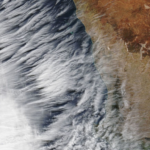
 An image of clouds above Earth collected by the Visible Infrared Imaging Radiometer Suite (VIIRS) instrument, which sends its data through the Earth Observing System Data and Information System (EOSDIS). Find more images available through EOSDIS. Photo by NASA / VIIRS.
To address this challenge, the team will generate numerical simulations, as opposed to direct observational data collected by the satellite, to help define in computer code the ways clouds and other particles interact with each other in the atmosphere.
Using those complex simulations, “We can know which pixels are affecting their surroundings or being affected by their surroundings. That way, we’ll have a totally connected network that we can use to train the algorithms,” Zhang says. “Even observations cannot tell us which pixel is affecting which pixel. Only numerical simulations can do that.”
Decoding the data
Another important part of their work will make it possible to transfer knowledge between two different categories of instruments. The first type, active sensors, are extremely accurate but only observe a very small portion of the sky: All of them together only watch about 10 percent of Earth’s surface. Passive sensors, on the other hand, are a little less accurate but, combined, look at nearly the whole globe.

Sanjay Purushotham. Photo courtesy Sanjay Purushotham.
“These sensors collect different kinds of data,” and all of it is valuable, says Sanjay Purushotham, assistant professor of information systems and another co-investigator on the project. A major challenge for the team is coming up with algorithms that allow computers to use all of the available data—from both kinds of sensors—to define clouds and their interactions in ways a computer can understand.
“You cannot use any off-the-shelf machine learning or deep learning model to solve this problem,” Purushotham says.
The magic of AI
All of this algorithm development takes a lot of resources and human energy. However, the team is working to automate some parts of the process. Right now, “It’s always difficult to duplicate an algorithm designed for one instrument for other, similar instruments, or even for the same instrument on a different platform,” explains Chenxi Wang, a co-PI on the project and an assistant research scientist with JCET. “Even subtle changes in the instrument or the platform’s orbit can cause the original algorithm to fail.”
“You have to develop almost a brand new algorithm,” C. Wang adds. “You have to adjust parameters, check the stability of the algorithm, and do evaluation… You have to do everything again. And that can take from six months to several years.”
 Chenxi Wang. Photo courtesy Chenxi Wang.
C. Wang hopes to help the computer learn to do the translations itself, based on an understanding of the fundamental physics. All a human would have to do is give the program certain parameters about the instrument and the satellite it’s traveling on.
“I think that’s the magic of machine learning and artificial intelligence,” says C. Wang. “The hope is that instead of years, it will take only a few days or at most a week. It will save a lot of time and resources.”
“We’re developing this process so it can be universal and applied to any instrument,” adds Zhang. “It’ll liberate some scientists from repeating the same things again and again to fine-tune the algorithms.” It will also get data to scientists like him much faster. As he notes, “If you have to wait for many years to get that useful data, it’s harder to make progress.”
The power of partnership
UMBC’s long-term partnership with NASA has helped make this project possible. “The special connection between UMBC and NASA through JCET has definitely prepared us better for this kind of proposal,” Zhang says.
Belay Demoz, director of JCET and professor of physics at UMBC. UMBC also maintains two other partnerships with NASA, the Geoplanetary Heliophysics Institute (GPHI) and the Center for Space Sciences and Technology (CSST). Photo by Marlayna Demond ’11 for UMBC.
In addition, a confluence of advances has given fresh impetus to this kind of work. For one thing, demand for climate data is on the rise, given the increasing visibility of the climate emergency. “Cloud observation is a high priority for NASA today. No one knows just how much clouds are contributing to climate change and other things,” J. Wang says. “That’s why we chose this topic, because it’s so important to understand Earth.”
Parallel advances in machine learning and data collection further fuel the effort. “Even two or three years ago we couldn’t have done this,” J. Wang reflects.
In the end, though, it comes down to collaboration. Each member of the team of data scientists and atmospheric physicists brings a unique perspective and knowledge base.
“We have good synergy among the team members, so we can speak the same language even though we come from different disciplines,” Purushotham says. “That helps us understand what the real problems in the data are, and what innovations we need to solve them.”
Banner image: The VIIRS instrument captured this image of bands of cirrus clouds off the southwest coast of Australia in 2019, which portend intense weather. Photo: NASA.
]]>
Data archives from NASA’s Earth Observing System Data and Information System (EOSDIS), which collects data from satellites, aircraft, and ground instruments, currently contain about 31 petabytes...
https://umbc.edu/stories/nasa-awards-umbc-team-1-4m-to-develop-ai-that-improves-how-computers-process-climate-data-from-satellites/
https://my3.my.umbc.edu/api/v0/pixel/news/119768/guest@my.umbc.edu/7c5fa40d74f9a5c7b6c2eb004dcafa2c/api/pixel
is
jcet
page1
physics
research
science-and-technology
UMBC News & Magazine
https://my3.my.umbc.edu/groups/umbc-news-magazine
https://assets1-my.umbc.edu/system/shared/avatars/groups/000/001/943/24435aa6207c452e7bc15cc74b42c7bb/xsmall.png?1748556657
https://assets1-my.umbc.edu/system/shared/avatars/groups/000/001/943/24435aa6207c452e7bc15cc74b42c7bb/original.png?1748556657
https://assets2-my.umbc.edu/system/shared/avatars/groups/000/001/943/24435aa6207c452e7bc15cc74b42c7bb/xxlarge.png?1748556657
https://assets2-my.umbc.edu/system/shared/avatars/groups/000/001/943/24435aa6207c452e7bc15cc74b42c7bb/xlarge.png?1748556657
https://assets3-my.umbc.edu/system/shared/avatars/groups/000/001/943/24435aa6207c452e7bc15cc74b42c7bb/large.png?1748556657
https://assets1-my.umbc.edu/system/shared/avatars/groups/000/001/943/24435aa6207c452e7bc15cc74b42c7bb/medium.png?1748556657
https://assets2-my.umbc.edu/system/shared/avatars/groups/000/001/943/24435aa6207c452e7bc15cc74b42c7bb/small.png?1748556657
https://assets1-my.umbc.edu/system/shared/avatars/groups/000/001/943/24435aa6207c452e7bc15cc74b42c7bb/xsmall.png?1748556657
https://assets2-my.umbc.edu/system/shared/avatars/groups/000/001/943/24435aa6207c452e7bc15cc74b42c7bb/xxsmall.png?1748556657
UMBC News & Magazine
0
0
false
Mon, 26 Oct 2020 16:09:11 -0400
UMBC once again ranks among the top 150 universities in federal research funding
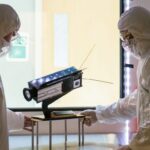
The annual Higher Education Research and Development (HERD) survey from the National Science Foundation again includes UMBC as a top recipient of federal research support.
The most recent survey aggregates federal research and development expenditures for fiscal year 2018. The survey data combines total funding from all federal agencies and also provides information on research funding from non-federal and non-governmental sources.
Overall, UMBC is ranked #148 in federal research funding for the 2018 fiscal year, and #173 in total research funding from all sources. The federal investment figures include funding from sources such as the Department of Defense, Department of Health and Human Services, and NASA, among others.
“The annual HERD Rankings represent a widely reviewed national comparison of institutional scholarly and research activities,” says Karl V. Steiner, vice president for research at UMBC. “The most recently released 2018 data represents the fourth consecutive year of growth in research expenditures for UMBC.”
A leader in studying Earth’s atmosphere
UMBC is now ranked #13 nationally in NASA funding and #27 in federal funding for geosciences, atmospheric sciences, and ocean research more broadly. Among the projects included in that funding was UMBC’s Hyper-Angular Rainbow Polarimeter (HARP) cubesat.
 Vanderlei Martins, Roberto Borda, and Dominik Cieslak with HARP at UMBC. Photo by Marlayna Demond ’11 for UMBC.
This small satellite, the size of a loaf of bread, was developed by a team of UMBC scientists, led by Vanderlei Martins, director of UMBC’s Earth and Space Institute. It was recently launched into space aboard a NASA rocket heading for the International Space Station. The satellite contains sensors that will collect information about Earth’s atmosphere, informing our understanding of pollution and climate.
Computing hardware to address infrastructure challenges
In computer and information sciences, UMBC ranked #69 in federal research support. Among awards in this area was NSF support for UMBC to lead a new $3 million research partnership to solve major infrastructure challenges with next-generation computing hardware.
 Yelena Yesha, right, alongside faculty and students who conduct research through CARTA. Photo by Marlayna Demond ’11 for UMBC.
Yelena Yesha, computer science and electrical engineering, serves as principal investigator for the five-year grant from the NSF Industry-University Cooperative Research Centers. UMBC launched the Center for Accelerated Real Time Analytics (CARTA) to complete computing hardware research supported by this grant. A portion of the NSF funds are also furthering collaborative research with partner institutions North Carolina State University; Rutgers University, Newark; Rutgers University, New Brunswick; and Tel Aviv University. UC San Diego and the University of Utah are also collaborating, and industry partners like Seagate and Morgan Stanley are engaged in this work as well.
Yesha explains, “CARTA will usher in the era of accelerated real-time analytics by effectively utilizing innovative technologies such as cognitive computing, machine learning, and quantum computing to address our nation’s global competitive challenges in health security, disaster mitigation, and the emerging artificial intelligence revolution.”
Social science research to address health disparities
In the social sciences, UMBC ranks #27 in federal research dollars among universities nationwide. UMBC psychology faculty received a particularly high number of federal grants in 2018, including Danielle Beatty Moody (NIH funding), Shawn Bediako (NSF funding), Chris Murphy (DHHS-NIH funding), and Shari Waldenstein ( DHHS-NIH funding, as well as support from the VA Medical Center in Baltimore). Additionally, Christine Yee, economics, received a research grant from the U.S. Department of Veterans Affairs.
 Danielle Beatty Moody. Photo by Marlayna Demond ’11 for UMBC.
Beatty Moody is director of UMBC’s Social Determinants of Health Lab. In 2018 she was the PI on three NIH grants, funded through the National Institute of Aging. They all focused on the HANDLES study, which stands for Health Aging in Neighborhoods of Diversity across the Life Span. Beatty Moody’s team examined health disparities among middle-aged and older residents of Baltimore. This includes the relationship between factors like structural discrimination and early life experiences with cognitive decline and cardiometabolic measures.
“We are proud of the broad impact of our work, from the social sciences, to computing, to our close relationship with NASA Goddard,” says Steiner. “I am pleased with the continued efforts and growing success of our entire research community.”
Banner image: Research team of Vanderlei Martins, professor of physics, with a model of the HARP satellite. Photo by Marlayna Demond ’11 for UMBC
]]>
The annual Higher Education Research and Development (HERD) survey from the National Science Foundation again includes UMBC as a top recipient of federal research support. The most recent...
https://umbc.edu/stories/umbc-once-again-ranks-among-the-top-150-universities-in-federal-research-funding/
https://my3.my.umbc.edu/api/v0/pixel/news/119945/guest@my.umbc.edu/6836f3b7f8c57244a547fc39547c3346/api/pixel
cahss
cnms
coeit
csee
economics
jcet
page1
physics
psychology
rankings
research
science-and-technology
UMBC News & Magazine
https://my3.my.umbc.edu/groups/umbc-news-magazine
https://assets1-my.umbc.edu/system/shared/avatars/groups/000/001/943/24435aa6207c452e7bc15cc74b42c7bb/xsmall.png?1748556657
https://assets1-my.umbc.edu/system/shared/avatars/groups/000/001/943/24435aa6207c452e7bc15cc74b42c7bb/original.png?1748556657
https://assets2-my.umbc.edu/system/shared/avatars/groups/000/001/943/24435aa6207c452e7bc15cc74b42c7bb/xxlarge.png?1748556657
https://assets2-my.umbc.edu/system/shared/avatars/groups/000/001/943/24435aa6207c452e7bc15cc74b42c7bb/xlarge.png?1748556657
https://assets3-my.umbc.edu/system/shared/avatars/groups/000/001/943/24435aa6207c452e7bc15cc74b42c7bb/large.png?1748556657
https://assets1-my.umbc.edu/system/shared/avatars/groups/000/001/943/24435aa6207c452e7bc15cc74b42c7bb/medium.png?1748556657
https://assets2-my.umbc.edu/system/shared/avatars/groups/000/001/943/24435aa6207c452e7bc15cc74b42c7bb/small.png?1748556657
https://assets1-my.umbc.edu/system/shared/avatars/groups/000/001/943/24435aa6207c452e7bc15cc74b42c7bb/xsmall.png?1748556657
https://assets2-my.umbc.edu/system/shared/avatars/groups/000/001/943/24435aa6207c452e7bc15cc74b42c7bb/xxsmall.png?1748556657
UMBC News & Magazine
0
0
false
Fri, 28 Feb 2020 20:23:06 -0500


