A Tree Grows in Baltimore

It all starts with a seed—a source of hope.
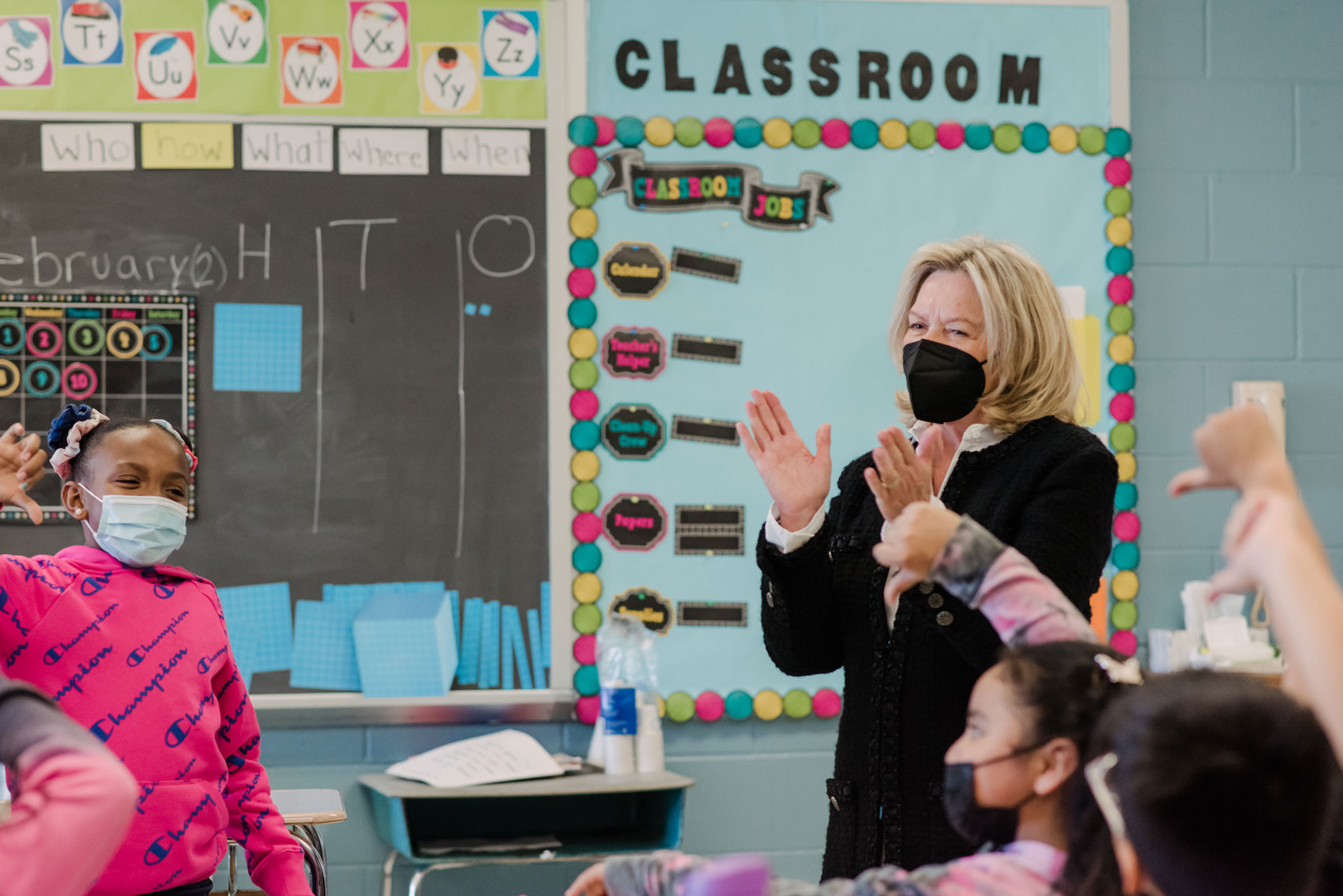
Or in this particular case, a handful of seeds in the form of alumna Tamera Davis’ second grade students at Lakeland Elementary/Middle School. The class is fidgety but tuned in. As they jump into a rhyming exercise, Betsy Sherman joins them in a game of call and response at the front of the classroom.
A former teacher herself, Sherman feels right at home at Lakeland. In a hallway with cut-out paper letters reading “Education = Opportunity,” she smiles and waves to a line of students in puffy winter coats. As she sees kids studying in an alcove, she can’t help but peek over their shoulders in curiosity.
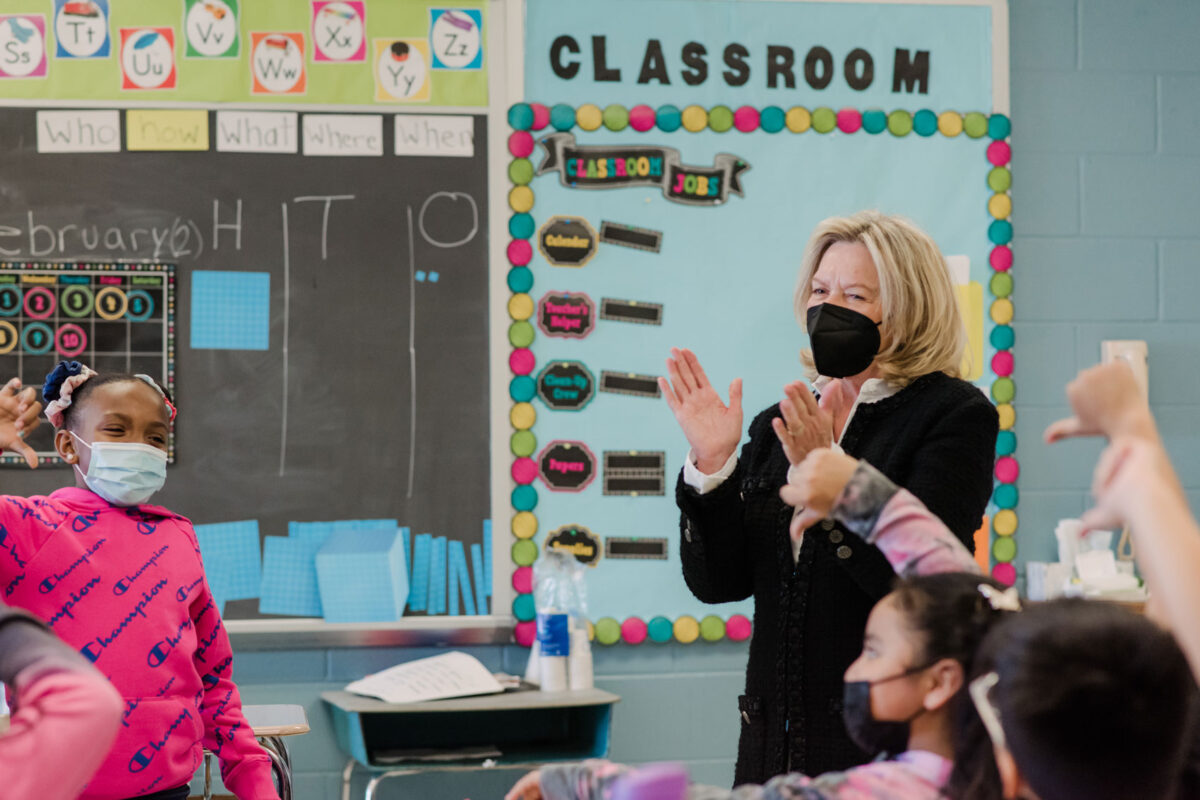 Tamera Davis ’21, psychology, and her second grade students practice rhyming with Betsy Sherman.
Earlier this winter, the Sherman Family Foundation donated $21 million to create the Betsy & George Sherman Center, which will expand and integrate UMBC’s work in teacher preparation, school partnerships, and applied research focused on early childhood education and improving learning outcomes for Baltimore students.
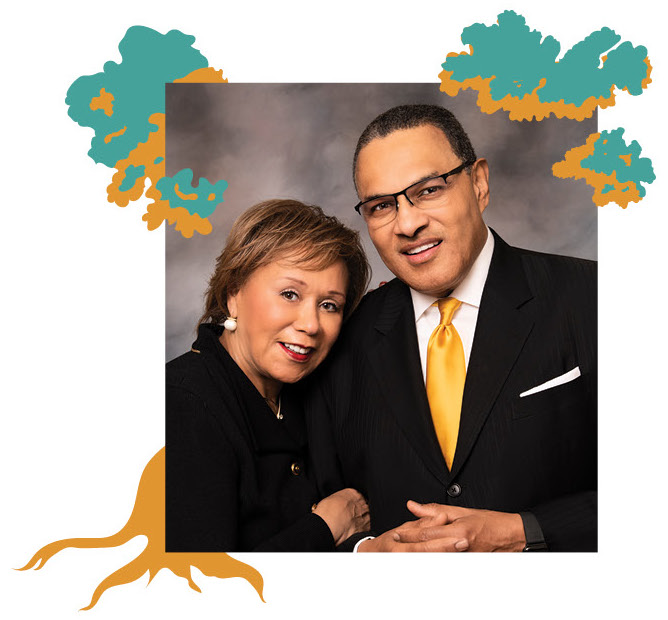 In addition to stewarding
philanthropic relationships
for UMBC, Freeman and
Jackie Hrabowski have also
given more than $2.3 million
to the university over the
past three decades. Photo
by Jay Baker ’80, visual and
performing arts.
The gift—the largest in UMBC’s history—has the potential to transform both UMBC and generations of local students. The Lakeland partnership has clearly already transformed Sherman.
“You just never know how that one moment you spend with a child impacts their lives. You may never know,” says Sherman, who with her late husband, George, began partnering with UMBC in 2006 to create the Sherman STEM Teacher Scholars Program and other related initiatives. “And so you really need to be aware that your influence can be long lasting.”
Philanthropy of this sort is not about flash or money. It’s about the long game, driven by love and hope. UMBC has, for years, stood as a fertile planting ground for very personal, values-driven giving. It’s a vision shared by Freeman and Jackie Hrabowski and close UMBC partners who have connected over the idea that change is possible—and a belief in the promise one seed can hold.
Driven By Love
For Freeman and Jackie Hrabowski, the seeds of philanthropy were planted very early in childhood. He grew up in Birmingham, Alabama, the son of two teachers; she in rural Virginia, the daughter of two first-generation college students. Both recount stories of how their families helped their communities through work in schools and churches, and how that example stuck with them throughout their lives and careers.
“I think that my foundation for fundraising and philanthropy comes from the strong belief in the power of education to transform lives,” says Freeman, who has been known to sit on the floor with elementary school children to talk excitedly about math. “Jackie and I both understand, as the children of teachers, how important teachers were in our own development.”
Later in life, as Hrabowski matured into his role as president of UMBC, he and his wife became friends with George and Betsy Sherman—folks with similar interests and hopes. As their friendship grew, so did their vision of how they might change the face of education in Baltimore.
“As you build relationships, you build trust,” says Mrs. Hrabowski, who thinks of Betsy Sherman and her late husband as family. “You share lots of time together talking about your differences, your perspectives, and how to make it all work. It’s all about the realities of where we are and what we can do together to make a difference.”
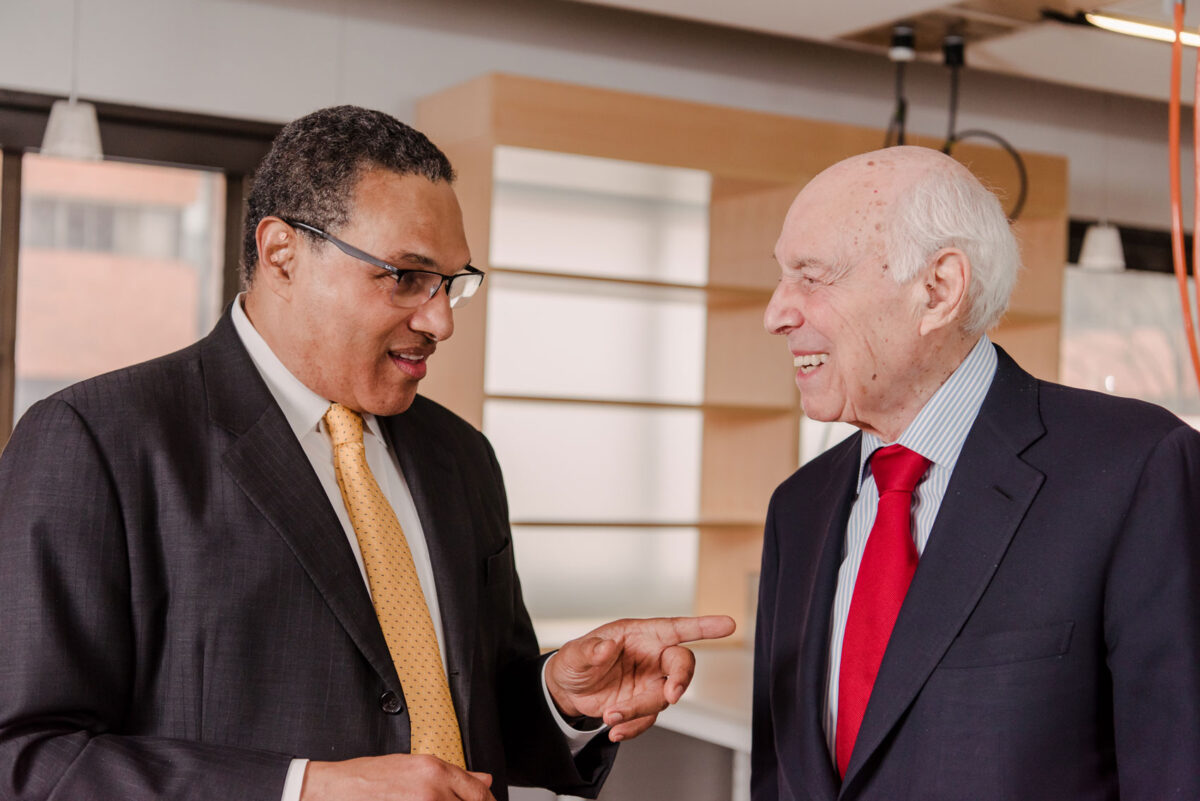 Freeman Hrabowski and Robert Meyerhoff co-founded the Meyerhoff Scholars Program in 1988.
Because “people tend to give to people,” as both Hrabowskis say, it’s not surprising that so many major philanthropic endeavors at UMBC have felt so personal in nature. Dr. Hrabowski’s relationship with Robert Meyerhoff—and a shared vision for making science more accessible to students of color—turned into a more than 30-year endeavor that has since changed the face of science and technology through the Meyerhoff Scholars Program.
“I threw the ball, but he ran for the touchdown,” Meyerhoff said of Hrabowski recently. “He made the most of it. He is a wonderful man.”
 Earl and Darielle Linehan created the Linehan Artist Scholars Program at UMBC.
Similarly, a relationship with Earl and Darielle Linehan that began with Mr. Linehan’s serving on and chairing UMBC’s Board of Visitors revealed a deep desire to provide talented artists with an interdisciplinary approach to learning. Today, more than 300 Linehan Artists Scholar alumni are out in the world influencing dance, music, theatre, and other creative disciplines.
At the core of these partnerships—like so many others nurtured by Hrabowski—is a shared desire to help others thrive.
“When my parents and Jackie and Freeman get together, they talk about changing the world,” says Dave Sherman, noting his parents’ great love of Baltimore. “My mom and dad…not only would they provide resources, but they would provide passion. They would provide involvement…but it really all goes back to the people. And my parents wouldn’t support something that they didn’t believe would have the ability to grow.”
Watching It Grow
From her vantage point as a UMBC alumna, a mentee of Jackie Hrabowski, and vice president for economic development at Johns Hopkins University and Health System, Alicia Wilson ’04, political science, knows a good long-term investment when she sees it.
Wilson has felt the personal investment the Hrabowskis have made in her ever since she was a student. Recently, when she was sick, the pair brought Wilson a homemade pot of chicken soup, she says. At night. During a snowstorm.
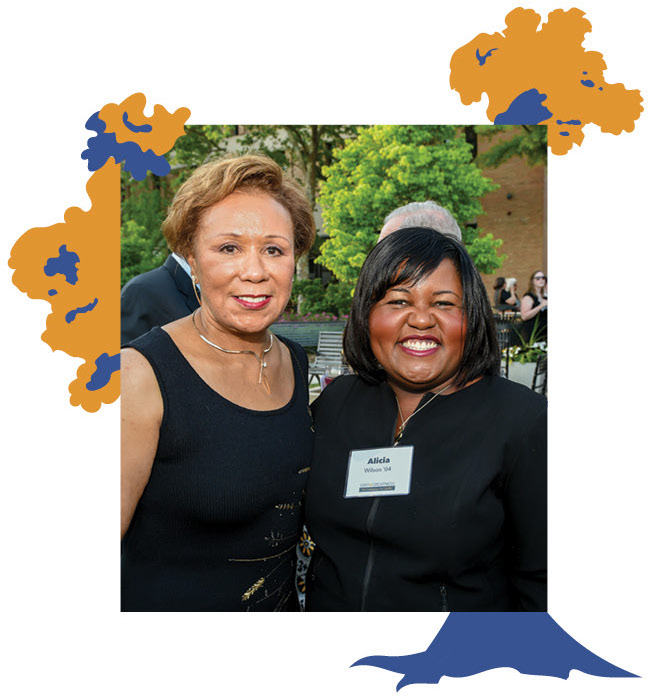 Jackie Hrabowski and Alicia Wilson ’04
Beyond her own experiences, Wilson understands how personal philanthropic commitment shows up in the community—and what a lasting effect it can make, both structurally and emotionally, for all involved. A program like the Sherman STEM Teacher Scholars is able to put enthusiastic and well-equipped teachers in front of underserved students who will thrive with the extra attention. The effort adds up over time, creating a pipeline of opportunity for kids all over Baltimore.
“If you think about the ripple effect of your impact, it’s really through people and it’s through what we invest in,” says Wilson. “And so, as you think about the impact of the philanthropy that takes place at UMBC, you can point to so many scientific advances, public health, social advances that really started at a school in Catonsville. And really the testimony is in the people.”
For Sandra Evers-Manly, president of the Northrop Grumman Foundation and a partner in the work at Lakeland Elementary/Middle School, what sets these projects apart is the way UMBC engages at all levels, looking at the long-term potential of collaborative effort. “When we first began the discussion with Freeman about his vision for Lakeland and all of our UMBC partnerships, it was never about one element, it was always about the whole picture—the impact and results. In Lakeland’s case, what did the partnership mean to the school, students, teachers, parents, and the surrounding community,” says Evers-Manly.
“UMBC is a great neighbor,” she continues. “Some people will pick just one thing, like scholarships, and that’s it. But UMBC will say, ‘We’re going to work with families. We’re going to work with teachers. And, oh, by the way, we’re coming to you. You don’t have to come up the hill to UMBC. And we’ll find strategic partners to be a part of this.’ UMBC has the magnetism to help bring those key players into the room. What is equally impressive, is that you have both Freeman and Jackie who are so committed to the university, the greater community, and our nation. They do this in so many ways, both professionally and personally.”
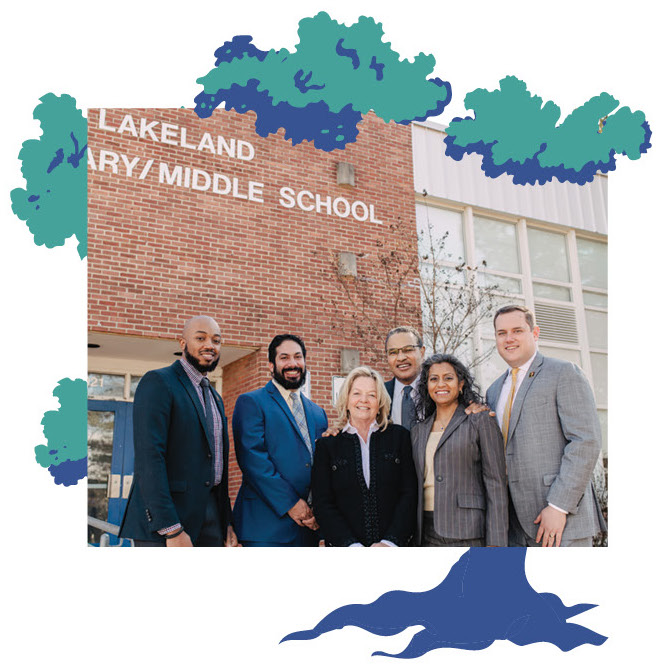 At Lakeland Elementary/Middle School (L-R): Sherman Scholar alum and staff member Corey Carter ’08, M16, biological sciences, M.A.T. ’10; Lakeland Principal Najib Jammal; Betsy Sherman; Freeman Hrabowski; Rihanna Shafi, Director, Sherman Scholars; and Joshua Michael ’10, Director, Baltimore School Partnerships.
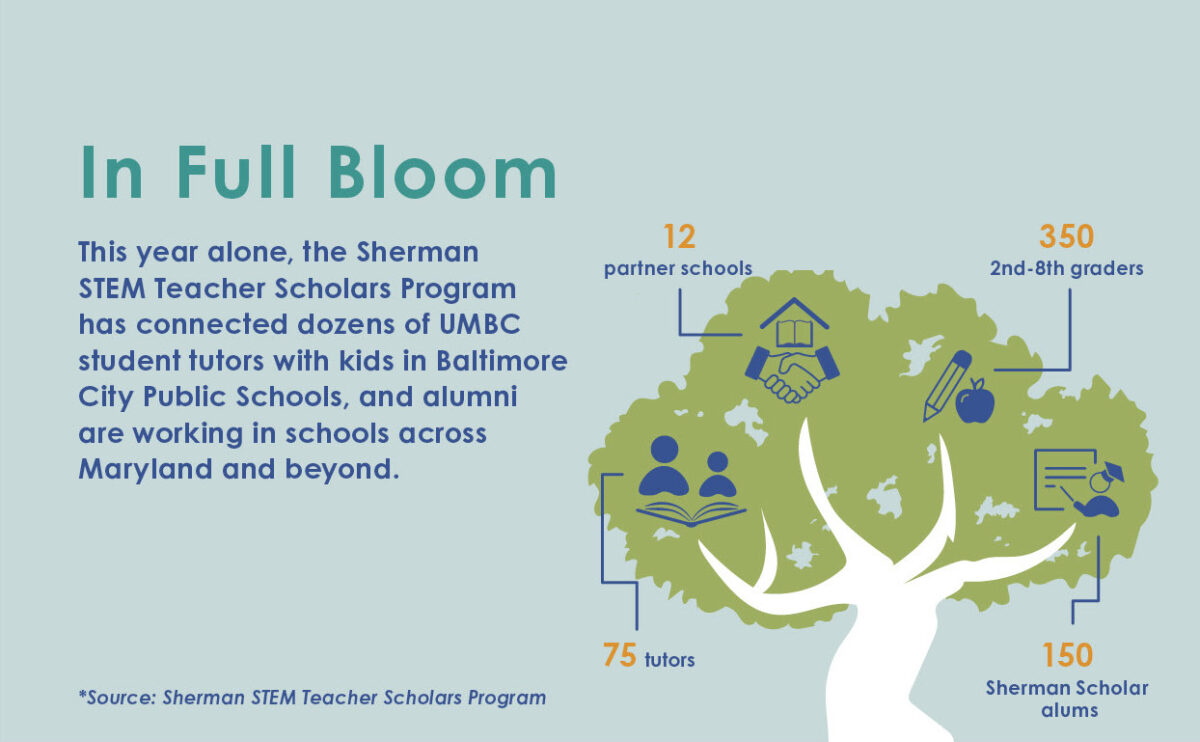
The success of a partnership can be measured in many ways—and UMBC loves to measure and study regularly to make sure their programs are working. The Sherman Scholars program now partners with 10 schools to promote academic achievement through professional development for teachers and intensive tutoring for students. For example, more than 90 UMBC students, including Sherman Scholars and others, provide evidence-based math tutoring for over 350 elementary and middle school students in several schools across Baltimore. Early data show this approach is working.
But much of what drives these programs goes beyond data.
“This isn’t academic. . . It is a heart move,” says Wilson. “And thank God their hearts are pure and good and filled with love for young people. . . and the belief in the fact that young people, regardless of their background, can achieve.”
A Seed Sustained
When Hrabowski was still interim president of UMBC, then Maryland Governor William Donald Schaefer asked what he might do to support him and UMBC. Looking out over campus from the roof of the Administration Building, Hrabowski made what was probably an unexpected request.
“He…asked what he could do, noting that he didn’t have a lot of money to throw around. I said ‘Give me trees!’” Hrabowski writes in The Empowered University, noting that Schaefer quickly followed up by calling the Department of Natural Resources and having trees planted all over the young campus grounds.
Overnight, the campus was visually changed. Thirty years later, stands of mature trees provide sanctuary for wildlife and green space for all.
Thinking back on his years at UMBC, Hrabowski reminds us: “It’s not about me. It’s about us.” None of UMBC’s successes happen without the community, he emphasizes. UMBC is strong because we have put in the work, grown our endowment from practically nothing to more than $125 million, and proven ourselves year after year. UMBC will remain strong because of our shared commitment to inclusive excellence.
In his final months as president, Hrabowski has sealed his legacy yet again with the founding of a named scholarship that will increase access and affordability for undergraduate students with financial need and a commitment to community service. And while he has promised never to stop planting for UMBC, it’s up to the rest of us to nurture the trees he’s so faithfully tended.
“The seeds that he planted so long ago are now mighty trees,” says Wilson. “But, the goal isn’t that we just get to sit under the shade of the trees. We also have to go and plant some trees and build upon that legacy.”
Learn more about the Freeman A. Hrabowski, III, Endowment for Student Excellence at giving.umbc.edu/hrabowskifund.
Anyone who has had the pleasure of a rooftop visit with Freeman A. Hrabowski knows the joy UMBC’s president takes in pointing out the Baltimore skyline from the top of the Administration Building. That’s because Baltimore — to him, and to UMBC — is not just a nearby spot on a map or a place to watch a baseball game. It’s a life source for the university, providing internships for our students, jobs for our graduates, and culture for all who may choose to take advantage of it.
As much as UMBC receives from the city, however, it also gives back in immeasurable ways, in service and partnership. Every day, members of the UMBC community — faculty, students, staff, and alumni — collaborate with neighbors across the city through art, civic and social service, environmental activism, storytelling, and education projects. The stories that follow highlight just a few of the many, many ways UMBC is making an impact in its beloved Baltimore.
Full STEAM Ahead
 A UMBC student teacher reads to Lakeland Elementary School students.
It has been a year since UMBC and Northrop Grumman launched a partnership in three Baltimore City schools, sparked by a $1.6 million commitment from the Northrop Grumman Foundation. The partnership, which includes Baltimore City Public Schools and the Department of Recreation and Parks, boosts science, technology, engineering, arts, and math (STEAM) education both in and out of school. The work is centered at Lakeland Elementary/Middle School in Southwest Baltimore and is changing how these students, and their families, see science in their futures.
A primary focus of the program will be the development of a state-of-the-art STEAM Center at Lakeland that will feature science labs, a makerspace, digital video and sound studio, computer lab, parent resource room, and community meeting space. The recreation center attached to the school is in the process of getting a complete makeover, but even during construction planning, the new STEAM programs are already happening. After school, girls are learning to design and build apps in the Technovation club, and students are working on robots for Vex Robotics.
Students showed off the work in the first ever STEAM family night, bringing almost 70 students and community members to the school to learn about science together. With more than just financial support, volunteers from Northrop Grumman are now a constant presence in the school, serving as coaches, mentors, and even celebrity readers.
Four years ago, UMBC President Freeman Hrabowski and Lakeland Principal Najib Jammal met to lay the groundwork for collaboration inspired by the vision and philanthropy of George and Betsy Sherman. The partnership that emerged brought UMBC’s Sherman STEM Teacher Scholars Program, Shriver Center Peaceworker Program, and The Choice Program to Lakeland.
“The impact of this partnership goes beyond institutional philanthropy. It provides meaningful learning opportunities for all partners, from Lakeland and UMBC students, to teachers and professors, to STEAM professionals,” explains Rehana Shafi, director of the Sherman STEM Teacher Scholars Program at UMBC.
Beyond STEAM, the partnership also helps Lakeland and other schools build stronger communities. Northrop has supported the expansion of The Choice Program, a highly successful national model for community-based intervention that has served more than 20,000 youth and their families from Maryland’s highest risk communities for almost 30 years. Through the partnership, The Choice Program has expanded to serve students and their families, including former Lakeland students, at Benjamin Franklin High School at Masonville Cove and Excel Academy at Francis M. Wood. At Lakeland, STEAM center staff plan activities for parents, including a food pantry, community Zumba, and free tax preparation. Once the new computer lab is complete, the center will also start offering job training classes.
“We are going to work with our colleagues to prepare these children to compete against anybody, anywhere in the world,” said President Hrabowski. “We want to be saying that we can take children from any background…and make them best in the world. It takes that village, and it takes…hard work.”
— Max Cole and Marie Lilly
Hands-On Science
 The Remote Access Instrumentation Laboratory (RAIL) allows UMBC student researchers to analyze water samples taken by Baltimore elementary, middle and high school students – and communicate with partner schools via video chat while doing so.
What exactly is in our water? Through a partnership between UMBC and area schools, students can explore worlds beyond what’s visible by the naked eye.
“Science is premised on asking questions about our world and seeking answers through the scientific method. Students learn best through doing,” says Dean Bill LaCourse of the College of Natural and Mathematical Sciences. Unfortunately, many schools have limited resources to practice science using advanced instrumentation, he explains, but UMBC’s RAIL, or Remote Access Instrumentation Laboratory, can help close that gap.
Through the generous support of Battelle, UMBC is using RAIL to leverage technology to bring high-end analytical instrumentation to elementary, middle, and high school students across Maryland. Housed in UMBC’s Molecular Characterization and Analysis Complex, RAIL aims to increase teacher content knowledge while inspiring the next generation of scientists and researchers in STEM.
Teachers receive training at UMBC to use remote-access software to connect computers in their classrooms to the instrumentation in the RAIL studio. They also learn procedures for collecting water samples RAIL can test – from the Patapsco River to a playground puddle – which they send to UMBC for analysis on RAIL. When the teacher and class make contact with RAIL, a UMBC scientist is available to answer questions via the lab’s two-way video capability. Then the class can remotely operate the instrument as it analyzes their samples and view the data it produces in real time – from pollutant content to salinity. Over the last year, the system has been implemented in schools in Baltimore City and Harford County, and the goal is to greatly increase the reach of the program.
“RAIL will be the basis of a new model for outreach by UMBC,” LaCourse shares, “to provide opportunity and inspiration to students from every corner of the state, including Baltimore City.”
— Sarah Hansen M.S. ’15
Making the JUMP to College
 College Jump student Sushmita Thapa (L) and UMBC sophomore Hannah Sadollah.
Nepal is a world away from Baltimore in miles of land and ocean. But for those who find they must leave their home there, making that trip is only the beginning of their journey.
“I cannot speak what’s on my mind. I stop because of my language barrier,” said Sushmita Thapa, a Western High senior who had to leave Nepal with her family in 2015 because of the political unrest. Despite the difficulties, she says, “I want to be a doctor. I want to be an independent woman, and I want to help others.”
Thankfully, she has an ally in that process – Hannah Sadollah, UMBC sophomore and mentor in College JUMP (Journey Upward Mentoring Program). Since September, Sadollah has met with Thapa weekly, giving her tips on how to take the next steps to getting into college – from crafting essays to navigating financial aid.
“It hurts my soul that she has the potential to get into college but she wouldn’t have been able to get in because she doesn’t know how to apply,” said Sadollah, who is studying to become a psychiatrist.
Sadollah and other college students acting as mentors in College JUMP aim to enable high school juniors and seniors who are refugees (or asylees, seeking asylum) with crucial college application and life skills. The program came about two years ago through a partnership between UMBC and the Baltimore City Community College Refugee Youth Project.
Christie Smith ’15, global studies, coordinates the program through AmeriCorps. She says partnerships like Thapa and Sadollah’s work well because “they build off each other’s energy” and are both so motivated. It also helps that, like most of the mentors, Sadollah’s family has an immigrant background. She came here from Iran when she was a baby.
“This gives me an awesome opportunity to give back,” said Sadollah, who learned these skills in high school. She said Thapa is “soaking it up,” to the point where four of her college applications have been accepted, including one to UMBC. Now, like all college-bound seniors in the U.S., she has to figure out what will work for her in her ongoing education.
“I’m learning every day,” said Thapa, “I’m trying to fit into this society every day.”
— Karen Stysley
Charm City Connections
 UMBC Senior Ramses Long (r) works with student at Excel Academy.
It’s a little chaotic during closing bell at Excel Academy, located on Baltimore’s west side. Teenage students, giddy with the excitement of an unseasonably warm March day, flow in and out of the library — drawn equally to the PlayStation that has been set up and two young men just a few years older than the high school students themselves.
UMBC students Ramses Long ’17, biology, and Jabari McLain ’19, financial economics, are visiting the library to tutor, mentor, and connect. They are members of Charm City Connection, an organization of UMBC students, most of whom also went to school in the city and who want to build relationships as role models and mentors with Baltimore City students.
These after-school sessions are only one of the club’s endeavors, but it’s unique in simplicity and impact. Long, McClain, and the other members are not trying to change policy or act as saviors. They have partnered with UMBC’s Shriver Center to help students with homework, studying, writing a paper – or maybe just getting them into class – on a weekly basis. Excel Academy is an alternative high school for students at least two years behind grade level – usually over-aged, under-credited, and facing a plethora of problems in their homes and neighborhoods.
“We’ve gotten students to commit to their goals. One student didn’t come to school on a regular basis and never came on Fridays. We got him to start coming to school on Fridays,” says Long about the basic nature of their approach. “Another student needed help writing a paper and was behind. We worked on the paper during the after-school session, and she got it in on time.”
Understanding the small steps to achievement like attending class, completing homework, and a few hours of studying, make the Charm City Connection mission humble and effective. Showing how accomplishments like passing a class and moving to the next grade level put goals like graduation, college enrollment, and job placement within reach.
The PlayStation might be a trick to get students into the library after the closing bell rings, but it works. Charm City Connection members have built an honest relationship with Excel Academy students, beyond just tutoring.
“We engage students in conversation to help them contextualize their experiences, so they aren’t as confused by the obstacles they are facing,” says Long. “We want to empower these students to do something for themselves and communities.”
— Alice Crogan
Proof of Life
 From “Stains on the Sidewalk” by Amy Berbert: #47, Kenneth Collins, 45 Y/O, March 15, 2016 @ 9 P.M., 2433 East Monument Street.
UMBC student Amy Berbert ’17, visual arts, is in the midst of an ambitious yet somber project: using photography to memorialize each of the 318 victims of homicide in Baltimore in 2016.
Berbert began taking photographs at crime scenes in the city last year with the goal of bringing visibility to the traumatic impacts of violence on people and communities. Her year-long senior thesis project, which she posts on the Instagram feed @stainsonthesidewalk, is described as, “An Exploration of Homicide in Baltimore City. Same Day. Same Time. Same Place. One Year Later.” Each death is memorialized with a picture taken precisely one year later at the location of the homicide.
The photographs “are respectful of the people involved,” she told Mary Carole McCauley in the Baltimore Sun. “They don’t judge anyone. It’s just a moment of silence to remember these people, and the fact that they lived and died in that place.”
Though Berbert’s senior exhibit concluded her college career, she is dedicated to continuing the rigorous project through the end of the year, planning her life in 2017 around the lives that were lost in Baltimore in 2016.
By focusing on increasing awareness of lives lost through violence, Berbert hopes to encourage others to engage with and support communities facing challenges. She shares, “As a community we need to educate ourselves and others about the root causes of violence…step out of the bubble of campus and immerse ourselves in understanding the issues that people right down the road from us face every day.”
 Amy Berbert ’17 captures a photo for her year-long series memorializing the 318 victims of homicide in Baltimore in 2016.
The broader impacts of Berbert’s work aren’t yet fully realized, but she’s already felt the project’s effects on herself. As she told the Baltimore Sun, “Before I started working on this project, I knew I had stereotypes. But, every time I go out I’m faced with them. I don’t know if this project is going to change anyone else. But, I think it’s changing me.”
Berbert notes the similarity in age of herself and many of the victims as well as perpetrators. “It has inspired me to learn how differences in circumstances and environment can lead two equally human people down two very different life paths. We all want to feel safe, provided for, accepted, and sometimes noticed. As I have read about the victims and the perpetrators of these homicides as well as spend time in the neighborhoods and talk with people who experience the struggles of these neighborhoods, I have learned that we really are not so different.”
— Catherine Borg
Walking the Walk
 Kate Drabinski leads students on a walking tour of Baltimore.
When the students disembark the UMBC Shuttle at MLK Boulevard, their tour guide Kate Drabinski, lecturer in gender and women’s studies, turns the group to face the subject of the day: a part of downtown Baltimore they have likely not explored before this day.
They start walking, stopping to discuss the B&O Railroad Museum, the Bromo Seltzer Arts tower, and other landmarks. With each of these points of interest, however, there is a division as tangible as the short brick wall dividing one side of MLK from the other. The rise and fall of industrialization, the spread of the arts community, and the building of new neighborhoods comes at the expense of demolishing others.
The group goes quiet at the University of Maryland Biopark, a physical reflection of what comes down when something new is built. Boarded-up houses still surround vacant lots reserved for development.
“When we cut those people off from our imagination, then it makes it easier to destroy them,” says Drabinski, who offers the walking tour in conjunction with the Women’s Center Critical Social Justice Week. “From talking to students, their parents say ‘Don’t go to Baltimore. Baltimore is so dangerous.’ But that kind of rhetoric is dishonest … and it justifies the civic abandonment of these places and that is not ok.’”
At the end of the tour, Drabinski leaves the students with a final lesson. They must find lunch and figure out their own way back to campus so they can learn not only about the layers of history within the different places, but also the logistical barriers of getting there and back.
“Stuff that is a little bit scary,… part of the struggle is having someone give you permission to go into that space,” says Drabinski. “As a tour guide or as a teacher I can say, ‘I invite you;’ that is the first step. Just like in class, if I call on you on the first day and you hear your voice, you are more likely to talk through the rest of the semester. With the walking tour, if someone takes you somewhere and shows you how to do it … someone shows you the first steps they are more likely to do it again.”
— Kristen Russell
Making Good CHOICEs
 High school junior Ja’bria shows an art project she made during college night to Choice fellow J’Monnie Walker. The Choice Intensive Advocacy Program works with approximately 400 students in Baltimore City each year, along with 150 in Baltimore County, and 225 in Prince George’s and Montgomery counties.
At the dinner table, J’Monnie Walker and his four high school clients act like a family. Their plates piled high with the abundance only a college all-you-can-eat buffet can provide, they joke over ice cream, mac and cheese, pizza, and smiley face french fries, with day glo green soda to wash it all down. They ham it up for a group photo like siblings.
Then Walker, a fellow with the Choice Intensive Advocacy program, which is run by UMBC’s Shriver Center, gets serious.
“Tell me what this program is about,” he says, directing the question to 15-year-old Ja’Bria, a city high school junior who wears a cat ear headband and a welcoming smile.
“When I started the program, I was not a happy person,” explains Ja’Bria, who has missed more than her fair share of school days over the last semester for reasons we don’t discuss tonight. “But now … I’m a happier person. I try to be warmer.”
“Do you feel better?” he asks her. She nods. And her attendance record reflects it.
Students who are referred by a state agency into the six-month program find themselves paired with a fellow, like Walker, who visits the school at least twice a week, and the home once a day. Walker is like an extended member of the family, he says, even teaching the students how to cook. Tonight, they’re at Loyola University for a “College Night,” which he hopes will help them see opportunities beyond the challenges of their lives.
“I just want people to see them the way that I do,” and not judge them by their transcripts, he says. “The best part is the progression you see, the window that opens.”
— Jenny O’Grady
Calm in a Storm
 IPV assistance program coordinator Julia Caplan ’07 works with a client at the Baltimore VA Medical Center.
Intimate partner violence (IPV) can happen anywhere, and it largely goes unreported and untended. For veterans in the Baltimore area, however, a pilot program created and staffed by UMBC alumni and faculty is setting new standards for care and prevention of this particular type of violence. The Baltimore Veterans Administration Medical Center is among the first of 17 national pilot sites for Strength at Home, a 12-week group-based program developed by Casey Taft Ph.D. ’01, clinical psychology.
“Our programs focus on preventing violence from occurring in the first place, or else ending that violence once it begins,” says Taft, who originated the program at his home base of Boston, and whose recently published trials prove the program to be a bona fide success.
Over the course of three months, small groups of veterans who have been referred to the program meet for two hours at a time to discuss in depth the best ways of responding to stressful situations, the difference between assertive communication and aggressive or passive communication, and other related topics.
“We have been amazed at the receptiveness that we have received at the Baltimore VA, and how invested folks there have been in working to end violence in military and veteran families,” says Taft. “We expect to see the program continue to grow and to be considered the place to refer veterans and service members who are experiencing difficulties with anger and aggression in their relationships.”
IPV Assistance Program Coordinator Julia Caplan ’07, modern languages and linguistics, notes an added benefit is having Taft’s mentor Chris Murphy, professor and chair of the psychology department, just a short drive away. An expert in abuse and violence in intimate adult relationships, Murphy also serves as a trainer for the program.
“We are lucky that we have Chris down the road because they’re training people all over the entire United States. So Casey is in Boston, his co-coordinator is in Texas, and Chris is here,” she said, and Taft agrees.
“His presence there ensures that there will always be incredible local expertise in partner violence intervention and a steady stream of highly competent providers and trainees who will carry on this effort.”
— Jenny O’Grady
]]>
Anyone who has had the pleasure of a rooftop visit with Freeman A. Hrabowski knows the joy UMBC’s president takes in pointing out the Baltimore skyline from the top of the Administration Building....
https://umbc.edu/stories/good-neighbors/
https://my3.my.umbc.edu/api/v0/pixel/news/120763/guest@my.umbc.edu/3bad3ac9e385ba60b194a85a475ee2d5/api/pixel
amy-berbert
baltimore
choice-program
college-jump
impact
kate-drabinski
lakeland-elementary
northrop-grumman
rail
spring-2017
UMBC News & Magazine
https://my3.my.umbc.edu/groups/umbc-news-magazine
https://assets1-my.umbc.edu/system/shared/avatars/groups/000/001/943/24435aa6207c452e7bc15cc74b42c7bb/xsmall.png?1748556657
https://assets1-my.umbc.edu/system/shared/avatars/groups/000/001/943/24435aa6207c452e7bc15cc74b42c7bb/original.png?1748556657
https://assets2-my.umbc.edu/system/shared/avatars/groups/000/001/943/24435aa6207c452e7bc15cc74b42c7bb/xxlarge.png?1748556657
https://assets2-my.umbc.edu/system/shared/avatars/groups/000/001/943/24435aa6207c452e7bc15cc74b42c7bb/xlarge.png?1748556657
https://assets3-my.umbc.edu/system/shared/avatars/groups/000/001/943/24435aa6207c452e7bc15cc74b42c7bb/large.png?1748556657
https://assets1-my.umbc.edu/system/shared/avatars/groups/000/001/943/24435aa6207c452e7bc15cc74b42c7bb/medium.png?1748556657
https://assets2-my.umbc.edu/system/shared/avatars/groups/000/001/943/24435aa6207c452e7bc15cc74b42c7bb/small.png?1748556657
https://assets1-my.umbc.edu/system/shared/avatars/groups/000/001/943/24435aa6207c452e7bc15cc74b42c7bb/xsmall.png?1748556657
https://assets2-my.umbc.edu/system/shared/avatars/groups/000/001/943/24435aa6207c452e7bc15cc74b42c7bb/xxsmall.png?1748556657
UMBC News & Magazine
0
0
false
Tue, 23 May 2017 12:26:46 -0400
 Tamera Davis ’21, psychology, and her second grade students practice rhyming with Betsy Sherman.