Meet a Retriever—Natalie Blank ’08, special educator and author
Meet Natalie Blank ’08, acting, who started writing novels as a child and continued pursuing her passion for writing while studying dance and theatre at UMBC. To date, the author has published four novels, Rock Bottom Rise (2026), The Mass (2024), The Tangibles (2022), which received the In the Margins Book Award in 2023, and Walking Off Pluto (2014). Natalie primarily writes young adult and women’s fiction, exploring mental health and family relationships. She lives in Maryland with her husband and three children. Take it away, Natalie!
Q: What brought you to UMBC?
A: I came to UMBC as a Linehan Artist Scholar. I remember auditioning for the theatre program with a fairly serious monologue. During the audition, the professors (Xerxes Mehta was my favorite professor) worked with me in a way I had never experienced before. They were able to push me to a level of vulnerability and emotional depth I didn’t know I was capable of as an actress. In that moment, I knew these were professors who understood how to challenge students and help them grow.
Q: How did you grow during your time at UMBC?
A: The Theatre Department had a huge impact on me, both creatively and personally. Through acting, I learned a lot about myself, not just as a performer, but also as a writer. I had the opportunity to portray many incredible characters, and through that process, I realized that storytelling in all its forms (acting in stories, creating stories, and writing stories) was at the core of who I am.
During my time at UMBC, I wrote several plays that were produced and performed. One of those plays eventually became my first novel, Walking Off Pluto, which I self-published in 2014. Since then, I have worked hard to build my writing career and transition into traditional publishing. My current goal is to secure literary representation and publish with a major publishing house.
 Blank’s four novels: Walking Off Pluto (2014), The Tangibles (2022), The Mass (2024), and Rock Bottom Rise (2026)
While I only pursued theatre professionally for about two years after college, the lessons I learned have stayed with me and continue to shape my work as a writer. The program encouraged me to explore who I was, challenge my assumptions, and confront some of the fears and weaknesses that were holding me back from reaching my full potential. One of the biggest lessons was learning to take creative risks. In recent years, I’ve become much more willing to take chances and tell the stories I genuinely want to tell, and my readers love it!
Q: Can you tell us about your current job and your work as an author?
A: I’ve always been driven and largely self-taught, figuring out many aspects of my career on my own. After college, I pursued acting professionally, but the pay was inconsistent and often insufficient, so I also worked a day job to support myself. Eventually, I found my way into the school system, and after starting a family, I became a certified teacher. I work part-time as a special education teacher for Montgomery County Public Schools. I miss theatre and dance, but I can’t live without writing. It’s something I’ll pursue for the rest of my life.
Balancing work, writing, and family life is challenging, but I remain committed to my craft. I wake up before my children each morning to write and often return to my manuscript after they’ve gone to bed. I recently published my fourth novel, Rock Bottom Rise, in May 2026.
 Blank at the book release party for “Rock Bottom Rise.”
* * * * *
UMBC’s greatest strength is its people. When people meet Retrievers and hear about the passion they bring, the relationships they create, the ways they support each other, and the commitment they have to inclusive excellence, they truly get a sense of our community. That’s what “Meet a Retriever” is all about.
Learn more about how UMBC can help you achieve your goals.
]]>
Meet Natalie Blank ’08, acting, who started writing novels as a child and continued pursuing her passion for writing while studying dance and theatre at UMBC. To date, the author has published...
https://umbc.edu/stories/author-natalie-blank/
https://my3.my.umbc.edu/api/v0/pixel/news/160779/guest@my.umbc.edu/e70b383cefad73bca6247ab811c3919d/api/pixel
alumni
cahss
linehan
retriever-authors
story
UMBC News & Magazine
https://my3.my.umbc.edu/groups/umbc-news-magazine
https://assets1-my.umbc.edu/system/shared/avatars/groups/000/001/943/24435aa6207c452e7bc15cc74b42c7bb/xsmall.png?1748556657
https://assets1-my.umbc.edu/system/shared/avatars/groups/000/001/943/24435aa6207c452e7bc15cc74b42c7bb/original.png?1748556657
https://assets2-my.umbc.edu/system/shared/avatars/groups/000/001/943/24435aa6207c452e7bc15cc74b42c7bb/xxlarge.png?1748556657
https://assets2-my.umbc.edu/system/shared/avatars/groups/000/001/943/24435aa6207c452e7bc15cc74b42c7bb/xlarge.png?1748556657
https://assets3-my.umbc.edu/system/shared/avatars/groups/000/001/943/24435aa6207c452e7bc15cc74b42c7bb/large.png?1748556657
https://assets1-my.umbc.edu/system/shared/avatars/groups/000/001/943/24435aa6207c452e7bc15cc74b42c7bb/medium.png?1748556657
https://assets2-my.umbc.edu/system/shared/avatars/groups/000/001/943/24435aa6207c452e7bc15cc74b42c7bb/small.png?1748556657
https://assets1-my.umbc.edu/system/shared/avatars/groups/000/001/943/24435aa6207c452e7bc15cc74b42c7bb/xsmall.png?1748556657
https://assets2-my.umbc.edu/system/shared/avatars/groups/000/001/943/24435aa6207c452e7bc15cc74b42c7bb/xxsmall.png?1748556657
UMBC News & Magazine
1
0
false
Thu, 18 Jun 2026 14:40:52 -0400
Thu, 18 Jun 2026 14:40:52 -0400
Katie King ’26, biology and dance double major, Admissions Grit Guide, and UMBC Dance Team co-captain, pursues a future that engages her passions
Katie King ’26, biology and dance, completed an ambitious double degree, and not only thrived but also became co-captain of the UMBC Dance Team and worked for the admissions office as a Grit Guide. Looking forward, she plans to become a physician assistant, and hopes to find ways to combine her love of both dance and biology.
Q: What attracted you to UMBC?
A: I knew I wanted to double major in biology and dance. I’m planning to go into the medical field, so biology was the route I needed to take, but I have been dancing since I was three. When looking at colleges, a lot of them told me I had to choose, but UMBC allowed me to do both. I was accepted into the Linehan Artist Scholars Program, so that also drew me here—I really love the possibilities and experiences that the program gives.
Q: How did the Linehan Artist Scholars Program impact your time at UMBC?
A: My experience began with the first-year seminar, and that class really helped me get more exposure and awareness to the other arts. As a dancer of many years, I really only stuck to dance, so I never really dove into the music or the theatre sides, and I didn’t know a lot about visual arts at all. That class really helped open my eyes—we did skits, we had to learn how to play music. In the second year, we had to do service hours, and that was rewarding. I did service hours within the dance department, and it was nice to feel like I was giving back to a bigger cause. The different trips that we got to go on with the Linehan program were super fun—twice to New York and once to Philly, to visit art museums and see performances. I was also in the Living-Learning Community in Harbor Hall, living right next to everyone in my cohort.
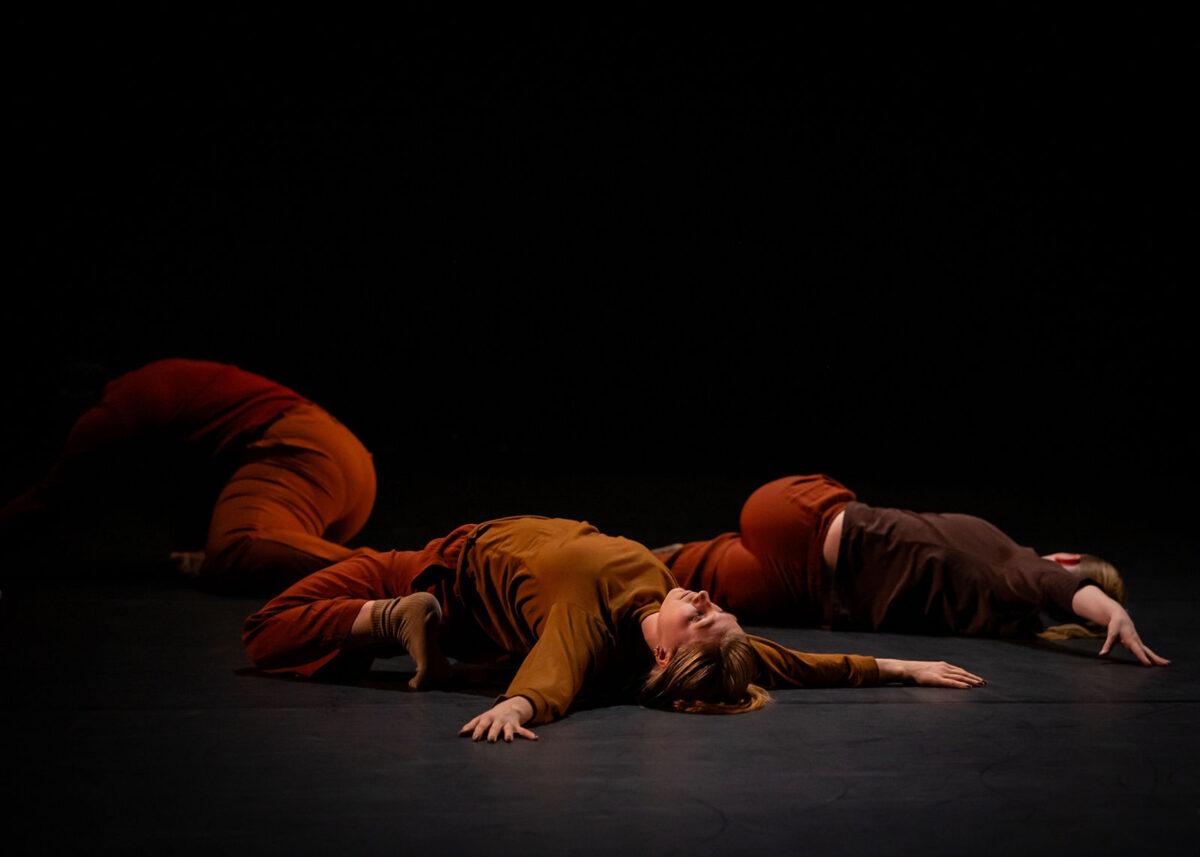 Katie King and two colleagues perform in the 2025 Fall Dance Showcase. (Photo by Kiirstn Pagan ’11.)
Q: Can you share more about your dance and biology double major?
A: I knew I wanted to be in the medical field since I was little. My dolls would be wrapped in casts, and I bought my own crutches when I was 7 at the pharmacy! At the same time, I’ve been dancing since I can remember. For a while, I thought of going into physical therapy, combining my dance and biology backgrounds. Now, I’m thinking of becoming a physician assistant. Both dance and biology have been passions, and I haven’t wanted to give up either one. I worked in a physical therapy office for 5 or 6 years, and there I got the idea to specialize in dancers. So that was the route I thought for a while until I switched to physician’s assistant, but I’m hoping at some point those fields intercross.
Q: How did being a Grit Guide impact your experience?
A: During my freshman year, I joined the UMBC Dance Team to get more involved on campus, and the coach said that the admissions office was hiring. I was brought on as a visual and performing arts tour guide for dance, but later became a general tour guide, and it shaped my entire experience at UMBC. I’ve done it for four years now. Working with professional staff, I gained skill sets that I’ll be able to use in the future, especially if I go into the medical field or work with the public again.
 Katie King, third from right, poses UMBC’s comfort dog, Chip, her handler, Sergeant Jamie Cheatem, and other friends. (Image courtesy of King.)
Q: What motivated you to join the UMBC Dance Team?
A; At the start of my freshman year, I didn’t join anything—I thought I needed to get acclimated. But by November, I was bored! I’ve never been the kind of person who isn’t involved—I have to be going all the time. So I decided to try out for the Dance Team, and I was accepted. It was a super fun experience. During my last two years, I was co-captain for the team and built so many friendships. I love basketball and used to play, but had to give it up for dance. With the Dance Team, I could both dance and watch basketball, and this year they won championships—life was good! It was probably my favorite part of college.
Q: How did you maintain a work-life balance?
A: I prioritize sleep, and get eight hours every night. My calendar is my best friend, truthfully. A lot of my shifts for tour guides were in the mornings, and then I had classes, and then rehearsals at night, and then a 3 or 4-hour block at the end of the night where I would do homework. I didn’t do a lot of hanging out in general besides those things—my social time was being at those events and at work.
 Katie King, left, poses with other members of the UMBC Dance Team on the basketball court.
Q: Were there faculty or staff who made a difference for you?
A: Definitely Ann Sofie Clemmensen—I call her my school mom! She was my dance advisor, but also became my unintentional biology advisor. At the start of my freshman year, we sat down, and she helped me plan out all four years, saying, “We’re going to get you out in four years, both degrees done.” We planned everything out. We met all the time, and I text and call her all the time. She’s always been there.
Q: What are your post-graduation plans?
A: I’m applying to physician assistant school and hope to start somewhere in January. Over the summer, though, I’ll be visiting Portugal, Spain, England, France, and Switzerland. I’m so excited—I haven’t been to Europe.
 Katie King, bottom right, poses with Grit Guide colleagues. (Image courtesy of King.)
Q: What advice would you give to new students?
A: My advice would be to stay true to yourself and always go after what you want. I was told many times that I couldn‘t do both degrees, and then I found a way. Get involved. That changed my whole trajectory here at UMBC. It’s hard to get out of your shell sometimes, and hard to put yourself out there, but it’s so rewarding, especially here. Step out of your comfort zone!
]]>
Katie King ’26, biology and dance, completed an ambitious double degree, and not only thrived but also became co-captain of the UMBC Dance Team and worked for the admissions office as a Grit...
https://umbc.edu/stories/katie-king-26-biology-and-dance-double-major-admissions-grit-guide-and-umbc-dance-team-co-captain-pursues-a-future-that-engages-her-passions/
https://my3.my.umbc.edu/api/v0/pixel/news/160254/guest@my.umbc.edu/d74fc3f9c7b7a6fc508207e7e3529d15/api/pixel
biology
cahss
class-of-2026
cnms
dance
linehan
news
science-and-tech
story
UMBC News & Magazine
https://my3.my.umbc.edu/groups/umbc-news-magazine
https://assets1-my.umbc.edu/system/shared/avatars/groups/000/001/943/24435aa6207c452e7bc15cc74b42c7bb/xsmall.png?1748556657
https://assets1-my.umbc.edu/system/shared/avatars/groups/000/001/943/24435aa6207c452e7bc15cc74b42c7bb/original.png?1748556657
https://assets2-my.umbc.edu/system/shared/avatars/groups/000/001/943/24435aa6207c452e7bc15cc74b42c7bb/xxlarge.png?1748556657
https://assets2-my.umbc.edu/system/shared/avatars/groups/000/001/943/24435aa6207c452e7bc15cc74b42c7bb/xlarge.png?1748556657
https://assets3-my.umbc.edu/system/shared/avatars/groups/000/001/943/24435aa6207c452e7bc15cc74b42c7bb/large.png?1748556657
https://assets1-my.umbc.edu/system/shared/avatars/groups/000/001/943/24435aa6207c452e7bc15cc74b42c7bb/medium.png?1748556657
https://assets2-my.umbc.edu/system/shared/avatars/groups/000/001/943/24435aa6207c452e7bc15cc74b42c7bb/small.png?1748556657
https://assets1-my.umbc.edu/system/shared/avatars/groups/000/001/943/24435aa6207c452e7bc15cc74b42c7bb/xsmall.png?1748556657
https://assets2-my.umbc.edu/system/shared/avatars/groups/000/001/943/24435aa6207c452e7bc15cc74b42c7bb/xxsmall.png?1748556657
UMBC News & Magazine
1
0
false
Wed, 20 May 2026 16:14:49 -0400
Wed, 20 May 2026 16:14:49 -0400
A Journey of Growth
International travel offers ample opportunities to stretch yourself—one minute you may be the expert and the next, completely clueless about how something works. Retrievers currently in the Fulbright U.S. Student Program—teaching English or researching around the globe—find themselves oscillating between their teaching and student roles on a daily or hourly basis. By engaging their host communities through openness and cultural humility (and many shared cups of tea or coffee), these Fulbrighters are finding their balance along the way.
All eyes are on Milan Richardson ’23 as she helps her co-teacher keep score in a Jeopardy-like game her students are playing. Richardson teaches English to several classes of first through sixth-grade students at Jinsha Elementary School in Kinmen County, Taiwan. As she completes the Mandarin character for the numeral 5, a wave of giggles and chatter flows through the room.
Similar to a U.S. tally—four strokes and a strike though, the Mandarin character has 5 strokes total and needs to be written a certain way to represent 1, 2, 3, 4, or 5. “The students were so confused because I wrote the character strokes in the wrong order,” says Richardson, who is used to solving complex math as a Meyerhoff Scholar having earned a bachelor’s degree in bioinformatics and computational biology and minors in computer science and modern, languages, linguistics, and intercultural communication.
“I wanted to write the character correctly. I asked, and they showed me the proper order to write the strokes,” says Richardson, a Fulbright English Teaching Assistant (ETA). “They started clapping once I got it right. This was one of the many cool moments where my students were able to teach me.”
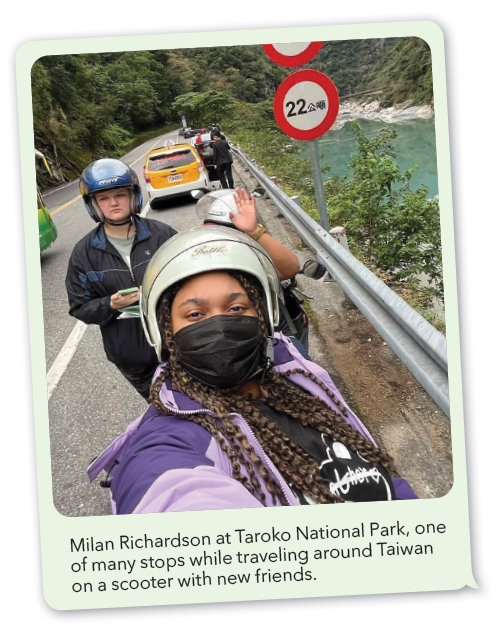
While she may be new to teaching in Taiwan, Richardson brings with her four years as an English and math tutor and a minor in Mandarin. “Taiwan was so different from any place I’ve ever been to. I was overwhelmed at first,” says Richardson. “I like it a lot, now. In my second month, I applied for a scooter license. Now I ride around the island and have taken my scooter other places on trips.”
Diplomas earned. Visas in hand. Vaccines completed. Luggage packed. Destination confirmed. Last summer, UMBC’s eight participants in the 2023 – 2024 Fulbright U.S. Student Program checked off all the important items on their to-do lists. The only thing left was to get to their placements on islands and in landlocked countries, cities, and countrysides across East Asia and Eastern Europe. It’s easier written than done. To adapt well to a new community, job, language, and culture, they must practice the art of humility and flexibility as their roles shift regularly from teacher to student.
Leading the Fulbright charge
All technicalities aside, the Fulbright experience is the beginning of building an international network of teachers and researchers who share the diversity and possibility of the U.S. with the world. In return, across the globe, communities welcome the next generation of leaders into their cities, neighborhoods, schools, and homes to share their country’s history, innovations, and culture. Since Fulbright’s inception in 1946, these reciprocal acts of kindness have created multiple paths forward to lifelong worldwide collaboration and understanding based on the simple act of giving someone different than yourself a chance.
“The Fulbright Program truly demonstrates public diplomacy in action,” says Brian Souders, M.A.’19, TESOL, and Ph.D. ’09, language, literacy, and culture, the associate director of global learning at UMBC’s Center for Global Engagement. In this role, Souders, who received a 2023 Fulbright International Education Administrator award to Germany, has led hundreds of Retrievers through the Fulbright application process as UMBC’s Fulbright Program advisor. “Whether in the classroom as teachers, students, or researchers, recipients learn about the world as much as they share what it means to be from the U.S. and UMBC alumni,” says Souders.
Thanks to Souders’ guidance, UMBC is one of 57 doctoral universities nationwide and three in Maryland to receive a Fulbright Top Producing Institution designation for 2023 – 2024, for the third time in the last five years. In the last decade, more than 80 UMBC alumni have received Fulbright awards. Out of the 10 Retrievers who received a 2023 – 2024 Fulbright, eight are currently placed internationally, seven are ETAs and one is on a research grant.
The hard work of play
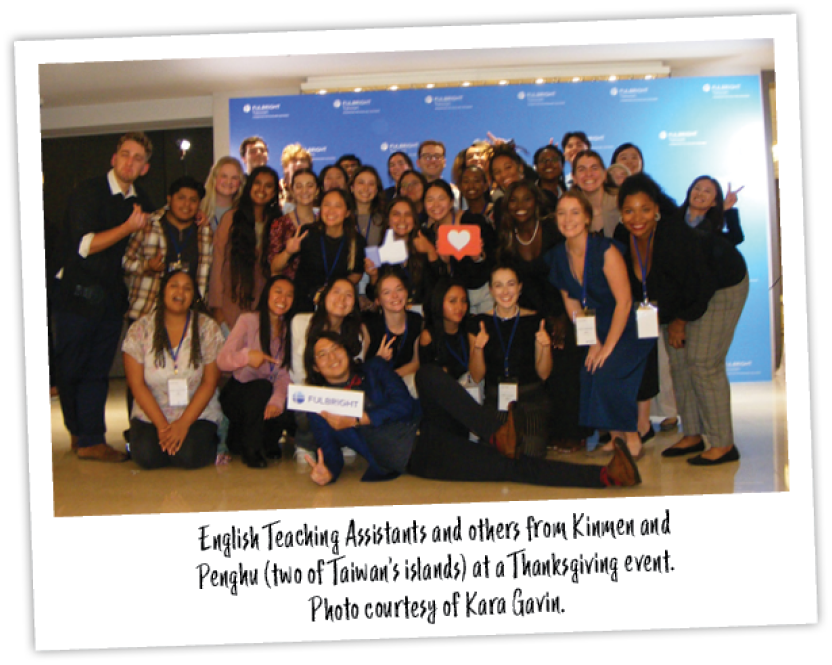
There are U.S. Fulbright student scholars in more than 100 countries worldwide. Three Retrievers were placed in Taiwan—they keep in touch regularly, see each other at ETA trainings, and are planning to travel together during their Fulbright year. But they all arrived in Taiwan separately and faced different challenges settling in.
“I arrived in Taiwan and immediately changed my plans because the airline lost my luggage,” says Humanities Scholar Kara Gavin ’20, English. She was grateful to have a carry-on. “It was chaotic. I was taking it all in,” says Gavin. A day and a 50-minute plane ride later, she arrived in Penghu County, Taiwan, an archipelago of about 90 islands between China and the main island of Taiwan. “The little beach town is in its own little world,” says Gavin. “The smell of the sand gave me comfort.”
Gavin teaches beginner English at two local junior high schools. New to Asia and Mandarin, Gavin’s thinking cap is on 24 – 7, including learning Mandarin in between teaching classes. “Living independently for the first time is hard on its own, but doing it in a foreign country is a whole other ball game,” says Gavin. “I’m acquiring many new life skills that will last me a lifetime.”
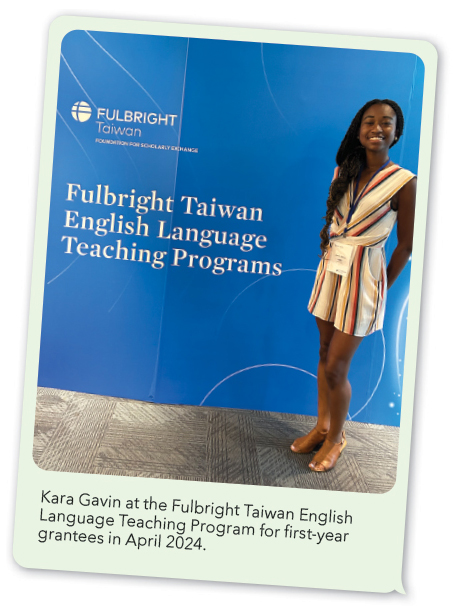
One of those is sympathizing with her students and anyone learning a new language and culture. “I teach the English pronunciation and spelling of a word,” says Gavin. “Then, they like to share the Mandarin equivalent with me. It’s all about patience, balance, and trust.” She also models intercultural teamwork by developing and teaching lessons with her bilingual (Mandarin/English) Taiwanese co-teacher to foster student engagement and enrichment.
For Fulbright Scholars, it is equally important to engage with communities beyond the classroom. When they apply for the grant, the Fulbright Program asks them to develop ideas to share their passions and skills in a community project. For Gavin, this meant adding a little drama to have a lot of fun. As a performing artist, Gavin knows the theatre can be a powerful community-building outlet. “I wanted to encourage students and other community members to express themselves and share their culture with me and others,” says Gavin.
She found a kindred spirit in a professor at a local university. They formed a drama club at the university for English language learners at all levels to explore American play formats with Taiwanese traditions and histories.“Writing original bilingual plays, in English and Mandarin, based on folktales about island traditions is creating an artistic and fun cultural exchange and understanding outside of my ETA duties,” says Gavin.
Finding the right pace
For fellow Humanities Scholar Nailah-Benā Chambers ’23, global studies, a Fulbright award to Taiwan was a natural next step. Chambers began learning Mandarin and all things Taiwanese in sixth grade at a Taiwanese Mandarin language immersion school in her hometown of Richmond, Virginia. As her Mandarin improved, she tutored other English speakers. This oscillating pattern of being a student and a teacher makes Chambers adaptable and persistent, she says.
But it hasn’t always been easy. When she first visited Taipei, Taiwan, in the spring of 2023 on a Mandarin language-intensive study abroad program, “I was so confident. I walked into a 7-Eleven to shop. No one could understand me,” says Chambers. “It was a bit embarrassing. Even with my language and cultural skills, I had a long way to go to mastering Mandarin.”
Now on her Fulbright ETA grant, Chambers arrived on solid ground, both culturally and linguistically. “I felt such a sense of calm and familiarity. Taiwan is so welcoming,” says Chambers. “It calms you down. Things are much slower here than in the U.S.” Soon enough, Chambers was balancing classrooms at Huludun Elementary and Fu Chun Elementary in Taichung City, on the main island of Taiwan, with students at both schools on the extreme spectrum of English proficiency.
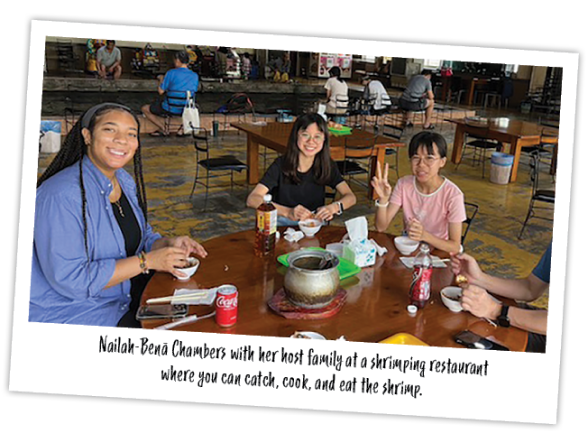
The upside of working with proficient English language learners is connecting on more advanced topics and sticking to Fulbright’s English-only immersion model. At one of her schools, the students are beginning English language learners, and the administrators only speak Mandarin. “My experience as a bilingual teacher and learner with a high level of understanding of the local language and culture has helped with classroom management and fostering powerful connections with students and administrators,” says Chambers. “It also helps to advance their grasp of the nuances of American English, especially when there are gray areas or misunderstandings.”
Keeping your ears open
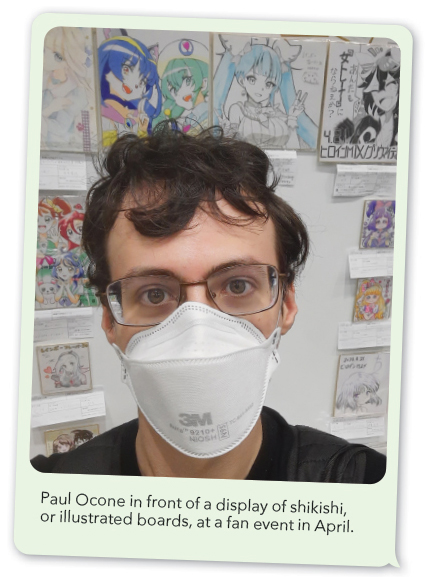
Watching anime, reading manga, (Japanese graphic novels), and participating in their fandom inspired Paul Ocone ’22, individualized study, a Linehan Artist Scholar, to research these subjects and learn Japanese. “I have deeply engaged in fan social life and communities—from leading an anime club to participating in and running conventions to moderating online communities—my affinity for and interest in anime fan spaces runs deep,” says Ocone. Part of Ocone’s observations include witnessing how some fan subcultures limit their membership in fear that a broader fanbase would weaken their subculture identity. In contrast, he says, other fan subcultures are more flexible while maintaining their identity.
Interested in adding to his initial research in U.S. fan spaces, Ocone is now at the epicenter of anime and manga culture as a Fulbright Student Researcher doing anthropological research with Morikawa Kaichirō, a leading scholar in this field at Meiji University’s School of Global Japanese Studies in Tokyo, also home to the Yoshihiro Yonezawa Memorial Library of Manga and Subcultures.
“I have had some amazing experiences participating in anime pilgrimage or anime tourism, including learning much from other fans and benefitting from their generosity,” says Ocone. “My Japanese is conversational—sometimes it’s challenging to understand specialized topics, but this has not deterred me from adding anime and manga tourism as a second research project.” In January, Ocone presented his work at the Popular Culture Tourism Stakeholders Summit in Japan.
Ocone is a sort of tourist himself, enjoying various aspects of Japanese pop culture. The daily musicality of Tokyo teaches him about enjoying the rhythm of the day. “Each train station plays a unique melody when the train departs,” says Ocone. These melodies or “hassha merodii,” are catchy and echo around in his brain like the convenience store jingles that also greet customers. “I was happily surprised when I heard a loudspeaker playing a symphony in my neighborhood,” says Ocone. “Another one played the following day and the next. I learned this was a daily sunset ritual.” He knows these sound experiences will play in his head long after returning to the U.S.
Learning new languages
This is not the first time David Bullman ’22, ancient studies, visited North Macedonia. He first went in 1995 as a performing musician and public affairs representative for the U.S. Army.
“North Macedonia was very different coming out of the Cold War,” says Bullman. “The infrastructure and general state of repair of public spaces and businesses is much better than I recall from that time.”
Now, as an ETA, Bullman teaches British civilization and American civilization in addition to three different levels of English at the University of Totovo in the Republic of North Macedonia, a landlocked country north of Greece. In Totovo, students begin learning English in elementary school and are fluent by the time they reach college. “I thought I would be teaching English basics,” says Bullman, “but it’s been great to teach a complex subject in the context of where my students live.”
His students are equally glad to help him with the local language. Macedonian and Albanian are the country’s two official languages. Bullman began learning some key Macedonian phrases in preparation for his trip. However, Albanian is the preferred language in Tetovo. After traveling with the Army to more than 15 countries on three continents, Bullman is used to rapidly switching gears and accepting help.
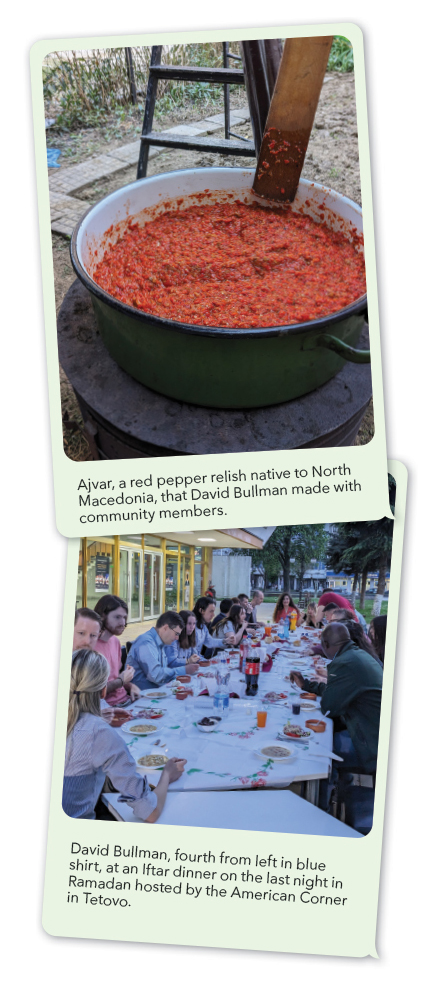
He eagerly takes on the student role when it comes to learning about new foods. Bullman’s apartment faces the Hapësira Socio-Kulturore Tetovë, a community center where locals and the nearby Peace Corps Volunteers sometimes organize activities, like an ajvar-making gathering. Ajvar is a delicacy across the Balkans made every fall. It’s a tradition passed down through centuries with many recipe variations. “Ajvar is made by charring red bell peppers that are then peeled, minced, seasoned, and cooked for hours,” says Bullman. It boils down to a relish that can be preserved for months, but locals tell Bullman that’s rare because it’s too good to keep for even one week. After participating in the preparation and getting to take home a few jars, Bullman agrees with the locals. Ajvar is now his go-to condiment on eggs, pasta, toast—anything goes.
Albanian and cooking are not the only languages Bullman tapped into while in Tetovo. As a lifelong clarinet player, Bullman hoped to create a musical exchange with local musicians. The opportunity presented itself when the dean of the Faculty of Art wanted to celebrate Thanksgiving. Bullman collaborated with the music faculty, the orchestra director, and students to create a concert of six songs. “I’m glad I returned to North Macedonia. The people are as warm and friendly as I remembered them to be,” says Bullman. “I wanted to come back and experience it myself again.”
Tapping into curiosity
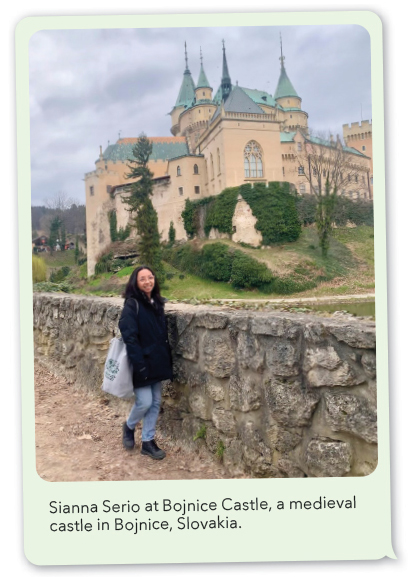
On her way to her Fulbright placement, Sianna Serio ’23, computer science, went city hopping. “I was headed to Žilina, Slovakia, east of Austria and south of Poland,” says Serio. “I flew into Vienna, Austria, then I took a one-hour bus ride crossing Austria’s eastern border into Slovakia to get to Bratislava, the capital.“ There she met other ETAs for orientation. “A week later, I hopped on a two-hour train ride to my teaching placement in Žilina and I met my wonderful mentor, Maria Veršova, who became my second mom.”
Serio teaches at the Hotel Academy, Žilina. The academy focuses on hotel management, gastronomy, and tourism. “My students are beginning English language learners,” says Serio. “I teach what the class is interested in, like American pop culture, because they rarely meet a native English speaker.” During outings with her students, they ask about a wide range of topics. “There are many topics that I would not have thought to cover if it were not for time spent outside of the classroom,” says Serio, “Some of those conversations became formal lessons, like the lesson on the three branches of the U. S. government.”
Serio appreciates her students’ curiosity. She tapped into her love of website development and design to improve her students’ confidence in writing and speaking English and prepare for their Maturita exam, a national high school exit exam. “Some of my students are helping me design a class webpage for them where I will showcase their class and post some of their practice writing in English,” says Serio. “These posts will include topics covered in the Maturita exam, information about their school, and answers to questions about Slovakia.”
Serio’s mentor Maria Veršova, head of the English department, is her motivation. She guides her through lesson planning, class schedules, and the challenges of relocating to a new country. “When my original housing plans fell through, Maria found housing for me five minutes from her house,” says Serio. “She helped me find health insurance and open a bank account. Her husband set up my internet.” They have welcomed Serio almost daily into their home for dinner, tea, coffee, or wine. Serio is a gracious guest and lent her graphic design expertise to help Veršova design invitation cards for her 50th birthday party. Veršova tells Serio she will always have a place to stay in Žilina.
Fulbright: The next generation
Teaching has defined the last decade for Tiffany Powell, a master’s student in UMBC’s TESOL program, a passion she invested in as an English language learner teacher in Seoul and in Miryang City, South Korea, for five years, and in Florida this past year. Now, she is in Iași, Romania, southwest of Ukraine, at the Alexandru Ioan Cuza University teaching American studies. Powell is committed to bridging culture, community, and belonging by bringing technology into the classroom.
Powell also decided to bring the research and cultural understanding closer to home by partnering with Romanian teachers to develop a five-part series on African American women’s history. “We talked about Black women in science in the context of the movie Hidden Figures and discussed Hollywood’s portrayal of Black life,” says Powell. The class is now creating a series on Romanian women. Helping students better understand the similarities and differences between U.S. and Romanian cultures has been an eye-opening experience for Powell.
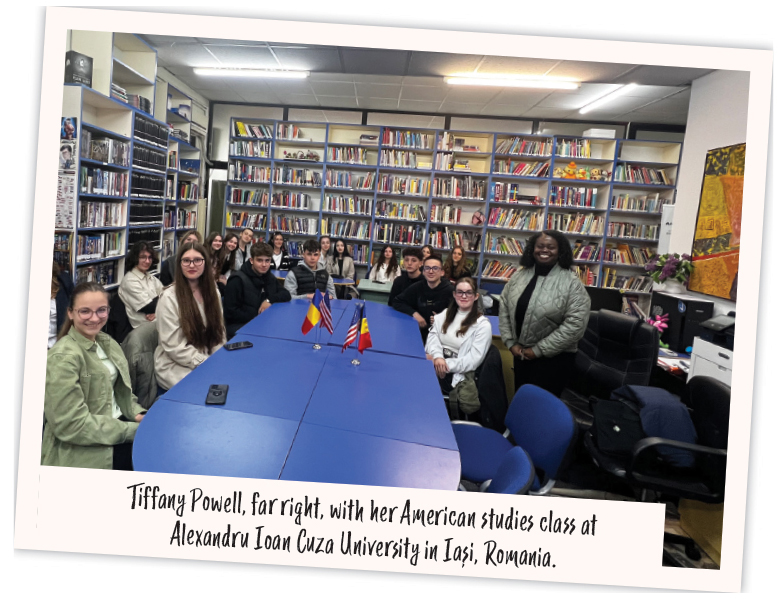
She sees the impact of a country formerly under communism. In Iași, sometimes the internet doesn’t work and, in her school, there are no clubs or student organizations to gain the skills needed to earn a Fulbright award. “My students have given me a new perspective. You may want to come in and make changes, but you must understand where they’re coming from. There is a saying in Iași, ‘It’s not impossible. It’s just difficult,’” says Powell. She is trying to help with the difficult part by leading Fulbright application and leadership workshops.
Powell, like the other Fulbrighters, will bring her experiences home with her and wherever she ends up teaching English next. When their Fulbright year ends, these Retriever ambassadors will find themselves as emissaries yet again, returning to their hometowns, sharing the good news of ajvar made in community, the freedom of a scooter ride along a Taiwanese beach, or the correct stroke order for writing the Mandarin number five. The lessons their students and host families passed along—including pausing to take a breath and appreciate their international successes small and large—will continue to form and shape the way they see the world.
“Having a flexible mindset and under-standing the historical context of your placement is key,” says Powell. “I carry myself as a U.S. representative. Living abroad teaches humility, adaptability, and open-mindedness to press on through challenging times.”
]]>
International travel offers ample opportunities to stretch yourself—one minute you may be the expert and the next, completely clueless about how something works. Retrievers currently in the...
https://umbc.edu/stories/a-journey-of-growth/
https://my3.my.umbc.edu/api/v0/pixel/news/142391/guest@my.umbc.edu/429a43e449ef9d4187b1ae1d4e63ca4e/api/pixel
alumni
ancient-studies
bioinformatics-and-computational-biology
cahss
cge
computer-science
education-abroad
english
feature
fulbright
global-studies
humanities
inds
linehan
llc
magazine
meyerhoff
spring-2024
story
UMBC News & Magazine
https://my3.my.umbc.edu/groups/umbc-news-magazine
https://assets1-my.umbc.edu/system/shared/avatars/groups/000/001/943/24435aa6207c452e7bc15cc74b42c7bb/xsmall.png?1748556657
https://assets1-my.umbc.edu/system/shared/avatars/groups/000/001/943/24435aa6207c452e7bc15cc74b42c7bb/original.png?1748556657
https://assets2-my.umbc.edu/system/shared/avatars/groups/000/001/943/24435aa6207c452e7bc15cc74b42c7bb/xxlarge.png?1748556657
https://assets2-my.umbc.edu/system/shared/avatars/groups/000/001/943/24435aa6207c452e7bc15cc74b42c7bb/xlarge.png?1748556657
https://assets3-my.umbc.edu/system/shared/avatars/groups/000/001/943/24435aa6207c452e7bc15cc74b42c7bb/large.png?1748556657
https://assets1-my.umbc.edu/system/shared/avatars/groups/000/001/943/24435aa6207c452e7bc15cc74b42c7bb/medium.png?1748556657
https://assets2-my.umbc.edu/system/shared/avatars/groups/000/001/943/24435aa6207c452e7bc15cc74b42c7bb/small.png?1748556657
https://assets1-my.umbc.edu/system/shared/avatars/groups/000/001/943/24435aa6207c452e7bc15cc74b42c7bb/xsmall.png?1748556657
https://assets2-my.umbc.edu/system/shared/avatars/groups/000/001/943/24435aa6207c452e7bc15cc74b42c7bb/xxsmall.png?1748556657
UMBC News & Magazine
5
0
false
Wed, 29 May 2024 14:32:52 -0400
A Journey of Growth
International travel offers ample opportunities to stretch yourself—one minute you may be the expert and the next, completely clueless about how something works. Retrievers currently in the Fulbright U.S. Student Program—teaching English or researching around the globe—find themselves oscillating between their teaching and student roles on a daily or hourly basis. By engaging their host communities through openness and cultural humility (and many shared cups of tea or coffee), these Fulbrighters are finding their balance along the way.
All eyes are on Milan Richardson ’23 as she helps her co-teacher keep score in a Jeopardy-like game her students are playing. Richardson teaches English to several classes of first through sixth-grade students at Jinsha Elementary School in Kinmen County, Taiwan. As she completes the Mandarin character for the numeral 5, a wave of giggles and chatter flows through the room.
Similar to a U.S. tally—four strokes and a strike though, the Mandarin character has 5 strokes total and needs to be written a certain way to represent 1, 2, 3, 4, or 5. “The students were so confused because I wrote the character strokes in the wrong order,” says Richardson, who is used to solving complex math as a Meyerhoff Scholar having earned a bachelor’s degree in bioinformatics and computational biology and minors in computer science and modern, languages, linguistics, and intercultural communication.
“I wanted to write the character correctly. I asked, and they showed me the proper order to write the strokes,” says Richardson, a Fulbright English Teaching Assistant (ETA). “They started clapping once I got it right. This was one of the many cool moments where my students were able to teach me.”
While she may be new to teaching in Taiwan, Richardson brings with her four years as an English and math tutor and a minor in Mandarin. “Taiwan was so different from any place I’ve ever been to. I was overwhelmed at first,” says Richardson. “I like it a lot, now. In my second month, I applied for a scooter license. Now I ride around the island and have taken my scooter other places on trips.”
Diplomas earned. Visas in hand. Vaccines completed. Luggage packed. Destination confirmed. Last summer, UMBC’s eight participants in the 2023 – 2024 Fulbright U.S. Student Program checked off all the important items on their to-do lists. The only thing left was to get to their placements on islands and in landlocked countries, cities, and countrysides across East Asia and Eastern Europe. It’s easier written than done. To adapt well to a new community, job, language, and culture, they must practice the art of humility and flexibility as their roles shift regularly from teacher to student.
Leading the Fulbright charge
All technicalities aside, the Fulbright experience is the beginning of building an international network of teachers and researchers who share the diversity and possibility of the U.S. with the world. In return, across the globe, communities welcome the next generation of leaders into their cities, neighborhoods, schools, and homes to share their country’s history, innovations, and culture. Since Fulbright’s inception in 1946, these reciprocal acts of kindness have created multiple paths forward to lifelong worldwide collaboration and understanding based on the simple act of giving someone different than yourself a chance.
“The Fulbright Program truly demonstrates public diplomacy in action,” says Brian Souders, M.A.’19, TESOL, and Ph.D. ’09, language, literacy, and culture, the associate director of global learning at UMBC’s Center for Global Engagement. In this role, Souders, who received a 2023 Fulbright International Education Administrator award to Germany, has led hundreds of Retrievers through the Fulbright application process as UMBC’s Fulbright Program advisor. “Whether in the classroom as teachers, students, or researchers, recipients learn about the world as much as they share what it means to be from the U.S. and UMBC alumni,” says Souders.
Thanks to Souders’ guidance, UMBC is one of 57 doctoral universities nationwide and three in Maryland to receive a Fulbright Top Producing Institution designation for 2023 – 2024, for the third time in the last five years. In the last decade, more than 80 UMBC alumni have received Fulbright awards. Out of the 10 Retrievers who received a 2023 – 2024 Fulbright, eight are currently placed internationally, seven are ETAs and one is on a research grant.
The hard work of play
There are U.S. Fulbright student scholars in more than 100 countries worldwide. Three Retrievers were placed in Taiwan—they keep in touch regularly, see each other at ETA trainings, and are planning to travel together during their Fulbright year. But they all arrived in Taiwan separately and faced different challenges settling in.
“I arrived in Taiwan and immediately changed my plans because the airline lost my luggage,” says Humanities Scholar Kara Gavin ’20, English. She was grateful to have a carry-on. “It was chaotic. I was taking it all in,” says Gavin. A day and a 50-minute plane ride later, she arrived in Penghu County, Taiwan, an archipelago of about 90 islands between China and the main island of Taiwan. “The little beach town is in its own little world,” says Gavin. “The smell of the sand gave me comfort.”
Gavin teaches beginner English at two local junior high schools. New to Asia and Mandarin, Gavin’s thinking cap is on 24 – 7, including learning Mandarin in between teaching classes. “Living independently for the first time is hard on its own, but doing it in a foreign country is a whole other ball game,” says Gavin. “I’m acquiring many new life skills that will last me a lifetime.”
One of those is sympathizing with her students and anyone learning a new language and culture. “I teach the English pronunciation and spelling of a word,” says Gavin. “Then, they like to share the Mandarin equivalent with me. It’s all about patience, balance, and trust.” She also models intercultural teamwork by developing and teaching lessons with her bilingual (Mandarin/English) Taiwanese co-teacher to foster student engagement and enrichment.
For Fulbright Scholars, it is equally important to engage with communities beyond the classroom. When they apply for the grant, the Fulbright Program asks them to develop ideas to share their passions and skills in a community project. For Gavin, this meant adding a little drama to have a lot of fun. As a performing artist, Gavin knows the theatre can be a powerful community-building outlet. “I wanted to encourage students and other community members to express themselves and share their culture with me and others,” says Gavin.
She found a kindred spirit in a professor at a local university. They formed a drama club at the university for English language learners at all levels to explore American play formats with Taiwanese traditions and histories.“Writing original bilingual plays, in English and Mandarin, based on folktales about island traditions is creating an artistic and fun cultural exchange and understanding outside of my ETA duties,” says Gavin.
Finding the right pace
For fellow Humanities Scholar Nailah-Benā Chambers ’23, global studies, a Fulbright award to Taiwan was a natural next step. Chambers began learning Mandarin and all things Taiwanese in sixth grade at a Taiwanese Mandarin language immersion school in her hometown of Richmond, Virginia. As her Mandarin improved, she tutored other English speakers. This oscillating pattern of being a student and a teacher makes Chambers adaptable and persistent, she says.
But it hasn’t always been easy. When she first visited Taipei, Taiwan, in the spring of 2023 on a Mandarin language-intensive study abroad program, “I was so confident. I walked into a 7-Eleven to shop. No one could understand me,” says Chambers. “It was a bit embarrassing. Even with my language and cultural skills, I had a long way to go to mastering Mandarin.”
Now on her Fulbright ETA grant, Chambers arrived on solid ground, both culturally and linguistically. “I felt such a sense of calm and familiarity. Taiwan is so welcoming,” says Chambers. “It calms you down. Things are much slower here than in the U.S.” Soon enough, Chambers was balancing classrooms at Huludun Elementary and Fu Chun Elementary in Taichung City, on the main island of Taiwan, with students at both schools on the extreme spectrum of English proficiency.
The upside of working with proficient English language learners is connecting on more advanced topics and sticking to Fulbright’s English-only immersion model. At one of her schools, the students are beginning English language learners, and the administrators only speak Mandarin. “My experience as a bilingual teacher and learner with a high level of understanding of the local language and culture has helped with classroom management and fostering powerful connections with students and administrators,” says Chambers. “It also helps to advance their grasp of the nuances of American English, especially when there are gray areas or misunderstandings.”
Keeping your ears open
Watching anime, reading manga, (Japanese graphic novels), and participating in their fandom inspired Paul Ocone ’22, individualized study, a Linehan Artist Scholar, to research these subjects and learn Japanese. “I have deeply engaged in fan social life and communities—from leading an anime club to participating in and running conventions to moderating online communities—my affinity for and interest in anime fan spaces runs deep,” says Ocone. Part of Ocone’s observations include witnessing how some fan subcultures limit their membership in fear that a broader fanbase would weaken their subculture identity. In contrast, he says, other fan subcultures are more flexible while maintaining their identity.
Interested in adding to his initial research in U.S. fan spaces, Ocone is now at the epicenter of anime and manga culture as a Fulbright Student Researcher doing anthropological research with Morikawa Kaichirō, a leading scholar in this field at Meiji University’s School of Global Japanese Studies in Tokyo, also home to the Yoshihiro Yonezawa Memorial Library of Manga and Subcultures.
“I have had some amazing experiences participating in anime pilgrimage or anime tourism, including learning much from other fans and benefitting from their generosity,” says Ocone. “My Japanese is conversational—sometimes it’s challenging to understand specialized topics, but this has not deterred me from adding anime and manga tourism as a second research project.” In January, Ocone presented his work at the Popular Culture Tourism Stakeholders Summit in Japan.
Ocone is a sort of tourist himself, enjoying various aspects of Japanese pop culture. The daily musicality of Tokyo teaches him about enjoying the rhythm of the day. “Each train station plays a unique melody when the train departs,” says Ocone. These melodies or “hassha merodii,” are catchy and echo around in his brain like the convenience store jingles that also greet customers. “I was happily surprised when I heard a loudspeaker playing a symphony in my neighborhood,” says Ocone. “Another one played the following day and the next. I learned this was a daily sunset ritual.” He knows these sound experiences will play in his head long after returning to the U.S.
Learning new languages
This is not the first time David Bullman ’22, ancient studies, visited North Macedonia. He first went in 1995 as a performing musician and public affairs representative for the U.S. Army.
“North Macedonia was very different coming out of the Cold War,” says Bullman. “The infrastructure and general state of repair of public spaces and businesses is much better than I recall from that time.”
Now, as an ETA, Bullman teaches British civilization and American civilization in addition to three different levels of English at the University of Totovo in the Republic of North Macedonia, a landlocked country north of Greece. In Totovo, students begin learning English in elementary school and are fluent by the time they reach college. “I thought I would be teaching English basics,” says Bullman, “but it’s been great to teach a complex subject in the context of where my students live.”
His students are equally glad to help him with the local language. Macedonian and Albanian are the country’s two official languages. Bullman began learning some key Macedonian phrases in preparation for his trip. However, Albanian is the preferred language in Tetovo. After traveling with the Army to more than 15 countries on three continents, Bullman is used to rapidly switching gears and accepting help.
He eagerly takes on the student role when it comes to learning about new foods. Bullman’s apartment faces the Hapësira Socio-Kulturore Tetovë, a community center where locals and the nearby Peace Corps Volunteers sometimes organize activities, like an ajvar-making gathering. Ajvar is a delicacy across the Balkans made every fall. It’s a tradition passed down through centuries with many recipe variations. “Ajvar is made by charring red bell peppers that are then peeled, minced, seasoned, and cooked for hours,” says Bullman. It boils down to a relish that can be preserved for months, but locals tell Bullman that’s rare because it’s too good to keep for even one week. After participating in the preparation and getting to take home a few jars, Bullman agrees with the locals. Ajvar is now his go-to condiment on eggs, pasta, toast—anything goes.
Albanian and cooking are not the only languages Bullman tapped into while in Tetovo. As a lifelong clarinet player, Bullman hoped to create a musical exchange with local musicians. The opportunity presented itself when the dean of the Faculty of Art wanted to celebrate Thanksgiving. Bullman collaborated with the music faculty, the orchestra director, and students to create a concert of six songs. “I’m glad I returned to North Macedonia. The people are as warm and friendly as I remembered them to be,” says Bullman. “I wanted to come back and experience it myself again.”
Tapping into curiosity
On her way to her Fulbright placement, Sianna Serio ’23, computer science, went city hopping. “I was headed to Žilina, Slovakia, east of Austria and south of Poland,” says Serio. “I flew into Vienna, Austria, then I took a one-hour bus ride crossing Austria’s eastern border into Slovakia to get to Bratislava, the capital.“ There she met other ETAs for orientation. “A week later, I hopped on a two-hour train ride to my teaching placement in Žilina and I met my wonderful mentor, Maria Veršova, who became my second mom.”
Serio teaches at the Hotel Academy, Žilina. The academy focuses on hotel management, gastronomy, and tourism. “My students are beginning English language learners,” says Serio. “I teach what the class is interested in, like American pop culture, because they rarely meet a native English speaker.” During outings with her students, they ask about a wide range of topics. “There are many topics that I would not have thought to cover if it were not for time spent outside of the classroom,” says Serio, “Some of those conversations became formal lessons, like the lesson on the three branches of the U. S. government.”
Serio appreciates her students’ curiosity. She tapped into her love of website development and design to improve her students’ confidence in writing and speaking English and prepare for their Maturita exam, a national high school exit exam. “Some of my students are helping me design a class webpage for them where I will showcase their class and post some of their practice writing in English,” says Serio. “These posts will include topics covered in the Maturita exam, information about their school, and answers to questions about Slovakia.”
Serio’s mentor Maria Veršova, head of the English department, is her motivation. She guides her through lesson planning, class schedules, and the challenges of relocating to a new country. “When my original housing plans fell through, Maria found housing for me five minutes from her house,” says Serio. “She helped me find health insurance and open a bank account. Her husband set up my internet.” They have welcomed Serio almost daily into their home for dinner, tea, coffee, or wine. Serio is a gracious guest and lent her graphic design expertise to help Veršova design invitation cards for her 50th birthday party. Veršova tells Serio she will always have a place to stay in Žilina.
Fulbright: The next generation
Teaching has defined the last decade for Tiffany Powell, a master’s student in UMBC’s TESOL program, a passion she invested in as an English language learner teacher in Seoul and in Miryang City, South Korea, for five years, and in Florida this past year. Now, she is in Iași, Romania, southwest of Ukraine, at the Alexandru Ioan Cuza University teaching American studies. Powell is committed to bridging culture, community, and belonging by bringing technology into the classroom.
Powell also decided to bring the research and cultural understanding closer to home by partnering with Romanian teachers to develop a five-part series on African American women’s history. “We talked about Black women in science in the context of the movie Hidden Figures and discussed Hollywood’s portrayal of Black life,” says Powell. The class is now creating a series on Romanian women. Helping students better understand the similarities and differences between U.S. and Romanian cultures has been an eye-opening experience for Powell.
She sees the impact of a country formerly under communism. In Iași, sometimes the internet doesn’t work and, in her school, there are no clubs or student organizations to gain the skills needed to earn a Fulbright award. “My students have given me a new perspective. You may want to come in and make changes, but you must understand where they’re coming from. There is a saying in Iași, ‘It’s not impossible. It’s just difficult,’” says Powell. She is trying to help with the difficult part by leading Fulbright application and leadership workshops.
Powell, like the other Fulbrighters, will bring her experiences home with her and wherever she ends up teaching English next. When their Fulbright year ends, these Retriever ambassadors will find themselves as emissaries yet again, returning to their hometowns, sharing the good news of ajvar made in community, the freedom of a scooter ride along a Taiwanese beach, or the correct stroke order for writing the Mandarin number five. The lessons their students and host families passed along—including pausing to take a breath and appreciate their international successes small and large—will continue to form and shape the way they see the world.
“Having a flexible mindset and under-standing the historical context of your placement is key,” says Powell. “I carry myself as a U.S. representative. Living abroad teaches humility, adaptability, and open-mindedness to press on through challenging times.”
]]>
International travel offers ample opportunities to stretch yourself—one minute you may be the expert and the next, completely clueless about how something works. Retrievers currently in the...
https://umbc.edu/stories/a-journey-of-growth-retriever-fulbright/
https://my3.my.umbc.edu/api/v0/pixel/news/142404/guest@my.umbc.edu/ed280c216f570c718be808f58bf7c55a/api/pixel
alumni
ancient-studies
bioinformatics-and-computational-biology
cahss
cge
computer-science
education-abroad
english
feature
fulbright
global-studies
humanities
inds
linehan
llc
magazine
meyerhoff
spring-2024
story
UMBC News & Magazine
https://my3.my.umbc.edu/groups/umbc-news-magazine
https://assets1-my.umbc.edu/system/shared/avatars/groups/000/001/943/24435aa6207c452e7bc15cc74b42c7bb/xsmall.png?1748556657
https://assets1-my.umbc.edu/system/shared/avatars/groups/000/001/943/24435aa6207c452e7bc15cc74b42c7bb/original.png?1748556657
https://assets2-my.umbc.edu/system/shared/avatars/groups/000/001/943/24435aa6207c452e7bc15cc74b42c7bb/xxlarge.png?1748556657
https://assets2-my.umbc.edu/system/shared/avatars/groups/000/001/943/24435aa6207c452e7bc15cc74b42c7bb/xlarge.png?1748556657
https://assets3-my.umbc.edu/system/shared/avatars/groups/000/001/943/24435aa6207c452e7bc15cc74b42c7bb/large.png?1748556657
https://assets1-my.umbc.edu/system/shared/avatars/groups/000/001/943/24435aa6207c452e7bc15cc74b42c7bb/medium.png?1748556657
https://assets2-my.umbc.edu/system/shared/avatars/groups/000/001/943/24435aa6207c452e7bc15cc74b42c7bb/small.png?1748556657
https://assets1-my.umbc.edu/system/shared/avatars/groups/000/001/943/24435aa6207c452e7bc15cc74b42c7bb/xsmall.png?1748556657
https://assets2-my.umbc.edu/system/shared/avatars/groups/000/001/943/24435aa6207c452e7bc15cc74b42c7bb/xxsmall.png?1748556657
UMBC News & Magazine
0
0
false
Wed, 29 May 2024 14:32:52 -0400
The Power of Music

When junior Linehan Artist Scholar Etai Fuchs heard about the economic devastation the COVID-19 pandemic was wreaking on the music industry, he knew he needed to respond. And as a music technology major, he realized he was in a unique position to help bands that had lost income because of canceled shows.
“I created an online record label called Gardenhead Records,” he explained, “and released a compilation recording that features and raises money for musicians whose performances have been canceled.”
In all, Fuchs was able to include twenty-six tracks by twenty-six different bands, and the resulting album — Pandemic Artist Relief: Music in the Time of Covid-19 — was released exclusively on Bandcamp on April 10. All proceeds from sales of the recording will benefit the artists.

“The best outcome would be to continue raising money for these musicians,” said Fuchs. “Some of them have lost their jobs and are struggling to pay rent, so my priority is to try and help these people out in any way that I can. Also, it’s great to be able to help promote music that I genuinely enjoy by lesser-known artists.”
One song was authored by Tom Waterworth (writing under the pen name Firesites), an undergraduate at Newcastle University in the UK who studied music technology at UMBC as an exchange student.
Putting Skills to Work
The project engaged many of Fuchs’s music technology and entrepreneurship skills—he contacted the artists, started the label, created the artwork, reached out to media, and mastered the compilation. He’s also working on plans to livestream a concert featuring some of the artists.
“We are so proud of Etai’s project and its potential for positive impact during a difficult time!” said Linda Dusman, chair of the music department. “Etai’s work exemplifies the extraordinary creativity fostered in all of our music majors. Our faculty and students embody that creative spirit as performing, teaching, and composing musicians who contribute to the community through their artistry.”
Fuchs also recently released his own solo album, Bloodletting, which he describes as a collection of “very introspective indie folk and dream pop” written about core memories and experiences. After graduating, he plans to record and perform his music, organize music releases, book shows, and freelance in production and graphic design.
Scott Casper, dean of the College of Arts, Humanities, and Social Sciences, applauded Fuchs’s efforts, as well.
“Etai Fuchs’s project, so perfect for this moment, also embodies UMBC’s long-standing values,” he said. “It exemplifies entrepreneurship in the arts, and it reaches beyond our university community to assist other artists challenged by COVID-19 and the loss of live performance opportunities.”
Header image by Tom Waterworth.
]]>
When junior Linehan Artist Scholar Etai Fuchs heard about the economic devastation the COVID-19 pandemic was wreaking on the music industry, he knew he needed to respond. And as a music technology...
https://umbc.edu/stories/the-power-of-music/
https://my3.my.umbc.edu/api/v0/pixel/news/119912/guest@my.umbc.edu/98cd74d98f7d0825530929830692049e/api/pixel
cahss
impact
linehan
music
resilience
undergraduate
UMBC News & Magazine
https://my3.my.umbc.edu/groups/umbc-news-magazine
https://assets1-my.umbc.edu/system/shared/avatars/groups/000/001/943/24435aa6207c452e7bc15cc74b42c7bb/xsmall.png?1748556657
https://assets1-my.umbc.edu/system/shared/avatars/groups/000/001/943/24435aa6207c452e7bc15cc74b42c7bb/original.png?1748556657
https://assets2-my.umbc.edu/system/shared/avatars/groups/000/001/943/24435aa6207c452e7bc15cc74b42c7bb/xxlarge.png?1748556657
https://assets2-my.umbc.edu/system/shared/avatars/groups/000/001/943/24435aa6207c452e7bc15cc74b42c7bb/xlarge.png?1748556657
https://assets3-my.umbc.edu/system/shared/avatars/groups/000/001/943/24435aa6207c452e7bc15cc74b42c7bb/large.png?1748556657
https://assets1-my.umbc.edu/system/shared/avatars/groups/000/001/943/24435aa6207c452e7bc15cc74b42c7bb/medium.png?1748556657
https://assets2-my.umbc.edu/system/shared/avatars/groups/000/001/943/24435aa6207c452e7bc15cc74b42c7bb/small.png?1748556657
https://assets1-my.umbc.edu/system/shared/avatars/groups/000/001/943/24435aa6207c452e7bc15cc74b42c7bb/xsmall.png?1748556657
https://assets2-my.umbc.edu/system/shared/avatars/groups/000/001/943/24435aa6207c452e7bc15cc74b42c7bb/xxsmall.png?1748556657
UMBC News & Magazine
0
0
false
Thu, 23 Apr 2020 21:18:30 -0400
Supporting Artistic Talents
The Linehan Artist Scholars Reception is an annual event students have long enjoyed. This year, scholar alumni joined current students to meet with donors Earl and Darielle Linehan, and to thank them for their support. Students talked about their studies and plans while alumni shared their accomplishments with the Linehans. During the program, students and alumni displayed their talents in dance, music, theatre, and visual arts.
Learn more about the Linehan Artist Scholars Program.
See more photos from the reception. All images by Marlayna Demond ’11 for UMBC Magazine.
]]>
The Linehan Artist Scholars Reception is an annual event students have long enjoyed. This year, scholar alumni joined current students to meet with donors Earl and Darielle Linehan, and to thank...
https://umbc.edu/stories/supporting-artistic-talents/
https://my3.my.umbc.edu/api/v0/pixel/news/120268/guest@my.umbc.edu/26862eea7433e648cf26d1045e084b2d/api/pixel
impact
linehan
linehan-artist-scholars
UMBC News & Magazine
https://my3.my.umbc.edu/groups/umbc-news-magazine
https://assets1-my.umbc.edu/system/shared/avatars/groups/000/001/943/24435aa6207c452e7bc15cc74b42c7bb/xsmall.png?1748556657
https://assets1-my.umbc.edu/system/shared/avatars/groups/000/001/943/24435aa6207c452e7bc15cc74b42c7bb/original.png?1748556657
https://assets2-my.umbc.edu/system/shared/avatars/groups/000/001/943/24435aa6207c452e7bc15cc74b42c7bb/xxlarge.png?1748556657
https://assets2-my.umbc.edu/system/shared/avatars/groups/000/001/943/24435aa6207c452e7bc15cc74b42c7bb/xlarge.png?1748556657
https://assets3-my.umbc.edu/system/shared/avatars/groups/000/001/943/24435aa6207c452e7bc15cc74b42c7bb/large.png?1748556657
https://assets1-my.umbc.edu/system/shared/avatars/groups/000/001/943/24435aa6207c452e7bc15cc74b42c7bb/medium.png?1748556657
https://assets2-my.umbc.edu/system/shared/avatars/groups/000/001/943/24435aa6207c452e7bc15cc74b42c7bb/small.png?1748556657
https://assets1-my.umbc.edu/system/shared/avatars/groups/000/001/943/24435aa6207c452e7bc15cc74b42c7bb/xsmall.png?1748556657
https://assets2-my.umbc.edu/system/shared/avatars/groups/000/001/943/24435aa6207c452e7bc15cc74b42c7bb/xxsmall.png?1748556657
UMBC News & Magazine
0
0
false
Wed, 21 Nov 2018 18:40:11 -0500