The chase and thrill of researching erotic worlds
A couple of years ago, Jessica Floyd was enjoying delicious olive flatbreads in Opio, France, a village on the French Riviera, thanks to the hospitality of Judith Legman, who owned the olive grove and a manuscript Floyd had been trying to find for her doctoral work for three years. This bucolic heaven was not where Floyd, who studies erotic folklore, thought she would find the holy grail of erotic chanteys by Stan Hugill, a renowned British sailor and chantey singer. These sailors’ work songs, first collected in the 1900s, were passed down verbally by sailors, with some never recorded. These bawdy versions were never meant to be heard or read by women, much less shared between them.
“When you’re talking about erotic content, it automatically becomes something that is salacious and provocative and therefore seen as taboo,” said Floyd, Ph.D. ’17, language, literacy, and culture, an adjunct instructor of English. “Publications that are not conservative in their treatment of sex, gender, and sexuality are often deemed taboo. Scholars who are actively working in this field have to fight not only for their legitimacy, but also because we’re considered dirty workers. We also fight for the legitimacy of the materials that we’re researching. These are real human experiences. They just happen to be from the darker corners of the human experience.”
Like other scholars in the field seeking access to a variety of documents, Floyd reached out to the librarians at the Kinsey Institute, which holds the largest historical archive on sexuality. “They weren’t sure if the manuscript could be found in the extensive archive of Gershon Legman, which Judith, his wife, had donated,” said Floyd, of her research for her debut book Cabin Boys, Milkmaids, and Rough Seas: Identity in the Unexpurgated Repertoire of Stan Hugill (University Press of Mississippi, 2024).
She emailed Legman, following a tip from other chantey folklorists and researchers that Legman, a famous connoisseur and collector of erotic jokes, folklore, and songs, had the manuscript. “Lo and behold, she emailed me back. I still get chills talking about it,” said Floyd. “Judith said, ‘Not only do I have it, I actually just sent it to the Kinsey Institute. If you’d like, I’ll send you the copy.’” Dispersed throughout Legman’s chapter on erotic folk songs were Hugill’s erotic chanteys that had never been circulated.
 The envelope sent by Judith Legman to Jessica Floyd with Stan Hugill’s unpublished manuscript. (Image courtesy of Jessica Floyd)
Chasing erotic rare texts
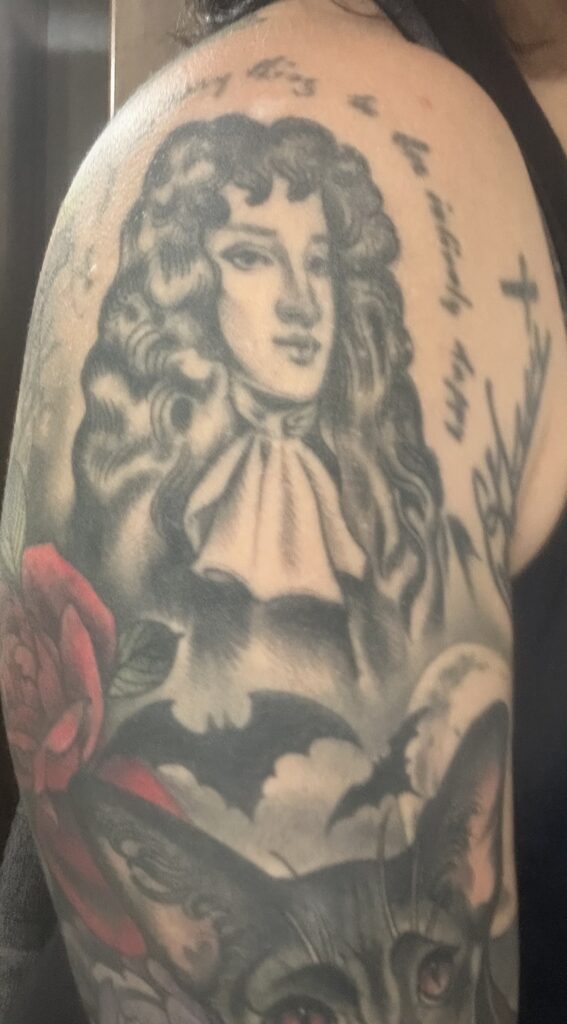 Floyd’s tattoo of John Wilmot, the Second Earl of Rochester, a late 17th-century English nobleman. (Image courtesy of Jessica Floyd)
Floyd is used to the chase and thrill of finding rare texts. She studies the gender and sexuality of sailors during the height of British and American sailing, from the mid-16th to the mid-19th centuries—when sailing ships dominated global trade and naval warfare—as well as 17th and 18th-century literature, erotic folklore, gender and women’s studies, and queer theory. This passion began in high school and continued through her undergraduate and graduate studies researching the life of John Wilmot, the Second Earl of Rochester, a late 17th-century English nobleman better known for questioning authority while also enjoying the excesses of court life and writing poetry that explored sex, desire, rebellion, and challenged social and gender norms.
“It made sense for me to research sexuality in chanteys because I want to understand why men sing dirty songs. What can chanteys tell us about how sailors negotiate sex and gender, especially in the constrained environment of the sailing ship?” said Floyd.
An epistolary discovery
Like Wilmot, Hugill also wrote and published his work. In the 1950s, Hugill began writing down the songs he remembered. In 1961, he published Shanties From The Seven Seas, a collection of over 400 chanteys now considered by chantey researchers and folklorists as the most comprehensive work on chanteys. Sailor Town was published in 1967, Shanties and Sailors’ Songs in 1969, followed by Songs of the Sea: The Tales and Tunes of Sailors and Sailing Shipsin 1977. Between 1962 and 1994, Hugill released 10 recordings—LPs, CDs, and cassette tapes—of chanteys and chantey history. Three were released posthumously. His Sea Songs CD, released in 1980, is now part of the Smithsonian Folkways Recordings catalogue.
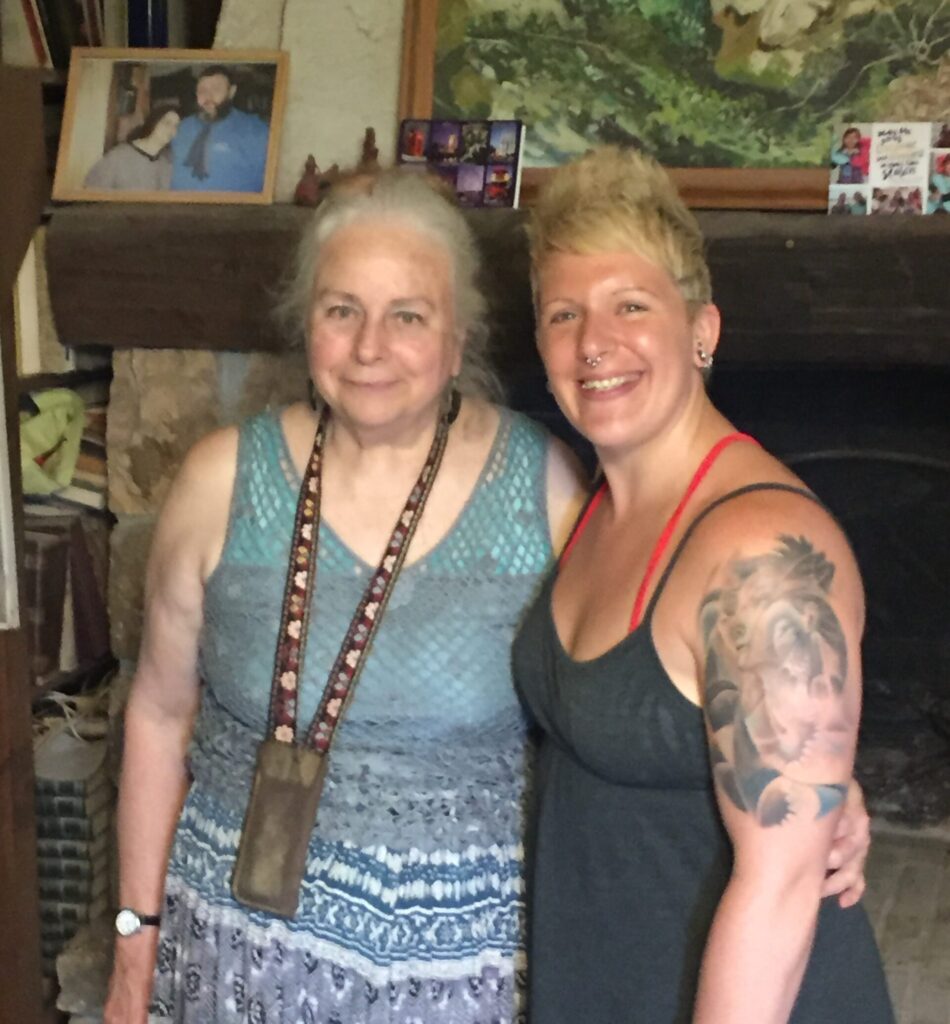 (l-r): Judith Legman and Jessica Floyd in Opio, France. (Image courtesy of Floyd)
However, unlike Wilmot, Hugill never penned the erotic versions and only sang them after a performance to an all-male audience. When Gershon Legman learned about Hugill’s repertoire, he wrote to Hugill, urging him to commit the erotic chanteys to paper for his vast collection. Hugill capitulated after years of correspondence with the condition that Legman not publish the manuscript before he could. Both men died in the 1990s without ever publishing it. With Hugill and Legman as the only witnesses of the manuscript’s existence, what was left for the chantey folklore community was rumors and the lore of its existence.
Thanks to funding from a 2016 UMBC Dresher Center for the Humanities summer fellowship, Floyd visited Judith Legman to study these letters alongside the manuscript. “Judith also had the letters shared between Hugill and Legman, which confirmed that this indeed was the sought-after manuscript,” said Floyd. She notes that by the time she left France, she had everything she needed to do a close analysis of the songs.
“Erotic worlds have fascinated me for a long time. It’s not your run-of-the-mill construction of gender. It’s actually focusing on the part of the human experience that we’re really reticent to talk about, especially in academic work,” said Floyd, who sports a palm-sized tattoo of Wilmot on her upper right arm. “This is the heart of my research—how do we write erotic worlds?”
Floyd is once again on the hunt for rare texts and has completed her second book, The Sons of Neptune. In this study, she is looking at cultural artifacts, from the 18th to the 20th century, that provide insight into why sailors are often thought of as sexy. This project is set to be published through the University of Mississippi Press in May 2026.
Read other books in our Humanities Books series.
]]>
A couple of years ago, Jessica Floyd was enjoying delicious olive flatbreads in Opio, France, a village on the French Riviera, thanks to the hospitality of Judith Legman, who owned the olive grove...
https://umbc.edu/stories/the-chase-and-thrill-of-researching-erotic-worlds/
https://my3.my.umbc.edu/api/v0/pixel/news/155331/guest@my.umbc.edu/6e42352b341487bf50a638ab81874d4f/api/pixel
arts-and-culture
cahss
dreshercenter
english
gwst
humanitiesbooks
llc
news
story
UMBC News & Magazine
https://my3.my.umbc.edu/groups/umbc-news-magazine
https://assets1-my.umbc.edu/system/shared/avatars/groups/000/001/943/24435aa6207c452e7bc15cc74b42c7bb/xsmall.png?1748556657
https://assets1-my.umbc.edu/system/shared/avatars/groups/000/001/943/24435aa6207c452e7bc15cc74b42c7bb/original.png?1748556657
https://assets2-my.umbc.edu/system/shared/avatars/groups/000/001/943/24435aa6207c452e7bc15cc74b42c7bb/xxlarge.png?1748556657
https://assets2-my.umbc.edu/system/shared/avatars/groups/000/001/943/24435aa6207c452e7bc15cc74b42c7bb/xlarge.png?1748556657
https://assets3-my.umbc.edu/system/shared/avatars/groups/000/001/943/24435aa6207c452e7bc15cc74b42c7bb/large.png?1748556657
https://assets1-my.umbc.edu/system/shared/avatars/groups/000/001/943/24435aa6207c452e7bc15cc74b42c7bb/medium.png?1748556657
https://assets2-my.umbc.edu/system/shared/avatars/groups/000/001/943/24435aa6207c452e7bc15cc74b42c7bb/small.png?1748556657
https://assets1-my.umbc.edu/system/shared/avatars/groups/000/001/943/24435aa6207c452e7bc15cc74b42c7bb/xsmall.png?1748556657
https://assets2-my.umbc.edu/system/shared/avatars/groups/000/001/943/24435aa6207c452e7bc15cc74b42c7bb/xxsmall.png?1748556657
UMBC News & Magazine
1
0
false
Mon, 15 Dec 2025 16:29:52 -0500
Mon, 15 Dec 2025 16:29:52 -0500
Retrievers gone global: 5 ways UMBC fosters international engagement
As International Education Week 2025 comes to a close, we’ve rounded up a few of the many ways Retrievers engage globally through their work and studies. Even though it has been a particularly trying time for international students, “…more UMBC students studied abroad in Academic Year 2024 – 25 than ever before. Our students are discovering new perspectives, building global connections, and transforming their futures through these life-changing experiences,” says Katie Heird, director of education abroad and global learning at UMBC. Here are a few ways international students and Retrievers who have gone abroad play a role in the lifeblood of UMBC.
1. Who is Fulbright material?
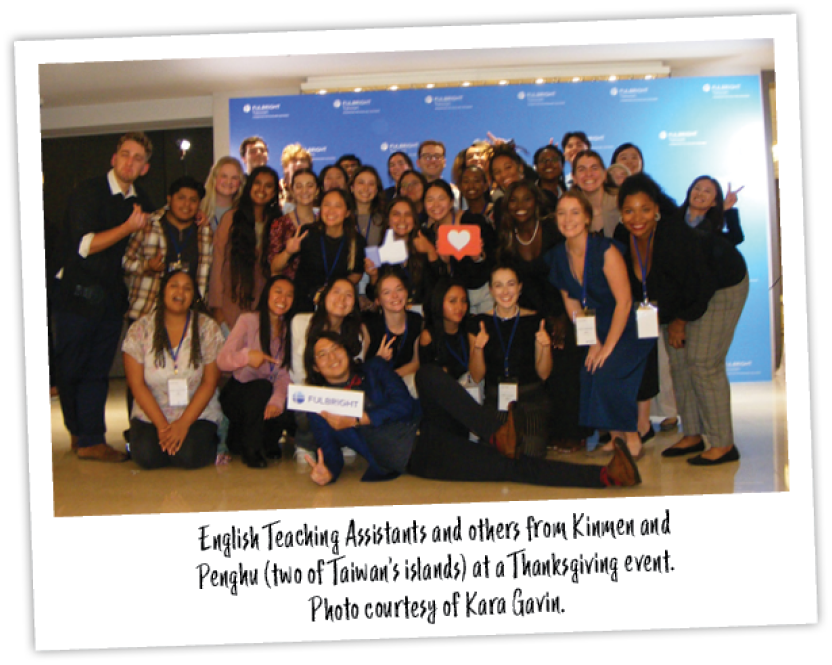
UMBC’s six 2025 – 2026 Fulbright U.S. Student Program recipients share their not-so-secret recipe for success. Deciding to apply for a Fulbright is just the first step, and with the support of UMBC’s Center for Global Engagement, which hosts Fulbright information sessions in the spring for undergraduate, graduate, and recent alumni. Retrievers can apply to earn a master’s, conduct research, or be an English Teaching Assistant in more than 160 countries. With the UMBC 2025 – 2026 Fulbrights already settled in Taiwan, Norway, and Indonesia, Belgium, Israel, and Germany, these alumni are eager to share tips to inspire and prepare the next generations of Fulbright Retrievers.
 UMBC’s 2025 – 2026 U.S. Fulbright Program class. (Brad Ziegler/UMBC)
Additionally, this year, four UMBC faculty and staff members received highly competitive Fulbright U.S. Scholar awards to teach, conduct research, and foster cross-cultural connections globally. The recipients span all three UMBC colleges and comprise three faculty members and one staff member. The UMBC awardees are connecting with international partners in areas of shared interest. Augusto Casas, an associate teaching professor of information systems, is working in Colombia; Cynthia Wagner, a teaching professor of biological sciences, went to Kyrgyzstan; Irene Chan, a professor of visual arts, is in Romania; and Tom Penniston, M.A. ’09, TESOL, Ph.D. ’14, language, literacy, and culture, the coordinator of learning analytics in the Division of Information Technology, is working in Croatia.
2. Building intentional international connections
A six-person UMBC team built international connections at the “PIWOT – World of Technology” conference, held in early 2025 in Mumbai, India. The science and technology conference is organized by the alumni association for graduates of the prestigious Indian Institutes of Technology (IITs), and attracts many of the leaders in science and technology in India and around the world. The CEO of Alphabet, Inc. (Google’s parent company), the co-founder of Sun Microsystems, and the CEO of IBM are all graduates of IITs.
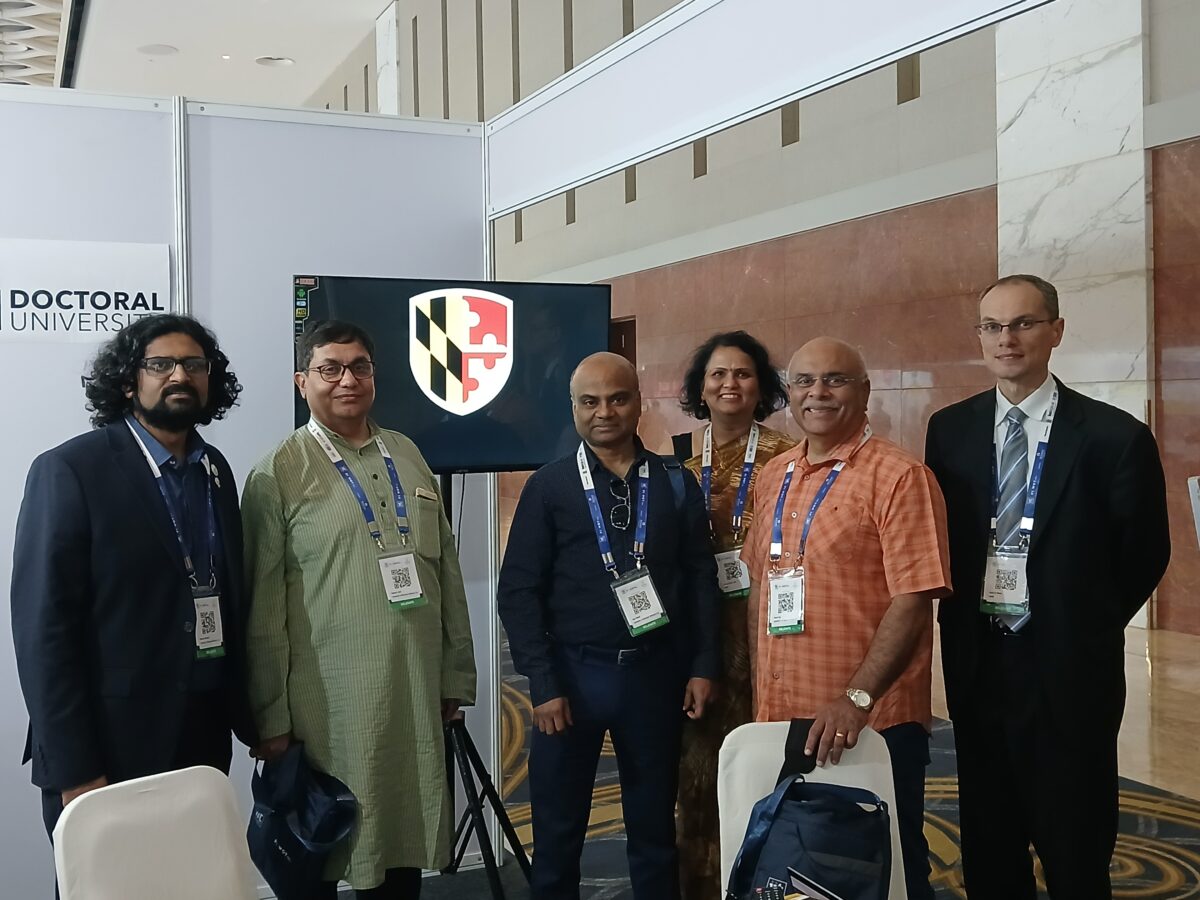 UMBC PIWOT attendees (l-r): Ramana Vinjamuri, associate professor of computer science and electrical engineering and director of the NSF IUCRC BRAIN Center; Joshi; Upal Ghosh, professor of chemical, biochemical, and environmental engineering; Karuna Pande Joshi, professor of information systems and director of the NSF IUCRC Center for Accelerated Real Time Analytics; Govind Rao, director of the Center for Advanced Sensor Technology and professor of chemical, biochemical and environmental engineering; and David Di Maria, associate vice provost for international education at UMBC. (Photo courtesy of Karuna Pande Joshi)
This year’s PIWOT conference focused on the impact of technology across multiple dimensions of life, from the professional to the personal. UMBC’s Anupam Joshi, acting dean of the College of Engineering and Information Technology, took part as a speaker on a panel about the impact of technology on education, and the UMBC booth also displayed the low-cost infant incubator developed by Professor Govind Rao.
3. International research collaboration challenges assumptions
Thanks to funding from the German Academic Exchange Service, Lorenz Kopp and Björn Michelmann, mechanical engineering students from Germany’s Regensburg University of Applied Sciences, came to UMBC to conduct research with UMBC’s mechanical engineering professor, Paris von Lockette. The project was part of a bigger assumption-questioning enterprise—in particular, probing the behavior of materials called soft magnets. Kopp’s and Michelmann’s advisor at Regensburg University of Applied Sciences knew von Lockette through the American Society of Mechanical Engineers, and together they arranged the details of the two-month visit with the help of the Office of International Students and Scholars at UMBC.
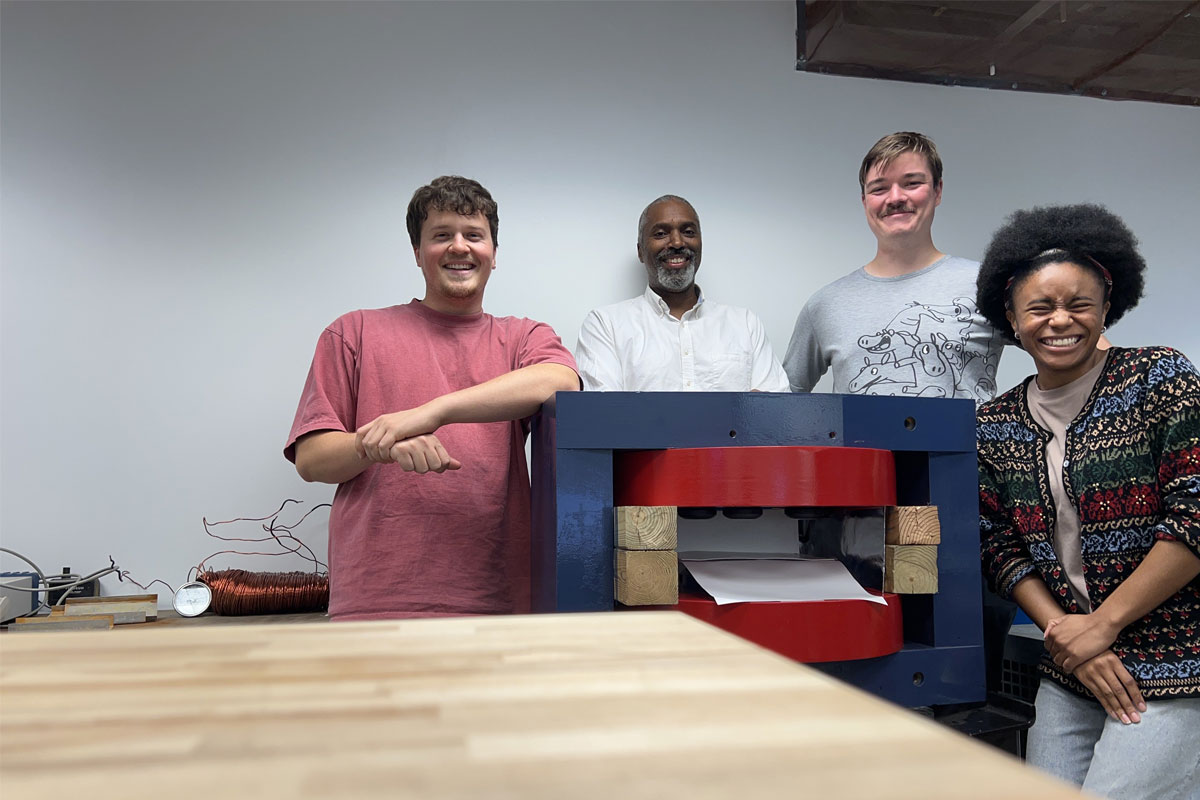 (l-r): Lorenz Kopp, Björn Michelmann, von Lockette, and Tamia Bowers ’23, mechanical engineering, with the electromagnet they set up in the lab. (Brad Ziegler/UMBC)
While Kopp and Michelmann spent plenty of time in the lab during their visit, they also had chances to explore the areas surrounding UMBC on weekends. They visited the National Aquarium in Baltimore, took in a Baltimore Ravens football game, and drove to Shenandoah National Park in Virginia. They also enjoyed campus life, attending Homecoming weekend, and regularly visiting the Retriever Activity Center to work out.
4. Exploring politics in a global context, virtually
Professor Filomeno’s 2024 Collaborative Online International Learning (COIL) Brazil project on climate change equips students with the technical and interpersonal skills to thrive in professional online international and intercultural environments. COIL makes international scholarship and intercultural learning accessible by removing barriers of cost and travel while preparing students with essential skills for future in-person exchanges. COIL Brazil was part of Filomeno’s Global Citizenship class in collaboration with former colleague Clarissa Dri, a professor of international relations at his alma mater, the Federal University of Santa Catarina, in southern Brazil.
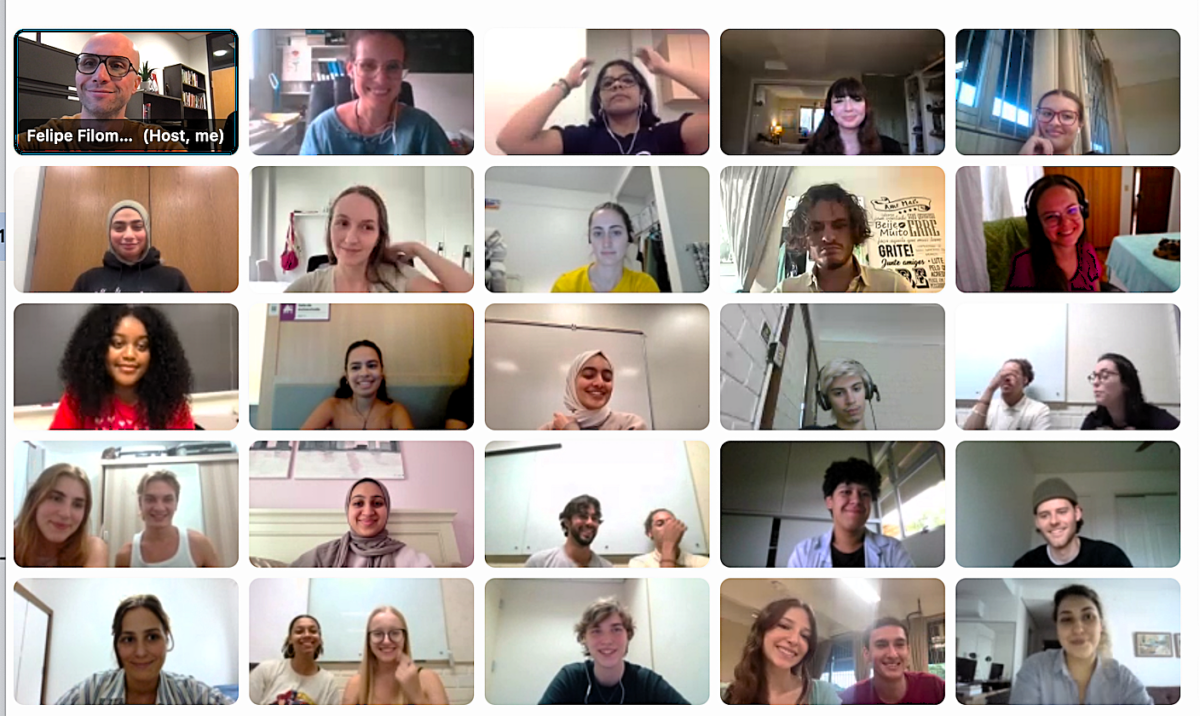 COIL Brazil met online so that students from UMBC and the Federal University of Santa Catarina in southern Brazil could participate. (Image courtesy of Felipe Filomeno.)
The ongoing Virtual Tandem Conversation project was created by Susanne Sutton, a teaching professor of German, and Talke Macfarland, a visiting lecturer of German in UMBC’s Department of Modern Languages, Linguistics, and Intercultural Communication. They established the program during COVID-19 to help UMBC students learning German and German students learning English socialize while continuing to improve their language skills.
The actual tandem meetings are entirely student-driven and take place outside of the classroom—each tandem pair arranges virtual meetings according to their schedule. Tandem participants have gone beyond the virtual classroom, such as UMBC Golden ID Program student Rebecca Smith, who, while on a recent trip to France, hopped over to Germany to visit Gertrud Krause-Traudes, her partner in UMBC’s Virtual Tandem Conversation project. After three semesters of virtual conversations in German and English, Smith was happy to meet Krause-Traudes in person.
5. Science that bridges two worlds
In 2020, as the COVID-19 pandemic disrupted lives worldwide, Greema Regmi began her Ph.D. in UMBC’s atmospheric physics program. Studying remotely from her home in Nepal, she navigated a grueling schedule due to the time difference. Now in her fifth year, Regmi’s perseverance has earned her NASA’s prestigious Future Investigators in NASA Earth and Space Science and Technology (FINESST) fellowship, which will provide up to $50,000 annually for up to three years to fuel her research on atmospheric dust.
 Greema Regmi discussed her research at a recent poster session at UMBC. (Brad Ziegler/UMBC)
Regmi has been able to accomplish so much in part because of the supportive community she found at UMBC, after finally arriving on campus in fall 2021. Regmi’s journey bridges her unique perspectives as a student in Nepal and the U.S. At UMBC, she’s embraced broader opportunities. “I think here you can push the limit. I don’t even know what the limit is in the U.S. Here you can dream more and be more experimental,” she observes.
Grounded in the UMBC physics department’s community of support, Regmi’s confidence has only grown since her arrival in Maryland. “There’s always a place for my opinion, which is very nice. Because of that, and all of the experiences I’ve had, now I have the confidence to start my own project,” she explains. “And that’s why I think now I’m confident to go back home, lead something there, and be helpful in some small way.”
Learn more about UMBC’s international opportunities.
]]>
As International Education Week 2025 comes to a close, we’ve rounded up a few of the many ways Retrievers engage globally through their work and studies. Even though it has been a particularly...
https://umbc.edu/stories/gone-global-umbc-international-engagement/
https://my3.my.umbc.edu/api/v0/pixel/news/154859/guest@my.umbc.edu/4a42a8215afbcd5c0ace5e35458352e2/api/pixel
cahss
cge
cnms
coeit
community
fulbright
international
is
llc
meche
mlli
news
physics
politicalscience
research
story
visualarts
UMBC News & Magazine
https://my3.my.umbc.edu/groups/umbc-news-magazine
https://assets1-my.umbc.edu/system/shared/avatars/groups/000/001/943/24435aa6207c452e7bc15cc74b42c7bb/xsmall.png?1748556657
https://assets1-my.umbc.edu/system/shared/avatars/groups/000/001/943/24435aa6207c452e7bc15cc74b42c7bb/original.png?1748556657
https://assets2-my.umbc.edu/system/shared/avatars/groups/000/001/943/24435aa6207c452e7bc15cc74b42c7bb/xxlarge.png?1748556657
https://assets2-my.umbc.edu/system/shared/avatars/groups/000/001/943/24435aa6207c452e7bc15cc74b42c7bb/xlarge.png?1748556657
https://assets3-my.umbc.edu/system/shared/avatars/groups/000/001/943/24435aa6207c452e7bc15cc74b42c7bb/large.png?1748556657
https://assets1-my.umbc.edu/system/shared/avatars/groups/000/001/943/24435aa6207c452e7bc15cc74b42c7bb/medium.png?1748556657
https://assets2-my.umbc.edu/system/shared/avatars/groups/000/001/943/24435aa6207c452e7bc15cc74b42c7bb/small.png?1748556657
https://assets1-my.umbc.edu/system/shared/avatars/groups/000/001/943/24435aa6207c452e7bc15cc74b42c7bb/xsmall.png?1748556657
https://assets2-my.umbc.edu/system/shared/avatars/groups/000/001/943/24435aa6207c452e7bc15cc74b42c7bb/xxsmall.png?1748556657
UMBC News & Magazine
7
0
false
Tue, 25 Nov 2025 13:03:08 -0500
Tue, 25 Nov 2025 13:03:08 -0500
Celebrating the history, evolution, and impact of K-pop culture as represented in ‘KPop Demon Hunters’
Abbie Fakoya is at the front of the room, smiling and encouraging over 40 UMBC faculty, staff, and students to follow her dance steps. Many of the attentive dancers were either new to the intricate K-pop choreography, learning this sequence, or, like millions of fans around the world, ready to show off their synchronized dance moves to “Golden,” the 2026 Grammy-nominated Song of the Year, from Netflix’s KPop Demon Hunters film.
The global success of the film drew fans to the KPop Demon Hunters: A Conversation on Media, Culture, & Globalization event organized by the Asian Studies Program in collaboration with several CAHSS departments at the Skylight Lounge this fall. Fakoya, a biochemistry senior and the event coordinator for UMBC’s K-pop Dance Club, was not surprised to see the long line of people waiting to participate in an evening of Korean culture, dance, and food that celebrated Korea’s vast snack culture thanks to the D.C. Korean Foundation and a delicious Korean-fusion catered dinner by Baltimore’s own Dooby’s restaurant

 Participants line up for a Korean-fusion dinner and Korean snacks and drinks.
“Seeing the movie accurately portray the food and cultural practices I grew up with in a positive way—like the noodles, the Korean spa the characters enjoyed, and Korean shamanistic practices—reminds me of my own childhood experiences, and doing those same things now when visiting family in Korea. It is really inspiring,” said Angelina Jenkins, assistant director of UMBC’s Mosaic Center for Cultural Diversity, a member of the expert panel.
Growing up with K-pop
Fakoya became interested in K-pop in elementary school, at a time when she felt that liking K-pop—especially if you weren’t Korean—was not as well received. Friend and club historian Esha Shah, an information systems junior, agrees. “This year has been very exciting. We’ve had a lot of interest in the club because of the movie,” said Sha. “I remember when I was in elementary and middle school, kids would give me side-eyes for liking K-pop and singing in Korean and ask me why I wanted to be Korean.”
The two met in 2022 at the RAC for a packed K-pop dance workshop, featuring the then-top K-pop song “Dope,” by BTS. It was the first in-person dance workshop after COVID-19 restrictions were lifted. “UMBC’s K-pop dance club moved its dance workshops online during the COVID-19 lockdown because K-pop artists were still posting songs and dance videos,” said Sha. “When students came back in person, there were so many people who wanted to participate that the club had to keep rotating participants in and out of the workshop.”
For Jenkins, a life-long K-pop fan, being among Retrievers who champion, appreciate, and embrace Korean culture was also a welcome change from her experience growing up in Pennsylvania, where she was one of the very few students of color in her high school. “I’m super excited to be here as I am what I consider to be a one-and-a-half first-generation American, Korean American, who not only does their work through the Mosaic Center,” said Jenkins.
“I am also a third-year Ph.D. student at the University of Maryland, College Park, looking at culture studies, Asian American identity development, and how films like KPop Demon Hunters allow young Asian American students to really understand what this means to bridge the gap between American culture, Korean culture, and this idea of globalization.”
 (l-r): Mea Lee and Angelina Jenkins discuss Korean culture as represented in the film KPOP Demon Hunters.
Alongside Angelina Jenkins, Mea Lee, a doctoral student in the Language, Literacy, and Culture Program at UMBC and a librarian at Anne Arundel Community College, highlighted the film’s cultural integrity. Lee emphasized how breaking Asian stereotypes and incorporating authentic cultural references can empower not only Korean communities but all minority groups in America.
She explained how Korean folk narratives and art were skillfully woven into the storyline, enriching the film’s depth and relevance. One example is the blue-striped mystical tiger, Derpy, and the magpie, Sussy, with three eyes on each side of its head, who are paired together to act as messengers and protectors. These elements not only honored tradition but also created a bridge between folklore and modern fantasy, allowing the narrative to resonate with diverse audiences.
 Lee discusses the meaning of a Korean mystical tiger and magpie in Korean folklore.
K-pop’s influence beyond the screen
The panel, moderated by Fan Yang, professor of media and communication studies, director of the Asian Studies Program, and the faculty leader of UMBC’s Global Asias Initiative, discussed the spiritual, gender, linguistic, and artistic Korean cultural references throughout the movie, along with the Westernization of K-pop.
“The experience of being a human and a demon—struggling with duality— is very relatable. I’m an American,” said Lee, “but I also want to live within my Korean culture. It’s a balance between how much I really want to be an outcast in either culture, versus how much I’m going to accept. It’s a constant struggle.” Lee continues, “It’s a similar duality that Rumi, the main character, faces as a half-demon and half-human. Life isn’t always so clear. We spend most of our lives in the grey area. It’s a balance. At least I don’t have to fight four dancing demons.”
Fakoya and Sha have also witnessed the Westernization of K-pop, with a shift from Korean lyrics to mostly English lyrics—like in KPop Demon Hunters. First, they didn’t expect to like the movie because it was marketed for children, and most of it was in English. “I don’t speak Korean, but I like to memorize the Korean lyrics and the dances,” said Sha.
 Abbie Fakoya leads the audience in a K-pop dance sequence at the KPop Demon Hunters: A Conversation on Media, Culture, & Globalization event.
They were won over by the movie’s attention to detail of the K-pop culture they’ve been a part of since childhood. Now, they’ve found themselves as ambassadors encouraging students who “don’t want to like it because everyone likes it now,” to explore the genre beyond what’s popular. “There are different sounds and niche groups just like in any type of music,” said Sha.
In preparation to lead the “Golden” dance workshop, Fakoya memorized the Korean and English lyrics and choreography. “K-pop is so cool. It’s just a habit. I love it,” she said, after masterfully and patiently showing everyone how to be a K-pop demon superstar.
Learn more about UMBC’s K-Pop Dance Club’s next showcase.
]]>
Abbie Fakoya is at the front of the room, smiling and encouraging over 40 UMBC faculty, staff, and students to follow her dance steps. Many of the attentive dancers were either new to the...
https://umbc.edu/stories/celebrating-k-pop-culture-in-kpop-demon-hunters/
https://my3.my.umbc.edu/api/v0/pixel/news/154739/guest@my.umbc.edu/cd7f498a1fbee02793558176307efae5/api/pixel
arts-and-culture
asianstudies
biochemistry
cahss
community
international
is
llc
mcs
mlli
news
story
the-mosaic
UMBC News & Magazine
https://my3.my.umbc.edu/groups/umbc-news-magazine
https://assets1-my.umbc.edu/system/shared/avatars/groups/000/001/943/24435aa6207c452e7bc15cc74b42c7bb/xsmall.png?1748556657
https://assets1-my.umbc.edu/system/shared/avatars/groups/000/001/943/24435aa6207c452e7bc15cc74b42c7bb/original.png?1748556657
https://assets2-my.umbc.edu/system/shared/avatars/groups/000/001/943/24435aa6207c452e7bc15cc74b42c7bb/xxlarge.png?1748556657
https://assets2-my.umbc.edu/system/shared/avatars/groups/000/001/943/24435aa6207c452e7bc15cc74b42c7bb/xlarge.png?1748556657
https://assets3-my.umbc.edu/system/shared/avatars/groups/000/001/943/24435aa6207c452e7bc15cc74b42c7bb/large.png?1748556657
https://assets1-my.umbc.edu/system/shared/avatars/groups/000/001/943/24435aa6207c452e7bc15cc74b42c7bb/medium.png?1748556657
https://assets2-my.umbc.edu/system/shared/avatars/groups/000/001/943/24435aa6207c452e7bc15cc74b42c7bb/small.png?1748556657
https://assets1-my.umbc.edu/system/shared/avatars/groups/000/001/943/24435aa6207c452e7bc15cc74b42c7bb/xsmall.png?1748556657
https://assets2-my.umbc.edu/system/shared/avatars/groups/000/001/943/24435aa6207c452e7bc15cc74b42c7bb/xxsmall.png?1748556657
UMBC News & Magazine
1
0
false
Thu, 20 Nov 2025 09:42:26 -0500
Thu, 20 Nov 2025 09:42:26 -0500
Michael Hunt ’06, Ph.D. ’25, Outstanding Staff award winner, lifts up students and builds community
When Shaniah Reece ’23, information systems, now a Ph.D. student in computer science at Emory University, was navigating her academic journey at UMBC, there were times she felt like giving up. One evening, around 10 p.m. at night, she was exhausted and considering not submitting an important application. But then Michael Hunt, director of the McNair Scholars Program, with which she was affiliated, gave her a call.
“He said, ‘There are two hours left, and I haven’t seen any indication that you’ve submitted it,’” Reece relates. “I could hear his family and the TV in the background—he was off the clock, at home—but he still made that call. That moment was so impactful because he thought about me, believed in me, and pushed me in a moment when I was too weak to push myself.”
It’s just one example of the many times that Hunt ’06, applied mathematics, Ph.D. ’25, language, literacy, and culture, has shown up for students in just the ways they need. Since 2019, Hunt has directed the federally funded UMBC McNair program with a goal of empowering students from underrepresented segments of society to earn research-based doctoral degrees. Not only does he support the 30 students who enter the full program each year—he’s worked hard to extend opportunities to affiliated students, through a program now called the Retriever Graduate Preparation Network, and to spread the supportive culture of the McNair program across the university as a whole.
On October 29, Hunt’s contributions will be recognized when he receives the 2025 Outstanding Staff award from UMBC’s Alumni Association Board of Directors.
Showing up for students
 From l-r: McNair Scholar Nogaye Khady Wade, McNair coordinator Antoinette Newsome, McNair Scholar Noor Huma and Michael Hunt at the American Educational Research Association annual meeting in 2023. (Photo courtesy of Hunt)
What makes Hunt such an effective mentor? For one thing, he asks students what they need and makes their voices and experiences a central part of his relationship with them. He strives to support them holistically, including emotional, cultural, and academic support. He wants the mentor-mentee relationship to be reciprocal, to honor the value of the mentee’s contributions, and to extend into a wider network of community support.
The approach, called holistic critical mentoring, has been central to the McNair Scholar’s Program under Hunt’s leadership. Hunt even wrote his Ph.D. dissertation on the subject and his interviews of former McNair scholars showed how much they valued the mentoring philosophy.
“I am one of the many UMBC students whose trajectory was forever changed by Dr. Hunt’s mentorship,” says Ting Huang ’21, psychology, the program coordinator for UMBC McNair Scholars Program and a former scholar herself. “I didn’t know my path until I stumbled onto McNair as an undergraduate. Through the program, I conducted research virtually for the first time during the height of the COVID-19 pandemic. Despite the remote nature of those years, I had never felt more connected to a community. That sense of belonging was cultivated by Dr. Hunt and his team, showing how intentional leadership can overcome even the most isolating circumstances.”
Building community
Hunt says the experience of reaching out to current and former McNair program participants to request their help supplying information for his dissertation research was ultimately very gratifying. He wondered how many would respond, given their busy schedules, but a large number were eager to engage.
“I was genuinely surprised, I didn’t expect that number of responses. But then my mentor pointed out: That’s what happens when you build relationships,” Hunt says.
 Michael Hunt with his family at the Black and Latine/x Celebration and Awards in spring 2025. (Brad Zeigler/UMBC)
Hunt says the continued support of program alumni makes him feel like he is making a difference. He’s happy that former participants, some as far away as California, regularly offer to serve as volunteer mentors for current students.
This summer, Hunt had the opportunity to sit in on the dissertation defense of one of the first students to go through the McNair Scholars Program under his watch.
“It’s wonderful to see these alums thriving,” Hunt says. “We are building community. And while we stood on the shoulders of giants, we’re making sure to also be the shoulders that others can stand on next.”
Mark your calendars for the 2025 Alumni Awards on Wednesday, October 29, at 6 p.m., and consider joining the UMBC community at the Chesapeake Employers Insurance Arena to celebrate Michael Hunt and the many remarkable individuals receiving awards. The event will be livestreamed for those unable to join in person. You can learn more at alumni.umbc.edu/alumniawards.
]]>
When Shaniah Reece ’23, information systems, now a Ph.D. student in computer science at Emory University, was navigating her academic journey at UMBC, there were times she felt like giving up. One...
https://umbc.edu/stories/michael-hunt-outstanding-staff-award/
https://my3.my.umbc.edu/api/v0/pixel/news/153998/guest@my.umbc.edu/9f1ef4212ec1126461db307e1dc3f9e0/api/pixel
alumni
alumni-awards
cahss
cnms
coeit
is
llc
magazine
math
mcnairscholars
meyerhoff
story
UMBC News & Magazine
https://my3.my.umbc.edu/groups/umbc-news-magazine
https://assets1-my.umbc.edu/system/shared/avatars/groups/000/001/943/24435aa6207c452e7bc15cc74b42c7bb/xsmall.png?1748556657
https://assets1-my.umbc.edu/system/shared/avatars/groups/000/001/943/24435aa6207c452e7bc15cc74b42c7bb/original.png?1748556657
https://assets2-my.umbc.edu/system/shared/avatars/groups/000/001/943/24435aa6207c452e7bc15cc74b42c7bb/xxlarge.png?1748556657
https://assets2-my.umbc.edu/system/shared/avatars/groups/000/001/943/24435aa6207c452e7bc15cc74b42c7bb/xlarge.png?1748556657
https://assets3-my.umbc.edu/system/shared/avatars/groups/000/001/943/24435aa6207c452e7bc15cc74b42c7bb/large.png?1748556657
https://assets1-my.umbc.edu/system/shared/avatars/groups/000/001/943/24435aa6207c452e7bc15cc74b42c7bb/medium.png?1748556657
https://assets2-my.umbc.edu/system/shared/avatars/groups/000/001/943/24435aa6207c452e7bc15cc74b42c7bb/small.png?1748556657
https://assets1-my.umbc.edu/system/shared/avatars/groups/000/001/943/24435aa6207c452e7bc15cc74b42c7bb/xsmall.png?1748556657
https://assets2-my.umbc.edu/system/shared/avatars/groups/000/001/943/24435aa6207c452e7bc15cc74b42c7bb/xxsmall.png?1748556657
UMBC News & Magazine
1
0
false
Tue, 28 Oct 2025 16:03:47 -0400
Tue, 28 Oct 2025 16:03:47 -0400
Sweat equity—UMBC’s arts, humanities, and social science interns use campus connections and resources to find ideal summer placements
Used to working in beautiful sunny weather, Giovanna Orfali, a visual arts senior from São Paulo, Brazil, spent this summer behind the camera as a digital content intern at the Maryland Center for History and Culture (MCHC). A seasoned filmmaker and photographer, this internship was an opportunity to expand her professional network and bring a fresh perspective to Maryland history by creating short-form social media content to share the center’s unique exhibits and events with audiences across the state.
Orfali is a recipient of the #YouAreWelcomeHere scholarship that offers tuition support for international students. She came to UMBC with experience as a television video editor and videographer and has used her skillset working on a wide range of projects. She produced and edited “Arthropod Biodiversity and Applications,” a full-length instructional video course for the Department of Biological Sciences, and works part-time as a photographer for UMBC athletics events. When Orfali is not at the MCHC, she produces digital media for UMBC’s event and conference services, her second summer internship site.


 Giovanna Orfali editing videos and photos of MCHC’s research library and documenting a Tom Miller exhibit. (Brad Ziegler/UMBC)
“When I began taking classes back home, no one was interested in editing audio, so I volunteered. I learned to say yes to all opportunities. At the TV station, I filmed interviews, exercise classes, and tourism commercials,” says Orfali. “I did the same when I came to UMBC. Being open to learning all aspects of audiovisual production has made me more confident and helped me make a lot of connections in and outside of the classroom.” Orfali’s short film “A Shared Story of Distance” was chosen to represent UMBC at the 2023 Maryland Film Festival Day: Student Shorts Showcase.
Hundreds of Retrievers like Orfali maximize their summer by putting their hard-earned skills to work in collaboration with campus and community partners. The 2025 arts, humanities, and social sciences summer interns are getting it done, one sunny day at a time.
Designing a career
No matter where a Retriever is in the world, they can search the online student job platform Handshake for thousands of summer internships, including on-campus opportunities. This was crucial for Humanities Scholar Kendal Howell, who stepped off the plane after studying business management abroad in France this past spring and into the office as an intern at UMBC’s Division of Student Affairs for their new academic partnerships and high-impact experiences (APHIE) unit. James DeVita, assistant vice president for APHIE, says his group needed materials and resources to help stakeholders understand the value of developing and engaging in high-impact experiences. So he turned to the experts in student experiences—the students themselves.
 Kendal Howell working at the academic partnerships and high-impact experiences (APHIE) unit. (Brad Ziegler/UMBC)
“We wanted to add to the number of on-campus internships. It was wonderful to have created a new professional experience for over 25 students, whose research will directly benefit their peers in a multitude of ways,” says DeVita. “By the end of the internship, the interns had collectively reviewed over 30 publications and drafted six resources in addition to completing the mapping research and related presentation.”
“The student-led research team studied high-impact practices for scholars programs, including UMBC’s, and synthesized academic research of these practices on student success in higher education,” says Howell, an Africana studies and sociology senior, with a minor in entrepreneurship. She focused on entrepreneurship, education abroad, work-based learning, and student leadership opportunities. “The information we gathered will help inform campus leaders in improving UMBC’s scholar programs. This was my first internship, and I loved it!”
 (l-r): Kendal Howell updates internship supervisor, James DeVita, on her latest project. (Brad Ziegler/UMBC)
Second-year gerontology doctoral student Claire McDonald also had the opportunity to conduct new research. Trained in quantitative research in psychology, McDonald gained qualitative methodology skills in her spring sociology class as part of her training to conduct research about aging in the LGBTQ+ community, a growing area of research. She is utilizing the mixed-methods LGBTQ+ Social Networks, Aging, and Policy Study, one of the few datasets on this topic, and hopes to add to her dissertation qualitative data from interviews with older LGBTQ+ adults in Baltimore for a mixed-methods project. Impressed with McDonald’s rigor, her professor recommended her to Rowena Winkler, the new assistant director for graduate student career development at the UMBC Career Center, who was seeking graduate students to conduct a 10-week qualitative research project.

 (l-r): Claire McDonald discusses her research with her internship supervisor, Rowena Winkler. McDonald practices interviewing a graduate student about their experience. (Brad Ziegler/UMBC)
“I recruited over 100 students, conducted 11 individual interviews, and three focus groups to learn how and why graduate students use the Career Center and why they don’t,” says McDonald. Winkler appreciated the partnership. They co-facilitated two of the focus groups together. “I watched Claire build rapport with the students. She was very open-ended and asked great prompts and follow-ups,” says Winkler. “I’m happy she had the opportunity to hone in on some of these skills that she learned in her class.”
From intern to staff
Professional growth and community building throughout the summer help students maintain ongoing growth at every stage of their learning process, leading to new jobs in other organizations, extending their internship to another semester, or a promotion from an intern to a staff member.
Like Howell, Handshake helped Orfali find both her summer internship at the MCHC as well as a spring internship in media production and audiovisual at the CATO Institute, a think tank in Washington, D.C. She impressed the MCHC team so much that they have extended her internship through the fall. “I learned a lot about working at a nonprofit that values the importance of history and culture, as well as collaborating with the external affairs team to create content for marketing purposes,” shared Orfali on LinkedIn. “This experience made me very interested in producing informative and educational videos and documentaries.”
As students advance in their academic careers, they can access paid, hands-on learning opportunities by serving as graduate assistants. Over the last eight years, Caleb Ruck, a language, literacy, and culture doctoral student and two-time alum, has climbed UMBC’s student worker ladder, including as a graphic designer and social media manager for UMBC’s Initiatives for Identity, Inclusion, and Belonging. He served as a special projects intern for the Center for Democracy and Civic Life and moved to the front of the classroom as a graduate teaching assistant for the modern languages, linguistics, and intercultural communication department.
Ruck is now the first year-long graduate assistant for the Center for Social Justice Dialogue where he is helping develop and establish programming and procedures, such as co-facilitating a first-year seminar on the intricacies of dialogue around social identity, race, power, privilege, and oppression, and co-facilitating Building Bridges Across Difference: A Dialogue for Every Day for staff and faculty.
 Caleb Ruck (center) speaks with Jasmine Lee and Ciara Christian, M.A. ’18, sociology, Ph.D. ’22, language literacy, and culture, who both co-direct the Center for Social Justice Dialogue. (Brad Ziegler/UMBC)
This summer, Ruck focused on professional development by attending the National Intergroup Dialogue Institute, hosted by the University of Michigan’s program on intergroup relations, and preparing to welcome the first group of interns he helped interview.
 Caleb Ruck shares his doctoral research with members of the Center for Social Justice Dialogue. (Brad Ziegler/UMBC)
“The skills I’ve acquired in this job make me feel more competent and prepared to co-facilitate dialogue, especially in student, staff, and faculty-facing contexts,” says Ruck ’22, modern languages, linguistics, and intercultural communication, and M.A. ’24, intercultural communication. “I want to be a faculty member, teach, and conduct research on social identity topics. Being able to navigate dialogue across differences is key.”
The UMBC Career Guide has templates and resources for students to help with internet and job search at every stage of their internship and job search. Listen to more tips on UMBC’s Careers Unleashed podcast.
]]>
Used to working in beautiful sunny weather, Giovanna Orfali, a visual arts senior from São Paulo, Brazil, spent this summer behind the camera as a digital content intern at the Maryland Center for...
https://umbc.edu/stories/arts-humanities-social-science-interns/
https://my3.my.umbc.edu/api/v0/pixel/news/151641/guest@my.umbc.edu/2948f8cc3d15624a344110be1c818563/api/pixel
africanastudies
arts-and-culture
cahss
careercenter
centerfordemocracyandciviclife
community
graduateschool
humanitiesscholars
international
internships
llc
mlli
news
psychology
research
sociology
story
studentaffairs
visualarts
UMBC News & Magazine
https://my3.my.umbc.edu/groups/umbc-news-magazine
https://assets1-my.umbc.edu/system/shared/avatars/groups/000/001/943/24435aa6207c452e7bc15cc74b42c7bb/xsmall.png?1748556657
https://assets1-my.umbc.edu/system/shared/avatars/groups/000/001/943/24435aa6207c452e7bc15cc74b42c7bb/original.png?1748556657
https://assets2-my.umbc.edu/system/shared/avatars/groups/000/001/943/24435aa6207c452e7bc15cc74b42c7bb/xxlarge.png?1748556657
https://assets2-my.umbc.edu/system/shared/avatars/groups/000/001/943/24435aa6207c452e7bc15cc74b42c7bb/xlarge.png?1748556657
https://assets3-my.umbc.edu/system/shared/avatars/groups/000/001/943/24435aa6207c452e7bc15cc74b42c7bb/large.png?1748556657
https://assets1-my.umbc.edu/system/shared/avatars/groups/000/001/943/24435aa6207c452e7bc15cc74b42c7bb/medium.png?1748556657
https://assets2-my.umbc.edu/system/shared/avatars/groups/000/001/943/24435aa6207c452e7bc15cc74b42c7bb/small.png?1748556657
https://assets1-my.umbc.edu/system/shared/avatars/groups/000/001/943/24435aa6207c452e7bc15cc74b42c7bb/xsmall.png?1748556657
https://assets2-my.umbc.edu/system/shared/avatars/groups/000/001/943/24435aa6207c452e7bc15cc74b42c7bb/xxsmall.png?1748556657
UMBC News & Magazine
0
0
false
Thu, 21 Aug 2025 11:00:43 -0400
Thu, 21 Aug 2025 11:00:43 -0400
Meet a Retriever—Jessica Floyd, Ph.D. ’17, gender and sexuality scholar and professor
Meet Jessica Floyd, Ph.D. ’17, language, literacy, and culture (LLC). She is an interdisciplinary researcher and scholar who investigates erotic worlds for what they might communicate about gender and sexuality. Her early interests began in her teens while reading the Marquis de Sade’s 120 Days of Sodom, which eventually led her to research John Wilmot, the Second Earl of Rochester, while an undergraduate student at Towson University, and then as a graduate student at the University of Maryland, College Park. Her interests eventually led her to study chanteys as a Ph.D. student at UMBC. Today, she is an adjunct instructor in the gender, women’s, and sexuality studies program at UMBC, and published her first book, Cabin Boys, Milkmaids, and Rough Seas: Identity in the Unexpurgated Repertoire of Stan Hugill, in 2024. Take it away, Jessica!
Q: What initially brought you to UMBC?
A: I came to UMBC because I was encouraged by a graduate of the LLC program, Dave Truscello, Ph.D. ’04, who was a member of the very first cohort of LLC doctoral students. Once I met faculty from UMBC, I knew that it was the place where I could achieve my dreams of a Ph.D. It was my hope that I would be able to grow a career as a scholar, publishing books and articles that were exciting and which stoked my curiosity. I have been able to do that.
Q: What do you love about the language, literacy, and culture program?
A: I loved the LLC program as it was a place where I was encouraged and supported in ways that I had never experienced before. The program is filled with faculty and mentors who are as excited about what you are doing as you are. There is nothing a student needs more than a group of people rallying behind them, and the LLC community felt like a safe and warm home.
My other favorite part of the LLC program and being in Retriever Nation is that I met my best friend and colleague, Steven Dashiell, professor of gender, women’s, and sexuality studies. He studied in the LLC program with me in my cohort.


Photos above: Floyd with her co-chairs, Amy Froide and Laura Rosenthal, after defending her doctoral thesis (left). Floyd with her family, Bill Sapp (dad), Kathy Sapp (mom), Cory Floyd (husband), after graduating from UMBC (right).
Q: How would you describe the support you find at UMBC?
A: UMBC is a place where you will be academically challenged, but supported in ways that will transform you. Challenges create strong scholars, but you need allies to work through those challenges. At UMBC, every faculty member is there to see you succeed and will lift you up even when you are at your most vulnerable.
Q: What is your favorite part of Retriever Nation?
A: UMBC is where I earned my doctorate, something that I have wanted since I was a teenager. Being a graduate from UMBC will always be associated with that accomplishment, and I continue to have a warm memory of UMBC based on the experiences there, the people I encountered, and the things I accomplished.
 Jessica Floyd, Ph.D. ’17, with the committee after defending her doctoral thesis. From left to right: Laura Rosenthal, Christine Mallinson, Jessica Floyd, Amy Froide, Kate Drabinski, Marjoleine Kars
Q: Who in the UMBC community has inspired you or supported you?
A: At UMBC, I was able to find a home. My mentor Amy Froide, director of UMBC’s Dresher Center for the Humanities, inspired me to keep pushing and was always in my corner to encourage me as I finished my doctorate. Dr. Froide counseled me during some of my most challenging rejections/revisions. Christine Mallinson, my LLC mentor and advisor, was always there to guide me toward the right path and to steer me in the direction I needed to go in order to accomplish my goals. Kate Drabinski, professor of gender, women’s, and sexuality studies, was also an incredible support and inspiration to me as I was working. She gave me space to stretch my legs and try things out, moving me towards my completed project. Carole McCann, professor of gender, women’s, and sexuality studies, provided the space for me and fellow LLC students to explore theoretical frameworks in gender and women’s studies in an intimate cohort. That experience was foundational to some of my theoretical work in the dissertation. She inspired me to be exacting.
UMBC's faculty allows you to be expansive and believe in you sometimes more than you believe in yourself.
Jessica Floyd, Ph.D. ’17
Language, Literacy, and Culture
Carole McCann hired me in the gender, women’s, and sexuality studies program in the spring of 2022, permitting me space to chase my dream of teaching at the four-year level. I have taught at the college level since 2011, but this was the first time that I taught at the four-year level and at a place that is dear to me.
I was hired to teach Intro to Critical Sexuality Studies, which is my passion and research focus. There, I introduce students to conceptions of sexuality, gender, and identity across time, from looking at erotic poetry from the Restoration in England to pulp erotic novels from the post-Stonewall era. I went on to teach Introduction to Gender and Women’s Studies and enjoyed working with students as we discussed foundational topics in the field.
Just this past fall 2024, I was asked to teach Doin’ It: Case Studies in the History of Western Sexuality, where I was able to draw on my doctoral work and teach an interdisciplinary history course, cross-listed with GWST. In my time teaching as an adjunct at UMBC, it has been exciting for me to work closely with students and see the incredibly creative projects and ideas they brought with them. What was most rewarding, for me, was seeing my own students light up in ways that I did as an undergraduate, taking some of their own research projects and developing them into conference papers, undergraduate theses, and even potential publications.
Q: Can you tell us about your book?
A: In 2024, I published my first book, Cabin Boys, Milkmaids, and Rough Seas: Identity in the Unexpurgated Repertoire of Stan Hugill, which grew out of my doctoral work at UMBC. The monograph specifically analyzes bawdy chanteys, sailing worksongs of the sea, from the repertoire of famed chantey singer and collector Stan Hugill and were a part of a collection of songs he sent to Gershon Legman, a notable collector and researcher of bawdy content. As a Dresher Center Fellow, I was able to travel to Opio, France, to meet with Legman’s widow and acquire the correspondence between Legman and Hugill that they exchanged as they were in the process of sharing material. Early in my doctoral work, Judith Legman, Legman’s widow, sent me a copy of the chapter containing the songs from Hugill’s repertoire that were a part of this epistolary exchange. These songs were thought long-lost, and nearly every collector I met noted the rarity of the collection.
The songs confirmed much of the cultural ideal about chanteys, which is that they are often salacious and highly erotic. Both my dissertation and the ultimate book project contend that chanteys are release valves for internal tensions: sexual, emotional, and psychological, and that sailors likely used chanteys as hidden transcripts that communicated complicated and kaleidoscopic desires. They are akin to confessions, and though they are often short and many sensations are buried under nautical metaphors, the songs are rich with complicated expressions of interiorities.
My initial interest in chanteys grew out of my master’s-level work at the University of Maryland, College Park. I began researching chanteys as anecdotal discussion of them demonstrated that they were a lot like the bawdy poetry I studied of John Wilmot, the Second Earl of Rochester. In fact, my initial interest in chanteys was based on hearing a rendition of “Barnacle Bill the Sailor” (not a chantey) sung at my kitchen table by my father. As I began researching chanteys, though, I realized that it was a far larger project than a master’s thesis, and ultimately proposed the chantey project when I applied for the Language, Literacy, and Culture Program at UMBC.
* * * * *
UMBC’s greatest strength is its people. When people meet Retrievers and hear about the passion they bring, the relationships they create, the ways they support each other, and the commitment they have to inclusive excellence, they truly get a sense of our community. That’s what “Meet a Retriever” is all about.
Learn more about how UMBC can help you achieve your goals.
]]>
Meet Jessica Floyd, Ph.D. ’17, language, literacy, and culture (LLC). She is an interdisciplinary researcher and scholar who investigates erotic worlds for what they might communicate about gender...
https://umbc.edu/stories/jessica-floyd-gender-and-sexuality-scholar/
https://my3.my.umbc.edu/api/v0/pixel/news/150805/guest@my.umbc.edu/6628ff24560ccab67dfa3ded96230ca4/api/pixel
alumni
llc
magazine
meet-a-retriever
retriever-authors
sexuality
story
uncategorized
UMBC News & Magazine
https://my3.my.umbc.edu/groups/umbc-news-magazine
https://assets1-my.umbc.edu/system/shared/avatars/groups/000/001/943/24435aa6207c452e7bc15cc74b42c7bb/xsmall.png?1748556657
https://assets1-my.umbc.edu/system/shared/avatars/groups/000/001/943/24435aa6207c452e7bc15cc74b42c7bb/original.png?1748556657
https://assets2-my.umbc.edu/system/shared/avatars/groups/000/001/943/24435aa6207c452e7bc15cc74b42c7bb/xxlarge.png?1748556657
https://assets2-my.umbc.edu/system/shared/avatars/groups/000/001/943/24435aa6207c452e7bc15cc74b42c7bb/xlarge.png?1748556657
https://assets3-my.umbc.edu/system/shared/avatars/groups/000/001/943/24435aa6207c452e7bc15cc74b42c7bb/large.png?1748556657
https://assets1-my.umbc.edu/system/shared/avatars/groups/000/001/943/24435aa6207c452e7bc15cc74b42c7bb/medium.png?1748556657
https://assets2-my.umbc.edu/system/shared/avatars/groups/000/001/943/24435aa6207c452e7bc15cc74b42c7bb/small.png?1748556657
https://assets1-my.umbc.edu/system/shared/avatars/groups/000/001/943/24435aa6207c452e7bc15cc74b42c7bb/xsmall.png?1748556657
https://assets2-my.umbc.edu/system/shared/avatars/groups/000/001/943/24435aa6207c452e7bc15cc74b42c7bb/xxsmall.png?1748556657
UMBC News & Magazine
3
0
false
Wed, 25 Jun 2025 08:28:29 -0400
UMBC recognized for excellence in student voter registration and turnout during the 2022 midterm elections
The ALL IN Campus Democracy Challenge (ALL IN) recently recognized UMBC for its nonpartisan democratic engagement efforts that fostered high levels of student voter engagement in the 2022 midterm elections. UMBC received the 2022 America East Campus Votes Highest Registration Rate and a Silver Seal from ALL IN based on the university’s 2022 campus voting rate from its National Study of Learning, Voting, and Engagement (NSLVE) report, reflecting its commitment to ensuring that engagement with democracy is a defining feature of campus life.
UMBC was recognized alongside more than 500 campuses using data from the NSLVE out of Tufts University, which found that colleges and universities had the second-highest voter turnout among students in a midterm election since NSLVE began measuring this data.
“UMBC students are highly engaged in their communities, and our strong voter registration and turnout rates are important ways in which that engagement shows up,” says David Hoffman, Ph.D. ‘13, language, literacy, and culture, director of UMBC’s Center for Democracy and Civic Life. “I’m especially proud that so many student organizations and campus departments are working together to support and expand that culture of engagement. Not everyone is eligible to register to vote, but all of us can help build communities and a society in which everyone can thrive.”
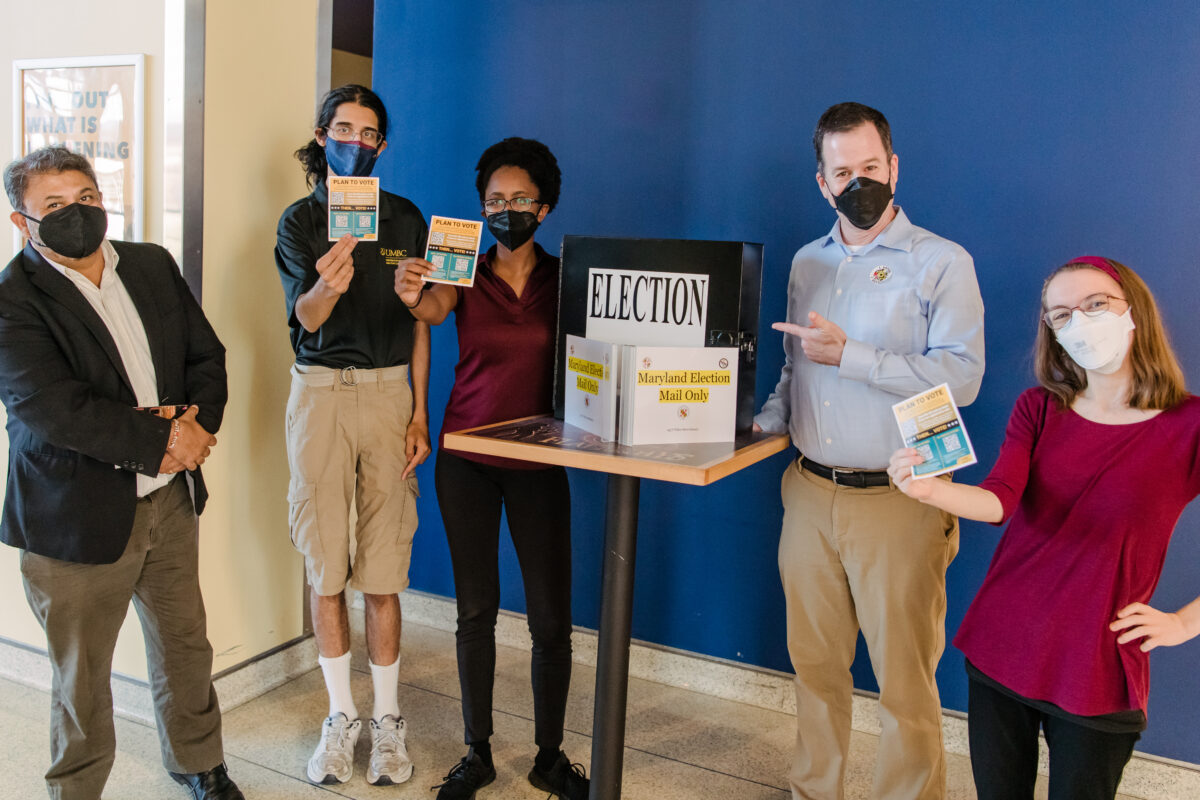 Sunil Dasgupta, Musa Jafri ’23, Markya Reed ’18, M.S. ’23, David Hoffman, Ph.D. ’13, and Tess McRae ’22 gather around the mail in ballot drop off box on campus in 2022. (Marlayna Demond ’11/UMBC)
Hoffman adds, “This is timely news, as we are in the midst of working with campus partners to provide resources and events to encourage turnout in Election 2024. The stakes are high, so register and vote if you are eligible!”
“The ALL IN Awards were created to celebrate nonpartisan democratic engagement and the outstanding campus voter registration and turnout rates achieved by our ALL IN campuses. Ahead of the 2024 elections, ALL IN campuses are ready to build on the momentum from 2022 to ensure their communities are ready to make an even bigger impact this fall,” said Jennifer Domagal-Goldman, executive director of the ALL IN Campus Democracy Challenge. “ALL IN is proud to celebrate and honor top-performing campuses like UMBC, who demonstrate that nonpartisan student voter engagement is possible and effective.”
The ALL IN Campus Democracy Challenge strives to change civic culture and institutionalize democratic engagement activities and programs on college campuses, making voter participation a defining feature of campus life. More than 1,060 institutions enrolling more than 10 million students participate in the ALL IN. The Center for Democracy and Civic Life hosted ALL IN Campus Democracy Challenge leaders at UMBC on August 29 so they could pilot a voter registration workshop directed at staff and student leaders.
]]>
The ALL IN Campus Democracy Challenge (ALL IN) recently recognized UMBC for its nonpartisan democratic engagement efforts that fostered high levels of student voter engagement in the 2022 midterm...
https://umbc.edu/stories/umbc-recognized-for-student-voter-registration/
https://my3.my.umbc.edu/api/v0/pixel/news/143784/guest@my.umbc.edu/72a0903bb0803c744585c5d6991ccf63/api/pixel
center-for-democracy-and-civic-life
election
llc
news
policy-and-society
story
UMBC News & Magazine
https://my3.my.umbc.edu/groups/umbc-news-magazine
https://assets1-my.umbc.edu/system/shared/avatars/groups/000/001/943/24435aa6207c452e7bc15cc74b42c7bb/xsmall.png?1748556657
https://assets1-my.umbc.edu/system/shared/avatars/groups/000/001/943/24435aa6207c452e7bc15cc74b42c7bb/original.png?1748556657
https://assets2-my.umbc.edu/system/shared/avatars/groups/000/001/943/24435aa6207c452e7bc15cc74b42c7bb/xxlarge.png?1748556657
https://assets2-my.umbc.edu/system/shared/avatars/groups/000/001/943/24435aa6207c452e7bc15cc74b42c7bb/xlarge.png?1748556657
https://assets3-my.umbc.edu/system/shared/avatars/groups/000/001/943/24435aa6207c452e7bc15cc74b42c7bb/large.png?1748556657
https://assets1-my.umbc.edu/system/shared/avatars/groups/000/001/943/24435aa6207c452e7bc15cc74b42c7bb/medium.png?1748556657
https://assets2-my.umbc.edu/system/shared/avatars/groups/000/001/943/24435aa6207c452e7bc15cc74b42c7bb/small.png?1748556657
https://assets1-my.umbc.edu/system/shared/avatars/groups/000/001/943/24435aa6207c452e7bc15cc74b42c7bb/xsmall.png?1748556657
https://assets2-my.umbc.edu/system/shared/avatars/groups/000/001/943/24435aa6207c452e7bc15cc74b42c7bb/xxsmall.png?1748556657
UMBC News & Magazine
1
0
false
Tue, 10 Sep 2024 15:42:32 -0400
Tue, 10 Sep 2024 15:42:32 -0400
Meet a Retriever—Buhlebakhe Ncube, a 2024 Young African Leaders Initiative Fellow
Meet Buhlebakhe Ncubefrom Zimbabwe. She spent six weeks at UMBC as part of the 2024 Mandela Washington Fellowship for Young African Leaders, the flagship program of the U.S. Government’s Young African Leaders Initiative (YALI) hosted by UMBC’s Center for Global Engagement (CGE). The new cohort included 25 innovators from countries across Sub-Saharan Africa representing education, journalism, tech, health care, and more. Buhlebakhe is now back home reminiscing about her YALI summer experience and the Retrievers she connected with along the way. Take it away, Buhlebakhe.
Q: Briefly introduce yourself. What’s one essential thing you’d want another Retriever to know about you?
A: I am the chief of staff for the Shasha Network, located in Edinburgh, the capital of Scotland, but I work remotely from Bulawayo, Zimbabwe. Shasha Network is a nonprofit organization that provides early career resources, opportunities, and support to students and educators across Africa. I have a bachelor’s degree in civil and water engineering from the National University of Science and Technology in Bulawayo.
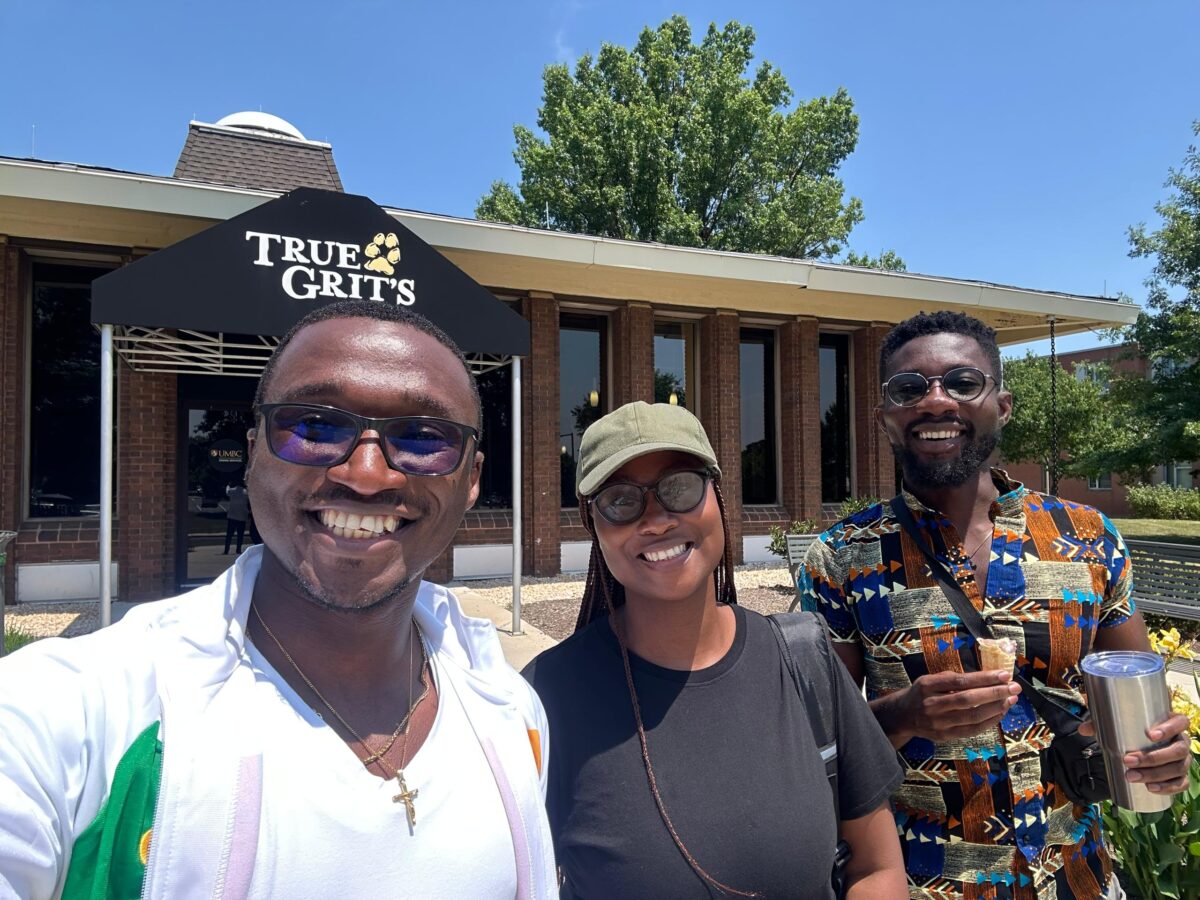 2024 YALI Fellows(l-r): Sintieh Nchinda Ngek Okongefeyin from Cameroon, Ncube, and Richard Siaw from Ghana. (Image courtesy of Ncube)
Q: Tell us about someone in the community who has inspired you or supported you, and how they did it.
A: From the first day we arrived in Baltimore, Madison Pickard, M.A. ’24, intercultural communication, assistant director of special programs, and co-academic director of the YALI Fellowship at CGE, went above and beyond for the YALI Fellows. She drove us to different meetings and events all day and stayed with us late into the night, often going back to her home around midnight. Despite everything, she still showed up the next day with a smile and energy, ready to help us tackle the busy day ahead. Through her, I have learned what it means to be truly selfless and fully involved in someone else’s journey and ensure they are set up for success.
 2024 YALI graduation day. (Image courtesy of Ncube)
Q: Since you’ve been a part of the UMBC community, how have you found support of your WHY?
A: When I was at UMBC, I was exposed to various types of leadership styles, and rather than try and alter who I am to fit into a particular style—I learned how to use my uniqueness and strengths to create my path as a young leader. The UMBC team went above and beyond to make sure that we had access to coaches and experts in various fields. The facilitators are exceptional, and the people I met through networking sessions are quite eager to work with me beyond the fellowship. Lastly, the UMBC team is full of cheerleaders who constantly push me to challenge myself. I have done so, and I am thankful to them for their support and faith in my abilities.
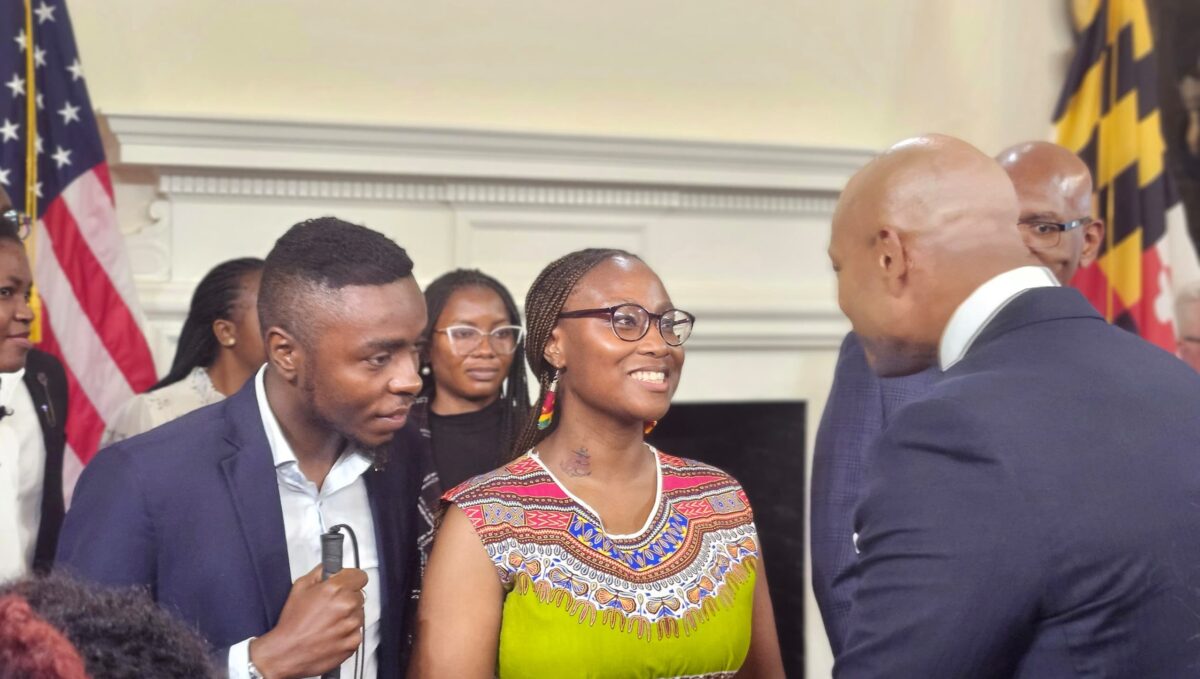 2024 YALI Fellows meeting with Maryland Governor Wes Moore. (Image courtesy of Ncube)
Q: Tell us about what you love about the organization you’re involved in.
A: I am grateful that I was placed at UMBC for the YALI fellowship. The community at UMBC is very welcoming. Baltimore and Maryland are full of humanity, culture, history, art, and love. I was able to connect with people not just through networking but on a human level. There is nothing pretentious about UMBC. People here genuinely want the best for you, and everyone wants to come together and create a better and stronger community. That sense of pride in being from UMBC is something I will always carry with me as an adopted Marylander and Retriever!
* * * * *
UMBC’s greatest strength is its people. When people meet Retrievers and hear about the passion they bring, the relationships they create, the ways they support each other, and the commitment they have to inclusive excellence, they truly get a sense of our community. That’s what “Meet a Retriever” is all about.
Learn more about how UMBC can help you achieve your goals.
]]>
Meet Buhlebakhe Ncubefrom Zimbabwe. She spent six weeks at UMBC as part of the 2024 Mandela Washington Fellowship for Young African Leaders, the flagship program of the U.S. Government’s Young...
https://umbc.edu/stories/meet-a-retriever-buhlebakhe-ncube-a-2024-yali-fellow/
https://my3.my.umbc.edu/api/v0/pixel/news/143464/guest@my.umbc.edu/e9bde98f02ec635d34269d185fe86b00/api/pixel
arts-and-culture
cge
international
llc
news
story
UMBC News & Magazine
https://my3.my.umbc.edu/groups/umbc-news-magazine
https://assets1-my.umbc.edu/system/shared/avatars/groups/000/001/943/24435aa6207c452e7bc15cc74b42c7bb/xsmall.png?1748556657
https://assets1-my.umbc.edu/system/shared/avatars/groups/000/001/943/24435aa6207c452e7bc15cc74b42c7bb/original.png?1748556657
https://assets2-my.umbc.edu/system/shared/avatars/groups/000/001/943/24435aa6207c452e7bc15cc74b42c7bb/xxlarge.png?1748556657
https://assets2-my.umbc.edu/system/shared/avatars/groups/000/001/943/24435aa6207c452e7bc15cc74b42c7bb/xlarge.png?1748556657
https://assets3-my.umbc.edu/system/shared/avatars/groups/000/001/943/24435aa6207c452e7bc15cc74b42c7bb/large.png?1748556657
https://assets1-my.umbc.edu/system/shared/avatars/groups/000/001/943/24435aa6207c452e7bc15cc74b42c7bb/medium.png?1748556657
https://assets2-my.umbc.edu/system/shared/avatars/groups/000/001/943/24435aa6207c452e7bc15cc74b42c7bb/small.png?1748556657
https://assets1-my.umbc.edu/system/shared/avatars/groups/000/001/943/24435aa6207c452e7bc15cc74b42c7bb/xsmall.png?1748556657
https://assets2-my.umbc.edu/system/shared/avatars/groups/000/001/943/24435aa6207c452e7bc15cc74b42c7bb/xxsmall.png?1748556657
UMBC News & Magazine
8
0
false
Thu, 29 Aug 2024 12:58:27 -0400
Thu, 29 Aug 2024 12:58:27 -0400
UMBC Center for Global Engagement welcomes its second cohort of the Young African Leaders Initiative
This summer, UMBC’s Center for Global Engagement (CGE) is excited to welcome its second cohort of the prestigious Mandela Washington Fellowship for Young African Leaders, the six-week flagship program of the U.S. Government’s Young African Leaders Initiative (YALI). The new cohort includes 25 innovators from countries across Sub-Saharan Africa representing education, journalism, tech, health care, and more. The fellows will spend six weeks living at UMBC networking and attending diversity and leadership skills workshops. They will also meet with campus, local, and state leaders, learn more about Baltimore’s LGBTQ+ leaders of color, developmental disabilities at The ARC Baltimore, trauma-informed practices, and more.
“The fellowship is a beacon of hope,” says Jok Thon, M.P.S. ’24, entrepreneurship, innovation, and leadership, a 2018 University of Delaware YALI fellow and UMBC’s first Global Peaceworker Fellow. Thon is a father of four and the director and founder of Promised Land Primary and Secondary School and Promised Land College in Juba, South Sudan, which has educated over 1500 displaced students. “As a witness and participant in this transformative experience, I wholeheartedly attest the journey is as profound for the mentors as it is for the fellows.”
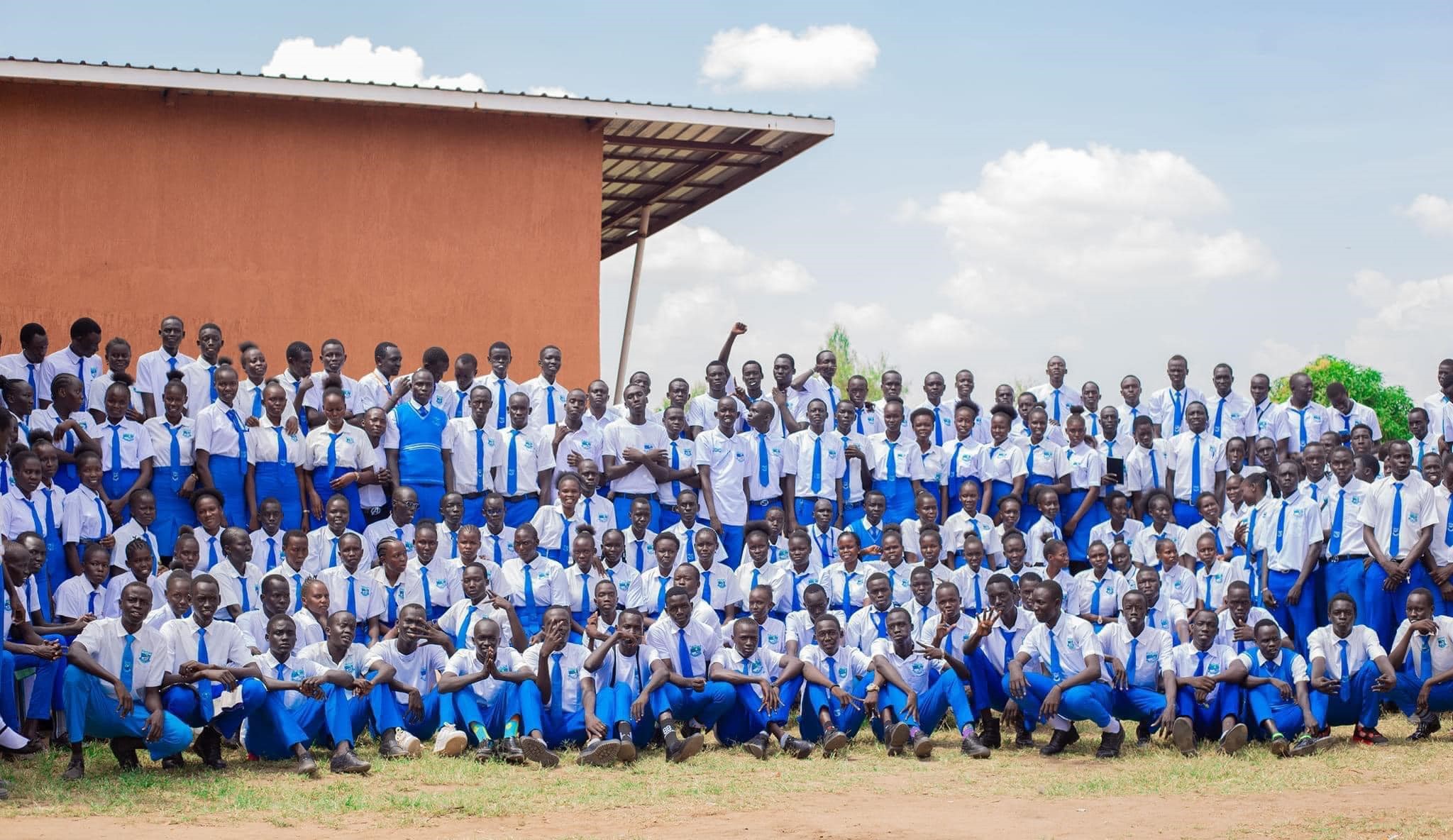 Promised Land Primary and Secondary School in Juba, South Sudan. (Image courtesy of Thon)
Thousands of leaders ages 25 – 35, across 49 Sub-Saharan African countries covet a prestigious YALI fellowship. YALI hopefuls must condense years of leadership in business, civic engagement, and public management into one application, demonstrating concrete ongoing efforts to broaden access to education, health care, and workforce development. These 700 spots across 28 U.S. educational institutions are considered a once-in-a-lifetime opportunity, for both fellows and host institutions, to strengthen connections between the U.S. and Africa and establish enduring partnerships between fellows, local communities, and private businesses through their expertise, perspectives, and experiences.
“YALI is a huge deal in my country and Africa. It’s a journey I want to take with my whole community, nation, and the world,” says 2023 UMBC YALI fellow Victoria Merab Akinyi. She is the CEO and co-founder of Streetlights Uganda, a visual and performing arts-based organization empowering children living on the streets with entrepreneurship and life skills to become self-employed and engaged citizens.
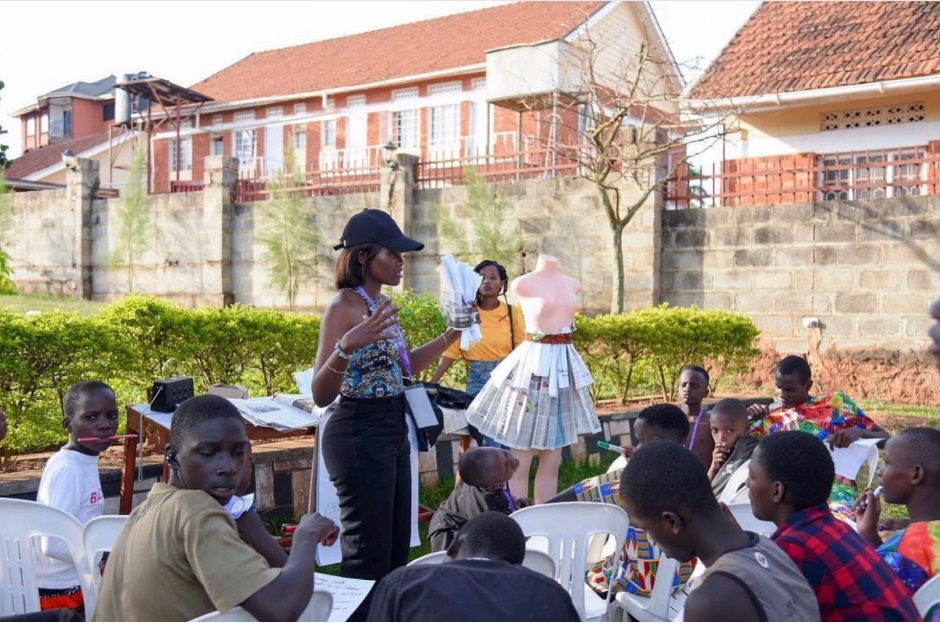 Victoria Merab Akinyi teaching a fashion design class at Streetlights Uganda. (Image courtesy of Merab Akinyi)
“I have a master’s degree in fine arts and two fashion companies. I don’t take my degrees, work with my community, and my YALI experiences for granted because they have all helped open doors for me.”
Creating a Retriever YALI Village
Becoming a YALI host is also an arduous but worthwhile process. It requires developing a six-week international residency program unique to the institution’s resources and the fellows’ needs. When Ryan Sheldon, M.A. ’15, teaching English to speakers of other languages, director of the English Language Institute and special programs within CGE, and Madison Pickard, M.A. ’24, intercultural communication, and assistant director of special programs and co-academic director of the YALI Fellowship, applied to bring YALI to UMBC in 2023, Thon was excited to join the team as a program assistant.
“It was so valuable to our fellowship having Jok as a program assistant and a resource for the fellows while they were here,” says Pickard. “Jok assisted the fellows in leadership activities, accompanied us on on-site visits, and facilitated their weekly feedback and reflection sessions as our leadership coordinator.”
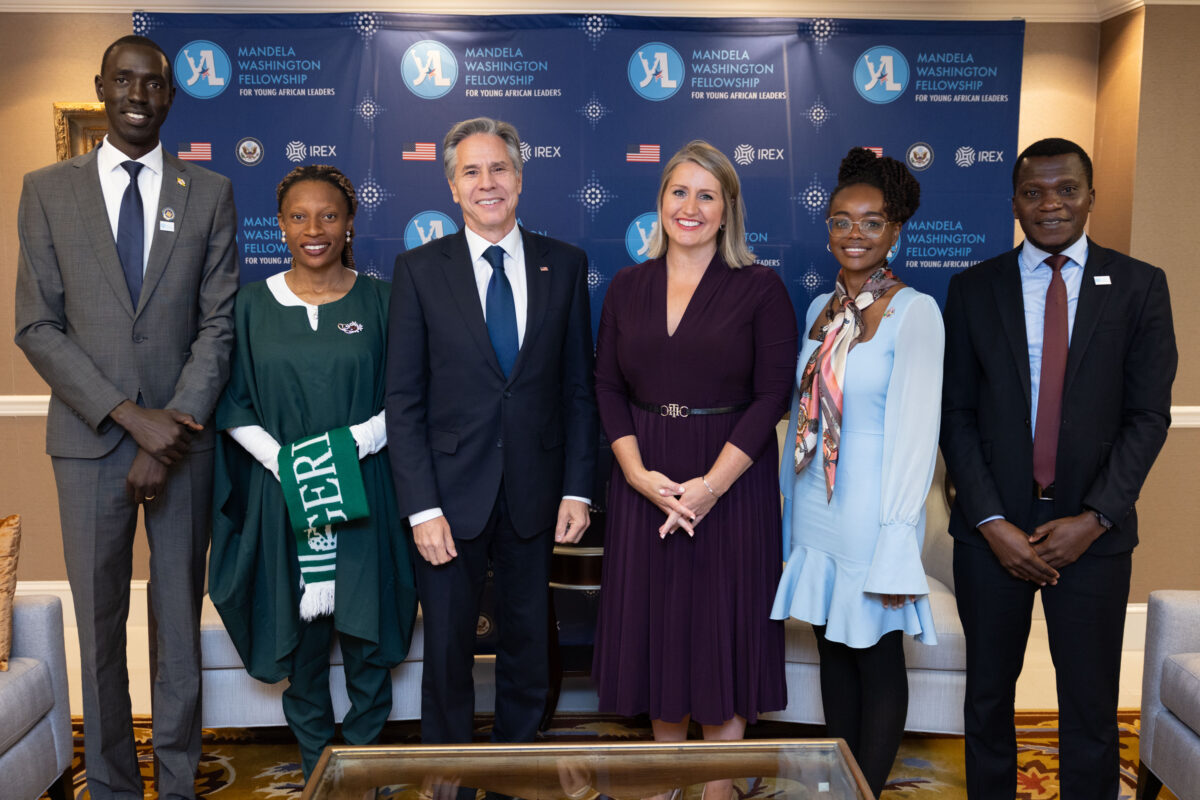 (l-r): Jok Thon, YALI fellow Blessing Ashi from Nigeria, U.S. Secretary of State Antony Blinken, Undersecretary of State Elizabeth Allen, and YALI fellows Shange-Ndamona Mungoba from Namibia and Khwima Mkamanga from Malawi. (Image courtesy of Thon)
Designing a “Retriever YALI Village” requires many hands. The village was equipped with campus housing, transportation, catering, activities, and a budget for each fellow. Thanks to campus and community partners, it also included workshops, projects, events, and speakers.
“We invited trusted partners aligned with our fellows, had conversations with them, and created a space for the fellows to choose their level of engagement,” says Pickard. The proposal was a winner.
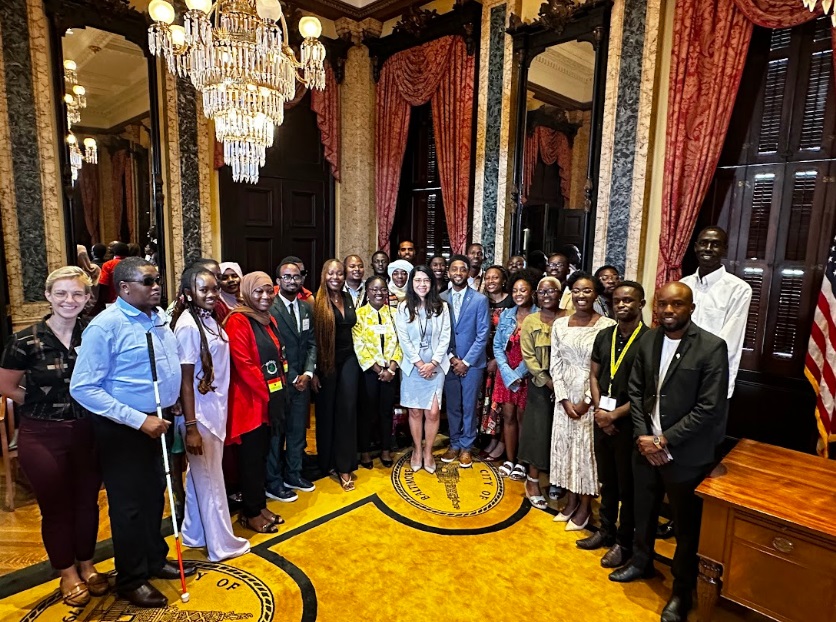 YALI fellows at Baltimore City Hall with Baltimore City Mayor Brandon Scott.
(Image courtesy of Mirab Akinyi)
In summer 2023, 24 young African leaders came to UMBC to share and learn new skills to empower them as critical leaders in addressing issues facing women, girls, and children, mental and public health, education, community organizing, NGO management, sustainability, and more. Fellows engaged in academic sessions, community service, site visits, and networking events and met state and local government leaders, businesses, and community organizations. They also joined in Baltimore’s baseball season at the Oriole Park at Camden Yards.
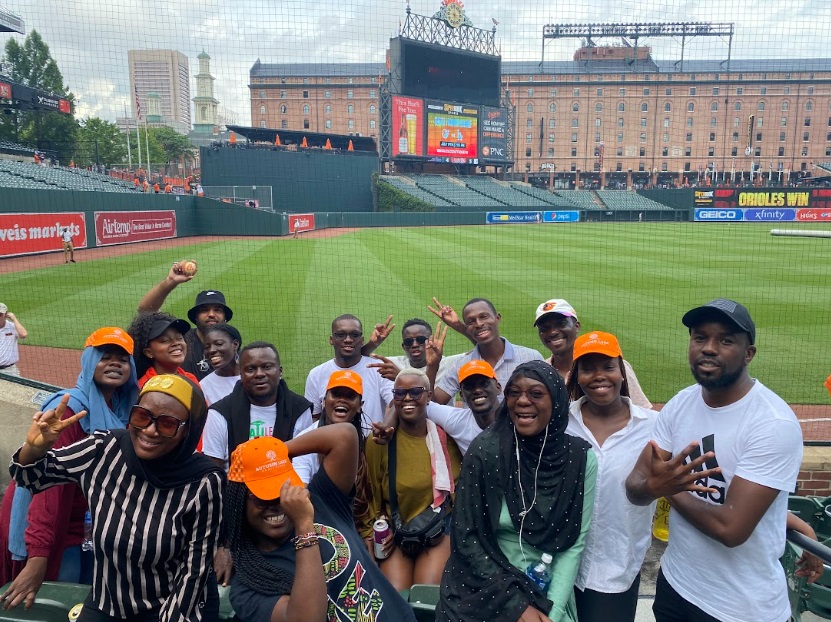 YALI fellows at the Oriole Park at Camden Yards in Baltimore City. (Image courtesy of CGE)
“Together, we explored the notion that true leadership is rooted in service and that we can drive meaningful progress by embracing diversity and harnessing collective strengths,” says Thon. Due to the program’s success, UMBC was chosen to host again in June 2024.
All for all
Fellows are often inspired into action by personal experiences. Their superpower is knowing they alone are not the answer. Fellows share their community-building strategies and acquire new expertise to address ongoing challenges. It’s not all-for-one, or one-for-all, but all-for-all.
Leveraging social media for social justice is a key approach for Ellen Kalaputse Nanyeni, a financial modeling and valuation analyst from Namibia. As a survivor of sexual and gender-based violence (SGBV), she understands the victim blaming and legal hurdles survivors face to access care and protection. Nanyeni promotes equal opportunity rights and the safety of women in Namibia via the #Shutitalldown Namibia SGBV awareness social media movement and through the #Breakfree #Befree support services initiative established by Monica Geingos, the First Lady of Namibia.
In Nigeria, Sunday Emmanuel Onuche networks with schools and disability organizations to further disability justice. Onuche promotes inclusion, leadership opportunities, and self-reliance for people with disabilities like himself via his VisionLink Initiative.
Skateboarding is John Kabiye Kalenga’s community development tool. As a professional skateboarder and the coach for Zambia’s first Olympic skateboard team at the 2022 Tokyo Olympics, Kalenga lives and breathes the sense of belonging skateboarding has given him. As vice president of the Skate Association of Zambia, he teamed up with more than 30 international skatepark construction volunteers to build Zambia’s first-ever skatepark creating a safe haven for young people.
CNN World: Zambian instructor empowers kids through skateboarding
These are just a few of the 2023 YALI fellows who connected over the summer of 2023 and returned to their countries with new leadership skills and tools for change.
Implementing the YALI Way
YALI is one summer, but it’s what comes afterward when the fellows return home that the work truly becomes YALI work. Merab Akinyi returned to Uganda intent on expanding Streetlights Uganda’s reach. She fundraised to remodel old houses in areas of high need. The additional classrooms and offices launched the Ntunga project, Changing Lives Through Fashion. It equips women and children with marketable skills to sustain their families. Her team continues to run the Mwalimu Mentorship, an apprenticeship connecting artists with youth, and the Unseen Me children’s exhibition.
Currently, Streetlights Uganda manages two training centers for women and two for street children. Merab Akinyi and her team of seven organizers have reached over 60 women in the past 3 years and over 400 street children.
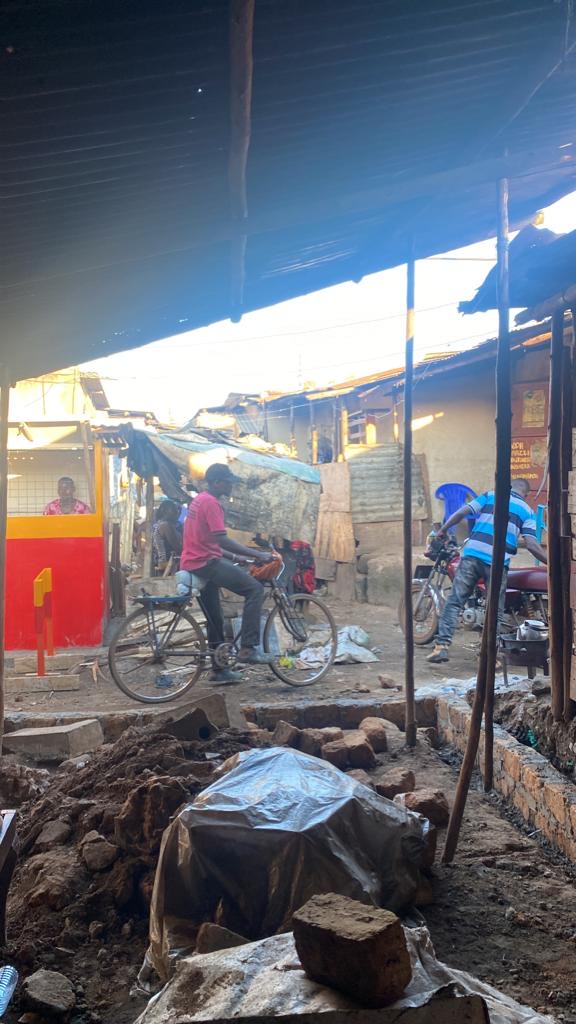
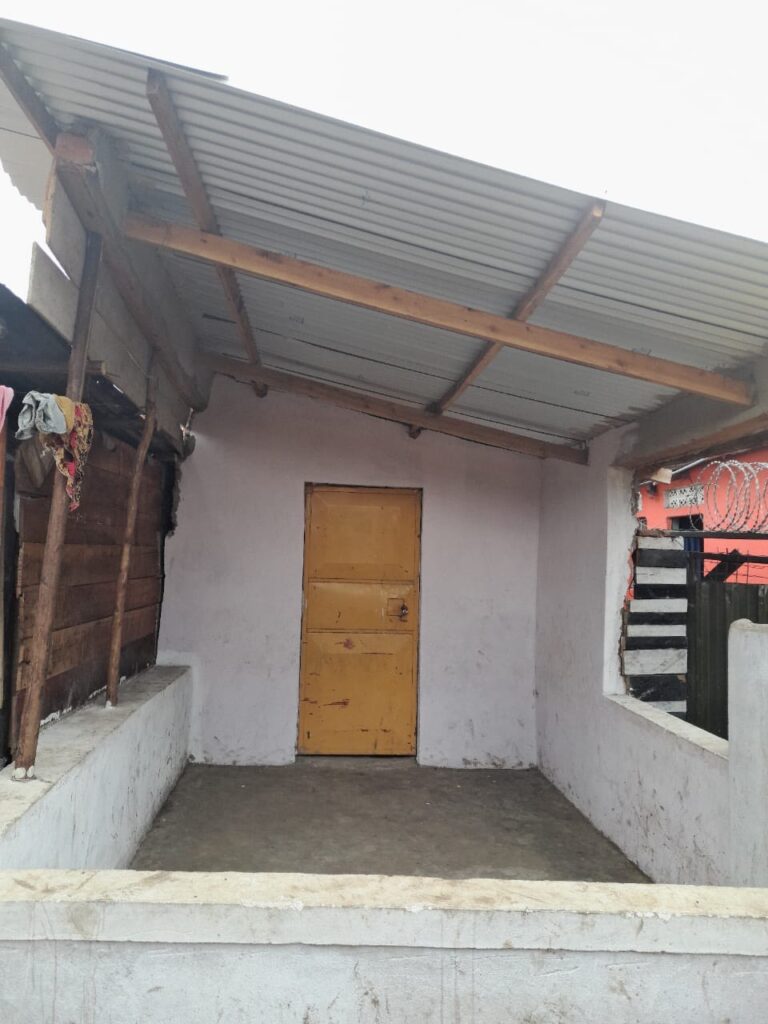
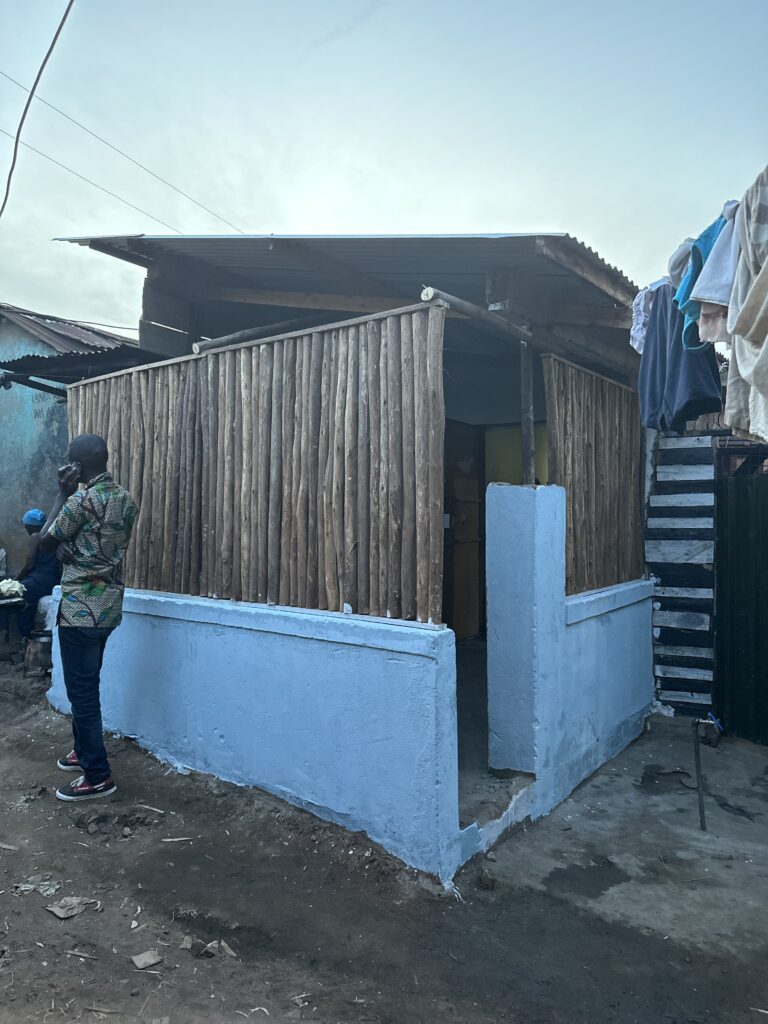 Streetlights Uganda’s phases of remodeling an additional center. (Images courtesy of Merab Akinyi)
Merab Akinyi’s next project is inspired by a YALI fellow who reuses empty bottles for building construction. “Many bottles are lying around. We are looking to develop an awareness campaign on how to use bottles to save the environment,” says Merab Akinyi. “These bottles can be repurposed to fix drainage problems around the centers and add more space.”
Pickard notes this is the goal of the fellowship. “We create opportunities for fellows to learn from each other and for everyone to challenge and develop their personal growth and values.”
Overlapping hearts and minds
The deep sense of camaraderie drew the attention of UMBC community members outside of YALI resulting in powerful friendships and mentorships that continue to this day. Pickard connected Merab Akinyi with artist Ariel Valéria Barbosa, M.P.S. ’24, community leadership, after noticing Merab Akinyi’s passion for using art as a vehicle for change. Barbosa is the program coordinator for UMBC’s food pantry Retriever Essentials and leads A Gente, an organization that gives opportunities to Black artists to travel to the African Diaspora to co-create free exhibitions for the local community.
“There are similarities in our surrealist art styles and wanting to use the little we have and our charisma and intelligence to expand impact for our people,” says Barbosa. “Victoria is really good at what she does, and I want her talents to be nurtured and supported.” Barbosa linked Pickard with DewMore, a nonprofit that uses poetry as a platform for youth leadership.
“It was full circle for me to listen to Victoria read a poem she wrote during the DewMore poetry workshop about her experience in Baltimore,” says Barbosa. “She carries herself with a lot of composure and dignity, like a voice for the people. That is just who she is.”
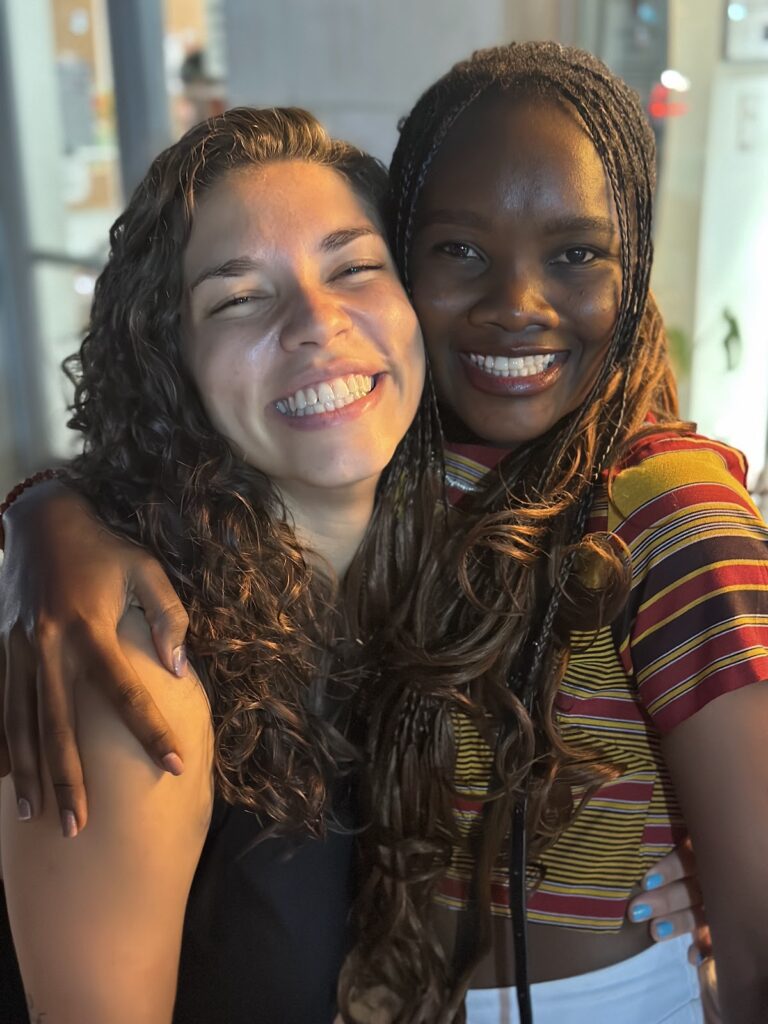
Ariel Barbosa and Victoria Merab Akinyi. (Image courtesy of Merab Akiniyi.)
A smile goes a long way
Lovetta Y. Qualah is the founder and CEO of Positive Actions Driving Safety (PADS), which addresses period poverty by providing free sanitary products to women and girls in Monrovia, Liberia. She found a kindred heart in Namrata Oruganti ’24, biology. As a summer conference assistant, Oruganti helped code keys, fold towels, organize sheets, and prepare comforters for the fellows. “I was blessed to be at that desk,” says Oruganti. The first night, the YALI group organized a party for a fellow who had arrived on his birthday.
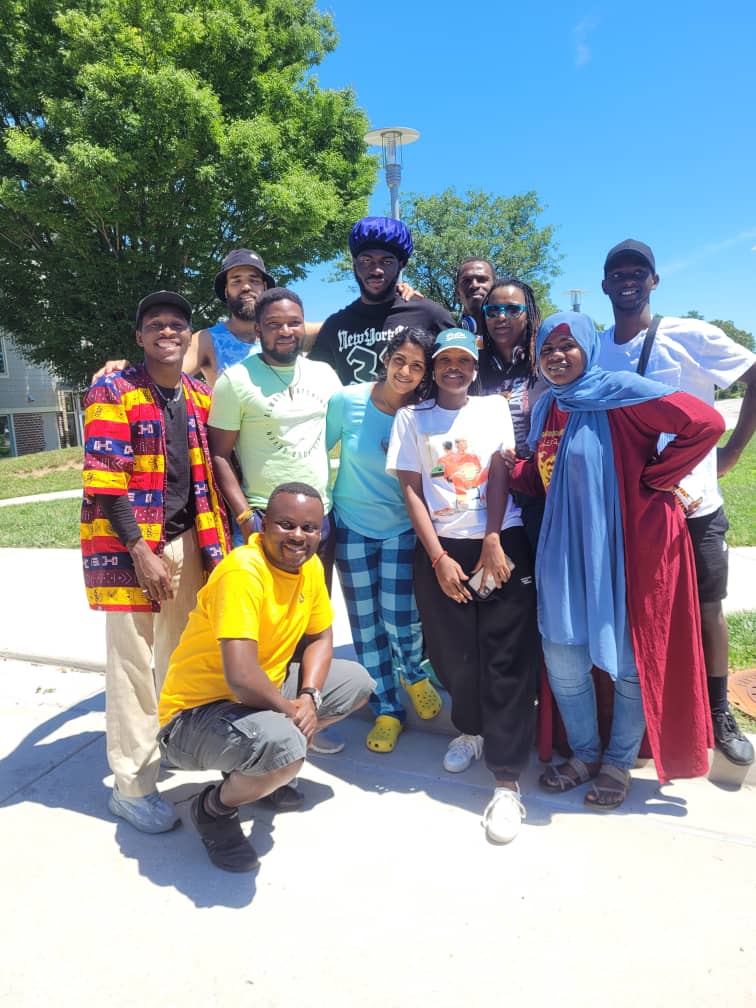
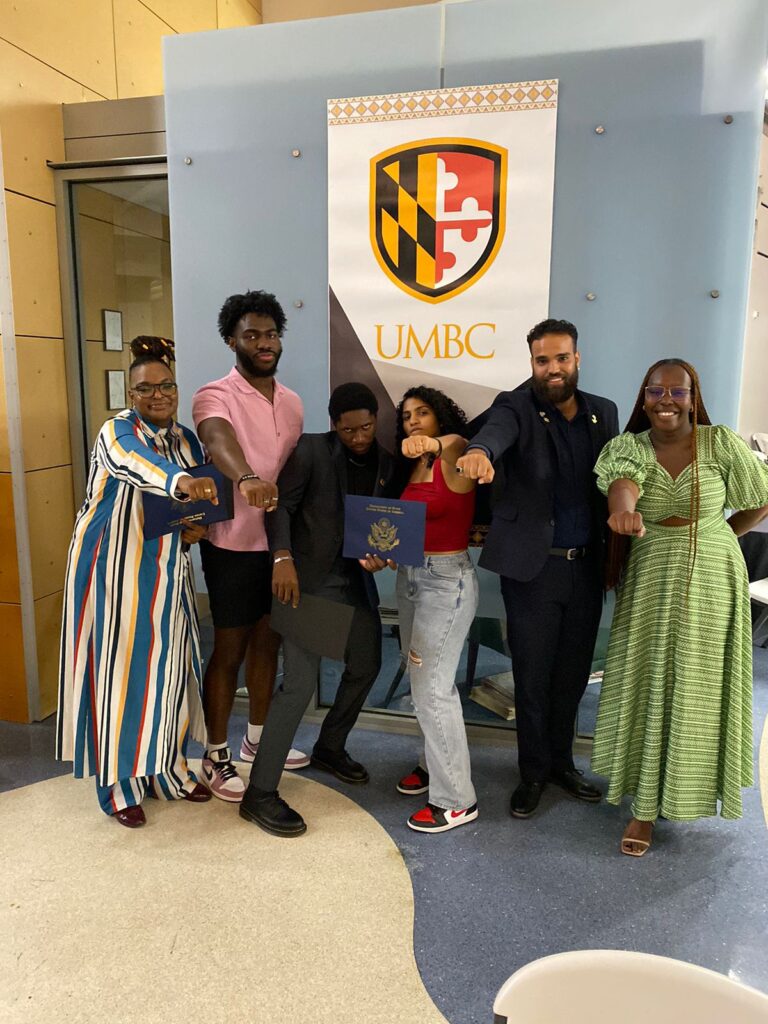 (l-r): Oruganti (center with plaid pants) with fellows on their last days and (center with red shirt) at the farewell ceremony. (Image courtesy of Oruganti)
“I couldn’t believe the fellows weren’t familiar with each other. Each person contributed something they already had,” says Oruganti. They invited her to share a meal and, once they learned of her love for Afro-beats, to dance.
Oruganti had no idea they were CEOs or experts. “Not one person made me feel like I was less than them. People in leadership sometimes forget that,” says Oruganti, known to her friends—which now include the fellows—as Smiley. “Sometimes I forget.”
“Smiley took an interest in me as a person, my work, and my progress,” says Qualah. “Smiley was a really good ambassador for UMBC. She is an image of positive energy. Always checking in on everybody.”
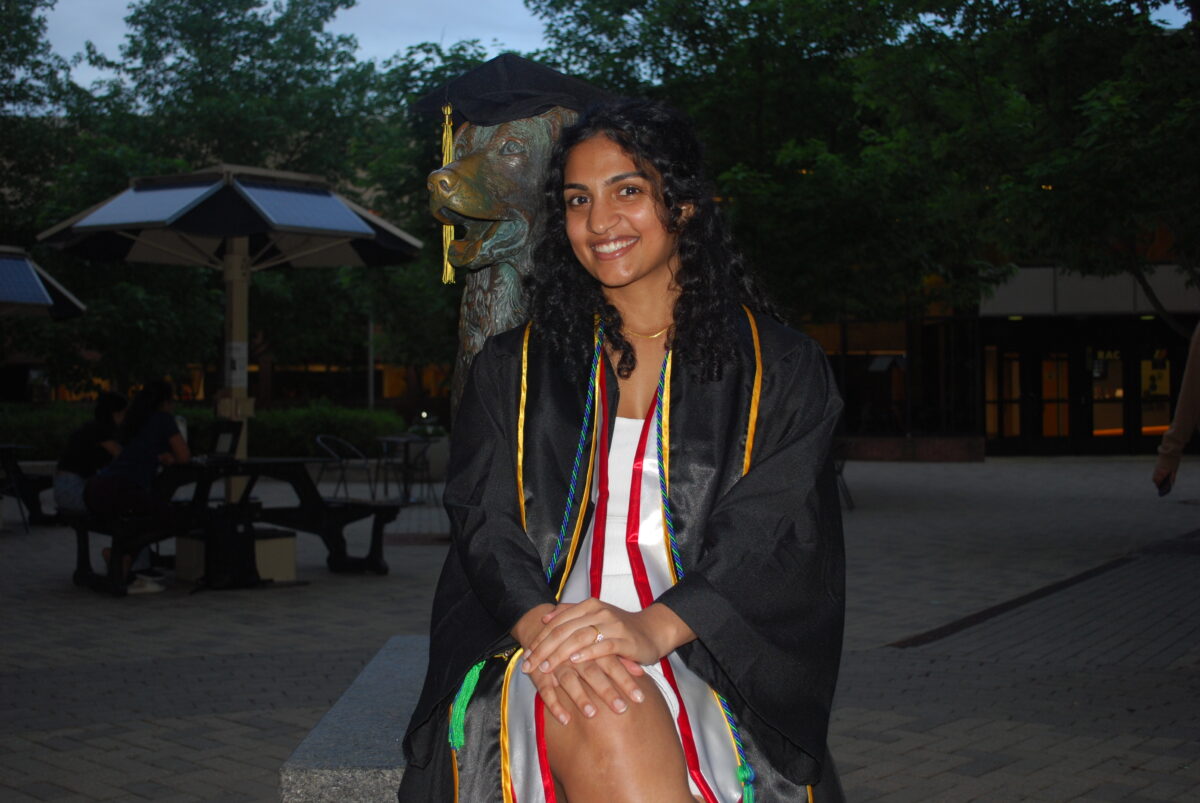
As Oruganti applies to medical school, she keeps her YALI lessons in mind. “The fellows are the most amazing, sweet, and humble people. They taught me how to be a collective,” says Oruganti. “They will always be part of my life story.” The fellows congratulated her on her recent graduation on their WhatsApp chat. “Smiley wasn’t even a part of YALI but she became an integral part,” says Qualah.
(Image courtesy of Oruganti)
Conversation + connection = action
Deep understanding is the goal. Mentorship is the path. To listen, think, share, and reflect is the YALI way. With the help of mentors like Joby Taylor, Ph.D. ’05, language, literacy, and culture, and director of the Shriver Center, fellows build mentorship tools to better communicate with their communities and instill mentorship programs. Taylor led a workshop on place, sense of place, and placemaking as social change in Africa and Baltimore City.
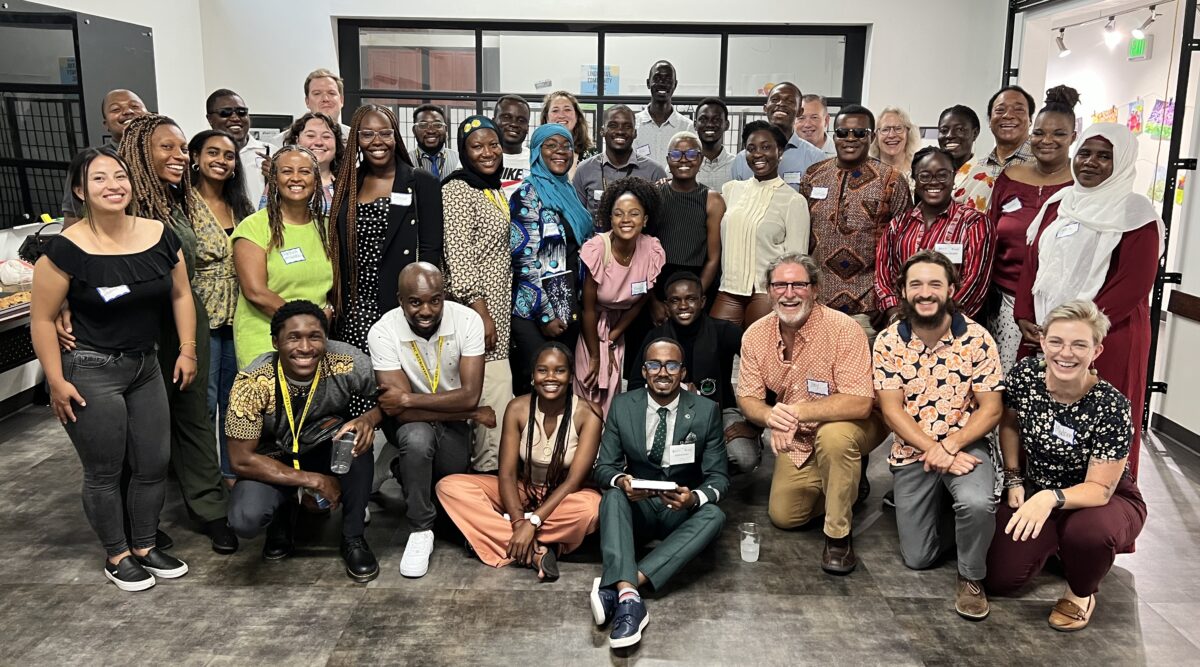 YALI fellows at OCA Mocha with UMBC Shriver Center and CGE staff, Peaceworker fellows, and the Baltimore Entrepreneurship and Leadership Network. (Image courtesy of Sally Scott, director of graduate programs in community leadership at The Shriver Center.)
“Jok and I have had a two-year conversation where we have learned so much about leadership from each other and South Sudan and Baltimore,” says Taylor, who is also Thon’s host family. “Living and working with him makes you want to be a better person.”
Thon put theory to practice by helping fellows complete paperwork and hone their professionalism skills. “This was my favorite part because I saw myself in their work and they saw themselves in my work at UMBC and back home in South Sudan,” says Thon. Heplayed basketball with them every Sunday. “They called me their mentor and big brother.”
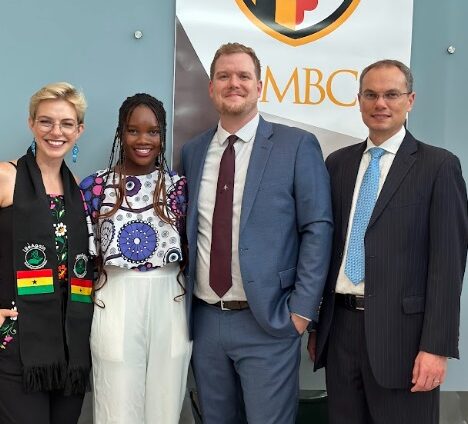
Merab Akinyi appreciated the intention, “Beyond the classes, the dedication, and humility of the facilitators—especially Ryan Sheldon, Madison, and Jok—were great lessons to me as a leader and great virtues for me to take back home.”
(l-r): Pickard, Merab Akinyi, Sheldon, David Di Maria, senior international officer and associate vice provost for international education. (Image courtesy of Mirab Akinyi)
A year later, Qualah continues to reflect on the fears she had while at YALI and how UMBC community members helped her overcome this. “While at YALI I had imposter syndrome. I was looking for validation every day,” says Qualah. “Everything changed when I met amazing people at UMBC: President Valerie Sheares Ashby, Sally Scott, Madison Pickard, Ryan Sheldon, Jok Thon, and, my dear friend and YALI fellow, Lillian Ndilwa. They challenged my perspective, highlighting the unique value I bring and the importance of my contributions. Words like ‘You deserve to be here,’ and ‘Your work is needed’ resonated deeply.” Today, Qualah puts these beliefs to work and is a visible and outspoken leader sharing PADS’ success and her UMBC YALI experience on Facebook.
Africans for Africa
This year, YALI celebrates its 10th anniversary. Nearly 6,500 leaders have taken YALI’s multi-tiered mentorship approach across all sub-Saharan countries. Thon notes convening 20-plus African leaders in one room is a feat on its own. “It’s hard bringing people together in Africa,” he says. “I can have connections in Congo or Kenya because those are my neighboring countries, but you cannot really know what the young people are doing in South Africa from South Sudan or a West African country.”
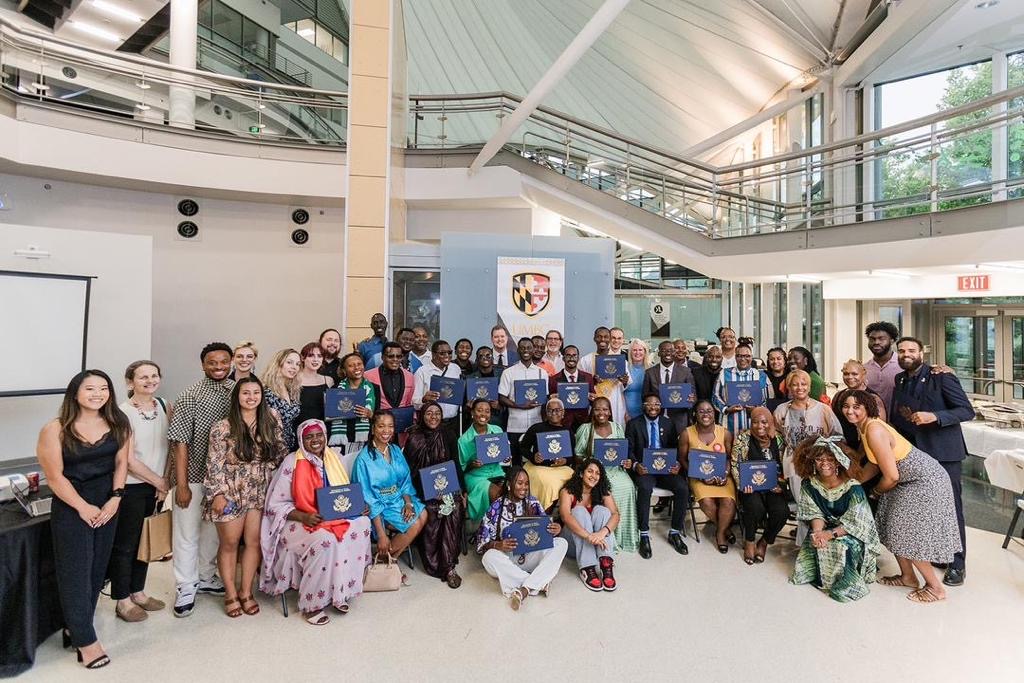 YALI 2023 fellows at their farewell ceremony with the CGE team, Peaceworker Fellows leadership, and Oruganti (center front row wearing red sneakers).
(Image courtesy of Oruganti)
This summer Thon will extend the YALI ripple effect, working as a partnership associate at CorpsAfrica, a non-profit organization focused on engaging youth and helping rural communities overcome extreme poverty.
 Jok Thon celebrating his 2024 graduation from UMBC.
(Image courtesy of Thon)
“Every little act of peace and kindness gets us closer to building a just and prosperous society where there is no weak or strong, poor or rich,” says Thon, “but a society that thrives on the basic principles of living a dignified life guided by empathy.”
]]>
This summer, UMBC’s Center for Global Engagement (CGE) is excited to welcome its second cohort of the prestigious Mandela Washington Fellowship for Young African Leaders, the six-week flagship...
https://umbc.edu/stories/umbc-center-for-global-engagement-welcomes-young-african-leaders/
https://my3.my.umbc.edu/api/v0/pixel/news/142500/guest@my.umbc.edu/ee1d8353c9a2f54a62f3581da961d3c9/api/pixel
biology
cge
community
international
llc
mlli
news
peaceworker
retriever-essentials
shrivercenter
story
tesol
UMBC News & Magazine
https://my3.my.umbc.edu/groups/umbc-news-magazine
https://assets1-my.umbc.edu/system/shared/avatars/groups/000/001/943/24435aa6207c452e7bc15cc74b42c7bb/xsmall.png?1748556657
https://assets1-my.umbc.edu/system/shared/avatars/groups/000/001/943/24435aa6207c452e7bc15cc74b42c7bb/original.png?1748556657
https://assets2-my.umbc.edu/system/shared/avatars/groups/000/001/943/24435aa6207c452e7bc15cc74b42c7bb/xxlarge.png?1748556657
https://assets2-my.umbc.edu/system/shared/avatars/groups/000/001/943/24435aa6207c452e7bc15cc74b42c7bb/xlarge.png?1748556657
https://assets3-my.umbc.edu/system/shared/avatars/groups/000/001/943/24435aa6207c452e7bc15cc74b42c7bb/large.png?1748556657
https://assets1-my.umbc.edu/system/shared/avatars/groups/000/001/943/24435aa6207c452e7bc15cc74b42c7bb/medium.png?1748556657
https://assets2-my.umbc.edu/system/shared/avatars/groups/000/001/943/24435aa6207c452e7bc15cc74b42c7bb/small.png?1748556657
https://assets1-my.umbc.edu/system/shared/avatars/groups/000/001/943/24435aa6207c452e7bc15cc74b42c7bb/xsmall.png?1748556657
https://assets2-my.umbc.edu/system/shared/avatars/groups/000/001/943/24435aa6207c452e7bc15cc74b42c7bb/xxsmall.png?1748556657
UMBC News & Magazine
3
0
false
Tue, 18 Jun 2024 13:55:38 -0400
Tue, 18 Jun 2024 13:55:38 -0400
A Journey of Growth
International travel offers ample opportunities to stretch yourself—one minute you may be the expert and the next, completely clueless about how something works. Retrievers currently in the Fulbright U.S. Student Program—teaching English or researching around the globe—find themselves oscillating between their teaching and student roles on a daily or hourly basis. By engaging their host communities through openness and cultural humility (and many shared cups of tea or coffee), these Fulbrighters are finding their balance along the way.
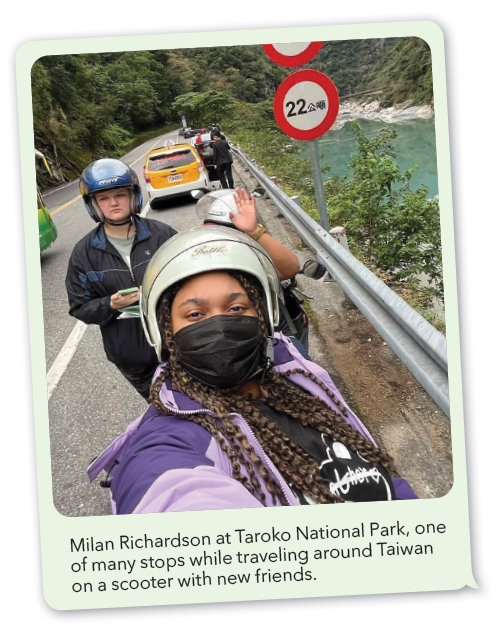
All eyes are on Milan Richardson ’23 as she helps her co-teacher keep score in a Jeopardy-like game her students are playing. Richardson teaches English to several classes of first through sixth-grade students at Jinsha Elementary School in Kinmen County, Taiwan. As she completes the Mandarin character for the numeral 5, a wave of giggles and chatter flows through the room.
Similar to a U.S. tally—four strokes and a strike though, the Mandarin character has 5 strokes total and needs to be written a certain way to represent 1, 2, 3, 4, or 5. “The students were so confused because I wrote the character strokes in the wrong order,” says Richardson, who is used to solving complex math as a Meyerhoff Scholar having earned a bachelor’s degree in bioinformatics and computational biology and minors in computer science and modern, languages, linguistics, and intercultural communication.
“I wanted to write the character correctly. I asked, and they showed me the proper order to write the strokes,” says Richardson, a Fulbright English Teaching Assistant (ETA). “They started clapping once I got it right. This was one of the many cool moments where my students were able to teach me.”
While she may be new to teaching in Taiwan, Richardson brings with her four years as an English and math tutor and a minor in Mandarin. “Taiwan was so different from any place I’ve ever been to. I was overwhelmed at first,” says Richardson. “I like it a lot, now. In my second month, I applied for a scooter license. Now I ride around the island and have taken my scooter other places on trips.”
Diplomas earned. Visas in hand. Vaccines completed. Luggage packed. Destination confirmed. Last summer, UMBC’s eight participants in the 2023 – 2024 Fulbright U.S. Student Program checked off all the important items on their to-do lists. The only thing left was to get to their placements on islands and in landlocked countries, cities, and countrysides across East Asia and Eastern Europe. It’s easier written than done. To adapt well to a new community, job, language, and culture, they must practice the art of humility and flexibility as their roles shift regularly from teacher to student.
Leading the Fulbright charge
All technicalities aside, the Fulbright experience is the beginning of building an international network of teachers and researchers who share the diversity and possibility of the U.S. with the world. In return, across the globe, communities welcome the next generation of leaders into their cities, neighborhoods, schools, and homes to share their country’s history, innovations, and culture. Since Fulbright’s inception in 1946, these reciprocal acts of kindness have created multiple paths forward to lifelong worldwide collaboration and understanding based on the simple act of giving someone different than yourself a chance.
“The Fulbright Program truly demonstrates public diplomacy in action,” says Brian Souders, M.A.’19, TESOL, and Ph.D. ’09, language, literacy, and culture, the associate director of global learning at UMBC’s Center for Global Engagement. In this role, Souders, who received a 2023 Fulbright International Education Administrator award to Germany, has led hundreds of Retrievers through the Fulbright application process as UMBC’s Fulbright Program advisor. “Whether in the classroom as teachers, students, or researchers, recipients learn about the world as much as they share what it means to be from the U.S. and UMBC alumni,” says Souders.
Thanks to Souders’ guidance, UMBC is one of 57 doctoral universities nationwide and three in Maryland to receive a Fulbright Top Producing Institution designation for 2023 – 2024, for the third time in the last five years. In the last decade, more than 80 UMBC alumni have received Fulbright awards. Out of the 10 Retrievers who received a 2023 – 2024 Fulbright, eight are currently placed internationally, seven are ETAs and one is on a research grant.
The hard work of play
There are U.S. Fulbright student scholars in more than 100 countries worldwide. Three Retrievers were placed in Taiwan—they keep in touch regularly, see each other at ETA trainings, and are planning to travel together during their Fulbright year. But they all arrived in Taiwan separately and faced different challenges settling in.
“I arrived in Taiwan and immediately changed my plans because the airline lost my luggage,” says Humanities Scholar Kara Gavin ’20, English. She was grateful to have a carry-on. “It was chaotic. I was taking it all in,” says Gavin. A day and a 50-minute plane ride later, she arrived in Penghu County, Taiwan, an archipelago of about 90 islands between China and the main island of Taiwan. “The little beach town is in its own little world,” says Gavin. “The smell of the sand gave me comfort.”
Gavin teaches beginner English at two local junior high schools. New to Asia and Mandarin, Gavin’s thinking cap is on 24 – 7, including learning Mandarin in between teaching classes. “Living independently for the first time is hard on its own, but doing it in a foreign country is a whole other ball game,” says Gavin. “I’m acquiring many new life skills that will last me a lifetime.”
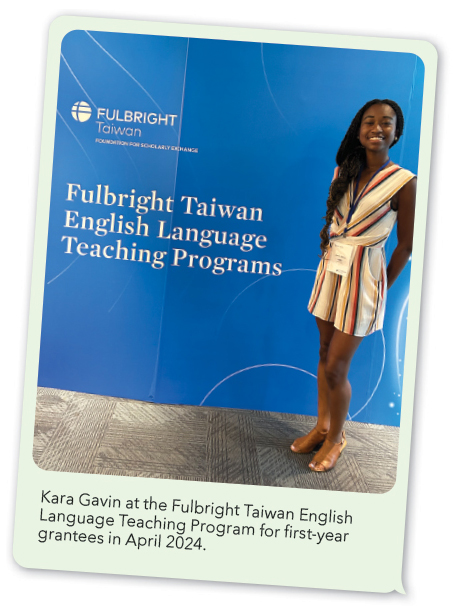
One of those is sympathizing with her students and anyone learning a new language and culture. “I teach the English pronunciation and spelling of a word,” says Gavin. “Then, they like to share the Mandarin equivalent with me. It’s all about patience, balance, and trust.” She also models intercultural teamwork by developing and teaching lessons with her bilingual (Mandarin/English) Taiwanese co-teacher to foster student engagement and enrichment.
For Fulbright Scholars, it is equally important to engage with communities beyond the classroom. When they apply for the grant, the Fulbright Program asks them to develop ideas to share their passions and skills in a community project. For Gavin, this meant adding a little drama to have a lot of fun. As a performing artist, Gavin knows the theatre can be a powerful community-building outlet. “I wanted to encourage students and other community members to express themselves and share their culture with me and others,” says Gavin.
She found a kindred spirit in a professor at a local university. They formed a drama club at the university for English language learners at all levels to explore American play formats with Taiwanese traditions and histories.“Writing original bilingual plays, in English and Mandarin, based on folktales about island traditions is creating an artistic and fun cultural exchange and understanding outside of my ETA duties,” says Gavin.
Finding the right pace
For fellow Humanities Scholar Nailah-Benā Chambers ’23, global studies, a Fulbright award to Taiwan was a natural next step. Chambers began learning Mandarin and all things Taiwanese in sixth grade at a Taiwanese Mandarin language immersion school in her hometown of Richmond, Virginia. As her Mandarin improved, she tutored other English speakers. This oscillating pattern of being a student and a teacher makes Chambers adaptable and persistent, she says.
But it hasn’t always been easy. When she first visited Taipei, Taiwan, in the spring of 2023 on a Mandarin language-intensive study abroad program, “I was so confident. I walked into a 7-Eleven to shop. No one could understand me,” says Chambers. “It was a bit embarrassing. Even with my language and cultural skills, I had a long way to go to mastering Mandarin.”
Now on her Fulbright ETA grant, Chambers arrived on solid ground, both culturally and linguistically. “I felt such a sense of calm and familiarity. Taiwan is so welcoming,” says Chambers. “It calms you down. Things are much slower here than in the U.S.” Soon enough, Chambers was balancing classrooms at Huludun Elementary and Fu Chun Elementary in Taichung City, on the main island of Taiwan, with students at both schools on the extreme spectrum of English proficiency.
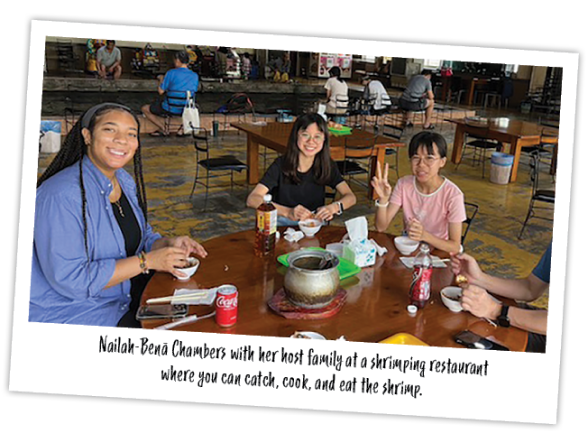
The upside of working with proficient English language learners is connecting on more advanced topics and sticking to Fulbright’s English-only immersion model. At one of her schools, the students are beginning English language learners, and the administrators only speak Mandarin. “My experience as a bilingual teacher and learner with a high level of understanding of the local language and culture has helped with classroom management and fostering powerful connections with students and administrators,” says Chambers. “It also helps to advance their grasp of the nuances of American English, especially when there are gray areas or misunderstandings.”
Keeping your ears open
Watching anime, reading manga, (Japanese graphic novels), and participating in their fandom inspired Paul Ocone ’22, individualized study, a Linehan Artist Scholar, to research these subjects and learn Japanese. “I have deeply engaged in fan social life and communities—from leading an anime club to participating in and running conventions to moderating online communities—my affinity for and interest in anime fan spaces runs deep,” says Ocone. Part of Ocone’s observations include witnessing how some fan subcultures limit their membership in fear that a broader fanbase would weaken their subculture identity. In contrast, he says, other fan subcultures are more flexible while maintaining their identity.
Interested in adding to his initial research in U.S. fan spaces, Ocone is now at the epicenter of anime and manga culture as a Fulbright Student Researcher doing anthropological research with Morikawa Kaichirō, a leading scholar in this field at Meiji University’s School of Global Japanese Studies in Tokyo, also home to the Yoshihiro Yonezawa Memorial Library of Manga and Subcultures.
“I have had some amazing experiences participating in anime pilgrimage or anime tourism, including learning much from other fans and benefitting from their generosity,” says Ocone. “My Japanese is conversational—sometimes it’s challenging to understand specialized topics, but this has not deterred me from adding anime and manga tourism as a second research project.” In January, Ocone presented his work at the Popular Culture Tourism Stakeholders Summit in Japan.
Ocone is a sort of tourist himself, enjoying various aspects of Japanese pop culture. The daily musicality of Tokyo teaches him about enjoying the rhythm of the day. “Each train station plays a unique melody when the train departs,” says Ocone. These melodies or “hassha merodii,” are catchy and echo around in his brain like the convenience store jingles that also greet customers. “I was happily surprised when I heard a loudspeaker playing a symphony in my neighborhood,” says Ocone. “Another one played the following day and the next. I learned this was a daily sunset ritual.” He knows these sound experiences will play in his head long after returning to the U.S.
Learning new languages
This is not the first time David Bullman ’22, ancient studies, visited North Macedonia. He first went in 1995 as a performing musician and public affairs representative for the U.S. Army.
“North Macedonia was very different coming out of the Cold War,” says Bullman. “The infrastructure and general state of repair of public spaces and businesses is much better than I recall from that time.”
Now, as an ETA, Bullman teaches British civilization and American civilization in addition to three different levels of English at the University of Totovo in the Republic of North Macedonia, a landlocked country north of Greece. In Totovo, students begin learning English in elementary school and are fluent by the time they reach college. “I thought I would be teaching English basics,” says Bullman, “but it’s been great to teach a complex subject in the context of where my students live.”
His students are equally glad to help him with the local language. Macedonian and Albanian are the country’s two official languages. Bullman began learning some key Macedonian phrases in preparation for his trip. However, Albanian is the preferred language in Tetovo. After traveling with the Army to more than 15 countries on three continents, Bullman is used to rapidly switching gears and accepting help.
He eagerly takes on the student role when it comes to learning about new foods. Bullman’s apartment faces the Hapësira Socio-Kulturore Tetovë, a community center where locals and the nearby Peace Corps Volunteers sometimes organize activities, like an ajvar-making gathering. Ajvar is a delicacy across the Balkans made every fall. It’s a tradition passed down through centuries with many recipe variations. “Ajvar is made by charring red bell peppers that are then peeled, minced, seasoned, and cooked for hours,” says Bullman. It boils down to a relish that can be preserved for months, but locals tell Bullman that’s rare because it’s too good to keep for even one week. After participating in the preparation and getting to take home a few jars, Bullman agrees with the locals. Ajvar is now his go-to condiment on eggs, pasta, toast—anything goes.
Albanian and cooking are not the only languages Bullman tapped into while in Tetovo. As a lifelong clarinet player, Bullman hoped to create a musical exchange with local musicians. The opportunity presented itself when the dean of the Faculty of Art wanted to celebrate Thanksgiving. Bullman collaborated with the music faculty, the orchestra director, and students to create a concert of six songs. “I’m glad I returned to North Macedonia. The people are as warm and friendly as I remembered them to be,” says Bullman. “I wanted to come back and experience it myself again.”
Tapping into curiosity
On her way to her Fulbright placement, Sianna Serio ’23, computer science, went city hopping. “I was headed to Žilina, Slovakia, east of Austria and south of Poland,” says Serio. “I flew into Vienna, Austria, then I took a one-hour bus ride crossing Austria’s eastern border into Slovakia to get to Bratislava, the capital.“ There she met other ETAs for orientation. “A week later, I hopped on a two-hour train ride to my teaching placement in Žilina and I met my wonderful mentor, Maria Veršova, who became my second mom.”
Serio teaches at the Hotel Academy, Žilina. The academy focuses on hotel management, gastronomy, and tourism. “My students are beginning English language learners,” says Serio. “I teach what the class is interested in, like American pop culture, because they rarely meet a native English speaker.” During outings with her students, they ask about a wide range of topics. “There are many topics that I would not have thought to cover if it were not for time spent outside of the classroom,” says Serio, “Some of those conversations became formal lessons, like the lesson on the three branches of the U. S. government.”
Serio appreciates her students’ curiosity. She tapped into her love of website development and design to improve her students’ confidence in writing and speaking English and prepare for their Maturita exam, a national high school exit exam. “Some of my students are helping me design a class webpage for them where I will showcase their class and post some of their practice writing in English,” says Serio. “These posts will include topics covered in the Maturita exam, information about their school, and answers to questions about Slovakia.”
Serio’s mentor Maria Veršova, head of the English department, is her motivation. She guides her through lesson planning, class schedules, and the challenges of relocating to a new country. “When my original housing plans fell through, Maria found housing for me five minutes from her house,” says Serio. “She helped me find health insurance and open a bank account. Her husband set up my internet.” They have welcomed Serio almost daily into their home for dinner, tea, coffee, or wine. Serio is a gracious guest and lent her graphic design expertise to help Veršova design invitation cards for her 50th birthday party. Veršova tells Serio she will always have a place to stay in Žilina.
Fulbright: The next generation
Teaching has defined the last decade for Tiffany Powell, a master’s student in UMBC’s TESOL program, a passion she invested in as an English language learner teacher in Seoul and in Miryang City, South Korea, for five years, and in Florida this past year. Now, she is in Iași, Romania, southwest of Ukraine, at the Alexandru Ioan Cuza University teaching American studies. Powell is committed to bridging culture, community, and belonging by bringing technology into the classroom.
Powell also decided to bring the research and cultural understanding closer to home by partnering with Romanian teachers to develop a five-part series on African American women’s history. “We talked about Black women in science in the context of the movie Hidden Figures and discussed Hollywood’s portrayal of Black life,” says Powell. The class is now creating a series on Romanian women. Helping students better understand the similarities and differences between U.S. and Romanian cultures has been an eye-opening experience for Powell.
She sees the impact of a country formerly under communism. In Iași, sometimes the internet doesn’t work and, in her school, there are no clubs or student organizations to gain the skills needed to earn a Fulbright award. “My students have given me a new perspective. You may want to come in and make changes, but you must understand where they’re coming from. There is a saying in Iași, ‘It’s not impossible. It’s just difficult,’” says Powell. She is trying to help with the difficult part by leading Fulbright application and leadership workshops.
Powell, like the other Fulbrighters, will bring her experiences home with her and wherever she ends up teaching English next. When their Fulbright year ends, these Retriever ambassadors will find themselves as emissaries yet again, returning to their hometowns, sharing the good news of ajvar made in community, the freedom of a scooter ride along a Taiwanese beach, or the correct stroke order for writing the Mandarin number five. The lessons their students and host families passed along—including pausing to take a breath and appreciate their international successes small and large—will continue to form and shape the way they see the world.
“Having a flexible mindset and under-standing the historical context of your placement is key,” says Powell. “I carry myself as a U.S. representative. Living abroad teaches humility, adaptability, and open-mindedness to press on through challenging times.”
]]>
International travel offers ample opportunities to stretch yourself—one minute you may be the expert and the next, completely clueless about how something works. Retrievers currently in the...
https://umbc.edu/stories/a-journey-of-growth-retriever-fulbright/
https://my3.my.umbc.edu/api/v0/pixel/news/142404/guest@my.umbc.edu/ed280c216f570c718be808f58bf7c55a/api/pixel
alumni
ancient-studies
bioinformatics-and-computational-biology
cahss
cge
computer-science
education-abroad
english
feature
fulbright
global-studies
humanities
inds
linehan
llc
magazine
meyerhoff
spring-2024
story
UMBC News & Magazine
https://my3.my.umbc.edu/groups/umbc-news-magazine
https://assets1-my.umbc.edu/system/shared/avatars/groups/000/001/943/24435aa6207c452e7bc15cc74b42c7bb/xsmall.png?1748556657
https://assets1-my.umbc.edu/system/shared/avatars/groups/000/001/943/24435aa6207c452e7bc15cc74b42c7bb/original.png?1748556657
https://assets2-my.umbc.edu/system/shared/avatars/groups/000/001/943/24435aa6207c452e7bc15cc74b42c7bb/xxlarge.png?1748556657
https://assets2-my.umbc.edu/system/shared/avatars/groups/000/001/943/24435aa6207c452e7bc15cc74b42c7bb/xlarge.png?1748556657
https://assets3-my.umbc.edu/system/shared/avatars/groups/000/001/943/24435aa6207c452e7bc15cc74b42c7bb/large.png?1748556657
https://assets1-my.umbc.edu/system/shared/avatars/groups/000/001/943/24435aa6207c452e7bc15cc74b42c7bb/medium.png?1748556657
https://assets2-my.umbc.edu/system/shared/avatars/groups/000/001/943/24435aa6207c452e7bc15cc74b42c7bb/small.png?1748556657
https://assets1-my.umbc.edu/system/shared/avatars/groups/000/001/943/24435aa6207c452e7bc15cc74b42c7bb/xsmall.png?1748556657
https://assets2-my.umbc.edu/system/shared/avatars/groups/000/001/943/24435aa6207c452e7bc15cc74b42c7bb/xxsmall.png?1748556657
UMBC News & Magazine
0
0
false
Wed, 29 May 2024 14:32:52 -0400