Business—not as usual
At UMBC, entrepreneurship transcends a traditional business education: It empowers scientists, artists, and technologists to transform their expertise into real-world impact. Through business accelerators, ambassador programs, interdisciplinary courses, and other innovation pathways, the university offers many avenues for ideas to flourish.
Kushani Mendis and her labmates have developed novel nanomaterials that could transform biomedical technology. She wants to translate their discoveries into a business opportunity, but initially, wasn’t sure what steps to take. So, early in her chemistry Ph.D. with Zeev Rosenzweig, professor of chemistry and biochemistry, Mendis told him that she wanted to become an entrepreneur—and he jumped at the chance to creatively support her with internal and external resources.
UMBC has no formal business school. Yet it may be one of the best places in the country to learn entrepreneurial thinking—precisely because the best ideas so often come from those with technical expertise rather than MBAs. Also, many UMBC entrepreneurs are motivated by a desire to drive positive social change rather than profit, which is supported by courses on “socialpreneurship.” Overall, the university’s model rests on a simple but powerful dual thesis: 1) Disciplinary excellence paired with an entrepreneurial mindset produces graduates who create real-world impact, and 2) entrepreneurship is for everyone.
Employers repeatedly say they need graduates who excel in communication, creative problem-solving, collaboration, and constructive conflict navigation. Traits like resilience and empathy are in high demand—after all, finding effective solutions often requires understanding problems from another’s perspective. UMBC’s courses and programs deliberately train these skills, which can enhance the success of entrepreneurs—and every UMBC graduate.
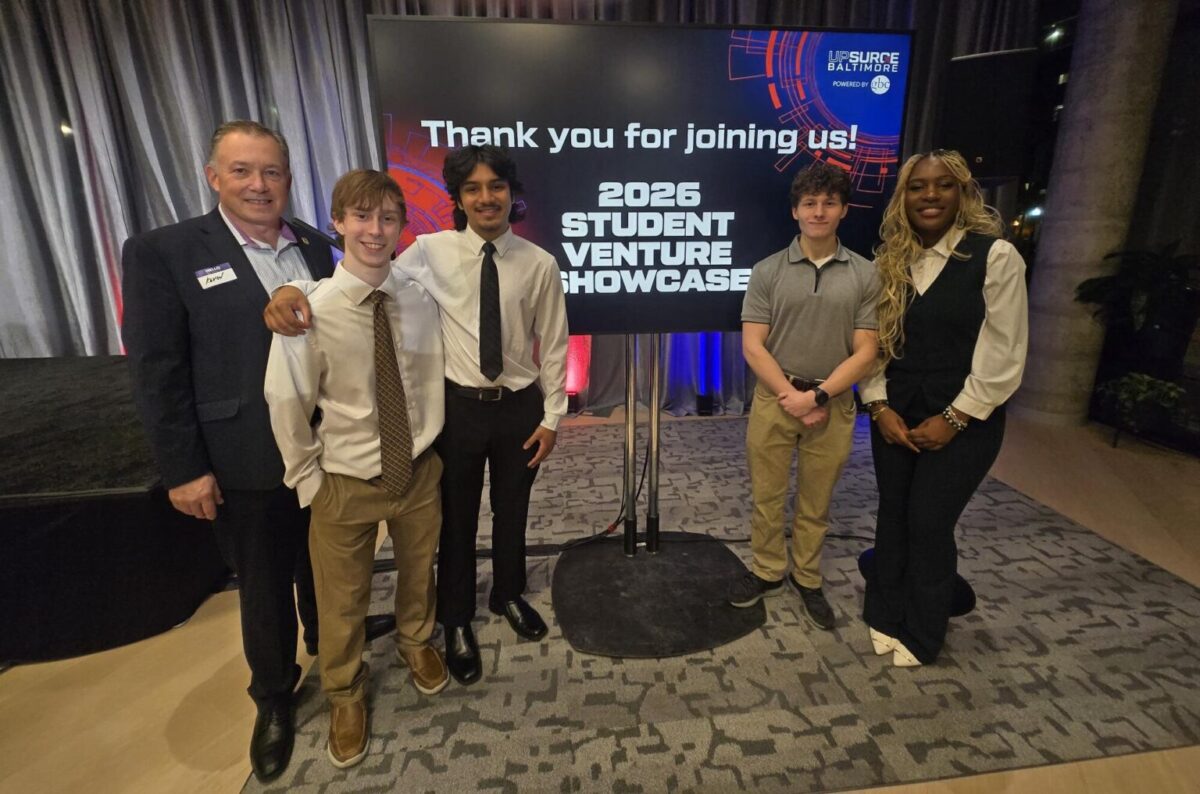 From left to right, Kevin Fulmer, director of the The Alex. Brown Center for Entrepreneurship and Innovation at UMBC, and students Charles Nerad, Abhinav Patel, Aidan Fleischer, and Velma Funebe at the 2026 Maryland Student Venture Showcase in Baltimore. (Photo courtesy of Kevin Fulmer)
The results speak for themselves. Students are winning state and national funding, launching ventures, gaining versatile life skills, and contributing to Maryland’s innovation economy. This spring, two UMBC student teams—iBraid and StrikeSense—each received $50,000 Pava LePere Innovation Awards. Others have advanced through the university’s Summer Launchpad accelerator and secured funding totaling more than $300,000 in the past three years.
An entrepreneurial environment
The roots of UMBC’s entrepreneurship emphasis trace back to 2000, with the founding of the Alex. Brown Center for Entrepreneurship and Innovation. Initially led by Vivian Armour and supported by Constellation Energy Group and the Bearman Foundation, the center took off in 2006 the Kauffman Foundation awarded funds to a small cohort of universities including UMBC, as well as Brown, Carnegie Mellon, Arizona State, and Purdue, to further their entrepreneurship efforts. Armour invited Gib Mason ’95, economics, a serial entrepreneur who had been guest lecturing at UMBC, to help steward UMBC’s $2 million Kauffman award.
“Kauffman’s research had shown that it wasn’t the business school students bringing entrepreneurial ideas to the marketplace,” Mason recalls. “It was the engineers and the tech guys and gals.” The foundation’s premise was that exposing disciplinary experts to entrepreneurial environments could help them develop and commercialize new ideas, he explains.
That initiative led to the creation of UMBC’s minor in Entrepreneurship and Innovation. The 18-credit program combines two core entrepreneurship courses with 12 credits from designated courses across UMBC’s three colleges, where faculty have infused entrepreneurial principles into existing major curricula. Today, more than 70 courses in biology, public health, information systems, art, and engineering count toward the minor, making it broadly accessible.
 Gib Mason (standing) leads entrepreneurship programming at the UMBC Training Centers. (Marlayna Demond ’11/UMBC)
The center turned 25 this academic year. Kevin Fulmer, its first full-time director and a lifelong entrepreneur, has spent the past five years expanding its reach and visibility. “Before there were any full-time staff, awareness of the center was fairly minimal,” he says. Under his leadership, Introduction to Entrepreneurship—which fills up quickly every semester—was approved as a General Education Program course. The center also launched a student ambassador program, and now six students promote events, support programming, and serve as peer mentors. Faculty can apply for funding to embed entrepreneurial thinking in their courses, and designated faculty fellows from each college are designing discipline-specific tracks within the minor. “We’re trying to make it as accessible for as many students as possible,” Fulmer explains.
A separate master’s in Entrepreneurship, Innovation, and Leadership—developed by Mason and offered through UMBC’s Division of Professional Studies—has served working professionals since 2019 and draws on the same philosophy of practical application. Meanwhile, the center’s summer Launchpad accelerator has supported more than 20 student ventures since 2022; participants receive an $8,000 stipend to dedicate 10-weeks to full-time customer discovery and problem validation. iBraid and StrikeSense, the Maryland award winners, emerged from the accelerator’s pipeline. Additional opportunities include the fall Idea and Innovation Challenge (with a popular social-impact category) and the spring Cangialosi Business Innovation Competition for more developed concepts.
All of this exists without a traditional business school. Instead, UMBC has built an ecosystem that meets students where they are—inside their technical and creative majors—and provides the tools to translate discovery into impact. “Entrepreneurship is for everyone,” the Alex. Brown Center’s website proclaims, regardless of major or career aspirations.
Not-so-risky business

Entrepreneurship at UMBC emphasizes mindset over venture creation alone. “It’s really just about solving problems and using an entrepreneurial mindset to do that,” Fulmer stresses.
Studies suggest that only 30 to 50 percent of graduates nationally are employed in roles directly related to their specific field of study, Fulmer notes. “You may have all the technical skills in the world, but not get these life skills from your major,” he adds. UMBC’s approach prepares students for diverse careers—launching startups, innovating inside a corporation, teaching, or pursuing research—by developing empathy and resilience and building creative problem-solving and communication skills.
Mason challenges the stereotype that entrepreneurs are reckless risk takers. “Most entrepreneurs are constantly making informed decisions to mitigate risks,” he says. He draws from childhood summers working on his grandfather’s Kansas farm, where he earned money from “his” acres of wheat—until one year a tornado destroyed the crop. The experience taught him that “there’s a lot that you can control and a lot that you can’t.” True entrepreneurs, he says, take calculated risks and then work diligently to reduce them.
Many UMBC students are drawn to “socialpreneurship”—ventures that solve societal problems rather than chase profit. “Students today seem especially geared toward trying to do things for social impact,” Mason says. The center’s social-impact track in competitions reflects this, and courses like Creative Problem Solving and The Socialpreneur have led to tangible outcomes, such as OCA Mocha, a coffee shop connecting UMBC with the Baltimore community.
Braiding the future
Velma Funebe, a public health major, embodies this orientation. Her venture, iBraid, uses augmented reality to help users part and braid their own hair—transforming protective styling that can become a multi-day ordeal into a more manageable process. Inspired by braiding her own hair since age 11 and running a professional braiding business since ninth grade, Funebe validated demand via TikTok and conversations. “I realized it was a major problem because so many people struggled with it,” she says. “I couldn’t find any solutions out there.”
As an Entrepreneurship Ambassador, she now supports programming and events like 1 Million Cups, another Kauffman Foundation initiative where entrepreneurs pitch ideas and get feedback. The Baltimore edition meets at OCA Mocha twice monthly. “The scariest part is when the idea is not just in your brain, but other people hear it,” Funebe says. “But I think it’s a great space to get feedback and say, ‘Okay, I can live through an application rejection.’”
Funebe’s faith helps anchor her while she balances classes, leadership in the Public Health Council of Majors, weekend braiding appointments, and venture development. iBraid has gained strong traction: a second-place finish in UMBC’s Idea and Innovation Challenge, the Pava LaPere Innovation Award, a waitlist approaching 4,000, and more than 10,000 TikTok followers. Beta testing is underway, supported in part by two UMBC data science graduate fellows through the Maryland New Venture program at bwtech@UMBC, a business incubator adjacent to campus. iBraid’s momentum continued to build at Maryland New Venture Pitch Night ’26, where Funebe took third place and received the Audience Choice Visionary Award.
“The Alex. Brown Center has played an essential role in helping me to grow my confidence,” she says. To others considering giving entrepreneurship a try, she says, “Don’t be afraid to fail—at least you get a result out of failing, and can learn a lot from it.”
Striking while it’s hot
Abhinav Patel, Charles Nerad, and Aidan Fleischer, co-founders of StrikeSense, channeled frustration with their Taekwondo training into innovation. In competition, expensive electronic wearables detect hits and record scores, but most athletes lack access to that equipment in practice. “I had the idea for a sparring vest with a health bar like something from a video game,” Nerad says.
The team developed an affordable sensor attachment that turns any existing sparring vest into a smart vest capable of detecting and scoring hits, with a gamified “health bar” interface. After placing second in the 2025 Cangialosi Business Innovation Competition, they joined the summer Launchpad program.

“All of the support we have gotten from UMBC has been instrumental, and we wouldn’t be where we are today without it.” Patel notes. Mentors like Donald Miner ’06, Ph.D. 2010, computer science; and Chris Ewing, an “entrepreneur in residence” at bwtech@UMBC, and especially Fulmer provided guidance: “Without him, we would not have had the encouragement to continue, the accountability to work hard, and the guidance to grow,” Nerad adds.
They are now refining software and preparing a pilot program with local dojos. “There is no better time to take a chance on an idea than right now,” Nerad advises. “You are surrounded by thousands of brilliant minds at UMBC, and have access to dedicated mentors who genuinely want you to succeed.”
And Kushani Mendis is now thriving at the intersection of research and entrepreneurship. She’s participated in the Center for Sustainable Nanotechnology, represented UMBC in the regional 3-Minute Thesis competition, and completed training at Brookhaven National Lab through UMBC’s Chemistry and Biology Interface program. To younger scientists, she says: “Being a scientist does not have to mean being confined in a lab. You are a human who has a lot of potential that you can give out to the community.”
As Fulmer puts it, “We’ve always been really great at UMBC at training students’ analytical, left-brain development—but our entrepreneurship programs are promoting right-brain skills as well, which are just as important.”
Extending the ecosystem
Faculty, alumni, and the broader community benefit, too. bwtech@UMBC offers state-of-the-art labs and work spaces, educational programming, mentorship, and industry connections. Many alumni and community members have built businesses there that contribute jobs and innovative products and services to the regional economy.
 bwtech@UMBC, located adjacent to main campus, supports Maryland entrepreneurs at every stage of business growth. (Marlayna Demond ’11/UMBC)
In addition, the Entrepreneurial Skills Training program for faculty in the College of Natural and Mathematical Sciences helps principal investigators apply strategic, startup-style thinking to manage their multi-million-dollar research labs. “They’re running a business, whether they like it or not,” says Mason, who originally designed the program that’s now run by Fulmer. “They’re hiring people, buying resources, creating stuff.”
Finally, the new Entrepreneurial Learning Lab (ELL) pairs faculty with trained students to evaluate research for commercialization potential—without requiring faculty to become full-time CEOs. The inaugural cohort drew strong interest: 23 faculty applied for 10 spots alongside 54 student applications. “We’re not trying to change what faculty do in terms of research and teaching,” Fulmer explains, “but while they’re doing that, think about potential impact.”
This diverse array of entry points—from minors and master’s programs to accelerators, competitions, and faculty-student collaborations—deliberately creates an inclusive entrepreneurial ecosystem. Ideas from any discipline or career stage have room to grow.
The bigger picture
UMBC’s entrepreneurial ecosystem does more than launch student ventures; it strengthens Maryland’s innovation economy, particularly in biotech, health tech, and advanced materials. The university’s strengths in these areas—coupled with proximity to federal labs and funding—creates what Fulmer calls a “target-rich environment.” Many Launchpad teams naturally transition into bwtech@UMBC’s incubation programs, forming a clear pathway from classroom concept to scalable company.
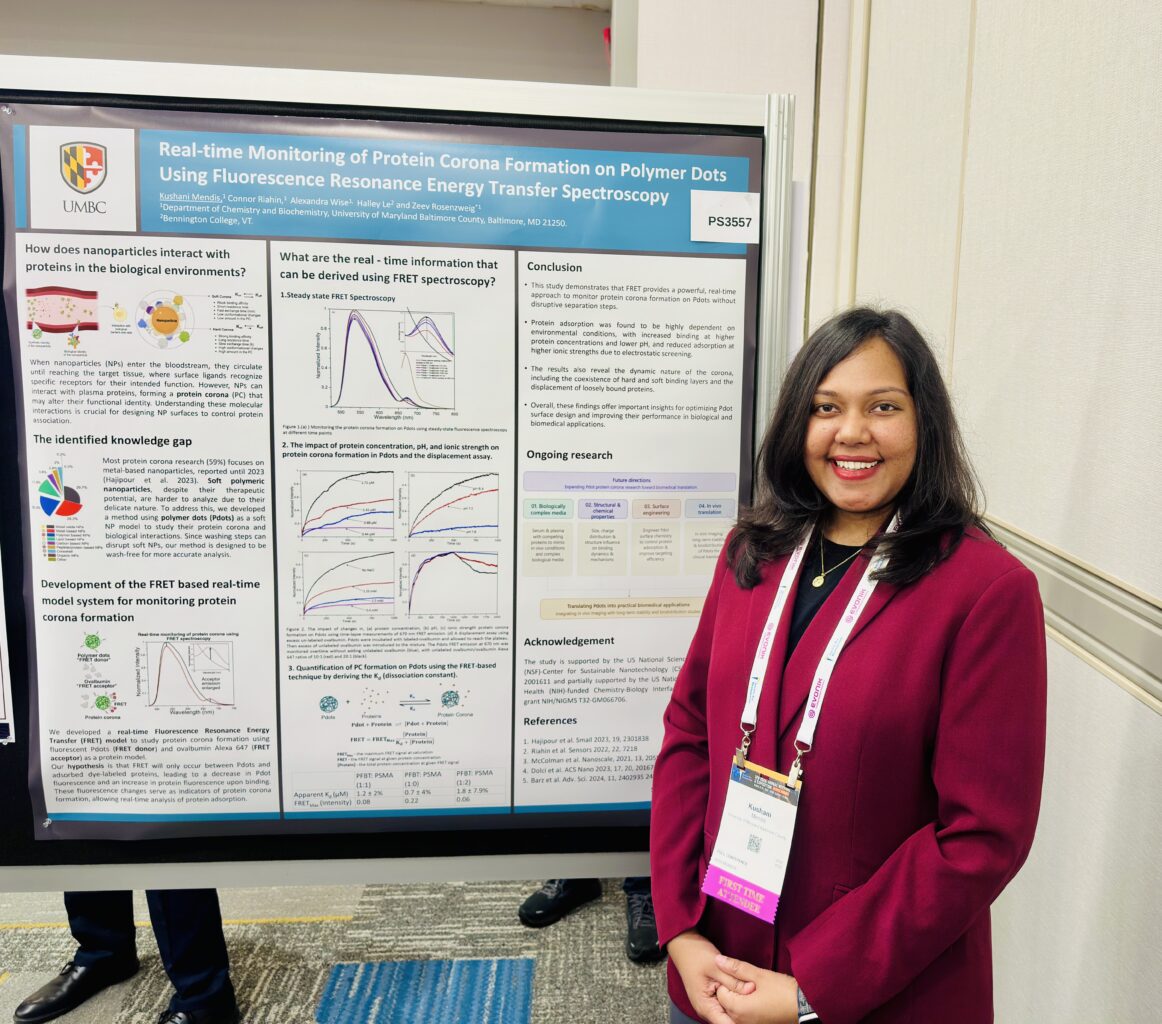 Kushani Mendis presented her research at the 2026 Society for Biomaterials Annual Meeting. (Courtesy of Mendis)
Today, Mendis’s schedule is packed with interviews of biomedical technology researchers in government, academia, and industry. Her probing questions are helping determine whether her lab’s novel nanomaterials have commercial potential. Rosenzweig’s encouragement and programs like the National Science Foundation Innovation Corps (I-Corps), which trains scientists to translate research into societal impact, have been key. She is thriving, balancing independent laboratory research, teaching and mentoring undergraduates, and her entrepreneurial work; she even occasionally finds time to engage her artistic side.
Whether or not students like Mendis ultimately launch businesses, at UMBC, they gain versatile skills—problem-solving, communication, empathy, and resilience—that will serve them across diverse careers. Here, entrepreneurial thinking is not an elective add-on but foundational preparation for an unpredictable world.
“UMBC’s model—technical excellence plus mindset training—prepares graduates to innovate anywhere,” Fulmer says, “making the university a powerful driver of Maryland’s future.”
]]>
At UMBC, entrepreneurship transcends a traditional business education: It empowers scientists, artists, and technologists to transform their expertise into real-world impact. Through business...
https://umbc.edu/stories/business-not-as-usual/
https://my3.my.umbc.edu/api/v0/pixel/news/160676/guest@my.umbc.edu/3eb018960d350b6c9c83e9cf0bcdf92a/api/pixel
alexbrowncenter
alumni
bwtech
cahss
campus-life
chemistry-and-biochemistry
cnms
coeit
csee
discovery
economics
entrepreneurship
feature
graduate-research
magazine
public-health
story
UMBC News & Magazine
https://my3.my.umbc.edu/groups/umbc-news-magazine
https://assets1-my.umbc.edu/system/shared/avatars/groups/000/001/943/24435aa6207c452e7bc15cc74b42c7bb/xsmall.png?1748556657
https://assets1-my.umbc.edu/system/shared/avatars/groups/000/001/943/24435aa6207c452e7bc15cc74b42c7bb/original.png?1748556657
https://assets2-my.umbc.edu/system/shared/avatars/groups/000/001/943/24435aa6207c452e7bc15cc74b42c7bb/xxlarge.png?1748556657
https://assets2-my.umbc.edu/system/shared/avatars/groups/000/001/943/24435aa6207c452e7bc15cc74b42c7bb/xlarge.png?1748556657
https://assets3-my.umbc.edu/system/shared/avatars/groups/000/001/943/24435aa6207c452e7bc15cc74b42c7bb/large.png?1748556657
https://assets1-my.umbc.edu/system/shared/avatars/groups/000/001/943/24435aa6207c452e7bc15cc74b42c7bb/medium.png?1748556657
https://assets2-my.umbc.edu/system/shared/avatars/groups/000/001/943/24435aa6207c452e7bc15cc74b42c7bb/small.png?1748556657
https://assets1-my.umbc.edu/system/shared/avatars/groups/000/001/943/24435aa6207c452e7bc15cc74b42c7bb/xsmall.png?1748556657
https://assets2-my.umbc.edu/system/shared/avatars/groups/000/001/943/24435aa6207c452e7bc15cc74b42c7bb/xxsmall.png?1748556657
UMBC News & Magazine
0
0
false
Fri, 12 Jun 2026 11:42:24 -0400
Fri, 12 Jun 2026 11:42:24 -0400
Wildfires are reversing America’s progress on ozone pollution, the main ingredient in smog
Written by Weizhi Deng, University of Iowa; Jun Wang, University of Iowa; and Meng Zhou, research scientist at the Goddard Earth Sciences and Technology Research Center II
For decades, the United States made steady progress in reducing surface ozone pollution, the main ingredient in smog. But that progress – achieved as vehicles, industries and power sources became cleaner – is increasingly being overshadowed by a different and growing source of ozone pollution: wildfires.
Our team of atmospheric and wildfire scientists analyzed wildfires’ contribution to surface ozone levels from 2003 to 2024 across the United States.
We found that the gases in wildfire smoke have reversed the national ozone trend, forcing a shift from declining ozone levels prior to 2015 to increasing ozone levels after 2015. We also found that the number of ozone-related premature deaths due to wildfires has been increasing by about 300 deaths per year since then.
Battling smog
Most people know ozone as the protective layer of the atmosphere high above the Earth that shields the planet from harmful ultraviolet radiation. But ozone has two very different faces.
High in the atmosphere, ozone is beneficial. Near the ground, it is a harmful air pollutant that can irritate the lungs and worsen respiratory diseases.
Los Angeles made ozone visible to the nation in the 1940s and 1950s, as thick, eye-stinging smog often blanketed the city. It turned an invisible chemistry problem into a public-health crisis people could see and feel. That crisis helped motivate decades of air pollution control efforts in California and, later, across the United States.
After the passage of the Clean Air Act and its amendments in the 1970s, the U.S. made steady progress in cleaning up surface ozone. Regulations on vehicles, power plants and industrial sources reduced emissions of nitrogen oxides and other ozone-forming chemicals.
To monitor the progress, the U.S. Environmental Protection Agency has over 1,000 stations that measure ozone around the country. They cover many places, but mostly urban areas, and do not measure ground-level ozone everywhere at the neighborhood scale.
We were able to fill in the gaps by combining those monitoring station measurements with satellite-derived information about air pollution and human activity, along with weather and air quality model simulations. We then used artificial intelligence to estimate daily surface ozone levels everywhere in the contiguous U.S., with data every square kilometer, over the past 22 years.
The results show that national progress in reducing surface ozone reversed around 2015 as North America began to face more severe wildfires. In many regions, ozone levels are now increasing, especially in the western U.S. and the Midwest, where smoke and gases from wildfires are becoming more common as they are transported through the air.
Overall, surface ozone levels that had been falling by about 0.65 part per billion per year from 2003–2015 have since increased by about 0.13 parts per billion per year. If wildfires hadn’t been an influence, we found, the trend of falling surface ozone levels would have continued instead.
 Ground-level ozone since 2015 has increased the most in areas where wildfire smoke increased. Minnesota, Wisconsin and other parts of the Midwest have experienced several summers of wildfire smoke from Canada. The map uses national ambient air quality standards. (Weizhi Deng et al., 2026)
People often think of wildfires as a problem for the western U.S., but smoke and gas pollutants from their emissions can travel thousands of miles, affecting communities far from the fires themselves.
The 2023 Canadian wildfires offered a vivid example. In much of the Midwest, ozone reached unhealthy levels for more than a week. The impact of wildfire smoke reached as far as Georgia and New York. That year, an additional 43 million Americans lived in areas with ozone exceeding healthy standards compared to previous years because of increased wildfire emissions.
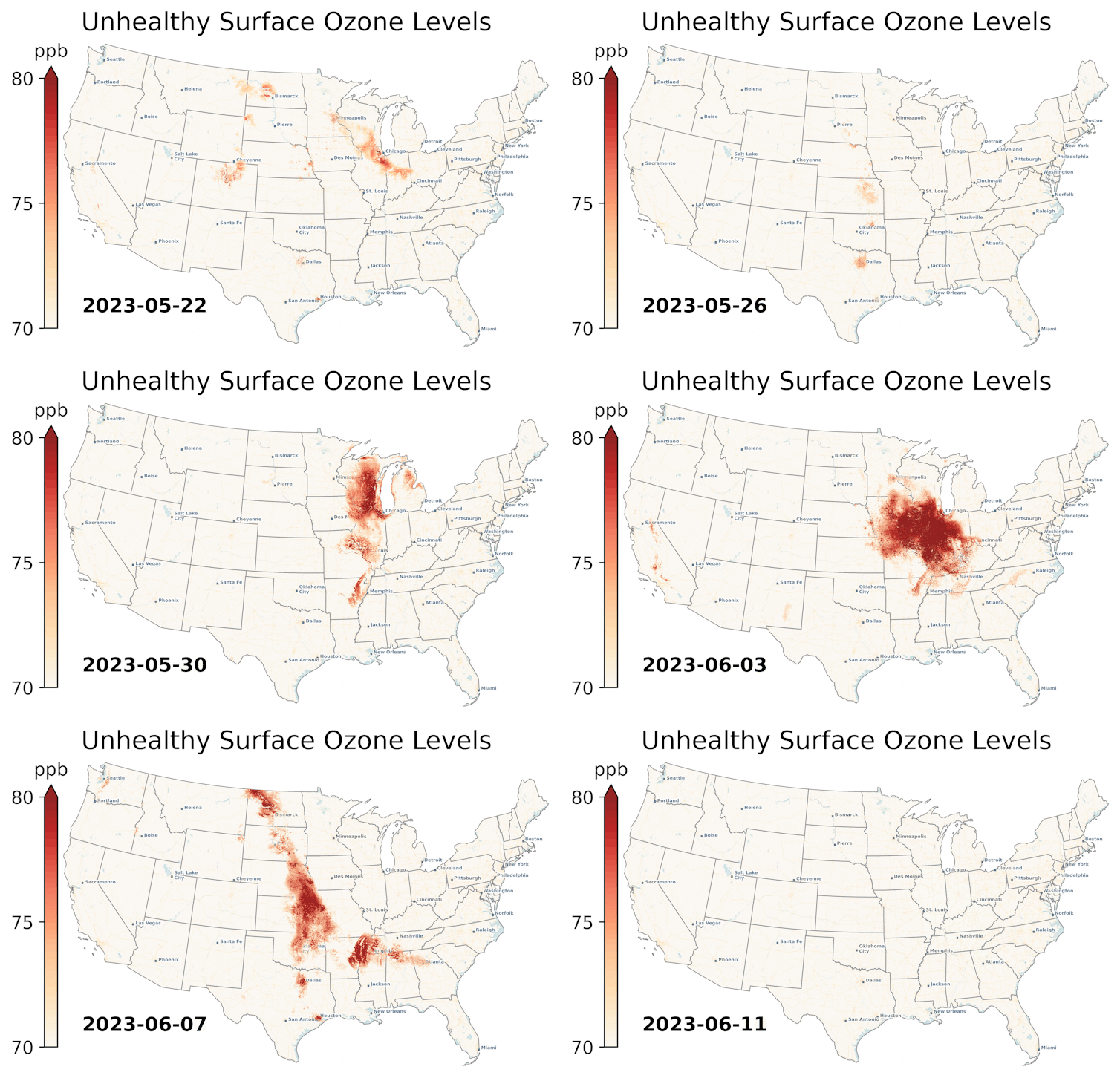 Smoke reached far into the U.S. during Canada’s destructive 2023 wildfire season, as these measures of ground-level ozone over three weeks that summer show. (Weizhi Deng, CC BY-ND)
As the Earth and its atmosphere warm, wildfire seasons are becoming longer and more severe across many parts of North America, and the trend is predicted to continue. In line with projections, Canada experienced its most devastating wildfire seasons on record in 2023 and 2025. In January 2025, destructive fires burned more than 16,000 homes and businesses in and around Los Angeles during a time of year when such events have historically been uncommon.
The shift toward more fires suggests that the rising ozone problem could become even greater in the future. That’s a problem for human health.
Reducing exposure to ozone and its health risks
People can reduce their exposure to ozone pollution by checking air quality forecasts and limiting outdoor activities when wildfires are sending smoke into the air. But protecting public health in the long run will require broader actions to reduce ground-level ozone itself.
That includes efforts to mitigate fire risk by improving wildfire management, such as reducing brush and other dry undergrowth that can fuel fires, and also scaling back the causes of rising global temperatures, such as the burning of fossil fuels. As temperatures rise, the ground loses moisture, creating conditions for more extreme fires.
Protecting public health also means strengthening air quality forecasting systems to provide accurate early warnings, so people can take precautions, and maintaining air pollution monitoring networks and investing in satellite sensors to continue measuring progress, so problems can be identified and fixed.
Weizhi Deng, Ph.D. Student in Atmospheric and Environmental Science, University of Iowa; Jun Wang, Professor of Chemical and Biochemical Engineering, University of Iowa, and Meng Zhou, Researcher in Atmospheric and Earth Sciences, University of Maryland, Baltimore County
This article is republished from The Conversation under a Creative Commons license. Read the original article and see more than 300 UMBC articles available in The Conversation.
]]>
Written by Weizhi Deng, University of Iowa; Jun Wang, University of Iowa; and Meng Zhou, research scientist at the Goddard Earth Sciences and Technology Research Center II For decades, the...
https://umbc.edu/stories/the-conversation-wildfires-reverse-ozone-progress/
https://my3.my.umbc.edu/api/v0/pixel/news/160625/guest@my.umbc.edu/9617001933486ab16921677613403e89/api/pixel
discovery
goddard-earth-sciences-technology-and-research-gestar-ii
magazine
story
the-conversation
UMBC News & Magazine
https://my3.my.umbc.edu/groups/umbc-news-magazine
https://assets1-my.umbc.edu/system/shared/avatars/groups/000/001/943/24435aa6207c452e7bc15cc74b42c7bb/xsmall.png?1748556657
https://assets1-my.umbc.edu/system/shared/avatars/groups/000/001/943/24435aa6207c452e7bc15cc74b42c7bb/original.png?1748556657
https://assets2-my.umbc.edu/system/shared/avatars/groups/000/001/943/24435aa6207c452e7bc15cc74b42c7bb/xxlarge.png?1748556657
https://assets2-my.umbc.edu/system/shared/avatars/groups/000/001/943/24435aa6207c452e7bc15cc74b42c7bb/xlarge.png?1748556657
https://assets3-my.umbc.edu/system/shared/avatars/groups/000/001/943/24435aa6207c452e7bc15cc74b42c7bb/large.png?1748556657
https://assets1-my.umbc.edu/system/shared/avatars/groups/000/001/943/24435aa6207c452e7bc15cc74b42c7bb/medium.png?1748556657
https://assets2-my.umbc.edu/system/shared/avatars/groups/000/001/943/24435aa6207c452e7bc15cc74b42c7bb/small.png?1748556657
https://assets1-my.umbc.edu/system/shared/avatars/groups/000/001/943/24435aa6207c452e7bc15cc74b42c7bb/xsmall.png?1748556657
https://assets2-my.umbc.edu/system/shared/avatars/groups/000/001/943/24435aa6207c452e7bc15cc74b42c7bb/xxsmall.png?1748556657
UMBC News & Magazine
0
0
false
Tue, 09 Jun 2026 11:04:57 -0400
Tue, 09 Jun 2026 11:04:57 -0400
“The Meyerhoff Effect”—Alycia Marshall ’95 multiplies opportunities for underrepresented students and faculty
They say a rising tide lifts all ships—the idea that when an ecosystem prospers, everyone within it is propelled upward by the same powerful current. The same can be said for UMBC’s Meyerhoff Scholars Program. At least that was the experience of Alycia Marshall ’95, mathematics. The Meyerhoff tide eventually lifted her higher than she imagined: president of the Community College of Philadelphia.
As an undergraduate student at UMBC, Marshall wasn’t a Meyerhoff Scholar by title, but she felt like one by proximity. Many of her friends were Meyerhoff Scholars. Her peers were Meyerhoff Scholars. Her line sisters Sigma Gamma Rho Sorority Incorporated were Meyerhoff Scholars. Everywhere she turned, she was surrounded by Meyerhoff Scholars.
“Even though I wasn’t a Meyerhoff, I was sucked into this culture of high achievement,” says Marshall. “I call it ‘the Meyerhoff Effect.’”
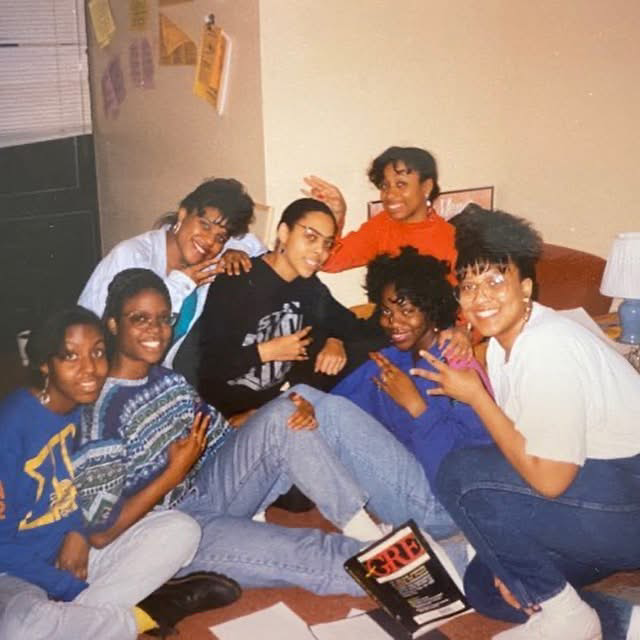
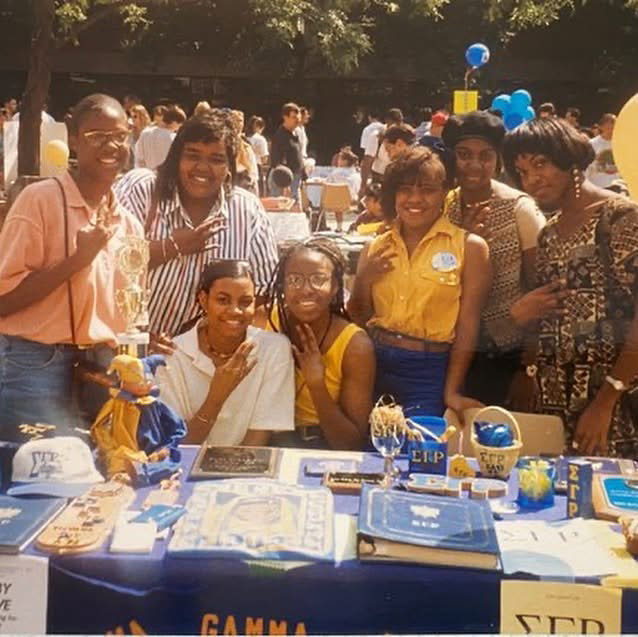
Pictured above: Marshall and members of Sigma Gamma Rho Sorority Incorporated on campus.
Brilliance was the baseline, and everyone strived to do their absolute best. It became a friendly peer-to-peer competition. But more than that, for Marshall, it was inspiring to see so many high-achieving Black students in one place, pushing each other to be the best versions of themselves.
“I had been in talented and gifted classes my entire school career,” says Marshall. “I was used to being around high-achieving students, but I was always the one person of color in the room. I was just floored to actually see so many people that looked like me who were high achieving at one time, in one place.”
For Marshall, that “Meyerhoff Effect” caused a fundamental shift in her internal barometer for success. She began to see her own potential through a wider lens—one that would eventually take her from a shy undergraduate student at UMBC to the President’s Office at CCP.
The teaching bug
Marshall started her UMBC journey as a biology major. Math and teaching were not even on her radar as potential careers—but that all changed pretty quickly during Marshall’s first year. Her “aha moment” occurred during a Calculus 1 lecture. Marshall was doing well in the course, but she knew she could do even better. She wanted that “A.” So, when the professor offered extra credit to anyone who could go to the board and explain the solution to a problem, Marshall couldn’t help herself. While other students were intimidated by the hundreds of students in that lecture hall class, and the difficulty of the material, Marshall regularly volunteered. She found that she wasn’t just good at solving the equations—she was good at communicating the logic behind them. “I got something out of that,” she says. Before she knew it, her classmates were asking to study with her, and Marshall started tutoring a few of her peers.
“That experience encouraged me to think about mathematics and teaching as a profession,” says Marshall.
After graduating from UMBC in 1995 with a B.S. in mathematics, Marshall began her teaching career at Bishop McNamara High School, a private school in Forestville, Maryland, before moving to Frederick Douglass High School, a public school in Prince George’s County. Around the same time, she began a master’s program at Bowie State University, eventually earning her masters of arts in teaching in 1998. Then, she got the higher education itch.
Education that changes lives
“I was very intrigued by the idea of teaching at the college level,” says Marshall, who quickly found an adjunct role at Anne Arundel Community College (AACC), teaching developmental math part-time. She was teaching high school students during the day and non-traditional college students twice a week in the evenings for AACC at Fort George G. Meade, a United States Army installation in Maryland.
“That was a whole different experience for me,” says Marshall, “understanding how important education was and how people were seeking that to change their lives.”
She was hooked. So, when a full-time position opened up, Marshall jumped at the opportunity and for the next 23 years she built an impressive career at AACC. During this time, Marshall also earned a Ph.D. in mathematics education from the University of Maryland, College Park in 2007. Her career saw her move from a professor of mathematics to the first African American woman to chair the department. Eventually, she worked her way up to associate vice president of learning and academic affairs. However, the work Marshall says she is most proud of is what she’s done throughout her career to support underrepresented students in STEM and leadership—an effort to replicate aspects of the Meyerhoff Scholars Program at the community college level.
When the idea initially occurred to Marshall, the first thing she did was reach out to her mentor, Freeman Hrabowski, III, UMBC president emeritus. He invited Marshall and AACC leaders to UMBC to meet with him and LaMont Toliver, then the director of the Meyerhoff Scholars Program and assistant dean of undergraduate education.
“It was great,” says Marshall. “That never would have happened had it not been for my connection to UMBC, my relationship with Dr. Hrabowski, and his continued interest in supporting me well beyond my graduation.”
The UMBC field trip and a National Science Foundation grant helped Marshall start the Engineering Scholars Program at AACC, connecting underrepresented students with scholarships, mentoring, and support services. Marshall also created the African American Leadership Institute to develop highly qualified, diverse leaders through targeted leadership development to improve the retention rates for this population and increase the diversity of college leadership.
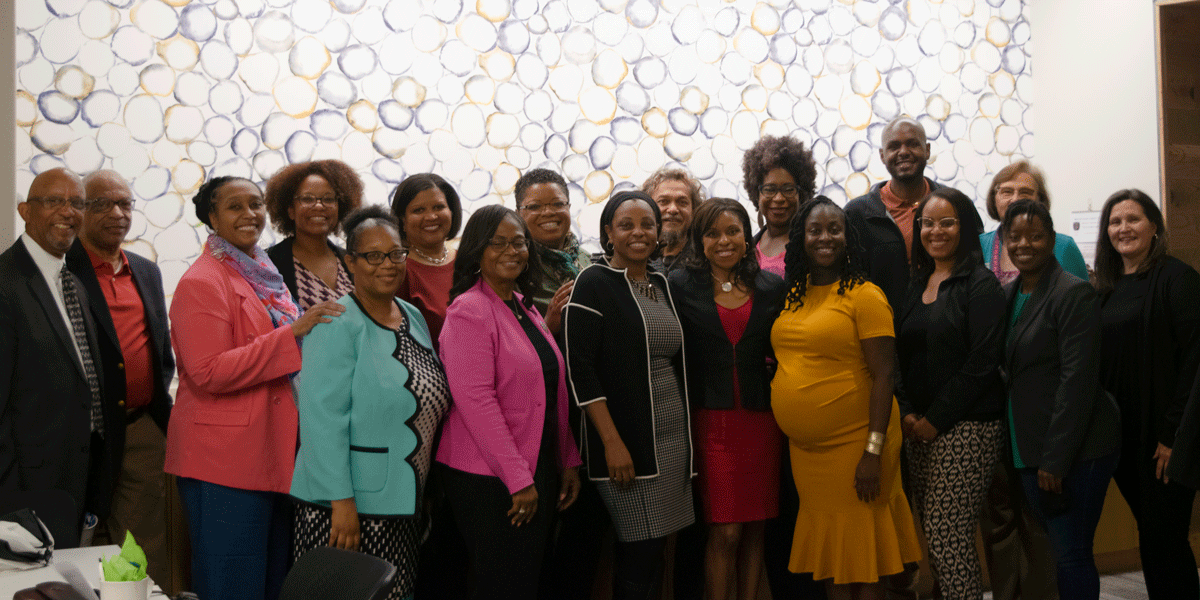 Marshall (center) at the African American Leadership Institute (AALI) closing session at Anne Arundel Community College (AACC).
For years after that, whenever Hrabowski was in a room with Marshall, he would introduce her with a bold proclamation: “This is Dr. Marshall. She’s a UMBC graduate, and she’s going to be a president one day.”
“When Doc pours into people that way, he has a way of speaking their future into them,” says Marshall. “I leaned on that. Knowing that he knew I could do it helped me know I could do it, too.”
Marshall left AACC in 2022 to become the provost and vice president for academic and student success at the Community College of Philadelphia (CCP). And it didn’t take long for her to make an impact. Soon after joining CCP, Marshall started the Aspiring Leaders Fellowship Program for employees interested in moving into higher education leadership roles. The program, now in its third cohort, matches participants with senior leaders from different institutions who serve as mentors.
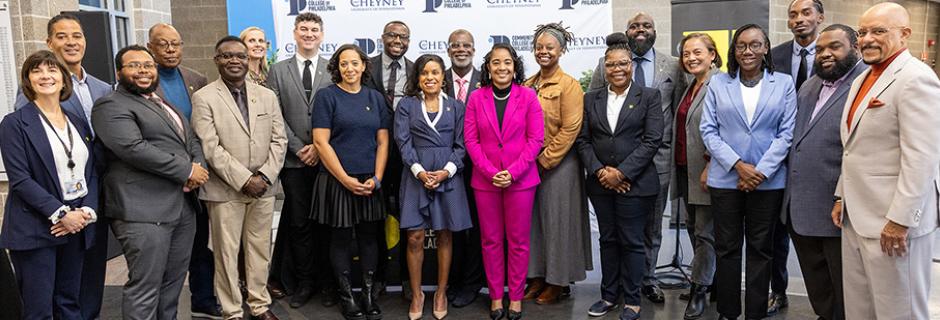 Marshall (center) and members of the Aspiring Leaders Fellowship Program at the Community College of Philadelphia.
Marshall also started a new faculty onboarding program to provide newly hired faculty the tools they need to succeed—time to learn ways to enhance their pedagogical practices and build on their teaching skills in their first year at CCP—as well as a new department head onboarding program.
“There’s a similar theme with all this about professional development, continuous improvement, and making sure folks have the tools that they need,” says Marshall.
In 2025, Hrabowski’s prophecy came true. Marshall was named CCP president, the first Black woman to serve in the role in a permanent capacity.
Upon receiving the news, one of Marshall’s first calls was to the man who believed in her future before she believed it herself.
“When I told Doc I got the job…he was emotional,” says Marshall. “He was so very proud of me. It was a wonderful day.”
 Marshall (center) at graduation with Cherelle Parker, the Mayor of Philadelphia, and the Community College of Philadelphia’s student graduation speaker.
]]>
They say a rising tide lifts all ships—the idea that when an ecosystem prospers, everyone within it is propelled upward by the same powerful current. The same can be said for UMBC’s Meyerhoff...
https://umbc.edu/stories/the-meyerhoff-effect-alycia-marshall/
https://my3.my.umbc.edu/api/v0/pixel/news/160598/guest@my.umbc.edu/3fd28592639581a7f925a4b10e6aab07/api/pixel
alumni
magazine
meyerhoff-scholars
story
UMBC News & Magazine
https://my3.my.umbc.edu/groups/umbc-news-magazine
https://assets1-my.umbc.edu/system/shared/avatars/groups/000/001/943/24435aa6207c452e7bc15cc74b42c7bb/xsmall.png?1748556657
https://assets1-my.umbc.edu/system/shared/avatars/groups/000/001/943/24435aa6207c452e7bc15cc74b42c7bb/original.png?1748556657
https://assets2-my.umbc.edu/system/shared/avatars/groups/000/001/943/24435aa6207c452e7bc15cc74b42c7bb/xxlarge.png?1748556657
https://assets2-my.umbc.edu/system/shared/avatars/groups/000/001/943/24435aa6207c452e7bc15cc74b42c7bb/xlarge.png?1748556657
https://assets3-my.umbc.edu/system/shared/avatars/groups/000/001/943/24435aa6207c452e7bc15cc74b42c7bb/large.png?1748556657
https://assets1-my.umbc.edu/system/shared/avatars/groups/000/001/943/24435aa6207c452e7bc15cc74b42c7bb/medium.png?1748556657
https://assets2-my.umbc.edu/system/shared/avatars/groups/000/001/943/24435aa6207c452e7bc15cc74b42c7bb/small.png?1748556657
https://assets1-my.umbc.edu/system/shared/avatars/groups/000/001/943/24435aa6207c452e7bc15cc74b42c7bb/xsmall.png?1748556657
https://assets2-my.umbc.edu/system/shared/avatars/groups/000/001/943/24435aa6207c452e7bc15cc74b42c7bb/xxsmall.png?1748556657
UMBC News & Magazine
0
0
false
Mon, 08 Jun 2026 08:23:10 -0400
Mon, 08 Jun 2026 08:23:10 -0400
Plot twist— Michelle Corpora ’03 took a nonlinear path to becoming NYT bestselling author
Marshall (center) at graduation with Cherelle Parker, the Mayor of Philadelphia, and the Community College of Philadelphia’s student graduation speaker.
]]>
They say a rising tide lifts all ships—the idea that when an ecosystem prospers, everyone within it is propelled upward by the same powerful current. The same can be said for UMBC’s Meyerhoff...
https://umbc.edu/stories/the-meyerhoff-effect-alycia-marshall/
https://my3.my.umbc.edu/api/v0/pixel/news/160598/guest@my.umbc.edu/3fd28592639581a7f925a4b10e6aab07/api/pixel
alumni
magazine
meyerhoff-scholars
story
UMBC News & Magazine
https://my3.my.umbc.edu/groups/umbc-news-magazine
https://assets1-my.umbc.edu/system/shared/avatars/groups/000/001/943/24435aa6207c452e7bc15cc74b42c7bb/xsmall.png?1748556657
https://assets1-my.umbc.edu/system/shared/avatars/groups/000/001/943/24435aa6207c452e7bc15cc74b42c7bb/original.png?1748556657
https://assets2-my.umbc.edu/system/shared/avatars/groups/000/001/943/24435aa6207c452e7bc15cc74b42c7bb/xxlarge.png?1748556657
https://assets2-my.umbc.edu/system/shared/avatars/groups/000/001/943/24435aa6207c452e7bc15cc74b42c7bb/xlarge.png?1748556657
https://assets3-my.umbc.edu/system/shared/avatars/groups/000/001/943/24435aa6207c452e7bc15cc74b42c7bb/large.png?1748556657
https://assets1-my.umbc.edu/system/shared/avatars/groups/000/001/943/24435aa6207c452e7bc15cc74b42c7bb/medium.png?1748556657
https://assets2-my.umbc.edu/system/shared/avatars/groups/000/001/943/24435aa6207c452e7bc15cc74b42c7bb/small.png?1748556657
https://assets1-my.umbc.edu/system/shared/avatars/groups/000/001/943/24435aa6207c452e7bc15cc74b42c7bb/xsmall.png?1748556657
https://assets2-my.umbc.edu/system/shared/avatars/groups/000/001/943/24435aa6207c452e7bc15cc74b42c7bb/xxsmall.png?1748556657
UMBC News & Magazine
0
0
false
Mon, 08 Jun 2026 08:23:10 -0400
Mon, 08 Jun 2026 08:23:10 -0400
Plot twist— Michelle Corpora ’03 took a nonlinear path to becoming NYT bestselling author
It was around five o’clock on a Wednesday in May, and Michelle Jabès Corpora ’03, English and theatre, was on her sofa watching her favorite British murder mystery on TV. It had been a long shot to think her newest book, His Face Is the Sun, would hit the New York Times (NYT) bestsellers list, and since she hadn’t heard anything and it was getting late, she figured it wasn’t meant to be.
Buzz! Buzz! Buzz! Suddenly, she looked down at her phone to see a FaceTime call from five different numbers—most of which she didn’t recognize. She quickly answered and saw her agent, editor, assistant editor, and publicists in the group of smiling faces before hearing the four words every author dreams of hearing: “You’re on the list!”
“I just started crying,” recalls Corpora. “I couldn’t believe it.”
His Face Is the Sun stayed on the NYT Bestsellers Young Adult Hardcover list for five weeks, which the author says was “absolutely unbelievable.”
Where it all began
Corpora’s journey to becoming a NYTbestselling author was not a straight line—far from it. Corpora initially came to UMBC as a Linehan Artist Scholar to study theatre. Because she’d always been passionate about writing and literature, however, she added English as a second major to supplement her studies.

“Learning about drama helped significantly with my approach to character, plot, and pacing,” says Corpora. After UMBC, Corpora earned a master’s degree in Children’s Literature from Hollins University. Then, a few more twists and turns. Among other jobs, Corpora worked as a wedding singer, as a technician in a veterinarian’s office, and volunteered at a wildlife rehabilitation center before taking a big career leap and moving to New York City to try and get a job in children’s publishing.
Pictured left: Corpora as ‘Cleo’ AKA Fraulein Kost in a 2001 UMBC Theatre production of Cabaret.
New York state of mind
One catch: Corpora didn’t have a full-time job lined up. All she had were two unpaid summer internships at children’s publishing houses.
“It was a real gamble,” says Corpora, “but I feel like my entire career has been a series of gambles, and they always seem to work out well.”
Corpora landed an editorial assistant position at Greenwillow Books, an imprint of HarperCollins Children’s Books, where she had the opportunity to work on books by legendary authors like Kevin Henkes and Sid Fleischman, among many others. Then came her own children and another career pivot. With the birth of her daughter, Corpora moved into book packaging services.
“Book packaging is an interesting, mostly unknown side of the publishing industry where groups of writers work as a team to create concepts for series fiction,” says Corpora. “The transition was challenging because you really have to let go of ownership over your ideas, and you have to be creative in a collaborative way, which doesn’t come naturally to most people at first.”
Despite the learning curve, Corpora admits that her work as a concept creator really helped her grow as a writer, as she was coming up with ideas, developing them, and also editing manuscripts. “It made me into a jack of all trades,” she says.
From ghostwriting to ghosts
In 2015, Corpora got her first publishing opportunity after winning an audition to be a ghostwriter for a long-running middle-grade mystery series, eventually writing five books in the series. It wasn’t until 2021, however, that Corpora would see her name on one of her creations. Her next four books, all bearing the name Michelle Jabes Corpora on the cover, were what are known as work-for-hire projects.
“These are usually projects that you audition for,” explains Corpora. “It’s not ghostwriting because your name goes on the books, but usually the publisher has a concept for a book or series they want on their list, and they hire a writer to develop and write that project for them.”
This was the process for her two middle-grade historical fiction novels, The Fog of Warand The Dust Bowl, as well as her young adult horror duology, Holly Horror, which was created in partnership with the owners of the classic character, Holly Hobbie.
“Because of my job, I’d become a kind of chameleon,” says Corpora. “I was happy to write whatever book the client wanted. But it also taught me to identify the essence of every story. What makes it good? What makes it human? What’s the heart of this story?”
Michelle Jabès Corpora '03
English
Each step in Corpora’s journey built her foundation as a writer. But at that point, her agent knew she was ready for more.
“She’d seen me grow through all of this, was basically like, ‘It’s time for you to stop auditioning and ghostwriting and start writing your story—something that’s meaningful to you and that’s yours,’” recalls Corpora.
Finding her story
In 2023, Corpora took her next big gamble: creating not only her own original series, but writing something she’d never tried her hand at before. Epic fantasy.
“It felt like a big leap of faith at the time. I still had two young daughters, a part-time job, and a very busy life,” says Corpora, “and I was planning to put a lot of hours into a project that might never sell. But once the idea was born, I knew there was no going back.”
The Throne of Khetara series, born from that fateful conversation with her editor, is an Ancient Egyptian-inspired trilogy about a kingdom in turmoil, a forgotten oracle, and four unlikely heroes: a princess, a priestess, a rebel, and a thief.
“My parents and three of my grandparents were immigrants born in Egypt,” says Corpora. “So I grew up hearing stories about Egypt, and became fascinated by Ancient Egyptian history from a very young age.”
Corpora describes the series as “Ancient Egyptian Game of Thrones for young adults,” and is told from the perspectives of the four main characters.
“That seemed to really resonate strongly with people,” says Corpora, who wanted to showcase the different perspectives in ancient Egypt, including the non-royal population who were most affected by war and conquest.
The trilogy was picked up by Sourcebooks Fire and is currently being published in nine territories so far, including the UK, Italy, France, Germany, Spain, Brazil, Hungary, and Greece. It has also won numerous distinctions, including being on the list of YALSA Top Ten Best Fiction for Young Adults in 2026.
“It’s been a long and winding road to get here,” says Corpora. “But I’ll always remember UMBC as a place that allows people to find their way in the world, even if your journey might take you off the beaten path.”
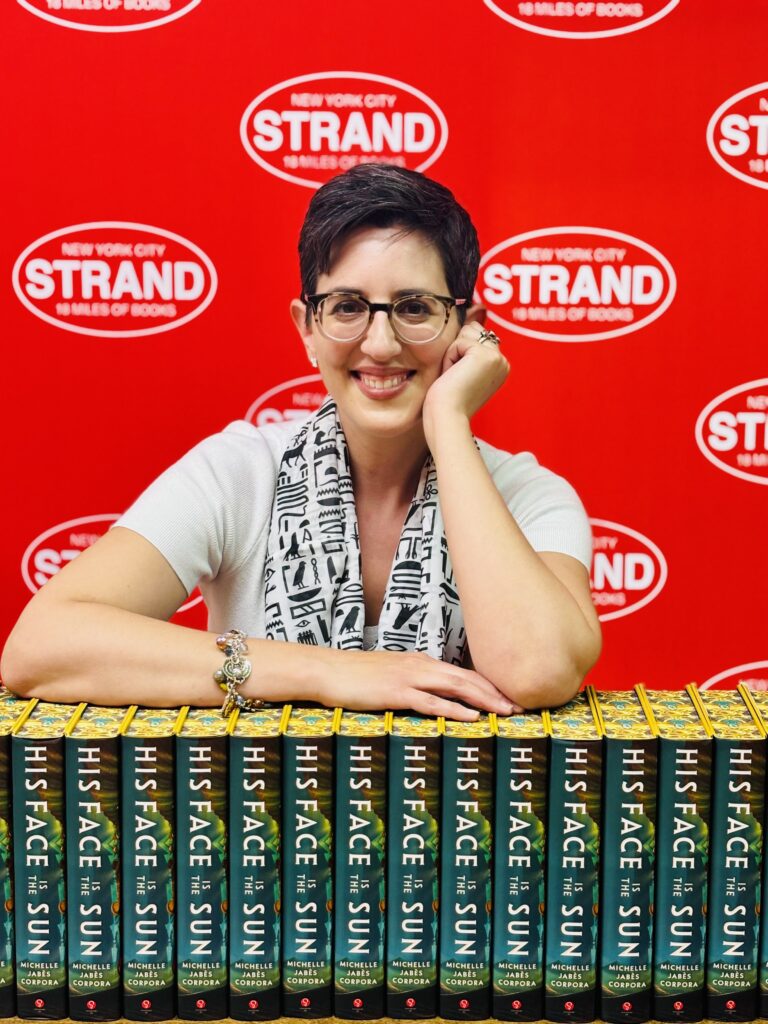
Pictured right: Corpora, a New York Times bestseller, at a book signing event at The Strand Book Store in New York City.
]]>
It was around five o’clock on a Wednesday in May, and Michelle Jabès Corpora ’03, English and theatre, was on her sofa watching her favorite British murder mystery on TV. It had been a long shot...
https://umbc.edu/stories/michelle-corpora-nyt-bestselling-author/
https://my3.my.umbc.edu/api/v0/pixel/news/160456/guest@my.umbc.edu/e88128bedc3f4318bdb5ec9e163215e9/api/pixel
alumni
alumni-profile
cahss
english
magazine
retriever-authors
spring-2026
story
theatre
UMBC News & Magazine
https://my3.my.umbc.edu/groups/umbc-news-magazine
https://assets1-my.umbc.edu/system/shared/avatars/groups/000/001/943/24435aa6207c452e7bc15cc74b42c7bb/xsmall.png?1748556657
https://assets1-my.umbc.edu/system/shared/avatars/groups/000/001/943/24435aa6207c452e7bc15cc74b42c7bb/original.png?1748556657
https://assets2-my.umbc.edu/system/shared/avatars/groups/000/001/943/24435aa6207c452e7bc15cc74b42c7bb/xxlarge.png?1748556657
https://assets2-my.umbc.edu/system/shared/avatars/groups/000/001/943/24435aa6207c452e7bc15cc74b42c7bb/xlarge.png?1748556657
https://assets3-my.umbc.edu/system/shared/avatars/groups/000/001/943/24435aa6207c452e7bc15cc74b42c7bb/large.png?1748556657
https://assets1-my.umbc.edu/system/shared/avatars/groups/000/001/943/24435aa6207c452e7bc15cc74b42c7bb/medium.png?1748556657
https://assets2-my.umbc.edu/system/shared/avatars/groups/000/001/943/24435aa6207c452e7bc15cc74b42c7bb/small.png?1748556657
https://assets1-my.umbc.edu/system/shared/avatars/groups/000/001/943/24435aa6207c452e7bc15cc74b42c7bb/xsmall.png?1748556657
https://assets2-my.umbc.edu/system/shared/avatars/groups/000/001/943/24435aa6207c452e7bc15cc74b42c7bb/xxsmall.png?1748556657
UMBC News & Magazine
1
0
false
Mon, 01 Jun 2026 08:39:25 -0400
Mon, 01 Jun 2026 08:39:25 -0400
Meet a Retriever—Hailey Turney, M.A. ’21, a COEIT academic advisor who’s found a trusted team to rely on
Hailey Turney, M.A. ’21, first came to UMBC as a student pursuing an academic passion in the text, technologies, and literature program. She connected right away with faculty and other community members. Now, as an undergraduate academic advisor in the College of Engineering and Information Technology and an instructor teaching introductory English and university orientation classes, she helps current UMBC connect and find their own path, too.
Hailey shares what she loves about UMBC and her advising job. Take it away, Hailey!
Q: Tell us about yourself.
A: I am a COEIT academic advisor. I mostly work with mechanical engineering students now. I also teach a section of ENGL 100 each semester and UNIV 101 in the fall semesters. I love being able to help students and engage in my community, so advising and teaching feels like a great way to reach students on different levels.
When I was an undergrad, I did not have the best advising experience, so being able to make a difference as an advisor now feels like an interesting, but great, twist of fate. I also like to play Volo soccer in Baltimore and do Dog’s Day Out at BARCS outside of work!
Q: Who are some of the people at UMBC who have most supported you?
A: My amazing boss Emily Abrams-Stephens is spectacular. She supports me and my fellow advisors every day. She is always advocating for us and showing us how much she cares everyday. Working with her, I never doubt that I am valued here. She always listens to our ideas and is a fantastic (and popular) morning chat partner.
I had a previous job that weighed on me every minute of the day—even outside of work. I missed the activities I loved to do because of it. At UMBC, I have a trusting team—my boss and my fellow advisors—that supports me. If I am ever away, I know my students will be taken care of by my colleagues. The trust I have in my team is something I will never be able to replace. The most remarkable thing about UMBC is the people.
Q: What’s the one thing you’d want someone who hasn’t joined the UMBC community to know about the support you find here?
A: There will always be someone in your corner. I did my master’s here and it was the first time I immediately felt seen in my academic career. When I came to work here, I immediately felt wanted and supported. There are so many resources available to the UMBC community and there is always someone there to help you find them. As an advisor, it is now my job and honor to help students find those resources and their own supporting community.
 Hailey Turney (center) laughs with Assistant Director of Transfer Success Initiatives Krista Wallace at the 2024 COEIT Celebration. (Photo courtesy of Turney)
Q: What part of your job do you enjoy the most and why?
A: I love interacting with students and helping them find their way. Being that person that they can turn to when they don’t know where to go is the most important part of our job. We want students to succeed and feel secure in their place here at UMBC.
Q: What brought you to UMBC in the first place?
A: I came to UMBC because I wanted to expand my knowledge on a topic I was passionate about. The faculty in the English department had so many interesting areas of study that I knew I would be well-supported in finding my own. After meeting with some faculty members for a graduate assistantship, I felt hopeful that this would be an interactive community. The faculty responded to my emails right away, were interested in what I had to say, and were encouraging from the beginning. I came for the academics and stayed for the community. This continued as I found a job here at UMBC as well—I was hesitant to leave.
Q: What would you tell someone who is considering a career at UMBC?
A: You will find a great community here. You will also find ways to continue to improve and learn no matter where you end up.
* * * * *
UMBC’s greatest strength is its people. When people meet Retrievers and hear about the passion they bring, the relationships they create, the ways they support each other, and the commitment they have to inclusive excellence, they truly get a sense of our community. That’s what “Meet a Retriever” is all about.
Learn more about how UMBC can help you achieve your goals.
]]>
Hailey Turney, M.A. ’21, first came to UMBC as a student pursuing an academic passion in the text, technologies, and literature program. She connected right away with faculty and other community...
https://umbc.edu/stories/meet-a-retriever-hailey-turney-coeit-advisor/
https://my3.my.umbc.edu/api/v0/pixel/news/160430/guest@my.umbc.edu/da776ba878d2262d39dfe97a4983ea50/api/pixel
alumni
cahss
coeit
impact
magazine
meet-a-retriever
perspectives
spring-2026
story
UMBC News & Magazine
https://my3.my.umbc.edu/groups/umbc-news-magazine
https://assets1-my.umbc.edu/system/shared/avatars/groups/000/001/943/24435aa6207c452e7bc15cc74b42c7bb/xsmall.png?1748556657
https://assets1-my.umbc.edu/system/shared/avatars/groups/000/001/943/24435aa6207c452e7bc15cc74b42c7bb/original.png?1748556657
https://assets2-my.umbc.edu/system/shared/avatars/groups/000/001/943/24435aa6207c452e7bc15cc74b42c7bb/xxlarge.png?1748556657
https://assets2-my.umbc.edu/system/shared/avatars/groups/000/001/943/24435aa6207c452e7bc15cc74b42c7bb/xlarge.png?1748556657
https://assets3-my.umbc.edu/system/shared/avatars/groups/000/001/943/24435aa6207c452e7bc15cc74b42c7bb/large.png?1748556657
https://assets1-my.umbc.edu/system/shared/avatars/groups/000/001/943/24435aa6207c452e7bc15cc74b42c7bb/medium.png?1748556657
https://assets2-my.umbc.edu/system/shared/avatars/groups/000/001/943/24435aa6207c452e7bc15cc74b42c7bb/small.png?1748556657
https://assets1-my.umbc.edu/system/shared/avatars/groups/000/001/943/24435aa6207c452e7bc15cc74b42c7bb/xsmall.png?1748556657
https://assets2-my.umbc.edu/system/shared/avatars/groups/000/001/943/24435aa6207c452e7bc15cc74b42c7bb/xxsmall.png?1748556657
UMBC News & Magazine
2
0
false
Fri, 29 May 2026 14:22:58 -0400
Fri, 29 May 2026 14:22:58 -0400
Bartleby is more than golden—50+ years with UMBC’s creative arts journal
 Quinn shows his poem published in the 1979 – 1980 Bartleby edition. (Catalina Dansberger Duque/UMBC)
“Bartleby NEEDS YOU!” This was the handwritten call to arms in 1979, for writers and poets to submit their work to Bartleby, UMBC’s creative arts journal. The sentiment of this flyer is not that different from its first publication in 1972 and from today’s social media posts alerting students to upcoming submission deadlines.
This unwavering spirit brought Howard Quinn ’80, English, back to campus in fall 2025 for the Bartleby 50+ celebration. He shared his memories as one of six editors of the 1979 – 1980 edition and reveled at the Bartleby covers and works, displayed in showcases at the Albin O. Kuhn Library and Gallery, some with typed-up poems printed on newsprint or cardstock and stapled together like the edition with 35 pieces that he helped edit—including his own poem, “Wind Down Wind” about loss.
In 2026, Bartleby—under the recently chartered Student Media Collective—editors read 200 art submissions, 120 poetry submissions, 60 fiction submissions, and 23 creative nonfiction submissions. The ensuing 160-page publication is book-bound and printed on glossy paper. Over five decades, Retrievers have continued to creatively express the personal and political events that have defined their lives, including war and national identity, rebellion, women’s rights, LGBTQ+ identity, social isolation, and joy and love.
Quinn came to Bartleby’s retrospective to celebrate the publication’s ongoing impact and to share a message from his friend Martha Campbell ’82, American studies, a Bartleby editor for three and a half years.
“I know that Bartleby has endured because people showed up to create art, give voice, share ideas, and they did that work year after year,” wrote Campbell, perhaps inadvertently echoing a line from her poem published during her tenure: “And the clock moves on, slow, but certain in its ways.”
 Left to right: Howard Quinn, Andrew Coulbourne, current editor (middle), and Sean McNutt ’24, anthropology, editor of volume 43, at the Bartleby 50+ exhibit. (Brad Ziegler/UMBC)
Read more Spring 2026 UMBC Magazine stories.
]]>
Quinn shows his poem published in the 1979 – 1980 Bartleby edition. (Catalina Dansberger Duque/UMBC) “Bartleby NEEDS YOU!” This was the handwritten call to arms in 1979, for writers and poets...
https://umbc.edu/stories/bartleby-is-more-than-golden-50-years-with-umbcs-creative-arts-journal/
https://my3.my.umbc.edu/api/v0/pixel/news/160278/guest@my.umbc.edu/fc04b276cb66c7fac1085ab5f5bf83f9/api/pixel
aok-library-gallery
cahss
community
english
magazine
story
UMBC News & Magazine
https://my3.my.umbc.edu/groups/umbc-news-magazine
https://assets1-my.umbc.edu/system/shared/avatars/groups/000/001/943/24435aa6207c452e7bc15cc74b42c7bb/xsmall.png?1748556657
https://assets1-my.umbc.edu/system/shared/avatars/groups/000/001/943/24435aa6207c452e7bc15cc74b42c7bb/original.png?1748556657
https://assets2-my.umbc.edu/system/shared/avatars/groups/000/001/943/24435aa6207c452e7bc15cc74b42c7bb/xxlarge.png?1748556657
https://assets2-my.umbc.edu/system/shared/avatars/groups/000/001/943/24435aa6207c452e7bc15cc74b42c7bb/xlarge.png?1748556657
https://assets3-my.umbc.edu/system/shared/avatars/groups/000/001/943/24435aa6207c452e7bc15cc74b42c7bb/large.png?1748556657
https://assets1-my.umbc.edu/system/shared/avatars/groups/000/001/943/24435aa6207c452e7bc15cc74b42c7bb/medium.png?1748556657
https://assets2-my.umbc.edu/system/shared/avatars/groups/000/001/943/24435aa6207c452e7bc15cc74b42c7bb/small.png?1748556657
https://assets1-my.umbc.edu/system/shared/avatars/groups/000/001/943/24435aa6207c452e7bc15cc74b42c7bb/xsmall.png?1748556657
https://assets2-my.umbc.edu/system/shared/avatars/groups/000/001/943/24435aa6207c452e7bc15cc74b42c7bb/xxsmall.png?1748556657
UMBC News & Magazine
1
0
false
Thu, 21 May 2026 17:07:56 -0400
Thu, 21 May 2026 17:07:56 -0400
Revealing galactic history with cosmic rays
What if we could peer back in time to understand how our galaxy was built—one exploding star at a time?
When massive stars reach the end of their lives, they don’t go quietly. They explode in spectacular fashion, forging heavy elements and hurling them across space. Some of these particles, known as cosmic rays, eventually reach detectors built by humans. By studying which elements arrive and in what amounts, scientists hope to piece together the story of our galaxy’s chemical evolution.
But there’s a problem: As these cosmic rays race through space, they smash into hydrogen atoms and break apart. These reactions, called “proton spallation,” turn heavier elements like iron into lighter ones like sodium or chromium. Without knowing exactly how often these “break-ups” happen, it’s hard to translate what detectors see into a true picture of what’s out there. But if scientists could accurately reverse-engineer the process, determining how much of one element came from another, they would better understand the galaxy’s true chemical makeup.
Now, Priyarshini Ghosh, a nuclear physicist at UMBC’s Center for Space Sciences and Technology, is performing a first-of-its-kind experiment, hoping to fill some of this knowledge gap.
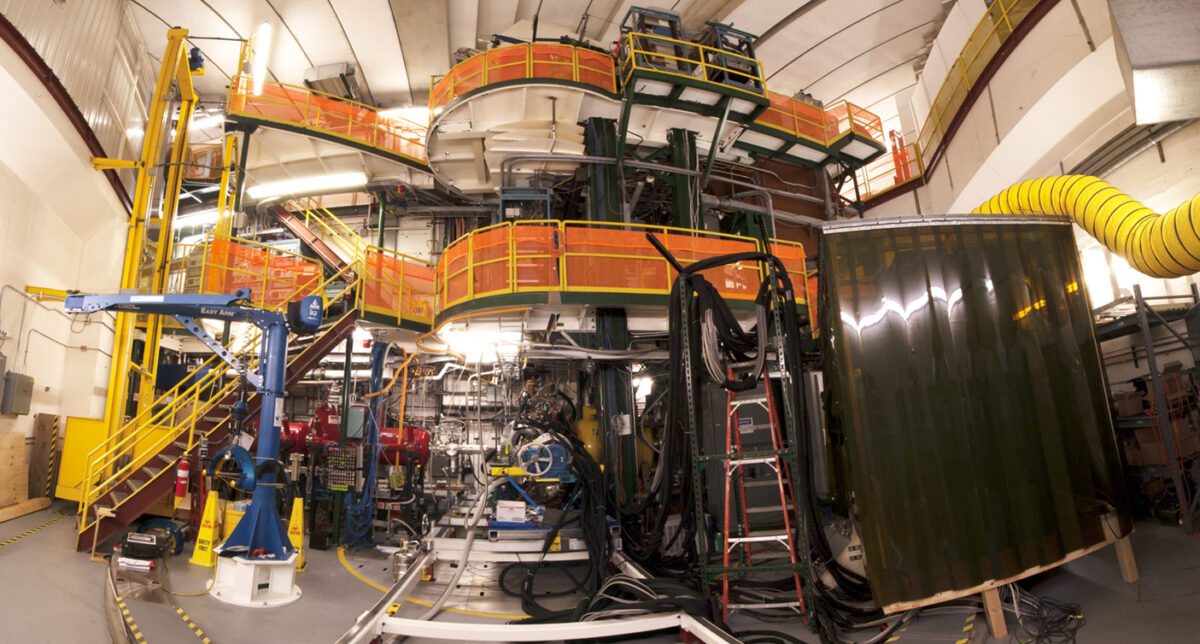 The research team will run a novel experiment on the S800 Spectrograph at the Facility for Rare Ion Beams at Michigan State University. They expect the results to increase understanding of the chemical makeup of the Milky Way galaxy. (Courtesy of FRIB)
In early June, Ghosh and her collaborators led the Facility for Rare Isotope Beams (FRIB) at Michigan State University to study, for the first time ever, how chromium-52 breaks apart when it interacts with hydrogen. Chromium-52 is of particular interest because it can shed light on processes happening in our galaxy, and yet it has never been measured before. Using a high-energy beam of this stable form of chromium, the team will record “proton spallation cross sections”—measures of the likelihood of violent interactions between protons and heavy ions. The experiment essentially recreates inside a Michigan laboratory what’s happening to cosmic rays in space, Ghosh says.
“Nuclear data acts as a translator from the data collected by missions like Voyager, converting it into a meaningful understanding of our galaxy,” Ghosh explains.
Mimicking cosmic rays
Current models don’t quite match what telescopes and spacecraft actually observe, especially for elements like chromium, titanium, and vanadium. The differences have puzzled researchers for years. These questions linger because the right kind of experimental data has been extremely laborious and expensive to obtain—until now.
“A sample of chromium-52 the size of a chocolate square can cost around $150,000,” Ghosh notes. So instead of using a large piece of chromium-52, FRIB’s chemists will collide a beam of less-expensive nickel-58 with a carbon target, producing a pure chromium beam—the first time this has ever been achieved.
 Priyarshini Ghosh operates a scanning electron microscope at Kansas State University, where she completed her Ph.D. in nuclear engineering. (Courtesy of Kansas State University)
The team will run the experiment for about 43 hours, collecting data on 50 to 60 different fragments produced as the chromium beam collides with various detectors and breaks apart. Then comes the long work of analysis. The results are expected to sharpen astrophysical models and bring us closer to understanding how elements are created and spread throughout the Milky Way.
“What makes this project exciting is that FRIB lets us reproduce, in a controlled way, a process that naturally happens in the universe: cosmic rays traveling from a dying star through the galaxy,” says Jorge Pereira, FRIB’s magnetic spectrometer operation group leader.
“Arm-wrestling with nature”
This chromium experiment is the first in a program that Ghosh is developing at UMBC dedicated to building a comprehensive proton-spallation cross-section database. Proton-based reactions—like the ones cosmic rays experience with hydrogen—have received little attention, even though they’re crucial for interpreting data from space.
By building a reliable database of these proton cross sections, the team is laying the groundwork that could transform how we read the cosmos. The results will directly support the upcoming TIGERISS mission, set to fly to the International Space Station in 2027. TIGERISS will be the first instrument to measure elements from boron all the way to lead with remarkable precision—and Ghosh’s nuclear data will help scientists make sense of what it sees.
For Ghosh, the thrill lies in the experimental challenge itself.
“This is such a feat of nuclear engineering,” she says. “We’re using detectors to expose the physics in very specific ways—arm-wrestling with nature to get the answers we need.”
]]>
What if we could peer back in time to understand how our galaxy was built—one exploding star at a time? When massive stars reach the end of their lives, they don’t go quietly. They explode in...
https://umbc.edu/stories/revealing-galactic-history-with-cosmic-rays/
https://my3.my.umbc.edu/api/v0/pixel/news/160273/guest@my.umbc.edu/410394584f051775b6fcd874feb81096/api/pixel
csst
discovery
magazine
research
science-and-tech
story
UMBC News & Magazine
https://my3.my.umbc.edu/groups/umbc-news-magazine
https://assets1-my.umbc.edu/system/shared/avatars/groups/000/001/943/24435aa6207c452e7bc15cc74b42c7bb/xsmall.png?1748556657
https://assets1-my.umbc.edu/system/shared/avatars/groups/000/001/943/24435aa6207c452e7bc15cc74b42c7bb/original.png?1748556657
https://assets2-my.umbc.edu/system/shared/avatars/groups/000/001/943/24435aa6207c452e7bc15cc74b42c7bb/xxlarge.png?1748556657
https://assets2-my.umbc.edu/system/shared/avatars/groups/000/001/943/24435aa6207c452e7bc15cc74b42c7bb/xlarge.png?1748556657
https://assets3-my.umbc.edu/system/shared/avatars/groups/000/001/943/24435aa6207c452e7bc15cc74b42c7bb/large.png?1748556657
https://assets1-my.umbc.edu/system/shared/avatars/groups/000/001/943/24435aa6207c452e7bc15cc74b42c7bb/medium.png?1748556657
https://assets2-my.umbc.edu/system/shared/avatars/groups/000/001/943/24435aa6207c452e7bc15cc74b42c7bb/small.png?1748556657
https://assets1-my.umbc.edu/system/shared/avatars/groups/000/001/943/24435aa6207c452e7bc15cc74b42c7bb/xsmall.png?1748556657
https://assets2-my.umbc.edu/system/shared/avatars/groups/000/001/943/24435aa6207c452e7bc15cc74b42c7bb/xxsmall.png?1748556657
UMBC News & Magazine
0
0
false
Thu, 21 May 2026 15:17:46 -0400
Thu, 21 May 2026 15:17:46 -0400
UMBC opens a new chapter with inaugural BookFest
Appropriately, chapter one of UMBC’s inaugural BookFest began at AOK Library Plaza. Hundreds of students gathered at the BookMarkIt to try letterpress printing, stitch pamphlets, create and swap zines, and browse a book arts display and used books.
Lindsay DiCuirci, associate professor of English, envisioned Bookfest ’26 after receiving professional development funds from the Breaking the M.O.L.D. leadership program in the College of Arts, Humanities, and Social Sciences in spring 2025. Her proposal for the funds included hosting a book festival that explored both the creative, maker-based aspects of book history and the importance of advocacy and access. BookFest came to fruition this April when UMBC celebrated writers, readers, makers, and advocates during National Library Week.


 A letterpress and zine swap were highlights for BookFest attendees.
“My own research is in early American book history, so I am drawn to all aspects of books across time and place,” DiCuirci says. “Given that we are also facing a major resurgence in book banning and censorship, I wanted to draw particular attention to attacks on libraries and the urgency around protecting our rights to read. Books by and about underrepresented people and experiences are being pulled from shelves across the country at the same time that funding for public schools and libraries is being slashed. I wanted BookFest to amplify this dynamic.”
A communal reading experience
One of the first conversations DiCuirci had about her idea was with Aditya Desai ’09, English, a program officer for Maryland Humanities who runs its Center for the Book and the One Maryland, One Book (OMOB) initiative. The pair decided that BookFest would celebrate OMOB—a communal reading experience for the state—by hosting Lawrence Burney, author of the 2026 OMOB selection, No Sense in Wishing. Burney attended BookFest and discussed his essay collection, growing up in Baltimore, and his deep relationship to music with Chris L. Terry, assistant professor of English.
Burney contended that everyone, no matter their age or life stage, can make valuable contributions to their community. “I think that’s one of the easiest ways any critic can kind of stunt their own growth, so I always make it a point to engage with people younger than me,” he said. As he leaned into writing and sharing his passions, he says he realized, “There is a way to amplify something while also having a challenging conversation about it.”
Desai also introduced DiCuirci to Maryland State Librarian Morgan Miller, who was instrumental in passing Maryland’s Freedom to Read Act. The pair collaborated on a BookFest panel called “Freedom to Read: Libraries and Our Democracy.”
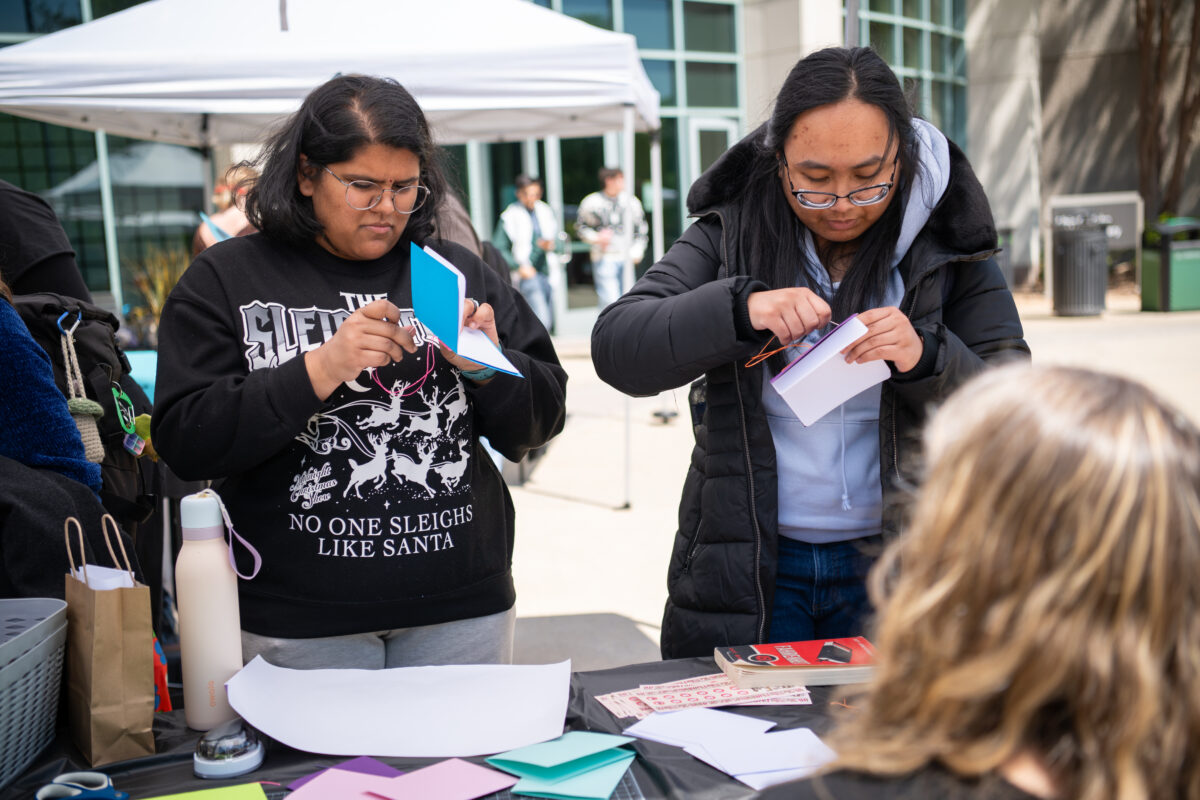
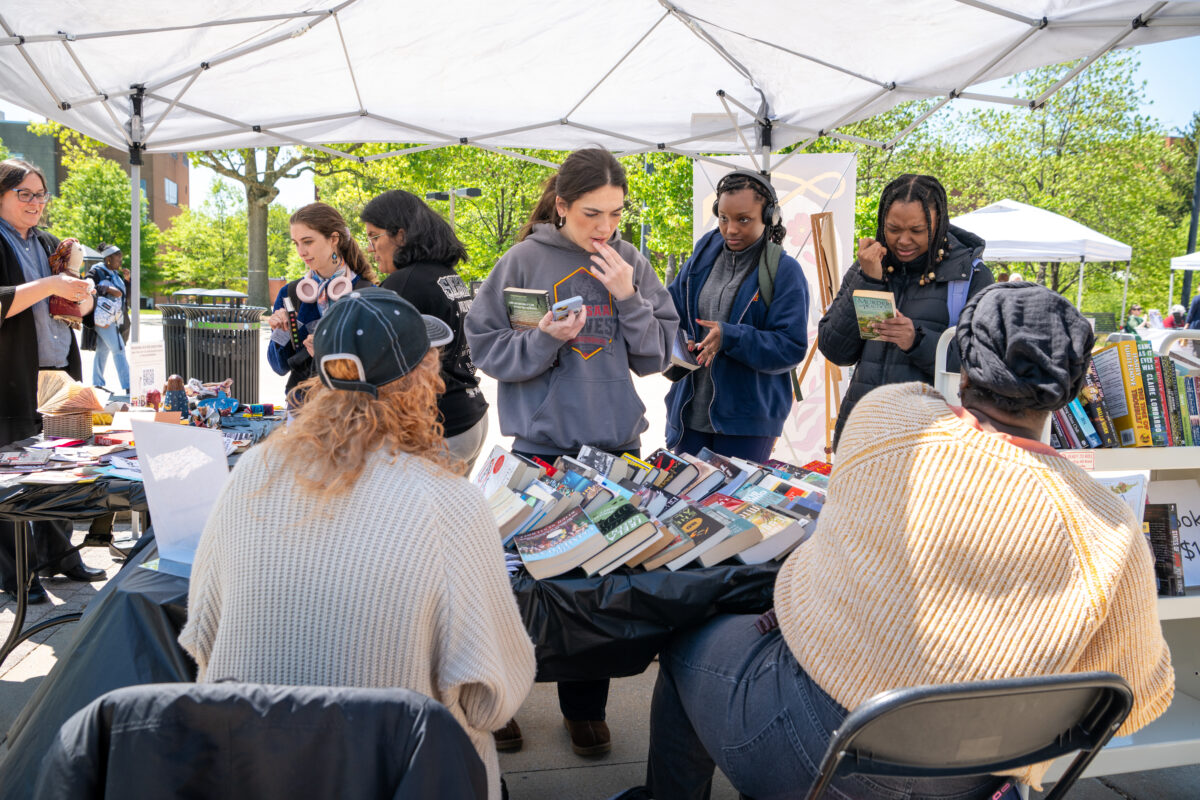 Left: Students got to stitch together their own books at BookFest. Right: So many books, so little time!
Miller then brought John Owen into the mix. Owen is the librarian for the Maryland State Library of the Blind and Print Disabled (LBPD), and throughout BookFest, UMBC raised funds for a nonprofit that supports the LBPD in its mission to make reading and all library services accessible to Marylanders. In partnership with Maryland Humanities, BookFest also served as a collection point for the Maryland Commission on African American History and Culture’s annual book drive.
Stay tuned for the sequel
Craft and care were front and center throughout the festival. Graphic design senior Sonia Pivovarov brought the first iteration of BookFest to life with eye-catching print and digital advertising materials. The BookMarkIt purveyed BookFest-themed original creations and items from the Hilltop Print Shop, an instructional letterpress printing shop and mobile cart. Special Collections librarian Lindsey Loeper and DiCuirci built the shop with support from a Hrabowski Innovation Grant.
Hoping for a sequel to BookFest? The next iteration is already in the works, DiCuirci says, along with ideas for smaller pop-up events throughout the year to amplify the creative work of UMBC students.
By Kayla Logue ’27
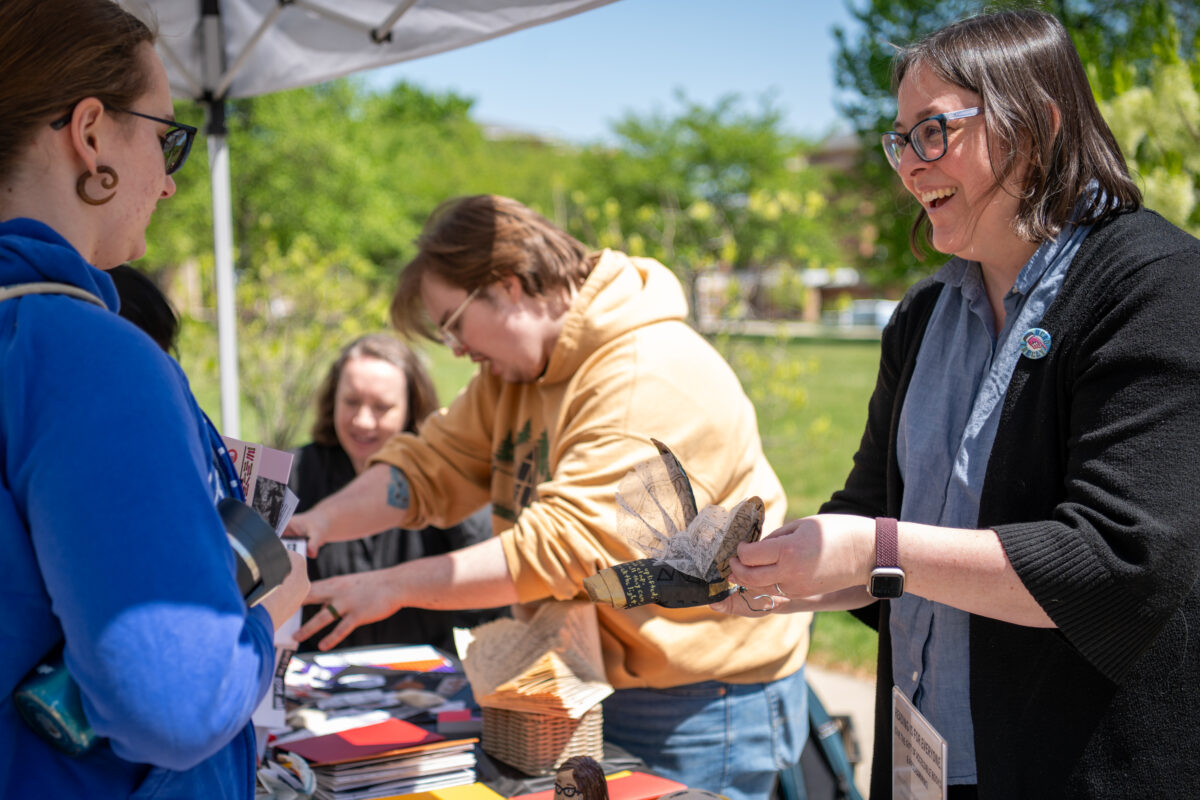 Jenny O’Grady, assistant vice president for communications, (right), shares her love of bookmaking with students at BookFest.
]]>
Appropriately, chapter one of UMBC’s inaugural BookFest began at AOK Library Plaza. Hundreds of students gathered at the BookMarkIt to try letterpress printing, stitch pamphlets, create and swap...
https://umbc.edu/stories/umbc-opens-a-new-chapter-with-inaugural-bookfest/
https://my3.my.umbc.edu/api/v0/pixel/news/160126/guest@my.umbc.edu/5241e563d54f59f869c22de29ea7284f/api/pixel
alumni
aok-library
cahss
campus-life
english
graphic-design
magazine
story
UMBC News & Magazine
https://my3.my.umbc.edu/groups/umbc-news-magazine
https://assets1-my.umbc.edu/system/shared/avatars/groups/000/001/943/24435aa6207c452e7bc15cc74b42c7bb/xsmall.png?1748556657
https://assets1-my.umbc.edu/system/shared/avatars/groups/000/001/943/24435aa6207c452e7bc15cc74b42c7bb/original.png?1748556657
https://assets2-my.umbc.edu/system/shared/avatars/groups/000/001/943/24435aa6207c452e7bc15cc74b42c7bb/xxlarge.png?1748556657
https://assets2-my.umbc.edu/system/shared/avatars/groups/000/001/943/24435aa6207c452e7bc15cc74b42c7bb/xlarge.png?1748556657
https://assets3-my.umbc.edu/system/shared/avatars/groups/000/001/943/24435aa6207c452e7bc15cc74b42c7bb/large.png?1748556657
https://assets1-my.umbc.edu/system/shared/avatars/groups/000/001/943/24435aa6207c452e7bc15cc74b42c7bb/medium.png?1748556657
https://assets2-my.umbc.edu/system/shared/avatars/groups/000/001/943/24435aa6207c452e7bc15cc74b42c7bb/small.png?1748556657
https://assets1-my.umbc.edu/system/shared/avatars/groups/000/001/943/24435aa6207c452e7bc15cc74b42c7bb/xsmall.png?1748556657
https://assets2-my.umbc.edu/system/shared/avatars/groups/000/001/943/24435aa6207c452e7bc15cc74b42c7bb/xxsmall.png?1748556657
UMBC News & Magazine
0
0
false
Fri, 15 May 2026 14:10:47 -0400
Fri, 15 May 2026 14:10:47 -0400
A place where kindness grows
Jenny O’Grady, assistant vice president for communications, (right), shares her love of bookmaking with students at BookFest.
]]>
Appropriately, chapter one of UMBC’s inaugural BookFest began at AOK Library Plaza. Hundreds of students gathered at the BookMarkIt to try letterpress printing, stitch pamphlets, create and swap...
https://umbc.edu/stories/umbc-opens-a-new-chapter-with-inaugural-bookfest/
https://my3.my.umbc.edu/api/v0/pixel/news/160126/guest@my.umbc.edu/5241e563d54f59f869c22de29ea7284f/api/pixel
alumni
aok-library
cahss
campus-life
english
graphic-design
magazine
story
UMBC News & Magazine
https://my3.my.umbc.edu/groups/umbc-news-magazine
https://assets1-my.umbc.edu/system/shared/avatars/groups/000/001/943/24435aa6207c452e7bc15cc74b42c7bb/xsmall.png?1748556657
https://assets1-my.umbc.edu/system/shared/avatars/groups/000/001/943/24435aa6207c452e7bc15cc74b42c7bb/original.png?1748556657
https://assets2-my.umbc.edu/system/shared/avatars/groups/000/001/943/24435aa6207c452e7bc15cc74b42c7bb/xxlarge.png?1748556657
https://assets2-my.umbc.edu/system/shared/avatars/groups/000/001/943/24435aa6207c452e7bc15cc74b42c7bb/xlarge.png?1748556657
https://assets3-my.umbc.edu/system/shared/avatars/groups/000/001/943/24435aa6207c452e7bc15cc74b42c7bb/large.png?1748556657
https://assets1-my.umbc.edu/system/shared/avatars/groups/000/001/943/24435aa6207c452e7bc15cc74b42c7bb/medium.png?1748556657
https://assets2-my.umbc.edu/system/shared/avatars/groups/000/001/943/24435aa6207c452e7bc15cc74b42c7bb/small.png?1748556657
https://assets1-my.umbc.edu/system/shared/avatars/groups/000/001/943/24435aa6207c452e7bc15cc74b42c7bb/xsmall.png?1748556657
https://assets2-my.umbc.edu/system/shared/avatars/groups/000/001/943/24435aa6207c452e7bc15cc74b42c7bb/xxsmall.png?1748556657
UMBC News & Magazine
0
0
false
Fri, 15 May 2026 14:10:47 -0400
Fri, 15 May 2026 14:10:47 -0400
A place where kindness grows
Ten minutes south of True Grits, food is also being prepared for the local community. It’s 8:30 on a Wednesday morning in the parking lot of Arbutus United Methodist Church. To the right of the church building is the Southwest Emergency Services (SWES) office, where the clanking of canned goods on metal shelves and the rustling of brown paper bags echo in the back warehouse. Legacy volunteers, a UMBC Shriver Peaceworker Fellow, and Shriver Center undergraduate student volunteers quickly stock shelves and prepare to fill grocery bags with donated goods for families in the surrounding 21227 or 21229 zip codes in need of food assistance.
Rosmery De Jesus Dinzey Santana, a senior psychology student, pops out of the dried goods room to check the first order. She writes the number three on a sticky note and sticks it to a grocery cart that gets passed around from volunteer to volunteer, until it gets all the way to the back to Joan Birmingham. She is clad in a long-sleeved flannel, baseball cap, and plastic gloves to keep somewhat warm as she moves in and out of freezers—one for chicken, one for beef, one for pastries. Birmingham, a volunteer of 20+ years, quickly spins the cart back around, pushing it down the long hallway, the wobbly wheel hitting the metal, making a ding sound like it’s announcing it’s ready to check out.
While UMBC and SWES have been in close proximity for decades, it’s relatively new that an intentional cohort of Retrievers regularly volunteers there. This shift was led by a UMBC Peaceworker Fellow, Megan Hamilton, who began working with SWES for 20 hours a week in fall 2025. The Peaceworker Fellows Program, based in UMBC’s Shriver Center, offers a master’s degree in social change leadership for returning Peace Corps Volunteers. Fellows are required to complete 20 hours a week of service with community partner non-profits, government agencies, or campus-based service-learning for the entirety of the program, says Charlotte Keniston, Ph.D. ’24, language, literacy, and culture, an alum and current director of the program. “We now have weekly undergraduate volunteers working with the legacy volunteers, UMBC staff supporting grant writing, and a team of graduate students creating a data management system for them,” Keniston says.
A call to serve
For Hamilton, the experience has been deeply fulfilling. “Community service is one of the happiest things I can do with my life,” she says. “I think in this particular time, people have lost track of the joy of service a little bit.” The Retrievers at SWES are working to bring that back.
Back at SWES on Wednesday morning, it’s getting close to 9:00 a.m., and a stream of cars fills the parking lot. Hamilton greets each client with a genuine ear-to-ear smile as they walk in the door. When Hamilton sees Birmingham, she grabs the cart, calls on the family of three, and helps them get the cart out of the narrow doorway into the parking lot. Diane Moberg, a church volunteer and SWES board member, steps into the dried goods room to help unfold grocery bags while she waits for the next financial services client to arrive.
Hamilton has a booming, happy voice and laugh. She has deep roots in Baltimore’s grassroots organizing and co-founded the Creative Alliance in 1994, a performance and art community space in the city. Her big heart has also taken her around the world in the service of others, including her Peace Corps service in Albania.
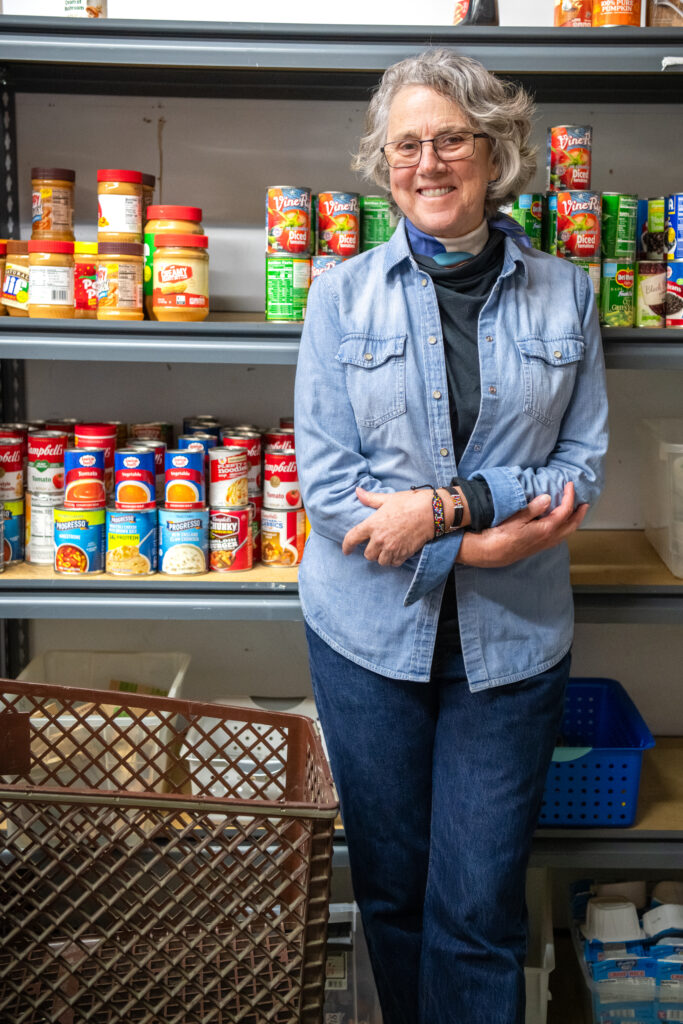 Megan Hamilton at SWES. (Brad Ziegler/UMBC)
Hamilton was beaming this morning because the Maryland Foodbank, which donates food to SWES, had just conducted a site visit and was impressed with how SWES is committed to shifting to a choice food pantry—a labor of love for Hamilton. Choice food pantries function similarly to a grocery store, where clients select the food they take, increasing agency and reducing waste.
“The loving energy catalyzed when the students meet, learn from, work with, and teach their elders is awe-inspiring,” says Hamilton. “It has meant worlds to the elders and the students, and those friendships are laying the groundwork for SWES’ long-term sustainability.
In the future, SWES is also looking to evolve its financial assistance program, where families receive partial funding to prevent evictions, utility shut-offs, and prescription costs. SWES covers part of the bill, and the family covers the rest. SWES hopes to leverage the renewed partnership with UMBC’s Peaceworkers and Shriver Center volunteers to develop a financial literacy skills program to help families become economically stable and prosperous, and pass those skills to future generations.
Powered by volunteers inspired by the community
Hamilton says part of what’s making the relationship between SWES and UMBC work so well is the physical proximity, as well as a shared commitment to service in the Baltimore area.
Dinzey Santana, the only Spanish-speaking volunteer, provides language support for Spanish-speaking families, helping to translate their needs to the rest of the team. She is quiet but fierce in her service, consistent, a master of organization, and overall just awesome, Birmingham says.
“I went to high school in Silver Springs with a lot of Latinos. Coming to UMBC, I learned so much about what is possible, and yet there is still so much that I have to learn. I want to go back and work with other Latinos to show them that it’s possible to go to college and give to your community at the same time,” says Dinzey Santana, almost at a whisper, smiling, and gliding between carts, bags, and shelves without stopping or looking—muscle memory. While she started UMBC on a pre-med track, after taking some psychology and social work classes, she was drawn to community-engaged work. Birmingham, Moberg, and Hamilton can feel her resolve. “I want students not to get frustrated if their path is unclear. Sometimes, the best path for you is not the one you set your heart on. There isn’t one path, and there is help. Everyone deserves help.”
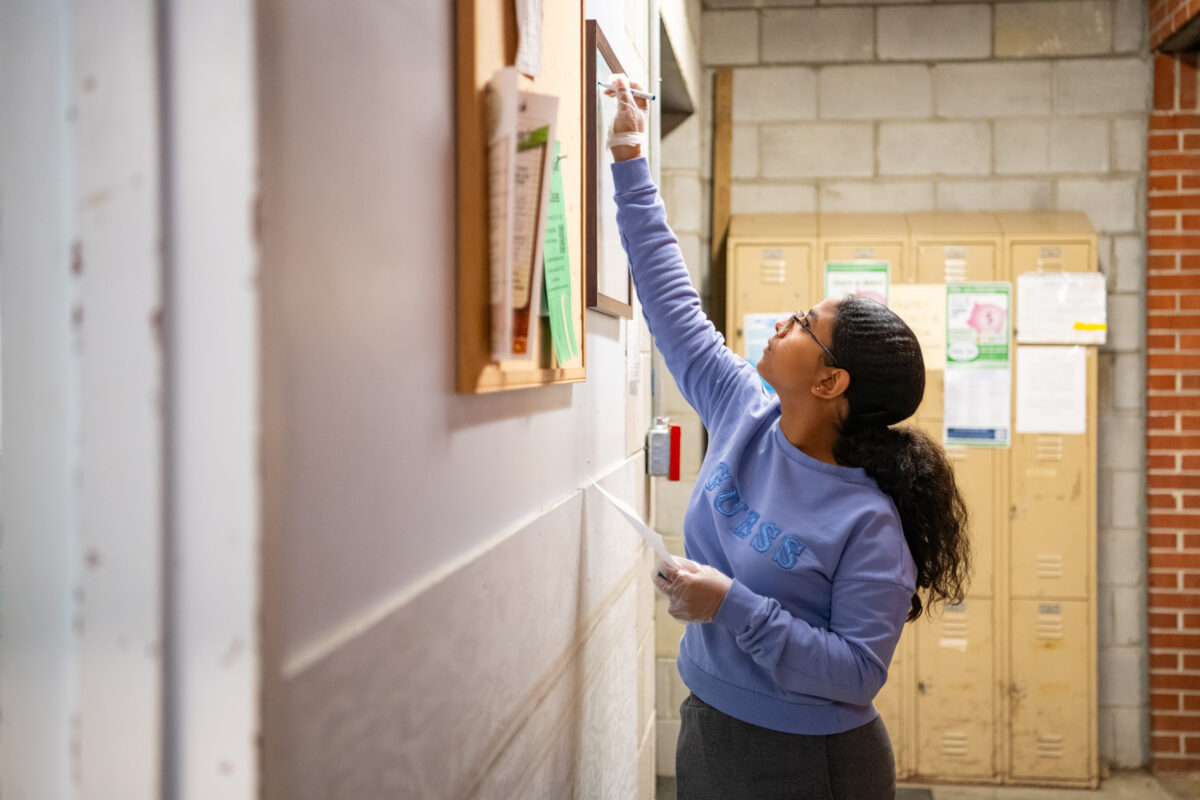 Rosemery De Jesus Dinzey Santana writes the names of the families picking up groceries. (Brad Ziegler/UMBC)
Working on a prayer
The UMBC volunteers serve alongside legacy volunteers from the community and surrounding areas who have, in some cases, been volunteering for decades. Star legacy volunteer Naomi Morris is ninety-two and has volunteered at SWES for thirty-years. Birmingham says that although SWES has seen its share of challenges, she is continually touched by the people she meets and the way they make it work.
Before becoming part of the SWES volunteer team, Birmingham worked in warehouses for 36 years, stocking and organizing shelves. “I wasn’t quite sure what I wanted to do after I retired,” she says. “I found out that [SWES] needed help through my church. I thought I would give it a try.” She started hanging clothes for their clothing donation shop for a day or two. “But I saw everything that SWES was doing, and it was unbelievable. It touched my heart. The people I have met here are just unbelievable.”
Moberg, who is a certified public accountant, joined the board and became a volunteer to support the financial assistance program. “I recognize things are really hard. Let’s face it, expenses have gone up exponentially. Gas, everything. Low to mid-range wages are not keeping pace. So, it’s really disheartening, which is why the finance mission is an extremely important one for me. “
Sometimes, when the pantry and the financial assistance dwindle, and there doesn’t seem to be an answer to how SWES will serve its community, Birmingham throws out a request to the heavens. “I learned it from my friend who volunteers with me. She just calls it out, ‘We need more of whatever it is,’ and sure enough, the next day someone walks in with what we need. Last week it was pasta, this year it was volunteers—both came in abundance, and Megan, Rosmery, and all the UMBC volunteers are now helping us legacy volunteers to keep it all going.”
Read more Alumni Magazine stories.
]]>
Ten minutes south of True Grits, food is also being prepared for the local community. It’s 8:30 on a Wednesday morning in the parking lot of Arbutus United Methodist Church. To the right of the...
https://umbc.edu/stories/swes-a-place-where-kindness-grows/
https://my3.my.umbc.edu/api/v0/pixel/news/160119/guest@my.umbc.edu/35a17967e12b096f5351768b98a06639/api/pixel
cahss
impact
magazine
psychology
shrivercenter
spring-2026
story
UMBC News & Magazine
https://my3.my.umbc.edu/groups/umbc-news-magazine
https://assets1-my.umbc.edu/system/shared/avatars/groups/000/001/943/24435aa6207c452e7bc15cc74b42c7bb/xsmall.png?1748556657
https://assets1-my.umbc.edu/system/shared/avatars/groups/000/001/943/24435aa6207c452e7bc15cc74b42c7bb/original.png?1748556657
https://assets2-my.umbc.edu/system/shared/avatars/groups/000/001/943/24435aa6207c452e7bc15cc74b42c7bb/xxlarge.png?1748556657
https://assets2-my.umbc.edu/system/shared/avatars/groups/000/001/943/24435aa6207c452e7bc15cc74b42c7bb/xlarge.png?1748556657
https://assets3-my.umbc.edu/system/shared/avatars/groups/000/001/943/24435aa6207c452e7bc15cc74b42c7bb/large.png?1748556657
https://assets1-my.umbc.edu/system/shared/avatars/groups/000/001/943/24435aa6207c452e7bc15cc74b42c7bb/medium.png?1748556657
https://assets2-my.umbc.edu/system/shared/avatars/groups/000/001/943/24435aa6207c452e7bc15cc74b42c7bb/small.png?1748556657
https://assets1-my.umbc.edu/system/shared/avatars/groups/000/001/943/24435aa6207c452e7bc15cc74b42c7bb/xsmall.png?1748556657
https://assets2-my.umbc.edu/system/shared/avatars/groups/000/001/943/24435aa6207c452e7bc15cc74b42c7bb/xxsmall.png?1748556657
UMBC News & Magazine
2
0
false
Fri, 15 May 2026 12:41:26 -0400
Fri, 15 May 2026 12:41:26 -0400
Restorative practices at UMBC guide students to thrive through accountability
At UMBC, restorative practices have grown from a promising idea into a campus-wide movement—one shaped by dedicated staff and reaching far beyond the university itself.
For Jeff Cullen, UMBC’s director of Student Conduct and Community Standards, this work has been years in the making. Now in his 18th year at the university, Cullen has helped guide the evolution of student conduct from a traditional, punitive model toward something more meaningful: a restorative approach that centers accountability, healing, and community.
“Each student I encounter is unique,” Cullen explains. “I enjoy working with them in a restorative way—offering high levels of support while also demanding high levels of accountability.”
Building a proactive framework
UMBC formally began integrating restorative practices in 2015, after adopting training models inspired by the International Institute for Restorative Practices. What started as an alternative way to resolve disputes has since expanded into a proactive framework for building relationships and fostering authentic communication across campus.
Instead of focusing solely on punishment, restorative practices ask deeper questions. Cullen describes a hypothetical situation: a student returns to their residence hall inebriated, damages a bulletin board, and creates a mess in a shared space. In a traditional system, the outcome might center on sanctions. But a restorative approach broadens the lens.
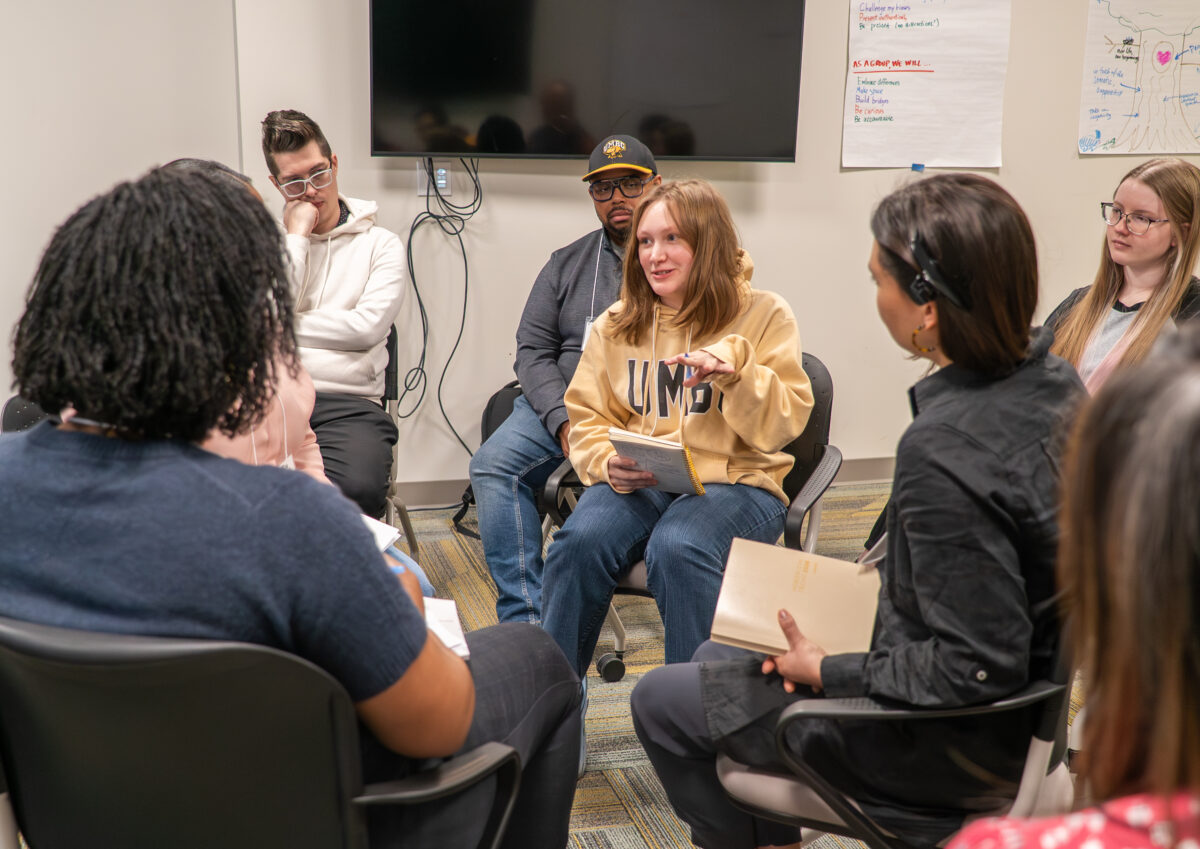 Samantha Kennedy ’25, social work, a graduate assistant for restorative practices in Student Conduct and Community Standards participates in a “fishbowl circle” which can be useful for idea generation and problem solving.
“It’s not just about the student,” Cullen says. “There are custodial staff, residential life staff, and other students who are impacted.”
Through restorative circles, those affected come together—the student, staff members, peers—and engage in guided dialogue. They reflect on what happened, who was harmed, and how to make things right. The result is not only accountability, but also understanding and, often, reintegration into the community.
While the process can feel challenging at first, Cullen notes that participants often leave with a sense of resolution and stronger conflict-resolution skills. Early data and broader research suggest that restorative approaches can reduce repeat offenses, increase satisfaction, and create healthier communities overall.
That impact is not limited to UMBC.
Restorative practices beyond the classroom
Toshiyasu Tsuruhara, an associate professor at Ritsumeikan Asia Pacific University in Japan, traveled across the globe to attend a 2-day restorative practices workshop at UMBC (combining his trip with another training in San Diego). With a background in conflict mediation—including accreditation as a community mediator in the U.K. and experience working with neighbor disputes and in family court—Tsuruhara was already familiar with restorative justice concepts.
But the workshop offered something new.
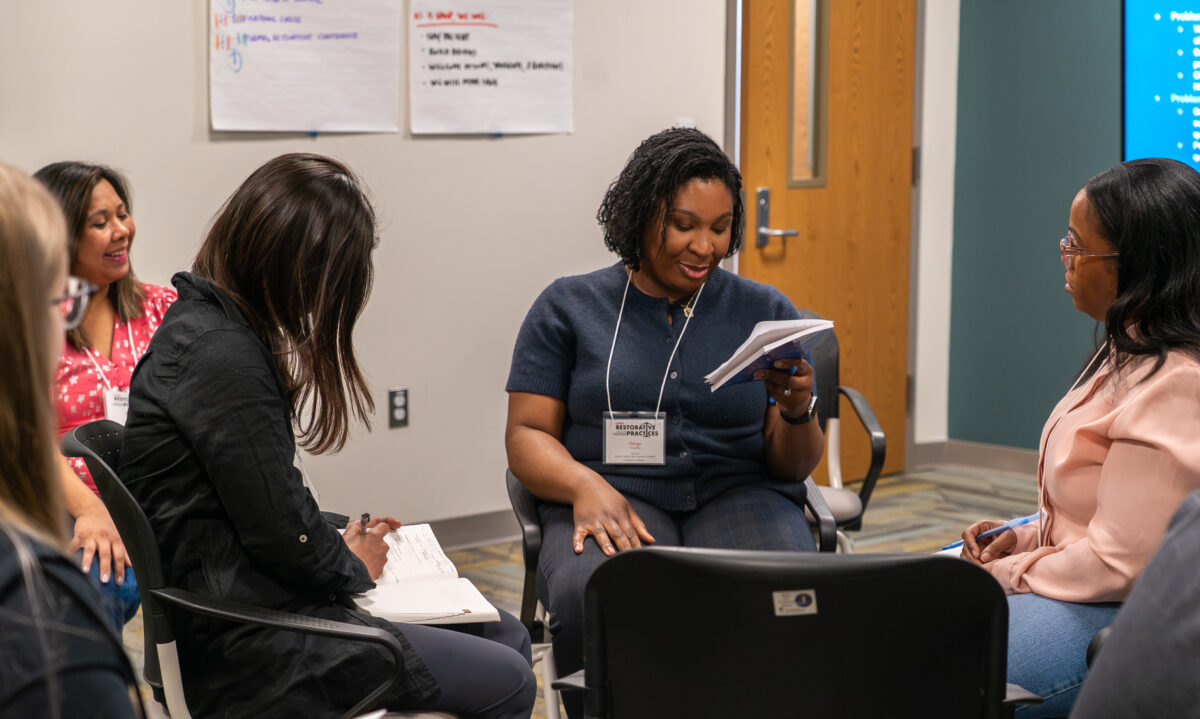
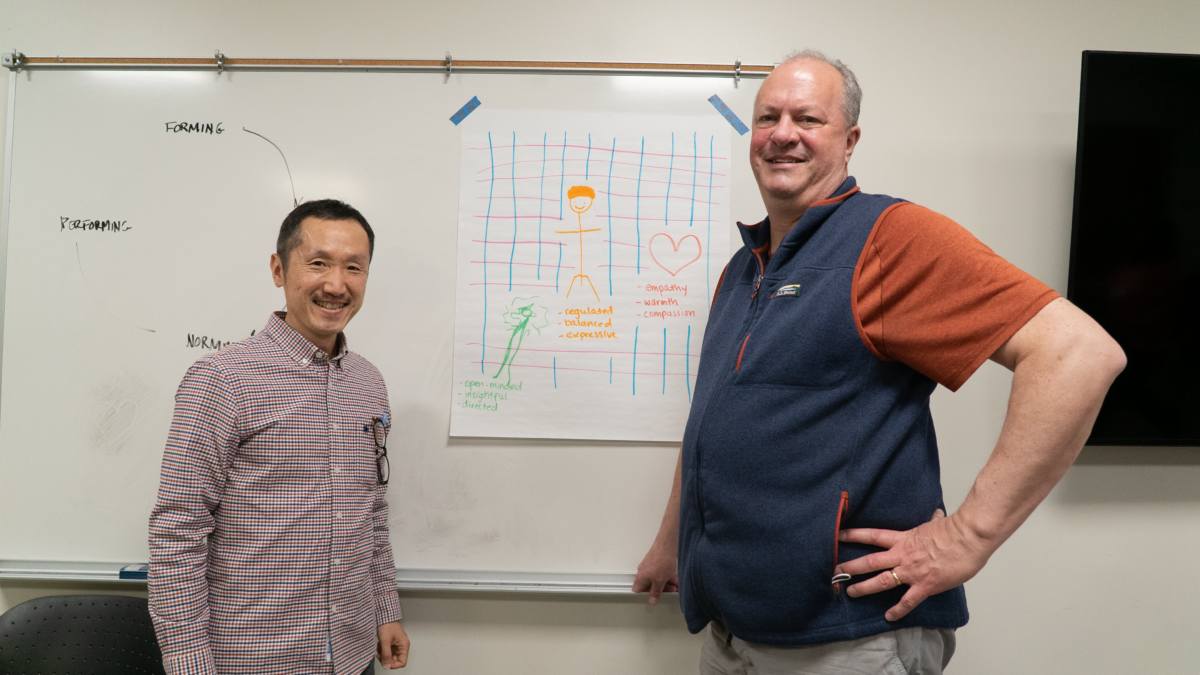 Left: More fishbowl circle work at the 2026 training. Right: Toshiyasu Tsuruhara and Jeff Cullen met during the 2-day training.
“I learned how these tools can be applied in real-life situations,” he explains. “I am interested in restorative practices because they offer tools to repair relationships and bring communities toward peace,” Tsuruhara says. “They are not just for education—they can be applied in work, family, and friendships.”
During his time at UMBC, Tsuruhara engaged closely with students and staff, participating in discussions, collaborative exercises, and even creative activities like short dramatic presentations to explore key concepts. What stood out most was not just the theory, but how actively it was practiced.
For Tsuruhara, the experience also highlighted the value of introducing restorative practices early in students’ lives. He observed how these approaches could help students navigate both academic and social challenges, while also preparing them for professional environments.
“They help maintain peaceful relationships with workmates,” he says. “And if conflict happens, they provide tools to resolve it.”
Inspired by what he learned, Tsuruhara plans to continue to integrate restorative practices into his own teaching. In his “Multicultural Cooperation Workshop,” students from diverse national and cultural backgrounds collaborate on long-term group projects—an environment where conflict can naturally arise. Rather than relying solely on mediation training, he sees restorative practices as a more holistic and educational approach.
One small effort turns into campus-wide movement
Back at UMBC, Cullen reflects on how far the initiative has come. What began over a decade ago as a small effort has grown into a campus-wide movement, with hundreds of students, faculty, and staff trained in restorative methods.
“At UMBC, if you have a good idea, you’re encouraged to implement it,” Cullen says. “We had no idea it would grow like this—but here we are.”
Supported by colleagues in Residential Life and Student Affairs leadership, and shaped through years of collaboration, restorative practices at UMBC continue to evolve—impacting not only the campus community, but also educators and practitioners around the world.
Click here for more resources on restorative practices at UMBC
]]>
At UMBC, restorative practices have grown from a promising idea into a campus-wide movement—one shaped by dedicated staff and reaching far beyond the university itself. For Jeff Cullen,...
https://umbc.edu/stories/restorative-practices-at-umbc-guide-students-to-thrive-through-accountability/
https://my3.my.umbc.edu/api/v0/pixel/news/158721/guest@my.umbc.edu/ed3c5f2fe0eaa7047f980c27a677b65b/api/pixel
campus-life
magazine
story
studentaffairs
UMBC News & Magazine
https://my3.my.umbc.edu/groups/umbc-news-magazine
https://assets1-my.umbc.edu/system/shared/avatars/groups/000/001/943/24435aa6207c452e7bc15cc74b42c7bb/xsmall.png?1748556657
https://assets1-my.umbc.edu/system/shared/avatars/groups/000/001/943/24435aa6207c452e7bc15cc74b42c7bb/original.png?1748556657
https://assets2-my.umbc.edu/system/shared/avatars/groups/000/001/943/24435aa6207c452e7bc15cc74b42c7bb/xxlarge.png?1748556657
https://assets2-my.umbc.edu/system/shared/avatars/groups/000/001/943/24435aa6207c452e7bc15cc74b42c7bb/xlarge.png?1748556657
https://assets3-my.umbc.edu/system/shared/avatars/groups/000/001/943/24435aa6207c452e7bc15cc74b42c7bb/large.png?1748556657
https://assets1-my.umbc.edu/system/shared/avatars/groups/000/001/943/24435aa6207c452e7bc15cc74b42c7bb/medium.png?1748556657
https://assets2-my.umbc.edu/system/shared/avatars/groups/000/001/943/24435aa6207c452e7bc15cc74b42c7bb/small.png?1748556657
https://assets1-my.umbc.edu/system/shared/avatars/groups/000/001/943/24435aa6207c452e7bc15cc74b42c7bb/xsmall.png?1748556657
https://assets2-my.umbc.edu/system/shared/avatars/groups/000/001/943/24435aa6207c452e7bc15cc74b42c7bb/xxsmall.png?1748556657
UMBC News & Magazine
0
0
false
Tue, 14 Apr 2026 12:59:01 -0400
Tue, 14 Apr 2026 12:59:01 -0400

