UMBC Center for Precision Aquaculture launches to boost sustainable U.S. fish farming
UMBC has secured $1.5 million in congressional funding to establish the UMBC Center for Precision Aquaculture, an interdisciplinary effort aimed at revolutionizing land-based fish production through real-time monitoring and smart technology.
The new center brings together faculty and students from UMBC’s marine biotechnology, chemistry and biochemistry, and computer science and electrical engineering (CSEE) departments. The interdisciplinary team will strive to make domestic aquaculture more efficient, healthier for fish, and environmentally responsible—while helping reduce America’s massive seafood trade deficit.
“Fish are the last ‘hunt-and-gather’ animal crop,” says Yonathan Zohar, professor and chair of marine biotechnology and the new center’s lead. “To relieve pressure on our oceans, fish—like other animal proteins—must be produced through farming or aquaculture.”
Bringing a “blue revolution”
The U.S. imports over 90 percent of its seafood and nearly all its Atlantic salmon, contributing to American seafood imports exceeding exports by roughly $20 billion, the largest deficit across all agricultural crops. And aquaculture is the fastest-growing sector of global and U.S. agriculture, yet the U.S. ranks only 18th in production.
 Researchers Keiko Saito (left) and Yonathan Zohar (right) discuss the remediation of liquid waste, which is carried out by bacteria in tanks like this one. (Brad Ziegler/UMBC)
To address these challenges, Zohar and his team at the Aquaculture Research Center (ARC) at the Institute of Marine and Environmental Technology in Baltimore’s Inner Harbor have long pioneered recirculating aquaculture systems (RAS)—self-contained, land-based tanks that recycle nearly all their water and discharge nothing into the environment. Compared to the floating, open-ocean pens currently used to farm fish, other perks of land-based operations include preventing commingling of captive fish with wild stocks, limiting disease exposure, the ability to bring fish to market size more quickly and more often throughout the year, and reduced transportation costs and emissions associated with bringing fresh seafood to inland areas. The ARC even converts solid fish waste into biogas that could supply part of the facility’s energy needs.
The new Center for Precision Aquaculture will add a high-tech layer to this work. Advanced underwater imaging, optical sensors, and artificial intelligence will track fish biomass, behavior, body condition, stress signals, and early disease indicators in real time. Producers can then intervene quickly and optimize tank conditions for better growth, health, and welfare.
Zohar, whose decades of work in sustainable aquaculture recently earned him the Distinguished Lifetime Achievement Award from the United States Aquaculture Society, said the project “will contribute to the U.S. and global ‘blue revolution’ by helping develop the next generation of highly efficient and environmentally responsible aquaculture technologies.”
Connecting disciplines, pursuing impact
The center’s strength lies in its cross-department collaboration. Brian Cullum, professor and chair of chemistry and biochemistry and co-investigator on the grant, brings long-standing expertise in multispectral imaging (MSI). His group will use MSI to detect subtle color changes in the visible, infrared, and UV light spectra that are invisible to standard cameras and signal early disease or unwanted sexual maturation, both of which can hurt profitability.

 Emmanuella Duruye, a UMBC chemistry Ph.D. student in Brian Cullum’s lab, is taking the lead on the multispectral imaging aspect of the project. (Brad Ziegler/UMBC)
“In high-density RAS tanks, disease can spread rapidly, so early detection is critical,” Cullum says. “This project combines multispectral imaging with AI to identify stressed or maturing fish early, allowing growers to remove them from the tank.”
“With global demand for protein rising, improving aquaculture systems means contributing to a more stable and responsible food supply,” says Emmanuella Duruye, a Ph.D. candidate in Cullum’s lab. “I am excited about the multidisciplinary aspect, and being part of a team whose goal is to improve systems that make real-world and long-term impacts.” She is focused on improving non-invasive monitoring of hidden stress signals via multispectral imaging.
Rebecca Williams, assistant professor of CSEE, is a co-investigator on the project, as is Don Engel, associate professor of CSEE. Beamlak Bekele, a master’s student in Williams’s group, is developing computer vision tools tailored to underwater environments. “I am excited about this project because it connects computer science with aquaculture, allowing me to apply computer vision to a real-world problem,” Bekele said. “As the project progresses, it can contribute methods that improve the application of underwater vision data to other scenarios as well.”
 Beamlak Bekele (left), Rebecca Williams (center), and Don Engel (right) are developing software to analyze heatmap images of the fish tanks, as pictured on the screen. (Brad Ziegler/UMBC)
Ph.D. students Sean Ravel and Max Prager; postdoctoral fellow Matthew Stromberg, Ph.D. ’26, environmental engineering; and John Stubblefield, ARC laboratory director, are all working with Zohar at IMET. Undergraduates are contributing, too: Krish Bakshi, a junior biochemistry and molecular biology major, and Mason Chialastri, junior biological sciences major, are currently doing research internships with the Zohar lab.
“Early maturation is one of the biggest challenges in salmon aquaculture, and I’m excited to be part of the cutting-edge research to better understand and manage it,” Ravel shares. “We are building tools that let us understand fish in ways that are only possible because we combine biology, engineering, and AI into a single, integrated system.”

 Juniors Krish Bakshi (left) and Mason Chialastri (right) have contributed to the precision aquaculture project as interns in the Zohar lab. (Brad Ziegler/UMBC)
Piloting the future of aquaculture
The new funding will support a pilot RAS system that integrates the new precision technologies. ARC will serve as a demonstration site for industry, hands-on student training, and public outreach. It builds directly on UMBC’s existing strengths, including ongoing USDA- and NOAA-funded salmon research and a popular Sustainable Aquaculture course. The center will also help train the next generation of skilled workers through internships and research opportunities for high school, undergraduate, and graduate students.
By combining UMBC’s deep foundation in RAS technology with state-of-the-art imaging and AI, the Center for Precision Aquaculture positions Maryland as an emerging hub for innovative, sustainable seafood production—reducing reliance on imports, easing pressure on wild fisheries, and delivering healthy food to American tables.
]]>
UMBC has secured $1.5 million in congressional funding to establish the UMBC Center for Precision Aquaculture, an interdisciplinary effort aimed at revolutionizing land-based fish production...
https://umbc.edu/stories/center-for-precision-aquaculture/
https://my3.my.umbc.edu/api/v0/pixel/news/159531/guest@my.umbc.edu/f7ab4a9b5d54e1fee92a2c9f1311367d/api/pixel
chemistry-and-biochemistry
cnms
coeit
csee
graduate-research
marinebiotech
news
research
science-and-tech
story
UMBC News & Magazine
https://my3.my.umbc.edu/groups/umbc-news-magazine
https://assets1-my.umbc.edu/system/shared/avatars/groups/000/001/943/24435aa6207c452e7bc15cc74b42c7bb/xsmall.png?1748556657
https://assets1-my.umbc.edu/system/shared/avatars/groups/000/001/943/24435aa6207c452e7bc15cc74b42c7bb/original.png?1748556657
https://assets2-my.umbc.edu/system/shared/avatars/groups/000/001/943/24435aa6207c452e7bc15cc74b42c7bb/xxlarge.png?1748556657
https://assets2-my.umbc.edu/system/shared/avatars/groups/000/001/943/24435aa6207c452e7bc15cc74b42c7bb/xlarge.png?1748556657
https://assets3-my.umbc.edu/system/shared/avatars/groups/000/001/943/24435aa6207c452e7bc15cc74b42c7bb/large.png?1748556657
https://assets1-my.umbc.edu/system/shared/avatars/groups/000/001/943/24435aa6207c452e7bc15cc74b42c7bb/medium.png?1748556657
https://assets2-my.umbc.edu/system/shared/avatars/groups/000/001/943/24435aa6207c452e7bc15cc74b42c7bb/small.png?1748556657
https://assets1-my.umbc.edu/system/shared/avatars/groups/000/001/943/24435aa6207c452e7bc15cc74b42c7bb/xsmall.png?1748556657
https://assets2-my.umbc.edu/system/shared/avatars/groups/000/001/943/24435aa6207c452e7bc15cc74b42c7bb/xxsmall.png?1748556657
UMBC News & Magazine
0
0
false
Thu, 30 Apr 2026 16:01:14 -0400
Thu, 30 Apr 2026 16:01:14 -0400
CNMS GradFest fosters research connections and builds community
On November 7, graduate students and postdoctoral researchers from the College of Natural and Mathematical Sciences (CNMS) gathered for the college’s second annual CNMS GradFest.
Prableen Chowdhary, Ph.D. ’24, biological sciences, currently a postdoc with Rachel Brewster, professor of biological sciences, and a member of the student-led planning committee, expressed hope that GradFest would “spark conversations and collaborations across disciplines.”
CNMS dean William LaCourse offered advice to attendees as the program kicked off. “Whatever you do in life, do it with all your heart. If you’re doing research, do it like you own it,” he said. “Live in the present and seize opportunities. Enjoy every moment, like this moment today. You can’t change yesterday; when I make mistakes, I’m grateful for grace and forgiveness. And you can plan for tomorrow, but you can’t control it.”
 Prableen Chowdhary (left) and Hasan Al Banna, CNMS GradFest’s two emcees, welcome attendees to the event. (Brad Ziegler/UMBC)
Following the introductions, seven students presented “lightning talks,” five-minute presentations describing their research in engaging, accessible terms for those outside their field. The talks featured students in biological sciences, physics, chemistry and biochemistry, marine biotechnology, and mathematics and statistics. They discussed topics like novel therapeutic targets for ovarian cancer, innovative two-dimensional materials for improved sensors, and previously unobserved plasma jets from black holes.
GradFest as a stepping stone
“Part of our goal was to intentionally include graduate students with less presentation experience or early-stage projects,” shared Maria Cambraia, director for research and international affairs in CNMS, and lead staff member on the planning committee. “GradFest gives them a chance to practice in a friendly environment.”
 Lightning talk presenters and CNMS GradFest planning committee members worked hard to make the event a success. Rear, left to right: Maria Cambraia, Lara Scott, Andrew Wolff, Sean Ravel, Peng Yan, Codi Hrynko, Jalil Ahmad. Front, left to right: Prableen Chowdhary, Lizbeth Joy Tan, Megha Pandya, Ronita Sequeira, Hasan Al Banna. Planning committee members not pictured: Ayo Ogunsanya, Elana Frazier, Jeanne Ngo. (Brad Ziegler/UMBC)
Following the talks, the ballroom buzzed during two poster sessions, where dozens more students discussed their projects with peers, mentors, and guests. GradFest encouraged presentations of research at all stages of development.
Muhammad Jalil Ahmad, president of the Mathematics and Statistics Graduate Student Association and a planning committee member, presented a lightning talk and poster on mathematical modeling for complex phenomena like weather or disease spread.
Ahmad, a fourth-year applied mathematics Ph.D. candidate mentored by Animikh Biswas and Kathleen Hoffman, professors of mathematics, agreed. “Presenting at GradFest is useful before heading to a bigger stage, like a national meeting,” he said. “Even at a math conference, people are studying different topics, so it’s good to practice communicating with people outside your field.” He added that GradFest offers the opportunity to network with researchers using similar methods for different applications.

 Muhammad Jalil Ahmad (left) and Lara Scott (right), Ph.D. students in mathematics, presented lightning talks at GradFest. (Brad Ziegler/UMBC)
Ian Kirn ’23, physics, a second-year physics Ph.D. student, presented a poster on astroseismology, which investigates earthquake-like phenomena on stars. Kirn chose to pursue his Ph.D. with Eileen Meyer, professor of physics, after doing undergraduate research with her. “It’s important for different disciplines to talk to each other, because they’re actually all related,” Kirn says. “This event encourages collaboration.”
Fidelia Asomani, a third-year biological sciences Ph.D. candidate working with Erin Green, associate professor of biological sciences, called GradFest “a good first opportunity to get my feet wet presenting.” Asomani studies yeast, which shares basic functions with complex organisms. “It’s important to invest in studying processes conserved across species,” she says, which can inform human disease treatment.

 Ian Kirn (left) discussed his astroseismology research, and Fidelia Asomani (right) explains her research on protein regulation in yeast, with GradFest attendees. (Brad Ziegler/UMBC)
The humble heart of a scientist
LaCourse also encouraged embracing humility. “By remembering you won’t always be the best, humility helps you celebrate others’ successes and accept failure—and research involves a lot of failure,” he said. “Humility is a path you walk, not a trait you innately possess, and it leads to learning, growth, and respect.”
By late afternoon, GradFest had turned strangers into collaborators, boosted first-time presenters’ confidence, and made the ballroom a launchpad for breakthroughs. Attendees left with new contacts and the dean’s words in their hearts—proof that bold discoveries can begin with a humble “hello.”
Learn more about graduate programs in CNMS.
]]>
On November 7, graduate students and postdoctoral researchers from the College of Natural and Mathematical Sciences (CNMS) gathered for the college’s second annual CNMS GradFest. Prableen...
https://umbc.edu/stories/cnms-gradfest-2025/
https://my3.my.umbc.edu/api/v0/pixel/news/154570/guest@my.umbc.edu/e98c847e7012a2b534bab5add27d1f0c/api/pixel
biology
chembiochem
cnms
community
gradresearch
graduateschool
marinebiotech
mathstat
news
physics
science-and-tech
story
UMBC News & Magazine
https://my3.my.umbc.edu/groups/umbc-news-magazine
https://assets1-my.umbc.edu/system/shared/avatars/groups/000/001/943/24435aa6207c452e7bc15cc74b42c7bb/xsmall.png?1748556657
https://assets1-my.umbc.edu/system/shared/avatars/groups/000/001/943/24435aa6207c452e7bc15cc74b42c7bb/original.png?1748556657
https://assets2-my.umbc.edu/system/shared/avatars/groups/000/001/943/24435aa6207c452e7bc15cc74b42c7bb/xxlarge.png?1748556657
https://assets2-my.umbc.edu/system/shared/avatars/groups/000/001/943/24435aa6207c452e7bc15cc74b42c7bb/xlarge.png?1748556657
https://assets3-my.umbc.edu/system/shared/avatars/groups/000/001/943/24435aa6207c452e7bc15cc74b42c7bb/large.png?1748556657
https://assets1-my.umbc.edu/system/shared/avatars/groups/000/001/943/24435aa6207c452e7bc15cc74b42c7bb/medium.png?1748556657
https://assets2-my.umbc.edu/system/shared/avatars/groups/000/001/943/24435aa6207c452e7bc15cc74b42c7bb/small.png?1748556657
https://assets1-my.umbc.edu/system/shared/avatars/groups/000/001/943/24435aa6207c452e7bc15cc74b42c7bb/xsmall.png?1748556657
https://assets2-my.umbc.edu/system/shared/avatars/groups/000/001/943/24435aa6207c452e7bc15cc74b42c7bb/xxsmall.png?1748556657
UMBC News & Magazine
2
0
false
Fri, 14 Nov 2025 15:37:10 -0500
Fri, 14 Nov 2025 15:37:10 -0500
ICARE Day celebrates 5 years of environmental research, community partnerships
Since fall 2021, UMBC’s Interdisciplinary Consortium for Applied Research in the Environment (ICARE) has supported master’s students pursuing environmental science research related to Baltimore and the surrounding area. Students in the program have studied everything from “forever chemical” contamination in local waterways to educational outreach using horseshoe crabs to stormwater management. Trainees have looked at urban bat populations, community members’ knowledge of zero-waste practices, and oyster aquaculture. Program alumni have accepted roles with the U.S. Forest Service, National Oceanic and Atmospheric Administration, The National Academies of Sciences, Baltimore Tree Trust, and more.
To increase the relevance and benefit of students’ projects, members of community partner organizations co-advise students on their research. Co-advisors have come from organizations like Baltimore Green Space, Maryland’s Department of Natural Resources, and the South Baltimore Community Land Trust. ICARE began with a handful of faculty members from all three colleges at UMBC who wanted to collaborate more closely. Over time, it grew into an NSF-funded training program that today includes more than 100 people and 36 organizations.
Earlier this month, the ICARE program celebrated its impact with “ICARE Day,” including a research poster session and luncheon with keynote address.
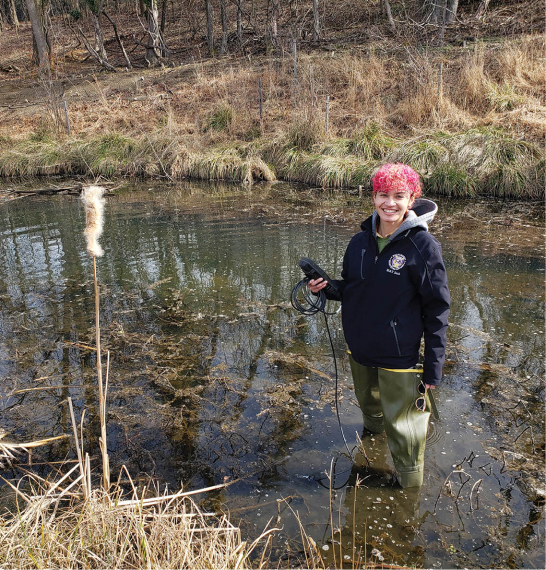

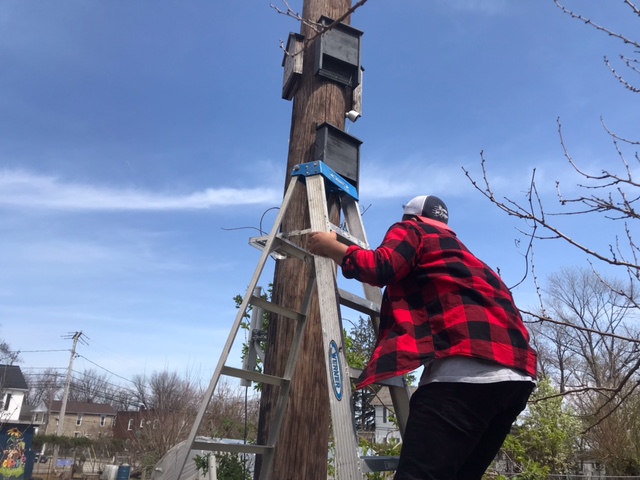 Left: Erin Hamner collected weekly water quality data from this stream for six months, using the battery-powered digital probe she’s holding. (Sarah L. Hansen, M.S. ’15/UMBC) Center: Natalia Figueredo, M.S. ’23, geography and environmental systems (second from left), interviewed local community members about their experiences with zero-waste practices. (Courtesy of Figueredo) Right: Chris Blume, M.S. ’23, geography and environmental systems, studied urban bat populations to investigate heavy metal pollution. (Courtesy of Blume)
“You’re combining the skills, knowledge, and perspectives you gained here in ICARE with your already strong commitment to environmental justice to make the world better for people and the ecosystems we live in,” said Tamra Mendelson, professor of biological sciences and ICARE program director, of program alumni, while members of the current cohort are “flexing those skills, nurturing your passions, and finding your way toward meaningful and consequential work in the environmental sector.”
Those opportunities are plentiful today, according to keynote speaker Fernando Miralles-Wilhelm, president of the University of Maryland Center for Environmental Science.
“What’s happening now is that individuals realize that every single thing we do—every single economic activity we engage in, from the food you eat, to the clothing you wear, to how we power our cities—everything hinges on the environment and natural resources,” he said. “It’s not just about having a nice landscape—the environment impacts economic bottom lines.”
Current trainees, set to graduate in the next few months, are pursuing a diverse set of projects. For example, Isabella Molatore has been studying the presence of invasive fish species in Baltimore Harbor through a combination of angler interviews and DNA testing of harbor water samples. Donovin Smith is exploring novel methods to detect heavy metals in the air and using the data to measure how proximity to railways, incinerators, and other factors affects air pollution. And Will Kaselow has compared the roles and effects of different entities that influence environmental education, such as nonprofits, various levels of government, and local institutions like schools and community centers.
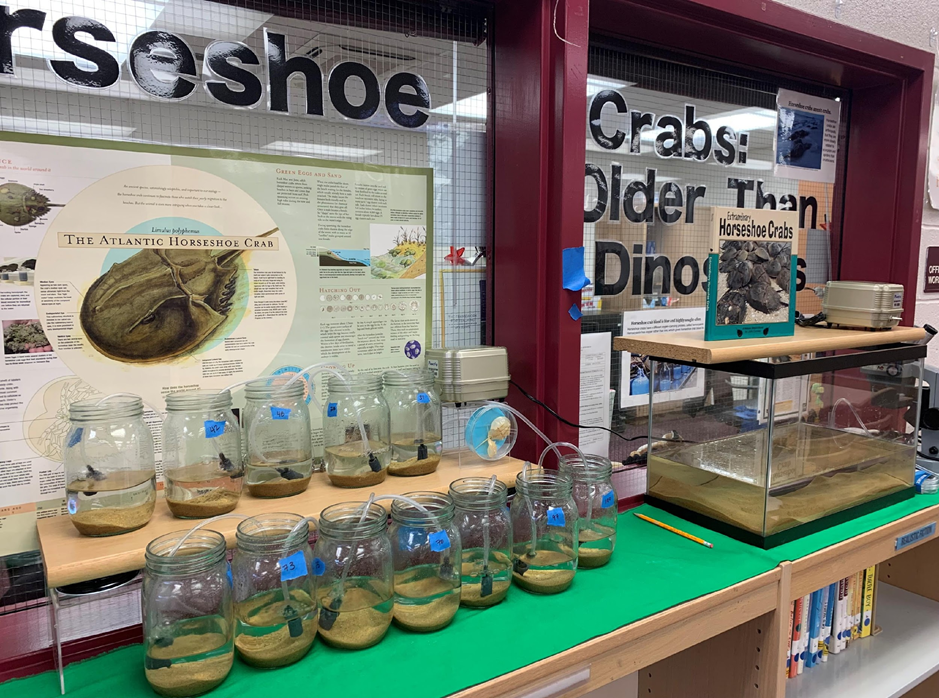
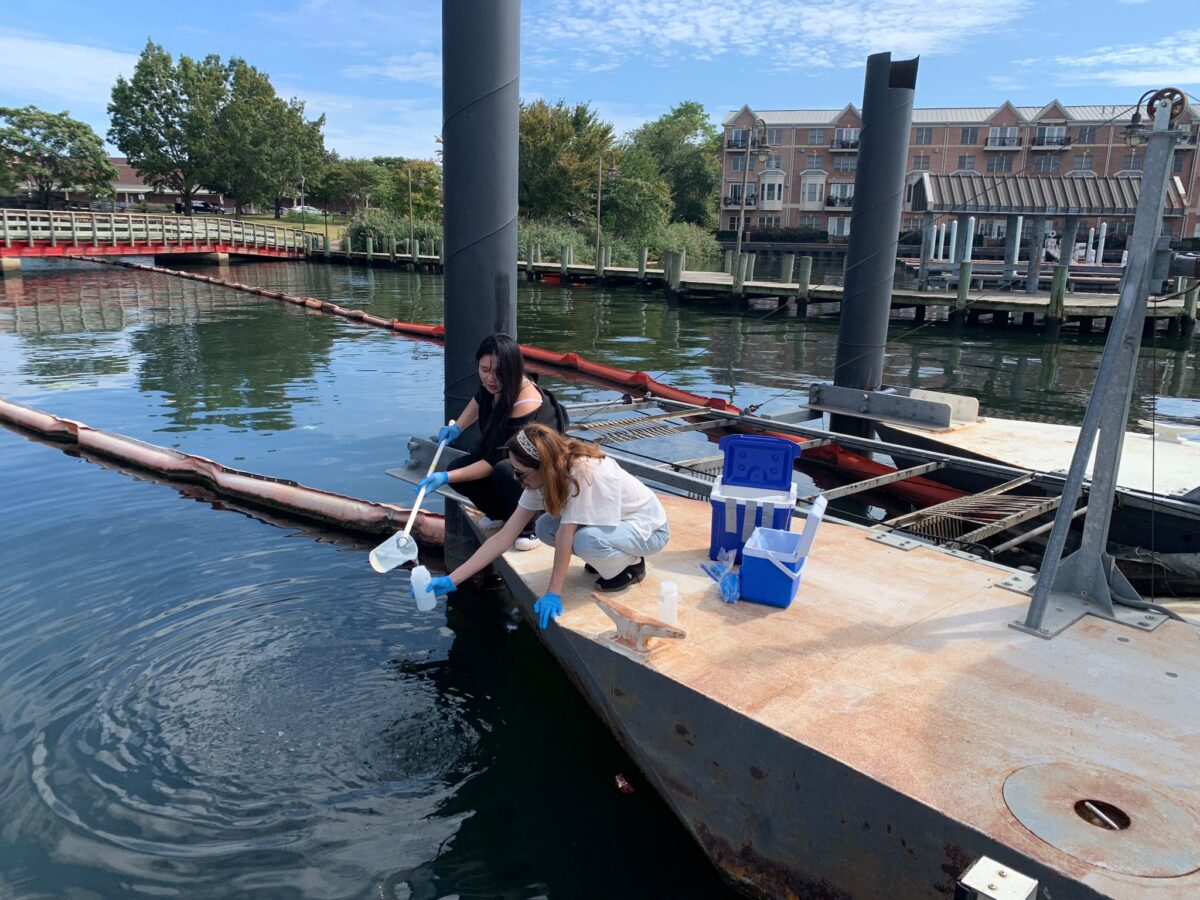 Left: Kids at Glenwood Middle School in Howard County raised horseshoe crabs hand-delivered by Jessica Baniak during the 2023 – 2024 school year. (Courtesy of Baniak) Right: Margaret Siao (left) and Donya Hamidi collect water samples from around Baltimore Harbor, part of the initial stages of a project to measure PFAS in the local waterways. (Image courtesy of Siao)
Despite undeniable environmental challenges, Miralles-Wilhelm ended the event on a hopeful note.
“If you look at the news, you get bombarded by so much negative stuff. You may end up believing that the world is becoming a worse place. However, I counter that by saying that since World War II, every single human development indicator and every single environmental and development indicator around the world has gotten better,” Miralles-Wilhelm said. “We’ve spent quite a bit of effort—scientists, policymakers, and investors—to try to make a better world, and it is working. It may not be working at the pace that you want it to work, it may not be improving everywhere at the same time, but it’s also undeniable that we have gotten better.”
ICARE trainees and alumni, armed with skills from technical laboratory techniques to community organizing, are now poised to contribute to and accelerate that positive trend.
]]>
Since fall 2021, UMBC’s Interdisciplinary Consortium for Applied Research in the Environment (ICARE) has supported master’s students pursuing environmental science research related to Baltimore...
https://umbc.edu/stories/icare-day-2025/
https://my3.my.umbc.edu/api/v0/pixel/news/150278/guest@my.umbc.edu/d6b440564a266f02aee293ec5319d6ce/api/pixel
baltimore-city
biological-sciences
biology
cahss
cnms
ges
icare
marinebiotech
news
policy-and-society
science-and-tech
story
UMBC News & Magazine
https://my3.my.umbc.edu/groups/umbc-news-magazine
https://assets1-my.umbc.edu/system/shared/avatars/groups/000/001/943/24435aa6207c452e7bc15cc74b42c7bb/xsmall.png?1748556657
https://assets1-my.umbc.edu/system/shared/avatars/groups/000/001/943/24435aa6207c452e7bc15cc74b42c7bb/original.png?1748556657
https://assets2-my.umbc.edu/system/shared/avatars/groups/000/001/943/24435aa6207c452e7bc15cc74b42c7bb/xxlarge.png?1748556657
https://assets2-my.umbc.edu/system/shared/avatars/groups/000/001/943/24435aa6207c452e7bc15cc74b42c7bb/xlarge.png?1748556657
https://assets3-my.umbc.edu/system/shared/avatars/groups/000/001/943/24435aa6207c452e7bc15cc74b42c7bb/large.png?1748556657
https://assets1-my.umbc.edu/system/shared/avatars/groups/000/001/943/24435aa6207c452e7bc15cc74b42c7bb/medium.png?1748556657
https://assets2-my.umbc.edu/system/shared/avatars/groups/000/001/943/24435aa6207c452e7bc15cc74b42c7bb/small.png?1748556657
https://assets1-my.umbc.edu/system/shared/avatars/groups/000/001/943/24435aa6207c452e7bc15cc74b42c7bb/xsmall.png?1748556657
https://assets2-my.umbc.edu/system/shared/avatars/groups/000/001/943/24435aa6207c452e7bc15cc74b42c7bb/xxsmall.png?1748556657
UMBC News & Magazine
0
0
false
Mon, 19 May 2025 12:13:28 -0400
Mon, 19 May 2025 12:13:28 -0400
Bio-inspired ‘batteries’ will use phytoplankton to power underwater sensors
A new $7.8 million award from the Defense Advanced Research Projects Agency (DARPA) will support the development of biologically-powered underwater sensors. Right now, a vast network of underwater sensing devices in oceans around the world conducts environmental monitoring and supports national security—and most of these devices rely on batteries and underwater cables for power.
“The motivation of the project is to eliminate the requirement for periodic battery replacement or recharging, which is expensive and logistically demanding,” says Kevin Sowers, professor of marine biotechnology and a co-PI on the award, which is led by Stephanie Lansing, a professor in the Department of Environmental Science and Technology at the University of Maryland, College Park. The project is supported by DARPA’s BioLogical Undersea Energy (BLUE) program and includes researchers from nine universities and companies.
A new fuel source for underwater sensors
The proposed devices, called the Persistent Oceanographic Device Power (PODPower) system, will autonomously draw phytoplankton from the surrounding water into a fermentation chamber. There, microorganisms will break down the phytoplankton into simpler chemical compounds. Finally, other microorganisms in a microbial fuel cell will use those compounds to generate electricity, Sowers explains. Sowers, a microbiologist, will work on engineering bacteria that can break down the phytoplankton into chemicals such as acetic acid that the microbes in the fuel cell can use.
Sowers will also lead efforts to develop a testing environment in the Aquaculture Research Center (ARC) at the Institute of Marine and Environmental Technology (IMET) in downtown Baltimore to evaluate components and a complete prototype of the new devices. The current award will support development of a functioning prototype, and there is the potential for $3.4 million more for testing in the open ocean.
“This unique collaboration of interdisciplinary experts will produce a bio-inspired system that has game-changing potential to provide direct electric power to improve sensing capabilities while protecting and limiting the impact to the environment through use of this unique bioenergy system,” Lansing said.
]]>
A new $7.8 million award from the Defense Advanced Research Projects Agency (DARPA) will support the development of biologically-powered underwater sensors. Right now, a vast network of underwater...
https://umbc.edu/quick-posts/bio-inspired-underwater-sensors/
https://my3.my.umbc.edu/api/v0/pixel/news/147517/guest@my.umbc.edu/78caaf78f68e3a8f70df4fcfaf7a6394/api/pixel
cnms
marinebiotech
news
quick-post
research
science-and-tech
UMBC News & Magazine
https://my3.my.umbc.edu/groups/umbc-news-magazine
https://assets1-my.umbc.edu/system/shared/avatars/groups/000/001/943/24435aa6207c452e7bc15cc74b42c7bb/xsmall.png?1748556657
https://assets1-my.umbc.edu/system/shared/avatars/groups/000/001/943/24435aa6207c452e7bc15cc74b42c7bb/original.png?1748556657
https://assets2-my.umbc.edu/system/shared/avatars/groups/000/001/943/24435aa6207c452e7bc15cc74b42c7bb/xxlarge.png?1748556657
https://assets2-my.umbc.edu/system/shared/avatars/groups/000/001/943/24435aa6207c452e7bc15cc74b42c7bb/xlarge.png?1748556657
https://assets3-my.umbc.edu/system/shared/avatars/groups/000/001/943/24435aa6207c452e7bc15cc74b42c7bb/large.png?1748556657
https://assets1-my.umbc.edu/system/shared/avatars/groups/000/001/943/24435aa6207c452e7bc15cc74b42c7bb/medium.png?1748556657
https://assets2-my.umbc.edu/system/shared/avatars/groups/000/001/943/24435aa6207c452e7bc15cc74b42c7bb/small.png?1748556657
https://assets1-my.umbc.edu/system/shared/avatars/groups/000/001/943/24435aa6207c452e7bc15cc74b42c7bb/xsmall.png?1748556657
https://assets2-my.umbc.edu/system/shared/avatars/groups/000/001/943/24435aa6207c452e7bc15cc74b42c7bb/xxsmall.png?1748556657
UMBC News & Magazine
2
0
false
Thu, 20 Feb 2025 12:38:03 -0500
Thu, 20 Feb 2025 12:38:03 -0500
Yonathan Zohar honored for lifetime of contributions to fish endocrinology research and advances in aquaculture

Yonathan Zohar, professor of marine biotechnology, has received the Lifetime Achievement Award from the International Society for Fish Endocrinology. Zohar’s work at the Institute of Marine and Environmental Technology in Baltimore’s Inner Harbor has produced fundamental discoveries in fish reproductive biology and applied the findings to the aquaculture industry, resulting in major advances. In 2020, the Binational Agricultural Research Development (BARD) Fund, a partnership program between the U.S. and Israel, also recognized Zohar for the outsize economic impact of his research.
In addition to Zohar’s core work in fish reproductive physiology, he has led a decades-long effort to develop land-based aquaculture methods that could bring fresh seafood to inland areas of the United States. Land-based fish production operations avoid pitfalls of open-water aquaculture such as disease, polluted water, and escapes. Land-based aquaculture could also limit the need for long-distance seafood transportation.
Maryland Farm and Harvest on Maryland Public Television (MPT) recently featured Zohar and his colleagues’ work. The aquaculture industry is the world’s fastest growing sector of agriculture, Zohar told MPT. American demand for seafood is rising, and currently, most of it is imported. With a $10 million grant from the USDA, Zohar has been working with team of scientists and government and industry stakeholders from the U.S. and abroad to help move land-based aquaculture toward commercial viability.
“We here at IMET, at the Aquaculture Research Center [ARC], are trying to address all these challenges, bottlenecks, hurdles to this industry so it can become economically feasible as well as—obviously as much as possible—environmentally responsible,” Zohar told MPT.
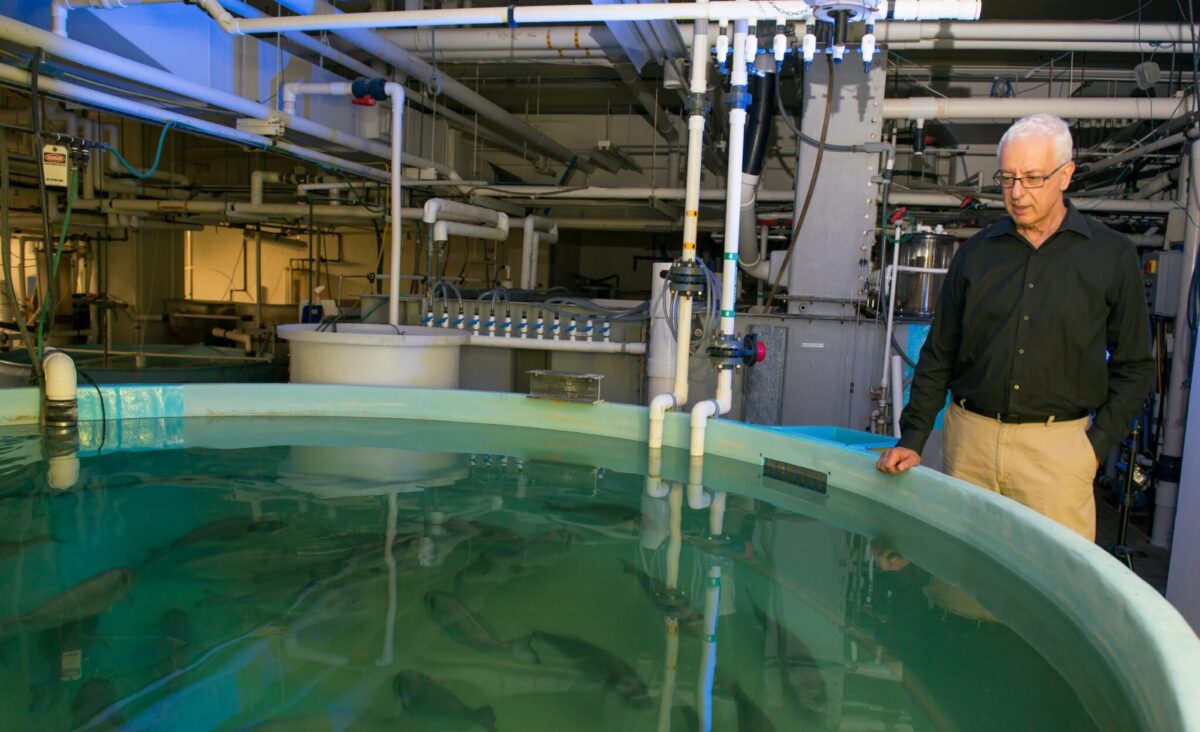 Yonathan Zohar stands next to a tank full of fish in the Aquaculture Research Center. (Marlayna Demond ’11/UMBC)
Addressing aquaculture’s hurdles
One of those hurdles is figuring out how to bring salmon to market size year round. Typically, salmon only reproduce once per year, Zohar explained. “We are using environmental manipulation to phase shift—to change the time of the spawning of the fish—so the farmer can get good quality eggs all year round,” he said. The team at the ARC has had success spawning salmon six months after their typical spawning time, Zohar told MPT, as a tray of red-orange salmon eggs spawned at IMET showed on the screen. And “if you can do it six months, you can do it four months, three months, all year round,” he said.
Another challenge to land-based systems is the accumulation of sludge—otherwise known as fish poop—in the tanks. Kevin Sowers, professor of marine biotechnology and a microbiology expert, explained that as the water in the fish tanks passes through a filter to be reused, bacterial colonies living on the surface of what look like pieces of wheel-shaped pasta break down the sludge. One of the products is methane gas.
“The goal here is to get rid of that waste, reduce it, and turn it into a product that can be used,” Sowers said. “And the product we produce, the biogas, will actually help power about 10 percent of the energy costs here in the facility.”
Still swimming along
All of these advances represent years or decades of effort by Zohar, Sowers, and additional colleagues to first understand the fundamentals of fish biology and reproduction, and then to find ways of tweaking it that serve the aquaculture industry and address the rising consumer demand for fish.
Zohar may have been doing this for a while, but with the industry on what feels like the cusp of a breakthrough, his continued enthusiasm for his work was obvious on Maryland Farm and Harvest.
“For someone who has been working on aquaculture for over 40 years, well, I have a lot of energy still to make sure that we make this happen,” Zohar told MPT—“that we stop overfishing our oceans and we satisfy the increasing demand of seafood in the United States and in the world.”
]]>
Yonathan Zohar, professor of marine biotechnology, has received the Lifetime Achievement Award from the International Society for Fish Endocrinology. Zohar’s work at the Institute of Marine and...
https://umbc.edu/stories/zohar-lifetime-achievement-aquaculture/
https://my3.my.umbc.edu/api/v0/pixel/news/145907/guest@my.umbc.edu/d0a06ae5010b6b1b2a53149708cde7ba/api/pixel
cnms
marinebiotech
news
research
science-and-tech
story
UMBC News & Magazine
https://my3.my.umbc.edu/groups/umbc-news-magazine
https://assets1-my.umbc.edu/system/shared/avatars/groups/000/001/943/24435aa6207c452e7bc15cc74b42c7bb/xsmall.png?1748556657
https://assets1-my.umbc.edu/system/shared/avatars/groups/000/001/943/24435aa6207c452e7bc15cc74b42c7bb/original.png?1748556657
https://assets2-my.umbc.edu/system/shared/avatars/groups/000/001/943/24435aa6207c452e7bc15cc74b42c7bb/xxlarge.png?1748556657
https://assets2-my.umbc.edu/system/shared/avatars/groups/000/001/943/24435aa6207c452e7bc15cc74b42c7bb/xlarge.png?1748556657
https://assets3-my.umbc.edu/system/shared/avatars/groups/000/001/943/24435aa6207c452e7bc15cc74b42c7bb/large.png?1748556657
https://assets1-my.umbc.edu/system/shared/avatars/groups/000/001/943/24435aa6207c452e7bc15cc74b42c7bb/medium.png?1748556657
https://assets2-my.umbc.edu/system/shared/avatars/groups/000/001/943/24435aa6207c452e7bc15cc74b42c7bb/small.png?1748556657
https://assets1-my.umbc.edu/system/shared/avatars/groups/000/001/943/24435aa6207c452e7bc15cc74b42c7bb/xsmall.png?1748556657
https://assets2-my.umbc.edu/system/shared/avatars/groups/000/001/943/24435aa6207c452e7bc15cc74b42c7bb/xxsmall.png?1748556657
UMBC News & Magazine
0
0
false
Mon, 25 Nov 2024 16:35:06 -0500
Mon, 25 Nov 2024 16:35:06 -0500
CNMS Awards and Recognition Day honors students, faculty, and staff
The College of Natural and Mathematical Sciences (CNMS) held its annual CNMS Awards and Recognition Day on May 10. Nearly 270 UMBC community members and friends attended the event in the University Center Ballroom. The department chairs presented 45 awards established by donors in support of students, faculty, and staff, such as the Carl S. Weber Award for Excellence in Teaching, awarded this year to Tamra Mendelson, professor of biological sciences.
“I would like to thank the members of the UMBC community—alumni, parents, faculty, staff, and friends—who have made possible many of the awards we are presenting here today. These are not just names on a page—they are stories of gratitude and giving, honoring loved ones and families,” shared William R. LaCourse, CNMS dean. “You are fueling the academic success of our students, helping us recruit and retain top-notch faculty, ensuring support for programs and people across the university, and inspiring others to give. On behalf of UMBC, thank you!”
The recognition day also honored eight CNMS faculty at all levels with Faculty Excellence Awards for research and teaching designated by the college, awarded college-level Staff Excellence Awards for outstanding service, and distributed departmental awards for undergraduate and graduate students recognizing academic excellence, research, and teaching.
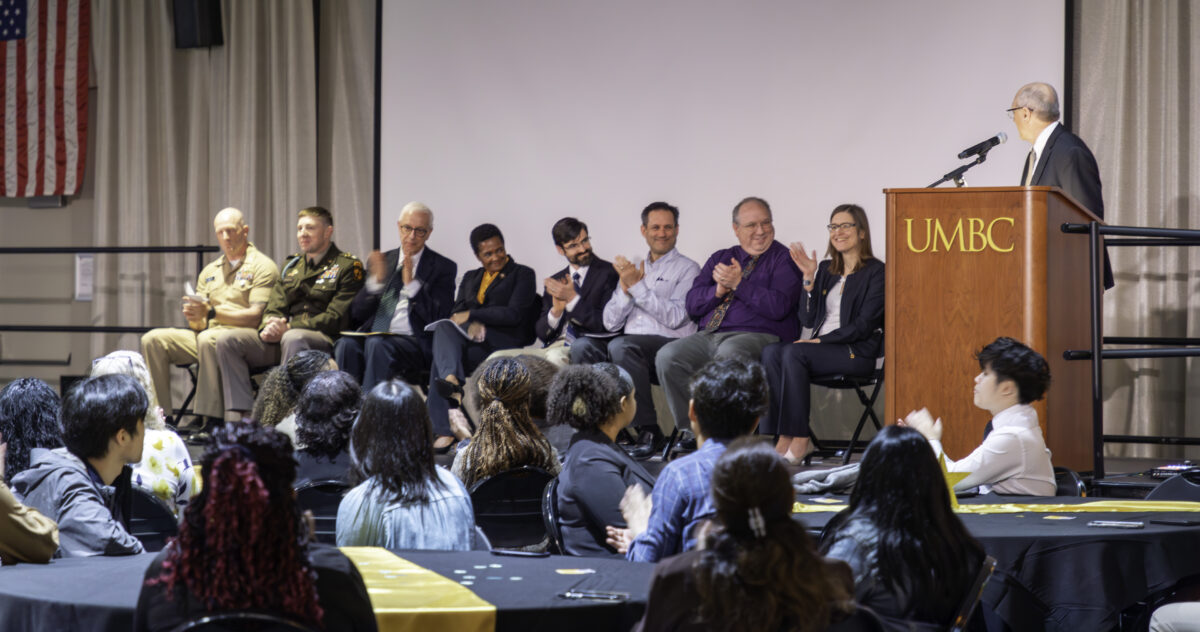 Dean LaCourse, at the podium, introduced the awards ceremony, and individual chairs or their designees presented the awards to members of their departments. From left to right: Commander Christopher Boehm, naval science; Captain John Howrey, naval science; Yonathan Zohar, professor and chair, marine biotechnology; Annica Wayman ’99, mechanical engineering, associate dean for Shady Grove affairs; Jason Kestner, associate professor and associate chair, physics; Bradford Peercy, professor, mathematics; Brian Cullum, professor and chair, chemistry and biochemistry; Michelle Starz-Gaiano, professor and chair, biological sciences. (Melissa Penley Cormier, M.F.A. ’17/UMBC)
CNMS also celebrated students who had been inducted into national honor societies, including Sigma Pi Sigma, the physics and astronomy honor society; Pi Mu Epsilon, the national mathematics honor society; Mu Sigma Rho, the national statistics honorary society; and the Phi Beta Kappa Society, which recognizes overall academic excellence.
LaCourse closed the ceremony by recognizing students in scholars programs within the college. The CNMS Scholars program supports students interested in the advancement of women in STEM fields where they are still underrepresented, and the Beckman Scholars program, funded by the Arnold and Mabel Beckman Foundation, supports students desiring to pursue doctoral study in the biological and chemical sciences.
“Students who have been recognized at this ceremony have met UMBC’s academic requirements and have excelled at high levels in their academics and/or service to their departments, college, and university,” LaCourse shared. “These honorees are poised to become scientists, physicians, mathematicians, teachers, and leaders in their chosen fields. These students are our leaders of the future, and we are fortunate to have the opportunity to help provide the critical foundations for their promising futures.”
The full event program, including additional remarks from Dean LaCourse and a complete list of awardees and award descriptions, is available here.
]]>
The College of Natural and Mathematical Sciences (CNMS) held its annual CNMS Awards and Recognition Day on May 10. Nearly 270 UMBC community members and friends attended the event in the...
https://umbc.edu/quick-posts/cnms-awards-and-recognition-day/
https://my3.my.umbc.edu/api/v0/pixel/news/142067/guest@my.umbc.edu/d470f1cd3c570305367c88562363b92a/api/pixel
biology
chembiochem
cnms
community
marinebiotech
mathstat
naval-science
news
physics
quick-post
science-and-tech
UMBC News & Magazine
https://my3.my.umbc.edu/groups/umbc-news-magazine
https://assets1-my.umbc.edu/system/shared/avatars/groups/000/001/943/24435aa6207c452e7bc15cc74b42c7bb/xsmall.png?1748556657
https://assets1-my.umbc.edu/system/shared/avatars/groups/000/001/943/24435aa6207c452e7bc15cc74b42c7bb/original.png?1748556657
https://assets2-my.umbc.edu/system/shared/avatars/groups/000/001/943/24435aa6207c452e7bc15cc74b42c7bb/xxlarge.png?1748556657
https://assets2-my.umbc.edu/system/shared/avatars/groups/000/001/943/24435aa6207c452e7bc15cc74b42c7bb/xlarge.png?1748556657
https://assets3-my.umbc.edu/system/shared/avatars/groups/000/001/943/24435aa6207c452e7bc15cc74b42c7bb/large.png?1748556657
https://assets1-my.umbc.edu/system/shared/avatars/groups/000/001/943/24435aa6207c452e7bc15cc74b42c7bb/medium.png?1748556657
https://assets2-my.umbc.edu/system/shared/avatars/groups/000/001/943/24435aa6207c452e7bc15cc74b42c7bb/small.png?1748556657
https://assets1-my.umbc.edu/system/shared/avatars/groups/000/001/943/24435aa6207c452e7bc15cc74b42c7bb/xsmall.png?1748556657
https://assets2-my.umbc.edu/system/shared/avatars/groups/000/001/943/24435aa6207c452e7bc15cc74b42c7bb/xxsmall.png?1748556657
UMBC News & Magazine
0
0
false
Fri, 17 May 2024 15:55:57 -0400
Fri, 17 May 2024 15:55:57 -0400
Ph.D. student Jonas Miller receives USM Student Excellence Scholarship

Jonas Miller, Ph.D. candidate in the marine, estuarine, and environmental science graduate program, has received the 2024 University System of Maryland Board of Regents Student Excellence Scholarship for Academics, Scholarship, and Research. Only four graduate students across the system receive Student Excellence Scholarships—one each in four categories.
Miller has been conducting research under the mentorship of Yonathan Zohar, professor of marine biotechnology at UMBC, at the Institute of Marine and Environmental Technology (IMET) since January 2022. Miller’s work is central to enhancing sustainable land-based aquaculture of Atlantic salmon, an area in which Zohar is a world leader. Specifically, Miller is searching for genetic biomarkers in female salmon that predict the timing of spawning and the quality of the spawned eggs.
The end goal is to promote a consistent supply of domestic salmon for consumers by generating populations of fish that spawn at staggered times throughout the year, triggered by different light and temperature conditions in land-based facilities.
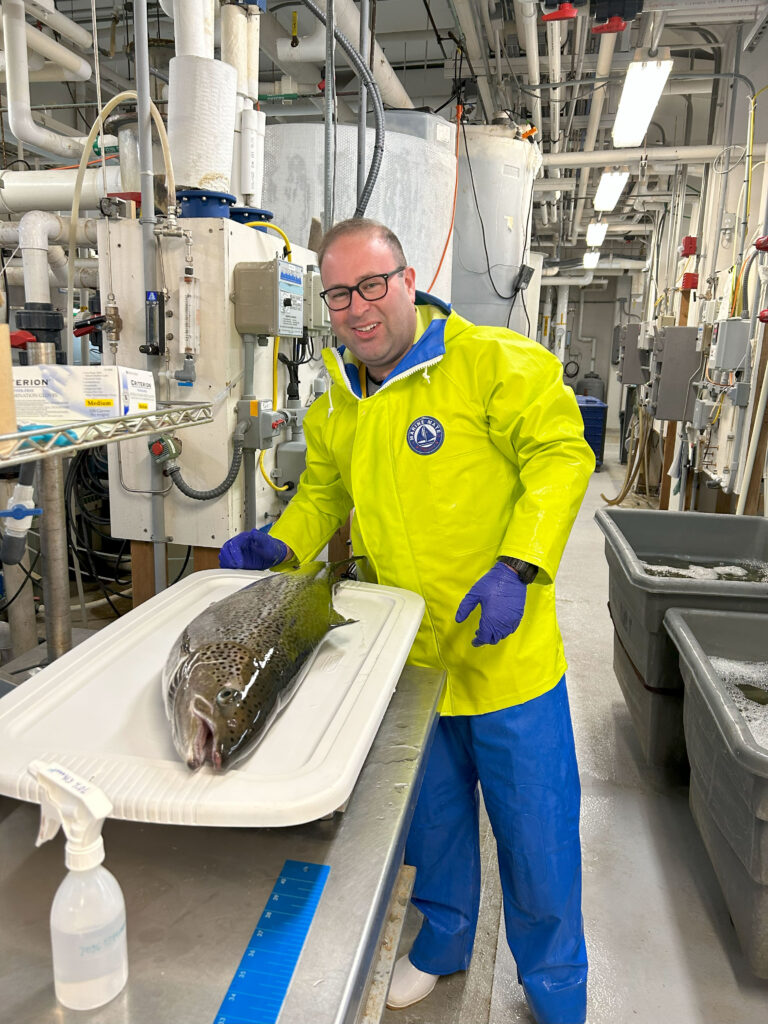
“Receiving the Board of Regents scholarship has provided me with the motivation to propel my research to the next level on my quest to find new predictive biomarkers pertaining to Atlantic salmon reproductive endocrinology,” Miller says.
“Jonas is a talented student able to formulate hypotheses and test them, methodically designing and carrying out experiments using the most advanced methods of genomics and endocrinology,” Zohar wrote in his letter recommending Miller for the scholarship. “His multi-year studies have already generated innovative findings, and his ongoing work will undoubtedly result in much more data and lead to scientific advances and, potentially, economic development opportunities.”
Left: Jonas Miller stands with a fish raised in the Aquaculture Research Center, the main laboratory for aquaculture research at IMET. (Courtesy of Miller)
Ongoing ripples of impact
 Jonas Miller mentors numerous students who participate in marine research. (Courtesy of Miller)
Miller’s contributions have gone far beyond the impact of his research. He served as IMET’s Graduate Student Association president for the 2022 – 2023 academic year, teaches weekly English classes to Chinese graduate students at IMET, and has mentored three high school students volunteering in Zohar’s research group. Miller also authored an 80-page white paper for the National Oceanic and Atmospheric Administration on the potential for tuna aquaculture in the United States.
“His understanding of the aquaculture field and the relevant literature, as well as his personal experience working on bluefin tuna in Japan, is of great benefit to his colleagues,” Zohar adds. Those colleagues include not only researchers at IMET, but also collaborators at the U.S. Department of Agriculture, University of Maine, University of Wisconsin-Stevens Point, and University of Maryland, College Park. Researchers at these institutions and others are involved in various projects led by Zohar, including a $10 million effort funded by the USDA to address specific challenges in the aquaculture industry.
When the personal propels the professional
Miller expressed gratitude to Zohar for the opportunity to work with him, and to his collaborators, “who have all made my experience as a Ph.D. student both fruitful and exciting.”
Miller’s accomplishments have not come without adversity, however. “I’d like to dedicate this scholarship to my best friend David Pardo Hernandez, and to my mom, Sheila Mann Miller, both of whom tragically and unexpectedly passed away during my first year as a Ph.D. student at UMBC in 2022,” Miller shares. “Finally, thanks to my dad for encouraging me to study fish biology and for constantly motivating me to study harder.”
“I am grateful to all of my friends at IMET who have given me support,” Miller adds. “I wish my mom and best friend were here to experience this. They would both be really proud of this accomplishment. They motivated me to work hard and I hope that I made them proud.”
]]>
Jonas Miller, Ph.D. candidate in the marine, estuarine, and environmental science graduate program, has received the 2024 University System of Maryland Board of Regents Student Excellence...
https://umbc.edu/stories/usm-student-excellence-scholarship/
https://my3.my.umbc.edu/api/v0/pixel/news/141569/guest@my.umbc.edu/63a92fbea63289d6b42bf400c89f832d/api/pixel
cnms
community
gradresearch
marinebiotech
news
rca-1
research
science-and-tech
story
UMBC News & Magazine
https://my3.my.umbc.edu/groups/umbc-news-magazine
https://assets1-my.umbc.edu/system/shared/avatars/groups/000/001/943/24435aa6207c452e7bc15cc74b42c7bb/xsmall.png?1748556657
https://assets1-my.umbc.edu/system/shared/avatars/groups/000/001/943/24435aa6207c452e7bc15cc74b42c7bb/original.png?1748556657
https://assets2-my.umbc.edu/system/shared/avatars/groups/000/001/943/24435aa6207c452e7bc15cc74b42c7bb/xxlarge.png?1748556657
https://assets2-my.umbc.edu/system/shared/avatars/groups/000/001/943/24435aa6207c452e7bc15cc74b42c7bb/xlarge.png?1748556657
https://assets3-my.umbc.edu/system/shared/avatars/groups/000/001/943/24435aa6207c452e7bc15cc74b42c7bb/large.png?1748556657
https://assets1-my.umbc.edu/system/shared/avatars/groups/000/001/943/24435aa6207c452e7bc15cc74b42c7bb/medium.png?1748556657
https://assets2-my.umbc.edu/system/shared/avatars/groups/000/001/943/24435aa6207c452e7bc15cc74b42c7bb/small.png?1748556657
https://assets1-my.umbc.edu/system/shared/avatars/groups/000/001/943/24435aa6207c452e7bc15cc74b42c7bb/xsmall.png?1748556657
https://assets2-my.umbc.edu/system/shared/avatars/groups/000/001/943/24435aa6207c452e7bc15cc74b42c7bb/xxsmall.png?1748556657
UMBC News & Magazine
2
0
false
Wed, 01 May 2024 09:51:29 -0400
Wed, 01 May 2024 09:51:29 -0400
UMBC-led Aquaculture Research Center donates thousands of pounds of seafood to local food pantries
The Aquaculture Research Center (ARC) at the Institute of Marine and Environmental Technology (IMET), led by Yonathan Zohar, professor of marine biotechnology, has been focused for years on advancing sustainable methods of growing fish on land to meet the growing global demand for seafood. In addition to helping develop new, environmentally responsible ways of producing nutritious food for the long term, the ARC is helping to meet immediate needs in the local community.
Today, the center donated 1,200 pounds of Atlantic salmon to DC Central Kitchen, a food pantry in Southwest Washington, D.C., after donating 1,400 pounds in November 2023. ProFish, located in Washington, DC, processed the salmon for the donations.
The ARC’s seafood donation program launched in 2017, when the Feeding Individuals to Support Health (FISH) initiative was formed in partnership with several local businesses and non-profit organizations. The first major donation distributed thousands of pounds of European sea bass (also known as bronzino) grown in the ARC’s marine tanks to communities in need in the Baltimore area.
“The U.S. is the largest importer of seafood in the world. Currently the oceans are overfished, and IMET is working on innovative aquaculture platforms that will reduce U.S. and global dependence on wild fisheries stocks,” Zohar says. “Through these donations, we can also provide a small level of societal benefit right away and close to home.”
Learn more about groundbreaking work at the Aquaculture Research Center here.
]]>
The Aquaculture Research Center (ARC) at the Institute of Marine and Environmental Technology (IMET), led by Yonathan Zohar, professor of marine biotechnology, has been focused for years on...
https://umbc.edu/quick-posts/arc-donates-seafood-to-food-pantries/
https://my3.my.umbc.edu/api/v0/pixel/news/139223/guest@my.umbc.edu/d13abf131268680fb743db1c7b7503b3/api/pixel
cnms
community
marinebiotech
news
quick-post
science-and-tech
UMBC News & Magazine
https://my3.my.umbc.edu/groups/umbc-news-magazine
https://assets1-my.umbc.edu/system/shared/avatars/groups/000/001/943/24435aa6207c452e7bc15cc74b42c7bb/xsmall.png?1748556657
https://assets1-my.umbc.edu/system/shared/avatars/groups/000/001/943/24435aa6207c452e7bc15cc74b42c7bb/original.png?1748556657
https://assets2-my.umbc.edu/system/shared/avatars/groups/000/001/943/24435aa6207c452e7bc15cc74b42c7bb/xxlarge.png?1748556657
https://assets2-my.umbc.edu/system/shared/avatars/groups/000/001/943/24435aa6207c452e7bc15cc74b42c7bb/xlarge.png?1748556657
https://assets3-my.umbc.edu/system/shared/avatars/groups/000/001/943/24435aa6207c452e7bc15cc74b42c7bb/large.png?1748556657
https://assets1-my.umbc.edu/system/shared/avatars/groups/000/001/943/24435aa6207c452e7bc15cc74b42c7bb/medium.png?1748556657
https://assets2-my.umbc.edu/system/shared/avatars/groups/000/001/943/24435aa6207c452e7bc15cc74b42c7bb/small.png?1748556657
https://assets1-my.umbc.edu/system/shared/avatars/groups/000/001/943/24435aa6207c452e7bc15cc74b42c7bb/xsmall.png?1748556657
https://assets2-my.umbc.edu/system/shared/avatars/groups/000/001/943/24435aa6207c452e7bc15cc74b42c7bb/xxsmall.png?1748556657
UMBC News & Magazine
3
0
false
Thu, 22 Feb 2024 14:51:10 -0500
UMBC-led aquaculture conference brings together academics, business and government leaders, educators to move the industry forward
More than 110 academic researchers, industry pros, government officials and educators met at the Institute of Marine and Environmental Technology (IMET) for the second annual Sustainable Aquaculture Systems Supporting Atlantic Salmon (SAS2) conference in October. The conference’s nine panel discussions (with more than 50 panelists), local field trips and tours, and social events gave stakeholders the opportunity to share progress and address remaining challenges to move the aquaculture industry forward.
Yonathan Zohar, professor of marine biotechnology at UMBC and IMET, leads the SAS2 consortium, which includes 32 co-investigators, 12 research institutions, and 11 industry partners, from around the U.S. and internationally.
Salmon is consumed more than any other fish in the U.S., but over 90 percent of it is imported at a value of $3.8 billion annually, Zohar shared in introductory remarks. People across sectors are interested in reducing this trade deficit and improving environmental sustainability of salmon aquaculture by eliminating the carbon footprint associated with transporting salmon from overseas. As a result, domestic salmon aquaculture is experiencing an investment boom, Zohar says. The investment is particularly strong for land-based aquaculture, which Zohar and colleagues are advancing at IMET’s Aquaculture Research Center (ARC).
“This is a stakeholder-driven program,” Zohar says. “Industry and academia are engaged in genuine brainstorming towards enabling salmon aquaculture in the U.S. to be a success story.”
University System of Maryland Chancellor Jay Perman shared that the SAS2 team’s efforts, from biotechnology to market strategies to workforce development and education, “are poised to change the face of food scarcity and food production the world over.”
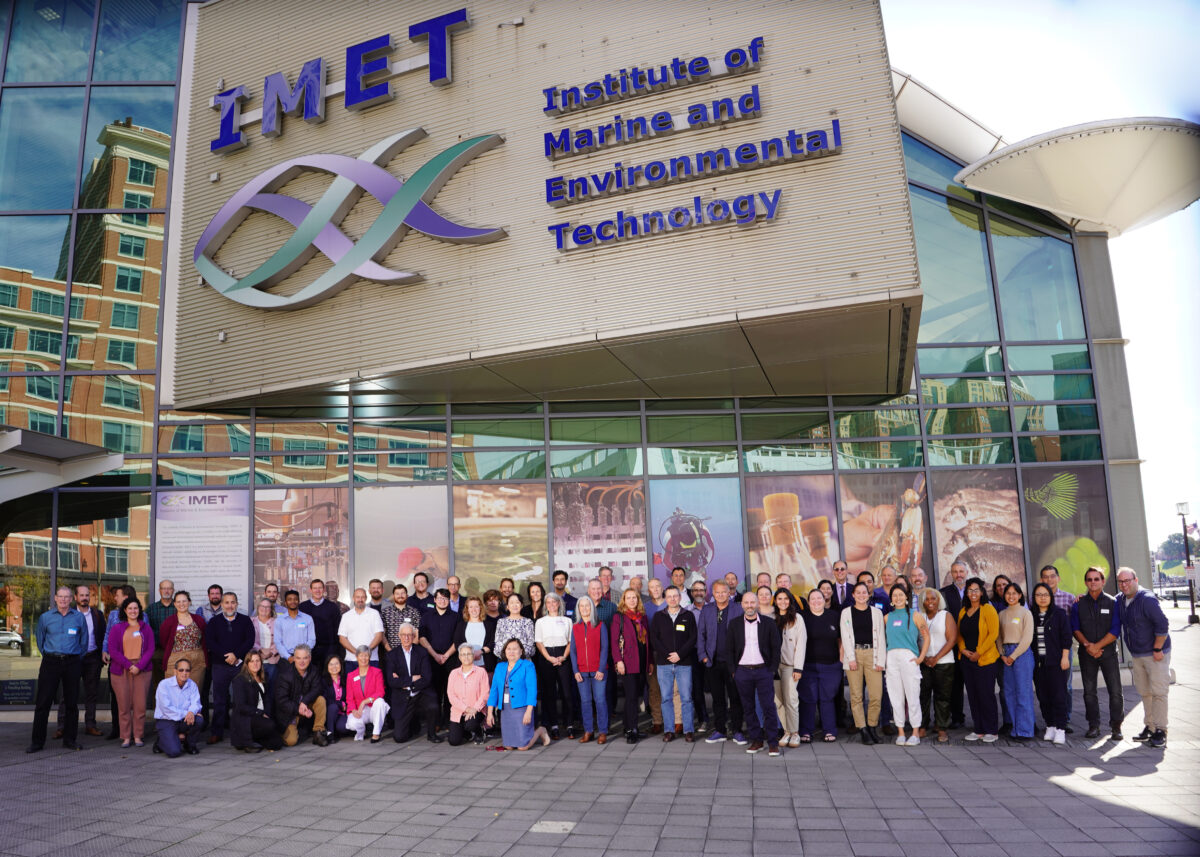 Conference attendees gather in front of the Institute for Marine and Environmental Technology. (Image by Barry Freeman)
Research for the public good
The work at IMET has been critical to move the industry forward worldwide. The SAS2 initiative, awarded $10 million by the U.S. Department of Agriculture in 2021, builds on the Recirculating Aquaculture Salmon Network, also led by Zohar and funded by the National Oceanic and Atmospheric Administration’s National Sea Grant Office.
IMET, and the ARC in particular, are “a showcase of our best ideas, ideas that promise solutions to so many essential challenges—food security, environmental sustainability, economic resilience,” Perman shared. The SAS2 consortium is “research for the public good,” Perman added. “That’s our mission and this project is emblematic of that.”
Session topics at the conference included scientific and engineering challenges like waste remediation, water reuse, and managing the salmon life cycle in captivity. Other sessions discussed market research for salmon produced on land and examples of education programs that increase awareness of aquaculture careers.
Attendees also traveled to The Conservation Fund Freshwater Institute in West Virginia to see collaborative SAS2 research, visited Baltimore City Schools that incorporate aquaculture into the curriculum, toured the ARC, and heard from graduate students contributing to the research arm of SAS2.
“SAS2 is an amazing accomplishment—the best example of public-private partnership to solve problems for industry,” shares Steve Summerfelt, a conference panelist and the chief science officer at Superior Fresh, which raises land-based salmon and recycles the nutrient-rich wastewater to grow greens. “SAS2 is providing relevant and groundbreaking research with strong tech transfer to help land-based salmon farmers.”
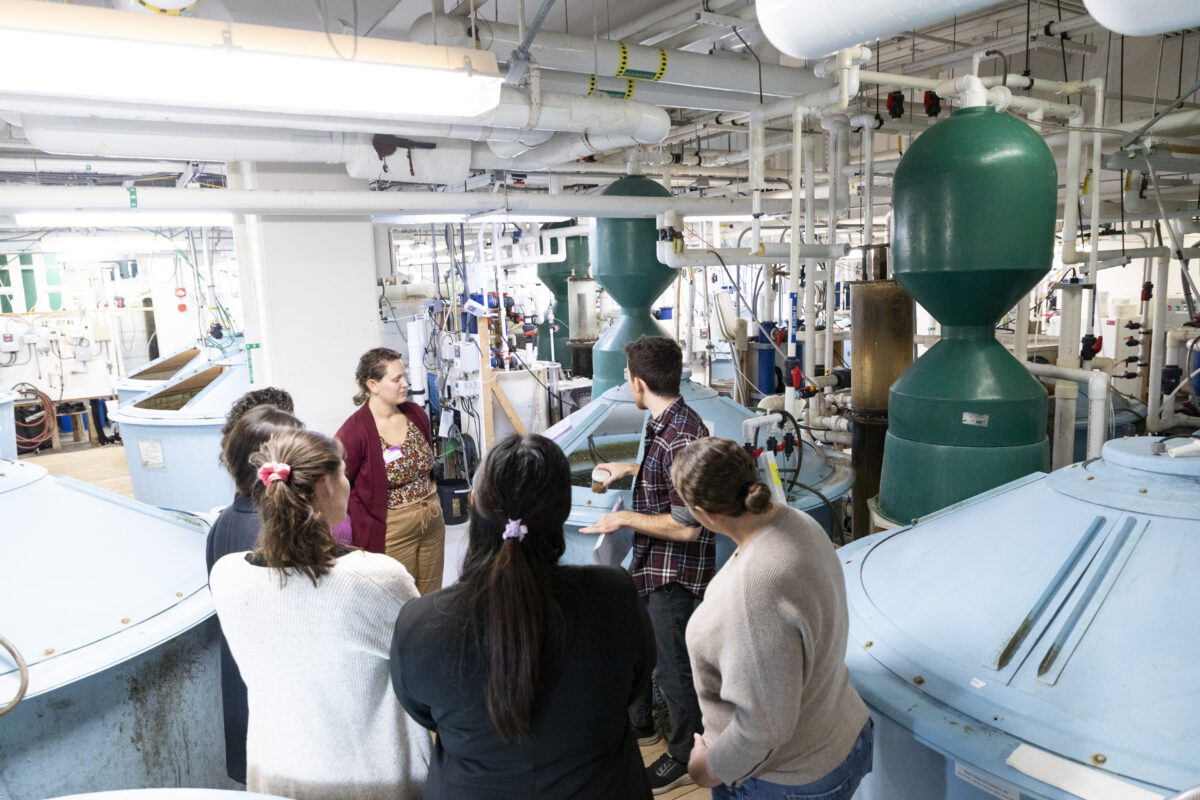 Conference attendees took tours of the Aquaculture Research Center, the land-based salmon production facility at IMET led by Yonathan Zohar. (Image by Melissa Penley Cormier, M.F.A. ’17)
Enabling aquaculture innovation
Overall, the conference emphasized aquaculture’s important and growing role in worldwide food production.
“Land-based, sustainable production of seafood is critically important technology to meet the rapidly growing need for healthy seafood as a source of protein in diets worldwide,” Russell Hill, director of IMET, said. “A land-based approach has huge advantages for minimizing pollution in the coastal environment and taking pressure off wild fish populations—and all of this can be done through this resilient technology that’s also adaptable in the face of a changing planet.”
By bringing together people from across industries, the event created opportunities that will enable more breakthroughs.
“The lively engagement and productive brainstorming of all relevant sectors led to several innovative ideas and collaborations which will contribute in the short term to making Atlantic salmon farming in the U.S. and globally more environmentally responsible and economically feasible” concluded Zohar. “Everyone left inspired and excited about the opportunities being created by the SAS2 program for innovative and sustainable aquaculture.”
]]>
More than 110 academic researchers, industry pros, government officials and educators met at the Institute of Marine and Environmental Technology (IMET) for the second annual Sustainable...
https://umbc.edu/stories/aquaculture-conference/
https://my3.my.umbc.edu/api/v0/pixel/news/137224/guest@my.umbc.edu/b9771cef91d515cec5e21ddb5aff8b2c/api/pixel
cnms
marinebiotech
news
research
science-and-tech
UMBC News & Magazine
https://my3.my.umbc.edu/groups/umbc-news-magazine
https://assets1-my.umbc.edu/system/shared/avatars/groups/000/001/943/24435aa6207c452e7bc15cc74b42c7bb/xsmall.png?1748556657
https://assets1-my.umbc.edu/system/shared/avatars/groups/000/001/943/24435aa6207c452e7bc15cc74b42c7bb/original.png?1748556657
https://assets2-my.umbc.edu/system/shared/avatars/groups/000/001/943/24435aa6207c452e7bc15cc74b42c7bb/xxlarge.png?1748556657
https://assets2-my.umbc.edu/system/shared/avatars/groups/000/001/943/24435aa6207c452e7bc15cc74b42c7bb/xlarge.png?1748556657
https://assets3-my.umbc.edu/system/shared/avatars/groups/000/001/943/24435aa6207c452e7bc15cc74b42c7bb/large.png?1748556657
https://assets1-my.umbc.edu/system/shared/avatars/groups/000/001/943/24435aa6207c452e7bc15cc74b42c7bb/medium.png?1748556657
https://assets2-my.umbc.edu/system/shared/avatars/groups/000/001/943/24435aa6207c452e7bc15cc74b42c7bb/small.png?1748556657
https://assets1-my.umbc.edu/system/shared/avatars/groups/000/001/943/24435aa6207c452e7bc15cc74b42c7bb/xsmall.png?1748556657
https://assets2-my.umbc.edu/system/shared/avatars/groups/000/001/943/24435aa6207c452e7bc15cc74b42c7bb/xxsmall.png?1748556657
UMBC News & Magazine
0
0
false
Mon, 20 Nov 2023 16:11:08 -0500
Mon, 20 Nov 2023 16:11:08 -0500
Underwater cameras facilitate large-scale study of oyster reef habitat in Chesapeake Bay
A new study used a novel technique to assess types of habitat provided by oyster reefs across 12 tributaries in the Chesapeake Bay. Researchers from UMBC; the University of Maryland, Baltimore (UMB); and the Smithsonian Environmental Research Center (SERC) used underwater cameras to collect images of reef structure at approximately 50 sites in each tributary—a total geographic span of 134 miles. They also repeatedly sampled habitat in two of the tributaries in 2017, 2019, and 2021 to track change over time.
The study included sites in Maryland and Virginia with a wide range of salinities. The team observed restored and unrestored reefs, oyster sanctuaries, and harvested reefs. The results indicate that unharvested reefs and restored reefs had the most complex reef structures, including more surface area covered with oysters and greater reef height, meaning the height of the reef above the bay bottom. Complex reef structure tends to create richer habitat for oysters and other bay wildlife, such as fish and crustaceans. The role of salinity was more nuanced and depended on a reef’s restoration and harvest status.
“Managing harvest and managing restoration are two of the biggest tools that managers have,” says Allison Tracy, assistant professor of marine biotechnology at UMBC/UMB and lead author on the new study. “It’s interesting to see at this scale that we’re able to pick up important contributions to habitat patterns from harvest, restoration, and salinity together.”
The sites tracked over time all saw an overall upward trend in habitat scores over the years of the study, which is good news for the bay and people who depend on it. “Reefs that were unharvested and restored maintained a higher habitat score more consistently over that time period,” Tracy explains.
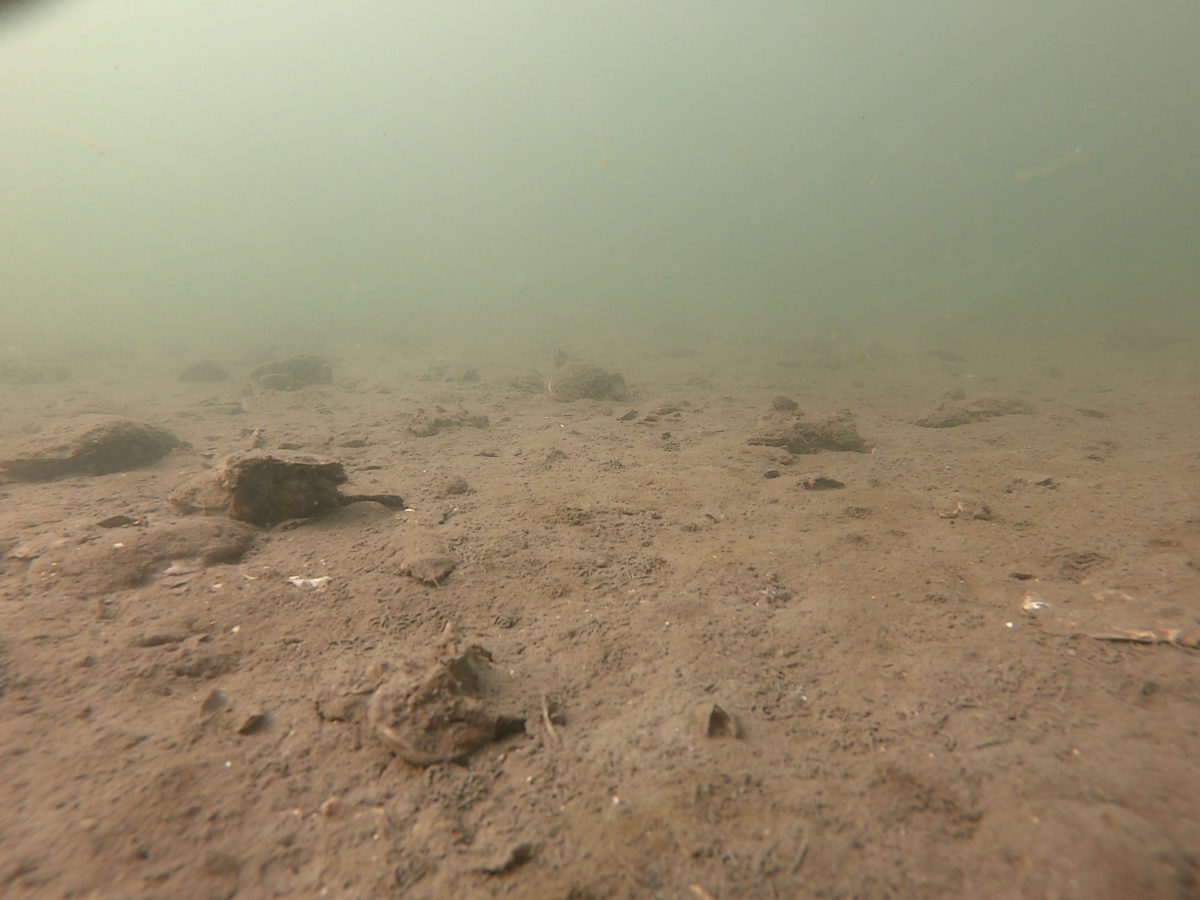 An example of a low-scoring oyster reef image.
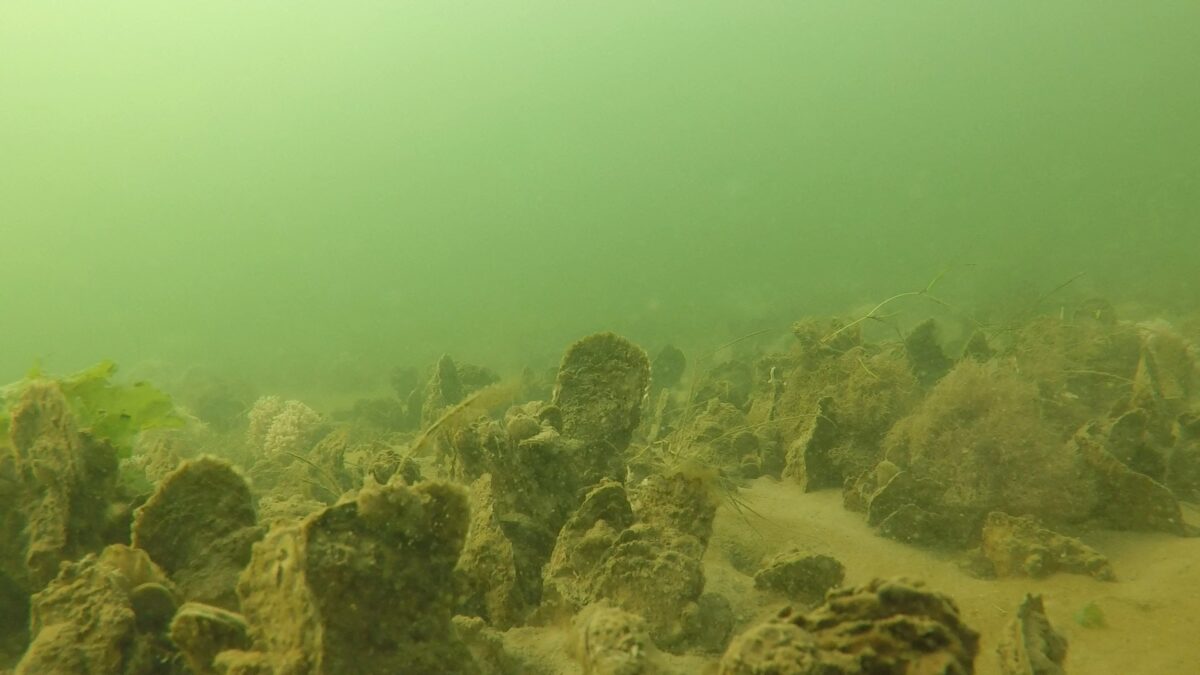 An example of a high-scoring reef image. (Images courtesy of Allison Tracy)
New technique addresses longstanding challenges
In the new study, published in Marine Ecology Progress Series, “we used underwater photography to solve two big challenges to understanding restoration success,” says Matthew Ogburn, senior scientist at SERC and senior author on the new paper. Previous studies have primarily focused on oysters themselves, rather than the habitat their reefs generate, and different monitoring techniques are not always comparable, he explains. Ogburn and Keira Heggie, another SERC scientist and co-author on the paper, previously published a paper outlining the new underwater camera technique.
“Using one simple method of assessing oyster reefs allowed us to survey a large number of sites efficiently and to make comparisons among all different types of oyster reefs,” Ogburn explains. “Our research supports the idea that oyster restoration results in more oysters but also more complex reefs that provide habitat for other species.”
While restoring reefs and designating some reefs as sanctuaries for oysters are important, “the solution is not to stop harvesting,” Tracy says. The authors note that harvested reefs still provide important, if different, habitat. For example, some species prefer sparser reefs.
“Those harvested reefs are still providing habitat,” Tracy says. “It’s not that habitat on harvested reefs is not important, they’re just contributing something different while also having economic importance.”
The best place for oyster reef research
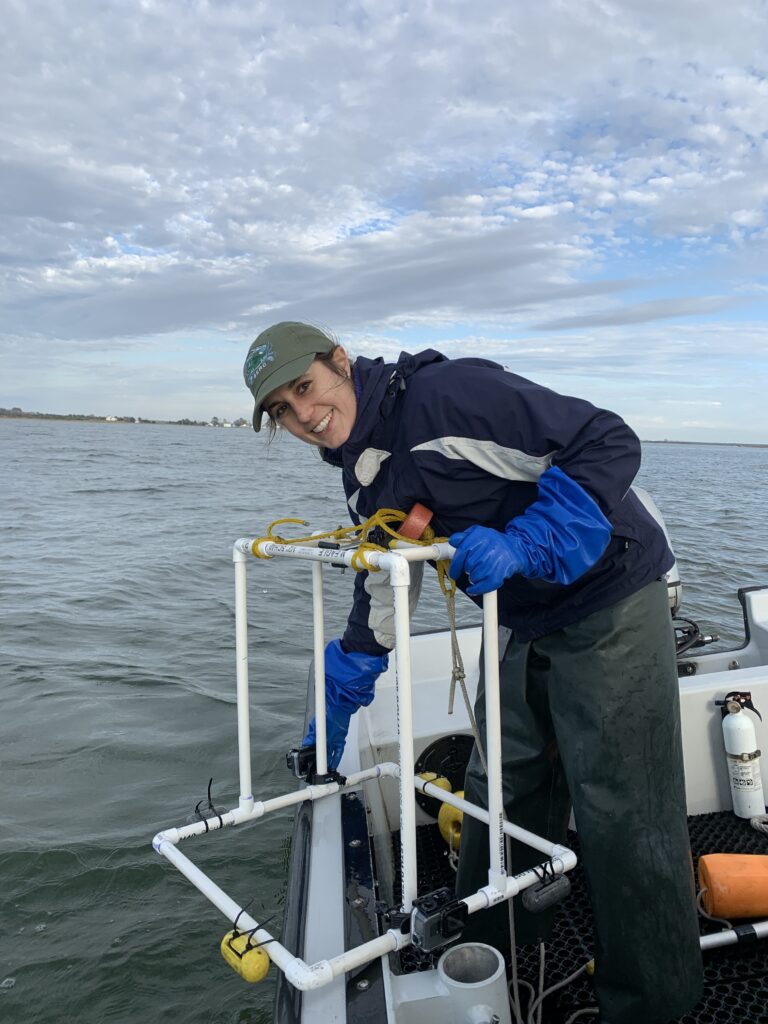 Allison Tracy on Chesapeake Bay collecting data. She’s holding the frame the research team used to lower the underwater cameras down to each sampling site. (Photo courtesy of Allison Tracy)
Moving forward, the research team hopes to build on this work. Tracy and coauthors are working on a forthcoming paper that uses more-intensive sampling methods at a subset of the study sites to verify the results from the rapid assessment technique. The team would also like to find creative ways to collect more underwater data at each site to identify which other species are using the reefs—but right now that effort is limited by the camera’s battery life.
The authors would also like to find ways to use machine learning to analyze the images, making that process more efficient while retaining a human’s level of accuracy. To date, this application of machine learning has proven less accurate than human analysis—but that may change in the future.
For this study, co-author and dedicated SERC citizen scientist David Norman analyzed all the images to determine reef habitat scores. Having one person score all the images for surface cover and reef height improves consistency considerably, but computerized scoring could help achieve this consistency across multiple studies going ahead. SERC is also testing whether crowd-sourcing the image analysis could be an effective way to increase consistency and efficiency.
There is much work ahead, but the new study provides an important large-scale perspective on the relationships between management practices, environmental conditions, and reef habitat across the Chesapeake Bay.
With significant restoration efforts underway, a wide range of management practices in use, and strong engagement from conservation organizations, fisheries, state governments, and local citizens, Tracy is grateful to be conducting research on one of the largest estuary systems in the world, noting, “We’re really fortunate that Chesapeake Bay is such a great place to do this research.”
]]>
A new study used a novel technique to assess types of habitat provided by oyster reefs across 12 tributaries in the Chesapeake Bay. Researchers from UMBC; the University of Maryland, Baltimore...
https://umbc.edu/stories/chesapeake-bay-oyster-reef-habitat-study/
https://my3.my.umbc.edu/api/v0/pixel/news/136406/guest@my.umbc.edu/9462ac622bba5c3eeaf690c43e2d1036/api/pixel
cnms
marinebiotech
news
research
science-and-tech
UMBC News & Magazine
https://my3.my.umbc.edu/groups/umbc-news-magazine
https://assets1-my.umbc.edu/system/shared/avatars/groups/000/001/943/24435aa6207c452e7bc15cc74b42c7bb/xsmall.png?1748556657
https://assets1-my.umbc.edu/system/shared/avatars/groups/000/001/943/24435aa6207c452e7bc15cc74b42c7bb/original.png?1748556657
https://assets2-my.umbc.edu/system/shared/avatars/groups/000/001/943/24435aa6207c452e7bc15cc74b42c7bb/xxlarge.png?1748556657
https://assets2-my.umbc.edu/system/shared/avatars/groups/000/001/943/24435aa6207c452e7bc15cc74b42c7bb/xlarge.png?1748556657
https://assets3-my.umbc.edu/system/shared/avatars/groups/000/001/943/24435aa6207c452e7bc15cc74b42c7bb/large.png?1748556657
https://assets1-my.umbc.edu/system/shared/avatars/groups/000/001/943/24435aa6207c452e7bc15cc74b42c7bb/medium.png?1748556657
https://assets2-my.umbc.edu/system/shared/avatars/groups/000/001/943/24435aa6207c452e7bc15cc74b42c7bb/small.png?1748556657
https://assets1-my.umbc.edu/system/shared/avatars/groups/000/001/943/24435aa6207c452e7bc15cc74b42c7bb/xsmall.png?1748556657
https://assets2-my.umbc.edu/system/shared/avatars/groups/000/001/943/24435aa6207c452e7bc15cc74b42c7bb/xxsmall.png?1748556657
UMBC News & Magazine
0
0
false
Thu, 19 Oct 2023 10:16:44 -0400
Thu, 19 Oct 2023 10:16:44 -0400