Office Hours—President Sheares Ashby talks with a graduating senior about rootedness and change
Manav Narendra’s story has been shaped by constant motion. A math and computer science double major, who graduated from UMBC this spring, Narendra grew up moving frequently between India and the United States, adapting to new schools, cultures, and environments every few years. Raised by a single mother who was always striving to create a better life for them, Narendra grew accustomed to change—but also to the challenges that come with it.
Coming to UMBC marked a turning point. Narendra sought out a smaller, close-knit academic environment where he could build community, form lasting friendships, and explore what it means to belong somewhere. In this Office Hour, President Valerie Sheares Ashby—who has also been at UMBC for four years—and Narendra reflect on growing rooted to a place and what effect those lasting connections can have.
UMBC Magazine: Manav, tell us about your background and what brought you to UMBC.
Manav Narendra: I’m originally from India, and I’ve spent about half my life there and half in the U.S. Growing up, I moved a lot because my mom would switch jobs for better opportunities. By my senior year of high school, we had just moved to Maryland. I applied to a vast array of colleges, but I ultimately chose UMBC because I wanted a smaller, more personal environment where I wouldn’t feel lost.
And here, I’ve met people in so many different ways—through classes, the Honors College, tutoring, tennis, even the Career Fair. It’s been really meaningful.
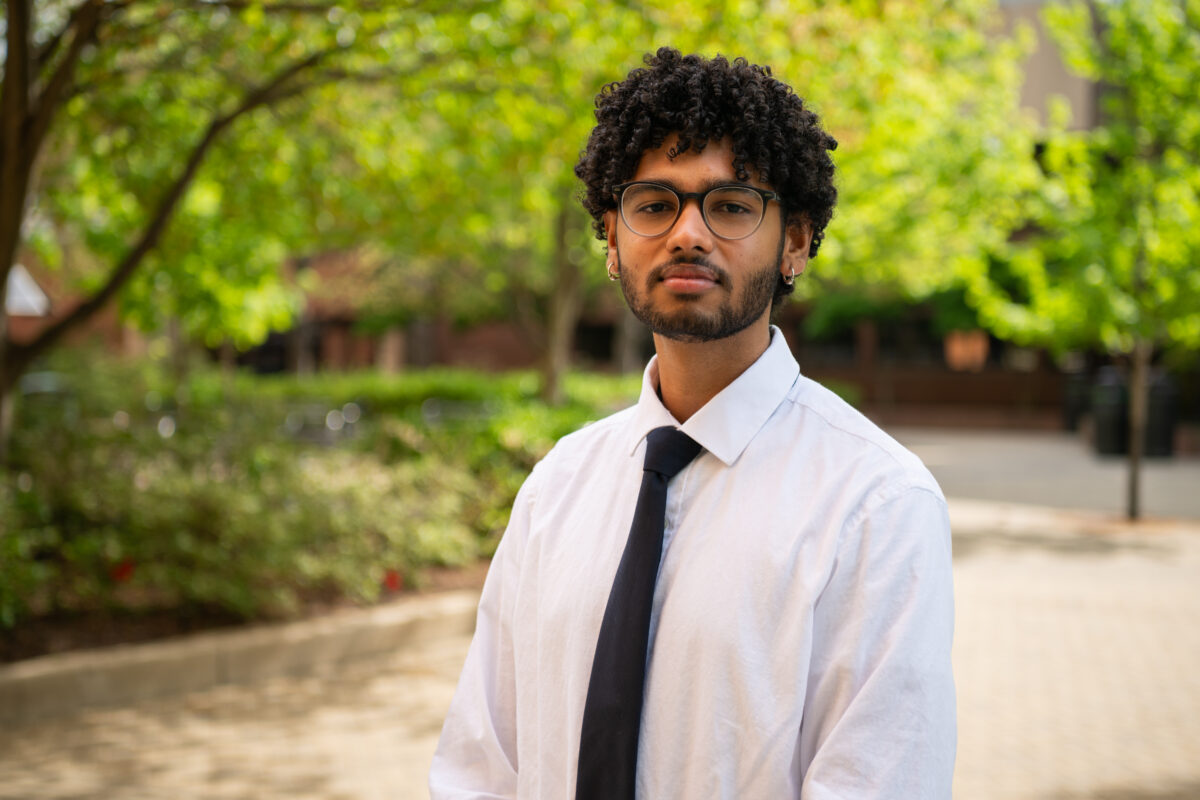 Narendra on campus in spring 2026.
President Valerie Sheares Ashby: You wanted a place where you could feel seen—that is powerful. And these smaller communities within UMBC can really shape your experience.
UMBC Magazine: How did moving so often affect your ability to build relationships?
Narendra: It was difficult. I became more introverted over time because you don’t really get the chance to build lasting friendships when you’re always leaving. I just didn’t realize how much I was missing in terms of long-term connections until I got here. Nevertheless, I’m forever grateful to have met so many incredible people from such beautifully different walks of life—they’ve all shaped who I am today.
President Sheares Ashby: I understand that. I am an introvert, too, and I think those kinds of experiences can really shape how you connect with people. It is not always easy to keep starting over. When I moved to Baltimore, I did not know anyone here, but from experience, I knew what I needed to put in place in order to feel like I am grounded and rooted in community. I learned how to do that when I was your age. In college and in graduate school, I started to ask myself: “What is it that I need to feel grounded?” And then I would go get it—I do not wait for it to happen.
UMBC Magazine: How has UMBC shaped your conception of community?
Narendra: I’ve made friendships that have lasted all four years, which still surprises me. I’ll see someone on campus and think, “Wow, I’ve known you for so long.”
President Sheares Ashby: That is such a special realization. I always tell students that those relationships are one of the most important parts of college. You learn so much in the classroom, but those connections—those are what stay with you.
UMBC Magazine: What does “home” mean to you now, after having moved so much?
Narendra: Growing up, home was my mom. Wherever she was, that’s where home was. She was the only constant in my life. I was diagnosed with cancer when I was 13, and my mom and I went through it together. I dealt with the physical pain, but she carried the brunt of the emotional and mental burden. She quit her job to take care of me. I couldn’t have done it without her. Now, I feel like I have another home here. I have a place where I belong, where I feel valued. It’s comforting to be in one place and not have everything constantly changing.
UMBC Magazine: How did that experience influence your future goals?
Narendra: It’s made me want to give back. I’m looking at various roles, ranging from data and actuarial science to software and astrophysics—seeing where I can best utilize my skills to make a difference: something that helps people and advances our collective understanding of the world. I feel like I’ve been given a second chance at life, and I want to use it well.
President Sheares Ashby: Often, our experiences guide us toward that sense of purpose. There is this idea of finding where your talents meet the greatest need—that is where meaningful work happens.
]]>
Manav Narendra’s story has been shaped by constant motion. A math and computer science double major, who graduated from UMBC this spring, Narendra grew up moving frequently between India and the...
https://umbc.edu/stories/office-hours-rootedness-and-change/
https://my3.my.umbc.edu/api/v0/pixel/news/160751/guest@my.umbc.edu/9430445fa9c6f071aa889ed9b10c3a72/api/pixel
alumni
campus-life
cnms
coeit
computer-science
mathematics
office-hours
spring-2026
story
UMBC News & Magazine
https://my3.my.umbc.edu/groups/umbc-news-magazine
https://assets1-my.umbc.edu/system/shared/avatars/groups/000/001/943/24435aa6207c452e7bc15cc74b42c7bb/xsmall.png?1748556657
https://assets1-my.umbc.edu/system/shared/avatars/groups/000/001/943/24435aa6207c452e7bc15cc74b42c7bb/original.png?1748556657
https://assets2-my.umbc.edu/system/shared/avatars/groups/000/001/943/24435aa6207c452e7bc15cc74b42c7bb/xxlarge.png?1748556657
https://assets2-my.umbc.edu/system/shared/avatars/groups/000/001/943/24435aa6207c452e7bc15cc74b42c7bb/xlarge.png?1748556657
https://assets3-my.umbc.edu/system/shared/avatars/groups/000/001/943/24435aa6207c452e7bc15cc74b42c7bb/large.png?1748556657
https://assets1-my.umbc.edu/system/shared/avatars/groups/000/001/943/24435aa6207c452e7bc15cc74b42c7bb/medium.png?1748556657
https://assets2-my.umbc.edu/system/shared/avatars/groups/000/001/943/24435aa6207c452e7bc15cc74b42c7bb/small.png?1748556657
https://assets1-my.umbc.edu/system/shared/avatars/groups/000/001/943/24435aa6207c452e7bc15cc74b42c7bb/xsmall.png?1748556657
https://assets2-my.umbc.edu/system/shared/avatars/groups/000/001/943/24435aa6207c452e7bc15cc74b42c7bb/xxsmall.png?1748556657
UMBC News & Magazine
0
0
false
Wed, 17 Jun 2026 14:49:56 -0400
Wed, 17 Jun 2026 14:49:56 -0400
Humanities Books: A Room in Bombay
Manil Suri moved to the United States after spending the first 20 years of his life living in a 400-square-foot room in Bombay, India, with his father, Ram, and mother, Prem, to whom he dedicated his latest book, A Room in Bombay. The rest of the apartment was shared between three other families. “In the apartment lived my family, which was Hindu, and three Muslim families. We had a lot of fights, but those fights were really not about religion. They were about the shared bathroom, or the shared kitchen, or resources, or money, or space,” explains Suri, a professor of mathematics at UMBC.
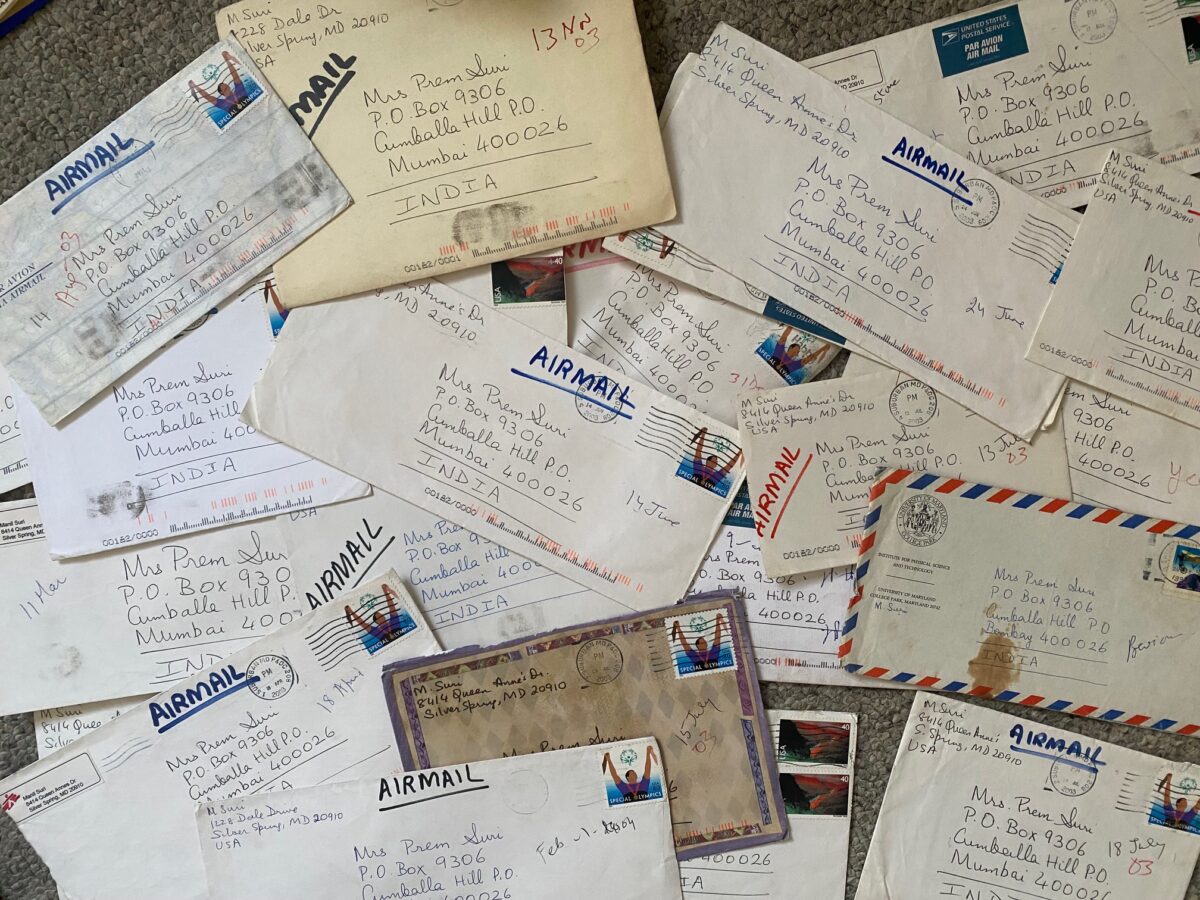 Some of the envelopes from letters Suri sent to his mom, Prem, in India once he moved to the U.S. (Image courtesy of Manil Suri)
Suri is also an award-winning author of three novels named after Hindu gods: The Death of Vishnu, The Age of Shiva, and The City of Devi. His fourth book, The Big Bang of Numbers: How to Build the Universe Using Only Math, is a humanities-based approach to mathematical concepts. They all paved the way for Suri’s most personal and most recent book. In three parts, Suri shares his life growing up in this room in Bombay and his life in the United States, drawing on more than 2,700 letters he wrote to his mother, which she saved in bundles organized by year, beginning with his time as a graduate student at Carnegie Mellon University. The letters chronicle his life in the U.S., including his relationship with his partner Larry, whom he took twice to meet his parents in the room in Bombay.
Q: Who is your book for?
A: I think it’s a book that, first of all, I want to work as a story. People who like a good narrative will enjoy it. It also ties into a different idea of immigration. You hear drastic tales of how immigrants are being shunned and put into prisons. But there’s another side of immigration, too, a little more subtle, perhaps. People immigrate for all sorts of reasons—including “finding themselves,” as I did.
 Aditya Desai ’09, English, a fellow writer, editor, teacher, and activist in Baltimore, and a great fan of Suri’s work, interviewed Suri during an Asian Studies Program book event in spring 2026. (Brad Ziegler/UMBC)
Also, I’ve already received a few pieces of feedback from people who are taking care of their aging parents. There are a huge number of people in various generations who are doing that. So I think it’ll appeal to them and help them negotiate the very difficult road ahead that many will face.
Q: How did the timing for publishing this memoir come about?
A: I have published three novels and a book on math. I felt I had to write the math book as a public service, since I had one foot in the humanities and one in the sciences—and needed to make something out of it. Once this math book was done, there was this other lingering project [the memoir] that I actually started around 2010.

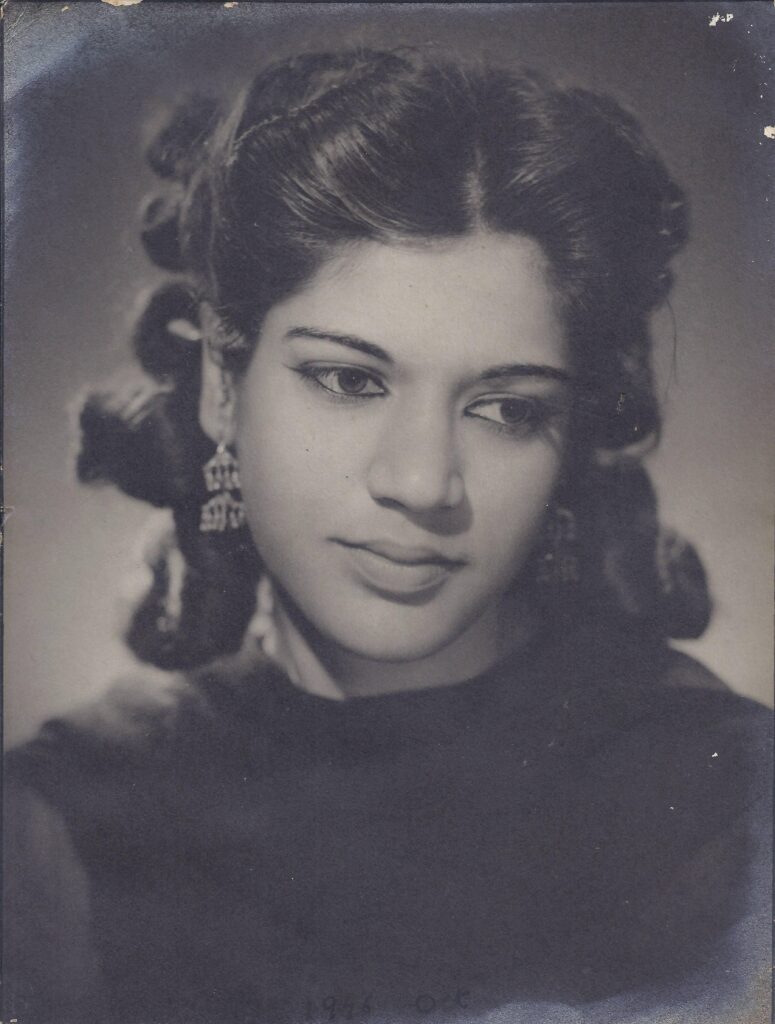
 (l-r): Suri’s mom, Prem Suri, in Bombay (date unknown), Prem in 1946, and Suri with Prem and his father, Ram, at Juhu Chowpatty Beach, Mumbai in 1961.
My mother passed away in 2013, and there was a big gap before I really got into writing the memoir. I needed that distance, since it would have been too much to have written it too close to her passing.
Q: Your mom had this intense love for you, which you wrote was sometimes overwhelming. How did that carry on through the room and through the rest of your life?
A: I think what happened with my mother was that my identity almost melded with hers when I was growing up. It’s only once I came to the U.S. that I was able to separate the two a little and move on. She would always say, “The U.S. has made you unemotional.” It was something I learned after coming here, to keep some distance, and move away from that merging of personalities.
Keeping boundaries is always hard, but it also tunes you to being more conscious of them. I don’t have any kids, so I don’t have to worry about that boundary.
Q: How did you feel coming to the United States?
A: When I first came to the U.S., I spent one week with a typical American family, and suddenly I had my own bedroom. That was exhilarating, but also a little weird. After that, I was in a dorm room with a roommate, so that was again a shared room for one year.
But after that year, I moved into an apartment where I had my own room. Since then, I’ve always had my own bedroom. Even though I’m married now, I need my own bedroom.
Q: A Room in Bombay centers around four families with very different backgrounds that often argue and have major disagreements. How does that tie into today’s world?
A: I think the book actually offers a lesson pertinent to our times. Although it was my Hindu family and three Muslim families sharing this apartment, the fights we had—and there were a lot of them—were really not about religion. They were about the shared bathroom, or the shared kitchen, or resources, or money, or space.
The same applies to most of the clashes going on in the world. Even though people try to put a religious spin on them, there are so many other reasons underlying all this strife. It’s property and boundaries, space, and resources.
Very rarely is it really religion. It’s not the cultural differences that are the cause of friction, it’s other things. Look deeper, and you’ll probably find an economic reason.
Q: Why did you choose to write the book as a memoir as opposed to an epistolary novel?
A: First of all, in terms of the letters, what I wrote are not letters to be treasured like Letters Between a Father and Son, a collection of intimate letters between Nobel laureate V.S. Naipaul and his son. Most of my letters are very ordinary and come with no claim of literary value. I was desperately trying to find things to say, and wrote three or four times a week just to keep my parents happy and engaged.
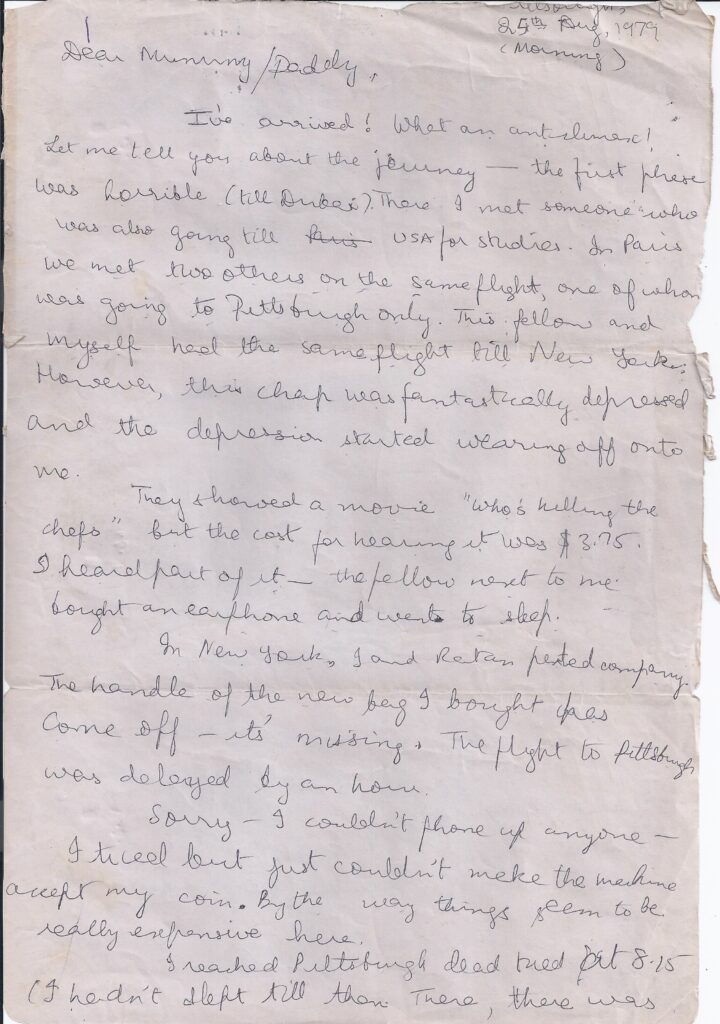 A letter Suri wrote to his father, Ram, in 1979.
There’s also so much more that happened that is not covered by the letters. I did keep some journals, especially once my mother came to the U.S. In fact, I had too much material. The first draft of this novel was about 50 percent longer, excess that I had to edit out.
Q: How do you choose what parts of the book to keep and what to cut?
A: That can be a painful decision, but fortunately, my editor helped by telling me what could be trimmed or shortened. Eventually, I had to get ruthless enough and ask myself: Is the story coming across? How much do I really need to put in for that? What examples have already been included to illustrate something—if there are two of them, let’s get rid of one.
A lot of nice, entertaining experiences had to be jettisoned in the interest of a story that keeps moving. You know, that’s what they say to writers: Kill your darlings. It’s a hard, murderous task to be a writer.
Q: There is a lot of stigma still in South Asian cultures around coming out. Did you intentionally want to address that?
A: Yes, the South Asian LGBTQ+ community is definitely one of the audiences I aimed for in this book, and in particular, their parents. Because even with my mother, who was so enlightened in many ways, there was this up and down that she went through after I came out to her. I think it really eats away at you if you cannot come out to your parents.
At the end of part two in the book, I talk about coming out to my dad. It happened after he took me to his friend’s house to introduce me to his 19-year-old daughter. Afterwards, my father said, “Well, what did you think of the daughter?” And I said, “You can’t be serious. First of all, she’s like half my age.” I ended up telling him about my relationship with my partner, to which he said, “I didn’t know, I didn’t know.” But then I noticed he was still looking expectantly at me. I realized then that he was still waiting for an answer to his question about whether I wanted to marry his friend’s daughter!
I always wanted to have a long conversation with him, which I thought I would have the next time I went back. But he passed away two months later, so that opportunity never came. I found out from my uncle that he had told all his brothers I was gay, even in that short period. So even though my mother always said, “He won’t be able to handle it. Don’t tell him,” as it turned out, he was fine with it.
As far as creating a supportive atmosphere for coming out in the South Asian LGBTQ+ community goes, I’d love to help in any way I could. It would be a good thing for members to give the book to their parents, “Here is someone else’s experience. It may help you.”
Q: Out of the twelve letters that you kept from the hundreds your mom wrote to you, is there one that really stands out to you?
A: The one that’s at the end of the book. It’s a full letter that really crystallizes a lot of things about how she viewed my coming out and how she was aware of losing some of her faculties in terms of memory and concentration. All those things are in that letter, which is why it’s probably the most poignant.
Read more about books from the humanities at UMBC.
]]>
Manil Suri moved to the United States after spending the first 20 years of his life living in a 400-square-foot room in Bombay, India, with his father, Ram, and mother, Prem, to whom he dedicated...
https://umbc.edu/stories/humanities-books-a-room-in-bombay/
https://my3.my.umbc.edu/api/v0/pixel/news/160556/guest@my.umbc.edu/9b67a293e9b6faf4fff6d4a7338ae592/api/pixel
arts-and-culture
cnms
humanitiesbooks
mathematics
news
retriever-authors
story
UMBC News & Magazine
https://my3.my.umbc.edu/groups/umbc-news-magazine
https://assets1-my.umbc.edu/system/shared/avatars/groups/000/001/943/24435aa6207c452e7bc15cc74b42c7bb/xsmall.png?1748556657
https://assets1-my.umbc.edu/system/shared/avatars/groups/000/001/943/24435aa6207c452e7bc15cc74b42c7bb/original.png?1748556657
https://assets2-my.umbc.edu/system/shared/avatars/groups/000/001/943/24435aa6207c452e7bc15cc74b42c7bb/xxlarge.png?1748556657
https://assets2-my.umbc.edu/system/shared/avatars/groups/000/001/943/24435aa6207c452e7bc15cc74b42c7bb/xlarge.png?1748556657
https://assets3-my.umbc.edu/system/shared/avatars/groups/000/001/943/24435aa6207c452e7bc15cc74b42c7bb/large.png?1748556657
https://assets1-my.umbc.edu/system/shared/avatars/groups/000/001/943/24435aa6207c452e7bc15cc74b42c7bb/medium.png?1748556657
https://assets2-my.umbc.edu/system/shared/avatars/groups/000/001/943/24435aa6207c452e7bc15cc74b42c7bb/small.png?1748556657
https://assets1-my.umbc.edu/system/shared/avatars/groups/000/001/943/24435aa6207c452e7bc15cc74b42c7bb/xsmall.png?1748556657
https://assets2-my.umbc.edu/system/shared/avatars/groups/000/001/943/24435aa6207c452e7bc15cc74b42c7bb/xxsmall.png?1748556657
UMBC News & Magazine
1
0
false
Thu, 04 Jun 2026 16:35:39 -0400
Thu, 04 Jun 2026 16:35:39 -0400
Rileigh Mansfield ’26—a mathematician with contagious enthusiasm and a ‘Survivor’ spirit
The UMBC career of Rileigh Mansfield ’26, mathematics, has been a masterclass in combining high-level theory with real-world impact. A Meyerhoff Scholar who began conducting research in her first year, Mansfield has spent the last three years applying complex data assimilation to everything from epidemiology to volcanology. Her academic path has taken her from the Andes of Ecuador to a math camp in Rwanda, and now it will take her to Stanford University to pursue a Ph.D. in geophysics. But Mansfield’s time at UMBC has included much more than academics: It has been defined by resilience and a contagious enthusiasm for building community—whether through tutoring and mentoring fellow students or playing Settlers of Catan with classmates and friends.
Q: What’s next for you after graduation?
A: I’m heading to Stanford University to pursue a Ph.D. in geophysics. Stanford has always been my dream school. I was nervous about applying, because I was switching from math to geophysics and graduating a year early. Plus, I didn’t do as well as I’d hoped on the GRE, and I felt like it was going to be impossible to get in. But I went for it anyway, with encouragement from my best friend—and now I get to go!
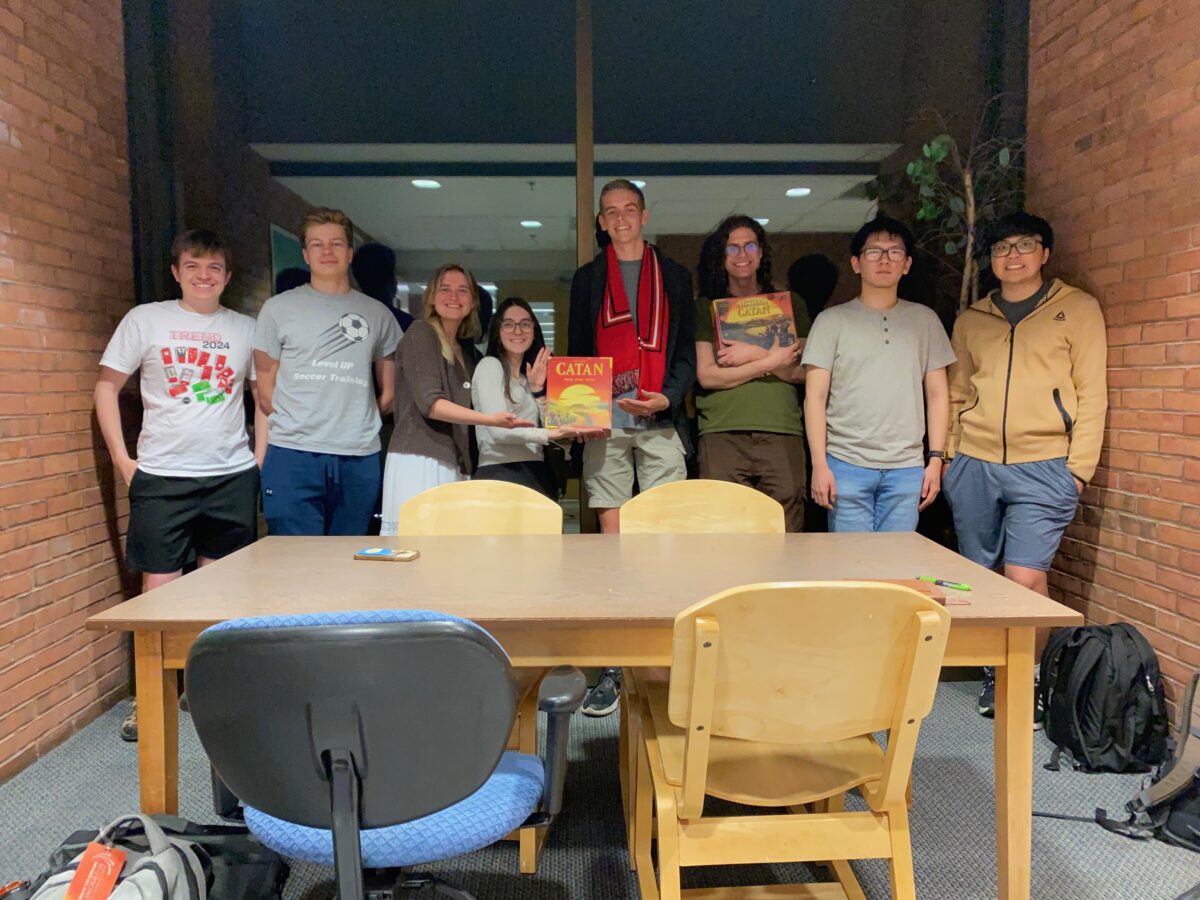 Rileigh Mansfield (third from left) gets together regularly with friends to play the strategic board game Catan. (Courtesy of Mansfield)
Q: How have you gotten involved on campus, and how have those activities supported your growth?
A: I’ve served as the president of Pi Mu Epsilon (the national math honors society), a Meyerhoff Peer Advisor, and a teaching assistant in the math department. I also conducted research with math professors Dr. Animikh Biswas and Dr. Kathleen Hoffman. But honestly, some of my most meaningful involvement has been more informal. Last spring, I was having a tough semester when I got invited to join a group from the math lounge to play the board game Catan on Tuesdays. It became a little community and something to look forward to every week—a much-needed step back from school and work. I actually play in competitive Catan tournaments now, and I’m even hosting an official tournament this spring through the math honors society.
Q: How did you first get involved in research at UMBC, and what did you focus on?
A: I got involved in research through the Meyerhoff Scholars Program. Dr. Biswas taught one of my Summer Bridge classes. I asked a lot of questions, and he said I should apply to be in his lab. In the fall, a notification went out for a research position in the math department, so I filled it out, and it ended up being for his lab combined with Dr. Hoffman’s. I got to start my first year, which was really cool. My research focused on data assimilation—specifically looking at parameter sensitivity and estimation for biological models. I was studying how diseases like cholera and HIV spread. Jumping into that as a freshman was tricky, but I had a lot of support from the seniors in the lab.
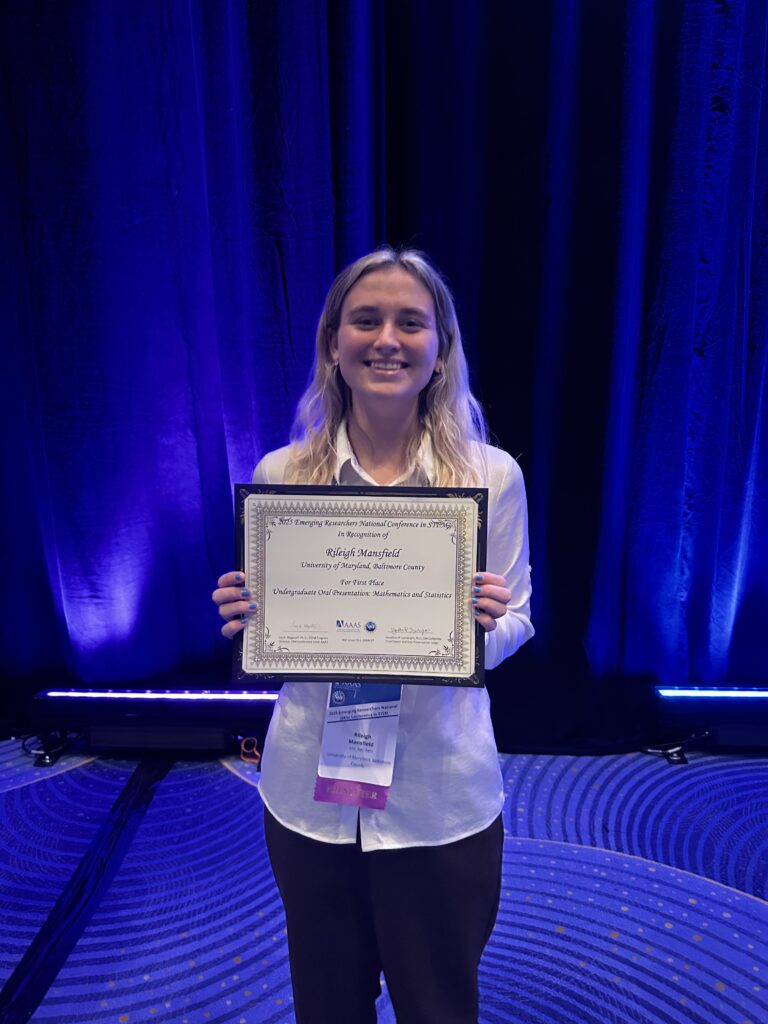 Rileigh Mansfield won first place in the Undergraduate Oral Presentation category at the 2025 Emerging Researchers National Conference in STEM. (Courtesy of Mansfield)
Q: So how did you end up pivoting to geophysics for graduate school?
A: My dad was a budget analyst for NASA, so I grew up around space and earth science. I’ve always been mystified by natural disasters like earthquakes and volcanoes, because we don’t really have them in Maryland. When Dr. Biswas introduced me to data assimilation, he mentioned it’s used for weather forecasting. That was the spark. I liked my research at UMBC, because it’s easy to see how working in biology can help save people’s lives, but honestly biology isn’t my passion. When I looked internally at what I’m excited about that can also help people, natural disasters came to mind. I realized I could use my math background to work on earthquake or volcano early-warning systems.
Q: Who has supported you throughout your UMBC journey?
A: I met my friend Emilia Pelegano-Titmuss at a summer program at Caltech in 2024, and we have supported each other in our pursuit of earth science ever since. Last spring, I had an incredibly challenging semester. My grades dipped, and I lost my self-confidence; I felt like I wasn’t made for research. Emilia talked me through it. She told me, “If you and I aren’t made for the research life, I don’t know who is.” She pushed me to graduate early and apply to grad school with her. Without her courage and motivation, I wouldn’t be in the position I am today.
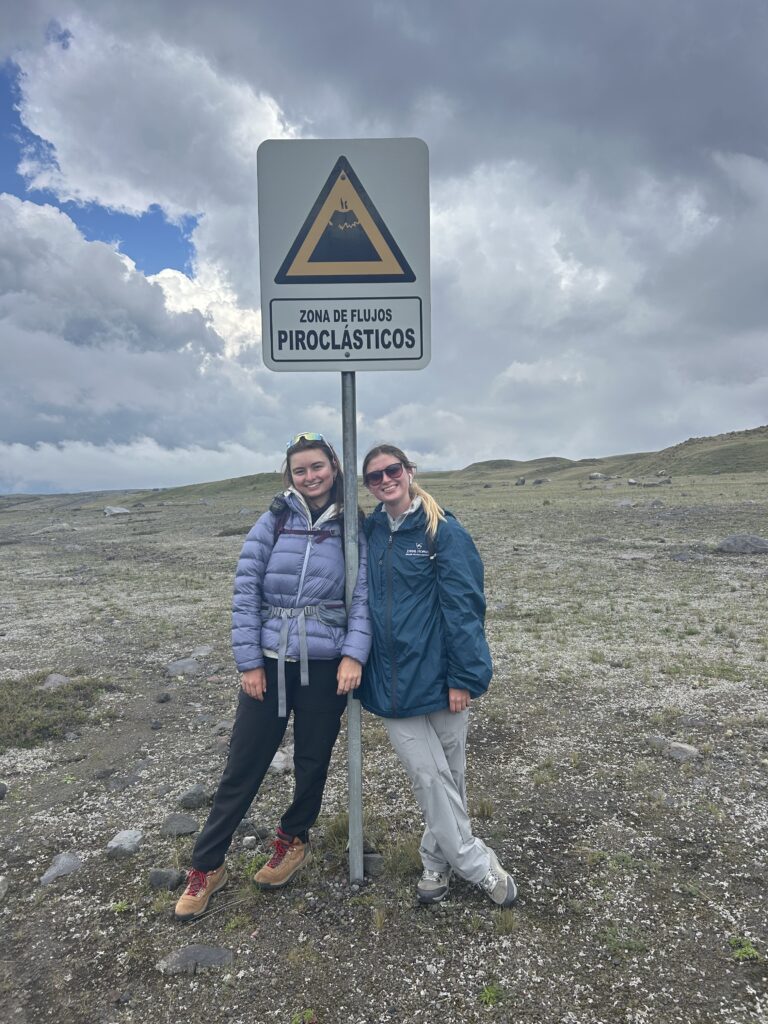 Rileigh Mansfield (right) and her best friend, Emilia Pelegano-Titmuss (left), studied volcanoes in Ecuador among the indigenous people who live there. The sign warns that they are in a volcanic flow zone. (Courtesy of Mansfield)
Q: Can you describe key takeaways from your education abroad experiences?
A: Going to Ecuador was my favorite part of undergrad. In winter 2025, I went into the Andes to do field work in volcanology with Emilia, who goes to Hunter College. We stayed with indigenous communities who lived right on a volcano. It was a huge cultural experience in addition to the science we did. I even got to shear alpacas! Sitting down for dinner with the people I want my work to impact was a huge motivator. I learned about how there was a lot of distrust between their community and scientists, including the ones who order evacuations around disasters. I want to help bridge those divides.
I also went to Rwanda to teach elective math seminars at a Supporting African Maths Initiative (SAMI) camp. I taught game theory and disease modeling, but I also spent a lot of time helping students understand the U.S. college admissions process. Many of those students are so bright, and they really want to come to the U.S. for college, but they don’t have the resources or information to navigate the system. I still talk to some of them today to help them through the Common App.
Q: Why is it important to you to make a positive impact and help others?
A: I don’t like to feel like I’m wasting my time—if I’m going to spend my life doing research, I want to know it’s having a real-world impact. I’m also just genuinely excited about what I do. I really love it, and I want everyone else to love it, too. My favorite type of mentor is someone who loves something so much that even if at first you don’t understand what they’re talking about, you start caring about it just because they do—their enthusiasm is contagious. I try to bring that same energy to my work as a teaching assistant and peer mentor and to sharing math and science with anyone and everyone.
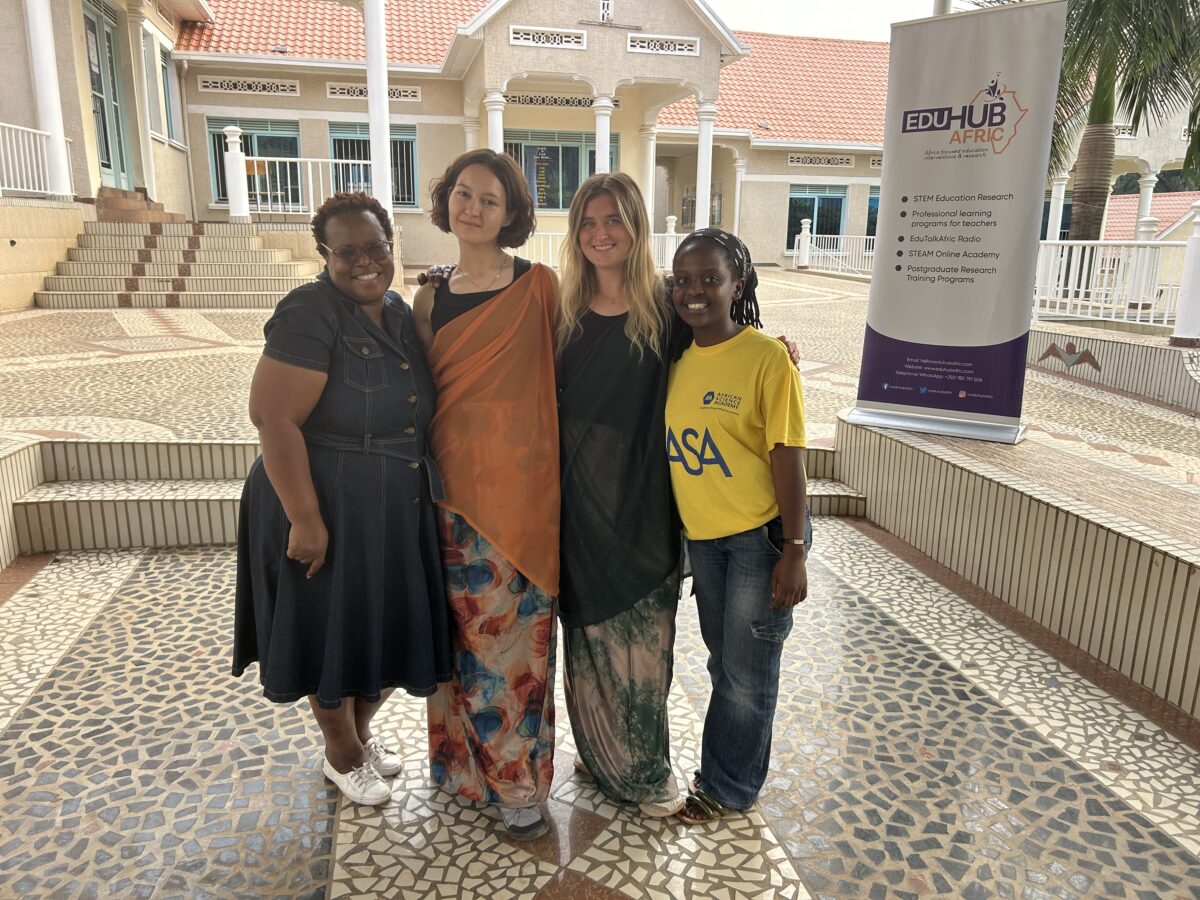 Rileigh Mansfield (second from right) had a transformative experience tutoring math in Rwanda. (Courtesy of Mansfield)
Q: What’s something unique about you that isn’t obvious from your résumé?
A: I am obsessed with the show Survivor. I audition for it every year. I’ve been watching it since third grade, and I’m always training for it. One year during finals, I even practiced eating only small portions of rice and working out on very little sleep just to see if my brain could still function—and it turned out it could. I also practiced starting fires with a flint.
I also did competitive trampolining for years, and I play in competitive Catan tournaments. It’s interesting because, like Survivor, it’s a social game and a strategic game. My strength is always the social game. More recently, I went on The Price is Right with my friend Emilia. If you watch the June 1 episode, you’ll see us screaming and jumping up and down in the audience; she got picked to participate!
Q: What advice do you have for incoming UMBC students or aspiring undergraduate researchers?
A: Go to office hours. Even if you don’t have a specific question, just go and talk to your professors. It helps the professors know who you are, which can have the side benefit of motivating you even more to do well in the class. It can also create opportunities, like how I talked to Dr. Biswas at Summer Bridge, which led to doing research in his lab.
And if you really want something, you can always find a way to get it. Don’t just say, “UMBC doesn’t offer it,” or, “It’s not easy to get.” Many of the things I did weren’t here at UMBC, but UMBC professors sent me applications for workshops and opportunities. Dr. Justin Webster and Dr. Biswas sent me to a workshop in Texas on partial differential equations and to Colorado for a conference on data simulation—both were incredibly valuable. The resources are there to help you get what you want, but you have to go after it.
]]>
The UMBC career of Rileigh Mansfield ’26, mathematics, has been a masterclass in combining high-level theory with real-world impact. A Meyerhoff Scholar who began conducting research in her first...
https://umbc.edu/stories/rileigh-mansfield-survivor-spirit/
https://my3.my.umbc.edu/api/v0/pixel/news/159722/guest@my.umbc.edu/b4633ce5875caa60c53eef598bb38645/api/pixel
class-of-2026
cnms
mathematics
news
science-and-tech
story
undergraduate-research
UMBC News & Magazine
https://my3.my.umbc.edu/groups/umbc-news-magazine
https://assets1-my.umbc.edu/system/shared/avatars/groups/000/001/943/24435aa6207c452e7bc15cc74b42c7bb/xsmall.png?1748556657
https://assets1-my.umbc.edu/system/shared/avatars/groups/000/001/943/24435aa6207c452e7bc15cc74b42c7bb/original.png?1748556657
https://assets2-my.umbc.edu/system/shared/avatars/groups/000/001/943/24435aa6207c452e7bc15cc74b42c7bb/xxlarge.png?1748556657
https://assets2-my.umbc.edu/system/shared/avatars/groups/000/001/943/24435aa6207c452e7bc15cc74b42c7bb/xlarge.png?1748556657
https://assets3-my.umbc.edu/system/shared/avatars/groups/000/001/943/24435aa6207c452e7bc15cc74b42c7bb/large.png?1748556657
https://assets1-my.umbc.edu/system/shared/avatars/groups/000/001/943/24435aa6207c452e7bc15cc74b42c7bb/medium.png?1748556657
https://assets2-my.umbc.edu/system/shared/avatars/groups/000/001/943/24435aa6207c452e7bc15cc74b42c7bb/small.png?1748556657
https://assets1-my.umbc.edu/system/shared/avatars/groups/000/001/943/24435aa6207c452e7bc15cc74b42c7bb/xsmall.png?1748556657
https://assets2-my.umbc.edu/system/shared/avatars/groups/000/001/943/24435aa6207c452e7bc15cc74b42c7bb/xxsmall.png?1748556657
UMBC News & Magazine
0
0
false
Tue, 05 May 2026 13:48:11 -0400
Tue, 05 May 2026 13:48:11 -0400
Kayla Nemirovsky ’26—Math plus financial economics major with equal passion for numbers and travel
If senior Kayla Nemirovsky’s passport could talk, the first thing it would likely say is, “I’m tired.” Despite having local roots, first attending Mount Hebron High School in nearby Ellicott City and then continuing her academic career 10 miles away at UMBC, Nemirovsky has always felt most at home on a plane. She has visited over 30 (!) countries with no signs of stopping her travel now. Thanks to the support and guidance she received from UMBC, she’ll be staying here to pursue a master’s in teaching.
Q: With dual degrees in math and financial economics, it’s a little surprising that one of your greatest passions in life is traveling. How did you catch the travel bug?
A: I was four, if not younger, when I took my first international trip. We traveled a lot as a family and have always had a big love of it. When I was in middle school and early high school, my grandpa took my cousin and me on three trips to Europe, which we’re very grateful for. It was a really great snapshot into a lot of places. Both of my parents are immigrants from the Soviet Union, so growing up, my dad traveled around the Soviet Union a lot with my grandpa. It’s just something that is ingrained in our family. Seeing new places, learning about cultures, trying new food, and learning about the history of places when I’m going to them—that’s what’s fun to me.
Q: With such a pull to travel and see the world, why did you decide to continue your education locally at UMBC?
A: I knew I wanted to stay local-ish and take advantage of in-state tuition. My dad [Sergey Nemirovsky ’03, computer science] went here and I worked at the UMBC summer camp in high school. I met some people who went to UMBC and they showed me around and let me know what it’s really like. But when I was accepted into the Sondheim Scholars Program, that really sealed it for me. My brother [Sam Nemirovsky ’27, mathematics] is a first-year student here, and it’s funny because we’re both math majors but doing it in entirely different ways. He’s working with applied math, and I know that’s just not for me. It was also so important for me to build study abroad into my college experience.
 Nemirovsky and friends traveling in snowy Finland.
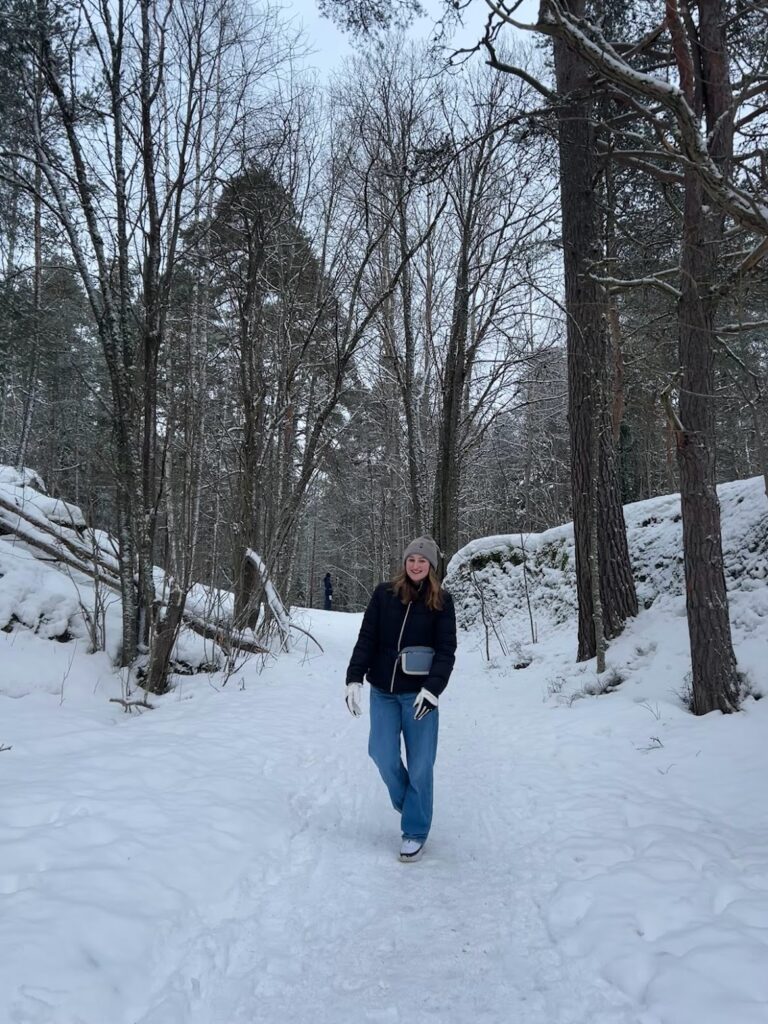 Enjoying a walk through Finland’s winter wonderland.
Q: How would you describe the Sondheim Public Affairs Scholars Program to someone who isn’t familiar with it?
A: We focus on not only policy, but also community engagement and service. Throughout all of freshman year, we’re doing community service, involved mostly in Baltimore and just getting a chance to see local communities. And then we go through our years at UMBC as a cohort. Some people graduate early, but for the most part, for us, it’s been 12 people, together. The other cool thing is it’s a very diverse group of majors so you get a lot of different perspectives and people trying to implement policy in different ways or just seeing how it comes to play, not just in government. It’s been great having that community throughout to push each other. We push each other to really exceed and make the most of our college experiences.
 Nemirovsky, left, with President Valerie Sheares Ashby and members of her Sondheim cohort.
Q: Do you have any advice for students who are unsure what they want to do?
A: Go with what you like and what you enjoy. Obviously having a job is ideal, so be a little more realistic with what you’re studying but think about how you could apply it and investigate that. And be flexible! I texted my mom a couple of times my first year thinking out loud, “What if I add this minor? What if I do this major?” And she said, “If you want to and if it makes sense, do it.”
I knew that I would love to have a job where I have the flexibility to travel but never really as a career. I had no idea what exactly I wanted to do but I always liked math, so figured maybe that route. And then I had a really good high school economics teacher [Vann Prime] who was state recognized, and I decided to go down that path and see where it takes me.
Q: So many students think it’s not possible to study abroad with their academic course load or they can’t fit it into their schedule. What would you say to them?
A: As an Education Abroad Advisor, I talk about this all day, every day. I think everybody should study abroad and there’s so many new ways to do it too, especially with the faculty-led programs that are really growing. Even in these super packed majors where you feel like you have to be here every semester, you can still travel for a short-term winter or summer faculty-led program. They’re really meeting students where they are to give them opportunities.
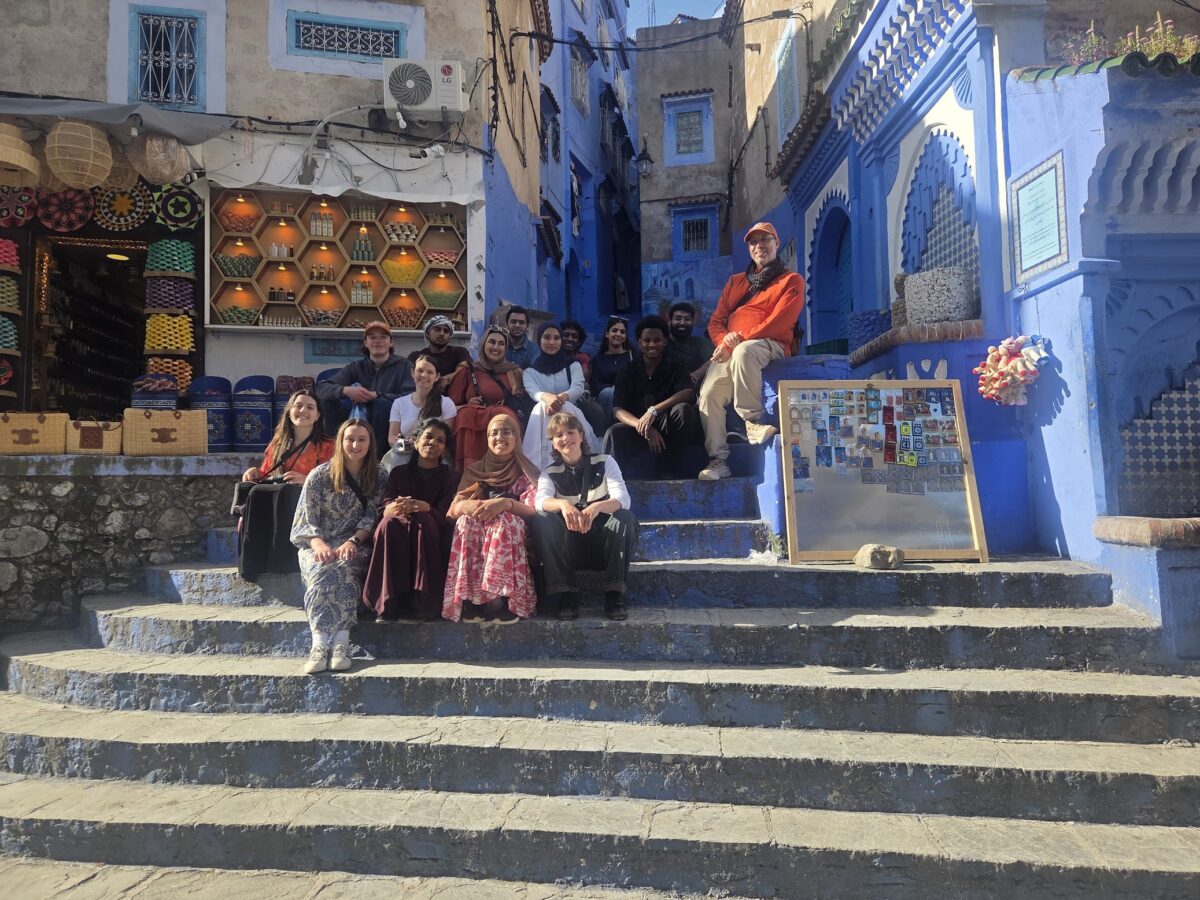 One of Nemirovsky’s many trips abroad with classmates traveling in Morocco.
Q: Have you had mentors who have influenced you throughout your academic career. What does mentorship look like and mean to you?
A: I view mentorship as something that has to be beneficial. Through the Sondheim Program, we were assigned mentors freshman year, and I originally wasn’t sure how to feel about it, and I didn’t know if we would connect in a meaningful way. But it’s been one of the things I’ve enjoyed most. Jess Cook [associate director of Sondheim] connected me to Josh Michael [’10, political science, Ph.D. ’22, public policy], who helped me get my internship at the Maryland State Department of Education and was one of my mentors. From there, this internship helped me solidify the work that I want to do in math education curriculum and policy and helped me figure out what my next steps need to be after college. The internship also helped me to expand my connections in the field and shaped my plans for senior year and beyond.
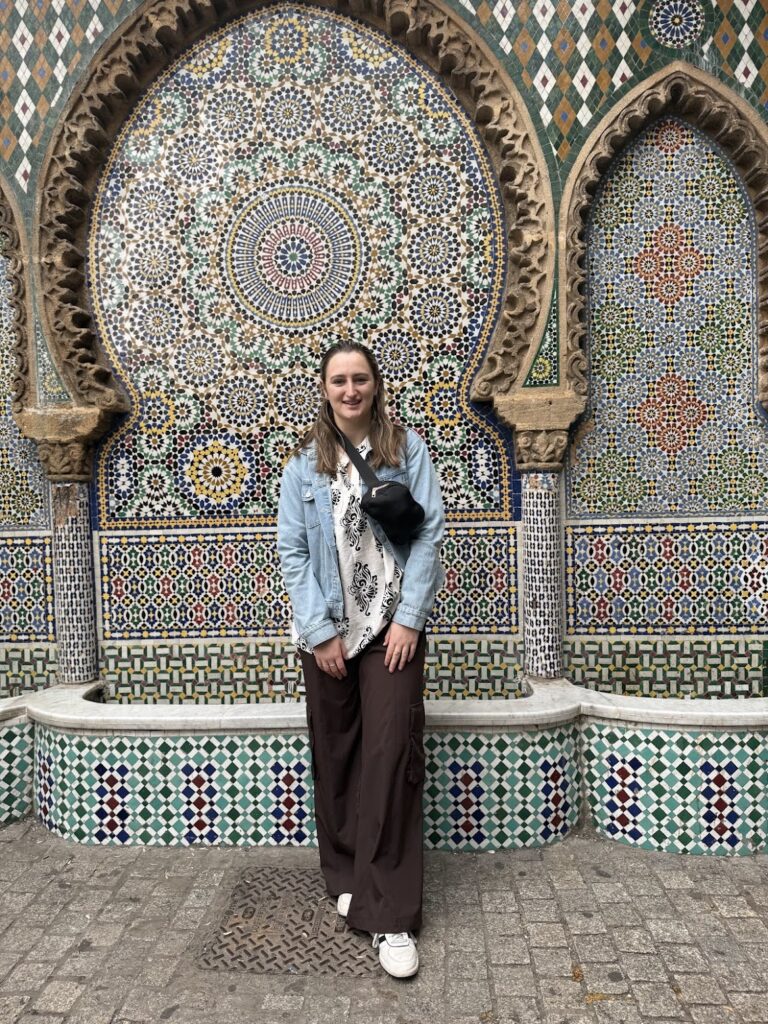
Q: Are there other ways your mentors have helped you?
A: I’m a person who needs a path. And I realized once I got to college that there’s kind of no more path, I have to make my own. That was really scary to me, so having mentors who can help me make this path…give me advice and offer suggestions, that was extremely helpful. I really believe you have to choose the people you look up to and kind of aspire to be them.
]]>
If senior Kayla Nemirovsky’s passport could talk, the first thing it would likely say is, “I’m tired.” Despite having local roots, first attending Mount Hebron High School in nearby Ellicott City...
https://umbc.edu/stories/kayla-nemirovsky-26-passion-for-math-and-travel/
https://my3.my.umbc.edu/api/v0/pixel/news/159259/guest@my.umbc.edu/5764e8df35d0fbde95f78c7d70a8430d/api/pixel
class-of-2026
cnms
education-abroad
financial-economics
mathematics
news
science-and-tech
story
UMBC News & Magazine
https://my3.my.umbc.edu/groups/umbc-news-magazine
https://assets1-my.umbc.edu/system/shared/avatars/groups/000/001/943/24435aa6207c452e7bc15cc74b42c7bb/xsmall.png?1748556657
https://assets1-my.umbc.edu/system/shared/avatars/groups/000/001/943/24435aa6207c452e7bc15cc74b42c7bb/original.png?1748556657
https://assets2-my.umbc.edu/system/shared/avatars/groups/000/001/943/24435aa6207c452e7bc15cc74b42c7bb/xxlarge.png?1748556657
https://assets2-my.umbc.edu/system/shared/avatars/groups/000/001/943/24435aa6207c452e7bc15cc74b42c7bb/xlarge.png?1748556657
https://assets3-my.umbc.edu/system/shared/avatars/groups/000/001/943/24435aa6207c452e7bc15cc74b42c7bb/large.png?1748556657
https://assets1-my.umbc.edu/system/shared/avatars/groups/000/001/943/24435aa6207c452e7bc15cc74b42c7bb/medium.png?1748556657
https://assets2-my.umbc.edu/system/shared/avatars/groups/000/001/943/24435aa6207c452e7bc15cc74b42c7bb/small.png?1748556657
https://assets1-my.umbc.edu/system/shared/avatars/groups/000/001/943/24435aa6207c452e7bc15cc74b42c7bb/xsmall.png?1748556657
https://assets2-my.umbc.edu/system/shared/avatars/groups/000/001/943/24435aa6207c452e7bc15cc74b42c7bb/xxsmall.png?1748556657
UMBC News & Magazine
9
0
false
Fri, 24 Apr 2026 14:24:40 -0400
Fri, 24 Apr 2026 14:24:40 -0400
Meet a Retriever—Anna Gifty Opoku-Agyeman ’19, award-winning researcher and writer
Meet Anna Gifty Opoku-Agyeman ’19, mathematics with a minor in economics. Anna is an award-winning Ghanaian American researcher and writer and a doctoral student studying public policy and economics at Harvard’s John F. Kennedy School of Government. Anna is a Forbes 30 Under 30 Boston honoree and the youngest recipient of a CEDAW Women’s Rights Award by the United Nations Convention on the Elimination of All Forms of Discrimination Against Women—previously awarded to Vice President Kamala Harris and former Democratic House Speaker Nancy Pelosi. Anna’s newest book, “The Double Tax: How Women of Color are Overcharged and Underpaid,” explores why it’s so expensive to be a woman in America and why it doesn’t have to be this way. Take it away, Anna!
Q: What initially brought you to UMBC?
A: I came to UMBC from the University of Maryland, College Park. On a large campus, I felt too much like a number and not like an actual person. I also felt, in my gut, that College Park wasn’t the right campus for the kind of growth I knew needed to happen to transition into adulthood. UMBC, at first, seemed like the right fit, but I struggled a lot to find my place and to find my voice. I didn’t immediately know what I wanted to do right away. It actually took me until my junior year to figure out the path I am on now, and even then, I wasn’t too sure! That said, the communities on this campus really became the match for the fire I feel today in the work I do. The educators, the students, and the organizations have fueled me throughout, even now as an alum.
Q: Were you involved in any student organizations at UMBC?
A: One of my favorite organizations to lead and be a part of was the UMBC chapter of the National Society of Black Engineers (NSBE). There’s something about being part of a Black-led organization alongside Black students that was so empowering. I was educated at predominantly white schools up until college, so between participating in NSBE, where we started new traditions like the annual NSBE pageant and launched the first U.S. conference for Black women economists, and being part of the Meyerhoff Scholars Program, I felt more seen than I had in the years prior.
Q: Who in the UMBC community has inspired you or supported you?
A: There are a couple of people across the UMBC community who have made a big impact on me, but I want to focus on two people specifically: Bonny Tighe and Jacqueline King, Ph.D. ’09, human services psychology. Ms. Tighe taught my Calculus II class, which at the time was one of the most difficult courses offered for STEM majors. She and Dr. Kalman Nanes really believed that I could do hard things, and her class became a turning point for me—math was really something I could pursue in college. She’s also hilarious.
 Anna Gifty Opoku-Agyeman ’19 and Jacqueline King, Ph.D. ’09, in the Meyerhoff Scholars Program office. (Marlayna Demond ’11/UMBC)
Dr. King is my soul sister, truly a kindred spirit. She is part of what I like to call my Mount Rushmore of educators. Dr. King led the MARC/URISE program, which funded my final years of college. She saw me stumble in with no plan, no purpose, and no direction, and coached me into the life I am living and thriving in today. She and I touched base weekly, sometimes just to catch up, and her guidance fundamentally changed my college experience. I owe her so much.
Q: Can you tell us more about your work as an author?
A: The work I do as a writer cuts across race, gender, and the economy, with an eye toward making the workplace a fairer place. In 2022, I published a critically acclaimed collection, The Black Agenda, which was the first trade publication to exclusively feature Black scholars and experts across economics, education, health, climate, criminal justice, and technology. In September 2025, I published The Double Tax, which explores why it’s so expensive to be a woman in America and how the individual costs women of color face become societal costs later on. You’ve probably heard of the pink tax—that additional price women pay to exist in the same world as men. Now meet the double tax, the compounded cost of racism and sexism, or the pink tax and then some.
I am currently hosting events across the country and hope you’ll join me! If interested, RSVP by visiting my website: annagifty.com!
Q: What’s the one thing you’d want someone who hasn’t joined the UMBC community to know about us?
A: UMBC is a small school, but finding community is still the best way to make your time on campus count. I talk a little bit about my time at UMBC in my new book, The Double Tax, namely, how when I first arrived, I was so lost in the sea of ambition and among the students who seemed to have it all together. I think finding community on campus via clubs, organizations, and academic affiliations made this school feel more like home and ultimately became the driver of the success I am experiencing today.
* * * * *
UMBC’s greatest strength is its people. When people meet Retrievers and hear about the passion they bring, the relationships they create, the ways they support each other, and the commitment they have to inclusive excellence, they truly get a sense of our community. That’s what “Meet a Retriever” is all about.
Learn more about how UMBC can help you achieve your goals.
]]>
Meet Anna Gifty Opoku-Agyeman ’19, mathematics with a minor in economics. Anna is an award-winning Ghanaian American researcher and writer and a doctoral student studying public policy and...
https://umbc.edu/stories/meet-anna-researcher-and-writer/
https://my3.my.umbc.edu/api/v0/pixel/news/152602/guest@my.umbc.edu/120a0f1bd35b9b27862428e18bd71ed2/api/pixel
alumni
magazine
mathematics
meet-a-retriever
meyerhoff-scholar
retriever-authors
story
UMBC News & Magazine
https://my3.my.umbc.edu/groups/umbc-news-magazine
https://assets1-my.umbc.edu/system/shared/avatars/groups/000/001/943/24435aa6207c452e7bc15cc74b42c7bb/xsmall.png?1748556657
https://assets1-my.umbc.edu/system/shared/avatars/groups/000/001/943/24435aa6207c452e7bc15cc74b42c7bb/original.png?1748556657
https://assets2-my.umbc.edu/system/shared/avatars/groups/000/001/943/24435aa6207c452e7bc15cc74b42c7bb/xxlarge.png?1748556657
https://assets2-my.umbc.edu/system/shared/avatars/groups/000/001/943/24435aa6207c452e7bc15cc74b42c7bb/xlarge.png?1748556657
https://assets3-my.umbc.edu/system/shared/avatars/groups/000/001/943/24435aa6207c452e7bc15cc74b42c7bb/large.png?1748556657
https://assets1-my.umbc.edu/system/shared/avatars/groups/000/001/943/24435aa6207c452e7bc15cc74b42c7bb/medium.png?1748556657
https://assets2-my.umbc.edu/system/shared/avatars/groups/000/001/943/24435aa6207c452e7bc15cc74b42c7bb/small.png?1748556657
https://assets1-my.umbc.edu/system/shared/avatars/groups/000/001/943/24435aa6207c452e7bc15cc74b42c7bb/xsmall.png?1748556657
https://assets2-my.umbc.edu/system/shared/avatars/groups/000/001/943/24435aa6207c452e7bc15cc74b42c7bb/xxsmall.png?1748556657
UMBC News & Magazine
0
0
false
Wed, 17 Sep 2025 14:17:50 -0400
Wed, 17 Sep 2025 14:17:50 -0400
The parallel evolution of Milt Halem and the third pillar of science

For almost 70 years, Milt Halem, now a research professor at UMBC after a career at NASA, has deployed the latest computing technology—from vacuum tubes in the ’50s to artificial intelligence today—to tackle some of science’s toughest problems.
Colorful screen prints cover the walls of Milt Halem’s Rockville, Maryland, apartment. One shows a high-altitude view of the Nile River, cutting through desert sands before emptying into a turquoise Mediterranean. In another, the fragile blue marble of the Earth rises above a desolate lunar surface.
One large picture, taking centerplace on the dining room wall, is more enigmatic—filled with alternating red, yellow, and blue patches. “This is what’s known as the quasi-biennial oscillation,” Halem explains.
Tens of thousands of feet up, in Earth’s stratosphere, the winds around the equator regularly shift direction, blowing east for many months, and then west, and then east again. A satellite measured the shifts, and Halem, a former NASA scientist and current UMBC professor, turned six years of that data into art.
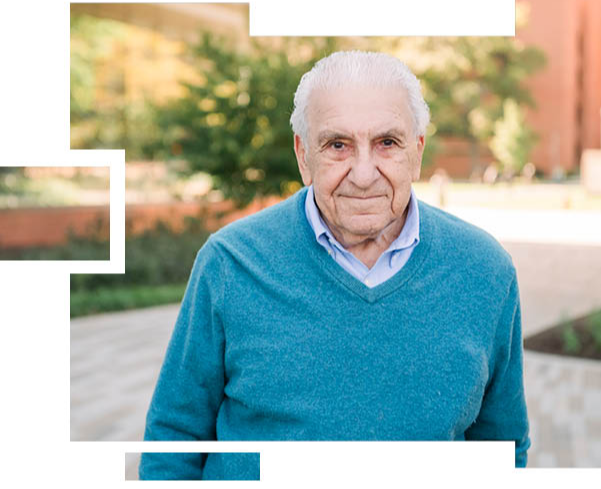
Halem’s framed prints, many of which he created himself while taking evening and weekend classes at the Corcoran School of the Arts and Design in Washington, D.C., are a window into his nearly 70-year-long scientific career. For roughly 40 years of that time, he worked for NASA, the famed federal space agency. Halem harnessed NASA’s space-based instrument “eyes” and ever-evolving computer “brains” to advance humanity’s understanding of Earth and our place in the cosmos and, in 1996, was recognized with NASA’s highest award, the Distinguished Service Medal.
In 2003, after retiring from NASA, Halem joined UMBC as a research professor. In his more than two decades at the university, he has nurtured connections with government and industry, brought in research money and equipment, regularly taught a popular graduate course, and mentored more than a dozen Ph.D. students, helping them pursue their passions and propel their careers.
“I think of myself as a computational scientist: I use computers to both discover and explore new territory,” Halem says. “What I love is the computer’s ability to represent, and to explain, the world around us.”
Charting computers’ evolution
Halem began his working life at the dawn of the computing age, and his career trajectory mirrors the steady rise of those digital devices. After earning a bachelor’s degree in mathematics from the City College of New York in 1951, Halem was drafted into the Korean War effort and served on U.S. Army bases for two years, first in New Jersey and then in Arizona. After a stint clearing rocks off the golf course so that the officers could play, Halem’s skills were better put to use on some of the Army’s first attempts to use what at the time were relatively new-fangled devices called computers to improve surveillance of battlefields.
In 1955, Halem received a fellowship to work with an IBM 704 computer installed at New York University. The computer took up significant floor space with its multiple cabinet-sized components, filled with vacuum tubes for logic operations and magnetic tape for memory. It was state-of-the-art in its day, able to execute about 40,000 instructions per second.
“You could say 1955 was my start in high-performance computing,” Halem says. “I’ve been acquiring and managing and programming and doing research on computers ever since.”
In the late 1950s, NASA established the Goddard Space Flight Center (GSFC) and, shortly after, opened a New York campus—the Goddard Institute for Space Studies—focused on theoretical research.
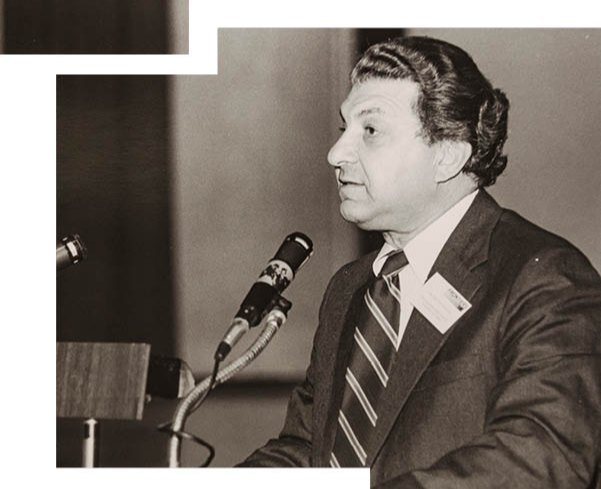
Milt Halem delivers remarks during a conference at NASA Goddard Space Flight Center, 1986. Photo by NASA.
Because of Halem’s experience with computers, he was hired as contract support. In the subsequent years, he worked with some of the most advanced computers of the time, using them to model the Earth’s atmosphere and predict the scientific value of launching new Earth-observing instruments. In 1968, he also earned his Ph.D. in applied mathematics from NYU.
In the late ’70s, Halem moved to Goddard’s main facility, GSFC, in Maryland to continue his computing work. In 1983, he became chief of the Space Data and Computing Division and shifted from using supercomputers to being a force in their development. The division had recently developed the Goodyear Massively Parallel Processor (MPP), a trailblazing computer containing 16,384 processors working simultaneously. This degree of parallelism, which lies at the heart of today’s supercomputers, marked a radical departure from traditional computing.
“The MPP was a relatively simple concept, but it took us more than a decade to develop it,” says Jim Fischer, who managed the MPP’s fabrication contract and applications programs. “Milt found people to help and money to support the machine. And then he offered it to the U.S. science community to try it out, and they recognized its architecture as a solution. Milt pumped us to world class by force of will.”
In the ensuing years, Halem and Fischer pursued making the power of MPPs more accessible and less expensive. In 1994, their staff demonstrated the “Beowulf” computing cluster, composed entirely of mass market personal computers networked with Ethernet and running the Linux open source operating system.
Now 30 years later, the Beowulf approach sits at the core of most of the world’s supercomputers and much of the cloud infrastructure, putting vast amounts of affordable computing resources at the fingertips of scientists, engineers, and even social media users.
After Halem arrived at UMBC in his 70s, he continued to engage with the latest computing technology. He was instrumental in securing the donation of high-performance IBM computing equipment from NASA to the university, and he helped run a new computing research center. With his students, he has explored the frontiers of quantum computing and AI.
“I’ve followed the evolution of high-performance computing my entire career,” Halem says.

Computing for science
Computers can do many things—from recommending videos you might like to rendering life-like graphics—but Halem is most interested in what they can do for science.
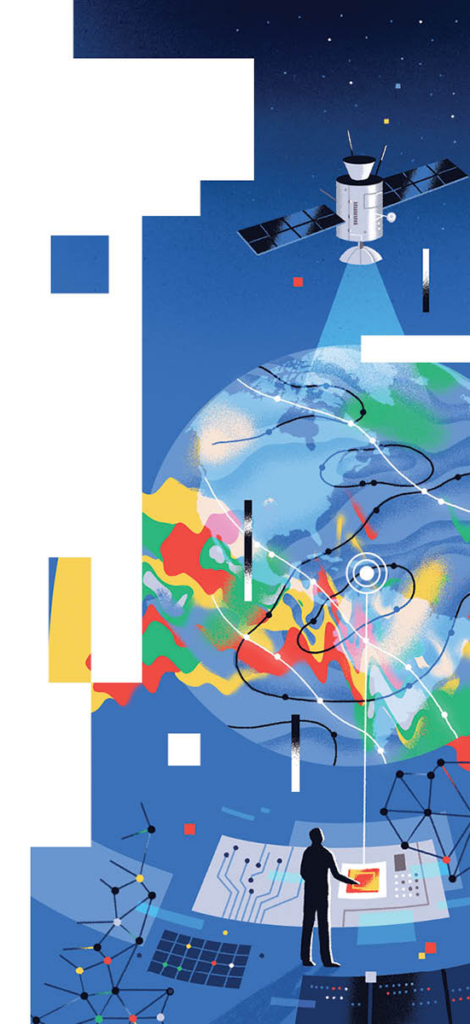
“Science is based on the notion of observations and then explaining the observations by some theoretical process,” says Halem. “That was the way science evolved until the mid-20th century. Then computers came along and became the third pillar of science.”
Halem’s passion fit with NASA’s mission. Though the agency was born out of the Cold War and the space race with the Soviets, it has concentrated its efforts on the peaceful use of space to advance science.
NASA launches satellites that observe Earth from space with a suite of scientific instruments (including some designed at UMBC), and a large part of Halem’s research has been using computers to understand how that data can improve our understanding of the Earth’s air, water, and land and the physical processes that link them. Halem has also advanced weather forecasting through, among other techniques, finding new ways to incorporate observations into the weather models.
As an administrator at NASA, Halem always put the science first, according to his colleagues. “I believe that Milt left a legacy of making decisions that are in the best interest of science,” says Dan Duffy, the chief of the Computational and Information Sciences and Technology Office at GSFC, who sits in Halem’s old NASA office and has continued to work with him on special projects since Halem joined UMBC.
“His motivation was always driven by the scientific community’s needs,” Fischer adds. “It was very high-minded.”
Shaping students’ lives
At UMBC, Halem has continued his devotion to computing for science’s sake. In doing so, he has supported the research community and shaped his students’ lives.
Jennifer Sleeman, Ph.D. ’17, computer science, was co-mentored by Halem on her Ph.D. thesis, which involved mapping topics from past climate reports from the Intergovernmental Panel on Climate Change and trying to predict the contents of future reports.
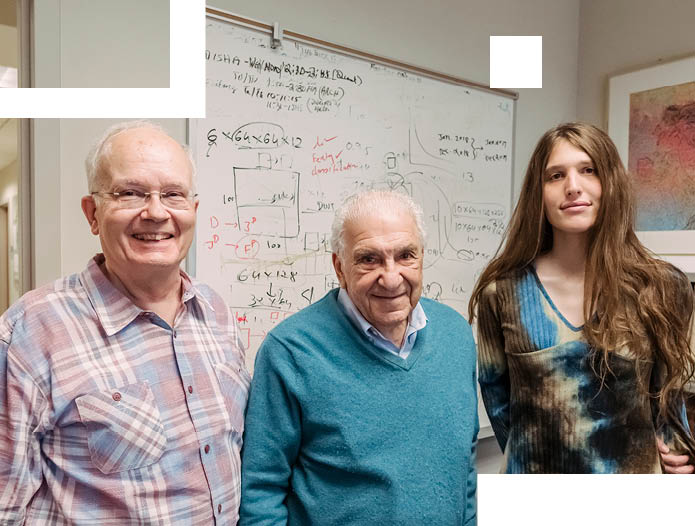
Jim Fischer, Milt Halem, and Sophia Hamer (left to right) in Halem’s UMBC office. One of Halem’s screen prints hangs in the upper right.
“Milt and I would have discussions about my thesis, and I always like to describe it as: Milt decided to adopt me. I was close to the end of my Ph.D., and I changed my focus based on working with him,” she said. “It really changed the trajectory of my career.” After graduating, she became a research assistant professor at UMBC. She currently studies weather and climate-related topics as a senior AI research scientist at Johns Hopkins Applied Physics Laboratory while she continues to work part-time with Halem and his students.
Sophia Hamer ’22, mathematics and computer science, who is currently working with Halem as a master’s student, also credits Halem with helping her find her career footing. She first met him to discuss a research project when she was an undergraduate and just emerging from a time when she struggled with her grades and with choosing a major.
“Dr. Halem took a chance on me,” she says. “I honestly think that was the turning point for me. Before I was thinking, ‘I’m just gonna squeak out of here with a degree and hopefully my GPA isn’t too bad to get a job.’ But now, my entire perspective has shifted: I’m about to graduate with a master’s, and I’m doing impactful research in a field I really like. I never thought that would be possible.”
“Milt is tough—he pushes you—but he also works closely with you,” Sleeman adds. “I really grew from that relationship.”
AI for weather and climate forecasting
Both Sleeman and Hamer are working with Halem on a project to be the first to use AI to make regional weather predictions, one of a couple AI projects Halem is currently pursuing.
In his embrace of AI, Halem is yet again advancing alongside the technology that has defined his career. Gone are the days of mere 40,000 instructions per second. Now advanced computer chips power computationally hungry “neural networks” originally inspired by the workings of the human brain. Neural networks are behind celebrity chatbots such as ChatGPT—and forecasters are increasingly turning to them to predict the weather too.
While traditional weather models simulate the physics of the Earth and its atmosphere to make predictions about the future, AI forecasting models simply examine vast datasets of past weather and learn how to spot patterns.
So far, the main advantage of AI forecasting is speed. What can take days for a physics-based model can be done in only minutes or seconds with AI. AI weather models offer great promise for distributed, real-time weather forecasting, for example as natural disasters unfold. Halem and his students are looking in particular to predict wildfires.
While much AI weather forecasting research is undertaken by leading tech companies such as Google and Microsoft, Halem thinks his students are more than holding their own.
“I’ve got a new generation of computer scientists making breakthroughs,” says Halem. “Two students who are writing up their master’s theses are doing leading AI computations to rival what some big tech companies are doing.”
The work of weather and climate modeling is growing in importance as global warming unfolds and the Earth’s natural patterns shift. “Applying what I know to a real-world problem has been an amazing experience,” Hamer says.
The projects are also yet one more demonstration of Halem’s constant intellectual evolution.
“Milt has an amazing ability to learn new things,” says Anupam Joshi, the acting dean of the College of Engineering and Information Technology. “He was trained as a mathematician who then specialized in high-performance computing and in the last few years has become an expert in using AI systems to model weather and climate phenomena. It speaks to his intellectual capabilities but also his perseverance and his grit.”
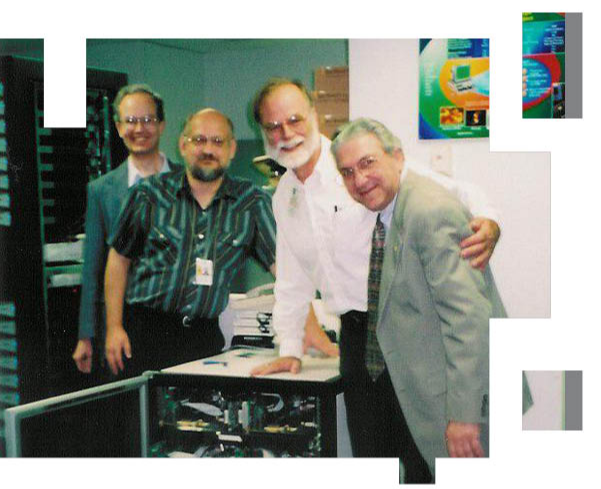
Halem (far right) poses with (from left to right) NASA’s Jim Fischer and John Dorband, and Microsoft Fellow Jim Gray next to the first Beowulf computing cluster. Photo by NASA.
Into the future
Now in his tenth decade of life, Halem shows few signs of slowing down. When not spending time with his large family, he’s still tackling some of science’s thorniest problems, such as how to predict weather patterns months to years in advance.
“He’s like the energizer bunny,” says Fischer, his former NASA colleague.
Duffy agrees. “He has an amazing amount of energy; he never seems to stop. He has a willingness to listen, learn, and ask questions and is an amazing role model for his students.”
Halem says it’s the computation challenges that drive him. “I have to keep moving because the computational instrument continues to evolve,” he says. He continues to be on the lookout for new ideas—the latest he’s come across being an AI research scientist. “The AI agent can use large language models to read the literature; it can write computer code and conduct experiments by itself. It can write the paper on what it discovered. So that’s probably the ultimate research goal that I would like to see if I can make an impact on,” Halem explains.
“Milt is probably one of the most dedicated people I know to the research,” Sleeman says. “He’s so tenacious, and it’s just so impressive. It’s a privilege to continue to work with him.”
“Milt is incredible,” adds Joshi. “If we could replicate him, we would.” And maybe, in some sense, Halem’s AI scientist would do just that.
 ]]>
For almost 70 years, Milt Halem, now a research professor at UMBC after a career at NASA, has deployed the latest computing technology—from vacuum tubes in the ’50s to artificial intelligence...
https://umbc.edu/stories/milt-halem-and-the-third-pillar-of-science/
https://my3.my.umbc.edu/api/v0/pixel/news/146115/guest@my.umbc.edu/e9026a516fe6b98808ffc05f4258bd43/api/pixel
ai
campus-life
cfr
coeit
discovery
fall-2024
feature
gsfc
magazine
mathematics
nasa
story
UMBC News & Magazine
https://my3.my.umbc.edu/groups/umbc-news-magazine
https://assets1-my.umbc.edu/system/shared/avatars/groups/000/001/943/24435aa6207c452e7bc15cc74b42c7bb/xsmall.png?1748556657
https://assets1-my.umbc.edu/system/shared/avatars/groups/000/001/943/24435aa6207c452e7bc15cc74b42c7bb/original.png?1748556657
https://assets2-my.umbc.edu/system/shared/avatars/groups/000/001/943/24435aa6207c452e7bc15cc74b42c7bb/xxlarge.png?1748556657
https://assets2-my.umbc.edu/system/shared/avatars/groups/000/001/943/24435aa6207c452e7bc15cc74b42c7bb/xlarge.png?1748556657
https://assets3-my.umbc.edu/system/shared/avatars/groups/000/001/943/24435aa6207c452e7bc15cc74b42c7bb/large.png?1748556657
https://assets1-my.umbc.edu/system/shared/avatars/groups/000/001/943/24435aa6207c452e7bc15cc74b42c7bb/medium.png?1748556657
https://assets2-my.umbc.edu/system/shared/avatars/groups/000/001/943/24435aa6207c452e7bc15cc74b42c7bb/small.png?1748556657
https://assets1-my.umbc.edu/system/shared/avatars/groups/000/001/943/24435aa6207c452e7bc15cc74b42c7bb/xsmall.png?1748556657
https://assets2-my.umbc.edu/system/shared/avatars/groups/000/001/943/24435aa6207c452e7bc15cc74b42c7bb/xxsmall.png?1748556657
UMBC News & Magazine
1
0
false
Tue, 03 Dec 2024 14:13:49 -0500
Tue, 03 Dec 2024 14:13:49 -0500
Putting UMBC Research on the Map
]]>
For almost 70 years, Milt Halem, now a research professor at UMBC after a career at NASA, has deployed the latest computing technology—from vacuum tubes in the ’50s to artificial intelligence...
https://umbc.edu/stories/milt-halem-and-the-third-pillar-of-science/
https://my3.my.umbc.edu/api/v0/pixel/news/146115/guest@my.umbc.edu/e9026a516fe6b98808ffc05f4258bd43/api/pixel
ai
campus-life
cfr
coeit
discovery
fall-2024
feature
gsfc
magazine
mathematics
nasa
story
UMBC News & Magazine
https://my3.my.umbc.edu/groups/umbc-news-magazine
https://assets1-my.umbc.edu/system/shared/avatars/groups/000/001/943/24435aa6207c452e7bc15cc74b42c7bb/xsmall.png?1748556657
https://assets1-my.umbc.edu/system/shared/avatars/groups/000/001/943/24435aa6207c452e7bc15cc74b42c7bb/original.png?1748556657
https://assets2-my.umbc.edu/system/shared/avatars/groups/000/001/943/24435aa6207c452e7bc15cc74b42c7bb/xxlarge.png?1748556657
https://assets2-my.umbc.edu/system/shared/avatars/groups/000/001/943/24435aa6207c452e7bc15cc74b42c7bb/xlarge.png?1748556657
https://assets3-my.umbc.edu/system/shared/avatars/groups/000/001/943/24435aa6207c452e7bc15cc74b42c7bb/large.png?1748556657
https://assets1-my.umbc.edu/system/shared/avatars/groups/000/001/943/24435aa6207c452e7bc15cc74b42c7bb/medium.png?1748556657
https://assets2-my.umbc.edu/system/shared/avatars/groups/000/001/943/24435aa6207c452e7bc15cc74b42c7bb/small.png?1748556657
https://assets1-my.umbc.edu/system/shared/avatars/groups/000/001/943/24435aa6207c452e7bc15cc74b42c7bb/xsmall.png?1748556657
https://assets2-my.umbc.edu/system/shared/avatars/groups/000/001/943/24435aa6207c452e7bc15cc74b42c7bb/xxsmall.png?1748556657
UMBC News & Magazine
1
0
false
Tue, 03 Dec 2024 14:13:49 -0500
Tue, 03 Dec 2024 14:13:49 -0500
Putting UMBC Research on the Map
Spring on UMBC’s main campus brings a host of familiar sights and sounds: blooms on the magnolia trees, the chatter of red-winged blackbirds calling from the reeds around Library Pond, greening grass on the campus Quad, and black-and-gold-bedecked Grit Guides leading groups of prospective Retrievers around what may soon become a home away from home.
The guides cover the usual highlights—Academic Row, the Retriever Activity Center, the AOK Library, eating establishments, and residential halls. UMBC is a place to live, to learn, and to find community. And while some of the functions of campus spaces are obvious, others are often hidden.
Look more closely, and you’ll see faculty and students turning the everyday infrastructure and green oases of UMBC into out-of-the-ordinary laboratories. Beeswax sculptures, tactile maps, robots helping other robots—read on to discover some of the amazing ways Retrievers are using the campus itself for experiential learning and diverse research.
Written by: Catherine Meyers & Sarah L. Hansen, M.S. ’15

Two students wearing knee-high waders stand several meters apart in the middle of a rapidly flowing stream at the north end of UMBC’s campus. One releases a Ping-Pong ball, which bobs along with the current, as the second starts a timer, stopping it when the ball reaches his feet to determine the stream’s flow rate.
Nearby, another student measures the size of rocks in the streambed using a device called a gravelometer—a rectangular piece of metal with square holes of various sizes. The smallest hole a given rock will fit through becomes its measurement.
Farther along, other students capture photos that include reference posts on the stream bank. Each small group of students also takes measurements of the water depth at one-foot intervals along strings hung from one bank to the other. The students (with the help of specialized software) will use these measurements and photos to generate 3D models of the streambed.
“It’s a little DIY, but we get some amazing pictures,” says Charles Kaylor, the instructor and director of GIS and cartography labs in the Department of Geography and Environmental Systems (GES).
This is the “stream lab” in Exploring the Environment: A Geospatial Perspective, a course best known in the UMBC community for its semesterly launch of a dozen or so brightly-colored balloons that dot the campus skyline. Throughout the semester, students train their brains in the ways geographic data can help answer a wide range of research questions.
For the students, there are a range of perks to the course. “It’s cool to see different applications of computer science, which can sometimes feel pretty theoretical,” says George Rush ’24, computer science. Luke Thomas ’27, GES, who was partnered with Rush, is grateful for the senior’s support with the programming aspects of the coursework.
Rhonda Plofkin, Ph.D. student in GES and the graduate assistant for the class, concurs that having students with different strengths facilitates peer learning. “This is real-life stuff that geomorphologists do in the field,” she adds.
For some, the benefits are just as real, but simpler: “The cold water wakes me up,” Anthony Roytenberg ’24, computer science, says with a smile.
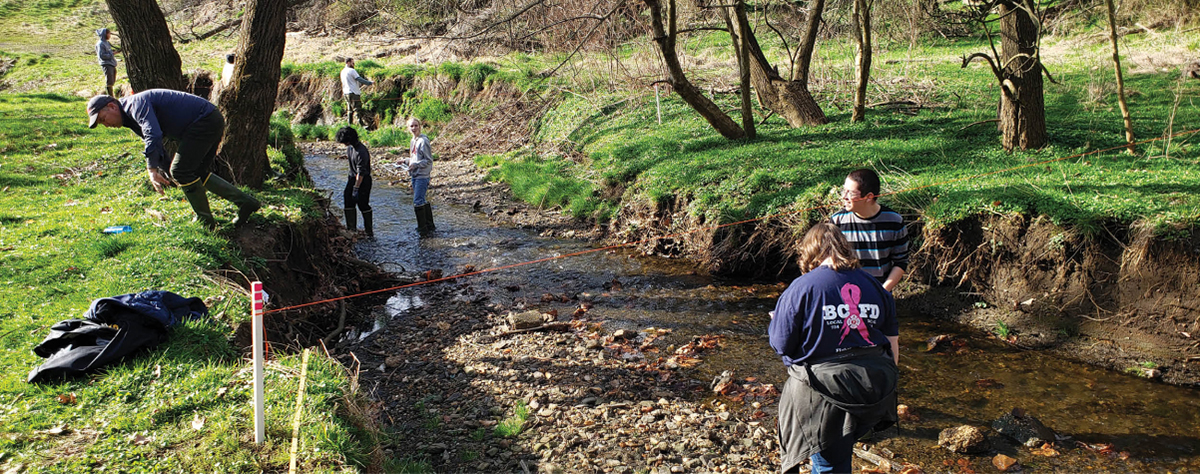 Students collect data that measure flow rate, depth, pebble size, and more as part of the “stream lab” in a popular, interdisciplinary GES course. Photo by Sarah Hansen, M.S. ’15.

When Alieh Rezaei arrived at UMBC from Iran, she couldn’t take her eyes off the ground. Almost immediately she was mesmerized by the flora and fauna of her new residence, and as an master of fine
arts student in the intermedia and digital arts (IMDA) program, she decided to incorporate pieces of UMBC into her artwork. She walked around campus, picking up windfalls of seeds and exploring hidden nooks of nature. A place that would come to be her sanctuary,
Rezaei, M.F.A. ’22, says, was Joseph Beuys Sculpture Park.
“The solidity of the stones alongside the growth of the oaksand the evolving shape of the garden reflect concepts of erosion and growth,” says Rezaei. “As an immigrant, I found solace in my attachment to the settled and solid stones, representing a sense of
grounding to me.”
Rezaei was drawn to UMBC’s M.F.A. program because of its multidisciplinary approach and the freedom she felt to choose an unconventional path. She praised Kathy O’Dell, IMDA professor emerita, who was her advisor. “Kathy was someone who—it was like I was floating in the air and Kathy held my hand and grounded me. She was very supportive for the whole journey.”
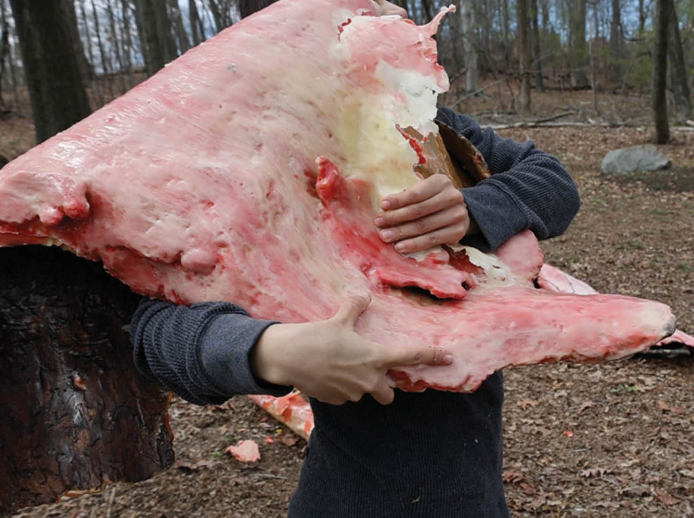
A photograph from Rezaei’s three-hour performance “The Tongue in the Landscape” at the Joseph Beuys Sculpture Park featuring the artist laboriously peeling the wax layer off the pieces of bark. Photo courtesy of Rezaei.
To create the art for her thesis project, Rezaei used almost exclusively materials collected on or near campus, including fallen tree bark, shattered wood, and seeds. She bought her main material—beeswax— from Baltimore beekeepers. One piece, “The Collective Womb,” featured hundreds of native seeds, called Devil’s Darning Needles, held together by beeswax around orange peels.
When the pieces were finished, Rezaei immediately knew the stage she wanted to showcase them on—Joseph Beuys Sculpture Park. “I installed my pieces there and had a performance as a way to extend the concept of public sculpture, aiming to reactivate the space and revive the concept of ecological engagement central to Beuys’ 7000 Oaks project.”

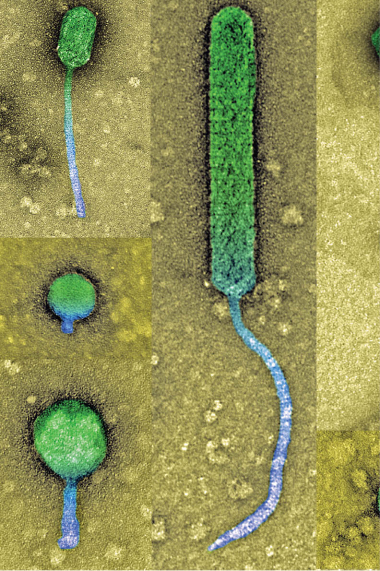
A composite of several microscope images of phages discovered by UMBC students in the Phage Hunters program demonstrates the variety of shapes phages can take. Photo by Tagide deCarvalho.
IchabodCrane. MindFlayer. Annihilus. TonyStarch. These are viruses previously completely unknown to science discovered by UMBC students in the Phage Hunters program, a two-course undergraduate genetics and bioinformatics sequence.
Since its launch in 2008, UMBC students have discovered 661 viruses that infect bacteria, called phages. Ninety-seven of them originated in samples collected on campus, with the most popular location being the Library Pond. Seventy-seven phages have been sequenced and 60 have been fully characterized and submitted to GenBank, an international digital repository of genetic and protein sequences.
Steven Caruso ’94, Ph.D. ’02, biological sciences, principal lecturer of biological sciences, runs the genetics course where the students collect samples, isolate their phages, image them with help from Tagide deCarvalho, “and growth,” says Rezaei. “As an immigrant, I found present their findings. They learn foundational laboratory techniques and get a taste for research.
Phage Hunters gives students “a first glimpse of what research is, with all that goes with it: determination, grit, inspiration, frustration, and more,” says Ivan Erill, professor of biological sciences and co-instructor for the bioinformatics course with Caruso. “Students get to see all the possible outcomes of a research project, from total success culminating in a DNA extraction for sequencing to failure to isolate a phage in the first place.”

In the basement of the Meyerhoff Chemistry Building, in a tiled expanse called the Molecular Characterization and Analysis Complex, sits a sleek, roughly human-sized instrument with the power to measure extremely tiny amounts of chemicals. Amanda Belunis, a chemistry Ph.D. student now in her final year, knows the instrument like an old friend, having turned to it to analyze a smorgasbord of UMBC water samples.
Belunis studies a group of chemicals called per- and polyfluoroalkyl substances, or PFAS. The chemicals are used in products as varied as makeup, clothing, and fire-fighting foam and are found in trace amounts in many water sources as well as in human blood. Dubbed “forever chemicals” because of the way they persist in the environment, they present a growing concern to human health.
Belunis’s research is part of a growing effort by scientists to understand how PFAS enter and travel through the environment and, ultimately, figure out ways to remove them.
To validate her procedures for measuring PFAS concentrations, Belunis tested water from drinking fountains, the sink in her chemistry lab, the pool, and the pond and streams around UMBC, all of which contained trace amounts of PFAS, as would be expected. Confident her methods worked on real-life samples, she then turned her attention to analyzing water in aquaculture fish tanks.
“My lab mates and I sometimes discuss how all of us have these chemicals in our bodies,” says Belunis. “It’s concerning, which is why we need to do more studies.”
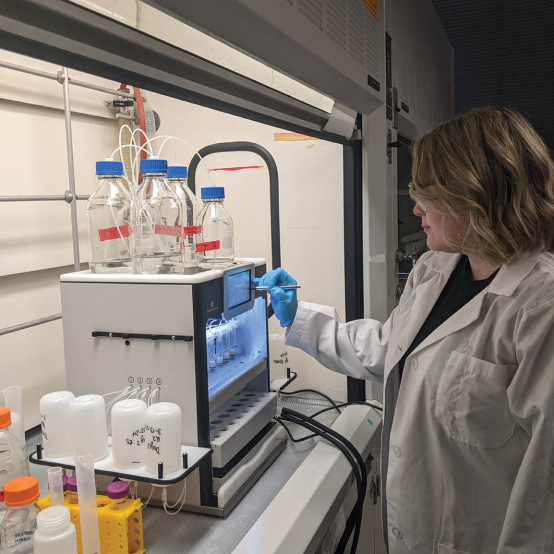
Amanda Belunis prepares samples for later analysis in the Molecular Characterization and Analysis Complex. Photo by Catherine Meyers.

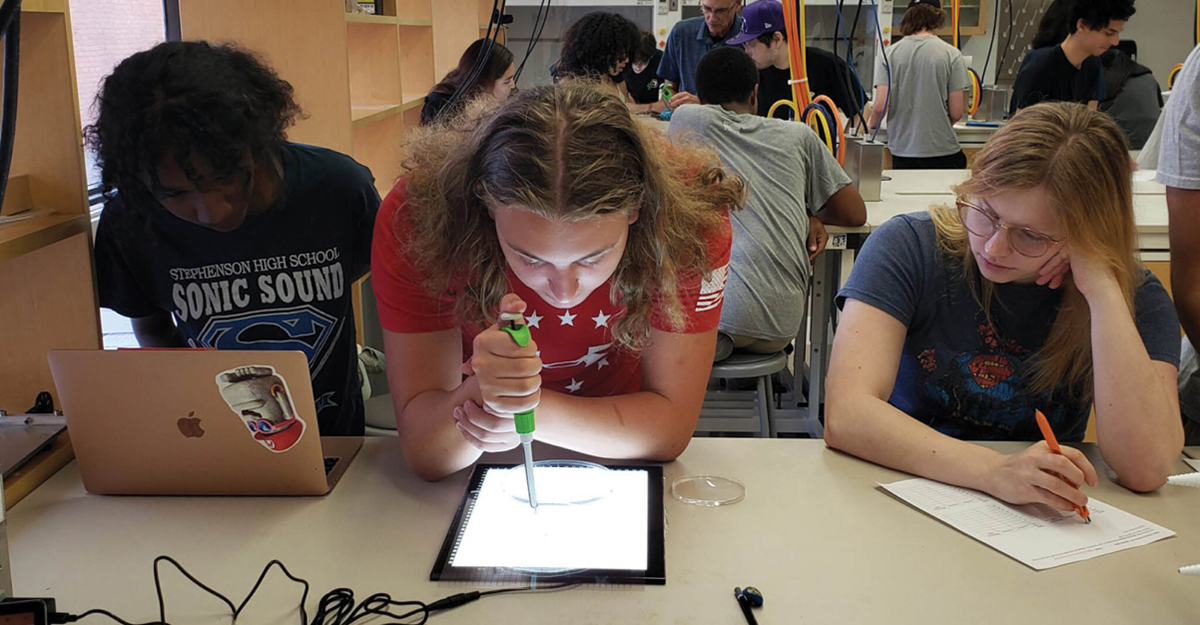 In addition to measuring buildings, students in Math in Action discovered other ways that math naturally interacts with their lives and studies. Here they are recording the movements of brine shrimp. Photo by Sarah Hansen, M.S. ’15.
When asked how to measure the height of a building, most students in Math in Action, a new laboratory course for non-STEM majors, “came up with various ways to measure the height directly—for example, by dropping down a string and then measuring the string or stacking up various objects,” says Alexis O’Malley ’18, mathematics and psychology, who teaches the lab.
But today, students are peering along the edges of homemade clinometers—plastic protractors with drinking straws attached—taking measurements from safely on the ground with a meter stick, and running simple calculations based on the properties of triangles to measure the height of UMBC’s Administration Building (123 feet, 2 inches).
Throughout the course, “I want students to see how math can be used to solve problems creatively,” O’Malley says.
Math in Action covers different math concepts each week through hands-on activities. The purpose of the clinometer activity is to remind students that “science is based on measurement, and you can build a tool to measure almost anything,” shares William R. LaCourse, dean of the College of Natural and Mathematical Sciences, who originally generated the idea for the course to help a wider range of students develop math skills relevant to their everyday lives. The course, he adds, “is a doorway to a lot of different math concepts.”

Shawn Abraham ’24, political science, has gotten lost on the UMBC campus more times than he can remember. As a blind student, he finds his way using a white cane, auditory cues, mental maps, and by asking people for directions. “People are surprised when I tell them, but big cities are much easier to navigate,” Abraham says. “College campuses are hard to get around.”
Tactile maps are one tool that could help. Erin Higgins and Kirk Crawford, Ph.D. students in human-centered computing, have recently been working with blind students at UMBC to create and test 3D-printed maps of campus.
The researchers launched the project after being approached by Michael Canale, assistant director of the Office of Student Disability Services. He says UMBC currently has four completely blind students enrolled and his office wants to provide personalized maps that each student can carry with them as they navigate campus. He’d also like to see a large 3D-printed map mounted somewhere on campus.
“A beautiful tactile map could be used by visitors of all kinds,” Canale said. “It’s the principle of universal design.”
Meanwhile, Md Osman Gani, an assistant professor of information systems, is spearheading a new project, named MyPath, to develop a Google Maps–style app to help wheelchair users navigate campus.
“Uneven surfaces, discontinuous sidewalks, and steep slopes can make wheelchair travel challenging, and even impossible” Gani says. The MyPath app would help by providing users with personalized turn-by-turn navigation with real-time updates. The app will rely on a machine learning model that recognizes path accessibility conditions based on crowd-sourced data, and Gani is currently recruiting wheelchair users to contribute data using their smartphones.
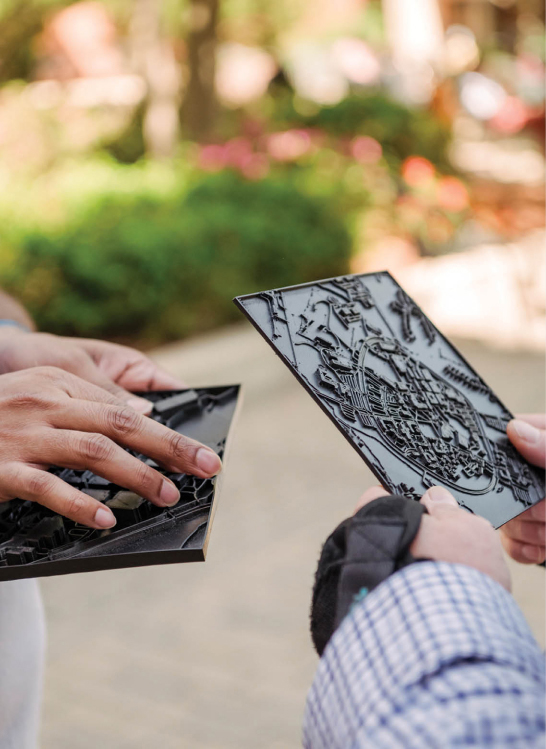
Shawn Abraham (left) tests prototype tactile maps made with 3-D printers with Michael Canale (right).

It’s 7 a.m. in July, and Megan Curtiss ’23, GES, is standing next to a tree just outside The Loop on UMBC’s southeast corner. It’s wrapped in a thin metal band at about chest height. Curtiss carefully measures the small gap between the two ends of the band with digital calipers three times, takes the average, and then moves on to the next tree. Only 98 to go.
This scene played out weekly from March to October 2023 as Curtiss collected data for a study led by Matthew Baker, GES professor, and Nancy Sonti, a research ecologist with the U.S. Forest Service. “It became like a morning meditation,” Curtiss shares.
The metal bands, call dendrobands, “are a cheap and easy way to get pretty detailed information,” Curtiss says. By measuring the trees’ growth over time, the goal is to look at how trees of different species and in different immediate environments (such as a parking lot versus a forest) handle conditions like fluctuating temperatures and water availability.
After attending Anne Arundel Community College in her 30s, Curtiss then found a home at UMBC. She began working with Baker in fall 2022 and will enter the GES master’s program at UMBC this fall. A graduate degree was not something Curtiss originally planned on, but now she’s excited about the further experiences it will bring. “I’m looking forward to the unexpected,” Curtiss says.

Take a left off Hilltop Circle, just past the greenhouse on the right and toward the Walker Avenue apartments, and you’ll find yourself outside a traditional brick building that used to house trial rooms and detention cells. In 2021, UMBC turned this former courthouse into the main hub for the Center for Real-time Distributed Sensing and Autonomy (CARDS). Researchers here develop artificial intelligence-enabled smart robots for military and search-and-rescue operations.
On a sunny day in spring, you will likely see students gathered in the courthouse’s “backyard,” huddled around dog-like Spot robots and wheeled vehicles called Jackals and Huskies.
The researchers outfit the robots with a host of custom devices, such as cameras and radar to sense their surroundings and microprocessors to run on-board algorithms. While the robots can be commanded via voice and gesture, the ultimate goal is for them to operate mostly autonomously.
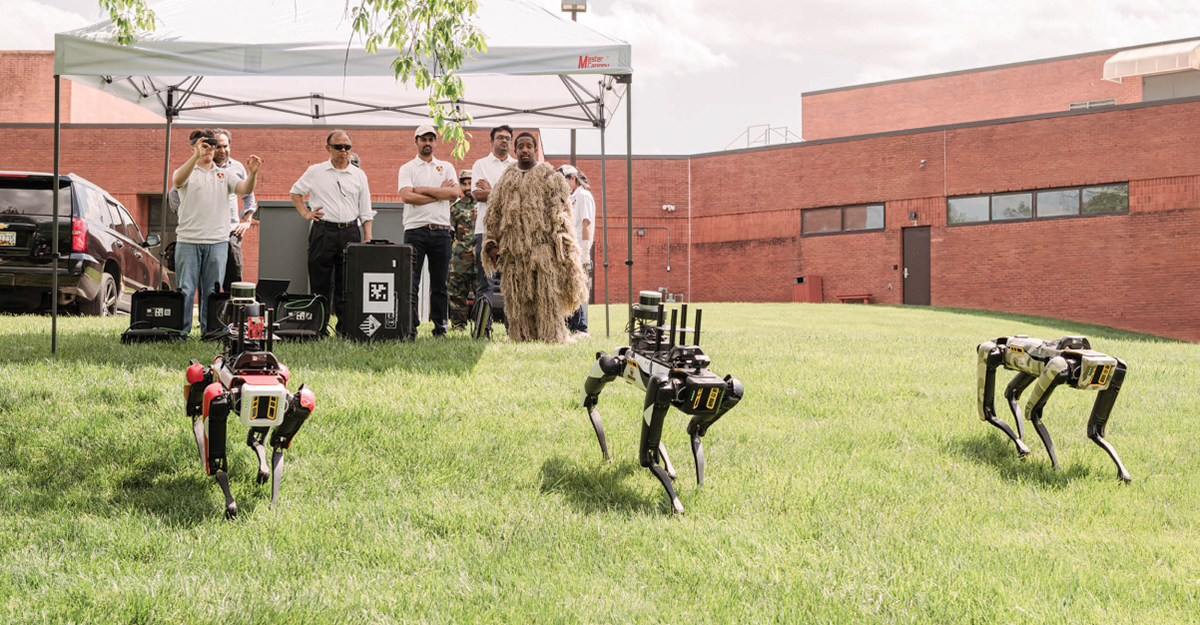 On the back lawn of the courthouse building, student researcher Kevin Rippy, left, controls three Spot robots with gestures. Another student stands by in a ghillie suit, a type of camouflage clothing.
Recently, the team has demonstrated this capability by verbally assigning the robots the task of jointly surveying a given area. The robots must translate the instructions from plain English into machine-level commands, divide up duties, detect and avoid obstacles, come to a fellow robot’s aid in the case of unexpected problems, and identify and keep track of the objects and people within their assigned perimeter.
“People from around campus will see us testing and will stop to watch,” says Aryya Gangopadhyay, a professor in information systems who directs CARDS. “The robots are an attention getter.”

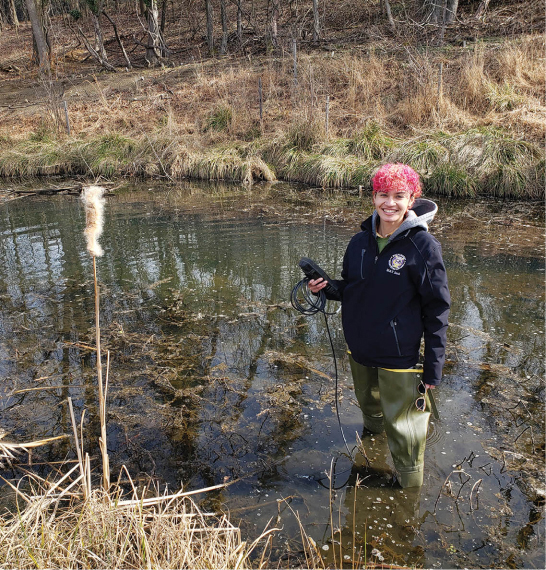
Erin Hamner collected weekly water quality data from this stream for six months, using the battery-powered digital probe she’s holding. (Image by Sarah L. Hansen, M.S. ’15)
After traipsing across a swampy field between research sites, Erin Hamner ’22, GES, and a current master’s student in the Interdisciplinary Consortium for Applied Research in the Environment program, scampers down a streambank in thigh-high waders and plunges a battery-powered probe into the water. It reports concentrations of ammonia and nitrates—key water quality measures. The probe also measures the water’s conductivity, which indicates the level of ions, such as salts used to melt snow.
It’s beautiful out today, but Hamner completed the trek to a dozen campus sites weekly from September 2023 to February 2024, sometimes dealing with mud, snow, or rain. The goal of her master’s thesis is to confirm that stormwater management features UMBC has installed to reduce flooding, filter storm runoff, and otherwise improve water quality are working as intended—or if they aren’t, to suggest improvements.
Hamner and her collaborators in Facilities Management and the Office of Sustainability want to see the data collection effort continue after she graduates. So she is working with faculty in GES to incorporate crowd-sourced stormwater monitoring into the undergraduate curriculum, including generating a public dashboard.
“Erin has done incredible groundwork collecting water quality data across our campus, generating useful data that can tell us about the health of UMBC’s waterways,” says Taylor Smith, assistant director of sustainability.
Long-term data will help the university “see how our development affects our watershed so we can continue to be good stewards,” Smith adds, noting that, “data like Erin’s can help us advocate for more greenspace and stream buffers around campus.”
]]>
Spring on UMBC’s main campus brings a host of familiar sights and sounds: blooms on the magnolia trees, the chatter of red-winged blackbirds calling from the reeds around Library Pond, greening...
https://umbc.edu/stories/putting-umbc-research-on-the-map/
https://my3.my.umbc.edu/api/v0/pixel/news/142303/guest@my.umbc.edu/93196282138c9d99f3c2930689edf3cd/api/pixel
biological-sciences
cahss
campus-life
cards
chemistry
cnms
coeit
computer-science
feature
ges
humancentered-computing
icare
imda
information-systems
joseph-beuys
magazine
mathematics
political-science
psychology
science-and-tech
sds
spring-2024
story
UMBC News & Magazine
https://my3.my.umbc.edu/groups/umbc-news-magazine
https://assets1-my.umbc.edu/system/shared/avatars/groups/000/001/943/24435aa6207c452e7bc15cc74b42c7bb/xsmall.png?1748556657
https://assets1-my.umbc.edu/system/shared/avatars/groups/000/001/943/24435aa6207c452e7bc15cc74b42c7bb/original.png?1748556657
https://assets2-my.umbc.edu/system/shared/avatars/groups/000/001/943/24435aa6207c452e7bc15cc74b42c7bb/xxlarge.png?1748556657
https://assets2-my.umbc.edu/system/shared/avatars/groups/000/001/943/24435aa6207c452e7bc15cc74b42c7bb/xlarge.png?1748556657
https://assets3-my.umbc.edu/system/shared/avatars/groups/000/001/943/24435aa6207c452e7bc15cc74b42c7bb/large.png?1748556657
https://assets1-my.umbc.edu/system/shared/avatars/groups/000/001/943/24435aa6207c452e7bc15cc74b42c7bb/medium.png?1748556657
https://assets2-my.umbc.edu/system/shared/avatars/groups/000/001/943/24435aa6207c452e7bc15cc74b42c7bb/small.png?1748556657
https://assets1-my.umbc.edu/system/shared/avatars/groups/000/001/943/24435aa6207c452e7bc15cc74b42c7bb/xsmall.png?1748556657
https://assets2-my.umbc.edu/system/shared/avatars/groups/000/001/943/24435aa6207c452e7bc15cc74b42c7bb/xxsmall.png?1748556657
UMBC News & Magazine
1
0
false
Thu, 30 May 2024 10:42:29 -0400
Thu, 30 May 2024 10:42:29 -0400
Meet a Retriever—Sean McWilliams, M.S. ’16, Alumni Association Alumni Awards Committee Co-Chair

Meet Sean McWilliams, M.S. ‘16, applied mathematics. Sean is a portfolio manager at T. Rowe Price and an active member of the UMBC Alumni Association Board of Directors, serving as one of the co-chairs of the Alumni Awards committee. Sean was a non-traditional student who found his way to UMBC as a part-time graduate student while working full-time at T. Rowe Price. Take it away, Sean!
Q: What is your WHY? What brought you to UMBC?
A: After working for a few years I deeply missed the academic rigor of studying mathematics. I wanted to study more math at the graduate level, mostly out of personal interest, while I continued to work. I also wanted to take the same classes that the full-time graduate students would be taking. UMBC’s applied mathematics program was the only one that offered classes with the level of rigor I was seeking that would work with my schedule.
Q: What’s your favorite part of Retriever Nation?
A: I love meeting new alumni and learning about how UMBC helped launch their personal and professional successes after graduation.
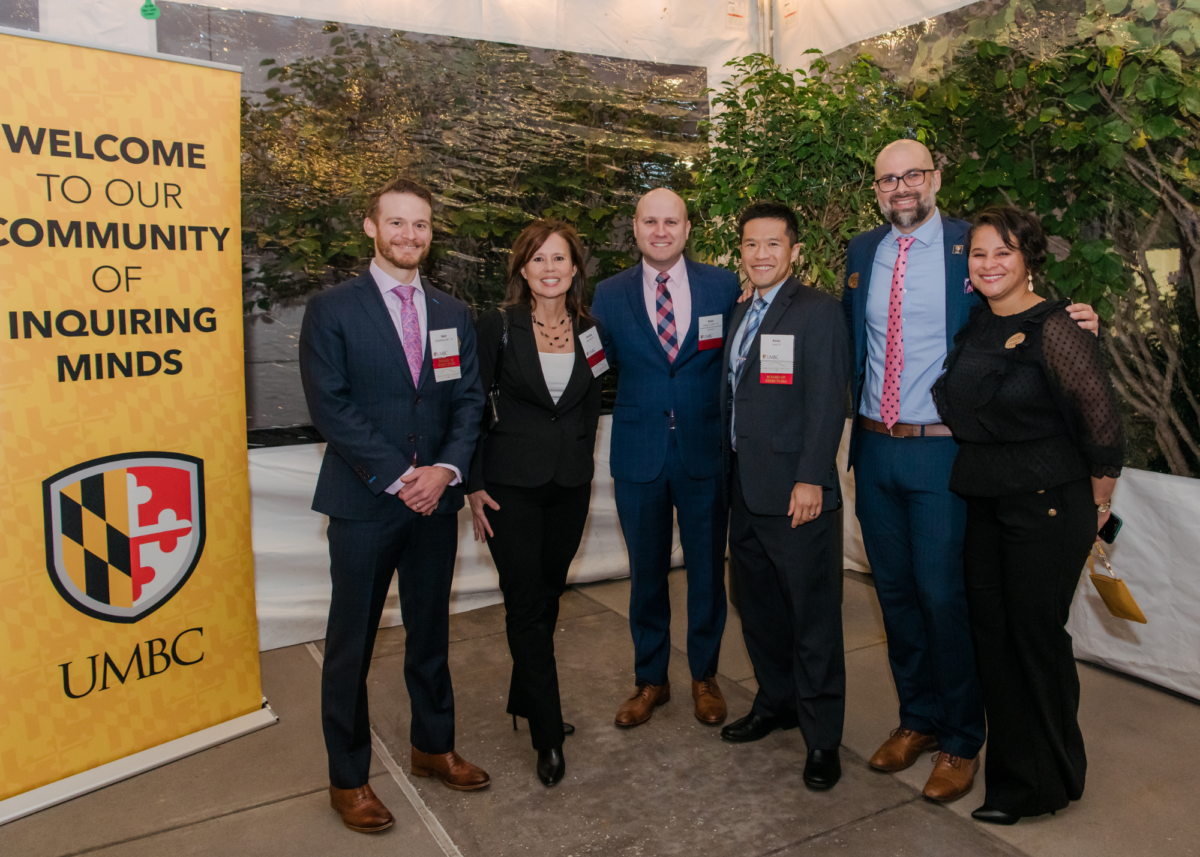 Members of the Alumni Association Board of Directors with UMBC’s Director of Alumni Engagement, Stanyell Odom. Pictured left to right: Sean McWilliams, M.S. ’16, Zozscha Bomhardt ’93, Brian Frazee ’11, M.P.P. ’12., Kevin Yang ’07, Bobby Lubaszewski ’10, M.P.S. ’23, and Stanyell Odom.
Q. What is your HOW? Where did you find support?
A: I enjoyed all of my classes at UMBC and found the professors to be almost universally excellent and passionate teachers. I had especially memorable experiences taking partial differential equations with Kathleen Hoffman, stochastic processes with Muruhan Rathinam, and applied analysis with Animikh Biswas.
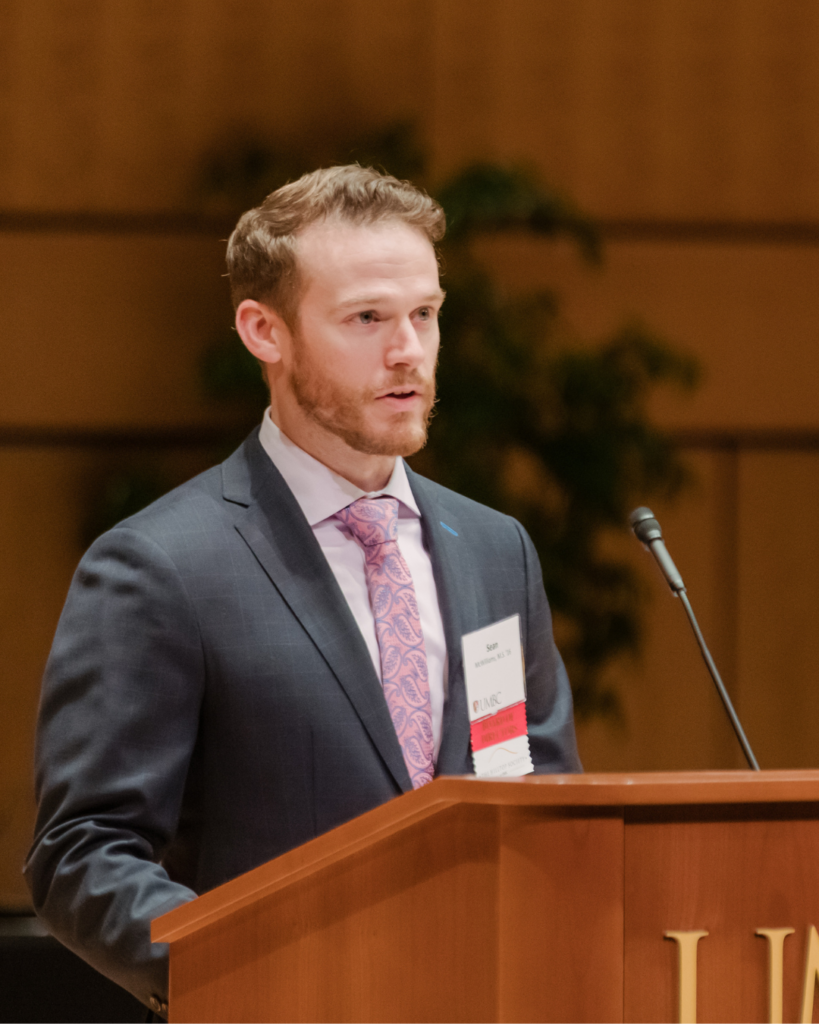
Q: What drives you to support UMBC?
A: I specifically donate to support the Alumni Endowed Scholarship Fund. The scholarships this fund supports often have a direct and immediate impact on the recipients’ ability to complete their degrees. It’s gratifying to know my donations help support the fund’s ability to continue to deliver that impact.
About the Alumni Association Board of Directors
UMBC’s Alumni Association is a non-dues-paying organization and is led by a volunteerBoard of Directors—volunteer graduates, like Sean, who support advancing the mission and vision of the association and, by extension, UMBC, through their visibility as alumni leaders and active participants in the ongoing work of the board and its committees.
(Pictured left: Sean McWilliams, Alumni Awards co-chair, at the podium during Alumni Awards 2022.)
About the Alumni Awards
Extraordinary UMBC alumni, faculty, and staff are making a difference in the world, and the UMBC Alumni Association Board of Directors holds an annual celebration of their accomplishments. Past winners have included a U.S. Surgeon General, a Lucasfilm sound editor, the New Yorker‘s social media director, chief judges, teachers, and scientists advancing fields such as medicine, chemical engineering, physics, and biology. We also honor outstanding UMBC faculty and staff members for their role in guiding and nurturing students.
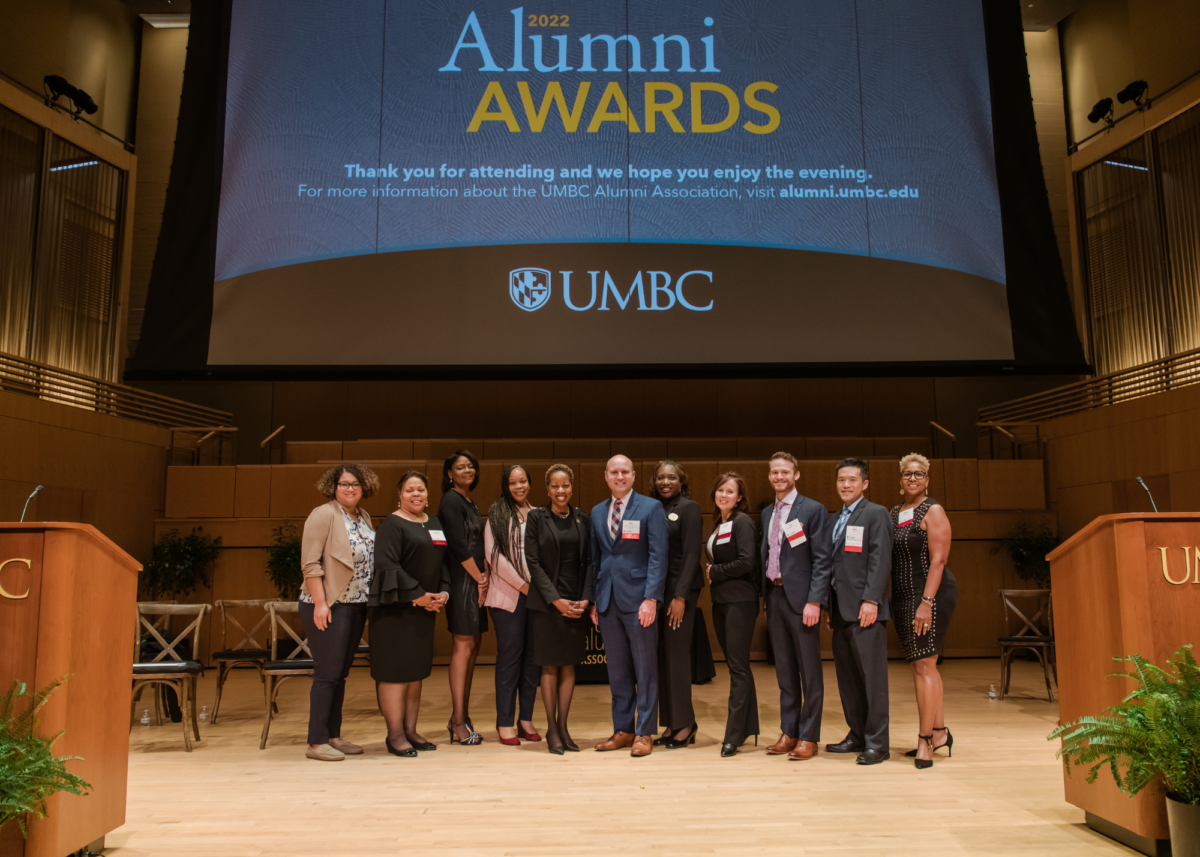 Alumni Awards 2022 group photo. Alumni Awards committee members with UMBC President Valerie Sheares Ashby and Alumni Association President Brian Frazee ’11, M.P.P. ’12.
Five types of awards are given: Outstanding Graduate, Distinguished Service, Rising Star, Outstanding Faculty, and Outstanding Staff.
* * * * *
UMBC’s greatest strength is its people. When people meet Retrievers and hear about the passion they bring, the relationships they create, the ways they support each other, and the commitment they have to inclusive excellence, they truly get a sense of our community. That’s what “Meet a Retriever” is all about.
Learn more about how UMBC can help you achieve your goals.
]]>
Meet Sean McWilliams, M.S. ‘16, applied mathematics. Sean is a portfolio manager at T. Rowe Price and an active member of the UMBC Alumni Association Board of Directors, serving as one of the...
https://umbc.edu/stories/meet-sean-mcwilliams-alumni-awards-co-chair/
https://my3.my.umbc.edu/api/v0/pixel/news/140907/guest@my.umbc.edu/9b42927e23fae63593d0071bed522301/api/pixel
alumni
alumni-association
alumni-awards
alumni-endowed-scholarship
impact
magazine
mathematics
meet-a-retriever
story
UMBC News & Magazine
https://my3.my.umbc.edu/groups/umbc-news-magazine
https://assets1-my.umbc.edu/system/shared/avatars/groups/000/001/943/24435aa6207c452e7bc15cc74b42c7bb/xsmall.png?1748556657
https://assets1-my.umbc.edu/system/shared/avatars/groups/000/001/943/24435aa6207c452e7bc15cc74b42c7bb/original.png?1748556657
https://assets2-my.umbc.edu/system/shared/avatars/groups/000/001/943/24435aa6207c452e7bc15cc74b42c7bb/xxlarge.png?1748556657
https://assets2-my.umbc.edu/system/shared/avatars/groups/000/001/943/24435aa6207c452e7bc15cc74b42c7bb/xlarge.png?1748556657
https://assets3-my.umbc.edu/system/shared/avatars/groups/000/001/943/24435aa6207c452e7bc15cc74b42c7bb/large.png?1748556657
https://assets1-my.umbc.edu/system/shared/avatars/groups/000/001/943/24435aa6207c452e7bc15cc74b42c7bb/medium.png?1748556657
https://assets2-my.umbc.edu/system/shared/avatars/groups/000/001/943/24435aa6207c452e7bc15cc74b42c7bb/small.png?1748556657
https://assets1-my.umbc.edu/system/shared/avatars/groups/000/001/943/24435aa6207c452e7bc15cc74b42c7bb/xsmall.png?1748556657
https://assets2-my.umbc.edu/system/shared/avatars/groups/000/001/943/24435aa6207c452e7bc15cc74b42c7bb/xxsmall.png?1748556657
UMBC News & Magazine
0
0
false
Fri, 05 Apr 2024 13:11:26 -0400
Uplifting up-and-coming economists
As a student Anna Gifty Opoku-Agyeman took notice of something missing in the field of academic economics—people who looked like her.
Since then, this Forbes 30 under 30 star in Boston has worked to shed light on the harrowing diversity issues in economics while carving out a space for economists of color, specifically Black women, to thrive. But she’s not carrying on this work in a vacuum. Inspired by and connected with other aspiring economists at UMBC through Sloan UMBC, Opoku-Agyeman ’19, mathematics, and others leveraged the resources in that scholars program to uplift underrepresented voices in economics—including their own.
In 2017, UMBC received a $1.3 million grant from the Alfred P. Sloan Foundation in an effort to diversify the field of economics by creating interventions from the undergraduate level through the post-baccalaureate (post-bac) level. The program was originally intended to conclude in five years but has since been extended to support UMBC students in post-bac programs through 2025.
“The Sloan program is a really good signal to the economics space that UMBC is in the business of producing Black economists,” says Opoku-Agyeman. “It also provided me with community among the next generation of Black folks coming up in the economics field.”
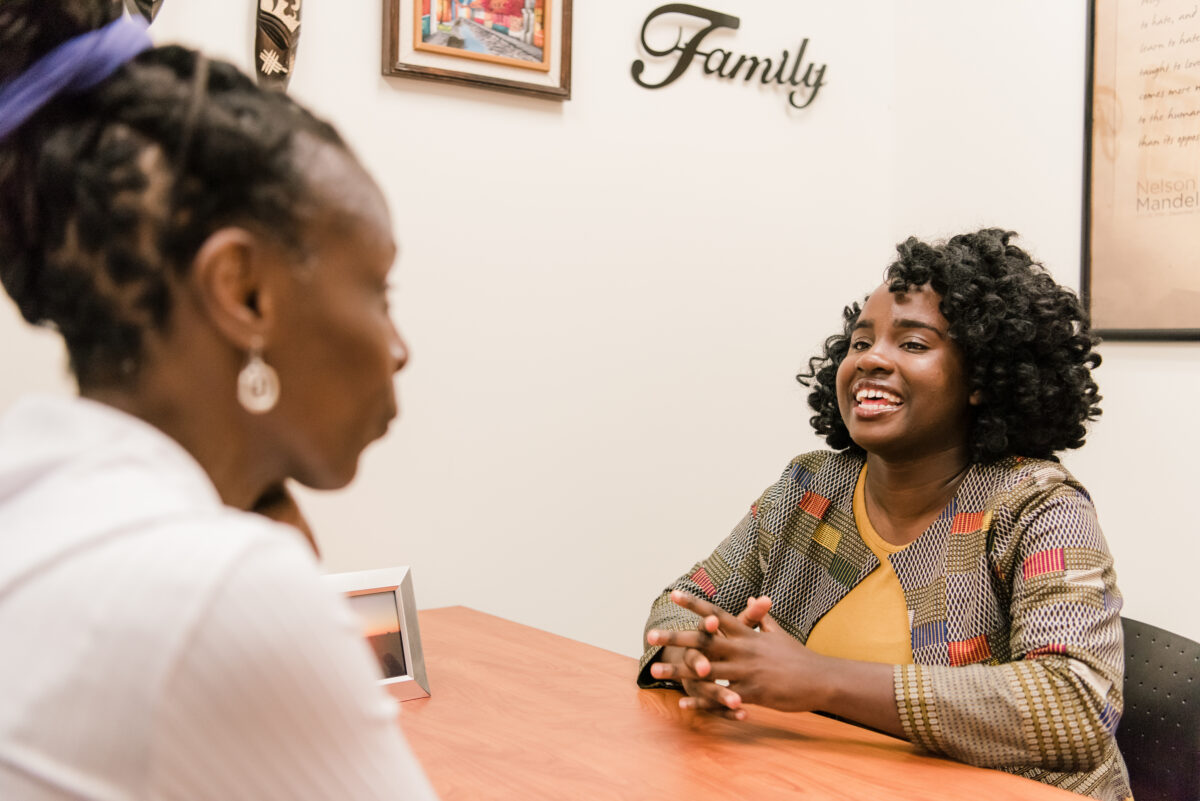 Anna Gifty Opoku-Agyeman (right). (Marlayna Demond ’11/UMBC)
Program scholar Yetunde Oshagbemi ’23, mathematics, benefited from the material and financial resources from Sloan, but also credits the personal connections she developed. In 2022, Oshagbemi participated in the Exploring Career Pathways conference organized by The Sadie Collective—a nonprofit co-founded by Opoku-Agyeman that addresses the pipeline and pathway problem for Black women in economics and related fields—and the Federal Reserve Bank of Chicago.
“There are many things I wouldn’t have known without a program like Sloan,” says Oshagbemi, now a first-year research assistant at the Federal Reserve Bank of Chicago. “It introduced me to other students who were on a similar path and people like Anna who can possibly guide me through my research experience.”
Opoku-Agyeman, who is now a third-year Ph.D. student studying public policy and economics at the Harvard Kennedy School, shares the importance of why she stays connected to UMBC and the Sloan program.
“I want to ensure that those who come after me have a much easier time getting through the economics space. Fellow graduates and I have helped to inform how the program can best serve students,” she says.
Developing the Next Generation of Academic Economists
“It’s important to do this work at an early stage—it’s often a path that students haven’t thought about when they enter college,” says David Mitch, principal investigator of the Sloan program.
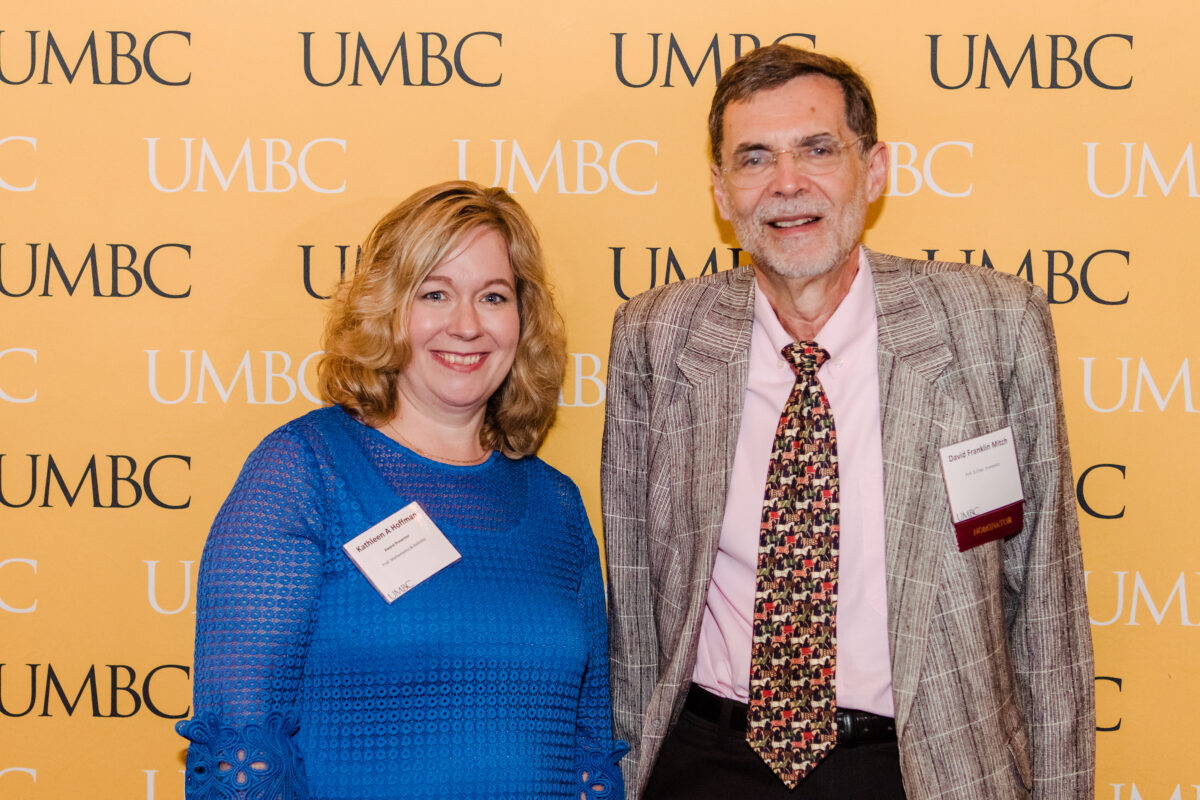 Kathleen Hoffman, professor of math and statistics, and David Mitch at the 2018 UMBC Alumni Awards (Marlayna Demond ’11/UMBC)
Mitch, department chair and professor of economics, explains that when it comes to professions in his field, students often think about careers in finance or the stock market. The program educates students about the academic side of economics careers and provides participants with mentoring, scholarships, research experiences, and financial support in research programs specializing in doctoral preparation. To date the program has placed six students in post-baccalaureate programs—one more than the original goal—with a further 17 students participating in various program activities.
 Yetunde Oshagbemi. (Photo courtesy of Yetunde Oshagbemi)
“There’s this route that involves graduate work in economics through all sorts of social impact areas such as health, the environment, education, and upward mobility of minority groups,” Mitch shares. Much of this work “deals with policy issues that could benefit from somebody with an underrepresented background.”
With support from the Sloan program to cover travel, lodging, and conference fees, Oshagbemi developed her research skills with internships at the University of Chicago, Brown University, and Howard University.
Growing up in Lagos, Nigeria, and then emigrating to the U.S. in 2010, keeping in mind the economic potential of her home country helped to influence Oshagbemi’s goal of addressing microeconomic issues of gender inequality and wealth disparities in sub-Saharan Africa.
Sloan UMBC, says Oshagbemi, “levels out the playing field for us, teaches us how to apply for opportunities, and what to do to be prepared to enter the field.”
Expanding the Economics Pipeline
Despite growing up with parents working in the field of economics, Sondheim Public Affairs Scholar Brevin Franklin ’22, economics and mathematics, wasn’t familiar with academic economics—teaching and researching—before coming to UMBC.
“The program exposed me to people doing economics research in post-bac programs and those who were in Ph.D. programs,” says Franklin, who is now a second-year economics scholar at Harvard University, supported by the Sloan grant. “It gave me a sense of whether I would like doing any of those things in the future.”
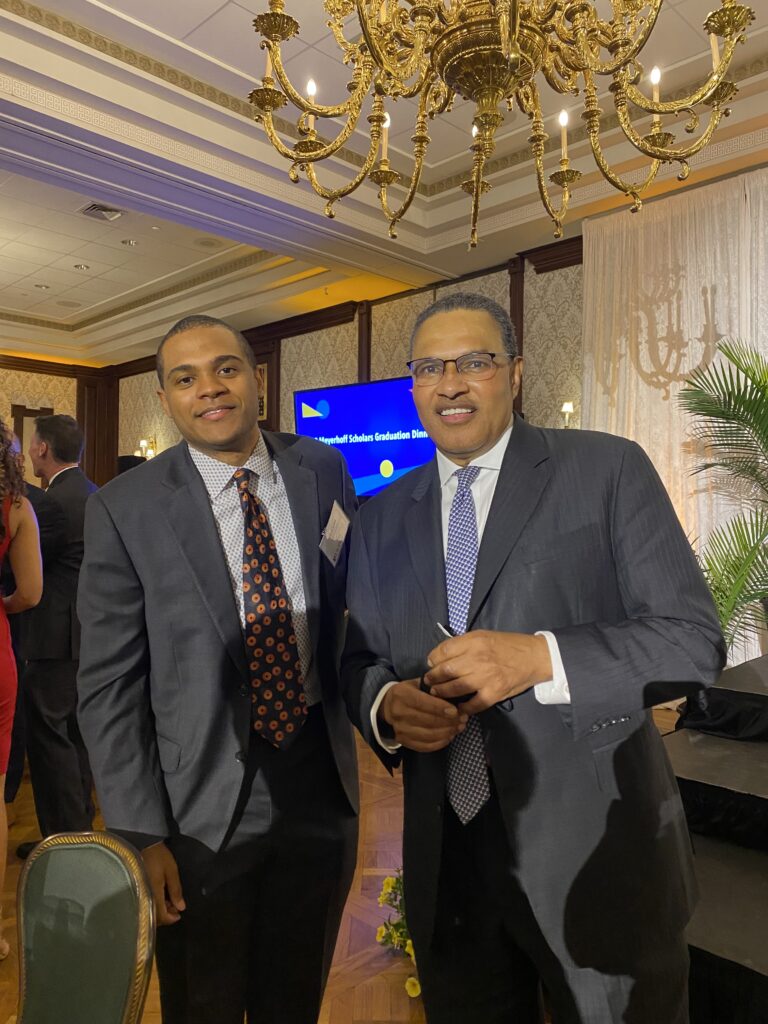 Brevin Franklin and UMBC President Emeritus Freeman Hrabowski. (Photo courtesy of Brevin Franklin)
Myles Ellis ’19, mathematics—who was also a post-bac economics scholar at Harvard—says the Sloan program encouraged him to take part in opportunities not initially aware of.
He’s now a third-year Ph.D. candidate at Brown University with a major concentration in econometrics. Ellis’ research focuses on how mistrust of institutions can shape the financial decision-making of Black households and how that might contribute to the racial wealth gap.
“Seeing people in this space that look like me is really important,” Ellis explains. “It’s important for this pipeline to be established because we need more Black and brown faces to shed light on what’s going on [in the world] through research, especially in this academic space.”
Oshagbemi, Franklin, and Ellis all referenced the significance of the mentorship they acquired as Sloan program scholars, pointing to guidance from the program’s coordinator, Ivanna Abreu.
“Ms. Abreu helped me practice for my internship interviews before applying and has been a great help with keeping us on track by checking in on what our top [research program] choices are and how we prepare for them,” says Oshagbemi.
Abreu was previously a program coordinator for UMBC’s Meyerhoff Scholars Program and says she admires the “hustle of STEM students” who come from underrepresented backgrounds.
“We make sure students have what they need,” says Abreu. “The program gives students the opportunity to really consider the economics field and to see themselves in it, as opposed to thinking about all of the stereotypes of economics. That’s the biggest thing we teach our students.”
]]>
As a student Anna Gifty Opoku-Agyeman took notice of something missing in the field of academic economics—people who looked like her. Since then, this Forbes 30 under 30 star in Boston has...
https://umbc.edu/stories/uplifting-up-and-coming-economists/
https://my3.my.umbc.edu/api/v0/pixel/news/137723/guest@my.umbc.edu/4e30f7edf474bf1b38de32dba9631884/api/pixel
alumni
economics
fall-2023
impact
magazine
mathematics
scholarships
UMBC News & Magazine
https://my3.my.umbc.edu/groups/umbc-news-magazine
https://assets1-my.umbc.edu/system/shared/avatars/groups/000/001/943/24435aa6207c452e7bc15cc74b42c7bb/xsmall.png?1748556657
https://assets1-my.umbc.edu/system/shared/avatars/groups/000/001/943/24435aa6207c452e7bc15cc74b42c7bb/original.png?1748556657
https://assets2-my.umbc.edu/system/shared/avatars/groups/000/001/943/24435aa6207c452e7bc15cc74b42c7bb/xxlarge.png?1748556657
https://assets2-my.umbc.edu/system/shared/avatars/groups/000/001/943/24435aa6207c452e7bc15cc74b42c7bb/xlarge.png?1748556657
https://assets3-my.umbc.edu/system/shared/avatars/groups/000/001/943/24435aa6207c452e7bc15cc74b42c7bb/large.png?1748556657
https://assets1-my.umbc.edu/system/shared/avatars/groups/000/001/943/24435aa6207c452e7bc15cc74b42c7bb/medium.png?1748556657
https://assets2-my.umbc.edu/system/shared/avatars/groups/000/001/943/24435aa6207c452e7bc15cc74b42c7bb/small.png?1748556657
https://assets1-my.umbc.edu/system/shared/avatars/groups/000/001/943/24435aa6207c452e7bc15cc74b42c7bb/xsmall.png?1748556657
https://assets2-my.umbc.edu/system/shared/avatars/groups/000/001/943/24435aa6207c452e7bc15cc74b42c7bb/xxsmall.png?1748556657
UMBC News & Magazine
2
0
false
Tue, 12 Dec 2023 12:52:04 -0500
Tue, 12 Dec 2023 12:52:04 -0500
Mentors help students grow their research skills, from fieldwork in Puerto Rico to labs at UMBC
It’s 4 a.m. in Puerto Rico, and Ellie Bare’s alarm is going off. Within an hour, she and her research colleagues are driving to their forested field site on the north side of the island to record Puerto Rican Oriole songs. After a midday break to avoid the worst of the heat, the team scouts new sites late in the afternoon. Some days they make another excursion before bed to check the birds’ roosting sites. Then the research team hits the pillow before doing it all over again.
This is the life of an ecological field researcher, one Ellie Bare ’23, biological sciences, has embraced wholeheartedly with the encouragement of mentors like Kevin Omland, professor of biological sciences, and Michelle Moyer, a Ph.D. candidate in Omland’s research group.
Building research skills—and life skills
Perhaps the most important trait of a strong researcher is the ability to ask good questions and then figure out how to pursue their answers. For example, Bare and her teammates in Puerto Rico noticed a bird roosting in a years-old nest overnight near their lodging. “We’d never heard of a bird doing that before,” Bare says, and as it turned out, neither had local experts. So began a new observational study managed by Bare.
Bare presented the results at UMBC’s Undergraduate Research and Achievement Day (URCAD) in April, finding that over 50 percent of old nests she tracked were in use as overnight roosts. The findings created new knowledge about this endangered species and a chance for Bare to flex her scientific inquiry skills, which will serve her well in any research area.
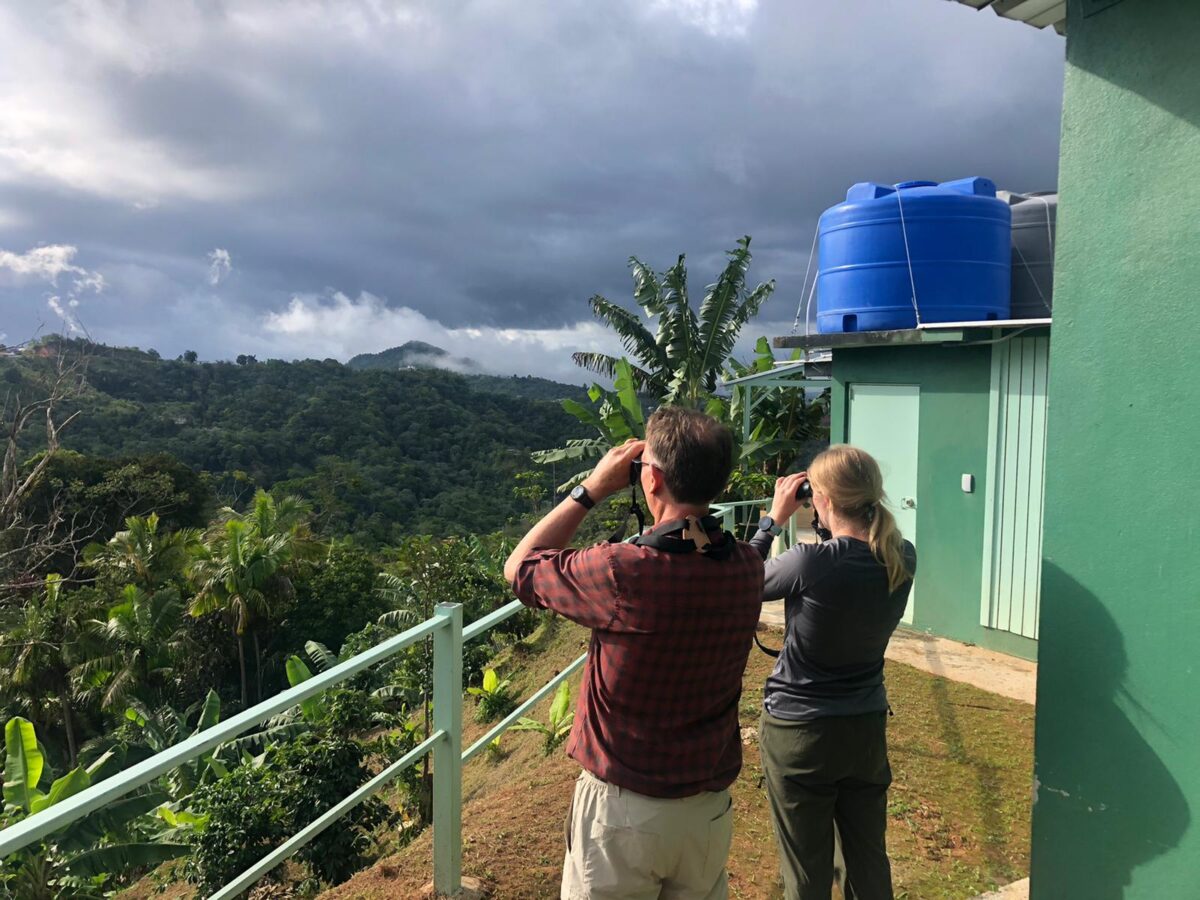 Kevin Omland and Ellie Bare scan the rainforest for birds during a research trip in Puerto Rico. (Image courtesy of Bare)
“Dr. Omland encourages that in his undergrads, which is really special,” Bare says. “He’s really supportive of undergrads getting the full research experience.”
Back on campus, Bare also took on developing a protocol for the Omland lab to determine the sex of birds based on DNA samples. That’s especially valuable in the study of tropical birds, where males and females frequently sport identical plumage. “It was really interesting and fun to spearhead that project on my own,” Bare says. The molecular skills she learned will help her in her next role, a postbac fellowship at the National Institutes of Health (NIH).
Omland also emphasizes communication skills with his students, requiring lab members to take turns presenting journal articles and providing updates on their own projects at lab meetings. In addition to URCAD, Bare also attended the international American Ornithological Society and BirdsCaribbean conference in Puerto Rico.
“Having those opportunities to improve my science communications abilities was invaluablereally great,” Bare says, “and it even helped me with my postbac interviews.”
Across the disciplines, student research shines
Bare will soon explore another area of biological research through her upcoming work at NIH—cancer research. While this area is a shift from her prior work with Omland and Moyer, she shares that the skills she learned in the Omland Lab were essential to her journey as a researcher and her mentors have continued to provide unflagging support.
Other graduating students, too, have had positive experiences with research that have prepared them for what’s next. Sarah Turner ’23, psychology, completed research with Susan Sonnenschein, professor of psychology, as well as summer research experiences at the Harvard Business School and Michigan State University. Max Bobbin ’23, chemical engineering, took on a leadership role early on in Tyler Josephson’s research group, learning and then teaching others a new programming language, and applying it to the team’s chemical theory work.
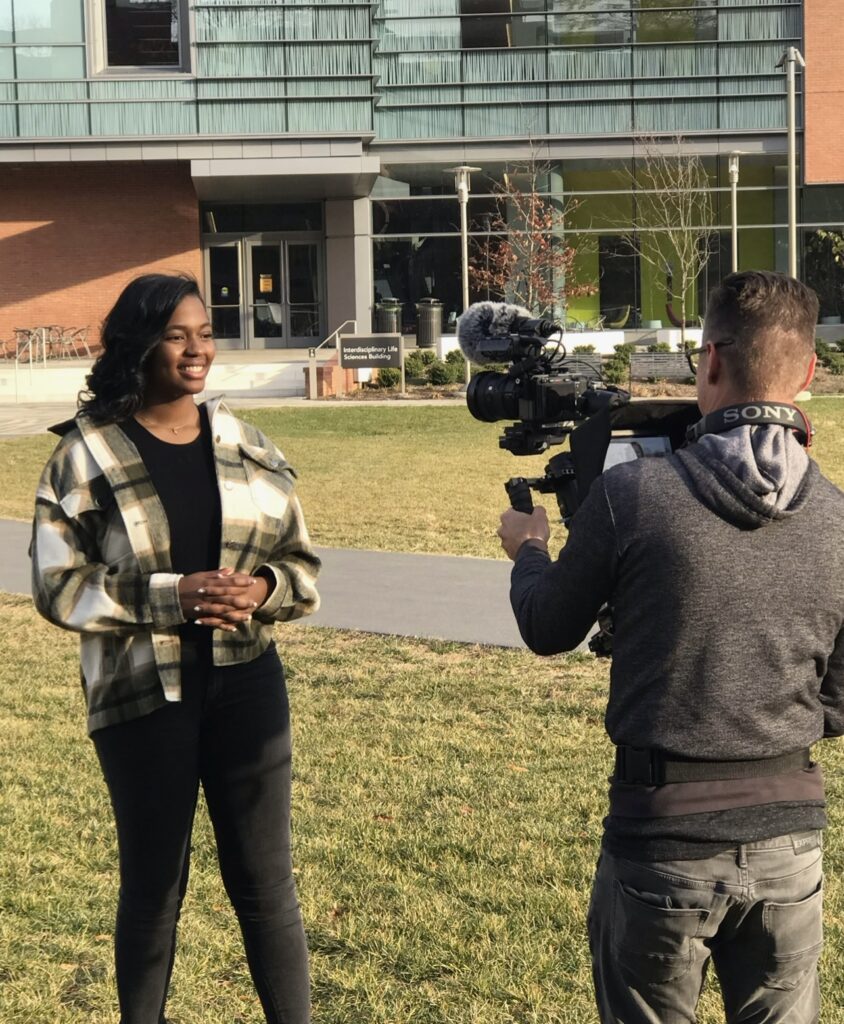 Sarah Turner, left, was interviewed for UMBC’s episode of the College Tour (on Amazon Prime) in 2022. (Image courtesy of Turner)
And valedictorian for the humanities and social sciences, Zinedine Partipilo Cornielles ’23, financial economics and mathematics, conducted research with Tim Gindling, professor of economics, and Salem Abo-Zaid, associate professor of economics. His project with Gindling focused on the impact of financial literacy on student loan decisions among undergraduates across the United States. In the future, he hopes to conduct research on labor economics with a focus on Latin America.
Across UMBC, research experiences are a cornerstone of the current and future success of students and the projects and labs to which they contribute. Encouragement from mentors to ask new questions, try new techniques, and fully participate in the intellectual life of the research group helps students build skills that will serve them in their careers and in life.
Read more Class of 2023 stories.
]]>
It’s 4 a.m. in Puerto Rico, and Ellie Bare’s alarm is going off. Within an hour, she and her research colleagues are driving to their forested field site on the north side of the island to record...
https://umbc.edu/stories/mentors-help-students-grow-research-skills/
https://my3.my.umbc.edu/api/v0/pixel/news/133508/guest@my.umbc.edu/df218eeb547890f00512ce3fe39109fc/api/pixel
biology
cahss
cahssresearch
chemeng
class-of-2023
cnms
coeit
economics
mathematics
news
psychology
undergraduate-research
UMBC News & Magazine
https://my3.my.umbc.edu/groups/umbc-news-magazine
https://assets1-my.umbc.edu/system/shared/avatars/groups/000/001/943/24435aa6207c452e7bc15cc74b42c7bb/xsmall.png?1748556657
https://assets1-my.umbc.edu/system/shared/avatars/groups/000/001/943/24435aa6207c452e7bc15cc74b42c7bb/original.png?1748556657
https://assets2-my.umbc.edu/system/shared/avatars/groups/000/001/943/24435aa6207c452e7bc15cc74b42c7bb/xxlarge.png?1748556657
https://assets2-my.umbc.edu/system/shared/avatars/groups/000/001/943/24435aa6207c452e7bc15cc74b42c7bb/xlarge.png?1748556657
https://assets3-my.umbc.edu/system/shared/avatars/groups/000/001/943/24435aa6207c452e7bc15cc74b42c7bb/large.png?1748556657
https://assets1-my.umbc.edu/system/shared/avatars/groups/000/001/943/24435aa6207c452e7bc15cc74b42c7bb/medium.png?1748556657
https://assets2-my.umbc.edu/system/shared/avatars/groups/000/001/943/24435aa6207c452e7bc15cc74b42c7bb/small.png?1748556657
https://assets1-my.umbc.edu/system/shared/avatars/groups/000/001/943/24435aa6207c452e7bc15cc74b42c7bb/xsmall.png?1748556657
https://assets2-my.umbc.edu/system/shared/avatars/groups/000/001/943/24435aa6207c452e7bc15cc74b42c7bb/xxsmall.png?1748556657
UMBC News & Magazine
0
0
false
Mon, 15 May 2023 11:40:41 -0400
Mon, 15 May 2023 11:40:41 -0400