New Art of Science award recognizes UMBC students who communicate research visually
For Rachel Brewster, professor of biological sciences, “science has always been visual,” she says. Her laboratory focuses on developmental biology, using zebrafish as a model organism. Zebrafish have transparent embryos, and imaging them as they grow and change is a core element of her group’s data collection.
“There is endless complexity and beauty captured in the images we generate using increasingly advanced imaging technologies,” Brewster says. “To me, this is not unlike the experience of viewing great works of art, such as impressionist paintings that bring the natural world to life through color, texture, and contrast.”
To that end, Brewster endowed the new Havelock and Jennifer Brewster Art of Science award in the College of Natural and Mathematical Sciences (CNMS). The award recognizes one CNMS student per year who produces original, visually stunning photographs, illustrations, or data visualizations that effectively communicate an important aspect of research.
“Scientific imaging that captures both beauty and meaning takes time, skill, and perseverance,” Brewster says. The new award acknowledges that “this kind of work deserves recognition not just within the scientific community, but beyond, because it has the power to spark curiosity, inspire others, and make science more accessible and engaging to the wider public.”
 Rachel Brewster’s office is a welcoming space for students to come and ask questions. (Marlayna Demond ’11/UMBC)
Opening people’s minds to the art of science
Maggie Wang, a junior biochemistry and molecular biology major with a minor in art history and museum studies, is the first recipient of the new award. Participating in UMBC’s SCIART program, a collaboration with the Walters Art Museum in Baltimore, initially “opened my mind to the intersection of science and art,” Wang says.
As an undergraduate researcher in UMBC’s Molecular Characterization and Analysis Complex (MCAC), Wang’s desire to better understand the research equipment in the MCAC led her to produce detailed illustrations explaining the purpose of various instruments and the techniques they employ. With the encouragement of Cynthia Tope Niedermaier,MCAC facility manager, Wang polished her illustrations to help others learn about the equipment.
 Maggie Wang created detailed drawings of instruments in the MCAC accompanied by helpful explanations of their features, such as this Bruker 12T solariX Fourier Transform Ion Cyclotron Resonance Mass Spectrometer (FT-ICR-MS). (Courtesy of Wang)
This summer, Wang will develop educational diagrams of more MCAC instruments. In addition to her scientific art, she works with graphite, ink, and yarn to create pieces that frequently focus on themes of Chinese culture and women’s fashion. Wang plans to pursue additional study in medical illustration after she graduates from UMBC.
“Making art is a cathartic experience that allows me to express my creativity and emotions,” Wang says. “It also helps me connect with people from different backgrounds, opening the door to new perspectives and meaningful connections.”
Giving back in gratitude
Brewster strongly believes in UMBC’s mission to bring together and support students from a wide range of backgrounds, a goal she lives out daily within her own research group. Recently she also became co-lead of UMBC’s Meyerhoff Graduate Fellows Program, which offers financial support and a close community feel to promising STEM students from all backgrounds.
“I have seen firsthand the powerful role the program plays in building the next generation of scientists,” Brewster says. “The Meyerhoff Program offers a proven framework, showing that by engaging all those who have something to contribute, we can continue to thrive as a nation.”
Brewster’s gift to fund this award is also “a small expression of my deep and lasting gratitude to my late parents, whom I love and miss every day,” she says. UMBC has also had a major role in shaping her identity. “UMBC has been my home since 2004. It is here that I have grown, not just as a scientist, but as a person. A big part of who I am is inextricably linked to this university.”
]]>
For Rachel Brewster, professor of biological sciences, “science has always been visual,” she says. Her laboratory focuses on developmental biology, using zebrafish as a model organism. Zebrafish...
https://umbc.edu/stories/art-of-science-award/
https://my3.my.umbc.edu/api/v0/pixel/news/150421/guest@my.umbc.edu/e2e7f6d2f5d14cac243879fc6a00cd41/api/pixel
arts-and-culture
biology
chembiochem
cnms
mcac
news
science-and-tech
story
UMBC News & Magazine
https://my3.my.umbc.edu/groups/umbc-news-magazine
https://assets1-my.umbc.edu/system/shared/avatars/groups/000/001/943/24435aa6207c452e7bc15cc74b42c7bb/xsmall.png?1748556657
https://assets1-my.umbc.edu/system/shared/avatars/groups/000/001/943/24435aa6207c452e7bc15cc74b42c7bb/original.png?1748556657
https://assets2-my.umbc.edu/system/shared/avatars/groups/000/001/943/24435aa6207c452e7bc15cc74b42c7bb/xxlarge.png?1748556657
https://assets2-my.umbc.edu/system/shared/avatars/groups/000/001/943/24435aa6207c452e7bc15cc74b42c7bb/xlarge.png?1748556657
https://assets3-my.umbc.edu/system/shared/avatars/groups/000/001/943/24435aa6207c452e7bc15cc74b42c7bb/large.png?1748556657
https://assets1-my.umbc.edu/system/shared/avatars/groups/000/001/943/24435aa6207c452e7bc15cc74b42c7bb/medium.png?1748556657
https://assets2-my.umbc.edu/system/shared/avatars/groups/000/001/943/24435aa6207c452e7bc15cc74b42c7bb/small.png?1748556657
https://assets1-my.umbc.edu/system/shared/avatars/groups/000/001/943/24435aa6207c452e7bc15cc74b42c7bb/xsmall.png?1748556657
https://assets2-my.umbc.edu/system/shared/avatars/groups/000/001/943/24435aa6207c452e7bc15cc74b42c7bb/xxsmall.png?1748556657
UMBC News & Magazine
0
0
false
Tue, 27 May 2025 13:05:54 -0400
Tue, 27 May 2025 13:05:54 -0400
The Man Behind the MCAC
Tucked away in the basement of the Meyerhoff Chemistry Building lies a hidden gem. The Molecular Characterization and Analysis Complex (MCAC) houses a group of self-proclaimed nerds analyzing chemical compounds on instruments that cost upward of a million dollars. Their manager, mentor, and friend, UMBC alumnus Joshua Wilhide M.S. ’10, chemistry, watches over the students—nudging them in the right direction when they need guidance and cracking a joke when they need a mental break.
By the time lunch rolls around, the group grabs a deck of cards and gathers at a table in the front of the lab to play a round of rummy. Before returning to the humming machines that are separating and sorting complicated chemical mixtures, the students swap stories of any ghost sightings in recent days.
“There’s a running joke that our lab is haunted by a very friendly ghost,” Wilhide chuckles. “Whenever we get new people in the lab we always ask if they believe in ghosts. Whether or not you believe, it’s a fascinating subject that we can always go back to, and we are able to bond over it.”
The profoundly welcoming work atmosphere is a feeling that Wilhide has been working to create for nearly a decade. When he started there full-time, in 2010, the MCAC was just a basement with gritty tile floors, worn down infrastructure, and three mass spectrometers. In 2019, it’s an inspirational learning environment with over 20 pieces of analytical instrumentation, and Wilhide’s home away from home.
Maryland Born and Bred
Wilhide was first introduced to what would become the MCAC in 2006, when he was an undergraduate at Stevenson University. Knowing that he wanted to become an analytical chemist, he sought out an instrumental lab for his senior capstone project and found one at UMBC. The lab allowed nearly anyone to come in and be trained on any piece of equipment, something that still holds true today at the MCAC.
“I came to UMBC and fell in love with the aspect of figuring out the unknown. It was fascinating to me that you can take a mixture of chemicals and inject it into an instrument and it will give you a unique profile of all the compounds in the chemical,” Wilhide says.
His first few years of research at UMBC included working with DNA and RNA samples and discovering how each interacted with the HIV virus. Those crucial early years gave Wilhide an in depth understanding of how to operate each instrument in the lab and taught him how to modify different instruments so that they interacted properly with the unique chemical makeup of RNA.
“I came to UMBC and fell in love with the aspect of figuring out the unknown.”
– Joshua Wilhide M.S. ’10, chemistry
After Stevenson, Wilhide was working toward his Ph.D. at UMBC when his mentor, Dan Fabris, decided to move his research to the University at Albany. Wilhide initially followed Fabris to upstate New York, but after two months, decided to return home and graduate with his master’s in chemistry at UMBC.
“The decision was difficult, but I was born and raised in Maryland, and I love my Old Bay and my crabs,” he admits. “I’m truly a Maryland boy at heart.”
Shortly after Wilhide’s graduation in 2010, the dean of UMBC’s College of Natural and Mathematical Sciences, William LaCourse, offered Wilhide a managerial position at the MCAC. Having worked intimately with the equipment for several years, LaCourse believed that Wilhide was the perfect candidate for the job.
Unique Approach to Learning
Wilhide describes the MCAC as a unique “jack of all trades” facility that works on general analytics. Other universities have core facilities that specialize in a certain subsection of analytical chemistry, which he says limits their ability to solve certain problems. On the other hand, the MCAC has more than 20 pieces of instrumentation that allow samples to be run through an instrument specially formulated for their specific molecular make-up.
One area of expertise that the lab has developed over the last several years is ambient ionization mass spectrometry. In layman’s terms, this involves Wilhide and other MCAC members building and designing a platform to test a range of unique samples (some examples of what they have tested include ink on paper, a piece of fruit, art from various museums) and determining their molecular make-up in a matter of seconds. Wilhide explains that the technology can be used to determine pesticides on foods, discover groups of chemicals in plastics, and was once even used to uncover the chemical differences between Coca-Cola and Pepsi.
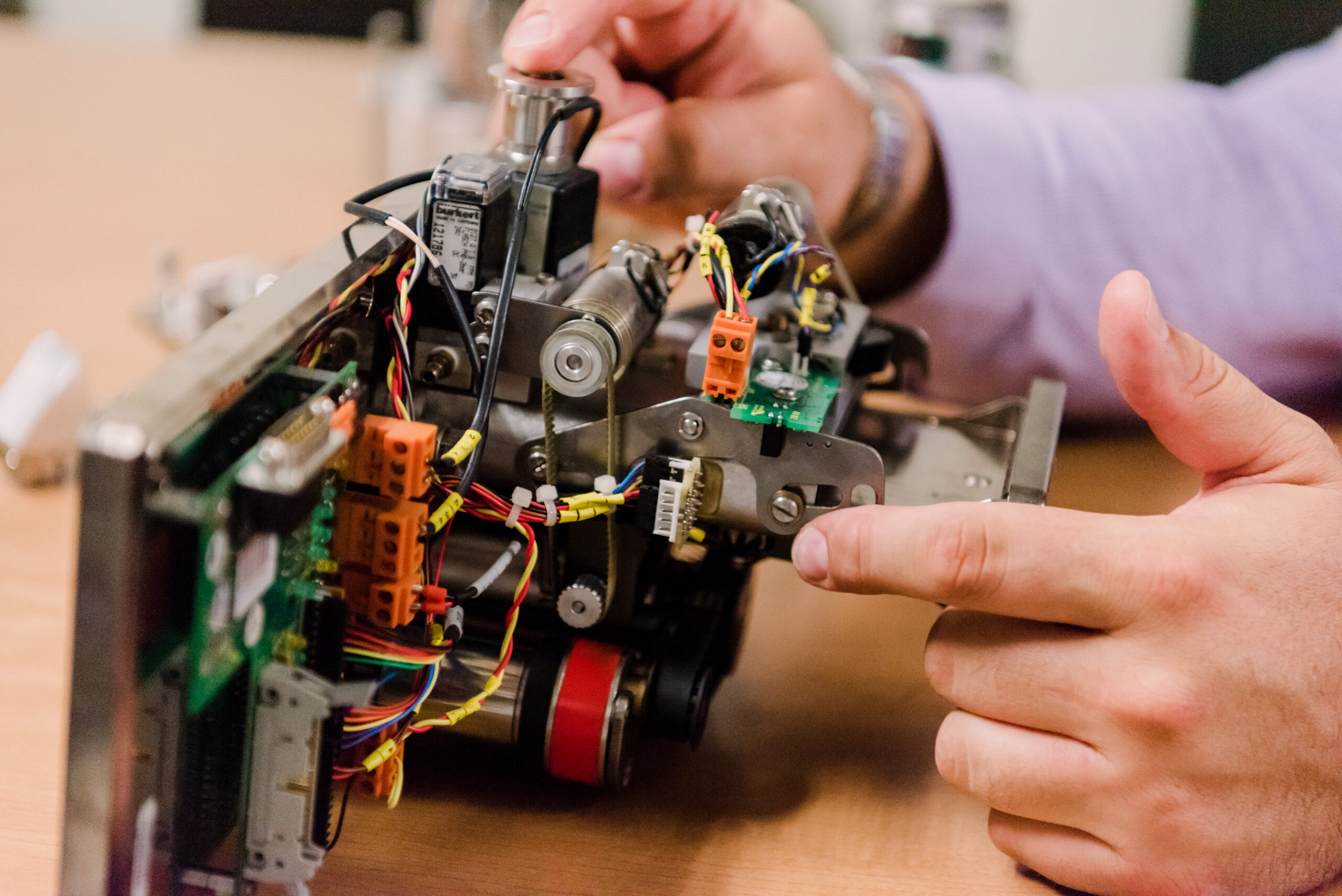
 Wilhide training a student on the inner-workings of a mass spectrometer.
“We are processing analytical problems that other core facilities can’t analyze because they don’t have the instrumentation nor the proper analytical techniques. Because the MCAC is so diversified in personal backgrounds as well as instruments,” Wilhide explains, “we can usually find a way to solve these issues, and that’s what makes us so unique.”
And students directly benefit from the MCAC’s diverse instrumentation. Wilhide personally trains all of his undergraduates on all of the instruments, even the $2 million mass spectrometer. If a trainee breaks any instrument, Wilhide sees this as an opportunity to show them how to fix it.
Open Access Advantage
Most analytic chemistry facilities have equipment behind closed doors where samples are put in a dropbox, tested by the lab’s staff, and results are emailed to the recipient weeks later. But Wilhide takes pride in the open access aspect of the MCAC, noting that anyone can come into the lab and be trained on any instrument. Another unique feature of the lab is the opportunity for undergraduates to run samples. Not only are the students learning how to analyze the data, but they are learning to run the instrumentation, thereby increasing their skill sets and marketability in the workforce.
“That’s how we feed back into that loop of a university education,” Wilhide says. “The students have access to equipment that many people don’t have and because of that will be able to get a job almost anywhere. It’s a unique opportunity to train students from the ground up.”
 Students are trained on every piece of instrumentation in the MCAC.
Chemistry major, Maddie Schuch ’21, currently works in the MCAC studying water quality analysis. She uses the lab’s instrumentation to detect and determine how much of a certain ion or compound is in a specific water sample, thus revealing the water quality. Her time working at the MCAC solidified her plans to pursue a Ph.D. in analytical chemistry when she graduates. Schuch notes that the fun work environment Wilhide creates has led to her ongoing success as an undergrad.
“It’s almost like having a little family here at the lab,” she says. “Josh truly cares for everyone and is very supportive—he never puts you down for not understanding something. Not only do I love the science that I get to do here, but I love the people.”
Keeping Alumni Close to Home
Wilhide is grateful that his professional odyssey brought him back to where he started: UMBC. Dean of the College of Natural and Mathematical Sciences, William LaCourse, understands the importance of keeping alumni like Wilhide on campus.
“There’s no better feeling than the joy of making room for one more member of the UMBC family,” LaCourse says. “In doing so, we are better equipped to meet our challenges and celebrate success as we deepen the inclusive excellence and community of our UMBC.”
LaCourse is impressed by how Wilhide has breathed life into the MCAC over the years. Wilhide’s commitment to growth and discovery on both a scientific and a personal level leaves a lasting impact on his students and is something that LaCourse wants to keep at UMBC.
“Alums on campus bring with them an insight into the culture of UMBC and a devotion to its mission and ethos—all of which enriches the student experience and working environment. Their loyalty and love for UMBC and all we do shines through as a beacon of inspiration for others to follow,” he says.
 Comradery and collaboration are two vital components of the lab.
UMBC as a Cornerstone
The Maryland boy continues to stay loyal to UMBC and acknowledges how much he has grown throughout his many years working in the MCAC.
“UMBC has been an anchoring point for me. Every stage of my life, from being a rookie grad student at 21, all the way to now being married with a stable career, the university has been there for me. I see it as a home and a place to grow, all while standing on the shoulders of giants and utilizing the connections I’ve made,” Wilhide says.
Wilhide emphasized that he has grown alongside his students, too. He recalls when he was dating his future wife, students would offer him advice on proposals and engagement rings around the lunch table. Now, conversations revolve around raising his toddler.
“UMBC is a place to grow, and the MCAC is always growing… I’m always growing,” he says. “If you would’ve told me nine years ago that we were going to set up this facility, I would’ve laughed. But we took it one day at a time and look where we are now.”
The MCAC will continue expanding when the new Interdisciplinary Life Sciences Building (ILSB) opens in fall 2019. The university recently purchased a $1.3 million multiple instrument package for the ILSB, designed to expand the university’s ability to study the function of proteins and peptides. Wilhide says that these new instruments will help bring back UMBC faculty who had to use other facilities to complete their lab work. He notes that this new equipment is a big step out of their comfort zone and will bring many new challenges, but will certainly be worth it.
“That’s the thing about Josh, he loves a good challenge,” LaCourse says. “He is a brilliant scientist and an overachiever. He cares about the students and is always ready to help build the university as a whole.”
*****
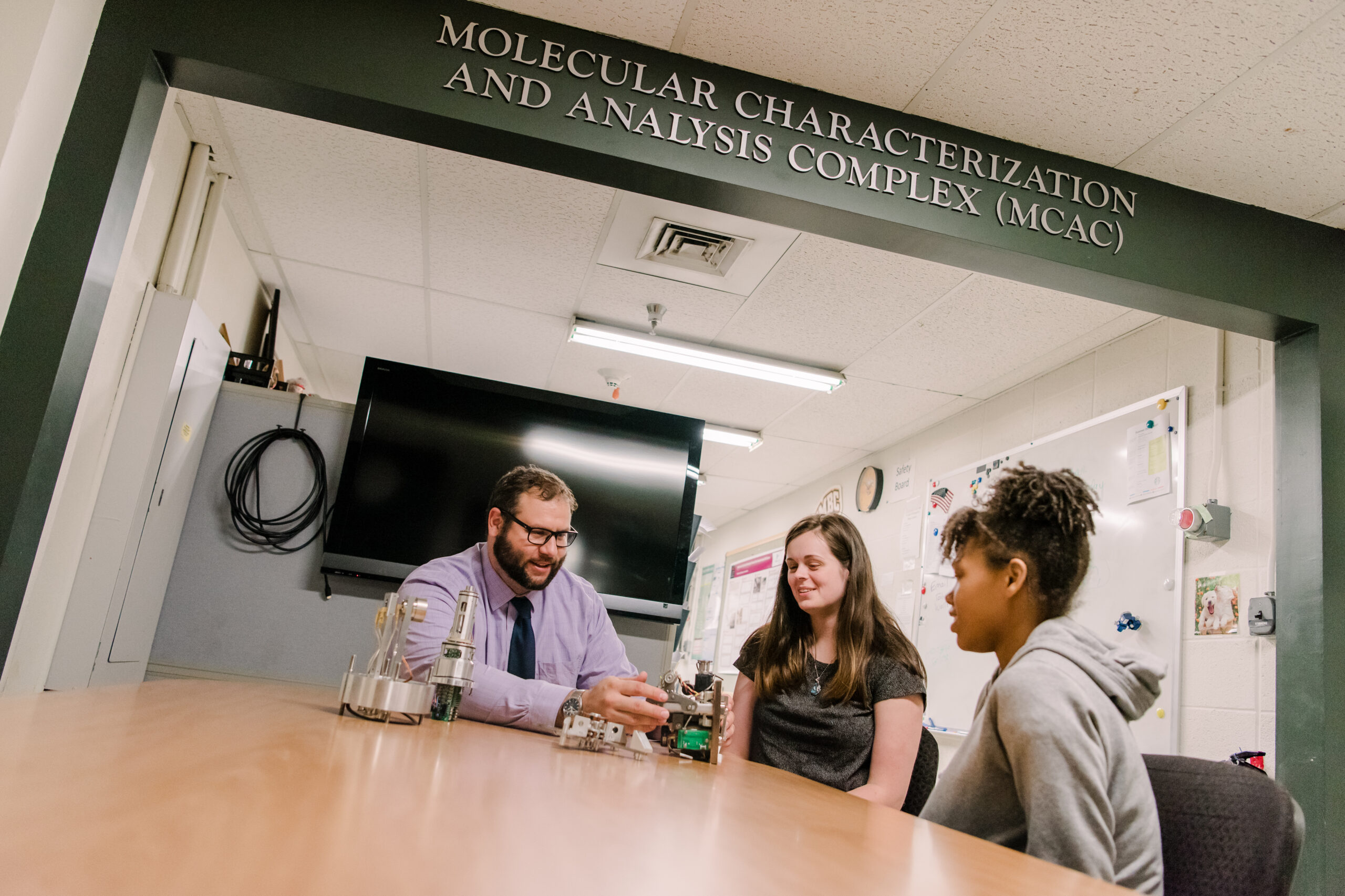
Header image: Wilhide showing students a piece of a mass spectrometer
Students pictured: Shirley Wolz ’20, biochemistry, and Sanaa Jones, an incoming first year student getting a jump start on research.
All photos by Marlayna Demond ’11.
]]>
Tucked away in the basement of the Meyerhoff Chemistry Building lies a hidden gem. The Molecular Characterization and Analysis Complex (MCAC) houses a group of self-proclaimed nerds analyzing...
https://umbc.edu/stories/the-man-behind-the-mcac/
https://my3.my.umbc.edu/api/v0/pixel/news/120069/guest@my.umbc.edu/1781c98a453f3ac1c1c41e6f201e8444/api/pixel
alumni
cnms
graduateschool
ilsb
mcac
UMBC News & Magazine
https://my3.my.umbc.edu/groups/umbc-news-magazine
https://assets1-my.umbc.edu/system/shared/avatars/groups/000/001/943/24435aa6207c452e7bc15cc74b42c7bb/xsmall.png?1748556657
https://assets1-my.umbc.edu/system/shared/avatars/groups/000/001/943/24435aa6207c452e7bc15cc74b42c7bb/original.png?1748556657
https://assets2-my.umbc.edu/system/shared/avatars/groups/000/001/943/24435aa6207c452e7bc15cc74b42c7bb/xxlarge.png?1748556657
https://assets2-my.umbc.edu/system/shared/avatars/groups/000/001/943/24435aa6207c452e7bc15cc74b42c7bb/xlarge.png?1748556657
https://assets3-my.umbc.edu/system/shared/avatars/groups/000/001/943/24435aa6207c452e7bc15cc74b42c7bb/large.png?1748556657
https://assets1-my.umbc.edu/system/shared/avatars/groups/000/001/943/24435aa6207c452e7bc15cc74b42c7bb/medium.png?1748556657
https://assets2-my.umbc.edu/system/shared/avatars/groups/000/001/943/24435aa6207c452e7bc15cc74b42c7bb/small.png?1748556657
https://assets1-my.umbc.edu/system/shared/avatars/groups/000/001/943/24435aa6207c452e7bc15cc74b42c7bb/xsmall.png?1748556657
https://assets2-my.umbc.edu/system/shared/avatars/groups/000/001/943/24435aa6207c452e7bc15cc74b42c7bb/xxsmall.png?1748556657
UMBC News & Magazine
0
0
false
Thu, 08 Aug 2019 19:26:01 -0400
Expanded core facilities offer imaging and analysis services for UMBC and local start-ups

Dean Bill LaCourse, of the College of Natural and Mathematical Sciences (CNMS), has been working for 20 years to build up a set of core analysis and imaging facilities at UMBC, open to the full UMBC community, local startups, and other institutions in need of these research tools. The campus celebrated the realization of his vision on February 24 with the Core Crawl, a special event where dozens of guests toured four core facilities, guided by their managers.
The Keith R. Porter Imaging Facility (KPIF), Nano-Imaging Facility, Research Graphics, and Molecular Characterization and Analysis Complex (MCAC) each offer unique tools to support scientific research, from mass spectrometry to scientific animations. The facilities’ most recent addition is a state-of-the-art transmission electron microscope recently donated by the Howard Hughes Medical Institute’s Janelia Research Campus.
Tools like these “are all about the most fundamental aspect of science—observation,” says LaCourse, and they “leverage and extend our capabilities so we can look at everything from the atom to the ends of the universe.”
The four UMBC facilities are unique among similar facilities at other universities because their directors do much more than analyze experimental samples for researchers. “The leaders of these facilities really are your allies as you are trying to gain new knowledge,” says Karl Steiner, vice president for research at UMBC. “They bring their expertise to your problem and work with you to get somewhere you may not have known you could go.” He adds, “It’s not the newest and latest instrument that makes a facility successful—it’s the people who run it and work with you.”
 Marios Levi ’19, mechanical engineering, demonstrates a 3D printer at the Keith Porter Imaging Facility to Julia Wolf, biological sciences.
One of those people is Tagide deCarvalho, manager of the KPIF, who stressed the teaching and learning aspects of the facilities. “I’m really interested in helping people at all levels,” she shared, “from sample prep, to instrument training, to experimental design.”
Joshua Wilhide, M.S. ’10, chemistry, and manager of the MCAC, emphasized that the goals of the facilities extend beyond generating results researchers can publish. “We are a university—at the end of the day we have to look at how we’re teaching the next generation,” he shared, “be it graduate student or undergrad, we’re going to train you on any of the instruments so you not only understand what the analytical techniques are, you can actually run them.” Developing those skill sets early in their scientific careers can open up new and exciting opportunities for students who work in the labs.
As university-based facilities, the labs are also able to provide low rates for instrument time, which is particularly useful for local start-ups. Before making a major investment in expensive equipment, new companies can get advice from dedicated staff and determine what instrumentation they might need down the road.
Dean LaCourse is particularly excited that the four expanded core facilities will reach a broad range of users, within and beyond CNMS. “Now we have facilities that are customer-focused, client-focused. We’re here to service and facilitate the research enterprise in the most effective and efficient way possible,” said LaCourse. “It’s access for everybody.”
Banner image: Joshua Wilhide describes the instruments available at the MCAC; photo by Marlayna Demond ’11 for UMBC.
]]>
Dean Bill LaCourse, of the College of Natural and Mathematical Sciences (CNMS), has been working for 20 years to build up a set of core analysis and imaging facilities at UMBC, open to the full...
https://umbc.edu/stories/expanded-core-facilities-offer-imaging-and-analysis-services-for-umbc-and-local-start-ups/
https://my3.my.umbc.edu/api/v0/pixel/news/120867/guest@my.umbc.edu/7824a5473469328463771a72f651561d/api/pixel
biology
chembiochem
cnms
kpif
marinebiotech
mcac
physics
research
science-and-technology
UMBC News & Magazine
https://my3.my.umbc.edu/groups/umbc-news-magazine
https://assets1-my.umbc.edu/system/shared/avatars/groups/000/001/943/24435aa6207c452e7bc15cc74b42c7bb/xsmall.png?1748556657
https://assets1-my.umbc.edu/system/shared/avatars/groups/000/001/943/24435aa6207c452e7bc15cc74b42c7bb/original.png?1748556657
https://assets2-my.umbc.edu/system/shared/avatars/groups/000/001/943/24435aa6207c452e7bc15cc74b42c7bb/xxlarge.png?1748556657
https://assets2-my.umbc.edu/system/shared/avatars/groups/000/001/943/24435aa6207c452e7bc15cc74b42c7bb/xlarge.png?1748556657
https://assets3-my.umbc.edu/system/shared/avatars/groups/000/001/943/24435aa6207c452e7bc15cc74b42c7bb/large.png?1748556657
https://assets1-my.umbc.edu/system/shared/avatars/groups/000/001/943/24435aa6207c452e7bc15cc74b42c7bb/medium.png?1748556657
https://assets2-my.umbc.edu/system/shared/avatars/groups/000/001/943/24435aa6207c452e7bc15cc74b42c7bb/small.png?1748556657
https://assets1-my.umbc.edu/system/shared/avatars/groups/000/001/943/24435aa6207c452e7bc15cc74b42c7bb/xsmall.png?1748556657
https://assets2-my.umbc.edu/system/shared/avatars/groups/000/001/943/24435aa6207c452e7bc15cc74b42c7bb/xxsmall.png?1748556657
UMBC News & Magazine
0
0
false
Fri, 10 Mar 2017 14:44:31 -0500
Baltimore City elementary school students learn about college opportunities through UMBC visit

Prospective students tour UMBC on a daily basis, rain or shine, but last week saw a particularly special visit from around 80 fifth graders from Armistead Gardens Elementary School in Baltimore, who came to get a taste of the opportunities available at UMBC and a sense what the college experience could have in store for them.
The Shriver Center at UMBC coordinated the visit, including Michele Wolff, director of The Shriver Center, Lori Hardesty, assistant director of service-learning, K-16 partnerships, Sandra Abbott, curator of collections & outreach for the Center for Art, Design and Visual Culture, Mavis Sanders, professor of education, and Shane McCormick, coordinator of administration, evaluation & operations for the office of academic opportunity programs. Faculty, staff, and students from across the university, gave the students a truly broad sense of what UMBC offers.
“At UMBC, we want youth to feel, think, dream, and know that they can achieve their goals,” Hardesty said. “We encourage them because we believe in them, too.”
True Grit and members of UMBC’s Admissions Team welcomed the students and led enthusiastic cheers to kick off the day. “UMBC is a place that embraces diversity,” said Ana María Schwartz Caballero, associate professor of Spanish, second language education, and modern languages, linguistics and intercultural communication (MLLI), during her welcoming remarks. Schwartz Caballero highlighted UMBC’s shared community values, including a strong commitment to fostering an inclusive and welcoming environment.
A panel of UMBC students, including Joy Kish ‘17, biological sciences; Ramses Long ‘17, biology, Yamani Narayan ‘18; health administration and public policy; and Jaelyn Bos ‘17, biological sciences and environmental science, discussed career goals, involvement on campus, and how and when they decided to attend UMBC.
“I was fourteen when I discovered UMBC on a class tour in middle school,” shared Long, who plans to become a physician.“I was excited to expose a younger generation to UMBC so it can motivate them and show them a pathway to a better life. That was what my tour did for me.”
UMBC encourages students to pursue their interests outside of the classroom. The clubs and organizations at UMBC are “opportunities to express yourself,” Kish said.
Faculty and staff across all three UMBC colleges led sessions for the elementary school students. One group learned about chemistry through an interactive demonstration by Bill LaCourse, dean of the College of Natural and Mathematical Sciences, and Josh Wilhide, M.S. ’10, chemistry, manager of the Molecular Characterization and Analysis Complex (MCAC) at UMBC. Another group of students visited the Joseph Beuys Sculpture Park, completing a scavenger hunt and creating nature drawings with Abbott.
Doug Hamby, associate professor of dance, and director of the Linehan Artist Scholars Program, led the third group through the steps of creating a new, improvisational dance. The fourth group explored engineering with Jamie Gurganus, associate director of engineering education initiatives and instructor of mechanical engineering, building structures out of small wooden planks. The students tested their structures with heavy textbooks to see how well they tolerated stress.
Parents were invited to attend a session about resources for planning and preparing for college, led by Sanders, Karen Watkins-Lewis, lecturer in psychology, and Claudia Galindo, associate professor of Teaching and Learning, Policy and Leadership at the University of Maryland, College Park. The Baltimore City Public Schools Office of Family and Community Engagement provided books for the students, and gave turkey dinners to two parents who attended the session.
Bos enjoyed connecting with the students individually, on light topics like favorite animals and more serious issues like how to pay for college. “Bringing fifth graders to campus gives them the opportunity to see themselves at college, and inspires them to see their own education as interesting and meaningful,” she said.
Moving forward, Hardesty plans to welcome greater numbers of K-12 students to campus regularly, to help them envision themselves pursuing a college degree. She also hopes to keep engaging Armistead Gardens Elementary School students as they move through their middle school and high school years, on the path to college.
“Many youth must manage barriers, including others telling them that they ‘can’t,’ a perception that there are not enough resources available, or that they are not aware of others who reached their goals despite their own obstacles,” said Hardesty. “It’s more critical than ever that all youth have an equal opportunity to dream about what they love, shape how they see themselves in the world, and create their own futures.”
Image: A group of UMBC students answering questions from fifth graders at Armistead Gardens Elementary School. Photo by Marlayna Demond ’11 for UMBC.
]]>
Prospective students tour UMBC on a daily basis, rain or shine, but last week saw a particularly special visit from around 80 fifth graders from Armistead Gardens Elementary School in Baltimore,...
https://umbc.edu/stories/baltimore-city-elementary-school-students-learn-about-college-opportunities-through-umbc-visit/
https://my3.my.umbc.edu/api/v0/pixel/news/120961/guest@my.umbc.edu/098196d36ee6ae0508513f41d988d208/api/pixel
arts-and-culture
biology
cadvc
cnms
coeit
community
education
linehanscholars
mcac
policy-and-society
publicpolicy
saph
science-and-technology
shrivercenter
UMBC News & Magazine
https://my3.my.umbc.edu/groups/umbc-news-magazine
https://assets1-my.umbc.edu/system/shared/avatars/groups/000/001/943/24435aa6207c452e7bc15cc74b42c7bb/xsmall.png?1748556657
https://assets1-my.umbc.edu/system/shared/avatars/groups/000/001/943/24435aa6207c452e7bc15cc74b42c7bb/original.png?1748556657
https://assets2-my.umbc.edu/system/shared/avatars/groups/000/001/943/24435aa6207c452e7bc15cc74b42c7bb/xxlarge.png?1748556657
https://assets2-my.umbc.edu/system/shared/avatars/groups/000/001/943/24435aa6207c452e7bc15cc74b42c7bb/xlarge.png?1748556657
https://assets3-my.umbc.edu/system/shared/avatars/groups/000/001/943/24435aa6207c452e7bc15cc74b42c7bb/large.png?1748556657
https://assets1-my.umbc.edu/system/shared/avatars/groups/000/001/943/24435aa6207c452e7bc15cc74b42c7bb/medium.png?1748556657
https://assets2-my.umbc.edu/system/shared/avatars/groups/000/001/943/24435aa6207c452e7bc15cc74b42c7bb/small.png?1748556657
https://assets1-my.umbc.edu/system/shared/avatars/groups/000/001/943/24435aa6207c452e7bc15cc74b42c7bb/xsmall.png?1748556657
https://assets2-my.umbc.edu/system/shared/avatars/groups/000/001/943/24435aa6207c452e7bc15cc74b42c7bb/xxsmall.png?1748556657
UMBC News & Magazine
0
0
false
Mon, 14 Nov 2016 21:56:46 -0500
