Celebrating the history, evolution, and impact of K-pop culture as represented in ‘KPop Demon Hunters’
Abbie Fakoya is at the front of the room, smiling and encouraging over 40 UMBC faculty, staff, and students to follow her dance steps. Many of the attentive dancers were either new to the intricate K-pop choreography, learning this sequence, or, like millions of fans around the world, ready to show off their synchronized dance moves to “Golden,” the 2026 Grammy-nominated Song of the Year, from Netflix’s KPop Demon Hunters film.
The global success of the film drew fans to the KPop Demon Hunters: A Conversation on Media, Culture, & Globalization event organized by the Asian Studies Program in collaboration with several CAHSS departments at the Skylight Lounge this fall. Fakoya, a biochemistry senior and the event coordinator for UMBC’s K-pop Dance Club, was not surprised to see the long line of people waiting to participate in an evening of Korean culture, dance, and food that celebrated Korea’s vast snack culture thanks to the D.C. Korean Foundation and a delicious Korean-fusion catered dinner by Baltimore’s own Dooby’s restaurant

 Participants line up for a Korean-fusion dinner and Korean snacks and drinks.
“Seeing the movie accurately portray the food and cultural practices I grew up with in a positive way—like the noodles, the Korean spa the characters enjoyed, and Korean shamanistic practices—reminds me of my own childhood experiences, and doing those same things now when visiting family in Korea. It is really inspiring,” said Angelina Jenkins, assistant director of UMBC’s Mosaic Center for Cultural Diversity, a member of the expert panel.
Growing up with K-pop
Fakoya became interested in K-pop in elementary school, at a time when she felt that liking K-pop—especially if you weren’t Korean—was not as well received. Friend and club historian Esha Shah, an information systems junior, agrees. “This year has been very exciting. We’ve had a lot of interest in the club because of the movie,” said Sha. “I remember when I was in elementary and middle school, kids would give me side-eyes for liking K-pop and singing in Korean and ask me why I wanted to be Korean.”
The two met in 2022 at the RAC for a packed K-pop dance workshop, featuring the then-top K-pop song “Dope,” by BTS. It was the first in-person dance workshop after COVID-19 restrictions were lifted. “UMBC’s K-pop dance club moved its dance workshops online during the COVID-19 lockdown because K-pop artists were still posting songs and dance videos,” said Sha. “When students came back in person, there were so many people who wanted to participate that the club had to keep rotating participants in and out of the workshop.”
For Jenkins, a life-long K-pop fan, being among Retrievers who champion, appreciate, and embrace Korean culture was also a welcome change from her experience growing up in Pennsylvania, where she was one of the very few students of color in her high school. “I’m super excited to be here as I am what I consider to be a one-and-a-half first-generation American, Korean American, who not only does their work through the Mosaic Center,” said Jenkins.
“I am also a third-year Ph.D. student at the University of Maryland, College Park, looking at culture studies, Asian American identity development, and how films like KPop Demon Hunters allow young Asian American students to really understand what this means to bridge the gap between American culture, Korean culture, and this idea of globalization.”
 (l-r): Mea Lee and Angelina Jenkins discuss Korean culture as represented in the film KPOP Demon Hunters.
Alongside Angelina Jenkins, Mea Lee, a doctoral student in the Language, Literacy, and Culture Program at UMBC and a librarian at Anne Arundel Community College, highlighted the film’s cultural integrity. Lee emphasized how breaking Asian stereotypes and incorporating authentic cultural references can empower not only Korean communities but all minority groups in America.
She explained how Korean folk narratives and art were skillfully woven into the storyline, enriching the film’s depth and relevance. One example is the blue-striped mystical tiger, Derpy, and the magpie, Sussy, with three eyes on each side of its head, who are paired together to act as messengers and protectors. These elements not only honored tradition but also created a bridge between folklore and modern fantasy, allowing the narrative to resonate with diverse audiences.
 Lee discusses the meaning of a Korean mystical tiger and magpie in Korean folklore.
K-pop’s influence beyond the screen
The panel, moderated by Fan Yang, professor of media and communication studies, director of the Asian Studies Program, and the faculty leader of UMBC’s Global Asias Initiative, discussed the spiritual, gender, linguistic, and artistic Korean cultural references throughout the movie, along with the Westernization of K-pop.
“The experience of being a human and a demon—struggling with duality— is very relatable. I’m an American,” said Lee, “but I also want to live within my Korean culture. It’s a balance between how much I really want to be an outcast in either culture, versus how much I’m going to accept. It’s a constant struggle.” Lee continues, “It’s a similar duality that Rumi, the main character, faces as a half-demon and half-human. Life isn’t always so clear. We spend most of our lives in the grey area. It’s a balance. At least I don’t have to fight four dancing demons.”
Fakoya and Sha have also witnessed the Westernization of K-pop, with a shift from Korean lyrics to mostly English lyrics—like in KPop Demon Hunters. First, they didn’t expect to like the movie because it was marketed for children, and most of it was in English. “I don’t speak Korean, but I like to memorize the Korean lyrics and the dances,” said Sha.
 Abbie Fakoya leads the audience in a K-pop dance sequence at the KPop Demon Hunters: A Conversation on Media, Culture, & Globalization event.
They were won over by the movie’s attention to detail of the K-pop culture they’ve been a part of since childhood. Now, they’ve found themselves as ambassadors encouraging students who “don’t want to like it because everyone likes it now,” to explore the genre beyond what’s popular. “There are different sounds and niche groups just like in any type of music,” said Sha.
In preparation to lead the “Golden” dance workshop, Fakoya memorized the Korean and English lyrics and choreography. “K-pop is so cool. It’s just a habit. I love it,” she said, after masterfully and patiently showing everyone how to be a K-pop demon superstar.
Learn more about UMBC’s K-Pop Dance Club’s next showcase.
]]>
Abbie Fakoya is at the front of the room, smiling and encouraging over 40 UMBC faculty, staff, and students to follow her dance steps. Many of the attentive dancers were either new to the...
https://umbc.edu/stories/celebrating-k-pop-culture-in-kpop-demon-hunters/
https://my3.my.umbc.edu/api/v0/pixel/news/154739/guest@my.umbc.edu/cd7f498a1fbee02793558176307efae5/api/pixel
arts-and-culture
asianstudies
biochemistry
cahss
community
international
is
llc
mcs
mlli
news
story
the-mosaic
UMBC News & Magazine
https://my3.my.umbc.edu/groups/umbc-news-magazine
https://assets1-my.umbc.edu/system/shared/avatars/groups/000/001/943/24435aa6207c452e7bc15cc74b42c7bb/xsmall.png?1748556657
https://assets1-my.umbc.edu/system/shared/avatars/groups/000/001/943/24435aa6207c452e7bc15cc74b42c7bb/original.png?1748556657
https://assets2-my.umbc.edu/system/shared/avatars/groups/000/001/943/24435aa6207c452e7bc15cc74b42c7bb/xxlarge.png?1748556657
https://assets2-my.umbc.edu/system/shared/avatars/groups/000/001/943/24435aa6207c452e7bc15cc74b42c7bb/xlarge.png?1748556657
https://assets3-my.umbc.edu/system/shared/avatars/groups/000/001/943/24435aa6207c452e7bc15cc74b42c7bb/large.png?1748556657
https://assets1-my.umbc.edu/system/shared/avatars/groups/000/001/943/24435aa6207c452e7bc15cc74b42c7bb/medium.png?1748556657
https://assets2-my.umbc.edu/system/shared/avatars/groups/000/001/943/24435aa6207c452e7bc15cc74b42c7bb/small.png?1748556657
https://assets1-my.umbc.edu/system/shared/avatars/groups/000/001/943/24435aa6207c452e7bc15cc74b42c7bb/xsmall.png?1748556657
https://assets2-my.umbc.edu/system/shared/avatars/groups/000/001/943/24435aa6207c452e7bc15cc74b42c7bb/xxsmall.png?1748556657
UMBC News & Magazine
1
0
false
Thu, 20 Nov 2025 09:42:26 -0500
Thu, 20 Nov 2025 09:42:26 -0500
Meet a Retriever—Arabia Morgan ’12, financial recruiter, content creator, and author
Meet Arabia Morgan ’12, media and communication studies with a minor in theatre. Arabia currently resides in Los Angeles, California, where she works as a financial recruiter with Edward Jones and enjoys making a positive impact on the lives of others. She is also a content creator with a life goal of becoming a voice actor. In 2023, Arabia added another feather to her cap as an author after publishing her debut novel, But I’m Fine Tho: Khadija Parker—inspired by some writing she started at UMBC. Take it away, Arabia!
Q: What initially brought you to UMBC?
A: I came to UMBC because a childhood friend, Victoria Sari ‘12, was attending the school. I was looking for a theatre program and decided to join her there. I hadn’t heard of the university prior to speaking with my friend. I immediately tried to embed myself in the campus culture to build community. I even started working in the dining hall to be able to provide for myself. Although I originally transferred to UMBC to major in theatre, I eventually changed my major to media and communication studies with a minor in theatre.
Q: Who in the UMBC community has inspired you or supported you?
A: At UMBC, I found a place where I felt seen. I loved my professors and how they pushed me. I still use the skill sets that I learned from my leaders. People like Rebecca Adelman, professor and chair of MCS, Professor Bill Shewbridge, Professor Jason Loviglio, and so many other professors in MCS and theatre really helped shape my future. They gave me purpose.
Q: What is your favorite part of Retriever Nation?
A: UMBC has given me a community like no other. Even being an alum of so many years ago, I still feel connected within my MCS program. I constantly receive updates on jobs, professors’ retirement announcements, and more.
MCS was an amazing program, and the lessons I learned still ring true to this day. I also really enjoy being able to say I went to an honors university.
Arabia Morgan ’12
media and communication studies
I graduated from UMBC in December of 2012 and have not stopped using my degree since. I have been invested in social media and have continuously grown my platforms over the years. I began writing my first novel during the COVID-19 pandemic, in June of 2020. It was one of the best decisions I could have made.
 Morgan posing by the old UMBC sign after graduation.
Q: Can you tell us about your book?
A: I found a gray hair, which prompted me to write about my feelings regarding what I perceived as a midlife crisis. I not only wrote about things I’ve encountered, but things people close to me have gone through as well. Funnily enough, while I was at UMBC, I had started what I call a diary. I wrote in this diary from 2011 to about 2019 about different men I met. Not necessarily relationships, but if I met you at a club, store, gas station, or wherever, I would write about it. I used some of the content as a muse to write about the main character of my book, Khadija Parker.
But I’m Fine Tho: Khadija Parker is a romantic journey of self-love. It tells the story of Khadija Parker, a young woman from Charlotte, North Carolina. She has spent most of her life as a people pleaser and hopeless romantic. Turning 25 made no difference. She felt that there were still many unforeseen obstacles preventing her from finding her happily ever after. It wasn’t until 30 that a light bulb illuminated, making things appear a little clearer for her. Khadija learns to close the revolving door of broken promises and begins to seek her own destiny while dealing with sexual assault, failed relationships, and many tribulations.



Pictured above: Morgan at a book signing from her book launch in February 2023.
Publishing this novel impacted me personally. I was afraid of the outcome. I often debated about putting this piece of work out into the world—would anyone even get it? Being an artist who creates real stories that the average person may go through is hard. A lot of people would rather read fairy tales and happy endings. I would rather write in truth.
Attending UMBC subconsciously started all of my accomplishments. For that, I thank you!
* * * * *
UMBC’s greatest strength is its people. When people meet Retrievers and hear about the passion they bring, the relationships they create, the ways they support each other, and the commitment they have to inclusive excellence, they truly get a sense of our community. That’s what “Meet a Retriever” is all about.
Learn more about how UMBC can help you achieve your goals.
]]>
Meet Arabia Morgan ’12, media and communication studies with a minor in theatre. Arabia currently resides in Los Angeles, California, where she works as a financial recruiter with Edward Jones and...
https://umbc.edu/stories/arabia-morgan-author/
https://my3.my.umbc.edu/api/v0/pixel/news/150804/guest@my.umbc.edu/ccec58355a42b0a095c0b5a2e1efb901/api/pixel
alumni
magazine
mcs
media-and-communication-studies
meet-a-retriever
retriever-authors
story
UMBC News & Magazine
https://my3.my.umbc.edu/groups/umbc-news-magazine
https://assets1-my.umbc.edu/system/shared/avatars/groups/000/001/943/24435aa6207c452e7bc15cc74b42c7bb/xsmall.png?1748556657
https://assets1-my.umbc.edu/system/shared/avatars/groups/000/001/943/24435aa6207c452e7bc15cc74b42c7bb/original.png?1748556657
https://assets2-my.umbc.edu/system/shared/avatars/groups/000/001/943/24435aa6207c452e7bc15cc74b42c7bb/xxlarge.png?1748556657
https://assets2-my.umbc.edu/system/shared/avatars/groups/000/001/943/24435aa6207c452e7bc15cc74b42c7bb/xlarge.png?1748556657
https://assets3-my.umbc.edu/system/shared/avatars/groups/000/001/943/24435aa6207c452e7bc15cc74b42c7bb/large.png?1748556657
https://assets1-my.umbc.edu/system/shared/avatars/groups/000/001/943/24435aa6207c452e7bc15cc74b42c7bb/medium.png?1748556657
https://assets2-my.umbc.edu/system/shared/avatars/groups/000/001/943/24435aa6207c452e7bc15cc74b42c7bb/small.png?1748556657
https://assets1-my.umbc.edu/system/shared/avatars/groups/000/001/943/24435aa6207c452e7bc15cc74b42c7bb/xsmall.png?1748556657
https://assets2-my.umbc.edu/system/shared/avatars/groups/000/001/943/24435aa6207c452e7bc15cc74b42c7bb/xxsmall.png?1748556657
UMBC News & Magazine
1
0
false
Wed, 25 Jun 2025 08:29:01 -0400
Wed, 25 Jun 2025 08:29:01 -0400
Public law for public good
On a fall Saturday morning, Mohammad Arshad, an information systems senior, greeted clients arriving at the Erickson School of Aging Studies looking for a fresh start with the help of UMBC’s first Expungement Clinic. After completing the intake forms, Arshad passed the files to pro-bono lawyers and staff from Maryland Legal Aid and pro-bono lawyers from the Baltimore County Bar Association. They carefully reviewed each client’s criminal records to determine eligibility for clearing or sealing certain charges or offenses that can create barriers to jobs, housing, and education
When Jessica Cook, associate director of the Sondheim Public Affairs Scholar Program, noticed that Loyola University has this program, she connected with Molly Timko, UMBC’s pre-law academic advisor, and discussed bringing the program to UMBC. They established the clinic with funding from UMBC’s Center for Democracy and Civic Life. As soon as a call was made for 20 student volunteers, the response was overwhelming.
 Expungement clinic volunteers (l-r): Damilola Khadijat Yusuf, a philosophy sophomore; Oyinlola Oluka, a political science and philosophy senior; Desta’nae Nicole Wilson ’24, psychology; Jessica Cook, associate director of the Sondheim Public Affairs Scholar Program. (center); Jean Kim, a global studies junior; Thara Pillai, a political science sophomore; Samantha Kennedy ’25, a social work senior; Cooper; Garret Miller, a financial economics sophomore; and Arshad. (Image courtesy of Timko)
Sometimes it’s hard to get internships as an undergraduate student, notes Timko. “The exposure to public interest law—doing law for the greater good—and to network with lawyers in various fields broadens students’ understanding of what being a lawyer can look like beyond arguing in a courtroom,” says Timko, a licensed attorney in Maryland, Washington, D.C., and New York. In her role at UMBC, Timko provides career pathway counseling and law school application support for UMBC students of all majors, as well as alumni.
“It was the first time I saw a law-related volunteer opportunity on campus,” said Arshad. He serves as the senate president of the Maryland Student Legislation (MSL), a model Maryland General Assembly. Currently, there are 15 college delegations, governed by the Council of States, a group of six college students elected by MSL members. Arshad serves as the lieutenant governor.
 Mohammad Arshad (l) with Maryland State Delegate, Christopher Michael Griffith. (Image courtesy of Arshad)
This experiential learning experience teaches students how to draft original legislation and debate bills, navigate parliamentary procedures, and understand the legislative process. At the end of the year, all of the legislation adopted by the students is shared with members of the Maryland General Assembly for their review. “As someone interested in the legal field, I saw the Expungement Clinic as a meaningful way to deepen my understanding of the legal process.”
 Oyinlola Oluka assists with a client intake at the Expungement Clinic. (Image courtesy of Timko)
The expungement clinic was streamlined to assist as many clients as possible. No appointment was needed. Lawyers arrived equipped with laptops and printers, prepared to complete and file paperwork. Angus Derbyshire, director for Pro Bono at Maryland Legal Aid, who spearheads expungement clinics across Maryland, reported that 14 clients were served at the UMBC Expungement Clinic, and 10 of them had cases that were deemed potentially eligible for expungement. “This resulted in the preparation of 24 expungement petitions, which is a meaningful outcome for both the clients and the community,” said Derbyshire.
As a first-generation college student, Arshad had never seen the legal process in action firsthand, let alone been part of it. What surprised him most was the collaboration and community focus. “I had always assumed legal work was mostly done behind the scenes, but this clinic showed me how much personal interaction and empathy are involved,” said Arshad, who plans to practice intellectual property law defending the rights of inventors, entrepreneurs, and developers. “It also gave me a better understanding of expungement and how access to legal resources can significantly improve someone’s future opportunities.”
All majors to the legal field
Despite the overwhelming response from volunteers for the expungement clinic, Timko has noticed that many students still assume a political science major is required to pursue a career in law. Like Arshad, Timko is a first-generation law student with a major outside of political science. She majored in anthropology and art history, with a minor in Italian, but wasn’t sure if she wanted to pursue a Ph.D. in either field. “During my master’s program in higher education and student affairs administration, I studied abroad in South Africa and took a course on social reform in post-apartheid South Africa. It sparked my interest in education and advocacy law,” says Timko.
One of Timko’s bigger goals is to help students discover their spark. “It’s important for students to know you can major in anything. There are so many ways to be a lawyer. There’s the stereotypical trial lawyer, but there are also lawyers focused on research and writing that never set foot in a courtroom,” says Timko who is also the advisor for UMBC’s Pre-Law Society that helps student prepare for the Law School Admissions Test (LSAT) and network with area schools. “You don’t have to be super extroverted or argumentative to be a really good lawyer.” There is also no expiration date on when you can decide to pursue a legal career.

 Timko (right with gold jacket) and UMBC’s Pre-Law Society students visit nearby law schools. (Images courtesy of Timko)
This is why she was excited when Shannon Ziegler ’14, fine arts, and Alexander Langsam ’22, biology, reached out to her for guidance on applying to law school. Both had initially worked in their respective fields, which unexpectedly led them in new directions—Ziegler in the financial technology industry and Langsam in civil service, which then spurred in them an interest in law.
After completing the pre-med track at UMBC, Langsam dove into studying for the Medical College Admission Test and worked as a medical assistant. When he saw firsthand the challenges faced by providers and patients, he pivoted and decided to pursue a master’s in public health policy instead, while continuing to work in civil service. There, he spent time learning about the work of the general counsel, which confirmed for him the impact lawyers can have at the federal level.
“I had never considered law school before, so when I began to think of it as a possible career, I looked up UMBC pre-law advising and emailed Molly out of the blue. She guided me through the law school application process,” said Langsam. “If you can, expand your career options beyond your degree because there are so many things you can do in this world that may not be obvious in undergrad.” He will complete his masters in May and continue to the University of Baltimore Law School in the fall.
Ziegler is about to finish her first year of law school at the University of Maryland Francis King Carey School of Law. In the decade before law school, she balanced being a business manager for Baltimore’s Center Stage by day and acting by night. She then checked off living in Chicago from her bucket list, where she worked at Venmo, launching a career at the crossroads of financial regulation and technology, the topic of her law school admissions essay.
Timko is on the Law School Admission Council directory as an undergraduate pre-law school advisor and receives an alert when an alum takes the LSAT. As soon as she was sent Ziegler’s results, she touched base with her. “It had been so long since I left UMBC that I didn’t think of reaching out. Molly gave me great advice on how to focus my application better and what to prioritize in my search,” said Ziegler. “She helped me slow down to think about what my goals are. I found that reframing really helpful.”
Making the LSAT accessible
 Megumi Fukuzawa. (Image courtesy of Fukuzawa)
At the core of the pre-law advising programming is a mission to create a supportive community where UMBC’s law school hopefuls can develop the skills, strategies, and confidence to navigate the various steps between studying for the LSAT and the first year of law school. This spring, Megumi Fukuzawa ’23, political science, who is currently studying for the LSAT, understands the need for support. Like many undergraduate students, Fukuzawa’s schedule was jam-packed. Whenever she carved out time to study for the LSAT, she felt lost and discouraged. “I needed help understanding the materials and advice about how to study effectively,” said Fukuzawa, a research assistant at the Howard County Historical Society’s Archives and Historical Center. “The only flyer I saw on campus was during my junior year, advertising a $1,000 introductory LSAT course. At that point, the LSAT felt like a massive wall I couldn’t break through.”
Thanks to a professional development grant from the American Studies Department, she was able to access study materials during her senior year. This spring, Fukuzawa asked Timko if she could lead an LSAT preparation information session.“By hosting this LSAT prep information session, providing free tutoring, and forming an online study community for UMBC LSAT students, I hope to make LSAT prep, and by extension, a legal education, more accessible to UMBC students and alumni,” said Fukuzawa. Arshad is also championing the need to help fund LSAT preparation materials, for Fukuwaza, himself, and other pre-law students who can’t afford expensive study aids. Arshad is collaborating with peers and community members on a long-term solution to establish a UMBC partnership with an LSAT coaching provider to offset LSAT preparation costs.
Advocacy and fairness are Arshad’s core values. They have defined his student work as well as his career plans to practice intellectual property law. “My background in systems and data gives me a unique perspective on how legal services, like the Expungement Clinic, can be streamlined and made more accessible through innovation,” said Arshad. “Volunteering at the expungement clinic made me think about how I can apply my tech skills to create more efficient and equitable legal solutions.”
Learn more about UMBC’s Expungement Clinic and pre-law advising.
]]>
On a fall Saturday morning, Mohammad Arshad, an information systems senior, greeted clients arriving at the Erickson School of Aging Studies looking for a fresh start with the help of UMBC’s first...
https://umbc.edu/stories/public-law-for-public-good/
https://my3.my.umbc.edu/api/v0/pixel/news/150161/guest@my.umbc.edu/62c19cce5439e59fc3b514d5ea6a7daf/api/pixel
baltimore-city
cahss
class-of-2025
cnms
coeit
economics
erickson-school
fine-arts
global-studies
impact
magazine
mcs
philosophy
political-science
psychology
social-work
sondheim-public-affairs-scholars-program
story
UMBC News & Magazine
https://my3.my.umbc.edu/groups/umbc-news-magazine
https://assets1-my.umbc.edu/system/shared/avatars/groups/000/001/943/24435aa6207c452e7bc15cc74b42c7bb/xsmall.png?1748556657
https://assets1-my.umbc.edu/system/shared/avatars/groups/000/001/943/24435aa6207c452e7bc15cc74b42c7bb/original.png?1748556657
https://assets2-my.umbc.edu/system/shared/avatars/groups/000/001/943/24435aa6207c452e7bc15cc74b42c7bb/xxlarge.png?1748556657
https://assets2-my.umbc.edu/system/shared/avatars/groups/000/001/943/24435aa6207c452e7bc15cc74b42c7bb/xlarge.png?1748556657
https://assets3-my.umbc.edu/system/shared/avatars/groups/000/001/943/24435aa6207c452e7bc15cc74b42c7bb/large.png?1748556657
https://assets1-my.umbc.edu/system/shared/avatars/groups/000/001/943/24435aa6207c452e7bc15cc74b42c7bb/medium.png?1748556657
https://assets2-my.umbc.edu/system/shared/avatars/groups/000/001/943/24435aa6207c452e7bc15cc74b42c7bb/small.png?1748556657
https://assets1-my.umbc.edu/system/shared/avatars/groups/000/001/943/24435aa6207c452e7bc15cc74b42c7bb/xsmall.png?1748556657
https://assets2-my.umbc.edu/system/shared/avatars/groups/000/001/943/24435aa6207c452e7bc15cc74b42c7bb/xxsmall.png?1748556657
UMBC News & Magazine
4
0
false
Wed, 14 May 2025 14:48:23 -0400
Wed, 14 May 2025 14:48:23 -0400
6 Earth Day events that will ground you to our planet
While Earth Day may be a one-day affair, our everyday actions affect the Earth 365 days of the year. This April, UMBC is celebrating Earth Month, allowing the community to dedicate time to reflect more deeply on the environmental challenges we are facing and also celebrate the many gifts our world has to offer. In partnership with the Environmental Protection Agency (EPA) and the United States Geological Survey (USGS), UMBC is hosting a lineup of free, exciting, Earth Day events happening all month! You don’t even need to leave campus to join in on the fun all while learning about how we can all do our part to take care of our planet.
1. Watch the Solar Eclipse (with proper glasses)
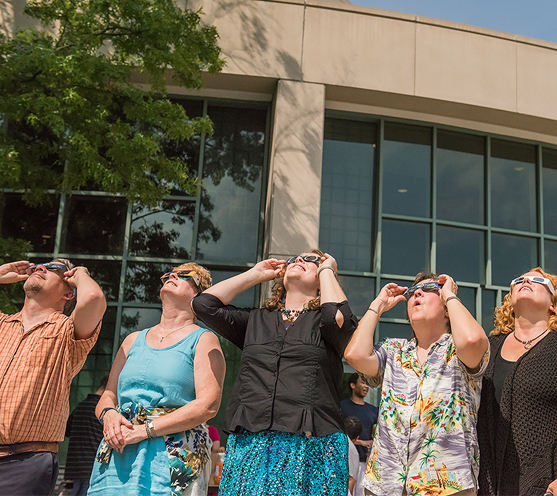
Head over to the Quad, on April 8 from 2 to 4 p.m., and join your fellow earthlings from the Astronomy Club for a watch party of the solar eclipse! The eclipse will trace a narrow path of darkness across North America where the moon will pass between the Sun and the Earth, creating a partial eclipse. Watch as more than 88 percent of the Sun will be obstructed from view at UMBC. (Left, a group watches the 2017 eclipse in front of the AOK Library.)
2. Go see the play “SLIME”
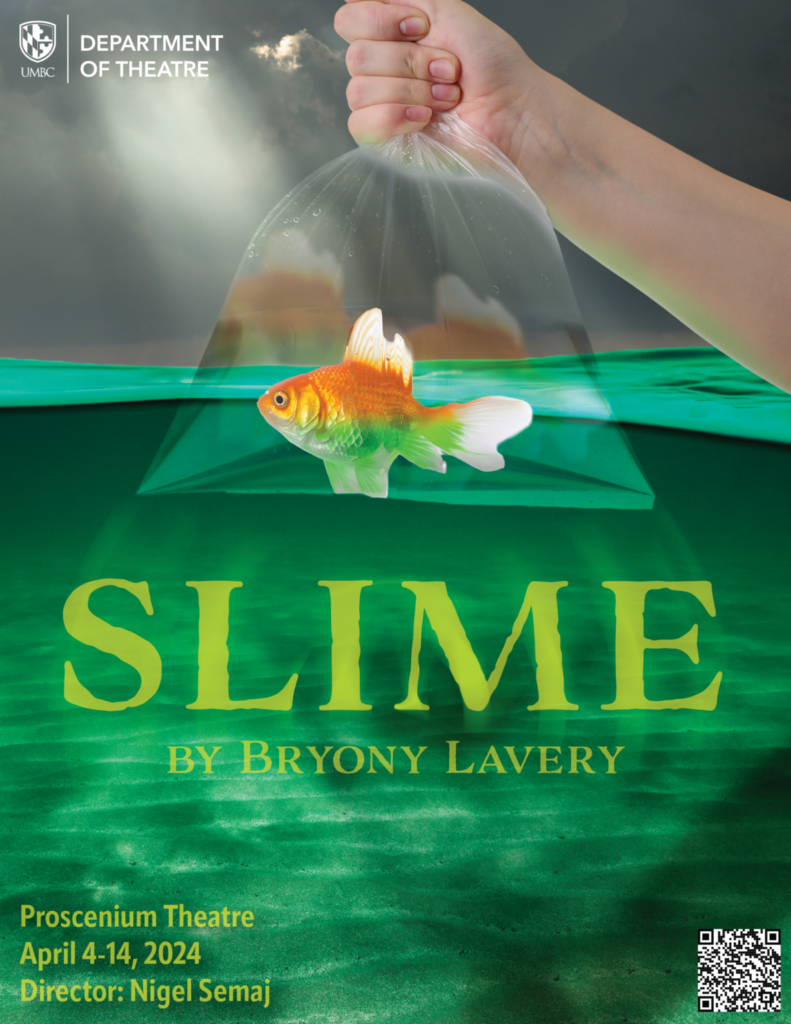
As part of the Plays for Our Planet initiative, the Department of Theatre is producing Byrony Lavery’s “SLIME,” directed by Nigel Semaj. The play is about seven graduate students who appear at the Third Annual Slime Crisis Conference, fighting to save the Earth from a toxic slime that is threatening all animal life.
Performances will take place from April 4 to 14, and on April 14, there will be a free matinee for students, followed by a post-show actor talk-back, featuring, Dawn Biehler of UMBC’s Department of Geography and Environmental Systems. You don’t want to miss this opportunity to educate yourself on climate change in an engaging and entertaining way.
3. Run the Earth Day 3K
Enjoy the spring weather and head over to RAC for the annual free Earth Day 3K Run on April 17. Don’t worry if you’re not a competitive runner, walking is encouraged as well. If you’re up for the challenge, you can sign up here, or via walk-up registration the day of from 11 a.m.to noon. Prizes will be awarded to the top finishers, and the first 100 completed racers will receive Earth Day T-Shirts.
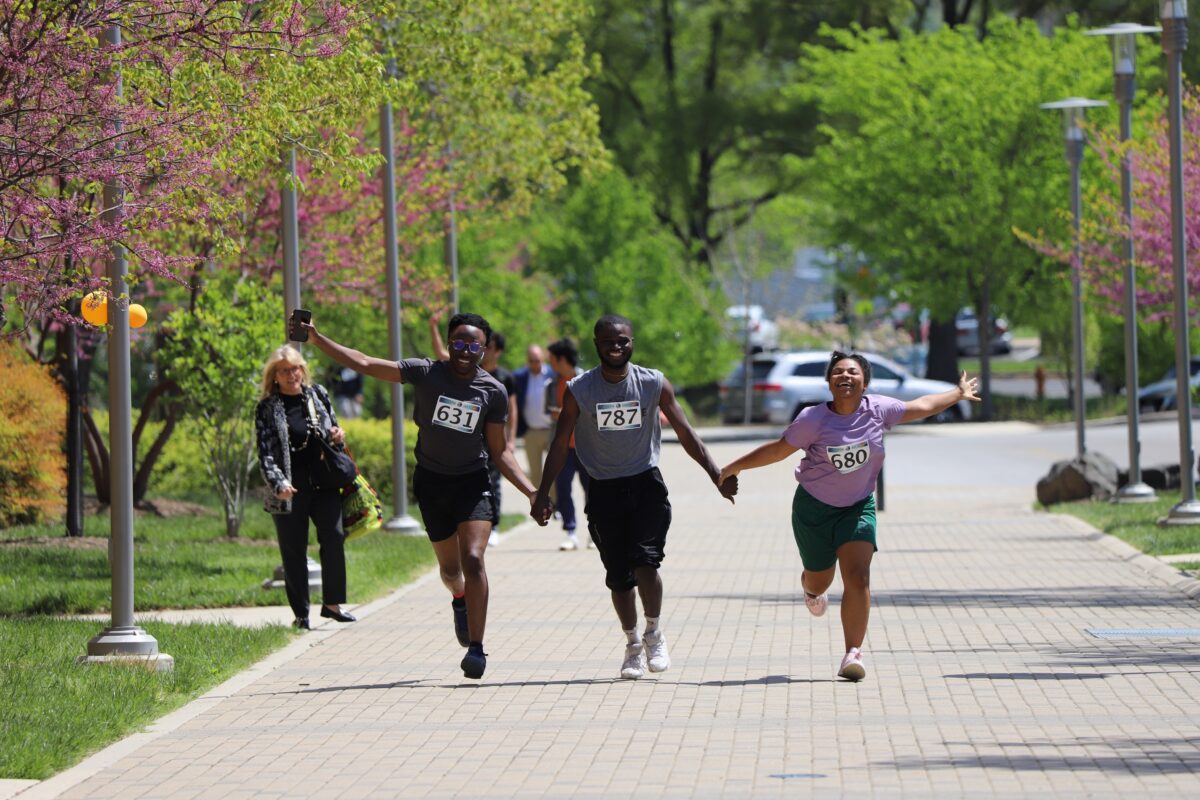 A group of students running the 2022 Earth Day 3K on campus.
The event begins at 12:15 p.m. and refreshments will be provided post-race. All participants will have a chance to connect with the community and become more aware of earth sciences and the environment. UMBC students, faculty, as well as anyone in the Baltimore community is encouraged to participate!
4. Bring global change down to Earth
For most of us, managing greenhouse gas emissions and watching distant islands flood or glaciers melt are far beyond our reach. However, the pervasive reach of an environmental reckoning means we have local issues, with much for all of us to work on. This panel on April 22 will bring together scholars from public policy, geography and environmental systems, and beyond to discuss multiple ways to understand climate work.
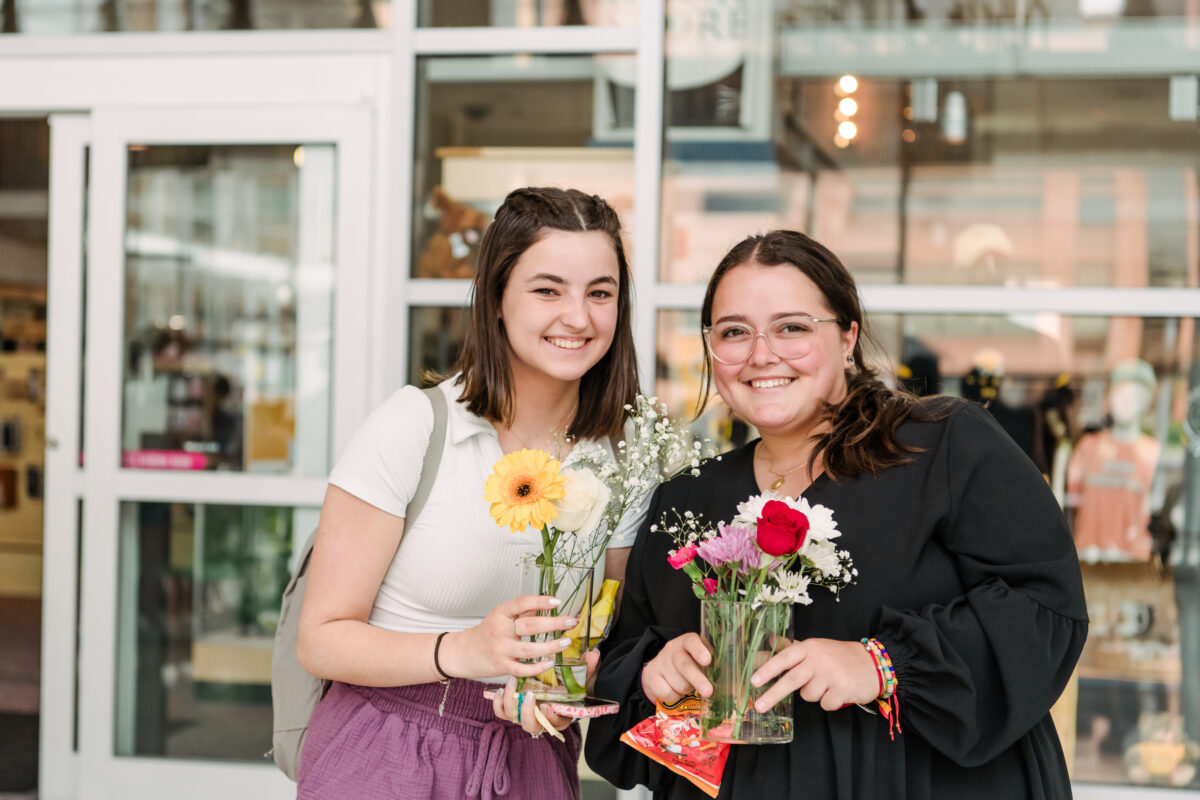 Students gathered in The Commons to make bouquets of flowers in spring 2023. (Marlayna Demond ’11/UMBC)
5. Check out research from the UMBC community
There is so much groundbreaking research happening at UMBC conducted by students, faculty, staff, and community members, and you can learn all about it at Earth Day Community Day on the Quad on April 22. There will be two sessions, one starts at 10 a.m. and another at 1 p.m. Take this time to enrich your understanding of the research being carried out at UMBC and how it has had a significant impact on the Baltimore community and beyond.
6. Attend an Earth Day panel
After checking out Community Day on the Quad, be sure to catch the panel, Climate Change, Science Communication, and the Arts. Artist Anastasia Samoylova (Gator, 2017, left) will be joining scientists and media historians for a panel discussion on April 22.
Along with Anastasia Samoylova—the photographer behind the vivid pictures in the exhibit “Floodzone” which takes a look at how climate change has affected the southern U.S.—the panelists will include, Autumn Powell, a UMBC graduate student in geography and environmental systems, Lavar Thomas, a special assistant within the EPA’s administrator’s office, and Tracy Tinga, assistant professor in media and communication studies. This event will be a discussion of how to use of how to use alternate forms of communication, including art, to describe climate change findings to a general audience. The event will take place at the AOK Library Gallery at 5 p.m.

]]>
While Earth Day may be a one-day affair, our everyday actions affect the Earth 365 days of the year. This April, UMBC is celebrating Earth Month, allowing the community to dedicate time to reflect...
https://umbc.edu/stories/6-earth-day-events-that-ground-you-to-our-planet/
https://my3.my.umbc.edu/api/v0/pixel/news/140608/guest@my.umbc.edu/c1ca080f96cc69268bdf418c5ed3affc/api/pixel
aok-library
cahss
campus-life
cnms
coeit
ges
magazine
mcs
story
theatre
UMBC News & Magazine
https://my3.my.umbc.edu/groups/umbc-news-magazine
https://assets1-my.umbc.edu/system/shared/avatars/groups/000/001/943/24435aa6207c452e7bc15cc74b42c7bb/xsmall.png?1748556657
https://assets1-my.umbc.edu/system/shared/avatars/groups/000/001/943/24435aa6207c452e7bc15cc74b42c7bb/original.png?1748556657
https://assets2-my.umbc.edu/system/shared/avatars/groups/000/001/943/24435aa6207c452e7bc15cc74b42c7bb/xxlarge.png?1748556657
https://assets2-my.umbc.edu/system/shared/avatars/groups/000/001/943/24435aa6207c452e7bc15cc74b42c7bb/xlarge.png?1748556657
https://assets3-my.umbc.edu/system/shared/avatars/groups/000/001/943/24435aa6207c452e7bc15cc74b42c7bb/large.png?1748556657
https://assets1-my.umbc.edu/system/shared/avatars/groups/000/001/943/24435aa6207c452e7bc15cc74b42c7bb/medium.png?1748556657
https://assets2-my.umbc.edu/system/shared/avatars/groups/000/001/943/24435aa6207c452e7bc15cc74b42c7bb/small.png?1748556657
https://assets1-my.umbc.edu/system/shared/avatars/groups/000/001/943/24435aa6207c452e7bc15cc74b42c7bb/xsmall.png?1748556657
https://assets2-my.umbc.edu/system/shared/avatars/groups/000/001/943/24435aa6207c452e7bc15cc74b42c7bb/xxsmall.png?1748556657
UMBC News & Magazine
0
0
false
Fri, 05 Apr 2024 12:06:31 -0400
Fri, 05 Apr 2024 12:06:31 -0400
Mellon Foundation grants CAHSS $750K to establish Global Asias Initiative
Kimberly Moffitt, dean of the College of Arts, Humanities, and Socials Sciences, and co-pi Tamara Bhalla, associate professor of American studies and director of the Asian American studies minor, have been awarded a $750,000 grant from the Mellon Foundation to establish the Global Asias Initiative. The initiative will support the rethinking of Asian American issues on campus in a global, diasporic, and collaborative framework through community-engaged, public-facing scholarship and teaching.
“The impact and influence of the Asian diaspora in this region makes it clear that our world has more to offer in providing valuable opportunities for our students, while also creating additional partnerships with the greater Baltimore community,” says Moffitt.
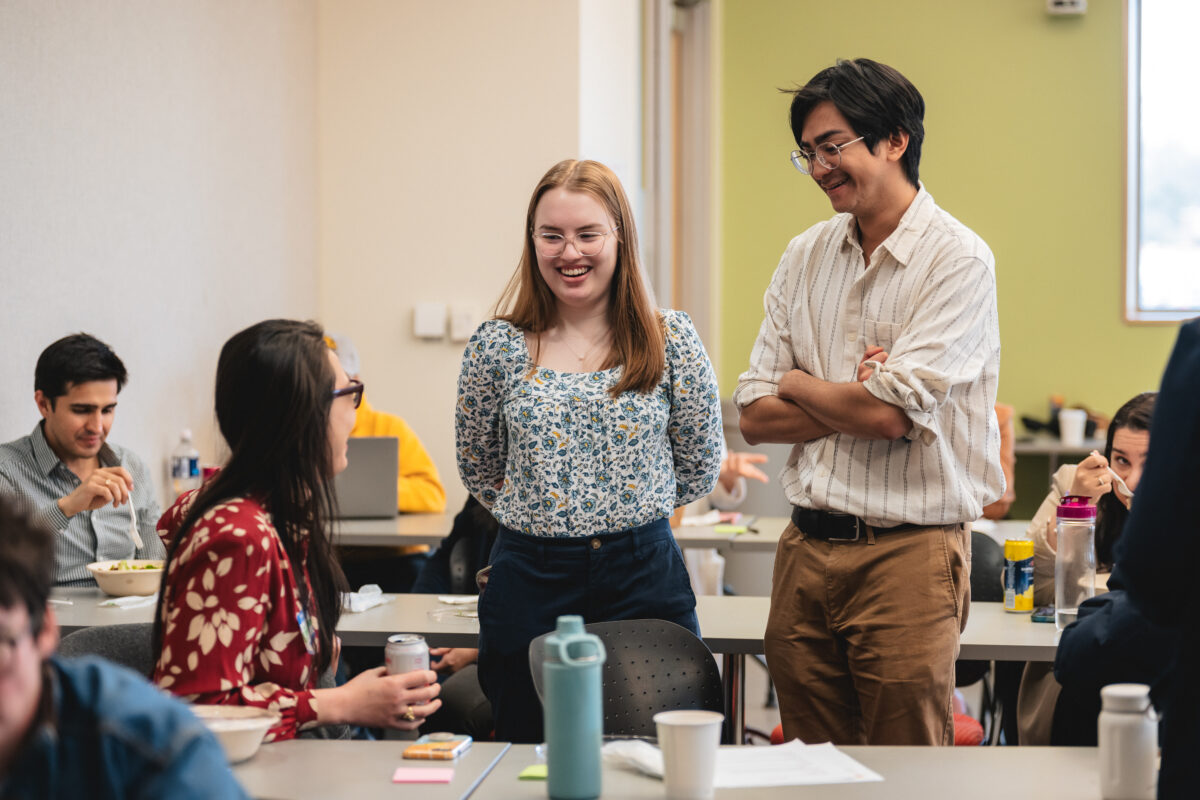 (l-r) Emily Yoon and students at the Global Asias Initiative launch workshop.
(Abnet Shiferaw)
UMBC’s existing Asian studies program and Asian American studies minor will grow into a more expansive Global Asias program that better serves and represents UMBC’s Asian American community, interested students, and beyond. This includes launching an undergraduate community-based research fellowship in Global Asias and the conversation series “Reframing Global Asias,” which invites prominent leaders, scholars, and community members in the field to present and discuss key issues, possibilities, challenges, and new research.
“Together,” says Bhalla, “we will create a forum for engaging in difficult yet productive intellectual conversations in Asian American studies, Asian diaspora studies, and Asian studies.”
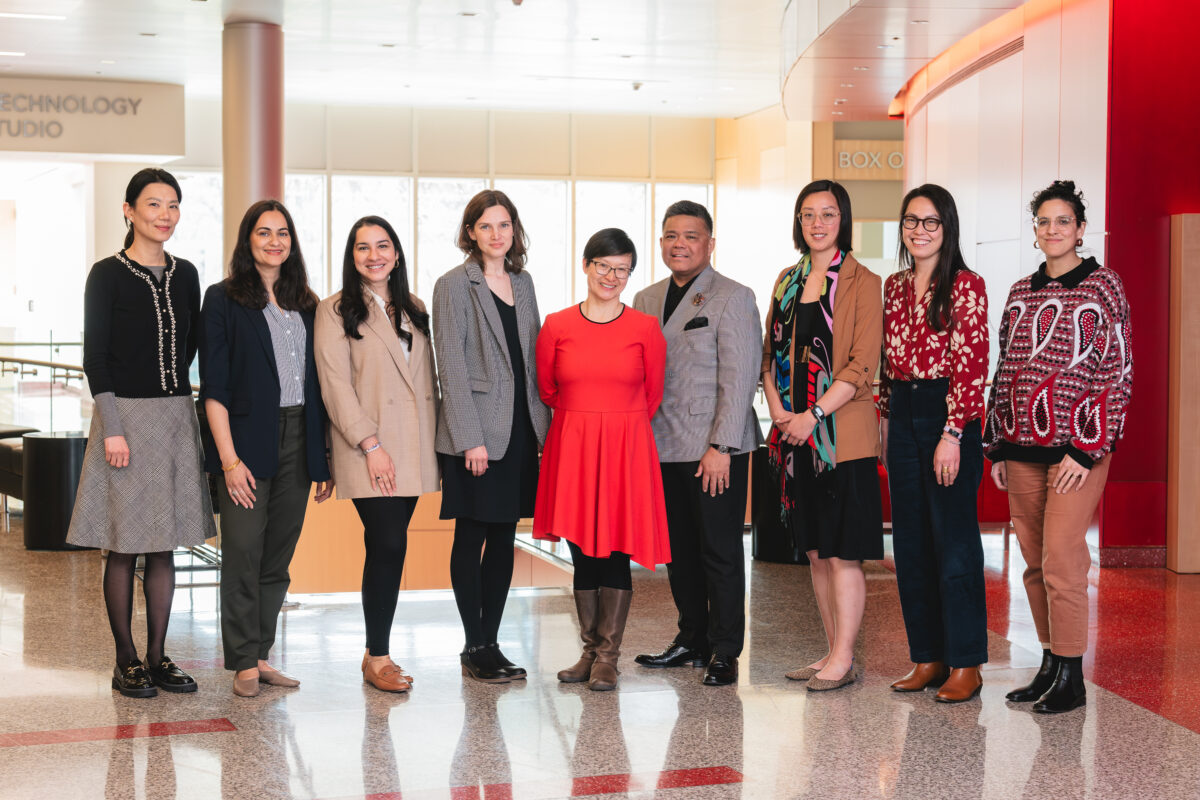 Global Asias Advisory Board, AY2023-2024. (l-r) Tamara Bhalla, Noor Zaidi, Meredith Oyen, Fan Yang, Theo Gonzalvez, Emily Yoon, and Priya Bhayana, project manager for the Global Asias Initiative. (Abnet Shiferaw)
Faculty across UMBC are collaborating to bring the Global Asia Initiative to fruition along with community partners:
-
Meredith Oyen, associate professor of history and director of the Asian studies program
-
Shin Yon Kim, Asian studies lecturer
-
Fan Yang, associate professor of media and communication studies
-
Emily Yoon, assistant professor of English
-
Noor Zaidi, assistant professor of history
-
Christopher Tong, associate professor of modern languages, linguistics, and intercultural communication
-
Theo Gonzalves, former American studies chair and professor, curator of Asian-Pacific American history at the Smithsonian National Museum of American History
-
Robbin Lee ’13, visual arts and media and communications studies, director of partnerships and mobilization at UpSurge Baltimore
Learn more about the Global Asias Iniatiave and Asian studies program.
]]>
Kimberly Moffitt, dean of the College of Arts, Humanities, and Socials Sciences, and co-pi Tamara Bhalla, associate professor of American studies and director of the Asian American studies minor,...
https://umbc.edu/quick-posts/umbc-to-establish-global-asias-initiative/
https://my3.my.umbc.edu/api/v0/pixel/news/140528/guest@my.umbc.edu/32bd2a6ff02002d0cfa31ee10d13251e/api/pixel
american-studies
asian-studies
cahss
english
history
mcs
mlli
news
policy-and-society
quick-post
quick-posts
research
visual-arts
UMBC News & Magazine
https://my3.my.umbc.edu/groups/umbc-news-magazine
https://assets1-my.umbc.edu/system/shared/avatars/groups/000/001/943/24435aa6207c452e7bc15cc74b42c7bb/xsmall.png?1748556657
https://assets1-my.umbc.edu/system/shared/avatars/groups/000/001/943/24435aa6207c452e7bc15cc74b42c7bb/original.png?1748556657
https://assets2-my.umbc.edu/system/shared/avatars/groups/000/001/943/24435aa6207c452e7bc15cc74b42c7bb/xxlarge.png?1748556657
https://assets2-my.umbc.edu/system/shared/avatars/groups/000/001/943/24435aa6207c452e7bc15cc74b42c7bb/xlarge.png?1748556657
https://assets3-my.umbc.edu/system/shared/avatars/groups/000/001/943/24435aa6207c452e7bc15cc74b42c7bb/large.png?1748556657
https://assets1-my.umbc.edu/system/shared/avatars/groups/000/001/943/24435aa6207c452e7bc15cc74b42c7bb/medium.png?1748556657
https://assets2-my.umbc.edu/system/shared/avatars/groups/000/001/943/24435aa6207c452e7bc15cc74b42c7bb/small.png?1748556657
https://assets1-my.umbc.edu/system/shared/avatars/groups/000/001/943/24435aa6207c452e7bc15cc74b42c7bb/xsmall.png?1748556657
https://assets2-my.umbc.edu/system/shared/avatars/groups/000/001/943/24435aa6207c452e7bc15cc74b42c7bb/xxsmall.png?1748556657
UMBC News & Magazine
0
0
false
Wed, 03 Apr 2024 11:06:07 -0400
Wed, 03 Apr 2024 11:06:07 -0400
Dean Moffitt interviewed about media and Black hair and body politics

Kimberly R. Moffitt, dean of UMBC’s College of Arts, Humanities, and Social Sciences, speaks about the inspiration for and journey of her career in an interview with mastersincommunications.com, which offers research-based data on graduate programs in media and communication studies nationwide along with insights from leaders in the field.
Moffitt shares that one of the key inspirations for her work in media and communication studies is her children. Her research and discourse on colorism, her Black hair syllabus website, and her criticism of Disney’s programming have come from observing how her children and other children of color are perceived and talked about in media. She also analyzes the major challenges with feminism and her identity as a womanist.
“I do not consider myself a feminist. I do embrace and consider myself a womanist, as Audre Lorde discusses it, however. I believe in seeing the uplift of African Americans in this nation,” says Moffitt. “I think it takes all of us to make that happen, and I am not really interested in privileging or prioritizing my own existence as a Black woman over that of a Black man.”
Leadership and communication
The scholarship that fueled Moffitt’s career paved a path to leadership as a dean during a worldwide pandemic and global calls for social justice. Moffitt credits her skills and knowledge of media and communication in helping her navigate these challenges, with grace and patience.
“The beauty of being in a discipline like communication is that we have space to engage a set of theoretical frameworks and concepts that other disciplines cannot,” says Moffitt. “Some of that is because we are a much younger discipline than most, but it is also because we are dealing with a number of contemporary issues that allow us to speak back to society about things as they are currently going on.”
Learn more about Dean Moffitt’s additional work with the Mellon Foundation-funded Global Asias Initiative.
]]>
Kimberly R. Moffitt, dean of UMBC’s College of Arts, Humanities, and Social Sciences, speaks about the inspiration for and journey of her career in an interview with mastersincommunications.com,...
https://umbc.edu/quick-posts/dean-moffitt-interviewed-about-media-black-hair/
https://my3.my.umbc.edu/api/v0/pixel/news/139731/guest@my.umbc.edu/ef4e2008edbaf146bf9d53e11e245eb3/api/pixel
cahss
cahss-research
mcs
news
policy-and-society
quick-post
research
UMBC News & Magazine
https://my3.my.umbc.edu/groups/umbc-news-magazine
https://assets1-my.umbc.edu/system/shared/avatars/groups/000/001/943/24435aa6207c452e7bc15cc74b42c7bb/xsmall.png?1748556657
https://assets1-my.umbc.edu/system/shared/avatars/groups/000/001/943/24435aa6207c452e7bc15cc74b42c7bb/original.png?1748556657
https://assets2-my.umbc.edu/system/shared/avatars/groups/000/001/943/24435aa6207c452e7bc15cc74b42c7bb/xxlarge.png?1748556657
https://assets2-my.umbc.edu/system/shared/avatars/groups/000/001/943/24435aa6207c452e7bc15cc74b42c7bb/xlarge.png?1748556657
https://assets3-my.umbc.edu/system/shared/avatars/groups/000/001/943/24435aa6207c452e7bc15cc74b42c7bb/large.png?1748556657
https://assets1-my.umbc.edu/system/shared/avatars/groups/000/001/943/24435aa6207c452e7bc15cc74b42c7bb/medium.png?1748556657
https://assets2-my.umbc.edu/system/shared/avatars/groups/000/001/943/24435aa6207c452e7bc15cc74b42c7bb/small.png?1748556657
https://assets1-my.umbc.edu/system/shared/avatars/groups/000/001/943/24435aa6207c452e7bc15cc74b42c7bb/xsmall.png?1748556657
https://assets2-my.umbc.edu/system/shared/avatars/groups/000/001/943/24435aa6207c452e7bc15cc74b42c7bb/xxsmall.png?1748556657
UMBC News & Magazine
0
0
false
Thu, 07 Mar 2024 12:44:38 -0500
Thu, 07 Mar 2024 12:44:38 -0500
American Council of Learned Societies spotlights UMBC’s CoLab as an interdisciplinary leader
The American Council of Learned Societies (ACLS) has chosen UMBC’s Interdisciplinary CoLab for its “Undergraduate Spotlight” series. ACLS is a nonprofit federation of 80 scholarly organizations that has supported and amplified American scholarship in the humanities and interpretive social sciences since 1919. Over the last six summers, UMBC’s CoLab has provided students with an innovative team-based applied learning opportunity through a three-credit paid internship in narrative-based research.
ACLS writes, “Unlike traditional group work in a college classroom, wherein majors from the same discipline are all trying to master the same material, CoLab projects require students to use their own skills and appreciate the skills of others.”
Professional research experience
CoLab gives interdisciplinary student teams a professional research experience while learning how to tell effective stories and create valuable public-facing results for community partners. “I wasn’t aware of the [Baltimore Immigration] museum prior to my internship,” shared CoLab alum Johanna Alonso ’20, English, about her team’s project “Baltimore: The Second Ellis Island. “I think the real benefit of the CoLab is that it exposes students to people, places, programs, and projects we may never have encountered otherwise.”
Co-directed by Carole McCann, professor and chair of gender, women’s, + sexuality studies, and Donald Snyder, a principal lecturer in media and communications studies, UMBC Interdisciplinary CoLab is a partnership between the Provost’s Office, the Dresher Center for the Humanities, and the Office of Summer, Winter, and Special Programs.
“ACLS is a very prestigious national academic organization,” says McCann, “so for it to highlight CoLab as an innovative program is a big deal.”
After participating in the 2021 CoLab focused on BLM and Civil Rights Oral Histories, Deysi Chitic-Amaya ’23, media and communication studies, said, “I want to be able to approach future projects with a more open-minded perspective that may help to produce something new and innovative.”
Read more about students’ CoLab experiences and the application process.
]]>
The American Council of Learned Societies (ACLS) has chosen UMBC’s Interdisciplinary CoLab for its “Undergraduate Spotlight” series. ACLS is a nonprofit federation of 80 scholarly organizations...
https://umbc.edu/quick-posts/acls-spotlights-umbcs-colab/
https://my3.my.umbc.edu/api/v0/pixel/news/138616/guest@my.umbc.edu/8adca042e9b8aa6e12394de60be2da52/api/pixel
cahss
cahss-research
colab
english
gwst
mcs
news
policy-and-society
quick-post
research
UMBC News & Magazine
https://my3.my.umbc.edu/groups/umbc-news-magazine
https://assets1-my.umbc.edu/system/shared/avatars/groups/000/001/943/24435aa6207c452e7bc15cc74b42c7bb/xsmall.png?1748556657
https://assets1-my.umbc.edu/system/shared/avatars/groups/000/001/943/24435aa6207c452e7bc15cc74b42c7bb/original.png?1748556657
https://assets2-my.umbc.edu/system/shared/avatars/groups/000/001/943/24435aa6207c452e7bc15cc74b42c7bb/xxlarge.png?1748556657
https://assets2-my.umbc.edu/system/shared/avatars/groups/000/001/943/24435aa6207c452e7bc15cc74b42c7bb/xlarge.png?1748556657
https://assets3-my.umbc.edu/system/shared/avatars/groups/000/001/943/24435aa6207c452e7bc15cc74b42c7bb/large.png?1748556657
https://assets1-my.umbc.edu/system/shared/avatars/groups/000/001/943/24435aa6207c452e7bc15cc74b42c7bb/medium.png?1748556657
https://assets2-my.umbc.edu/system/shared/avatars/groups/000/001/943/24435aa6207c452e7bc15cc74b42c7bb/small.png?1748556657
https://assets1-my.umbc.edu/system/shared/avatars/groups/000/001/943/24435aa6207c452e7bc15cc74b42c7bb/xsmall.png?1748556657
https://assets2-my.umbc.edu/system/shared/avatars/groups/000/001/943/24435aa6207c452e7bc15cc74b42c7bb/xxsmall.png?1748556657
UMBC News & Magazine
0
0
false
Fri, 02 Feb 2024 11:54:56 -0500
Grab a Seat at the Table

These days, it’s tempting to grow numb to the polarization of society and the breakdown in public discourse and to retreat into our silos of solidarity. But a liberal arts education has the potential to offer an antidote to these seemingly inevitable fates—through modeling and practicing empathy. At UMBC, students are invited to the table to share their stories and listen to their peers. These acts of educational hospitality help Retrievers find their why and pursue the public good.
Want weekly Top Stories sent to your inbox?

It’s the first day of class. You’re looking around, bright-eyed and a little nervous, and then your instructor smiles at the class and says, “One day you are all going to die.” Are you offended? Shocked? Titillated? Horrified? Collectively, the class titters. Already social bonds are forming as Christine Armstrong Mair, associate professor of sociology who specializes in gerontology, continues her spiel. “And if we’re all lucky, that won’t be for a long time.”
As sociologists, says Mair, or more broadly as leaders in an educational setting, “it’s not our task to make somebody think a certain way. Our task is to show them what exists in society and help them feel empathy for the human experience.”
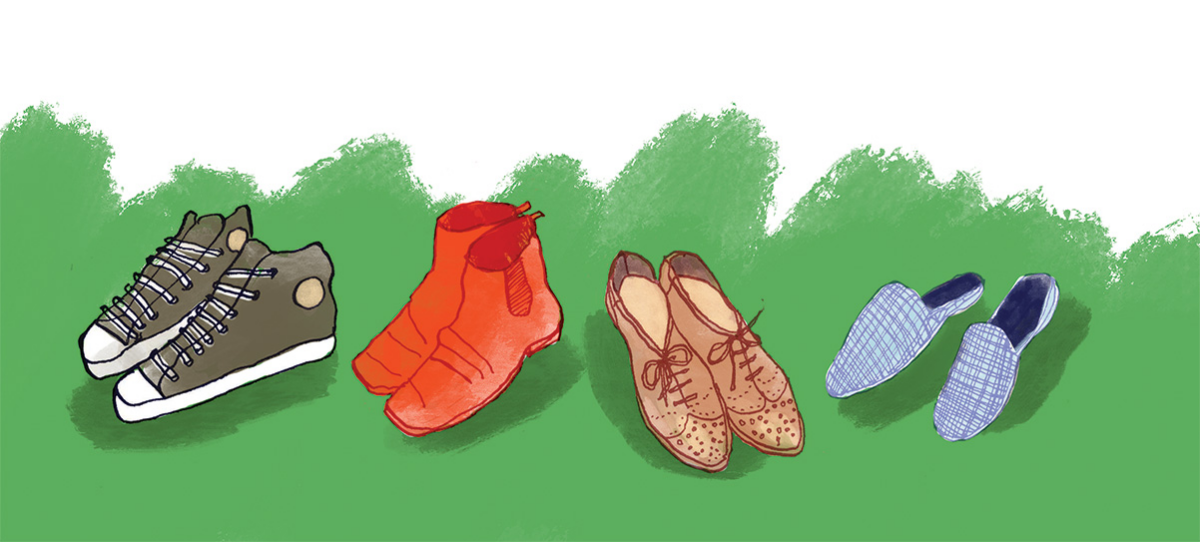
At its most pedestrian roots, empathy is putting yourself in someone else’s shoes. How can someone else’s emotional experience inform your own personal perspective?
In the best-case scenario, a college campus is a microcosm of its society: a crosshatch of races, ages, and socio-economic backgrounds. And UMBC holds true to those measures. But something different happens when you step into the Loop—you sit next to someone who didn’t go to your high school. You eat at the same table with someone outside of your cultural background. You take a test side by side with someone who voted differently than you. And even more than sharing space, you start sharing notes and books and stories—even your own story—with these strangers and then suddenly they’re no longer strangers.
When empathy is on the table, students and colleagues expand their capacity for hard work. You might change your thesis to address human trafficking or leave your home island to work toward healthy aging for all populations. So pull up a chair, step into someone else’s shoes, and partake in this grand educational potluck.
“With my background—what I’ve seen with human trafficking and migrant smuggling—what can I do as a person with my knowledge and responsibility?”
– Saydeh Karabatis, Ph.D. candidate
Building bridges across campus
You’re sitting at a beach-side cafe in Greece with your husband. It’s 2015 and Greece’s financial troubles are in the news, but the waves of migrants washing ashore are not yet as publicized. As you enjoy your coffee, you see a group of 40 to 50 people sitting seemingly aimless and distraught nearby. Based on their clothing, you make a guess that they are Muslims and Arabic speakers. What do you do?
If you’re Saydeh Karabatis, originally from Lebanon—and a survivor of the 17-year Lebanon civil war—and fluent in Arabic, you let that immediate moment of empathy guide you and approach the group.
Karabatis and her husband George, a professor of information systems at UMBC and from Greece, changed the plans for their summer in the Mediterranean to volunteer as translators, food finders, and listeners for the refugees, primarily fleeing the war in Syria and arriving in Greece in dire straits. They did so again in 2017.
As Karabatis interacted with these desperate groups and read more about their plight, she realized familiar patterns were emerging in their stories. They were not just migrants fleeing a war, they were trafficked people, paying dearly for not-safe passage, and many others headed toward labor and a life they did not sign up for. Struck by the limits of her actions—and even her emotional capacity for empathy—when Karabatis returned home to Maryland, she found her next step.
Karabatis, who has a master’s in computer science from UMBC and works for the university’s Division of Information Technology, knew she would need to fill her time when her two sons left for college. Karabatis asked herself, “With my background—what I’ve seen with human trafficking and migrant smuggling—what can I do as a person with my knowledge and responsibility?”

She contacted Vandana Janeja, then chair of information systems, and explained the project she wanted to complete for her Ph.D. During her master’s, Karabatis had tried to conduct a research project on human trafficking for a class with Janeja but couldn’t find a robust data set to use for her project and ended up having to leave the work incomplete. This time, she pitched using the stories of trafficked people. “Instead of dealing with numbers, numbers as data, I am now dealing with stories as data—the stories of people being trafficked,” says Karabatis.
It’s not been easy going. Many trafficked people are not open about their stories, for fear of retribution or simply because of how horrific the experience was. Additionally, it’s hard for Karabatis to take in their trauma. “I’m reading about all these abuses,” says Karabatis. “I’m reading about sex trafficking, labor trafficking, organ trafficking, human smuggling. I can’t imagine—how can a human being do something like that to another human?”
Eventually though, with the end goal of combating the network of smuggling routes, Karabatis says, you need to reach a level where you can try to put your emotions aside: “You need to detach yourself from these emotions if you want to do something to help these people. If your emotions are the only thing driving you, you wouldn’t be able to produce the research. Use these emotions as a spark and then put them on the side.”
Caring starts with listening
You’re a teenager riding the bus for fun in Puerto Rico, killing time by people watching. You’re struck by the number of older adults on the bus, noticing their many bags stuffed with x-rays and other apparent medical paperwork. Unthinkingly, you just assume they’re enjoying the ride like yourself, but this older generation seems eager to talk.
If you’re Jaminette Nazario, a curious if bored high schooler, you strike up a conversation.
What she heard from her fellow travelers shook her: “‘We don’t have people to help….’ ‘My wife just died of cancer….’ ‘I need to use this bus to get to my medical appointments.’” It wasn’t until she was pursuing her bachelor’s degree in social sciences that Nazario was hit by the realization that those conversations might have been the only time those older bus riders had talked to someone that day. “So I started thinking about the many barriers older adults have in order to achieve healthy aging,” she says. “When older adults don’t have resources or people, they miss out on social networks that are vital to healthy aging.”
This aha moment would propel Nazario to a master’s degree in public health with a focus on gerontology, but in order to study further, she’d have to leave her island for the next academic step.
Now in her second year of UMBC’s Ph.D. program in gerontology—a joint program with the University of Maryland, Baltimore—Nazario is beginning to research aging Hispanic immigrants and their increasing challenges accessing medical care.
And unlike her fellow bus riders, she’s not doing this alone. “Even though it’s really hard to be far from family, I feel like I’m home here. And I love how Dr. Mair teaches.” Like most classes, says Nazario, there are readings and discussion, but Mair brings a “specific dynamic” to the setting. Each class starts with questions prepared by the students, which is really empowering, says Nazario. It might end up that the class all resonates with one question and they stay on that topic, guiding the trajectory of the discussion.
In summer 2022, Nazario joined Mair and others from the gerontology program at a conference in Japan. She presented a poster on her research and walked away from her talk with a new level of confidence. “There were professionals from Japan and China and they’re asking me about something in the United States…it was kind of cool. People came up and treated me with so much respect.”
Students in Mair’s gerontology classes are finding their drive to solve crises in aging care not only because they might have loved ones suffering, but because aging (if we’re lucky) and death are unifying elements. “It’s something that really applies to all of us,” says Mair, “to make sure that we’re taking care and setting up a good system so that when we all arrive there, that us and all of our people that we care about are okay.”
Inclusive classrooms by design
You walk to the front of the media and communications class you’re teaching. Students are sitting in traditional desks in rows, facing the whiteboard where you’ll teach. They’re silent, spaced out or on their phones. They seem to breathe a sigh of relief when you walk in, grateful to know where to put their attention. Later, in a different section of that class, you meet in a newly designed lecture hall filled with round tables and no clear lectern space. In this format, the students are already grouped together and chatting.
If you’re Donald Snyder, principal lecturer in media and communication studies, you know there is science behind what forms good class cohesion and participation. He learned it from the experts in UMBC’s Faculty Development Center (FDC).
In addition to learning about and playing around with classroom set-up to facilitate more natural conversations (and to rid the learning experience from a “perceived hierarchy” as FDC Director Linda Hodges calls it), Snyder and others who use the FDC are supported in using inclusive and culturally responsive teaching.
While culturally responsive pedagogy isn’t a new concept—it centers and nurtures students’ unique cultural strengths—Hodges says that recent world events have brought the teaching style more into focus. Citing the death of George Floyd and the nation’s response—especially young people—and the COVID-19 pandemic as two significant flashpoints, Hodges says inclusive pedagogy and empathetic practices have become more imperative than ever. Room design is just one tool in the FDC toolbelt that can work to democratize students’ experience. It can erase the divide between the front row handraiser and the back row hider, giving equal footing to all types of students and their stories.
“Instructors are recognizing that they need to try to connect with and hear their students’ voices,” says Hodges. “This will create a sense of belonging. It’s become quite clear in the research that one of the key factors in whether students succeed and persist in education is the feeling of belonging.”
Snyder has made the most of the FDC’s offerings, including inviting Hodges’ team to observe his teaching and offer feedback. He starts many of his classes with some tools for students to learn about self-regulation, basically how to use available resources to make the most of education. He introduces them to Bloom’s Taxonomy, which places rote memorization at the bottom of the pyramid and evaluating and creating a unique argument at top. “I want the students to know, I’m not asking to memorize anything,” says Snyder, “but we need to learn to be critical when we’re thinking about media and communication texts and how these things operate.”
Giving students tools to succeed in college—go to office hours, block out time for studying, get enough sleep—may seem basic and far afield from teaching and practicing empathy, but in the taxonomy of educational success, says Snyder, this foundation leads to the heavy-lifting tools at the top of the pyramid.
Snyder helps them harness existing interests, in tech or media, and then run with it, academically. He wants them to ask, “‘How can I turn that switch? What is the thing that I can grab onto? What do I really want to know about?’”
He also listens to them, and attempts to model vulnerability in the classroom. “Yes, these are students and they need to understand content, but they’re also humans who are struggling and we’re all struggling and there’s a human condition aspect we can’t ignore as instructors.”

Swapping stories strengthens neighborly bonds
You’re driving your car on tour in Texas when you’re hit by a criminally intoxicated drunk driver. You survive, but a host of physical and psychological repercussions are still taking their toll 10 years later. As a musician, you fuel your art with your resiliency and work through the healing process by creating music. But when the pandemic hits, and live, in-person music disappears, you look for a pivot point—and the community you’re missing.
If you’re Kristin Putchinski, a student in UMBC’s M.F.A. program for intermedia and digital arts, you lean into the concept of “platonic intimacy.”
Putchinski coined the term to sum up her goal of “trying to strengthen neighborly bonds. What I’m looking for is an intimate experience between two people. And when people hear intimacy, they tend to think that it’s about a romantic or sexual component. But how do I frame that intimacy—and how important intimacy is—in terms of friendship and neighborliness?”
Through a graduate assistantship jointly funded by jointly funded by UMBC and the University of Maryland, Baltimore’s Community Engagement Center (CEC), Putchinski was given the opportunity to shadow CEC’s then-director Tyrone Roper and learn about the center’s mission, which includes strengthening neighborly bonds. Roper told Putchinski they were looking for ways to engage the 18- to 24-year-old demographic. When Putchinski was tasked with creating an art project for CEC the following semester, she kept this age goal in mind.
As a student in UMBC’s intermedia program, Putchinski “explores the textures between mediums,” she says. As a musical artist who performed under the stage name ellen cherry, “I have 25 years of experience as a performing songwriter and storyteller, creating my own and interpreting other people’s stories.” So she began to imagine a strange game of telephone that would give participants the opportunity to swap stories, with the end result of creating instances of platonic intimacy.
This multifaceted project connected post-high-school-aged individuals with older generations through curated, facilitated sessions. The participant-pairs met four different times and talked about a song, a photograph, and a memory—and at the last session, the neighbors “swapped” their stories. A recording of the swap was sent to local artists who interpreted the stories into their own mediums—painting, poetry, and a video soundscape. Then, at an event open to the public in the CEC, the storytellers took the stage, retelling their neighbor’s story. For example, a Latinx college graduate took to the stage to reshare her stranger-turned-partner’s tale of being raised in foster care in 1970s Baltimore.
Putchinski was eager to find out “when you talk to somebody that’s 40 years different from you…did your perceptions change about yourself, about them, and what were those changes and the answers?”
It makes sense she’s asking these questions based on her ongoing empathy toward the man who altered her life in an accident 10 years ago. “It was very conflicting for me to be the victim of a crime that I really feel like was committed not by a criminal but by a person who abuses alcohol. At the base level, he’s a human being. How can we think about his human potential after this experience and mine?”
“Imagine intensely” a better way forward
One of the greatest assertions of the liberal arts comes from Percy Bysshe Shelley’s essay “A Defence of Poetry.” The short-lived husband of Frankenstein’s creator writes, “A man, to be greatly good, must imagine intensely and comprehensively; he must put himself in the place of another and of many others; the pains and pleasures of his species must become his own.”
On college campuses, and at UMBC in particular, through thoughtful classroom instruction and intentional commitment to community, students trade their stories—pains and pleasures alike. Less of a transaction and more of a gift, these stories are invitations to grow in understanding, change your opinion, or shape your research.
But walking in someone else’s shoes doesn’t mean you misplace your own shoes along the way—in fact professors hope it helps you find your footing at UMBC. “That open-mindedness and appreciation and empathy does not necessarily mean that you lose other parts of yourself,” says Anne Brodsky, professor and chair of the psychology department. “It shouldn’t be a zero-sum game.”
You’re walking down Academic Row. You’re a first-generation college student with a lot of questions. You’re a returning student giving college a second (or third) chance. You’re a first-year who misses the familiar halls of high school. You see other Retrievers walking in groups, heading into classrooms, rubbing True Grit’s bronze nose, making conversation with their peers. What do you do?
]]>
These days, it’s tempting to grow numb to the polarization of society and the breakdown in public discourse and to retreat into our silos of solidarity. But a liberal arts education has the...
https://umbc.edu/stories/grab-a-seat-at-the-table-empathy/
https://my3.my.umbc.edu/api/v0/pixel/news/137271/guest@my.umbc.edu/777eb34ff02b7fc72d1664adf771099a/api/pixel
campus-life
coeit
computer-science
fall-2023
feature
imda
information-systems
magazine
mcs
UMBC News & Magazine
https://my3.my.umbc.edu/groups/umbc-news-magazine
https://assets1-my.umbc.edu/system/shared/avatars/groups/000/001/943/24435aa6207c452e7bc15cc74b42c7bb/xsmall.png?1748556657
https://assets1-my.umbc.edu/system/shared/avatars/groups/000/001/943/24435aa6207c452e7bc15cc74b42c7bb/original.png?1748556657
https://assets2-my.umbc.edu/system/shared/avatars/groups/000/001/943/24435aa6207c452e7bc15cc74b42c7bb/xxlarge.png?1748556657
https://assets2-my.umbc.edu/system/shared/avatars/groups/000/001/943/24435aa6207c452e7bc15cc74b42c7bb/xlarge.png?1748556657
https://assets3-my.umbc.edu/system/shared/avatars/groups/000/001/943/24435aa6207c452e7bc15cc74b42c7bb/large.png?1748556657
https://assets1-my.umbc.edu/system/shared/avatars/groups/000/001/943/24435aa6207c452e7bc15cc74b42c7bb/medium.png?1748556657
https://assets2-my.umbc.edu/system/shared/avatars/groups/000/001/943/24435aa6207c452e7bc15cc74b42c7bb/small.png?1748556657
https://assets1-my.umbc.edu/system/shared/avatars/groups/000/001/943/24435aa6207c452e7bc15cc74b42c7bb/xsmall.png?1748556657
https://assets2-my.umbc.edu/system/shared/avatars/groups/000/001/943/24435aa6207c452e7bc15cc74b42c7bb/xxsmall.png?1748556657
UMBC News & Magazine
1
0
false
Wed, 15 Nov 2023 14:07:28 -0500
Academic Minute: The promise of work-life balance
COVID forced employees away from traditional offices to home offices, making working from home no longer the exception. Before the pandemic, work-from-home proponents advocated a more flexible work week/space to give employees a better work-life balance. Has this proven to be true? As some employers try to find incentives to bring their teams back to cubicles and open-plan workspaces, the argument about which setup gives a better work-life balance continues.
UMBC’s Elizabeth Patton, associate professor of media and communication studies and author of Easy Living: The Rise of the Home Office (Rutgers University Press, 2020), is very familiar with this argument. “Through my research, it has become evident that the issue of balancing work and life, and the integration of work into the home, has a deep-rooted history and continues to be a challenge we face today,” Patton explains to Dr. Lynn Pasquerella, president of the American Association of Colleges and Universities and host of The Academic Minute, a daily show featuring faculty from colleges and universities worldwide speaking about their cutting-edge research.
UMBC’s Academic Minute takeover week
Patton joined five UMBC scholars this fall in UMBC’s first Academic Minute Takeover Week, featuring the latest research in philosophy; modern languages, linguistics, and intercultural communication; language, literacy, and culture; and history. The episode was republished by NPR podcasts and Inside Higher Ed.
Learn more about Patton’s research
-
Living: The Rise of the Home Office (Rutgers University Press, 2020)
-
Race and the Suburbs in American Film (SUNY University Press, 2021)
-
Mediapolis: JA Journal of Cities and
-
UMBC humanities faculty receive NEH fellowships for research into “the why and how of our past”
-
Media Crossroads: Intersections of Space and Identity in Screen Cultures (Duke University Press, 2021)
Learn more about UMBC’s media and communication studies program.
]]>
COVID forced employees away from traditional offices to home offices, making working from home no longer the exception. Before the pandemic, work-from-home proponents advocated a more flexible...
https://umbc.edu/stories/academic-minute-the-promise-of-work-life-balance/
https://my3.my.umbc.edu/api/v0/pixel/news/135868/guest@my.umbc.edu/5cd2dfbf362a352dcc0130793d0c7641/api/pixel
cahss
cahssresearch
mcs
news
policy-and-society
research
UMBC News & Magazine
https://my3.my.umbc.edu/groups/umbc-news-magazine
https://assets1-my.umbc.edu/system/shared/avatars/groups/000/001/943/24435aa6207c452e7bc15cc74b42c7bb/xsmall.png?1748556657
https://assets1-my.umbc.edu/system/shared/avatars/groups/000/001/943/24435aa6207c452e7bc15cc74b42c7bb/original.png?1748556657
https://assets2-my.umbc.edu/system/shared/avatars/groups/000/001/943/24435aa6207c452e7bc15cc74b42c7bb/xxlarge.png?1748556657
https://assets2-my.umbc.edu/system/shared/avatars/groups/000/001/943/24435aa6207c452e7bc15cc74b42c7bb/xlarge.png?1748556657
https://assets3-my.umbc.edu/system/shared/avatars/groups/000/001/943/24435aa6207c452e7bc15cc74b42c7bb/large.png?1748556657
https://assets1-my.umbc.edu/system/shared/avatars/groups/000/001/943/24435aa6207c452e7bc15cc74b42c7bb/medium.png?1748556657
https://assets2-my.umbc.edu/system/shared/avatars/groups/000/001/943/24435aa6207c452e7bc15cc74b42c7bb/small.png?1748556657
https://assets1-my.umbc.edu/system/shared/avatars/groups/000/001/943/24435aa6207c452e7bc15cc74b42c7bb/xsmall.png?1748556657
https://assets2-my.umbc.edu/system/shared/avatars/groups/000/001/943/24435aa6207c452e7bc15cc74b42c7bb/xxsmall.png?1748556657
UMBC News & Magazine
0
0
false
Fri, 29 Sep 2023 10:23:42 -0400
Fri, 29 Sep 2023 10:23:42 -0400
All Rise for Alumni Mock Trial Coaches
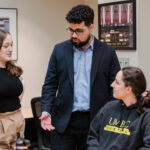
When Natalie Murray ’22, biological sciences, Thomas Azari ’22, political science, and Lauren Wotring ’22, political science, graduated last spring, they didn’t expect to be returning to UMBC so soon. These recent alums—all members of the 2021 National Mock Trial Championship team—were making inroads in the next stages of their careers, but didn’t hesitate to pick up the phone when the UMBC Mock Trial team called.
Together they took on the leadership of UMBC’s B team, guiding the group—composed mostly of first-year students—to the Opening Round Championship Series (ORCS) in March 2023 and saw B team co-captain Fadil Adeite ’26, media and communication studies, and Anna Kim ’26, biochemistry and psychology, win all-National attorney awards.
Coming back to pay it forward
Natalie Murray was the first to rejoin the UMBC Mock Trial team as a coach. She was hesitant initially. A full-time veterinary assistant position at the Elkridge Animal Hospital meant long days, so long she sometimes showed up to practice in her scrubs after a 12-hour shift.
When Murray agreed to coach, she envisioned having a minor position, yet she ended the season as the B team’s head coach. “Once I started working with them, and I saw how driven and incredible they were, I could not help but throw myself way more into it than I had planned,” said Murray.
The students were aware of the coaches’ investment. “To see the three coaches come back after leaving and dedicate so much time and effort—and gas money—to the team was inspiring, and it really motivated us as competitors to give even more,” said co-captain Adeite.
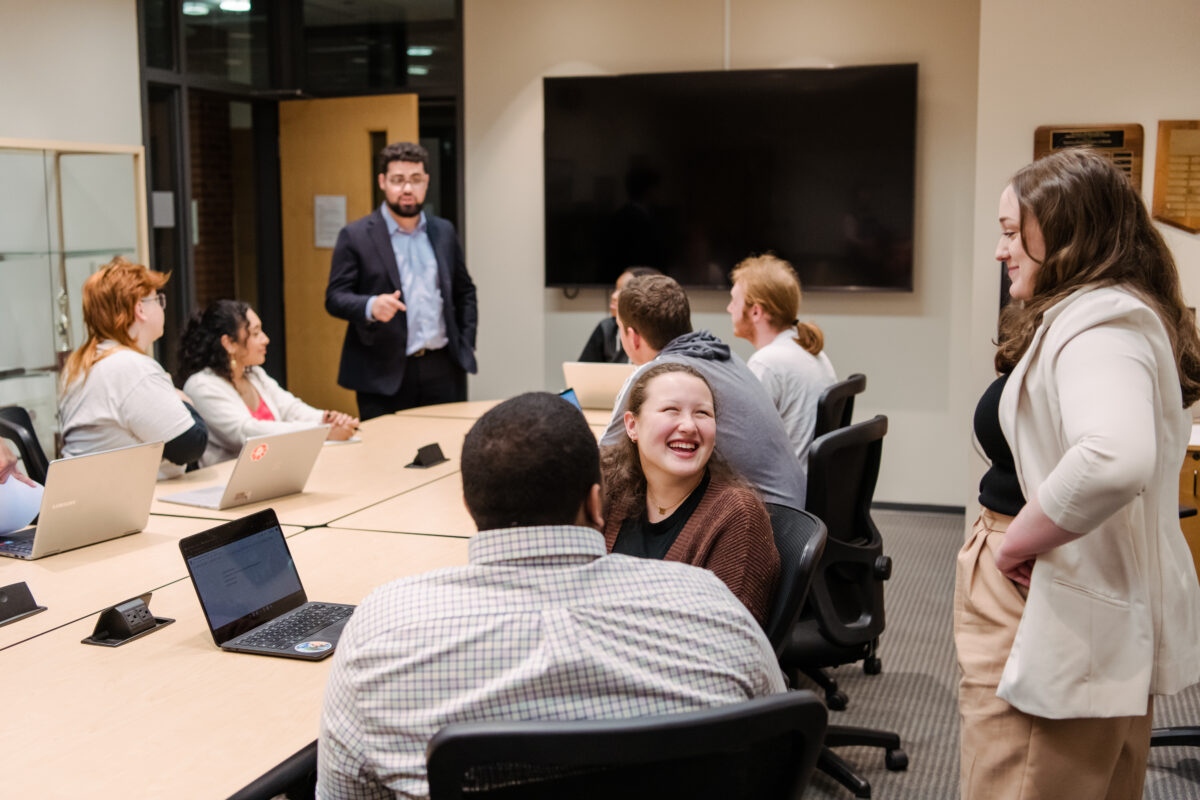 Standing, Azari, left, and Wotring, right, speak with members of the UMBC Mock Trial team. (Marlayna Demond ’11/UMBC)
The team became a source of joy for Murray, brightening her stressful days and making the logistics of coordinating coaching worth it. It helped that she could rely on former teammates to share the load.
Thomas Azari navigated his job in the U.S. Department of State’s Department of Human Rights and Labor, studying for the LSAT, and applying to law school while coaching. Lauren Wotring also made time to coach the B team while working at a D.C. law firm as an intellectual property legal assistant and prepping for law school.
Wotring said the students made the whole experience so special. “I realized how much the students meant to me and how amazing they are and how willing they were to learn,” said Wotring, who realized she wants to keep coaching next year.
Alumni coaching legacy
The Mock Trial team has always had dedicated coaches. The B team trio cites current head coach Ben Garmoe ’13, political science,and assistant coach Whitney Wilder as some coaches who made their mock trial experience.
Azari knew he had to return as a coach after the impact his coaches had on him and his Nationals-winning team.“If not for Ben, we wouldn’t have had any of the success we have now,” he said. “I kind of learned from that and was like, ‘Ben is doing all this work. I have to too.’”
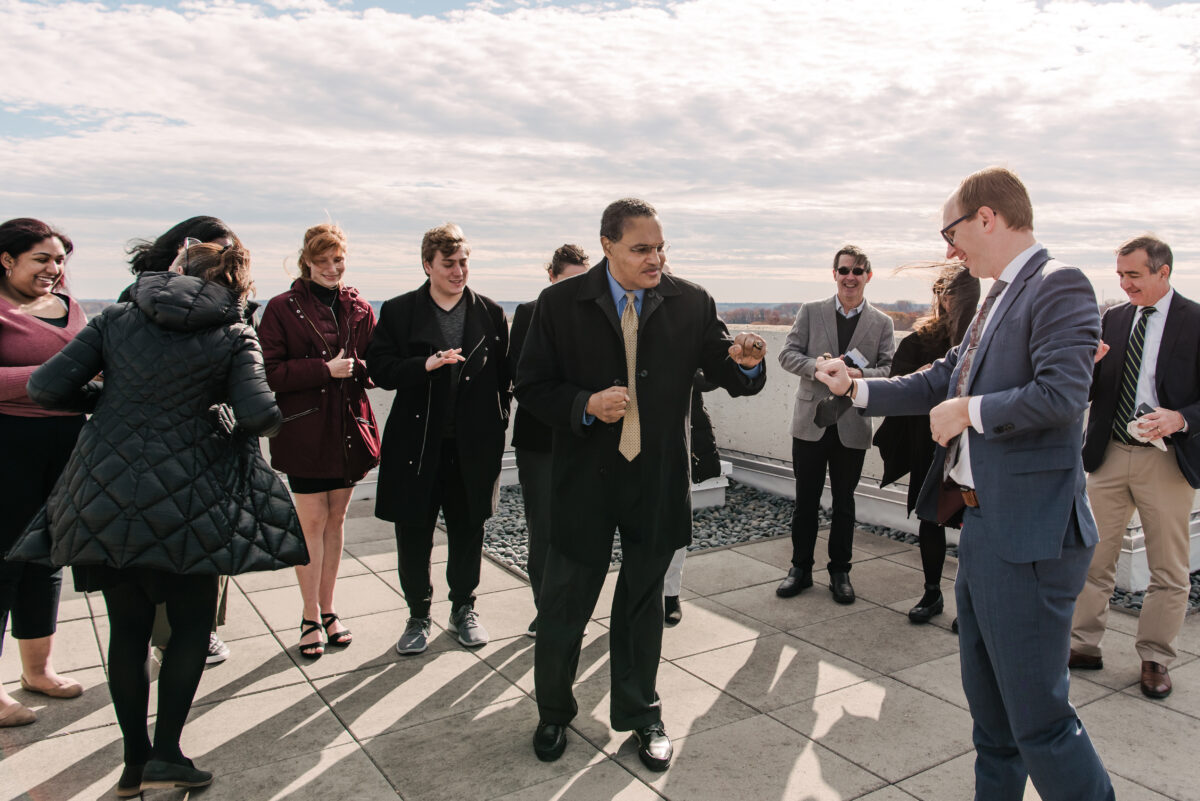 Garmoe, right, and then-President Freeman Hrabowski show each other their 2021 National Mock Trial Championship rings with members of the UMBC Mock Trial team. (Marlayna Demond ’11/UMBC)
Murray, Azari, and Wotring’s investment in the students took many forms. Wotring spoke to many about the dangers of perfectionism. Murray ensured they were having fun while being competitive. Azari lent out ties and showed them how to stay positive even after a loss. All three drove students to competitions, helped pay for food, and were always a text away.
The students couldn’t have been more thankful. At the end of the season, the alumni coaches received cards from the team with notes from each student. Kim emailed each of them, telling them how they impacted her.
“They taught us how to be better competitors, how to work better as a team, how to get places on time, but mostly how to be confident and proud of ourselves,” said Kim.
“Whenever anyone felt down about themselves, their performance, or not understanding, they were right there to lift us up, guide us, and make us all feel heard,” said B team co-captain Alysha Carter ’26, political science.
Champion volunteers
The trio’s willingness to turn around so quickly after graduation and invest their time in the next generation of UMBC Mock Trial competitors means a lot to Garmoe. “Thomas, Natalie, and Lauren are all national champions and highly decorated competitors,” said Garmoe. “But even more importantly, they are wonderful people and stellar role models for our young students.”
Murray sees a direct correlation between her coaching experience now and the support she received as a Mock Trial participant. Her fond memories of the organization, said Murray, are rooted in the genuine care she felt from her coaches and teammates. “To be part of that equation, and thinking that maybe one day down the line some of these students will do the same thing, they’ll graduate and they’ll want to coach, has been a really fun thought to have.”
By Morgan Casey ’22
]]>
When Natalie Murray ’22, biological sciences, Thomas Azari ’22, political science, and Lauren Wotring ’22, political science, graduated last spring, they didn’t expect to be returning to UMBC so...
https://umbc.edu/stories/all-rise-for-alumni-mock-trial-coaches/
https://my3.my.umbc.edu/api/v0/pixel/news/133925/guest@my.umbc.edu/fc680eab97419f9be2ec22e8a0109bcd/api/pixel
alumni
biological-sciences
impact
magazine
mcs
mock-trial
political-science
spring-2023
UMBC News & Magazine
https://my3.my.umbc.edu/groups/umbc-news-magazine
https://assets1-my.umbc.edu/system/shared/avatars/groups/000/001/943/24435aa6207c452e7bc15cc74b42c7bb/xsmall.png?1748556657
https://assets1-my.umbc.edu/system/shared/avatars/groups/000/001/943/24435aa6207c452e7bc15cc74b42c7bb/original.png?1748556657
https://assets2-my.umbc.edu/system/shared/avatars/groups/000/001/943/24435aa6207c452e7bc15cc74b42c7bb/xxlarge.png?1748556657
https://assets2-my.umbc.edu/system/shared/avatars/groups/000/001/943/24435aa6207c452e7bc15cc74b42c7bb/xlarge.png?1748556657
https://assets3-my.umbc.edu/system/shared/avatars/groups/000/001/943/24435aa6207c452e7bc15cc74b42c7bb/large.png?1748556657
https://assets1-my.umbc.edu/system/shared/avatars/groups/000/001/943/24435aa6207c452e7bc15cc74b42c7bb/medium.png?1748556657
https://assets2-my.umbc.edu/system/shared/avatars/groups/000/001/943/24435aa6207c452e7bc15cc74b42c7bb/small.png?1748556657
https://assets1-my.umbc.edu/system/shared/avatars/groups/000/001/943/24435aa6207c452e7bc15cc74b42c7bb/xsmall.png?1748556657
https://assets2-my.umbc.edu/system/shared/avatars/groups/000/001/943/24435aa6207c452e7bc15cc74b42c7bb/xxsmall.png?1748556657
UMBC News & Magazine
0
0
false
Thu, 08 Jun 2023 11:28:04 -0400
Thu, 08 Jun 2023 11:28:04 -0400