More than skills: Four CNMS interns on mentorship, belonging, and the gift of opportunity
Every morning this summer, junior biological sciences major Magdalen Ruth made her way to the National Institutes of Health in Bethesda—a dense hub of biomedical research. There, at the National Institute of Arthritis and Musculoskeletal and Skin Diseases, she helped investigate a genetic mutation in a patient with a rare form of juvenile arthritis known as Still’s disease, connecting her UMBC training to work that could improve patients’ lives. She is one of four CNMS students whose recent internships at Maryland-based companies and agencies show how local opportunities are helping Retrievers build skills, find mentors, and advance discoveries that matter here and beyond.
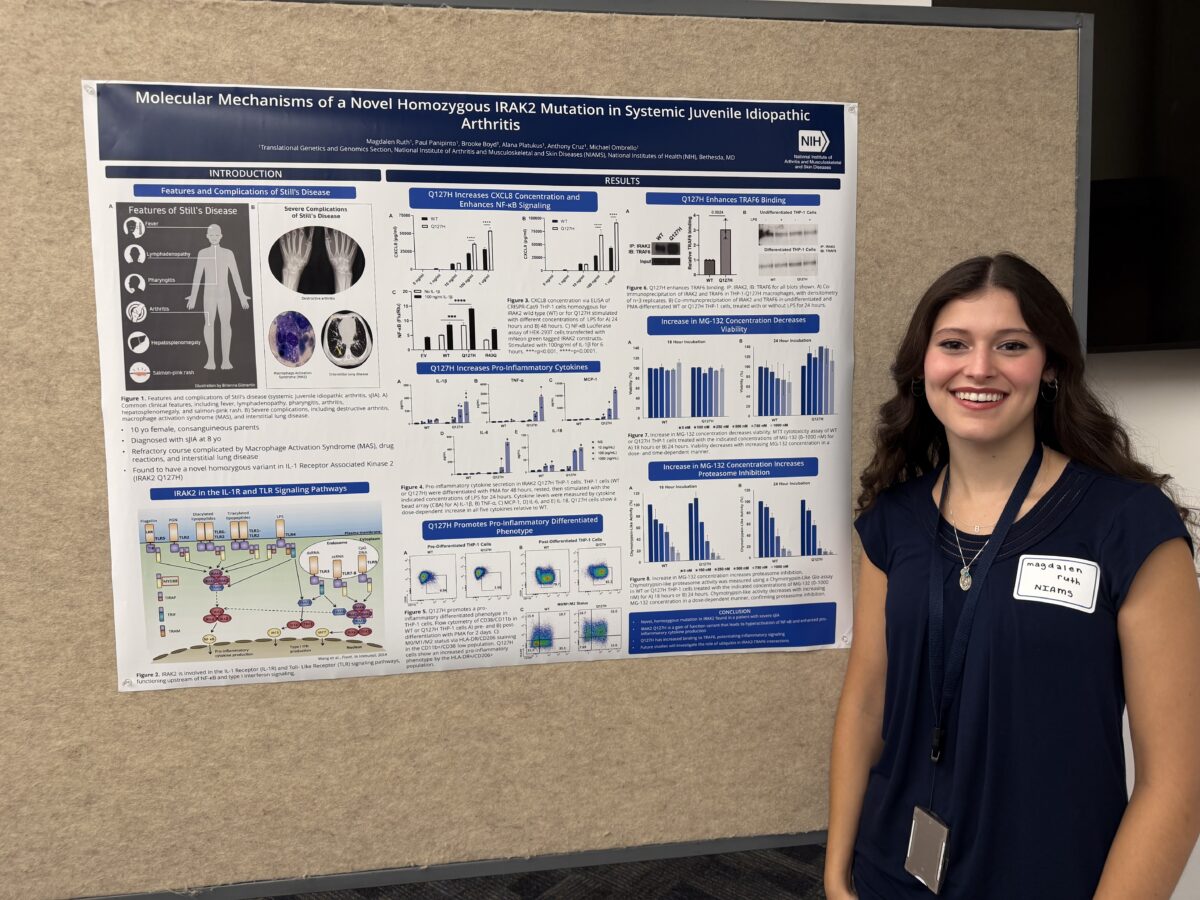 At the conclusion of her NIH internship, Magdalen Ruth presented her summer research on the role of a particular genetic mutation in a rare form of juvenile arthritis. (Courtesy of Ruth)
“I feel like I’m doing really important work,” Ruth, a Meyerhoff and U-RISE scholar, says. “Getting to know the patient’s diagnosis and being able to see that what I’m working on is affecting an actual person in real time has been awesome.” The internship has confirmed her interest in pursuing a career in pharmacology. It’s also stretched her communication skills. While familiar with presenting her work to colleagues in Deepak Koirala’s lab group at UMBC, communicating her research to a mix of researchers and clinicians—who don’t all share the same jargon and expertise—taught her the nuance of communicating with technical and non-technical audiences.
The Meyerhoff community helped make the opportunity possible. “I would not be in the place I am without Meyerhoff,” she notes. On campus, Ruth balances research and leadership as vice president of the STEM Ph.D. Society, a student-run organization designed to help students connect with scholarships, internships, graduate schools, and more. She also takes dance classes, is pursuing a music minor, and volunteers at her family’s Catholic parish—nurturing connections that ground her amid rigorous academic work.
Protecting lives, growing a career
Mark Harrison, a senior biological sciences major who started in chemical engineering, is in his third summer at Aberdeen Proving Ground (APG), a U.S. Army installation in Aberdeen, Maryland. His work involves designing and testing gas masks, bridging his early engineering training and his understanding of physiology. “I’m able to bring an understanding of what a warfighter may be experiencing in their body while wearing a gas mask in a way that others at APG may not,” Harrison says.
His mentors at APG, Jon Sampson ’03, mechanical engineering, and Edward Parshley ’06, chemical engineering, value the perspective Harrison brings and have supported his growth. “They made it clear that they want to reach back and offer opportunities to those coming behind them,” he says. They are making good on that commitment: Harrison will stay on board at APG this fall, and the plan is to transition him into a full-time position after he graduates in December. “They were always asking me what I wanted to learn and then giving me related opportunities,” Harrison says. “I could ask anyone how something worked, and they’d take the time to explain it to me. I’m so grateful for the way they’ve invested in me.”
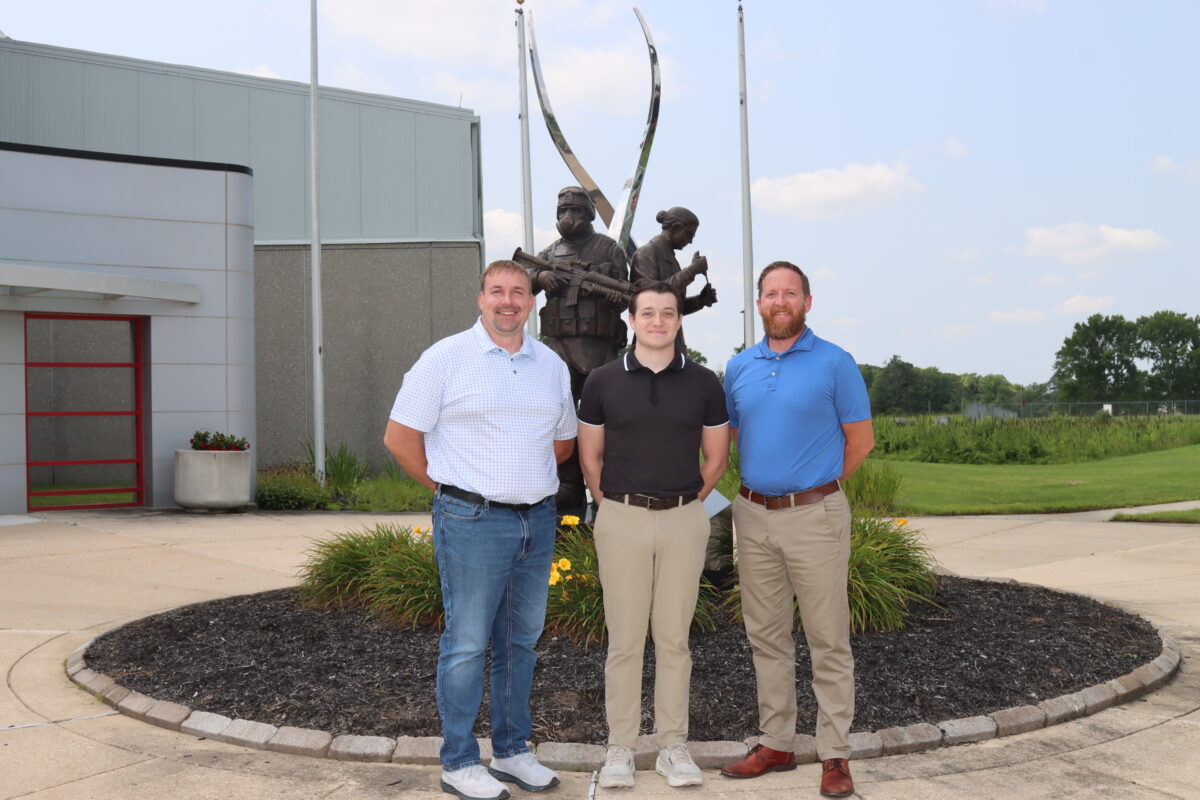 UMBC alumni Jonathan Sampson (right) and Ed Parshley (left) have mentored Mark Harrison (center) over the last two-plus years as he completed three internships at Aberdeen Proving Ground. (Courtesy of Harrison)
Interning in a fast-paced, interdisciplinary environment has also changed how Harrison operates in the classroom. “I learned how to learn at APG,” he says. “Now I don’t have to spend as much time studying, because when I leave class I already have a good understanding of the material. I’m connecting the dots so much better than before.” For Harrison, the work has taken on personal meaning, as well. “I’m fighting right now to try to protect American lives—that’s why I’m here.”
Translating discovery into treatment
Zainab Idowu, a senior biochemistry and molecular biology major and a Meyerhoff Scholar, interned at pharmaceutical giant AstraZeneca in Gaithersburg, Maryland, joining a robust group of Retrievers who’ve grown their skills there. Her project involved testing flow cytometers, which count and characterize individual cells and are used in manufacturing cell therapy treatments. Her goal was to determine the instrument and protocols that would be simplest and most effective for manufacturing teams to implement. The experience shifted Idowu’s focus toward translational medicine and reinforced her plans for an M.D./Ph.D. after UMBC. But the people around her made the biggest impression.
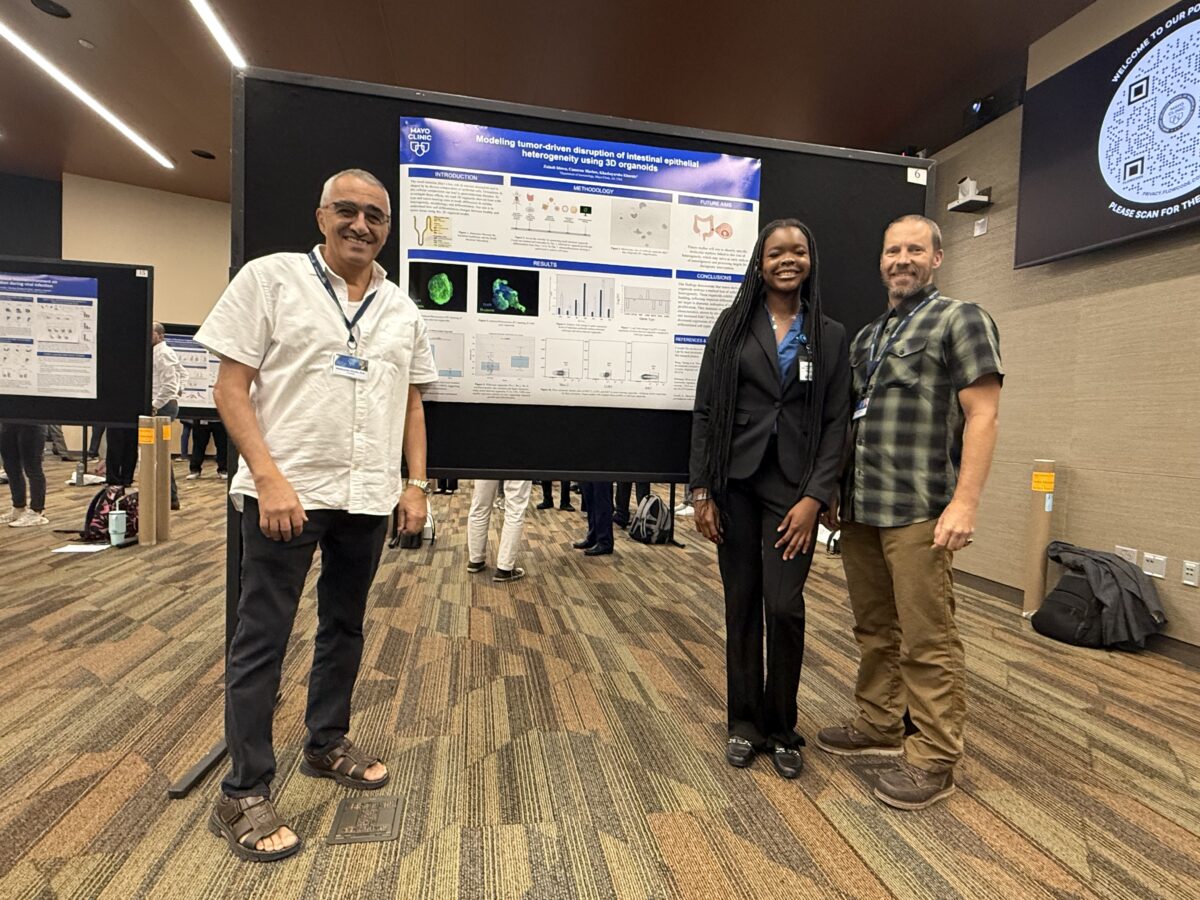
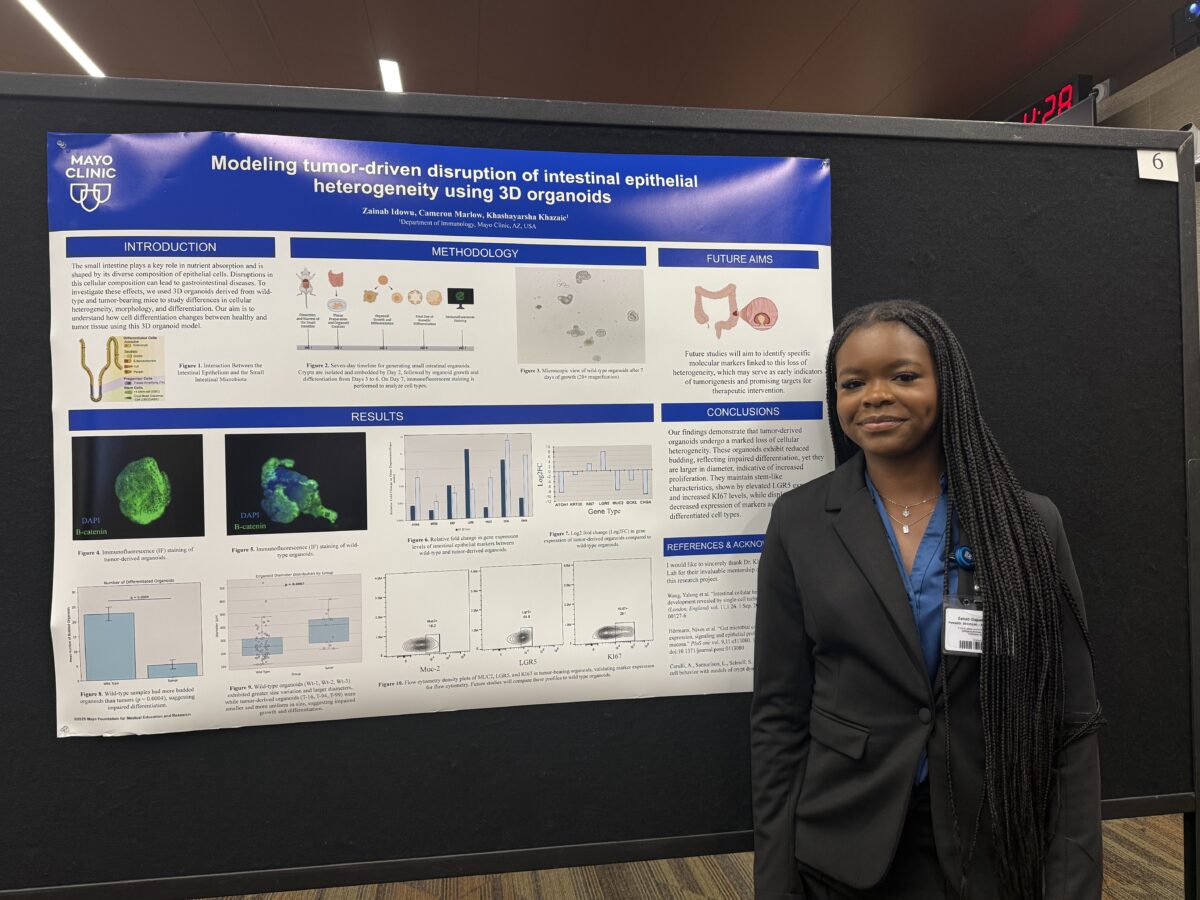 Zainab Idowu presented a research poster at the conclusion of a previous internship at the Mayo Clinic. She was supported by two mentors at the Mayo Clinic, Khashayarsha Khazaie (far left) and Cameron Marlow. (Courtesy of Idowu)
“I love everyone on my team,” Idowu says. “My managers, Ashley Ruddy and Jen Fox, were really insightful—giving me advice on what I want to do post-grad and what I should do my senior year to make sure I’m well-positioned for after graduation.” And when she had questions, the collaborative atmosphere showed her how scientists work together. “They were able to give recommendations and point me to scientific literature to help me along,” she says.
Opportunities through Meyerhoff gave her the chance to connect with AstraZeneca staff, which helped her secure the internship. “I was able to talk to them about my passions for research,” she says. Roles with UMBC’s chapters of the Society of Women Engineers, the international professional medical fraternity Phi Delta Epsilon, the National Society of Black Engineers, and the African Students Association have also enriched her UMBC experience. These organizations, she says, offered “a place to be ourselves, find new friends, and really build a home here at UMBC.”
The benefit of seeing both sides
 Saeed Damadi (left) and his wife Sepideh Hematian at her graduation from UMBC’s master’s program in data science.
Saeed Damadi recently defended his Ph.D. thesis in applied mathematics after beginning in electrical engineering. This summer at the FDA, he developed a mathematical model for how illicit drugs taken during pregnancy transfer to the developing baby through the placenta—increasing important understanding in a situation where human testing would be profoundly unethical.
While the math was familiar, Damadi welcomed the new challenge of jumping into biology. “I learned so many things, and I am still learning,” he says. Yet he found that his interest in how to describe randomness mathematically, which led him to complete a master’s in statistics on the way to his Ph.D., was highly relevant to studying the quirks of the human body. Looking ahead, he wants to continue work at the interface of biology and mathematics.
“Hopefully in the future I can make a contribution by bridging fields,” Damadi says, “because you can computationally simulate millions of parameters and patients at once, which makes the rate of iteration and discovery much faster.” The work Damadi and colleagues do with simulations can help effectively target limited resources for expensive and lengthy clinical studies, he explains.
Damadi and his wife, Sepideh Hematian, M.S. ’23, data science, and a former data scientist at the Maryland Department of Human Services, are planning to build their lives in California. They are both thriving, but “sometimes I get emotional thinking about UMBC,” Damadi says, “because after I arrived nine years ago from Iran, it became like a home to me and my wife.”
 Saeed Damadi (center) with his wife Sepideh Hematian (third from right), Ph.D. advisor Jinglai Shen (third from left), and the rest of his thesis committee and other members of the UMBC math faculty at his Ph.D. defense. (Courtesy of Damadi)
Damadi has given back through his teaching. As an engineer, “I just learned how to use the mathematical tools without understanding what was going on behind the scenes,” he says. Whereas, in math, “you learn the origins of all the theorems and how they work, but not necessarily how to apply them. I feel super lucky to get to see both sides.” So, in undergraduate calculus and linear algebra courses, “I just wanted to explain to my students, ‘Why do you need these equations? Why are they important?’ and give them a feeling of gratitude.”
Gratitude threads through all four of these journeys—for mentors who reach back, for teams that invest in their members, for communities that feel like home, and for the chance to do work that matters. As Magdalen Ruth at NIH puts it, “I’ve just found myself in a great spot with UMBC. I feel really blessed to have had all the opportunities I’ve had. Being able to do these internships has seriously been great.”
]]>
Every morning this summer, junior biological sciences major Magdalen Ruth made her way to the National Institutes of Health in Bethesda—a dense hub of biomedical research. There, at the National...
https://umbc.edu/stories/cnms-interns-mentorship-belonging-opportunity/
https://my3.my.umbc.edu/api/v0/pixel/news/161797/guest@my.umbc.edu/dacd98bb3662b16e6b4733ee94746d77/api/pixel
alumni
biology
career-center
chemical-biochemical-and-environmental-engineering
chemistry-and-biochemistry
cnms
coeit
community
data-science
internships
mathstat
meche
meyerhoff-scholars
science-and-tech
stories
story
undergraduate-research
urise
UMBC News & Magazine
https://my3.my.umbc.edu/groups/umbc-news-magazine
https://assets1-my.umbc.edu/system/shared/avatars/groups/000/001/943/24435aa6207c452e7bc15cc74b42c7bb/xsmall.png?1748556657
https://assets1-my.umbc.edu/system/shared/avatars/groups/000/001/943/24435aa6207c452e7bc15cc74b42c7bb/original.png?1748556657
https://assets2-my.umbc.edu/system/shared/avatars/groups/000/001/943/24435aa6207c452e7bc15cc74b42c7bb/xxlarge.png?1748556657
https://assets2-my.umbc.edu/system/shared/avatars/groups/000/001/943/24435aa6207c452e7bc15cc74b42c7bb/xlarge.png?1748556657
https://assets3-my.umbc.edu/system/shared/avatars/groups/000/001/943/24435aa6207c452e7bc15cc74b42c7bb/large.png?1748556657
https://assets1-my.umbc.edu/system/shared/avatars/groups/000/001/943/24435aa6207c452e7bc15cc74b42c7bb/medium.png?1748556657
https://assets2-my.umbc.edu/system/shared/avatars/groups/000/001/943/24435aa6207c452e7bc15cc74b42c7bb/small.png?1748556657
https://assets1-my.umbc.edu/system/shared/avatars/groups/000/001/943/24435aa6207c452e7bc15cc74b42c7bb/xsmall.png?1748556657
https://assets2-my.umbc.edu/system/shared/avatars/groups/000/001/943/24435aa6207c452e7bc15cc74b42c7bb/xxsmall.png?1748556657
UMBC News & Magazine
1
0
false
Thu, 20 Aug 2026 12:10:24 -0400
Thu, 20 Aug 2026 12:10:24 -0400
Hands-on science, lasting confidence: Student researchers impress at Summer Undergraduate Research Fest
Izabella Maria Marzano, a senior biological sciences major who transferred to UMBC from Anne Arundel Community College, was one of more than 120 undergraduate and high school student presenters who packed the University Center Ballroom on August 5 for UMBC’s 29th annual Summer Undergraduate Research Fest (SURF). Marzano was presenting work she completed with Diana Elizondo, assistant professor of biological sciences, on certain enzymes involved in metabolic dysfunction resulting from a poor diet. The experience had been transformative.
“In the short time I’ve been here, Dr. Elizondo has shown more faith in what I can achieve and given me more confidence than anyone else ever has, and I’m incredibly grateful,” Marzano says. She was one of four undergraduates from Elizondo’s research group who presented their summer work at SURF, which included two poster sessions and six short oral presentations.
Marzano joined the lab after taking Elizondo’s cell biology course, drawn to the group by the far-reaching impact of diabetes research, Elizondo’s approachability, and her desire to gain research experience to support her goal of becoming an orthodontist. In addition to Elizondo, Marzano says graduate students Marveline Akinola and Benjamin Cole have supported her growth.
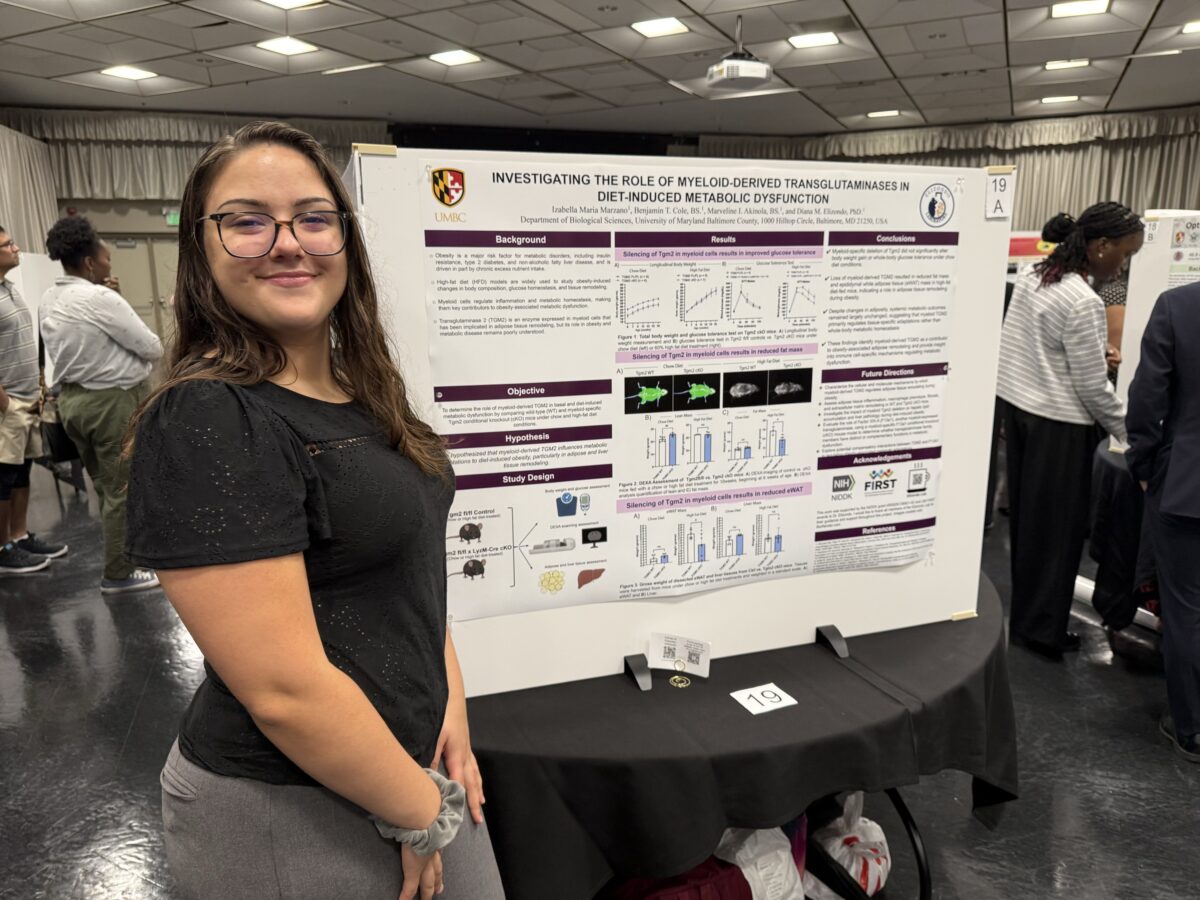
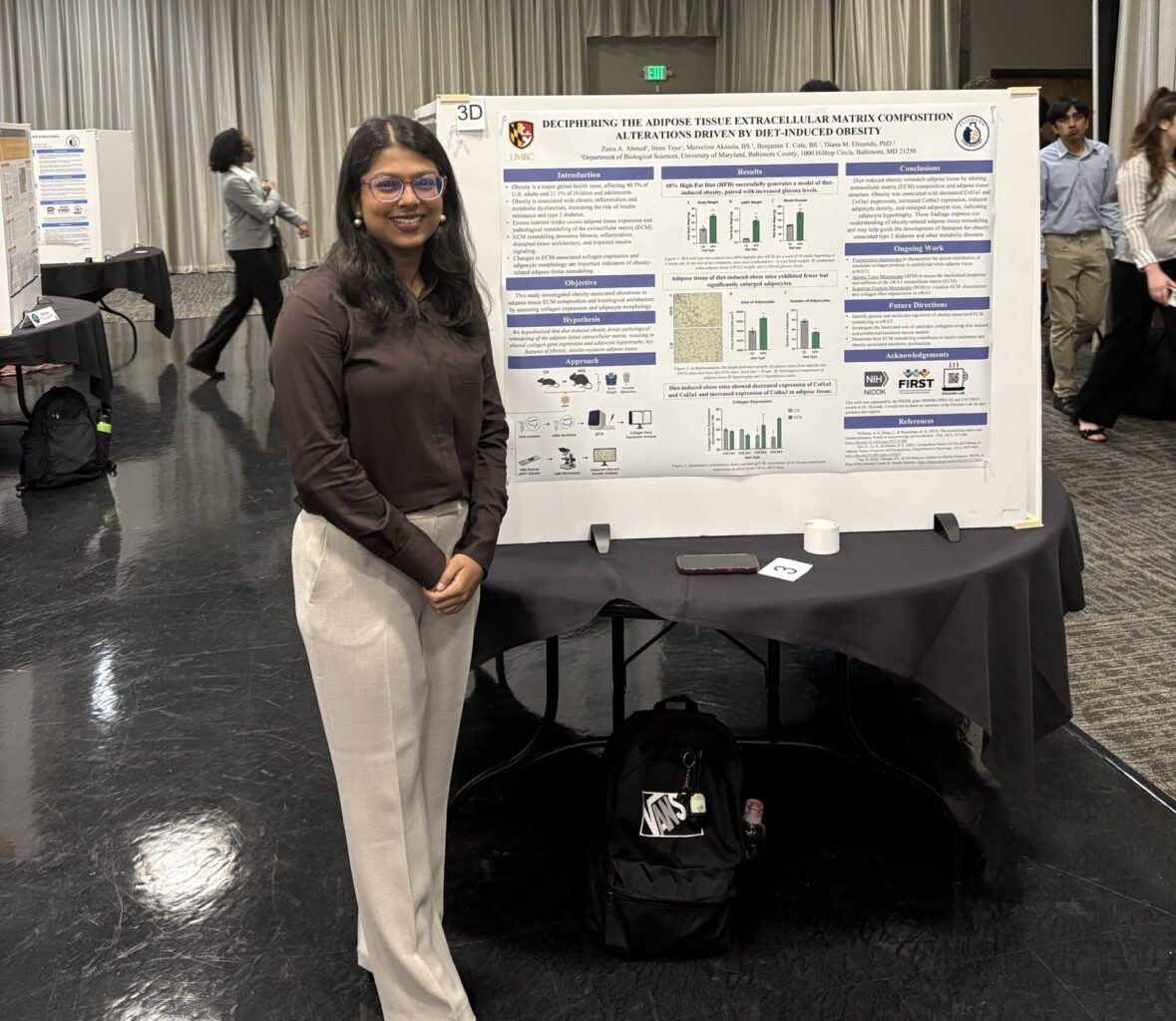 Izabella Marzano (left) and Zaira Ahmed (right) have steadily gained skills and confidence as scientists with the support of their research mentor, Diana Elizondo. Presenting at SURF was an important chance to share their work publicly. (Photos by Diana Elizondo)
Supported independence
Across the room, junior biochemistry and molecular biology major Zaira Ahmed, who began at UMBC this spring after transferring from Prince George’s Community College (PGCC), presented findings on how diet-induced obesity alters the composition of fat tissue’s extracellular matrix—a complex network of proteins, sugars, and other molecules surrounding cells. Ahmed first conducted research at PGCC, and she sought out Elizondo’s lab after taking the same cell biology course as Marzano, motivated in part by family members living with diabetes.
“Dr. Elizondo has been an amazing mentor. She explains everything so clearly and has been hands-on in teaching me different laboratory techniques,” Ahmed says. “But then once she sees I’ve got it, she lets me move forward independently.”
Irene Teye, a junior biological sciences major who started in Elizondo’s lab in January 2025, focused on the three-dimensional structural changes that obesity drives in the extracellular matrix. She worked with Tagide deCarvalho, manager of the Keith R. Porter Imaging Facility at UMBC, to generate and digitally analyze microscopy images of the matrix.
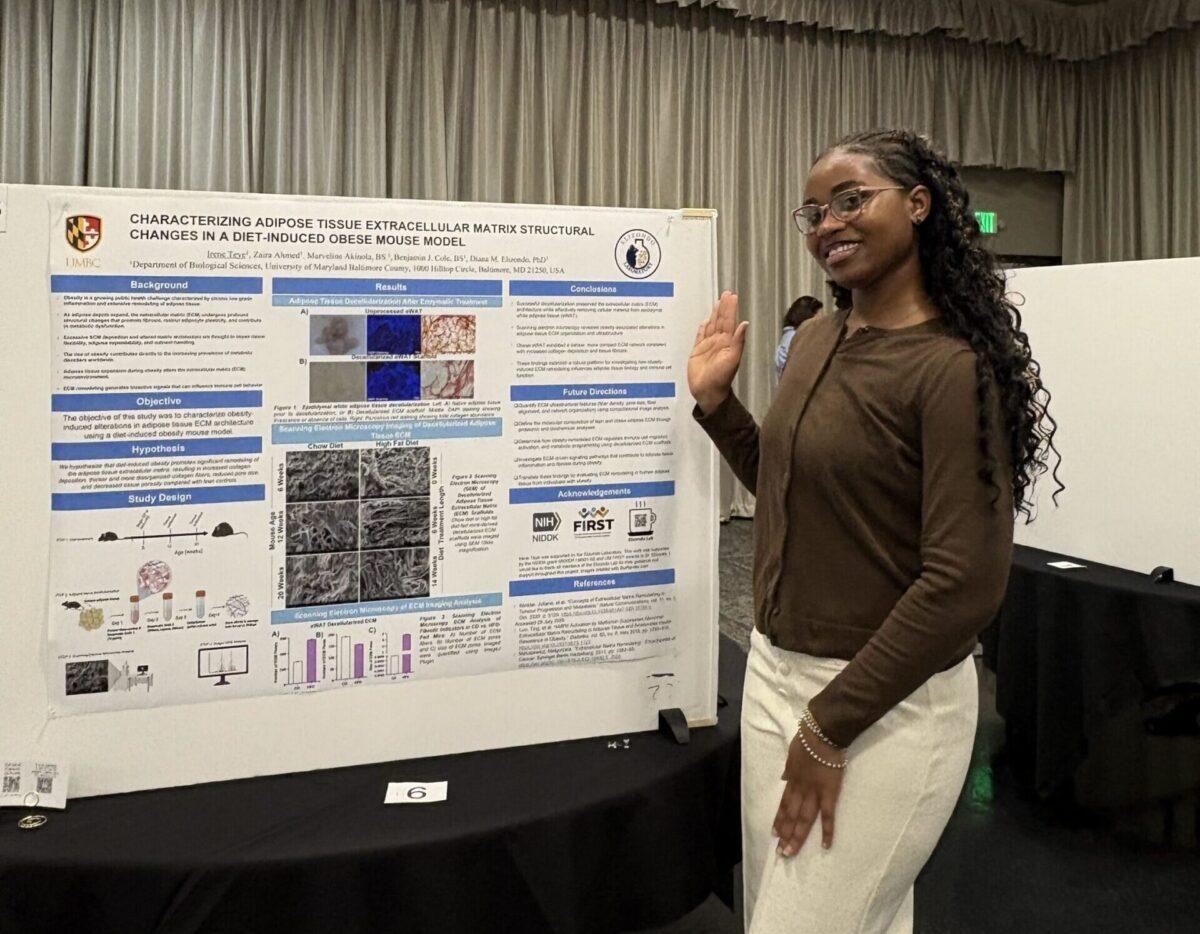
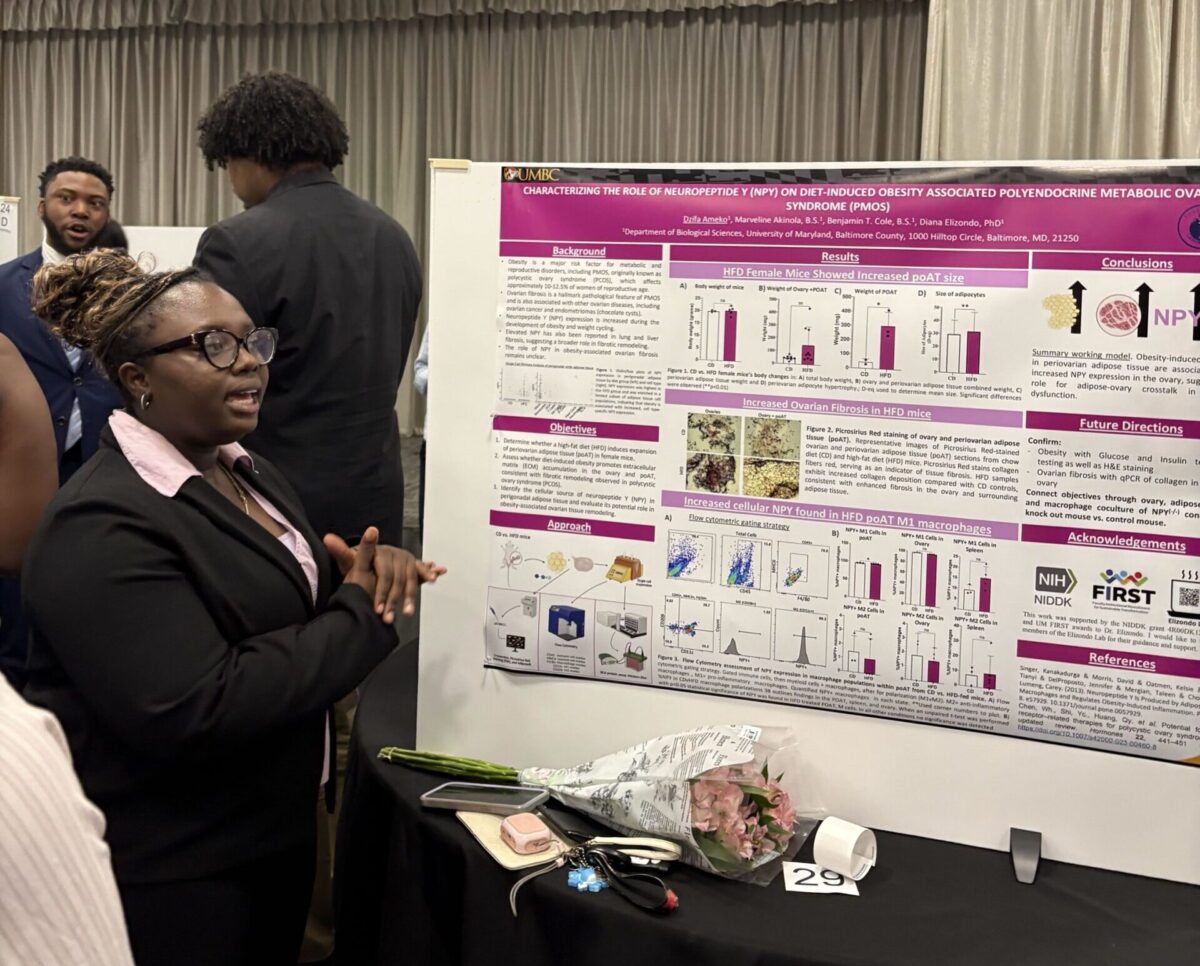 Irene Teye (left) loves working in Diana Elizondo’s research group, for both the sense of accomplishment she experiences doing the science and the closeness of the relationships she’s formed. Dzifa Ameko (right) is passionate about her research with Elizondo for its potential impact on women worldwide. (Photos by Diana Elizondo)
“It took three weeks to analyze the microscopy data to get just two images for my research poster, but it felt like such an accomplishment when I finished,” Teye says. She’s found a home in the Elizondo group, sharing that given how close the members are, “You’d think we’re all related.”
Dzifa Ameko, a junior biological sciences major, began with Elizondo in March 2025 after another faculty member recommended the lab based on Ameko’s interests. Long intrigued by endocrinology and gynecology, she investigated the role of neuropeptide Y, a small signaling molecule released by neurons, in an understudied hormonal and metabolic disorder that affects up to 170 million women worldwide.
“Dr. Elizondo’s door is always open,” Ameko said. “I can also always send her a Slack message and she is so responsive, whether it’s about research or a personal challenge.”
Students at the heart of research
Elizondo, who joined the UMBC faculty in January 2025, sees supporting student researchers as the heart of her work. “One of the most rewarding parts of starting my lab has been watching these students grow in confidence and independence,” she said. “Many of them joined with little or no prior research experience, and it has been incredibly exciting to see them develop into scientists who can think critically, troubleshoot experiments, and communicate their work so effectively. I strongly believe that the best way to learn science is by doing science. My goal is to create an environment where students are genuine contributors to the research, not just assistants.”
 Ben Bazarsuren, a senior mechanical engineering major, was one of six students who gave five-minute “lightning talks” to kick off SURF 2026. (Melissa Penley Cormier, M.F.A. ’17/UMBC)
SURF gave those contributions a public stage. Outgoing dean of the College of Natural and Mathematical Sciences, William R. LaCourse, welcomed participants to the event, highlighting the mix of student researchers from UMBC, regional community colleges, and other institutions. “SURF is one of the highlights of summer each year, because it celebrates the curiosity, perseverance, and excellence of our students and the faculty who guide them,” he said.
For transfer students like Marzano and Ahmed, and for first-time researchers across the university, the combination of hands-on projects, responsive mentoring, and a forum like SURF turns their motivation and potential into tangible results.
“You are ending this summer more knowledgeable, more experienced, more skilled, and a better scientist. Remember that the full benefits of your research may never be known to you. Science is not for those who seek glory—it’s not for me today, it’s for others tomorrow,” LaCourse reflected in his opening remarks. “Your spirit is an inspiration to us all. We hope that UMBC will always be a part of you.”
]]>
Izabella Maria Marzano, a senior biological sciences major who transferred to UMBC from Anne Arundel Community College, was one of more than 120 undergraduate and high school student presenters...
https://umbc.edu/stories/summer-undergraduate-research-fest-2026/
https://my3.my.umbc.edu/api/v0/pixel/news/161750/guest@my.umbc.edu/c89f30e2171cc66e40795d964d59e02f/api/pixel
biology
cnms
coeit
meche
research
science-and-tech
stories
story
transfer-students
undergraduate-research
UMBC News & Magazine
https://my3.my.umbc.edu/groups/umbc-news-magazine
https://assets1-my.umbc.edu/system/shared/avatars/groups/000/001/943/24435aa6207c452e7bc15cc74b42c7bb/xsmall.png?1748556657
https://assets1-my.umbc.edu/system/shared/avatars/groups/000/001/943/24435aa6207c452e7bc15cc74b42c7bb/original.png?1748556657
https://assets2-my.umbc.edu/system/shared/avatars/groups/000/001/943/24435aa6207c452e7bc15cc74b42c7bb/xxlarge.png?1748556657
https://assets2-my.umbc.edu/system/shared/avatars/groups/000/001/943/24435aa6207c452e7bc15cc74b42c7bb/xlarge.png?1748556657
https://assets3-my.umbc.edu/system/shared/avatars/groups/000/001/943/24435aa6207c452e7bc15cc74b42c7bb/large.png?1748556657
https://assets1-my.umbc.edu/system/shared/avatars/groups/000/001/943/24435aa6207c452e7bc15cc74b42c7bb/medium.png?1748556657
https://assets2-my.umbc.edu/system/shared/avatars/groups/000/001/943/24435aa6207c452e7bc15cc74b42c7bb/small.png?1748556657
https://assets1-my.umbc.edu/system/shared/avatars/groups/000/001/943/24435aa6207c452e7bc15cc74b42c7bb/xsmall.png?1748556657
https://assets2-my.umbc.edu/system/shared/avatars/groups/000/001/943/24435aa6207c452e7bc15cc74b42c7bb/xxsmall.png?1748556657
UMBC News & Magazine
0
0
false
Wed, 19 Aug 2026 11:48:37 -0400
Wed, 19 Aug 2026 11:48:37 -0400
Four Retrievers selected for this summer’s Key Bridge rebuilding internship
This summer, four UMBC students are getting hands-on experience contributing to efforts to rebuild the Francis Scott Key Bridge over the Patapsco River, which collapsed in March 2024 after a cargo ship collided with one of its supports. This is the second year in a row that the Maryland Transportation Authority has partnered with the Maryland Higher Education Commission to run the program.
Last year, three out of nine students in the program hailed from UMBC. This year, four out of the 10 interns are Retrievers. Mechanical engineering students Bilal Faizullah and Katelyn Prasad and geography and environmental systems students James Keller and Megan (Em) Schumacher ’26 will get the opportunity to learn about topics such as project management, environmental analysis, construction oversight, and community outreach. They will also get the chance to be a part of an iconic infrastructure project for Maryland, an experience that last year’s student interns found particularly meaningful.
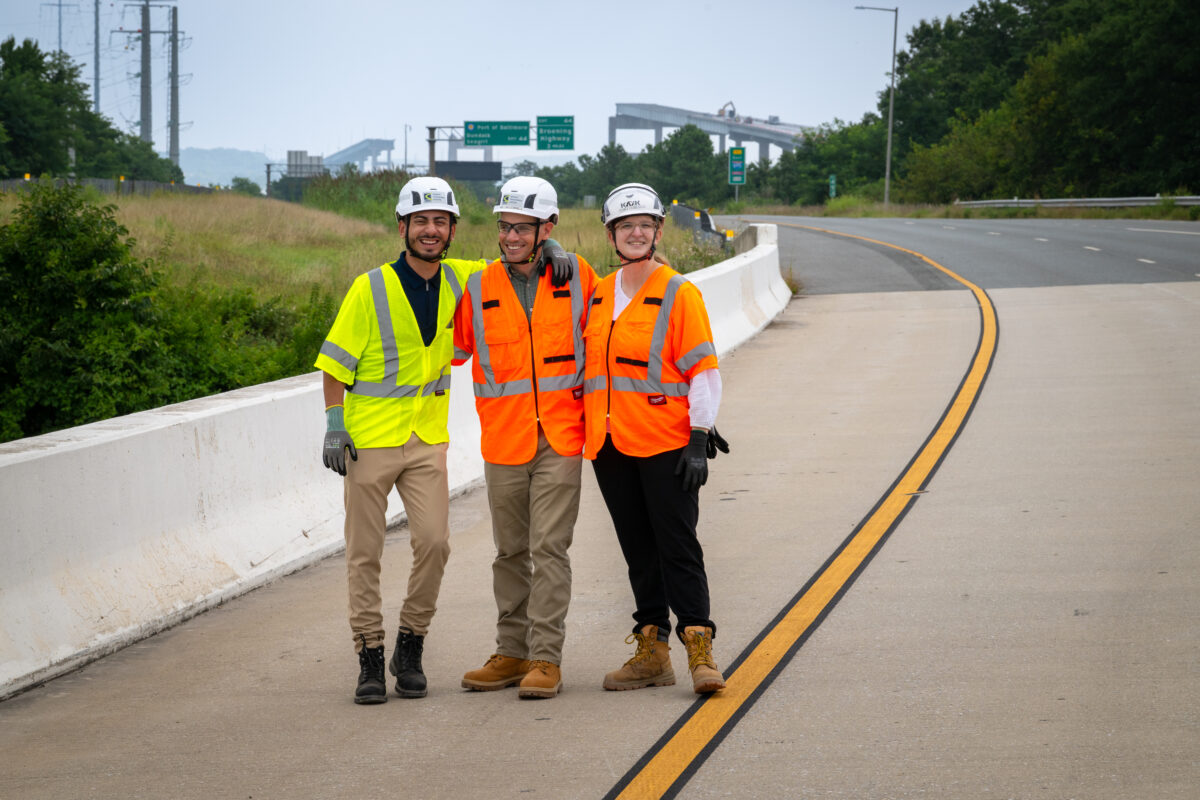 From left to right, Cristian Mena, William McConnell, and Emily DiMarzio pose for a photo near the site of the collapsed Key Bridge. The three worked on the bridge rebuilding project as interns with the Maryland Transportation Authority in summer 2025. (Brad Ziegler/UMBC)
“The Key Bridge Internship Program represents the very best of career-connected learning by giving students the opportunity to contribute to a project that will have a lasting impact on Maryland,” says Christine Routzahn, director of UMBC’s Career Center. “We’re incredibly proud that four UMBC students were selected for this prestigious program. Their selection reflects not only their talent and dedication, but also the strength of the partnerships that make opportunities like this possible. We are grateful to the Maryland Transportation Authority, Maryland Higher Education Commission, and its partners for investing in our students and in the state’s future workforce.”
]]>
This summer, four UMBC students are getting hands-on experience contributing to efforts to rebuild the Francis Scott Key Bridge over the Patapsco River, which collapsed in March 2024 after a cargo...
https://umbc.edu/stories/key-bridge-rebuilding-internship-summer-2026/
https://my3.my.umbc.edu/api/v0/pixel/news/161314/guest@my.umbc.edu/56fca8c62f428a6e6cff12abb2ccee1e/api/pixel
cahss
coeit
ges
impact
internship
meche
science-and-tech
stories
story
UMBC News & Magazine
https://my3.my.umbc.edu/groups/umbc-news-magazine
https://assets1-my.umbc.edu/system/shared/avatars/groups/000/001/943/24435aa6207c452e7bc15cc74b42c7bb/xsmall.png?1748556657
https://assets1-my.umbc.edu/system/shared/avatars/groups/000/001/943/24435aa6207c452e7bc15cc74b42c7bb/original.png?1748556657
https://assets2-my.umbc.edu/system/shared/avatars/groups/000/001/943/24435aa6207c452e7bc15cc74b42c7bb/xxlarge.png?1748556657
https://assets2-my.umbc.edu/system/shared/avatars/groups/000/001/943/24435aa6207c452e7bc15cc74b42c7bb/xlarge.png?1748556657
https://assets3-my.umbc.edu/system/shared/avatars/groups/000/001/943/24435aa6207c452e7bc15cc74b42c7bb/large.png?1748556657
https://assets1-my.umbc.edu/system/shared/avatars/groups/000/001/943/24435aa6207c452e7bc15cc74b42c7bb/medium.png?1748556657
https://assets2-my.umbc.edu/system/shared/avatars/groups/000/001/943/24435aa6207c452e7bc15cc74b42c7bb/small.png?1748556657
https://assets1-my.umbc.edu/system/shared/avatars/groups/000/001/943/24435aa6207c452e7bc15cc74b42c7bb/xsmall.png?1748556657
https://assets2-my.umbc.edu/system/shared/avatars/groups/000/001/943/24435aa6207c452e7bc15cc74b42c7bb/xxsmall.png?1748556657
UMBC News & Magazine
6
0
false
Mon, 27 Jul 2026 13:01:27 -0400
Mon, 27 Jul 2026 13:01:27 -0400
How to make a (really) strong magnet
Magnets often attract curious minds. Einstein told of his profound sense of hidden order after witnessing the invisible forces of the Earth’s magnetic field guide the needle of a compass. For Ethan Bowers, it was the wonder of learning Maxwell’s laws—equations developed by 19th-century Scottish physicist James Clerk Maxwell that unite magnetism, electricity, and light—that really pulled him in.
Now a Ph.D. student in mechanical engineering, Bowers is building a massive, one-of-a-kind research magnet. It weighs more than 2,300 pounds and will be capable of generating a magnetic field of 7 tesla (roughly 140,000 times stronger than the Earth’s magnetic field and more than twice as strong as the field in most MRI machines).
Making the magnet has been the labor of multiple researchers over more than a decade, led by mechanical engineering associate professor Carlos Romero Talamás, who plans to use the magnet to conduct experiments on plasma, the superheated soup of particles found in stars, lighting, and the Aurora Borealis, and which makes up more than 99 percent of the visible universe.
An initial magnet design and analysis was completed by Evan Bates, M.S. ’15, Ph.D. ’18, mechanical engineering. In 2023, Bowers, who had returned as a student to UMBC following a stint in industry, joined the project. He redesigned key aspects of the magnet and began the meticulous work of assembling and testing it. In the coming months, Bowers plans to run the magnet up to full strength. Then the real fun begins: Unleashing the new tool to help answer the questions curious minds dream up.
Tools of the trade
- Mechanical and electrical know-how
- Perseverance
- Heavy-lifting equipment (custom designed)
- A serious power source and some chilled water (things are going to get hot)
Step 1: Brush up on your magnet basics
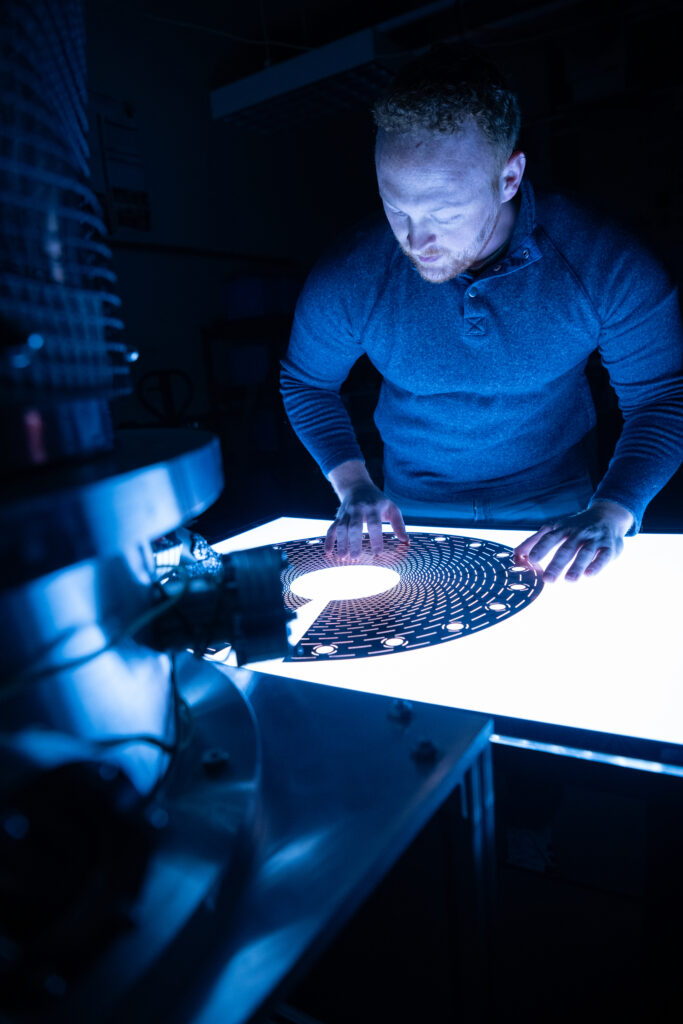 Bowers illuminates a Bitter disk with a backlight. (Brad Ziegler/UMBC)
Say “magnet,” and many people think first of the objects affixing their kids’ artwork to the fridge. Refrigerator magnets are an example of permanent magnets: materials in which the electrons permanently align in a way that generates a magnetic field. Permanent magnets can get quite strong—such as the rare earth neodymium magnets used in some maglev trains—but they top out at about 2 tesla.
To get an even stronger magnet, engineers can turn to a phenomenon that’s captured in the Maxwell equations that captivated Bowers: Electricity and magnetism are intrinsically linked.
Electrons flowing through a wire generate a magnetic field. Coil the wire and you can create a field similar in shape to a permanent bar magnet, with distinct north and south poles. This is the electromagnet. Higher current and more coils make a stronger magnet. However, high current also risks melting your magnet into a puddle and mangling it with the enormous pressure from the magnetic field pushing on the moving electrons (called Lorentz forces).
Superconducting electromagnets, which use material with the almost magical property of showing virtually zero electrical resistance when cooled with liquid helium, can eliminate the melting risk, but are expensive and finicky to operate, and have other limitations.
Another (more old-school) solution is called the Bitter electromagnet, invented in the 1930s by American physicist Francis Bitter. In place of coiled wires, circular metal disks separated with insulating spacers create a helical path that concentrates the current. The disks are shot through with holes for circulating water to whisk away heat and the structural design counteracts the mechanical stresses. “We chose a Bitter magnet because it offered the right combination of features for the tasks we wanted to perform,” Bowers says.
Step 2: Design, test, refine, repeat
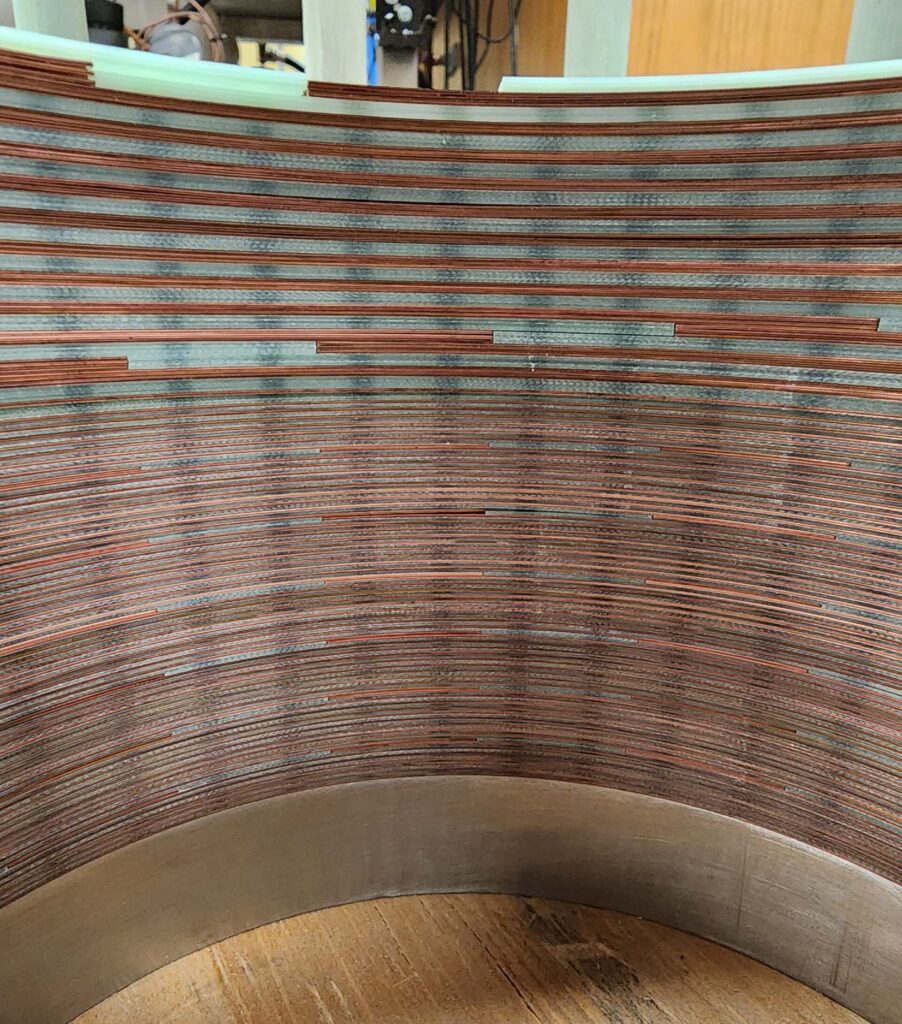 The turn density for the magnet is higher at the ends than at the middle. (Photo courtesy of Bowers)
The UMBC team’s initial vision was to create a 10-tesla Bitter magnet, with space in the center for a relatively large vacuum chamber to hold plasma. The magnet could generate either a steady or pulsed magnetic field, depending on the needs of the experiment. Bates analyzed the disk shape, stacking methods, cooling hole geometry, heat transfer, mechanical stress, and electrical properties of the magnet to optimize the design. He validated it by constructing and testing a 1-tesla prototype.
In 2023, the team decided to change the desired magnetic field profile, making it slightly higher on the ends of the magnet than in the middle, so that charged particles would be pushed toward the center. They didn’t want to redesign the Bitter disks, so they had to lower the maximum field strength to 7 tesla. They also had to vary the coil density, making tighter turns at the ends to get the stronger field.
Bowers analyzed the new field profile and worked out a clever trick of adding a tapered insulating disk to seamlessly transition between the areas of tighter and looser turns. He also performed a structural analysis of the whole assembly.
Step 3: Pallets, cranes, and painstaking planning
The final design called for 439 copper Bitter disks, four insulating transition disks, and 434 regular insulating disks housed inside a pressure vessel. Outside companies manufactured the disks, but Bowers personally inspected every single one, removing any with defects, and cleaning the copper ones with isopropyl alcohol. He built a custom pallet to hold the cylindrical assembly in place in the lab, and started stacking.
The process took about a month, and near the end “I was so sick of the monotony,” Bowers says. To push it across the finish line, he worked straight through the weekend, stacking the last disk on a Sunday afternoon in February. “It happened to be my friend’s birthday so I celebrated that completion and their birthday together,” he says.
Next up was moving the approximately 2-foot-high stack of disks to a movable swing set, created by a UMBC mechanical engineering capstone team to serve as a mobile and rotatable platform for the magnet. Bowers built a custom crane fixture to lift the assembly onto the platform and spent weeks planning every step of the move. “It was the last major place the structure could fail before we power the magnet,” he says. After one stressful day, Bowers says he was elated when it all went according to plan. “I felt genuinely grateful for all I had been given the chance to work on, and grateful that God had given me the ability to succeed.”
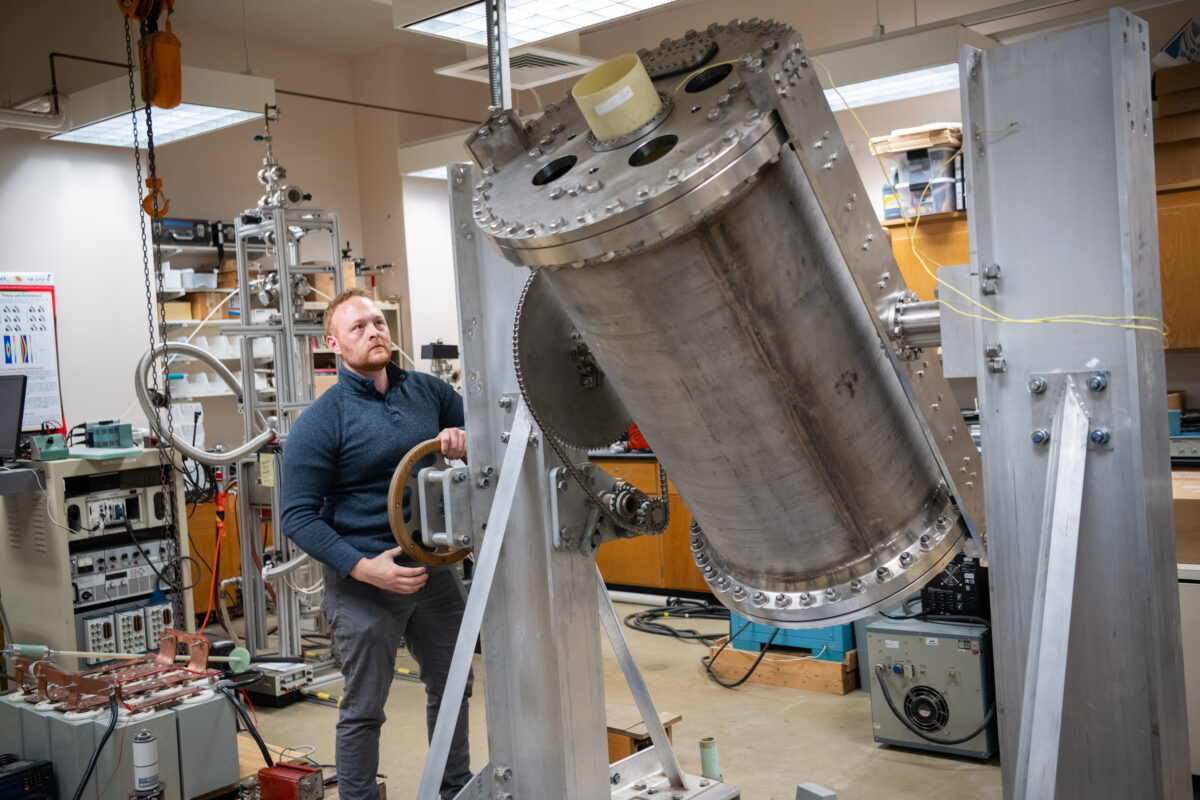 Bowers shows how the magnet core can be rotated. (Brad Ziegler/UMBC)
Step 4: Test some more
With the core of the magnet assembled, Bowers has also begun the detailed process of testing its electrical properties, using a host of measurement equipment.
At first, he is powering the magnet with lower currents, but eventually he will send 15,000 amps through the disks, about half the current that flows in an average lightning bolt. The voltage will be about five times the voltage in a wall socket.
Safety is of paramount concern to the team when working with such high power. When the magnet is operating at full strength, the energy in two cubic feet of the magnetic field alone will be more than the energy of a small SUV zooming by at 60 miles per hour.
Bowers is working on a set of detailed instructions to address all conceivable operating, maintenance, and failure scenarios. “We’re safe. We do all our due diligence,” he says.
Step 5: Serve up some science
Once the magnet is fully up and running, the science experiments can start. Bowers and Romero Talamás have a few ideas for initial experiments, including investigating how a high magnetic field affects when a gas will suddenly switch from being an insulator to a conductor, allowing current to arc through it. They are also interested in how the magnet might be used to separate different forms of hydrogen—particularly two forms that may form the fuel for future fusion reactors to supply clean and near limitless energy.
 Stars—nature’s original fusion reactors—show how plasma and magnetic fields can interact in spectacular fashion. In this image of our sun, taken in July 2012, million-degree plasma in the sun’s atmosphere began to cool and fall to the surface. Because the plasma is charged, it condensed along twisted magnetic field lines close to the surface and formed giant streaming arcs, some as tall as five Earths stacked high. (NASA Solar Dynamics Observatory)
Bowers grew up in rural Hagarstown, Maryland, a kid who enjoyed exploring everything from the rocks on the side of a path to the electrical motors his grandfather would wind. Research has offered him the chance to constantly challenge himself. After graduation, he’ll move on to new questions at the scientific frontiers, perhaps working at a fusion energy start-up or a national lab. But the 7T Bitter magnet will remain at UMBC, a gift to curious students who come after him.
]]>
Magnets often attract curious minds. Einstein told of his profound sense of hidden order after witnessing the invisible forces of the Earth’s magnetic field guide the needle of a compass. For...
https://umbc.edu/stories/how-to-make-a-really-strong-magnet/
https://my3.my.umbc.edu/api/v0/pixel/news/160699/guest@my.umbc.edu/daf60158f49bee7547aece6f2687d891/api/pixel
coeit
discovery
graduate-research
how-to
meche
research
science-and-tech
spring-2026
story
UMBC News & Magazine
https://my3.my.umbc.edu/groups/umbc-news-magazine
https://assets1-my.umbc.edu/system/shared/avatars/groups/000/001/943/24435aa6207c452e7bc15cc74b42c7bb/xsmall.png?1748556657
https://assets1-my.umbc.edu/system/shared/avatars/groups/000/001/943/24435aa6207c452e7bc15cc74b42c7bb/original.png?1748556657
https://assets2-my.umbc.edu/system/shared/avatars/groups/000/001/943/24435aa6207c452e7bc15cc74b42c7bb/xxlarge.png?1748556657
https://assets2-my.umbc.edu/system/shared/avatars/groups/000/001/943/24435aa6207c452e7bc15cc74b42c7bb/xlarge.png?1748556657
https://assets3-my.umbc.edu/system/shared/avatars/groups/000/001/943/24435aa6207c452e7bc15cc74b42c7bb/large.png?1748556657
https://assets1-my.umbc.edu/system/shared/avatars/groups/000/001/943/24435aa6207c452e7bc15cc74b42c7bb/medium.png?1748556657
https://assets2-my.umbc.edu/system/shared/avatars/groups/000/001/943/24435aa6207c452e7bc15cc74b42c7bb/small.png?1748556657
https://assets1-my.umbc.edu/system/shared/avatars/groups/000/001/943/24435aa6207c452e7bc15cc74b42c7bb/xsmall.png?1748556657
https://assets2-my.umbc.edu/system/shared/avatars/groups/000/001/943/24435aa6207c452e7bc15cc74b42c7bb/xxsmall.png?1748556657
UMBC News & Magazine
0
0
false
Mon, 15 Jun 2026 14:54:55 -0400
Mon, 15 Jun 2026 14:54:55 -0400
Diving into a new sport
Kaleb Cave’s story is unique among almost all collegiate swimming and diving athletes: When he started college, he was not a strong swimmer.
He is, however, the youngest person ever to perform a standing double backflip. His athletic prowess had also earned him a spot on the USA Gymnastics national team in the Senior Elite Trampoline and Tumbling division.
So how did this mechanical engineering major and gymnast end up on the swimming and diving team? It started on Instagram: Cave’s account (@lub.lub), where he chronicles his athletic feats, has over 140,000 followers.
Junior computer science major Andy Vines, a member of the diving team, messaged Cave when he saw the tumbler was a fellow Retriever. “My mom always told me to find a way to get involved at UMBC, and I thought this might be it,” Cave says. “After reaching out to head dive coach Jeff Fisher, a few months later, I was on the team and in the water.”
From setback to success
While diving and tumbling have many similarities, the transition was anything but smooth water for Cave.
“Learning how to dive was more of a mental than a physical battle for me. With my gymnastics background, the flipping and twisting came naturally. However, I struggled —and still struggle—with my approach and entries into the water,” Cave says. “Landing on my head was definitely weird to get used to, especially when I’ve been landing on my feet all my life. My aerial awareness is pretty good, though. As a gymnast, I’m used to doubles and triples, so when I have to dial it down, my body doesn’t quite understand.”
Cave officially joined the UMBC swimming and diving team as a sophomore. He had a solid rookie campaign, qualifying for the finals in both the one- and three-meter board events at the America East Championships. However, less than a month later, his diving journey suffered a big setback.
 Kaleb Cave competes in the qualifying round of the one-meter diving event at the America East Championships in February, 2026.
In March 2025, he ruptured his Achilles tendon at a tumbling national team camp. He had surgery five days later and started physical therapy eight weeks post-operation.
“My physical therapist did an amazing job getting me back to where I need to be, and he is still helping me become stronger,” Cave says. “In the beginning, physical therapy frustrated me—seeing how weak I was and how long it was taking to gain back little bits of strength was taxing on my mental health.”
However, he persisted with rehab and returned to competition in October 2025, just under seven months after the injury—much faster than anyone expected.
“It felt great,” said Cave. “My return didn’t feel rushed at all, just natural and smooth.”
Two for the team
In January 2026, Cave broke a 14-year-old school record en route to winning the three-meter competition at the Towson Diving Invitational. He qualified for NCAA Zones, the preliminary event for the NCAA Diving Championships, in the one- and three-meter events.
Two weeks later, Cave won bronze in both the one- and three-meter events at the America East Championships, helping lead the men’s swimming and diving team to its 15th title.
 For Kaleb Cave (left), earning two individual medals was not as meaningful as contributing to the team championship.
Cave’s two medals “contributed to the team winning that title, which means more to me than if I had felt like I didn’t contribute to it. Those were also my first diving-related medals ever, which is special to me,” he adds.
With two full seasons of diving under his belt, Cave feels ready to level up. “Next year, I definitely think I can start pushing the difficulty, now that I’ve cleaned up my form a bit since my very first season.”
Being a student athlete is time-consuming, especially when learning a new sport and alongside a technical major like mechanical engineering, but Cave says UMBC has allowed him to succeed.
“UMBC provides so much support for student-athletes, whether it be a quiet place for us to study or one-on-one tutoring sessions. Teachers are always here to provide help when needed and guide you through the course content.” It seems that Cave has landed on his feet after all.
By Zachary Seidel ’12, M.S. ’15
]]>
Kaleb Cave’s story is unique among almost all collegiate swimming and diving athletes: When he started college, he was not a strong swimmer. He is, however, the youngest person ever to...
https://umbc.edu/stories/diving-into-a-new-sport/
https://my3.my.umbc.edu/api/v0/pixel/news/159886/guest@my.umbc.edu/76bb68addcbfd14eec15a9b49a043c36/api/pixel
at-play
athletics
campus-life
coeit
meche
spring-2026
story
swimming-and-diving
themes
UMBC News & Magazine
https://my3.my.umbc.edu/groups/umbc-news-magazine
https://assets1-my.umbc.edu/system/shared/avatars/groups/000/001/943/24435aa6207c452e7bc15cc74b42c7bb/xsmall.png?1748556657
https://assets1-my.umbc.edu/system/shared/avatars/groups/000/001/943/24435aa6207c452e7bc15cc74b42c7bb/original.png?1748556657
https://assets2-my.umbc.edu/system/shared/avatars/groups/000/001/943/24435aa6207c452e7bc15cc74b42c7bb/xxlarge.png?1748556657
https://assets2-my.umbc.edu/system/shared/avatars/groups/000/001/943/24435aa6207c452e7bc15cc74b42c7bb/xlarge.png?1748556657
https://assets3-my.umbc.edu/system/shared/avatars/groups/000/001/943/24435aa6207c452e7bc15cc74b42c7bb/large.png?1748556657
https://assets1-my.umbc.edu/system/shared/avatars/groups/000/001/943/24435aa6207c452e7bc15cc74b42c7bb/medium.png?1748556657
https://assets2-my.umbc.edu/system/shared/avatars/groups/000/001/943/24435aa6207c452e7bc15cc74b42c7bb/small.png?1748556657
https://assets1-my.umbc.edu/system/shared/avatars/groups/000/001/943/24435aa6207c452e7bc15cc74b42c7bb/xsmall.png?1748556657
https://assets2-my.umbc.edu/system/shared/avatars/groups/000/001/943/24435aa6207c452e7bc15cc74b42c7bb/xxsmall.png?1748556657
UMBC News & Magazine
0
0
false
Fri, 08 May 2026 14:10:24 -0400
Fri, 08 May 2026 14:10:24 -0400
Meyerhoff Scholars Program celebrates 500th Ph.D.
This spring, the Meyerhoff Scholars Program at UMBC celebrates a landmark achievement: 500 program graduates have earned a Ph.D.
The milestone highlights the program’s success as the nation’s original model for increasing diversity in science, technology, engineering, and mathematics (STEM). Grounded in high expectations and robust support, Meyerhoff Scholars consistently go on to excel in top graduate programs and lead in academia, industry, and government while mentoring the next generation. UMBC has maintained its position as the national leader in producing Black M.D./Ph.D. graduates: Between 2014 and 2024, UMBC alumni accounted for 15 percent of all such dual-degree recipients nationwide, far outpacing any other institution. UMBC is also the leader in graduating Black students who go on to earn Ph.D.s in the life sciences, math and computer sciences, and engineering.
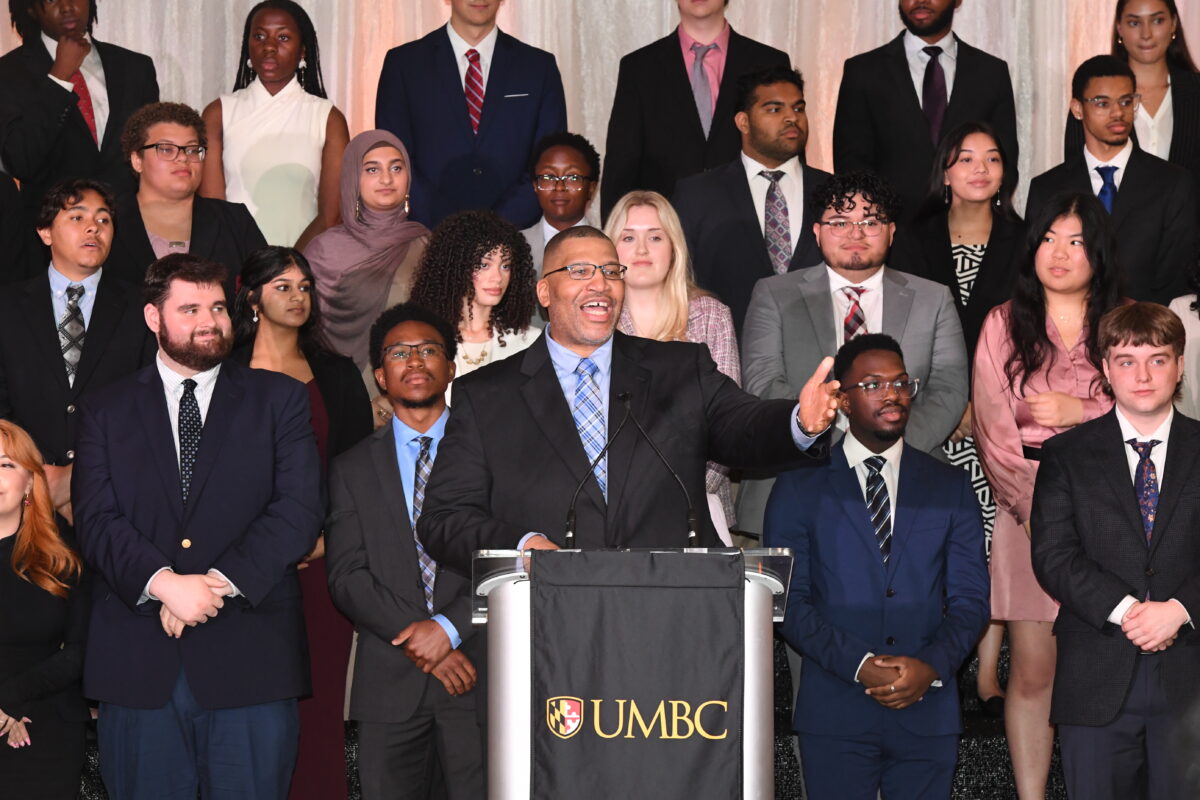 Keith Harmon, director of the Meyerhoff Scholars Program, celebrates graduating scholars at the 2024 Meyerhoff Senior Reception. (Jim Burger for UMBC)
Joseph Washington ’97, mechanical engineering, a member of the fourth Meyerhoff cohort (M4), embodies this trajectory. A first-generation college student, he initially considered trade school after a knee injury derailed his plans to attend the U.S. Naval Academy. The Meyerhoff scholarship changed his path. In particular, Selection Weekend for admitted Meyerhoff Scholars and Summer Bridge, intensive group programming prior to the scholars’ first UMBC semester, affirmed his identity and potential: “The most important message I internalized from the Meyerhoff program was that I can be Black and intelligent,” he recalls.
Washington earned a master’s degree before returning to UMBC for his Ph.D. Today, he serves as an assistant teaching professor at UMBC at the Universities at Shady Grove. He mentors students informally, advises the UMBC chapter of the American Institute of Aeronautics and Astronautics, and creates space for Meyerhoff Scholars to discuss graduate school and careers. “UMBC has always felt like home,” he says. “I would not be here if not for the Meyerhoff Scholars Program.”
A family tradition
Sadella Santos ’12, chemical engineering, M20, and her sister Melissa Santos ’12, chemical engineering, M19, also credit the program with shaping their journeys. Sadella, a senior scientist at Exponent, Inc. with a Ph.D. in chemical engineering, values the emphasis on community. “Academic success is a collective effort, rather than individual competition,” she says. “At work, I champion the message that diverse perspectives are necessary to drive scientific progress.” She pays it forward by reviewing abstracts for the Annual Biomedical Research Conference for Minoritized Scientists (ABRCMS) and hosting lab visits to expose high school students to possible careers.
 Meyerhoff Scholar alumni gathered at the 2022 Meyerhoff Family Meeting. (Marlayna Demond ’11/UMBC)
Melissa, who earned a Ph.D. in chemical engineering followed by a J.D., applies problem-solving and adaptability skills honed through Meyerhoff to her legal career. She recently participated in a panel for McNair Scholars on summer research experiences. “Community and network are important,” she notes. “Surround yourself with people who will support you but also challenge you to grow.”
Meyerhoff scholars often refer to themselves as family—and that’s especially true for the Santoses. Justin Santos ’17, biochemistry and molecular biology, M25, is the third scholar in the family. He is completing his M.D./Ph.D. in neuroscience at Emory University this spring and will begin residency in emergency medicine at Washington University in St. Louis. He mentors students pursuing clinical-scientist careers and assists with ABRCMS abstract reviews. “High-quality, comprehensive mentorship” was invaluable to him, and he works to provide that same guidance to others.
Reaching back to pay it forward
Naomi Mburu ’18, M26, chemical engineering, was UMBC’s first Rhodes Scholar, attending Oxford University on one of the world’s oldest and most prestigious scholarships. She earned a D.Phil. in engineering science from the University of Oxford and today serves as lead analyst at Fusion Advisory Services, providing analysis of the fusion industry to a wide range of stakeholders. Meyerhoff pushed her beyond her comfort zone into leadership roles and strengthened her public speaking and networking skills, she says. She now reviews scholarship essays for UMBC students and organizes summer internships to bring diverse talent into the fusion energy field. “Supporting the next generation is so important,” she says. “I have only come this far myself with the help of my own mentors.”
 From left to right, UMBC sophomore Amir Walton-Irvin, and juniors Jessica Slaughter, Deeya Mistry, and Phoenix Bryant all received a Goldwater Scholarship this year—and all four are Meyerhoff Scholars. (Brad Ziegler/UMBC)
These alumni illustrate the program’s lasting influence. Meyerhoff Scholars do not simply succeed—they reach back, creating opportunities and building communities for current students and early-career researchers. The model’s impact now extends even further: universities including Penn State, UNC-Chapel Hill, UC Berkeley, Stony Brook, and others have adapted key elements of the Meyerhoff approach with support from funders such as the Chan Zuckerberg Initiative and Simons Foundation. The Howard Hughes Medical Institutehas also been a long-term supporter of Meyerhoff and its replications.
With more than 2,200 undergraduates supported to date and a national reputation for producing leaders committed to diversity in STEM, the 500th Ph.D. stands as compelling proof of the Meyerhoff model’s effectiveness. As alumni advance in their fields and invest in those who follow, the Meyerhoff Scholars Program continues to change lives one by one, transforming the face of American science through excellence, community, and a powerful ripple effect that will benefit generations to come.
]]>
This spring, the Meyerhoff Scholars Program at UMBC celebrates a landmark achievement: 500 program graduates have earned a Ph.D. The milestone highlights the program’s success as the nation’s...
https://umbc.edu/stories/meyerhoff-scholars-program-celebrates-500th-ph-d/
https://my3.my.umbc.edu/api/v0/pixel/news/159662/guest@my.umbc.edu/842d203280497d3bf9ff4f93dcf9ec8f/api/pixel
alumni
biochemistry-and-molecular-biology
chemical-biochemical-and-environmental-engineering
chemical-engineering
chemistry-and-biochemistry
class-of-2026
cnms
coeit
community
mechanical-engineering
meche
meyerhoff-scholars
news
science-and-tech
story
UMBC News & Magazine
https://my3.my.umbc.edu/groups/umbc-news-magazine
https://assets1-my.umbc.edu/system/shared/avatars/groups/000/001/943/24435aa6207c452e7bc15cc74b42c7bb/xsmall.png?1748556657
https://assets1-my.umbc.edu/system/shared/avatars/groups/000/001/943/24435aa6207c452e7bc15cc74b42c7bb/original.png?1748556657
https://assets2-my.umbc.edu/system/shared/avatars/groups/000/001/943/24435aa6207c452e7bc15cc74b42c7bb/xxlarge.png?1748556657
https://assets2-my.umbc.edu/system/shared/avatars/groups/000/001/943/24435aa6207c452e7bc15cc74b42c7bb/xlarge.png?1748556657
https://assets3-my.umbc.edu/system/shared/avatars/groups/000/001/943/24435aa6207c452e7bc15cc74b42c7bb/large.png?1748556657
https://assets1-my.umbc.edu/system/shared/avatars/groups/000/001/943/24435aa6207c452e7bc15cc74b42c7bb/medium.png?1748556657
https://assets2-my.umbc.edu/system/shared/avatars/groups/000/001/943/24435aa6207c452e7bc15cc74b42c7bb/small.png?1748556657
https://assets1-my.umbc.edu/system/shared/avatars/groups/000/001/943/24435aa6207c452e7bc15cc74b42c7bb/xsmall.png?1748556657
https://assets2-my.umbc.edu/system/shared/avatars/groups/000/001/943/24435aa6207c452e7bc15cc74b42c7bb/xxsmall.png?1748556657
UMBC News & Magazine
0
0
false
Mon, 04 May 2026 15:15:30 -0400
Mon, 04 May 2026 15:15:30 -0400
Eight Retrievers awarded prestigious NSF Graduate Research Fellowships
Eight UMBC students and alumni have been awarded the prestigious 2026 National Science Foundation Graduate Research Fellowship (GRFP), a highly competitive honor that supports outstanding graduate students in STEM disciplines. This year’s large cohort of Retriever recipients demonstrates the university’s commitment to fostering research excellence and preparing students to become leaders in their fields.
The recipients are already making waves with their work. Caly Ferguson ’26, mechanical engineering, was recently named to the National Society of Black Engineers’ “25 Under 25” list and received the Barry Goldwater Scholarship in 2025. He has been working on developing an affordable and dextrous prosthetic forearm and hand with Ramana Vinjamuri, associate professor of computer science and electrical engineering.
 Lesley Hernandez conducted research with Michael Summers at UMBC. Today she is a Ph.D. student at the University of Michigan in biomedical science. (Melissa Penley Cormier, M.F.A. ’17/UMBC)
Lesley Hernandez ’25, biochemistry, will use the GRFP to support her doctoral studies in biomedical science at the University of Michigan. At UMBC, she studied HIV replication with Michael Summers, professor of chemistry and biochemistry. Both Ferguson and Hernandez are Meyerhoff Scholars, and Hernandez also balances her science with a passion for Latin dance.
Peter Allen Wilschke ’24, economics and political science, is heading to graduate school after completing a two-year research assistant position at the Federal Reserve Board of Governors in Washington, DC. His research at UMBC on the complex relationships between political factors and fiscal policy garnered national attention.
 Peter Wilschke (right), presented his research at the 2024 Pi Sigma Alpha National Student Research Conference. Eric Stokan (left), professor of political science and one of Wilschke’s mentors, was there to support him. (Courtesy of Carolyn Forestiere/UMBC)
Sydney Braithwaite, who completed her bachelor’s in forensic chemistry at Towson University, will bring her fellowship to UMBC for graduate study with Lee Blaney, professor of chemical, biochemical, and environmental engineering. Meredith Morse ’25, chemical engineering; Shefra Shah ’24, biochemistry and molecular biology; and Terra Miley ’25, chemical engineering, are all conducting doctoral work at the University of Delaware; Salman Mirza ’25, mechanical engineering, is pursuing a Ph.D. at Johns Hopkins University.
 Caly Ferguson (center) was one of three UMBC recipients of the Barry Goldwater Scholarship for the 2025 – 2026 academic year, along with Lea-Pearl Njei (right) and Jariatu Kargbo (left). (Michael Mower/UMBC)
The substantial fellowship provides three years of financial support, including an annual living stipend and funds for tuition and fees, and the recipients can take their fellowship to any institution in the U.S. That flexibility makes it easier for students to pursue exactly the research they are passionate about with faculty who share their enthusiasm, regardless of the level of resources available at the host institution.
These eight fellowships are a testament to the drive and talent of UMBC’s graduates as they take on new challenges along their research journeys. Each is in a strong position to make their mark on scientific discovery and innovation across the country.
]]>
Eight UMBC students and alumni have been awarded the prestigious 2026 National Science Foundation Graduate Research Fellowship (GRFP), a highly competitive honor that supports outstanding graduate...
https://umbc.edu/stories/nsf-graduate-research-fellowships-2026/
https://my3.my.umbc.edu/api/v0/pixel/news/159250/guest@my.umbc.edu/15fc58fa54a3ac3d7158489f91a1ec70/api/pixel
alumni
biochemistry
biochemistry-and-molecular-biology
cahss
chemical-biochemical-and-environmental-engineering
chemical-engineering
chemistry-and-biochemistry
class-of-2026
cnms
coeit
csee
economics
graduate-research
graduate-school
mechanical-engineering
meche
news
political-science
research
science-and-tech
story
UMBC News & Magazine
https://my3.my.umbc.edu/groups/umbc-news-magazine
https://assets1-my.umbc.edu/system/shared/avatars/groups/000/001/943/24435aa6207c452e7bc15cc74b42c7bb/xsmall.png?1748556657
https://assets1-my.umbc.edu/system/shared/avatars/groups/000/001/943/24435aa6207c452e7bc15cc74b42c7bb/original.png?1748556657
https://assets2-my.umbc.edu/system/shared/avatars/groups/000/001/943/24435aa6207c452e7bc15cc74b42c7bb/xxlarge.png?1748556657
https://assets2-my.umbc.edu/system/shared/avatars/groups/000/001/943/24435aa6207c452e7bc15cc74b42c7bb/xlarge.png?1748556657
https://assets3-my.umbc.edu/system/shared/avatars/groups/000/001/943/24435aa6207c452e7bc15cc74b42c7bb/large.png?1748556657
https://assets1-my.umbc.edu/system/shared/avatars/groups/000/001/943/24435aa6207c452e7bc15cc74b42c7bb/medium.png?1748556657
https://assets2-my.umbc.edu/system/shared/avatars/groups/000/001/943/24435aa6207c452e7bc15cc74b42c7bb/small.png?1748556657
https://assets1-my.umbc.edu/system/shared/avatars/groups/000/001/943/24435aa6207c452e7bc15cc74b42c7bb/xsmall.png?1748556657
https://assets2-my.umbc.edu/system/shared/avatars/groups/000/001/943/24435aa6207c452e7bc15cc74b42c7bb/xxsmall.png?1748556657
UMBC News & Magazine
1
0
false
Fri, 24 Apr 2026 13:34:54 -0400
Fri, 24 Apr 2026 13:34:54 -0400
Senior Caly Ferguson recognized with National Society of Black Engineers’ ‘25 Under 25’ award
Mechanical engineering senior Caly Ferguson will be honored with a “25 Under 25” award at the upcoming meeting of the National Society of Black Engineers (NSBE), held March 18 – 22 in Baltimore. The award recognizes exceptional students and young professionals under the age of 25 who are making a measurable impact in science and technology fields through leadership, innovation, entrepreneurship, and community advancement.
Ferguson is a Meyerhoff Scholar and current president of the UMBC chapter of NSBE. Last year he was one of three UMBC students recognized with the prestigious Goldwater Scholarship, established to promote a strong STEM workforce in the U.S.
Since his first year at UMBC, Ferguson has worked in the lab of Ramana Vinjamuri, an associate professor of computer science and electrical engineering, on a project to develop a prosthetic forearm and hand. The device employs machine learning to interpret electrical signals from the nerves in the arm and translate them into desired movements of the prosthetic hand. Ferguson is interested in a career developing biomedical devices—in particular making them more affordable so that more people can benefit from them.
“I am truly blessed to be considered as one of the awardees for this esteemed honor,” Ferguson says. “I feel as though God, my family, my friends, and all of my mentors and colleagues have played such integral roles in my successes over the past years.”
 UMBC attendees at the 2025 fall regional conference of the National Society of Black Engineers. From left to right: Amir Walton-Irvin, Glen Larbie-Mansah, Jessica Slaughter, Nathan Bolima, Kayla MaGruder, and Caly Ferguson. (Image courtesy of Kayla MaGruder)
Ferguson says being a part of the NSBE community has positively shaped his career trajectory and he plans to stay involved with the society after graduation. He is running for a regional executive board position with the organization at this year’s annual meeting.
“One of the things I am most proud of is seeing the consistent growth of the organization on campus throughout my undergraduate career,” he says. “I know that this student org will continue to rise and achieve amazing feats after I graduate from UMBC.”
]]>
Mechanical engineering senior Caly Ferguson will be honored with a “25 Under 25” award at the upcoming meeting of the National Society of Black Engineers (NSBE), held March 18 – 22 in Baltimore....
https://umbc.edu/quick-posts/ferguson-nsbe-25-under-25/
https://my3.my.umbc.edu/api/v0/pixel/news/157494/guest@my.umbc.edu/7737d8cc6235ba44cb5a27df4b6f50bd/api/pixel
coeit
mechanical-engineering
meche
meyerhoff-scholars
quick-post
science-and-tech
UMBC News & Magazine
https://my3.my.umbc.edu/groups/umbc-news-magazine
https://assets1-my.umbc.edu/system/shared/avatars/groups/000/001/943/24435aa6207c452e7bc15cc74b42c7bb/xsmall.png?1748556657
https://assets1-my.umbc.edu/system/shared/avatars/groups/000/001/943/24435aa6207c452e7bc15cc74b42c7bb/original.png?1748556657
https://assets2-my.umbc.edu/system/shared/avatars/groups/000/001/943/24435aa6207c452e7bc15cc74b42c7bb/xxlarge.png?1748556657
https://assets2-my.umbc.edu/system/shared/avatars/groups/000/001/943/24435aa6207c452e7bc15cc74b42c7bb/xlarge.png?1748556657
https://assets3-my.umbc.edu/system/shared/avatars/groups/000/001/943/24435aa6207c452e7bc15cc74b42c7bb/large.png?1748556657
https://assets1-my.umbc.edu/system/shared/avatars/groups/000/001/943/24435aa6207c452e7bc15cc74b42c7bb/medium.png?1748556657
https://assets2-my.umbc.edu/system/shared/avatars/groups/000/001/943/24435aa6207c452e7bc15cc74b42c7bb/small.png?1748556657
https://assets1-my.umbc.edu/system/shared/avatars/groups/000/001/943/24435aa6207c452e7bc15cc74b42c7bb/xsmall.png?1748556657
https://assets2-my.umbc.edu/system/shared/avatars/groups/000/001/943/24435aa6207c452e7bc15cc74b42c7bb/xxsmall.png?1748556657
UMBC News & Magazine
2
0
false
Fri, 13 Mar 2026 14:10:51 -0400
Fri, 13 Mar 2026 14:10:51 -0400
UMBC student entrepreneurs win funding from the 2026 Pava LePere Innovation Awards
Two student-led UMBC start-ups have been selected to receive 2026 Pava LePere Innovation Awards, granting them $50,000 each from the state of Maryland to support their business, as well as access to mentorship, training, and strategic support from the Maryland Student Venture Core Advisory Board and representatives from a network of entrepreneur support organizations across the local tech ecosystem.
The first start-up, called iBraid, was founded by Velma Funebe, a junior studying public health. She is building an augmented reality braiding app to help users part faster, see more clearly, and confidently braid their own hair.
The second start-up, called Strike Sense, is led by Charles Nerad, a sophomore studying media and communications and financial economics, and Aidan Fleischer,and Abhinav Patel, both sophomores studying mechanical engineering. The team is developing cost-effective attachments to transform any existing martial arts chest protector into an electronic, gamified system with sound effects and a “health bar.”
The teams were recognized at the Maryland Student Venture Showcase, held February 18 in Baltimore.
 Velma Funebe presents her start-up iBraid at the 2026 Maryland Student Venture Showcase on February 18. (Photo courtesy of Kevin Fulmer)
Aspiring entrepreneurs can tap a wealth of resources at UMBC. The Alex. Brown Center for Entrepreneurship and Innovation, led by director Kevin Fulmer, supports the entrepreneurial mindset with courses, speaker series featuring business leaders, start-up accelerator programs, and assistance with business ideas and networking with experts.
Last spring, Strike Sense competed and won second place in the technology and innovation track at the Cangialosi Business Innovation Competition, established by Greg Cangialosi ’96, English, an entrepreneurial leader in Baltimore. The competition provides UMBC student entrepreneurs with real-world experience, pairing them with mentors and connecting them to the local entrepreneurial ecosystem. Winners receive valuable support, including free legal and accounting services, a six-month affiliate membership at the bwtech@UMBC incubator, and guidance for fundraising and pitch development.
This year marks the second in a row that UMBC teams have won Pava LePere Innovation Awards, following the success of Elastic Energy, co-founded by mechanical engineering junior Samuel Bendek, at the inaugural awards in 2025.
“We are excited about the continued exposure and opportunities our student ventures are receiving in the broader Baltimore entrepreneurship community. It is validation that the programs we’ve put in place over the past few years are starting to pay dividends,” says Fulmer. “The ideas students are coming up with continue to be very impactful in creating economic and social impact in addition to being a great learning experience.”
]]>
Two student-led UMBC start-ups have been selected to receive 2026 Pava LePere Innovation Awards, granting them $50,000 each from the state of Maryland to support their business, as well as access...
https://umbc.edu/stories/entrepreneurs-win-2026-pava-lepere-innovation-awards/
https://my3.my.umbc.edu/api/v0/pixel/news/157097/guest@my.umbc.edu/56eefac58594f56a5b2d6e6d9ff20ec1/api/pixel
alexbrowncenter
baltimore-city
bwtech
cahss
coeit
meche
news
policy-and-society
public-policy
science-and-tech
story
UMBC News & Magazine
https://my3.my.umbc.edu/groups/umbc-news-magazine
https://assets1-my.umbc.edu/system/shared/avatars/groups/000/001/943/24435aa6207c452e7bc15cc74b42c7bb/xsmall.png?1748556657
https://assets1-my.umbc.edu/system/shared/avatars/groups/000/001/943/24435aa6207c452e7bc15cc74b42c7bb/original.png?1748556657
https://assets2-my.umbc.edu/system/shared/avatars/groups/000/001/943/24435aa6207c452e7bc15cc74b42c7bb/xxlarge.png?1748556657
https://assets2-my.umbc.edu/system/shared/avatars/groups/000/001/943/24435aa6207c452e7bc15cc74b42c7bb/xlarge.png?1748556657
https://assets3-my.umbc.edu/system/shared/avatars/groups/000/001/943/24435aa6207c452e7bc15cc74b42c7bb/large.png?1748556657
https://assets1-my.umbc.edu/system/shared/avatars/groups/000/001/943/24435aa6207c452e7bc15cc74b42c7bb/medium.png?1748556657
https://assets2-my.umbc.edu/system/shared/avatars/groups/000/001/943/24435aa6207c452e7bc15cc74b42c7bb/small.png?1748556657
https://assets1-my.umbc.edu/system/shared/avatars/groups/000/001/943/24435aa6207c452e7bc15cc74b42c7bb/xsmall.png?1748556657
https://assets2-my.umbc.edu/system/shared/avatars/groups/000/001/943/24435aa6207c452e7bc15cc74b42c7bb/xxsmall.png?1748556657
UMBC News & Magazine
1
0
false
Tue, 03 Mar 2026 13:09:42 -0500
Tue, 03 Mar 2026 13:09:42 -0500
Is fusion the future? Carlos Romero Talamás’ lab gets congressional attention
Piles of snow and bitter cold didn’t deter U.S. congressional representative Don Beyer from meeting with UMBC’s Carlos Romero Talamás in late January to discuss the hot topic of fusion energy. Fusion reactions, which release massive amounts of energy when multiple light atomic nuclei merge to form a single heavier nucleus, power the Sun, and it is hoped they will soon deliver clean, reliable, and abundant energy generation on Earth, too.
Rep. Beyer, of the 8th District of Virginia, founded and co-chairs the bipartisan Congressional Fusion Energy Caucus, dedicated to advancing fusion energy technology, while Romero Talamás, an associate professor of mechanical engineering, leads a laboratory exploring a novel fusion energy concept that may offer an easier path to a commercially viable reactor. During the visit on January 29, Romero Talamás gave Beyer a tour of the lab, which is located on the University of Maryland, College Park campus and brings together faculty and students from both UMBC and UMD.
A simpler fusion machine
 Images captured by NASA’s Solar Dynamics Observatory show loops of hot plasma trapped by the Sun’s magnetic field. A solar flare flashes on the left side. (Credit: NASA/GSFC/SDO)
The centerpiece of the lab is a large machine where the researchers have been testing a relatively new approach to confining plasma—the unruly soup of particles that forms when gas gets super hot. At high enough temperatures (typically more than 100 million degrees Celsius on Earth) and densities, particles in a plasma can slam into each other with enough energy to fuse together.
The Maryland group’s confinement approach, called a centrifugal mirror, traps the blazing hot plasma in a linear tube with strong magnetic fields at the ends that push charged particles toward the center (the magnetic mirror), while also whipping them at supersonic speeds around a central conducting rod (the centrifugal part). The rotation creates stabilizing forces that can pull a plasma back together in the face of inherent instabilities that threaten to rip it apart.
Recent experiments confirm that the physics used to model the confinement approach accurately predicts its real-world behavior, giving the researchers confidence that they could take the approach all the way to a working fusion reactor.
In fact, Romero Talamás has founded a company, called Terra Fusion, to do just that. The company has offices in College Park and is currently looking for laboratory space in Baltimore where it can build a next-generation machine.
The start-up joins a host of other fusion companies, primarily in the U.S. The entire field has attracted billions of dollars in private investments, including from such big players as Microsoft co-founder Bill Gates and OpenAI CEO Sam Altman. While Romero Talamás’ company is just getting started, he’s confident Terra Fusion can catch up and overcome competitors because of its relatively compact, inexpensive, and simple machine design.
 Many approaches to building a fusion reactor rely on strong magnetic fields to contain the hot plasma. (Marlayna Demond ’11/UMBC)
All the companies still face big engineering hurdles, such as finding materials that can withstand the punishing onslaught of particles and radiation within the reactor. A simpler machine should make the path to overcoming these challenges much easier.
Public-private partnerships fuel innovation
Fusion research in the U.S. in recent years offers an example of how the public and private sectors can work in tandem to address daunting challenges. The initial experiments on the current centrifugal mirror machine were funded by the U.S. Department of Energy. Once those experiments confirmed the promise of the approach, private sector investment jumped in. Romero Talamás says the U.S. government also supports private sector research by offering companies access to the specialized expertise, experimental facilities, and advanced modeling capabilities at the national laboratories.
U.S. fusion experts hope the jostle of competing commercial ideas will shorten the time it takes to demonstrate a fusion reactor design that could meet a significant portion of humanity’s ever-growing energy demands more cleanly, cheaply, and reliably than alternative energy approaches. Despite the proliferation of groups vying to make the next big fusion breakthrough, a mostly collaborative spirit still prevails within the research community, Romero Talamás says. “If any one of these technologies succeed,” he points out, “it will benefit us all.”
]]>
Piles of snow and bitter cold didn’t deter U.S. congressional representative Don Beyer from meeting with UMBC’s Carlos Romero Talamás in late January to discuss the hot topic of fusion energy....
https://umbc.edu/stories/fusion-carlos-romero-talamas-lab-gets-congressional-attention/
https://my3.my.umbc.edu/api/v0/pixel/news/156704/guest@my.umbc.edu/14d1121de2559948ecd0ecb5b8e598f0/api/pixel
coeit
meche
news
research
science-and-tech
story
UMBC News & Magazine
https://my3.my.umbc.edu/groups/umbc-news-magazine
https://assets1-my.umbc.edu/system/shared/avatars/groups/000/001/943/24435aa6207c452e7bc15cc74b42c7bb/xsmall.png?1748556657
https://assets1-my.umbc.edu/system/shared/avatars/groups/000/001/943/24435aa6207c452e7bc15cc74b42c7bb/original.png?1748556657
https://assets2-my.umbc.edu/system/shared/avatars/groups/000/001/943/24435aa6207c452e7bc15cc74b42c7bb/xxlarge.png?1748556657
https://assets2-my.umbc.edu/system/shared/avatars/groups/000/001/943/24435aa6207c452e7bc15cc74b42c7bb/xlarge.png?1748556657
https://assets3-my.umbc.edu/system/shared/avatars/groups/000/001/943/24435aa6207c452e7bc15cc74b42c7bb/large.png?1748556657
https://assets1-my.umbc.edu/system/shared/avatars/groups/000/001/943/24435aa6207c452e7bc15cc74b42c7bb/medium.png?1748556657
https://assets2-my.umbc.edu/system/shared/avatars/groups/000/001/943/24435aa6207c452e7bc15cc74b42c7bb/small.png?1748556657
https://assets1-my.umbc.edu/system/shared/avatars/groups/000/001/943/24435aa6207c452e7bc15cc74b42c7bb/xsmall.png?1748556657
https://assets2-my.umbc.edu/system/shared/avatars/groups/000/001/943/24435aa6207c452e7bc15cc74b42c7bb/xxsmall.png?1748556657
UMBC News & Magazine
0
0
false
Wed, 18 Feb 2026 13:10:26 -0500
Wed, 18 Feb 2026 13:10:26 -0500