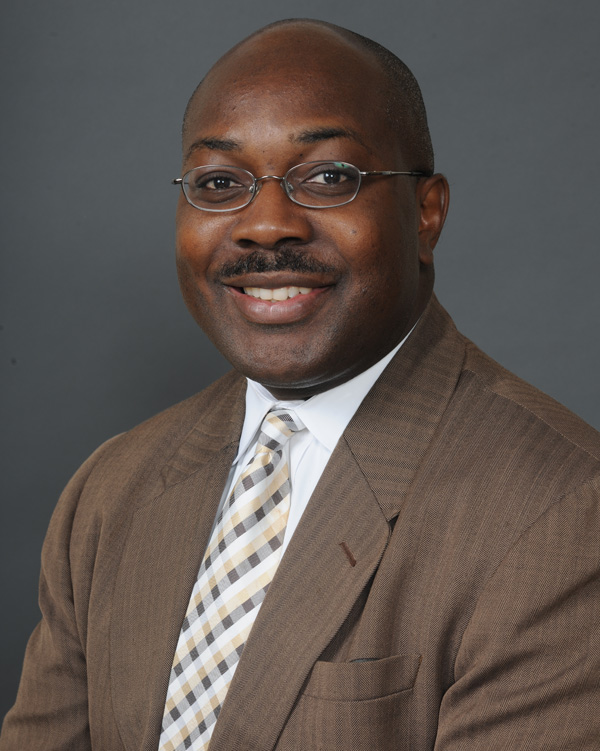
Meet a Retriever—Triple alum Corris Davis is building a stronger network for students
Corris Davis’98, M.P.P. ’19, Ph.D. ’25, didn’t originally envision such a long career at UMBC or the number of students she would directly impact. As a Meyerhoff Program Scholar, Corris experienced how intentional mentoring and support could lift up students on their UMBC journeys. Now the senior director of the Office of Academic Opportunity Programs—which she founded as a home to UMBC’s five TRIO Programs as well as first-generation student programming—Corris has been at the front lines for first-gen and low-income students for 26 years. By forging cross-departmental connections, Corris has built a network of support and encouragement for UMBC’s growing population of first-gen students. Tell us all about it!
Q: What’s one essential thing you’d want another Retriever to know about you?
A: I’m a three time UMBC alum—undergrad in biological sciences in 1998, M.P.P. ’19, and Ph.D. ’25, public policy—who has recently rekindled a love for Galaga and LEGOs (because everything old is new again).

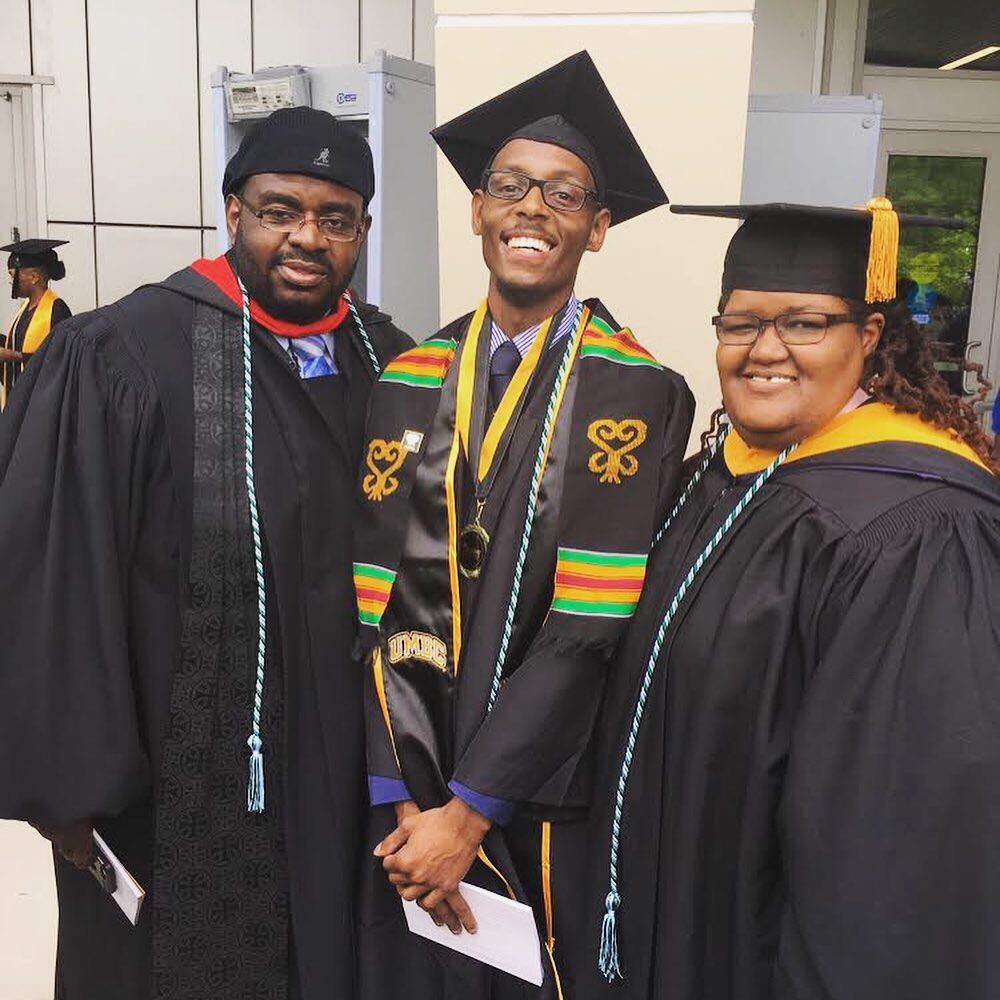 Left: Fellow staff of the Upward Bound Program outside of the Apollo Theatre in New York City during an end of summer field trip. Left to right: Terri Chambers, Christine Harris ’98, Allen Bolden ’99, Karriem Farrakhan ’97, Kerrian McLean ’00, and Corris. Right: At UMBC Commencement 2022, Dr. Michael Hunt, Damarius Johnson ’22 (McNair alum), and Corris.
Q: What’s the one thing you’d want someone to know about the support you find here?
A: “Support” and “community” aren’t just words. People show up for each other because that’s who we are, be it faculty, staff, students, or alumni.
Q: What part of your job do you enjoy the most and why?
A: I support programs that allow students from middle school all the way to undergrad to see what they can be. I have seen students that I met in 8th or 9th grade earn Ph.D.s. I love knowing that while I don’t always work directly with students, the work I do supports them in reaching their goals.
Q: What brought you to UMBC in the first place?
A: I started my professional staff journey as the office coordinator of the TRIO Upward Bound program at UMBC, one of what is now five TRIO programs hosted at UMBC (Upward Bound, Upward Bound Math/Science, Talent Search, McNair Scholars, and now Student Support Services). Since then, I’ve been the assistant director of Upward Bound, and then director. In 2016, I was able to form the Office of Academic Opportunity Programs that houses all of the TRIO Programs as well as first-generation student programming.
After completing my bachelor’s degree, I left UMBC to go to a Ph.D. program in molecular and cellular biology, but about seven months in, I realized that it was not a good fit. I had previously worked with Upward Bound as an undergrad so I essentially came home until I could figure out what my next moves were. I didn’t think that I would still be at UMBC 26 years later.
The reason I stay at UMBC is that I am given the space to help students who are from similar backgrounds to grow and thrive and have great experiences.
Photo: Over the years, many participants have become like family, says Corris. Left side front to back: Prentiss Haney, Gerrod Williamson (Upward Bound alum and current staff member), Corris’s wife, Consuela Lowery; on the right from front to back: Tobias Davis (Upward Bound alum), Dr. Durell Callier ’14, McNair Scholar alum), and Corris.

Q: Tell us about the people who have helped you at UMBC, and why it has made such a difference to you.
A: I must start with the late LaMont Toliver, director of the Meyerhoff Scholars Program. While my initial relationship with him was as a Meyerhoff Scholar, once I became a staff member, he provided even more guidance and support. I use much of what I learned from him in my work in supporting students now, both directly and behind the scenes. I recall him sharing a quote from Harry Truman: “It is amazing what you can accomplish if you do not care who gets the credit.” This has shaped a lot of my work at UMBC. It’s all about advancing our students.
I’ve found support at UMBC in two ways: sometimes by making the ask, and sometimes because people see the vision and step forward on their own. A great example is the creation of the First Generation Network. While it’s not as active as we’d like currently, it’s very existence comes from a group of campus partners, many of whom were first-generation students themselves who understand the importance of the work and volunteering.
The quote… “It is amazing what you can accomplish if you do not care who gets the credit.” This has shaped a lot of my work at UMBC. It’s all about advancing our students.
Corris Davis
Senior director of the Office of Academic Opportunity Programs
We’ve been able to honor first-generation graduates with cords for about six years now. Offices like the Academic Success Center, the Career Center, and several Student Affairs departments have regularly stepped up, not just as cord pick-up sites, but as co-creators of programming that supports UMBC’s first-gen students. Support may be handing out graduation cords, or staffing First Gen Week tables, or even redesigning programming and workshops so they tackle the hidden curriculum and the barriers created by higher-ed jargon.
 Staff of the various TRIO programs in the Office of Academic Opportunity Programs at the annual regional TRIO conference in Hershey, PA, in Feb 2023. Front, left to right: Tanaj Mogase, Talent Search, Corris, Ting Huang (UMBC and McNair alum), Ahdrianna Boyce (UMBC and Upward Bound alum); back left to right: Jennifer Appleby (former TS coordinator), Dr. Michael Hunt, and Dr. Sunji Jangha ’25
Although my office sits in Academic Affairs, this cross-division collaboration is exactly how things get done at UMBC: People come together to support students. It’s impossible to name everyone who has supported me and this work over the years, but I must acknowledge the incredibly talented staff in AOP. Their commitment, partnership, and care make everything we do not only possible, but even more meaningful.
Q: What would you tell someone who is considering a career at UMBC?
A: UMBC is a place where you can take a dream and run with it. We have a culture of supporting students and supporting each other in that work.
UMBC’s greatest strength is its people. When people meet Retrievers and hear about the passion they bring, the relationships they create, the ways they support each other, and the commitment they have to inclusive excellence, they truly get a sense of our community. That’s what “Meet a Retriever” is all about.
Learn more about how UMBC can help you achieve your goals.
]]>
Corris Davis’98, M.P.P. ’19, Ph.D. ’25, didn’t originally envision such a long career at UMBC or the number of students she would directly impact. As a Meyerhoff Program Scholar, Corris...
https://umbc.edu/stories/meet-a-retriever-triple-alum-corris-davis-is-building-a-stronger-network-for-students/
https://my3.my.umbc.edu/api/v0/pixel/news/155467/guest@my.umbc.edu/c1b04b96258202ea2847b3e626f8104b/api/pixel
biological-sciences
cnms
graduateschool
meet-a-retriever
meyerhoff-alumni
story
trio
uncategorized
UMBC News & Magazine
https://my3.my.umbc.edu/groups/umbc-news-magazine
https://assets1-my.umbc.edu/system/shared/avatars/groups/000/001/943/24435aa6207c452e7bc15cc74b42c7bb/xsmall.png?1748556657
https://assets1-my.umbc.edu/system/shared/avatars/groups/000/001/943/24435aa6207c452e7bc15cc74b42c7bb/original.png?1748556657
https://assets2-my.umbc.edu/system/shared/avatars/groups/000/001/943/24435aa6207c452e7bc15cc74b42c7bb/xxlarge.png?1748556657
https://assets2-my.umbc.edu/system/shared/avatars/groups/000/001/943/24435aa6207c452e7bc15cc74b42c7bb/xlarge.png?1748556657
https://assets3-my.umbc.edu/system/shared/avatars/groups/000/001/943/24435aa6207c452e7bc15cc74b42c7bb/large.png?1748556657
https://assets1-my.umbc.edu/system/shared/avatars/groups/000/001/943/24435aa6207c452e7bc15cc74b42c7bb/medium.png?1748556657
https://assets2-my.umbc.edu/system/shared/avatars/groups/000/001/943/24435aa6207c452e7bc15cc74b42c7bb/small.png?1748556657
https://assets1-my.umbc.edu/system/shared/avatars/groups/000/001/943/24435aa6207c452e7bc15cc74b42c7bb/xsmall.png?1748556657
https://assets2-my.umbc.edu/system/shared/avatars/groups/000/001/943/24435aa6207c452e7bc15cc74b42c7bb/xxsmall.png?1748556657
UMBC News & Magazine
0
0
false
Mon, 22 Dec 2025 20:33:40 -0500
Mon, 22 Dec 2025 20:33:40 -0500
Ripples of excellence: This Meyerhoff alumnus is expanding UMBC’s legacy
“I have been in your shoes.” Erwin Cabrera ’10, biological sciences, often finds himself sharing these words during monthly meetings for Stony Brook University’s Simons STEM Scholars. Some of the bright-eyed students in front of him are the first in their family to attend college. Others may be nervous about upcoming exams or graduate school application deadlines. All are striving toward careers in STEM within the program’s supportive community—and these “family meetings” are one element of that support.
As the program’s inaugural executive director, Cabrera isn’t just leading a replication of UMBC’s renowned Meyerhoff Scholars Program: He’s channeling the same cohort spirit, rigorous support, and unyielding belief in students’ potential that transformed him from a self-described “rough around the edges” undergrad into a champion for emerging scientists from all backgrounds. On October 29, Cabrera will receive a 2025 Outstanding Alumni Award from UMBC’s Alumni Association Board of Directors.
 Erwin Cabrera gets to know students “through and through” in order to support them better. (Photo by John Griffin/Stony Brook University)
Cabrera’s journey began in Prince George’s County, Maryland. Cabrera initially resisted considering UMBC, despite his older brother, Ramon Cabrera ’09, a Meyerhoff Scholar, already thriving there. At Meyerhoff selection weekend, two days of activities for students offered admission, he changed his mind. Amid UMBC’s nerdy reputation, Cabrera saw peers who looked like him, dreamed like him, and supported one another fiercely. “I could see myself there,” he says.
Achievement grounded in love
Cabrera dove into research with Phyllis Robinson, professor of biological sciences. She “gave me a lot of grace” as he stumbled early on, Cabrera recalls, recognizing his potential before he had smoothed some of his edges. He balanced lab work with the UMBC’s Major Definition hip-hop dance team with mixed success—at his request, an advisor once showed up at rehearsal to remind him of study time. Later in his UMBC career, Cabrera, an M18 (the shorthand Meyerhoffs use to designate their cohort), served as a Meyerhoff Summer Bridge counselor and peer mentor for younger cohorts. “This is a lot of emotional labor, but super fun,” he remembers thinking of those roles, which would anticipate his career.
After UMBC, Cabrera earned a Ph.D. in neurobiology and neuroscience at the New York University Grossman School of Medicine, followed by a postdoc. Yet his heart was in administration. “I love science, but what I loved the most was teaching people in the lab and the impact it could have on folks’ lives,” he says. In 2019, he became director of the Research Aligned Mentorship (RAM) Program at Farmingdale State College, which is loosely inspired by Meyerhoff principles. It integrates research as an undergraduate retention tool, drawing economics and business students alongside STEM majors.
In October 2022, Cabrera made his next big career move, becoming the first Meyerhoff alumnus to helm a full replication. A $2.5 million Simons Foundation grant to UMBC seeded the adaptation at Stony Brook, located on Long Island, and later Stony Brook received its own major grant from Simons to fully develop its program. Now in its third year, the program mirrors Meyerhoff’s core—cohort-based community, intensive mentoring, Summer Bridge, and research immersion—while adapting for the local context.
 Alongside Stony Brook University President Andrea Goldsmith (second from right), Erwin Cabrera (second from left) speaks with Simons STEM Scholars following a recent “family meeting” for the program, an important mechanism for building community among the scholars. (Photo by John Griffin/Stony Brook University)
“New York students are very different. They’re highly independent; some of them are regularly traveling three hours on the subway,” Cabrera notes. Early challenges included combating “hyper independence,” where some scholars struggled to trust that program leaders had their best interests at heart. His solution? “I just upped that love factor,” Cabrera says. He gets to know students “through and through,” offering tough love rooted in consent: “Do you need me to show up?” he asks, while also encouraging ownership. “This is yours at the end of the day,” he reminds students.
From UMBC to New York and beyond
At Stony Brook, Cabrera wears two hats: He’s a research professor in neurobiology and behavior, teaching honors courses and advising juniors through grad school applications. He also interfaces with program funders, manages the budget and staff, and more. Somehow he also travels to Kenya and Switzerland to support study abroad partnerships.
“It’s all-encompassing,” he admits. Yet the success of the program keeps him going. Last summer, three Simons Scholars interned at Harvard and two at Stanford. “As a Meyerhoff from UMBC, I know the legacy of the program,” Cabrera says. “It’s my job to provide that vision here at Stony Brook, when this program did not exist three years ago. To see it coming to fruition is overwhelming in the best way possible.”
“Everyone’s watching. It’s pressure because I’m the first,” Cabrera confesses. But amplifying UMBC’s ripple effect feels like a privilege. Since 1988, the Meyerhoff Scholars Program has supported over 1,800 undergraduates. Alumni have earned 488 Ph.D.s—including 80 M.D./Ph.D.s—making UMBC the nation’s top baccalaureate origin for African American M.D./Ph.D. recipients. Over 70 Meyerhoff alumni hold faculty posts at elite institutions like Harvard and Duke; more than 200 are in grad programs. Meyerhoff participants are 5.3 times more likely to pursue STEM Ph.D.s than students offered admission who decline.
 Erwin Cabrera with the third cohort of Simons STEM Scholars during their Summer Bridge experience. (John Griffin/Stony Brook University)
This success has sparked over a dozen replications nationwide. HHMI’s 2013 – 2018 Meyerhoff Adaptation Project tailored the model for Penn State and UNC Chapel Hill. Howard University’s Karsh STEM Scholars and Stony Brook’s Simons initiative build on key elements like research engagement. International efforts at the University of Toronto Mississauga and University of the Philippines Los Baños adapt for local contexts, and the Chan Zuckerberg Initiative founded programs at UC Berkeley and UC San Diego. Collectively, these efforts have empowered thousands of students, turning UMBC’s vision into a movement. “I am guided by the quote, ‘To whom much is given, much is required,'” Cabrera says, highlighting his passion for his work.
Cabrera has kept in touch with Meyerhoff staff Keith Harmon and Mitsue Wiggs, who occasionally connect him with current UMBC students for mentoring, and remembers the influence of the late LaMont Toliver, an early director of the Meyerhoff program, fondly. He also stays connected through UMBC’s Filipino American Student Association and Alumni Advisory Board.
In the midst of the demands of his role, Cabrera preaches and models balance. This fall, he vacationed in Japan with his spouse. “You need to see me take a break—we’re not robots,” he says, reminding his students not to obsess over performance. “You don’t have to be perfect; I want you to be a college student, and learn about who you are,” he tells them. In doing so, Cabrera serves his scholars as whole people—ensuring UMBC’s legacy of inclusive excellence endures, one resilient scholar at a time.
]]>
“I have been in your shoes.” Erwin Cabrera ’10, biological sciences, often finds himself sharing these words during monthly meetings for Stony Brook University’s Simons STEM Scholars. Some of the...
https://umbc.edu/stories/meyerhoff-alumnus-expanding-umbcs-legacy/
https://my3.my.umbc.edu/api/v0/pixel/news/153776/guest@my.umbc.edu/6237168130a635037df1fba1012fadbc/api/pixel
alumni
biology
cnms
magazine
meyerhoff-alumni
meyerhoff-scholars
story
UMBC News & Magazine
https://my3.my.umbc.edu/groups/umbc-news-magazine
https://assets1-my.umbc.edu/system/shared/avatars/groups/000/001/943/24435aa6207c452e7bc15cc74b42c7bb/xsmall.png?1748556657
https://assets1-my.umbc.edu/system/shared/avatars/groups/000/001/943/24435aa6207c452e7bc15cc74b42c7bb/original.png?1748556657
https://assets2-my.umbc.edu/system/shared/avatars/groups/000/001/943/24435aa6207c452e7bc15cc74b42c7bb/xxlarge.png?1748556657
https://assets2-my.umbc.edu/system/shared/avatars/groups/000/001/943/24435aa6207c452e7bc15cc74b42c7bb/xlarge.png?1748556657
https://assets3-my.umbc.edu/system/shared/avatars/groups/000/001/943/24435aa6207c452e7bc15cc74b42c7bb/large.png?1748556657
https://assets1-my.umbc.edu/system/shared/avatars/groups/000/001/943/24435aa6207c452e7bc15cc74b42c7bb/medium.png?1748556657
https://assets2-my.umbc.edu/system/shared/avatars/groups/000/001/943/24435aa6207c452e7bc15cc74b42c7bb/small.png?1748556657
https://assets1-my.umbc.edu/system/shared/avatars/groups/000/001/943/24435aa6207c452e7bc15cc74b42c7bb/xsmall.png?1748556657
https://assets2-my.umbc.edu/system/shared/avatars/groups/000/001/943/24435aa6207c452e7bc15cc74b42c7bb/xxsmall.png?1748556657
UMBC News & Magazine
3
0
false
Tue, 21 Oct 2025 14:44:49 -0400
Tue, 21 Oct 2025 14:44:49 -0400
Meet a Retriever—Monroe Kennedy, III, ’12, mechanical engineering professor at Stanford University
Meet Monroe Kennedy, III, a Meyerhoff Scholar (M20) who earned his B.S. in mechanical engineering from UMBC in 2012 before earning his M.S. in robotics and Ph.D. in mechanical engineering and applied mechanics from the University of Pennsylvania. Monroe is now an assistant professor in the mechanical engineering department at Stanford University. His work is in collaborative robotics, building systems capable of extending robotic autonomy to scenarios where robots work closely around humans and must anticipate their needs to be effective teammates. Outside of his role as a professor, Monroe serves as a national director for Black in Robotics, a nonprofit organization dedicated to enhancing diversity within the field of robotics. Take it away Monroe!
Q: What brought you to UMBC?
A: I came to UMBC for its mechanical engineering program and the Meyerhoff Scholars Program. I had a passion for invention and design and UMBC was the perfect place to gain knowledge so I could have an impactful career. During high school, I was taking courses at a community college, and one instructor was aware of the Meyerhoff program and nominated me—I am so grateful for that initial introduction.
UMBC is truly a melting pot of ideas and culture. You will find a diverse and vibrant community and a place to call home.
Monroe Kennedy, III, ’12, M20
Q: What do you love about your academic program?
A: I love mechanical engineering. When I first joined UMBC, the movie Iron Man had just come out and there was a screening on the Quad. I remember thinking “I want to do that!” Tony Stark was the only hero whose superpower was truly achievable—his ability to innovate and invent.
Mechanical engineering is one of the oldest engineering disciplines. If you follow the Ph.D. “academic tree,” you will find many of the first mechanical engineers had advisors in more fundamental sciences. Because it is a fundamental engineering discipline it covers many areas from controls, dynamics, design, fluids, vibrations, and so much more.
An individual who learns to embrace the diversity of subjects within mechanical engineering learns to think about problems and solutions holistically and brings solutions from every sub-field to solve problems in the most elegant way possible. As a roboticist, a lot of my work is endowing my robots with a form of “intelligence,” but often we find ourselves wishing our robot had an additional physical feature, and as mechanical engineers, it is not difficult for us to make such concepts a reality very quickly.
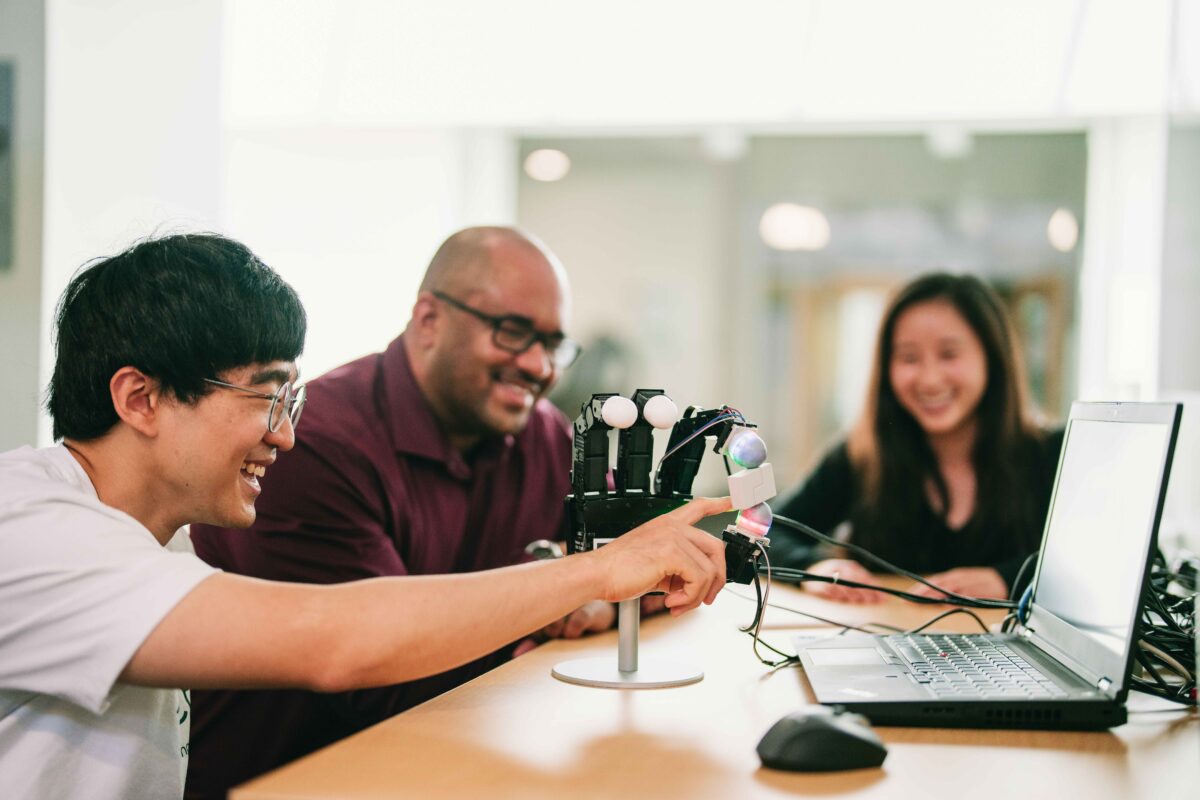 Monroe, a mechanical engineering professor at Stanford University, and his students looking at a robotic fingertip developed in the lab called DenseTact that will enable robots to perform dexterous tasks like humans in the near future.
Q: Tell us about someone in the community who has inspired you or supported you, and how they did it.
A: While at UMBC I was very fortunate to be able to work in Professor J. Vanderlei Martins‘ LACO (Laboratory for Aerosol and Cloud Optics) lab. Professor Martins was an amazing advisor who was able to use my limited experience at the time to contribute to a very impactful project involving designing the de-orbiting system for a picosatellite. Being given an opportunity to work on something that traveled to space was a key element in my ultimate trajectory, and I am very grateful to Professor Martins for his support and mentorship.
My favorite part of being a UMBC alumnus is the sense of forever community I’ve felt in the decade since graduating.
Monroe Kennedy, III, ’12, M20
Q: Tell us about your HOW.
A: The Meyerhoff community played a very big role in my career. Through the program, I was coached on applying for internships and graduate school. Additionally, having the support of professors like J. Vanderlei Martins, working in his laboratory, and receiving his recommendation was crucial to my academic trajectory.
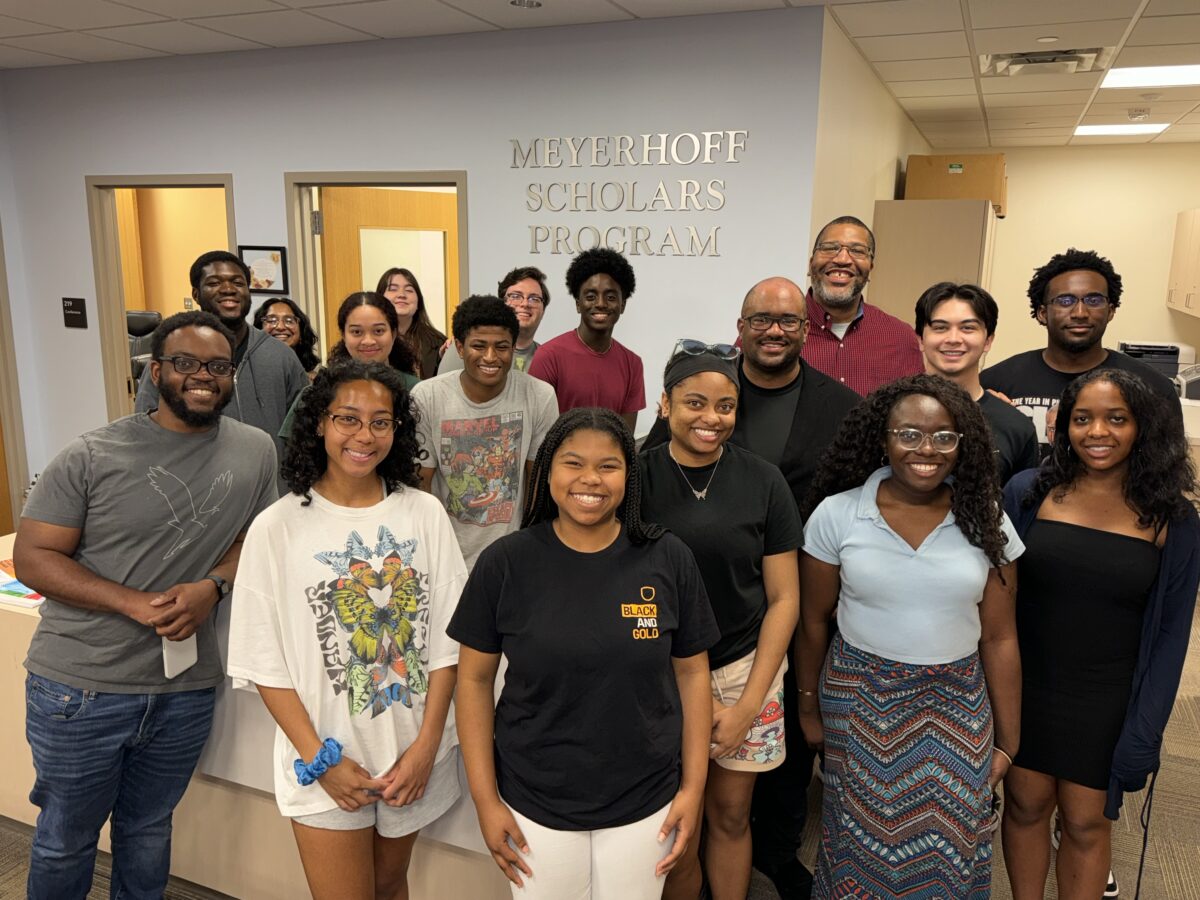 Monroe returned to campus recently to meet with current Meyerhoff students and tour faculty labs.
Q: Tell us about your current job. What do you like most about it?
A: I am an assistant professor in the mechanical engineering department with a courtesy appointment in computer science at Stanford University. My work is in collaborative robotics, building systems capable of extending robotic autonomy to scenarios where robots work closely around humans and must anticipate their needs to be effective teammates.
I love the Stanford community. You will find here that dreaming big and doing the extraordinary is quite ordinary here.
Outside of my role as a professor, I serve as a national director for Black in Robotics, a nonprofit organization dedicated to enhancing diversity within the field of robotics.
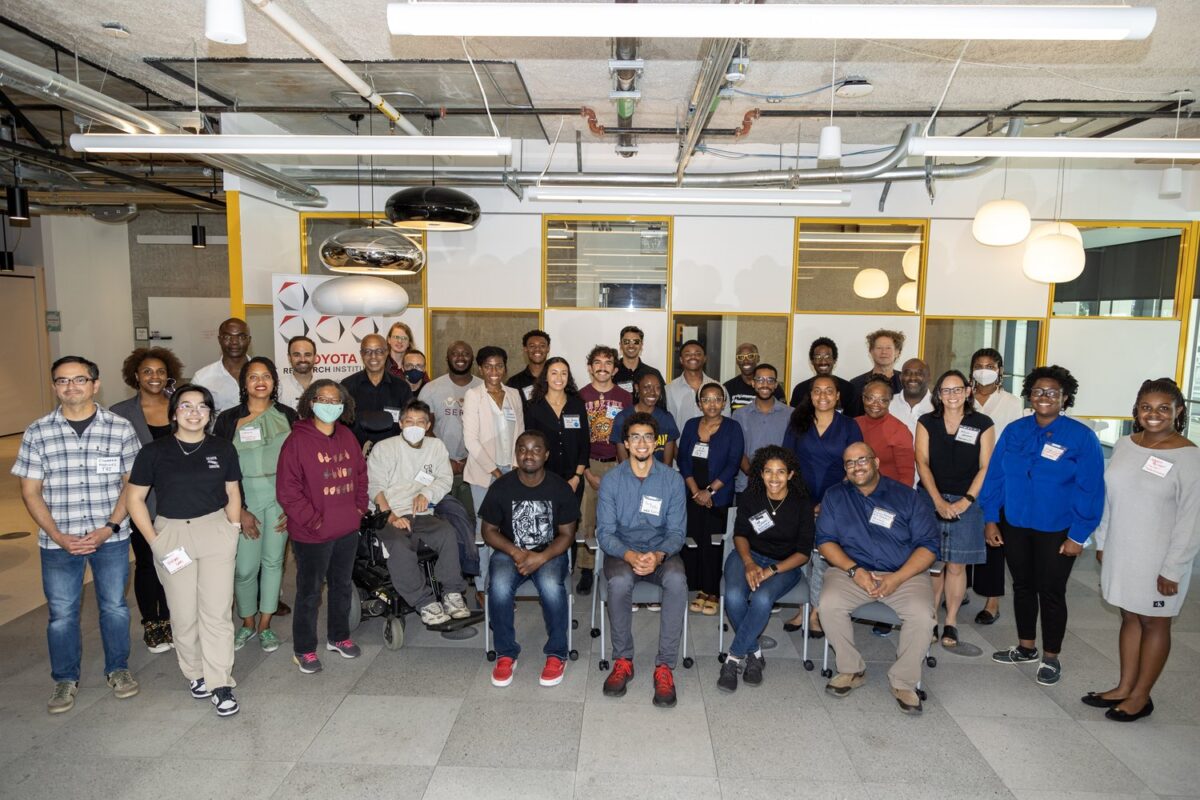 Group photo from a Black in Robotics networking event at the University of California, Berkeley.
Q: What drives you to support UMBC?
A: I want to see UMBC continue to produce leaders who are inquisitive and courageous, unafraid of setbacks, and yet very accomplished and making the world a better place.
* * * * *
UMBC’s greatest strength is its people. When people meet Retrievers and hear about the passion they bring, the relationships they create, the ways they support each other, and the commitment they have to inclusive excellence, they truly get a sense of our community. That’s what “Meet a Retriever” is all about.
Learn more about how UMBC can help you achieve your goals.
]]>
Meet Monroe Kennedy, III, a Meyerhoff Scholar (M20) who earned his B.S. in mechanical engineering from UMBC in 2012 before earning his M.S. in robotics and Ph.D. in mechanical engineering and...
https://umbc.edu/stories/mechanical-engineering-professor-monroe-kennedy/
https://my3.my.umbc.edu/api/v0/pixel/news/141656/guest@my.umbc.edu/adb4daec1996ac3764c5485836f34075/api/pixel
alumni
impact
magazine
mechanical-engineering
meet-a-retriever
meyerhoff
meyerhoff-alumni
meyerhoff-scholar
story
UMBC News & Magazine
https://my3.my.umbc.edu/groups/umbc-news-magazine
https://assets1-my.umbc.edu/system/shared/avatars/groups/000/001/943/24435aa6207c452e7bc15cc74b42c7bb/xsmall.png?1748556657
https://assets1-my.umbc.edu/system/shared/avatars/groups/000/001/943/24435aa6207c452e7bc15cc74b42c7bb/original.png?1748556657
https://assets2-my.umbc.edu/system/shared/avatars/groups/000/001/943/24435aa6207c452e7bc15cc74b42c7bb/xxlarge.png?1748556657
https://assets2-my.umbc.edu/system/shared/avatars/groups/000/001/943/24435aa6207c452e7bc15cc74b42c7bb/xlarge.png?1748556657
https://assets3-my.umbc.edu/system/shared/avatars/groups/000/001/943/24435aa6207c452e7bc15cc74b42c7bb/large.png?1748556657
https://assets1-my.umbc.edu/system/shared/avatars/groups/000/001/943/24435aa6207c452e7bc15cc74b42c7bb/medium.png?1748556657
https://assets2-my.umbc.edu/system/shared/avatars/groups/000/001/943/24435aa6207c452e7bc15cc74b42c7bb/small.png?1748556657
https://assets1-my.umbc.edu/system/shared/avatars/groups/000/001/943/24435aa6207c452e7bc15cc74b42c7bb/xsmall.png?1748556657
https://assets2-my.umbc.edu/system/shared/avatars/groups/000/001/943/24435aa6207c452e7bc15cc74b42c7bb/xxsmall.png?1748556657
UMBC News & Magazine
0
0
false
Fri, 03 May 2024 07:17:57 -0400
Fri, 03 May 2024 07:17:57 -0400
For the Love of Dirty Jobs

First Mate Alex Barnard ’09, American Studies spends many mornings high atop the mast on the 150-foot sailing ship Kwai, watching the bright horizon of the Pacific Ocean through binoculars for the shimmer of an abandoned fishing net. When she spots a clump of plastic waste, she guides the captain toward the tangle of fishing nets and the garbage they accumulate.
Then sailors on deck throw grappling hooks into the floating trash. A hydraulic crane hauls onto the deck the dripping hunks of degrading plastic nets—sometimes the size of Volkswagen Bug, sometimes 100 feet long. Barnard and the crew stumble through tangles slick with algae and seaweed, throwing the trash’s resident crabs and fish back overboard. Those moments are cathartic, Barnard says, as if they’ve just pulled a rotten tooth from the mouth of the ocean.
“I just think about that moment as beautiful. I love seeing that net up on deck,” Barnard says. “It’s so toxic and then to watch it come out. Just to be able to do that all day every day. It’s pretty amazing.”
Walking down a steep hill on her family’s farm, Roxann Brooks Motroni ’06, M14, biological sciences is searching for her cattle.
“Hey mamas! Hey cows!” the veterinarian calls. A fuzzy black head pops up over the next hill and bellows. The cattle gallop toward Motroni and her bucket, which rattles with hay cookies.
She steps into the pasture and is mobbed by her family’s cattle, the flies clustered on their backs in the late autumn heat. Cookie, the black Lowline Angus most fond of the treats, pushes to the front of the herd. The cow’s foot-long tongue curls around Motroni’s forearm, leaving bubbly trails of slobber and grass bits.
Ignoring the fresh cow patty her black boot has just stepped in, Motroni hands out cookies, then tosses the rest of the nuggets into the scrum. She swipes off her freshly slimed arm and continues naming the cattle—The Hereford, Valentino the bull, and her favorite, Nellie, named for a great-grandmother because they’re a bit alike.
“Sweet, but a little suspicious of new people,” Motroni says and wades out of the herd distributing scratches all around, oblivious to the flies and slobber and excrement.
Stephen Bradley, associate professor in the Department of Visual Arts, hauls on a braided cord connected to a white lifesaving ring that bobs on the water of the Jones Falls in Baltimore. A Doritos package, two latex gloves, a slick of oil, and some liquor bottles float nearby. And that’s just what’s visible. Other ingredients in the toxic stew flowing toward the Inner Harbor are heavy metals, fertilizer, microbes, pesticides, and sewage, as well as industrial sound pollution.
Bradley, an artist who adds video and audio sensory layers to his sculptures, pulls out his dripping hydrophones and fiddles with their connections. Then he lowers the receivers back in, to record the underwater sounds of mussels, gizzard shad, and blue crabs, along with the urban noise of HVAC systems and traffic.
Chatting away, Bradley pulls out his sketch pad to show some drawings, then licks his thumb to turn the page. He stops to grimace at his thumb, which was just mucking about in the murky water.
“Guess I shouldn’t have done that,” he says.
Making a difference in the world isn’t always a neat endeavor. Hard to keep your hands clean when you’re raising cattle humanely and safely, pulling communities together to pick up trash and make art, or hauling tons of plastic waste from the Pacific Ocean. These three Retrievers all find immense joy in work that is sometimes smelly, usually dirty, and always requires an intrepid spirit.
Sustainability sparked Barnard’s quest
Alex Barnard wrote her UMBC honors thesis on her attempts to live sustainably in Baltimore. “Extremely challenging,” Barnard summarizes, with a wry chuckle. “It completely changed my life. I see everything through this lens now.”
For nearly 10 years, she traveled, trying to live lightly on the planet. She worked in an eco-cafe in Fiji, labored on an organic farm in Hawaii, sailed on eco-tourism voyages in the South Pacific, and biked New Zealand.
Now, she has her captain’s license and sails as a chief mate on National Geographic voyages to Costa Rica, Alaska, and Baja with Lindblad Expeditions, a company known for its green approach to travel.
 Alex Barnard (top, center) poses with her team. All photos of Barnard, courtesy of Ocean Voyages Institute.
Barnard’s schedule of two months on, two months off gives her time to volunteer on the Kwai for the Ocean Voyages Institute. The institute partners with companies that turn the trash into fuel, shoes, clothing, and building blocks for construction.
Through overconsumption and improper trash disposal, humans have created five garbage patches in the Pacific, Atlantic, and Indian oceans, where trash is concentrated by currents.
 Courtesy of Alex Barnard and Ocean Voyages Institute.
Discarded nets and lines from fishing boats now make up 46% of the waste in the Great Pacific Garbage Patch, according to the World Wildlife Fund. Dubbed “ghostnets” or “ghost gear,” the fishing waste kills marine life by the thousands—turtles and whales and dolphins tangle themselves in the nets that are tossed off fishing boats. But because oceans are vast, and the nets sink and bob in the waves, they’re difficult to find.
“It’s not like wading through trash,” Barnard explains. “There are big spaces in between. If you were at sea level, the nets are hard to see. We could be sailing right by one and not see it until we’re past it. The plastic breaks down in UV light. A lot of it is microplastic, which is deadly to the ocean.”
Last summer, Barnard and the Kwai crew hauled 170 tons of plastic from the ocean, a fraction of the 17 billion tons dumped into the world’s waters every year. Other organizations, like Sea Shepherd Conservation Society, Greenpeace, The Ocean Cleanup, and the 5 Gyres Institute, are also focusing on ghostnet removal. Many environmental groups are pushing the Global Ghost Gear Initiative, a collaborative effort by the fishing industry, NGOs, governments, and researchers to regulate plastic dumping.
“This work is possible and successful,” Barnard says. “The idea is to show that we need more boats, a fleet of vessels doing the same thing. It feels like a starting point more than anything.”
Temporarily on land, in a remote cabin in Michigan where she’s doing some writing for Lindblad, Barnard hikes often, always with a trash bag.
“It’s my dream to go somewhere and not have to pick up trash,” Barnard says. “I could spend my whole life picking up trash everywhere I go. That’s not very efficient. It has to be bigger than just one person. But it’s better than not picking it up.”
A family farm affair
Every morning and evening, Roxann Brooks Motroni visits her cattle, not just to offer treats but to check the herd for a limp, some pinkeye, a calf that’s not thriving.
Her family started 804 Cattle Company in Upper Marlboro in 2016 with three cows. They now raise 25 cattle on 33 acres. A vet married to an agricultural business expert, Motroni works the farm with her parents, John and Chantal Brooks, both retired doctors. And while Motroni has a day job as a National Program Leader for Animal Health for the USDA’s Agricultural Research Service, focusing on research solutions for livestock diseases, she begins and ends her days on the farm.
“This is a family affair. My mom is the chief cow operator. I do the vet work, my husband does the finances and handyman work,” Motroni explains, plus he’s the beekeeper.


The farm is also devoted to teaching the next generation of farmers and veterinarians. Today, two interns hoping to be veterinarians are chasing Nutmeg the goat and grooming horses. The family brings in veterans seeking help getting started in agriculture, through the Arcadia Center for Sustainable Food and Agriculture. The farm also sells at the Capital Market, whose mission is to provide quality food, produced by businesses and farms run by people of color, to residents of Prince George’s County’s food deserts.
A Meyerhoff Scholar, Motroni quotes its motto, “To Whom Much Is Given, Much Is Expected” and says she lives by it.
Their farm prides itself on their humane and safe practices with their cattle. The animals and their health comes first. No hormones or steroids go into their cattle and they limit antibiotic use to only sick cows. Their chutes and corrals are designed to reduce their cattle’s stress. All animals spend all their lives on grass pastures.
The family also uses regenerative agriculture practices to improve soil health and combat climate change through carbon sequestration while limiting fertilizer and pesticide usage. Motroni crouches in the pasture to show off the shoots of radishes, hairy vetch, turnips, oats, and rye that she interplants with grass, to aerate and fix nitrogen and carbon in the soil. Plus they offer her herd fine dining.
“I didn’t know when I became a cattle farmer that I would also become a grass farmer. I’ve come to realize how magical cow poop is. Every year our pastures get better and better,” she says, laughing. “All those plant physiology classes at UMBC really served me well.”
She hikes up the hill again, squelching through the mud around a water pump.
“Wow, now you can really smell the cow,” she says and smiles at the odor and the view.
Traces of life fuel his art
As an artist, Stephen Bradley sees and hears things a little differently. From the pop of color of a blue plastic container handle to the squelching clicks of the mussels underwater, the evidence of life is fascinating to him.
For more than 12 years, he has labored in the Brooklyn and Curtis Bay area of Baltimore, partnering with the Enoch Pratt Free Library, the National Aquarium, the local Boys and Girls Club, and the Masonville Cove Environmental Education Center to clean up the alleys and streets and to make art, from sidewalk paintings and murals to trash sculptures.
Right now, he’s bent closely over a pier in the Inner Harbor, lowering a round lifesaver strung with microphones and chum to attract fish into the water. He occasionally catches the attention of passersby and eagerly explains his artistic vision to them.
The project that inspired his recording in the Jones Falls waterway is a collaborative biodiversity study with the National Aquarium and the Institute of Marine and Environmental Technology (IMET). IMET has sunk a biodisk in the same areas Bradley is recording, to track biodiversity in the waters by collecting DNA samples. Those findings will be paired with Bradley’s recordings to provide a fuller picture of what’s living in Baltimore’s waterways. Bradley’s Inner Harbor’s soundtrack is run through a spectrograph to determine what species made the sounds, most of which can’t be heard by human ears, such as the mating songs of water bugs.
“With these recordings, it’s almost as if I have my ear to the water,” he says. “The gift is going home and listening.”
Bradley’s portion of the IMET project, called Bio-Buggy: Ear to the Harbor, will draw attention to the harm that human-generated noise pollution inflicts on aquatic species, including disrupting mating and growth.
In the fall, Bradley was recording at Marshy Point Nature Center and heard explosions coming from his underwater recorders, from the direction of Aberdeen Proving Ground, nearly 30 miles away.
“Hundreds of small minnows leaped out of the water each time there was an explosion, and there were nine huge discharges,” Bradley says. But in between, he heard the complex harmonies of bubbles and critter sounds, something he calls “musical marshlands.”
He has also built an exhibit, called the “Oh, Murky Waters Chorus,” with trash compositions, an aquarium with teeny water critters still living on one of those IMET DNA sampling biodisks, and an interactive video of microscopic creatures paired with their noises. The art installation showed at UMBC’s Center for Art, Design, and Visual Culture in 2019, and Bradley hopes to exhibit it again, as a work-in-progress later in 2022.


“The trash-filled sculptural elements in the art installation…are there to represent the stress and urgency for us as a society to gain control of our waste before we drown from it,” Bradley explains. Baltimore has taken recent steps, including banning polystyrene and taxing plastic bags, to reduce the trash in the Inner Harbor enough that if it hasn’t rained in 48 hours, according to Blue Water Baltimore, some areas are swimmable.
At the IMET open house next spring, Bradley hopes to show a prototype of the Bio-Buggy, a mobile science and sound collection lab, which engineering students at UMBC will work to design with him as their capstone project. The Bio-Buggy exhibit will also feature Bradley’s sound compositions based on the Inner Harbor and other Chesapeake Bay recordings.
“I have no aspiration to be a scientist, but I am inspired by science, the tools, the rigor, the process,” he says and tucks his headphones back on, listening for evidence of life in the waters. Perhaps, Bradley hopes, if people hear and see the life below the surface, they’ll pocket their Doritos packages and recycle their water bottles, instead of tossing them in the gutter for him to find later.
People who care about change must be willing to plunge their hands deep into the mess of this world. It’s a dirty job, but someone’s gotta do it.
— By Susan Thornton Hobby
*****
All photos courtesy of Marlayna Demond ’11 unless otherwise noted.
]]>
First Mate Alex Barnard ’09, American Studies spends many mornings high atop the mast on the 150-foot sailing ship Kwai, watching the bright horizon of the Pacific Ocean through binoculars for the...
https://umbc.edu/stories/for-the-love-of-dirty-jobs/
https://my3.my.umbc.edu/api/v0/pixel/news/119512/guest@my.umbc.edu/4697d91b126c234476387a30740851b2/api/pixel
american-studies
biological-sciences
discovery
fall-2021
feature
meyerhoff-alumni
umbc-magazine
visual-arts
UMBC News & Magazine
https://my3.my.umbc.edu/groups/umbc-news-magazine
https://assets1-my.umbc.edu/system/shared/avatars/groups/000/001/943/24435aa6207c452e7bc15cc74b42c7bb/xsmall.png?1748556657
https://assets1-my.umbc.edu/system/shared/avatars/groups/000/001/943/24435aa6207c452e7bc15cc74b42c7bb/original.png?1748556657
https://assets2-my.umbc.edu/system/shared/avatars/groups/000/001/943/24435aa6207c452e7bc15cc74b42c7bb/xxlarge.png?1748556657
https://assets2-my.umbc.edu/system/shared/avatars/groups/000/001/943/24435aa6207c452e7bc15cc74b42c7bb/xlarge.png?1748556657
https://assets3-my.umbc.edu/system/shared/avatars/groups/000/001/943/24435aa6207c452e7bc15cc74b42c7bb/large.png?1748556657
https://assets1-my.umbc.edu/system/shared/avatars/groups/000/001/943/24435aa6207c452e7bc15cc74b42c7bb/medium.png?1748556657
https://assets2-my.umbc.edu/system/shared/avatars/groups/000/001/943/24435aa6207c452e7bc15cc74b42c7bb/small.png?1748556657
https://assets1-my.umbc.edu/system/shared/avatars/groups/000/001/943/24435aa6207c452e7bc15cc74b42c7bb/xsmall.png?1748556657
https://assets2-my.umbc.edu/system/shared/avatars/groups/000/001/943/24435aa6207c452e7bc15cc74b42c7bb/xxsmall.png?1748556657
UMBC News & Magazine
0
0
false
Wed, 08 Dec 2021 18:02:57 -0500
Forward Progress Begins with Mentorship
Olumide Fagboyegun ’21, M29, biochemistry, is a recent UMBC graduate and a Meyerhoff Scholar. He will soon begin his Ph.D. in neuroscience at Harvard. Since graduating, he’s reflected on the mentors who have made these steps possible. What, exactly, made them great mentors, he asks. And how can he pass that gift along to future students, particularly other students from underrepresented groups?
Picture this: You’re sitting in a well-lit hotel ballroom at a table draped with a white tablecloth, nervously perspiring. Immediately in front of you is a podium on a stage, and encircling the ballroom are dozens of academics at various stages in their careers, from predoctoral trainees to full professors. One thing that stands out to you—even more imposing than their sheer presence—is the fact that almost all of them are Black. These academics are not only a testament to the fact that if we hold fast to the dream of equity in academia, it’s only a matter of time until it is realized. But for Black students in particular, this kind of experience is incredibly important.
 Headshot courtesy of Fagboyegun
.
My experience as a member of the Meyerhoff Family at UMBC prepared me as a scientist and a scholar through the invaluable mentoring relationships where I was able to see a road to success forged by underrepresented students who went before me.
What makes a good mentor?
All my effective mentoring relationships have begun with one thing: reciprocated belief. My mentors have believed in me and I, in turn, have believed in their abilities to be good mentors for me. Both elements are necessary for an effective mentoring relationship. As a result, they have pushed me to believe in myself—to be better and more confident, in every regard. And I believed in their guidance and their affirmation of my potential.
One close mentor pushed me to improve my networking skills while believing that I would represent my program and my university well wherever I went and with whomever I met. Another mentor believed in my capacity to do good science, and pushed me to reflect on the impact my scientific endeavors can have on society.
It is worth reiterating that mentorship styles are remarkably diverse. One of the characteristics of a good mentor is the ability to see when one’s mentoring style may not be effective for a particular mentee, and to either modify their style, or to identify another mentor who would better meet the mentee’s needs. One of the strengths of the Meyerhoff Scholars Program is its ability to provide a wide range of mentoring styles to make sure that every student can find the support they need and achieve success on their chosen path, be it medical school, industry, or graduate school.
The mentee’s role
We often emphasize the role of the mentor, but the mentee’s role is no less important. New Meyerhoff Scholars start by going through a Summer Bridge program, which emphasizes the concept of the Meyerhoff Family—our scholar and alumni community, focused on mutual support. Through Summer Bridge, students learn to be open-minded to advice from their peers and mentors and to be comfortable proactively asking for help. Importantly, students learn to identify potential areas of self-improvement.
My own path, as a transfer student from Anne Arundel Community College, is less common for a Meyerhoff Scholar. While I did not go through Summer Bridge, I was embraced wholeheartedly by the Meyerhoff Family, and I believed that the mentorship provided in the Meyerhoff Scholars Program would be invaluable.
 Fagboyegun with his fellow M29 cohort members, photo courtesy of the Meyerhoff Program
.
The ripple effects of mentoring
For underrepresented students, mentorship can play a particularly significant role in success.
In a recent piece published in Nature Medicine, Kizzmekia Corbett, ’08, M16, biological sciences and sociology, the leading scientist behind the Moderna COVID-19 vaccine, wrote about her first experience conducting scientific research as a high school student, and the impact, as a young Black woman, of having a Black scientist as her mentor. “This left me with an understanding of the necessity of visible representation in underserved communities, and the realization that one’s approach to mentorship is equally as important as (or arguably more important than) their approach to scientific discovery,” Corbett wrote.
Early in my college career, I was clued into the disparities that are characteristic of science and academia, which persist despite efforts to address them. In academia, these manifest, in part, as resource stratification and disparity in opportunities, including access to networks and mentors.
On a personal level, as a Queer Black student in STEM, not seeing people who share my identity represented can make it feel as though there is no place for me in academia. Underrepresented minority (URM) students are acutely aware that most of the difficulty in forging that place in academia falls on the early URM individuals who attempt it. These individuals then face increasing pressure both internally and externally to succeed and be a model or a trailblazer. After all, insufficient diversity can have far-reaching effects, such as in healthcare disparities, and URM scientists have a strong motivation to address these problems. These pressures, coupled with the already high demands of academia, wear away uniquely on URM scholars.
 Fagboyegun presents his research at Undergraduate R
e
search and Creative Achievement Day in 2019. Photo by Marlayna Demond ’11.
Here, again, the Meyerhoff Scholars Program shines. The Meyerhoff alumni network is remarkably connected, and ensures that graduates will always have peer mentors they are able to rely on, even if they are based in institutions with few other URM scientists, doctors, scholars, or other professionals. The strength of the Meyerhoff Family creates a ripple effect in those new institutions, providing Meyerhoff-style mentoring to URM students and more junior colleagues, which results in a cultural change. As a recent Meyerhoff alumnus, I intend to carry forward this culture change as well.
A vital perspective
The scene I set at the beginning of this essay is my memory from the annual University System of Maryland Summer Bridging Conference, hosted by the Louis Stokes Alliance for Minority Participation (LSAMP) my sophomore year. Such a scene is rare in academia, but it doesn’t have to be. The well-documented outcomes of the Meyerhoff Scholars Program so far suggest that it is entirely possible to permanently change the landscape of science to be much more inclusive of scholars of all identities.
It is worth noting that although a shared identity between a mentor and mentee isn’t necessary for all mentoring relationships, it often results in remarkably positive outcomes, as highlighted by Dr. Corbett in the quote above.
Like many others, I have struggled with the idea that I might not be good enough to pursue a career in academia. However, the mentorship I’ve received through the Meyerhoff Scholars Program, LSAMP, and other initiatives has helped dissuade me of that notion. To achieve this, my mentors often help to place everything “in view” for me: my goals, weaknesses, strengths, accomplishments, and my place in the scientific and non-scientific world. This opportunity to zoom out and see the broader perspective has been vital to my success so far.
We must recognize that mentorship is an essential part of the larger movement to diversify science in pursuit of an equitable society—a scaffold that ensures progress moves ever forward.
— Olumide Fagboyegun ’21, M29, biochemistry
*****
Header image: Fagboyegun presents his research at Undergraduate Research and Creative Achievement Day in 2019. Photo by Marlayna Demond ’11.
]]>
Olumide Fagboyegun ’21, M29, biochemistry, is a recent UMBC graduate and a Meyerhoff Scholar. He will soon begin his Ph.D. in neuroscience at Harvard. Since graduating, he’s reflected on the...
https://umbc.edu/stories/forward-progress-begins-with-mentorship/
https://my3.my.umbc.edu/api/v0/pixel/news/119582/guest@my.umbc.edu/577e23eef905819a36ce61d777b58b2b/api/pixel
alumni
biochemistry
cnms
meyerhoff-alumni
meyerhoff-scholar
meyerhoff-scholarship-program
perspectives
UMBC News & Magazine
https://my3.my.umbc.edu/groups/umbc-news-magazine
https://assets1-my.umbc.edu/system/shared/avatars/groups/000/001/943/24435aa6207c452e7bc15cc74b42c7bb/xsmall.png?1748556657
https://assets1-my.umbc.edu/system/shared/avatars/groups/000/001/943/24435aa6207c452e7bc15cc74b42c7bb/original.png?1748556657
https://assets2-my.umbc.edu/system/shared/avatars/groups/000/001/943/24435aa6207c452e7bc15cc74b42c7bb/xxlarge.png?1748556657
https://assets2-my.umbc.edu/system/shared/avatars/groups/000/001/943/24435aa6207c452e7bc15cc74b42c7bb/xlarge.png?1748556657
https://assets3-my.umbc.edu/system/shared/avatars/groups/000/001/943/24435aa6207c452e7bc15cc74b42c7bb/large.png?1748556657
https://assets1-my.umbc.edu/system/shared/avatars/groups/000/001/943/24435aa6207c452e7bc15cc74b42c7bb/medium.png?1748556657
https://assets2-my.umbc.edu/system/shared/avatars/groups/000/001/943/24435aa6207c452e7bc15cc74b42c7bb/small.png?1748556657
https://assets1-my.umbc.edu/system/shared/avatars/groups/000/001/943/24435aa6207c452e7bc15cc74b42c7bb/xsmall.png?1748556657
https://assets2-my.umbc.edu/system/shared/avatars/groups/000/001/943/24435aa6207c452e7bc15cc74b42c7bb/xxsmall.png?1748556657
UMBC News & Magazine
0
0
false
Fri, 16 Jul 2021 13:21:15 -0400
Choosing Her Own Adventure

Halfway through her senior year at UMBC, Naomi Mburu M26, ’18, chemical engineering, was named the very first Rhodes Scholar in university history. So, following Commencement, she packed her bags and—after squeezing in a summer trip to Kenya—headed for jolly old England to make her mark on Oxford, the oldest English-speaking university in the world. Today, more than 3,500 miles from home in her pursuit of a doctorate in nuclear fusion, Mburu writes to share her thoughts on her first year at Oxford, and the ways she’s making herself right at home.
Roughly a year and a half ago, I received one of the biggest surprises I have ever received: the opportunity to attend the University of Oxford in England. As someone who has lived and attended elementary, middle, and high school all within 15 minutes of UMBC, I was itching to see the broader world and what it had to offer. Now, I have been living in Oxford for a little over six months and wanted to share some experiences and observations with my UMBC community.
There have been several wonderful and difficult moments woven throughout my experience thus far. Meeting hundreds of other Rhodes Scholars has been one of the most wonderful aspects of this experience, as the scholars come from many corners of the world and each have such interesting experiences and perspectives on life. Some of the moments I most enjoy at Oxford involve exchanging life stories with my fellow “Rhodies” and hearing my classmates passionately talk about topics that are close to their hearts.
Having the Rhodes community around me has definitely helped ease my adjustment to English life, but there have still been many times when I felt the loneliness of leaving home and starting off alone in a new country. I found that close community and friendship can sometime take quite a bit of time, patience, and effort to create, and maintaining old friendships across time zones can be a difficult thing to juggle. Luckily, there is so much fantastic technology like WhatsApp and FaceTime that allow me to easily connect with family and friends back home, and my family was able to visit me in April. There have also been some unexpected differences that I am learning to adjust to, the main being the weather and the sun setting at 3 p.m. in the winter.
 Visiting the world’s oldest functioning nuclear fusion reactor in Prague.
One of the biggest surprises of Oxford has been the structure of the Ph.D. compared to universities in America. For starters, here the Ph.D. is instead called the D.Phil., and in my department the D.Phil. process solely consists of an in-depth research project conducted over 3-4 years. There are no class or teaching requirements; the only responsibility is conducting research. This was quite a shift from my time at UMBC where I found myself balancing a full, pre-determined chemical engineering course load along with extracurriculars, teaching, and research. This has given me the chance to spend my first few months at Oxford really diving into my new field of nuclear fusion and thinking critically about what I want to get out of my Ph.D.
The increased freedom does come with added responsibility, however—students must decide for themselves what they want their D.Phil. experience to look like and proactively seek out those opportunities. Coming from a more structured undergraduate experience, this freedom was initially quite intimidating. However, I have seen how the flexibility of this new schedule has afforded me lots of time to try new things, travel, ponder, and simply do things that make me happy. Oxford has lots of great spots where I go to relax, read, or think, such as Christ Church Meadow, a beautiful field complete with cows which runs along the Thames River, or any of the beautiful college gardens.
Oxford and the Rhodes community are bursting with opportunities for students to “choose their own adventure.” The Rhodes House has been a central part of my experience thus far, as it serves as a meeting place for scholars past and present to plan events, study, and hang out. I have attended many scholar-led talks, musical performances, and even a mindfulness course there. The house also serves as the location for the annual Rhodes Retreat, which is a unique chance to spend a few days reflecting and discussing deep issues of life and purpose with your cohort.
 Eating an American-style Thanksgiving together in Milner Hall of the Rhodes House.
In November, I helped organize an American Thanksgiving dinner for 130 people in the Rhodes House with a diverse team of people, some of whom had never experienced this type of holiday celebration. We had mashed potatoes, macaroni and cheese, stuffing, sweet potato casserole, homemade bread, turkey, a vegan option prepared by a scholar from Israel, and one of the Jamaican scholars even made jerk sauce for the turkey! Every year, the Rhodes House also sponsors scholar trips to places like Israel, China, Palestine, and Chile. I attended the Chile trip in March, where I joined a group of 11 other scholars on a nine-day backpacking expedition through Patagonia National Park.
Outside of the Rhodes House, I have attended talks at Oxford ranging from brain surgery to the evolution of language, tried new sports like rowing, and engaged in ancient traditions such as attending formal hall in the Harry Potter-style dining halls where we wear a mandatory black gown and stand for a formal Latin grace before the meal. And in March, the university supported me to attend a fusion-focused, week-long program that involved operating the world’s oldest functioning nuclear fusion reactor, located in Prague, Czech Republic, which was a great chance to meet other students in Europe interested in fusion and gain some hands-on experience with a fusion reactor.
Overall, my time at Oxford has been full of experiences that are continuing to shape the way I view the world and use my time. I look forward to all of the adventures the next year has in store!
–Naomi Mburu ’18
*****
Header image: Mburu finds the end of the rainbow during a Rhodes trip to Chile, which included a backpacking expedition through Patagonia National Park. All images courtesy of the author.
]]>
Halfway through her senior year at UMBC, Naomi Mburu M26, ’18, chemical engineering, was named the very first Rhodes Scholar in university history. So, following Commencement, she packed her bags...
https://umbc.edu/stories/umbc-rhodes-scholar-pursues-doctorate-in-nuclear-fusion-at-oxford/
https://my3.my.umbc.edu/api/v0/pixel/news/120121/guest@my.umbc.edu/c2eb028a6e296f023f5081f9120f5e8f/api/pixel
alumni
chemeng
meyerhoff
meyerhoff-alumni
oxford
rhodes-scholar
spring-2019
UMBC News & Magazine
https://my3.my.umbc.edu/groups/umbc-news-magazine
https://assets1-my.umbc.edu/system/shared/avatars/groups/000/001/943/24435aa6207c452e7bc15cc74b42c7bb/xsmall.png?1748556657
https://assets1-my.umbc.edu/system/shared/avatars/groups/000/001/943/24435aa6207c452e7bc15cc74b42c7bb/original.png?1748556657
https://assets2-my.umbc.edu/system/shared/avatars/groups/000/001/943/24435aa6207c452e7bc15cc74b42c7bb/xxlarge.png?1748556657
https://assets2-my.umbc.edu/system/shared/avatars/groups/000/001/943/24435aa6207c452e7bc15cc74b42c7bb/xlarge.png?1748556657
https://assets3-my.umbc.edu/system/shared/avatars/groups/000/001/943/24435aa6207c452e7bc15cc74b42c7bb/large.png?1748556657
https://assets1-my.umbc.edu/system/shared/avatars/groups/000/001/943/24435aa6207c452e7bc15cc74b42c7bb/medium.png?1748556657
https://assets2-my.umbc.edu/system/shared/avatars/groups/000/001/943/24435aa6207c452e7bc15cc74b42c7bb/small.png?1748556657
https://assets1-my.umbc.edu/system/shared/avatars/groups/000/001/943/24435aa6207c452e7bc15cc74b42c7bb/xsmall.png?1748556657
https://assets2-my.umbc.edu/system/shared/avatars/groups/000/001/943/24435aa6207c452e7bc15cc74b42c7bb/xxsmall.png?1748556657
UMBC News & Magazine
0
0
false
Tue, 04 Jun 2019 18:44:05 -0400