Jacqueline Smith ’06, cancer drug researcher and role model for Black chemists
At a young age, Jacqueline Smith ’06, chemistry, already knew what she wanted to study in college. What she wasn’t quite sure about was where that would take her. She interned at several different companies, including L’Oreal, McCormick, and Walgreens, but it wasn’t until she found herself in Katherine Seley-Radtke’s chemistry lab that she found her true passion—academic research.
Today, Smith is an associate professor of chemistry at Howard University.
Her research on drug discovery and delivery has been supported by prestigious national awards, including a National Science Foundation CAREER award, as well as the NSF Excellence in Research award. And in October, she will receive a 2025 UMBC Outstanding Alumni Award.
She recently had an opportunity to reflect on her journey from UMBC to Howard, and everything in between.
Q: What initially brought you to UMBC?
A: I’m a native of the DMV area. I graduated from Eleanor Roosevelt High School in Prince George’s County. I came to UMBC as a Meyerhoff scholar, the M13 cohort, as a chemistry major in 2003. In high school, I didn’t really know much about UMBC, to be honest. It was my guidance counselor who told me to check it out. And then when I came to campus for Meyerhoff selection weekend, it was a different atmosphere than I had ever experienced. The idea of people getting their Ph.D. was kind of new to me. That was attractive and interesting to me as a high-achieving student from the Eleanor Roosevelt Science and Tech program.
 Jacqueline, right, and some of her fellow Meyerhoff M13 cohort having fun.
Q: What do you love most about the Meyerhoff Scholars Program?
A: The Meyerhoff program really helped me because, even though I was a pretty strong student, I didn’t necessarily have the best study skills. The Meyerhoff Program helps you get organized and get focused, so that when you meet challenges, you have the tools to overcome them. And then personally, the Meyerhoff program has always been very supportive of me throughout my academic and professional career.
Q: You had your daughter while at UMBC. What was that experience like, and where did you find support?
A: It was challenging, of course. But I think that because of the strong foundation I had through the Meyerhoff program, I was able to continue on and eventually complete my degree. I remember vividly that sometimes I had to bring my daughter to class. The teachers were not like, “Oh, no, what are you doing here?” I didn’t get that vibe at UMBC. Even when I had to bring my daughter to the library with me for a study group, my colleagues were very welcoming. So, there was tons of support..
Q: If you could give one piece of advice to a current UMBC student, what would it be?
A: What I would say to current UMBC students is to take advantage of all the wonderful opportunities and support found on campus. Sometimes when you’re young, you think you don’t need to go to a study group or utilize the Writing Center, but they’re valuable.
Pictured right: Jacqueline holding hands with her daughter and one of her Meyerhoff M13 cohort.

Q: How did your time at UMBC shape your career aspirations?
A: Coming into UMBC, I knew I wanted to study chemistry, but I really didn’t know what type of chemistry or, really, what different varieties were out there. I was able to explore that at UMBC. In addition to the whole Meyerhoff program experience, which was pivotal to my academic growth, I had a lot of wonderful internship experiences at UMBC, including L’Oreal, McCormick, and Walgreens.
I also worked in Katherine Seley-Radtke’s lab in the chemistry department. Faculty research was a new thing to me, and it intrigued me. And so I decided that I wanted to explore this idea of academic research further. When I graduated from UMBC, I continued on to the University of Maryland, College Park to do my Ph.D. in chemistry, specializing in organic synthesis, which is what Dr. Seley-Radtke had done. Then, I went to do my postdoc at Georgetown University in the Lombardi Comprehensive Cancer Center.
Q: Can you tell us more about your career in higher ed?
A: After my postdoc, I got a faculty position at Bowie State University, which is a primarily undergraduate institution. I think what really attracted me to Bowie is that it’s an HBCU (Historically Black College or University), but it also felt similar to UMBC in a lot of ways. It was a smaller school, and I felt like there was that whole family environment.
However, when I got to Bowie in 2016, they did not have a chemistry department. I played a big role in developing the chemistry program at Bowie, developing the curriculum, developing the proposal for the Maryland Higher Education Committee, and, eventually, defending that proposal. And I am happy to say that we officially launched the chemistry department at Bowie in 2019.
While I was working on the chemistry program, I was also trying to develop a research program with undergraduates, similar to what I saw done at UMBC. Ultimately, I was able to secure National Science Foundation funding through the HBCU-UP program. Initially, I got a research initiation award, which allowed me to procure some high-tech equipment, like a microwave reactor and an automated column chromatography instrument.
These tools allowed students to do their research within the confines of their academic schedule. The microwave, for example, allowed students to do reactions very quickly—in about 20 minutes—and then they could purify the compounds very quickly using automated chromatography.
 Jacqueline, right, and the Bowie State Smith Research Lab 2023 summer research group.
In 2023, I became the first-ever Bowie professor to earn an NSF CAREER grant. This is an unusual achievement for an HBCU. When I was at College Park in my Ph.D. program, I remember seeing everybody working on their CAREER award applications. It was like a benchmark when they got it. So, being the rebel that I am, I decided that I was going to go for it at this primarily undergraduate HBCU institution.
It just so happened that UMBC president Valerie Sheares Ashby (herself a chemist) was at Bowie shortly after I received the CAREER award. She was very happy for me, especially after learning I was a UMBC alum. She shared that information with UMBC president emeritus Freeman Hrabowski and the Meyerhoff program, who also reached out to congratulate me.
Receiving the CAREER award was really a game-changer for my research. I was able to hire a postdoc. And then, I received the NSF Excellence in Research award the next year.
Now, I felt like I had the tools I needed to take my work to the next level. So, that’s what brought me to Howard University in 2025. It was a hard decision to leave Bowie, but I really wanted to work with and support graduate students at the Ph.D. level.
Q: How have you given back to the community throughout your career?
A: I’ve had the opportunity throughout my career, really starting in my Ph.D. program, to work with the National Organization for the Professional Advancement of Black Chemists and Chemical Engineers (NOBCChE). I was the student chapter president at College Park, and that was a really supportive organization for me. Then, upon starting my career at Bowie, I joined the NOBCChE board. I am entering the last year of my term as the Northeast Regional chair for NOBCChE.
However, I still plan to assist with programming and outreach in the local areas and with Howard University’s chapter. So, I’ve been really fortunate to come full circle and now be in a position to offer the same support to graduate students that I received. I was also lucky enough to help approve the UMBC chapter of NOBCChE recently.
While at Bowie, I also worked with the science and technology program at Flowers High School to have students come into my lab and do their research practicum project, just like I did when I was a student at Eleanor Roosevelt. Then, several times a year I try to do some K-12 STEM activities with local elementary, middle, and high schools.
Q: What does winning a UMBC Alumni Award mean to you?
A: Winning this award means a lot to me because it validates that I have continued the Meyerhoff and the UMBC tradition of excellence. I know UMBC’s reputation is world-renowned, and I know the high standard that is there. So, it makes me feel proud to be selected. It makes me feel like the work I’m doing is good work, and it’s contributing to the scientific community, to the chemistry community in a tremendous way.
Mark your calendars for the 2025 Alumni Awards on Wednesday, October 29,at 6 p.m., and consider joining the UMBC community at the Chesapeake Employers Insurance Arena to celebrate Jacqueline Smith and the many remarkable individuals receiving awards. The event will be livestreamed for those unable to join in person. You can learn more at alumni.umbc.edu/alumniawards.
]]>
At a young age, Jacqueline Smith ’06, chemistry, already knew what she wanted to study in college. What she wasn’t quite sure about was where that would take her. She interned at several different...
https://umbc.edu/stories/meet-jacqueline-smith-role-model-black-chemists/
https://my3.my.umbc.edu/api/v0/pixel/news/153465/guest@my.umbc.edu/f2440c7093eebd8fe644561b22f51060/api/pixel
alumni
alumni-awards
alumni-awards-2025
chemistry
cnms
magazine
meyerhoff-scholar
story
UMBC News & Magazine
https://my3.my.umbc.edu/groups/umbc-news-magazine
https://assets1-my.umbc.edu/system/shared/avatars/groups/000/001/943/24435aa6207c452e7bc15cc74b42c7bb/xsmall.png?1748556657
https://assets1-my.umbc.edu/system/shared/avatars/groups/000/001/943/24435aa6207c452e7bc15cc74b42c7bb/original.png?1748556657
https://assets2-my.umbc.edu/system/shared/avatars/groups/000/001/943/24435aa6207c452e7bc15cc74b42c7bb/xxlarge.png?1748556657
https://assets2-my.umbc.edu/system/shared/avatars/groups/000/001/943/24435aa6207c452e7bc15cc74b42c7bb/xlarge.png?1748556657
https://assets3-my.umbc.edu/system/shared/avatars/groups/000/001/943/24435aa6207c452e7bc15cc74b42c7bb/large.png?1748556657
https://assets1-my.umbc.edu/system/shared/avatars/groups/000/001/943/24435aa6207c452e7bc15cc74b42c7bb/medium.png?1748556657
https://assets2-my.umbc.edu/system/shared/avatars/groups/000/001/943/24435aa6207c452e7bc15cc74b42c7bb/small.png?1748556657
https://assets1-my.umbc.edu/system/shared/avatars/groups/000/001/943/24435aa6207c452e7bc15cc74b42c7bb/xsmall.png?1748556657
https://assets2-my.umbc.edu/system/shared/avatars/groups/000/001/943/24435aa6207c452e7bc15cc74b42c7bb/xxsmall.png?1748556657
UMBC News & Magazine
0
0
false
Wed, 08 Oct 2025 10:34:37 -0400
Meet Jacqueline Smith ’06, cancer drug researcher and role model for Black chemists
At a young age, Jacqueline Smith ’06, chemistry, already knew what she wanted to study in college. What she wasn’t quite sure about was where that would take her. She interned at several different companies, including L’Oreal, McCormick, and Walgreens, but it wasn’t until she found herself in Katherine Seley-Radtke’s chemistry lab that she found her true passion—academic research.
Today, Smith is an associate professor of chemistry at Howard University.
Her research on drug discovery and delivery has been supported by prestigious national awards, including a National Science Foundation CAREER award, as well as the NSF Excellence in Research award. And in October, she will receive a 2025 UMBC Outstanding Alumni Award.
She recently had an opportunity to reflect on her journey from UMBC to Howard, and everything in between.
Q: What initially brought you to UMBC?
A: I’m a native of the DMV area. I graduated from Eleanor Roosevelt High School in Prince George’s County. I came to UMBC as a Meyerhoff scholar, the M13 cohort, as a chemistry major in 2003. In high school, I didn’t really know much about UMBC, to be honest. It was my guidance counselor who told me to check it out. And then when I came to campus for Meyerhoff selection weekend, it was a different atmosphere than I had ever experienced. The idea of people getting their Ph.D. was kind of new to me. That was attractive and interesting to me as a high-achieving student from the Eleanor Roosevelt Science and Tech program.
Jacqueline, right, and some of her fellow Meyerhoff M13 cohort having fun.
Q: What do you love most about the Meyerhoff Scholars Program?
A: The Meyerhoff program really helped me because, even though I was a pretty strong student, I didn’t necessarily have the best study skills. The Meyerhoff Program helps you get organized and get focused, so that when you meet challenges, you have the tools to overcome them. And then personally, the Meyerhoff program has always been very supportive of me throughout my academic and professional career.
Q: You had your daughter while at UMBC. What was that experience like, and where did you find support?
A: It was challenging, of course. But I think that because of the strong foundation I had through the Meyerhoff program, I was able to continue on and eventually complete my degree. I remember vividly that sometimes I had to bring my daughter to class. The teachers were not like, “Oh, no, what are you doing here?” I didn’t get that vibe at UMBC. Even when I had to bring my daughter to the library with me for a study group, my colleagues were very welcoming. So, there was tons of support..
Q: If you could give one piece of advice to a current UMBC student, what would it be?
A: What I would say to current UMBC students is to take advantage of all the wonderful opportunities and support found on campus. Sometimes when you’re young, you think you don’t need to go to a study group or utilize the Writing Center, but they’re valuable.
Pictured right: Jacqueline holding hands with her daughter and one of her Meyerhoff M13 cohort.
Q: How did your time at UMBC shape your career aspirations?
A: Coming into UMBC, I knew I wanted to study chemistry, but I really didn’t know what type of chemistry or, really, what different varieties were out there. I was able to explore that at UMBC. In addition to the whole Meyerhoff program experience, which was pivotal to my academic growth, I had a lot of wonderful internship experiences at UMBC, including L’Oreal, McCormick, and Walgreens.
I also worked in Katherine Seley-Radtke’s lab in the chemistry department. Faculty research was a new thing to me, and it intrigued me. And so I decided that I wanted to explore this idea of academic research further. When I graduated from UMBC, I continued on to the University of Maryland, College Park to do my Ph.D. in chemistry, specializing in organic synthesis, which is what Dr. Seley-Radtke had done. Then, I went to do my postdoc at Georgetown University in the Lombardi Comprehensive Cancer Center.
Q: Can you tell us more about your career in higher ed?
A: After my postdoc, I got a faculty position at Bowie State University, which is a primarily undergraduate institution. I think what really attracted me to Bowie is that it’s an HBCU (Historically Black College or University), but it also felt similar to UMBC in a lot of ways. It was a smaller school, and I felt like there was that whole family environment.
However, when I got to Bowie in 2016, they did not have a chemistry department. I played a big role in developing the chemistry program at Bowie, developing the curriculum, developing the proposal for the Maryland Higher Education Committee, and, eventually, defending that proposal. And I am happy to say that we officially launched the chemistry department at Bowie in 2019.
While I was working on the chemistry program, I was also trying to develop a research program with undergraduates, similar to what I saw done at UMBC. Ultimately, I was able to secure National Science Foundation funding through the HBCU-UP program. Initially, I got a research initiation award, which allowed me to procure some high-tech equipment, like a microwave reactor and an automated column chromatography instrument.
These tools allowed students to do their research within the confines of their academic schedule. The microwave, for example, allowed students to do reactions very quickly—in about 20 minutes—and then they could purify the compounds very quickly using automated chromatography.
Jacqueline, right, and the Bowie State Smith Research Lab 2023 summer research group.
In 2023, I became the first-ever Bowie professor to earn an NSF CAREER grant. This is an unusual achievement for an HBCU. When I was at College Park in my Ph.D. program, I remember seeing everybody working on their CAREER award applications. It was like a benchmark when they got it. So, being the rebel that I am, I decided that I was going to go for it at this primarily undergraduate HBCU institution.
It just so happened that UMBC president Valerie Sheares Ashby (herself a chemist) was at Bowie shortly after I received the CAREER award. She was very happy for me, especially after learning I was a UMBC alum. She shared that information with UMBC president emeritus Freeman Hrabowski and the Meyerhoff program, who also reached out to congratulate me.
Receiving the CAREER award was really a game-changer for my research. I was able to hire a postdoc. And then, I received the NSF Excellence in Research award the next year.
Now, I felt like I had the tools I needed to take my work to the next level. So, that’s what brought me to Howard University in 2025. It was a hard decision to leave Bowie, but I really wanted to work with and support graduate students at the Ph.D. level.
Q: How have you given back to the community throughout your career?
A: I’ve had the opportunity throughout my career, really starting in my Ph.D. program, to work with the National Organization for the Professional Advancement of Black Chemists and Chemical Engineers (NOBCChE). I was the student chapter president at College Park, and that was a really supportive organization for me. Then, upon starting my career at Bowie, I joined the NOBCChE board. I am entering the last year of my term as the Northeast Regional chair for NOBCChE.
However, I still plan to assist with programming and outreach in the local areas and with Howard University’s chapter. So, I’ve been really fortunate to come full circle and now be in a position to offer the same support to graduate students that I received. I was also lucky enough to help approve the UMBC chapter of NOBCChE recently.
While at Bowie, I also worked with the science and technology program at Flowers High School to have students come into my lab and do their research practicum project, just like I did when I was a student at Eleanor Roosevelt. Then, several times a year I try to do some K-12 STEM activities with local elementary, middle, and high schools.
Q: What does winning a UMBC Alumni Award mean to you?
A: Winning this award means a lot to me because it validates that I have continued the Meyerhoff and the UMBC tradition of excellence. I know UMBC’s reputation is world-renowned, and I know the high standard that is there. So, it makes me feel proud to be selected. It makes me feel like the work I’m doing is good work, and it’s contributing to the scientific community, to the chemistry community in a tremendous way.
Mark your calendars for the 2025 Alumni Awards on Wednesday, October 29,at 6 p.m., and consider joining the UMBC community at the Chesapeake Employers Insurance Arena to celebrate Jacqueline Smith and the many remarkable individuals receiving awards. The event will be livestreamed for those unable to join in person. You can learn more at alumni.umbc.edu/alumniawards.
]]>
At a young age, Jacqueline Smith ’06, chemistry, already knew what she wanted to study in college. What she wasn’t quite sure about was where that would take her. She interned at several different...
https://umbc.edu/stories/jacqueline-smith-role-model-for-black-chemists/
https://my3.my.umbc.edu/api/v0/pixel/news/153381/guest@my.umbc.edu/a6ff0f914eb0c66659710fd1607638af/api/pixel
alumni
alumni-awards
alumni-awards-2025
chemistry
cnms
magazine
meyerhoff-scholar
story
UMBC News & Magazine
https://my3.my.umbc.edu/groups/umbc-news-magazine
https://assets1-my.umbc.edu/system/shared/avatars/groups/000/001/943/24435aa6207c452e7bc15cc74b42c7bb/xsmall.png?1748556657
https://assets1-my.umbc.edu/system/shared/avatars/groups/000/001/943/24435aa6207c452e7bc15cc74b42c7bb/original.png?1748556657
https://assets2-my.umbc.edu/system/shared/avatars/groups/000/001/943/24435aa6207c452e7bc15cc74b42c7bb/xxlarge.png?1748556657
https://assets2-my.umbc.edu/system/shared/avatars/groups/000/001/943/24435aa6207c452e7bc15cc74b42c7bb/xlarge.png?1748556657
https://assets3-my.umbc.edu/system/shared/avatars/groups/000/001/943/24435aa6207c452e7bc15cc74b42c7bb/large.png?1748556657
https://assets1-my.umbc.edu/system/shared/avatars/groups/000/001/943/24435aa6207c452e7bc15cc74b42c7bb/medium.png?1748556657
https://assets2-my.umbc.edu/system/shared/avatars/groups/000/001/943/24435aa6207c452e7bc15cc74b42c7bb/small.png?1748556657
https://assets1-my.umbc.edu/system/shared/avatars/groups/000/001/943/24435aa6207c452e7bc15cc74b42c7bb/xsmall.png?1748556657
https://assets2-my.umbc.edu/system/shared/avatars/groups/000/001/943/24435aa6207c452e7bc15cc74b42c7bb/xxsmall.png?1748556657
UMBC News & Magazine
1
0
false
Wed, 08 Oct 2025 10:34:37 -0400
Wed, 08 Oct 2025 10:34:37 -0400
Meet a Retriever—Anna Gifty Opoku-Agyeman ’19, award-winning researcher and writer
Meet Anna Gifty Opoku-Agyeman ’19, mathematics with a minor in economics. Anna is an award-winning Ghanaian American researcher and writer and a doctoral student studying public policy and economics at Harvard’s John F. Kennedy School of Government. Anna is a Forbes 30 Under 30 Boston honoree and the youngest recipient of a CEDAW Women’s Rights Award by the United Nations Convention on the Elimination of All Forms of Discrimination Against Women—previously awarded to Vice President Kamala Harris and former Democratic House Speaker Nancy Pelosi. Anna’s newest book, “The Double Tax: How Women of Color are Overcharged and Underpaid,” explores why it’s so expensive to be a woman in America and why it doesn’t have to be this way. Take it away, Anna!
Q: What initially brought you to UMBC?
A: I came to UMBC from the University of Maryland, College Park. On a large campus, I felt too much like a number and not like an actual person. I also felt, in my gut, that College Park wasn’t the right campus for the kind of growth I knew needed to happen to transition into adulthood. UMBC, at first, seemed like the right fit, but I struggled a lot to find my place and to find my voice. I didn’t immediately know what I wanted to do right away. It actually took me until my junior year to figure out the path I am on now, and even then, I wasn’t too sure! That said, the communities on this campus really became the match for the fire I feel today in the work I do. The educators, the students, and the organizations have fueled me throughout, even now as an alum.
Q: Were you involved in any student organizations at UMBC?
A: One of my favorite organizations to lead and be a part of was the UMBC chapter of the National Society of Black Engineers (NSBE). There’s something about being part of a Black-led organization alongside Black students that was so empowering. I was educated at predominantly white schools up until college, so between participating in NSBE, where we started new traditions like the annual NSBE pageant and launched the first U.S. conference for Black women economists, and being part of the Meyerhoff Scholars Program, I felt more seen than I had in the years prior.
Q: Who in the UMBC community has inspired you or supported you?
A: There are a couple of people across the UMBC community who have made a big impact on me, but I want to focus on two people specifically: Bonny Tighe and Jacqueline King, Ph.D. ’09, human services psychology. Ms. Tighe taught my Calculus II class, which at the time was one of the most difficult courses offered for STEM majors. She and Dr. Kalman Nanes really believed that I could do hard things, and her class became a turning point for me—math was really something I could pursue in college. She’s also hilarious.
 Anna Gifty Opoku-Agyeman ’19 and Jacqueline King, Ph.D. ’09, in the Meyerhoff Scholars Program office. (Marlayna Demond ’11/UMBC)
Dr. King is my soul sister, truly a kindred spirit. She is part of what I like to call my Mount Rushmore of educators. Dr. King led the MARC/URISE program, which funded my final years of college. She saw me stumble in with no plan, no purpose, and no direction, and coached me into the life I am living and thriving in today. She and I touched base weekly, sometimes just to catch up, and her guidance fundamentally changed my college experience. I owe her so much.
Q: Can you tell us more about your work as an author?
A: The work I do as a writer cuts across race, gender, and the economy, with an eye toward making the workplace a fairer place. In 2022, I published a critically acclaimed collection, The Black Agenda, which was the first trade publication to exclusively feature Black scholars and experts across economics, education, health, climate, criminal justice, and technology. In September 2025, I published The Double Tax, which explores why it’s so expensive to be a woman in America and how the individual costs women of color face become societal costs later on. You’ve probably heard of the pink tax—that additional price women pay to exist in the same world as men. Now meet the double tax, the compounded cost of racism and sexism, or the pink tax and then some.
I am currently hosting events across the country and hope you’ll join me! If interested, RSVP by visiting my website: annagifty.com!
Q: What’s the one thing you’d want someone who hasn’t joined the UMBC community to know about us?
A: UMBC is a small school, but finding community is still the best way to make your time on campus count. I talk a little bit about my time at UMBC in my new book, The Double Tax, namely, how when I first arrived, I was so lost in the sea of ambition and among the students who seemed to have it all together. I think finding community on campus via clubs, organizations, and academic affiliations made this school feel more like home and ultimately became the driver of the success I am experiencing today.
* * * * *
UMBC’s greatest strength is its people. When people meet Retrievers and hear about the passion they bring, the relationships they create, the ways they support each other, and the commitment they have to inclusive excellence, they truly get a sense of our community. That’s what “Meet a Retriever” is all about.
Learn more about how UMBC can help you achieve your goals.
]]>
Meet Anna Gifty Opoku-Agyeman ’19, mathematics with a minor in economics. Anna is an award-winning Ghanaian American researcher and writer and a doctoral student studying public policy and...
https://umbc.edu/stories/meet-anna-researcher-and-writer/
https://my3.my.umbc.edu/api/v0/pixel/news/152602/guest@my.umbc.edu/120a0f1bd35b9b27862428e18bd71ed2/api/pixel
alumni
magazine
mathematics
meet-a-retriever
meyerhoff-scholar
retriever-authors
story
UMBC News & Magazine
https://my3.my.umbc.edu/groups/umbc-news-magazine
https://assets1-my.umbc.edu/system/shared/avatars/groups/000/001/943/24435aa6207c452e7bc15cc74b42c7bb/xsmall.png?1748556657
https://assets1-my.umbc.edu/system/shared/avatars/groups/000/001/943/24435aa6207c452e7bc15cc74b42c7bb/original.png?1748556657
https://assets2-my.umbc.edu/system/shared/avatars/groups/000/001/943/24435aa6207c452e7bc15cc74b42c7bb/xxlarge.png?1748556657
https://assets2-my.umbc.edu/system/shared/avatars/groups/000/001/943/24435aa6207c452e7bc15cc74b42c7bb/xlarge.png?1748556657
https://assets3-my.umbc.edu/system/shared/avatars/groups/000/001/943/24435aa6207c452e7bc15cc74b42c7bb/large.png?1748556657
https://assets1-my.umbc.edu/system/shared/avatars/groups/000/001/943/24435aa6207c452e7bc15cc74b42c7bb/medium.png?1748556657
https://assets2-my.umbc.edu/system/shared/avatars/groups/000/001/943/24435aa6207c452e7bc15cc74b42c7bb/small.png?1748556657
https://assets1-my.umbc.edu/system/shared/avatars/groups/000/001/943/24435aa6207c452e7bc15cc74b42c7bb/xsmall.png?1748556657
https://assets2-my.umbc.edu/system/shared/avatars/groups/000/001/943/24435aa6207c452e7bc15cc74b42c7bb/xxsmall.png?1748556657
UMBC News & Magazine
0
0
false
Wed, 17 Sep 2025 14:17:50 -0400
Wed, 17 Sep 2025 14:17:50 -0400
UMBC and the U.S. Department of Health and Human Services partner to create pathways for a more diverse and inclusive workforce
UMBC and the U.S. Department of Health and Human Services (HHS) have signed a memorandum of understanding (MOU) establishing a strategic partnership to increase public service career awareness and diversify workforce opportunities. This collaboration can include internships, mentorships, shadowing experiences for UMBC students, and joint outreach events to boost awareness of HHS as an employer of choice.
“We work very hard to make sure that we do not just have a culture that is great, but we also have representation in places where students can see themselves and imagine who they can be and what they can contribute,” said Cheryl R. Campbell, the assistant secretary for administration for HHS.
HHS’s mission is to enhance the health and well-being of all Americans by providing effective health and human services and fostering sound, sustained advances in the sciences underlying medicine, public health, and social services. This MOU will enhance recruitment efforts, support career development programs, and share resources to broaden federal employment pathways for UMBC students, particularly in public health, research, and engineering.
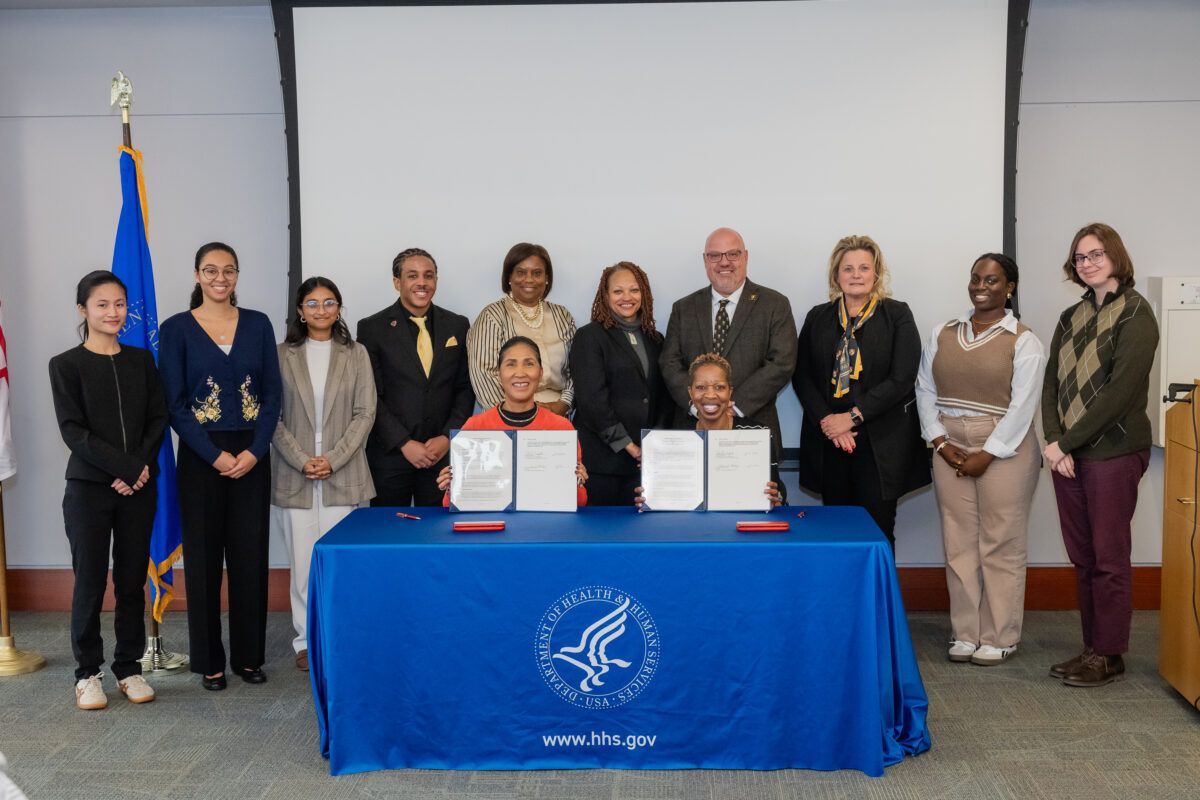 (l-r): Cheryl R. Campbell, the assistant secretary for administration for HHS, and UMBC President Dr. Valerie Sheares Ashby. (Marlayna Demond ’11/UMBC)
“When you talk about how do we change the conversation, how do we change and improve the health disparities? Well, you have to have people at the table that come from those environments,” said Campbell. “That’s why it’s critically important that we sign these memorandums of understanding to bring the next generation of Black and brown professionals into government service. Because if you want to affect change, you have to have a seat at the table to impact policy.”
This news is inspiring for Michael Ack. He joined UMBC as a Meyerhoff Scholar and earned a John H., Sr. and Althea Griner Scholarship for outstanding first-year undergraduate students committed to the advancement of minorities in the sciences and who intend to pursue biological sciences as a major. Ack is now a junior and in his second year at the National Institutes of Health Undergraduate Scholars Program (UGSP), which is part of HHS. Ack notes how these programs provided him access to invaluable financial support, mentorship, and a strong community of peers, faculty, and alumni. Last summer, Ack shadowed researchers working on understanding the development and continued survival of cancer cells. After graduation, Ack will complete his UGSP service obligation by working as a full-time NIH employee in an NIH Intramural Research Laboratory.
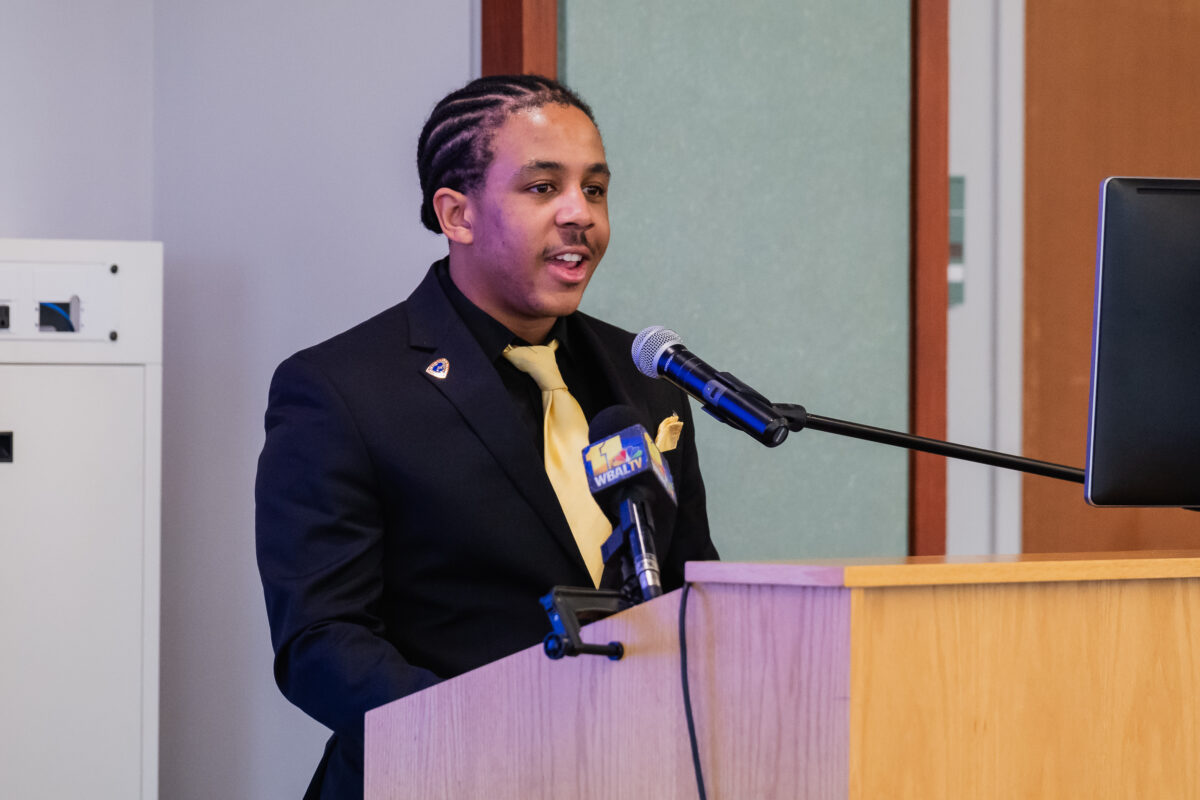 Michael Ack. (Marlayna Demond ’11/UMBC)
“This MOU will serve as a pathway for UMBC students to pursue meaningful careers in public service and make meaningful contributions to our society,” said Ack. “And through the various opportunities that this partnership promises, more UMBC students will be able to see the benefits of working for HHS, such as I have, and will empower more of us to dream big.”
For more internship and career information visit UMBC’s Career Center and listen to their UMBC Careers Unleashed podcast.
]]>
UMBC and the U.S. Department of Health and Human Services (HHS) have signed a memorandum of understanding (MOU) establishing a strategic partnership to increase public service career awareness and...
https://umbc.edu/quick-posts/umbc-and-health-and-human-services-partner-to-create-workforce-pathways/
https://my3.my.umbc.edu/api/v0/pixel/news/146556/guest@my.umbc.edu/7db8a2edf3bad945354b3b8d4241488e/api/pixel
biological-sciences
cahss
career-center
cnms
coeit
meyerhoff-scholar
news
policy-and-society
quick-post
UMBC News & Magazine
https://my3.my.umbc.edu/groups/umbc-news-magazine
https://assets1-my.umbc.edu/system/shared/avatars/groups/000/001/943/24435aa6207c452e7bc15cc74b42c7bb/xsmall.png?1748556657
https://assets1-my.umbc.edu/system/shared/avatars/groups/000/001/943/24435aa6207c452e7bc15cc74b42c7bb/original.png?1748556657
https://assets2-my.umbc.edu/system/shared/avatars/groups/000/001/943/24435aa6207c452e7bc15cc74b42c7bb/xxlarge.png?1748556657
https://assets2-my.umbc.edu/system/shared/avatars/groups/000/001/943/24435aa6207c452e7bc15cc74b42c7bb/xlarge.png?1748556657
https://assets3-my.umbc.edu/system/shared/avatars/groups/000/001/943/24435aa6207c452e7bc15cc74b42c7bb/large.png?1748556657
https://assets1-my.umbc.edu/system/shared/avatars/groups/000/001/943/24435aa6207c452e7bc15cc74b42c7bb/medium.png?1748556657
https://assets2-my.umbc.edu/system/shared/avatars/groups/000/001/943/24435aa6207c452e7bc15cc74b42c7bb/small.png?1748556657
https://assets1-my.umbc.edu/system/shared/avatars/groups/000/001/943/24435aa6207c452e7bc15cc74b42c7bb/xsmall.png?1748556657
https://assets2-my.umbc.edu/system/shared/avatars/groups/000/001/943/24435aa6207c452e7bc15cc74b42c7bb/xxsmall.png?1748556657
UMBC News & Magazine
1
0
false
Tue, 14 Jan 2025 13:39:02 -0500
Tue, 14 Jan 2025 13:39:02 -0500
Meet a Retriever—Monroe Kennedy, III, ’12, mechanical engineering professor at Stanford University

Meet Monroe Kennedy, III, a Meyerhoff Scholar (M20) who earned his B.S. in mechanical engineering from UMBC in 2012 before earning his M.S. in robotics and Ph.D. in mechanical engineering and applied mechanics from the University of Pennsylvania. Monroe is now an assistant professor in the mechanical engineering department at Stanford University. His work is in collaborative robotics, building systems capable of extending robotic autonomy to scenarios where robots work closely around humans and must anticipate their needs to be effective teammates. Outside of his role as a professor, Monroe serves as a national director for Black in Robotics, a nonprofit organization dedicated to enhancing diversity within the field of robotics. Take it away Monroe!
Q: What brought you to UMBC?
A: I came to UMBC for its mechanical engineering program and the Meyerhoff Scholars Program. I had a passion for invention and design and UMBC was the perfect place to gain knowledge so I could have an impactful career. During high school, I was taking courses at a community college, and one instructor was aware of the Meyerhoff program and nominated me—I am so grateful for that initial introduction.
UMBC is truly a melting pot of ideas and culture. You will find a diverse and vibrant community and a place to call home.
Monroe Kennedy, III, ’12, M20
Q: What do you love about your academic program?
A: I love mechanical engineering. When I first joined UMBC, the movie Iron Man had just come out and there was a screening on the Quad. I remember thinking “I want to do that!” Tony Stark was the only hero whose superpower was truly achievable—his ability to innovate and invent.
Mechanical engineering is one of the oldest engineering disciplines. If you follow the Ph.D. “academic tree,” you will find many of the first mechanical engineers had advisors in more fundamental sciences. Because it is a fundamental engineering discipline it covers many areas from controls, dynamics, design, fluids, vibrations, and so much more.
An individual who learns to embrace the diversity of subjects within mechanical engineering learns to think about problems and solutions holistically and brings solutions from every sub-field to solve problems in the most elegant way possible. As a roboticist, a lot of my work is endowing my robots with a form of “intelligence,” but often we find ourselves wishing our robot had an additional physical feature, and as mechanical engineers, it is not difficult for us to make such concepts a reality very quickly.
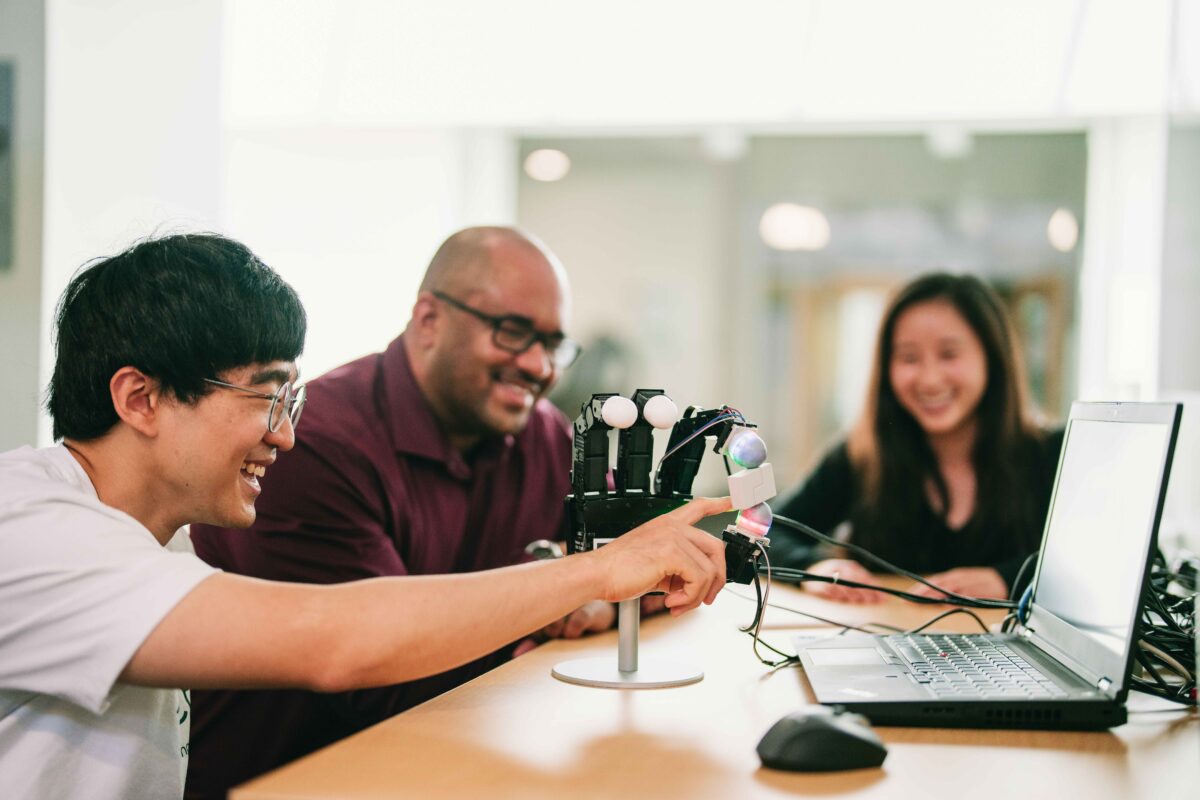 Monroe, a mechanical engineering professor at Stanford University, and his students looking at a robotic fingertip developed in the lab called DenseTact that will enable robots to perform dexterous tasks like humans in the near future.
Q: Tell us about someone in the community who has inspired you or supported you, and how they did it.
A: While at UMBC I was very fortunate to be able to work in Professor J. Vanderlei Martins‘ LACO (Laboratory for Aerosol and Cloud Optics) lab. Professor Martins was an amazing advisor who was able to use my limited experience at the time to contribute to a very impactful project involving designing the de-orbiting system for a picosatellite. Being given an opportunity to work on something that traveled to space was a key element in my ultimate trajectory, and I am very grateful to Professor Martins for his support and mentorship.
My favorite part of being a UMBC alumnus is the sense of forever community I’ve felt in the decade since graduating.
Monroe Kennedy, III, ’12, M20
Q: Tell us about your HOW.
A: The Meyerhoff community played a very big role in my career. Through the program, I was coached on applying for internships and graduate school. Additionally, having the support of professors like J. Vanderlei Martins, working in his laboratory, and receiving his recommendation was crucial to my academic trajectory.
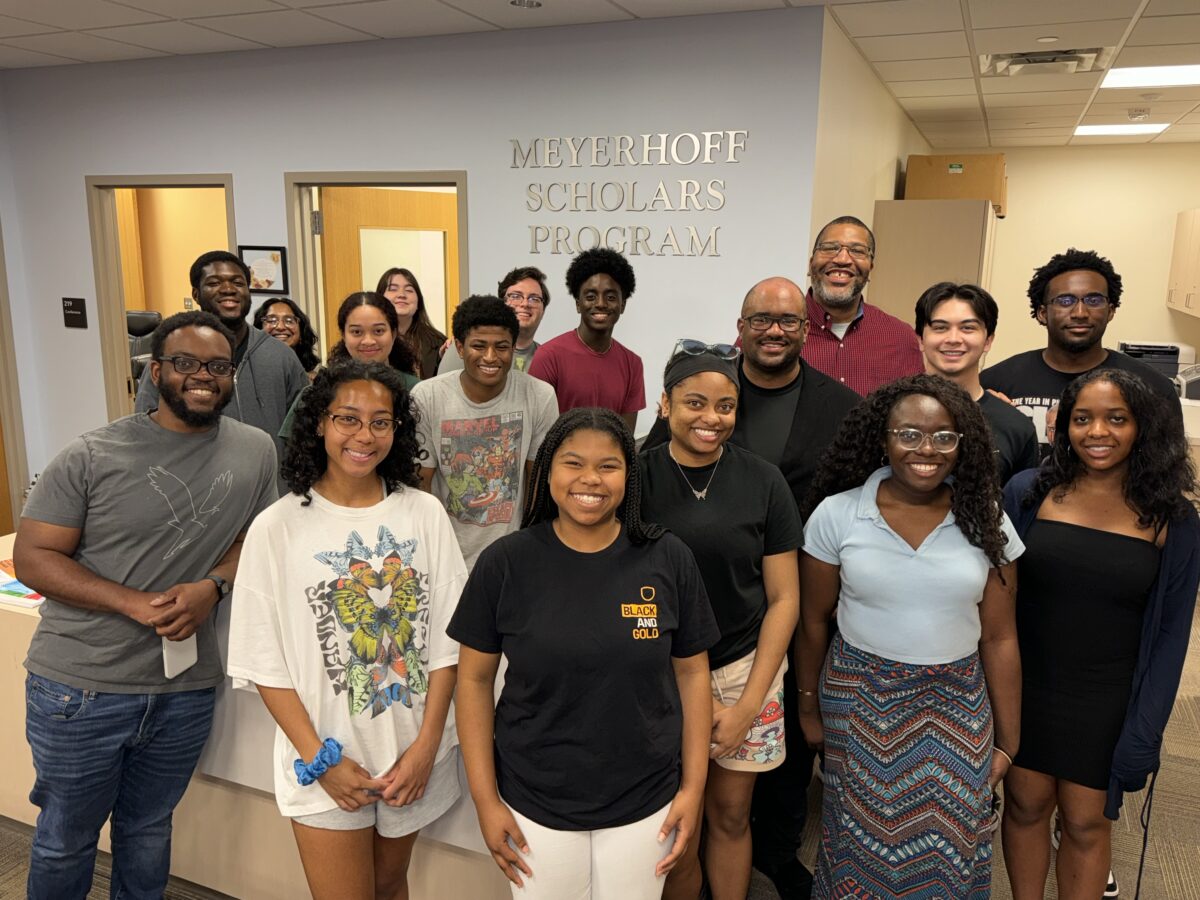 Monroe returned to campus recently to meet with current Meyerhoff students and tour faculty labs.
Q: Tell us about your current job. What do you like most about it?
A: I am an assistant professor in the mechanical engineering department with a courtesy appointment in computer science at Stanford University. My work is in collaborative robotics, building systems capable of extending robotic autonomy to scenarios where robots work closely around humans and must anticipate their needs to be effective teammates.
I love the Stanford community. You will find here that dreaming big and doing the extraordinary is quite ordinary here.
Outside of my role as a professor, I serve as a national director for Black in Robotics, a nonprofit organization dedicated to enhancing diversity within the field of robotics.
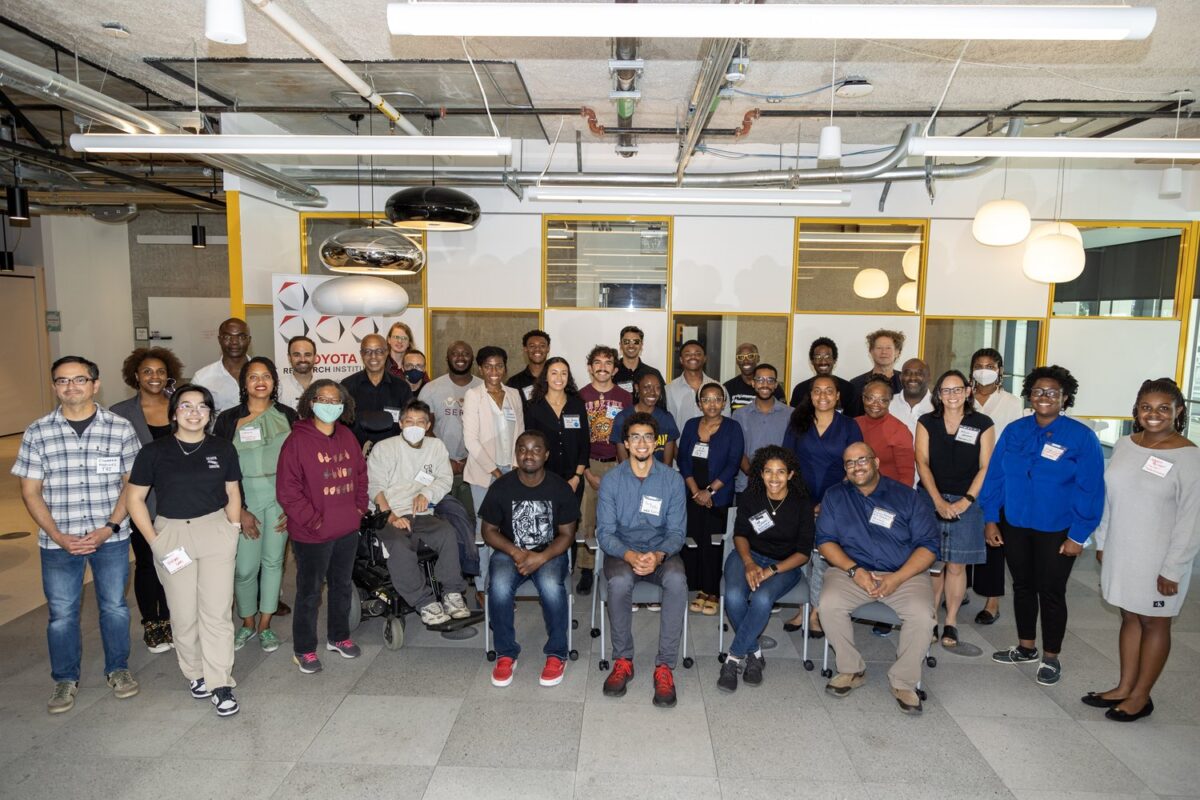 Group photo from a Black in Robotics networking event at the University of California, Berkeley.
Q: What drives you to support UMBC?
A: I want to see UMBC continue to produce leaders who are inquisitive and courageous, unafraid of setbacks, and yet very accomplished and making the world a better place.
* * * * *
UMBC’s greatest strength is its people. When people meet Retrievers and hear about the passion they bring, the relationships they create, the ways they support each other, and the commitment they have to inclusive excellence, they truly get a sense of our community. That’s what “Meet a Retriever” is all about.
Learn more about how UMBC can help you achieve your goals.
]]>
Meet Monroe Kennedy, III, a Meyerhoff Scholar (M20) who earned his B.S. in mechanical engineering from UMBC in 2012 before earning his M.S. in robotics and Ph.D. in mechanical engineering and...
https://umbc.edu/stories/mechanical-engineering-professor-monroe-kennedy/
https://my3.my.umbc.edu/api/v0/pixel/news/141656/guest@my.umbc.edu/adb4daec1996ac3764c5485836f34075/api/pixel
alumni
impact
magazine
mechanical-engineering
meet-a-retriever
meyerhoff
meyerhoff-alumni
meyerhoff-scholar
story
UMBC News & Magazine
https://my3.my.umbc.edu/groups/umbc-news-magazine
https://assets1-my.umbc.edu/system/shared/avatars/groups/000/001/943/24435aa6207c452e7bc15cc74b42c7bb/xsmall.png?1748556657
https://assets1-my.umbc.edu/system/shared/avatars/groups/000/001/943/24435aa6207c452e7bc15cc74b42c7bb/original.png?1748556657
https://assets2-my.umbc.edu/system/shared/avatars/groups/000/001/943/24435aa6207c452e7bc15cc74b42c7bb/xxlarge.png?1748556657
https://assets2-my.umbc.edu/system/shared/avatars/groups/000/001/943/24435aa6207c452e7bc15cc74b42c7bb/xlarge.png?1748556657
https://assets3-my.umbc.edu/system/shared/avatars/groups/000/001/943/24435aa6207c452e7bc15cc74b42c7bb/large.png?1748556657
https://assets1-my.umbc.edu/system/shared/avatars/groups/000/001/943/24435aa6207c452e7bc15cc74b42c7bb/medium.png?1748556657
https://assets2-my.umbc.edu/system/shared/avatars/groups/000/001/943/24435aa6207c452e7bc15cc74b42c7bb/small.png?1748556657
https://assets1-my.umbc.edu/system/shared/avatars/groups/000/001/943/24435aa6207c452e7bc15cc74b42c7bb/xsmall.png?1748556657
https://assets2-my.umbc.edu/system/shared/avatars/groups/000/001/943/24435aa6207c452e7bc15cc74b42c7bb/xxsmall.png?1748556657
UMBC News & Magazine
0
0
false
Fri, 03 May 2024 07:17:57 -0400
Fri, 03 May 2024 07:17:57 -0400
Why We Love it Here
What gets you up and out the door each morning? And what makes a job more than a job—or even more than a career? For so many who make UMBC their professional home, the value goes way beyond a paycheck.
Case in point: Employees for the 14th consecutive year rated UMBC as one of ModernThink’s Great Colleges to Work For in all 10 categories, including shared governance, mission and pride, job satisfaction and support, and diversity, equity, and inclusion. Additionally, the Baltimore Sun has once again named UMBC a 2023 Top Workplace winner based on a confidential employee survey conducted earlier this year. This is the 9th time UMBC has earned this designation since 2013.
What does this excellence look like in the day-to-day? We talked to some Retrievers about what they love about their work at UMBC.
Want weekly Top Stories sent to your inbox?
Valuing Our Whole Selves
UMBC is a place that considers the whole person, opening up space for both professional growth and work-life balance. From mentoring programs to embracing our individual stories, when we support each other in our work and lives, we all come out stronger.
Sharing Our Time
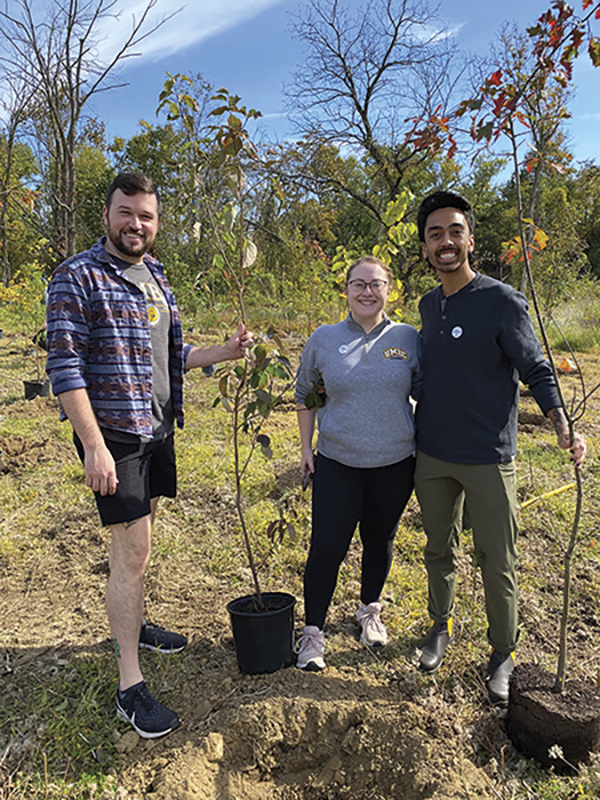
Dozens of Retrievers spent time this fall planting 900 new trees around campus, including those pictured here (L-R): Gavin Gilliland, Abby Hart ’18, and Tim Olivella.
Building bridges across campus
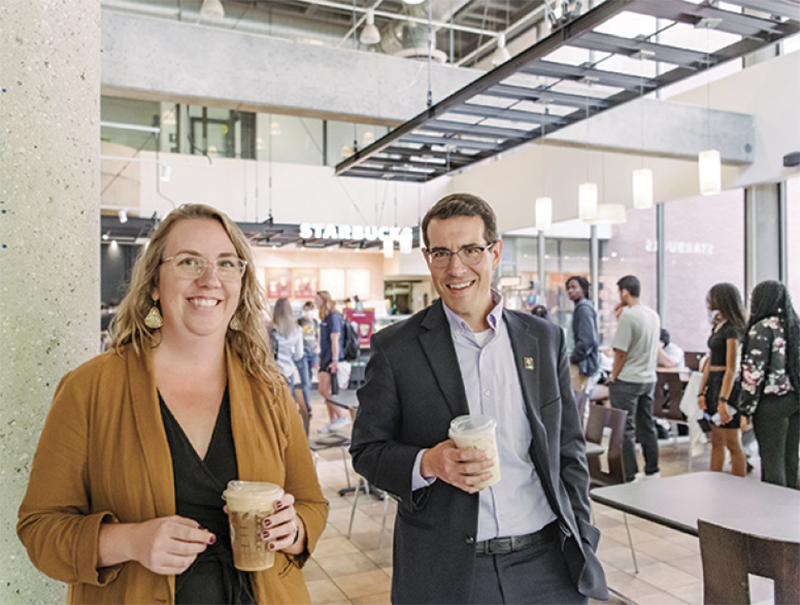
They met so many times at Starbucks, they knew each other’s orders.
Damian Doyle (’99, computer science, M.S. ’16, information systems): tea, Earl Grey, hot. Charlotte Keniston (M.F.A. ’14, intermedia and digital arts): coffee, iced.
Over their caffeine of choice, the two UMBC staff, who work in wildly divergent disciplines, forged connections through the Professional Staff Senate mentorship program—a staple of campus connectedness for the last decade.
Doyle, who works in information technology and has been a staff member at the university for almost 24 years, has served as a mentor for more than five years. Keniston, who started at the Shriver Center five years ago, anticipated a year of opportunity and transition and wanted a mentor to guide her toward balance between a demanding career, family, and finishing her Ph.D. in language, literacy, and culture.
“It was a perfect fit because Damian saw the big picture of the university and explained the campus overarching structures that I had never understood and was really great at advising me on critical points I was at in my career,” Keniston said.
As a mentor to a number of staff over the years, Doyle finds the program rewarding.
“One of the things I loved was getting to know different parts of the university. I get exposed to these different areas of the campus at a deeper level. It confirms for me the kind of driven work that people are doing.”
The mentorship program matches staff through a mentee-first pairing system that includes a speed-dating session and goal analysis for a year-long commitment. Keniston said the mentorship was crucial to her path at UMBC.
“I was at the point where I felt like I couldn’t ask questions, like, ‘Who is this person?’” Keniston said with a laugh. “But being in this mentor/mentee relationship gave me an opportunity to say, ‘Help me understand this.’”
Doyle said that hearing Keniston’s questions and seeing the campus organization through new eyes helped him know what is working and what needs improvement at UMBC. “It’s very educational for me, having to think through what is the right answer, what is the honest answer.”
After a year of meeting about once a month, Doyle has a new mentee, and Keniston has now become a mentor. But they’ll be keeping in touch. Maybe over tea and coffee.
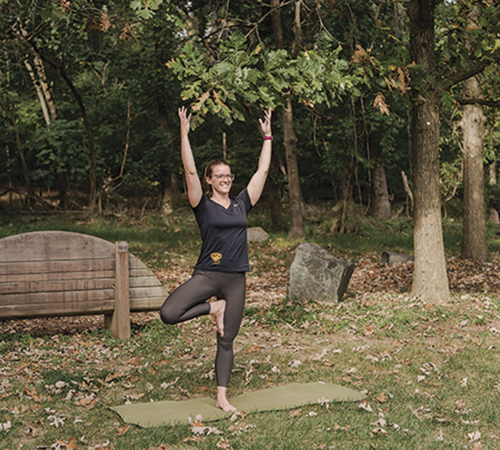
Inner Peace
Many of our staff and faculty take advantage of free exercise and wellness classes in the RAC, some of which are taught by Joella Lubaszewski ’10.
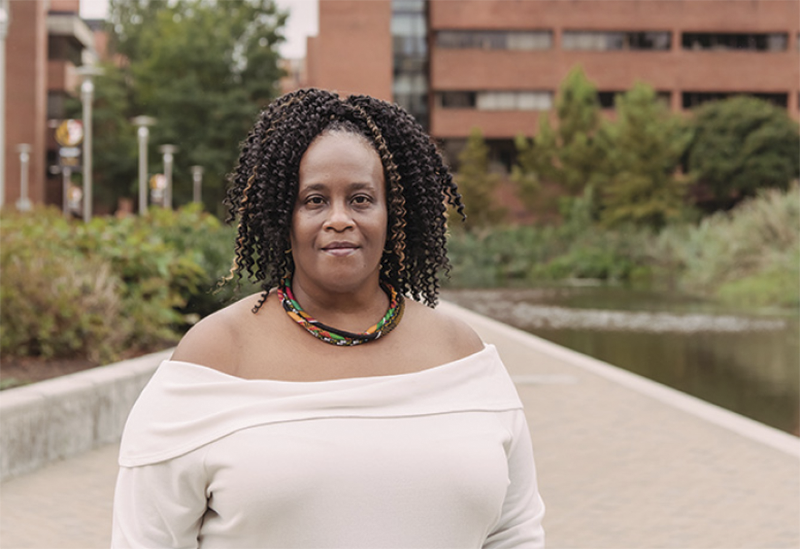
Telling her authentic story
Melessia Jasper’s journey to UMBC was not straight. But something kept pointing her toward UMBC. And toward herself.
“My path to UMBC started before I knew about UMBC,” Jasper said, explaining that after high school in Alabama, she arrived in Maryland only to find that the job she had been promised was locked in a hiring freeze. She started at American University, where she worked with two former UMBC staffers. Then she heard UMBC President Emeritus Freeman Hrabowski at a faculty retreat. “I didn’t realize it at the time, but God was laying the groundwork for where I am today.”
When she moved to Baltimore with her new husband, she applied to UMBC and worked in several different divisions, including Student Affairs and Administration and Finance. In each office, Jasper said, she found acceptance and growth. She now works in the Division of Institutional Equity.
“It was the first university I worked for where you’re applauded for your quirkiness,” Jasper said. “I was so empowered by the resources UMBC offered to me that I then could empower others.”
Last year, she stood on stage to tell her story in a Retriever Talk. For weeks, she and a cohort of other UMBC staff labored with Jill Wardell ’99, interdisciplinary studies, and other strategic talent management and storytelling staff to shape their life tales, a commitment of time and effort on the part of both the storytellers and for UMBC. Jasper said she felt like she was stripping naked. She was reluctant but told herself, “Sometimes, you have to be uncomfortable in order to follow your purpose in life.”
In addition to revealing lifelong intrusive thoughts of inadequacies and imposter syndrome, Jasper also shared—in front of hundreds of people she didn’t know—that in 2000, doctors discovered she had a rare condition called a Chiari malformation, in which part of her brain had grown down into her spine. Her doctor was amazed at what she had achieved, but Jasper knew she was only getting started.
After her Retriever Talk, many students, colleagues, and even strangers have since contacted her to affirm how her story helped them.
“This is something that I have gone through,” Jasper said. “If I can go through it and possibly help you by telling you my story, I want you to have that same freedom…freedom in understanding who I am and accepting who I am.”
A Community That Builds Together
Through our unique commitment to shared governance and a deep appreciation of community, we collectively build UMBC into what we know it should be.
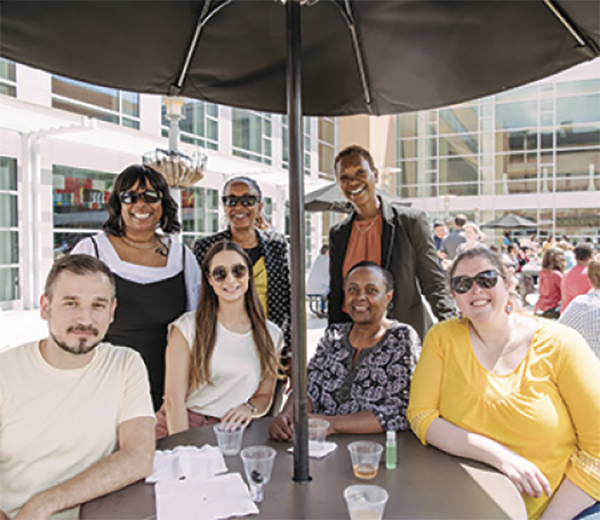
Sharing the Moment
The annual cookout put on by the Professional Staff Senate and Nonexempt Staff Senate brings folks together from all over campus.
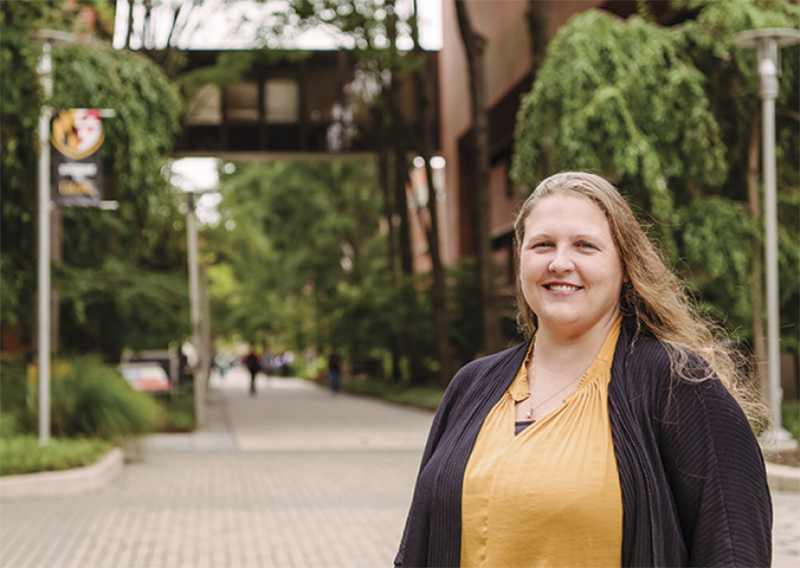
Finding a voice in leadership
There’s a reason the Nonexempt Staff Senate (NESS) carries the name of a democratic body. Alongside other staff and faculty shared governance groups and student government bodies serving their respective constituents, NESS exists to ensure all UMBC nonexempt employees have a voice, the way democracy is supposed to work.
Desiree Stonesifer, serving the second year of her term as president of NESS, and a business services specialist in the financial services department, believes that the shared governance organization builds trust at the university. UMBC offers both staff and faculty shared governance groups, in which all parties work together on the university’s leadership.
“I think it gives people the security of knowing that they’re welcome to speak their mind without it being held against them,” Stonesifer said. “They’re allowed to have thoughts outside the status quo. And a lot of times, those are the kind of thoughts that maybe the administration or other people in the university haven’t thought of. It gives everyone different perspectives and it allows staff the ability to grow more comfortable in their community so that they can be who they are and say what they think.”
NESS helps its members handle issues that are vital to employees: Are job descriptions adequate? Are positions equitably valued? Is professional development available?
Many of the nonexempt senate members aren’t interacting with students as much as other UMBC employees, Stonesifer said, and many of them want to reach out. The NESS, she said, can help members “find ways to get involved in the community.”
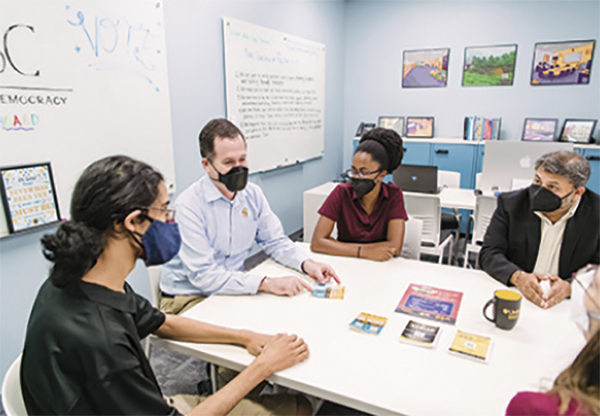
Creating Change
Campus offices like the Center for Democracy and Civic Life work alongside students to engage the community and make a difference.
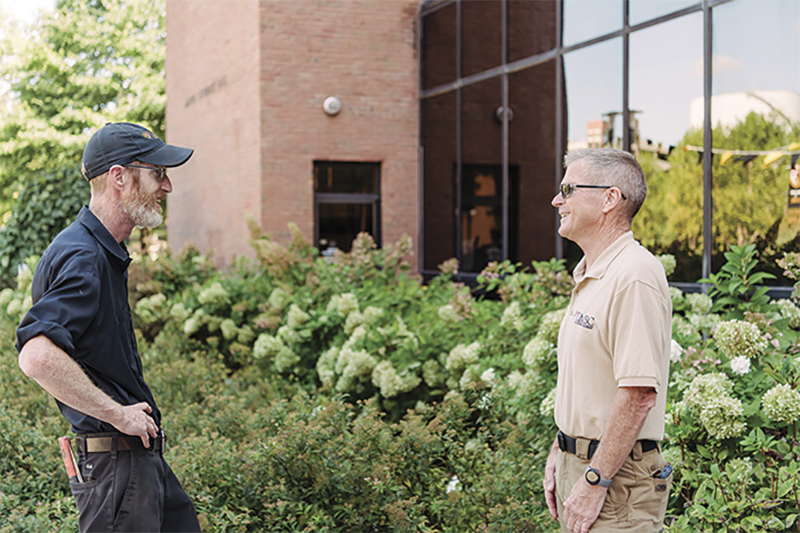
Creating a green space of solace
Charles Hogan, UMBC’s landscape and grounds manager, is comfortable with trees. He grew up climbing them, building forts in them, and “falling out of them,” he said, laughing. For decades, he has run and biked through forests for mile upon mile every week.
As he walks UMBC’s Academic Row in his sturdy boots and cargo pants, Hogan (above, right) admires the trees that have survived years of building renovations, root system compromise by tunnels carrying utilities and water underground, and the hundreds of students who tramp over their soil and tie hammocks to their trunks.
Hogan, who has worked on UMBC’s landscaping for 26 years, likes to construct park-like pockets dotted throughout the campus. Each of those miniature parks is based around trees, whether that’s the pair of oaks in front of the Administration Building that tower over the hydrangeas below or the diminutive weeping redbud that Hogan wanted to top with a tiny hat and sunglasses because it looked so much like Cousin Itt from the Addams Family.
“I’m a tree person,” said Hogan, who is a certified arborist. “Trees should be the focal points. We’re creating a lot of little park environments.”
A campus’ green spaces, Hogan said, make a difference when students and their families are trying to decide where to attend as well as provide succor to everyone making their way through a busy semester. That’s why the grounds staff plants 30,000 summer annuals and 10,000 fall pansies every year. Each area on campus is assigned to a particular gardener, Hogan said, who takes pride in the beauty of the plants under their charge.
Those gardens and the shade of the trees surrounding the buildings offer comfort to the staff, faculty, and students who make the campus their living rooms.
“I never went to college, but I know students are under a lot of stress. They should be able to sit outside, read, study, write a paper,” Hogan said. “Any landscape, whether it’s at your house or on campus, should make you feel good, feel relaxed.”
Living the Mission
At the end of the day, UMBC’s values and mission are what bring us all together. When we work in service of our students and our academic mission of inclusive excellence, it’s hard not to feel connected to the work on another level.
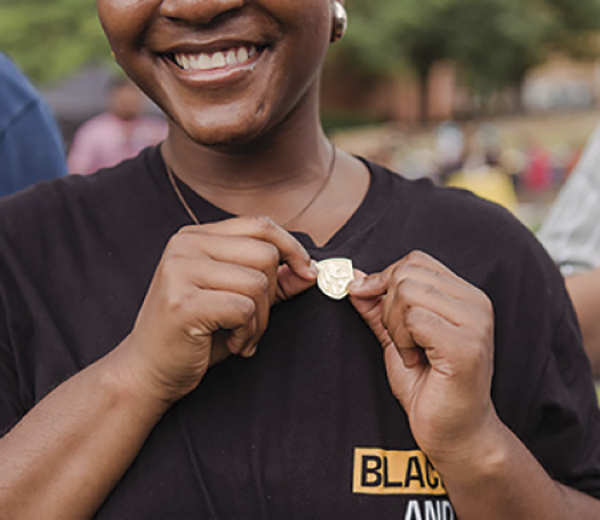
A Student-Centered Community
At the beginning of each school year, our new students are officially welcomed with the Convocation ceremony, where they each receive a special UMBC shield pin.
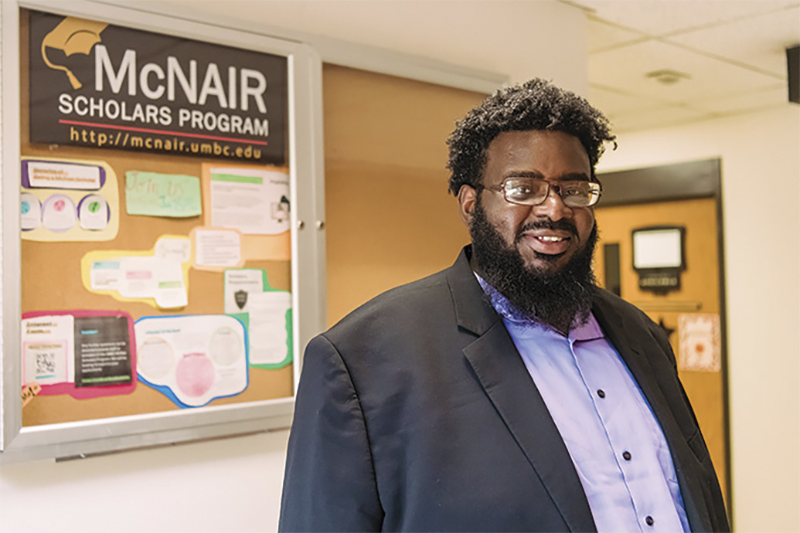
Lifting students to the next level
When he’s deep into extolling the mission and benefits of the McNair Scholars Program he directs, Michael Hunt ’06, computer engineering, needs only a pulpit to become the preacher he trained to be.
When Hunt sees a student achieve, he feels “that parent feeling, that joy that comes to you. Sometimes I’m more excited than they are when they’re telling me. Sometimes it’s a sense of awe in knowing their story, in knowing all that had to happen to get to that space,” said Hunt, who has a masters in theology. “I feel like we’re the mama bird, teaching them all they need before they fly away.”
The federally funded McNair program, with a goal of boosting students from underrepresented segments of society into earning research-based doctoral degrees, has expanded over the six years of Hunt’s directorship.
Every year, the McNair Scholars Program funds 30 slots for students, who meet with mentors, fulfill service obligations, attend cross-cultural events, and receive the help they need to prepare for, apply to, and excel in graduate school.
Hunt, who was a Meyerhoff and McNair scholar, is earning his own interdisciplinary Ph.D. from UMBC. After he became director of the McNair program in 2019, he found himself frustrated when he had to shut some students out of opportunities. So he spearheaded, with the backing of the then-current scholars, staff, and McNair Advisory Council, the creation of the Friends of McNair network, a group of students who reap some of the mentoring, community, and support benefits that McNair Scholars enjoy.
Hunt is exploring ways for the university to expand the support it gives to students not in formal scholar programs. He enthusiastically advocates for the need for holistic critical mentoring (HCM), a network of power-dynamic-flipped, student-centered, reciprocal relationships. HCM is the mentoring framework that uplifts both mentor and mentee while dismantling systems of oppression.
“Because of my heart and because of the work that I do, I don’t want to turn anyone away when I know there are resources to support them. The institution has to rise and say, ‘This is a part of the work of inclusive excellence, and we’re going to fund this to make it happen.’ What I love about my institution is that the more I talk and have these conversations, the more I do see people beginning to question and challenge what we are doing. And so I don’t feel quieted. In other spaces, I know that folks would have been quieted.”
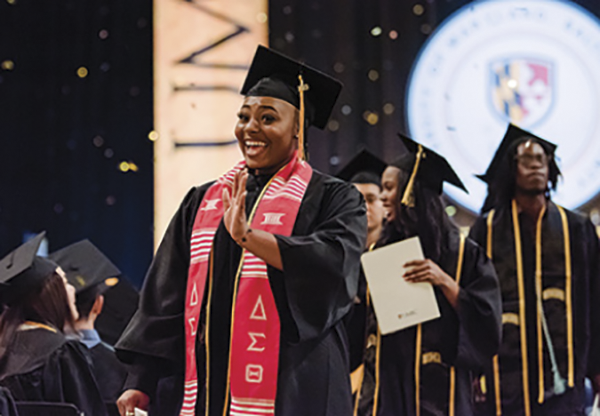
Moments of Joy
There’s simply nothing like the feeling of watching our students cross the stage to get their diplomas.
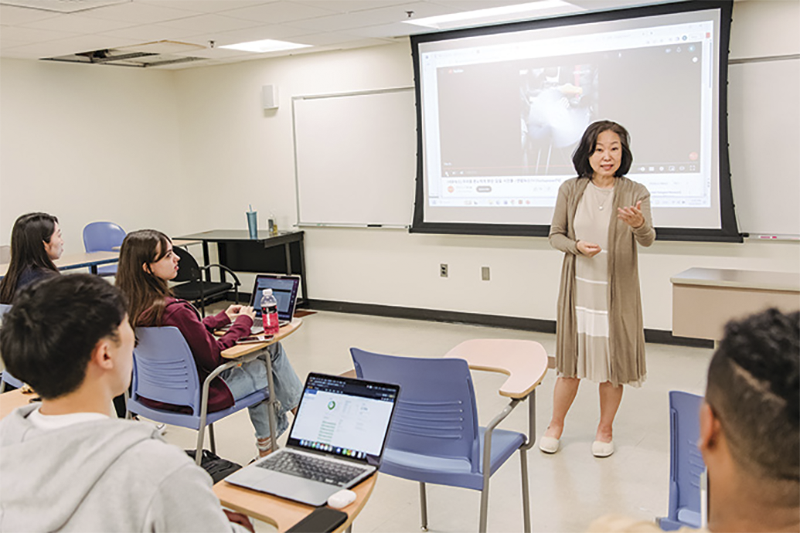
Shaping success in all sizes
At Commencement, Kyung-Eun Yoon likes to sneak out of her academic division’s seating section to hug students in other majors, she confesses. Of course, she gets to hug all the Korean majors when they rise to receive their diplomas, but other students have taken maybe five or six courses or minored in Korean, and she wants to embrace them, too, to recognize that achievement.
Student success, Yoon says, doesn’t come in one shape or size.
“For some students, yes, excelling in every class and getting double degrees and finishing an honors program with a wonderful thesis, going to Korea’s top university as a graduate student, getting a job—that’s a wonderful, wonderful success story,” Yoon said. “But for some students, completing the semester without withdrawing from too many classes, or without failing one or two courses, completing their degree, finally, in five or six years, that’s a wonderful success story for them too.”
Yoon started at UMBC in 2009 as the coordinator of the new Korean program and has grown the program so that students can now major or minor in Korean within the modern languages, linguistics, and intercultural communication department. Over her 14 years, Yoon’s Korean program graduates have gone on to work at the National Security Agency, to pursue graduate schools in various fields including Korean studies and international relations, to teach English in Korea, and more.
But sometimes, she said, success looks like one student whose achievement she particularly treasures. The student had dropped out, withdrawn from many classes, but after six years and many advising sessions with Yoon, last May, she graduated.
“It was not just a mere graduation for her, it was a really, really huge success for her,” Yoon said, and that student’s achievement made Yoon feel proud. “I did this much,” she says, holding up her finger and thumb an inch apart.
Yoon and her colleagues can help students along the path of hard work, but eventually, she says, “you have to have your ownership. We’ll help you, but without your ownership of this time, success cannot be happening.”
And when success happens, Yoon is sure to find that student to give them a hug.
By Susan Thornton Hobby
]]>
What gets you up and out the door each morning? And what makes a job more than a job—or even more than a career? For so many who make UMBC their professional home, the value goes way beyond a...
https://umbc.edu/stories/why-we-love-it-here-at-umbc/
https://my3.my.umbc.edu/api/v0/pixel/news/137627/guest@my.umbc.edu/7e783d773436c1823fe0629cac29e423/api/pixel
campus-life
center-for-democracy-and-civic-life
doit
fall-2023
imda
llc
magazine
mcnairscholars
meyerhoff-scholar
mll
ness
pss
UMBC News & Magazine
https://my3.my.umbc.edu/groups/umbc-news-magazine
https://assets1-my.umbc.edu/system/shared/avatars/groups/000/001/943/24435aa6207c452e7bc15cc74b42c7bb/xsmall.png?1748556657
https://assets1-my.umbc.edu/system/shared/avatars/groups/000/001/943/24435aa6207c452e7bc15cc74b42c7bb/original.png?1748556657
https://assets2-my.umbc.edu/system/shared/avatars/groups/000/001/943/24435aa6207c452e7bc15cc74b42c7bb/xxlarge.png?1748556657
https://assets2-my.umbc.edu/system/shared/avatars/groups/000/001/943/24435aa6207c452e7bc15cc74b42c7bb/xlarge.png?1748556657
https://assets3-my.umbc.edu/system/shared/avatars/groups/000/001/943/24435aa6207c452e7bc15cc74b42c7bb/large.png?1748556657
https://assets1-my.umbc.edu/system/shared/avatars/groups/000/001/943/24435aa6207c452e7bc15cc74b42c7bb/medium.png?1748556657
https://assets2-my.umbc.edu/system/shared/avatars/groups/000/001/943/24435aa6207c452e7bc15cc74b42c7bb/small.png?1748556657
https://assets1-my.umbc.edu/system/shared/avatars/groups/000/001/943/24435aa6207c452e7bc15cc74b42c7bb/xsmall.png?1748556657
https://assets2-my.umbc.edu/system/shared/avatars/groups/000/001/943/24435aa6207c452e7bc15cc74b42c7bb/xxsmall.png?1748556657
UMBC News & Magazine
6
0
false
Fri, 08 Dec 2023 09:06:37 -0500
Fri, 08 Dec 2023 09:06:37 -0500
Three sisters—all alums—share their family’s recipes for food and comfort

Aimee, Jamie, and Gina Joshua have a lot in common. All three went to UMBC as members of the Meyerhoff Scholars Program. And the sisters all have great memories of growing up in a house filled with delicious food and love. So, when their mother’s YouTube channel focusing on Indian cooking techniques started to take off, the trio made it their mission to create a cookbook of family recipes that would honor their beloved parents.
Our parents, Sara and Abraham Joshua, known to us as Mummy and Chacha, immigrated from India in their twenties separately to begin their careers and continued education to help provide for their families back home. Coming to America in the ’70s, they were learning how to navigate a new country and a new culture. After getting married and starting a family, they began raising three daughters in Baltimore, Maryland. The challenge was to figure out how to teach and preserve our Indian culture and traditions when it was over 8,000 miles away.
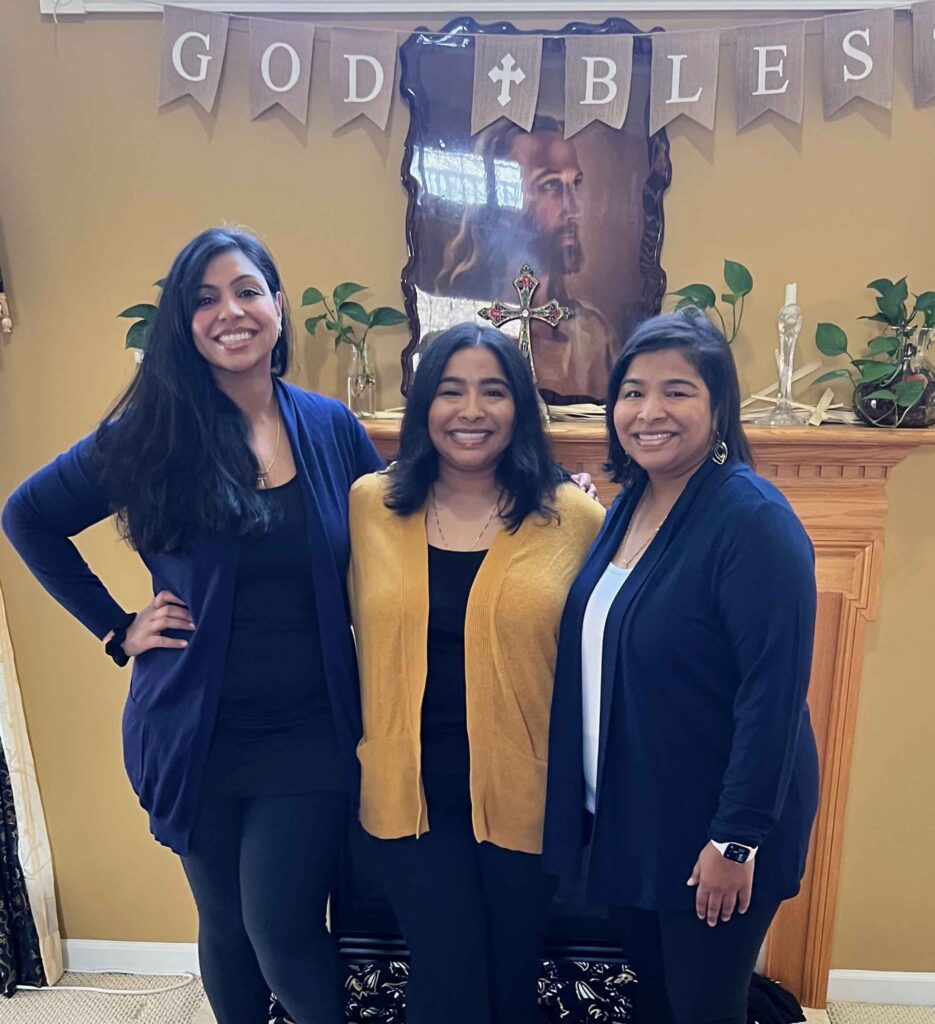 The Joshua Sisters: Gina, Jamie, and Aimee.
Growing up as “the Joshua sisters,” we did many things together—singing songs in church at talent shows, Girl Scouts, karate, and even attending UMBC! They wanted the best for us and every day showed us the value and importance of hard work and being and staying humble. Since we were young girls, Mummy and Chacha taught us that everything is possible if you put your mind to it and work hard. Our parents encouraged us to chase our dreams, but as with many parents, they didn’t think about pursuing their own, only providing for their family.
Mummy, affectionately known as “Ammini Aunty,” was a nurse at the University of Maryland Medical System and Chacha, affectionately known as “Bejoy Uncle,” was a realtor. They both kept busy outside of work hours with community and church activities.
If you wanted to find our parents in the house, it was usually in the kitchen—and the garden was a close second. Mummy loved to cook our traditional South Indian dishes and prepare food for others and Chacha enjoyed being her sous chef. Food was their love language and we had so many conversations around the kitchen table.
During our years at UMBC, we often brought Mummy’s home-cooked food when we returned to campus, always willing to share some chicken biriyani or beans mezhukkupuratti with our friends. Mummy didn’t often have time to do more than cooking for her family or special events because of her nursing career and her focus on our education. This meant she didn’t get to cook and experiment as much as she would have liked. It was only once we were in college that we began to understand the joy being in the kitchen would bring her.
Once we were older, some of our favorite memories were when we gathered in the kitchen to catch up on how everyone’s day had been. When we came home with our friends, Mummy would recruit them to help prepare whatever was on the menu, even if they had never cooked before. We did our best and Mummy would walk us through the recipe and cooking techniques with a lot of patience. Mummy always said “If you put your mind to it, you can do it. It’s a passion, and it takes hard work. But at the end of it all, you get something great.”
Food is meant to be shared, and while Mummy was teaching us to cook, she was also teaching us to curate and nurture relationships and be proud of our culture.
The Joshua Sisters
Whether we were peeling ginger, grating coconut, or chopping vegetables, we knew we were not just creating a meal, we were also building and creating something better: loving memories and an appreciation for our Kerala food. Because that’s what it’s about.
Food is meant to be shared, and while Mummy was teaching us to cook, she was also teaching us to curate and nurture relationships and be proud of our culture. Cooking together is creating together, which involves trust and building a connection between each person helping create the meal. In addition, we are Indian American and are so proud of what it means to be both Indian and American.
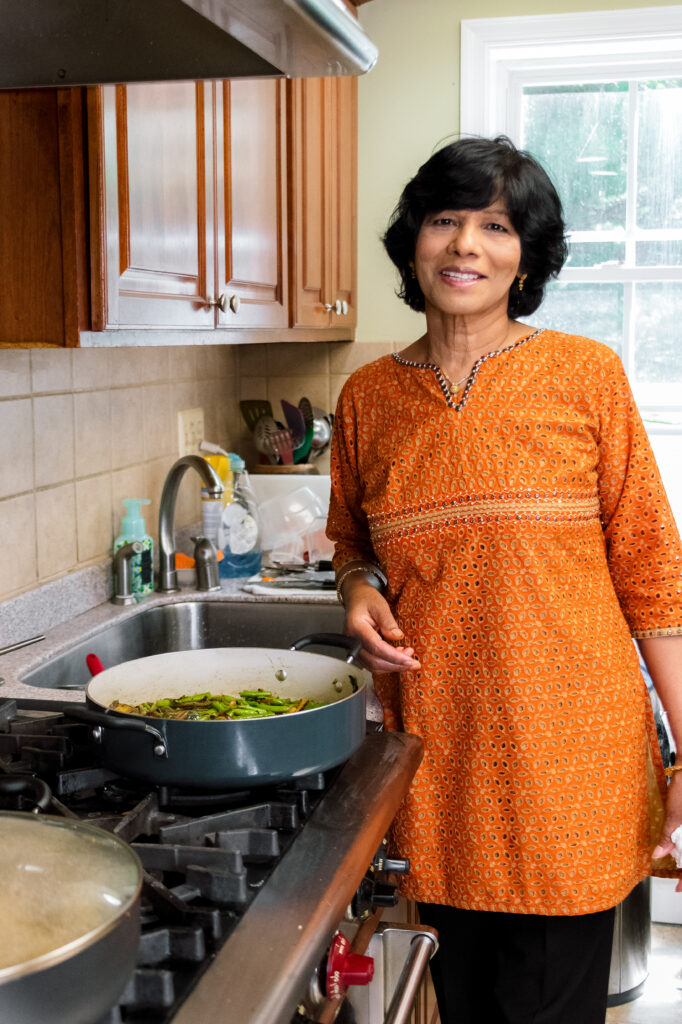 Known as Mummy to her three girls, Sara Joshua poses in her kitchen.
We learned an important lesson during our time at UMBC, taught to us by the late great Lamont Toliver, “Mr. T,” former director of the Meyerhoff Scholarship Program. In a moment of vulnerability, Aimee shared with Mr. T that she had been rejected by all of the Ph.D. programs she had applied to but had gotten into a master’s program.
In all his wisdom, Mr. T comforted Aimee with these wise words: “Not all paths from point A to point B are a straight line. Sometimes you have to take the long way to get where you want to go.” That’s a lesson that has stayed with us for some time and that, we soon realized during the pandemic, applied to Mummy.
By this time, Gina had started a family and we welcomed our next generation of children. The pandemic taught us how precious life is and that making every moment count is important. As sisters, we decided that we would work together to make Mummy’s dream of teaching our generation and future generations how to cook Kerala food come true.
After the pandemic began, Mummy retired from an over 40-year nursing career to help care for Chacha and avoid any risk due to COVID-19. With more time as a retiree, Mummy began experimenting with recipes and sharing them with close by family, who would pick up the care packages she would leave on the porch. They would then text or call her with feedback, helping perfect the recipes.
In April 2020, Mummy came into our room and asked if we wanted to take a picture of what she was cooking in the kitchen. So Jamie and Aimee, armed only with their iPhones and short notice to their friends online, began to livestream Mummy making Mango curry. Then the unexpected happened.
Thousands of people watched it within the first three days, and a flame was lit. Instead of waiting for perfection, we continued to dive into video after video, each an improvement on the one before. What started as a fun project became a thriving YouTube channel, Ammini Aunty’s A Pinch of Kerala, and a full-blown community of “Pinchers.” People were excited to learn from Mummy, and we were all thrilled to share her love for cooking with everyone.
Fast forward to today, our first cookbook, Ammini Aunty’s A Pinch of Kerala: A South Indian Inspired Cookbook, is being published. Thanks to the power of Kickstarter and Pinchers worldwide, what was just once a dream is now becoming a reality. As Mummy reminds her Pinchers, “If you put your mind to it, you can do it.” Don’t let your dreams stay a dream. Work toward making it a reality.
Jamie Joshua ’02, biological sciences, is the diversity, equity, and inclusion manager for Giant Food. Aimee Joshua ’03, M.S. ’05, computer science, is the senior manager, IT contracts, at PBS Distribution. Gina Wright ’05, biological sciences, is a dentist at a Veterans Affairs Medical Center.
]]>
Aimee, Jamie, and Gina Joshua have a lot in common. All three went to UMBC as members of the Meyerhoff Scholars Program. And the sisters all have great memories of growing up in a house filled...
https://umbc.edu/stories/three-sisters-keep-family-recipes-alive-in-book/
https://my3.my.umbc.edu/api/v0/pixel/news/137616/guest@my.umbc.edu/8b9de66ee2fe755d391c1d9411f14bcb/api/pixel
alumni
alumni-essay
biological-sciences
coeit
computer-science
fall-2023
magazine
meyerhoff-scholar
UMBC News & Magazine
https://my3.my.umbc.edu/groups/umbc-news-magazine
https://assets1-my.umbc.edu/system/shared/avatars/groups/000/001/943/24435aa6207c452e7bc15cc74b42c7bb/xsmall.png?1748556657
https://assets1-my.umbc.edu/system/shared/avatars/groups/000/001/943/24435aa6207c452e7bc15cc74b42c7bb/original.png?1748556657
https://assets2-my.umbc.edu/system/shared/avatars/groups/000/001/943/24435aa6207c452e7bc15cc74b42c7bb/xxlarge.png?1748556657
https://assets2-my.umbc.edu/system/shared/avatars/groups/000/001/943/24435aa6207c452e7bc15cc74b42c7bb/xlarge.png?1748556657
https://assets3-my.umbc.edu/system/shared/avatars/groups/000/001/943/24435aa6207c452e7bc15cc74b42c7bb/large.png?1748556657
https://assets1-my.umbc.edu/system/shared/avatars/groups/000/001/943/24435aa6207c452e7bc15cc74b42c7bb/medium.png?1748556657
https://assets2-my.umbc.edu/system/shared/avatars/groups/000/001/943/24435aa6207c452e7bc15cc74b42c7bb/small.png?1748556657
https://assets1-my.umbc.edu/system/shared/avatars/groups/000/001/943/24435aa6207c452e7bc15cc74b42c7bb/xsmall.png?1748556657
https://assets2-my.umbc.edu/system/shared/avatars/groups/000/001/943/24435aa6207c452e7bc15cc74b42c7bb/xxsmall.png?1748556657
UMBC News & Magazine
2
0
false
Thu, 07 Dec 2023 16:32:28 -0500
Thu, 07 Dec 2023 16:32:28 -0500
Forward Progress Begins with Mentorship
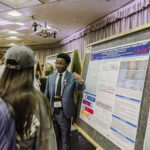
Olumide Fagboyegun ’21, M29, biochemistry, is a recent UMBC graduate and a Meyerhoff Scholar. He will soon begin his Ph.D. in neuroscience at Harvard. Since graduating, he’s reflected on the mentors who have made these steps possible. What, exactly, made them great mentors, he asks. And how can he pass that gift along to future students, particularly other students from underrepresented groups?
Picture this: You’re sitting in a well-lit hotel ballroom at a table draped with a white tablecloth, nervously perspiring. Immediately in front of you is a podium on a stage, and encircling the ballroom are dozens of academics at various stages in their careers, from predoctoral trainees to full professors. One thing that stands out to you—even more imposing than their sheer presence—is the fact that almost all of them are Black. These academics are not only a testament to the fact that if we hold fast to the dream of equity in academia, it’s only a matter of time until it is realized. But for Black students in particular, this kind of experience is incredibly important.
 Headshot courtesy of Fagboyegun
.
My experience as a member of the Meyerhoff Family at UMBC prepared me as a scientist and a scholar through the invaluable mentoring relationships where I was able to see a road to success forged by underrepresented students who went before me.
What makes a good mentor?
All my effective mentoring relationships have begun with one thing: reciprocated belief. My mentors have believed in me and I, in turn, have believed in their abilities to be good mentors for me. Both elements are necessary for an effective mentoring relationship. As a result, they have pushed me to believe in myself—to be better and more confident, in every regard. And I believed in their guidance and their affirmation of my potential.
One close mentor pushed me to improve my networking skills while believing that I would represent my program and my university well wherever I went and with whomever I met. Another mentor believed in my capacity to do good science, and pushed me to reflect on the impact my scientific endeavors can have on society.
It is worth reiterating that mentorship styles are remarkably diverse. One of the characteristics of a good mentor is the ability to see when one’s mentoring style may not be effective for a particular mentee, and to either modify their style, or to identify another mentor who would better meet the mentee’s needs. One of the strengths of the Meyerhoff Scholars Program is its ability to provide a wide range of mentoring styles to make sure that every student can find the support they need and achieve success on their chosen path, be it medical school, industry, or graduate school.
The mentee’s role
We often emphasize the role of the mentor, but the mentee’s role is no less important. New Meyerhoff Scholars start by going through a Summer Bridge program, which emphasizes the concept of the Meyerhoff Family—our scholar and alumni community, focused on mutual support. Through Summer Bridge, students learn to be open-minded to advice from their peers and mentors and to be comfortable proactively asking for help. Importantly, students learn to identify potential areas of self-improvement.
My own path, as a transfer student from Anne Arundel Community College, is less common for a Meyerhoff Scholar. While I did not go through Summer Bridge, I was embraced wholeheartedly by the Meyerhoff Family, and I believed that the mentorship provided in the Meyerhoff Scholars Program would be invaluable.
 Fagboyegun with his fellow M29 cohort members, photo courtesy of the Meyerhoff Program
.
The ripple effects of mentoring
For underrepresented students, mentorship can play a particularly significant role in success.
In a recent piece published in Nature Medicine, Kizzmekia Corbett, ’08, M16, biological sciences and sociology, the leading scientist behind the Moderna COVID-19 vaccine, wrote about her first experience conducting scientific research as a high school student, and the impact, as a young Black woman, of having a Black scientist as her mentor. “This left me with an understanding of the necessity of visible representation in underserved communities, and the realization that one’s approach to mentorship is equally as important as (or arguably more important than) their approach to scientific discovery,” Corbett wrote.
Early in my college career, I was clued into the disparities that are characteristic of science and academia, which persist despite efforts to address them. In academia, these manifest, in part, as resource stratification and disparity in opportunities, including access to networks and mentors.
On a personal level, as a Queer Black student in STEM, not seeing people who share my identity represented can make it feel as though there is no place for me in academia. Underrepresented minority (URM) students are acutely aware that most of the difficulty in forging that place in academia falls on the early URM individuals who attempt it. These individuals then face increasing pressure both internally and externally to succeed and be a model or a trailblazer. After all, insufficient diversity can have far-reaching effects, such as in healthcare disparities, and URM scientists have a strong motivation to address these problems. These pressures, coupled with the already high demands of academia, wear away uniquely on URM scholars.
 Fagboyegun presents his research at Undergraduate R
e
search and Creative Achievement Day in 2019. Photo by Marlayna Demond ’11.
Here, again, the Meyerhoff Scholars Program shines. The Meyerhoff alumni network is remarkably connected, and ensures that graduates will always have peer mentors they are able to rely on, even if they are based in institutions with few other URM scientists, doctors, scholars, or other professionals. The strength of the Meyerhoff Family creates a ripple effect in those new institutions, providing Meyerhoff-style mentoring to URM students and more junior colleagues, which results in a cultural change. As a recent Meyerhoff alumnus, I intend to carry forward this culture change as well.
A vital perspective
The scene I set at the beginning of this essay is my memory from the annual University System of Maryland Summer Bridging Conference, hosted by the Louis Stokes Alliance for Minority Participation (LSAMP) my sophomore year. Such a scene is rare in academia, but it doesn’t have to be. The well-documented outcomes of the Meyerhoff Scholars Program so far suggest that it is entirely possible to permanently change the landscape of science to be much more inclusive of scholars of all identities.
It is worth noting that although a shared identity between a mentor and mentee isn’t necessary for all mentoring relationships, it often results in remarkably positive outcomes, as highlighted by Dr. Corbett in the quote above.
Like many others, I have struggled with the idea that I might not be good enough to pursue a career in academia. However, the mentorship I’ve received through the Meyerhoff Scholars Program, LSAMP, and other initiatives has helped dissuade me of that notion. To achieve this, my mentors often help to place everything “in view” for me: my goals, weaknesses, strengths, accomplishments, and my place in the scientific and non-scientific world. This opportunity to zoom out and see the broader perspective has been vital to my success so far.
We must recognize that mentorship is an essential part of the larger movement to diversify science in pursuit of an equitable society—a scaffold that ensures progress moves ever forward.
— Olumide Fagboyegun ’21, M29, biochemistry
*****
Header image: Fagboyegun presents his research at Undergraduate Research and Creative Achievement Day in 2019. Photo by Marlayna Demond ’11.
]]>
Olumide Fagboyegun ’21, M29, biochemistry, is a recent UMBC graduate and a Meyerhoff Scholar. He will soon begin his Ph.D. in neuroscience at Harvard. Since graduating, he’s reflected on the...
https://umbc.edu/stories/forward-progress-begins-with-mentorship/
https://my3.my.umbc.edu/api/v0/pixel/news/119582/guest@my.umbc.edu/577e23eef905819a36ce61d777b58b2b/api/pixel
alumni
biochemistry
cnms
meyerhoff-alumni
meyerhoff-scholar
meyerhoff-scholarship-program
perspectives
UMBC News & Magazine
https://my3.my.umbc.edu/groups/umbc-news-magazine
https://assets1-my.umbc.edu/system/shared/avatars/groups/000/001/943/24435aa6207c452e7bc15cc74b42c7bb/xsmall.png?1748556657
https://assets1-my.umbc.edu/system/shared/avatars/groups/000/001/943/24435aa6207c452e7bc15cc74b42c7bb/original.png?1748556657
https://assets2-my.umbc.edu/system/shared/avatars/groups/000/001/943/24435aa6207c452e7bc15cc74b42c7bb/xxlarge.png?1748556657
https://assets2-my.umbc.edu/system/shared/avatars/groups/000/001/943/24435aa6207c452e7bc15cc74b42c7bb/xlarge.png?1748556657
https://assets3-my.umbc.edu/system/shared/avatars/groups/000/001/943/24435aa6207c452e7bc15cc74b42c7bb/large.png?1748556657
https://assets1-my.umbc.edu/system/shared/avatars/groups/000/001/943/24435aa6207c452e7bc15cc74b42c7bb/medium.png?1748556657
https://assets2-my.umbc.edu/system/shared/avatars/groups/000/001/943/24435aa6207c452e7bc15cc74b42c7bb/small.png?1748556657
https://assets1-my.umbc.edu/system/shared/avatars/groups/000/001/943/24435aa6207c452e7bc15cc74b42c7bb/xsmall.png?1748556657
https://assets2-my.umbc.edu/system/shared/avatars/groups/000/001/943/24435aa6207c452e7bc15cc74b42c7bb/xxsmall.png?1748556657
UMBC News & Magazine
0
0
false
Fri, 16 Jul 2021 13:21:15 -0400
Change Agent Behind #BlackBirdersWeek

Before she graduated from UMBC, Anna Gifty Opoku-Agyeman’19, M26, mathematics, founded the Sadie Collective. Opoku-Agyeman describes it on her website as, “the first and only organization to date dedicated to addressing the pipeline and pathway problem for Black women in economics and related fields.” Since the Collective’s inception in 2018, membership has expanded to nearly 500 members across 30 states, 120 institutions, and four continents.
This is a woman who is making change.
One of the Collective’s first orders of business was toorganize the Sadie Tanner Mossell Alexander Conference for Economics and Related Fields. The conference and the Sadie Collective offer resources, networking, and support to a community—in this case, Black women in economics—that has been historically under-resourced, -networked, and -supported.
As it happens, some members of the Sadie Collective’s leadership team are also birders.
So, when news of a White woman calling 911 on Christian Cooper, a Black birder in Central Park who asked her to follow the rules and leash her dog, made national headlines in May, the Collective leaped into action. Below, Opoku-Agyeman shares how #BlackBirdersWeek (May 31 – June 5, 2020) came to be, its extensive impact, and what’s next.
UMBC Magazine: What was your goal in creating #BlackBirdersWeek?
Anna Gifty Opoku-Agyeman: I want to first and foremost share that #BlackBirdersWeek was a joint effort with members of the BlackAFinSTEM Collective. I co-founded the initiative alongside Sheridan Alford, Danielle Belleny, Chelsea Connor, Joseph Saunders, and Tykee James, all wonderful people who, alongside others, stepped up to make the week possible.
#BlackBirdersWeek was a direct response to Christian Cooper’s unfortunate encounter with a White woman in Central Park. Although I am not a birder, many individuals in the Collective are, and each of them echoed similar experiences to Cooper’s. The conversations sparked an idea in me to amplify and prioritize the voices of Black birders, naturalists, and explorers similar to what I have done alongside my co-founder, Fanta Traore, at the Sadie Collective.
UMBC Magazine: Can you describe some of the components of the week’s programming, and how it came together?
Opoku-Agyeman: I suggested a Black Birders Day, and Tykee James suggested a week, as a way to celebrate Black people in the birding space similar to how running was used to celebrate the late Ahmaud Arbery. I did a little bit of brainstorming and came back with a pitch: a potential week-long digital campaign to amplify the experiences and expertise of Black birders, especially those within the group. The Collective loved the idea and offered suggestions to improve how we could roll out the campaign. We have well-known birders and natural scientists within our group, such as Jason Ward and Corina Newsome, and many of us had a couple thousand followers. So we knew that between all of us, this could be huge.
We were intentional about ensuring that there was a hashtag for each day, which led the wonderful Danielle Belleny, Sheridan Alford, and Chelsea Connor to create these amazing flyers that reflected our vision.
Every day had a theme and corresponding date. A brief description of what we highlighted includes:
● #BlackinNature—Showcasing Black people in nature. Black people typically don’t get to be in nature because we are viewed as a threat. This part of the campaign was intentional in that it normalized Black people in nature and also encouraged it.
● #PostABird Challenge—Posting a fun bird picture/fact/etc. This was really a campaign to get people involved regardless of race so that we could get the world talking about birds!
● #AskABlackBirder—Twitter and Instagram Q&A with Black birders. Folks submitted questions on Twitter and Instagram using the hashtag. It gave Black birders an opportunity to talk more about their own work and research.
● #BirdingWhileBlack—Live stream discussions with Christian Cooper (yes, that Christian Cooper) and Drew Laham. I actually co-moderated this session with Tykee James. To date, those streams together drew in over 1 million views. At the time we went live, nearly 60,000 people tuned in. Apparently we broke an average day record or something.
● #BlackWomenWhoBird—Amplifying Black women birders and LGBTQ+ birders, who are significantly underrepresented. Many of these individuals had an opportunity to work with national organizations such as the National Aquarium to talk about their work. It was truly awesome.
UMBC Magazine: What was your reaction to the huge response the campaign got?
Opoku-Agyeman: It’s funny, because when I told my mom about this idea, she kept saying we’d go global. It’s actually one of the first things I told the group: “If we do this right, this could go global,” and I am so glad it did. All of the individuals involved with the group have now been featured widely and are still being pursued for opportunities by prominent science organizations such as the National Aquarium and national agencies in the nature space. It was interesting, too, because simultaneously nationwide protests over senseless Black death at the hands of police were happening.
As a result of the campaign, the National Wildlife Federation launched a fellowship for minorities in the field, specifically with Black people in mind. The movement literally shifted power structures, something that we love to see.
At the same time, you had Black joy paralleling Black pain, which is oftentimes the experience of Black people in America.We have to balance these incredibly joyous moments with very real and deep-seated pain. While we were celebrating Black birders, our people were also being murdered. It’s a juxtaposition that is our daily lives.
UMBC Magazine: Do you have any plans to build on the success of #BlackBirdersWeek? Have you organized similar campaigns?
Opoku-Agyeman: We are currently working on building structure around the successful campaign as well as pushing forward our mission to be unapologetically Black in the STEM space. Recent campaigns that have been inspired by us include #BlackinAstro, which highlights Black people in astronomy, and #BlackHikersWeek, which aims to normalize Black people hiking outdoors. The offshoot campaigns are not ones we specifically organized, but we definitely support them!
UMBC Magazine: How does your work on #BlackBirdersWeek relate to your role as co-founder and CEO of the Sadie Collective?
Opoku-Agyeman: Both initiatives uplift Black people who are often among those marginalized in their space. The strikingly similar under-representation between birding and economics with respect to Black people is just more evidence that campaigns like #BlackBirdersWeek and additional advocacy is needed to push institutional change that allows for diverse voices to break through.
What I love about both initiatives is that they’re disruptive, political, and moving. Many people didn’t see the Sadie Collective coming when we officially announced like they didn’t see #BlackBirdersWeek coming. Both initiatives are led by young Black people who are incredibly passionate about this work, whatever it may be, and by existing in our respective spaces, we are protesting our right to be seen, heard, and celebrated. Quite literally embracing the idea of being unapologetically Black and unapologetically ourselves, encompassing our Blackness.
*****
Header image of Opoku-Agyeman on campus by Marlayna Demond ’11.
]]>
Before she graduated from UMBC, Anna Gifty Opoku-Agyeman’19, M26, mathematics, founded the Sadie Collective. Opoku-Agyeman describes it on her website as, “the first and only organization to date...
https://umbc.edu/stories/change-agent-behind-blackbirdersweek/
https://my3.my.umbc.edu/api/v0/pixel/news/119850/guest@my.umbc.edu/251f6add42af5583395e6823a6b61af8/api/pixel
alumni
cnms
meyerhoff
meyerhoff-scholar
UMBC News & Magazine
https://my3.my.umbc.edu/groups/umbc-news-magazine
https://assets1-my.umbc.edu/system/shared/avatars/groups/000/001/943/24435aa6207c452e7bc15cc74b42c7bb/xsmall.png?1748556657
https://assets1-my.umbc.edu/system/shared/avatars/groups/000/001/943/24435aa6207c452e7bc15cc74b42c7bb/original.png?1748556657
https://assets2-my.umbc.edu/system/shared/avatars/groups/000/001/943/24435aa6207c452e7bc15cc74b42c7bb/xxlarge.png?1748556657
https://assets2-my.umbc.edu/system/shared/avatars/groups/000/001/943/24435aa6207c452e7bc15cc74b42c7bb/xlarge.png?1748556657
https://assets3-my.umbc.edu/system/shared/avatars/groups/000/001/943/24435aa6207c452e7bc15cc74b42c7bb/large.png?1748556657
https://assets1-my.umbc.edu/system/shared/avatars/groups/000/001/943/24435aa6207c452e7bc15cc74b42c7bb/medium.png?1748556657
https://assets2-my.umbc.edu/system/shared/avatars/groups/000/001/943/24435aa6207c452e7bc15cc74b42c7bb/small.png?1748556657
https://assets1-my.umbc.edu/system/shared/avatars/groups/000/001/943/24435aa6207c452e7bc15cc74b42c7bb/xsmall.png?1748556657
https://assets2-my.umbc.edu/system/shared/avatars/groups/000/001/943/24435aa6207c452e7bc15cc74b42c7bb/xxsmall.png?1748556657
UMBC News & Magazine
0
0
false
Thu, 02 Jul 2020 16:08:47 -0400
Meet the Newest Alums: Bell, Tewelde, and Lomax

UMBC is always full of hard-working people who aspire to do great things, and the class of 2014 is no exception. Today, we wanted to share with you what some of our recent graduates are planning to do with their Retriever education.
In a mere four years at UMBC, Valedictorian
Travis Bell, psychology and political science, completed six internships, studied abroad in Chile, and received a mentorship for pursuing a career in public affairs. Along with being the UMBC Club Soccer President and the UMBC Pre-Law Society Founder and Treasurer, Bell was also selected as a finalist for the national Harry S. Truman Scholarship and won both the Outstanding Senior Award in political science and the Louis Cantori Memorial Scholarship. With his recent graduation, he plans to continue his education to earn a J.D. at the UCLA School of Law.
 Blossom Tewelde, biochemistry and molecular biology, came in to UMBC as a science major and later found herself excelling in poetry. In the realm of science, the Meyerhoff and Howard Hughes Medical Institute scholar won the Donald Creighton Memorial Scholarship for Outstanding Senior Undergraduate Researcher in Biochemistry.
Tewelde also explored her talents in poetry, was soon published in UMBC’s Bartleby, and earned the Malcolm C. Braly Award. She plans to pursue an M.D./Ph.D at the Johns Hopkins School of Medicine.
 Melissa Lomax, English literature, brought a lot to the table. While at UMBC, she was president of the Maryland Association of Blind Students and held active membership in the National Federation of the Blind of Maryland. Lomax was also chosen to travel abroad to Damascus as a part of the Open Hands Youth Abilities Summit, where she “worked with Syrian youth on the topic of the United Nations Convention for the Rights of Persons with Disabilities.” There, she helped develop the comic Silver Scorpion by Liquid Comic about an empowering superhero who has a disability, which has been featured on NPR and in Time Magazine. Lomax now plans to be the Youth Services Coordinator for the Blind Industries and Services of Maryland.
]]>
UMBC is always full of hard-working people who aspire to do great things, and the class of 2014 is no exception. Today, we wanted to share with you what some of our recent graduates are planning...
https://umbc.edu/stories/meet-the-newest-alums-bell-tewelde-and-lomax/
https://my3.my.umbc.edu/api/v0/pixel/news/122099/guest@my.umbc.edu/05138d3e946f22b67607cf0015cb7925/api/pixel
alumni
bartleby
biochemistry
blossom-tewelde
chile
club-soccer
damascus
english-literature
harry-s-truman-scholarship
hhmi-scholar
johns-hopkins
maryland-association-of-blind-students
melissa-lomax
meyerhoff-scholar
molecular-biology
national-federation-of-the-blind-of-maryland
open-hands-youth-abilities-summit
political-science
psychology
travis-bell
ucla-school-of-law
umbc
UMBC News & Magazine
https://my3.my.umbc.edu/groups/umbc-news-magazine
https://assets1-my.umbc.edu/system/shared/avatars/groups/000/001/943/24435aa6207c452e7bc15cc74b42c7bb/xsmall.png?1748556657
https://assets1-my.umbc.edu/system/shared/avatars/groups/000/001/943/24435aa6207c452e7bc15cc74b42c7bb/original.png?1748556657
https://assets2-my.umbc.edu/system/shared/avatars/groups/000/001/943/24435aa6207c452e7bc15cc74b42c7bb/xxlarge.png?1748556657
https://assets2-my.umbc.edu/system/shared/avatars/groups/000/001/943/24435aa6207c452e7bc15cc74b42c7bb/xlarge.png?1748556657
https://assets3-my.umbc.edu/system/shared/avatars/groups/000/001/943/24435aa6207c452e7bc15cc74b42c7bb/large.png?1748556657
https://assets1-my.umbc.edu/system/shared/avatars/groups/000/001/943/24435aa6207c452e7bc15cc74b42c7bb/medium.png?1748556657
https://assets2-my.umbc.edu/system/shared/avatars/groups/000/001/943/24435aa6207c452e7bc15cc74b42c7bb/small.png?1748556657
https://assets1-my.umbc.edu/system/shared/avatars/groups/000/001/943/24435aa6207c452e7bc15cc74b42c7bb/xsmall.png?1748556657
https://assets2-my.umbc.edu/system/shared/avatars/groups/000/001/943/24435aa6207c452e7bc15cc74b42c7bb/xxsmall.png?1748556657
UMBC News & Magazine
0
0
false
Sun, 21 Dec 2014 14:00:34 -0500


 Drawn by @/nina.draws.scientists on IG

