More than skills: Four CNMS interns on mentorship, belonging, and the gift of opportunity
Every morning this summer, junior biological sciences major Magdalen Ruth made her way to the National Institutes of Health in Bethesda—a dense hub of biomedical research. There, at the National Institute of Arthritis and Musculoskeletal and Skin Diseases, she helped investigate a genetic mutation in a patient with a rare form of juvenile arthritis known as Still’s disease, connecting her UMBC training to work that could improve patients’ lives. She is one of four CNMS students whose recent internships at Maryland-based companies and agencies show how local opportunities are helping Retrievers build skills, find mentors, and advance discoveries that matter here and beyond.
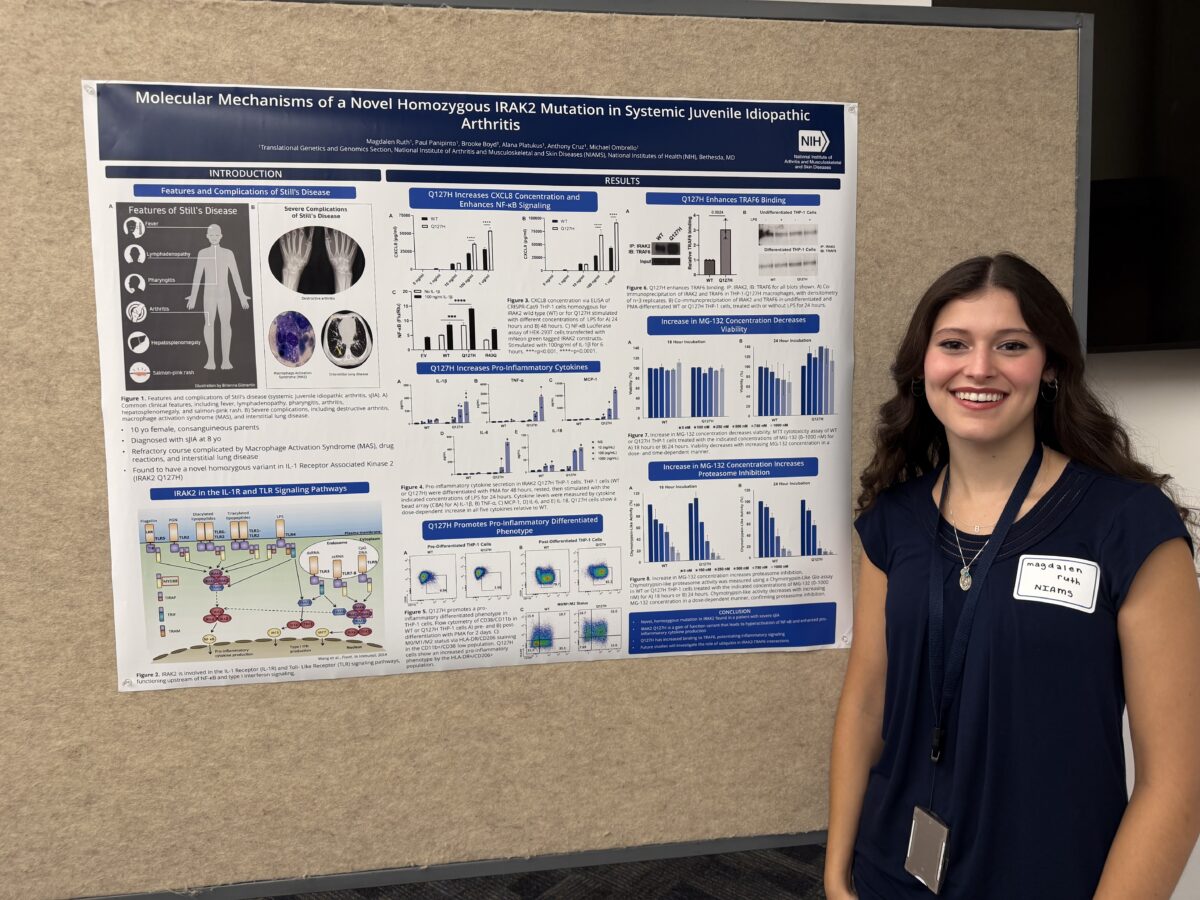 At the conclusion of her NIH internship, Magdalen Ruth presented her summer research on the role of a particular genetic mutation in a rare form of juvenile arthritis. (Courtesy of Ruth)
“I feel like I’m doing really important work,” Ruth, a Meyerhoff and U-RISE scholar, says. “Getting to know the patient’s diagnosis and being able to see that what I’m working on is affecting an actual person in real time has been awesome.” The internship has confirmed her interest in pursuing a career in pharmacology. It’s also stretched her communication skills. While familiar with presenting her work to colleagues in Deepak Koirala’s lab group at UMBC, communicating her research to a mix of researchers and clinicians—who don’t all share the same jargon and expertise—taught her the nuance of communicating with technical and non-technical audiences.
The Meyerhoff community helped make the opportunity possible. “I would not be in the place I am without Meyerhoff,” she notes. On campus, Ruth balances research and leadership as vice president of the STEM Ph.D. Society, a student-run organization designed to help students connect with scholarships, internships, graduate schools, and more. She also takes dance classes, is pursuing a music minor, and volunteers at her family’s Catholic parish—nurturing connections that ground her amid rigorous academic work.
Protecting lives, growing a career
Mark Harrison, a senior biological sciences major who started in chemical engineering, is in his third summer at Aberdeen Proving Ground (APG), a U.S. Army installation in Aberdeen, Maryland. His work involves designing and testing gas masks, bridging his early engineering training and his understanding of physiology. “I’m able to bring an understanding of what a warfighter may be experiencing in their body while wearing a gas mask in a way that others at APG may not,” Harrison says.
His mentors at APG, Jon Sampson ’03, mechanical engineering, and Edward Parshley ’06, chemical engineering, value the perspective Harrison brings and have supported his growth. “They made it clear that they want to reach back and offer opportunities to those coming behind them,” he says. They are making good on that commitment: Harrison will stay on board at APG this fall, and the plan is to transition him into a full-time position after he graduates in December. “They were always asking me what I wanted to learn and then giving me related opportunities,” Harrison says. “I could ask anyone how something worked, and they’d take the time to explain it to me. I’m so grateful for the way they’ve invested in me.”
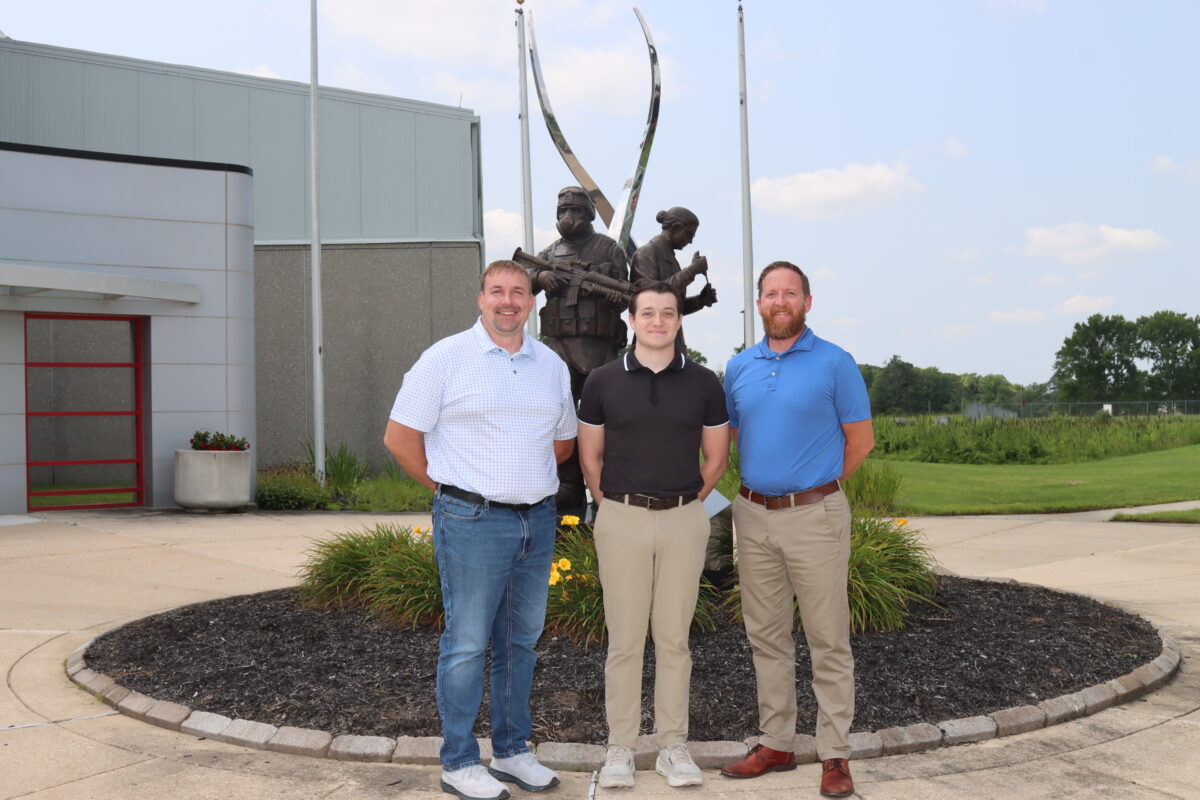 UMBC alumni Jonathan Sampson (right) and Ed Parshley (left) have mentored Mark Harrison (center) over the last two-plus years as he completed three internships at Aberdeen Proving Ground. (Courtesy of Harrison)
Interning in a fast-paced, interdisciplinary environment has also changed how Harrison operates in the classroom. “I learned how to learn at APG,” he says. “Now I don’t have to spend as much time studying, because when I leave class I already have a good understanding of the material. I’m connecting the dots so much better than before.” For Harrison, the work has taken on personal meaning, as well. “I’m fighting right now to try to protect American lives—that’s why I’m here.”
Translating discovery into treatment
Zainab Idowu, a senior biochemistry and molecular biology major and a Meyerhoff Scholar, interned at pharmaceutical giant AstraZeneca in Gaithersburg, Maryland, joining a robust group of Retrievers who’ve grown their skills there. Her project involved testing flow cytometers, which count and characterize individual cells and are used in manufacturing cell therapy treatments. Her goal was to determine the instrument and protocols that would be simplest and most effective for manufacturing teams to implement. The experience shifted Idowu’s focus toward translational medicine and reinforced her plans for an M.D./Ph.D. after UMBC. But the people around her made the biggest impression.
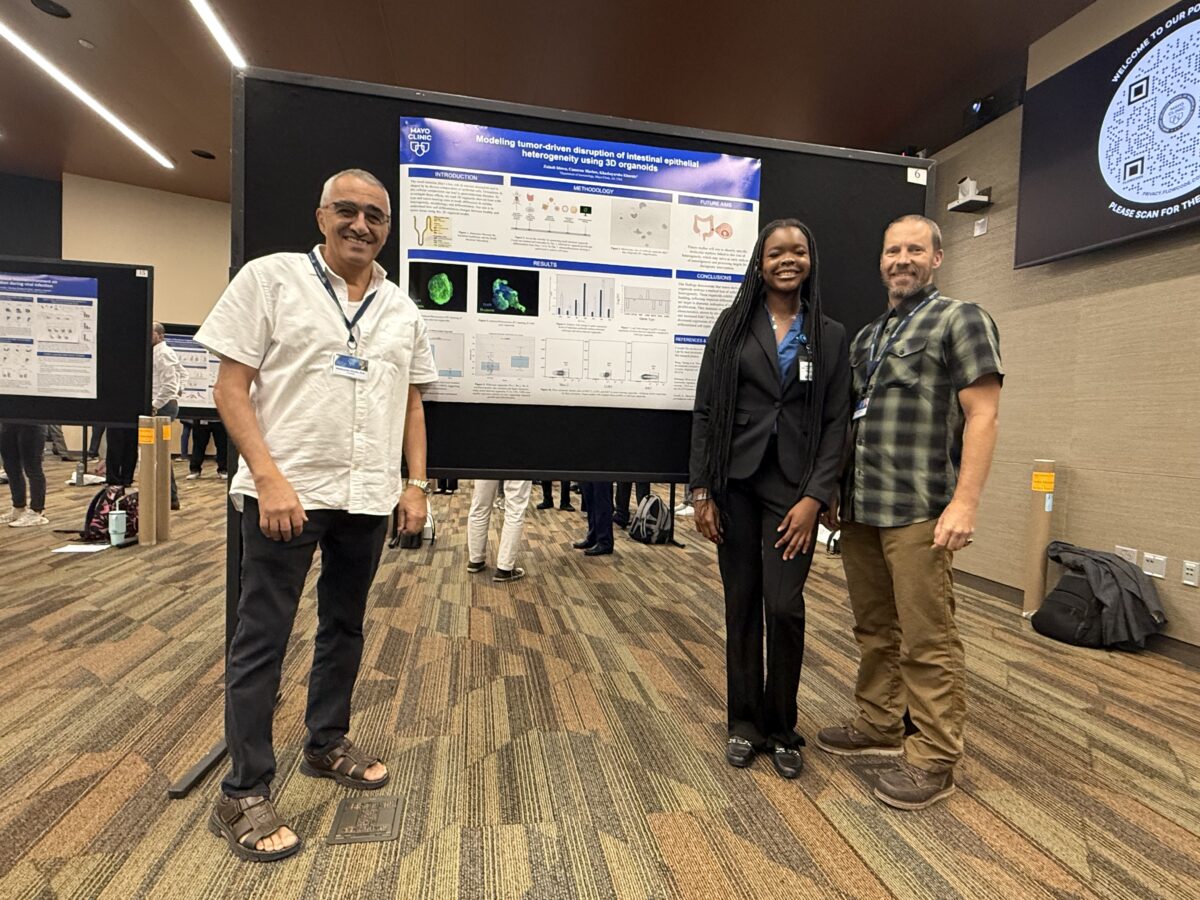
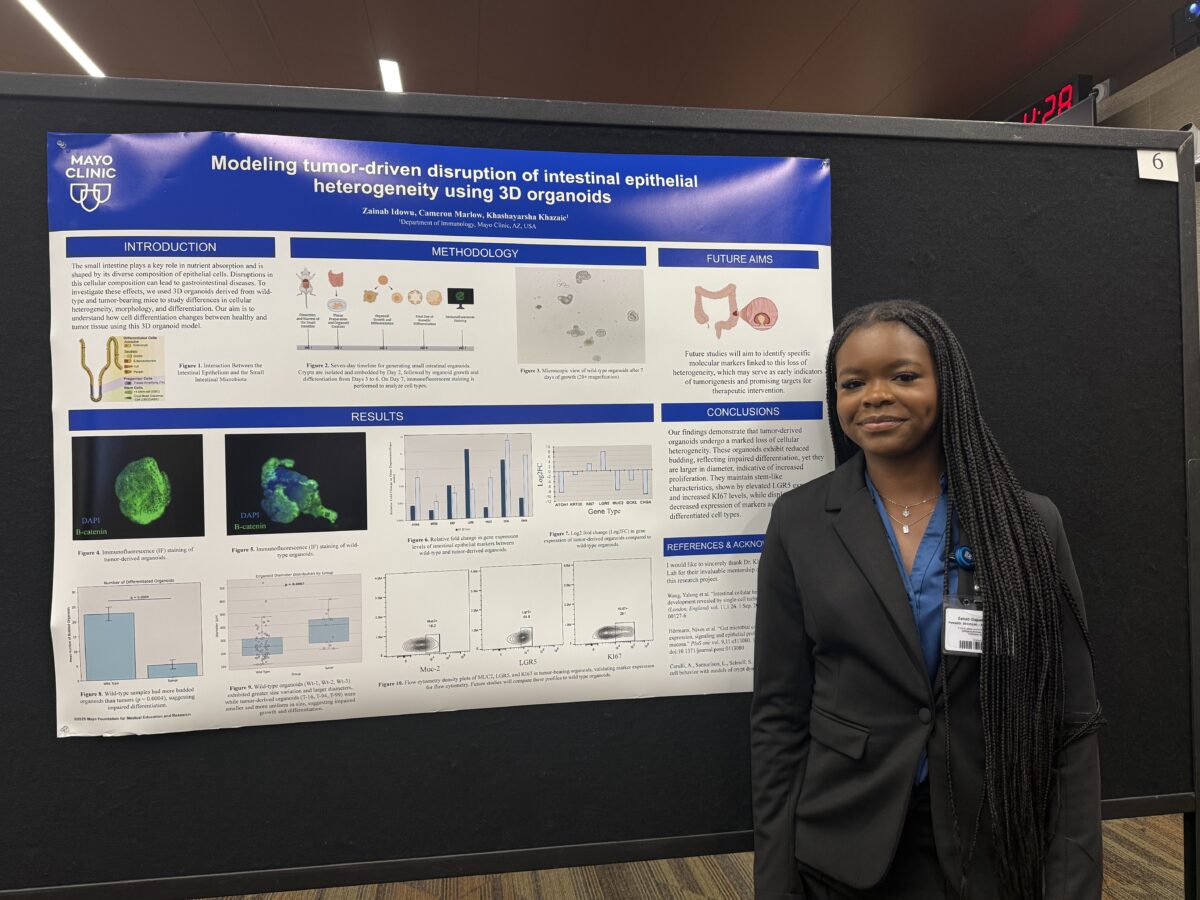 Zainab Idowu presented a research poster at the conclusion of a previous internship at the Mayo Clinic. She was supported by two mentors at the Mayo Clinic, Khashayarsha Khazaie (far left) and Cameron Marlow. (Courtesy of Idowu)
“I love everyone on my team,” Idowu says. “My managers, Ashley Ruddy and Jen Fox, were really insightful—giving me advice on what I want to do post-grad and what I should do my senior year to make sure I’m well-positioned for after graduation.” And when she had questions, the collaborative atmosphere showed her how scientists work together. “They were able to give recommendations and point me to scientific literature to help me along,” she says.
Opportunities through Meyerhoff gave her the chance to connect with AstraZeneca staff, which helped her secure the internship. “I was able to talk to them about my passions for research,” she says. Roles with UMBC’s chapters of the Society of Women Engineers, the international professional medical fraternity Phi Delta Epsilon, the National Society of Black Engineers, and the African Students Association have also enriched her UMBC experience. These organizations, she says, offered “a place to be ourselves, find new friends, and really build a home here at UMBC.”
The benefit of seeing both sides
 Saeed Damadi (left) and his wife Sepideh Hematian at her graduation from UMBC’s master’s program in data science.
Saeed Damadi recently defended his Ph.D. thesis in applied mathematics after beginning in electrical engineering. This summer at the FDA, he developed a mathematical model for how illicit drugs taken during pregnancy transfer to the developing baby through the placenta—increasing important understanding in a situation where human testing would be profoundly unethical.
While the math was familiar, Damadi welcomed the new challenge of jumping into biology. “I learned so many things, and I am still learning,” he says. Yet he found that his interest in how to describe randomness mathematically, which led him to complete a master’s in statistics on the way to his Ph.D., was highly relevant to studying the quirks of the human body. Looking ahead, he wants to continue work at the interface of biology and mathematics.
“Hopefully in the future I can make a contribution by bridging fields,” Damadi says, “because you can computationally simulate millions of parameters and patients at once, which makes the rate of iteration and discovery much faster.” The work Damadi and colleagues do with simulations can help effectively target limited resources for expensive and lengthy clinical studies, he explains.
Damadi and his wife, Sepideh Hematian, M.S. ’23, data science, and a former data scientist at the Maryland Department of Human Services, are planning to build their lives in California. They are both thriving, but “sometimes I get emotional thinking about UMBC,” Damadi says, “because after I arrived nine years ago from Iran, it became like a home to me and my wife.”
 Saeed Damadi (center) with his wife Sepideh Hematian (third from right), Ph.D. advisor Jinglai Shen (third from left), and the rest of his thesis committee and other members of the UMBC math faculty at his Ph.D. defense. (Courtesy of Damadi)
Damadi has given back through his teaching. As an engineer, “I just learned how to use the mathematical tools without understanding what was going on behind the scenes,” he says. Whereas, in math, “you learn the origins of all the theorems and how they work, but not necessarily how to apply them. I feel super lucky to get to see both sides.” So, in undergraduate calculus and linear algebra courses, “I just wanted to explain to my students, ‘Why do you need these equations? Why are they important?’ and give them a feeling of gratitude.”
Gratitude threads through all four of these journeys—for mentors who reach back, for teams that invest in their members, for communities that feel like home, and for the chance to do work that matters. As Magdalen Ruth at NIH puts it, “I’ve just found myself in a great spot with UMBC. I feel really blessed to have had all the opportunities I’ve had. Being able to do these internships has seriously been great.”
]]>
Every morning this summer, junior biological sciences major Magdalen Ruth made her way to the National Institutes of Health in Bethesda—a dense hub of biomedical research. There, at the National...
https://umbc.edu/stories/cnms-interns-mentorship-belonging-opportunity/
https://my3.my.umbc.edu/api/v0/pixel/news/161797/guest@my.umbc.edu/dacd98bb3662b16e6b4733ee94746d77/api/pixel
alumni
biology
career-center
chemical-biochemical-and-environmental-engineering
chemistry-and-biochemistry
cnms
coeit
community
data-science
internships
mathstat
meche
meyerhoff-scholars
science-and-tech
stories
story
undergraduate-research
urise
UMBC News & Magazine
https://my3.my.umbc.edu/groups/umbc-news-magazine
https://assets1-my.umbc.edu/system/shared/avatars/groups/000/001/943/24435aa6207c452e7bc15cc74b42c7bb/xsmall.png?1748556657
https://assets1-my.umbc.edu/system/shared/avatars/groups/000/001/943/24435aa6207c452e7bc15cc74b42c7bb/original.png?1748556657
https://assets2-my.umbc.edu/system/shared/avatars/groups/000/001/943/24435aa6207c452e7bc15cc74b42c7bb/xxlarge.png?1748556657
https://assets2-my.umbc.edu/system/shared/avatars/groups/000/001/943/24435aa6207c452e7bc15cc74b42c7bb/xlarge.png?1748556657
https://assets3-my.umbc.edu/system/shared/avatars/groups/000/001/943/24435aa6207c452e7bc15cc74b42c7bb/large.png?1748556657
https://assets1-my.umbc.edu/system/shared/avatars/groups/000/001/943/24435aa6207c452e7bc15cc74b42c7bb/medium.png?1748556657
https://assets2-my.umbc.edu/system/shared/avatars/groups/000/001/943/24435aa6207c452e7bc15cc74b42c7bb/small.png?1748556657
https://assets1-my.umbc.edu/system/shared/avatars/groups/000/001/943/24435aa6207c452e7bc15cc74b42c7bb/xsmall.png?1748556657
https://assets2-my.umbc.edu/system/shared/avatars/groups/000/001/943/24435aa6207c452e7bc15cc74b42c7bb/xxsmall.png?1748556657
UMBC News & Magazine
1
0
false
Thu, 20 Aug 2026 12:10:24 -0400
Thu, 20 Aug 2026 12:10:24 -0400
Mentorship and momentum: How UMBC support propelled six students into HHMI’s first Cech Fellows cohort
This summer, six rising juniors from UMBC are among the 176 undergraduates nationwide selected for the inaugural cohort of the Howard Hughes Medical Institute’s (HHMI) Cech Fellows program. Named for Nobel laureate Thomas R. Cech, the nine-week research experience pairs promising students with HHMI scientists at top institutions across the country. For these Retrievers, the fellowship is more than a prestigious opportunity: It’s a culmination of support, community, and hands-on experiences at UMBC that have opened doors.
Amir Walton-Irvin, a computer engineering major and an Undergraduate Research Training Initiative for Student Enhancement (U-RISE), HHMI, Meyerhoff, and Goldwater Scholar, is spending his summer at MIT as a Cech Fellow and an MIT Summer Research Program in Biology intern. As a member of Steven Flavell’s research group, he’s developing deep learning methods to analyze brain imaging data from C. elegans—a microscopic roundworm with just 302 neurons used as a model organism in research. The work builds directly on Walton-Irvin’s research at UMBC with Tulay Adali, professor of computer science and electrical engineering, where he uses fMRI to investigate how environmental factors affect the brains of neurologically healthy adults. “This jump allows me to explore how contextual and physiological factors reshape the functional organization of the nervous system,” he explains.
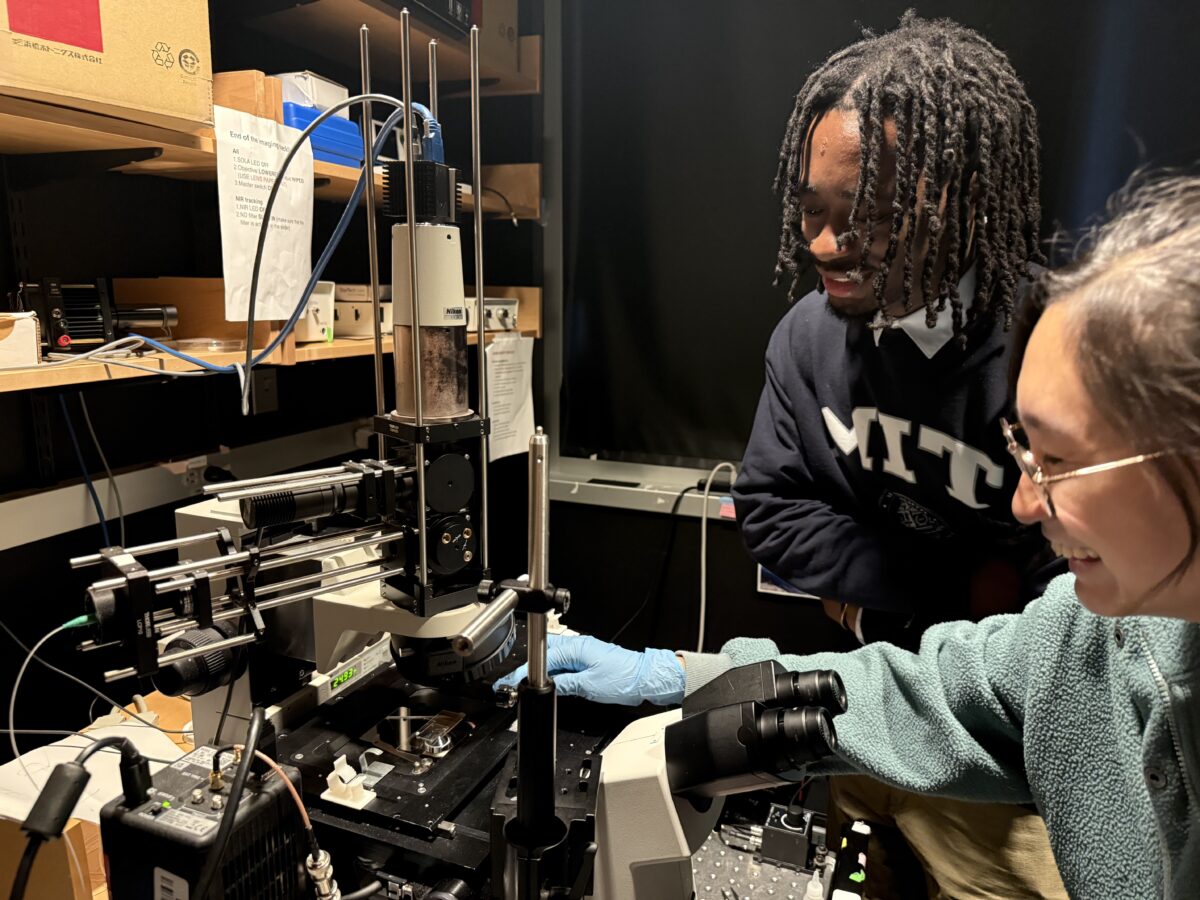 Amir Walton-Irvin (left), and a Ph.D. student in the Flavell Laboratory perform confocal microscopy. (Courtesy of Walton-Irvin)
Walton-Irvin’s path to Flavell’s lab started with the Quantitative Methods Workshop (QMW) at MIT, a seven-day professional development program that the Meyerhoff Scholars Program nominated him for. There, group lunches with faculty and sessions on machine learning in neuroscience, protein folding, and genomic sequencing sparked lasting connections. In particular, a lunch with Flavell led to ongoing conversations that aligned with the Cech opportunity, which is now creating fresh networking opportunities. Walton-Irvin’s leadership roles in the National Society of Black Engineers and UMBC’s chapter of the Institute of Electrical and Electronics Engineers have created further opportunities for networking with peers and mentors.
Shared ambition supports success
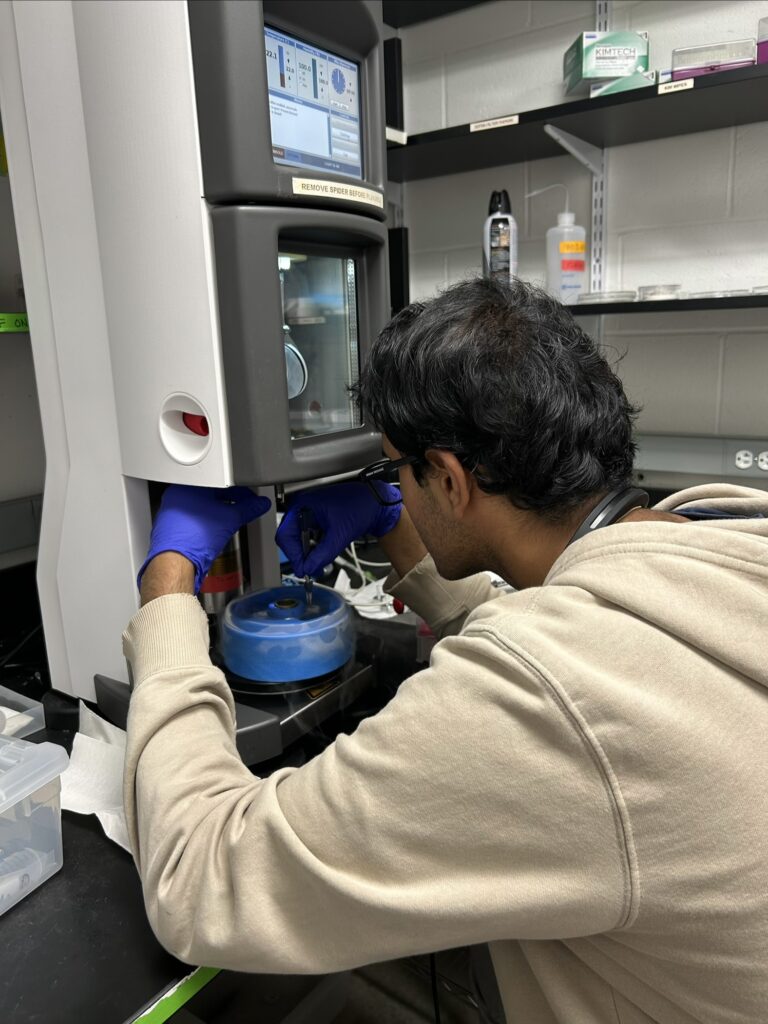 Aryan Srivastava is pursuing virology research
in the Harrison Lab at Harvard.
(Courtesy of Srivastava)
Aryan Srivastava, a dual degree student in biochemistry and molecular biology and bioinformatics and computational biology, is diving into structural virology in Stephen C. Harrison’s lab at Harvard. As president of both the Honors College Council and the Bioinformatics and Computational Biology Association, and a Meyerhoff, HHMI, and U-RISE scholar, Srivastava has built a strong scientific identity at UMBC: In his first year, he began conducting research with Michael Summers, HHMI Investigator and professor of chemistry and biochemistry.
A talk Harrison gave at an HHMI Science Meeting inspired Srivastava; financial support from his scholars programs had made his attendance possible. That encounter combined with his ongoing structural HIV research in the Summers Lab positioned him to pursue the Cech Fellowship. With Harrison, he will further explore the complex ways viruses enter cells that Harrison discussed at the meeting.
“Meeting peers who share your ambitions is one of the most important things an undergraduate can do,” Srivastava says. He also participated in the QMW at MIT, and roles in student organizations have connected him with program directors at federal grantmaking agencies, graduate students, and even Nobel laureates. Those relationships continue to pay dividends in Boston, where he’s reconnected with UMBC alumni like Arjun Kanjarpane ’24, biochemistry and molecular biology, a Ph.D. student at Harvard.
From participation to leadership
Silvi Shah, a Meyerhoff Scholar studying biochemistry and molecular biology, is in Elizabeth Engle’s lab at Boston Children’s Hospital, affiliated with Harvard Medical School and the Broad Institute. Shah’s neuroscience research with Weihong Lin at UMBC, where she is examining the effects of e-cigarette vapor on the olfactory system and behavior in mice, sparked her interest in deepening her mechanistic understanding of the brain by focusing on biomarkers for neurodevelopmental disorders.
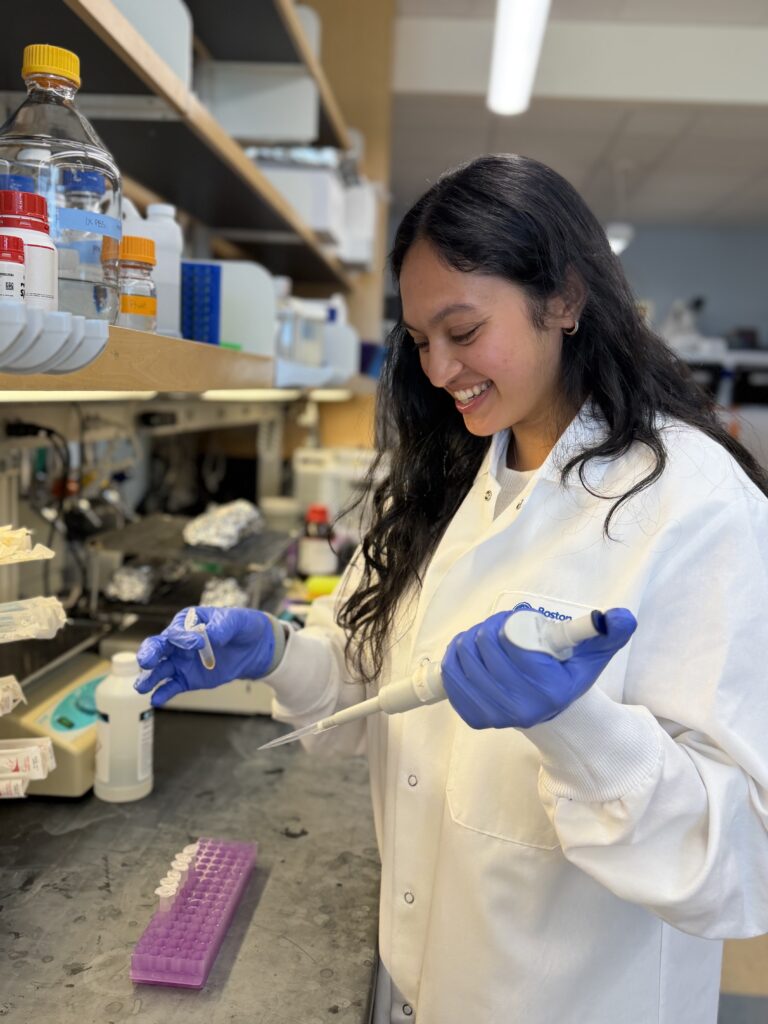 Silvi Shah is conducting neuroscience research with Elizabeth Engle at the Harvard Medical School. (Courtesy of Shah)
Being a member of the Meyerhoff, HHMI, and U-RISE scholars programs, and taking on leadership roles in Meyerhoff and the Phi Delta Epsilon Medical Fraternity, built Shah’s confidence and supplied community and mentorship. She connected with Harvard neuroscientist Beth Stevens at an HHMI Science Meeting, who introduced her to the Engle Lab. Award-winning presentations at the Annual Biomedical Research Conference for Minoritized Students (ABRCMS) and interactions with Nobel laureates, renowned faculty, graduate program directors, and alumni have broadened her perspective, she says.
In Boston, she’s reconnecting with scientists from the HHMI meeting and tapping into the Meyerhoff alumni network. “I am developing advanced research techniques and approaches that I would not have otherwise had the opportunity to learn at this stage of my education. These experiences have strengthened my commitment to an M.D./Ph.D. and a career in pediatric neuroscience research,” she shares.
Meanwhile, Nina-Simone Hunter, a biological sciences major, Meyerhoff, HHMI, and U-RISE Scholar, is at Cornell University in Liz Johnson’s lab. The group’s integration of microbiology, biochemistry, genomics, and molecular biology perfectly matches her interests and future Ph.D. plans, she says.
Preparation for the national stage
Nahom Getachew, a biochemistry and molecular biology major, Meyerhoff and HHMI Scholar, and Ethiopian immigrant, initially doubted research was for him, but opportunities at UMBC changed that, he says. Getachew attended an HHMI Science Meeting and ABRCMS with support from the Meyerhoff program. Squire Booker, a University of Pennsylvania biochemist and HHMI Investigator, spoke at both events, and Getachew asked follow-up questions about his work and the opportunity to contribute—which is now being realized through the Cech Fellows program.
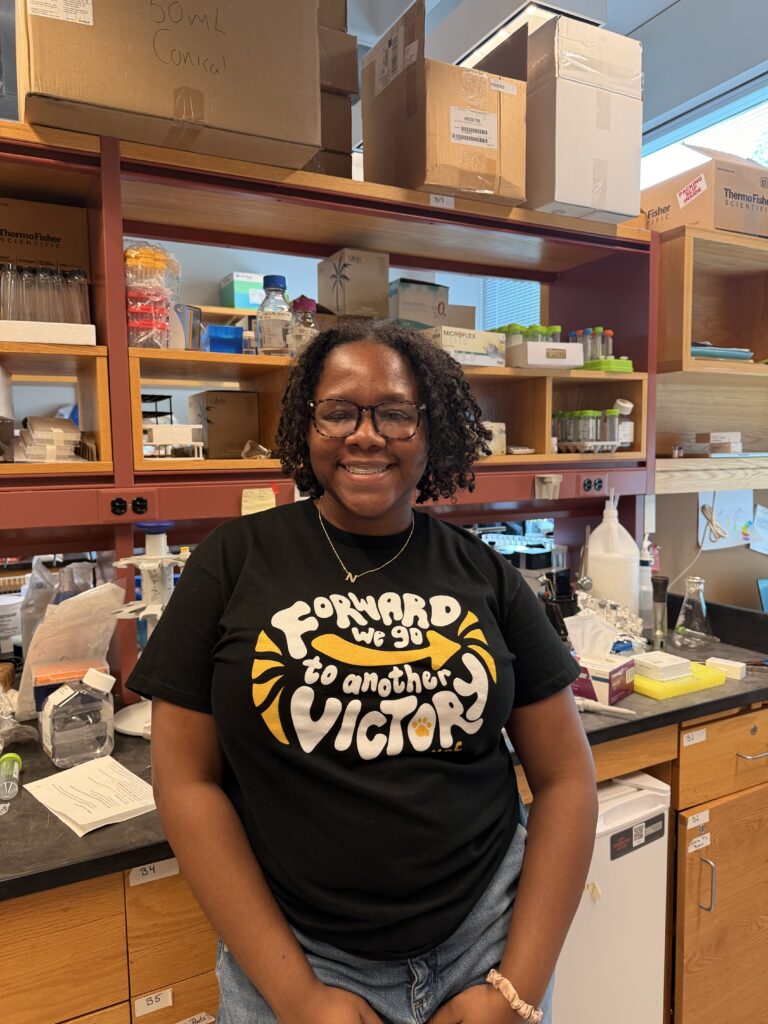 Nina-Simone Hunter is integrating microbiology, biochemistry, genomics, and molecular biology in Liz Johnson’s lab at Cornell. (Courtesy of Hunter)
“Networking is one of the most important skills for finding summer research opportunities,” Getachew notes. In addition to Booker, he connected with a Cech program coordinator at ABRCMS. Getachew prepared for national conferences by practicing communicating his work under Marcin Ptsazek, associate professor of chemistry and biochemistry, at UMBC’s Summer Undergraduate Research Fest and Undergraduate Research and Creative Achievement Day.
Now in the Booker Lab, he’s mastering new techniques in a drug discovery project, presenting results at the Cech Fellows Research Symposium at HHMI’s Janelia Research Campus, and connecting with peers who share similar goals, including fellow UMBC Cech Fellow Djina Awungnjia, a biological sciences major and McNair Scholar. All six UMBC fellows will present at the culminating symposium at HHMI Janelia, further expanding their national network.
As these Cech Fellows advance ambitious projects—from neural imaging analysis and virus structures to drug discovery and neurodevelopment—they carry forward skills, relationships, and confidence cultivated at UMBC through scholars programs, faculty mentorship, student organizations, and more.
Getachew says that the experience has reinforced his pursuit of an M.D./Ph.D. in translational clinical research: “This program has shown me what I am capable of.”
Learn more about UMBC’s premier scholars programs.
]]>
This summer, six rising juniors from UMBC are among the 176 undergraduates nationwide selected for the inaugural cohort of the Howard Hughes Medical Institute’s (HHMI) Cech Fellows program. Named...
https://umbc.edu/stories/six-umbc-students-hhmis-first-cech-fellows-cohort/
https://my3.my.umbc.edu/api/v0/pixel/news/161437/guest@my.umbc.edu/855db29b67be4bceb38339e83e52dbd3/api/pixel
biochemistry-and-molecular-biology
bioinformatics-and-computational-biology
biology
cnms
coeit
community
computer-engineering
csee
feature
honors-college
mcnair-scholars
meyerhoff-scholars
science-and-tech
stories
story
UMBC News & Magazine
https://my3.my.umbc.edu/groups/umbc-news-magazine
https://assets1-my.umbc.edu/system/shared/avatars/groups/000/001/943/24435aa6207c452e7bc15cc74b42c7bb/xsmall.png?1748556657
https://assets1-my.umbc.edu/system/shared/avatars/groups/000/001/943/24435aa6207c452e7bc15cc74b42c7bb/original.png?1748556657
https://assets2-my.umbc.edu/system/shared/avatars/groups/000/001/943/24435aa6207c452e7bc15cc74b42c7bb/xxlarge.png?1748556657
https://assets2-my.umbc.edu/system/shared/avatars/groups/000/001/943/24435aa6207c452e7bc15cc74b42c7bb/xlarge.png?1748556657
https://assets3-my.umbc.edu/system/shared/avatars/groups/000/001/943/24435aa6207c452e7bc15cc74b42c7bb/large.png?1748556657
https://assets1-my.umbc.edu/system/shared/avatars/groups/000/001/943/24435aa6207c452e7bc15cc74b42c7bb/medium.png?1748556657
https://assets2-my.umbc.edu/system/shared/avatars/groups/000/001/943/24435aa6207c452e7bc15cc74b42c7bb/small.png?1748556657
https://assets1-my.umbc.edu/system/shared/avatars/groups/000/001/943/24435aa6207c452e7bc15cc74b42c7bb/xsmall.png?1748556657
https://assets2-my.umbc.edu/system/shared/avatars/groups/000/001/943/24435aa6207c452e7bc15cc74b42c7bb/xxsmall.png?1748556657
UMBC News & Magazine
0
0
false
Tue, 04 Aug 2026 16:06:03 -0400
Tue, 04 Aug 2026 16:06:03 -0400
“The Meyerhoff Effect”—Alycia Marshall ’95 multiplies opportunities for underrepresented students and faculty
They say a rising tide lifts all ships—the idea that when an ecosystem prospers, everyone within it is propelled upward by the same powerful current. The same can be said for UMBC’s Meyerhoff Scholars Program. At least that was the experience of Alycia Marshall ’95, mathematics. The Meyerhoff tide eventually lifted her higher than she imagined: president of the Community College of Philadelphia.
As an undergraduate student at UMBC, Marshall wasn’t a Meyerhoff Scholar by title, but she felt like one by proximity. Many of her friends were Meyerhoff Scholars. Her peers were Meyerhoff Scholars. Her line sisters Sigma Gamma Rho Sorority Incorporated were Meyerhoff Scholars. Everywhere she turned, she was surrounded by Meyerhoff Scholars.
“Even though I wasn’t a Meyerhoff, I was sucked into this culture of high achievement,” says Marshall. “I call it ‘the Meyerhoff Effect.’”
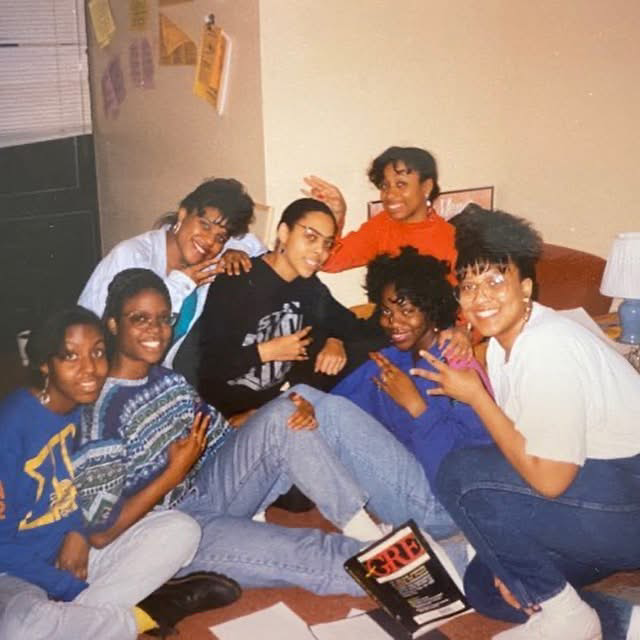
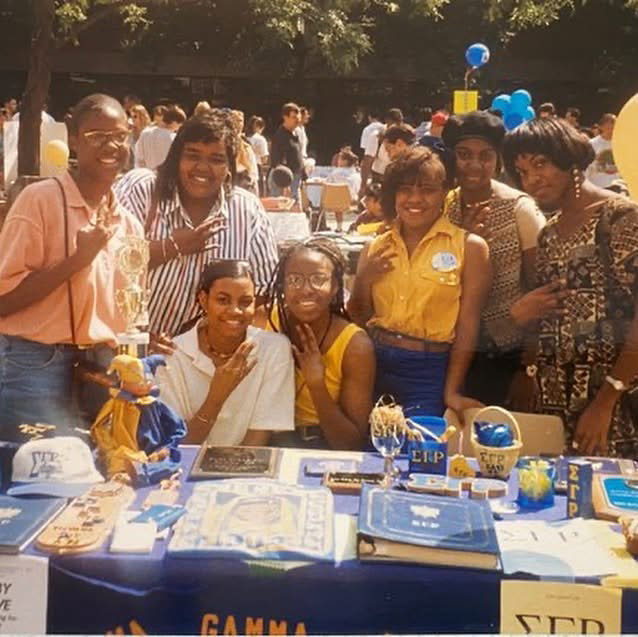
Pictured above: Marshall and members of Sigma Gamma Rho Sorority Incorporated on campus.
Brilliance was the baseline, and everyone strived to do their absolute best. It became a friendly peer-to-peer competition. But more than that, for Marshall, it was inspiring to see so many high-achieving Black students in one place, pushing each other to be the best versions of themselves.
“I had been in talented and gifted classes my entire school career,” says Marshall. “I was used to being around high-achieving students, but I was always the one person of color in the room. I was just floored to actually see so many people that looked like me who were high achieving at one time, in one place.”
For Marshall, that “Meyerhoff Effect” caused a fundamental shift in her internal barometer for success. She began to see her own potential through a wider lens—one that would eventually take her from a shy undergraduate student at UMBC to the President’s Office at CCP.
The teaching bug
Marshall started her UMBC journey as a biology major. Math and teaching were not even on her radar as potential careers—but that all changed pretty quickly during Marshall’s first year. Her “aha moment” occurred during a Calculus 1 lecture. Marshall was doing well in the course, but she knew she could do even better. She wanted that “A.” So, when the professor offered extra credit to anyone who could go to the board and explain the solution to a problem, Marshall couldn’t help herself. While other students were intimidated by the hundreds of students in that lecture hall class, and the difficulty of the material, Marshall regularly volunteered. She found that she wasn’t just good at solving the equations—she was good at communicating the logic behind them. “I got something out of that,” she says. Before she knew it, her classmates were asking to study with her, and Marshall started tutoring a few of her peers.
“That experience encouraged me to think about mathematics and teaching as a profession,” says Marshall.
After graduating from UMBC in 1995 with a B.S. in mathematics, Marshall began her teaching career at Bishop McNamara High School, a private school in Forestville, Maryland, before moving to Frederick Douglass High School, a public school in Prince George’s County. Around the same time, she began a master’s program at Bowie State University, eventually earning her masters of arts in teaching in 1998. Then, she got the higher education itch.
Education that changes lives
“I was very intrigued by the idea of teaching at the college level,” says Marshall, who quickly found an adjunct role at Anne Arundel Community College (AACC), teaching developmental math part-time. She was teaching high school students during the day and non-traditional college students twice a week in the evenings for AACC at Fort George G. Meade, a United States Army installation in Maryland.
“That was a whole different experience for me,” says Marshall, “understanding how important education was and how people were seeking that to change their lives.”
She was hooked. So, when a full-time position opened up, Marshall jumped at the opportunity and for the next 23 years she built an impressive career at AACC. During this time, Marshall also earned a Ph.D. in mathematics education from the University of Maryland, College Park in 2007. Her career saw her move from a professor of mathematics to the first African American woman to chair the department. Eventually, she worked her way up to associate vice president of learning and academic affairs. However, the work Marshall says she is most proud of is what she’s done throughout her career to support underrepresented students in STEM and leadership—an effort to replicate aspects of the Meyerhoff Scholars Program at the community college level.
When the idea initially occurred to Marshall, the first thing she did was reach out to her mentor, Freeman Hrabowski, III, UMBC president emeritus. He invited Marshall and AACC leaders to UMBC to meet with him and LaMont Toliver, then the director of the Meyerhoff Scholars Program and assistant dean of undergraduate education.
“It was great,” says Marshall. “That never would have happened had it not been for my connection to UMBC, my relationship with Dr. Hrabowski, and his continued interest in supporting me well beyond my graduation.”
The UMBC field trip and a National Science Foundation grant helped Marshall start the Engineering Scholars Program at AACC, connecting underrepresented students with scholarships, mentoring, and support services. Marshall also created the African American Leadership Institute to develop highly qualified, diverse leaders through targeted leadership development to improve the retention rates for this population and increase the diversity of college leadership.
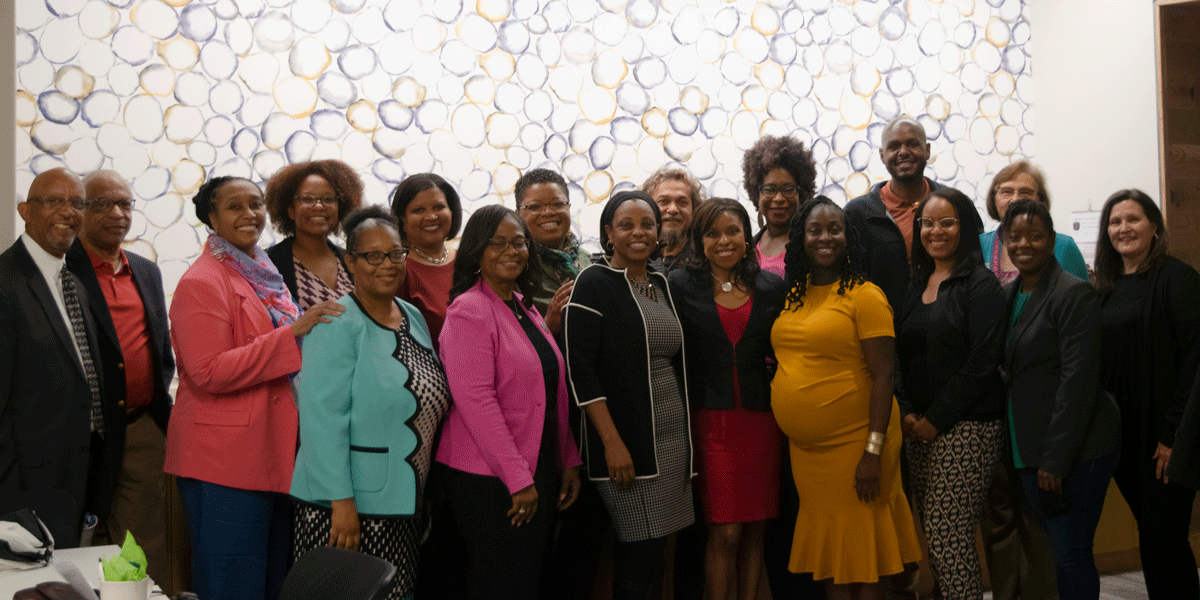 Marshall (center) at the African American Leadership Institute (AALI) closing session at Anne Arundel Community College (AACC).
For years after that, whenever Hrabowski was in a room with Marshall, he would introduce her with a bold proclamation: “This is Dr. Marshall. She’s a UMBC graduate, and she’s going to be a president one day.”
“When Doc pours into people that way, he has a way of speaking their future into them,” says Marshall. “I leaned on that. Knowing that he knew I could do it helped me know I could do it, too.”
Marshall left AACC in 2022 to become the provost and vice president for academic and student success at the Community College of Philadelphia (CCP). And it didn’t take long for her to make an impact. Soon after joining CCP, Marshall started the Aspiring Leaders Fellowship Program for employees interested in moving into higher education leadership roles. The program, now in its third cohort, matches participants with senior leaders from different institutions who serve as mentors.
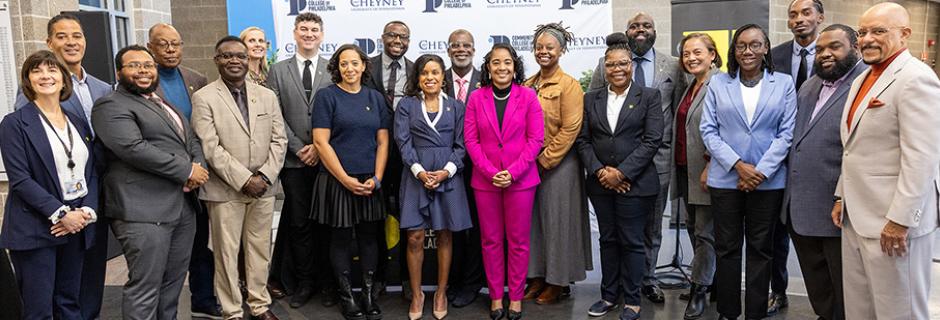 Marshall (center) and members of the Aspiring Leaders Fellowship Program at the Community College of Philadelphia.
Marshall also started a new faculty onboarding program to provide newly hired faculty the tools they need to succeed—time to learn ways to enhance their pedagogical practices and build on their teaching skills in their first year at CCP—as well as a new department head onboarding program.
“There’s a similar theme with all this about professional development, continuous improvement, and making sure folks have the tools that they need,” says Marshall.
In 2025, Hrabowski’s prophecy came true. Marshall was named CCP president, the first Black woman to serve in the role in a permanent capacity.
Upon receiving the news, one of Marshall’s first calls was to the man who believed in her future before she believed it herself.
“When I told Doc I got the job…he was emotional,” says Marshall. “He was so very proud of me. It was a wonderful day.”
 Marshall (center) at graduation with Cherelle Parker, the Mayor of Philadelphia, and the Community College of Philadelphia’s student graduation speaker.
]]>
They say a rising tide lifts all ships—the idea that when an ecosystem prospers, everyone within it is propelled upward by the same powerful current. The same can be said for UMBC’s Meyerhoff...
https://umbc.edu/stories/the-meyerhoff-effect-alycia-marshall/
https://my3.my.umbc.edu/api/v0/pixel/news/160598/guest@my.umbc.edu/3fd28592639581a7f925a4b10e6aab07/api/pixel
alumni
magazine
meyerhoff-scholars
story
UMBC News & Magazine
https://my3.my.umbc.edu/groups/umbc-news-magazine
https://assets1-my.umbc.edu/system/shared/avatars/groups/000/001/943/24435aa6207c452e7bc15cc74b42c7bb/xsmall.png?1748556657
https://assets1-my.umbc.edu/system/shared/avatars/groups/000/001/943/24435aa6207c452e7bc15cc74b42c7bb/original.png?1748556657
https://assets2-my.umbc.edu/system/shared/avatars/groups/000/001/943/24435aa6207c452e7bc15cc74b42c7bb/xxlarge.png?1748556657
https://assets2-my.umbc.edu/system/shared/avatars/groups/000/001/943/24435aa6207c452e7bc15cc74b42c7bb/xlarge.png?1748556657
https://assets3-my.umbc.edu/system/shared/avatars/groups/000/001/943/24435aa6207c452e7bc15cc74b42c7bb/large.png?1748556657
https://assets1-my.umbc.edu/system/shared/avatars/groups/000/001/943/24435aa6207c452e7bc15cc74b42c7bb/medium.png?1748556657
https://assets2-my.umbc.edu/system/shared/avatars/groups/000/001/943/24435aa6207c452e7bc15cc74b42c7bb/small.png?1748556657
https://assets1-my.umbc.edu/system/shared/avatars/groups/000/001/943/24435aa6207c452e7bc15cc74b42c7bb/xsmall.png?1748556657
https://assets2-my.umbc.edu/system/shared/avatars/groups/000/001/943/24435aa6207c452e7bc15cc74b42c7bb/xxsmall.png?1748556657
UMBC News & Magazine
0
0
false
Mon, 08 Jun 2026 08:23:10 -0400
Mon, 08 Jun 2026 08:23:10 -0400
Meyerhoff Scholars Program celebrates 500th Ph.D.
Marshall (center) at graduation with Cherelle Parker, the Mayor of Philadelphia, and the Community College of Philadelphia’s student graduation speaker.
]]>
They say a rising tide lifts all ships—the idea that when an ecosystem prospers, everyone within it is propelled upward by the same powerful current. The same can be said for UMBC’s Meyerhoff...
https://umbc.edu/stories/the-meyerhoff-effect-alycia-marshall/
https://my3.my.umbc.edu/api/v0/pixel/news/160598/guest@my.umbc.edu/3fd28592639581a7f925a4b10e6aab07/api/pixel
alumni
magazine
meyerhoff-scholars
story
UMBC News & Magazine
https://my3.my.umbc.edu/groups/umbc-news-magazine
https://assets1-my.umbc.edu/system/shared/avatars/groups/000/001/943/24435aa6207c452e7bc15cc74b42c7bb/xsmall.png?1748556657
https://assets1-my.umbc.edu/system/shared/avatars/groups/000/001/943/24435aa6207c452e7bc15cc74b42c7bb/original.png?1748556657
https://assets2-my.umbc.edu/system/shared/avatars/groups/000/001/943/24435aa6207c452e7bc15cc74b42c7bb/xxlarge.png?1748556657
https://assets2-my.umbc.edu/system/shared/avatars/groups/000/001/943/24435aa6207c452e7bc15cc74b42c7bb/xlarge.png?1748556657
https://assets3-my.umbc.edu/system/shared/avatars/groups/000/001/943/24435aa6207c452e7bc15cc74b42c7bb/large.png?1748556657
https://assets1-my.umbc.edu/system/shared/avatars/groups/000/001/943/24435aa6207c452e7bc15cc74b42c7bb/medium.png?1748556657
https://assets2-my.umbc.edu/system/shared/avatars/groups/000/001/943/24435aa6207c452e7bc15cc74b42c7bb/small.png?1748556657
https://assets1-my.umbc.edu/system/shared/avatars/groups/000/001/943/24435aa6207c452e7bc15cc74b42c7bb/xsmall.png?1748556657
https://assets2-my.umbc.edu/system/shared/avatars/groups/000/001/943/24435aa6207c452e7bc15cc74b42c7bb/xxsmall.png?1748556657
UMBC News & Magazine
0
0
false
Mon, 08 Jun 2026 08:23:10 -0400
Mon, 08 Jun 2026 08:23:10 -0400
Meyerhoff Scholars Program celebrates 500th Ph.D.
This spring, the Meyerhoff Scholars Program at UMBC celebrates a landmark achievement: 500 program graduates have earned a Ph.D.
The milestone highlights the program’s success as the nation’s original model for increasing diversity in science, technology, engineering, and mathematics (STEM). Grounded in high expectations and robust support, Meyerhoff Scholars consistently go on to excel in top graduate programs and lead in academia, industry, and government while mentoring the next generation. UMBC has maintained its position as the national leader in producing Black M.D./Ph.D. graduates: Between 2014 and 2024, UMBC alumni accounted for 15 percent of all such dual-degree recipients nationwide, far outpacing any other institution. UMBC is also the leader in graduating Black students who go on to earn Ph.D.s in the life sciences, math and computer sciences, and engineering.
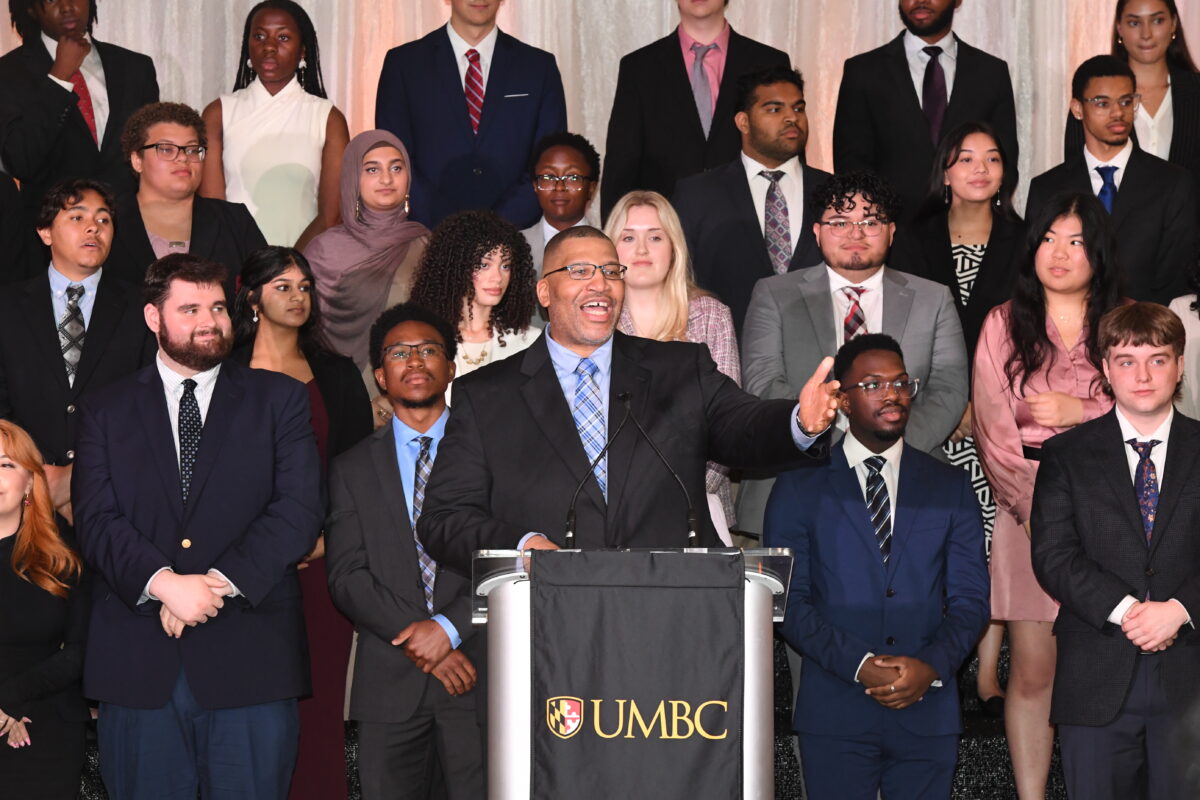 Keith Harmon, director of the Meyerhoff Scholars Program, celebrates graduating scholars at the 2024 Meyerhoff Senior Reception. (Jim Burger for UMBC)
Joseph Washington ’97, mechanical engineering, a member of the fourth Meyerhoff cohort (M4), embodies this trajectory. A first-generation college student, he initially considered trade school after a knee injury derailed his plans to attend the U.S. Naval Academy. The Meyerhoff scholarship changed his path. In particular, Selection Weekend for admitted Meyerhoff Scholars and Summer Bridge, intensive group programming prior to the scholars’ first UMBC semester, affirmed his identity and potential: “The most important message I internalized from the Meyerhoff program was that I can be Black and intelligent,” he recalls.
Washington earned a master’s degree before returning to UMBC for his Ph.D. Today, he serves as an assistant teaching professor at UMBC at the Universities at Shady Grove. He mentors students informally, advises the UMBC chapter of the American Institute of Aeronautics and Astronautics, and creates space for Meyerhoff Scholars to discuss graduate school and careers. “UMBC has always felt like home,” he says. “I would not be here if not for the Meyerhoff Scholars Program.”
A family tradition
Sadella Santos ’12, chemical engineering, M20, and her sister Melissa Santos ’12, chemical engineering, M19, also credit the program with shaping their journeys. Sadella, a senior scientist at Exponent, Inc. with a Ph.D. in chemical engineering, values the emphasis on community. “Academic success is a collective effort, rather than individual competition,” she says. “At work, I champion the message that diverse perspectives are necessary to drive scientific progress.” She pays it forward by reviewing abstracts for the Annual Biomedical Research Conference for Minoritized Scientists (ABRCMS) and hosting lab visits to expose high school students to possible careers.
 Meyerhoff Scholar alumni gathered at the 2022 Meyerhoff Family Meeting. (Marlayna Demond ’11/UMBC)
Melissa, who earned a Ph.D. in chemical engineering followed by a J.D., applies problem-solving and adaptability skills honed through Meyerhoff to her legal career. She recently participated in a panel for McNair Scholars on summer research experiences. “Community and network are important,” she notes. “Surround yourself with people who will support you but also challenge you to grow.”
Meyerhoff scholars often refer to themselves as family—and that’s especially true for the Santoses. Justin Santos ’17, biochemistry and molecular biology, M25, is the third scholar in the family. He is completing his M.D./Ph.D. in neuroscience at Emory University this spring and will begin residency in emergency medicine at Washington University in St. Louis. He mentors students pursuing clinical-scientist careers and assists with ABRCMS abstract reviews. “High-quality, comprehensive mentorship” was invaluable to him, and he works to provide that same guidance to others.
Reaching back to pay it forward
Naomi Mburu ’18, M26, chemical engineering, was UMBC’s first Rhodes Scholar, attending Oxford University on one of the world’s oldest and most prestigious scholarships. She earned a D.Phil. in engineering science from the University of Oxford and today serves as lead analyst at Fusion Advisory Services, providing analysis of the fusion industry to a wide range of stakeholders. Meyerhoff pushed her beyond her comfort zone into leadership roles and strengthened her public speaking and networking skills, she says. She now reviews scholarship essays for UMBC students and organizes summer internships to bring diverse talent into the fusion energy field. “Supporting the next generation is so important,” she says. “I have only come this far myself with the help of my own mentors.”
 From left to right, UMBC sophomore Amir Walton-Irvin, and juniors Jessica Slaughter, Deeya Mistry, and Phoenix Bryant all received a Goldwater Scholarship this year—and all four are Meyerhoff Scholars. (Brad Ziegler/UMBC)
These alumni illustrate the program’s lasting influence. Meyerhoff Scholars do not simply succeed—they reach back, creating opportunities and building communities for current students and early-career researchers. The model’s impact now extends even further: universities including Penn State, UNC-Chapel Hill, UC Berkeley, Stony Brook, and others have adapted key elements of the Meyerhoff approach with support from funders such as the Chan Zuckerberg Initiative and Simons Foundation. The Howard Hughes Medical Institutehas also been a long-term supporter of Meyerhoff and its replications.
With more than 2,200 undergraduates supported to date and a national reputation for producing leaders committed to diversity in STEM, the 500th Ph.D. stands as compelling proof of the Meyerhoff model’s effectiveness. As alumni advance in their fields and invest in those who follow, the Meyerhoff Scholars Program continues to change lives one by one, transforming the face of American science through excellence, community, and a powerful ripple effect that will benefit generations to come.
]]>
This spring, the Meyerhoff Scholars Program at UMBC celebrates a landmark achievement: 500 program graduates have earned a Ph.D. The milestone highlights the program’s success as the nation’s...
https://umbc.edu/stories/meyerhoff-scholars-program-celebrates-500th-ph-d/
https://my3.my.umbc.edu/api/v0/pixel/news/159662/guest@my.umbc.edu/842d203280497d3bf9ff4f93dcf9ec8f/api/pixel
alumni
biochemistry-and-molecular-biology
chemical-biochemical-and-environmental-engineering
chemical-engineering
chemistry-and-biochemistry
class-of-2026
cnms
coeit
community
mechanical-engineering
meche
meyerhoff-scholars
news
science-and-tech
story
UMBC News & Magazine
https://my3.my.umbc.edu/groups/umbc-news-magazine
https://assets1-my.umbc.edu/system/shared/avatars/groups/000/001/943/24435aa6207c452e7bc15cc74b42c7bb/xsmall.png?1748556657
https://assets1-my.umbc.edu/system/shared/avatars/groups/000/001/943/24435aa6207c452e7bc15cc74b42c7bb/original.png?1748556657
https://assets2-my.umbc.edu/system/shared/avatars/groups/000/001/943/24435aa6207c452e7bc15cc74b42c7bb/xxlarge.png?1748556657
https://assets2-my.umbc.edu/system/shared/avatars/groups/000/001/943/24435aa6207c452e7bc15cc74b42c7bb/xlarge.png?1748556657
https://assets3-my.umbc.edu/system/shared/avatars/groups/000/001/943/24435aa6207c452e7bc15cc74b42c7bb/large.png?1748556657
https://assets1-my.umbc.edu/system/shared/avatars/groups/000/001/943/24435aa6207c452e7bc15cc74b42c7bb/medium.png?1748556657
https://assets2-my.umbc.edu/system/shared/avatars/groups/000/001/943/24435aa6207c452e7bc15cc74b42c7bb/small.png?1748556657
https://assets1-my.umbc.edu/system/shared/avatars/groups/000/001/943/24435aa6207c452e7bc15cc74b42c7bb/xsmall.png?1748556657
https://assets2-my.umbc.edu/system/shared/avatars/groups/000/001/943/24435aa6207c452e7bc15cc74b42c7bb/xxsmall.png?1748556657
UMBC News & Magazine
0
0
false
Mon, 04 May 2026 15:15:30 -0400
Mon, 04 May 2026 15:15:30 -0400
Four UMBC student researchers receive prestigious Goldwater Scholarships
Four UMBC students have been named Barry Goldwater Scholars this year. The Barry Goldwater Scholarship and Excellence in Education Foundation supports talented college sophomores and juniors who aspire to become leading researchers in science, engineering, and mathematics in the U.S. The award is one of the most prestigious for undergraduates in STEM.
UMBC juniors Deeya Mistry, biological sciences, Jessica Slaughter, computer engineering, Phoenix Bryant, biological sciences, and sophomore Amir Walton-Irvin, computer engineering, are among the 454 scholars selected nationwide in 2026. They competed with nearly 1,500 students majoring in science, engineering, and mathematics who were nominated by their academic institutions for the award.
This is the third time that a record four UMBC students have received Goldwater Scholarships in the same year.
“I’m always so impressed by the caliber of students at UMBC,” says April Householder ’95, director of undergraduate research and prestigious scholarships, who works with students each year to prepare their Goldwater application materials. “And I’m excited to see what they do next, because this is also a springboard to even bigger and better opportunities.”
Personal stories propel curiosity
The road to a successful scientific career can be arduous, and each of this year’s UMBC Goldwater Scholars have tapped deep curiosity, a drive to make a difference, as well as nurturing family and school support, to take them to this prestigious milestone on their journeys.
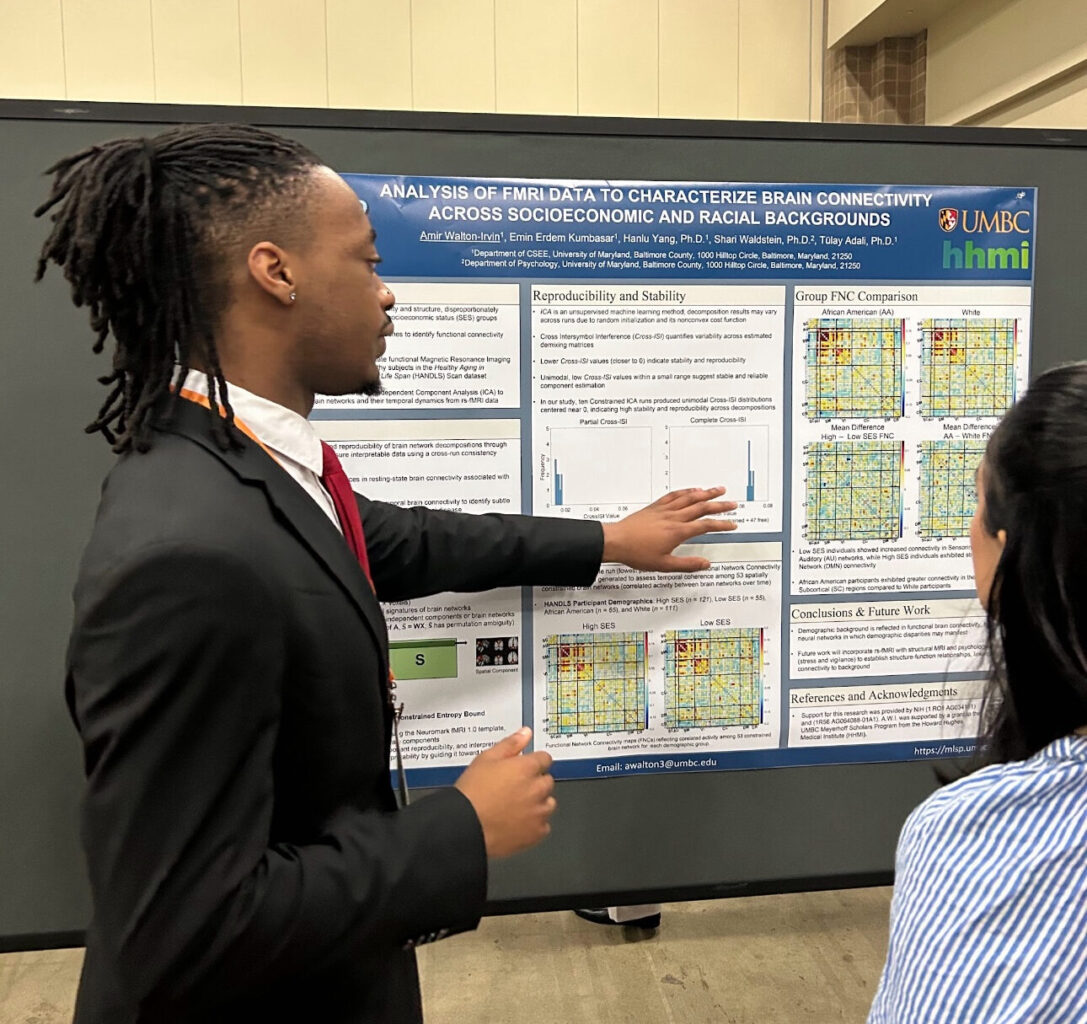 Amir Walton-Irvin presents his research at the 2025 Biomedical Research Conference for Minoritized Scientists. (Photo courtesy of Amir Walton-Irvin)
“I grew up in a household with my mom and my grandmother, who were both mathematics teachers,” Walton-Irvin says. “They both helped nurture my interest in STEM from an early age. My grandmother taught me how to solve math problems, code, and take things apart and put them back together, while my mom encouraged that curiosity by exposing me to engineering camps and science museums.”
Later, when his grandmother started showing signs of dementia, Walton-Irvin found himself facing a host of hard-to-answer questions. “She went from someone who had an answer to every question to not knowing who I was anymore. It was heartbreaking, but it also made me start asking bigger questions: Why did this happen to her, like it has to so many others before her? How does disease change brain function?” He plans to pursue a career at the intersection of machine learning and neuroscience, developing novel neuroimaging analysis methods to investigate neurological disease and health disparities.
 Jessica Slaughter working in Polina Anikeeva’s lab at MIT during a summer internship. (Photo courtesy of Jessica Slaughter)
Bryant experienced a similar personal connection to unanswered scientific questions when her dad was diagnosed with schizoaffective disorder. “I remember asking my mom: ‘Why is he like this?’ And sometimes she’d say: ‘We don’t know that yet.’ And I really wanted to know the answer,” Bryant says. She plans to enter an M.D.-Ph.D. program, and would like to study how environmental factors influence how genes are expressed and may contribute to the development of psychiatric diseases.
Mistry found herself drawn to science since grade school, working to get ever closer to that scientific frontier where new knowledge is created. “Since not everything is known yet, there’s the possibility to uncover more,” she says. “Doing scientific research is an amazing way to pursue my curiosity.” She plans to pursue an M.D.-Ph.D. with a clinical focus in emergency medicine and a Ph.D. studying the molecular makeup of individualized stroke recovery.
“While my clinical and research focuses are different from one another, I was really inspired to study this when I shadowed in the Emergency Department in downtown Baltimore,” she says. “Stroke patients usually come to the Emergency Department first, and everyone’s experience truly is different, because timing is crucial for strokes.”
Slaughter says the possibility of combining new knowledge with helping people drew her to the field of engineering, where she hopes to make a difference by improving global health, especially in disadvantaged areas where resources are limited.
Coming from a family of immigrants, Slaughter watched her grandmother travel over 5,000 miles to the U.S. for surgery, even as her health made the journey difficult. “That experience gave me a window into global healthcare disparities, especially in access to diagnostics and effective treatment, and showed me how engineering can be part of the solution,” she says. It is what drives her to develop low-cost, accessible medical devices and incorporate machine learning.
A supportive family—at home and at school
All the new scholars emphasize how much mentorship, connections, and support have helped them as they worked toward their dreams.
“One of the reasons winning this scholarship is so meaningful to me is because it was only two generations ago when women in my family did not get past a high school education,” says Mistry. She credits her parents with instilling in her a strong work ethic and the confidence to overcome challenges. “My dreams were built on the sacrifice and hard work of my parents and grandparents,” she says.
She also credits the many mentors she met at UMBC. Mistry, Slaughter, Bryant and Walton-Irvin are all part of the Meyerhoff Scholarship Program, which aims to increase diversity among future leaders in science, technology, engineering, and related fields.
“The Meyerhoff program and the COEIT community, particularly Dr. LaBerge and Dr. Marten, have been instrumental to my career,” Slaughter says.
“The advisors in the Meyerhoff program really helped me, and they’re always so supportive,” Bryant echoed.


On left, Deeya Mistry (right) with Mitsue Wiggs, associate director of the Meyerhoff program. (Photo courtesy of Deeya Mistry). On right, Jessica Slaughter (with braids) celebrates winning the limbo contest at the annual Meyerhoff Family Retreat at Centennial Park. “The Meyerhoff program isn’t just a scholarship, but also a family that celebrates every win, big or small,” she says. (Photo courtesy of Jessica Slaughter)
The students also credit their mentors in the labs where they do research on campus. Mistry is investigating the molecular mechanisms that underlie the sex differences in chronic stress susceptibility to understand why females have a higher susceptibility to chronic stress-induced psychiatric disorders such as depression and anxiety in the lab of Tara LeGates. Bryant is studying the biomechanical properties of a protein involved in chromatin regulation in the lab of Erin Green. Slaughter is applying statistical principles to develop bioinformatics applications to facilitate the analysis of dynamic, system-scale “-omics” data in the lab of Mark Marten. And Walton-Irvin is applying machine learning and signal processing methods to investigate functional brain connectivity and health disparities in the lab of Tülay Adali.
On the right path
For the four UMBC students, winning a Goldwater Scholarship is both a validation of the work they have put in so far, and a stepping stone to their next achievement.
“When I saw the email letting me know I’d been selected, I literally screamed, I was so excited,” Slaughter says. “I FaceTimed my family. I FaceTimed all my friends who helped me through this journey. I immediately sent thank you emails to all my mentors.”
Mistry messaged LeGates, her research advisor, and sprinted to her office to celebrate.
Walton-Irvin’s first response was to call his mom, as the news felt both emotional and affirming. “It meant a lot to know that the path I’m trying to build, one rooted in both personal experience and a desire to empower others, was being recognized,” he says. “Awards like this are meaningful, but I see them as part of a much larger journey of doing impactful work.”
 The Goldwater Scholars and some of their mentors strike a fun pose. Back row, from left to right, Ph.D. student Emin Erdem Kumbasar, Amir Walton-Irvin, and Professor Charles Laberge. Middle row, from left to right, Assistant Professor Tara LeGates, Deeya Mistry, Jessica Slaughter, Phoenix Bryant, and Associate Professor Erin Green; front row, April Householder. (Brad Ziegler/UMBC)
Come meet all four Goldwater Scholars at the Undergraduate Research and Creative Achievement Day on April 22 in the RAC, where they will be presenting their research alongside more than 400 other student presenters:
Deeya Mistry: “Investigation of the Circadian Rhythm on Blood Brain Barrier Permeability,” RAC 050, 9:20 – 9:35 a.m.
Phoenix Bryant: “Investigating the Function of the PHD Finger in Chromatin Regulator Set4,” RAC Arena, 10 – 11 a.m., Poster #20
Amir Walton-Irvin: “Analysis of FMRI Data to Characterize Brain Connectivity Across Socioeconomic and Racial Backgrounds,” RAC 230, 11:20 – 11:35 a.m.
Jessica Slaughter: “Open-Source Software Suite of Bioinformatic Tools for Dynamic Omics Data,” RAC Arena, 2 – 3 p.m., Poster #65
]]>
Four UMBC students have been named Barry Goldwater Scholars this year. The Barry Goldwater Scholarship and Excellence in Education Foundation supports talented college sophomores and juniors who...
https://umbc.edu/stories/umbc-goldwater-2026/
https://my3.my.umbc.edu/api/v0/pixel/news/158732/guest@my.umbc.edu/3c3d3b8609cf3cedec6939ce5b5a34a2/api/pixel
biology
cnms
coeit
community
csee
meyerhoff-scholars
news
science-and-tech
story
undergraduate-research
UMBC News & Magazine
https://my3.my.umbc.edu/groups/umbc-news-magazine
https://assets1-my.umbc.edu/system/shared/avatars/groups/000/001/943/24435aa6207c452e7bc15cc74b42c7bb/xsmall.png?1748556657
https://assets1-my.umbc.edu/system/shared/avatars/groups/000/001/943/24435aa6207c452e7bc15cc74b42c7bb/original.png?1748556657
https://assets2-my.umbc.edu/system/shared/avatars/groups/000/001/943/24435aa6207c452e7bc15cc74b42c7bb/xxlarge.png?1748556657
https://assets2-my.umbc.edu/system/shared/avatars/groups/000/001/943/24435aa6207c452e7bc15cc74b42c7bb/xlarge.png?1748556657
https://assets3-my.umbc.edu/system/shared/avatars/groups/000/001/943/24435aa6207c452e7bc15cc74b42c7bb/large.png?1748556657
https://assets1-my.umbc.edu/system/shared/avatars/groups/000/001/943/24435aa6207c452e7bc15cc74b42c7bb/medium.png?1748556657
https://assets2-my.umbc.edu/system/shared/avatars/groups/000/001/943/24435aa6207c452e7bc15cc74b42c7bb/small.png?1748556657
https://assets1-my.umbc.edu/system/shared/avatars/groups/000/001/943/24435aa6207c452e7bc15cc74b42c7bb/xsmall.png?1748556657
https://assets2-my.umbc.edu/system/shared/avatars/groups/000/001/943/24435aa6207c452e7bc15cc74b42c7bb/xxsmall.png?1748556657
UMBC News & Magazine
1
0
false
Tue, 14 Apr 2026 16:29:33 -0400
Tue, 14 Apr 2026 16:29:33 -0400
Senior Caly Ferguson recognized with National Society of Black Engineers’ ‘25 Under 25’ award
Mechanical engineering senior Caly Ferguson will be honored with a “25 Under 25” award at the upcoming meeting of the National Society of Black Engineers (NSBE), held March 18 – 22 in Baltimore. The award recognizes exceptional students and young professionals under the age of 25 who are making a measurable impact in science and technology fields through leadership, innovation, entrepreneurship, and community advancement.
Ferguson is a Meyerhoff Scholar and current president of the UMBC chapter of NSBE. Last year he was one of three UMBC students recognized with the prestigious Goldwater Scholarship, established to promote a strong STEM workforce in the U.S.
Since his first year at UMBC, Ferguson has worked in the lab of Ramana Vinjamuri, an associate professor of computer science and electrical engineering, on a project to develop a prosthetic forearm and hand. The device employs machine learning to interpret electrical signals from the nerves in the arm and translate them into desired movements of the prosthetic hand. Ferguson is interested in a career developing biomedical devices—in particular making them more affordable so that more people can benefit from them.
“I am truly blessed to be considered as one of the awardees for this esteemed honor,” Ferguson says. “I feel as though God, my family, my friends, and all of my mentors and colleagues have played such integral roles in my successes over the past years.”
 UMBC attendees at the 2025 fall regional conference of the National Society of Black Engineers. From left to right: Amir Walton-Irvin, Glen Larbie-Mansah, Jessica Slaughter, Nathan Bolima, Kayla MaGruder, and Caly Ferguson. (Image courtesy of Kayla MaGruder)
Ferguson says being a part of the NSBE community has positively shaped his career trajectory and he plans to stay involved with the society after graduation. He is running for a regional executive board position with the organization at this year’s annual meeting.
“One of the things I am most proud of is seeing the consistent growth of the organization on campus throughout my undergraduate career,” he says. “I know that this student org will continue to rise and achieve amazing feats after I graduate from UMBC.”
]]>
Mechanical engineering senior Caly Ferguson will be honored with a “25 Under 25” award at the upcoming meeting of the National Society of Black Engineers (NSBE), held March 18 – 22 in Baltimore....
https://umbc.edu/quick-posts/ferguson-nsbe-25-under-25/
https://my3.my.umbc.edu/api/v0/pixel/news/157494/guest@my.umbc.edu/7737d8cc6235ba44cb5a27df4b6f50bd/api/pixel
coeit
mechanical-engineering
meche
meyerhoff-scholars
quick-post
science-and-tech
UMBC News & Magazine
https://my3.my.umbc.edu/groups/umbc-news-magazine
https://assets1-my.umbc.edu/system/shared/avatars/groups/000/001/943/24435aa6207c452e7bc15cc74b42c7bb/xsmall.png?1748556657
https://assets1-my.umbc.edu/system/shared/avatars/groups/000/001/943/24435aa6207c452e7bc15cc74b42c7bb/original.png?1748556657
https://assets2-my.umbc.edu/system/shared/avatars/groups/000/001/943/24435aa6207c452e7bc15cc74b42c7bb/xxlarge.png?1748556657
https://assets2-my.umbc.edu/system/shared/avatars/groups/000/001/943/24435aa6207c452e7bc15cc74b42c7bb/xlarge.png?1748556657
https://assets3-my.umbc.edu/system/shared/avatars/groups/000/001/943/24435aa6207c452e7bc15cc74b42c7bb/large.png?1748556657
https://assets1-my.umbc.edu/system/shared/avatars/groups/000/001/943/24435aa6207c452e7bc15cc74b42c7bb/medium.png?1748556657
https://assets2-my.umbc.edu/system/shared/avatars/groups/000/001/943/24435aa6207c452e7bc15cc74b42c7bb/small.png?1748556657
https://assets1-my.umbc.edu/system/shared/avatars/groups/000/001/943/24435aa6207c452e7bc15cc74b42c7bb/xsmall.png?1748556657
https://assets2-my.umbc.edu/system/shared/avatars/groups/000/001/943/24435aa6207c452e7bc15cc74b42c7bb/xxsmall.png?1748556657
UMBC News & Magazine
2
0
false
Fri, 13 Mar 2026 14:10:51 -0400
Fri, 13 Mar 2026 14:10:51 -0400
Lighting the path: Jackie King’s unyielding vision
In the crisp autumn air, Jackie King laces up her running shoes, her white cane—affectionately named Amigo—tucked nearby. The UMBC alumna is training for the New York City Marathon. The effort underscores a life shaped by triumphs and relationships, rather than her gradual loss of sight.
After years of misdiagnosis, in 2017, King finally learned she had retinitis pigmentosa, a genetic condition causing progressive vision loss. Today, King is legally blind—and yet she radiates resilience and positivity. “I have chosen this,” she says firmly. “I could choose to be like, ‘Oh man, this sucks,’ every day, all day. But I’ve chosen not to.”
In her early 20s, King built a graphic design business in Baltimore, mixing paints and hand-lettering signs when she could still see clearly. But by age 30, dark flecks were regularly drifting across her field of vision, making night driving and dim spaces like movie theaters challenging.
As her vision faltered, a recurring dream of a college campus spurred her to enroll at Western Maryland College (now McDaniel College) as an art history major, but she shifted to psychology after a professor’s nudge. “I fell in love,” she recalls. “Studying behaviors and people—it seemed so natural.” King arrived at UMBC in 2002 as a Ph.D. student in human services psychology.
The vision to see others’ potential
 Jackie King (center) trains with Achilles International every Saturday. (Image courtesy of King)
King’s dissertation evaluated Baltimore’s Sisters Circle mentoring program for middle and high school girls, revealing that unstructured, long-term relationships boosted self-esteem and academic drive—and the benefits often extended to mentees’ families. Earning her Ph.D. in 2009, King joined UMBC as assistant director of the Minority Access to Research Careers (MARC) program, and today she is the associate director of the Undergraduate Research Training Initiative for Student Enhancement (U-RISE), which replaced MARC. In that role, she applies her research, guiding hundreds of students through graduate school applications and academic and personal challenges.
“I often see so much more in them than they see in themselves,” King says. “Seeing their potential is my gift—and then I get to let them in on the secret.” Sharing her own struggles with students builds trust, modeling that seeking help is a strength.
Phyllis Robinson, U-RISE director and a professor of biological sciences, praises King as “the linchpin that makes the program run smoothly.” Robinson supports King’s pursuits on and off the road, admiring her “compassionate and caring approach” amid her vision challenges.
Adapting hasn’t been easy for King, though. She hasn’t driven in a decade, and reading text on paper is now impossible. Adopting the cane 18 months ago, she admits, was “the hardest hurdle.” Yet she reframes her loss: “I would not be as compassionate or empathetic without this journey. It could have been otherwise—but the fact that it isn’t? I’m making the best of it.”
A healthy mix of challenge and community
 Jackie King (left) and her daughter, Demirise King, celebrate after racing in the Baltimore Running Festival’s half marathon on October 18, 2025. (Image courtesy of King)
Running anchored King. At age 45, she trained on UMBC’s 1.8-mile loop for her first marathon. She ran the Baltimore race with Team in Training, fundraising for the Leukemia & Lymphoma Society. As running alone grew riskier, she was thrilled when Achilles International, a nonprofit that supports athletes with disabilities, launched a Baltimore chapter in April 2024. Now, 15 to 30 athletes—visually impaired, neurodivergent, amputees, stroke survivors, and more—and their volunteer guides gather each Saturday in Patterson Park to train.
“I came for the challenge; I’ve stayed for the community,” King says. “No one’s judging your pace—6 minutes or 17. There’s a place for you with Achilles.”
After seeing how much the organization has meant to her mom, King’s daughter, Demerise King, is fundraising for Achilles International as she also trains for NYC this fall. “I’ve watched my mom navigate her vision loss for as long as I can remember,” she shares. “She’s given me a gift by illustrating what it looks like to push past obstacles. Knowing that she is safe while running with the Achilles community gives me a sense of peace.”
King’s forthcoming memoir reflects her reluctant embrace of her condition. “I did not want to be here, but I am,” she says. As King tapers for NYC, she takes a spiritual approach to her situation, affirming that “I’m preparing for what’s been prepared for me.” As her vision dims, she runs with an illuminated heart, lighting the path for hundreds of UMBC students and others along the way.
Learn more about UMBC’s Ph.D. program in human services psychology.
]]>
In the crisp autumn air, Jackie King laces up her running shoes, her white cane—affectionately named Amigo—tucked nearby. The UMBC alumna is training for the New York City Marathon. The effort...
https://umbc.edu/stories/lighting-the-path-jackie-kings-unyielding-vision/
https://my3.my.umbc.edu/api/v0/pixel/news/153881/guest@my.umbc.edu/a9434eb584636e9e467090bf1b6406f7/api/pixel
alumni
at-play
cahss
cnms
coeit
fall-2025
magazine
meyerhoff-scholars
psychology
story
urise
UMBC News & Magazine
https://my3.my.umbc.edu/groups/umbc-news-magazine
https://assets1-my.umbc.edu/system/shared/avatars/groups/000/001/943/24435aa6207c452e7bc15cc74b42c7bb/xsmall.png?1748556657
https://assets1-my.umbc.edu/system/shared/avatars/groups/000/001/943/24435aa6207c452e7bc15cc74b42c7bb/original.png?1748556657
https://assets2-my.umbc.edu/system/shared/avatars/groups/000/001/943/24435aa6207c452e7bc15cc74b42c7bb/xxlarge.png?1748556657
https://assets2-my.umbc.edu/system/shared/avatars/groups/000/001/943/24435aa6207c452e7bc15cc74b42c7bb/xlarge.png?1748556657
https://assets3-my.umbc.edu/system/shared/avatars/groups/000/001/943/24435aa6207c452e7bc15cc74b42c7bb/large.png?1748556657
https://assets1-my.umbc.edu/system/shared/avatars/groups/000/001/943/24435aa6207c452e7bc15cc74b42c7bb/medium.png?1748556657
https://assets2-my.umbc.edu/system/shared/avatars/groups/000/001/943/24435aa6207c452e7bc15cc74b42c7bb/small.png?1748556657
https://assets1-my.umbc.edu/system/shared/avatars/groups/000/001/943/24435aa6207c452e7bc15cc74b42c7bb/xsmall.png?1748556657
https://assets2-my.umbc.edu/system/shared/avatars/groups/000/001/943/24435aa6207c452e7bc15cc74b42c7bb/xxsmall.png?1748556657
UMBC News & Magazine
2
0
false
Fri, 24 Oct 2025 09:25:20 -0400
Fri, 24 Oct 2025 09:25:20 -0400
Ripples of excellence: This Meyerhoff alumnus is expanding UMBC’s legacy
“I have been in your shoes.” Erwin Cabrera ’10, biological sciences, often finds himself sharing these words during monthly meetings for Stony Brook University’s Simons STEM Scholars. Some of the bright-eyed students in front of him are the first in their family to attend college. Others may be nervous about upcoming exams or graduate school application deadlines. All are striving toward careers in STEM within the program’s supportive community—and these “family meetings” are one element of that support.
As the program’s inaugural executive director, Cabrera isn’t just leading a replication of UMBC’s renowned Meyerhoff Scholars Program: He’s channeling the same cohort spirit, rigorous support, and unyielding belief in students’ potential that transformed him from a self-described “rough around the edges” undergrad into a champion for emerging scientists from all backgrounds. On October 29, Cabrera will receive a 2025 Outstanding Alumni Award from UMBC’s Alumni Association Board of Directors.
 Erwin Cabrera gets to know students “through and through” in order to support them better. (Photo by John Griffin/Stony Brook University)
Cabrera’s journey began in Prince George’s County, Maryland. Cabrera initially resisted considering UMBC, despite his older brother, Ramon Cabrera ’09, a Meyerhoff Scholar, already thriving there. At Meyerhoff selection weekend, two days of activities for students offered admission, he changed his mind. Amid UMBC’s nerdy reputation, Cabrera saw peers who looked like him, dreamed like him, and supported one another fiercely. “I could see myself there,” he says.
Achievement grounded in love
Cabrera dove into research with Phyllis Robinson, professor of biological sciences. She “gave me a lot of grace” as he stumbled early on, Cabrera recalls, recognizing his potential before he had smoothed some of his edges. He balanced lab work with the UMBC’s Major Definition hip-hop dance team with mixed success—at his request, an advisor once showed up at rehearsal to remind him of study time. Later in his UMBC career, Cabrera, an M18 (the shorthand Meyerhoffs use to designate their cohort), served as a Meyerhoff Summer Bridge counselor and peer mentor for younger cohorts. “This is a lot of emotional labor, but super fun,” he remembers thinking of those roles, which would anticipate his career.
After UMBC, Cabrera earned a Ph.D. in neurobiology and neuroscience at the New York University Grossman School of Medicine, followed by a postdoc. Yet his heart was in administration. “I love science, but what I loved the most was teaching people in the lab and the impact it could have on folks’ lives,” he says. In 2019, he became director of the Research Aligned Mentorship (RAM) Program at Farmingdale State College, which is loosely inspired by Meyerhoff principles. It integrates research as an undergraduate retention tool, drawing economics and business students alongside STEM majors.
In October 2022, Cabrera made his next big career move, becoming the first Meyerhoff alumnus to helm a full replication. A $2.5 million Simons Foundation grant to UMBC seeded the adaptation at Stony Brook, located on Long Island, and later Stony Brook received its own major grant from Simons to fully develop its program. Now in its third year, the program mirrors Meyerhoff’s core—cohort-based community, intensive mentoring, Summer Bridge, and research immersion—while adapting for the local context.
 Alongside Stony Brook University President Andrea Goldsmith (second from right), Erwin Cabrera (second from left) speaks with Simons STEM Scholars following a recent “family meeting” for the program, an important mechanism for building community among the scholars. (Photo by John Griffin/Stony Brook University)
“New York students are very different. They’re highly independent; some of them are regularly traveling three hours on the subway,” Cabrera notes. Early challenges included combating “hyper independence,” where some scholars struggled to trust that program leaders had their best interests at heart. His solution? “I just upped that love factor,” Cabrera says. He gets to know students “through and through,” offering tough love rooted in consent: “Do you need me to show up?” he asks, while also encouraging ownership. “This is yours at the end of the day,” he reminds students.
From UMBC to New York and beyond
At Stony Brook, Cabrera wears two hats: He’s a research professor in neurobiology and behavior, teaching honors courses and advising juniors through grad school applications. He also interfaces with program funders, manages the budget and staff, and more. Somehow he also travels to Kenya and Switzerland to support study abroad partnerships.
“It’s all-encompassing,” he admits. Yet the success of the program keeps him going. Last summer, three Simons Scholars interned at Harvard and two at Stanford. “As a Meyerhoff from UMBC, I know the legacy of the program,” Cabrera says. “It’s my job to provide that vision here at Stony Brook, when this program did not exist three years ago. To see it coming to fruition is overwhelming in the best way possible.”
“Everyone’s watching. It’s pressure because I’m the first,” Cabrera confesses. But amplifying UMBC’s ripple effect feels like a privilege. Since 1988, the Meyerhoff Scholars Program has supported over 1,800 undergraduates. Alumni have earned 488 Ph.D.s—including 80 M.D./Ph.D.s—making UMBC the nation’s top baccalaureate origin for African American M.D./Ph.D. recipients. Over 70 Meyerhoff alumni hold faculty posts at elite institutions like Harvard and Duke; more than 200 are in grad programs. Meyerhoff participants are 5.3 times more likely to pursue STEM Ph.D.s than students offered admission who decline.
 Erwin Cabrera with the third cohort of Simons STEM Scholars during their Summer Bridge experience. (John Griffin/Stony Brook University)
This success has sparked over a dozen replications nationwide. HHMI’s 2013 – 2018 Meyerhoff Adaptation Project tailored the model for Penn State and UNC Chapel Hill. Howard University’s Karsh STEM Scholars and Stony Brook’s Simons initiative build on key elements like research engagement. International efforts at the University of Toronto Mississauga and University of the Philippines Los Baños adapt for local contexts, and the Chan Zuckerberg Initiative founded programs at UC Berkeley and UC San Diego. Collectively, these efforts have empowered thousands of students, turning UMBC’s vision into a movement. “I am guided by the quote, ‘To whom much is given, much is required,'” Cabrera says, highlighting his passion for his work.
Cabrera has kept in touch with Meyerhoff staff Keith Harmon and Mitsue Wiggs, who occasionally connect him with current UMBC students for mentoring, and remembers the influence of the late LaMont Toliver, an early director of the Meyerhoff program, fondly. He also stays connected through UMBC’s Filipino American Student Association and Alumni Advisory Board.
In the midst of the demands of his role, Cabrera preaches and models balance. This fall, he vacationed in Japan with his spouse. “You need to see me take a break—we’re not robots,” he says, reminding his students not to obsess over performance. “You don’t have to be perfect; I want you to be a college student, and learn about who you are,” he tells them. In doing so, Cabrera serves his scholars as whole people—ensuring UMBC’s legacy of inclusive excellence endures, one resilient scholar at a time.
]]>
“I have been in your shoes.” Erwin Cabrera ’10, biological sciences, often finds himself sharing these words during monthly meetings for Stony Brook University’s Simons STEM Scholars. Some of the...
https://umbc.edu/stories/meyerhoff-alumnus-expanding-umbcs-legacy/
https://my3.my.umbc.edu/api/v0/pixel/news/153776/guest@my.umbc.edu/6237168130a635037df1fba1012fadbc/api/pixel
alumni
biology
cnms
magazine
meyerhoff-alumni
meyerhoff-scholars
story
UMBC News & Magazine
https://my3.my.umbc.edu/groups/umbc-news-magazine
https://assets1-my.umbc.edu/system/shared/avatars/groups/000/001/943/24435aa6207c452e7bc15cc74b42c7bb/xsmall.png?1748556657
https://assets1-my.umbc.edu/system/shared/avatars/groups/000/001/943/24435aa6207c452e7bc15cc74b42c7bb/original.png?1748556657
https://assets2-my.umbc.edu/system/shared/avatars/groups/000/001/943/24435aa6207c452e7bc15cc74b42c7bb/xxlarge.png?1748556657
https://assets2-my.umbc.edu/system/shared/avatars/groups/000/001/943/24435aa6207c452e7bc15cc74b42c7bb/xlarge.png?1748556657
https://assets3-my.umbc.edu/system/shared/avatars/groups/000/001/943/24435aa6207c452e7bc15cc74b42c7bb/large.png?1748556657
https://assets1-my.umbc.edu/system/shared/avatars/groups/000/001/943/24435aa6207c452e7bc15cc74b42c7bb/medium.png?1748556657
https://assets2-my.umbc.edu/system/shared/avatars/groups/000/001/943/24435aa6207c452e7bc15cc74b42c7bb/small.png?1748556657
https://assets1-my.umbc.edu/system/shared/avatars/groups/000/001/943/24435aa6207c452e7bc15cc74b42c7bb/xsmall.png?1748556657
https://assets2-my.umbc.edu/system/shared/avatars/groups/000/001/943/24435aa6207c452e7bc15cc74b42c7bb/xxsmall.png?1748556657
UMBC News & Magazine
3
0
false
Tue, 21 Oct 2025 14:44:49 -0400
Tue, 21 Oct 2025 14:44:49 -0400
Partnership with biotech giant Genentech benefits UMBC graduate students
UMBC doctoral students are reaping the benefits of an innovative partnership between UMBC and biotech leader Genentech. In year three of a five-year program, sixstudents have received financial support and started conducting research with the company through Genentech Fellowships. In addition, many more students have benefited from regular contact with Genentech senior scientists through their on-campus lecture series.
By supplying training opportunities in industry before graduation—the kind of preparation that has not always been supplied in traditional life science programs—the relationship between UMBC and Genentech is opening doors to a wider range of careers for graduate students in the life sciences.
Hands-on training at Genentech
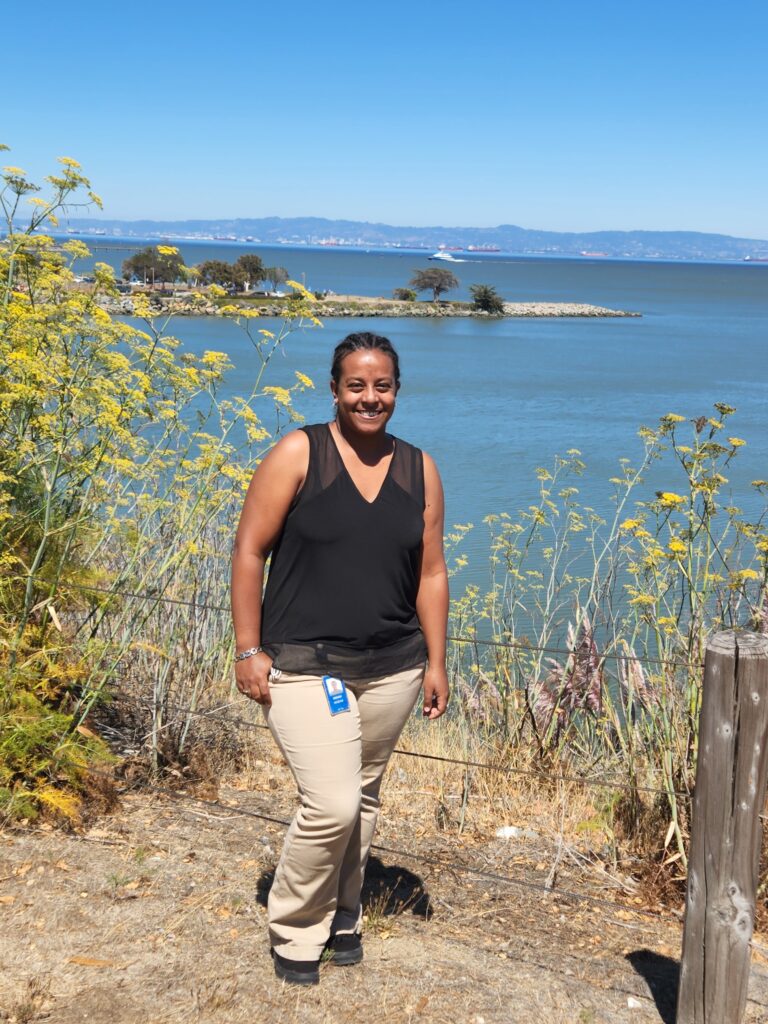 Maki Negesse on the Genentech campus in South San Francisco, California. (Photo courtesy of Negesse)
Each year during the five-year agreement, Genentech fully funds two life science Ph.D. candidates in the Meyerhoff Graduate Fellows Program who are progressing well through their doctoral work and have expressed interest in pursuing a career in industry. Selected students continue their thesis work with their Ph.D. advisors during the academic year; then they spend the summer as research interns at Genentech headquarters in South San Francisco, California. Alecia Dent ’12, biochemistry and molecular biology, who earned a Ph.D. at University of Maryland, Baltimore as a Meyerhoff Graduate Fellow and today works at Genentech, has generously helped the fellows acclimate to life on the West Coast by offering lodging at her home.
The internship at Genentech “was a great opportunity to grow my network and get hands-on training in a different area of expertise, and a great way to gain some industry experience,” shares Maki Negesse, a biological sciences Ph.D. candidate in Erin Green’s research group at UMBC.
When fellows return to UMBC, they present their research and experience at Genentech to all of the current Meyerhoff Graduate Fellows—a group that includes more than 100 UMBC and University of Maryland, Baltimore graduate students. In addition, Genentech scientists give multiple seminars at both campuses each year.
“My experience at Genentech has strengthened my desire to pursue a career in biotech companies,” Negesse adds. “I highly recommend that students pursue at least one internship during graduate school.”
Proactive steps for success
 Michael Summers played a key role in the development of the Meyerhoff Graduate Fellows Program. (Photo by Marlayna Demond ’11/UMBC)
The partnership signals that UMBC is proactively taking steps to ensure its graduate training programs set students up for success in various high-demand roles. Genentech, too, is committed to supporting the next generation of highly qualified biotech workers.
“Graduate programs in the life sciences are historically geared toward preparing Ph.D. students for academic careers. This partnership fills a gap in graduate education by providing on-site training at a world-class company for students who are interested in careers in the biotechnology industry,” shares Michael Summers, Distinguished University Professor of Chemistry and Biochemistry and co-director of the Meyerhoff Graduate Fellows Program. “It also provides opportunities to diversify the scientific workforce at Genentech, providing a win-win for the company and our students.”
]]>
UMBC doctoral students are reaping the benefits of an innovative partnership between UMBC and biotech leader Genentech. In year three of a five-year program, sixstudents have received financial...
https://umbc.edu/stories/grad-students-benefit-from-genentech-partnership/
https://my3.my.umbc.edu/api/v0/pixel/news/142556/guest@my.umbc.edu/17afe8eefc376b2e89cc8917ae160145/api/pixel
cnms
gradresearch
graduate-school
meyerhoff-scholars
news
rca-1
research
science-and-tech
story
UMBC News & Magazine
https://my3.my.umbc.edu/groups/umbc-news-magazine
https://assets1-my.umbc.edu/system/shared/avatars/groups/000/001/943/24435aa6207c452e7bc15cc74b42c7bb/xsmall.png?1748556657
https://assets1-my.umbc.edu/system/shared/avatars/groups/000/001/943/24435aa6207c452e7bc15cc74b42c7bb/original.png?1748556657
https://assets2-my.umbc.edu/system/shared/avatars/groups/000/001/943/24435aa6207c452e7bc15cc74b42c7bb/xxlarge.png?1748556657
https://assets2-my.umbc.edu/system/shared/avatars/groups/000/001/943/24435aa6207c452e7bc15cc74b42c7bb/xlarge.png?1748556657
https://assets3-my.umbc.edu/system/shared/avatars/groups/000/001/943/24435aa6207c452e7bc15cc74b42c7bb/large.png?1748556657
https://assets1-my.umbc.edu/system/shared/avatars/groups/000/001/943/24435aa6207c452e7bc15cc74b42c7bb/medium.png?1748556657
https://assets2-my.umbc.edu/system/shared/avatars/groups/000/001/943/24435aa6207c452e7bc15cc74b42c7bb/small.png?1748556657
https://assets1-my.umbc.edu/system/shared/avatars/groups/000/001/943/24435aa6207c452e7bc15cc74b42c7bb/xsmall.png?1748556657
https://assets2-my.umbc.edu/system/shared/avatars/groups/000/001/943/24435aa6207c452e7bc15cc74b42c7bb/xxsmall.png?1748556657
UMBC News & Magazine
1
0
false
Tue, 25 Jun 2024 15:46:44 -0400
Tue, 25 Jun 2024 15:46:44 -0400
Meet a Retriever—Kevin Yang ’07, Alumni Association Executive Vice President

Meet Kevin Yang ’07, computer science and financial economics. Kevin is a real estate entrepreneur, the current executive vice president and vice president of finance of the UMBC Alumni Association Board of Directors, and one half of an alumni power couple. Kevin met his wife, Katelyn Niu ’05, biochemistry, when the pair found themselves in the same physics study group as undergrads (because where else do you find love at UMBC?). They both share a passion for UMBC that runs deep. Take it away, Kevin!
Q: What is your WHY? What brought you to UMBC?
A. I grew up in an immigrant family and witnessed the sacrifices that my parents made to give me an opportunity to achieve the American dream. Although they never had the chance to finish high school, my parents firmly believed in the importance of higher education. I came to UMBC for a quality STEM education and found it to be a perfect fit. UMBC offered the resources of a larger university and the individualized attention of a smaller college.
Q: What’s your favorite part of Retriever Nation?
A. I love UMBC’s commitment to inclusive excellence. Retriever Nation welcomes students from diverse backgrounds and provides them with the necessary support to succeed at UMBC and beyond. I am forever grateful for the amazing experience that I had at UMBC! In addition to receiving a quality education, I made many lifelong friends, including my wife. I have stayed engaged since graduation, and I am proud of UMBC’s commitment to inclusive excellence.
Q: Tell us what you love about your academic program or an organization you’re involved in.
A. I had an excellent experience with the computer science program, which offered many opportunities beyond the classroom. As a tutor, teaching assistant, and research assistant in the computer science department, I learned valuable written and verbal communication skills, which was a highlight of my UMBC education.
UMBC community members work together to help our students achieve their academic and professional goals.
Today, I am a real estate entrepreneur, the Founder of KRY Properties. As a business owner, I love the ability to chart my own path. I often have to assume multiple roles, which is both challenging and rewarding. The analytical, problem-solving, and communication skills that I developed at UMBC gave me the confidence to pursue entrepreneurship.
Q: Where did you find support?
A. I built meaningful and long-lasting relationships at UMBC. I attribute much of my personal growth and academic achievements to my peers. We struggled together in challenging engineering courses, contemplated our futures from late night into early morning, and celebrated our birthdays at the local Olive Garden. We strengthened our bonds through highs and lows, and I will forever cherish those special memories.
 CMSC 441H, Algorithms with Professor Richard Chang, study group in Harbor Hall with fellow UMBC alumni JC Montminy, Kevin Yang, Donald Miner, Corey Weidenhammer, Alessandro Ferrucci, and Brandon Wilson.
Q: Tell us about someone in the community who has inspired you.
A. I received substantial financial and academic support from the Meyerhoff Scholars Program, which laid the foundation for my personal and professional successes. As a Meyerhoff Scholar, I learned about and took advantage of many incredible opportunities, such as summer internships at Georgia Tech and MIT. The Meyerhoff Scholars Program and its co-founder, Dr. Freeman A. Hrabowski, III, have inspired me to give back to the community that gave me so much.
Q: As alumni, how have you and Katelyn given back?
A. “To whom much is given, much is required.” I have been a donor every year since I graduated in 2007. My support focuses on scholarships, including the Meyerhoff Scholars Program and the Alumni Endowed Scholarship Fund. My wife, Katelyn, and I established an endowed scholarship in 2014 to support undergraduate students. Katelyn and I were fortunate to receive scholarships at UMBC. We are giving back so students who come after us can continue to have the same extraordinary experience that shaped our future.
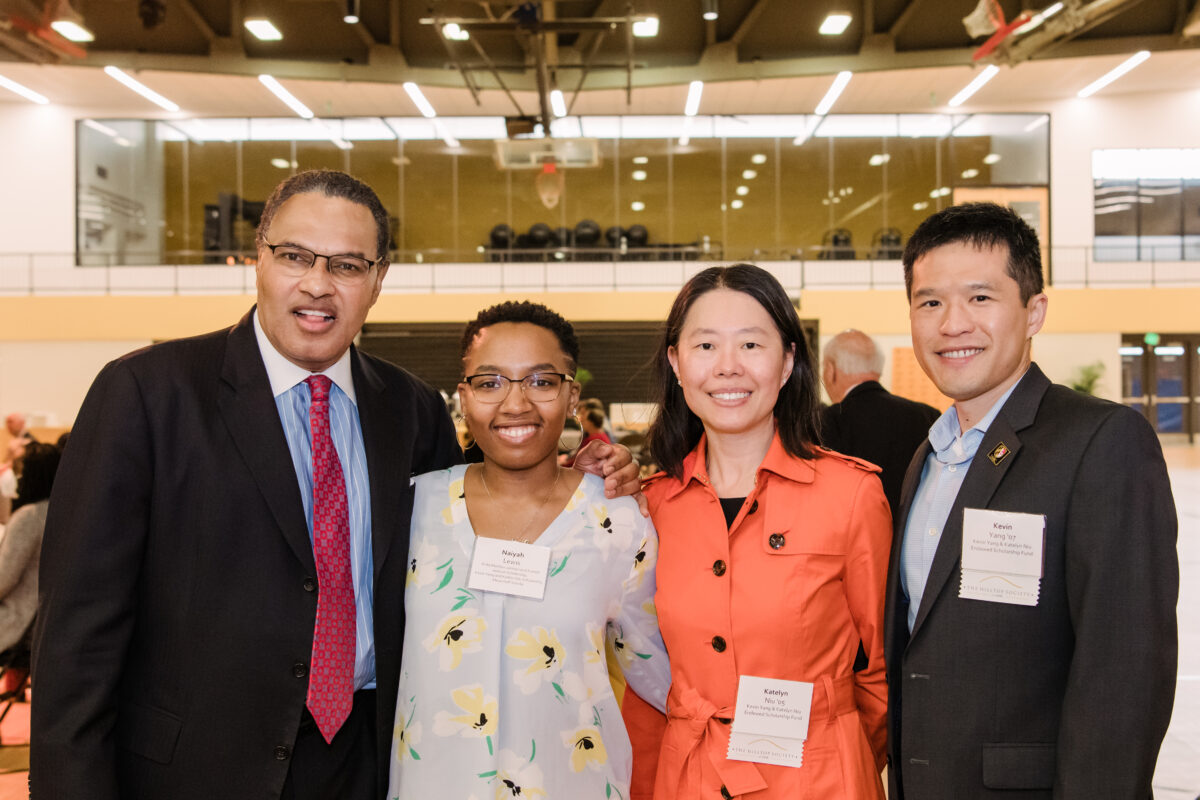 Katelyn Niu and Kevin Yang pose for a photo with Naiyah Lewis, one of their scholars, and UMBC President Emeritus Dr. Freeman A. Hrabowski, III, at the 2022 Endowed Scholars Luncheon.
Q: What’s the one thing you’d want someone who hasn’t joined the UMBC community to know about the support you find here?
A. UMBC community members work together to help our students achieve their academic and professional goals. We are proud of our collaborative culture!
* * * * *
UMBC’s greatest strength is its people. When people meet Retrievers and hear about the passion they bring, the relationships they create, the ways they support each other, and the commitment they have to inclusive excellence, they truly get a sense of our community. That’s what “Meet a Retriever” is all about.
Learn more about how UMBC can help you achieve your goals.
]]>
Meet Kevin Yang ’07, computer science and financial economics. Kevin is a real estate entrepreneur, the current executive vice president and vice president of finance of the UMBC Alumni...
https://umbc.edu/stories/meet-kevin-yang-alumni-association-vice-president/
https://my3.my.umbc.edu/api/v0/pixel/news/138486/guest@my.umbc.edu/a3688e5e3b57ddc1135a96deb38440d4/api/pixel
alumni
alumni-association
alumni-endowed-scholarship
biochemistry
coeit
compsci
financial-economics
impact
magazine
meet-a-retriever
meyerhoff-scholars
story
UMBC News & Magazine
https://my3.my.umbc.edu/groups/umbc-news-magazine
https://assets1-my.umbc.edu/system/shared/avatars/groups/000/001/943/24435aa6207c452e7bc15cc74b42c7bb/xsmall.png?1748556657
https://assets1-my.umbc.edu/system/shared/avatars/groups/000/001/943/24435aa6207c452e7bc15cc74b42c7bb/original.png?1748556657
https://assets2-my.umbc.edu/system/shared/avatars/groups/000/001/943/24435aa6207c452e7bc15cc74b42c7bb/xxlarge.png?1748556657
https://assets2-my.umbc.edu/system/shared/avatars/groups/000/001/943/24435aa6207c452e7bc15cc74b42c7bb/xlarge.png?1748556657
https://assets3-my.umbc.edu/system/shared/avatars/groups/000/001/943/24435aa6207c452e7bc15cc74b42c7bb/large.png?1748556657
https://assets1-my.umbc.edu/system/shared/avatars/groups/000/001/943/24435aa6207c452e7bc15cc74b42c7bb/medium.png?1748556657
https://assets2-my.umbc.edu/system/shared/avatars/groups/000/001/943/24435aa6207c452e7bc15cc74b42c7bb/small.png?1748556657
https://assets1-my.umbc.edu/system/shared/avatars/groups/000/001/943/24435aa6207c452e7bc15cc74b42c7bb/xsmall.png?1748556657
https://assets2-my.umbc.edu/system/shared/avatars/groups/000/001/943/24435aa6207c452e7bc15cc74b42c7bb/xxsmall.png?1748556657
UMBC News & Magazine
0
0
false
Fri, 26 Jan 2024 15:34:40 -0500
Fri, 26 Jan 2024 15:34:40 -0500