One brick at a time
Brick making is an inherently pay-it-forward process, says Marian April Glebes, M.F.A. ’09, a conceptual and mixed-media artist. In the past 10 years of her Mobile Community Brick Factory & Monument project, Glebes has made thousands of bricks and then invited community members to imprint their stories into the clay. Later, the bricks are used in mobile monuments around Baltimore City and beyond. Glebes, who won the 2025 Rubys Alumni Award through the Robert W. Deutsch Foundation for this work, asks: How can we support social and spatial change in order to build a new kind of community-driven monumental public space?
I come to historic preservation by way of my M.F.A. in imaging media and digital arts (IMDA) from UMBC—with an additional masters degree in city and regional planning and historic preservation from the University of Pennsylvania—my home in Baltimore City, and by making bricks as public art. As an artist, a preservation planner, a homeowner, an educator, a gardener, and a community and economic development practitioner, all of my research and methods investigate how we make a place and how a place makes us.
In 2015, I was the inaugural artist-in-residence at the Baltimore Museum of Art’s Patricia and Mark Joseph Education Center. The Robert E. Lee and Stonewall Jackson Confederate monument still stood across from the BMA’s Spring House in Wyman Park Dell in the Charles Village neighborhood of Baltimore. Aligning with and inspired by protest in support of social and civic justice movements, The Mobile Community Brick Factory & Monument operated within these complex intersections.
 Glebes’ brick factory set up outside of the Spring House at the Baltimore Museum of Art. (Photo by Marian April Glebes, M.F.A. ’09)
Almost a decade later, my camera was the only familiar thing at Baltimore City’s Department of Transportation facility on a frigid dawn in November 2023. I held it tightly as if it would prove to signify my role in providing archival documentation of a monumental move. The temperature had dropped to a mere 22 degrees, but the top-secret site was teeming with activity while the project was just beginning.
“I like to do an easy one first,” the director of field operations says. But with the removal of any Confederate monuments, these or other “monuments to hate,” there is no easy one.
In the back corner of a DOT storage yard, I watched as the historical record was made and unmade, as preservation theory and practice was suspended and turned on their side, as conservation techniques and concepts were followed to the letter and simultaneously reinvented, starting with the Roger B. Taney statue.
 Baltimore’s Confederate monuments in a Department of Transportation storage lot. (Photo by Marian April Glebes, M.F.A. ’09)
Baltimore’s contentious monuments shipped out to a storage facility near St. Louis on their way to Los Angeles for an exhibition at The Brick (formerly LAXart). In Baltimore, I stayed with the problem through a project I started a decade ago—creating a countermonument out of personalized, handmade bricks.
Memory is mutable. Social contexts shift. This is the wicked problem in living heritage and what to do when it dies. I’ve had a unique position with singular access to process and understand this ongoing debate in Baltimore City while unofficial researcher-in-residence at the Commission for Historic and Architectural Preservation (CHAP). Each community is unique in its response on what to do with their Confederate monuments, and Baltimore’s perspective is vital to the discourse. Eric Holcomb, the former director of CHAP, invited me to the conversation, positing that perhaps it could or should be for the arts and artists to influence this unfolding preservation conundrum.

 Left: A stack of imprinted bricks waits to be transformed. Right: Glebes holds a brick imprinted with: “I am a monument.”
At UMBC, as M.F.A. candidates, our artwork was considered research—and therefore had to be contextualized and placed within the canon. To work responsibly, we were encouraged to know our audiences and our references and understand our place in time. Inspired by the people and places of Baltimore and by conceptual art’s blurring-of-art-andlife thinking of the 1960s, The Mobile Community Brick Factory & Monument maintains the ethos of rigorous research, material gravitas, and community connection engendered by my IMDA studies. Existing in the contexts of the Baltimore Uprising, the 2017 monument removals, social practice art, and civic engagement, I interrogate our circumscribed understandings of monumentality.
Monuments exist in social contexts that have often changed dramatically since the time they were created. Because of this, their meaning does not come only from the objects themselves—or only from how people view them—but from the shifting relationship between the two. The counter-monument was birthed by artists in Germany after the fall of the Berlin Wall and has not been widely accepted or brought into practice. In 2017, as monuments were being removed from our public spaces, artists again began erecting counter-monuments in protest of white supremacy.
The Mobile Community Brick Factory & Monument is centered in process, people, and making. To date, we have engaged over 15,000 people in Baltimore, made over 2,500 unique bricks, and collected over 1,000 personal stories from Baltimore residents. The Mobile Community Brick Factory & Monument is a new kind of monument, a monument not to the past, but a monument as an act of collective power that anticipates what will come to be.
 To date, the project has engaged over 15,000 people in Baltimore, made over 2,500 unique bricks, and collected over 1,000 personal stories from Baltimore residents.
The Mobile Community Brick Factory produces handmade bricks using local hand-processed clay and historic water-struck methods. This means of brickmaking is an inherently pay-it-forward endeavor—the bricks made one day are destined for someone else’s future hands. Participants personalize and inscribe their stories onto these bricks—words and messages about place, power, home, and experience. These story bricks are woodfired and become The Mobile Community Brick Monument, an ongoing series of exhibitions that create shared spaces.
While the bricks become pathways, garden beds, benches—some are embedded in sidewalks in Baltimore—I collect oral histories from brick constituents through ethnographic methods. In Baltimore, over 150,000 people have visited The Mobile Community Brick Monuments, finding connections to stories that are like their own.
At The Mobile Community Brick Factory & Monument, we believe ordinary voices matter, especially those that aren’t usually heard, that public space should be built by the people who use it, that heritage is alive, memory is mutable, and history is ongoing—made by daily lives. Our bricks represent pasts, presents, and futures that would otherwise remain untold and unwitnessed, built, shared, and spoken by urban residents. All are welcome and included in the process—a different kind of monument—a living space that honors the past and is built collectively by the people who live in and use our cities.
—Marian April Glebes, M.F.A ’09
]]>
Brick making is an inherently pay-it-forward process, says Marian April Glebes, M.F.A. ’09, a conceptual and mixed-media artist. In the past 10 years of her Mobile Community Brick Factory &...
https://umbc.edu/stories/one-brick-at-a-time-marian-april-glebes/
https://my3.my.umbc.edu/api/v0/pixel/news/154790/guest@my.umbc.edu/a5b5b57409fdd065cdb303c4d962d827/api/pixel
alumni
alumni-essay
cahss
fall-2025
imda
magazine
mfa
story
UMBC News & Magazine
https://my3.my.umbc.edu/groups/umbc-news-magazine
https://assets1-my.umbc.edu/system/shared/avatars/groups/000/001/943/24435aa6207c452e7bc15cc74b42c7bb/xsmall.png?1748556657
https://assets1-my.umbc.edu/system/shared/avatars/groups/000/001/943/24435aa6207c452e7bc15cc74b42c7bb/original.png?1748556657
https://assets2-my.umbc.edu/system/shared/avatars/groups/000/001/943/24435aa6207c452e7bc15cc74b42c7bb/xxlarge.png?1748556657
https://assets2-my.umbc.edu/system/shared/avatars/groups/000/001/943/24435aa6207c452e7bc15cc74b42c7bb/xlarge.png?1748556657
https://assets3-my.umbc.edu/system/shared/avatars/groups/000/001/943/24435aa6207c452e7bc15cc74b42c7bb/large.png?1748556657
https://assets1-my.umbc.edu/system/shared/avatars/groups/000/001/943/24435aa6207c452e7bc15cc74b42c7bb/medium.png?1748556657
https://assets2-my.umbc.edu/system/shared/avatars/groups/000/001/943/24435aa6207c452e7bc15cc74b42c7bb/small.png?1748556657
https://assets1-my.umbc.edu/system/shared/avatars/groups/000/001/943/24435aa6207c452e7bc15cc74b42c7bb/xsmall.png?1748556657
https://assets2-my.umbc.edu/system/shared/avatars/groups/000/001/943/24435aa6207c452e7bc15cc74b42c7bb/xxsmall.png?1748556657
UMBC News & Magazine
2
0
false
Fri, 21 Nov 2025 14:32:47 -0500
Fri, 21 Nov 2025 14:32:47 -0500
Kelley Bell, M.F.A ’06, brings a sense of play to the BMA with “Fantastic Village”
When associate professor of visual arts Kelley Bell thinks back to her childhood growing up in the Capitol Hill area of Washington, D.C., she recalls fond memories of playing in her neighborhood playground, locally dubbed as “Turtle Park.”
“I remembered the concrete structures behind the turtle in the playground and it really inspired me to want to figure out how they came to be,” Bell says.
The public park, officially named Marion Park, was given the “Turtle Park” moniker because of the large concrete turtle structure that lived in the center of its playground, designed by Virginia Dortch Dorazio in 1953. Bell, M.F.A. ’06, imaging and digital arts, remembers Turtle Park as a prominent staple of her adolescence and decades later, the park also acts as the inspiration behind her latest project “Fantastic Village,” which will be on display at the Baltimore Museum of Art (BMA) from April 27 through July 27 as part of the museum’s Baker Artist Awards exhibition.
Maryland Public Television’s 2024 Baker Artist Awards Special featuring Kelley Bell.
The power of design
Bell was a 2024 recipient of the Greater Baltimore Cultural Alliance’s Baker Artist Award. The BMA exhibit will feature 20 works from five recent Baker Artist Award recipients, including Bell’s “Fantastic Village.” The colorful geometries of Bell’s installation draw on memories of now-demolished playgrounds of her youth in Washington, D.C., and Baltimore’s iconic rowhomes, bridging together the two places she calls home.
Bell creates vibrant projection-mapping works on a grand scale and gallery installations that emphasize joy, playfulness, community, and human connection. Before pursuing her current career as a visual artist, designer, and educator, Bell initially thought she’d be a lawyer. She believed that since her father was a speechwriter for President Gerald Ford and her mother was a teacher, she’d continue the family’s lineage of public service work.
However, “drawing in class was always a problem with me to the degree that it’s written on a lot of my report cards, saying, ‘Kelley has a lot of attention issues.’ I never thought of art as a career,” says Bell.
 Kelley Bell. (Photo courtesy of Bell)
Growing up in the nation’s capital, Bell was heavily influenced by the city’s independent music scene. During her wanderings through downtown Washington as a teenager, a chance encounter with a repurposed “five and dime” store (then home to the Washington Project for the Arts) changed everything.
“When I walked in that store, I never saw anything like it,” Bell recalls, “There were zines, posters, paintings, and tapes for bands all around. It was a window into this idea that art doesn’t have to be this picture on the wall and that was an amazing idea to me even at a young age.”
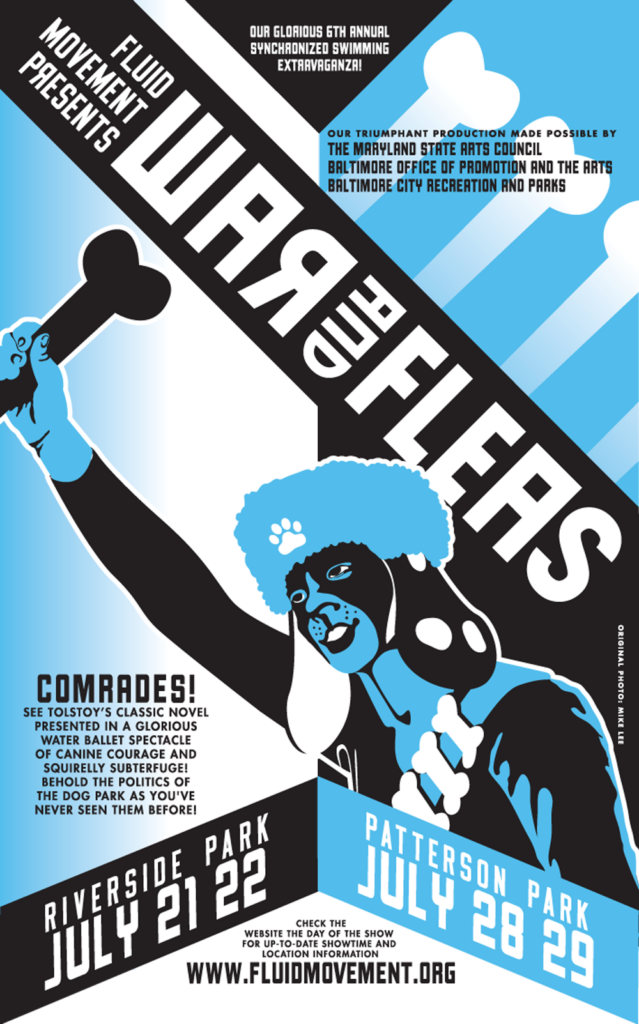 The poster for Fluid Movement’s 2007 “War and Fleas” water ballet, designed by Kelley Bell. (Photo courtesy of Bell’s website)
After graduating from Pratt, Bell landed a designer role for a record pressing plant that worked with dance music labels. Continuing her work in the entertainment industry, she freelanced for MTV Networks for several years before she was encouraged to explore Baltimore after a recommendation from a fellow designer who boasted about the city’s arts scene. A one-day exploration of the city convinced Bell that Baltimore was the place for her.
Bell was accepted into the Pratt Institute in Brooklyn, New York where she initially majored in illustration. But once there, she was introduced to the concept and the power of design. “A friend explained that designers construct the existing world, and I believe that’s an amazing power to have. I quickly switched my major after that,” says Bell.
In 1997, Bell moved into Baltimore’s now-defunct H&H Arts Building, a five-story warehouse where local artists lived and worked for more than two decades. It was at H&H where Bell was initially connected toperformer and fellow UMBC alum Beatrix “Trixie Little” Burneston ’99, visual and performing arts, a founding member of Fluid Movement, a Baltimore-based organization that utilizes public spaces to create joy and community through performance art that most notably includes quirky water ballet performances in Baltimore City public pools.
“Fluid Movement did a rendition of the opera ‘Carmen’ with hotdogs on sticks. They designed a stage and costumes for hotdogs and had a composer to do the score,” shares Bell. “To see people pour that much love and effort into something that ultimately is incredibly silly and unusual is, to me, a heroic act.”
Bell worked with Fluid Movement as a designer and the group then became a long-time client that she worked with throughout the years. Bell has also collaborated with a number of organizations and art collectives across Baltimore, including working with the Enoch Pratt Library and the community art space Creative Alliance. Bell’s project “The Clock Strikes 100,” a series of short animations designed for and projected within the Baltimore’s historic Bromo Seltzer Art Tower, was designated “Best Public Artwork” in Baltimore Magazine’s “Best of Baltimore 2011” issue.
“Projections, Inflatables, and Artistic Spectacles”
Bell’s first introduction to UMBC was on a snowy day in 2001. Her friends recommended UMBC’s campus as a great place for sledding due to the campus’ hilly landscape. Soon after, Bell decided to expand her skillset and enrolled in UMBC’s M.F.A program.
“I was like a kid in a candy store with all of the stuff that I could do. It was a new world being opened up to me,” says Bell.
After experiencing difficulties in executing her thesis project to her satisfaction, Bell was advised by her then-thesis chair Preminda Jacob to consider extending her time in the program for an additional year.
“That extra year was the year that I figured out projection mapping. Doing guerilla projection projects changed the way that I thought about making art. That has been a form of art that’s served me since I’ve graduated from UMBC and it was all because of that fourth year,” says Bell. Guerilla projection mapping—the use of projectors to display images, animations, or videos onto various surfaces in public spaces without formal authorization or permits—helped to inform the foundation of Bell’s artistic pursuits.
Bell’s large-scale projection-mapping works and public installations have been featured in national and international festivals for almost two decades. Among her notable works include “The Herd,” a 2018 installation that was part of Light City Festival in Baltimore City. The project featured more than 300 solar powered inflatables that were placed into Baltimore’s Inner Harbor as a call to action for healthy waterways in the harbor.
 Bell’s “The Herd” installation in Baltimore City’s Inner Harbor in 2018. (Marlayna Demond ’11 for UMBC)
In addition to her artistic practice, Bell has been an educator at UMBC since 2008. Earlier this year, Bell presented a retrospective of her work and her research practice with the presentation “Projections, Inflatables, and Artistic Spectacles,” organized by the UMBC’s Center for Innovation, Research, and Creativity in the Arts (CIRCA).
“The CIRCA talk was a breakthrough. It was the first time that I took in the full scope of starting with an M.F.A. and how that work led up to the BMA exhibit,” she says.
The motivation behind Bell’s BMA exhibit “Fantastic Village” largely stemmed from her collaboration with UMBC theater professor Collete Searls on the “Enchanted Jangle” installation that was part of the 2024 Sweaty Eyeballs: Animation Adjacent gallery exhibition, curated by Corrie Parks, associate professor of visual arts. The installation is described as an “epic cardboard fort your five-year-old self dreamed of.”

 (left) Installation view ofBell’s “Enchanted Jangle” at UMBC’s Performing Arts and Humanities Building. (right) Performance of “Enchanted Jangle” at Area 405 Gallery featuring UMBC theatre student Jazmine McDonald. (Photos courtesy of Bell)
“There’s a playfulness about it but also a deeply-weird and creepy aspect to it. This is the place I like to dwell—giving people something new and something that they can’t figure out is something that is very important to me in my work.”
]]>
When associate professor of visual arts Kelley Bell thinks back to her childhood growing up in the Capitol Hill area of Washington, D.C., she recalls fond memories of playing in her neighborhood...
https://umbc.edu/stories/kelley-bell-bma-fantastic-village/
https://my3.my.umbc.edu/api/v0/pixel/news/149486/guest@my.umbc.edu/e09eef2fe04214a6d9d5dcec5a868f8e/api/pixel
alumni
arts-and-culture
cahss
community
mfa
news
research
story
visualarts
UMBC News & Magazine
https://my3.my.umbc.edu/groups/umbc-news-magazine
https://assets1-my.umbc.edu/system/shared/avatars/groups/000/001/943/24435aa6207c452e7bc15cc74b42c7bb/xsmall.png?1748556657
https://assets1-my.umbc.edu/system/shared/avatars/groups/000/001/943/24435aa6207c452e7bc15cc74b42c7bb/original.png?1748556657
https://assets2-my.umbc.edu/system/shared/avatars/groups/000/001/943/24435aa6207c452e7bc15cc74b42c7bb/xxlarge.png?1748556657
https://assets2-my.umbc.edu/system/shared/avatars/groups/000/001/943/24435aa6207c452e7bc15cc74b42c7bb/xlarge.png?1748556657
https://assets3-my.umbc.edu/system/shared/avatars/groups/000/001/943/24435aa6207c452e7bc15cc74b42c7bb/large.png?1748556657
https://assets1-my.umbc.edu/system/shared/avatars/groups/000/001/943/24435aa6207c452e7bc15cc74b42c7bb/medium.png?1748556657
https://assets2-my.umbc.edu/system/shared/avatars/groups/000/001/943/24435aa6207c452e7bc15cc74b42c7bb/small.png?1748556657
https://assets1-my.umbc.edu/system/shared/avatars/groups/000/001/943/24435aa6207c452e7bc15cc74b42c7bb/xsmall.png?1748556657
https://assets2-my.umbc.edu/system/shared/avatars/groups/000/001/943/24435aa6207c452e7bc15cc74b42c7bb/xxsmall.png?1748556657
UMBC News & Magazine
2
0
false
Fri, 25 Apr 2025 14:21:50 -0400
Fri, 25 Apr 2025 14:21:50 -0400
Unstuck in Time—Peeling Back Layers Through Art
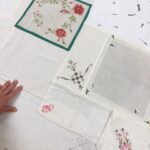
As a visual artist, Monique Crabb, M.F.A. ’22, intermedia and digital arts, draws from her environment quite literally—producing textile-based artworks colored with the rich hues of plants and objects around her. This fall, she spent a month in residency at the Baltimore County Public Library, teaching workshops and engaging with library users as she created new work inspired by her surroundings. These are her reflections from that experience.
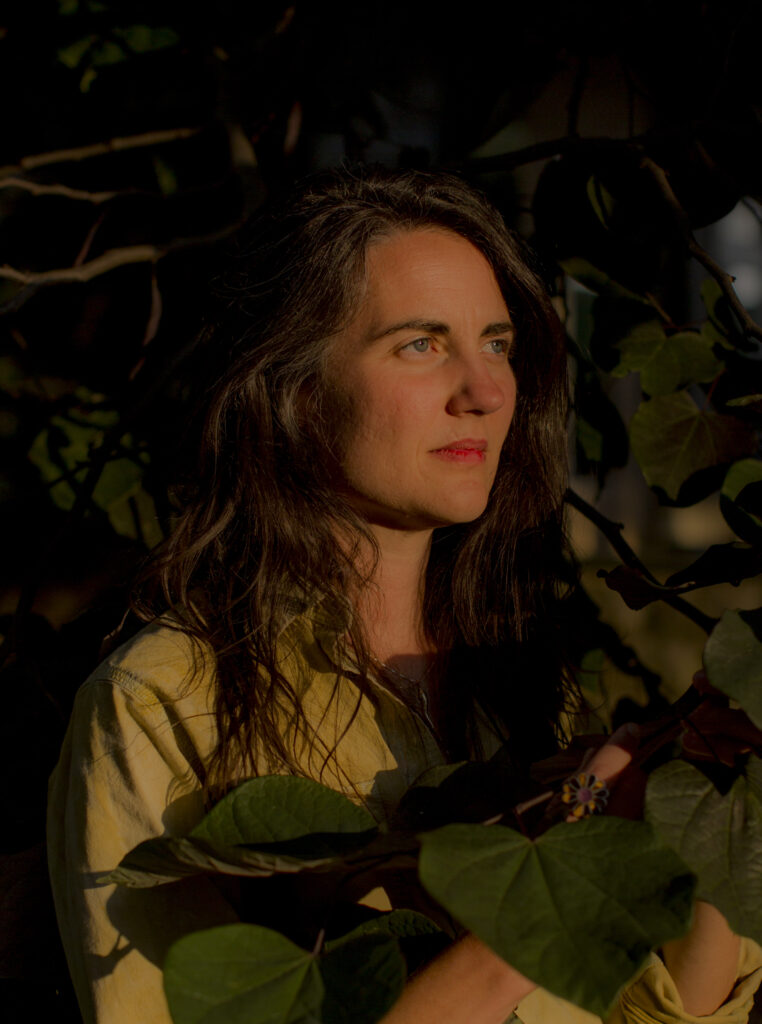 Headshot of Monique Crabb.
One of the most calming places to be in is a public library surrounded by people’s research, stories, and history of every place and culture from almost every perspective imaginable. At times, the amount of knowledge at my fingertips can feel daunting knowing I’ll never be able to take it all in. I’m reminded of a scene in the ’80s movie My Stepmother Is an Alien, when the main character Celeste, played by Kim Basinger, travels to earth in a model’s body to conduct research on human life and discovers books. She’s able to retain the books’ information instantly through osmosis, spanning the gamut of human emotions, and is starved for more. This scene has imprinted itself in my mind as a superpower I wish I had.
Growing up in a working class neighborhood to a mom who would every weekend pull open the large rolling door to our garage for the permanently set-up sale of our used things, and a father who worked various jobs and seemingly was never around, I spent most of my time outside of school on the streets, at friends’ homes, or playing in the woods. My parents did not engage much with books, the arts, or academia; I was mostly influenced by pop culture.
As I got older, books came to me at very specific times in my life to change my perspective and help me find my place in the world of things. One of those times was my junior year in high school when my English teacher gave the class a list of authors to pick from for a book report and I selected Kurt Vonnegut, solely on the fact that his name sounded cool and he shared a first name with Kurt Cobain. I then found myself sitting on the floor of my school’s library absorbed by the opening line of Slaughterhouse-Five: “All this happened, more or less.”
The rest of the book was an eye-opening view of one person’s experience in the world during a time so far removed from my own, yet with relatable philosophical ideas with quotes like, “All time is all time. It does not change. It does not lend itself to warnings or explanations. It simply is. Take it moment by moment, and you will find that we are all, as I’ve said before, bugs in amber.” Books allow us to travel through time and place to help us find meaning in our lives, which is a magical experience that visual arts achieves just as profoundly.
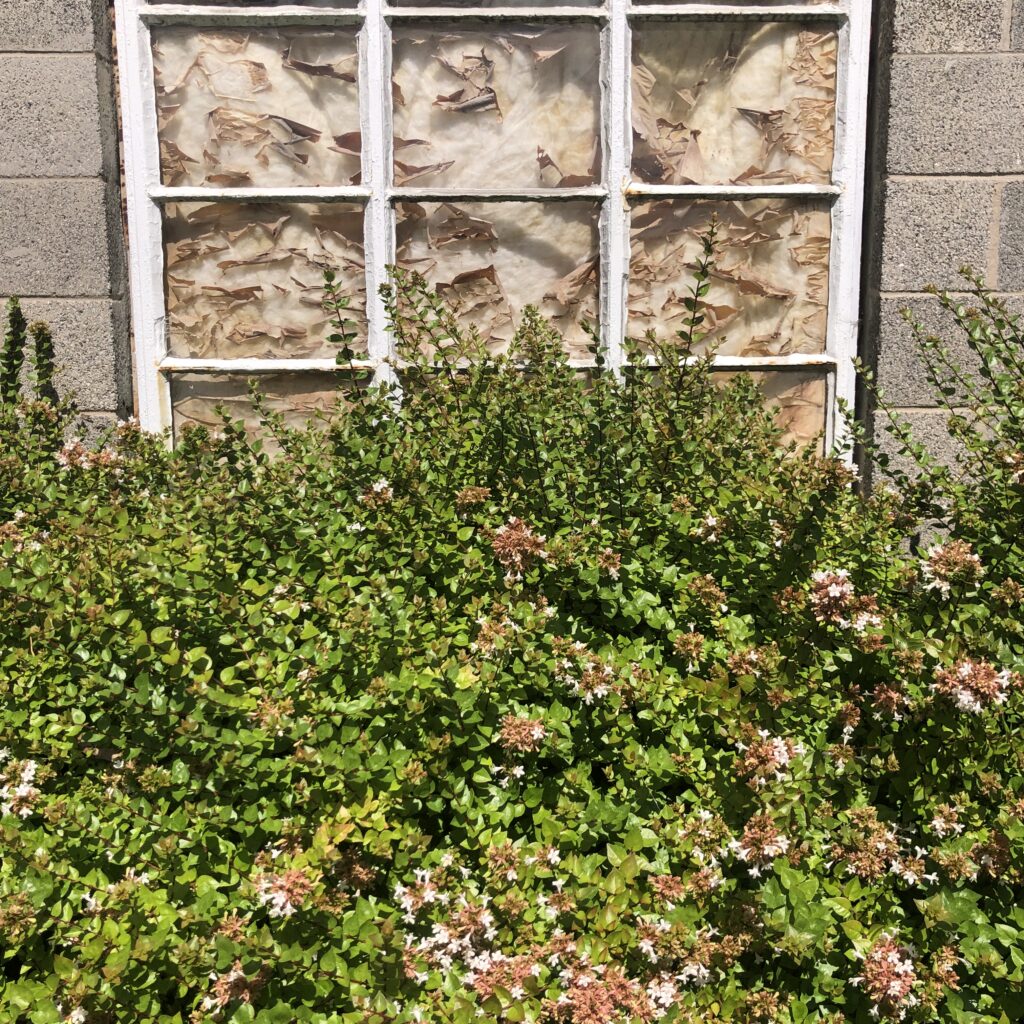 Window of a vacant building interacting with a bush near the Hereford Branch of the Baltimore County Public Library.
The Baltimore County Public Library month-long Artist in Residence program was a gift to take part in. Each week I walked through a sea of books and would greet the librarians on my way to their maker space, The Hive. Being there allowed me the time and space to focus on one project.
I also had the opportunity to engage with a community outside of my own through two workshops I gave on eco-printing and dyeing with food waste as well as having the studio space open to visitors while I was working. On my lunch breaks I would browse books and take walks, once visiting the nearest cemetery and other times just taking in the colors and patterns from the intersecting relationship of plants and human-made constructions in the area.
During my time in residency, I started a project using secondhand vintage linens made with open cut and intricately detailed hand and machine embroidery. I either cut up or used the entire napkin, handkerchief, or tablecloth and machine-pieced them together using pojagi, a Korean form of quilting that creates a seam on both sides of the pliable plane. These textile objects, often made by women, were and continue to be so precious that the folds and creases in them become deep from decades of being stored away unused.
I was drawn to bringing these objects out of storage, unfolding, and piecing one to the other to create a frankensteinian curtain that was large and would present as a confrontation in the middle of a room. I hadn’t fully unraveled the idea, but I knew if I put in the work that richer layers of context would reveal themselves.
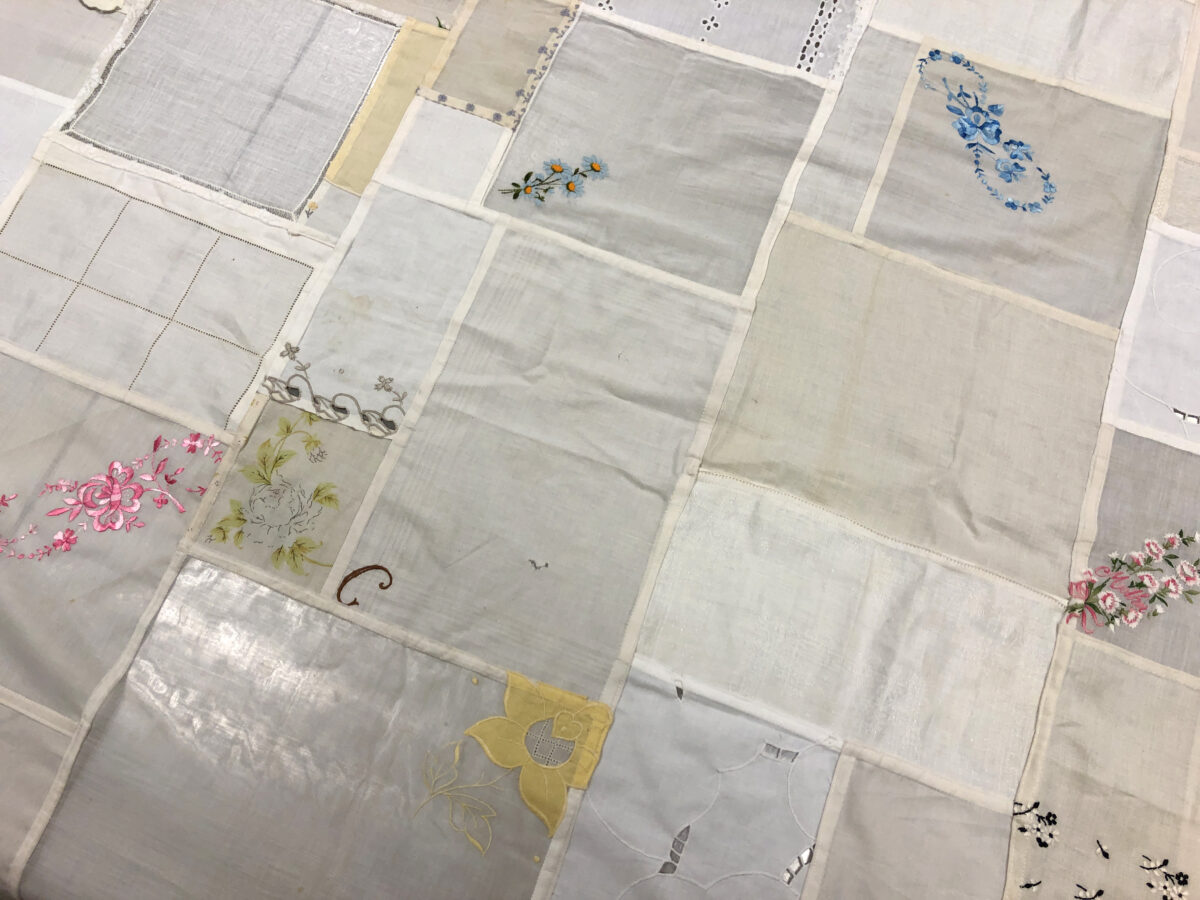 Pojagi-style piecing of secondhand vintage embroidered napkins.
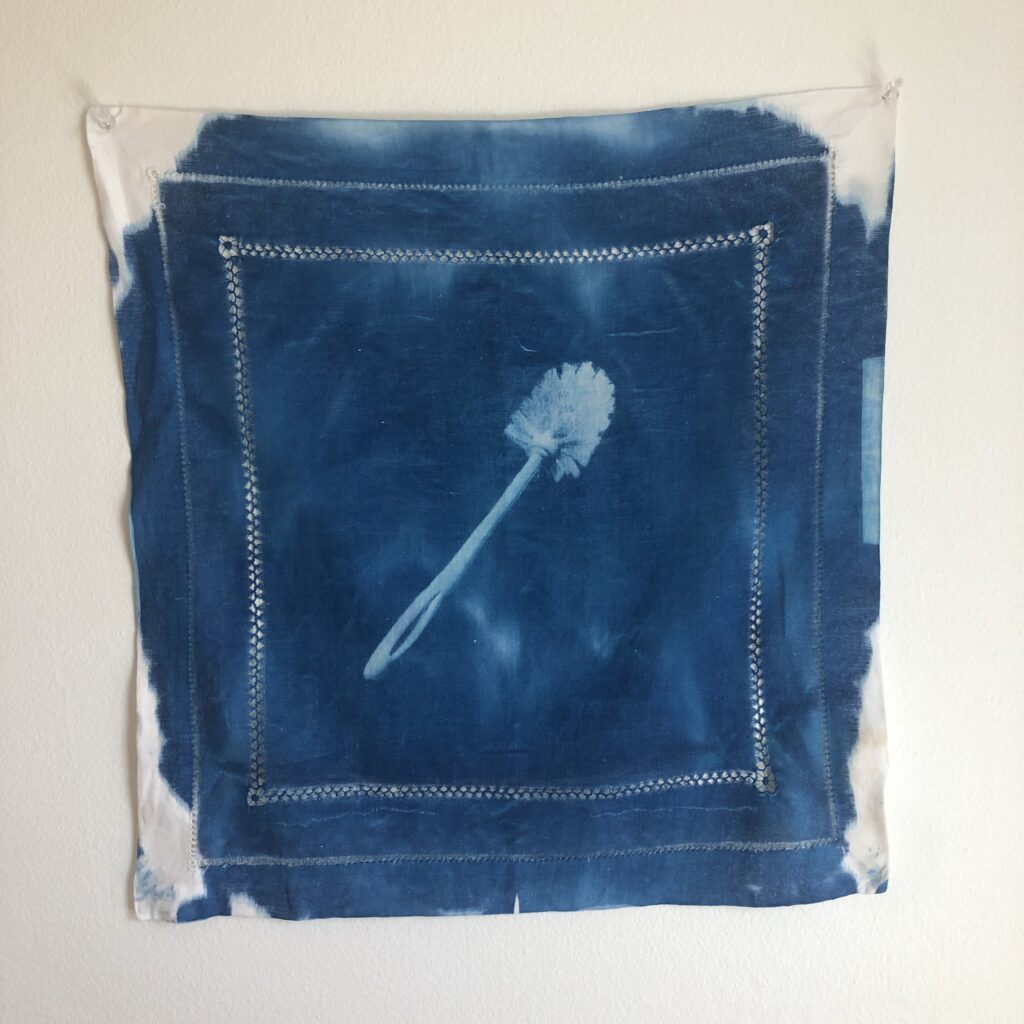 Cyanotype-coated vintage cotton napkin with an image of a toilet brush exposed using the light of the sun.
Toward the end of my residency I had a library visitor come through and we chatted for a while about art, the artist’s process, and the meaning behind what is made. It was during this exchange that I had a lightbulb moment for my project of painting cyanotype directly onto the napkins and exposing stark images of tools used in the domestic world like a toilet brush. Adding this layer of context expanded my exploration of materials from domestic life by bringing attention and exposing the hidden labor behind the undervalued role of homemaker, woman, and caregiver.
It’s essential to my growth as an artist to be in new environments and around new people as well as the opportunity to step back from being so deeply inside of my artwork by engaging with communities outside of my own. Meeting the folks who took my workshops and the ones who came through the studio to ask questions about what I was working on reminded me of the importance of my role as an artist. I believe our stories connect us and often find that the narratives I encounter, whether in person or from books, inform and enrich my practice in ways I could never do alone.
]]>
As a visual artist, Monique Crabb, M.F.A. ’22, intermedia and digital arts, draws from her environment quite literally—producing textile-based artworks colored with the rich hues of plants and...
https://umbc.edu/stories/unstuck-in-time-peeling-back-layers-through-art/
https://my3.my.umbc.edu/api/v0/pixel/news/129651/guest@my.umbc.edu/386371691536ef455083206234f9c043/api/pixel
alumni
cahss
fall-2022
magazine
mfa
visualarts
UMBC News & Magazine
https://my3.my.umbc.edu/groups/umbc-news-magazine
https://assets1-my.umbc.edu/system/shared/avatars/groups/000/001/943/24435aa6207c452e7bc15cc74b42c7bb/xsmall.png?1748556657
https://assets1-my.umbc.edu/system/shared/avatars/groups/000/001/943/24435aa6207c452e7bc15cc74b42c7bb/original.png?1748556657
https://assets2-my.umbc.edu/system/shared/avatars/groups/000/001/943/24435aa6207c452e7bc15cc74b42c7bb/xxlarge.png?1748556657
https://assets2-my.umbc.edu/system/shared/avatars/groups/000/001/943/24435aa6207c452e7bc15cc74b42c7bb/xlarge.png?1748556657
https://assets3-my.umbc.edu/system/shared/avatars/groups/000/001/943/24435aa6207c452e7bc15cc74b42c7bb/large.png?1748556657
https://assets1-my.umbc.edu/system/shared/avatars/groups/000/001/943/24435aa6207c452e7bc15cc74b42c7bb/medium.png?1748556657
https://assets2-my.umbc.edu/system/shared/avatars/groups/000/001/943/24435aa6207c452e7bc15cc74b42c7bb/small.png?1748556657
https://assets1-my.umbc.edu/system/shared/avatars/groups/000/001/943/24435aa6207c452e7bc15cc74b42c7bb/xsmall.png?1748556657
https://assets2-my.umbc.edu/system/shared/avatars/groups/000/001/943/24435aa6207c452e7bc15cc74b42c7bb/xxsmall.png?1748556657
UMBC News & Magazine
0
0
false
Wed, 07 Dec 2022 12:22:02 -0500
Wed, 07 Dec 2022 12:22:02 -0500
Beautiful Dreamer
The film begins, a fast-moving montage of seemingly unrelated images: eyes, people dancing, an airplane landing, artillery, President Kennedy, wrestlers, a woman applying hairspray, all interspersed with wacky cartoon-like animated images.
It’s the start of Breathdeath, Stan VanDerBeek’s experimental 1963 masterpiece that would influence a generation of artists, including Monty Python’s Terry Gilliam. VanDerBeek’s genius and visionary thinking—not only as a filmmaker, but also as a video artist, computer animator, and futurist—would earn him worldwide fame and, in 1975, a full professorship at UMBC, where he taught until his untimely death in 1984.
VanDerBeek’s vision can still be seen in the programs he helped found and the alumni he inspired at UMBC.
Underground Artist
Born in 1927 in New York to immigrant parents, VanDerBeek’s early interest in painting, architecture, and design led him to Black Mountain College, where he befriended pioneering composer John Cage, choreographer Merce Cunningham, and inventor Buckminster Fuller, all of whom were to prove deeply influential on the artist. In the early 1950s, working as a designer on the CBS children’s program Winky Dink and You—which featured plastic screens children could apply to the television and draw on with special crayons—VanDerBeek learned basic animation skills and, by 1955, began to create his own animated films. In 1959, he organized a New York film festival entitled “Films from the Underground,” and the term “underground film” was born.
 A portrait of Stan VanDerBeek.
Throughout his 30-year career, VanDerBeek was more than an artist; he became a visionary who thought beyond limits and boundaries, often dreaming up fascinating ideas that couldn’t be executed—at least in his lifetime. In 1980, midway through his tenure at UMBC, he imagined, “You’ll sit in your backyard and look up at beautiful paintings I and other artists will do for you on a 10,000 square mile screen of clouds. The strokes and colors will be images projected by laser beams. I call it ‘painting with light’ or optical painting.”
At UMBC, recalls Ellsworth Hall ’82, visual arts, the cloud projections were realized on a smaller scale. “A good friend of mine, Ed Hopf, with whom I’ve made films with since we were 13, helped Stan on his multimedia presentations. He would have film projected on the ‘smoke’ created by melting dry ice. At one point there wasn’t enough ‘smoke’ and Stan was in a hurry trying to coordinate some other aspect of the production so he grabbed the dry ice with his bare hands and threw it in the container to melt!”

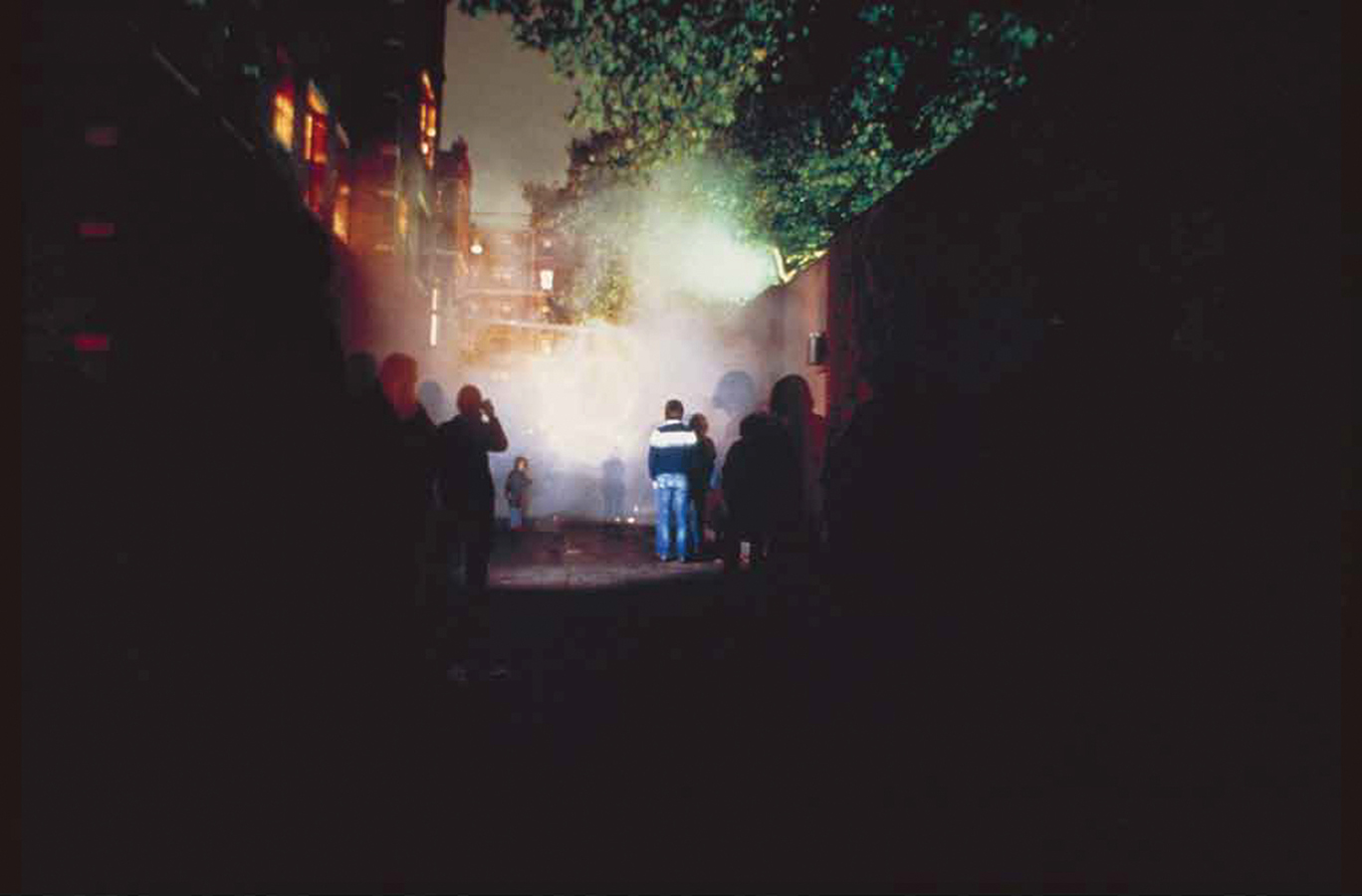
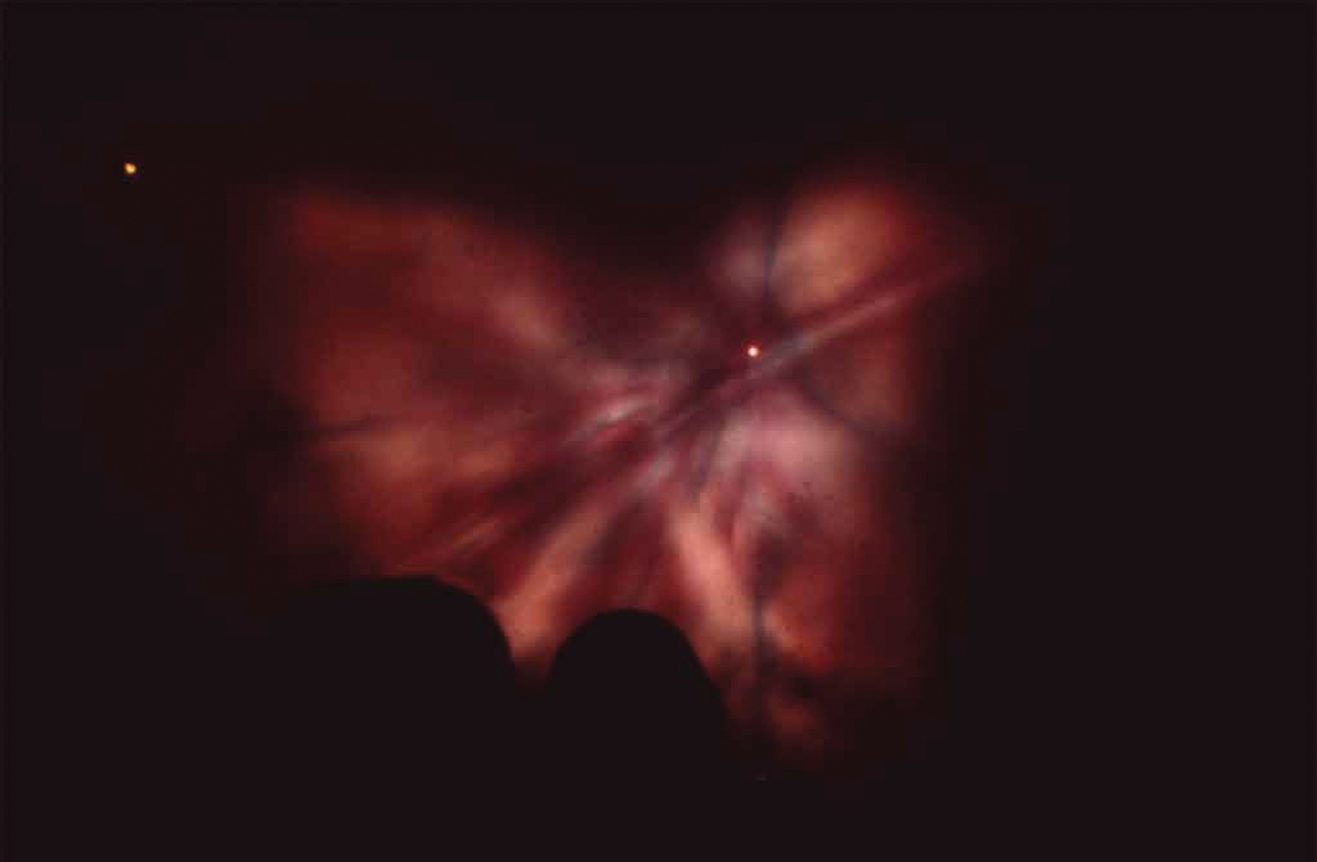
For VanDerBeek, moving images weren’t only material for his artwork—they had the power to facilitate global understanding and to help the world move toward peace. In a manifesto, “CULTURE: Intercom and Expanded Cinema,” he wrote, “I propose the following: that immediate research begin on the possibility of a picture-language based on motion pictures; that we combine audio-visual devices into an educational tool: an experience machine or ‘culture-intercom’; that audio-visual research centers be established on an international scale to explore the existing audio-visual devices and procedures, develop new image-making devices, and store and transfer image materials, motion pictures, television, computers, video-tape, etc.; that artists be trained on an international basis in the use of these image tools…” He set forth ideas with the certainty that they could be accomplished and even needed to be accomplished.
To facilitate that vision of global communication, VanDerBeek forged what was perhaps his best-known creation, the Movie-Drome. Located at Stony Point, New York, at the Gate Hill Cooperative (populated by the young VanDerBeek family in addition to others who had migrated from Black Mountain College, including John Cage, pianist David Tudor, and potter M.C. Richards), the Movie-Drome was the top of a grain silo dome. Guests were invited inside, asked to lie down, and, looking up, watched a mosaic of continually changing films and slides that were concurrently projected across the dome’s interior. VanDerBeek imagined a network of Movie-Dromes operating internationally, linked by satellite, presaging the internet.
Endless Possibilities
By the time VanDerBeek arrived at UMBC in 1975, he was already in the international limelight—a filmmaker whose works had won awards at festivals worldwide and who had received support from the Guggenheim Foundation, the Ford Foundation, the National Endowment for the Arts, and the Rockefeller Foundation. He had taught, lectured, or been in residence at Columbia University, MIT, the Walker Arts Center, the Smithsonian Institution, WGBH (Boston), NASA, and dozens of other institutions and had enjoyed a 1968 retrospective at the Museum of Modern Art. Ever fascinated by the possibilities of emerging technologies, VanDerBeek had branched out from film to embrace videography and computer animation, which seemed to offer endless possibilities. (His early computer-generated films were produced at MIT and at Bell Labs, where he was in residence and assisted by computer art pioneer Ken Knowlton.) An exhibition of VanDerBeek’s work Machine Art: An Exhibit of “Inter-Graphics” was presented in UMBC’s Library Gallery in spring 1976.
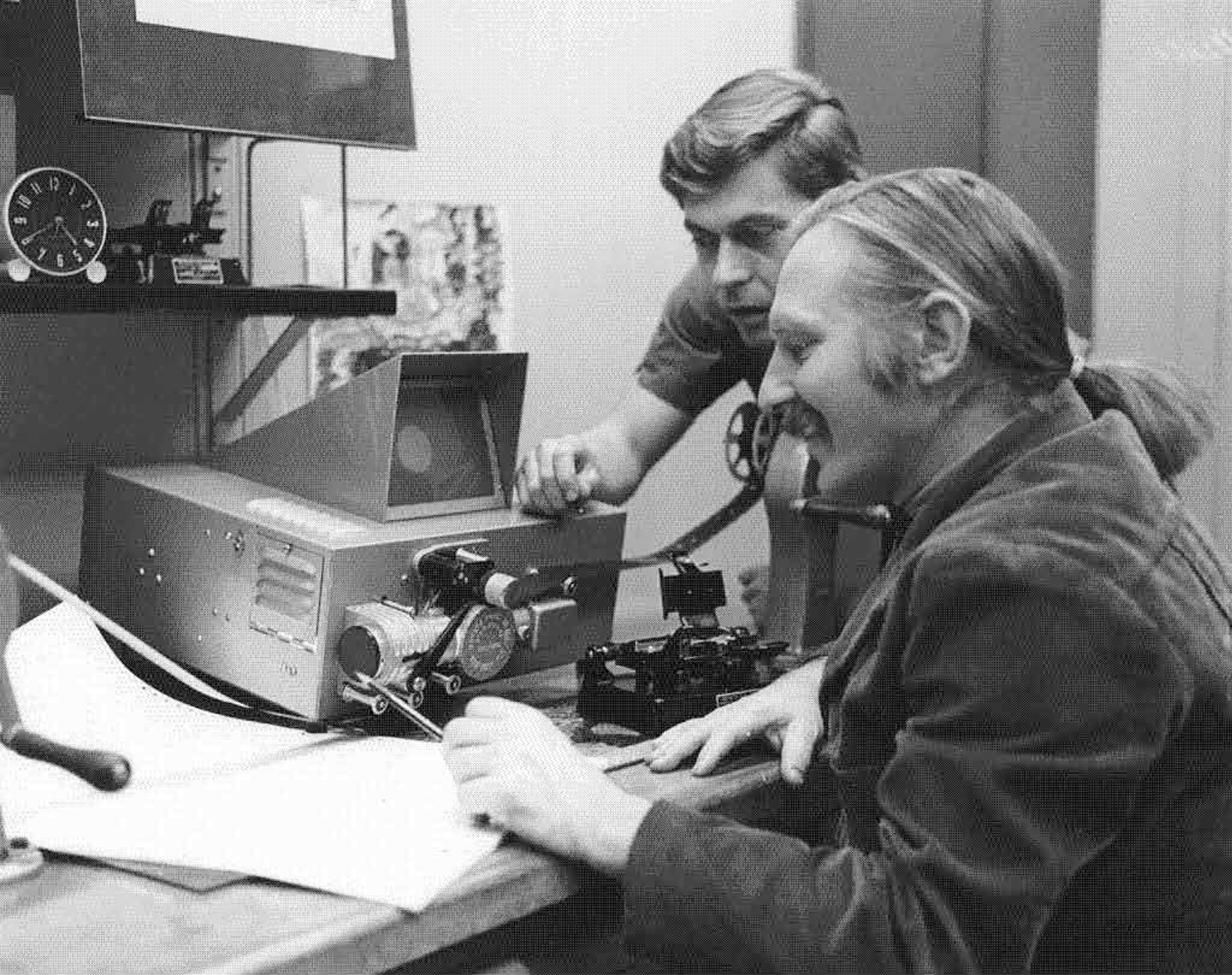
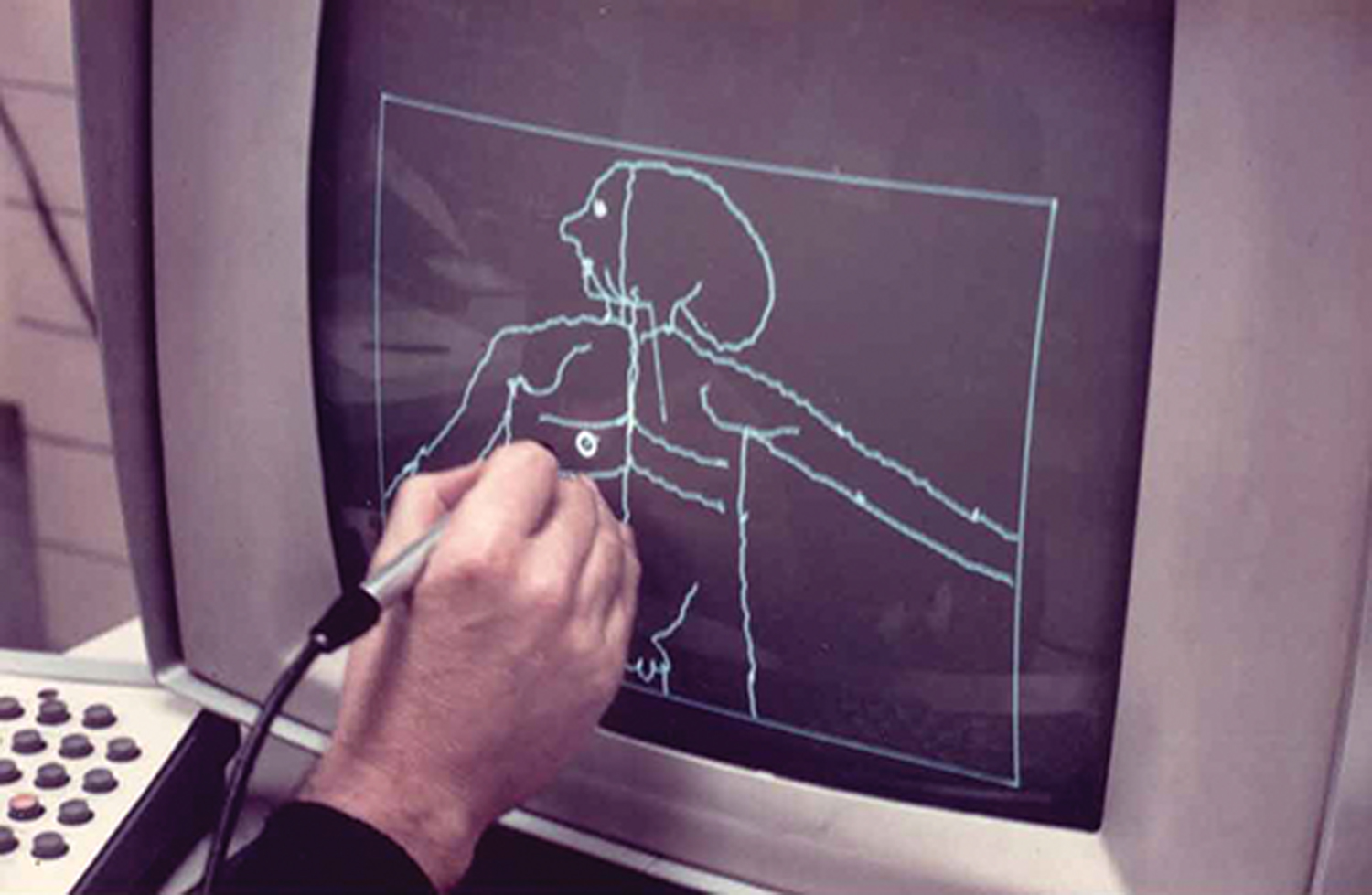
“It was a dynamic time,” remembers Ferdinand Maisel, who studied at UMBC and also worked in the dance department, “and Stan was maybe among the first interdisciplinary/collaborative artists of the 20th century. He was fascinated with how other people would think and solve problems. I met Stan via my work with Liz Walton—I worked for the dance department back then as a composer. Stan immediately had me push his shopping cart of films (which he was known to walk around campus) to a Steenbeck film machine, where I watched, with amazement, some of the films for which he wanted music.” VanDerBeek tapped Maisel to help run his Image Lab, a precursor to UMBC’s present-day Imaging Research Center.
While at UMBC, VanDerBeek recreated the Movie-Drome. Baltimore newscaster Denise Koch, who taught acting and theatre performance at UMBC, recalled, “Stan built a geodesic dome in the center of a large field and projected clouds and nighttime sky-lines, and had people come and lay on the floor for the experience.” (He had planned to erect on campus a 70-foot dome housing a 40-foot planetarium screen.)
 VanDerBeek’s award-winning 1963 film Breathdeath was described by the filmmaker as “a film experiment that deals with the photo reality and the surrealism of life…a black comedy, a fantasy that mocks at death.”
Koch also stars in a 1979 VanDerBeek film, Mirrored Reason. “He came to me and told me he’d been given a studio at the Voice of America for a day, and wanted to play with some of the equipment and asked if I’d participate as his actor—how could I refuse! We went to the studio, and he placed me in a room and just asked me to do an improvisation. I think I used a Kafka story to fall into a state of paranoia as Stan fooled around with my image. At one point my head splits in two and then I’m facing myself—thus, I believe, Mirrored Reason. Stan and our theatre company, Kraken, collaborated a number of times. Once, he took video of each actor’s head in the exact same position and then had us bleeding or melting into and out of each other as if we were a company made up of one face that held the persona of eight different people. It’s hard to explain, but I remember I was stunned!”
Ellsworth Hall remembers that VanDerBeek’s “office was rather messy with stacks of magazines, books, and film cans, but he knew where everything was!” Always encouraging his students to branch out with novel techniques, “In Experimental Film class Stan would have us put objects directly on unexposed film and then move them and expose each frame so as to create a direct animation on the emulsion. Very unusual technique, but it resulted in some interesting images.”
 A frequent collaborator across artistic disciplines, VanDerBeek worked in 1965 on the Merce Cunningham Dance Company’s Variations V with John Cage, Nam June Paik, and others. (Pictured: composers David Tudor and Gordon Mumma, dancer Carolyn Brown.)
Steve Estes, who studied film at UMBC as an undergraduate and then returned to earn an MFA in 1997, remembers VanDerBeek as an encouraging, supportive force. “He was very open, and very open to whatever you really wanted to do. Stan was the kind of guy who was helpful by basically just being there, and letting you do what you did, and providing whatever assistance he could. He had suggestions about this or that, but he was pretty much, ‘Go for it! Freedom, man, just go ahead and do it. Explore! Play!’”
Filmmaker Richard Chisolm ’82, interdisciplinary studies, recalls VanDerBeek as a character whose mind was sometimes racing so quickly that he wasn’t always focused on teaching, but says, “This dreamer personality, this charming dreamer, is kind of by definition boundary-less, and wild, and expressive. We need Stan VanDerBeeks to challenge our otherwise concrete, boring, structured way of looking at the arts. True art is extremely messy. It requires taking risks, and it requires trying things that are going to fail, and losing money, and losing time during those failures, and people like Stan are just fearless and have no regard for whether this dream is going to come true or be doable or not. It’s the old cliché about throwing things at the wall and seeing what sticks—that’s definitely how he looked at ideas. He got ideas every day, and every week, and he tried to contagiously get people to jump in with him, and sometimes they would. He was going super fast every day, always walking and talking fast and could never sit still.”
Dreaming at UMBC
VanDerBeek’s “dreamer” personality was, in fact, fascinated by dreams. He posted a note in a 1970s-era publication, Dreamworks, encouraging readers to send him brief written descriptions of their dreams, saying, “I am seeking this material for developing my ‘dream theater’ and for other futuristic dream-related media projects…. I am convinced that movies are the visual enactment of the dream state. I do not know how specific this function of pre-visualizing and making tangible the dream state is in our lives. But my own instincts move me further into experimenting with such illusory systems, such as freedom of metamorphosis to create ‘meta’ images that can approximate the geometry and forms of dreams.”
 The computer-generated Poemfield series, created between 1965 and 1969, were the artist’s exploration of “image-based poetry language.”
UMBC’s connections to the VanDerBeek family run deep. Two of his children—August and Max— studied briefly at UMBC, and his daughter Julie graduated in 2003 with a degree in theatre. Max returned in the 1990s to teach for the Department of Music; his son, Clay, was a Linehan Artist Scholar who graduated in 2017 with a degree in theatre. Another of Stan’s daughters, artist Sara VanDerBeek, has exhibited and spoken at UMBC’s Center for Art, Design, and Visual Culture. Stan VanDerBeek’s second wife, Louise, graduated in 1976 with a degree in interdisciplinary studies and an arts emphasis and then returned to earn a master’s in 1995 in instructional development systems.
“If I had to draw a cartoon for The New Yorker that was about Stan VanDerBeek?” Richard Chisolm asks rhetorically. “It would be Stan VanDerBeek buys furniture at IKEA, and then you see him in a room with the boxes, and then in the next frame you would see something that didn’t look at all like furniture, and the instructions would be curled up in the corner, and what he built would be this anarchistic mound of panels and windows that was not at all what the IKEA people were telling you to build.”
VanDerBeek served as chair of UMBC’s Department of Visual Arts for only a short time in 1983 and 1984 before becoming ill. Several days before his death in September 1984, he received a poignant good-bye letter from fellow experimental filmmaker Stan Brakhage, who wrote, “I grow more sure of what we’ve done, and that someday…our works and lives will be fully known to the ears and minds of human beings….”
— Tom Moore
*****
To learn more about Stan VanDerBeek’s work, visit stanvanderbeek.com. An exhibition, VanDerBeek + VanDerBeek, which presents artwork by Stan VanDerBeek alongside work by Sara VanDerBeek, is on display at the Black Mountain College Museum + Arts Center through January 4, 2020.
Thanks to Max VanDerBeek, August VanDerBeek, Chelsea Spengemann, the Stan VanDerBeek Archives, and Judy Taylor.
All images, including header, courtesy of the Estate of Stan VanDerBeek.
]]>
The film begins, a fast-moving montage of seemingly unrelated images: eyes, people dancing, an airplane landing, artillery, President Kennedy, wrestlers, a woman applying hairspray, all...
https://umbc.edu/stories/beautiful-dreamer/
https://my3.my.umbc.edu/api/v0/pixel/news/119999/guest@my.umbc.edu/46195ac1524849cc0a8a2f2d0b14052a/api/pixel
cahss
department-of-theatre
fall-2019
feature
graduateschool
mfa
theatre
umbc-history
visual-arts
UMBC News & Magazine
https://my3.my.umbc.edu/groups/umbc-news-magazine
https://assets1-my.umbc.edu/system/shared/avatars/groups/000/001/943/24435aa6207c452e7bc15cc74b42c7bb/xsmall.png?1748556657
https://assets1-my.umbc.edu/system/shared/avatars/groups/000/001/943/24435aa6207c452e7bc15cc74b42c7bb/original.png?1748556657
https://assets2-my.umbc.edu/system/shared/avatars/groups/000/001/943/24435aa6207c452e7bc15cc74b42c7bb/xxlarge.png?1748556657
https://assets2-my.umbc.edu/system/shared/avatars/groups/000/001/943/24435aa6207c452e7bc15cc74b42c7bb/xlarge.png?1748556657
https://assets3-my.umbc.edu/system/shared/avatars/groups/000/001/943/24435aa6207c452e7bc15cc74b42c7bb/large.png?1748556657
https://assets1-my.umbc.edu/system/shared/avatars/groups/000/001/943/24435aa6207c452e7bc15cc74b42c7bb/medium.png?1748556657
https://assets2-my.umbc.edu/system/shared/avatars/groups/000/001/943/24435aa6207c452e7bc15cc74b42c7bb/small.png?1748556657
https://assets1-my.umbc.edu/system/shared/avatars/groups/000/001/943/24435aa6207c452e7bc15cc74b42c7bb/xsmall.png?1748556657
https://assets2-my.umbc.edu/system/shared/avatars/groups/000/001/943/24435aa6207c452e7bc15cc74b42c7bb/xxsmall.png?1748556657
UMBC News & Magazine
0
0
false
Tue, 03 Dec 2019 21:36:22 -0500
Alums in the News: Moriarty, LaClair, Mayhew, and Macchi

Here at UMBC, we take pride in what our alums accomplish after graduation. Take a moment to see which Retrievers have been on the move and making news!
As Baltimore’s Gamescape, an exhibit at Artscape, moved out of MICA and into the Single Carrot Theatre, Jonathon Moriarty ‘13, computer science and visual arts, prepared to present his game, CAVE, to judges and guests.
 photo via BaltimoreGamer.com
Gamescape promotes the rise of “indie developers,” or those who don’t work for big companies.
Moriarty, who first got involved with the exhibit as a member of the game developers club at UMBC, returned for his fifth year at the exhibit as a full-time game developer.
“The rise of indie developers… it’s something that’s happening really the world over and it’s the result of tool sets previously unavailable due to large amounts of money,” said Moriarty to the City Paper. Read more in Technical.ly and the City Paper.
 photo via The Baltimore Sun
Danielle LaClair ’08, social work, had no reason to worry when her tuition payment plan for Howard County Community College was cancelled.
Recently, the Pathway Scholarship Program, which grants “a county government-funded scholarship designed to make college affordable for county residents in need,” gave $2.5 million to 1,300 student–including LaClair. “It’s eased a lot of my worrying. These scholarships make going back to school that much easier,” said LaClair to The Baltimore Sun. Read more here.
On November 6, 2014, the UMBC Department of Visual Arts IMDA (imaging and digital arts) program will host Neja Tomšič of Slovenia along with Icelandic Fulbright Scholar Jaimes Mayhew ‘10, imaging and digital arts.
This Catalyst event, which will take place from 12 p.m. to 1 p.m., is designed to work with IMDA graduate students in the ITE 110 Flex Lab. Read all of the information here.
 photo via LexieMountain.com
Alexandra Shaw Macchi ’14, M.F.A., was recently published in City Paper under her pen name Lexie Mountain. Throughout her article, she addresses the passing of H. Res 676, which gives citizens the ability to sue the president, and the epidemic of imported snails used for moisturizers eating away at Floridian homes. Find her full article here.
]]>
Here at UMBC, we take pride in what our alums accomplish after graduation. Take a moment to see which Retrievers have been on the move and making news! As Baltimore’s Gamescape, an exhibit at...
https://umbc.edu/stories/alums-in-the-news-moriarty-huang-laclair-and-mayhew/
https://my3.my.umbc.edu/api/v0/pixel/news/122357/guest@my.umbc.edu/91581498bffa0729b0d122a11b8d9013/api/pixel
alexandra-shaw-macchi
alumni
artscape
city-paper
danielle-laclair
emergency-services
fulbright-scholar
game-developers
gamescape
h-res-676
imda-graduate
indie-developers
jaimes-mayhew
jonathon-moriarty
leadership
lexie-mountain
mfa
morgan-stanley
neja-tomsic
nursing
pathway-scholarship-program
political-science
president
snails
social-work
visual-arts
UMBC News & Magazine
https://my3.my.umbc.edu/groups/umbc-news-magazine
https://assets1-my.umbc.edu/system/shared/avatars/groups/000/001/943/24435aa6207c452e7bc15cc74b42c7bb/xsmall.png?1748556657
https://assets1-my.umbc.edu/system/shared/avatars/groups/000/001/943/24435aa6207c452e7bc15cc74b42c7bb/original.png?1748556657
https://assets2-my.umbc.edu/system/shared/avatars/groups/000/001/943/24435aa6207c452e7bc15cc74b42c7bb/xxlarge.png?1748556657
https://assets2-my.umbc.edu/system/shared/avatars/groups/000/001/943/24435aa6207c452e7bc15cc74b42c7bb/xlarge.png?1748556657
https://assets3-my.umbc.edu/system/shared/avatars/groups/000/001/943/24435aa6207c452e7bc15cc74b42c7bb/large.png?1748556657
https://assets1-my.umbc.edu/system/shared/avatars/groups/000/001/943/24435aa6207c452e7bc15cc74b42c7bb/medium.png?1748556657
https://assets2-my.umbc.edu/system/shared/avatars/groups/000/001/943/24435aa6207c452e7bc15cc74b42c7bb/small.png?1748556657
https://assets1-my.umbc.edu/system/shared/avatars/groups/000/001/943/24435aa6207c452e7bc15cc74b42c7bb/xsmall.png?1748556657
https://assets2-my.umbc.edu/system/shared/avatars/groups/000/001/943/24435aa6207c452e7bc15cc74b42c7bb/xxsmall.png?1748556657
UMBC News & Magazine
0
0
false
Fri, 05 Sep 2014 19:30:02 -0400


