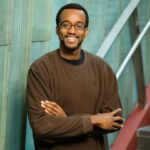
Corbett in the Interdisciplinary Life Sciences Building on campus in April 2021. Photo by Marlayna Demond ’11.
Everyone who’s ever met Kizzmekia Corbett ’08, M16, biological sciences and sociology, gets it.
Sue Florence, one of the few Black teachers in the Hillsborough, North Carolina, school district where Corbett went to elementary and middle school, got it. Rhonda Brooks, Corbett’s mother, remembers Florence saying, when Corbett was in third grade, “She’s got a gift. You’d better seek into it.”
Florence’s comments pushed Brooks to make sure expectations were high for Corbett in school, and to encourage—no, require—15-year-old “Kizzy” to find a scholarly internship rather than a position in retail when she wanted a summer job in high school.
So, at her mother’s behest, Corbett got involved in Project SEED, a program that offers research experiences to talented high school students from underrepresented groups in STEM. Her first program mentor was James Morken, who was on the chemistry faculty at University of North Carolina at Chapel Hill at the time.
He got it, too.
“When Kizzy started in my laboratory, she didn’t have much hands-on research experience, but she had loads of curiosity, a drive to learn what she didn’t know, and a very strong work ethic,” Morken says. “It was abundantly clear she would be successful in whatever she chose to do.”
Today, Corbett is an assistant professor of immunology and infectious diseases at the Harvard T.H. Chan School of Public Health, after leading the team behind the successful effort to create a vaccine for COVID-19 at the National Institutes of Health (NIH). Working with the pharmaceutical company Moderna, Corbett’s achievements on the global stage benefit all of us. Now, we get it, too.
“She can do anything”
As a Meyerhoff Scholar and NIH Scholar at UMBC, Corbett worked in Barney Graham’s lab at the Vaccine Research Center at the NIH. He’s also her boss today.
“Kizzmekia’s spirit was noticeable even from a young age,” Graham says. “New people who come into the lab have always quickly realized that she was a person who had bigger things in her future.”
Corbett met Jessica Kelley, a UMBC assistant professor of sociology at the time, when Corbett took her Introduction to Sociology course. “She was a standout in that large lecture class from the beginning,” Kelley recalls. Later, Corbett took Kelley’s course on applied community research, and conducted research with Kelley as part of a National Institute on Aging study on healthy aging in diverse neighborhoods.
Photos kindly provided by Kizzmekia Corbett, unless otherwise noted.
The work with Kelley inspired Corbett’s double major and her approach to all of her future work. Corbett even became the only undergraduate enrolled in one of Kelley’s graduate-level courses. “She kept the graduate students on their toes,” Kelley says.
“When she’s got her mind set on something, it’s set,” Brooks says. “She can do anything.”
A leading role
Today, Corbett has proven them all right. As the scientific lead of the Vaccine Research Center’s coronavirus team at the NIH, she developed a new technology for the Moderna COVID-19 vaccine and others, and as a result, she has played a leading role in one of the most important measures to end the pandemic. She has also become the first Black woman in the world to create a vaccine.
Anthony Fauci, head of the National Institute of Allergy and Infectious Diseases (NIAID) and one of the most trusted voices about the pandemic around the world, described Corbett as “widely recognized in the immunology community as a rising star,” when he nominated her for TIME magazine’s TIME100 Next list. Based on her leadership of COVID-19 vaccine development at NIAID, he added, “Her work will have a substantial impact on ending the worst respiratory-disease pandemic in more than 100 years.”
People drive the research
Perhaps just as important as her scientific accomplishments, Corbett has burst onto the public stage as the face of a diverse and rising generation of talented scientists who will transform the world. She is a stellar science communicator, explaining the vaccine and the virus in highly accessible ways to media outlets, her family, two U.S. presidents, and more. She is an inspiration to children who may now imagine becoming scientists.
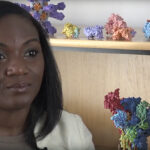
Corbett visits a lab on campus in April 2021. Photo by Marlayna Demond ’11.
“Dr. Corbett’s voice has been particularly important this year,” Graham says, “and going forward, her ability to inspire and to educate and motivate young people to see science as something feasible and even to see science as something fun will be part of her legacy.”
And yet, amid her newfound celebrity status and her vast scientific acumen, somehow she has managed to remain unabashedly human.
“I am still Kizzy. I’m still the little girl you met when I was 17 and being recruited into the Meyerhoff program,” she told UMBC President Freeman Hrabowski during a conversation in February 2021, when they were both being recognized at the Kaiser Permanente and Reginald F. Lewis Museum 2nd Annual African American Health Care Awards.
“Actually, before a scientist, I’m a Christian, and I’m sassy, and I’m bright, and I’m fashionable…” she says, “and I’m Southern, and I’m empathetic, and I’m all of these things that make me into this person, that make me a better scientist. I think that is the most important part of the story—that people drive the research.”
The genuine thing
First there was Sue Florence. Then there was James Morken and others with the SEED Project. All through her childhood, there was her mother, Rhonda Brooks, cheering her on. Combine that support structure with Corbett’s own deep-seated determination to succeed, and by the time she was looking at colleges, Corbett had lots of options. But when she, her parents, and her grandmother visited UMBC, it felt like home. The first reason? The grain silo along UMBC Boulevard.
“It reminded me of being back at home in the country,” Brooks remembers. When they began touring campus, Brooks thought, “Oh man, this is really her,” but, “I needed her to see it was her. So I didn’t even say anything.” There was no need. By the end of Meyerhoff Selection Weekend in 2004, Kizzy was glowing.
Beyond the welcoming silo were all the welcoming faces. “Everybody was so friendly,” Brooks says. “You think when you go visit campuses that people have to be this way because they’re trying to get students to come, but as a person who’s been in the education field for so long, I can weed out who’s genuine and who isn’t.” And, Brooks says, despite the emphasis on Meyerhoff cohort numbers, of which Kizzy belonged to M16, “it just felt like she would be not just a number.”
Equaling the playing field
In the February conversation with Hrabowski, Corbett recalls her father telling her that she should “go where she would be loved.” UMBC became that place.
Asked to describe the value of the Meyerhoff Scholars Program, she said, “It is simply one word: resources. It is equaling the playing field for people who have generally been under-resourced, and those are communities of color and people from underrepresented minority groups. And the Meyerhoff Program does that.”
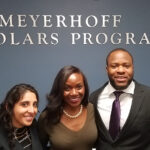
Corbett with fellow Meyerhoff alumni at a 2017 on-campus event. Photo courtesy of Keith Harmon, director, Meyerhoff Scholars Program.
The Meyerhoff Scholars Program, founded in 1989, is considered the gold standard of programs designed to support students from underrepresented groups in STEM. Hundreds of alumni have gone on to standout careers, including U.S. Surgeon General, Baltimore City health commissioner, and professorships at the nation’s top-tier universities.
The Meyerhoff Scholars Program “is a place where every single person was special and would be loved. The goal is not to fail you out, but to lift you up,” Corbett says. And for underrepresented students in STEM, living in a world that too often still doesn’t expect people who look like them to excel as researchers, the Meyerhoff Program “provided a niche for us to just be, to be comfortable, and to just thrive.”
A mother’s touch
It wasn’t always easy, though. Brooks remembers when Kizzy received her first C. “Being on the phone with her just didn’t help,” Brooks remembers. “So I got in my car, and I drove all the way to Maryland. I was trying to tell her it was going to be alright, but it was just heartbreaking, because she never had that C. I told her, it’s gonna be tough—you might get more than one C.”
Even world-class, world-saving scientists sometimes get Cs and need their moms.
And even now, Brooks is ready to support Corbett as she navigates this new chapter in her life. “If she needs me now, if she’s feeling stressed,” Brooks says, “if she picks up the phone, I don’t care what time of night it is, I pick it up.”
On Corbett’s college bedside also sat a Bible—another lasting connection to her family and her faith, which Corbett brings up often in her interviews. Brooks gave each of her children a Bible as they left for college. “I say take this Bible with you. Even if you don’t look at it, keep it next to your bed. I don’t care if you don’t open it. But if you touch it, it will make you feel a whole lot better.”
Corbett and her mother, though apart during the pandemic, have stayed connected by attending online services from the same church in Texas. Their first travel plans post-pandemic? A trip to attend the service in person.
Lifting others up
Whether it’s her faith, an innate empathy, 35 years of experience as a Black woman in the U.S., or other factors, Corbett’s dedication to lifting people up goes far beyond her work in the laboratory. Her commitment to equity has demanded that she speak out to address vaccine hesitancy, especially in communities hit hardest by the virus, and champion the participation of minorities in science and research, both as scientists and as participants in clinical trials.
“She has always, even as a young student, brought an energy and curiosity and love of science that made our lab a better place,” Graham says. “She has also always been very devoted to making things better for people around her, particularly younger people coming behind her.”
Brooks says that Corbett has always had a selfless nature. One day she brought home a classmate who had no place to go after school and asked if she could stay with the family. Brooks was uncertain at first, “but we did it,” she says. “And we’ve been taking kids in ever since.”
Fighting for the public good
Corbett’s study of sociology at UMBC enhanced and sharpened her innate desires to help people and promote fairness into a commitment to consider social factors throughout her scientific career. For example, when the Moderna vaccine was in clinical trials, Corbett pushed hard to make sure that there were more people of color among the study population.
Corbett at a Rally for Medical Research event in Washington, D.C.
“You have to start things equitably to finish them that way,” she told Hrabowski at the February event. “We slowed down the phase three clinical trial until we got to a point where we felt the numbers were respectable. We wanted 13 percent, to represent the proportion of Black people in the country,” she said, but they didn’t quite make it. Still, she says, “I have other vaccines heading into trials, so we will take care of it then.”
Kelley, her sociology instructor and research mentor at UMBC, reflects on how Corbett has developed over time. “Kizzmekia’s training in both biology and sociology has helped her become both a scientist working at the cutting-edge of vaccine development to provide a universal public good and a humanist who understands that historically and structurally not all groups have had access to these public goods,” she says.
Corbett has faced her own challenges throughout her career, some of which have predictably intensified since she became more of a public figure.
Kizzmekia, whose name is a combination of “Kizzy” from the character in Alex Haley’s Roots and “-mekia” from Brooks’s own imagination, has been teased since childhood and continues to be harassed about her name. When Kizzy showed her mother a particularly hurtful social media post, “I told her, tell them to call your mama,” Brooks recalls, “because your mama chose your name for a reason, because you’re a gift from God to me.”
As a child, even Kizzy’s strong interest in academic success was sometimes looked down upon by her peers, but “she just went beyond,” Brooks says.
Corbett (center, front) with her NIAID research team, including Olubukola Abiona ’17, M25, biochemistry and molecular biology (center, back).
Corbett has also experienced sexism and racism as a scientist. Brooks says sometimes men have skipped over Corbett and instead approached her boss, but “that’s why I like her boss, [Barney Graham] so much, because he’s always been behind her back,” she says—pointing people right back to Corbett.
Finding your champions
Corbett has taken her mother’s message to heart. “You just have to believe in yourself and believe in your work,” she says. Important, too, is having your own champions. “I always had someone in the space who was looking out for me,” she said—people like Sue Florence, Freeman Hrabowski, and Barney Graham. “Find those people and seek them out. You want someone to be as invested in you, as you are in you.”
High expectations and support from all those people who “got it,” cheering for her and setting the bar high from elementary school onward, combined with Corbett’s inner determination—and a dash of spunk—have fueled her success. If you had met a childhood Kizzy, she would have said, “Hi, I’m Kizzmekia Corbett, and I’m going to be the first Black woman to win the Nobel Prize in Medicine.”
Verbalizing one’s goals is a risk, because people will know if you fail. But it’s also a critical step toward turning them into reality. Little Kizzy knew it as a kid. “It speaks to putting yourself where you want to be, and really speaking the words to the universe,” she told Hrabowski. Even if she hasn’t reached her childhood goal yet, she’s happy with what she’s been able to accomplish so far.
“I haven’t won a Nobel prize, and I don’t know if I will,” she says, “but I think helping to ‘save the world,’ so to speak, is good enough.”
For now.
Read more about other ways Retrievers are giving their time and efforts to help others access the vaccine.
*****
Header image of Corbett on campus in April 2021 by Marlayna Demond ’11.
]]>
Corbett in the Interdisciplinary Life Sciences Building on campus in April 2021. Photo by Marlayna Demond ’11. Everyone who’s ever met Kizzmekia Corbett ’08, M16, biological sciences and...https://umbc.edu/stories/her-science-is-the-worlds/https://my3.my.umbc.edu/api/v0/pixel/news/119599/guest@my.umbc.edu/7ce5d4efc33fbc01db43592b40e066b3/api/pixelbiological-sciencescommunityimpactcovidresearchdiscoveryfeaturemeyerhoffscholarsmhoffsociologyspring-2021UMBC News & Magazinehttps://my3.my.umbc.edu/groups/umbc-news-magazinehttps://assets1-my.umbc.edu/system/shared/avatars/groups/000/001/943/24435aa6207c452e7bc15cc74b42c7bb/xsmall.png?1748556657https://assets1-my.umbc.edu/system/shared/avatars/groups/000/001/943/24435aa6207c452e7bc15cc74b42c7bb/original.png?1748556657https://assets2-my.umbc.edu/system/shared/avatars/groups/000/001/943/24435aa6207c452e7bc15cc74b42c7bb/xxlarge.png?1748556657https://assets2-my.umbc.edu/system/shared/avatars/groups/000/001/943/24435aa6207c452e7bc15cc74b42c7bb/xlarge.png?1748556657https://assets3-my.umbc.edu/system/shared/avatars/groups/000/001/943/24435aa6207c452e7bc15cc74b42c7bb/large.png?1748556657https://assets1-my.umbc.edu/system/shared/avatars/groups/000/001/943/24435aa6207c452e7bc15cc74b42c7bb/medium.png?1748556657https://assets2-my.umbc.edu/system/shared/avatars/groups/000/001/943/24435aa6207c452e7bc15cc74b42c7bb/small.png?1748556657https://assets1-my.umbc.edu/system/shared/avatars/groups/000/001/943/24435aa6207c452e7bc15cc74b42c7bb/xsmall.png?1748556657https://assets2-my.umbc.edu/system/shared/avatars/groups/000/001/943/24435aa6207c452e7bc15cc74b42c7bb/xxsmall.png?1748556657UMBC News & Magazine00falseThu, 10 Jun 2021 14:54:22 -0400Creating Technology that Protects Us—Rising Together
Since 2009, as part of its Alumni Awards celebration, the UMBC Alumni Association names one “Rising Star” recipient each year who exemplifies early career and professional achievement. In the coming weeks, we will spend some time with awardees from the past decade to see where they are now—and how they’ve grown in their fields while maintaining ties to UMBC. In this installment, UMBC Rising Stars Isaac Kinde’05, M13, biological sciences, and Christopher Valentino ’02, M.S. ’06, information systems,discuss their roles in the healthcare and defense industries, respectively. Both alumni discovered their passion for their work while at UMBC and aim to harness technology to protect us from disease and cyber warfare.
As we embrace life in a technologically immersive world—scrolling out of habit or relying on a life-saving medical device—there’s a common question many of us have about the tech we’ve come to depend on: How can we best harness it to protect us? From malware and scams, but also from disease and unnecessary pain?
Two UMBC graduates, who previously received Rising Star alumni awards, are diligently working to create and influence technology that innovates and protects us.
Protecting lives with early detection technology
Isaac Kinde ’05, M13, biological sciences, is advancing healthcare technologies that work to protect people from possibly fatal diseases. Kinde is co-founder and vice president for technology assessment at Thrive, an Exact Sciences Company. Thrive was recently acquired by Exact Sciences for up to $2.15 billion assuming successful completion of certain milestones, says Kinde. He and his team work to save lives threatened by cancer by creating early detection technologies.
Kinde at work in his lab at Thrive Early Detection in Baltimore, Maryland. Photo courtesy of Kinde.
“There’s two million cancer cases in the U.S. annually and 70 percent of those cases don’t have a screening test available,” says Kinde. “If you can find cancers earlier, particularly in the earliest stages, survival can be as high as 90 percent or greater. The technology that my company is developing really leverages decades of research into how cancers work, their biology, as well as method developments in order to exploit that biology.”
Getting an early start
Since being named a Rising Star alum in 2014, Kinde received his M.D.-Ph.D. from the Johns Hopkins University School of Medicine. He was named one of Forbes magazine’s 30 under 30 “Rising Stars Transforming Science and Health.” Kinde also received The Daily Record’sInnovator of the Year award in 2015.
While at UMBC as a Meyerhoff Scholar, Kinde’s appreciation for research blossomed. He said that his first research mentor, Michael Summers, a professor in the Chemistry and Biochemistry department, influenced his love of research after spending a summer in his lab. “I just got hooked and I just didn’t stop doing research. It was a continuous effort until I graduated,” Kinde recalls.
Kinde speaking at the 2014 Alumni Award ceremony, and pictured with President Hrabowski, Mike Summers, and Kenneth Pittman ’80. All photos courtesy of the Alumni Association, unless otherwise noted.
It was his doctoral work at the Vogelstein Lab at Hopkins that helped to propel the technological initiatives at Thrive. “We set out to apply the latest and greatest technologies to identify cancers in their earliest stages. It took new method creation. We had to develop new technologies in order to find the earliest signs of cancer in routine clinical specimens,” Kinde says.
The future of cancer detection technology
Thus, came about the creation of CancerSEEK, a blood test that has shown the ability to detect 65 percent of cancers prior to clinically evident metastasis in individuals without any history of the disease. Kinde noted that a test like CancerSEEK can detect multiple cancers from a single test and do so in real time.
“There was the prototype version [of CancerSEEK] that our academic lab published. Then there was another prototype version that our company collaborated with Hopkins in order to demonstrate how we could work in a real-world setting,” says Kinde. “It’s the first of its kind to demonstrate real world detection and intervention of cancers. We’re preparing to get FDA approval, to do the full clinical validation of the CancerSEEK test.”
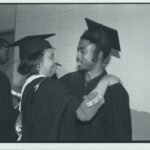
Kinde, second from left, with his roommates Andy Windsor, Seth Miller, and Kenneth Gibbs, all fellow Meyerhoff Scholars, at a graduation celebration in 2005. Photo courtesy of Kinde.
Kinde recalls the moment he saw successful Black Americans who were in the top M.D.-Ph.D. programs and top graduate programs while he studied at UMBC as an influential factor in his career progression. In fact, UMBC undergraduate alumni who identify as African American have gone on to pursue and earn more M.D.-Ph.D.s than alumni from any other institution across the country, largely in thanks to the support from the Meyerhoff Scholars Program.
“To me, that said, ‘well, why can’t I do that too?’ As I’ve progressed in my career, it’s the lesson that I remember. It’s something that I want to help future generations of people by being that example that they can look to.”
Valentino with his family at the 2012 Alumni Award ceremony.
Cybersecurity at the highest levels
Christopher Valentino ’02, M.S. ’06, information systems management, has more than two decades of expertise in domestic and global cybersecurity, which began during his undergraduate tenure at UMBC. Valentino spent 24 years working with Northrop Grumman Corp., a global aerospace and defense technology company, and its predecessor companies.
He started working at Northrop as an intern—working in what he called the “cyber mailroom”—and worked his way up. When he received the UMBC Alumni Association’s Rising Star award in 2012, Valentino was the then-director of contract research and development at Northrop.
“I had a parallel experience of working and going to school at the same time,” says Valentino, “while I was also starting a family. There are things I learned at UMBC as a student that I would not have learned anywhere else. The bottom line is UMBC is a really hard school. And it’s very underappreciated until you actually show up and become part of the institution, and go through the rigor that’s there.”
A leader in influencing cyberspace infrastructures
Nearly 10 years since being named a UMBC rising star, Valentino now serves as the chief strategy officer at Peraton, a next-generation national security company that provides technology solutions to space and intelligence, cyber mission, defense and security, and civil and health customers. Peraton acquired Northrop’s IT services business in February 2021 when Valentino transitioned into being the point person for shaping the future of the company.
“Peraton is a national security company focused on providing capabilities and solutions across the Department of Defense intelligence community—federal, civilian, and Homeland Security. I am responsible for operationalizing our strategy across those businesses,” Valentino says.
Valentino’s work emphasizes the importance of cybersecurity protection at the highest levels. While in his role as vice president of information warfare and cyber survivability at Northrop, Valentino shared insight on how some of the most powerful warfare structures in our country, such as the military and aerospace defenses, work to approach information warfare and how they keep our protections secure in the face of international threats on the Defense & Aerospace Report Podcast last June.
Valentino speaks at the 2012 Alumni Award ceremony.
“You train as you fight. In this domain, things move fast and things can change. You have to know the right environments to be able to train your mission operators,” Valentino told podcast host Vago Muradian. “From an exercise perspective, you would always go out and train, train, train and then execute. It’s the same thing in information warfare.”
The past, present, and future of tech
In his long tenure in the cyber security field, Valentino is able to appreciate innovative technological protections while understanding that these advancements are interconnected with all the efforts of past researchers.
“The one thing that I can appreciate from being in the industry now for over two decades is that there’s repetition and then there’s innovation in the seams between the repetition,” says Valentino. “There’s a lot of concepts that were new 20-plus years ago that will still be new 20 years from now. Artificial intelligence is probably one that I would point to and say, 20 years ago, we were doing research and trying to apply technologies, and two decades later, we’re still working to operationalize that technology.”
Valentino with Provost Philip Rous, Aryya Gangopadhyay, information systems chair, and Bennett Moe ’88 at the 2012 Alumni Award Ceremony.
Threat protection
Valentino and Kinde’s efforts have created an impactful ripple effect in our understanding of how technology can protect us from threats. Kinde’s work in early detection technology is on track to save more lives ahead of a cancer diagnosis that can be fatal. One blood test may have the potential to accurately detect a variety of different cancers. Valentino, on the other hand, is continuing to fortify the infrastructure and systems that protects our land, air, space, and digital domains from threats.
Whether it be a threat against our immune systems or a threat to our cyber safety, these former UMBC rising stars are raising the bar and redefining what protections in technology look like.
— Adriana Fraser
Read more about other Retrievers rising together and stay tuned for more information about UMBC’s 32nd annual Alumni Awards in October.
]]>
Since 2009, as part of its Alumni Awards celebration, the UMBC Alumni Association names one “Rising Star” recipient each year who exemplifies early career and professional achievement. In the...https://umbc.edu/stories/creating-technology-that-protects-us/https://my3.my.umbc.edu/api/v0/pixel/news/119607/guest@my.umbc.edu/52cf200d1a5dba3b9f7d80322938fc88/api/pixelalumnialumni-awardsbiological-sciencesinformation-systemsmeyerhoffmhoffrising-togetherUMBC News & Magazinehttps://my3.my.umbc.edu/groups/umbc-news-magazinehttps://assets1-my.umbc.edu/system/shared/avatars/groups/000/001/943/24435aa6207c452e7bc15cc74b42c7bb/xsmall.png?1748556657https://assets1-my.umbc.edu/system/shared/avatars/groups/000/001/943/24435aa6207c452e7bc15cc74b42c7bb/original.png?1748556657https://assets2-my.umbc.edu/system/shared/avatars/groups/000/001/943/24435aa6207c452e7bc15cc74b42c7bb/xxlarge.png?1748556657https://assets2-my.umbc.edu/system/shared/avatars/groups/000/001/943/24435aa6207c452e7bc15cc74b42c7bb/xlarge.png?1748556657https://assets3-my.umbc.edu/system/shared/avatars/groups/000/001/943/24435aa6207c452e7bc15cc74b42c7bb/large.png?1748556657https://assets1-my.umbc.edu/system/shared/avatars/groups/000/001/943/24435aa6207c452e7bc15cc74b42c7bb/medium.png?1748556657https://assets2-my.umbc.edu/system/shared/avatars/groups/000/001/943/24435aa6207c452e7bc15cc74b42c7bb/small.png?1748556657https://assets1-my.umbc.edu/system/shared/avatars/groups/000/001/943/24435aa6207c452e7bc15cc74b42c7bb/xsmall.png?1748556657https://assets2-my.umbc.edu/system/shared/avatars/groups/000/001/943/24435aa6207c452e7bc15cc74b42c7bb/xxsmall.png?1748556657UMBC News & Magazine00falseTue, 08 Jun 2021 16:12:58 -0400Career Q&A: Robert Deloatch ’11, M19
Every so often, we chat with an alum about what they do and how they got there. Robert Deloatch ’11, M19, computer science, has followed his research interests to an exciting job at Apple. We asked Robert about what his experience as a Meyerhoff Scholar means in his life today, and what he would say to a future scholar.
Q: What is your current job title and employer?
A: I am a Human Factors Engineer at Apple Inc.
Q: Tell us about your current job and what you enjoy most about it.
A: I manage a team of researchers who focus on applying user-centered design principles to design and develop Apple products. I collaborate with teams at Apple to come up with new ways to continue to enhance the customer experience. I enjoy the fast paced environment of Apple which allows for conducting research that leads to immediate customer impact.
Q: When you think about the “ripple effect” of the Meyerhoff Scholars Program, how do you see that playing out in your field and in your life?
A: I’ve been amazed at how the Meyerhoff Scholars Program has continued to affect my field and life. I’ve encountered researchers and faculty of color that were part of the Meyerhoff Scholars Program or programs that were modeled after Meyerhoff at conferences and internships. It’s been a reminder to me of the staying power of such a program and how it’s focus on leadership, diversity, and scholarship has been ingrained into my beliefs and relationships.
Q: Why is the Meyerhoff mission so important, not only to you, but to society?
A: The Meyerhoff mission is important because diversity in STEM is important. To generate the best ideas and solve complex problems requires discussion and being challenged. Having groups from various backgrounds and perspectives is foundational to promote useful discussion.
Q: What advice would you give to a student considering the program?
A: I would tell a student to follow the advice of your Meyerhoff staff. They have been instrumental in helping produce thousands of amazing scholars and have your best interest at heart. Listen to them.
]]>
Every so often, we chat with an alum about what they do and how they got there. Robert Deloatch ’11, M19, computer science, has followed his research interests to an exciting job at Apple. We...https://umbc.edu/stories/career-qa-robert-deloatch-11-m9/https://my3.my.umbc.edu/api/v0/pixel/news/119633/guest@my.umbc.edu/4cd30822664f76375c603032d56853ee/api/pixelalumnicareer-q-and-acomputer-sciencemeyerhoffmhoffUMBC News & Magazinehttps://my3.my.umbc.edu/groups/umbc-news-magazinehttps://assets1-my.umbc.edu/system/shared/avatars/groups/000/001/943/24435aa6207c452e7bc15cc74b42c7bb/xsmall.png?1748556657https://assets1-my.umbc.edu/system/shared/avatars/groups/000/001/943/24435aa6207c452e7bc15cc74b42c7bb/original.png?1748556657https://assets2-my.umbc.edu/system/shared/avatars/groups/000/001/943/24435aa6207c452e7bc15cc74b42c7bb/xxlarge.png?1748556657https://assets2-my.umbc.edu/system/shared/avatars/groups/000/001/943/24435aa6207c452e7bc15cc74b42c7bb/xlarge.png?1748556657https://assets3-my.umbc.edu/system/shared/avatars/groups/000/001/943/24435aa6207c452e7bc15cc74b42c7bb/large.png?1748556657https://assets1-my.umbc.edu/system/shared/avatars/groups/000/001/943/24435aa6207c452e7bc15cc74b42c7bb/medium.png?1748556657https://assets2-my.umbc.edu/system/shared/avatars/groups/000/001/943/24435aa6207c452e7bc15cc74b42c7bb/small.png?1748556657https://assets1-my.umbc.edu/system/shared/avatars/groups/000/001/943/24435aa6207c452e7bc15cc74b42c7bb/xsmall.png?1748556657https://assets2-my.umbc.edu/system/shared/avatars/groups/000/001/943/24435aa6207c452e7bc15cc74b42c7bb/xxsmall.png?1748556657UMBC News & Magazine00falseFri, 14 May 2021 17:03:53 -0400Alumna Leads Team to Breakthrough Coronavirus Vaccine Results
Clinical trials seeking a vaccine to prevent COVID-19 are galloping forward around the world, and Kizzmekia Corbett and Barney Graham’s research team at the National Institute of Allergy and Infectious Diseases (NIAID) continues to lead the pack.
In a study of non-human primates published in the prestigious New England Journal of Medicinelast week, the team became the first to demonstrate that their vaccine successfully stopped viral replication in both the lungs and nose. The findings were a significant advance compared to previous studies, which only showed protection in the lungs. The day after Corbett’s results were published, Johnson & Johnson published similar results for their vaccine, although the animals in the Johnson & Johnson trial were exposed to a lower amount of the virus.
“Protection in the upper airway is something that’s hard to come by, so it’s a big deal,” says Corbett ’08, M16, biological sciences and sociology, scientific lead for the Coronavirus Vaccines Team at the NIAID Vaccine Research Center. “We were very excited when we saw it.”
Next steps
The next step is a phase III human trial, which began with 30,000 participants on July 27. The participants will either receive the vaccine or a placebo, “and then they will go live their lives, and either be exposed to the coronavirus or not,” Corbett says. Over time, enough of the participants will be exposed so that researchers can measure the efficacy of the vaccine.
Our (co-inventors @McLellan_Lab) COVID-19 vaccine (spike delivered by @moderna_tx's mRNA) was just injected into the 1st human in phase 1 trial, only 66 days after viral sequence release… a testament to rapid vaccine development for emerging diseases
]]>
Clinical trials seeking a vaccine to prevent COVID-19 are galloping forward around the world, and Kizzmekia Corbett and Barney Graham’s research team at the National Institute of Allergy and...https://umbc.edu/stories/alumna-leads-team-to-breakthrough-coronavirus-vaccine-results/https://my3.my.umbc.edu/api/v0/pixel/news/119819/guest@my.umbc.edu/7d46675ead141ff9b930480daa11b9f2/api/pixelbiologychemistrycnmscovidresearchdiscoverymeyerhoffmeyerhoffscholarsmhoffresilienceUMBC News & Magazinehttps://my3.my.umbc.edu/groups/umbc-news-magazinehttps://assets1-my.umbc.edu/system/shared/avatars/groups/000/001/943/24435aa6207c452e7bc15cc74b42c7bb/xsmall.png?1748556657https://assets1-my.umbc.edu/system/shared/avatars/groups/000/001/943/24435aa6207c452e7bc15cc74b42c7bb/original.png?1748556657https://assets2-my.umbc.edu/system/shared/avatars/groups/000/001/943/24435aa6207c452e7bc15cc74b42c7bb/xxlarge.png?1748556657https://assets2-my.umbc.edu/system/shared/avatars/groups/000/001/943/24435aa6207c452e7bc15cc74b42c7bb/xlarge.png?1748556657https://assets3-my.umbc.edu/system/shared/avatars/groups/000/001/943/24435aa6207c452e7bc15cc74b42c7bb/large.png?1748556657https://assets1-my.umbc.edu/system/shared/avatars/groups/000/001/943/24435aa6207c452e7bc15cc74b42c7bb/medium.png?1748556657https://assets2-my.umbc.edu/system/shared/avatars/groups/000/001/943/24435aa6207c452e7bc15cc74b42c7bb/small.png?1748556657https://assets1-my.umbc.edu/system/shared/avatars/groups/000/001/943/24435aa6207c452e7bc15cc74b42c7bb/xsmall.png?1748556657https://assets2-my.umbc.edu/system/shared/avatars/groups/000/001/943/24435aa6207c452e7bc15cc74b42c7bb/xxsmall.png?1748556657UMBC News & Magazine00falseThu, 06 Aug 2020 18:03:03 -0400Thu, 06 Aug 2020 18:03:03 -0400UMBC Alumnae Racing to Develop Coronavirus Vaccine
Kizzmekia Corbett ’08, M16, biological sciences, says it feels like she’s “living in a constant adrenaline rush.” Maybe that’s because she and her team at the Vaccine Research Center at the National Institute of Allergy and Infectious Diseases have been working around the clock for weeks. They’re racing to develop a vaccine for the coronavirus faster than it can race across the globe.
“To be living in this moment where I have the opportunity to work on something that has imminent global importance…it’s just a surreal moment for me,” Corbett says.
Despite it feeling surreal, the advances Corbett and her team are making are very real, and they’re setting records. “We are making better progress than I could have ever hoped for,” she says. After three months of studies in test tubes and in animals, the vaccine her team developed is about to enter a phase I clinical trial, a crucial hurdle on the way to FDA approval.
“Focus, focus, focus”
Corbett says her experience as a Meyerhoff Scholar at UMBC helped prepare her and another core team member, post-baccalaureate researcher OlubukolaAbiona ‘17, M25, biochemistry and molecular biology, for a moment like this. “Discipline is one of the biggest things that Meyerhoff taught us,” Corbett says. “And it matters—a lot—in these instances of being pulled in multiple directions and really trying to understand what the priorities are.”
Corbett, who came to UMBC from North Carolina, and Abiona, who attended Eleanor Roosevelt High School in Prince George’s County, also draw on UMBC President Freeman Hrabowski’s consistent exhortation to “Focus, focus, focus,” Corbett says. “The UMBC connection and the training we received there, for both of us, has been instrumental in how we are operating right now,” she adds.
A couple of years ago, Corbett and Abiona were the only members of their team. It’s since grown, but their relationship remains special. “Essentially we started out being the team alone, and as a result, there is this level of trust and understanding that we have with each other,” Corbett says. “It’s extremely rewarding to watch someone exponentially grow into a scientist in the course of a few years,” Corbett reflects. “I think next to getting data, mentoring young scientists is the most exciting and rewarding part of what I do here.”
As an African American woman in STEM, Corbett says she has also experienced people thinking she’s only there because of diversity initiatives. “That’s been a cloud around my movement in science,” she shares. So, she says, “showing up, particularly in a moment like this, and setting a standard about what people from different backgrounds can contribute” is just as important as mentoring the next generation of scientists.
“Hopefully we will open people’s eyes to the credibility of people who look like us as real scientists.”
Corbett, Abiona, and team at NIH.
Setting the standard
While that message is always in the back of their minds, right now, Corbett and Abiona are deeply focused on the work at hand. “For me, I’m very interested in looking ahead to the kinds of data we’ll get from human trials,” Corbett says. “Yes, we have tons of data that will support this vaccine being a fruitful one and a protective one, but it’s always just a hypothesis until we get some real human data.”
If the phase I trials are successful, that will be a huge step toward an FDA-approved vaccine for the coronavirus—and also set a new benchmark for future disease outbreaks.
“I’m really excited about fulfilling this proof-of-concept for pandemic preparedness, where we can literally go from receiving the genetic sequence of a virus all the way through to a vaccine clinical trial in less than three months,” Corbett says. “I think that’s somewhat of an unprecedented standard to set, and I’m looking forward to helping to standardize it. I hope that it will get even shorter.”
]]>
Kizzmekia Corbett ’08, M16, biological sciences, says it feels like she’s “living in a constant adrenaline rush.” Maybe that’s because she and her team at the Vaccine Research Center at the...https://umbc.edu/stories/umbc-alumnae-racing-to-develop-coronavirus-vaccine/https://my3.my.umbc.edu/api/v0/pixel/news/119943/guest@my.umbc.edu/2484ad6ce05702d67cb5feb2d391e875/api/pixelalumnibiologychemistrycnmscovidresearchmeyerhoffmeyerhoffscholarsmhoffresilienceUMBC News & Magazinehttps://my3.my.umbc.edu/groups/umbc-news-magazinehttps://assets1-my.umbc.edu/system/shared/avatars/groups/000/001/943/24435aa6207c452e7bc15cc74b42c7bb/xsmall.png?1748556657https://assets1-my.umbc.edu/system/shared/avatars/groups/000/001/943/24435aa6207c452e7bc15cc74b42c7bb/original.png?1748556657https://assets2-my.umbc.edu/system/shared/avatars/groups/000/001/943/24435aa6207c452e7bc15cc74b42c7bb/xxlarge.png?1748556657https://assets2-my.umbc.edu/system/shared/avatars/groups/000/001/943/24435aa6207c452e7bc15cc74b42c7bb/xlarge.png?1748556657https://assets3-my.umbc.edu/system/shared/avatars/groups/000/001/943/24435aa6207c452e7bc15cc74b42c7bb/large.png?1748556657https://assets1-my.umbc.edu/system/shared/avatars/groups/000/001/943/24435aa6207c452e7bc15cc74b42c7bb/medium.png?1748556657https://assets2-my.umbc.edu/system/shared/avatars/groups/000/001/943/24435aa6207c452e7bc15cc74b42c7bb/small.png?1748556657https://assets1-my.umbc.edu/system/shared/avatars/groups/000/001/943/24435aa6207c452e7bc15cc74b42c7bb/xsmall.png?1748556657https://assets2-my.umbc.edu/system/shared/avatars/groups/000/001/943/24435aa6207c452e7bc15cc74b42c7bb/xxsmall.png?1748556657UMBC News & Magazine00falseMon, 02 Mar 2020 22:41:26 -0500Dreams Realized: Celebrating 30 Years of UMBC’s Meyerhoff Scholars Program
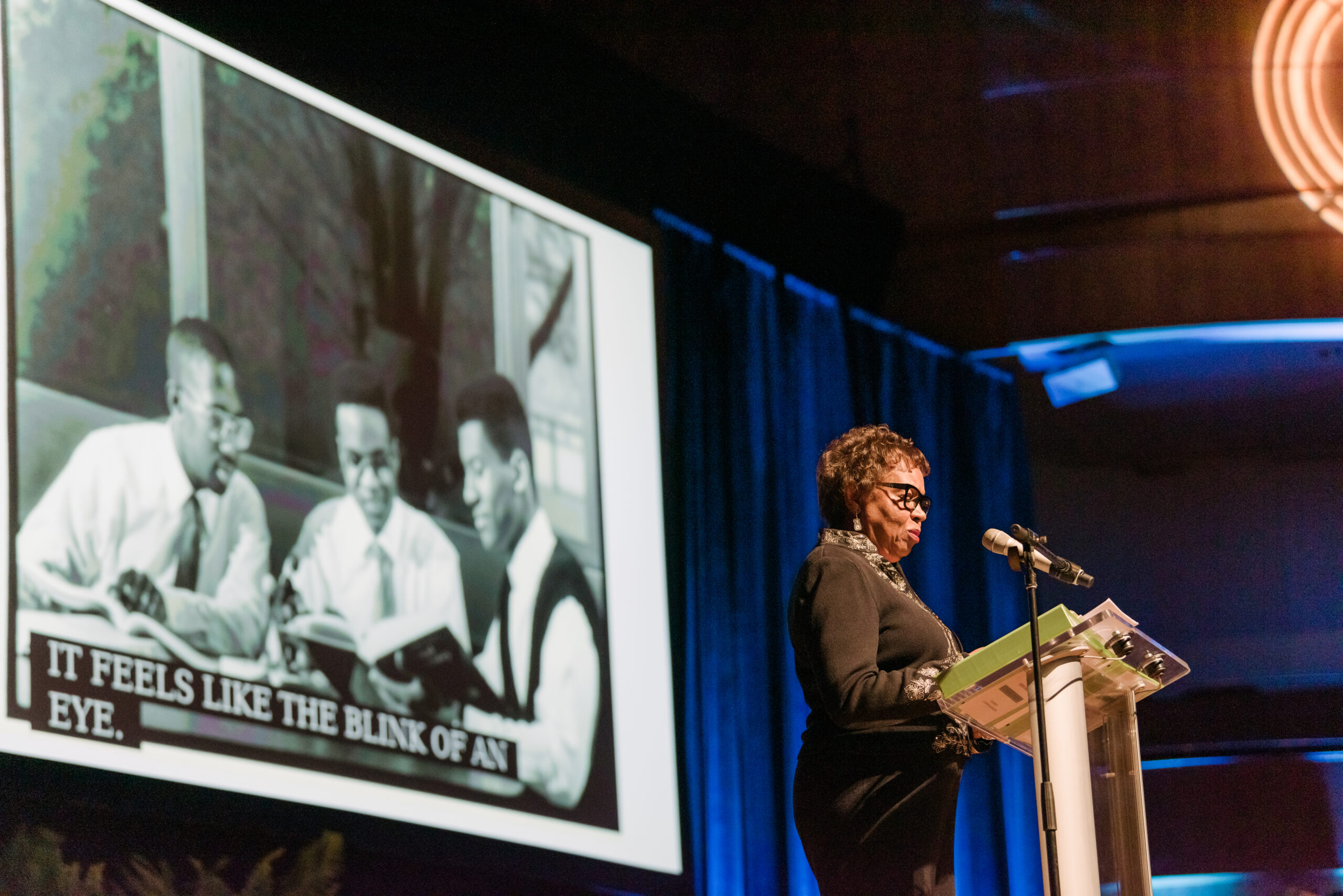
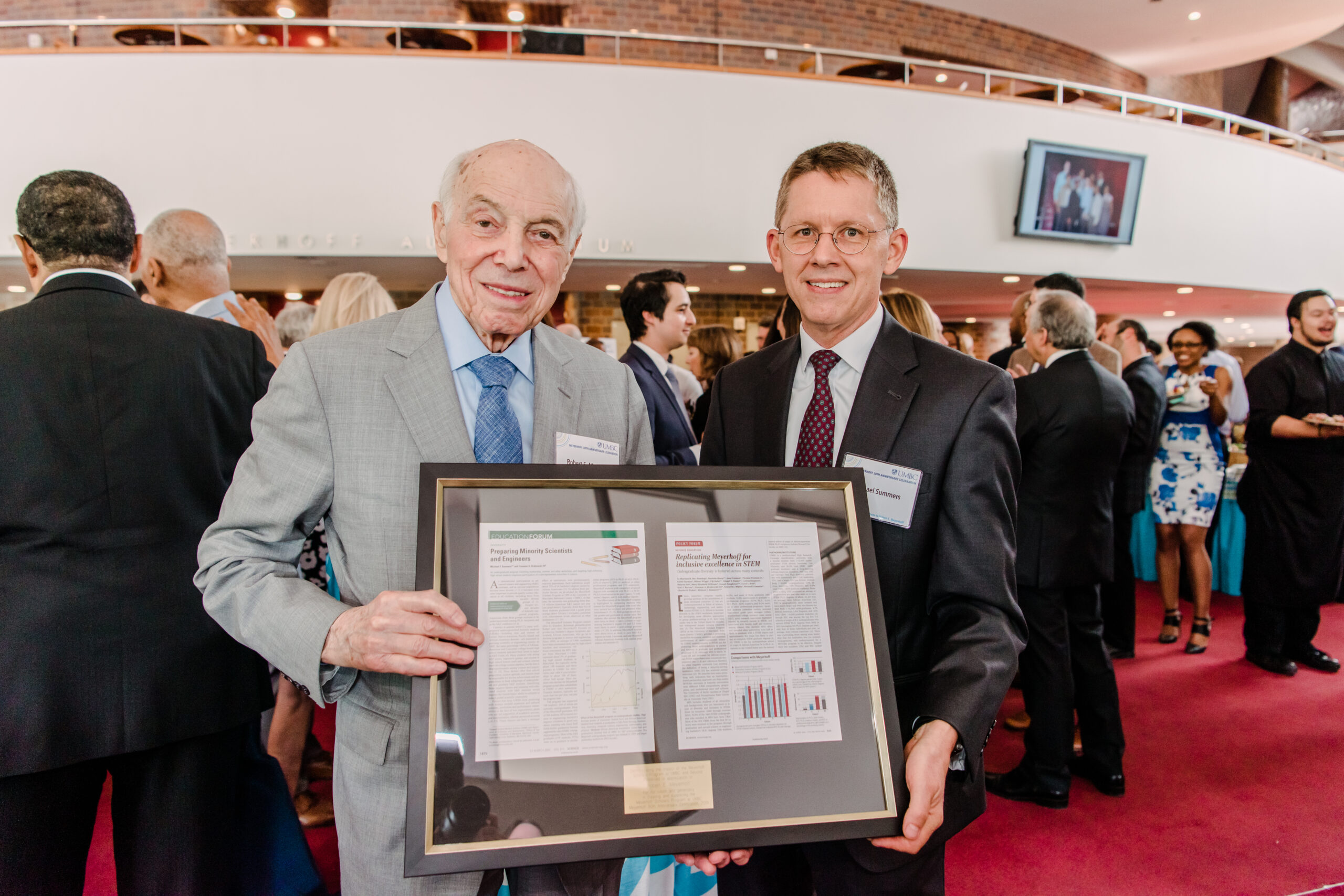
Thirty years ago, Baltimore philanthropist Robert E. Meyerhoff came to then-UMBC vice provost Freeman Hrabowski with the seed of an idea: to create a program that would enable all students, regardless of background, access to the highest levels of science.
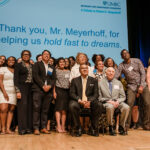
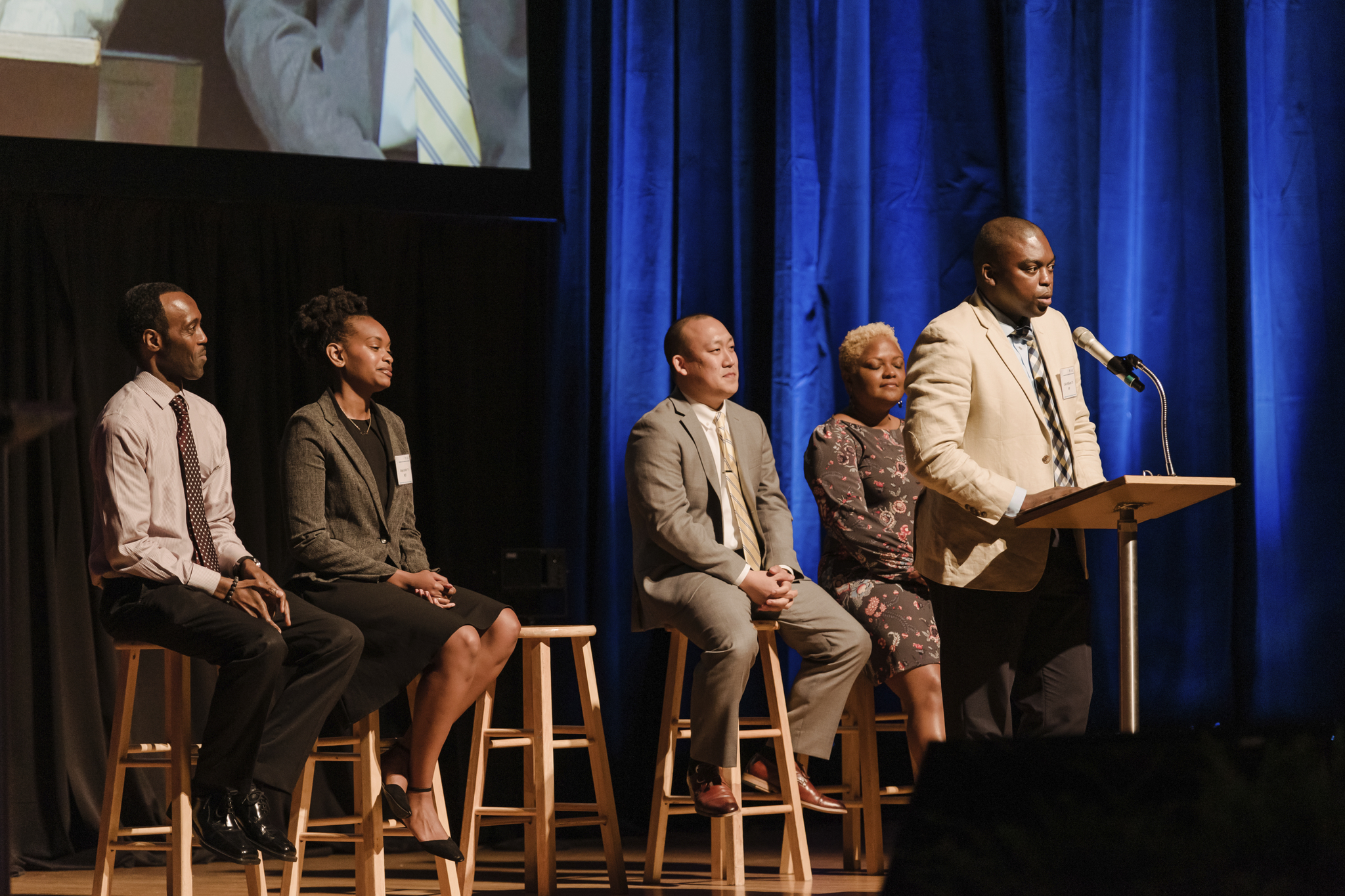
Last week, hundreds of Meyerhoff Scholars Program alumni filled an auditorium stage to thank Meyerhoff for his bold vision. They also came to share their own experiences as proof that he was right to believe in their potential and invest in their futures so many years ago.
Standing on the shoulders of giants
The night of gratitude kicked off an emotional weekend of fellowship and reflection celebrating the Meyerhoff Scholars Program’s 30th anniversary. Over the course of Friday evening, alumni and supporters shared stories of the successes they attribute to a community that believed in them from the start—one that in the words of poet Langston Hughes let them “hold fast to dreams.”
“Meyerhoffs are ‘all in’ types,” said Keith Harmon, director of the program. “Now as alumni, they are distinguishing themselves as STEM professionals, changing the face of the STEM workforce, and showing the world how right Bob Meyerhoff was to believe in them in the first place.”
Setting a national example
The first of its kind in the country, the Meyerhoff Scholars Program launched in 1989 with a small cohort of African American men interested in pursuing graduate degrees in science, engineering, and related fields. In the years that followed, the program expanded to include women and students of all backgrounds who were committed to increasing the representation of minorities in science and engineering.
A post shared by UMBC (@umbclife) on May 30, 2019 at 10:19am PDT
Today, more than 1,100 Meyerhoff alumni are changing the face of science across the country. The program is a national leader on the forefront of efforts to increase diversity in STEM fields, and UMBC is the nation’s number one producer of African American undergraduates who go on to earn M.D./Ph.D.s.
As alumni lined up on stage to share their stories, Kamili Jackson Shaw M5, ’97, M.S. ’99, mechanical engineering, talked about her first impressions of the program as an entering student.
“The Meyerhoff Scholars Program was the first time I had ever been around a critical mass of high-achieving African Americans, and it was extremely important to my growth as an individual,” said Shaw. Today, she leads the safety, quality, and management systems division for the NASA Stennis Space Center. “It gave me confidence and humility at the same time,” she says. “For the first time, I was able to simply ‘be.’”
Paying it forward
The night ended with what program alumni called a “Gesture of Gratitude”—the announcement of a $500,000 gift made by alums from across the decades to support the program. As impactful as the gift will be, it was also symbolic, matching Robert Meyerhoff’s original gift to UMBC. And they have no intention of stopping there.
“Sometimes you don’t understand legacy until you see the fruit of it, and 25 years later, I see the magnitude of the program,” says Felicia Sanders M4, ’96, chemical engineering. Sanders, a, leadership-level supporter of the program, says giving back “is a responsibility. It’s a necessity.”
“If someone hadn’t given to us,” she asks, “where would we be?”
Kellie McCants-Price M2, ’95, interdisciplinary studies, was in the first Meyerhoff class that included women, one year after its founding. “I didn’t realize how significant it was until about 10 years out,” says McCants-Price, who holds her Ph.D. in psychology. “I saw how prolific it was—how many women were graduating—and realized that we held the door open for them.”
Alums took to social media to share their memories and thoughts on the celebration, including U.S. Surgeon General Jerome M. Adams M4, ‘97, biochemistry and molecular biology.
I’ve shared that the first time I met a black doctor was when I was in college at @UMBC. That’s why I was so proud to attend the 30th anniversary celebration of the Meyerhoff program tonight. A ballroom packed full of minorities with MDs and PhDs. #RepresentationMatterspic.twitter.com/M8AcSwzQea
— U.S. Surgeon General (@Surgeon_General) June 2, 2019
The family connection
After Friday’s formal event, alumni gathered in the Event Center on Saturday for a family-style reunion. Many of them brought their children to enjoy a day of food, cohort cluster game competitions, networking, and campus tours. Later that evening, many also enjoyed a dance party hosted by the Meyerhoff Alumni Advisory Board.
Alumni left feeling re-connected as friends, as scholars—and ultimately, as part of a family.
Kafui Dzirasa M8, ’01, chemical engineering, summed up this sentiment as he thanked Robert Meyerhoff on Friday night. “What has increasingly become obvious to us—which you have known all along—is that the power of this community is us, working together as a family.”
]]>
Thirty years ago, Baltimore philanthropist Robert E. Meyerhoff came to then-UMBC vice provost Freeman Hrabowski with the seed of an idea: to create a program that would enable all students,...https://umbc.edu/stories/dreams-realized-celebrating-30-years-of-umbcs-meyerhoff-scholars-program/https://my3.my.umbc.edu/api/v0/pixel/news/120114/guest@my.umbc.edu/85afae7e027cc2b93188c92a444f767c/api/pixelalumnimeyerhoffmeyerhoffscholarsmhoffvideosUMBC News & Magazinehttps://my3.my.umbc.edu/groups/umbc-news-magazinehttps://assets1-my.umbc.edu/system/shared/avatars/groups/000/001/943/24435aa6207c452e7bc15cc74b42c7bb/xsmall.png?1748556657https://assets1-my.umbc.edu/system/shared/avatars/groups/000/001/943/24435aa6207c452e7bc15cc74b42c7bb/original.png?1748556657https://assets2-my.umbc.edu/system/shared/avatars/groups/000/001/943/24435aa6207c452e7bc15cc74b42c7bb/xxlarge.png?1748556657https://assets2-my.umbc.edu/system/shared/avatars/groups/000/001/943/24435aa6207c452e7bc15cc74b42c7bb/xlarge.png?1748556657https://assets3-my.umbc.edu/system/shared/avatars/groups/000/001/943/24435aa6207c452e7bc15cc74b42c7bb/large.png?1748556657https://assets1-my.umbc.edu/system/shared/avatars/groups/000/001/943/24435aa6207c452e7bc15cc74b42c7bb/medium.png?1748556657https://assets2-my.umbc.edu/system/shared/avatars/groups/000/001/943/24435aa6207c452e7bc15cc74b42c7bb/small.png?1748556657https://assets1-my.umbc.edu/system/shared/avatars/groups/000/001/943/24435aa6207c452e7bc15cc74b42c7bb/xsmall.png?1748556657https://assets2-my.umbc.edu/system/shared/avatars/groups/000/001/943/24435aa6207c452e7bc15cc74b42c7bb/xxsmall.png?1748556657UMBC News & Magazine00falseFri, 07 Jun 2019 23:02:09 -0400The Family Connection: Paying it Forward
“To whom much is given, much is required.” Meyerhoff scholars internalize this message, which is introduced during Summer Bridge and is almost as ubiquitous as “Focus, Focus, Focus,” and Langston Hughes’ “Dreams” at Meyerhoff gatherings. For many of the scholars, giving back has become a foundational principle in their lives, as they mentor colleagues, students, and interns in their roles as researchers, medical professionals, biotech entrepreneurs, and more.
This extension of the Meyerhoff program beyond UMBC amplifies its impact. Like a family tree, the DNA for the Meyerhoff program’s values and practices travels through generations of researchers as scholars graduate from UMBC and carry their experiences with the program wherever they go, cultivating the Meyerhoff culture in their new environments. Perhaps no simile is required—members of the Meyerhoff community feel that it is, indeed, a family.
“We truly are a family, full of people who accept and love each other as we are,” says Rhea Brooking-Dixon ’02, M10, biological sciences. After UMBC, she earned her Ph.D. from Duke University in experimental pathology, and today she is a scientist at Booz Allen Hamilton. She is married to Jason Dixon ’02, M10, computer engineering, so for them, Meyerhoff means family in multiple ways.
Families always help each other out, and that stuck with Dixon and Brooking-Dixon after graduation. They remember being asked by advisors at UMBC about participation in a study group, both to receive and give support to their classmates. “That showed us that the Meyerhoff Scholars Program wanted us to consider not just what a community could do for us,” they share, “but what we could also do for our community, whatever the scale, to help everyone develop into their best selves.”
Cultivating each Meyerhoff cohort as a family begins with Summer Bridge, a six-week experience that combines academics and social activities. Students learn together, eat together, and play together, forming bonds that buoy them through their years at UMBC and beyond.
“We’re developing a community. So to generate this concept of a community, they’ve got to have a shared experience,” says Keith Harmon, director of the Meyerhoff Scholars Program. “So a big part of Bridge is doing everything together. You do nothing in Bridge as an individual.”
The mentality of giving back and supporting one’s community has been inherent to the program since its early days. Crystal Watkins-Johansson ’95, M3, biological sciences, earned her M.D./Ph.D. at Johns Hopkins University and now serves as director of the memory clinic in the neuropsychiatry program in the Sheppard Pratt Health System, and as an assistant professor of psychiatry at the Johns Hopkins School of Medicine.
“When we recruit, we don’t talk a lot about Ph.D.s and M.D./Ph.D.s. We talk about legacy,
and we talk about service. We talk about leadership. We talk about being a part of
something that’s bigger than yourself.” – Keith Harmon, Director, Meyerhoff Scholars Program
“As a graduate of the Meyerhoff Scholars Program at UMBC, I have developed a tradition of mentoring undergraduate and graduate students from the Meyerhoff program,” Watkins-Johansson says, “as the mentoring I received through the program continues to be the foundation of my success.”
Isaac Newton said, “I have only seen farther by standing on the shoulders of giants,” and that phrase, too, has resonated with Meyerhoff Scholars. Erwin Cabrera ’10, M18, biological sciences, shares, “The Meyerhoff staff, program alumni, and UMBC faculty were my giants, so I strive to be a giant for those students who come after me.”
Cabrera’s current role aligns directly with his commitment to mentoring the next generation of biomedical professionals. After earning his Ph.D. at the New York University School of Medicine, he now serves as the associate director for the Research Aligned Mentorship program at Farmingdale State University, a program that provides additional supports—similar in ways to the Meyerhoff Scholars Program—to annual cohorts of Farmingdale students.
For some Meyerhoff scholars, it was the group experience that helped them see their true potential. “Being surrounded by a critical mass of high-achieving African Americans was extremely important to my growth as an individual,” says Kamili (Shaw) Jackson ’97, M5, M.S. ’99, mechanical engineering. “It gave me confidence and humility at the same time.”
Mentoring the next generation of scientists and engineers, and changing their lives in the process, is a worthy goal and a laudable outcome of the Meyerhoff Scholars Program. But the ripple effect goes even farther. Those researchers, many of whom are from underrepresented groups in STEM, bring fresh perspectives and energy to their work, and the results of their efforts can impact an even larger set of people.
“My research experience in Dr. [Michael] Summers’ lab helped me recognize the lasting impact that biomedical research could have on the lives of patients,” shares Chelsea Pinnix ’99, M7, biochemistry and molecular biology. “I began to envision myself as more than a future physician, and instead as a young woman with the potential to heal patients in my clinic and improve medical care for patients that I would never meet through meaningful research.”
As the Meyerhoff Scholars Program enters its fourth decade, the emphasis on paying it forward is just as strong as it was at the program’s founding in 1989. Except now, there already exists a network—a family—of hundreds of Meyerhoff alumni ready to support upcoming students in all that they wish to pursue, which goes far beyond earning a degree (or three).
And that message of changing the world is part of the conversation from the start. Teaching students to think beyond the degree toward thinking about a career where they can make real change in the world, both by doing meaningful research and mentoring others, is an important part of the Meyerhoff program.
“When we recruit, we don’t talk a lot about Ph.D.s and M.D./Ph.D.s.,” Harmon says. “We talk about legacy,
and we talk about service. We talk about leadership. We talk about being a part of something that’s bigger than yourself.”
Photos courtesy of the Meyerhoff Scholars Program.
]]>
“To whom much is given, much is required.” Meyerhoff scholars internalize this message, which is introduced during Summer Bridge and is almost as ubiquitous as “Focus, Focus, Focus,” and Langston...https://umbc.edu/stories/the-family-connection-paying-it-forward/https://my3.my.umbc.edu/api/v0/pixel/news/120123/guest@my.umbc.edu/e88ea7dfafa01c505ffc020a04c7c694/api/pixelmeyerhoffmhoffstoriesUMBC News & Magazinehttps://my3.my.umbc.edu/groups/umbc-news-magazinehttps://assets1-my.umbc.edu/system/shared/avatars/groups/000/001/943/24435aa6207c452e7bc15cc74b42c7bb/xsmall.png?1748556657https://assets1-my.umbc.edu/system/shared/avatars/groups/000/001/943/24435aa6207c452e7bc15cc74b42c7bb/original.png?1748556657https://assets2-my.umbc.edu/system/shared/avatars/groups/000/001/943/24435aa6207c452e7bc15cc74b42c7bb/xxlarge.png?1748556657https://assets2-my.umbc.edu/system/shared/avatars/groups/000/001/943/24435aa6207c452e7bc15cc74b42c7bb/xlarge.png?1748556657https://assets3-my.umbc.edu/system/shared/avatars/groups/000/001/943/24435aa6207c452e7bc15cc74b42c7bb/large.png?1748556657https://assets1-my.umbc.edu/system/shared/avatars/groups/000/001/943/24435aa6207c452e7bc15cc74b42c7bb/medium.png?1748556657https://assets2-my.umbc.edu/system/shared/avatars/groups/000/001/943/24435aa6207c452e7bc15cc74b42c7bb/small.png?1748556657https://assets1-my.umbc.edu/system/shared/avatars/groups/000/001/943/24435aa6207c452e7bc15cc74b42c7bb/xsmall.png?1748556657https://assets2-my.umbc.edu/system/shared/avatars/groups/000/001/943/24435aa6207c452e7bc15cc74b42c7bb/xxsmall.png?1748556657UMBC News & Magazine00falseFri, 31 May 2019 19:37:47 -0400Q&A: Earnestine Baker, Executive Director Emerita, Meyerhoff Scholars Program
From its very first days, Earnestine Baker, Executive Director Emerita, has been an integral part of the Meyerhoff Scholars Program. UMBC Magazine sat down with Baker to talk about some of the ways she — along with other staff and students — laid the foundation for the program’s successes over the last thirty years.
UMBC Magazine: What are some of your first memories of how the Meyerhoff Scholars Program came to be?
Earnestine Baker: Immediately what comes to mind is the phone call I received from Dr.Hrabowski, inviting me to a meeting in his conference room. I was working in the Office of Financial Aid as the Associate Director of Financial Aid and Scholarships; UMBC did not have a scholarship program at that time. Tom Taylor, the Director of Financial Aid, initiated UMBC’s formal scholarship program.
So in that capacity, I worked to establish the scholarship program for incoming freshmen. One afternoon in the summer of 1988, I received a life-changing call from the Assistant to the Vice Provost, Dr. Freeman Hrabowski, inviting me to come to a meeting to discuss scholarships. I was thinking that we would talk about my work and plans for UMBC’s scholarship program, but instead he laid out his plan for recruiting, to UMBC, African American men who would go on and achieve Ph.D.s in science. He met with Mr. and Mrs. [Robert] Meyerhoff, and he wanted to develop this program. I hesitated a little but finally said “Okay,” and he said, “I want to create the environment that we had when we were undergraduates [at Hampton Institute now Hampton University.]” And when he said that, I knew immediately what he was talking about. … During the meeting he asked if I would look into developing an application for the Meyerhoff Scholars Program. I went back to my office, developed a design and that’s how I began working with the Meyerhoff Scholars Program. By the way, the first application received for the Meyerhoff Scholars Program was from Chester Hedgepeth now an M.D./Ph.D. from the University of Pennsylvania.
UMBC Magazine: How did you initially spread the word about it?
Earnestine Baker: So that’s an excellent question, because what happened after that meeting I thought was very smart of Doc. He sent letters to all the state superintendents of schools, principals, the heads of private and parochial schools, letters to guidance counselors throughout the state, community leaders, inviting them all to come to UMBC for a meeting. During this meeting, he again laid out his plan for the Program; first buy-in approach I thought.
Additionally, we asked students who were the people who made an impact in their lives educationally. And they said, “My teacher in biology,” or “My guidance counselor,” or, “My minister,” “My pastor of my church,” or “Someone down the street.” We collected names and addresses of individuals and invited them also to this meeting, and … asked them to nominate students for the scholarship. From this came the Meyerhoff Nomination Process.
UMBC Magazine: How did folks react to the program at the very beginning?
Earnestine Baker: That’s what was great about this meeting with the superintendents, principal and others …yes we announced the scholarship, but we also wanted support, buy-in, plus community ownership for the Program we were about to launch.
UMBC Magazine: So in a way, you were opening the door to the people who were most likely to make it successful, because someone coming to the meeting was already going to believe in what you’re talking about. That seems like just such a smart move.
Earnestine Baker: Right, it was a very wise decision. We let our leaders in education know that UMBC will provide another opportunity for them to support students whose goal is to increase the number of scientists who will teach and become researchers.
UMBC Magazine: What was it like bringing students into research opportunities for the first time, when you were still figuring pieces of the experience out?
Earnestine Baker: The students were very excited. We knew for them to have a competitive application for graduate and professional schools, they needed strong research experiences, be it in industry or in higher education. Initially, a larger number of students were completing research in industry and not in higher education, at the NIH, National Science Foundation, NSA, and NASA; we had more connections in industry at that time.
At UMBC, the first faculty member to take one of our students in his lab was Dr. Frank Hanson in the Biology Department. I said to Frank, “I need to find a lab placement for one of our students,” and he said, “Well, let’s look at it and see what we can do.”
It took many, many meetings with high schools, universities, federal and state agencies and individuals to get our message “out.” Many of these meetings included Charles “Tot” Woolston – you don’t hear much about his efforts, but he gave tremendously while promoting the Meyerhoff mission and goals. Dr. Phyllis Robinson, Biology Department was extremely helpful in advising the program for internships and graduate school placements. A major breakthrough for research opportunities came when Dr. Hrabowski connected with Leadership Alliance, whose executive office is at Brown University.
Dr. James “Jim” Wyche was the director of the Leadership Alliance as well as a faculty member at Brown. This partnership, provided opportunities for our students to participate in research at the top leading institutions across the nation. There are about 38 schools in the Alliance now. I invited one of the Leadership Alliance faculty members from Harvard University to visit UMBC, meet faculty and the Meyerhoff Scholars. From this meeting – the next two summers, she (the late Dr. Jocelyn Spragg) selected three Meyerhoff Scholars for summer research at Harvard. The Meyerhoffs Scholars were Crystal Watkins M3, Damon Tweedy M4, and Andrew Atiemo M4. Their work was exceptional and created an interest in Meyerhoff Scholars at other top tier universities. This was a very exciting time, and my confirmation that “yes, we can do this.” Jocelyn invited me to visit Harvard while Damon and Andrew were there. She remained a good friend and strong supporter of UMBC and the Meyerhoff Program.
UMBC Magazine:I would love to talk about Summer Bridge, because that is what comes up so often with everyone as a really pivotal moment of the Meyerhoff experience.
Earnestine Baker:I feel Summer Bridge is the key component. It is the beginning stages of becoming a Meyerhoff Scholar and truly understanding the goals of the Program and what it means to work together as a family; the true feeling of the Meyerhoff family. I often say to students “you don’t have to love each other, you don’t have to like each other, but you have to help each other.”
It’s not only about working together as students, but also learning how to work with faculty, staff and administrators; teaching the UMBC way, the Meyerhoff way. Academically, we talked about high expectations and goals. We had regular meetings and talked about how the Program expected students to perform academically, personally, socially … in all aspects of their undergraduate career.
What is critically important, and what we have tried to communicate over the years, is that you cannot be successful in STEM trying to do it alone, nor should you try. Interdependence is taught during Summer Bridge, and it’s very important. Some students’ approach is similar to high school, “I have to do this by myself. I cannot – I don’t – I shouldn’t ask questions, because if I ask questions it shows that I’m not smart, I’m not capable, and I’m not intelligent.” Hence some don’t want to ask questions or reach out for help. Some have the mindset, “It’s me. It’s mine. And that’s the way it’s going to be.” I know it’s a part of their growing-up experience. For some, it’s the first time — hearing when you gain knowledge and achieve you should, and we expect you to, share what you have gained with others. When one wins we all win. When one fails we all fail. In Meyerhoff failure is not an option. Can you imagine the reaction in a calculus class when the lowest grade on a test – let’s say 69 – becomes the grade for everyone in the class? Not happy campers. Over the years I have enjoyed and appreciated the lesson learned in this class; seeing the class come together and work to achieve an “A” was just what I hoped would happen. It’s a powerful lesson and it has been passed forward. During Summer Bridge scholars are expected to move about campus together – a part of the bonding process. I remember once a group of scholars decided to leave their cohort early for lunch. Upon my arrival to the dining hall one of the dining hall staff members reported to me that some Meyerhoffs had arrived early and she knew that they were not supposed to do that. This to me was a wonderful example of institutional buy-in. This staff member knew and supported our mission.
It begins with Summer Bridge, and the lessons learned hopefully will continue. I’m told it continues at the graduate level and in the work place. Summer Bridge is not easy. LaMont (Toliver) and I used to plan, plot, and scheme to make each Meyerhoff co-hort the best they could be. No gaps in the line while walking to class together, 6 a.m. wake-up calls, never late to anything, sit in the front of class … Scholars were not always happy with us, I know, but I hope they realize the reasons and can see and appreciate the benefits. For what we have accomplished over thirty years – “it is worth it.”
UMBC Magazine: What’s it like talking with students about Summer Bridge now, especially those who didn’t initially understand what you were trying to do?
Earnestine Baker: It was a challenge seeing Meyerhoff Scholars go through Summer Bridge and initially not understanding its purpose, not getting it. Sometimes I saw hurt on their faces, or anger, and I said to them, ‘ Just listen. Just listen and you’ll come to understand what it is that we are trying to do.’ … And now I hear – ‘Okay, I’m out. I’ve graduated now, and I get Summer Bridge. I understand’…and they find themselves repeating some of the same principals not only to their students and colleagues, but to their kids…. I feel this part of my life has been so worthwhile. At the end of the day, I exhale and reflect, and I say, ‘Thank you, God.’” Many scholars have expressed their gratitude for my support over the years and I am grateful. But the only thank you I desire is to see them give back to others.
Photos, top to bottom, provided by the Meyerhoff Scholars Program: Baker with Lamont Dozier, a member of the second Meyerhoff cohort; Early Meyerhoff students studying; Baker with members of the Meyerhoff Parents Association; Meyerhoff student activity on the Quad.
]]>
From its very first days, Earnestine Baker, Executive Director Emerita, has been an integral part of the Meyerhoff Scholars Program. UMBC Magazine sat down with Baker to talk about some of the...https://umbc.edu/stories/qa-earnestine-baker-executive-director-emerita-meyerhoff-scholars-program/https://my3.my.umbc.edu/api/v0/pixel/news/120124/guest@my.umbc.edu/8c3e01aa8723b4daf270895d548e566d/api/pixelmeyerhoffmhoffstoriesUMBC News & Magazinehttps://my3.my.umbc.edu/groups/umbc-news-magazinehttps://assets1-my.umbc.edu/system/shared/avatars/groups/000/001/943/24435aa6207c452e7bc15cc74b42c7bb/xsmall.png?1748556657https://assets1-my.umbc.edu/system/shared/avatars/groups/000/001/943/24435aa6207c452e7bc15cc74b42c7bb/original.png?1748556657https://assets2-my.umbc.edu/system/shared/avatars/groups/000/001/943/24435aa6207c452e7bc15cc74b42c7bb/xxlarge.png?1748556657https://assets2-my.umbc.edu/system/shared/avatars/groups/000/001/943/24435aa6207c452e7bc15cc74b42c7bb/xlarge.png?1748556657https://assets3-my.umbc.edu/system/shared/avatars/groups/000/001/943/24435aa6207c452e7bc15cc74b42c7bb/large.png?1748556657https://assets1-my.umbc.edu/system/shared/avatars/groups/000/001/943/24435aa6207c452e7bc15cc74b42c7bb/medium.png?1748556657https://assets2-my.umbc.edu/system/shared/avatars/groups/000/001/943/24435aa6207c452e7bc15cc74b42c7bb/small.png?1748556657https://assets1-my.umbc.edu/system/shared/avatars/groups/000/001/943/24435aa6207c452e7bc15cc74b42c7bb/xsmall.png?1748556657https://assets2-my.umbc.edu/system/shared/avatars/groups/000/001/943/24435aa6207c452e7bc15cc74b42c7bb/xxsmall.png?1748556657UMBC News & Magazine00falseFri, 31 May 2019 19:15:49 -0400Moving the Needle
With their hearts in the work and their ears to the ground, the people behind some of UMBC’s longest-standing homegrown programs are solving big societal problems. But the work is never done.
By Jenny O’Grady
On the wall of the office, in bright Retriever gold, hangs UMBC’s vision statement, a bold call to action for any and all who happen to wander past. A call to “connect innovative teaching and learning, research across disciplines, and civic engagement.” A call to “advance knowledge, economic prosperity, and social justice.” No simple task, indeed.
There’s a quote from late Baltimore civic leader Walter Sondheim, as well. Christopher Steele keeps them here as a reminder that we’re all here to serve as well as learn. It can be messy work, he says, but worth the pursuit.
“Look at our vision statement. This notion of social justice and civic engagement are clearly stated…it’s in our values,” said Steele, Vice Provost, Division of Professional Studies, and Executive Director of the Shriver Center.
Founded in 1966, during a time of great civil unrest, UMBC is rooted in a type of service-learning that cuts across disciplines and traditional social structures. And the backbone of that work is programs like those of the Shriver Center, and many others homegrown on the UMBC campus, that over the last several decades have worked to address major societal problems of their time — from inclusivity in the workplace, to social justice in our cities — in collaboration with community partners.
Time passes, and successes come hard earned, because moving the needle takes both persistence and patience. Challenges change over time, forcing student learners and their instructors to bend and re-learn as they go.
The vision statement doesn’t precisely define the “why” of it all, but that’s not necessary. The answer is woven through everything these programs do.
Leveling the Playing Field
More than 200 CWIT Scholar Alumni are bringing new perspectives to the tech industry.
Imagine having a passion for technology or science, and the desire to make a difference with your talents. Now imagine encountering multiple locked doors before you as you attempt to enter the field of your choice — or even to pursue the study that drives you. Imagine hearing over and over again that this is “just the way it is,” or worse, the silence of no one noticing.
Decades after their founding, issues of accessibility in learning and industry still exist in the STEM fields. But, UMBC’s Meyerhoff Scholars Program and the Center for Women in Technology (CWIT) forge on, as they have for 30 and 20 years, respectively, working to open doors for underrepresented groups both as they learn, and as they move into the workforce.
“This is what drives us…increasing the number of women, and the participation of women, as well as other underrepresented groups in computing and engineering,” says Carolyn Seaman, associate professor of information systems and interim director for CWIT, not only because of the principal of fairness, but because the industry needs it.
“Better design requires a diverse set of perspectives, a diverse set of life experiences, a diverse set of requirements,” that can only be improved through diversification of these traditionally male dominated work spaces, she says.
As one of the nation’s leading sources of African Americans who get Ph.D.s in science and engineering, UMBC’s Meyerhoff Scholars Program does its work for similar reasons. Many academic doors haven’t traditionally been open to these students — not just at the college level, but far before that.
“There’s so much potential, and there are so many problems in the world. We need as many hands in the work as possible,” says Keith Harmon, director of the Meyerhoff program.
Both Meyerhoff and CWIT have evolved over time, as industry and societal needs revealed themselves. CWIT, for one, broadened its scope to include not just women, but male allies who could contribute to a shared vision. The program has also branched out to cover study areas that map directly to industry needs with the creation of its Cyber Scholars group, and worked to expand the program to students who need them most.
“We had people saying, ‘Well, you’re serving the best of the best, which is fantastic, but there are more than 3,000 other students in the [College of Engineering and IT]. How can you serve them?’” said Danyelle Ireland, associate director of CWIT. “We’ve done great things for our scholars, so there’s now more demand.”
Even if his program could double in size, however, Harmon believes that pushing the numbers too far could hurt the one-on-one attention his students receive, and, ultimately take away from the experience. Students in both programs graduate among tightly-knit groups who often refer to their cohorts as families.
T-SITE Scholar Kiante Brantley ’15, M.S. ’16, computer science, recalls a fellow CWIT Scholar found time to personally tutor him in a class he was struggling in even though he was working 20 hours a week with a full course load.
“Being a minority in STEM is hard, but you have a support system of other minority students, faculty, and alumni, then the struggle becomes easier,” says Brantley, now a Ph.D. student at College Park. “CWIT created a family that provided students like myself with the encouragement to make it through…tough times.”
For CWIT, the family means living on a residence hall together, eating together, doing Zumba together, and celebrating life’s victories. The same happens with the Meyerhoffs, where new students begin school the summer before fall semester — in a Summer Bridge program, an academic and social immersion that helps students quickly establish solid study habits — as cohorts that stick together long after graduation.
Rockford “Rocky” Foster ’13, mathematics, a member of the 21st Meyerhoff cohort who is nearing completion of a Ph.D. in mathematics at UC Berkeley, says he was embraced by the community immediately. Because of what he learned, he has started a “mini- Meyerhoff” system on the west coast, seeking out mentors and mentees as a solid support system. The Meyerhoff program’s “secret sauce,” he says, is the strength of those bonds; 30 years in, those bonds can be found across the country.
“So now, when a Meyerhoff undergrad is facing a challenge, chances are there’s a Meyerhoff who can empathize and provide guidance. When they identify an institution or professor they want to work with, there’s someone who can put them in touch or put in a good word,” says Foster.
“The truth is there are many people who are born with such networks in place; their families have accumulated a sort of academic wealth. But other people, historically disadvantaged people, have been denied the ability to accumulate this wealth. The incredible thing about Meyerhoff is that they built it in less than thirty years.”
Meyerhoff Scholars frequently work in the lab with professor Mike Summers.
As a Cyber Scholar, Priyanka Ranade ‘18, information systems, participated on an all-woman team in a cyber engineering competition sponsored by Northrop Grumman. The team won first place, and today Ranade works at Northrop as a cyber software engineer and serves as a mentor to a current Cyber Scholar team.
“We are not taught to solely invest in our own dreams,” she said, but “to use our strengths in helping others in their journeys, too.”
Filling a Teaching Need
Studies show that students in high-needs schools who are taught by teachers who come from similar backgrounds — and who can understand their specific needs and challenges — are more likely to succeed. And yet, filling those teaching spots presents a perpetual challenge, because teaching in those areas often carries stigmas that scare away potential candidates.
“The biggest challenges, we find, is just finding enough students who want to be teachers, whose families support that career path, and who want to teach in Baltimore,” said Rehana Shafi, director of the Sherman STEM Teacher Scholars Program, which for the past decade has worked to fulfill the mission of “for every Baltimore student an exceptional STEM educator.”
Today, the program has more than 90 alumni teaching and leading in schools all over the state, including in Baltimore city and Baltimore County, and 64 current students. Getting students interested in the first place may be difficult, but the program works to help them understand why this is such a special — and important — calling.
“We’ve shifted how we talk about teaching,” said Shafi. “We talk about social justice and equity. STEM is an integral part of our mission, but at the end of the day, we want people who are approaching teaching from those two lenses…especially when you’re working with kids — and with families and communities — who are the most underresourced.”
Sherman Scholars teach at Lakeland Elementary School and beyond.
Knowing the challenges their students are facing as they student teach, the Sherman program in the last few years made shifts to offer higher levels of support, with the addition of staff who offer dedicated professional coaching for students. It also targets recruitment efforts in city schools because people often want to return to their home community to teach. And the program now requires annual applied learning experiences (an increase) in city schools or with programs that support kids from city schools.
This includes major work at Lakeland Elementary/Middle School in Baltimore city, where for the last six years the Sherman program has partnered on teacher professional development with math teachers, afterschool enrichment programs, and (along with elbow grease from the UMBC Peaceworker Fellows Program and financial support from the Northrop Grumman Foundation) the launch of a new Lakeland Community and STEAM Center.
Elizabeth “Rosie” Plitt ’14, psychology, M.A.T. ’16, education, who is in her second year of teaching kindergarten at Lakeland currently, says the professional coaching specifically regarding community and cultural responsiveness she received through Sherman is what sets the program apart.
“The program has opened my eyes to my passion for teaching in urban schools,” she said. “The community, the connection, and the reward outweigh the many challenging aspects that occur throughout the year.”
Joseph Skowronski ’18, biochemistry and molecular biology, joined Sherman “on a whim,” he said, “but it was a decision that I will be proud of for the rest of my life. I knew immediately that I was in the company of dedicated professionals who wanted nothing more than for each and every one of us to succeed and be the best teachers we could be.”
Currently completing both his master’s of arts in teaching and a year-long student teaching internship at Baltimore Polytechnic Institute, Skowronski said he “loves walking into a class and seeing a fellow Sherman in the room. An instant connection is made in that moment, and I have a friend and partner in the class on day one.”
For Shafi, though pushing the numbers of students working in high-need schools is a goal, the real mark of success is a shift in thinking among them.
“We really want our students to deeply understand who they are and what they walk into the room with, and who their students are. That takes time,” said Shafi. “And then, when people ask, ‘What do you teach?’ that the first thing they say is ‘I teach students.’ It might be math. It might be chemistry. It be elementary, but ‘I teach students.’”
A Community That Cares
Dealing directly with critical social challenges can be messy, but for the past 25 years the Shriver Center has moved and changed to keep up with the challenge, connecting thousands of students and faculty to partner with people and communities to address their needs. Alongside them, the Sondheim Public Affairs Scholars have also contributed to service-learning, internships, activism, and research to enact social change since 1999.
Named in honor of Eunice Kennedy Shriver and Sargent Shriver with the mission of “addressing critical social challenges by bridging campus and community through engaged scholarship and applied learning,” UMBC’s Shriver Center serves as an umbrella organization with numerous spokes and broadly sweeping goals. The center runs programs covering everything from service-learning and community engagement (including the Shriver Living Learning Community, and service and leadership scholarships) and Public Service Scholars programs for students, to orchestrating engaged scholarship by faculty, to advocacy, academic support, and work experience for youth offered by the Choice Program, and intense community engagement via the Shriver Peaceworker Program.
“We’re trying to move toward social justice and increased equity across the board in society,” through approaches that involve students, faculty and communities, said Shriver Director Michele Wolff ’89, sociology.
“On the student side, we want to create spaces in which they feel empowered to become change agents to tackle issues identified by the community…and with faculty, we want to collaborate to connect their research and creative work with community-based activity. And then, we work directly with the community to help them address their identified needs, usually with students as the resource that helps build their capacity to lead positive change.”
Many Shriver Center staff are alumni of their own programs.
Studies by members of the Shriver staff have shown that in addition to helping surrounding communities, applied learning of this sort also improves GPAs and graduation rates among participating students, while nurturing skills in leadership, public speaking, personal growth, and career exploration.
The center’s Choice Program offers community-based case management services and aims to foster healthy development and resiliency among youth from under resourced schools and communities. It served nearly 1,000 youth and their families in 2017, resulting in lower recidivism rates and a reduction in out of home placements.
When she came to UMBC, MaryBeth Hyland ’06, social work, wanted to become an orthodontist. But, her experiences working as a site coordinator with the Choice Program and living in the Shriver Living Learning Community put her on track for an entirely different career. In one case, she helped a youth with serious dental issues get pro-bono treatment with an orthodontist with whom she had previously interned.
“It was in that experience that I realized that I wanted to help people to get the support they needed to live better lives,” said Hyland. Today she runs SparkVision, an organization that helps individuals and companies to live in alignment with their values. “And I changed my major to social work and began to thrive.”
Many Shriver alumni maintain their connections long after they graduate. Peaceworker alumna Katie Long, M.A. ’10, intercultural communication, who currently works as program director and Hispanic liaison for the Friends of Patterson Park in Baltimore, still calls upon her Peaceworker family for support and camaraderie.
“I think the practical idealism that is instilled by the Peaceworker Program is much of the reason why many of us are able to continue with the fight for social justice and betterment of our city,” she said.
Sondheim Scholars help with a variety of programs, including UMBC’s community garden.
Service is also a core value of the Sondheim Public Affairs Scholars, who often collaborate with Shriver Center programs. By working closely on problems like poverty, inadequate education, or services for immigrants or disabled people, students broaden their horizons, build empathy, and become exposed to people they might not otherwise, says Laura Hussey, director of the program and associate professor of political science.
“When students learn about problems through direct encounters with the people they affect most keenly, the problems start to look a little different, and perhaps also more complex, than they might have looked from a set of statistics or ideological arguments,” says Hussey. “It’s a great learning exercise to balance and weigh these types of evidence — what students witness at their service sites, what they read in their textbooks, what they hear in the news or from their favorite political sources.”
During his years as a Sondheim Scholar, Evan Leiter-Mason ’17, economics and political science, started a student-run volunteer tax service for people in need of assistance. Today, he continues that work via the CASH Campaign of Maryland, driven by a desire to create a world free from poverty and financial hardship.
“The Sondheim program affirmed my existing desire to be involved in public service by connecting it to the legacy of Walter Sondheim and his work to make Baltimore a better place to live for its citizens,” said Leiter-Mason, who said he found mentors and friends who share his values and drive to help. “I believe we all have a responsibility, in our own way, to imagine and work toward a better world than the one we have.”
]]>
With their hearts in the work and their ears to the ground, the people behind some of UMBC’s longest-standing homegrown programs are solving big societal problems. But the work is never done....https://umbc.edu/stories/moving-the-needle/https://my3.my.umbc.edu/api/v0/pixel/news/120257/guest@my.umbc.edu/56fc4958c228b64f22d4baa0eaec92f1/api/pixelcwitfall-2018impactmeyerhoffmhoffshermanshriversondheimUMBC News & Magazinehttps://my3.my.umbc.edu/groups/umbc-news-magazinehttps://assets1-my.umbc.edu/system/shared/avatars/groups/000/001/943/24435aa6207c452e7bc15cc74b42c7bb/xsmall.png?1748556657https://assets1-my.umbc.edu/system/shared/avatars/groups/000/001/943/24435aa6207c452e7bc15cc74b42c7bb/original.png?1748556657https://assets2-my.umbc.edu/system/shared/avatars/groups/000/001/943/24435aa6207c452e7bc15cc74b42c7bb/xxlarge.png?1748556657https://assets2-my.umbc.edu/system/shared/avatars/groups/000/001/943/24435aa6207c452e7bc15cc74b42c7bb/xlarge.png?1748556657https://assets3-my.umbc.edu/system/shared/avatars/groups/000/001/943/24435aa6207c452e7bc15cc74b42c7bb/large.png?1748556657https://assets1-my.umbc.edu/system/shared/avatars/groups/000/001/943/24435aa6207c452e7bc15cc74b42c7bb/medium.png?1748556657https://assets2-my.umbc.edu/system/shared/avatars/groups/000/001/943/24435aa6207c452e7bc15cc74b42c7bb/small.png?1748556657https://assets1-my.umbc.edu/system/shared/avatars/groups/000/001/943/24435aa6207c452e7bc15cc74b42c7bb/xsmall.png?1748556657https://assets2-my.umbc.edu/system/shared/avatars/groups/000/001/943/24435aa6207c452e7bc15cc74b42c7bb/xxsmall.png?1748556657UMBC News & Magazine00falseThu, 06 Dec 2018 23:41:54 -0500Two Meyerhoff Alumnae Included in Sun “Women to Watch” List
Two Meyerhoff Scholars Program alumnae, Kavita Krishnaswamy, M13, ’07, mathematics, and Tabassum Majid, M18, M.A. ’18, aging studies, ’10, interdisciplinary studies, have been included in the Baltimore Sun‘s “25 Women to Watch in 2018” annual listing.
Current Ph.D. student Kavita Krishnaswamy, who through her work as a roboticist focuses on giving people with severe disabilities greater independence, has invented voice command interfaces, and is working on another that responds to eye movement. Krishnaswamy, who lives with spinal muscular atrophy, a progressive disorder that severely limits her movement below the neck, works from home via a telepresence device, and will attend the 2018 Heidelberg Laureate Forum. “Life is always beautiful,” Krishnaswamy tells the Sun. “Instead of complaining, people should remember to do something to make it better.”
Through her work as executive director at Integrace Institute, Tabassum Majid brings an interdisciplinary approach to the future of aging, and the needs of an increasingly diverse demographic. Integrace was featured in the film “Every Three Seconds” with 23 other organizations from around the world for its work on Alzheimer’s disease prevention. “We are looking at who’s the next generation of customers and seniors,” Majid tells the Sun. “And that’s how we get that first step onto the global stage. The documentary was just the beginning in my opinion.”
The “25 Women to Watch in 2018” piece features “leading voices in business, activism, research and more” from a range of backgrounds and industries, the Sun writes. The awardees will be featured in a special supplement on Sunday, October 14.
]]>
Two Meyerhoff Scholars Program alumnae, Kavita Krishnaswamy, M13, ’07, mathematics, and Tabassum Majid, M18, M.A. ’18, aging studies, ’10, interdisciplinary studies, have been included in the...https://umbc.edu/stories/two-meyerhoff-alumnae-included-in-sun-women-to-watch-list/https://my3.my.umbc.edu/api/v0/pixel/news/120314/guest@my.umbc.edu/3c77bcdb0719a922527ea8bddbcc8afc/api/pixelalumnimeyerhoffmhoffUMBC News & Magazinehttps://my3.my.umbc.edu/groups/umbc-news-magazinehttps://assets1-my.umbc.edu/system/shared/avatars/groups/000/001/943/24435aa6207c452e7bc15cc74b42c7bb/xsmall.png?1748556657https://assets1-my.umbc.edu/system/shared/avatars/groups/000/001/943/24435aa6207c452e7bc15cc74b42c7bb/original.png?1748556657https://assets2-my.umbc.edu/system/shared/avatars/groups/000/001/943/24435aa6207c452e7bc15cc74b42c7bb/xxlarge.png?1748556657https://assets2-my.umbc.edu/system/shared/avatars/groups/000/001/943/24435aa6207c452e7bc15cc74b42c7bb/xlarge.png?1748556657https://assets3-my.umbc.edu/system/shared/avatars/groups/000/001/943/24435aa6207c452e7bc15cc74b42c7bb/large.png?1748556657https://assets1-my.umbc.edu/system/shared/avatars/groups/000/001/943/24435aa6207c452e7bc15cc74b42c7bb/medium.png?1748556657https://assets2-my.umbc.edu/system/shared/avatars/groups/000/001/943/24435aa6207c452e7bc15cc74b42c7bb/small.png?1748556657https://assets1-my.umbc.edu/system/shared/avatars/groups/000/001/943/24435aa6207c452e7bc15cc74b42c7bb/xsmall.png?1748556657https://assets2-my.umbc.edu/system/shared/avatars/groups/000/001/943/24435aa6207c452e7bc15cc74b42c7bb/xxsmall.png?1748556657UMBC News & Magazine00falseSat, 06 Oct 2018 00:36:21 -0400

 Corbett in the Interdisciplinary Life Sciences Building on campus in April 2021. Photo by Marlayna Demond ’11.
 Photos kindly provided by Kizzmekia Corbett, unless otherwise noted.
 Corbett visits a lab on campus in April 2021. Photo by Marlayna Demond ’11.

 Corbett with fellow Meyerhoff alumni at a 2017 on-campus event. Photo courtesy of Keith Harmon, director, Meyerhoff Scholars Program.

 Corbett at a Rally for Medical Research event in Washington, D.C.
 Corbett (center, front) with her NIAID research team, including Olubukola Abiona ’17, M25, biochemistry and molecular biology (center, back).



 Valentino speaks at the 2012 Alumni Award ceremony.