Isabel Kendall ’26—Honors College mentor, visual artist, and study abroad enthusiast
Isabel Kendall ’26, modern languages and linguistics, is described by Julie Oakes, assistant director of curriculum and retention in UMBC’s Honors College, as someone who “truly represents what is best about well-rounded humanities folks.” This comes as no surprise, given her time at UMBC, where she took on mentorship roles in the Honors College, created art installations, and traveled abroad to multiple countries. She is ready to apply her artistic and creative spirit to a fulfilling career where she can see the impact of her work, after taking the time to travel around the world.
Q: What led you to be so involved in different leadership and mentor roles?
A: I didn’t start out being super involved in mentorship or leadership roles or even extracurriculars. For my first two years, I was super focused on just the academic side of things. But in the Honors College, the first class that you take is called Honors Forum, and with that, there are team leaders who are like mentors slash teaching assistants for the first-year class. And at the end of my sophomore year, I applied for a team leader position. Once I had that job, I was like, ‘Oh my gosh, this is like everything I love.’ It’s connecting with people, it’s being a mentor—which is a really rewarding role to have—and also you’re just connecting with people and the freshman class, which is cool to see them ushered into UMBC.
Q: Tell us about your senior project.
A: It was so challenging, and so rewarding. I wanted my senior project to be multidisciplinary and just visual and creative. I did the honors independent study, and that’s where I did my whole senior project. I really pushed myself to make something I had never made before. It was actually just displayed at URCAD [Undergraduate Research and Creative Achievement Day], and it was an art installation of ten six-foot by three-foot panels of paintings. It was super fun. I’m happy it’s over because it was so much work, but it was very rewarding.
 Kendall with her special exhibit “Missionary Position: Power and Cultural Mediation Through the Lens of 16th-Century Missionaries and Postwar Sex Workers.” (Photo courtesy of UMBC’s History Department)
Q: How long did each of those paintings take?
A: It really varied because it was also multi-modal. So some of the paintings took over a month for each stage. There were just a lot of layers to it, and then some of them I painted in an afternoon. It really varied depending on the medium I was using.
Q: Do you have any plans for after graduation?
A: I’ve applied for a program called TAPIF, which is an English teaching program in France, and I’m still waiting to hear back about that. It’s basically teaching English at elementary levels and secondary levels. That’s on the horizon. I also really want to travel once I graduate. I’ve traveled in Europe because I studied abroad in Europe, and also in Japan. But I’ve barely seen the U.S. So I’d like to perhaps see California and do a road trip, or maybe travel down South.
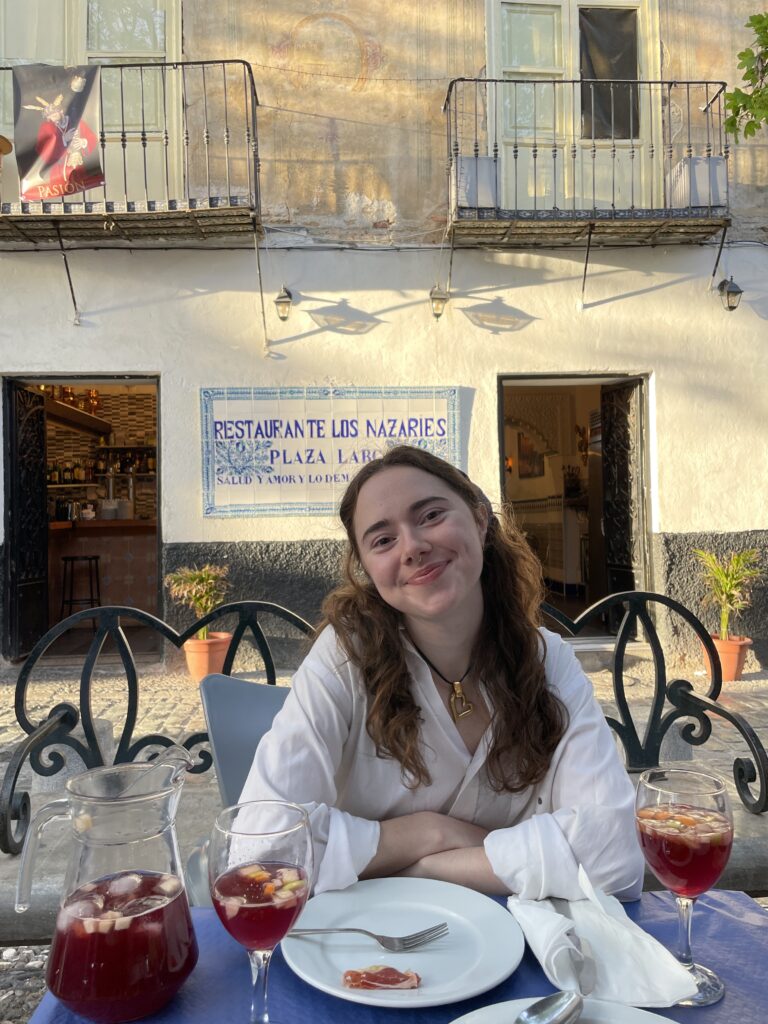 Kendall enjoys a meal and the views while in Spain.
Q: Do you have any advice for any students who are thinking about studying abroad, but they’re still unsure?
A: It’s such a good experience to get to know yourself outside of your comfort zone and build your own resiliency. And also, you just meet such cool people when you’re abroad. It’s such a wonderful experience, and I urge everyone to study abroad. It’s so worth it in every way.
Q: Do you have any idea what you want your future career to look like?
A: Honestly, I’m not sure. I would love to continue my artistry, whatever that looks like. But I also love teaching, and that’s something I’m very passionate about. I think for the immediate future, it’s probably just dipping my toes in different things and seeing what works best for me and what I want. I think that’s one thing that I feel like I need to see the impact of my work; that’s important.
Q: In your time here at UMBC, who’s been the biggest influence in your studies?
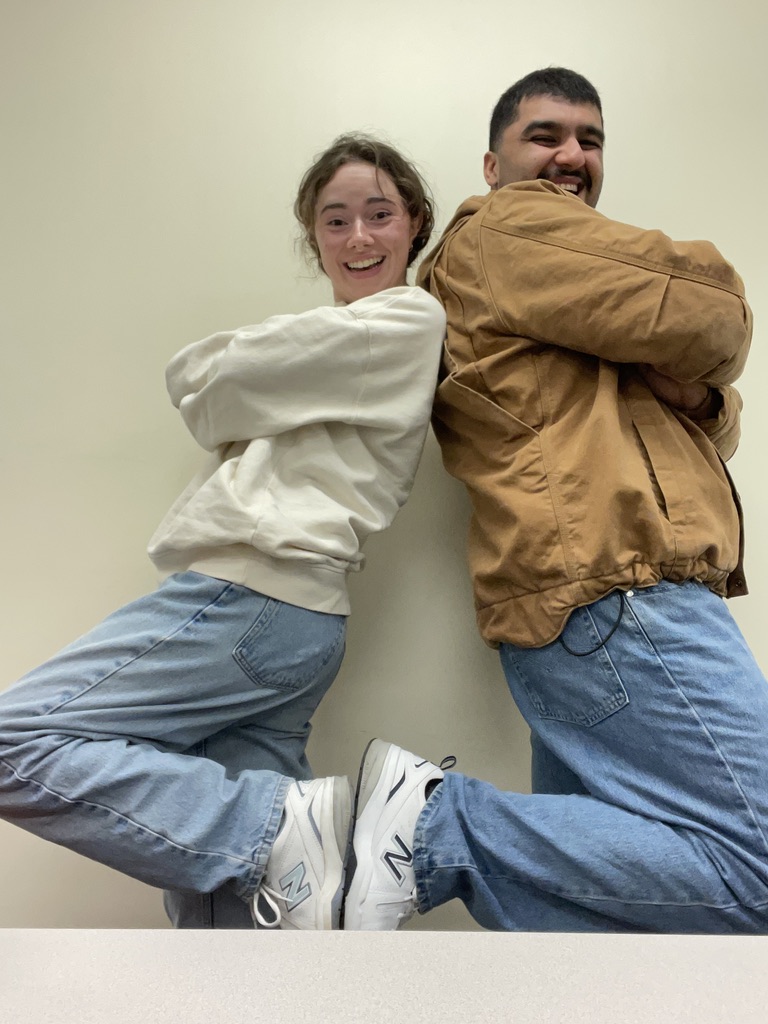 Kendall gets some support from friends who have her back!
A: I would say Dr. Julie Oakes, my research mentor. I’ve taken three classes with her at this point, not including the honors independent studies classes I have taken with her. She’s such a wonderful and brilliant professor and especially with my senior project, her support of my vision and my ideas was so unwavering, and I couldn’t have asked for a better mentor for that. Additionally, her classes were just some of the most fascinating history classes I’ve ever taken.
Q: What part of UMBC do you think will have the biggest impact on you post-graduation?
A: The Honors College has been such a core part of my studies. My time in the Honors College has connected me with some of the best people, some of the best professors, and the best peers. I feel like I’ve gotten to know people that I’m going to know forever and people that I want to know forever. The Honors College make you feel very supported. It feels very all-encompassing like if you need something, the Honors College is there to help you.
Q: Is there anything else you would like to share about yourself with the community?
A: UMBC has just been a really wonderful experience, and I feel like I’ve gotten to grow so much. The interdisciplinary nature of my studies and my senior project and all the projects that I’ve undertaken have been so rewarding. That interdisciplinarianism is not only a core component of the Honors College, but also I feel like it’s valued at UMBC. I would urge anyone to lean into being interdisciplinary in their work and exploring that.
Story written by Jason Conti, UMBC Library IT support associate. All photos courtesy of Kendall unless otherwise noted.
Read more stories about the Class of 2026.
]]>
Isabel Kendall ’26, modern languages and linguistics, is described by Julie Oakes, assistant director of curriculum and retention in UMBC’s Honors College, as someone who “truly represents what is...
https://umbc.edu/stories/isabel-kendall-26-honors-college-mentor/
https://my3.my.umbc.edu/api/v0/pixel/news/160276/guest@my.umbc.edu/e2d48ed8876bba863143e205b45068df/api/pixel
cahss
class-of-2026
education-abroad
honors-college
mll
news
policy-and-society
story
UMBC News & Magazine
https://my3.my.umbc.edu/groups/umbc-news-magazine
https://assets1-my.umbc.edu/system/shared/avatars/groups/000/001/943/24435aa6207c452e7bc15cc74b42c7bb/xsmall.png?1748556657
https://assets1-my.umbc.edu/system/shared/avatars/groups/000/001/943/24435aa6207c452e7bc15cc74b42c7bb/original.png?1748556657
https://assets2-my.umbc.edu/system/shared/avatars/groups/000/001/943/24435aa6207c452e7bc15cc74b42c7bb/xxlarge.png?1748556657
https://assets2-my.umbc.edu/system/shared/avatars/groups/000/001/943/24435aa6207c452e7bc15cc74b42c7bb/xlarge.png?1748556657
https://assets3-my.umbc.edu/system/shared/avatars/groups/000/001/943/24435aa6207c452e7bc15cc74b42c7bb/large.png?1748556657
https://assets1-my.umbc.edu/system/shared/avatars/groups/000/001/943/24435aa6207c452e7bc15cc74b42c7bb/medium.png?1748556657
https://assets2-my.umbc.edu/system/shared/avatars/groups/000/001/943/24435aa6207c452e7bc15cc74b42c7bb/small.png?1748556657
https://assets1-my.umbc.edu/system/shared/avatars/groups/000/001/943/24435aa6207c452e7bc15cc74b42c7bb/xsmall.png?1748556657
https://assets2-my.umbc.edu/system/shared/avatars/groups/000/001/943/24435aa6207c452e7bc15cc74b42c7bb/xxsmall.png?1748556657
UMBC News & Magazine
2
0
false
Thu, 21 May 2026 16:03:59 -0400
Thu, 21 May 2026 16:03:59 -0400
Office Hours—President Sheares Ashby and Petra Janka ’25 discuss student-led inclusive excellence
“You are a valued and important voice.” “UMBC cares and listens.” “The diversity on UMBC’s campus helps to bring out the best in everyone.” Along with an eye-catching color gradient, these words adorn the walls of the Mezzanine Gallery in The Commons. And while the phrases may sound like something President Valerie Sheares Ashby would (and does) say quite often, they are actually part of an Arts+ initiative, student-sourced art installation that asked students: “Inclusive excellence: What does it mean to you?”
Created by students in the spring 2025 class Professional Practices in Graphic Design, the installation transforms the Mezzanine Gallery and nearby breezeway into spaces that reflect UMBC’s welcoming community. Funded by Student Affairs Communications and Marketing, the project included Petra Janka ’25, graphic design and modern languages and linguistics, and a current human-centered computing master’s student. In this Q&A, Janka and President Sheares Ashby talk about student-led inclusive excellence and the ways that UMBC welcomes people into its community.
President Valerie Sheares Ashby: How did your class approach this project?
Petra Janka: Our class was asked to help to reimagine and transform two spaces in The Commons: The Mezzanine Gallery and the entrance near the breezeway. We wanted students to interact with something enjoyable and inspirational. So our design approach focused on creating a multi-perspective experience.
There are three specific views you can take in this installation. From one side, you see this colorful gradient representing the diversity of residential life on campus. From the other angle, you can see the black and gold gradient symbolizing academic life at the university. If you look at it straight on, you can see the quotes included in the installation and the digital signage, which highlights additional answers. We sourced these quotes by surveying students about their connections, their advice, their challenges, their experiences on campus, and so on.

 Left: headshot of Petra Janka in front of the colorful gradient perspective; Right: Designed by the same class, “The Roots of Inclusive Excellence” mural takes over the entire wall of the breezeway entrance to The Commons. The flowers of all different colors, shapes, and sizes represent the many backgrounds and stories each UMBC student brings to campus.
Sheares Ashby: This is fantastic. It is a brilliant idea on multiple levels. I talk about inclusive excellence all the time because it is a core value of the institution, but hearing students’ experience lets me know we are doing something right. It also lets me know there is more for us to do, right? These quotes inspire me to keep going—to try to make the place even more inclusive for everyone.
It is one thing for me to say it, but to know that your student peer is saying—”Give everyone a chance”—well, that is far more powerful than if I were using my voice. When I read the quotes on the wall, I think, “Oh, that is different. That is more powerful. That is more meaningful.”
Janka: The motto of our group was: “From the students, for the students.” We wanted everyone who passes by to stop, read, and feel seen, heard, and valued, and I think we achieved that.
Sheares Ashby: This is a unique institution. It is a very different thing to be at an institution that has been around for more than 150 years, and one that has been around for 59. Older institutions are pretty hard to change. Students certainly have an impact everywhere they go, but you are not creating that institution anymore, not fundamentally changing the DNA.
But, here, we are still in a space where we are becoming clear about our values, but we are flexible and humble enough to recognize there is still more input to receive, still more growth to experience, still new ideas to include. We can be better and different, and it is our clarity about our core principle of inclusive excellence that enables us to do that.
Janka: Last spring, when we were scouting out the space, we saw how many people pass through because this is a place to eat, study, and meet friends. We wanted to add something that becomes part of that everyday experience at UMBC. And now the colors draw your eyes to it, and then you read the messages, and you feel connected, and you’re like, “Oh, this is nice. I feel inspired to do better, to give everyone a chance.” I hope it stays up for a long time.
Sheares Ashby: We are clearly better because you are here. This is what students do. Each time a new student joins us, UMBC gets better.
The project, part of UMBC’s Arts+ initiative, was completed and installed by commonvision, UMBC Student Design and Print Center students Shomapti Hussein ‘25 and Thomas Hammond ‘25, under the print and installation guidance of Tori Richner ‘22, general associate: print production, and the supervision of SACM staff. The Commons Facilities and Operations team installed the panels and screen in the Mezzanine Gallery, and were integral partners in this project.
]]>
“You are a valued and important voice.” “UMBC cares and listens.” “The diversity on UMBC’s campus helps to bring out the best in everyone.” Along with an eye-catching color gradient, these words...
https://umbc.edu/stories/office-hours-inclusive-excellence/
https://my3.my.umbc.edu/api/v0/pixel/news/155094/guest@my.umbc.edu/55f688a7135a5ae6d04417370cce03bc/api/pixel
cahss
campus-life
coeit
fall-2025
graphic-design
magazine
mll
office-hours
story
UMBC News & Magazine
https://my3.my.umbc.edu/groups/umbc-news-magazine
https://assets1-my.umbc.edu/system/shared/avatars/groups/000/001/943/24435aa6207c452e7bc15cc74b42c7bb/xsmall.png?1748556657
https://assets1-my.umbc.edu/system/shared/avatars/groups/000/001/943/24435aa6207c452e7bc15cc74b42c7bb/original.png?1748556657
https://assets2-my.umbc.edu/system/shared/avatars/groups/000/001/943/24435aa6207c452e7bc15cc74b42c7bb/xxlarge.png?1748556657
https://assets2-my.umbc.edu/system/shared/avatars/groups/000/001/943/24435aa6207c452e7bc15cc74b42c7bb/xlarge.png?1748556657
https://assets3-my.umbc.edu/system/shared/avatars/groups/000/001/943/24435aa6207c452e7bc15cc74b42c7bb/large.png?1748556657
https://assets1-my.umbc.edu/system/shared/avatars/groups/000/001/943/24435aa6207c452e7bc15cc74b42c7bb/medium.png?1748556657
https://assets2-my.umbc.edu/system/shared/avatars/groups/000/001/943/24435aa6207c452e7bc15cc74b42c7bb/small.png?1748556657
https://assets1-my.umbc.edu/system/shared/avatars/groups/000/001/943/24435aa6207c452e7bc15cc74b42c7bb/xsmall.png?1748556657
https://assets2-my.umbc.edu/system/shared/avatars/groups/000/001/943/24435aa6207c452e7bc15cc74b42c7bb/xxsmall.png?1748556657
UMBC News & Magazine
1
0
false
Fri, 05 Dec 2025 14:35:04 -0500
Fri, 05 Dec 2025 14:35:04 -0500
Meet a Retriever—Nathan Wooddell ’23, graduate student specializing in Russian and cybersecurity
Meet Nathan Wooddell ’23, computer science. Nathan is a member of UMBC’s CyberCorps: Scholarship for Service cohort, and is getting his master’s in cybersecurity as a graduate researcher at the National Nuclear Security Agency. Nathan attributes much of his success to the connections he’s made with the staff and faculty at UMBC who have helped him to discover his true passions. During his time as an undergraduate at UMBC, Nathan also completed a Russian language certificate, and has found a way to combine his interests of both cybersecurity and the Russian language in the professional world. Take it away, Nathan.
Q: What’s one thing you’d want someone to know about the support you find at UMBC?
A: In many classes, casual visits to professors during office hours, polite interactions during class, and expressing interest in the subject matter can go a long way. Such interactions help with all aspects of student life. Too many students fail to take proper advantage of the fantastic support that the university faculty can offer. The best way to do this in my experience is simply to speak with your professors after class or outside of class.
Such interactions help with all aspects of student life. The faculty can offer support in the form of academic resources, scholarship recommendations, professional guidance, and even letters of recommendation for work or graduate programs.
Q: Tell us about someone in the community who has inspired you or supported you, and how they did it.
A: I want to give special thanks to Russian instructor Vira Zhdanovych. Since I first transferred to UMBC, I have taken Russian language courses with Professor Zhdanovych. It was through her guidance that I got my first research experience when she advised me on my 2022 Undergraduate Research and Creative Achievement Day presentation Analyzing the Russian Federation’s Impact on Global Cyber Security. This was also the first time that I was able to merge my interest in cybersecurity and Russian language.
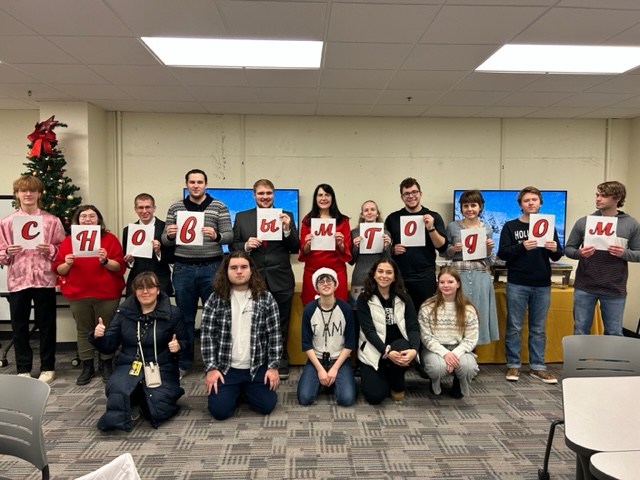 At the MLLI winter and New Year celebration, hosted by the Russian Area in December 2023, Zhdanovych stands in the center holding an “M” and Wooddell is to her right holding the Russian letter “ы.” The full sign reads “Happy New Year!” (Photo courtesy of Zhdanovych)
I have worked extensively with Professor Zhdanovych to study and research the impact of the Russian-speaking world on the cybersecurity and intelligence communities—I owe so much of my professional and academic success to her.
Q: Tell us what you love about your academic program or an organization you’re involved in.
A: I am a participant and former officer in UMBC’s Russian Club. The meetings of this club are especially good for learning about contemporary Russian culture, as well as the geopolitical history, which still shapes the diplomacy of the Russo-American relationship.
“Had I known then what I know now about the university’s programs, rigor, faculty, and opportunities, UMBC would have been a shoo-in. Ultimately, I am so grateful that I applied to, and attended UMBC.”
Nathan Wooddell ’23, current master’s student
Q: What is your WHY? What brought you to UMBC?
A:I came to UMBC in my sophomore year as a transfer student. Admittedly when I was accepted I toyed around with the idea of going to a variety of different schools, but eventually decided on UMBC for the price, and the relative vicinity to my home in northern Maryland.
Had I known then what I know now about the university’s programs, rigor, faculty, and opportunities, UMBC would have been a shoo-in. Ultimately, I am so grateful that I applied to, and attended UMBC.
Q: Tell us about the people who are helping you grow at UMBC, and why their HOW made such a difference to you.
A: In addition to Professor Zhdanovych’s support with my Russian language and research, Professor RJ Joyce in computer science encouraged me to become invested in cybersecurity. It’s because of him that I’ve become involved in many of the clubs and organizations I am currently enrolled in. Such interest in security was able to earn me recipient status in UMBC’s Scholarship for Service cohort.
Q: What clubs, teams, or organizations are you a part of? What do you love about them?
A: First and foremost, I am a member of UMBC’s National Science Foundation-fundedCyberCorps: Scholarship of Service (SFS). This program has allowed me to pursue my interest in security outside of the traditional academic venues. Thanks to SFS, I was able to attend and present at DEFCON 31 in Las Vegas, one of the largest cybersecurity conventions in the world [Photo: Wooddell, left, at DEFCON 31 with a fellow student].
I am also a member of the UMBC Cyberdawgs. I never miss an opportunity to compete in the annual competitions they hold on campus. Beyond this, I attend the bi-weekly Cyber Defense Lab meetings, which allow me to keep up to date with all sorts of security research projects being conducted on campus.
Q: Are you a student leader? Tell us about it!
A: Through SFS, related organizations, and clubs on campus, I have been lucky enough to meet and work with some of the most amazing and intelligent people I have ever met. From these associated labs, clubs, and programs I have met and been influenced by more people than I could ever hope to list here.

I am incredibly honored to have been able to lead these organizations, as they have provided me with opportunities to give back to my university and community.
* * * * *
UMBC’s greatest strength is its people. When people meet Retrievers and hear about the passion they bring, the relationships they create, the ways they support each other, and the commitment they have to inclusive excellence, they truly get a sense of our community. That’s what “Meet a Retriever” is all about.
Learn more about how UMBC can help you achieve your goals.
]]>
Meet Nathan Wooddell ’23, computer science. Nathan is a member of UMBC’s CyberCorps: Scholarship for Service cohort, and is getting his master’s in cybersecurity as a graduate researcher at the...
https://umbc.edu/stories/meet-a-retriever-wooddell-russian-cybersecurity/
https://my3.my.umbc.edu/api/v0/pixel/news/139627/guest@my.umbc.edu/2095dac00bc9311ee2df369ee54e38f3/api/pixel
alumni
coeit
compsci
cybersecurity
impact
magazine
meet-a-retriever
mll
perspectives
russian
story
UMBC News & Magazine
https://my3.my.umbc.edu/groups/umbc-news-magazine
https://assets1-my.umbc.edu/system/shared/avatars/groups/000/001/943/24435aa6207c452e7bc15cc74b42c7bb/xsmall.png?1748556657
https://assets1-my.umbc.edu/system/shared/avatars/groups/000/001/943/24435aa6207c452e7bc15cc74b42c7bb/original.png?1748556657
https://assets2-my.umbc.edu/system/shared/avatars/groups/000/001/943/24435aa6207c452e7bc15cc74b42c7bb/xxlarge.png?1748556657
https://assets2-my.umbc.edu/system/shared/avatars/groups/000/001/943/24435aa6207c452e7bc15cc74b42c7bb/xlarge.png?1748556657
https://assets3-my.umbc.edu/system/shared/avatars/groups/000/001/943/24435aa6207c452e7bc15cc74b42c7bb/large.png?1748556657
https://assets1-my.umbc.edu/system/shared/avatars/groups/000/001/943/24435aa6207c452e7bc15cc74b42c7bb/medium.png?1748556657
https://assets2-my.umbc.edu/system/shared/avatars/groups/000/001/943/24435aa6207c452e7bc15cc74b42c7bb/small.png?1748556657
https://assets1-my.umbc.edu/system/shared/avatars/groups/000/001/943/24435aa6207c452e7bc15cc74b42c7bb/xsmall.png?1748556657
https://assets2-my.umbc.edu/system/shared/avatars/groups/000/001/943/24435aa6207c452e7bc15cc74b42c7bb/xxsmall.png?1748556657
UMBC News & Magazine
3
0
false
Wed, 28 Feb 2024 13:31:03 -0500
Why We Love it Here
What gets you up and out the door each morning? And what makes a job more than a job—or even more than a career? For so many who make UMBC their professional home, the value goes way beyond a paycheck.
Case in point: Employees for the 14th consecutive year rated UMBC as one of ModernThink’s Great Colleges to Work For in all 10 categories, including shared governance, mission and pride, job satisfaction and support, and diversity, equity, and inclusion. Additionally, the Baltimore Sun has once again named UMBC a 2023 Top Workplace winner based on a confidential employee survey conducted earlier this year. This is the 9th time UMBC has earned this designation since 2013.
What does this excellence look like in the day-to-day? We talked to some Retrievers about what they love about their work at UMBC.
Want weekly Top Stories sent to your inbox?
Valuing Our Whole Selves
UMBC is a place that considers the whole person, opening up space for both professional growth and work-life balance. From mentoring programs to embracing our individual stories, when we support each other in our work and lives, we all come out stronger.
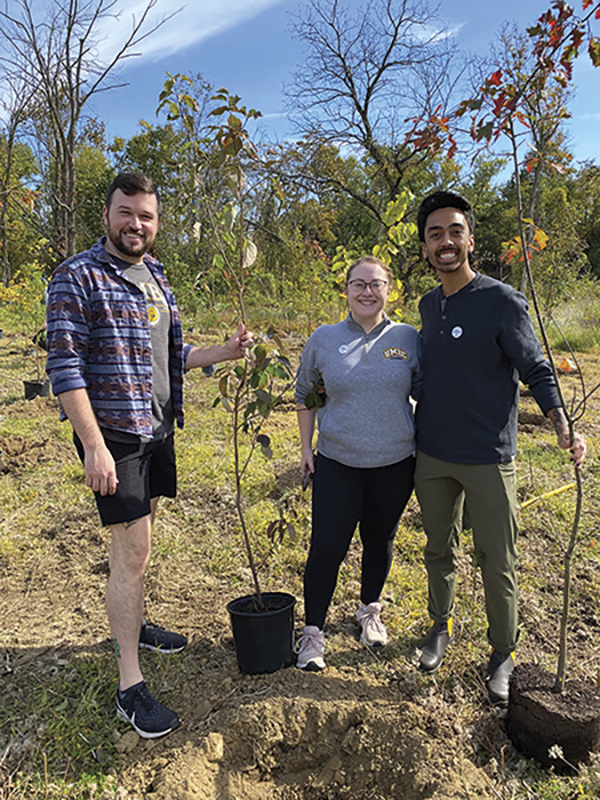
Sharing Our Time
Dozens of Retrievers spent time this fall planting 900 new trees around campus, including those pictured here (L-R): Gavin Gilliland, Abby Hart ’18, and Tim Olivella.
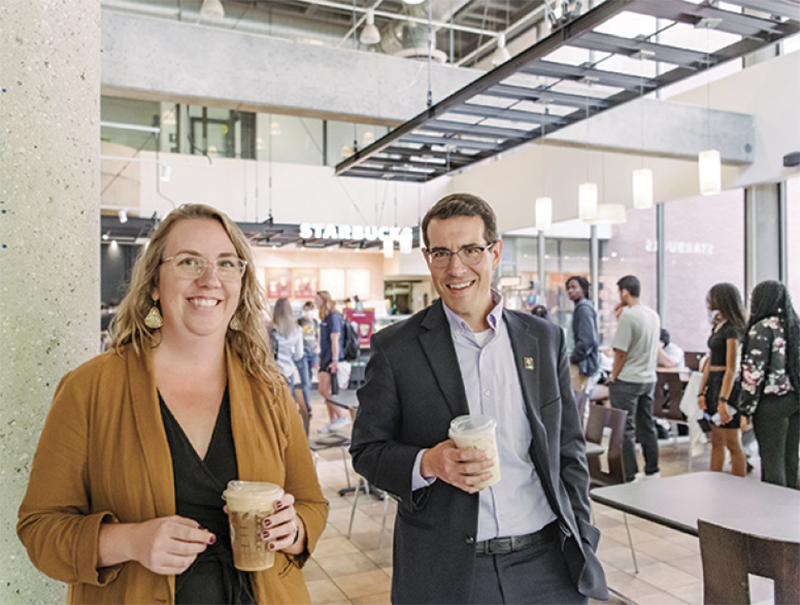
Building bridges across campus
They met so many times at Starbucks, they knew each other’s orders.
Damian Doyle (’99, computer science, M.S. ’16, information systems): tea, Earl Grey, hot. Charlotte Keniston (M.F.A. ’14, intermedia and digital arts): coffee, iced.
Over their caffeine of choice, the two UMBC staff, who work in wildly divergent disciplines, forged connections through the Professional Staff Senate mentorship program—a staple of campus connectedness for the last decade.
Doyle, who works in information technology and has been a staff member at the university for almost 24 years, has served as a mentor for more than five years. Keniston, who started at the Shriver Center five years ago, anticipated a year of opportunity and transition and wanted a mentor to guide her toward balance between a demanding career, family, and finishing her Ph.D. in language, literacy, and culture.
“It was a perfect fit because Damian saw the big picture of the university and explained the campus overarching structures that I had never understood and was really great at advising me on critical points I was at in my career,” Keniston said.
As a mentor to a number of staff over the years, Doyle finds the program rewarding.
“One of the things I loved was getting to know different parts of the university. I get exposed to these different areas of the campus at a deeper level. It confirms for me the kind of driven work that people are doing.”
The mentorship program matches staff through a mentee-first pairing system that includes a speed-dating session and goal analysis for a year-long commitment. Keniston said the mentorship was crucial to her path at UMBC.
“I was at the point where I felt like I couldn’t ask questions, like, ‘Who is this person?’” Keniston said with a laugh. “But being in this mentor/mentee relationship gave me an opportunity to say, ‘Help me understand this.’”
Doyle said that hearing Keniston’s questions and seeing the campus organization through new eyes helped him know what is working and what needs improvement at UMBC. “It’s very educational for me, having to think through what is the right answer, what is the honest answer.”
After a year of meeting about once a month, Doyle has a new mentee, and Keniston has now become a mentor. But they’ll be keeping in touch. Maybe over tea and coffee.
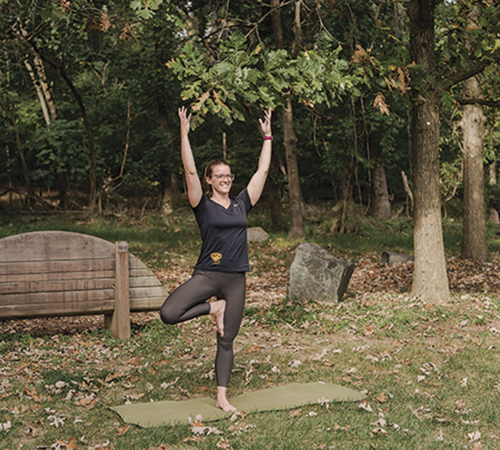
Inner Peace
Many of our staff and faculty take advantage of free exercise and wellness classes in the RAC, some of which are taught by Joella Lubaszewski ’10.
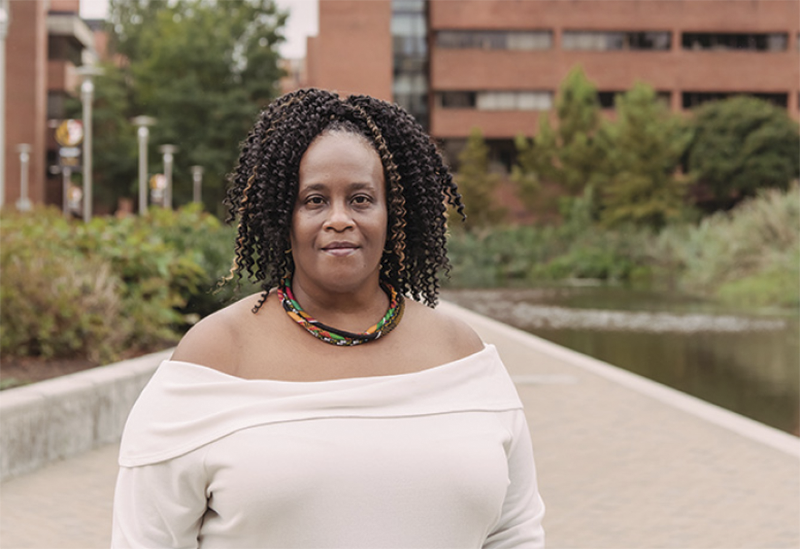
Telling her authentic story
Melessia Jasper’s journey to UMBC was not straight. But something kept pointing her toward UMBC. And toward herself.
“My path to UMBC started before I knew about UMBC,” Jasper said, explaining that after high school in Alabama, she arrived in Maryland only to find that the job she had been promised was locked in a hiring freeze. She started at American University, where she worked with two former UMBC staffers. Then she heard UMBC President Emeritus Freeman Hrabowski at a faculty retreat. “I didn’t realize it at the time, but God was laying the groundwork for where I am today.”
When she moved to Baltimore with her new husband, she applied to UMBC and worked in several different divisions, including Student Affairs and Administration and Finance. In each office, Jasper said, she found acceptance and growth. She now works in the Division of Institutional Equity.
“It was the first university I worked for where you’re applauded for your quirkiness,” Jasper said. “I was so empowered by the resources UMBC offered to me that I then could empower others.”
Last year, she stood on stage to tell her story in a Retriever Talk. For weeks, she and a cohort of other UMBC staff labored with Jill Wardell ’99, interdisciplinary studies, and other strategic talent management and storytelling staff to shape their life tales, a commitment of time and effort on the part of both the storytellers and for UMBC. Jasper said she felt like she was stripping naked. She was reluctant but told herself, “Sometimes, you have to be uncomfortable in order to follow your purpose in life.”
In addition to revealing lifelong intrusive thoughts of inadequacies and imposter syndrome, Jasper also shared—in front of hundreds of people she didn’t know—that in 2000, doctors discovered she had a rare condition called a Chiari malformation, in which part of her brain had grown down into her spine. Her doctor was amazed at what she had achieved, but Jasper knew she was only getting started.
After her Retriever Talk, many students, colleagues, and even strangers have since contacted her to affirm how her story helped them.
“This is something that I have gone through,” Jasper said. “If I can go through it and possibly help you by telling you my story, I want you to have that same freedom…freedom in understanding who I am and accepting who I am.”
A Community That Builds Together
Through our unique commitment to shared governance and a deep appreciation of community, we collectively build UMBC into what we know it should be.
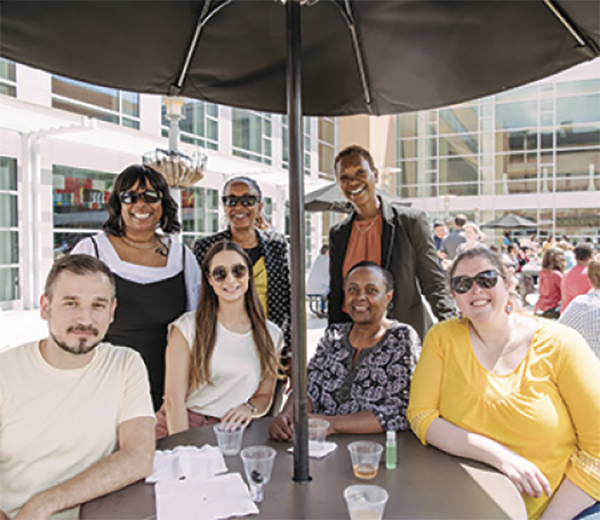
Sharing the Moment
The annual cookout put on by the Professional Staff Senate and Nonexempt Staff Senate brings folks together from all over campus.
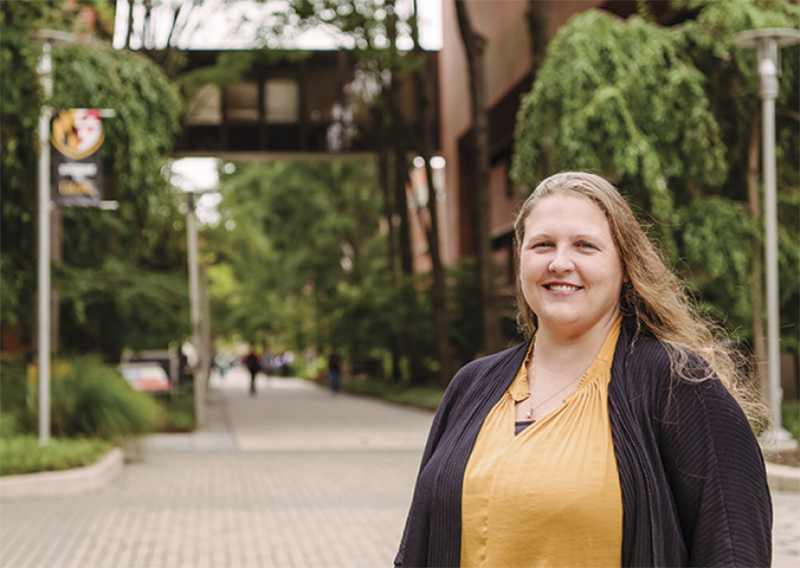
Finding a voice in leadership
There’s a reason the Nonexempt Staff Senate (NESS) carries the name of a democratic body. Alongside other staff and faculty shared governance groups and student government bodies serving their respective constituents, NESS exists to ensure all UMBC nonexempt employees have a voice, the way democracy is supposed to work.
Desiree Stonesifer, serving the second year of her term as president of NESS, and a business services specialist in the financial services department, believes that the shared governance organization builds trust at the university. UMBC offers both staff and faculty shared governance groups, in which all parties work together on the university’s leadership.
“I think it gives people the security of knowing that they’re welcome to speak their mind without it being held against them,” Stonesifer said. “They’re allowed to have thoughts outside the status quo. And a lot of times, those are the kind of thoughts that maybe the administration or other people in the university haven’t thought of. It gives everyone different perspectives and it allows staff the ability to grow more comfortable in their community so that they can be who they are and say what they think.”
NESS helps its members handle issues that are vital to employees: Are job descriptions adequate? Are positions equitably valued? Is professional development available?
Many of the nonexempt senate members aren’t interacting with students as much as other UMBC employees, Stonesifer said, and many of them want to reach out. The NESS, she said, can help members “find ways to get involved in the community.”
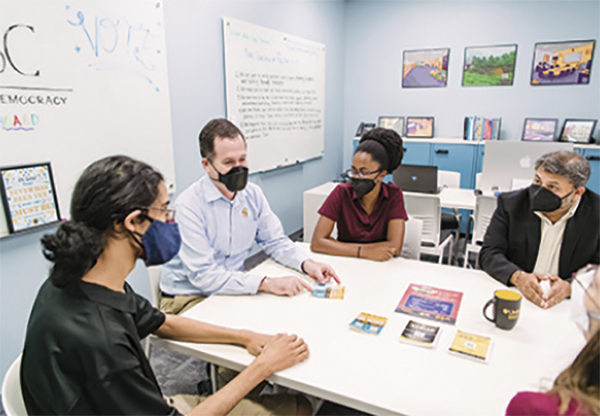
Creating Change
Campus offices like the Center for Democracy and Civic Life work alongside students to engage the community and make a difference.
Creating a green space of solace
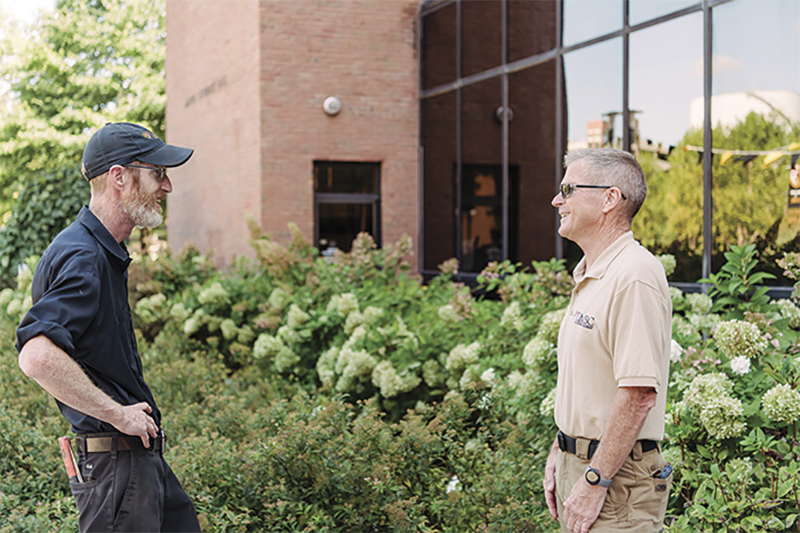
Charles Hogan, UMBC’s landscape and grounds manager, is comfortable with trees. He grew up climbing them, building forts in them, and “falling out of them,” he said, laughing. For decades, he has run and biked through forests for mile upon mile every week.
As he walks UMBC’s Academic Row in his sturdy boots and cargo pants, Hogan (above, right) admires the trees that have survived years of building renovations, root system compromise by tunnels carrying utilities and water underground, and the hundreds of students who tramp over their soil and tie hammocks to their trunks.
Hogan, who has worked on UMBC’s landscaping for 26 years, likes to construct park-like pockets dotted throughout the campus. Each of those miniature parks is based around trees, whether that’s the pair of oaks in front of the Administration Building that tower over the hydrangeas below or the diminutive weeping redbud that Hogan wanted to top with a tiny hat and sunglasses because it looked so much like Cousin Itt from the Addams Family.
“I’m a tree person,” said Hogan, who is a certified arborist. “Trees should be the focal points. We’re creating a lot of little park environments.”
A campus’ green spaces, Hogan said, make a difference when students and their families are trying to decide where to attend as well as provide succor to everyone making their way through a busy semester. That’s why the grounds staff plants 30,000 summer annuals and 10,000 fall pansies every year. Each area on campus is assigned to a particular gardener, Hogan said, who takes pride in the beauty of the plants under their charge.
Those gardens and the shade of the trees surrounding the buildings offer comfort to the staff, faculty, and students who make the campus their living rooms.
“I never went to college, but I know students are under a lot of stress. They should be able to sit outside, read, study, write a paper,” Hogan said. “Any landscape, whether it’s at your house or on campus, should make you feel good, feel relaxed.”
Living the Mission
At the end of the day, UMBC’s values and mission are what bring us all together. When we work in service of our students and our academic mission of inclusive excellence, it’s hard not to feel connected to the work on another level.
A Student-Centered Community
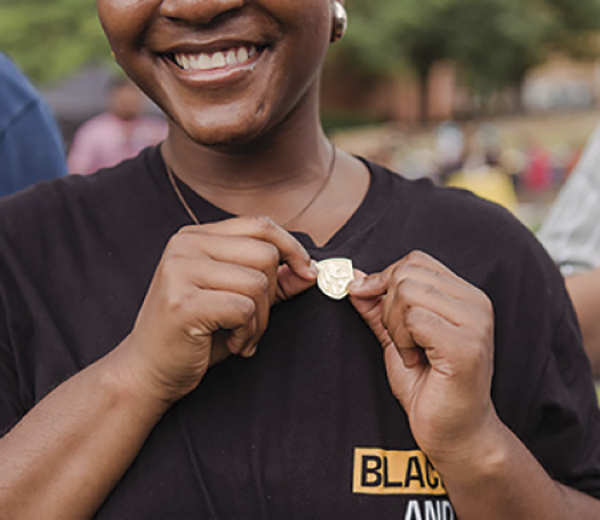
At the beginning of each school year, our new students are officially welcomed with the Convocation ceremony, where they each receive a special UMBC shield pin.
Lifting students to the next level
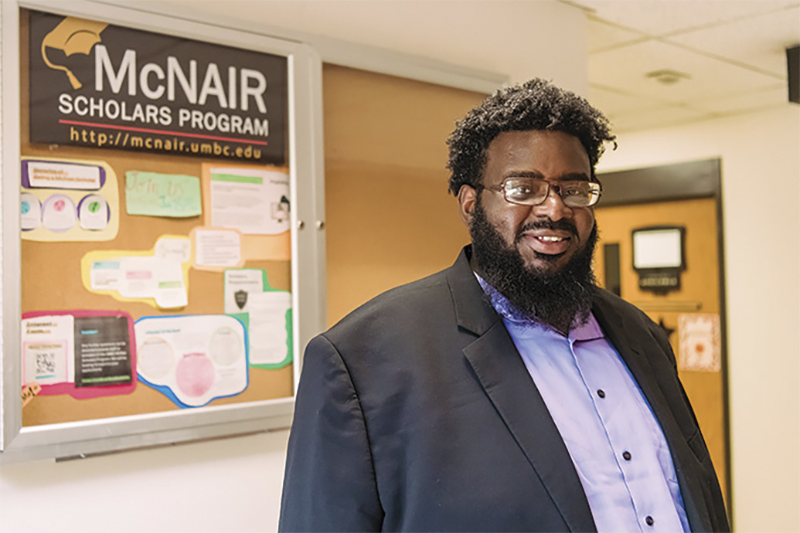
When he’s deep into extolling the mission and benefits of the McNair Scholars Program he directs, Michael Hunt ’06, computer engineering, needs only a pulpit to become the preacher he trained to be.
When Hunt sees a student achieve, he feels “that parent feeling, that joy that comes to you. Sometimes I’m more excited than they are when they’re telling me. Sometimes it’s a sense of awe in knowing their story, in knowing all that had to happen to get to that space,” said Hunt, who has a masters in theology. “I feel like we’re the mama bird, teaching them all they need before they fly away.”
The federally funded McNair program, with a goal of boosting students from underrepresented segments of society into earning research-based doctoral degrees, has expanded over the six years of Hunt’s directorship.
Every year, the McNair Scholars Program funds 30 slots for students, who meet with mentors, fulfill service obligations, attend cross-cultural events, and receive the help they need to prepare for, apply to, and excel in graduate school.
Hunt, who was a Meyerhoff and McNair scholar, is earning his own interdisciplinary Ph.D. from UMBC. After he became director of the McNair program in 2019, he found himself frustrated when he had to shut some students out of opportunities. So he spearheaded, with the backing of the then-current scholars, staff, and McNair Advisory Council, the creation of the Friends of McNair network, a group of students who reap some of the mentoring, community, and support benefits that McNair Scholars enjoy.
Hunt is exploring ways for the university to expand the support it gives to students not in formal scholar programs. He enthusiastically advocates for the need for holistic critical mentoring (HCM), a network of power-dynamic-flipped, student-centered, reciprocal relationships. HCM is the mentoring framework that uplifts both mentor and mentee while dismantling systems of oppression.
“Because of my heart and because of the work that I do, I don’t want to turn anyone away when I know there are resources to support them. The institution has to rise and say, ‘This is a part of the work of inclusive excellence, and we’re going to fund this to make it happen.’ What I love about my institution is that the more I talk and have these conversations, the more I do see people beginning to question and challenge what we are doing. And so I don’t feel quieted. In other spaces, I know that folks would have been quieted.”
Moments of Joy
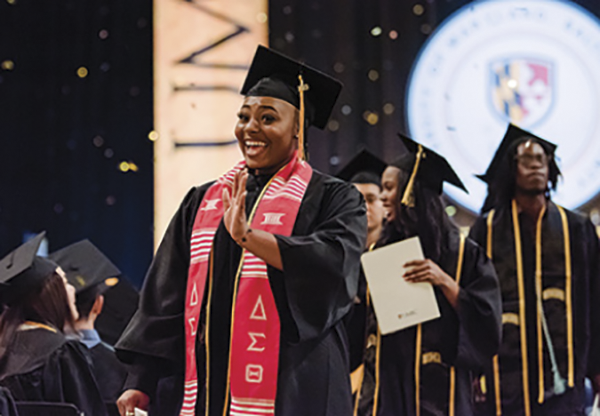
There’s simply nothing like the feeling of watching our students cross the stage to get their diplomas.
Shaping success in all sizes
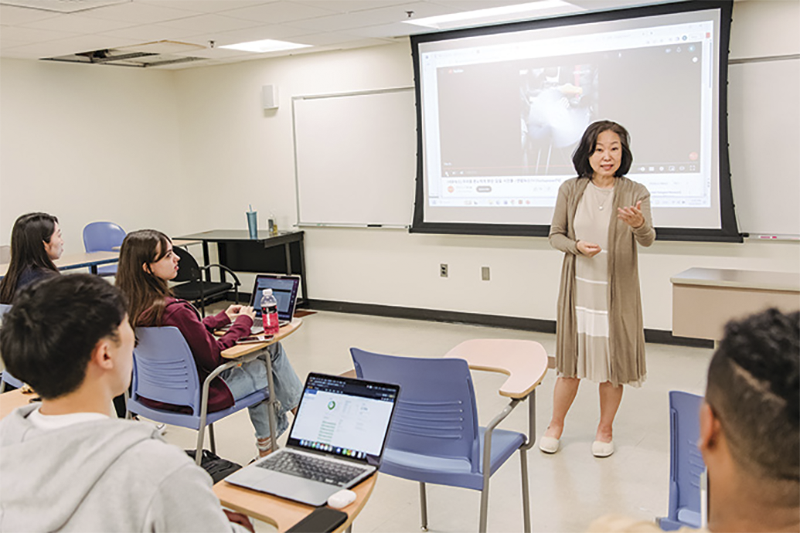
At Commencement, Kyung-Eun Yoon likes to sneak out of her academic division’s seating section to hug students in other majors, she confesses. Of course, she gets to hug all the Korean majors when they rise to receive their diplomas, but other students have taken maybe five or six courses or minored in Korean, and she wants to embrace them, too, to recognize that achievement.
Student success, Yoon says, doesn’t come in one shape or size.
“For some students, yes, excelling in every class and getting double degrees and finishing an honors program with a wonderful thesis, going to Korea’s top university as a graduate student, getting a job—that’s a wonderful, wonderful success story,” Yoon said. “But for some students, completing the semester without withdrawing from too many classes, or without failing one or two courses, completing their degree, finally, in five or six years, that’s a wonderful success story for them too.”
Yoon started at UMBC in 2009 as the coordinator of the new Korean program and has grown the program so that students can now major or minor in Korean within the modern languages, linguistics, and intercultural communication department. Over her 14 years, Yoon’s Korean program graduates have gone on to work at the National Security Agency, to pursue graduate schools in various fields including Korean studies and international relations, to teach English in Korea, and more.
But sometimes, she said, success looks like one student whose achievement she particularly treasures. The student had dropped out, withdrawn from many classes, but after six years and many advising sessions with Yoon, last May, she graduated.
“It was not just a mere graduation for her, it was a really, really huge success for her,” Yoon said, and that student’s achievement made Yoon feel proud. “I did this much,” she says, holding up her finger and thumb an inch apart.
Yoon and her colleagues can help students along the path of hard work, but eventually, she says, “you have to have your ownership. We’ll help you, but without your ownership of this time, success cannot be happening.”
And when success happens, Yoon is sure to find that student to give them a hug.
By Susan Thornton Hobby
]]>
What gets you up and out the door each morning? And what makes a job more than a job—or even more than a career? For so many who make UMBC their professional home, the value goes way beyond a...
https://umbc.edu/stories/why-we-love-it-here-at-umbc/
https://my3.my.umbc.edu/api/v0/pixel/news/137627/guest@my.umbc.edu/7e783d773436c1823fe0629cac29e423/api/pixel
campus-life
center-for-democracy-and-civic-life
doit
fall-2023
imda
llc
magazine
mcnairscholars
meyerhoff-scholar
mll
ness
pss
UMBC News & Magazine
https://my3.my.umbc.edu/groups/umbc-news-magazine
https://assets1-my.umbc.edu/system/shared/avatars/groups/000/001/943/24435aa6207c452e7bc15cc74b42c7bb/xsmall.png?1748556657
https://assets1-my.umbc.edu/system/shared/avatars/groups/000/001/943/24435aa6207c452e7bc15cc74b42c7bb/original.png?1748556657
https://assets2-my.umbc.edu/system/shared/avatars/groups/000/001/943/24435aa6207c452e7bc15cc74b42c7bb/xxlarge.png?1748556657
https://assets2-my.umbc.edu/system/shared/avatars/groups/000/001/943/24435aa6207c452e7bc15cc74b42c7bb/xlarge.png?1748556657
https://assets3-my.umbc.edu/system/shared/avatars/groups/000/001/943/24435aa6207c452e7bc15cc74b42c7bb/large.png?1748556657
https://assets1-my.umbc.edu/system/shared/avatars/groups/000/001/943/24435aa6207c452e7bc15cc74b42c7bb/medium.png?1748556657
https://assets2-my.umbc.edu/system/shared/avatars/groups/000/001/943/24435aa6207c452e7bc15cc74b42c7bb/small.png?1748556657
https://assets1-my.umbc.edu/system/shared/avatars/groups/000/001/943/24435aa6207c452e7bc15cc74b42c7bb/xsmall.png?1748556657
https://assets2-my.umbc.edu/system/shared/avatars/groups/000/001/943/24435aa6207c452e7bc15cc74b42c7bb/xxsmall.png?1748556657
UMBC News & Magazine
6
0
false
Fri, 08 Dec 2023 09:06:37 -0500
Fri, 08 Dec 2023 09:06:37 -0500
Connecting the Dots

Students come to UMBC for many reasons—to find community, to explore a passion, to make change in the world. Once they figure out the “why” that truly drives their interests, the Retriever community is ready to kick in with the “how” to help make those plans a reality. Part of that looks like the traditional classroom experience with a professor, of course—but just as important are the experiential-learning moments that help many students actively connect the knowledge to careers they hope to pursue after graduation.
UMBC students pursue applied learning in huge numbers. Despite the pandemic, nearly 80 percent of our recent graduates engaged in applied learning, including internships, research, co-ops, and service learning during their time at UMBC. An impressive 91 percent of new grads head directly to a job, advanced degree, or both within six months of graduating—and of those, more than half interned or worked for their employer as a student.
“When it comes to impact, there is nothing more valuable than engaging in applied-learning opportunities to help clarify one’s career direction, build professional skills, and increase one’s professional network,” shares Susan Hindle, the Career Center’s assistant director of internships and employment.
For students pursuing experiential learning through internships, campus jobs, research, and community engagement, it’s not just about learning how to do the thing they want to do. It’s about connecting the work to the passions that brought them to UMBC in the first place. These students and alumni working in their chosen fields tell the whole picture—what hands-on learning looks like when it comes full circle.
Essential Connections
The desire to help people comes from deep within. But knowing how to do it successfully on a large scale—and understanding the systems and politics that can make the job more or less challenging—takes more than just compassion.
On the morning of the monthly food delivery from the Maryland Food Bank, the brigade of students who keep the Retriever Essentials food pantry running see all sides of the work. Together, they unload and shelve staples like rice, pasta, and huge crates of broccoli for the more than 2,100 visits to the pantry so far this year. At the same time, they work with community members to understand what might make life better—halal meats, for one; more campus job opportunities, another biggie—and then put their heads together to try to make those changes happen.
 Nyla Howell (left) and Lydia Sannella and Ariel Barbosa (L-R) sort canned goods for Retriever Essentials. Photos by Marlayna Demond ’11/UMBC, design by Jim Lord ’99.
For Ariel Barbosa, a grad student in UMBC’s community leadership program, working in this space is part of a journey that started with her trying to understand her Brazilian father’s immigrant experience better. As she works with Retriever Essentials, she’s learning about the complexities of these experiences in a way that will help her as she carves out a career in service. “There are so many signs showing me that I’m supposed to be right here, right now. I feel like I’m preparing,” she says. “Right now, I feel like I’m in a confidence-building, skill-building phase where I’m just trying to pick up as many skills as I can to be able to create what I feel I need to create at the right time.”
As a student, Matthew Dolamore ’08, modern languages and linguistics, caught a first glimpse of what would later become a service-based career when he tutored Spanish-speaking clients for an immigration services office in Baltimore. After graduating, he went on to serve with AmeriCorps and the Peace Corps and earned a master’s degree in community planning before pulling all of those skills together into a full-circle career in Baltimore.
Today, Dolamore is program director for the Esperanza Center, a project of Catholic Charities that assists more than 3,000 individuals each year with walk-in immigration services, including healthcare, legal assistance, and education tools. Dolamore serves as a connector between people and solutions, helping people get what they need when they need it and looking for ways to help improve the system.
 Matthew Dolamore ’08 at the Esperanza Center. Photos by Marlayna Demond ’11/UMBC, design by Jim Lord ’99.
“Among our managers we have a nurse practitioner, a managing attorney, a licensed social worker, an individual who got their master’s in teaching English from UMBC, and a woman who oversees our one-touch client services desk who’s a former immigrant and just has a really dynamic background. And just those five people alone is symbolic of what I love about my job,” says Dolamore.
“I’m not a medical professional. I’m not a legal professional. I’m not a social worker. I’m something myself of a generalist nonprofit manager at this stage in my career, but I get the opportunity every day to come in and out of these really focused professional engagements and try to help all five of them think of each other as teammates, and that’s the part of my job I really enjoy.”
Lydia Sannella, a Peaceworker and grad student in applied sociology at UMBC, also enjoys the organizational aspect of her job with Retriever Essentials. As she looks ahead to her post-academic career, she’s already thinking about how she can continue to marry her values with her career—knowing that it won’t likely be quite the same as what she’s experiencing at UMBC.
“I find that, whenever we want to do something, there are supportive, knowledgeable experts who want to help,” she says. “There’s just hoards of students who want to be involved and engaged and do any variety of work, from physical lifting to technical projects. And it’s just this canvas for creativity and possibility. It’s very reciprocal. What I’m able to contribute ends up being more significant and then what I get ends up being more significant.”
— Jenny O’Grady
Becoming part of the solution
Students come to higher education for a variety of reasons, and among them, many have the goal of learning to create new things—from innovative water-quality solutions to entire companies. For many students, in fact, learning while doing is an integral part of going to college.
If you ask Premal S. Shah ’98, biochemistry and molecular biology, however, he’ll tell you that there’s a world of difference between learning while doing and learning from doing.
That’s not to say that Shah, who earned a Ph.D. from the California Institute of Technology on his way to founding and leading a string of successful healthcare-related companies, doesn’t believe in academics. But from his vantage point as CEO at MyOme, a genomics firm based in northern California, classroom-based learning is only a part of the puzzle.
 Premel S. Shah ’98 interned at National Institutes of Health before founding a genomics firm. Photos by Barack Shrama, design by Jim Lord ’99.
Shah said he’s always had a practical streak, but he found out how much experiential learning can boost classroom learning thanks to a hands-on internship and fellowship at the National Institutes of Health, beginning while he was a student at UMBC.
“When I got to grad school, there were a lot of people who hadn’t really worked in a lab or done stuff,” he said. “I had a huge head start, just because I was able to pick up a pipette and actually use it. I knew what a DNA extraction protocol was. I knew how to use certain machinery.”
It was a vivid object lesson—one Shah has carried forward into his career. “When you start building companies, there’s always that challenge…of analysis paralysis, right?” he said. “There’s a notion of, ‘We could do this or that. Let’s read and learn more or get additional inputs in search of the perfect answer.’ Or we can actually go build something that will benefit people and iterate even faster as we learn more to make it much better.”
That’s the big difference between studying science and, for example, running science-based companies, Shah says: “The hypotheticals are great. The theories are great. But you’ve got to get [things] done.”
Getting things done is Matt Stromberg’s perennial modus operandi. Being a Ph.D. student studying environmental engineering means he is very much both an environmental scientist—someone who studies environmental problems—and an engineer: someone who works to solve those problems. “I always knew I was a passionate environmentalist, but I also knew I liked to build things,” he said.
In fact, Stromberg, who graduated in 2019 from the University of Virginia with bachelor’s degrees in both environmental engineering and environmental science, is a literal embodiment of learning while doing. Working as both a graduate research assistant and a researcher in the jointly run University System of Maryland Institute for Marine and Environmental Technology (IMET), he sometimes finds himself simultaneously running experiments and keeping the experiments running.
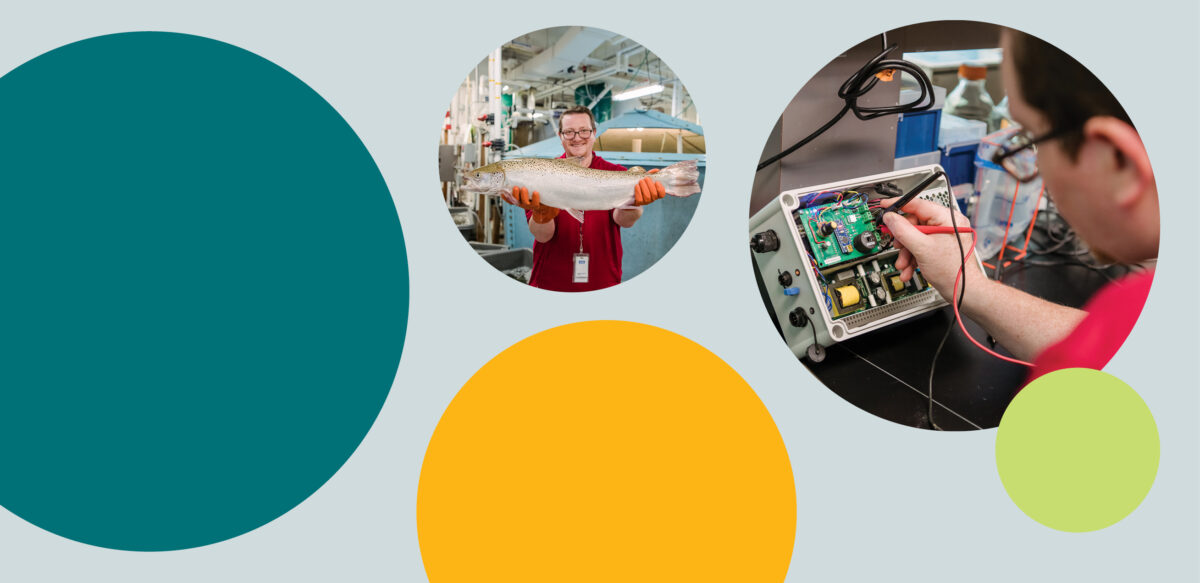 Matt Stromberg is studying aquaculture at the University System of Maryland Institute for Marine and Environmental Technology. Photos by Marlayna Demond ’11/UMBC, design by Jim Lord ’99.
A few months ago, Stromberg said, the night before an experiment was scheduled to start, a pump failed in IMET’s Aquaculture Research Center, a 1,800-square-meter facility with hundreds of fish tanks.
“It was a large pump, and it needed to be replaced—and it was eight o’clock at night,” Stromberg said. “I had already worked 12 hours that day, [but] I realized that there’s no way this experiment is going to run if I don’t have a pump tomorrow. So…I got the wrenches and I got all the fittings I needed,” and found a way to fix it.
Stromberg’s ability to save that experiment is part and parcel of his approach. One of his main research projects is unclogging a major bottleneck that prevents more farm-raised fish from getting to market: purging them of an unsavory flavor that’s sometimes characteristic of fish that aren’t caught in the wild. As Stromberg put it, “You’re not going to sell the fish if it tastes like dirt.”
That’s a problem not only for aquaculture companies—which have to use lots of water, time, money, and energy to purge the fish of this taste—but also for the planet. That’s because the only alternative to aquaculture is fishing in the wild, which can destroy ecosystems but is still cheaper than aquaculture, due to the expensive purging process.
He’s working with advanced oxidative processes and a technology of his own that would effectively create a shortcut, making it more cost-effective to farm fish and thus helping to protect wild habitat in the process. And Stromberg aims to eventually put his Ph.D. to work in a similarly practical way: His goal is to create a company that performs chemical analysis and remediation of water contaminants.
“I’ve learned a lot from my time here,” he says. “Especially not to over-engineer things!”
— Scott Cech
Community-centered art
Visual art is all around us—in flyers, television commercials, and even clothes. And while many of us may never know the artists creating work behind the scenes, their lives and experiences certainly do shape their work.
For instance, earlier this year, Jennifer White-Johnson ’08, visual arts, designed a collection for Target’s national Latino Heritage Month campaign, including a tumbler with stacked text reading sonando vivamente vividly dreaming and a T-shirt proudly proclaiming piel canela pelo rizado (brown/cinnamon skin curly hair). As a disabled, neurodiverse, Afro-Latina designer from Baltimore, White-Johnson sees her inclusion as an opportunity to highlight and provide a voice to communities that often aren’t heard or represented.
 Former Student Events Board member Jennifer White-Johnson ’08 now has designs at Target. Photos by Marlayna Demond ’11/UMBC, design by Jim Lord ’99.
“I am really honored to have been chosen and included in this year’s Target Latino Heritage Month collection and campaign,” says White-Johnson. “Using art and design to celebrate and elevate my cultural stories, the strength, and legacy of my ancestors, felt like something that was meant to be!”
Living with undiagnosed ADHD as a student, White-Johnson often felt like her intensity, excitement, and point of view were unwelcome or just too much. That changed when she transferred to UMBC, where she immediately felt at home. In particular, her time as director of promotions for the Student Events Board [(seb)] gave her her first taste of how graphic design could marry with communit-ycentric work.
Working closely with the Office of Student Life, White-Johnson and other members of (seb) volunteered during an alternative spring-break trip to post-Hurricane Katrina New Orleans. White-Johnson also designed the T-shirts.
“This was in 2007, so we could help offer some sort of relief from Hurricane Katrina,” says White-Johnson. “It was life-changing because I was able to surround myself with other like-minded scholars that were serious about academic life but who also understood that school is about self-discovery.”
Enter Patch Hatley, a sophomore visual arts major with a concentration in animation. Fresh from a session learning how to create stop-motion animation puppets from paper, she is excited to test out some of what she’s learned on the job at commonvision, the student-driven print and design center in The Commons. On any given day, one might find her working on anything from animating cute countdowns for student activities to designing stickers.
“I’m always constantly learning in an environment like commonvision,” she says. “Each new skill helps transition to the next project, and each project creates new and exciting opportunities. You’re always surrounded by a team who are all community-driven, so I always feel like I can ask for help or constructive criticism. commonvision supports, drives, and motivates me to keep reaching for the stars and will always be an important part of how I’ve grown—not just as an artist but as a team player.”
 Patch Hatley learns while working on animations at commonvision. Photos by Marlayna Demond ’11/UMBC, design by Jim Lord ’99.
Hatley finds work at commonvision particularly helpful because it stretches her creative muscles and opens up her craft to new programs, tools, and mediums, and also because other creators surround her. After spending a decade in animation and illustration before becoming a Retriever, Hatley loves the opportunity to expand her craft in a place that has fostered the foundation for budding designers for years—and getting to bring her personal perspective into work for clients.
“At the end of the day, you’re drawing for yourself and for the people around you whether you realize it implicitly or not,” says Hatley. At the core of both artists’ practices is community. Both White-Johnson and Hatley recognize that their art doesn’t live in a vacuum but exists as a letter of inspiration, solidarity, and encouragement to their respective communities. Both artists, years apart in their practice, found similar communities to nurture and invest in them.
“Being given the space to bring visibility to themes of cultural intersectionality, specifically the parts of our natural beauty that aren’t always celebrated, our caramel brown, cinnamon skin, and our natural curls,” says White-Johnson. “I hope my work can culturally inspire others to center what they want to see more of.”
— Sharéa Harris
Taking experiential learning to the next level
Developing high-level skills in a highly technical field like computer science is difficult enough. But the ability to both master and successfully teach those skills to others takes the challenge to a whole new level.
Fortunately, Amina Mahmood and Zach Margulies thrive at that level. With their dedication to passing along computer-science knowledge, these Retrievers amply demonstrate that doing while teaching and learning while doing are just different parts of the same equation.
As Mahmood ’21, computer science, tells it, she started learning while doing quite literally. Just weeks into her first year at UMBC, Mahmood found herself working 20 hours a week as a junior malware analyst at Huntress, a cybersecurity firm that was then still in the startup phase at the bwtech@UMBC Research and Technology Park.
“I didn’t really have any experience, but I was pretty ambitious, so I learned everything on the job,” she said.
Mahmood, part of UMBC’s Cyber Scholars Program, quickly learned how to run different types of malware on a virtual machine, dissect the particulars of each, and create mitigation reports. The nascent company’s culture also helped boost her confidence. If she ran into a problem, she said, the people she worked with were glad to bring her up to speed.
 Amina Mahmood ’21 at the Johns Hopkins University Applied Physics Lab. Photos courtesy of Johns Hopkins Applied Physics Laboratory, design by Jim Lord ’99.
“It was just like, ‘Oh, you don’t know this—let me teach it to you.’ And then I picked up on it and then I was like, ‘OK—I can do this,’” Mahmood said. Mahmood was quick to apply such on-the-job learning to her academics, even persuading an academic advisor to allow her to add her to his overenrolled, graduate-level software reverse-engineering course at the same time she was enrolled in an undergraduate prerequisite class.
Mahmood not only aced the graduate-level class, she also started using what she had learned to complete the experiential-learning cycle at her new part-time job at Parsons Corp., a technology-focused defense, intelligence, security, and infrastructure engineering firm.
“One of my mentors at Parsons—he really supported me, and he said, ‘You know a lot about reverse engineering. Why don’t you just make a course and teach coworkers?’” That’s exactly what Mahmood did— and now does for new summer interns as a full-time reverse engineer at the Johns Hopkins University Applied Physics Lab.
Recently she found herself completing the circle, coming back to UMBC for the same kind of career fair where she’d found her first job as a first-year student. “But [this time] I didn’t go as a student,” she noted. “I went as an employer.”
Margulies ’14, biological sciences, is completing his own trajectory: Nearly a decade after earning his first bachelor’s degree, he has returned to UMBC to earn a bachelor’s in computer science and a master’s in education, with the goal of teaching computer science to Baltimore high school students when he graduates in 2024.
Margulies started his career pivot before diving back into academics immersing himself in on-the-job data science and programming—including a Maryland Institute for Innovative Computing internship at the Maryland Department of Health after starting in the computer science program. Because of this, he’s able to pursue his studies with a greater sense of perspective.
“I feel like it inspires confidence and it builds your self-esteem, taking what you’ve learned in the class and not even a semester later applying it in a real-world setting,” he said.
Margulies noted that, as a teacher, he’ll also be able to fully address high schoolers’ perennial classroom question: ‘When am I ever going to use this in real life?’
 Zach Margulies took part in a Maryland Institute for Innovative Computing internship with the Maryland Department of Health. Photos by Marlayna Demond ’11/UMBC, design by Jim Lord ’99.
“It’s really important for teachers to know what the practical application of [schoolwork] is going to be and what working in a computer science job will look like,” he said.
A case in point, Margulies said, was the work he did as part of a Maryland Department of Health internship last summer, reviewing and finding improvements for data collection, including the creation of a data dashboard.
“Last semester, I took Computer Science 201, and we learned the programming language Python, and I really wanted to start applying that language at the internship,” he said. Because he’d had both practical experience and formal training, Margulies said, he was able to see that he’d have to adapt what he’d learned to suit the task at hand.
“[I had] to figure out a way that I could take Python and apply it to developing the database because that’s not something we necessarily learned in the class,” he said. “I had a lot of fun taking the thing that I learned academically and not just applying it, but also taking it to the next level.”
— Scott Cech
]]>
Students come to UMBC for many reasons—to find community, to explore a passion, to make change in the world. Once they figure out the “why” that truly drives their interests, the Retriever...
https://umbc.edu/stories/connecting-the-dots/
https://my3.my.umbc.edu/api/v0/pixel/news/129482/guest@my.umbc.edu/38f4c1bff401ad3aed0a5d74a732610b/api/pixel
applied-sociology
biochemistry-and-molecular-biology
biological-sciences
career-center
commonvision
community-leadership
computer-science
discovery
environmental-engineering
fall-2022
feature
magazine
mll
peaceworker
retriever-essentials
visual-arts
UMBC News & Magazine
https://my3.my.umbc.edu/groups/umbc-news-magazine
https://assets1-my.umbc.edu/system/shared/avatars/groups/000/001/943/24435aa6207c452e7bc15cc74b42c7bb/xsmall.png?1748556657
https://assets1-my.umbc.edu/system/shared/avatars/groups/000/001/943/24435aa6207c452e7bc15cc74b42c7bb/original.png?1748556657
https://assets2-my.umbc.edu/system/shared/avatars/groups/000/001/943/24435aa6207c452e7bc15cc74b42c7bb/xxlarge.png?1748556657
https://assets2-my.umbc.edu/system/shared/avatars/groups/000/001/943/24435aa6207c452e7bc15cc74b42c7bb/xlarge.png?1748556657
https://assets3-my.umbc.edu/system/shared/avatars/groups/000/001/943/24435aa6207c452e7bc15cc74b42c7bb/large.png?1748556657
https://assets1-my.umbc.edu/system/shared/avatars/groups/000/001/943/24435aa6207c452e7bc15cc74b42c7bb/medium.png?1748556657
https://assets2-my.umbc.edu/system/shared/avatars/groups/000/001/943/24435aa6207c452e7bc15cc74b42c7bb/small.png?1748556657
https://assets1-my.umbc.edu/system/shared/avatars/groups/000/001/943/24435aa6207c452e7bc15cc74b42c7bb/xsmall.png?1748556657
https://assets2-my.umbc.edu/system/shared/avatars/groups/000/001/943/24435aa6207c452e7bc15cc74b42c7bb/xxsmall.png?1748556657
UMBC News & Magazine
0
0
false
Wed, 30 Nov 2022 15:17:19 -0500
Connecting the Dots
Students come to UMBC for many reasons—to find community, to explore a passion, to make change in the world. Once they figure out the “why” that truly drives their interests, the Retriever community is ready to kick in with the “how” to help make those plans a reality. Part of that looks like the traditional classroom experience with a professor, of course—but just as important are the experiential-learning moments that help many students actively connect the knowledge to careers they hope to pursue after graduation.
UMBC students pursue applied learning in huge numbers. Despite the pandemic, nearly 80 percent of our recent graduates engaged in applied learning, including internships, research, co-ops, and service learning during their time at UMBC. An impressive 91 percent of new grads head directly to a job, advanced degree, or both within six months of graduating—and of those, more than half interned or worked for their employer as a student.
“When it comes to impact, there is nothing more valuable than engaging in applied-learning opportunities to help clarify one’s career direction, build professional skills, and increase one’s professional network,” shares Susan Hindle, the Career Center’s assistant director of internships and employment.
For students pursuing experiential learning through internships, campus jobs, research, and community engagement, it’s not just about learning how to do the thing they want to do. It’s about connecting the work to the passions that brought them to UMBC in the first place. These students and alumni working in their chosen fields tell the whole picture—what hands-on learning looks like when it comes full circle.
Essential connections
The desire to help people comes from deep within. But knowing how to do it successfully on a large scale—and understanding the systems and politics that can make the job more or less challenging—takes more than just compassion.
On the morning of the monthly food delivery from the Maryland Food Bank, the brigade of students who keep the Retriever Essentials food pantry running see all sides of the work. Together, they unload and shelve staples like rice, pasta, and huge crates of broccoli for the more than 2,100 visits to the pantry so far this year. At the same time, they connect with community members to understand what might make life better—halal meats, for one; more campus job opportunities, another biggie—and then put their heads together to try to make those changes happen.
Photos by Marlayna Demond ’11/UMBC, design by Jim Lord ’99.
For Ariel Barbosa, a grad student in UMBC’s community leadership program, working in this space is part of a journey that started with her trying to understand her Brazilian father’s immigrant experience better. As she works with Retriever Essentials, she’s learning about the complexities of these experiences in a way that will help her as she carves out a career in service.
“There are so many signs showing me that I’m supposed to be right here, right now. I feel like I’m preparing,” she says. “Right now, I feel like I’m in a confidence-building, skill-building phase where I’m just trying to pick up as many skills as I can to be able to create what I feel I need to create at the right time.”
As a student, Matthew Dolamore ’08, modern languages and linguistics, caught a first glimpse of what would later become a service-based career when he tutored Spanish-speaking clients for an immigration services office in Baltimore. After graduating, he went on to serve with AmeriCorps and the Peace Corps and earned a master’s degree in community planning before pulling all of those skills together into a full-circle career in Baltimore.
Today, Dolamore is program director for the Esperanza Center, a project of Catholic Charities that assists more than 3,000 individuals each year with walk-in immigration services, including healthcare, legal assistance, and education tools. Dolamore serves as a connector between people and solutions, helping people get what they need when they need it and looking for ways to help improve the system.
Matthew Dolamore ’08 at the Esperanza Center. Photos by Marlayna Demond ’11/UMBC, design by Jim Lord ’99.
“Among our managers we have a nurse practitioner, a managing attorney, a licensed social worker, an individual who got their master’s in teaching English from UMBC, and a woman who oversees our one-touch client services desk who’s a former immigrant and just has a really dynamic background. And just those five people alone is symbolic of what I love about my job,” says Dolamore.
“I’m not a medical professional. I’m not a legal professional. I’m not a social worker. I’m something myself of a generalist nonprofit manager at this stage in my career, but I get the opportunity every day to come in and out of these really focused professional engagements and try to help all five of them think of each other as teammates, and that’s the part of my job I really enjoy.”
Lydia Sannella, a Peaceworker and grad student in applied sociology at UMBC, also enjoys the organizational aspect of her job with Retriever Essentials. As she looks ahead to her post-academic career, she’s already thinking about how she can continue to marry her values with her career—knowing that it won’t likely be quite the same as what she’s experiencing at UMBC.
“I find that, whenever we want to do something, there are supportive, knowledgeable experts who want to help,” she says. “There’s just hoards of students who want to be involved and engaged and do any variety of work, from physical lifting to technical projects. And it’s just this canvas for creativity and possibility. It’s very reciprocal. What I’m able to contribute ends up being more significant and then what I get ends up being more significant.”
— Jenny O’Grady
Becoming part of the solution
Students come to higher education for a variety of reasons, and among them, many have the goal of learning to create new things—from innovative water-quality solutions to entire companies. For many students, in fact, learning while doing is an integral part of going to college.
If you ask Premal S. Shah ’98, biochemistry and molecular biology, however, he’ll tell you that there’s a world of difference between learning while doing and learning from doing.
That’s not to say that Shah, who earned a Ph.D. from the California Institute of Technology on his way to founding and leading a string of successful healthcare-related companies, doesn’t believe in academics. But from his vantage point as CEO at MyOme, a genomics firm based in northern California, classroom-based learning is only a part of the puzzle.
Premal S. Shah ’98 interned at National Institutes of Health before founding a genomics firm. Photos by Barak Shrama, design by Jim Lord ’99.
Shah said he’s always had a practical streak, but he found out how much experiential learning can boost classroom learning thanks to a hands-on internship and fellowship at the National Institutes of Health, beginning while he was a student at UMBC.
“When I got to grad school, there were a lot of people who hadn’t really worked in a lab or done stuff,” he said. “I had a huge head start, just because I was able to pick up a pipette and actually use it. I knew what a DNA extraction protocol was. I knew how to use certain machinery.”
It was a vivid object lesson—one Shah has carried forward into his career. “When you start building companies, there’s always that challenge…of analysis paralysis, right?” he said. “There’s a notion of, ‘We could do this or that. Let’s read and learn more or get additional inputs in search of the perfect answer.’ Or we can actually go build something that will benefit people and iterate even faster as we learn more to make it much better.”
That’s the big difference between studying science and, for example, running science-based companies, Shah says: “The hypotheticals are great. The theories are great. But you’ve got to get [things] done.”
Getting things done is Matt Stromberg’s perennial modus operandi. Being a Ph.D. student studying environmental engineering means he is very much both an environmental scientist—someone who studies environmental problems—and an engineer: someone who works to solve those problems. “I always knew I was a passionate environmentalist, but I also knew I liked to build things,” he said.
In fact, Stromberg, who graduated in 2019 from the University of Virginia with bachelor’s degrees in both environmental engineering and environmental science, is a literal embodiment of learning while doing. Working as both a graduate research assistant and a researcher in the jointly run University System of Maryland Institute for Marine and Environmental Technology (IMET), he sometimes finds himself simultaneously running experiments and keeping the experiments running.
Matt Stromberg is studying aquaculture at the University System of Maryland Institute for Marine and Environmental Technology. Photos by Marlayna Demond ’11/UMBC, design by Jim Lord ’99.
A few months ago, Stromberg said, the night before an experiment was scheduled to start, a pump failed in IMET’s Aquaculture Research Center, a 1,800-square-meter facility with hundreds of fish tanks.
“It was a large pump, and it needed to be replaced—and it was eight o’clock at night,” Stromberg said. “I had already worked 12 hours that day, [but] I realized that there’s no way this experiment is going to run if I don’t have a pump tomorrow. So…I got the wrenches and I got all the fittings I needed,” and found a way to fix it.
Stromberg’s ability to save that experiment is part and parcel of his approach. One of his main research projects is unclogging a major bottleneck that prevents more farm-raised fish from getting to market: purging them of an unsavory flavor that’s sometimes characteristic of fish that aren’t caught in the wild. As Stromberg put it, “You’re not going to sell the fish if it tastes like dirt.”
That’s a problem not only for aquaculture companies—which have to use lots of water, time, money, and energy to purge the fish of this taste—but also for the planet. That’s because the only alternative to aquaculture is fishing in the wild, which can destroy ecosystems but is still cheaper than aquaculture, due to the expensive purging process.
He’s working with advanced oxidative processes and a technology of his own that would effectively create a shortcut, making it more cost-effective to farm fish and thus helping to protect wild habitat in the process. And Stromberg aims to eventually put his Ph.D. to work in a similarly practical way: His goal is to create a company that performs chemical analysis and remediation of water contaminants.
“I’ve learned a lot from my time here,” he says. “Especially not to over-engineer things!”
— Scott Cech
Community-centered art
Visual art is all around us—in flyers, television commercials, and even clothes. And while many of us may never know the artists creating work behind the scenes, their lives and experiences certainly do shape their work.
For instance, earlier this year, Jennifer White-Johnson ’08, visual arts, designed a collection for Target’s national Latino Heritage Month campaign, including a tumbler with stacked text reading sonando vivamente vividly dreaming and a T-shirt proudly proclaiming piel canela pelo rizado (brown/cinnamon skin curly hair). As a disabled, neurodiverse, Afro-Latina designer from Baltimore, White-Johnson sees her inclusion as an opportunity to highlight and provide a voice to communities that often aren’t heard or represented.
Former Student Events Board member Jennifer White-Johnson ’08 now has designs at Target. Photos by Marlayna Demond ’11/UMBC, design by Jim Lord ’99.
“I am really honored to have been chosen and included in this year’s Target Latino Heritage Month collection and campaign,” says White-Johnson. “Using art and design to celebrate and elevate my cultural stories, the strength, and legacy of my ancestors, felt like something that was meant to be!”
Living with undiagnosed ADHD as a student, White-Johnson often felt like her intensity, excitement, and point of view were unwelcome or just too much. That changed when she transferred to UMBC, where she immediately felt at home. In particular, her time as director of promotions for the Student Events Board [(seb)] gave her her first taste of how graphic design could marry with communit-ycentric work.
Working closely with the Office of Student Life, White-Johnson and other members of (seb) volunteered during an alternative spring-break trip to post-Hurricane Katrina New Orleans. White-Johnson also designed the T-shirts.
“This was in 2007, so we could help offer some sort of relief from Hurricane Katrina,” says White-Johnson. “It was life-changing because I was able to surround myself with other like-minded scholars that were serious about academic life but who also understood that school is about self-discovery.”
Enter Patch Hatley, a sophomore visual arts major with a concentration in animation. Fresh from a session learning how to create stop-motion animation puppets from paper, she is excited to test out some of what she’s learned on the job at commonvision, the student-driven print and design center in The Commons. On any given day, one might find her working on anything from animating cute countdowns for student activities to designing stickers.
“I’m always constantly learning in an environment like commonvision,” she says. “Each new skill helps transition to the next project, and each project creates new and exciting opportunities. You’re always surrounded by a team who are all community-driven, so I always feel like I can ask for help or constructive criticism. commonvision supports, drives, and motivates me to keep reaching for the stars and will always be an important part of how I’ve grown—not just as an artist but as a team player.”
Patch Hatley learns while working on animations at commonvision. Photos by Marlayna Demond ’11/UMBC, design by Jim Lord ’99.
Hatley finds work at commonvision particularly helpful because it stretches her creative muscles and opens up her craft to new programs, tools, and mediums, and also because other creators surround her. After spending a decade in animation and illustration before becoming a Retriever, Hatley loves the opportunity to expand her craft in a place that has fostered the foundation for budding designers for years—and getting to bring her personal perspective into work for clients.
“At the end of the day, you’re drawing for yourself and for the people around you whether you realize it implicitly or not,” says Hatley. At the core of both artists’ practices is community. Both White-Johnson and Hatley recognize that their art doesn’t live in a vacuum but exists as a letter of inspiration, solidarity, and encouragement to their respective communities. Both artists, years apart in their practice, found similar communities to nurture and invest in them.
“Being given the space to bring visibility to themes of cultural intersectionality, specifically the parts of our natural beauty that aren’t always celebrated, our caramel brown, cinnamon skin, and our natural curls,” says White-Johnson. “I hope my work can culturally inspire others to center what they want to see more of.”
— Sharéa Harris
Taking experiential learning to the next level
Developing high-level skills in a highly technical field like computer science is difficult enough. But the ability to both master and successfully teach those skills to others takes the challenge to a whole new level.
Fortunately, Amina Mahmood and Zach Margulies thrive at that level. With their dedication to passing along computer-science knowledge, these Retrievers amply demonstrate that doing while teaching and learning while doing are just different parts of the same equation.
As Mahmood ’21, computer science, tells it, she started learning while doing quite literally. Just weeks into her first year at UMBC, Mahmood found herself working 20 hours a week as a junior malware analyst at Huntress, a cybersecurity firm that was then still in the startup phase at the bwtech@UMBC Research and Technology Park.
“I didn’t really have any experience, but I was pretty ambitious, so I learned everything on the job,” she said.
Mahmood, part of UMBC’s Cyber Scholars Program, quickly learned how to run different types of malware on a virtual machine, dissect the particulars of each, and create mitigation reports. The nascent company’s culture also helped boost her confidence. If she ran into a problem, she said, the people she worked with were glad to bring her up to speed.
Amina Mahmood ’21 at the Johns Hopkins University Applied Physics Lab. Photos courtesy of Johns Hopkins Applied Physics Laboratory, design by Jim Lord ’99.
“It was just like, ‘Oh, you don’t know this—let me teach it to you.’ And then I picked up on it and then I was like, ‘OK—I can do this,’” Mahmood said. Mahmood was quick to apply such on-the-job learning to her academics, even persuading an academic advisor to allow her to add her to his overenrolled, graduate-level software reverse-engineering course at the same time she was enrolled in an undergraduate prerequisite class.
Mahmood not only aced the graduate-level class, she also started using what she had learned to complete the experiential-learning cycle at her new part-time job at Parsons Corp., a technology-focused defense, intelligence, security, and infrastructure engineering firm.
“One of my mentors at Parsons—he really supported me, and he said, ‘You know a lot about reverse engineering. Why don’t you just make a course and teach coworkers?’” That’s exactly what Mahmood did— and now does for new summer interns as a full-time reverse engineer at the Johns Hopkins University Applied Physics Lab.
Recently she found herself completing the circle, coming back to UMBC for the same kind of career fair where she’d found her first job as a first-year student. “But [this time] I didn’t go as a student,” she noted. “I went as an employer.”
Margulies ’14, biological sciences, is completing his own trajectory: Nearly a decade after earning his first bachelor’s degree, he has returned to UMBC to earn a bachelor’s in computer science and a master’s in education, with the goal of teaching computer science to Baltimore high school students when he graduates in 2024.
Margulies started his career pivot before diving back into academics immersing himself in on-the-job data science and programming—including a Maryland Institute for Innovative Computing internship at the Maryland Department of Health after starting in the computer science program. Because of this, he’s able to pursue his studies with a greater sense of perspective.
“I feel like it inspires confidence and it builds your self-esteem, taking what you’ve learned in the class and not even a semester later applying it in a real-world setting,” he said.
Margulies noted that, as a teacher, he’ll also be able to fully address high schoolers’ perennial classroom question: ‘When am I ever going to use this in real life?’
Zach Margulies took part in a Maryland Institute for Innovative Computing internship with the Maryland Department of Health. Photos by Marlayna Demond ’11/UMBC, design by Jim Lord ’99.
“It’s really important for teachers to know what the practical application of [schoolwork] is going to be and what working in a computer science job will look like,” he said.
A case in point, Margulies said, was the work he did as part of a Maryland Department of Health internship last summer, reviewing and finding improvements for data collection, including the creation of a data dashboard.
“Last semester, I took Computer Science 201, and we learned the programming language Python, and I really wanted to start applying that language at the internship,” he said. Because he’d had both practical experience and formal training, Margulies said, he was able to see that he’d have to adapt what he’d learned to suit the task at hand.
“[I had] to figure out a way that I could take Python and apply it to developing the database because that’s not something we necessarily learned in the class,” he said. “I had a lot of fun taking the thing that I learned academically and not just applying it, but also taking it to the next level.”
— Scott Cech
]]>
Students come to UMBC for many reasons—to find community, to explore a passion, to make change in the world. Once they figure out the “why” that truly drives their interests, the Retriever...
https://umbc.edu/stories/connecting-the-dots-through-experiential-learning/
https://my3.my.umbc.edu/api/v0/pixel/news/129595/guest@my.umbc.edu/19c7c86c3aa950e73d30a2d31a2a7667/api/pixel
applied-sociology
biochemistry-and-molecular-biology
biological-sciences
career-center
commonvision
community-leadership
computer-science
discovery
environmental-engineering
fall-2022
magazine
mll
peaceworker
retriever-essentials
visual-arts
UMBC News & Magazine
https://my3.my.umbc.edu/groups/umbc-news-magazine
https://assets1-my.umbc.edu/system/shared/avatars/groups/000/001/943/24435aa6207c452e7bc15cc74b42c7bb/xsmall.png?1748556657
https://assets1-my.umbc.edu/system/shared/avatars/groups/000/001/943/24435aa6207c452e7bc15cc74b42c7bb/original.png?1748556657
https://assets2-my.umbc.edu/system/shared/avatars/groups/000/001/943/24435aa6207c452e7bc15cc74b42c7bb/xxlarge.png?1748556657
https://assets2-my.umbc.edu/system/shared/avatars/groups/000/001/943/24435aa6207c452e7bc15cc74b42c7bb/xlarge.png?1748556657
https://assets3-my.umbc.edu/system/shared/avatars/groups/000/001/943/24435aa6207c452e7bc15cc74b42c7bb/large.png?1748556657
https://assets1-my.umbc.edu/system/shared/avatars/groups/000/001/943/24435aa6207c452e7bc15cc74b42c7bb/medium.png?1748556657
https://assets2-my.umbc.edu/system/shared/avatars/groups/000/001/943/24435aa6207c452e7bc15cc74b42c7bb/small.png?1748556657
https://assets1-my.umbc.edu/system/shared/avatars/groups/000/001/943/24435aa6207c452e7bc15cc74b42c7bb/xsmall.png?1748556657
https://assets2-my.umbc.edu/system/shared/avatars/groups/000/001/943/24435aa6207c452e7bc15cc74b42c7bb/xxsmall.png?1748556657
UMBC News & Magazine
0
0
false
Wed, 30 Nov 2022 15:17:19 -0500
Wed, 30 Nov 2022 15:17:19 -0500
Meet the Alumni Leadership: Nicole Smith ’10
 Name: Nicole Smith ’10, modern languages and linguistics (German concentration)
Employer: Albin O. Kuhn Library & Gallery at UMBC
Alumni leadership role: Secretary/Historian for the Chapter of Young Alumni (CYA)
Q: Where are you from originally?
The Arbutus/Lansdowne area in Baltimore County
Q: What’s your favorite UMBC memory?
Cardboard surfing! My friends and I would spread broken-down boxes in our dorm’s hallway and proceed to act like penguins for the next few hours. There’s far too many embarrassing photos…
Q: Why are you involved in an alumni chapter?
It’s a wonderful opportunity to stay connected with the campus and support current and future students. And I get to work with some of the coolest people around; it helps me stay creative.
Q: Why do you think it’s important to support UMBC?
Supporting UMBC means supporting students. Gifts to the campus don’t end up in limbo–they directly impact a student’s success, and from there, their future.
Q: If you could visit any place in the world, where would you pick?
Seal Island in South Africa (well, on a boat near it). Great white sharks will propel themselves out of the water when hunting here, and that’s pretty much the coolest thing.
]]>
Name: Nicole Smith ’10, modern languages and linguistics (German concentration) Employer: Albin O. Kuhn Library & Gallery at UMBC Alumni leadership role: Secretary/Historian for the Chapter...
https://umbc.edu/stories/meet-the-alumni-leadership-nicole-smith-chapter-of-young-alumni/
https://my3.my.umbc.edu/api/v0/pixel/news/122404/guest@my.umbc.edu/7c67149c4da27394c713cf50a415b15e/api/pixel
alumni
cardboard-surfing
cya
german
mll
sharks
smith
south-africa
young-alumni
UMBC News & Magazine
https://my3.my.umbc.edu/groups/umbc-news-magazine
https://assets1-my.umbc.edu/system/shared/avatars/groups/000/001/943/24435aa6207c452e7bc15cc74b42c7bb/xsmall.png?1748556657
https://assets1-my.umbc.edu/system/shared/avatars/groups/000/001/943/24435aa6207c452e7bc15cc74b42c7bb/original.png?1748556657
https://assets2-my.umbc.edu/system/shared/avatars/groups/000/001/943/24435aa6207c452e7bc15cc74b42c7bb/xxlarge.png?1748556657
https://assets2-my.umbc.edu/system/shared/avatars/groups/000/001/943/24435aa6207c452e7bc15cc74b42c7bb/xlarge.png?1748556657
https://assets3-my.umbc.edu/system/shared/avatars/groups/000/001/943/24435aa6207c452e7bc15cc74b42c7bb/large.png?1748556657
https://assets1-my.umbc.edu/system/shared/avatars/groups/000/001/943/24435aa6207c452e7bc15cc74b42c7bb/medium.png?1748556657
https://assets2-my.umbc.edu/system/shared/avatars/groups/000/001/943/24435aa6207c452e7bc15cc74b42c7bb/small.png?1748556657
https://assets1-my.umbc.edu/system/shared/avatars/groups/000/001/943/24435aa6207c452e7bc15cc74b42c7bb/xsmall.png?1748556657
https://assets2-my.umbc.edu/system/shared/avatars/groups/000/001/943/24435aa6207c452e7bc15cc74b42c7bb/xxsmall.png?1748556657
UMBC News & Magazine
0
0
false
Tue, 12 Aug 2014 14:00:43 -0400
Targeting Tastes – Maggie Lebherz '08, MLL

Some students studying abroad fall in love with a place. Maggie Lebherz ’08, modern languages and linguistics, fell in love with some new tastes during her semester at the University of Salamanca.
“Tasting fresh olive oil added an entirely new dimension to it, and I also learned about the health benefits of olive oil,” she says. “I had never had true balsamic vinegar, and even the best ones on the market here could not compare to what I had in Spain.”
The love affair that Lebherz developed with balsamic vinegar and fresh olive oil while studying in Spain has translated into a most unusual business venture: Lebherz Oil & Vinegar Emporium (LOVE) in her hometown of Frederick.
After graduating from UMBC, Lebherz returned to Frederick, working as a translator for the local school system. However, when a redistricting left her with a job as a secretary, she began to consider opening her own store focused on the two products she loved: olive oil and vinegar. Many people thought she was nuts to build a business on two products. But, as Lebherz says, “I told people that Baskin-Robbins ‘just’ sells ice cream.”
Working with the local Small Business Development Center (created by a collaboration of federal, state and local agencies), Lebherz put together a business plan. “My saving grace was Chris Olson, a retired businessman who helped me pull everything together and make projections,” she says. “But it was difficult because there were no other similar businesses to compare what I wanted to do.”
After extensive research and contributions from her own savings and financial help from family and friends, Lebherz threw open the doors of her store, Lebherz Oil & Vinegar Emporium, in June 2010.
Lebherz imports her olive oil from eight different countries and her vinegars from three countries. She buys in small quantities to keep the products fresh. The emporium boasts 25 different vinegars (including lavender and vanilla balsamic) and 30 different oils, including a blood orange and a Persian lime olive oil.
Most first-time visitors expect to see bottles waiting to be picked off the shelves. But Lebherz keep all her product on tap in “fustis,” which resemble ornate samovars. Cubes of fresh bread and small paper cups allow customers to sample oils and vinegars before making a purchase. “The stainless steel fustis ha
ve gaskets on top, which prevent oxidation and are key to keeping the oil from deteriorating,” says Lebherz, “and they also block the sunlight.”
Of course, Lebherz is on hand to offer suggestions to customers. “Believe it or not, wild blueberry balsamic vinegar is great on vanilla ice cream,” she says. “It really is a great complement to a number of desserts.” And her customers come up with their own twists – reducing wild blueberry balsamic and pouring it on pancakes, or using a dark chocolate balsamic to craft a terrific mole sauce. Indeed, a Frederick gelato store rustles up one of its flavors with that wild blueberry balsamic, which is so popular that Lebherz has a hard time keeping in stock.
Frederick is increasingly being seen as a food destination, and the emporium has forged a strong local following. But the shop does face challenges. A two-week period between ordering olive oil and actually receiving it requires some fine tuning in managing inventory. And when winter weather delayed a delivery of bottles from a California factory, she had to close the store for several days last year. “The trucks that were bringing the bottles got stuck in a snowstorm, and by law I can only sell the oil and vinegar in my store’s own bottles,” notes Lebherz.
Lebherz credits her family for providing practical assistance as well as investments. Her father helped make the store’s shelving. An aunt designed the shop’s website. And her mother and sister worked part-time in the store for no financial compensation for a few months. But the business has done well enough that her mother is now on the payroll on a part-time basis, and Lebherz has also hired another part-time staffer. And while the emporium isn’t showing a profit yet, Lebherz is very optimistic about the future.
“My main reason for doing this is for the health benefits of fresh olive oil and it is something that everyone can enjoy,” she says. “And this store feels like it is a little piece of Europe.”
— Mary Medland
]]>
Some students studying abroad fall in love with a place. Maggie Lebherz ’08, modern languages and linguistics, fell in love with some new tastes during her semester at the University of Salamanca....
https://umbc.edu/stories/targeting-tastes-maggie-lebherz-08-mll-2-2/
https://my3.my.umbc.edu/api/v0/pixel/news/124519/guest@my.umbc.edu/5dd8a3df47149d028b8257c365208f79/api/pixel
alumni
fall-2011
maggie-lebherz
mll
olive-oil
UMBC News & Magazine
https://my3.my.umbc.edu/groups/umbc-news-magazine
https://assets1-my.umbc.edu/system/shared/avatars/groups/000/001/943/24435aa6207c452e7bc15cc74b42c7bb/xsmall.png?1748556657
https://assets1-my.umbc.edu/system/shared/avatars/groups/000/001/943/24435aa6207c452e7bc15cc74b42c7bb/original.png?1748556657
https://assets2-my.umbc.edu/system/shared/avatars/groups/000/001/943/24435aa6207c452e7bc15cc74b42c7bb/xxlarge.png?1748556657
https://assets2-my.umbc.edu/system/shared/avatars/groups/000/001/943/24435aa6207c452e7bc15cc74b42c7bb/xlarge.png?1748556657
https://assets3-my.umbc.edu/system/shared/avatars/groups/000/001/943/24435aa6207c452e7bc15cc74b42c7bb/large.png?1748556657
https://assets1-my.umbc.edu/system/shared/avatars/groups/000/001/943/24435aa6207c452e7bc15cc74b42c7bb/medium.png?1748556657
https://assets2-my.umbc.edu/system/shared/avatars/groups/000/001/943/24435aa6207c452e7bc15cc74b42c7bb/small.png?1748556657
https://assets1-my.umbc.edu/system/shared/avatars/groups/000/001/943/24435aa6207c452e7bc15cc74b42c7bb/xsmall.png?1748556657
https://assets2-my.umbc.edu/system/shared/avatars/groups/000/001/943/24435aa6207c452e7bc15cc74b42c7bb/xxsmall.png?1748556657
UMBC News & Magazine
0
0
false
Fri, 02 Sep 2011 19:34:52 -0400
Targeting Tastes – Maggie Lebherz ’08, MLL
Some students studying abroad fall in love with a place. Maggie Lebherz ’08, modern languages and linguistics, fell in love with some new tastes during her semester at the University of Salamanca.
“Tasting fresh olive oil added an entirely new dimension to it, and I also learned about the health benefits of olive oil,” she says. “I had never had true balsamic vinegar, and even the best ones on the market here could not compare to what I had in Spain.”
The love affair that Lebherz developed with balsamic vinegar and fresh olive oil while studying in Spain has translated into a most unusual business venture: Lebherz Oil & Vinegar Emporium (LOVE) in her hometown of Frederick.
After graduating from UMBC, Lebherz returned to Frederick, working as a translator for the local school system. However, when a redistricting left her with a job as a secretary, she began to consider opening her own store focused on the two products she loved: olive oil and vinegar. Many people thought she was nuts to build a business on two products. But, as Lebherz says, “I told people that Baskin-Robbins ‘just’ sells ice cream.”
Working with the local Small Business Development Center (created by a collaboration of federal, state and local agencies), Lebherz put together a business plan. “My saving grace was Chris Olson, a retired businessman who helped me pull everything together and make projections,” she says. “But it was difficult because there were no other similar businesses to compare what I wanted to do.”
After extensive research and contributions from her own savings and financial help from family and friends, Lebherz threw open the doors of her store, Lebherz Oil & Vinegar Emporium, in June 2010.
Lebherz imports her olive oil from eight different countries and her vinegars from three countries. She buys in small quantities to keep the products fresh. The emporium boasts 25 different vinegars (including lavender and vanilla balsamic) and 30 different oils, including a blood orange and a Persian lime olive oil.
Most first-time visitors expect to see bottles waiting to be picked off the shelves. But Lebherz keep all her product on tap in “fustis,” which resemble ornate samovars. Cubes of fresh bread and small paper cups allow customers to sample oils and vinegars before making a purchase. “The stainless steel fustis ha
ve gaskets on top, which prevent oxidation and are key to keeping the oil from deteriorating,” says Lebherz, “and they also block the sunlight.”
Of course, Lebherz is on hand to offer suggestions to customers. “Believe it or not, wild blueberry balsamic vinegar is great on vanilla ice cream,” she says. “It really is a great complement to a number of desserts.” And her customers come up with their own twists – reducing wild blueberry balsamic and pouring it on pancakes, or using a dark chocolate balsamic to craft a terrific mole sauce. Indeed, a Frederick gelato store rustles up one of its flavors with that wild blueberry balsamic, which is so popular that Lebherz has a hard time keeping in stock.
Frederick is increasingly being seen as a food destination, and the emporium has forged a strong local following. But the shop does face challenges. A two-week period between ordering olive oil and actually receiving it requires some fine tuning in managing inventory. And when winter weather delayed a delivery of bottles from a California factory, she had to close the store for several days last year. “The trucks that were bringing the bottles got stuck in a snowstorm, and by law I can only sell the oil and vinegar in my store’s own bottles,” notes Lebherz.
Lebherz credits her family for providing practical assistance as well as investments. Her father helped make the store’s shelving. An aunt designed the shop’s website. And her mother and sister worked part-time in the store for no financial compensation for a few months. But the business has done well enough that her mother is now on the payroll on a part-time basis, and Lebherz has also hired another part-time staffer. And while the emporium isn’t showing a profit yet, Lebherz is very optimistic about the future.
“My main reason for doing this is for the health benefits of fresh olive oil and it is something that everyone can enjoy,” she says. “And this store feels like it is a little piece of Europe.”
— Mary Medland
]]>
Some students studying abroad fall in love with a place. Maggie Lebherz ’08, modern languages and linguistics, fell in love with some new tastes during her semester at the University of Salamanca....
https://umbc.edu/stories/targeting-tastes-maggie-lebherz-08-mll-2/
https://my3.my.umbc.edu/api/v0/pixel/news/124520/guest@my.umbc.edu/a55b857a4606841737078097c2dd976c/api/pixel
alumni
fall-2011
maggie-lebherz
mll
olive-oil
UMBC News & Magazine
https://my3.my.umbc.edu/groups/umbc-news-magazine
https://assets1-my.umbc.edu/system/shared/avatars/groups/000/001/943/24435aa6207c452e7bc15cc74b42c7bb/xsmall.png?1748556657
https://assets1-my.umbc.edu/system/shared/avatars/groups/000/001/943/24435aa6207c452e7bc15cc74b42c7bb/original.png?1748556657
https://assets2-my.umbc.edu/system/shared/avatars/groups/000/001/943/24435aa6207c452e7bc15cc74b42c7bb/xxlarge.png?1748556657
https://assets2-my.umbc.edu/system/shared/avatars/groups/000/001/943/24435aa6207c452e7bc15cc74b42c7bb/xlarge.png?1748556657
https://assets3-my.umbc.edu/system/shared/avatars/groups/000/001/943/24435aa6207c452e7bc15cc74b42c7bb/large.png?1748556657
https://assets1-my.umbc.edu/system/shared/avatars/groups/000/001/943/24435aa6207c452e7bc15cc74b42c7bb/medium.png?1748556657
https://assets2-my.umbc.edu/system/shared/avatars/groups/000/001/943/24435aa6207c452e7bc15cc74b42c7bb/small.png?1748556657
https://assets1-my.umbc.edu/system/shared/avatars/groups/000/001/943/24435aa6207c452e7bc15cc74b42c7bb/xsmall.png?1748556657
https://assets2-my.umbc.edu/system/shared/avatars/groups/000/001/943/24435aa6207c452e7bc15cc74b42c7bb/xxsmall.png?1748556657
UMBC News & Magazine
0
0
false
Fri, 02 Sep 2011 19:34:52 -0400
