Connecting NASA to the classroom: UMBC physicist Zhibo Zhang to lead Goddard Planetary Heliophysics Institute
Zhibo Zhang, professor of physics, has been named director of the Goddard Planetary Heliophysics Institute (GPHI), UMBC’s arm of the Partnership for Heliophysics and Space Environment Research (PHaSER). PHaSER, a multi-institution consortium led by Catholic University of America, contributes to NASA’s Heliophysics Science Division at Goddard Space Flight Center (GSFC) through research on the Sun, its processes, and space weather, which can affect planet Earth and human technologies.
NASA allocated $10 million to UMBC in 2021 under its $64.1 million PHaSER award, underscoring the university’s contributions to heliophysics research and building on more than thirty years of successful collaboration between UMBC and GSFC, located in Greenbelt, Maryland.
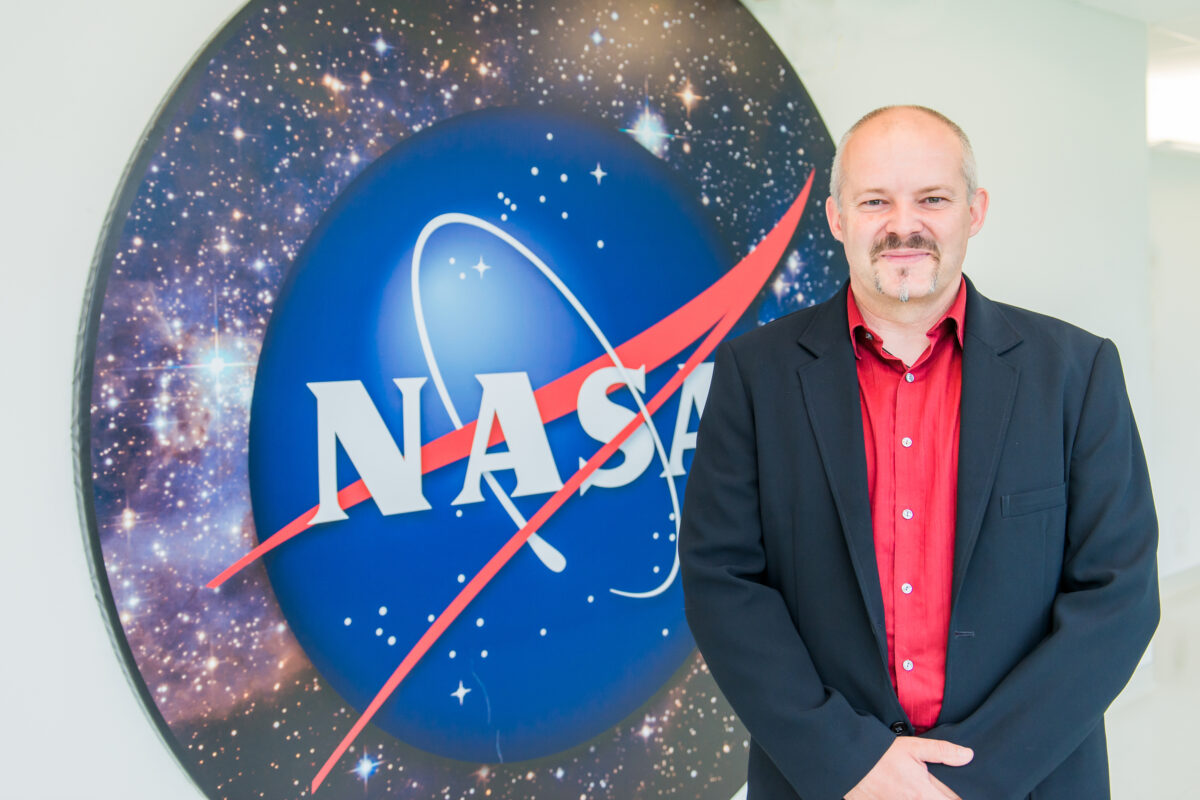 Jan Merka led GPHI from from its inception in 2011 and will hand the reins to Zhibo Zhang this month. (Marlayna Demond ’11/UMBC)
“My first priority is to support GPHI faculty and help enable the outstanding science and engineering they carry out at NASA Goddard Space Flight Center,” Zhang says. “At the same time, I hope GPHI can serve as a stronger bridge between NASA and UMBC by connecting GPHI faculty with UMBC research resources, collaboration and funding opportunities, and with students and faculty who can expand our collective capacity and open doors to bigger, cross-cutting ideas.”
Zhang follows Jan Merka, who has served as the inaugural GPHI director since 2011. As director, Zhang will continue in his faculty role at UMBC, advancing his team’s research on atmospheric dust’s influence on climate and remaining deeply committed to teaching and mentoring. His guidance of undergraduate and graduate students has helped multiple students secure the prestigious NASA Future Investigators in NASA Earth and Space Science and Technology (FINESST) Fellowship and other awards, including the 2025 Elsevier/JQSRT Richard M. Goody Award, fostering the next generation of scientists.
“We are very proud of the fact that UMBC is currently ranked as the #11 institution in the nation in NASA expenditures,” say Karl V. Steiner, vice president for research and creative achievement. “Zhibo Zhang is an outstanding colleague with a broad set of relevant expertise and experiences who will provide important leadership to GPHI and to our partnership with Catholic University under PHaSER. I know that he is the right leader to strengthen our relationship with NASA, building on over three decades of successful cooperative partnership between UMBC and NASA Goddard.”
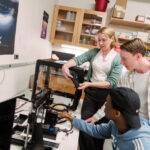
 Zhibo Zhang (second from right) thoughtfully mentors undergraduate and graduate students, including Qianqian Song (right), Ph.D. ’22, who received the FINESST fellowship, and Jianyu Zheng (far left, rear), Ph.D. ’23, who received the 2025 Elsevier/JQSRT Goody Award. (Marlayna Demond ’11/UMBC)
]]>
Zhibo Zhang, professor of physics, has been named director of the Goddard Planetary Heliophysics Institute (GPHI), UMBC’s arm of the Partnership for Heliophysics and Space Environment Research...
https://umbc.edu/stories/zhang-to-lead-goddard-planetary-heliophysics-institute/
https://my3.my.umbc.edu/api/v0/pixel/news/157136/guest@my.umbc.edu/7aba311f3831e3c2c778aff9a9535436/api/pixel
cnms
gphi
nasa
news
phaser
physics
research
science-and-tech
story
UMBC News & Magazine
https://my3.my.umbc.edu/groups/umbc-news-magazine
https://assets1-my.umbc.edu/system/shared/avatars/groups/000/001/943/24435aa6207c452e7bc15cc74b42c7bb/xsmall.png?1748556657
https://assets1-my.umbc.edu/system/shared/avatars/groups/000/001/943/24435aa6207c452e7bc15cc74b42c7bb/original.png?1748556657
https://assets2-my.umbc.edu/system/shared/avatars/groups/000/001/943/24435aa6207c452e7bc15cc74b42c7bb/xxlarge.png?1748556657
https://assets2-my.umbc.edu/system/shared/avatars/groups/000/001/943/24435aa6207c452e7bc15cc74b42c7bb/xlarge.png?1748556657
https://assets3-my.umbc.edu/system/shared/avatars/groups/000/001/943/24435aa6207c452e7bc15cc74b42c7bb/large.png?1748556657
https://assets1-my.umbc.edu/system/shared/avatars/groups/000/001/943/24435aa6207c452e7bc15cc74b42c7bb/medium.png?1748556657
https://assets2-my.umbc.edu/system/shared/avatars/groups/000/001/943/24435aa6207c452e7bc15cc74b42c7bb/small.png?1748556657
https://assets1-my.umbc.edu/system/shared/avatars/groups/000/001/943/24435aa6207c452e7bc15cc74b42c7bb/xsmall.png?1748556657
https://assets2-my.umbc.edu/system/shared/avatars/groups/000/001/943/24435aa6207c452e7bc15cc74b42c7bb/xxsmall.png?1748556657
UMBC News & Magazine
1
0
false
Wed, 04 Mar 2026 09:28:26 -0500
Wed, 04 Mar 2026 09:28:26 -0500
Possible tectonic activity on Venus may yield insight into Earth’s past
Zhibo Zhang (second from right) thoughtfully mentors undergraduate and graduate students, including Qianqian Song (right), Ph.D. ’22, who received the FINESST fellowship, and Jianyu Zheng (far left, rear), Ph.D. ’23, who received the 2025 Elsevier/JQSRT Goody Award. (Marlayna Demond ’11/UMBC)
]]>
Zhibo Zhang, professor of physics, has been named director of the Goddard Planetary Heliophysics Institute (GPHI), UMBC’s arm of the Partnership for Heliophysics and Space Environment Research...
https://umbc.edu/stories/zhang-to-lead-goddard-planetary-heliophysics-institute/
https://my3.my.umbc.edu/api/v0/pixel/news/157136/guest@my.umbc.edu/7aba311f3831e3c2c778aff9a9535436/api/pixel
cnms
gphi
nasa
news
phaser
physics
research
science-and-tech
story
UMBC News & Magazine
https://my3.my.umbc.edu/groups/umbc-news-magazine
https://assets1-my.umbc.edu/system/shared/avatars/groups/000/001/943/24435aa6207c452e7bc15cc74b42c7bb/xsmall.png?1748556657
https://assets1-my.umbc.edu/system/shared/avatars/groups/000/001/943/24435aa6207c452e7bc15cc74b42c7bb/original.png?1748556657
https://assets2-my.umbc.edu/system/shared/avatars/groups/000/001/943/24435aa6207c452e7bc15cc74b42c7bb/xxlarge.png?1748556657
https://assets2-my.umbc.edu/system/shared/avatars/groups/000/001/943/24435aa6207c452e7bc15cc74b42c7bb/xlarge.png?1748556657
https://assets3-my.umbc.edu/system/shared/avatars/groups/000/001/943/24435aa6207c452e7bc15cc74b42c7bb/large.png?1748556657
https://assets1-my.umbc.edu/system/shared/avatars/groups/000/001/943/24435aa6207c452e7bc15cc74b42c7bb/medium.png?1748556657
https://assets2-my.umbc.edu/system/shared/avatars/groups/000/001/943/24435aa6207c452e7bc15cc74b42c7bb/small.png?1748556657
https://assets1-my.umbc.edu/system/shared/avatars/groups/000/001/943/24435aa6207c452e7bc15cc74b42c7bb/xsmall.png?1748556657
https://assets2-my.umbc.edu/system/shared/avatars/groups/000/001/943/24435aa6207c452e7bc15cc74b42c7bb/xxsmall.png?1748556657
UMBC News & Magazine
1
0
false
Wed, 04 Mar 2026 09:28:26 -0500
Wed, 04 Mar 2026 09:28:26 -0500
Possible tectonic activity on Venus may yield insight into Earth’s past
Vast, quasi-circular features on Venus’ surface may reveal that the planet has ongoing tectonics, according to new research. On Earth, the shifting and recycling of tectonic plates continually renews our planet’s surface. Venus doesn’t have tectonic plates, but its surface is still being deformed by molten material from below.
“These features are not found on Earth today; however, they may have existed when our planet was young and before plate tectonics had been established,” says the study’s lead author, Gael Cascioli, a UMBC assistant research scientist with the Center for Space Sciences and Technology. “By combining gravity and topography data, this research has provided a new and important insight into the possible subsurface processes currently shaping the surface of Venus.”
Seeking to better understand the underlying processes at work on Venus, researchers studied a feature called a corona. Ranging from tens to hundreds of miles across, a corona is most often thought to be the location where a blob of molten, buoyant material from the planet’s mantle rises (called a “plume”), pushing against the uppermost part of the planet’s mantle and its crust. Coronae are usually oval and surrounded by fractures in the crust, and hundreds are known to exist on Venus.
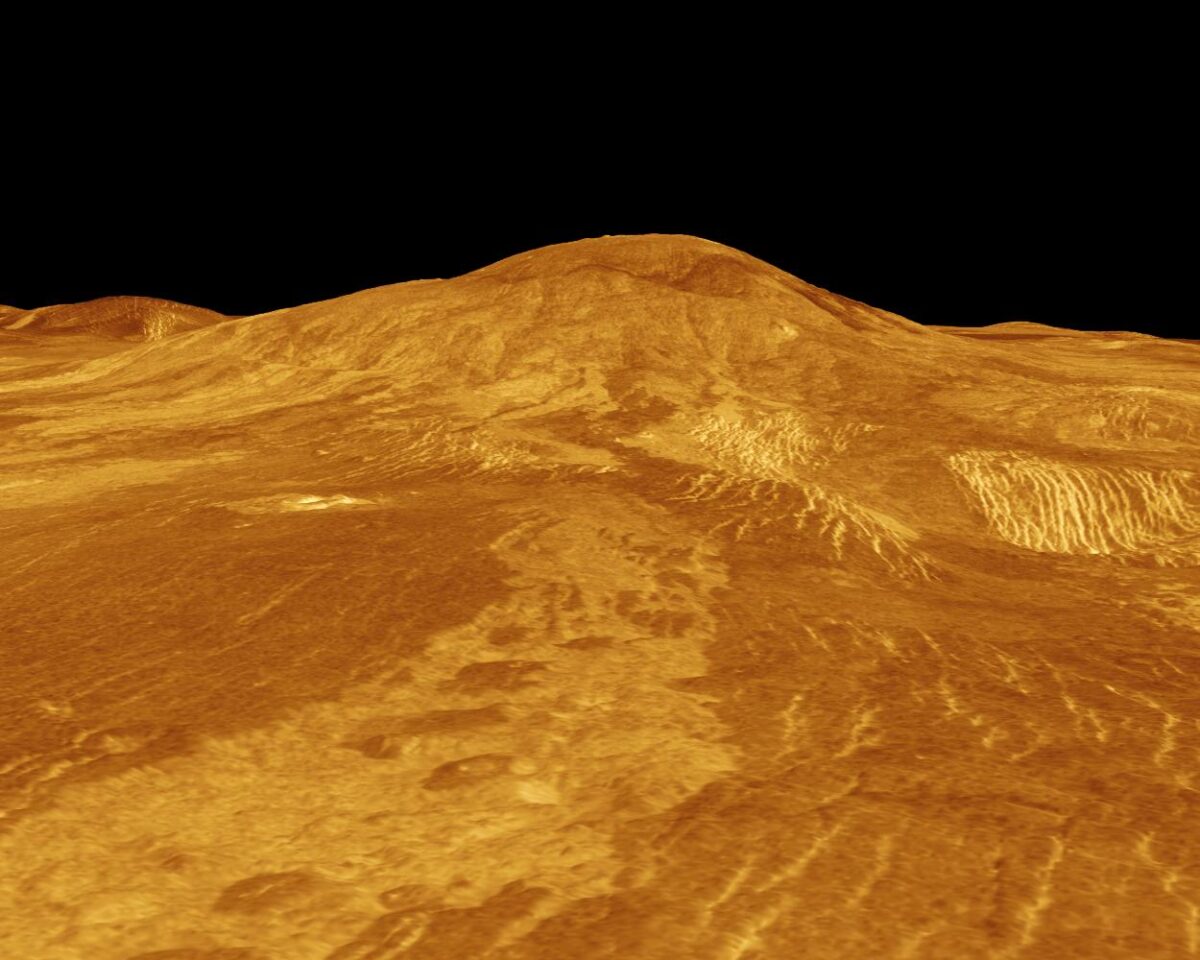 Unlike on Earth, where tectonic plates move sideways and down in a process called subduction, the plumes on Venus might be pushing the surface upward and outward, making the surrounding surface sink down. The scientists also think that in some places, the plumes might be driving volcanoes. Here, Sif Mons, a volcano on Venus, is rendered from data collected by Magellan. The lighter orange trails coming from the peak to the foreground are lava flows. (NASA)
Old data, new discoveries
The new study, published in Science Advances, found telltale signs of corona-shaping activity at or beneath Venus’ surface. These signs may also provide a unique window into Earth’s past. To find them, the authors turned to NASA’s Magellan mission, which orbited Venus in the 1990s and collected what is still the most detailed gravity and topography data of Venus available.
There are various theories about how coronae form. “The most exciting thing for our study is that we can now say there are most likely various and ongoing active processes driving their formation,” coauthor Anna Gülcher, Earth and planetary scientist at the University of Bern in Switzerland, says.
The scientists created detailed 3D models that predicted different ways the coronae might have formed, and then compared them to data from Magellan. Their work revealed that beneath about 70 percent of the coronae they studied, there were hot, low-density plumes rising from deep inside Venus, which might be causing the unique geological activity.
The NASA VERITAS mission, scheduled for launch no earlier than 2031, will be key to filling gaps in understanding of how coronae form. According to coauthor Suzanne Smrekar, planetary scientist at the NASA Jet Propulsion Laboratory (JPL) and principal investigator for VERITAS, the mission will provide much greater resolution than Magellan, supplying “an unprecedented level of detail that could revolutionize our understanding of Venus’ geology and implications for early Earth.”
Read the complete NASA release here.
]]>
Vast, quasi-circular features on Venus’ surface may reveal that the planet has ongoing tectonics, according to new research. On Earth, the shifting and recycling of tectonic plates continually...
https://umbc.edu/stories/tectonic-activity-on-venus/
https://my3.my.umbc.edu/api/v0/pixel/news/150164/guest@my.umbc.edu/9845bc31648d4838b4a64bbfa155d67c/api/pixel
csst
nasa
news
rca
research
science-and-tech
story
UMBC News & Magazine
https://my3.my.umbc.edu/groups/umbc-news-magazine
https://assets1-my.umbc.edu/system/shared/avatars/groups/000/001/943/24435aa6207c452e7bc15cc74b42c7bb/xsmall.png?1748556657
https://assets1-my.umbc.edu/system/shared/avatars/groups/000/001/943/24435aa6207c452e7bc15cc74b42c7bb/original.png?1748556657
https://assets2-my.umbc.edu/system/shared/avatars/groups/000/001/943/24435aa6207c452e7bc15cc74b42c7bb/xxlarge.png?1748556657
https://assets2-my.umbc.edu/system/shared/avatars/groups/000/001/943/24435aa6207c452e7bc15cc74b42c7bb/xlarge.png?1748556657
https://assets3-my.umbc.edu/system/shared/avatars/groups/000/001/943/24435aa6207c452e7bc15cc74b42c7bb/large.png?1748556657
https://assets1-my.umbc.edu/system/shared/avatars/groups/000/001/943/24435aa6207c452e7bc15cc74b42c7bb/medium.png?1748556657
https://assets2-my.umbc.edu/system/shared/avatars/groups/000/001/943/24435aa6207c452e7bc15cc74b42c7bb/small.png?1748556657
https://assets1-my.umbc.edu/system/shared/avatars/groups/000/001/943/24435aa6207c452e7bc15cc74b42c7bb/xsmall.png?1748556657
https://assets2-my.umbc.edu/system/shared/avatars/groups/000/001/943/24435aa6207c452e7bc15cc74b42c7bb/xxsmall.png?1748556657
UMBC News & Magazine
2
0
false
Wed, 14 May 2025 15:34:06 -0400
Wed, 14 May 2025 15:34:06 -0400
UMBC increases rank in latest HERD survey, among top 10 universities in the nation in NASA funding
UMBC’s national rankings in federal research funding are on the rise based on the NSF’s latest Higher Education Research and Development (HERD) survey results, which includes the university being ranked among the nation’s top 10 institutions to receive NASA funding.
The annual HERD survey, conducted by the NSF’s National Center for Science and Engineering Statistics, collects information on research and development (R&D) expenditures by field of research and source of funds and also gathers information on types of research, expenses, and headcounts of R&D personnel. In the latest HERD survey report published in November that compares fiscal year 2023 data, UMBC was ranked #10 in the country in NASA expenditures, a six-spot increase over the previous year’s HERD report. UMBC’s collaboration with NASA in 2024 has resulted in impactful research advances and contributions to active space missions.
“We have been collaborating with our colleagues at the NASA Goddard Space Flight Center for three decades now, and today, about 250 UMBC scientists, research faculty, and students are working closely with their civil servant counterparts at Goddard,” says Karl V. Steiner, vice president for research and creative achievement. “All of us are delighted and proud by this top 10 recognition.”
In addition, UMBC has seen improvements in R&D rankings across several disciplines, of which includes the university’s #20 ranking in federal funding for geosciences, atmospheric sciences, and ocean sciences, jumping 13 slots from its 2022 ranking. The university has also seen improvement in federal support for computer and information sciences (now ranked at #54), as well as federal funding for physical sciences (now ranked at #55).
Overall, the university is now ranked within the top 100 public universities to receive federal research supporting, climbing 11 spots to its new ranking at #96.
“Over the past two years, our HERD expenditures have increased by more than 70 percent, from $84 million reported in 2021 to $144 million in 2023,” Steiner explains. “This growth, and the corresponding improvement in national rankings, are a direct result of more than a decade focused on developing a true research culture across the campus community, as well as working with faculty members and institutional leaders to provide the research infrastructure needed to support our growing aspirations as a Carnegie R1 institution.”
Review more of UMBC’s research and development expenditure funding in Inquiring Minds, UMBC’s research and creative achievement annual report.
]]>
UMBC’s national rankings in federal research funding are on the rise based on the NSF’s latest Higher Education Research and Development (HERD) survey results, which includes the university being...
https://umbc.edu/quick-posts/herd-rankings-2024/
https://my3.my.umbc.edu/api/v0/pixel/news/146296/guest@my.umbc.edu/e808251e6cdc8209faca65cc6b4dd64c/api/pixel
cahss
cnms
coeit
nasa
nasa-goddard-space-flight-center
quick-post
rankings
research
UMBC News & Magazine
https://my3.my.umbc.edu/groups/umbc-news-magazine
https://assets1-my.umbc.edu/system/shared/avatars/groups/000/001/943/24435aa6207c452e7bc15cc74b42c7bb/xsmall.png?1748556657
https://assets1-my.umbc.edu/system/shared/avatars/groups/000/001/943/24435aa6207c452e7bc15cc74b42c7bb/original.png?1748556657
https://assets2-my.umbc.edu/system/shared/avatars/groups/000/001/943/24435aa6207c452e7bc15cc74b42c7bb/xxlarge.png?1748556657
https://assets2-my.umbc.edu/system/shared/avatars/groups/000/001/943/24435aa6207c452e7bc15cc74b42c7bb/xlarge.png?1748556657
https://assets3-my.umbc.edu/system/shared/avatars/groups/000/001/943/24435aa6207c452e7bc15cc74b42c7bb/large.png?1748556657
https://assets1-my.umbc.edu/system/shared/avatars/groups/000/001/943/24435aa6207c452e7bc15cc74b42c7bb/medium.png?1748556657
https://assets2-my.umbc.edu/system/shared/avatars/groups/000/001/943/24435aa6207c452e7bc15cc74b42c7bb/small.png?1748556657
https://assets1-my.umbc.edu/system/shared/avatars/groups/000/001/943/24435aa6207c452e7bc15cc74b42c7bb/xsmall.png?1748556657
https://assets2-my.umbc.edu/system/shared/avatars/groups/000/001/943/24435aa6207c452e7bc15cc74b42c7bb/xxsmall.png?1748556657
UMBC News & Magazine
0
0
false
Mon, 16 Dec 2024 11:20:24 -0500
Mon, 16 Dec 2024 11:20:24 -0500
5 ways UMBC partnered with NASA in 2024
UMBC is approaching 30 years of collaboration with the National Aeronautics and Space Administration (NASA), a partnership that largely culminates under the university’s three major cooperative agreements with the agency. According to the NSF’s latest Higher Education Research and Development (HERD) survey, UMBC is among the nation’s top 10 universities receiving federal funding from NASA. In 2024, UMBC scientists, researchers, interns, and engineers have reached new levels of achievement in connection to this partnership—some even going as far as to the surface of the Moon…in a few years.
Take a look back at five ways UMBC collaborated with NASA in 2024:
UMBC goes to the Moon
Planetary scientist Mehdi Benna of UMBC’s Center for Space Sciences Technology is leading the team designing one of the lunar instruments chosen for implementation and deployment in NASA’s forthcoming Artemis III mission, humanity’s first return to the lunar surface in more than 50 years. The Lunar Environment Monitoring Station (LEMS) was selected as one of the first three candidate payloads to be a part of Artemis III, NASA’s mission that will send astronauts to explore the region near the lunar South Pole. Artemis III, currently planned to launch in 2026, will be the first time humans will return to the Moon’s surface since the historic Apollo program in 1969 – 1972.
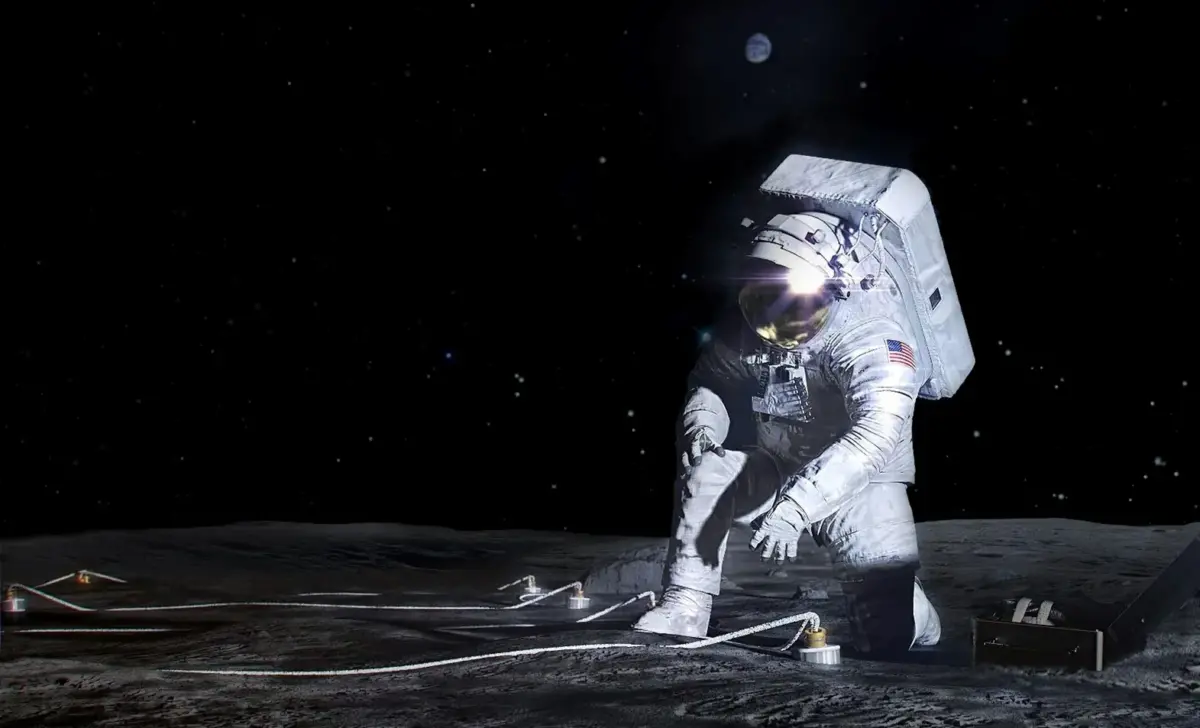 Artist’s concept of an Artemis astronaut deploying an instrument on the lunar surface.
(Photo courtesy of NASA)
HARP2 launches into space
The UMBC-designed Hyper-Angular Rainbow Polarimeter (HARP2) wide-angle imaging polarimeter instrument is part of NASA’s Plankton, Aerosol, Cloud, ocean Ecosystem (PACE) spacecraft mission, which launched into space in February. The PACE satellite provides insight into ocean health, air quality, and the effects of a changing climate. PACE’s mission data, which includes data captured by the HARP2 instrument, is now available for public access. The HARP2 team, which includes a host of students and alumni, is led by Vanderlei Martins, professor of physics, who is also the director of the NASA-affiliated Earth and Space Institute, based out of UMBC’s Physics Building.
AXIS X-ray telescope selected for final round
Nearly a year ago, a group of engineers and scientists including UMBC physicists became one of 10 teams to successfully submit a proposal to NASA to develop the Advanced X-ray Imaging Satellite (AXIS). In October 2024, the AXIS team was selected as one of the final two instrument designs selected for further development. The team will receive $5 million to flesh out their plans as part of what NASA calls a “Phase A study.” Adi Foord, assistant professor of physics, and Eileen Meyer, associate professor of physics, serve on the AXIS leadership team, and during the proposal development phase, Foord co-led the sub-team focused on supermassive black hole evolution.
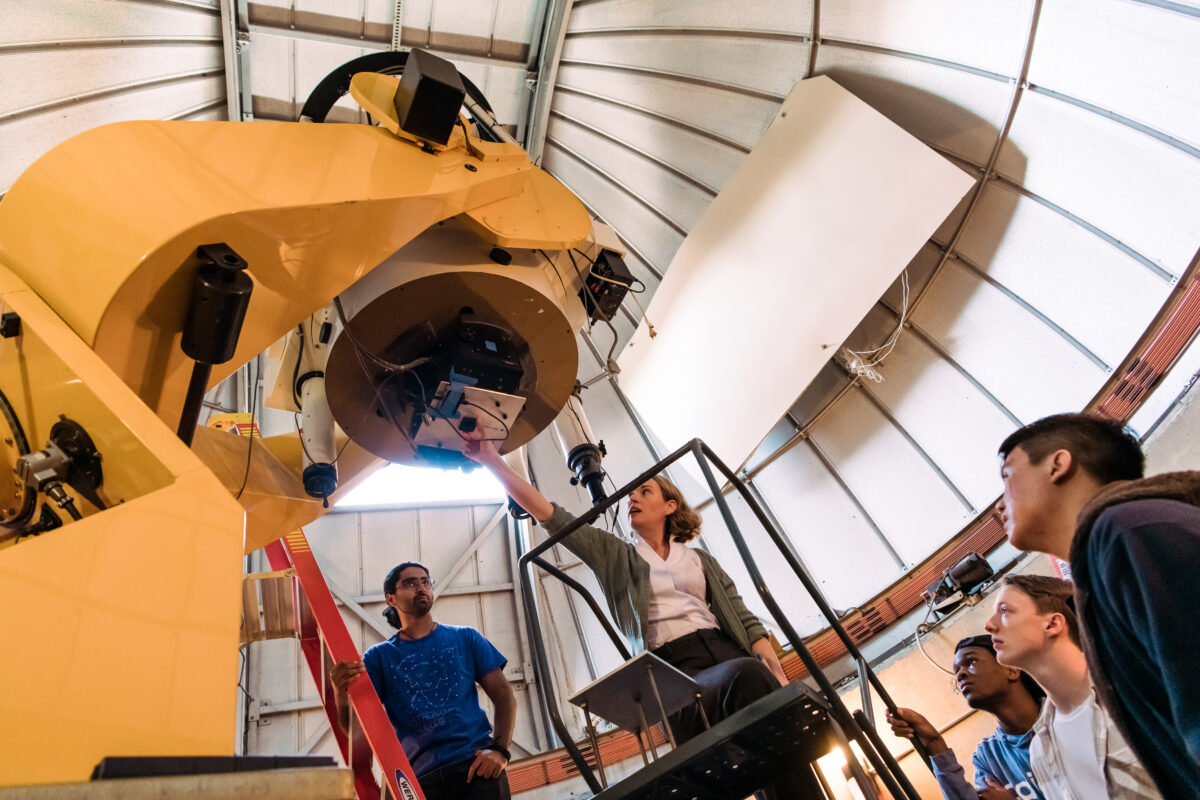 Eileen Meyer (center, reaching up) works on UMBC’s telescope with students. (Marlayna Demond ’11/UMBC)
NASA comes to campus
The university collaborated with the Goddard Space Flight Center to host the “NASA-UMBC Interaction Days,” an interactive, three-day series that took a closer look into the agency’s current research activity across a range of fields, with insight into how UMBC faculty, staff, and students can continue to work with Goddard scientists and engineers. The event series attracted more than 250 registrants.
UMBC-NASA earth science center awarded $47 million extension
The UMBC-led Goddard Earth Science Technology and Research (GESTAR) II center was awarded a two-year, $47 million extension this year to continue its cooperative agreement with the NASA Goddard Space Flight Center (GSFC). Since launching in 2021, GESTAR II has employed more than 150 scientists who are distributed across nearly all of GSFC’s earth science division laboratories. Over the years, GESTAR II researchers have been a part of teams that have developed an instrument that monitors water quality in the Chesapeake Bay, studied the environmental impacts of megafire smoke plumes, generated the first global map of cargo ship pollution, and much more.
More on UMBC’s partnership with NASA
]]>
UMBC is approaching 30 years of collaboration with the National Aeronautics and Space Administration (NASA), a partnership that largely culminates under the university’s three major cooperative...
https://umbc.edu/stories/umbc-nasa-partnership-2024/
https://my3.my.umbc.edu/api/v0/pixel/news/146266/guest@my.umbc.edu/c9b14e4a81a0cad626bb8a2df7cb33d8/api/pixel
csst
esi
gestar2
gphi
nasa
nasa-goddard-space-flight-center
news
research
science-and-tech
story
UMBC News & Magazine
https://my3.my.umbc.edu/groups/umbc-news-magazine
https://assets1-my.umbc.edu/system/shared/avatars/groups/000/001/943/24435aa6207c452e7bc15cc74b42c7bb/xsmall.png?1748556657
https://assets1-my.umbc.edu/system/shared/avatars/groups/000/001/943/24435aa6207c452e7bc15cc74b42c7bb/original.png?1748556657
https://assets2-my.umbc.edu/system/shared/avatars/groups/000/001/943/24435aa6207c452e7bc15cc74b42c7bb/xxlarge.png?1748556657
https://assets2-my.umbc.edu/system/shared/avatars/groups/000/001/943/24435aa6207c452e7bc15cc74b42c7bb/xlarge.png?1748556657
https://assets3-my.umbc.edu/system/shared/avatars/groups/000/001/943/24435aa6207c452e7bc15cc74b42c7bb/large.png?1748556657
https://assets1-my.umbc.edu/system/shared/avatars/groups/000/001/943/24435aa6207c452e7bc15cc74b42c7bb/medium.png?1748556657
https://assets2-my.umbc.edu/system/shared/avatars/groups/000/001/943/24435aa6207c452e7bc15cc74b42c7bb/small.png?1748556657
https://assets1-my.umbc.edu/system/shared/avatars/groups/000/001/943/24435aa6207c452e7bc15cc74b42c7bb/xsmall.png?1748556657
https://assets2-my.umbc.edu/system/shared/avatars/groups/000/001/943/24435aa6207c452e7bc15cc74b42c7bb/xxsmall.png?1748556657
UMBC News & Magazine
0
0
false
Fri, 13 Dec 2024 12:58:18 -0500
Fri, 13 Dec 2024 12:58:18 -0500
The parallel evolution of Milt Halem and the third pillar of science

For almost 70 years, Milt Halem, now a research professor at UMBC after a career at NASA, has deployed the latest computing technology—from vacuum tubes in the ’50s to artificial intelligence today—to tackle some of science’s toughest problems.
Colorful screen prints cover the walls of Milt Halem’s Rockville, Maryland, apartment. One shows a high-altitude view of the Nile River, cutting through desert sands before emptying into a turquoise Mediterranean. In another, the fragile blue marble of the Earth rises above a desolate lunar surface.
One large picture, taking centerplace on the dining room wall, is more enigmatic—filled with alternating red, yellow, and blue patches. “This is what’s known as the quasi-biennial oscillation,” Halem explains.
Tens of thousands of feet up, in Earth’s stratosphere, the winds around the equator regularly shift direction, blowing east for many months, and then west, and then east again. A satellite measured the shifts, and Halem, a former NASA scientist and current UMBC professor, turned six years of that data into art.
Halem’s framed prints, many of which he created himself while taking evening and weekend classes at the Corcoran School of the Arts and Design in Washington, D.C., are a window into his nearly 70-year-long scientific career. For roughly 40 years of that time, he worked for NASA, the famed federal space agency. Halem harnessed NASA’s space-based instrument “eyes” and ever-evolving computer “brains” to advance humanity’s understanding of Earth and our place in the cosmos and, in 1996, was recognized with NASA’s highest award, the Distinguished Service Medal.
In 2003, after retiring from NASA, Halem joined UMBC as a research professor. In his more than two decades at the university, he has nurtured connections with government and industry, brought in research money and equipment, regularly taught a popular graduate course, and mentored more than a dozen Ph.D. students, helping them pursue their passions and propel their careers.
“I think of myself as a computational scientist: I use computers to both discover and explore new territory,” Halem says. “What I love is the computer’s ability to represent, and to explain, the world around us.”
Charting computers’ evolution
Halem began his working life at the dawn of the computing age, and his career trajectory mirrors the steady rise of those digital devices. After earning a bachelor’s degree in mathematics from the City College of New York in 1951, Halem was drafted into the Korean War effort and served on U.S. Army bases for two years, first in New Jersey and then in Arizona. After a stint clearing rocks off the golf course so that the officers could play, Halem’s skills were better put to use on some of the Army’s first attempts to use what at the time were relatively new-fangled devices called computers to improve surveillance of battlefields.
In 1955, Halem received a fellowship to work with an IBM 704 computer installed at New York University. The computer took up significant floor space with its multiple cabinet-sized components, filled with vacuum tubes for logic operations and magnetic tape for memory. It was state-of-the-art in its day, able to execute about 40,000 instructions per second.
“You could say 1955 was my start in high-performance computing,” Halem says. “I’ve been acquiring and managing and programming and doing research on computers ever since.”
In the late 1950s, NASA established the Goddard Space Flight Center (GSFC) and, shortly after, opened a New York campus—the Goddard Institute for Space Studies—focused on theoretical research.

Milt Halem delivers remarks during a conference at NASA Goddard Space Flight Center, 1986. Photo by NASA.
Because of Halem’s experience with computers, he was hired as contract support. In the subsequent years, he worked with some of the most advanced computers of the time, using them to model the Earth’s atmosphere and predict the scientific value of launching new Earth-observing instruments. In 1968, he also earned his Ph.D. in applied mathematics from NYU.

In the late ’70s, Halem moved to Goddard’s main facility, GSFC, in Maryland to continue his computing work. In 1983, he became chief of the Space Data and Computing Division and shifted from using supercomputers to being a force in their development. The division had recently developed the Goodyear Massively Parallel Processor (MPP), a trailblazing computer containing 16,384 processors working simultaneously. This degree of parallelism, which lies at the heart of today’s supercomputers, marked a radical departure from traditional computing.
“The MPP was a relatively simple concept, but it took us more than a decade to develop it,” says Jim Fischer, who managed the MPP’s fabrication contract and applications programs. “Milt found people to help and money to support the machine. And then he offered it to the U.S. science community to try it out, and they recognized its architecture as a solution. Milt pumped us to world class by force of will.”
In the ensuing years, Halem and Fischer pursued making the power of MPPs more accessible and less expensive. In 1994, their staff demonstrated the “Beowulf” computing cluster, composed entirely of mass market personal computers networked with Ethernet and running the Linux open source operating system.
Now 30 years later, the Beowulf approach sits at the core of most of the world’s supercomputers and much of the cloud infrastructure, putting vast amounts of affordable computing resources at the fingertips of scientists, engineers, and even social media users.
After Halem arrived at UMBC in his 70s, he continued to engage with the latest computing technology. He was instrumental in securing the donation of high-performance IBM computing equipment from NASA to the university, and he helped run a new computing research center. With his students, he has explored the frontiers of quantum computing and AI.
“I’ve followed the evolution of high-performance computing my entire career,” Halem says.

Computing for science
Computers can do many things—from recommending videos you might like to rendering life-like graphics—but Halem is most interested in what they can do for science.
“Science is based on the notion of observations and then explaining the observations by some theoretical process,” says Halem. “That was the way science evolved until the mid-20th century. Then computers came along and became the third pillar of science.”
Halem’s passion fit with NASA’s mission. Though the agency was born out of the Cold War and the space race with the Soviets, it has concentrated its efforts on the peaceful use of space to advance science.
NASA launches satellites that observe Earth from space with a suite of scientific instruments (including some designed at UMBC), and a large part of Halem’s research has been using computers to understand how that data can improve our understanding of the Earth’s air, water, and land and the physical processes that link them. Halem has also advanced weather forecasting through, among other techniques, finding new ways to incorporate observations into the weather models.
As an administrator at NASA, Halem always put the science first, according to his colleagues. “I believe that Milt left a legacy of making decisions that are in the best interest of science,” says Dan Duffy, the chief of the Computational and Information Sciences and Technology Office at GSFC, who sits in Halem’s old NASA office and has continued to work with him on special projects since Halem joined UMBC.
“His motivation was always driven by the scientific community’s needs,” Fischer adds. “It was very high-minded.”
Shaping students’ lives
At UMBC, Halem has continued his devotion to computing for science’s sake. In doing so, he has supported the research community and shaped his students’ lives.
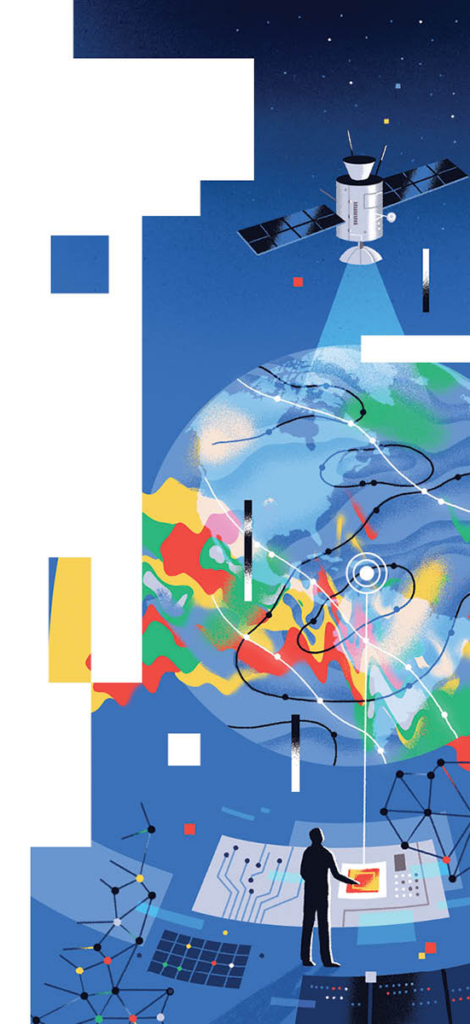
Jennifer Sleeman, Ph.D. ’17, computer science, was co-mentored by Halem on her Ph.D. thesis, which involved mapping topics from past climate reports from the Intergovernmental Panel on Climate Change and trying to predict the contents of future reports.
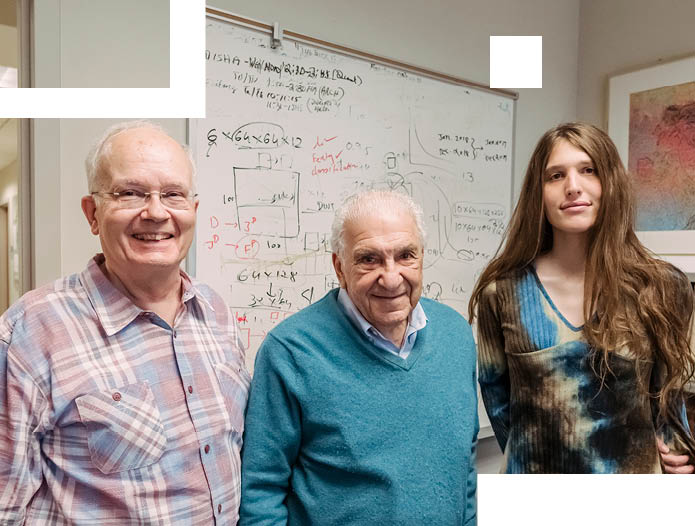
Jim Fischer, Milt Halem, and Sophia Hamer (left to right) in Halem’s UMBC office. One of Halem’s screen prints hangs in the upper right.
“Milt and I would have discussions about my thesis, and I always like to describe it as: Milt decided to adopt me. I was close to the end of my Ph.D., and I changed my focus based on working with him,” she said. “It really changed the trajectory of my career.” After graduating, she became a research assistant professor at UMBC. She currently studies weather and climate-related topics as a senior AI research scientist at Johns Hopkins Applied Physics Laboratory while she continues to work part-time with Halem and his students.
Sophia Hamer ’22, mathematics and computer science, who is currently working with Halem as a master’s student, also credits Halem with helping her find her career footing. She first met him to discuss a research project when she was an undergraduate and just emerging from a time when she struggled with her grades and with choosing a major.
“Dr. Halem took a chance on me,” she says. “I honestly think that was the turning point for me. Before I was thinking, ‘I’m just gonna squeak out of here with a degree and hopefully my GPA isn’t too bad to get a job.’ But now, my entire perspective has shifted: I’m about to graduate with a master’s, and I’m doing impactful research in a field I really like. I never thought that would be possible.”
“Milt is tough—he pushes you—but he also works closely with you,” Sleeman adds. “I really grew from that relationship.”
AI for weather and climate forecasting
Both Sleeman and Hamer are working with Halem on a project to be the first to use AI to make regional weather predictions, one of a couple AI projects Halem is currently pursuing.
In his embrace of AI, Halem is yet again advancing alongside the technology that has defined his career. Gone are the days of mere 40,000 instructions per second. Now advanced computer chips power computationally hungry “neural networks” originally inspired by the workings of the human brain. Neural networks are behind celebrity chatbots such as ChatGPT—and forecasters are increasingly turning to them to predict the weather too.
While traditional weather models simulate the physics of the Earth and its atmosphere to make predictions about the future, AI forecasting models simply examine vast datasets of past weather and learn how to spot patterns.
So far, the main advantage of AI forecasting is speed. What can take days for a physics-based model can be done in only minutes or seconds with AI. AI weather models offer great promise for distributed, real-time weather forecasting, for example as natural disasters unfold. Halem and his students are looking in particular to predict wildfires.
While much AI weather forecasting research is undertaken by leading tech companies such as Google and Microsoft, Halem thinks his students are more than holding their own.
“I’ve got a new generation of computer scientists making breakthroughs,” says Halem. “Two students who are writing up their master’s theses are doing leading AI computations to rival what some big tech companies are doing.”
The work of weather and climate modeling is growing in importance as global warming unfolds and the Earth’s natural patterns shift. “Applying what I know to a real-world problem has been an amazing experience,” Hamer says.
The projects are also yet one more demonstration of Halem’s constant intellectual evolution.
“Milt has an amazing ability to learn new things,” says Anupam Joshi, the acting dean of the College of Engineering and Information Technology. “He was trained as a mathematician who then specialized in high-performance computing and in the last few years has become an expert in using AI systems to model weather and climate phenomena. It speaks to his intellectual capabilities but also his perseverance and his grit.”
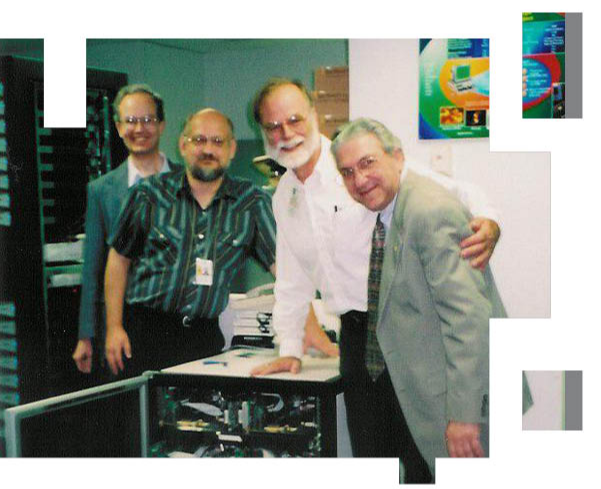
Halem (far right) poses with (from left to right) NASA’s Jim Fischer and John Dorband, and Microsoft Fellow Jim Gray next to the first Beowulf computing cluster. Photo by NASA.
Into the future
Now in his tenth decade of life, Halem shows few signs of slowing down. When not spending time with his large family, he’s still tackling some of science’s thorniest problems, such as how to predict weather patterns months to years in advance.
“He’s like the energizer bunny,” says Fischer, his former NASA colleague.
Duffy agrees. “He has an amazing amount of energy; he never seems to stop. He has a willingness to listen, learn, and ask questions and is an amazing role model for his students.”
Halem says it’s the computation challenges that drive him. “I have to keep moving because the computational instrument continues to evolve,” he says. He continues to be on the lookout for new ideas—the latest he’s come across being an AI research scientist. “The AI agent can use large language models to read the literature; it can write computer code and conduct experiments by itself. It can write the paper on what it discovered. So that’s probably the ultimate research goal that I would like to see if I can make an impact on,” Halem explains.
“Milt is probably one of the most dedicated people I know to the research,” Sleeman says. “He’s so tenacious, and it’s just so impressive. It’s a privilege to continue to work with him.”
“Milt is incredible,” adds Joshi. “If we could replicate him, we would.” And maybe, in some sense, Halem’s AI scientist would do just that.
 ]]>
For almost 70 years, Milt Halem, now a research professor at UMBC after a career at NASA, has deployed the latest computing technology—from vacuum tubes in the ’50s to artificial intelligence...
https://umbc.edu/stories/milt-halem-and-the-third-pillar-of-science/
https://my3.my.umbc.edu/api/v0/pixel/news/146115/guest@my.umbc.edu/e9026a516fe6b98808ffc05f4258bd43/api/pixel
ai
campus-life
cfr
coeit
discovery
fall-2024
feature
gsfc
magazine
mathematics
nasa
story
UMBC News & Magazine
https://my3.my.umbc.edu/groups/umbc-news-magazine
https://assets1-my.umbc.edu/system/shared/avatars/groups/000/001/943/24435aa6207c452e7bc15cc74b42c7bb/xsmall.png?1748556657
https://assets1-my.umbc.edu/system/shared/avatars/groups/000/001/943/24435aa6207c452e7bc15cc74b42c7bb/original.png?1748556657
https://assets2-my.umbc.edu/system/shared/avatars/groups/000/001/943/24435aa6207c452e7bc15cc74b42c7bb/xxlarge.png?1748556657
https://assets2-my.umbc.edu/system/shared/avatars/groups/000/001/943/24435aa6207c452e7bc15cc74b42c7bb/xlarge.png?1748556657
https://assets3-my.umbc.edu/system/shared/avatars/groups/000/001/943/24435aa6207c452e7bc15cc74b42c7bb/large.png?1748556657
https://assets1-my.umbc.edu/system/shared/avatars/groups/000/001/943/24435aa6207c452e7bc15cc74b42c7bb/medium.png?1748556657
https://assets2-my.umbc.edu/system/shared/avatars/groups/000/001/943/24435aa6207c452e7bc15cc74b42c7bb/small.png?1748556657
https://assets1-my.umbc.edu/system/shared/avatars/groups/000/001/943/24435aa6207c452e7bc15cc74b42c7bb/xsmall.png?1748556657
https://assets2-my.umbc.edu/system/shared/avatars/groups/000/001/943/24435aa6207c452e7bc15cc74b42c7bb/xxsmall.png?1748556657
UMBC News & Magazine
1
0
false
Tue, 03 Dec 2024 14:13:49 -0500
Tue, 03 Dec 2024 14:13:49 -0500
NASA awards AXIS X-ray telescope co-developed by UMBC faculty $5M for further study
]]>
For almost 70 years, Milt Halem, now a research professor at UMBC after a career at NASA, has deployed the latest computing technology—from vacuum tubes in the ’50s to artificial intelligence...
https://umbc.edu/stories/milt-halem-and-the-third-pillar-of-science/
https://my3.my.umbc.edu/api/v0/pixel/news/146115/guest@my.umbc.edu/e9026a516fe6b98808ffc05f4258bd43/api/pixel
ai
campus-life
cfr
coeit
discovery
fall-2024
feature
gsfc
magazine
mathematics
nasa
story
UMBC News & Magazine
https://my3.my.umbc.edu/groups/umbc-news-magazine
https://assets1-my.umbc.edu/system/shared/avatars/groups/000/001/943/24435aa6207c452e7bc15cc74b42c7bb/xsmall.png?1748556657
https://assets1-my.umbc.edu/system/shared/avatars/groups/000/001/943/24435aa6207c452e7bc15cc74b42c7bb/original.png?1748556657
https://assets2-my.umbc.edu/system/shared/avatars/groups/000/001/943/24435aa6207c452e7bc15cc74b42c7bb/xxlarge.png?1748556657
https://assets2-my.umbc.edu/system/shared/avatars/groups/000/001/943/24435aa6207c452e7bc15cc74b42c7bb/xlarge.png?1748556657
https://assets3-my.umbc.edu/system/shared/avatars/groups/000/001/943/24435aa6207c452e7bc15cc74b42c7bb/large.png?1748556657
https://assets1-my.umbc.edu/system/shared/avatars/groups/000/001/943/24435aa6207c452e7bc15cc74b42c7bb/medium.png?1748556657
https://assets2-my.umbc.edu/system/shared/avatars/groups/000/001/943/24435aa6207c452e7bc15cc74b42c7bb/small.png?1748556657
https://assets1-my.umbc.edu/system/shared/avatars/groups/000/001/943/24435aa6207c452e7bc15cc74b42c7bb/xsmall.png?1748556657
https://assets2-my.umbc.edu/system/shared/avatars/groups/000/001/943/24435aa6207c452e7bc15cc74b42c7bb/xxsmall.png?1748556657
UMBC News & Magazine
1
0
false
Tue, 03 Dec 2024 14:13:49 -0500
Tue, 03 Dec 2024 14:13:49 -0500
NASA awards AXIS X-ray telescope co-developed by UMBC faculty $5M for further study
Nearly a year ago, a group of engineers and scientists including UMBC physicists became one of 10 teams to successfully submit a proposal to NASA to develop the Advanced X-ray Imaging Satellite (AXIS). In October, the AXIS team learned that they were one of the final two instrument designs selected for further development. Over the next year, each of the two teams will receive $5 million to flesh out their plans as part of what NASA calls a “Phase A study.” Then NASA will review the proposals and select one of these two instruments for construction and testing, with plans to launch in the early 2030s.
Adi Foord, assistant professor of physics, and Eileen Meyer, associate professor of physics, serve on the AXIS leadership team, and during the proposal development phase, Foord co-led the sub-team focused on supermassive black hole evolution. The AXIS team is led overall by Chris Reynolds at the University of Maryland, College Park and deputy lead Erin Kara at MIT.
 Adi Foord is on the AXIS leadership team. (courtesy of Foord)
X-rays come from extremely hot processes such as exploding stars or the accretion of black holes, so tracing them back to their source can paint a picture of galactic formation. As scientists search for life beyond Earth, X-rays could even offer clues about potentially habitable planets.
“We’re extremely excited that AXIS has been chosen for Phase A study! AXIS represents a huge leap forward in high-resolution and high-sensitivity imaging that will allow us to study the early universe and trace the growth of the earliest supermassive black holes,” Foord says. “It’s a unique opportunity to answer some of the most fundamental questions in astrophysics. With AXIS, we’ll have the sensitivity and resolution to detect faint X-ray signals from galaxies in the early universe, offering unprecedented insight into how supermassive black holes formed and evolved over cosmic time.”
A new kind of explorer
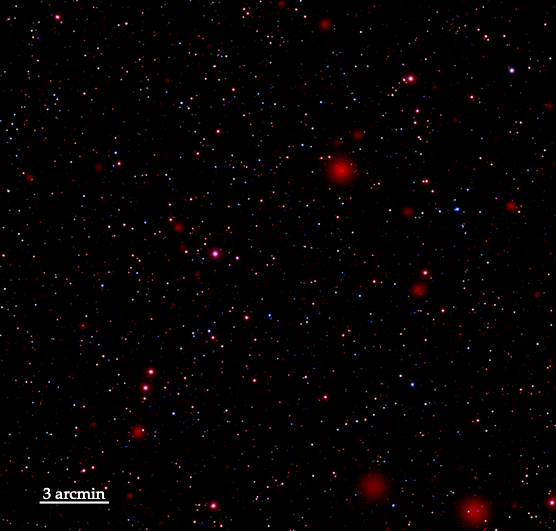 This simulated image shows how AXIS would see the sky. It shows a five million-second stare into space, and some of the earliest-detected supermassive black holes are visible. (Stefano Marchesi)
AXIS and the other satellite design selected for further study, PRIMA—also led by scientists in College Park—are competing to be the first in the new Probe Explorer class of NASA missions, which fit neatly between its flagship missions and smaller missions.
“Both of the selected concepts could enable ground-breaking science responsive to the top astrophysics priorities of the decade, develop key technologies for future flagship missions, and offer opportunities for the entire community to use the new observatory, for the benefit of all,” said Nicola Fox, associate administrator, Science Mission Directorate at NASA Headquarters.
“In observational astronomy we are now in the era of big and sensitive surveys of large portions of the sky,” Meyer adds. “AXIS is not only 10 times more sensitive than its predecessor, the Chandra X-ray Observatory, it also has the ability to make high-resolution images over a much larger sky area, or field of view. This is transformative for deep surveys, and AXIS will synergize with a lot of other missions and observatories operating in the 2030s.”
]]>
Nearly a year ago, a group of engineers and scientists including UMBC physicists became one of 10 teams to successfully submit a proposal to NASA to develop the Advanced X-ray Imaging Satellite...
https://umbc.edu/stories/axis-x-ray-telescope-selected-for-further-study/
https://my3.my.umbc.edu/api/v0/pixel/news/145570/guest@my.umbc.edu/9f2a2e66a5cdabc0db9f62a1b40a6726/api/pixel
cnms
nasa
news
physics
research
science-and-tech
story
UMBC News & Magazine
https://my3.my.umbc.edu/groups/umbc-news-magazine
https://assets1-my.umbc.edu/system/shared/avatars/groups/000/001/943/24435aa6207c452e7bc15cc74b42c7bb/xsmall.png?1748556657
https://assets1-my.umbc.edu/system/shared/avatars/groups/000/001/943/24435aa6207c452e7bc15cc74b42c7bb/original.png?1748556657
https://assets2-my.umbc.edu/system/shared/avatars/groups/000/001/943/24435aa6207c452e7bc15cc74b42c7bb/xxlarge.png?1748556657
https://assets2-my.umbc.edu/system/shared/avatars/groups/000/001/943/24435aa6207c452e7bc15cc74b42c7bb/xlarge.png?1748556657
https://assets3-my.umbc.edu/system/shared/avatars/groups/000/001/943/24435aa6207c452e7bc15cc74b42c7bb/large.png?1748556657
https://assets1-my.umbc.edu/system/shared/avatars/groups/000/001/943/24435aa6207c452e7bc15cc74b42c7bb/medium.png?1748556657
https://assets2-my.umbc.edu/system/shared/avatars/groups/000/001/943/24435aa6207c452e7bc15cc74b42c7bb/small.png?1748556657
https://assets1-my.umbc.edu/system/shared/avatars/groups/000/001/943/24435aa6207c452e7bc15cc74b42c7bb/xsmall.png?1748556657
https://assets2-my.umbc.edu/system/shared/avatars/groups/000/001/943/24435aa6207c452e7bc15cc74b42c7bb/xxsmall.png?1748556657
UMBC News & Magazine
0
0
false
Tue, 12 Nov 2024 13:45:26 -0500
Tue, 12 Nov 2024 13:45:26 -0500
PANTHYR instrument installed in Chesapeake Bay to monitor water quality, validate satellite data

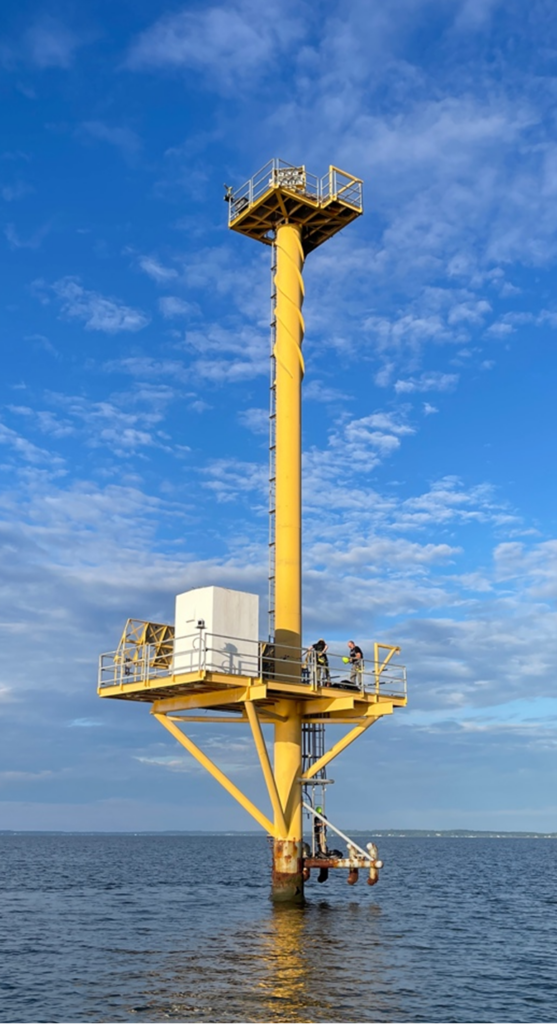 The PANTHYR instrument system is on the upper platform of the Chesapeake Bay Tower on the corner out of view. (Kevin Turpie, GSFC/UMBC)
Climbing 30-meter ladders and avoiding osprey nests might not sound like typical activities for scientists who usually work with equations and models—but it’s all in a day’s work for Kevin Turpie’s team, which includes an international group of scientists and engineers from UMBC, NASA, the Royal Belgian Institute of Natural Sciences (RBINS) and the Vlaams Instituut voor de Zee (VLIZ), also known as the Flanders Marine Institute, also in Belgium. Over the last 15 months, they have collaborated with Maryland Department of the Environment (MDE) staff, with the blessing of the U.S. Coast Guard, to install, monitor, and repair a new instrument on top of a Coast Guard navigation tower in Chesapeake Bay near Tolchester, Maryland.
The instrument, called the Pan-and-Tilt Hyperspectral Radiometer (PANTHYR) and developed by VLIZ, is one of multiple PANTHYRs deployed worldwide. Each is part of the WATERHYPERNET—a growing network of automated instruments that provide measurements to validate observations from space. The WATERHYPERNET concept was developed by RBINS and VLIZ and supported by the European Space Agency (ESA). Another instrument called the HYPSTAR is installed at some other WATERHYPERNET sites, and the Chesapeake Bay station may add one in the future.
The Chesapeake Bay PANTHYR station is the first WATERHYPERNET station installed in North America; others operate off the coasts of France, Italy, Belgium, and Argentina. The new station “will provide a wealth of information regarding water quality and the environmental and ecological conditions in the Upper Chesapeake Bay,” says Turpie, a research associate professor with the Goddard Earth Science Technology and Research Center (GESTAR II), a UMBC partnership with NASA.
A “rigorous test”
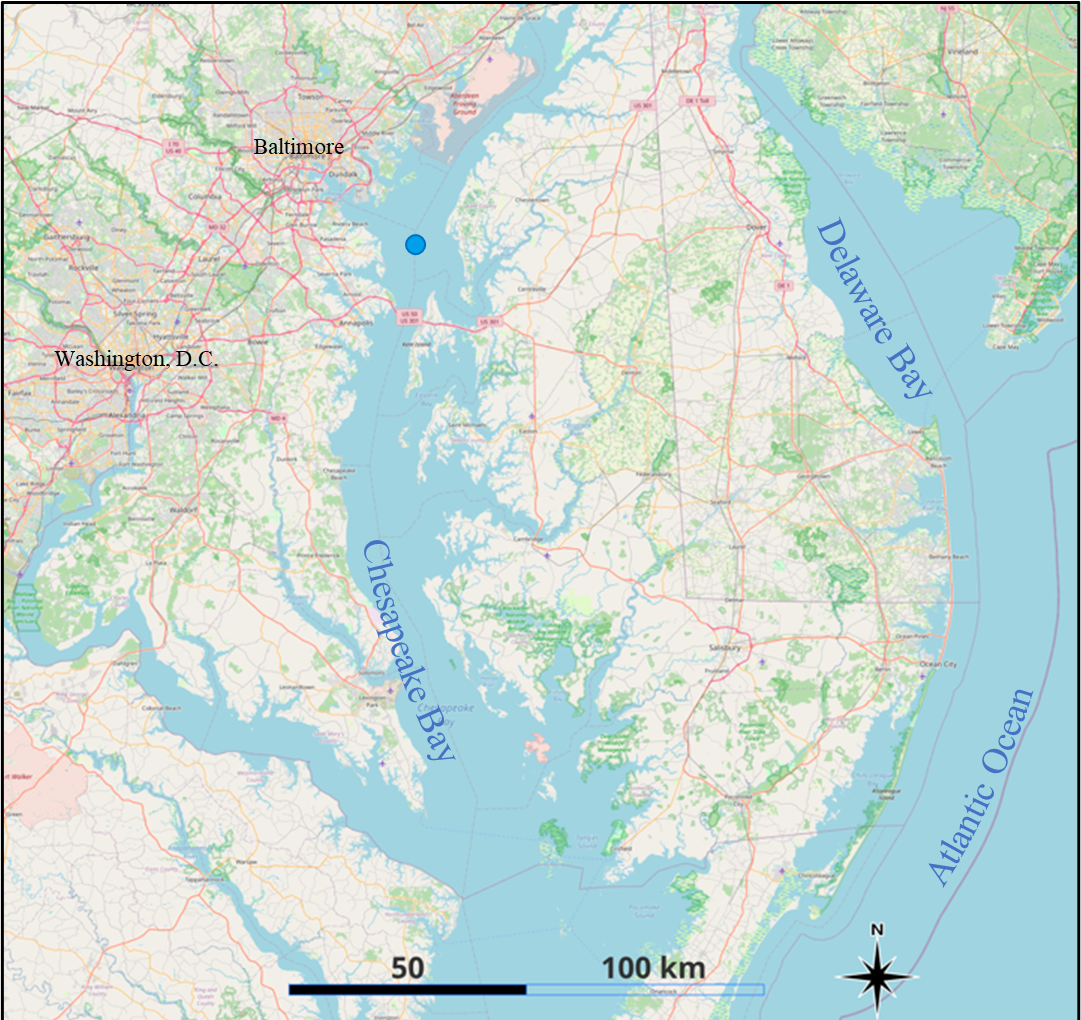 The blue dot marks the location of the new Chesapeake Bay WATERHYPERNET station. (Courtesy of Kevin Turpie)
The Chesapeake PANTHYR will also help validate data coming from the Ocean Color Instrument (OCI) aboard the recently-launched NASA PACE satellite, which also carries HARP2, an instrument designed and built by UMBC researchers. The station will also provide data to validate many other satellite missions, including NASA’s future Surface Biology and Geology (SBG) mission, part of the upcoming Integrated Earth System Observatory.
“Observations from space are critical to understanding how our planet functions as a system and how that system is changing. But such measurements are done in the harsh environment of space, looking through the entire atmosphere, and always from several hundred kilometers away,” Turpie explains. “So, we need to compare those data against the same kind of measurements taken at the surface. PANTHYR offers a rigorous test for PACE and its ability to glean vital information about our world’s most critical coastal resources.”
PANTHYR is the newest instrument in the WATERHYPERNET, a global network of instruments managed by the Royal Belgian Institute of Natural Sciences and supported by the European Space Agency.
A challenging work location
The Chesapeake Bay PANTHYR station was installed in July 2023, but encountered challenges due to winter weather, complex logistics, and the collapse of Baltimore’s Key Bridge and subsequent environmental threat assessments. However, after a repair mission in September 2024, PANTHYR is up and running again, and data are streaming in.
Arranging each trip to service PANTHYR is complicated. MDE staff pilot the boats that take the researchers to and from the site, and only tower climbers with special training can access the instrument. Calm weather is a necessity. Plus, in the spring, there’s always a risk that ospreys or eagles will choose the tower for nesting. That makes the instrument inaccessible if young birds are present.
But the team is committed, because the data PANTHYR produces are valuable. Every 20 minutes, PANTHYR measures the intensity of light encountering the surface of the water, the brightness of the sky, and how much light is reflected back from the water’s surface. PANTHYR detects visible and near-infrared light. These are some of the same data collected by satellites like PACE. WATERHYPERNET instruments also help scientists develop improved algorithms for processing the data and monitor phenomena like harmful algal blooms.
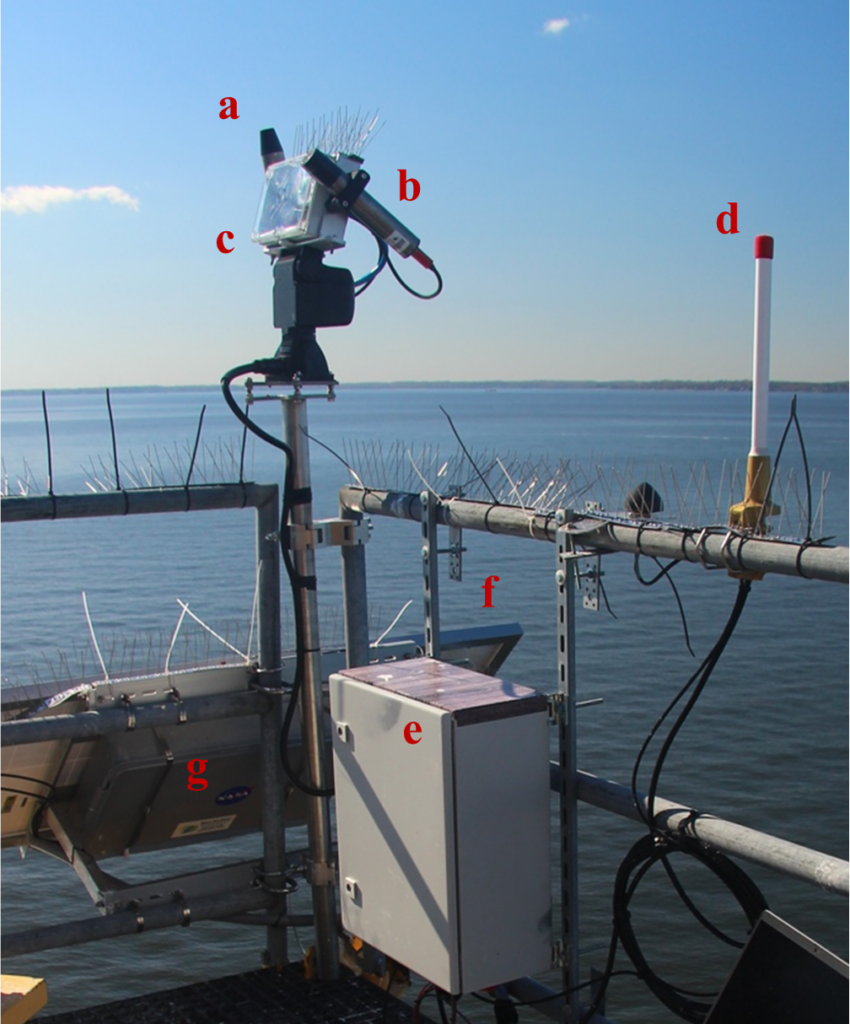 A closer view of the PANTHYR instrument on the tower’s upper platform. Components of the station instrument system include (a) solar spectral irradiance instrument, (b) sky and surface radiance instrument, (c) robotics package (with the “pan/tilt” device), (d) cellular antenna, (e) instrument control box, (f) photovoltaic panel, (g) power control box. (Photo by Dieter Vansteenwegen, VLIZ)
“Autonomous stations like this collect a wealth of validation information—more than we get from science cruises or other means, which can be very expensive,” Turpie says. “It’s exciting to get multiple observations a day of the changing water quality and ecosystem conditions of this important coastal estuary. For surface radiometry, this is very important in order to build up as many match ups with satellite observations as possible.”
Moving forward, UMBC is responsible for the maintenance and operation of the PANTHYR station. Turpie and his colleagues will be working hard to keep the station in tip-top shape so that it can continue to produce useful data and inform future satellite missions—with or without the “help” of neighborhood ospreys.
]]>
The PANTHYR instrument system is on the upper platform of the Chesapeake Bay Tower on the corner out of view. (Kevin Turpie, GSFC/UMBC) Climbing 30-meter ladders and avoiding osprey nests...
https://umbc.edu/stories/panthyr-in-chesapeake-bay/
https://my3.my.umbc.edu/api/v0/pixel/news/145273/guest@my.umbc.edu/9d518e886633877b7b70494fab57822b/api/pixel
gestar2
nasa
news
research
science-and-tech
story
UMBC News & Magazine
https://my3.my.umbc.edu/groups/umbc-news-magazine
https://assets1-my.umbc.edu/system/shared/avatars/groups/000/001/943/24435aa6207c452e7bc15cc74b42c7bb/xsmall.png?1748556657
https://assets1-my.umbc.edu/system/shared/avatars/groups/000/001/943/24435aa6207c452e7bc15cc74b42c7bb/original.png?1748556657
https://assets2-my.umbc.edu/system/shared/avatars/groups/000/001/943/24435aa6207c452e7bc15cc74b42c7bb/xxlarge.png?1748556657
https://assets2-my.umbc.edu/system/shared/avatars/groups/000/001/943/24435aa6207c452e7bc15cc74b42c7bb/xlarge.png?1748556657
https://assets3-my.umbc.edu/system/shared/avatars/groups/000/001/943/24435aa6207c452e7bc15cc74b42c7bb/large.png?1748556657
https://assets1-my.umbc.edu/system/shared/avatars/groups/000/001/943/24435aa6207c452e7bc15cc74b42c7bb/medium.png?1748556657
https://assets2-my.umbc.edu/system/shared/avatars/groups/000/001/943/24435aa6207c452e7bc15cc74b42c7bb/small.png?1748556657
https://assets1-my.umbc.edu/system/shared/avatars/groups/000/001/943/24435aa6207c452e7bc15cc74b42c7bb/xsmall.png?1748556657
https://assets2-my.umbc.edu/system/shared/avatars/groups/000/001/943/24435aa6207c452e7bc15cc74b42c7bb/xxsmall.png?1748556657
UMBC News & Magazine
0
0
false
Fri, 01 Nov 2024 15:34:10 -0400
Fri, 01 Nov 2024 15:34:10 -0400
GESTAR II center awarded $47 million extension on cooperative agreement with NASA Goddard Space Flight Center

The UMBC-led Goddard Earth Science Technology and Research (GESTAR) II center has been awarded a two-year, $47 million extension to continue its cooperative agreement with the NASA Goddard Space Flight Center (GSFC).
In fall 2021, NASA awarded $72 million for UMBC to establish GESTAR II in collaboration with primary partner Morgan State University and six other institutions. Since its launch, GESTAR II has employed more than 150 scientists who are distributed across nearly all of GSFC’s earth science division laboratories. GESTAR II scientists and engineers are currently working on active NASA earth science missions, such as the Plankton, Aerosol, Cloud, ocean Ecosystem (PACE) satellite mission, which launched into orbit earlier this year.
“Our scientists and engineers are continuing to contribute toward the advancement of earth science at NASA Goddard. We want to continue to do more of the same with this agreement extension,” said GESTAR II director Charles Ichoku. “With GSFC, we are making progress to keep our planet safe while continuing to make a lot of discoveries.”
GESTAR II is one of three cooperative agreements that UMBC has with GSFC, a partnership that began nearly 30 years ago. Earlier this month, the university collaborated with GSFC to host the “NASA-UMBC Interaction Days,” an interactive, three-day event series (concluding on September 30) that takes a closer look into the center’s current research activity, with insight into how faculty and students can engage with Goddard scientists and engineers.
In addition to contributions to NASA’s missions and earth science scholarship, GESTAR II also provides funding support for UMBC students with its undergraduate and graduate fellowships. The center also hosts a recurring seminar series for scientists.
Learn more about the research happening at the Goddard Earth Science Technology and Research (GESTAR) II center.
]]>
The UMBC-led Goddard Earth Science Technology and Research (GESTAR) II center has been awarded a two-year, $47 million extension to continue its cooperative agreement with the NASA Goddard Space...
https://umbc.edu/quick-posts/gestar-ii-center-extension/
https://my3.my.umbc.edu/api/v0/pixel/news/144266/guest@my.umbc.edu/67693ecb504c855e32d9d78a5289d181/api/pixel
gestar
gestar2
nasa
nasa-goddard-space-flight-center
quick-post
UMBC News & Magazine
https://my3.my.umbc.edu/groups/umbc-news-magazine
https://assets1-my.umbc.edu/system/shared/avatars/groups/000/001/943/24435aa6207c452e7bc15cc74b42c7bb/xsmall.png?1748556657
https://assets1-my.umbc.edu/system/shared/avatars/groups/000/001/943/24435aa6207c452e7bc15cc74b42c7bb/original.png?1748556657
https://assets2-my.umbc.edu/system/shared/avatars/groups/000/001/943/24435aa6207c452e7bc15cc74b42c7bb/xxlarge.png?1748556657
https://assets2-my.umbc.edu/system/shared/avatars/groups/000/001/943/24435aa6207c452e7bc15cc74b42c7bb/xlarge.png?1748556657
https://assets3-my.umbc.edu/system/shared/avatars/groups/000/001/943/24435aa6207c452e7bc15cc74b42c7bb/large.png?1748556657
https://assets1-my.umbc.edu/system/shared/avatars/groups/000/001/943/24435aa6207c452e7bc15cc74b42c7bb/medium.png?1748556657
https://assets2-my.umbc.edu/system/shared/avatars/groups/000/001/943/24435aa6207c452e7bc15cc74b42c7bb/small.png?1748556657
https://assets1-my.umbc.edu/system/shared/avatars/groups/000/001/943/24435aa6207c452e7bc15cc74b42c7bb/xsmall.png?1748556657
https://assets2-my.umbc.edu/system/shared/avatars/groups/000/001/943/24435aa6207c452e7bc15cc74b42c7bb/xxsmall.png?1748556657
UMBC News & Magazine
0
0
false
Thu, 26 Sep 2024 13:59:40 -0400
Thu, 26 Sep 2024 13:59:40 -0400
UMBC hosts “NASA Days” event series with Goddard Space Flight Center
UMBC is collaborating with the NASA Goddard Space Flight Center (GSFC) to host an interactive, three-day event series that takes a closer look into the center’s current research activity, with insight into how faculty and students can engage with Goddard scientists and engineers.
NASA-UMBC Interaction Days launched on September 9 and continues on September 16 and September 30, highlighting a range of topics on the diverse research and technological advancements in space exploration from leading scientists and engineers at GSFC. The series also provides an overview of the extensive research activity happening in collaboration between UMBC and NASA, a partnership that began nearly 30 years ago.
Astrophysicist Sibasish Laha, an associate research scientist with UMBC’s Center for Space Sciences and Technology who works out of GSFC, organized the series in response to an influx of students inquiring about the work that happens at NASA and ways to get involved.
“I started this interaction day series to help UMBC students better understand what NASA scientists and engineers do on a day-to-day basis,” says Laha. Students get a behind-the-scenes look into the research happening at GSFC, across an array of disciplinary fields such as earth science, data science and AI, astrobiology, and more.
Student opportunities at NASA
Day one of the event series included lectures focused on earth science, exoplanets, and laboratory astrophysics with featured speakers Maurice Leutenegger of GSFC’s x-ray astrophysics laboratory; Wayne Yu, an senior engineer in astrobiology; and planetary scientist Ravi Kopparap. A packed room of more than 90 attendees learned about the inquiring minds behind the GSFC’s research activity.
Day two of the event series (happening on September 16) will feature discussions on data science and AI, x-ray astrophysics, and astrobiology. The event will conclude on September 30 with lectures on the habitable worlds observatory, payload systems and engineering, and NASA’s long term goals with featured speaker Robert Petre, director of GSFC’s astrophysics science division.
Some Retrievers at the event were there out of general curiosity and some were looking for jobs and internship experiences. Brad Cenko, research scientist at GSFC, shared about the wide array of experiential learning opportunities happening at NASA’s research centers across the country.
“NASA has one of the largest internship programs in the state of Maryland, and students can apply to internships year-round,” said Cenko. This summer, UMBC students secured internship placements with NASA, which included senior Leah Narat, business technology administration, who worked at GSFC as a business intelligence intern.
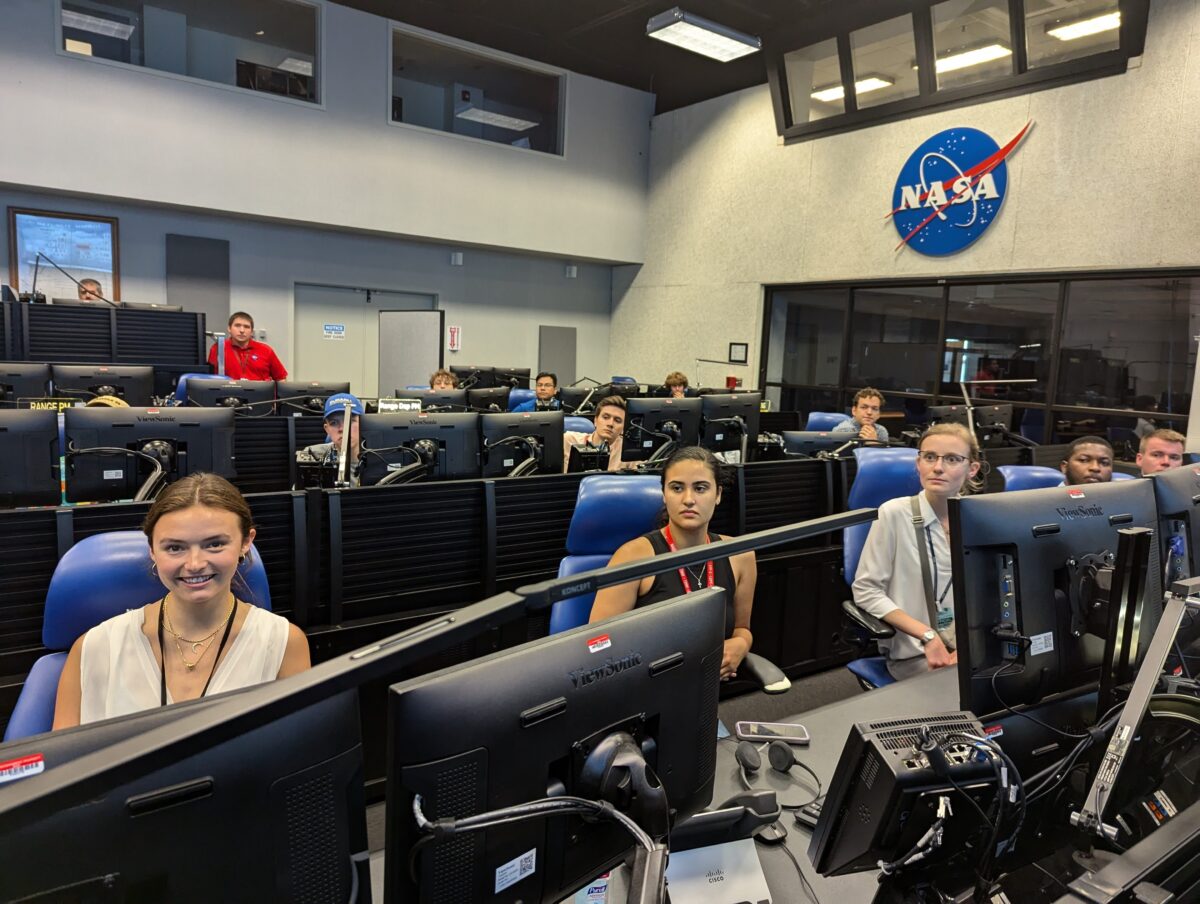 Interns from the Flight Projects Directorate at NASA Goddard, including Leah Narat, center, tour the Wallops Flight Facility in Virginia. (Image courtesy of Narat)
Narat created and updated databases to track awards given to NASA employees. The agency will use the information to maximize employees’ recognition and success and guide them toward career paths that best take advantage of their strengths.
“Honestly, being at NASA was something that I never thought I would achieve, but I put my application out there, and here I am,” says Narat, who worked as a business intelligence intern at the NASA Goddard Space Flight Center in Greenbelt, Maryland, this past summer. “It’s been wonderful.”
A 30-year partnership
While a large majority of students made up the attendee list for day one, the event also brought in many faculty and staff interested in collaborating with the agency. “Faculty are an integral part in these collaborative efforts and our goal is to connect them directly with NASA’s scientists and engineers,” said event organizer Laha.
 Makenzie Lystrup, director of NASA’s Goddard Space Flight Center, and UMBC President Valerie Sheares Ashby during Lystrup’s visit to UMBC in February 2024. (Marlayna Demond ’11/UMBC)
Currently, more than 250 UMBC scientists and research faculty members are partnering with NASA civil servants and are employed under three major cooperative agreements, of which includes the Goddard Earth Sciences Technology and Research II center (GESTAR II); the Center for Space Sciences and Technology (CSST); and the Goddard Planetary Heliophysics Institute (GPHI). The university also is home to the NASA-affiliated Earth and Space Institute based out of UMBC’s Physics Building.
Additionally, nearly 30 of the university’s scientists and research faculty are working on active NASA space missions. That includes the UMBC-developed Lunar Environment Monitoring Station, which was selected as one of the first three instruments to be a part of Artemis III, NASA’s mission that will send astronauts back to the lunar surface after more than 50 years, and UMBC’s Hyper-Angular Rainbow Polarimeter wide-angle imaging polarimeter instrument on board NASA’s Plankton, Aerosol, Cloud, ocean Ecosystem spacecraft mission.
“NASA is providing half of UMBC’s federal contract funding—on a national scale, this is really unusual,” says Don Engel, director of the CSST and assistant professor of computer science and electrical engineering. “Our NASA partnerships are so cross-disciplinary. All three of UMBC’s colleges are represented with these centers, and that’s extremely significant.”
Register for the remaining NASA-UMBC Interaction Days events here.
]]>
UMBC is collaborating with the NASA Goddard Space Flight Center (GSFC) to host an interactive, three-day event series that takes a closer look into the center’s current research activity, with...
https://umbc.edu/stories/nasa-days-event-series/
https://my3.my.umbc.edu/api/v0/pixel/news/143892/guest@my.umbc.edu/e03c952bb42087e2a28c0c06cd19474e/api/pixel
community
csst
esi
gestar
gestar2
gphi
nasa
nasa-goddard-space-flight-center
news
science-and-tech
story
UMBC News & Magazine
https://my3.my.umbc.edu/groups/umbc-news-magazine
https://assets1-my.umbc.edu/system/shared/avatars/groups/000/001/943/24435aa6207c452e7bc15cc74b42c7bb/xsmall.png?1748556657
https://assets1-my.umbc.edu/system/shared/avatars/groups/000/001/943/24435aa6207c452e7bc15cc74b42c7bb/original.png?1748556657
https://assets2-my.umbc.edu/system/shared/avatars/groups/000/001/943/24435aa6207c452e7bc15cc74b42c7bb/xxlarge.png?1748556657
https://assets2-my.umbc.edu/system/shared/avatars/groups/000/001/943/24435aa6207c452e7bc15cc74b42c7bb/xlarge.png?1748556657
https://assets3-my.umbc.edu/system/shared/avatars/groups/000/001/943/24435aa6207c452e7bc15cc74b42c7bb/large.png?1748556657
https://assets1-my.umbc.edu/system/shared/avatars/groups/000/001/943/24435aa6207c452e7bc15cc74b42c7bb/medium.png?1748556657
https://assets2-my.umbc.edu/system/shared/avatars/groups/000/001/943/24435aa6207c452e7bc15cc74b42c7bb/small.png?1748556657
https://assets1-my.umbc.edu/system/shared/avatars/groups/000/001/943/24435aa6207c452e7bc15cc74b42c7bb/xsmall.png?1748556657
https://assets2-my.umbc.edu/system/shared/avatars/groups/000/001/943/24435aa6207c452e7bc15cc74b42c7bb/xxsmall.png?1748556657
UMBC News & Magazine
0
0
false
Fri, 13 Sep 2024 16:04:17 -0400
Fri, 13 Sep 2024 16:04:17 -0400
UMBC partners on STAR-X, a $3M NASA mission concept study through the CRESST II research consortium
UMBC researchers are partnering on STAR-X, a nine-month mission concept study investigating black holes, galaxy clusters, and often-elusive transient cosmic events like supernova explosions. STAR-X stands for Survey and Time-domain Astrophysical Research Explorer. It is one of two Explorer missions to receive $3 million from NASA for this concept phase, before NASA selects one in 2024 to proceed with implementation, targeted for launch in 2028.
“With STAR-X, we want to come up with a survey that will catch very rare transient events,” said Antara Basu-Zych, a UMBC associate research scientist with the Center for Research and Exploration in Space Science & Technology II (CRESST II). “We’re aiming to understand at what rate these events are happening, what types of systems they involve, and where in the universe they’re happening.”
Maintaining STAR-X’s mission data
 Antara Basu-Zych. (Photo curtesy of Antara Basu-Zych)
This mission reflects the important role of strategic research partnerships in moving forward space science—what CRESST II was designed to achieve. UMBC’s CRESST II partners on STAR-X include NASA’s Goddard Space Flight Center (GSFC) and the Massachusetts Institute of Technology, providing an X-ray telescope; the University of Colorado, providing an ultraviolet telescope; and Ball Aerospace, providing the spacecraft. UMBC’s role will focus on the mission data retrieved from STAR-X.
Basu-Zych works with NASA’s High Energy Astrophysics Science Archive Research Center (HEASARC). If the mission is selected for launch, HEASARC will house the data that STAR-X collects. Basu-Zych is currently developing a process to organize the data, along with methods of alerting the scientific community of interesting STAR-X discoveries, called targets of opportunity, that could be further explored.
“Our role is to make it so that average scientists outside of the mission are able to do something valuable with the mission data,” she said.
An agile spacecraft
The mission will conduct a medium survey covering 300 square degrees of the sky on a weekly basis, and a deep survey on a daily basis covering 12 square degrees. As NASA has described, those deep surveys would seek to map black holes and hot gas trapped in distant clusters of galaxies. Combined with infrared observations from NASA’s Roman Space Telescope, these observations would enable researchers to trace how massive galaxy clusters were built up over time.
Additionally, the spacecraft would be able to turn rapidly to point its wide-field X-ray and UV telescopes at transient cosmic sources, such as supernova explosions, gravitational wave events, and extreme black hole feeding events.
“STAR-X is fast moving, very agile, and can quickly go to a source that is interesting,” explains Basu-Zych. “It would be able to slew the sky within a day or within a couple of hours, depending on what event was happening, and target something very quickly.”
In addition to being agile, she notes, “the instrument itself has a large field of view and low particle background, so that helps us with picking out faint objects and will help us get to areas of deep sensitivity.”
With these time-domain surveys and detecting cosmic targets of opportunity, STAR-X seeks to address several key priorities outlined in the “Pathways to Discovery in Astronomy and Astrophysics for the 2020s,” the latest decadal survey of the field released by the National Academies.
]]>
UMBC researchers are partnering on STAR-X, a nine-month mission concept study investigating black holes, galaxy clusters, and often-elusive transient cosmic events like supernova explosions....
https://umbc.edu/stories/star-x-nasa-mission/
https://my3.my.umbc.edu/api/v0/pixel/news/130905/guest@my.umbc.edu/f8c6d5ac6a997ba6ee11dde520d63403/api/pixel
csst
nasa
nasa-goddard-space-flight-center
news
rca-2
research
science-and-tech
UMBC News & Magazine
https://my3.my.umbc.edu/groups/umbc-news-magazine
https://assets1-my.umbc.edu/system/shared/avatars/groups/000/001/943/24435aa6207c452e7bc15cc74b42c7bb/xsmall.png?1748556657
https://assets1-my.umbc.edu/system/shared/avatars/groups/000/001/943/24435aa6207c452e7bc15cc74b42c7bb/original.png?1748556657
https://assets2-my.umbc.edu/system/shared/avatars/groups/000/001/943/24435aa6207c452e7bc15cc74b42c7bb/xxlarge.png?1748556657
https://assets2-my.umbc.edu/system/shared/avatars/groups/000/001/943/24435aa6207c452e7bc15cc74b42c7bb/xlarge.png?1748556657
https://assets3-my.umbc.edu/system/shared/avatars/groups/000/001/943/24435aa6207c452e7bc15cc74b42c7bb/large.png?1748556657
https://assets1-my.umbc.edu/system/shared/avatars/groups/000/001/943/24435aa6207c452e7bc15cc74b42c7bb/medium.png?1748556657
https://assets2-my.umbc.edu/system/shared/avatars/groups/000/001/943/24435aa6207c452e7bc15cc74b42c7bb/small.png?1748556657
https://assets1-my.umbc.edu/system/shared/avatars/groups/000/001/943/24435aa6207c452e7bc15cc74b42c7bb/xsmall.png?1748556657
https://assets2-my.umbc.edu/system/shared/avatars/groups/000/001/943/24435aa6207c452e7bc15cc74b42c7bb/xxsmall.png?1748556657
UMBC News & Magazine
0
0
false
Tue, 14 Feb 2023 09:31:31 -0500
Tue, 14 Feb 2023 09:31:31 -0500