Meet a Retriever—ASM Mobarak Hossain, M.S. ’26, COEIT Computing for Social Good Award recipient
Meet ASM Mobarak Hossain (Sajib). He recently graduated from UMBC with an M.S. in information systems and joined IBM as a Senior Developer and AI Specialist. Sajib has spent more than a decade working in technology. What excites him most is using what he knows to build solutions that make a difference in people’s lives. At UMBC, he put that passion to work helping to develop MyPath, a Google Maps–style app that uses AI, remote sensing measurements, and crowd-sourced data to guide wheelchair users to accessible routes.
This May, the work was recognized when Sajib was selected as one of two recipients for the inaugural COEIT Computing for Social Good Award, made possible by a generous donation from alumnus Akshay Java, M.S. ’03, Ph.D. ’08, computer science. Awardees were selected in a competitive review process by COEIT faculty reviewers and departmental leadership. Sajib was selected for his project “A Multi-Modal Agentic Framework for Auditing Wheelchair Accessibility.” Take it away, Sajib!
Q: What brought you to UMBC?
A: After spending many years working in software engineering and technology leadership, I wanted to keep growing and challenge myself in a new way. I came to UMBC to deepen my knowledge, explore AI and research, and connect my industry experience with problems that could have a meaningful impact on people’s lives.
Q: What did you enjoy most about UMBC?
A: What I enjoyed most about UMBC was being able to connect what I learned in class with real problems. My research gave me the chance to use AI and software engineering to work on wheelchair accessibility, which made the experience much more meaningful to me than simply learning technology.
Q: Who in the UMBC community inspired you or supported you?
A: I found support at UMBC through the people who were willing to listen to my ideas and help me develop them. My advisor, Md Osman Gani, has been one of the most supportive people during my time at UMBC. He encouraged me to think beyond the technical side of a problem and focus on how our research could actually help people. That support helped turn my interest in accessibility into research that became a very meaningful part of my UMBC experience.
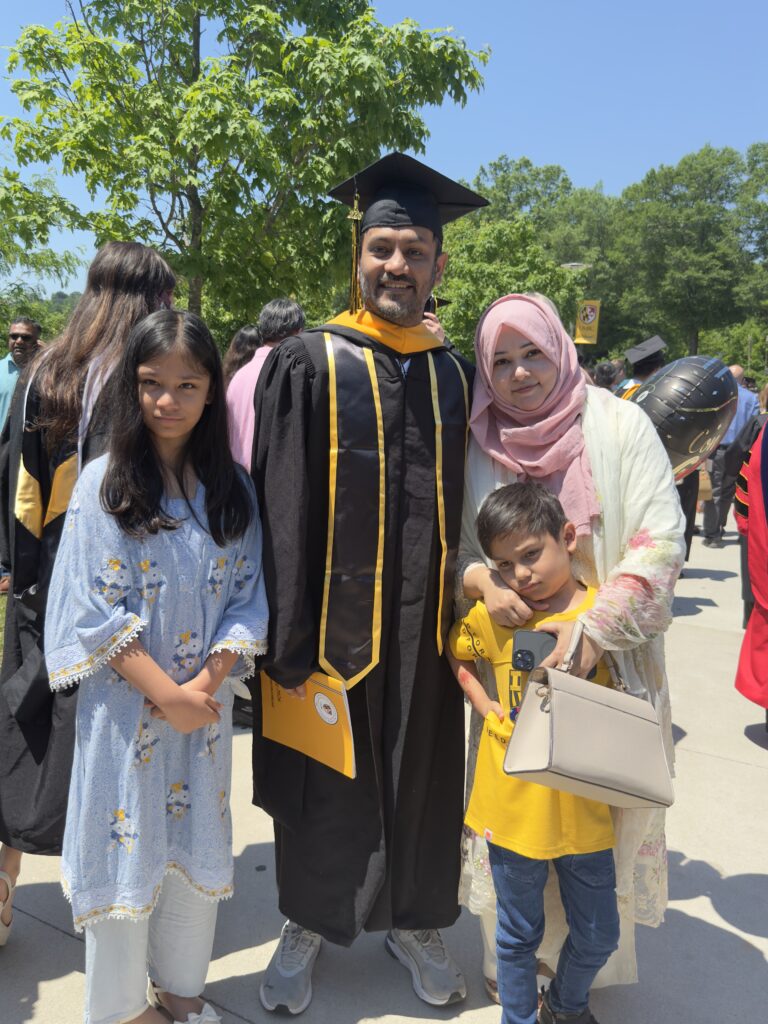 Following commencement, Hossain (middle) posed for a picture outside the Chesapeake Employers Insurance Arena with his daughter, Ayra (left), wife, Humayira (right), and son, Ayaz (bottom right). (Photo courtesy of Hossain)
Q: What’s the one thing you’d want someone who hasn’t joined the UMBC community to know about the support you find here?
A: I would tell them that at UMBC you don’t have to figure everything out by yourself. I found professors and researchers who were willing to listen to my ideas, guide me, and give me room to explore. That support helped me turn an idea into research with a real purpose.
Even after graduation, I feel connected to the people, mentors, and experiences that were part of my journey at UMBC. I’m proud to be part of a community that encourages learning, collaboration, and meaningful work.
ASM Mobarak Hossain, M.S. '26
information systems
Q: Can you tell us about your current job and how UMBC helped prepare you for your career?
A: I’m currently working at IBM as a Senior Developer and AI Specialist. What I enjoy most is the opportunity to work on challenging technology problems and continue learning. I especially enjoy using my software engineering background together with AI to build solutions that can solve real-world problems.
UMBC helped me look at technology from a different perspective. I already had many years of industry experience, but my time at UMBC gave me the opportunity to become more involved in research, explore AI more deeply, and think about how technology can be used to address real human needs. That experience has been valuable as I move into the next stage of my career.
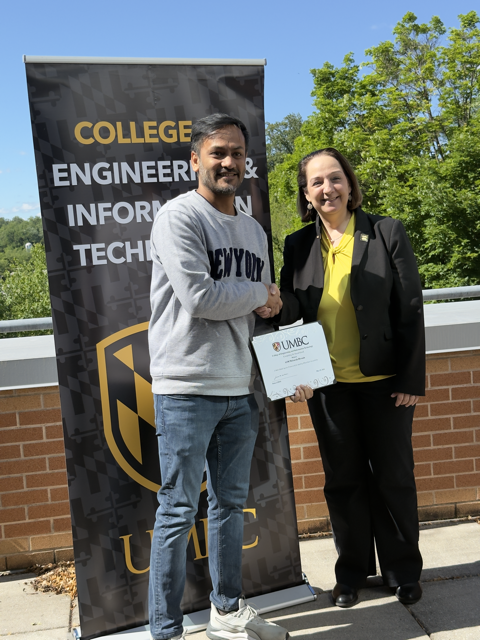 Hossain (left) pictured with Jeanne van Briesen, dean of the College of Engineering and Information Technology, after receiving the COEIT Computing for Social Good Award. (Photo courtesy of Vandana Janeja)
Q: How does the COEIT Computing for Social Good Award make an impact on your education?
A: Receiving the COEIT Computing for Social Good Award directly bridges the gap between academic theory and real-world impact. It provides vital encouragement and support to continue leveraging computer science for positive social change, specifically through the MyPath project. Beyond the immediate recognition, it inspires me to stay focused on human-centered software design, seek out complex social challenges in my future coursework, and pursue career opportunities centered on technology for good.
Q: How did it feel to win the award?
A: Winning the COEIT Computing for Social Good Award was an immense honor and deeply validating. Developing MyPath required countless hours of hard work, continuous refinement, and a deep commitment to addressing a meaningful community need. Seeing that work recognized by COEIT was incredibly exciting and humbling—it gave me a strong sense of pride in what we’ve built and renewed enthusiasm for creating tools that deliver genuine social value.
* * * * *
UMBC’s greatest strength is its people. When people meet Retrievers and hear about the passion they bring, the relationships they create, the ways they support each other, and the commitment they have to inclusive excellence, they truly get a sense of our community. That’s what “Meet a Retriever” is all about.
Learn more about how UMBC can help you achieve your goals.
]]>
Meet ASM Mobarak Hossain (Sajib). He recently graduated from UMBC with an M.S. in information systems and joined IBM as a Senior Developer and AI Specialist. Sajib has spent more than a decade...
https://umbc.edu/stories/hossain-coeit-computing-for-social-good/
https://my3.my.umbc.edu/api/v0/pixel/news/161833/guest@my.umbc.edu/e98d34c33e8561e78fab88181404606c/api/pixel
coeit
impact
is
meet-a-retriever
perspectives
science-and-tech
stories
story
UMBC News & Magazine
https://my3.my.umbc.edu/groups/umbc-news-magazine
https://assets1-my.umbc.edu/system/shared/avatars/groups/000/001/943/24435aa6207c452e7bc15cc74b42c7bb/xsmall.png?1748556657
https://assets1-my.umbc.edu/system/shared/avatars/groups/000/001/943/24435aa6207c452e7bc15cc74b42c7bb/original.png?1748556657
https://assets2-my.umbc.edu/system/shared/avatars/groups/000/001/943/24435aa6207c452e7bc15cc74b42c7bb/xxlarge.png?1748556657
https://assets2-my.umbc.edu/system/shared/avatars/groups/000/001/943/24435aa6207c452e7bc15cc74b42c7bb/xlarge.png?1748556657
https://assets3-my.umbc.edu/system/shared/avatars/groups/000/001/943/24435aa6207c452e7bc15cc74b42c7bb/large.png?1748556657
https://assets1-my.umbc.edu/system/shared/avatars/groups/000/001/943/24435aa6207c452e7bc15cc74b42c7bb/medium.png?1748556657
https://assets2-my.umbc.edu/system/shared/avatars/groups/000/001/943/24435aa6207c452e7bc15cc74b42c7bb/small.png?1748556657
https://assets1-my.umbc.edu/system/shared/avatars/groups/000/001/943/24435aa6207c452e7bc15cc74b42c7bb/xsmall.png?1748556657
https://assets2-my.umbc.edu/system/shared/avatars/groups/000/001/943/24435aa6207c452e7bc15cc74b42c7bb/xxsmall.png?1748556657
UMBC News & Magazine
1
0
false
Fri, 14 Aug 2026 16:18:43 -0400
Meet a Retriever—Rishav Gupta, COEIT Computing for Social Good Award recipient
Meet Rishav Gupta. After spending five years as a mobile engineer, he decided to pursue his Ph.D. in computer science at UMBC to deepen his expertise and choose projects with the clear objective of improving people’s lives. Rishav is working in the Future Sensing and Interaction Lab of professor Dong Li on a project to use everyday smartphones as affordable and accessible blood pressure monitors.
This May, the work was recognized when Rishav was selected as one of two recipients for the inaugural COEIT Computing for Social Good Award, made possible by a generous donation from alumnus Akshay Java, M.S. ’03, computer science, Ph.D. ’08, computer science. Awardees were selected in a competitive review process by COEIT faculty reviewers and departmental leadership. Rishav was choosen for his project “Enabling Affordable and Accessible Blood Pressure Monitoring Using Only a Commodity Smartphone.” Take it away, Rishav!
Q: What brought you to UMBC?
A: As an international student from India, I left a comfortable career to come here. After five years as a mobile engineer in industry, I was a generalist who could build things, but I wanted to understand them, to master a domain and create research that genuinely gives back to the community and helps people. UMBC’s work in health sensing was exactly that chance.
UMBC’s welcoming and inclusive environment made the transition less daunting. From peers who’d walked the same path to a community that genuinely wants your feedback to others considering it: you won’t be figuring things out alone here.
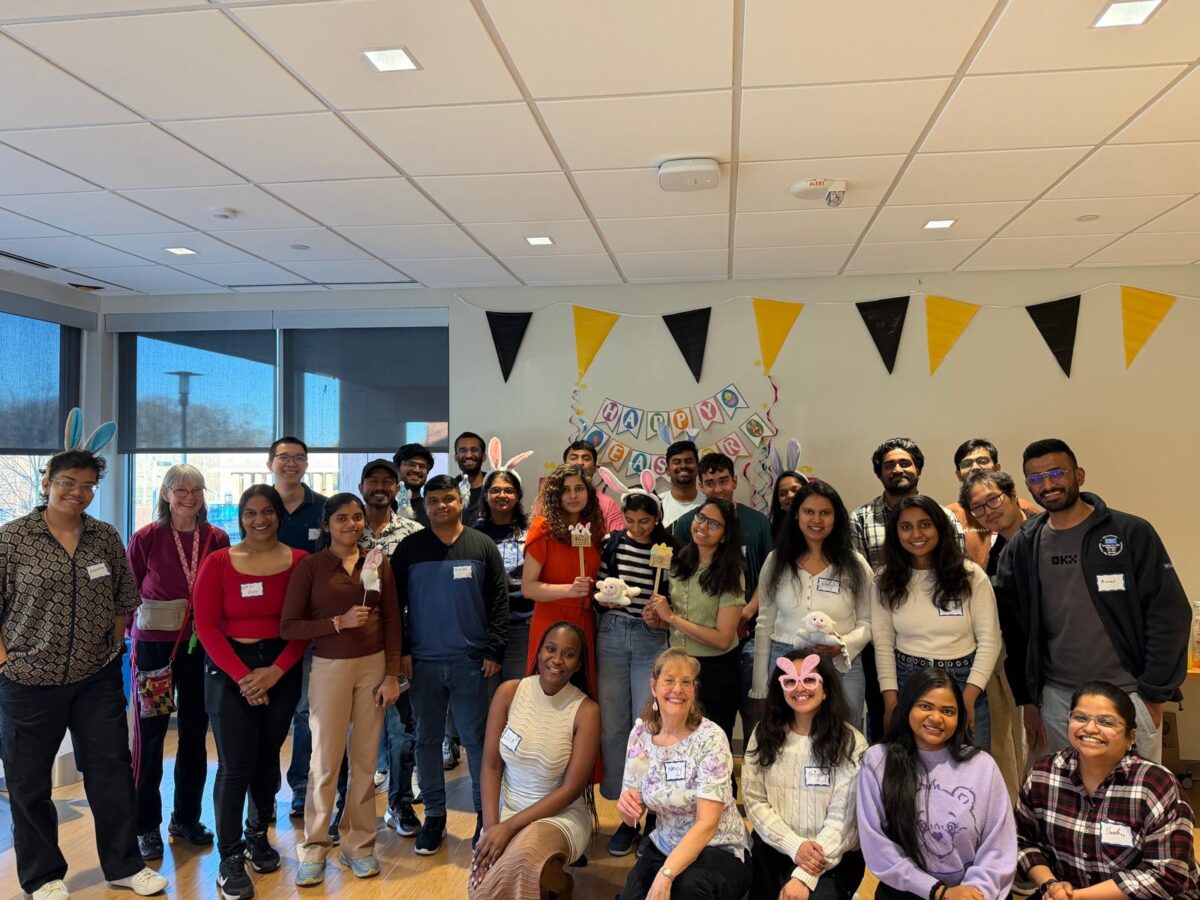 Gupta attending an Easter festival organized by Nancy Parlette and the International Students Connect club. (Photo courtesy of Gupta)
Q: What do you love about UMBC?
A: Beyond my research, I serve on the Graduate Assistant Advisory Committee, helping improve the experience for graduate assistants across campus. From clarifying appointment expectations to shaping GA orientation, it’s shown me a side of UMBC that genuinely listens to students and works to actually affect people’s day-to-day lives. What I enjoy most is being a bridge: carrying real student concerns to people who can actually act on them.
Q: Who in the community inspired you or supported you?
A: My advisor, Dong Li, pushes me to aim high and take ownership of my research, trusting me to drive my own ideas. That independence has stretched me. I’ve also leaned on senior students in the department, whose willingness to share what they’ve learned has made navigating the early Ph.D. years far less daunting.
Q: What’s the one thing you’d want someone who hasn’t joined the UMBC community to know about the support you find here?
A: What surprised me most is how many people quietly have your back. A student who walked me through a rough patch, a staff member who actually wanted my feedback and acted on it, and peers who share hard lessons so I don’t struggle alone are just a few examples. The support is every day and practical.
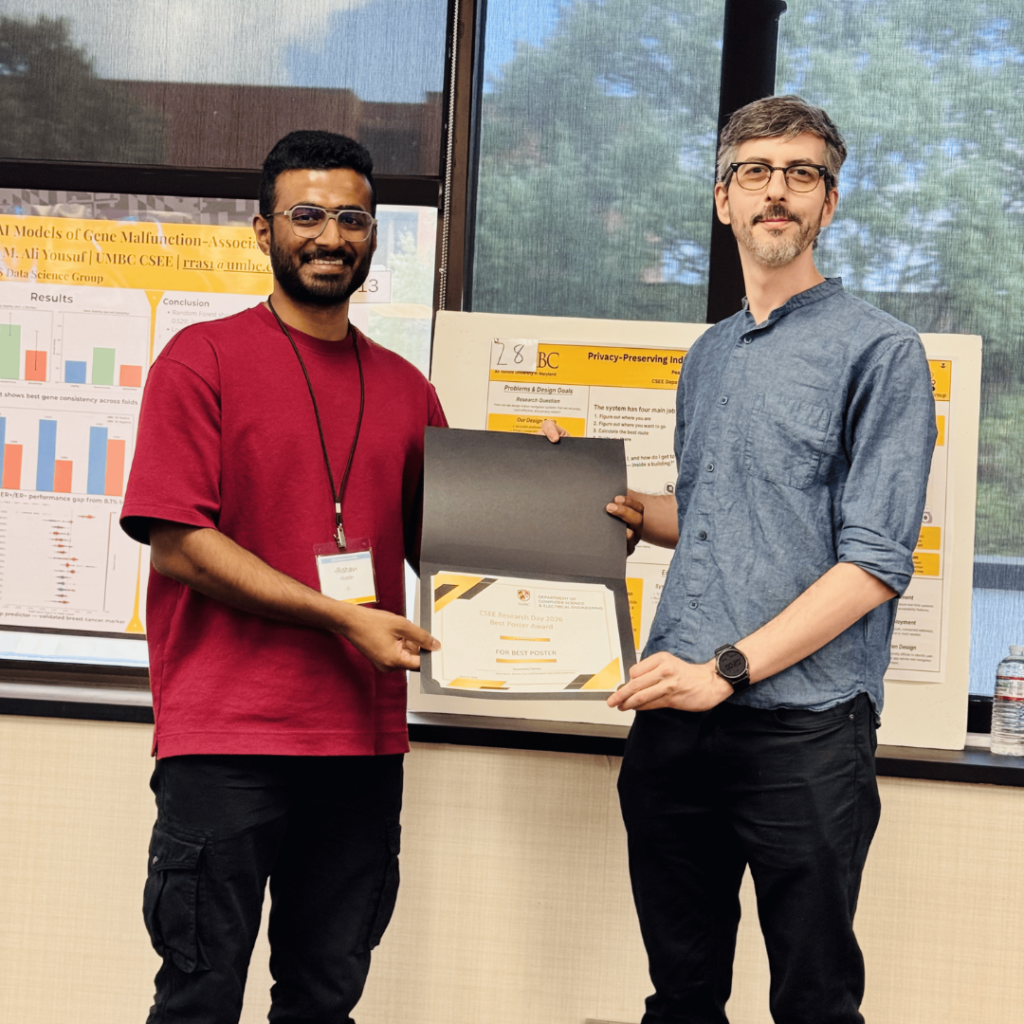
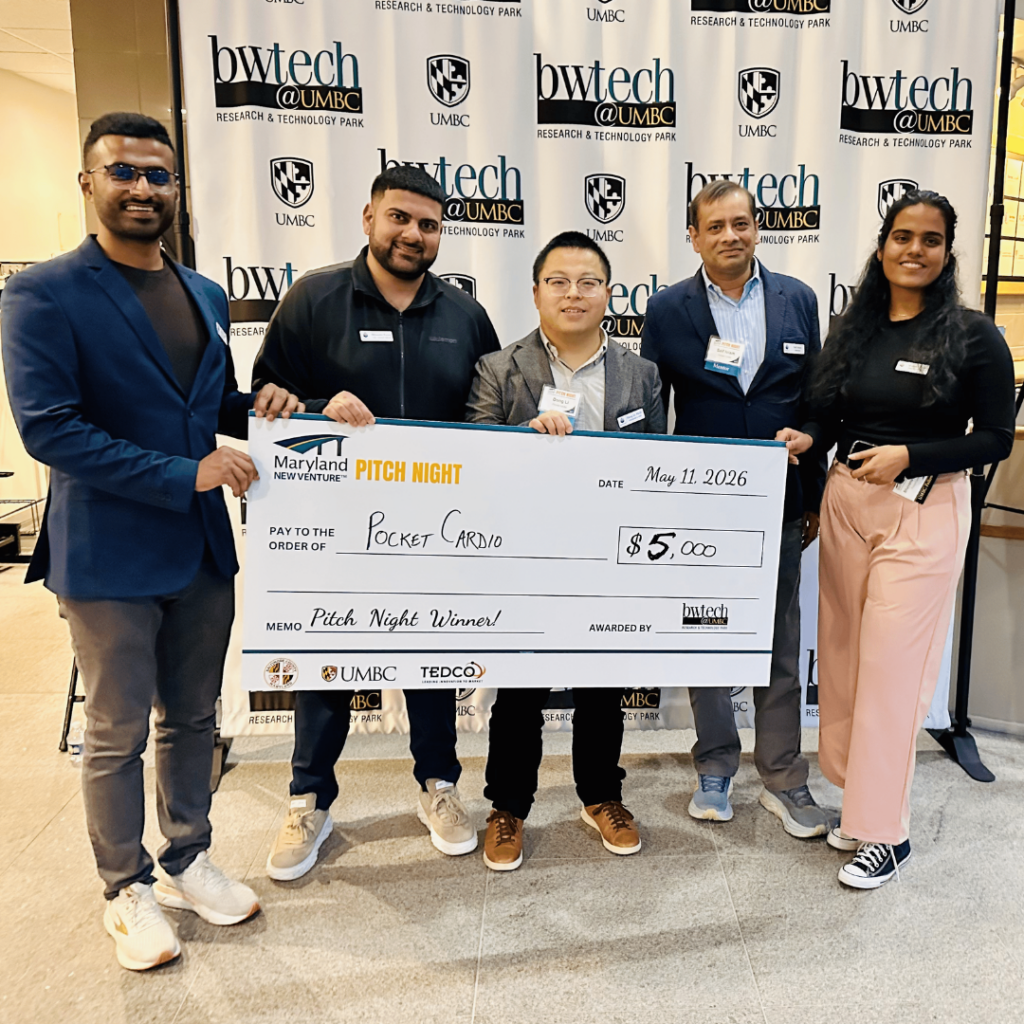
On left, Gupta receives an award for best poster from computer science and electrical engineering assistant professor Roberto Yus on CSEE Research Day in April 2026. On right, Gupta and his team receive a first place award from The Maryland NEW VENTURE program in May 2026. (Photos courtesy of Gupta)
Q: What are your goals after graduation and how is UMBC helping you?
A: My goal is a research career with significant meaningful work, ideally a faculty position at a strong university, where I can keep pushing on affordable health-sensing technology and train the next generation of researchers. I’m early in the journey, but that’s the direction I’m building toward.
UMBC has pushed me toward independence by owning my research direction, presenting my work at top venues, and building the depth I came here for. Serving on a graduate committee has also grown skills I didn’t expect to develop: representing others, navigating institutions, and turning feedback into real change.
Q: How has the Computing for Social Good Award impacted your education?
A: The COEIT Computing for Social Good Award directly supports my research to make blood pressure monitoring affordable and accessible using only a commodity smartphone, with no specialized hardware and no clinic visit required. Beyond the tangible support, being recognized specifically for the social good of the work, rather than only its technical side, has shaped how I choose research problems: it pushes me to keep asking who my work actually helps, and to keep people who can’t easily access conventional care at the center of what I build.
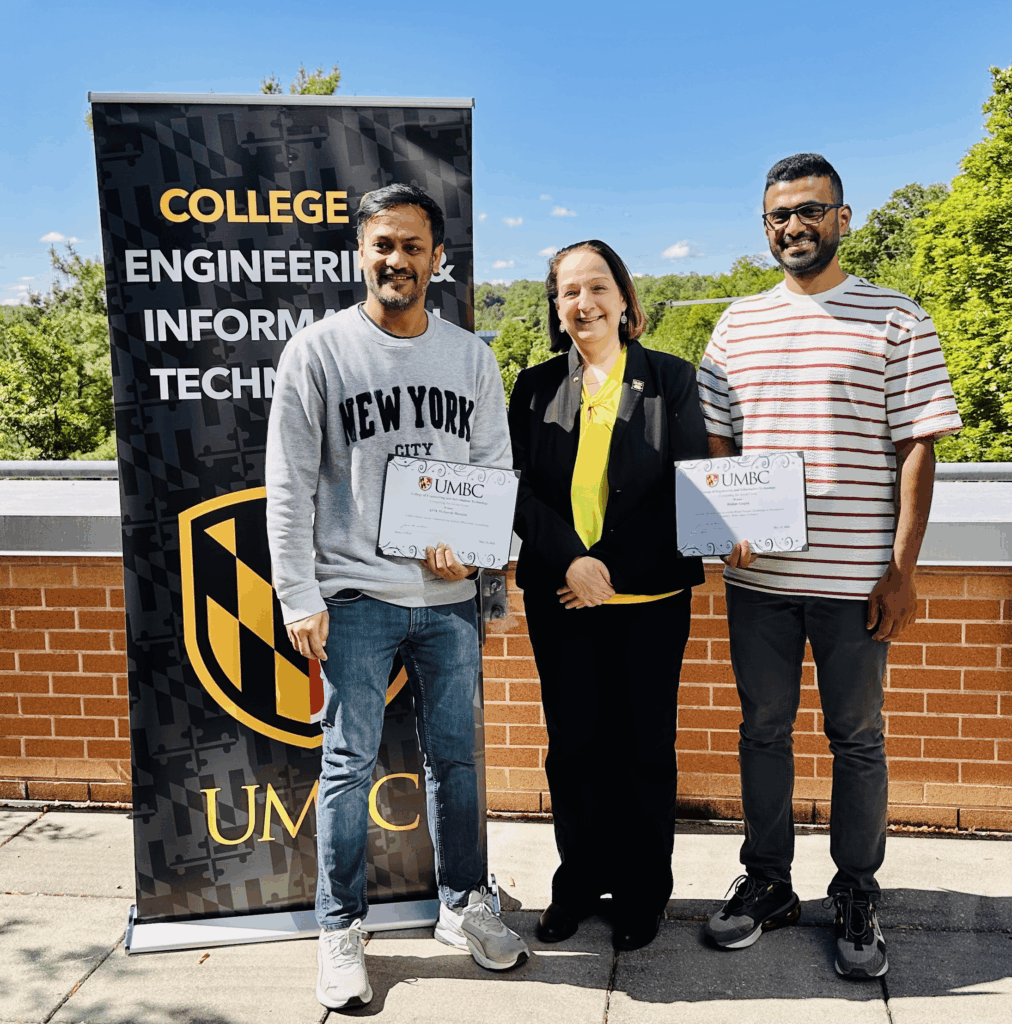 Rishav Gupta and ASM Mobarak Hossain receiving the COEIT Computing Social for Good Award from Jeanne van Briesen, dean of the College of Engineering and Information Technology. (Photo courtesy of Vandana Janeja)
Q: How did it feel to win this award?
A: Receiving the COEIT Computing for Social Good Award felt meaningful in a way I didn’t expect. I came to UMBC from a career in industry because I wanted my work to matter beyond a product. Being recognized for the research’s social impact felt like confirmation that I’d chosen the right path. It was also humbling as a reminder that affordable health technology isn’t an abstract goal but something real people are rooting for, and it left me more motivated to deliver on the promise the award recognizes.
* * * * *
UMBC’s greatest strength is its people. When people meet Retrievers and hear about the passion they bring, the relationships they create, the ways they support each other, and the commitment they have to inclusive excellence, they truly get a sense of our community. That’s what “Meet a Retriever” is all about.
Learn more about how UMBC can help you achieve your goals.
]]>
Meet Rishav Gupta. After spending five years as a mobile engineer, he decided to pursue his Ph.D. in computer science at UMBC to deepen his expertise and choose projects with the clear objective...
https://umbc.edu/stories/riishav-guptaa-coeit-computing-for-social-good/
https://my3.my.umbc.edu/api/v0/pixel/news/161829/guest@my.umbc.edu/0647a74cddf8f7fd7e12be7e2a8a1948/api/pixel
coeit
csee
impact
meet-a-retriever
perspectives
science-and-tech
stories
story
UMBC News & Magazine
https://my3.my.umbc.edu/groups/umbc-news-magazine
https://assets1-my.umbc.edu/system/shared/avatars/groups/000/001/943/24435aa6207c452e7bc15cc74b42c7bb/xsmall.png?1748556657
https://assets1-my.umbc.edu/system/shared/avatars/groups/000/001/943/24435aa6207c452e7bc15cc74b42c7bb/original.png?1748556657
https://assets2-my.umbc.edu/system/shared/avatars/groups/000/001/943/24435aa6207c452e7bc15cc74b42c7bb/xxlarge.png?1748556657
https://assets2-my.umbc.edu/system/shared/avatars/groups/000/001/943/24435aa6207c452e7bc15cc74b42c7bb/xlarge.png?1748556657
https://assets3-my.umbc.edu/system/shared/avatars/groups/000/001/943/24435aa6207c452e7bc15cc74b42c7bb/large.png?1748556657
https://assets1-my.umbc.edu/system/shared/avatars/groups/000/001/943/24435aa6207c452e7bc15cc74b42c7bb/medium.png?1748556657
https://assets2-my.umbc.edu/system/shared/avatars/groups/000/001/943/24435aa6207c452e7bc15cc74b42c7bb/small.png?1748556657
https://assets1-my.umbc.edu/system/shared/avatars/groups/000/001/943/24435aa6207c452e7bc15cc74b42c7bb/xsmall.png?1748556657
https://assets2-my.umbc.edu/system/shared/avatars/groups/000/001/943/24435aa6207c452e7bc15cc74b42c7bb/xxsmall.png?1748556657
UMBC News & Magazine
0
0
false
Tue, 11 Aug 2026 15:01:08 -0400
Meet a Retriever—Rishav Gupta, COEIT Computing for Social Good Award recipient
Meet Rishav Gupta. After spending five years as a mobile engineer, he decided to pursue his Ph.D. in computer science at UMBC to deepen his expertise and choose projects with the clear objective of improving people’s lives. Rishav is working in the Future Sensing and Interaction Lab of professor Dong Li on a project to use everyday smartphones as affordable and accessible blood pressure monitors.
This May, the work was recognized when Rishav was selected as one of two recipients for the inaugural COEIT Computing for Social Good Award, made possible by a generous donation from alumnus Akshay Java, M.S. ’03, Ph.D. ’08, computer science. Awardees were selected in a competitive review process by COEIT faculty reviewers and departmental leadership. Rishav was choosen for his project “Enabling Affordable and Accessible Blood Pressure Monitoring Using Only a Commodity Smartphone.” Take it away, Rishav!
Q: What brought you to UMBC?
A: As an international student from India, I left a comfortable career to come here. After five years as a mobile engineer in industry, I was a generalist who could build things, but I wanted to understand them, to master a domain and create research that genuinely gives back to the community and helps people. UMBC’s work in health sensing was exactly that chance.
UMBC’s welcoming and inclusive environment made the transition less daunting. From peers who’d walked the same path to a community that genuinely wants your feedback to others considering it: you won’t be figuring things out alone here.
Gupta attending an Easter festival organized by Nancy Parlette and the International Students Connect club. (Photo courtesy of Gupta)
Q: What do you love about UMBC?
A: Beyond my research, I serve on the Graduate Assistant Advisory Committee, helping improve the experience for graduate assistants across campus. From clarifying appointment expectations to shaping GA orientation, it’s shown me a side of UMBC that genuinely listens to students and works to actually affect people’s day-to-day lives. What I enjoy most is being a bridge: carrying real student concerns to people who can actually act on them.
Q: Who in the community inspired you or supported you?
A: My advisor, Dong Li, pushes me to aim high and take ownership of my research, trusting me to drive my own ideas. That independence has stretched me. I’ve also leaned on senior students in the department, whose willingness to share what they’ve learned has made navigating the early Ph.D. years far less daunting.
Q: What’s the one thing you’d want someone who hasn’t joined the UMBC community to know about the support you find here?
A: What surprised me most is how many people quietly have your back. A student who walked me through a rough patch, a staff member who actually wanted my feedback and acted on it, and peers who share hard lessons so I don’t struggle alone are just a few examples. The support is every day and practical.
On left, Gupta receives an award for best poster from computer science and electrical engineering assistant professor Roberto Yus on CSEE Research Day in April 2026. On right, Gupta and his team receive a first place award from The Maryland NEW VENTURE program in May 2026. (Photos courtesy of Gupta)
Q: What are your goals after graduation and how is UMBC helping you?
A: My goal is a research career with significant meaningful work, ideally a faculty position at a strong university, where I can keep pushing on affordable health-sensing technology and train the next generation of researchers. I’m early in the journey, but that’s the direction I’m building toward.
UMBC has pushed me toward independence by owning my research direction, presenting my work at top venues, and building the depth I came here for. Serving on a graduate committee has also grown skills I didn’t expect to develop: representing others, navigating institutions, and turning feedback into real change.
Q: How has the Computing for Social Good Award impacted your education?
A: The COEIT Computing for Social Good Award directly supports my research to make blood pressure monitoring affordable and accessible using only a commodity smartphone, with no specialized hardware and no clinic visit required. Beyond the tangible support, being recognized specifically for the social good of the work, rather than only its technical side, has shaped how I choose research problems: it pushes me to keep asking who my work actually helps, and to keep people who can’t easily access conventional care at the center of what I build.
Rishav Gupta and ASM Mobarak Hossain receiving the COEIT Computing Social for Good Award from Jeanne van Briesen, dean of the College of Engineering and Information Technology. (Photo courtesy of Vandana Janeja)
Q: How did it feel to win this award?
A: Receiving the COEIT Computing for Social Good Award felt meaningful in a way I didn’t expect. I came to UMBC from a career in industry because I wanted my work to matter beyond a product. Being recognized for the research’s social impact felt like confirmation that I’d chosen the right path. It was also humbling as a reminder that affordable health technology isn’t an abstract goal but something real people are rooting for, and it left me more motivated to deliver on the promise the award recognizes.
* * * * *
UMBC’s greatest strength is its people. When people meet Retrievers and hear about the passion they bring, the relationships they create, the ways they support each other, and the commitment they have to inclusive excellence, they truly get a sense of our community. That’s what “Meet a Retriever” is all about.
Learn more about how UMBC can help you achieve your goals.
]]>
Meet Rishav Gupta. After spending five years as a mobile engineer, he decided to pursue his Ph.D. in computer science at UMBC to deepen his expertise and choose projects with the clear objective...
https://umbc.edu/stories/rishav-gupta-coeit-computing-for-social-good/
https://my3.my.umbc.edu/api/v0/pixel/news/161834/guest@my.umbc.edu/561a4ae78bb45a1aa63e92cf0f0faf27/api/pixel
coeit
csee
impact
meet-a-retriever
perspectives
science-and-tech
stories
story
UMBC News & Magazine
https://my3.my.umbc.edu/groups/umbc-news-magazine
https://assets1-my.umbc.edu/system/shared/avatars/groups/000/001/943/24435aa6207c452e7bc15cc74b42c7bb/xsmall.png?1748556657
https://assets1-my.umbc.edu/system/shared/avatars/groups/000/001/943/24435aa6207c452e7bc15cc74b42c7bb/original.png?1748556657
https://assets2-my.umbc.edu/system/shared/avatars/groups/000/001/943/24435aa6207c452e7bc15cc74b42c7bb/xxlarge.png?1748556657
https://assets2-my.umbc.edu/system/shared/avatars/groups/000/001/943/24435aa6207c452e7bc15cc74b42c7bb/xlarge.png?1748556657
https://assets3-my.umbc.edu/system/shared/avatars/groups/000/001/943/24435aa6207c452e7bc15cc74b42c7bb/large.png?1748556657
https://assets1-my.umbc.edu/system/shared/avatars/groups/000/001/943/24435aa6207c452e7bc15cc74b42c7bb/medium.png?1748556657
https://assets2-my.umbc.edu/system/shared/avatars/groups/000/001/943/24435aa6207c452e7bc15cc74b42c7bb/small.png?1748556657
https://assets1-my.umbc.edu/system/shared/avatars/groups/000/001/943/24435aa6207c452e7bc15cc74b42c7bb/xsmall.png?1748556657
https://assets2-my.umbc.edu/system/shared/avatars/groups/000/001/943/24435aa6207c452e7bc15cc74b42c7bb/xxsmall.png?1748556657
UMBC News & Magazine
1
0
false
Tue, 11 Aug 2026 15:01:08 -0400
Tue, 11 Aug 2026 15:01:08 -0400
Who gets to tell the story? The tricky back story of how radio shows can promote empathy but also build up cultural divides
In his new book, Empathy Machines: This American Life, Podcasting, and the Public Radio Structure of Feeling, Jason Loviglio, professor of media and communications, critiques and analyzes the making of and the impact of one of his favorite shows on National Public Radio (NPR), “This American Life”—a radio show turned podcast that received the 2021 Pulitzer Prize in Audio Reporting. “This American Life,” created and hosted by Baltimore-native Ira Glass, became a listener favorite for its magical way of weaving stories about everyday people into larger human issues, sounding more like a sympathetic, curious neighbor instead of a serious professor. The irony is not lost on Loviglio, who thanked his students in the book for reminding him that accessibility ensures that the public, his students, and their families, not only academic editors, understand the research. He wants this young audience to learn about radio and be inspired to research their own media and communications passions.
“The people I have had the honor of calling my students over the years have done more than anyone else to help me learn how to communicate ideas about communication and media clearly and simply,” writes Loviglio in his acknowledgements. “The MCS undergraduates are among the least pretentious and least entitled people I’ve ever had the pleasure of working with. Too numerous to name here, I give a collective thanks to you for the lessons of clarity you’ve taught me and for the laughs.”
Long before Loviglio became an author and the co-editor of Radio Journal: International Studies in Broadcast and Audio Media and of The Routledge Companion to Radio and Podcasting Studies, he was a young kid in love with “weird radio shows,” notes Loviglio. “I remember listening at night to my red transistor radio when I was little, maybe 9 or so. I put it under my pillow so my parents wouldn’t hear it,” says Loviglio. “I mostly listened to weird nationally-syndicated late night public radio shows, like Dr. Demento and local sports talk shows.”
While he doesn’t expect students to fall in love with radio as he did, in his History of Media class, he wants students to understand the power and importance of radio long before stories were mobilized in the palms of our hands 24/7 worldwide. Loviglio encourages students to look beyond Google and instead find people whose lives were shaped by radio.
He wants students to explore what radio meant in everyday life and how it conveyed and reflected emotions such as fear, danger, excitement, and joy—functioning as empathy machines that inspired deeper forms of storytelling and laid the groundwork for public radio and podcasts.
Q: What are empathy machines?
A: I think it’s safe to say that public radio has been explicitly understood as an empathy machine at least since the radio show “This American Life’s” debut in 1996. If we allow for synonyms of empathy, then radio has been understood this way for a lot longer. There’s a longer history regarding various media of communication as uniquely efficient machines for producing empathy. Most famously, of course, is the novel. And before that, oral storytelling. The idea of radio as an empathy machine stems from a specific history referred to as the technological sublime.
The notion that we can invent and communicate our way into equality is central to the way we understand Western history since at least the printing press. The book, particularly the novel, has been hailed for its powers to impart democracy and empathy. This history is opposed by an equally compelling one in which the machine represents the antithesis of democratic values of participation and empathy. A dominant theme in media history is the role of technology as an extension of human values, such that we no longer hear the metaphors in our arguments.
Q: Did you always know you were going to write about “This American Life” instead of general radio?
A: It wasn’t until a couple of years ago that I realized the best way to tell the story of public radio and podcasting was through NPR’s “This American Life.” It was first produced in 1996 by WBEZ, Chicago Public Radio, and then picked up nationally by Public Radio International. It became a massive show.
“This American Life” is also one of the first shows to start offering a podcast version, in case you missed an episode. Around 2014, “This American Life” started to shift, where more people were listening to it as a podcast. I wrote to Ira Glass last year, and he still calls it a radio show. That’s still his default understanding of it, even now.
Q: Did you have fun writing this?
A: Yes and no. I had fun thinking about it and fun listening to the shows. This is such a great way to tell stories. But it was hard to write because the shows kept changing. My thoughts kept changing. I began writing the book during President Obama’s administration, when I was thinking positively about American history. Then, Trump won.
I didn’t think that because President Obama was elected, it meant that everything was great and we had cured racism. I thought a particular version of liberalism had won. Definitely very capitalistic, definitely very interested in style, maybe more than substance, but there was a story everyone was telling about the country that was designed to make people feel very comfortable. Not only liberals, but also very privileged people, and not particularly political.
Trump winning the 2016 presidential election was a reminder that there is another story. I knew the other far-right story, but I thought that more people were happy for the positive symbolic victory that President Obama represented in terms of being biracial and being born to an immigrant father. This educated, cosmopolitan elite could also speak across different cultural registers. I thought that’s what I was writing about. Then the Trump administration began, and I felt I had to write about this darker story. That meant I had to think differently about the long, slow death of liberalism. There was something rotten in the creeping neoliberalism of the era that put some of us to sleep, left others out in the cold, and mobilized a politics of racial grievance on the right.
Q: What was the critique?
A: I’m not speaking for everyone, but people like me: privileged, educated, and progressive but kind of complacent. What did we do for the eight years of the Obama administration and the previous two or three decades of creeping neoliberalism? What were we listening to? Public radio. That’s what we were listening to. That’s the soundtrack of the frog and the pot. The pot slowly heats up, the frog is comfortable, and doesn’t realize it’s slowly boiling. I love public radio. I love “This American Life.” I love podcasting, but I also wanted to look critically at the story we were telling about empathy, who is telling the story, and who is the story about?
Important exceptions long persisted at the margins of the public radio industry. “Latino USA” is the longest-running public radio Latino news and cultural program in the United States. It is unique in that it has people of color behind the microphone. It is designed by the people that it speaks to, but most of public radio is not that way. In contrast, “This American Life,” in a way, is the epitome of white liberalism. It’s really beautiful storytelling, but in the service of this kind of sound effect of liberalism and empathy, instead of something a little bit more gritty and radically engaged that maybe we should have been trying to tune into.
I use “This American Life,” as a bridge, because of the way that it really epitomizes…radio, as a place for sonic innovation, experimentation, the primacy of the local, the intimacy of the familiar, weakly voice…
Then what happens is it becomes a national phenomenon…turning into inside the beltway, political relevance, and increasing market share…driven by an increasingly robust audience research, which discovers…that the folks who listen to public radio are disproportionately…highly educated, higher earners, and that in order to sustain a system that relies on donations…the programming has to not only appeal to them, but the variation between programs has to be minimal…which is borrowed from commercial radio.
Q: Did the mindset about who gets to tell the radio story shift during or after the social justice protests of the summer of 2020?
A: Yes. That is when it all falls apart. The whole public radio storytelling format starts to collapse in the late 2010s because most of these shows are run by white producers and white on-air talent who are telling stories about others. All the contradictions just start to crash into each other, and a lot of the shows go off the air. There are all these awkward moments of reckoning. Shows changed. One week, the radio show “Invisibilia,” an NPR podcast about the unseen forces that shape human behavior, like ideas and beliefs, was being produced by all-white women from NPR, The New Yorker, and Slate magazine. Then, in part due to the collapse of the specific logic of empathy that animated the show, there is a switchover to new hosts—two women of color, who cheerfully embraced a more politically engaged set of feelings, like confrontation and discomfort. The show was canceled in 2023, suggesting that the format could not bear certain kinds of changes to its structure of feeling.
The same thing happened with “Reply All,” a popular podcast about the internet and digital culture, created and hosted by Alex Goldman and PJ Vogt, two white men from New York City. They had a massive implosion. Goldman and Vogt were called out for perpetuating plantation culture in the workplace, where leadership and decision-making are dominated by white executives or managers, right in the middle of doing an exposé on Bon Appétit, a high-end food culture magazine, for doing precisely the same thing. “Reply All” was calling out a white-run magazine, and the people who were doing a lot of the grunt work but not getting paid were people of color and young people, who spoke up about the hypocrisy. That show collapsed in a couple of weeks.
It’s really a radical moment because radio shows and podcasts don’t get to tell the same stories without ever changing who gets to tell the stories. You don’t get to pretend you care, but not change. And so things really start to feel the strain by 2020.
Q: Are shows today more liberal or conservative as a result of the shift in 2020?
A: There are many shows today that center on conflict and unhappiness with the status quo—that Trumpism has gone too far. I try to write about how we are in a whiplash between this rhetoric of empathy and the rhetoric of Trumpism, this hostility to the idea of caring for others. I don’t know how many people took the political implications of empathy seriously, but rhetorically, it shaped a good deal of the public radio structure of feeling.
Q: Why did you thank your students in the book?
A: Students are reading less and less, and academics like me want to write clearly, and we usually don’t because we’re not thinking about 17-year-olds. We’re not thinking about the parents of 17-year-olds who might encounter our research in a faculty magazine or a newspaper. We’re thinking about the people who review academic journals or books.
One reason I thanked the students is that in the MCS methods class, students read articles written by MCS faculty. If they’re learning about history, they’re reading something I wrote or something Liz Patton, chair and associate professor of MCS, who writes about media history, identity, and space, wrote. If they’re reading about globalization and representation, they’ll read research byTracy Tinga, associate professor of MCS, who focuses on critical conversations about media, power, development, and digital cultures in African contexts, or research by Fan Yang, professor of MCS, who writes about the intersection of cultural studies, transnational media studies, globalization, postcolonialism/postsocialism, urban communication, and contemporary China. And now, they are reading work on social media and mental health, thanks to our newest colleague, Holly Avella. They’re also reading or viewing the work of Chung-Wei Huang, teaching assistant professor, Kristen Anchor, teaching associate professor, and Donald Snyder, teaching professor of MCS.
Students love reading faculty research, so I want to make sure what I’m writing is accessible to students. It’s a conversation starter when students connect personally with the research.
Q: Do students in your classes listen to the radio?
A: Some do. I think they do so a bit more after they’ve had a class with me. I want to make sure all my classes have opportunities for different kinds of creativity and engagement. In my History of Media class, I have students think about radio and pay attention to what is on the radio by having them interview a grandparent or someone older in their lives about their experiences with the radio. Students create small stories by conducting interviews and editing them into short radio diaries in a style similar to “This American Life.”
A lot of our students are immigrants or international students, and even more are children or grandchildren of immigrants. Radio remains especially important in much of the world, particularly in the Global South and in regions shaped by uneven development. This assignment helps students learn about their grandparents, and for some, it becomes the most meaningful conversation they have ever had with them. I’ve had students come back and tell me, “My grandfather died, and I have this recording of us talking for your assignment. It’s the only thing I have of him.” That’s why I really value this assignment.
Q: Is listening to the radio really a thing of the past?
A: Video games and gaming culture are increasingly central to sound studies because so much of these experiences are built around audio design. Many major games are intentionally structured to sound like radio, as in Grand Theft Auto, which features more than a dozen in-game radio stations with full playlists. In this sense, radio continues to shape not only podcasting but also video games, providing a template for how soundscapes are constructed for audiences. Even though radio may seem obsolete or old-fashioned, it remains one of the dominant frameworks through which people understand and design contemporary sound culture.
Register to attend an interview with Loviglio on July 21, 2026, at the Ivy Bookshop in Baltimore City, hosted by Aaron Henkin, award-winning public radio producer and podcaster. Read more UMBC Humanities Books stories.
]]>
In his new book, Empathy Machines: This American Life, Podcasting, and the Public Radio Structure of Feeling, Jason Loviglio, professor of media and communications, critiques and analyzes the...
https://umbc.edu/stories/public-radio-empathy-machines-loviglio/
Video Preview
https://assets2-my.umbc.edu/system/shared/attachments/06d0a3d420db7c79e7daf53d8bcd5c1b/6a95cb20/news/000/160/880/1421f658b20874eb200e6eeaca8d6d88/2ofgfOORQ1E.jpg?1782827406
https://my3.my.umbc.edu/api/v0/pixel/news/160880/guest@my.umbc.edu/04fc9b50e74032c6482b5f555a9ed286/api/pixel
arts-and-culture
cahss
humanitiesbooks
perspectives
research
retriever-authors
stories
story
UMBC News & Magazine
https://my3.my.umbc.edu/groups/umbc-news-magazine
https://assets1-my.umbc.edu/system/shared/avatars/groups/000/001/943/24435aa6207c452e7bc15cc74b42c7bb/xsmall.png?1748556657
https://assets1-my.umbc.edu/system/shared/avatars/groups/000/001/943/24435aa6207c452e7bc15cc74b42c7bb/original.png?1748556657
https://assets2-my.umbc.edu/system/shared/avatars/groups/000/001/943/24435aa6207c452e7bc15cc74b42c7bb/xxlarge.png?1748556657
https://assets2-my.umbc.edu/system/shared/avatars/groups/000/001/943/24435aa6207c452e7bc15cc74b42c7bb/xlarge.png?1748556657
https://assets3-my.umbc.edu/system/shared/avatars/groups/000/001/943/24435aa6207c452e7bc15cc74b42c7bb/large.png?1748556657
https://assets1-my.umbc.edu/system/shared/avatars/groups/000/001/943/24435aa6207c452e7bc15cc74b42c7bb/medium.png?1748556657
https://assets2-my.umbc.edu/system/shared/avatars/groups/000/001/943/24435aa6207c452e7bc15cc74b42c7bb/small.png?1748556657
https://assets1-my.umbc.edu/system/shared/avatars/groups/000/001/943/24435aa6207c452e7bc15cc74b42c7bb/xsmall.png?1748556657
https://assets2-my.umbc.edu/system/shared/avatars/groups/000/001/943/24435aa6207c452e7bc15cc74b42c7bb/xxsmall.png?1748556657
UMBC News & Magazine
4
0
false
Tue, 30 Jun 2026 09:33:36 -0400
Tue, 30 Jun 2026 09:33:36 -0400
Meet a Retriever—Beryl Fuamazeh ’26 is on her way to medical school with an eye on aging care
Beryl Fuamazeh ’26, biology, and a minor in health, wellness, and aging, is on her way to Howard University College of Medicine. After connecting with Nancy Kusmaul, professor of social work, Beryl found her research interests piqued by learning more about healthcare and aging care. While at UMBC, Beryl worked as a nursing assistant at a retirement community and volunteered for an organization that supports people with disabilities and older adults. After presenting her research at UMBC’s Undergraduate Research and Creative Achievement Day, she received the Erickson School of Aging Studies Award for Excellence in Undergraduate Research.
Beryl transferred to UMBC from the Community College of Baltimore County through the Degrees to Succeed program, and says that the support and funding she’s received from UMBC has made her education affordable and given her time to focus on her passion: healthcare and aging. Outside of school and work, she loves watching Korean dramas.
Q: Tell us about someone in the UMBC community who has inspired you.
A: Dr. Nancy Kusmaul is my research mentor, and she has been instrumental in my undergraduate research journey. The work she does to support the aging community has deeply inspired me. I have also been greatly influenced by Professor Mary Carter, an English professor here, who taught me how to better express myself through writing—a skill that was invaluable during my medical school application process. The support and guidance both faculty members have given me have truly shaped my experience at UMBC.
Q: Tell us about what you love about your academic program.
A: I’ve really enjoyed being part of the Erickson School of Aging Studies through my minor in health, wellness, and aging. Many of the classes I’ve taken have been meaningful because I can directly apply what I learn to my work as a nursing assistant in a retirement community. My biology major has also given me a strong foundation as I prepare to matriculate into medical school.
Q: What’s one thing you’d want someone to know about the support you find here?
A: Because it’s a smaller university, I’ve been able to build meaningful one-on-one relationships with professors, which has been incredibly valuable. I’ve also loved being surrounded by students who are passionate, driven, and genuinely supportive of one another, especially within the sciences. UMBC is a very supportive community.
Q: What brought you to UMBC in the first place?
A: I wanted to further my education while building meaningful relationships along the way. As someone pursuing the pre-med path, I knew it was important to be surrounded by supportive, like-minded people, and UMBC provided that for me, especially as a transfer student from the Community College of Baltimore County.
I was also drawn to the smaller campus environment, which made it easier to adapt and connect with professors and peers. Through my community college’s Degrees to Succeed partnership program, I was introduced to UMBC and the opportunities it offered, including research experiences, mentorship, and a strong academic community.
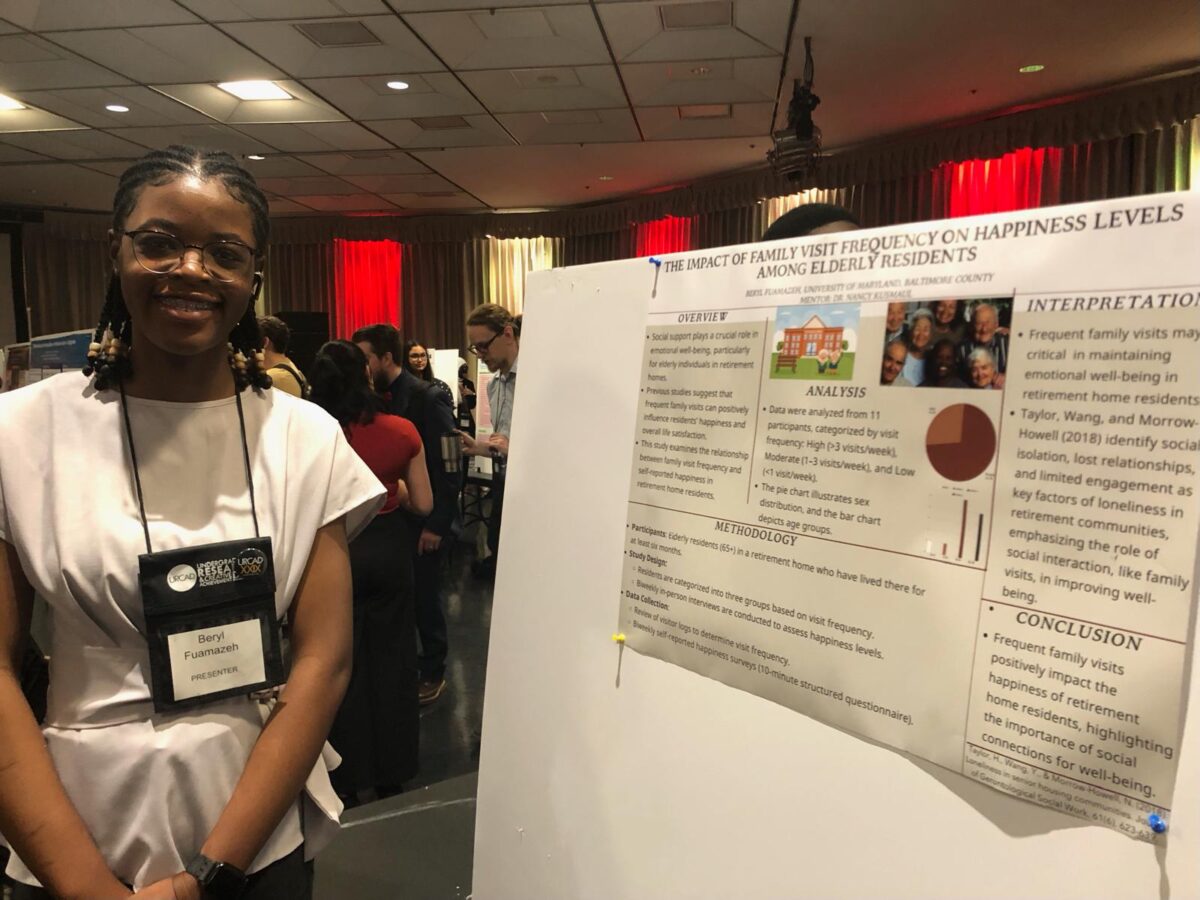
Right: Fuamazeh next to her poster at URCAD 2025.
Q: Tell us about the people who are helping you grow at UMBC.
A: Dr. Nancy Kusmaul has been incredibly instrumental in helping me grow at UMBC. She helped me kickstart my undergraduate research journey, which initially felt very daunting. All it took was reaching out to her by email, and she was immediately supportive and responsive. She took time out of her busy schedule to help me develop an individualized research study focused on aging, a topic that has become deeply meaningful to me and the communities it impacts.
Q: How have you connected with the community?
A: I have been involved in community programs, like volunteering with the Trusted Ride Program at Ascension Saint Agnes Hospital, which supports older adults and individuals with disabilities by helping them get to medical appointments safely. Experiences like this have allowed me to stay connected to the community while pursuing my interests in healthcare and aging.
Q: What would you tell others who are in your shoes about UMBC?
A: I transferred to UMBC from the Community College of Baltimore County, and through scholarships and financial support, including merit-based awards, UMBC helped ease the financial burden of pursuing higher education, which allowed me to focus more on my academics and future goals. I also felt well supported as a transfer student through the Degrees to Succeed program, even before officially transferring to UMBC. The transition felt smooth, and I always felt like there were people willing to help guide me along the way.
UMBC’s greatest strength is its people. When people meet Retrievers and hear about the passion they bring, the relationships they create, the ways they support each other, and the commitment they have to inclusive excellence, they truly get a sense of our community. That’s what “Meet a Retriever” is all about.
Learn more about how UMBC can help you achieve your goals.
]]>
Beryl Fuamazeh ’26, biology, and a minor in health, wellness, and aging, is on her way to Howard University College of Medicine. After connecting with Nancy Kusmaul, professor of social work,...
https://umbc.edu/stories/meet-a-retriever-beryl-fuamazeh-aging-care/
https://my3.my.umbc.edu/api/v0/pixel/news/160752/guest@my.umbc.edu/8b4bf215522e0179499e5c60c5bc173d/api/pixel
aging-studies
alumni
cnms
erickson-school
meet-a-retriever
perspectives
social-work
story
urcad
UMBC News & Magazine
https://my3.my.umbc.edu/groups/umbc-news-magazine
https://assets1-my.umbc.edu/system/shared/avatars/groups/000/001/943/24435aa6207c452e7bc15cc74b42c7bb/xsmall.png?1748556657
https://assets1-my.umbc.edu/system/shared/avatars/groups/000/001/943/24435aa6207c452e7bc15cc74b42c7bb/original.png?1748556657
https://assets2-my.umbc.edu/system/shared/avatars/groups/000/001/943/24435aa6207c452e7bc15cc74b42c7bb/xxlarge.png?1748556657
https://assets2-my.umbc.edu/system/shared/avatars/groups/000/001/943/24435aa6207c452e7bc15cc74b42c7bb/xlarge.png?1748556657
https://assets3-my.umbc.edu/system/shared/avatars/groups/000/001/943/24435aa6207c452e7bc15cc74b42c7bb/large.png?1748556657
https://assets1-my.umbc.edu/system/shared/avatars/groups/000/001/943/24435aa6207c452e7bc15cc74b42c7bb/medium.png?1748556657
https://assets2-my.umbc.edu/system/shared/avatars/groups/000/001/943/24435aa6207c452e7bc15cc74b42c7bb/small.png?1748556657
https://assets1-my.umbc.edu/system/shared/avatars/groups/000/001/943/24435aa6207c452e7bc15cc74b42c7bb/xsmall.png?1748556657
https://assets2-my.umbc.edu/system/shared/avatars/groups/000/001/943/24435aa6207c452e7bc15cc74b42c7bb/xxsmall.png?1748556657
UMBC News & Magazine
1
0
false
Wed, 17 Jun 2026 15:25:50 -0400
Wed, 17 Jun 2026 15:25:50 -0400
Meet a Retriever—Balmory Moran ’24 drew on his history major to coach his youth soccer team to league championships
Balmory Moran II ’24, history, used to describe himself as a soccer player above all else. The soccer field and his team were where he felt most at home. In high school, an injury ended his hopes of playing at the collegiate level, and doubts about his future settled in until he met Joe Thompson, a professor of history and political science at Montgomery College (MC), and Andrew Nolan, teaching professor of history at UMBC. They instilled in him a passion for history, and their support helped him transfer to UMBC as a history major, where he learned not only about the past but also interpersonal and mentorship skills that he now puts to practice every day as a coach for the Latino Youth Development Program in Rockville, Maryland.
As a coach, Balmory imparts performance strategies and techniques to middle school and high school students in the program while also emphasizing essential team skills such as collaboration, active listening, empathy, and accountability, both on and off the field. This strategy led the team to win the league championship in fall 2025.
After years of coaching and time away from the classroom, Balmory is ready to balance soccer and the classroom once again as he begins applying to a master’s in social work. He credits his sister, Alexandra Moran ’15, social work, a current social worker, for the inspiration to join the field. Take it away, Balmory!
Q: What was your journey to UMBC?
A: I began my undergraduate experience at MC. I was a bit lost, and I didn’t know what I wanted to do, but Professor Thompson changed all that. I had a 200-level U.S. history class with him. He made our class so entertaining, enticing, and interesting at both a personal and an academic level. It really showed me that history didn’t have to be boring or slow.
After seeing how attentive I was in his classes, he encouraged me to pursue a degree in history. Professor Thompson showed me multiple examples of students in different fields of work with a history degree. It prompted me to take more history classes at MC, which laid the foundation for studying history at UMBC.
I made my way to UMBC after Professor Nolan visited MC multiple times to talk to students about life as a history major at UMBC and the careers it could lead to after graduation. He also explained the many ways UMBC would further nurture my academic aspirations. I was so involved with the history program at MC that it felt like a natural next step to continue my undergrad degree in history at UMBC.
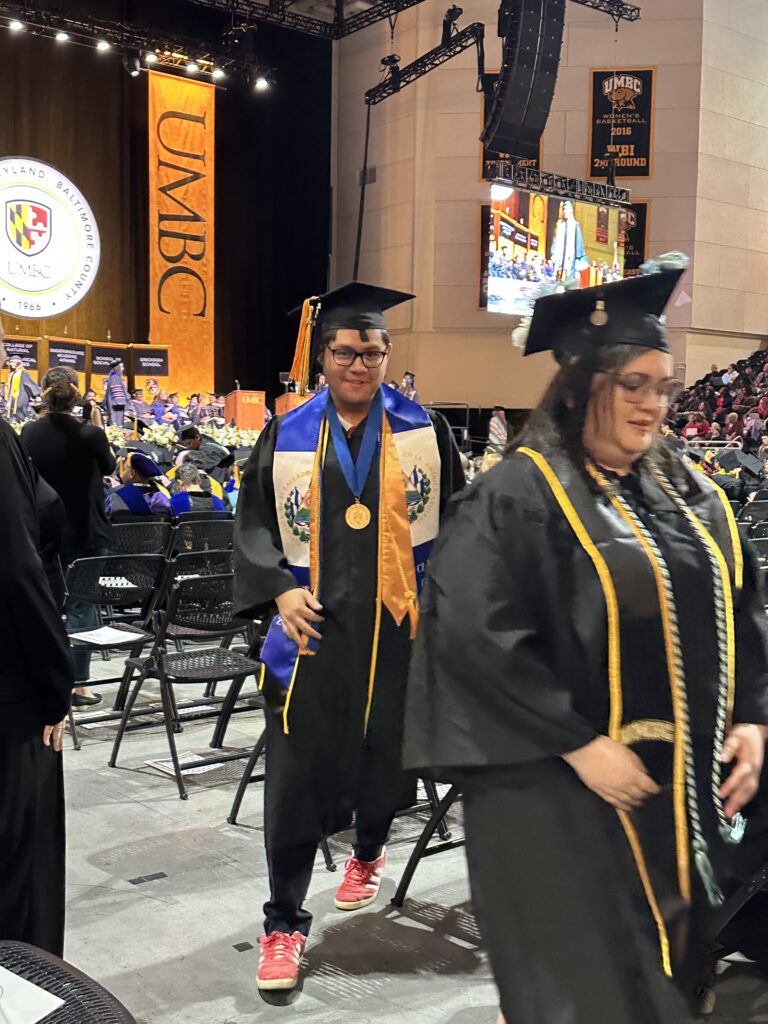
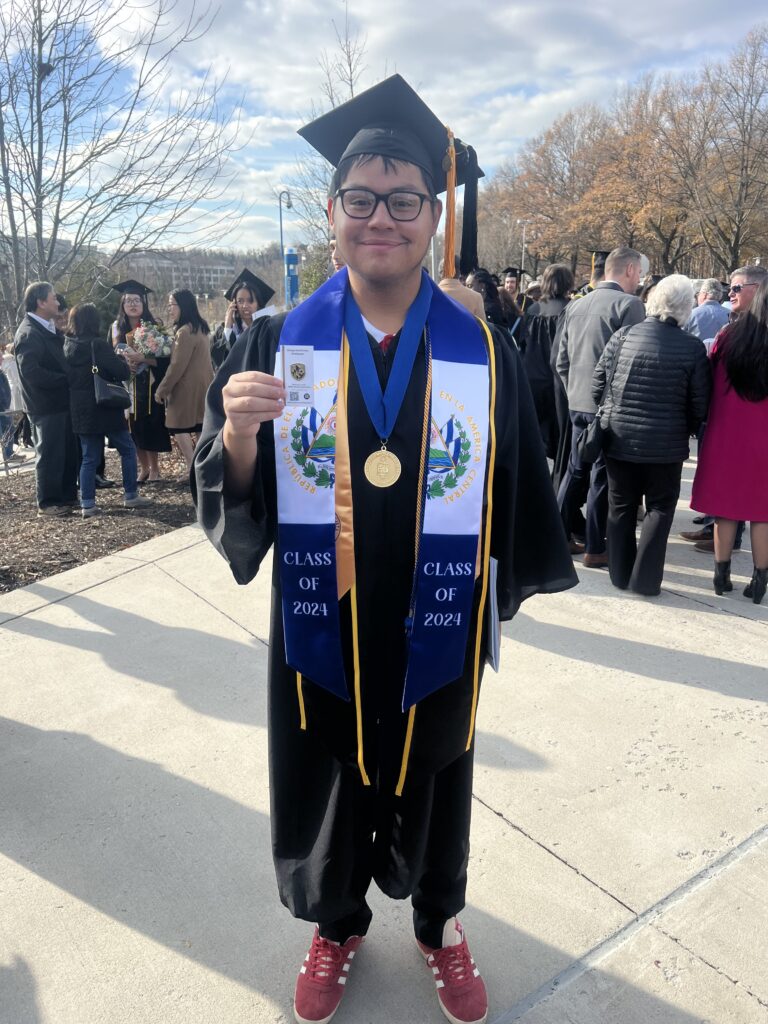 Moran at his 2024 graduation from UMBC.
Q: What was your experience studying history at UMBC?
A: Once at UMBC, I dove into the multitude of classes on aging, women’s studies, sociology, and, of course, history, which all helped me gain a better understanding and appreciation for the communities I grew up alongside. I learned that there was a history of pretty much everything, as long as there was some interest. So many people think history is just old people in wigs, but it’s everywhere, from political history to sports history. There is always a story to be told as long as someone is willing to listen and learn.
Q: Who in the UMBC community has inspired you or supported you?
A: The last two years have really pushed me to be the best version of myself in my work as well as my mentorship. I’ve learned from Melissa Blair, associate teaching professor of history, as well as other professors throughout the history department, how to approach different types of students. These lessons have helped me teach these young men right from wrong in ways that they can understand.
UMBC gave me the tools to be creative in how I tackle challenges and debates with my players. I guide players by equipping them with the tools to grow and improve, as Blair and other professors supported me in the classroom, rather than stepping in.
So many people think history is just old people in wigs, but it’s everywhere, from political history to sports history. There is always a story to be told as long as someone is willing to listen and learn. —Balmory Moran ’24
Q: Is there a concept you learned in your classes at UMBC that is applicable outside of the classroom?
A: The professors I had at UMBC showed me that there are many ways to get important information across that don’t feel like a lecture. They taught me how to be an effective problem-solver. These lessons were within a history class setup, but felt applicable to how I wanted to coach and mentor my players. So many people get the wrong idea when they hear the term “history degree.” It’s not just about curating museums and lecturing. It is also about what makes us who we are, helps us understand where we come from, and what values we hold onto.
* * * * *
UMBC’s greatest strength is its people. When people meet Retrievers and hear about the passion they bring, the relationships they create, the ways they support each other, and the commitment they have to inclusive excellence, they truly get a sense of our community. That’s what Meet a Retriever is all about.
Learn more about how UMBC can help you achieve your goals and the UMBC History Department’s programs and faculty.
]]>
Balmory Moran II ’24, history, used to describe himself as a soccer player above all else. The soccer field and his team were where he felt most at home. In high school, an injury ended his hopes...
https://umbc.edu/stories/balmory-moran-uses-history-major-to-coach-youth/
Video Preview
https://assets3-my.umbc.edu/system/shared/attachments/c0898230a21371692ac517e436724e27/6a95cb20/news/000/160/698/77fd1d4f4e2edb4384e207a1ab551f9f/ENkc1G1ZZCw.jpg?1781549406
https://my3.my.umbc.edu/api/v0/pixel/news/160698/guest@my.umbc.edu/15a3d9b0ded499cefe0c1446285fb89c/api/pixel
alumni
cahss
history
impact
meet-a-retriever
perspectives
story
transfer-students
UMBC News & Magazine
https://my3.my.umbc.edu/groups/umbc-news-magazine
https://assets1-my.umbc.edu/system/shared/avatars/groups/000/001/943/24435aa6207c452e7bc15cc74b42c7bb/xsmall.png?1748556657
https://assets1-my.umbc.edu/system/shared/avatars/groups/000/001/943/24435aa6207c452e7bc15cc74b42c7bb/original.png?1748556657
https://assets2-my.umbc.edu/system/shared/avatars/groups/000/001/943/24435aa6207c452e7bc15cc74b42c7bb/xxlarge.png?1748556657
https://assets2-my.umbc.edu/system/shared/avatars/groups/000/001/943/24435aa6207c452e7bc15cc74b42c7bb/xlarge.png?1748556657
https://assets3-my.umbc.edu/system/shared/avatars/groups/000/001/943/24435aa6207c452e7bc15cc74b42c7bb/large.png?1748556657
https://assets1-my.umbc.edu/system/shared/avatars/groups/000/001/943/24435aa6207c452e7bc15cc74b42c7bb/medium.png?1748556657
https://assets2-my.umbc.edu/system/shared/avatars/groups/000/001/943/24435aa6207c452e7bc15cc74b42c7bb/small.png?1748556657
https://assets1-my.umbc.edu/system/shared/avatars/groups/000/001/943/24435aa6207c452e7bc15cc74b42c7bb/xsmall.png?1748556657
https://assets2-my.umbc.edu/system/shared/avatars/groups/000/001/943/24435aa6207c452e7bc15cc74b42c7bb/xxsmall.png?1748556657
UMBC News & Magazine
1
0
false
Mon, 15 Jun 2026 14:40:35 -0400
Mon, 15 Jun 2026 14:40:35 -0400
Meet a Retriever—Hailey Turney, M.A. ’21, a COEIT academic advisor who’s found a trusted team to rely on
Hailey Turney, M.A. ’21, first came to UMBC as a student pursuing an academic passion in the text, technologies, and literature program. She connected right away with faculty and other community members. Now, as an undergraduate academic advisor in the College of Engineering and Information Technology and an instructor teaching introductory English and university orientation classes, she helps current UMBC connect and find their own path, too.
Hailey shares what she loves about UMBC and her advising job. Take it away, Hailey!
Q: Tell us about yourself.
A: I am a COEIT academic advisor. I mostly work with mechanical engineering students now. I also teach a section of ENGL 100 each semester and UNIV 101 in the fall semesters. I love being able to help students and engage in my community, so advising and teaching feels like a great way to reach students on different levels.
When I was an undergrad, I did not have the best advising experience, so being able to make a difference as an advisor now feels like an interesting, but great, twist of fate. I also like to play Volo soccer in Baltimore and do Dog’s Day Out at BARCS outside of work!
Q: Who are some of the people at UMBC who have most supported you?
A: My amazing boss Emily Abrams-Stephens is spectacular. She supports me and my fellow advisors every day. She is always advocating for us and showing us how much she cares everyday. Working with her, I never doubt that I am valued here. She always listens to our ideas and is a fantastic (and popular) morning chat partner.
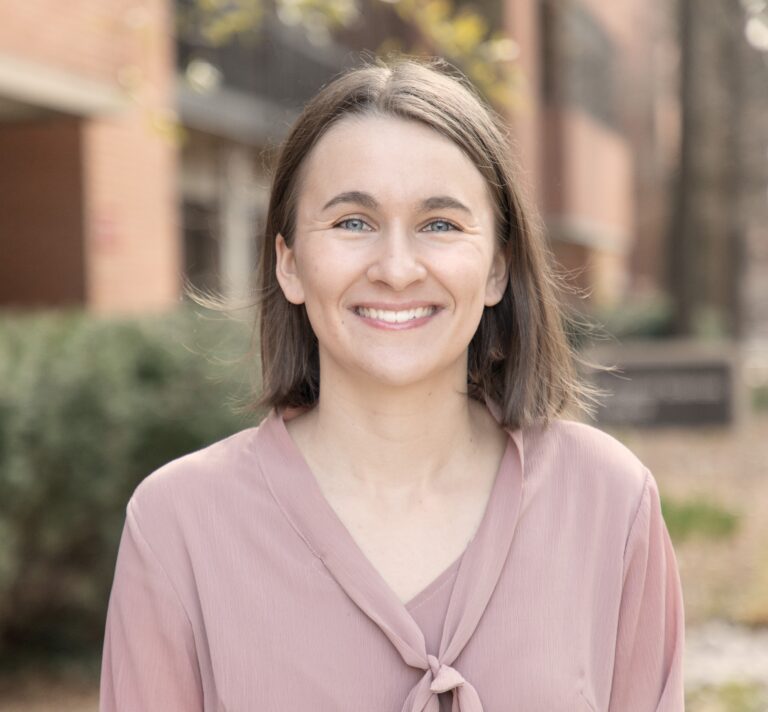
I had a previous job that weighed on me every minute of the day—even outside of work. I missed the activities I loved to do because of it. At UMBC, I have a trusting team—my boss and my fellow advisors—that supports me. If I am ever away, I know my students will be taken care of by my colleagues. The trust I have in my team is something I will never be able to replace. The most remarkable thing about UMBC is the people.
Q: What’s the one thing you’d want someone who hasn’t joined the UMBC community to know about the support you find here?
A: There will always be someone in your corner. I did my master’s here and it was the first time I immediately felt seen in my academic career. When I came to work here, I immediately felt wanted and supported. There are so many resources available to the UMBC community and there is always someone there to help you find them. As an advisor, it is now my job and honor to help students find those resources and their own supporting community.
 Hailey Turney (center) laughs with Assistant Director of Transfer Success Initiatives Krista Wallace at the 2024 COEIT Celebration. (Photo courtesy of Turney)
Q: What part of your job do you enjoy the most and why?
A: I love interacting with students and helping them find their way. Being that person that they can turn to when they don’t know where to go is the most important part of our job. We want students to succeed and feel secure in their place here at UMBC.
Q: What brought you to UMBC in the first place?
A: I came to UMBC because I wanted to expand my knowledge on a topic I was passionate about. The faculty in the English department had so many interesting areas of study that I knew I would be well-supported in finding my own. After meeting with some faculty members for a graduate assistantship, I felt hopeful that this would be an interactive community. The faculty responded to my emails right away, were interested in what I had to say, and were encouraging from the beginning. I came for the academics and stayed for the community. This continued as I found a job here at UMBC as well—I was hesitant to leave.
Q: What would you tell someone who is considering a career at UMBC?
A: You will find a great community here. You will also find ways to continue to improve and learn no matter where you end up.
* * * * *
UMBC’s greatest strength is its people. When people meet Retrievers and hear about the passion they bring, the relationships they create, the ways they support each other, and the commitment they have to inclusive excellence, they truly get a sense of our community. That’s what “Meet a Retriever” is all about.
Learn more about how UMBC can help you achieve your goals.
]]>
Hailey Turney, M.A. ’21, first came to UMBC as a student pursuing an academic passion in the text, technologies, and literature program. She connected right away with faculty and other community...
https://umbc.edu/stories/meet-a-retriever-hailey-turney-coeit-advisor/
https://my3.my.umbc.edu/api/v0/pixel/news/160430/guest@my.umbc.edu/da776ba878d2262d39dfe97a4983ea50/api/pixel
alumni
cahss
coeit
impact
magazine
meet-a-retriever
perspectives
spring-2026
story
UMBC News & Magazine
https://my3.my.umbc.edu/groups/umbc-news-magazine
https://assets1-my.umbc.edu/system/shared/avatars/groups/000/001/943/24435aa6207c452e7bc15cc74b42c7bb/xsmall.png?1748556657
https://assets1-my.umbc.edu/system/shared/avatars/groups/000/001/943/24435aa6207c452e7bc15cc74b42c7bb/original.png?1748556657
https://assets2-my.umbc.edu/system/shared/avatars/groups/000/001/943/24435aa6207c452e7bc15cc74b42c7bb/xxlarge.png?1748556657
https://assets2-my.umbc.edu/system/shared/avatars/groups/000/001/943/24435aa6207c452e7bc15cc74b42c7bb/xlarge.png?1748556657
https://assets3-my.umbc.edu/system/shared/avatars/groups/000/001/943/24435aa6207c452e7bc15cc74b42c7bb/large.png?1748556657
https://assets1-my.umbc.edu/system/shared/avatars/groups/000/001/943/24435aa6207c452e7bc15cc74b42c7bb/medium.png?1748556657
https://assets2-my.umbc.edu/system/shared/avatars/groups/000/001/943/24435aa6207c452e7bc15cc74b42c7bb/small.png?1748556657
https://assets1-my.umbc.edu/system/shared/avatars/groups/000/001/943/24435aa6207c452e7bc15cc74b42c7bb/xsmall.png?1748556657
https://assets2-my.umbc.edu/system/shared/avatars/groups/000/001/943/24435aa6207c452e7bc15cc74b42c7bb/xxsmall.png?1748556657
UMBC News & Magazine
2
0
false
Fri, 29 May 2026 14:22:58 -0400
Fri, 29 May 2026 14:22:58 -0400
Meet a Retriever—Manpreet Suri ’14, M.S. ’15 is an entrepreneur and digital tool builder
Meet Manpreet Suri ’14, M.S. ’15, information systems, an entrepreneur, digital solutions problem solver, McNair Scholar, and a member of the Alumni Association Board of Directors. Suri found a community of support during his time at UMBC, and he credits his professors and UMBC Assistant Vice Provost and Assistant Dean Laila Shishineh for challenging him to meet his full potential. In his work, he finds fulfillment in building tools that make someone’s day easier and more efficient.
Q: What brought you to UMBC?
A: I wanted to be in a place where I wouldn’t get lost in the crowd—a place where I could learn, be challenged, and be supported. UMBC offered all of that, plus a community that genuinely cared about who I was becoming.
Q: What would you want another Retriever to know about you?
A: I recently joined Asurion as a group product manager on the Enterprise Client Experience team. At Asurion, I lead product strategy for tools that support the end-to-end experience of Fortune 500 partners and their customers, from digital onboarding to service delivery. I am a two-time master’s graduate, having earned my first degree at UMBC and my second at the University of Florida’s Warrington College of Business while working full time. My journey blends entrepreneurship, real estate, and digital innovation, always with a focus on solving real-world problems through community-driven solutions.
Q: What’s the one thing you’d want someone who hasn’t joined the UMBC community to know about the support you find here?
A: You’re never alone here. Whether it’s faculty, peers, or alumni—someone always shows up for you, challenges you to grow, and reminds you that your ideas and voice matter.
Left: Suri during his McNair Summer Research Fellowship designing a hardware-software prototype: a wearable Braille-based device for the visually impaired.
Q: Tell us about someone in the UMBC community who has inspired you or supported you, and how they did it.
A: Dr. Laila Shishineh encouraged me to merge my technical background with my passion for supporting others. Her mentorship helped me take risks, try new experiences, and believe that innovation can start in the classroom.
Dr. Shishineh was my Summer Bridge mentor and had an enormous influence on both my personal and professional trajectory. She encouraged me to take on extra credits early, accelerating my progress and building my confidence, and pushed me to get involved beyond the classroom—to form meaningful connections, volunteer, and embrace opportunities I otherwise might have overlooked.
With that encouragement, I joined the Refugee Youth Project through the Shriver Center, which eventually helped me connect with recruiters at General Electric. She supported my interest in becoming a resident assistant in the Discovery Scholars Living-Learning Community, and she constantly encouraged me to step into leadership roles, attend retreats like STRiVE, and explore other parts of campus life, including student government and community service.
 Suri at the McNair Scholars induction ceremony in 2012.
Her mentorship came at a time when I was navigating unfamiliar territory as a first-generation student. My parents didn’t go to college, so having someone who believed in me, challenged me, and celebrated my wins made an enormous difference. She even supported me in applying to the McNair Scholars Program and helped me think about potential future paths in tech.
In so many ways, Laila was the single most influential person in my college journey—a steady source of humor, enthusiasm, and encouragement. I truly wouldn’t be where I am today without her.
Q: Tell us about what you loved about your academic program at UMBC.
A: The information systems program provided a powerful blend of technical skills and practical application. What I appreciated most was how interdisciplinary it felt—it taught me to think not just about technology itself, but about the people, systems, and structures that surround it. That balance shaped the way I approach product management and innovation today.
My professors saw potential I didn’t see in myself. They helped me land my first internships, encouraged me to explore entrepreneurship, and taught me that curiosity and kindness are just as important as credentials.
Manpreet Suri '14, M.S. '15
Q: How did UMBC foster your interest in entrepreneurship?
A: My interest in entrepreneurship definitely sparked while at UMBC. While in Dr. Shaun Kane’s Prototyping and Design Lab I worked on a wearable Braille-based device for users with visual impairments. That was my first real experience with human-centered technology design. That project ultimately became the foundation of my McNair Scholars research and showed me how innovation and empathy can come together to solve real-world problems. It planted the seed for the entrepreneurial mindset I carry with me today.
Q: Since joining the UMBC community, in what ways have you felt supported and experienced personal growth?
A: My professors saw potential I didn’t see in myself. They helped me land my first internships, encouraged me to explore entrepreneurship, and taught me that curiosity and kindness are just as important as credentials.
Dr. Kimberly R. Moffitt remains one of the most memorable and impactful professors I’ve had in any academic setting. Her classes pushed me to consider identity, community, and social systems in ways I never had before. She introduced me to a world of nonfiction that I didn’t realize I’d been missing, and the discussions in her classroom helped balance the technical focus of my information systems coursework.
Her teaching style—thoughtful, engaging, and deeply human—broadened my perspective and made my overall academic experience richer and more holistic. I’m still grateful for the lasting impact her classes had on how I view people and the world.
Q: What’s your favorite thing about being a part of Retriever Nation?
A: Retriever Nation is about hustle, heart, and humility. I love how UMBC fosters change makers who don’t just talk about impact, they do the work and bring others with them.
Right: Suri as an undergraduate student at a skydiving experience during his summer internship with GE Aviation.
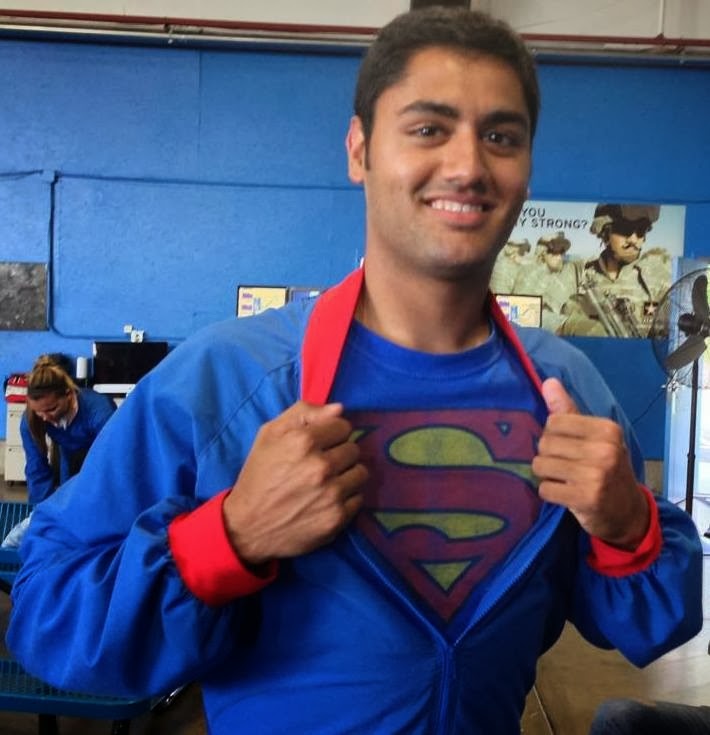
Q: What drives you to support UMBC?
A: UMBC changed the trajectory of my life. Giving back is my way of paying it forward—especially to programs that support first-generation students and innovators who just need a chance to be seen and supported. I’ll always be proud to support and be part of a community that shows up for people the way UMBC showed up for me.
UMBC’s greatest strength is its people. When people meet Retrievers and hear about the passion they bring, the relationships they create, the ways they support each other, and the commitment they have to inclusive excellence, they truly get a sense of our community. That’s what “Meet a Retriever” is all about.
Learn more about how UMBC can help you achieve your goals.
]]>
Meet Manpreet Suri ’14, M.S. ’15, information systems, an entrepreneur, digital solutions problem solver, McNair Scholar, and a member of the Alumni Association Board of Directors. Suri found a...
https://umbc.edu/stories/meet-a-retriever-manpreet-suri-entrepreneur/
https://my3.my.umbc.edu/api/v0/pixel/news/156274/guest@my.umbc.edu/d5724b4c4bb823c631d2b22c6681ee2e/api/pixel
alumni
coeit
is
magazine
mcnair
meet-a-retriever
perspectives
story
trio
UMBC News & Magazine
https://my3.my.umbc.edu/groups/umbc-news-magazine
https://assets1-my.umbc.edu/system/shared/avatars/groups/000/001/943/24435aa6207c452e7bc15cc74b42c7bb/xsmall.png?1748556657
https://assets1-my.umbc.edu/system/shared/avatars/groups/000/001/943/24435aa6207c452e7bc15cc74b42c7bb/original.png?1748556657
https://assets2-my.umbc.edu/system/shared/avatars/groups/000/001/943/24435aa6207c452e7bc15cc74b42c7bb/xxlarge.png?1748556657
https://assets2-my.umbc.edu/system/shared/avatars/groups/000/001/943/24435aa6207c452e7bc15cc74b42c7bb/xlarge.png?1748556657
https://assets3-my.umbc.edu/system/shared/avatars/groups/000/001/943/24435aa6207c452e7bc15cc74b42c7bb/large.png?1748556657
https://assets1-my.umbc.edu/system/shared/avatars/groups/000/001/943/24435aa6207c452e7bc15cc74b42c7bb/medium.png?1748556657
https://assets2-my.umbc.edu/system/shared/avatars/groups/000/001/943/24435aa6207c452e7bc15cc74b42c7bb/small.png?1748556657
https://assets1-my.umbc.edu/system/shared/avatars/groups/000/001/943/24435aa6207c452e7bc15cc74b42c7bb/xsmall.png?1748556657
https://assets2-my.umbc.edu/system/shared/avatars/groups/000/001/943/24435aa6207c452e7bc15cc74b42c7bb/xxsmall.png?1748556657
UMBC News & Magazine
0
0
false
Thu, 05 Feb 2026 14:52:43 -0500
Thu, 05 Feb 2026 14:52:43 -0500
Meet a Retriever—Rishi Nixon, Honors College senior, Parkinson’s researcher, and performing storyteller
Rishi Nixon, a senior biological sciences major and member of the Honors College, brings a kaleidoscope of interests and skills to his time at UMBC after transferring from Montgomery College. He’s been a performing storyteller for more than 10 years, originally with his 4-H youth club and now independently. Nixon conducts research on Parkinson’s disease at the University of Maryland School of Medicine and plans to pursue a medical degree after UMBC.
Q: Tell us about someone in the UMBC community who has inspired or supported you.
A: Meeting Kendyl Walker, my honors college advisor, on my first day of classes made UMBC feel like home. Especially coming into this new environment after leaving my community college—she met me where I was on day one and continues to make me feel supported every time we meet.
Q: Tell us about what you love about your academic program or an organization you’re involved in.
A: My honors college seminar on race, poverty, and gender in Baltimore, taught by Dr. Jodi Kelber-Kaye (“Dr. K.”) opened my eyes to issues facing the city and was one of my most impactful UMBC courses. It helped cut through the ways the city is sometimes talked about in Maryland politics, emphasizing the importance of funding programs that help lift up Baltimore.
This past summer, I had the opportunity to complete a second seminar with Dr. K: an applied community service experience at a nonprofit organization in the city called Moveable Feast, which helps deliver medically-tailored meals to Baltimore residents experiencing food insecurity.
In August 2025, I engaged with the city for the first time in my capacity as a performing storyteller. I performed at the Irvington Peace Park for an annual summer camp organized by Cynthia Wagner, teaching professor in biological sciences, for youth who live in her West Baltimore community. The peace park—a beautiful space built by community members from clearing a vacant lot—was a magical site for the camp, and the kids were a wonderful audience.
Photo right: Rishi Nixon at the National Storytelling Conference in Georgia with the vice chair and vice chair-elect of the board of the National Storytelling Network.

Q: What’s the one thing you’d want someone who hasn’t joined the UMBC community to know about it?
A: Something Dr. K. said once sums it up: “UMBC is a small town.” I see UMBC as a really welcoming place for students who are comfortable leaning on their advisors, mentors, and supporters. It’s very comforting to see faces you recognize each day all over “town.”
Q: What brought you to UMBC?
 Rishi Nixon sits at his lab bench at the University of Maryland School of Medicine, where he conducts Parkinson’s research.
A: I came to UMBC because of its excellent reputation for undergraduate teaching and scientific research opportunities, but also to maintain the small-town feeling and one-on-one learning I received at Montgomery College.
Now that I’m here, UMBC’s research reputation has proven true. I’ve conducted research at the University of Maryland School of Medicine (UMSOM) and also in my coursework. At UMSOM, I study a neuron protein called proSAAS that helps unclump misfolded proteins in the brain that are responsible for neuron death in Parkinson’s disease.
And in my Experimental Biology Lab course, taught by Dr. Tracy Smith, associate teaching professor in biological sciences, I got to participate in ecological research. We visited on-campus sections of the West Branch of Herbert Run to measure the diversity of macroinvertebrates (e.g. fly larvae, water beetles, etc.). We collected them from the stream bed, logged their abundance and the number of types of organisms, and drew a conclusion about the stream’s overall health and pollution levels based on an index of biodiversity levels associated with different degrees of stream health.
Our calculations determined that the stream is very healthy, which is probably a result of UMBC and the Chesapeake and Atlantic Coastal Bays Trust Fund investing in restoring the streams. In fact, the most abundant species of macroinvertebrate we found (damselfly larvae), are actually sensitive to pollutants, yet they were thriving in campus streams when we surveyed in September 2025.
Q: How has UMBC supported your “why”?
A: UMBC’s Honors College has been core to supporting my “why.” They have been huge supporters in connecting me with opportunities for research, and their seminars are excellent for deep one-on-one learning in very niche areas (e.g., Dr. K. and Baltimore). It’s hard for me to imagine my UMBC experience without the Honors College. Its staff and programming helped deepen my existing interests, including pursuing service in Baltimore after my coursework on the city and taking a seminar in neuroscience after conducting research in neurobiology.
Q: What would you tell other transfer students about UMBC?
A: I would encourage other transfer students to apply to the Honors College—I think the small class sizes and the one-on-one advising preserve a similar experience at community colleges. I am also very grateful that UMBC is able to provide generous merit scholarships to support transfer students coming from honors programs at Maryland community colleges.
]]>
Rishi Nixon, a senior biological sciences major and member of the Honors College, brings a kaleidoscope of interests and skills to his time at UMBC after transferring from Montgomery College. He’s...
https://umbc.edu/stories/meet-a-retriever-rishi-nixon-honors-college/
https://my3.my.umbc.edu/api/v0/pixel/news/153825/guest@my.umbc.edu/984747be35e4a4a8a35b1a7c85606166/api/pixel
biology
cahss
campus-life
cnms
community
gwst
honors-college
magazine
perspectives
story
transfer-students
undergradresearch
UMBC News & Magazine
https://my3.my.umbc.edu/groups/umbc-news-magazine
https://assets1-my.umbc.edu/system/shared/avatars/groups/000/001/943/24435aa6207c452e7bc15cc74b42c7bb/xsmall.png?1748556657
https://assets1-my.umbc.edu/system/shared/avatars/groups/000/001/943/24435aa6207c452e7bc15cc74b42c7bb/original.png?1748556657
https://assets2-my.umbc.edu/system/shared/avatars/groups/000/001/943/24435aa6207c452e7bc15cc74b42c7bb/xxlarge.png?1748556657
https://assets2-my.umbc.edu/system/shared/avatars/groups/000/001/943/24435aa6207c452e7bc15cc74b42c7bb/xlarge.png?1748556657
https://assets3-my.umbc.edu/system/shared/avatars/groups/000/001/943/24435aa6207c452e7bc15cc74b42c7bb/large.png?1748556657
https://assets1-my.umbc.edu/system/shared/avatars/groups/000/001/943/24435aa6207c452e7bc15cc74b42c7bb/medium.png?1748556657
https://assets2-my.umbc.edu/system/shared/avatars/groups/000/001/943/24435aa6207c452e7bc15cc74b42c7bb/small.png?1748556657
https://assets1-my.umbc.edu/system/shared/avatars/groups/000/001/943/24435aa6207c452e7bc15cc74b42c7bb/xsmall.png?1748556657
https://assets2-my.umbc.edu/system/shared/avatars/groups/000/001/943/24435aa6207c452e7bc15cc74b42c7bb/xxsmall.png?1748556657
UMBC News & Magazine
0
0
false
Wed, 22 Oct 2025 16:21:36 -0400
Wed, 22 Oct 2025 16:21:36 -0400
Meet a Retriever—Meagan Wade ’13, goes above and beyond to make students feel welcome and engaged
Meet Meagan Wade ’13, psychology, the program coordinator for the Department of Information Systems. Part of Meagan’s job is planning professional development and social events for IS students. She’s organized standing-room-only talks with tech leaders, game nights with pizzas and snacks, resume workshops and job search training, and more. She’s loving it all—and shares why she’s so happy she returned to her alma mater as a staff member.
Q: How did you start working in higher ed?
A: I graduated from UMBC in 2013 with a B.A. in psychology and a minor in social welfare. I then graduated from Towson University with a M.A. in teaching for elementary education in 2016. I worked as an elementary teacher for four years before switching gears and finding a job in higher education.
Q: Tell us about someone in the community who has supported you, and how they did it.
A: Dwayne Butcher, assistant director of marketing for the IS department, has been an awesome supporter of me since I started back in October 2024. He has been a great mentor for the marketing aspects of my job, and an amazing supporter of my career growth, for example, by encouraging me to attend conferences.
I love that the department has essentially given me free reign to plan whatever events for IS students that I think will get them engaged in the community and help to prepare them for their careers post-graduation from UMBC.
Q: What part of your job do you enjoy the most and why?
A: My favorite part of my job has been planning events that students enjoy attending—such as our game night events; and planning events that will help students in their career journeys—such as the Career Talk series I planned this fall. Each week we host a different panel of tech industry professionals, with themes such as women in tech and the gaming industry, and company-specific events with Oracle, The Trevor Project, and more.


Wade organizes student events for the IS department throughout the year, including a Women in Tech Career Talk (left) and the IS department’s Welcome Week (right), complete with a visit from Spot, a robotic dog. (Images courtesy of Wade)
Q: What brought you to UMBC in the first place?
 Wade and her dog Baxter at the Homecoming Puppy Parade in 2024. (Image courtesy of Wade)
A: I originally came to UMBC as a starry-eyed 18-year-old, hoping to figure out what I wanted to do with my life and to make great friends along the way. I chose UMBC for a few different reasons: I’m originally from Towson, so UMBC was just the right distance away from home so that I could still easily visit. Also, my dad is a UMBC alum, and my best friend also ended up going to UMBC, so it felt like a “home away from home” for me, which my anxious freshman self needed at the time.
I’m happy to say that UMBC brought so many amazing people into my life, many of whom I am still friends with to this day. I wouldn’t have wanted to be anywhere other than UMBC because of all the happy memories I made here.
Years later, when I ended up working in higher education, I remembered the awesome culture of UMBC that I experienced as a student, and hoped to “come back home” as a staff member. I applied for a number of jobs at UMBC and am so grateful that the information systems department was willing to give me the opportunity to return to UMBC. Now that I am back, I’m so glad that the welcoming culture I experienced as a student is still here, and I hope to now give current students the opportunity to find their way in the world, just like I did years ago.
Q: Are you involved in any campus organizations?
A: Back when I was a student, I was involved with WMBC, UMBC’s radio station. My friend and I had a radio show called “Cuddlecore,” where we would chat and play our favorite music. I remember loving the seemingly infinite amount of CDs back in the WMBC studio that we were encouraged to listen to and write reviews for.
I was also a Resident Assistant, so I was pretty involved with ResLife. I loved the apartment RA family that we created after spending so many hours together, and all the events that we would do together as RAs, including bowling, dinner parties, and late night trips to Double T Diner.
Since returning as a staff member, I’ve resurrected Cuddlecore. It’s on Wednesdays at 5pm! I’ve also attended UMBC Homecoming and participated in the Puppy Parade with my dog Baxter, which was very fun!
Q: How have you found support and community here?
A: As a UMBC student, the main way that I met amazing people was making connections with classmates in my courses, becoming close with roommates and suitemates in the dorms/apartments, and bonding with my fellow Resident Assistants and other ResLife staff when I worked as an RA.
As a UMBC staff member, I’ve been able to help students find their way in the world by planning awesome events for them to meet other people with similar interests. (I had no idea there’d be so many people interested in Super Smash Brothers, specifically!) I’ve also been able to collaborate with other organizations on campus, such as the Information Systems Security Association (ISSA) student chapter and the Career Center, to plan even more meaningful events for IS students. Because UMBC’s culture is so welcoming, it has been surprisingly easy to reach out to other organizations on campus and plan things together to help UMBC students as a whole.


Wade and fellow apartment RAs bowling (left) and at the end-of-year ResLife banquet (right). (Images courtesy of Wade)
Q: What would you tell someone who is considering a career at UMBC?
A: DO IT! I am so happy that I made the switch to UMBC from my prior higher education institution (although I might be a little biased as a UMBC alum).
* * * * *
UMBC’s greatest strength is its people. When people meet Retrievers and hear about the passion they bring, the relationships they create, the ways they support each other, and the commitment they have to inclusive excellence, they truly get a sense of our community. That’s what “Meet a Retriever” is all about.
Learn more about how UMBC can help you achieve your goals.
]]>
Meet Meagan Wade ’13, psychology, the program coordinator for the Department of Information Systems. Part of Meagan’s job is planning professional development and social events for IS students....
https://umbc.edu/stories/meet-a-retriever-meagan-wade/
https://my3.my.umbc.edu/api/v0/pixel/news/153333/guest@my.umbc.edu/40d209e5cfc5de16fdb17400931cf00e/api/pixel
alumni
cahss
coeit
impact
is
magazine
meetaretriever
perspectives
story
UMBC News & Magazine
https://my3.my.umbc.edu/groups/umbc-news-magazine
https://assets1-my.umbc.edu/system/shared/avatars/groups/000/001/943/24435aa6207c452e7bc15cc74b42c7bb/xsmall.png?1748556657
https://assets1-my.umbc.edu/system/shared/avatars/groups/000/001/943/24435aa6207c452e7bc15cc74b42c7bb/original.png?1748556657
https://assets2-my.umbc.edu/system/shared/avatars/groups/000/001/943/24435aa6207c452e7bc15cc74b42c7bb/xxlarge.png?1748556657
https://assets2-my.umbc.edu/system/shared/avatars/groups/000/001/943/24435aa6207c452e7bc15cc74b42c7bb/xlarge.png?1748556657
https://assets3-my.umbc.edu/system/shared/avatars/groups/000/001/943/24435aa6207c452e7bc15cc74b42c7bb/large.png?1748556657
https://assets1-my.umbc.edu/system/shared/avatars/groups/000/001/943/24435aa6207c452e7bc15cc74b42c7bb/medium.png?1748556657
https://assets2-my.umbc.edu/system/shared/avatars/groups/000/001/943/24435aa6207c452e7bc15cc74b42c7bb/small.png?1748556657
https://assets1-my.umbc.edu/system/shared/avatars/groups/000/001/943/24435aa6207c452e7bc15cc74b42c7bb/xsmall.png?1748556657
https://assets2-my.umbc.edu/system/shared/avatars/groups/000/001/943/24435aa6207c452e7bc15cc74b42c7bb/xxsmall.png?1748556657
UMBC News & Magazine
1
0
false
Tue, 07 Oct 2025 10:39:02 -0400
Tue, 07 Oct 2025 10:39:02 -0400