One photon, a trillion electrons: UMBC physicist Daniel Suárez-Forero explores the quantum frontier
Imagine a material where trillions of electrons are locked in an intricate, collective dance—so tightly choreographed that the tiniest nudge can send ripples across the entire system, transforming its behavior in dramatic ways. Now picture using light—especially the delicate touch of a single photon—to peek inside that dance, understand its hidden steps, and maybe even change the rhythm.
That’s the frontier Daniel Suárez-Forero is exploring at UMBC. He joined the Department of Physics as an assistant professor in August 2025 and leads the Quantum Optics of Correlated Materials group. His experimental approach sits at the intersection of two powerful fields: quantum optics, which studies how light behaves when quantum effects like entanglement come into play (the 2022 Nobel Prize recognized research in this area), and correlated materials, where electrons interact so intensely that they create physics impossible in ordinary conductors or insulators.
By shining quantum light into these strongly interacting systems, his lab aims to reveal quantum behaviors that existing tools can’t see, probe states that have so far been hidden, and help build the foundation for future technologies. His work, featured in two recent papers published in Science and Nature Materials, blends deep questions with real long-term promise, and he’s excited to build his lab here at UMBC.
Q: What will your research group at UMBC focus on, and how has your background prepared you for it?
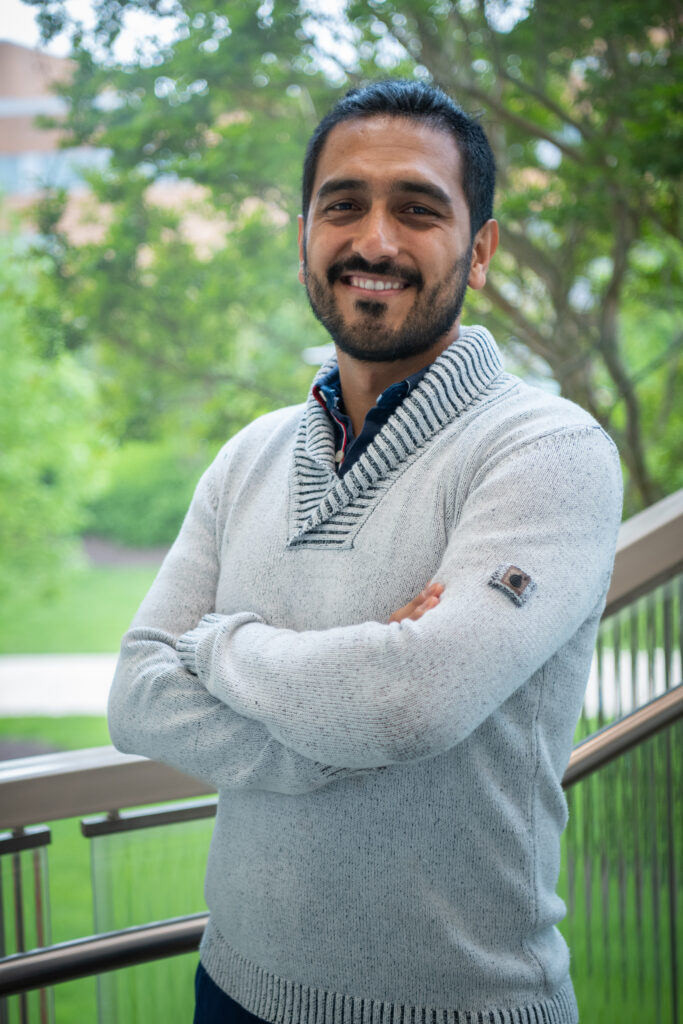 Daniel Suárez-Forero joined the UMBC faculty in 2025 and is already making waves in the physics department. (Brad Ziegler/UMBC)
A: At UMBC, my group will use single photons—the tiniest packets of light—to probe and even gently tweak materials where electrons interact extremely strongly. The exciting goal is to use one photon to affect about a trillion electrons at once: either to reveal hidden quantum details that ordinary tools miss, or to modify the whole material’s behavior with just one particle of light.
My path has been building toward this. In my Ph.D. in Italy, I worked on light-matter hybrids using entangled photons. Then, as a postdoc at the Joint Quantum Institute at the University of Maryland, I dived into these strongly interacting materials. Before joining UMBC, I spent a year in Geneva, Switzerland, learning new experimental techniques that I’m now bringing to campus. The fields of quantum optics and correlated materials had been developing separately, but technology is advancing so that the time is right to bridge them—and that’s what I’ll be doing at UMBC.
What excites me most is the scale: Using one photon to influence a trillion particles could unlock mysteries in these materials and help solve real challenges, like using photons more effectively in quantum computing or creating ultra-sensitive detectors. It’s fundamental science with huge potential for real impact.
Q: How did you choose UMBC and how is your first year going?
A: UMBC made the decision easy. The startup support for my lab’s equipment was strong, and infrastructure from recently retired professors transferred to incoming experimentalists like Geoffrey Diederich, Alex Senichev, and me—creating an excellent setup to build experiments.
Also, the DMV area is a major quantum hub, and Maryland’s initiative to become the “capital of quantum” aligns with UMBC’s Quantum Science Institute, which connects departments across science and engineering to advance quantum from every angle.
 Ph.D. student Nico Rueda-Becerra works with a laser in the Suarez-Forero laboratory. (Courtesy of Daniel Suárez-Forero)
My first year has been wonderful—I’ve gotten tremendous support from the administration, department, and students. I’ve taught graduate quantum mechanics, following the same cohort from their first to second semester. It’s rewarding to watch their understanding and independence grow. I now have one Ph.D. student from Colombia, another starting soon, and two enthusiastic undergrads helping set up the lab. It’s been a positive, exciting start.
Q: What were the key findings from your two recent papers, and how do they relate to your current work?
A: Both papers came from my time as a postdoc and looked at special layered materials where electrons interact very strongly with each other.
In the Science paper, we found something really surprising. Normally, when electrons get “stuck” in place because of their strong interactions (think of them crowding each other so much they can’t move easily), you’d expect other particles in the material to slow down too. But we saw the opposite: Certain particle pairs—made of an excited electron and the empty spot (or “hole”) it left behind—actually moved much faster, about 1,000 times faster than expected! The crowding actually helped these pairs zip around more freely by interfering with their usual tight pairing. It was a “wow” moment that showed how these interactions can lead to unexpected enhanced mobility.
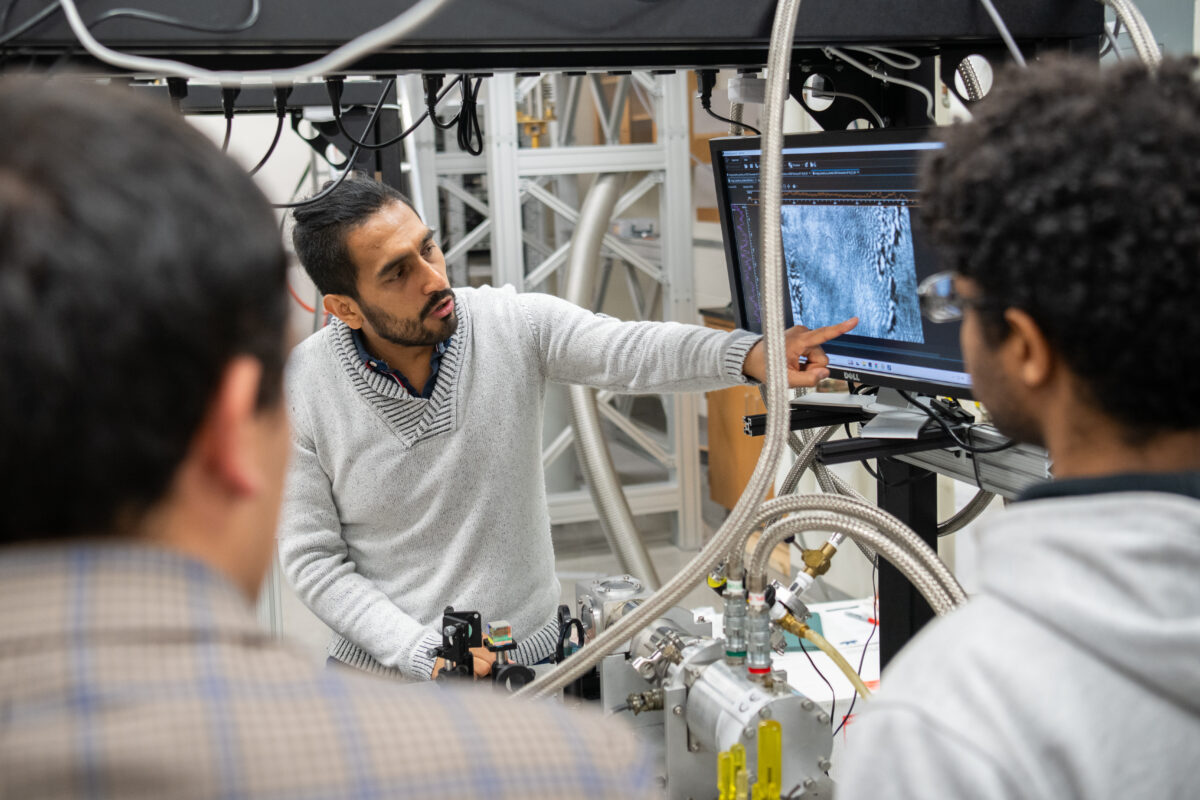 Daniel Suárez-Forero’s group uses complex optics systems to study the properties of correlated materials. Here, he explains the output of one of the research group’s tests. (Brad Ziegler/UMBC)
The Nature Materials paper looked at the flip side: When we shined laser light on the material to create more of those electron-hole pairs, they started lining up neatly all in the same direction—like tiny magnets snapping into alignment. And we could control and reverse this alignment just by turning the light on and off. It’s a way to use light to change how the material behaves, almost like flipping a switch.
These discoveries help us better understand how light and super-strong electron interactions can work together. That’s exactly what sets the stage for my research at UMBC: using single photons to explore or even tweak these materials in new ways—probing hidden details or switching states with just one photon.
Q: What advice do you have for students who are interested in quantum science?
A: If you’re already curious about quantum physics, of course I think that’s a good choice—it’s an exciting field. A Ph.D. can be challenging and involve a lot of failure—like experiments that don’t work—but persistence pays off. Keep digging, stay curious, try different approaches, and don’t get stuck on one path.
If you’re ready to start doing research, choose a group carefully—look at their publications and the tools they use to make sure they match what you’re passionate about. Get hands-on experience early. Quantum is challenging but incredibly rewarding—keep going, and the breakthroughs will eventually come.
 The gold cylinder Suárez-Forero (left) is holding is how samples are loaded into the cryostat instrument for experiments. Suárez-Forero discusses the process with Nico Rueda-Becerra. (Brad Ziegler/UMBC)
]]>
Imagine a material where trillions of electrons are locked in an intricate, collective dance—so tightly choreographed that the tiniest nudge can send ripples across the entire system, transforming...
https://umbc.edu/stories/daniel-suarez-forero-quantum-frontier/
https://my3.my.umbc.edu/api/v0/pixel/news/159598/guest@my.umbc.edu/d9a88a55ac343b89ac739bbddf00a736/api/pixel
cnms
news
physics
research
science-and-tech
story
UMBC News & Magazine
https://my3.my.umbc.edu/groups/umbc-news-magazine
https://assets1-my.umbc.edu/system/shared/avatars/groups/000/001/943/24435aa6207c452e7bc15cc74b42c7bb/xsmall.png?1748556657
https://assets1-my.umbc.edu/system/shared/avatars/groups/000/001/943/24435aa6207c452e7bc15cc74b42c7bb/original.png?1748556657
https://assets2-my.umbc.edu/system/shared/avatars/groups/000/001/943/24435aa6207c452e7bc15cc74b42c7bb/xxlarge.png?1748556657
https://assets2-my.umbc.edu/system/shared/avatars/groups/000/001/943/24435aa6207c452e7bc15cc74b42c7bb/xlarge.png?1748556657
https://assets3-my.umbc.edu/system/shared/avatars/groups/000/001/943/24435aa6207c452e7bc15cc74b42c7bb/large.png?1748556657
https://assets1-my.umbc.edu/system/shared/avatars/groups/000/001/943/24435aa6207c452e7bc15cc74b42c7bb/medium.png?1748556657
https://assets2-my.umbc.edu/system/shared/avatars/groups/000/001/943/24435aa6207c452e7bc15cc74b42c7bb/small.png?1748556657
https://assets1-my.umbc.edu/system/shared/avatars/groups/000/001/943/24435aa6207c452e7bc15cc74b42c7bb/xsmall.png?1748556657
https://assets2-my.umbc.edu/system/shared/avatars/groups/000/001/943/24435aa6207c452e7bc15cc74b42c7bb/xxsmall.png?1748556657
UMBC News & Magazine
2
0
false
Fri, 01 May 2026 16:13:03 -0400
Fri, 01 May 2026 16:13:03 -0400
Connecting NASA to the classroom: UMBC physicist Zhibo Zhang to lead Goddard Planetary Heliophysics Institute
The gold cylinder Suárez-Forero (left) is holding is how samples are loaded into the cryostat instrument for experiments. Suárez-Forero discusses the process with Nico Rueda-Becerra. (Brad Ziegler/UMBC)
]]>
Imagine a material where trillions of electrons are locked in an intricate, collective dance—so tightly choreographed that the tiniest nudge can send ripples across the entire system, transforming...
https://umbc.edu/stories/daniel-suarez-forero-quantum-frontier/
https://my3.my.umbc.edu/api/v0/pixel/news/159598/guest@my.umbc.edu/d9a88a55ac343b89ac739bbddf00a736/api/pixel
cnms
news
physics
research
science-and-tech
story
UMBC News & Magazine
https://my3.my.umbc.edu/groups/umbc-news-magazine
https://assets1-my.umbc.edu/system/shared/avatars/groups/000/001/943/24435aa6207c452e7bc15cc74b42c7bb/xsmall.png?1748556657
https://assets1-my.umbc.edu/system/shared/avatars/groups/000/001/943/24435aa6207c452e7bc15cc74b42c7bb/original.png?1748556657
https://assets2-my.umbc.edu/system/shared/avatars/groups/000/001/943/24435aa6207c452e7bc15cc74b42c7bb/xxlarge.png?1748556657
https://assets2-my.umbc.edu/system/shared/avatars/groups/000/001/943/24435aa6207c452e7bc15cc74b42c7bb/xlarge.png?1748556657
https://assets3-my.umbc.edu/system/shared/avatars/groups/000/001/943/24435aa6207c452e7bc15cc74b42c7bb/large.png?1748556657
https://assets1-my.umbc.edu/system/shared/avatars/groups/000/001/943/24435aa6207c452e7bc15cc74b42c7bb/medium.png?1748556657
https://assets2-my.umbc.edu/system/shared/avatars/groups/000/001/943/24435aa6207c452e7bc15cc74b42c7bb/small.png?1748556657
https://assets1-my.umbc.edu/system/shared/avatars/groups/000/001/943/24435aa6207c452e7bc15cc74b42c7bb/xsmall.png?1748556657
https://assets2-my.umbc.edu/system/shared/avatars/groups/000/001/943/24435aa6207c452e7bc15cc74b42c7bb/xxsmall.png?1748556657
UMBC News & Magazine
2
0
false
Fri, 01 May 2026 16:13:03 -0400
Fri, 01 May 2026 16:13:03 -0400
Connecting NASA to the classroom: UMBC physicist Zhibo Zhang to lead Goddard Planetary Heliophysics Institute
Zhibo Zhang, professor of physics, has been named director of the Goddard Planetary Heliophysics Institute (GPHI), UMBC’s arm of the Partnership for Heliophysics and Space Environment Research (PHaSER). PHaSER, a multi-institution consortium led by Catholic University of America, contributes to NASA’s Heliophysics Science Division at Goddard Space Flight Center (GSFC) through research on the Sun, its processes, and space weather, which can affect planet Earth and human technologies.
NASA allocated $10 million to UMBC in 2021 under its $64.1 million PHaSER award, underscoring the university’s contributions to heliophysics research and building on more than thirty years of successful collaboration between UMBC and GSFC, located in Greenbelt, Maryland.
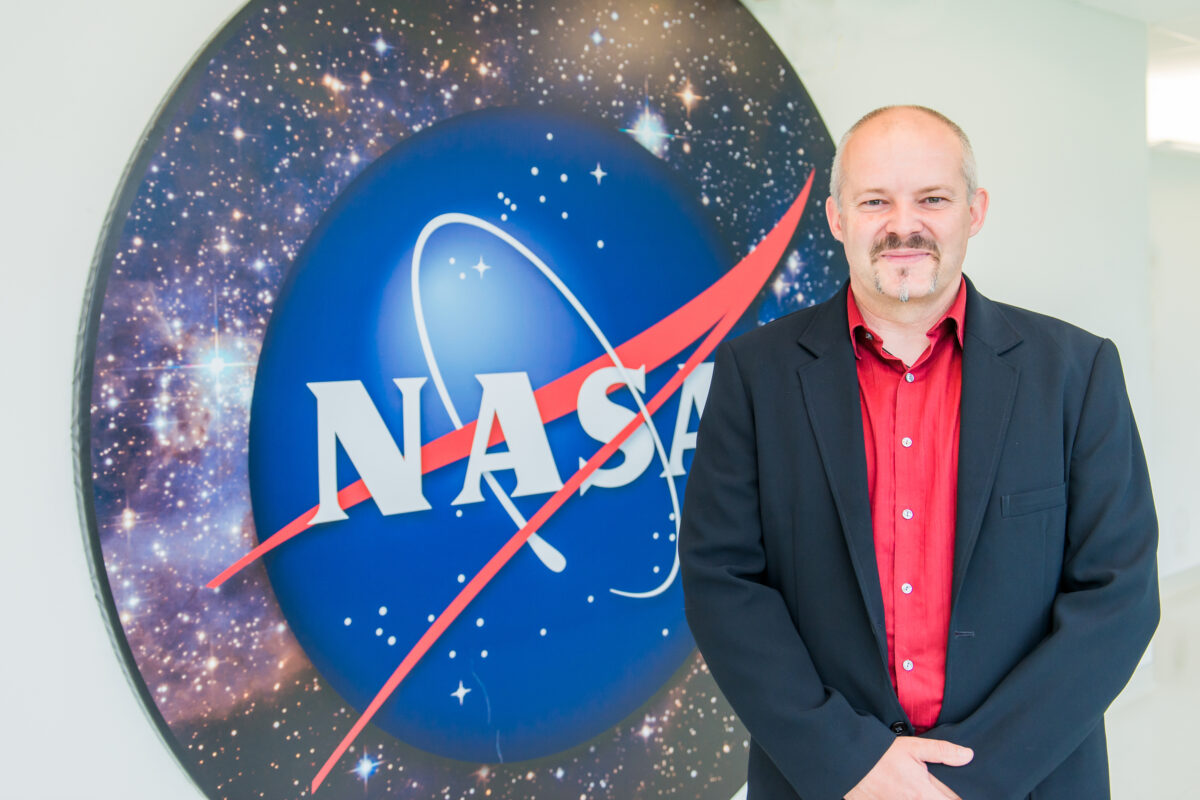 Jan Merka led GPHI from from its inception in 2011 and will hand the reins to Zhibo Zhang this month. (Marlayna Demond ’11/UMBC)
“My first priority is to support GPHI faculty and help enable the outstanding science and engineering they carry out at NASA Goddard Space Flight Center,” Zhang says. “At the same time, I hope GPHI can serve as a stronger bridge between NASA and UMBC by connecting GPHI faculty with UMBC research resources, collaboration and funding opportunities, and with students and faculty who can expand our collective capacity and open doors to bigger, cross-cutting ideas.”
Zhang follows Jan Merka, who has served as the inaugural GPHI director since 2011. As director, Zhang will continue in his faculty role at UMBC, advancing his team’s research on atmospheric dust’s influence on climate and remaining deeply committed to teaching and mentoring. His guidance of undergraduate and graduate students has helped multiple students secure the prestigious NASA Future Investigators in NASA Earth and Space Science and Technology (FINESST) Fellowship and other awards, including the 2025 Elsevier/JQSRT Richard M. Goody Award, fostering the next generation of scientists.
“We are very proud of the fact that UMBC is currently ranked as the #11 institution in the nation in NASA expenditures,” say Karl V. Steiner, vice president for research and creative achievement. “Zhibo Zhang is an outstanding colleague with a broad set of relevant expertise and experiences who will provide important leadership to GPHI and to our partnership with Catholic University under PHaSER. I know that he is the right leader to strengthen our relationship with NASA, building on over three decades of successful cooperative partnership between UMBC and NASA Goddard.”
 Zhibo Zhang (second from right) thoughtfully mentors undergraduate and graduate students, including Qianqian Song (right), Ph.D. ’22, who received the FINESST fellowship, and Jianyu Zheng (far left, rear), Ph.D. ’23, who received the 2025 Elsevier/JQSRT Goody Award. (Marlayna Demond ’11/UMBC)
]]>
Zhibo Zhang, professor of physics, has been named director of the Goddard Planetary Heliophysics Institute (GPHI), UMBC’s arm of the Partnership for Heliophysics and Space Environment Research...
https://umbc.edu/stories/zhang-to-lead-goddard-planetary-heliophysics-institute/
https://my3.my.umbc.edu/api/v0/pixel/news/157136/guest@my.umbc.edu/7aba311f3831e3c2c778aff9a9535436/api/pixel
cnms
gphi
nasa
news
phaser
physics
research
science-and-tech
story
UMBC News & Magazine
https://my3.my.umbc.edu/groups/umbc-news-magazine
https://assets1-my.umbc.edu/system/shared/avatars/groups/000/001/943/24435aa6207c452e7bc15cc74b42c7bb/xsmall.png?1748556657
https://assets1-my.umbc.edu/system/shared/avatars/groups/000/001/943/24435aa6207c452e7bc15cc74b42c7bb/original.png?1748556657
https://assets2-my.umbc.edu/system/shared/avatars/groups/000/001/943/24435aa6207c452e7bc15cc74b42c7bb/xxlarge.png?1748556657
https://assets2-my.umbc.edu/system/shared/avatars/groups/000/001/943/24435aa6207c452e7bc15cc74b42c7bb/xlarge.png?1748556657
https://assets3-my.umbc.edu/system/shared/avatars/groups/000/001/943/24435aa6207c452e7bc15cc74b42c7bb/large.png?1748556657
https://assets1-my.umbc.edu/system/shared/avatars/groups/000/001/943/24435aa6207c452e7bc15cc74b42c7bb/medium.png?1748556657
https://assets2-my.umbc.edu/system/shared/avatars/groups/000/001/943/24435aa6207c452e7bc15cc74b42c7bb/small.png?1748556657
https://assets1-my.umbc.edu/system/shared/avatars/groups/000/001/943/24435aa6207c452e7bc15cc74b42c7bb/xsmall.png?1748556657
https://assets2-my.umbc.edu/system/shared/avatars/groups/000/001/943/24435aa6207c452e7bc15cc74b42c7bb/xxsmall.png?1748556657
UMBC News & Magazine
1
0
false
Wed, 04 Mar 2026 09:28:26 -0500
Wed, 04 Mar 2026 09:28:26 -0500
A place to spark scientific curiosity—UMBC hosts 1,200 high schoolers at Science Olympiad invitational
Zhibo Zhang (second from right) thoughtfully mentors undergraduate and graduate students, including Qianqian Song (right), Ph.D. ’22, who received the FINESST fellowship, and Jianyu Zheng (far left, rear), Ph.D. ’23, who received the 2025 Elsevier/JQSRT Goody Award. (Marlayna Demond ’11/UMBC)
]]>
Zhibo Zhang, professor of physics, has been named director of the Goddard Planetary Heliophysics Institute (GPHI), UMBC’s arm of the Partnership for Heliophysics and Space Environment Research...
https://umbc.edu/stories/zhang-to-lead-goddard-planetary-heliophysics-institute/
https://my3.my.umbc.edu/api/v0/pixel/news/157136/guest@my.umbc.edu/7aba311f3831e3c2c778aff9a9535436/api/pixel
cnms
gphi
nasa
news
phaser
physics
research
science-and-tech
story
UMBC News & Magazine
https://my3.my.umbc.edu/groups/umbc-news-magazine
https://assets1-my.umbc.edu/system/shared/avatars/groups/000/001/943/24435aa6207c452e7bc15cc74b42c7bb/xsmall.png?1748556657
https://assets1-my.umbc.edu/system/shared/avatars/groups/000/001/943/24435aa6207c452e7bc15cc74b42c7bb/original.png?1748556657
https://assets2-my.umbc.edu/system/shared/avatars/groups/000/001/943/24435aa6207c452e7bc15cc74b42c7bb/xxlarge.png?1748556657
https://assets2-my.umbc.edu/system/shared/avatars/groups/000/001/943/24435aa6207c452e7bc15cc74b42c7bb/xlarge.png?1748556657
https://assets3-my.umbc.edu/system/shared/avatars/groups/000/001/943/24435aa6207c452e7bc15cc74b42c7bb/large.png?1748556657
https://assets1-my.umbc.edu/system/shared/avatars/groups/000/001/943/24435aa6207c452e7bc15cc74b42c7bb/medium.png?1748556657
https://assets2-my.umbc.edu/system/shared/avatars/groups/000/001/943/24435aa6207c452e7bc15cc74b42c7bb/small.png?1748556657
https://assets1-my.umbc.edu/system/shared/avatars/groups/000/001/943/24435aa6207c452e7bc15cc74b42c7bb/xsmall.png?1748556657
https://assets2-my.umbc.edu/system/shared/avatars/groups/000/001/943/24435aa6207c452e7bc15cc74b42c7bb/xxsmall.png?1748556657
UMBC News & Magazine
1
0
false
Wed, 04 Mar 2026 09:28:26 -0500
Wed, 04 Mar 2026 09:28:26 -0500
A place to spark scientific curiosity—UMBC hosts 1,200 high schoolers at Science Olympiad invitational
On a cloudy Saturday in January, UMBC buzzed with the energy of over 1,200 high school students from across the Mid-Atlantic region. For the third consecutive year, UMBC’s College of Natural and Mathematical Sciences (CNMS) hosted its Science Olympiad Invitational Tournament, transforming the campus into a vibrant hub of hands-on scientific discovery for the high school competitors.
From building hovercrafts and bridges to tackling exams in anatomy, astronomy, and beyond, the event showcased 23 competitive challenges across an array of STEM disciplines. What started as a modest gathering of 40 teams three years ago has ballooned into Maryland’s largest invitational, drawing participants from Virginia, Delaware, New Jersey, Pennsylvania, and D.C.
The tournament exemplifies UMBC’s commitment to nurturing young talent and building community connections. “A couple of years ago, I suggested a Science Olympiad tournament as a way to invite more high school students onto the campus and get them excited about science—and UMBC,” shared event co-organizer Bindu Abraham, Ph.D. ’06, chemistry, assistant teaching professor of chemistry and biochemistry, and executive director of Maryland Science Olympiad.
Abraham first encountered Science Olympiad as a homeschool parent watching a passion for science emerge in her son. Now, she is happy to be involved in encouraging a similar enthusiasm for science in students across the region. This year’s event also spotlighted partnerships with organizations like STEM Champions of Baltimore, ensuring under-resourced Baltimore City schools could participate in a dedicated league and envision futures at UMBC.
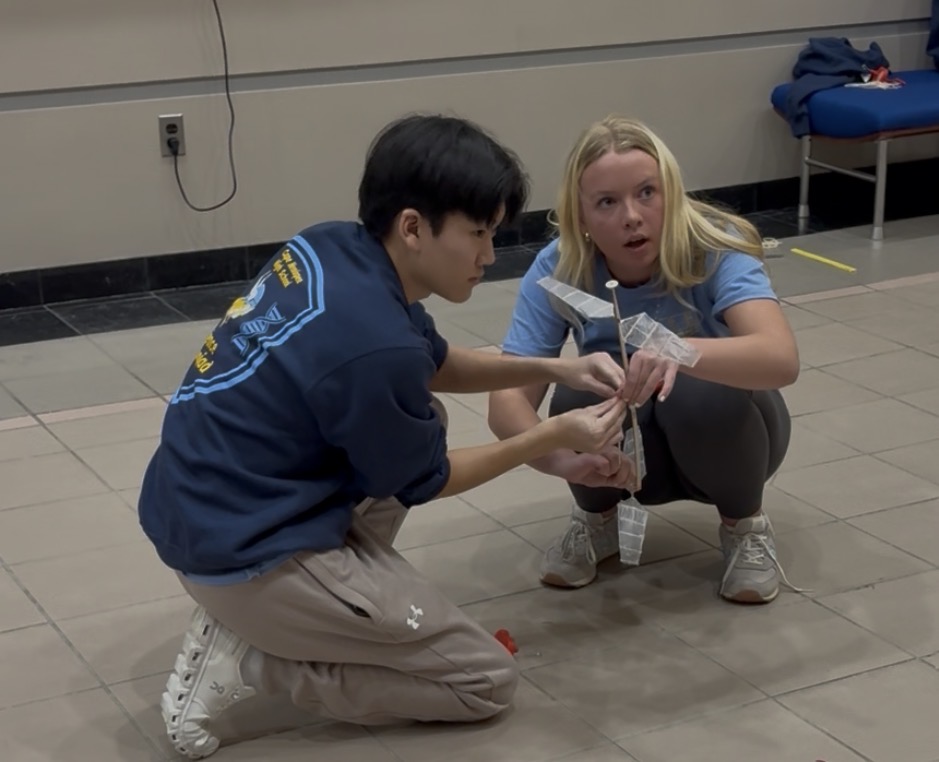
 Cape Henlopen High School in Delaware brought three complete teams to the Science Olympiad at UMBC. Left: Nathaniel Hoang and Ellie Sprague compete in the helicopter event. Right: Quinton Eisenmann and Ava Lewis prepare for the hovercraft event. (Photos courtesy of Priscilla Coolbaugh)
Inspiring students’ interest in science
Volunteers—including UMBC faculty, alumni, current students—made the day possible, each driven by motivations rooted in their own journeys. Mark Grzanna, M.S. ’15, biological sciences, today a Science Olympiad coach at John Carroll High School in Bel Air, Maryland, brought two teams of eager students for his third year at the UMBC tournament. Grzanna teaches biology, anatomy and physiology, and a biotech course he designed at John Carroll, and he views the Olympiad as a gateway to scientific curiosity.
“Education is so important. I became a teacher to get kids interested in science—or at least to help them understand enough science to navigate their world,” he said. His co-coach, John Carroll teacher Andrew Ketchum, echoed the sentiment: “It’s a great experience for our kids to see other students excited about science.”
Frank Tagaytay, a senior physics and math major, supervised the “boomilever” event, where teams tested structures’ strength and integrity. Based on experience as president of his high school Science Olympiad club, Tagaytay patiently guided participants through event regulations, offering encouragement amid the occasional structural mishap.

 Left: Frank Tagaytay (left), a senior UMBC physics and math major, encourages Aalyna Johnson (center) and Cassidy Mehegan from Cape Henlopen High School as they set up their “boomilever” for competition. (Photo by Sarah Hansen, M.S. ’15/UMBC) Right: Cape Henlopen students Theodore Noe Fellows, Shouta Sano, Quinton Eisenmann, and Ava Lewis (left to right) carry their equipment to the competition site in the UMBC Physics Building. (Photo courtesy of Priscilla Coolbaugh)
“It’s an early season event for teams to work out the kinks,” he explained, highlighting how the low-stakes environment builds confidence and resilience. For Tagaytay, volunteering bridges his past and present, reinforcing UMBC’s supportive community.
Fareedah Owolabi, a junior chemical engineering major who recently transferred from the Community College of Baltimore County, found the event particularly meaningful. “I have a soft spot for STEM outreach, because it’s how I was introduced to UMBC,” she shared. Through the Upward Bound Math and Science program, Owolabi connected with UMBC tutors as a high schooler. Now, as a volunteer, she fielded questions from participants about campus life. “I want to inspire younger students,” she said, embodying the cycle of mentorship that defines the tournament.
Broadening their horizons
Priscilla Coolbaugh, Science Olympiad coach at Cape Henlopen High School in Delaware, started her team three years ago after loving Science Olympiad as a student herself. “I want to share that love,” she said. Her three full teams traveled far to compete. “They get to see themselves at these universities. They might have planned to stay close to home, but this way they get exposure to out-of-state schools,” Coolbaugh said. “It broadens their horizons to different schools as well as different STEM fields.”

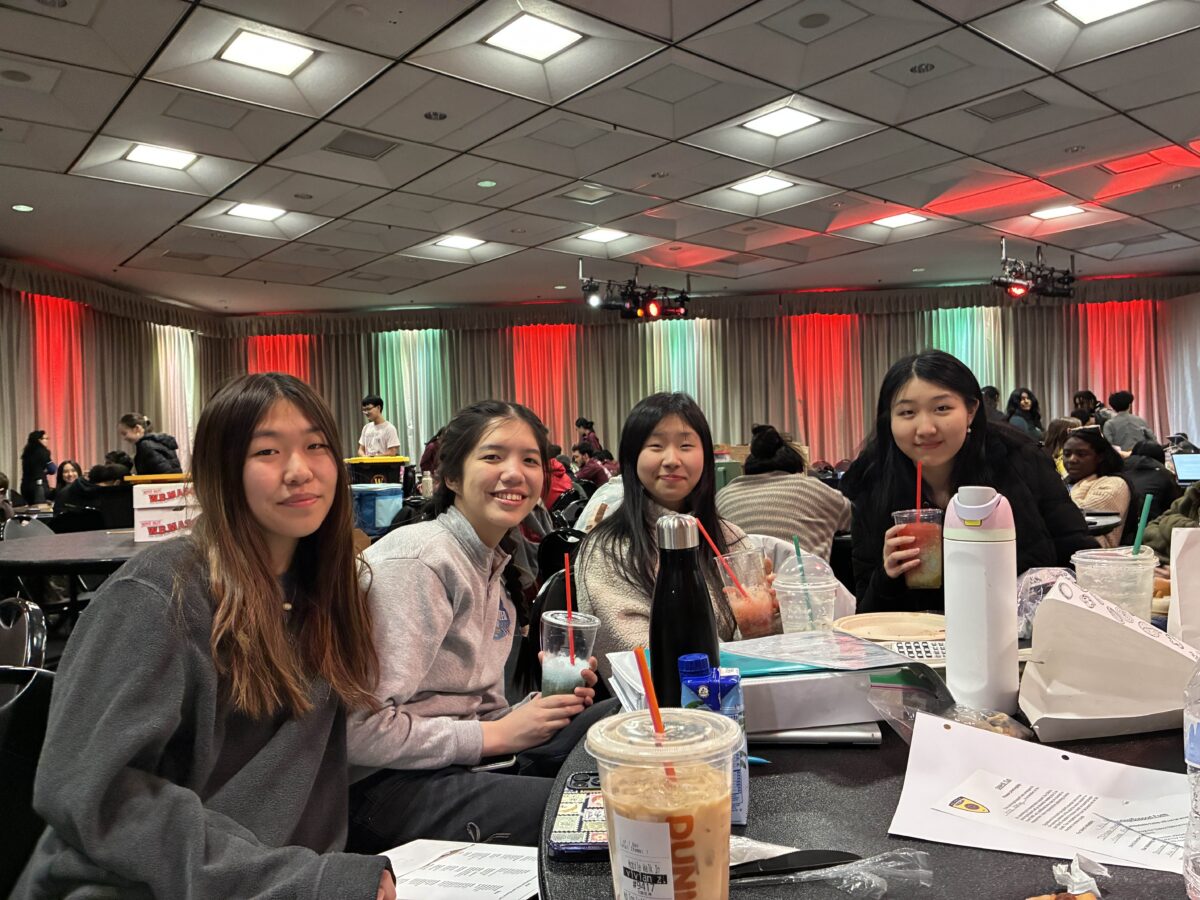 Students and a coach from Winston Churchill High School in Potomac, Maryland, relax in the UMBC Ballroom between events. (Photos courtesy of Jonathan Lee)
Students expressed their sense of community and excitement about their experiences at the UMBC event. Cape Henlopen freshman Aalya Desai noted how the event helped her make friends despite starting as a newcomer, and sophomore Grace Eanes appreciated the chance to bond with peers across grades while exploring the beautiful campus. Michael Song, a junior from Winston Churchill High School in Potomac, Maryland, who with his teammate, Leo Jiang, earned the top score in the hovercraft event, commented, “UMBC is much bigger than I expected. It’s a lot of fun to travel to Olympiad events.”
In good hands
Faculty and staff volunteers underscored the event’s broader impact. CNMS dean William R. LaCourse, surveying the awards ceremony, reflected on the promise of the participants. “As I stood on the stage looking over the ballroom filled with excited and creative students, I couldn’t help feeling as if I was looking into the future and thinking, ‘We (all of us) are in good hands,’” he said.
Zeev Rosenzweig, professor of chemistry and biochemistry, supervised the rocks and minerals test with three undergraduates and three of his graduate students. “Being here is just an important thing to do,” he said. “It’s a great outlet to show them that their interests matter,” he noted. “The kids who come to the Olympiad—they’re our people.” Ph.D. student Kushani Mendis, a Ph.D. student in Rosenzweig’s lab, added, “The best way to support the next generation in STEM is to organize events like this and spend time with them.”
In April, UMBC will host the Maryland State Science Olympiad for the first time, building on this invitational’s momentum. “It’s fun to see young people so excited about different areas of STEM,” shared Michelle Starz-Gaiano, professor and chair of biological sciences, adding, “It’s critical to foster the growth of young scientists. We love the energy and enthusiasm that they bring.”
]]>
On a cloudy Saturday in January, UMBC buzzed with the energy of over 1,200 high school students from across the Mid-Atlantic region. For the third consecutive year, UMBC’s College of Natural and...
https://umbc.edu/stories/1200-high-schoolers-at-science-olympiad/
https://my3.my.umbc.edu/api/v0/pixel/news/156251/guest@my.umbc.edu/8fcd1fc51406ee5d71336ef39bd47917/api/pixel
biology
cbee
chembiochem
cnms
coeit
community
news
physics
science-and-tech
story
trio
UMBC News & Magazine
https://my3.my.umbc.edu/groups/umbc-news-magazine
https://assets1-my.umbc.edu/system/shared/avatars/groups/000/001/943/24435aa6207c452e7bc15cc74b42c7bb/xsmall.png?1748556657
https://assets1-my.umbc.edu/system/shared/avatars/groups/000/001/943/24435aa6207c452e7bc15cc74b42c7bb/original.png?1748556657
https://assets2-my.umbc.edu/system/shared/avatars/groups/000/001/943/24435aa6207c452e7bc15cc74b42c7bb/xxlarge.png?1748556657
https://assets2-my.umbc.edu/system/shared/avatars/groups/000/001/943/24435aa6207c452e7bc15cc74b42c7bb/xlarge.png?1748556657
https://assets3-my.umbc.edu/system/shared/avatars/groups/000/001/943/24435aa6207c452e7bc15cc74b42c7bb/large.png?1748556657
https://assets1-my.umbc.edu/system/shared/avatars/groups/000/001/943/24435aa6207c452e7bc15cc74b42c7bb/medium.png?1748556657
https://assets2-my.umbc.edu/system/shared/avatars/groups/000/001/943/24435aa6207c452e7bc15cc74b42c7bb/small.png?1748556657
https://assets1-my.umbc.edu/system/shared/avatars/groups/000/001/943/24435aa6207c452e7bc15cc74b42c7bb/xsmall.png?1748556657
https://assets2-my.umbc.edu/system/shared/avatars/groups/000/001/943/24435aa6207c452e7bc15cc74b42c7bb/xxsmall.png?1748556657
UMBC News & Magazine
1
0
false
Thu, 05 Feb 2026 11:30:12 -0500
Thu, 05 Feb 2026 11:30:12 -0500
UMBC physicist wins Amazon award to build AI-orchestrated scientific assistant
Fabio Anza, an assistant professor in UMBC’s Department of Physics, Quantum Science Institute and Cybersecurity Institute, has won an Amazon Research Award to develop Physics Co-Pilot—a scientific AI assistant that combines large language model (LLM) orchestration with reliable computational algorithms to address critical bottlenecks in modern physics research.
The problem isn’t just coding. Theoretical physics, like many other areas of scientific research, is currently facing two major challenges: knowledge fragmentation and hyperspecialized computational tools. The open-access, online scientific paper repository ArXiv alone publishes over 25,000 new papers monthly across computer science, math, and physics. Meanwhile, using sophisticated computational methods requires mastering ultra-niche software ecosystems—work that diverts researchers from scientific discovery.
“Researchers spend increasingly large amounts of time wrestling with software issues rather than exploring scientific questions,” Anza explains. “Valuable human capital gets diverted from discovery to dealing with technical problems that could be avoided with better infrastructure.”
A hybrid approach to scientific computing
Physics Co-Pilot takes a fundamentally different approach from pure AI code generation systems. Rather than having language models write code—which, at scale, produces unreliable results—the system uses LLMs only for natural language understanding, while delegating all computational work to pre-written, validated algorithms.
Researchers spend increasingly large amounts of time wrestling with software issues rather than exploring scientific questions. Valuable human capital gets diverted from discovery to dealing with technical problems that could be avoided with better infrastructure. — Fabio Anza, assistant physics professor
“The LLM acts as an orchestrator, not a programmer,” Anza says. “It translates natural language into structured commands that call expertly implemented computational routines. This maintains computational rigor while making advanced techniques accessible through conversation.”
The tool features specialized software routines for literature analysis and physics simulations. For the initial release, the system will focus on modeling a a narrow set of physical systems, serving as proof-of-concept for future community-driven expansions.
From concept to open-source release
Anza has recruited computer science senior Samuel Truong to help develop the system over the next year, with plans to expand the team as the project progresses.
The project follows a short timeline: an initial prototype with literature analysis capabilities will be released in the first six months, enabling researchers to conduct natural language-driven searches and synthesis of ArXiv papers. The complete system, including simulation and visualization capabilities for dynamical systems, will be released (under the MIT open-source license) by the end of 2026.
“Physics Co-Pilot represents a new paradigm in scientific assistants,” Anza notes. “By combining conversational accessibility with computational reliability, we aim to give researchers access to advanced computational techniques without the need to know any programming languages.”
The system aims to enable physicists to discover and synthesize knowledge across disciplines, eliminate programming barriers to sophisticated analysis methods, and accelerate research cycles through rapid hypothesis testing—all without researchers writing a single line of code themselves.
]]>
Fabio Anza, an assistant professor in UMBC’s Department of Physics, Quantum Science Institute and Cybersecurity Institute, has won an Amazon Research Award to develop Physics Co-Pilot—a scientific...
https://umbc.edu/quick-posts/anza-ai-orchestrated-scientific-assistant/
https://my3.my.umbc.edu/api/v0/pixel/news/156016/guest@my.umbc.edu/381414bc27cf343cac1118e24912a032/api/pixel
cnms
coeit
csee
cybersecurity
physics
quick-post
science-and-tech
UMBC News & Magazine
https://my3.my.umbc.edu/groups/umbc-news-magazine
https://assets1-my.umbc.edu/system/shared/avatars/groups/000/001/943/24435aa6207c452e7bc15cc74b42c7bb/xsmall.png?1748556657
https://assets1-my.umbc.edu/system/shared/avatars/groups/000/001/943/24435aa6207c452e7bc15cc74b42c7bb/original.png?1748556657
https://assets2-my.umbc.edu/system/shared/avatars/groups/000/001/943/24435aa6207c452e7bc15cc74b42c7bb/xxlarge.png?1748556657
https://assets2-my.umbc.edu/system/shared/avatars/groups/000/001/943/24435aa6207c452e7bc15cc74b42c7bb/xlarge.png?1748556657
https://assets3-my.umbc.edu/system/shared/avatars/groups/000/001/943/24435aa6207c452e7bc15cc74b42c7bb/large.png?1748556657
https://assets1-my.umbc.edu/system/shared/avatars/groups/000/001/943/24435aa6207c452e7bc15cc74b42c7bb/medium.png?1748556657
https://assets2-my.umbc.edu/system/shared/avatars/groups/000/001/943/24435aa6207c452e7bc15cc74b42c7bb/small.png?1748556657
https://assets1-my.umbc.edu/system/shared/avatars/groups/000/001/943/24435aa6207c452e7bc15cc74b42c7bb/xsmall.png?1748556657
https://assets2-my.umbc.edu/system/shared/avatars/groups/000/001/943/24435aa6207c452e7bc15cc74b42c7bb/xxsmall.png?1748556657
UMBC News & Magazine
3
0
false
Thu, 29 Jan 2026 13:46:52 -0500
Thu, 29 Jan 2026 13:46:52 -0500
Retrievers gone global: 5 ways UMBC fosters international engagement
As International Education Week 2025 comes to a close, we’ve rounded up a few of the many ways Retrievers engage globally through their work and studies. Even though it has been a particularly trying time for international students, “…more UMBC students studied abroad in Academic Year 2024 – 25 than ever before. Our students are discovering new perspectives, building global connections, and transforming their futures through these life-changing experiences,” says Katie Heird, director of education abroad and global learning at UMBC. Here are a few ways international students and Retrievers who have gone abroad play a role in the lifeblood of UMBC.
1. Who is Fulbright material?
UMBC’s six 2025 – 2026 Fulbright U.S. Student Program recipients share their not-so-secret recipe for success. Deciding to apply for a Fulbright is just the first step, and with the support of UMBC’s Center for Global Engagement, which hosts Fulbright information sessions in the spring for undergraduate, graduate, and recent alumni. Retrievers can apply to earn a master’s, conduct research, or be an English Teaching Assistant in more than 160 countries. With the UMBC 2025 – 2026 Fulbrights already settled in Taiwan, Norway, and Indonesia, Belgium, Israel, and Germany, these alumni are eager to share tips to inspire and prepare the next generations of Fulbright Retrievers.
 UMBC’s 2025 – 2026 U.S. Fulbright Program class. (Brad Ziegler/UMBC)
Additionally, this year, four UMBC faculty and staff members received highly competitive Fulbright U.S. Scholar awards to teach, conduct research, and foster cross-cultural connections globally. The recipients span all three UMBC colleges and comprise three faculty members and one staff member. The UMBC awardees are connecting with international partners in areas of shared interest. Augusto Casas, an associate teaching professor of information systems, is working in Colombia; Cynthia Wagner, a teaching professor of biological sciences, went to Kyrgyzstan; Irene Chan, a professor of visual arts, is in Romania; and Tom Penniston, M.A. ’09, TESOL, Ph.D. ’14, language, literacy, and culture, the coordinator of learning analytics in the Division of Information Technology, is working in Croatia.
2. Building intentional international connections
A six-person UMBC team built international connections at the “PIWOT – World of Technology” conference, held in early 2025 in Mumbai, India. The science and technology conference is organized by the alumni association for graduates of the prestigious Indian Institutes of Technology (IITs), and attracts many of the leaders in science and technology in India and around the world. The CEO of Alphabet, Inc. (Google’s parent company), the co-founder of Sun Microsystems, and the CEO of IBM are all graduates of IITs.
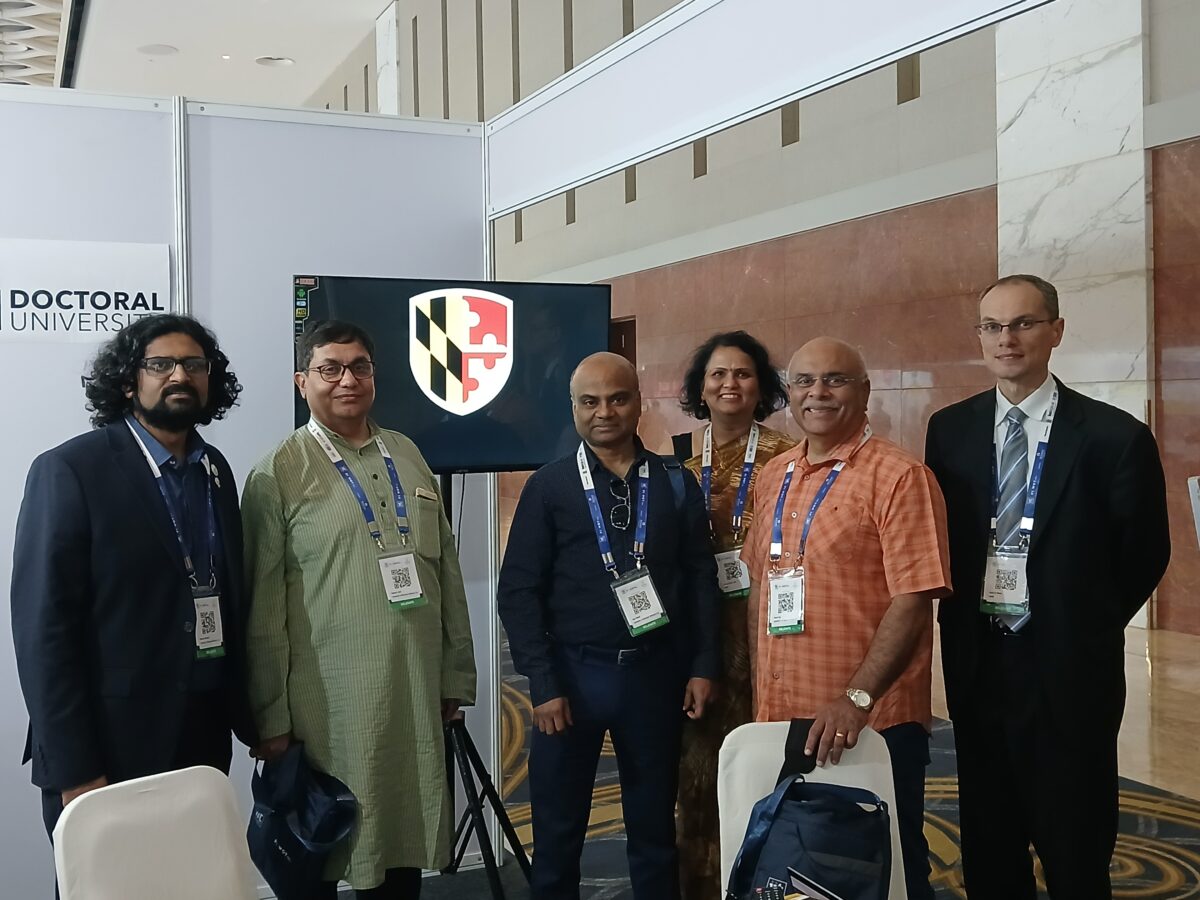 UMBC PIWOT attendees (l-r): Ramana Vinjamuri, associate professor of computer science and electrical engineering and director of the NSF IUCRC BRAIN Center; Joshi; Upal Ghosh, professor of chemical, biochemical, and environmental engineering; Karuna Pande Joshi, professor of information systems and director of the NSF IUCRC Center for Accelerated Real Time Analytics; Govind Rao, director of the Center for Advanced Sensor Technology and professor of chemical, biochemical and environmental engineering; and David Di Maria, associate vice provost for international education at UMBC. (Photo courtesy of Karuna Pande Joshi)
This year’s PIWOT conference focused on the impact of technology across multiple dimensions of life, from the professional to the personal. UMBC’s Anupam Joshi, acting dean of the College of Engineering and Information Technology, took part as a speaker on a panel about the impact of technology on education, and the UMBC booth also displayed the low-cost infant incubator developed by Professor Govind Rao.
3. International research collaboration challenges assumptions
Thanks to funding from the German Academic Exchange Service, Lorenz Kopp and Björn Michelmann, mechanical engineering students from Germany’s Regensburg University of Applied Sciences, came to UMBC to conduct research with UMBC’s mechanical engineering professor, Paris von Lockette. The project was part of a bigger assumption-questioning enterprise—in particular, probing the behavior of materials called soft magnets. Kopp’s and Michelmann’s advisor at Regensburg University of Applied Sciences knew von Lockette through the American Society of Mechanical Engineers, and together they arranged the details of the two-month visit with the help of the Office of International Students and Scholars at UMBC.
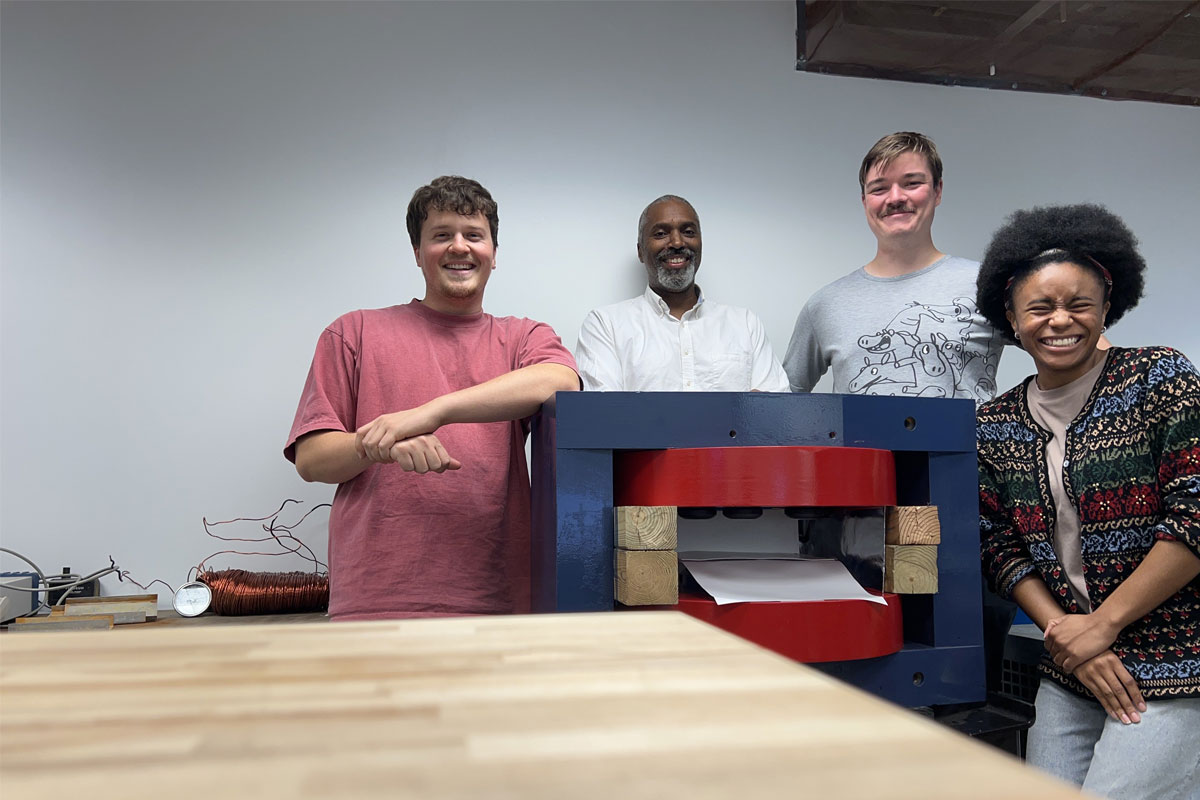 (l-r): Lorenz Kopp, Björn Michelmann, von Lockette, and Tamia Bowers ’23, mechanical engineering, with the electromagnet they set up in the lab. (Brad Ziegler/UMBC)
While Kopp and Michelmann spent plenty of time in the lab during their visit, they also had chances to explore the areas surrounding UMBC on weekends. They visited the National Aquarium in Baltimore, took in a Baltimore Ravens football game, and drove to Shenandoah National Park in Virginia. They also enjoyed campus life, attending Homecoming weekend, and regularly visiting the Retriever Activity Center to work out.
4. Exploring politics in a global context, virtually
Professor Filomeno’s 2024 Collaborative Online International Learning (COIL) Brazil project on climate change equips students with the technical and interpersonal skills to thrive in professional online international and intercultural environments. COIL makes international scholarship and intercultural learning accessible by removing barriers of cost and travel while preparing students with essential skills for future in-person exchanges. COIL Brazil was part of Filomeno’s Global Citizenship class in collaboration with former colleague Clarissa Dri, a professor of international relations at his alma mater, the Federal University of Santa Catarina, in southern Brazil.
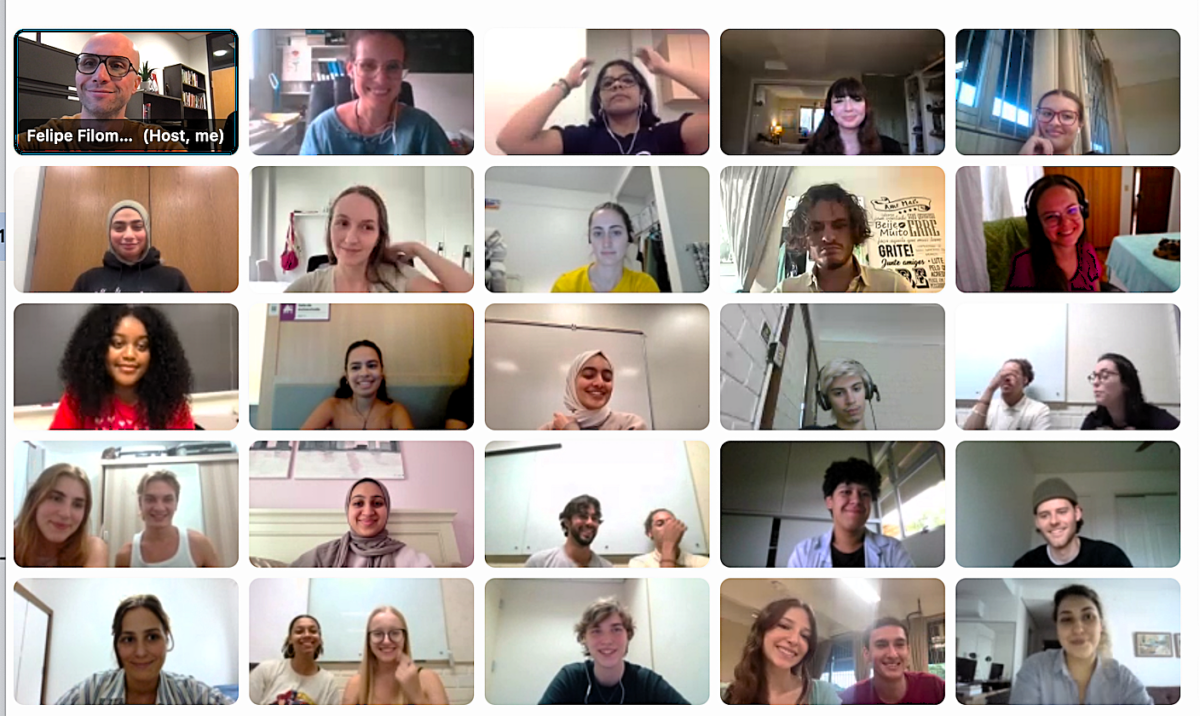 COIL Brazil met online so that students from UMBC and the Federal University of Santa Catarina in southern Brazil could participate. (Image courtesy of Felipe Filomeno.)
The ongoing Virtual Tandem Conversation project was created by Susanne Sutton, a teaching professor of German, and Talke Macfarland, a visiting lecturer of German in UMBC’s Department of Modern Languages, Linguistics, and Intercultural Communication. They established the program during COVID-19 to help UMBC students learning German and German students learning English socialize while continuing to improve their language skills.
The actual tandem meetings are entirely student-driven and take place outside of the classroom—each tandem pair arranges virtual meetings according to their schedule. Tandem participants have gone beyond the virtual classroom, such as UMBC Golden ID Program student Rebecca Smith, who, while on a recent trip to France, hopped over to Germany to visit Gertrud Krause-Traudes, her partner in UMBC’s Virtual Tandem Conversation project. After three semesters of virtual conversations in German and English, Smith was happy to meet Krause-Traudes in person.
5. Science that bridges two worlds
In 2020, as the COVID-19 pandemic disrupted lives worldwide, Greema Regmi began her Ph.D. in UMBC’s atmospheric physics program. Studying remotely from her home in Nepal, she navigated a grueling schedule due to the time difference. Now in her fifth year, Regmi’s perseverance has earned her NASA’s prestigious Future Investigators in NASA Earth and Space Science and Technology (FINESST) fellowship, which will provide up to $50,000 annually for up to three years to fuel her research on atmospheric dust.
 Greema Regmi discussed her research at a recent poster session at UMBC. (Brad Ziegler/UMBC)
Regmi has been able to accomplish so much in part because of the supportive community she found at UMBC, after finally arriving on campus in fall 2021. Regmi’s journey bridges her unique perspectives as a student in Nepal and the U.S. At UMBC, she’s embraced broader opportunities. “I think here you can push the limit. I don’t even know what the limit is in the U.S. Here you can dream more and be more experimental,” she observes.
Grounded in the UMBC physics department’s community of support, Regmi’s confidence has only grown since her arrival in Maryland. “There’s always a place for my opinion, which is very nice. Because of that, and all of the experiences I’ve had, now I have the confidence to start my own project,” she explains. “And that’s why I think now I’m confident to go back home, lead something there, and be helpful in some small way.”
Learn more about UMBC’s international opportunities.
]]>
As International Education Week 2025 comes to a close, we’ve rounded up a few of the many ways Retrievers engage globally through their work and studies. Even though it has been a particularly...
https://umbc.edu/stories/gone-global-umbc-international-engagement/
https://my3.my.umbc.edu/api/v0/pixel/news/154859/guest@my.umbc.edu/4a42a8215afbcd5c0ace5e35458352e2/api/pixel
cahss
cge
cnms
coeit
community
fulbright
international
is
llc
meche
mlli
news
physics
politicalscience
research
story
visualarts
UMBC News & Magazine
https://my3.my.umbc.edu/groups/umbc-news-magazine
https://assets1-my.umbc.edu/system/shared/avatars/groups/000/001/943/24435aa6207c452e7bc15cc74b42c7bb/xsmall.png?1748556657
https://assets1-my.umbc.edu/system/shared/avatars/groups/000/001/943/24435aa6207c452e7bc15cc74b42c7bb/original.png?1748556657
https://assets2-my.umbc.edu/system/shared/avatars/groups/000/001/943/24435aa6207c452e7bc15cc74b42c7bb/xxlarge.png?1748556657
https://assets2-my.umbc.edu/system/shared/avatars/groups/000/001/943/24435aa6207c452e7bc15cc74b42c7bb/xlarge.png?1748556657
https://assets3-my.umbc.edu/system/shared/avatars/groups/000/001/943/24435aa6207c452e7bc15cc74b42c7bb/large.png?1748556657
https://assets1-my.umbc.edu/system/shared/avatars/groups/000/001/943/24435aa6207c452e7bc15cc74b42c7bb/medium.png?1748556657
https://assets2-my.umbc.edu/system/shared/avatars/groups/000/001/943/24435aa6207c452e7bc15cc74b42c7bb/small.png?1748556657
https://assets1-my.umbc.edu/system/shared/avatars/groups/000/001/943/24435aa6207c452e7bc15cc74b42c7bb/xsmall.png?1748556657
https://assets2-my.umbc.edu/system/shared/avatars/groups/000/001/943/24435aa6207c452e7bc15cc74b42c7bb/xxsmall.png?1748556657
UMBC News & Magazine
7
0
false
Tue, 25 Nov 2025 13:03:08 -0500
Tue, 25 Nov 2025 13:03:08 -0500
CNMS GradFest fosters research connections and builds community
On November 7, graduate students and postdoctoral researchers from the College of Natural and Mathematical Sciences (CNMS) gathered for the college’s second annual CNMS GradFest.
Prableen Chowdhary, Ph.D. ’24, biological sciences, currently a postdoc with Rachel Brewster, professor of biological sciences, and a member of the student-led planning committee, expressed hope that GradFest would “spark conversations and collaborations across disciplines.”
CNMS dean William LaCourse offered advice to attendees as the program kicked off. “Whatever you do in life, do it with all your heart. If you’re doing research, do it like you own it,” he said. “Live in the present and seize opportunities. Enjoy every moment, like this moment today. You can’t change yesterday; when I make mistakes, I’m grateful for grace and forgiveness. And you can plan for tomorrow, but you can’t control it.”
 Prableen Chowdhary (left) and Hasan Al Banna, CNMS GradFest’s two emcees, welcome attendees to the event. (Brad Ziegler/UMBC)
Following the introductions, seven students presented “lightning talks,” five-minute presentations describing their research in engaging, accessible terms for those outside their field. The talks featured students in biological sciences, physics, chemistry and biochemistry, marine biotechnology, and mathematics and statistics. They discussed topics like novel therapeutic targets for ovarian cancer, innovative two-dimensional materials for improved sensors, and previously unobserved plasma jets from black holes.
GradFest as a stepping stone
“Part of our goal was to intentionally include graduate students with less presentation experience or early-stage projects,” shared Maria Cambraia, director for research and international affairs in CNMS, and lead staff member on the planning committee. “GradFest gives them a chance to practice in a friendly environment.”
 Lightning talk presenters and CNMS GradFest planning committee members worked hard to make the event a success. Rear, left to right: Maria Cambraia, Lara Scott, Andrew Wolff, Sean Ravel, Peng Yan, Codi Hrynko, Jalil Ahmad. Front, left to right: Prableen Chowdhary, Lizbeth Joy Tan, Megha Pandya, Ronita Sequeira, Hasan Al Banna. Planning committee members not pictured: Ayo Ogunsanya, Elana Frazier, Jeanne Ngo. (Brad Ziegler/UMBC)
Following the talks, the ballroom buzzed during two poster sessions, where dozens more students discussed their projects with peers, mentors, and guests. GradFest encouraged presentations of research at all stages of development.
Muhammad Jalil Ahmad, president of the Mathematics and Statistics Graduate Student Association and a planning committee member, presented a lightning talk and poster on mathematical modeling for complex phenomena like weather or disease spread.
Ahmad, a fourth-year applied mathematics Ph.D. candidate mentored by Animikh Biswas and Kathleen Hoffman, professors of mathematics, agreed. “Presenting at GradFest is useful before heading to a bigger stage, like a national meeting,” he said. “Even at a math conference, people are studying different topics, so it’s good to practice communicating with people outside your field.” He added that GradFest offers the opportunity to network with researchers using similar methods for different applications.

 Muhammad Jalil Ahmad (left) and Lara Scott (right), Ph.D. students in mathematics, presented lightning talks at GradFest. (Brad Ziegler/UMBC)
Ian Kirn ’23, physics, a second-year physics Ph.D. student, presented a poster on astroseismology, which investigates earthquake-like phenomena on stars. Kirn chose to pursue his Ph.D. with Eileen Meyer, professor of physics, after doing undergraduate research with her. “It’s important for different disciplines to talk to each other, because they’re actually all related,” Kirn says. “This event encourages collaboration.”
Fidelia Asomani, a third-year biological sciences Ph.D. candidate working with Erin Green, associate professor of biological sciences, called GradFest “a good first opportunity to get my feet wet presenting.” Asomani studies yeast, which shares basic functions with complex organisms. “It’s important to invest in studying processes conserved across species,” she says, which can inform human disease treatment.

 Ian Kirn (left) discussed his astroseismology research, and Fidelia Asomani (right) explains her research on protein regulation in yeast, with GradFest attendees. (Brad Ziegler/UMBC)
The humble heart of a scientist
LaCourse also encouraged embracing humility. “By remembering you won’t always be the best, humility helps you celebrate others’ successes and accept failure—and research involves a lot of failure,” he said. “Humility is a path you walk, not a trait you innately possess, and it leads to learning, growth, and respect.”
By late afternoon, GradFest had turned strangers into collaborators, boosted first-time presenters’ confidence, and made the ballroom a launchpad for breakthroughs. Attendees left with new contacts and the dean’s words in their hearts—proof that bold discoveries can begin with a humble “hello.”
Learn more about graduate programs in CNMS.
]]>
On November 7, graduate students and postdoctoral researchers from the College of Natural and Mathematical Sciences (CNMS) gathered for the college’s second annual CNMS GradFest. Prableen...
https://umbc.edu/stories/cnms-gradfest-2025/
https://my3.my.umbc.edu/api/v0/pixel/news/154570/guest@my.umbc.edu/e98c847e7012a2b534bab5add27d1f0c/api/pixel
biology
chembiochem
cnms
community
gradresearch
graduateschool
marinebiotech
mathstat
news
physics
science-and-tech
story
UMBC News & Magazine
https://my3.my.umbc.edu/groups/umbc-news-magazine
https://assets1-my.umbc.edu/system/shared/avatars/groups/000/001/943/24435aa6207c452e7bc15cc74b42c7bb/xsmall.png?1748556657
https://assets1-my.umbc.edu/system/shared/avatars/groups/000/001/943/24435aa6207c452e7bc15cc74b42c7bb/original.png?1748556657
https://assets2-my.umbc.edu/system/shared/avatars/groups/000/001/943/24435aa6207c452e7bc15cc74b42c7bb/xxlarge.png?1748556657
https://assets2-my.umbc.edu/system/shared/avatars/groups/000/001/943/24435aa6207c452e7bc15cc74b42c7bb/xlarge.png?1748556657
https://assets3-my.umbc.edu/system/shared/avatars/groups/000/001/943/24435aa6207c452e7bc15cc74b42c7bb/large.png?1748556657
https://assets1-my.umbc.edu/system/shared/avatars/groups/000/001/943/24435aa6207c452e7bc15cc74b42c7bb/medium.png?1748556657
https://assets2-my.umbc.edu/system/shared/avatars/groups/000/001/943/24435aa6207c452e7bc15cc74b42c7bb/small.png?1748556657
https://assets1-my.umbc.edu/system/shared/avatars/groups/000/001/943/24435aa6207c452e7bc15cc74b42c7bb/xsmall.png?1748556657
https://assets2-my.umbc.edu/system/shared/avatars/groups/000/001/943/24435aa6207c452e7bc15cc74b42c7bb/xxsmall.png?1748556657
UMBC News & Magazine
2
0
false
Fri, 14 Nov 2025 15:37:10 -0500
Fri, 14 Nov 2025 15:37:10 -0500
Meet a Retriever—Maggie Williams ’24, physics, Quantum Science Institute Graduate Fellow
Maggie Williams ’24, physics, is a second-year physics Ph.D. student, a Quantum Science Institute (QSI) Graduate Fellow, and an officer in the Physics Graduate Student Association (PGSA). In her research with Sebastian Deffner, associate professor of physics, she studies biological processes at a microscopic scale, where the physics of atomic interactions—including quantum effects—come into play. Outside the lab, Maggie enjoys playing guitar, listening to music, hiking, and reading.
On November 6, Maggie is giving an interactive live demo of quantum key distribution, where participants can experience firsthand how quantum physics makes eavesdropping detectable and secure communication possible. All are welcome. Take it away, Maggie!
Q: What brought you to UMBC for graduate school, and how did your path at UMBC begin?
A: I applied to graduate school because I wasn’t done learning. As a UMBC undergraduate, my first upper-level physics course was Thermal and Statistical Physics, taught by Dr. Deffner. It was very challenging, but it sparked my interest in statistical physics, and soon I began sitting in on Dr. Deffner’s research group meetings to learn more about the field and what research involves. Not long after, I completed a research project under his guidance and presented a poster at UMBC’s 2023 Undergraduate Research and Creative Achievement Day.
Working with Dr. Deffner led me to begin reading current papers and graduate texts to better understand my work, which only made me want to learn more. Since I already knew about the strong, close-knit community at UMBC from my undergraduate experience, choosing UMBC for graduate school felt like the best option for my success.
Earning my bachelor’s degree was not without challenges, though. After struggling through classes during the COVID-19 pandemic, I felt burned out and unsure about continuing my education, so I took a gap semester in spring 2022 to complete an internship at the tourism organization Visit Baltimore. After some time in the corporate world, I decided to finish my bachelor’s degree and returned to UMBC that fall. During my time away, UMBC advisors and faculty checked in and helped map out a clear path to graduating, which made my transition feel more manageable.
Q: Tell us about your current research and what fascinates you about it.
A: I study nonequilibrium statistical physics, which uses mathematics to model systems heavily affected by randomness. Right now, I’m finishing a project on small, active processes inside cells that are not in balance, with a particular focus on how cells copy information from DNA to RNA, and how tiny errors can build up as an organism ages. Because cells are so small, their behavior is naturally random, and events in the cell that are far apart in time barely affect each other.
That makes Markovian dynamics, which assumes the next step of a system depends only on its current state, a good framework for modeling these systems. This project also provides a simple testbed for future studies that aim to model microscopic biological processes.
Graduate school is challenging, and I’ve had my own moments of discouragement and impostor syndrome. When that happens, I try to turn it into a chance to deepen my understanding, which has only fueled my curiosity about a subject.
Maggie Williams ’24, physics, and a second-year physics Ph.D. student
In my graduate work, the idea that mathematics, combined with physical intuition, can effectively model complex quantum systems continues to fascinate me. I plan to focus my Ph.D. research on quantum many-body systems, which are large groups of tiny particles (like electrons or atoms) that follow quantum rules (such as being able to act like waves or exist in multiple states at once) and whose behaviors are tightly interconnected, so you have to consider how they all influence each other at the quantum level.
Q: What do you love about UMBC’s physics program and the community that supports you?
A: One thing I love about my program is its small-but-mighty community, which makes it easy to reach professors or senior grad students for support, advice, or just a chat. My cohort has inspired me to push toward my goals and has been a steady support network when classes or work get overwhelming, so I’m genuinely grateful for my peers at UMBC.
 Edgar Rueda, Sandra Cheng, Cassie Daniele, and Maggie Williams (left to right) enjoy an intense game of spikeball at a Physics Graduate Student Association event. (Courtesy of Williams)
Q: How is being part of QSI benefiting your Ph.D.?
A: QSI fosters a welcoming community across disciplines that has helped me learn about fields I might not otherwise have the chance to explore. It also provides practical support, from funding for research materials and supplementary textbooks to travel support for conferences and meetings, and it offers chances to lead academic seminars!
Q: How are you involved on campus, and what do you enjoy about it?
A: I serve on the PGSA council. It’s a great way to boost morale among first- and second-year students, encourage socializing outside of class and work, and help us get to know each other. I also enjoy the event-planning side—it’s an opportunity to get creative and come up with fun group activities. The other council members are supportive and kind, and it’s been a great experience so far.
Q: What advice would you give to a high schooler or undergraduate interested in physics and/or quantum science?
A: Don’t hesitate to reach out to teachers and mentors: Ask questions, introduce yourself, and start conversations. Networking matters in every field, and it’s especially important in academia. I’d also encourage them not to dwell on setbacks. Graduate school is challenging, and I’ve had my own moments of discouragement and impostor syndrome. When that happens, I try to turn it into a chance to deepen my understanding, which has only fueled my curiosity about a subject.
In the end, a genuine interest in learning and the drive to keep pursuing knowledge are the most important ingredients. I believe these things have brought me to where I am today, and I’m excited to see where my journey through graduate school takes me. This is only the beginning!
UMBC’s greatest strength is its people. When people meet Retrievers and hear about the passion they bring, the relationships they create, the ways they support each other, and the commitment they have to inclusive excellence, they truly get a sense of our community. That’s what “Meet a Retriever” is all about.
Learn more about how UMBC can help you achieve your goals.
]]>
Maggie Williams ’24, physics, is a second-year physics Ph.D. student, a Quantum Science Institute (QSI) Graduate Fellow, and an officer in the Physics Graduate Student Association (PGSA). In her...
https://umbc.edu/stories/meet-a-retriever-maggie-williams/
https://my3.my.umbc.edu/api/v0/pixel/news/154250/guest@my.umbc.edu/54e42b6cdf38117f5d88903b448ca07b/api/pixel
cnms
gradresearch
graduate-school
magazine
meetaretriever
physics
qsi
story
UMBC News & Magazine
https://my3.my.umbc.edu/groups/umbc-news-magazine
https://assets1-my.umbc.edu/system/shared/avatars/groups/000/001/943/24435aa6207c452e7bc15cc74b42c7bb/xsmall.png?1748556657
https://assets1-my.umbc.edu/system/shared/avatars/groups/000/001/943/24435aa6207c452e7bc15cc74b42c7bb/original.png?1748556657
https://assets2-my.umbc.edu/system/shared/avatars/groups/000/001/943/24435aa6207c452e7bc15cc74b42c7bb/xxlarge.png?1748556657
https://assets2-my.umbc.edu/system/shared/avatars/groups/000/001/943/24435aa6207c452e7bc15cc74b42c7bb/xlarge.png?1748556657
https://assets3-my.umbc.edu/system/shared/avatars/groups/000/001/943/24435aa6207c452e7bc15cc74b42c7bb/large.png?1748556657
https://assets1-my.umbc.edu/system/shared/avatars/groups/000/001/943/24435aa6207c452e7bc15cc74b42c7bb/medium.png?1748556657
https://assets2-my.umbc.edu/system/shared/avatars/groups/000/001/943/24435aa6207c452e7bc15cc74b42c7bb/small.png?1748556657
https://assets1-my.umbc.edu/system/shared/avatars/groups/000/001/943/24435aa6207c452e7bc15cc74b42c7bb/xsmall.png?1748556657
https://assets2-my.umbc.edu/system/shared/avatars/groups/000/001/943/24435aa6207c452e7bc15cc74b42c7bb/xxsmall.png?1748556657
UMBC News & Magazine
0
0
false
Wed, 05 Nov 2025 11:55:11 -0500
Wed, 05 Nov 2025 11:55:11 -0500
Unsung heroes: Meet 4 UMBC building managers who keep research moving
The College of Natural and Mathematical Sciences is home to high-tech scientific instrumentation alongside traditional infrastructure like water pipes and HVAC systems, all of which UMBC researchers and students rely on. That equipment also requires regular maintenance and occasional upgrades, and it’s the often-invisible work of UMBC’s skilled and experienced building managers that keeps things humming. Four CNMS building managers welcomed us into their world, sharing everything from what it takes to succeed in their roles to the hidden gems found in their buildings.
Meet the building managers:
Erik Crowe
Building Manager, Physics Building
Erik Crowe brought five years of hands-on expertise as a laboratory specialist in the UMBC physics department and prior experience at NASA Goddard Space Flight Center to his current role as physics department building manager, which he assumed in 2019. Today he supports faculty, staff, and students in physics—including the Earth and Space Institute and Quantum Science Institute—overseeing everything from HVAC systems to lab renovations. Crowe thrives on the blend of technical innovation, educational support, and collaborative spirit he gets to practice in his role.
 Erik Crowe works in the Physics Building’s basement machine shop, where he fabricates custom instrument parts for researchers and trains students to do the same. Crowe built 35 parts for AirHARP, a critical precursor to UMBC’s HARP2, which is currently orbiting Earth on NASA’s PACE mission. (Photo by Brad Ziegler/UMBC)
Q: What do you enjoy about your role?
A: I appreciate that every day presents new challenges to problem-solve and support occupants of the Physics Building. My position allows me to leverage my technical background in facilities management and in educating students, staff, and faculty about prototyping and precision machine operations in the machine shop. I also appreciate my collaboration with my colleagues. We have a wonderful staff team in physics, and I couldn’t be successful in my position without their support. The faculty, staff, and students are always finding new ways to push me to expand my skill set.
Q: What brought you to UMBC?
A: I started my career as a process engineer developing and fabricating cryogenic detectors, devices that use ultra-low temperatures to very sensitively detect particles, for the Cosmology Large Angular Scale Surveyor at NASA Goddard Space Flight Center. I thoroughly enjoyed the work, but working in a cleanroom is grueling, and I was looking for something new. Encouraged by my former college advisor, I applied for the lab specialist position at UMBC and was hired in December 2014. It was the change that I needed. I have grown both professionally and personally over the last decade, hitting career goals and growing my family.
Q: What are some of your proudest moments?
A: I am particularly proud of collaborating with the structural maintenance department in facilities management (FM) to renovate approximately 40 spaces in the building over the course of a year and a half. These included research labs, office spaces, and our graduate student wing. It is a tremendous amount of work to plan, organize, and facilitate a project of that size, but we were able to do it with minimal interruption and impact to the building occupants.
I am also proud of the ongoing work to improve the HVAC system within the Physics Building. Over the last decade, we’ve gathered data and addressed the underlying issues, so completing the HVAC study last year was a huge milestone for me. We have a lot of work left to do, but we are moving in the right direction every day.
 Crowe operates a lathe, which is useful for creating complex shapes in various materials. The lathe is the only instrument Crowe does not train others to use due to the risk of injury; he takes safety in the shop very seriously and is proud of the space’s safety record. (Photo by Brad Ziegler/UMBC)
Q: What does it take to be a successful building manager?
A: It takes large doses of patience, persistence, organization, and communication skills to be a successful building manager. You have to prioritize different issues that arise on a daily, weekly, and monthly basis. There are emergencies where a building system might go down or malfunction. In those situations, you have to stay calm, gather data, run through your contact list, formulate a plan, communicate the impact, and follow up to make sure all aspects of an issue are addressed. You also have to be prepared to pivot when things don’t go smoothly.
I submit work orders every day to keep the building running. There are small maintenance and renovation projects where I meet with the FM shops to discuss our approach, there are large-scale projects that can significantly impact occupants and their academic and research activities, and everything in between. My day is never the same and the requests I receive ebb and flow.
Q: What are some of your favorite spaces or hidden gems in the building?
A: The machine shop is my favorite space in the building. Over the last decade, I have built the shop to match the department’s needs. I am proud of the resource it has become and my interactions with students, staff, and faculty to help them develop their technical skills. I am excited about the future of the space, and how we can continue to grow its capabilities and educational programming. It’s a lean facility, but it packs a punch.
Not all of our research activities are performed inside the building. We installed a dedicated research platform on the roof in 2018, which gathers data for atmospheric physics and astrophysics research. But the roof doesn’t just house equipment—it also provides some of the best views on campus of the Baltimore skyline.

 Erik Crowe maintains the Physics Building’s machine shop (left) and instrumentation on the building’s roof (right). (Photos by Brad Ziegler/UMBC)
Dennis Cuddy
Senior Facilities Manager, Interdisciplinary Life Sciences Building and beyond
Dennis Cuddy, administrator of the Interdisciplinary Life Sciences Building (ILSB) and senior facilities manager in the College of Natural and Mathematical Sciences, is in his 26th year at UMBC and his sixth in his current role. Cuddy’s career exemplifies innovative problem-solving and dedication to UMBC’s scientific ecosystem, from orchestrating the renovation of the Meyerhoff Chemistry Building to managing dozens of classrooms, labs, and core facilities that support hundreds of students and researchers.
 Dennis Cuddy maintains research equipment in the Interdisciplinary Life Sciences Building, which opened in 2019. (Photo by Brad Ziegler/UMBC)
Q: What do you appreciate about your role?
A: UMBC has allowed me to use my strengths in organization, scheduling, and operations while exposing me to skills like web development, event planning, and major construction operations—above and beyond what I could offer when I was hired. Now, I handle building operations across colleges and consult for administrative departments I’ve worked with over the years. It’s fulfilling to be asked your opinion about how things can run better.
Q: What brought you to UMBC?
A: I answered an ad in the Baltimore Sun for a chemist, which listed managerial duties similar to what I was doing at the University of Maryland Greenebaum Comprehensive Cancer Center. I still have the ad somewhere at home.
Q: What are some of your proudest moments?
A: I oversaw the renovation of the Meyerhoff Chemistry Building from 2002 to 2005. When we needed additional funds to finish the project, I wrote a construction grant to the National Center for Research Resources that was awarded. Being tasked with reporting the research activities going on in the renovated space for 20 years after the fact was the price I paid, but it was worth it.
 The ILSB sports a green roof, which reduces cooling costs but also complicates building maintenance. (Photo by Brad Ziegler/UMBC)
Q: What does it take to be a successful building manager?
A: It takes patience, good communication, organization, and being proactive when needed (and knowing when that is). You have to be a representative of the university and a good steward of state-appropriated funds. Helping colleagues when needed is essential, because even buildings with dedicated facility managers often lack backups.
Q: What are some of your favorite spaces or surprising facts about the building?
A: The lobby by the third floor elevators is pretty amazing, with the green roof and double helix staircase to the fourth floor, but I find that sitting in the main lobby, anonymously taking in the beauty of the space and the energy of the students, is the most rewarding. Most people don’t know that the ILSB sits on a redirected creek bed, and even during the driest times, the water table is only eight feet beneath the basement floor.
 The ILSB houses several active learning classrooms with extensive audio visual equipment that Cuddy also oversees. (Photo by Brad Ziegler/UMBC)
Brian Moravec
Building Manager, Meyerhoff Chemistry Building
Brian Moravec honed his skills through two decades in USDA molecular biology labs. For the last six years, he has ensured that research and teaching go smoothly in the Meyerhoff Chemistry Building as its building manager. Moravec coordinates repairs and maintenance, manages inventories, and supervises the department’s glassblower and teaching lab manager—turning potential disruptions into opportunities for safety and efficiency.
 Brian Moravec will do anything to keep his building spic and span, including stopping to straighten a poster during a tour of the Meyerhoff Chemistry Building. (Photo by Brad Ziegler/UMBC)
Q: What do you enjoy about your role?
A: I like that my responsibilities change from day to day. One day I may spend most of my time in the office completing administrative tasks, and the next day I might respond to an urgent water leak. I also like that my colleagues in the department, college, and facilities management all have the same goal: Keep things running safely and smoothly to serve our community’s education and research needs.
Q: What brought you to UMBC?
A: I worked in a molecular biology lab at the USDA in Beltsville, Maryland for 20 years. Near the end of that time, I was able to take temporary work as a facility operations specialist at the National Agricultural Library and the National Arboretum. These temporary jobs boosted my interest in the field of building management and operations. When I saw an opening at UMBC in a STEM field, I decided to make a switch.
 Brian Moravec maintains the behind-the-scenes systems that keep the Meyerhoff Chemistry Building running. (Photo by Brad Ziegler/UMBC)
Q: What are some of your proudest moments?
A: I am proud of the water damage mitigation I helped with during the 2022 Christmas flood. Our building was damaged, but we didn’t lose any scientific equipment because I had prepared some items in advance, just in case we needed to divert water around million-dollar instruments. I am also proud of the safety record in both the teaching and research labs in the building. Our building can be dangerous, with flammable and toxic materials, but the safety training and equipment we provide helps keep what can be a dangerous place very safe.
Q: What is something you want people to know about the building or your role?
A: People should know that sometimes the building smells—it’s old! There are a lot of different chemicals in use, but a strange odor by itself is not dangerous. Also, I consider myself a problem solver. People come to me with all sorts of difficulties and issues. I may not be able to fix them all, but I can almost certainly find someone that can help.

 Brian Moravec manages and distributes keys for all spaces in his building, and there are a lot of them! (Photos by Brad Ziegler/UMBC)
Sam Williams ’99
Building Manager, Biological Sciences Building and Schwartz Hall
Sam Williams ’99, history, has dedicated 24 years to UMBC, serving the last 11 as building manager for the Biological Sciences Building after 13 years as assistant athletics director for facilities and operations. His role spans routine maintenance, crisis response, vendor coordination, budget oversight, and safety compliance.
 Sam Williams maintains the many freezers that store experimental samples in the Biological Sciences Building. Some are as cold as -80 degrees Celsius. (Photo by Brad Ziegler/UMBC)
Q: What do you enjoy about your role?
A: I appreciate the fact that no day is ever the same. I feel like we have a great department, from the students to the faculty and staff, which makes coming to work a lot easier.
Q: What are some of your proudest moments?
A: I’ve been a part of two major events: COVID and the great flood in December of 2022. Both of these events brought their own set of challenges. However, the biggest goal for both was making sure that research continued and building occupants were able to work in a safe environment. I have a lot of memories from both.
Q: What does it take to be a successful building manager?
A: I feel like you need patience and the ability to adapt. Things can change by the minute, so being prepared and prioritizing is an essential skill. I would also say that problem-solving is one of the best skills I’ve learned. Having a good working relationship with building occupants and FM makes my life a lot easier, too.
 Sam Williams helped coordinate repair of the Biological Sciences Building’s mural (pictured), which was damaged in a flood in 2022. (Photo by Brad Ziegler/UMBC)
]]>
The College of Natural and Mathematical Sciences is home to high-tech scientific instrumentation alongside traditional infrastructure like water pipes and HVAC systems, all of which UMBC...
https://umbc.edu/stories/unsung-heroes-building-managers/
https://my3.my.umbc.edu/api/v0/pixel/news/153867/guest@my.umbc.edu/cafa05eb2799f41007947a56c8bc02cc/api/pixel
biology
chembiochem
cnms
facilities-management
fall-2025
magazine
physics
retriever-behind-the-scenes
staff
story
UMBC News & Magazine
https://my3.my.umbc.edu/groups/umbc-news-magazine
https://assets1-my.umbc.edu/system/shared/avatars/groups/000/001/943/24435aa6207c452e7bc15cc74b42c7bb/xsmall.png?1748556657
https://assets1-my.umbc.edu/system/shared/avatars/groups/000/001/943/24435aa6207c452e7bc15cc74b42c7bb/original.png?1748556657
https://assets2-my.umbc.edu/system/shared/avatars/groups/000/001/943/24435aa6207c452e7bc15cc74b42c7bb/xxlarge.png?1748556657
https://assets2-my.umbc.edu/system/shared/avatars/groups/000/001/943/24435aa6207c452e7bc15cc74b42c7bb/xlarge.png?1748556657
https://assets3-my.umbc.edu/system/shared/avatars/groups/000/001/943/24435aa6207c452e7bc15cc74b42c7bb/large.png?1748556657
https://assets1-my.umbc.edu/system/shared/avatars/groups/000/001/943/24435aa6207c452e7bc15cc74b42c7bb/medium.png?1748556657
https://assets2-my.umbc.edu/system/shared/avatars/groups/000/001/943/24435aa6207c452e7bc15cc74b42c7bb/small.png?1748556657
https://assets1-my.umbc.edu/system/shared/avatars/groups/000/001/943/24435aa6207c452e7bc15cc74b42c7bb/xsmall.png?1748556657
https://assets2-my.umbc.edu/system/shared/avatars/groups/000/001/943/24435aa6207c452e7bc15cc74b42c7bb/xxsmall.png?1748556657
UMBC News & Magazine
20
0
false
Thu, 23 Oct 2025 17:18:15 -0400
Thu, 23 Oct 2025 17:18:15 -0400
Meet a Retriever—Anjayooluwa Adegboyo ’25, Arthur Ashe Jr. Male Sports Scholar of the Year
Sam Williams helped coordinate repair of the Biological Sciences Building’s mural (pictured), which was damaged in a flood in 2022. (Photo by Brad Ziegler/UMBC)
]]>
The College of Natural and Mathematical Sciences is home to high-tech scientific instrumentation alongside traditional infrastructure like water pipes and HVAC systems, all of which UMBC...
https://umbc.edu/stories/unsung-heroes-building-managers/
https://my3.my.umbc.edu/api/v0/pixel/news/153867/guest@my.umbc.edu/cafa05eb2799f41007947a56c8bc02cc/api/pixel
biology
chembiochem
cnms
facilities-management
fall-2025
magazine
physics
retriever-behind-the-scenes
staff
story
UMBC News & Magazine
https://my3.my.umbc.edu/groups/umbc-news-magazine
https://assets1-my.umbc.edu/system/shared/avatars/groups/000/001/943/24435aa6207c452e7bc15cc74b42c7bb/xsmall.png?1748556657
https://assets1-my.umbc.edu/system/shared/avatars/groups/000/001/943/24435aa6207c452e7bc15cc74b42c7bb/original.png?1748556657
https://assets2-my.umbc.edu/system/shared/avatars/groups/000/001/943/24435aa6207c452e7bc15cc74b42c7bb/xxlarge.png?1748556657
https://assets2-my.umbc.edu/system/shared/avatars/groups/000/001/943/24435aa6207c452e7bc15cc74b42c7bb/xlarge.png?1748556657
https://assets3-my.umbc.edu/system/shared/avatars/groups/000/001/943/24435aa6207c452e7bc15cc74b42c7bb/large.png?1748556657
https://assets1-my.umbc.edu/system/shared/avatars/groups/000/001/943/24435aa6207c452e7bc15cc74b42c7bb/medium.png?1748556657
https://assets2-my.umbc.edu/system/shared/avatars/groups/000/001/943/24435aa6207c452e7bc15cc74b42c7bb/small.png?1748556657
https://assets1-my.umbc.edu/system/shared/avatars/groups/000/001/943/24435aa6207c452e7bc15cc74b42c7bb/xsmall.png?1748556657
https://assets2-my.umbc.edu/system/shared/avatars/groups/000/001/943/24435aa6207c452e7bc15cc74b42c7bb/xxsmall.png?1748556657
UMBC News & Magazine
20
0
false
Thu, 23 Oct 2025 17:18:15 -0400
Thu, 23 Oct 2025 17:18:15 -0400
Meet a Retriever—Anjayooluwa Adegboyo ’25, Arthur Ashe Jr. Male Sports Scholar of the Year
Meet track and field student athlete Anjayooluwa “Jayo” Adegboyo ’25, biochemistry and molecular biology, who was named the 2025 Arthur Ashe Jr. Male Sports Scholar of the Year by Diverse: Issues in Higher Education magazine. The publication sponsors the Arthur Ashe Jr. Sports Scholar Awards to honor students of color who have excelled in the classroom and on the athletic field, demonstrating a commitment to community service and student leadership. Jayo is a Meyerhoff Program Scholar and is excited to pursue a career in medicine after being trained in research at UMBC.
Q: What’s one essential thing you’d want another Retriever to know about you?
A: I am a student-athlete who graduated with a biochemistry major and a physics minor in the Honors College. I am interested in pursuing a career in medicine and research to solve problems associated with migraine and autism-related disorders.
Q: Tell us about someone in the community who has inspired you or supported you, and how they did it.
A: An alum and fellow Meyerhoff Scholar from UMBC about 20 years ago, and a notable professor from Duke University, Dr. Kafui Dzirasa ’01, inspired and supported me by investing in my future as a research advisor, motivator for my passions, and connecting me with people who do work related to my career goals.
Q: Tell us about what you love about your academic program or an organization you’re involved in.
A: I am a part of the Meyerhoff Scholars program and U-RISE scholar. I really appreciated how much the programs reached out to us about research opportunities in STEM related to the interests of me and my peers.
Q: What’s the one thing you’d want someone who hasn’t joined the UMBC community to know about the support you find here?
A: All of the support is there, just do not be afraid to ask around. You never know who may have the answer to your question; whether it is a roommate in a different major or a faculty member in one of your gen ed classes!
Q: Tell us about your primary WHY, and how it led you to UMBC
A: I came to UMBC because of the opportunity to pursue both of my passions in track and field competition and scholarship. It also introduced me to the prospect of pursuing a career in research through the Meyerhoff Scholars Program and its affiliations.

Q: Tell us about the people who are helping you grow at UMBC.
A: My support for my WHY came in the form of familial circumstances. My twin brother has autism and is relatively non-verbal, and my dad has migraines that get progressively worse as the days go by. These issues got me interested in medicine. UMBC helped guide me on a path to successfully apply to and get accepted to an M.D./Ph.D. program at Rutgers New Jersey Medical School.
Q: What clubs, teams, or organizations are you a part of? What do you love about them?
A: I was a part of the UMBC track and field team, the NOBCChE e-board, a member of NSBE, and a mentor in the Meyerhoff Scholars Program’s peer mentorship program. I also tutored in the physics and chemistry tutorial centers and the SI-PASS program.
 NCAA Indoor Track – 2024 – America East Championships, Track at New balance, Boston, Massachusetts.
Q: What do you enjoy about your scholar program?
A: I love the Meyerhoff Scholars Program because the community is filled with people with similar goals of pursuing research in STEM. It also felt like another family, from the peers who love interacting with one another outside of the classroom to the faculty who always have an intense desire to guide us scholars on the path to realizing and attaining our career goals.
Jayo’s fun loving personality disguises his relentless pursuit of excellence, and that combination makes him an obvious asset.
David Bobb ’02
UMBC head track and field coach
Q: Tell us more about being a student-athlete and scholarship recipient. What would you tell others who are in your shoes about UMBC?
A: These dual parts of my life were difficult to get in tuned with during college because I felt some imposter-syndrome in trying to excel athletically and academically, while at the same time as I would see the accomplishments of my peers in each realm.
Eventually, I came to embrace my dual-roles and found harmony in the balance between the two, most especially during my roughest year (3rd year) where I had to balance training and competitions every week with studying for the MCAT (the medical school entrance exam), research, tutoring, and my ongoing classwork. I built so much resilience through these experiences that I would never trade it for anything in the world.
UMBC’s greatest strength is its people. When people meet Retrievers and hear about the passion they bring, the relationships they create, the ways they support each other, and the commitment they have to inclusive excellence, they truly get a sense of our community. That’s what “Meet a Retriever” is all about.
Learn more about how UMBC can help you achieve your goals.
]]>
Meet track and field student athlete Anjayooluwa “Jayo” Adegboyo ’25, biochemistry and molecular biology, who was named the 2025 Arthur Ashe Jr. Male Sports Scholar of the Year by Diverse: Issues...
https://umbc.edu/stories/meet-a-retriever-arthur-ashe-sports-scholar/
https://my3.my.umbc.edu/api/v0/pixel/news/152941/guest@my.umbc.edu/638fb364100caee296e28f4458b166c1/api/pixel
athletics
biochemistry-and-molecular-biology
chemistry
cnms
honorscollege
impact
magazine
meyerhoffscholars
perspectives
physics
story
urise
UMBC News & Magazine
https://my3.my.umbc.edu/groups/umbc-news-magazine
https://assets1-my.umbc.edu/system/shared/avatars/groups/000/001/943/24435aa6207c452e7bc15cc74b42c7bb/xsmall.png?1748556657
https://assets1-my.umbc.edu/system/shared/avatars/groups/000/001/943/24435aa6207c452e7bc15cc74b42c7bb/original.png?1748556657
https://assets2-my.umbc.edu/system/shared/avatars/groups/000/001/943/24435aa6207c452e7bc15cc74b42c7bb/xxlarge.png?1748556657
https://assets2-my.umbc.edu/system/shared/avatars/groups/000/001/943/24435aa6207c452e7bc15cc74b42c7bb/xlarge.png?1748556657
https://assets3-my.umbc.edu/system/shared/avatars/groups/000/001/943/24435aa6207c452e7bc15cc74b42c7bb/large.png?1748556657
https://assets1-my.umbc.edu/system/shared/avatars/groups/000/001/943/24435aa6207c452e7bc15cc74b42c7bb/medium.png?1748556657
https://assets2-my.umbc.edu/system/shared/avatars/groups/000/001/943/24435aa6207c452e7bc15cc74b42c7bb/small.png?1748556657
https://assets1-my.umbc.edu/system/shared/avatars/groups/000/001/943/24435aa6207c452e7bc15cc74b42c7bb/xsmall.png?1748556657
https://assets2-my.umbc.edu/system/shared/avatars/groups/000/001/943/24435aa6207c452e7bc15cc74b42c7bb/xxsmall.png?1748556657
UMBC News & Magazine
0
0
false
Fri, 26 Sep 2025 11:31:23 -0400
Fri, 26 Sep 2025 11:31:23 -0400
Quantum on track: UMBC researchers demonstrate feasibility of using quantum devices to manage urban train scheduling, using a Baltimore transit line as a model
Train delays can cascade into stalled commutes, economic losses, and vacation snags. Scheduling trains is computationally complex, though: It can take hours or days to solve large transportation networks on traditional computers, when disruptions like train breakdowns or traffic accidents demand much quicker solutions. A new study led by UMBC researchers—and focused on Baltimore’s Light RailLink, a hybrid tram-rail network sharing roads with cars inside Baltimore City—harnesses quantum computing to address this challenge, using an approach that blends physics, computer science, and mathematics.
In their new paper, Sebastian Deffner, associate professor of physics; postdoctoral fellow Emery Doucet; doctoral candidate Reece Robertson; and collaborators Krzysztof Domino and Bartłomiej Gardas at the Institute of Theoretical and Applied Informatics in the Polish Academy of Sciences tested whether quantum devices could manage train schedules under real-world conditions. The team leveraged the “noise” inherent in quantum computers—random, unwanted disturbances that cause an effect similar to radio static—to model unpredictable train travel times.
Their results suggest that quantum computers can solve transportation scheduling problems, but more advanced hardware is needed to make using quantum devices practical, especially for larger networks.
Randomness on the rails
Doucet and Robertson discussed the work at Baltimore’s Camden Yards LightRail Link Station, while Orioles baseball fans unloaded from trains at regular intervals and delivery trucks rumbled by. Their enthusiasm cut through the urban din, their voices rising over the clatter and clank of passing Baltimore Light RailLink cars.
 Baltimore’s LightRail Link is a good example of a complex system that would benefit from a way to address disruptions quickly and efficiently. As hardware improves, new research suggests quantum computers could help. (Elijah Davis, M.F.A. ’21/UMBC)
“How long it takes you to get between two stations where you have a lot of shared infrastructure in between—you can’t really predict that precisely,” Doucet says, gesturing toward the tracks and their intersection with a nearby stoplight. This randomness complicates scheduling, but the team’s diverse expertise—spanning theoretical physics, algorithm design, and quantum hardware—facilitated creative solutions.
Noisy doesn’t have to be bad
Current quantum computers are classified as “NISQ,” or “noisy intermediate-scale quantum,” pronounced “nisk.” That means they’re error-prone with only moderate power. Rather than fighting the noise, though, the researchers used it to mimic everyday randomness, like traffic delays.
“The ‘N’ in NISQ stands for ‘noisy,’ but that doesn’t mean that the noise has to always be deleterious,” Doucet explains. “We wondered if maybe we could use the noise that the device is subject to as a tool to model the chaos and randomness.”
 Sebastian Deffner leads the research group that published the new paper. (Marlayna Demond ’11/UMBC)
The team tested their approach on two different quantum computers, one made by IonQ, which is headquartered in Maryland, and the other by D-Wave. Each company’s quantum devices use quantum bits, or qubits, slightly differently to process information. The research team was able to solve scheduling problems with up to 12 trains on D-Wave’s system, which contains thousands of qubits, and only two trains on IonQ’s 25-qubit system.
This proof-of-principle work demonstrates that quantum computers can tackle concrete problems, though they’re not yet faster or cheaper than classical supercomputers for large networks—the experiments cost about $65,000.
“What we’ve shown is that with the currently available hardware, you can already solve practical problems,” Deffner, senior author on the new paper, says. The study highlights the need for larger, less noisy quantum systems to handle bigger networks.
Merging expertise, expanding possibilities
The potential impact is significant; rapid rescheduling could prevent network-wide disruptions.
“If you have an issue on a train network, everything has to stop until you reschedule, at least in that region—and the longer it takes you to come up with a new schedule, the more disruptive the original problem becomes,” Doucet noted, as a train coasted noisily into the platform.
 The bustling Baltimore LightRail Link operates as a train outside Baltimore City, and as a tram subject to traffic within the city limits, making it an interesting challenge for scheduling. (Elijah Davis, M.F.A. ’21/UMBC)
Robertson, a Ph.D. candidate in computer science, added, “Within the next few generations of quantum technology, the problems we could address will get larger, approaching problems that are intractable on current hardware.”
Robertson’s computer science background complements the team’s physics expertise.
“Someone else might be able to help me with physics intuition, and then I can help them by suggesting an algorithm we could use to test their idea, or by applying some computational intuition that we could use in designing our quantum solution.”
“Quantum information science is truly interdisciplinary,” adds Deffner, who is also affiliated with the UMBC computer science and electrical engineering department and has master’s level math training.
Beyond trains
This interdisciplinary, quantum-based approach could eventually optimize logistics, financial portfolios, or drug discovery—fields with complex, random variables. The study, funded through Deffner’s fellowship at the National Quantum Laboratory, involved coding, theoretical modeling, and experiments on real quantum devices—a departure for Deffner’s typically theory-focused research group.
Working on the Baltimore system was a fun challenge, Deffner says, because the LightRail Link transitions from operating as a train unaffected by traffic outside the city to a tram navigating city streets and stopping at traffic lights inside Baltimore. “Because of its unusual characteristics, it was just a unique problem. And of course, it’s cool to work on a local system,” Deffner says.
By uniting diverse expertise, UMBC’s team is turning quantum noise into a strength, paving the way for efficient solutions to real-world problems.
]]>
Train delays can cascade into stalled commutes, economic losses, and vacation snags. Scheduling trains is computationally complex, though: It can take hours or days to solve large transportation...
https://umbc.edu/stories/quantum-on-track-for-train-scheduling/
https://my3.my.umbc.edu/api/v0/pixel/news/152581/guest@my.umbc.edu/3eefabfe8602b421ddbf76c093c02380/api/pixel
cnms
coeit
csee
gradresearch
news
physics
qsi
research
science-and-tech
story
UMBC News & Magazine
https://my3.my.umbc.edu/groups/umbc-news-magazine
https://assets1-my.umbc.edu/system/shared/avatars/groups/000/001/943/24435aa6207c452e7bc15cc74b42c7bb/xsmall.png?1748556657
https://assets1-my.umbc.edu/system/shared/avatars/groups/000/001/943/24435aa6207c452e7bc15cc74b42c7bb/original.png?1748556657
https://assets2-my.umbc.edu/system/shared/avatars/groups/000/001/943/24435aa6207c452e7bc15cc74b42c7bb/xxlarge.png?1748556657
https://assets2-my.umbc.edu/system/shared/avatars/groups/000/001/943/24435aa6207c452e7bc15cc74b42c7bb/xlarge.png?1748556657
https://assets3-my.umbc.edu/system/shared/avatars/groups/000/001/943/24435aa6207c452e7bc15cc74b42c7bb/large.png?1748556657
https://assets1-my.umbc.edu/system/shared/avatars/groups/000/001/943/24435aa6207c452e7bc15cc74b42c7bb/medium.png?1748556657
https://assets2-my.umbc.edu/system/shared/avatars/groups/000/001/943/24435aa6207c452e7bc15cc74b42c7bb/small.png?1748556657
https://assets1-my.umbc.edu/system/shared/avatars/groups/000/001/943/24435aa6207c452e7bc15cc74b42c7bb/xsmall.png?1748556657
https://assets2-my.umbc.edu/system/shared/avatars/groups/000/001/943/24435aa6207c452e7bc15cc74b42c7bb/xxsmall.png?1748556657
UMBC News & Magazine
0
0
false
Wed, 17 Sep 2025 10:41:36 -0400
Wed, 17 Sep 2025 10:41:36 -0400